Newsroom Robots
87 episodes — Page 2 of 2
Ep 36David Clinch: The Cost-Benefit Analysis of Building vs. Buying AI Tools
David Clinch, the Vice President of Partnership at Mather Economics and Managing Director at Media Growth Partners, joins Nikita Roy to discuss the critical choice between building or buying AI tools in newsrooms. With his extensive experience advising major publishers, David sheds light on how AI is reshaping newsroom strategies and the critical trade-offs news organizations face in the era of AI adoption. David has worked as an international journalist at ITN and CNN, and then as a media executive at both Storyful and Mather Economics.Throughout his three decade career at the intersection of the news and technology industries David has created an unrivaled network and a skill set built on direct experience of innovative journalism and successful business strategies in the digital age. From his time as an early evangelist for the adoption of digital technology and social media at CNN, David has become an expert in both the opportunities and risks involved in connecting journalism to technology. Helping to build a successful digital news organization at Storyful also helped him understand what is involved in developing a business strategy that can build sustainable growth and diversified revenue streams. This passion for journalism and the appropriate application of digital technology and resources is at the core of David's current work at MGP, helping news organizations not only survive, but thrive, in a way that has a real impact in society.🎧 Tune in for valuable insights into the decision-making processes for publishers grappling with the "build vs. buy" dilemma for AI tools. ✉️ Newsroom Robots now has a newsletter! Sign up here. Hosted on Acast. See acast.com/privacy for more information.
Ep 35Simon Willison: How Datasette Helps with Investigative Reporting (Part 2)
In this second part of the episode with Simon Willison, he shares how Datasette, the open-source data exploration and publishing tool he built, could help journalists perform data analysis with minimum technical expertise. He also shares some fun use cases of ChatGPT in his personal life. Simon, a former software architect at The Guardian and a JSK Journalism Fellow at Stanford University, currently works full-time to build open-source tools for data journalism. Before becoming an independent open-source developer, Simon was an engineering director at Eventbrite. He is also renowned for his work as the co-creator of the Django Web Framework, a key tool in Python web development.If you're intrigued to discover how Datasette works and how it can help you in your newsroom, don't miss the opportunity to connect directly with Simon Willison.🎧 Tune in to hear how AI has the potential to help amplify data journalism🔔 Course registration is now open. Sign up for Wonder Tools X Newsroom Robots Generative AI for Media Pros Masterclass. A Live Cohort-Based Course taught by Jeremy Caplan & Nikita Roy. Sign up here. Hosted on Acast. See acast.com/privacy for more information.
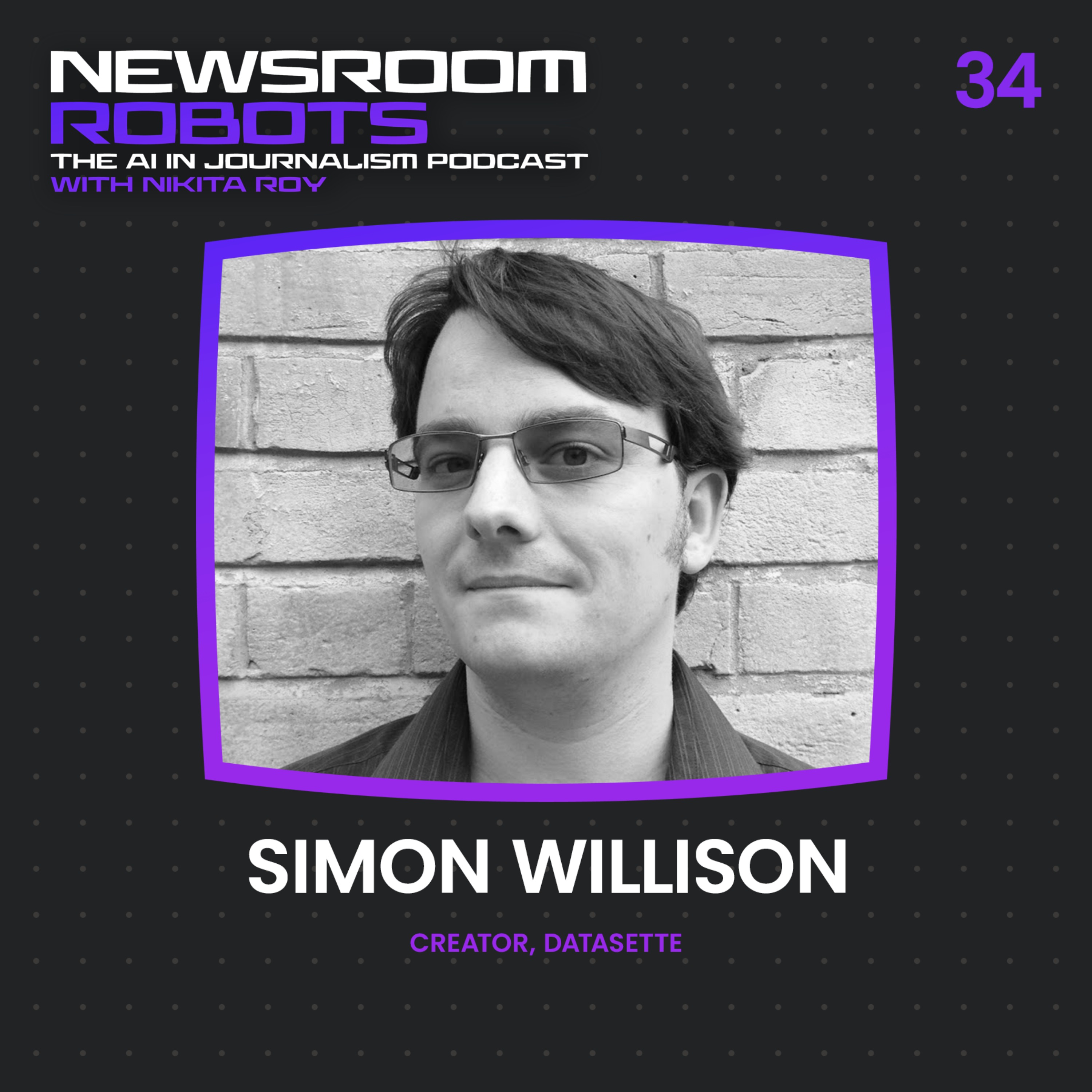
Ep 34Simon Willison: OpenAI's New Features & Security Risks of Large Language Models (Part 1)
Simon Willison, the creator of the open source data exploration and publishing tool Datasette, joins Nikita Roy to discuss the recent turmoil at Open AI and the new features unveiled at OpenAI’s first developer conference earlier this month.They discuss the security risks inherent in generative AI applications and explore the usefulness of small language models for journalists, particularly for analyzing sensitive data on personal devices.Simon, a former software architect at The Guardian and JSK Fellow at Stanford University, currently works full-time to build open-source tools for data journalism. Prior to becoming an independent open source developer, Simon served as an engineering director at Eventbrite. He is also renowned for his work as the co-creator of the Django Web Framework, a key tool in Python web development.🎧Tune in for a detailed exploration of the latest features from OpenAI🔔 Course registration is now open. Sign up for Wonder Tools X Newsroom Robots Generative AI for Media Pros Masterclass. A Live Cohort-Based Course taught by Jeremy Caplan & Nikita Roy. Sign up here.✉️ Newsroom Robots now has a newsletter! Sign up here. Hosted on Acast. See acast.com/privacy for more information.
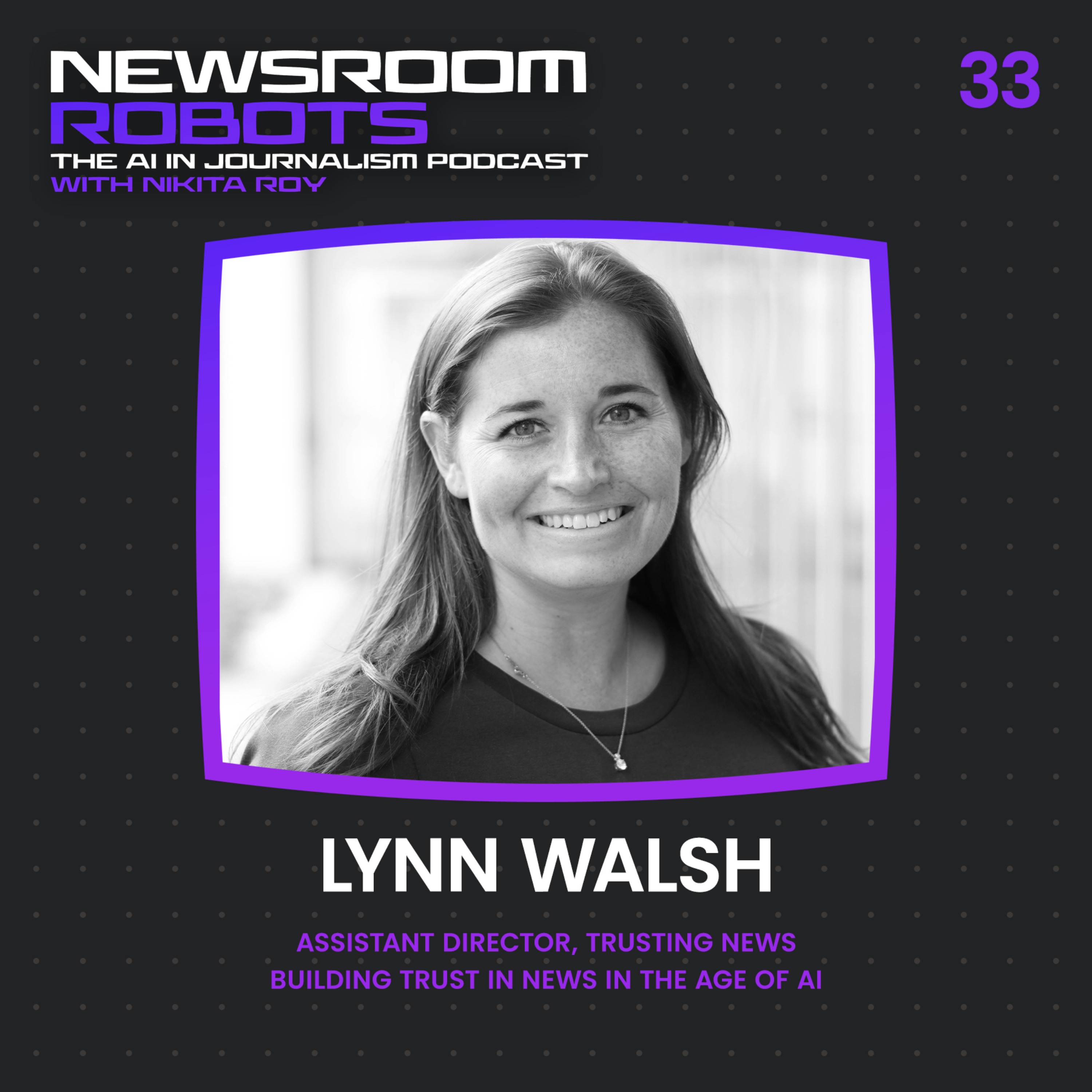
Ep 33Lynn Walsh: Building Trust in News in the AI Era
Lynn Walsh, the Assistant Director of Trusting News, joins Nikita Roy to discuss how newsrooms should think about their relationship with audiences when adopting AI. She also highlights opportunities to use AI to enhance trust and engagement with the news.Lynn is an Emmy Award-winning journalist who has worked in investigative, data and TV journalism for over 15 years. Currently at Trusting News, she works to help rebuild trust between journalists and the public. She is also an adjunct professor at Point Loma Nazarene University and a past national president and Ethics Chair for the Society of Professional Journalists.🎧 Tune in for insights on how newsrooms can put in place guidelines for experimenting with AI responsibly and ethically.🔔 Course Registration is Now Open. Sign up for Wonder Tools X Newsroom Robots Generative AI for Media Pros Masterclass. A Live Cohort-Based Course taught by Jeremy Caplan & Nikita Roy. Sign up here.✉️ Newsroom Robots now has a newsletter! Sign up here. Hosted on Acast. See acast.com/privacy for more information.
Ep 32Mario Garcia: How AI is Unleashing New Creative Potentials in Journalism
Dr. Mario R. Garcia, Senior Adviser on News Design and Adjunct Professor at Columbia University, joins Nikita Roy to discuss how artificial intelligence is revolutionizing news design and creating new opportunities for visual storytelling.Mario shares insights from his extensive research and his new book, 'AI: The Next Revolution in Content Creation,' on how AI is being applied in newsrooms globally.Mario offers his perspective on the emerging skill of prompt engineering and discusses ways in which journalism educators can teach the responsible use of AI.Mario is the CEO and Founder of Garcia Media, a global consulting firm, and has been involved in redesigning and rethinking more than 700 publications across 120 countries, including notable ones like The Wall Street Journal and The Washington Post. He is also the author of 15 books.He is a recipient of the Lifetime Achievement Award from the Society for News Design, the Journalism Medal of Honor from the University of Missouri for Distinguished Service in Journalism, and the Charles O'Malley Award for Excellence in Teaching from the Columbia Scholastic Press Association. Additionally, People Magazine named him one of the 100 most influential Hispanics in the United States.🎧Tune in to discover how designers and illustrators can harness the power of generative AI, explore its applications in print journalism, and learn strategies for incorporating generative AI into classroom teaching.✉️ Newsroom Robots now has a newsletter! Subscribe to receive podcast summaries and be the first to know when a new episode is released. Sign up here.🔔 Introducing Generative AI for Media Pros Masterclass. A Wondertools + Newsroom Robots CollaborationA Live Cohort-Based Course taught by Jeremy Caplan & Nikita RoySign up to be the first to know when course registration opens. Hosted on Acast. See acast.com/privacy for more information.
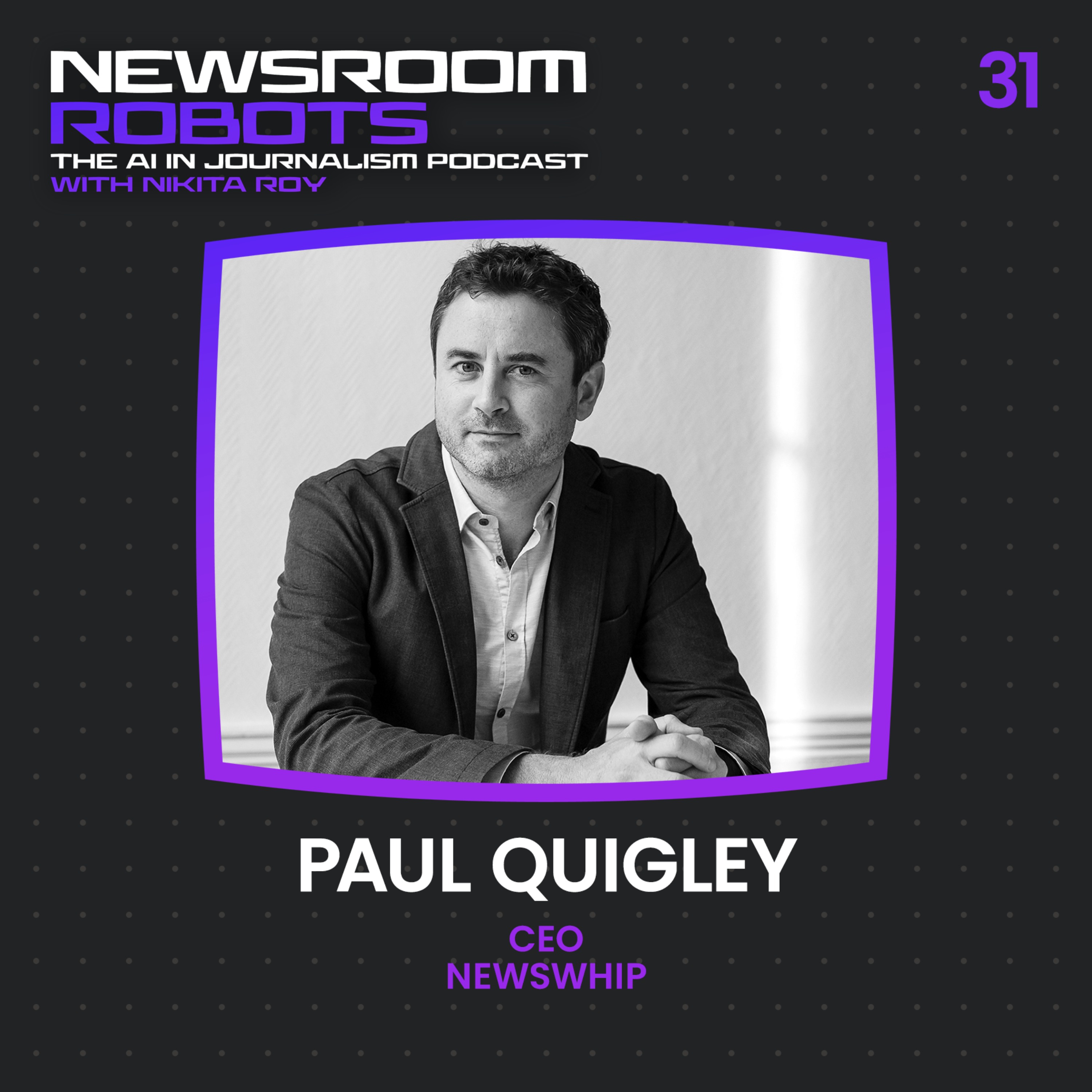
Ep 31Paul Quigley: How NewsWhip Uses AI to Help Newsrooms Predict Viral Stories
Paul Quigley, the CEO of NewsWhip, joins Nikita Roy to discuss how NewsWhip aids newsrooms in identifying trending stories and predicting viral news through real-time social media monitoring and analytics. He discusses how his team is integrating large language models and shares his perspective on the transformative impact that generative AI could have on the news media business model.NewsWhip, an innovative technology, is utilized by PR professionals and journalists in over 80 countries. Leading newsrooms, including the Associated Press, Reuters, and BBC, are among its users.NewsWhip provides low-cost access to its tools for numerous researchers, universities, and NGOs. Since 2017, NewsWhip has played a key role in tackling misinformation. It is utilized by the WHO and numerous fact-checking organizations to counter political disinformation.Before founding NewsWhip, Paul was an attorney based in New York City, specializing in international dispute resolution. He holds law degrees from Trinity College Dublin and an LLM in International Law from NYU. He is a winner of the Emerging EY Entrepreneur of the Year Award.🔔 Introducing Generative AI for Media Pros Masterclass. A Wondertools + Newsroom Robots CollaborationA Live Cohort-Based Course taught by Jeremy Caplan & Nikita RoyJeremy Caplan: Director of Teaching and Learning at the Craig Newmark Graduate School of Journalism at the City University of New York and the founder of Wondertools.Nikita Roy: Data scientist, journalist, media entrepreneur. Host of the Newsroom Robots podcast. She was a two-time semi-finalist in the Harvard President's Innovation Challenge at Harvard University's Innovation Labs and has led AI literacy workshops at places like the City University of New York's Craig Newmark Graduate School of Journalism, the International Center for Journalists, and the University of Toronto.Sign up to be the first to know when course registration opens. Hosted on Acast. See acast.com/privacy for more information.
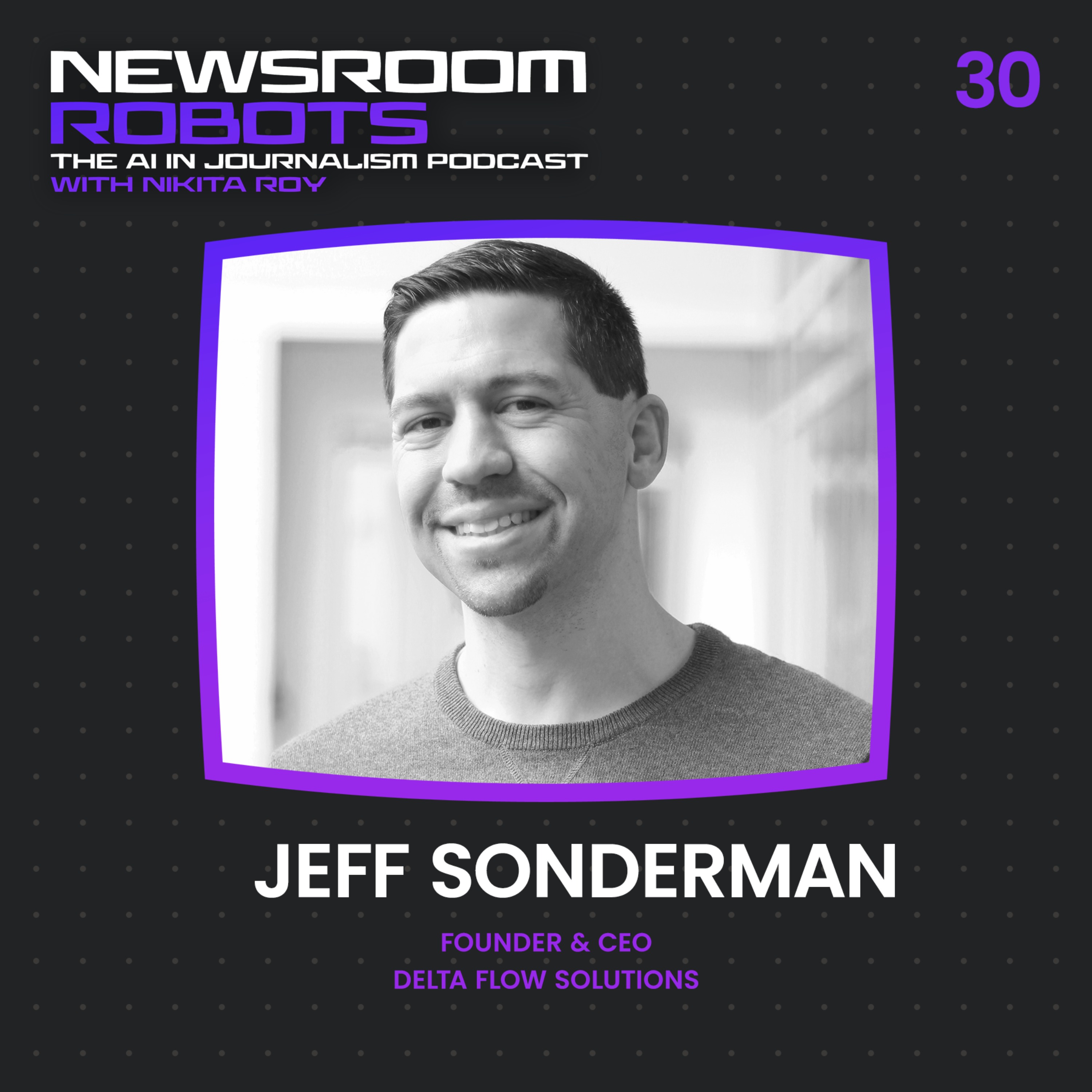
Ep 30Jeff Sonderman: Leveraging Generative AI to Optimize Business Processes
Newsroom Robots now has a newsletter! Subscribe to receive podcast summaries and be the first to know when a new episode is released. Sign up here.In this episode, Jeff Sonderman, the founder and CEO of Delta Flow Solutions, joins Nikita Roy to discuss the transformative potential of generative AI in streamlining business operations across analytics, marketing, product management, and content accessibility. Jeff also shares insights from his experiments with AI, particularly in converting unstructured data from PDFs into hyperlocal news reports.Jeff is the former Deputy Executive Director of the American Press Institute, where he created the Metrics for News analytics software, revolutionizing audience data for over 200 news enterprises, and invented the Source Matters software to enhance source diversity in newsrooms. He has been a Media Transformation Challenge fellow at the Harvard Kennedy School Executive Education and continues to blend innovation with journalism.Tune in for an episode to brainstorm diverse use cases, demonstrating how generative AI can be a game-changer on both the business and product side of running a newsroom. 🔔 Introducing the Generative AI for Media Professionals Masterclass.A live cohort based coursed taught jointly by Jeremy Caplan and Nikita Roy.Sign up to be the first when course registration goes live.Jeremy Caplan is the Director of Teaching and Learning at the Craig Newmark School of Graduate Journalism at the City University of New York and the founder of Wondertools.Nikita Roy is a data scientist, journalist and media entrepreneur. She hosts the Newsroom Robots podcast and has taught AI literacy workshops for the Craig Newmark School of Graduate Journalism at the City University of New York, International Center for Journalists and University of Toronto. Hosted on Acast. See acast.com/privacy for more information.
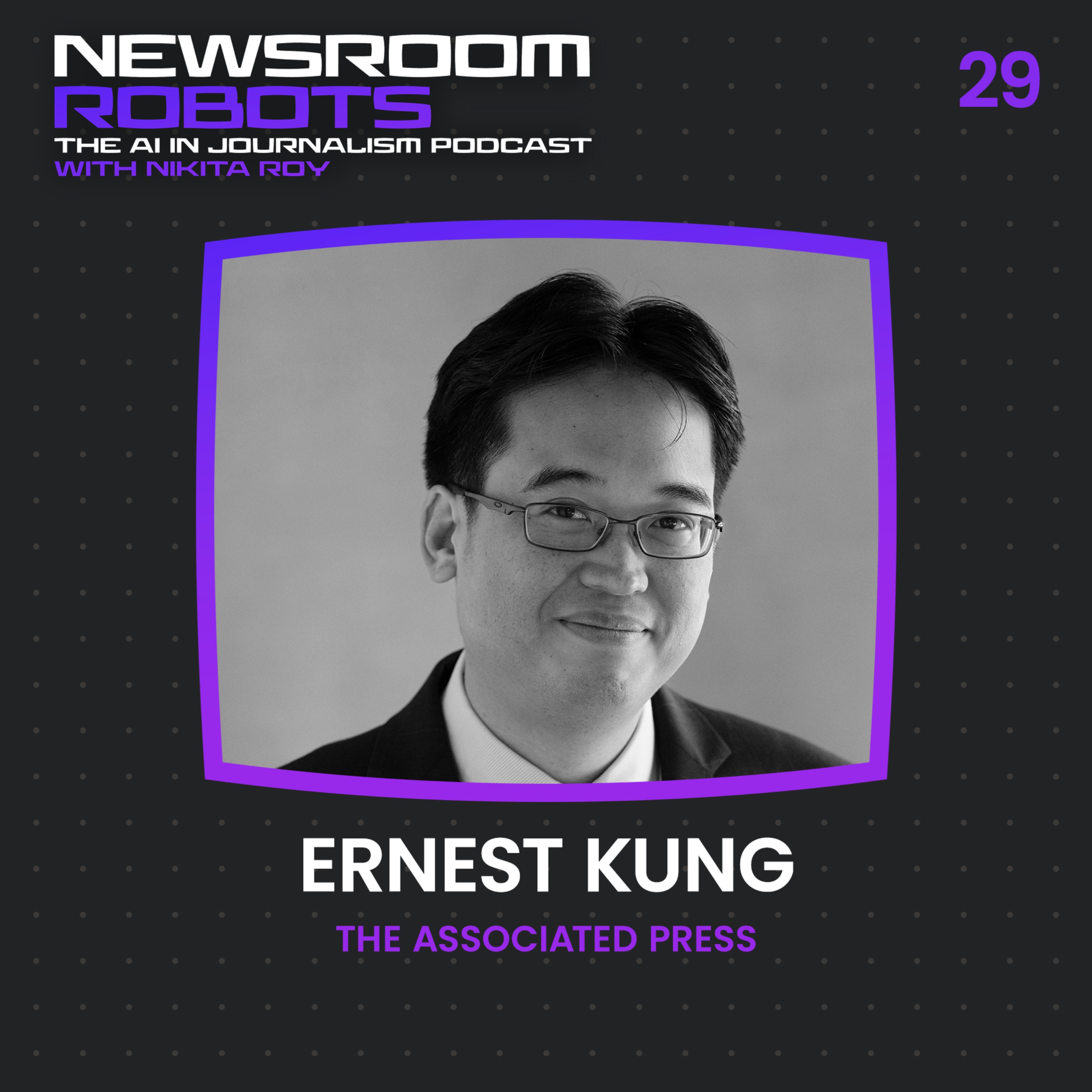
Ep 29Ernest Kung: How The Associated Press Built Five AI Tools for Local Newsrooms
Ernest Kung, the AI Product Manager for The Associated Press joins Nikita Roy to share how the AP has been helping local newsrooms implement artificial intelligence into their workflows as part of the Local News Initiative. He also discusses the deal that AP signed with OpenAI and the newsroom’s recently published AI guidelines. Before joining the AP, he was an award-winning local television news producer and writer. Ernest pursued a master's degree to shift into the technology development side of news to make it easier for journalists to do their jobs. He earned a Master of Business Information Systems with Distinction from the University of Canterbury where his research project was on AI for journalism in Aotearoa New Zealand. Ernest worked for 15 years in the newsrooms of CBS-owned and affiliated stations in Los Angeles, San Diego and Portland, Oregon. He also holds a BA in Broadcast Journalism from the University of Southern California. Hosted on Acast. See acast.com/privacy for more information.
Ep 28Charlie Beckett & Munmun De Choudhury: The Role of the News Industry in Safeguarding Democracy in the Age of AI-Generated Misinformation (Recorded at Online News Association's Onward 2023)
Charlie Beckett, Professor and Founding Director of Polis, the international journalism think tank at the London School of Economics and Munmun De Choudhury, Associate Professor of Interactive Computing at Georgia Institute of Technology, join host Nikita Roy in this episode. Together, they explore the intricacies of AI-generated misinformation, its potential implications on election and the role of the news industry in keeping the public informed and safeguarding democracy. This episode is a recording of the virtual panel at the Online News Association's Onward 2023 event on September 29, 2023.Charlie Beckett is a professor in the Department of Media and Communications at the London School of Economics.He currently leads the Polis Journalism and AI project. Charlie was director of the LSE’s Truth, Trust and Technology Commission that reported on the misinformation crisis in 2018. He was an award-winning journalist at LWT, BBC and ITN. He began his news career on the South London Press and ended it as a programme editor at Channel 4 News.Munmun De Choudhury is an Associate Professor of Interactive Computing at Georgia Tech. Associate Professor of Interactive Computing at Georgia Tech. She is best known for laying the foundation of a new line of research that develops computational techniques for understanding and improving mental health outcomes through the ethical analysis of social media data. Munmun's work has been recognized by multiple awards and recognitions, and her research has contributed to the Office of the U.S. Surgeon General's Advisory on The Healing Effects of Social Connection. Munmun serves on the Board of the International Society for Computational Social Science. She is on the National Academies of Sciences, Engineering, and Medicine committee examining research on social media's impact on the well-being of young people. Tune in for a comprehensive discussion on the evolving role of the news industry in the AI era and its pivotal role in safeguarding democracy.🔔 Introducing the Generative AI for Media Professionals Masterclass.A live cohort based coursed taught jointly by Jeremy Caplan and Nikita Roy.Sign up to be the first when course registration goes live.Jeremy Caplan is the Director of Teaching and Learning at the Craig Newmark School of Graduate Journalism at the City University of New York and the founder of Wondertools.Nikita Roy is a data scientist, journalist and media entrepreneur. She hosts the Newsroom Robots podcast and has taught AI literacy workshops for the Craig Newmark School of Graduate Journalism at the City University of New York, International Center for Journalists and University of Toronto. Hosted on Acast. See acast.com/privacy for more information.
Ep 27Uli Köppen & Miranda Marcus: Approaches In AI Innovation From Two of Europe's Public Broadcasters (Recorded at Online News Association's Onward 2023)
Uli Köppen, Head of AI + Automation Lab and Co-Lead of BR Data at Germany's Public Broadcaster Bayerischer Rundfunk (BR), and Miranda Marcus, Head of BBC News Labs, join Nikita Roy for a conversation on how AI has been a part of their newsrooms. This episode is a recording of the virtual panel at the Online News Association's ONWARD-2023 event on September 28, 2023.Uli Köppen is Head of the AI + Automation Lab and Co-Lead of the investigative data team BR Data at Germany's Public Broadcaster Bayerischer Rundfunk. In this role, she's working with interdisciplinary teams of journalists, coders, and product developers. She and her teams are investigating AI and automation for algorithmic accountability reporting, as well as using this technology for data-driven journalistic products. The teams are building on the lab experience to form strategy for using AI and automation for journalism. As a Nieman Fellow 2019, she spent an academic year at Harvard and MIT, and she was part of the Online News Association's Women's Leadership Accelerator 2022. Together with her colleagues, she has won many national and international awards.Miranda leads BBC News Labs, an interdisciplinary innovation team that combines software engineering and journalism. The team works collaboratively across BBC News, World Service, and BBC Product to explore topics from automation in authoring, addressing news avoidance and data-driven newsgathering. They develop and test prototypes with journalists and audiences to inform long-term strategy and the production of innovative content in the short term. Miranda’s background combines design, AI research, data policy, digital innovation, and social science.Tune into this episode to hear about how two of Europe’s most prominent public broadcasters have been integrating AI. 🔔 Introducing the Generative AI for Media Professionals Masterclass.A live cohort based coursed taught jointly by Jeremy Caplan and Nikita Roy.Sign up to be the first when course registration goes live.Jeremy Caplan is the Director of Teaching and Learning at the Craig Newmark School of Graduate Journalism at the City University of New York and the founder of Wondertools.Nikita Roy is a data scientist, journalist and media entrepreneur. She hosts the Newsroom Robots podcast and has taught AI literacy workshops for the Craig Newmark School of Graduate Journalism at the City University of New York, International Center for Journalists and University of Toronto. Hosted on Acast. See acast.com/privacy for more information.
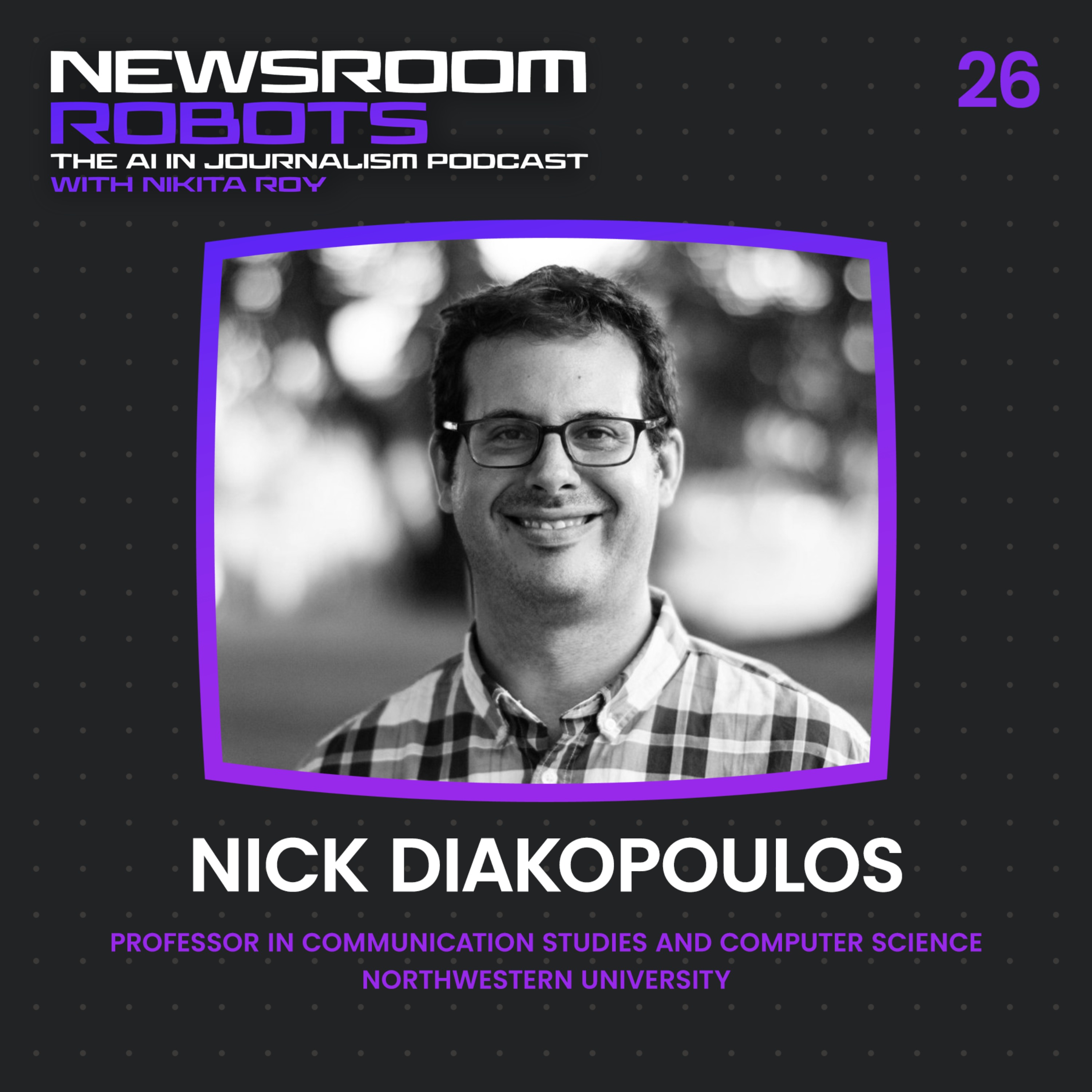
Ep 26Nick Diakopoulos: The Potential of Fine-Tuning Large Language Models on Newsroom Data
Nick Diakopoulos, Communication Studies and Computer Science Professor at Northwestern University joins Nikita Roy to discuss the opportunities fine-tuning Large Language Models offer for news organizations, and the impact of generative AI on news production and the broader information ecosystem. Nick directs the Computational Journalism Lab and is Director of Graduate Studies for the Technology and Social Behavior doctoral program. He's also the author of the award-winning book "Automating the News: How Algorithms are Rewriting the Media," published by Harvard University Press. His research focuses on computational journalism, including automation and algorithms in news production and algorithmic accountability and transparency. Thoughts or questions? You can reach us here. Hosted on Acast. See acast.com/privacy for more information.
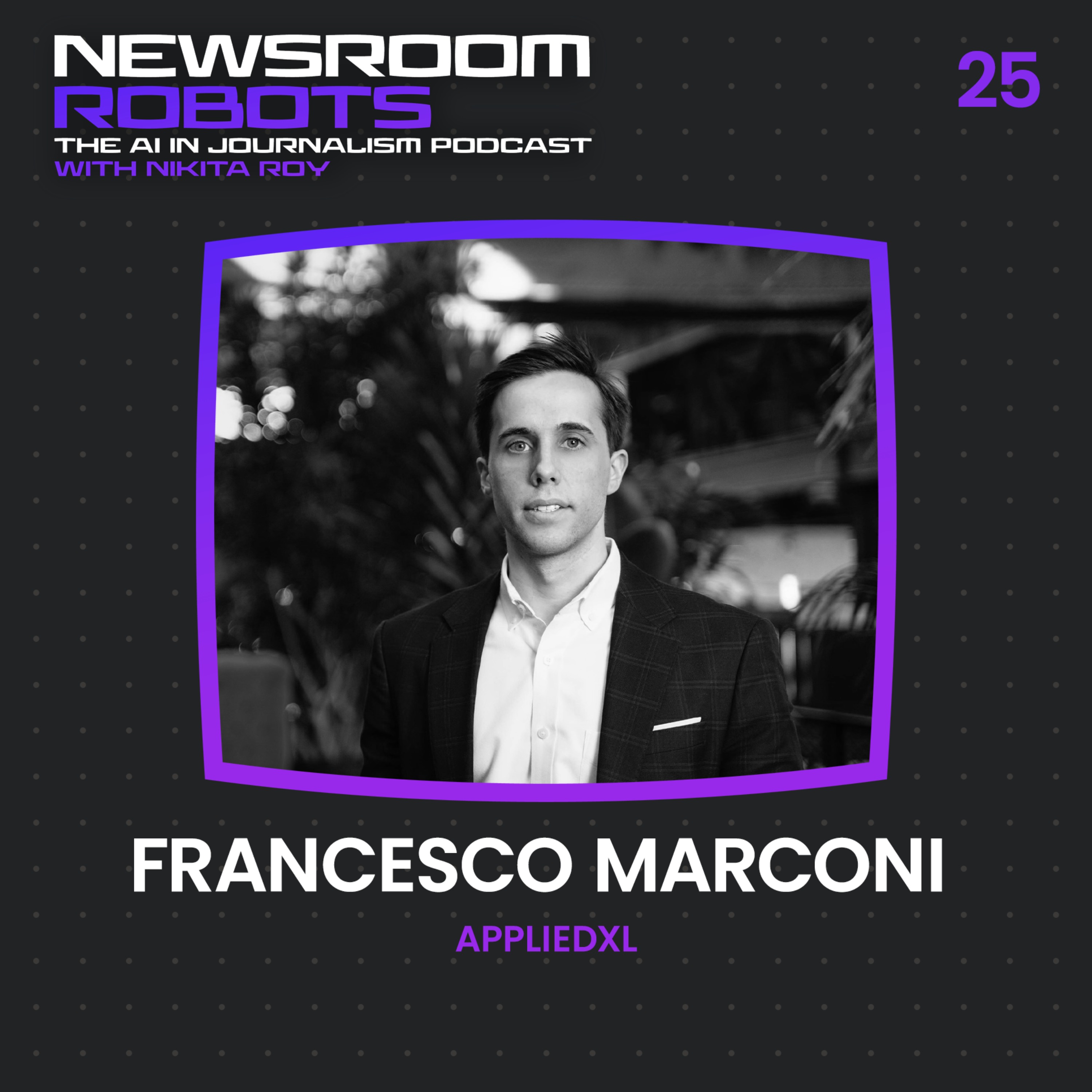
Ep 25Francesco Marconi: Opportunities and Challenges of Large Language Models in Journalism
Francesco Marconi, the co-founder and CEO of AppliedXL, joins Nikita Roy to discuss the opportunities and challenges that Large Language Models present to the news industry, emphasizing the need for collaboration between tech companies and newsrooms. Francesco also covers copyright and data access challenges and proposes long-term business model innovations to support news organizations and the AI sector. He also shares how his company AppliedXL uses AI combined with human expertise to detect events in real-time biotech data and generate specialized reporting for STAT News.Francesco shares his perspective from years of experience leading AI initiatives at major news organizations. He served as the R&D Chief at The Wall Street Journal, leading a team of data scientists and computational journalists in developing AI-driven newsroom tools. Before that, he managed AI strategy at the Associated Press and co-led their content automation and artificial intelligence efforts. Francesco has been an affiliate researcher at the MIT Media Lab and a Tow Fellow at Columbia University. His work and ideas have been featured in The New York Times, The Wall Street Journal, Financial Times, Politico, Forbes, and the World Economic Forum. His book, "Newsmakers: Artificial Intelligence and the Future of Journalism," was published by Columbia University Press in 2020.On Tuesday, he testified before the UK Parliament's Communications and Digital Committee as an AI expert on Large Language Models. The committee held evidence sessions exploring the benefits of LLMs to the UK economy, their immediate risks, potential catastrophic impacts, and the broader challenges posed by this technology.Thoughts or questions? You can reach us here. Hosted on Acast. See acast.com/privacy for more information.
Ep 24Chris Dinn: How a Toronto News Startup Developed an AI Chatbot to Analyze & Report on Municipal Budgets
Chris Dinn joins Nikita Roy to talk about building AI bots for his Toronto news startup, Torontoverse. Chris also explores the Online News Act's effects in Canada and AI's potential impact on the news industry.Chris is the Emmy award-winning founder and publisher of Torontoverse, a Toronto-based digital news startup harnessing cutting-edge technology for local news delivery. He earned his Emmy in Technology and Engineering for his contributions at mDialog, an innovator in integrating live video streams with advertisements, later acquired by Google.At 19, Chris entered the media realm, selling ads for his college newspaper. His zeal for innovation guided him to mDialog, where he was instrumental in reshaping the video ad landscape. Following its acquisition by Google, Chris dedicated six years as a software engineer focusing on publisher ads. In 2022, he launched his publishing venture, torontoverse.com.Referenced in the episode: Meet TorontoBot: Torontoverse’s AI-powered municipal budget analystTry out TorontoBotHow Torontoverse built their AI-powered newsletterThoughts or questions? You can reach us here. Hosted on Acast. See acast.com/privacy for more information.
Ep 23Mark Hansen: How Generative AI Can Help With Data Journalism
Mark Hansen joins Nikita Roy to discuss how generative AI can enhance data journalism, particularly by accelerating coding tasks. The discussion also addresses bias and privacy concerns associated with AI models.Mark is the East Coast Director of The Brown Institute for Media Innovation, a collaborative initiative between Columbia Journalism School and Stanford's School of Engineering. Mark began his tenure at Columbia Journalism School over a decade ago, serving as a Professor and teaching computational and data journalism courses.An investigation in one of his classes examining the bot economy behind the sale of fake followers on Twitter garnered significant attention. It became a front-page story in the New York Times and was part of a package of stories that secured the 2019 Polk Award for National Reporting. Additionally, it was shortlisted for the 2019 Pulitzer Prize for National Reporting.Mark Hansen earned his Ph.D. in Statistics from the University of California, Berkeley, and a BS in Applied Mathematics from the University of California, Davis.Referenced:Sorting Things Out: Classification and Its Consequences by Geoffrey C. Bowker and Susan Leigh StarSeeing Like a State: How Certain Schemes to Improve the Human Condition Have Failed by James C. ScottData Feminism by Catherine D'Ignazio and Lauren KleinThoughts or questions? You can reach us here. Hosted on Acast. See acast.com/privacy for more information.
Ep 22Liam Andrew: Building a Data Infrastructure for AI Innovation at The Texas Tribune
Liam Andrew, the Chief Product Officer at The Texas Tribune joins Nikita Roy to discuss how they built a data warehouse and analytics hub to provide transparency around key metrics for their newsroom. Liam also shares how The Tribune has implemented tools like automatic content tagging and content recommendations using AI. In his role at the Tribune, Liam leads the newsroom's software strategy and operations, and oversees the engineering, design, and analytics teams. He joined the Tribune in 2015 as a developer, bringing a background in software engineering, product strategy, and user experience design from media startups and academic research labs. Tune in to hear how a non profit newsroom in the United States has been leading in AI adoption. Thoughts or questions? You can reach us here. Hosted on Acast. See acast.com/privacy for more information.
Ep 21Uli Köppen: Algorithmic Accountability, Generative AI and Automation in Journalism at Germany's Bayerischer Rundfunk (Bavarian Broadcasting)
Uli Köppen, head of the AI + Automation Lab at German Public Broadcaster Bayerischer Rundfunk, joins Nikita Roy to discuss how BR's newsroom has integrated AI across its entire news cycle. Uli shares her team's work on algorithmic accountability, AI strategy, generative AI experiments, and their experience integrating AI in the newsroom.Uli also co-leads BR Data, the newsroom's investigative data team. The award-winning team at BR Data is pioneering the future of AI in journalism, drawing upon the experience of journalists, coders, and product developers to specialize in investigative data stories, interactive storytelling, and experimentation with AI. In 2019, she spent a year at Harvard and MIT as a Nieman Fellow, focusing on algorithmic accountability, machine bias, and automation in journalism. She also participated in the Online News Association's Women's Leadership Accelerator in 2022.Tune in to learn about advanced AI-driven media from one of Europe's leading voices in the field. Hosted on Acast. See acast.com/privacy for more information.
Ep 20Jeremy Caplan: Exploring the Landscape of AI Tools to Boost Productivity
Jeremy Caplan joins Nikita Roy to discuss the evolving landscape of AI tools by analyzing their use cases, addressing the challenges they present, and offering tips for enhancing productivity through strategic AI adoptionJeremy Caplan is the Director of Teaching and Learning at the Newmark Graduate School of Journalism at the City University of New York. He also leads the school's Entrepreneurial Journalism Creators Program — a 100-day online curriculum that guides independent journalists to build new ventures.Before transitioning to academia, Jeremy was a Time Magazine reporter writing about digital innovation. He is also the person behind Wonder Tools, a weekly newsletter that zeros in on the most useful digital tools to boost productivity. He studied public policy at Princeton University's Woodrow Wilson School and subsequently earned an MS in Journalism as a Knight-Bagehot Fellow at Columbia University and an MBA as a Wiegers Fellow at Columbia University.He is a violinist who formerly served as the Concertmaster of the International Symphony Orchestra in Israel. Tools discussed in this episode: ChatGPTClaudeBing ChatbotBardPoePersonal.aiWoebotCharacter.aiRunwayMLKapwingDescriptWotchit.aiSuperhumanBloks.app4149.aiSupernormalIntros.ai Hosted on Acast. See acast.com/privacy for more information.
Ep 19Scott Brodbeck: Early Experiments with Generative AI in Local News & Lessons Learned
Scott Brodbeck joins Nikita Roy to discuss his experiments using generative AI in his local newsroom, from creating completely AI-generated newsletters and AI-generated videos to ad copy and back-office support. He also shares his views for other small newsrooms looking to experiment with AI. Scott is the founder and CEO of Local News Now, which owns and operates three hyperlocal news websites in the United States, covering the Northern Virginia region. A former TV news writer and producer, Scott was also a founding board member of the Local Independent Online News Publishers (LION).Tune in to hear about Scott’s early experiments with generative AI in his newsroom. Thoughts or questions? You can reach us here. Hosted on Acast. See acast.com/privacy for more information.
Ep 18Elite Truong: From The Washington Post to American Press Institute, Leading AI Innovation in Newsrooms (Part Two)
In the second part of this episode with Elite Truong, she shares her work leading AI products like Metrics for News and Source Matters at the American Press Institute for local newsrooms. She shares how AI can help local news and her advice for product managers looking to incorporate emerging tech, like generative AI.Elite is the Vice President of Product Strategy at the American Press Institute. Formerly, she was the Director of Strategic Initiatives at The Washington Post. In the first part of the episode, she discussed her experience working on emerging technologies. Before joining The Post, Elite spent four years at Vox Media, three as the product manager for off-platform storytelling, primarily negotiating with tech platforms to create user experiences that benefited news consumers. She serves as the Board Secretary for the News Product Alliance and is on the advisory board for Democracy Day.Tune in for the second part of this episode with Elite and hear about her current work at The American Press Institute. Thoughts or questions? You can reach us here. Hosted on Acast. See acast.com/privacy for more information.
Ep 17Elite Truong: From The Washington Post to American Press Institute, Leading AI Innovation in Newsrooms (Part One)
Elite Truong joins Nikita Roy to delve into her journey of leading AI products, first at The Washington Post and now at the American Press Institute, in a special two-part episode. In part one, Elite shares insights from her work on Heliograf, The Washington Post's robot reporter that debuted in 2016. She discusses the evolution of the product under her leadership and explores the potential of computer vision in assisting journalists, particularly when covering traumatic events. Join us for part two of this episode, where we discuss her current role at the American Press Institute and her perspective on the potential applications of generative AI in newsrooms.Elite is the Vice President of Product Strategy at the American Press Institute, where she manages data products like Metrics for News and Source Matters that empower local newsrooms to make strategic decisions. Formerly, she was the Director of Strategic Initiatives at The Washington Post, where she led the newsroom R & D team to capture younger and more diverse audiences by creating projects driven by emerging technologies, including machine learning, artificial intelligence, 3D, and augmented reality. Before joining The Post, Elite spent four years at Vox Media, three as the product manager for off-platform storytelling, primarily negotiating with tech platforms to create user experiences that benefited news consumers.She serves as the Board Secretary for the News Product Alliance and is on the advisory board for Democracy Day.Don't miss out, as Elite recounts her initial experiences with AI product development at The Washington Post in this episode.Thoughts or questions? You can reach us here. Hosted on Acast. See acast.com/privacy for more information.
Ep 16Aimee Rinehart: How AI is Transforming News Production at The Associated Press and Beyond
Aimee Rinehart, the Senior Product Manager of AI Strategy for The Associated Press joins Nikita Roy to discuss how AP is using AI and the tools being built as part of AP’s Local News AI Initiative. Aimee shares AP's current approach of learning and experimentation with generative AI through projects around translation, image identification and search. Before joining AP, Aimee served as the Deputy Director of First Draft's New York Bureau, where she helped journalists and newsrooms navigate the mis- and disinformation during the 2018 and 2020 U.S. election cycles. In 2018, she managed Comprova, a project to monitor and analyze misinformation and disinformation around the 2018 Brazilian elections. Aimee started working online in 1996 and was a digital originator at The New York Times, and returned to print briefly as an editor at the Wall Street Journal Europe in Brussels.Tune in to hear how one of the largest news organizations is navigating the adoption of AI and automation technologies while also assisting local newsrooms. Thoughts or questions? You can reach us here. Hosted on Acast. See acast.com/privacy for more information.
Ep 15Mark Briggs: Creating an AI-Ready Newsroom Culture
Mark Briggs joins Nikita Roy to discuss the core components necessary for building an AI-ready newsroom culture. Mark also shares the findings of a recent survey on audience perceptions of using AI in news.Mark is the author of the widely-used book 'Journalism Next,' now in its fourth edition and used in colleges across the United States. He was a leadership and change management professor at the University of North Carolina, Chapel Hill, for six years. He will now teach a course on entrepreneurial journalism at the University of Washington in the fall. Mark has spent the past two decades championing digital transformation and innovation in the world of news.Tune in to hear Mark’s insights on how to prepare your newsroom for the AI revolution.Referenced in the episode: PoisedOasis AIThoughts or questions? You can reach us here. Hosted on Acast. See acast.com/privacy for more information.
Ep 14Dalia Hashim: Building an Ethical AI Strategy & Tips for Engaging with AI Vendors
Dalia Hashim joins Nikita Roy to unpack the nuances of incorporating AI into journalism. She provides critical questions to consider when engaging with AI vendors, elaborating on facets of clear communication, comprehension of tool limitations, and the importance of oversight. Dalia also delves into the ethical quandaries with AI use in newsrooms, particularly around potential job displacement. She offers insights on building an ethical AI strategy. Dalia also shares the future plans of Partnership on AI to help newsrooms.Dalia Hashim is the Program and Research Lead for AI and Media Integrity at Partnership on AI. She focuses on the intersection of AI and local news and works extensively on understanding how AI policies and interventions can minimize the harmful impact of AI in various industries. Before this role, Dalia made significant strides in AI policy development in the Ontario Government. As a founding member of their AI policy team, she helped write and pass Canada’s first digital law. Most recently, she served as a Senior Policy Advisor to Ontario’s Chief Digital and Data Officer, providing key insights on Ontario’s digital and data strategies.Referenced in the episode: Partnership on AI’s Responsible Practices for Synthetic MediaAI Tools for Local Newsrooms DatabaseThoughts or questions? You can reach us here. Hosted on Acast. See acast.com/privacy for more information.
Ep 13Santiago Lyon: How Adobe’s Content Authenticity Initiative is fostering digital provenance
Santiago Lyon joins Nikita Roy to discuss how Adobe's Content Authenticity Initiative is taking an active role in combating misinformation through digital content provenance. He discusses how Adobe addresses ethical issues and brings transparency to its AI-enabled products, like the new generative fill feature in Adobe Photoshop. He also touches upon the transformative impact of generative AI on the roles of creatives. Santiago Lyon is the Head of Advocacy and Education for the Adobe-led Content Authenticity Initiative. He has more than 35 years of experience in photography as an award-winning photojournalist, photo editor, media executive, and educator. As a photographer for Reuters and The Associated Press, he won multiple photojournalism awards for his coverage of conflicts around the globe. In 2003 he was a Nieman Fellow in journalism at Harvard University before being named Director of Photography at The Associated Press, a position he held until 2016. Under his direction, the AP won three Pulitzer Prizes for photography and multiple other major photojournalism awards worldwide. He was Chair of the Jury for the 2013 World Press Photo contest. Lyon serves on the boards of directors of the Eddie Adams Workshop and the VII Foundation. He also teaches regularly at the International Center of Photography in New York.Thoughts or questions? You can reach us here. Hosted on Acast. See acast.com/privacy for more information.
Ep 12Gregory Gondwe: Uncovering Stereotypes in Generative AI Models and How Journalists in sub-Saharan Africa Use ChatGPT
Dr. Gregory Gondwe joins Nikita Roy to discuss the embedded stereotypes and biases in Generative AI models that put the Global South at a disadvantage. He also shares his findings on how journalists in sub-Saharan Africa leverage ChatGPT, with insights derived from his recently published journal article, "CHATGPT and the Global South: how are journalists in sub-Saharan Africa engaging with generative AI?" Dr. Gregory Gondwe is an Assistant Professor of Journalism Studies at California State University, San Bernardino, and a Rebooting Social Media Visiting Scholar at Harvard University's Berkman Klein Centre for Internet and SocietyHe studies emerging media trends and their implications on society, particularly in Africa. His current projects include how people in sub-Saharan Africa use social media — particularly how individuals orchestrate online communities, outsmart government censorship and surveillance, and navigate through biased social media algorithms. His other works include cross-national studies on mis/disinformation in sub-Saharan Africa related to gender, geolocation, age, and media literacy. Dr. Gondwe’s research works have appeared in various peer-reviewed journals, including Digital Journalism, International Journal of Communication, Journalism Practice, Journalism Studies, International Communication Gazette, and African Journalism Studies. Hosted on Acast. See acast.com/privacy for more information.
Ep 11Ryan Restivo: Inside the Product Life Cycle of Building an AI-Powered SEO Tool
Ryan Restivo joins host Nikita Roy to discuss the product life cycle of building a generative AI product. As a Reynold’s Journalism Institute (RJI) fellow at the Missouri School of Journalism, Ryan developed YESEO. This free SEO slack tool uses Natural Language Processing and Generative AI to help newsrooms with SEO best practices. Since its launch in March, over 160 newsrooms have adopted the tool. Besides his work on YESEO, Ryan holds the Director of Product position at Newsday. He has more than a decade of industry experience in digital media.In this episode, we hear about Ryan’s journey building the YESEO app and explore the unique challenges and opportunities of building generative AI toolsThoughts or questions? You can reach us here. Hosted on Acast. See acast.com/privacy for more information.
Ep 10Jay Allred: How a Local Newsroom in Ohio Uses AI to Automate Sports Reporting
Jay Allred joins host Nikita Roy to share how his newsroom uses artificial intelligence to automatically generate sports content by converting data into news articles. Jay Allred is the CEO of Source Media Properties, a nationally recognized local news organization serving nearly half a million readers in Ohio in the United States. The Source newsrooms have become known for their tightly focused local coverage, entrepreneurial culture, and national leadership in audience engagement, revenue generation, and solutions journalism.Jay is also the co-founder of Lede AI, an artificial intelligence startup developed inside Source Media’s newsroom. Lede AI builds reliable, easy-to-use automation tools for newsrooms informed by the needs of readers, journalists, and communities. Jay serves as a board member of LION Publishers and was a 2022 Sulzberger Fellow at the Columbia Journalism School, where his project focused on the development of easy-to-use SAAS tools for local newsrooms around the globe. On today’s episode, Jay highlights his team’s journey building Lede AI, how his newsroom is carefully experimenting with generative AI, and discusses the future of the local news landscape. Hosted on Acast. See acast.com/privacy for more information.
Ep 9David Cohn: Copyright Challenges & Audience Engagement in AI-Era Newsrooms
David Cohn, the co-founder of Subtext joins host Nikita Roy in this episode to discuss the recent doomsday buzz surrounding AI, copyright challenges and how generative AI can change the way news publishers interact with their audiences. Over the past two decades David has worked at the intersection of technology and journalism, with a focus on new products, business models, audience growth, customer experience and incubating new companies. He helped pioneer crowdfunding at Spot.Us, explored mobile first news at Circa and led the charge into social video at AJ+. Today he is a co-founder of Subtext, a platform that lets news organizations, reporters and content creators text with their audience to increase audience engagement, develop new revenue or increase subscriber retention.Tune in to hear David’s perspective on the potential of AI to reshape the relationship between news publishers and their audience. Thoughts or questions? You can reach us here. Hosted on Acast. See acast.com/privacy for more information.
Ep 8Craig Newmark Graduate School of Journalism at CUNY Workshop: Empowering News Entrepreneurs with Generative AI
This episode features a workshop held by Newsroom Robots’ host Nikita Roy at the Craig Newmark Graduate School of Journalism at CUNY for the Entrepreneurial Journalism Creators Program. Focusing on the practical applications of generative AI tools, she explores how these advanced technologies can empower news entrepreneurs to streamline their workflows and shares numerous use cases for their implementation in the newsroom.Mentioned in this episode: The AI generated video produced for the workshopHow generative AI was used to create the Newsroom Robots podcast cover artUse case: Having ChatGPT act as a salesperson for a hyperlocal newsroomAI tools discussed:ChatGPT: Text generation tool by OpenAI.Writer: Another text generation tool geared towards businesses with a focus on privacy and a competitor to ChatGPTLumen5: Converts text to video.Eleven Labs: Text to speech voice generator.MidJourney: AI image generator.Poe MidJourney Prompt Bot: AI chatbot app to help you create MidJourney promptsDALL-E: Generates images from text powered by OpenAI.Bing Image Creator: Bing’s AI image generator based on text powered by OpenAIZapier: No-code automation tool that connects apps to create automated workflows.Thoughts or questions? You can reach us here. Hosted on Acast. See acast.com/privacy for more information.
Ep 7Ryan Serpico: Building Hearst Newspapers’ First Generative AI Tool
In today’s episode, Ryan Serpico joins host Nikita Roy to discuss how he built the first generative AI tool that is helping power local newsrooms across Hearst Newspapers. Ryan is Hearst Newspapers first AI and Automation Engineer, where he takes advantage of the latest developments in generative AI to empower journalists in Hearst Newspapers' local newsrooms across the country. Prior to moving into this role, he spent three years at the San Antonio Express-News, first as a digital producer and then as a graphics reporter. He graduated from the University of Florida in 2018 with a bachelor's degree in journalism in 2018. You can follow him on mastodon (https://mastodon.social/@ryan_serpico) and on Twitter (https://twitter.com/ryan_serpico).We also discuss Ryan’s transition from the editorial side of the newsroom to the technical side, how he views privacy concerns regarding generative AI and his advice for journalists looking to get more technical with AI. Thoughts or questions? You can reach us here. Hosted on Acast. See acast.com/privacy for more information.

Ep 6Bill Adair: AI-Generated Misinformation & The Future of Fact-Checking
Pulitzer Prize-winning journalist Bill Adair, the creator of PolitiFact and the co-founder of the International Fact-Checking Network joins host Nikita Roy to discuss the current state of misinformation in the age of generative AI and the role of journalism in combating it.Bill is a Knight Professor of Journalism and Public Policy at Duke University, where he researches new ways to expand fact-checking and combat misinformation. He is currently working on a book about lying in politics. We discuss the potential threats and opportunities that generative AI brings to the industry, the cutting-edge work at the Duke Reporters Lab using generative AI, and the future of automated fact-checking. Tune in to hear Bill's optimistic outlook on leveraging AI to safeguard our information ecosystem.Thoughts or questions? You can reach us here. Hosted on Acast. See acast.com/privacy for more information.
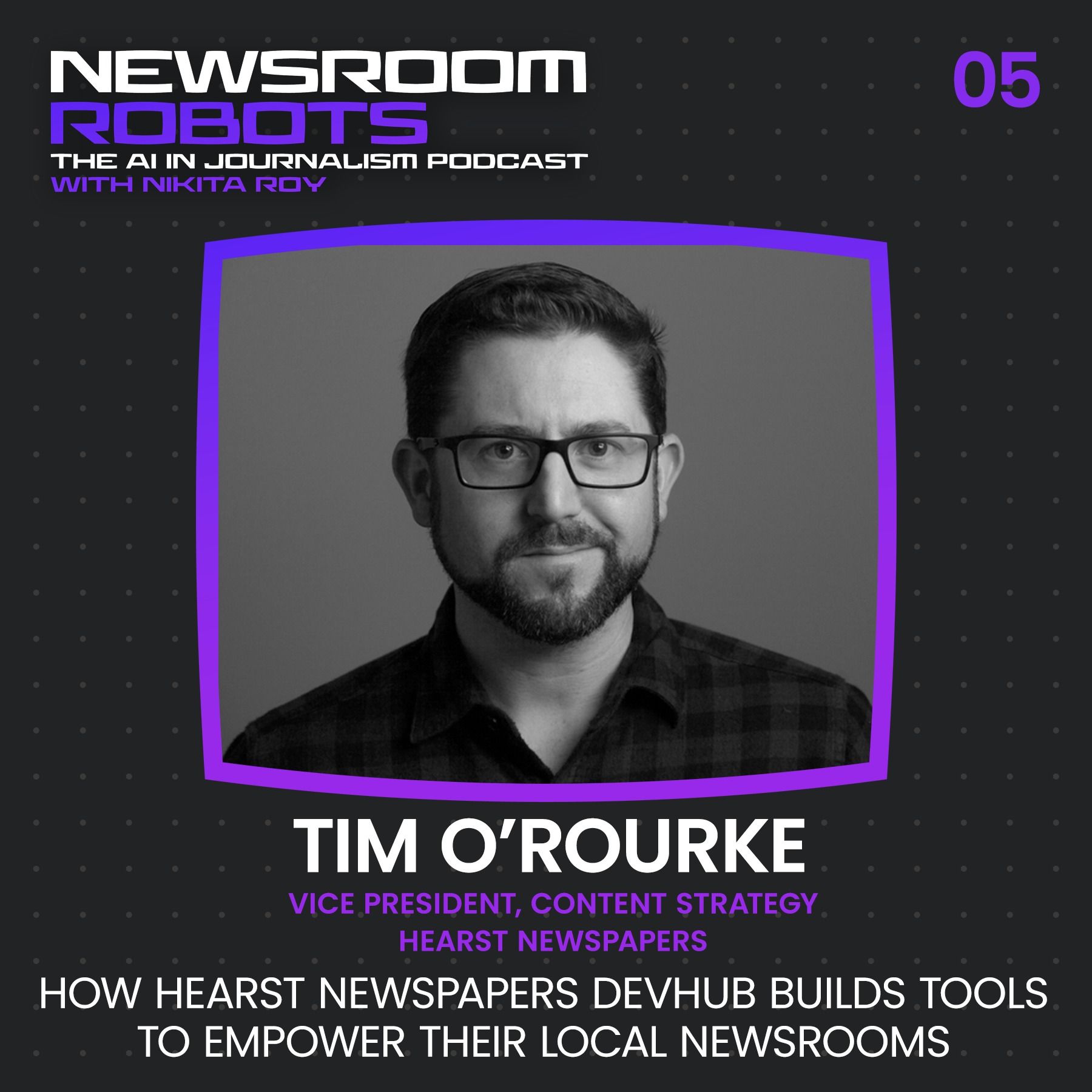
Ep 5Tim O’Rourke: How Hearst Newspapers DevHub Builds Tools to Empower Their Local Newsrooms
In this episode, Tim O'Rourke, the Vice President for Content Strategy at Hearst Newspapers, shares his experience leading the group's DevHub editorial engineering and content strategy team that partners with HNP's local newsrooms on innovative projects and growth strategies. Hearst Newspapers produces 24 daily and 52 weekly publications across the United States. Previously, Tim was the director of product and strategy for The San Francisco Chronicle. He supervised the newsroom's product, website+app, multimedia, and audio staff; directed data-driven coverage; and oversaw the development of interactive projects and journalistic tools for Hearst Newspapers. His former roles include The Chronicle's managing editor, digital; assistant managing editor, and the executive producer of SFChronicle.com. He came to The Chronicle as the senior news editor, responsible for the print front page and news operations. He also served as the night-breaking news editor and the department head for the copy and wire desks. He developed the yearlong Chronicle Covers front-page archive project and wrote the occasional craft beer story for the Food+Wine department.Before joining The Chronicle in 2013, O'Rourke worked as an editor and writer at the San Jose Mercury News, Contra Costa Times, Santa Barbara News-Press, Hartford Courant, and Diablo Magazine.Join us as Tim delves into how Hearst is building their AI strategy in the age of generative AI, looking at the impact of AI-driven chatbots, the opportunities and hurdles in creating AI-powered tools, and Hearst's foray into VR and news gamification. Hosted on Acast. See acast.com/privacy for more information.
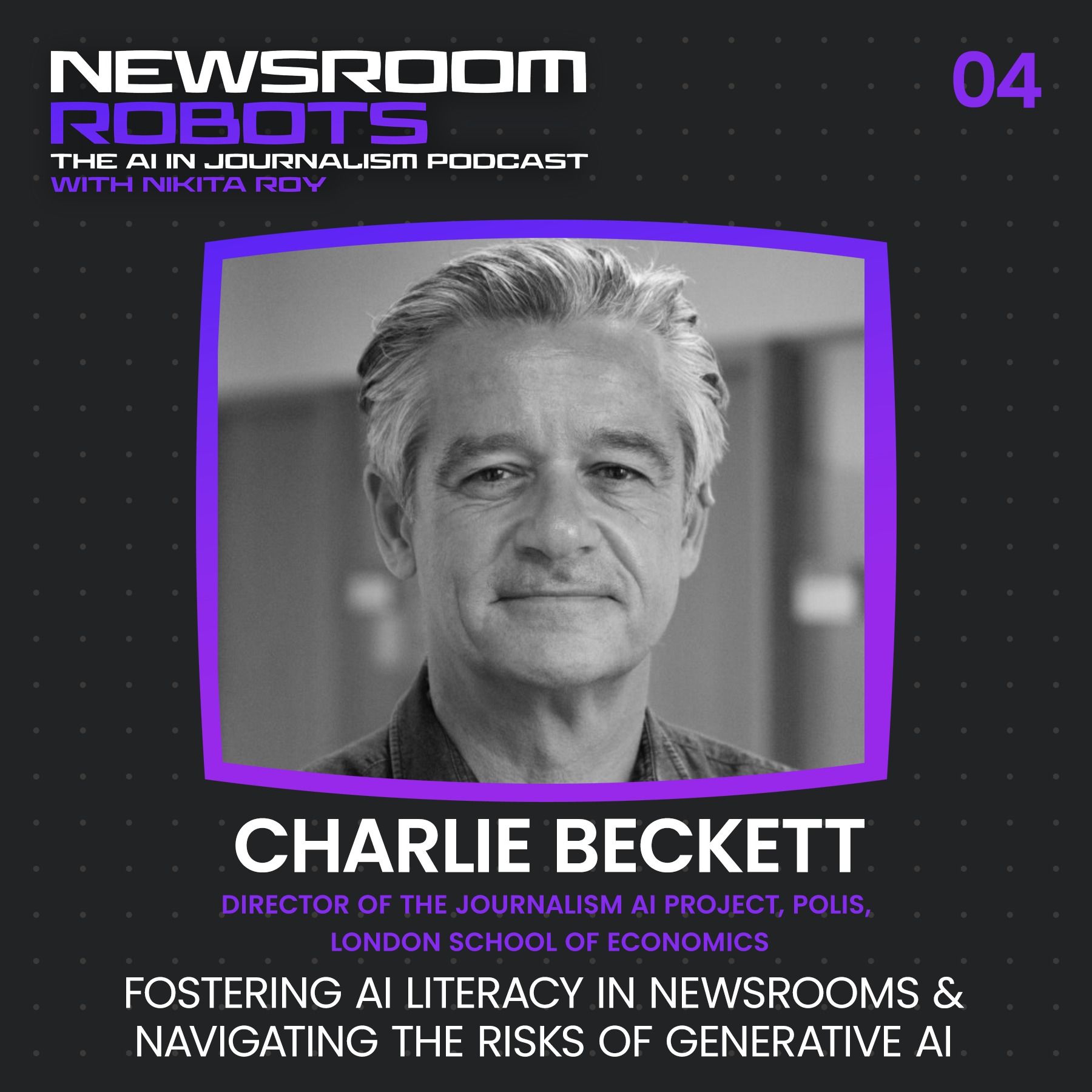
Ep 4Charlie Beckett: Fostering AI Literacy in Newsrooms and Navigating the Risks of Generative AI
In this episode, we explore the crucial considerations when developing an AI strategy and the potential risks of generative AI in the newsroom with Charlie Beckett, Director of the JournalismAI project at Polis – the international journalism think tank at the London School of Economics and Political Science(LSE). He is also a professor at LSE’s Department of Media and Communications. He was previously the director of LSE's Truth, Trust, and Technology Commission, which reported on the misinformation crisis in 2018. Charlie is the author of SuperMedia: Saving Journalism So It Can Save The World (Blackwell, 2008) and WikiLeaks: News In The Networked Era (Polity, 2012).Before LSE, Charlie was an award-winning journalist at LWT, BBC, and ITN, beginning his career at the South London Press and later a program editor at Channel 4 News.JournalismAI, a project of Polis supported by the Google News Initiative, is a global initiative committed to helping news organizations use artificial intelligence responsibly. By fostering innovation and capacity-building, JournalismAI aims to make the potential of AI more accessible and to address inequalities in the global news media related to AI. Through various programs, JournalismAI unites journalists and media professionals to discuss and explore AI, encouraging debates on AI's editorial, ethical, and financial implications on journalism.Join us as Charlie provides his valuable insights on the significance of AI literacy for journalists, the crucial questions to consider when developing an AI strategy for news organizations, the risks and potential limitations of generative AI, and the influence of AI-powered chatbots on search engine traffic.Be a part of the conversation on AI in journalism! Send us your questions here.Here’s a list of helpful resources concerning today’s episode:JournalismAI Case StudiesJournalismAI Starter Pack JournalismAI Discovery Course (Applications currently open)JournalismAI Survey Report (2019)Partnership on AI's Database of AI Tools for Local Newsroom Hosted on Acast. See acast.com/privacy for more information.
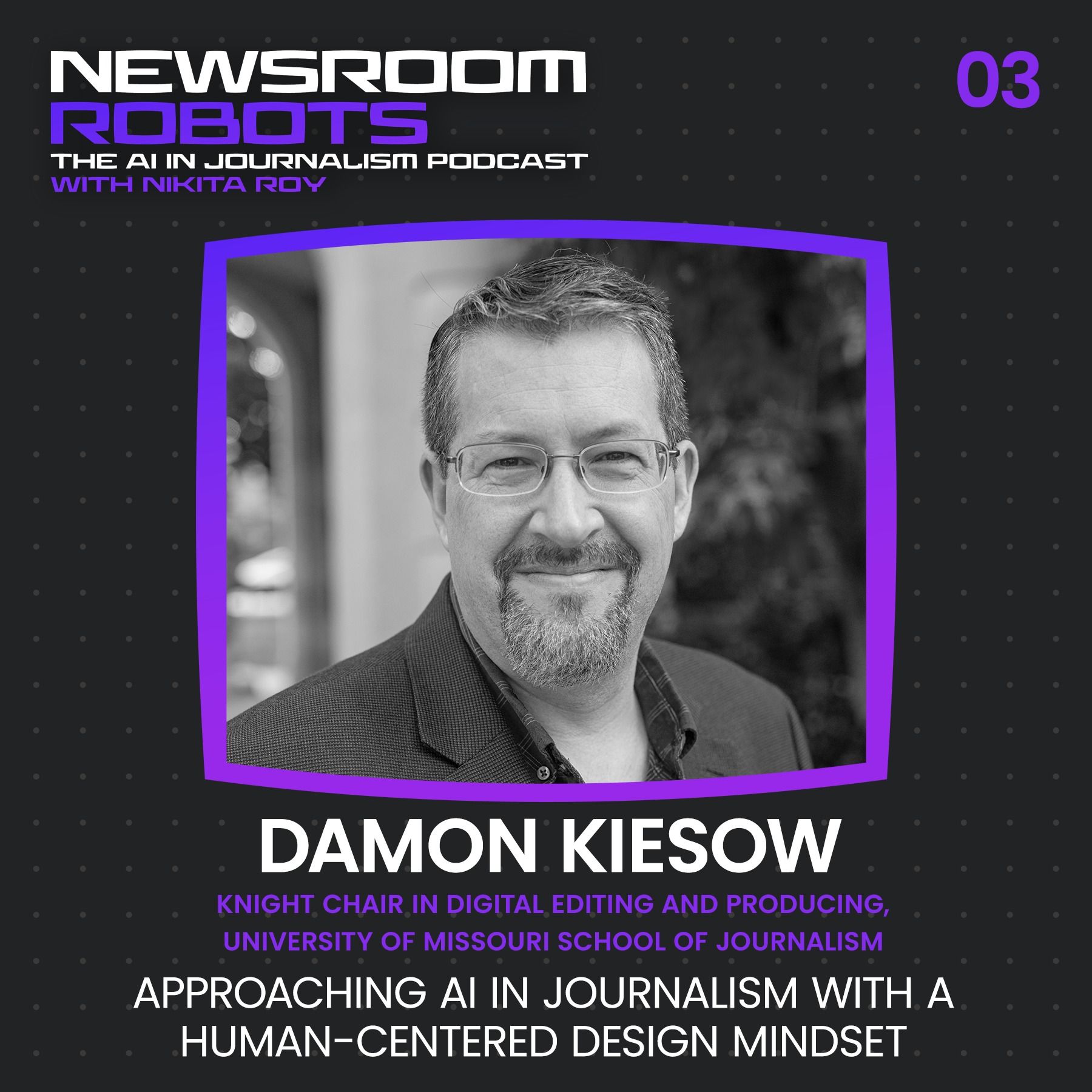
Ep 3Damon Kiesow: Approaching AI in Journalism with a Human-Centered Design Mindset
How can journalists adopt a human-centered design mindset when building AI-driven products, and what skills will the next generation of journalists need to succeed in an AI-powered newsroom? Today we’re joined by Damon Kiesow, a digital media pioneer specializing in aligning community information needs and business strategies to support sustainable local journalism. Damon shares his expertise as a professor at the Missouri School of Journalism, author of the first textbook in News Product Management, and co-founder of the International News Product Alliance. He is also the co-founder of the summer pop-up newsroom, the Missouri Information Corps, and the creator of an audience and product-focused diversity internship program in partnership with the Institute of Nonprofit News.Before joining Mizzou, Damon served as director of Product for McClatchy, where he created the company’s first Product Design and User Experience Research teams. Over at The Boston Globe, as a senior product manager, he helped guide the publication’s mobile strategy. In Nashua, New Hampshire, he served as the managing editor/online at The Telegraph, where he helped the Newsroom pursue a digital-first local news strategy — launching the newspaper’s first mobile app and video journalism efforts.In this episode, we get Damon’s views on how newsrooms can approach AI, delve into the importance of a human-centered design mindset when incorporating AI into newsrooms, and discuss the essential skills journalism students must develop to succeed in this evolving landscape. Be a part of the conversation on AI in journalism! Send us your questions here. Hosted on Acast. See acast.com/privacy for more information.
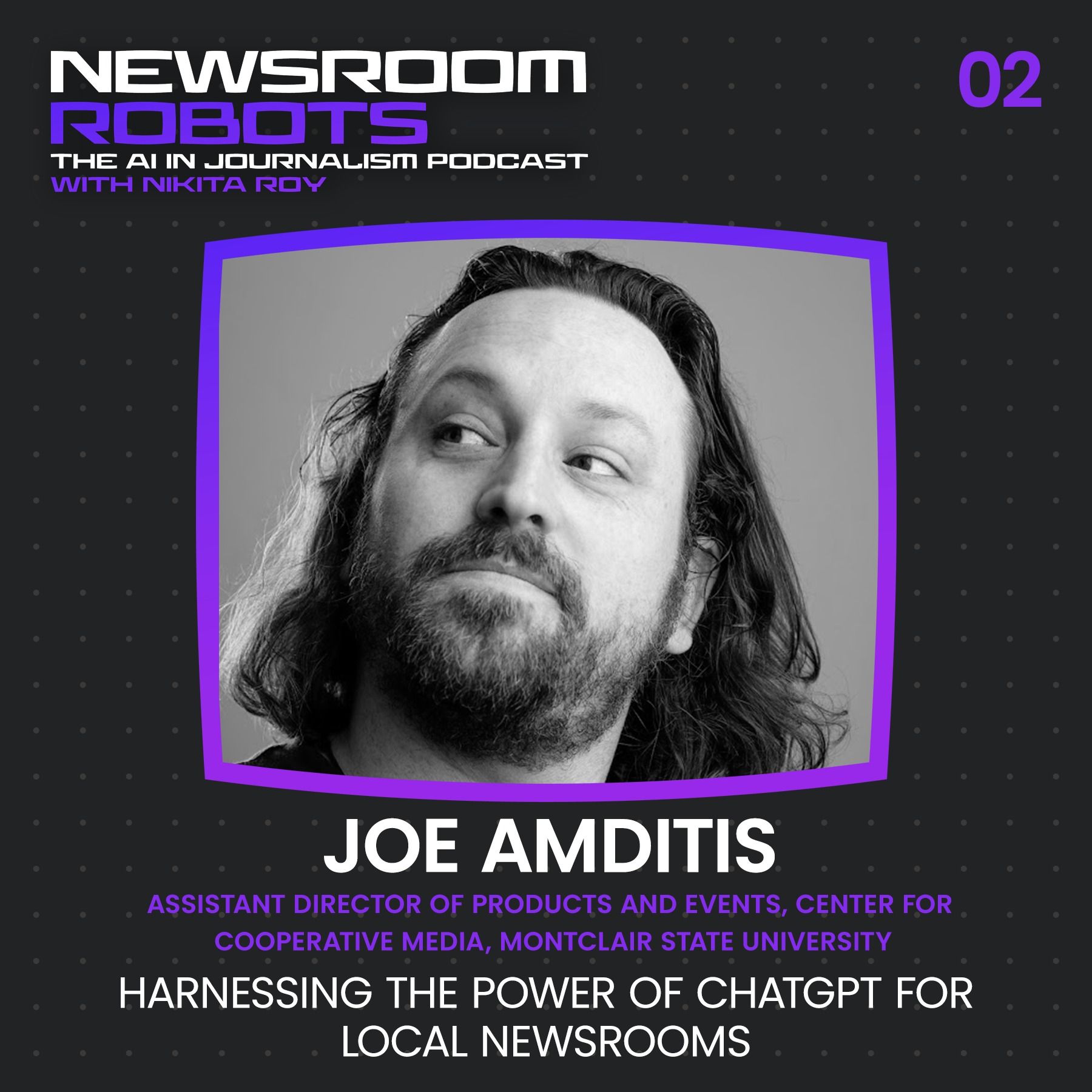
Ep 2Joe Amditis: Harnessing the Power of ChatGPT for Local Newsrooms
In this episode, we explore the potential of ChatGPT for local newsrooms with Joe Amditis, author of Beginner's Prompt Handbook: ChatGPT for Local News Publishers. Joe is the Assistant Director of Products and Events at the Center for Cooperative Media at Montclair State University, an Adjunct Professor at the School of Communication and Media, and the producer and host of the WTF Just Happened Today podcast. Joe, a veteran of the NJ Army National Guard, was deployed to Iraq in 2008 and his unit was activated to help with Hurricane Irene relief efforts in 2011. He earned a BA in political science and criminal justice from Rutgers in 2013 and an MA in engaged journalism from the Newmark Graduate School of Journalism at CUNY in 2016. He was co-founder and director of operations of Muckgers, an award-winning, student-focused investigative news outlet, until 2014.Joe has also coordinated several collaborative reporting projects, including Democracy Day, a nationwide reporting collaborative involving 300+ newsrooms across the United States.We explore the exciting world of ChatGPT and its potential to revolutionize local journalism, discussing the transformative power of generative AI, ethical considerations, prompt engineering, and the future of local newsrooms in the age of AI. Joe can be reached at [email protected] and on Twitter at @jsamditis.Here’s a list of helpful resources concerning today’s episode:Beginner's Prompt Handbook: ChatGPT for Local News Publishers (Center for Cooperative Media) - Discover Joe's comprehensive guide to using ChatGPT in local newsrooms.Giant List of Useful Tools and Websites (Center for Cooperative Media) - A treasure trove of tools and resources for newsroom operations.Template: ChatGPT Usage and Newsroom Ethics Policy (Center for Cooperative Media) - This template facilitates transparency in newsrooms' ethics policies regarding the use and disclosure of generative AI.Trusting News Newsletter (Trusting News) - Stay informed about building trust in journalism with this insightful newsletter.Journalism AI Starter Pack (LSE) - Get started with AI in journalism with this comprehensive resource from the London School of Economics.Be a part of the conversation on AI in journalism! Send us your questions here Hosted on Acast. See acast.com/privacy for more information.
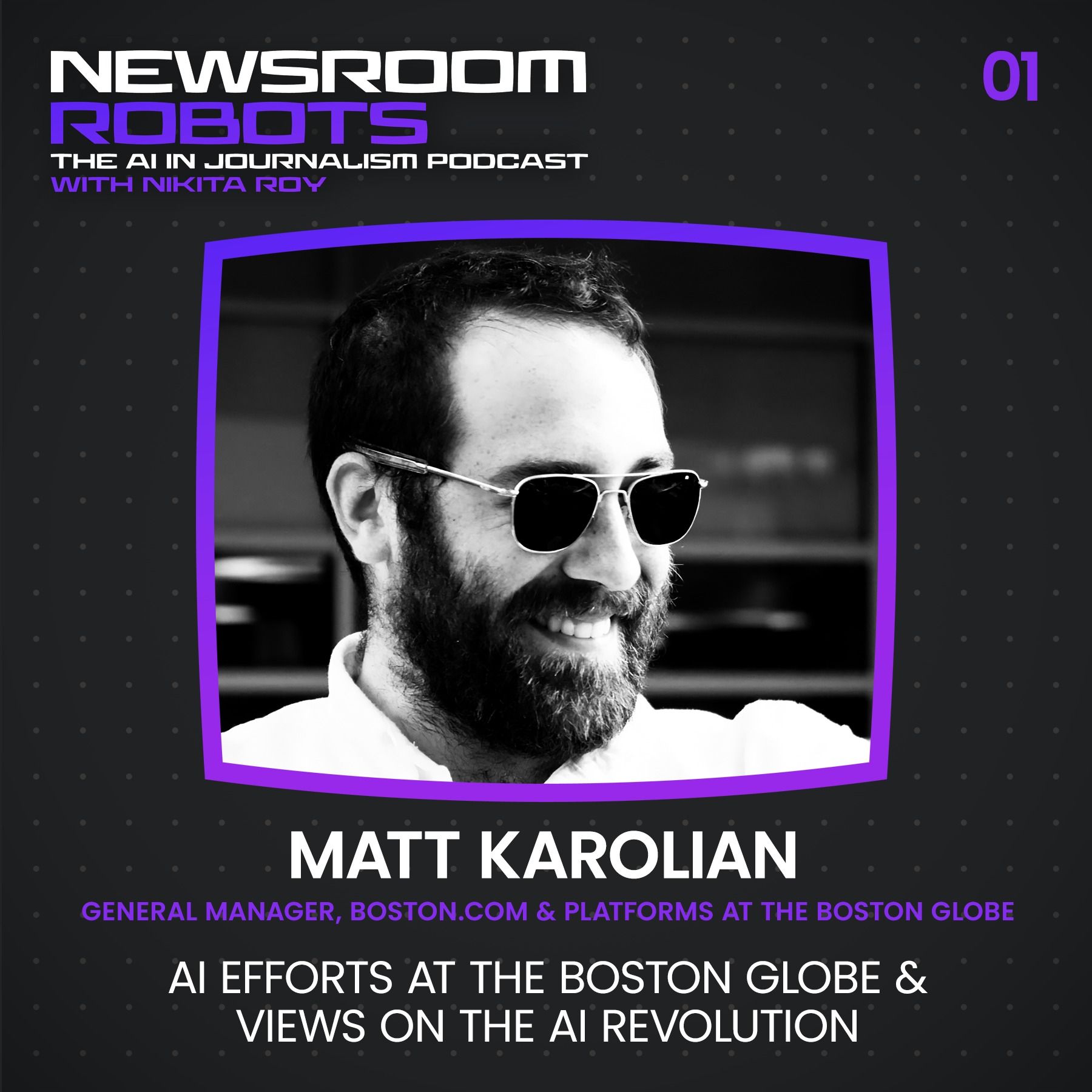
Ep 1Matt Karolian: AI Efforts at The Boston Globe and Views on the AI Revolution
As AI technology rapidly evolves, how will it transform journalism and newsrooms? In our first episode, we delve into the intersection of AI and journalism with our guest, Matt Karolian, General Manager of Boston.com and Platforms at the Boston Globe. In 2017, Matt spent a year at Harvard and MIT as a Nieman Fellow studying how AI and automation might impact the future of news, media, and publishing. He teaches Audience Engagement: Journalism in the Age of Google, Facebook, Twitter, and Apple at the Harvard Extension School.Join us for this insightful conversation as Matt shares his experience leading the AI efforts at The Boston Globe. He provides a unique perspective on how the news industry can adapt, innovate, and flourish in the age of AI. We explore the implications of generative AI on journalism, tackle concerns related to AI disclosure, trust, accuracy, and bias, and examine the impact of AI-powered search engines on search traffic for publishers.Be a part of the conversation on AI in journalism! Send us your questions here. Hosted on Acast. See acast.com/privacy for more information.
Introducing: Newsroom Robots with Nikita Roy
trailerHosted on Acast. See acast.com/privacy for more information.