Show overview
Newsroom Robots has been publishing since 2023, and across the 3 years since has built a catalogue of 87 episodes, alongside 1 trailer or bonus episode. That works out to roughly 65 hours of audio in total. Releases follow a fortnightly cadence.
Episodes typically run thirty-five to sixty minutes — most land between 35 min and 49 min — though episode length varies meaningfully from one episode to the next. None of the episodes are flagged explicit by the publisher. It is catalogued as a EN-language Technology show.
There hasn’t been a new episode in the last ninety days; the most recent episode landed 4 months ago. The busiest year was 2023, with 40 episodes published. Published by Nikita Roy.
From the publisher
Looking to explore the intersection of AI and journalism? Influential thought leaders in the industry join data scientist and media entrepreneur, Nikita Roy, each week to explore what's next with AI and its implications for the media landscape. In each episode, industry experts discuss how automated newsrooms have the potential to change journalism and uncover opportunities to optimize workflows and increase efficiency without compromising journalistic integrity. Hosted on Acast. See acast.com/privacy for more information.
Latest Episodes
View all 87 episodesKevin Delaney & Jim Friedlich: How The San Francisco Standard is Reinventing the News App
Kati Erwert & Tristan Loper: How The Seattle Times uses AI to drive revenue in local news
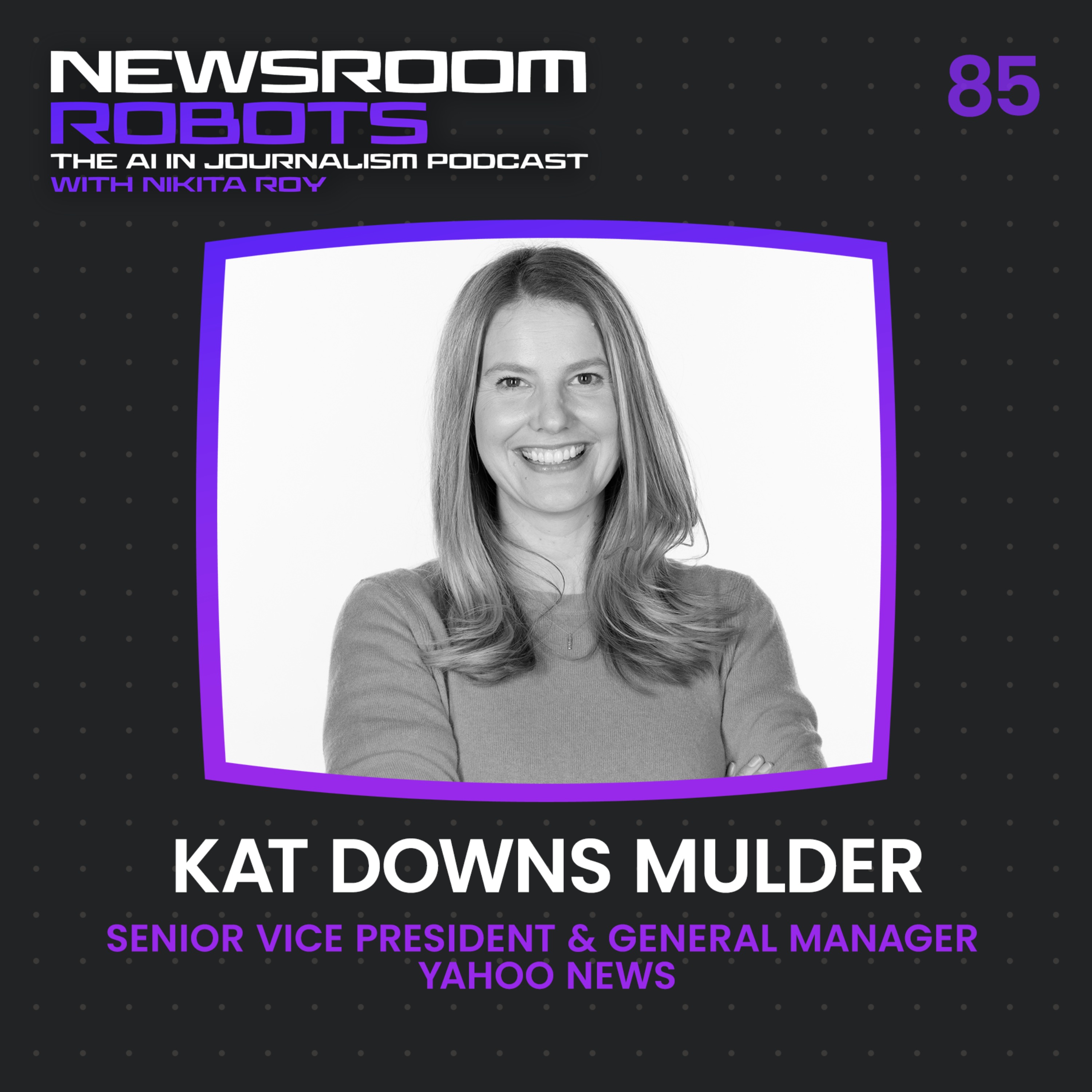
Ep 86Kat Downs Mulder: Inside Yahoo’s AI Strategy for the Future of News
For years, the aggregator model was simple: curate the best journalism from thousands of publishers and send audiences their way. Now that contract is being rewritten, and Yahoo News is one of the most interesting places to watch it happen.In this episode of Newsroom Robots, host Nikita Roy speaks with Kat Downs Mulder, Senior Vice President and General Manager of Yahoo News, about how the platform is layering AI across every surface of a product that reaches an estimated 180 million people in the U.S. alone each month. Kat previously spent more than 14 years at The Washington Post as chief product officer and managing editor before taking on the challenge of modernizing one of the internet's original news destinations.The conversation explores Yahoo's acquisition of Artifact, the AI news app built by Instagram's co-founders, which gave the platform a new recommendation engine that prioritizes time spent reading over clicks. It also digs into Yahoo Scout, the company's new AI answer engine that synthesizes information with rich citations and visual context, and an AI-powered daily audio digest designed to turn personalized news into a listening habit. Each of these products makes Yahoo more useful to its audience, but each also changes the relationship between Yahoo and the publishers whose journalism powers the platform.When an answer engine can deliver what a user needs without a click-through, when an audio digest summarizes a story so well the article never gets opened, and when personalization makes the aggregator the destination instead of the pass-through, the old economics stop working for publishers. Kat is candid that the compensation models haven't been figured out yet, noting that Yahoo is working with the Microsoft Publisher Content Marketplace to develop new frameworks, but that the industry is still writing those rules in real time.She makes a strong case for how Yahoo is approaching this differently, from how Scout prominently surfaces publishers to the rev-share model they operate, and why she believes the quality flywheel they are building actually rewards better journalism. Kat argues that original, distinctive journalism will become more valuable in an AI world because AI agents will seek out what is unique. This episode covers: 03:20 — Why Yahoo acquired Artifact and how it shifted recommendation algorithms 06:20 — The shift from click-based metrics to deeper engagement signals such as session time and retention 08:50 — Inside Yahoo Scout, Yahoo's new AI answer engine built to support publishers and the open web 12:40 — The changing economics of news as AI platforms begin generating answers instead of sending traffic 17:40 — Yahoo's personalized AI-generated audio news digest and why multimodal news experiences matter 22:00 — How Yahoo's editorial and AI teams collaborate on quality control at scale 31:00 — How AI is transforming newsroom product development and prototyping 36:10 — The tension between personalization and journalism's civic responsibility 40:00 — What smaller newsrooms can learn from their AI product playbookSign up for the Newsroom Robots newsletter for episode summaries and insights from host Nikita Roy. Hosted on Acast. See acast.com/privacy for more information.
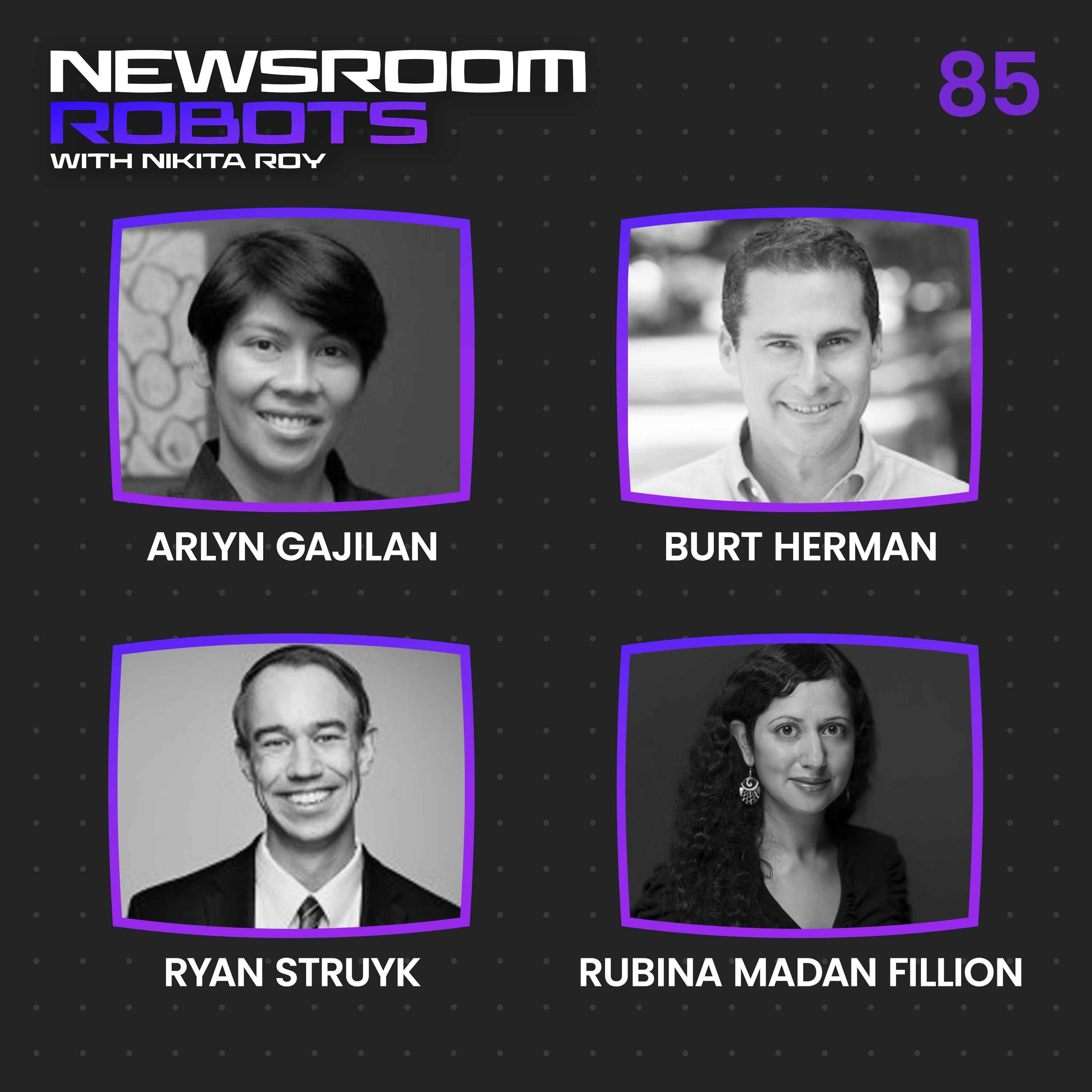
Ep 85CNN, The New York Times, Reuters, and Hacks/Hackers on AI in the Newsroom: In Conversation with Arlyn Gajilan, Burt Herman, Ryan Struyk and Rubina Madan Fillion
AI is settling in as infrastructure within newsrooms, a layer quietly reshaping how journalists discover information, how stories move through production, and how audiences increasingly expect news to reach them.In this episode of Newsroom Robots, recorded live in New York City at TV News Check’s News Tech Forum, host Nikita Roy brings together four industry leaders to examine the tangible ways AI is transforming newsroom operations. The conversation features Ryan Struyk, Director of AI Initiatives at CNN; Rubina Madan Fillion, Associate Editorial Director of AI Initiatives at The New York Times; Arlyn Gajilan, Global Editor of AI Development and Integration at Reuters; and Burt Herman, Co-Founder and Principal of Hacks/Hackers.The discussion focuses on defining questions for the news industry: Where is AI already delivering real operational impact? How should newsrooms adapt to a world of “liquid content” and AI-mediated distribution? Is human-in-the-loop governance sustainable, or is it already breaking down? As trust in news declines and trust in AI interfaces rises, what becomes journalism’s true competitive advantage?In this episode, they cover:03:10 — Where AI is already embedded inside CNN’s newsroom workflows04:25 — How The New York Times uses AI to power investigative reporting and the “Manosphere Report”07:30 — How Reuters compressed story production from minutes to seconds and feature development from three months to three weeks11:44 — Why Hacks/Hackers is urging small newsrooms to think from first principles before adopting AI15:15 — The rise of liquid content and what it means when audiences reshape journalism into their preferred formats23:24 — Why local news holds a unique advantage in an AI-mediated information landscape29:12 — Five years from now: What newsrooms hope they get rightSign up for the Newsroom Robots newsletter for episode summaries and insights from host Nikita Roy. Hosted on Acast. See acast.com/privacy for more information.
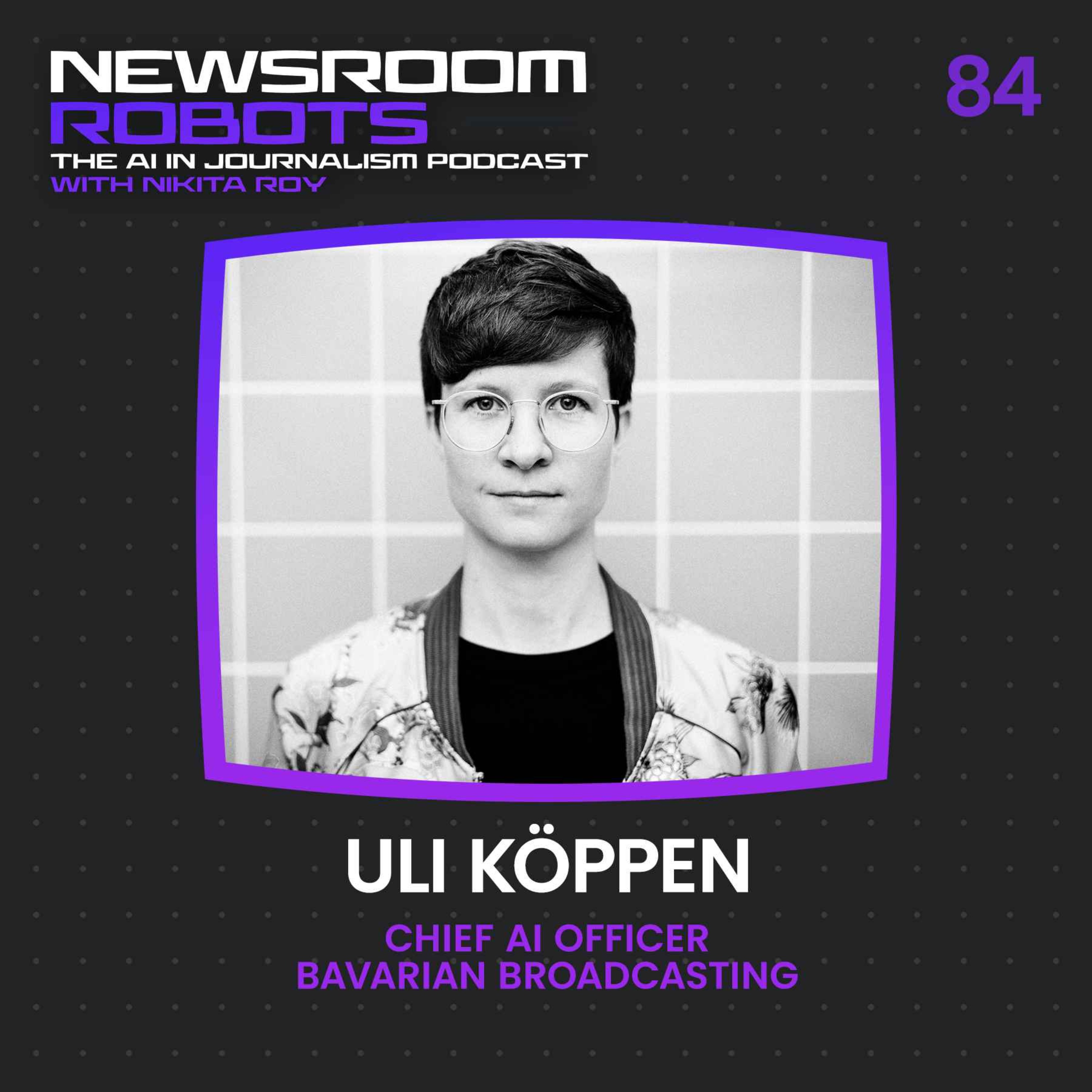
Ep 84Uli Köppen: How Bavarian Broadcasting is preparing for an AI-mediated future where trusted content wins
Most major newsrooms have now moved beyond early experimentation with AI. The main challenge now is determining how to govern effectively, scale consistently, and strategically position AI across the entire organization—while maintaining public trust as a central priority.This week on Newsroom Robots, host Nikita Roy sits down with Uli Köppen, Chief AI Officer at Bavarian Broadcasting (BR), to talk about what it really looks like to lead AI strategy inside one of Europe’s largest public broadcasting networks.Uli makes a compelling case for why every newsroom should establish a dedicated AI leadership function, backed by an interdisciplinary governance structure. They also dig into a question defining the next phase of AI strategy for many newsrooms: in a world of AI overviews, zero-click search, and agent-driven information retrieval, how do you maintain your brand as a recognizable, trustworthy source? Uli shares why BR opted out of AI crawling and what they are building instead, including a vision for a verified content data pool that could power new products across multiple media organizations.In this episode, they cover:02:09 — What it means to be Chief AI Officer at a public broadcaster06:30 — Why every newsroom needs an interdisciplinary AI board, not just a single AI leader09:06 — The skills newsrooms need to build for an AI-driven environment11:00 — Why reinventing workflows starts before adding any technology16:28 — Inside the Oktoberfest Chatbot and the collaborative content pool powering it23:40 — Using AI for smarter community engagement and real-time moderation26:30 — The personalized audio news briefing that users love and where it’s headed36:00 — How BR’s AI guidelines evolved from broad guardrails to clear, example-based rules41:40 — The strategic question: be part of AI platforms, or build recognizable products of your own?Sign up for the Newsroom Robots newsletter for episode summaries and insights from host Nikita Roy. Hosted on Acast. See acast.com/privacy for more information.
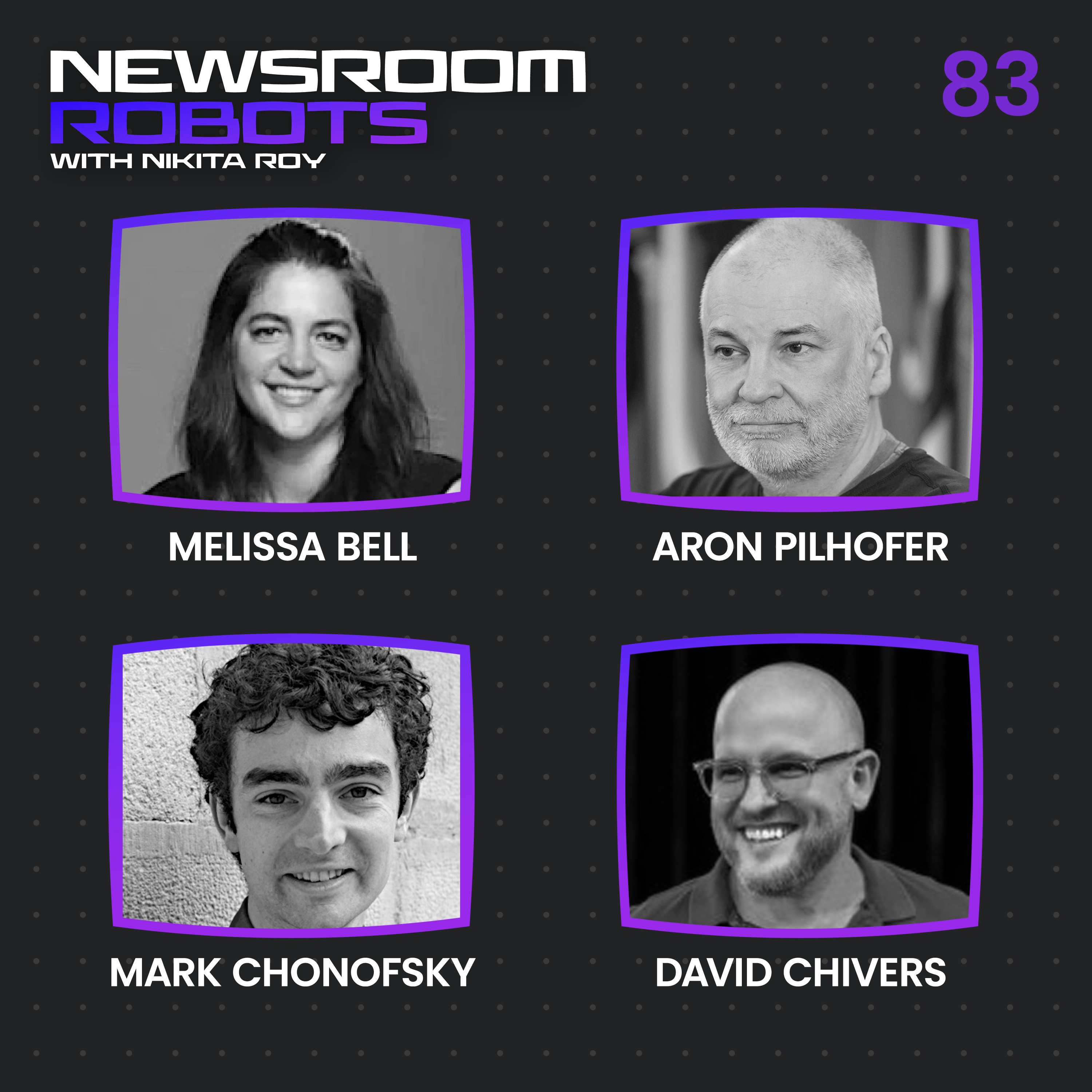
Melissa Bell, Aron Pilhofer, Mark Chonofsky & David Chivers: Chicago Public Media on Building AI Tools That Serve the Audience
Chicago Public Media operates two distinct news brands: WBEZ, the public radio station, and the Chicago Sun-Times, the legacy newspaper. With audio and print journalism, both membership and advertising revenue, and decades of archives in multiple formats, they're a unique case study for AI in local news.When CEO Melissa Bell joined the organization, there was interest in AI but no dedicated resources for experimentation. Through the Lenfest AI Collaborative, they brought in their first AI engineer. A year later, Spanish translations that used to take days are now published the same day. Forty years of WBEZ audio, previously unsearchable, are being transcribed and made searchable for journalists.In this week's episode, host Nikita Roy speaks with Chicago Public Media leaders Melissa Bell (CEO) and Aron Pilhofer (Chief Product and Membership Officer), along with Mark Chonowsky (AI Fellow) and David Chivers (lead AI advisor for the Lenfest AI Collaborative).A note on this week's episodeDavid Chivers, who listeners will hear in this episode, passed away on January 1, 2026. He was the lead advisor for the Lenfest AI Collaborative and this episode was recorded the previous month. David was deeply committed to building capability in newsrooms. He was generous with his time, sharp in his insights, and always had one of those big smiles that would light up a room. He will be missed.The conversation covers how Chicago Public Media is thinking about AI as part of a larger membership strategy, how they decide what to build versus buy with limited resources, and what it looks like to lead through a public AI failure.In this episode:02:55 — Where Chicago Public Media started with AI a year ago08:08 — What AI use looks like inside the newsroom15:42 — How product development is evolving with AI tools27:28 — Collaboration with OpenAI and Microsoft28:26 — How AI fits into Chicago Public Media's membership strategy36:05 — Build vs. buy with limited resources37:44 — The Chicago Sun-Times AI-generated book list incident42:18 — Advice for leaders navigating AI mistakes publiclyThis episode of Newsroom Robots is supported by the Lenfest Institute for Journalism. Sign up for the Newsroom Robots newsletter for episode summaries and insights from host Nikita Roy. Hosted on Acast. See acast.com/privacy for more information.
Alessandro Alviani & Fabian Heckenberger: How Germany’s Süddeutsche Zeitung is building AI products that audience can trust
By 2026, most leading newsrooms have moved past the question of whether AI belongs in their organization. Now the key question is: what does a sustainable AI product strategy look like when you’re building for a subscription-based business and a high-trust brand?This week on Newsroom Robots, host, Nikita Roy sits down with Alessandro Alviani, Lead for Generative AI, and Fabian Heckenberger, Managing Editor for AI, at Germany’s Süddeutsche Zeitung to discuss how they’re using AI to build the next generation of news products.This conversation looks at what happens when AI becomes a permanent layer in a newsroom’s product stack. Alessandro and Fabian walk through how they’re designing AI experiences that fit naturally with reader behavior and how they’re developing new distribution and accessibility formats that would have been impossible to sustain manually.This episode also goes deep on a topic that’s becoming a defining competency which is operational trust. What do you monitor once an AI product is live? How do you categorize failures? And how do you respond quickly when something goes wrong, without panic and without eroding your brand?This episode, we cover:02:52 — How editorial and product roles complement each other in AI strategy13:13 — Addressing skepticism and fear around AI in the newsroom25:17 — Inside building the German election chatbot31:10 — The design framework that signals AI content without eroding trust35:30 — Real-time risk management and monitoring for live AI tools48:50 — The two questions every newsroom should ask before greenlighting an AI project54:55 — Closing reflections and personal AI useSign up for the Newsroom Robots newsletter for episode summaries and insights from host Nikita Roy. Hosted on Acast. See acast.com/privacy for more information.
Francesco Marconi & Scott Austin: 2025 Year in Review, What Actually Changed in AI and Media
2025 wasn’t just another year of AI experimentation in the media industry. It forced the industry to confront a bigger question: what happens when AI stops being just a newsroom tool and becomes the layer audiences experience journalism through? That is the core question heading into 2026.This week on Newsroom Robots, host Nikita Roy sits down with Francesco Marconi and Scott Austin for an end of year recap roundtable on what actually changed in AI and media in 2025 and what newsroom leaders need to prepare for heading into 2026.Francesco is the co-founder and CEO of AppliedXL. He previously led R&D at The Wall Street Journal and built some of the earliest AI and newsroom automation systems at The Associated Press.Scott leads business development at Symbolic.ai, an AI assisted publishing tool. He is also a journalist and digital media veteran who spent years at The Wall Street Journal as a reporter and award winning editor, and later led content partnerships at Dow Jones across major platforms.This episode covers:03:10 — Why 2025 was journalism’s operational reckoning year08:55 — The shift from search to answers and why it breaks old business models14:40 — Proactive AI and what ChatGPT Pulse reveals about the next distribution layer20:30 — Journalism’s hidden work and why persistence, source building, and human judgment still matter23:30 — Why news orgs must move upstream from content to structured knowledge36:10 — AI agents: what they actually are, what they are not, and why transparency matters41:20 — The overlooked shift: Model Context Protocol (MCP) and why it is a major newsroom disruption51:05 — Predictions for 2026Sign up for the Newsroom Robots newsletter for episode summaries and insights from host Nikita Roy. Hosted on Acast. See acast.com/privacy for more information.
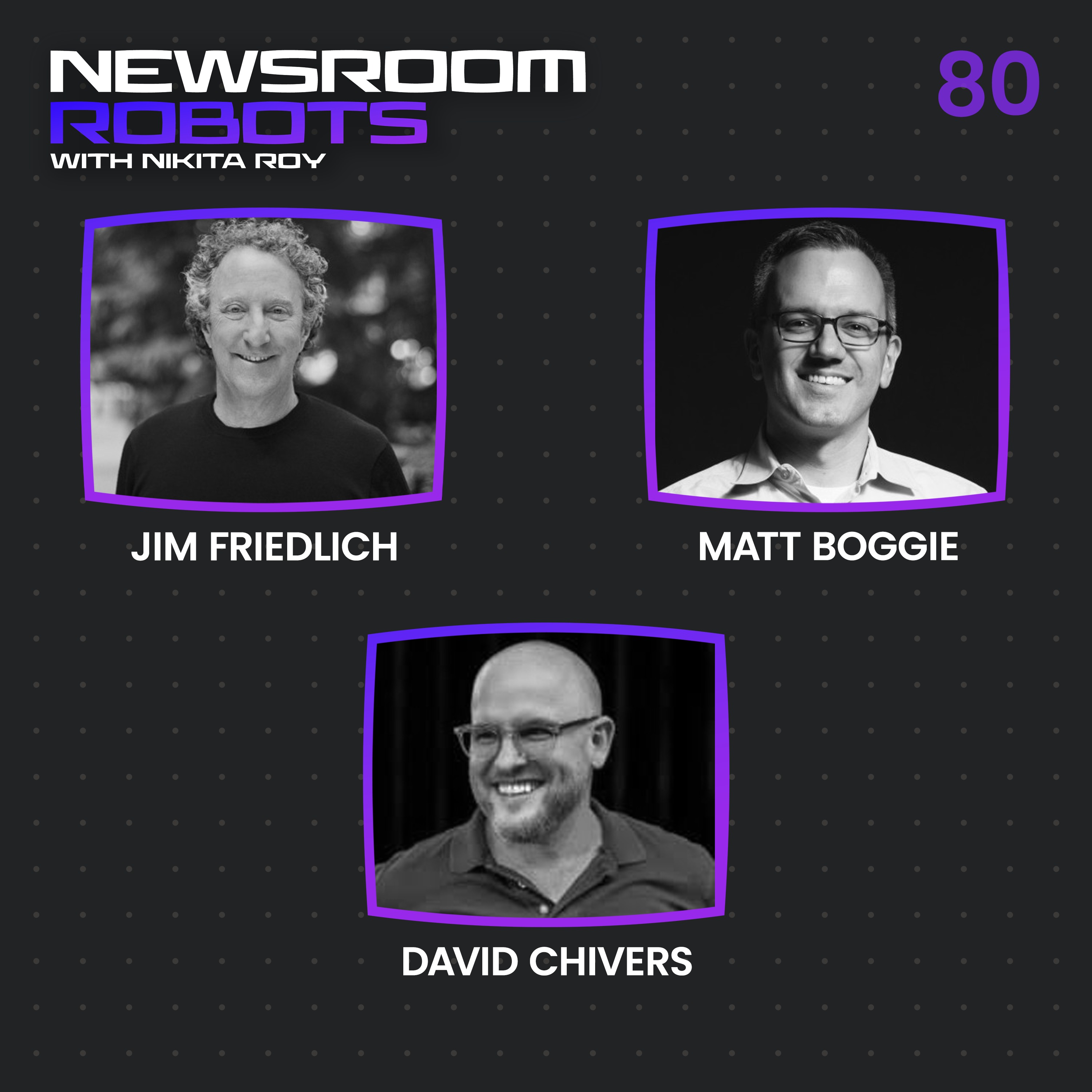
Jim Friedlich, David Chivers & Matt Boggie: How the Lenfest AI Collaborative placed AI engineers in 10 newsrooms
The Philadelphia Inquirer never had an AI engineer on staff until the Lenfest AI Collaborative & Fellowship program changed that.The collaborative is a $5 million partnership between the Lenfest Institute, OpenAI, and Microsoft that placed 10 AI fellows in American newsrooms for two years. These engineers work within the organizations, building tools that solve real newsroom problems.This week on Newsroom Robots, host Nikita Roy sits down with Jim Friedlich, CEO and Executive Director of the Lenfest Institute, David Chivers, lead advisor to the Lenfest AI Collaborative and Matt Boggie, CTO of The Philadelphia Inquirer, to walk through how the program works and what the Inquirer has built as a result.The Inquirer came to the collaborative with an idea to build a full-archive search tool that would let reporters query decades of journalism. They expected it to take 24 months. Within two weeks of a Microsoft hackathon, they had working code. The tool, now called Dewey, searches everything the Inquirer has published since 1978.This episode covers:03:02 — How the Lenfest AI Collaborative got started05:34 — Can newsrooms trust big tech partners?08:33 — How the fellowship works day to day14:52– Inside the Microsoft hackathon that built Dewey in two weeks21:37 — Training journalists to understand LLM limitations24:07 — How AI literacy has changed newsroom culture29:45 – How small newsrooms can get started with AI35:14 — AI answers, search decline, and the future of audience traffic38:15 — Rethinking journalism’s role in an AI-mediated world41:23 — Closing reflections and personal AI useThis episode of Newsroom Robots is supported by the Lenfest Institute for Journalism. Sign up for the Newsroom Robots newsletter for episode summaries and insights from host Nikita Roy. Hosted on Acast. See acast.com/privacy for more information.
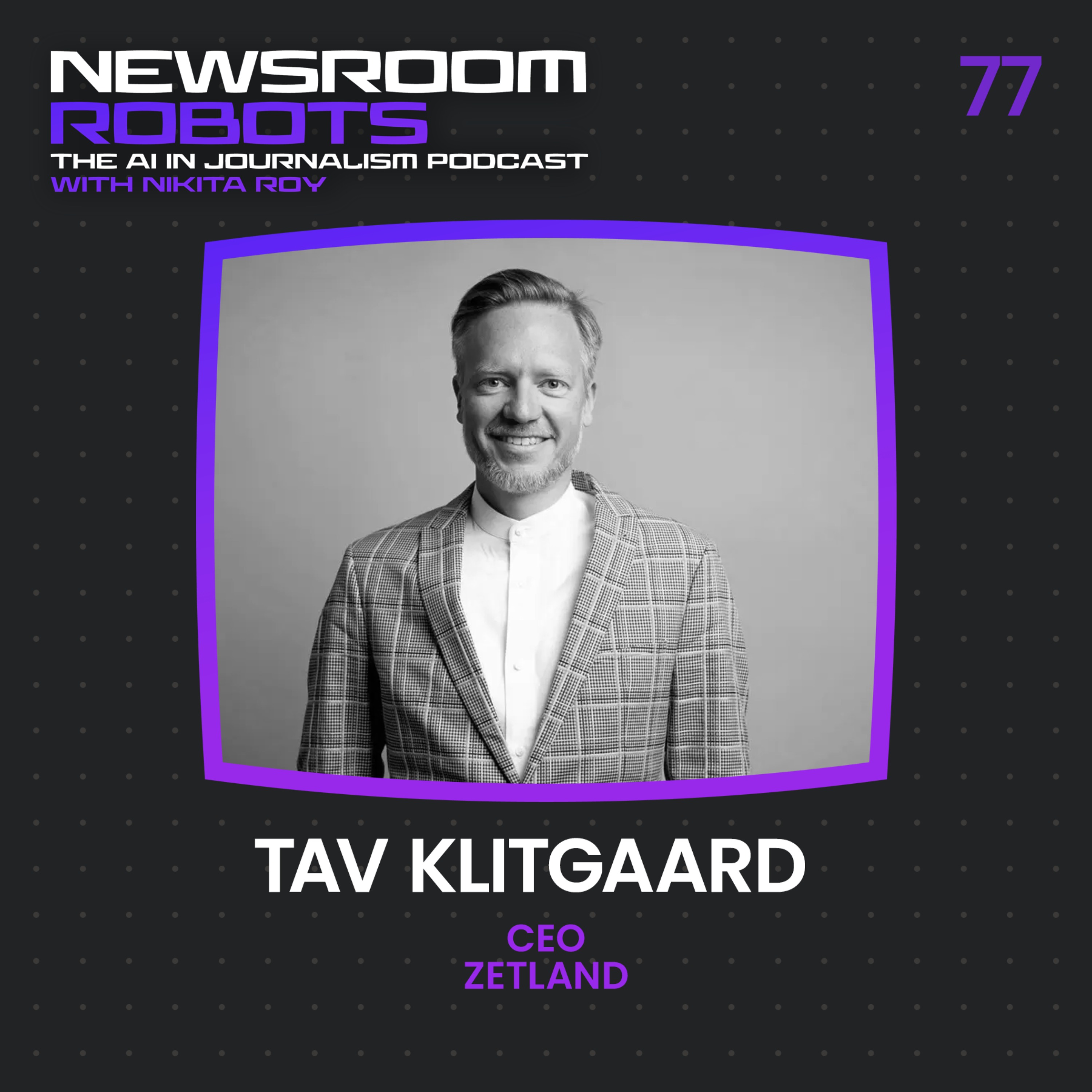
Ep 77Tav Klitgaard: How Zetland turned a newsroom problem into a global AI business
This week on Newsroom Robots, host Nikita Roy is joined by Tav Klitgaard, the CEO of the Danish newsroom Zetland, to unpack the origin story of GoodTape — an AI transcription tool that began as an internal newsroom solution and evolved into a profitable, global product used far beyond journalism.Zetland is an audio-first newsroom in Denmark. But GoodTape wasn’t born from an AI strategy or a product roadmap. It emerged from a familiar newsroom pain point of journalists spending hours transcribing interviews, with existing tools falling short, especially in non-English languages like Danish.In this conversation, Tav breaks down how GoodTape went from an internal experiment to a standalone, subscription-based product that quickly became profitable, generated millions in revenue and was eventually divested. He also shares what building GoodTape taught Zetland about AI adoption, organizational learning, and where newsrooms should, and shouldn’t, use generative AI.This episode covers:05:50 – How a prototype using OpenAI’s Whisper sparked GoodTape08:36 – The moment Zetland realized GoodTape could be a real product12:34 – How journalism’s trust and privacy standards became a product advantage13:59 – What actually improves transcription quality beyond the model itself15:27 – How GoodTape became profitable and contributed to Zetland’s revenue16:29 – Why Zetland eventually divested GoodTape instead of scaling it internally17:36 – What building an AI product taught Zetland about newsroom AI adoption19:08 – Why Zetland uses AI for productivity, not editorial output28:14 – A real-world example of AI use that forced Zetland to rethink its own guidelines30:34 – Why principles matter more than rigid AI rules in newsroomsSign up for the Newsroom Robots newsletter for episode summaries and insights from host Nikita Roy. Hosted on Acast. See acast.com/privacy for more information.
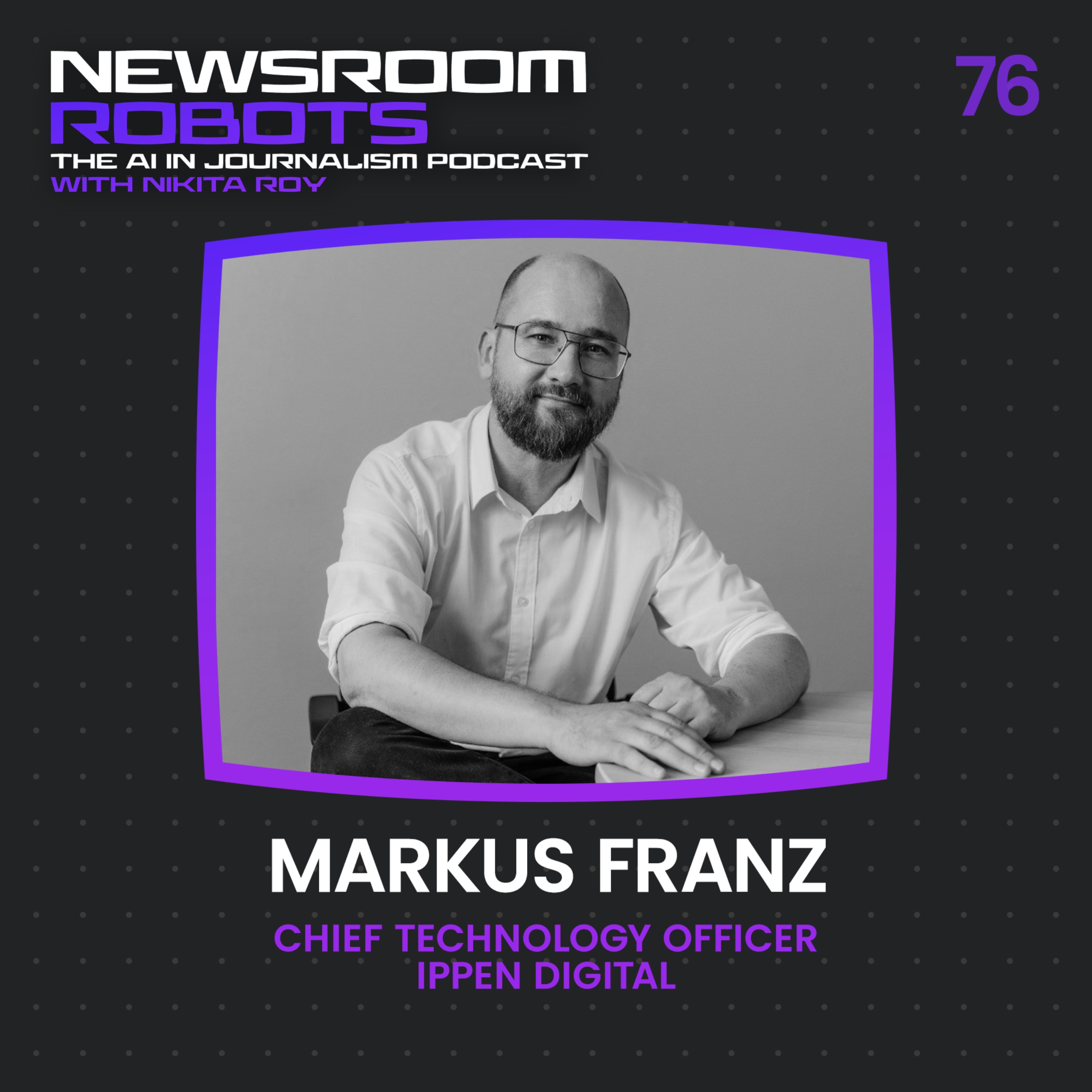
Ep 76Markus Franz: How Germany's Ippen Digital Is Prototyping the AI-Powered Newsroom of the Future
How do you redesign a newsroom’s entire workflow when AI is no longer a single tool, but a collection of agents, voice interfaces, and ambient intelligence changing how journalism gets produced?This week on Newsroom Robots, host Nikita Roy is joined by Markus Franz, Chief Technology Officer at Ippen Digital, one of Germany’s largest digital media networks with more than 80 online news and media portals. This episode was recorded live at the Digital Growth Summit in Stuttgart, where Markus shared how his team is building some of the most forward-looking AI experiments in European media.Markus leads Ippen Digital’s Incubator Lab, an innovation unit focused on reimagining how publishing and AI-driven experiences will evolve. With 16 years inside the company, Markus has been central to Ippen’s digital transformation and now leads efforts around multi-agent architectures and building adaptive workflows for the newsroom.In this conversation, Markus breaks down how his lab is experimenting with multi-agent “virtual teams,” voice-first newsroom interfaces, multimodal content production and an ambient AI-powered newsroom where intelligent systems support journalists in real time. He shares what his team has learned from early prototypes, why the biggest challenges are cultural rather than technical, and how news organizations should think about guardrails, platform dependency, and the rise of self-evolving models.This episode covers:02:22 – Why Ippen Digital built an Incubator Lab and how it’s structured as a future-focused R&D unit04:49 – What multi-agent systems look like inside a newsroom9:42 – The case for voice as the next major interface for both journalists and audiences14:41 – The shift from human-in-the-loop to human-on-the-loop workflows17:40 – Guardrails for agent systems: grounding, bounding, editorial policies19:33 – The vision for an ambient newsroom powered by AI companions and real-time intelligence27:31 – Why vendor lock-in and self-evolving LLMs pose new strategic risks30:08 – Multimodal personalization and rethinking how news is experienced34:27 – Why most AI pilots fail and what experimentation looks like in practice49:19 – Markus’s personal AI stack and how he uses these tools day-to-daySign up for the Newsroom Robots newsletter for episode summaries and insights from host Nikita Roy. Hosted on Acast. See acast.com/privacy for more information.

Ep 75Olle Zacharison: How BBC News is Shaping its AI Strategy for the Next Era of Journalism
How do you bring AI into a newsroom as big and globally distributed as the BBC, an editorial network that stretches across 42 languages and more than 5,000 journalists?This week on Newsroom Robots, host Nikita Roy talks to Olle Zachrison, Head of News AI at BBC News, where he leads the BBC’s efforts to advance AI use and strengthen its journalism and audience experiences. Previously, the Head of AI at Swedish Radio, Olle has spent the past few years implementing practical newsroom AI workflows while upholding public-service values.In this conversation, Olle breaks down BBC’s four-part AI strategy, covering large-scale translation and transcription, content reformatting, investigative tools, and early experiments with synthetic audio and conversational news. He shares what’s working inside one of the world’s largest news organizations, what routinely stalls AI projects, and why the most challenging part of AI transformation isn’t the technology but the collaboration required across editorial, product, and engineering. Olle also reflects on what it means to innovate as a public broadcaster in an AI-driven ecosystem, and why archives, credibility, and direct audience relationships will determine which journalism remains indispensable in the years ahead.This episode covers:03:39 – The BBC’s four-part AI strategy: Boosting productivity, reformatting content, augmenting journalism, and innovating user experience as the core themes05:10 – Using AI for large-scale transcription, tagging, live pages, alt text, newsletter production, and translation to save time and make content more searchable.08:17 – Reformatting content across platforms and formats20:59 – Innovating user experiences with synthetic audio and conversational formats31:59 – How the BBC uses strategic themes, clear metrics, and fast pilots to decide what’s worth building and scaling46:59 – Inside the BBC’s fine-tuned LLM and Style Assist52:01 – What it means to be a public broadcaster in an AI-driven ecosystem01:02:58 – Olle’s personal AI stackSign up for the Newsroom Robots newsletter for episode summaries and insights from host Nikita Roy. Hosted on Acast. See acast.com/privacy for more information.
Ep 74Vilas Dhar: Why the Future of Journalism Is Still Human
This week on Newsroom Robots, host Nikita Roy sits down with Vilas Dhar, President of the Patrick J. McGovern Foundation, one of the world's foremost philanthropies advancing AI for public good. Dhar leads a $1.5 billion endowment that has committed over $500 million to projects spanning climate action, public health, education, and democratic governance. He has served on the UN Secretary-General's High-Level Advisory Body on AI, is the U.S. government's nominated expert to the Global Partnership on AI, and was named a World Economic Forum Young Global Leader in 2022.Across philanthropy, policy, and technology, Dhar carries one central conviction: technology may accelerate, but the future of journalism and society must remain human-centered. Dhar introduces a three-part framework for ethical AI deployment (responsible data, clear boundaries, and transparency) and explains how to translate abstract principles into concrete newsroom decisions. He unpacks his LISA framework (Listen, Involve, Share, Assess) for audience-centered AI design, and tackles the hardest questions facing newsroom leaders: Should we buy or build AI tools? How do we balance innovation with environmental sustainability? What happens to human creativity when machines can create?But perhaps most powerfully, Dhar challenges a deeply held belief in journalism: that media organizations can remain ‘just’ media companies in an AI-driven world. There is no way to be a media organization today without also being a technology organization, he argues, and that shift requires not just new tools, but a fundamental reckoning with organizational identity and purpose. This epiosde covers:00:31 – Introducing Vilas Dhar and his human-centered AI vision: Why technology should serve dignity, equity, and democracy—not just profit02:17 – The three-part framework for ethical AI: Responsible data, clear boundaries, and transparency as actionable principles07:08 – Questions leaders must ask before deploying AI: Who's involved? Who's accountable? Who has editorial control over AI use?10:16 – The LISA framework: Listen, Involve, Share, Assess to turn AI experimentation into behind-the-scenes reporting that builds public trust13:30 – Navigating ethical dilemmas around AI-generated content13:51 – The three phases of newsroom AI adoption18:54 – Why "we're not a tech company" no longer works23:12 – Organizational reckoning in an 18-month transformation cycle25:23 – Why smaller, targeted models and collective action matter more than massive systems29:14 – Fighting misinformation with AI34:13 – What journalism is missing compared to other industries37:01 – The evolving role of human creativity and agency39:33 – The McGovern Foundation's North Star44:23 – How Vilas uses AI personallySign up for the Newsroom Robots newsletter for episode summaries and insights from host Nikita Roy. Hosted on Acast. See acast.com/privacy for more information.
Ep 73Ludwig Siegele: Inside The Economist’s AI Playbook
How does a 182-year-old global magazine stay ahead in the age of generative AI? This week on Newsroom Robots, host Nikita Roy is joined by Ludwig Siegele, Senior Editor for AI Initiatives at The Economist. After more than 25 years reporting from San Francisco, Berlin, and London, Siegele now leads the publication’s AI strategy. He discusses how The Economist launched its AI Lab—a startup-style group within the organization with the freedom to test bold ideas and move quickly. The lab is charged with looking years ahead, preparing for a future where much of journalism’s supply chain may be automated, and ensuring The Economist maintains its identity in an AI-driven media ecosystem.From practical newsroom wins like AI-powered translation and research pipelines to more experimental projects such as TikTok video dubbing and the SCOTUS bot, Siegele explains how The Economist is testing, iterating, and learning in real time. He also reflects on what hasn’t worked, the challenges of newsroom adoption, and why the next phase of journalism may require redefining the role of the journalist itself.In this episode:00:00 – Introducing Ludwig Siegele & The Economist’s AI journey01:31 – How AI experimentation began at The Economist03:26 – Overcoming newsroom fear of ChatGPT04:53 – Building AI infrastructure and upskilling staff07:10 – The tools and vendor partnerships powering experiments08:29 – Why adoption is harder than building tools12:10 – Translation, research, and NotebookLM as newsroom game changers16:06 – How automation could reshape the journalist’s role18:41 – Launching The Economist AI Lab24:11 – Audience-facing AI experiments (TikTok dubbing, Espresso app, SCOTUS bot)26:05 – Partnering with Google NotebookLM while protecting the brand30:02 – Scraping, monetization, and the future of publisher revenue33:41 – Measuring ROI on AI initiatives37:40 – The biggest barriers to newsroom AI adoption39:14 – How Ludwig uses AI personally in art and culture40:40 – Closing reflectionsSign up for the Newsroom Robots newsletter for episode summaries and insights from host Nikita Roy. Hosted on Acast. See acast.com/privacy for more information.
Ep 72Ivar Krustok: How Estonia’s Media Giant Builds AI That Actually Works
In Estonia, Delfi Meedia has built one of the strongest foundations for AI in journalism. With one of the highest digital subscription rates in the world, Delfi has moved beyond the buzz around AI to put it into everyday practice, supporting both its journalism and business.In this episode, host Nikita Roy is joined by Ivar Krustok, Chief AI & Innovation Officer at Delfi Meedia. Ivar breaks down how a small-market publisher is shipping AI that actually helps journalists: from live cross-language translation and newsroom bots to an in-house “company ChatGPT” toolkit wired into 25 years of archives and public records.Key topics include:•Delfi’s three-bucket AI strategy: everyday newsroom tools, experimental long-term projects, and company-wide literacy.•Why Delfi built its own “company ChatGPT” toolkit to search 25 years of archives.•How bots and agents are transforming dashboards into conversational tools for subscriptions, ads, and editorial performance.•Lessons from AI experiments, from court-case monitoring that surfaces hidden stories to audience-facing image generators.•The ongoing challenge of scaling AI literacy across hundreds of staff while keeping adoption practical and trust-centered.Sign up for the Newsroom Robots newsletter for episode summaries and insights from host Nikita Roy. Hosted on Acast. See acast.com/privacy for more information.
Ep 71Djordje Padejski: Why AI Literacy Belongs at the Core of Journalism Education
As a new academic year begins, journalism schools face a defining challenge: how to prepare students for a profession being reshaped by AI.At Stanford University, Djordje Padejski is leading the way. A veteran investigative journalist and now associate director of the John S. Knight Journalism Fellowships at Stanford, he created one of the earliest AI-focused journalism courses at Arizona State University before bringing it to Stanford last year. His classroom is less lecture hall and more lab, where students test AI tools and also learn to examine them.On Newsroom Robots, Djordje shared how he structures his course and what journalism schools must do to prepare the next generation of journalists.Key topics include:Why journalism education must move beyond teaching AI as just a tool and instead frame it as a socio-technical phenomenon.How to embed AI literacy in classrooms by separating hype from reality, contextualizing the history of AI, and examining its cultural and ethical limits.Practical strategies Djordje uses to structure his Stanford course, from lab-style experimentation to peer-led discussions that uncover both opportunities and pitfalls of tools like ChatGPT, Perplexity, and NotebookLM.The importance of teaching students not just how to use AI but how to critically assess its strengths, biases, and limitations.What a future journalism curriculum or degree built around AI might look like, and how educators across disciplines can prepare the next generation of reporters.Sign up for the Newsroom Robots newsletter for episode summaries and insights from host Nikita Roy. Hosted on Acast. See acast.com/privacy for more information.
Ep 70Sara Beykpour: The Next Chapter in News Aggregation
In this episode, host Nikita Roy is joined by Sara Beykpour, co-founder and CEO of Particle News — the AI-powered news aggregator. Launched in November 2024, Particle blends multi-perspective coverage, concise AI-generated summaries, and a bias meter that makes framing visible, giving readers both speed and trust in the same experience.Key topics include:How Particle’s “Reality Check” process works using multi-source input and verification passes to minimize hallucinations and produce more accurate summaries.Strategies Particle uses to maintain reader trust in an era when AI-generated summaries can quickly erode it.How Particle surfaces bias with a meter that shows how coverage leans left, right, or center and updates as stories develop.The role of topic-based personalization in avoiding filter bubbles while still giving readers tailored news feeds.Sign up for the Newsroom Robots newsletter for episode summaries and insights from host Nikita Roy. Hosted on Acast. See acast.com/privacy for more information.
Ep 69Florent Daudens: How Open-Source AI Puts Newsrooms Back in the Driver’s Seat
What if the future of journalism isn’t locked behind the paywalls of big tech companies, but freely available to every newsroom willing to embrace it?Too often, the conversation around AI in newsrooms centers on big tech, like OpenAI’s ChatGPT or Google’s Gemini. These are powerful tools, no doubt but they come with caveats: mainly cost, limited transparency, and little to no control over where your data ends up.But there’s another world of AI rapidly evolving in parallel and it might be journalism’s best path forward: open-source AI.In this episode of Newsroom Robots, host Nikita Roy reconnects with returning guest Florent Daudens, now the Press Lead at Hugging Face, one of the leading platforms powering open source AI. Formerly a newsroom leader driving AI integration at Canada’s Radio-Canada, Florent now sits at the heart of the open source AI movement.Key topics include:Why open source AI matters for journalism and how it compares to proprietary modelsThe rise of AI agents and what they mean for editorial control and user experienceHow compressed, privacy-first models running on laptops and phones could change the gameThe environmental cost of AI and how newsrooms can make more sustainable tech choicesWhat news apps might look like in an agent-powered futureHow newsrooms can start experimenting with open source AI (no dev team required)Plus, Florent shares 20 must-know open source AI tools for journalists, explains how writing is building in the age of AI, and discusses why owning the experience, not just the content, will be key to journalism’s survivalSign up for the Newsroom Robots newsletter for episode summaries and insights from host Nikita Roy. Hosted on Acast. See acast.com/privacy for more information.
Ep 68Fabian Heckenberg, Naja Nielsen & Gard Steiro: The Hard Truths About AI Every Newsroom Leader Can’t Ignore (Recorded Live at Nordic AI in Media Summit 2025)
In this live episode of Newsroom Robots, host Nikita Roy moderates a panel discussion recorded at the Nordic AI and Media Summit in Copenhagen. The conversation features Gard Steiro (Editor-in-Chief and CEO of VG in Norway), Fabian Heckenberger (Managing Editor and Senior Editor for AI at Süddeutsche Zeitung in Germany), and Naja Nielsen (Media Director at SVT in Sweden and former Digital Director at BBC News).They discuss how news organizations are approaching the complexities of integrating AI into editorial workflows, organizational strategy, and audience experiences. The conversation focuses on the tensions, trade-offs, and open questions that newsroom leaders are wrestling with. Key topics include:How AI is shifting from isolated projects to infrastructure across newsroom operations, and the implications for leadership and cross-functional teams.Why VG uses a fixed one-year runway model to evaluate AI experiments, and what happens when projects don’t deliver measurable outcomes.The role of transparency and relevance in building trust with audiences, particularly for younger and emerging user groups.SVT’s approach to organizational learning, including how leadership can empower experimentation without centralizing all decision-making.What interdisciplinary teams look like in practice—drawing on SZ’s experience embedding editorial staff into product and tech teams.Challenges with prioritization: choosing between maintaining legacy systems, launching new GenAI tools, or refining user experience.Why personalization can’t rely on a human-in-the-loop model, and how AI agents may soon take on quality assurance roles within content pipelines.Emerging revenue considerations: from small-scale funding streams and philanthropic support to fundamental questions about what people are actually willing to pay for.The episode wraps with a candid exchange about whether the article format has outlived its usefulness in an era of personalized, multimodal news delivery and what that means for the future of storytelling and journalistic impact.Subscribe to the Newsroom Robots newsletter for more insights and updates from host Nikita Roy. Hosted on Acast. See acast.com/privacy for more information.
Ep 67Gina Chua: Where Journalism’s Value Lives When AI Tells the Story
In this live episode, host Nikita Roy sits down with Gina Chua, Executive Editor of Semafor, recorded at an event at New York University hosted in collaboration with the AI networking group, Humans in the Loop. Gina brings a uniquely expansive lens to the AI conversation, grounded in her leadership across global newsrooms—from Reuters and The Wall Street Journal to the South China Morning Post. Now at Semafor, she continues to be a leading voice rethinking the information ecosystem for an AI-driven world.In this wide-ranging and candid conversation, Gina explores how generative AI is reshaping the fundamental architecture of journalism—from editorial workflows and business models to the core definition of a story. She discusses her team’s experiments with building custom AI tools like Miso, a multilingual aggregation system powering Semafor’s Signals format. Key topics include:How Semafor is using AI for multilingual search, editorial summarization, and style guide enforcement built directly into Google Suite workflows using App Scripts and Claude.The challenges of building durable AI products in newsrooms including unstable models, integration hurdles, and evolving use cases.Rethinking the role of journalists in an AI world: where value lies in asking the right questions, building audience understanding, and creating narratives only humans can shape.The importance of reframing journalism’s mission not as saving “journalists” or “journalism,” but as delivering information in the public interest.Behind-the-scenes on JESS (Journalist Expert Safety Support), a chatbot Gina prototyped and co-developed to democratize access to field safety guidance for reporters worldwide.Why the future of news depends on tight, authentic relationships with audiences and how startups like Semafor are designing for trust, voice, and community from the ground up.The episode closes with reflections on Gina’s personal coding journey with AI including her work building an assistive tool for a friend with ALS.Sign up for the Newsroom Robots newsletter for episode insights and updates from host Nikita Roy. Hosted on Acast. See acast.com/privacy for more information.