The Two-Presenter Formula: How British Podcasting Quietly Settled on Its House Style
The biggest podcasts in Britain right now share one structural choice: they're all double acts. We dig into why two voices became the UK's default podcasting unit, and where the formula starts to creak.
A chart that all looks the same now
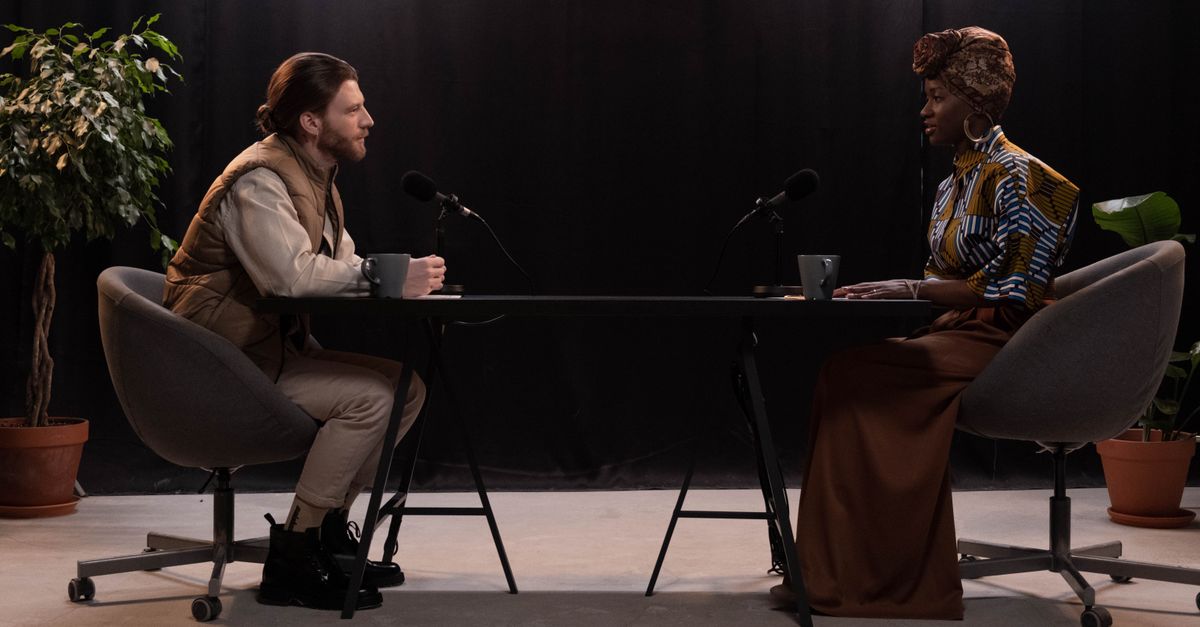
Open Apple Podcasts on a London commute and look at the top of the British chart. The number-one slot might be The Rest is History. Just below it: The Rest is Politics. Then The News Agents, Off Menu, Empire, The Rest is Football, Football Cliches, The Rabbit Hole Detectives, Goalhanger's spin-offs. Scroll past the American imports and the BBC compliance shows, and the pattern starts to feel architectural. Almost every flagship British podcast made in the last five years is built around two presenters. Sometimes three, in the case of The News Agents. Almost never one.
This is so common we barely notice it any more. But it is, in the particular shape it has taken, distinctly British. Across the Atlantic, the chart skews solo: Joe Rogan, Lex Fridman, Dax Shepard's Armchair Expert, How I Built This with Guy Raz, On Purpose with Jay Shetty. A handful of US shows pair up, but the gravitational pull is towards the single-host interview. In the UK, the gravitational pull is towards two voices in a room.
That is not an accident. It is the result of a particular network finding a particular formula at a particular moment, and the rest of the industry quietly copying it.
The Goalhanger pattern
Goalhanger Podcasts was founded in 2018 by Gary Lineker, Tony Pastor and Jack Davenport. Pastor and Davenport, both former ITV producers, brought the structural intuition. Their first hits — The Rest is History (Tom Holland and Dominic Sandbrook, launched 2020) and The Rest is Politics (Alastair Campbell and Rory Stewart, launched 2022) — locked the template. Two presenters with overlapping but distinct authority. A serial naming convention. Light scripting. A lead presenter who carries the structure and a co-presenter who keeps the room loose.
Once those two shows became mainstream hits — The Rest is Politics has been a top-five UK podcast more weeks than not since 2023 — Goalhanger ran the playbook on every adjacent topic. The Rest is Football. The Rest is Money. The Rest is Entertainment. The Rest is Classified. The pattern is literally the brand: a domain expert plus a counterpoint, paid in equal billing. By 2025 the company had ten paired shows under its umbrella and was reportedly turning over tens of millions of pounds a year.
Goalhanger did not invent the two-presenter podcast. Off Menu (Ed Gamble and James Acaster) launched in 2018 on the comedy circuit and built its own house style years before Holland-and-Sandbrook found theirs. Football Weekly, in its multi-host stadium format, predates them all. But Goalhanger gave the format a corporate scale that other UK producers — Persephonica, Plosive, The Athletic UK, Crowd Network — have all since echoed.
Why two voices is the right answer to a long-form question
A solo host has three jobs at once: structure the episode, deliver the content, and keep the listener emotionally present for sixty minutes. That is a lot to ask of a single voice. American podcasting solved this with the interview format — bring in a fresh guest each week and let the dialogue do the structural work. British podcasting solved it differently: keep the same two voices and let their relationship do the structural work.
The mechanical advantages stack up quickly:
- Voice variation. Listening to one person speak for an hour without a break is genuinely tiring. Two voices give the ear a switch every minute or two without any production trickery.
- Permission to teach and learn out loud. When Tom Holland says, 'remind me again, Dominic, what was happening in Italy at this point?' — Holland already knows. He is performing the question on the listener's behalf. A solo host has to break the fourth wall to do this. A pair can just talk.
- Disagreement without journalism. Campbell and Stewart can disagree on Brexit without it being an interrogation. The format manufactures friction without manufacturing antagonism. That softness is enormously valuable for a daily-news-adjacent listener who is exhausted by adversarial Radio 4.
- Scheduling resilience. If one presenter has flu, the show still ships. Some pairs (Football Cliches, Empire) regularly run with guest co-hosts; the format absorbs absence in a way solo shows simply cannot.
- Banter as content. The 90-second exchange about a bad pun, the slightly awkward birthday acknowledgement, the in-joke that returns three episodes later — this is what listeners describe when they say they 'love the show'. The pair format creates the surface area for it. A solo host is, by definition, doing a monologue.
- Two-for-one promotion. Each presenter brings their existing audience. Dominic Sandbrook's readers plus Tom Holland's. Alastair Campbell's blog subscribers plus Rory Stewart's book audience. The Venn overlap might be small at launch and very large six months in.
None of this is unique to Britain. American shows could do all of it. They mostly do not. Why?
Two reasons, I think. First, the British comedy circuit has always trained presenters in pair-work — panel shows, sketch duos, the radio comedy double act. There is a deep talent pool for it. Second, the BBC's interview tradition leaned heavily on the single anchor figure, and the post-2018 indie scene reacted against that grammar by deliberately pairing voices. The American podcast scene didn't have an equivalent grammar to react against; it grew straight out of public radio and stand-up's solo tradition.
Six paired shows, six different ways the formula bends
Not all double acts are the same shape. The pairing dynamics — what each host does, how their authority is distributed, how scripted they are — vary considerably. A useful way to map the field:
| Show | Pairing | Primary dynamic | Typical length | Network |
|---|---|---|---|---|
| The Rest is History | Tom Holland + Dominic Sandbrook | Populariser leads narrative; academic counters and corrects | 55–75 min | Goalhanger |
| The Rest is Politics | Alastair Campbell + Rory Stewart | Cross-bench political insiders, mutual respect across party lines | 50–70 min | Goalhanger |
| The News Agents | Maitlis + Sopel + Goodall (trio) | Three former BBC journalists running an editorial conversation | 35–45 min | Persephonica / Global |
| Off Menu | Ed Gamble + James Acaster | Comedy double act; structural bit (the menu) drives every episode | 60–80 min | Plosive |
| Empire | Anita Anand + William Dalrymple | Broadcaster–historian; one storytells, one provides scholarly density | 35–55 min | Goalhanger |
| Football Cliches | Adam Hurrey + rotating co-hosts | Lexical specialist plus working football journalists; semi-formatted | 45–60 min | The Athletic |
Look at that table and a sub-pattern surfaces. Half these shows pair a populariser with a specialist: someone who can carry a non-expert listener with someone who can satisfy an expert one. The other half pair two specialists who happen to disagree well. Both work, but they work for different reasons. The populariser-plus-specialist axis is editorially safer; you can almost guarantee a good episode if your chemistry is strong. The two-specialists axis is more volatile but has higher ceilings — The Rest is Politics works because Campbell and Stewart genuinely think differently, and you can hear it.
When the formula doesn't work
The format has a quiet failure mode, and it shows up more often than the chart suggests. Forced chemistry is the obvious one: two presenters paired by an exec who loved their individual CVs, with no rapport between them. The first six episodes will sound stilted; the listener will sense it; the show will fail to graduate from a five-figure to a six-figure audience. There are probably a dozen such shows that quietly disappeared in 2024 and 2025.
There is also the dominance problem. If one presenter is significantly more confident, more verbose or more famous than the other, the pairing collapses into a solo show with an awkward second chair. This is why the most durable pairings are between presenters of comparable but distinct stature: Holland and Sandbrook are both selling books, but to different readers. Campbell and Stewart are both political memoirists, but for different parties.
And there is the succession problem, which the format is only just starting to confront. What happens to The Rest is History if Tom Holland decides to write his next biography full-time? You cannot replace a co-host the way you can replace a producer or an editor. The pairing is the IP. Goalhanger has hedged this by spinning out so many shows that no single departure is fatal to the network — but each individual show carries the risk in private.
The format will keep winning, until it doesn't
For the next two years at least, expect the British chart to stay paired. The economics work, the talent pool is deep, and the listener has been trained to expect two voices. Newer entrants and the Goalhanger spin-offs yet to launch are all built to the same blueprint.
The interesting question is what happens when the trend becomes self-defeating. Twelve paired shows in the top fifty is distinctive. Forty paired shows in the top fifty is a monoculture, and a monoculture invites a counter-formula. If you wanted to bet on the next British podcast format — the one that breaks through in 2027 — bet against pairs. Bet on the curated solo essay show, the four-host roundtable, or the host-plus-listener-call format that nobody is currently making well. The audience will be ready for it. Right now they are still learning, with great pleasure, to listen for two voices.