
New Books in South Asian Studies
1,459 episodes — Page 12 of 30
Ep 280Annie Rachel Royson, "Texts, Traditions, and Sacredness: Cultural Translation in Kristapurana" (Routledge, 2023)
Annie Rachel Royson's book Texts, Traditions, and Sacredness: Cultural Translation in Kristapurana (Routledge, 2023) presents a critical reading of Kristapurāṇa, the first South Asian retelling of the Bible. In 1579, Thomas Stephens (1549-1619), a young Jesuit priest, arrived in Goa with the aim of preaching Christianity to the local subjects of the Portuguese colony. Kristapurāṇa (1616), a sweeping narrative with 10,962 verses, is his epic poetic retelling of the Christian Bible in the Marathi language. This fascinating text, which first appeared in Roman script, is also one of the earliest printed works in the subcontinent. Kristapurāṇa translated the entire biblical narrative into Marathi a century before Bible translation into South Asian languages began in earnest in Protestant missions. This book contributes to an understanding of translation as it was practiced in South Asia through its study of genre, landscapes, and cultural translation in Kristapurāṇa, while also retelling a history of sacred texts and biblical narratives in the region. It examines this understudied masterpiece of Christian writing from Goa in the early era of Catholic missions and examines themes such as the complexities of the colonial machinery, religious encounters, textual traditions, and multilingualism, providing insight into Portuguese Goa of the sixteenth and seventeenth centuries. The first of its kind, the book makes significant interventions into the current discourse on cultural translation and brings to the fore a hitherto understudied text. It will be an indispensable resource for students and researchers of translation studies, comparative literature, religious studies, biblical studies, English literature, cultural studies, literary history, postcolonial studies, and South Asian studies. Raj Balkaran is a scholar of Sanskrit narrative texts. He teaches at the Oxford Centre for Hindu Studies and at his own virtual School of Indian Wisdom. For information see rajbalkaran.com. Learn more about your ad choices. Visit megaphone.fm/adchoices Support our show by becoming a premium member! https://newbooksnetwork.supportingcast.fm/south-asian-studies
Ep 150Nishanth Injam, "The Best Possible Experience: Stories" (Pantheon, 2023)
The characters in Nishanth Injam’s The Best Possible Experience (Pantheon, 2023), his debut short story collection, are like many in India or in Indian communities in the United States: Working hard and enduring hardships to try to get a better life for themselves. They don’t always succeed—and even those that do lose something along the way. That tension between hope and reality is at the core of many of Injam’s stories, whether it’s a recently migrated Indian family panicking that a white boy is coming to dinner, a college student trying and failing to get a visa, or a young son in Goa, increasingly frustrated with his tour bus driver father , prone to embellishment and exaggeration. Nishanth Injam received an MFA from the Helen Zell Writers’ Program at the University of Michigan. He is the recipient of a PEN/Robert J. Dau Short Story Prize and a Cecelia Joyce Johnson Emerging Writer Award from the Key West Literary Seminar. His work has appeared in Zoetrope: All-Story, ZYZZYVA, The Virginia Quarterly Review, The Georgia Review, Best Debut Short Stories 2021, and The Best American Magazine Writing 2022. Today, Nishanth and I talk about why he pivoted from tech to creative writing, how his stories relate to the Indian experience, and the trials of Indians and Indian-Americans trying to improve their lives. You can find more reviews, excerpts, interviews, and essays at The Asian Review of Books, including its review of The Best Possible Experience. Follow on Twitter at @BookReviewsAsia. Nicholas Gordon is an associate editor for a global magazine, and a reviewer for the Asian Review of Books. He can be found on Twitter at@nickrigordon. Learn more about your ad choices. Visit megaphone.fm/adchoices Support our show by becoming a premium member! https://newbooksnetwork.supportingcast.fm/south-asian-studies
Ep 289Emilia Bachrach, "Religious Reading and Everyday Lives in Devotional Hinduism" (Oxford UP, 2022)
Religious texts are not stable objects, passed down unchanged through generations. The way in which religious communities receive their scriptures changes over time and in different social contexts. Emilia Bachrach's Religious Reading and Everyday Lives in Devotional Hinduism (Oxford UP, 2022) considers religious reading through a study of the Pushtimarg, a Hindu community whose devotional practices and community identity have developed in close relationship with Vārtā Sāhitya (Chronicle Literature), a genre of Hindi prose hagiography written during the 17th century. Through hagiographies that narrate the relationships between the deity Krishna and the Pushtimarg's early leaders and their disciples, these hagiographies provide community history, theology, vicarious epiphany, and models of devotion. While steeped in the social world of early-modern north India, these texts have continued to be immensely popular among generations of modern devotees, whose techniques of reading and exegesis allow them to maintain the narratives as primary guides for devotional living in Gujarat-the western state of India where the Pushtimarg thrives today. Combining ethnographic fieldwork with close readings of Hindi and Gujarati texts, the book examines how members of the community engage with the hagiographies through recitation and dialogue in temples and homes, through commentary and translation in print publications and on the Internet, and even through debates in courts of law. The book argues that these acts of "reading" inform and are informed by both intimate negotiations of the family and the self, and also by politically potent disputes over matters such as temple governance. By studying the texts themselves, as well as the social contexts of their reading, Religious Reading and Everyday Lives in Devotional Hinduism provides a distinct example of how changing class, regional, and gender identities continue to shape interpretations of a scriptural canon, and how, in turn, these interpretations influence ongoing projects of self and community fashioning. This book considers religious reading through a study of the Pushtimarg, a Hindu community whose devotional practices and community identity have developed in close relationship with Vārtā Sāhitya (Chronicle Literature), a genre of Hindi prose hagiography written during the 17th century. By studying the texts themselves, as well as the social contexts of their reading, Religious Reading and Everyday Lives in Devotional Hinduism provides a distinct example of how changing class, regional, and gender identities continue to shape interpretations of a scriptural canon, and how, in turn, these interpretations influence ongoing projects of self and community fashioning. Learn more about your ad choices. Visit megaphone.fm/adchoices Support our show by becoming a premium member! https://newbooksnetwork.supportingcast.fm/south-asian-studies
Ep 72Kalyani Ramnath, "Boats in a Storm: Law, Migration, and Decolonization in South and Southeast Asia, 1942-1962" (Stanford UP, 2023)
For more than a century before World War II, traders, merchants, financiers, and laborers steadily moved between places on the Indian Ocean, trading goods, supplying credit, and seeking work. This all changed with the war and as India, Burma, Ceylon, and Malaya wrested independence from the British Empire. Set against the tumult of the postwar period, Boats in a Storm: Law, Migration, and Decolonization in South and Southeast Asia, 1942-1962 (Stanford UP, 2023) centers on the legal struggles of migrants to retain their traditional rhythms and patterns of life, illustrating how they experienced citizenship and decolonization. Even as nascent citizenship regimes and divergent political trajectories of decolonization papered over migrations between South and Southeast Asia, migrants continued to recount cross-border histories in encounters with the law. These accounts, often obscured by national and international political developments, unsettle the notion that static national identities and loyalties had emerged, fully formed and unblemished by migrant pasts, in the aftermath of empires. Drawing on archival materials from India, Sri Lanka, Myanmar, London, and Singapore, Kalyani Ramnath narrates how former migrants battled legal requirements to revive prewar circulations of credit, capital, and labor, in a postwar context of rising ethno-nationalisms that accused migrants of stealing jobs and hoarding land. Ultimately, Ramnath shows how decolonization was marked not only by shipwrecked empires and nation-states assembled and ordered from the debris of imperial collapse, but also by these forgotten stories of wartime displacements, their unintended consequences, and long afterlives. Kalyani Ramnath is an Assistant Professor of History at the University of Georgia, with research and teaching interests in legal history, histories of migration and displacement, transnational history, and questions of archival method. Kelvin Ng is a PhD candidate at the Department of History at Yale University. His research work brings together the social history of migration and the intellectual history of internationalism in four linked Indian Ocean spaces: British India, Republican China, British Malaya, and the Dutch East Indies. His dissertation examines three intertwined strands of anti-imperial thought—communist internationalism, pan-Islamism, and anti-caste radicalism—in relation to an oceanic political economy of unfree labor and uneven development. Ahmed Yaqoub AlMaazmi is a Ph.D. candidate at Princeton University. His research focuses on the intersection of law, the occult sciences, and the environment across the Western Indian Ocean. He can be reached by email at [email protected] or on Twitter @Ahmed_Yaqoub. Listeners’ feedback, questions, and book suggestions are most welcome. Learn more about your ad choices. Visit megaphone.fm/adchoices Support our show by becoming a premium member! https://newbooksnetwork.supportingcast.fm/south-asian-studies
Ep 204Indrajit Roy, "Passionate Politics: Democracy, Development and India’s 2019 General Election" (Manchester UP, 2023)
In May 2019, India's Prime Minister Narendra Modi won the world's largest election. Indrajit Roy edited volume Passionate Politics: Democracy, Development and India’s 2019 General Election (Manchester UP, 2023) brings together a stellar team of economists, political scientists, sociologists, historians and geographers to explain why Indians voted the way they did. Prof Roy is the Professor of Global Development Politics at the University of York’s, Department of Politics, UK. His research and teaching strengthen critical approaches to ordering global development politics. Tusharika Deka is a PhD student in International Relations at the University of Nottingham. Learn more about your ad choices. Visit megaphone.fm/adchoices Support our show by becoming a premium member! https://newbooksnetwork.supportingcast.fm/south-asian-studies
Ep 149Samrat Choudhury, "Northeast India: A Political History" (Oxford UP, 2023)
For much of the past three months, the northeastern Indian state of Manipur—nestled right up against the border with Myanmar—has been the site of a conflict between two groups: the majority Meiteis and the minority Kukis. The fighting–with scenes of brutal violence, looting of police stations, and burnt places of worship–even sparked a motion of no confidence against Prime Minister Narendra Modi. The region of northeast India has long posed a challenge for its leaders, both local and national. Geographically isolated from the rest of India due to partition and the awkward placement of what eventually becomes Bangladesh, the region soon features countless ethnic groups demanding authority and autonomy in the newly independent India—at times, through violent resistance—and a heavy-handed national administration quite willing to impose martial law to get things under control. Journalist Samrat Choudhury writes about this region in his latest book, Northeast India: A Political History (Oxford UP, 2023). Samrat talks about the region’s eight states: Arunachal Pradesh, Assam, Manipur, Meghalaya, Mizoram, Nagaland, Tripura, and Sikkim, and their experience under first the British, and then newly-independent India. Samrat is a journalist and former newspaper editor who has written for major papers and magazines in Britain, the US, Asia and Europe. He has edited anthologies, contributed to academic publications, and authored books including novel The Urban Jungle (Penguin Books India: 2011) and travelog The Braided River: A Journey Along the Brahmaputra (HarperCollins: 2021). Today, Samrat and I talk about this region’s sometimes messy history, its experience with insurgencies and the tough government reaction, and touch briefly on what’s happening in Manipur today. You can find more reviews, excerpts, interviews, and essays at The Asian Review of Books, including its review of Northeast India. Follow on Twitter at @BookReviewsAsia. Nicholas Gordon is an associate editor for a global magazine, and a reviewer for the Asian Review of Books. He can be found on Twitter at @nickrigordon. Learn more about your ad choices. Visit megaphone.fm/adchoices Support our show by becoming a premium member! https://newbooksnetwork.supportingcast.fm/south-asian-studies
Ep 281Kelzang T. Tashi, "World of Worldly Gods: The Persistence and Transformation of Shamanic Bon in Buddhist Bhutan" (Oxford UP, 2023)
In World of Worldly Gods: The Persistence and Transformation of Shamanic Bon in Buddhist Bhutan (Oxford UP, 2023), Kelzang T. Tashi offers the first comprehensive examination of the tenacity of Shamanic Bon practices, as they are lived and contested in the presence of an invalidating force: Buddhism. Through a rich ethnography of Goleng and nearby villages in central Bhutan, Tashi investigates why people, despite shifting contexts, continue to practice and engage with Bon, a religious practice that has survived over a millennium of impatience from a dominant Buddhist ecclesiastical structure. Against the backdrop of long-standing debates around practices unsystematically identified as 'bon', this book reframes the often stale and scholastic debates by providing a clear and succinct statement on how these practices should be conceived in the region. Tashi argues that the reasons for the tenacity of Bon practices and beliefs amid censures by the Buddhist priests are manifold and complex. While a significant reason for the persistence of Bon is the recency of formal Buddhist institutions in Goleng, he demonstrates that Bon beliefs are so deeply embedded in village social life that some Buddhists paradoxically feel it necessary to reach some kind of accommodation with Bon priests. Through an analysis of the relationship between Shamanic Bon and Buddhism, and the contemporary dynamics of Bhutanese society, this book tackles the longstanding concern of anthropology: cultural persistence and change. It discusses the mutual accommodation and attempted amalgamation of Buddhism and Bon, and offers fresh perspectives on the central distinguishing features of Great and Little Traditions. Raj Balkaran is a scholar of Sanskrit narrative texts. He teaches at the Oxford Centre for Hindu Studies and at his own virtual School of Indian Wisdom. For information see rajbalkaran.com. Learn more about your ad choices. Visit megaphone.fm/adchoices Support our show by becoming a premium member! https://newbooksnetwork.supportingcast.fm/south-asian-studies
Ep 203Thomas Simpson, "The Frontier in British India: Space, Science, and Power in the Nineteenth Century" (Cambridge UP, 2021)
In The Frontier in British India: Space, Science, and Power in the Nineteenth Century (Cambridge UP, 2021), Thomas Simpson provides an innovative account of how distinctive forms of colonial power and knowledge developed at the territorial fringes of colonial India during the nineteenth century. Through critical interventions in a wide range of theoretical and historiographical fields, he speaks to historians of empire and science, anthropologists, and geographers alike. The Frontier in British India provides the first connected and comparative analysis of frontiers in the northwest and northeast India and draws on visual and written materials from an array of archives across the subcontinent and the UK. It shows that colonial interventions in frontier spaces and populations were enormously destructive but also prone to confusion and failure on their own terms. British frontier administrators did not merely suffer 'turbulent' frontiers but actively worked to generate and uphold these regions as spaces of governmental and scientific exception. Accordingly, India's frontiers became crucial spaces of imperial practice and imagination throughout the nineteenth century. Tiatemsu Longkumer is a Ph.D. scholar working on Indigenous Religion and Christianity at North-Eastern Hill University, Shillong: India. Learn more about your ad choices. Visit megaphone.fm/adchoices Support our show by becoming a premium member! https://newbooksnetwork.supportingcast.fm/south-asian-studies
Ep 306Romit Chowdhury, "City of Men: Masculinities and Everyday Morality on Public Transport" (Rutgers UP, 2023)
In South Asian urban landscapes, men are everywhere. And yet we do not seem to know very much about precisely what men do in the city as men. How do men experience gender in city spaces? What are the interactional dynamics between different groups of men on city streets? How do men adjudicate between good and bad conduct in urban spaces? Through ethnographic descriptions of copresence on public transport in Kolkata, India, Romit Chowdhury's City of Men: Masculinities and Everyday Morality on Public Transport (Rutgers UP, 2023) brings into sight the gendered logics of cooperation and everyday morality through which masculinities take up space in cities. It follows the labour geographies of auto-rickshaw and taxi operators and their interactions with traffic police and commuters to argue that the gendered fabric of urban life needs to be understood as a product of situational forms of cooperation between different social groups. Such an orientation sheds light on the part played by everyday morality and provisional support in upholding male privilege in the city. Rituparna Patgiri is an Assistant Professor of Sociology at Indraprastha College for Women, University of Delhi. She has a PhD in Sociology from Jawaharlal Nehru University (JNU), New Delhi. Her research interests lie in the areas of food, media, gender and public. She is also one of the co-founders of Doing Sociology. Patgiri can be reached at @Rituparna37 on Twitter. Learn more about your ad choices. Visit megaphone.fm/adchoices Support our show by becoming a premium member! https://newbooksnetwork.supportingcast.fm/south-asian-studies
Ep 202Ruchi Chaturvedi, "Violence of Democracy: Interparty Conflict in South India" (Duke UP, 2023)
In Violence of Democracy: Interparty Conflict in South India (Duke UP, 2023), Ruchi Chaturvedi tracks the rise of India’s divisive politics through close examination of decades-long confrontations in Kerala between members of the Communist Party of India (Marxist) and supporters of the Hindu nationalist Rashtriya Swayam Sevak Sangh and the Bharatiya Janata Party. Drawing on ethnographic fieldwork and extensive archival research, Chaturvedi investigates the unique character of the conflict between the party left and the Hindu right. This conflict, she shows, defies explanations centering religious, caste, or ideological differences. It offers instead new ways of understanding how quotidian political competition can produce antagonistic majoritarian communities. Rival political parties mobilize practices of disbursing care and aggressive masculinity in their struggle for electoral and popular power, a process intensified by a criminal justice system that reproduces rather than mitigating violence. Chaturvedi traces these dynamics from the late colonial period to the early 2000s, illuminating the broader relationships between democratic life, divisiveness, and majoritarianism. Yash Sharma is a PhD student in Political Science at the School of Public and International Affairs, University of Cincinnati. His research is focused on the interactions of political mobilization and anti-minority violence within Hindu nationalist organizations in India. Twitter. Email: [email protected]. Learn more about your ad choices. Visit megaphone.fm/adchoices Support our show by becoming a premium member! https://newbooksnetwork.supportingcast.fm/south-asian-studies
Ep 148Nicholas Hoover Wilson, "Modernity's Corruption: Empire and Morality in the Making of British India" (Columbia UP, 2023)
When Robert Clive, the man who established Company rule in India was hauled in front of Parliament to answer for crimes of corruption, he allegedly responded by saying, essentially, he could have been worse. Am I not rather deserving of praise for the moderation which marked my proceedings? Consider the situation in which the victory at Plassey had placed me. A great prince was dependent on my pleasure; an opulent city lay at my mercy; its richest bankers bid against each other for my smiles; I walked through vaults which were thrown open to me alone, piled on either hand with gold and jewels! Mr. Chairman, at this moment I stand astonished at my own moderation! The strange thing is that Clive’s argument was actually acceptable according to how many at the time understood corruption, as Nicholas Hoover Wilson writes in Modernity's Corruption: Empire and Morality in the Making of British India (Columbia University Press: 2023). Nick uses Company rule in India as a way to examine how society’s view of corruption changed–from something governed by one’s situation, to a behavior that violates some universal code of ethics. In this interview, the two of us talk about Clive, Company rule, and why this period is a good period through which to understand the idea of “corruption.” Nicholas Hoover Wilson is associate professor of sociology at Stony Brook University. Nick’s research focuses on the historical sociology of empires and colonialism, through the case of the English East India Trading Company's presence in South Asia. You can find more reviews, excerpts, interviews, and essays at The Asian Review of Books, including its review of Modernity’s Corruption. Follow on Twitter at @BookReviewsAsia. Nicholas Gordon is an associate editor for a global magazine, and a reviewer for the Asian Review of Books. He can be found on Twitter at @nickrigordon. Learn more about your ad choices. Visit megaphone.fm/adchoices Support our show by becoming a premium member! https://newbooksnetwork.supportingcast.fm/south-asian-studies
Ep 279Renny Thomas, "Science and Religion in India: Beyond Disenchantment" (Routledge, 2022)
Science and Religion in India: Beyond Disenchantment (Routledge, 2022) provides an in-depth ethnographic study of science and religion in the context of South Asia, giving voice to Indian scientists and shedding valuable light on their engagement with religion. Drawing on biographical, autobiographical, historical, and ethnographic material, the volume focuses on scientists' religious life and practices, and the variety of ways in which they express them. Renny Thomas challenges the idea that science and religion in India are naturally connected and argues that the discussion has to go beyond binary models of 'conflict' and 'complementarity'. By complicating the understanding of science and religion in India, the book engages with new ways of looking at these categories. Raj Balkaran is a scholar of Sanskrit narrative texts. He teaches at the Oxford Centre for Hindu Studies and at his own virtual School of Indian Wisdom. For information see rajbalkaran.com. Learn more about your ad choices. Visit megaphone.fm/adchoices Support our show by becoming a premium member! https://newbooksnetwork.supportingcast.fm/south-asian-studies
Ep 278Michael Baltutis, "The Festival of Indra: Innovation, Archaism, and Revival in a South Asian Performance" (SUNY Press, 2023)
Michael Baltutis' book The Festival of Indra: Innovation, Archaism, and Revival in a South Asian Performance (SUNY Press, 2023) details the textual and performative history of an important South Asian festival and its role in the development of classical Hinduism. Drawing on various genres of Sanskrit textual sources--especially the epic Mahābhārata--the book highlights the innovative ways that this annual public festival has supported the stable royal power responsible for the sponsorship of these texts. More than just a textual project, however, the book devotes significant ethnographic attention to the only contemporary performance of this festival that adheres to the classical Sanskrit record: the Indrajatra of Kathmandu, Nepal. Here, Indra's tall pole remains the festival's focal point, though its addition of the royal blessing by Kumari, the "living goddess" of Nepal, and the regular presence of the fierce god Bhairav show several significant ways that ritual agents have re-constructed this festival over the past two thousand years. Raj Balkaran is a scholar of Sanskrit narrative texts. He teaches at the Oxford Centre for Hindu Studies and at his own virtual School of Indian Wisdom. For information see rajbalkaran.com. Learn more about your ad choices. Visit megaphone.fm/adchoices Support our show by becoming a premium member! https://newbooksnetwork.supportingcast.fm/south-asian-studies
Ep 126Breaking Out: An Indian Woman's American Journey
Padma Desai grew up in the 1930s in the provincial world of Surat, India, where she had a sheltered and strict upbringing in a traditional Gujarati Anavil Brahmin family. Her academic brilliance won her a scholarship to Bombay University, where the first heady taste of freedom in the big city led to tragic consequences—seduction by a fellow student whom she was then compelled to marry. In a failed attempt to end this disastrous first marriage, she converted to Christianity. A scholarship to America in 1955 launched her on her long journey to liberation from the burdens and constraints of her life in India. With a growing self-awareness and transformation at many levels, she made a new life for herself, met and married the celebrated economist Jagdish Bhagwati, became a mother, and rose to academic eminence at Harvard and Columbia. How did she navigate the tumultuous road to assimilation in American society and culture? And what did she retain of her Indian upbringing in the process? This brave and moving memoir—Breaking Out--written with a novelist's skill at evoking personalities, places, and atmosphere, and a scholar's insights into culture and society, community, and family—tells a compelling and thought-provoking human story that will resonate with readers everywhere. Padma Desai is Gladys and Roland Harriman Professor of Comparative Economic Systems and Director, Center for Transition Economies at Columbia University. Learn more about your ad choices. Visit megaphone.fm/adchoices Support our show by becoming a premium member! https://newbooksnetwork.supportingcast.fm/south-asian-studies
Ep 200Diya Gupta, "India in the Second World War: An Emotional History" (Oxford UP, 2023)
In 1940s India, revolutionary and nationalistic feeling surged against colonial subjecthood and imperial war. Two-and-a-half million men from undivided India served the British during the Second World War, while 3 million civilians were killed by the war-induced Bengal Famine, and Indian National Army soldiers fought against the British for Indian independence. This captivating new history shines a spotlight on emotions as a way of unearthing these troubled and contested experiences, exposing the personal as political. Diya Gupta draws upon photographs, letters, memoirs, novels, poetry and philosophical essays, in both English and Bengali languages, to weave a compelling tapestry of emotions felt by Indians in service and at home during the war. She brings to life an unknown sepoy in the Middle East yearning for home, and anti-fascist activist Tara Ali Baig; a disillusioned doctor on the Burma frontline, and Sukanta Bhattacharya's modernist poetry of hunger; Mulk Raj Anand's revolutionary home front, and Rabindranath Tagore's critique of civilisation. India in the Second World War: An Emotional History (Oxford UP, 2023) recovers a truly global history of the Second World War, revealing the crucial importance of cultural approaches in challenging a traditional focus on the wartime experiences of European populations. Seen through Indian eyes, this conflict is no longer the 'good' war. Learn more about your ad choices. Visit megaphone.fm/adchoices Support our show by becoming a premium member! https://newbooksnetwork.supportingcast.fm/south-asian-studies
Ep 201Mayur R. Suresh, "Terror Trials: Life and Law in Delhi's Courts" (Fordham UP, 2022)
In Terror Trials: Life and Law in Delhi's Courts (Fordham UP, 2022), Mayur Suresh shows how legal procedures and technicalities become the modes through which courtrooms are made habitable. Where India’s terror trials have come to be understood by way of the expansion of the security state and displays of Hindu nationalism, Suresh elaborates how they are experienced by defendants in a quite different way, through a minute engagement with legal technicalities. Amidst the grinding terror trials—which are replete with stories of torture, illegal detention and fabricated charges—defendants school themselves in legal procedures, became adept petition writers, build friendships with police officials, cultivate cautious faith in the courts and express a deep sense of betrayal when this trust is belied. Though seemingly mundane, legal technicalities are fraught and highly contested, and acquire urgent ethical qualities in the life of a trial: the file becomes a space in which the world can be made or unmade, the petition a way of imagining a future, and investigative and courtroom procedures enable the unexpected formation of close relationships between police and terror-accused. In attending to the ways in which legal technicalities are made to work in everyday interactions among lawyers, judges, accused terrorists, and police, Suresh shows how human expressiveness, creativity and vulnerability emerge through the law. Shatakshi Singh is a PhD student in Political Science at the University of California Santa Cruz. Her research focuses on legal mobilization and claim-making within the context of dispossession and evictions of urban slums in India. Twitter. Email: [email protected]. Learn more about your ad choices. Visit megaphone.fm/adchoices Support our show by becoming a premium member! https://newbooksnetwork.supportingcast.fm/south-asian-studies
Ep 147Tom Young, "Unmaking the East India Company: British Art and Political Reform in Colonial India, c. 1813-1858" (Paul Mellon Centre, 2023)
Unmaking the East India Company: British Art and Political Reform in Colonial India, c. 1813-1858 (Paul Mellon Centre, 2023) by Dr. Tom Young illuminates how new modes of artistic production in colonial India shaped the British state’s nationalisation of the East India Company, transforming the relationship between nation and empire. This pioneering book explores how art shaped the nationalisation of the East India Company between the loss of its primary monopoly in 1813 and its ultimate liquidation in 1858. Challenging the idea that parliament drove political reform, it argues instead that the Company’s political legitimacy was destabilised by novel modes of artistic production in colonial India. New artistic forms and practices—the result of new technologies like lithography and steam navigation, middle-class print formats like the periodical, the scrapbook and the literary annual, as well as the prevalence of amateur sketching among Company employees—reconfigured the colonial regime’s racial boundaries and techniques of governance. They flourished within transimperial networks, integrating middle-class societies with new political convictions and moral disciplines, and thereby eroding the aristocratic corporate cultures that had previously structured colonial authority in India. Unmaking the East India Company contributes to a reassessment of British art as a global, corporate and intrinsically imperial phenomenon—highlighting the role of overlooked media, artistic styles and print formats in crafting those distinctions of power and identity that defined ‘Britishness’ across the world. This interview was conducted by Dr. Miranda Melcher whose doctoral work focused on post-conflict military integration, understanding treaty negotiation and implementation in civil war contexts, with qualitative analysis of the Angolan and Mozambican civil wars. Learn more about your ad choices. Visit megaphone.fm/adchoices Support our show by becoming a premium member! https://newbooksnetwork.supportingcast.fm/south-asian-studies
Ep 193Daisy Cheung and Michael Dunn, "Advance Directives Across Asia: A Comparative Socio-legal Analysis" (Cambridge UP, 2023)
Advance Directives in Asia: A Socio-Legal Analysis (Cambridge UP, 2023) , edited by Daisy Cheung and Michael Dunn is the first book to consider the concept of advance directives in Asia. It is unique in its depth and breadth as it brings together an extensive number of Asian jurisdictions to draw out the ways that advance directives are regulated in law and practice across the region. In their analysis Cheung and Dunn provide overall observations towards a concept of "generative accomodation". As a concept, generative accomodation has the potential to foreground new explorations of bioethics in Asia and globally. It also seeks to understand the role of the family in medical decision making. These are key concerns that come through in this comprehensive and groundbreaking book. It will be useful for regulators, Asia scholars, students, and practitioners in the field of health-law and ethics, and end of life care. The book has wider application for scholars in law, ethics and healthcare. Daisy Cheung is an Assistant Professor in the Department of Law and the Centre for Medical Ethics and Law at The University of Hong Kong. Dr Michael Dunn is an Associate Professor and the Co-Director of Education at the Centre for Biomedical Ethics in the Yong Loo Lin School of Medicine. Jane Richards is a doctoral student at the University of Hong Kong. You can find her on twitter where she follows all things related to human rights and Hong Kong politics @JaneRichardsHK Learn more about your ad choices. Visit megaphone.fm/adchoices Support our show by becoming a premium member! https://newbooksnetwork.supportingcast.fm/south-asian-studies
Ep 191India's Development Diplomacy and Soft Power in Africa
In this episode, Kenneth King (University of Edinburgh) & Meera Venkatachalam (University of Mumbai), discuss their recently co-edited volume, India's Development Diplomacy and Soft Power in Africa, published by Boydell and Brewer in 2021. India has understood its relations with Africa within the framework of South-South cooperation, where postcolonial states collaborated for scientific and technological exchanges, as well as to craft common political positions against the hegemony of 'northern' powers. However, following economic liberalisation and the rise of the political right, India's relationship with Africa has changed. Kenneth & Meera discuss some of the main themes in their book, including how the nature of Indian aid to Africa has changed over the decades; how symbols such as Gandhi have been used by the Indian government as part of its soft power strategy; how mantras of post-colonial solidarity and South-South Cooperation have been replaced by a growing sense of Indian exceptionalism in recent years, and, most importantly, what Africans make of India's growing footprint on the continent. Kenneth Bo Nielsen is an Associate Professor at the dept. of Social Anthropology at the University of Oslo and one of the leaders of the Norwegian Network for Asian Studies. The Nordic Asia Podcast is a collaboration sharing expertise on Asia across the Nordic region, brought to you by the Nordic Institute of Asian Studies (NIAS) based at the University of Copenhagen, along with our academic partners: the Centre for East Asian Studies at the University of Turku, and Asianettverket at the University of Oslo. We aim to produce timely, topical and well-edited discussions of new research and developments about Asia. Learn more about your ad choices. Visit megaphone.fm/adchoices Support our show by becoming a premium member! https://newbooksnetwork.supportingcast.fm/south-asian-studies
Ep 274Brenda E. F. Beck, "Hidden Paradigms: Comparing Epic Themes, Characters, and Plot Structures" (U Toronto Press, 2022)
Brenda Beck discusses her lifelong work on a Tamil folk legend, resulting in a graphic novel, an English translation and Hidden Paradigms: Comparing Epic Themes, Characters, and Plot Structures (U Toronto Press, 2022) which identifies important symbolic patterns connecting this tale to other epic stories. Raj Balkaran is a scholar of Sanskrit narrative texts. He teaches at the Oxford Centre for Hindu Studies and at his own virtual School of Indian Wisdom. For information see rajbalkaran.com. Learn more about your ad choices. Visit megaphone.fm/adchoices Support our show by becoming a premium member! https://newbooksnetwork.supportingcast.fm/south-asian-studies
Ep 199Lisa Mitchell, "Hailing the State: Indian Democracy Between Elections" (Duke UP, 2023)
In Hailing the State: Indian Democracy Between Elections (Duke UP, 2023), Lisa Mitchell explores the methods of collective assembly that people in India use to hold elected officials and government administrators accountable, demand inclusion in decision making, and stage informal referendums. Mitchell traces the colonial and postcolonial lineages of collective forms of assembly, in which—rather than rejecting state authority—participants mobilize with expectations that officials will uphold the law and fulfill electoral promises. She shows how assembly, which ranges from sit-ins, hunger strikes, and demands for meetings with officials to massive general strikes and road and rail blockades, is fundamental to the functioning of democracy in India. These techniques are particularly useful for historically marginalized groups and others whose voices may not be easily heard. Moving beyond an exclusive focus on electoral processes, Mitchell argues that to understand democracy—both in India and beyond—we must also pay attention to what occurs between elections, thereby revising understanding of what is possible for democratic action around the world. Sneha Annavarapu is Assistant Professor of Urban Studies at Yale-NUS College. Learn more about your ad choices. Visit megaphone.fm/adchoices Support our show by becoming a premium member! https://newbooksnetwork.supportingcast.fm/south-asian-studies
Ep 301Usha Raman and Sumana Kasturi, "Childscape, Mediascape: Children and Media in India" (Orient BlackSwan, 2023)
Children are considered to be a group of special interest by media scholars and advocates, especially because they are seen as a vulnerable group whose rights must be protected and also because they represent the future of the world, and so their education and socialisation is of particular importance. While there has been global research on children’s media practices, in India, there has been very little critical work in this area. Usha Raman and Sumana Kasturi’s edited book Childscape, Mediascape: Children and Media in India (Orient BlackSwan, 2023) fills this gap by bringing together, for the first time, a variety of perspectives from media researchers, practitioners and those involved in secondary school education, with a focus on children, childhood and media. Questioning what it means to ‘grow up digital’ in twenty-first century India, this collection explores a variety of themes relating to children and the media landscape. The volume contains twelve essays on relevant topics such as digital media literacy among children and their new media practices; mediated childhood and child rights; children as both consumers and producers of social media; digitality and education; children’s entertainment and leisure practices, and issues of identity, representation and community in a mediated world. The book also contains a comprehensive introduction by the volume editors. This volume will be of value to scholars of media and communication studies and cultural studies, while also drawing readers from psychology and journalism. The chapters offer critical insights of relevance to parents, teacher training institutes, child-focused NGOs, and others who work with children. Rituparna Patgiri, PhD is an Assistant Professor of Sociology at Indraprastha College for Women, University of Delhi. She has a PhD in Sociology from Jawaharlal Nehru University (JNU), New Delhi. Her research interests lie in the areas of food, media, gender and public. She is also one of the co-founders of Doing Sociology. Patgiri can be reached at @Rituparna37 on Twitter. Learn more about your ad choices. Visit megaphone.fm/adchoices Support our show by becoming a premium member! https://newbooksnetwork.supportingcast.fm/south-asian-studies
Ep 273Dimitry Shevchenko, "Mirror of Nature, Mirror of Self: Mirror of Self: Models of Consciousness in Sāṃkhya, Yoga, and Advaita Vedānta" (Oxford UP, 2023)
In Indian philosophical traditions, a reflection in a mirror frequently serves as a metaphor, suggesting that just as a face in a mirror appears where it is not, so does consciousness. Mirror of Nature, Mirror of Self: Mirror of Self: Models of Consciousness in Sāṃkhya, Yoga, and Advaita Vedānta (Oxford UP, 2023) utilizes this metaphor to address metaphysical, epistemological, and theological problems within non-reductionist approaches to consciousness. Author Dimitry Shevchenko contends that consciousness and its properties--such as the sense of self, subjectivity, and experience of qualia--stand in falsely perceived relations to cognitive and perceptive processes. This book explores models of interaction between consciousness, the mind-body complex, and the world in the philosophical schools of Sāṃkhya, Yoga, and Advaita-Vedant. In a dialogue with psychoanalytical theory and analytic philosophy of mind, Shevchenko defends a new model of consciousness, integrating consciousness-mind dualism, mind naturalism, and representationalism about consciousness. Despite the overwhelming presence of pratibimbavadas, or "theories of reflection", in major philosophical traditions in India, they have received little scholarly attention. Mirror of Nature, Mirror of Self is the first systematic exploration of mirror models of consciousness across traditions. By grounding these theories in their historical intellectual context, Shevchenko contributes to an intense philosophical conversation between Indian reductionists and non-reductionists about consciousness. The book explores the impact of Indian mirror models on theories of mental representation, theories of knowledge, philosophy of language, debates on illusory causality and the relationship between noumena and phenomena, as well as soteriological and theological theories. Finally, by comparing mirror models of consciousness in Indian philosophy with Jacques Lacan's theory of the mirror stage and by engaging with theories of consciousness in analytic philosophy, this study contributes to contemporary debates across philosophical disciplines. In Indian philosophical traditions, a reflection in a mirror frequently serves as a metaphor, suggesting that just as a face in a mirror appears where it is not, so does consciousness. Mirror of Nature, Mirror of Self utilizes this metaphor to address metaphysical, epistemological, and theological problems within non-reductionist approaches to consciousness. The book is available open access here. Raj Balkaran is a scholar of Sanskrit narrative texts. He teaches at the Oxford Centre for Hindu Studies and at his own virtual School of Indian Wisdom. For information see rajbalkaran.com. Learn more about your ad choices. Visit megaphone.fm/adchoices Support our show by becoming a premium member! https://newbooksnetwork.supportingcast.fm/south-asian-studies

Ep 124Bombay Talkies
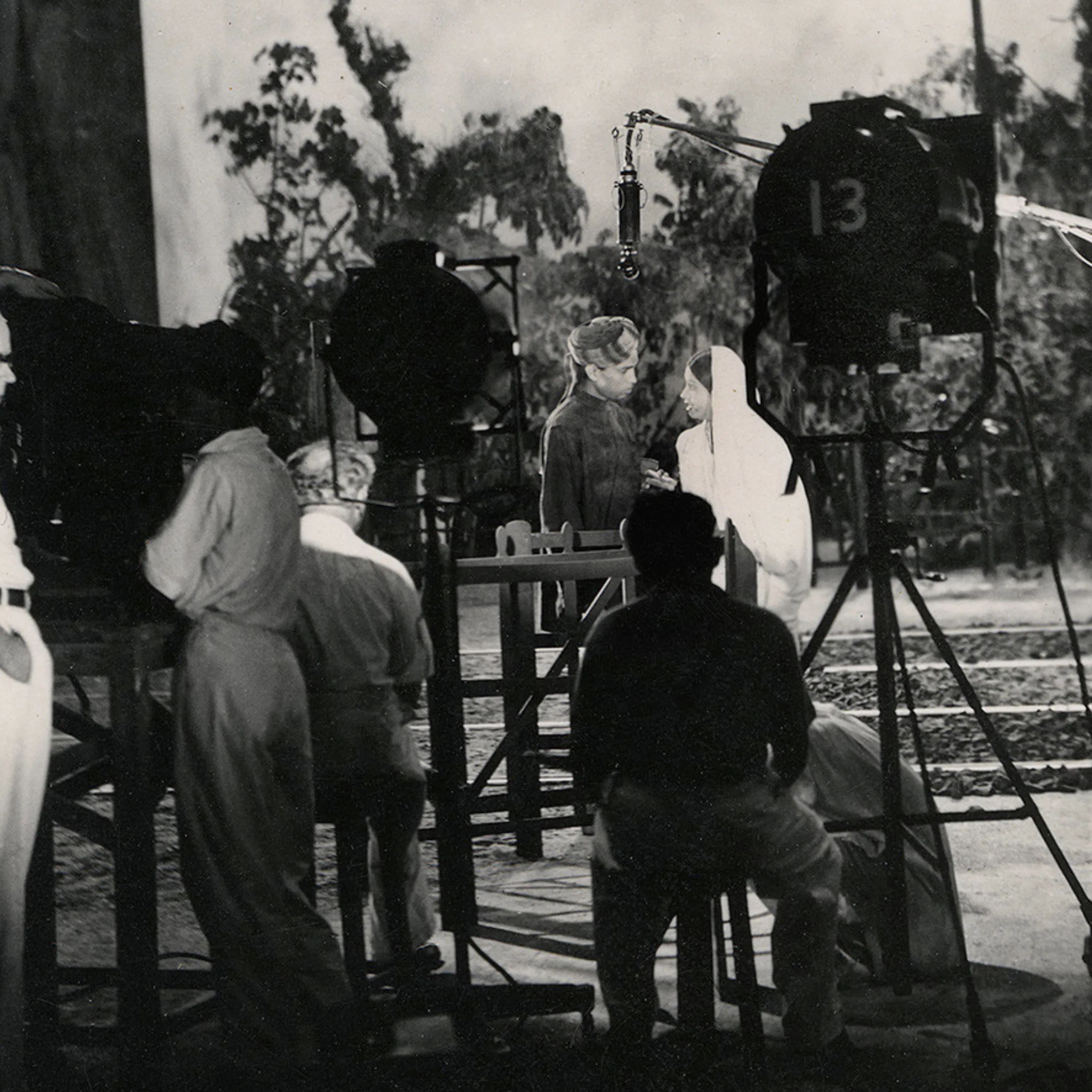
Debashree Mukherjee talks about the pioneering film studio founded in 1934 in the city of Bombay (now Mumbai) by Himansu Rai and Devika Rani. Its cast and crew of diverse global origins and training, offer new ways of writing the history of labor in Indian Cinema. In the accompanying B-Side episode, she focuses on her new book Bombay Talkies: An Unseen History of Indian Cinema, which features rare behind-the-scenes photographs from the personal archive of cinematographer Josef Wirsching. Wirsching brought the influence of German Expressionism to Indian cinema, and was responsible for the cinematic stylings of groundbreaking films like Achhyut Kanya (1936), Mahal (1949), and Pakeezah (1972). Debashree Mukherjee is Associate Professor of film and media in the Department of Middle Eastern, South Asian, and African Studies (MESAAS) at Columbia University. Her first book, Bombay Hustle: Making Movies in a Colonial City (2020), approaches film history as an ecology of material practices and practitioners. Her second book project, Camera Obscura: Media at the Dawn of Planetary Extraction, develops a media history of oceanic migrations and plantation capitalism. Debashree edits the peer-reviewed journal BioScope: South Asian Screen Studies and in a previous life she worked in Mumbai’s film and TV industries as an assistant director, writer, and cameraperson. Image: Sourced from Bombay Talkies: An Unseen History of Indian Cinema with permission. Learn more about your ad choices. Visit megaphone.fm/adchoices Support our show by becoming a premium member! https://newbooksnetwork.supportingcast.fm/south-asian-studies
Ep 125Wirsching: Bombay Talkies B-Side
In this episode of High Theory, we continue our conversation with Debashree Mukherjee about the pioneering film studio Bombay Talkies, founded in 1934 in the city of Bombay (now Mumbai) by Himansu Rai and Devika Rani. Here, she focuses on cinematographer Josef Wirsching, whose rare behind-the-scenes photographs of life and work at the studio appear in her new book Bombay Talkies: An Unseen History of Indian Cinema. Wirsching fled fascism in Europe, and brought the influence of German Expressionism to Indian cinema, and was responsible for the cinematic stylings of groundbreaking films like Achhyut Kanya (1936), Mahal (1949), and Pakeezah (1972). His experiences teach us about the stifling effects of fascism on art and the peculiarity of national cinema as an analytic category. The diverse global origins and training of the cast and crew his photographs document offer new ways of writing the history of labor in Indian Cinema. If you want to learn more about Debashree’s research, and her new book, listen back to our earlier episode called “Bombay Talkies.” Debashree Mukherjee is Associate Professor of film and media in the Department of Middle Eastern, South Asian, and African Studies (MESAAS) at Columbia University. Her first book, Bombay Hustle: Making Movies in a Colonial City (2020), approaches film history as an ecology of material practices and practitioners. Her second book project, Camera Obscura: Media at the Dawn of Planetary Extraction, develops a media history of oceanic migrations and plantation capitalism. Debashree edits the peer-reviewed journal BioScope: South Asian Screen Studies and in a previous life she worked in Mumbai’s film and TV industries as an assistant director, writer, and cameraperson. Image: Sourced from Bombay Talkies: An Unseen History of Indian Cinema with permission. Learn more about your ad choices. Visit megaphone.fm/adchoices Support our show by becoming a premium member! https://newbooksnetwork.supportingcast.fm/south-asian-studies
Ep 198Brahma Prakash, "Body on the Barricades: Life, Art and Resistance in Contemporary India" (LeftWord, 2023)
Brahma Prakash's book Body on the Barricades: Life, Art and Resistance in Contemporary India (LeftWord, 2023) is an interesting gaze into life, art, and resistance in contemporary India. Through a wide canvas of contemporary events, the book has tried to look at how barricade becomes a symbol of excessive policing as well as a metaphor for containment. The book also reflects upon marginalized identities and the conflicting narratives of such identities with the State; which unfolds almost like a horror story. The book has interestingly engaged with each of such suppressive events through the affect it generates on the victimized body. The book has beautifully captured bodily acts like breathing, mourning, dancing, singing, and other creative expression as an act of resistance. Thus, resistance becomes an act that is not just visible out there, but it also becomes an inward experience. The book has lucid language, yet it is written with a sense of authenticity, that dares to speak out. The book ends with a clarion call for hope among the despair that prevails. The author has ensured that every narrator who has been a victim gets enough space to think about their acts of resistance, rather than being a passive dead protagonist lying on the barricade. Learn more about your ad choices. Visit megaphone.fm/adchoices Support our show by becoming a premium member! https://newbooksnetwork.supportingcast.fm/south-asian-studies
Ep 197Ajay Gudavarthy, "Politics, Ethics and Emotions in ‘New India’" (Routledge, 2023)
How do emotions mobilise in politics? How do they frame ideologies? Broadly focusing on these questions, Ajay Gudavarthy's book Politics, Ethics and Emotions in ‘New India’ (Routledge, 2023) explains the role emotions play in Indian politics and the part they played in the aftermath of the 2019 general elections. It traces the consolidation of the Right in India and highlights the reasons for its electoral successes with a focus on the interplay between ethics and emotions such as fear, anxiety, guilt, shame, anger, hatred, betrayal, and violence. At the same time, it traces the changing dynamic in the way we think about politics and analyses the failure of liberal democratic institutions to make space for emotions in politics and political motivations. An accessible and essential guide to understanding contemporary India, this book will be of great interest to scholars and researchers of politics, especially governance and political theory, as well as South Asian studies. Tusharika Deka is a PhD student in International Relations at the University of Nottingham. Learn more about your ad choices. Visit megaphone.fm/adchoices Support our show by becoming a premium member! https://newbooksnetwork.supportingcast.fm/south-asian-studies
Ep 196Roluah Puia, "Nationalism in the Vernacular: State, Tribes, and Politics of Peace in Northeast India" (Cambridge UP, 2023)
Roluah Puia's book Nationalism in the Vernacular: State, Tribes, and Politics of Peace in Northeast India (Cambridge UP, 2023) illuminates our understanding of the relationship between orality and nationalist politics. In doing so, it provides a new angle to the understanding of nationalism by looking at the popular support and participation of ordinary people in the construction of Mizo nationalism, in short, the vernacularisation of nationalism. Nationalism in the Vernacular examines this process of vernacularisation at two levels, the first concerns the process of creating a vernacular language to express nationalist ideas and second, the irrepressibility of the oral against state's violent response to the nationalist movement. Drawing from multiple sources, the book through the rich oral narratives, archival materials, including government and media reports shows how Mizos have remained active agents in asserting and claiming their rights to defining ideas of nationalism in their own terms by making it distinctively Mizo. Tiatemsu Longkumer is a Ph.D. scholar working on Indigenous Religion and Christianity at North-Eastern Hill University, Shillong: India. Learn more about your ad choices. Visit megaphone.fm/adchoices Support our show by becoming a premium member! https://newbooksnetwork.supportingcast.fm/south-asian-studies
Ep 195Callie Wilkinson, "Empire of Influence: The East India Company and the Making of Indirect Rule" (Cambridge UP, 2023)
Indirect rule is widely considered as a defining feature of the nineteenth and twentieth century British Empire but its divisive earlier history remains largely unexplored. Empire of Influence: The East India Company and the Making of Indirect Rule (Cambridge UP, 2023) traces the contentious process whereby the East India Company established a system of indirect rule in India in the first decades of the nineteenth century. In a series of thematic chapters covering intelligence gathering, violence, gift giving and the co-optation of the scribal and courtly elite, Callie Wilkinson foregrounds the disagreement surrounding the tactics of the political representatives of the Company and recaptures the experimental nature of early attempts to secure Company control. She demonstrates how these endeavours were reshaped, exploited and resisted by Indians as well as disputed within the Company itself. This important new account exposes the contested origins of these ambiguous relationships of 'protection' and coercion, while identifying the factors that enabled them to take hold and endure. Callie Wilkinson is a Marie Skłodowska-Curie European Postdoctoral Fellow at Ludwig-Maximilians-Universität München Morteza Hajizadeh is a Ph.D. graduate in English from the University of Auckland in New Zealand. His research interests are Cultural Studies; Critical Theory; Environmental History; Medieval (Intellectual) History; Gothic Studies; 18th and 19th Century British Literature. YouTube channel. Learn more about your ad choices. Visit megaphone.fm/adchoices Support our show by becoming a premium member! https://newbooksnetwork.supportingcast.fm/south-asian-studies
Ep 270Ankur Barua, "Exploring Hindu Philosophy" (Equinox Publishing, 2023)
Ankur Barua's book Exploring Hindu Philosophy (Equinox Publishing, 2023) points to some of the diverse tapestries of Hindu worldviews where scriptural revelation, logical argumentation, embodied affectivity, moral reasoning, and aesthetic cultivation constitute densely interwoven conceptual threads. It begins with an exploration of some classical iterations of the quest for a fundamental ontology amidst the diversities of the everyday world. This quest is often embedded in both a diagnosis of the human condition as structured by suffering and a therapy for recovery from worldly fragmentation. A crucial aspect of this therapeutic structure is the analysis of the means of knowledge and the categories of reality, since in order to know the nature of the world one must proceed along truth-tracking routes. Such dynamic mind-world encounters are mediated through language, and Hindu philosophical texts extensively discuss the motif of whether or not deep reality can be comprehended through linguistic structures. These philosophical exercises also shape reflections on themes such as aesthetics, social organization, the meaning of life, and so on. As Hinduism increasingly migrates to western locations through practices of yoga, meditation, and mindfulness, and along with sensibilities relating to vegetarianism, ecology, and pacifism, we encounter multiple translations of these classical motifs relating to the self, language, and consciousness. Raj Balkaran is a scholar of Sanskrit narrative texts. He teaches at the Oxford Centre for Hindu Studies and at his own virtual School of Indian Wisdom. For information see rajbalkaran.com. Learn more about your ad choices. Visit megaphone.fm/adchoices Support our show by becoming a premium member! https://newbooksnetwork.supportingcast.fm/south-asian-studies
Ep 194Anam Zakaria, "1971: A People's History from Bangladesh, Pakistan and India" (Vintage Books, 2021)
The year 1971 exists everywhere in Bangladesh-on its roads, in sculptures, in its museums and oral history projects, in its curriculum, in people's homes and their stories, and in political discourse. It marks the birth of the nation, its liberation. More than 1000 miles away, in Pakistan too, 1971 marks a watershed moment, its memories sitting uncomfortably in public imagination. It is remembered as the 'Fall of Dacca', the dismemberment of Pakistan or the third Indo-Pak war. In India, 1971 represents something else-the story of humanitarian intervention, of triumph and valour that paved the way for India's rise as a military power, the beginning of its journey to becoming a regional superpower. Navigating the widely varied terrain that is 1971 across Pakistan, Bangladesh, and India, Anam Zakaria sifts through three distinct state narratives, and studies the institutionalization of the memory of the year and its events. Through a personal journey, she juxtaposes state narratives with people's history on the ground, bringing forth the nuanced experiences of those who lived through the war. Using intergenerational interviews, textbook analyses, visits to schools and travels to museums and sites commemorating 1971, Zakaria explores the ways in which 1971 is remembered and forgotten across countries, generations, and communities. Anam Zakaria is the author of 1971: A People's History from Bangladesh, Pakistan and India (2021), Between the Great Divide: A Journey into Pakistan-Administered Kashmir (2018) and The Footprints of Partition: Narratives of Four Generations of Pakistanis and Indians (2015), which won her the 2017 KLF German Peace Prize. She works as a development professional and writes frequently on issues of conflict and peace. Her work has appeared in The New York Times, Toronto Star, CBC, The Hill Times, Al Jazeera, Dawn, Wire.in and Scroll.in among other media outlets. Ed Amon has a Master of Indigenous Studies and is a PhD Candidate at the University of Auckland, New Zealand. He is a columnist at his local paper: Hibiscus Matters, and a Stand-up Comedian. His main interests are indigenous studies, politics, history, and cricket. Follow him on twitter @edamoned or email him at [email protected] Learn more about your ad choices. Visit megaphone.fm/adchoices Support our show by becoming a premium member! https://newbooksnetwork.supportingcast.fm/south-asian-studies
Ep 1335Nile Green, "How Asia Found Herself: A Story of Intercultural Understanding" (Yale UP, 2023)
The nineteenth century saw European empires build vast transport networks to maximize their profits from trade, and it saw Christian missionaries spread printing across Asia to bring Bibles to the colonized. The unintended consequence was an Asian communications revolution: the maritime public sphere expanded from Istanbul to Yokohama. From all corners of the Asian continent, curious individuals confronted the challenges of studying each other’s cultures by using the infrastructure of empire for their own exploratory ends. Whether in Japanese or Persian, Bengali or Arabic, or Chinese or Urdu, they wrote travelogues, histories, and phrasebooks to chart the vastly different regions that European geographers labeled “Asia.” How did people from different parts of Asia encounter and come to understand and interpret each other’s cultures in the modern period? What did they make of the languages, histories, literary cultures, religious traditions, and broader societies of the countries and regions that they encountered? Nile Green’s How Asia Found Herself: A Story of Intercultural Understanding (Yale University Press, 2023) attempts to answer these questions through analyzing a wide range of primary sources in different languages from across Asia and paying attention to the often-forgotten individuals who became the interpreters within their own countries for the distant cultures and societies that they encountered. Yet comprehension does not always keep pace with connection. Far from flowing smoothly, inter-Asian understanding faced obstacles of many kinds, especially on a landmass with so many scripts and languages. Here is the dramatic story of cross-cultural knowledge on the world’s largest continent, exposing the roots of enduring fractures in Asian unity. How Asia Found Herself is the 2023 winner of the Bentley Book Prize for best book in world history from the World History Association. Nile Green is Professor and Ibn Khaldun Endowed Chair in World History at the University of California, Los Angeles (UCLA). He is a historian of the multiple globalizations of Islam and Muslims, and the author of multiple books and articles. His research truly spans the world and having begun his research as a historian of India and Pakistan, he has subsequently traced multiple Muslim networks across the Middle East, the Indian Ocean, Africa, Japan, and even Europe and North America. Shatrunjay Mall is a PhD candidate at the Department of History at the University of Wisconsin-Madison. He works on transnational Asian history, and his dissertation explores intellectual, political, and cultural intersections and affinities that emerged between Indian anti-colonialism and imperial Japan in the twentieth century. Learn more about your ad choices. Visit megaphone.fm/adchoices Support our show by becoming a premium member! https://newbooksnetwork.supportingcast.fm/south-asian-studies
Ep 188Hindu Nationalism and Lower Caste Politics
Why and how has India’s Hindu nationalist party, the BJP, become so adept at appealing to and recruiting people from the lower castes? And what does this mean for Indian politics in the short to medium term? In this episode we are joined by Samantha Agarwal to discuss the rise of Hindu nationalism, focusing on the strategies it deploys to recruit people and voters from lower caste groups as it seeks to rework its image as a Brahminical and upper caste political organization. Samantha Agarwal is currently at Johns Hopkins University and will soon join the School of International Service at American University in Washington, DC., as a Changemaker Postdoctoral Fellow. Kenneth Bo Nielsen is an Associate Professor at the Department of Social Anthropology at the University of Oslo and one of the leaders of the Norwegian Network for Asian Studies. The Nordic Asia Podcast is a collaboration sharing expertise on Asia across the Nordic region, brought to you by the Nordic Institute of Asian Studies (NIAS) based at the University of Copenhagen, along with our academic partners: the Centre for East Asian Studies at the University of Turku, and Asianettverket at the University of Oslo. We aim to produce timely, topical and well-edited discussions of new research and developments about Asia. Learn more about your ad choices. Visit megaphone.fm/adchoices Support our show by becoming a premium member! https://newbooksnetwork.supportingcast.fm/south-asian-studies
Ep 269Daniel J. Soars and Nadya Pohran, "Hindu-Christian Dual Belonging" (Routledge, 2022)
Daniel J. Soars and Nadya Pohran's book Hindu-Christian Dual Belonging (Routledge, 2022) focuses on dual belonging within Hindu-Christian contexts. Written by experts in a variety of fields, the chapters explore the theological, philosophical, and cultural anthropological debates relating to religious pluralism, religious language, and social identity while addressing the fact that both Hindu and Christian forms of self-understandings have been significantly moulded through their interactions in South Asia and across certain Euro-American horizons. The limits of the definition of dual belonging are tested via case studies, and contributors address the question of whether there is anything distinctive about dual belonging across Christianity and Hinduism specifically. A timely contribution to the emerging subject of dual religious belonging, this book will be of interest to academics in the fields of Hindu studies and Christian theology, Hindu-Christian comparative theology, religious pluralism, interreligious relations, the sociology and anthropology of religion, and comparative theology and philosophy. Raj Balkaran is a scholar of Sanskrit narrative texts. He teaches at the Oxford Centre for Hindu Studies and at his own virtual School of Indian Wisdom. For information see rajbalkaran.com. Learn more about your ad choices. Visit megaphone.fm/adchoices Support our show by becoming a premium member! https://newbooksnetwork.supportingcast.fm/south-asian-studies
Ep 67Radhika Seshan and Ryuto Shimada, "Connecting the Indian Ocean World: Across Sea and Land" (Routledge, 2023)
The Indian Ocean world has a rich history of socio-economic and cultural exchanges across time and space. Connecting the Indian Ocean World Across Sea and Land (Routledge, 2023) and its companion, Merchants and Ports in the Indian Ocean World (Routledge, 2023), explore these connections around the wider Indian Ocean world. The book examines the many overlapping linkages that existed from the early modern period and into the colonial era. It offers a clear understanding of the economic networks that extended across the Indian Ocean and the Atlantic during the 19th century. With a critical historical lens, the volume discusses themes like the opium trade in the Malay-Indonesian Archipelago - the biggest opium trade market at the time; the Safavid mission to Siam; and the economic relationship between Pondicherry and West Africa, via France. Rich in archival material, this book will be of interest for scholars and researchers of Indian Ocean history, maritime history, Indian history, economic and commercial history, South Asian history, and social history, anthropology, and trade relations in general. Radhika Seshan is former head and retired professor of the Department of History, Savitribai Phule Pune University, and is now visiting faculty at the Symbiosis School for Liberal Arts, Pune, India. Her work has been primarily in the areas of economic history, particularly maritime and urban history of early modern India. Author of three books, she has edited or co-edited many others, and her most recent publication is Wage Earners in India 1500–1900: Regional Approaches in an International Context, co-edited with Jan Lucassen (2022). Ryuto Shimada is associate professor, Department of Asian History, Graduate School of Humanities and Sociology, The University of Tokyo. The author of The Intra-Asian Trade in Japanese Copper by the Dutch East India Company during the Eighteenth Century (2006), he has published extensively in Japanese and in English on aspects of the networks of the Indian Ocean world in the early modern age. Ahmed Yaqoub AlMaazmi is a Ph.D. candidate at Princeton University, Near Eastern Studies Department. His research focuses on the intersection of law, the occult sciences, and the environment across the western Indian Ocean. He can be reached by email at [email protected] or on Twitter @Ahmed_Yaqoub. Listeners’ feedback, questions, and book suggestions are most welcome. Learn more about your ad choices. Visit megaphone.fm/adchoices Support our show by becoming a premium member! https://newbooksnetwork.supportingcast.fm/south-asian-studies
Ep 186Afghanistan-Pakistan Relations: A Clash of Identities?
With Afghanistan once again under Taliban rule and Pakistan reeling under a severe economic and political crisis, the relationship between the neighbouring countries is growing increasingly tense. How can we understand this contentious situation? And, what are the consequences for the civilian population? To discuss these question, and current Afghanistan-Pakistan relations more generally, Kenneth Bo Nielsen is joined by Farhat Taj (University of Tromsø). Farhat Taj is an associate professor at the University of Tromsø, the Arctic University of Norway. Kenneth Bo Nielsen is an Associate Professor at the dept. of Social Anthropology at the University of Oslo and one of the leaders of the Norwegian Network for Asian Studies. The Nordic Asia Podcast is a collaboration sharing expertise on Asia across the Nordic region, brought to you by the Nordic Institute of Asian Studies (NIAS) based at the University of Copenhagen, along with our academic partners: the Centre for East Asian Studies at the University of Turku, and Asianettverket at the University of Oslo. We aim to produce timely, topical and well-edited discussions of new research and developments about Asia. Learn more about your ad choices. Visit megaphone.fm/adchoices Support our show by becoming a premium member! https://newbooksnetwork.supportingcast.fm/south-asian-studies
Ep 307Yael Rice, "The Brush of Insight: Artists and Agency at the Mughal Court" (U Washington Press, 2023)
Over the course of the sixteenth and early seventeenth centuries, Mughal court painters evolved from illustrators of manuscripts and albums to active mediators of imperial visionary experience, cultivating their patrons’ earthly and spiritual authority. The Brush of Insight: Artists and Agency at the Mughal Court (University of Washington Press, 2023) traces this shift, demonstrating how royal artists created a new visual economy that featured highly naturalistic royal portraits and depictions of the emperors’ dreams. These images, in turn, shaped the perception of the Mughal emperors’ preeminence in all domains—temporal and spiritual—from the reign of Akbar to that of his son and successor, Jahangir. In analyzing a wide range of visual materials including manuscripts, albums, and coins, art historian Yael Rice, Associate Professor at Amherst College, documents how manuscript painters and paintings challenged the status of writing as the primary medium for the transmission of knowledge and experience. The Brush of Insight probes how pictures and illustrated books became central to imperial modes of seeing and being in early modern Mughal South Asia. In our conversation we discussed royal court culture, illustrated manuscripts, the role of painters, the collective foundations of the workshop, sacred kingship and Sufi sheikhs, artists as mediators between the spiritual and material worlds, the celebration of Nawruz, and the creation of a specific Mughal artistic style and professional identity. Kristian Petersen is an Associate Professor of Philosophy & Religious Studies at Old Dominion University. You can find out more about his work on his website, follow him on Twitter @BabaKristian, or email him at [email protected]. Learn more about your ad choices. Visit megaphone.fm/adchoices Support our show by becoming a premium member! https://newbooksnetwork.supportingcast.fm/south-asian-studies
Ep 268Nayanjot Lahiri, "Searching for Ashoka: Questing for a Buddhist King from India to Thailand" (SUNY Press, 2023)
Blending travelogue, history, and archaeology, Searching for Ashoka: Questing for a Buddhist King from India to Thailand (SUNY Press, 2023) unravels the various avatars of India's most famous emperor, revealing how he came to be remembered—and forgotten—in distinctive ways at particular points in time and in specific locations. Through personal journeys that take her across India and to various sites and cities in Sri Lanka, Myanmar, and Thailand, archaeologist Nayanjot Lahiri explores how Ashoka's visibility from antiquity to the modern era has been accompanied by a reinvention of his persona. Although the historical Ashoka spoke expansively of his ideas of governance and a new kind of morality, his afterlife is a jumble of stories and representations within various Buddhist imaginings. By remembering Ashoka selectively, Lahiri argues, ancient kings and chroniclers created an artifice, constantly appropriating and then remolding history to suit their own social visions, political agendas, and moral purposes. Nayanjot Lahiri is Professor of History at Ashoka University. Her previous books include Finding Forgotten Cities: How the Indus Civilization was Discovered; Marshalling the Past: Ancient India and Its Modern Histories; and Ashoka in Ancient India, which was awarded the John F. Richards Prize in South Asian History in 2016. Raj Balkaran is a scholar of Sanskrit narrative texts. He teaches at the Oxford Centre for Hindu Studies and at his own virtual School of Indian Wisdom. For information see rajbalkaran.com. Learn more about your ad choices. Visit megaphone.fm/adchoices Support our show by becoming a premium member! https://newbooksnetwork.supportingcast.fm/south-asian-studies
Ep 266J. Barton Scott, "Slandering the Sacred: Blasphemy Law and Religious Affect in Colonial India" (U Chicago Press, 2023)
Why is religion today so often associated with giving and taking offense? To answer this question, Slandering the Sacred: Blasphemy Law and Religious Affect in Colonial India (U Chicago Press, 2023) invites us to consider how colonial infrastructures shaped our globalized world. Through the origin and afterlives of a 1927 British imperial law (Section 295A of the Indian Penal Code), J. Barton Scott weaves a globe-trotting narrative about secularism, empire, insult, and outrage. Decentering white martyrs to free thought, his story calls for new histories of blasphemy that return these thinkers to their imperial context, dismantle the cultural boundaries of the West, and transgress the borders between the secular and the sacred as well as the public and the private. Raj Balkaran is a scholar of Sanskrit narrative texts. He teaches at the Oxford Centre for Hindu Studies and at his own virtual School of Indian Wisdom. For information see rajbalkaran.com. Learn more about your ad choices. Visit megaphone.fm/adchoices Support our show by becoming a premium member! https://newbooksnetwork.supportingcast.fm/south-asian-studies
Ep 276Sangraha: Digital Cataloguing of Sanskrit Manuscripts
Sanjaya Singhal discusses Sangraha, an ambitious digital enterprise cataloguing India's millions of decaying Sanskrit manuscripts. Sangraha is a detailed, descriptive catalogue allowing users to find relevant manuscripts with a wide range of search terms. Eventually it will have 2.5 million entries. Raj Balkaran is a scholar of Sanskrit narrative texts. He teaches at the Oxford Centre for Hindu Studies and at his own virtual School of Indian Wisdom. For information see rajbalkaran.com. Learn more about your ad choices. Visit megaphone.fm/adchoices Support our show by becoming a premium member! https://newbooksnetwork.supportingcast.fm/south-asian-studies
Ep 316Arvind-Pal Singh Mandair, "Sikh Philosophy: Exploring Gurmat Concepts in a Decolonizing World" (Bloomsbury, 2022)
In his new contribution to the Bloomsbury Introductions to World Philosophies, Sikh Philosophy: Exploring Gurmat Concepts in a Decolonizing World (Bloomsbury, 2022), Arvind-Pal Singh Mandair introduces readers to a tradition often ignored by contemporary philosophers. While simultaneously arguing for the fecundity of Sikh categories and concepts from a philosophical vantage point, Mandair scrutinizes the characterization of Sikh ideas as unified -ism, also problematizing the philosophy/religion divide. And, at the same time as he tracks the historical and intellectual development of Sikh philosophy, examining the reasons for its marginalization, he introduces readers to the main contours of its epistemology, ontology, philosophy of mind, and ethics, in particular bioethics. Malcolm Keating is Associate Professor of Philosophy at Yale-NUS College. His research focuses on Sanskrit works of philosophy in Indian traditions, in the areas of language and epistemology. He is the author of Language, Meaning, and Use in Indian Philosophy (Bloomsbury Press, 2019) and host of the podcast Sutras & Stuff. Learn more about your ad choices. Visit megaphone.fm/adchoices Support our show by becoming a premium member! https://newbooksnetwork.supportingcast.fm/south-asian-studies
Ep 110The Outsourcer: The Story of India's IT Revolution
The rise of the Indian information technology industry is a remarkable economic success story. Software and services exports from India amounted to less than $100 million in 1990, and today come close to $100 billion. But, as Dinesh Sharma explains in The Outsourcer, Indian IT's success has a long prehistory; it did not begin with software support, or with American firms' eager recruitment of cheap and plentiful programming labor, or with India's economic liberalization of the 1990s. The foundations of India's IT revolution were laid long ago, even before the country's independence from British rule in 1947, as leading Indian scientists established research institutes that became centers for the development of computer science and technology. The “miracle” of Indian IT is actually a story about the long work of converting skills and knowledge into capital and wealth. With The Outsourcer, Sharma offers the first comprehensive history of the forces that drove India's IT success. Sharma describes India's early development of computer technology, part of the country's efforts to achieve national self-sufficiency, and shows that excessive state control stifled IT industry growth before economic policy changed in 1991. He traces the rise and fall (and return) of IBM in India and the emergence of pioneering indigenous hardware and software firms. He describes the satellite communication links and state-sponsored, tax-free technology parks that made software-related outsourcing by foreign firms viable, and the tsunami of outsourcing operations at the beginning of the new millennium. It is the convergence of many factors, from the tradition of technical education to the rise of entrepreneurship to advances in communication technology, that have made the spectacular growth of India's IT industry possible. Dinesh C. Sharma is a journalist and author with thirty years of experience reporting on science, technology, and innovation. Learn more about your ad choices. Visit megaphone.fm/adchoices Support our show by becoming a premium member! https://newbooksnetwork.supportingcast.fm/south-asian-studies
Ep 157Leela Fernandes, "Governing Water in India: Inequality, Reform, and the State" (U Washington Press, 2022)
Intensifying droughts and competing pressures on water resources foreground water scarcity as an urgent concern of the global climate change crisis. In India, individual, industrial, and agricultural water demands exacerbate inequities of access and expose the failures of state governance to regulate use. State policies and institutions influenced by global models of reform produce and magnify socio-economic injustice in this "water bureaucracy." Drawing on historical records, an analysis of post-liberalization developments, and fieldwork in the city of Chennai, Leela Fernandes traces the configuration of colonial historical legacies, developmental-state policies, and economic reforms that strain water resources and intensify inequality. While reforms of water governance promote privatization and decentralization, they strengthen the state centralized control over water through city-based development models. Understanding the political economy of water thus illuminates the consequent failures of the state within countries of the Global South. Governing Water in India: Inequality, Reform, and the State (U Washington Press, 2022) is available open access here. Anubha Anushree is a Lecturer at the COLLEGE Program, Stanford University. She could be reached at [email protected]. Learn more about your ad choices. Visit megaphone.fm/adchoices Support our show by becoming a premium member! https://newbooksnetwork.supportingcast.fm/south-asian-studies
Ep 92Tania James, "Loot: A Novel" (Knopf, 2023)
Abbas is just seventeen years old when his gifts as a woodcarver come to the attention of Tipu Sultan, and he is drawn into service at the palace in order to build a giant tiger automaton for Tipu's sons, a gift to commemorate their return from British captivity. His fate--and the fate of the wooden tiger he helps create--will mirror the vicissitudes of nations and dynasties ravaged by war across India and Europe. Working alongside the legendary French clockmaker Lucien du Leze, Abbas hones his craft, learns French, and meets Jehanne, the daughter of a French expatriate. When Du Leze is finally permitted to return home to Rouen, he invites Abbas to come along as his apprentice. But by the time Abbas travels to Europe, Tipu's palace has been looted by British forces, and the tiger automaton has disappeared. To prove himself, Abbas must retrieve the tiger from an estate in the English countryside, where it is displayed in a collection of plundered art. Tania James is the author of Atlas of Unknowns, Aerogrammes, and Other Stories, and The Tusk That Did the Damage. Her stories have appeared in Freeman’s: The Future of New Writing, Granta, the New Yorker, O, The Oprah Magazine, and One Story, and have been featured on Symphony Space Selected Shorts. The Tusk that Did the Damage was shortlisted for the Dylan Thomas Prize. Tania lives in Washing D.C. where she is an associate professor of English at George Mason University. Recommended Books: Hua Hsu, Stay True Marcy Dermansky, Very Nice Rita Chang-Eppig, Deep as the Sky, Red as the Sea *A video of a period expert playing Tipu’s Tiger at the Victoria and Albert Museum in London is available here Chris Holmes is Chair of Literatures in English and Associate Professor at Ithaca College. He writes criticism on contemporary global literatures. His book, Kazuo Ishiguro as World Literature, is under contract with Bloomsbury Publishing. He is the co-director of The New Voices Festival, a celebration of work in poetry, prose, and playwriting by up-and-coming young writers. Learn more about your ad choices. Visit megaphone.fm/adchoices Support our show by becoming a premium member! https://newbooksnetwork.supportingcast.fm/south-asian-studies
Ep 99Douglas Ober, "Dust on the Throne: The Search for Buddhism in Modern India" (Stanford UP, 2023)
Received wisdom has it that Buddhism disappeared from India, the land of its birth, between the thirteenth and fourteenth centuries, long forgotten until British colonial scholars re-discovered it in the early 1800s. Its full-fledged revival, so the story goes, only occurred in 1956, when the Indian civil rights pioneer Dr. B. R. Ambedkar converted to Buddhism along with half a million of his Dalit (formerly "untouchable") followers. This, however, is only part of the story. Dust on the Throne reframes discussions about the place of Buddhism in the subcontinent from the early nineteenth century onwards, uncovering the integral, yet unacknowledged, role that Indians played in the making of modern global Buddhism in the century prior to Ambedkar's conversion, and the numerous ways that Buddhism gave powerful shape to modern Indian history. Through an extensive examination of disparate materials held at archives and temples across South Asia, Douglas Ober explores Buddhist religious dynamics in an age of expanding colonial empires, intra-Asian connectivity, and the histories of Buddhism produced by nineteenth and twentieth-century Indian thinkers. While Buddhism in contemporary India is often disparaged as being little more than tattered manuscripts and crumbling ruins, this book opens new avenues for understanding its substantial socio-political impact and intellectual legacy. You can find the Navayana Publishing edition with its amazing cover art here. You can find readable articles and references on more recent research on Bengli-speaking Buddhists and their contribution to modern Indian Buddhism by Sanjoy Chawdhury here. Douglas Ober is Visiting Assistant Professor, History Department, Fort Lewis College, and Honorary Research Associate, School of Public Policy and Global Affairs, University of British Columbia. Jessica Zu is an intellectual historian and a scholar of Buddhist studies. She is an assistant professor of religion at the University of Southern California. Learn more about your ad choices. Visit megaphone.fm/adchoices Support our show by becoming a premium member! https://newbooksnetwork.supportingcast.fm/south-asian-studies
Ep 139Tanvi Srivastava, trans., "The War Diary of Asha-san: From Tokyo to Netaji's Indian National Army" (Harper Collins, 2022)
On a trip many years ago to New Delhi, I was struck by an official memorial to Subhas Chandra Bose, the wartime leader of the Indian National Army, the Japan-affiliated force of Indians who fought against the British during the Second World War. India, of course, has a more complex view of the fight against Japan than other countries involved in the War–with these soldiers being contentious, debated and, at times, celebrated. In this interview, I’m joined by Tanvi Srivastava, translator of The War Diary of Asha-san: From Tokyo to Netaji's Indian National Army (HarperCollins India: 2022). The book is a unique historical document showing the life of Lt Bharati ‘Asha’ Sahay Choudhry, a 17-year-old Indian girl, raised in Japan, who signed up to fight the British in 1943. While she never quite makes it to the frontlines, her story—as translated by her eventual grandaughter-in-law, Tanvi—discusses the war’s events from a different vantage point. Tanvi Srivastava also writes fiction and was a member of the 2021 cohort of the Write Beyond Borders programme funded by the British Council. She has been published in journals like Kitaab, Gulmohur Quarterly, New Anthology of Asian Writing, and The Reading Hour. She can be followed on Twitter at @tanvisrivastava and on Instagram at @tanvisrivastava_a. You can find more reviews, excerpts, interviews, and essays at The Asian Review of Books, including its review of The War Diary of Asha-san. Follow on Twitter at @BookReviewsAsia. Nicholas Gordon is an associate editor for a global magazine, and a reviewer for the Asian Review of Books. He can be found on Twitter at @nickrigordon. Learn more about your ad choices. Visit megaphone.fm/adchoices Support our show by becoming a premium member! https://newbooksnetwork.supportingcast.fm/south-asian-studies
Ep 235Francis Cody, "The News Event: Popular Sovereignty in the Age of Deep Mediatization" (U Chicago Press, 2023)
Not merely the act of representing events with words or images, a "news event" is the reciprocal relationship between the events being reported in the news and the event of the news coverage itself. In The News Event: Popular Sovereignty in the Age of Deep Mediatization (U Chicago Press, 2023), Francis Cody focuses on how imaginaries of popular sovereignty have been remade through the production and experience of such events. Political sovereignty is thoroughly mediated by the production of news, and subjects invested in the idea of democracy are remarkably reflexive about the role of publicly circulating images and texts in the very constitution of their subjectivity. The law comes to stand as both a limit and positive condition in this process of event making, where acts of legal and extralegal repression of publication can also become the stuff of news about news makers. When the subjects of news inhabit multiple participant roles in the unfolding of public events, when the very technologies of recording and circulating events themselves become news, the act of representing a political event becomes difficult to disentangle from that of participating in it. This, Cody argues, is the crisis of contemporary news making: the news can no longer claim exteriority to the world on which it reports. Atreyee Majumder is an anthropologist based in Bangalore, India. She tweets at @twitatreyee. Learn more about your ad choices. Visit megaphone.fm/adchoices Support our show by becoming a premium member! https://newbooksnetwork.supportingcast.fm/south-asian-studies
Ep 193Malini Ranganathan et al., "Corruption Plots: Stories, Ethics, and Publics of the Late Capitalist City" (Cornell UP, 2023)
Corruption Plots: Stories, Ethics, and Publics of the Late Capitalist City (Cornell UP, 2023) illuminates how corruption is fundamental to global storytelling about how states and elites abuse entrusted power in late capitalism. The millennial city of the global South is a charged setting for allegations of corruption, with skyscrapers, land grabs, and slum evictions invoking outrage at deepening economic polarization. Drawing on ethnography in Bengaluru and Mumbai and a cross-section of literary and cinematic stories from cities around the world, Malini Ranganathan, David L. Pike, and Sapana Doshi pay close attention to the racial, caste, class, and gender locations of the narrators, spaces, and publics imagined to be harmed by corruption. Corruption Plots demonstrates how corruption talk is leveraged to make sense of unequal spatial change and used opportunistically by those who are themselves implicated in wrongdoing. Offering a wide-ranging analysis of urban worlds, the authors reveal the ethical, spatial, and political stakes of storytelling and how vital it is to examine the corruption plot in all its contradictions. Sneha Annavarapu is Assistant Professor of Urban Studies at Yale-NUS College. Learn more about your ad choices. Visit megaphone.fm/adchoices Support our show by becoming a premium member! https://newbooksnetwork.supportingcast.fm/south-asian-studies
Ep 293Maitrayee Chaudhuri and Manish Thakur, "Doing Theory: Locations, Hierarchies and Disjunctions" (Orient Blackswan, 2018)
We live in times where theory is often understood as irrelevant in the real world. It appears to have no practical results. This has been further complicated in a post-fact world, where our ‘identities’ and ‘perception’ have become the final judges of truth. Sociology/social anthropology, in contrast, rests on a fundamental distinction between commonsense and theoretically informed knowledge. It teaches us to get rid of ‘perceptions’ and alerts us to go beyond taken-for-granted ideas. The paradox is that although theory is taught as a mandatory paper in sociology, it is either reduced to a topic in the syllabi or used as ceremonial citations. Emphasizing that theories emerge in specific historical contexts and are embedded in economic, political, social, cultural, institutional and intellectual processes, this edited volume Doing Theory: Locations, Hierarchies and Disjunctions (Orient Blackswan, 2018) by Maitrayee Chaudhuri and Manish Thakur takes a new approach by highlighting the sociological paths through which theories travel and are adopted by institutions in different parts of the country. Rituparna Patgiri is an Assistant Professor of Sociology at Indraprastha College for Women, University of Delhi. She has a PhD in Sociology from Jawaharlal Nehru University (JNU), New Delhi. Her research interests lie in the areas of food, media, gender and public. She is also one of the co-founders of Doing Sociology. Patgiri can be reached at @Rituparna37 on Twitter. Learn more about your ad choices. Visit megaphone.fm/adchoices Support our show by becoming a premium member! https://newbooksnetwork.supportingcast.fm/south-asian-studies
Ep 264Loriliai Biernacki, "The Matter of Wonder: Abhinavagupta's Panentheism and the New Materialism" (Oxford UP, 2023)
In the early 11th century, the Kashmiri philosopher Abhinavagupta proposed panentheism-seeing the divine as both immanent in the world and at the same time as transcendent--as a way to reclaim the material world as something real, something solid. His theology understood the world itself, with its manifold inhabitants--from gods to humans to insects down to the merest rock-as part of the unfolding of a single conscious reality, Siva. This conscious singularity-the word "god" here does not quite do it justice--with its capacity to choose and will, pervades all through, top to bottom; as Abhinavagupta writes, "even down to a worm -- when they do their own deeds, that which is to be done first stirs in the heart." His panentheism proposed an answer to a familiar conundrum, one we still grapple with today: Consciousness is so unlike matter. How does consciousness actually connect to the materiality of our world? To put this in more familar twenty-first-century terms, how does mind connect to body? These questions drive Loriliai Biernacki's The Matter of Wonder: Abhinavagupta's Panentheism and New Materialism (Oxford UP, 2023), Biernacki draws on Abhinavagupta's thought--and particularly his yet-untranslated, philosophical magnum opus, the Isvara Pratyabhijña Vivrti Vimarsini--to think through contemporary issues such as the looming prospect of machine AI, ideas about information, and our ecological crises. She argues that Abhinavagupta's panentheism can help us understand our current world and can contribute to a New Materialist re-envisioning of the relationship that humans have with matter. Raj Balkaran is a scholar of Sanskrit narrative texts. He teaches at the Oxford Centre for Hindu Studies and at his own virtual School of Indian Wisdom. For information see rajbalkaran.com. Learn more about your ad choices. Visit megaphone.fm/adchoices Support our show by becoming a premium member! https://newbooksnetwork.supportingcast.fm/south-asian-studies