
New Books in Science, Technology, and Society
2,948 episodes — Page 23 of 59

Ep 116Computer Graphics
In this episode of High Theory, Bernard Dionysius Geoghegan talks with us about computer graphics. Emerging from tools for sailing and warmaking, like sea charts and radar, modern computer graphics are technologies of mapping and managing risk. They seem intent on absorbing the human sensorium into the machine. In the episode Bernard refers to computer graphics as “techniques of addressing,” a term he attributes to Ranjodh Singh Dhaliwal. He also uses the term “operational images” which comes from the work of Harun Farocki, and talks about SAGE, the US Government’s Cold War era Semi-Automatic Ground Environment Air Defense System. Bernard references Paul Edward’s book A Vast Machine: Computer Models, Climate Data, and the Politics of Global Warming (MIT Press, 2013). He also mentions the German scholar Christoph Borbach who has written on auditory computer interfaces, and American disability studies scholar Mara Mills, who has written on the Deaf history of computing. He was kind enough to give us an extensive bibliography on this topic, which is posted below. Bernard Dionysius Geoghegan is a reader in the History and Theory of Digital Media at King’s College London. He has a brand new book out on the cybernetic history of French theory, called Code: From Information Theory to French Theory (Duke UP, 2023). Kim met him when he came to give a talk at the Stanford Humanities Center in January 2023. He wore denim and had a slightly manic affect. People came all the way from Berkeley to hear what he had to say, which is quite impressive in the Bay Area. This week’s image is a radar loop of the December 16 2007 Eastern North America winter storm, found on Wikimedia Commons. The loop runs from Saturday Morning at 7 AM (Dec 15) to Sunday Night at 7 PM (Dec 16). The image is in the public domain because it was made by someone who works for the National Weather Service. Learn more about your ad choices. Visit megaphone.fm/adchoices Support our show by becoming a premium member! https://newbooksnetwork.supportingcast.fm/science-technology-and-society
Ep 94Alan Lightman, "The Transcendent Brain: Spirituality in the Age of Science" (Pantheon, 2023)
Are science and spirituality incompatible? From the acclaimed author of Einstein’s Dreams comes a rich, fascinating answer to that question... Gazing at the stars, falling in love, or listening to music, we sometimes feel a transcendent connection with a cosmic unity and things larger than ourselves. But these experiences are not easily understood by science, which holds that all things can be explained in terms of atoms and molecules. Is there space in our scientific worldview for these spiritual experiences? According to acclaimed physicist and novelist Alan Lightman, there may be. Drawing on intellectual history and conversations with contemporary scientists, philosophers, and psychologists, Lightman asks a series of thought-provoking questions that illuminate our strange place between the world of particles and forces and the world of complex human experience. Can strict materialism explain our appreciation of beauty? Or our feelings of connection to nature and to other people? Is there a physical basis for consciousness, the most slippery of all scientific problems? In The Transcendent Brain: Spirituality in the Age of Science (Pantheon, 2023), Lightman weaves these investigations together to propose what he calls “spiritual materialism”—the belief that we can embrace spiritual experiences without letting go of our scientific worldview. In his view, the breadth of the human condition is not only rooted in material atoms and molecules but can also be explained in terms of Darwinian evolution. What is revealed in this lyrical, enlightening book is that spirituality may not only be compatible with science, it also ought to remain at the core of what it means to be human. Renee Garfinkel, Ph.D. is a psychologist, writer, Middle East television commentator and host of The New Books Network’s Van Leer Jerusalem Series on Ideas. Write her at [email protected]. She's on Twitter @embracingwisdom. She blogs here. Learn more about your ad choices. Visit megaphone.fm/adchoices Support our show by becoming a premium member! https://newbooksnetwork.supportingcast.fm/science-technology-and-society
Ep 651Paul A. Lombardo, "Three Generations, No Imbeciles: Eugenics, the Supreme Court, and Buck v. Bell" (Johns Hopkins UP, 2022)
“Three generations of imbeciles are enough” were the infamous words U.S. Supreme Court Justice Oliver Wendell Holmes Jr. wrote in 1927. In Buck v. Bell, an almost unanimous Court upheld a Virginia law allowing the sterilization of people the state found to be “socially inadequate” and “feebleminded.” This landmark decision allowed the eugenics movement to take full effect, with multiple states passing similar laws. In Three Generations, No Imbeciles: Eugenics, the Supreme Court, and Buck v. Bell (Johns Hopkins UP, 2022), Dr. Paul Lombardo unpacks the case of an individual – Carrie Buck – to argue that the case not only represents the collective power of the eugenics movement in the early 20th century but an individual miscarriage of justice. Using extensive archival sources, Dr. Lombardo demonstrates that Carrie Buck was neither a “moral degenerate” or “feeble-minded.” She was a rape victim of sound mind. Her sterilization was based on fraudulent evidence. The powerful eugenics lobby manufactured a case – and a sympathetic court gave them a precedent that justified Carrie Buck’s sterilization – and over 60,000 sterilizations in the following decades. Three Generations, No Imbeciles frames the history of sterilization as essential to understanding contemporary legal fights over birth control and abortion. Does the constitution’s promise of “liberty” include the right to become pregnant or end a pregnancy? Dr. Lombardo’s epilogue and afterward outlines the connections between Buck and modern cases involving abortion, disability rights, and reparations for those sterilized. Originally published in 2008, the book has been updated in 2022 with a terrific epilogue and afterward with an eye towards contemporary events in reproductive politics. Dr. Paul A. Lombardo is Regents’ Professor and Bobby Lee Cook Professor of Law at the Center for Law, Health & Society at Georgia State University. He has published extensively on topics in health law, medico-legal history, and bioethics and is best known for his work on the legal history of the American eugenics movement. His website houses the images and all documents discussed in the podcast including the petition for rehearing created by the National Council of Catholic Men. Daniela Campos served as the editorial assistant for this podcast. Susan Liebell is Dirk Warren '50 Professor of Political Science at Saint Joseph’s University in Philadelphia. Learn more about your ad choices. Visit megaphone.fm/adchoices Support our show by becoming a premium member! https://newbooksnetwork.supportingcast.fm/science-technology-and-society
Ep 51Rachel Robison-Greene, "Edibility and in Vitro Meat: Ethical Considerations" (Lexington Books, 2022)
Consumers and policy makers have unprecedented choices to make in the years to come about how and what we eat. If we continue down our current path of food production, we risk ever-increasing levels of animal exploitation, environmental destruction, biodiversity loss, and challenges to human health. In vitro meat production, or the process of growing meat in a lab, has the potential to reduce the severity of these problems. This proposal would change our food systems dramatically. Edibility and In Vitro Meat: Ethical Considerations (Lexington Books, 2022) explores the ethical questions that it’s important to ask every stage of this process. Rachel Robison-Greene considers arguments for and against the production of in vitro meat, as well as challenges for implementation. She argues that in vitro meat should be implemented and that we should re-think how we use the term “edible.” Rachel Robison-Greene is Assistant Professor of Philosophy at Utah State University. Her research interests are largely in meta-ethics, epistemology, and applied ethics, especially as it pertains to animals, the environment, and technology. Rachel serves as the Secretary of the Public Philosophy Network, the Secretary of the Culture and Animals Foundation, and is the Chair Elect of the Intercollegiate Ethics Bowl. Kyle Johannsen is a philosophy instructor at Trent University and Wilfrid Laurier University. His most recent book is Wild Animal Ethics: The Moral and Political Problem of Wild Animal Suffering (Routledge, 2021). Learn more about your ad choices. Visit megaphone.fm/adchoices Support our show by becoming a premium member! https://newbooksnetwork.supportingcast.fm/science-technology-and-society

Ep 53Quantitative Science Studies: A Discussion with Editor-in-Chief Ludo Waltman
Quantitative Science Studies (QSS) is a newly launched open access journal that was born out of a collaboration between the International Society for Scientometrics and Informetrics (ISSI) and the MIT Press. In this episode, Editor-in-Chief Ludo Waltman discusses the origins of QSS, its growing inaugural issue, and its future as a publishing outlet run for and by the scientometric community. Learn more about your ad choices. Visit megaphone.fm/adchoices Support our show by becoming a premium member! https://newbooksnetwork.supportingcast.fm/science-technology-and-society
Ep 152John Lisle, "The Dirty Tricks Department: Stanley Lovell, the OSS, and the Masterminds of World War II Secret Warfare" (St. Martin's Press, 2023)
In the summer of 1942, Stanley Lovell, a renowned industrial chemist, received a mysterious order to report to an unfamiliar building in Washington, D.C. When he arrived, he was led to a barren room where he waited to meet the man who had summoned him. After a disconcerting amount of time, William “Wild Bill” Donovan, the head of the OSS, walked in the door. “You know your Sherlock Holmes, of course,” Donovan said as an introduction. “Professor Moriarty is the man I want for my staff…I think you’re it.” Following this life-changing encounter, Lovell became the head of a secret group of scientists who developed dirty tricks for the OSS, the precursor to the CIA. Their inventions included bat bombs, suicide pills, fighting knives, silent pistols, and camouflaged explosives. Moreover, they forged documents for undercover agents, plotted the assassination of foreign leaders, and performed truth drug experiments on unsuspecting subjects. Based on extensive archival research and personal interviews, The Dirty Tricks Department: Stanley Lovell, the OSS, and the Masterminds of World War II Secret Warfare (St. Martin's Press, 2023) tells the story of these scheming scientists, explores the moral dilemmas that they faced, and reveals their dark legacy of directly inspiring the most infamous program in CIA history: MKULTRA. AJ Woodhams hosts the "War Books" podcast. You can subscribe on Apple here and on Spotify here. War Books is on YouTube, Facebook and Instagram. Learn more about your ad choices. Visit megaphone.fm/adchoices Support our show by becoming a premium member! https://newbooksnetwork.supportingcast.fm/science-technology-and-society
Ep 197Arleen Tuchman, "Diabetes: A History of Race and Disease" (Yale UP, 2020)
Arleen Marcia Tuchman’s book, Diabetes: A History of Race and Disease (Yale UP, 2020), tells the American history of a disease that continues to defy categorizations. Researchers for more than a century have worked to create distinctions between “types” of diabetes to parse people who all share the trait of high levels of sugar in their blood. Tuchman shows how efforts to divide diabetes into types tracked efforts to divide people into different types—specifically by race. For Tuchman, this move reflects an American obsession with race that too often overlooks racism as a fundamental cause of disease. The book won the 2022 Rosen Prize from the American Association for the History of Medicine and will be of immediate interest to readers interested in Science & Technology Studies, American History, and social justice. This interview was a collaborative effort among Professor Laura Stark and graduate students at Vanderbilt University in the course, “American Medicine & the World.” Please email Laura with any feedback on the interview or questions about how to design collaborative interview projects for the classroom. Email: [email protected]. Learn more about your ad choices. Visit megaphone.fm/adchoices Support our show by becoming a premium member! https://newbooksnetwork.supportingcast.fm/science-technology-and-society
Ep 101Adi Kuntsman and Liu Xin, "Digital Politics, Digital Histories, Digital Futures: New Approaches for Historicising, Politicising and Imagining the Digital" (Emerald, 2023)
What is digital politics? What new creative and experimental tools can we use to study digital politics historically and analyse and create future imaginaries of digital politics? Adi Kuntsman and Liu Xin about their co-edited book Digital Politics, Digital Histories, Digital Futures: New Approaches for Historicising, Politicising and Imagining the Digital (2023, Emerald Publishing Limited). In a conversation with Joanne Kuai, Adi Kuntsman and Liu Xin speak about how they managed to bring together contributions from junior and experienced scholars in a book that examines digital politics theoretically, methodologically, and ethically, offering interdisciplinary perspectives and innovative pedagogies. The first part of the book presents research chapters that look at misinformation and reactionary online activism, digital imperialism and capitalism, future internet governance, digital memory, digital waste, and environmental imagination. The second part showcases several creative and experimental tools for studying digital politics historically, and for analysing and creating future imaginaries of digital politics. Adi Kuntsman is Reader in Digital Politics at the Department of History, Politics and Philosophy at Manchester Metropolitan University, UK. Adi’s work lies at the intersection of cybercultures/digital and social media; anti-colonial and feminist scholarship; queer theory; and social research on war, nationalism and colonialism. Read more on the Digital Politics blog. Liu Xin is a senior lecturer at the Center for Gender Studies, Karlstad University, Sweden. Her recent research projects are located at the intersection of feminist theory, environmental humanities, critical race studies, science and technology studies, social theory and digital media research. Find her on Twitter @LiuxinYB. Joanne Kuai is a PhD Candidate at Karlstad University, Sweden, with a research project on Artificial Intelligence in Chinese Newsrooms. Her research interests centre around data and AI for media, computational journalism, and the social implications of automation and algorithms. Find her on LinkedIn or Twitter @JoanneKuai. Learn more about your ad choices. Visit megaphone.fm/adchoices Support our show by becoming a premium member! https://newbooksnetwork.supportingcast.fm/science-technology-and-society
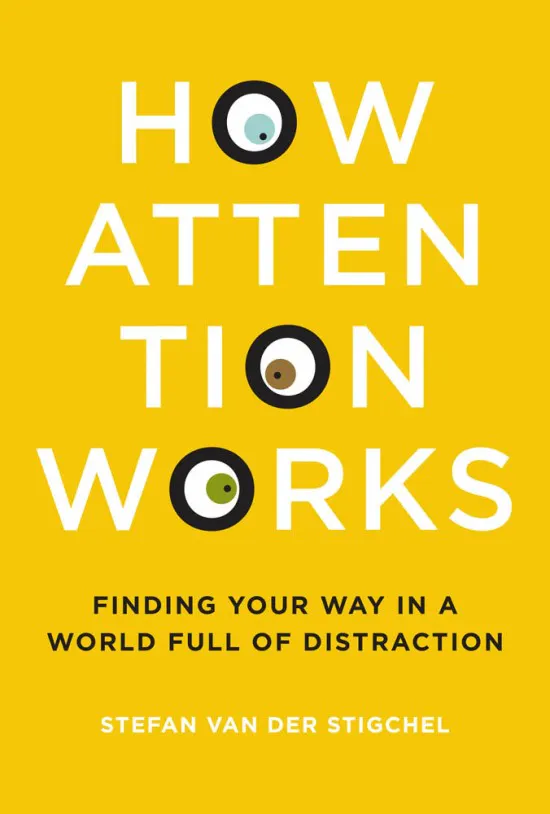
Ep 50How Attention Works: Finding Your Way in a World Full of Distraction
Stefan Van der Stigchel discusses how we filter out what is irrelevant so we can focus on what we need to know. We are surrounded by a world rich with visual information, but we pay attention to very little of it, filtering out what is irrelevant so we can focus on what we think we need to know. Advertisers, web designers, and other "attention architects" try hard to get our attention, promoting products with videos on huge outdoor screens, adding flashing banners to websites, and developing computer programs with blinking icons that tempt us to click. Often they succeed in distracting us from what we are supposed to be doing. In How Attention Works, Stefan Van der Stigchel explains the process of attention and what the implications are for our everyday lives. The visual attention system is efficient, Van der Stigchel writes, because it doesn't waste energy processing every scrap of visual data it receives; it gathers only relevant information. We focus on one snippet of information and assume that everything else is stable and consistent with past experience; that's why most people miss even the most glaring continuity errors in films. If an object doesn't meet our expectations, chances are we won't see it. Van der Stigchel makes his case with examples from real life, explaining, among other things, the limitations of color perception (and why fire trucks shouldn't be red); the importance of location (security guards and radiologists, for example, have to know where to look); the attention-getting properties of faces and spiders; what we can learn from someone else's eye movements; why we see what we expect to see (magicians take advantage of this); and visual neglect and unattended information. Learn more about your ad choices. Visit megaphone.fm/adchoices Support our show by becoming a premium member! https://newbooksnetwork.supportingcast.fm/science-technology-and-society

Ep 48The Making of "Ways of Hearing"
Bonus to the Ways of Hearing podcast and book A behind-the-scenes conversation with the creators of Ways of Hearing, the podcast and book. Hosted by author Damon Krukowski, with Radiotopia and Showcase executive producer Julie Shapiro, sound designer Ian Coss, MIT Press editor Matthew Browne, and graphic designer James Goggin. Recorded live before a studio audience at the PRX Podcast Garage, April 9, 2019. Mixed by Ian Coss. Learn more about your ad choices. Visit megaphone.fm/adchoices Support our show by becoming a premium member! https://newbooksnetwork.supportingcast.fm/science-technology-and-society
Ep 13Cristina Mejia Visperas, "Skin Theory: Visual Culture and the Postwar Prison Laboratory" (NYU, 2022)
An abolitionist approach to STS and the history of the life sciences: this is the model that Cristina Mejia Visperas offers in her book, Skin Theory: Visual Culture and the Postwar Prison Laboratory (NYU 2022). By now, scientists’ experiments on captive men at Philadelphia’s Holmesburg Prison are well known, thanks to the brave and important testimony of former captive-subjects in books like Allen Hornblum’s Acres of Skin. Building on this documentary work, Visperas turns attention to the prison experiments’ “optical rationality,” the way of seeing images that came out of a space that was simultaneously prison and laboratory. For Visperas, skin is a scientific apparatus and a metaphor for what science makes visible—and what it leaves as a void, namely, the endurance of anti-Black racism in the US, from slavery to mass incarceration. At its core, the book asks “What is the relationship between science and the project of freedom?”—and it hopes towards a reparative bioethics that dismantles scientific racism and the prison nation that it upholds. This interview was a collaborative effort among Professor Laura Stark and graduate students at Vanderbilt University in the seminar “Critical Bioethics.” Please email Laura with any feedback on the interview or questions about how to design collaborative interview projects for the classroom. Learn more about your ad choices. Visit megaphone.fm/adchoices Support our show by becoming a premium member! https://newbooksnetwork.supportingcast.fm/science-technology-and-society
Ep 184Rajesh Veeraraghavan, "Patching Development: Information Politics and Social Reform in India" (Oxford UP, 2022)
Rajesh Veeraraghavan’s Patching Development: Information Politics and Social Change in India (Oxford University Press, 2022) offers the first ethnographically grounded perspective on the Mahatma Gandhi National Rural Employment Guarantee Act (2005), which was promulgated as a welfare oriented ‘right to work’ scheme by the Indian Parliament at the recommendation of civil society organizations and development economists like Jean Dréze. The book presents a granular case study of the implementation of the scheme in the southern Indian state of Andhra Pradesh, and more specifically, the process of “auditing” that addresses many of the information and technological asymmetries that exist on-the-ground. Veeraraghavan also takes us to Araria, Bihar and his initial research forays in the field (where I first met him as one of the volunteer facilitators of a social audit myself) to show the tensions in the production of these audits, and the difficulty in having marginalized citizens’ voices heard in the face of local elite pressure. Given the complexities that animate the delivery of a scheme from abstract law to tangible results like finished roads and money received by those who performed the labor to finish those roads, success itself is never a guarantee. In order mitigate these kinds of uncertainties, he argues that these landscapes are navigated by bureaucrats to produce a socio-technical, infrastructural system reliant on the mechanism of ‘patching,’—instantly familiar to anyone who has done any work in software development. Patching, here, implies an iterative and evolving practice of measuring and responding to outcomes. In the process, Veeraraghavan powerfully and persuasively makes the case for playing closer attention to how information technology and politics mix, in rural India—unsettling the narrative of urban spaces as the primary bearers of and responders to technology, and urging a thorough reexamination of development studies and science and technology studies paradigms. Archit Guha is a PhD researcher in the Duke University History Department. Learn more about your ad choices. Visit megaphone.fm/adchoices Support our show by becoming a premium member! https://newbooksnetwork.supportingcast.fm/science-technology-and-society
Ep 111Michelle McSweeney, "OK" (Bloomsbury, 2023)
"OK" as a word accepts proposals, describes the world as satisfactory (but not good), provides conversational momentum, or even agrees (or disagrees). OK as an object, however, tells a story of how technology writes itself into language, permanently altering communication. OK (Bloomsbury, 2023), by Dr. Michelle McSweeney and published by Bloomsbury in 2023, explores this story OK is a young word, less than 200 years old. It began as an acronym for “all correct” when the steam-powered printing press pushed newspapers into the mainstream. Today it is spoken and written by nearly everyone in the world. Drawing on linguistics, history, and new media studies, Michelle McSweeney traces OK from its birth in the Penny Presses through telephone lines, grammar books, and television signals into the digital age. This interview was conducted by Dr. Miranda Melcher whose doctoral work focused on post-conflict military integration, understanding treaty negotiation and implementation in civil war contexts, with qualitative analysis of the Angolan and Mozambican civil wars. Learn more about your ad choices. Visit megaphone.fm/adchoices Support our show by becoming a premium member! https://newbooksnetwork.supportingcast.fm/science-technology-and-society
Ep 312Tiger C. Roholt, "Distracted from Meaning: A Philosophy of Smartphones" (Bloomsbury, 2022)
Social scientists have long studied the ways in which smartphone use can distract us from the proper performance of means-ends tasks, such as driving or medical procedures. In Distracted from Meaning: A Philosophy of Smartphones (Bloomsbury, 2022), Tiger Roholt discusses a distinct type of distraction: when smartphone use interferes with our active engagement with meaningful experiences, such as dinner with friends or a musical performance or gardening. In these cases, Roholt argues, we risk stunting the experiences that would otherwise give meaning to our lives, or even missing out on discovering new types of meaningful experiences. Roholt, who is an associate professor of philosophy at Montclair State University, draws on writings from John Dewey, Susan Wolf, Albert Borgmann and others in this engagingly written meditation on how ubiquitous uses of smartphones and wearable technologies affects our lives in ways that other types of interruptions do not. Carrie Figdor is professor of philosophy at the University of Iowa. Learn more about your ad choices. Visit megaphone.fm/adchoices Support our show by becoming a premium member! https://newbooksnetwork.supportingcast.fm/science-technology-and-society

Ep 114The Cooperative Extension System
In this episode of High Theory, Karl Dudman tells us about the Cooperative Extension System. Formed in 1914 as an extension of the Land Grant University system in the United States, the Cooperative Extension System is an extraordinarily public model of scientific communication. There is an extension officer in every county of the US. The original goal was to transmit academic scientific knowledge on agriculture to America’s farmers, but the program’s remit has expanded over the past hundred years. And it varies widely from place to place. You might go to an extension office to test the soil of your rose bed, to find a food pantry, or attend a kids exercise class. You might also have a conversation about climate change. In the full version of our conversation, Karl discussed the National Extension Climate Initiative which aims to unite climate change education and research across the cooperative extension system and Christopher Henke’s book, Cultivating Science, Harvesting Power: Science and Industrial Agriculture in California (MIT Press, 2008). Karl Dudman is doctoral candidate at the University of Oxford’s Institute for Science, Innovation and Society and a fellow at the Harvard Kennedy School’s Program on Science Technology and Society. He does qualitative research on climate science in the US. His ongoing fieldwork, hosted by the North Carolina State Climate Office, examines how actors within climate science, coastal management and local politics navigate accelerating sea level rise in the context of widespread ambivalence towards the mainstream climate change narrative. Karl is also a photographer, and through his work explores the politics of competing cultural relationships with landscapes, and their subsequent representation. This week’s image is a photograph of two men in a field of tall grass taken November 11, 2008 by Dennis Pennington, Bioenergy Educator, Michigan State University Extension. Learn more about your ad choices. Visit megaphone.fm/adchoices Support our show by becoming a premium member! https://newbooksnetwork.supportingcast.fm/science-technology-and-society
Ep 18Tiago Forte, "Building a Second Brain: A Proven Method to Organize Your Digital Life and Unlock Your Creative Potential" (Atria Books, 2022)
Today I talked to Tiago Forte about his new book Building a Second Brain: A Proven Method to Organize Your Digital Life and Unlock Your Creative Potential (Atria Books, 2022). For the first time in history, we have instantaneous access to the world’s knowledge. There has never been a better time to learn, to contribute, and to improve ourselves. Yet, rather than feeling empowered, we are often left feeling overwhelmed by this constant influx of information. The very knowledge that was supposed to set us free has instead led to the paralyzing stress of believing we’ll never know or remember enough. Now, this eye-opening and accessible guide shows how you can easily create your own personal system for knowledge management, otherwise known as a Second Brain. As a trusted and organized digital repository of your most valued ideas, notes, and creative work synced across all your devices and platforms, a Second Brain gives you the confidence to tackle your most important projects and ambitious goals. Tiago Forte is the Second Brain Guy. Here's how he describes himself: "I am a first-generation American, born and raised in Orange County in Southern California. I grew up in a mixed Brazilian and Filipino household with two brothers and a sister. Our home was filled with culture and the arts for as long as I can remember. My mother is a talented musician and singer who exposed us to the distinct rhythms of Brazilian music and the Portuguese language from our earliest years. My father is a professional artist who covered every wall of our home with his paintings and sketches." Joseph Fridman is a researcher, science communicator, media producer, and educational organizer. You can follow him on Twitter @joseph_fridman, or reach him at his website. Learn more about your ad choices. Visit megaphone.fm/adchoices Support our show by becoming a premium member! https://newbooksnetwork.supportingcast.fm/science-technology-and-society
Ep 82Johnny Walker, "Rewind, Replay: Britain and the Video Boom, 1978-92" (Edinburgh UP, 2022)
Nostalgia for the 1980s is in the air. From Stranger Things to the relaunch of 80s franchises like Top Gun, the American entertainment industry casts the period as an age of simpler things, clearer dichotomies, and less technology. Yet not all was simple. The 1980s were the heyday of the Cold War. They were the decade of rapid social change, of deregulation and selfish consumption, of Ronald Reagan and Margaret Thatcher. They were also the decade when a new technology swept the world, setting the stage for our all-too-digital present. A lot has been written about the rise of video in the United States, the format wars, the impact it had on the entertainment industry, on personal entertainment consumption habits, and new business models. But the rise of video was not a uniquely American phenomenon, nor was the American experience normative. In fact, wherever the new technology arrived, from the US, to the Middle East, to Eastern Europe, it reshaped social and business practices, as well as government responses to it, in ways that reflected the political, social, and economic arrangements of each space. Johnny Walker’s Rewind, Replay: Britain and the Video Boom, 1972-1992 (Edinburgh UP, 2022) tells the story of Britain’s vide boom in the 1980s by focusing on the first video distributors who took chances on a wide range of films, from documentaries, to horror, to kids entertainment, in order to attract consumer interest. The new video shops that mushroomed across Britain turned video rental into a common practice among the public. Soon, despite a crushing recession, more and more industry players started to invest into what media at the time was dismissing as a mere ‘plaything.’ Rewind, Replay chronicles the idiosyncratic ways in which British distributors and store owners navigated various local political and economic pressures including piracy, the infamous video nasties moral panic and the government crackdown on the industry, as well as the corporate expansion of the industry which, by the end of the decade, eliminated independent distributors, and turned the pre-recorded videocassette from morally questionable enterprise into a staple of high street retail. Oana Godeanu-Kenworthy is Teaching Professor of American Studies at Miami University of Ohio. Her book, Between Empire and Republic: America in the Colonial Canadian Imagination, came out in 2022. Twitter: @OanaGodyKenw. Oana’s webpage. Learn more about your ad choices. Visit megaphone.fm/adchoices Support our show by becoming a premium member! https://newbooksnetwork.supportingcast.fm/science-technology-and-society
Ep 62Seeing Truth in Physics
Stephon Alexander talks about a better way of thinking about the interconnections between music, physics, and creativity and how as someone often seen as “outside” the field, he has found freedom to think harder, pursue ideas, and carve a place for himself in the story of science. Alexander and Alexis Boylan discuss how we should be thinking about physics, art, and the meaning of life all together, all the time. Learn more about the Seeing Truth exhibition at our website. Follow us on Twitter @WhyArguePod and on Instagram @WhyWeArguePod Alexis L. Boylan is the director of academic affairs of the University of Connecticut Humanities Institute (UCHI) and an associate professor with a joint appointment in the Art and Art History Department and the Africana Studies Institute Learn more about your ad choices. Visit megaphone.fm/adchoices Support our show by becoming a premium member! https://newbooksnetwork.supportingcast.fm/science-technology-and-society
Ep 192Antero Garcia, "All through the Town: The School Bus as Educational Technology" (U Minnesota Press, 2023)
Everyone knows the yellow school bus. It’s been invisible and also omnipresent for a century. Dr. Antero Garcia shows how the U.S. school bus, its form unaltered for decades, is the most substantial piece of educational technology to ever shape how schools operate. As it noisily moves young people across the country every day, the bus offers the opportunity for a necessary reexamination of what “counts” as educational technology. Particularly in light of these buses being idled in pandemic times, All through the Town: The School Bus as Educational Technology (University of Minnesota Press, 2023) questions what we take for granted and what we overlook in public schooling in America, pushing for liberatory approaches to education that extend beyond notions of school equity. This interview was conducted by Dr. Miranda Melcher whose doctoral work focused on post-conflict military integration, understanding treaty negotiation and implementation in civil war contexts, with qualitative analysis of the Angolan and Mozambican civil wars. Learn more about your ad choices. Visit megaphone.fm/adchoices Support our show by becoming a premium member! https://newbooksnetwork.supportingcast.fm/science-technology-and-society
Ep 145Joseph Giacomelli, "Uncertain Climes: Debating Climate Change in Gilded Age America" (U Chicago Press, 2023)
Even people who still refuse to accept the reality of human-induced climate change would have to agree that the topic has become inescapable in the United States in recent decades. But as Joseph Giacomelli shows in Uncertain Climes: Debating Climate Change in Gilded Age America (University of Chicago Press, 2023), this is actually nothing new: as far back as Gilded Age America, climate uncertainty has infused major debates on economic growth and national development. In this ambitious examination of late-nineteenth-century understandings of climate, Giacomelli draws on the work of scientists, foresters, surveyors, and settlers to demonstrate how central the subject was to the emergence of American modernity. Amid constant concerns about volatile weather patterns and the use of natural resources, nineteenth-century Americans developed a multilayered discourse on climate and what it might mean for the nation’s future. Although climate science was still in its nascent stages during the Gilded Age, fears and hopes about climate change animated the overarching political struggles of the time, including expansion into the American West. Giacomelli makes clear that uncertainty was the common theme linking concerns about human-induced climate change with cultural worries about the sustainability of capitalist expansionism in an era remarkably similar to the United States’ unsettled present. Joseph Giacomelli is Assistant Professor of Environmental History at Duke Kunshan University. Brian Hamilton is chair of the History and Social Science Department at Deerfield Academy. Twitter. Website. Learn more about your ad choices. Visit megaphone.fm/adchoices Support our show by becoming a premium member! https://newbooksnetwork.supportingcast.fm/science-technology-and-society
Ep 338Ben Shneiderman, "Human-Centered AI" (Oxford UP, 2022)
The remarkable progress in algorithms for machine and deep learning have opened the doors to new opportunities, and some dark possibilities. However, a bright future awaits those who build on their working methods by including HCAI strategies of design and testing. As many technology companies and thought leaders have argued, the goal is not to replace people, but to empower them by making design choices that give humans control over technology. In Human-Centered AI (Oxford UP, 2022), Professor Ben Shneiderman offers an optimistic realist's guide to how artificial intelligence can be used to augment and enhance humans' lives. This project bridges the gap between ethical considerations and practical realities to offer a road map for successful, reliable systems. Digital cameras, communications services, and navigation apps are just the beginning. Shneiderman shows how future applications will support health and wellness, improve education, accelerate business, and connect people in reliable, safe, and trustworthy ways that respect human values, rights, justice, and dignity. Jake Chanenson is a computer science Ph.D. student at the University of Chicago. Broadly, Jake is interested in topics relating to HCI, privacy, and tech policy. Jake’s work has been published in top venues such as ACM’s CHI Conference on Human Factors in Computing Systems. Learn more about your ad choices. Visit megaphone.fm/adchoices Support our show by becoming a premium member! https://newbooksnetwork.supportingcast.fm/science-technology-and-society
Ep 115Has Peer Review Hit a Point of No Return?
Vivian Berghahn joins to discuss what is broken with the peer review system in general, how it impacts book publishing, and some creative solutions for how it can be rectified. Also, hear the surprising reason why small, independent publishers tend to have more robust quality review processes than big corporate publishers. Avi Staiman is the founder and CEO of Academic Language Experts . Learn more about your ad choices. Visit megaphone.fm/adchoices Support our show by becoming a premium member! https://newbooksnetwork.supportingcast.fm/science-technology-and-society
Ep 47Control Through Communication: The Rise of System in American Management
JoAnne Yates, Sloan Distinguished Professor of Management, Emerita and Professor of Managerial Communication and Work and Organization Studies at MIT’s Sloan School of Management, talks about her classic and award-winning 1989 book, Control Through Communication: The Rise of System in American Management (Johns Hopkins University Press), with Peoples & Things host, Lee Vinsel. Control Through Communication tells the fascinating story of how corporations came to adopt modern communications systems, including typewriters, filing cabinets, card catalogs, memos, and reports. Over the past twenty years, the book has been hugely influential in history, communications, and media studies. Yates and Vinsel also talk about how Yates came to move from literature to business history and organization studies, what it was like working as a woman in a business school in the 1980s, how she managed to have a dual writing career in history and business school journals, and much more. Lee Vinsel is an associate professor in the Department of Science, Technology and Society at Virginia Tech. Learn more about your ad choices. Visit megaphone.fm/adchoices Support our show by becoming a premium member! https://newbooksnetwork.supportingcast.fm/science-technology-and-society
Ep 105Rhea Myers, "Proof of Work: Blockchain Provocations 2011-2021" (MIT Press, 2023)
NFT, BTC, DAO, ETH, WAGMI, HODL. It would have been hard to avoid these acronyms only a year ago. The hype around cryptocurrencies and blockchain art was almost as annoying as the glee with which crypto sceptics welcomed the sudden onset of the crypto winter. But for all the popularity of Bored Apes and Ponzi scheme stories, there seems to have been little serious engagement with the philosophical, political, and aesthetic implications of the blockchain. The academy appears to have dismissed the crypto world out of hand, citing its financial unviability and the deeply ‘problematic’ philosophical foundations of its technology. Rhea Myers is a crypto artist, writer, and hacker who searches for faces in cryptographic hashes, follows a day in the life of a young shibe in the year 2032, and patiently explains why all art should be destructively uploaded to the blockchain. Her engagement in the technical history and debates in blockchain technology is complemented by a broader sense of the crypto movement and the artistic and political sensibilities that accompanied its ascendancy. Remodelling the tropes of conceptual art and net art to explore what blockchain technology reveals about our concepts of value, culture and currency, Myers’s work has become required viewing for anyone interested in the future of art, consensus, law, and collectivity. Rhea Myers speaks to Pierre d’Alancaisez about art’s role in mapping and shaping the emergent properties of blockchain technologies, the crypto-libertarian, anarchy-capitalist nexus, and the enduring legacy of the conceptual art movement. Proof of Work brings together annotated presentations of Myers’s blockchain artworks with essays, reviews, and fictions—a sustained critical encounter between the cultures and histories of the artworld and crypto-utopianism, technically accomplished but always generously demystifying and often mischievous. PostScript Viruses, 1993 Portrait of V.I. Lenin with Cap, in the Style of Jackson Pollock III by Art & Language Futherfield Gallery, London Is Art, 2014/15, Art Is, 2014/17 Pierre's essay on the speculative deficit and NFT art Certificate of Inauthenticity, 2020 Rhea Myers is an artist, writer, and blockchain developer and activist. Now an acknowledged pioneer whose work has graced the auction room at Sotheby’s, Myers focussed on blockchain tech in 2011, becoming one of the first artists to enter into creative, speculative, and conceptual engagement with ‘the new internet’. Pierre d’Alancaisez is a contemporary art curator, cultural strategist, researcher. Sometime scientist, financial services professional. Learn more about your ad choices. Visit megaphone.fm/adchoices Support our show by becoming a premium member! https://newbooksnetwork.supportingcast.fm/science-technology-and-society
Ep 182Alexa Hagerty, "Still Life with Bones: Genocide, Forensics, and What Remains" (Crown, 2023)
In Still Life with Bones: Genocide, Forensics, and What Remains (Crown, 2023), anthropologist Alexa Hagerty learns to see the dead body with a forensic eye. She examines bones for marks of torture and fatal wounds—hands bound by rope, machete cuts—and also for signs of identity: how life shapes us down to the bone. A weaver is recognized from the tiny bones of the toes, molded by kneeling before a loom; a girl is identified alongside her pet dog. In the tenderness of understanding these bones, forensics not only offers proof of mass atrocity but also tells the story of each life lost. Working with forensic teams at mass grave sites and in labs, Hagerty discovers how bones bear witness to crimes against humanity and how exhumation can bring families meaning after unimaginable loss. She also comes to see how cutting-edge science can act as ritual—a way of caring for the dead with symbolic force that can repair societies torn apart by violence. Weaving together powerful stories about investigative breakthroughs, histories of violence and resistance, and her own forensic coming-of-age, Hagerty crafts a moving portrait of the living and the dead. Kelly McFall is Professor of History and Director of the Honors Program at Newman University. Learn more about your ad choices. Visit megaphone.fm/adchoices Support our show by becoming a premium member! https://newbooksnetwork.supportingcast.fm/science-technology-and-society
Ep 311Karen Frost-Arnold, "Who Should We Be Online?: A Social Epistemology for the Internet" (Oxford UP, 2023)
The Internet plays a central role in how we communicate, share information, disseminate ideas, maintain social connections, and conduct business. The Internet also exacerbates existing problems regarding irrationality, bias, wrongful discrimination, exploitation, and dehumanization. Moreover, the Internet gives rise to new ethical and epistemological problems – fake news, sock-puppetry, internet hoaxes, disinformation, and so on. In Who Should We Be Online?: A Social Epistemology for the Internet (Oxford University Press 2023), Karen Frost-Arnold proposes a multi-layered social epistemology designed to assist us in navigating the fraught normative landscape of the online world. Robert Talisse is the W. Alton Jones Professor of Philosophy at Vanderbilt University. Learn more about your ad choices. Visit megaphone.fm/adchoices Support our show by becoming a premium member! https://newbooksnetwork.supportingcast.fm/science-technology-and-society
Ep 218Julia H. Lee, "The Racial Railroad" (NYU Press, 2022)
Despite the seeming supremacy of car culture in the United States, the train has long been and continues to be a potent symbol of American exceptionalism, ingenuity, and vastness. For almost two centuries, the train has served as the literal and symbolic vehicle for American national identity, manifest destiny, and imperial ambitions. It’s no surprise, then, that the train continues to endure in depictions across literature, film, ad music. The Racial Railroad (NYU Press, 2022) highlights the surprisingly central role that the railroad has played―and continues to play―in the formation and perception of racial identity and difference in the United States. Julia H. Lee argues that the train is frequently used as the setting for stories of race because it operates across multiple registers and scales of experience and meaning, both as an invocation of and a depository for all manner of social, historical, and political narratives. Lee demonstrates how, through legacies of racialized labor and disenfranchisement―from the Chinese American construction of the Transcontinental Railroad and the depictions of Native Americans in landscape and advertising, to the underground railroad and Jim Crow segregation―the train becomes one of the exemplary spaces through which American cultural works explore questions of racial subjectivity, community, and conflict. By considering the train through various lenses, The Racial Railroad tracks how racial formations and conflicts are constituted in significant and contradictory ways by the spaces in which they occur. Julia H. Lee is Associate Professor of Asian American Studies at the University of California at Irvine and author of Interracial Encounters: Reciprocal Representations in African and Asian American Literatures, 1896–1937 and Understanding Maxine Hong Kingston. Morteza Hajizadeh is a Ph.D. graduate in English from the University of Auckland in New Zealand. His research interests are Cultural Studies; Critical Theory; Environmental History; Medieval (Intellectual) History; Gothic Studies; 18th and 19th Century British Literature. YouTube channel. Learn more about your ad choices. Visit megaphone.fm/adchoices Support our show by becoming a premium member! https://newbooksnetwork.supportingcast.fm/science-technology-and-society
Ep 81Susan R. Grayzel, "The Age of the Gas Mask: How British Civilians Faced the Terrors of Total War" (Cambridge UP, 2022)
On this episode, we sit down with Dr. Susan R. Grayzel, Professor of History at Utah State University to discuss The Age of the Gas Mask: How British Civilians Faced the Terrors of Total War (Cambridge University Press, 2022). Professor Grayzel compellingly and skillfully explores the history of one object - the civilian gas mask - to reveal the reach of modern, total war and the limits of the state trying to safeguard civilian life in an extensive empire. The First World War introduced the widespread use of lethal chemical weapons. In its aftermath, the British government, like that of many states, had to prepare civilians to confront such weapons in a future war. Over the course of the interwar period, it developed individual anti-gas protection as a cornerstone of civil defense. Drawing on records from Britain's Colonial, Foreign, War and Home Offices and other archives alongside newspapers, journals, personal accounts and cultural sources, she connects the histories of the First and Second World Wars, combatants and civilians, men and women, metropole and colony, illuminating how new technologies of warfare shaped culture, politics, and society. Dr. Julia M. Gossard hosts this episode. She is Associate Dean for Research in the College of Humanities and Social Sciences and Associate Professor of History at Utah State University. Learn more about your ad choices. Visit megaphone.fm/adchoices Support our show by becoming a premium member! https://newbooksnetwork.supportingcast.fm/science-technology-and-society
Ep 337Elizabeth M. Renieris, "Beyond Data: Reclaiming Human Rights at the Dawn of the Metaverse" (MIT Press, 2023)
Why laws focused on data cannot effectively protect people—and how an approach centered on human rights offers the best hope for preserving human dignity and autonomy in a cyberphysical world. Ever-pervasive technology poses a clear and present danger to human dignity and autonomy, as many have pointed out. And yet, for the past fifty years, we have been so busy protecting data that we have failed to protect people. In Beyond Data: Reclaiming Human Rights at the Dawn of the Metaverse (MIT Press, 2023), Elizabeth Renieris argues that laws focused on data protection, data privacy, data security and data ownership have unintentionally failed to protect core human values, including privacy. And, as our collective obsession with data has grown, we have, to our peril, lost sight of what’s truly at stake in relation to technological development—our dignity and autonomy as people. Far from being inevitable, our fixation on data has been codified through decades of flawed policy. Renieris provides a comprehensive history of how both laws and corporate policies enacted in the name of data privacy have been fundamentally incapable of protecting humans. Her research identifies the inherent deficiency of making data a rallying point in itself—data is not an objective truth, and what’s more, its “entirely contextual and dynamic” status makes it an unstable foundation for organizing. In proposing a human rights–based framework that would center human dignity and autonomy rather than technological abstractions, Renieris delivers a clear-eyed and radically imaginative vision of the future. At once a thorough application of legal theory to technology and a rousing call to action, Beyond Data boldly reaffirms the value of human dignity and autonomy amid widespread disregard by private enterprise at the dawn of the metaverse. Jake Chanenson is a computer science Ph.D. student at the University of Chicago. Broadly, Jake is interested in topics relating to HCI, privacy, and tech policy. Jake’s work has been published in top venues such as ACM’s CHI Conference on Human Factors in Computing Systems. Learn more about your ad choices. Visit megaphone.fm/adchoices Support our show by becoming a premium member! https://newbooksnetwork.supportingcast.fm/science-technology-and-society
Ep 52Life Extension Therapies
The story of the Fountain of Youth is as old as history itself. Herodotus, the father of ancient Greek history, wrote of a mythical spring that extended the life of its bathers. Today, biotech entrepreneurs, scientists, and health influencers are still searching for that mythical spring. Longevity and anti-aging research has recently blossomed, with a number of tantalizing discoveries. Still, this research hasn't delivered any magic bullets. Yet, that hasn't stopped a cottage industry of folks hawking a plethora of dubious supplements and bizarre health regimens. Jay Cockburn tries to make sense of what's real, what's hype, who could benefit, and who would pay. Do we even want to live in the world the longevity researchers are looking for? Should we keep looking for that fountain? We'll hear from: CEO of BioViva, Liz Parish, who has stepped outside of the regular drug approval process and experimented on herself; Dr. Charles Brenner, a scientist and vocal critic of the claims of life extension; and Dr. Keisha S. Ray, a bioethicist who reminds us that while the rich look for fanciful new ways to live longer, the poor lack access to basic health care. SUPPORT THE SHOW You can support the show for free by following or subscribing on Spotify, Apple Podcasts, or whichever app you use. This is the best way to help us out and it costs nothing so we’d really appreciate you clicking that button. If you want to do a little more we would love it if you chip in. You can find us on patreon.com/dartsandletters. Patrons get content early, and occasionally there’s bonus material on there too. ABOUT THE SHOW For a full list of credits, contact information, and more, visit our about page. Learn more about your ad choices. Visit megaphone.fm/adchoices Support our show by becoming a premium member! https://newbooksnetwork.supportingcast.fm/science-technology-and-society
Ep 336Woodrow Hartzog, "Privacy's Blueprint: The Battle to Control the Design of New Technologies" (Harvard UP, 2018)
Every day, Internet users interact with technologies designed to undermine their privacy. Social media apps, surveillance technologies, and the Internet of Things are all built in ways that make it hard to guard personal information. And the law says this is okay because it is up to users to protect themselves―even when the odds are deliberately stacked against them. In Privacy's Blueprint: The Battle to Control the Design of New Technologies (Harvard UP, 2018), Woodrow Hartzog pushes back against this state of affairs, arguing that the law should require software and hardware makers to respect privacy in the design of their products. Current legal doctrine treats technology as though it were value-neutral: only the user decides whether it functions for good or ill. But this is not so. As Hartzog explains, popular digital tools are designed to expose people and manipulate users into disclosing personal information. Against the often self-serving optimism of Silicon Valley and the inertia of tech evangelism, Hartzog contends that privacy gains will come from better rules for products, not users. The current model of regulating use fosters exploitation. Privacy’s Blueprint aims to correct this by developing the theoretical underpinnings of a new kind of privacy law responsive to the way people actually perceive and use digital technologies. The law can demand encryption. It can prohibit malicious interfaces that deceive users and leave them vulnerable. It can require safeguards against abuses of biometric surveillance. It can, in short, make the technology itself worthy of our trust. Jake Chanenson is a computer science Ph.D. student at the University of Chicago. Broadly, Jake is interested in topics relating to HCI, privacy, and tech policy. Jake’s work has been published in top venues such as ACM’s CHI Conference on Human Factors in Computing Systems. Learn more about your ad choices. Visit megaphone.fm/adchoices Support our show by becoming a premium member! https://newbooksnetwork.supportingcast.fm/science-technology-and-society
Ep 86Wake Smith, "Pandora's Toolbox: The Hopes and Hazards of Climate Intervention" (Cambridge UP, 2022)
Reaching net zero emissions will not be the end of the climate struggle, but only the end of the beginning. For centuries thereafter, temperatures will remain elevated; climate damages will continue to accrue and sea levels will continue to rise. Even the urgent and utterly essential task of reaching net zero cannot be achieved rapidly by emissions reductions alone. To hasten net zero and minimize climate damages thereafter, we will also need massive carbon removal and storage. We may even need to reduce incoming solar radiation in order to lower unacceptably high temperatures. Such unproven and potentially risky climate interventions raise mind-blowing questions of governance and ethics. Wake Smith's book Pandora's Toolbox: The Hopes and Hazards of Climate Intervention (Cambridge UP, 2022) offers readers an accessible and authoritative introduction to both the hopes and hazards of some of humanity's most controversial technologies, which may nevertheless provide the key to saving our world. Bryan Toepfer, AIA, NCARB, CAPM is the Principal Architect for TOEPFER Architecture, PLLC, an Architecture firm specializing in Residential Architecture and Virtual Reality. Learn more about your ad choices. Visit megaphone.fm/adchoices Support our show by becoming a premium member! https://newbooksnetwork.supportingcast.fm/science-technology-and-society
Ep 219Jeffrey G. Snodgrass, "The Avatar Faculty: Ecstatic Transformations in Religion and Video Games" (U California Press, 2023)
The Avatar Faculty: Ecstatic Transformations in Religion and Video Games (University of California Press, 2023) creatively examines the parallels between spiritual and digital activities to explore the roles that symbolic second selves—avatars—can play in our lives. The use of avatars can allow for what anthropologists call ecstasy, from the Greek ekstasis, meaning "standing outside oneself." The archaic techniques of promoting spiritual ecstasy, which remain central to religious healing traditions around the world, now also have contemporary analogues in virtual worlds found on the internet. In this innovative book, Jeffrey G. Snodgrass argues that avatars allow for the ecstatic projection of consciousness into alternate realities, potentially providing both the spiritually possessed and gamers access to superior secondary identities with elevated social standing. Even if only temporary, self-transformations of these kinds can help reduce psychosocial stress and positively improve health and well-being. Jeffrey G. Snodgrass is Professor of Anthropology at Colorado State University. Armanc Yildiz is a doctoral candidate in Social Anthropology with a secondary field in Studies in Women, Gender and Sexuality at Harvard University. He is also the founder of Academics Write, where he supports scholars in their writing projects as a writing coach and developmental editor. Learn more about your ad choices. Visit megaphone.fm/adchoices Support our show by becoming a premium member! https://newbooksnetwork.supportingcast.fm/science-technology-and-society
Ep 46Winning & Losing in the Emerging EV Wars/The Aftershocks of the EV Transition Could Be Ugly
Robert Charette, engineer, consultant, and contributing editor at IEEE Spectrum magazine, talks about his twelve-part series, “The Electric Vehicle Transition Explained,” with Peoples & Things host, Lee Vinsel. The series takes a systems perspective on electric vehicles, and talks about all of the potential barriers – from a lack of minerals, to stressing out the electricity grid, to being short on consumers or workers – that face EVs, which are too often cast as a climate change cure-all. Charette and Vinsel also talk about the kinds of thinking that are necessary if we are to have realistic policies around EVs. Lee Vinsel is an associate professor in the Department of Science, Technology and Society at Virginia Tech. Learn more about your ad choices. Visit megaphone.fm/adchoices Support our show by becoming a premium member! https://newbooksnetwork.supportingcast.fm/science-technology-and-society
Ep 114The Science of Security
Listen to this interview of Cormac Herley, Principal Researcher at Microsoft Research. We talk about the science of security and as well, about the communication of security science. Cormac Herley : "For very many projects, all through, I sort of have this kind of imaginary dialogue going on with my imagined audience or with representatives of my imagined audience, where what I'm doing on my side of the talk is to convince them. And for me personally, the point of the dialogue is kind of, What am I trying to convince them of? Because, I mean, if I can't tell myself first what it is I'm trying to convince them of, well then, success is going to be very unlikely." Learn more about your ad choices. Visit megaphone.fm/adchoices Support our show by becoming a premium member! https://newbooksnetwork.supportingcast.fm/science-technology-and-society
Ep 67Felix Zimmermann, "Virtual Realities: Atmospheric Experience of the Past in Digital Games (Büchner-Verlag, 2023)
Today I talked to Felix Zimmermann about his book Virtual Realities: Atmospheric Experience of the Past in Digital Games (Virtuelle Wirklichkeiten: Atmosphärisches Vergangenheitserleben im Digitalen Spiel (Büchner-Verlag, 2023) Atmospheres are everywhere: at the workplace, in the soccer stadium, in front of the crackling fireplace. They shape our everyday language and have become quite natural expressions of how we find ourselves in certain environments and how we feel about them. Their influence is far-reaching: aesthetic atmospheres are closely linked to a contemporary experience-oriented historical culture whose products and practices claim to establish an immediate contact with the past. With 'Vergangenheitsatmosphären' Felix Zimmermann offers for the first time a term to adequately describe this striving for immediacy. Using in-depth analyses of the digital games Anno 1800 (2019), Assassin's Creed Syndicate (2015), and Dishonored: The Mask of Wrath (2012), the concept is contoured and the productivity of atmospheric research trained on theories and methods of public history, game studies, and phenomenology is demonstrated. Rudolf Inderst is a professor of Game Design with a focus on Digital Game Studies at the IU International University of Applied Science, editor of “Game Studies Watchlist”, a weekly messenger newsletter about Game Culture and curator of @gamestudies at tiktok. Learn more about your ad choices. Visit megaphone.fm/adchoices Support our show by becoming a premium member! https://newbooksnetwork.supportingcast.fm/science-technology-and-society
Ep 85Reinhold Martin, "Knowledge Worlds: Media, Materiality, and the Making of the Modern University" (Columbia UP, 2021)
What do the technical practices, procedures, and systems that have shaped institutions of higher learning in the United States, from the Ivy League and women’s colleges to historically black colleges and land-grant universities, teach us about the production and distribution of knowledge? Addressing media theory, architectural history, and the history of academia, Knowledge Worlds: Media, Materiality, and the Making of the Modern University (Columbia UP, 2021) reconceives the university as a media complex comprising a network of infrastructures and operations through which knowledge is made, conveyed, and withheld. Reinhold Martin argues that the material infrastructures of the modern university—the architecture of academic buildings, the configuration of seminar tables, the organization of campus plans—reveal the ways in which knowledge is created and reproduced in different kinds of institutions. He reconstructs changes in aesthetic strategies, pedagogical techniques, and political economy to show how the boundaries that govern higher education have shifted over the past two centuries. From colleges chartered as rights-bearing corporations to research universities conceived as knowledge factories, educating some has always depended upon excluding others. Knowledge Worlds shows how the division of intellectual labor was redrawn as new students entered, expertise circulated, science repurposed old myths, and humanists cultivated new forms of social and intellectual capital. Combining histories of architecture, technology, knowledge, and institutions into a critical media history, Martin traces the uneven movement in the academy from liberal to neoliberal reason. Nushelle de Silva is a PhD candidate in the Department of Architecture at the Massachusetts Institute of Technology. Her work examines museums and exhibitions, and how the dissemination of visual culture is politically mediated by international organizations in the twentieth century. Learn more about your ad choices. Visit megaphone.fm/adchoices Support our show by becoming a premium member! https://newbooksnetwork.supportingcast.fm/science-technology-and-society
Ep 194Dominique A. Tobbell, "Dr. Nurse: Science, Politics, and the Transformation of American Nursing" (U Chicago Press, 2022)
An analysis of the efforts of American nurses to establish nursing as an academic discipline and nurses as valued researchers in the decades after World War II. Nurses represent the largest segment of the US health care workforce and spend significantly more time with patients than any other member of the health care team. Dominique A. Tobbell's book Dr. Nurse: Science, Politics, and the Transformation of American Nursing (U Chicago Press, 2022) probes their history to examine major changes that have taken place in American health care in the second half of the twentieth century. The book examines the major changes in nursing education and the place of nursing in the post-war research university, revealing how federal and state health and higher education policies shaped education within health professions after World War II. Starting in the 1950s, academic nurses sought to construct a science of nursing--distinct from that of the related biomedical or behavioral sciences--that would provide the basis of nursing practice. Facing broad changes in patient care driven by the introduction of new medical innovations, they worked both to develop science-based nursing practice and to secure their roles within the post-war research university. By their efforts, academic nurses transformed nursing's labor into a valuable site of knowledge production and demonstrated how the application of this knowledge was integral to improving patient outcomes and healthcare delivery. Exploring the knowledge claims, strategies, and politics involved as academic nurses negotiated their roles and nursing's future, Dr. Nurse reveals how state-supported health centers have profoundly shaped nursing education and health care delivery. Claire Clark is a medical educator, historian of medicine, and associate professor in the University of Kentucky’s College of Medicine. Learn more about your ad choices. Visit megaphone.fm/adchoices Support our show by becoming a premium member! https://newbooksnetwork.supportingcast.fm/science-technology-and-society
Ep 194David J. Halperin, "Intimate Alien: The Hidden Story of the UFO" (Stanford UP, 2020)
In his book Intimate Alien: The Hidden Story of the UFO (Stanford University Press, 2020), David J. Halperin explores the phenomena of UFO's through a psychological lense. UFOs became part of our cultural landscape in 1947, and they've been with us ever since. Debunked innumerable times, they refuse to go away. Made the subject of great expectations by their believers, they invariably disappoint. They've been called a myth, both in disparagement and, more properly, in appreciation of their power and significance. This book argues that they are actually a mythology, as gripping and profound as the great mythologies of antiquity to which they're linked. The question it asks about them is not, "What are they?" nor "Where do they come from?" but "What do they mean?" Halperin begins his exploration with his own longish teenage foray into the UFOs that he began to believe in as his mother lay dying of cancer. Despite the fact that he was only a high school student, Halperin joined and then became the director of "New Jersey Association on Aerial Phenomena" (NJAAP), an organization of amateur observers with members across the States. He goes on to revisit a range of famous cases of UFO sightings and abductions while introducing his own approach, which is informed by the study of religion, folklore, and Jungian psychology. Ultimately arguing for UFOs as evidence of the inner trauma of individuals as well as entire societies, he posits that the rise of the UFO in post-World War II America coincides with that moment in the nuclear age when we first became capable of imagining our death as a species, Learn more about your ad choices. Visit megaphone.fm/adchoices Support our show by becoming a premium member! https://newbooksnetwork.supportingcast.fm/science-technology-and-society
Ep 488Gordon Barrett, "China’s Cold War Science Diplomacy" (Cambridge UP, 2022)
During the early decades of the Cold War, the People’s Republic of China remained far outside mainstream international science — right? Gordon Barrett’s new book, China’s Cold War Science Diplomacy (Cambridge University Press, 2022), counters this straightforward narrative and shows a very different side of China’s engagement with the outside world during this period. Barrett shows how scientists became crucial interlocutors for the early PRC, engaging in international and cross-bloc organizations, conferences, and networks. In China’s Cold War Science Diplomacy we follow scientists as they travel to international meetings, advocate for China’s position in international organizations, and correspond with collaborators and peers abroad. Overall, by piecing together a wide range of archival and published materials, Barrett shows how scientists developed transnational networks and interacted closely with overseas counterparts in ways that anticipated and lay the groundwork for China’s emergence as a science and technology powerhouse. Meticulously researched and carefully written, this book is sure to be of interest to those interested in modern Chinese history, science and technology, the Cold War period, and the role that scientists can play in diplomacy and diplomatic work. Sarah Bramao-Ramos is a PhD candidate in History and East Asian Languages at Harvard. She works on Manchu language books and is interested in anything with a kesike. She can be reached at [email protected]. Learn more about your ad choices. Visit megaphone.fm/adchoices Support our show by becoming a premium member! https://newbooksnetwork.supportingcast.fm/science-technology-and-society
Ep 371Alvin Hall, "Driving the Green Book: A Road Trip Through the Living History of Black Resistance" (HarperOne, 2023)
For countless Americans, the open road has long been a place where dangers lurk. In the era of Jim Crow, Black travelers encountered locked doors, hostile police, and potentially violent encounters almost everywhere, in both the South and the North. From 1936 to 1967, millions relied on The Negro Motorist Green Book, the definitive guide to businesses where they could safely rest, eat, or sleep. Most Americans only know of the guide from the 2018 Green Book movie or the 2020 Lovecraft Country TV show. Alvin Hall set out to revisit the world of the Green Book to instruct us all on the real history of the guide that saved many lives. With his friend Janée Woods Weber, he drove from New York to Detroit to New Orleans, visiting motels, restaurants, shops, and stores where Black Americans once found a friendly welcome. They explored historical and cultural landmarks, from the theatres and clubs where stars like Duke Ellington and Lena Horne performed to the Lorraine Motel where Dr. Martin Luther King, Jr. was assassinated. Along the way, they gathered memories from some of the last living witnesses for whom the Green Book meant survival--remarkable people who not only endured but rose above the hate, building vibrant Black communities against incredible odds. Driving the Green Book: A Road Trip Through the Living History of Black Resistance (HarperOne, 2023) is a vital work of national history as well as a hopeful chronicle of Black resilience and resistance. Nicole Trujillo-Pagán is a sociologist and Associate Professor at Wayne State University who studies race, the Latina/o/x population, and socio-spatial mobility. You can follow her on Twitter @BorderStruggles. Learn more about your ad choices. Visit megaphone.fm/adchoices Support our show by becoming a premium member! https://newbooksnetwork.supportingcast.fm/science-technology-and-society
Ep 45Left to Our Own Devices: A Conversation with Julia Ticona
Over the past three decades, digital technologies like smartphones and laptops have transformed the way we work in the US. At the same time, workers at both ends of the income ladder have experienced rising levels of job insecurity and anxiety about their economic futures. In Left to Our Own Devices: Coping with Insecure Work in a Digital Age (Oxford UP, 2022), Julia Ticona explores the ways that workers use their digital technologies to navigate insecure and flexible labor markets. Through 100 interviews with high and low-wage precarious workers across the US, she explores the surprisingly similar "digital hustles" they use to find work and maintain a sense of dignity and identity. Ticona then reveals how the digital hustle ultimately reproduces inequalities between workers at either end of polarized labor markets. A moving and accessible look at the intimate consequences of contemporary capitalism, Left to Our Own Devices will be of interest to sociologists, communication and media studies scholars, as well as a general audience of readers interested in digital technologies, inequality, and the future of work in the US. Learn more about your ad choices. Visit megaphone.fm/adchoices Support our show by becoming a premium member! https://newbooksnetwork.supportingcast.fm/science-technology-and-society
Ep 111The Challenge of AI to Publishing: A Discussion with Sally Wilson
Sally Wilson, VP of Publishing at Emerald opens up about the challenges publishers are facing in contending with the onset of the mass adoption of AI tools including ChatGPT, and its ramifications for scholarly publishing. She also talks about the potential positive use cases for ChatGPT for reducing inequality in publishing. In addition, Sally discusses the nature of mission-based publishing and leading the charge in tackling United Nations SDG goals in publishing. Avi Staiman is the founder and CEO of Academic Language Experts. Learn more about your ad choices. Visit megaphone.fm/adchoices Support our show by becoming a premium member! https://newbooksnetwork.supportingcast.fm/science-technology-and-society
Ep 217John Miller, "The Philosophy of Tattoos" (British Library, 2021)
The Philosophy of Tattoos (British Library, 2021) by Dr. John Miller presents an impressively broad yet personal account, exploring tattooing as a unique expression of individual, cultural and national identity. Dr. Miller explores tattooing as an innate human impulse throughout history, following its suppression and revival in cultures around the world. A bold and nuanced story of colonial oppression, social deviance and tattooing in the age of social media, the book features original tattoo designs from London-based tattoo artist Luca Ortis, as well as illustrations from the British library collections. The Philosophy of Tattoos returns to its origins in cultural locations as disparate as Polynesia, the Amazon and the Arctic to interrogate the innate human desire to mark the skin. It asks what the history of tattooing might tell us about that fundamental question: what does it mean to be human? This interview was conducted by Dr. Miranda Melcher whose doctoral work focused on post-conflict military integration, understanding treaty negotiation and implementation in civil war contexts, with qualitative analysis of the Angolan and Mozambican civil wars. Learn more about your ad choices. Visit megaphone.fm/adchoices Support our show by becoming a premium member! https://newbooksnetwork.supportingcast.fm/science-technology-and-society
Ep 107Bleddyn E. Bowen, "Original Sin: Power, Technology and War in Outer Space" (Oxford UP, 2022)
Space technology was developed to enhance the killing power of the state. The Moon landings and the launch of the Space Shuttle were mere sideshows, drawing public attention away from the real goal: military and economic control of space as a source of power on Earth. Today, as Bleddyn E. Bowen vividly recounts in Original Sin: Power, Technology and War in Outer Space (Oxford UP, 2022), thousands of satellites work silently in the background to provide essential military, intelligence and economic capabilities. No major power can do without them. Beyond Washington, Moscow and Beijing, truly global technologies have evolved, from the ground floor of the nuclear missile revolution to today's orbital battlefield, shaping the wars to come. World powers including India, Japan and Europe are fully realizing the strategic benefits of commanding Earth's 'cosmic coastline', as a stage for war, development and prestige. Yet, as new contenders spend more and more on outer space, there is scope for cautious optimism about the future of the Space Age-if we can recognize, rather than hide, its original sin. Bleddyn E. Bowen is Associate Professor of International Relations at the University of Leicester, specializing in space policy and military uses of outer space. The internationally recognized author of War in Space, he consults on space policy for institutions including the UK Parliament, the European Space Agency, and the Pentagon. Sam Canter is a policy and strategy analyst, PhD candidate, and Army Reserve intelligence officer. His views are his own and do not reflect any institution, organization, or entity with which he is affiliated. Learn more about your ad choices. Visit megaphone.fm/adchoices Support our show by becoming a premium member! https://newbooksnetwork.supportingcast.fm/science-technology-and-society
Ep 123Eric Porter, "A People's History of SFO: The Making of the Bay Area and an Airport" (U California Press, 2023)
What can an airport tell us about a city? Quite a bit, according to UC-Santa Cruz history professor Eric Porter in A People's History of SFO: The Making of the Bay Area and an Airport (University of California Press, 2023). San Francisco's SFO airport has been reshaping the Bay Area's politics and reflecting the region's inequalities since its founding in 1927, Porter argues. From the dispossessed Native land on which it was built, to the class dynamics shaping airport noise and amenities, to the airport's mid-century racist hiring practices, the facility served as a microcosm of Bay Area problems, promise, and growth. Even in recent years, with the airport serving as a site for pro-immigrant activism during the Trump era, SFO continues to be a symbol for the city s a whole. As sea level rises threaten to swamp the runways, the airport's future is uncertain, but its past is a useful lens for viewing western urban history in the twentieth century. Dr. Stephen R. Hausmann is an assistant professor of history at the University of St. Thomas in Minnesota. Learn more about your ad choices. Visit megaphone.fm/adchoices Support our show by becoming a premium member! https://newbooksnetwork.supportingcast.fm/science-technology-and-society

Ep 17Computer Music and Human Computer Interaction
Michael Gurevich, lecturer at the Sonic Arts Research Centre at the Queen’s University, Belfast School of Music and Sonic Arts, serves as guest editor of the Winter 2010 issue of Computer Music Journal. In this podcast, Michael discusses the fields of Computer Music and Human Computer Interaction (HCI). He describes how these fields intersect and what they can learn from each other, touching on how the field of Computer Music has grown and how this affects performance and composition of electronic music. This conversation was recorded on December 14, 2010. Learn more about your ad choices. Visit megaphone.fm/adchoices Support our show by becoming a premium member! https://newbooksnetwork.supportingcast.fm/science-technology-and-society

Ep 72Illuminations Episode 3: Divine Technology
It’s common to feel that technology removes the magic of the world, but Hindu worshippers in Bangalore have shown that it's all in the approach. Guest Tulasi Srinivas, associate professor of anthropology at the Institute for Interdisciplinary Studies at Emerson College. Fellow of the Royal Asiatic Society and the Indian Sociological Society. Author of Winged Faith: Rethinking Globalization and Religious Pluralism, among other books. Learn more about your ad choices. Visit megaphone.fm/adchoices Support our show by becoming a premium member! https://newbooksnetwork.supportingcast.fm/science-technology-and-society
Ep 44Traveling Black, A Story of Race and Resistance: A Conversation with Mia Bay
Mia Bay, the Roy F. and Jeannette P. Nichols Chair in American History at the University of Pennsylvania, talks about her book Traveling Black: A Story of Race and Resistance (Harvard University Press, 2023), with Peoples & Things, Lee Vinsel. From stagecoaches and trains to buses, cars, and planes, Traveling Black explores when, how, and why racial restrictions took shape and brilliantly portrays what it was like to live with them. Bay unearths troves of supporting evidence, rescuing forgotten stories of undaunted passengers who made it back home despite being insulted, stranded, re-routed, or ignored. Black travelers never stopped challenging these humiliations and insisting on justice in the courts. Traveling Black upends our understanding of Black resistance, documenting a sustained fight that falls outside the traditional boundaries of the civil rights movement. Bay and Vinsel also talk about where Traveling Black fits in Bay’s broader career as a historian and which project she is turning to next. Lee Vinsel is an associate professor in the Department of Science, Technology and Society at Virginia Tech. He studies human life with technology, with particular focus on the relationship between government, business, and technological change. His first book, Moving Violations: Automobiles, Experts, and Regulations in the United States, was published by Johns Hopkins University Press in July 2019. Learn more about your ad choices. Visit megaphone.fm/adchoices Support our show by becoming a premium member! https://newbooksnetwork.supportingcast.fm/science-technology-and-society

Ep 71Illuminations Episode 2: Beyond Belief
Do scientists ever reject science? Research data on the controversial topic of extraterrestrial life has met with resistance from some in the scientific community and openness from communities of faith. Guests Avi Loeb, professor of astrophysics and cosmology at Harvard University, where he serves as the Frank B. Baird Jr. Professor of Science. Author of Extraterrestrial: The First Sign of Intelligent Life Beyond Earth. Kate Dorsch, associate director of Philosophy, Politics and Economics at the University of Pennsylvania . Sen. Harry Reid (D-NV), longtime U.S. Senator (1987-2017) from the state of Nevada and former Senate Majority Leader (2007-2015. *The Senator died in December 2021. Learn more about your ad choices. Visit megaphone.fm/adchoices Support our show by becoming a premium member! https://newbooksnetwork.supportingcast.fm/science-technology-and-society