New Books in Policing, Incarceration, and Reform
446 episodes — Page 2 of 9
Aileen Teague, "Policing on Drugs: The United States, Mexico, and the Origins of the Modern Drug War, 1969-2000" (Oxford UP, 2025)
Today, images of cartels, security agents donning face coverings, graphs depicting egregious murder rates, and military guards at US border crossings influence the world's perception of Mexico. Mexico's so-called drug war, as generally conceived by journalists and academics, was the product of recent cartel turf wars, the end of the PRI's single party rule in 2000, and enhanced US border security measures post-9/11. These explanations are compelling, but they overlook state actions beginning in the 1970s that set the foundation for drug violence over the longer term. In Policing on Drugs: The United States, Mexico, and the Origins of the Modern Drug War, 1969-2000 (Oxford University Press, 2025), Aileen Teague chronicles a largely ignored but critical prehistory of intensified bilateral antidrug efforts by exploring their origins and inherent contradictions in Mexico. Beginning in the 1960s, US leaders externalized their aggressive domestic drug control practices by forcing junior partners such as Mexico into adopting their policies. Leaders on both sides of the border situated counternarcotics within a larger paradigm of militarized policing, which increased the power and influence of the military and aggressive counternarcotics in both countries. However, different security imperatives motivated US and Mexican agents, complicating enforcement in Mexico. Between 1969 and 2000, Mexico's embrace of America's punitive antidrug policies strengthened the coercive capacities of the Mexican state, exacerbated crime, and were so ineffective in an era of open trade blocs that they hastened the expansion of the drug trade. Drawing on such sources as records from the Drug Enforcement Administration (DEA), the US State Department, interviews with key officials, accounts from Mexican journalists, and rarely seen Mexican intelligence reports, Teague relates the war on drugs as a transnational story with deep historical roots in US and Mexican conceptions of policing and security. The negative impacts of US-led counternarcotics policies in Mexico can be attributed to the complex relationship between the United States' and Mexico's shared approach to the drug war--with critical implications for present-day relations. Aileen Teague is an Assistant Professor of International Affairs at the Bush School of Government and Public Service at Texas A&M University. She is a former Marine Corps officer and a fellow at the Quincy Institute for Responsible Statecraft. Caleb Zakarin is editor of the New Books Network. Learn more about your ad choices. Visit megaphone.fm/adchoices
Mark Archuleta, "The Reel Thrilling Events of Bank Robber Henry Starr: From Gentleman Bandit to Movie Star and Back Again" (U North Texas Press, 2025)
In 1921 headlines across the country announced the death of Henry Starr, a burgeoning silent film star who was killed while attempting to rob a bank in Harrison, Arkansas. Cynics who knew the real Starr were not surprised. Before becoming a matinee idol, Starr had been the greatest bank robber of the horseback bandit era. Born in 1873, Cherokee outlaw Henry Starr had survived shootouts and death sentences and lived long enough to witness the invention of moving pictures. In 1919, after Starr was released from the Oklahoma State Penitentiary, a hotshot movie producer convinced him he had the looks, charisma, and “wild and woolly” life story to become the next big movie star. When filming began in 1920, powerful organizations aligned to censor Starr, attempting to prevent him from exposing Oklahoma’s corrupt legal system and the government’s mistreatment of the Cherokee. The Women's Christian Temperance Union pressured theater owners to ban his film, state and federal lawmakers drafted legislation to stymie theatrical distribution, and police and district attorneys threatened to send him back to prison. Starr's only film, the biographical movie A Debtor to the Law, is lost to history, but through surviving memorabilia, newspaper accounts, and interviews with people who worked with him on set, author Mark Archuleta traces how the reformed gentleman bandit attempted to use the power of cinema to reframe his life story and redeem himself in the eyes of the public, his family, and the Cherokee Nation. The Reel Thrilling Events of Bank Robber Henry Starr: From Gentleman Bandit to Movie Star and Back Again (University of North Texas Press, 2025) by Mark Archuleta is about more than heists and Hollywood glamor. Starr’s journey is about the American myth of reinvention, recidivism, and the founding of the motion picture industry when racial tensions were simmering to a boil. Contact the author here. This interview was conducted by Dr. Miranda Melcher whose book focuses on post-conflict military integration, understanding treaty negotiation and implementation in civil war contexts, with qualitative analysis of the Angolan and Mozambican civil wars. You can find Miranda’s interviews on New Books with Miranda Melcher, wherever you get your podcasts. Learn more about your ad choices. Visit megaphone.fm/adchoices
Karen Robert, "Driving Terror: Labor, Violence, and Justice in Cold War Argentina" (U New Mexico Press, 2025)
Driving Terror: Labor, Violence, and Justice in Cold War Argentina (U New Mexico Press, 2025) by Dr. Karen Robert tells the story of twenty-four Ford autoworkers in Argentina who were tortured and “disappeared” for their union activism in 1976, miraculously survived, and pursued a decades-long quest for truth and justice. In December 2018, more than four decades after their ordeal, the men won a historic human-rights case against a military commander and two retired Ford Argentina executives who were convicted of crimes against humanity. The book uses this David-and-Goliath story to explore issues of labor repression and corporate complicity with Argentina’s last military dictatorship as well as to shed light on the enormous obstacles facing victims of such crimes. Its emphasis on working-class activism in the arenas of labor and human rights introduces North American readers to a new narrative of contemporary Argentine history. The Ford survivors’ story intertwines with the symbolic evolution of the car the men helped build at Ford: the Falcon sedan. The political polarization and violence of the Cold War era transformed the Falcon from a popular family car to a tool of state terror after the coup of 1976, when it became associated with the widespread practice of “disappearance.” Its meaning continued to evolve after the return to democracy, when artists and activists used it as a symbol of military impunity during Argentina’s long-term struggles over justice and memory. This interview was conducted by Dr. Miranda Melcher whose book focuses on post-conflict military integration, understanding treaty negotiation and implementation in civil war contexts, with qualitative analysis of the Angolan and Mozambican civil wars. You can find Miranda’s interviews on New Books with Miranda Melcher, wherever you get your podcasts. Learn more about your ad choices. Visit megaphone.fm/adchoices
Breanne Pleggenkuhle and Joseph A. Schafer, "Crime, Corrections, and the COVID-19 Pandemic: Responses and Adaptations in the US Criminal Justice System" (Southern Illinois UP, 2025)
While COVID-19 lockdowns affected nearly everyone worldwide, feelings of anxiety and fear were exacerbated for those already entangled in the criminal justice system. Scholars recognized the unique opportunity to study crime and the justice system’s response during this period, though they soon realized that determining the pandemic’s effects would be a complicated, nuanced process.Crime, Corrections, and the COVID-19 Pandemic: Crime, Corrections, and the COVID-19 Pandemic: Responses and Adaptations in the US Criminal Justice System (Southern Illinois University Press 2025) features analyses and findings from more than thirty contributors in eleven essays. The collection examines the multifaceted social, economic, cultural, legislative, and policy responses to COVID-19 and their impacts on crime and justice. It also explores how professionals across the criminal justice system—police officers, campus police officers, attorneys, judges, correctional staff, and community supervision agents—adapted to unprecedented challenges.Through diverse perspectives and empirical approaches ranging from advanced statistical analysis to qualitative interviews, Crime, Corrections, and the COVID-19 Pandemic offers a comprehensive exploration of the complexities that affect research results. It showcases the resilience and innovation within the criminal justice field and details the challenges professionals in this area tackled during a universally trying time, presenting valuable lessons for future crises. Learn more about your ad choices. Visit megaphone.fm/adchoices
Ep 2Matthew D. C. Larsen and Mark Letteney, "Ancient Mediterranean Incarceration" (U California Press, 2025)
Ancient Mediterranean Incarceration (open access) examines spaces, practices, and ideologies of incarceration in the ancient Mediterranean basin from 300 BCE to 600 CE. Analyzing a wide range of sources—including legal texts, archaeological findings, documentary evidence, and visual materials—Matthew D. C. Larsen and Mark Letteney argue that prisons were integral to the social, political, and economic fabric of ancient societies. Ancient Mediterranean Incarceration traces a long history of carceral practices, considering ways in which the institution of prison has been fundamentally intertwined with issues of class, ethnicity, gender, and imperialism. By foregrounding the voices and experiences of the imprisoned, Larsen and Letteney demonstrate the extraordinary durability of carceral structures across time and call for a new historical consciousness around contemporary practices of incarceration. The database of data is: historyofincarceration.com New books in late antiquity is presented by Ancient Jew Review Matthew Larsen is a historian, archaeologist, and storyteller who brings the ancient world to life. A professor at the University of Copenhagen, he specializes in uncovering the real lives of the first Christians—what they built, how they lived, and what history gets wrong about them. Mark Letteney (he/him) is Assistant Professor, Carol Thomas Endowed Professor of Ancient History at the University of Washington Michael Motia teaches in Classics and Religious Studies at UMass Boston Learn more about your ad choices. Visit megaphone.fm/adchoices
Ep 519LaShawn Harris, "Tell Her Story: Eleanor Bumpurs & the Police Killing That Galvanized New York City" (Beacon, 2025)
On October 29, 1984, 66-year-old beloved Black disabled grandmother Eleanor Bumpurs was murdered in her own home. A public housing tenant 4 months behind on rent, Ms. Bumpurs was facing eviction when white NYPD officer Stephen Sullivan shot her twice with a 12-gauge shotgun. LaShawn Harris, 10 years old at the time, felt the aftershocks of the tragedy in her community well beyond the four walls of her home across the street.Now an award-winning historian, Harris uses eyewitness accounts, legal documents, civil rights pamphlets, and more to look through the lens of her childhood neighbor’s life and death. She renders in a new light the history of anti-Black police violence and of the watershed anti-policing movement Eleanor Bumpurs’s murder birthed.So many Black women’s lives have been stolen since—Deborah Danner, Sandra Bland, Breonna Taylor, Sonya Massey—and still more are on the line. A deeply researched, intimate portrait of Eleanor Bumpurs’s life and legacy highlights, Tell Her Story (Beacon Press, 2025) shows how one Black grandmother’s brutal police murder galvanized an entire city, and how possible and critical it is to stand together against racist policing now. Author LaShawn Harris is an Associate Professor of History at Michigan State University and former Managing and Book Review Editor for the Journal of African American History (JAAH). She is a historian of U. S. history with a focus on African American, Black Women’s, and urban histories. You can find her on Instagram. Find host Sullivan Summer at her website, on Instagram, and on Substack. Learn more about your ad choices. Visit megaphone.fm/adchoices
Robert Cribb et al., "Detention Camps in Asia: The Conditions of Confinement in Modern Asian History" (Brill, 2022)
Why have Asian states - colonial and independent - imprisoned people on a massive scale in detention camps? How have detainees experienced the long months and years of captivity? And what does the creation of camps and the segregation of people in them mean for society as a whole? Detention Camps in Asia: The Conditions of Confinement in Modern Asian History (Brill, 2022) is an ambitious book surveys the systems of detention camps set up in Asia from the beginning of the 20th century in The Philippines, Indonesia, Japan, Malaya, Myanmar (Burma), Vietnam, Timor, Korea and China. Learn more about your ad choices. Visit megaphone.fm/adchoices
Kate Herrity, "Sound, Order and Survival in Prison: The Rhythms and Routines of HMP Midtown" (Bristol UP, 2024)
The soundscape of prison life is that of constant clangs, bangs and jangles. What is the significance of this cacophonous din to those who live and work with it? Sound, Order and Survival in Prison: The Rhythms and Routines of HMP Midtown (Bristol UP, 2024) tells the story of a year spent with a UK prison community, bringing its social world vividly to life for the first time through aural ethnography. Dr. Kate Herrity’s sensory criminology challenges current thinking on how power is experienced by the imprisoned and the lasting effects of incarceration for all who spend time in these environments. This interview was conducted by Dr. Miranda Melcher whose book focuses on post-conflict military integration, understanding treaty negotiation and implementation in civil war contexts, with qualitative analysis of the Angolan and Mozambican civil wars. You can find Miranda’s interviews on New Books with Miranda Melcher, wherever you get your podcasts. Learn more about your ad choices. Visit megaphone.fm/adchoices
Sandra Hempel, "Controlling Women: The Untold Story of Britain's First Female Police Force" (Hurst, 2025)
Violence against women is out of control. Conviction rates for rape are so low that most survivors think it pointless to report, or later regret doing so. Ruthless trafficking gangs run the sex trade. Women have no confidence in the Metropolitan Police. The year is 1914. As the First World War began, a group of British campaigners founded the Women Police Volunteers, hoping to protect the vulnerable both from crime and from patriarchal policing and justice. The movement’s pioneers included a militant suffragette who’d spent time behind bars, a moral purity activist, a blue-blooded radical, and a court reporter born in the workhouse to a single mother. In Controlling Women: The Untold Story of Britain’s First Female Police Force (Hurst, 2025) Sandra Hempel follows their astonishing journey, through all of its troubling turns. Controlling Women is a vivid snapshot of rapid national change, and a rich tapestry of ethics and emotions among its fascinating characters. Reconciling political ideals with institutional compromise, these bold, complex women made history, despite establishment opposition and destructive infighting. They show us just how far we have to go in the fight for women’s justice. This interview was conducted by Dr. Miranda Melcher whose book focuses on post-conflict military integration, understanding treaty negotiation and implementation in civil war contexts, with qualitative analysis of the Angolan and Mozambican civil wars. You can find Miranda’s interviews on New Books with Miranda Melcher, wherever you get your podcasts. Learn more about your ad choices. Visit megaphone.fm/adchoices
Ep 1594Michael Stauch, "Wildcat of the Streets: Detroit in the Age of Community Policing" (U Pennsylvania Press, 2025)
The criminalization of Black youth was central to policing in urban America during the civil rights era and continued in Detroit even after the rise of Black political control in the 1970s. Wildcat of the Streets documents how the “community policing” approach of Mayor Coleman Young (1974–1993)—including neighborhood police stations, affirmative action hiring policies, and public participation in law enforcement initiatives—transformed Detroit, long considered the nation’s symbol of racial inequality and urban crisis, into a crucial site of experimentation in policing while continuing to subject many Black Detroiters to police brutality and repression. In response, young people in the 1970s and 1980s drew on the city’s storied history of labor radicalism as well as contemporary shopfloor struggles to wage a “wildcat of the streets,” consisting of street disturbances, decentralized gang activity, and complex organizations of the informal economy. In this revelatory new history of the social life of cities, Michael Stauch mines a series of evocative interviews conducted with the participants to trace how Black youth made claims for political equality over and against the new order of community policing. Centering the perspective of criminalized and crime-committing young people, Wildcat of the Streets is an original interpretation of police reform, the long struggle for Black liberation, and the politics of cities in the age of community policing. Guest: Michael Stauch (he/him) is an Associate Professor at the University of Toledo. He historian of the modern United States with a focus on policing, politics, and the intersection of race, labor, and youth in social movements. Host: Jenna Pittman (she/her), a Ph.D. student in the Department of History at Duke University. She studies modern European history, political economy, and Germany from 1945-1990. Scholars@Duke: https://scholars.duke.edu/pers... Linktree: https://linktr.ee/jennapittman Learn more about your ad choices. Visit megaphone.fm/adchoices
Ep 148David S. Wall, "Cybercrime: The Transformation of Crime in the Information Age" (Polity, 2024)
How has the digital revolution transformed criminal opportunities and behaviour? What is different about cybercrime compared with traditional criminal activity? What impact might cybercrime have on public security? In this updated edition of his authoritative and field-defining text, cybercrime expert David Wall carefully examines these and other important issues. Incorporating analysis of the latest technological advances and their criminological implications, he disentangles what is really known about cybercrime today. An ecosystem of specialists has emerged to facilitate cybercrime, reducing individual offenders’ level of risk and increasing the scale of crimes involved. This is a world where digital and networked technologies have effectively democratized crime by enabling almost anybody to carry out crimes that were previously the preserve of either traditional organized crime groups or a privileged coterie of powerful people. Against this background, the author scrutinizes the regulatory challenges that cybercrime poses for the criminal (and civil) justice processes, at both the national and the international levels. This book offers the most intellectually robust account of cybercrime currently available. It is suitable for use on courses across the social sciences, and in computer science, and will appeal to advanced undergraduate and graduate students. Learn more about your ad choices. Visit megaphone.fm/adchoices
John Bardes, "The Carceral City: Slavery and the Making of Mass Incarceration in New Orleans, 1803-1930" (UNC Press, 2024)
The Carceral City: Slavery and the Making of Mass Incarceration in New Orleans, 1803-1930 (UNC Press, 2024) reveals that Americans often assume that slave societies had little use for prisons and police because slaveholders only ever inflicted violence directly or through overseers. Mustering tens of thousands of previously overlooked arrest and prison records, John K. Bardes demonstrates the opposite: in parts of the South, enslaved and free people were jailed at astronomical rates. Slaveholders were deeply reliant on coercive state action. Authorities built massive slave prisons and devised specialized slave penal systems to maintain control and maximize profit. Indeed, in New Orleans—for most of the past half-century, the city with the highest incarceration rate in the United States—enslaved people were jailed at higher rates during the antebellum era than are Black residents today. Moreover, some slave prisons remained in use well after Emancipation: in these forgotten institutions lie the hidden origins of state violence under Jim Crow. With powerful and evocative prose, Bardes boldly reinterprets relations between slavery and prison development in American history. Racialized policing and mass incarceration are among the gravest moral crises of our age, but they are not new: slavery, the prison, and race are deeply interwoven into the history of American governance. Kishauna Soljour is an Assistant Professor of Public Humanities at San Diego State University. Her most recent writing appears in the edited collection: From Rights to Lives: The Evolution of the Black Freedom Struggle. Learn more about your ad choices. Visit megaphone.fm/adchoices
Secrets of the Killing State
In the popular imagination, lethal injection is a slight pinch and a swift nodding off to forever-sleep. It is performed by well-qualified medical professionals. It is regulated and carefully conducted. And it provides a “humane” death. In reality, however, not one of those things is true. Secrets of the Killing State: The Untold Story of Lethal Injection (NYU Press, 2025) presents the view of lethal injection that states have worked hard to hide. The story told here is bigger than the executions themselves. Fake science, torturous drugs, inept executioners, prison problems, and decades of state secrecy have created an execution method hard-wired to go wrong in countless ways.The story of lethal injection is a story of gross incompetence, law breaking, torturous deaths, and a stunning indifference to the way in which human beings die at the hands of the state. These are the secrets of the killing state—all that we know from litigation files, scientific studies, investigative journalism, autopsy reports, interviews, and scholarship across a number of fields. Death penalty expert Corinna Barrett Lain uses this groundbreaking journey into the dark reality of lethal injection to shine a light on the American death penalty more broadly and show that the state at its most powerful moment is also the state at its worst. Our guest is: Professor Corinna Barrett Lain, who is S. D. Roberts & Sandra Moore Professor of Law at University of Richmond School of Law. Our host is: Dr. Christina Gessler, who is the producer of the Academic Life podcast. Playlist for listeners: The Journal of Higher Education in Prison Hands Up, Don't Shoot Freemans Challenge Carceral Apartheid Stitching Freedom Education Behind The Wall A Conversation About The Emerson Prison Initiative Teaching About Race and Racism in the College Classroom Welcome to Academic Life, the podcast for your academic journey—and beyond! You can support the show by downloading and sharing episodes. Join us again to learn from more experts inside and outside the academy, and around the world. Missed any of the 250+ Academic Life episodes? Find them here. And thank you for listening! Learn more about your ad choices. Visit megaphone.fm/adchoices
Keith Merith, "A Darker Shade of Blue: A Police Officer's Memoir" (ECW Press, 2024)
A transparent first-hand account of a Black officer maneuvering through three terrifying yet rewarding decades of policing, all while seeking reform in law enforcementWhen 16-year-old Keith Merith finds himself pulled over, berated, and degraded by a white police officer, he’s outraged. He’s done nothing wrong. But the officer has the power, and he doesn’t. From that day on, he vows to join a police service and effect change from within.Twelve years and a multitude of infuriating applications later, Merith is finally hired by York Regional Police. Subjected to unfair treatment and constant microaggressions, he perseveres and gradually rises through the ranks, his goal of systemic change carrying him through. After a stellar career, Merith retires at the rank of superintendent, but his desire for sustained and equitable reform is stronger than ever.In A Darker Shade of Blue: A Police Officer's Memoir (ECW Press, 2024), Merith shares both his gut-wrenching and heart-warming experiences and advocates for immediate police reform in a balanced and level-headed manner. He praises the people in blue, but he also knows on a visceral level that there are deep issues that need to be rectified — starting with recruitment. He knows that law enforcement agencies should reflect the communities they serve and protect, and that all citizens should be treated equally. Entrusted with the duty to serve, Merith delivers an evocative perspective of policing by providing the opportunity to walk in his shoes, as a Black man, and as a police officer on the front lines. Learn more about your ad choices. Visit megaphone.fm/adchoices
Stacy Horn, "Damnation Island: Poor, Sick, Mad, and Criminal in 19th-Century New York" (Algonquin Books, 2019)
Conceived as the most modern, humane incarceration facility the world had ever seen, New York's Blackwell's Island, site of a lunatic asylum, two prisons, an almshouse, and a number of hospitals, quickly became, in the words of a visiting Charles Dickens, "a lounging, listless madhouse." Digging through city records, newspaper articles, and archival reports, Stacy Horn tells a gripping narrative through the voices of the island's inhabitants. We also hear from the era's officials, reformers, and journalists, including the celebrated undercover reporter Nellie Bly. And we follow the extraordinary Reverend William Glenney French as he ministers to Blackwell's residents, battles the bureaucratic mazes of the Department of Correction and a corrupt City Hall, testifies at salacious trials, and in his diary wonders about man's inhumanity to his fellow man. Damnation Island: Poor, Sick, Mad and Criminal in 19th Century New York (Algonquin Books, 2019) shows how far we've come in caring for the least fortunate among us--and reminds us how much work still remains. Stacy Horn shows that in setting up institutions for the humane treatment of social outcasts, New York City was so quickly overwhelmed by the sheer numbers confined to the Insane Asylum, Workhouse, Almshouse, Penitentiary and Hospital, that what emerged was a veritable gulag on Blackwell’s (now Roosevelt) Island. Based on a careful reading of both remarkably candid official documents detailing widespread suffering and accounts by the intrepid undercover reporter Nellie Bly and the socially prominent Josephine Shaw Lowell, we come to appreciate the long shadow of history cast over the city’s remaining island of the damned—Rikers. James Wunsch is Emeritus Professor of Historical and Educational Studies at SUNY Empire State. Learn more about your ad choices. Visit megaphone.fm/adchoices
American Gangster
American Gangster (2007) is Ridley Scott’s homage to The French Connection: it’s got the right cars, clothes, and colors and is based on another true story of an obsessed cop trying to take down a drug kingpin. The feature (or the bug, depending on how you look at it) is Denzel Washington in the title role. Is an actor so charismatic that everyone talks as if they are on a first-name basis with him actually a liability in a movie that wants to tell a story of a large-scale heroin dealer who, in the movie’s first scene, burns a man alive? Can an actor’s star power ever backfire? John McCarty’s Bullets Over Hollywood (Grand Central Publishing, 2005) traces the gangster film and explores the enduring appeal of the genre. Incredible bumper music by John Deley. Please subscribe to the show and consider leaving us a rating or review. You can find over three hundred episodes wherever you get your podcasts. Follow the show on X and on Letterboxd–and email us any time at [email protected] with requests and recommendations. Also check out Dan Moran’s substack, Pages and Frames, where he writes about books and movies, as well as the many film-related interviews on The New Books Network. Learn more about your ad choices. Visit megaphone.fm/adchoices
Ben Snyder on Spy Plane: Inside Baltimore’s Surveillance Experiment
In this 100th episode (!!!) of Peoples & Things, host, Lee Vinsel, talks with Benjamin H. Snyder, Associate Professor of Sociology at Williams College, about his recent book, Spy Plane: Inside Baltimore’s Surveillance Experiment (University of California Press, 2024). Spy Plane examines how the city of Baltimore, Maryland, came to adopt a corporate-run surveillance program using aerial surveillance planes that could supposedly photograph and track every person in public. Snyder bases his account on incredible access and direct observations inside the for-profit tech startup that ran the program. He also examines the complex reactions of community members in the neighborhoods that were surveilled and how the program eventually fell to pieces. Learn more about your ad choices. Visit megaphone.fm/adchoices
Jeffrey P. Rogg, "The Spy and the State: The History of American Intelligence" (Oxford UP, 2025)
Intelligence is all around us. We read about it in the news, wonder who is spying on us through our phones or computers, and want to know what is happening in the shadows. The US Intelligence Community or IC, as insiders call it, is more powerful than ever, but also more vulnerable than it has been in decades. It is facing the threat of rival intelligence services from countries like Russia and China while fighting to keep up with new technology and the private sector. Still, the IC's greatest struggle is always with the American people, who expect it to keep them safe but not at the cost of their liberty and principles. This foundational problem is at the center of The Spy and the State: The History of American Intelligence (Oxford University Press, 2025). Based on original research and a new interpretation of US history, this masterful book offers a complete history of American intelligence from the Revolutionary War to the present day. Jeffrey Rogg explores the origins and evolution of intelligence in America, including its overlooked role in some of the key events that shaped the nation and the historical underpinnings of intelligence controversies that have shaken the country to its constitutional core. With the American public in mind, he introduces the concept of US civil-intelligence relations to explain the interaction between intelligence and the society it serves.While answering questions from the past, The Spy and the State poses new questions for the future that the United States must confront as intelligence gains ever greater importance in the twenty-first century. Jeffrey P. Rogg is Senior Research Fellow at the Global and National Security Institute at the University of South Florida. He previously held academic positions at the Joint Special Operations University at US Special Operations Command, the Department of Intelligence and Security Studies at The Citadel, and the National Security Affairs Department at the US Naval War College. Caleb Zakarin is editor at the New Books Network. Learn more about your ad choices. Visit megaphone.fm/adchoices
Brittany Friedman, "Carceral Apartheid: How Lies and White Supremacists Run Our Prisons" (UNC Press, 2025)
In Carceral Apartheid: How Lies and White Supremacists Run Our Prisons, Dr. Brittany Friedman delves into how the California Department of Corrections deployed various official, clandestine, and at times extralegal control techniques—including officer alliances with imprisoned white supremacists—to suppress Black political movements, revealing the broader themes of deception, empire, corruption, and white supremacy in American mass incarceration. Drawing from original interviews with founders of Black political movements such as the Black Guerilla Family, white supremacists, and a swath of little-known archival data, Dr. Friedman uncovers how the US domestic war against imprisoned Black people models and perpetuates genocide, imprisonment, and torture abroad. This episode considers: what the official records omit, how the questions we ask guide the answers we find, pattern mapping, racial categorization systems, surveillance mechanisms, the importance of outsider archives, protecting your sources, and why we need to awaken. Our guest is: Dr. Brittany Friedman, who is assistant professor of sociology at the University of Southern California. Our host is: Dr. Christina Gessler, who works as a developmental editor for scholars, and is the producer of the Academic Life podcast. Listeners may enjoy this playlist: The Social Constructions of Race Hands Up, Don't Shoot The Names of All the Flowers Freemans Challenge Stitching Freedom The Emerson Prison Initiative The Journal of Higher Education in Prison Education Behind The Wall Welcome to Academic Life, the podcast for your academic journey—and beyond! You can help to support the show by posting about, downloading, assigning or sharing episodes. Join us to learn from experts inside and outside the academy, and around the world. Missed any of the 250+ Academic Life episodes? Find them here. And thank you for listening! Learn more about your ad choices. Visit megaphone.fm/adchoices
Daniel Karpowitz, "College in Prison: Reading in an Age of Mass Incarceration" (Rutgers UP, 2017)
Over the years, American colleges and universities have made various efforts to provide prisoners with access to education. However, few of these outreach programs presume that incarcerated men and women can rise to the challenge of a truly rigorous college curriculum. The Bard Prison Initiative is different.In his book, College in Prison: Reading in an Age of Mass Incarceration (Rutgers University Press, 2017), Daniel Karpowitz chronicles how, since 2001, Bard College has provided hundreds of incarcerated men and women across the country access to a high-quality liberal arts education. Earning degrees in subjects ranging from Mandarin to advanced mathematics, graduates have, upon release, gone on to rewarding careers and elite graduate and professional programs. Yet this is more than just a story of exceptional individuals triumphing against the odds. It is a study in how the liberal arts can alter the landscape of some of our most important public institutions giving people from all walks of life a chance to enrich their minds and expand their opportunities.Drawing on fifteen years of experience as a director of and teacher within the Bard Prison Initiative, Daniel Karpowitz tells the story of BPI’s development from a small pilot project to a nationwide network. At the same time, he recounts dramatic scenes from in and around college-in-prison classrooms pinpointing the contested meanings that emerge in moments of highly-charged reading, writing, and public speaking. Through examining the transformative encounter between two characteristically American institutions—the undergraduate college and the modern penitentiary—College in Prison makes a powerful case for why liberal arts education is still vital to the future of democracy in the United States. Interviewee: Daniel Karpowitz has worked on public and private sector systems change for over twenty-five years. He is the former director of policy and academics for the Bard Prison Initiative and the cofounder of the Consortium for the Liberal Arts in Prison, an organization that launches and cultivates college-in-prison programs across the country. Host: Schneur Zalman Newfield is an Associate Professor of Sociology and Jewish Studies at Hunter College, City University of New York, and the author of Degrees of Separation: Identity Formation While Leaving Ultra-Orthodox Judaism (Temple University Press). Visit him online at ZalmanNewfield.com. Learn more about your ad choices. Visit megaphone.fm/adchoices
Ep 301Polly Jones, "Gulag Fiction: Labour Camp Literature from Stalin to Putin" (Bloombury, 2024)
Gulag Fiction: Labour Camp Literature from Stalin to Putin (Bloombury, 2024) is a unique exploration of Russian prose fiction about the Soviet labour camp system since the Stalin era compares representations of identity, ethics and memory across the corpus. The Soviet labour camp system, or Gulag, was a highly complex network of different types of penal institutions, scattered across the vast Soviet territory and affecting millions of Soviet citizens directly and indirectly. As Gulag Fiction shows, its legacies remain palpable today, though survivors of the camps are now increasingly scarce, and successive Soviet and post-Soviet leaders have been reluctant to authorise a full working through of the Gulag past. This is the first book to compare Soviet, samizdat and post-Soviet literary prose about the Gulag as penal system, carceral experience and traumatic memory. Polly Jones analyses prose texts from across the 20th and 21st centuries through the prism of key themes in contemporary Soviet historiography and Holocaust literature scholarship: selfhood and survival; perpetration and responsibility; memory and post-memory. Learn more about your ad choices. Visit megaphone.fm/adchoices
Ep 500Philip V. McHarris, "Beyond Policing" (Legacy Lit, 2024)
What would happen if policing disappeared? Would we be safe? This book imagines a world without police. It's evident that policing is a problem. But what is the best way forward? In Beyond Policing, distinguished scholar and writer Philip V. McHarris reimagines the world without police to find answers and reveal how we can make police departments obsolete. Beyond Policing tackles thorny issues with evidence, including data and personal stories, to uncover the weight of policing on people and communities and the patterns that prove police reform only leads to more policing. McHarris challenges us to envision a future where safety is not synonymous with policing but is built on the foundation of community support and preventive measures. He explores innovative community-based safety models (like community mediators and violence interrupters), the decriminalization of driving offenses, and the creation of nonpolice crisis response teams. McHarris also outlines strategies for responding to conflict and harm in ways that transform the conditions that give rise to the issues. He asks us to imagine a world where people thrive without the shadow of inequality, where our approach to safety is a collective achievement. McHarris writes, "What if our response to crisis wasn't about control but about care? How can we create conditions where safety is a shared responsibility? How can we design justice so that no community is routinely oppressed? Envisioning such a world isn't just a daydream; it's the first step toward building a society where violence and fear no longer dictate our lives." Transformative and forward thinking, Beyond Policing provides a blueprint for a brighter, safer world. McHarris's vision is clear: we must dare to move beyond policing and foster a society where everyone has the resources to thrive and feel safe. Learn more about your ad choices. Visit megaphone.fm/adchoices
Ep 167Mary Bosworth, "Supply Chain Justice: The Logistics of British Border Control" (Princeton UP, 2024)
In the UK’s fully outsourced “immigration detainee escorting system,” private sector security employees detain, circulate and deport foreign national citizens. Run and organized like a supply chain, this system dehumanises those who are detained and deported, treating them as if they were packages to be moved from place to place and relying on poorly paid, minimally trained staff to do so. In Supply Chain Justice: The Logistics of British Border Control (Princeton UP, 2024), Mary Bosworth offers the first empirically grounded, scholarly analysis of the British detention and deportation system. Drawing on four years of extensive ethnographic research, Bosworth examines what keeps the system in place and whether it might be effectively challenged. Told by a senior manager that “this is a logistics business,” Bosworth documents how the public and private sectors have built a supply chain in which people’s humanity is transformed both symbolically and tangibly through administrative processes and bureaucracy into monetized, measurable units. Like all logistics, the system has failure built into it. The contract does not seek to eradicate risk but rather to manage it, determining responsibility and apportioning a financial value to such “failures” as delay, escape, aborted flight or death in custody. Front-line workers and managers depoliticise and normalise their efforts by casting their duties in familiar bureaucratic terms, with targets, “service level agreements” and “key performance indicators.” Focusing on first-hand accounts from workers and lengthy observation and document analysis, Bosworth explores the impact of border logistics in order to ask what it would take to build inclusive infrastructures rather than those designed to exclude. This interview was conducted by Dr. Hannah Pool whose research focuses on human mobilities. She is a senior researcher at the Max Planck Institute for the Studies of Societies. Learn more about your ad choices. Visit megaphone.fm/adchoices
Ep 355Atiya Husain, "No God But Man: On Race, Knowledge, and Terrorism" (Duke UP, 2025)
Atiya Husain’s No God but Man: On Race, Knowledge and Terrorism (Duke University Press, 2025) uses the FBI Most Wanted lists to rethink theoretical relationships between race and Islam in the United States. Husain traces the genealogy of wanted posters and how theories of the “average man” informs the use of photographs and its accompanying descriptions on most wanted posters. To probe this pattern further, she closely considers the activism and Islam of Black revolutionary Assata Shakur and her addition to the FBI Most Wanted Terrorist List in 2013. Shakur was the first woman added to this list and joins Muslims, who are oddly not racialized in the descriptions on the poster. This peculiar pattern forces us to contend with how race as a category oscillates between racelessness and race, and therefore reveals the categorical limitations of the discourses of racialization of Muslims. It is here that the work of Black Studies scholars, such as Sylvia Wynter, offers us necessary conceptual pathways forward. This book will be of interest to anyone thinking about race, Islam, and terrorism, surveillance or security studies, and Black Studies. Learn more about your ad choices. Visit megaphone.fm/adchoices
Ieva Jusionyte on American Guns in Mexico: Exit Wounds (EF, JP)
John and Elizabeth had the chance to talk with Ieva Jusionyte, anthropologist, journalist, emergency medical technician. Her award-winning books include Exit Wounds, which uses anthropological and journalistic methods to follow guns purchased in the United States through organized crime scenes in Mexico, and their legal, social and personal repercussions. Ieva described researching the topic, balancing structural understandings of how guns become entangled with people on both sides of the border with an emphasis on individual stories. The three also talked about how language captures and fails to capture violence, the ways violence and the fear of violence organize space, and the importance of a humble, responsive, and empathetic approach to speaking with people touched by gun violence. Mentioned in this episode: Sidney Mintz, Sweetness and Power (1985) Allen Feldman, Formations of Violence (1991) Roberto Bolaño, 2666 (2004) Yuri Herrera, Signs Preceding the End of the World (2009) tr. by Lisa Dillman, see RTB episode 48 "Transform, not Transfer: Lisa Dillman on Translation Deborah Thomas, Political Life in the Wake of the Plantation, 2019 Cormac McCarthy, Blood Meridian (1985) Giorgio Agamben, Homo Sacer (1998) and the "state of exception" Thomas Pynchon's Gravity's Rainbow (1973) and the "zone" Nathan Thrall, A Day in the Life of Abed Salama (2023) Recallable Books/Films Ieva suggested E.P Thompson, Whigs and Hunters: the Origin of the Black Act (1975) for its thoughtful framing of state violence and its incredible detail, and also Sven Lindqvist, A History of Bombing (2000), for the ways in which the book's structure enacts its argument. Elizabeth went with the documentary by Raul Paz Pastrana, Border South (2019), which also weaves together the stories of those affected, including the anthropologist Jason De León, in ways that account for the multidimensionality of human experience. John prasied the contested Northern Irish spaces of Anna Burns' novel Milkman (2018) Listen and Read Here. Learn more about your ad choices. Visit megaphone.fm/adchoices
Ep 28Rhys Machold, "Fabricating Homeland Security: Police Entanglements Across India and Palestine/Israel" (Stanford UP, 2024)
Homeland security is rarely just a matter of the homeland; it involves the circulation and multiplication of policing practices across borders. Though the term "homeland security" is closely associated with the United States, Israel is credited with first developing this all-encompassing approach to domestic surveillance and territorial control. Today, it is a central node in the sprawling global homeland security industry worth hundreds of billions of dollars. And in the wake of the 2008 Mumbai terrorist attacks, India emerged as a major growth market. Known as "India's 9/11" or simply "26/11," the attacks sparked significant public pressure to adopt "modern" homeland security approaches. Since 2008, India has become not only the single largest buyer of Israeli conventional weapons, but also a range of other surveillance technology, police training, and security expertise. Pairing insights from science and technology studies with those from decolonial and postcolonial theory, Fabricating Homeland Security: Police Entanglements Across India and Palestine/Israel (Stanford UP, 2024) traces 26/11's political and policy fallout, concentrating on the efforts of Israel's homeland security industry to advise and equip Indian city and state governments. Through a focus on the often unseen and overlooked political struggles at work in the making of homeland security, Rhys Machold details how homeland security is a universalizing project, which seeks to remake the world in its image, and tells the story of how claims to global authority are fabricated and put to work. Rhys Machold is Senior Lecturer in the School of Social and Political Sciences at the University of Glasgow. His work focuses on imperialism, colonialism, and empire, working from a transnational approach. He is an editor at Critical Studies on Security and an editorial board member at International Studies Review. He held research and teaching appointments at York University (Canada), the Danish Institute for International Studies, the Tata Institute of Social Sciences, and Wilfrid Laurier University. Deniz Yonucu is a Senior Lecturer in the School of Geography, Politics, and Sociology at Newcastle University. Her work focuses on policing and security, surveillance, left-wing and anti-colonial resistance, memory, and racism. Her monograph Police, Provocation, Politics: Counterinsurgency in Istanbul is the winner of the 2023 Anthony Leeds Prize for the best book in urban anthropology, awarded by the Critical Urban Anthropology Section of the American Anthropological Association. Learn more about your ad choices. Visit megaphone.fm/adchoices
"Imprisoning a Revolution: Writings from Egypt's Incarcerated" (U California Press, 2025)
Imprisoning a Revolution: Writings from Egypt’s Incarcerated (U California Press, 2025), edited by Collective Antigone, is a groundbreaking collection of writings by political prisoners in Egypt. It offers a unique lens on the global rise of authoritarianism during the last decade. This book contains letters, poetry, and art produced by Egypt’s incarcerated from the eruption of the January 25, 2011, uprising. Some are by journalists, lawyers, activists, and artists imprisoned for expressing their opposition to Egypt’s authoritarian order; others are by ordinary citizens caught up in the zeal to silence any hint of challenge to state power, including bystanders whose only crime was to be near a police sweep. Together, the contributors raise profound questions about the nature of politics in both authoritarian regimes and their “democratic” allies, who continue to enable and support such violence. This collection offers few answers and even less consolation, but it does offer voices from behind the prison walls that remind readers of our collective obligation not to look away or remain silent. With a foreword by acclaimed Egyptian novelist Ahmed Naji and an afterword with Kenyan literary giant Ngũgĩ wa Thiong’o, Imprisoning a Revolution holds a mirror not just to Egypt but to the world today, urging us to stop the rampant abuse and denial of fundamental human rights around the globe. In this episode, Ibrahim Fawzy interviews Mark LeVine and Lucia Sorbera about the genesis of the book, the challenges of curating it, struggle against tyranny, resistance, writing, and more. Ibrahim Fawzy is a literary translator and writer based in Boston. His interests include translation studies, Arabic literature, ecocriticism, disability studies, and migration literature. Learn more about your ad choices. Visit megaphone.fm/adchoices
Ep 27Kiran Mehta, "To Detain or to Punish: Magistrates and the Making of the London Prison System, 1750–1840" (McGill-Queen's UP, 2025)
Imprisonment was rarely used as punishment in Britain before 1800. The criminal justice system was based on terror and deterrence, sentencing convicts to the gallows at home and transportation overseas, with prisons serving primarily as holding spaces for the accused until the case against them was resolved. A major shift began in the late eighteenth century when imprisonment became an end in itself: a means to reform as well as to discipline criminal offenders. To Detain or to Punish: Magistrates and the Making of the London Prison System, 1750–1840 (McGill-Queen’s University Press, 2025) by Dr. Kiran Mehta revisits this revolutionary moment as it played out in the metropolis of London. Dr. Mehta charts how Londoners, through their interactions with police, magistrates, and judges, became prisoners, and then follows them into the prison, revealing how these institutions were managed and experienced. Local authorities’ increased use of imprisonment, for punishment as well as for detention, sparked the wholesale reconstruction and redesign of London’s prison estate. It also spurred the consolidation of the modern notion that prisoners who had not yet been convicted of a crime, or who had not been sentenced to imprisonment, should be held separately from and treated differently to those incarcerated for punishment. Most notably, the requirement to labour became a distinguishing feature of punitive confinement. Challenging traditional ideas about who and what prisons were for and how they operated, To Detain or to Punish offers a radical reappraisal of London’s prison system between 1750 and 1840. This interview was conducted by Dr. Miranda Melcher whose new book focuses on post-conflict military integration, understanding treaty negotiation and implementation in civil war contexts, with qualitative analysis of the Angolan and Mozambican civil wars. You can find Miranda’s episodes on New Books with Miranda Melcher, wherever you get your podcasts. Learn more about your ad choices. Visit megaphone.fm/adchoices
Ep 125Mark Neocleous, "Pacification: Social War and the Power of Police" (Verso, 2025)
Today I talked to Mark Neocleous about his new book Pacification: Social War and the Power of Police (Verso, 2025). For more than two decades, Neocleous has been a pioneer in the radical critique of policing, security, and warfare. Today we will discuss his newest work on the theory and practice of pacification, which, he argues, is “social warfare carried out through the ideology of peace.” Pacification not only aims to counter resistance to capitalist exploitation, dispossession, and displacement, but it aims to prevent such resistance from emerging in the first place by constructing social institutions and the built environment. Pacification is a totalizing process by which states deploy social policies, symbolic practices, and coercive operations in order to produce cooperative – or at least acquiescent – subjects. However, pacification never succeeds in obscuring the antagonistic nature of capitalist social relations. Consequently, pacification becomes an endless social war for peace. Mark Neocleous is Professor of the Critique of Political Economy at Brunel University in London. His previous books include A Critical Theory of Police Power (reissued by Verso in 2021), The Politics of Immunity (Verso, 2022), and War Power, Police Power (Edinburgh 2014). As a member of the Anti-Security Collective, he co-authored the Security Abolition Manifesto, which is available at anti-security.org. Learn more about your ad choices. Visit megaphone.fm/adchoices
Ep 25Lydia Pelot-Hobbs, "Prison Capital: Mass Incarceration and Struggles for Abolition Democracy in Louisiana" (UNC Press, 2023)
Every year between 1998 to 2020 except one, Louisiana had the highest per capita rate of incarceration in the nation and thus the world. Prison Capital: Mass Incarceration and Struggles for Abolition Democracy in Louisiana (University of North Carolina Press, 2023) is the first detailed account of Louisiana's unprecedented turn to mass incarceration from 1970 to 2020. Through extensive research, Dr. Lydia Pelot-Hobbs illuminates how policy makers enlarged Louisiana's carceral infrastructures with new prisons and jail expansions alongside the bulking up of police and prosecutorial power. At the same time, these infrastructures were the products of multiscalar crises: the swings of global oil capitalism, liberal federal court and policy interventions, the rise of neoliberal governance and law-and-order austerity, and racist and patriarchal moral panics surrounding "crime." However, these crises have also created fertile space for anticarceral social movements. From incarcerated people filing conditions of confinement lawsuits and Angola activists challenging life without parole to grassroots organizers struggling to shrink the New Orleans jail following Hurricane Katrina and LGBTQ youth of color organizing against police sexual violence, grassroots movements stretch us toward new geographies of freedom in the lineage of abolition democracy. Understanding Louisiana's carceral crisis extends our understanding of the interplay between the crises of mass criminalization and racial capitalism while highlighting the conditions of possibility for dismantling carceral power in all its forms. This interview was conducted by Dr. Miranda Melcher whose new book focuses on post-conflict military integration, understanding treaty negotiation and implementation in civil war contexts, with qualitative analysis of the Angolan and Mozambican civil wars. Learn more about your ad choices. Visit megaphone.fm/adchoices
Ep 351Asim Qureshi and Walaa Quisay, "When Only God Can See: The Faith of Muslim Political Prisoners" (Pluto Press, 2024)
When Only God Can See: The Faith of Muslim Political Prisoners (Pluto Press, 2024), uncovers the unique experiences of Muslim political prisoners held in Egypt and under US custody at Guantanamo Bay and other detention black sites. This groundbreaking book explores the intricate interplay between their religious beliefs, practices of ritual purity, prayer, and modes of resistance in the face of adversity. Highlighting the experiences of these prisoners, faith is revealed to be not only a personal spiritual connection to God but also a means of contestation against prison and state authorities, reflecting larger societal struggles. Written by Walaa Quisay, who has worked closely with prisoners in Egypt, and Asim Qureshi, with years of experience supporting detainees at Guantanamo Bay, the authors' deep connections with prisoner communities and their emphasis on the power of resistance shine through. Learn more about your ad choices. Visit megaphone.fm/adchoices
Ep 201Timothy P. R. Weaver, "Inequality, Crime, and Resistance in New York City" (Temple UP, 2025)
Looking closely at New York City's political development since the 1970s, three "political orders"--conservativism, neoliberalism, and egalitarianism--emerged. In Inequality, Crime, and Resistance in New York City, Timothy Weaver argues that the intercurrent impact of these orders has created a constant battle for power. Weaver brings these clashes to the fore by showing how New York City politics has been shaped by these conflicting orders. He examines the transformation of the city's political economy in the aftermath of the 1975 fiscal crisis through neoliberal real estate development and privatization, the conservative rise of law-and-order politics in the 1970s to 1990s, and the efforts of the city's egalitarians to respond to each of these shifts through social movements such as Occupy and Black Lives Matter. Inequality, Crime, and Resistance in New York City (Temple UP, 2025) belies glib assumptions about the city's liberal character. Weaver reveals the metropolis not as a homogenous political whole, but as a site in which the victories and defeats of rival political forces change the terms of local citizenship for the millions of residents who call the city home. Learn more about your ad choices. Visit megaphone.fm/adchoices
Ep 154Joshua Barker, "State of Fear: Policing a Postcolonial City" (Duke UP, 2024)
The relationship between fear people experience in their lives and the government often informs key questions about the rule of law and justice. In nations where the rule of law is unevenly applied, interpreting the people involved in its enforcement allows for contextualized understanding about why that unevenness occurs and is perpetuated. Joshua Barker’s State of Fear: Policing a Postcolonial City published by Duke University Press (2024) examines policing in Bandung, the capital city of the province of West Java in Indonesia, to show how fear and violence are produced and reproduced. He makes analysis of the emergence of informal and formal forms of political order in Bandung based on ethnographic and historical evidence about neighborhood watch groups, street-level toughs, vigilantes, and people in the police, from clerks to officers. This book provides a compelling interpretive framework for understanding episodes of violence and different forms of authority in Indonesian state-society relations as it does for many other parts of the world where unresolved colonial legacies shape the production of policing. Learn more about your ad choices. Visit megaphone.fm/adchoices
Ep 55Michael Rembis, "Writing Mad Lives in the Age of the Asylum" (Oxford UP, 2025)
The asylum--at once a place of refuge, incarceration, and abuse--touched the lives of many Americans living between 1830 and 1950. What began as a few scattered institutions in the mid-eighteenth century grew to 579 public and private asylums by the 1940s. About one out of every 280 Americans was an inmate in an asylum at an annual cost to taxpayers of approximately $200 million. Using the writing of former asylum inmates, as well as other sources, Writing Mad Lives in the Age of the Asylum (Oxford UP, 2025) reveals a history of madness and the asylum that has remained hidden by a focus on doctors, diagnoses, and other interventions into mad people's lives. Although those details are present in this story, its focus is the hundreds of inmates who spoke out or published pamphlets, memorials, memoirs, and articles about their experiences. They recalled physical beatings and prolonged restraint and isolation. They described what it felt like to be gawked at like animals by visitors and the hardships they faced re-entering the community. Many inmates argued that asylums were more akin to prisons than medical facilities and testified before state legislatures and the US Congress, lobbying for reforms to what became popularly known as "lunacy laws." Michael Rembis demonstrates how their stories influenced popular, legal, and medical conceptualizations of madness and the asylum at a time when most Americans seemed to be groping toward a more modern understanding of the many different forms of "insanity." The result is a clearer sense of the role of mad people and their allies in shaping one of the largest state expenditures in the nineteenth and early twentieth centuries--and, at the same time, a recovery of the social and political agency of these vibrant and dynamic "mad writers." Learn more about your ad choices. Visit megaphone.fm/adchoices
Ep 755Patricia A. Roos, "Surviving Alex: A Mother's Story of Love, Loss, and Addiction" (Rutgers UP, 2024)
In 2015, Patricia Roos’s twenty-five-year-old son Alex died of a heroin overdose. Turning her grief into action, Roos, a professor of sociology at Rutgers University, began to research the social factors and institutional failures that contributed to his death. Surviving Alex: A Mother's Story of Love, Loss, and Addiction (Rutgers UP, 2024) tells her moving story—and argues for a more compassionate and effective approach to addiction treatment. Weaving together a personal narrative and a sociological perspective, Surviving Alex describes how people become addicted. She highlights the toll that addiction took on Alex and all members of a family. Drawing from interviews with Alex’s friends, family members, therapists, teachers, and police officers—as well as files from his stays in hospitals, rehab facilities, and jails—Roos paints a compelling portrait of a young man whose life veered between happiness, anxiety, success, and despair. The book is part memoir, part sociological case study, and part policy proposal because it provides a strong challenge to extant treatment and policy options. As she explores how a punitive system failed her son, Dr. Roos calls for a community of action that would improve care for substance users and reduce addiction, realigning public health policy to address the overdose crisis. Dr. PATRICIA ROOS is a Professor emerita of sociology at Rutgers University. Among her many publications are the books Job Queues, Gender Queues: Explaining Women's Inroads into Male Occupations (coauthored with Barbara Reskin) from Temple University Press and Gender and Work: A Comparative Analysis of Industrial Societies from University of Albany Press. After her son's death, Dr. Roos realigned her research and advocacy interests to explore mental health and substance use disorders, turning her grief into activism. Mentioned: David Herzberg’s White Market Drugs: Big Pharma and the Hidden History of Addiction in America from University of Chicago Press. Pat Roos on Hunter Biden, Hunter Biden addiction: Joe, Jill continue to show compassion Learn more about your ad choices. Visit megaphone.fm/adchoices
Ep 29Blessin Adams, "Thou Savage Woman: Female Killers in Early Modern Britain" (HarperCollins, 2025)
Early Modern Britain was awash with pamphlets, ballads, woodcuts broadcasting bloodthirsty tales of traitorous wives, greedy mistresses, cunning female poisoning lacing the supper with deadly substances; of child killers and spiteful witches, stories of women wholly and unnaturally wicked. These were printed or sung, tacked the walls of alehouses, sold in the streets for pennies and read voraciously to thrill all. But why? When the vast majority of murders then (and now) are committed by men. In this bold, page-turning new history Thou Savage Woman: Female Killers in Early Modern Britain (HarperCollins, 2025), former police officer and historian Dr. Blessin Adams tells stories of women whose violent crimes shattered the narrow confines of their gender – and whose notoriety revealed a society that was at once repulsed by and attracted to murderous female rebellion. Based on detailed research in court archives, each chapter explores murders that thrilled and terrified the British public; the crimes that caused the most concern and provoked the most debate. Women in this period killed rarely, and when they did it was usually within the context of extreme provocation or domestic violence. Adams has the ability of the best crime novelists in recreating the setting in which each case occurred as well as the motivations of each perpetrator. Thou Savage Woman reminds us that women in the past had voices, that they sought to control their bodies and their environments and that they also had the capacity for committing acts of unspeakable violence. This interview was conducted by Dr. Miranda Melcher whose new book focuses on post-conflict military integration, understanding treaty negotiation and implementation in civil war contexts, with qualitative analysis of the Angolan and Mozambican civil wars. Learn more about your ad choices. Visit megaphone.fm/adchoices
Ep 491Robin Bernstein, "Freeman’s Challenge: The Murder That Shook America’s Original Prison for Profit" (U Chicago Press, 2024)
In Freeman’s Challenge: The Murder That Shook America’s Original Prison for Profit (U Chicago Press, 2024), Robin Bernstein tells the story of an Afro-Native teenager named William Freeman who was convicted of a horse theft he insisted he did not commit and sentenced to five years of hard labor in Auburn’s prison. Incensed at being forced to work without pay, Freeman demanded wages. His challenge triggered violence: first against him, then by him. Freeman committed a murder that terrified and bewildered white America. And white America struck back—with aftereffects that reverberate into our lives today in the persistent myth of inherent Black criminality. William Freeman’s unforgettable story reveals how the North invented prison for profit half a century before the Thirteenth Amendment outlawed slavery “except as a punishment for crime”—and how Frederick Douglass, Harriet Tubman, and other African Americans invented strategies of resilience and resistance in a city dominated by a citadel of unfreedom. Through one Black man, his family, and his city, Bernstein tells an explosive, moving story about the entangled origins of prison for profit and anti-Black racism. Learn more about your ad choices. Visit megaphone.fm/adchoices
Ep 217Valentina N. Glajar, "The Secret Police Dossier of Herta Müller: A "File Story" of Cold War Surveillance" (Camden House, 2023)
"Herta Müller should share her Nobel with the Securitate." This comment by a former officer in the Romanian secret police, or Securitate, was in reaction to hearing that Müller, a German writer originally from Romania, had won the 2009 Nobel Prize for Literature. Communist Romania's infamous secret police was indeed a protagonist in Müller's work, though an undesired and dreaded one: most of her writings are deeply and explicitly anchored in Ceaușescu's Romania and her own traumatic experiences with the Securitate. Müller's file traces her surveillance from 1983 until after she emigrated to West Germany in 1987. She has written extensively in reaction to reading her file, but primarily addresses its gaps, begging the question what information the file does in fact contain. The Secret Police Dossier of Herta Müller: A "File Story" of Cold War Surveillance (Camden House, 2023) is an in-depth investigation of Müller's file, and engages with other related files, including that of her then-husband, the writer Richard Wagner. Valentina Glajar treats the files as primary sources in order to re-create the story of Müller's surveillance by the Securitate. In such an intrusive culture of surveillance, surviving the system often meant a certain degree of entanglement: for victims, collaborators, and implicated subjects alike. Veiled in secrecy for decades, these compelling and complex documents shed light on a boundary between victims and perpetrators as porous as the Iron Curtain itself. Learn more about your ad choices. Visit megaphone.fm/adchoices
Ep 23David Lyon, "Surveillance: A Very Short Introduction" (Oxford UP, 2024)
Surveillance is everywhere today, generating data about our purchasing, political, and personal preferences. Surveillance: A Very Short Introduction (Oxford University Press, 2024) shows how surveillance makes people visible and affects their lives, considers the technologies involved and how it grew to its present size and prevalence, and explores the pressing ethical questions surrounding it. David Lyon is former Director of the Surveillance Studies Centre and Professor Emeritus of Sociology and Law, Queen's University, Kingston, Ontario. Caleb Zakarin is editor at the New Books Network. Learn more about your ad choices. Visit megaphone.fm/adchoices
Ep 9Adam Elliott-Cooper, "Black Resistance to British Policing" (Manchester UP, 2021)
As police racism unsettles Britain's tolerant self-image, Black Resistance to British Policing (Manchester UP, 2021) details the activism that made movements like Black Lives Matter possible. Adam Elliott-Cooper analyses racism beyond prejudice and the interpersonal - arguing that black resistance confronts a global system of racial classification, exploitation and violence. Imperial cultures and policies, as well as colonial war and policing highlight connections between these histories and contemporary racisms. But this is a book about resistance, considering black liberation movements in the 20th century while utilising a decade of activist research covering spontaneous rebellion, campaigns and protest in the 21st century. Drawing connections between histories of resistance and different kinds of black struggle against policing is vital, it is argued, if we are to challenge the cutting edge of police and prison power which harnesses new and dangerous forms of surveillance, violence and criminalisation. Black Resistance to British Policing is a must read for all those who are interested in the history of the British Empire, its enduring legacies, and anti-colonial and anti-racist resistance. Adam Elliot-Cooper is a Lecturer (Assistant Professor) in Public and Social Policy at Queen Mary University of London. He is also co-author of Empire’s Endgame: Racism and the British State (Pluto Press, 2021). He sits on the board of The Monitoring Group, an anti-racist organisation challenging state racisms and racial violence. Deniz Yonucu is a Lecturer (Assistant Professor) in the School of Geography, Politics, and Sociology at Newcastle University. Her work focuses on counterinsurgency, policing and security, surveillance, left-wing and anti-colonial resistance, memory, racism, and emerging digital control technologies. Her book, Police, Provocation, Politics Counterinsurgency in Istanbul (Cornell University Press, 2022), presents a counterintuitive analysis of policing, focusing particular attention on the incitement of counterviolence and perpetual conflict by state security apparatus. Learn more about your ad choices. Visit megaphone.fm/adchoices
Ep 1041Benjamin T. Smith, "The Dope: The Real History of the Mexican Drug Trade" (W. W. Norton, 2021)
For over a century Mexico has been embroiled in a drug war dictated by the demands of their neighbor to the north. In The Dope: The Real History of the Mexican Drug Trade (W. W. Norton, 2021), Benjamin T. Smith offers a history of the trade and its effects upon the people of Mexico. As he reveals, at the start of the 20th century drugs such as marijuana and opium were largely on the margins of Mexican society, used mainly by soldiers, prisoners, and immigrants. The association of marijuana with a bohemian subculture in the early 1920s prompted the first punitive laws against it, while the use of opium by Chinese immigrants led Mexican officials to target the drug as a means to arrest the country’s Chinese population. Yet the drug trade thrived thanks to the growing demand for marijuana and heroin in the United States. In response, American officials pressured their Mexican counterparts to end drug production and distribution in their country, even to the point of ending the effort to provide heroin in a regulated way for the country’s relatively small population of heroin addicts. Yet these efforts often foundered on the economic factors involved, with many government officials protecting the trade either for personal profit or for the financial benefits the trade provided to their states. This trade only grew in the postwar era, as the explosion of drug use in the 1960s and the crackdown on the European heroin trade made Mexico an increasingly important supplier of narcotics to the United States. The vast profits to be made from this changed the nature of the trade from small-scale family-managed operations to much more complex organizations that increasingly employed violence to ensure their share of it. As Smith details, the consequences of this have proven enormously detrimental both to the Mexican state and to the Mexican people. Learn more about your ad choices. Visit megaphone.fm/adchoices
Ep 109Sara Lodge, "The Mysterious Case of the Victorian Female Detective" (Yale UP, 2024)
In The Mysterious Case of the Victorian Female Detective (Yale UP, 2024), Sara Lodge tells stories of women who brought 19th century criminals to justice, in real life and popular culture, as unacknowledged crime-fighters and feminist icons. On stage and in fiction, women detectives were sensational figures who fascinated the public with cross-dressing, fist-swinging heroines who captured thieves, flushed out cheats, and solved murders. Few people realize that these characters were based on real women who were active as detectives in private agencies and in the Victorian police force. Far from the mythology of an all-male world, women were a daily presence in police activity, although often underpaid and overlooked. They did important and dangerous work in a variety of roles both openly and as undercover agents. While the fictional characters were heroic figures who always saved the day, these morally ambiguous real women were sometimes paid to betray, deceive, or entrap in the murky underworld of Victorian society. Related resources: The interest in Victorian women detectives continues into the present with dozens of contemporary novels, film, and tv featuring Victorian female detectives. Miss Scarlet on PBS is an original series by Rachael New. The Enola Holmes and Enola Holmes 2 films on Netflix are based on the original Enola Holmes books written by Nancy Springer. More Sherlock Holmes adjacent charaters are Mary Russell by Laurie R. King and Lady Sherlock by Sherry Thomas. While many actual female detectives were working class, fictional portrayals often feature upper class heroines as private detectives such as Lady Darby by Anna Lee Huber, Lady Emily by Tasha Alexander, and both Veronica Speedwell and Lady Julia Grey by Deanna Raybourn. Author recommended reading A Flat Place by Noreen Masud Hosted by Meghan Cochran Learn more about your ad choices. Visit megaphone.fm/adchoices
Ep 133Radha Kumar, "Police Matters: The Everyday State and Caste Politics in South India, 1900–1975" (Cornell UP, 2021)
Police Matters: The Everyday State and Caste Politics in South India, 1900–1975 (Cornell UP, 2021) moves beyond the city to examine the intertwined nature of police and caste in the Tamil countryside. Radha Kumar argues that the colonial police deployed rigid notions of caste in their everyday tasks, refashioning rural identities in a process that has cast long postcolonial shadows. Kumar draws on previously unexplored police archives to enter the dusty streets and market squares where local constables walked, following their gaze and observing their actions towards potential subversives. Station records present a textured view of ordinary interactions between police and society, showing that state coercion was not only exceptional and spectacular; it was also subtle and continuous, woven into everyday life. The colonial police categorized Indian subjects based on caste to ensure the security of agriculture and trade, and thus the smooth running of the economy. Among policemen and among the objects of their coercive gaze, caste became a particularly salient form of identity in the politics of public spaces. Police Matters demonstrates that, without doubt, modern caste politics have both been shaped by, and shaped, state policing. Radha Kumar is Assistant Professor of History at the Maxwell School in Syracuse University. Dr. Kumar holds a PhD in History from Princeton University, where she specialized in Modern South Asian Studies. She has conducted archival research in a range of cities including Madurai, Tirunelveli, Bangalore, Chennai, Delhi, and London, and was supported by the History Department at Princeton University and by the Princeton Institute for International and Regional Studies. Sohini Chatterjee is a PhD Student in Gender, Sexuality, and Women's Studies at Western University, Canada. Her work has recently appeared in South Asian Popular Culture and Fat Studies. Learn more about your ad choices. Visit megaphone.fm/adchoices
Ep 82Scott Huver, "Beverly Hills Noir: Crime, Sin, & Scandal in 90210" (Post Hill Press, 2024)
Beverly Hills Noir: Crime, Sin, & Scandal in 90210 (Post Hill Press, 2024) explores the city’s true crime history, delving deep inside cases that made headlines, scandals that engulfed Hollywood legends, and more strange-but-true tales that could only happen in the 90210. Beverly Hills Noir chronicles an assortment of jaw-dropping true crime stories spanning the legendary city’s history, each with oh-so-90210 twists—including a high-profile murder mystery in the city’s most extravagant mansion, the daring exploits of a handsome cat burglar with movie star looks, a toxic Tinseltown love triangle that ended in gunplay, a brazen Rodeo Drive jewelry store holdup with tragically stunning finale, an Oscar nominated actress on shoplifting spree and more—complete with major roles and countless cameos by Hollywood idols and cultural icons. A gripping, century-long tour of the glamorous city’s shadowy underbelly through crimes and misdemeanors as over-the-top as the city itself, Beverly Hills Noir collects the kinds of stories you’d expect to be swapped if James Ellroy and Dominick Dunne had met Jackie Collins and Ryan Murphy for cocktails at the Polo Lounge. It’s Sunset Boulevard and Once Upon a Time… in Hollywood turned sordid, face-down-in-the-pool reality. Scott Huver has covered the inner workings of Beverly Hills, the entertainment industry, and the Los Angeles-area elite for three decades. Caleb Zakarin is editor at the New Books Network. Learn more about your ad choices. Visit megaphone.fm/adchoices
Ep 236Leila Ullrich, "Victims and the Labour of Justice at the International Criminal Court: The Blame Cascade" (Oxford UP, 2024)
Victim participation at the International Criminal Court (ICC) has routinely been viewed as an empty promise of justice or mere spectacle for audiences in the Global North, providing little benefit for victims. Why, then, do people in Kenya and Uganda engage in justice processes that offer so little, so late? How and why do they become the court’s victims and intermediaries, and what impact do these labels have on them? Victims and the Labour of Justice at the International Criminal Court: The Blame Cascade (Oxford UP, 2024) offers a response to these poignant questions, demonstrating that the notion of ‘justice for victims’ is not merely symbolic, expressive, or instrumental. On the contrary — as Leila Ullrich argues — the ICC’s methods of victim engagement are productive, reproducing the Court as a relevant institution and transforming victims in the Global South into highly gendered and racialized labouring subjects. Challenging the Court’s interplay with global capitalist relationships, the book makes visible the hidden labour of justice, and how it lures, disciplines, and blames both victims and victims’ advocates. Drawing on critical theory, criminological analysis, and multi-sited ethnographic fieldwork in The Hague, Kenya, and Uganda, Victims and the Labour of Justice at the International Criminal Court illuminates how the drive to include victims as participants in international criminal justice proceedings also creates and disciplines them as blameworthy capitalist subjects. Yet, as victim workers learn to ‘stop crying’, ‘be peaceful’, ‘get married’, ‘work hard’, and ‘repay debt’, they also begin to challenge the terms of global justice. Dr. Leila Ullrich is an Associate Professor of Criminology at the University of Oxford's Faculty of Law. Her research lies at the intersection of international criminal justice, transitional justice, victimology, and border criminology. Her work focuses on how global justice institutions construct gendered and racialized subjects and how these groups engage with or resist these processes. Outside academia, Leila worked as social stability analyst on the Syrian refugee crisis at the United Nations Development Programme in Lebanon and she has also worked as an intern for the ICC. She has also worked for the German Bundestag and the BBC World Service. Alex Batesmith is an Associate Professor in Legal Professions in the School of Law at the University of Leeds, and a former barrister and UN war crimes prosecutor, with teaching and research interests in international criminal law, cause lawyering and the legal profession, and law and emotion. Learn more about your ad choices. Visit megaphone.fm/adchoices
Ep 255Sandhya Fuchs, "Fragile Hope: Seeking Justice for Hate Crimes in India" (Stanford UP, 2024)
Fragile Hope: Seeking Justice for Hate Crimes in India (Stanford University Press, 2024). Against the backdrop of the global Black Lives Matter movement, debates around the social impact of hate crime legislation have come to the political fore. In 2019, the UN Commission on Crime Prevention and Criminal Justice urgently asked how legal systems can counter bias and discrimination. In India, a nation with vast socio-cultural diversity, and a complex colonial past, questions about the relationship between law and histories of oppression have become particularly pressing. Recently, India has seen a rise in violence against Dalits (ex-untouchables) and other minorities. Consequently, an emerging "Dalit Lives Matter" movement has campaigned for the effective implementation of India's only hate crime law: the 1989 Scheduled Castes/Scheduled Tribes Prevention of Atrocities Act (PoA). Drawing on long-term fieldwork with Dalit survivors of caste atrocities, human rights NGOs, police, and judiciary, Sandhya Fuchs unveils how Dalit communities in the state of Rajasthan interpret and mobilize the PoA. Fuchs shows that the PoA has emerged as a project of legal meliorism: the idea that persistent and creative legal labor can gradually improve the oppressive conditions that characterize Dalit lives. Moving beyond statistics and judicial arguments, Fuchs uses the intimate lens of personal narratives to lay bare how legal processes converge and conflict with political and gendered concerns about justice for caste atrocities, creating new controversies, inequalities, and hopes. Learn more about your ad choices. Visit megaphone.fm/adchoices
Ep 337Aisha M Beliso-de Jesús, "Excited Delirium: Race, Police Violence, and the Invention of a Disease" (Duke UP, 2024)
In 1980, Charles Wetli---a Miami-based medical examiner and self-proclaimed “cult expert” of Afro-Caribbean religions---identified what he called “excited delirium syndrome.” Soon, medical examiners began using the syndrome regularly to describe the deaths of Black men and women during interactions with police. Police and medical examiners claimed that Black people with so-called excited delirium exhibited superhuman strength induced from narcotics abuse. It was fatal heart failure that killed them, examiners said, not forceful police restraints. In Excited Delirium: Race, Police Violence, and the Invention of a Disease (Duke University Press, 2024), Aisha M. Beliso-De Jesús examines this fabricated medical diagnosis and its use to justify and erase police violence against Black and Brown communities. Exposing excited delirium syndrome’s flawed diagnostic criteria, she outlines its inextricable ties to the criminalization of Afro-Latiné religions. Beliso-De Jesús demonstrates that it is yet a further example of the systemic racism that pervades law enforcement in which the culpability for state violence is shifted from the state onto its victims. In so doing, she furthers understanding of the complex layers of medicalized state-sanctioned violence against people of color in the United States. Aisha M. Beliso-De Jesús is Olden Street Professor of American Studies at Princeton University and author of Electric Santería: Racial and Sexual Assemblages of Transnational Religion. Reighan Gillam is Associate Professor in the Department of Latin American, Latino, and Caribbean Studies at Dartmouth College. Her research examines the ways in which Afro-Brazilian media producers foment anti-racist visual politics through their image creation. She is the author of Visualizing Black Lives: Ownership and Control in Afro-Brazilian Media (University of Illinois Press). Learn more about your ad choices. Visit megaphone.fm/adchoices
Ep 24Kevin B. Smith, "The Jailer's Reckoning: How Mass Incarceration Is Damaging America" (Rowman & Littlefield, 2024)
How does a Black man in Austin get sent to prison on a 70-year sentence for stealing a tuna sandwich, likely costing Texas taxpayers roughly a million dollars? In America, your liberty--or even your life--may be forfeit not simply because of what you do, but where you do it. If the same man had run off with a lobster roll from a lunch counter in Maine it's unlikely that he'd be spending the rest of his life behind bars. The U.S. incarcerates more people than any other industrial democracy in the world. We have more ex-prisoners than the entire population of Ireland, and more people with a felony record than the populations of Denmark, Norway, New Zealand and Liberia combined. Why did the United States become the world's biggest jailer? And, just as importantly, what has it done to us? What are the costs--socially, economically, and politically--of having the world's largest population of ex-prisoners? And what can we do about it? In The Jailer's Reckoning: How Mass Incarceration Is Damaging America (Rowman & Littlefield, 2024), Kevin B. Smith explains that the United States became the world's biggest jailer because politicians wanted to do something about a very real problem with violent crime. That effort was accelerated by a variety of partisan and socio-demographic trends that started to significantly reshape the political environment in the 1980s and 1990s. The force of those trends varied from state to state, but ultimately led to not just historically unprecedented levels of incarceration, but equally unprecedented numbers of ex-prisoners. Serving time behind bars is now a normalized social experience--it affects a majority of Americans directly or indirectly. There is a clear price, the jailer's reckoning, to be paid for this. As Smith shows, it is a society with declining levels of civic cohesion, reduced economic prospects, and less political engagement. Mass incarceration turns out to be something of a hidden bomb, a social explosion that inflicts enormous civic collateral damage on the entire country, and we must all do something about it. Learn more about your ad choices. Visit megaphone.fm/adchoices
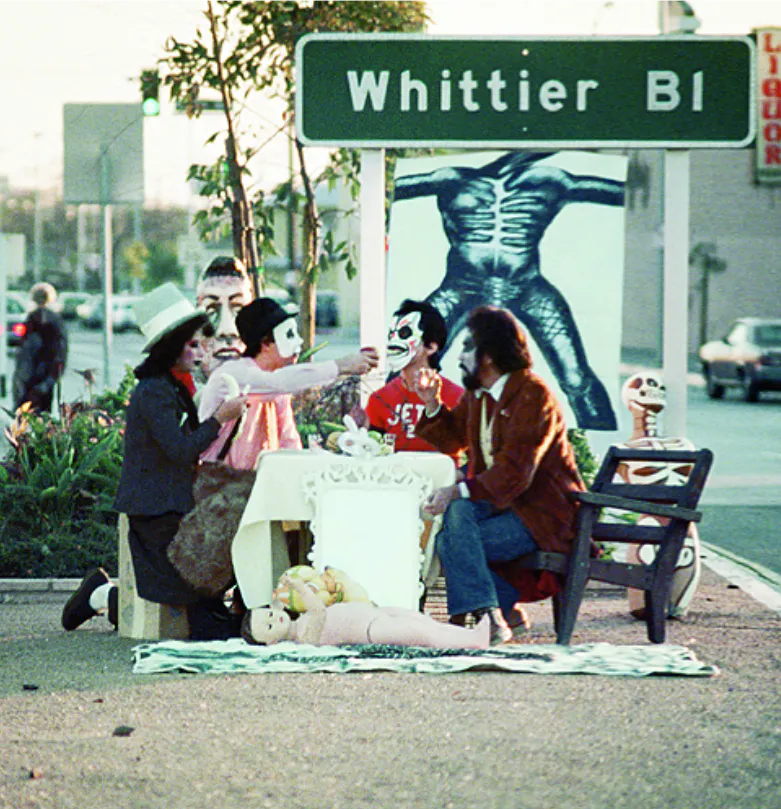
Ep 146Risk
In this episode of High Theory, Faye Raquel Gleisser tells us about Risk. A calculable danger in economics, athletics, sociology, or healthcare, risk has become a socially constructed danger that changes who we are and how we move through the world. Faye asks us to think about how risk management and risk literacy shaped the conceptual and performance work of American artists in the late twentieth century. Who is at risk? Who is safe? And how do we know? Faye’s book, Risk Work: Making Art and Guerrilla Tactics in Punitive America, 1967–1987 (U Chicago Press, 2023) studies how artists in the US starting in the 1960s came to use guerrilla tactics in performance and conceptual art, maneuvering policing, racism, and surveillance. As US news covered anticolonialist resistance abroad and urban rebellions at home, and as politicians mobilized the perceived threat of “guerrilla warfare” to justify increased police presence nationwide, artists across the country began adopting guerrilla tactics in performance and conceptual art. Risk Work tells the story of how artists’ experimentation with physical and psychological interference from the late 1960s through the late 1980s reveals the complex and enduring relationship between contemporary art, state power, and policing. Drawing on art history and sociology as well as performance, prison, and Black studies, Gleisser argues that artists’ anticipation of state-sanctioned violence invokes the concept of “punitive literacy,” a collectively formed understanding of how to protect oneself and others in a carceral society. Faye Raquel Gleisser is an associate professor of art history at Indiana University and curator, whose work focuses on three main subject areas: art and tactical intervention; the racial logics of archives; and curatorial ethics and canon formation. By bridging curation, art history, and performance studies, she investigates histories of art that challenge intertwined anti-Black societal structures and patriarchal, white-centering notions of value that have long limited the canon of “American art.” She approaches art as a material manifestation of sociopolitical conditions and artists as theorists of power and social encounter. In the episode Faye names several artists including Asco, Chris Burden, the Guerrilla Girls, Tehching Hsieh, and Adrian Piper. This image for this episode is a photograph by Harry Gambota Jr. titled First Supper (After a Major Riot), 1974 that documents a performance by the Chicano art group Asco in Los Angeles. See the Artsy page about the photograph for more about the art and the artist. Learn more about your ad choices. Visit megaphone.fm/adchoices
Ep 746Anthony Grasso, "Dual Justice: America's Divergent Approaches to Street and Corporate Crime" (U Chicago Press, 2024)
The United States incarcerates its citizens for property crime, drug use, and violent crime at a rate that exceeds any other developed nation – and disproportionately affects the poor and racial minorities. Yet the U.S. has never developed the capacity to consistently prosecute corporate wrongdoing. This disjuncture between the treatment of street and corporate crime is often narrated as hypocrisy. Others suggest that the disparity is rooted in a conservative backlash after the civil rights movement and the Great Society or a legacy of slavery, Jim Crow, and the racialization of crime. In Dual Justice: America's Divergent Approaches to Street and Corporate Crime (U Chicago Press, 2024), Dr. Anthony Grasso interrogates the intertwined histories of street and corporate crime to find that the differences in punishment are more than modern hypocrisy. Examining the carceral and regulatory states' evolutions from 1870 through today, Grasso argues that divergent approaches to street and corporate crime share common, self-reinforcing origins. During the Progressive Era, scholars and lawmakers championed naturalized theories of human difference such as eugenics to justify instituting punitive measures for poor offenders and regulatory controls for corporate lawbreakers. These ideas laid the foundation for dual justice systems: criminal justice institutions harshly governing street crime and regulatory institutions governing corporate misconduct. Even after eugenics was discredited, criminal justice and regulatory institutions have developed in tandem to reinforce politically constructed understandings about who counts as a criminal. Using an impressive array of sources and methods, Dr. Grasso analyzes the intellectual history, policy debates, and state and federal institutional reforms that consolidated these ideas, along with their racial and class biases, into America's legal system. Dr. Anthony Grasso is an assistant professor of political science at Rutgers University Camden. His research focuses on American political development, law, and inequality. Mentioned: Susan’s interview with Dr. Joanna Wuest on Born This Way: Science, Citizenship, and Inequality in the American LGBTQ+ Movement David Vogel, Fluctuating Fortunes: The Political Power of Business in America (Beard Books, 1989) Learn more about your ad choices. Visit megaphone.fm/adchoices