My Worst Investment Ever Podcast
917 episodes — Page 19 of 19
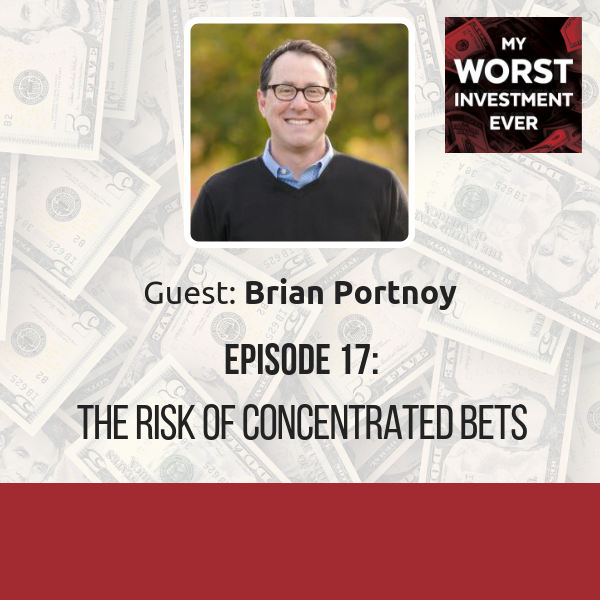
Brian Portnoy – The Risk of Concentrated Bets
Brian Portnoy is the Director of Investment Education at Virtus Investment Partners, where he develops the firm’s content on behavioral finance and investment solutions. Mr. Portnoy has worked in the mutual fund and hedge fund industries for the past 18 years. Prior to joining Virtus in 2014, he held senior investment and strategy roles, including at Mesirow Financial and Morningstar. Brian is the author of The Geometry of Wealth: How to Shape a Life of Money and Meaning. Published in summer 2018, the book explores how money figures into a happy life. He also published in 2014 The Investor’s Paradox: The Power of Simplicity in a World of Overwhelming Choice, which helps investors make better decisions about both traditional and alternative investment strategies. He has spoken to audiences globally about investing and decision-making and has lectured at the U.S. Securities and Exchange Commission as part of its Leading Authors series on the history and future of hedge funds. Mr. Portnoy pursued his research and teaching interests in political economy at the University of Chicago, where he earned his doctorate. He earned a B.A. from the University of Michigan. Mr. Portnoy is a Chartered Financial Analyst (CFA) charterholder. In this episode, Brian shares his worst investment ever story. Their portfolio manager invested the fund in the US financials. Despite the capital market rollover during the Q4 of 2008. The portfolio manager ignored the due diligence and assessments that they presented. Unfortunately, Brian and his team cannot do anything. Their money was in a three year lockdown period. “You really have to check yourself. You’ve got to have your own discipline, but then you have other people around you, coaches and counselors and colleagues and peers who say, ‘Do you know what you are getting into? Is it really worth it?’.” - Brian Portnoy What do you want to hear from the My Worst Investment Ever Podcast? Tell us here! Resources: My Worst Investment Ever Book myworstinvestmentever.com The Geometry of Wealth: How to shape a life of money and meaning The Investor's Paradox: The Power of Simplicity in a World of Overwhelming Choice Topics Covered: 00:54 – Brian Portnoy’s professional and investment background 03:25 – Sharing his worst investment story when he was Mezirow’s Head of Research leading a hedge fund’s due diligence 04:51 – Building up their companies’ global book with an emphasis on European and Asia equities 06:00 – The dangers of scarcity: an invitation-only opportunity that retrospect part of the investment problem 06:30 – The mosaic process of piecing together the history of trade the portfolio made, digging into the investment performance and investment process as part of the due diligence 12:20 – Projection of the success of their portfolio manager based on what he did in the past and the type of scenario they have 14:22 – The nature of the stop loss discipline, their portfolio manager ventured in the US financials of Q2 of 2007 until Q4 of 2008 buying at every tick down 19:15 – Andrew’s Takeaways 19:15 – Brian’s actionable advice based on what you learn from this that he recommend to the listeners take to avoid suffering the same thing Main Takeaways Lesson 1: “It's sometimes it's easy to blame the person. The reality is financial professionals. We do the best that we can.” – Andrew Stotz Lesson 2. “Maybe scarcity is really more of a marketing thing and we have to be careful not to fall on the influence of someone saying this is a limited time only, a limited number of people. Scarcity is something to be careful about.” – Andrew Stotz Lesson 3. “Running a small business is so different from working within a company. You need structures and sometimes large companies have the burdensome structures that we don't like, but they can be valuable.” – Andrew Stotz Lesson 4. “When you're making concentrated bets, you've got to have stop losses. If your plan goes wrong.” – Andrew Stotz Lesson 5. “When you make mistakes, especially when you make mistakes with other people's money, you can learn things and end up in a better spot.” – Brian Portnoy Lesson 6. “Sometimes you just have to force yourself to walk away and say, I'm not going to do this today.” – Brian Portnoy You can also check out Andrew’s books How to Start Building Your Wealth Investing in the Stock Market My Worst Investment Ever 9 Valuation Mistakes and How to Avoid Them Transform Your Business with Dr.Deming’s 14 Points Connect with Brian Portnoy: Linkedin Twitter shapingwealth.com Connect with Andrew Stotz: astotz.com Linkedin Facebook Instagram Twitter Youtube My Worst Investment Ever Podcast

Frank Moffatt – Stock Tips Can Work Until They Don’t
Frank Moffatt is an International Best Selling Author, Motivational Speaker, Lifestyle Coach, Music Producer, Movie Producer, TV Producer, and founder of Your Second Fifty. Today Frank is focused on his position as CEO of Your Second Fifty (YSF)- home of inspirational education to improve and enhance one’s life throughout their second fifty. In addition, Frank looks forward to serving those seeking to find their purpose through one of his latest ventures, Play at Creation (PaC). He is also Co-founder and CEO of AP Teacher Training Institute and International TEFL Canada. In this episode, Frank shares his worst investment experience, putting $50,000 in a thinly managed mining penny stock. “Part of the excitement of being an entrepreneur is we make bad investments and we learn from it.” - Frank Moffatt What do you want to hear from the My Worst Investment Ever Podcast? Tell us here! Resources: My Worst Investment Ever Book myworstinvestmentever.com Your Second Fifty Rising Above the Myths of Aging Topics Covered: 01:04 – Frank Moffatt’s professional background, being a pink colored glasses guy that sees the positive in all situation 03:20 – Sharing the circumstance leading to his worst investment ever 03:50 – His $50,000 worth of investment in a thinly managed mining penny stock 04:52 – the painful slide from $50,000 down to $3,000: his thoughts about his investment when the market crashed, his exit strategy 06:26 – Lessons Frank learned from the stock market investing experience 10:06 Andrew’s takeaway from Frank’s story 13:36 Frank’s Actionable Advice: Take a little more time to do a little bit more research. Just slow it down so that it's not an impulse action that is going to come back and burn your fingers to the bone. Main Takeaways Lesson 1: “When you invest in the stock market, don't invest for the short term, invest for the long term.” - Frank Moffatt Lesson 2: “Don't get in if you don't have the money to back yourself up.” - Frank Moffatt Lesson 3: “If anybody contacts you by phone, verbally or anything about an investment, that's your cue not to invest in that.” - Andrew Stotz Lesson 4. “When people come into the stock market for the first time, sometimes they just think, hey, this is how it's done. You know, this is how people make it because they get a good tip from somebody and they got the guts to go in and do it. But the reality is that at that time you knew nothing about all of this. So you, you went in like ready to give away your money.” - Andrew Stotz You can also check out Andrew’s books How to Start Building Your Wealth Investing in the Stock Market My Worst Investment Ever 9 Valuation Mistakes and How to Avoid Them Transform Your Business with Dr.Deming’s 14 Points Connect with Frank Moffatt: Linkedin Facebook Twitter YouTube Connect with Andrew Stotz: astotz.com Linkedin Facebook Instagram Twitter Youtube My Worst Investment Ever Podcast

Attila Koksal – Even Deep Investing Experience Cannot Overcome Government Policies
Attila Koksal is a Board member of Unlu Securities, Turkey’s leading investment house. He began his career in 1985 at the Center for International Financial Research, Inc., in Princeton. Between 1988 and 2001, he held senior positions in Turkey’s leading financial institutions and associations until he became a partner at Dundas Unlu. He currently serves as a board member of Unlu & Co., Turkey’s leading investment house and holds board positions in a number of Turkish and international institutions. He served six years on the CFA Institute Board of Governors. He also previously served as Presidents Council Representative of CFA Institute EMEA region, and as President of the CFA Istanbul Society. He holds an MBA from Drexel University and a BSc in Mechanical Engineering from Bogazici University. In this episode, Attila shares his worst investment ever story venturing in the power generation industry and how government policy interference affected their business. “With every investment, you should do your homework. You should really understand the implications of the investment and the possible outcomes.” - Attila Koksal What do you want to hear from the My Worst Investment Ever Podcast? Tell us here! Resources: My Worst Investment Ever Book www.myworstinvestmentever.com Topics Covered: 00:54 – Attila Koksal’s professional background as a serial investment banker 03:25 – Sharing his worst investment story venturing in the volatile market of the energy sector 04:15 – Setting up a co-generation plant to aid the power shortage in Turkey 04:44 – Their well-planned business feasibility: electricity to be sold to the grid and the by-product steam to be sold to local industrial companies close to their plant. 06:00 – He shared how they funded the plant: personal saving and bank leverages 07:23 – Factors affecting the energy prices: energy market regulators, an agreement between Russia where they import their natural gas, and government mandates 08:21 – How Turkey’s elections and the government’s populistic moves affected the electricity price 09:07 – The start of the plant losing money: high natural gas costs and they could not sell the steam 09:41 – Having an IRR is 10-12% for project 10:22 – The time they decided to stop operating and the start of selling off the energy production plant’s equipment 11:21 – Having a recoup of around 10% of their initial investment from the equipment that has been sold 13:44 – Factors that affected their revenue line: competition, government incentives for the use of coal for energy production 14:45 – Lessons Attila learned from the experience and the thing they missed that caused the loss 15:50 – The impact of the political intervention to any investment 17:58 – Did his relationship with his partner got affected after the business failed? 19:36 – Andrew’s takeaways from Attila’s story about failing in business Main Takeaways Lesson 1: “I don't think you should invest in an industry or a company which can be subject to political interventions.”- Attila Koksal Lesson 2: “With every investment, you should do your homework. You should really understand the implications of the investment and the possible outcomes.” - Attila Koksal Lesson 3: “Failing in business is not a crime. Failure in business happens all the time. The key thing is to ask if you are struggling in your own startup or other business like that. The key thing is to remain honest about the situation to your investors and to your banks. Make your case. Make sure that they know because if you start to hide what's going on you can start to get into something some fraud, breaking the law and then you end up in trouble.”- Andrew Stotz Lesson 4. “In the middle of trouble within their own business. If you can just stay communicating with your investors. When people invest in a business they know its high risk. Just communicate. And that will help you to stay keep yourself out of trouble.”- Andrew Stotz Lesson 5. “Startup of a small business is a trap. We all dream that we're going to have a very big and successful business and make a lot of money. But in the end, chances are you're going to be trapped together, in this case, seven friends you're going to be trapped in an investment that there's no way out.”- Andrew Stotz Lesson 5. “Never invest in something where you have to rely on the government because our government can change as you explain for instance shifting to a preference for coal as an example for most people trying not to come up by. I always have had people come to me about different investment ideas of this or that related to a new government plan or policy and I've got a relationship with the government and I'm going to be able to get this. And I always say for the majority of investors never invest in something where you're relying on the government to deliver something because they don't have to and they have all the power in the world to just not show up for that. .”- Andrew Stotz You can also check out Andrew

Karl-Mikael Syding – Don’t Be Blind to the Idea That You Haven’t Got the Full Picture
Karl-Mikael Syding was a hedge fund manager for 15 years. In 2010, Futuris, his 1.3 Billion dollars global long and short equity hedge fund received Hedge Fund Review's award as "The European Hedge Fund of The Decade". As one of three partners at Futuris, his responsibilities included investments in financials, software & IT services, plus professional support services and leisure. Before joining Futuris, he was the head IT analyst at Sweden’s largest bank, covering mainly Nordic Software and IT services stocks. Mikael has a Master’s degree in financial economics from the Stockholm School of Economics. He retired from Futuris in 2014 to pursue the meaning of life. In this episode, Mikael shares his worst investment ever story, how their Futuris hedge fund lost over $100-million during the Greek government debt crisis. Because of this experience, he realized the importance of neutrality when making big financial decisions. “Do not be afraid. Losing is the lesson that you will benefit the most from.” - Karl-Mikael Syding What do you want to hear from the My Worst Investment Ever Podcast? Tell us here! Resources: My Worst Investment Ever Book www.myworstinvestmentever.com The Retarded Hedge Fund Manager Topics Covered: 01:01 – Karl Mikael Syding’s professional and personal background 02:12 – His breakthrough moment realizing gratification from luxury lifestyle is not the true fulfillment 04:15 – His advice for people who want to pursue buying luxury things, the importance of awareness in identifying wants and needs 04:15 – His advice for people who want to pursue buying luxury things, the importance of awareness in identifying wants and needs 06:22 – The financial backstory of his worst investment 08:01 – Massive debt build-up: Impact of low-interest rate and Greece overspending habits 12:35 – The defining moment of his worst mistake- European Central Bank’s reinterpretation of the Rulebook of Central Banking and the support to the Government 15:33 – His partner’s decision to close the position 17:07 – Lessons from the experience, taking neutrality, relearning old lessons of finance 19:03 – Andrew’s takeaways from Mikael’s experience, taking about zero-based thinking 22:17 – Mikael’s actionable advice to help listeners protect their investment: Avoid hiding and hoping. Talk about the situation and explain it in details to others. Main Takeaways Lesson 1: Take some kind of a pause or break. If it is in financials, just neutralize the position for a while and think about it. Because then you might get another kind of perspective on what you are doing. Because as long as you are in the heat of it is difficult to think clearly. Lesson 2: Realize that if things are going against you in such a big way, then there is something you are not understanding. Even if it is not on the fundamental level it could be something completely different. It could be the flow of money, other people’s perceptions. Just be open to the idea that an unsustainable situation can actually be prolonged for a very long time. Lesson 3: Politicians will really do anything. It doesn’t really matter what the rules are. They will bend and reinterpret certain wordings and get central bankers in line. Assume that the current rulebook will be honored. Lesson 4. Try not to invest in things that you are relaying in the government. When you are waiting for the government to give permission to do something. Government’s change and they do not have your interest at heart when it comes to investing. One political group could be out and another one in. Lesson 5. Do zero-based thinking. In stocks, if you do not own it today, will you add it to your positions? If the answer is no, then it is probably a good sign to get out. You can also check out Andrew’s books How to Start Building Your Wealth Investing in the Stock Market My Worst Investment Ever 9 Valuation Mistakes and How to Avoid Them Transform Your Business with Dr.Deming’s 14 Points Connect with Karl-Mikael Syding: www.mikaelsyding.com Instagram Linkedin Future Skills Podcast Connect with Andrew Stotz: astotz.com Linkedin Facebook Instagram Twitter Youtube My Worst Investment Ever Podcast

Yoshimasa Satoh – Invest Time in Yourself to Get the Life You Want
Yoshimasa Satoh, CFA, is APAC’s Product Strategist and Solutions Specialist. He is also the Vice President at eVestment, which is a NASDAQ company. He has been in charge of portfolio management, multi-asset investment strategy and asset allocation model development throughout his career. Previously, he served as a portfolio manager of quantitative investment strategies at Goldman Sachs Asset Management and other companies. He started his career at Nomura Research Institute, where he led Nomura Securities’ equity trading technology team. Yoshimasa is a member of CFA Society Japan. He holds a bachelor’s and master’s degree of engineering from the University of Tsukuba. In this episode, Yoshimasa shares his worst investment ever story. He did not use his time horizons to plan his goals in life. He did not contemplate on thinking about his future. Instead, he worked so hard doing jobs he did not like at first. It was a good thing that later on, he took the leap to learn and exposed himself to the financial management industry which is his interest. “You have to find your own career path. Find the best one for yourself and live your own best life.” - Yoshimasa Satoh What do you want to hear from the My Worst Investment Ever Podcast? Tell us here! Resources: My Worst Investment Ever Book myworstinvestmentever.com Topics Covered: 00:57 – Yoshimasa Satoh’s professional and personal background 02:22 – Yoshimasa shares his worst investment ever story not investing his time for himself early on in his life 06:04 – Lessons that Yoshimasa learned from the experience, knowing what you really want to do and creating a long-term career plan for yourself 07:20 – Andrew’s breakthrough story with her sister, doing the things we are good at and doing the things we like and what we enjoy 11:37 – Yoshimasa’s actionable tip to avoid people from going through the same pain Main Takeaways Lesson 1: To keep always be looking for the things you enjoy. For work and in like and try to pursue those. Not from an extent that you are always going to be happy, but you’d be doing the things you enjoy, rather than just making money from the things you did not enjoy. Investing in yourself is the best return on investment you can have. It may be investing in learning a new skill, personal and professional development or pursuing your passion. You need to give time to yourself so you can align your plan and achieve the life you want to live. Lesson 2: To focus on your future. You should always be writing your plans. It is like driving a car. When you are diving a car, you’ve got to look down and you’ve got to also look up. You just can’t focus on what is right in front of you. Or you’ll eventually crash. Lesson 3: Think of long-term. If companies are short-term focused, that gives a great opportunity for those companies that are long-term focused. So do not be afraid to take a long-term view, in your personal and professional life. It is not always going to be popular. But I can tell you over time you can win. You can also check out Andrew’s books How to Start Building Your Wealth Investing in the Stock Market My Worst Investment Ever 9 Valuation Mistakes and How to Avoid Them Transform Your Business with Dr.Deming’s 14 Points Connect with Yoshimasa Satoh Linkedin Twitter Connect with Andrew Stotz: astotz.com Linkedin Facebook Instagram Twitter Youtube My Worst Investment Ever Podcast

Stuart Leckie – The Cost of Friendship: How your Friends Impact Your Investment Decision
Stuart Leckie is based in Hong Kong and advises on investments and pensions in Hong Kong and Mainland China. He is the author of books titled "Pension Funds in China" and "Investment Funds in China". He was Founding Chairman of the Hong Kong Retirement Schemes Association, acts as an advisor or trustee to a number of funds and was the Chairman of the CFA Institute Advisory Council on Standards and Financial Market Integrity. Stuart. Leckie worked in life insurance in the UK before moving to Hong Kong. He served as the Chairman of Willis Towers Watson (formerly Watson Wyatt) in Asia-Pacific and as Chairman of Fidelity Investments, Asia-Pacific. He has advised the Chinese Government on pension’s reform and advised the Hong Kong Government on the establishment of the Mandatory Provident Fund. In this episode Stuart shares his worst investment ever story, investing £500,000 in an affiliate product he did not deeply understand which was actually offered by a trusted friend. Eventually, he stopped investing further after realizing he needed to do more due diligence into the person he originally trusted. “Do not be afraid to ask information to people. If they do not like it, the investment is not for you.” - Stuart Leckie What do you want to hear from the My Worst Investment Ever Podcast? Tell us here! Resources: My Worst Investment Ever Book myworstinvestmentever.com Pension Funds in China by Stuart Leckie Investment Funds in China. A new look by Stuart Leckie and Rita Xiao Topics Covered: 00:44 – Stuart Leckie’s professional and personal background 02:33 – Stuart shares his worst investment ever story venturing into an affiliate product he did not understand 03:40 – Finding out that his trusted friend did not do his due diligence about the investment 04:28 – One of the personnel of the investment unaccounted the collected investment to the fund 06:11 – Availing the UK government grant for tax refund 07:16 – Lessons that Stuart learned from the experience 08:17 – The importance of reporting and transparency in any investment 09:42 – The circumstance that led him to invest in the fund his friend was offering him 10:40 – The different investment red flags Stuart encountered Main Takeaways Lesson 1: Do not touch things you do not understand. Get proper due diligence done. Performing due diligence will give you the necessary information that you need and it will help you vet out a possible investment. Lesson 2: Do not be afraid to push people especially those who are involved in your investment. If they do not like it that means that the investment is not for you. Do not be patient with people who seem to follow the time in the world and do what he likes about it. Lesson 3: Importance of reporting and transparency in any investment. Regularly sending the newsletter about the investment is important. Listing over the 9-parts bad news and the one-part good news. Financial reporting is important because people make their investment decisions based on the financial data of the company. Lesson 4: Never be afraid to tell bad news. You actually build a good reputation over time if you are the person that is willing to talk about it and say what you have learned from it. You can also check out Andrew’s books How to Start Building Your Wealth Investing in the Stock Market My Worst Investment Ever 9 Valuation Mistakes and How to Avoid Them Transform Your Business with Dr.Deming’s 14 Points Connect with Stuart Leckie: Linkedin Stirling Finance Limited Connect with Andrew Stotz: astotz.com Linkedin Facebook Instagram Twitter Youtube My Worst Investment Ever Podcast

Alan Lim Seong Chun – How Complacency Weakens Risk Awareness
Alan Lim Seong Chun is currently a Senior Research Analyst at the research division of MIDF Amanah Investment Bank Berhad. He has close to 10 years’ experience as a sell-side analyst and has covered sectors which include plantation, property, REITs, and telecommunication. He is a Chartered Financial Analyst (CFA) with a first degree in Computer Science from University of Technology, Malaysia. Alan consistently achieved high Bloomberg ranking for stocks under his coverage. As of 21 August 2018, he is ranked No 1 for IOI Corporation Berhad, Kuala Lumpur Kepong Berhad, FIMA Corporation and Ta Ann. In this episode, Alan shares how complacency brought by the property boom weakened his risk awareness leading to his worst investment. “Success can lead to complacency. We thought that things that go up will probably go up further.” - Alan Lim Seong Chun What do you want to hear from the My Worst Investment Ever Podcast? Tell us here! Resources: My Worst Investment Ever Book myworstinvestmentever.com Topics Covered: 00:57 – Alan Lim’s professional and personal background 02:33 – Alan shares his worst investment ever story and the circumstances that lead to it 04:10 – Acquiring his second property thinking that the same return like his first will continue 04:33 – Negative cashflow from the second property 05:32 – Alan shares his feeling from his first property success 06:45 – Why financial professionals do not apply their principles when doing their investment decisions? 08:06 – Lessons that Alan learned from the experience 10:18– Andrew’s takeaways from Alan’s investment story 14:02– Actionable advice that Alan recommend for people to avoid suffering the same investment mistake Main Takeaways Lesson 1: The concept of liquidity. When you buy a house or start a business, the liquidity of what you are buying is very low. It is very hard to get out. It is not an easy thing to get in and out of. Unlike in stock market or Real Estate Investment Trust (REIT), you can buy and sell them in the stock market. Lesson 2: Property investment can be a trap. Because you do not have liquidity, you put your money in, you got the financing from the bank and all of a sudden everything falls. It is hard to find a buyer for it and you are basically stuck in it. Lesson 3: Buying condominiums and this type of properties and thinking you got to rent it out. Remember it is a whole business. There are people who are running a business of renting out, and therefore there is a lot of overhead, hassle and a lot to it. Lesson 4: You can earn a return in Real Estate Investment Trust (REIT) somewhere between 5%-9% depending on the market that it is in. The capital appreciation is low for REIT it does not grow that much compared to a normal company but people can look at a REIT as a relatively safe low volatility way of investing money and getting a dividend or higher return. Not always, but that REIT is something that has liquidity and you could get out if it does not work. Lesson 5: Never believe what other people say about their investments. Because a lot of people only talk about their winners and they are not calculating it fully. You can also check out Andrew’s books How to Start Building Your Wealth Investing in the Stock Market My Worst Investment Ever 9 Valuation Mistakes and How to Avoid Them Transform Your Business with Dr.Deming’s 14 Points Connect with Alan Lim: Linkedin Twitter Connect with Andrew Stotz: astotz.com Linkedin Facebook Instagram Twitter Youtube My Worst Investment Ever Podcast

Michael Markels – Investing on a Hunch: Why an Exit Strategy is Important
A few of the firsts in Michael Markels’ career include the origination of the World Bank’s inaugural Sharia-compliant MYR bond and swaps back to $US libor; the first securitization of bank loans in eastern Europe, which reduced mismatches on the balance sheet of Slovenia’s largest bank; and the execution of the inaugural “N” transactions, in which the Resolution Trust Corporation sold management rights, bond debt and equity in large pools on non-performing mortgages. Michael Markels is an expert at raising funds at scale for rated borrowers and for pools of assets in structured transactions, in times of crisis and of growth. He understands the strategy, having worked on the RTC disposition asset disposition strategy. In addition to being an MD at Standard Chartered, responsible for the P&L generated by major financial institution clients, he arranged fund management products for their private bank shelf. Mike has deep relationships in the financial markets, developed over twenty years in a series of resident assignments with the US Treasury (Bosina), the World Bank (Thailand and India) and with Stan Chart and ABN AMRO (Singapore and Thailand). Mike teaches bank examiners in BCLMV countries, in the context of ASEAN integration. Mike has been using his experience in the bond markets and in development to help UNDP take a leadership role in SDG finance. In this episode, Michael shares the marital risk of financial investments, the importance of managing expectation when investing on a hunch and setting an exit strategy. “Platinum moved away from us. Gold moved away from us. We just hung in there in the view that it will turn around. It never did.” - Michael Markels What do you want to hear from the My Worst Investment Ever Podcast? Tell us here! Resources: My Worst Investment Ever Book myworstinvestmentever.com Topics Covered: 00:26 – Michael Markels professional and personal background 03:21 – Gold and platinum trading investment Michael and his wife ventured in, and the circumstances leading up to their worst investment 05:16 – Their forecast on the platinum’s performance over gold causing them to lose $100,000- $150,000 07:21 – Michael describes their position on their platinum and gold investment 08:02 – What supported the investment decision? 09:28 – The emotional situation in their relationship during their exiting strategy 11:55 – Michael’s takeaways from their losers 14:55 – Michael’s actionable advice to help people protect their investment Main Takeaways Lesson 1: Be careful with the massive market. It is not easy to make money. The counterparty you’re trading against has a huge balance sheet. And the ability to act very differently other you may think. Lesson 2: In every single trade you make, you have to think about what is your exit strategy. An exit strategy may be executed for the purpose of exiting a non-performing investment. Lesson 3: Consider behavioral and emotional factor especially when investing as a couple. The behavioral factors and the emotional factor within the world of finance are so powerful if you decide to get involved with a spouse. When couples want to make the most of their investment dollars, investing together can be a great strategy. But if partners don’t agree on the investment goal, the decisions made can be a recipe for a relationship disaster. You can also check out Andrew’s books How to Start Building Your Wealth Investing in the Stock Market My Worst Investment Ever 9 Valuation Mistakes and How to Avoid Them Transform Your Business with Dr.Deming’s 14 Points Connect with Michael Markels: Linkedin Connect with Andrew Stotz: astotz.com Linkedin Facebook Instagram Twitter Youtube My Worst Investment Ever Podcast

Colin McLean – Risks in Value Investing: When to Cut Loss on a Declining Stock
Colin McLean is the Founder and CEO of SVM Asset Management, an independent Edinburgh-based fund management group specializing in UK, European & Global equities. Colin is a regular member of CFA Institute and was elected to the Board of Governors in 2012. He is a Fellow of CFA UK, a Chartered Fellow of CISI and a Fellow of the Institute & Faculty of Actuaries. Colin is also an Honorary Professor at Heriot-Watt University, lecturing in behavioral finance, and guest lecturer at a number of universities. He is a regular contributor to financial media and conference speaker on investment, hedge funds, and behavioral finance. In this episode, Colin shares the importance of bringing in some contrary view and dealing with the emotion particularly challenges in value investors. “It is a declining business. But of course, as value investors, you always think there is potential recovery. ” -Colin McLean What do you want to hear from the My Worst Investment Ever Podcast? Tell us here! Resources: My Worst Investment Ever Book myworstinvestmentever.com Topics Covered: 00:56 – Colin McLean’s professional background 02:51 – The type of investment Colin ventured in, and the circumstances leading up to his worst investment 03:20 – Colin shares his value investing story: investing in a 100-year old legacy retail company 04:55 – Warning signs of a declining investment 07:47 – Colin’s takeaway from the experience 09:21 – Value investor insight, contrarian value investing 09:45 – How does a value investor reconcile prevailing wins against consensus 13:58 – Colin’s actionable advice to help people protect their investment Main Takeaways Lesson 1: You need to look much harder for what the negative view is. It is very important in owning a stock, not only to have a view of your own analysis. But to try to understand where the consensus is, where the market is because you need it in making a decision to differ from the consensus. If there is a disconnect between your analysis and what is happening with the share price, you need that contrary view into your own mindset. Lesson 2: Cut the position almost automatically if the things persistently move against your analysis. Taking a position is not a difficult thing to do, you can easily convince yourself with the remaining two-thirds of your portfolio, if you are right ultimately, because the two-thirds will be more than the recovery of the money but you are actually one step closer towards reducing the emotional impact of the loss. Lesson 3: Nothing is sacred in investing even 100-year old companies can go bust. Lesson 4: Trying to make money in a declining industry is hard. From a research perspective, identifying segments within the industry can potentially prevent you from overly pessimistic or optimistic about a general industry. Lesson 5: Be willing to immediately take a portion of the position off if a share price falls. Partial cut loss can protect your gains. It does not mean your analysis is wrong, it just means that it was possibly mean the wrong time. Lesson 6: Have a counter-narrative of your analysis. Let people milk you for why you have an opposite view. Bring in the challenge to look at what can go wrong and look for the signs what the portfolio is going to be as you go along. You can also check out Andrew’s books How to Start Building Your Wealth Investing in the Stock Market My Worst Investment Ever 9 Valuation Mistakes and How to Avoid Them Transform Your Business with Dr.Deming’s 14 Points Connect with Colin Mclean: Linkedin Connect with Andrew Stotz: astotz.com Linkedin Facebook Instagram Twitter Youtube My Worst Investment Ever Podcast

Mike Matoney – Stop Investing in Relationships Just for Convenience
Mike Matoney has been the CEO of New Directions for the past 7 years, and also the CEO of Crossroads & Beacon Health for the past 23 years in Cleveland, Ohio. Mike did his undergraduate and graduate MBA studies at Cleveland State University, focusing on Marketing and Quality Improvement as his primary field of study. He began his career as a supervisor at Huron Road Hospital in 1985 and eventually worked his way up through the industry to his current positions. This episode tells a type of the worst investment... investment of time. Hear Mike’s relational investment story, how being in a relationship of convenience shattered his self-esteem and self-worth. “You’ve got to act your way into better thinking. Rather than think your way into better action.” -Mike Matoney What do you want to hear from the My Worst Investment Ever Podcast? Tell us here! Resources: My Worst Investment Ever Book myworstinvestmentever.com Topics Covered: 02:00 – Andrew shares his 35-years friendship with Mike and how they met in the rehab facility, Mike being his counselor 02:51 – Mike shares his level of relational investment experience 03:32 – The circumstances that lead to Mike’s worst relational investment experience: Being in an on-off relationship with a girl for two years, with 8 breakups at the age of 16. 06:25 – Mike’s valuable learning from his experience and the impact it brought to his life 07:00 – Andrew summarizes the critical learning point from Mike’s experience 09:26 – Mike’s actionable steps for people to protect their investment of time in relationships 09:16 – Importance of investment risk management Main Takeaways Lesson 1: Listen. When things aren’t right sometimes we do not open doors to it. We do not listen to the feedback of the people outside our relationship. It is important that we listen and be aware of how your relationship is molding us as a person. We need to acknowledge our position before we get lost in our emotion and eventually making us lose our self-worth. Lesson 2: Self-esteem is important. The sense of self-worth and self-respect to keep any relationship. These attitudes stem from your adherence to judgments and values. People with a great sense of self-respect see themselves as worthy and deserving of happiness. It is important that you know your worth before you start investing your time and emotion to any relationship. Lesson 3: Overcome your fear. Acknowledge the fear or the insecurity and invite someone in whom you trust and cares about your well-being. They can really become their sage and kind of help you through. It is a matter of staying open, acknowledging your insecurities, your fears and staying open not staying closed. You can also check out Andrew’s books How to Start Building Your Wealth Investing in the Stock Market My Worst Investment Ever 9 Valuation Mistakes and How to Avoid Them Transform Your Business with Dr.Deming’s 14 Points Connect with Mike Matoney: Linkedin Facebook Twitter Connect with Andrew Stotz: astotz.com Linkedin Facebook Instagram Twitter Youtube My Worst Investment Ever Podcast

Lasse-Peter Pestel – Avoid the Risks of Eurozone Bailout Fund
Lasse-Peter Pestel is an Investment Strategist at Deka Investment in Frankfurt Am Main. He self-describes as having grown up between two cultures - Germany and Finland. He later added to this cultural mix by through extensive investing experience in Asia, in particular, Thailand and Taiwan. Starting his career as an intern at Georg Reisse GmbH CoKgin 2004, Lasse-Peter worked for over a dozen different companies including DE-Consult in Taipei City and Fidelity Investments in Frankfurt, Germany. Lasse-Peter also earned an MBA degree focusing on statistical studies such as econometrics and its usefulness in banking, risk management, and portfolio management. His work has always been with companies active in capital markets. These companies have been focused on fund management, portfolio construction, and asset simulations regarding return and risks, and various tax issues in relation to stock returns. In this episode, Lasse-Peter Pestel shares his investment experience venturing into government bond investments that are based on political rationality without knowing and studying the risk that comes with it, only focusing on the projected returns. “Make your research then sit back. And let your common sense run a little bit. Just rethink if there are really irrationality on it or not.” -Lasse-Peter Pestel What do you want to hear from the My Worst Investment Ever Podcast? Tell us here! Resources: My Worst Investment Ever Book myworstinvestmentever.com Topics Covered: 00:53 – Lasse-Peter Pestel’s professional and investment background 02:41 – The circumstances that lead to Lasse’s worst investment experience: venturing into government bonds under Eurozone bailout plans 03:08 – Troika’s patchy record on bailouts of distressed Eurozone countries 04:30 – Converting government bonds to the European Financial Stability Facility (EFSF) Bond that has a longer maturity period of 25-30 years 06:51 – Lasse’s Learnings from the experience 07:53 – Andrew summarizes the critical learning point from Lasse’s experience 08:51 – Hedge Fund Trade in the Credit Default Swap (CDS) Market 09:16 – Importance of investment risk management Main Takeaways Lesson 1: If you think history repeats itself, don't follow the herd.Just because you see a pattern in the past, and it repeated itself three times or five times. It doesn’t mean that that pattern will repeat itself again. You could be the unlucky one at the unlucky time. If things worked two times as it did before, they do not necessarily work the third time. Lesson 2: Do not rely on politicians to provide your return. Because when things go bad, they’ll throw you into the open market. Political rationality is not the same as economic rationality. Once these two collide, economic rationality tends to win. Lesson 3: Be careful in following the market and the sentiment running around. Gather more information to cover instead of blindly running around the markets. Whenever we make a bad mistake in our investing, it usually does have to do with our lack of research that we have done or maybe just the idea of not stopping and thinking about the risks. And a lot of time we just think of the returns. You can also check out Andrew’s books How to Start Building Your Wealth Investing in the Stock Market My Worst Investment Ever 9 Valuation Mistakes and How to Avoid Them Transform Your Business with Dr.Deming’s 14 Points Connect with Lasse-Peter Pestel: Linkedin Xing Book Connect with Andrew Stotz: astotz.com Linkedin Facebook Instagram Twitter Youtube My Worst Investment Ever Podcast

Paul Gambles – Why a Solid Investment Policy Framework is Important
Paul Gambles is the co-founder of the MBMG Group and the Chief Investment Officer of MBMG's Asset Management Division—which now oversees clients’ assets in excess of US $400 million. Paul is a member of the Advisory Board of IDEA Economics and a well-known expert commentator who appears regularly on national and international television. Paul has written a great number of academic research papers, articles, and opinion columns, while also finding the time to write over 2,000 editions of the blog, “MBMG Update” and “Paul’s Update.” Paul Gambles holds a degree in English and European Literature and Studies from the University of Warwick. Furthermore, he is licensed by the Thai SEC as a Securities Fundamental Investment Analyst and a financial planner. In this episode, Paul Gambles shares his experience working as an advisor for a range of investment fund in Mauritius. Learn how the organizational, institutional and regulatory changes affected the investment that eventually prompted the suspension of the fund by the Mauritius regulators. “We found ourselves in the situation that we were acting as an advisor to a range of funds. We entered into that with a certain range of assumptions. Those have changed as time went on. The investment mistake was we did not fully realize just how much that will going to impact the investment.” -Paul Gambles What do you want to hear from the My Worst Investment Ever Podcast? Tell us here! Resources: My Worst Investment Ever Book myworstinvestmentever.com Topics Covered: 01:22 – Paul Gambles’ professional background 03:09 – Paul describes his investment background and his investment personality 06:23 – Paul shares his worst investment story: Setting up an investment business in Mauritius 08:52 – Where things go wrong: Situation change in terms of the overall structure of the entity, the parties behind the entity, and the people who were involved in the entity 09:43 – The difference between having an investment idea versus putting the investment idea into action 10:37 – How he reacted when he realized that there are many risks going on 11:44 – Suspension of the fund by the Mauritius regulators 13:53 – Growing problems of the Mauritius Financial Services regulators 15:48 – What Paul learned from the experience and how it affected how he does business now 19:23 – Andrew summarizes the critical learning point from Paul’s experience Main Takeaways Lesson 1: Do not miss the idea that the financial infrastructure and framework is just as important to any investment thesis. And must remain absolute as it should be at all time. Lesson 2: When investing in start-ups you got to have trust. You’ve got to have a great idea and that person has to have good execution. If the trust falls apart or the structure falls apart you are not going to get the gain even if the gain is in the vehicle. Lesson 3: We need to be consistently checking our investment. Monitor how the things change over time. Is the person that you entered into business with a year ago, still acting the same way and in the same trustworthy way as the year previously? Or if they have been bought out by somebody else, be very careful and fully understand all the implications of every change that can impact the investment. You can also check out Andrew’s books How to Start Building Your Wealth Investing in the Stock Market My Worst Investment Ever 9 Valuation Mistakes and How to Avoid Them Transform Your Business with Dr.Deming’s 14 Points Connect with Paul Gambles: Linkedin Twitter MBMG Blog Youtube Connect with Andrew Stotz: astotz.com Linkedin Facebook Instagram Twitter Youtube My Worst Investment Ever Podcast

David Ying – Why Dot-Com Start-ups Failed (And What You Can Learn from Them)
David Ying is a Senior Consultant at the Systex Corporation in Taipei since 2012. David Ying holds a bachelor degree in Economics from National Taiwan University, along with an MBA degree, and an Executive MBA degree in Business Administration. In 1982, David started his career as a banking officer at Continental Illinois National Bank (CINB) located in Taipei City, where he was promoted to loan officer. He has more than 35 years of experience working for a dozen companies, including 5 years at International Investment Trust Company Ltd in Taiwan, 4 years at Dow Jones Telerate and the last 20 years at Systex Corporation. In this episode, David Ying shares his big dreams during the DotCom era leading to a painful start-up venture that brought his years' worth of salary into the bubble. “Investment pretty much at that time [dotcom era] is driven by your behavior and driven by the environment. Lots of people around you say, ‘Yeah, I make a lot of money because I invest in the internet’. ” -David Ying What do you want to hear from the My Worst Investment Ever Podcast? Tell us here! Resources: My Worst Investment Ever Book myworstinvestmentever.com Topics Covered: 00:56 – David Ying’s professional background 02:09 – David as a risk-averse investor 03:01 – The circumstances that lead to David’s Dot.Com investment 05:01 – What persuade him to venture into internet business during the Dotcom era 06:09 – The type of start-up cosmetics business that he ventured in dreaming it to be as big as Amazon and Yahoo 08:33 – How big of an investment was it relative to the money he had 09:11 – Andrew summarizes the critical learning point from David’s experience 10:37 – Jack Ma’s experience when he visited Taiwan for venture funding Main Takeaways: Lesson 1: People easily fall for the fear-of-missing-out. When you hear your friends and everybody talking about their winners and you are thinking that you are missing out, and you try to belong to the fad and invest your way to what they are doing. Lesson 2: The Dot-Com start-up period was the time of BIG DREAMS, BIG FADS. As you get older you recognize big dreams, big fads period is much better when you are younger. Lesson 3: Not all people will become a superstar like Jack Ma and Joseph Tsai. You can also check out Andrew’s books How to Start Building Your Wealth Investing in the Stock Market My Worst Investment Ever 9 Valuation Mistakes and How to Avoid Them Transform Your Business with Dr.Deming’s 14 Points Connect with David Ying: Linkedin Facebook Connect with Andrew Stotz: astotz.com Linkedin Facebook Instagram Twitter Youtube My Worst Investment Ever Podcast

Katsunari Yamaguchi – Government Venture Investing: The Importance of Understanding the Risks
Katsunari Yamaguchi, Ph.D., CFA, CMA, Chairman, Ibbotson Associates Japan, Inc. He joined The Long-Term Credit Bank of Japan (LTCB) in 1979. He worked as portfolio manager for LTCB’s asset management subsidiaries, LTCB-MAS in U.S. and LTCB Investment Management, from 1986 to 1999. He founded Ibbotson Associates Japan, Inc. in 2000, and served over 15 years as president since then. He has been its chairman since 2016. He also served as visiting professor in finance at Graduate School in Economics of Senshu University from 2003 to 2008, and as visiting lecturer for finance course at Hitotsubashi University Graduate School of International Corporate Strategy. He is also a visiting lecturer at leading universities in Asset Management Courses co-sponsored by Japan Securities Investment Advisors Association and Investment Trust Association, Japan. Currently, he serves as director for Nippon Finance Association and advisor for Association of Behavioral Economics and Finance. He holds CFA and CMA. He graduated from Hitotsubashi University in 1979 with BA in social studies and from Yale School of Management in 1986 with MPPM. He earned Ph.D., in Economics at Senshu University in 2008. He authored a book, Risk Premium on the Japanese Economy (2007), and translated two books, Capital Ideas (2006) and Capital Ideas Evolving (2009), both authored by Peter L. Bernstein). In addition, he published many academic and professional articles, of which he was awarded Security Analysts Journal Prize twice in 1991 and 2005. In this episode, Katsunari shares his close to painful experience with a government venture project, how he intuitively projected the outcome and realized the risk early on. “When it comes to the whole picture of any investment, we have to consider not only cost side and tax side. We have to consider the potential risk and return together with the tax reduction benefits.” -Katsunari Yamaguchi What do you want to hear from the My Worst Investment Ever Podcast? Tell us here! Resources: My Worst Investment Ever Book myworstinvestmentever.com Topics Covered: 01:11 – Katsunari Yamaguchi’s professional and investment background 04:16 – Venturing to government’s Accelerated Depreciation program to reduce his business’ tax 06:10 – European Government venture similar to Japan’s Mega Solar Power Project 06:42 – Katsunari’s intuitive projection: bankruptcy and project did not fully materialize 07:25 – Katsunari’s Key Takeaways from the experience 08:36 – Andrew explains what Accelerated Depreciation model is all about 09:40 – Andrew summarizes the critical learning point from Katsunari’s experience 11:52 – Katsunari’s actionable advice to help listeners protect their investment: Try to be modest about taking the risk and do it gradually not one time beating the market inch by inch and in small winning. Main Takeaways: Lesson 1: It is okay to hear some expert’s advice but when it comes to the whole picture of any investment, we have to consider not only the cost side, tax side. We have to consider the potential risk and return together with the tax reduction benefits. Lesson 2: It is only you as an individual can see your own picture of your finance and the whole picture that needs to be taken into consideration. Lesson 3: You have to look at every part of an investment. It is not enough to just have one part that is interesting. Lesson 4: Do not base your investment decision on the government doing something in your favor. Keep you government-dependent investments pretty low. You can also check out Andrew’s books How to Start Building Your Wealth Investing in the Stock Market My Worst Investment Ever 9 Valuation Mistakes and How to Avoid Them Transform Your Business with Dr.Deming’s 14 Points Connect with Katsunari Yamaguchi: Linkedin Connect with Andrew Stotz: astotz.com Linkedin Facebook Instagram Twitter Youtube My Worst Investment Ever Podcast

Emil Voehlert – Don’t Let FOMO Take Over Your Portfolio
Emil Voehlert is the commercial manager at aCommerce – a company based in Bangkok that provides e-commerce Solutions throughout Southeast Asia. Emil started his career as Web Technician and later Client coordinator for customers from Thailand at Mobillos.dk in Denmark. Later he moved to Thailand and developed his career there, working as a business development manager position at Tropical Focus and commercial effectiveness manager at Novo Nordisk. Emil has a growth mindset and strives for constant improvement through education. He entered Stamford International University in 2011 and graduated with a Bachelor degree of Business Administration. In 2018 graduated with a Master of Science (M.Sc) from Thammasat University. In this episode, Emil shares his painful stock equities investment story because of his overconfidence and improper portfolio approach. "Keep investing and keep doing it over time. You got time on your side. It is all about compounding over the years." -Emil Voehlert What do you want to hear from the My Worst Investment Ever Podcast? Tell us here! Resources: My Worst Investment Ever Book myworstinvestmentever.com Topics Covered: 00:50 – Emil Voehlert’s professional and investment background 02:42 – Emil describes his level of investing experience 03:28 – Emil describes the circumstances that led him to invest in German stock market 04:25 – Emil sharing his investment theme with his family and friends 05:47 – He and his friends experiencing a 10% gain on Deutsche Bank 06:34 – His stock’s performance compared to their entry point 07:20 – His supposedly cut loss at -40% 07:51 – Emil’s Takeaways from his investment experience 08:43 – Andrew summarizes the critical learning point from Emil’s experience 12:44 – Emil’s actionable advice to help listeners protect their investment: Do not just take it and use any words from friends at face value. Main Takeaways: Lesson 1: Do not fall into the Fear of missing out. When it comes to investing, FOMO is significantly impacted by recency bias. Our fear of missing out becomes more and more intense after the market has just experienced an uptick. If we take a couple of steps back, it is clear why we maintain a diversified portfolio – it provides the most appealing tradeoff between maximizing returns and minimizing risk. Lesson 2: Focus on your level of research. It is not enough to just develop an investment theme and build confidence in your idea. Lesson 3: Have a zero-based thinking concept. Ask yourself and say, " If I did not own it today will I add it?" It is one way to add clarity. Zero-Based Thinking goes against the traditional dogma of sticking with something even if it does more personal damage to you than good, which is often one of the biggest problems in investing namely attempting to make something work that you wouldn’t even have gotten into in the first place had you known better. You can also check out Andrew’s books How to Start Building Your Wealth Investing in the Stock Market My Worst Investment Ever 9 Valuation Mistakes and How to Avoid Them Transform Your Business with Dr.Deming’s 14 Points Connect with Emil Voehlert : Linkedin Connect with Andrew Stotz: astotz.com Linkedin Facebook Instagram Twitter Youtube My Worst Investment Ever Podcast

Ashraf Bava – Research Before Investing to Reduce Investment Portfolio Risk
Ashraf Bava is currently the Chief Executive at Nael Capital (Pvt.) Limited and a Director at the Institute of Capital Market in Pakistan. Also, he is the current President of the CFA Society in Pakistan, and a Securities and Exchange Commission of Pakistan (SECP) nominated director. Ashraf Bava holds both MBA and CFA degrees and started his career as Chief Security Officer (CSO) at Mobilink in 1995. He joined Elixir Securities in Equity Sales, was promoted to the position of Head of Sales in 2004, and eventually became CEO in November 2005. He joined Nael Capital in 2009. During his career, he was also a consultant at the World Bank Group In this episode, Ashraf shares his painful stock equities investment story because of his overconfidence and improper portfolio approach. "Whatever you invest in, whether it is a stock trade or real estate whatever, just study, read. You have to read. You cannot go blindly into anything without any research." -Ashraf Bava What do you want to hear from the My Worst Investment Ever Podcast? Tell us here! Resources: My Worst Investment Ever Book myworstinvestmentever.com Topics Covered: 00:42 – Ashraf’s professional and investment background 02:06 – Ashraf describes his level of investing experience 02:54 – Ashraf describes the circumstances that led him to invest in Attock Refinery Ltd. 03:30 – Ashraf's overconfidence which made him overlook the risk factors of his trades 03:50 – Investing 80% of his portfolio in one particular stock 04:27 – Attock Refinery stock’s performance when Ashraf entered 05:49 – Volatility of his stock pick and how wiped up his profits from his 2 years of stock market trading 09:55 – Ashraf’s Takeaways from his investment experience 11:39 – Andrew summarizes the critical learning point from Ashraf’s experience 15:14 – Ashraf’s actionable advice to help listeners protect their investment: Read and consider investing long-term. Main Takeaways: Lesson 1: It is important to have a proper portfolio approach. Your portfolio should meet your future capital requirements and give you peace of mind while doing so. Lesson 2: Make investment research before investing in any venture. Read reports about the particular industry you are investing in for example about the international oil prices and what the stocks broker is telling that particular stock. Lesson 3: Get insights into the particular investment that you are making. It is important to stay cool, calm and collected when trading. Lesson 4: Always cut your losses short. Cutting losses quickly prevent you from suffering a devastating fall that's too steep to recover from. You can also check out Andrew’s books How to Start Building Your Wealth Investing in the Stock Market My Worst Investment Ever 9 Valuation Mistakes and How to Avoid Them Transform Your Business with Dr.Deming’s 14 Points Connect with Ashraf Bava: Linkedin Facebook Connect with Andrew Stotz: astotz.com Linkedin Facebook Instagram Twitter Youtube My Worst Investment Ever Podcast

Bill Lewis – Importance of Knowing Product-Market Fit Before Making Any Financial Investment
Bill Lewis is the founder and leader of Linacre Digital Media. He holds a degree in Business Strategy, Leadership, Merger and Acquisition, Operations Strategy, and Globalization from Harvard Business School. Bill started his career as a senior financial analyst at Ford’s Europe division. Throughout his career, he worked for more than a dozen companies, including KPMG, British Airways and was the co-founder in 2012 of Temasys Communications. Born as a technologist, he has evolved into a consummate leader and boardroom titan. He’s helped many entrepreneurial businesses including some Fortune 200 companies. In this episode, Bill shares his painful investment story of loss and his takeaways from the experience. You may relate to his story, or have lived one of them, but most importantly learn from it. "Find a way of getting a hands-on exposure to a new business model and a new business environment before you commit financial investment." -Bill Lewis What do you want to hear from the My Worst Investment Ever Podcast? Tell us here! Resources: My Worst Investment Ever Book myworstinvestmentever.com Topics Covered: 00:57 – Bill’s entrepreneurial and investment background 02:44 – Bill describes the circumstances that led him to his worst investment ever 04:08 – Bill shares his worst investment story 05:44 – Qualities of the American company that Bill invested in 06:20 – Type of investment Bill made 07:35 – Why product-market fit is so important 08:10 – Signs of failure and how he knew the business is not working out 09:08 – 3 Takeaways from Bill’s investment experience and his actionable advice 11:39 – Andrew summarizes the critical learning point from Bills experience 13:33 – the Crash of 2008: Chapter 2 of investment failure for Bill 15:28 – Andrew shares the CFA’s standard of ethics Main Takeaways: Lesson 1: Find a way of getting a hands-on exposure to a new business model and a new business environment before you commit financial investment. Lesson 2: If you are going to enter into a commercial agreement with someone who allegedly has the product and the experience, you need to make sure that they have some skin in the game. Lesson 3: Have a committed and loyal staff. Employees are so much more than paid workers – they are ambassadors for your brand and everything that your business stands for. As members of your company, they must be acquainted with the products or services that you offer. You can also check out Andrew’s books How to Start Building Your Wealth Investing in the Stock Market My Worst Investment Ever 9 Valuation Mistakes and How to Avoid Them Transform Your Business with Dr.Deming’s 14 Points Connect with Bill Lewis: Linkedin Twitter Connect with Andrew Stotz: astotz.com Linkedin Facebook Instagram Twitter Youtube My Worst Investment Ever Podcast