
Musicality Now
317 episodes — Page 6 of 7
Ep 67067: About Scales and Their Flavors
Musical U's very own content editor and product manager Andrew Bishko discusses and demonstrates a variety of scale types, discussing the "flavor" of each one and how they're put to good use in music. Subscribe For Future Episodes! Apple Podcasts | Android | Stitcher | RSS | YouTube Full Show Notes and Transcript: Episode 067 Links and Resources • Interview with Forrest Kinney • Module Preview: Major and Minor Scale Recognition • Hearing Key Changes • The Dorian Mode • The Lydian Mode • The Minor Pentatonic Scale Enjoying the show? Please consider rating and reviewing it! Click here to rate and review
Ep 66066: Discover Your Own Musical Creativity, with Forrest Kinney (Pattern Play)
Today we're getting to speak with someone we've been hearing about for years, Forrest Kinney. He's the author of the Pattern Play series of piano books which you might remember past guests Natalie Weber and Sara Campbell both mentioned as being fantastic for helping students get "off the page" and start to be more creative in their music-making. He's actually the author of 35 music learning books. He's also a highly in-demand speaker, giving presentations on all the interesting things we'll be talking about today, and still regularly performs, including dozens of private appearances at a certain billionaire's house - stay tuned to hear about that. In this conversation we talk about: • Forrest's own musical beginnings and whether such a creative musician as himself credits talent for that creative success • The 4 Arts of Music that you can pick from and blend to find your own true identity as a musician • A creative way to think about music theory - and his opinion on scales that often gets him in trouble! If you've ever felt like learning to play sheet music note by note just wasn't the right fit for you as a musician, or you've felt the urge to create even though you don't consider yourself "a creative", you're going to love this episode. We should mention there were a couple of bits here where our connection got a bit patchy and you might hear a few short cut-outs - stick with it, they were very short sections and we don't think they'll affect how much you'll get out of listening to this. Subscribe For Future Episodes! Apple Podcasts | Android | Stitcher | RSS | YouTube Full Show Notes and Transcript: Episode 066 Links and Resources • Forrest Kinney's website • Forrest's books - including Pattern Play • Interview with Natalie Weber • Interview with Sara Campbell • Creating a Prepared Piano for the piece "Persia" Enjoying the show? Please consider rating and reviewing it! Click here to rate and review
Ep 65065: About Sight-Reading Music
Are you intimidated by the idea of sight-reading music, finding the skill to be intimidating and unattainable? This podcast episode explores how you can get started with learning this skill through musicality training, and the endless benefits that this ability yields. Subscribe For Future Episodes! Apple Podcasts | Android | Stitcher | RSS | YouTube Full Show Notes and Transcript: Episode 065 Links and Resources • Interview with Ben Parry • SightReadingMastery.com • Solfa and Relative Pitch • Speak Rhythms module preview Enjoying the show? Please consider rating and reviewing it! Click here to rate and review

Ep 64064: The Instrument Inside You, with Ben Parry (National Youth Choirs)
Today we're speaking with Ben Parry, the Artistic Director of the National Youth Choirs of Great Britain - but as you'll hear that's just one of many musical roles he has, including formerly being a singer and arranger with the world-famous a cappella group The Swingle Singers, and directing the London Voices choir which has performed on many of the Hollywood film soundtracks that we all know and love. We recently had the pleasure of attending a workshop Ben presented at the London A Cappella Festival and he had such a great way of getting people of all ability levels quickly singing some quite complex music, we knew we had to invite him onto the show to share his ideas with you. In this conversation we discuss: • His own journey from classical church music to cabaret and a cappella, and how it's all informed the way he helps people sing now. • Why having a choir get their tuning from a piano can be a really bad idea. • The pros and cons of using intervals versus using scale degrees (such as solfa or note numbers) Ben is clearly a man who has thought deeply about singing in all forms and brings his unique experience and perspective to all his roles to the benefit of his singers. We loved having the opportunity to pick his brains, and whatever kind of singer you might be - whether you're a vocal pro or just do karaoke at the pub, or you sing with your local choir or in a barbershop group, or you're only willing to sing in the shower but you wish you could do more - we know you're going to really enjoy this episode. Subscribe For Future Episodes! Apple Podcasts | Android | Stitcher | RSS | YouTube Full Show Notes and Transcript: Episode 064 Links and Resources • Ben's website • Swingle Singers • Eton Choral Courses • Choir with No Name • The Choir of King's College • National Youth Choirs of Great Britain Enjoying the show? Please consider rating and reviewing it! Click here to rate and review
Ep 63063: About Deliberate Practice in Music
You may be putting in the practice hours, but are you getting the results that your hard work deserves? In this episode, we take a look at the concepts of deliberate practice and purposeful practice, and how to integrate the two in order to make the most out of your practice time. Subscribe For Future Episodes! Apple Podcasts | Android | Stitcher | RSS | YouTube Full Show Notes and Transcript: Episode 063 Links and Resources • Interview with Professor Anders Ericsson • An Introduction to Solfa • Peak: Secrets from the New Science of Expertise (book) Enjoying the show? Please consider rating and reviewing it! Click here to rate and review
Ep 62062: The Truth About Talent, with Professor Anders Ericsson
This episode was a really exciting one for us because we got to speak with Professor Anders Ericsson, the leading academic researcher on the topic of "talent". If you've been listening to the Musicality Podcast for a while, then you know we have a particular perspective on "talent", and we're often asking our guests their opinion on how important talent is to become a great musician and learn the skills we associate with being a "natural" in music, like playing by ear, improvisation, song writing and more. So for a long time we've been wanting to speak with the man who's done more serious research on this topic than probably anyone else. Professor Ericsson has been researching talent for over 30 years and has become famous for two things: the so-called "10,000 hour rule" for becoming an expert, and the idea of "deliberate practice". We actually did a whole episode of this show on the 10,000 hour rule, and deliberate practice is an idea that runs through all of our teaching at Musical U. So you can imagine what a treat it was to get to talk to the man himself! He recently published a book titled Peak sharing the biggest findings from that research, co-authored with Robert Poole, and if you enjoy this episode then you must check it out, it is packed full of more information, explanation and examples of everything we talk about today. We were determined to make the most of this conversation and we asked Professor Ericsson the big questions we knew that you would be interested to hear the answers to... Questions like: • Is there such a thing as musical "talent"? • If you don't have talent for music, will that affect what you're able to accomplish? • Do you need perfect pitch to become an expert musician? • What's the most effective way to spend your practice time - especially considering the vast abundance of tutorials and other resources available at our fingertips online these days? His answers were just as fascinating as we'd hoped. We were looking forward to this interview for ages and it did not disappoint. We should mention there's a brief section towards the end where we have some noisiness on the audio. We apologise for that, we had real technical issues on this one but Professor Ericsson was really gracious and patient and in the end it turned out really well apart from that one glitchy section. We hope you'll enjoy this episode and feel encouraged and inspired by the proven truth about musical "talent" and what it really takes to develop your musical skills. Subscribe For Future Episodes! Apple Podcasts | Android | Stitcher | RSS | YouTube Full Show Notes and Transcript: Episode 062 Links and Resources • Peak: Secrets from the New Science of Expertise (book) • About the 10,000 Hour Rule - podcast episode • About Perfect Pitch - podcast episode • Making Music with Ease, with Gerald Glickstein - podcast episode • Talent vs. Practice in Music Enjoying the show? Please consider rating and reviewing it! Click here to rate and review
Ep 61061: About Having A Roadmap
With the seemingly endless fountain of resources available for the self-taught musician, it can be hard to weed out exactly how to approach your learning journey. In this episode, we discuss the idea of the musical roadmap, how it can lend structure to your learning, and how we use them here at Musical U to give members a way to keep themselves moving forwards in a way that is tailored to their musical goals. Subscribe For Future Episodes! Apple Podcasts | Android | Stitcher | RSS | YouTube Full Show Notes and Transcript: Episode 061 Links and Resources • Interview with Dave Isaacs • LearnJazzStandards podcast interview with Christopher Sutton • Roadmaps at Musical U Enjoying the show? Please consider rating and reviewing it! Click here to rate and review
Ep 60060: Follow Your Ear, with Dave Isaacs
Today we're joined by Dave Isaacs, a man known as the "Guitar Guru of Nashville". Dave has been teaching music for over thirty years and provides online courses at JamPlay.com. Dave is also a performing artist, releasing ten CDs of his own and continuing to perform with an Americana trio called Renfree Isaacs. Dave wrote a terrific guest post on song writing and arranging for the Musical U website last year and we were keen to pick his brains on songwriting advice - but in this conversation we also go deep into his own journey as a musician, the interplay of theory, instrument skills and your musical ear, and how he discovered the improviser's mindset. Dave shares: • The trick to breaking into improv if it's always seemed intimidating, and how he discovered this almost by accident. • His two big tips for songwriters looking to improve. • What causes many musicians to stall or plateau after learning for a few years, and how you can best tackle that and get moving again. Dave has had a particularly interesting journey as a musician and it's left him with true wisdom when it comes to the right mindset for teaching and learning music. We hope you'll find this conversation as enlightening and inspiring as we did. Subscribe For Future Episodes! Apple Podcasts | Android | Stitcher | RSS | YouTube Full Show Notes and Transcript: Episode 060 Links and Resources • Dave's website • Dave's blog • Arranging for Songwriters, with Dave Isaacs • Dave Isaacs on JamPlay • About Active Listening • Making Music with Ease, with Gerald Klickstein Enjoying the show? Please consider rating and reviewing it! Click here to rate and review
Ep 59059: About Learning to Improvise
Over the last eight episodes, we've covered a lot of ground: we first looked at the right mindset for improv, then dove right into how to use rhythm, scales, chords, harmony, structure, and form to really get your spontaneous playing off the ground. In this episode, we give you an overview of how you can approach the task at hand - learning to improvise! Subscribe For Future Episodes! Apple Podcasts | Android | Stitcher | RSS | YouTube Full Show Notes and Transcript: Episode 059 Links and Resources • About Improvising with Scales and Chords • About Improvising Rhythm • About Improvisation Enjoying the show? Please consider rating and reviewing it! Click here to rate and review
Ep 58058: Building Blocks of Improv, with Brenden Lowe (Jazz Piano School)
Today as part of Improv Month we're speaking with Brenden Lowe, the man behind JazzPianoSchool.com and the Jazz Piano School Podcast. Jazz and piano can both be intimidating things for aspiring musicians and they put front and center their belief that "Anyone can learn", as well as encouraging self-expression from the outset - so clearly a good match for our philosophy here at Musical U! Jazz Piano School has a unique approach to teaching and we were keen to hear more about how it works and how improvisation factors in. In this conversation we talk about: • The astonishing number of jazz tunes Brenden could play after $12,000 of traditional jazz piano lessons and why he was completely unsure how to improvise or be creative. • The "lego bricks" approach to improvising that makes it easy to learn, step by step. • The unique 4-step system they use at Jazz Piano School to connect theory, technique, improv and repertoire at every stage of learning. This was a really fun conversation and Brenden has a great way of explaining things that cuts straight through that intimidation factor. Whether you have any interest in jazz or piano, we think you're gonna dig this. Subscribe For Future Episodes! Apple Podcasts | Android | Stitcher | RSS | YouTube Full Show Notes and Transcript: Episode 058 Links and Resources • JazzPianoSchool.com • The Jazz Piano School podcast • "My Jazz Freedom: What's Helped and Hurt" • Interview with the creators of the Music Student 101 podcast Enjoying the show? Please consider rating and reviewing it! Click here to rate and review
Ep 57057: Improvising with Structure and Phrasing
When speaking, we use phrasing to emphasize ideas, capture our listener's attention, and tell a story. The same holds true in music, and more specifically, in improvisation! Learn how to use phrasing to add structure, interest, and musicality to your improv. Subscribe For Future Episodes! Apple Podcasts | Android | Stitcher | RSS | YouTube Full Show Notes and Transcript: Episode 057 Links and Resources • About Improvisation • About Improvising Rhythm • About Improvising with Scales and Chords • How to "Just Play", with Nick Mainella • How to Improvise for Real, with David Reed Enjoying the show? Please consider rating and reviewing it! Click here to rate and review
Ep 56056: Tell Your Own Story, with David Wallimann
In this episode we're speaking with David Wallimann, who has one of the most popular guitar channels on YouTube with over 100,000 subscribers there. As always when we're interviewing an expert in a particular instrument, we recommend staying tuned even if you don't play that instrument - because very little of what we cover is really instrument-specific. As well as his popularity as a guitar educator, David is a composer and recording artist who has collaborated with the likes of Dweezil Zappa. And as you'll hear in this episode, he is just a lovely down-to-earth guy whose perspective on learning music and improvising is refreshing and seriously perceptive. David has his own guitar courses available at GuitarPlayback.com as well as a free Music Theory DNA course for guitarists at GuitarInfusion.com - something we suspect you'll want to check out after hearing him describe it in this episode. In our conversation we talk about: • How to break free of fretboard patterns and "improvisation by numbers" with a counterintuitive exercise. • The big problem that puts people off music theory and the surprising impact it can have on your musical creativity. • The huge benefit you get from putting ego to one side and embracing your own uniqueness in music - both for improvisation, and for your musical life in general. We loved chatting with David and are really glad to feature his unique perspective as part of Improv Month. As you'll hear us say in this episode, we do think that guitar players tend to have a very particular relationship with music theory and with improvising - but David's take on it all is something that would be valuable for any musician to take on board. We certainly hope you'll enjoy hearing about it. Subscribe For Future Episodes! Apple Podcasts | Android | Stitcher | RSS | YouTube Full Show Notes and Transcript: Episode 056 Links and Resources • David's website • David's YouTube channel • "Self-Taught Musicians Suck?" video • Courses on Guitar Playback • Free "Music Theory DNA" course • Note2Self: "I Love This!", with Lisa McCormick • Doubling Down on Your Craft, with Brad Davis Enjoying the show? Please consider rating and reviewing it! Click here to rate and review
Ep 55055: About Improvising with Scales and Chords
Many musicians stick exclusively to improvising with scales, leaving them feeling frustrated and creatively stunted. This episode reveals how to integrate the idea of chord tones and harmony into your improv to really tell a story with your playing! Subscribe For Future Episodes! Apple Podcasts | Android | Stitcher | RSS | YouTube Full Show Notes and Transcript: Episode 055 Links and Resources • Interview with Improvise For Real's David Reed • About Improvisation • Patterns and Playgrounds • About Chord Tones • About Finding Chords in Scales Enjoying the show? Please consider rating and reviewing it! Click here to rate and review

Ep 54054: How to Improvise For Real, with David Reed
Today we're excited to welcome on to the show someone we were particularly hoping to feature as part of improv month: David Reed, the creator of Improvise For Real. You may have heard of this popular method for learning to improvise and it's one of the few we feel is totally aligned with the ear-led approach we recommend at Musical U and which we've been talking about on this podcast lately. In this conversation we talk about: • David's own musical beginnings and two big pivotal moments - one which let him finally really enjoy the learning process and the other which involved totally reframing his mindset about how music fit into his life. • We discuss the traditional approaches to music education and to learning improvisation - and the limitations these ultimately place on musicians. • And we talk about how learning to improvise the right way can be like the difference between blindly following directions versus using Google Maps to immerse yourself and explore the world you're navigating in rich, clear detail. This episode's going to be particularly useful for two groups of people. Those who feel like improvisation is kind of a side-topic, and are not necessarily particularly interested in it. We think you're going to discover you may have dramatically underestimated how learning to improvise could help you in music. And those who are interested to improvise, and have maybe tried one or two ways before - and found themselves a bit bewildered or disappointed by the experience. David does a fantastic job of describing how learning to improvise should be and how rewarding and straight-up fun it can be if you approach it in the right way. Subscribe For Future Episodes! Apple Podcasts | Android | Stitcher | RSS | YouTube Full Show Notes and Transcript: Episode 054 Links and Resources • Improvise For Real • The Rhythm of Success, with Steve Nixon • How to "Just Play", with Nick Mainella • An Ear for Jazz, with Brent Vaartstra Enjoying the show? Please consider rating and reviewing it! Click here to rate and review
Ep 53053: About Improvising Rhythm
Rhythm is an under-appreciated component of music - and we're here to put it in the spotlight for improvisation month! Learn all about improvising a rhythm, how to do it, and the musicality benefits it yields. Subscribe For Future Episodes! Apple Podcasts | Android | Stitcher | RSS | YouTube Full Show Notes and Transcript: Episode 053 Links and Resources • About Improvisation • About Active Listening • More Ways of Knowing Music, with Jeremy Dittus • Ella Fitzgerald's "One Note Samba" Enjoying the show? Please consider rating and reviewing it! Click here to rate and review
Ep 5252: How to Just Play, with Nick Mainella (10 Minute Jazz Lesson)
Today, we have the first of our interview series for Improv Month here at Musical U. To celebrate the launch of our new improv Roadmap that helps you learn to improvise from scratch, we've put together a month packed full of material all about improv. In our first episode for improv month, we talked about how to approach learning to improvise and how it's something core and fundamental to any musician, it can take on many forms across many genres. At the same time improvisation is something that is most commonly associated with jazz music in particular. And so we were keen to kick off improv month talking to someone who's expert in how you learn to improvise jazz. Nick Mainella is the host of the "10 Minute Jazz Lesson" podcast which really lives up to its name! As a jazz fan but not a jazz musicians ourselves, we have been really enjoying listening to this show and we would highly recommend it for anyone who's interested in learning to play jazz. The way Nick discusses improv on his show was so well aligned with the way we teach it at Musical U we knew we had to have him on the show, and we wanted to start improv month with this interview because as you'll hear, so much of learning jazz improv is in fact applicable to any genre and style of improvising. In this conversation we talk about: • Nick's own upbringing and what he did to compensate for *not* having a natural ear for music. • The specific exercises he finds most useful for learning to improvise. • One powerful memory he has that helped set his mindset right for improvisation for years to come, and which he passes on to his students if they're at all shy or nervous about improvising. • And why someone who wants to play jazz might actually be best served by first studying the blues. It was so much fun to talk to Nick about jazz and improv and he dropped several really valuable nuggets of wisdom in this conversation - simple things that you can go away and apply yourself and really benefit from. Subscribe For Future Episodes! Apple Podcasts | Android | Stitcher | RSS | YouTube Full Show Notes and Transcript: Episode 052 Links and Resources • The 10 Minute Jazz Lesson podcast • 60 Days to Crushing the Blues course • The Riff Everyone Plays Wrong • Donna Schwartz Music • About Active Listening podcast episode • About the Power of Solfa podcast episode • The 10 Minute Jazz Lesson podcast: Learning Vocabulary Enjoying the show? Please consider rating and reviewing it! Click here to rate and review
Ep 51051: About Improvisation
March is Improvisation Month here at Musical U, and what better way to kick off than with a crash course in the subject? In this episode of the Musicality Podcast, we share how to (and how not to!) improvise, the far-reaching benefits of this skill, and how it ties into the creative essence of being a musician. Subscribe For Future Episodes! Apple Podcasts | Android | Stitcher | RSS | YouTube Full Show Notes and Transcript: Episode 051 Links and Resources • About Transcribing Music • About Chord Tones • Improvisational Playgrounds Enjoying the show? Please consider rating and reviewing it! Click here to rate and review
Ep 50050: Unleashing Inspiration, with Vincent James (Keep Music Alive)
Today we're joined on the show by Vincent James, who is the co-founder of an organisation called Keep Music Alive. They organise two big music holidays each year: Teach Music Week and Kids Music Day. In 2017 they partnered with over 600 music school and retail locations to help celebrate Teach Music Week and Kids Music Day by offering free music lessons and holding other community events including open houses, student performances and instrument donation drives. Vincent and his wife Joann are also authors of a book called "88+ Ways Music Can Change Your Life" which features over 100 inspirational music stories from around the world, including a number of celebrities. And as if that wasn't enough, Vincent is also the man behind LoveSongs.com, writing custom love songs on request. In this conversation, we was keen to find out more about the musician behind these three fascinating and impressive projects. We talk about: • The book "88+ Ways…" - what inspired him to take on such an ambitious project and how it came about. I also ask Vincent to share two of his favourite stories from the book. • His experience writing custom love songs for couples and his advice to all budding songwriters. • The two nationwide events he's organised, partnering with over 600 music schools and stores across the US, to promote music learning. And Vincent shares the biggest lesson that comes through all of these projects and successes which you can apply to your own musical life. We've really loved reading a story or two from 88+ Ways each day recently, it's a great way to stay aware of and inspired by the incredible power of music in our world. Between the stories Vincent shares in this conversation and the events he has coming up in 2018 that you can get involved in, you're going to come away from this one feeling uplifted and inspired too. Subscribe For Future Episodes! Apple Podcasts | Android | Stitcher | RSS | YouTube Full Show Notes and Transcript: Episode 050 Links and Resources • KeepMusicAlive.org • KidsMusicDay.org • TeachMusicWeek.org • "So Many Things", by Vincent James • 88+ Ways Music Can Change Your Life • Interview with Sara Campbell Enjoying the show? Please consider rating and reviewing it! Click here to rate and review
Ep 49049: About Arranging Music
Arranging music is not nearly as complex as its name may lead you to believe - if you've ever plunked out the chords to your favourite song on the piano and sang along, you've already done it! In this episode of the Musicality Podcast, we discuss the elements involved in arranging music, and why you (yes, you!) should take a whack at it. Subscribe For Future Episodes! Apple Podcasts | Android | Stitcher | RSS | YouTube Full Show Notes and Transcript: Episode 049 Links and Resources • Interview with Brad Davis • Arranging for Songwriters Enjoying the show? Please consider rating and reviewing it! Click here to rate and review
Ep 48048: Doubling Down on Your Craft, with Brad Davis
Today we're talking with Brad Davis, a guitar icon in the world of country and bluegrass music. As you'll hear on this episode, Brad has had an amazing career. As a go-to stage and session player in Nashville he's played on Grammy-winning albums and worked with artists like Willie Nelson, Sheryl Crow, Earl Scruggs, Emmy Lou Harris and Johnny Cash. He's also an artist in his own right, recording critically-acclaimed albums under his own name and writing songs that have been recorded by well-known artists like Tim McGraw and Billy Bob Thornton. With that resumé you might be expecting a lot of swagger and pride - but Brad is one of the most down-to-earth and humble musicians we've had the pleasure of meeting. We found that really inspiring. This episode is a bit longer than most because there was just so much to learn from Brad. We talk about how he got started and what it took to rise rapidly through the ranks and perform with some of the biggest names in the world. How he was forging his own path from the beginning and how to do that without getting lost and stalling out like so many who try to go their own way do. He also shared a lot of killer insights for the guitarists in our audience, like • How and why his "double down up" guitar technique can be like adding a second language alongside the traditional "down up" technique. Don't miss the videos we'll have in the shownotes to see this in action! • How he's able to hone in on exactly the right region of the strings for his right hand to bring out the best sound on any guitar. • Which of your two hands is the most important to train on technique - and even as a busy recording artist and record producer he's still doing this 15 minutes every day himself. The conversation is quite a blend of guitar specifics and deep insights on career and collaboration in music - so if you're not a guitarist yourself please don't be put off - and in fact if you pay attention, a lot of Brad's comments about guitar can be highly instructive for any musician. Oh, and don't miss Brad revealing the embarrassing nickname he earned around Nashville - and why! Subscribe For Future Episodes! Apple Podcasts | Android | Stitcher | RSS | YouTube Full Show Notes and Transcript: Episode 048 Links and Resources • Brad Davis's website • The Rhythm Pick Pattern • The Double-Down Up Technique • The Brad Bender device • Brad's bluegrass tribute to George Jones • Brad's YouTube channel Enjoying the show? Please consider rating and reviewing it! Click here to rate and review
Ep 47047: About Meter in Music
Rhythm is rarely random - instead, it follows an underlying structure to give the song a certain flow, a structure called meter. In meter, depending on which beats are emphasized in a bar, completely different rhythms and "flows" can be created. Let's look at how this works! Subscribe For Future Episodes! Apple Podcasts | Android | Stitcher | RSS | YouTube Full Show Notes and Transcript: Episode 047 Links and Resources • Interview with Jeremy Dittos • About Grid Notation • What is "the beat"? • Playlist to get you started with recognizing meter Enjoying the show? Please consider rating and reviewing it! Click here to rate and review

Ep 46046: More Ways of Knowing Music, with Jeremy Dittus (Dalcroze School of the Rockies)
Have you ever heard of Dalcroze? It's a remarkable and effective approach to music-learning that's often discussed alongside Kodály or Orff. Today we're speaking with Dr. Jeremy Dittus, the founder and director of the Dalcroze School of the Rockies in Denver, one of the most prominent Dalcroze schools in the US, about his own experiences learning this approach and how (and why) he teaches it now. In this conversation we talk about: - How "reading between the lines" of sheet music, Schenkerian analysis, and Dalcroze training all helped transform Jeremy into the musician and educator he is today - What exactly "Dalcroze" is and how each of its five components can benefit a musician - How and why Dalcroze uses both the fixed and movable do systems of solfege - How Dalcroze can enrich a musician who's learning in the traditional way, and why walking past a Dalcroze classroom typically means seeing a room full of adults smiling, moving and having fun. Subscribe For Future Episodes! Apple Podcasts | Android | Stitcher | RSS | YouTube Full Show Notes and Transcript: Episode 046 Links and Resources • The Dalcroze School of the Rockies • Videos of Plastique Animée • Video of Eurythmics class • Website: Dalcroze USA • Book: "The Perfect wrong note" by William Westney Enjoying the show? Please consider rating and reviewing it! Click here to rate and review
Ep 45045: About Your Voice Sounding Weird
If you sing, it's likely you've recorded and listened back to your voice. Chances are, you were surprised by what you heard, and thought "Is this really what I sound like?". In this episode of the Musicality Podcast, we explain why recordings of yourself sound different from what you're used to hearing, and how to get comfortable with listening to recordings of your own singing voice. Subscribe For Future Episodes! Apple Podcasts | Android | Stitcher | RSS | YouTube Full Show Notes and Transcript: Episode 045 Links and Resources • Interview with Judy Rodman • The Benefits of Recording Your Music Practice • HearFones, a tool for vocalists to hear themselves • How to Love Your Own Singing Voice Enjoying the show? Please consider rating and reviewing it! Click here to rate and review

Ep 44044: All Things Vocal, with Judy Rodman
Today we're speaking with Judy Rodman of judyrodman.com and the All Things Vocal blog. Judy went from being a professional jingle singer in the 70s to getting a recording contract as a singer and having a Billboard #1 song, to writing songs and having one of them become a #1 hit for Leann Rimes, to now being an in-demand vocal coach in Nashville and the creator of the All Things Vocal blog and podcast. With that incredible career, it would be easy to assume Judy has a gift, or that she relied on natural talent. But as you'll learn in this conversation, it wasn't smooth sailing and it was a particular mindset that allowed Judy to have such success in so many different arenas in music. It's also abundantly clear from this conversation that Judy has soaked up an incredible amount of learning along the way and excels in sharing that expertise in a clear and valuable way for her students. In this conversation we talk about: • What it was that let her succeed again and again as she pivoted her music career through the years • The two areas she recommends beginning singers to focus on and specific exercises to help with both • The number one most important thing to focus on as a singer if you want to improve and have a good-sounding voice • How studio singing differs from singing on stage • A clever device that can help you past that feeling of thinking you sound odd or bad when you hear yourself on a recording There is a ton packed into this conversation and whether you've never sung before, you sing and want to get better, or you're already performing on stage and in the studio, there is going to be something valuable for you to take away, and we know you're going to want to immerse yourself more in everything Judy offers to help singers. Subscribe For Future Episodes! Apple Podcasts | Android | Stitcher | RSS | YouTube Full Show Notes and Transcript: Episode 044 Links and Resources • Judy Rodman's website • All Things Vocal blog and podcast • Power, Path & Performance course • Singing in the Studio course • Hearfones as a singing tool • Here We Are, Judy's album with her husband Enjoying the show? Please consider rating and reviewing it! Click here to rate and review
Ep 43043: About the 12-Bar Blues
Without the 12-bar blues, we wouldn't have rock 'n' roll... or, come to think of it, much of the Western music we have today! In this episode of the Musicality Podcast, we'll look at the simple chord progression that comprises the 12-bar blues, how to play it in any key, and how the 12-bar blues can be used as a powerful songwriting tool (and not just by blues musicians!). Subscribe For Future Episodes! Apple Podcasts | Android | Stitcher | RSS | YouTube Full Show Notes and Transcript: Episode 043 Links and Resources • Interview with Bill Hilton • About the I, IV, V, and vi Chords • Finding Chords in Scales • Playlist of songs that use the 12-bar blues • Introduction to Blues Enjoying the show? Please consider rating and reviewing it! Click here to rate and review

Ep 42042: How to Really Play Music, with Bill Hilton
Today we're talking with Bill Hilton, author of How to Really Play the Piano and the host of a hugely popular YouTube channel where over 120,000 people tune in to watch his video tutorials. As always when we have a guest who specialises in teaching a particular instrument, this episode is packed with tips and insights not just for that instrument, but for your musicality in general. In particular, Bill has great wisdom when it comes to the mindset that adult learners need. In this conversation we talk about: • The missing pieces that hold pianists back from feeling creative and expressive on piano, and how to really learn to play • How becoming an amateur singer made him a better piano teacher • What defines "cocktail piano" and why this style is so popular and useful to learn • The surprising advantages that can actually make it easier for adults and retirees to learn an instrument than children Bill's attitude and his teaching really cut right to the heart of what really matters in making music. We know you're going to enjoy this conversation. Subscribe For Future Episodes! Apple Podcasts | Android | Stitcher | RSS | YouTube Full Show Notes and Transcript: Episode 042 Links and Resources • Bill's YouTube channel • Bill's personal website • How to write a classic jazz song • Book: How to Really Play the Piano • Book: Cocktail Piano Enjoying the show? Please consider rating and reviewing it! Click here to rate and review
Ep 41041: About the Hook
We all know the "hook", if not by name. It's the catchiest, most memorable part of a song, and the culprit for getting the tune stuck in your head. In this podcast episode, learn what makes a hook, what differentiates it from the chorus, and how some famous artists have used it to elevate their songs from great to unforgettable. Subscribe For Future Episodes! Apple Podcasts | Android | Stitcher | RSS | YouTube Full Show Notes and Transcript: Episode 041 Instrumental hooks answers: • Queen - Under Pressure (or Vanilla Ice - Ice, Ice, Baby) • Deep Purple - Smoke on the Water • The Verve - Bittersweet Symphony • Don't Stop Believin' by Journey Links and Resources • Interview with the HookTheory team • Musicality Means… Knowing the Slang • The genius of "Hook" by Blues Traveler Enjoying the show? Please consider rating and reviewing it! Click here to rate and review
Ep 40040: Multi-coloured Music, with the HookTheory team
Today we're talking with Dave Carlton and Chris Anderson, two of the three creators of HookTheory - one of our favourite music-learning websites and one that can transform the way you understand melodies and harmony in the music you love. Ryan Miyakawa, the third team member, couldn't be with us today but we're hoping to have him on the show for a followup episode in future. HookTheory is one of a handful of websites that we are constantly recommending to people who are learning music and looking for easier ways to understand music theory. We've been continually impressed with their approach and the quality of the teaching they provide, and it was a real delight to immerse ourselves in the two HookTheory books last year. HookTheory is a new way of visualising notes and chords in music, as well as a very different and far more effective and interesting way of teaching core music theory concepts in songwriting. In this conversation we talk about: • The quite different musical backgrounds that the three HookTheory creators have and what they found a shared passion for that led to creating HookTheory together • What makes HookTheory different and why that might matter to you • Whether or not interactive tools like HookPad which make it easy to write music with computer assistance are removing the need for learning music theory yourself If you've never been to HookTheory.com, we know this conversation will inspire you to go dive in, and if you've seen HookTheory in action, you'll enjoy this peek behind the scenes of where such a cool project came from and what's in store for the future. Subscribe For Future Episodes! Apple Podcasts | Android | Stitcher | RSS | YouTube Full Show Notes and Transcript: Episode 040 Links and Resources • HookTheory.com • Previous interview with Dave: an introduction to hook theory • The I-IV-V progression • The Kodály Method • The benefits of solfege Enjoying the show? Please consider rating and reviewing it! Click here to rate and review
Ep 39039: About Grid Notation
Though hearing a rhythm in your head or tapping along to the beat comes naturally to many musicians, it can be trickier to understand rhythmic notation and put a beat to paper. Enter Groove Pizza, a simple, interactive tool to help you understand rhythms using a visual grid system that lets you see exactly how the beat is formed. In this episode, we're giving you a crash course on forming and tweaking some common beats with Groove Pizza! Subscribe For Future Episodes! Apple Podcasts | Android | Stitcher | RSS | YouTube Full Show Notes and Transcript: Episode 039 Links and Resources • Interview with Katie Wardrobe • Groove Pizza • Honing your sense of rhythm • Learning common beats Enjoying the show? Please consider rating and reviewing it! Click here to rate and review
Ep 38038: Top Musicality Tools and Tech, With Katie Wardrobe (Midnight Music)
Today we're talking with Katie Wardrobe, the founder of Midnight Music - a site we've followed for several years because it is the go-to place to learn about cool new music tools and websites and insights on how they can be used in music education. Katie runs hands-on workshops, presents regularly at conferences in Australia and overseas and she offers online training and support to music teachers all over the world through her music technology professional development online community - the Midnight Music Community. She is also the author of Studio Sessions, a keyboard and technology program for middle school students and the host of the weekly Music Tech Teacher podcast. One thing we've always admired is how Katie is always able to find interesting and creative ways to use new music websites and apps for real practical teaching purposes. We loved having the chance to pick Katie's brains on how to best use music tech in education, as well as learning a bit more about her own background and what led to her having such a creativity-focused perspective on technology in music education. In this conversation we talk about: • How growing up as the daughter of two music teacher parents impacted her early music education, and whether she believes it was nature or nurture that led to her becoming a music teacher herself. • Her opinion on whether easy music-making technology reduces (or even removes) the need for spending time learning music in the traditional way. • Her top suggestions for free online tools you can use today to develop your musicality in fun and interesting ways. This conversation is packed with useful ideas for self-taught musicians and music teachers alike, and you're going to come away with at least one (but probably several) cool new ideas for using technology in your musicality training. Subscribe For Future Episodes! Apple Podcasts | Android | Stitcher | RSS | YouTube Full Show Notes and Transcript: Episode 038 Links and Resources • Midnight Music • Music Tech Teacher Podcast • Book: Studio Sessions • Ultimate Free Music Tech Resources Guide 2017 • Groove Pizza online drum sequencer Enjoying the show? Please consider rating and reviewing it! Click here to rate and review
Ep 37037: About Singing As A Tool
Many musicians shy away from singing. They think that they don't need it, or that it serves no purpose for them. In fact, nothing could be further from the truth - regardless of what instrument you play, learning to sing will improve your audiation skills, express musical ideas in a new way, write songs without needing to hash out the exact melody on your instrument, and fine-tune your sense of pitch. Subscribe For Future Episodes! Apple Podcasts | Android | Stitcher | RSS | YouTube Full Show Notes and Transcript: Episode 037 Links and Resources • Interview: Davin Youngs • Interview: Brent Vaartstra • Interview: George Bevan • Learning to Sing in Tune • Why Every Musician Should Sing • Learn to Sing with Musical U Enjoying the show? Please consider rating and reviewing it! Click here to rate and review
Ep 36036: Singing That Sounds Good - And Beyond, With Davin Youngs (Chicago Circle Singing)
Can you imagine a room full of non-singers trying to sing, all together, completely improvised? You're probably imagining total unmusical chaos, right? You might be surprised by what's possible... Today we're talking with Davin Youngs, founder of Davin Youngs Voice, Chicago Circle Singing and the VOXUS Experience. Davin is a remarkable singing educator and although (as you'll hear in this episode) he doesn't much care about pedagogy for the sake of pedagogy, he does actually have a fascinating, unusual and in my opinion wonderful approach to helping people learn to sing and express themselves with their voice. In this conversation we talk about: • How group improvised singing can work even if the participants aren't trained to improvise - or sing! • Why focusing on what "sounds good" is not necessarily the right way to improve as a singer. • How someone who grew up as a natural singer ended up specialising in helping those who don't feel natural at all to find their authentic voice and start expressing themselves through singing. We were really happy to have the chance to speak with Davin and learn more about his innovative projects. There were a ton of useful insights and ideas in this conversation, whether you consider yourself "a singer" or not. Subscribe For Future Episodes! Apple Podcasts | Android | Stitcher | RSS | YouTube Full Show Notes and Transcript: Episode 036 Links and Resources • Davin Youngs Voice • Circle Singing • VOXUS Experience • Jeanie LoVetri's Somatic Voicework • Bobby McFerrin's Circlesongs Workshop Enjoying the show? Please consider rating and reviewing it! Click here to rate and review
035: About Active Listening
What is "active listening" - and should you be doing it? Musicians often make the mistake of thinking that "ear training" is just about specific concrete skills like recognising intervals or learning to adjust EQ bands on a mixer by ear. But actually there's one big-picture skill that's possibly more important than all of those - as well as providing a great opportunity to put those skills to use. And that's active listening. Learn more about what it is and a number of ways you can start doing it yourself, today, in this episode. Subscribe For Future Episodes! Apple Podcasts | Android | Stitcher | RSS | YouTube Full Show Notes and Transcript: Episode 035 Links and Resources • Interview: Why and How to Learn Music Theory, with Matthew Scott Phillips and Jeremy Burns • Article: How to hear more in the music you love • Article: Close your eyes to open your ears • Article: The #1 activity for every musician • Article: Audiation, the secret music practice skill Enjoying the show? Please consider rating and reviewing it! Click here to rate and review

Ep 34034: Why and How to Learn Theory, with Matthew Scott Phillips and Jeremy Burns (Music Student 101)
Today on the Musicality Podcast, we have two guests joining us on the show: Matthew Scott Phillips and Jeremy Burns, who together host the Music Student 101 podcast, a terrific show that dives deep into music theory in a way that makes it easy to understand, as well as covering other topics like music careers, different instruments, and tips for bands. Matthew and Jeremy are based in Birmingham, Alabama, and although they studied some of the same courses at university together, their musical lives have taken them in quite different directions. Matthew is the award-winning composer of over 70 instrumental and vocal works in a wide range of musical styles, and is now a professor of music at the University of Alabama at Birmingham. Jeremy runs Area 47 Sound, where he has recorded sound for commercials, documentary, film, national news, and prime time television. He's also a bassist, performing live with three bands. We're regular listeners of the Music Student 101 podcast and often recommend it to people who ask us how they can brush up on their music theory - so we were really delighted when they agreed to come on our podcast and share their own experiences and insights. In this episode we talk about: • How music theory and ear training have played a part in two quite different music careers - one into academia and composing, the other into performance and live sound recording • The big mindset shift you need to make learning music theory fun and successful • The core skill that underlies having a good ear, and bridges the gap between musical ear training and audio ear training And we ask them the very blunt question: Is there a point to doing a music degree? If you've ever questioned the usefulness of music theory or a music degree - or wondered if they're things you're missing out on, this conversation with Matthew and Jeremy is going to provide you with some real wisdom and insight. Subscribe For Future Episodes! Apple Podcasts | Android | Stitcher | RSS | YouTube Full Show Notes and Transcript: Episode 034 Links and Resources • MusicStudent101.com • Berklee Online • Who's On Your Ear Training Team? • Active Listening Tutorial Enjoying the show? Please consider rating and reviewing it! Click here to rate and review
033: About the I, IV, V and VI Chords
Chords sometimes referred to with numbers, and chord progressions as a series of numbers, such as I-IV-V or 1-4-5. Find out what these numbers mean, how to build chords on any note in any key, and how you can use this to write unforgettable songs! Subscribe For Future Episodes! Apple Podcasts | Android | Stitcher | RSS | YouTube Full Show Notes and Transcript: Episode 033 Links and Resources Turning Ordinary People into Musicians, with Casey McCann(interview) Note2Self: "I Love This!", with Lisa McCormick(interview) Making Ear Training Fun, with Steve Myers(interview) Finding the Notes Yourself, with Sara Campbell (interview) Seriously Enjoyable Music Learning, with Shelle Soelberg(interview) A Toolbox of Musical Understanding, with Scott Sharp(interview) I-IV-V Chords in Major Keys The vi-IV-I-V chord progression The Circle of Fifths Podcast Episode: The Power of Solfa Enjoying the show? Please consider rating and reviewing it! Click here to rate and review

032: Turning Ordinary People into Musicians, with Casey McCann (Eclectic Music)
Today we're speaking with Casey McCann, founder of Eclectic Music and The Little Middle School in Atlanta. We had the pleasure of meeting Casey in person recently and found her to be such a kindred spirit in the way she thinks about music education and the importance of empowering musicians with ear skills and musicality from the outset. Talking with her was so enjoyable that we knew we had to have her on the show, and share some of her ideas and insights with you too. Casey is the founder of Eclectic Music which offers music lessons and classes to musicians of all ages, and The Little Middle School, a small private academic program for ages 11 to 14. Casey believes that anyone can learn anything, as long as they have the tools and guidance. She especially enjoys working with students who have struggled in the past and helping them to find success. At Eclectic Music, they have the tagline of "Turning ordinary people into musicians", which we love. And she's also incorporated musicality training into The Little Middle School's academic program, something we talk about in this conversation. As always, we were keen to dig into Casey's own early music experiences and how she developed her musicality before starting to help others to do the same. We talk about: • The key insight about guitar and music theory that let her immediately have new freedom playing piano • How she was able to start playing songs by ear, even without formal ear training • Why at her school they let students pick each day what instrument they want to play rather than expecting them to pick one and stick with it for weeks or months There are a few really key insights in this episode as well as a refreshing and powerful philosophy on approaching music learning in general. We loved having the chance to speak with Casey again and we think you're going to really enjoy hearing her perspective and seeing how it can impact your own musical life. Subscribe For Future Episodes! Apple Podcasts | Android | Stitcher | RSS | YouTube Full Show Notes and Transcript: Episode 032 Links and Resources • Eclectic Music • The Little Middle School • Kodály: A Musical Language • The Benefits of Do-Re-Mi, also known as solfège Enjoying the show? Please consider rating and reviewing it! Click here to rate and review
031: About Transcribing Music
Transcribing music ensures that it can be replicated again and again by different musicians while still maintaining its melody, rhythm, and dynamics. It's a beautiful thing, and picking up the skill of transcribing can do wonders for your musicianship! Here, we discuss how to tailor your transcription style to your instrument and your goals, and share some hidden benefits of learning to put music to paper! Subscribe For Future Episodes! Apple Podcasts | Android | Stitcher | RSS | YouTube Full Show Notes and Transcript: Episode 031 Links and Resources Steve Nixon interview episode FreeJazzLessons.com Learn transcription Tips for transcribing music Enjoying the show? Please consider rating and reviewing it! Click here to rate and review

030: The Rhythm of Success, with Steve Nixon (Free Jazz Lessons)
Today we're joined by Steve Nixon of FreeJazzLessons.com, one of (if not the) top websites for playing jazz piano - though actually it covers some non-jazz material too, and if you're thinking that jazz means "advanced", this episode is going to set you straight. Although Steve specialises in piano, pretty much everything we talk about today applies across all instruments, and most of it is highly relevant outside of jazz too, so whatever instrument and genre you play, you'll get a lot from this conversation. Steve has an impressive background as a musician and music educator. After graduating from Berklee College of Music, he played over 1,800 gigs as a professional pianist in over 17 countries around the world, performing with Grammy Award-winning artists such as Koko Taylor and Buddy Guy. He's taught over 14,000 piano lessons and created FreeJazzLessons.com, the largest jazz piano education website in the world, which reaches over 60,000 students each month. In this conversation we talk about: • Steve's opinion on the importance of musical talent versus hard work and how much each has contributed to his own enormous success • His philosophy on improvising - and a cool trick for how you can make your improvisation sound more interesting, even with just a single scale over a single chord • Plus the importance of rhythm skills and three great tips for how to develop your own sense of rhythm And if you're starting to think about getting called on to play Christmas music this year, you won't want to miss what Steve shares about making the same-old Christmas tunes feel fresh and exciting for your audience. Subscribe For Future Episodes! Apple Podcasts | Android | Stitcher | RSS | YouTube Full Show Notes and Transcript: Episode 030 Links and Resources • FreeJazzLessons.com • Course: Zero to Hero • Course: Jazz Improvisation Super System • Preview videos for Jazz Improvisation Super System course • Course: The Christmas Jazz Piano Super System • Steve's Inner Circle program • Steve's interview on the Learn Jazz Standards podcast • The Musicality Podcast: Finding Chords in Scales Enjoying the show? Please consider rating and reviewing it! Click here to rate and review
029: About Good Music Habits
Approaching your music practice with the best goals, intentions, and instructions unfortunately isn't enough. If you want your practice to pay off, it's important to develop good practice habits and stick to them. On this episode of The Musicality Podcast, we start you off with four simple habits you can work into your routine! Subscribe For Future Episodes! Apple Podcasts | Android | Stitcher | RSS | YouTube Full Show Notes and Transcript: Episode 029 Links and Resources • Interview with David Andrew Wiebe • Music Entrepreneur HQ • New Music Industry podcast • Christopher Sutton's interview on LearnJazzStandards.com • Music Student 101 podcast Enjoying the show? Please consider rating and reviewing it! Click here to rate and review
028: Finding and Sustaining Creativity, with David Andrew Wiebe (Music Entrepreneur HQ)
On today's show, we're joined by David Andrew Wiebe. David's a man of many projects, and as well as writing on his site MusicEntrepreneurHQ.com and hosting the New Music Industry podcast, he is also a songwriter, performs regularly with two bands and has written a book, "The New Music Industry", soon to be followed by another all about the creative process, called "Flashes of Elation". We discovered David's work when featuring a podcast episode of his "The Importance of Ongoing Self Education for Musicians" in an article on our website. And it's been a real pleasure to dive into his web and podcast archives and have this opportunity to speak with him on our show. In this conversation we talk about: • Why performing regularly was so important to his finding freedom of creative expression and tapping into his musical instinct on guitar • What he recommends to beginner song writers trying to find inspiration • The conflict between thinking about "passion" and "inspiration" versus just getting solid creative work done day after day • His number one tip for musicians collaborating in a band or other creative projects One thing we love about David is his ability to balance the creative spirit with the down-to-earth practicalities of being a musician. It's fascinating to talk with him and hear his perspective and if you've ever struggled creatively, you're going to really enjoy this conversation. Subscribe For Future Episodes! Apple Podcasts | Android | Stitcher | RSS | YouTube Full Show Notes and Transcript: Episode 028 Links and Resources • Music Entrepreneur HQ • New Music Industry podcast • Book: New Music Industry • Upcoming book: Flashes of Elation • Long John Lev, one of David's bands • "There's Only One Boss" rap track • Ultimate-Guitar.com Enjoying the show? Please consider rating and reviewing it! Click here to rate and review
027: About Finding Chords in Scales
Though you may think of scales and chords as two separate entities, they are very closely intertwined! In fact, chords are very easy to construct if you already have a scale in mind. In this episode of The Musicality Podcast, we discuss how to go from scales to chords with one simple trick, and the practical applications of this skill in playing by ear, songwriting, and improvisation. Subscribe For Future Episodes! Apple Podcasts | Android | Stitcher | RSS | YouTube Full Show Notes and Transcript: Episode 027 Links and Resources • The Musicality Podcast: Scott Sharp interview episode • Fretboard Toolbox • The Musicality Podcast: Sara Campbell interview episode • Solfa episode of The Musicality Podcast • Christopher Sutton's interview on TimTopham.com • FreeJazzLessons.com Enjoying the show? Please consider rating and reviewing it! Click here to rate and review
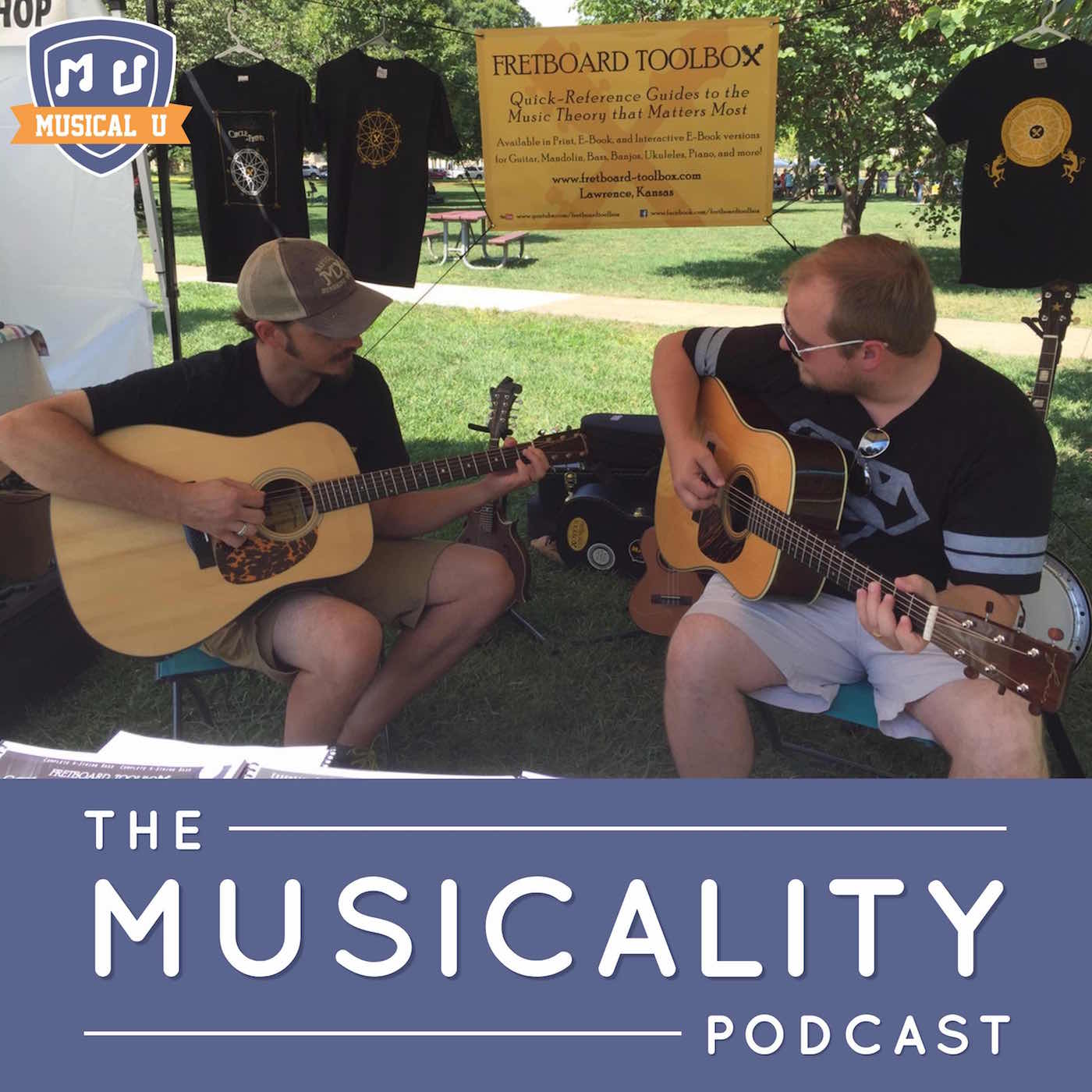
026: A Toolbox of Musical Understanding, with Scott Sharp (Fretboard Toolbox)
Today we're talking with Scott Sharp, the creator of Fretboard Toolbox - an innovative way to explain the notes and chords in each key for guitar, bass, piano, banjo and more. Interestingly, Scott started learning music later than you might expect and really didn't consider himself all that musical. But an impactful experience in his day job as a high school biology teacher unlocked music theory in a way that let him start improvising, playing by ear, and being creative and confident in music. He built on that insight to create his "fretboard toolboxes" for a range of instruments, and provides them online at fretboard-toolbox.com. He's also just released a very cool "Theory By Hand" eBook that makes it easy for you to figure out the scales and chords in any key. In this conversation we talk about: • The big theory insight that let him start playing by ear and improvising and led him to create a whole new way to show how music theory works • Why learning to play a whole bunch of instruments isn't nearly as hard as you might imagine • And the advice Scott would have for anyone who fears they're "unmusical" Scott's Fretboard Toolboxes are an amazing resource for any musician looking to explore the more creative side of music-making and give themselves a shortcut to sounding good and understanding what they're doing with the notes they choose to play. Please enjoy this conversation and come away inspired to explore this approach to theory yourself! Subscribe For Future Episodes! Apple Podcasts | Android | Stitcher | RSS | YouTube Full Show Notes and Transcript: Episode 026 Links and Resources • Fretboard Toolbox • Free jam tracks • Theory By Hand ebook • Online Lessons with Scott • The Circle of Fifths, an invaluable tool for understanding chords, scales, and more Enjoying the show? Please consider rating and reviewing it! Click here to rate and review
025: About Mindfulness for Musicians
Mindfulness isn't just for buddhist monks; for musicians, mindset is just as important as your chops. Stewing on your mistakes and thinking pessimistically about your progress aren't just bad for your brain - they can have a real hindrance on your actual progress. In this episode, we discuss how mindfulness can help you ignore that negative little voice and focus on your playing. Subscribe For Future Episodes! Apple Podcasts | Android | Stitcher | RSS | YouTube Full Show Notes and Transcript: Episode 025 Links and Resources • Interview with Lisa McCormick • Meditation for Beginners, by Jack Cornfield • The Power of Now, by Eckhart Tolle • The Untethered Soul, by Michael A. Singer • Calm.com - to aid your meditation and relaxation • The Headspace app, with guided meditations to get you started Enjoying the show? Please consider rating and reviewing it! Click here to rate and review
024: Note2Self: "I Love This!", with Lisa McCormick
Have you ever felt frustrated because you keep getting something wrong in the music you're learning? Or worried that there is just too much to learn and you're coming to music too late to ever master it all? Today we have the pleasure of interviewing Lisa McCormick, a successful singer-songwriter and the creator of the "Note2Self" methodology of music learning, which can help with exactly those kinds of mindset barriers, especially among adult musicians. After several years as a successful artist, Lisa turned her attention to teaching and now specialises in helping adult beginners get going with guitar and ukulele. We first met Lisa several years ago after discovering an excellent course she created to help guitarists start playing chords by ear. As well as in person classes 1-on-1 and in groups around Brattleboro, Vermont, she provides courses through her website LisaMcCormick.com and is a senior faculty member at GuitarTricks.com. What we love about Lisa's approach is that she really focuses on the joy of making music from day one and strips away the complexity that can often make learning music frustrating for adults. In this conversation we talk about: • The emotional baggage that can make it difficult for adults to begin learning a new instrument and how to get around that • How she helps complete beginners play a song on ukulele in less than ten minutes - and play several songs by the end of the day • How the Note2Self methodology can equip musicians - particularly those who are self-taught or trying to make use of internet resources to learn - to get away from the negative self-talk and confusion that can hold them back, and instead learn faster by having effective and healthy mental habits Lisa also shares the simple 3-word mantra from Note2Self that you can start using immediately - and honestly this alone could be transformative for how much you enjoy your musical journey... Subscribe For Future Episodes! Apple Podcasts | Android | Stitcher | RSS | YouTube Full Show Notes and Transcript: Episode 024 Links and Resources • LisaMcCormick.com • The Sexy Secret of "One, Four, Five" • Getting Started with Guitar • Lisa's Guitar Lessons, on GuitarTricks.com Enjoying the show? Please consider rating and reviewing it! Click here to rate and review
023: About the 10,000 Hour Rule
"It takes 10,000 hours of practice to become an expert," states the 10,000 Hour Rule. Undoubtedly, working passionately and diligently towards your musical goals is a great formula for success, but what if musicians could get the results they want before hitting this numerical milestone? We discuss the truths and myths surrounding the 10,000 Hour Rule, and how to best allocate those hours to become a master musician. Subscribe For Future Episodes! Apple Podcasts | Android | Stitcher | RSS | YouTube Full Show Notes and Transcript: Episode 023 Links and Resources Interview with Ged Brockie Outliers: The Story of Success, by Malcolm Gladwell How Musicians Should Spend Their 10,000 Hours How to Get More out of Every Practice Session Enjoying the show? Please consider rating and reviewing it! Click here to rate and review

022: Beyond the "Quick Fix", with Ged Brockie (The Guitar and Music Institute)
Today on The Musicality Podcast, we're joined by Ged Brockie, founder of the Guitar and Music Institute, a website which provides original and curated content to help guitarists develop their skills - and, as you'll learn in this conversation, also provides insights and education useful to any musician. Playing multiple instruments can both broaden and deepen your understanding of music, and is one of the best things you can do for your musicality. In that spirit, even if you're not a guitarist yourself you'll want to stay tuned, as Ged's story and perspective on learning music is still going to be very interesting and relevant for you. Ged has been a professional musician for over thirty years, performing across the UK. He's helped develop courses for higher education, launched a summer school and a music festival, and composed original music for television, theatre, and film. Somehow, amongst all of that he's also found the time to: Publish the "Fastline" series of guitar tutor books teaching jazz, blues, rock and more Write a book with accompanying tutorial videos called Drop Two Voicings Uncovered Create a huge website at GuitarAndMusicInstitute.com Launch the GMI podcast earlier this year Ged is a great storyteller, and in this conversation we talked a bit about his early beginnings in music, what it was like growing up as a musician in Scotland in the 80s, how things have changed in terms of learning music and performing, and his perspective on what's good and bad about the current status quo in music education. He shared his opinion on whether there's such a thing as musical "talent" (and if so, how important it is), the most important thing you can do while studying music to turn you into a real musician, how learning music is like learning a language, and the connection between theory, technique and musicality. We also talk about a man smashing a bus stop. We hope you enjoy this wide-ranging and illuminating conversation with Ged! Subscribe For Future Episodes! Apple Podcasts | Android | Stitcher | RSS | YouTube Full Show Notes and Transcript: Episode 022 Links and Resources GMI: Guitar and Music Institute The GMI Podcast GMI Podcast Episode: Interview with Christopher Sutton, CEO of Musical U Drop Two Voicings Uncovered - The Must-Have Book for Guitarists Fastlines Blues Guitar Method and Jazz Guitar Method Enjoying the show? Please consider rating and reviewing it! Click here to rate and review
021: About Chord Tones
Learning and understanding chord tones will help you create memorable melodies with tension and release and solo over existing progressions. This in turn will help you play by ear, improvise, and write songs - enabling you to choose the notes that sound the best, rather than using trial-and-error to form your chords and melodies. Subscribe For Future Episodes! Apple Podcasts | Android | Stitcher | RSS | YouTube Full Show Notes and Transcript: Episode 021 Links and Resources • Interview with Meghan Nixon • Playing by Ear with Brad Mavin - Chord Tones • Chord Ear Training How-To: Chord Types • Practice I-IV-V Progressions Enjoying the show? Please consider rating and reviewing it! Click here to rate and review
020: How to Sing Smarter, with Meghan Nixon
Today we're joined by Meghan Nixon, of HowToSingSmarter.com. You may be confused by the title: singers want to sing louder, higher, stronger, more confidently - but "smarter"? As you're going to discover in this conversation, singing smarter is perhaps the most important thing you can do to improve your experience and results as a singer. During the course of her career in music, Meghan has helped hundreds of people become better singers and musicians. She works with voice and piano students of all ages, levels and genres in her busy private studio in Arvada, Colorado. She is a classically-trained vocalist with a degree in Jazz Performance from Michigan State University and has performed in Jazz, Rock, Funk, R&B, Bluegrass and Folk bands. She's been teaching voice for 15 years and focuses on healthy singing technique, ear training and musicianship. In this episode Meghan shares with us: • The framework she puts in place with all her students that helps them approach new songs, sing the right notes, and even sight-sing music they've never seen before. • The truth about "tone deafness" and how she helps first-time singers to quickly get the hang of singing in tune, and • How she went from being too scared to even try improvising as a singer, to knowing clearly and confidently how to assemble the right notes at the right time. We loved chatting with Meghan about what it means to "sing smarter" and how it can help all those of us who aren't necessarily "natural singers" to feel just as confident and capable as those who are. Subscribe For Future Episodes! Apple Podcasts | Android | Stitcher | RSS | YouTube Full Show Notes and Transcript: Episode 020 Links and Resources • HowToSingSmarter.com • The Tone Deaf Test • Beginner Solfa Sight-Singing Practice Exercises Enjoying the show? Please consider rating and reviewing it! Click here to rate and review
019: About Recovering from Mistakes
Though you may be tempted to panic or freeze up after playing a bad note during your performance, your mistake is not the end of the world - far from it! Learn four tips and tricks that will get you through those moments, with your audience being none the wiser. Subscribe For Future Episodes! Apple Podcasts | Android | Stitcher | RSS | YouTube Full Show Notes and Transcript: Episode 019 Links and Resources • Interview with Melody Payne • Get Confident module preview • Making Music with Ease, with Gerald Klickstein Enjoying the show? Please consider rating and reviewing it! Click here to rate and review
018: Getting "Off Book", with Melody Payne
On this episode, we are joined by Melody Payne, a.k.a. "The Plucky Pianista". Melody has been writing online since 2012, sharing innovative and forward-thinking ideas for teaching music more effectively. In this conversation, we talk a lot about getting "off book" - meaning being able to play even without the note-by-note sheet music in front of you. Melody shares an impactful early experience with a performance that went wrong and how she eventually learned to handle musical mistakes with grace. She found a great way to get started playing by ear and improvising with a friend, and that led on to wanting to equip her students with the tools needed to feel that freedom. Melody teaches two particular skills and uses a special app to help her young students quickly start playing the songs they love in their own way without needing to learn them note-by-note. One thing a lot of musicians struggle with is how to make their performances actually sound good - not just hitting the right notes at the right time, but actually moving the listener. Melody shares insights on her "Three Rules for a Magical, Musical, Moving, Performance". If you've ever felt limited to playing just the notes that are put in front of you, you're going to love this episode. Melody shares so openly and has real insights on getting "off book". Subscribe For Future Episodes! Apple Podcasts | Android | Stitcher | RSS | YouTube Full Show Notes and Transcript: Episode 018 Links and Resources • MelodyPayne.com • iReal Pro app • 3 Rules for a Magical, Musical, Moving Performance • Accompanying 101: 10 Tips for Beginning Accompanists Enjoying the show? Please consider rating and reviewing it! Click here to rate and review