
Market Dominance Guys
259 episodes — Page 3 of 6

S4 Ep 159EP159: Join the Band - How Sales Professionals Are Like Lyricists
A company’s leadership – the lead singer, picks up the pieces and fills in the holes in a performance. Their drummers keep the rhythm of the deal moving forward so everyone can stay in time. But what about the sale professional making the calls – the lyricist? The correct tone of a single syllable can make or break a conversation before it starts. Corey and Chris continue their conversation with Paula S. White of Side B Consulting. They compare the ways different cultures start a cold call. We have more in common with all of our varying cultures than you may think when we start the call admitting we are an interruption and that we have never met the prospect on the other end. Paula takes us through the skill of being an unexpected listener and where that is valuable in every business encounter. The good news is it can be learned, like a memorable piece of music or a favorite song that takes us back to a favorite memory. Join these sales musicians in this episode, “Join the Band – How Sales Professionals Are like Lyricists.” ----more---- About Our Guest Paula S. White is the Leadership DJ of Side B Consulting in New Albany, Ohio. Side B Consulting helps leaders combine their business-minded skills with their relationship-based people skills to more effectively lead their teams. Full Transcript here: A company’s leadership – the lead singer, picks up the pieces and fills in the holes in a performance. Their drummers keep the rhythm of the deal moving forward so everyone can stay in time. But what about the sale professional making the calls – the lyricist? The correct tone of a single syllable can make or break a conversation before it starts. Corey and Chris continue their conversation with Paula S. White of Side B Consulting. They compare the ways different cultures start a cold call. We have more in common with all of our varying cultures than you may think when we start the call admitting we are an interruption and that we have never met the prospect on the other end. Paula takes us through the skill of being an unexpected listener and where that is valuable in every business encounter. The good news is, it can be learned, like a memorable piece of music or a favorite song that takes us back to a favorite memory. Join these sales musicians in this episode, “Join the Band – How Sales Professionals Are like Lyricists.” Corey Frank(00:00): So what are these challenges that you see in companies? Cuz I would bet that there are folks maybe at the C level who wanna be more in touch with side B to communicate, to retain talent, to inspire more creativity. And you probably have folks who say, Hey listen, I didn't sign on for this. I thought you hired me for my resume. I thought you hired me for my experience. How do you help workshop that out? So they do sing the same song. Paula White (00:29): So interestingly enough, it again all comes down to culture and you're gonna see resumes changing very, very shortly where some of those things, those side B traits are starting to show up on resumes. They're looking for cultures of accountability, they're looking for cultures that are going to give back. They're looking for cultures who believe in their people. So how do you take what you have now and ensure that everyone is singing on the same page? I think it's just getting in the studio. We have to get all ideas out on the paper or the whiteboard and start coming together as a band and making sure each instrument is represented for their own strengths. Corey Frank(01:28): How is that facilitated? Do you expect that the leaders will drive that facilitation? I know certainly that's what your practice is all about, but when the conductor leaves the building such as you and your team, how am I empowered or instilled with this sheet music to make sure that hey, drummer plays this, bass player plays this, et cetera? Paula White (01:53): That's a great question because after most workshops, people do tend to forget, right? Facilitating something really takes time. And there is a monthly plan that I do connect with the CEO or the leader that put the workshop together to ensure these things are still happening within the organization. But the most important part is really taking the survey for each person to understand what their intentionality and what they are on the inside is brought out. And if that is known by everybody, then we can hold each other accountable to being open-minded creative, to being experimental, to being laser logical. If we have a person who is laser logical, let's use that and let's create it together so that everyone knows what their skill sets are. Yes, it sounds great in a workshop and it can facilitate afterwards. And I tend to take the next six months and we take the next six months to ensure that that continues to go through the organization. Corey Frank(03:08): , . No, that's great. I think I keep coming back to this element of having the courage to do it. Yeah, because we read, right Chris, we re
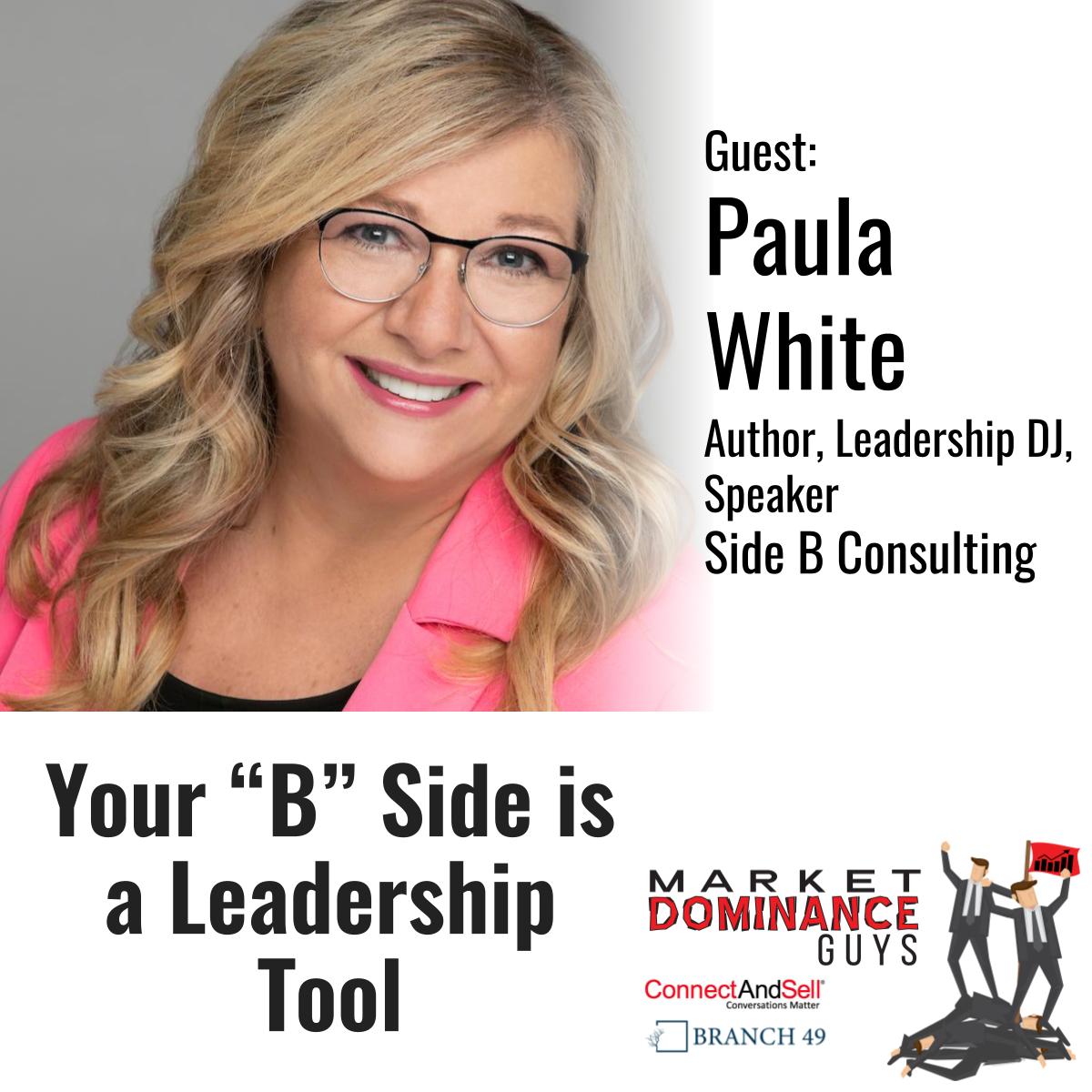
S4 Ep 158EP158: Your “Side B” Is a Leadership Tool
What helps make someone an effective leader? According to our guest, Paula White, the Leadership DJ of Side B Consulting, it’s all about employing a leader’s human side along with their business side when they connect with their team. Using music and musician metaphors, Paula helps leaders discover the aspects of their flip side — Side B — which define their humanity, and how they can combine their Side B aspects with their business side to become intentionally connected with their team members. Our hosts, Corey Frank and Chris Beall, bring their own experiences as team leaders to this topic, discussing with Paula how an imbalance of power can often impede an honest exchange between a leader and his team members, and how the application of a leader’s Side B traits can diminish this. Curious to discover your own Side B? Get some insights from today’s Market Dominance Guys’ episode, “Your ‘Side B’ Is a Leadership Tool.” About Our Guest Paula S. White is the Leadership DJ of Side B Consulting in New Albany, Ohio. Side B Consulting helps leaders combine their business-minded skills with their relationship-based people skills to more effectively lead their teams. ----more---- Full episode transcript below: Corey Frank (01:20): We're back, post-Thanksgiving version of the Market Dominance Guys. Welcome to another episode of the Market Dominance Guys with Corey Frank, and, as always, the sage of sales, the prophet of profit, my personal favorite, the Stephen Hawking of hawking, right, Chris Beall. And here we have another incredible special guest. We have Miss Paula White from the Leadership DJ, raise your leadership style, and always, Chris, because generally you sit with the most interesting people at either trade shows or on a plane, or you're introduced to some of the most interesting people in sales and sales leadership today, so I can't wait to hear how you met Paula. But first, Chris, how was your Thanksgiving, good time all around? Chris Beall (02:05): It was grand, it was grand. And, Paula, it's fabulous to have you here. Paula, we can try to remember how we met. Paula's the only person who's ever succeeded in getting me to jump on a plane and go to Columbus, Ohio, just to have breakfast Corey Frank (02:20): Really? On purpose? Wow. No coercion, nothing. Paula White (02:24): No coercion, just maybe the Ohio State Buckeyes. Yeah. Corey Frank (02:31): Perfect. And so this breakfast was what a breakfast it was. Chris Beall (02:35): And a graduate from the Ohio State University, who has a PhD in clinical psychology, cooked our Thanksgiving turkey. There's a connection right there, Paula. Paula White (02:48): There it is, right there. That person cooked your Thanksgiving turkey and, unfortunately, the Buckeyes did not win and lost to Michigan, the state up north. Chris Beall (03:01): Well, that's actually fortunate for me because Sean McLaren, our executive chairman, is a Michigan guy, so I have to deal with him on more occasions than Paula. Paula, I'm so sorry- Paula White (03:16): Well- Chris Beall (03:16): ... but out of self-interest. Paula and I met recently at the OutBound Conference, which is a tremendous conference that Jeb Blount and Anthony Iannarino, it used to be Mike Weinberg, anyway, but the Sales Hunter, Mark Hunter is there. And we met and just were having a bunch of conversations about something that's near and dear to my heart, which I'll call it the other side of sales, and she calls it Side B, and Paula's an aspiring DJ or a practicing DJ. I don't know what you are- Paula White (03:46): Yeah, yeah, right now, I'm aspiring. Chris Beall (03:53): ... just as good a DJ as I am a piano player. We were just talking about a whole bunch of stuff, and it also came together in my mind in part with what Helen is doing with her book, Love Your Team: A Survival Guide for Sales Managers in a Hybrid World, Amazon bestseller in multiple categories, and so it was like, "Hey, why not get on Market Dominance Guys?" Because we talk all the time about what I'll call technique, right, but, when we had Helen on, we talked about this other side, which is the human side. We do a lot of the human side on Market Dominance Guys about what's going on in that person's mind and their gut in the first seven seconds of a conversation? Paula is helping folks discover their own human side so they can bring it into the arena, so to speak, and be a whole person and still be a fantastic performer. I think that that just led to this. Here we are. Paula, welcome. Paula White (04:47): Well, thank you. What an amazing, amazing introduction there. Although I will say, Chris, that our very, very, very first meeting was seven years ago at the AAISP Leadership Summit. Chris Beall (05:04): Was it the leadership summit or the executive retreat? Paula White (05:07): Oh, the executive retreat. You're right. Right. Chris Beall (05:09): We were sitting at the same table- Paula White (05:11): Same table. Chris Beall (05:12): ... when we were

Ep 157EP157: Hold Everything!
When you’re nearing the end of the quarter, especially the fourth quarter, do you tend to panic and offer a discount in order to close any deals hanging fire? Oren Klaff, New York Times bestselling author of Pitch Anything and Flip The Script, discusses the downside of this neediness on today’s Market Dominance Guys podcast. Our two hosts, Chris Beall and Corey Frank, explore with Oren what happens to the status you have so carefully built with your prospective customer if you blatantly display just how needy and desperate you are to close the deal. Does showing your soft underbelly increase your chance of closing the deal? Or does your neediness kill the deal altogether? Oren’s advice is to stick to the sales process — and HOLD, no matter what. Join these three sales analysts as they caution the sales reps of the world about the pitfalls of a needy mindset when a sales deadline is looming on today’s Market Dominance Guys’ episode, “Hold Everything!” ----more---- More Marketet Dominance Guys episodes with Oren Klaff here: https://marketdominanceguys.com/category/guest-oren-klaff About Our Guest Oren Klaff is one of the world's leading experts on sales, raising capital, and negotiation. He is the New York Times bestselling author of two sales-related books, Flip The Script and Pitch Anything: An Innovative Method for Presenting, Persuading, and Winning the Deal. Employing his securities markets experience in capital-raising advisory leadership, Oren is Managing Director of Capital Markets at the investment bank Intersection Capital, where he manages its capital-raising platform. Since 2005, Oren has grown the firm to approximately $2 billion in aggregate trade volume across a diversified portfolio of companies and transactions. Full episode transcript below: Announcer (00:05): Welcome to another session with the Market Dominance Guys. A program exploring all the high stake speed bumps and off-ramps of driving to the top of your market with our host Chris Beall from ConnectAndSell and Corey Frank from Branch49. (00:21): When you're nearing the end of the quarter, especially the fourth quarter, you tend to panic and offer a discount in order to close any deals hanging fire or in clap. New York Times bestselling author of Pitch Anything and Flip the Script discusses the downside of this neediness on today's Market Dominance Guys Podcast. Our two hosts, Chris Beal and Corey Frank, explore with Oren what happens to the status you have so carefully built with your prospective customer if you blatantly display just how needy and desperate you are to close the deal. (00:51): Does showing your soft underbelly increase your chance of closing the deal? Or does your neediness kill the deal altogether? Oren's advice is to stick to the sales process and hold no matter what. Join these three sales analysts as they caution the sales reps of the world about the pitfalls of a needy mindset when the sales deadline is looming, on today's Market Dominance Guys episode Hold Everything. Corey Frank (01:20): And here we are. Welcome to another episode of the Market Dominance Guys with Corey Frank and the sage of sales, the prophet of profits, the hawking of Hawking, does that make sense? And we have, Oren, I'm sorry I don't have any nicknames I've rehearsed in my shower for the last few weeks for you, we have Oren Klaff, best-selling author of Pitch Anything, Flip the Script, and Sales Connoisseur. I don't know, that's all I got. So welcome, Chris, we got to a great special guest in the hotseat today and what brings the three of us together? What could possibly top the last podcast we did? Oh I don't know, a short six, eight months ago or so. We probably have something to announce, do we not, Oren, Chris, that we could talk to a little later in the podcast? Chris Beall (02:07): I think we do. For one thing, let me just point out, I recommend some sales books but I don't force any of them down anybody's throat except for Flip the Script. And the reason I do is Flip the Script says, "Don't force this book down somebody's throat," and I just love the delicious irony of utterly failing to apply every single principle in this book while pushing this book on people. I don't know, the dynamic tension in that just works for me. Corey Frank (02:36): It's like don't push this button [inaudible 00:02:39]. Chris Beall (02:39): Yeah, it's like peeps, look, if you have only two books you can read in this coming year and for some of you that is a stretch, read Flip the Script and learn how to do simple things like get a little status alignment going and learn how to flash roll. I'm still trying to teach our people how to flash roll. They tend to want to drift into teaching at that point. Learn how to flash roll. And then when you're done with all that and you realize that you're not going to do all this, that you're a manager and your people are going to do it, pick up Helen Fanucci's Love Your Team and go and read that, and you put those two tog

S4 Ep 156EP156: Focus on Over-Delivery
“It costs five times more to get a new client than to keep one you already have.” Today, Rick Elmore, Founder and CEO of Simply Noted, elaborates on his commitment to customer retention and to his company’s practice of over-delivery with our Market Dominance Guys’ host, Chris Beall. Rick believes that building relationships with clients is vital to any company’s success, so he begins by onboarding each new customer himself, answering all the frequently asked questions, and personally checking back to make sure the customer’s initial experience with Simply Noted’s products and services is a happy one. “When you’re truly on your client’s side, they’ll hear it in your voice,” Rick explains. Listen to this podcast, and you too will hear the commitment to customer retention in Rick’s voice in today’s Market Dominance Guys’ episode, “Focus on Over-Delivery.” About Our Guest Rick Elmore is founder and CEO of Simply Noted in Tempe, Arizona, a company that utilizes software and robotic technology to create personalized handwritten notes for its 300,000 monthly users. ----more---- Full episode transcript below: Announcer (00:06): Welcome to another session with the Market Dominance Guys. A program exploring all the high-stakes speed bumps and off ramps of driving to the top of your market, with our host Chris Beall from ConnectAndSell and Corey Frank from Branch 49. (00:23): It costs five times more to get a new client than to keep one you already have. Today, Rick Elmore, Founder and CEO of Simply Noted elaborates on his commitment to customer retention and to his company's practice of over-delivery with our Market Dominance Guys' host, Chris Beall. Rick believes that building relationships with clients is vital to any company's success, so he begins by onboarding each new customer himself, answering all the frequently asked questions and personally checking back to make sure the customer's initial experience with Simply Noted's products and services is a happy one. "When you're truly on your client's side, they'll hear it in your voice." Rick explains. Listen to this podcast, and you too will hear the commitment to customer retention in Rick's voice in today's Market Dominance Guys' episode, Focus on Over-Delivery. Chris Beall (01:20): Pretty fascinating. Here's a modern problem. So we have this massive work from home thing that showed up in 2020. We actually got to watch it, the day everybody went home in our customer base. We knew what day it was. It was like everything still worked, which was pretty cool. We thought that was amazing. Our people who navigate these phone calls all went home too. That shocked me that that worked. We dodged more than a bullet that particular day, because at 200,000 plus dials navigated a day by human beings. You got to have people who can navigate those styles and suddenly there are centers they were working at. We didn't know that had happened. But now I'm kind of looking at it going, okay, everybody's going to work from home. My wife's book, Love Your Team, A Survival Guide for sales managers in a hybrid world, in a hybrid world means a bunch of people are working from home. (02:06): How do you solve that problem of knowing how to get to them working from home? People send stuff to me in my office in Los Gatos and I will go there, something on the order of twice this year maybe. Partially because when you set foot in California, they tax you for that day of work, but for some other reasons too. What do you do there? How do I get my customers or even my team? So my innocent team right, there they are, I got 10 SDRs and I got 10 AEs and they're talking to say 85,000 people a year. How do they get that physical note to the right person? Rick Elmore (02:43): Yeah. Chris Beall (02:43): How do they get the address part to happen? Rick Elmore (02:45): So most of our clients have addresses already. Work with tons of nonprofits, political affiliation, political action committees, real estate, mortgage, insurance. All these people usually have those addresses, but there are a lot of creative ways you can find people's address. What we've seen people do, we don't do it, is they'll find a list of people they want to contact, at least the city they live in, and then they'll hire VAs to scrape list off of Reference USA match names and addresses or Data Axle or PropertyRate. I mean there's tons of ways to find someone's address, but I would say majority of our clients already have this information. But if there is a need to find it, you can get creative and find it. It's just a little extra work but [inaudible 00:03:30] off of Upwork or Fiverr, give them a list, tell them here's the three web addresses to use to scrape and match names in cities, and they do it. They do a good job. Chris Beall (03:39): Interesting, interesting. So in the B2B world, we live in B2B right. We have a couple of customers use ConnectAndSell for B2C. We're not hugely enthusiastic about it, even though it works great bec

S4 Ep 155EP155: Duly and Simply Noted
Who would have guessed that hand writing a note to 500 prospects would be a highly successful marketing campaign? Our guest, Rick Elmore, did! Founder and CEO of Simply Noted, Rick joins our host, Chris Beall, today to discuss his career path from college, to professional NFL football player, to a job in medical device sales and marketing, to a startup company now in its fourth year. It was the success of his handwritten-notes campaign that encouraged Rick to found his own business, offering this same service — now automated — to help individuals and companies utilize the personal touch of what looks like a handwritten note to reach out to their customers. Rick and Chris talk about the open rate of these notes versus the open rate of cold — or even warm — emails. You’ll want to hear it with your own ears on this Market Dominance Guys’ episode, “Duly and Simply Noted.” About Our Guest Rick Elmore is the founder and CEO of Simply Noted in Tempe, Arizona. Simply Noted is a company that utilizes software and robotic technology to create personalized handwritten notes for its 300,000 monthly users. ----more---- Full episode transcript below: Chris Beall (01:20): Okay everybody, this is Chris Beall. This is yet another episode of Market Dominance Guys. You'll note that at the moment, I am not here with Corey Frank, and those of you who are used to Market Dominance Guys at this point, know what we talk about. We talk about the practical world of dominating markets using the human voice, but today we have with us Rick Elmore, Founder and CEO of Simply Noted, and it's actually analogous, I believe. I'm going to have Rick talk about it, but we're into the human voice. We believe you have conversations, you create trust, and you can pave markets with trust and harvest that trust at your leisure while your competitors try to get in where they can't go anymore because the market trusts you. Rick's actually got a very similar business. Rick, thank you so much for jumping on Market Dominance Guys today. I am really, really excited to hear what you have to say. Rick Elmore (02:14): Thanks so much, Chris, for having me here. This is great. Chris Beall (02:16): Cool. We run a pretty informal show here, so here's the informal show part. I know you have a very, very interesting background. We both went to school at the same place. You for real, and me, did it for three years and then went off and became a professional blackjack player for a while. Your background is unusual, I think for anybody, much less in business. It's something people want to hear about, but then, I also am dying of curiosity, as a guy who bought probably the second or third HP 7470A sweet lips pen plotter in the world, back in 1981 or two, I believe. I am fascinated with the use you have found for using a pen plotter to create artifacts efficiently that generate trust and more, so tell me the story. Rick Elmore (03:07): Yeah, well thanks for the intro. I appreciate it. My background's actually in athletics. I went to the University of Arizona and played football for Mike Stoops back in the early 2000s. Lucky enough to have a good career, went to the NFL and played three years in the NFL, had the typical journeymen struggle to survive. Just super competitive there, but was fortunate enough to stay and thrive and play for three years, but then when I got done, like most competitive athletes, they're looking for that competitive environment still, so reached out to some people who made that transition. Got into medical device sales, was rookie of the year my first year. Then I was top 1% or number one rep for the next five years. And then, just felt like there was something more. Saw that chip in my shoulder. I wanted to do something big. (03:54): So in 2017, went back to Eller, that's University of Arizona's Business School, got my MBA, and I was in a marketing class and a marketing professor was going over just all the success rates in marketing. Everything was super nominal or marginal, super low from cold calling, knocking doors, print mail, email. Everything was either single digits or low double digits, and being in sales myself at the time, I was trying to figure out what the competitive edge is and waiting for him to kind of drop the truth bomb and hallelujah moment, but at the end of the lecture, he said half jokingly, "Hey guys, you know what still works nowadays, even more now than ever, is a nice handwritten note. It has a 99% open rate," and I was just like, that is a no brainer. Why aren't we doing that now? It's obvious, because nobody has the time, but I was like, why isn't there a business out there doing this? (04:46): I got to researching. There was a company at the time named Bond, but they were focusing on the worst segment. They were funded with a million dollars and they were focusing on the wedding industry. I was just like, you're dealing with Bridezillas. Why would you focus only on weddings? I've been married, tons of people have

S4 Ep 154EP154: Discover the Power of Discovery
Most sales reps think discovery isn’t sexy: Closing the deal is. But “Deals are won or lost in discovery,” cautions Sales Gravy CEO Jeb Blount, today’s podcast guest. This successful author of 15 sales-related books advises that “80% of your time in the sales process should be in discovery,” especially during a recession, when the discovery call becomes even more important. In this second of two interviews with Jeb, our Market Dominance Guys’ hosts, Corey Frank and Chris Beall, share sales-success nuggets taken from Jeb’s most recent book, Selling in a Crisis: 55 Ways to Stay Motivated and Increase Sales in Volatile Times. You’ll want to listen closely as these three like-minded sales gurus explain their own discovery-call practices for establishing trust and how they get prospects to open up to them. All of this and so much more in today’s Market Dominance Guys’ episode, “Discover the Power of Discovery.” ----more---- Listen to the first half of this interview here: Ep153: How to Dominate Your Market in a Crisis with Jeb Blount About Our Guest Jeb Blount is CEO at Sales Gravy, Inc., which is a global leader in sales acceleration and customer experience enablement solutions. He is the author of 15 sales-related books, including his most recent release, Selling in a Crisis: 55 Ways to Stay Motivated and Increase Sales in Volatile Times. Jeb is also the host of the Sales Gravy Podcast, the world’s most downloaded sales podcast. Full episode transcript below: Corey Frank (01:19): Getting to discovery is one of the things that we certainly do here at Branch 49 and Chris's insistence all those years ago is we're not just a revenue ops agency, top of funnel, but we also do discovery as a service. And Chris has identified that years ago as one of the key frontline bottlenecks in organizations discovery. So I was pleased buttress by the fact Jeb, that you dive quite deeply into this as well, is that if you say that deals are one and lost in discovery, not in a presentation or the closes or even the negotiation, but in you have to learn to increase sales to do discovery better. And so let's talk a little bit about that, Chris. I know you have some opinions on that too, but what do you mean by we have to learn to discover better and to do discovery calls a little bit better than we're doing today? Jeb Blount (02:10): Well, let's start with the reason why we don't do them. Discovery is the weakest link in most sales processes because it's not sexy, it's boring, Sexy is closed the deal. Sexy is do the presentation. Walk into any room of salespeople and ask them what would you like to know? And they'll what to say. They want to know what words should come out of their mouth that are going to suddenly woo everybody and wow everybody into saying yes to them or complying with a request. But the truth is that in sales a question you ask is more important than anything that you will ever say. But that's boring. It doesn't make us feel good to ask questions and listen. So discovery has a tendency to get put on the back burner even though 80% of your time that you spend in sales conversations and inside the sales process should be on discovery because what you said, Corey is true. Deals are won and lost based on the questions you ask and the information that you get. (03:12): It's really no different than if you think about attorneys, lawyers going to court. If you've ever been in a case, you know that you went into depositions and there was a ton of discovery that was done up front. Pretty much cases are won and lost during that period of time, not in some spark of inspiration in the middle of a courtroom. That happens on TV, it just doesn't happen in real life. In sales there's typically not this magical plays where like in a movie scene, you push the pen over to the buyer and say, "Sign here", and you've delivered some amazing message to them and they just comply, sign it and you go out and you celebrate. It doesn't really work like that. (03:53): Typically, the deal is closed somewhere in discovery because you ask a question that provokes their awareness that they need to change and then as you're listening to them, you're making them feel important. You're learning their story. And so as you build your business case, you begin to build these value bridges. You're connecting the dots between what you learn in discovery about their aspirations, about their pain, about the problems that they have to solve and you're connecting it to what you can do for them, but you're using their language. That's the point where they begin to feel like you get them and they begin to trust you and you begin to close more deals. Now as we move into recessionary period, discovery becomes even more important and it becomes more important because, as we're in an economic downturn, buyers begin to change their buying behaviors. The most important change that they're going to make is it going to be much more risk averse. (04:48): They're always ri

S4 Ep 153EP153: How to Dominate Your Market in a Crisis with Jeb Blount
What changes should you make when you’re selling in an economic-downturn period? Today’s podcast guest, Jeb Blount, is CEO of Sales Gravy and a successful author and podcaster. With 15 books to his name, including his latest, Selling in a Crisis: 55 Ways to Stay Motivated and Increase Sales in Volatile Times, it’s obvious that Jeb knows what he’s talking about when discussing sales techniques during these troubled times. His suggestion? You’ve got to pay close attention to patterns, as well as the signals you’re getting from prospects and customers. In this first of two interviews with our Market Dominance Guys’ hosts, Corey Frank and Chris Beall, Jeb shares his advice about selling a price increase to customers, and about honing and re-honing your message as fears about the current economy’s impact are revealed in your prospects’ objections. Jeb’s also a firm believer in selling alongside his sales team and listening to his reps’ calls to provide just-in-time coaching. Get ready to take notes as this master of selling practices lets you in on what works and what doesn’t in today’s Market Dominance Guys’ episode, “How to Dominate Your Market in a Crisis.” About Our Guest Jeb Blount is CEO at Sales Gravy, Inc., which is a global leader in sales acceleration and customer experience enablement solutions. He is the author of 15 sales-related books, including his most recent release, Selling in a Crisis: 55 Ways to Stay Motivated and Increase Sales in Volatile Times. Jeb is also the host of the Sales Gravy Podcast, the world’s most downloaded sales podcast. ----more---- Full episode transcript below: Corey Frank (01:38): Great. Good afternoon, good morning, good evening everybody. This is Corey Frank on behalf of Chris Beall and the Market Dominance Guys. We are once again with you for another exciting episode of what it takes to succeed in your market. And not just succeed, but to dominate your market. (01:55): And as always with me in the virtual studio is the sage of sales, the prophet of profit, the Stephen Hawking of hawking, Chris Beall. So Chris, good to see you once again. So I don't know if he owed you money in a poker game or what, but we were able to wrangle Jeb Blount, CEO of Sales Gravy, founder, author of 72 sales books... No, 13 sales books. Best selling- Jeb Blount (02:22): 13? 15. 15. Corey Frank (02:22): 15. Jeb Blount (02:24): I worked hard to get that number. Corey Frank (02:26): I'm misinformed. Chris Beall (02:26): [inaudible 00:02:29] Corey Frank (02:28): I'm misinformed. Yes, I will tell our producer that the data that I have is old, including the new one. So welcome, Jeb. Chris, how did we were able to lasso the esteemed Jeb Blount and his Sales Gravy team to our little podcast? Chris Beall (02:45): Well, so Jeb, it's so exciting to have you here. I haven't seen you for a couple of weeks. And it's like, I miss you, man. (02:56): So I was sitting down by the fire with Helen over here, we're down here in the desert, and I had been fortunate enough to go online at Amazon and buy a copy... Oops, a copy of Selling in a Crisis. And I love the title. (03:09): I was reading it, and it's a very easy read. It's 55 chunks that you can do something with each individual one, which I really like. My only complaint about it is, I prefer the number 108, as you know Corey. But Jeb got a little tired after 55, and figured that's enough and cut it off. (03:27): So I went out to review Selling in a Crisis, and just say how fabulous I thought it was, and Amazon wouldn't let me review it. So I sent Jeb a text. And it was fairly late at night, Jeb, right? It was like, I don't know, 11:00 something your time or whatever. Jeb Blount (03:42): Yeah, I was in bed. Chris Beall (03:43): You were in bed. [inaudible 00:03:45] Corey Frank (03:44): He's working on the 16th book, that's what he's doing. Number 16. Chris Beall (03:48): And he gives me this answer immediately, and basically says, "Well, there's kind of an issue with Amazon." And he explained it, and I didn't understand it. But I realized I just have to settle down and try again every day until I can finally review it. (04:00): But he said something interesting to me too, which is that, "I'm glad you liked the book. I wasn't 100% sure if people were going to like it." I think that's what you said, Jeb. Something like that, right? Jeb Blount (04:09): Yeah. Yes. Corey Frank (04:12): Well, I know it's tough enough, Jeb, and we can probably start with this as we turn the attention over to you, and as we have pen in hand as you spew all this wonderful wisdom for these 15 books, and all the wonderful seminars. Including the number one sales podcast in the world, I believe right now, right? Jeb Blount (04:28): Yeah. Corey Frank (04:28): With the Sales Gravy? But selling is tough enough. Now you're going to tell us, I got to learn a whole bunch of new things to sell in a crisis? So maybe we can talk about what was kind of the impetus and the rationale. (04:40): Beca

S4 Ep 152EP152: What Am I Going to Learn?
Most people look at a potential job from the standpoint of “What am I going to earn?” Austin Finch, Funnel Media Group’s podcast editor and today’s guest on Market Dominance Guys, talks with our host, Chris Beall, about an additional and very important way of looking at any new employment you’re considering. They suggest asking yourself the question, “What am I going to learn?” Austin cautions job hunters that even a high-paying job can be a dead-end job. When you’re looking at a new job — whether it’s in sales or another field — Austin suggests that “If you can gain experience, and move on to gain more, then there’s no reason to hold yourself back.” Listen to the whole podcast for more words of career wisdom from Chris and Austin in today’s insightful and helpful Market Dominance Guys’ episode, “What Am I Going to Learn?” ----more---- About Our Guest Austin Finch is an in-demand podcast editor for Funnel Media Group. He is currently a senior at Beaverton High School in Beaverton, Oregon. Chris Beall (01:16): It's really interesting. Helen is always really thoughtful about whether the job she has or a job if she thinks about taking one, like moving from one position to another in Microsoft, her number one thing is always, what am I going to learn? It's really interesting. And Helen is younger than I am, but not by five decades. And that attitude, that the main thing about a job is what are you gonna learn while you're doing it? I think that is refreshing. It's something to be intentional about for people who can. I know a lot of people it's like, "What am I gonna earn? But even a really high-paying job can be a dead-end job. And so, I love your view on that. (01:59): There's another thing you are getting out of this that you may or may not be aware of, you probably are 'cause here we are sitting here doing this. People go off to really expensive colleges, not hoping to get a great education 'cause they're pretty sure when they're 18, 19, 20, 21 years old the limiting factor in their actual education, their academic education is the fact that they're at a really bad age to get an academic education. I mean, it's just like you couldn't pick a worse age range to imbue yourself in the deep knowledge that's been gathered over the centuries, or whatever the leading stuff is that's coming out of laboratories, or whatever it happens to be than between 18 and 22 when, for not everybody but for a lot of people, there's a lot of, we'll call it, biologically amplified social interest. I think that's what I should call it, BASI, I could put a C on the end, that'd be pretty cool. Biologically amplified social interest . (02:59): But they do know they're getting one thing. Why do they spend a bazillion dollars to go to, you name it Ivy League School? And the answer is the network. It's why I didn't do it by the way. Now, I'm not saying I could have gotten into one of those places, but some people thought I could because they were recruiting me. But I didn't want that network interestingly enough. I don't know why, it's a freaking nature of my personality and I was wrong. Not that I should have gone to one of the schools, but if you know 10 people who are well placed in the world of whatever it is, and in the case of like Corey, and myself, and Helen, and all of our guests, you think about it, every single one of our guests would take your call. Every single one of our guests would take your call. (03:47): Now, think about who those guests are. That network, that's a bazillion dollar network. That's worth a Harvard education right there in terms of network. I mean you even know somebody who runs a really cool set of hotels up in Canada, the CEO of that company. You could call her up and go, "Hey, this is Austin Finch, I'm the editor of the podcast Market Dominance podcast you were on blah blah blah and I just wanted to tell you how much I really, I went back and listened to it and tell you how much I really enjoyed what you had to say there, especially X, Y or Z." You have an entry point throughout. Do you think young people think about that network-building effect while they're working in their first job, second job, third job? Austin Finch (04:29): I think in the first job it usually gets overlooked, unfortunately. But I think by the second it starts to really hit you. Because I have a lot of friends that quit their first job because the hours were bad or the pay was bad, whatever it is, the usual surface-level reasons. And then, when they were looking for their second job, they had a lot more in mind in terms of who that manager is and what companies that's connected to. Because, like you said, I mean if you can build a gazillion dollar network, why wouldn't you try to? Just the guests I've heard speak on this show alone are in so many different business sectors that any field I could have someone to talk to about it. Chris Beall (05:15): Yeah, you can talk to Oren Klaff, one of the most brilliant minds and practitioner

S4 Ep 151EP151: Helping to Get the Message Across
Who’s behind the curtain making the Market Dominance Guys the great podcast that it is? It’s Austin Finch, an editor at Funnel Media Group, which produces Market Dominance Guys. In listening to this conversation between Austin and our host, Chris Beall, you would never know that Austin is the youngest guest ever interviewed for this podcast. Currently 17 years old, he has edited Market Dominance Guys for several years and has recently added Helen Fanucci’s “Love Your Team” podcast to his editing responsibilities. In talking with this intelligent, thoughtful, and insightful young man, Chris asks about the challenges of podcast editing, including the pruning and grafting necessary to increase a podcast audience’s understanding and to decrease the distractibility caused by any audio glitches or guests’ faux pas. Austin loves his job and sees his editing work as that of a translator for the hosts’ and guests’ messages, and his goal as “Helping to Get the Message Across,” which just happens to be the title of today’s Market Dominance Guys’ episode. ----more---- About Our Guest Austin Finch is an in-demand podcast editor for Funnel Media Group. He is currently a senior at Beaverton High School in Beaverton, Oregon. Full episode transcript below: Chris Beall (01:22): All right, so here we are with another episode of Market Dominance Guys and this is Chris Beall flying solo on my side today without my wingman that I normally am with, although we've flown solo a couple times each direction. Corey Frank is off gallivanting around in Greek Islands, or God knows what. I get a video from him every once in a while and wonder why he's there and I'm not there, but that's just the way it is. (01:48): And I'm here today with a very, very special guest, Austin Finch. And none of you know Austin probably, unless he's secretly more famous than he lets on. But Austin has actually been I think the most important member of the Market Dominance Guys team, because he's worked, not behind the camera, but in this business on the other side of the screen turning whatever junk Corey and I spew out of our mouths into those episodes that people have been saying nice things about. So Austin, welcome to Market Dominance Guys, funny thing to say to the guy who actually causes it to go from a bunch of raw stuff to finished production material. Austin Finch (02:30): Thank you for having me on the show. Chris Beall (02:31): Spectacular, what fun. We in the form of I, came up with this idea at lunch the other day in Portland. I got to ask a preliminary question though because the audience is going to be all over this question which is, Austin, so we have a bunch of grizzled business people on, and then we have some lovely business people on, and then we have even some fairly young business people like Tom Yang has been on so that's been interesting. But I have a feeling that you might be the youngest guest we've had in terms of chronological age, although I think in terms of perhaps wisdom and maturity, you got Corey and me both beat. I don't want to ask you your name unless you're comfortable spitting it out, but are you roughly speaking 50 years younger than me? Austin Finch (03:15): I don't know quite how old you are, but I'm sitting at 17 right now. Chris Beall (03:20): 50 years it is. I got five decades on you. The audience can be stunned that I've learned so little in five decades, or you've learned so much in 1.7. But just an opening question, I've told people for a long time that you're the guy who makes our show real. Susan, your mom, says, "Cut it here, cut it there," and then you go and go way beyond cut it here, cut it there and turn it into something. When did you get started, because we're going to talk podcasting here for a while, a subject about which more than I. When did you get started editing podcasts? Austin Finch (03:57): In the summer of 2019, I had just bought a computer for the first time, a desktop computer and I was looking for jobs I could do at that age, which are pretty limited around here, almost everything wants you to be at least 16. And for years, since I was old enough to understand what she did, I'd always talked to my mom about what she did for work, or she'd asked me questions about, "Should I make this choice, or this choice?" And she goes up to me one day and she goes, "Well, do you have any interest in editing podcasts, that's the way a lot of people are getting interested in the business right now?" "Sure, I'll give it a shot." And she asked me what I'd want to do in terms of content and this one sounded interesting, because she said you guys were very knowledgeable and that your topic was cool and I'd have to agree. So it's been a little over three years. Chris Beall (04:46): Well, lucky three years for Corey of me, and for everybody in the audience who's been enjoying these podcasts. What was it like? That sounds like, "Hey Austin, here's a diving board and down there, somewhere, we're calling that a s

S4 Ep 150EP150: A Blueprint for Success
Retaining your top talent and delivering results is a challenge for all sales leaders when your top talent can walk out the door without taking a single step. The hybrid work revolution has made sales management the most pivotal role in the innovation economy—and simultaneously the most challenging. Our guest today is Helen Fanucci, Transformational Sales Leader at Microsoft, with 25 years managing hybrid teams and has an in-depth understanding of the problems facing sales managers today. Our Market Dominance Guys’ host, Chris Beall, conducts this second interview in his two-part conversation with Helen about her new book, Love Your Team: A Survival Guide for Sales Managers in a Hybrid World. In this podcast and in Helen’s book are details on not only what sales managers must be doing to thrive, but how to do them. It’s definitely a quintessential guide — with all the steps you need to know. But it’s even more than that as the title of today’s Market Dominance Guys episode states, it’s “A Blueprint for Success.” About Our Guest Helen Fanucci, Transformational Sales Leader at Microsoft is the author of Love Your Team: A Survival Guide for Sales Managers in a Hybrid World, available November 1, 2022. Full episode transcript below: (00:21): Retaining your top talent and delivering results is a challenge for all sales leaders, when your top talent can walk out the door without taking a single step. The hybrid work revolution has made sales management the most pivotal role in today's innovation economy, and simultaneously the most challenging. Our guest today is Helen Fanucci, transformational sales leader at Microsoft, and has 25 years managing hybrid teams and an in-depth understanding of the problems facing sales managers today. Our Market Dominance Guys host, Chris Beall, conducts this second interview in his two-part conversation with Helen about her new book, Love Your Team: A Survival Guide for Sales Managers in a Hybrid World. In this podcast and in Helen's book are details on not only what sales managers must be doing to thrive, but how to do them. It's definitely a quintessential guide with all the steps you need to know, but it's even more than that. As the title of today's Market Dominance Guys episode states, it's a blueprint for success. Chris Beall (01:25): You have a team this big, you're going to have this much time spent on these one-on-ones, this much on these. These are the ones that have a fixed agenda. These are the ones that are event-driven, but they're probably going to flow at about this rate. Here's the blah, blah, blah. It's on and on. I mean, it's like an engineering breakdown. And folks, by the way, when you read this book, what you're going to get is love as both an emotional concept but also as an engineering concept. Love your team is something you do, not something you just feel. It's mostly something you do through these one-on-one conversations. There must have been a time in your career where you were going through the evolution of all this and you have all the pressures of regular sales managers, report this, blah, blah, blah, all this stuff, right? Helen Fanucci (02:13): Sure. Yeah. Chris Beall (02:14): Did you have to go through a transition or were you just like, "No, I'm always going to do it like this. Screw all you people"? Because I think for most people in the audience who want to do this, what they're going to do is they're going to read the book, then they're going to try to apply, say, some of the conversations of connection. I believe they'll probably start there because they're early and they'll notice that they didn't do one to introduce themselves to the team. And you have a great story about somebody quitting because she went to a group and never got engaged with by the audience. But you do have to go through a process of, "Gosh, I got to figure out this time management thing because that's the real constraint." Or is it just like, "I'm Helen Fanucci. I made my way through MIT. I must be able to manage my time"? Helen Fanucci (02:58): I had to think about time constraint, for sure. So, I used to do hour-long one-on-ones with my team. This was years ago. And somehow I thought that that's what was needed and maybe at the time that's what was needed. But I do a half-hour, actually 25 minutes now, and this is a new thing since COVID in the last 18 months is going from a half-hour conversation to 25 minutes. Because everybody's back to back and everybody needs at least a five minute break between a 30 minute or 25 minute conversation. So, I do that. Now, the other thing is I'm available on IM. So, one of the things that I talk about actually in the book in the first getting to know your team is how to communicate with me. People IM me or they'll text me, and so I'm also available for drive-by connection points in between our biweekly one-on-one. (04:01): So, I do biweekly one-on-ones with direct reports. And so my last team was 12 direct reports. I now have two ma

S4 Ep 149EP149: 17 Conversations That Matter
In this scary new world of employment, where top sales talent has the power to stay with your team or leave you in the lurch, how do you hold onto that top talent? Helen Fanucci, Transformational Sales Leader at Microsoft and our guest on Market Dominance Guys, knows the answer to this question — and that answer has 17 parts. Helen has taken her 25 years of experience managing remote teams and turned that knowledge into a ground-breaking book titled, Love Your Team: A Survival Guide for Sales Managers in a Hybrid World (available on Amazon Nov. 1, 2022). In it, Helen details the 17 conversations that sales leaders must master with their team to successfully attract and retain top talent. Our podcast host, Chris Beall, questions Helen about her tried-and-true theories on why putting your sales team members first will get you the results you’re expecting. Get ready to take notes about this brave new approach to managing sales teams in today’s Market Dominance Guys’ episode, “17 Conversations That Matter.” ----more---- About Our Guest Helen Fanucci is a Transformational Sales Leader at Microsoft and the author of Love Your Team: A Survival Guide for Sales Managers in a Hybrid World, available November 1, 2022. Full episode transcript below: (00:17): In this scary new world of employment where top sales talent has the power to stay with your team, or leave you in the lurch, how do you hold onto that top talent? Helen Fanucci, transformational sales leader at Microsoft and our guest on Market Dominance Guys knows the answer to this question and that answer is 17 parts. Helen has taken her 25 years of experience managing remote teams and turned that knowledge into a groundbreaking book titled Love Your Team: A Survival Guide for Sales Managers in a Hybrid World. In it, Helen details is 17 conversations that sales leaders must master with their team in order for the company to successfully attract and retain top talent. Our podcast host, Chris Beall, questions Helen about her tried and true theories on way putting your sales team members first will get you the results you're expecting. Get ready to take notes about this brave new approach to managing sales teams in today's Market Dominance Guys episode, 17 Conversations That Matter. Chris Beall (01:24): Hey, everybody, Chris Beall. I am sitting in right now for Corey Frank, who I know on Market Dominance Guys, we're all used to hearing. His intros are fantastic. I have a little advantage in this intro because today I would like to introduce the audience again to Helen Fanucci. Helen has been a guest on the podcast before, but since the last time she was on Market Dominance Guys, Helen has been through a couple of, I would say, transitions. You never say transformation, she still looks a lot the same to me, although she has a certain glow. She got married and maybe she'll tell us a little bit about that and then also Helen has written a book and her book is I'll give you the title and then she can tell you about it. The book is called Love Your Team: A Survival Guide for Sales Managers in a Hybrid World. It's coming out on November 1st everywhere that you buy books. It'll be out in Kindle and you can buy hardbacks and paperbacks. (02:24): What we'd like to do today is first welcome Helen to the show, and then secondly, we're going to talk a little bit about this book and how it relates to market dominance, so Helen, welcome to Market Dominance Guys. Helen Fanucci (02:37): Thank you. Thanks, Chris. It is great to be back. Chris Beall (02:41): Well, it's great to have you back. Just briefly, you do have that certain glow, rumor has it that you actually got married in July of this year of 2022. Anything you want to share with the audience that does not have much to do with market dominance? Helen Fanucci (02:56): Oh, you are so funny, so yes indeed, I did get married, and you know what? It was so great to have you at my wedding. That was amazing, too, and to have you play the piano as I walked down the aisle was truly, truly amazing. Okay, and for the listeners who don't know, Chris and I got married in July. Well, does it have anything to do with market dominance? I don't know. I realized when we started dating or seeing each other that I was in trouble because you're probably the best sales guy on the planet, but the product is really great, so I have no regrets. Chris Beall (03:39): Fantastic. Well, I love being the product, and for those who wonder about the piano playing, I'm here all week, and tell jokes, too, so we'll do fun. Yes, I'm the lucky guy and Helen and I went off on a nine-week honeymoon and during the honeymoon one of the things that we paid some attention to, I would say a lot of attention to was the, I'll say, putting the final touches on Helen's new book. Her book, as I said is called Love Your Team. I'll tell you, audience, when Helen says a survival guide for sales managers in a hybrid world, this is not like some soft side or hype or whatever,

S4 Ep 148EP148: Is Your Product the Answer?
What’s your Big Idea? And does your Big Idea solve your prospect’s Big Problem? Exploring this important aspect of a discovery call today are Chris Beall and Corey Frank. As Chris explains it, at the beginning of a discovery call, you don’t really know what problem your prospect is facing. And because prospects are generally reluctant to confess their companies’ issues and concerns to strangers, it’s often tough for you to determine whether this is a call that will lead to the next step in the sales process — or will lead nowhere. You can nudge a prospect toward the confessional with a few probing questions, but you can’t necessarily get them to sit down in the booth and open up. So, how do you find out if your product or service is a good match for their needs or wants? Listen in as Corey and Chris teach you how to subtly and expertly steer your prospect away from their initial apprehension of talking to a stranger all the way to the moment when they finally feel safe enough to divulge the information you’re seeking. Then, and only then, will you know if your product will truly solve their problem. As always, our two sales experts offer lots of helpful advice on today’s Market Dominance Guys’ episode, “Is Your Product the Answer?” Full episode transcript below: (00:22): What's your big idea and does your big idea solve your prospect's big problem? Exploring this important aspect of a Discovery call today are Chris Beal and Corey Frank. As Chris explains it at the beginning of a Discovery call, you don't really know what problem your prospect is facing. And because prospects are generally reluctant to confess their company's issues and concerns to strangers, it's often tough for you to determine whether this is a call that will lead to the next step in the sales process, or will it lead nowhere. You can nudge your prospect toward the confessional with a few probing questions, but you can't necessarily get them to sit down in the booth and open up. So, how do you find out if your product or service is a good match for their needs or wants? Listen in as Corey and Chris teach you how to subtly and expertly steer your prospect away from their initial apprehension of talking to a stranger all the way to the moment when they finally feel safe enough to divulge the information you are seeking. (01:20): Then, and only then, will you know if your product will truly solve their problem. As always, our two sales experts offer lots of helpful advice on today's Market Dominance Guys episode, is your product the answer? Corey (01:37): How do we unplug? I think we started this conversation, is it possible to rewire the brain from the way that we do Discovery and our good friend, Oren Klaff, talks about the way that we learn things chronologically from our bad bosses, from bad behaviors, from trying to wing it, is the way that we run them or that we talk about. And so I think you and I earlier were talking about the alphabet, ABCDEFG. If I asked you to go to K and then tell me the alphabet backwards, well, maybe you could, but most people couldn't do it because you didn't learn the information that way. And so usually folks, again, are learning about Discovery from who's sitting next to them, maybe their own persona, maybe how they were pitched themself on a product. And so they need to gravitate to the right way of understanding the emotional state, from what I hear you're saying, to help us rewire. (02:42): And we rewire this natural, what we think is a natural order of doing things, otherwise, we're going to constantly keep fighting this inclination to do it the wrong way all the time. And in the process, I think that what I hear you saying, Chris, is that what we're trying to reconstruct is how the buyer really cares about things, how the buyer really sees things. They don't care about how we learn about it. They don't care how we think about it. They don't care what our quota is. They don't care how we do our business. They don't care how we get our business. They only care about the information that they need to know in the order that they need to know it. Chris (03:23): And they need to be motivated to learn, which is hard, right? Folks are motivated to learn about stuff that might solve a problem that they have right now. And this actually is similar to the cold calling, how do you get trust? Well, you show the other person that you see the world through their eyes, tactical empathy, and then you demonstrate to them that you're competent to solve a problem they have right now. The problem in discovery is we don't know what their problem is that they have right now. So how are we going to allow them or get them to be comfortable exposing it? Nobody likes to talk about the big problem that they have right now. That's vulnerability just like, here doctor, before we get started, I'd like to cut my chest open and show you this. It's like, no, I'm not there. So this rewiring is really hard and it's hard for emotional rea

S4 Ep 147EP147: Doing Discovery the Right Way
What are the best practices for conducting a successful discovery conversation? And how do those practices differ from having a successful cold call? On today’s Market Dominance Guys’ podcast, our hosts, Corey Frank and Chris Beall, share their insights into these two distinctly different types of sales conversations. They talk about tone, about call length, and about the practiced performance of a cold call, which has the goal of setting an appointment, versus the slower-paced, getting-to-know-you interchange of information, which has the goal of answering the question, “Does it make sense — to both parties — to proceed further?” Stay tuned to hear the advice and cautions of these two sales experts on today’s Market Dominance Guys’ episode, “Doing Discovery the Right Way.” ----more---- Full episode transcript below: Announcer (00:05): Welcome to another session with the Market Dominance Guys, a program exploring all the high stakes speed bumps and off ramps of driving to the top of your market. With our host, Chris Beall from ConnectAndSell and Corey Frank from Branch 49. (00:21): What are the best practices for conducting a successful discovery conversation? And how do those practices differ from having a successful cold call? On today's Market Dominance Guys Podcast, our host Corey Frank and Chris Beall share their insights into these two distinctly different types of sales conversations. (00:39): They talk about tone, about call length and about the practice performance of a cold call, which has the goal of setting an appointment versus the slower paced. Getting to know you interchange of information, which has the goal of answering the question, "Does it make sense to both parties, to proceed further?" (00:58): Stay tuned to hear the advice and cautions of these two sales experts on today's Market Dominance Guys episode, Doing Discovery the Right Way. Chris Beall (01:11): We do something cool here. Corey Frank (01:13): Well, you've always had a great tone and we've had many episodes talking about this, how does the tone in a cold call? Because we've talked about that with the surfboard, the surfer and the wave, with the screenplay and the performance. How does the tone differ? What are some of the best practices for that tone in a discovery, that you see different than a traditional cold call? Chris Beall (01:37): Well, for one it's softer. So the cold call is a relatively fast precision operation. In 30 seconds, you're going to go from fear to trust. You're going to go from trust to curiosity, curiosity to commitment. And hopefully when they attend the meeting, that's the next step, which is action, right? Well, that happens in 30 seconds. (02:04): A discovery call might be 15 minutes to 30 minutes, 15 minutes is what we always say on the calendar, you know a discovery call has gone well when it goes for 30 minutes. It's one of the reasons to set it short, because if it's going nowhere, well, time is valuable to everybody. If it's gone somewhere, who really puts 15 minutes on their calendar and then puts a meeting right after 15 minutes? So you have a little free buffer to express that this is going somewhere, let's explore further, right? (02:31): So in fact, that's a big threshold across it's like, "I see we've gone past 15 minutes, that's worth talking about it." They say, "Yes. You've gone a long way into the confessional. You're really talking about stuff then." So it's a slower kind of thing, I mean, I ask those first two questions, I have all the time in the world. That's my view of a discovery type call, I have all the time in the world. Whereas in a cold call, I don't have all the time in the world, it's a pretty clipped operation. On the cold call, you're managing the tone, kind of millisecond, mega millisecond, it's a practiced ballistic act. It has to be. It's a sincere performance but a performance done the less. (03:18): Discovery call is more kind of a dance, a slower dance, you might spend five or 10 minutes just getting into it. Now, some people don't have that personality and they're going to cut you off and say, "Okay, so what's this all about?" That's fine. They want to break into the confessional, like the shining knight and can come in with the ax, here's Johnny. Corey Frank (03:41): Right. Chris Beall (03:42): Whatever, that's okay, clearly you're not too apprehensive or maybe they're just being aggressive in order to cover their apprehension. But to me, the real key to discovery calls is, curiosity takes time to be allowed to do its job, to be allowed to unfold. And it requires being in an emotional state where you can afford to be curious, because being curious is incredibly vulnerable. (04:06): When you were being curious, so what did I say about some cat, right? You're offering yourself up to see if you have another life, right? Because bad things could happen to curious people, so it's slower. And I like asking for help because it takes a while for somebody to decide to giv

S4 Ep 146EP146: Calming Your Prospect’s Apprehension
"Every discovery call begins with apprehension,” says Chris Beall, our Market Dominance Guys’ co-host, who is back behind the microphone after a two-month absence. Chris goes on to say that you need to be aware that starting a discovery call by interrogating your prospect only increases their apprehension. If you’re going to have a meaningful, successful conversation, you need to use a kinder, gentler approach. Chris talks with his co-host, Corey Frank, about a couple of ways he knows to take a prospect from that feeling of apprehension and fear to a feeling of pride and openness. Then, and only then, will the atmosphere of the call be right for you to ease the conversation into one of mutual discovery, where you and your prospect can learn whether their company is a fit for your product. As the title of today’s Market Dominance Guys’ podcast states, this can only happen once you’ve succeeded in “Calming Your Prospect’s Apprehension." ----more---- Full episode transcript below: Announcer (00:06): Welcome to another session with the Market Dominance Guy, a program exploring all the high-stakes speed bumps and offramps of driving to the top of your market. With our hosts, Chris Beall from ConnectAndSell and Corey Frank from Branch 49. (00:18): "Every discovery call begins with apprehension," says Chris Beall, our Market Dominance Guys co-host who's back behind the microphone after a two-month absence. Chris says that you need to be aware that starting a discovery call by interrogating your prospect only increases their apprehension. If you're going to have a meaningful, successful conversation, you need to use a kinder, gentler approach. Chris talks with his co-host Corey Frank about a couple of ways he knows to take a prospect from that feeling of apprehension and fear to a feeling of pride and openness. Then and only then will the atmosphere of the call be right for you to ease the conversation into one of mutual discovery, where you and your prospect can learn whether their company is a fit for your product. As the title of today's Market Dominance Guys podcast states, this can only happen once you've succeeded in calming your prospect's apprehension. Corey Frank (01:27): Here we are. Welcome to another episode of the Market Dominance Guys with Corey Frank, and with me post-wedding honeymoon holiday bliss, the sage of sales, the prophet of profit, the Hawking of hawking, Chris Beall. Chris Beall (01:43): The Hawking of hawking. Corey Frank (01:44): So, welcome back from all points across the pond, Chris. Good to have this marital glow about yourself here and good to have you back in the co-host seat where you belong. Chris Beall (01:56): Thanks, Corey. I've really missed this part of the professional world. And we were having such a good time, Helen and I were, in, well, Iceland and Copenhagen and Norway and by the Russian border and eating crabs that would've preferred to eat something else themselves. Corey Frank (02:12): You missed this part when you talked about that part. Chris Beall (02:15): Yeah. I missed this part. We fell into this thing unintentionally some years ago now actually, in 2019. I've been watching them. You did a few while I was gone. Anyway, it's great to be back and hopefully I'll bring something because God knows if I got anything left. Corey Frank (02:34): Oh, well. Listen, I think you got a 911 call from Susan, our producer, saying, "You must come back quickly. Corey cannot do these by himself at all, and he needs you in the seat." So, I thought we'd jumped right into it, Chris. This had no easy topics that we're going to venture into on your first episode back. We want to get into the meaty stuff. And one of the things that's been on our mind, certainly here at the Branch 49 team working with some clients, is the discovery call, right? Seen a lot of stuff. The esteemed and prolific writer, commenter Gerry Hill of ConnectAndSell fame, right? I've seen so many postings for him on this topic. You talk about the cold call and we've done a number of episodes, right, Chris? (03:16): And if we've learned anything from you and your rantings and writings, it's that the natural state, the primordial state of a prospect when they receive a cold call is that of fear. I think we all know and all the listeners understand that. But when you set up a discovery... I set up a call for you as a prospect to meet with Gerry Hill next Tuesday at 10:00 AM. And here it is Tuesday at 9:58 and you are thinking about this. Should I make it, not make it? And you show up. If the state of a cold call is fear, what is the state, the insight into the prospect's mind on the discovery call, would you say? Chris Beall (03:55): Apprehension. Corey Frank (03:57): Apprehension. Chris Beall (03:58): Apprehension. It's not anxiety. Corey Frank (03:59): Not, "What did I just do?" Chris Beall (04:00): Anxiety is a little bit too strong, but apprehension. After all, when you show up for a discovery call, you're pretty sur
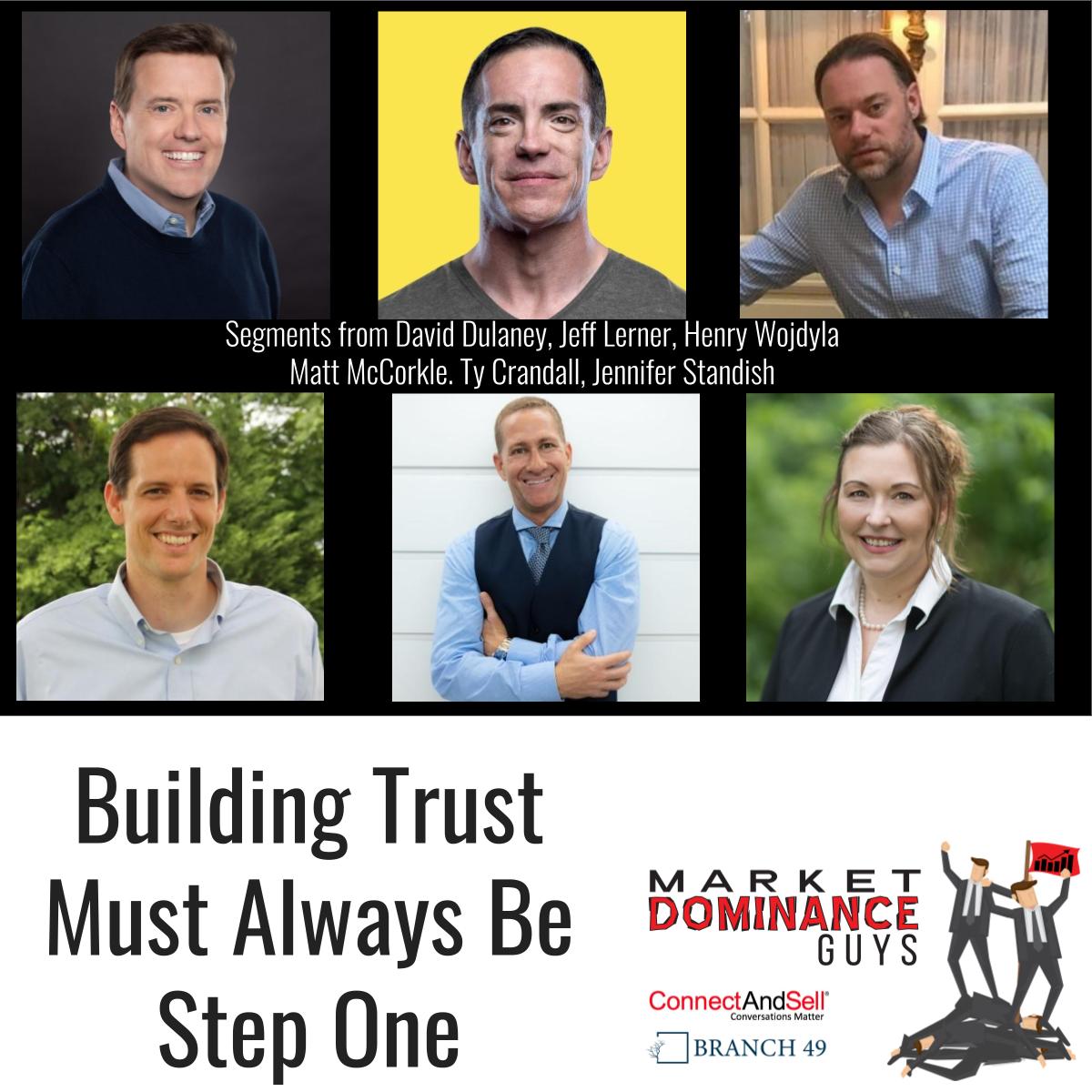
S4 Ep 145EP145: Building Trust Must Always Be Step One
In this episode of the Market Dominance Guys, Corey and Chris agree on the importance of building trust before anything else can happen. They are joined by Transformational Coach Jennifer Standish, Henry Wojdyla, Founder and Principal at RealSource Group, Matt McCorkle, Manager of Branch Operations at Kaiser Compressors, and hosts Ty Crandall on the Business Credit and Finance Show, Jeff Lerner from Ep 150 of Millionaire Secrets, and David Dulaney on the Sales Development Podcast. The full episodes to the ones included here are listed below: EP91: Borrowing from the Best EP109: Being There for Your Customers EP123: Hire Yourself a Grandma The Business Credit and Financing Show Sales Development Podcast https://www.spreaker.com/user/9196584/episode-164-done MILLIONAIRE SECRET #150 Unlock Your Potential with Jeff Lerner ----more---- Full episode transcript below: Announcer (00:05): Welcome to another session with the Market Dominance Guys, a program exploring all the high stakes speed bumps and off ramps of driving to the top of your market. With our host, Chris Beall from ConnectAndSell and Corey Frank from Branch 49. In this episode of Market Dominance Guys, Corey and Chris gather consensus on the importance of building trust before anything else can happen. They're joined by transformational coach, Jennifer Standish, Henry Wodjdyla, founder and principal at Real Source Group, Matt McCorkle manager of branch operations at Kaeser Compressors, and host Ty Crandall on the Business Credit and Finance show, Jeff Lerner from Millionaire Secrets and David Delaney on the Sales Development podcast. We hope you enjoy this episode of Market Dominance Guys. Building trust needs to be step one. David Dulaney (01:00): It seems the trends, in just society in general, is more digital typing, texting, sending snaps or whatever. It's much more digital, but that human connection, especially now during, this time period is so important. So where do you see the gap in the sales development world right now, between folks focusing on just that typing and texting and stuff like that versus actually having conversations with people? Chris Beall (01:30): Well, it's a chasm. It's huge. The challenge is this, the human voice carries about 20,000 bits of information per second. And an email, a whole email has about 5,000 bits. So it takes four emails to be the equivalent of one second of a conversation with regard to information. And it takes information, lots of it, before we trust somebody, because we're smart. David Dulaney (01:55): Right. Chris Beall (01:55): We're not going to just trust somebody on what's in an email, we got to get more. And it turns out it takes about seven seconds of a conversation, which is the equivalent of seven times four, 28 emails to get somebody to begin to trust you. So who's going to read 28 emails? I mean, really? I don't think anybody does that. So when you look at the problem of sales development, not as, I made you answer my email, but you look at it instead as, among all the competitive offerings, especially do nothing, which is the big winner in business as the status quo. How do I become the most trusted and how do I do it before my competitor does? If you see that as the problem, if that is what sales development needs to do, then the gap's pretty simple, sales development reps aren't talking to enough people. And when they do talk to them, they're talking to them incorrectly. They're not talking to them with an intention of building trust. They're talking to them with an intention to get them to take a meeting. Or worse, they're talking to them about a product, which is if you want to do the worst thing you can do in sales development, call somebody up and tell them that you have a solution to a problem that they have. You have a product that solves the problem they have. Because you've just insulted them. You just called somebody up, who's supposedly competent and diligent, and said, did you realize you were waiting for a salesperson to tell you how to do your job? David Dulaney (03:27): Okay. So that's one of the big misses. Yeah. Chris Beall (03:31): It's a big one, right? David Dulaney (03:32): Not having enough conversations. And then finally, when you do get a conversation, not leading with the trust, just going to your script, basically. Announcer (03:46): Jennifer Standish joins our Market Dominance Guys in this episode 123 where they're talking about hiring grandmas. I know, I know what you're thinking. What are you talking about? Hiring grandmas. Listen to this and you will understand the importance of building trust, tonality, and how women of a certain age have this skill as well as thick skin. Join us for this segment. Chris Beall (04:09): Certain voices cause people to act in a positive way, even if they don't take the meeting. So you're actually conditioning the market for all your future communications, that thank you that comes after every conversation. Thank you for our conve

S4 Ep 144EP144: The Many Approaches to the Buying Cycle
These sales experts agree, that there is more than one approach to a successful sales campaign. We're sure Chris Beall has some dark childhood story about alternate ways of skinning a cat, although he's never done it, of course. These discussions include modifications and redirections in the buying cycle, even though the basics are still there: awareness, consideration and decision. Join Corey and Chris in this episode of snippets from episodes about the buying cycle. This features Oren Klaff, Jason Beck, Gerhard Gschwandtner, Susan Finch, Dan McClain, Brad Ferguson, and our own Chris Beall and Corey Frank. To hear the entire episodes features, visit this collection: https://marketdominanceguys.com/category/buying-cycle/ ----more---- Full episode transcript below: Our Market Dominance Guys Chris Beall and Corey Frank have proven there is more ways than one to skin a cat. And I bet Chris Beall probably has some dark childhood story to support that information, but we all can agree on that. There's more than one solution to just about everything including the buying cycle. Now, the basics we know are awareness, consideration, decision. Those are the three basic steps, but let's hear what some of the best experts that we know that we've had on our show say about this. Including of course our own Chris and Corey. So among our guests that we're going to feature in these quick snippets, and you can listen to the whole playlist if you click on the post, we have Oren Klaff, Jason Beck, Garheart Gastraughtner, Dan McClain, Brad Ferguson, and your own yours truly Susan Finch. We hope you enjoy this playlist and learn a little bit more about the many approaches to the buying cycle. Speaker 2 (01:19): Yeah, so the nature of business products, the nature of all products to some degree is recency of purchase has a radical effect on desire for another unit, especially from someone else. I buy a car, I'm not in the market for a car tomorrow. I'm a little bit more in the market for a car the next day, even though you can't notice it. And once I get out there about three years, I'm actually looking for a car. That's just the way it is. Most products, it's not the product life cycle, it's the replacement cycle for most products is around three years. Your mileage might vary. Your product, it might be four years or five years. If your product happens to be a power plant, maybe it's 20 years. But most products that we sell that we bother to have a sales force around, it's about three years. And when you think about what needs to happen in those three years, your goal within market is to become the trusted go to person for everything about that problem. Not about your product, but about that problem. So as this individual company that they bought something and now we're in quarter two, after that quarter three and quarter four. You need to be interacting with them, not heavily, but interacting with them. Bringing them new stuff, bringing them new information. Not for the purpose of making them smart about your product, but just to use the asymmetry of information. You're the expert. You're the vendor. Vendors always know more than buyers about a problem because you're immersed in that world and they're busy doing their own stuff. So that information and the renewal of trust, you know how trust works? You only have to be gone from somebody for a day to have the trust, start to decay for this weird reason, which is nothing more than lack of interaction. You're not quite sure who that person is because they might have changed. So your deepest best friends, when you get back together after 20 years, 10 years, five years, there's always this surprise, it's like we were never apart. If the trust factor didn't change, that wouldn't be a surprise. When we rediscover that person as the person that they became in our head, we're delighted and we go right back up to where we were trust wise. But it actually shows us the trust decay and the [inaudible 00:03:47] very subtly. Well, these are strangers for crying out loud. Speaker 3 (03:51): Yeah. So the trust has a half life dependent on each person then? Speaker 2 (03:57): Exactly and its cycle. And then you have another problem. The person you're dealing with, they themselves have a half life. Speaker 4 (04:11): If you could wave a magic wand today and say, "Oren, go make this happen." What is it we should do? Speaker 2 (04:20): I think I used to actually bring a magic wand by the way that I made into our big customer meetings, where we bring all the customers together and then have the elite group advise us. And I would make a magic wand each year out of three plants in my yard and tie it together with the right color thread and hand it around and say, "You got the magic wand. You could-" Speaker 5 (04:45): Did you have a [inaudible 00:04:46] as well, to go with it? Speaker 2 (04:45): I did not. That would've been special. Something that I found pretty consistently in discovery that's I th

S4 Ep 143EP143: SaaS Sales Methodologies - which one best fits your needs?
Sales methodologies are the practical, how-to “guides” that support a sales process. These actions serve as a bridge between each step of the sales cycle by keeping both the buyer's and prospect's demands in mind. In our recent episodes with Brad Ferguson, Corey and Brad discussed the Sandler method vs. Oren Klaff's Pitch method. In this quick comparison segment, Corey explains the difference between the two methods, and when one fits better than the other. What is your method to determine which sales methodology fits your company? Have you bothered to determine which to use, or are you even using one method? That's a great place to start. Corey Frank is an expert at taking companies through this process - he's done it dozens of times. Welcome to this episode of Market Dominance Guys, "SaaS Sales Methodologies - which one best fits your needs?" ----more---- Full episode transcript below: Susan Finch: Welcome to another session with the Market Dominance Guys, a program exploring all the high stakes speed bumps and off ramps of driving to the top of your market. With our host, Chris Beall from Connect and Sell, and Corey Frank from Branch 49. Sales methodologies are the practical how-to guides that support a sales process. [00:00:30] These actions serve as a bridge between each step of the sales cycle, by keeping both the buyer and prospects demands in mind. In our recent episodes with Brad Ferguson, Corey and Brad talked about the Sandler method versus Oren Klaff's pitch method. In this quick comparison segment, Corey explains the difference between the two methods, and which one fits better over the other. Welcome to the Market Dominance Guys. I'm Susan Finch, your commentator today, sitting in for Corey and Chris, but it doesn't mean they're not going to be here in spirit [00:01:00] or maybe with a few clips. Corey Frank: Sandler is always more frontal. Sandler, meaning, it's trying to flush out a decision, almost like choose your own adventure. There's a lot of buyer autonomy in Sandler. And Pitch is more, the principles of people want what they can't have, people chase what moves away from them. And people only place value on that which is difficult to obtain. And so, you find there's no formal close in the pitch [00:01:30] methodology. Chris Beall: Right. Corey Frank: The pitch methodology is, you had said earlier in this discussion that if we can get to the prospect to talk about 70% of the time, that's a good thing. He'll settle with 50/50, but oftentimes it doesn't do that. The pitch methodology is different than sales, because a pitch is one shot, one kill, you lick the bullet. You better not screw it up, otherwise, as Oran says, you're going to get a to go cup for that coffee. There's no coming back. Like, oh, one more thing. No, you're [00:02:00] out. So the stakes are a little higher. And so Sandler, if I'm going to establish a territory, I'm new in my copier sales, I'm new in my software, and I got Northern California to throughout Oregon. I'm going to use Sandler. If I'm stockbroker, If I'm a one shot, one kill, I'm going to use, probably, Pitch. But I really believe, I don't think you can pitch anything without an understanding of a formal [00:02:30] sales methodology like Sandler. That's why we do it the way we do. People have to go through Sandler, they have to go through the foundations, and then you want to add to your achievements, like your little video game character, he's an elf level four, he knows how to throw stars, or this one's got nun chucks. Great. That's where you're going to fill it in. Here's an example. This is right from Oren, the other master's mouth. It's, we're trying to set an appointment. Hey, do you have a few minutes on your calendar? I'd like to set up about a 15 minutes [00:03:00] call with Brad, and you guys should talk a little bit deeper about your solution. The pitch anything methodology is more after you create a little bit of value in the intro. It's, listen, Brad. We don't have a lot of time to play footsy going back and forth and trying to get dates and times on the calendar. So let's just settle on Thursday afternoon. Are you a morning person or an afternoon person? Set it on Thursday at 2:00. Let's lock it in. I like you guys on paper, but [00:03:30] we really need to talk with you. And we've realized that an ambush sales call like this is no place to really get into the nitty gritty details, pricing speeds, and feeds. So let's get it going. And that's more, you're doing most of the talking, and people are chasing you. So there's not a lot of qualification out of the gate. Susan Finch: Trevor Hatfield, managing general partner at Interact Capital, has a wonderful post we'll link in this episode post. Seven [00:04:00] sales methodologies for SAS, and how to pick the one for your business, which explains of various sales methodologies, or at least his favorite seven for SAS. He also says the easiest way to choose which methodology is ideal for your company

S4 Ep 142EP142: A Good Salesperson Is Hard to Replace
Getting fired from a sales job is never a surprise. If you’re not producing, you already know it. Brad Ferguson, the managing member of Scottsdale Sales Training, has been with Sandler Training for more than 27 years, and today he shares his sales hiring, onboarding, training, and coaching expertise with our podcast host, Corey Frank. Brad believes that before you let someone go from a sales job, you need to determine whether this person can sell, and you need to consider your company’s financial investment in that individual. This includes training, coaching, and certifying, as well as their salary and benefits. Brad cautions our listeners, “Don’t let the good people you have go. Spend the time getting them up to a higher level.” If they are worth keeping, make the effort to diagnose their problems and then provide the needed training, because, as the title of this Market Dominance Guys’ episode reminds us, “A Good Salesperson Is Hard to Replace.” About Our Guest Brad Ferguson is the CEO of Best Sales Force, Inc., an Arizona-based sales development firm. He is the Senior Sandler Training Franchisee with over 25 years of experience in the Sandler Network. ----more---- Full episode transcript below: Getting fired from her sales job is never a surprise. If you're not producing, you already know it. Brad Ferguson managing member of Scottsdale sales training has been with Sandler training for more than 27 years. And today he shares his sales hiring, onboarding, training, and coaching expertise with our podcast host Cory Frank, Brad believes that before you let someone go from a sales job, you need to determine whether this person can sell and you need to consider your company's financial investment in that individual. This includes training, coaching, and certifying as well as their salary and benefits. Brad cautions our listeners. Don't let the good people you have go, spend the time getting them up to a higher level. If they're worth keeping, make the effort to diagnose their problems and then provide the needed training. Because, as the title of this Market Dominance Guy's episode reminds us a good salesperson is hard to replace. Corey Frank (01:21): That's great stuff. Certainly what we saw at StormWind and be even at Branch49, we set up shop here right now, right? It is no comparison before foundations and after foundations, it's not called president's club anymore. Right? The post foundations, what's the Sandler world? What do they... What do they talk? Brad Ferguson (01:38): Universally, we said, this has got to be sales mastery. And if there's sales mastery, there should be different levels and there should be global certification levels. So there's a broad sales mastery, a silver sales mastery, and a gold. Broad sales mastery, you understand the concepts. Silver sales mastery, you understand how to deliver and implement. Gold sales mastery, you can deliver it to others. Corey Frank (02:03): So if I don't have a system, if I'm a sales manager and I have really good producing reps, I mean their president's club every year they're doing well, but I don't know if it necessarily want my new people sitting with that top rep because I don't want them selling that way because it's not duplicatable. And that seems to be a common issue with a lot of sales leaders. What'd you say? Brad Ferguson (02:25): When I was in my earlier career before Sandler, Jerry Underwood was the guy, the leader. He was magic, top salesperson. Andy, can I ride with you? I think I begged Andy for three years to ride with him. Finally, he says, you can ride with me and commonly under one condition, you open your mouth, I'll break both your legs. You sit there and you shut up. So we go to this place up in Chicago, I think it's called Peppers. And it's a furniture store and I'm sitting back watching Jerry. And he says, and she says, and I'm like, well, this is over. And Underwood turned that around and he said, the need has come back. And she says, fine let's do it, two truckloads. We get out the car. And I said, Jerry, right here, I wrote this down. What tape did you listen to? What cassette did you listen to? What book did you read to have a comeback like that? And Underwood said, I would never say that to a woman. Jerry, I was there. You said it, non-transferable skills, those strong people. They don't even know that they said that themselves. So how am I going to identify it and share it with somebody else? Corey Frank (03:38): Yeah. The unconscious competence, right? I- Brad Ferguson (03:41): You go. Corey Frank (03:42): ... I think I have a system, but it's germane just to me, that's certainly a challenge for a lot of businesses today is those non-replicable skills, particularly, because I want to scale. But now we have a lot of organizations as we let off this chat that are lean off a lot of folks, right? They're going to prevent defense mode for whatever reason they and their investors think that's right. I think you and I and our

S4 Ep 141EP141: If I Could Show You a Way
In this continued “honeymoon” edition of the Market Dominance Guys, our host, Corey Frank, sits down with Brad Ferguson of Sandler Training, one of the most highly rated sales trainers on the planet. Brad, being a top franchisee of Sandler for years, personally learned his incredible questioning techniques and prospect approaches from the founder of Sandler himself, David Sandler, more than 30 years ago. On several of the Market Dominance Guys' podcasts over the years, Chris Beall and Corey have discussed many of the modern and fresh sales methodologies being used by successful sales professionals all over the world. From Oren Klaff’s “Pitch Anything” to Andy Paul’s “Sell Without Selling Out” to Chris Voss’ “Never Split The Difference,” there are many different flavors of sales methodologies that can be used to generate trust that result in more consistent sales success. If you’re a pilot, you file a solid flight plan and know where you are going before you start the engines. You may change course due to bumpy weather, but you still know your final destination. If you are an architect, you know what type of building you are constructing. You have a blueprint. But if you are in sales today and you are still “winging it” and letting your personality alone dictate how your sales conversations progress, you fall into the trap of being labeled a “mere tourist” and continuing to wander inconsistently in this profession. As Uncle Zig once said, “Selling is the highest-paid hard work and the lowest-paid easy work there is.” Using a sales methodology makes the hard work easier. In this episode, have your pen and pad ready as Brad shares several tactical and specific use cases where the Sandler methodology can be employed on your calls today. He discusses many traditional “mental hang-ups” and speed bumps that impede success from an emotional point of view. From being uncomfortable about money to having a high need for approval and an aversion to the word “no,” Brad shares just some of the powerful Sandler techniques that have generated hundreds of millions of dollars in closed deals. This is the Market Dominance Guys' nearly indispensable podcast, and today’s episode is entitled, “If I Could Show You a Way.” About Our Guest Brad Ferguson is the CEO of Best Sales Force, Inc., an Arizona-based sales development firm. He is the Senior Sandler Training Franchisee with over 25 years of experience in the Sandler Network. ----more---- Full episode transcript below: Announcer (00:05): Welcome to another session with the Market Dominance Guys, a program exploring all the high stakes, speed bumps and off ramps of driving to the top of your market. With our host, Chris Beall from ConnectAndSell, and Corey Frank from Branch49. Announcer (00:17): In this continued honeymoon edition of the Market Dominance Guys, Corey sits down with Brad Ferguson of Sandler, one of the most highly rated sales trainers on the planet. Brad, being a top franchisee of Sandler for years, personally learned his incredible questioning techniques and prospect approaches from the founder of Sandler himself, David Sandler, more than 30 years ago. On several of the Market Dominance Guys podcasts over the years, Chris and Corey have discussed many of the modern and fresh sales methodologies that are being used by successful sales professionals all over the world. From Oren Klaff's Pitch Anything to Andy Paul's Sell without Selling Out to Chris Voss's Never Split the Difference, there are many different flavors of sales methodologies that can be used to generate trust that result in more consistent sales success. Announcer (01:08): If you're a pilot, you file a solid flight plan and know where you're going before you start the engines. You may change course due to bumpy weather, but you still know your final destination. If you're an architect, you know what type of building you're constructing. You have a blueprint. But if you are in sales today and you're still winging it, and letting your personality alone dictate how your sales conversations progress, you fall into the trap of being labeled as a mere tourist and continuing to wander inconsistently in this profession. As Uncle Zig once said, "Selling is the highest paid hard work and the lowest paid easy work there is." Using a sales methodology makes the hard work easier. In this episode, have your pen and pad ready, as Brad shared several tactical and specific use cases where the Sandler methodology can be employed on your calls today. Announcer (01:58): He discusses many of the traditional mental hangups, the speed bumps that impede our success from an emotional point of view, from being uncomfortable about money to having a high need for approval and an aversion to the word no. Brad shares just some of the powerful Sandler techniques that have generated hundreds of millions of dollars in closed deals. This is the Market Dominance Guys, nearly indispensable podcast, and today's episode

S4 Ep 140EP140: Save the Goat!
In this special “Honeymoon” edition episode of the Market Dominance Guys, Corey grabs some time with Robert Vera, the founding Director of the Canyon Ventures Center for Innovation & Entrepreneurship at Grand Canyon University. Robert is an incredibly well-respected innovation and start-up business expert as well as a member of the faculty of the top-rated Jerry Colangelo School of Business at Grand Canyon University. Robert breaks down his involvement in training and working with the Navy Seals over the years and how sales organizations should look to adopt some of the more “unorthodox” training processes similar to what special forces and their medics implement. Robert also chats about his first-hand experiences with the unique revenue generation practice and talent development mission of the Branch49 team and how businesses should view Top of Funnel and Discovery. This is the Market Dominance Guys' nearly indispensable podcast and today’s episode is entitled, “Save the Goat!” About Our Guest Robert Vera is a bestselling author and the founding director of Canyon Ventures Center for Innovation and Entrepreneurship at Grand Canyon University in Phoenix, Arizona. ----more---- Full episode transcript below: Announcer (00:06): Welcome to another session with the Market Dominance Guys, a program exploring all the high stake speed bumps and off ramps of driving to the top of your market. With our hosts, Chris Beall from ConnectAndSell, and Corey Frank from Branch 49. In this special honeymoon edition episode of the Market Dominance Guys, Corey grabbed some time with Robert Vera, the founding director of the Canyon Ventures Center For Innovation and Entrepreneurship at Grand Canyon University. Robert is an incredibly well respected innovation and startup business expert, as well as a member of the faculty of the top rated Jerry Colangelo School of Business at Grand Canyon University. Robert breaks down his involvement, training and working with the Navy Seals over the year, and how sales organizations should look to adopt some of the more unorthodox training processes, similar to what special forces and their medics implement. Robert also chats about his first hand experiences, on the unique revenue generation practice and talent development mission of the Branch 49 team, and how businesses should view top of funnel and discovery. This is the Market Dominance Guys' nearly indispensable podcast and today's episode is entitled, Save the Goat. Corey Frank (01:25): Okay. Welcome to another episode of the Market Dominance Guys. This is the honeymoon edition, since Chris Beall and the fetching Miss Fanucci are now hitched and somewhere on the way to Iceland, or Scotland, or somewhere. So, Chris is away. I have the guest panel in my control now. So one of the first ones lined up, and he's been with us a few prior episodes, is Robert Vera. So Robert, good to have you. Give you a little bit of an intro here since some of the folks know you, had been creeping on your LinkedIn profile. But we're here in Phoenix at Grand Canyon University, where Robert is the founding director of the Canyon Venture Center For Innovation and Entrepreneurship. It's a former CIO and a med tech startup that was acquired. Proud Boston College alumni, former Senate staffer to Edward M. Kennedy back in the day, and New York Times bestselling author. I'm sure I missed a few things there, but overall, just a great guest here for the Market Dominance Guys, as we continue our discussion in this series, 200 episodes strong, of talking about the pitfalls and the cookbooks that a lot of organizations, especially with these pending doom and gloom recession prognosticators are out there. Talk a little bit about what we can do to get to market dominance in spite of the forces. So anyway, Robert, that is a mammoth introduction. So, welcome to the Market Dominance Guy, sans the Sage of Sales, sans the Prophet of Profit, Chris Beall, but we'll maybe airbrush him in later. So welcome, Robert. Robert Vera (02:54): Thanks for having me. I'm sorry, I'm hopefully, I'm a good pitch hitter for Chris. So thanks for having me, but it's great to back on, and I'm really excited to talk to the audience about some ideas that I have, to help them dominate their market and expose some of the things that you are doing that has really proven that. So, I think that it's no longer theory. We could show you how to do that. Corey Frank (03:11): Well, hey, I'm a shameless promoter of my own business. So, I'm happy to have you wax eloquently about our experience of working together here at Branch 49. So, how about for the audience, a little bit about what we do at Grand Canyon, and what this center for innovation and entrepreneurship, what it was in the vision that you and President Mueller set up all those years ago, and how's it going? Robert Vera (03:33): Yeah, in 2019, I came here as the founding director of Grand Canyon University's Center For Innovation And Entrepreneurship. T
S4 Ep 139EP139: Your Product Is the Meeting
How many cold-call opportunities have you wasted by pushing hard and fast to sell your company’s product? Today’s podcast guest, Bruce Lewolt, Founder of both JoyAI and Blast Learning, talks about a more caring and effective approach to selling. It starts with switching the goal of that initial call from selling your company’s product to offering prospects a helping hand with a problem or goal they have. Imagine for a moment you’re the prospect, and you’ve just been ambushed by a cold call: Who would you be willing to set an appointment with for a discovery meeting? A person blatantly trying to make a sale? Or a caring professional who understands your business’ needs and wants? In this episode, our three well-reasoned and insightful sales professionals share many insights with our listeners about making a successful cold call, but the one you don’t want to miss is this “aha!” moment. Your job is not selling your company’s product: Your job is selling a discovery meeting. That should make the title of this week’s Market Dominance Guys’ podcast very clear: You’re still selling something, but “Your Product Is the Meeting.” Listen to Bruce Lewolt's previous episodes in this series: EP137: What Do Your Prospects Really Hear? Ep138: Don’t Get Lost in Your Rock ’n’ Roll More episodes on the topic of Believing in the Meeting are here. About Our Guest Bruce Lewolt is Founder of Blast Learning, a service that uses Alexa or Google Assistant as an intelligent personal study assistant, resulting in a state-of-the-art study method that is not just effective but makes learning enjoyable. (See BlastLearning.com and BlastStudy.com) He is also the Founder of JOYai, the first emotionally intelligent and sales-savvy artificial intelligence system for salespeople, bringing intelligent automation to prospecting and selling. ----more---- Full episode transcript below: Announcer (00:17): How many cold-call opportunities have you wasted by pushing hard and fast to sell your company's product? Today's podcast guest, Bruce Lewolt, founder of both JOYai and Blast Learning, talks about a more caring and effective approach to selling. It starts with switching the goal of that initial call from selling your company's product to offering prospects a helping hand with a problem or goal they have. Imagine for a moment you're the prospect, and you've just been ambushed by a cold-call. Who would you be willing to set an appointment with for a discovery meeting? Announcer (00:55): A person blatantly trying to make a sale? Or a caring professional who understands your business' needs and wants? In this episode, our three insightful sales professionals share many insights with our listeners about making a successful cold-call. But the one you don't want to miss is this a-ha moment: your job is not selling your company's product, your job is selling a discovery meeting. That should make the title of this week's Market Dominance Guys podcast very clear. You're still selling something, but your product is the meeting. Bruce Lewolt (01:36): There's another thing in my mind too though, is it gives me the first marker that I can put in there as soon as possible to judge this person's emotions. Really I should back up, their personality, because I'm going to mold to their personality, right? I live in their world, not mine. I mold to their personality, rather than expecting them to mold to mine so I could communicate. Bruce Lewolt (02:01): And can I have 30 seconds? Okay, there's nothing really to react to there, other than yes or no. But 27 seconds gives a world of different options. They can laugh at it, okay. They can figure it's a challenge, "Okay, yeah. 27 seconds, go." That's a different personality than the, "Sure. Go ahead." The empathetic. "Sure, you go ahead." It's a different person. And the sooner you can get a handle on that person's personality, to go back to Corey's point, the sooner you can have an authentic relationship with that person about their needs in their world, because you're selling in their world and you interrupted them. It's your responsibility to be in their world. And that's how you start to figure it out. Corey Frank (02:44): Yeah. Chris, what do you call this, the playful curious, right? The, "Can Bruce come out and play?" type of tonality? Corey Frank (02:53): Is that what I'm after? Is that the best way to describe it? Chris Beall (02:56): Yeah that voice is the, "Can you come out and play?" voice. It's funny too, because at the same time, you're very seriously offering a solution to their problem, which is you. It's actually funny that you are the problem and that you recognize it. Almost all great comedians have something early in their shtick that lets us both laugh at them and with them at the same moment, at themselves. Laughing with somebody at themselves is one of the most collegial, embracing, we're together things you can do with somebody. It's acknowledging that the situation's a little funny, right? It is
S4 Ep 138EP138: Don’t Get Lost in Your Rock ’n’ Roll
Training and coaching are essential for the rookie cold caller, and that’s an important part of the life work of today’s guest, Bruce Lewolt, Founder of both JoyAI and Blast Learning. But, as our hosts, Chris Beall and Corey Frank, remind our podcast listeners, even the most experienced and successful cold callers also need coaching from time to time. They can suffer from an inadvertent tendency to drift away from the prescribed plan — the script, tonality, and emotion that they’ve been trained to use — one that generally elicits a prospect’s response of “Sure! Tell me why you’re calling.” Bruce agrees and says that sales directors need to listen to calls and give feedback and coaching to all salespeople on a consistent basis, because it’s human nature to drift away from what you’re taught to say and start doing what feels easier or more comfortable, or putting your own cool, personal stamp on it because that’s the way you roll. It’s not your call to make, so note the caution in today’s Market Dominance Guys’ title and “Don’t Get Lost in Your Rock ‘n’ Roll” and drift away. About Our Guest Bruce Lewolt is Founder of Blast Learning, a service that uses Alexa or Google Assistant as an intelligent personal study assistant, resulting in a state-of-the-art study method that is not just effective but makes learning enjoyable. (See BlastLearning.com and BlastStudy.com) He is also the Founder of JOYai, the first emotionally intelligent and sales-savvy artificial intelligence system for salespeople, bringing intelligent automation to prospecting and selling. ----more---- Full episode transcript below: Training and coaching are essential for the rookie cold caller, and that's an important part of the life work of today's guest, Bruce Lewolt, founder of both JOYai and Blast Learning. But as our host Chris Beall and Corey Frank remind our podcast listeners, even the most experienced and successful cold callers also need coaching from time to time. They can suffer from an inadvertent tendency to drift away from the prescribed plan, the script, tonality, and emotion that they've been trained to use, one that generally elicits a prospect's response of "Sure, tell me why you're calling." Bruce agrees and says that sales directors need to listen to calls and give feedback and coaching to all sales people on a consistent basis because it's human nature to drift away from what you're taught to say and start doing what feels easier or more comfortable or put in your own cool personal stamp on it because that's the way you roll. It's not your call to make. So note the caution in today's Market Dominance Guys title, and don't get lost in your rock and roll and drift away. Corey Frank (01:31): Would you mind saying your opening in character again all the way through Bruce, because I really like that. We certainly have used that here about the Blast Learning, because I think in character hearing your intonation and your modulation I think really helps convey that message. Bruce Lewolt (01:46): Sure. So Corey, you all have the list I've categorized by what you are. So I know that you're a dean... Corey Frank (01:46): I said I'm a nursing and administrator for a... Bruce Lewolt (01:46): Yeah, a dean of a nursing school. Corey Frank (01:46): ...one of the medical schools. Yeah. Bruce Lewolt (01:58): Yep. So Corey, I know my call's an interruption. Can I have just 27 seconds to share how we could help your students? So with that there I'm getting the vast majority of the time. Sure, okay, go ahead. And I'm listening then for what kind of reaction that is really carefully there. I'm listening for the real emotive, I'm listening for the fun. Go ahead. Yeah, sure. Go ahead. And then I'm matching that. Then it depends. The words that I'm saying are somewhat [inaudible 00:02:31] on that, but the key is that I'm matching the emotion of that, right? So the [inaudible 00:02:36] is to do the one that's emotive. We've discovered a breakthrough here that solves the problem of retention for nursing schools and when other nursing colleges have worked with us, they've seen dropouts decrease by 92%. So in that part, I'm getting at the thing that after a while I discovered that is the biggest pain point for anybody that's a dean. And by the way, if it's not a pain point, then they're not a prospect for me. Then I don't care. If no, it's Harvard and we graduate a hundred percent, I don't care. Okay, fine. Tell me no that, but virtually everybody else is really concerned about student retention, and then I'll go into a value proposition when they give me of course the 27 seconds, right? They've given me time to now talk. Basically what we do is we turn a student's cell phone into a digital tutor that follows them around and every single day figures out what they should do and how they should study so literally they can be in the car and say, "Alexa, open Study Blast," and it'll start quizzing them in the way that builds durable, long term memories. Core
S4 Ep 137EP137: What Do Your Prospects Really Hear?
How do you produce the emotional reaction that you want in those you are cold calling? Bruce Lewolt, Founder of both JoyAI and Blast Learning, has devoted himself to discovering the answer to this question. Bruce joins our Market Dominance Guys, Corey Frank and Chris Beall, to explain how even the most carefully worded message and well-meaning tone and pacing don’t always have the emotional significance to your prospect that you had hoped they would. “When your prospect is only half-listening, what do they hear?” Bruce asks. Ah, that’s the question! These three experienced and dynamic cold callers each share their well-thought-out theories on how to communicate authenticity, spark curiosity, and offer intrinsic value that will elicit the kind of response from your prospect that will lead to setting a meeting. Here at Market Dominance Guys, we are devoted to helping you answer the tough sales questions, like this one: “What Do Your Prospects Really Hear?” About Our Guest Bruce Lewolt is Founder of Blast Learning, a service that uses Alexa or Google Assistant as an intelligent personal study assistant, resulting in a state-of-the-art study method that is not just effective but makes learning enjoyable. (See BlastLearning.com and BlastStudy.com) He is also the Founder of JOYai, the first emotionally intelligent and sales-savvy artificial intelligence system for salespeople, bringing intelligent automation to prospecting and selling. ----more---- Full episode transcript below: Corey Frank (01:23): Welcome to another episode of the Market Dominance Guys. This is Corey Frank, with Chris Beall, the prophet of profit, the sage of sales. And I got a new one, Chris, the Hawking of hawking. How about that, right? No? Nothing? This on? Is this on? All right. The Hawking of hawking. And in the hot seat today, we have a very special guest, one who's well overdue but keeps rebuffing our advances to be on the Market Dominance Guys for the last three years, Bruce Lewolt, the CEO of Blast Learning and overall connoisseur of the craft of inside sales. So welcome Bruce. Bruce Lewolt (01:59): Nice to be with you guys, finally. Corey Frank (02:02): Finally. Chris Beall (02:02): Really- Corey Frank (02:02): Finally. Chris Beall (02:03): I mean, I'm telling you, I don't know. I remember standing with you on a boat out off of Chicago one day talking about some crazy stuff, and we didn't even have a podcast, but if we would, you would've had to been a guest like that night or something. Bruce Lewolt (02:18): Yeah, we had this fascinating conversation about using the latest research on emotion and personality to craft cold call messages. That was fun. Chris Beall (02:28): That was fun. And we drank enough to make it clear. Bruce Lewolt (02:31): It was clear to both of us before we got off the boat, I think. Chris Beall (02:34): Very clear. Bruce Lewolt (02:35): I'm pretty sure you were clearer than I was, but anyway. Corey Frank (02:40): Bruce, you've tasted the same dirt certainly as Chris in the trenches here of the cold calling world, AISP, and been CEO of many company. But, your expertise and your focus seems to be more on the AI side, the neuroscience, the... Bruce Lewolt (02:54): That's it. Corey Frank (02:54): ... the trust side. Bruce Lewolt (02:56): Right. The real science side of this. And I come to it from training. You can't train unless you really understand why something works in the background. And so I built for salespeople at IBM training programs for, you mentioned the AISP training programs for them, lots and lots of different companies. And before I went off then and started this new company in the middle of the pandemic to solve a huge problem that I saw coming. And we'll get to that. But the thing that's interesting about this, that with all of this stuff that I've learned along the way training, oh, goodness thousands. Well, actually hundreds of thousands because we trained to hundred thousand salespeople in China alone in one go. So that put us in the hundreds. But even with all that, as a founder of a new company, when I said, "Look, I'm not going to get startup funding. I'm going to fund this thing myself by doing what I've trained other people to do." And that is get initial sales using cold calling. And I'm glad I did that because I discovered a depth that I never would've discovered before. And we'll talk about those things. So this really will help startup founders. You don't have to sell your soul to the startup funding club. You can, if you want, but you can do it another way. But also to sales leaders, real new level of insight into what works and how to get salespeople to do what they need to do on a consistent basis. Chris Beall (04:22): That's so interesting too when you talk about startups and how they get funded, there's a couple of things that I've deeply believed for the last 11 years it's coming to ConnectAndSell. And one of them is that conversations are the competition for venture capital an
S4 Ep 136EP136: What Customer Success Can Do for You
What’s the reason customers bought from you and will buy from you again? Don’t know? Look to the end of your buyer’s journey — to the team that helps customers successfully use their purchase. That’s the advice of Ed Porter, fractional Chief Revenue Officer of Blue Chip CRO and today’s Market Dominance Guys’ guest. In this third of three conversations with our podcast’s hosts, Corey Frank and Chris Beall, Ed suggests that you find out what’s working for customers, then take that information back to marketing to finetune the value description of your product so that it matches what customers are reporting. That’s the way to successfully sell your product: Start with the end in mind and work backward to inform marketing strategies and sales messaging. If you didn’t think that customer success had anything to do with selling, it’s time to reconsider, as today’s Market Dominance Guys’ episode’s title says, “What Customer Success Can Do for You.” Listen to the previous two episodes with Ed Porter. About Our Guest Ed Porter is a fractional Chief Revenue Officer for Blue Chip CRO, providing coaching and strategy planning services for executives and startups, and helping them rethink and refocus revenue strategies to accelerate growth. He assists his clients in aligning their revenue teams — marketing, sales, enablement, and customer success — to build accountability at every step of their organization, leading to accelerated and sustainable growth. Ed is also an investor and advisor to startups in the Columbus area. ----more---- Full episode transcript below: Announcer (00:22): What's the reason customers bought from you and will buy from you again, don't know? Look to the end of your buyer's journey to the team that helps customers successfully use their purchase. That's the advice of Ed Porter, fractional chief revenue officer of blue chip CRO and today's Market Dominance Guy's guest. In this third of three conversations with our podcast host, Corey Frank and Chris Beall, and suggests that you find out what's working for customers. Then take that information back to marketing to fine tune the value description of your product, so that it matches what customers are reporting. That's the way to successfully sell your product. Start with the end in mind and work backwards to inform marketing strategies and sales messaging. If you didn't think that customer success had anything to do with selling, it's time to reconsider as today's Market Dominance Guy's episode title says, 'What customer success can do for you.' Chris Beall (01:20): Funny thing about sales commissions as a way of paying people, funny thing to me anyway, is that they have this peculiar quality of being tied to the market for sales talent. But not being tied in any way that can be measured as far as I can figure out, to the performance of that talent within a given sales organization or mission. It's kind of a math problem. There's nothing to compare them to, that is you hire top talent, they make the big commission dollars because you have accelerators in your commissions, you have asymmetries that are built into them, and the top people who would be top people with or without a commission are in the big commissions, and we use that as a feedback loop to say that commissions are working. Chris Beall (02:05): If you love to break away from it, you can't because you want the top sales people who are themselves comfortable with that, whether it is myth or truth. There's self-interest in it too, and there should be. Could be paid more than the CEO in most places. But as a salesperson, if you arrange it all correctly, you can be. I mean, our two top salespeople at ConnectAndSell who produce the most total bookings per year are not commissioned. In fact, our three top salespeople are not commissioned. Corey Frank (02:36): That's right. Chris Beall (02:36): There's no commission whatsoever for those three people. We're a peculiar company though. We're a bootstrap company that literally uses the output that bookings output, which turns very quickly into cash as a means for financing the company as an efficient, economically efficient alternative to venture capital or anything else. Right? But we're old people who can think through stuff like that all the way and we have a confidence that we can make the least likely event in the world to predict, which is the next deal in a portfolio basis, we can make it so likely that we sleep at night, right? Chris Beall (03:13): We never sweat a deal. We never think about a deal, actually, you just do what's right for the customer. You let the chips fall and you know, we have something pretty good and it works. But none of us are driven by commission and nor by the way, are we driven by the stock options that we hold or the stock that we hold. We are classic normal, I'll call them normal, Deming described folks. Deming told us people work for pride to workmanship. I guarantee you everybody in this company who produces a

S4 Ep 135EP135: The Architecture of a First Conversation
Whether you’re new to sales or a seasoned cold caller, you no doubt have a go-to way of starting a phone conversation with a prospect. Excellent! But how’s that working for you? Ed Porter, the fractional Chief Revenue Officer of Blue Chip CRO is our Market Dominance Guys' guest. He talks today about scripts, pattern-interrupts, and the art of conversation with our hosts, Chris Beall and Corey Frank. As Chris points out, that first conversation is an ambush call, and nobody likes to be ambushed, especially by an invisible stranger. Ed totally agrees and adds that “Fear prevents us from picking up the phone” — which is true whether you’re the salesperson or the prospect. So, what can generally get both the caller and the prospect past that fear? A well-constructed cold-calling script, but not necessarily one that a salesperson makes up on their own. Ed says it’s got to be architected from a sound plan that includes expertise and advice from both the marketing and customer success teams, which is why we’ve titled today’s Market Dominance Guys’ episode, “The Architecture of a First Conversation.” Listen to his previous episode: EP134 - Is sales the real problem? About Our Guest Ed Porter is a fractional Chief Revenue Officer for Blue Chip CRO, providing coaching and strategy planning services for executives and startups, and helping them rethink and refocus revenue strategies to accelerate growth. He assists his clients in aligning their revenue teams — marketing, sales, enablement, and customer success — to build accountability at every step of their organization, leading to accelerated and sustainable growth. Ed is also an investor and advisor to startups in the Columbus area. ----more---- Full episode transcript below: Announcer (00:22): Whether you're new to sales or a seasoned cold caller, you no doubt have a go-to way of starting a phone conversation with a prospect. Excellent. But how's that working for you? Ed Porter, The Fractional Chief Revenue Officer of Blue Chip CRO, and Our Market Dominance Guy's guest, talks today about scripts, pattern interrupts, and the art of conversation with our hosts, Chris Beall and Corey Frank. As Chris points out, that first conversation is an ambush call, and nobody likes to be ambushed, especially by an invisible stranger. Ed totally agrees, and adds that, fear prevents us from picking up the phone, which is true, whether you're the salesperson or the prospect. So what can generally get both the caller and the prospect past that fear? A well constructed cold calling script, but not necessarily one that a salesperson makes up on their own. Ed says, "It's got to be architect from a sound plan that includes expertise and advice from both the marketing and customer success teams, which is why we've titled today's Market Dominance Guys episode, The Architecture of a First Conversation." Corey Frank (01:36): So Ed, this is the Market Dominance Guys, and we talk about all things sales and marketing and how to dominate your marketing. We believe, certainly both of our organizations Branch49 and ConnectAndSell. And certainly think you believe the same thing, that conversation first strategy has to be at the core of what you're doing to dominate your market. So when you coach your clients and talk to your groups, your teams that you invest in about go to market, what are some of your thoughts on conversation first, and how you do it well and how they're doing it today? And I'm sure you've seen your share of poorly designed scripts in the world. And you've probably heard your share of cringe-worthy cold calls that they're still hanging on from, you can't pry from their cold dead fingers because, every once in a while it does work, but just overall your thoughts on cool calling today. Ed Porter (02:31): Again, something I love talking about and something that I think one of the reasons why Chris and I always have familiar ground to speak from, is that architecting a first conversation is in practice, very simple, but conceptually very difficult. You don't have a whole lot of time on a first conversation. I think in most of the markets that we're in, and I do want to talk a little bit about PLG because I think there's a big overlap that is being missed right now with PLG. PLG doesn't mean if you build it, they will come again. We kind of use that same thing. There's still an intervention of a human being in a conversation that needs to happen to move the needle along. So I will always firmly believe in, and I'll say in most B2B, I think there are some very highly transactional products that can very well, if you architect the messaging and the cadence properly, it can work, but purely transactional lower value. Ed Porter (03:30): But beyond that, taking all of those butts aside is, architecting the conversation, and the conversation is starting point and not the end point. A lot of times, I think I was on a podcast a few years back talking about this word vomit, is sales people be

S4 Ep 134EP134: Is Sales the Real Problem?
If a company isn’t experiencing success, the finger of blame is usually pointed at the sales department. Ed Porter, the fractional Chief Revenue Officer of Blue Chip CRO, is here to say that it ain’t necessarily so. Ed joins our Market Dominance Guys, Chris Beall and Corey Frank, on today’s podcast to talk about his experience in helping companies ferret out the real culprits — and it’s not always the sales reps. In exploring the problem with his own customers, Ed has discovered that marketing and customer success are often the departments that need some repair or fine-tuning. He wholeheartedly agrees with one of Chris’ maxims: In a cold call, “technology amplifies ‘suck’,” which is what you’ll see if there’s a technology-provided increase in your cold-calling speed but there’s no company alignment of messaging, training, coaching, and follow-up. So, take Ed’s advice for business trouble-shooting and ask yourself the question posed by today’s Market Dominance Guys’ title, “Is Sales the Real Problem?” About Our Guest Ed Porter is a fractional Chief Revenue Officer for Blue Chip CRO, providing coaching and strategy planning services for executives and startups, and helping them rethink and refocus revenue strategies to accelerate growth. He assists his clients in aligning their revenue teams — marketing, sales, enablement, and customer success — to build accountability at every step of their organization, leading to accelerated and sustainable growth. Ed is also an investor and advisor to startups in the Columbus area. Connect with Ed Porter on LinkedIn ----more---- Full episode transcript below: Corey Frank (01:26): Welcome to another episode of the Market Dominance Guys. This is Corey Frank with the sage of sales and the princely profit of profit, Chris Beall. Chris, how are you? Chris Beall (01:39): Fantastic Corey. If I were any better, I would swim out to that cruise ship and wave hello to everybody. Corey Frank (01:45): We had a great guest with us today, Chris, from the AA-ISP world, the esteemed AA-ISP world, right? We have Mr. Ed Porter. Sir. Ed, welcome. Welcome to the crucible. Welcome to the octagon. Ed Porter (01:57): Yeah. You got to call it something. You got to get it something profane and something relevant and something that people are going to go, "What the heck is that?" Corey Frank (02:05): The thunder dome. Welcome to the sales thunder dome with Chris Beall. Ed Porter (02:09): Yeah. Thanks guys. Appreciate it. The world is very big. But of course, as we all know, the world is also very small. And so, I first met Chris through AA-ISP, which is a association that he's been a supporter of for a long time. I've been a member of, I've run the Columbus chapter. And I somehow suckered him into flying to Columbus from the West Coast to do a meeting really early in the morning. So, he came from West Coast time to Eastern Standard Time and still agreed to a 7:30 AM meeting. So, it was a great meeting. One of the most well attended meetings because it was the benefit. There was no PowerPoint deck. I loved it. There was no presentation. It was conversation. And that's exactly what you talk about. So, it was very conversational. It was a great interactive meeting. And it talked about that first phone call. And I think that's the trepidation that a lot of people have is, how do you make the first call? What do you say? How do I not word vomit? And I think that context really resonated with a lot of people. Fast forward, then as Chris mentioned, I was a customer of ConnectAndSell and really wanted to understand just the different value in these dialers and what a dialer is and how it can work. And the difference now what Chris is doing in agent assisted dialing and how that really turns the needle into acceleration and what that really means. And we were building a sales development team and it was a lot of we're going to try and see what works. And we did a... What do you call it now? The flight, the pilot? Chris Beall (03:42): You did an intensive test drive [inaudible 00:03:44]- Ed Porter (03:44): Intensive test drive. There it is. Yeah. So, that was the first. And just the data we got from that was... I remember having a conversation with my boss and I said, "I'm looking for you to poke holes in it but I just don't see that there's a bad decision here. I think we have to go forward with it unless you can see anything else?" He's like, "No. Doesn't seem like it." So, financially we were able to scale that team. We would've hired about 26, 27 SDRs. And we did it before. And we covered the whole country with it. So, again, that solidified our relationship. And then, since then we've kept in touch. Although Chris just came to Columbus and didn't shoot me a text. So, I was really disappointed. And then I had to give him crap for that. Corey Frank (04:27): He would've just- Chris Beall (04:27): My reasoning around that, Ed is simple. I was there with Helen for the Elton John concert and my fiance, Helen

S4 Ep 133EP133: We All Need to Get Better
How often do salespeople need to be trained? Most people would say, “Once during onboarding should do it.” “Not so,” says Dan McClain, Sales Director at ConnectAndSell. As today’s guest on Market Dominance Guys, Dan talks with our host, Chris Beall, about the importance of periodically sharpening sales reps’ skills. In this second of their two-part conversation, these two sales guys, both amateur chefs, agree that knives work better when they’ve recently been sharpened — and sales reps work better when their selling skills have recently been sharpened. Dan reminds our podcast audience that, over time, all sales reps drift from their company’s established message, their pace may become rushed, or their tone lackluster. For these very reasons, ConnectAndSell’s own reps go through a periodic blitz-and-coach cold-calling session, an essential tool of ConnectAndSell’s Flight School, because, as Dan says, “We all need to get better.” And because this essential advice bears repeating, that’s what we’ve named today’s Market Dominance Guys’ episode: “We All Need to Get Better.” About Our Guest Dan McClain is Sales Director at ConnectAndSell. His life-long dedication to sales has led him to his current goal: helping sales leaders, teams, and individuals connect with their targets at a velocity of 10X by using ConnectAndSell Lightning. Dan is based in the San Diego area and is active in his local chapter of AA-ISP. ----more---- Full episode transcript below: Dan McClain (01:30): It's really easy to go hire someone. It's really hard to go buy, ConnectAndSell. Even when you put a mathematical equation in front of them saying, "We could double the output of what you're doing and actually you'll spend less money." It's still hard. Chris Beall (01:45): Yeah. Dan McClain (01:45): It seems like a no brainer. It seems like this would be such an easy job. Chris Beall (01:50): Well, part of it also is this program is a little bit funny, because Cory Frank came to me and said he wanted to get a book out on the [inaudible 00:01:58] market dominance. Well, a book on market dominance is fundamentally only interesting to owners of different kinds. Whether an owner is an investor in a business or the owner is the owner or the owner is a CEO. CEOs are often pretty... I can tell you from experience pretty aligned with their company. There's a problem called the agency problem, right? You have somebody else doing something for you, but they've got to look out for themselves. And so the question is- Dan McClain (02:24): Why wouldn't you include a VP of sales in that grouping of people that would be interested in market domination? Chris Beall (02:29): Well, because here's the thing, a VP of sales, like our VP of sales, Jonti McLaren, highly aligned, right? He's a big cash investor in the company. And so it's easy. And he owns enough of the company that he's naturally aligned. And this is true in certain kinds of startups where they're still in startup mode, so to speak, where maybe the VP of sales is with the founder. Chris Beall (02:52): They're a founder of themselves and they got that ownership mentality. But I think we have a little bit of a vicious cycle going on where folks don't know quite how to drive organic growth. They're guessing, "Should we do ABM? Should we do this? Should we prospecting hard on social media? Is it a prospecting problem or a closing problem?" It's hard to tell, right? It's not obvious what you're going to do. And then how fast is it going to kick in? Chris Beall (03:18): Right. If I say I got a seven month sales cycle, eight month sales cycle. So I've got 17 months of average tenure. So wait a minute. If I'm past month four, I'm down to the point where I got to start to see results somebody else cares about three months before I'm likely to get kicked out of here because I didn't produce the numbers. There's kind of a short term attitude on the part of ownership often. Chris Beall (03:43): I'll call it ownership, regarding the sales function, where they treat sales as an externality. Like sales is something you graphed onto the company. And I've said it on this show, sales traditionally was used to dispose of inventory. The factories created, dispose of it as sufficient profit to keep the lights on and maybe give you a net profit that you can use in order to grow the business, right? That's how capitalism works. Chris Beall (04:06): You put capital in to buy plant and equipment. You make stuff, the widgets are being made. Well, the widgets must be sold. And what was the tradition? Put a rep in a territory, give them a quota, give them a fair amount of autonomy. There wasn't much management required. And then it's great, they get to keep the territory and maybe get a better territory. Chris Beall (04:32): If it doesn't work out, you put another rep in. And meanwhile you're telling more stories about how great you were back in the day, so you have something to do management wise. So I think that role doesn't

S4 Ep 132EP132: The Seller Has a Journey Too
You’re no doubt familiar with the buyer’s journey, but what do you know about the seller’s journey? Dan McClain, Sales Director at ConnectAndSell and today’s guest on Market Dominance Guys, shares his personal journey as a salesperson with our host Chris Beall in this first of a two-part conversation. Starting at the beginning of his career, Dan tells the story of how he got into sales straight out of college, what his early selling experiences were like, and how he cold-called his way to where he is today. Most memorable for him was his first experience using ConnectAndSell Lightning, the cold-calling tool that boosts the number of conversations a salesperson can have with prospects. Pushing that “Go” button and being served one conversation after another changed his life and led to his current job selling Lightning at ConnectAndSell. Helping other salespeople discover this tool is now Dan’s mission. Listen in as Dan and Chris remember the details of their first meeting in today’s Market Dominance Guys’ episode, “The Seller Has a Journey Too.” About Our Guest Dan McClain is Sales Director at ConnectAndSell. His life-long dedication to sales has led him to his current goal: helping sales leaders, teams, and individuals connect with their targets at a velocity of 10X by using ConnectAndSell Lightning. Dan is based in the San Diego area and is active in his local chapter of AA-ISP. ----more---- Full episode transcript below: Chris Beall (01:24): Hey Market Dominance folks, it's Chris Beall and I'm here without Corey Frank, which is a bit of a shock because I lean on Corey pretty hard. He always comes up with the cool questions and he's got the literary references and he's got a tie on, which is nice. Dan McClain (01:42): Oh. Chris Beall (01:42): You don't see one on me. I know Dan. Dan McClain (01:44): You could have worn a tie. [inaudible 00:01:46] Chris Beall (01:46): And instead I'm here today, not instead but normally we'd have Corey, but now I'm all by myself as a host except I've got Dan McClain. Dan McClain, among many other things that he does including things involving surfboards and riding vehicles across sandy terrain that doesn't look safe at all to me. Dan McClain (02:06): Absolutely. Chris Beall (02:07): And shooting the occasional wild boar and eating them. And growing tomatoes in a way that I've never seen another human being grow tomatoes, including naming his tomato plants appropriately. Dan McClain (02:17): True. Chris Beall (02:18): So Dan is also somebody who works for ConnectAndSell. He sells for ConnectAndSell. I don't know if he properly sells, he'll describe what it's actually like I'm sure. But Dan, welcome to Market Dominance Guys. Dan McClain (02:30): Thanks for having me. This is my very first podcast. Chris Beall (02:34): Oh my God. I'm excited. No wonder you're wearing white, you're a podcast virgin. Dan McClain (02:39): That's right. Absolutely. [inaudible 00:02:41] And my hair too. Chris Beall (02:42): Fantastic. And notice that Dan has a Flight School shirt on, I got a Flight School shirt on. We are as twinsy as can be right now. So Dan, just a little background. How did you fall into the world of sales, and especially sales that involved anything resembling software? Is this like your dream when you were a child? Is it something that you got hit in the head once? I know you surf and sometimes you could hit your head surfing I bet. Dan McClain (03:11): It's true. Chris Beall (03:12): What happened? Dan McClain (03:13): Well, growing up I always knew I was going to be in sales. My father was in sales but, it was different back then. He was in industrial sales and he covered Minnesota, Wisconsin, Iowa, kind of the Midwest belt, and he would drive his car around and he had an expense account and that seemed kind of cool. Chris Beall (03:34): Interesting. Dan McClain (03:34): And I'd hear him on the phone every once in a while. And I thought, "That's what I want to do". Chris Beall (03:38): Wow. Dan McClain (03:38): Well actually then college, I had to put myself through. And I learned very quickly that the traditional jobs that one can get when you're in college aren't enough to pay for college, even way back in the late '80s, early '90s. And so I had to be creative, and I actually started a couple of my own small little companies. A volleyball business, where we taught leagues and lessons and ran tournaments. And also a valet car parking business at a very cool restaurant in Minneapolis called J.D. Hoyt's. And doing that I kind of learned some entrepreneurial things. Dan McClain (04:16): And then towards the tail end of college, a friend of mine had a sister who married an entrepreneur that ran a company called Skyline Displays, they make trade show exhibits. And he saw what I was doing and he thought, "I'd like to hire this guy and send him off to California" to do what they called "R&D sales". Because what they used to do is they'd come up with something new, they'd release i

S4 Ep 131EP131: Why Conversations Matter
“When you share your life nuggets, you don’t know when it’s going to matter to someone,” observes Elena Hesse, our Market Dominance Guys’ guest and the Vice President of Operations of Thomson Reuters’ tax and accounting professionals in this third of three podcast episodes with our hosts, Chris Beall and Corey Frank. For the past four years, Elena has led the “NoTimeToRead Book Club” for #GirlsClub, an organization dedicated to changing the face of sales leadership by empowering more women to earn roles in management. Corey starts off the conversation by asking Elena to describe what happens in a book club that doesn’t require reading the book. “A book is just a vehicle for a conversation. You never know when something is going to resonate,” she says, as she explains how the subject matter generates ideas and experiences that club members share with each other. And just like the book club participants, Corey, Chris, and Elena share ideas and personal insights of their own, which cover everything from the sales benefits of a live conversation over an emailed message to the trust-creating habit of asking for clarification when you don’t understand something. As Chris says, “The essence of curiosity is embracing our ignorance.” So, get ready to open your mind and heart to embrace what these three experienced salespeople share with each other — and with you — about the essence of this week’s Market Dominance Guys podcast, “Why Conversations Matter.” About Our Guest Elena T. Hesse, Vice President, Operations – Tax & Accounting Professionals at Thomson Reuters, has been with this firm for more than 30 years. Elena is also a thought leader for #GirlsClub, leading the book club discussions to support #GirlsClub and its continuing work of changing the face of sales leadership by empowering more women to earn roles in management. ----more---- Full episode transcript below: Corey Frank (01:46): Elena, one last question for you, maybe a good plug for what we were talking about here towards the end about empowering women leadership, particularly in sales and tech, which you're at the heart of certainly at Thomson. You have a book club, The No Time to Read Book Club. Maybe you can end this with a little plug for the book club, and what you do, and maybe some of the learnings over the years leading that? Elena Hesse (02:05): Absolutely. One, the reason that the book club even exists, in a way, is because of Chris Beall. Because Chris, you told Lauren Bailey about me, and she reached out to me for Girls Club, so that all happened. Elena Hesse (02:22): So, in the Girls Club organization, which I'm a part of as a thought leader, Lauren and Angela, there's so many great people there, we have this book club. We do it for each cohort. I think this is our third or fourth year. What I really love about the book club is that it's really a time for women. Sometimes there are men too, so this is not just a one gender conversation. Elena Hesse (02:49): The first book I pick, the next two, they pick. It tells you where their heads are. Where are they looking for help? Where do they want some insights? And we just talk. We read the book. Sometimes they don't read the book. I'll be honest with you, there's a reason for the title. It's hard to squeeze in book reading sometimes. Elena Hesse (03:08): A lot of the women in Girls Club, if I were making a general statement, I would say are women with families. A lot of times you got young kids. Time's precious, so we don't use that as a filter, if you will. So, we have a book club in which reading the book is not necessarily needed, because I always read the book. Elena Hesse (03:26): There's always some people that read the book, and we just go through the highlights, and share our personal stories as they relate to the books. I don't know if it's any more magical than that, Corey. It's really people coming together to say, "Never thought about that," or "This how I reacted to it." When you're sharing your life nuggets, you don't know when it's going to matter to somebody. Elena Hesse (03:48): I will make a point to our conversation and how it all started, Chris. You flatter me and humble me with remembering a statement that I made many years ago, frankly that I would never have been able to repeat back to you if you asked me, do you remember what you said? I would not have been able to, right? Elena Hesse (04:07): You never know when the teacher arrives. The student has to be ready. I'm not saying you're a student in that respect, but you never know when something's going to resonate. You never know. So, anytime you can bring people together with some level of continuity to the conversation, a book, that's just a vehicle for a conversation. Elena Hesse (04:28): A good book club, that is just the muse. You could go in lots of different directions and learn about each other, and walk away with something that no one would've thought that one little something would've mattered. Elena Hesse (04:
S4 Ep 130EP:130 Do You Have Skin in the Game?
“When you go to a doctor, do you want that doctor to be excellent — or okay?” Elena Hesse, our Market Dominance Guys’ guest and the Vice President of Operations of Thomson Reuters’ tax and accounting professionals, poses this question to our podcast hosts, Corey Frank and Chris Beall. Their answer — and yours too, no doubt — is that they want doctors who love their job and do it extremely well. Elena, Chris, and Corey talk about how this equates to the role of the salesperson. In the old days, sales was generally a “hit and run” affair. You’d probably never see your customers again once the sale was made, so there was little reason to provide true value in a product or to develop and maintain a relationship with a customer. But in the modern world, most of us want to sell our customers an upgrade or an add-on or a renewal. So, product value and excellent customer relations are essential. In other words, if you want to be successful in sales today, our three sales experts say that it’s crucial to have skin in the game. Oh, yeh. It’s self-examination time. Evaluate your personal investment in your job as you listen to today’s Market Dominance Guys’ episode. “Do You Have Skin in the Game?” About Our Guest Elena T. Hesse, Vice President, Operations – Tax & Accounting Professionals at Thomson Reuters, has been with this firm for more than 13 years. Elena is also a thought leader for #GirlsClub, leading the book club discussions to support #GirlsClub and its continuing work of changing the face of sales leadership by empowering more women to earn roles in management. ----more---- Full episode transcript below: Corey Frank (01:46): Elena, one last question for you, maybe a good plug for what we were talking about here towards the end about empowering women leadership, particularly in sales and tech, which you're at the heart of certainly at Thomson. You have a book club, The No Time to Read Book Club. Maybe you can end this with a little plug for the book club, and what you do, and maybe some of the learnings over the years leading that? Elena Hesse (02:05): Absolutely. One, the reason that the book club even exists, in a way, is because of Chris Beall. Because Chris, you told Lauren Bailey about me, and she reached out to me for Girls Club, so that all happened. Elena Hesse (02:22): So, in the Girls Club organization, which I'm a part of as a thought leader, Lauren and Angela, there's so many great people there, we have this book club. We do it for each cohort. I think this is our third or fourth year. What I really love about the book club is that it's really a time for women. Sometimes there are men too, so this is not just a one gender conversation. Elena Hesse (02:49): The first book I pick, the next two, they pick. It tells you where their heads are. Where are they looking for help? Where do they want some insights? And we just talk. We read the book. Sometimes they don't read the book. I'll be honest with you, there's a reason for the title. It's hard to squeeze in book reading sometimes. Elena Hesse (03:08): A lot of the women in Girls Club, if I were making a general statement, I would say are women with families. A lot of times you got young kids. Time's precious, so we don't use that as a filter, if you will. So, we have a book club in which reading the book is not necessarily needed, because I always read the book. Elena Hesse (03:26): There's always some people that read the book, and we just go through the highlights, and share our personal stories as they relate to the books. I don't know if it's any more magical than that, Corey. It's really people coming together to say, "Never thought about that," or "This how I reacted to it." When you're sharing your life nuggets, you don't know when it's going to matter to somebody. Elena Hesse (03:48): I will make a point to our conversation and how it all started, Chris. You flatter me and humble me with remembering a statement that I made many years ago, frankly that I would never have been able to repeat back to you if you asked me, do you remember what you said? I would not have been able to, right? Elena Hesse (04:07): You never know when the teacher arrives. The student has to be ready. I'm not saying you're a student in that respect, but you never know when something's going to resonate. You never know. So, anytime you can bring people together with some level of continuity to the conversation, a book, that's just a vehicle for a conversation. Elena Hesse (04:28): A good book club, that is just the muse. You could go in lots of different directions and learn about each other, and walk away with something that no one would've thought that one little something would've mattered. Elena Hesse (04:41): So, I like to have spontaneous interesting conversations because I never know what I'm going to learn something. God knows I never could have repeated back that quote you told me. I'm very happy that I gave you something that meant something, obviously. I bet

S4 Ep 129EP129: Do You Have an Inquiring Mind?
“If you’re not curious, you’re not going to be a good sales rep.” That’s the well-considered opinion of our Market Dominance Guys’ guest, Elena Hesse, Vice President of Operations of Thomson Reuters’ tax and accounting professionals. As a naturally curious person herself, Elena has observed that “You can’t be speaking more than you’re listening” if you’re going to learn what you need to know about your prospects and their businesses. You have to ask those insight-seeking questions and then truly pay attention to their answers in order to discover whether your product or service is a good fit for their needs. Our two podcast hosts, Corey Frank and Chris Beall, totally agree with Elena that the best way to establish a good relationship with your sales prospect is with an inquiring mind — not a sales pitch. Curious about what else these three have to say? Listen to today’s Market Dominance Guys’ episode, “Do You Have an Inquiring Mind?” About Our Guest Elena T. Hesse, Vice President, Operations – Tax & Accounting Professionals at Thomson Reuters, has been with this firm for more than 13 years. Elena is also a thought leader for #GirlsClub, leading the book club discussions to support #GirlsClub and its continued work in changing the face of sales leadership by empowering more women to earn roles in management. ----more---- Full episode transcript below: Corey Frank (01:17): And we are here again, Chris, the Market Dominance Guys podcast is on the air. Welcome to our fabulous guest that we have in the seat today, Elena Hesse who's the Vice President of Operations over at Thomson Reuters. The behemoth that is, the worldwide force that is Thomson Reuters, and Elena hails from somewhere on the hand in the... Not the upper Michigan, but somewhere over there. Elena Hesse (01:42): Right there. [crosstalk 00:01:42] That's right. Corey Frank (01:43): Absolutely. Well, pleased to have you as always, my name is Corey Frank and we have the duke of dials, the profit of profit. We have the CEO of ConnectAndSell, my pal, Chris Beall. So Chris, welcome once again to the Market Dominance Guys, another great reporting with an incredible guest here that we've lined up for today. Chris Beall (02:00): The guest who has the best quote I have heard in my entire business career, so... Elena Hesse (02:09): What is that, Chris? Chris Beall (02:09): And you know, I've heard a lot of stuff and I said a lot of stuff and I don't forget very many things. Corey Frank (02:13): Okay. All right. Pen in hand. What's the quote? Chris Beall (02:15): Pen in hand. Well, we'll tell you the quote later, but hey, we missed you on the episode with James Townsend. I was going solo, but some people say it's acceptable, but now we're in the real deal. So, Elena, this is just beyond thrilling to be here with you. This is- Elena Hesse (02:31): [crosstalk 00:02:31] Your expectations are kind of low. Corey Frank (02:35): No, no, no, no, not at all. Thomson Reuters again is just a beat-in industry. It's been there for a while. Looks like you've had quite a stellar career over there, but I have to ask what kind of rundown gin joint did you stumble into to meet a guy like Chris Beall, for him to lasso you as a guest on the Market Dominance Guys? Elena Hesse (02:54): Well, I wish I had a fancy story. I will say that I was walking the aisles of our sales team when Chris was in the office to get us started on ConnectAndSell and got introduced to him there. We just started chatting up, which I love people and Chris is easy to love because he's got a lot of stories to tell. Elena Hesse (03:13): I was fascinated with ConnectAndSell and just the whole concept. So one of my good things, bad things, I don't know, I'm super curious and probably asked a million questions is probably my MO is I always like to know how things work. And he explained a lot of that to me, so that's how it all began. We need a gin joint, Chris to meet up. Chris Beall (03:37): Well, here's my version of the story. Who is the person running the show that day for us? April, right? Elena Hesse (03:42): April. Yeah. Chris Beall (03:43): Yeah, so... Elena Hesse (03:43): April Welliver. Chris Beall (03:44): So we're in the hands of April, who's just incredible, wonderfully organized. This is one of the cleanest test drives and we do these test drives, right? The full production, full-day, crazy things happen in them. In fact, the biggest one we ever did was actually a Thomson Reuters down in Texas, the day after Christmas, once we did 108 people in a test drive. Elena Hesse (04:05): Wow. Chris Beall (04:05): And it was just fly on Christmas day and go down there and have... And it was more fun than is right to have. But this one, here we are, I hide in the conference room because I don't want to disturb the action on the floor. So my people are doing that, I only had one people at that at moment. And so I'm hanging out in the conference room and I'm just doing things, making calls and sending emails and
S4 Ep 128EP128: Getting to the Right Insider
The triumphs, rewards, and prosperity of the customers he serves is at the heart of everything today’s Market Dominance Guys’ guest does. Meet James Townsend, Vice President of Customer Success and Growth at ConnectAndSell, as he discusses with our host, ConnectAndSell CEO Chris Beall, the different ways that sales has changed in the 10 years since James joined the company. They compare acquiring data on prospects, targeting the right insertion points (aka company insiders), the importance of cold call training, and selling vs. serving customers’ needs. You’ll want to stay tuned to the very end when they talk about what they see as “the next frontier,” on today’s Market Dominance Guys’ episode, “Getting to the Right Insider.” About Our Guest James Townsend is Vice President of Customer Success and Growth at ConnectAndSell, a company that pioneered the service of getting prospects on the phone for its customers’ cold callers to talk to. As one of his LinkedIn followers states, “James is a consummate professional with a deep desire to see his clients succeed.” ----more---- Full episode transcript below: Chris Beall (01:09): Hey everybody. Welcome to another episode of the Market Dominance Guys. I am not Corey Frank, and I apologize for that. Corey is not available today. But gosh, I think we got something even better. I mean, Corey, you know a thing or two, but we're here with James Townsend. James is ConnectAndSell's Vice President Of Customer Success, master of intensive test drives, guy who makes a bunch of weird stuff work with a bunch of other weird stuff, including human beings. And he's been around this company and this whole business of talking to people in order to move business forward. Really the original market dominance play longer than I have. So welcome James to Market Dominance Guys. James Townsend (01:52): Thank you, Chris. Hi everybody. Chris Beall (01:54): Wow. You sound good, James. So where are you on the face of our blue whirling planet? James Townsend (02:01): I'm in snowy Ottawa, Ontario, Canada right now. Chris Beall (02:06): [inaudible 00:02:06]. That doesn't sound very good. This is April 19th. Is April truly the cruelest month? James Townsend (02:12): It is. It was this morning, I'll tell you that much. Chris Beall (02:14): Wow. Wow. Well, James, you've been around the world of conversation first everything in a bunch of different ways. Could you give us a little background, first of all, just overall career-wise? And then how did you get your leg caught in the bear trap that we call ConnectAndSell? What have you learned along the way that's just kind of obvious to you now that wasn't so obvious back when you first touched this thing? The bear trap we call ConnectAndSell. Well, I got my upbringing in the BPO world, a call-center company called Cytel, which was then bought by Client Logic. And so the boot camp of running massive amounts of inbound sales and customer calls for Dell, our client back in the day. Made the jump to BPL Consulting and then ran into a guy at a grocery store and said, "Hey, we're hiring for an outbound telemarketing manager."Before it was cool to run a sales development team that used to call it outbound telemarketing, back in the day. I jumped on board at Halogen. About a year into my tenure at Halogen, I was lucky enough to cross paths with this sales trainer out of Long Island, who, as we were going through the goal call approach said to me, "You got to check out this product ConnectAndSell. It's like shooting fish in a barrel," he said. And I said, "Well, all right, Uncle Pete, I'll check out this product ConnectAndSell." And the rest is history. We used it very successfully as a customer. I think I was customer number 14 back in the day, back in 2007, 2008. To this day, I still come across folks that we were competitive with back in the day. And they say, "How did that little Canadian company get in every deal?" And there we go. We were this small team of 10 top-of-the-funnel sales development folks covering a whole lot of ground conversationally. About three years in, I was so enamored with ConnectAndSell, I joined the company, I joined the mission. I joined the cause back in October 19th, of 2010, I remembered the day vividly. From there, it's been a fascinating journey helping companies and sales practitioners embrace the power of a conversation-first focus. And along the way, we've learned some stuff about how to make those conversations great. And I think you said it right, Chris, when you said, "If we're going to provide a mechanism to allow sellers to have lots of conversations, we may as well make those good Conversations." And there are things that go into that around how do you target and who do you speak to and cadence and frequencies and targeting and all sorts of fun stuff that play into how do you attack your market in the most fiscally efficient way possible. So I'm in the bear trap on the mission and loving every minute of it. Because, t
S4 Ep 127EP127: How to Turn Awkwardness into Success
Does the thought of placing a cold call make you tense, nervous, embarrassed, or tongue-tied? Today’s Market Dominance Guys’ guest, Gavin Tice, a sales instructor for ConnectAndSell’s Flight School, says not to worry about this awkwardness. He even says it’s an okay place to start. What a relief, huh? Our hosts, Corey Frank and Chris Beall, talk with Gavin today about how a standard operating procedure — in this case, a tried-and-true cold call script and method of delivery — can turn that frown upside down. What Gavin teaches is how to have a lot of fun and success making cold calls. Yes, you heard right: FUN! What a great reason to listen in while this Conductor of Conversations and our podcast hosts discuss the ways that SOPs, social work, psychology, and introversion positively impact the cold-calling experience in today’s Market Dominance Guy’s topic, “How to Turn Awkwardness into Success.” About Our Guest Gavin Tice is a Flight School instructor for ConnectAndSell. His background in the military and as a social worker have bestowed on him the perfect mix of skills needed to be a member of ConnectAndSell’s conversation optimization team, as he helps his Flight School students make success-building changes to their cold-calling delivery. A former team member of Gavin’s gives him this accolade: “Gavin’s depth of experience with sales and relationship building is like nothing I've encountered before. He brings his all to the table, every time.” ----more---- Full episode transcript below: Corey Frank (01:22): Welcome to another episode of The Market Dominance Guys. This is Corey Frank with the saint of sales, the prophet of profit, and the duke of dials, Chris Beall. I added the duke of dials. That's the new one there, Chris. I don't know if you agree. Chris Beall (01:33): I am excited. I'm excited. I've always wanted to be the duke of something, and not just putting up your dukes, so I'm quite happy. Corey Frank (01:39): Well, speaking of somebody who is an expert at putting up his dukes, we have a very special guest here. We have Gavin Tice. Gavin, a Marine Corps veteran, social work veteran, and now esteemed head instructor, pilot instructor of the Flight School. What do we call Gavin over there in the ConnectAndSell Flight School, Chris? Chris Beall (01:58): Well, he is a Flight School instructor. He's also a member of our Conversation Optimization team, and that's a lot of syllables, but it's what it's all about. It's like the fight is inside the conversation. Let's optimize that sucker. Corey Frank (02:11): Anyway, welcome, Gavin to the Market Dominance Guys. It's good to finally have you on this side of the camera. Gavin Tice (02:16): Yeah, and so this is nice. Corey Frank (02:18): As Chris knows, I would just sit in an empty room and just listen to him wax eloquently about all the topics that we have here. So what we want to talk about today on this particular episode of the podcast is the Flight School and I'm fascinated because as Chris came up with, maybe you can get our listeners up to speed on how the Flight School came about. Since it's been a little bit since we heard that origin story and how you met Gavin and why he's such a good, perfect person to lead some of the efforts and what are some of the special qualities that Gavin has that makes it so successful? Chris Beall (02:54): Oh, interesting question. Well, Flight School came about because we were trying to help a company out that had run into some problems and they'd asked whether they could have a special deal and we don't do special deals at ConnectAndSell. But I came up with a special deal, which is a month of Monday and Friday unlimited use for the team. And then, we realized that the best way to do that, that's four Mondays and four Fridays, was to train like crazy on Friday, but to train live so they're actually getting meetings. And then to sort of let them run on Monday, but with coaching and then go to the next part of the conversation and train that. So, we said let's train on the first seven seconds of the conversation the first Friday, and then on Monday, we'll listen carefully for that stuff and do some coaching around it, but let them settle in. And I figured there were a couple nights of sleep in there and you don't really learn when you're awake. You only learn when you're asleep. So just came up with this idea. And after about the third week, we were flying back from wherever this was and a couple of us on the airplane said this is funny, the first session's like taking the airplane off and the second one's going somewhere, and the third one is we actually changed the order. We said the third ones like landing and the fourth one is handling the objections. Turbulence made no sense. Once you're on the ground, there is no turbulence. So we reordered the Flight School so that it's take off the first seven seconds. And then there is going somewhere, free flight, which is what we call the 27 seconds. And then, handling all
S4 Ep 126EP126: Pattern Interrupts Are Your Friend
What’s a pattern interrupt? And how can it help you break down the resistance most people feel when ambushed by a cold call? Donny Crawford, Director of Conversation Optimization at ConnectAndSell, joins our Market Dominance Guy, ConnectAndSell CEO Chris Beall, on a Selling Power webinar hosted by Founder Gerhard Gschwandtner. These three conversation experts share some little-known tricks of the cold-calling trade, one of which is that saying something unexpected, like “Can I have 27 seconds to tell you why I called?”, can break a prospect’s usual pattern of hanging up or refusing to engage. As Donny says, it truly is a game-changer, especially when said in a friendly, playful voice. “The friendliness actually matters,” he explains. “You’ve got to be assertive enough, but in a friendly manner.” Get ready to absorb this and other helpful tips from ConnectAndSell’s Flight School cold-calling training lessons in this Market Dominance Guys’ episode, “Pattern Interrupts Are Your Friend.” About Our Guest Donny Crawford is Director of Conversation Optimization at ConnectAndSell. With the expertise developed as a former customer and as Customer Success Manager at ConnectAndSell, he operates as chief instructor of Flight School, a structured program designed to help cold callers find their voice. Hear more from Donny Crawford on his other Market Dominance Guys’ episodes. ----more---- Full episode transcript below: Gerhard Gerschwandtner (01:10): Name is Gerhard Gerschwandtner. I'm the founder and publisher of Selling Power magazine. Thank you for tuning in. Donny Crawford (01:16): And as long as we approach them with the sincerity that what we can provide and share and advise them on is something that could be beneficial to them. Well, then we're in a good state. So the five sentences, what I love about the breakthrough messaging framework or the ambush conversation framework is really that it's filled with pattern interrupts, things that sound a little weird. Why is that important? It's because it doesn't trigger psychological reactance or reflex responses like Jeb Blount talks about in his book Objections. He talks about reflex responses. People get a lot of cold calls and they built up this wall in front of them and they know how to reflexively response to salespeople. So you have to have quite a few little pattern interrupts that keep them a little on the edge of their seat while they're listening to you. Let's walk through those a little bit. So the first two sentences within this it's what's called a greeting. You just get right into the conversation, be upfront, be honest, be friendly, be casual. Hey, it's Chris Beall, CEO of ConnectAndSell. Hey, it's Donny over at ConnectAndSell, right? It's just very simple. I'm not hiding behind the fact that I want to keep elusive what company I'm with. I'm just coming straight out in front and letting you know where I'm at. And then I hit you with what's called a pattern interrupt and then upfront contract. So these are terms around the Sandler world. So you want to get them into a place where you acknowledge a truth. I know I'm an interruption. Can I have 27 seconds to tell you why I called? Now, there's a really important method of delivering this line. And it's with the use of two different voices. We actually spoke with Chris Voss about this. Chris Beall, you were at a mystery dinner with him. For some reason, you guys both picked out of a hat, the Batman, and you were sitting at a table together and you were able to corner Chris Voss and say, how do you get trust from someone? How much time does it take to get trust? And Chris Voss said, "You have seven seconds." And Chris is like, "Oh, that's interesting. Our research says eight seconds." And Chris Voss says with his FBI eyes, "Your research is wrong. It's seven seconds." And he is like, "Oh, okay." So Chris then asked the follow-up question. What do you need to do to get trust? And Chris Voss said, "That's the simple part. There's two things. You need to first establish that you see the world through that individual's eyes. You understand the circumstance they are in." This first piece of, I know I'm an interruption, it's not an apology. It's just an acknowledgement of truth. It's just an acceptance that I've interrupted your day. I understand that. And I'm going to state it clearly. I know I'm an interruption. And then Chris Voss said, "The second thing you need to do is you need to have a competent solution to the problem that they are facing. And when we accept the fact that we as cold callers, we who are ambushing people are the problem in a cold call, then we can have a simple solution to that problem. Hey, it's only going to take 27 seconds." But Chris Voss actually said something even more important. And what I really want to emphasize here is the use of our voice, how we come across with our voice actually matters. Chris Voss likes the term, the late night FM DJ voice. That's what you use for, I know I'm
S4 Ep 125EP125: Find Your Cold-Calling Voice
When you’re making a cold call, is the voice you’re using an effective voice? Or could it use a little fine-tuning so that you can engender trust with your prospect — the trust needed to secure a discovery meeting? Donny Crawford, Director of Conversation Optimization at ConnectAndSell, joins our Market Dominance Guy, ConnectAndSell CEO Chris Beall, to walk you through how to find your most effective cold-calling voice. In previous episodes of this podcast, you may have heard our guys talk about ConnectAndSell’s Flight School cold-call training program. In today’s episode, you’ll get a mini–Flight School lesson all your own, presented by master instructors, Donny and Chris. Not only will you get a tried-and-true script, but more importantly, you’ll hear detailed instructions on how to use your tone of voice to achieve cold-calling success. As Donny says, you’ll learn to bring out your “friendly voice,” and when you do, you’ll see how that voice can make some magic happen. All this — and so much more — in today’s Market Dominance Guys’ episode, “Finding Your Cold-Calling Voice.” About Our Guest Donny Crawford is Director of Conversation Optimization at ConnectAndSell. With the expertise developed as a former customer and as Customer Success Manager at ConnectAndSell, he operates as chief instructor of Flight School, a structured program designed to help cold callers find their voice. Learn more from Donny Crawford on these Market Dominance Guys’ episodes: “Three Reasons Sales Reps Don’t Follow Up” https://marketdominanceguys.com/e/three-reasons-sales-reps-dont-follow-up/ “The Power of the Anti-Curse to Overcome Rejection” https://marketdominanceguys.com/e/the-power-of-the-anti-curse-to-overcome-rejection/ “Your Sales People Are Brain Surgeons” https://marketdominanceguys.com/e/your-sales-people-are-brain-surgeons/ “Never, Never, NEVER Retire a Follow-Up Call” https://marketdominanceguys.com/e/never-never-never-retire-a-follow-up-call/ ----more---- Full episode transcript below: Gerhard Gschwandtner (01:38): Hi. My name is Gerhard Gschwandtner. I'm the founder and publisher of Selling Power Magazine, and welcome to our webinar. Thank you for tuning in. We have two experts today that will talk about the topic of how to conduct a fail-safe free discovery meeting, and that's a vital part of the sales funnel. And I want to welcome Chris Beall. He's the CEO of ConnectAndSell, and also Donny Crawford. He is the Flight School director with ConnectAndSell. Welcome, Donny. Welcome, Chris. Donny Crawford (02:13): Hey, Gerhard. Thanks. Chris Beall (02:14): Hey, Gerhard and everybody. Great to be here. So Donny and I are here from ConnectAndSell. For those of you don't know what ConnectAndSell does, we let you or one of your reps push a button and have a conversation with somebody on your list with no effort whatsoever. So all that dialing, navigating phone systems, hanging up on voicemails, yapping with gatekeepers, all that stuff that 95 times out of 100 leads nowhere ... and by nowhere, I do mean voicemail ... goes away. You push a button. You wait a little bit. You can have a cup of coffee, write an email, pet your cat, whatever you want to do. And then bloop, you're talking to somebody on your list. Chris Beall (02:53): So I'm the CEO of ConnectAndSell, been around this company for 10 years, used to be a product guy. Donny Crawford ... His title has actually just changed. He is our director of conversation optimization, and there's a little background that's required here. Donny's been with us for longer than I have in that he was a customer of ConnectAndSell, a user, end-user, a cold caller and follow-upper sales rep back in the day. And he was famous for refusing to take a job unless they would get him ConnectAndSell. So he'd go all the way through the interview process, and then when they'd make the offer, he'd say, "Great, happy to do it and come to work for you. However, I have one requirement." And eventually, when he had done that often enough, apparently somewhere along the way, we were smart enough to beg him to come to work with us. And he worked as a customer success person for a long time and then became our chief Flight School instructor. Chris Beall (03:52): And Flight School doesn't make sense what ... The name of it doesn't quite tell you what it is. Flight School's a program, structured program that helps a set of rep together, five or more of them, to go from their current state regarding their skill and their competence, their confidence with regard to cold calling to the top 5% in the world. And they do it through a series of blitz and coach sessions where Donny or one of Donny's colleagues actually coaches them live while they're talking to real prospects. So this isn't role play. This isn't lecture. This is live fire under pressure. Chris Beall (04:30): And the reason that Donny teaches this is that the key to first conversations, cold calls, or any conversation is the human voice, right? Almos
S4 Ep 124EP124: The Magical Type of Cold Call
Are you motivated to help the prospects you’re cold-calling? Jennifer Standish, Founder of Prospecting Works, joins our Market Dominance Guys, Corey Frank and Chris Beall, in this third of a three-part conversation to talk about different approaches to this process we call “sales.” Thinking of a sale as a “win,” implies that sales is a contest between you and your prospect — and your prospect is the loser. Does this sound like cause for a happy dance? Jennifer says it makes her crazy to hear salespeople say that they’re “killing” their numbers. Corey and Chris agree that this aggressive attitude could also kill the chance of developing a trusting relationship with a buyer, a relationship that would serve both parties now and in the future. Oh, these three savvy sales folks know what’s what when it comes to making magic happen between a salesperson and a prospect. You’re going to want to take notes while you’re listening to this week’s Market Dominance Guys’ episode, “The Magical Type of Cold Call.” Catch the previous two episodes in this conversation here: EP122: Learning to Manage Your Voice Under Pressure EP123: Hire Yourself a Grandma About Our Guest Jennifer Standish is Founder of Prospecting Works, an organization that assists salespeople in overcoming cold-call reluctance. She combines her 25-year cold-calling career with her skills as an intuitive healer, offering a “warm and fuzzy” approach that attracts introverts as well as people who don’t want to be considered salespeople. ----more---- Full episode transcript below: Corey Frank (01:24): Let's switch gears for a second and just talk about the exhaust, the results, the outcome of the cold call. The meeting. Whether it shows or it doesn't show. What's your philosophy around that? Folks at ConnectAndSell have a very interesting philosophy around no-shows, which a lot of folks have adopted, including us. But invariably, you're going to get folks that fires happen or maybe the interest didn't lock in or life gets in the way. What do you do about no-shows? What's the attitude about no-shows and how do you approach them? Jennifer Standish (01:51): I've experienced very few no-shows, so I don't know that I have a philosophy on them, just because my people show up. Corey Frank (01:59): How come? When you listen to an average cold call versus, I think Steve Richard from ExecVision always gave the stat that, I think you may know the most recent one, maybe from Trish [Pertuzzi 00:02:09], Chris. Was it 52% is the standard show rate for B2B calls, I think it is. Something like that. So then, what is that chasm that your team and you are doing that maybe gets them to lock in a little bit more than the average? Jennifer Standish (02:23): Well, I'll tell them, I'll say, "So I'm going to send you an invitation and if I don't see that you've accepted it, I'm going to call you back to make sure that you've received it. Because I want to make sure that you get it." And they're like, "Oh, okay, that's fine." And then I'll send it. And then if they don't accept it, I will call them back and I'll be like, "Did I get the email wrong? [crosstalk 00:02:45] going on?" And so they'll say, "Yeah, no, I don't see it. I don't see it." And I'm like, "Well, let me send it again." And then inevitably it gets to them. Corey Frank (02:54): So you will call them back. Jennifer Standish (02:55): I will call them back. And then if they still don't, then I call them the day before and I'll be like, "I'm just calling because ..." And he's like, "No, no, no, I got it. I just didn't accept it. It's here on my calendar." So I will follow up on people and I will nudge them. And then they show up. But that's just me. They can't get out of it with me. Corey Frank (03:16): I believe you. I believe you. Chris talks about the moral authority frame being broken when you don't show for a meeting and you use that, ethically, of course, to secure the second meeting. Couple episodes with Cheryl with, I think it's called I Heart No-shows, it's a very, very ... part of our popular episode. But certainly, if you can secure the meeting now the first time by a couple of nuances, like you're saying, calling them, "Hey, 10 minutes ago, we just got off the phone. You didn't accept it yet. Make sure I got it correctly." That's a simple tip, I love that. Chris Beall (03:48): Especially telling them you're going to do that. I mean, the big point over Cheryl's episode, the what I call uber point beyond I heart no-shows, is subtle. It's really subtle. And it's a different point, which is, when somebody agrees to meet with you, you actually now have a relationship within which you can turn, if there's going to be a meeting, into when. And I call it the operational regime. You're no longer in the sales regime anymore at all. In the sales regime, you're only ever answering the question if. If it makes sense for us to take a mixed step. That's all we do in sales. We exchange information and we make a single decision.
S4 Ep 123EP123: Hire Yourself a Grandma
Would you hang up on your grandmother? Of course not! Jennifer Standish, Founder of Prospecting Works, joins our Market Dominance Guys, Corey Frank and Chris Beall, in this second of a three-part conversation to talk about the perfect voice for cold-calling success. Certain voices cause people to react in a positive way, and it turns out that a female over the age of 60 has the perfect voice to get that positive reaction needed to be a successful cold-caller. Who knew?! Well, researchers like Jennifer did. She has discovered that with a little training, middle-aged women without an identifiable accent are phenomenal appointment-setters. Corey and Chris enthusiastically agree with her that “grandmas are the untapped labor market we need in sales.” If this sounds bizarre to you, tune in to hear how the nuances of voice affect the trust you need to establish in the first critical moments of a cold call. It’s all on today’s Market Dominance Guys’ episode, “Hire Yourself a Grandma.” Listen to the first part of this conversation: EP122: Learning to Manage Your Voice Under Pressure and the next segment after this one: EP124: The Magical Type of Cold Call About Our Guest Jennifer Standish is Founder of Prospecting Works, an organization that assists salespeople in overcoming cold-call reluctance. She combines her 25-year cold-calling career with her skills as an intuitive healer, offering a “warm and fuzzy” approach that attracts introverts as well as people who don’t want to be considered salespeople. ----more---- Full episode transcript below: Chris Beall (01:24): Scott, by the way, his thing is commercial insurance. And I know he believes he's potentially saving these companies lives. I mean... Jennifer Standish (01:38): Yeah. Chris Beall (01:38): Saving those jobs. Jennifer Standish (01:40): Yeah. Chris Beall (01:40): I look at ConnectAndSell. Somebody asked me, "What do you guys do?", we are determined to pull the cork out of the bottle that keeps the value of the innovation economy on the inside. When it could be poured freely on the outside, where people could make use of it. We all rely on innovations. They're stuck inside of companies and they need to get out for all of us, and that's what we do. Corey Frank (02:04): That's a beautiful thing. We go back, because again, I keep seeing it on a t-shirt here. Jennifer's [inaudible 00:02:11] the Chick-fil-A, "Eat more chicken.", right? But you say, "Take more cold-calls, take the meat.". Jennifer Standish (02:16): Take the call, take the call! Corey Frank (02:21): Take the call. But, a lot of the trust is that I don't have a relevant list. If I'm talking to someone who I feel there's some relevancy, there's some linkage there. Some familiarity, some status tip off as our friend Oren Klaff talks about on the call. Then I have some credibility. But if I have, for instance, I get these alerts from Glassdoor. Glassdoor is a reputable organization, been around for a long time and rates socially how organizations are doing, how happy team members are. But, they also have these alerts that somehow I got on that says, "Hey, you're a good fit for X and Y and Z position.", right? Maybe we've all received some of those. Well, I got one the other day and I shared it with the team that evidently I'm a pretty good fit for short order cook at the Village Inn, down the street. Chris Beall (03:14): Yeah. Corey Frank (03:14): So there's no relevance there. Now, I don't think I have anything in my LinkedIn file that says that I've gone, now to me that's my ideal position is someday to retire and be a short order cook. But between now and then, so if I got a call from someone at Glassdoor immediately I would say, you don't know what you're talking about. Your list is garbage. You haven't put that human element attached to say, wait a minute, somehow I got a little disconnect here. So how important is that? When you create a list, we've talked about it on the Market Dominance Guy's level. When you create a list for a client, if there's no relevancy there, it seems like what you're saying is right. The whole house of cards kind of falls apart a little bit. Jennifer Standish (03:56): Yes. But, I would never talk to somebody that way. If I got a phone call, a cold-call, about a job as a cook, I don't think I would respond that way. I would say, oh my goodness. Wow. I think you've... Corey Frank (04:09): Of course. Jennifer Standish (04:12): Yeah, I wouldn't say it that way. I would say... Corey Frank (04:15): I think internally, how'd you... Jennifer Standish (04:17): You need to talk a little bit because seems the algorithm that you're using somehow is misplaced or because I am not at all your target. Corey Frank (04:28): Yeah. Jennifer Standish (04:28): And I'm afraid that maybe your list is filled with people who are not yours as well. Corey Frank (04:33): Sure, sure. Jennifer Standish (04:33): But algorithms, they make mistakes. I mean, they're... Corey Frank (04:37): If you're a r
S4 Ep 122EP122: Learning to Manage Your Voice Under Pressure
Jennifer Standish, Founder of Prospecting Works, is preaching to the Cold Calling Choir when she says that cold calling trainers don't spend enough time working with their people on their delivery. Jennifer and our Market Dominance Guys, Chris Beall and Corey Frank, all believe that a great script that hits all the points but has a terrible delivery won't get you any appointments. However, a great delivery — even if you're working with a mediocre script — will absolutely bring in the appointments. In this podcast, they also emphasize the importance of a salesperson's mindset when it comes to being a successful cold caller. If you think everybody's going to hang up on you, that everybody's going to be nasty to you, well, then, that is generally what you're going to get. But if you believe in your core that your product or service can truly help people, if you are certain of the integrity of your offering, then you can sell people on your belief. Why? Because your authenticity will come through to your prospects, loud and clear. Listen to this first of a three-part Market Dominance Guys' series by these three cold-calling gurus on today's episode, "Learning to Manage Your Voice Under Pressure." Then, listen to the next two parts of this conversation here: EP123: Hire Yourself a Grandma EP124: The Magical Type of Cold Call About Our Guest Jennifer Standish is Founder of Prospecting Works, an organization that assists salespeople in overcoming cold-call reluctance. She combines her 25-year cold-calling career with her skills as an intuitive healer, offering a “warm and fuzzy” approach that attracts introverts as well as people who don’t want to be considered salespeople. ----more---- Full episode transcript below: Corey Frank (01:29): Welcome to another episode of the Market Dominance Guys with the sage of sales, the profit of profits. With Chris Beall and Corey Frank and today we have a guest that is near and dear to both of our hearts Chris, we're going to speak in reverent tones, hush tones of cold calling. Jennifer Standish is here from Prospecting Work so, Jennifer, welcome to The Market Dominance Guys. Please say hi to our seven listeners, including my mother on this well esteemed almost 200 episodes of this podcast. Jennifer, welcome. Jennifer Standish (02:03): Hello. Thank you for having me. It's been a great pleasure to be here. Corey Frank (02:07): Great. So I understand that you are well skilled in the black art of cold calling but then I also heard, right? When we were talking about it in pregame a little bit that as skilled as you are, you also want to make cold calling obsolete. Do you swear that's true? Jennifer Standish (02:26): Well, where did you hear that? That I want to make it obsolete? Corey Frank (02:29): Oh, the sage of sales had shared that thing with me beforehand so. Jennifer Standish (02:32): Yeah, because I work with a lot of people that have call reluctance and it's such a struggle for them and I just wish that we could somehow rename it, do something, something to help these people be able to make cold calls and I would also like for it to be acceptable to be able to call a business during business hours to discuss business and be able to call somebody and get an appointment and it's such a struggle and cold calling is such a bad name. That if there was a way to just be able to call somebody and schedule appointment and have it be done. I would love for that for it to happen. Corey Frank (03:12): Well, I can already tell, Chris and you probably picked up on this. You've known Jennifer a little longer than I have, right? The cadence and the tonality you use just to explain yourself is probably indubitably what hooked Chris, so is that how you guys met? Chris, were you a cold call from Ms. Standish here? How did you guys meet? Chris Beall (03:32): I can't remember. Jennifer Standish (03:32): No, you- Chris Beall (03:35): But I know she told me that she had an idea and it's such a tremendous idea that I asked her not to tell me more about the idea until she got a provisional patent on it because I think I said, "Jennifer, at this moment I'm the most dangerous person on the face of the earth and you should protect yourself before you speak with me." Jennifer Standish (03:56): Yeah, so we were introduced by David Masover because we were both on his podcasts and so Chris and I just had a nice lovely conversation and I said, "I have this idea about how to end cold calling." And so I told him and then we spent two and a half hours on the phone. Corey Frank (04:10): Oh that's nice. Jennifer Standish (04:11): And he said, "you need to get a provisional patent for this. You have to protect yourself and then we can build it because it's a brilliant idea." And I got off the phone thinking that I was going to be the next Elon Musk and I felt as if my life trajectory had just changed and it didn't turn out quite as I had expected but the idea is still there. Corey Frank (04:34): Sure. Jennifer S

S4 Ep 121EP121: Beware the Jabberwock, my son!
How do you de-risk your company? Marketing and business consultant John Orban and our Market Dominance Guys, Chris Beall and Corey Frank, wind up their four-part conversation by offering our listeners a great deal of advice about how to balance potential risk. These three sales scholars delve into the potential problems of forecasting your company’s success, the possible perils of determining the market value of your sales pipeline, and the pitfalls of the practice of inflating your sales and revenue prior to a reporting period, which is known as “stuffing the channel.” “I give myself good advice, but I seldom follow it,” admits Lewis Carroll’s famous character, Alice. In this vein, Chris warns that being in love with your brilliant idea for a business can make you into your great idea’s zombie — ignoring all you’ve learned about de-risking. Save yourself from that fate by listening to this week’s Market Dominance Guys’ episode, “Beware the Jabberwock, my son!” The complete poem by Lewis Carroll is here. About Our Guest John Orban brings his background as a MetLife sales rep and as an administrator of computer networks to his current career as a marketing and business consultant for creative professionals. ----more---- Full episode transcript below: John Orban (01:21): All the games that were played to make sales, you would not believe the stuff that went on. And quite frankly, I think it's one of the reasons why a number of insurance companies went out of business, because of all the games that their sales reps were doing. Chris Beall (01:36): Well, I think that- John Orban (01:36): Think that question compensation system is a problem. Chris Beall (01:39): It's a very interesting problem, right? We don't compensate our, our software engineers on how many lines of code they wrote this week and then have them go out and fake up some lines of code that ... you know? Okay, I'm going to do this. Then I had the smartness to delete it and add it, delete it ... Oh, I got enough code, right? I found that person who was alive and could sign that insurance policy. We don't do the at anywhere else in business. And it's a hangover. And it's a hangover, I believe, from the fundamental nature of manufacturing-driven capitalism, manufacturing core capitalism, where we came up with a trick. It sounds like the ultimate trick, which is, take raw materials, use machines and turn them into something, therefore allowing money to turn into more money in a very predictable way, but comes with a problem. Chris Beall (02:30): You got to dump the finished goods inventory somewhere. Otherwise it piles up. So, how often do we have to dump it or what's our flow rate to dump it? Well, our flow rate to dump it is determined by the flow rate of our factory and our buffer for finished its inventory. So, we do a bunch of things. Here's a gaming thing that people do at sales called stuffing the channel. So, we expand the buffer by getting channel partners to take on inventory that they may or may not be able to sell. Why do we do that? To make the number today. Why do we do that? Because the number today allows us to invest in the factory at very low interest rates, maybe even negative interest rates to borrow that money, because we don't have to borrow it, we got it from customers in advance and therefore we can make our factory bigger and it can dump our widgets up into finished goods inventory. Chris Beall (03:21): And at some point the channel, as they say, barfs it back up on us. That's a thing that the channel does. This is no longer what's interesting in the world. What's interesting in the world now is in B2B, is helping companies acquire capabilities that let them run better or grow more cost-efficient, or capital efficient way or more smoothly or less brain damage or less unethically or whatever it is they're trying to do. That's what we're selling. And there is no finished goods inventory. There's nothing to dump. And so, we compensate salespeople as though they're dumping or as though there's stuff the channel, let's face it, as though they're stuffing the channel, and we admire them and call it President's Club if they stuff the channel enough this year, because they got a club and nobody next year it's like, oh he had a bad year. Chris Beall (04:11): No. The channel barfed up his stuffing back onto it. Right? That's what we're looking at. Corey Frank (04:18): That's right, that's right. Chris Beall (04:19): And then it's a funny thing. I don't see it changing soon because, frankly, the very best sales people get to ride on that surfboard. And it's okay for them that they get paid immense amounts of money for being really good. Even though you could pay them the same immense amount of money and they would sell just as much or more, and you could trust them. You could just go, "Hey, I'm just going to pay you this." Like we do with CEOs, right? CEOs are considered often to be the top salesperson in the company. We don't ever pay c

S4 Ep 120EP120: Six impossible things before breakfast
Do you believe that the cold calls you make are an interruption in your prospect’s day? Well, they definitely are! But to what purpose? Marketing and business consultant John Orban and our Market Dominance Guys, Chris Beall and Corey Frank, use part three of a four-part conversation to take this inherent problem in sales and look at it from a different angle. Chris cites the podcast he did with ConnectAndSell’s Matt Forbes, whose epiphany about how belief in the opportunity he offers his prospects changed everything about the way he conducts cold calls. John cites the epiphany he experienced reading Betty Edwards’ book, Drawing on the Right Side of the Brain, when he discovered how a book can change your awareness of ordinary things and lead you to look at your world differently. Chris touts Geoffrey Moore’s book, Crossing the Chasm, for opening his eyes and engendering a new belief in empathy and how employing that essential quality can help you build trust with a prospect. And, with another of his insightful summations, Corey ties all these ideas together with the advice to “major in minor things.” Be prepared to garner insights of your own as our three dedicated students of sales and of life share with you their practice — just like Alice’s — of believing “Six impossible things before breakfast” on this episode of the Market Dominance Guys. Drawing on the Right Side of the Brain - Betty Edwards Crossing the Chasm - Geoffrey A. Moore About Our Guest John Orban brings his background as a MetLife sales rep and as an administrator of computer networks to his current career as a marketing and business consultant for creative professionals. ----more---- Full episode transcript below: Corey Frank (01:38): Was that something that you were taught? Was that your natural state as an introvert? Could you teach that to your other reps that were on your team over the years? You're selling a different dynamic than Chris and I sometimes are used to in that mostly it was face-to-face sets. Correct? John Orban (02:00): Yeah. Yeah. Corey Frank (02:00): So what are those dynamics that broke down to elicit that level of trust that people would go to the confessional with you? John Orban (02:10): This is how I feel about it. That technology is so powerful when I realize what was happening I tore all that stuff up. It scared me. It was way too much power for any one person to have. I'm serious about that. I'll never forget it. I was sitting in the guy's office and I was leading him down this track. "Well, why is that important to you? Why is that important?" And going deeper, and deeper, and deeper. And I got down to a level that if I had gone one more, I don't know what would've happened. And I said, "I can't handle this. I'm certainly not going to be teaching this to somebody else." Now, there are people out there who have learned it and you see them a lot in the personal development field. And they are very close to pure manipulation. That's how powerful that technology is. And it's like I told you on the phone. I don't know why we're torturing people because if you understand how to use this technology, they'll spill their guts. And I know that in some cases- Corey Frank (03:11): You talked about Neuro-linguistic programming, NLP. John Orban (03:12): Yeah. Yeah. And that in itself sort of raises a lot of red flags to people because NLP, the way it was originally developed and the way it's being used now, has basically been bastardized over the last 50 years since it's been out. So as part of the process of learning about that, I got involved with propaganda because I felt that basically that's all sales and marketing is, is propaganda. And who got at that started? Well, it was this guy by the name of Edward Bernays, who was the nephew of Sigmund Freud, who was exploring all this stuff about the human mind and that kind of thing. And he wrote a very small book called Propaganda. And I also read Goebbels' book on propaganda, which is, it's a short book. It's like 60 pages. So everything you need to know about propaganda, you can learn in a pretty short period of time. John Orban (04:04): Bernays, his book... I hate listening to C-SPAN's Booknotes because every time I listen to that stupid program I end up buying a book. So I'm listening to this guy. This goes back to 1998; I found it on YouTube. And he's talking about this book he wrote about, Edward Bernays, and it's in my Kindle library now because I want to start reading it tonight, but it's just fascinating. But all that stuff is related. And so, one of the notes I had written down was the idea of the power of words and Bernays understood that very early on. It's one thing if you call something a gene therapy treatment. It's another thing if you call it a vaccine. And the power of words is just something that people who know how to use it, use it very effectively, and it's just too much power to be in one person's hand. You know? That's just how I feel about it. And... C
S4 Ep 119EP119: Curiouser and Curiouser
Would you expect introverts to be good at cold calling? Oddly enough, they aren’t just good —they’re great! Today, we delve into why introverts make great salespeople in this second part of a four-part conversation between marketing and business consultant John Orban and our Market Dominance Guys, Chris Beall and Corey Frank. It turns out that introverts’ reluctance to push themselves forward makes them less likely to take over a cold-call conversation, and this allows prospects to talk. And when prospects talk — shazam! — we learn things about them that help us become partners on their sales journey. This insight sparked John to ask Chris the question, “What role do you think curiosity plays in the process of making a cold call?” Listen in to learn the whys and wherefores of this valuable cold-calling asset on this Market Dominance Guys’ episode, “ ‘Curiouser and Curiouser.’ ” About Our Guest John Orban brings his background as a MetLife sales rep and as an administrator of computer networks to his current career as a marketing and business consultant for creative professionals. ----more---- Full episode transcript below: Corey Frank (01:18): Formula we use for screenplay scripting, Chris uses the same one of iteration that creates millions of phone calls and tens of thousands of successful conversations a year has to do with that simplicity. When you have two competing theories, right? Chris. That makes exactly the same predictions, the simpler one is always the better one and until more evidence comes along. John Orban (01:43): But you've taken A/B tests to it to a completely different level. Your whole idea of taking an idea, get on the phone for a week and whether it's going to work or not. That's game-changing. I don't know why you're beating people away from the door, maybe you are. But seriously it, I could go on all day about that, but anyhow. Chris Beall (02:02): We've politely ask them to stand six feet away. Cause here, we live in splendid isolation in the pandemic and we [inaudible 00:02:16] Six feet away. John Orban (02:16): So I want to go one more step on this thing about the communication and what's inside the sales rep. It's not just the sales rep because he's got a sales manager, he's got a sales VP, a marketing VP. God knows how many steps to get to the CEO and every one of those have got problems. When I say problems, I don't mean like they're psychotic or anything of that sort. Although there may be one or two that are in there, but they're all dealing with this stuff. And you're trying to create this smooth path through all this thing. And there's got to be a simpler way to do it. And I think you're on the right track, you really are. You're thinking the right way to go on this. And it amazes me because I was in sales 50 years ago and they basically pointed at a telephone. John Orban (03:02): In fact, when I started, I started in the insurance business. I was one of the first group of sales reps that came through that was going to use this new marketing thing called the telephone. Up to that point, everything was door to door. Now I've done my share of door-to-door stuff too. And I know Chris has because you talk about it. I love listening to your stories by the way. And they basically pointed the phone. They gave me a piece of paper, which was a script and said, "Go get them tiger." And I learned everything on my own. And talk about fear, you talk about fear on the phone. I was so petrified. I would stare at that thing and just shake. But I made a couple of changes in my head. Finally, as I went through this process, it pulled me out of my introversion. John Orban (03:48): I was forced to get out of it. I ended up going to Dale Carnegie courses, both in New York and also when I came back home after I left the city. I actually worked for, well, I worked for a bunch of different insurance companies, but the first one I did, I was a group and pension specialist in New York City. And so I went to the Dale Carnegie sales course first. And that's where they taught you about the "Sales Burger". If you know anything about that, the hamburger is the benefit and the role is the features. And then you stick this toothpick through it and that's something else, I can't remember what that was supposed to be. John Orban (04:22): But anyhow, I did that and then I came back and I went through the Dale Carnegie sales course when I got into the insurance business again. I had a skin as a professional photographer in the interim, but I was terribly introverted. I had a lot of difficulty with it, but making those calls just forced me out of it. I had no choice it was either that, or I don't know. Go [crosstalk 00:04:41]. Corey Frank (04:40): So you were an introvert by nature, John? John Orban (04:42): Oh yeah. (affirmative) And my brother's the same way. In fact, my brother still is, but I was that way. I'm not anymore. Corey Frank (04:49): Not anymore. No, you're not. But that's interesting. Chris, wha

S4 Ep 118EP118: Of Cabbages and Kings — and Blue Whales
“The time has come,” the Walrus said, “to talk of many things.” Our podcast guest, John Orban, is currently a marketing and business consultant who spent 24 years honing his sales skills as a rep for MetLife. Today, John joins our Market Dominance Guys, Chris Beall and Corey Frank, to talk of many sales- and life-related things. In this first episode of a four-part conversation, John, Chris, and Corey touch on the trickiness of successfully communicating an idea, on the importance of thinking but not over-thinking, on resisting the temptation to make things complex, and finally, on the math employed in sales and, thus, market domination. There’s even a bit about the stability of cruise ships. Seriously. Many things! And these three sales guys are just getting started, so don’t miss the fun in this Market Dominance Guys’ episode, “Of Cabbages and Kings — and Blue Whales.” About Our Guest John Orban brings his background as a MetLife sales rep and as an administrator of computer networks to his current career as a marketing and business consultant for creative professionals. ----more---- Full episode transcript below: Corey Frank (01:18): Welcome to another episode of the Market Dominance Guys. Here we are in late January, or whenever this is going to air, Chris, 2022. I'm here with Chris Beall, the sage of sales, the prophet of profit. And here we are talking all things market dominance, math. And today, we have a very special guest. We may delve into other topics, such as art, maybe blue whales, Chris, as you said before the show, and of course, all of our fun things to talk about with regards to how to dominate your market in today's business world. So Chris, how about just a few minutes on our special guest, John, and how you guys met, and then we'll dive right into the topics? Chris Beall (01:57): Well, John reached out to me on LinkedIn, and said something that made me cry. I can't remember exactly what it was, but it was basically, hey, your podcast doesn't suck too bad. I got kind of hooked on it. And it just touched my heart, quite frankly. And then, as we went back and forth a little bit, I realized that John brings a kind of depth and precision of thought honed over very many years. I'm not saying, John, that you're older than me, although it's possible, I'm- John Orban (02:30): Yeah, I am. Chris Beall (02:31): ... [inaudible 00:02:31] old, but it was one of these situations where we just went back and forth a little bit, and I thought, good god, we have not had this guy on Market Dominance Guys, and we should. It was just like that. He reads books, we were doing a little book thing. He respects thought and reality. He's multidimensional. And he's out there in eastern Maryland, one of my favorite places in the world, so why not get a little geographic diversity here? Love it. Love it. John Orban (03:01): There you go, there you go. Corey Frank (03:02): But we all need a little serendipity in our life, and John, if you came across the podcast when you were looking for Joe Rogan or Jordan Peterson, or any of the greats, sorry to disappoint you upon first listening, but we're still glad that you're one of our seven listeners. So let's jump right into it. Chris Beall (03:17): Anyway, how are you doing? John Orban (03:19): I'm doing pretty good. Chris Beall (03:20): Fantastic. This is going to be a fun episode, books, books, books, so- John Orban (03:23): I don't have a fancy background like you guys. Chris Beall (03:25): I have a story with my background. It's a funny story. John Orban (03:28): Oh, yeah? Chris Beall (03:29): The story of the boat there is that Helen and I spent a month in Australia, first month of 2020. And the last day of the trip. I went out for a nice long barefoot run, because she was hanging in the hotel having some business meeting or other. I mean, the girl carries a $1.2 billion quota. And even though she was between jobs at that point, I think quota chases you somehow, even if you're not working. So she's doing business stuff, so I go out for this long barefoot run. Come around this corner in Sydney Harbor, and here's this giant boat with this blue bottom, and it's got a Panda, like a four-story high Panda coming down off the top of it, like King Kong coming down it. Chris Beall (04:12): Yes. And I thought, wow, that's really weird, but interesting. And it's just huge, like, it's a city block or more long. So I looked at it, and I noted its name, and I don't really care about cruise ships, and that was it. And then, boom, cruise industry is gone about a week or two later. It was its last voyage before COVID. And we're not thinking about any of this kind of stuff, and then, here we are a year and a half later, having dinner, looking out over at Seattle, and suddenly, the ship shows up. The [inaudible 00:04:45] followed me from Sydney like a faithful dog ... John Orban (04:47): Wow. Chris Beall (04:48): ... to show itself off. So I took a picture of it. And so, when people ask m

S4 Ep 117EP117: We Try Hardest!
In striving for market dominance, which among the top companies in any field do you think puts forth the most effort to gain — or hold onto — that dominant position? Our guest, Matt McCorkle, Manager of Branch Operations for Kaeser Compressors, and our two Market Dominance Guys, Chris Beall and Corey Frank, debate this question during this final conversation of their four-part discussion on all things sales-related. Even loyal followers of our Market Dominance Guys’ podcast will be surprised at the shared opinion these three sales gurus hold about which highly ranked company within each industry or service can claim bragging rights to the title of this episode, “We Try Hardest!” About Our Guest Matt McCorkle is Manager of Branch Operations for Kaeser Compressors. He has earned both a bachelor’s degree and a master’s degree in mechanical engineering and has now been with Kaeser Compressors for 13 years. Catch the three previous episodes in this session with Matt McCorkle: EP107: On the Phone, They’ll Tell You the Truth EP108: Sales and the State of Apprehension EP109: Being There for Your Customers ----more---- Full episode transcript below: Chris Beall (00:00): Well, that's funny. Many people have asked me, "Who do you want to do business with in any industry?" And I always say, "I want to do business with the number three player. Always." Corey Frank (01:22): Okay. So, Matt, we always leave it on recording because we have just a brief... But thanks. Great stuff, brother. That's really kind of you to spend so much time and to... We're very careful about asking questions. We want to disclose the family jewels there. So I appreciate you indulging in some but not all of your techniques. Matt McCorkle (01:43): Absolutely. By the way, there is one that I was realizing, I probably shouldn't have said third, I'm thinking. I mean, I feel like it's common knowledge, probably. Maybe it is, maybe it isn't, but the guys who are fourth and fifth might be like, "I thought I was third." I don't know. Chris Beall (02:00): Well, that's funny. Many people have asked me, "Who do you want to do business with in any industry?" And I always say, "I want to do business with the number three player. Always. Always." Because number one is focused on the past. Matt McCorkle (02:15): Right. Chris Beall (02:16): Number two is focused on number one. Matt McCorkle (02:19): Yeah. Chris Beall (02:19): Three is focused on taking the entire industry. It's always the same. Matt McCorkle (02:24): And the guys behind are just hanging around. Chris Beall (02:26): That's right. Matt McCorkle (02:27): [crosstalk 00:02:27]- Chris Beall (02:27): So I mean, you look at it back in the day, right? Number one was Hertz. Number two was Avis. Number three was Enterprise. If you knew how Enterprise ran, you knew they were going to own the world. Matt McCorkle (02:37): Yeah, yeah. Chris Beall (02:39): It was abundantly clear, because they weren't going after Hertz and Avis. They were going after the true loyalty of the person who rented a car, and they were going in places the other guys didn't go. I was talking to somebody today who worked at Enterprise. Day one at Enterprise, here's what they tell you. They ask a question, "So what's the most important thing that we have around here as an asset, piece of equipment or whatever?" "Oh, the cars." "Oh, the system." Everybody has answers and nobody ever comes up with the right answer. Chris Beall (03:10): The trainer's right answer is, "No, the telephone. And here's what you're going to learn to do. When that phone rings you answer within two rings and you sound like the person that that person needs right now." And that's how they built that business. Right? Avis and Hertz, they didn't focus on that. So the number three player I've been obsessed with in every industry I've ever done business in. Because you can't become number three unless you're great, right? Matt McCorkle (03:45): Yeah. Chris Beall (03:46): You've built in real industries. But the question is who wants to own it all? Who wants to go after it? It's never number one or number two. Matt McCorkle (03:54): Well, Chris, this is what's great about our partnership with you because I don't know that we can. It's still, to me, a little bit of an open question of whether we can take those spots, because we are the top of the top. I mean, it is a different product, a different solution we offer than the other guys. And it is a dramatic different price. And so part of this experiment is to say, "What is that market share? What is the amount of the market that is willing to pay for the fully engineered German product that we sell? And that it is a good business decision for them to do that. How big of a market is it that needs that reliable of air at the cost we're able to give it to them?" Chris Beall (04:43): Well, something to remember, and we've discussed this on Market Dominance Guys, is the market is always a list. Matt McCorkle (04:50): Right. Ch

S4 Ep 116EP116: Who’s Ready to Buy Right Now?
When your prospect’s response to your cold call is “Not now,” do you assume they mean they’re too busy to talk at that moment? Or perhaps this is just their way of getting rid of you altogether. Our Market Dominance Guy, Chris Beall, talks with Gerhard Gschwandtner, CEO and founder of Selling Power, in this podcast about a more probable reason you’re hearing “Not now.” It has to do with the replacement cycle and consideration cycle of businesses. In other words, where they are in the three-year buying cycle most businesses utilize for timing when they begin considering a new product or service — or replacing an existing one. Once you determine if “Not now” really means “We’re not ready to purchase at this time,” what you do next is critical! Listen in as Chris and Gerhard divulge the intelligent way to deal with the 11/12ths of the market who aren’t ready to buy at this time. Take my word for it: You won’t want to miss the market-dominating advice you’ll hear on this Market Dominance Guys’ episode, “Who’s Ready to Buy Right Now?” About Our Guest Host Gerhard Gschwandtner is founder and CEO of Selling Power magazine, as well as CEO of the Sales 3.0 Conference series. Gerhard’s career has always been centered around helping sales leaders create peak performance in business and in life through video interviews, online events, and live workshops and retreats. ----more---- Full episode transcript below: Chris Beall (01:22): The big question in sales is who's ready now and 11/12ths of your market ... In the perfect case, 11/12ths of your market is not ready to consider your solution now. Consideration cycles are about one quarter, three months. Replacement cycles for solutions are about three years, 12 quarters. So one-twelfth of your perfect market, if your list is perfect, is in a consideration cycle this quarter. 11/12ths, you're going to have to address later. Well, on what foundation? You can address them without trust or with trust. Which do you think works better? It's actually as simple as that. Chris Beall (02:04): So, think of it this way. You dominate markets by building a pipeline that consists of paving the market with trust, and then harvesting the trust over the 12 quarters it's going to take to get to dominance. Market dominance is generally a three-year process. That's how to do it. Step by step, I have 104 episodes of a podcast. For the people who don't like this compressed format, you can go listen to it for hours, and hours, and hours and go, "I think I heard of all that [crosstalk 00:02:33]." Gerhard Gschwandtner (02:33): Let me jump right in, because it makes me think about the tone of voice, the emotions, the emotion of trust. And that is the emotion that you want to create in the buyer. But at the same time, you talk about the fear of strangers, that not only the buyer has but also the seller. So fear decreases confidence, and a decrease in confidence is also perceived by the buyer as a decrease in trust. Chris Beall (03:02): Yes. Immediately. You've hit it. One of the biggest problem in market dominance, it's getting started in those conversations such that your lack of confidence or lack of competence doesn't sabotage the trust you're trying to create. And, it's not easy to overcome. exhorting people to be unafraid is of not value whatsoever. Chris Beall (03:26): I went to a fantastic weekend experience with you once, in which the culmination, the last thing that we did, was jumped out of an airplane. Not all of us did it, but some of us did it. And, I did it. I'm like anybody else. I looked out of an airplane, I looked down at the ground 10,000 feet below, or whatever the heck it was. You're two miles about the ground. You're going to jump. Are you kidding me? I spent a career as a rock climber, mountaineer. Falling is a bad idea, trust me. I've tried it once or twice. This looked like a big fall. So my fear was an issue. The confidence I got was from the guy I was strapped to and from the preparation. Rationally, I knew we probably weren't going to die. And, the person I was with expressed confidence. Why? Because he'd jumped a bunch before. Chris Beall (04:19): So you need to be introduced to the problem of overcoming your own fears so your confidence isn't an issue. So that now, the buyer's fear can work for you. Their fear works for you because when you relieve their fear, they'll trust you. "I know I'm an interruption. Can I have 27 seconds to tell you why I called?" When you take responsibility for being a bad thing, and then you show them a solution to a problem, you are the problem, they'll trust you. It'll really simple, but I've got to say it right, which means I need that confidence. Confidence comes from preparation and from practice. Chris Beall (04:54): That's actually why we finally gave up over here at ConnectAndSell, you see this thing called Flight School. We finally gave up and decided to start teaching people how to have those great first conversations. And, it takes
S4 Ep 115EP115: The Enemy of Your Message Is Drift
The only reliable way to see if your company’s value statement resonates with your prospects is to have lots of conversations with them, and for that, of course, you need salespeople. But as our Market Dominance Guy, Chris Beall, tells our guest host, Gerhard Gschwandtner, founder and CEO of Selling Power magazine, that’s not all you need. You first require an expert to craft the scripted message salespeople will use in their cold calls. And you need a coach to train your callers to deliver that message in the most effective way. Once cold-calling begins, you then need a coach to make sure your salespeople don’t drift from your carefully crafted script and specified way of delivering it. “Under pressure,” Chris says, “we all begin to drift, to try something a little different, something unproven. So, somebody’s got to keep the salespeople together, and that’s the coach.” Join Gerhard and Chris as they provide coaching on the importance of sales-call coaching in this week’s Market Dominance Guys’ episode, “The Enemy of Your Message Is Drift.” About Our Guest Host Gerhard Gschwandtner is founder and CEO of Selling Power magazine, as well as CEO of the Sales 3.0 Conference series. Gerhard’s career has always been centered around helping sales leaders create peak performance in business and in life through video interviews, online events, and live workshops and retreats. Full episode transcript below: Chris Beall (01:20): You're going to start with one. Right. This is really simple. So you make a list of some possibilities and then you start putting companies in those lists and then you choose the one that's kind of right-sized. Hey, we think we're going to sell for average sales price of $37,000. That's our guess. And we're going to have a gross margin of 73%. That's our guests because we've looked at our cost of goods and all that. And so if we get about this many looking at our overhead, we will be profitable. That's cool. Or maybe we'll be financable, which is a speculation about future profits. Chris Beall (01:57): So we need a market about this big. So let's not make one any smaller than that. And then we're going to make some lists. This is why having the reps make the list doesn't make sense. This process would not work with a bunch of sales reps. This is executive management with the marketing function and the product function, getting together and you make the list. And you go, here's one, here's one, here's one. You could close your eyes and pick one at random, but don't pick two or three and don't address two or three at a time. We address two now, ourselves at ConnectAndSell. We've been in business 15 years. Gerhard Gschwandtner (02:29): Wow. Chris Beall (02:29): We've been selling successfully in the marketplace for 15 years. We're up to two. I'm thinking of adding a third. I'm almost there, but guess what? My salespeople are not adding the third. We're going to add the third over here in executive mysteries. This is board of directors level stuff. And like, are we going to do this? Because it represents risk and it represents an investment. So how do you choose the ones you're not going to pay attention to? It's all the ones that aren't the one you are paying attention to. One is an easy number. It's a lonely number. It's according to a song, Gerhard Gschwandtner (03:04): Right. Chris Beall (03:04): Lonely. But you have to be as old as us to even have heard that song Gerhard. So that's what an addressable market is. So I've already addressed this, but I'm going to address it again. Business leaders and sales leaders need to be business leaders. You must dominate at least one market because somebody will. That is whatever you're doing fits in one market, two markets, three markets, whatever, somebody is going to be the dominant player. That's called just math. Right. If you run a race, somebody's going to win the race. I don't need to know who it is to know that it's somebody. There's a little piece of calculus if you remember Gerhard, that they taught us that, right? Gerhard Gschwandtner (03:42): Right. Chris Beall (03:42): So it's a little fact about curves and this has to do with this maximum and minimum thing. So if you don't dominate at least one market, you have two problems. One is a survival problem because whoever dominates that market is going to choose whether you survive or not. They're going to keep you around kind of as their servant. Oh yeah. You take those, we'll take these, the good ones. You can have the leftovers. Right. So you're the dog under the table, hoping for scraps. That's not the greatest position to be in, especially if somebody can put the dog out or put the dog down, which is not so great. Right. Chris Beall (04:19): So the other reason is that it drives valuation. And whether you're a private company or public company or whatever, valuation is an expression of the willingness of others to invest in your future. That's exactly what it is. So you'll get 10 times the v
S3 Ep 114EP114: There Is No Going Back
You may have heard the term “post-pandemic” bandied about in recent months, but there’s nothing “post” about the COVID pandemic yet: We’re still in the thick of it. It’s not all downside, though, as James Thornburg, Enterprise IT Strategist at Bridgepointe Technologies, and our Market Dominance Guys, Chris Beall and Corey Frank will tell you. In their third conversation together, they talk about the upside of the pandemic as it concerns sales. Because what is “post” for most salespeople is that bone-wearying business air travel, and the time-waste of business lunches, and the tedium and expense of that daily commute to and from the company office or to and from the offices of business prospects. The combination of cold calling by phone and discovery meetings by Zoom has made a new and successful world for salespeople, one that doesn’t require leaving home. Yes, you’ve heard of attempts to return sales to the pre-pandemic days, but as Chris predicts in this episode of Market Dominance Guys, “There Is No Going Back.” About Our Guest James Thornburg is the Enterprise IT Strategist at Bridgepointe Technologies, which offers a service that helps design IT and telecom projects for their clients and includes selecting the right supplier at the right price with no extra cost to their customers. ----more---- Full episode transcript below: Corey Frank (00:47): Welcome to another episode of the Market Dominance Guys with Corey Frank and the sage of sales, Chris Beall with all things market dominance. I'd be curious to see from a CEO perspective, because a lot of us we've talked certainly several times now about the change in organizations when they're moving remotely and the role in sales, where I have to be around you ... As you say, my three pound brain has to be around in a vicinity of somebody else with a three pound brain and particularly in sales with the collaboration, and the energy, and the activity tracking. But I'm curious, it would be interesting to explore what that does to the CEO as well, when his whole entire organization is virtual now. Right? You're used to it certainly at ConnectAndSell, you guys have had a head start, but for a lot of CEOs, they're used to having this security blanket of a staff around them to kind of go from meeting to meeting, to meeting, to have this echo chamber, as we called it, of feedback flowing up. And now I wonder if CEOs actually have more time on their hands. And so there's even less of an excuse not to make these type of discovery calls or customer calls to fill those gaps. Chris Beall (02:08): Well, they certainly have more time that they're not traveling. I can speak as, maybe I traveled an unusual amount, but I don't think so. I was on the road in business 108 days last year. So, that's a lot of time. Now you could say it's productive of time to read, time to talk to people. I met random people here and there and not a small number of deals get made. I have a certain propensity for picking up deals in bars, so to speak, but still that's a lot of time. Think of each trip, there's the half an hour to an hour to get to the airport. There's an hour and a half to go through all the junk at the airport. There's the occasional missed flight. There's the four hours plus to get to the other end. There's the Uber, there's this, there's that. That's all waste. That's all pure waste. So, that time has been freed up. By the way, that money's freed up too. So in our company, $40,000 a month of travel is freed up. Corey Frank (02:08): That's right. Chris Beall (03:05): $40,000 a month's a lot of money to find ... Talk about change found in the couch cushions, "Oh look, there's 40 grand. I wonder if we could get something with it." Corey Frank (03:13): That's right. Chris Beall (03:16): "Let's put it away for a few minutes and then think about that in 10." Right? Corey Frank (03:19): Right. Chris Beall (03:20): So, the time is certainly there and yes, I think one of the things is, there's an egalitarianism of a good kind that shows up in these Zoom meetings. Zoom flattens the meeting. The meeting's no longer in my office, but one thing I always hated when I moved, so to speak up, I never could figure out why they call it up, in organizations, is get the big office. And I hated the big office. I've always hated the big office. I remember I had a big office at a big-ish company I worked at. Not big by anybody's standards to think, a company had been a billion dollar a year, a company that had kind of moved into being under secular pressure from the internet of $350,000,000 year company. I was hired as the head of innovation. They gave me this big, big office, big corner office on the eighth floor, overlooking, like a cornfield or something. I'm pretty sure I went in there six times during the year I worked there. And one of them was on the very last day when we sat around drinking some Chinese whiskey, because I had all-Chinese team. The most wonderful team I've ever had in my life.
S3 Ep 113EP113: The Cold-Call Kiss of Death
There’s a decided difference between the purpose of a cold call and that of a discovery call. During a discovery call, marketing language, also known as “selling your product or service,” is entirely appropriate. But if you foolishly use marketing language during your first conversation with a prospect — well, that, my podcast friends, is the cold-call kiss of death. Join these three successful cold-callers as they discuss the components of each type of call and warn you away from the two biggest cold-calling mistakes. James Thornburg, Enterprise IT Strategist at Bridgepointe Technologies, continues his conversation with our Market Dominance Guys, Chris Beall and Corey Frank, in order to provide you with some guidance about this important difference. Listen in to borrow from the best as these three professional salespeople lend you their expertise on this Market Dominance Guys’ episode, “The Cold-Call Kiss of Death.” About Our Guest James Thornburg is the Enterprise IT Strategist at Bridgepointe Technologies, which offers a service that helps design IT and telecom projects for their clients and includes selecting the right supplier at the right price with no extra cost to their customers. Catch his previous episode here: Is Cold Calling a Form of Slapstick? ----more---- Full episode transcript below: Corey Frank (01:30): Give us a little insight into what happens after the cold call. Somebody says, "Yeah, I'll take the meeting." Walk us through that sales. Do you use a methodology? Are you a Sandler guy? Are you a pitch anything guy? Corey Frank (01:42): Are you a question-based selling? How does your demeanor change on the fact find end of discovery, the illumination, because they showed up for this meeting, differently from the top of funnel, the cold call? James Thornberg (01:57): So the next step is a 30-minute call. And so we have that 30-minute call with a client and it's to really kind of introduce them to the concept. hey, do you see value in what we do and how we can help you buy technology? James Thornberg (02:10): And then if they do, we walk them through the areas that we focus on. And while we're doing that, we're doing some discovery to identify if there's a possibility of a project in the future. James Thornberg (02:21): So we're poking around a little bit, trying to find out, hey is there something that's coming up? And then based on, hey, yeah, you can help us out, we identify an area and then the next step would be a deeper technical conversation in regards to their scope and then their requirements. James Thornberg (02:36): And then based on that conversation, we align them with who we think the top two or three suppliers are and [inaudible 00:02:43] that process. Corey Frank (02:44): Do you use a methodology or is it true empathetic kind of discovery solution sell? What do you take from the cold call, your persona, your style, and use in the discovery or the illumination stage? James Thornberg (02:59): Well, our process, I mean, it's very relationship-driven because we're not doing the selling. We are streamlining that process to help them save time. And because the reality is, let's just say you have a project that you're working on. James Thornberg (03:15): You have three vendors that you're working with. You're meeting with a direct sales rep. I mean, their job is to sell you their stuff, may or may not be the best fit. And so when customers go and they reach out to these vendors directly, they have to sift through the noise, fact or fiction, and who's the best fit. James Thornberg (03:30): Where we step into that is we say, hey, meet with us first. We'll do some discovery, get an idea of your requirements. And then based on that, we'll make some recommendations. And then we facilitate that process and get them the information that they need so they're in a better position to make an informed IT decision. James Thornberg (03:46): So the process isn't like your typical sales process. We're following a certain methodology. I mean, we do have steps in the process that we follow, but it's not a traditional sales approach because we're not direct salespeople in a sense. Corey Frank (04:03): Got it. What's more fun for you? Do you have a balance of how often you do cold calls? How often you do discovery? And do you yearn for doing one over the other? James Thornberg (04:14): I'm enjoying it all to be frank. Right now, I have a great process. I make calls maybe like an hour, an hour and a half a day, typically four or five days a week. Pretty much every day anywhere between 9:00 and 11:00. James Thornberg (04:29): And then in the afternoon, it's dedicated to meetings. And depending on the day I may be running two or seven different meetings. They might be net new meetings. They may be follow-ups, things of that new nature. James Thornberg (04:42): And then what people don't get to see, and it's kind of hard to understand, is there's a whole world of selling and working deals behind the scene
S3 Ep 112EP112: Is Cold Calling a Form of Slapstick?
What makes a great cold caller? Our guest today on Market Dominance Guys, James Thornburg, Enterprise IT Strategist at Bridgepointe Technologies, defines the characteristics of a great cold caller as someone who puts in the hard work by having lots of conversations — and also has a little charisma. James uses humor and ConnectAndSell’s Lightning platform to connect to his prospects, and then shares his cold calls on LinkedIn for all to learn from — or be entertained by. Our hosts, Chris Beall and Corey Frank, are enthusiastic listeners, each touting the entertainment and educational value James provides with his cold-calling triumphs as well as his train wrecks. Listen in as these three sales guys discuss James Thornburg’s ability to “pivot to a chuckle” on this Market Dominance Guys’ episode, “Is Cold Calling a Form of Slapstick?” About Our Guest James Thornburg is the Enterprise IT Strategist at Bridgepointe Technologies, which offers a service that helps design IT or telecom projects for their clients and includes selecting the right supplier at the right price with no extra cost to their customers. ----more---- Here is the complete transcript to this episode. Corey Frank (01:16): Welcome to another episode of The Market Dominance Guys with Corey Frank and the prince [inaudible 00:01:22] and the prognosticator of all things sales, Chris Beall, my fabulous co-host here. So good afternoon, Chris. Chris Beall (01:30): Hey. Good to be here, Corey. Nice to see you. You look good. Corey Frank (01:33): Yeah, thank you. I think it's the lighting, it's all in the lighting with the black. Black, I heard, is slimming. I probably need to wear all black. But listen, we're in the presence of some royalty here. It's been a long time coming because we've talked about James several episodes. James, if you're one of our seven listeners, you know that your name has come up a number of times in some of the earlier episodes. So we have with us today, not only a titan of technology, the prince of pastures ... You're a farmer, you're a homesteader. But we have the one and only, the king of the cold call, James Thornburg with us. So welcome, James, to The Market Dominance Guys. James Thornburg (02:10): Thanks for having me. Appreciate it. Yeah. Corey Frank (02:12): Absolutely. So are you currently in the throne room? Is that what you call the cold call room you're in right now? James Thornburg (02:16): Yes, it's my basement downstairs. Chris Beall (02:21): James, I love your plain white background. It's so good. James Thornburg (02:24): It's great. For my calls, I've been using the Zoom background. We have some new branding here at Bridgepointe, but yeah, I like just the gray. Corey Frank (02:32): Yeah. Yeah. So James, we've been following you for a while, and obviously, you and Chris have known each other for a while, we've known each other for a few years. I've heckled and commented you on many a LinkedIn post. But you're the king of the cold call, you're not the earl of email or you're not the lord of LinkedIn, you chose the cold call as the channel of dominance for your business here at Bridgepointe. It's one of the principles at Bridgepointe. How come, in your sales career, why cold call versus ... Isn't email easier? Isn't LinkedIn easier? But you chose to have dominion as the king in probably one of the channels that most folks would shun. So why, for you, is the cold call king? James Thornburg (03:13): Well, I mean, I wasn't making a lot of calls for a lot of my career. I mean, when I first got out of college, I was making cold calls. I was selling insurance and I got into selling wireless phones and things like that for Nextel. So I was sitting the phones quite a bit then. And then I got into The Channel, and The Channel, you really just leveraged network relationships. And so I used those individuals to open up doors for me. And I did quite well when I was at my former company, Single Path, I was there for almost 12 years. And for about eight or nine of those years, I focused on working with networking partners and that's how I got introduced to opportunities. But things started to dry up, partnerships that I had before, they were acquired. Some of them were making so much money they just weren't active in terms of opening up opportunities and my pipeline was suffering because of it. So I started looking to figure out, hey, how am I going to net new opportunities? And I was thinking about it this weekend, I'm like, I don't even know how I got introduced to ConnectAndSell. I don't know if it was, I was Googling or whatever, but landed on ConnectAndSell and at that point I was reborn cold caller. And it kind of opened my eyes that, hey, I can open up a lot of opportunities using this platform and making dials. And then that put me in a position, I was at Single Path for about a year, year and a half on ConnectAndSell, using it as a full-time sales rep. And then I saw ConnectAndSell as my vehicle to basically start out.
S3 Ep 111EP111: Is Your Cold-Calling Technique Right On?
How’d you do on your last cold call? Can you detect when you’re off your game? Or are you still trying to figure out what techniques are needed to have a successful sales conversation? Jason Bay, Chief Prospecting Officer at Blissful Prospecting, has made teaching others to cold call successfully his life work. In this episode, he continues his two-part conversation as a guest on Market Dominance Guys with our hosts, Chris Beall and Corey Frank, as they discuss developing the techniques and self-awareness necessary in this job. They all agree it takes a fair amount of repetition to hone those sales skills, but you may be shocked to hear them say that just because you’ve been making cold calls for 20 years, doesn’t mean you’re good at it. Take some time out to check your skills against the ones that Jason, Chris, and Corey propose in this Market Dominance Guys’ episode “Is Your Cold Calling Technique Right On?” About Our Guest Jason Bay is Chief Prospecting Officer at Blissful Prospecting. He helps reps and sales teams who love landing big meetings with prospects but hate not getting responses to their cold emails or feeling confident making cold calls. ----more---- Full episode transcript below: Corey Frank (01:19): My coach should be able to say, "Wait a minute, Corey, the last 27 conversations he's had, he's got a hang up past 18 seconds. There's probably something there in his tone, not necessarily the messaging, that is inhibiting him from moving forward." Versus me, as a rep I'm going to say, "Hey boss, these leads suck," right? "No one wants to talk to me. Clearly no product market fit," right? We've certainly ran into that several times with our clients, Chris. Chris Beall (01:49): Really? They say things like that? Well, sometimes there is no product market fit that you can use. It is interesting when you consider this particular question. If you're trying to evaluate whether your list is any good, whether your targeting is any good, whether your message in any good, first you need to have what I call a 'calibrated rep.' It'd be like going out to measure... "I'm going to see how tall this door is over here, but I don't really know if my tape measure measures inches, or centimeters, or some other ridiculous measure." If I don't know what those little marks mean, if I don't have a calibrated tape measure, I can't tell you how tall that door is, in a way that's going to let me go buy another door to fit in that particular door frame. Corey Frank (02:33): Yeah. Chris Beall (02:33): And I think a lot of times, the most valuable thing in the world to have, by the way, when you're taking a product to market or you're taking company to market, is a calibrated rep. Because then you don't have to deal with this question of, "Is it us, or is it them?" You have Jason making those calls. You have Cheryl Turner making those calls. You know not by what they say, because they can also be calibrated about themselves. They can say, "I was off," right? The true professional knows when they're off compared to when it's a situation in the wild. And they're quite happy to say they were off because they're confident that they're usually on. They know that they can find their way back, maybe with help, maybe with... No, not with help. But that's a different game entirely. I'll jump over to something which is... I think it's quite amazing to me, that so many modern companies, SaaS companies, attempt to execute their go-to-market with uncalibrated reps, and then accept whatever the feedback is concerning their product when they don't even know what the marks on the tape measure mean. They're just clueless. So the trust goes both ways. You've got to trust yourself to be a calibrated rep. You have to know when you're off, or at least take a guess. You have that feel. Sometimes it's like, "Oh God, that wasn't particularly risky." But also, you have to have had so many repetitions that the odds of you being off by so much that it's you, rather than statistically them... You got to reduce those odds down to where you can coldly now evaluate, "Do I have either problem market fit with..." That's what I'm seeking. "Or product market fit?" By the way, skipping the problem market fit step is a real problem too. That one's really common. But you got to have somebody like Jason or people he teaches. Jason, when you teach folks, at which point in the process as they've learned from you and then they go forward into the great world do you think that, if they're going to become a master where they're calibrated... Kind of where does that happen? Or do they know it happens? Does somebody else need to point it out to them? What is that S curve like when it comes to the ones who make it? I'm not interested in the ones who don't make it because that's like me on the piano. Nobody would've cared early because you weren't going to care late, right? That guy's going nowhere. Let's not worry about him. Maybe he can play for his fiance someday. But
S3 Ep 110EP110: Your Tone of Voice Tells All
Did you know that, during a cold call, your tone is more important than the words you use? Who would have guessed that tonality ranks higher than the message you so carefully crafted? Jason Bay, Chief Prospecting Officer of Blissful Prospecting, joins our Market Dominance Guys, Chris Beall and Corey Frank, to talk about this very thing: how a sincere tone communicates authenticity, which is so important when attempting to connect with your prospect. The guys also discuss how preparing and practicing cold calls can put you at ease enough that you are then able to concentrate on listening to the other person in the call — your prospect! According to Jason, “If you really listen to your prospect’s tonality, you’ll hear what they are thinking but not saying. But you’ve got to be so used to delivering your message that you’re not thinking much about what you’re going to say.” That way, you can really be tuned into the other person. We’d like to suggest you tune into this Market Dominance Guys’ episode to learn even more about how “Your Tone of Voice Tells All.” About Our Guest Jason Bay is Chief Prospecting Officer at Blissful Prospecting. He helps reps and sales teams who love landing big meetings with prospects but hate not getting responses to their cold emails or feeling confident making cold calls. ----more---- Here is the full transcript to this episode: Chris Beall: (01:31) Corey, lead us into this thing. Corey Frank: (01:34) Beautiful. Absolutely. Well, welcome to another episode of the Market Dominance Guys. This is Corey Frank and my esteemed cohost, the sage of sales, the profit of profits, Chris Beall, as always. Welcome, Chris. How have you been this past week since our last recording session? Chris Beall: (01:48) Oh, this has been a rocking week. It's been wild. I think I've had five new ideas, two of which were worth not throwing away this week. It's really something. Corey Frank: (01:58) And I understand, not to disclose too much for the audience here, but competition is about to weep. I have a premonition the competition is about to weep here in the next few weeks with all the deals that certainly ConnectAndSell has been dragging in in this very profitable and high-velocity Q4, correct? Chris Beall: (02:16) Yeah. Q4 tends to be good for us, and I think this one is going to be pretty unusually good. So yeah, it's a lot of fun. Corey Frank: (02:24) Yes. And so today we have, I think the butteriest, is that a word? Butteriest voice in the business. We have Jason Bay, CEO of Blissful Prospecting as our guest in the studio. So welcome, Jason, to the Market Dominance Guys. Jason Bay: (02:39) I'm excited to be here. I was a little nervous about what was going to come out of your mouth after you said butteriest. Is he talking about my skin, my body? I don't know what you were- Corey Frank: (02:48) Well, maybe. Jason Bay: (02:49) ... about to go with that, man. Corey Frank: (02:49) Extrasensory, yeah, I could wax your head a little bit. But I know Chris is a big advocate of tone and I'd like to talk about that, maybe even out the gate or so, because Chris is a connoisseur of the craft. And certainly you, Jason, for what you do at Blissful, which we want to learn all about. But tone is so important, and especially when we're talking about top of funnel for market dominance. So, Chris, the first time you were on Jason's podcast last week, I guess, and so first impressions, just if you close your eyes and you just think about the tone of getting a cold call from Jason, what are your thoughts? Chris Beall: (03:20) Oh, I'm just saying yes. I mean, if Jason closed a call with, "Fantastic, I'm a morning person. I'll shoot something over for next Thursday and we'll move it around if we have to," he's going to get 130% of the people he talks to saying yes. 130%. New people will come over and say, "Did I hear that correctly? I want in on that meeting, too." That's what it's going to be like. And it is. I mean, I'm deadly serious, by the way, that tone is everything. In fact, I was talking with Geoff Hatfield the other day, Scott Webb's partner in crime over there at HUB International, and he said, "People think that strategy and execution are where it's at, and the conversations work in service of strategy and execution. They're a thing you do, and you have conversation tools and analytics and all that around that." And this guy, by the way, is a world-class strategist. He's the real deal kind of strategist, right? And he said, "Conversations are up here at the top of the business. Everything else is dependent, including strategy and execution." Chris Beall: (04:24) Well, when you think about conversations, conversations by information content are almost all tone and very little of it is the actual words. So, we know that the words that we've spoken so far here might comprise, as words typed out, we might have gotten four or 5,000 bits of information out so far, the equivalent of a couple of emails, right? Maybe 5