
Market Dominance Guys
259 episodes — Page 2 of 6
S5 Ep 209EP209: Your Only Product Is the Meeting
Closing sales requires trust, and trust is built through conversation. As Chris Beall notes, in B2B, the gateway to ongoing dialogue is the discovery meeting. Yet, too often, sales teams fail to view the meeting itself as the product they are selling. As Bruce Lewolt highlights, sellers must frame their sincere care for the customer’s success. This care is best conveyed interpersonally. By securing that initial meeting, the sales rep opens the door to relationship-building. As Jennifer Standish explains, delivery matters as much as content in piquing interest. With the right tonality and empathy, a seller can turn cold calls into warm introductions. James Thornburg and Matt McCorkle build on this idea: the meeting is a gift, saving the prospect time and money. When sellers view appointment-setting as customer service, their conviction carries through. The discovery meeting enables the sales conversation to continue. Building trust starts with booking that first meeting. Join us for episode 209: Your Only Product Is the Meeting. This episode has segments from the following full episodes featuring Matt McCorkle, James Thornburg, Corey Frank, Chris Beall, Jennifer Standish, and Bruce Lewolt. EP139: Your Product Is the Meeting EP122: Learning to Manage Your Voice Under Pressure EP115: The Enemy of Your Message Is Drift EP113: The Cold-Call Kiss of Death EP108: Sales and the State of Apprehension FULL EPISODE TRANSCRIPT Below: Chris Beall (00:00): I think that's what we do primarily in sales is we help people go from the emotional state they're in to one that would be more conducive to getting to an exploration of possibilities. And when we think of it differently, I think we get in trouble. Matt McCorkle (00:16): Yeah, I really like that analogy of being on the phone with somebody and the value of the meeting is saving them from an oncoming train or a bus or whatever you're saying. What we say is that this one isn't nearly as impactful, but when we're training we say you are giving the person you're talking to a hundred dollars, are you going to be excited and happy to give this person a hundred dollars because you're saving them that money simply by showing up and showing them some of the knowledge that we have at Ksr for their operation. Absolutely. You're not taking a hundred bucks from them. You're not wasting their time. You're giving them a hundred dollars and here's the a hundred dollars of value you're giving them. That's when we use, pretend like you got a hundred dollars and you're pocket and you're just walking up to somebody to say, here you go. No strings attached. Here's a hundred bucks. Help with that confidence. Absolutely right. Corey, Corey Frank (01:09): What's more fun for you? Do you have a balance of how often do you do cold calls? How often do you do discovery and do you yearn for doing one over the other? James Thornburg (01:19): I'm enjoying it all. To be frank. Right now I have a great process. I make calls maybe like an hour, an hour and a half a day, typically four or five days a week, pretty much every day, anywhere between nine and 11. And then in the afternoon it's dedicated to meetings. And depending on the day, I may be running two or seven different meetings. They might be net new meetings, they may be follow-ups, things of that nature. And then what people don't get to see, and it's kind of hard to understand is there's a whole world of selling and working deals behind the scenes with the different providers in terms of registration and things of that nature. Competitors, I mean, it's a knife fight. And what people don't realize about this business is that these deals don't always go through the front door. Traditionally how people expect them to be. I mean there's a lot of maneuvering on opportunities to get things done. Corey Frank (02:10): How about from a metrics perspective, James? I think Chris, at any given time you give him seven seconds notice. He'll pull up the data and the stats for his team and know within the first hour of the day if they're off or who needs help on the intro, who needs help on tonality as kind of the proprietor of your own practice there. Do you look at the stats at that level of tactical detail of how you're doing 'em one day or to the other and dial the connect or dialed a meeting or if you're getting your butt kicked in the intro, maybe it's a tonality thing and I should probably change it up. How do you use math of the data to alter or calibrate your sales process? James Thornburg (02:51): I do have a general idea in terms of what my numbers look like. I don't get overly concerned about, Hey, what my conversions are down this month. I just think it's a trend. I mean, you look at, last week for me, I set five meetings like an hour and a half, never happened before. This week I'm at one meeting, one meeting probably 20 conversations. So it's not horrible but not great. And so it flows. It flows and some days I'm better than others. I can feel i
S5 Ep 208EP208: Balancing Relationships and Efficiency in AI Sales
In our brave new AI-augmented world, navigating tech integration while retaining that human trust factor remains a tricky balancing act. So who better to provide expert guidance than our sage of sales, Chris Beall? Today our very own ChatGPT steps in as co-host for Corey to pepper Chris across the AI-sales trust landscape. Should we unleash these bots to comb leads? How do we mitigate client skepticism? Does transparency enhance trust? Chris distills hard-earned wisdom on these questions and more. From specific use cases in training and process efficiency to ethical dilemmas around transparency, you’ll gain critical insights for smoothly integrating AI without severing those all-important human connections. Chris even gazes into the future, weighing engaging versus alienating roles for our robot friends. Chris offers actionable advice so we can deploy AI judiciously while cementing bonds of respect and rapport. Time to bridge that tech-touch gap in this episode, Balancing Relationships and Efficiency in AI Sales FULL EPISODE TRANSCRIPT Below: Chris Beall (00:14): Hey everybody, this is Chris Beall, CEO of ConnectAndSell. And today I am not joined by Corey Frank, my co-host. Corey runs the awesome company, branch 49, in addition to many other things, finishing school for future CEOs by providing folks who want to be great professionals in the world of business with the opportunity to learn how to talk to strangers by cold calling them. So I asked chat GPT today to come up with 10 questions to play the role of Corey and kind of interview me Now, poor chat, GPT doesn't get to listen to the answers. I could probably have it do that, but I'm not going to do that. But I asked it to give us an opportunity to talk about a topic that is near and dear to me, which is the relationship between trust and efficiency in B2B sales in the era of chat GBT. Chris Beall (01:12): And there's a lot of speculation out there as to where all this is going. I've been fairly immersed in AI for a long time, since 1992 in fact, and certainly am delighted that we have the ability to get to the next level with ChatGPT and all the GPT-4 stuff. And it does lots and lots of neat things. Many people speculate on what it might be able to do in sales, replace salespeople and so forth. I thought I'd explore just this one question, which is how about trust and efficiency? Are they actually at opposite ends of the spectrum? That is if we ramp up efficiency too far in B2B sales, do we ramp down trust or is there a case to be made for trust and efficiency actually working together in B2B sales. Now, just to remind my view of B2B sales, pretty simple. We need to establish ourselves with somebody else, another human being as an expert in a matter that's important to them and as on their side. Chris Beall (02:18): If we can do that, we become what's called a trusted advisor. And a trusted advisor has a lot of freedom to get good information, quality information from another party so that they can bring their own expertise to bear and guide the process of coming up with a potential solution to a business problem that can result in a commercial transaction between the seller's business they work for and the buyer business, the one they work for. So trust is super important, but efficiency is important too because there's a question of, well, who are we going to sell to? There's a lot of folks out there we could talk to. Most of them will not be ready to Chris Beall (02:58): Buy in the near term, even if they fundamentally need our offering, and most of them probably don't need our offering if we're at all specialized. I happen to work for a company called ConnectAndSell that provides something that lots of B2B companies need, but not all of them need it to the same degree. And so we have an efficiency problem just like everybody else. How do you efficiently go through the market and find the folks that are worth exploring with further, this is why the end of every sales interaction or the outcome of every sales interaction is the same. It answers the question, should we mutually decide to go down the road further together? So I asked chat GPT to play host Corey. It is standing in for you right now. And here's its first question. Chris, could you start by giving us a brief overview of how chat GT and similar AI technologies are currently being integrated into B2B sales processes? Chris Beall (03:56): Well, one place we know they're being integrated into B2B sales processes is in conversational intelligence. Almost every conversational intelligence technology now, and in technologies like the one I'm using here Zoom video, I've got the ability to summarize conversations using a GPT model. What does that really give us in B2B sales? Well, one thing it gives us is time compression. If I'm a manager and I'm trying to understand how are all the deals going, I can talk to my reps and have one-on-ones, I can have one-on manys where we do some pipeline review or
S5 Ep 207EP207: Full-Bodied Discovery - Breathing Space for Truth
Discovery calls are typically auditory-only affairs, but this episode of Market Dominance Guys reminds us that we are physical beings having a full-person experience. As Chris emphasizes, you don't converse with a brain in a jar, so why disconnect your body from the persuasive power of discovery? From micro-prancing, to miming props, to the hepatic value of gestures and pauses, your physical presence profoundly impacts connection, emphasis, and revelation. Body language not only expresses what pure words cannot, but it heightens the musicality and truth-emergence Chris describes as “letting the silence breathe.” So start envisioning your prospects, get your blood pumping, and bring your whole self into alignment with the call. It’s time to let your full-bodied discovery create breathing space for truth. What non-verbal techniques will you incorporate next call? This is a continuation of last week's discussion with Henry Wojdyla and Shawn Sease. You can listen to the previous episode here. EP206: Mastering the Art of Silence How Pauses Can Improve Discovery Links from this episode: Shawn Sease on LinkedIn Henry Wojdyla on LinkedIn Corey Frank on LinkedIn Chris Beall on LinkedIn Branch49 ConnectAndSell FULL EPISODE TRANSCRIPT Below: Corey Frank (00:00): Chris, I know you and fetching Ms. Fanucci got back from a recent trip to the wine country in the south of France, and I think you told me a few stories about how certain wines need to breathe after they're open differently than others. And Henry, it sounds like what you're trying to teach us here is that there are certain questions that you can just let, is there a French term for that, Chris, that breathing? What's the wine? Chris Beall (00:24): My French sucks, but it is ironic when you think about it, right? I think this actually is a pretty APTT analogy you've brought up. The wine is corked so that it almost doesn't breathe. It actually breathes a little bit. This why real corks are considered to be important in some kinds of wines because there's a little oxidation that needs to go on over a long period of time. There's a little breathing, but then you went a lot of breathing reasonably fast. I have no idea what that is called In French, my French got better after 21 tastings one morning before lunch, and then we climbed a mountain together that it was really quite fluent, I'm sure at that point. But I don't think I knew how to talk about this, but it is really something. I mean, this is true in music also. The silences are where the music has actually heard, so to speak, when you're learning to play. Chris Beall (01:13): Henry is a musical person. He's been involved in this sort of stuff too. When you're learning to play as a little kid, the rest don't mean nothing to you. And when somebody's a virtuoso, the rests are everything. It's the timing of the silence and the precision of the silence that allows the listener to become part of the music. And that's what you're really looking for in discovery is you want the other person to become a producer of the music of these truths that are coming out and you're working together on them as shunts. I love that. We're going to do this together. We're not going to do it. I think that's not so much of a command, like I'm setting up a set of conditions. Either you do this with me or we're not going to do it. It's a statement of fact. Either we're going to do it together or we're not going to do it, as in we're not really going to get it done. Chris Beall (02:02): We're just going to kind of sound like we're getting it done or act like we're getting it done. And getting to the bottom of stuff is quite difficult with folks. It takes pregnant pauses. I mean, pregnant pauses give birth at some point, and sometimes they give birth to stuff that's pretty magnificent to something new and it's the hardest thing we love to fill in. You imagine a podcast, say we ran the podcast like this, Corey, you ask a question. We all just sit here and look at the audience for, I don't know, 30 or 40 seconds. Corey Frank (02:34): Yeah, yeah. Take off the glasses once in a while, right? We've talked about that here at branches is the world of hepatic and NLP, and I know we have to cut you loose here in a minute, Henry, for a seven or eight, nine or figure deal here that you're pursuing. But can you use those verbal disfluencies, the hepatic, the pregnant pauses to take off your glasses and lean forward as if we were together where there's a figurative me reaching out just slightly touching your knee as I take off my glasses and leaning forward a good doctor would like a good therapist would, and tell you what I think. And with the deep baritone with the late-night FM DJ voice that our friend Chris Vos talks about, there's a musicality of that glorious bastards, right? One of my favorite scenes is towards the end when they're trying to impersonate, they're an Italian film crew. Corey Frank (03:25): We all remember it. Christophe Waltz kn
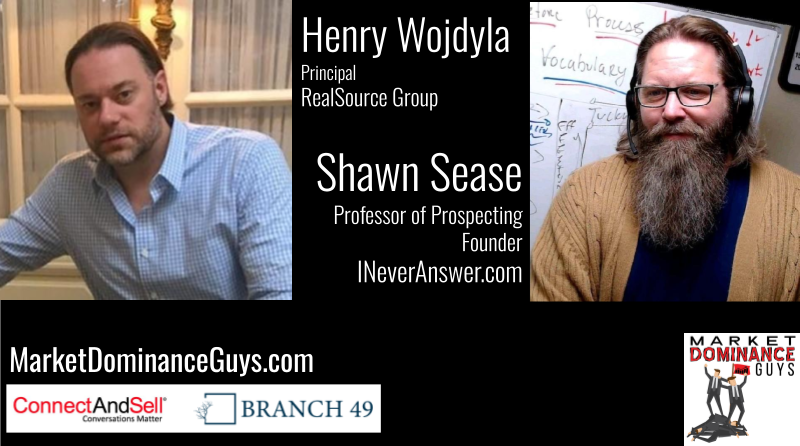
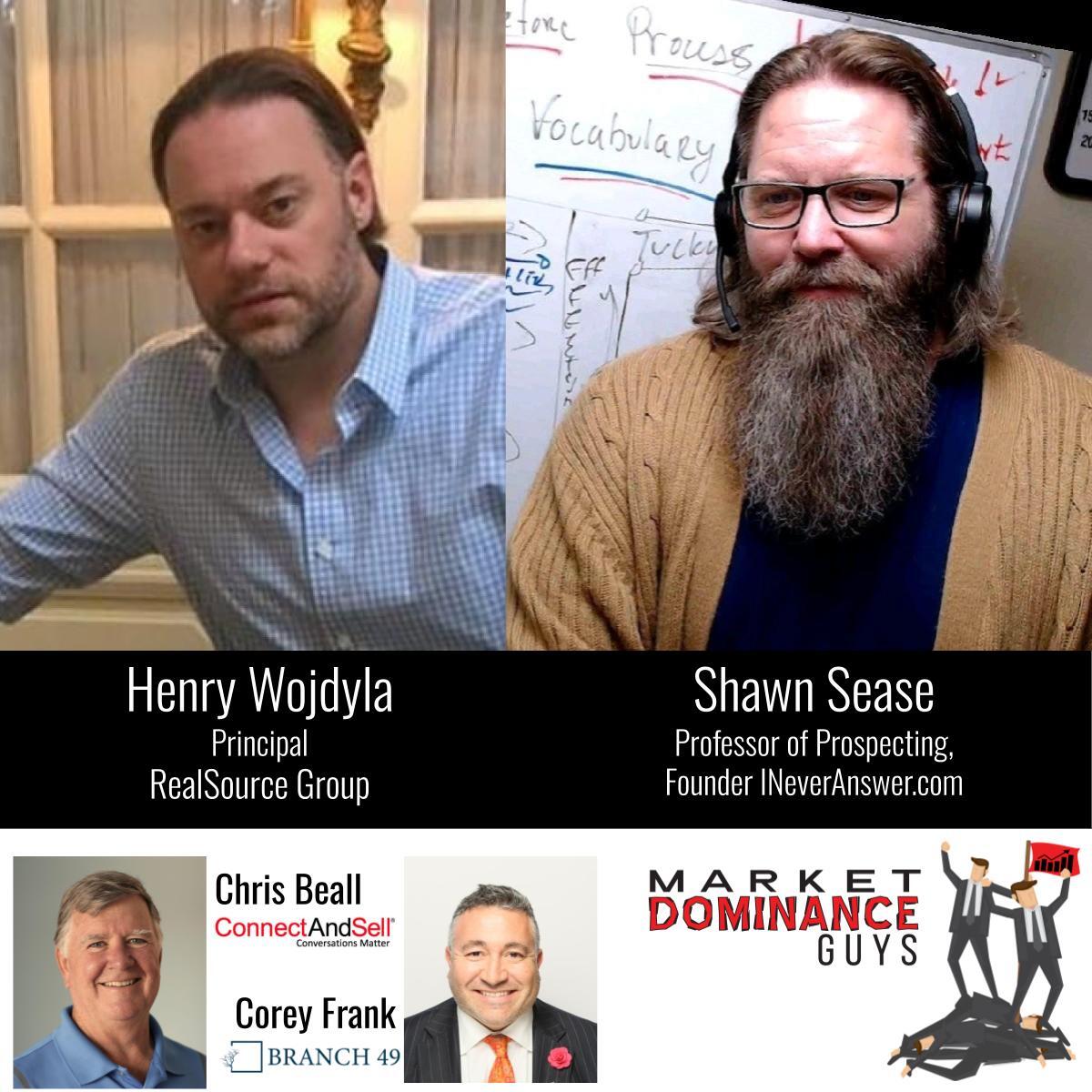
S5 Ep 206EP206: Mastering the Art of Silence How Pauses Can Improve Discovery
What's the secret sauce to nailing discovery calls? Is it your intricate questioning strategy? Your ability to build quick rapport? We're exploring an underappreciated element today - the power of tonality. From a Marine drill sergeant's verbal shock and awe to real estate power players commanding eight-figure deals, our esteemed guests get vocal about vocal dynamics. Join Chris, Corey, and their guests, Henry Wojdyla and Shawn Sease as they battle assumptions, pregnant pauses, and the occasional restraining order. You'll hear straight from the horse's mouth why tonality eclipses terminology and how losing your cool in discovery can cost you deals. If your team overlooks today's vocal victory tips, you'll condemn them to tone-deaf discovery call defeats. Listen to this episode: Mastering the Art of Silence: How Pauses Can Improve Discovery Links from this episode: Shawn Sease on LinkedIn Henry Wojdyla on LinkedIn Corey Frank on LinkedIn Chris Beall on LinkedIn Branch49 ConnectAndSell FULL EPISODE TRANSCRIPT Below: Corey Frank (01:14): Welcome to another episode of the Market Dominance Guys, with Corey Frank, and of course, always at my virtual side is Chris Beall, the stage of sales, the prophet of profit and the hawking of caulking. But we also have two other extra special guests. We happen to be graced in our in-house home Phoenix GCU-based studios with the professor of prospecting, Shawn Sease himself. Good afternoon, Shawn. Shawn Sease (01:42): Good afternoon. Thanks for having me. Corey Frank (01:43): And we have one of our eight registered listeners, Chris, of our podcast, the most gracious and esteemed Henry Wojdyla from RealSource. Henry, it's great to have you on the podcast, back on the podcast. I think you're one of our earlier guests, I believe so, Chris. So good to have you, gentlemen. We have a first here at Market Dominance Guys. We actually have four talking heads, three brains amongst four talking heads, so we'll see what we can do here. (02:12): What we wanted to talk about is something we were talking about before we jumped on air. And Chris, I want to have you have the opportunity to tee up Henry, because I thought it was a compelling topic about tonality, but not just in cold calls, which we often talk about the surfboard and the surfer. But Henry brought up a very compelling point. Shawn, I'd like to get your take on this too, about the importance of tonality and when and how you use it in discovery calls. Chris, so I'll leave it to you to tee up our good friend Henry here and let's dive into this topic. Chris Beall (02:42): Sure. I mean, the conversation we were just having was about how much of the, well, we were talking a little bit about Branch 49 and how much of the waterfront makes sense to cover or the funnel or whatever. The big question is always, where's the bottleneck? We always talk about theory of constraints on this show, and we also know if you ever address the bottleneck, you got to stand back. You have to stand back when you've done something about the constraint and see if it moves and if so, where it moves because it's actually not easy to predict. It could move up or it could move down, so to speak, in the processes. Doesn't move sideways too often. (03:16): And Henry was talking about how when we were just chatting out there, not where you're sitting, not where he's sitting or he's sitting or I'm sitting, but where somebody else's or you're sitting, Corey. He was talking about how the tonality and disfluency is also the whole tonality package I call it, has actually become as important or more important to him as he's evolved in the way that he does discovery. And what I thought was so cool about what he hit on is we call it the confessional. And the question is, well, what are you confessing to? And while you're doing that confessing, are you learning? Are you getting self-knowledge, knowledge of your situation as a result that's facilitated by the conversation? And I think that was a point that Henry was making. So at that, Henry, what was the point you were making? Because frankly, I was just eating tacos and listening in. Henry Wojdyla (04:09): Well, it was probably the ride-on piece to the opening comment I made about some recent conversations, Chris, you and I have had, and I'll keep it brief to get back to your question. But the fact that the top of funnel has been improved so much by the good thinking here from Market Dominance Guys, the facilitation from ConnectAndSell, it gets back to the wood-turning analogy that you had so wisely laid out probably at least a couple of years ago on this podcast. But the idea that I can get enough reps in that I'm beginning to pattern match and seeing ghosts in the machine, so to speak, as it relates to discovery. And a lot of what I've been discovering about my own discovery process has been effectively getting out of the way. And a lot of getting out of the way is facilitating the prospect to do more and more self-disco
S5 Ep 205EP205: Finding Your Beachhead Beyond The Chasm
Many a promising startup has seen their lofty dreams dashed on the rocks due to lacking a bridge to cross that yawning chasm, separating early adopters from pragmatic mainstream buyers. Chris has contended with this treacherous chasm across multiple expeditions. Those early adopters feature prominently in startup lore - enthusiastic pioneers who relish new technology, derive career perks from kick-the-tires experimentation and care little about reputation risk. Yet they differ radically from that mainstream majority awaiting pragmatic proof. Chris invites you to draw on the profound insights of Geoffrey Moore (Crossing the Chasm) to help identify those visionary partners, extract maximum value from your earlyvangelists, and ultimately package your technology into a must-have product. Join Chris for this episode, “Finding Your Beachhead Beyond The Chasm.” Reading list from this episode: Out of Crisis - W. Edwards Deming Theory of Constraints - Eliyahu M. Goldratt Crossing the Chasm - Geoffrey A. Moore Full episode transcript below: ----more---- (00:23): Today, Chris unpacks one of the toughest challenges for startups, navigating the chasm, separating enthusiastic early adopters from pragmatic mainstream customers. As an admitted disciple of Jeffrey Moore's pioneering work, Chris aims to spare fellow innovators from the common downfalls along the journey to achieving industry dominance. He'll examine how to identify key early evangelists and high value visionary partners to fund the next grueling leg after the chasm. Safely across, he'll share hard-won experience on transforming novel technologies into a must-have solution for pressing business needs. Charting this course carefully can turn scrappy upstarts into mighty market rulers. Chris offers guideposts so more pioneers can find safe passage from fledgling startup to titan. Join us for this episode, finding Your Beachhead Beyond the Chasm. Chris Beall (01:23): Hey everybody. Chris Beall here with Market Dominance Guys podcast. And hey, Corey's not available right now, and I thought I'd just put something in the can here and see whether anybody's interested in what I have on my mind today. So today I thought I'd talk about something really important that you can just go out and get a book and read what it's all about and figure it out, but maybe you want to think through some of the things that are unappealing about it that will make you not want to do the right thing when it's time to do the right thing. So this is for folks who come up with new technologies, with new solutions. So if all you do is you sell old stuff, probably isn't particularly relevant to you. But if you're selling a new technology, if you've invented something, or even if you've just come up with a twist on something and you think it's really valuable, important, could make a difference in the marketplace, could solve some real problems, you have a real problem. (02:19): And your real problem is that people are generally repulsed by new technologies. In fact, in general, people are repulsed by just plain old new stuff. Once it's been established and other people are doing it, they're buying it, they're using it, they're getting good value from it, yeah, then it's all pretty easy. But that's a big barrier to get through is that psychological aversion that people have to doing something new or trying something new, especially if it involves parting with something that they already have that would normally be money and always time, and then you could throw in risk to their reputation and well, it only gets worse. So now you've got something new, you're a member of the innovation economy, you want to come out with something, and I'm going to assume it's B2B. Why? Because I don't know anything about B2C. (03:08): I think I've mentioned this before. I'm clueless as a consumer and as a result, I don't think that I'm qualified to say anything about businesses that sell to consumers. I divide my Shark Tank episodes into two kinds. The ones where they're talking B2B, which is almost none of them, and the ones where they're selling to consumers where I can sit back and relax and think, "I don't know anything about this. These sharks seem to, but I don't." But B2B, I've been doing that a long time and I'm a disciple of Jeffrey Moore. The book in question is Crossing the Chasm. There's another book called The Gorilla Game if you want to get into the fantasy of actually doing what we suggest here on Market Dominance Guys, which is dominating markets. So The Gorilla Game's all about dominating tech markets with a product, not with a service. (03:57): If you want to dominate with a service, you become a king or a queen of that particular market, but you can't be a gorilla. And Jeff explains this in great detail in both of those books. They are wonderful reads. I must have read Crossing the Chasm now five or six times. If you really want to get everything you need to know, you could consider Crossing t
S5 Ep 204EP204: Confidence Beats Technique in Sales Training
Alex McNaughten continues his visit with Chris to share psychological insights that challenge traditional sales training. As an AI entrepreneur, Alex emphasizes confidence should be the priority when onboarding salespeople, not technique. He advocates first building enough confidence just to "pick up the phone” and draws parallels between sales and coaching - both guide people through "the emotional journey to consider something new." Alex tells his story about overcoming fear in sales and boxing, noting most training overlooks the emotional side. He concludes that "so much sales training, particularly cold calling, is wrong or missing" these emotional components. Alex’s perspective as an AI builder brings a unique view on honing the emotional skills crucial for sales success. He advocates pushing sales leaders to transform training to address confidence and psychology first. Join them for this episode, “Confidence Beats Technique in Sales Training.” Links from this episode: Grw.ai Branch49 ConnectAndSell Alex McNaughten on LinkedIn Corey Frank on LinkedIn Chris Beall on LinkedIn Full episode transcript below: ----more---- (00:21): Alex McNaughten continues his visit with Chris to share psychological insights that challenge traditional sales training. As an AI entrepreneur, Alex emphasizes confidence should be the priority when onboarding salespeople, not technique. (00:36): He advocates first building enough confidence just to pick up the phone, and draws parallels between sales and coaching. Both guide people through the emotional journey to consider something new. Alex tells his story about overcoming fear in sales and boxing, noting most training overlooks the emotional side. (00:55): He concludes that so much sales training, particularly cold calling, is wrong or missing these emotional components. Alex's perspective as an AI builder brings a unique view on honing the emotional skills crucial for sales success. He advocates pushing sales leaders to transform training to address confidence and psychology first. Join him and Chris for this episode, Confidence Beats Technique in Sales Training. Chris Beall (01:26): Yeah, so I think a CS team would be very interesting. And he loves trying new stuff. He's kind of like Corey in that regard, and I think CS might be as big a play as sales for Taylor. (01:39): In fact, I mean CS is the game in the world of SaaS. CAC is like, well, okay, great. But are you going to hold them, right? I know when somebody looks at a company, they don't start out asking, what's your effectiveness at acquiring customers? They ask, what's your net retention rate? Alex McNaughten (01:57): I think CS becomes more important in a tougher environment because it's much easier to sell more to your existing customers, and upsell them, rather than trying to bring on new ones for a lot of companies right now. (02:10): Thanks for teeing up this podcast, that was fun. 30 minutes goes quickly when you're just talking. It goes so fast. You think 30 minutes is a long time., It's really not. It flies past. Chris Beall (02:20): It is quick. Alex McNaughten (02:24): It's good, though. Because... Chris Beall (02:25): By the way. Yeah, I think that it's really interesting. We sometimes do these and we'll go an hour and a half, or something like that. And it's really interesting where the conversations end up going. We almost never go where we think we're going to go, which is great. So we don't think very hard about it, but they go by fast. They really do. Alex McNaughten (02:42): Yeah, that's the best part about it. It's often when a conversation just naturally flows. Chris, I just want to say a massive thank you for your support. You said some really lovely things about what we're doing, and I get the sense that you genuinely believe and are excited by what we're building. Which is really cool, and it's the early supporters that I think really make a company. It's those folks who kind of get it before 90% of the world gets it. I really appreciate it, and thank you. Let's keep going on the journey together. We're going to build something big. Chris Beall (03:13): I feel very fortunate that we got to talk in the first place. Just watching the demo, most demos don't do much for me because they're about buttons. And buttons aren't very interesting. Push this button, this thing happens. And they're generally about feeding the monster or making pretty pictures, neither one of which is interesting to me. You feed the CRM system or whatever all day long, and then you ask it for pretty pictures, and then you pretend the pretty pictures are going to change your life and they don't. That's kind of the history of enterprise software kind of in a nutshell. (03:45): We do something at ConnectAndSell that actually does something. It's a doing thing, it's not a looking and thinking and whatever thing. And what I was drawn to in the simple demo was the emotional content. (04:01): And my view of sales is pretty simple,
S5 Ep 203EP203: AI Coaching Conversations Elicit Unfiltered Rep Feedback
The guys are tackling the big question on every sales manager's mind: Could AI replace me? With wisdom and reassurance, Corey and Chris explore the power of Taylor, an AI sales coach created by grw.ai CEO Alex McNaughten. Taylor provides a judgment-free space for reps to vent frustrations and surface red flags managers miss. As Chris explains, Taylor's conversational skills elicit "confessions" from reps. And for managers worried an AI could do their job better, Alex gently says: "The goal here is to make leaders better...not replace them." So breathe easy sales managers, and get ready to be 10-50X more effective. With the power of AI augmentation Sales Managers will be unstoppable. Join us for this episode, AI Coaching Conversations Elicit Unfiltered Rep Feedback. About Our Guest: Alex McNaughten - CEO/Founder - Grw.ai With a background in B2B sales for both Kiwi startups and US tech giants, Alex is passionate about increasing the level of professionalism & performance in B2B selling globally. Prior to Apprento, through his advisory firm, he trained hundreds of founders, executives and sales professionals and worked across over 130+ ANZ businesses from pre-revenue startups like SafeStack Academy, to growth companies like Rocos to large multinationals like Vodafone, helping them to reduce their sales costs, speed sales cycles, maximize win rates, build out teams, expand into new markets and ultimately generate $10s of millions in new revenues. Links from this episode: Grw.ai Branch49 ConnectAndSell Alex McNaughten on LinkedIn Corey Frank on LinkedIn Chris Beall on LinkedIn Full episode transcript below: ----more---- (00:23): The Market Dominance Guys are tackling the big question on every sales manager's mind. Could AI replace me? With wisdom and reassurance, Corey and Chris explore the power of Taylor, an AI sales coach created by grw.ai, that's G-R-W-A-I, CEO Alex McNaughten. Taylor provides a judgment-free space for reps to vent frustrations and surface red flags managers miss. (00:47): As Chris explains, Taylor's conversational skills elicit confessions from reps. And for managers worried an AI could do their job better, Alex gently says, the goal here is to make leaders better, not replace them. So breathe easy sales managers, and get ready to be 10 to 50 times more effective. With the power of AI augmentation, sales managers will be unstoppable. Join us for this episode, AI Coaching Conversations Elicit Unfiltered Rep Feedback. Corey Frank (01:22): And here we are once again. Welcome to another episode of the Market Dominance Guys. It's episode 200 and something. We'll just say 200X episode of the Market Dominance Guys. As always, we have the sage of sales, the prophet of profit, and the Hawking of hawking. Chris Beall to my left or right, depended on where in the audience you are sitting right now. And we also have a guest. So Alex McNaughton, fresh over the pond. Do you call the Pacific the pond, or the Atlantic is the pond. I don't know what the Pacific is. But anyway, he's somewhere in the land of the Hobbits in New Zealand. I don't know if you were in Auckland, but welcome to Alex McNaughton, the CEO of Grw.ai, and he's going to talk to me and Chris about his company and some of the changes and trends that he's been seeing. So first off, good afternoon, Chris. Good afternoon, Alex. Chris, how you been? Chris Beall (02:15): I'm been good. I'm down here south of you right now, in southern Arizona. Not as far south as Alex. He's so far southeast, he's an antipodal upside-down kind of guy. I'm looking to see the blood rushing to his head anytime soon. Alex McNaughten (02:28): About as south as you can be in the world. Chris Beall (02:30): Yeah, yeah. And still have a nice climate. That's what's kind of weird. How you guys get away with that in New Zealand is entirely beyond me. As you know, Corey, my sister Theresa once executed the most brilliant business I've ever seen. She flew to New Zealand to the South island. She bought a horse, a retired racehorse, and tacked to go with it. Rode it around for three months. A product of that was a trail horse. Trail horses are worth a great deal on the South Island. She sold said trail horse for enough to pay for the entire trip and then went up, spent two months on the North Island, hitchhiking around among friendly people. I still think if you want to see bootstrapped, she was wearing boots. Alex McNaughten (03:15): That's awesome. Corey Frank (03:17): So Alex, tell us a little bit about Grw.ai and what kind of rundown [inaudible 00:03:23] did you stumble into meet a guy like Chris, besides LinkedIn, of course. Alex McNaughten (03:27): Well firstly, guys, thanks to have me on the podcast. It's good to be here. How did I meet Chris? I think this was a podcast introductory conversation or just a LinkedIn conversation, that I've been running a podcast for a few years and it's brought me to some interesting places and brought me to some very interesting peop
S5 Ep 202EP202: Keeping Teams Future-Focused and Failure-Ready
In the last episode, our Sales sultans, Corey and Chris tackled the folly of chasing too many shiny objects. Now, Chris shares pragmatic insights on building resilient teams for the marathon versus the sprint. Should staff know the messy truths from day one? Chris believes people need full commitment to the mission. Does solidarity trump balance sheet bravado when attempting bold new initiatives? Chris says, "I think people love to look at stuff because looking at stuff is lower risk than doing stuff. Doing stuff is very high risk. You could fail.” As Corey noted, presentations often overlook the people who drive innovation. Corey reminds us, “The people elements, traits, personas don't live on the balance sheet.” Here’s a question posed, "When you go to a potluck, do you only eat the food you brought first?" Listen as they tackle tough topics like letting go of personnel clinging to the past versus embracing the unknown future in episode 202 of Market Dominance Guys, “ Keeping Teams Future-Focused and Failure-Ready.’ Full episode transcript below: ----more---- Susan Finch (00:05): Welcome to another session with the Market Dominance Guys, a program exploring all the high stakes speed bumps and off-ramps of driving to the top of your market, with our hosts, Chris Beall from ConnectAndSell and Corey Frank from Branch49. (00:21): The last episode, these sales consultants, Corey and Chris, tackled the folly of chasing too many shiny objects. Now, Chris shares pragmatic insights on building resilient [00:00:30] teams for the marathon versus the sprint. Should staff know the messy truths from day one? Chris believes people need a full commitment to the mission. Does solidarity trump balance sheet bravado when attempting bold new initiatives? Chris says, "I think people love to look at stuff, because looking at stuff is lower risk than doing stuff. Doing stuff is very high risk, and you could fail." (00:53): As Corey noted, presentations often overlook the people who drive innovation. He reminds us the [00:01:00] people elements, traits, personas, don't live on the balance sheet. (01:04): Here's a question posed. When you go to a potluck, do you only eat the food you brought first? Listen as they tackle tough topics, like letting go of personnel clinging to the past versus embracing the unknown future, in episode 202 of Market Dominance Guys, Keeping Teams Future-Focused and Failure-Ready. Corey Frank (01:30): [00:01:30] What would you suggest, as far as the level of candor, at an early stage, with your people, all the people, about what's our most profitable product or least profitable product, what's fungible and what's not, how we make money, do you believe and have you evolved and have you seen other scenarios where they want to just keep it to the C-suite, and you're just a team member, and here's your myopic [00:02:00] vision? Or do you believe, and success is contingent on everybody knowing exactly what they signed up for, if they're going to go off the earth on search of these new worlds? Chris Beall (02:10): Oh, I believe deeply. For me, it's at the interview process. The first time I ever said this to anybody in an interview, I was probably in my early 30s, and I said, "By the time you get to me, it's assumed that you're competent. They don't send incompetent people to be interviewed by me. [00:02:30] Well, that doesn't happen, so therefore, you're competent. So I'm not going to ask you any questions to assess your competence. What I want to do is make it clear to you what you're getting into, and it's going to be your choice whether you want to get in or not. And I'm good either way. So I know you're good enough to do the job. Now I'm going to tell you about the real job, and the real job is doing really hard things." (02:53): "So one, we're likely to fail, so you have to accept that we're likely to fail. Why do I think we're likely to fail? Because [00:03:00] otherwise, we wouldn't be doing this. Somebody else would've already done it who is less skilled, determined, insightful, clever or whatever than us. So we're going to do something hard, and hard things generally fail, so you're signing up for failure. So recognize that. But we're going to persist. We're probably going to have a good time. So two, you're signing up to have a good time. Why? Because otherwise, we can't do something so hard that we're likely to fail. It just doesn't work. It doesn't work [00:03:30] to come in all glum and morose, and everything's got to be great, otherwise, I got a bad day. I don't want to hear about your bad day. There are no bad days in the sense of going after the mission. We're just going to do it. So we're going to be enthusiastically wrong every day. That's going to be our thing, enthusiastically wrong every day. We're going to say, 'If we're not having fun, we're not taking this seriously enough,' So we're going to do that." (03:53): "And third is, we're going to make a weird sacrifice. I've made it. You'll

S5 Ep 201EP201: Customers Aren’t Formulas - Navigating the Emotional Journey
Getting punched in the face is practically a rite of passage for startups with seemingly bulletproof business models. Spreadsheets might predict hockey stick growth, but, as Corey says "customers aren't formulas on a page. They're human beings who are often "repulsed by new technology". Adoption requires an emotional journey and trust, not a formula. Yet founders frequently ignore reality, believing spreadsheets will magically generate growth. Chris says this quest for an easy quota can even derail progress as "salespeople focused on quota may take company backwards" by clinging to the past. Hence leaders must prevent "retrograde motion back to what was comfortable before" by being "hard-edged on changing direction." There are no maps for the uncharted path from startup to sustainable enterprise. But experienced guides like Corey and Chris are happy to share their battle scars and perspectives. Join us for this episode, “Customers Aren't Formulas: Navigating the Emotional Journey.” Full episode transcript below: ----more---- Announcer (00:06): Welcome to another session with the Market Dominance Guys, a program exploring all the high stakes, speed bumps and off-ramps of driving to the top of your market, with our host Chris Beall from ConnectAndSell, and Corey Frank from Branch49. (00:21): Getting punched in the face is practically a rite of passage for startups with seemingly bulletproof business models. Spreadsheets might predict hockey stick growth, but as Corey [00:00:30] says, customers aren't formulas on a page. They're human beings. Adoption requires an emotional journey and trust, not a formula. Yet, founders frequently ignore reality, believing spreadsheets will magically generate growth. Chris says this quest for an easy quota can even derail progress, as salespeople focused on quota may take the company backwards by clinging to the past. Hence, leaders must prevent retrograde motion back to what was comfortable by being hard-edged on changing direction. [00:01:00] There are no maps for the uncharted path from startup to sustainable enterprise, but experience guides like Corey and Chris are happy to share their battle scars and perspectives. (01:10): Join us for this episode, Customers Aren't Formulas: Navigating the Emotional Journey. Corey Frank (01:20): And here we are. Welcome to another episode of the Market Dominance Guys, episode, I believe, 201, with the sage of sales, [00:01:30] the prophet of profit, the Hawking of Hawking, fresh back from his jaunt across the pond, freshly stocked with Porto and Cabernet and other assorted box wines, knowing Chris and the fetching Miss Fanucci. Chris, welcome back. Episode 201, what do you have to say about that, my friend? Chris Beall (01:51): Well, it's great to be back on this continent. There's all sorts of things that are wonderful here, even on the East Coast. And I'm hanging out at the Breakers, where I've learned the value of money, [00:02:00] which is no matter how much money you bring, you can't get anything of value. Corey Frank (02:04): The Breakers, yes, I understand they're renowned for their breakfast at the Breakers, right? Did you have a coupon, or how did you... I mean, the Breakers, talk a little bit about the breakfast before we get in our topic today. Chris Beall (02:15): Pretty much it's all-inclusive if you pay $64 for the buffet. And hey, I had a very nice omelet there. By the way, the service of the Breakers is really second to none. Every single person that I've talked to here is incredibly accommodating, [00:02:30] gracious, pleasant, and willing to do the right things. Corey Frank (02:33): Yeah. Chris Beall (02:34): Yeah, you stack up on Stacey's Naked chips, so guacamole and some salsa, you have the breakfast, and then you get through the rest of the day alive and bring your own wine, because the only way it's going to work either. Corey Frank (02:45): Great. Well, let's talk a little bit about one of the topics that you and I, I think, gosh, it's peppered throughout the Market Dominance Guys on many of our 200 plus episodes with guests or without, and that is everybody [00:03:00] has a business model until they get punched in the face. But I want to talk to you about different business models. You've been talking with a lot of private equity firms, a lot of other investors. A business model from what I was taught, and I think you probably taught me this, Chris, is above all, it should be geared to make a profit. And certainly, you want to study your competition, you want to get the right staff and get the right talent level in there, but your business model should be geared to make a profit. (03:28): But let's start from [00:03:30] the basics here on this. The traditional SaaS business models that are out there, they're template driven oftentimes by a lot of VCs, a lot of investors. There's a certain gate you have to go through on your friends and family, and then your seed round before you get your A round, and you have to
S5 Ep 200EP200: Authentic Demand: Moving Past Impersonal Lead Gen
Episode 200 of the Market Dominance Guys features Corey, Chris, and special guest Jim Graf. They explore key trends shaping modern prospecting – from the diminishing returns of broad email campaigns to the rise of personalized, longitudinal selling. Jim explains how the old concept of BANT (budget, authority, need, timeframe) fails to capture the fluidity of today's buying journeys. Rather than chasing "leads," they advocate nurturing long-term demand through authentic relationship building. The conversation culminates in examining the overlooked value of seasoned SDRs. Chris shares examples of 60+ year-old SDRs wildly outperforming their younger peers, dispelling misconceptions that this function is merely developmental. With their seasoning, polish, and focus, many late-career reps embody the consummate skills needed to excel. Jim and Chris emphasize how this critical frontline role requires a professional, not progressive, mindset. In an era of noisy outreach, the guys explore timeless ways to cut through the clutter – with patience, personalization, and wisdom accrued over decades. Listen to this episode, "Authentic Demand: Moving Past Impersonal Lead Gen." Links from this episode: Corey Frank on LinkedIn Chris Beall on LinkedIn Jim Graf on LinkedIn Kazzcade Branch49 ConnectAndSell Full episode transcript below: ----more---- Chris Beall (01:37): Everybody thinks that they're doing something clever, but they're not asking themselves the fundamental question which is, what's the cost of reproducing that and making another unit? And if the cost is too low, they can't win based on it. You just cannot win in the marketplace, based on commoditizing the one thing that makes a difference, which is getting a trust relationship [00:02:00] going. Going the expensive way turns out to be a path to cheap dominance. It's the least expensive thing you can do to dominate, is the most expensive thing you must do in order to get started. Jim Graf (02:14): The other thing too, and we train our guys on this, but when you have that conversation, there's branding going on, but then there's also all sorts of market intelligence. I mean, tons of market intelligence. And I'm not just talking about what do you use now, but there's [00:02:30] first-party data. Our team a lot, is identifying when that contract runs out with your CRM, when it make the most sense to talk more about evaluating third parties, stuff like that. And you can't buy that intent data. You can't buy the fact that this law firm has a three-year contract with Salesforce, expiring December 2023. (02:52): And so our ability, we focus a lot on, of course, quotes them, "They're not going to be interested. Now's not a good time. [00:03:00] This is going to be standard, guys. Just get comfortable with it." But it's taking that and being able to, you can't do this in email. Is what is that market intelligence that we can gather, where we can move this further down the pipe? Is there a contract expiring, have an A activity going on, but basically we're really not forceful, but move to like we have this person's undivided attention for 30 seconds. Let's make the most of it. Be in the moment. Try to understand what their problems are, when things are expiring, but move it along. And [00:03:30] you don't get any of that with email. Email's just kind of a branding exercise. Someone from AWS reached out and they've got a special going on, and here's a link to a landing page. Okay. Chris Beall (03:39): Yeah, and it's funny too, though, there's another marketing impact we don't talk about, but we can measure it. I don't know if you've done this with us, but we'll measure from opportunities back to what produced them, what conversations produced which opportunities. And the biggest producers are the negative conversations. So the positive conversations, the super conversation, [00:04:00] the one that sets a meeting is the most obvious producer. But in most shops, and we've measured about 120 of them over extended periods of time, two to three, four years. In most shops, most of the money comes out of the negative conversations. (04:15): And the reason we think is, that person that you're talking to feels kind of good that they got out of the conversation with their self-image intact fairly quickly, but they also went to your website while they were talking to you. And so your Google [00:04:30] ad, you paid them a lot of money. Why does Google make so much money? Well, they drive people to websites. That's why, right? That conversation, which you need in order to set the meeting, its primary impact is almost always, they go to your website. And the secondary impact is, they will almost always answer an email you send them, immediately after the conversation, with this subject line, "Thank you for our conversation today." Unless you want to really cheat, and then you send one from the boss that says, "Thank [00:05:00] you for speaking with my colleague today." (05:02): Nobody get
S5 Ep 199EP199: Conversational Alchemy - Transforming Sales in the Age of Cheap Outreach
Prepare for another thought-provoking journey as Corey and Chris are joined by special guest Jim Graf, the CEO and Founder of Kazzcade, a former private equity finance titan turned outreach sales guru. Together, they delve into the concept of "Gresham's Law" – where "bad money drives out good" – and apply it to the world of sales. In an era overrun by cheap tricks and impersonal outreach, the MDG team explores how these practices can diminish the value of genuine, high-touch sales. With AI and automation flooding inboxes with repetitive and uninspiring messages, Chris, Corey, and Jim examine the phenomenon of how "cheap outreach actually drives out the value of good outreach." Join the conversation as they discuss the impact of this shift on the art of selling. Can we reverse this trend? Can we, in fact, perform real “conversational alchemy” by transforming mundane interactions into genuine, meaningful connections? This episode offers valuable insights into navigating the challenging landscape of modern sales and cold outreach, where authenticity and real dialogue are held at a premium. Don't miss "Conversational Alchemy: Transforming Sales in the Age of Cheap Outreach" as it explores the timeless wisdom of Gresham's Law and its relevance in today's business world. Full episode transcript below: ----more---- Corey Frank (00:00): Here we are with another episode of The Market Dominance Guys, as we inch ever closer to episode number 200, Chris. And as always, I'm here with the Sage of Sales, the profit of profit, and the Hawking of Hawking. Chris Beal. Chris, how are you? Chris Beall (00:17): I'm doing pretty good today, having fun at the Outreach Unleash Conference the last couple of days. And gosh, I'd forgotten how amusing people are when you get 'em in a big herd like that. They're pretty funny. Corey Frank (00:28): Well, we're going to talk a little bit about the trends [00:00:30] and not the most circuitous route to get to B P O and outsourced sales. We have a very special guest, Jim Groff, C e o, and founder of Kaz Kade k a zz kaz cade.com. Jim, welcome to the market Dominance Skies. Chris Beall (00:48): Corey, happy to be here. I really appreciate the invitation. I'm excited, Corey Frank (00:52): And you are also for full disclosure because our attorneys get on this every episode, right? Chris, you are a power user of connected Cell just for the listeners, so they [00:01:00] absolutely know this was not coerced. You're not being compensated for your appearance in any way, shape or form. You were somehow enticed, seduced come on this podcast. And that's all there is really is just the nuggets that come from Chris's words. And that's payment enough though, as it is for me for the last 15, 20 years. I don't know what it's been, Chris, but anyway. Well, let's get right into it. So Jim, you come from a very different background that Chris has some interesting perspective on. You come from the private equity and financial [00:01:30] side of the ledger, but yet you own one of the best B P O sales consulting agencies marketplace over there in Lake Mary in Florida. So how did a finance guy, what left turn where you should have took a right turn to a space like this? Chris Beall (01:52): Yep. I spent my entire life actually in sales from right out of undergrad and then after grad school and I worked for some [00:02:00] great companies that provided just a great foundational B two B sales. Then after grad school, worked for an investment bank where it's a lot of selling. I mean, investment bankers by definition are kind of glorified real estate agents, but my specific role is what's called an institutional broker. And we would help companies raise capital and I'd work directly with hedge funds on pitching them stocks, putting their portfolio long or short. So it was a constant sales job and a lot of phone sales. So sales has just always been in my D N A and I always navigated [00:02:30] towards sales because the income was always limitless and it was a great career. I really enjoyed it, but I always had a very entrepreneurial spirit and just realized that look, life's not slowing down. Chris Beall (02:42): And so I started to look for an organization that I could raise some money and buy. And I came across this at the time it was just a mom and pop lead gen company in Orlando, and I'm like, man, I didn't even know appointment setting was even a thing. And I'm like, this is crazy because all my life in sales, I've never heard [00:03:00] of bant qualified. That still blows my mind. We can talk about that. I think that's insane. I was given a territory and it's like make it happen. So anyways, as I looked at the company, I'm like, this could be really interesting. I think it can add a lot of value here as sales is so cordo my profession. And that was eight years ago. And since then we really kind of transformed it into a complete S D R as a service. Chris Beall (03:19): We're more of a business process outsourcing

S5 Ep 198EP198: Pruning the Unnecessary to Focus on Strengths
Corey and Chris continue their discussion about inertia and constraints. How can leaders identify hidden constraints shaping their strategy? What fosters innovation: centralization or decentralization? Can classic texts offer counter-cultural wisdom to elevate leadership today? Pulling insights from ancient to modern thinkers, Corey and Chris tackle these questions and more. They argue consolidation often hinders progress while decentralization promotes healthy competition. Chris advocates "divisionalizing" to optimize strategy. They explore conquering inertia, maximizing strengths by pruning the unnecessary and structuring for change. The curiosity continues in part two of this engaging conversation in this episode, "Pruning the Unnecessary to Focus on Strengths." Full episode transcript below: ----more---- There's been, yeah, I think with this concept of innovation in limitations, it leads to [00:33:00] I think a natural progression to the next piece that Rami had spoken about was finding customer limitations. And he had three, and you talked about one earlier that you find customer limitations through the customer eyes, through the market's eyes, and then through the product size. Corey Frank (00:33:22): And so what are your thoughts on that? Because as a sales, a leader here and as an entrepreneur, [00:33:30] certainly sometimes, and he says in order too, it should be customer market and product. But as you know, and we've talked about many times too, Hey, I built the product so I'm going to start from the product. If I build it, they will come. Because many customers don't understand the limitations. They can't foresee the reality of a product without this limitation before connect and sell came around. Certainly folks didn't complain about [00:34:00] the real limitations because they didn't know a reality without the limitation of, wait, I just press a button and I don't have gatekeepers and everything else. Or the Henry Ford, if I asked the customer what they wanted, they'd all be still driving or still riding horses. So what do you think about that with customer market and product and as far as a blueprint, if you will, to find customer limitations for innovation? Chris Beall (00:34:26): Well, I always think of it in terms of what's the unit of change? What's the cost of change? What's [00:34:30] the probability of change? So the unit of change, you got to know what's the unit of change. The customer got to change their mind, their business, their point of view, the value that they're hoping to get, what's going to change there? The market always interesting. The market is going to say, Hey, here's some alternatives. Here's ways of looking at this. Whatever my way is, they're going to have some other ones. So the unit of change is they don't go with me, they go with somebody else or they do [00:35:00] nothing. Which is the most common one. The product is the most interesting one in this regard. You can design products for change or you can design products for perfection, for great fit. And they're two different things. Chris Beall (00:35:14): So the whole idea of software is so to speak, all software products are designed for change. This is why software is eating the world. You can do tricks with software. Think of the Tesla. Teslas download new software [00:35:30] all the time, and they keep getting smarter. It's not that the car was delivered to you smart. It's that the car's getting sitting out there charging in your garage right now. So Elon Musk identified a unit of change. It was super valuable, and customers are delighted in it because it's like, wow, look at that. Well, how does the car show that it's smart? It has a big whole screen and it can show you new things on it so it can make its new smartness obvious. [00:36:00] So designing for change is hard. Nobody in design classes teaches design for change. When you're writing code. The way I've always been a fanatic, and as you know, I've been writing code since 68. I know people laugh when I say that. It's like 1868. I'm exceptionally well preserved, 1968. Sure. So maybe 1768, anticipating some events on the eastern [00:36:30] seaboard of the us. But I've been writing code for a long time. I'm not very creative when it comes to writing code. I don't like tricks. I don't like some tricky way of doing something. I did for a little bit, and then I decided, but the main way that we design code for change is just to make it readable. Chris Beall (00:36:50): To make it readable. So you could read it to your mom. So my rule always when I hire great developers is we get in a room and we do two things. One is we decide what all the words mean. All [00:37:00] the words in the business need a formal definition. They need a comparative definition. It's one of these and not one of those, right? So you have positive and negative, and it needs an extensive definition. There's an example of one and every word that we're going to use of significance, and th

S5 Ep 197EP197: Divisional vs. Departmental - Structure for Sales Innovation
The guys are back together! Join our master salesmen Corey Frank and Chris Beall as they dive into this discussion on business strategy inspired by a recent event Corey attended featuring Rami Goldratt of the Theory of Constraints Institute. Discussing key concepts like inertia, identifying constraints, and the politics involved, they provide insight for sales managers and CROs looking to break through barriers to growth. Chris explains how constraints manifest on the buyer's side, in their emotions and feelings of possibility. On the execution side, he advocates building key elements in advance to avoid delays. He and Corey cover divisional vs departmental structure, M&A pitfalls, and more insights. Join them for this episode, “Divisional vs. Departmental – Structure for Sales Innovation.” Full episode transcript below: ----more---- Corey Frank (00:00:04): Here we are once again. Welcome to another episode of the Market Dominance Guys, with Corey Frank, and of course the Sage of Sales, the prophet of Profit, the Hawking of Hawking, Chris Beal. Chris, it's been a minute or two since the two of us have been in the same virtual room. How are you? Chris Beall (00:00:23): I'm doing great. We must be like busy little bees out taking our flowers to task and doing our Corey Frank (00:00:30): [00:00:30] Thing. Exactly. We don't have the time. I wish we did to post prolifically on LinkedIn, but I think you and I both have businesses to run sometimes, so that gets in the way, doesn't it? Chris Beall (00:00:40): Sad business. Indeed. But you know what? Somebody's got to do Corey Frank (00:00:44): It. Oh, hey, listen, we depend on the Gerry Hills of the world and the Ryan Reiserts of the world and the Sean Ceases of the world to write so prolifically and so poetically and so elegantly, and then steal their ideas at scale. So [00:01:00] that's certainly what I do. I speak for myself, of course, but I love their writings in particular and there's many, many, many more out there. Hey, in the meantime, since the last time we had spoken and met a lot of folks, I know Taylor Swift has been in the news on a concert tour and then the Rolling Stones have had a tour that was kind of going and then interrupted and it's starting again. And then Ed Sheeran also was recently on tour, [00:01:30] but I think although both of us, we kind of like music, we had a different tour that I figured that I'd share with you, and I sent you my picture, my Taylor Swift, our Taylor Swift, our Mick Jagger, and our Ed Sheeran. And that of course is Rami Goldratt from the Theory of Constraints Institute. He came to town on a special concert tour, and of course I had to drop everything and send you a selfie with a master himself because that's how we roll, [00:02:00] right? As the other eight listeners on this podcast, I think that's what we care about is anything and everything with regards to market dominance and certainly the theory constraints plays a big part of that, doesn't it, Chris? Chris Beall (00:02:11): Oh yeah. I mean the whole market dominance concept is built on the theory of constraints. As you know, I have a disciple of fanatic, and the trick with these things is they give you a framework to think, but you still need to think and you still need to do experiments, and you also need to look into your own mind and your heart and say, [00:02:30] am I looking at this objectively or am I playing mind games with myself? So that's what makes it so interesting. Corey Frank (00:02:38): It does. It crosses, although as you had educated me all those 10 plus years ago on Eli Gold Rat and that it was meant originally for the manufacturing space, I think what we've done here on the market dominance guys, certainly with your tutelage, is open up the minds of so many sales professionals like myself [00:03:00] that this transcends the manufacturing space into what we do in running sales organizations. Correct? Chris Beall (00:03:07): To me, sales is actually manufacturing. I mean, we're manufacturing the opportunity to solve a problem and supposedly we've come with a potential solution. Somebody has a problem that we could potentially help them with, but manufacturing that opportunity to solve a problem and to do it in a way that works for everybody. The other constraint, if you're going to do it over and over, [00:03:30] it's got to work for everybody. I mean, some folks in sales have been known to wear out their welcome a little bit here and there, but that's not sort of the ultimate game. So yeah, I'm a manufacturing oriented guy. I used to build manufacturing systems and software and spend a lot of time on factory floors and out in distribution centers, and when you make it physical, it gets real. That's one of the interesting things about the whole world of software is as soon as you make it physical, it gets very, very real. [00:04:00] And as you know, I'm married to Helen Ucci, who herself started her career as a manufacturing engineer. She's

S5 Ep 196EP196: Making Seinfeld Laugh - The Sales Professional’s Aim
Corey Frank continues his interview with Susan Finch as they talk about perfecting your craft and the importance of a supportive and evaluative community in the journey. This leads to an insightful discussion that draws parallels between renowned comedians and training sales professionals. Corey uses the example of comedians like Jim Gaffigan, Chris Rock, and Jerry Seinfeld testing new material in heartland towns to underscore the significance of knowing your audience and how practicing your craft in smaller venues can sometimes offer more genuine feedback than large, more famous platforms. Listen in as Corey recounts the story of hotdog-eating champion Kobayashi, drawing lessons on questioning the conventional and pushing the boundaries of what's possible. They emphasize the power of not just aiming for more but seeking ways to make the process more efficient. Join them if you're keen on exploring the intricacies of the sales profession, the art of feedback, and the significance of pushing boundaries in this episode, “Making Seinfeld Laugh: The Sales Professional’s Aim.” Full episode transcript below: ----more---- Susan Finch (00:00): When you were saying about dressing, my mom taught me when I was a child. I mean, she did not leave the house without makeup and dress to the nines, but that was a different era. But that's how I was raised. I do not go to my kitchen table without teeth, brush, makeup on, dressed ready to go. And I had one bad experience where I was seen on C N N in a bucket hat in the rain, and I will never do that again and leave my house without being presentable. It was a parade, but still Corey Frank (00:30): [00:00:30] Camera ready. Susan Finch (00:30): It did not look good. But it's also out of respect when your team shows up that way, they're respecting each other and they are saying, our business that I have an effect on that affects your bottom line, Joe, Bob, Gina, I'm going to show you that respect that I'm here for you too, and I will show up because we are all in it. And I want your clients to know that I respect you, and they can see that even if I'm just walking around the background on a call, [00:01:00] they can see that everybody has that same mindset of respect for each other, respect for the brand, respect for the client. And it puts us, I don't know if you remember when I was in school and we had school dances and stuff, we love the formal themes best. I was in leadership because everybody behaved better than when they dressed up as babies or animals or whatever. It was some crazy hair day for spirit week. But when they dressed formally, [00:01:30] they all behaved better. Corey Frank (01:36): I do remember that. And I guess I didn't see the correlation back then, but yeah, we had dress up day versus dress down day or Hawaiian shirt day. Right, right. That is interesting. Yeah, I like that analogy a lot. I think it's probably a little outdated in our sales world today. A lot of the clients that we have when we show up on the call immediately, they apologize for not dressing apart, not putting [00:02:00] a tie up, putting a jacket on, et cetera, which is interesting. And we use that as indicative of, okay, folks want to rise to a higher level. And we encourage folks to turn on their camera when we're talking and it says, Hey, unless you believe that the camera somehow steals a portion of your soul, if you put it online, turn on your camera and let's have a conversation. The screenplays that we present, which ties into a little bit what you're saying too, because it's all about authenticity. Corey Frank (02:26): It's all about presenting yourself. And what Chris and I talk about all the time is the [00:02:30] building, the power of trust in seven seconds or 27 seconds and the replays that we use, we try to incorporate a number of verbal disfluencies, s and ums. Think of the way Ellen DeGeneres talks this way. Bob Newhart certainly made a career of having the stammer. And we believe that Nicole call that it's not a TED talk, it's not a Toastmasters event. This is a serendipitously created Kramer like engagement. I barged [00:03:00] in and I'm a stranger. I'm the invisible stranger. You may be fearful. And if I start becoming a silver tongue devil and no ahs and ums and come off very strongly in spite of what my product may be, you're not necessarily going to get the conversions. So part of our approach is that we look the part, but we're going to come in very softly, but also very confidently. Corey Frank (03:27): And we want this to feel like this is the first [00:03:30] and only call I made today, not the 150 second dial in conversation I've had today where folks will lose trust. The analogy we give Susan is the first time you see a superhero movie, maybe early on when you're a kid, you saw maybe I could see the strings holding Superman up. It was terrible, c g i, but at that age you didn't care because we had no c g I, and it helped create the illusion that Superman coul

S5 Ep 195EP195: Humility’s on the Menu - Serving Sales Success Sashimi-style!
Corey Frank welcome Susan Finch to talk about humility, sales training, and sushi. If you've ever wondered how to turn water into wine without being at a wedding in Cana. Today's discussion is all about nurturing the greenhorns and newbies by diving into how to nurture the budding talent fresh from school or those having a "Is this my life?" moment. Corey expounds on why humility isn’t just for monks in monasteries but crucial in the sales world too. Drawing unexpected life lessons from the likes of the book 'The Alchemist' to 'Giro Dreams of Sushi' - yes, a sushi documentary, because why not? - this episode promises a roller coaster ride through the heart of sales strategies. Listen to the first half of this conversation, "Humility's on the Menu: Serving Sales Success Sashimi-style!" Full episode transcript below: ----more---- Susan Finch (00:21): Hey, everyone, Susan Finch here, and today I have the pleasure of sitting with Corey Frank, and we have two parts of this visit. If [00:00:30] you've ever wondered how to turn water into wine without having to be at a wedding in Cana, well, you want to join us for this episode. Today's discussion or the first half of this two-part visit is all about nurturing the greenhorns and newbies by diving into how to nurture the budding talent, fresh from school, or those having a "is this my life" moment. Corey expounds on why humility isn't just for monks and monasteries, but crucial in the sales world too. (00:58): Drawing unexpected life lessons from [00:01:00] the likes of the book The Alchemist to Jiro Dreams of Sushi, yes, a sushi documentary. Because why not? You know these guys. This episode promises a ride through the heart of sales strategies. Listen to the first half of this discussion, humility is on the menu, serving sales success, sashimi style. (01:30): [00:01:30] Some of the things that I notice because you are in the trenches with newbies, new salespeople that are not cluttered with bad habits, and you are able to from the get-go show them based on your experience, of course, the best way to learn as a group, to mentor each other, to make use [00:02:00] of some of their talents. One of the things that you guys have talked about before is give me the dyslexic ADHD person and I will make a great salesperson because they are the good ones. That always cracks me up because there I am. (02:15): I love hearing because neurodiversity is such a big topic right now and what it means to people. It's the quiet stuff we don't see. It's that silent diversity, the quiet diversity, however you want to word it, but it's what we don't see in [00:02:30] personalities. Some people are highly functioning with all of those assets, those quirks, however you want to call it. And yet there are some qualities that actually are way better for sales than they are for many other professions. (02:50): I wanted to talk to you about that a little bit, and also to see two things, and you can go as far as you want with this because we can just record this and chop [00:03:00] it up too, how to build a sales team from scratch for small to mid-size businesses. Which comes first, the people are the tools? And if it's tools, I mean, we know ConnectAndSell, of course, but what are your must haves that there's no deal without it, you must be using something to the effect of these tools because otherwise this will happen? (03:23): And then finally, I wanted to talk about the importance of a mentor in sales, especially when people are only remote. [00:03:30] I have seen the difference when people are trained in person. There is no substitution for that. As much as I love working from home, I also had the benefit though of mentors early on. I would not be successful, I would not know what I know today without being in person working alongside people, bumping along, reacting, responding, and pivoting. Those are the topics I was thinking about. Corey Frank (03:57): I don't know how people do [00:04:00] that. It's got to be tough to start your sales career and work from home that way, right? Susan Finch (04:06): I would think so. Corey Frank (04:08): There's nobody to the left or the right and am I doing it? Yeah, it's got to be tough. Susan, what we do here at Branch 49 is we certainly with the help of folks like you and Chris and the Market Dominance Guys' philosophy is how do you turn water into wine? You and I have had a lot of conversations over the years. One of the things that we [00:04:30] like to call Branch 49, and I think this should be the aim of any organization that aims to hire folks right off the boat, right out of school, maybe career changers, is how do you arm them? (04:43): Chris calls it a finishing school for CEOs. When you look at maybe the traits of what we would all want to see as a nearly finished product or a product in progress of development, the biggest one that we see is humility. [00:05:00] It's probably counterintuitive from a sales perspective is that don't you want

S5 Ep 194EP194: Decoding the One-Stop Shop Sales Tool
In this episode, Chris dives deep into the intricacies and pitfalls of sales tooling, questioning the effectiveness of piling on more tools and the notion of an 'Uber tool.' Chris explores the impedance mismatch between the world of sales tools and the neurodiversity of salespeople, highlighting the challenges faced by salespeople who switch attention frequently and the toll it takes on their productivity. With references to a recent Forrester article, an insight into sales conversations, and a sprinkle of Beall's Laws, Chris delves into the complexities of sales processes, the importance of meaningful conversations, and the hurdles of creating a one-size-fits-all tool. Tune in as Chris discusses the present and future of sales technology, neurodiversity, and the search for an optimal toolset. Join us for this episode, "Decoding the One-Stop Shop Sales Tool." Full episode transcript below: ----more---- (00:23): In this episode, Chris dives deep into the intricacies and pitfalls of sales tooling, questioning the effectiveness of piling on more [00:00:30] tools and the notion of an über tool. Chris explores the impedance mismatch between the world of sales tools, and the neurodiversity of salespeople. Highlighting the challenges faced by salespeople who switch attention frequently, and the toll it takes on their productivity. With references to a recent Forrester article and insight into sales conversations, and a sprinkle of Beall's laws, Chris delves into the complexities of sales processes and the importance of meaningful conversations. As well as [00:01:00] the hurdles of creating a one-size-fits-all tool. Tune in for a discussion on the present and future of sales technology, neurodiversity, and a search for an optimal tool set. Join us for this episode, Decoding The One-Stop Shop Sales Tool. Chris Beall (01:23): Hey everybody. Chris Beall here without Corey Frank. He's probably available, but it's a Tuesday [00:01:30] afternoon raining here in Port Townsend, Washington. I don't know, I was just in a mood to hold forth on something. So here's the something. I read yesterday, it was a LinkedIn post I believe, that pointed to a Forrester analysis that said basically the number of sales tools keeps going up and sales performance keeps going down. And asking the question, "Are they related to each other?" And [00:02:00] I think the answer is yes, but not for precisely the reasons they stated in the article. So the idea in the article was pretty simple. More sales tools means more stuff that the sales person has got to work with, or is tempted to work with. And it's hard to become an expert at anything at all in this world, actually. Let's face it. But it's particularly hard to become an expert in something that you use occasionally and use a little bit. (02:28): So the idea is, [00:02:30] hey, you're having to jump around from tool to tool to tool. And the suggestion is a one-stop shop that does everything, is going to get the job done. That is, you want one tool to rule them all. And it's interesting. This to me, reminds me of the whole world of enterprise resource planning as it eventually came to be called. And you grew out of a thing called MRP, Manufacturing Resource Planning. And then MRP 2, which was a subtle twist [00:03:00] on all of that, that actually went and closed the loop between outputs and inputs. That is, you were actually talking about making stuff and ultimately maybe even shipping it. I only know about this because I was a architect designer of an MRP 2 system way back when. Which turned into, with a little bit of help, into a distribution management system to run a big automated warehouse full of all sorts of things. Humans and robots working [00:03:30] together. (03:30): And people who know me know I do love my humans and robots working together. Especially if the robots don't have much physical form, if they're just software. That's what we do here at ConnectAndSell, is humans and AI work together to solve the problem of getting a conversation with somebody, which is a positive thing. And getting to ship the right stuff out on an order and not make any mistakes. That was a pretty good one too. So the reason I bring that up is, there was always a dream in the world [00:04:00] of ERP. And that dream has been repeated over, and over, and over in enterprise software land. Folks come up with something and say, "Well it's just ridiculous that we're using general purpose tools." And they will generally point to email and Excel, unless they choose to say it in the other order. And then it's Excel and email. (04:22): And then they might throw in something like, I don't know, Microsoft Word and PowerPoint, or nowadays, some Google tools or other. [00:04:30] And say, "Wouldn't it be great if instead of using this general stuff, we could use specific stuff that was wired together to solve all the problems that are faced by all sellers?" And so these tools come out, first as point solutions doing

S5 Ep 193EP193: Thriving in Market Turbulence - Tech Tango and Global Jigs
In this episode, Chris Beall, CEO of ConnectAndSell, discusses various challenges faced by B2B sales leaders in the modern business landscape. With Corey Frank, CEO of Branch49, absent from the co-host chair, Chris invited ChatGPT to take a seat. He starts by introducing the idea of asking ChatGPT about challenges in B2B sales. He touches on the challenge of coaching sales reps, particularly their first failure points in conversations. Chris explains how technology, such as the one developed by Symbl.ai, can help identify these first failure points and support reps in improving their performance. Chris stresses that addressing these challenges requires a combination of strategic thinking, technological proficiency, people management skills, and deep industry understanding. Some of the challenges covered include: Adapting to Technological Change Understanding Customer Needs Compliance and Regulation Maintaining Quality Lead Generation Managing Sales Team Performance Pricing Strategies in a Competitive Market Cultural and Geographical Differences Integrating Sales with Other Business Functions Economic Uncertainties Full episode transcript below: ----more---- (00:22): In this episode, Chris Beall, CEO of ConnectAndSell discusses various challenges faced by B2B sales leaders in the modern business landscape [00:00:30] with Cory Frank, CEO of Branch 49. Absent from the co-host chair, Chris invited ChatGPT to take a seat. He started by introducing the idea of asking ChatGPT about challenges in B2B sales. He touches on the challenge of coaching sales reps, particularly their first failure points in conversations. He explains how technology such as the one developed by Symbl.ai can help identify these first failure points and support reps in improving their performance. Chris stresses [00:01:00] that addressing these challenges requires a combination of strategic thinking, technological proficiency, people management skills, and deep industry understanding. Join us for this episode of Market Dominance Guys, thriving in market, turbulence, tech tango, and global jigs. Chris Beall (01:24): Hey, everybody. Chris Beall, CEO of ConnectAndSell and co-host of Market Dominance [00:01:30] Guys. Corey Frank seems to be otherwise occupied today. And so I've decided to go ahead and do something we haven't really done before, which is to ask ChatGPT a question, we call them prompts, and see what it has to say about the challenges that are being faced by B2B sales leaders today. And who knows, maybe as I go through these, I'll have something to say. I just got primed for all of this by wonderful lunch with [00:02:00] Dan Nordale, who is the chief revenue officer over at Symbl.ai. And he and I were talking about one of the challenges which is coaching, and specifically the challenge of coaching first failure, so I'm going to put that one out there, is coaching sales reps helping them become better is very, very challenging. (02:23): And one of the reasons it's challenging is that it's very difficult to find that moment where [00:02:30] they have a first failure in a conversation and just coaching that moment and doing so in a way that allows them to repeat the performance under pressure. So think about discovery calls, if we were to coach a discovery call and point out, "Hey, the first point where you actually failed, where you came up short was about 37 seconds in. And the issue is that you went ahead and plowed forward into the value that your solution [00:03:00] provides without having the least idea of whether the other person has made that transition from their initial emotional state, which is apprehension to some other emotional state that might be suitable and supportive for them to listen to what it is you have to say as an expert." So we were talking about that and how the technology that they use a symbol could help with that because it listens to conversations and shows [00:03:30] that first failure rate if you choose to have it do that. (03:33): But then how long before they get to repeat the performance? If I'm teaching somebody how to serve in pickleball, for instance, well, I can have them serve and then I can note their first failure point, the place where they could try something different and they could try another serve. It's just a matter of hitting the ball again. But in discovery calls, our next opportunity might be tomorrow or it might [00:04:00] be later in the week. And so that's even in a good case, right? So how do we get that situation set up where we not only can provide feedback as to the first failure, but we can actually have the person perform again and by the way, perform under pressure. And so that's very difficult. Now, here at ConnectAndSell, we have the ability to help folks have lots and lots of conversations. And so these are not discovery calls, these are first conversations, [00:04:30] we call them ambush calls or cold calls, whatever you want to call them. (04:33): And we have an oppor
S5 Ep 192EP192: Sales Insights Using Sailing Strategies for Business Success
Today's adventure is a jaunt on the high seas with Chris Beall's wife, Helen Fanucci, the sailing extraordinaire (before she even became his better half). Now, my sailing skills are on par with a landlocked pirate. But no matter because this story isn't just about boats and briny waters – it's a tale of drive, insight, and a dash of brilliance that'll leave you pondering your business compass. Picture it: a sun-soaked day, a boat called J80, and Helen Fanucci – a mechanical maestro with a thirst for precision. Amidst the waves, she spots a teeny metal tab on the mast, having a bit of a tiff with its groove. But here's the twist – she didn't pounce on the problem like a hungry seagull on a French fry. Oh no! She executed a strategic dance of action and contemplation. Think of it as a chess grandmaster swapping their knight for a piña colada mid-game. The result? A symphony of decisions, a triumphant "click," and a lesson that'll rock your business boat. Join Chris for the full story in this episode, "Sales Insights Using Sailing Strategies for Business Success." Full episode transcript below: ----more---- (00:21): Today's adventure is a jaunt on the high seas with Chris Beall and his wife Helen Fanucci, the sailing extraordinaire before she became his better [00:00:30] half. Now, I must confess, my sailing skills are on par with a landlocked pirate, but no matter, because this story isn't just about boats and briny waters, it's a tale of drive, insight and a dash of brilliance that will leave you pondering your business compass. (00:44): Picture this, a sun soaked day and Helen Fanucci, a mechanical maestro with a thirst for precision. Amidst the wave, she spots a teeny metal tab on the mast, having a bit of a tiff with its groove. But here's the twist, she didn't pounce on the problem [00:01:00] like a hungry seagull on a french fry. No, no. She executed a strategic dance of action and contemplation. Think of it as a chess grandmaster swapping their night for a pina colada mid-game. The result, a symphony of decisions, a triumphant click and a lesson that'll rock your business boat. (01:18): Join Chris for the full story in this episode, Sales Insights using Sailing Strategies for Business Success. Chris Beall (01:30): [00:01:30] Hey everybody, this is Chris Beall and this is Market Dominance Guys, the podcast, without my cohost, Corey Frank who, he must be out doing something important because he couldn't make it today, and I've decided to put something together that hopefully it'll be of some value to you. So let's see how I can do without Corey Frank, but with my favorite monstrosity, the Ovation of the Seas, [00:02:00] which this is my commemorative picture of it, showing up after COVID, the first cruise ship to show up in Elliot Bay in Seattle, reopening the world of cruising after it had been shut down by COVID. You can have a lot of opinions about whether cruising should be banned or not, as they've done, certainly in Amsterdam, they've decided it's not a great idea to have these big things show up. But they're kind of cool, like a giant hotel, city block long, so to speak, and [00:02:30] out there going from one place to another with other people on the water. There is something about it. I'm not a huge fan, but I'm fan enough, so there we go. (02:39): What I wanted to chat about today is this whole question of the delicate balance between drive and myopia. I'll tell a story. So this is a story, as y'all know, I like to sometimes [00:03:00] tell stories about my wife back when she was my fiance, but this is before we were even at that level. She was taking me out sailing on this very body of water here, actually, not Elliot Bay per se, but for the north, just a place called Shilshole, and there was something about the boat and something on the mast that she thought was not quite right. It was just a little tab like object. (03:25): Now I don't know anything about sailing. I mean, I used to sail Sunfish in [00:03:30] Boulder Reservoir in Boulder, Colorado, but to call that sailing is an overstatement. (03:36): So this boat is, I think, called the J80 or something like that, and she was in a group that raced them, Seattle Sailing Club, so she was a sailboat racer, but hadn't really taken one out by herself. So she goes through a checklist, MIT trained mechanical engineer. Very, very thorough, very professional in the way she handled all that. I felt very comfortable getting on the boat. [00:04:00] I'm good on water anyway, I figure I can swim and how long are you going to be hanging out in the water anyway? (04:06): So we go out, there was a little mishap in that the bow line that connected the boat to shore hadn't been loosed, and so we had a hard time getting going with that in its position. But that got resolved and out we went onto beautiful Elliot Bay. It was a lovely day, light breeze, really, really nice. But we were just getting going. And she [00:04:30] noticed something that was up on the ma

S5 Ep 191EP191: Boosting Your Sales Swagger with AI As Your Backup Dancer
In this episode, we step in with the AI sales tango. Corey, our tree-hugging sales champ, questions if AI can replace good old empathy. Our resident sales physicist, Chris chimes in, revealing AI as your trusty confidant, not a sales rival. Chris dishes out AI secrets: it's an emotional prosthetic, erasing self-doubt and boosting confidence. It's like AI saying, "You've got this!" Corey and Chris tag-team AI's power in sales—providing insights, suggesting next moves, and extinguishing self-doubt. AI's not stealing the spotlight; it's your backup dancer, complementing your sales swagger. They salsa through the AI-human tango, admitting AI won't replace human connection magic. But it's the GPS guiding you through the sales maze. The bottom line? Episode 191 busts the myth: AI isn't your enemy; it's your trusty sidekick on the sales stage. Join us for this episode, “Boosting Your Sales Swagger with AI As Your Backup Dancer." Linked from this episode: Corey Frank on LinkedIn Chris Beall on LinkedIn Branch 49 ConnectAndSell Full episode transcript below: ----more---- (00:39): It's an emotional prosthetic erasing self-doubt and boosting confidence. It's like AI saying, "You've got this." Corey and Chris tag team AI's power in sales providing insights, suggesting next moves, and extinguishing self-doubt. AI's not stealing the spotlight. It's your backup dancer complimenting your sales swagger. [00:01:00] They salsa through the AI human tango, admitting AI won't replace human connection magic, but it's a GPS guiding you through the sales maze. (01:10): The bottom line, AI isn't your enemy, it's your trusty sidekick on the sales stage. Join us for this episode, boosting your sales swagger with AI as your backup dancer. Corey Frank (01:27): Our last topic then let's jump into just real briefly [00:01:30] my beef, my hang-up, and maybe it's more emotional, maybe I'm more of a tree hugger on this, but you're an old physicist, so maybe you can figure out an equation to help me justify empirically why I may be a tree hugger in this, in that I've tried chatbots, right? You and I've worked extensively with ChatGPT in the book with Susan, certainly. As I say, I'm a degenerate gambler where I, in most of my sales career, have tried [00:02:00] any tool weapon that I could, even if I get mere basis point increases. I was the guy that wanted to be the early adopter. (02:07): I was the one that Jeffrey Moore talked about that I am in the far left quadrant of the far left quadrant to say, "Give it to me because I got a number to hit and I want to do more, more, more." But when it comes to the rubber meeting the road, I'm still old school enough, Chris, where empathy and attention and [00:02:30] eye contact and hepatics and nuances and speech and listening patterns and mirroring and all the NLP stuff, all the Sandler, all the Orrin, all this neuropsychology that I've been inundated in my sales group of mentors, such as yourself, that that matters to help establish trust with the prospect and ultimately get them to buy or not buy or to be postponed, but to have you as a trusted advisor. (03:00): [00:03:00] And with AI tools out there, do you see us crossing that bridge with deep purchases? I can see transactional purchases if I'm buying tires online, if I'm commoditized by buying, should I buy this Lego set for my son versus this Lego set? I get that, but what do you say about AI and the advent of it when I'm trying to cling to the fabric of my profession by saying, "Well, this industry does need guys like [00:03:30] me because I can connect well," or are my days numbered? Chris Beall (03:35): Well, your days are numbered, in any case, I hate to... Corey Frank (03:39): [Inaudible 00:03:39] Chris Beall (03:43): Yeah, sorry to break it to you. Corey Frank (03:45): I didn't mean existentially. I meant. Chris Beall (03:52): My days are numbered also. I don't know what the numbers are exactly though. It's a countdown to somewhere, but we don't know where we are in the countdown, [00:04:00] so I'm good. I actually think in sales we tend to forget that, in B2B sales especially, what we're doing only counts to the degree or to the effect of it moving what somebody else is feeling. We do in sales to change what somebody else feels. That's our job. (04:23): And while there are AI chatbots you might choose to help you work your way through your own emotional [00:04:30] issues, it's very unlikely that a buyer is going to choose an AI chatbot to work through the emotional issues that you need them to work through, which is they don't yet trust you. This is the whole issue in B2B. That Anthony Iannarino quote, out of Elite Sales Strategies, people buy from people they trust to make a decision they don't trust themselves to make. (04:58): Now mind you, Anthony [00:05:00] was actually quoting me and he was kind enough to put my name after the quote, which I discovered after he'd signed the book, which I found a little bit interesting. Point is, in

S5 Ep 190EP190: AI for Sales? Don’t Be Candy Crush Complacent!
Are you looking to gain a competitive edge in your sales process? Are you interested in understanding what lies deep inside your sales funnel and pipeline to drive more revenue? Then you don't want to miss this episode! Join our Market Dominanc Guys, Chris Beall, and Corey Frank, as they dive deep into the world of sales technology and AI-powered tools. Discover the true advantage of understanding and optimizing the flow rate within your sales projects. Learn why it's essential to focus on time as the denominator when measuring success rather than vanity metrics like conversion rates. They provide valuable insights on discerning whether a tool truly de-risks your sales path and reduces friction or merely adds to your tech stack inventory without tangible results. Explore the fascinating concept of "speed beats free" and why pushing time on the denominator matters more than dream outcomes in sales. Join us for this episode, “AI for Sales? Don’t be ‘Candy Crush’ Complacent

S5 Ep 189EP189: Rock Salt & Roll: Unraveling Sales Tech’s Mystery
Chris Beall and Corey Frank take us on a nostalgic journey through the evolution of sales tech and the intriguing world of AI. They start with a blast from the past, reminiscing about a 1960s AI program called Eliza, which acted as a non-directive therapist, fooling people into thinking it was a friend. Fast forward to the present day, they question the true value of CRM systems, pondering whether they actually help make money or just keep salespeople organized. Corey shares a road trip story of stumbling upon racks of rock salt in Alabama, sparking the idea of the right people selling the right tools. Chris passionately emphasizes that onboarding salespeople should involve engaging them in discovery meetings from day one to boost their success. This episode encourages sales managers and CEOs to rethink their sales tech strategies, focus on revenue-generating activities, and find the perfect balance between the human touch and AI. Join us for “Rock Salt & Roll: Unraveling Sales Tech's Mystery.” Linked from this episode: EP9: How to Harvest Authentic Trust in your Discovery Calls Corey Frank on LinkedIn Chris Beall on LinkedIn Branch 49 ConnectAndSell

Ep 188EP188: Bottlenecks Beware: Flow Rates Coming to Crash the Party!
Chris unravels the enchanting world of manufacturing. Gone are the days of painstakingly crafting artifacts one by one, like our Stone Age ancestors. Now, we're immersed in the art of flow manufacturing, where tanks channel the flow of chemicals, and even discreet manufacturing dances to the rhythm of flow. It's a symphony of efficiency where our sales teams manufacture opportunities, creating the invaluable currency of option value. Chris urges us to view our sales organizations as factories where identifying bottlenecks and maximizing flow rates are the keys to success. In this world, conversion rates become the icing on the cake, but only after we've mastered the flow. Finally, Chris challenges the age-old debate of quality versus quantity and reminds us that we're left with nothing without quantity. Join us for this episode, "Bottlenecks Beware: Flow Rates Coming to Crash the Party!" Links from this episode: Corey Frank on LinkedIn Chris Beall on LinkedIn Branch 49 ConnectAndSell Full episode transcript below: ----more---- (00:19): In this episode, Chris unravels the enchanting world of manufacturing. Gone are the days of painstakingly crafting artifacts one by one like our Stone Age ancestors. Now, we're immersed in the art of flow manufacturing, where tanks channel the flow of chemicals, and even discrete manufacturing dances to the rhythm of flow. It's a symphony of efficiency where our sales teams manufacture opportunities, creating the invaluable currency of option value. (00:49): Chris urges us to view our sales organizations as factories where identifying bottlenecks and maximizing flow rates are the key to success. In this world, conversion rates become the icing on the cake, but only after we've mastered flow. Finally, Chris challenges the age-old debate of quality versus quantity, and reminds us that without quantity we're left with nothing. (01:11): Join us for this episode, Bottlenecks Beware. Flow rates coming to crash the party. (01:20): Hey. Everybody, Susan Finch here, sitting in for Corey Frank on Market Dominance Guys. I'm here with Chris Beall. And today, we're going to go a little bit deeper on the topic of flow rates, conversion rates. Time is the denominator that counts, not the dials, not the emails, not whatever else you think it might be, not the voodoo, whooo, magic, whatever. Chris, you really wanted to get into the specifics, the specifics of flow rate. So let's really go into that one piece of it. Chris Beall (01:54): You bet. So I'm an old manufacturing guy. I come out of the world of manufacturing software. I used to write build systems for manufacturers. And when you get into manufacturing, you realize that what's amazing about it is, hey, folks have actually figured out how to build stuff through flow processes, not just through one at a time building something, that is through most of human history. If there was an artifact, somebody made that artifact from end to end. Susan Finch (02:24): Right. Chris Beall (02:24): And they would shape a spearpoint or something. I just saw a picture yesterday of some people who still are living that life, that Stone Age life, and they're making those spear points out of dirt or flint or whatever they make them out of, flaking them and doing this. Susan Finch (02:39): Yeah. Chris Beall (02:40): And it's a shaping process where what you just made determines what you can make. If you break your piece of stone that you're using inappropriately in the wrong place, well, you got to start over. Susan Finch (02:52): Right. Chris Beall (02:53): So now, we manufacture things through... Even discrete manufacturing, which we would consider to be one at a time. You're making something like an iPhone, or a computer, or a chair, or whatever it is, and I'm distinguishing that from true flow manufacturing. So a company like Huish Chemical that I used to work with in Salt Lake City, they were a flow manufacturer. That means they had tanks into which things would flow and they'd flow down sort of a channel and get mixed with other chemicals, and it would flow, right? Susan Finch (03:25): Right. Chris Beall (03:26): But even discreet manufacturing where you're taking parts and putting them together one at a time, two at a time, three at a time, robots, all that kind of stuff, it's still a flow business. And if you want to make it better, we always want to make our sales better, our sales process, our sales teams more efficient, we need to look at it like manufacturing. Because what we're doing is we're manufacturing opportunities in the pipeline. That's the main thing that we should be doing in sales in our company. We might think of it as manufacturing customers or manufacturing deals, but those are both unreliable processes with incredibly high scrap rates and a lot of variability in terms of what goes in to make that thing work. (04:10): But if we're manufacturing enough opportunities in the pipeline, life is good, because we have choices. And when we

S5 Ep 187EP187: Prospecting Costs - Dollars Spent, Dollars Missed
The game isn't won with the buzzer shot. The game is won by endless hours of preparing for the buzzer shot. Chris and Susan dive deep into the often-overlooked topic of prospecting costs and return on investment (ROI). Chris's passion for the subject shines through as he challenges conventional thinking and emphasizes the importance of time as the ultimate business denominator. He reveals that traditional efficiency metrics like conversion rates and ratios have little to do with business success. Instead, he argues that prospecting is about maximizing the value of every hour and building a robust pipeline. Chris expertly breaks down prospecting ROI, highlighting the investment in time and the need to attribute pipeline growth back to conversations. Throughout the episode, they share pro tips and emphasize the need for a strategic and holistic approach to prospecting beyond research and follow-ups. This engaging discussion is a must-listen for sales professionals looking to unlock the true potential of prospecting and boost their ROI. Join Chris and Susan for this episode, "Prospecting Costs and ROI: Dollars Spent, Dollars Missed." Links from this episode: Susan Finch on LinkedIn Chris Beall on LinkedIn Funnel Media Group ConnectAndSell Full episode transcript below: ----more---- Susan Finch (00:06): Welcome to another session with the Market Dominance Guys, a program exploring all the high stakes, speed bumps and off-ramps of driving to the top of your market with our host Chris Beal from Connect and Sell, and Cory Frank from Branch 49. Hey everybody, Susan Finch here. I am sitting in for Corey Frank on Market Dominance. Guys, I'm with Chris Beal and he tossed out some topics that we are going to be tackling one by one. And the first one we will be covering is prospecting costs on return on investment, which means dollar spent, dollars missed. So Chris, let's just get right into these because I am really excited and I know you're excited because then I will stay off your case to record shows for a few weeks. Chris Beall (00:53): I do have a few things going on, Susan, so let's be great. Chris Beall (00:59): But this is one of my favorite topics. I'm kind of a fanatic about this and I keep finding myself thinking, oh, other people must think like this about prospecting, and then I get the same blank stares over and over, which it indicates to me maybe they don't. So what I find is when folks are thinking about prospecting, they're thinking about things like efficiency, like well, how many dials does it take to get a conversation? Or how many emails does it take to get somebody to open an email or to act on an email, or what's our conversion rate when people come to the website? So there's a lot of rates and ratios that go on, and to me, none of that has anything to do with business. The denominator in business is always time, right? So time is the thing you can't do anything about other than get as much out of it as you can possibly get out of it, right? Chris Beall (01:50): Money, you can go get more money, you can get talent, you can have ideas. You might even wake up being creative one day. I highly advise just go back to sleep, but you can't really do anything about time. And the main thing is we have a whole show that's dedicated to this is time is overhead, so it's eating up your costs. It is the thing that just basically if you just sit around and do nothing, if you don't prospect, then you don't have a pipeline. If you don't have a pipeline, then you don't have future business. And if you don't have future business, then out in that future you don't have gross profit to cover your overhead and you will go out of business eventually or sell in a fire sale or whatever. So one part of prospecting is obvious, which is in as little time as possible, you need to build as much pipeline as possible. Chris Beall (02:39): And pipeline built now is worth more to your business than pipeline built tomorrow. So going fast actually counts because of the nature of overhead. I think we used the phrase once. Overhead is like a race horse that you buy like a race horse that eats while you sleep. It's absorbing your bank account regardless. And Susan, you run a small business and you know the feel, right? This is why business owners act differently from agents. Agents never feel this the same way. Even CFOs don't feel it at the same level. So that's part of it. But with prospecting, there's another hideous cost that shows up, and this is multidimensional cost. That's like the worst of the worst and it's opportunity cost. So in the world that you can't quite see from in inside your own business, there are out there multiple competitors. There are competitors like you, and then there are folks just solving problems themselves. And then there's folks putting off solving problems, which gives time for a competitor like you to come in or for that person who thought maybe it was worth solving to go away and now that company w

S5 Ep 186EP186: Hot Dogs and Hot Deals - Devouring Sales Records
Chris and Corey asked me to prepare you for a mind-expanding journey as we take Dr. Goldratt’s theory of constraints beyond its traditional boundaries and revolutionize the way you approach sales. Discover the art of identifying the true constraint and learn why pulling together as a team can sometimes snap the traces. We uncover the secrets of critical paths, buffers, and the profound impact of time in the fast-paced sales arena. Embrace your inner rebel and challenge the norms by seeking fresh perspectives from other disciplines. But wait, there's more! Get inspired by the legendary story of competitive eater Kobe and his unconventional strategies that shattered records. We'll show you how to think outside the bun and achieve unprecedented sales success. Join us for this episode covering mastering sales success by unleashing the power of constraints and revolutionary strategies but we’ll just call it, “Hot Dogs and Hot Deals: Devouring Sales Records!" Links from this episode: Corey Frank on LinkedIn Chris Beall on LinkedIn Branch 49 ConnectAndSell Full episode transcript below: ----more---- (00:21): Chris and Corey asked me to prepare you for a mind-expanding journey as we take Dr. Goldratt's theory of constraints beyond its traditional boundaries and revolutionize the way you approach sales. Discover the art of identifying the true constraint and learn why pulling together as a team can sometimes snap the traces. We uncover the secrets of critical paths, buffers, and the profound impact of time in the fast-paced sales arena. Embrace your inner rebel and challenge the norms by seeking fresh perspectives from other disciplines. (00:53): But wait, there's more. Get inspired by the legendary story of competitive eater, Kobe, and his unconventional strategies that shattered records. We'll show you how to think outside the bun and achieve unprecedented sales success. Join us for this episode covering mastering sales success, unleashing the power of constraints and revolutionary strategies, but we'll just call it Hot Dogs and Hot Deals, devouring sales records. Corey (01:24): Well, here we are again. Welcome to another episode of The Market Dominance Guys, with Corey Frank and, as always in the sales throne, virtually next to me, Chris Beall, the sage of sales, the profit of prophet and the hawking of hawking. Chris, you look tan and rested. You must have been somewhere where there's water and sunshine and fetching Ms. Fenucci and celebrating something. Correct? I see- Chris (01:49): Celebrating something. Our first anniversary, we got married last year. This is being filmed... It's not filmed, but whatever we call it nowadays, Zoomed here on... What are we on? July something, or the 6th of July 2023. Corey (02:04): Wow. Chris (02:04): We got married on the 2nd of July 2022, and we went over to Hawaii to the scene of the crime where I proposed to her. I call it the second proposal. Oh no, the third, she calls it the second. She claims the first one was a proposition. This is where you can disagree about terminology, but agree on a course of action, in our course of action with this. So yes, back here in Seattle right now where it may as well be Hawaii. It's 90 degrees and the sun is shining here as well. So why did we go anywhere? Corey (02:36): Indeed, indeed. Well, as long as you're back here, both in front of the microphone where you belong, where we can talk about all things market dominance, and of course. Right before we hit the record button, it seems, Chris, that every time I come whining to you about a business problem that I may have, or other folks who climb the mountaintop to pick your brain about a course of action and what state they may be in, which you can talk about that certainly as a great review, we end up always coming back to the good and fine Dr. Eli Goldratt and his theory of constraints. And I think if we had a heat map of how many times we've talked about the theory of constraints in our episodes, but I think the real answer is it's not enough. Already- Chris (02:36): Not enough. Corey (02:36): Not enough. Chris (03:20): Not enough. Kirsten, not enough there. Corey (03:24): Kirsten not enough. So I bet a guy like you, Chris, you see the theory of constraints in everything, not only in businesses and restaurants, but you probably had an episode or two when you're on some boat or on some surfboard in Hawaii where it probably came up as well. Chris (03:41): Yeah, it's interesting. We were just out the other day on a little boat tour. You get on one of these big catamarans and you go out somewhere. And if you're lucky, it's the kind that is not Coast Guard certified, therefore you can only have four couples on it, and then two of them cancel, so then there's only two couples. And then you got white pineapple, which is like candy, so then you're really doing well and they have some other things. (04:04): And I had a conversation with one of the captains on the boat, not the captain captain,

S5 Ep 185EP185: Using Scarcity Tactics in Sales - GenX vs GenZ Psychology
Chris and Corey continue their conversation with Dr. Mindy Weinstein, as they delve deep into the psychology behind scarcity and its profound impact on consumer behavior. You'll uncover invaluable insights on how scarcity appeals to different generations, especially the younger demographic, and how you can leverage this powerful phenomenon to drive sales success. Drawing from their wealth of experience, Corey and Chris share practical strategies on positioning salespeople as indispensable resources in a scarce market, fostering authentic connections, and building trust through genuine expertise. By the end of this episode, you'll be equipped with actionable tips and powerful communication techniques to elevate your sales game and unleash your full potential. Don't miss out on this opportunity to transform your sales approach—tune in now and unlock the untapped potential of scarcity! Join us for this episode, "Using Scarcity Tactics in Sales: GenX vs. GenZ Psychology." Links from this episode: Dr. Mindy Weinstein on LinkedIn Corey Frank on LinkedIn Chris Beall on LinkedIn Branch 49 ConnectAndSell Full episode transcript below: ----more---- (00:23): Chris and Cory continue their conversation with Dr. Mindy Weinstein as they delve deep into the psychology behind scarcity and its profound impact on consumer behavior. You'll uncover invaluable insights on how scarcity appeals to different generations, especially the younger demographic, and how you can leverage this powerful phenomenon to drive sales success. Drawing from their wealth of experience. Chris and Cory share practical strategies on positioning salespeople as indispensable resources in a scarce market, fostering authentic connections and building trust through genuine expertise. By the end of this episode, you'll be equipped with actionable tips and powerful communication techniques to elevate your sales game. Don't miss out on this opportunity to transform your sales approach. Join us for this episode using scarcity tactics and sales, Gen X versus Gen Z psychology. Corey Frank (01:20): Yeah, I think when we were meeting last week, I think one of the examples you gave, or maybe this is in your book, is you're not going to find Christian Dior clothes, purses and et cetera at the corner Safeway or the grocery store. There has to be an element of scarcity and exclusivity to get these items. Chanel doesn't mass produce these items, and it's interesting. I wonder if Chris, if we've ever done any discussions or if, or the good doctor can comment on selling or buying from a younger generation. (01:56): We have a lot of folks in the 25, 30 or even younger or so that are in the marketplace that we sell our goods and wear's to, Chris certainly, and that are consumers. I'm curious if there's any studies on that approach, doctor, or experience that you've had maybe, Chris, where younger folks, they're used to these drops that happen from Supreme or my 10-year-old lets me know when Lego's about to do a drop two weeks in advance, and does that affect the buying behavior or the selling response for old salts like me and Chris here later on when we're selling them into the marketplace? Dr. Mindy Weinstein (02:36): Well, I can tell you, I mean there is a difference based on age with all of this. So I will tell you the older generations, so more, I think we're retirement years, they're not going to be drawn to something that shows this is in high demand or the most popular because most likely they're going to be like, I'm good with the product I'm using or the company that I've already been hiring, why would I switch? That's not an incentive." And actually it could even backfire. "Well, then that's going to be really crowded. I don't want to go there," if it's an event or something like that. Now with the younger generation, so when I say younger generation, I'm actually talking about Gen Z and millennials, so Gen X is kind of just in the middle. It just depends on a lot of other factors with them. (03:16): But for Gen Z and millennials, very much anything that is a supply related scarcity draws, or a limited edition, which is part of supply, draws them in a lot because they're in a generation where very big on social media, very big on showing the latest thing that they have. They're self-expression based on what you wear, what you drink, where you go, the experiences. And so they're very susceptible to that and interested in that. They want to be unique, they want to feel like they are special and that they can show showcase something. And so going with the drops, that's why Nike's brilliant when it comes to that or Supreme, they have done such a phenomenal job because not only do they do drops, but if you've ever been to one of their stores, the first time I ever went was in San Francisco and I just thought they didn't have a lot of merchandise available, like, "Oh, they must be running out of stock." (04:09): And so I was there with my oldest son, so I asked one of

S5 Ep 184EP184: Cracking the Code; Scarcity Strategies for Sales Success
In this episode Chris and Corey are joined by the brilliant Dr. Mindy Weinstein, marketing expert and author of the bestselling book, "The Power of Scarcity." If you want to boost your sales game, this episode is a must-listen. Dr. Weinstein breaks down the secrets behind scarcity and its four types: time-related, demand-related, supply-related, and limited edition scarcity. Learn how to tap into the psychology of scarcity and motivate your customers to take action. Together, they explore the dynamics of scarcity in business and the impact it has on sales and marketing strategies. They also emphasize the importance of trust and credibility. Don't be that professional who abuses scarcity—build genuine relationships first! Join the Market Dominance Guys for a an insightful exploration of the power of scarcity in sales, in "Cracking the Code: Scarcity Strategies for Sales Success." About Dr. Mindy Weinstein Marketing is her passion. Over the last several years, she has trained 15,000+ people how to effectively approach marketing and sales in today's climate. Through webinars, workshops and conferences, her goal is to educate the business world one person at a time. As part of this goal, she has been researching, teaching and consulting about marketing psychology, with a special focus on the power of scarcity. In fact, that’s the name of her bestselling book, The Power of Scarcity: Leveraging Urgency and Demand to Influence Customer Decisions (McGraw Hill 2022). Links from this episode: Dr. Mindy Weinstein on LinkedIn Corey Frank on LinkedIn Chris Beall on LinkedIn Branch 49 ConnectAndSell Full episode transcript below: ----more---- (00:24): In this episode, Chris and Corey are joined by the brilliant Dr. Mindy Weinstein, marketing expert and author of the bestselling book, The Power of Scarcity. If you want to boost your sales game, this episode is a must listen. Dr. Weinstein breaks down the secrets behind scarcity in its four types, time-related, demand-related, supply-related, and limited edition scarcity. Learn how to tap into the psychology of scarcity and motivate your customers to take action. Together, they explore the dynamics of scarcity in business and the impact it has on sales and marketing strategies. (00:57): And they also emphasize the importance of trust and credibility. Don't be that professional that abuses scarcity. Build genuine relationships first. Join the Market Dominance Guys for an insightful exploration of power of scarcity in sales in Cracking the Code, Scarcity Strategies for Sales Success. Corey Frank (01:22): Welcome to another episode of the Market Dominance Guys with Corey Frank and as always, Chris Beall, the sage of sales, the profit of profit, and the hawking of hawking. But Chris, even though you have those three vaunted titles that we've used as your nom de guerre, I guess you could say, for the last several years, we have somebody who rivals that little triumvirate of a title. And that is Dr. Mindy Weinstein. You were named as one of the top women in marketing globally. Put that in your hat, Chris, sage of sales, profit of profit. (01:58): We have Dr. Mindy Weinstein, MBA from ASU, Professor of Marketing here at Grand Canyon University, and the bestselling author from McGraw Hill of The Power of Scarcity. Chris, that's why we wanted to coerce, cajole, albeit probably subtly threaten Dr. Mindy Weinstein to finally jump on an episode of the Market Dominance Guys so we could talk about scarcity since we've talked about this as a backbone of sales at the crossroads for many, many of our nearly 200 episodes. Welcome, Dr. Weinstein, to the Market Dominance Guys. Chris? Chris Beall (02:36): Hey, what can I say, we share something, Mindy or Dr. Weinstein. My dad got an MBA from ASU also. Dr. Mindy Weinstein (02:44): Oh really? Chris Beall (02:45): I spent my childhood almost literally crawling the stacks in that big library there. That's how I grew up was in the ASU library when I was 12, 13, 14 years old. Dr. Mindy Weinstein (02:59): It's not a bad way to grow up, that's for sure. It's a good school. Well, I'm so excited to be here today. Corey Frank (03:02): Well, it's good to have you. You've been promoted and recommended, and you are also a student of the great Dr. Robert Cialdini. Chris, we were talking several times certainly about pre-suasion and persuasion and the power of influence and how that affects many of our theories and our principles here at Market Dominance Guys. (03:25): Doctor, talk to a little bit about the relationship that you have, certainly with the good Dr. Robert, and influence and how that helped mold what you turned from a dissertation into your bestselling book, The Power of Scarcity. Dr. Mindy Weinstein (03:40): It actually started out several years ago. It was over a cup of coffee. That's even the first chapter in my book is talking about the cup of coffee with Dr. Cialdini. I had just heard him, gosh, now it's been probably almost 10 years. I was

Ep 183EP183: Sales Mastery - Body Language and AI Giving You the Edge
Chris and Corey continue their conversation with Ben Sternsmith of Sybill AI . This episode covers how AI is revolutionizing the sales process, making it more precise and empowering for sales professionals. Discover how AI analyzes tonality and body language, equipping salespeople with unparalleled accuracy in assessing deal progress. They discuss the importance of building trust with clients and how AI can support but never replace the human touch in establishing meaningful connections. They also explore the resurgence of cold calling as a powerful strategy in the digital age and introduce Dealy. This innovative AI-driven solution enhances CRM systems by analyzing customer interactions and providing valuable insights. Join us for this insightful episode that explores the synergy between sales and AI, offering practical tips and inspiring ideas for sales professionals. Links from this episode: Ben Sternsmith on LinkedIn Corey Frank on LinkedIn Chris Beall on LinkedIn Sybill AI Branch 49 ConnectAndSell About Sybill AI Sybill AI is an AI company that originated as a Stanford project three years ago. The founders, frustrated with the limitations of remote teaching, developed a behavioral AI engine over Zoom. This innovative tool records calls and analyzes body language to determine engagement levels. Leveraging the power of large language models like GPT-4, Sybill AI offers generative AI for salespeople. It automatically generates call summaries, writes AI-powered follow-up emails, and even appends CRM data. Full episode transcript below: ----more---- (00:22): Chris and Corey continue their conversation with Ben Sternsmith of Sybill AI. This episode covers how AI's revolutionizing the sales process, making it more precise and empowering for sales professionals. Discover how AI analyzes tonality and body language equipping salespeople with unparalleled accuracy in assessing deal progress. The guys discuss the importance of building trust with clients and how AI can support but never replace the human touch in establishing meaningful connections. They also explore the resurgence of cold calling as a powerful strategy in the digital age, and introduce DealSync, an innovative AI-driven solution that enhances CRM systems by analyzing customer interactions and providing valuable insights. Join us for this insightful episode that explores the synergy between sales and AI, offering practical tips and inspiring ideas for sales professionals. Join us for this episode of Market Dominance Guys, sales mastery, body language and AI Giving You the Edge. Chris Beall (01:26): Imagine this, imagine Sybill gets to the point of being able to do tonality as accurately or maybe more accurately than body language. Now you've got multiple people you've interacted with. So now the question is, how does the tonality of various parts of the conversation go together to make a whole with regard to the progress of the deal? Where's the landmines? That's what we always want to know, we're working in the enterprise. Where's the landmines? Where's the thing that indicates they're listening to the competitor and not you? Where's that stuff going on? That's what, as an enterprise salesperson, which is where the big money is, right? That and where the big committees are and where people come and go, and where circumstances change and where their stock price can affect you. Anybody sold recently to an enterprise where its stock price is down to 5% of what it was 15 months ago? Holy moly, that's a different game. (02:18): So bringing all that together with AI and coming, I'll call it up in the deal, up out of the interaction with the individual and into the whole of what's going on. I think that's where the stuff ends up going, and I actually don't think that's a very long clap. Ben Sternsmith (02:34): Yeah, I think you're right. It's moving pretty fast right now and what we're describing is not science fiction. A third of it we do today and where it's only 2023, so exciting times. I think it's exciting time to be in sales. A lot of people are fearful of how AI's going to take over and I feel like this goes fast and it goes slow all at the same time where we're still going to be needed. AI's not going to take your prospect out for a steak dinner and build trust. It's not going to happen. So you still got to do that, but you can sure as heck give you more time at the dinner because you're going to have to write up a follow-up note, send it off to your boss. So anyway. Chris Beall (03:12): Yeah. AI already does sous vide better than I do. 95% of the cooking the steak will already occur with the AI. Now I have to sear it and get a little sizzle and a little smell on it. Corey Frank (03:23): I have a feeling you can order a drone steak by Amazon and you can have the degrees of well done, medium rare, et cetera, and it'll come in a hot pocket via drone to your doorstep. But Chris, you have a good buddy of ours of the podcast or so that was one of the f

S5 Ep 182EP182: Harnessing Generative AI: Revolutionizing Sales Strategies and Results
The guys welcome Ben Sternsmith of Sybill AI delves into the benefits of AI in sales, such as freeing salespeople to be more engaged and focused during customer interactions. Ben shares his experience of being able to concentrate on customer needs without the burden of note-taking or manual follow-up tasks. As Corey, Chris, and Ben explore the possibilities opened up by AI in sales, they discuss the challenges faced by sales professionals and the potential for AI tools to streamline and enhance their work. With tools like Sybill AI and ConnectAndSell, sales reps can offload repetitive tasks and focus on building genuine connections with customers. Join Corey, Chris, and Ben on this captivating episode as they unravel the fascinating world of AI in sales and its potential to reshape the industry in this episode, “Harnessing Generative AI: Revolutionizing Sales Strategies and Results”. Links from this episode: Ben Sternsmith on LinkedIn Corey Frank on LinkedIn Chris Beall on LinkedIn Sybill AI Branch 49 ConnectAndSell About Sybill AI Sybill AI is an AI company that originated as a Stanford project three years ago. The founders, frustrated with the limitations of remote teaching, developed a behavioral AI engine over Zoom. This innovative tool records calls and analyzes body language to determine engagement levels. Leveraging the power of large language models like GPT-4, Sybill AI offers generative AI for salespeople. It automatically generates call summaries, writes AI-powered follow-up emails, and even appends CRM data. Full episode transcript below: ----more---- (00:22): The guys welcome Ben Sternsmith of Sybill AI. They delve into the benefits of AI and sales, such as freeing salespeople to be more engaged and focused during customer interactions. Ben shares his experience of being able to concentrate on customer needs without the burden of note-taking or manual follow-up tasks. As Corey, Chris, and Ben explore the possibilities opened up by AI and sales. They discuss the challenges faced by sales professionals and the potential for AI tools to streamline and enhance their work. With tools like Sybill AI and ConnectAndSell, sales reps can offload repetitive tasks and focus on building genuine connections with customers. Join Corey, Chris, and Ben on this captivating episode as they unravel the fascinating world of AI and sales and its potential to reshape the industry. In this episode, harnessing generative AI revolutionizing sales strategies and results. Corey Frank (01:16): Welcome to another episode of the Market Dominance Guys with Corey Frank, and as always, the sage of sales, the profit of profit, and the Hawking of Hawking. Chris Beall, CEO of ConnectAndSell. Chris, good afternoon. Chris Beall (01:30): I tell you what, the perils of a physics degree, my friend. Corey Frank (01:34): That's right. Well, speaking of smart kids, right, which I am definitely not. We have a very special guest. We have Ben Sternsmith. Ben is the CRO currently over at Sybill.ai, which we're going to talk about, but I think he harvested in the same tall cotton, Chris, that you come from up in the Bay Area, former VP of sales over at Salesforce, former VP of sales over at Lyft, and other assorted CRO recruiting stints and most recently over at Sybill. So welcome, Ben, finally, to the Market Dominance Guys. Ben Sternsmith (02:08): Great to be here. Thanks, Corey. Thanks, Chris. Corey Frank (02:11): I've been threatening you for a while that we're going to put you on, and I finally made do with my threat. You thought this was a sales pitch, and instead it turns into a podcast recording with me and Chris. So how about we start, Ben, a quick synopsis of Sybill.ai because that'll lead, I think, into our next topic that Chris and I want to talk to you about, about where all this stuff is going. But let's talk a little bit about what is Sybill AI and why do I need it? Ben Sternsmith (02:39): Yeah, Sybil is really an AI company at heart. We started the company as a Stanford project about three years ago. Our co-founders were lecturing at Stanford, and really, in 2020, we all went to these Zoom boxes, as you guys know, and they got really frustrated with not being able to understand who in the class was paying attention and who wasn't, who was engaged. And so we built a behavioral AI engine over Zoom that basically records calls, just like most conversational intelligence tools you may use today. And then we could really read the body language of the people that were on the call, at least in part, and to figure out who was basically engaged and who wasn't. (03:16): And since then, with the dawn of these beautiful large language models, specifically OpenAI, we use GPT-4 today like a lot of applications. But we've been at it really early since, I think, December 15th, 2022, when this whole thing, ChatGPT, and that craze launched on us all. We started incorporating that into our product on top of the behavioral AI to produce some unbeli
S5 Ep 181EP181: Unleash the Sales Kraken: Fearless, Innovative, and AI-slaying!
Chris Beall is on the road in Seattle, attending the annual Microsoft Build conference. Amidst thousands of software developers learning about the latest advancements, Chris and Susan discuss the impact of AI on sales and address common concerns about its effects on job security. Drawing an analogy of material science advancements to the evolution of building materials, Chris explains how new technology creates opportunities for salespeople rather than making them obsolete. He predicts an explosion of new products and businesses as companies leverage the power of AI to enhance their offerings. With an optimistic outlook, Chris emphasizes that salespeople should embrace the possibilities brought by material science advancements and look forward to a world of new products and increased sales opportunities. Join them as they explore the exciting potential of AI in sales on this episode, "Unleash the Sales Kraken: Fearless, Innovative, and AI-slaying!" Full episode transcript below: ----more---- Susan Finch: Welcome to another session with the Market Dominance Guys, a program exploring all the high-stakes, speed bumps and off ramps of driving to the top of your market. With our host Chris Beall from ConnectAndSell, and Corey Frank from Branch 49. Chris is on the road in Seattle, attending the annual Microsoft Build Conference. Amidst thousands of software developers learning about the latest advancements, Chris and I discuss the impact of AI on sales and address common concerns about its effect on job security. Drawing an analogy of material science advancements to the evolution of building materials, Chris explains how new technology creates opportunities for salespeople rather than making them obsolete. He predicts an explosion of new products and businesses as companies leverage the power of AI to enhance their offerings. With an optimistic outlook, Chris emphasizes that salespeople should embrace the possibilities brought by material science advancements, and look forward to a world of new products and increase sales opportunities. Join us as we explore the exciting potential of AI in sales on this episode of Market Dominance Guys. Unleash the Sales Kraken: Fearless, Innovative, and AI-slaying. Hey, Chris, you are on the road with a whole bunch of people. Can you tell us where you are and what's going on? Chris Beall: Yeah, so I'm in Seattle, not very far from my wife's condo. Everybody knows Helen, the author of Love Your Team, A Survival Guide for Sales Managers in a Hybrid world. A Amazon bestseller, by the way, in four categories. Anyway, she has a condo here. Now, she has been known to call it our condo now that we're married. But I always say, "Helen, read the prenup." Right? I'm kind of a stickler for these things. And so anyway, we came over here to Seattle to go to Microsoft Build. Build is their big annual conference for developers. Now, you might wonder... Susan Finch: You froze. Chris Beall: And that Helen Fanucci doing here at this conference. Well, that's what I wanted to talk about today, is why would a couple of senior people who don't write a bunch of code... Now I used to, but I don't anymore. Why would we come and hang out with thousands of software developers learning about the latest and greatest that Microsoft has to offer for building software? That's where we are. So we're at the Summit Center. It's a big beautiful convention center. And one of my favorite things about it is, it has not only escalators and elevators, but it has stairs going all the way up to the top level. And of course, the young people, they take the escalators and the elevators. But us older folk, we're wise enough to take the stairs. So that's been part of the day so far. It was a brilliant kickoff this morning. Satya Nadella started it off and kind of took us through a little bit of the history of all the stuff that's going on with AI. I myself built my first AI system in 1992, which is going back a little ways, so I'm kind of familiar with it. Basically laid out sort of a revolution in two hours, with a number of very senior speakers and topics, many of which are important to our company. And it made me think about something. Because I've been reading tons of articles about sales and AI, especially ChatGPT. And some of them say, ChatGPT will make sales go away, or salespeople unneeded. And some of them say it makes your job easier. And some say, "Well, you could just send spam like five times faster than you could before. And it's even personalized spam." And, "Wow, that'll work really well." Which I think everybody knows my opinion on that. But what struck me was, this is very natural for human beings. And I'm not criticizing, I'm just pointing it out, that when people think about AI, they think, "What's it going to do to me? What's it going to do to my job?" Susan Finch: Right. Chris Beall: Right? And they think about it, I'll call it first order. So they think, "Well, I do X, Y, and Z. I send emails and I ta

S5 Ep 180EP180: Sales Success in the Age of AI and Emotional Intelligence
In this episode of the Market Dominance Guys, Chris Beall reviews how artificial intelligence and machine learning will impact the future of sales. Beall shares his thoughts on how decision support using AI can make it easier and faster to figure out what to do. He gives an example of a prospective customer who wanted to talk to CEOs of companies using the entrepreneurial operating system popularized in the book "Traction." He was able to use ChatGPT to find the names of CEOs running companies that were probably following EOS. In just a few minutes, he had a list of CEOs, company names, and phone numbers. Chris believes that AI and machine learning will help sales teams be more efficient at finding the folks they want to talk to. They will be able to understand their sales teams better, which will help sales run better. In addition to AI, he covers inbound and outbound marketing strategies and which one is more effective. Finally, he explores the power of negative conversations in driving pipeline and how they can be more effective than positive conversations. Join us for this episode, “Sales Success in the Age of AI and Emotional Intelligence.” Here are 12 provocative questions answered in this episode: How do you think the rise of artificial intelligence and machine learning will impact the future of sales? What's your take on the debate between inbound and outbound marketing strategies? Which one do you think is more effective? Can you share a story about a time when you failed at something in your professional life? How did you bounce back from it? How do you stay motivated and focused when faced with challenges or setbacks? What's the biggest mistake you see salespeople make, and how can they avoid it? How do you think technology changes how sales teams work and collaborate? What's your opinion on the role of emotional intelligence in sales, and how can salespeople develop this skill? How do you measure the success of your sales team, and what metrics do you use? In your experience, what are the most effective strategies for building strong relationships with clients and customers? How do you ensure that your sales messaging resonates with your target audience? What advice would you give to someone who is just starting a career in sales? What are the biggest challenges facing sales leaders today, and how can they overcome them? Full episode transcript below: ----more---- Chris Beall (00:11): Hey everybody. Chris Beal here, co-host of Market Dominance Guys with another episode of Market Dominance. Guys, I find myself today all alone. I'm here in West Seattle looking out at the water, watching ferries go by water taxis, an occasional harbor seal, hoping for a cruise ship, but haven't seen one yet. And my co-host, Corey Frank, is super busy right now building Branch 49 and servicing customers, and I've got a little time this afternoon, so I thought I'd just do something with, instead of Corey, I'd do something with our friend chat, G p T. So I asked chat G p T to provide 12 provocative questions that a podcast host might ask. Chris Beal, c e o of connect and sell and co-host of the Market Dominance Guys podcast. So chat G P t's going to be kind of our host interviewers so to speak, and I'm going to answer these questions as best I can. Chris Beall (01:09): Now, one thing that I thought was pretty impressive was the speed with which chat g p T came up with these 12 questions. Sometimes it takes a little bit of time and it thinks things over might take 10 seconds, 20 seconds. This was like there is your 12, so I thought that was very interesting and we'll just jump right in. So this is Chris Beal, a glass of wine, a beautiful afternoon here in West Seattle and chat G P T asking provocative questions. So provocative question number one, how do you think the rise of artificial intelligence and machine learning is going to impact the future of sales? Now that's what we call a big, big question. So I've got some ideas. I know some of these things are going to seem a little short term and some are kind of long term. The short term ones I'm pretty certain of mostly because I'm already doing them, the long term ones we'll see. Chris Beall (02:10): So the short term ones have to do with just making it easier and faster to figure out what to do. I'll call it decision support. So I have an example, I have a prospective customer who would like to talk to CEOs of companies that are using the entrepreneurial operating system as popularized in the book traction. That's a really hard problem to solve with something like ZoomInfo or Apollo or whatever and it's not really solvable with Google. Now you could find folks that had attended an online event or physical event who are into the traction concept, the e o s as it's called. But hey, how about asking chat G P T for the names of CEOs who are running companies that are probably following e o s? Well, I tried it and I'd actually tried it during the time that my prospective

S5 Ep 179EP179: Conversations Over Headcount: What VCs Should be Counting
In this episode Chris Beall discusses the common mistakes made by CEOs when seeking funding and how venture capitalists (VCs) make their decisions. Chris explains that VCs are in the business of pattern matching, meaning they compare the characteristics of a company seeking funding to those of successful companies they have previously funded. However, this approach can lead to the exclusion of companies that do not fit the pattern. He uses his own company, ConnectAndSell, as an example, explaining that his company's reputation and the age of its founders did not match the pattern favored by VCs, but the company was still successful. He also notes that VCs often encourage companies to spend their funding on headcount, specifically sales development representatives (SDRs), who set meetings for account executives. Beall calls this a "comfort" for VCs, but emphasizes that it may not always be the most effective use of funding. Join Susan Finch as she takes the host’s chair with Chris as her guest for this episode, “Conversations Over Headcount: What VCs Should be Counting.” Full episode transcript below: ----more---- Susan Finch (02:35): Okay. Well, Chris, I know this is near and dear to you, and you have a lot of experience in this, and you've had many successes and maybe a couple failures along the way, but that makes your successes all the more sweet. I'm wondering, what would your advice be for CEOs as they're seeking to get funding, and what are the biggest mistakes that they make thinking that it's an obvious, oh, that's obvious. You need to do that, or that's obvious you need to do that. What are those assumptions that they make that it's like, no, no, no, no, no, no. How can you guide them with a small checklist, what they need to be aware of, where the common pitfalls are and how to avoid them? Chris Beall (03:18): That's a fantastic question. When you take money as a founder from VCs, especially venture capitalists, you're taking money from folks whose business is pattern matching. So what they do is they match your company as you describe it, and as their due diligence reveals it to other companies that they have seen that are in the same categories or similar categories to yours. And if the patterns match enough with previous success, then they might be inclined to fund you. So I'll give a counter example. A few years ago, about three or four years ago, the head of strategy of Google Cloud called me out of the blue. Now this is somebody I actually had met at a conference. We'd become friends. I'd actually sold connect and sell to Kaizer Compressors before his eyes at the conference as kind of a demo. What do you do? I said, I won't tell you what we do, point to somebody at lunch and I'll sell it to them and you'll learn what we do. Chris Beall (04:16): So we became friends. And a little while later, a couple months later, he called me and he said, we're Google As, and I said, yes, I'm fully aware of your goos. And he said, well, so we know everything. And I said, yeah, yeah, yeah, I got it. And he said, I mean literally everything. And I said, yes, you are creeping me out now lj. So get on with it. And he says, well, I just want to tell you, we've come to the conclusion that Connect and Sell is the most interesting company in Silicon Valley. And I said, well, that's a very weird word to apply. Interesting. If my children use it, I say, try another adjective. So you're going to get away with it because as you say, you're a Google, but what do you mean? I said, well, for one thing, your reputation is just bizarre. Chris Beall (05:05): It's like off the charts strange five Sigma to the right of everybody else. I said, that's not very interesting to me. He said, okay, well, here's something that might be interesting. You're very, very old. I said, no, we're not. We're like a 13 year old company. He said, not your company, human beings who run, connect, and sell are so old. And this is the pattern matching part. So old, there is no chance that you've ever been properly funded in Silicon Valley because you don't match the pattern for founders. Founders are predominantly these young-ish thirties males who that's kind of it, who went to Stanford or whatever it was, and they've got an idea, but they look like each other. And this is why women I think, have such a hard time getting funded as they're sort of like human beings have got some real skills at telling people from people according to their perception of somebody's gender. Chris Beall (06:09): So my point is, here's a pattern matcher. In fact, there's a whole cadre of 'em. They go up and down Sandhill Road, and what they're doing is they're matching patterns of companies they've seen and they believe, everybody believes that whatever works for step A of A process must work for step B. Step A is deciding who to invest in Step v B is helping them along the way. As a helpful board member, you're a vc, you're on their board, and now you're going to say, h

S5 Ep 178EP178: The Salvage Yard - A Hidden Gem of Silicon Valley
In this episode, Chris and Corey discuss the collapse of Silicon Valley Bank and its potential impact on the startup ecosystem and the broader economy. Chris explains that the venture capital industry is important for occasionally making an important company, but most of what Silicon Valley funds is R&D for unnamed corporate investors. He thinks debt will become more popular in the future because it has advantages for both parties, and he expects debt to be democratized more. They guys also discuss how the innovation economy depends on innovations that diffuse through the economy through various means and how the VC industry operates as a salvage yard for VCs in advance of failure. Finally, Corey and Chris predict that debt will become more popular and democratized in the future as more debt players come in to help companies and the pure equity games become trickier to play. Join us for this episode, "The Salvage Yard: A Hidden Gem of Silicon Valley." Full episode transcript below: ----more---- Chris Beall (00:00): We knew one thing for sure. The first time interest rates were raised by the Fed, the tech economy was going to lose a big chunk of its value. And when you lose a big chunk of value fast, more value goes out immediately because of the fear that all the value is going to go out, it's going to zero. So as soon as the Fed raised interest rates, the entire world of tech, which is predicated on zero interest rates, the valuations as a multiple of revenue went down, how far should it have gone down? Who knows, right? But it went down 70% or something. So Silicon Valley Bank as an example, it's customers suddenly lost 70% of their value in 24 hours. And that was predictable. That was completely predictable. So that effect had nothing to do with inflation, because what Silicon Valley companies charge for their products is not relevant in the economy. Chris Beall (00:58): Trust. It doesn't cause anybody to have to pay more for a grapefruit. It just doesn't. So there's this tight coupling within Silicon Valley of the companies and how they're correlated. There's this centrality of mechanism. It's kind of like, why have two banks when you can have one? Sure, sure. PCs don't like variety. So who wants variety? Let's just, then there was even more correlation and coupling. Oh, wealth management. We'll do that for you, right? We'll give you your line of credit. We'll, all this good stuff, right? We'll value your company. One of the big deals in the world of tech is a 4 0 9 a valuation. That's right. That thing's used, done once a year, probably takes some amount of time and they charge some large amount of money for it. It's become an industrial process and it allows you to set the most important thing about a company's compensation in Silicon Valley. Chris Beall (01:54): The strike price of your employee's stock options. That's right. That's right. Okay. So with Silicon Valley bag involved in that, sure. Bought a company that does that, put the brand on it and the way they went. So they're doing all this stuff. So I look at it like this. There was a center of correlation in tech called Silicon Valley Bank because the money from the checks that were written to these, I still think younger and less experienced than might have been ideal as cash managers, since that's not their job. Their main job is growth at all costs, right? Your job, Corey, grow as fast as you can, by the way. Manage the cash really well. Yeah. What does that mean? Let's get the highest interest rate for it. Why? Well, it sounds good, right? I don't know. My mom said to do that or something like that. Chris Beall (02:43): Is it really a great idea to get the highest interest rate? Yeah, probably not. Probably not. Interest rates and risk always go in the opposite direction. And if your upside is in your growth, you shouldn't be trying to get more upside from this little bit of money kind of nutty. If that was a great thing to do with money, they shouldn't have given it to you in the first place. I mean, that's crazy, right? Let's invest in a company so they can put the money in the bank and see how fast they can grow it as kind of a weird idea. Put the money in the bank yourself if you wanted to do it. So we have a centrality of correlation in a part of the economy that is non-linearly hypersensitive to interest rate changes. And in specific the change from zero to some other number that's positive. It doesn't matter what that number is. Quarter point, half point doesn't really make any difference because the valuations are predicated on not being able to make any money with your money. So at least these things in a portfolio will make you something and they'll make you lot actually. So suddenly there's a hurdle that shows up. That's right. And the hurdle runs now forever and it cuts the legs out from the entire evaluation system, which happened in a day. Corey Frank (04:02): Maybe we should ask our friend chat GPT how this all ends and what

S5 Ep 177EP177: The Problem with Correlation in VC-Funded Companies
Chris and Corey discuss the dangers of correlation in the tech industry and the impact it can have on valuations. Chris explains how the venture capital industry is focused on headcount as a metric for success, leading to inefficient practices among funded companies. This correlation can create a house of cards effect, where the collapse of one company can trigger a chain reaction that affects the entire ecosystem. They also touch on the pre-chasm state of companies and the importance of finding visionary buyers who can provide the necessary funding without relying on rounds of financing. As a sales professional, it's important to understand the broader industry trends that can affect your company's success and plan accordingly. Chris and Corey's insights offer valuable perspectives on the challenges facing tech companies and how to navigate them. Listen to this episode of Market Dominance Guys, "The Problem with Correlation in VC-Funded Companies." Corey Frank on LinkedIn Chris Beall on LinkedIn Branch 49 ConnectAndSell Full episode transcript below: ----more---- (00:21): Chris and Corey discuss the dangers of correlation in the tech industry and the impact it can have on valuations. Chris explains how the venture capital industry is focused on headcount as a metric for success leading to inefficient practices among funded companies. This correlation can create a house of cards effect where the collapse of one company can trigger a chain reaction that affects the entire ecosystem. (00:46): They also touch on the pre-chasm state of companies and the importance of finding visionary buyers who can provide the necessary funding without relying on rounds of financing. (00:57): As a sales professional, it's important to understand the broader industry trends that can affect your company's success and plan accordingly. (01:04): Chris and Corey's insights offer valuable perspective on the challenges facing tech companies and how to navigate them. (01:10): Join us for this episode, the problem with correlation in VC funded companies. Chris Beall (01:20): That's it. I mean, in our company, the flow rate that we shoot for meetings attended is about 30 a day, and we have a more precise number. And being precise doesn't help you here by the way. It's just 30 is as good as 29 when you come right down to it, but it's not the same as 36. So, you've got a flow rate of meetings that are happening, and they're happening somehow. So, the question is what's the flow rate of meetings per dollar that you're spending overall on sales and marketing? What is it? (01:55): Before you go for revenue and say, "Well, how much revenue am I getting?" First you got to know, "Am I getting in the neighborhood? Am I getting meetings?" Because meetings are that thing that must happen before you have business. And again, very rarely, can I ask somebody? So, hey, what's your flow rate of meetings per day held? Held meetings per day, what is it? And they just go, "Uh. I don't know. Sometimes we have five, sometimes we have sixes." I'd say, "Flow rates aren't about sometimes. Yes, there's variation. It's a flow rate, and you've got to know that that flow rate supports your business plan. (02:32): Or say you convert. We convert the fairly small portion of meetings. We have a high flow rate, 30 a day. We have a flow rate now of the next thing which we standardize at ConnectAndSell. It's called the test drive, and it is the next thing, and it's always the next thing. That is, you can have three meetings, but the next thing that's a new kind of thing is always this thing called the test drive. And all test drives are the same. You actually use the product in production, and you have the experience and blah, blah, blah. (03:05): Well, we know what the close rate is on test drives. That percent that turn into something. 39% of ours turn into deals. That average $24,200. Got it. That's easy. Okay. Do I know the step before that? What is the percentage conversion of my flow of meetings to my flow of next things? (03:28): Ryan talked about something really important which is knowing your cost of acquisition numbers. I think you've got to actually know in addition, the actual elements of acquisition- Corey Frank (03:38): Without a doubt. Chris Beall (03:39): ... And know how that works in the real world. And then, you got to find the levers, and there're probably only one. There's probably one lever because the theory of constraints says there's one constraint. So, you got to find the lever. What is it? More stuff at the top, higher conversion rate, what is it? That takes real thinking. A lot of experiments. Corey Frank (03:56): Well, I know our friend, Trish Bertuzzi for The Bridge Group. She just released the latest state of the SDR industry here. And the one on the screen right now, I'd like to get your opinion on, Chris, is what Trish and the folks call quality conversations per rep per day. You talk about going up the funnel and measuring some of the k

S5 Ep 176EP176: Growth, Profitability, and Pivoting in Economic Turmoil
In this episode Corey Frank and Chris Beall discuss the impact of recent market shifts on businesses and the advice they would give to CEOs and CROs to adapt to these changes. With tightening debt and equity markets, businesses must focus on efficiency and go-to-market strategies to maintain profitability. Chris emphasizes the importance of go-to-market efficiency and being disciplined in investing resources wisely. Their guest, Ryan Edwards, Managing Partner at Prospeq, shares his thoughts on the investment side, highlighting that businesses should prioritize investments that drive revenue growth, instead of focusing solely on product improvements. In the face of uncertainty, Chris advises companies to aim for profitability and avoid making hasty decisions. They also cover key metrics that businesses should track to stay on top of their performance. Chris suggests focusing on meetings per rep hour, net meetings attended per hour, and the net show rate as essential indicators of a company's go-to-market efficiency. Ryan emphasizes the importance of understanding client acquisition cost and lifetime value, especially for businesses with mixed revenue sources. As businesses navigate these uncertain times, focusing on efficiency, profitability, and key metrics will help them maintain a strong footing and continue to grow. Join us for this episode, "Growth, Profitability, and Pivoting in Economic Turmoil." Links from this episode: Ryan Edwards on LinkedIn Corey Frank on LinkedIn Chris Beall on LinkedIn Prospeq Branch 49 ConnectAndSell Full episode transcript below: ----more---- (00:23): In this episode, Corey Frank and Chris Beall discussed the impact of recent market shifts on businesses and the advice they would give to CEOs and CROs to adapt these changes. With tightening debt in equity markets, businesses must focus on efficiency and go-to-market strategies to maintain profitability. They are joined by Ryan Edwards, managing partner at Prospeq. He shares his thoughts on the investment side, highlighting the businesses should prioritize investments that drive revenue growth instead of focusing solely on product improvements. (00:55): In the face of uncertainty, Chris advises companies to aim for profitability and avoid making hasty decisions. They also cover key metrics that businesses should track to stay on top of their performance. Chris suggests focusing on meetings per rep hour, net meetings attended per hour, and the net show rate as essential indicators of a company's go-to-market efficiency. Ryan emphasizes the importance of understanding client acquisition cost and lifetime value, especially for businesses with mixed revenue sources. As businesses navigate these uncertain times, join us for this episode, growth, profitability, and pivoting in economic turmoil. Corey Frank (01:41): Welcome to another episode of the Market Dominance Guys, with Corey Frank and the sage of sales, the profit of profit, the Tom Cruise of sales, that's the new one, and the Hawking of Hawking, Chris Beall. Chris, how are you today? Chris Beall (01:55): If I were any better I wouldn't have bothered to come on with you, I'd just do something else. Corey Frank (01:59): Well, the lighting is just perfect today. Very, very soft. Barbara Walters like lighting today. We have a special guest on his way. Welcome, Ryan Edwards. Ryan, good to have you. I'm going to edify you a little bit, Ryan, and embarrass you. In addition to Ryan being co-founder and the managing partner on the tech and venture side over at Prospeq, which is a venture lending bank, he spent almost 15 years at Silicon Valley Bank in the latter half dozen or so plus years in charge of the Southwest. And of course he's very active in the community here in Arizona with his chairmanship and support for Invest Southwest. So welcome, Ryan, to the Market Dominance Guys. Ryan Edwards (02:39): Thank you. Appreciate it. I'm glad to be on here, Cory. Corey Frank (02:42): By the way, I see the swag on your left sleeve there, if I'm not mistaken, in the camera. So you are representing your former peers at the bank? Ryan Edwards (02:50): Yes, absolutely. Corey Frank (02:51): So I figured we could start. Chris, what do you think if we just a review of the basics of what happened at SVB because obviously you have some your colleagues over there, you have some folks that have been affected, and you have a lot of investments active in prior investments here in the Valley and across the US that still use SVB. So right from the horse's mouth, what's happened in as a tech investor and as a CEO or as a CRO for an organization? How should I take this series of events? Ryan Edwards (03:21): Well, I think that there's a lot to unpack with that. How should you take that as a tech investor in this ecosystem is one thing like what happened over there is kind of whole other story. I obviously was not at Silicon Valley Bank for the past close to a year now, so I'm not necessarily in the weeds of
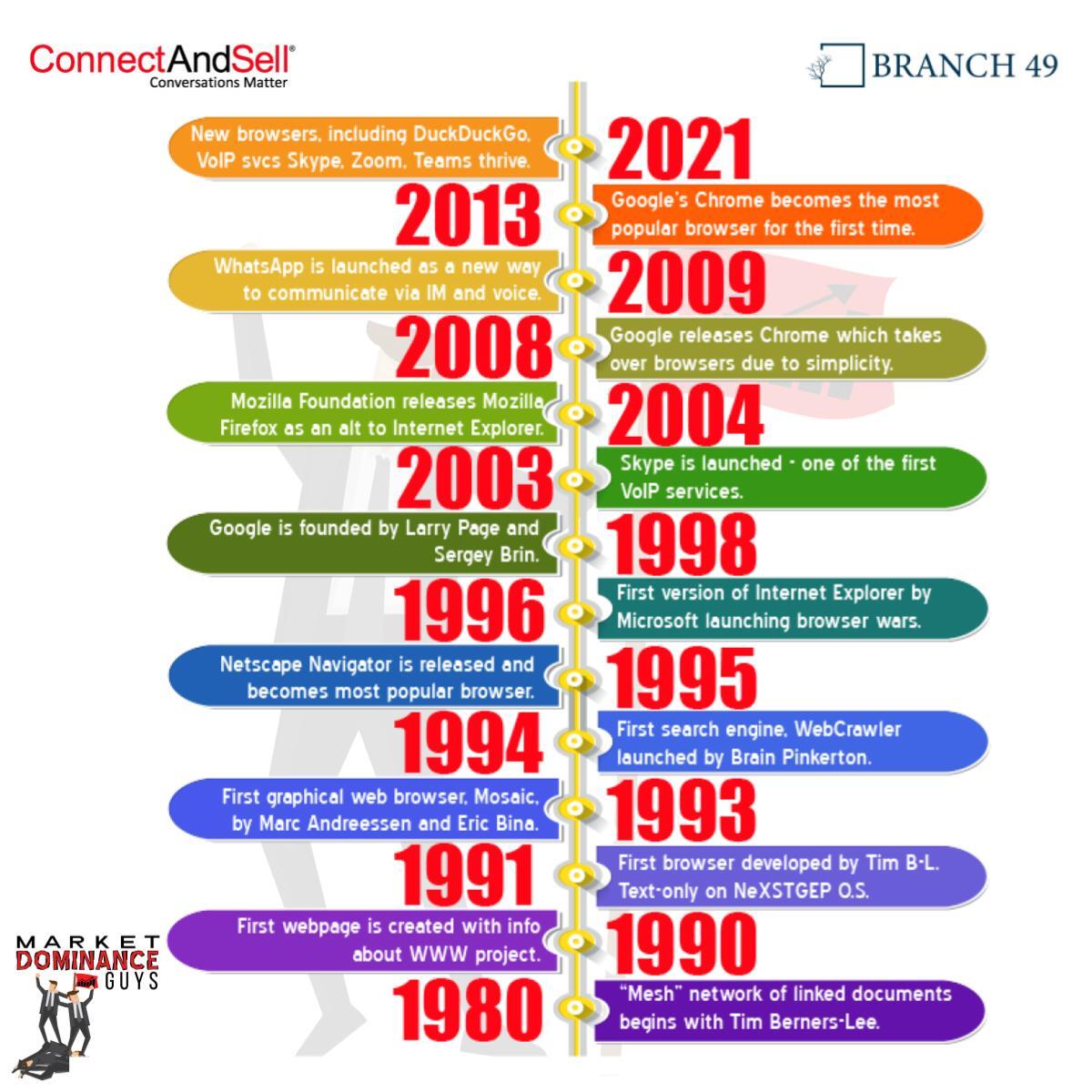
S5 Ep 175EP175: How ChatGPT Can Improve Sales Enablement
In this episode of the Market Dominance Guys podcast, Chris, Corey and Helen Fanucci discuss the evolution of the internet, from its early days as a way for messages to move across networks to the democratization of global information through the browser and search engines. They also explore the capabilities of ChatGPT, including its ability to generate email responses and interact with customers using personalized prompts. They highlight the potential of ChatGPT to save time and improve the quality of communication for sales professionals. Join us for this idea-filled episode, "How ChatGPT Can Improve Sales Enablement." Four ideas on how sales professionals can benefit from using ChatGPT for follow-up: Personalized Follow-Up: ChatGPT can help sales professionals create personalized follow-up messages for each customer based on their preferences, interests, and past interactions with the sales team. ChatGPT can analyze the customer's conversation history and provide personalized responses that feel like a human wrote them. Lead Nurturing: ChatGPT can help sales professionals nurture leads by sending automated follow-up messages to potential customers at regular intervals. These messages can be customized to meet the specific needs of each customer, making it easier to keep them engaged with the sales process. Schedule Meetings: ChatGPT can help sales professionals schedule meetings with potential customers by automating the process of finding a mutually convenient time to meet. This can save the sales team a lot of time and effort by eliminating the need to go back and forth with customers trying to find a suitable time. Provide Instant Customer Support: ChatGPT can be used to provide instant customer support to customers who have questions or concerns about a product or service. Sales professionals can use ChatGPT to respond to these inquiries in real-time, providing customers with the information they need to make a purchasing decision. This can help increase customer satisfaction and improve the chances of closing a sale. The Evolution of the Internet and Digital Communications 1960s: The concept of hypertext is introduced by Ted Nelson. 1980: Tim Berners-Lee develops the idea of a "mesh" network of hyperlinked documents and begins working on the WorldWideWeb (WWW) project. 1990: The first web page is created by Tim Berners-Lee. It contains information about the WWW project and how to use a web browser. 1991: The first web browser, called WorldWideWeb, is developed by Tim Berners-Lee. It was a text-only browser and was only available on the NeXTSTEP operating system. 1993: The first graphical web browser, called Mosaic, is released by Marc Andreessen and Eric Bina. It was a huge success and helped to popularize the web. 1994: The first search engine, called WebCrawler, is launched by Brian Pinkerton. It was the first search engine to index entire web pages rather than just titles and headings. 1995: Netscape Navigator is released by Netscape Communications Corporation. It becomes the most popular web browser and sets the standard for web browsing features. 1996: The first version of Internet Explorer is released by Microsoft, marking the beginning of the "browser wars" between Microsoft and Netscape. 1998: Google is founded by Larry Page and Sergey Brin. Their search engine quickly becomes the most popular and sets a new standard for search technology. 2003: Skype is launched, becoming one of the first and most popular VoIP (Voice over Internet Protocol) services. 2004: Mozilla Firefox is released by the Mozilla Foundation as an open-source alternative to Internet Explorer. 2008: Google releases the first version of the Chrome browser, which quickly becomes popular due to its speed and simplicity. 2009: WhatsApp is launched, providing a new way for people to communicate via instant messaging and voice calls over the internet. 2010: Microsoft releases Internet Explorer 9, which is considered a major improvement over previous versions. 2013: Google's Chrome becomes the most popular web browser, surpassing Internet Explorer for the first time. 2021: The current versions of popular web browsers include Google Chrome, Mozilla Firefox, Apple Safari, Microsoft Edge, and Opera. Popular search engines include Google, Bing, Yahoo, and DuckDuckGo. VOIP services like Skype, Zoom, and Teams have become critical tools for remote communication in response to the COVID-19 pandemic. The Worldwide Web continues to evolve and expand, with new technologies and innovations being introduced regularly. 2022: ChatGPT from OpenAI.com takes the world by storm and changes how we write and communicate forever. Full episode transcript below: ----more---- Chris Beall (00:00): Internet is a funny thing because when it was being built by some people, I won't mention any of them, back in the late, very late seventies and early eighties, it was really just a way for basically for messages to move across networks that were interconnected.
S5 Ep 174EP174: Boosting Website Traffic with Cold Calls
Welcome to another episode of Market Dominance Guys! In this third installment of our Road Trip visit series, we join Helen Fanucci and the team at Branch 49 as they discuss trust-building, gratitude, and top-of-the-funnel strategies. Helen Fanucci shares her experiences with cold calls while using ConnectAndSell, adjusting her approach to engage prospects effectively. Her customized calls-to-action cater to each prospect's unique needs, leading to successful completions even when the prospect isn't the right person or ready for a meeting. The experts also explore the value of cold calls in generating website traffic, comparing it to targeted Google ads. The conversation emphasizes the power of trust in maintaining lasting relationships, highlighting that trust endures indefinitely, provided it's not undermined by sales pressure. Join them for this episode, "Boosting Website Traffic with Cold Calls." Links from this episode: Branch 49 Sean Snyder on LinkedIn Corey Frank on LinkedIn Microsoft Helen Fanucci on LinkedIn Helen's book, Love Your Team ConnectAndSell Chris Beall on LinkedIn Chris and Corey's book, Market Dominance: A Conversation with ChatGPT Full episode transcript below: ----more---- Announcer (00:06): Welcome to another session with the Market Dominance Guys, a program exploring all the high stakes, speed bumps, and off ramps of driving to the top of your market. With our host, Chris Beall from ConnectAndSell, and Corey Frank from Branch 49. Welcome to another episode of Market Dominance Guys. In this third installment of our Road Trip Visit series, we join Helen Fanucci and the team at Branch 49 as they discuss trust-building, gratitude, and top-of-the-funnel strategies. Helen shares her experience with cold calls while using ConnectAndSell, adjusting her approach to engage prospect effectively. Her customized calls to action cater to each prospect's unique needs, leading to successful completions, even when the prospect isn't the right person or ready for a meeting. The experts also explore the value of cold calls in generating website traffic, comparing it to targeted Google Ads. The conversation emphasizes the power of trust in maintaining lasting relationships, highlighting that trust endures indefinitely, provided it's not undermined by sales pressure. Join them for this episode, Boosting Website Traffic With Cold Calls. Corey Frank (01:19): I love the concepts of gratitude reciprocates. And were you thinking the same thing? The fact that part of the challenge that we have, and an agency model like us at Branch 49, but I think this is endemic to, if you were a qualifier or an SDR or a Microsoft and you took that lead from that person and you threw it over the fence to your AE, they have the notes to read. And maybe they'll give you a call, "Helen, tell me about this one," but most of the time that never happens. They're just going off of the notes and maybe they'll be intimidated by the title. Maybe they'll be surprised that, "You actually got ahold of so-and-so? Oh my gosh, this is great." And they're going to go through their own emotional machinations about how I should prepare and relax because now I'm going to be under pressure in this discovery call. (02:04): And we always talked about, Chris, that the natural state of somebody in a cold call is fear. And the natural state, something they came up with a few months ago, the national state of somebody in a discovery call is that one of apprehension. Because I'm about to get sold something and I'm not quite sure if they're going to use the Ivanov gambit opening move or they're going to use the Belarusian gambit to come off from the ... what are they going to do? But I know it's coming. It's interesting to diffuse that by saying, "I know I'm an interruption, [inaudible 00:02:40] thank you. First off, before we get started, I just wanted to thank you for talking with my colleague, Helen." So is that a hot tub epiphany as well, because I really like that. I think that could be very powerful for starting a discovery. Chris Beall (02:55): Yeah, I think it'd be amazing in discovery. It'd be amazing for a follow-up call. It actually harmonizes follow-up calls and discovery calls, even though the follow-up call is always an ambush. Never forget on the other side of an ambushed, they're always in the same emotional state. I want to get off this call with my self-image intact. You have an animal in that state 100% of the time. Unless you call me, in which case I answer cold calls by going, "Great, I have a cold call here. I get a chance to make a sales rep's day." Not very many people- Corey Frank (03:31): That's empirical evidence of what your cold call picker-upper score is. Chris Beall (03:34): It's pretty good. My best phone number scores 94 out of 100 and I'm pretty busy most of the time. That's not pretty good. Helen Fanucci (03:42): But you also ambush everybody or you boomerang everybody. Chris Beall (03:46): I have been known to point o
S5 Ep 173EP173: What Do a Fitbit and Surfboard Have in Common with Cold Calling?
As our Market Dominance Guys continue this road trip book signing tour with Helen Fanucci, Chris emphasizes the significance of practicing sales conversations in order to become a high-performance salesperson, with the script being the key to unleashing creativity in sales. Helen tells the story of her experience cold-calling using ConnectAndSell, a script, and how it affected her Fitbit. Additionally, Chris talks about the energy transfer that takes place in a sales conversation, and how BDRs need to provide energy but also listen carefully to the emotional response of the prospect. Helen shares her experience of working with a coach and learning from the best in the world to improve her sales skills, and the importance of being objective about oneself to become a great salesperson. This episode provides valuable insights on how to engage customers effectively to build lasting relationships. As Chris says, "You are a performance athlete with your voice. That's what you are. That's what you have to work with." Join us for this episode, “What Do a Fitbit and Surfboard Have in Common with Cold Calling?” About Our Guest Helen Fanucci, Transformational Sales Leader at Microsoft is the author of Love Your Team: A Survival Guide for Sales Managers in a Hybrid World. Helen's book is available on Amazon: LOVE YOUR TEAM A SURVIVAL GUIDE for Sales Managers in a Hybrid World Helen Fanucci on LinkedIn Corey and Chris' book is also available on Amazon: Market Dominance: A Conversation With ChatGPT Corey Frank on LinkedIn Chris Beall on LinkedIn ConnectAndSell Branch49 Full episode transcript below: ----more---- Helen Fanucci (00:01): So that's what I got. Any questions or Corey? Anything that, Corey Frank(00:05): Well, I want to go back to the cold call. Helen Fanucci (00:07): Alrighty, let's go for it. Chris Beall (00:09): Me too. Me too. I like that. Corey Frank(00:11): Chris, since you and Helen originally met, there was no, I think you met at a conference where it was very clear that this person was the ConnectAndSell. Helen Fanucci (00:22): Yeah. Corey Frank(00:22): And that was what, four years Helen Fanucci (00:24): Ago almost? Yeah. Corey Frank(00:25): So from a sales cycle, Chris, what I'm looking for is like the forecast. Did you keep that? You're married now and you're most of the time in the same household when you're not traveling. But it took until last week to close the deal for her to actually use ConnectAndSell. Chris Beall (00:43): Well, I've prioritized which deal I was trying to close. Oh see. And I did a pretty good job on the first deal. I believe I was two days into the sales cycle and did okay on what she calls the proposition and I call it proposal. I see. So that one I prioritized. It brings up a good point though, and b2b. So this isn't a B2B sale, although it kind of is. I mean in a way because she was calling us as Microsoft, right? And Microsoft's not the easiest company in the world to get to do business with you. I went to Fargo, North Dakota and a December day a few years ago thinking we were going to get a test drive, a free test, drive up Microsoft. After seven hours there we walked out and had a nice dinner after the weirdest, coldest, slipperiest, Uber ride I've ever been on. Chris Beall (01:31): And a truck that we had to climb up into and no test drive. So here we are. You want to see a long sales cycle. That was quite a while ago. Yeah, that's the Microsoft sales cycle. But when b2b, the replacement cycle for pretty much everything is three years. That's kind of like if you bought one, whatever it is, you're not going to buy another one of those for three years. Think about it. You're in a company, you're the one who wants X, Y, or Z to help the company do its thing better. Are you going to come back the next quarter to your board, to the committee and say, oh, just kidding, that thing that we just bought X that out. Let's get a different one. Right? Doesn't go like that. You might do that as a consumer on occasion, but think of it more like buying a car as a consumer. Chris Beall (02:18): You're probably going to keep the car for three years, four years, or in my case 24 years with my big red Ford excursion, which Helen thinks is a bit of an eyesore and dangerous. Other than that, it's all right. So think of it as a three year cycle. Now, the consideration cycle for a product, a category of product is about a quarter. So the products that give you intent, like Bombora 6 cents, and I guess LinkedIn's doing it now and ZoomInfo is doing it, they actually have their intent window generally set at seven days. That is if you learn that a company is spiking in looking at a particular category, you got seven days to get in there according to experts who sell that stuff. So think about that, how tough that would be. So you start calling on day one, how long is it going to take before you actually have a conversation with somebody and at some point they're out of cycle. Chris Beall (03:13)
S5 Ep 172EP172: Intentional Choices: Mapping Out Your Sales Career
In this episode of Market Dominance Guys, author Helen Fanucci joins Chrisand Corey. Helen suggests that when thinking about the first job, you should consider the industry you want to work in, as it can set you up for future success. For instance, sales tech is a great industry for those passionate about sales and technology, while cybersecurity is growing rapidly due to the increasing sophistication of hackers. The importance of building your network is another crucial aspect of a successful career, as it can provide exposure to others' work and broaden your horizons. Helen emphasizes the need to develop a point of view and post original content on LinkedIn to distinguish yourself. Helen also stresses the need for continuous learning and growth in our role. By intentionally meeting people in other parts of the business and getting exposure to their work, one can learn and grow. Join us for this episode, "Intentional Choices: Mapping Out Your Sales Career." About Our Guest Helen Fanucci, Transformational Sales Leader at Microsoft is the author of Love Your Team: A Survival Guide for Sales Managers in a Hybrid World. Links for this episode: Helen Fanucci on LinkedIn Corey Frank on LinkedIn Chris Beall on LinkedIn ConnectAndSell Branch49 Full episode transcript below: ----more---- (00:43): The importance of building your network is another crucial aspect of a successful career because it can provide exposure to others' work and broaden your horizons. Helen emphasizes the need to develop a point of view and post original content on LinkedIn to distinguish yourself. Helen also stresses the need for continuous learning and growth in our roles. By intentionally meeting people in other parts of the business and getting exposure to their work, we can all learn and grow. Join us for this episode, Intentional Choices; Mapping Out Your Sales Career. Corey Frank (01:19): Welcome to another episode of The Market Dominance Guys on tour, the roadshow episode with Corey Frank and of course, the sage of sales, prosperous prosperer, the Hawking of Hawking and the prophet of profit. Chris Beall (01:34): That's it. Corey Frank (01:35): Right? Here we are at the HQ and the home base mothership of Branch 49 with our Branch 49 team on Taco Friday, not Taco Tuesday. We do not like alliteration. We're against all kinds of alliteration here at Branch 49, so it's Taco Friday and we are here with Miss Helen Fanucci and of course, the fetching spouse of the also famously fetching Tom Cruise of sales, I forgot that one that we talk about too, Chris Beall. Helen, of course as most folks know from our previous episode, is a Microsoft leader with 15 years of experience at Microsoft. Runs the customer success team 10 years over at Sun Microsystems and went to a little college called Massachusetts Institute of Technology at the degree in mechanical engineering. We're pleased to have Ms. Fanucci here talk certainly about her most recent bestselling book, Love Your Team, and to impart her wisdom with some snide commentary from Chris Beall and of course myself here along the way. So with that, Helen, welcome to the roadshow edition of Market Dominance Guys. Helen Fanucci (02:38): Great. Thanks, Corey. I appreciate it. Hi everybody. Nice to see you again. So as Corey said, I am at Microsoft. I've been at Microsoft almost 15 years, and mostly in the sales capacity, the in sales teams. I've hit quotas of over a billion dollars, well over a billion dollars, in excess of actually, one year, over 30 billion, but that's a whole nother story. As Corey said, I recently completed and launched this book, Love Your Team: A Survival Guide for Sales Managers in a Hybrid World, and it's been super successful and well received, and in fact, there's some CEOs who are making it required reading for their whole management team, not just sales management as well as venture capitalists, so that's been super exciting. But how did I get here? So I graduated from MIT with a degree in mechanical engineering in 1982, and back then, frankly, there weren't many women graduating with any engineering degree. (03:48): When I was graduating, I had job offers from like nine companies in different industries; oil and gas, consumer goods, companies like Chevron, Procter & Gamble, Boeing Aircraft Company, and I decided to take a job... I was drawn to high tech, so I made a deliberate decision to go with an industry that I thought had a future, and as it turned out, high tech's been pretty good to me. I got a job working for IBM in Silicon Valley as a mechanical engineer, manufacturing engineer in thin-film heads, which are the heads that read really big disc drives that attached to mainframes that used to be the state-of-the-art in tech at that time. I was in that job for a year or so, and I really decided that so much was happening in Silicon Valley that I wanted to make a transition from engineering into marketing or sales because I wanted to be out in front of customers helpi

S5 Ep 171EP171: From Cold Calling to AI: How Sales is Evolving with Technology
In this episode, Gerhard Gschwandtner compares ChatGPT to a painter's palette with an infinite amount of colors, and salespeople are the artists who must decide how many colors to use and when the painting is finished. The hosts discuss the role of technology in sales and how salespeople can use ChatGPT to harness its intelligence to make more informed decisions. Chris describes a practical example of how he used ChatGPT for list creation for a company called Partner Tap. He was able to ask it about the specific job titles used in senior roles in companies and generate a table of titles for each company. Gerhard suggests that salespeople can tap into their internal ChatGPT to discover great ideas and pursue meaningful work. Chris mentions how they are exploring the use of ChatGPT in developing a new data product and using it to summarize the best conversations that set a meeting with different types of executives. Key points from this portion of the episode include the power of ChatGPT in harnessing technology to make more informed decisions in sales, the importance of pursuing meaningful work, and the potential for ChatGPT to be used in various aspects of sales, from list creation to conversation summaries. Corey reminds us, "You have to be willing to put in that work, do your research and know that it's going to take time. It's not going to happen overnight. It's really about understanding who your customer is and what they care about." Key points from this episode: ChatGPT can be used in various aspects of sales, such as list creation and conversation summaries. Salespeople can use ChatGPT to harness its intelligence and make more informed decisions. Pursuing meaningful work can lead to greater happiness and success in sales. The better the "why" behind what you are doing in sales, the easier the "how" will be. Prompt engineering is a method for developing ChatGPT responses that require careful consideration of the language and wording used in prompts.

S5 Ep 170EP170: Sales Energy: The Importance of being an omnichannel salesperson
Chris Beall and Corey Frank welcome Gerhard Gschwandtner, the CEO of Selling Power and an advocate for non-verbal sales communication. Gerhard emphasizes the importance of being aware of one's own energy, as sales is a transfer of energy. They talk about the challenge of losing cultural underpinnings when not being on-site with customers and how finding the right connections that can help you learn and grow is important in gathering energy. Chris, Corey, and Gerhard's experiences and insights provide valuable lessons for salespeople and individuals looking to improve their energy and become their authentic selves. They emphasize the importance of being aware of one's energy, using technology as a natural extension of oneself, finding the right connections to learn and grow, taking action and engaging with the world to build self-discovery, and accepting mortality to improve energy and focus in this episode of Market Dominance Guys, "Sales energy: The Importance of being an omnichannel salesperson." Full episode transcript below: ----more---- (00:23): Chris and Corey welcome Gerhard Gschwandtner, the CEO of Selling Power and an advocate for nonverbal sales communication. Gerhard emphasizes the importance of being of one's own energy, as sales is a transfer of energy. They talk about the challenge of losing cultural underpinnings when not being on site with customers and how finding the right connections that can help you learn and grow is important in gathering energy. (00:47): Chris, Corey, and Gerhard's experiences and insights provide valuable lessons for salespeople and individuals looking to improve their energy and become their authentic selves. They emphasize the importance of using technology as a natural extension of yourself, finding the right connections to learn and grow, taking action and engaging with the world to build self-discovery, and accepting mortality to improve energy and focus. In this episode of Market Dominance Guys, sales energy, the importance of being an omnichannel salesperson. Corey Frank (01:25): And we are off once again. Welcome to another episode of the Market Dominance Guys with the sage of sales, the prophet of profit, the hawking of hawking, Chris Beall, and of course yours truly, Corey Frank. We've had a lot of guests. Not going to embarrass a Gerhard a little bit, but I don't think there's many guests that we've had in 170+ episodes, Chris, where I actually had pictures on my wall as a young aspiring sales rep of the product of Gerhard's here. So we'll welcome Gerhard Gschwandtner, the CEO, founder, sales thought leader extraordinaire for, gosh, a lot of years, probably back since, what, 1980 or so, I think, Selling Power has been around, right, Gerhard? (02:09): So welcome to the Market Dominance Guys, thrilled to have you. Of course, Gerhard, not only Selling Power and thought leader, one of the original members, the OGs of the Sales Enablement Society, and I think the founder of probably the most timely conference in our profession today, Sales 3.0 up in Vegas, usually it's where it's, right? So welcome, Gerhard. Chris, what did you have to bribe, promise, cajole Mr. Gschwandtner here to get him to come back again? Once wasn't enough, back again to our humble little podcast here. Chris Beall (02:43): Well, I promised him I would actually burn a copy of the rules of golf on the first tee the next time we play so that there is no evidence of the existence of the rules of golf. Because he placed by his own rules that involve enjoyment, and I just don't want to get in the way. So that was my bribe. Gerhard Gschwandtner (02:59): I second that, because I will not allow official PGA rules to interfere with my natural excellence. Corey Frank (03:10): Well, those are live rules, I think, right? You prefer the live rule book, I think is, it's a whole new addendum to the old PGA stodgy rules. So how did a physicist and a sales thought leader here, how did you guys even stumble across each other? Is it pre-Connect and Sell? Is it during Connect and Sell? Let's talk a little bit about that. Chris Beall (03:28): Oh gosh, Gerhard, do you recall how we met? Because I do. You probably don't. Gerhard Gschwandtner (03:33): I probably don't. Chris Beall (03:35): Boston, I think 2011, very, very early on in my career at Connect and Sell, and it was a Sales 2.0 ... Gerhard Gschwandtner (03:43): Sales 2.0 conference. Chris Beall (03:44): And we were sponsoring, Connect and Sell was sponsoring. We had met and chatted a little bit, but the shocking thing was, I was about to present in a breakout. And back then breakouts would have some people in them. I think I remember counting something like 87 people in this breakout, and I always count the people in a breakout. Whether I've ever told you this or not, I'm a former card counter. So I have this thing about counting things. So I count these 87 people, and I'm about to go up on stage, or in front of them, it wasn't an actual stage. And Gerha

S5 Ep 169EP169: How ChatGPT is Writing a Book: The AI and Human Collaboration
In this episode of Market Dominance Guys, Chris Beall, and Susan Finch discuss their experience using ChatGPT to write a book based on their podcast, and the benefits of using AI to create content. They delve into the limitless possibilities of machine learning, natural language processing, and computer vision, and how they are transforming various industries. Chris and Susan also share their insights on the process and the excitement of seeing the AI learn and improve. Chris and Susan talk about how ChatGPT can generate various versions of a prompt, and the different approaches they took to refine their requests for better results. They also reflect on the human-like interactions they had with ChatGPT, and the Eliza effect that makes people treat the AI as if it were a person. Ultimately, they highlight the efficiency and creativity that AI can bring to content creation, and the potential for using ChatGPT to write more books in the future. Tune in to hear their fascinating discussion on the intersection of AI and writing in this episode, "How ChatGPT is Writing a Book: The AI and Human Collaboration." Full episode transcript below: ----more---- (00:24): In this episode of the Market Dominance Guys, Chris Beall and Susan Finch discuss their experience using ChatGPT to write a book based on their podcast, and the benefits of using AI to create content. They delve into the limitless possibilities of machine learning, natural language processing, and computer vision, and how they're transforming various industries. Chris and Susan also share their insights on the process and the excitement of seeing the AI learn and improve. They talk about how ChatGPT can generate various versions of a prompt and the different approaches they took to refine their request for better results. They also reflect on the human-like interactions they had with ChatGPT, and the ELIZA Effect that makes people treat the AI as if it were a person. Ultimately, they highlight the efficiency and creativity that AI can bring to content creation and the potential for using ChatGPT to write more books in the future. Tune in to hear their fascinating discussion on this intersection of AI and writing. (01:23): In this episode of Market Dominance Guys, how ChatGPT is writing a book, the AI and Human Collaboration. Chris Beall (01:33): So Susan, you and I did something remarkable that started, I believe, with your own work using ChatGPT in a podcasting setting, right? Susan Finch (01:47): Right. Chris Beall (01:47): A podcasting setting, about a week, 10 days ago, something like that, you were doing some experimentation. I was getting ChatGPT up by various people, including some very interesting people at my wife's company where she works, a little company called Microsoft, seems to be very interested in this area. And it occurred to me, based on your work, that we could maybe take the Market Dominance Guys podcast and turn it into a book written by ChatGPT. (02:19): But first, how about, how did you get started with this? What stimulated you to go all AI? Didn't you used to own an art gallery or something like that? People who own art galleries don't go all AI on us like this. That's for crazy techy people and guys like Austin and me. So what's up? Susan Finch (02:35): When Austin first brought up ChatGPT to me say, "Well, try this, try that," and I love the idea of creating on the fly, and to challenge it and to ask variations of the same questions to see what the difference would be. It was like a game and a creativity experiment at the same time. So I loved that. And I was really surprised though at how much of a variation you could get just by tweaking a couple of phrases, or as you and I experimented over the weekend, by lumping the aspects of the query properly. I am known to have misplaced modifiers in my writing, and some lines have to be edited. So my queries were the same, and when I tightened it up, the results were so different and so much more enjoyable. It was a lot of fun. I mean, I love to create. I have to create every day, or I am bored and miserable. So every day, I have to create something, and this gives me an outlet and saves me some time for the grunt work, and then I can go back and refine it how I want. Chris Beall (03:41): Well, it's really something. So what did you apply it to first? Clearly, not Market Dominance Guys. You were doing something with another podcast, right? Susan Finch (03:48): I was doing something for Asher Sales Sense, because John Asher interviewed Judy Schramm, and Judy Schramm was talking about ChatGPT and the ways that it could be used for marketers, or some of the ways, I should say. There's no way it could be all the ways. And she had some great ideas though on how to apply it to your LinkedIn profile and how to define the audiences. "Who do you want this to appeal to? Who is the goal?" So I thought, "I'm going to start playing with my own." So I started to do that right there. And because in t

S5 Ep 168EP168: Get Granular to Boost Your Sales Performance
Welcome to the continuation of a conversation with Hitesh Shah, CTO and CPO of ConnectAndSell. This episode delves into the world of sales and coaching for sales managers. Hitesh shares his experience and insights on coaching by the numbers and how to effectively manage and coach a sales team. Corey and Chris share their thoughts on how to analyze sales data and determine the strengths and weaknesses of individual sales reps. They stress the importance of getting granular with data and looking at it with a critical eye. By understanding the patterns and details of sales interactions, sales managers can take the necessary steps to help their reps improve and drive better results. Chris also offers his advice for new sales managers on how to stay up-to-date with fast-moving sales trends and how to effectively manage a sales team in a fast-paced environment. He suggests starting the day by looking at sales data and focusing on the critical details of sales interactions. So whether you're a seasoned sales manager or just starting out, join us for this exciting episode as Chris, Corey and Hitesh help you take your sales management, training, and sales skills to the next level in this episode, "Get Granular to Boost Your Sales Performance". If you missed the first half to this interview, you can listen here: The Power of Childlike Curiosity in the Digital World of Sales Full episode transcript below: ----more---- (00:24): Welcome to the continuation of a conversation with Hitesh Shah, the CTO and CPO of ConnectAndSell. This episode delves into the world of sales and coaching for sales managers. Hitesh shares his experience in insights on coaching by the numbers and how to effectively manage and coach a sales team. Cory and Chris share their thoughts on how to analyze sales data and determine the strengths and weaknesses of individual sales reps. They stress the importance of getting granular with the data and looking at it with a critical eye. By understanding the patterns and details of sales interactions, sales managers can take the necessary steps to help their reps improve and drive better results. (01:01): Chris also offers his advice for new sales managers on how to stay up to date with fast-moving sales trends and how to effectively manage a sales team in a fast-paced environment. He suggests starting the day by looking at sales data and focusing on the critical details of sales interactions. So whether you're a seasoned sales manager or just starting out, join us for this exciting episode as Chris, Corey and Hitesh help you take your sales management, training and sales skills to the next level. In this episode, get granular to boost your sales performance. Corey Frank (01:38): We had a great conversation the other day informally talking about your cataloging experience, Hitesh and Chris, and we were talking about the, and I'm going to butcher it, was that the items lead you to the category. The category doesn't lead you to the items. It's very easy when you're trying to deduce causation versus correlation. We've had a number of conversations about this, but when you have, let's take a real-world problem, how do you determine if the items that data is leading to a category challenge or is the category going to lead you to, it never leads you to the items I believe that you had said. Maybe you can clean up that butchering of your nuggets of wisdom that I just fed back to you. Chris Beall (02:19): Well, it's pretty good. You just got 12 of my patents right there. Hitesh, what are your thoughts about this? You and I have both built a lot of classification systems that do automated or semi-automated classifications, all with at some point with humans in the loop either early, middle, or late or cleanup. You did it in the world of jobs at a level that nobody had ever done before, figuring out how to match people to the jobs that are out there in the world. I've done it in the world of products and parts also. Hitesh Shah (02:55): When you think about what Corey just said. I think the most interesting example that comes to my mind is coaching by the numbers, Chris, in terms of dispositions. So Corey, in ConnectAndSell world, every call is disposed with a disposition. What happened. I got a referral, I got wrong target. The person is not interested. Right timing. Not me. Talk to somebody else or whatever. Chris started noticing this very peculiar pattern where interests and information would suddenly start dominating your disposition pie chart. (03:26): So we a have pie chart which shows what's the spread of your dispositions, and it turns out that people who are not very good at communicating a value prop or are super nice on the phone, so you don't feel like blowing them off, you don't feel like telling them off. But at the same time, they don't give you a compelling enough story or a pitch for you to say, "Yes, I want to learn more." (03:45): So guess what? The easiest thing to point to is, "Send me some info

S5 Ep 167Ep167: The Power of Childlike Curiosity in the Digital World of Sales
So, what's the biggest challenge in sales? Today, the guys have a special guest, Hitesh Shah, CTO and CPO of ConnectAndSell. As Hitesh puts it, it's the fact that we don't like to be sold to. That's why sales is about helping, not selling. And if you want to succeed in sales, you have to understand who your target audience is and what their business problems are. You have to start at the bottom and work your way up, building relevance and trust with each person you talk to. Hitesh says there are two things, one is always trying to understand what happened. And, when it goes against your instinct - what did you expect it to do? Be open to the possibility that you may have missed something. Corey says that this requires a level of humility that doesn’t exist in high quantities in sales, even though it should. One of the things these three have learned over the years is that when something starts working when it shouldn't, it can be scary. But in the digital world, everything is deterministic. There are causes and effects, and there's no such thing as waiting or hoping that something fixes itself. As Hitesh puts it, you have to have a childlike curiosity and naivete, especially in the digital world where computers are deterministic. Join us for this episode of Market Dominance Guys, “The Power of Childlike Curiosity in the Digital World of Sales” Full episode transcript below: ----more---- Announcer (00:06): Welcome to another session with the Market Dominance Guys, a program exploring all the high stakes, speed bumps and off-ramps of driving to the top of your market with our host Chris Beall from ConnectAndSell, and Corey Frank from Branch 49. (00:21): So what's the biggest challenge in sales? Today the guys have a special guest, Hitesh Shah, CTO and CPO of ConnectAndSell. As Hitesh puts it's the fact that we don't like to be sold to. That's why sales is about helping, not selling. And if you want to succeed in sales, you have to understand who your target audience is and what their business problems are. You have to start at the bottom and work your way up building relevance and trust with each person you talk to. And when things don't go your way, Hitesh says there are two things. One is always try to understand what happened and when it goes against your instinct, what did you expect it to do? Be open to the possibility that you might have missed something. (01:03): Corey says that this requires a level of humility that doesn't exist in high quantities in sales, even though it should. One of the things these three have learned over the years is that when something starts working when it shouldn't, it can be scary. But in the digital world, everything is deterministic. There are causes and effects, and there's no such thing as waiting or hoping that something fixes itself. As Hitesh puts it, you have to have a childlike curiosity and naivete, especially in the digital world where computers are deterministic. Join us for this episode of Market Dominance Guys, the power of childlike curiosity in the digital world of sales. Corey Frank (01:44): Excellent. Hey, here we are. Welcome to the Market Dominance Guys, with Corey Frank and Chris Beall. Chris, we got a new one for you, right? As we talked about the other day, we have the sage of sales, the prophet of profit, the Hawking of hawking, and the Tom Cruise of outbound calling. Chris Beall (02:00): That's so embarrassing. Corey Frank (02:02): Well, hey, I said it just like you wrote it, right? The Tom Cruise of outbound calling I think it was. Well, if that's the case, well, it's good to have you, Chris. We have a very special guest, internally inside those four virtual walls of ConnectAndSell, the brains behind all of the effort and engineering and all of your good ideas, the origins of all your good ideas probably over the years, Hitesh Shah, who I would say is maybe not the Tom Cruise, the Amitabh Bachchan of ConnectAndSell of outbound calling. (02:31): So welcome, Hitesh. It's long overdue to actually have you here on the Market Dominance Guys podcast. Hitesh Shah (02:37): Thank you. Glad to be here, Corey. Corey Frank (02:39): I don't think we have any episodes, Chris, one of these days we got poll between the two of you, a legacy version of Clipmedia. Because for ladies and gentlemen in the audience, I am on the phone here, we're on the podcast with Chris Beall and Hitesh, who are the inventors, the co-founders of Clipmedia, an old product that is the precursor to, man, all things Zoom, all things GoToMeeting. If we would've only stuck with that product 15 years ago, holy cats, 20 years ago it's been around. Chris Beall (03:11): Yeah, it is. Corey Frank (03:11): What do you think, Chris? Can you dust that off? Yeah. Chris Beall (03:14): Yeah. Hitesh and I met at a company that a venture capitalist asked me, a very good friend who had actually worked with me at one company back when he was an operator, and he asked me to take a look at this company. Woul

S5 Ep 166EP166: The Sales Cycle: Lengthening is Not Always a Bad Thing
In part two of this series, Barry Trailer, Chris and Corey bring a touch of humor to the conversation on the topic of sales and how it relates to the corporate business world today. Barry emphasizes the importance of establishing and elevating relationships over time, stating that sales isn't about predicting anything but rather bringing people together. He compares the unpredictability of sales to the unpredictability of a baseball game, where even the best players are out 70% of the time. Chris Beall adds that the desire for predictability is a universal human desire, but sales is about doing things that have a reasonable shot of bringing people together so that problems can be solved that would otherwise be left unsolved. There is even a reference to fortune tellers, who are able to convince people to believe in the impossible. They guys agree that while the game of sales has not changed, the tools available to do it have improved, and the ability to access and share information has greatly increased, making sales performance level much higher today than in the past. If you haven't listened to the first half of this series, we highly recommend you to check it out, "The Scarcest Commodity in Corporate Business Today.” Full episode transcript below: ----more---- Announcer (00:06): Welcome to another session with the Market Dominance Guys, a program exploring all the high stakes, speed bumps and off ramps of driving to the top of your market, with our hosts, Chris Beall from ConnectAndSell, and Corey Frank from Branch 49. (00:22): In part two of this series, Barry Trailer, Chris and Corey bring a touch of humor to the conversation on the topic of sales and how it relates to the corporate business world today. Barry emphasizes the importance of establishing and elevating relationships over time, stating that sales isn't about predicting anything, but rather bringing people together. They compare the unpredictability of sales to the unpredictability of a baseball game, where even the best players are out 70% of the time. Chris adds that the desire for predictability is a universal human desire, but sales is about doing things that have a reasonable shot of bringing people together so that problems can be solved that would otherwise be left unsolved. There's even a reference to fortune tellers who are able to convince people to believe in the impossible. Listen to this episode of the Market Dominance Guys, The Sales Cycle: Lengthening Is Not Always A Bad Thing. Barry Trailer (01:19): Now, I'll just say this. It took me a while to get to this place, and I think it's worth saying. Way back when, when I was at Oracle giving that talk, one of the things that I was saying then and still say is, "I think business is just an excuse for us all to hang out together." And people would hear that and they'd say, "Oh, you really are from California." And it wasn't until I was invited into Salesforce around 2015 to give a talk on innovation that I came up with a second part of that, which is, "Hang out together to do what?" And I think the answer is to do good, to make this a better place, to establish and elevate relationships over time. That's our definition of selling. And if you can make a difference, if you can connect folks, add value, move this thing along, I think that's a job worth doing. Corey Frank (02:16): For sure. No, that's beautiful. I like that a lot. I think, Chris, you certainly in your team with the Flight School, to what Barry is talking about, you've probably been part of many organizations and many individuals that maybe have been in sales one year five times or one year three times. And all you do is teach him the basics of Flight School, that it's okay to have turbulence. It doesn't mean you did something wrong to have an objection or to have a stall. Maybe you talk a little bit about that and how it ties into what Barry's saying, because you see that I understand it now and I can actually fall in love with this profession after so many years of doing it poorly. Chris Beall (02:59): Yeah. Flight School's been interesting to me for a couple of reasons. One is I'm an educator by background. My degree is in education and physics. People tend to think of me as more the physics type, but then they go, "Well, how is it you do this other thing?" Well, sales and education are highly intertwined, both in the training part of sales, but also just in doing it. I mean, you're bringing people together. If they're not having new thoughts and they're not thinking about doing new things, no sale is going to occur. Corey Frank (03:27): There'd be no sale. Chris Beall (03:29): So, it's essentially an educational discipline in that sense. And it's also, and I've told you before, Corey, why I in this particular situation I'm in, I believe that sales done well is how we reduce the friction at the bottleneck of the innovation economy, and its innovations that allow us to live together peacefully. And so that's the essenc

S5 Ep 165EP165: The Scarcest Commodity in Corporate Business Today
Revealing the scarcest commodity in corporate business, especially in America today, first requires an understanding of how we got there. Today Barry Trailer, Co-founder of Sales Mastery, joins Chris and Corey. He reviews the four levels of process implementation: the percentage of revenue, the target revenue plan attained, the percentage of reps meeting or beating quota, the outcome of forecast deals, and rep turnover. These are real numbers. But higher levels of relationship and higher levels of process implementation lead to higher levels of performance. And the numbers are just the numbers They continued talking about the turnover. There's a huge contributory factor to the failure to implement significant change on the part of most sales organizations other than the change that a new leader brings in. What is common is that the new lion, so to speak, the new CRO, the new VP of Sales, comes in and kills the cubs. They attempt to prove that whatever was being done before must not be done anymore. Because I've come in with my new way of doing things and territory must be marked, I was brought in to do something in a new way, and away we go. When the performance isn't there, the CRO or the CSO takes the bullet that the CEO doesn't want to take. But the only reason is that there's been this unholy alliance or this unspoken agreement that as long as we make the numbers, you'll stay out of my sandbox. Listen to this episode to see where your company falls in place in, “The Scarcest Commodity in Corporate Business Today.” Full episode transcript below: ----more---- Announcer (00:06): Welcome to another session with the Market Dominance Guys, a program exploring all the high stakes, speed bumps, and off-ramps of driving to the top of your market, with our hosts, Chris Beall from ConnectAndSell and Corey Frank from Branch 49. (00:25): Revealing the scarcest commodity in corporate business, especially in America today, first requires an understanding of how we got here. Today, Barry Trailer, co-founder of Sales Mastery, joins Chris and Corey. He reviews the four levels of process implementation: the percentage of revenue, the target revenue plan attained, the percentage of reps meeting and beating quota, the outcome of forecast deals, and rep turnover. These are real numbers. But higher levels of relationship and higher levels of process implementation led to higher levels of performance, and the numbers are just the numbers. (01:00): What's common is that the new lion, so to speak, the new CRO or the new VP of sales, comes in and kills the cubs. They attempt to prove that whatever was being done before must not be done anymore. When the performance isn't there, the CRO or the CSO takes the bullet that the CEO doesn't want to take. But the only reason is that there's been this unholy alliance or this unspoken agreement that as long as we're making the numbers, you'll stay out of my sandbox. Listen to this episode to see where your company falls in place in The Scarcest Commodity in Corporate Business Today. Corey Frank (01:40): Here we are once again. Welcome to another episode of The Market Dominance Guys with Corey Frank and, as always, the sage of sales, the profit of profit, the hawking of hawking, Chris Beall. Chris, good to see you once again. How are you? Chris Beall (01:56): It gets me every time. I was just reading about a black hole, 600 billion suns, taking a chomp out of something every day, and thinking, "The hawking of hawking." I wish I could- Corey Frank (02:04): The hawking of hawking. I'll work on a fourth here. Give me a couple of beers, football games here, and we'll come up with something else. Right now, it'll have to stay at the hawking of hawking. With us today, we have Mr. Barry Trailer. If you don't know Barry and his organization, Sales Mastery, he's been at the epicenter. He's the Kevin Bacon of sales, thought leadership, I think, probably for the last 20 years or so. So, if you don't know Barry, you certainly know the wake that he leaves with his experience as an executive CEO over at Miller Heiman, at GoldMine, at FrontRange Solutions, and of course, CSO Insights, certainly a publication that I've used, Barry, throughout the years to make me sound much smarter than I am, to defend my actions against the board's machinations, to say, "No, no, no, no, hang on. CSO Insights says this is the direction it's going, versus this." That's saved me many quarters. Barry, good to be with you here. Barry Trailer (02:57): It's good to be here, and it's really good to hear you using the data in the way it was really intended. Not just because we like running surveys, but to support chief sales officers, chief revenue officers, heads of sales- Corey Frank (03:12): They need backup. Barry Trailer (03:13): ... their asks or their actions. So, yes, I- Corey Frank (03:16): Oh, of course. Of course. As we've said many times in this podcast, right, Chris, I haven't had an original thought since 1998, so an

S5 Ep 164EP164: The Power of Finesse and the Bullfighter
In this follow-up to last week’s, “The Theory of Constraints and Ice Cream” Chris reminds us that all talent problems are wrapped up in lots of politics. And it turns out the key to all of this, whether you're like Corey and Chris and your company provides a discontinuous innovation. Something that naturally could bring change too fast or if you are the leader and something needs to change because it's the constraint and it's time to go after it no matter what. If you fail the finesse test, you fail all the tests. Because then the politics turn on you. And quite rightly, by the way. Finesse is a very elegant way of describing the search process, reading the signals, reading the tea leaves, and understanding where the constraints are. Understanding that in this discontinuous innovation process, you're going to have of extraneous pipeline that's going to come in very rapidly at a flow rate that you’re not used to. And finesse is, as a way to almost like when you see a bullfighter, they have this big two 3000 pound beast that's bearing down at you and bull bullfighter. And he just finesses his way from one to the next and dances and it's a glorious thing to see in action where internally they may be sweating. People underestimate the power of finesse and the reason that you need it. We are all machines when we sell, we're a machine that turns a potential opportunity into something that's taking a next step. That's all we do. So the more mathematically you are, that is, if you're listening to this and you're going, yeah, gold red theory of constraints I'm in, I'm in. Right? You probably need to spend more of your life thinking about and exercising the finesse components. Listen to this episode, “The Power of Finesse and the Bullfighter.” If you missed the first part of this conversation, "The Theory of Constraints" you can catch up here. Full episode transcript below: ----more---- Announcer (00:06): Welcome to another session with the Market Dominance Guys, a program exploring all the high stakes, speed bumps and off-ramps of driving to the top of your market with our host Chris Beall from ConnectAndSell and Corey Frank from Branch 49. (00:21): In this follow-up to last week's, “The Theory of Constraints and Ice Cream,” Chris reminds us all that talent problems are wrapped up in lots of politics. It turns out the key to all of this, whether you're like Corey and Chris and your company, provides a discontinuous innovation, something that naturally could bring change too fast, or if you're the leader and something needs to change because it's the constraint and it's time to go after it, no matter what, if you fail the finesse test, you fail all the tests because then the politics turn on you. Quite rightly, by the way, finesse is a very elegant way of describing the search process, reading the signals, reading the T leaves, and understanding where the constraints are. Understanding that in this discontinuous innovation process, you're going to have an extraneous pipeline that's going to come in very rapidly at a flow rate that you're not used to. (01:12): Finesses as a way to almost like, it's almost like when you see a bullfighter that has two 3000 pound beast bearing down on them and he just finesses his way from one to the next and dances and it's a glorious thing to see in action where internally they may be sweating. People underestimate the power of finesse and the reason that you need it. We're all machines when we sell, we're a machine that turns a potential opportunity into something that's taking a step. That's all we do. If you're listening to this and you're going, "Yeah, glory, the power of constraints I'm in and I'm in," right? You probably need to spend more of your life thinking about and exercising the finesse components. Listen to this episode, The Power of Finesse and the Bullfighter Corey Frank (02:01): Because that reduction in the conversion rate is certainly, as you and I have spoken about and other folks, other guests on this show that are in the business of martech stack tools and weapons is the intent of how the weapon, the tool was used. Well, ultimately, Chris, connected. It's just not doing that well. It's started off really well, but now it's just not doing that well. So tough time really justifying the ROI and instead what I hear you saying is those are signals that we should be understanding, being aware of tracking to addressing that our symptoms of where that constraint lives. Chris Beall (02:40): Yes. Yes. The discipline, the intellectual discipline which needs to be turned into a management discipline is actually quite simple. Ignore all ratios, only pay attention to rates. By rates, I mean things like flow rates. So here's a flow rate conversations per hour per rep. Here's a different flow rate. Conversations, same targets, right? Per week or whatever it is. I like weeks because every week has got five days except the recent ones around the holidays. But conversations per week

S5 Ep 163EP163: The Theory of Constraints and Ice Cream
We've heard the phrase, "Be careful what you wish for..." It's not unlike wanting to build pipeline quickly and how it relates to a kid in an ice cream store. What is the goal? Build as much - eat as much as possible to gain as much success and pleasure as possible. Think of the system of building pipeline like a child who isn't sufficiently mature enough to handle all that ice cream. Belly aches will ensue. So the issue with too much too fast is you can't find the bottleneck anymore. And if you can't find the bottleneck anymore, you can't manage. In this episode, Corey asked Chris to visit the theory of constraints. Businesses are artificial, in the sense, that we say we're going to do something for others, and they're going to pay us money for it. And then the question is, what are the inputs to the business? And whenever you have a system with inputs and outputs, you always have exactly one constraint within that system. That's what the theory of constraints says. The reason that people like Mark Cuban, Steve Jobs, and Elon Musks, and the like are such outstanding business leaders is they put their eye on the bottleneck regardless of the noise that's produced by the change that they are willing to induce in order to improve. Most of us can't do that. Listen to this episode of Market Dominance Guys, "The Theory of Constraints and Ice Cream." Full episode transcript below: ----more---- Announcer (00:06): Welcome to another session with the Market Dominance Guys, a program exploring all the high stakes, speed bumps and off-ramps of driving to the top of your market. With our host Chris Beall from ConnectAndSell and Corey Frank from Branch 49. We've all heard the phrase, be careful what you wish for. It's not unlike wanting to build pipeline quickly and how it relates to a kid in an ice cream store. What is the goal? Build as much, eat as much as possible to gain as much success and pleasure as possible. Think of the system of building pipeline like a child that isn't sufficiently mature to handle all that ice cream, belly aches will ensue. So the issue of having too much too fast is you actually can't find the bottleneck anymore. And if you can't find the bottleneck anymore, you can't manage. (00:55): In this episode, Corey asked Chris to visit the theory of constraints. Businesses are artificial in a sense that we say we're going to do something for others and they're going to pay us for it. Then the question is, what are the inputs to the business? And whenever you have a system with inputs and outputs, you always have exactly one constraint within that system. That's what the theory of constraint says. The reason that people like Mark Cuban, Steve Jobs, Elon Musk, and the like are all such outstanding business leaders is they put their eye on the bottleneck, regardless of the noise that's produced by the change that they are willing to induce in order to improve. Most of us can't do that. Listen to this episode of Market Dominance Guys, the theory of constraints and ice cream. Corey Frank (01:48): And here we are once again. Welcome to the latest episode of the Market Dominance Guys with Corey Frank and as always, in the throne of wisdom, the sage of sales, the prophet of profit, the hawking of hawking, Chris Beall. Chris, Merry Christmas. Happy New Year to you. Chris Beall (02:04): Hey, Merry Christmas, Happy New Year to you. That hawking of hawking thing always gets me. You know my background's in physics and- Corey Frank (02:11): Absolutely, yeah. Chris Beall (02:12): And Stephen Hawking's one of them guys that I just think is marvelous. Sad he's no longer with us. Corey Frank (02:16): Yes. Yeah, I will think of... It's a new year. I should probably think of a fourth honorary title here, so give me some time, but I'm still in my post-holiday eggnog funk, but the Market Dominance Guys rules on. Here we are in another year, 2023. Was this year number four of the Market Dominance Guys, is that correct? Chris Beall (02:34): Eventually, we'll just write the book and be done with this, but in the meantime, people have to put up with us. Corey Frank (02:38): That's correct. And so Chris, I know it's a new year for your company, for our company as well, and couldn't resist having a quick episode with no guest, old school, just me trying to suck the marrow out of your brain here and try to selfishly use that wisdom for my own business, which is the intent. Not a book. Not a book. It was all for my own personal gain, you know that. Chris Beall (02:59): Oh yes, I forgot. Corey Frank (03:01): As I tell everybody, I haven't had original thoughts since 1997, so this proves it. So but Chris, I thought what we talk about today is something we were talking about off air was the theory of constraints and how we teed this up was this concept of when you look at pipeline maturity and a lot of organizations are going into the new year, they're planning their sales kickoff probably in the next few weeks or so, and we've al

S4 Ep 162EP162: Science, Silver Bullets and Evaluating Variables
Scientific methods have a place in sales, whether it is to keep existing customers happy or to continue building the pipeline. David Dulany of Tenbound says, “You create a hypothesis of what your messaging is going to be, and then you run an experiment on it and report on the results of the methodology that you're using, do a little bit more research, change it up, make a new hypothesis, and run the same structure over and over again basically for the rest of your life.” Unless you are willing to reevaluate what is working and what is not continuously, it will all stop working, and static growth or loss of business is inevitable. Chris, Corey, and David have solutions for you. They suggest you look at the efficiency of the people, the processes, and the current technology you currently have in place. Many of these companies have a tech stack, and they don't optimize it and look at it from the perspective of setting it up correctly to really be able to get all the juice out of it. Evaluate the value of what's on hand versus coming up with some new silver bullet that will solve everything. Listen to this episode of Market Dominance Guys, “Science, Silver Bullets and Evaluating Variables. ----more---- Here are the first two episodes of this interview: EP 160: Prospecting, Inbound, or Pipeline Problems; Should You Hire an SDR? EP 161: Hiring Pipeline Builders Who Can Build Trust About David Dulany He is highly-skilled and knowledgable in the SDR/BDR space. His training courses are personable, easy to understand, and most importantly- actionable. At a strategic level, he has the ability to effectively blueprint the entire Sales Development function. From there, recruit, hire, build, mentor, inspire and lead a team of Sales Development Representatives to exponentially grow new business revenue and new logo attainment for start-ups or more established companies. He considers himself a lifelong student of this craft. About Tenbound Tenbound is a Research and Advisory firm focused and dedicated to B2B SaaS GTM Sales Development Performance improvement. The Sales Tech industry has exploded over the past few years; however, expertise in the subject is still rare. Tenbound aims to uplevel the profession through cutting-edge research, high quality events, and highly practical online training programs for all levels of the Sales Development team. Full episode transcript below: ----more---- Announcer (00:06): Welcome to another session with the Market Dominance Guys, a program exploring all the high stakes, speed bumps and off-ramps of driving to the top of your market. With our host, Chris Beall from ConnectAndSell, and Cory Frank from Branch 49. (00:18): Scientific methods have a place in sales, whether it's to keep existing customers happy, or to continue building the pipeline. David Delaney of TenBound says, "You create a hypothesis of what your messaging is going to be, and then you run an experiment on it, and report on the results of the methodology that you're using. Do a little bit more research, change it up, make a new hypothesis, run the same structure over and over again, basically for the rest of your life." Unless you're willing to continuously reevaluate what is working and what is not, it will all stop working, and static growth or loss of business is inevitable. (00:52): Chris, Corey and David have solutions for you. They suggest that you look at the efficiency of the people and the processes, and the technology that you have in place right now. A lot of companies have a tech stack that they just don't really optimize, and they don't look at it from the perspective of setting it up correctly, to really be able to get all the juice out of it. Evaluate the value of what's on hand, versus coming up with some new silver bullet that's going to solve everything. Listen to this episode of Market Dominance Guys, "Science, Silver Bullets, and Evaluating Variables." Corey Frank (01:31): From a sales methodology structure, as Chris had said about the conversation earlier, what do you see out there? And from your position as a thought leader, having a purview of 40,000 feet to see what seems to be working, you can see the curvature of the earth, so to speak, in the space, more so than a lot of us who are myopically focused on today and today's dials. So what is an effective structure to run a cold call at a tactical level that, if I'm a BDR manager, I should start to employ for my team? David Dulany (02:05): We kind of boiled it down, and there's a blog I can give the link to you guys, into applying the scientific method to sales development. And essentially, if you think of the ancient scientific method of, you create a hypothesis of what your messaging is going to be, and then you run an experiment on it, and report on the results of the methodology that you're using, do a little bit more research, change it up, make a new hypothesis, and run the same structure over and over again, basically for the rest of your l

S4 Ep 161EP161: Hiring Pipeline Builders Who Can Build Trust.
CROs, VP of Sales or VP of SDRs need to be able to persuade like Atticus Finch, write and email like Tarantino, and perform like DiCaprio. You’re actually looking for people to have a decent conversation with somebody that is built on trust and authenticity. You can’t solve that if all you want to do is hire more SDRs. David Dulany continues his conversation with Corey and Chris. He says, “The number one recommendation that I would make if people were asking is do not hire five SDRs First, hire a really good operational person that can connect the dots and set the stage and set the foundation between all the technology and the processes and the playbook to get that in place and then start to layer on the people that can actually execute on that. “ If companies have a good sales operations person that has the bandwidth to be able to help the SDRs, it makes a huge difference in helping them quickly learn how to create that trust. There’s more to this success plan than this, but you’ll have to listen to get the details on this episode of Market Dominance Guys, “Hiring Pipeline Builders Who Can Build Trust.” ----more---- Link to the first part of this interivew: Ep 160: Prospecting, Inbound, or Pipeline Problems; Should You Hire an SDR? About David Dulany He is highly-skilled and knowledgable in the SDR/BDR space. His training courses are personable, easy to understand, and most importantly- actionable. At a strategic level, he has the ability to effectively blueprint the entire Sales Development function. From there, recruit, hire, build, mentor, inspire and lead a team of Sales Development Representatives to exponentially grow new business revenue and new logo attainment for start-ups or more established companies. He considers himself a lifelong student of this craft. About Tenbound Tenbound is a Research and Advisory firm focused and dedicated to B2B SaaS GTM Sales Development Performance improvement. The Sales Tech industry has exploded over the past few years; however, expertise in the subject is still rare. Tenbound aims to uplevel the profession through cutting-edge research, high quality events, and highly practical online training programs for all levels of the Sales Development team. Full episode transcript below: ----more---- Announcer (00:05): Welcome to another session with the Market Dominance Guys, a program exploring all the high stakes speed bumps and off ramps of driving to the top of your market, with our host Chris Beal from ConnectAndSell and Cory Frank from Branch 49. (00:22): CROs, VP of sales, and VP of SDRs need to be able to persuade like Atticus Finch, write an email like Tarantino, and perform like DiCaprio. Actually, you're looking for people to have a decent conversation with somebody that is built on trust and authenticity. You can't solve that if all you want to do is hire more SDRs. (00:42): David Delaney continues his conversation with Corey and Chris. He says, "The number one recommendation I would make if people were asking is, do not hire five SDRs first, hire a really good operational person that can connect the dots and set the stage and set the foundation between all the technology and processes and the playbook to get that in place. Then you start to layer on the people that can actually execute on that." (01:07): If companies have a good sales operations person that has the bandwidth to be able to help the SDRs, it makes a huge difference in helping them quickly learn how to create that trust. There's more to this success plan than this, but you'll have to listen to get to all the details of this episode, Hiring Pipeline Builders who can Build Trust. Corey Frank (01:36): To your point, David, about Q1, it will be really interesting, Q1 and early Q2, to see with some of these cuts and changes in layoffs that folks are having, they're moving away from a pipeline-first culture, which is where they really should be. Chris obviously lives this. Chris has one of the best weapons on the market to control your own future as an organization, to deliver the greatest ROI they could imagine to their investors, and of course, what we talk about, which is the namesake of this podcast, to dominate your market, because it's just all math. (02:07): As Chris knows from the physics side of it, a blood pressure of zero over zero is dead. The pipeline pressure is a privilege that many deny. When you stuff more water or oil or gas or leads into the pipe, the law of physics takes over. And substances that move through the pipe, it's flow, it's F equals Q divided by T. Flow requires a pressure gradient between two points such that the flow is directly proportional to the pressure differential. (02:38): Higher pressure, more leads, will certainly drive greater flow rates. And I find that that's fascinating when folks are trying to target an ABM strategy, which certainly has its place, as a replacement for general brute force ballistic SDR activities. Wouldn't you say, David? David Dulany (02:5

S4 Ep 160EP160: Prospecting, Inbound, or Pipeline Problems; Should You Hire an SDR?
How are you tracking your pipeline’s success? If you are only looking at one quarter or two, you are missing the larger picture of the attribution. Most of the results are going to be 3, 4, 5, and 6 quarters later. Is it the SDRs, advertising, phone calls made, or conversations you’ve had? If you wait too long to look at where the pipeline is coming from and where it is weak, you may be behind by an additional three to six months at that point. Companies are cutting back on prospecting teams without fully appreciating the long-term effect on the pipeline. David Dulany, Founder and CEO at TenBound, joins Chris and Corey for the first in a three-part series on Market Dominance Guys. In this episode, you’ll hear why a vendor is like someone with one leg of a giraffe and the other of an octopus tentacle. How do you walk with those? Or is it like Wile E Coyote running into the tunnel the Roadrunner painted on the side of the road? Chris sums up this episode, “Failure to prospect today will turn future good times into bad times that are worse than today.” How will you avoid this position? Listen to “Prospecting, Inbound, or Pipeline Problems; Should You Hire an SDR?” to find out. ----more---- About David Dulany He is highly-skilled and knowledgable in the SDR/BDR space. His training courses are personable, easy to understand, and most importantly- actionable. At a strategic level, he has the ability to effectively blueprint the entire Sales Development function. From there, recruit, hire, build, mentor, inspire and lead a team of Sales Development Representatives to exponentially grow new business revenue and new logo attainment for start-ups or more established companies. He considers himself a lifelong student of this craft. About Tenbound Tenbound is a Research and Advisory firm focused and dedicated to B2B SaaS GTM Sales Development Performance improvement. The Sales Tech industry has exploded over the past few years; however, expertise in the subject is still rare. Tenbound aims to uplevel the profession through cutting-edge research, high quality events, and highly practical online training programs for all levels of the Sales Development team. Full episode transcript below: ----more---- (00:22): How are you tracking your pipeline success? If you're only looking at one quarter or two, you're missing the larger picture of attribution. Most of the results are going to be three, four, five, and six quarters later. Is it the SDR's, advertising, phone calls made or conversations you've had? If you wait too long to look at where the pipeline is coming from and where it is weak, you may be behind by an additional three to six months at that point. Companies are cutting back on prospecting teams without fully appreciating the long-term effect on the pipeline. (00:52): David Dulany, founder and CEO at TenBound, joins Chris and Corey for the first in a three-part series on Market Dominance Guys. In this episode, you'll hear why a vendor is like someone with one leg of a giraffe and the other of an octopus tentacle. How do you walk with those? Or is it more like Wile E. Coyote running into the tunnel the Roadrunner painted on the side of the road? You'll have to tune in to find out. Chris sums up this episode. "Failure to prospect today will turn future good times into bad times that are worse than today." How will you avoid this position? Listen to Prospecting, Inbound, or Pipeline Problems. Should You Hire an SDR? Tune in to find out. Corey Frank (01:35): Alrighty, here we are again. Welcome to another episode of The Market Dominance Guys with Corey Frank and Chris Beall, the sage of sales, the prophet of prophet and my new favorite, Chris, the Stephen Hawking of hawking. And we are here today with David Dulany. David, we were creeping on your profile beforehand. Certainly, we've shared many of the same conferences, but I haven't had the courage enough to introduce myself. This is the first time for me. It's a thrill. Chris, I know you know David for a while, but David is the CEO and the founder of TenBound, which is a research and advisory firm. Certainly, David is one of those rare breeds you find nowadays, Chris, on LinkedIn, where you're not just a poster of content, you are a connoisseur and you are a practitioner. You cut your teeth at Act-On and Cisco and Glassdoor, so you know what you're talking about. And Chris and I on this show, the guests that we have, you have to know what you're talking about to get in the hot seat with the Market Dominance Guys. Welcome, David. Welcome. David Dulany (02:37): All right. Thanks for having me on. I'm excited. I've got a PhD in the school of hard knocks, so hopefully I can keep up with you guys. Corey Frank (02:45): You can certainly keep up with maybe Chris. We'll see. Depends how many fingers of scotch he has had. It is four. There it is. David Dulany (02:52): Oh guys. Corey Frank (02:53): So, we'll- David Dulany (02:53): Where's mine? Come on, guys. Corey Frank (02:55