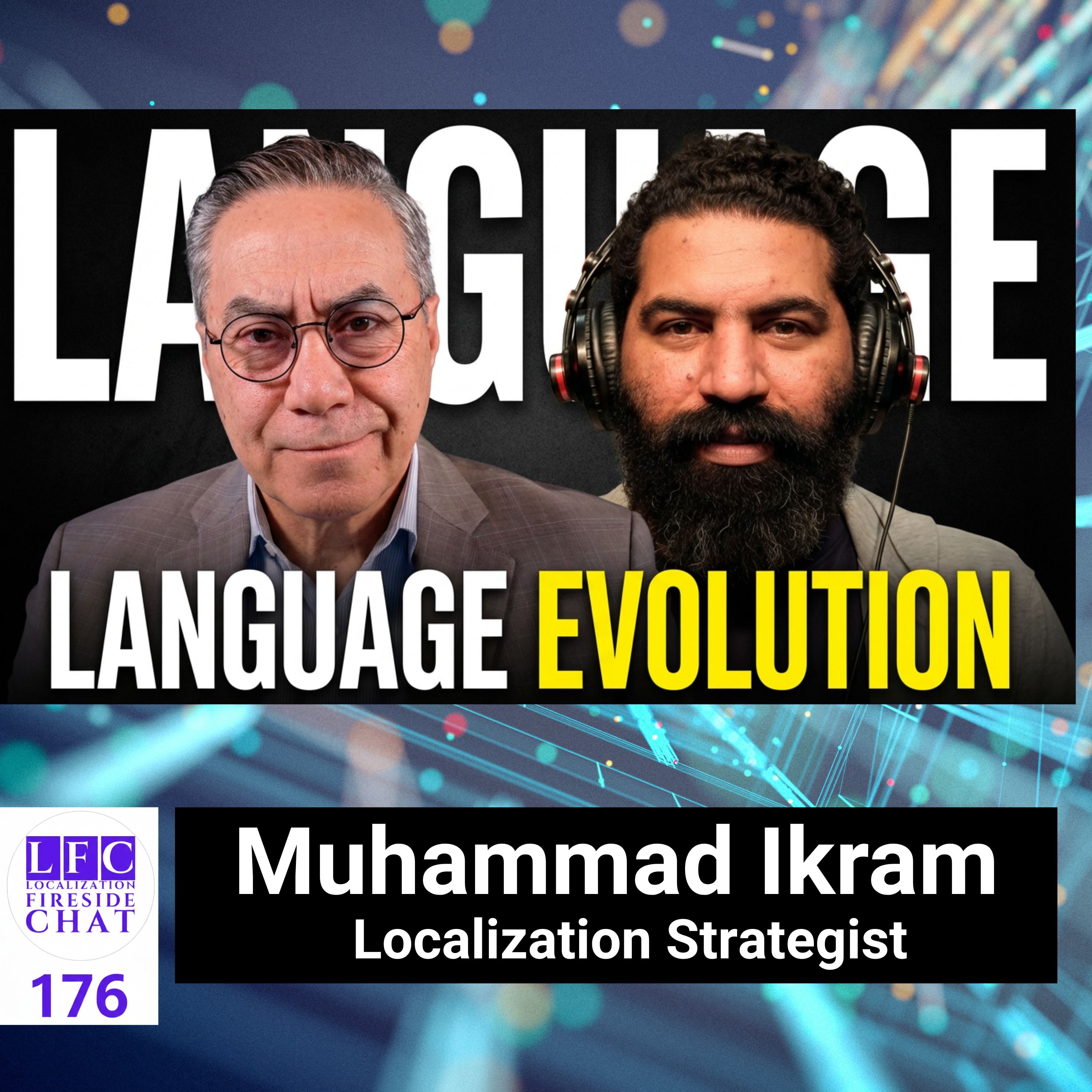
Localization Is Failing Emerging Markets: Linguistic Purity vs Real Users | Muhammad Ikram | Episode 176
For decades, the localization industry has measured success in translated words, standardized terminology, and institutional approval. Yet billions of users in emerging markets still reject technology in their own language. Why? In Episode 176 of Localization Fireside Chat, Muhammad Ikram challenges the structural assumptions of the localization industry. Drawing from over twenty years of experience working on major platforms including Windows, Android, and Meta products, he argues that the real failure is not translation quality, but linguistic puritanism and misaligned industry incentives. This conversation explores who controls digital language, why standardized terminology often alienates real users, and what must change if global digital adoption is to become meaningful.
Localization Fireside Chat · Muhammad Ikram
Audio is streamed directly from the publisher (injector.simplecastaudio.com) as published in their RSS feed. Play Podcasts does not host this file. Rights-holders can request removal through the copyright & takedown page.
Show Notes
The localization industry often presents itself as a global success story.
We translated the world’s software.
We created standards.
We built scalable vendor ecosystems.
And yet, billions of people still do not experience technology in a way that feels natural in their own language.
In this episode, Muhammad Ikram brings a structural critique to the conversation. A native speaker of Urdu and Punjabi with more than two decades of experience in emerging market localization initiatives, Ikram has worked across major global platforms including Windows, Android, and Meta.
His core argument is direct:
The system optimized for linguistic correctness instead of user adoption.
We discuss:
• The concept of linguistic puritanism and how rigid standards shape digital language
• Why institutionally approved terminology often fails everyday users
• The tension between language preservation and real-world usability
• How vendor-driven quality models reinforce the wrong incentives
• Why users frequently switch back to English even when localized versions exist
• The risks AI introduces when trained on already flawed linguistic frameworks
• What a user-centered localization model might look like
This is not simply a discussion about translation.
It is a conversation about identity, power, access, and the future of digital inclusion in emerging markets.
🧠 KEY TAKEAWAYS
Standardization does not guarantee adoption
Institutional language often diverges from real speech
Vendor incentives shape localization outcomes more than user feedback
Quality metrics frequently ignore adoption behavior
AI may amplify structural weaknesses if foundational assumptions remain unchanged
True digital inclusion requires user-driven language evolution
🔗 LINKS
YouTube Episode:
https://youtu.be/swyHe8kidsw
Localization Fireside Chat:
https://www.l10nfiresidechat.com
N49 Networks:
https://www.n49networks.com
Credits
Host: Robin Ayoub, Founder, Localization Fireside Chat
Connect and watch more
Website: www.L10NFiresideChat.com
Spotify: https://open.spotify.com/show/5OoURgc29R31XPGzOWL9iX
Be a guest: https://calendly.com/robin-ayoub/localization-fireside-chat-podcast-recording
LinkedIn: https://www.linkedin.com/in/robinayoub/
Support the show
Share the episode with a friend. Subscribe on YouTube and Spotify. Leave a short review.
Disclaimer
Views are for education and discussion. Apply judgment in your own context.
Tags
#L10NFiresideChat #localization #hiring #recruiting #leadership #ai
Hosted by Simplecast, an AdsWizz company. See pcm.adswizz.com for information about our collection and use of personal data for advertising.