Learning Bayesian Statistics
220 episodes — Page 5 of 5
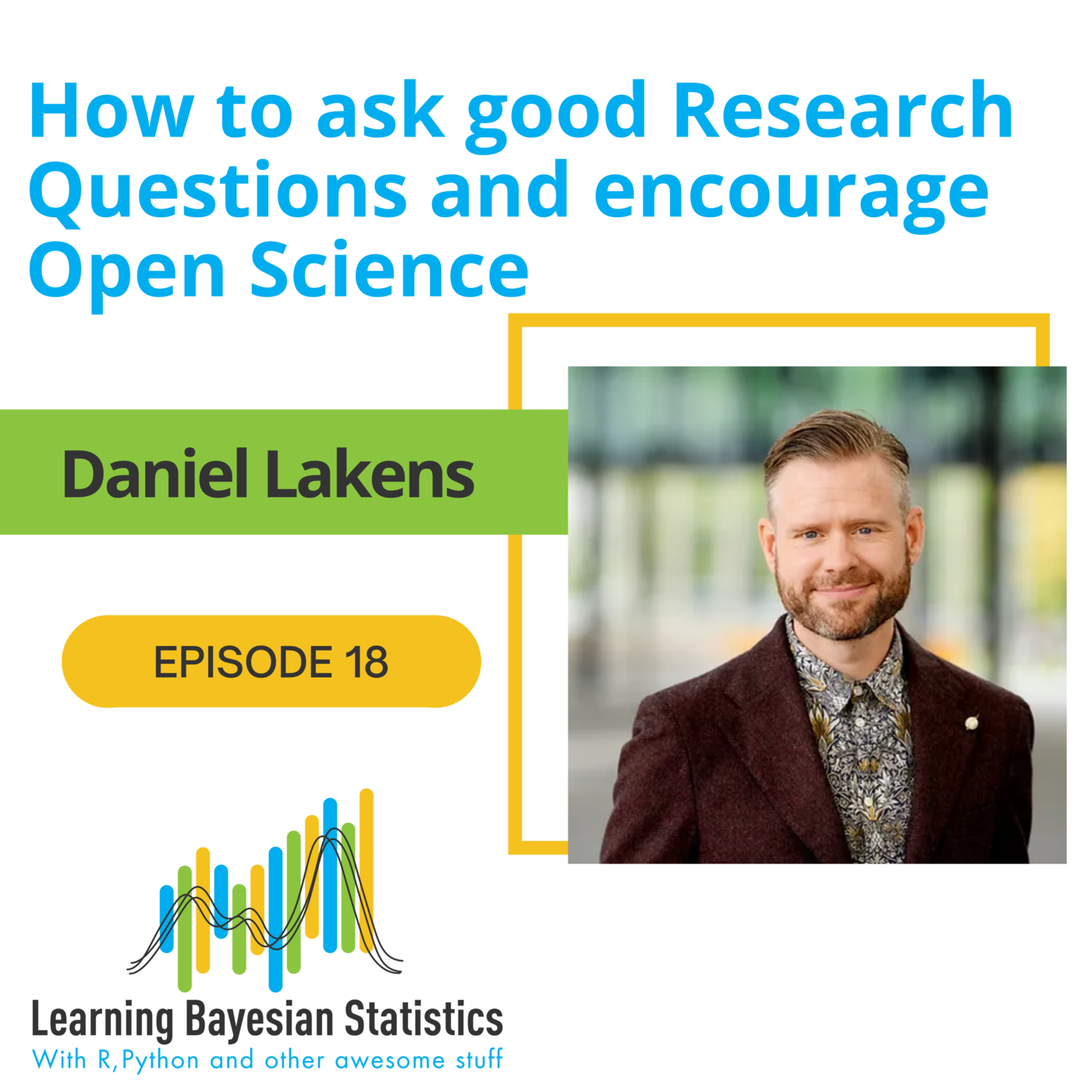
S1 Ep 18#18 How to ask good Research Questions and encourage Open Science, with Daniel Lakens
How do you design a good experimental study? How do you even know that you’re asking a good research question? Moreover, how can you align funding and publishing incentives with the principles of an open source science?Let’s do another “big picture” episode to try and answer these questions! You know, these episodes that I want to do from time to time, with people who are not from the Bayesian world, to see what good practices there are out there. The first one, episode 15, was focused on programming and python, thanks to Michael Kennedy. In this one, you’ll meet Daniel Lakens. Daniel is an experimental psychologist at the Human-Technology Interaction group at Eindhoven University of Technology, in the Netherlands. He’s worked there since 2010, when he received his PhD in social psychology. His research focuses on how to design and interpret studies, applied meta-statistics, and reward structures in science. Daniel loves teaching about research methods and about how to ask good research questions. He even crafted free Coursera courses about these topics. A fervent advocate of open science, he prioritizes scholar articles review requests based on how much the articles adhere to Open Science principles. On his blog, he describes himself as ‘the 20% Statistician’. Why? Well, he’ll tell you in the episode…Our theme music is « Good Bayesian », by Baba Brinkman (feat MC Lars and Mega Ran). Check out his awesome work at https://bababrinkman.com/ !Links from the show:Daniel's website: https://sites.google.com/site/lakens2/HomeThe 20% Statistician: http://daniellakens.blogspot.com/Daniel on GitHub: https://github.com/LakensDaniel on Twitter: https://twitter.com/lakensDaniel on Google Scholar: https://scholar.google.nl/citations?user=ZbqYyrsAAAAJ&hl=nlCoursera Course -- Improving your statistical inferences: https://www.coursera.org/learn/statistical-inferencesCoursera Course -- Improving Your Statistical Questions: https://www.coursera.org/learn/improving-statistical-questionsPeer Reviewers' Openness Initiative: https://opennessinitiative.org/The Scientific Paper Is Obsolete -- Here’s what’s next: https://www.theatlantic.com/science/archive/2018/04/the-scientific-paper-is-obsolete/556676/
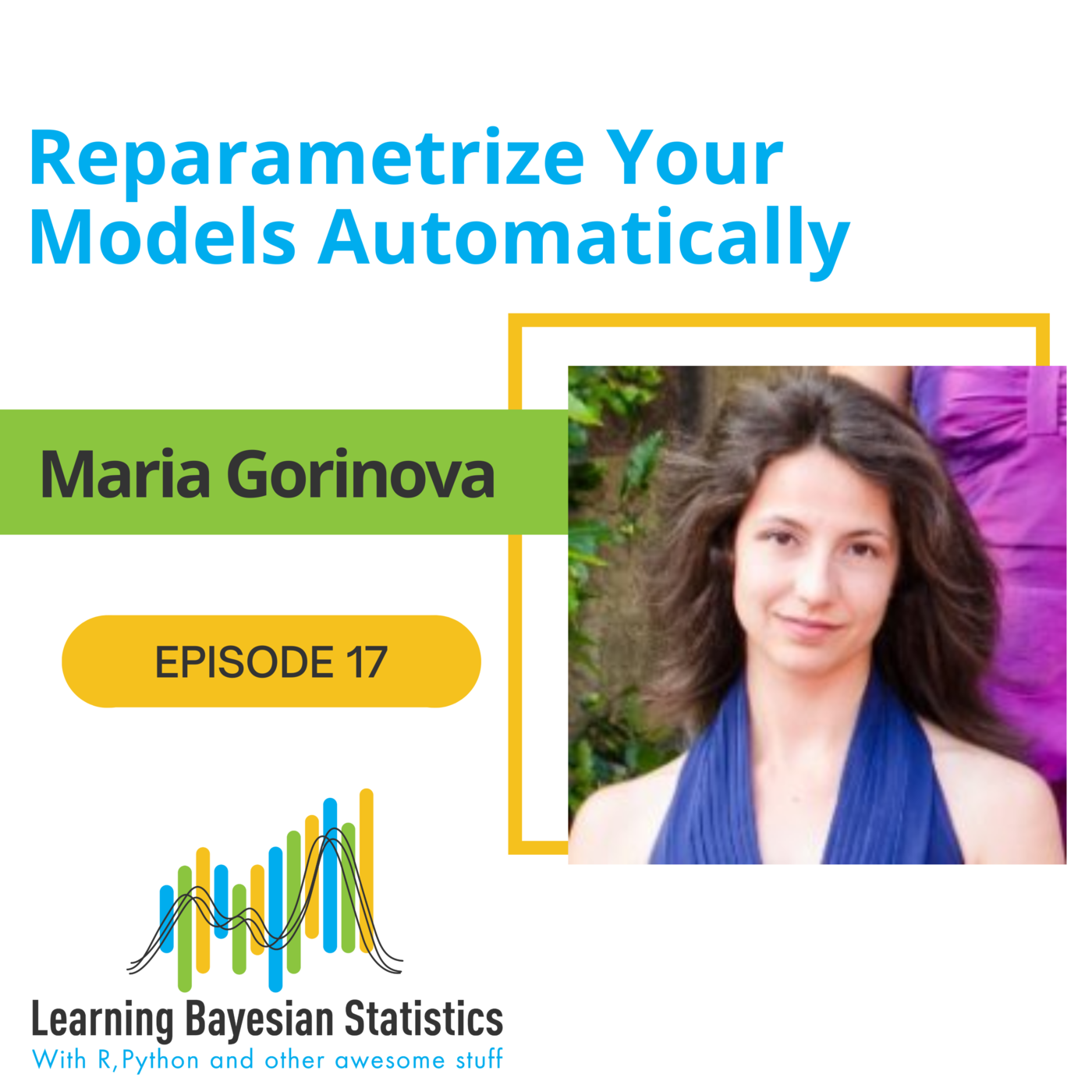
S1 Ep 17#17 Reparametrize Your Models Automatically, with Maria Gorinova
Have you already encountered a model that you know is scientifically sound, but that MCMC just wouldn’t run? The model would take forever to run — if it ever ran — and you would be greeted with a lot of divergences in the end. Yeah, I know, my stress levels start raising too whenever I hear the word « divergences »…Well, you’ll be glad to hear there are tricks to make these models run, and one of these tricks is called re-parametrization — I bet you already heard about the poorly-named non-centered parametrization?Well fear no more! In this episode, Maria Gorinova will tell you all about these model re-parametrizations! Maria is a PhD student in Data Science & AI at the University of Edinburgh. Her broad interests range from programming languages and verification, to machine learning and human-computer interaction. More specifically, Maria is interested in probabilistic programming languages, and in exploring ways of applying program-analysis techniques to existing PPLs in order to improve usability of the language or efficiency of inference.As you’ll hear in the episode, she thinks a lot about the language aspect of probabilistic programming, and works on the automation of various “tricks” in probabilistic programming: automatic re-parametrization, automatic marginalization, automatic and efficient model-specific inference.As Maria also has experience with several PPLs like Stan, Edward2 and TensorFlow Probability, she’ll tell us what she thinks a good PPL design requires, and what the future of PPLs looks like to her.Our theme music is « Good Bayesian », by Baba Brinkman (feat MC Lars and Mega Ran). Check out his awesome work at https://bababrinkman.com/ !Links from the show:Maria on the Web: http://homepages.inf.ed.ac.uk/s1207807/index.htmlMaria on Twitter: https://twitter.com/migorinovaMaria on GitHub: https://github.com/mgorinovaAutomatic Reparameterisation of Probabilistic Programs (Maria's paper with Dave Moore and Matthew Hoffman): https://arxiv.org/abs/1906.03028Stan User's Guide on Reparameterization: https://mc-stan.org/docs/2_23/stan-users-guide/reparameterization-section.htmlHMC for hierarchical models -- Background on reparameterization: https://arxiv.org/abs/1312.0906NeuTra -- Automatic reparameterization: https://arxiv.org/abs/1903.03704Edward2 -- A library for probabilistic modeling, inference, and criticism: http://edwardlib.org/Pyro -- Automatic reparameterization and marginalization: https://pyro.ai/Gen -- Programmable inference: http://probcomp.csail.mit.edu/software/gen/TensorFlow Probability: https://www.tensorflow.org/probability/
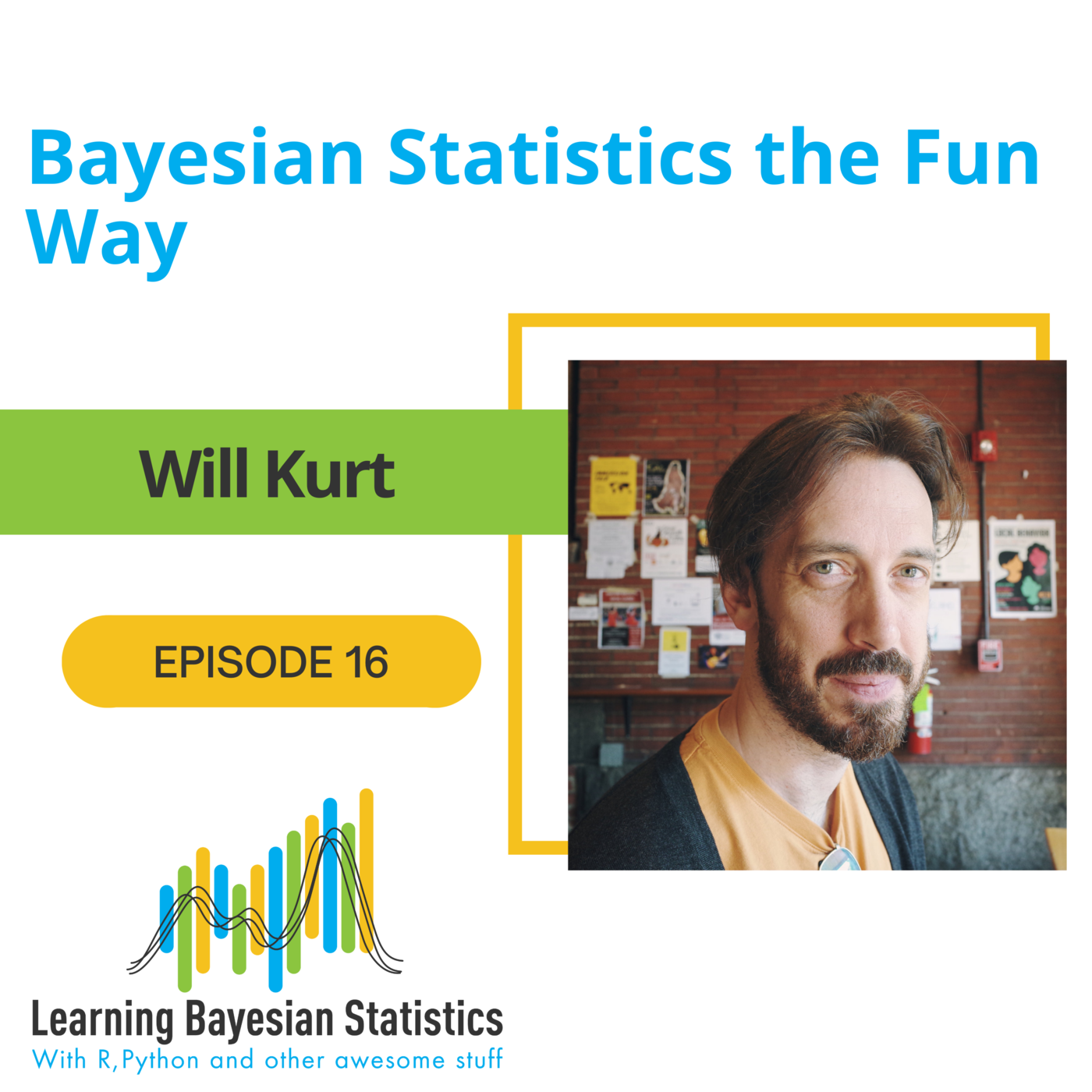
S1 Ep 16#16 Bayesian Statistics the Fun Way, with Will Kurt
A librarian, a philosopher and a statistician walk into a bar — and they can’t find anybody to talk to; nobody seems to understand what they are talking about. Nobody? No! There is someone, and this someone is Will Kurt! Will Kurt is the author of ‘Bayesian Statistics the Fun Way’ and ‘Get Programming With Haskell’. Currently the lead Data Scientist for the pricing and recommendations team at Hopper, he also blogs about stats and probability at countbayesie.com.In this episode, he’ll tell us how a Boston librarian can become a Data Scientist and work with Bayesian models everyday. He’ll also explain the value of Bayesian inference from a philosophical standpoint, why it’s useful in the travel industry and how his latest book came into life.Finally, Will is also a big fan of the “mind projection fallacy”, an informal fallacy first described by physicist and Bayesian philosopher Edwin Thompson Jaynes. Does that intrigue you? Well, stay tuned, he’ll tell us more in the episode…Our theme music is « Good Bayesian », by Baba Brinkman (feat MC Lars and Mega Ran). Check out his awesome work at https://bababrinkman.com/ !Links from the show:Will's Blog: https://www.countbayesie.comWill on Twitter: https://twitter.com/willkurtBayesian Statistics the Fun Way -- Understanding Statistics and Probability with Star Wars, LEGO, and Rubber Ducks: https://nostarch.com/learnbayesGet Programming with Haskell: https://www.amazon.com/Get-Programming-Haskell-Will-Kurt/dp/1617293768The Mind Projection Fallacy: https://en.wikipedia.org/wiki/Mind_projection_fallacyProbability Theory -- The Logic of Science by E.T. Jaynes: https://www.cambridge.org/core/books/probability-theory/9CA08E224FF30123304E6D8935CF1A99Wittgenstein's Lectures on the Foundations of Mathematics: https://www.amazon.com/Wittgensteins-Lectures-Foundations-Mathematics-Cambridge/dp/0226904261
S1 Ep 15#15 The role of Python in Science and Education, with Michael Kennedy
This is it folks! This is the first of the special episodes I want to do from time to time, to expand our perspective and get inspired by what’s going on elsewhere. The guests will not come directly from the Bayesian world, but will still be related to science or programming.For the first episode of the kind, I had the chance to chat with Michael Kennedy! Michael is not only a very knowledgeable and respected member of the Python community, he’s also the founder and host of Talk Python To Me, the most popular Python podcast. He’s the founder and chief author at Talk Python Training, where he develops many Python developer online courses. And before that, Michael was a professional software trainer for over 10 years – he has taught numerous developers throughout the world! But Michael is not only an entrepreneur and teacher – he’s also a father, a husband, and a proud inhabitant of Portland, OR! As you’ll hear, our conversation spanned a large array of topics — the role of Python in science and research; how it came to be so important in data science, and why; what are Python’s threats and weaknesses and how it should evolve to not become obsolete. Michael also has interesting thoughts on the role of programming in education and how it relates to geometry — but I’ll let you discover that one by yourself…Our theme music is « Good Bayesian », by Baba Brinkman (feat MC Lars and Mega Ran). Check out his awesome work at https://bababrinkman.com/ !Links from the show:Michael on Twitter: https://twitter.com/mkennedyThe Talk Python Podcast: https://talkpython.fm/The Python Bytes Podcast: https://pythonbytes.fm/Michael's blog: https://blog.michaelckennedy.net/Michael on Crowdcast: https://www.crowdcast.io/mkennedyJupytext -- Turn Jupyter Notebooks to scripts and (R) Markdown files: https://jupytext.readthedocs.io/en/latest/introduction.html
S1 Ep 14#14 Hidden Markov Models & Statistical Ecology, with Vianey Leos-Barajas
I bet you love penguins, right? The same goes for koalas, or puppies! But what about sharks? Well, my next guest loves sharks — she loves them so much that she works a lot with marine biologists, even though she’s a statistician! Vianey Leos Barajas is indeed a statistician primarily working in the areas of statistical ecology, time series modeling, Bayesian inference and spatial modeling of environmental data. Vianey did her PhD in statistics at Iowa State University and is now a postdoctoral researcher at North Carolina State University.In this episode, she’ll tell us what she’s working on that involves sharks, sheep and other animals! Trying to model animal movements, Vianey often encounters the dreaded multimodal posteriors. She’ll explain why these can be very tricky to estimate, and why ecological data are particularly suited for hidden Markov models and spatio-temporal models — don’t worry, Vianey will explain what these models are in the episode!Our theme music is « Good Bayesian », by Baba Brinkman (feat MC Lars and Mega Ran). Check out his awesome work at https://bababrinkman.com/ !Links from the show:Vianey on Twitter: https://twitter.com/vianey_lbHidden Markov Models in the Stan User's Guide: https://mc-stan.org/docs/2_18/stan-users-guide/hmms-section.htmlTagging Basketball Events with HMM in Stan: https://mc-stan.org/users/documentation/case-studies/bball-hmm.htmlHMMs with Python and PyMC3: https://ericmjl.github.io/bayesian-analysis-recipes/notebooks/markov-models/The Discrete Adjoint Method -- Efficient Derivatives for Functions of Discrete Sequences (Betancourt, Margossian, Leos-Barajas): https://arxiv.org/abs/2002.00326Vianey will be doing an HMM 90-minute introduction at the International Statistical Ecology Conference in June 2020: http://www.isec2020.org/Stan for Ecology -- a website for the ecology community in Stan: https://stanecology.github.io/LatinR 2020 -- 7th to 9th October 2020: https://latin-r.com/Migramar -- Science for the Conservation of Marine Migratory Species in the Eastern Pacific: http://migramar.org/hi/en/Pelagios Kakunja -- Know, educate and conserve for a sustainable sea: https://www.pelagioskakunja.org/Book recommendations:Hidden Markov Models for Time Series: https://www.routledge.com/Hidden-Markov-Models-for-Time-Series-An-Introduction-Using-R-Second-Edition/Zucchini-MacDonald-Langrock/p/book/9781482253832Handbook of Mixture Analysis:
S1 Ep 13#13 Building a Probabilistic Programming Framework in Julia, with Chad Scherrer
How is Julia doing? I’m talking about the programming language, of course! What does the probabilistic programming landscape in Julia look like? What are Julia’s distinctive features, and when would it be interesting to use it?To talk about that, I invited Chad Scherrer. Chad is a Senior Research Scientist at RelationalAI, a company that uses Artificial Intelligence technologies to solve business problems.Coming from a mathematics background, Chad did his PhD at Indiana University of Bloomington and has been working in statistics and data science for a decade now. Through this experience, he’s been using and developing probabilistic programming languages – so he’s familiar with python, R, PyMC, Stan and all the blockbusters of the field. But since 2018, he’s particularly interested in Julia and developed Soss, an open-source lightweight probabilistic programming package for Julia. In this episode, he’ll tell us why he decided to create this package, and which choices he made that made Soss what it is today. But we’ll also talk about other projects in Julia, like Turing or Gen for instance.Our theme music is « Good Bayesian », by Baba Brinkman (feat MC Lars and Mega Ran). Check out his awesome work at https://bababrinkman.com/ !Links from the show:Chad's Website: https://cscherrer.github.io/Chad on Twitter: https://twitter.com/ChadScherrerSoss Package: https://github.com/cscherrer/Soss.jlSoss Presentation at 2019 Strata NYC: https://slides.com/cscherrer/2019-09-26-strata#/Passage -- A Parallel Sampler Generator for Hierarchical Bayesian Modeling: https://bit.ly/2UTmaYBDynamic HMC in Julia: https://github.com/tpapp/DynamicHMC.jlAdvanced HMC in Julia: https://github.com/TuringLang/AdvancedHMC.jlMonte Carlo Measurements in Julia: https://github.com/baggepinnen/MonteCarloMeasurements.jlTuring.jl -- Bayesian inference with probabilistic programming: https://turing.ml/dev/Gen.jl -- Probabilistic modeling and inference in Julia: https://www.gen.dev/Etalumis -- Bringing Probabilistic Programming to Scientific Simulators at Scale: https://arxiv.org/abs/1907.03382Omega.jl -- A programming language for causal and probabilistic reasoning: http://www.zenna.org/Omega.jl/latest/JuliaLang -- The Ingredients for a Composable Programming Language: https://white.ucc.asn.au/2020/02/09/whycompositionaljulia.htmlSimpy -- Discrete event simulation for Python:
S1 Ep 12#12 Biostatistics and Differential Equations, with Demetri Pananos
Do you know Google Summer of Code? It’s a time of year when students can contribute to open-source software by developing and adding much needed functionalities to the open-source package of their choice. And Demetri Pananos did just that.He did it in 2019 with PyMC3, for which he developed the API for ordinary differential equations. In this episode, he’ll tell us why and how he did that, what he learned from the experience, and what the strengths and weaknesses of the API are in his opinion.Demetri is a Ph.D candidate in Biostatistics at Western University, in Ontario, Canada. His research interests surround machine learning and Bayesian statistics for personalized medicine. He earned his Master’s in Applied Mathematics from The University of Waterloo and is a firm believer in open science, interdisciplinary collaboration, and reproducible research. Other than that, he loves plotting data and drinking IPA beer – well, who doesn’t?”Our theme music is « Good Bayesian », by Baba Brinkman (feat MC Lars and Mega Ran). Check out his awesome work at https://bababrinkman.com/ !Links from the show:Demetri on Twitter: https://twitter.com/PhDemetriDemetri on GitHub: https://github.com/DpananosDemetri's website: https://dpananos.github.io/PyMC3, Probabilistic Programming in Python: https://docs.pymc.io/Chris Bishop, Pattern Recognition and Machine Learning: https://www.amazon.fr/Pattern-Recognition-Machine-Learning-Christopher/dp/0387310738Bayesian Data Analysis (Gelman, Carlin, Stern, Dunson, Vehtari, Rubin): http://www.stat.columbia.edu/~gelman/book/Parallel Plots: https://arviz-devs.github.io/arviz/generated/arviz.plot_parallel.html
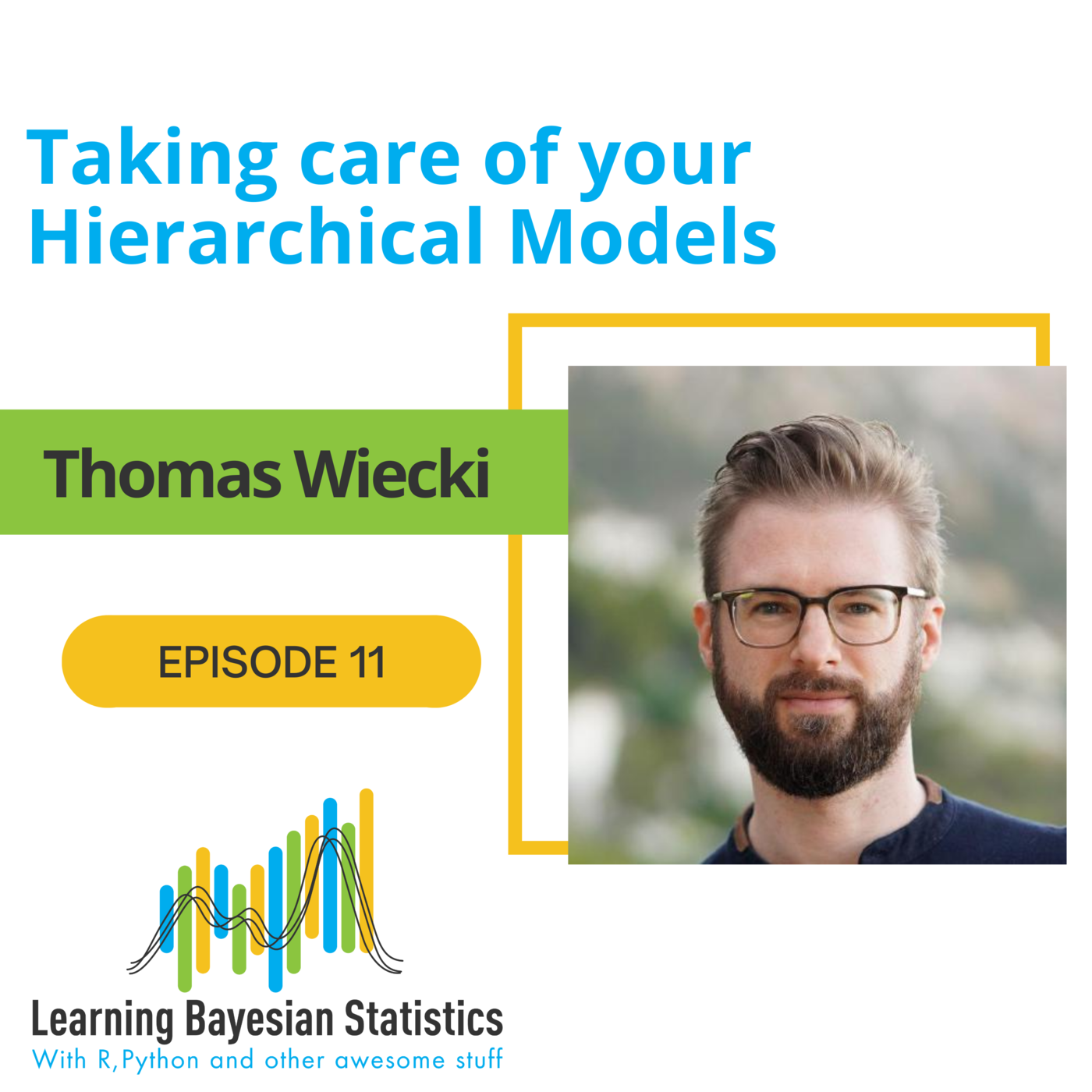
S1 Ep 11#11 Taking care of your Hierarchical Models, with Thomas Wiecki
I bet you already heard about hierarchical models, or multilevel models, or varying-effects models — yeah this type of models has a lot of names! Many people even turn to Bayesian tools to build _exactly_ these models. But what are they? How do you build and use a hierarchical model? What are the tricks and classical traps? And even more important: how do you _interpret_ a hierarchical model?In this episode, Thomas Wiecki will come to the rescue and explain what multilevel models are, how to build them, what their powers are… but also why you should be very careful when building them…Does the name Thomas Wiecki ring a bell? Probably because he’s the host and creator of the PyData Deep Dive Podcast, where he interviews open-source contributors from the Python and Data Science worlds! Thomas is also the VP of Data Science at Quantopian, a crowd-sourced quantitative investment firm that encourages people everywhere to write investment algorithms.Finally, Thomas is a longtime Bayesian and core-developer of PyMC3, a fantastic python package to do probabilistic programming in Python. On his blog, he publishes tutorial articles and explores new ideas such as Bayesian Deep Learning. Caring a lot about open-source software sustainability, he puts all he’s up to on his Patreon page, that you’ll find in the show notes.Our theme music is « Good Bayesian », by Baba Brinkman (feat MC Lars and Mega Ran). Check out his awesome work at https://bababrinkman.com/ !Links from the show:Thomas’ series on Hierarchical Regression: https://twiecki.io/blog/2013/08/12/bayesian-glms-1/Non-centered Parametrization with PyMC3: https://twiecki.io/blog/2017/02/08/bayesian-hierchical-non-centered/Using Bayesian Decision Making: https://twiecki.io/blog/2019/01/14/supply_chain/PyMC3 - Probabilistic Programming in Python: https://docs.pymc.io/Symbolic PyMC: https://pymc-devs.github.io/symbolic-pymc/PyData Deep Dive Podcast: https://pydata-podcast.comThomas on Twitter: https://twitter.com/twiecki?lang=enThomas on Patreon: https://www.patreon.com/twieckiThomas on GitHub: https://github.com/twieckiAlex’s Hierarchical Model of Elections in Paris: https://mybinder.org/v2/gh/AlexAndorra/pollsposition_models/master?urlpath=%2Fvoila%2Frender%2Fdistrict-level%2Fmunic_model_analysis.ipynb
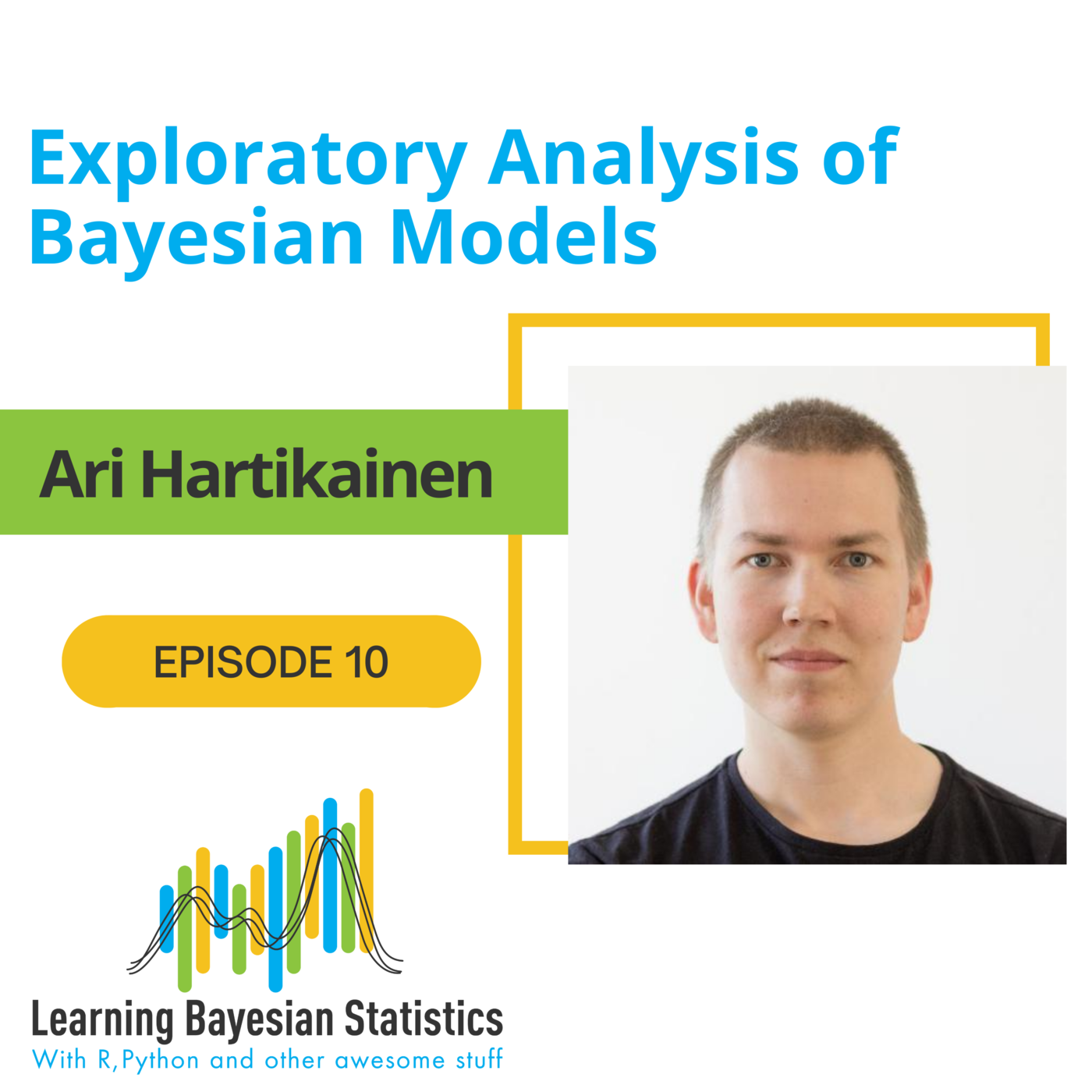
S1 Ep 10#10 Exploratory Analysis of Bayesian Models, with ArviZ and Ari Hartikainen
How do you handle your MCMC samples once your Bayesian model fit properly? Which diagnostics do you check to see if there was a computational problem? And isn’t that nice when you have beautiful and reliable plots to complement your analysis and better understand your model?I know what you think: plotting can be long and complicated in these cases. Well, not with ArviZ, a platform-agnostic package to do exploratory analysis of your Bayesian models. And in this episode, Ari Hartikainen will tell you why.Ari is a data-scientist in geophysics and a researcher at the Department of Civil Engineering of Aalto University in Finland. He mainly works on geophysics, Bayesian statistics and visualization. Ari’s also a prolific open-source contributor, as he’s a core-developer of the popular Stan and ArviZ libraries. He’ll tell us how PyStan interacts with ArviZ, what he thinks ArviZ most useful features are, and which common difficulties he encounters with his models and data.Our theme music is « Good Bayesian », by Baba Brinkman (feat MC Lars and Mega Ran). Check out his awesome work at https://bababrinkman.com/ !Links from the show:Ari on GitHub: https://github.com/ahartikainenAri on Twitter: https://twitter.com/a_hartikainenArviZ -- Exploratory analysis of Bayesian models: https://arviz-devs.github.io/arviz/Introductory paper of ArviZ in The Journal of Open Source Software: https://www.researchgate.net/publication/330402908_ArviZ_a_unified_library_for_exploratory_analysis_of_Bayesian_models_in_PythonStan -- Statistical Modeling Platform: https://mc-stan.org/GPflow -- Gaussian processes in TensorFlow: https://www.gpflow.org/GPy -- Gaussian processes framework in Python: https://sheffieldml.github.io/GPy/
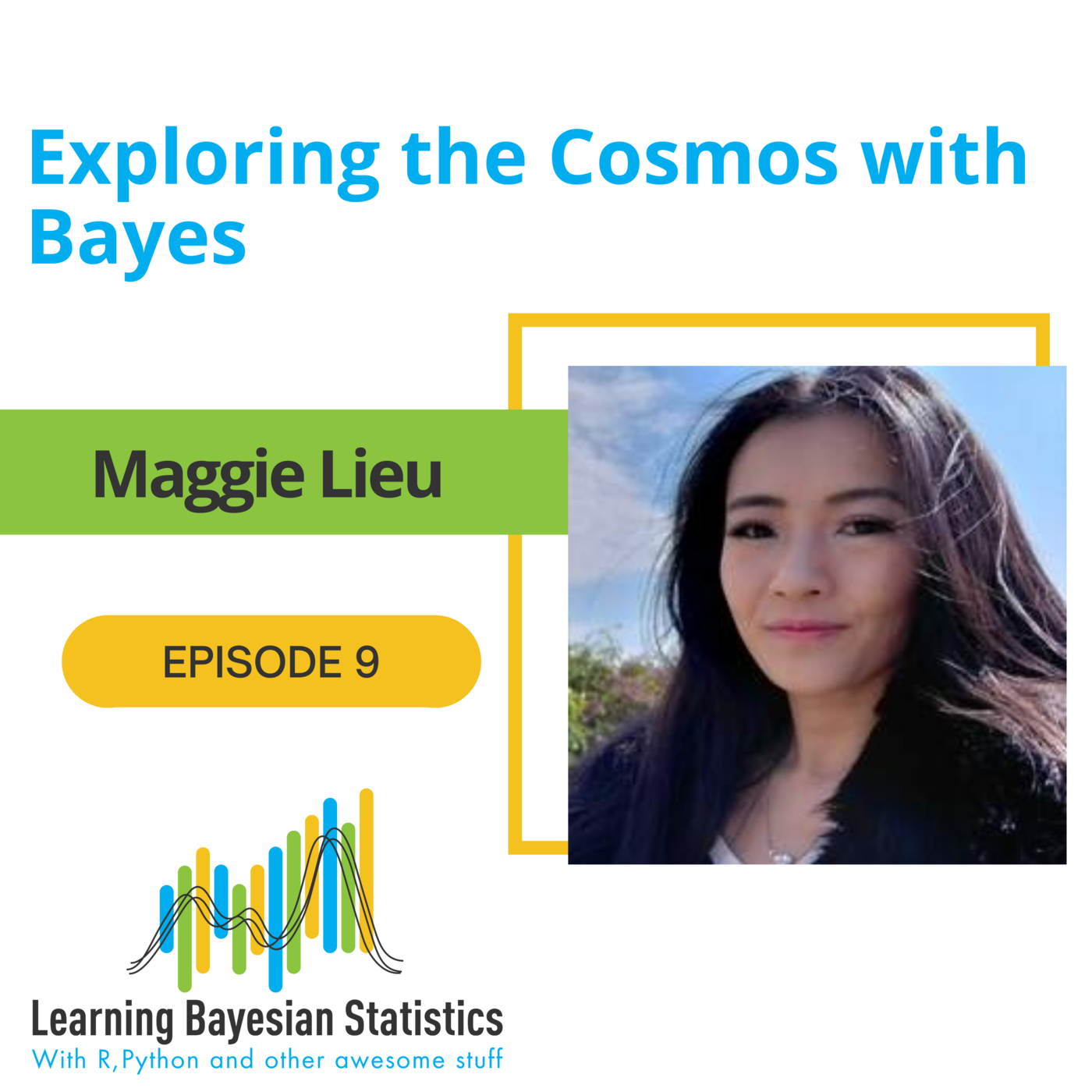
S1 Ep 9#9 Exploring the Cosmos with Bayes and Maggie Lieu
Have you always wondered what dark matter is? Can we even see it — let alone measure it? And what would discover it imply for our understanding of the Universe?In this episode, we’ll take look at the cosmos with Maggie Lieu. She’ll tell us what research in astrophysics is made of, what model she worked on at the European Space Agency, and how Bayesian the world of space science is.Maggie Lieu did her PhD in the Astronomy & Space Department of the University of Birmingham. She’s now a Research Fellow of Machine Learning & Cosmology at the University of Nottingham and is working on projects in preparation for Euclid, a space-based telescope whose goal is to map the dark Universe and help us learn about the nature of dark matter and dark energy.In a nutshell, she tries to help us better understand the entire cosmos. Even more amazing, she uses the Stan library and applies Bayesian statistical methods to decipher her astronomical data! But Maggie is not just a Bayesian astrophysicist: she also loves photography and rock-climbing!Our theme music is « Good Bayesian », by Baba Brinkman (feat MC Lars and Mega Ran). Check out his awesome work at https://bababrinkman.com/ !Links from the show:Maggie's Website: https://maggielieu.com/Maggie's Google Scholar Page: https://scholar.google.co.uk/citations?user=ilfwfuUAAAAJ&hl=enMaggie on Twitter: https://twitter.com/Space_MogMaggie on GitHub: https://github.com/MaggieLieuMaggie on YouTube: https://www.youtube.com/channel/UClO6TuRE6XLzbMBmQ_KY38AStan -- Statistical Modeling Platform: https://mc-stan.org/Stan's YouTube Channel: https://www.youtube.com/channel/UCwgN5srGpBH4M-Zc2cAluOA
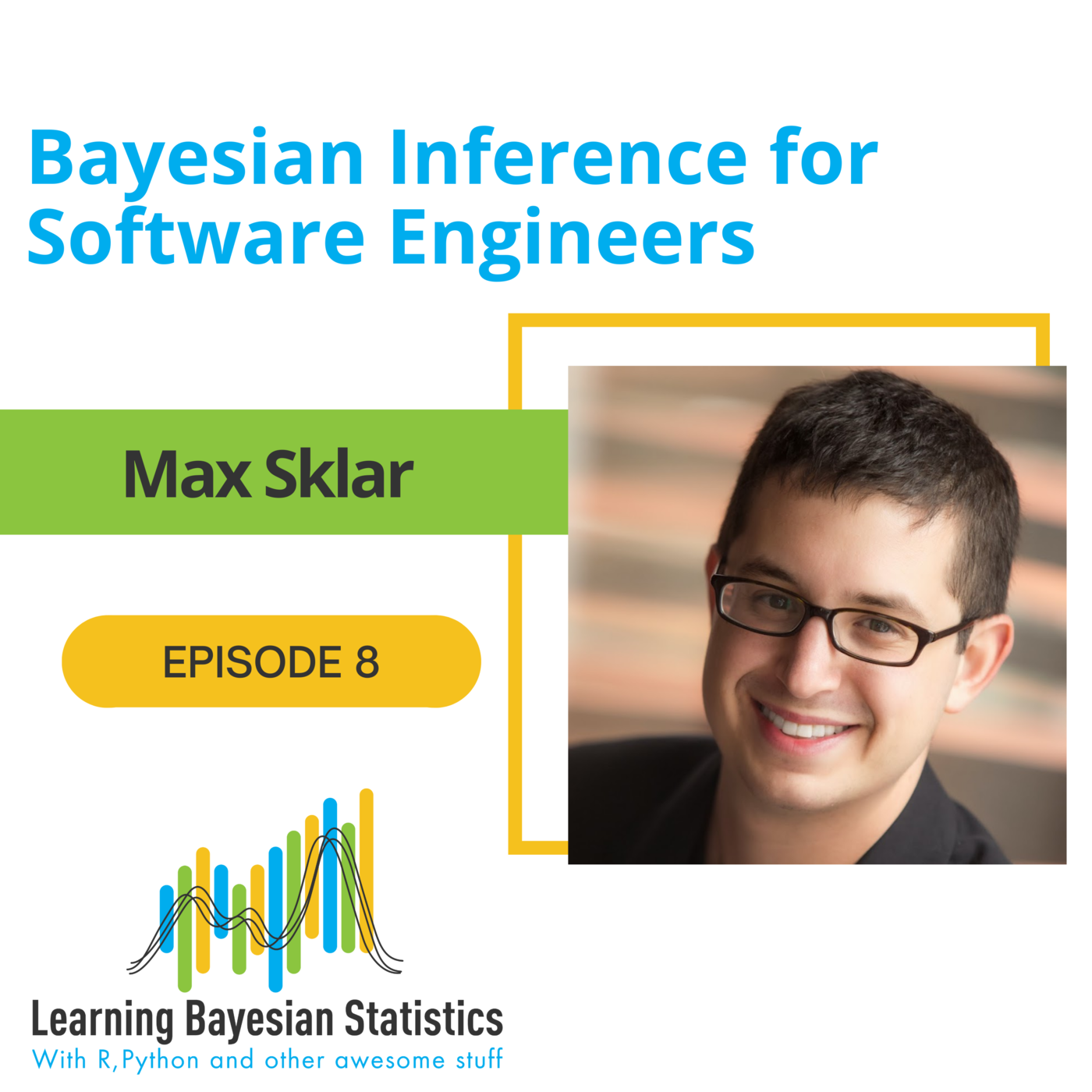
S1 Ep 8#8 Bayesian Inference for Software Engineers, with Max Sklar
What is it like using Bayesian tools when you’re a software engineer or computer scientist? How do you apply these tools in the online ad industry? More generally, what is Bayesian thinking, philosophically? And is it really useful in every day life? Because, well you can’t fire up MCMC each time you need to make a quick decision under uncertainty… So how do you do that in practice, when you have at most a pen and paper?In this episode, you’ll hear Max Sklar’s take on these questions. Max is a software engineer with a focus on machine learning and Bayesian inference. Now working at Foursquare’s innovation lab, he recently led the development of a causality model for Foursquare’s Ad Attribution product and taught a course on Bayesian Thinking at the Lviv Data Science Summer School.Max is also an open-source enthusiast and a fellow podcaster – he’s the host of the Local Maximum podcast, where you can hear every week about the latest trends in AI, machine learning and technology from an engineering perspective.Ow, and if you liked the movie « Her », with Joaquin Phoenix, well you’re in for a treat at the end of this episode…Our theme music is « Good Bayesian », by Baba Brinkman (feat MC Lars and Mega Ran). Check out his awesome work at https://bababrinkman.com/ !Links from the show:Local Maximum podcast website: https://www.localmaxradio.comMax on Twitter: https://twitter.com/maxsklarBayesian linear models: https://github.com/maxsklar/BayesPy/tree/master/LinearModelsBayesian Dirichlet-Multinomial estimation: https://github.com/maxsklar/BayesPy/tree/master/DirichletEstimationBayesian Thinking for Applied Machine Learning slides: https://docs.google.com/presentation/d/1eiceuvXlsoFKoHdqjF3qXBkyht7vR0YXQPG82ady-TU/edit?usp=sharing
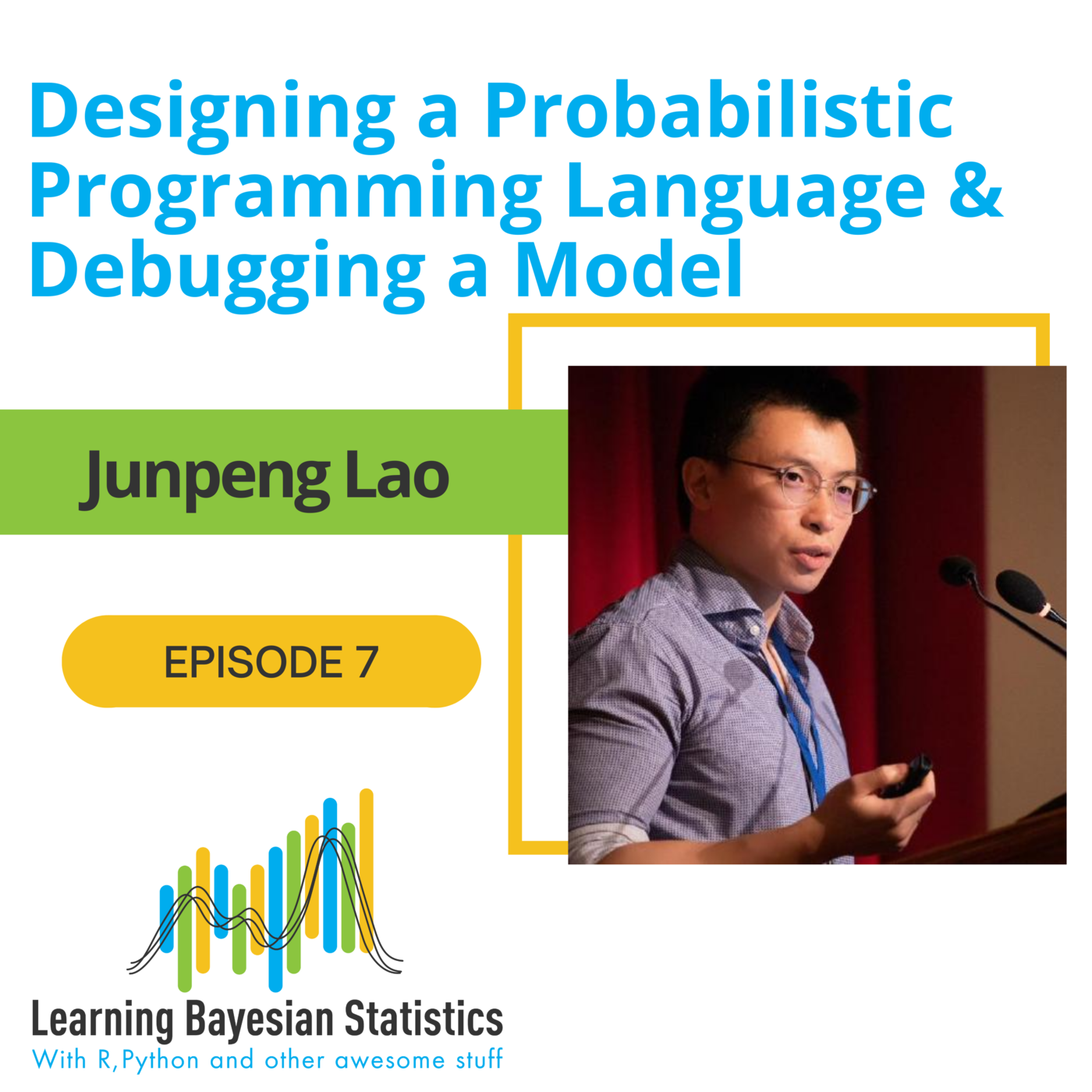
S1 Ep 7#7 Designing a Probabilistic Programming Language & Debugging a Model, with Junpeng Lao
You can’t study psychology up until your PhD and end-up doing very mathematical and computational data science at Google right? It’s too hard of a U-turn — some would even say it’s NUTS, just because they like bad puns… Well think again, because Junpeng Lao did just that!Before doing data science at Google, Junpeng was a cognitive psychology researcher at the University of Fribourg, Switzerland. Working in Python, Matlab and occasionally in R, Junpeng is a prolific open-source contributor, particularly to the popular TensorFlow and PyMC3 libraries. He also maintains the PyMC Discourse on his free time, where he amazingly answers all kinds of various and very specific questions!In this episode, he’ll tell you what the core characteristics of TensorFlow Probability are, and when you would use TFP instead of another probabilistic programming framework, like Stan or PyMC3. He’ll also explain why PyMC4 will be based on TensorFlow Probability itself, and what future contributions he has in mind for these two amazing libraries. Finally, Junpeng will share with you his workflow for debugging a model, or just for better understanding your models.Our theme music is « Good Bayesian », by Baba Brinkman (feat MC Lars and Mega Ran). Check out his awesome work at https://bababrinkman.com/ !Links from the show: Junpeng's blog: https://junpenglao.xyz/Junpeng on Twitter: https://twitter.com/junpenglaoJunpeng on GitHub: https://github.com/junpenglaoAdvanced Bayesian Modeling Tutorial: https://discourse.pymc.io/t/advance-bayesian-modelling-with-pymc3/1439Stan Devs' Prior Choice Recommendations: https://github.com/stan-dev/stan/wiki/Prior-Choice-RecommendationsPyMC Discourse: https://discourse.pymc.io/PyMC3 - Probabilistic Programming in Python: https://docs.pymc.io/Tensor Flow Probability: https://www.tensorflow.org/probability/
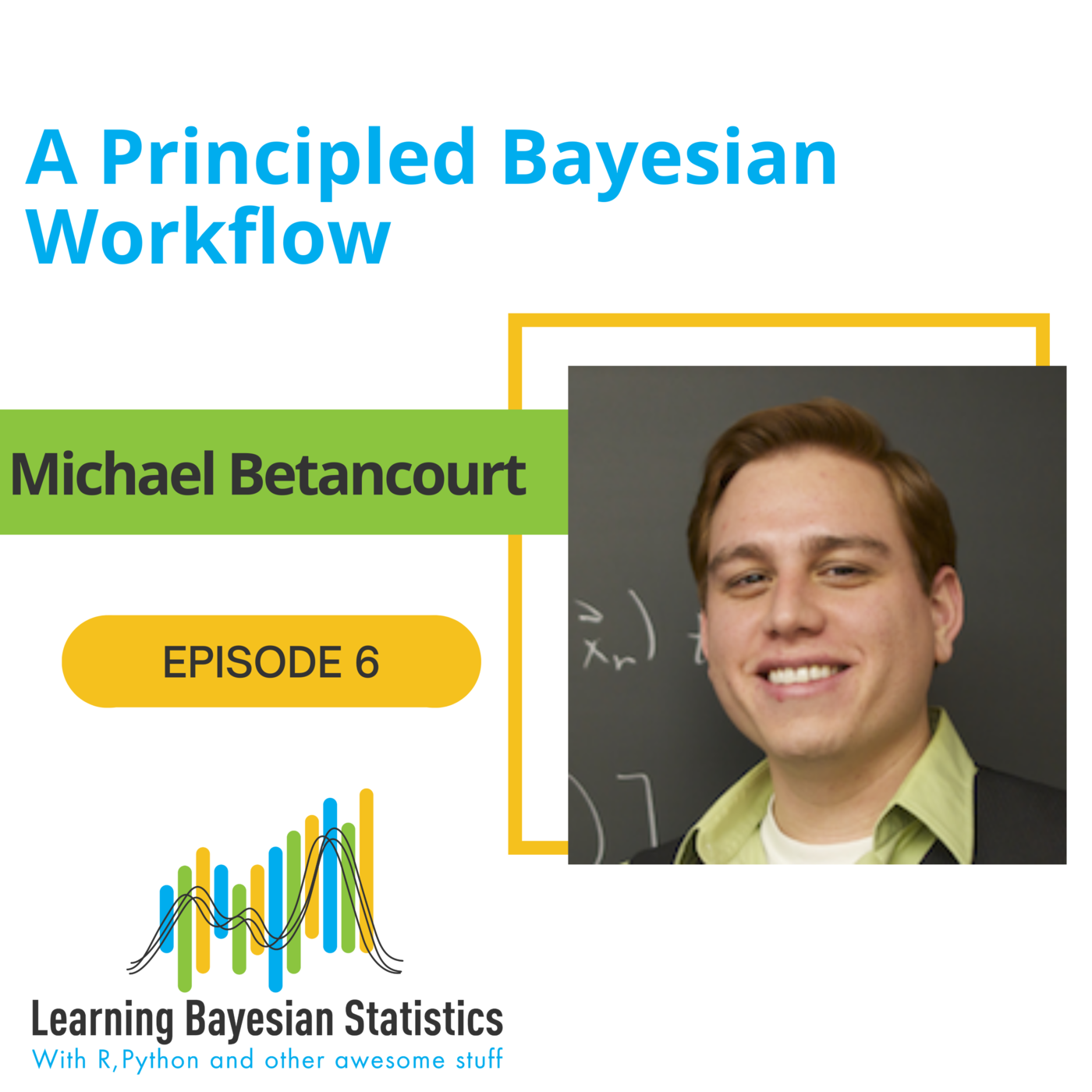
S1 Ep 6#6 A principled Bayesian workflow, with Michael Betancourt
If you’re there, it’s probably because you’re interested in Bayesian inference, right? But don’t you feel lost sometimes when building a model? Or you ask yourself why what you’re trying to do is so damn hard… and you conclude that YOU are the problem, that YOU must be doing something wrong!Well, rest assured, as you’ll hear from Michael Betancourt himself: it’s hard for everybody! That’s why over the years he developed and tries to popularize what he calls a « principled Bayesian workflow » — in a nutshell, think about what could have generated your data; and always question default settings!With that workflow, you’ll probably feel less alone when modeling, but expect to fail often. That’s ok — as Michael says: if you don’t fail, you don’t learn!Who is Michael Betancourt you ask? He is a physicist and statistician, whose research focuses on the development of robust statistical workflows, computational tools, and pedagogical resources that help bridge the gap between statistical theory and scientific practice.Michael works a lot on differential geometry and probability theory, and he often lives in high-dimensional spaces, where he meets with a good friend of his -- Hamiltonian Monte Carlo. Then, you won’t be surprised to learn that Michael is one of the core developers of the seminal probabilistic programming language Stan.Our theme music is « Good Bayesian », by Baba Brinkman (feat MC Lars and Mega Ran). Check out his awesome work at https://bababrinkman.com/ !Links from the show:Michael's upcoming course: https://events.eventzilla.net/e/introduction-to-bayesian-inference-with-stan-with-michael-betancourt-2138756860Michael's website (the “Writing” page collects the case studies and pedagogical material, and the “Speaking” page links to the recorded talks): https://betanalpha.github.io/Support Michael's work on Patreon: https://patreon.com/betanalphaMichael on Twitter: https://twitter.com/betanalphaMichael on GitHub: https://github.com/betanalphaStan probabilistic programming langage: https://mc-stan.org/
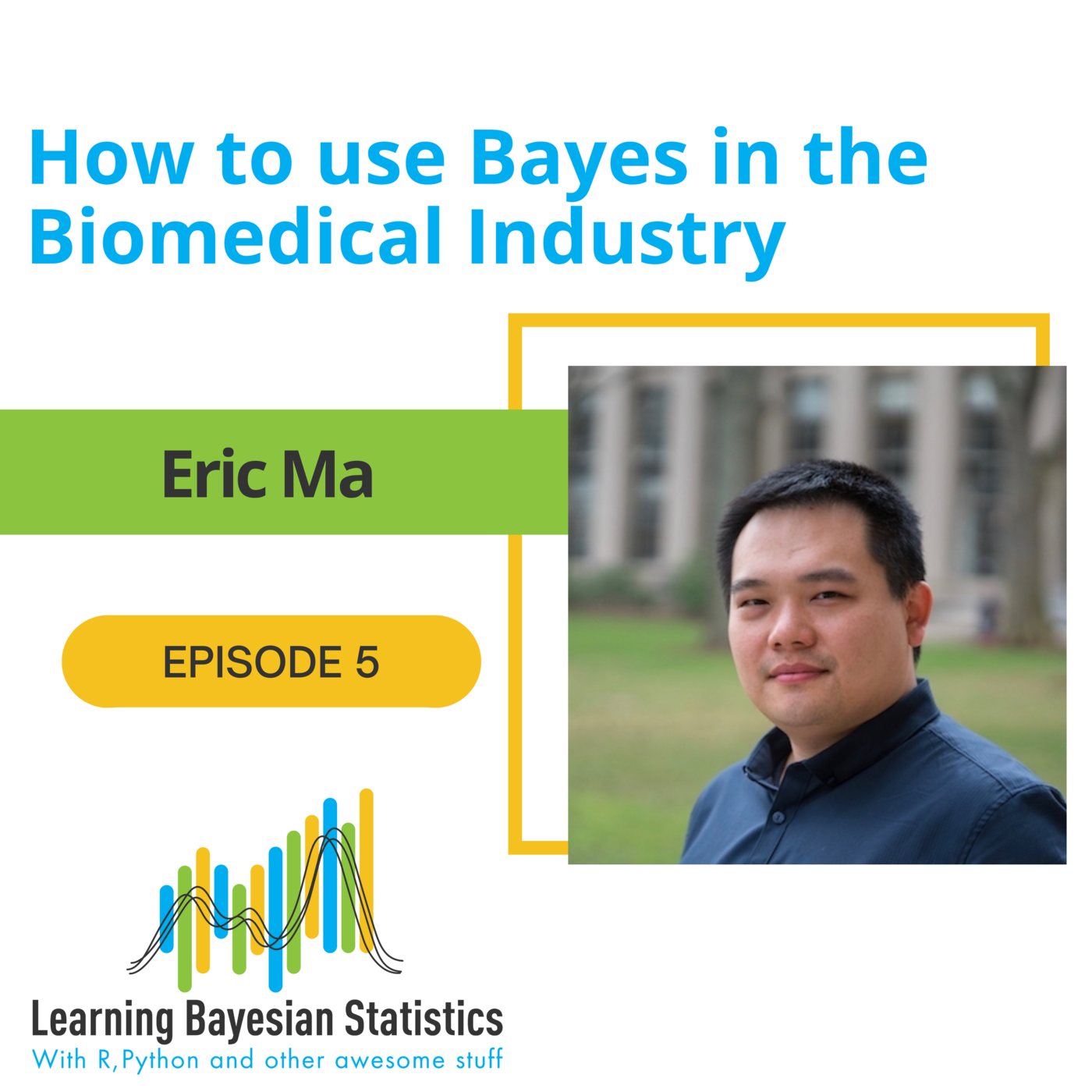
S1 Ep 5#5 How to use Bayes in the biomedical industry, with Eric Ma
I have two questions for you: Are you a self-learner? Then how do you stay up to date? What should you focus on if you’re a beginner, or if you’re more advanced?And here is my second question: Are you working in biomedicine? And if you do, are you using Bayesian tools? Then how do you get your co-workers more used to posterior distributions than p-values? In other words, how do you change behaviors in a large organization?In this episode, Eric Ma will answer all these questions and even tell us his favorite modeling techniques, which problems he encountered with these models, and how he solved them. He’ll also share with us the software-engineering workflow he uses at Novartis to share his work with colleagues.Eric is a data scientist at the Novartis Institutes for Biomedical Research, where he focuses on Bayesian statistical methods to make medicines for patients. Eric is also a prolific open source developer: he led the development of pyjanitor, an API for cleaning data in Python, and nxviz, a visualization package for NetworkX. He also contributes to PyMC3, matplotlib and bokeh.This is « Learning Bayesian Statistics », episode 5, recorded October 21, 2019.Our theme music is « Good Bayesian », by Baba Brinkman (feat MC Lars and Mega Ran). Check out his awesome work at https://bababrinkman.com/ !Links from the show:Eric's website: https://ericmjl.github.io/Eric on Twitter: https://twitter.com/ericmjlBayesian analysis recipes: https://github.com/ericmjl/bayesian-analysis-recipesBayesian deep learning demystified: https://github.com/ericmjl/bayesian-deep-learning-demystifiedCausality repo: https://github.com/ericmjl/causalityPyjanitor - Convenient data cleaning routines for repetitive tasks: https://pyjanitor.readthedocs.io/PyMC3 - Probabilistic Programming in Python: https://docs.pymc.io/Panel - A high-level app and dashboarding solution for Python: https://panel.pyviz.org/Nxviz - Visualization Package for NetworkX: https://nxviz.readthedocs.io/en/latest/
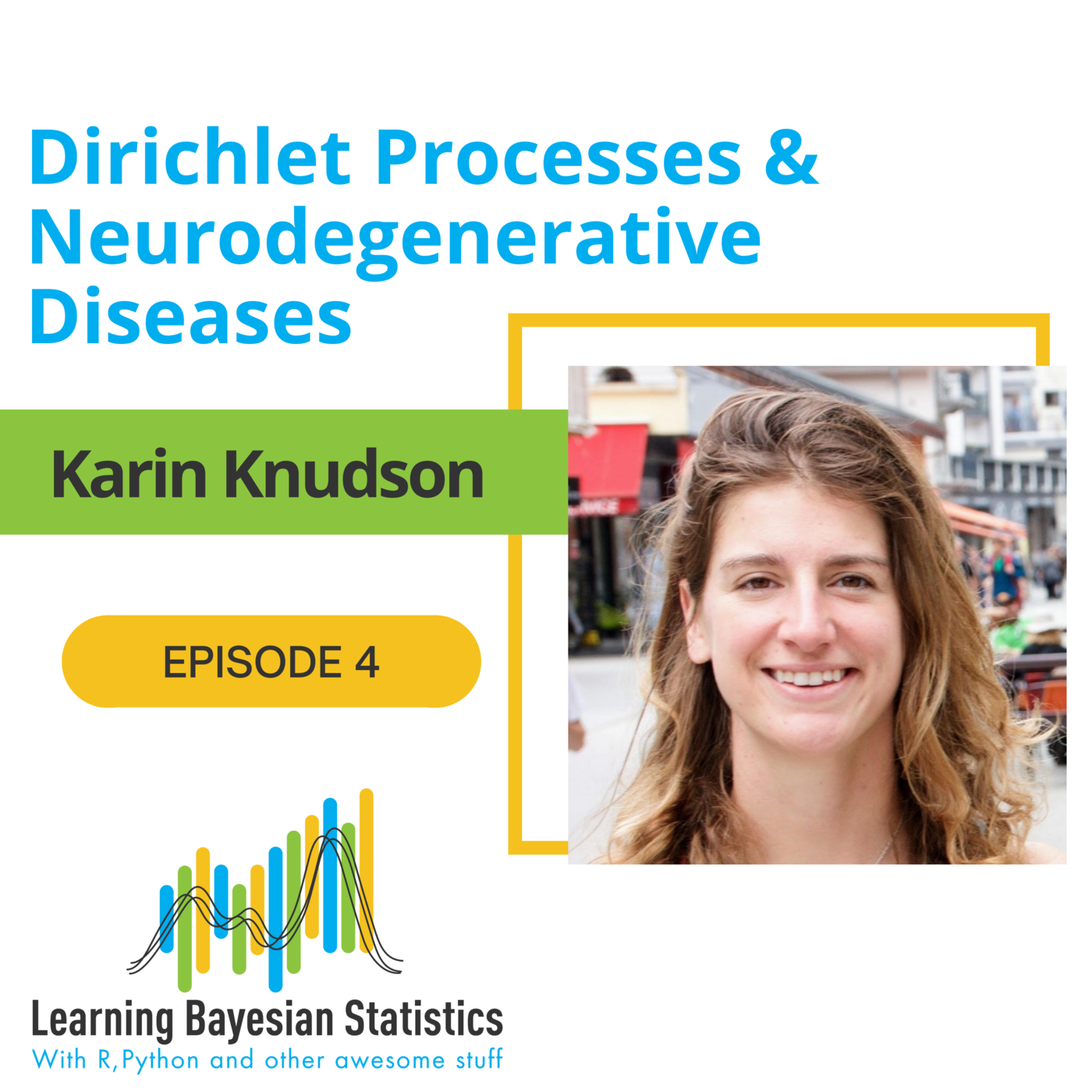
S1 Ep 4#4 Dirichlet Processes and Neurodegenerative Diseases, with Karin Knudson
What do neurodegenerative diseases, gerrymandering and ecological inference all have in common? Well, they can all be studied with Bayesian methods — and that’s exactly what Karin Knudson is doing.In this episode, Karin will share with us the vital and essential work she does to understand aspects of neurodegenerative diseases. She’ll also tell us more about computational neuroscience and Dirichlet processes — what they are, what they do, and when you should use them.Karin did her doctorate in mathematics, with a focus on compressive sensing and computational neuroscience at the University of Texas at Austin. Her doctoral work included applying hierarchical Dirichlet processes in the setting of neural data and focused on one-bit compressive sensing and spike-sorting.Formerly the chair of the math and computer science department of Phillips Academy Andover, she started a postdoc at Mass General Hospital and Harvard Medical in Fall 2019. Most importantly, rock climbing and hiking have no secrets for her!Our theme music is « Good Bayesian », by Baba Brinkman (feat MC Lars and Mega Ran). Check out his awesome work at https://bababrinkman.com/ ! Links from the show, personally curated by Karin Knudson:Karin on Twitter: https://twitter.com/karinknudsonSpike train entropy-rate estimation using hierarchical Dirichlet process priors (Knudson and Pillow): https://pillowlab.princeton.edu/pubs/abs_Knudson_HDPentropy_NIPS13.htmlFighting Gerrymandering with PyMC3, PyCon 2018, Colin Carroll and Karin Knudson: https://www.youtube.com/watch?v=G9I5ZnkWR0AExpository resources on Dirichlet Processes: Chapter 23 of Bayesian Data Analysis (Gelman et al.) and http://www.gatsby.ucl.ac.uk/~ywteh/research/npbayes/dp.pdfHierarchical Dirichlet Processes (introduced the HDP and included applications in topic modeling and for working with time-series data and Hidden Markov Models): https://www.stat.berkeley.edu/~aldous/206-Exch/Papers/hierarchical_dirichlet.pdfA Sticky HDP-HMM with applications to speaker diarization (a nice example of how the HDP can be used with HMM, in this case cleverly adapted so that states have more persistence): https://arxiv.org/abs/0905.2592If you want to get deeper into the weeds and also get a sense of the history: Dirichlet Processes with Applications to Bayesian Nonparametric Problems (https://projecteuclid.org/euclid.aos/1176342871) and A Bayesian Analysis of Some Nonparametric Problems (https://projecteuclid.org/euclid.aos/1176342360)
#3.2 How to use Bayes in industry, with Colin Carroll
bonusHow can you use Bayesian tools and optimize your models in industry? What are the best ways to communicate and visualize your models with non-technical and executive people? And what are the most common pitfalls?In this episode, Colin Carroll will tell us how he did all that in finance and the airline industry. He’ll also share with us what the future of probabilistic programming looks like to him.You already heard from Colin two weeks ago — so, if you didn’t catch this episode, go back in your feed’s history and enjoy the first part! As a reminder, Colin is a machine learning researcher and software engineer who’s notably worked on modeling risk in the airline industry and building NLP-powered search infrastructure for finance. He’s also an active contributor to open source, particularly to the popular PyMC3 and ArviZ libraries.Our theme music is « Good Bayesian », by Baba Brinkman (feat MC Lars and Mega Ran). Check out his awesome work at https://bababrinkman.com/!Links from the show: Colin's blog: https://colindcarroll.com/ Gelman’s putting model in PyMC3: https://github.com/pymc-devs/pymc3/blob/master/docs/source/notebooks/putting_workflow.ipynb Matthew Kay’s quantile dotplots: https://github.com/mjskay/when-ish-is-my-bus/blob/master/quantile-dotplots.md Jax, Composable transformations of Python+NumPy programs: https://github.com/google/jax NumPyro, Probabilistic programming with NumPy: https://github.com/pyro-ppl/numpyro Pyro, Deep Universal Probabilistic Programming: https://pyro.ai/ Rainier, Bayesian inference in Scala: https://github.com/stripe/rainier---Send in a voice message: https://anchor.fm/learn-bayes-stats/message
S1 Ep 3#3.1 What is Probabilistic Programming & Why use it, with Colin Carroll
When speaking about Bayesian statistics, we often hear about « probabilistic programming » — but what is it? Which languages and libraries allow you to program probabilistically? When is Stan, PyMC, Pyro or any other probabilistic programming language most appropriate for your project? And when should you even use Bayesian libraries instead of non-bayesian tools, like Statsmodels or Scikit-learn?Colin Carroll will answer all these questions for you. Colin is a machine learning researcher and software engineer who’s notably worked on modeling risk in the airline industry and building NLP-powered search infrastructure for finance. He’s also an active contributor to open source, particularly to the popular PyMC3 and ArviZ libraries.Having studied geometric measure theory at Rice University, Colin was bound to walk in the woods with Pete the pup – who was there when we recorded by the way – and to launch balloons into near-space in his spare time.Our theme music is « Good Bayesian », by Baba Brinkman (feat MC Lars and Mega Ran). Check out his awesome work at https://bababrinkman.com/!Links from the show:Colin's blog: https://colindcarroll.com/Colin on Twitter: https://twitter.com/colindcarrollColin on GitHub: https://github.com/ColCarrollVery parallel MCMC sampling: https://colindcarroll.com/2019/08/18/very-parallel-mcmc-sampling/A tour of probabilistic programming APIs: https://colindcarroll.com/2019/07/23/a-tour-of-probabilistic-programming-apis/PyMC3, Probabilistic Programming in Python: https://docs.pymc.io/Stan: https://mc-stan.org/Pyro, Deep Universal Probabilistic Programming: https://pyro.ai/ArviZ, Exploratory analysis of Bayesian models: https://arviz-devs.github.io/arviz/ PyMC-Learn, Probabilistic models for machine learning: https://www.pymc-learn.org/Facebook’s Prophet uses Stan: https://statmodeling.stat.columbia.edu/2017/03/01/facebooks-prophet-uses-stan/Prophet in PyMC3: https://github.com/luke14free/pm-prophet
S1 Ep 2#2 When should you use Bayesian tools, and Bayes in sports analytics, with Chris Fonnesbeck
When are Bayesian methods most useful? Conversely, when should you NOT use them? How do you teach them? What are the most important skills to pick-up when learning Bayes? And what are the most difficult topics, the ones you should maybe save for later?In this episode, you’ll hear Chris Fonnesbeck answer these questions from the perspective of marine biology and sports analytics. Chris is indeed the New York Yankees’ senior quantitative analyst and an associate professor at Vanderbilt University School of Medicine. He specializes in computational statistics, Bayesian methods, meta-analysis, and applied decision analysis. He also created PyMC, a library to do probabilistic programming in python, and is the author of several tutorials at PyCon and PyData conferences.Our theme music is « Good Bayesian », by Baba Brinkman (feat MC Lars and Mega Ran). Check out his awesome work at https://bababrinkman.com!Links from the show:Chris on Twitter: https://twitter.com/fonnesbeckPyMC3, Probabilistic Programming in Python: https://docs.pymc.io/Chris on GitHub: https://github.com/fonnesbeckAn introduction to Markov Chain Monte Carlo using PyMC3 - PyData London 2019: https://www.youtube.com/watch?v=SS_pqgFziAgIntroduction to Statistical Modeling with Python - PyCon 2017 - video: https://www.youtube.com/watch?v=TMmSESkhRtIIntroduction to Statistical Modeling with Python - PyCon 2017 - code repo: https://github.com/fonnesbeck/intro_stat_modeling_2017Bayesian Non-parametric Models for Data Science using PyMC3 - PyCon 2018: https://www.youtube.com/watch?v=-sIOMs4MSuAStatistical Data Analysis in Python: https://github.com/fonnesbeck/statistical-analysis-python-tutorial
S1 Ep 1#1 Bayes, open-source and bioinformatics, with Osvaldo Martin
What do you get when you put a physicist, a biologist and a data scientist in the same body? Well, you’re about to find out… In this episode you’ll meet Osvaldo Martin. Osvaldo is a researcher at the National Scientific and Technical Research Council in Argentina and is notably the author of the book Bayesian Analysis with Python, whose second edition was published in December 2018. He also teaches bioinformatics, data science and Bayesian data analysis, and is a core developer of PyMC3 and ArviZ, and recently started contributing to Bambi. Originally a biologist and physicist, Osvaldo trained himself to python and Bayesian methods – and what he’s doing with it is pretty amazing!We also touch on how accepted are Bayesian methods in his field, which models he’s currently working on, and what it’s like to be an open-source developer.Our theme music is « Good Bayesian », by Baba Brinkman (feat MC Lars and Mega Ran). Check out his awesome work at https://bababrinkman.com!Links from the show:Bayesian Analysis with Python, 2nd edition: https://www.amazon.com/dp/B07HHBCR9GBayesian Analysis with Python, code repository; https://github.com/aloctavodia/BAPOsvaldo on Twitter: https://twitter.com/aloctavodiaPyMC3, Probabilistic Programming in Python: https://docs.pymc.io/ArviZ, Exploratory analysis of Bayesian models: https://arviz-devs.github.io/arviz/BAyesian Model-Building Interface (BAMBI) in Python: https://bambinos.github.io/bambi/
#0 What is this podcast?
trailerAre you a researcher or data scientist / analyst / ninja? Do you want to learn Bayesian inference, stay up to date or simply want to understand what Bayesian inference is? Well I'm just like you! When I started learning Bayesian methods, I really wished there were a podcast out there that could introduce me to the methods, the projects and the people who make all that possible.So I created "Learning Bayesian Statistics", a fortnightly podcast where I interview researchers and practitioners of all fields about why and how they use Bayesian statistics, and how in turn YOU, as a learner, can apply these methods in YOUR modeling workflow. Now the thing is, I’m not a beginner, but I’m not an expert either. The people I’ll interview will definitely be. So I’ll be learning alongside you. I won’t pretend to know everything in this podcast, and I WILL make mistakes. But thanks to the guests’ feedback, we’ll be able to learn from those mistakes, and I think this will help you (and me!) become better, faster, stronger Bayesians.So, whether you want to learn Bayesian statistics or hear about the latest libraries, books and applications, this podcast is for you. In this very first episode - well actually it’s episode 0, because 0-indexing rules! - I will introduce you to the genesis of this podcast, tell you why you should listen and reveal some of the guests for the coming episodes.Come join us!Links from the show:Podcast website: https://learnbayesstats.anvil.app/Alex Twitter feed: https://twitter.com/alex_andorra