Learning Bayesian Statistics
220 episodes — Page 4 of 5
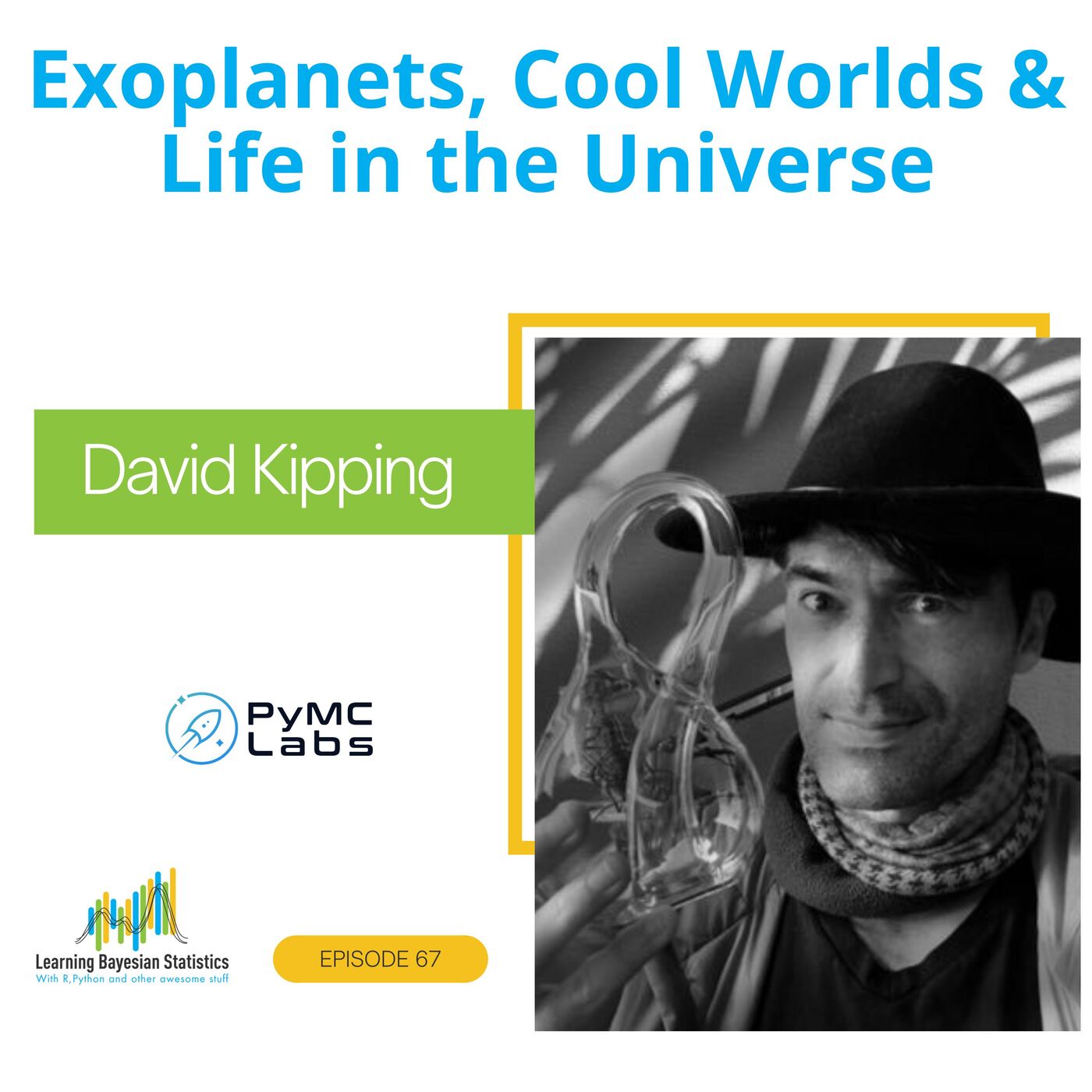
S1 Ep 67#67 Exoplanets, Cool Worlds & Life in the Universe, with David Kipping
Proudly sponsored by PyMC Labs, the Bayesian Consultancy. Book a call, or get in touch!Is there life in the Universe? It doesn’t get deeper than this, does it? And yet, why do we care about that? In the very small chance that there is other life in the Universe, we have even less chance to discover it, talk to it and meet it. So, why do we care?Well, it may surprise you but Bayesian statistics helps us think about these astronomical and — dare I say? — philosophical topics, as my guest, David Kipping, will brilliantly explain in this episode.David is an Associate Professor of Astronomy at Columbia University, where he leads the Cool Worlds Lab — I know, the name is awesome. His team’s research spans exoplanet discovery and characterization, the search for life in the Universe and developing novel approaches to our exploration of the cosmos.David also teaches astrostatistics, and his contributions to Bayesian statistics span astrobiology to exoplanet detection. He also hosts the Cool Worlds YouTube channel, with over half a million subscribers, that discusses his team’s work and broader topics within the field.Cool worlds, cool guest, cool episode.Our theme music is « Good Bayesian », by Baba Brinkman (feat MC Lars and Mega Ran). Check out his awesome work at https://bababrinkman.com/ !Thank you to my Patrons for making this episode possible!Yusuke Saito, Avi Bryant, Ero Carrera, Giuliano Cruz, Tim Gasser, James Wade, Tradd Salvo, Adam Bartonicek, William Benton, Alan O'Donnell, Mark Ormsby, James Ahloy, Robin Taylor, Thomas Wiecki, Chad Scherrer, Nathaniel Neitzke, Zwelithini Tunyiswa, Elea McDonnell Feit, Bertrand Wilden, James Thompson, Stephen Oates, Gian Luca Di Tanna, Jack Wells, Matthew Maldonado, Ian Costley, Ally Salim, Larry Gill, Joshua Duncan, Ian Moran, Paul Oreto, Colin Caprani, George Ho, Colin Carroll, Nathaniel Burbank, Michael Osthege, Rémi Louf, Clive Edelsten, Henri Wallen, Hugo Botha, Vinh Nguyen, Raul Maldonado, Marcin Elantkowski, Adam C. Smith, Will Kurt, Andrew Moskowitz, Hector Munoz, Marco Gorelli, Simon Kessell, Bradley Rode, Patrick Kelley, Rick Anderson, Casper de Bruin, Philippe Labonde, Matthew McAnear, Michael Hankin, Cameron Smith, Luis Iberico, Tomáš Frýda, Ryan Wesslen, Andreas Netti, Riley King, Aaron Jones, Yoshiyuki Hamajima, Sven De Maeyer, Michael DeCrescenzo, Fergal M, Mason Yahr, Naoya Kanai, Steven Rowland, Aubrey Clayton, Jeannine Sue, Omri Har Shemesh, Lin Yu Sha, Scott Anthony Robson, David Haas and Robert Yolken.Visit https://www.patreon.com/learnbayesstats to unlock exclusive Bayesian swag ;)Links from the show:David’s website: http://user.astro.columbia.edu/~dkipping/David on Twitter: https://twitter.com/david_kippingDavid’s YouTube channel:
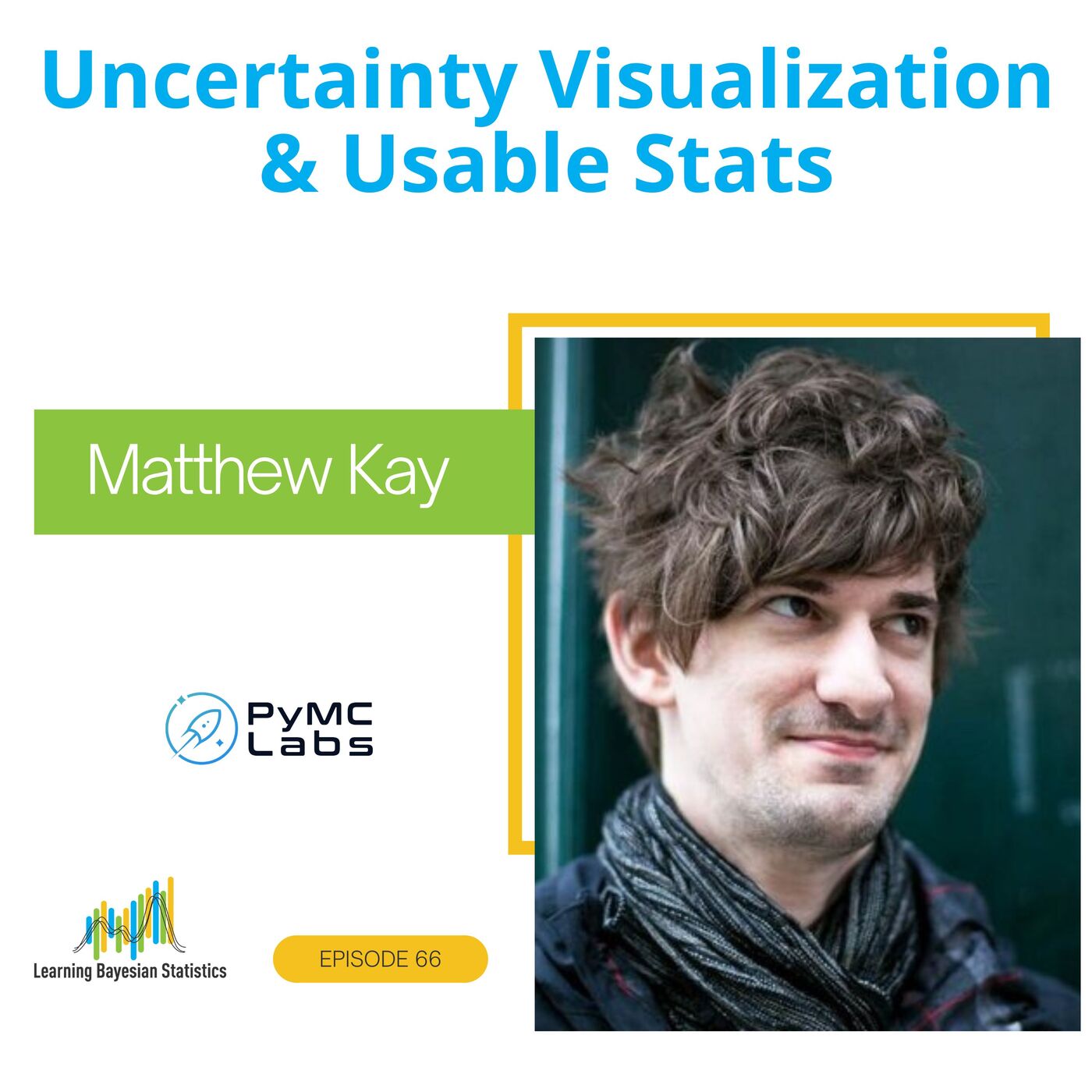
S1 Ep 66#66 Uncertainty Visualization & Usable Stats, with Matthew Kay
Proudly sponsored by PyMC Labs, the Bayesian Consultancy. Book a call, or get in touch!I have to confess something: I love challenges. And when you’re a podcaster, what’s a better challenge than dedicating an episode to… visualization? Impossible you say? Well, challenge accepted!Thankfully, I got the help of a visualization Avenger for this episode — namely, Matthew Kay. Matt is an Assistant Professor jointly appointed in Computer Science and Communications Studies at Northwestern University, where he co-directs the Midwest Uncertainty Collective — I know, it’s a pretty cool name for a lab.He works in human-computer interaction and information visualization, and especially in uncertainty visualization. He also builds tools to support uncertainty visualization in R. In particular, he’s the author of the tidybayes and ggdist R packages, and wrote the random variable interface in the posterior package.I promise, you won’t be uncertain about the importance of uncertainty visualization after that…Our theme music is « Good Bayesian », by Baba Brinkman (feat MC Lars and Mega Ran). Check out his awesome work at https://bababrinkman.com/ !Thank you to my Patrons for making this episode possible!Yusuke Saito, Avi Bryant, Ero Carrera, Giuliano Cruz, Tim Gasser, James Wade, Tradd Salvo, Adam Bartonicek, William Benton, Alan O'Donnell, Mark Ormsby, James Ahloy, Robin Taylor, Thomas Wiecki, Chad Scherrer, Nathaniel Neitzke, Zwelithini Tunyiswa, Elea McDonnell Feit, Bertrand Wilden, James Thompson, Stephen Oates, Gian Luca Di Tanna, Jack Wells, Matthew Maldonado, Ian Costley, Ally Salim, Larry Gill, Joshua Duncan, Ian Moran, Paul Oreto, Colin Caprani, George Ho, Colin Carroll, Nathaniel Burbank, Michael Osthege, Rémi Louf, Clive Edelsten, Henri Wallen, Hugo Botha, Vinh Nguyen, Raul Maldonado, Marcin Elantkowski, Adam C. Smith, Will Kurt, Andrew Moskowitz, Hector Munoz, Marco Gorelli, Simon Kessell, Bradley Rode, Patrick Kelley, Rick Anderson, Casper de Bruin, Philippe Labonde, Matthew McAnear, Michael Hankin, Cameron Smith, Luis Iberico, Tomáš Frýda, Ryan Wesslen, Andreas Netti, Riley King, Aaron Jones, Yoshiyuki Hamajima, Sven De Maeyer, Michael DeCrescenzo, Fergal M, Mason Yahr, Naoya Kanai, Steven Rowland, Aubrey Clayton, Jeannine Sue, Omri Har Shemesh, Lin Yu Sha and Scott Anthony Robson.Visit https://www.patreon.com/learnbayesstats to unlock exclusive Bayesian swag ;)Links from the show:Matt on Twitter: https://twitter.com/mjskayMatt on GitHub: https://github.com/mjskay Matt’s website: https://www.mjskay.com/ Midwest Uncertainty Collective lab:
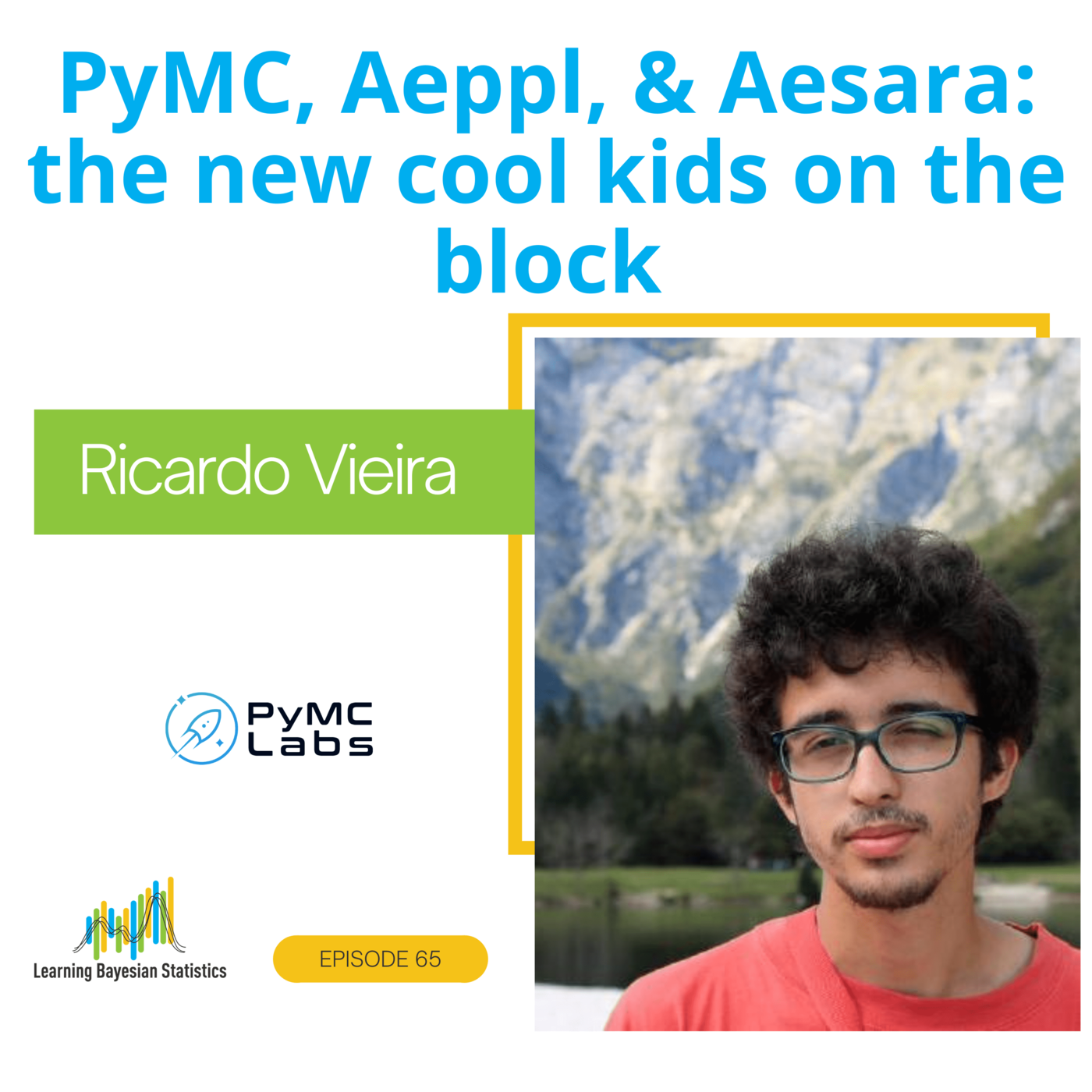
S1 Ep 65#65 PyMC, Aeppl, & Aesara: the new cool kids on the block, with Ricardo Vieira
Proudly sponsored by PyMC Labs, the Bayesian Consultancy. Book a call, or get in touch!Folks, there are some new cool kids on the block. They are called PyMC, Aeppl, and Aesara, and it’s high time we give us a proper welcome!To do that, who better than one of the architects of the new PyMC 4.0 — Ricardo Vieira! In this episode, he’ll walk us through the inner workings of the newly released version of PyMC, telling us why the Aesara backend and the brand new RandomVariable operators constitute such strong foundations for your beloved PyMC models. He will also tell us about a self-contained PPL project called Aeppl, dedicated to converting model graphs to probability functions — pretty cool, right?Oh, in case you didn’t guess yet, Ricardo is a PyMC developer and data scientist at PyMC Labs. He spent several years teaching himself Statistics and Computer Science at the expense of his official degrees in Psychology and Neuroscience.So, get ready for efficient random generator functions, better probability evaluation functions, and a fully-fledged modern Bayesian workflow!Our theme music is « Good Bayesian », by Baba Brinkman (feat MC Lars and Mega Ran). Check out his awesome work at https://bababrinkman.com/ !Thank you to my Patrons for making this episode possible!Yusuke Saito, Avi Bryant, Ero Carrera, Giuliano Cruz, Tim Gasser, James Wade, Tradd Salvo, Adam Bartonicek, William Benton, Alan O'Donnell, Mark Ormsby, James Ahloy, Robin Taylor, Thomas Wiecki, Chad Scherrer, Nathaniel Neitzke, Zwelithini Tunyiswa, Elea McDonnell Feit, Bertrand Wilden, James Thompson, Stephen Oates, Gian Luca Di Tanna, Jack Wells, Matthew Maldonado, Ian Costley, Ally Salim, Larry Gill, Joshua Duncan, Ian Moran, Paul Oreto, Colin Caprani, George Ho, Colin Carroll, Nathaniel Burbank, Michael Osthege, Rémi Louf, Clive Edelsten, Henri Wallen, Hugo Botha, Vinh Nguyen, Raul Maldonado, Marcin Elantkowski, Adam C. Smith, Will Kurt, Andrew Moskowitz, Hector Munoz, Marco Gorelli, Simon Kessell, Bradley Rode, Patrick Kelley, Rick Anderson, Casper de Bruin, Philippe Labonde, Matthew McAnear, Michael Hankin, Cameron Smith, Luis Iberico, Tomáš Frýda, Ryan Wesslen, Andreas Netti, Riley King, Aaron Jones, Yoshiyuki Hamajima, Sven De Maeyer, Michael DeCrescenzo, Fergal M, Mason Yahr, Naoya Kanai, Steven Rowland, Aubrey Clayton, Jeannine Sue, Omri Har Shemesh, Lin Yu Sha and Scott Anthony Robson.Visit https://www.patreon.com/learnbayesstats to unlock exclusive Bayesian swag ;)Links from the show:Ricardo on Twitter: https://twitter.com/RicardoV944Ricardo on GitHub: https://github.com/ricardoV94/Ricardo’s website: https://ricardov94.github.io/posts/PyMC, Aesara and Aeppl: The New Kids on The Block (YouTube...
S1 Ep 64#64 Modeling the Climate & Gravity Waves, with Laura Mansfield
Proudly sponsored by PyMC Labs, the Bayesian Consultancy. Book a call, or get in touch!I’m sure you’ve already heard of gravitational waves, because my listeners are the coolest and smartest ever ;) But did you know about gravity waves? That’s right, waves in the sky due to gravity — sounds awesome, right?Well, I’m pretty sure that Laura Mansfield will confirm your prior. Currently a postdoc at Stanford University, Laura studies — guess what? — gravity waves and how they are represented in climate models. In particular, she uses Bayesian methods to estimate the uncertainty on the gravity wave components of the models.Holding a PhD from the University of Reading in the UK, her background is in atmospheric physics, but she’s interested in climate change and environmental issues.So seat back, chill out, and enjoy this physics-packed, aerial episode!Our theme music is « Good Bayesian », by Baba Brinkman (feat MC Lars and Mega Ran). Check out his awesome work at https://bababrinkman.com/ !Thank you to my Patrons for making this episode possible!Yusuke Saito, Avi Bryant, Ero Carrera, Giuliano Cruz, Tim Gasser, James Wade, Tradd Salvo, Adam Bartonicek, William Benton, Alan O'Donnell, Mark Ormsby, James Ahloy, Robin Taylor, Thomas Wiecki, Chad Scherrer, Nathaniel Neitzke, Zwelithini Tunyiswa, Elea McDonnell Feit, Bertrand Wilden, James Thompson, Stephen Oates, Gian Luca Di Tanna, Jack Wells, Matthew Maldonado, Ian Costley, Ally Salim, Larry Gill, Joshua Duncan, Ian Moran, Paul Oreto, Colin Caprani, George Ho, Colin Carroll, Nathaniel Burbank, Michael Osthege, Rémi Louf, Clive Edelsten, Henri Wallen, Hugo Botha, Vinh Nguyen, Raul Maldonado, Marcin Elantkowski, Adam C. Smith, Will Kurt, Andrew Moskowitz, Hector Munoz, Marco Gorelli, Simon Kessell, Bradley Rode, Patrick Kelley, Rick Anderson, Casper de Bruin, Philippe Labonde, Matthew McAnear, Michael Hankin, Cameron Smith, Luis Iberico, Tomáš Frýda, Ryan Wesslen, Andreas Netti, Riley King, Aaron Jones, Yoshiyuki Hamajima, Sven De Maeyer, Michael DeCrescenzo, Fergal M, Mason Yahr, Naoya Kanai, Steven Rowland, Aubrey Clayton, Jeannine Sue, Omri Har Shemesh, Lin Yu Sha and Scott Anthony Robson.Visit https://www.patreon.com/learnbayesstats to unlock exclusive Bayesian swag ;)Links from the show:Laura on Twitter: https://twitter.com/lau_mansfieldLaura’s webpage: https://profiles.stanford.edu/laura-mansfieldJulia package for Gaussian Processes: https://github.com/STOR-i/GaussianProcesses.jl Julia implementation of the scikit-learn API:
S1 Ep 63#63 Media Mix Models & Bayes for Marketing, with Luciano Paz
Proudly sponsored by PyMC Labs, the Bayesian Consultancy. Book a call, or get in touch!Inviting someone like Luciano Paz on a stats podcast is both a pleasure and a challenge — he does so many things brilliantly that you have too many questions to ask him…In this episode, I’ve chosen — not without difficulty — to focus on the applications of Bayesian stats in the marketing industry, especially Media Mix Models. Ok, I also asked Luciano about other topics — but you know me, I like to talk…Originally, Luciano studied physics. He then did a PhD and postdoc in neuroscience, before transitioning into industry. During his time in academia, he used stats, machine learning and data science concepts here and there, but not in a very organized way.But at the end of his postdoc, he got into PyMC — and that’s when everything changed… He loved the community and decided to hop on board to exit academia into a better life. After leaving academia, he worked at a company that wanted to do data science but that, for privacy reasons, didn’t have a lot of data. And now, Luciano is one of the folks working full time at the PyMC Labs consultancy.But Luciano is not only one of the cool nerds building this crazy Bayesian adventures. He also did a lot of piano and ninjutsu. Sooooo, don’t provoke him — either in the streets or at a karaoke bar…Our theme music is « Good Bayesian », by Baba Brinkman (feat MC Lars and Mega Ran). Check out his awesome work at https://bababrinkman.com/ !Thank you to my Patrons for making this episode possible!Yusuke Saito, Avi Bryant, Ero Carrera, Giuliano Cruz, Tim Gasser, James Wade, Tradd Salvo, Adam Bartonicek, William Benton, Alan O'Donnell, Mark Ormsby, James Ahloy, Robin Taylor, Thomas Wiecki, Chad Scherrer, Nathaniel Neitzke, Zwelithini Tunyiswa, Elea McDonnell Feit, Bertrand Wilden, James Thompson, Stephen Oates, Gian Luca Di Tanna, Jack Wells, Matthew Maldonado, Ian Costley, Ally Salim, Larry Gill, Joshua Duncan, Ian Moran, Paul Oreto, Colin Caprani, George Ho, Colin Carroll, Nathaniel Burbank, Michael Osthege, Rémi Louf, Clive Edelsten, Henri Wallen, Hugo Botha, Vinh Nguyen, Raul Maldonado, Marcin Elantkowski, Adam C. Smith, Will Kurt, Andrew Moskowitz, Hector Munoz, Marco Gorelli, Simon Kessell, Bradley Rode, Patrick Kelley, Rick Anderson, Casper de Bruin, Philippe Labonde, Matthew McAnear, Michael Hankin, Cameron Smith, Luis Iberico, Tomáš Frýda, Ryan Wesslen, Andreas Netti, Riley King, Aaron Jones, Yoshiyuki Hamajima, Sven De Maeyer, Michael DeCrescenzo, Fergal M, Mason Yahr, Naoya Kanai, Steven Rowland, Aubrey Clayton, Jeannine Sue, Omri Har Shemesh and Lin Yu Sha.Visit https://www.patreon.com/learnbayesstats to unlock exclusive Bayesian swag ;)Links from the show:Luciano’s website: https://lucianopaz.github.io/Luciano on GitHub:
S1 Ep 62#62 Bayesian Generative Modeling for Healthcare, with Maria Skoularidou
Proudly sponsored by PyMC Labs, the Bayesian Consultancy. Book a call, or get in touch!We talk a lot about generative modeling on this podcast — at least since episode 6, with Michael Betancourt! And an area where this way of modeling is particularly useful is healthcare, as Maria Skoularidou will tell us in this episode.Maria is a final year PhD student at the University of Cambridge. Her thesis is focused on probabilistic machine learning and, more precisely, towards using generative modeling in… you guessed it: healthcare!But her fields of interest are diverse: from theory and methodology of machine intelligence to Bayesian inference; from theoretical computer science to information theory — Maria is knowledgeable in a lot of topics! That’s why I also had to ask her about mixture models, a category of models that she uses frequently.Prior to her PhD, Maria studied Computer Science and Statistical Science at Athens University of Economics and Business. She’s also invested in several efforts to bring more diversity and accessibility in the data science world.When she’s not working on all this, you’ll find her playing the ney, trekking or rawing.Our theme music is « Good Bayesian », by Baba Brinkman (feat MC Lars and Mega Ran). Check out his awesome work at https://bababrinkman.com/ !Thank you to my Patrons for making this episode possible!Yusuke Saito, Avi Bryant, Ero Carrera, Giuliano Cruz, Tim Gasser, James Wade, Tradd Salvo, Adam Bartonicek, William Benton, Alan O'Donnell, Mark Ormsby, James Ahloy, Robin Taylor, Thomas Wiecki, Chad Scherrer, Nathaniel Neitzke, Zwelithini Tunyiswa, Elea McDonnell Feit, Bertrand Wilden, James Thompson, Stephen Oates, Gian Luca Di Tanna, Jack Wells, Matthew Maldonado, Ian Costley, Ally Salim, Larry Gill, Joshua Duncan, Ian Moran, Paul Oreto, Colin Caprani, George Ho, Colin Carroll, Nathaniel Burbank, Michael Osthege, Rémi Louf, Clive Edelsten, Henri Wallen, Hugo Botha, Vinh Nguyen, Raul Maldonado, Marcin Elantkowski, Adam C. Smith, Will Kurt, Andrew Moskowitz, Hector Munoz, Marco Gorelli, Simon Kessell, Bradley Rode, Patrick Kelley, Rick Anderson, Casper de Bruin, Philippe Labonde, Matthew McAnear, Michael Hankin, Cameron Smith, Luis Iberico, Tomáš Frýda, Ryan Wesslen, Andreas Netti, Riley King, Aaron Jones, Yoshiyuki Hamajima, Sven De Maeyer, Michael DeCrescenzo, Fergal M, Mason Yahr, Naoya Kanai, Steven Rowland, Aubrey Clayton and Jeannine Sue.Visit https://www.patreon.com/learnbayesstats to unlock exclusive Bayesian swag ;)Links from the show:Maria on Twitter: https://twitter.com/skoularidouMaria on LinkedIn: https://www.linkedin.com/in/maria-skoularidou-1289b62a/Maria’s webpage:
S1 Ep 61#61 Why we still use non-Bayesian methods, with EJ Wagenmakers
The big problems with classic hypothesis testing are well-known. And yet, a huge majority of statistical analyses are still conducted this way. Why is it? Why are things so hard to change? Can you even do (and should you do) hypothesis testing in the Bayesian framework?I guess if you wanted to name this episode in a very Marvelian way, it would be “Bayes factors against the p-values of madness” — but we won’t do that, it wouldn’t be appropriate, would it?Anyways, in this episode, I’ll talk about all these very light and consensual topics with Eric-Jan Wagenmakers, a professor at the Psychological Methods Unit of the University of Amsterdam.For almost two decades, EJ has staunchly advocated the use of Bayesian inference in psychology. In order to lower the bar for the adoption of Bayesian methods, he is coordinating the development of JASP, an open-source software program that allows practitioners to conduct state-of-the-art Bayesian analyses with their mouse — the one from the computer, not the one from Disney.EJ has also written a children’s book on Bayesian inference with the title “Bayesian thinking for toddlers”. Rumor has it that he is also working on a multi-volume series for adults — but shhh, that’s a secret!EJ’s lab publishes regularly on a host of Bayesian topics, so check out his website, particularly when you are interested in Bayesian hypothesis testing. The same goes for his blog by the way, “BayesianSpectacles”.Wait, what’s that? EJ is telling me that he plays chess, squash, and that, most importantly, he enjoys watching arm wrestling videos on YouTube — yet another proof that, yes, you can find everything on YouTube.Our theme music is « Good Bayesian », by Baba Brinkman (feat MC Lars and Mega Ran). Check out his awesome work at https://bababrinkman.com/ !Thank you to my Patrons for making this episode possible!Yusuke Saito, Avi Bryant, Ero Carrera, Giuliano Cruz, Tim Gasser, James Wade, Tradd Salvo, Adam Bartonicek, William Benton, Alan O'Donnell, Mark Ormsby, James Ahloy, Robin Taylor, Thomas Wiecki, Chad Scherrer, Nathaniel Neitzke, Zwelithini Tunyiswa, Elea McDonnell Feit, Bertrand Wilden, James Thompson, Stephen Oates, Gian Luca Di Tanna, Jack Wells, Matthew Maldonado, Ian Costley, Ally Salim, Larry Gill, Joshua Duncan, Ian Moran, Paul Oreto, Colin Caprani, George Ho, Colin Carroll, Nathaniel Burbank, Michael Osthege, Rémi Louf, Clive Edelsten, Henri Wallen, Hugo Botha, Vinh Nguyen, Raul Maldonado, Marcin Elantkowski, Adam C. Smith, Will Kurt, Andrew Moskowitz, Hector Munoz, Marco Gorelli, Simon Kessell, Bradley Rode, Patrick Kelley, Rick Anderson, Casper de Bruin, Philippe Labonde, Matthew McAnear, Michael Hankin, Cameron Smith, Luis Iberico, Tomáš Frýda, Ryan Wesslen, Andreas Netti, Riley King, Aaron Jones, Yoshiyuki Hamajima, Sven De Maeyer, Michael DeCrescenzo, Fergal M, Mason Yahr, Naoya Kanai, Steven Rowland and Aubrey Clayton.Visit https://www.patreon.com/learnbayesstats to unlock exclusive Bayesian swag ;)Links from the show:EJ’s website: http://ejwagenmakers.com/EJ on Twitter: https://twitter.com/EJWagenmakers“Bayesian Cognitive Modeling” book website:
S1 Ep 60#60 Modeling Dialogues & Languages, with J.P. de Ruiter
Why do we, humans, communicate? And how? And isn’t that a problem that to study communication we have to… communicate?Did you ever ask yourself that? Because J.P. de Ruiter did — and does everyday. But he’s got good reasons: JP is a cognitive scientist whose primary research focus is on the cognitive foundations of human communication. He aims to improve our understanding of how humans and artificial agents use language, gesture and other types of signals to effectively communicate with each other.Currently he has one of the two Bridge Professorship at Tufts University, and has been appointed in both the Computer Science and Psychology departments.In this episode, we’ll look at why Bayes is helpful in dialogue research, what the future of the field looks like to JP, and how he uses PyMC in his own teaching.Our theme music is « Good Bayesian », by Baba Brinkman (feat MC Lars and Mega Ran). Check out his awesome work at https://bababrinkman.com/ !Thank you to my Patrons for making this episode possible!Yusuke Saito, Avi Bryant, Ero Carrera, Giuliano Cruz, Tim Gasser, James Wade, Tradd Salvo, Adam Bartonicek, William Benton, Alan O'Donnell, Mark Ormsby, James Ahloy, Robin Taylor, Thomas Wiecki, Chad Scherrer, Nathaniel Neitzke, Zwelithini Tunyiswa, Elea McDonnell Feit, Bertrand Wilden, James Thompson, Stephen Oates, Gian Luca Di Tanna, Jack Wells, Matthew Maldonado, Ian Costley, Ally Salim, Larry Gill, Joshua Duncan, Ian Moran, Paul Oreto, Colin Caprani, George Ho, Colin Carroll, Nathaniel Burbank, Michael Osthege, Rémi Louf, Clive Edelsten, Henri Wallen, Hugo Botha, Vinh Nguyen, Raul Maldonado, Marcin Elantkowski, Adam C. Smith, Will Kurt, Andrew Moskowitz, Hector Munoz, Marco Gorelli, Simon Kessell, Bradley Rode, Patrick Kelley, Rick Anderson, Casper de Bruin, Philippe Labonde, Matthew McAnear, Michael Hankin, Cameron Smith, Luis Iberico, Tomáš Frýda, Ryan Wesslen, Andreas Netti, Riley King, Aaron Jones, Yoshiyuki Hamajima, Sven De Maeyer, Michael DeCrescenzo, Fergal M, Mason Yahr, Naoya Kanai, Steven Rowland and Aubrey Clayton.Visit https://www.patreon.com/learnbayesstats to unlock exclusive Bayesian swag ;)Links from the show:JP’s page: https://sites.tufts.edu/hilab/people/Projecting the End of a Speaker's Turn – A Cognitive Cornerstone of Conversation: https://www.researchgate.net/publication/236787756_Projecting_the_End_of_a_Speaker's_Turn_A_Cognitive_Cornerstone_of_ConversationCognitive and social delays in the initiation of conversational repair: https://journals.uic.edu/ojs/index.php/dad/article/view/11388Using uh and um in spontaneous speaking: http://www.columbia.edu/~rmk7/HC/HC_Readings/Clark_Fox.pdfStatus of Frustrator as an Inhibitor of Horn-Honking Responses: https://www.tandfonline.com/doi/abs/10.1080/00224545.1968.9933615A Simplest Systematics for the Organization of Turn-Taking for Conversation:
S1 Ep 59#59 Bayesian Modeling in Civil Engineering, with Michael Faber
In large-scale one-off civil infrastructure, decision-making under uncertainty is part of the job, that’s just how it is. But, civil engineers don't get the luxury of building 10^6 versions of the bridge, offshore wind turbine or aeronautical structure to consider a relative frequency interpretation!And as you’ll hear, challenges don’t stop there: you also have to consider natural hazards such as earthquakes, rockfall and typhoons — in case you were wondering, civil engineering is not among the boring jobs!To talk about these original topics, I had the pleasure to host Michael Faber. Michael is a Professor at the Department of Built Environment at Aalborg University, Denmark, the President of the Joint Committee on Structural Safety and is a tremendously deep thinker on the Bayesian interpretation of probability as it pertains to the risk-informed management of big infrastructure.His research interests are directed on governance and management of risks, resilience and sustainability in the built environment — doing all that with Bayesian probabilistic modeling and applied Bayesian decision analysis, as you’ll hear.Our theme music is « Good Bayesian », by Baba Brinkman (feat MC Lars and Mega Ran). Check out his awesome work at https://bababrinkman.com/ !Thank you to my Patrons for making this episode possible!Yusuke Saito, Avi Bryant, Ero Carrera, Giuliano Cruz, Tim Gasser, James Wade, Tradd Salvo, Adam Bartonicek, William Benton, Alan O'Donnell, Mark Ormsby, James Ahloy, Robin Taylor, Thomas Wiecki, Chad Scherrer, Nathaniel Neitzke, Zwelithini Tunyiswa, Elea McDonnell Feit, Bertrand Wilden, James Thompson, Stephen Oates, Gian Luca Di Tanna, Jack Wells, Matthew Maldonado, Ian Costley, Ally Salim, Larry Gill, Joshua Duncan, Ian Moran, Paul Oreto, Colin Caprani, George Ho, Colin Carroll, Nathaniel Burbank, Michael Osthege, Rémi Louf, Clive Edelsten, Henri Wallen, Hugo Botha, Vinh Nguyen, Raul Maldonado, Marcin Elantkowski, Adam C. Smith, Will Kurt, Andrew Moskowitz, Hector Munoz, Marco Gorelli, Simon Kessell, Bradley Rode, Patrick Kelley, Rick Anderson, Casper de Bruin, Philippe Labonde, Matthew McAnear, Michael Hankin, Cameron Smith, Luis Iberico, Tomáš Frýda, Ryan Wesslen, Andreas Netti, Riley King, Aaron Jones, Yoshiyuki Hamajima, Sven De Maeyer, Michael DeCrescenzo, Fergal M, Mason Yahr, Naoya Kanai, Steven Rowland and Aubrey Clayton.Visit https://www.patreon.com/learnbayesstats to unlock exclusive Bayesian swag ;)Links from the show:Michael's profile on Aalborg University: https://vbn.aau.dk/en/persons/100493Michael's LinkedIn profile: https://www.linkedin.com/in/michael-havbro-faber-22898414/Statistics and Probability Theory - In Pursuit of Engineering Decision Support: https://link.springer.com/book/10.1007/978-94-007-4056-3Bayes in Civil Engineering - an abridged personal account of research and applications: https://www.linkedin.com/pulse/bayes-civil-engineering-michael-havbro-faberWebsite of the Joint Committee on Structural Safety (JCSS): https://www.jcss-lc.org/
S1 Ep 58#58 Bayesian Modeling and Computation, with Osvaldo Martin, Ravin Kumar and Junpeng Lao
You know when you have friends who wrote a book and pressure you to come on your podcast? That’s super annoying, right?Well that’s not what happened with Ravin Kumar, Osvaldo Martin and Junpeng Lao — I was the one who suggested doing a special episode about their new book, Bayesian Modeling and Computation in Python. And since they cannot say no to my soothing French accent, well, they didn’t say no…All of them were on the podcast already, so I’ll refer you to their solo episode for background on their background — aka backgroundception.Junpeng is a Data Scientist at Google, living in Zurich, Switzerland. Previously, he was a post-doc in Psychology and Cognitive Neuroscience. His current obsessions are time series and state space models. Osvaldo is a Researcher at CONICET in Argentina and the Department of Computer Science from Aalto University in Finland. He is especially motivated by the development and implementation of software tools for Bayesian statistics and probabilistic modeling.Ravin is a data scientist at Google, living in Los Angeles. Previously he worked at Sweetgreen and SpaceX. He became interested in Bayesian statistics when trying to quantify uncertainty in operations. He is especially interested in decision science in business settings.You’ll make your own opinion, but I like their book because uses a hands-on approach, focusing on the practice of applied statistics. And you get to see how to use diverse libraries, like PyMC, Tensorflow Probability, ArviZ, Bambi, and so on. You’ll see what I’m talking about in this episode.To top it off, the book is fully available online at bayesiancomputationbook.com. If you want a physical copy (because you love those guys and wanna support them), go to CRC website and enter the code ASA18 at checkout for a 30% discount.Our theme music is « Good Bayesian », by Baba Brinkman (feat MC Lars and Mega Ran). Check out his awesome work at https://bababrinkman.com/ !Thank you to my Patrons for making this episode possible!Yusuke Saito, Avi Bryant, Ero Carrera, Giuliano Cruz, Tim Gasser, James Wade, Tradd Salvo, Adam Bartonicek, William Benton, Alan O'Donnell, Mark Ormsby, James Ahloy, Robin Taylor, Thomas Wiecki, Chad Scherrer, Nathaniel Neitzke, Zwelithini Tunyiswa, Elea McDonnell Feit, Bertrand Wilden, James Thompson, Stephen Oates, Gian Luca Di Tanna, Jack Wells, Matthew Maldonado, Ian Costley, Ally Salim, Larry Gill, Joshua Duncan, Ian Moran, Paul Oreto, Colin Caprani, George Ho, Colin Carroll, Nathaniel Burbank, Michael Osthege, Rémi Louf, Clive Edelsten, Henri Wallen, Hugo Botha, Vinh Nguyen, Raul Maldonado, Marcin Elantkowski, Adam C. Smith, Will Kurt, Andrew Moskowitz, Hector Munoz, Marco Gorelli, Simon Kessell, Bradley Rode, Patrick Kelley, Rick Anderson, Casper de Bruin, Philippe Labonde, Matthew McAnear, Michael Hankin, Cameron Smith, Luis Iberico, Tomáš Frýda, Ryan Wesslen, Andreas Netti, Riley King, Aaron Jones, Yoshiyuki Hamajima, Sven De Maeyer, Michael DeCrescenzo, Fergal M, Mason Yahr, Naoya Kanai, Steven Rowland and Aubrey Clayton.Visit https://www.patreon.com/learnbayesstats to unlock exclusive Bayesian swag ;)Links from the...
S1 Ep 57#57 Forecasting French Elections, with… Mystery Guest
No, no, don't leave! You did not click on the wrong button. You are indeed on Alex Andorra’s podcast. The podcast that took the Bayesian world by a storm: “Learning Bayesian Statistics”, and that Barack Obama deemed “the best podcast in the whole galaxy” – or maybe Alex said that, I don’t remember.Alex made us discover new methods, new ideas, and mostly new people. But what do we really know about him? Does he even really exist? To find this out I put on my Frenchest beret, a baguette under my arm, and went undercover to try to find him.And I did ! So today for a special episode I, Rémi Louf, will be the one asking questions and making bad jokes with a French accent.Before letting him in, here’s what I got on him so far.By day, Alex is a Bayesian modeler at the PyMC Labs consultancy. By night, he doesn’t (yet) fight crime but he’s an open-source enthusiast and core contributor to PyMC and ArviZ.An always-learning statistician, Alex loves building models and studying elections and human behavior.When he’s not working, he loves hiking, exercising, meditating and reading nerdy books and novels. He also loves chocolate a bit too much, but he doesn’t like talking about it – he prefers eating it.Our theme music is « Good Bayesian », by Baba Brinkman (feat MC Lars and Mega Ran). Check out his awesome work at https://bababrinkman.com/ !Thank you to my Patrons for making this episode possible!Yusuke Saito, Avi Bryant, Ero Carrera, Giuliano Cruz, Tim Gasser, James Wade, Tradd Salvo, Adam Bartonicek, William Benton, Alan O'Donnell, Mark Ormsby, James Ahloy, Robin Taylor, Thomas Wiecki, Chad Scherrer, Nathaniel Neitzke, Zwelithini Tunyiswa, Elea McDonnell Feit, Bertrand Wilden, James Thompson, Stephen Oates, Gian Luca Di Tanna, Jack Wells, Matthew Maldonado, Ian Costley, Ally Salim, Larry Gill, Joshua Duncan, Ian Moran, Paul Oreto, Colin Caprani, George Ho, Colin Carroll, Nathaniel Burbank, Michael Osthege, Rémi Louf, Clive Edelsten, Henri Wallen, Hugo Botha, Vinh Nguyen, Raul Maldonado, Marcin Elantkowski, Adam C. Smith, Will Kurt, Andrew Moskowitz, Hector Munoz, Marco Gorelli, Simon Kessell, Bradley Rode, Patrick Kelley, Rick Anderson, Casper de Bruin, Philippe Labonde, Matthew McAnear, Michael Hankin, Cameron Smith, Luis Iberico, Tomáš Frýda, Ryan Wesslen, Andreas Netti, Riley King, Aaron Jones, Yoshiyuki Hamajima, Sven De Maeyer, Michael DeCrescenzo, Fergal M, Mason Yahr, Naoya Kanai, Steven Rowland and Aubrey Clayton.Visit https://www.patreon.com/learnbayesstats to unlock exclusive Bayesian swag ;)Links from the show:Alex on Twitter: https://twitter.com/alex_andorraAlex on GitHub: https://github.com/AlexAndorraAlex on LinkedIn: https://www.linkedin.com/in/aandorra-pollsposition/Intuitive Bayes Introductory Course:
S1 Ep 56#56 Causal & Probabilistic Machine Learning, with Robert Osazuwa Ness
Did you know there is a relationship between the size of firetrucks and the amount of damage down to a flat during a fire? The bigger the truck sent to put out the fire, the bigger the damages tend to be. The solution is simple: just send smaller firetrucks!Wait, that doesn’t sound right, does it? Our brain is a huge causal machine, so it can instinctively feel it’s not credible that size of truck and amount of damage done are causally related: there must be another variable explaining the correlation. Here, it’s of course the seriousness of the fire — even better, it’s the common cause of the two correlated variables.Your brain does that automatically, but what about your computer? How do you make sure it doesn’t just happily (and mistakenly) report the correlation? That’s when causal inference and machine learning enter the stage, as Robert Osazuwa Ness will tell us.Robert has a PhD in statistics from Purdue University. He currently works as a Research Scientist at Microsoft Research and a founder of altdeep.ai, which teaches live cohort-based courses on advanced topics in applied modeling. As you’ll hear, his research focuses on the intersection of causal and probabilistic machine learning. Maybe that’s why I invited him on the show… Well, who knows, causal inference is very hard!Our theme music is « Good Bayesian », by Baba Brinkman (feat MC Lars and Mega Ran). Check out his awesome work at https://bababrinkman.com/ !Thank you to my Patrons for making this episode possible!Yusuke Saito, Avi Bryant, Ero Carrera, Giuliano Cruz, Tim Gasser, James Wade, Tradd Salvo, Adam Bartonicek, William Benton, Alan O'Donnell, Mark Ormsby, James Ahloy, Robin Taylor, Thomas Wiecki, Chad Scherrer, Nathaniel Neitzke, Zwelithini Tunyiswa, Elea McDonnell Feit, Bertrand Wilden, James Thompson, Stephen Oates, Gian Luca Di Tanna, Jack Wells, Matthew Maldonado, Ian Costley, Ally Salim, Larry Gill, Joshua Duncan, Ian Moran, Paul Oreto, Colin Caprani, George Ho, Colin Carroll, Nathaniel Burbank, Michael Osthege, Rémi Louf, Clive Edelsten, Henri Wallen, Hugo Botha, Vinh Nguyen, Raul Maldonado, Marcin Elantkowski, Adam C. Smith, Will Kurt, Andrew Moskowitz, Hector Munoz, Marco Gorelli, Simon Kessell, Bradley Rode, Patrick Kelley, Rick Anderson, Casper de Bruin, Philippe Labonde, Matthew McAnear, Michael Hankin, Cameron Smith, Luis Iberico, Tomáš Frýda, Ryan Wesslen, Andreas Netti, Riley King, Aaron Jones, Yoshiyuki Hamajima, Sven De Maeyer, Michael DeCrescenzo, Fergal M, Mason Yahr, Naoya Kanai, Steven Rowland and Aubrey Clayton.Visit https://www.patreon.com/learnbayesstats to unlock exclusive Bayesian swag ;)Links from the show:Robert's webpage: https://www.microsoft.com/en-us/research/people/robertness/Robert on Twitter: https://twitter.com/osazuwaRobert on GitHub: https://github.com/robertnessRobert on LinkedIn: https://www.linkedin.com/in/osazuwa/Do-calculus enables causal reasoning with latent variable models, Arxiv: https://arxiv.org/abs/2102.06626Integrating Markov processes with structural causal modeling enables counterfactual inference in complex systems, NeurIPS...
S1 Ep 55#55 Neuropsychology, Illusions & Bending Reality, with Dominique Makowski
What’s the common point between fiction, fake news, illusions and meditation? They can all be studied with Bayesian statistics, of course!In this mind-bending episode, Dominique Makowski will for sure expand your horizon. Trained as a clinical neuropsychologist, he is currently working as a postdoc at the Clinical Brain Lab in Singapore, in which he leads the Reality Bending Team. What’s reality-bending you ask? Well, you’ll have to listen to the episode, but I can already tell you we’ll go through a journey in scientific methodology, history of art, religion, and philosophy — what else?Beyond that, Dominique tries to improve the access to advanced analysis techniques by developing open-source software and tools, like the NeuroKit Python package or the bayestestR package in R.Even better, he looks a lot like his figures of reference. Like Marcus Aurelius, he plays the piano and guitar. Like Sisyphus, he loves history of art and comparative mythology. And like Yoda, he is a wakeboard master.Our theme music is « Good Bayesian », by Baba Brinkman (feat MC Lars and Mega Ran). Check out his awesome work at https://bababrinkman.com/ !Thank you to my Patrons for making this episode possible!Yusuke Saito, Avi Bryant, Ero Carrera, Brian Huey, Giuliano Cruz, Tim Gasser, James Wade, Tradd Salvo, Adam Bartonicek, William Benton, Alan O'Donnell, Mark Ormsby, Demetri Pananos, James Ahloy, Robin Taylor, Thomas Wiecki, Chad Scherrer, Nathaniel Neitzke, Zwelithini Tunyiswa, Elea McDonnell Feit, Bertrand Wilden, James Thompson, Stephen Oates, Gian Luca Di Tanna, Jack Wells, Matthew Maldonado, Ian Costley, Ally Salim, Larry Gill, Joshua Duncan, Ian Moran, Paul Oreto, Colin Caprani, George Ho, Colin Carroll, Nathaniel Burbank, Michael Osthege, Rémi Louf, Clive Edelsten, Henri Wallen, Hugo Botha, Vinh Nguyen, Raul Maldonado, Marcin Elantkowski, Adam C. Smith, Will Kurt, Andrew Moskowitz, Hector Munoz, Marco Gorelli, Simon Kessell, Bradley Rode, Patrick Kelley, Rick Anderson, Casper de Bruin, Philippe Labonde, Matthew McAnear, Michael Hankin, Cameron Smith, Luis Iberico, Tomáš Frýda, Ryan Wesslen, Andreas Netti, Riley King, Aaron Jones, Daniel Lindroth, Yoshiyuki Hamajima, Sven De Maeyer and Michael DeCrescenzo.Visit https://www.patreon.com/learnbayesstats to unlock exclusive Bayesian swag ;)Links from the show:To follow:Dominique's website: https://dominiquemakowski.github.io/Dominique on Twitter: https://twitter.com/Dom_MakowskiDominique on GitHub: https://github.com/DominiqueMakowskiPackages:NeuroKit -- Python Toolbox for Neurophysiological Signal Processing: https://github.com/neuropsychology/NeuroKitbayestestR -- Become a Bayesian master you will: https://easystats.github.io/bayestestR/report -- From R to your manuscript: https://easystats.github.io/report/Research:The Reality Bending...
S1 Ep 54#54 Bayes in Theoretical Ecology, with Florian Hartig
Let’s be honest: evolution is awesome! I started reading Improbable Destinies: Fate, Chance, and the Future of Evolution, by Jonathan Losos, and I’m utterly fascinated. So I’m thrilled to welcome Florian Hartig on the show. Florian is a professor of Theoretical Ecology at the University of Regensburg, Germany. His research concentrates on theory, computer simulations, statistical methods and machine learning in ecology & evolution. He is also interested in open science and open software development, and maintains, among other projects, the R packages DHARMa and BayesianTools.Among other things, we talked about approximate Bayesian computation, best practices when building models and the big pain points that remain in the Bayesian pipeline.Most importantly, Florian’s main hobbies are whitewater kayaking, snowboarding, badminton and playing the guitar.Our theme music is « Good Bayesian », by Baba Brinkman (feat MC Lars and Mega Ran). Check out his awesome work at https://bababrinkman.com/ !Thank you to my Patrons for making this episode possible!Yusuke Saito, Avi Bryant, Ero Carrera, Brian Huey, Giuliano Cruz, Tim Gasser, James Wade, Tradd Salvo, Adam Bartonicek, William Benton, Alan O'Donnell, Mark Ormsby, Demetri Pananos, James Ahloy, Robin Taylor, Thomas Wiecki, Chad Scherrer, Nathaniel Neitzke, Zwelithini Tunyiswa, Elea McDonnell Feit, Bertrand Wilden, James Thompson, Stephen Oates, Gian Luca Di Tanna, Jack Wells, Matthew Maldonado, Ian Costley, Ally Salim, Larry Gill, Joshua Duncan, Ian Moran, Paul Oreto, Colin Caprani, George Ho, Colin Carroll, Nathaniel Burbank, Michael Osthege, Rémi Louf, Clive Edelsten, Henri Wallen, Hugo Botha, Vinh Nguyen, Raul Maldonado, Marcin Elantkowski, Adam C. Smith, Will Kurt, Andrew Moskowitz, Hector Munoz, Marco Gorelli, Simon Kessell, Bradley Rode, Patrick Kelley, Rick Anderson, Casper de Bruin, Philippe Labonde, Matthew McAnear, Michael Hankin, Cameron Smith, Luis Iberico, Tomáš Frýda, Ryan Wesslen, Andreas Netti, Riley King, Aaron Jones and Daniel Lindroth.Visit https://www.patreon.com/learnbayesstats to unlock exclusive Bayesian swag ;)Links from the show:Florian's website: https://theoreticalecology.wordpress.com/Florian on Twitter: https://twitter.com/florianhartigFlorian on GitHub: https://github.com/florianhartigDHARMa -- Residual Diagnostics for Hierarchical Regression Models: https://cran.r-project.org/web/packages/DHARMa/index.htmlBayesianTools -- General-Purpose MCMC and SMC Samplers and Tools for Bayesian Statistics: https://cran.r-project.org/web/packages/BayesianTools/index.htmlStatistical inference for stochastic simulation inference -- theory and application: https://onlinelibrary.wiley.com/doi/epdf/10.1111/j.1461-0248.2011.01640.xArviZ plot rank function:
S1 Ep 53#53 Bayesian Stats for the Behavioral & Neural Sciences, with Todd Hudson
Get a 30% discount on Todd's book by entering the code BDABNS22 at checkout!The behavioral and neural sciences are a nerdy interest of mine, but I didn’t dedicate any episode to that topic yet. But life brings you gifts sometimes (especially around Christmas…), and here that gift is a book, Bayesian Data Analysis for the Behavioral and Neural Sciences, by Todd Hudson.Todd is a part of the faculty at New York University Grossman School of Medicine and also the New York University Tandon School of Engineering. He is a computational neuroscientist working in several areas including: early detection and grading of neurological disease; computational models of movement planning and learning; development of new computational and experimental techniques. He also co-founded Tactile Navigation Tools, which develops navigation aids for the visually impaired, and Third Eye Technologies, which develops low cost laboratory- and clinical-grade eyetracking technologies.As you’ll hear, Todd wanted his book to bypass the need for advanced mathematics normally considered a prerequisite for this type of material. Basically, he wants students to be able to write code and models and understand equations, even they are not specialized in writing those equations.We’ll also touch on some of the neural sciences examples he’s got in the book, as well as the two general algorithms he uses for model measurement and model selection.Ow, I almost forgot the most important: Todd loves beekeeping and gardening — he’s got 25 apple trees, 4 cherry trees, nectarines, figs, strawberries, etc!Our theme music is « Good Bayesian », by Baba Brinkman (feat MC Lars and Mega Ran). Check out his awesome work at https://bababrinkman.com/ !Thank you to my Patrons for making this episode possible!Yusuke Saito, Avi Bryant, Ero Carrera, Brian Huey, Giuliano Cruz, Tim Gasser, James Wade, Tradd Salvo, Adam Bartonicek, William Benton, Alan O'Donnell, Mark Ormsby, Demetri Pananos, James Ahloy, Robin Taylor, Thomas Wiecki, Chad Scherrer, Nathaniel Neitzke, Zwelithini Tunyiswa, Elea McDonnell Feit, Bertrand Wilden, James Thompson, Stephen Oates, Gian Luca Di Tanna, Jack Wells, Matthew Maldonado, Ian Costley, Ally Salim, Larry Gill, Joshua Duncan, Ian Moran, Paul Oreto, Colin Caprani, George Ho, Colin Carroll, Nathaniel Burbank, Michael Osthege, Rémi Louf, Clive Edelsten, Henri Wallen, Hugo Botha, Vinh Nguyen, Raul Maldonado, Marcin Elantkowski, Adam C. Smith, Will Kurt, Andrew Moskowitz, Hector Munoz, Marco Gorelli, Simon Kessell, Bradley Rode, Patrick Kelley, Rick Anderson, Casper de Bruin, Philippe Labonde, Matthew McAnear, Michael Hankin, Cameron Smith, Luis Iberico, Alejandro Morales, Tomáš Frýda, Ryan Wesslen, Andreas Netti, Riley King, Aaron Jones and Daniel Lindroth.Visit https://www.patreon.com/learnbayesstats to unlock exclusive Bayesian swag ;)Links from the show:30% discount on Todd's book by entering BDABNS22 at checkout:
S1 Ep 52#52 Election forecasting models in Germany, with Marcus Gross
Did I mention I like survey data, especially in the context of electoral forecasting? Probably not, as I’m a pretty shy and reserved man. Why are you laughing?? Yeah, that’s true, I’m not that shy… but I did mention my interest for electoral forecasting already!And before doing a full episode where I’ll talk about French elections (yes, that’ll come at one point), let’s talk about one of France’s neighbors — Germany. Our German friends had federal elections a few weeks ago — consequential elections, since they had the hard task of replacing Angela Merkel, after 16 years in power.To talk about this election, I invited Marcus Gross on the show, because he worked on a Bayesian forecasting model to try and predict the results of this election — who will get elected as Chancellor, by how much and with which coalition?I was delighted to ask him about how the model works, how it accounts for the different sources of uncertainty — be it polling errors, unexpected turnout or media events — and, of course, how long it takes to sample (I think you’ll be surprised by the answer). We also talked about the other challenge of this kind of work: communication — how do you communicate uncertainty effectively? How do you differentiate motivated reasoning from useful feedback? What were the most common misconceptions about the model?Marcus studied statistics in Munich and Berlin, and did a PhD on survey statistics and measurement error models in economics and archeology. He worked as a data scientist at INWT, a consulting firm with projects in different business fields as well as the public sector. Now, he is working at FlixMobility.Our theme music is « Good Bayesian », by Baba Brinkman (feat MC Lars and Mega Ran). Check out his awesome work at https://bababrinkman.com/ !Thank you to my Patrons for making this episode possible!Yusuke Saito, Avi Bryant, Ero Carrera, Brian Huey, Giuliano Cruz, Tim Gasser, James Wade, Tradd Salvo, Adam Bartonicek, William Benton, Alan O'Donnell, Mark Ormsby, Demetri Pananos, James Ahloy, Robin Taylor, Thomas Wiecki, Chad Scherrer, Nathaniel Neitzke, Zwelithini Tunyiswa, Elea McDonnell Feit, Bertrand Wilden, James Thompson, Stephen Oates, Gian Luca Di Tanna, Jack Wells, Matthew Maldonado, Ian Costley, Ally Salim, Larry Gill, Joshua Duncan, Ian Moran, Paul Oreto, Colin Caprani, George Ho, Colin Carroll, Nathaniel Burbank, Michael Osthege, Rémi Louf, Clive Edelsten, Henri Wallen, Hugo Botha, Vinh Nguyen, Raul Maldonado, Marcin Elantkowski, Adam C. Smith, Will Kurt, Andrew Moskowitz, Hector Munoz, Marco Gorelli, Simon Kessell, Bradley Rode, Patrick Kelley, Rick Anderson, Casper de Bruin, Philippe Labonde, Matthew McAnear, Michael Hankin, Cameron Smith, Luis Iberico, Alejandro Morales, Tomáš Frýda, Ryan Wesslen, Andreas Netti, Riley King and Aaron Jones.Visit https://www.patreon.com/learnbayesstats to unlock exclusive Bayesian swag ;)Links from the show:German election forecast website: https://www.wer-gewinnt-die-wahl.de/enTwitter account of electoral model: https://twitter.com/GerElectionFcstGerman election model code: https://github.com/INWTlab/lsTerm-election-forecastLBS #27 -- Modeling the US Presidential Elections, with Andrew Gelman & Merlin Heidemanns:
S1 Ep 51#51 Bernoulli’s Fallacy & the Crisis of Modern Science, with Aubrey Clayton
You know I love epistemology — the study of how we know what we know. It was high time I dedicated a whole episode to this topic. And what better guest than Aubrey Clayton, the author of the book Bernoulli's Fallacy: Statistical Illogic and the Crisis of Modern Science. I’m in the middle of reading it, and it’s a really great read!Aubrey is a mathematician in Boston who teaches the philosophy of probability and statistics at the Harvard Extension School. He holds a PhD in mathematics from the University of California, Berkeley, and his writing has appeared in Pacific Standard, Nautilus, and the Boston Globe.We talked about what he deems “a catastrophic error in the logic of the standard statistical methods in almost all the sciences” and why this error manifests even outside of science, like in medicine, law, public policy, etc.But don’t worry, we’re not doomed — we’ll also see where we go from there. As a big fan of E.T Jaynes, Aubrey will also tell us how this US scientist influenced his own thinking as well as the field of Bayesian inference in general.Our theme music is « Good Bayesian », by Baba Brinkman (feat MC Lars and Mega Ran). Check out his awesome work at https://bababrinkman.com/ !Thank you to my Patrons for making this episode possible!Yusuke Saito, Avi Bryant, Ero Carrera, Brian Huey, Giuliano Cruz, Tim Gasser, James Wade, Tradd Salvo, Adam Bartonicek, William Benton, Alan O'Donnell, Mark Ormsby, Demetri Pananos, James Ahloy, Robin Taylor, Thomas Wiecki, Chad Scherrer, Nathaniel Neitzke, Zwelithini Tunyiswa, Elea McDonnell Feit, Bertrand Wilden, James Thompson, Stephen Oates, Gian Luca Di Tanna, Jack Wells, Matthew Maldonado, Ian Costley, Ally Salim, Larry Gill, Joshua Duncan, Ian Moran, Paul Oreto, Colin Caprani, George Ho, Colin Carroll, Nathaniel Burbank, Michael Osthege, Rémi Louf, Clive Edelsten, Henri Wallen, Hugo Botha, Vinh Nguyen, Raul Maldonado, Marcin Elantkowski, Tim Radtke, Adam C. Smith, Will Kurt, Andrew Moskowitz, Hector Munoz, Marco Gorelli, Simon Kessell, Bradley Rode, Patrick Kelley, Rick Anderson, Casper de Bruin, Philippe Labonde, Matthew McAnear, Michael Hankin, Cameron Smith, Luis Iberico, Alejandro Morales, Tomáš Frýda, Ryan Wesslen and Andreas Netti.Visit https://www.patreon.com/learnbayesstats to unlock exclusive Bayesian swag ;)Links from the show:Aubrey's website: https://aubreyclayton.com/Aubrey on Twitter: https://twitter.com/aubreyclaytonBernoulli's Fallacy: https://aubreyclayton.com/bernoulliAubrey's probability theory lectures based on E.T Jayne's work: https://www.youtube.com/playlist?list=PL9v9IXDsJkktefQzX39wC2YG07vw7DsQ_What Society Gets Wrong About Statistics: https://www.youtube.com/watch?v=fDulF2MzsIUThe Prosecutor's Fallacy: https://en.wikipedia.org/wiki/Prosecutor%27s_fallacyThe Theory That Would Not Die -- How Bayes' Rule Cracked the Enigma Code:
S1 Ep 50#50 Ta(l)king Risks & Embracing Uncertainty, with David Spiegelhalter
Folks, this is the 50th episode of LBS — 50th! I never would have thought that there were so many Bayesian nerds in the world when I first interviewed Osvaldo Martin more than 2 years ago. To celebrate that random, crazy adventure, I wanted to do a special episode at any random point, and so it looks like it’s gonna be #50! This episode is special by its guest, not its number — although my guest knows a thing or two about numbers. Most recently, he wrote the book Covid by Numbers.A mathematical statistician dedicated to helping the general public understand risk, uncertainty and decision-making, he’s the author of several books on the topic actually, including The Art of Statistics. You may also know him from his podcast, Risky Talk, or his numerous appearances in newspapers, radio and TV shows.Did you guess who it is?Maybe you just know him as the reigning World Champion in Loop – a version of pool played on an elliptical table – and are just discovering now that he is a fantastic science communicator – something that turns out to be especially important for stats education in times of, let’s say, global pandemic for instance.He holds a PhD in Mathematical Statistics from the University of London and has been the Chair of the Winton Centre for Risk and Evidence Communication at Cambridge University since 2016. He was also the President of the famous Royal Statistical Society in 2017-2018.Most importantly, he was featured in BBC1’s Winter Wipeout in 2011 – seriously, go check it out on his website; it’s hilarious.So did you guess it yet? Yep, my guest for this episode is no other than Sir David Spiegelhalter — yes, there are Bayesian knights!Our theme music is « Good Bayesian », by Baba Brinkman (feat MC Lars and Mega Ran). Check out his awesome work at https://bababrinkman.com/ !Thank you to my Patrons for making this episode possible!Yusuke Saito, Avi Bryant, Ero Carrera, Brian Huey, Giuliano Cruz, Tim Gasser, James Wade, Tradd Salvo, Adam Bartonicek, William Benton, Alan O'Donnell, Mark Ormsby, Demetri Pananos, James Ahloy, Jon Berezowski, Robin Taylor, Thomas Wiecki, Chad Scherrer, Nathaniel Neitzke, Zwelithini Tunyiswa, Elea McDonnell Feit, Bertrand Wilden, James Thompson, Stephen Oates, Gian Luca Di Tanna, Jack Wells, Matthew Maldonado, Ian Costley, Ally Salim, Larry Gill, Joshua Duncan, Ian Moran, Paul Oreto, Colin Caprani, George Ho, Colin Carroll, Nathaniel Burbank, Michael Osthege, Rémi Louf, Clive Edelsten, Henri Wallen, Hugo Botha, Vinh Nguyen, Raul Maldonado, Marcin Elantkowski, Tim Radtke, Adam C. Smith, Will Kurt, Andrew Moskowitz, Hector Munoz, Marco Gorelli, Simon Kessell, Bradley Rode, Patrick Kelley, Rick Anderson, Casper de Bruin, Philippe Labonde, Matthew McAnear, Michael Hankin, Cameron Smith, Luis Iberico, Alejandro Morales and Tomáš Frýda.Visit https://www.patreon.com/learnbayesstats to unlock exclusive Bayesian swag ;)Links from the show:David's website: http://www.statslab.cam.ac.uk/~david/David on Twitter: https://twitter.com/d_spiegelThe Art of Statistics: https://dspiegel29.github.io/ArtofStatistics/Risky Talk podcast: https://riskytalk.libsyn.com/Winton Centre for Risk and Evidence Communication:
S1 Ep 49#49 The Present & Future of Baseball Analytics, with Ehsan Bokhari
It’s been a while since I did an episode about sports analytics, right? And you know it’s a field I love, so… let’s do that!For this episode, I was happy to host Ehsan Bokhari, not only because he’s a first-hour listener of the podcast and spread the word about it whenever he can, but mainly because he knows baseball analytics very well!Currently Senior Director of Strategic Decision Making with the Houston Astros, he previously worked there as Senior Director of Player Evaluation and Director of R&D. And before that, he was Senior Director at the Los Angeles Dodgers from the 2015 to the 2018 season.Among other things, we talked about what his job looks like, how Bayesian the field is, which pushbacks he gets, and what the future of baseball analytics look like to him.Ehsan also has an interesting background, coming from both psychology and mathematics. Indeed, he received a PhD in quantitative psychology and an MS in statistics at the University of Illinois in 2014.Maybe most importantly, he loves reading non-fiction and spending time with his almost three-year-old son — who he read Bayesian Probability for Babies to, of course.Our theme music is « Good Bayesian », by Baba Brinkman (feat MC Lars and Mega Ran). Check out his awesome work at https://bababrinkman.com/ !Thank you to my Patrons for making this episode possible!Yusuke Saito, Avi Bryant, Ero Carrera, Brian Huey, Giuliano Cruz, Tim Gasser, James Wade, Tradd Salvo, Adam Bartonicek, William Benton, Alan O'Donnell, Mark Ormsby, Demetri Pananos, James Ahloy, Jon Berezowski, Robin Taylor, Thomas Wiecki, Chad Scherrer, Nathaniel Neitzke, Zwelithini Tunyiswa, Elea McDonnell Feit, Bertrand Wilden, James Thompson, Stephen Oates, Gian Luca Di Tanna, Jack Wells, Matthew Maldonado, Ian Costley, Ally Salim, Larry Gill, Joshua Duncan, Ian Moran, Paul Oreto, Colin Caprani, George Ho, Colin Carroll, Nathaniel Burbank, Michael Osthege, Rémi Louf, Clive Edelsten, Henri Wallen, Hugo Botha, Vinh Nguyen, Raul Maldonado, Marcin Elantkowski, Tim Radtke, Adam C. Smith, Will Kurt, Andrew Moskowitz, Hector Munoz, Marco Gorelli, Simon Kessell, Bradley Rode, Patrick Kelley, Rick Anderson, Casper de Bruin, Philippe Labonde, Matthew McAnear, Michael Hankin, Cameron Smith, Luis Iberico, and Alejandro Morales.Visit https://www.patreon.com/learnbayesstats to unlock exclusive Bayesian swag ;)Links from the show:Ehsan on LinkedIn: https://www.linkedin.com/in/ebokhari/Bayesian Bagging to Generate Uncertainty Intervals -- A Catcher Framing Story: https://www.baseballprospectus.com/news/article/38289/bayesian-bagging-generate-uncertainty-intervals-catcher-framing-story/ Jim Albert's Bayesball blog: https://bayesball.github.io/Simulation of empirical Bayesian methods, using baseball statistics: http://varianceexplained.org/r/simulation-bayes-baseball/Detection and Characterization of Cluster Substructure -- Fuzzy c-Lines: https://epubs.siam.org/doi/abs/10.1137/0140029Tensor rank decomposition:
S1 Ep 48#48 Mixed Effects Models & Beautiful Plots, with TJ Mahr
In episode 40, we already got a glimpse of how useful Bayesian stats are in the speech and communication sciences. To talk about the frontiers of this field (and, as it happens, about best practices to make beautiful plots and pictures), I invited TJ Mahr on the show.A speech pathologist turned data scientist, TJ earned his PhD in communication sciences and disorders in Madison, Wisconsin. On paper, he was studying speech development, word recognition and word learning in preschoolers, but over the course of his graduate training, he discovered that he really, really likes programming and working with data – we’ll of course talk about that in the show!In short, TJ wrangles data, crunches numbers, plots pictures, and fits models to study how children learn to speak and communicate. On his website, he often writes about Bayesian models, mixed effects models, functional programming in R, or how to plot certain kinds of data.He also got very into the deck-building game “Slay the Spire” this year, and his favorite youtube channel is a guy who restores paintings.Our theme music is « Good Bayesian », by Baba Brinkman (feat MC Lars and Mega Ran). Check out his awesome work at https://bababrinkman.com/ !Thank you to my Patrons for making this episode possible!Yusuke Saito, Avi Bryant, Ero Carrera, Brian Huey, Giuliano Cruz, Tim Gasser, James Wade, Tradd Salvo, Adam Bartonicek, William Benton, Alan O'Donnell, Mark Ormsby, Demetri Pananos, James Ahloy, Jon Berezowski, Robin Taylor, Thomas Wiecki, Chad Scherrer, Nathaniel Neitzke, Zwelithini Tunyiswa, Elea McDonnell Feit, Bertrand Wilden, James Thompson, Stephen Oates, Gian Luca Di Tanna, Jack Wells, Matthew Maldonado, Ian Costley, Ally Salim, Larry Gill, Joshua Duncan, Ian Moran, Paul Oreto, Colin Caprani, George Ho, Colin Carroll, Nathaniel Burbank, Michael Osthege, Rémi Louf, Clive Edelsten, Henri Wallen, Hugo Botha, Vinh Nguyen, Raul Maldonado, Marcin Elantkowski, Tim Radtke, Adam C. Smith, Will Kurt, Andrew Moskowitz, Hector Munoz, Marco Gorelli, Simon Kessell, Bradley Rode, Patrick Kelley, Rick Anderson, Casper de Bruin, Philippe Labonde, Matthew McAnear, Michael Hankin, Cameron Smith, and Luis Iberico.Visit https://www.patreon.com/learnbayesstats to unlock exclusive Bayesian swag ;)Links from the show:TJ's website: https://www.tjmahr.com/TJ on Twitter: https://twitter.com/tjmahrTJ on GitHub: https://github.com/tjmahrLBS #40, Bayesian Stats for the Speech & Language Sciences: https://www.learnbayesstats.com/episode/40-bayesian-stats-speech-language-sciences-allison-hilger-timo-roettgerRandom Effects and Penalized Splines: https://www.tjmahr.com/random-effects-penalized-splines-same-thing/Bayes’s theorem in three panels: https://www.tjmahr.com/bayes-theorem-in-three-panels/Another mixed effects model visualization:
S1 Ep 47#47 Bayes in Physics & Astrophysics, with JJ Ruby
The field of physics has brought tremendous advances to modern Bayesian statistics, especially inspiring the current algorithms enabling all of us to enjoy the Bayesian power on our own laptops.I did receive some physicians already on the show, like Michael Betancourt in episode 6, but in my legendary ungratefulness I hadn’t dedicated a whole episode to talk about physics yet.Well that’s now taken care of, thanks to JJ Ruby. Apart from having really good tastes (he’s indeed a fan of this very podcast), JJ is currently a postdoctoral fellow for the Center for Matter at Atomic Pressures at the University of Rochester, and will soon be starting as a Postdoctoral Scholar at Lawrence Livermore National Laboratory, a U.S. Department of Energy National Laboratory.JJ did his undergraduate work in Astrophysics and Planetary Science at Villanova University, outside of Philadelphia, and completed his master’s degree and PhD in Physics at the University of Rochester, in New York.JJ studies high energy density physics and focuses on using Bayesian techniques to extract information from large scale physics experiments with highly integrated measurements.In his freetime, he enjoys playing sports including baseball, basketball, and golf.Our theme music is « Good Bayesian », by Baba Brinkman (feat MC Lars and Mega Ran). Check out his awesome work at https://bababrinkman.com/ !Thank you to my Patrons for making this episode possible!Yusuke Saito, Avi Bryant, Ero Carrera, Brian Huey, Giuliano Cruz, Tim Gasser, James Wade, Tradd Salvo, Adam Bartonicek, William Benton, Alan O'Donnell, Mark Ormsby, Demetri Pananos, James Ahloy, Jon Berezowski, Robin Taylor, Thomas Wiecki, Chad Scherrer, Nathaniel Neitzke, Zwelithini Tunyiswa, Elea McDonnell Feit, Bertrand Wilden, James Thompson, Stephen Oates, Gian Luca Di Tanna, Jack Wells, Matthew Maldonado, Ian Costley, Ally Salim, Larry Gill, Joshua Duncan, Ian Moran, Paul Oreto, Colin Caprani, George Ho, Colin Carroll, Nathaniel Burbank, Michael Osthege, Rémi Louf, Clive Edelsten, Henri Wallen, Hugo Botha, Vinh Nguyen, Raul Maldonado, Marcin Elantkowski, Tim Radtke, Adam C. Smith, Will Kurt, Andrew Moskowitz, Hector Munoz, Marco Gorelli, Simon Kessell, Bradley Rode, Patrick Kelley, Rick Anderson, Casper de Bruin, Philippe Labonde, Matthew McAnear, Michael Hankin and Cameron Smith.Visit https://www.patreon.com/learnbayesstats to unlock exclusive Bayesian swag ;)Links from the show:Center for Matter at Atomic Pressures: https://www.rochester.edu/cmap/Laboratory for Laser Energetics: https://www.lle.rochester.edu/index.php/about-the-laboratory-for-laser-energetics/Lawrence Livermore National Laboratory: https://www.llnl.gov/JJ's thesis -- Bayesian Inference of Fundamental Physics at Extreme Conditions: https://www.lle.rochester.edu/media/publications/documents/theses/Ruby.pdfRecent Fusion Breakthrough: https://www.llnl.gov/news/national-ignition-facility-experiment-puts-researchers-threshold-fusion-ignitionLBS #6, A principled Bayesian...
S1 Ep 46#46 Silly & Empowering Statistics, with Chelsea Parlett-Pelleriti
You wanna know something funny? A sentence from this episode became a meme. And people even made stickers out of it! Ok, that’s not true. But if someone could pull off something like that, it would surely be Chelsea Parlett-Pelleriti.Indeed, Chelsea’s research focuses on using statistics and machine learning on behavioral data, but her more general goal is to empower people to be able to do their own statistical analyses, through consulting, education, and, as you may have seen, stats memes on Twitter.A full-time teacher, researcher and statistical consultant, Chelsea earned an MsC and PhD in Computational and Data Science in 2021 from Chapman University. Her courses include R, intro to programming (in Python), and data science.In a nutshell, Chelsea is, by her own admission, an avid lover of anything silly or statistical. Hopefully, this episode turned out to be both at once! I’ll let you be the judge of that…Our theme music is « Good Bayesian », by Baba Brinkman (feat MC Lars and Mega Ran). Check out his awesome work at https://bababrinkman.com/ !Thank you to my Patrons for making this episode possible!Yusuke Saito, Avi Bryant, Ero Carrera, Brian Huey, Giuliano Cruz, Tim Gasser, James Wade, Tradd Salvo, Adam Bartonicek, William Benton, Alan O'Donnell, Mark Ormsby, Demetri Pananos, James Ahloy, Jon Berezowski, Robin Taylor, Thomas Wiecki, Chad Scherrer, Nathaniel Neitzke, Zwelithini Tunyiswa, Elea McDonnell Feit, Bertrand Wilden, James Thompson, Stephen Oates, Gian Luca Di Tanna, Jack Wells, Matthew Maldonado, Ian Costley, Ally Salim, Larry Gill, Joshua Duncan, Ian Moran, Paul Oreto, Colin Caprani, George Ho, Colin Carroll, Nathaniel Burbank, Michael Osthege, Rémi Louf, Clive Edelsten, Henri Wallen, Hugo Botha, Vinh Nguyen, Raul Maldonado, Marcin Elantkowski, Tim Radtke, Adam C. Smith, Will Kurt, Andrew Moskowitz, Hector Munoz, Marco Gorelli, Simon Kessell, Bradley Rode, Patrick Kelley, Rick Anderson, Casper de Bruin and Philippe Labonde.Visit https://www.patreon.com/learnbayesstats to unlock exclusive Bayesian swag ;)Links from the show:Chelsea's website: https://cmparlettpelleriti.github.io/index.htmlChelsea on Twitter: https://twitter.com/ChelseaParlettMichael Betancourt's sparsity case study: https://betanalpha.github.io/assets/case_studies/modeling_sparsity.htmlLBS #31 -- Bayesian Cognitive Modeling & Decision-Making, with Michael Lee: https://www.learnbayesstats.com/episode/31-bayesian-cognitive-modeling-michael-leeProjection predictive variable selection R package: https://mc-stan.org/projpred/SelectiveInference R package: https://cran.r-project.org/web/packages/selectiveInference/selectiveInference.pdfStatistical learning and selective inference: https://www.pnas.org/content/112/25/7629LBS #29 -- Model Assessment, Non-Parametric Models, with Aki Vehtari:
S1 Ep 45#45 Biostats & Clinical Trial Design, with Frank Harrell
As a podcaster, I discovered that there are guests for which the hardest is to know when to stop the conversation. They could talk for hours and that would make for at least 10 fantastic episodes. Frank Harrell is one of those guests. To me, our conversation was both fascinating — thanks to Frank’s expertise and the width and depth of topics we touched on — and frustrating — I still had a gazillion questions for him!But rest assured, we talked about intent to treat and randomization, proportional odds, clinical trial design, bio stats and covid19, and even which mistakes you should do to learn Bayes stats — yes, you heard right, which mistakes. Anyway, I can’t tell you everything here — you’ll just have to listen to the episode!A long time Bayesian, Frank is a Professor of Biostatistics in the School of Medicine at Vanderbilt University. His numerous research interests include predictive models and model validation, Bayesian clinical trial design and Bayesian models, drug development, and clinical research.He holds a PhD in biostatistics from the University of North Carolina, and did his Bachelor in mathematics at the University of Alabama in Birmingham.Our theme music is « Good Bayesian », by Baba Brinkman (feat MC Lars and Mega Ran). Check out his awesome work at https://bababrinkman.com/ !Thank you to my Patrons for making this episode possible!Yusuke Saito, Avi Bryant, Ero Carrera, Brian Huey, Giuliano Cruz, Tim Gasser, James Wade, Tradd Salvo, Adam Bartonicek, William Benton, Alan O'Donnell, Mark Ormsby, Demetri Pananos, James Ahloy, Jon Berezowski, Robin Taylor, Thomas Wiecki, Chad Scherrer, Nathaniel Neitzke, Zwelithini Tunyiswa, Elea McDonnell Feit, Bertrand Wilden, James Thompson, Stephen Oates, Gian Luca Di Tanna, Jack Wells, Matthew Maldonado, Ian Costley, Ally Salim, Larry Gill, Joshua Duncan, Ian Moran, Paul Oreto, Colin Caprani, George Ho, Colin Carroll, Nathaniel Burbank, Michael Osthege, Rémi Louf, Clive Edelsten, Henri Wallen, Hugo Botha, Vinh Nguyen, Raul Maldonado, Marcin Elantkowski, Tim Radtke, Adam C. Smith, Will Kurt, Andrew Moskowitz, Hector Munoz, Marco Gorelli, Simon Kessell, Bradley Rode, Patrick Kelley, Rick Anderson, Casper de Bruin and Philippe Labonde.Visit https://www.patreon.com/learnbayesstats to unlock exclusive Bayesian swag ;)Links from the show:Frank's website and courses: https://hbiostat.org/Frank's blog: https://www.fharrell.com/Frank on Twitter: https://twitter.com/f2harrellCOVID-19 Randomized Clinical Trial Design: https://hbiostat.org/proj/covid19/Frank on GitHub: https://github.com/harrelfeRegression Modeling Strategies repository: https://github.com/harrelfe/rmsBiostatistics for Biomedical Research repository: https://github.com/harrelfe/bbrBayesian Approaches to Randomized Trials, Spiegelhalter et al.: http://hbiostat.org/papers/Bayes/spi94bay.pdfStatistical Rethinking, Richard...
S1 Ep 44#44 Building Bayesian Models at scale, with Rémi Louf
Episode sponsored by Paperpile: paperpile.comGet 20% off until December 31st with promo code GOODBAYESIAN21Bonjour my dear Bayesians! Yes, it was bound to happen one day — and this day has finally come. Here is the first ever 100% French speaking ‘Learn Bayes Stats’ episode! Who is to blame, you ask? Well, who better than Rémi Louf?Rémi currently works as a senior data scientist at Ampersand, a big media marketing company in the US. He is the author and maintainer of several open source libraries, including MCX and BlackJAX. He holds a PhD in statistical Physics, a Masters in physics from the Ecole Normale Supérieure and a Masters in Philosophy from Oxford University.I think I know what you’re wondering: how the hell do you go from physics to philosophy to Bayesian stats?? Glad you asked, as it was my first question to Rémi! He’ll also tell us why he created MXC and BlackJax, what his main challenges are when working on open-source projects, and what the future of PPLs looks like to him.Our theme music is « Good Bayesian », by Baba Brinkman (feat MC Lars and Mega Ran). Check out his awesome work at https://bababrinkman.com/ !Thank you to my Patrons for making this episode possible!Yusuke Saito, Avi Bryant, Ero Carrera, Brian Huey, Giuliano Cruz, Tim Gasser, James Wade, Tradd Salvo, Adam Bartonicek, William Benton, Alan O'Donnell, Mark Ormsby, Demetri Pananos, James Ahloy, Jon Berezowski, Robin Taylor, Thomas Wiecki, Chad Scherrer, Nathaniel Neitzke, Zwelithini Tunyiswa, Elea McDonnell Feit, Bertrand Wilden, James Thompson, Stephen Oates, Gian Luca Di Tanna, Jack Wells, Matthew Maldonado, Ian Costley, Ally Salim, Larry Gill, Joshua Duncan, Ian Moran, Paul Oreto, Colin Caprani, George Ho, Colin Carroll, Nathaniel Burbank, Michael Osthege, Rémi Louf, Clive Edelsten, Henri Wallen, Hugo Botha, Vinh Nguyen, Raul Maldonado, Marcin Elantkowski, Tim Radtke, Adam C. Smith, Will Kurt, Andrew Moskowitz, Hector Munoz, Marco Gorelli, Simon Kessell, Bradley Rode, Patrick Kelley, Rick Anderson, Casper de Bruin and Philippe Labonde.Visit https://www.patreon.com/learnbayesstats to unlock exclusive Bayesian swag ;)Links from the show:Rémi on GitHub: https://github.com/rloufRémi on Twitter: https://twitter.com/remiloufRémi's website: https://rlouf.github.io/BlackJAX -- Fast & modular sampling library: https://github.com/blackjax-devs/blackjaxMCX -- Probabilistic programs on CPU & GPU, powered by JAX: https://github.com/rlouf/mcxaeppl, Tools for a PPL in Aesara: https://github.com/aesara-devs/aepplFrench Presidents' popularity dashboard: https://www.pollsposition.com/popularityHow to model presidential approval (in French):
S1 Ep 43#43 Modeling Covid19, with Michael Osthege & Thomas Vladeck
Episode sponsored by Paperpile: paperpile.comGet 20% off until December 31st with promo code GOODBAYESIAN21I don’t know if you’ve heard, but there is a virus that took over most of the world in the past year? I haven’t dedicated any episode to Covid yet. First because research was moving a lot — and fast. And second because modeling Covid is very, very hard.But we know more about it now, so I thought it was a good time to pause and ponder — how does the virus circulate? How can we model it and, ultimately, defeat it? What are the challenges in doing so?To talk about that, I had the chance to host Michael Osthege and Thomas Vladeck, who both were part of the team who developed the Rt-live model, a Bayesian model to infer the reproductive rate of Covid19 in the general population. As you’ll hear, modeling the evolution of this virus is challenging, fascinating, and a perfect fit for Bayesian modeling! It truly is a wonderful example of Bayesian generative modeling.Tom is the Managing Director of Gradient Metrics, a quantitative market research firm, and a Co-Founder of Recast, a media mix model for modern brands.Michael is a PhD student in laboratory automation and bioprocess optimization at the Forschungszentrum Jülich in Germany, and a fellow PyMC core-developer. As he works a lot on the coming brand new version 4, we’ll take this opportunity to talk about the current developments and where the project is headed.Our theme music is « Good Bayesian », by Baba Brinkman (feat MC Lars and Mega Ran). Check out his awesome work at https://bababrinkman.com/ !Thank you to my Patrons for making this episode possible!Yusuke Saito, Avi Bryant, Ero Carrera, Brian Huey, Giuliano Cruz, Tim Gasser, James Wade, Tradd Salvo, Adam Bartonicek, William Benton, Alan O'Donnell, Mark Ormsby, Demetri Pananos, James Ahloy, Jon Berezowski, Robin Taylor, Thomas Wiecki, Chad Scherrer, Nathaniel Neitzke, Zwelithini Tunyiswa, Elea McDonnell Feit, Bertrand Wilden, James Thompson, Stephen Oates, Gian Luca Di Tanna, Jack Wells, Matthew Maldonado, Ian Costley, Ally Salim, Larry Gill, Joshua Duncan, Ian Moran, Paul Oreto, Colin Caprani, George Ho, Colin Carroll, Nathaniel Burbank, Michael Osthege, Rémi Louf, Clive Edelsten, Henri Wallen, Jonathan Sedar, Hugo Botha, Vinh Nguyen, Raul Maldonado, Marcin Elantkowski, Tim Radtke, Adam C. Smith, Will Kurt, Andrew Moskowitz, Hector Munoz, Marco Gorelli, Simon Kessell, Bradley Rode and Patrick Kelley.Visit https://www.patreon.com/learnbayesstats to unlock exclusive Bayesian swag ;)Links from the show:Tom on Twitter: https://twitter.com/tvladeckTom's newsletter: https://tvladeck.substack.com/Michael on Twitter: https://twitter.com/theCakeMichael on GitHub: https://github.com/michaelosthegeRt Live dashboard: https://rtlive.de/global.htmlRt Live model tutorial:
S1 Ep 42#42 How to Teach and Learn Bayesian Stats, with Mine Dogucu
Episode sponsored by Paperpile: paperpile.comGet 20% off until December 31st with promo code GOODBAYESIAN21We often talk about applying Bayesian statistics on this podcast. But how do we teach them? What’s the best way to introduce them from a young age and make sure the skills students learn in the stats class are transferable?Well, lucky us, Mine Dogucu’s research tackles precisely those topics!An Assistant Professor of Teaching in the Department of Statistics at University of California Irvine, Mine is both an educator with an interest in statistics, and an applied statistician with experience in educational research.Her work focuses on modern pedagogical approaches in the statistics curriculum, making data science education more accessible. In particular, she teaches an undergraduate Bayesian course, and is the coauthor of the upcoming book Bayes Rules! An Introduction to Bayesian Modeling with R.In other words, Mine is not only interested in teaching, but also in how best to teach statistics – how to engage students in remote classes, how to get to know them, how to best record and edit remote courses, etc. She writes about these topics on her blog, DataPedagogy.com.She also works on accessibility and inclusion, as well as a study that investigates how popular Bayesian courses are at the undergraduate level in the US — that should be fun to talk about!Mine did her Master’s at Bogazici University in Istanbul, Turkey, and then her PhD in Quantitative Research, Evaluation, and Measurement at Ohio State University.Our theme music is « Good Bayesian », by Baba Brinkman (feat MC Lars and Mega Ran). Check out his awesome work at https://bababrinkman.com/ !Thank you to my Patrons for making this episode possible!Yusuke Saito, Avi Bryant, Ero Carrera, Brian Huey, Giuliano Cruz, Tim Gasser, James Wade, Tradd Salvo, Adam Bartonicek, William Benton, Alan O'Donnell, Mark Ormsby, Demetri Pananos, James Ahloy, Jon Berezowski, Robin Taylor, Thomas Wiecki, Chad Scherrer, Nathaniel Neitzke, Zwelithini Tunyiswa, Elea McDonnell Feit, Bertrand Wilden, James Thompson, Stephen Oates, Gian Luca Di Tanna, Jack Wells, Matthew Maldonado, Ian Costley, Ally Salim, Larry Gill, Joshua Duncan, Ian Moran, Paul Oreto, Colin Caprani, George Ho, Colin Carroll, Nathaniel Burbank, Michael Osthege, Rémi Louf, Clive Edelsten, Henri Wallen, Jonathan Sedar, Hugo Botha, Vinh Nguyen, Raul Maldonado, Marcin Elantkowski, Tim Radtke, Adam C. Smith, Will Kurt, Andrew Moskowitz, John Johnson, Hector Munoz, Marco Gorelli, Simon Kessell, Bradley Rode and Patrick Kelley.Visit https://www.patreon.com/learnbayesstats to unlock exclusive Bayesian swag ;)Links from the show:Mine's website: https://mdogucu.ics.uci.edu/index.htmlMine's blog: https://www.datapedagogy.com/Mine on Twitter: https://twitter.com/MineDogucuMine on GitHub: https://github.com/mdogucuBayes Rules! An Introduction to Bayesian Modeling with R: https://www.bayesrulesbook.com/R package for Supplemental Materials for the Bayes Rules! Book:
S1 Ep 41#41 Thinking Bayes, with Allen Downey
Let’s think Bayes, shall we? And who better to do that than the author of the well known book, Think Bayes — Allen Downey himself! Since the second edition was just released, the timing couldn’t be better!Allen is a professor at Olin College and the author of books related to software and data science, including Think Python, Think Bayes, and Think Complexity. His blog, Probably Overthinking It, features articles on Bayesian probability and statistics. He holds a Ph.D. from U.C. Berkeley, and bachelors and masters degrees from MIT.In this special episode, Allen and I talked about his background, how he came to the stats and teaching worlds, and why he wanted to write this book in the first place. He’ll tell us who this book is written for, what’s new in the second edition, and which mistakes his students most commonly make when starting to learn Bayesian stats. We also talked about some types of models, their usefulness and their weaknesses, but I’ll let you discover that.Now for another good news: 5 Patrons of the show will get Think Bayes for free! To qualify, you just need to go the form I linked to in the 'Learn Bayes Stats' Slack channel or the Patreon page and enter your email address. That’s it. After a week or so, Allen and I will choose 5 winners at random, who will receive the book for free!If you’re not a Patron yet, make sure to check out patreon.com/learnbayesstats if you don’t want to miss out on these goodies!And even if you’re not a Patron, I love you dear listeners, so you all get a discount when you go buy the book at https://www.learnbayesstats.com/buy-think-bayes (unfortunately, this only applies for purchases in the US and Canada).Our theme music is « Good Bayesian », by Baba Brinkman (feat MC Lars and Mega Ran). Check out his awesome work at https://bababrinkman.com/ !Thank you to my Patrons for making this episode possible!Yusuke Saito, Avi Bryant, Ero Carrera, Brian Huey, Giuliano Cruz, Tim Gasser, James Wade, Tradd Salvo, Adam Bartonicek, William Benton, Alan O'Donnell, Mark Ormsby, Demetri Pananos, James Ahloy, Jon Berezowski, Robin Taylor, Thomas Wiecki, Chad Scherrer, Nathaniel Neitzke, Zwelithini Tunyiswa, Elea McDonnell Feit, Bertrand Wilden, James Thompson, Stephen Oates, Gian Luca Di Tanna, Jack Wells, Matthew Maldonado, Ian Costley, Ally Salim, Larry Gill, Joshua Duncan, Ian Moran, Paul Oreto, Colin Caprani, George Ho, Colin Carroll, Nathaniel Burbank, Michael Osthege, Rémi Louf, Clive Edelsten, Henri Wallen, Jonathan Sedar, Hugo Botha, Vinh Nguyen, Raul Maldonado, Marcin Elantkowski, Tim Radtke, Adam C. Smith, Will Kurt, Andrew Moskowitz, John Johnson and Hector Munoz.Visit https://www.patreon.com/learnbayesstats to unlock exclusive Bayesian swag ;)Links from the show:Give LBS a 5-star rating on Podchaser: https://www.podchaser.com/learnbayesstatsBuy Think Bayes at a 40% discount with the code LBS40 (expires on July 31; only applies for purchases in the US and Canada): https://www.learnbayesstats.com/buy-think-bayesThink Bayes 2 online:...
S1 Ep 40#40 Bayesian Stats for the Speech & Language Sciences, with Allison Hilger and Timo Roettger
We all know about these accidental discoveries — penicillin, the heating power of microwaves, or the famous (and delicious) tarte tatin. I don’t know why, but I just love serendipity. And, as you’ll hear, this episode is deliciously full of it…Thanks to Allison Hilger and Timo Roettger, we’ll discover the world of linguistics, how Bayesian stats are helpful there, and how Paul Bürkner’s BRMS package has been instrumental in this field. To my surprise — and perhaps yours — the speech and language sciences are pretty quantitative and computational!As she recently discovered Bayesian stats, Allison will also tell us about the challenges she’s faced from advisors and reviewers during her PhD at Northwestern University, and the advice she’d have for people in the same situation.Allison is now an Assistant Professor at the University of Colorado Boulder. The overall goal in her research is to improve our understanding of motor speech control processes, in order to inform effective speech therapy treatments for improved speech naturalness and intelligibility. Allison also worked clinically as a speech-language pathologist in Chicago for a year. As a new Colorado resident, her new hobbies include hiking, skiing, and biking — and then reading or going to dog parks when she’s to tired.Holding a PhD in linguistics from the University of Cologne, Germany, Timo is an Associate Professor for linguistics at the University of Oslo, Norway. Timo tries to understand how people communicate their intentions using speech – how are speech signals retrieved; how do people learn and generalize? Timo is also committed to improving methodologies across the language sciences in light of the replication crisis, with a strong emphasis on open science.Most importantly, Timo loves hiking, watching movies or, even better, watching people play video games!Our theme music is « Good Bayesian », by Baba Brinkman (feat MC Lars and Mega Ran). Check out his awesome work at https://bababrinkman.com/ !Thank you to my Patrons for making this episode possible!Yusuke Saito, Avi Bryant, Ero Carrera, Brian Huey, Giuliano Cruz, Tim Gasser, James Wade, Tradd Salvo, Adam Bartonicek, William Benton, Alan O'Donnell, Mark Ormsby, Demetri Pananos, James Ahloy, Jon Berezowski, Robin Taylor, Thomas Wiecki, Chad Scherrer, Nathaniel Neitzke, Zwelithini Tunyiswa, Elea McDonnell Feit, Bertrand Wilden, James Thompson, Stephen Oates, Gian Luca Di Tanna, Jack Wells, Matthew Maldonado, Ian Costley, Ally Salim, Larry Gill, Joshua Duncan, Ian Moran, Paul Oreto, Colin Caprani, George Ho, Colin Carroll, Nathaniel Burbank, Michael Osthege, Rémi Louf, Clive Edelsten, Henri Wallen, Jonathan Sedar, Hugo Botha, Vinh Nguyen, Raul Maldonado, Marcin Elantkowski, Tim Radtke, Adam C. Smith, Will Kurt and Andrew Moskowitz.Visit https://www.patreon.com/learnbayesstats to unlock exclusive Bayesian swag ;)Links from the show:Allison's website: https://allisonhilger.com/Allison on Twitter: https://twitter.com/drahilgerAllison's motor speech lab: https://www.colorado.edu/lab/motor-speech/Timo's website: https://www.simplpoints.com/Timo on Twitter: https://twitter.com/TimoRoettgerBayesian...
S1 Ep 39#39 Survival Models & Biostatistics for Cancer Research, with Jacki Buros
Episode sponsored by Tidelift: tidelift.comIt’s been a while since we talked about biostatistics and bioinformatics on this podcast, so I thought it could be interesting to talk to Jacki Buros — and that was a very good idea!She’ll walk us through examples of Bayesian models she uses to, for instance, work on biomarker discovery for cancer immunotherapies. She’ll also introduce you to survival models — their usefulness, their powers and their challenges.Interestingly, all of this will highlight a handful of skills that Jacki would try to instill in her students if she had to teach Bayesian methods.The Head of Data and Analytics at Generable, a state-of-the-art Bayesian platform for oncology clinical trials, Jacki has been working in biostatistics and bioinformatics for over 15 years. She started in cardiology research at the TIMI Study Group at Harvard Medical School before working in Alzheimer’s Disease genetics at Boston University and in biomarker discovery for cancer immunotherapies at the Hammer Lab. Most recently she was the Lead Biostatistician at the Institute for Next Generation Health Care at Mount Sinai.An open-source enthusiast, Jacki is also a contributor to Stan and rstanarm, and the author of the survivalstan package, a library of Stan models for survival analysis.Last but not least, Jacki is an avid sailor and skier!Our theme music is « Good Bayesian », by Baba Brinkman (feat MC Lars and Mega Ran). Check out his awesome work at https://bababrinkman.com/ !Thank you to my Patrons for making this episode possible!Yusuke Saito, Avi Bryant, Ero Carrera, Brian Huey, Giuliano Cruz, Tim Gasser, James Wade, Tradd Salvo, Adam Bartonicek, William Benton, Alan O'Donnell, Mark Ormsby, Demetri Pananos, James Ahloy, Jon Berezowski, Robin Taylor, Thomas Wiecki, Chad Scherrer, Nathaniel Neitzke, Zwelithini Tunyiswa, Elea McDonnell Feit, Bertrand Wilden, James Thompson, Stephen Oates, Gian Luca Di Tanna, Jack Wells, Matthew Maldonado, Ian Costley, Ally Salim, Larry Gill, Joshua Duncan, Ian Moran, Paul Oreto, Colin Caprani, George Ho, Colin Carroll, Nathaniel Burbank, Michael Osthege, Rémi Louf, Clive Edelsten, Henri Wallen, Jonathan Sedar, Hugo Botha, Vinh Nguyen, Raul Maldonado, Marcin Elantkowski, Tim Radtke, Adam C. Smith, Will Kurt and Andrew Moskowitz.Visit https://www.patreon.com/learnbayesstats to unlock exclusive Bayesian swag ;)Links from the show:Nominate "Learn Bayes Stats" as "Best Podcast of 2021" and "Best Tech Podcast" by entering its Apple feed in this form!Jacki on Twitter: https://twitter.com/jackiburosJacki on GitHub: https://github.com/jburosJacki on Orcid: https://orcid.org/0000-0001-9588-4889survivalstan -- Survival Models in Stan: https://github.com/hammerlab/survivalstanrstanarm -- R model-fitting functions using Stan:
S1 Ep 38#38 How to Become a Good Bayesian (& Rap Artist), with Baba Brinkman
Episode sponsored by Tidelift: tidelift.comImagine me rapping: "Let me show you how to be a good Bayesian. Change your predictions after taking information in, and if you’re thinking I’ll be less than amazing, let’s adjust those expectations!"What?? Nah, you’re right, I’m not as good as Baba Brinkman. Actually, the best to perform « Good Bayesian » live on the podcast would just be to invite him for an episode… Wait, isn’t that what I did???Well indeed! For this episode, I had the great pleasure of hosting rap artist, science communicator and revered author of « Good Bayesian », Baba Brinkman!We talked about his passion for oral poetry, his rap career, what being a good rapper means and the difficulties he encounters to establish himself as a proper rapper.Baba began his rap career in 1998, freestyling and writing songs in his hometown of Vancouver, Canada.In 2000 he started adapting Chaucer’s Canterbury Tales into original rap compositions, and in 2004 he premiered a one man show based on his Master’s thesis, The Rap Canterbury Tales, exploring parallels between hip-hop music and medieval poetry.Over the years, Baba went on to create “Rap Guides” dedicated to scientific topics, like evolution, consciousness, medicine, religion, and climate change – and I encourage you to give them all a listen!By the way, do you know the common point between rap and evolutionary biology? Well, you’ll have to tune in for the answer… And make sure you listen until the end: Baba has a very, very nice surprise for you!A little tip: if you wanna enjoy it to the fullest, I put the unedited video version of this interview in the show notes ;) By the way, let me know if you like these video live streams — I might just do them again if you do!Our theme music is « Good Bayesian », by Baba Brinkman (feat MC Lars and Mega Ran). Check out his awesome work at https://bababrinkman.com/ !Thank you to my Patrons for making this episode possible!Yusuke Saito, Avi Bryant, Ero Carrera, Brian Huey, Giuliano Cruz, Tim Gasser, James Wade, Tradd Salvo, Adam Bartonicek, William Benton, Alan O'Donnell, Mark Ormsby, Demetri Pananos, James Ahloy, Jon Berezowski, Robin Taylor, Thomas Wiecki, Chad Scherrer, Vincent Arel-Bundock, Nathaniel Neitzke, Zwelithini Tunyiswa, Elea McDonnell Feit, Bertrand Wilden, James Thompson, Stephen Oates, Gian Luca Di Tanna, Jack Wells, Matthew Maldonado, Ian Costley, Ally Salim, Larry Gill, Joshua Duncan, Ian Moran, Paul Oreto, Colin Caprani, George Ho, Colin Carroll, Nathaniel Burbank, Michael Osthege, Rémi Louf, Clive Edelsten, Henri Wallen, Jonathan Sedar, Hugo Botha, Vinh Nguyen, Raul Maldonado, Marcin Elantkowski and Tim Radtke.Visit https://www.patreon.com/learnbayesstats to unlock exclusive Bayesian swag ;)Links from the show:Video live-stream of the episode: https://www.youtube.com/watch?v=YkFXpP_SvHkBaba on Twitter: https://twitter.com/bababrinkmanBaba on YouTube: https://www.youtube.com/channel/UCz9Qm66ewnY0LAlZlL4HK9gBaba on Spotify:
S1 Ep 37#37 Prophet, Time Series & Causal Inference, with Sean Taylor
Episode sponsored by Tidelift: tidelift.comI don’t know about you, but the notion of time is really intriguing to me: it’s a purely artificial notion; we humans invented it — as an experiment, I asked my cat what time it was one day; needless to say it wasn’t very conclusive… And yet, the notion of time is so central to our lives — our work, leisures and projects depend on it.So much so that time series predictions represent a big part of the statistics and machine learning world. And to talk about all that, who better than a time master, namely Sean Taylor?Sean is a co-creator of the Prophet time series package, available in R and Python. He’s a social scientist and statistician specialized in methods for solving causal inference and business decision problems. Sean is particularly interested in building tools for practitioners working on real-world problems, and likes to hang out with people from many fields — computer scientists, economists, political scientists, statisticians, machine learning researchers, business school scholars — although I guess he does that remotely these days…Currently head of the Rideshare Labs team at Lyft, Sean was a research scientist and manager on Facebook’s Core Data Science Team and did a PhD in information systems at NYU’s Stern School of Business. He did his undergraduate at the University of Pennsylvania, studying economics, finance, and information systems. Last but not least, he grew up in Philadelphia, so, of course, he’s a huge Eagles fan! For my non US listeners, we’re talking about the football team here, not the bird!We also talked about two of my favorite topics — science communication and epistemology — so I had a lot of fun talking with Sean, and I hope you’ll deem this episode a good investment of your time Our theme music is « Good Bayesian », by Baba Brinkman (feat MC Lars and Mega Ran). Check out his awesome work at https://bababrinkman.com/ !Thank you to my Patrons for making this episode possible!Yusuke Saito, Avi Bryant, Ero Carrera, Brian Huey, Giuliano Cruz, Tim Gasser, James Wade, Tradd Salvo, Adam Bartonicek, William Benton, Alan O'Donnell, Mark Ormsby, Demetri Pananos, James Ahloy, Jon Berezowski, Robin Taylor, Thomas Wiecki, Chad Scherrer, Vincent Arel-Bundock, Nathaniel Neitzke, Zwelithini Tunyiswa, Elea McDonnell Feit, Bertrand Wilden, James Thompson, Stephen Oates, Gian Luca Di Tanna, Jack Wells, Matthew Maldonado, Ian Costley, Ally Salim, Larry Gill, Joshua Duncan, Ian Moran, Paul Oreto, Colin Caprani, George Ho, Colin Carroll, Nathaniel Burbank, Michael Osthege, Rémi Louf, Clive Edelsten, Henri Wallen, Jonathan Sedar, Hugo Botha, Vinh Nguyen and Raul Maldonado.Visit https://www.patreon.com/learnbayesstats to unlock exclusive Bayesian swag ;)Links from the show:Sean's website: https://seanjtaylor.com/Sean on GitHub: https://github.com/seanjtaylorSean on Twitter: https://twitter.com/seanjtaylorProphet docs: https://facebook.github.io/prophet/Forecasting at Scale -- How and why we developed Prophet for forecasting at Facebook:
S1 Ep 36#36 Bayesian Non-Parametrics & Developing Turing.jl, with Martin Trapp
Episode sponsored by Tidelift: tidelift.comI bet you already heard of Bayesian nonparametric models, at least on this very podcast. We already talked about Dirichlet Processes with Karin Knudson on episode 4, and then about Gaussian Processes with Elizaveta Semenova on episode 21. Now we’re gonna dive into the mathematical properties of these objects, to understand them better — because, as you may know, Bayesian nonparametrics are quite powerful but also very hard to fit!Along the way, you’ll learn about probabilistic circuits, sum-product networks and — what a delight — you’ll hear from the Julia community! Indeed, my guest for this episode is no other than… Martin Trapp!Martin is a core developer of Turing.jl, an open-source framework for probabilistic programming in Julia, and a post-doc in probabilistic machine learning at Aalto University, Finland.Martin loves working on sum-product networks and Bayesian non-parametrics. And indeed, his research interests focus on probabilistic models that exploit structural properties to allow efficient and exact computations while maintaining the capability to model complex relationships in data. In other words, Martin’s research is focused on tractable probabilistic models.Martin did his MsC in computational intelligence at the Vienna University of Technology and just finished his PhD in machine learning at the Graz University of Technology. He doesn’t only like to study the tractability of probabilistic models — he also is very found of climbing!Our theme music is « Good Bayesian », by Baba Brinkman (feat MC Lars and Mega Ran). Check out his awesome work at https://bababrinkman.com/ !Thank you to my Patrons for making this episode possible!Yusuke Saito, Avi Bryant, Ero Carrera, Brian Huey, Giuliano Cruz, Tim Gasser, James Wade, Tradd Salvo, Adam Bartonicek, William Benton, Alan O'Donnell, Mark Ormsby, Demetri Pananos, James Ahloy, Jon Berezowski, Robin Taylor, Thomas Wiecki, Chad Scherrer, Vincent Arel-Bundock, Nathaniel Neitzke, Zwelithini Tunyiswa, Elea McDonnell Feit, Bertrand Wilden, James Thompson, Stephen Oates, Gian Luca Di Tanna, Jack Wells, Matthew Maldonado, Ian Costley, Ally Salim, Larry Gill, Joshua Duncan, Ian Moran, Paul Oreto, Colin Caprani, George Ho, Colin Carroll, Nathaniel Burbank, Michael Osthege, Rémi Louf, Clive Edelsten, Henri Wallen, Jonathan Sedar, Hugo Botha, Vinh Nguyen and Raul Maldonado.Visit https://www.patreon.com/learnbayesstats to unlock exclusive Bayesian swag ;)Links from the show:Martin's website: https://trappmartin.github.io/Martin on GitHub: https://github.com/trappmartinMartin on Twitter: https://twitter.com/martin_trappTuring, Bayesian inference with Julia: https://turing.ml/dev/Hierarchical Dirichlet Processes: https://people.eecs.berkeley.edu/~jordan/papers/hdp.pdfThe Automatic Statistician:
S1 Ep 35#35 The Past, Present & Future of BRMS, with Paul Bürkner
Episode sponsored by Tidelift: tidelift.comOne of the most common guest suggestions that you dear listeners make is… inviting Paul Bürkner on the show! Why? Because he’s a member of the Stan development team and he created BRMS, a popular R package to make and sample from Bayesian regression models using Stan. And, as I like you, I did invite Paul on the show and, well, that was a good call: we had an amazing conversation, spanning so many topics that I can’t list them all here!I asked him why he created BRMS, in which fields it’s mostly used, what its weaknesses are, and which improvements to the package he’s currently working on. But that’s not it! Paul also gave his advice to people realizing that Bayesian methods would be useful to their research, but who fear facing challenges from advisors or reviewers.Besides being a Bayesian rockstar, Paul is a statistician working as an Independent Junior Research Group Leader at the Cluster of Excellence SimTech at the University of Stuttgart, Germany. Previously, he has studied Psychology and Mathematics at the Universities of Münster and Hagen and did his PhD in Münster about optimal design and Bayesian data analysis, and he also worked as a Postdoctoral researcher at the Department of Computer Science at Aalto University, Finland.So, of course, I asked him about the software-assisted Bayesian workflow that he’s currently working on with Aki Vehtari, which led us to no less than the future of probabilistic programming languages…Our theme music is « Good Bayesian », by Baba Brinkman (feat MC Lars and Mega Ran). Check out his awesome work at https://bababrinkman.com/ !Thank you to my Patrons for making this episode possible!Yusuke Saito, Avi Bryant, Ero Carrera, Brian Huey, Giuliano Cruz, Tim Gasser, James Wade, Tradd Salvo, Adam Bartonicek, William Benton, Alan O'Donnell, Mark Ormsby, Demetri Pananos, James Ahloy, Jon Berezowski, Robin Taylor, Thomas Wiecki, Chad Scherrer, Vincent Arel-Bundock, Nathaniel Neitzke, Zwelithini Tunyiswa, Elea McDonnell Feit, Bertrand Wilden, James Thompson, Stephen Oates, Gian Luca Di Tanna, Jack Wells, Matthew Maldonado, Ian Costley, Ally Salim, Larry Gill, Joshua Duncan, Ian Moran, Paul Oreto, Colin Caprani, George Ho, Colin Carroll, Nathaniel Burbank, Michael Osthege, Rémi Louf, Clive Edelsten, Henri Wallen and Jonathan Sedar.Visit https://www.patreon.com/learnbayesstats to unlock exclusive Bayesian swag ;)Links from the show:Paul's website: https://paul-buerkner.github.io/about/Paul on Twitter: https://twitter.com/paulbuerknerPaul on GitHub: https://github.com/paul-buerknerBRMS docs: https://paul-buerkner.github.io/brms/Stan docs: https://mc-stan.org/Bayesian workflow paper: https://arxiv.org/pdf/2011.01808v1.pdf
S1 Ep 34#34 Multilevel Regression, Post-stratification & Missing Data, with Lauren Kennedy
Episode sponsored by Tidelift: tidelift.comWe already mentioned multilevel regression and post-stratification (MRP, or Mister P) on this podcast, but we didn’t dedicate a full episode to explaining how it works, why it’s useful to deal with non-representative data, and what its limits are. Well, let’s do that now, shall we?To that end, I had the delight to talk with Lauren Kennedy! Lauren is a lecturer in Business Analytics at Monash University in Melbourne, Australia, where she develops new statistical methods to analyze social science data. Working mainly with R and Stan, Lauren studies non-representative data, multilevel modeling, post-stratification, causal inference, and, more generally, how to make inferences from the social sciences.Needless to say that I asked her everything I could about MRP, including how to choose priors, why her recent paper about structured priors can improve MRP, and when MRP is not useful. We also talked about missing data imputation, and how all these methods relate to causal inference in the social sciences.If you want a bit of background, Lauren did her Undergraduates in Psychological Sciences and Maths and Computer Sciences at Adelaide University, with Danielle Navarro and Andrew Perfors, and then did her PhD with the same advisors. She spent 3 years in NYC with Andrew Gelman’s Lab at Columbia University, and then moved back to Melbourne in 2020. Most importantly, Lauren is an adept of crochet — she’s already on her third blanket!Our theme music is « Good Bayesian », by Baba Brinkman (feat MC Lars and Mega Ran). Check out his awesome work at https://bababrinkman.com/ !Thank you to my Patrons for making this episode possible!Yusuke Saito, Avi Bryant, Ero Carrera, Brian Huey, Giuliano Cruz, Tim Gasser, James Wade, Tradd Salvo, Adam Bartonicek, William Benton, Alan O'Donnell, Mark Ormsby, Demetri Pananos, James Ahloy, Jon Berezowski, Robin Taylor, Thomas Wiecki, Chad Scherrer, Vincent Arel-Bundock, Nathaniel Neitzke, Zwelithini Tunyiswa, Elea McDonnell Feit, Bertrand Wilden, James Thompson, Stephen Oates, Gian Luca Di Tanna, Jack Wells, Matthew Maldonado, Ian Costley, Ally Salim, Larry Gill, Joshua Duncan, Ian Moran, Paul Oreto, Colin Caprani, George Ho, Colin Carroll, Nathaniel Burbank, Michael Osthege and Rémi Louf.Visit https://www.patreon.com/learnbayesstats to unlock exclusive Bayesian swag ;)Links from the show:Lauren's website: https://jazzystats.com/Lauren on Twitter: https://twitter.com/jazzystatsLauren on GitHub: https://github.com/lauken13Improving multilevel regression and poststratification with structured priors: https://arxiv.org/abs/1908.06716Using model-based regression and poststratification to generalize findings beyond the observed sample: https://arxiv.org/abs/1906.11323Lauren's beginners Bayes workshop: https://github.com/lauken13/Beginners_Bayes_WorkshopMRP in RStanarm:
S1 Ep 33#33 Bayesian Structural Time Series, with Ben Zweig
How do people choose their career? How do they change jobs? How do they even change careers? These are important questions that we don’t have great answers to. But structured data about the dynamics of labor markets are starting to emerge, and that’s what Ben Zweig is modeling at Revelio Labs.An economist and data scientist, Ben is indeed the CEO of Revelio Labs, a data science company analyzing raw labor data contained in resumes, online profiles and job postings. In this episode, he’ll tell us about the Bayesian structural time series model they built to estimate inflows and outflows from companies, using LinkedIn data — a very challenging but fascinating endeavor, as you’ll hear!As a lot of people, Ben has always used more traditional statistical models but had been intrigued by Bayesian methods for a long time. When they started working on this Bayesian time series model though, he had to learn a bunch of new methods really quickly. I think you’ll find interesting to hear how it went…Ben also teaches data science and econometrics at the NYU Stern school of business, so he’ll reflect on his experience teaching Bayesian methods to economics students. Prior to that, Ben did a PhD in economics at the City University of New York, and has done research in occupational transformation and social mobility.Our theme music is « Good Bayesian », by Baba Brinkman (feat MC Lars and Mega Ran). Check out his awesome work at https://bababrinkman.com/ !Thank you to my Patrons for making this episode possible!Yusuke Saito, Avi Bryant, Ero Carrera, Brian Huey, Giuliano Cruz, Tim Gasser, James Wade, Tradd Salvo, Adam Bartonicek, William Benton, Alan O'Donnell, Mark Ormsby, Demetri Pananos, James Ahloy, Jon Berezowski, Robin Taylor, Thomas Wiecki, Chad Scherrer, Vincent Arel-Bundock, Nathaniel Neitzke, Zwelithini Tunyiswa, Elea McDonnell Feit, Bertrand Wilden, James Thompson, Stephen Oates, Gian Luca Di Tanna, Jack Wells, Matthew Maldonado, Ian Costley, Ally Salim, Larry Gill, Joshua Duncan, Ian Moran, Paul Oreto, Colin Caprani, George Ho, Colin Carroll, Nathaniel Burbank, Michael Osthege and Rémi Louf.Visit https://www.patreon.com/learnbayesstats to unlock exclusive Bayesian swag ;)Links from the show:Ben's bio: https://www.stern.nyu.edu/faculty/bio/benjamin-zweigRevelio Labs blog: https://www.reveliolabs.com/blog/Predicting the Present with Bayesian Structural Time Series: https://people.ischool.berkeley.edu/~hal/Papers/2013/pred-present-with-bsts.pdfA Hierarchical Framework for CorrectingUnder-Reporting in Count Data: https://arxiv.org/pdf/1809.00544.pdfTensorFlow Probability module for Bayesian structural time series models: https://www.tensorflow.org/probability/api_docs/python/tfp/sts/ Fitting Bayesian structural time series with the bsts R package:
S1 Ep 32#32 Getting involved into Bayesian Stats & Open-Source Development, with Peadar Coyle
When explaining Bayesian statistics to people who don’t know anything about stats, I often say that MCMC is about walking many different paths in lots of parallel universes, and then counting what happened in all these universes.And in a sense, this whole podcast is dedicated to sampling the whole distribution of Bayesian practitioners. So, for this episode, I thought we’d take a break of pure, hard modeling and talk about how to get involved into Bayesian statistics and open-source development, how companies use Bayesian tools, and what common struggles and misperceptions the latter suffer from.Quite the program, right? The good news is that Peadar Coyle, my guest for this episode, has done all of that! Coming to us from Armagh, Ireland, Peadar is a fellow PyMC core developer and was a data science and data engineer consultant until recently – a period during which he has covered all of modern startup data science, from AB testing to dashboards to data engineering to putting models into production.From these experiences, Peadar has written a book consisting of numerous interviews with data scientists throughout the world – and do consider buying it, as money goes to the NumFOCUS organization, under which many Bayesian stats packages live, like Stan, ArviZ, PyMC, etc.Now living in London, Peadar recently founded the start-up Aflorithmic, an AI solution that aims at developing personalized voice-first solutions for brands and enterprises. Their technology is also used to support children, families and elderly coping with the mental health challenges of COVID-19 confinements.Before all that, Peadar studied physics, philosophy and mathematics at the universities of Bristol and Luxembourg. When he’s away from keyboard, he enjoys the outdoors, cooking and, of course, watching rugby!Our theme music is « Good Bayesian », by Baba Brinkman (feat MC Lars and Mega Ran). Check out his awesome work at https://bababrinkman.com/ !Thank you to my Patrons for making this episode possible!Yusuke Saito, Avi Bryant, Ero Carrera, Brian Huey, Giuliano Cruz, Tim Gasser, James Wade, Tradd Salvo, Adam Bartonicek, William Benton, Alan O'Donnell, Mark Ormsby, Demetri Pananos, James Ahloy, Jon Berezowski, Robin Taylor, Thomas Wiecki, Chad Scherrer, Vincent Arel-Bundock, Nathaniel Neitzke, Zwelithini Tunyiswa, Elea McDonnell Feit, Bertrand Wilden, James Thompson, Stephen Oates, Gian Luca Di Tanna, Jack Wells, Matthew Maldonado, Ian Costley, Ally Salim, Larry Gill, Joshua Duncan, Ian Moran, Paul Oreto, Colin Caprani, George Ho, Colin Carroll and Nathaniel Burbank.Visit https://www.patreon.com/learnbayesstats to unlock exclusive Bayesian swag ;)Links from the show:"Matchmaking Dinner" announcement: https://twitter.com/alex_andorra/status/1351136756087734272How to get acces to "Matchmaking Dinner" episodes: https://www.patreon.com/learnbayesstatsPeadar on Twitter: https://twitter.com/springcoilPeadar's website: https://peadarcoyle.com/Peadar on GitHub: https://github.com/springcoilInterviews with Data Scientists -- A discussion of the Industy and the current trends:
S1 Ep 31#31 Bayesian Cognitive Modeling & Decision-Making, with Michael Lee
I don’t know if you noticed, but I have a fondness for any topic related to decision-making under uncertainty — when it’s studied scientifically of course. Understanding how and why people make decisions when they don’t have all the facts is fascinating to me. That’s why I like electoral forecasting and I love cognitive sciences.So, for the first episode of 2021, I have a special treat: I had the great pleasure of hosting Michael Lee on the podcast! Yes, the Michael Lee who co-authored the book Bayesian Cognitive Modeling with Eric-Jan Wagenmakers in 2013 — by the way, the book was ported to PyMC3, I put the link in the show notes ;)This book was inspired from Michael’s work as a professor of cognitive sciences at University of California, Irvine. He works a lot on representation, memory, learning, and decision making, with a special focus on individual differences and collective cognition.Using naturally occurring behavioral data, he builds probabilistic generative models to try and answer hard real-world questions: how does memory impairment work (that’s modeled with multinomial processing trees)? How complex are simple decisions, and how do people change strategies?Echoing episode 18 with Daniel Lakens, Michael and I also talked about the reproducibility crisis: how are cognitive sciences doing, which progress was made, and what is still to do?Living now in California, Michael is originally from Australia, where he did his Bachelors of Psychology and Mathematics, and his PhD in psychology. But Michael is also found of the city of Amsterdam, which he sees as “the perfect antidote to southern California with old buildings, public transport, great bread and beer, and crappy weather”.Our theme music is « Good Bayesian », by Baba Brinkman (feat MC Lars and Mega Ran). Check out his awesome work at https://bababrinkman.com/ !Thank you to my Patrons for making this episode possible!Yusuke Saito, Avi Bryant, Ero Carrera, Brian Huey, Giuliano Cruz, Tim Gasser, James Wade, Tradd Salvo, Adam Bartonicek, William Benton, Alan O'Donnell, Mark Ormsby, Demetri Pananos, James Ahloy, Jon Berezowski, Robin Taylor, Thomas Wiecki, Chad Scherrer, Vincent Arel-Bundock, Nathaniel Neitzke, Zwelithini Tunyiswa, Elea McDonnell Feit, Bertrand Wilden, James Thompson, Stephen Oates, Gian Luca Di Tanna, Jack Wells, Matthew Maldonado, Ian Costley, Ally Salim, Larry Gill, Joshua Duncan, Ian Moran, Paul Oreto, Colin Caprani, George Ho, Colin Carroll and Nathaniel Burbank.Visit https://www.patreon.com/learnbayesstats to unlock exclusive Bayesian swag ;)Links from the show:Michael's website: https://faculty.sites.uci.edu/mdlee/Michael on GitHub: https://twitter.com/mdlBayesBayesian Cognitive Modeling book: https://faculty.sites.uci.edu/mdlee/bgm/Bayesian Cognitive Modeling in PyMC3: https://github.com/pymc-devs/resources/tree/master/BCMAn application of multinomial processing tree models and Bayesian methods to understanding memory impairment: https://drive.google.com/file/d/1NHml_YUsnpbUaqFhu0h8EiLeJCx6q403/viewUnderstanding the Complexity of Simple...
S1 Ep 30#30 Symbolic Computation & Dynamic Linear Models, with Brandon Willard
It’s funny how powerful symbols are, right? The Eiffel Tower makes you think of Paris, the Statue of Liberty is New-York, and the Trevi Fountain… is Rome of course! Just with one symbol, you can invoke multiple concepts and ideas.You probably know that symbols are omnipresent in mathematics — but did you know that they are also very important in statistics, especially probabilistic programming?Rest assured, I didn’t really know either… until I talked with Brandon Willard! Brandon is indeed a big proponent of relational programming and symbolic computation, and he often promotes their use in research and industry. Actually, a few weeks after our recording, Brandon started spearheading the revival of Theano through the JAX backend that we’re currently working on for the future version of PyMC3!As you guessed it, Brandon is a core developer of PyMC, and also a contributor to Airflow and IPython, just to name a few. His interests revolve around the means and methods of mathematical modeling and its automation. In a nutshell, he’s a Bayesian statistician: he likes to use the language and logic of probability to quantify uncertainty and frame problems.After a Bachelor’s in physics and mathematics, Brandon got a Master’s degree in statistics from the University of Chicago. He’s worked in different areas in his career – from finance, transportation and energy to start-ups, gov-tech and academia. Brandon particularly loves projects where popular statistical libraries are inadequate, where sophisticated models must be combined in non-trivial ways, or when you have to deal with high-dimensional and discrete processes.Our theme music is « Good Bayesian », by Baba Brinkman (feat MC Lars and Mega Ran). Check out his awesome work at https://bababrinkman.com/ !Thank you to my Patrons for making this episode possible!Yusuke Saito, Avi Bryant, Ero Carrera, Brian Huey, Giuliano Cruz, Tim Gasser, James Wade, Tradd Salvo, Adam Bartonicek, William Benton, Alan O'Donnell, Mark Ormsby, Demetri Pananos, James Ahloy, Jon Berezowski, Robin Taylor, Thomas Wiecki, Chad Scherrer, Vincent Arel-Bundock, Nathaniel Neitzke, Zwelithini Tunyiswa, Elea McDonnell Feit, Bertrand Wilden, James Thompson, Stephen Oates, Gian Luca Di Tanna, Jack Wells, Matthew Maldonado, Ian Costley, Ally Salim, Larry Gill, Joshua Duncan, Ian Moran, Paul Oreto, Colin Caprani, George Ho and Colin Carroll.Visit https://www.patreon.com/learnbayesstats to unlock exclusive Bayesian swag ;)Links from the show:Brandon's website: https://brandonwillard.github.io/Brandon on GitHub: https://github.com/brandonwillardThe Future of PyMC3, or "Theano is Dead, Long Live Theano": https://pymc-devs.medium.com/the-future-of-pymc3-or-theano-is-dead-long-live-theano-d8005f8a0e9bNew Theano-PyMC library: https://github.com/pymc-devs/Theano-PyMCSymbolic PyMC: https://pymc-devs.github.io/symbolic-pymc/A Role for Symbolic Computation in the General Estimation of Statistical Models:

S1 Ep 29#29 Model Assessment, Non-Parametric Models, And Much More, with Aki Vehtari
I’ll be honest here: I had a hard time summarizing this episode for you, and, let’s face it, it’s all my guest’s fault! Why? Because Aki Vehtari works on so many interesting projects that it’s hard to sum them all up, even more so because he was very generous with his time for this episode! But let’s try anyway, shall we?So, Aki is an Associate professor in computational probabilistic modeling at Aalto University, Finland. You already heard his delightful Finnish accent on episode 20, with Andrew Gelman and Jennifer Hill, talking about their latest book, « Regression and other stories ». He is also a co-author of the popular and awarded book « Bayesian Data Analysis », Third Edition, and a core-developer of the seminal probabilistic programming framework Stan.An enthusiast of open-source software, Aki is a core-contributor to the ArviZ package and has been involved in many free software projects such as GPstuff for Gaussian processes and ELFI for likelihood inference.His numerous research interests are Bayesian probability theory and methodology, especially model assessment and selection, non-parametric models (such as Gaussian processes), feature selection, dynamic models, and hierarchical models.We talked about all that — and more — on this episode, in the context of his teaching at Aalto and the software-assisted Bayesian workflow he’s currently working on with a group of researchers.Our theme music is « Good Bayesian », by Baba Brinkman (feat MC Lars and Mega Ran). Check out his awesome work at https://bababrinkman.com/ !Thank you to my Patrons for making this episode possible!Yusuke Saito, Avi Bryant, Ero Carrera, Brian Huey, Giuliano Cruz, Tim Gasser, James Wade, Tradd Salvo, Adam Bartonicek, William Benton, Alan O'Donnell, Mark Ormsby, Demetri Pananos, James Ahloy, Jon Berezowski, Robin Taylor, Thomas Wiecki, Chad Scherrer, Vincent Arel-Bundock, Nathaniel Neitzke, Zwelithini Tunyiswa, Elea McDonnell Feit, Bertrand Wilden, James Thompson, Stephen Oates, Gian Luca Di Tanna, Jack Wells, Matthew Maldonado, Ian Costley, Ally Salim, Larry Gill, Joshua Duncan, Ian Moran, Paul Oreto, Colin Caprani, George Ho and Colin Carroll.Visit https://www.patreon.com/learnbayesstats to unlock exclusive Bayesian swag ;)Links from the show:New podcast website: https://www.learnbayesstats.com/Rate LBS on Podchaser: https://www.podchaser.com/podcasts/learning-bayesian-statistics-932588Aki's website: https://users.aalto.fi/~ave/Aki's educational material: https://avehtari.github.io/Aki on GitHub: https://github.com/avehtariAki on Twitter: https://twitter.com/avehtariBayesian Data Analysis, 3rd edition: https://www.routledge.com/Bayesian-Data-Analysis/Gelman-Carlin-Stern-Dunson-Vehtari-Rubin/p/book/9781439840955Bayesian Data Analysis course material:
S1 Ep 28#28 Game Theory, Industrial Organization & Policy Design, with Shosh Vasserman
In times of crisis, designing an efficient policy response is paramount. In case of natural disasters or pandemics, it can even determine the difference between life and death for a substantial number of people. But precisely, how do you design such policy responses, making sure that risks are optimally shared, people feel safe enough to reveal necessary information, and stakeholders commit to the policies?That’s where a field of economics, industrial organization (IO), can help, as Shosh Vasserman will tell us in this episode. Shosh is an assistant professor of economics at the Stanford Graduate School of Business. Specialized in industrial organization, her interests span a number of policy settings, such as public procurement, pharmaceutical pricing and auto-insurance.Her work leverages theory, empirics and modern computation (including the Stan software!) to better understand the equilibrium implications of policies and proposals involving information revelation, risk sharing and commitment. In short, Shoshana uses theory and data to study how risk, commitment and information flows interplay with policy design. And she does a lot of this with… Bayesian models! Who said Bayes had no place in economics?Prior to Stanford, Shoshana did her Bachelor’s in mathematics and economics at MIT, and then her PhD in economics at Harvard University.This was a fascinating conversation where I learned a lot about Bayesian inference on large scale random utility logit models, socioeconomic network heterogeneity and pandemic policy response — and I’m sure you will too!Our theme music is « Good Bayesian », by Baba Brinkman (feat MC Lars and Mega Ran). Check out his awesome work at https://bababrinkman.com/ !Thank you to my Patrons for making this episode possible!Yusuke Saito, Avi Bryant, Ero Carrera, Brian Huey, Giuliano Cruz, Tim Gasser, James Wade, Tradd Salvo, Adam Bartonicek, William Benton, Alan O'Donnell, Mark Ormsby, Demetri Pananos, James Ahloy, Jon Berezowski, Robin Taylor, Thomas Wiecki, Chad Scherrer, Vincent Arel-Bundock, Nathaniel Neitzke, Zwelithini Tunyiswa, Elea McDonnell Feit, Bertrand Wilden, James Thompson, Stephen Oates, Gian Luca Di Tanna, Jack Wells, Matthew Maldonado, Ian Costley, Ally Salim, Larry Gill, Joshua Duncan, Ian Moran and Paul Oreto.Visit https://www.patreon.com/learnbayesstats to unlock exclusive Bayesian swag ;)Links from the show:Shosh's website: https://shoshanavasserman.com/Shosh on Twitter: https://twitter.com/shoshievassHow do different reopening strategies balance health and employment: https://reopenmappingproject.com/Aggregate random coefficients logit—a generative approach: http://modernstatisticalworkflow.blogspot.com/2017/03/aggregate-random-coefficients-logita.htmlVoluntary Disclosure and Personalized Pricing: https://shoshanavasserman.com/files/2020/08/Voluntary-Disclosure-and-Personalized-Pricing.pdfSocioeconomic Network Heterogeneity and Pandemic Policy Response:
S1 Ep 27#27 Modeling the US Presidential Elections, with Andrew Gelman & Merlin Heidemanns
In a few days, a consequential election will take place, as citizens of the United States will go to the polls and elect their president — in fact they already started voting. You probably know a few forecasting models that try to predict what will happen on Election Day — who will get elected, by how much and with which coalition of States?But how do these statistical models work? How do you account for the different sources of uncertainty, be it polling errors, unexpected turnout or media events? How do you model covariation between States? How do you even communicate the model’s results and afterwards assess its performance? To talk about all this, I had the pleasure to talk to Andrew Gelman and Merlin Heidemanns.Andrew was already on episode 20, to talk about his recent book with Jennifer Hill and Aki Vehtari, “Regression and Other Stories”. He’s a professor of statistics and political science at Columbia University and works on a lot of topics, including: why campaign polls are so variable while elections are so predictable, the statistical challenges of estimating small effects, and methods for surveys and experimental design.Merlin is a PhD student in Political Science at Columbia University, and he specializes in political methodology. Prior to his PhD, he did a Bachelor's in Political Science at the Freie Universität Berlin.I hope you’ll enjoy this episode where we dove into the Bayesian model they helped develop for The Economist, and talked more generally about how to forecast elections with statistical methods, and even about the incentives the forecasting industry has as a whole.Thank you to my Patrons for making this episode possible! Visit https://www.patreon.com/learnbayesstats to unlock exclusive Bayesian swag ;)Our theme music is « Good Bayesian », by Baba Brinkman (feat MC Lars and Mega Ran). Check out his awesome work at https://bababrinkman.com/ !Links from the show:Andrew's website: http://www.stat.columbia.edu/~gelman/Andrew's blog: https://statmodeling.stat.columbia.edu/Andrew on Twitter: https://twitter.com/statmodelingMerlin's website: https://merlinheidemanns.github.io/website/Merlin on Twitter: https://twitter.com/MHeidemannsThe Economist POTUS forecast: https://projects.economist.com/us-2020-forecast/presidentHow The Economist presidential forecast works: https://projects.economist.com/us-2020-forecast/president/how-this-worksGitHub repo of the Economist model: https://github.com/TheEconomist/us-potus-modelInformation, incentives, and goals in election forecasts (Gelman, Hullman & Wlezien): http://www.stat.columbia.edu/~gelman/research/unpublished/forecast_incentives3.pdfHow to think about extremely...
S1 Ep 26#26 What you’ll learn & who you’ll meet at the PyMC Conference, with Ravin Kumar & Quan Nguyen
I don’t know about you, but I’m starting to really miss traveling and just talking to people without having to think about masks, social distance and activating the covid tracking app on my phone. In the coming days, there is one event that, granted, won’t make all of that disappear, but will remind me how enriching it is to meet new people — this event is PyMCon, the first-ever conference about the PyMC ecosystem! To talk about the conference format, goals and program, I had the pleasure to host Ravin Kumar and Quan Nguyen on the show.Quan is a PhD student in computer science at Washington University in St Louis, USA, researching Bayesian machine learning and one of the PyMCon program committee chairs. He is also the author of several programming books on Python and scientific computing.Ravin is a core contributor to Arviz and PyMC, and is leading the PyMCon conference. He holds a Bachelors in Mechanical Engineering and a Masters in Manufacturing Engineering. As a Principal Data Scientist he has used Bayesian Statistics to characterize and aid decision making at organizations like SpaceX and Sweetgreen. Ravin is also currently co-authoring a book with Ari Hartikainen, Osvaldo Martin, and Junpeng Lao on Bayesian Statistics due for release in February.We talked about why they became involved in the conference, parsed through the numerous, amazing talks that are planned, and detailed who the keynote speakers will be… So, If you’re interested the link to register is in the show notes, and there are even two ways to get a free ticket: either by applying to a diversity scholarship, or by being a community partner, which is anyone or any organization working towards diversity and inclusion in tech — all links are in the show notes.Our theme music is « Good Bayesian », by Baba Brinkman (feat MC Lars and Mega Ran). Check out his awesome work at https://bababrinkman.com/ !Links from the show:PyMCon speakers: https://pymc-devs.github.io/pymcon/speakersRegister to PyMCon: https://www.eventbrite.com/e/pymcon-2020-tickets-121404065829PyMCon Diversity Scholarship: https://bit.ly/2J3Vb9dPyMCon Community Partner Form: https://bit.ly/35yq90LPyMC3 -- Probabilistic Programming in Python: https://docs.pymc.ioDonate to PyMC3: https://numfocus.org/donate-to-pymc3PyMC3 for enterprise: https://bit.ly/3jo9jq9Ravin on Twitter: https://twitter.com/canyon289Quan on the web: https://krisnguyen135.github.io/Quan's author page: https://amzn.to/37JsB7rAlex talks about polls on the "Local Maximum" podcast: https://bit.ly/3e1Ro7OSupport "Learning Bayesian Statistics" on Patreon: https://www.patreon.com/learnbayesstatsThank you to my Patrons for making...
S1 Ep 25#25 Bayesian Stats in Football Analytics, with Kevin Minkus
Have you watched the series « The English Game », on Netflix? Well, I think you should — it’s a fascinating dive into how football went from an aristocratic to a popular sport in the late 19th century England. Today it is so popular that it became a valuable business to do statistics on the game and its players!To talk about that, I invited Kevin Minkus on the show — he’s a data scientist and soccer fan living in Philadelphia. Kevin’s currently working at Monetate on ecommerce problems, and prior to Monetate he worked on property and casualty insurance pricing.He spends a lot of his spare time working on problems in football analytics and is a contributor at American Soccer Analysis, a website and podcast dedicated to… football made or played in the US (or “soccer”, as they say over there). Kevin is responsible for some of their data management and devops, and he recently wrote a guide to football analytics for the Major League Soccer’s website, entitled « Soccer Analytics 101 ».To be honest, I had a great time talking for one hour about two of my passions — football and stats! Soooo, maybe 2020 isn’t that bad after all… Ow, and beyond football, Kevin is also into the digital humanities, web development, 3D animation, machine learning, and… the bassoon!Our theme music is « Good Bayesian », by Baba Brinkman (feat MC Lars and Mega Ran). Check out his awesome work at https://bababrinkman.com/ !Links from the show:Kevin on Twitter: https://twitter.com/kevinminkusKevin on GitHub: https://github.com/kcm30Soccer Analytics 101: https://www.mlssoccer.com/soccer-analytics-guide/2020/soccer-analytics-101American Soccer Analysis: https://www.americansocceranalysis.com/Thank you to my Patrons for making this episode possible!Yusuke Saito, Avi Bryant, Ero Carrera, Brian Huey, Giuliano Cruz, Tim Gasser, James Wade, Tradd Salvo, Adam Bartonicek, William Benton, Alan O'Donnell, Mark Ormsby, Demetri Pananos, James Ahloy, Jon Berezowski, Robin Taylor, Thomas Wiecki, Chad Scherrer, Vincent Arel-Bundock, Nathaniel Neitzke, Zwelithini Tunyiswa, Elea McDonnell Feit, Bertrand Wilden, James Thompson, Stephen Oates, Gian Luca Di Tanna, Jack Wells, Matthew Maldonado, Ian Costley, Ally Salim, Larry Gill, Joshua Duncan, Ian Moran and Paul Oreto.
S1 Ep 24#24 Bayesian Computational Biology in Julia, with Seth Axen
Do you know what proteins are, what they do and why they are useful? Well, be prepared to be amazed! In this episode, Seth Axen will tell us about the fascinating world of protein structures and computational biology, and how his work of Bayesian modeler fits into that!Passionate about mathematics and statistics, Seth is finishing a PhD in bioinformatics at the Sali Lab of the University of California, San Francisco (UCSF). His research interests span the broad field of computational biology: using computer science, mathematics, and statistics to understand biological systems. His current research focuses on inferring protein structural ensembles. Open source development is also very dear to his heart, and indeed he contributes to many open source packages, especially in the Julia ecosystem. In particular, he develops and maintains ArviZ.jl, the Julia port of ArviZ, a platform-agnostic python package to visualize and diagnose your Bayesian models. Seth will tell us how he became involved in ArviZ.jl, what its strengths and weaknesses are, and how it fits into the Julia probabilistic programming landscape.Ow, and as a bonus, you’ll discover why Seth is such a fan of automatic differentiation, aka « autodiff » — I actually wanted to edit this part out but Seth strongly insisted I kept it. Just kidding of course — or, am I… ?Our theme music is « Good Bayesian », by Baba Brinkman (feat MC Lars and Mega Ran). Check out his awesome work at https://bababrinkman.com/ !Links from the show:Seth website: http://sethaxen.com/Seth on Twitter: https://twitter.com/sethaxenSeth on GitHub: https://github.com/sethaxenArviZ.jl -- Exploratory analysis of Bayesian models in Julia: https://arviz-devs.github.io/ArviZ.jl/dev/PyCon2020 -- Colin Carroll -- Getting started with automatic differentiation: https://www.youtube.com/watch?v=NG21KWZSiokThank you to my Patrons for making this episode possible!Yusuke Saito, Avi Bryant, Ero Carrera, Brian Huey, Giuliano Cruz, Tim Gasser, James Wade, Tradd Salvo, Adam Bartonicek, William Benton, Alan O'Donnell, Mark Ormsby, Demetri Pananos, James Ahloy, Jon Berezowski, Robin Taylor, Thomas Wiecki, Chad Scherrer, Vincent Arel-Bundock, Nathaniel Neitzke, Zwelithini Tunyiswa, Elea McDonnell Feit, Bertrand Wilden, James Thompson, Stephen Oates, Gian Luca Di Tanna, Jack Wells, Matthew Maldonado, Ian Costley, Ally Salim, Larry Gill, Joshua Duncan, Ian Moran and Paul Oreto.
S1 Ep 23#23 Bayesian Stats in Business and Marketing Analytics, with Elea McDonnel Feit
If you’ve studied at a business school, you probably didn’t attend any Bayesian stats course there. Well this isn’t like that in every business schools! Elea McDonnel Feit does integrate Bayesian methods into her teaching at the business school of Drexel University, in Philadelphia, US. Elea is an Assistant Professor of Marketing at Drexel, and in this episode she’ll tell us which methods are the most useful in marketing analytics, and why.Indeed, Elea develops data analysis methods to inform marketing decisions, such as designing new products and planning advertising campaigns. Often faced with missing, unmatched or aggregated data, she uses MCMC sampling, hierarchical models and decision theory to decipher all this.After an MS in Industrial Engineering at Lehigh University and a PhD in Marketing at the University of Michigan, Elea worked on product design at General Motors and was most recently the Executive Director of the Wharton Customer Analytics Initiative.Thanks to all these experiences, Elea loves teaching marketing analytics and Bayesian and causal inference at all levels. She even wrote the book R for Marketing Research and Analytics with Chris Chapman, at Springer Press.In summary, I think you’ll be pretty surprised by how Bayesian the world of marketing is…Our theme music is « Good Bayesian », by Baba Brinkman (feat MC Lars and Mega Ran). Check out his awesome work at https://bababrinkman.com/ !Links from the show:Elea's website: http://eleafeit.com/R for Marketing Research and Analytics: http://r-marketing.r-forge.r-project.org/Elea's Tutorials & Online Courses: http://eleafeit.com/teaching/Elea on Twitter: https://twitter.com/eleafeitElea on GitHub: https://github.com/eleafeitTutorial on Conjoint Analysis in R: https://github.com/ksvanhorn/ART-Forum-2017-Stan-TutorialTest & Roll app: https://testandroll.shinyapps.io/testandroll/Test & Roll Paper -- Profit-Maximizing A/B Tests: https://papers.ssrn.com/sol3/papers.cfm?abstract_id=3274875Principal Stratification for Advertising Experiments: https://papers.ssrn.com/sol3/papers.cfm?abstract_id=3140631CausalImpact R package: https://google.github.io/CausalImpact/CausalImpact.htmlChapter on Data Fusion in marketing: https://link.springer.com/referenceworkentry/10.1007/978-3-319-05542-8_9-1Statistical Analysis with Missing Data (Little & Rubin): https://onlinelibrary.wiley.com/doi/book/10.1002/9781119013563R-Ladies Philly YouTube channel:
S1 Ep 22#22 Eliciting Priors and Doing Bayesian Inference at Scale, with Avi Bryant
If, like me, you’ve been stuck in a 40 square-meter apartment for two months, you’re going to be pretty jealous of Avi Bryant. Indeed, Avi lives on Galiano Island, Canada, not very far from Vancouver, surrounded by forest, overlooking the Salish Sea. In this natural and beautiful — although slightly deer-infested — spot, Avi runs The Gradient Retreat Center, a place where writers, makers, and code writers can take a week away from their regular lives and focus on creative work. But it’s not only to envy him that I invited Avi on the show — it’s to talk about Bayesian inference in Scala, prior elicitation, how to deploy Bayesian methods at scale, and how to enable Bayesian inference for engineers. While working at Stripe, Avi wrote Rainier, a Bayesian inference framework for Scala. Inference is based on variants of the Hamiltonian Monte Carlo sampler, and the implementation is similar to, and targets the same types of models as both Stan and PyMC3. As Avi says, depending on your background, you might think of Rainier as aspiring to be either "Stan, but on the JVM", or "TensorFlow, but for small data".In this episode, Avi will tell us how Rainier came into life, how it fits into the probabilistic programming landscape, and what its main strengths and weaknesses are.Our theme music is « Good Bayesian », by Baba Brinkman (feat MC Lars and Mega Ran). Check out his awesome work at https://bababrinkman.com/ !Links from the show:Avi on Twitter: https://twitter.com/avibryantAvi on GitHub: https://github.com/avibryantRainier -- Bayesian Inference in Scala: https://rainier.fit/The Gradient Retreat: https://gradientretreat.com/Facebook's Prophet: https://facebook.github.io/prophet/BAyesian Model-Building Interface (Bambi) in Python: https://bambinos.github.io/bambi/BRMS -- Bayesian regression models using Stan: https://paul-buerkner.github.io/brms/Using Bayesian Decision Making to Optimize Supply Chains -- Thomas Wiecki & Ravin Kumar: https://twiecki.io/blog/2019/01/14/supply_chain/Thank you to my Patrons for making this episode possible!Yusuke Saito, Avi Bryant, Ero Carrera, Brian Huey, Giuliano Cruz, Tim Gasser, James Wade, Tradd Salvo, Adam Bartonicek, William Benton, Alan O'Donnell, Mark Ormsby, Demetri Pananos, James Ahloy, Jon Berezowski, Robin Taylor, Thomas Wiecki, Chad Scherrer, Vincent Arel-Bundock, Nathaniel Neitzke, Zwelithini Tunyiswa, Elea McDonnell Feit, Bertrand Wilden, James Thompson, Stephen Oates, Gian Luca Di Tanna, Jack Wells, Matthew Maldonado, Ian Costley, Ally Salim, Larry Gill, Joshua Duncan, Ian Moran and Paul Oreto.
S1 Ep 21#21 Gaussian Processes, Bayesian Neural Nets & SIR Models, with Elizaveta Semenova
I bet you heard a lot about epidemiological compartmental models such as SIR in the last few months? But what are they exactly? And why are they so useful for epidemiological modeling? Elizaveta Semenova will tell you why in this episode, by walking us through the case study she recently wrote with the Stan team. She’ll also tell us how she used Gaussian Processes on spatio-temporal data, to study the spread of Malaria, or to fit dose-response curves in pharmaceutical tests. And finally, she’ll tell us how she used Bayesian neural networks for drug toxicity prediction in her latest paper, and how Bayesian neural nets behave compared to classical neural nets. Ow, and you’ll also learn an interesting link between BNNs and Gaussian Processes…I know: Liza works on _a lot_ of projects! But who is she? Well, she’s a postdoctorate in Bayesian Machine Learning at the pharmaceutical company AstraZeneca, in Cambridge, UK. Elizaveta did her masters in theoretical mathematics in Moscow, Russia, and then worked in financial services as an actuary in various European countries. She then did a PhD in epidemiology at the University of Basel, Switzerland. This is where she got interested in health applications – be it epidemiology, global health or more small-scale biological questions. But she’ll tell you all that in the episode ;)Our theme music is « Good Bayesian », by Baba Brinkman (feat MC Lars and Mega Ran). Check out his awesome work at https://bababrinkman.com/ !Links from the show:Liza on Twitter: https://twitter.com/liza_p_semenovaLiza on GitHub: https://github.com/elizavetasemenovaLiza's blog: https://elizavetasemenova.github.io/blog/A Bayesian neural network for toxicity prediction: https://www.biorxiv.org/content/10.1101/2020.04.28.065532v2Bayesian Neural Networks for toxicity prediction -- Video presentation: https://www.youtube.com/watch?v=BCQ2oVlu_tY&t=751sBayesian workflow for disease transmission modeling in Stan: https://mc-stan.org/users/documentation/case-studies/boarding_school_case_study.htmlAndrew Gelman's comments on the SIR case-study: https://statmodeling.stat.columbia.edu/2020/06/02/this-ones-important-bayesian-workflow-for-disease-transmission-modeling-in-stan/Determining organ weight toxicity with Bayesian causal models: https://www.biorxiv.org/content/10.1101/754853v1Material for Applied Machine Learning Days ("Embracing uncertainty"): https://github.com/elizavetasemenova/EmbracingUncertaintyPredicting Drug-Induced Liver Injury with Bayesian Machine Learning: https://pubs.acs.org/doi/abs/10.1021/acs.chemrestox.9b00264Ordered Logistic Regression in Stan, PyMC3 and Turing: https://medium.com/@liza_p_semenova/ordered-logistic-regression-and-probabilistic-programming-502d8235ad3fPyMCon website: https://pymc-devs.github.io/pymcon/PyMCon Call For Proposal: https://pymc-devs.github.io/pymcon/cfpPyMCon...
S1 Ep 20#20 Regression and Other Stories, with Andrew Gelman, Jennifer Hill & Aki Vehtari
Once upon a time, there was an enchanted book filled with hundreds of little plots, applied examples and linear regressions — the prettiest creature that was ever seen. Its authors were excessively fond of it, and its readers loved it even more. This magical book had a nice blue cover made for it, and everybody aptly called it « Regression and other Stories »!As every good fairy tale, this one had its share of villains — the traps where statistical methods fall and fail you; the terrible confounders, lurking in the dark; the ill-measured data that haunt your inferences! But once you defeat these monsters, you’ll be able to think about, build and interpret regression models.This episode will be filled with stories — stories about linear regressions! Here to narrate these marvelous statistical adventures are Andrew Gelman, Jennifer Hill and Aki Vehtari — the authors of the brand new Regression and other Stories.Andrew is a professor of statistics and political science at Columbia University. Jennifer is a professor of applied statistics at NYU. She develops methods to answer causal questions related to policy research and scientific development. Aki is an associate professor in computational probabilistic modeling at Aalto University, Finland.In this episode, they tell us why they wrote this book, who it is for and they also give us their 10 tips to improve your regression modeling! We also talked about the limits of regression and about going to Mars…Other good news: until October 31st 2020, you can go to http://www.cambridge.org/wm-ecommerce-web/academic/landingPage/GoodBayesian2020 and buy the book with a 20% discount by entering the promo code “GoodBayesian2020” upon checkout!That way, you’ll make up your own stories before going to sleep and dream of a world where we can easily generalize from sample to population, and where multilevel regression with poststratification is a bliss…Our theme music is « Good Bayesian », by Baba Brinkman (feat MC Lars and Mega Ran). Check out his awesome work at https://bababrinkman.com/ !Links from the show:Regression and Other Stories on Cambridge Press website: http://www.cambridge.org/wm-ecommerce-web/academic/landingPage/GoodBayesian2020Amazon page (because of VAT laws, in some regions ordering from Amazon can be cheaper than from the editor directly, even with the discount): https://www.amazon.com/Regression-Stories-Analytical-Methods-Research/dp/110702398XCode, data and examples for the book: https://avehtari.github.io/ROS-Examples/Port of the book in Python and Bambi: https://github.com/bambinos/Bambi_resources/tree/master/ROSAndrew's home page: http://www.stat.columbia.edu/~gelman/Andrew's blog: https://statmodeling.stat.columbia.edu/Andrew on Twitter: https://twitter.com/statmodelingJennifer's home page:
S1 Ep 19#19 Turing, Julia and Bayes in Economics, with Cameron Pfiffer
Do you know Turing? Of course you do! With Soss and Gen, it’s one of the blockbusters to do probabilistic programming in Julia. And in this episode Cameron Pfiffer will tell us all about it — how it came to life, how it fits into the probabilistic programming landscape, and what its main strengths and weaknesses are.Cameron did some Rust, some Python, but he especially loves coding in Julia. That’s also why he’s one of the core-developers of Turing.jl. He’s also a PhD student in finance at the University of Oregon and did his master’s in finance at the University of Reading. His interests are pretty broad, from cryptocurrencies, algorithmic and high-frequency trading, to AI in financial markets and anomaly detection – in a nutshell he’s a fan of topics where technology is involved.As he’s the first economist to come to the show, I also asked him how Bayesian the field of economics is, why he thinks economics is quite unique among the social sciences, and how economists think about causality — I later learned that this topic is pretty controversial!Our theme music is « Good Bayesian », by Baba Brinkman (feat MC Lars and Mega Ran). Check out his awesome work at https://bababrinkman.com/ !Links from the show:Bayesian Econometrics on Cameron's Blog: http://cameron.pfiffer.org/2020/03/24/bayesian-econometrics/Cameron on Twitter: https://twitter.com/cameron_pfifferCameron on GitHub: https://github.com/cpfifferTuring.jl -- Bayesian inference in Julia: https://turing.ml/dev/Gen.jl -- Programmable inference embedded in Julia: https://www.gen.dev/Soss.jl -- Probabilistic programming via source rewriting: https://github.com/cscherrer/Soss.jlThe Julia Language -- A fresh approach to technical computing: https://julialang.org/What is Probabilistic Programming -- Cornell University: http://adriansampson.net/doc/ppl.htmlMostly Harmless Econometrics Book: http://www.mostlyharmlesseconometrics.com/Thank you to my Patrons for making this episode possible!Yusuke Saito, Avi Bryant, Ero Carrera, Brian Huey, Giuliano Cruz, Tim Gasser, James Wade, Tradd Salvo, Adam Bartonicek, William Benton, Alan O'Donnell, Mark Ormsby, Demetri Pananos, James Ahloy, Jon Berezowski, Robin Taylor, Thomas Wiecki, Chad Scherrer, Vincent Arel-Bundock, Nathaniel Neitzke, Zwelithini Tunyiswa, Elea McDonnell Feit, Bertrand Wilden, James Thompson, Stephen Oates, Gian Luca Di Tanna, Jack Wells, Matthew Maldonado, Ian Costley, Ally Salim, Larry Gill, Joshua Duncan, Ian Moran and Paul Oreto.
#SpecialAnnouncement: Patreon Launched!
bonusI hope you’re all safe! Some of you also asked me if I had set up a Patreon so that they could help support the show, and that’s why I’m sending this short special episode your way today. I had thought about that, but I wasn’t sure there was a demand for this. Apparently, there is one — at least a small one — so, first, I wanna thank you and say how grateful I am to be in a community that values this kind of work!The Patreon page is now live at patreon.com/learnbayesstats. It starts as low as 3€ and you can pick from 4 different tiers:"Maximum A Posteriori" (3€): Join the Slack, where you can ask questions about the show, discuss with like-minded Bayesians and meet them in-person when you travel the world."Full Posterior" (5€): Previous tier + Your name in all the show notes, and I'll express my gratitude to you in the first episode to go out after your contribution. You also get early access to the special episodes. -- that I'll make at an irregular pace and will include panel discussions, book releases, live shows, etc."Principled Bayesian" (20€): Previous tiers + Every 2 months, I'll ask my guest two questions voted-on by "Principled Bayesians". I'll probably do that with a poll in the Slack channel, which will be only answered by the "Principled Bayesians" and of these questions, I will ask the top 2 every two months on the show. "Good Bayesian" (200€, only 8 spots): Previous tiers + Every 2 months, you can come on the show and you ask one question to the guest without a vote. So that's why I can't have too many people in that tier.Before telling you the best part: I already have a lot of ideas for exclusive content and options. I first need to see whether you're as excited as I am about it. If I see you are, I'll be able to add new perks to the tiers! So give me your feedback about the current tiers or any benefits you'd like to see there... but don't see yet! BTW, you have a new way to do that now: sending me voice messages at anchor.fm/learn-bayes-stats/message!Now, the icing on the cake: until July 31st, if you choose the "Full Posterior" tier (5$) or higher, you get early access to the very special episode I'm planning with Andrew Gelman, Jennifer Hill and Aki Vehtari about their upcoming book, "Regression and other stories". To top it off, there will be a promo code in the episode to buy the book at a discount price — now, that is an offer you can't turn down!Alright, that is it for today — I hope you’re as excited as I am for this new stage in the podcast’s life! Please keep the emails, the tweets, the voice messages, the carrier pigeons coming with your feedback, questions and suggestions.In the meantime, take care and I’ll see you in the next episode — episode 19, with Cameron Pfiffer, who’s the first economist to come on the show and who’s a core-developer of Turing.jl. We’re gonna talk about the Julia probabilistic programming landscape, Bayes in economics and causality — it’s gonna be fun ;) Again, patreon.com/learnbayesstats if you want to support the show and unlock some nice perks. Thanks again, I am very grateful for any support you can bring me!Our theme music is « Good Bayesian », by Baba Brinkman (feat MC Lars and Mega Ran). Check out his awesome work at https://bababrinkman.com/ !Links from the show:LBS Patreon page: patreon.com/learnbayesstatsSend me voice messages: