Learning Bayesian Statistics
220 episodes — Page 1 of 5
How AI Can Evaluate Bayesian Workflows with Bayesify
#165 Hierarchical Sequential Sampling Modeling, with Alex Fengler
Bayesian Principal Stratification: Modeling Treatment Effects
Why a Bayesian Workflow Goes Beyond Fitting Models
#164 Bayesian Workflow, with Andrew Gelman, Aki Vehtari & Richard McElreath
Making Gaussian Processes Easier to Use
The Future of Faster MCMC
#163 How to make your models sample faster, with Adrian Seyboldt & Eliot Carlson
Bayesian Statistics vs. Epistemology
Bayesian Epistemology Is "Bayes' Theorem Without the Data"
Why Bayesians Have an Edge in AI
#162 Bayesian Hydrology & GPU AI, with Christopher Krapu
The Next Step Beyond LLMs: Foundation Models for Inference
#161 Amortized Inference & Neural Processes, with Luigi Acerbi
Bayesian Statistics vs Epistemology, with Vaden Masrani
Why Bayesian Statistics Is More Computational Than Ever
Exact GPs vs Approximations: When to Use Each (and Why It Matters)
#159 Bayesian Occupancy Models, with Matthijs Hollanders
Can AI Learn What Experts Know? Automating Prior Elicitation with Generative Models
#158 Bayesian Workflows & Foundation Models, with Stefan Radev
The Hidden Geometry of Hierarchical Models
#157 Amortized Inference & BayesFlow in Practice, with Stefan Radev
How to Design Better Experiments with Expected Information Gain
#156 Bayesian Experimental Design & Active Learning, with Adam Foster
Pricing Under Uncertainty: A Bayesian Workflow
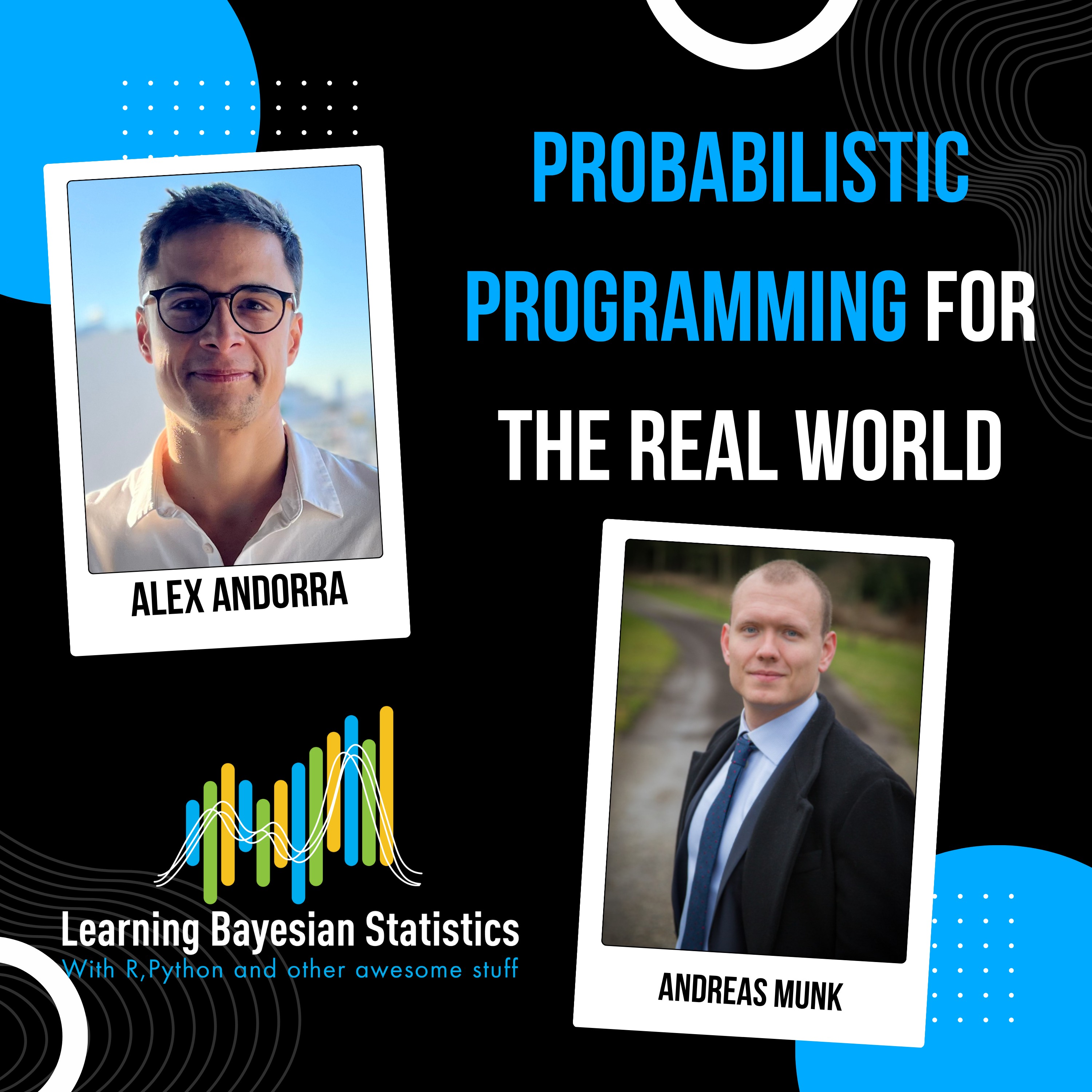
S1 Ep 155#155 Probabilistic Programming for the Real World, with Andreas Munk
Support & Resources→ Support the show on Patreon→ Bayesian Modeling Course (first 2 lessons free): Our theme music is « Good Bayesian », by Baba Brinkman (feat MC Lars and Mega Ran). Check out his awesome work Takeaways:Q: Why is bridging deep learning and probabilistic programming so important?A: Deep learning is extraordinarily good at fitting complex functions, but it throws away uncertainty. Probabilistic programming keeps uncertainty explicit throughout. Combining the two – as in inference compilation – lets you get the expressiveness of neural networks while still doing proper Bayesian inference.Q: What is inference compilation and how does it relate to amortized inference?A: Amortized inference is the general idea of training a model upfront so you don't have to run expensive inference from scratch every single time. Inference compilation is a specific form of amortized inference where a neural network is trained to propose good posterior samples for a given probabilistic program – essentially learning to do inference rather than computing it fresh each query.Q: What is PyProb and what problems does it solve?A: PyProb is a probabilistic programming library designed specifically to support amortized inference workflows. It lets you write probabilistic models in Python and then train inference networks on top of them, making methods like inference compilation practical for real-world simulators and scientific models.Full takeaways here.Chapters:00:00:00 Introduction to Bayesian Inference and Its Barriers00:03:51 Andreas Munch's Journey into Statistics00:10:09 Bridging the Gap: Bayesian Inference in Real-World Applications00:15:56 Deep Learning Meets Probabilistic Programming00:22:05 Understanding Inference Compilation and Amortized Inference00:28:14 Exploring PyProb: A Tool for Amortized Inference00:33:55 Probabilistic Surrogate Networks and Their Applications00:38:10 Building Surrogate Models for Probabilistic Programming00:45:44 The Challenge of Bayesian Inference in Enterprises00:52:57 Communicating Uncertainty to Stakeholders01:01:09 Democratizing Bayesian Inference with Evara01:06:27 Insurance Pricing and Latent Variables01:16:41 Modeling Uncertainty in Predictions01:20:29 Dynamic Inference and Decision-Making01:23:17 Updating Models with Actual Data01:26:11 The Future of Bayesian Sampling in Excel01:31:54 Navigating Business Challenges and Growth01:36:40 Exploring Language Models and Their Applications01:38:35 The Quest for Better Inference Algorithms01:41:01 Dinner with Great Minds: A Thought ExperimentThank you to my Patrons for making this episode possible!Links from the show here.
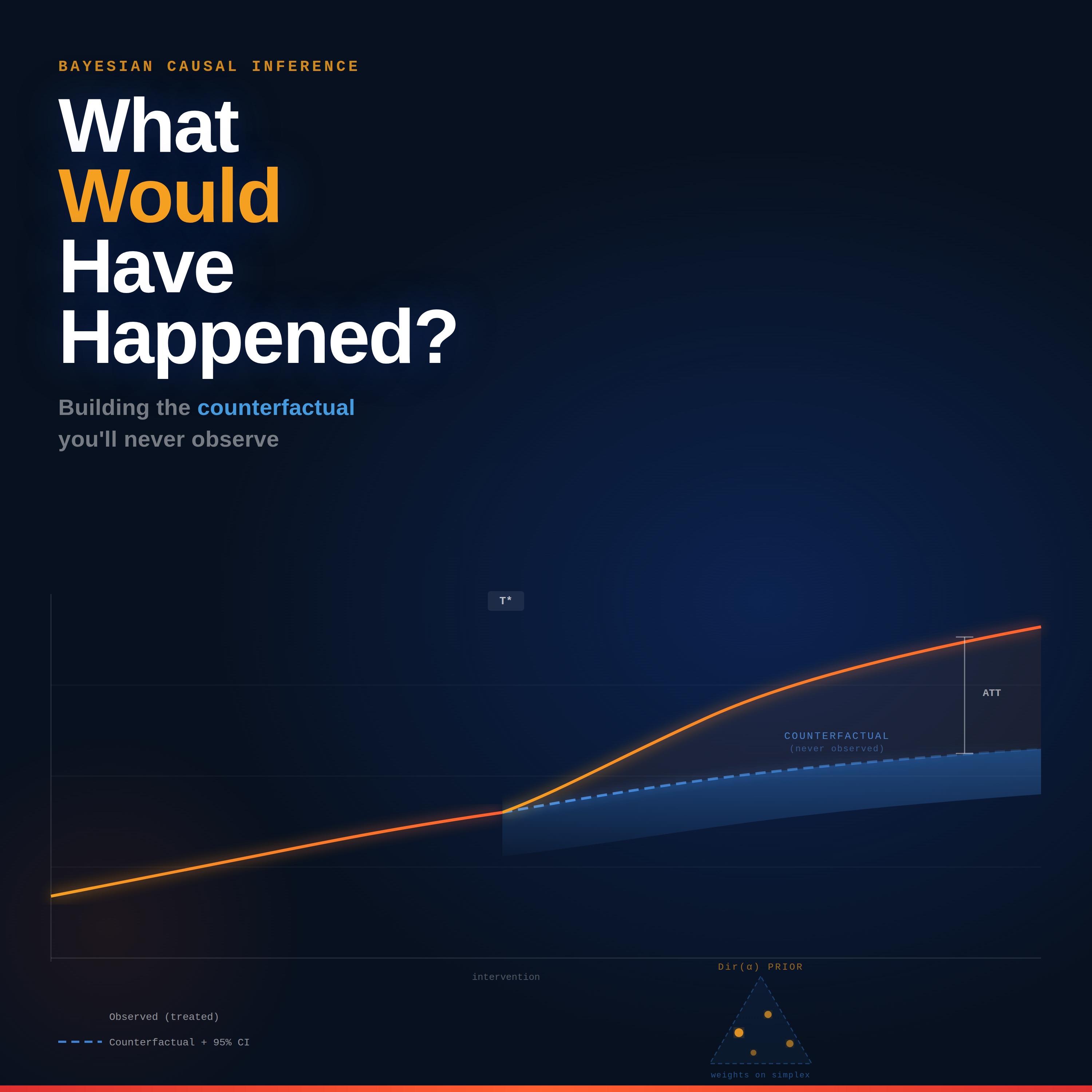
Bitesize | "What Would Have Happened?" - Bayesian Synthetic Control Explained
bonusToday's clip is from Episode 154 of the podcast, with Thomas Pinder.In this conversation, Thomas Pinder explains how Bayesian methods naturally lend themselves to causal modeling, and why that matters for real-world business decisions. The key insight is that causal questions in industry are rarely black and white: instead of a single treatment effect, you get a full posterior distribution, credible intervals, and the ability to communicate the probability that an effect is positive, which is far more useful to stakeholders than a p-value.Thomas then dives into Bayesian Synthetic Control, a reframing of the classic synthetic control method from a constrained optimization problem into a Bayesian regression problem. Rather than optimizing weights on a simplex, you place a Dirichlet prior on the regression coefficients, which turns out to be not just mathematically elegant but practically richer: you can express prior beliefs about how many control units are informative, set the concentration parameter accordingly, or let a gamma hyperprior on that parameter let the data decide. The result is a more flexible, less fragile counterfactual, implemented cleanly in PyMC or NumPyro.Get the full discussion here Support & Resources→ Support the show on Patreon: https://www.patreon.com/c/learnbayesstats→ Bayesian Modeling Course (first 2 lessons free): https://topmate.io/alex_andorra/1011122Our theme music is « Good Bayesian », by Baba Brinkman (feat MC Lars and Mega Ran). Check out his awesome work at https://bababrinkman.com/ !
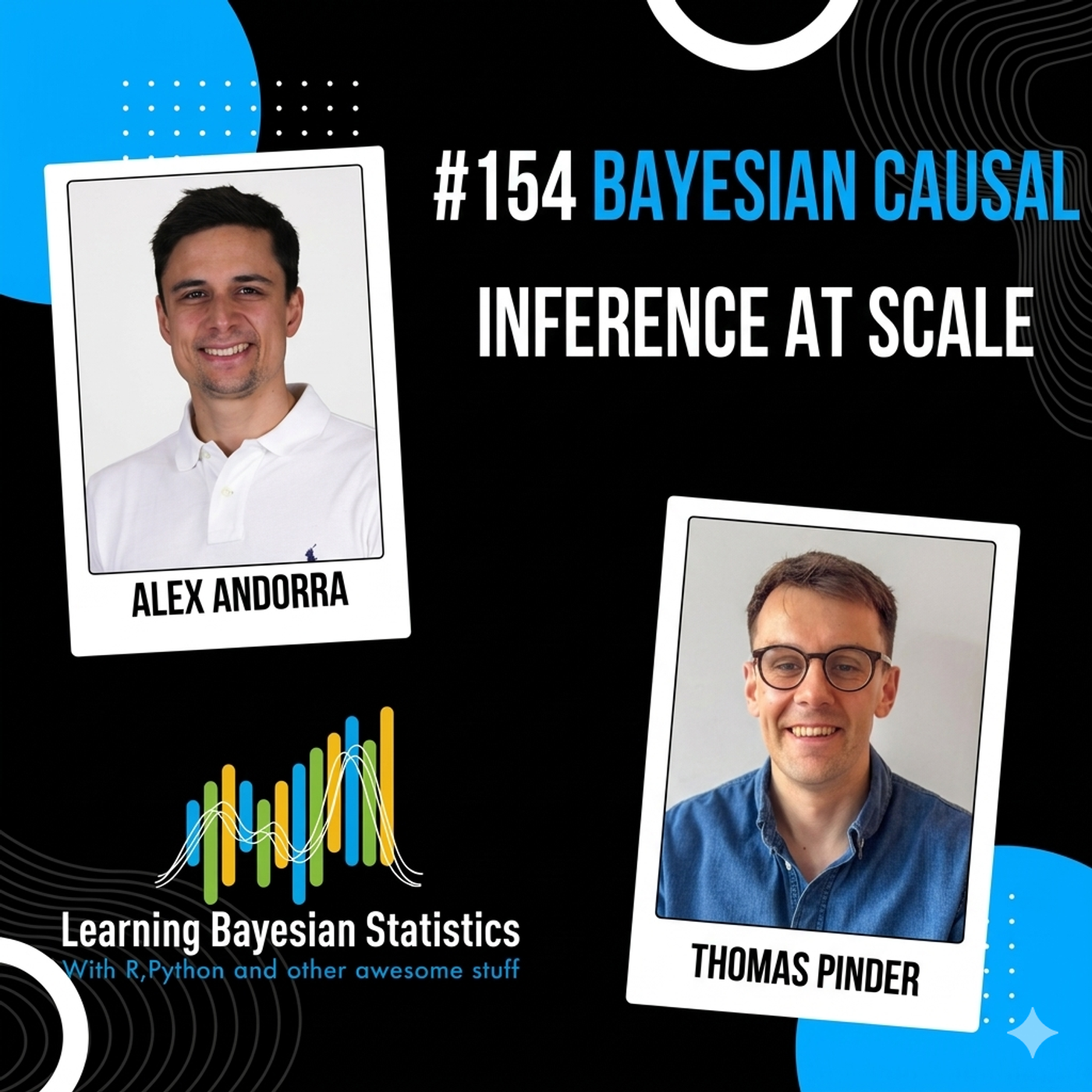
S1 Ep 154#154 Bayesian Causal Inference at Scale, with Thomas Pinder
• Support & get perks!• Bayesian Modeling course (first 2 lessons free)Our theme music is « Good Bayesian », by Baba Brinkman (feat MC Lars and Mega Ran). Check out his awesome work! Takeaways:Q: Why was GPJax created and how does it benefit researchers?A: GPJax was developed to provide a high-performance, flexible framework for Gaussian processes (GPs) within the JAX ecosystem. It allows researchers to move beyond black-box implementations and easily experiment with custom kernels and model structures while leveraging JAX’s automatic differentiation and GPU acceleration.Q: What are the primary advantages of using Gaussian processes for data modeling?A: Gaussian processes are highly effective at modeling complex, nonlinear relationships in data. Unlike many machine learning methods that only provide a point estimate, GPs offer built-in uncertainty quantification, which is essential for understanding the reliability of predictions in research and industry.Q: How does the GPJax and NumPyro integration enhance probabilistic modeling?A: The integration allows users to treat GPJax models as components within a larger NumPyro probabilistic program. This combination enables the use of advanced sampling techniques like NUTS (No-U-Turn Sampler), making it easier to build and fit complex hierarchical models that include Gaussian processes.Q: What are the main challenges when applying Gaussian processes to high-dimensional data?A: High-dimensional data significantly complicates GP modeling due to the curse of dimensionality and the cubic scaling of computational costs. In high dimensions, defining meaningful distance metrics for kernels becomes harder, often requiring specialized techniques like sparse GPs or dimensionality reduction to remain tractable.Full takeaways here!Chapters:11:40 What is GPJax and how does it simplify Gaussian Process modeling?15:48 How are Bayesian methods used for experimentation and causal inference in industry?18:40 How do you implement Bayesian Synthetic Control?32:17 What is Bayesian Synthetic Difference-in-Differences?39:44 What are the research applications and supported methods for the GPJax library?45:47 What are the primary software and computational bottlenecks when scaling Gaussian Processes?49:02 What are the real-world industrial applications of Gaussian Process models?54:36 How is Bayesian modeling applied to soccer and sports analytics?58:43 What is the future development roadmap for the GPJax ecosystem?01:05:37 What is Impulso and how does it integrate into a Bayesian modeling workflow?01:13:42 How do you balance Bayesian computational overhead with industrial latency requirements?01:20:26 Why is there optimism that scalable Bayesian methods for causal inference are now within reach?Thank you to my Patrons for making this episode possible!Links from the show here!
S1 Ep 153#153 The Neuroscience of Philanthropy, with Cherian Koshy
• Support & get perks!• Bayesian Modeling course (first 2 lessons free)Our theme music is « Good Bayesian », by Baba Brinkman (feat MC Lars and Mega Ran). Check out his awesome work !Takeaways:Q: Is generosity a natural human trait?A: Yes, generosity is hardwired in our brains and is essential for social interaction.Q: Why do people say they care about causes but not act on it?A: There is often a disconnect between stated care for causes and actual action. Understanding the conditions under which generosity aligns with a person's identity is crucial for bridging this gap.Q: How should fundraising efforts be approached?A: Fundraising should primarily focus on belief updating rather than mere persuasion.Q: What are the benefits of being generous?A: Generosity has significant mental and physical health benefits, as the brain's reward systems activate when we give, making us feel good.Q: How do our beliefs relate to our actions?A: Our beliefs about ourselves strongly influence our actions and decisions, including our decision to be generous.Q: Can generosity impact a community?A: Yes, generosity can be a powerful tool for improving community dynamics.Q: How can technology like AI assist institutions with donors?A: AI could help institutions remember donors better, improving the donor-institution relationship.Chapters:00:00 What's the role of Behavioral Science inPhilanthropy19:57 What is The Neuroscience of Generosity?24:40 How can we best understand Donor Decision-Making?32:14 How can we achieve reframe Beliefs and Actions?35:39 What is the role of Identity in Habit Formation?38:06 What is the Generosity Gap in Philanthropy?45:06 How can we reduce Friction in Donation Processes?48:27 What is the role of AI and Trust in Nonprofits?52:11 How can we build Predictive Models for Donor Behavior?55:41 What is the role of Empathy in Sales and Stakeholder Engagement?01:00:46 How can we best align ideas with Stakeholder Beliefs?01:02:06 How can we explore Generosity and Memory?Thank you to my Patrons for making this episode possible!Links from the show:Come meet Alex at the Field of Play Conference in Manchester, UK, March 27, 2026! https://www.fieldofplay.co.uk/Bayesian workflow agent skillNeurogiving, The Science of Donor Decision-MakingCherian's websiteCherian's press kitLBS #89 Unlocking the Science of Exercise, Nutrition & Weight Management, with Eric Trexler
Bitesize | How To Model Risk Aversion In Pricing?
bonusToday's clip is from Episode 152 of the podcast, with Daniel Saunders. In this conversation, Daniel Saunders explains how to incorporate risk aversion into Bayesian price optimization. The key insight is that uncertainty around expected profit is asymmetric across price points, low prices yield more predictable (if modest) returns, while high prices introduce much wider uncertainty. Rather than simply maximizing expected profit, you can pass profit through an exponential utility function that models diminishing returns, a well-established idea from economics. This adds an adjustable risk aversion parameter to the optimization: as risk aversion increases, the model shifts toward more conservative price recommendations, trading off potentially large but uncertain gains for outcomes with tighter, more reliable distributions.Get the full discussion here• Join this channel to get access to perks:https://www.patreon.com/c/learnbayesstats• Intro to Bayes Course (first 2 lessons free): https://topmate.io/alex_andorra/503302• Advanced Regression Course (first 2 lessons free): https://topmate.io/alex_andorra/1011122Our theme music is « Good Bayesian », by Baba Brinkman (feat MC Lars and Mega Ran). Check out his awesome work at https://bababrinkman.com/ !
S1 Ep 152#152 A Bayesian decision theory workflow, with Daniel Saunders
• Support & get perks!• Proudly sponsored by PyMC Labs!• Intro to Bayes and Advanced Regression courses (first 2 lessons free)Our theme music is « Good Bayesian », by Baba Brinkman (feat MC Lars and Mega Ran). Check out his awesome work !Chapters:00:00 The Importance of Decision-Making in Data Science06:41 From Philosophy to Bayesian Statistics14:57 The Role of Soft Skills in Data Science18:19 Understanding Decision Theory Workflows22:43 Shifting Focus from Accuracy to Business Value26:23 Leveraging PyTensor for Optimization34:27 Applying Optimal Decision-Making in Industry40:06 Understanding Utility Functions in Regulation41:35 Introduction to Obeisance Decision Theory Workflow42:33 Exploring Price Elasticity and Demand45:54 Optimizing Profit through Bayesian Models51:12 Risk Aversion and Utility Functions57:18 Advanced Risk Management Techniques01:01:08 Practical Applications of Bayesian Decision-Making01:06:54 Future Directions in Bayesian Inference01:10:16 The Quest for Better Inference Algorithms01:15:01 Dinner with a Polymath: Herbert SimonThank you to my Patrons for making this episode possible!Links from the show:Come meet Alex at the Field of Play Conference in Manchester, UK, March 27, 2026! https://www.fieldofplay.co.uk/A Bayesian decision theory workflowDaniel's website, LinkedIn and GitHubLBS #124 State Space Models & Structural Time Series, with Jesse GrabowskiLBS #123 BART & The Future of Bayesian Tools, with Osvaldo MartinLBS #74 Optimizing NUTS and Developing the ZeroSumNormal Distribution, with Adrian SeyboldtLBS #76 The Past, Present & Future of Stan, with Bob Carpenter
BITESIZE | How Do Diffusion Models Work?
bonusToday's clip is from Episode 151 of the podcast, with Jonas ArrudaIn this conversation, Jonas Arruda explains how diffusion models generate data by learning to reverse a noise process. The idea is to start from a simple distribution like Gaussian noise and gradually remove noise until the target distribution emerges. This is done through a forward process that adds noise to clean parameters and a backward process that learns how to undo that corruption. A noise schedule controls how much noise is added or removed at each step, guiding the transformation from pure randomness back to meaningful structure.Get the full discussion here• Join this channel to get access to perks:https://www.patreon.com/c/learnbayesstats• Intro to Bayes Course (first 2 lessons free): https://topmate.io/alex_andorra/503302• Advanced Regression Course (first 2 lessons free): https://topmate.io/alex_andorra/1011122Our theme music is « Good Bayesian », by Baba Brinkman (feat MC Lars and Mega Ran). Check out his awesome work at https://bababrinkman.com/ !
S1 Ep 151#151 Diffusion Models in Python, a Live Demo with Jonas Arruda
• Support & get perks!• Proudly sponsored by PyMC Labs!• Intro to Bayes and Advanced Regression courses (first 2 lessons free)Our theme music is « Good Bayesian », by Baba Brinkman (feat MC Lars and Mega Ran). Check out his awesome work !Chapters:00:00 Exploring Generative AI and Scientific Modeling10:27 Understanding Simulation-Based Inference (SBI) and Its Applications15:59 Diffusion Models in Simulation-Based Inference19:22 Live Coding Session: Implementing Baseflow for SBI34:39 Analyzing Results and Diagnostics in Simulation-Based Inference46:18 Hierarchical Models and Amortized Bayesian Inference48:14 Understanding Simulation-Based Inference (SBI) and Its Importance49:14 Diving into Diffusion Models: Basics and Mechanisms50:38 Forward and Backward Processes in Diffusion Models53:03 Learning the Score: Training Diffusion Models54:57 Inference with Diffusion Models: The Reverse Process57:36 Exploring Variants: Flow Matching and Consistency Models01:01:43 Benchmarking Different Models for Simulation-Based Inference01:06:41 Hierarchical Models and Their Applications in Inference01:14:25 Intervening in the Inference Process: Adding Constraints01:25:35 Summary of Key Concepts and Future DirectionsThank you to my Patrons for making this episode possible!Links from the show:- Come meet Alex at the Field of Play Conference in Manchester, UK, March 27, 2026!- Jonas's Diffusion for SBI Tutorial & Review (Paper & Code)- The BayesFlow Library- Jonas on LinkedIn- Jonas on GitHub- Further reading for more mathematical details: Holderrieth & Erives- 150 Fast Bayesian Deep Learning, with David Rügamer, Emanuel Sommer & Jakob Robnik- 107 Amortized Bayesian Inference with Deep Neural Networks, with Marvin Schmitt
S1 Ep 150#150 Fast Bayesian Deep Learning, with David Rügamer, Emanuel Sommer & Jakob Robnik
• Support & get perks!• Proudly sponsored by PyMC Labs!• Intro to Bayes and Advanced Regression courses (first 2 lessons free)Our theme music is « Good Bayesian », by Baba Brinkman (feat MC Lars and Mega Ran). Check out his awesome work !Chapters:00:00 Scaling Bayesian Neural Networks04:26 Origin Stories of the Researchers09:46 Research Themes in Bayesian Neural Networks12:05 Making Bayesian Neural Networks Fast16:19 Microcanonical Langevin Sampler Explained22:57 Bottlenecks in Scaling Bayesian Neural Networks29:09 Practical Tools for Bayesian Neural Networks36:48 Trade-offs in Computational Efficiency and Posterior Fidelity40:13 Exploring High Dimensional Gaussians43:03 Practical Applications of Bayesian Deep Ensembles45:20 Comparing Bayesian Neural Networks with Standard Approaches50:03 Identifying Real-World Applications for Bayesian Methods57:44 Future of Bayesian Deep Learning at Scale01:05:56 The Evolution of Bayesian Inference Packages01:10:39 Vision for the Future of Bayesian StatisticsThank you to my Patrons for making this episode possible!Come meet Alex at the Field of Play Conference in Manchester, UK, March 27, 2026!Links from the show:David Rügamer:* Website* Google Scholar* GitHubEmanuel Sommer:* Website* GitHub* Google ScholarJakob Robnik:* Google Scholar* GitHub* Microcanonical Langevin paper* LinkedIn
BITESIZE | Building Resilience in Modern Tech Careers
bonusToday’s clip is from episode 149 of the podcast, with Alana Karen.This conversation explores the evolving landscape of technology, particularly in Silicon Valley, focusing on the cultural shifts due to mass layoffs, the debate over remote work, and the impact of AI on job roles and priorities. The discussion highlights the importance of adapting to these changes and preparing for the future by developing complex skills that AI cannot easily replicate.Get the full discussion here!• Join this channel to get access to perks:https://www.patreon.com/c/learnbayesstats• Intro to Bayes Course (first 2 lessons free): https://topmate.io/alex_andorra/503302• Advanced Regression Course (first 2 lessons free): https://topmate.io/alex_andorra/1011122Our theme music is « Good Bayesian », by Baba Brinkman (feat MC Lars and Mega Ran). Check out his awesome work at https://bababrinkman.com/ !
S1 Ep 149#149 The Future of Work in Tech, with Alana Karen
• Support & get perks!• Proudly sponsored by PyMC Labs!• Intro to Bayes and Advanced Regression courses (first 2 lessons free)Our theme music is « Good Bayesian », by Baba Brinkman (feat MC Lars and Mega Ran). Check out his awesome work !Chapters:11:37 The Hard Tech Era21:08 The Shift in Tech Work Culture28:49 AI's Impact on Job Security and Work Dynamics34:33 Adapting to AI: Skills for the Future45:56 Understanding AI Models and Their Limitations47:25 The Importance of Diversity in AI Development54:34 Positioning Technical Talent for Job Security57:58 Building Resilience in Uncertain Times01:06:33 Recognizing Diverse Ambitions in Career Progression01:12:51 The Role of Managers in Employee Retention01:26:55 Solving Complex Problems with AI and InnovationThank you to my Patrons for making this episode possible!Links from the show:Alana's latest book (Use code BAYESIAN for 10% off + a free interview preparation download PDF)Alana’s SubstackAlana on LinkedinAlana on InstagramThe Obstacle Is the Way – The Timeless Art of Turning Trials into TriumphCourage Is Calling – Fortune Favours the Brave
BITESIZE | The Trial Design That Learns in Real Time
bonusToday’s clip is from episode 148 of the podcast, with Scott Berry. In this conversation, Alex and Scott discuss emphasizing the shift from frequentist to Bayesian approaches in clinical trials. They highlight the limitations of traditional trial designs and the advantages of adaptive and platform trials, particularly in the context of COVID-19 treatment. The discussion provides insights into the complexities of trial design and the innovative methodologies that are shaping the future of medical research. Get the full discussion here!• Join this channel to get access to perks: https://www.patreon.com/c/learnbayesstats • Intro to Bayes Course (first 2 lessons free): https://topmate.io/alex_andorra/503302 • Advanced Regression Course (first 2 lessons free): https://topmate.io/alex_andorra/1011122 Our theme music is « Good Bayesian », by Baba Brinkman (feat MC Lars and Mega Ran). Check out his awesome work at https://bababrinkman.com/ !
S1 Ep 148#148 Adaptive Trials, Bayesian Thinking, and Learning from Data, with Scott Berry
• Support & get perks!• Proudly sponsored by PyMC Labs. Get in touch and tell them you come from LBS!• Intro to Bayes and Advanced Regression courses (first 2 lessons free)Our theme music is « Good Bayesian », by Baba Brinkman (feat MC Lars and Mega Ran). Check out his awesome work !Chapters:13:16 Understanding Adaptive and Platform Trials25:25 Real-World Applications and Innovations in Trials34:11 Challenges in Implementing Bayesian Adaptive Trials42:09 The Birth of a Simulation Tool44:10 The Importance of Simulated Data48:36 Lessons from High-Stakes Trials52:53 Navigating Adaptive Trial Designs56:55 Communicating Complexity to Stakeholders01:02:29 The Future of Clinical Trials01:10:24 Skills for the Next Generation of StatisticiansThank you to my Patrons for making this episode possible!Yusuke Saito, Avi Bryant, Giuliano Cruz, Tradd Salvo, William Benton, James Ahloy, Robin Taylor,, Chad Scherrer, Zwelithini Tunyiswa, Bertrand Wilden, James Thompson, Stephen Oates, Gian Luca Di Tanna, Jack Wells, Matthew Maldonado, Ian Costley, Ally Salim, Larry Gill, Ian Moran, Paul Oreto, Colin Caprani, Colin Carroll, Nathaniel Burbank, Michael Osthege, Rémi Louf, Clive Edelsten, Henri Wallen, Hugo Botha, Vinh Nguyen, Marcin Elantkowski, Adam C. Smith, Will Kurt, Andrew Moskowitz, Hector Munoz, Marco Gorelli, Simon Kessell, Bradley Rode, Patrick Kelley, Rick Anderson, Casper de Bruin, Michael Hankin, Cameron Smith, Tomáš Frýda, Ryan Wesslen, Andreas Netti, Riley King, Yoshiyuki Hamajima, Sven De Maeyer, Michael DeCrescenzo, Fergal M, Mason Yahr, Naoya Kanai, Aubrey Clayton, Omri Har Shemesh, Scott Anthony Robson, Robert Yolken, Or Duek, Pavel Dusek, Paul Cox, Andreas Kröpelin, Raphaël R, Nicolas Rode, Gabriel Stechschulte, Arkady, Kurt TeKolste, Marcus Nölke, Maggi Mackintosh, Grant Pezzolesi, Joshua Meehl, Javier Sabio, Kristian Higgins, Matt Rosinski, Luis Fonseca, Dante Gates, Matt Niccolls, Maksim Kuznecov, Michael Thomas, Luke Gorrie, Cory Kiser, Julio, Edvin Saveljev, Frederick Ayala, Jeffrey Powell, Gal Kampel, Adan Romero, Blake Walters, Jonathan Morgan, Francesco Madrisotti, Ivy Huang, Gary Clarke, Robert Flannery, Rasmus Hindström, Stefan, Corey Abshire, Mike Loncaric, Ronald Legere, Sergio Dolia, Michael Cao, Yiğit Aşık, Suyog Chandramouli, Guillaume Berthon, Avenicio Baca, Spencer Boucher, Krzysztof Lechowski, Danimal, Jácint Juhász, Sander and Philippe.Links from the show:Berry ConsultantsScott's podcastLBS #45 Biostats & Clinical Trial Design, with Frank Harrell
BITESIZE | Making Variational Inference Reliable: From ADVI to DADVI
bonusToday’s clip is from episode 147 of the podcast, with Martin Ingram.Alex and Martin discuss the intricacies of variational inference, particularly focusing on the ADVI method and its challenges. They explore the evolution of approximate inference methods, the significance of mean field variational inference, and the innovative linear response technique for covariance estimation. The discussion also delves into the trade-offs between stochastic and deterministic optimization techniques, providing insights into their implications for Bayesian statistics.Get the full discussion here.Intro to Bayes Course (first 2 lessons free)Advanced Regression Course (first 2 lessons free)Our theme music is « Good Bayesian », by Baba Brinkman (feat MC Lars and Mega Ran). Check out his awesome work!Visit our Patreon page to unlock exclusive Bayesian swag ;)TranscriptThis is an automatic transcript and may therefore contain errors. Please get in touch if you're willing to correct them.
S1 Ep 147#147 Fast Approximate Inference without Convergence Worries, with Martin Ingram
Proudly sponsored by PyMC Labs, the Bayesian Consultancy. Book a call, or get in touch!Intro to Bayes Course (first 2 lessons free)Advanced Regression Course (first 2 lessons free)Our theme music is « Good Bayesian », by Baba Brinkman (feat MC Lars and Mega Ran). Check out his awesome work!Visit our Patreon page to unlock exclusive Bayesian swag ;)Takeaways:DADVI is a new approach to variational inference that aims to improve speed and accuracy.DADVI allows for faster Bayesian inference without sacrificing model flexibility.Linear response can help recover covariance estimates from mean estimates.DADVI performs well in mixed models and hierarchical structures.Normalizing flows present an interesting avenue for enhancing variational inference.DADVI can handle large datasets effectively, improving predictive performance.Future enhancements for DADVI may include GPU support and linear response integration.Chapters:13:17 Understanding DADVI: A New Approach21:54 Mean Field Variational Inference Explained26:38 Linear Response and Covariance Estimation31:21 Deterministic vs Stochastic Optimization in DADVI35:00 Understanding DADVI and Its Optimization Landscape37:59 Theoretical Insights and Practical Applications of DADVI42:12 Comparative Performance of DADVI in Real Applications45:03 Challenges and Effectiveness of DADVI in Various Models48:51 Exploring Future Directions for Variational Inference53:04 Final Thoughts and Advice for PractitionersThank you to my Patrons for making this episode possible!Yusuke Saito, Avi Bryant, Giuliano Cruz, James Wade, Tradd Salvo, William Benton, James Ahloy, Robin Taylor, Chad Scherrer, Zwelithini Tunyiswa, Bertrand Wilden, James Thompson, Stephen Oates, Gian Luca Di Tanna, Jack Wells, Matthew Maldonado, Ian Costley, Ally Salim, Larry Gill, Ian Moran, Paul Oreto, Colin Caprani, Colin Carroll, Nathaniel Burbank, Michael Osthege, Rémi Louf, Clive Edelsten, Henri Wallen, Hugo Botha, Vinh Nguyen, Marcin Elantkowski, Adam C. Smith, Will Kurt, Andrew Moskowitz, Hector Munoz, Marco Gorelli, Simon Kessell, Bradley Rode, Patrick Kelley, Rick Anderson, Casper de Bruin, Michael Hankin, Cameron Smith, Tomáš Frýda, Ryan Wesslen, Andreas Netti, Riley King, Yoshiyuki Hamajima, Sven De Maeyer, Michael DeCrescenzo, Fergal M, Mason Yahr, Naoya Kanai, Aubrey Clayton, Omri Har Shemesh, Scott Anthony Robson, Robert Yolken, Or Duek, Pavel Dusek, Paul Cox, Andreas Kröpelin, Raphaël...
BITESIZE | Why Bayesian Stats Matter When the Physics Gets Extreme
bonusToday’s clip is from episode 146 of the podcast, with Ethan Smith.Alex and Ethan discuss the application of Bayesian inference in high energy density physics, particularly in analyzing complex data sets. They highlight the advantages of Bayesian techniques, such as incorporating prior knowledge and managing uncertainties. They also shares insights from an ongoing experimental project focused on measuring the equation of state of plasma at extreme pressures. Finally, Alex and Ethan advocate for best practices in managing large codebases and ensuring model reliability.Get the full discussion here.Intro to Bayes Course (first 2 lessons free)Advanced Regression Course (first 2 lessons free)Our theme music is « Good Bayesian », by Baba Brinkman (feat MC Lars and Mega Ran). Check out his awesome work!Visit our Patreon page to unlock exclusive Bayesian swag ;)TranscriptThis is an automatic transcript and may therefore contain errors. Please get in touch if you're willing to correct them.
S1 Ep 146#146 Lasers, Planets, and Bayesian Inference, with Ethan Smith
Proudly sponsored by PyMC Labs, the Bayesian Consultancy. Book a call, or get in touch!Intro to Bayes Course (first 2 lessons free)Advanced Regression Course (first 2 lessons free)Our theme music is « Good Bayesian », by Baba Brinkman (feat MC Lars and Mega Ran). Check out his awesome work!Visit our Patreon page to unlock exclusive Bayesian swag ;)Takeaways:Ethan's research involves using lasers to compress matter to extreme conditions to study astrophysical phenomena.Bayesian inference is a key tool in analyzing complex data from high energy density experiments.The future of high energy density physics lies in developing new diagnostic technologies and increasing experimental scale.High energy density physics can provide insights into planetary science and astrophysics.Emerging technologies in diagnostics are set to revolutionize the field.Ethan's dream project involves exploring picno nuclear fusion.Chapters:14:31 Understanding High Energy Density Physics and Plasma Spectroscopy21:24 Challenges in Data Analysis and Experimentation36:11 The Role of Bayesian Inference in High Energy Density Physics47:17 Transitioning to Advanced Sampling Techniques51:35 Best Practices in Model Development55:30 Evaluating Model Performance01:02:10 The Role of High Energy Density Physics01:11:15 Innovations in Diagnostic Technologies01:22:51 Future Directions in Experimental Physics01:26:08 Advice for Aspiring ScientistsThank you to my Patrons for making this episode possible!Yusuke Saito, Avi Bryant, Giuliano Cruz, James Wade, Tradd Salvo, William Benton, James Ahloy, Robin Taylor, Chad Scherrer, Zwelithini Tunyiswa, Bertrand Wilden, James Thompson, Stephen Oates, Gian Luca Di Tanna, Jack Wells, Matthew Maldonado, Ian Costley, Ally Salim, Larry Gill, Ian Moran, Paul Oreto, Colin Caprani, Colin Carroll, Nathaniel Burbank, Michael Osthege, Rémi Louf, Clive Edelsten, Henri Wallen, Hugo Botha, Vinh Nguyen, Marcin Elantkowski, Adam C. Smith, Will Kurt, Andrew Moskowitz, Hector Munoz, Marco Gorelli, Simon Kessell, Bradley Rode, Patrick Kelley, Rick Anderson, Casper de Bruin, Michael Hankin, Cameron Smith, Tomáš Frýda, Ryan Wesslen, Andreas Netti, Riley King, Yoshiyuki Hamajima, Sven De Maeyer, Michael DeCrescenzo, Fergal M, Mason Yahr, Naoya Kanai, Aubrey Clayton, Omri Har Shemesh, Scott Anthony Robson, Robert Yolken, Or Duek, Pavel Dusek, Paul Cox, Andreas Kröpelin, Raphaël R, Nicolas Rode, Gabriel Stechschulte, Arkady,
BITESIZE | How to Thrive in an AI-Driven Workplace?
bonusToday’s clip is from episode 145 of the podcast, with Jordan Thibodeau.Alexandre Andorra and Jordan Thibodeau discuss the transformative impact of AI on productivity, career opportunities in the tech industry, and the intricacies of the job interview process. They emphasize the importance of expertise, networking, and the evolving landscape of tech companies, while also providing actionable advice for individuals looking to enhance their careers in AI and related fields.Get the full discussion here.Intro to Bayes Course (first 2 lessons free)Advanced Regression Course (first 2 lessons free)Our theme music is « Good Bayesian », by Baba Brinkman (feat MC Lars and Mega Ran). Check out his awesome work!Visit our Patreon page to unlock exclusive Bayesian swag ;)TranscriptThis is an automatic transcript and may therefore contain errors. Please get in touch if you're willing to correct them.
S1 Ep 145#145 Career Advice in the Age of AI, with Jordan Thibodeau
Proudly sponsored by PyMC Labs, the Bayesian Consultancy. Book a call, or get in touch!Intro to Bayes Course (first 2 lessons free)Advanced Regression Course (first 2 lessons free)Our theme music is « Good Bayesian », by Baba Brinkman (feat MC Lars and Mega Ran). Check out his awesome work!Visit our Patreon page to unlock exclusive Bayesian swag ;)Thank you to my Patrons for making this episode possible!Yusuke Saito, Avi Bryant, Giuliano Cruz, James Wade, Tradd Salvo, William Benton, James Ahloy, Robin Taylor, Chad Scherrer, Zwelithini Tunyiswa, Bertrand Wilden, James Thompson, Stephen Oates, Gian Luca Di Tanna, Jack Wells, Matthew Maldonado, Ian Costley, Ally Salim, Larry Gill, Ian Moran, Paul Oreto, Colin Caprani, Colin Carroll, Nathaniel Burbank, Michael Osthege, Rémi Louf, Clive Edelsten, Henri Wallen, Hugo Botha, Vinh Nguyen, Marcin Elantkowski, Adam C. Smith, Will Kurt, Andrew Moskowitz, Hector Munoz, Marco Gorelli, Simon Kessell, Bradley Rode, Patrick Kelley, Rick Anderson, Casper de Bruin, Michael Hankin, Cameron Smith, Tomáš Frýda, Ryan Wesslen, Andreas Netti, Riley King, Yoshiyuki Hamajima, Sven De Maeyer, Michael DeCrescenzo, Fergal M, Mason Yahr, Naoya Kanai, Aubrey Clayton, Omri Har Shemesh, Scott Anthony Robson, Robert Yolken, Or Duek, Pavel Dusek, Paul Cox, Andreas Kröpelin, Raphaël R, Nicolas Rode, Gabriel Stechschulte, Arkady, Kurt TeKolste, Marcus Nölke, Maggi Mackintosh, Grant Pezzolesi, Joshua Meehl, Javier Sabio, Kristian Higgins, Matt Rosinski, Luis Fonseca, Dante Gates, Matt Niccolls, Maksim Kuznecov, Michael Thomas, Luke Gorrie, Cory Kiser, Julio, Edvin Saveljev, Frederick Ayala, Jeffrey Powell, Gal Kampel, Adan Romero, Will Geary, Blake Walters, Jonathan Morgan, Francesco Madrisotti, Ivy Huang, Gary Clarke, Robert Flannery, Rasmus Hindström, Stefan, Corey Abshire, Mike Loncaric, David McCormick, Ronald Legere, Sergio Dolia, Michael Cao, Yiğit Aşık, Suyog Chandramouli and Guillaume Berthon.Takeaways:AI is reshaping the workplace, but we're still in early stages.Networking is crucial for job applications in top firms.AI tools can augment work but are not replacements for skilled labor.Understanding the tech landscape requires continuous learning.Timing and cultural readiness are key for tech innovations.Expertise can be gained without formal education.Bayesian statistics is a valuable skill for tech professionals.The importance of personal branding in the job market. You just need to know 1% more than the person you're talking to.Sharing knowledge can elevate your status within a company.Embracing chaos in tech can create new opportunities.Investing in people leads...
BITESIZE | Why is Bayesian Deep Learning so Powerful?
bonusToday’s clip is from episode 144 of the podcast, with Maurizio Filippone.In this conversation, Alex and Maurizio delve into the intricacies of Gaussian processes and their deep learning counterparts. They explain the foundational concepts of Gaussian processes, the transition to deep Gaussian processes, and the advantages they offer in modeling complex data. The discussion also touches on practical applications, model selection, and the evolving landscape of machine learning, particularly in relation to transfer learning and the integration of deep learning techniques with Gaussian processes.Get the full discussion here.Intro to Bayes Course (first 2 lessons free)Advanced Regression Course (first 2 lessons free)Our theme music is « Good Bayesian », by Baba Brinkman (feat MC Lars and Mega Ran). Check out his awesome work!Visit our Patreon page to unlock exclusive Bayesian swag ;)TranscriptThis is an automatic transcript and may therefore contain errors. Please get in touch if you're willing to correct them.
S1 Ep 144#144 Why is Bayesian Deep Learning so Powerful, with Maurizio Filippone
Sign up for Alex's first live cohort, about Hierarchical Model building!Get 25% off "Building AI Applications for Data Scientists and Software Engineers"Proudly sponsored by PyMC Labs, the Bayesian Consultancy. Book a call, or get in touch!Our theme music is « Good Bayesian », by Baba Brinkman (feat MC Lars and Mega Ran). Check out his awesome work!Visit our Patreon page to unlock exclusive Bayesian swag ;)Takeaways:Why GPs still matter: Gaussian Processes remain a go-to for function estimation, active learning, and experimental design – especially when calibrated uncertainty is non-negotiable.Scaling GP inference: Variational methods with inducing points (as in GPflow) make GPs practical on larger datasets without throwing away principled Bayes.MCMC in practice: Clever parameterizations and gradient-based samplers tighten mixing and efficiency; use MCMC when you need gold-standard posteriors.Bayesian deep learning, pragmatically: Stochastic-gradient training and approximate posteriors bring Bayesian ideas to neural networks at scale.Uncertainty that ships: Monte Carlo dropout and related tricks provide fast, usable uncertainty – even if they’re approximations.Model complexity ≠ model quality: Understanding capacity, priors, and inductive bias is key to getting trustworthy predictions.Deep Gaussian Processes: Layered GPs offer flexibility for complex functions, with clear trade-offs in interpretability and compute.Generative models through a Bayesian lens: GANs and friends benefit from explicit priors and uncertainty – useful for safety and downstream decisions.Tooling that matters: Frameworks like GPflow lower the friction from idea to implementation, encouraging reproducible, well-tested modeling.Where we’re headed: The future of ML is uncertainty-aware by default – integrating UQ tightly into optimization, design, and deployment.Chapters:08:44 Function Estimation and Bayesian Deep Learning10:41 Understanding Deep Gaussian Processes25:17 Choosing Between Deep GPs and Neural Networks32:01 Interpretability and Practical Tools for GPs43:52 Variational Methods in Gaussian Processes54:44 Deep Neural Networks and Bayesian Inference01:06:13 The Future of Bayesian Deep Learning01:12:28 Advice for Aspiring Researchers
BITESIZE | Are Bayesian Models the Missing Ingredient in Nutrition Research?
bonusSign up for Alex's first live cohort, about Hierarchical Model buildingSoccer Factor Model DashboardToday’s clip is from episode 143 of the podcast, with Christoph Bamberg.Christoph shares his journey into Bayesian statistics and computational modeling, the challenges faced in academia, and the technical tools used in research. Alex and Christoph delve into a specific study on appetite regulation and cognitive performance, exploring the implications of framing in psychological research and the importance of careful communication in health-related contexts.Get the full discussion here.Intro to Bayes Course (first 2 lessons free)Advanced Regression Course (first 2 lessons free)Our theme music is « Good Bayesian », by Baba Brinkman (feat MC Lars and Mega Ran). Check out his awesome work!Visit our Patreon page to unlock exclusive Bayesian swag ;)TranscriptThis is an automatic transcript and may therefore contain errors. Please get in touch if you're willing to correct them.
S1 Ep 143#143 Transforming Nutrition Science with Bayesian Methods, with Christoph Bamberg
Sign up for Alex's first live cohort, about Hierarchical Model building!Proudly sponsored by PyMC Labs, the Bayesian Consultancy. Book a call, or get in touch!Intro to Bayes Course (first 2 lessons free)Advanced Regression Course (first 2 lessons free)Our theme music is « Good Bayesian », by Baba Brinkman (feat MC Lars and Mega Ran). Check out his awesome work!Visit our Patreon page to unlock exclusive Bayesian swag ;)Takeaways:Bayesian mindset in psychology: Why priors, model checking, and full uncertainty reporting make findings more honest and useful.Intermittent fasting & cognition: A Bayesian meta-analysis suggests effects are context- and age-dependent – and often small but meaningful.Framing matters: The way we frame dietary advice (focus, flexibility, timing) can shape adherence and perceived cognitive benefits.From cravings to choices: Appetite, craving, stress, and mood interact to influence eating and cognitive performance throughout the day.Define before you measure: Clear definitions (and DAGs to encode assumptions) reduce ambiguity and guide better study design.DAGs for causal thinking: Directed acyclic graphs help separate hypotheses from data pipelines and make causal claims auditable.Small effects, big implications: Well-estimated “small” effects can scale to public-health relevance when decisions repeat daily.Teaching by modeling: Helping students write models (not just run them) builds statistical thinking and scientific literacy.Bridging lab and life: Balancing careful experiments with real-world measurement is key to actionable health-psychology insights.Trust through transparency: Openly communicating assumptions, uncertainty, and limitations strengthens scientific credibility.Chapters:10:35 The Struggles of Bayesian Statistics in Psychology22:30 Exploring Appetite and Cognitive Performance29:45 Research Methodology and Causal Inference36:36 Understanding Cravings and Definitions39:02 Intermittent Fasting and Cognitive Performance42:57 Practical Recommendations for Intermittent Fasting49:40 Balancing Experimental Psychology and Statistical Modeling55:00 Pressing Questions in Health Psychology01:04:50 Future Directions in ResearchThank you to my Patrons for...
BITESIZE | How Bayesian Additive Regression Trees Work in Practice
bonusSoccer Factor Model DashboardUnveiling True Talent: The Soccer Factor Model for Skill EvaluationLBS #91, Exploring European Football Analytics, with Max GöbelGet early access to Alex's next live-cohort courses!Today’s clip is from episode 142 of the podcast, with Gabriel Stechschulte.Alex and Garbriel explore the re-implementation of BART (Bayesian Additive Regression Trees) in Rust, detailing the technical challenges and performance improvements achieved.They also share insights into the benefits of BART, such as uncertainty quantification, and its application in various data-intensive fields.Get the full discussion here.Intro to Bayes Course (first 2 lessons free)Advanced Regression Course (first 2 lessons free)Our theme music is « Good Bayesian », by Baba Brinkman (feat MC Lars and Mega Ran). Check out his awesome work!Visit our Patreon page to unlock exclusive Bayesian swag ;)TranscriptThis is an automatic transcript and may therefore contain errors. Please get in touch if you're willing to correct them.
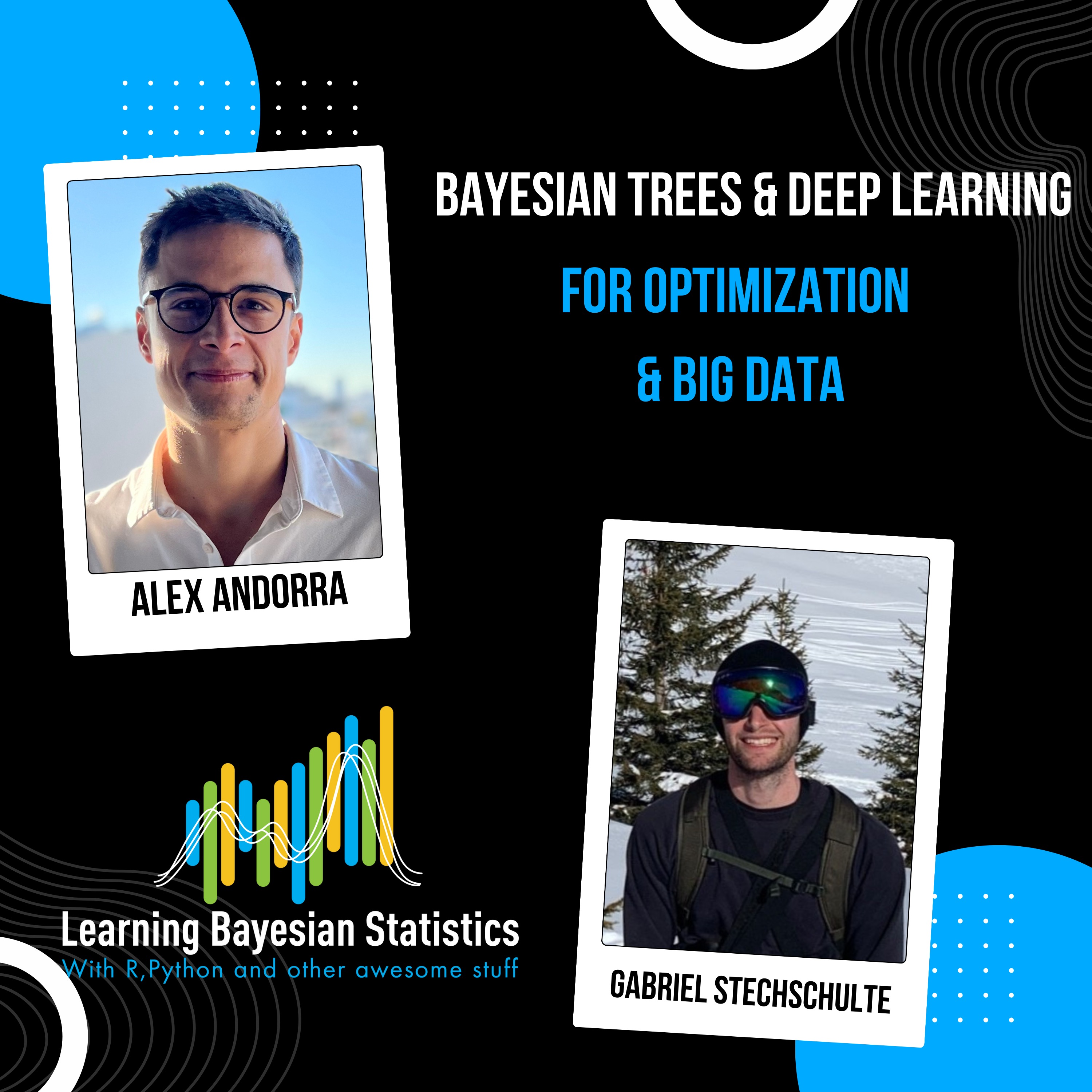
S1 Ep 142#142 Bayesian Trees & Deep Learning for Optimization & Big Data, with Gabriel Stechschulte
Proudly sponsored by PyMC Labs, the Bayesian Consultancy. Book a call, or get in touch!Get early access to Alex's next live-cohort courses!Intro to Bayes Course (first 2 lessons free)Advanced Regression Course (first 2 lessons free)Our theme music is « Good Bayesian », by Baba Brinkman (feat MC Lars and Mega Ran). Check out his awesome work!Visit our Patreon page to unlock exclusive Bayesian swag ;)Takeaways:BART as a core tool: Gabriel explains how Bayesian Additive Regression Trees provide robust uncertainty quantification and serve as a reliable baseline model in many domains.Rust for performance: His Rust re-implementation of BART dramatically improves speed and scalability, making it feasible for larger datasets and real-world IoT applications.Strengths and trade-offs: BART avoids overfitting and handles missing data gracefully, though it is slower than other tree-based approaches.Big data meets Bayes: Gabriel shares strategies for applying Bayesian methods with big data, including when variational inference helps balance scale with rigor.Optimization and decision-making: He highlights how BART models can be embedded into optimization frameworks, opening doors for sequential decision-making.Open source matters: Gabriel emphasizes the importance of communities like PyMC and Bambi, encouraging newcomers to start with small contributions.Chapters:05:10 – From economics to IoT and Bayesian statistics18:55 – Introduction to BART (Bayesian Additive Regression Trees)24:40 – Re-implementing BART in Rust for speed and scalability32:05 – Comparing BART with Gaussian Processes and other tree methods39:50 – Strengths and limitations of BART47:15 – Handling missing data and different likelihoods54:30 – Variational inference and big data challenges01:01:10 – Embedding BART into optimization and decision-making frameworks01:08:45 – Open source, PyMC, and community support01:15:20 – Advice for newcomers01:20:55 – Future of BART, Rust, and probabilistic programmingThank you to my Patrons for making this episode possible!Yusuke Saito, Avi Bryant, Ero Carrera, Giuliano Cruz, James Wade, Tradd Salvo, William Benton, James Ahloy, Robin Taylor,, Chad Scherrer, Zwelithini Tunyiswa, Bertrand Wilden, James Thompson, Stephen Oates, Gian Luca Di Tanna, Jack Wells, Matthew Maldonado, Ian...