
Interpreting India
154 episodes — Page 2 of 4

S4 Ep 1Vijay Gokhale on Crosswinds of History: India, China, and the Cold War's Hidden Game
In this episode of Interpreting India, we delve into the often-overlooked history of India's early relationship with China. Author Vijay Gokhale former Indian Foreign Secretary, takes us back to the 1940s and 50s, exploring pivotal moments like India's quick reaction of the People's Republic of China and its involvement in the Taiwan Straits crises. Beyond familiar narratives of border disputes and Tibet, Gokhale sheds light on a "forgotten" rivalry: the struggle between a declining British Empire and a rising United States, which powerfully shaped India's diplomatic dance with both China and the West. We navigate the complex alliances under Prime Minister Nehru, gleaning valuable lessons for understanding India's present approach to Asia and China. Gokhale's book, "Crosswinds," offers a new perspective on this crucial period, prompting us to reconsider the forces that shaped a nation's foreign policy. So, tune in as we unpack the past, revealing its enduring relevance for the present and the future.EPISODE CONTRIBUTORSVijay Gokhale is a nonresident senior fellow at Carnegie India. Mr. Gokhale retired from the Indian Foreign Service in January 2020 after a diplomatic career that spanned thirty-nine years. From January 2018 to January 2020, he served as the foreign secretary of India.Srinath Raghavan is a nonresident senior fellow at Carnegie India. He is also a professor of International Relations and History at Ashoka University. His primary research focus is on the contemporary and historical aspects of India’s foreign and security policies.ADDITIONAL READINGSCrosswinds: Nehru, Zhou and the Anglo-American Competition over China, by Vijay Gokhale After Tiananmen : The Rise of China by Vijay GokhaleThe Long Game: How the Chinese Negotiate with India, by Vijay GokhaleTiananmen Square: The Making of a Protest, by Vijay GokhaleThe Security Dilemma and India-China Relations, by Srinath RaghavanVijay Gokhale on China's India Policy and India-China Relations Every two weeks, Interpreting India brings you diverse voices from India and around the world to explore the critical questions shaping the nation's future. We delve into how technology, the economy, and foreign policy intertwine to influence India's relationship with the global stage.As a Carnegie India production, hosted by Carnegie scholars, Interpreting India, a Carnegie India production, provides insightful perspectives and cutting-edge by tackling the defining questions that chart India's course through the next decade.Stay tuned for thought-provoking discussions, expert insights, and a deeper understanding of India's place in the world.Don't forget to subscribe, share, and leave a review to join the conversation and be part of Interpreting India's journey.

S3 Ep 24Karthik Ganesan on the Current State of Electrical Connectivity in India
India has seen superlative progress in electrical connectivity, achieving 96.7 percent connectivity to the grid as of 2020 from around 67 percent over a decade ago. For context, the electricity sector can be broadly split between generation, transmission, and distribution. Despite recent progress, electrical connectivity is still racked by problems such as irregular supply and voltage fluctuations, and distribution companies face losses. Much of the electricity generated is derived from coal, which serves to impede our climate goals, and renewable alternatives require energy storage mechanisms that are technologically complex and depend on locally unavailable raw materials.In this episode of Interpreting India, Karthik Ganesan joins Sayoudh Roy to delve further into the issues ailing electrical connectivity in India.Episode ContributorsKarthik Ganesan is a fellow and director for research coordination at the Council on Energy, Environment and Water, where he ensures cross-team coherence for CEEW's research direction and imperatives. He also acts as an internal adviser across research teams and creates institutional platforms that spur innovation. In addition, he holds a master's degree in public policy from the Lee Kuan Yew School of Public Policy at the National University of Singapore, an undergraduate degree in civil engineering, and an MTech in infrastructure engineering from IIT Madras.Sayoudh Roy was a senior research analyst with the Political Economy Program at Carnegie India. His work focuses on the macroeconomic implications of frictions in labor and financial markets and how interactions between them can affect macroeconomic aggregates.Additional ReadingsState of Electricity Access in India, by Shalu Agarwal et al.What Smart Meters Can Tell Us, by Shalu Agarwal et al. Mapping India’s Energy Subsidies 2021, by Balasubramanian Viswanathan et al.Developing Resilient Renewable Energy Supply Chains for Global Clean Energy Transition, by Akanksha Tyagi et al. Every two weeks, Interpreting India brings you diverse voices from India and around the world to explore the critical questions shaping the nation's future. We delve into how technology, the economy, and foreign policy intertwine to influence India's relationship with the global stage.As a Carnegie India production, hosted by Carnegie scholars, Interpreting India, a Carnegie India production, provides insightful perspectives and cutting-edge by tackling the defining questions that chart India's course through the next decade.Stay tuned for thought-provoking discussions, expert insights, and a deeper understanding of India's place in the world.Don't forget to subscribe, share, and leave a review to join the conversation and be part of Interpreting India's journey.

S3 Ep 23Izumi Nakamitsu on Exploring the Geopolitics of Technology: Insights into Military Applications of AI
There are similarities between the UN’s efforts to pursue a disarmament strategy for nuclear weapons and the regulation of the military applications of AI. Given the multiple parallel initiatives on this issue, inputs would also have to be gathered from a range of stakeholders already working on the issue, such as the REAIM participants, the United States, and other countries, in order to regulate AI in the military domain. The private sector has a role here to drive governance on this topic as well, given that most of the technology emanates from their R&D efforts. Here, more regulation should not be seen as a roadblock to innovation; instead, it can accelerate it. This is because empirically-based regulations would allow the adoption of such AI systems to be faster. The lack of any such regulation could even lead to undesirable outcomes, which may hamper the growth of the industry. In this episode of Interpreting India, Izumi Nakamitsu joins Konark Bhandari to discuss the military applications of AI.EPISODE CONTRIBUTORSIzumi Nakamitsu assumed her position as under-secretary-general and high representative for disarmament affairs on May 1, 2017. Prior to taking on this post, she served as assistant administrator of the Crisis Response Unit at the United Nations Development Programme since 2014. She has many years of experience within and outside the UN system, most recently as special adviser ad interim on follow-up to the Summit on Addressing Large Movements of Refugees and Migrants between 2016 and 2017. She was previously director of the Asia and the Middle East Division of the UN Department of Peacekeeping Operations between 2012 and 2014 and director of the Department’s Division of Policy, Evaluation and Training from 2008 to 2012. She holds a Master of Science degree in foreign service from Georgetown University in Washington, DC, and a Bachelor of Law degree from Waseda University, Tokyo.Konark Bhandari is a fellow with Carnegie India. He is a lawyer who has researched certain areas in the digital economy, focusing primarily on approaches to antitrust regulation of companies in the digital realm. He had earlier worked at India’s antitrust regulator, the Competition Commission of India (CCI), where he worked closely with senior officials on a variety of matters. He is also an avid follower of the regulation of the space technology ecosystem and is keen to contribute to that discipline. While at the CCI, he was a member of the Internal Coordination Committee on the Think Tank on Digital Markets. Konark was also attached to the office of the chairperson of CCI, where his duties involved providing a briefing on live cases as well as speechwriting responsibilities. Konark has published papers in the areas of antitrust, intellectual property, and corporate law. Every two weeks, Interpreting India brings you diverse voices from India and around the world to explore the critical questions shaping the nation's future. We delve into how technology, the economy, and foreign policy intertwine to influence India's relationship with the global stage.As a Carnegie India production, hosted by Carnegie scholars, Interpreting India, a Carnegie India production, provides insightful perspectives and cutting-edge by tackling the defining questions that chart India's course through the next decade.Stay tuned for thought-provoking discussions, expert insights, and a deeper understanding of India's place in the world.Don't forget to subscribe, share, and leave a review to join the conversation and be part of Interpreting India's journey.

S3 Ep 22Amit Bhatt on Effective Ways to Achieve Cleaner Transportation
With the onset of winter, severe levels of air pollution have reemerged as a concern in North India. Various factors have been put forth to explain this malaise: stubble burning in farms, vehicular pollution, and pollution due to the construction sector. But even outside of the winter months, the National Capital Region maintains poor air quality, with an AQI of over 200. Can clean transportation help?To speak of clean transportation, which is key to addressing the issue of vehicular pollution, we must first speak of electric passenger and commercial vehicles, low-emission zones, and so on. Each option comes with its own set of challenges. Electric vehicle uptake is low in India and hovers at around 2 percent owing to relatively higher prices, range anxiety, lengthy charging times, a lack of standardized charging points, and a lack of charging infrastructure. However, there are concerted efforts to promote electric vehicles and alternative forms of cleaner transportation in India. The auto PLI scheme and Delhi’s electric vehicle (EV) policy provide incentives that can potentially spur the uptake of electric vehicles. Delhi’s EV policy also addresses the issue of scarce charging infrastructure. This appears to have had results since Delhi’s electric vehicle sales rose to 9 percent in the September–November quarter of 2021 from around 1 percent in 2019–2020. Nor is price as much of a deterrent as it may initially appear, since initial high costs may be offset by long-term gains from heavy usage, such as low fuel and running and maintenance costs.In this episode of Interpreting India, Amit Bhatt joins Sayoudh Roy to discuss these key questions around clean transportation.Episode ContributorsAmit Bhatt is the India managing director at the International Council on Clean Transportation (ICCT). He is based in New Delhi and has over twenty years of experience in transportation, urban development, and management. Before joining ICCT, Amit was executive director for integrated transport at WRI India for twelve years. Prior to this, he worked with the Urban Mass Transit Company, India’s leading urban transport consultancy, and with infrastructure leasing and financial services. Sayoudh Roy is a senior research analyst with the Political Economy Program at Carnegie India. His work focuses on the macroeconomic implications of frictions in labor and financial markets and how interactions between them can affect macroeconomic aggregates.Additional ReadingsIndia's Path to Clean Transport is Electric, Strong Central Policies on Zero-Emission Vehicles by Amit Bhatt and Harsimran KaurWhere Are India's Electric Trucks? by Amit Bhatt and Aviral YadavBattery Swapping for Electric Two-Wheelers in India: Strategy Hinterlands, by Pramoda Gode, Sumati Kohli, and Jennifer Callahan How Delhi Is Becoming a Lighthouse City for Electric Mobility in India by Amit BhattImproving Air Quality in Cities Through Transport-Focused Low- and Zero-Emission Zones: Legal Pathways and Opportunities for India by Anuj Dhole, Sandra Wappelhorst, and Amit Bhatt Every two weeks, Interpreting India brings you diverse voices from India and around the world to explore the critical questions shaping the nation's future. We delve into how technology, the economy, and foreign policy intertwine to influence India's relationship with the global stage.As a Carnegie India production, hosted by Carnegie scholars, Interpreting India, a Carnegie India production, provides insightful perspectives and cutting-edge by tackling the defining questions that chart India's course through the next decade.Stay tuned for thought-provoking discussions, expert insights, and a deeper understanding of India's place in the world.Don't forget to subscribe, share, and leave a review to join the conversation and be part of Interpreting India's journey.

S3 Ep 21D. Shyam Babu on Caste Census and the Politics of Social Justice in India
The last publicly available nation-wide caste census in India was conducted in 1931. Now, a state-wide caste census has become available from the government of Bihar. Even though we know the Indian state collects data on a variety of markers and indicators, whether socioeconomic or health-related, there seems to be a reluctance when it comes to collecting data on caste. What is the reason for this? What are the complexities involved in capturing caste in India? How should we think about the categorization and sub-categorization of caste? What will the politics of caste look like going forward? What are the ways in which a caste census can be conducted more efficiently? What are the different aspects of the politics of social justice in India? What have been the successes and failures of social justice in India?In this episode of Interpreting India, D. Shyam Babu joins Suyash Rai to discuss these questions and more.Episode ContributorsD. Shyam Babu is a senior fellow at the Centre for Policy Research. His current research interests include socioeconomic mobility among Dalits, liberalization and social justice, and the role of entrepreneurship in mobility. He has also collaborated with Devesh Kapur and Chandra Bhan Prasad to conduct socioeconomic surveys to map social change and its linkages with public policies and entrepreneurship among Dalits. Their 2014 co-authored book, Defying the Odds, has received critical acclaim.Suyash Rai is a deputy director and fellow at Carnegie India. His research focuses on the political economy of economic reforms and the performance of public institutions in India. His current research looks at the financial sector, the fiscal system, and the infrastructure sector.Additional ReadingsMandal’s Original Sin, Surveyed by D. Shyam BabuRethinking Inequality: Dalits in Uttar Pradesh in the Market Reform Era by Devesh Kapur, Chandra Bhan Prasad, Lant Pritchett, and D. Shyam BabuDefying the Odds: The Rise of Dalit Entrepreneurs by Devesh Kapur, D. Shyam Babu, and Chandra Bhan Prasad Reimagining Merit in India: Cognition and Affirmative Action by D. Shyam Babu, Chandra Bhan Prasad, and Devesh KapurDalits in the New Millennium by Sudha Pai, D. Shyam Babu, and Rahul VermaKey Moments(00:00); Introduction(01:47); Chapter 1: Why Was There Hesitance in Conducting Caste Census?(10:43); Chapter 2: The Complexity of Caste and Its Relationship With the State(15:45); Chapter 3: Potential Purposes of Caste Census(20:49); Chapter 4: Scope of Improvement in Politics of Caste Census(23:29); Chapter 5: Ways to Mitigate the Negative Consequences of Caste(30:13); Chapter 6: Public System and Caste (35:35); Chapter 7: Consequences and Limitations of Economy on Social System(42:18); Chapter 8: Caste Issues and Public(44:28); Chapter 9: The Making of Citizens: Social Identity and Community (52:08); Chapter 10: Structural Incompetence of Caste on Social System(54:16); Chapter 11: Cultural Determinism and Nationalism(57:24); Chapter 12: Social Justice in Relation to Caste(58:25); Chapter 13: Recommended Books (59:10); Outro---From December 4–6, 2023, Carnegie India will convene the eighth Global Technology Summit, co-hosted with the Ministry of External Affairs, Government of India. This year, we will discuss key technology policy issues concerning digital public infrastructure, artificial intelligence, critical and emerging technology, space, semiconductors, national security and technology, data protection, and more. To register for the summit, visit gts2023.com. Make sure you follow our Twitter, Facebook, and Instagram accounts for more updates on the event. Every two weeks, Interpreting India brings you diverse voices from India and around the world to explore the critical questions shaping the nation's future. We delve into how technology, the economy, and foreign policy intertwine to influence India's relationship with the global stage.As a Carnegie India production, hosted by Carnegie scholars, Interpreting India, a Carnegie India production, provides insightful perspectives and cutting-edge by tackling the defining questions that chart India's course through the next decade.Stay tuned for thought-provoking discussions, expert insights, and a deeper understanding of India's place in the world.Don't forget to subscribe, share, and leave a review to join the conversation and be part of Interpreting India's journey.
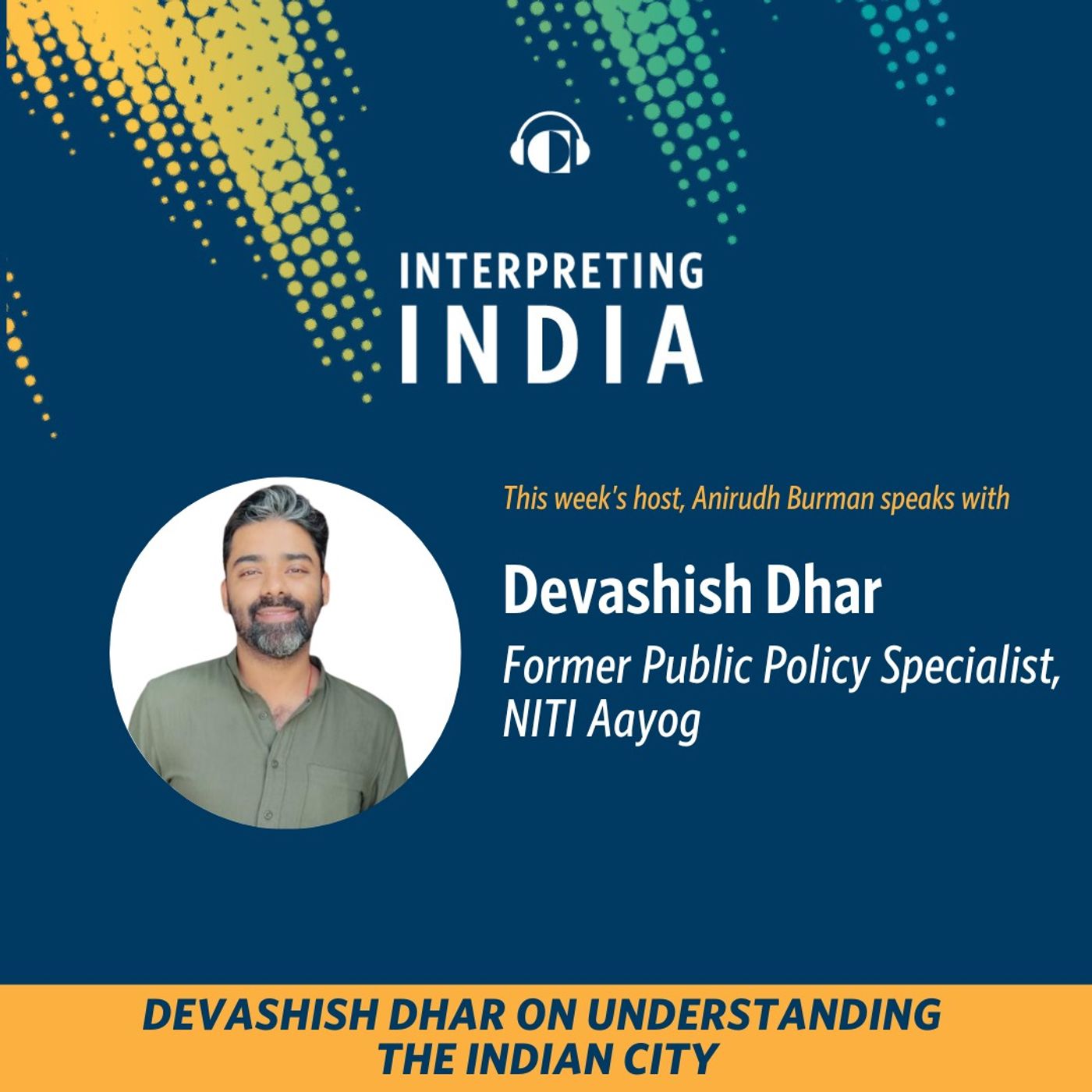
S3 Ep 20Devashish Dhar on Understanding the Indian City
One of the most visible signs of India’s economic development in the past seventy-five years has been the growth of its cities. Some of them are now among the largest on the planet, both in terms of area and population. However, Indian cities are far from perfect. They’re often not well planned, coping with problems of rapid growth and inefficient use of land and other resources. Indian cities are also plagued by a lack of basic amenities, such as clean drinking water, sanitation, and solid waste management systems, as well as safety-related problems.What is the scale of the challenges facing India’s cities? What are some of the ideas and themes that are unique to India’s experience of urbanization? What is the global significance of the trends underway in Indian cities?Devashish Dhar discusses many of these questions in his recent book, India’s Blind Spot: Understanding and Managing Our Cities. In this episode, he joins Anirudh Burman to unpack them further.Episode ContributorsDevashish Dhar is a former public policy specialist at NITI Aayog. He is a Mason Fellow from the Harvard Kennedy School and a Li-Ka Shing Scholar from the Lee Kuan Yew School of Public Policy in Singapore.Anirudh Burman is an associate research director and fellow at Carnegie India. He works on key issues relating to public institutions, public administration, the administrative and regulatory state, and state capacity. He has also worked extensively on financial regulation and regulatory governance.Additional ReadingsIndia’s Blind Spot: Understanding and Managing Our Cities by Devashish DharUnderstanding Indian Cities by Anirudh BurmanKey Moments00:00); Introduction(02:25); Chapter 1: What Prompted Devashish to Study Indian Cities?(04:55); Chapter 2: Why is Urbanization a Binding Constraint?(07:17); Chapter 3: Transforming Cities: Economic Growth and Socio-Economic Factors (11:50); Chapter 4: Unique Features of India’s Urbanization and Cities (21:49); Chapter 5: Infrastructure, Housing, and Utility Issues in India (29:10); Chapter 6: Are There Any Solutions to High Rents? (36:18); Chapter 7: Causes of Failure to Redevelop Land Property (42:45); Chapter 8: Urban Governance(51:23); Chapter 9: Urban Reforms in Small Cities(54:54); Chapter 9: Children as Figures of Urban Research(01:01:45); Closing Comments (01:02:55); Outro Every two weeks, Interpreting India brings you diverse voices from India and around the world to explore the critical questions shaping the nation's future. We delve into how technology, the economy, and foreign policy intertwine to influence India's relationship with the global stage.As a Carnegie India production, hosted by Carnegie scholars, Interpreting India, a Carnegie India production, provides insightful perspectives and cutting-edge by tackling the defining questions that chart India's course through the next decade.Stay tuned for thought-provoking discussions, expert insights, and a deeper understanding of India's place in the world.Don't forget to subscribe, share, and leave a review to join the conversation and be part of Interpreting India's journey.
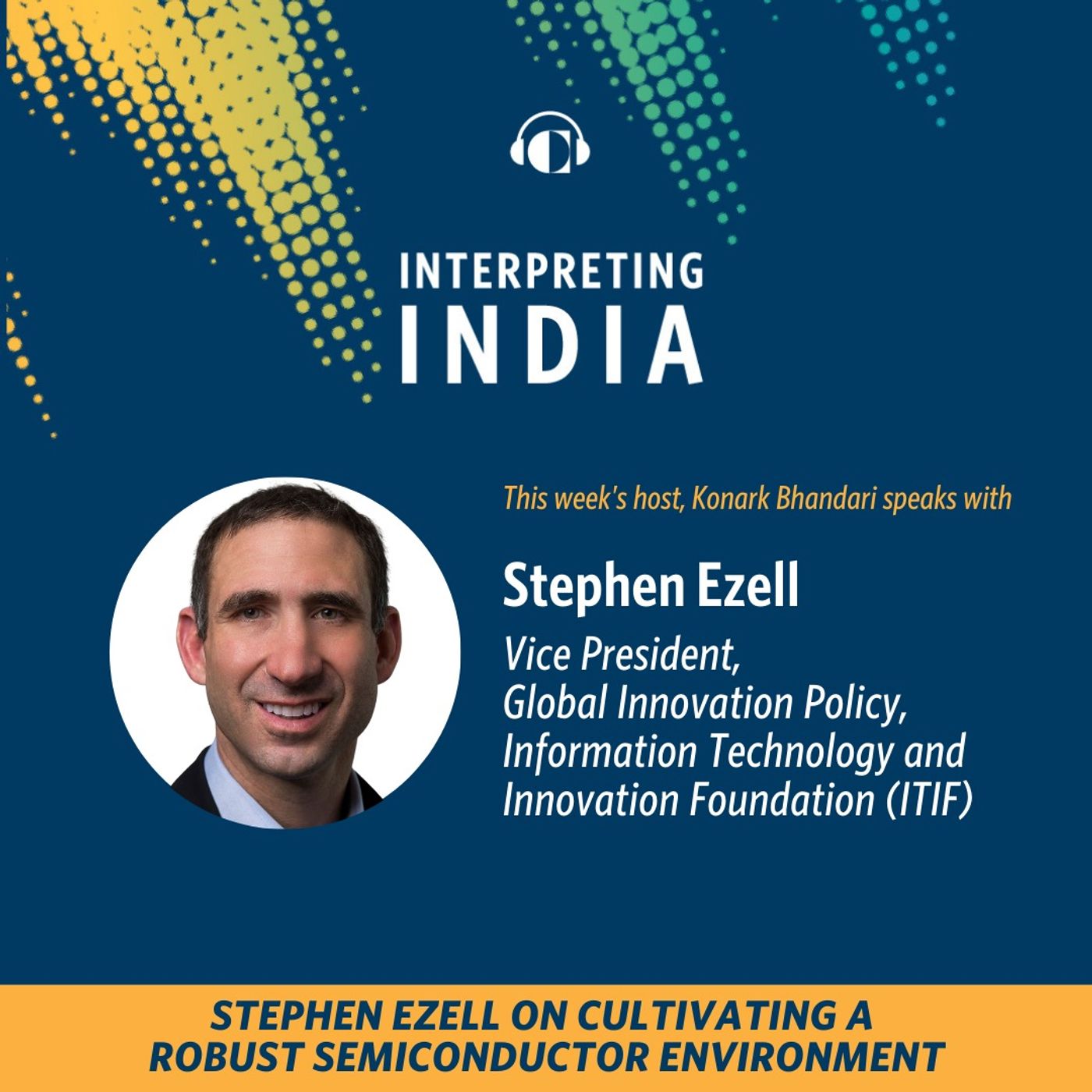
S3 Ep 19Stephen Ezell on Cultivating a Robust Semiconductor Environment
The U.S.-India initiative on Critical and Emerging Technology (iCET) was launched during the Quad Summit in Tokyo in May 2022. The purpose of the iCET was to expand partnerships in critical and emerging technologies, including semiconductors. As part of the iCET, the Semiconductor Industry Association and India Electronics and Semiconductor Association agreed to undertake a “readiness assessment” to identify near-term industry opportunities and facilitate the longer-term strategic development of their complementary semiconductor ecosystems. The Information Technology and Innovation Foundation (ITIF), a Washington, DC-based science and technology policy think tank, was commissioned to undertake authorship of this assessment.In this episode, Stephen Ezell, vice president for global innovation policy at ITIF, joins Konark Bhandari to discuss the opportunities and obstacles involved in cultivating robust semiconductor supply chains.Episode ContributorsStephen Ezell is vice president for global innovation policy at the Information Technology and Innovation Foundation (ITIF) and director of ITIF’s Center for Life Sciences Innovation. He also leads the Global Trade and Innovation Policy Alliance. His areas of expertise include science and technology policy, international competitiveness, trade, and manufacturing. Ezell is also the co-author of Innovating in a Service-Driven Economy: Insights, Application, and Practice and Innovation Economics: The Race for Global Advantage.Konark Bhandari is a fellow at Carnegie India. He is a lawyer who has researched certain areas in the digital economy, focusing primarily on approaches to antitrust regulation of companies in the digital realm. He had earlier worked at India’s antitrust regulator, the Competition Commission of India, where he worked closely with senior officials on a variety of matters. He is also an avid follower of the regulation of the space technology ecosystem and is keen to contribute to that discipline. Additional ReadingsIs India “Ready” for Semiconductor Manufacturing? by Konark BhandariThe Geopolitics of the Semiconductor Industry and India’s Place in It by Konark BhandariKey Moments(00:00); Introduction(02:23); Chapter 1: Offshoring Operations Outside China(05:52); Chapter 2: Utilization of ITSI Funds(09:19); Chapter 3: Friendshoring Initiatives(13:35); Chapter 4: Survival of Supplier Companies (19:06); Chapter 5: Semiconductor Fabrication Ecosystem in India(21:44); Chapter 6: Financial Investments(25:28); Chapter 7: Why Hasn’t India Leveraged the Chip-Designing Ecosystem?(27:48); Chapter 8: Role of Trade Policy in Company Investment(32:26); Chapter 9: Red Tape to Red Carpet: Readiness in India on Investment(35:36); Closing Comments(36:32); Outro Every two weeks, Interpreting India brings you diverse voices from India and around the world to explore the critical questions shaping the nation's future. We delve into how technology, the economy, and foreign policy intertwine to influence India's relationship with the global stage.As a Carnegie India production, hosted by Carnegie scholars, Interpreting India, a Carnegie India production, provides insightful perspectives and cutting-edge by tackling the defining questions that chart India's course through the next decade.Stay tuned for thought-provoking discussions, expert insights, and a deeper understanding of India's place in the world.Don't forget to subscribe, share, and leave a review to join the conversation and be part of Interpreting India's journey.

S3 Ep 18Emmanuel Lenain on the India-France Strategic Partnership and G20
Even though India and France have had a strategic partnership for twenty-five years now, the bilateral relationship between these countries has received substantial impetus recently. The relationship spans common interests in the Indian Ocean Region and the Indo-Pacific, a robust military and defense partnership, cooperation in high-tech areas such as space and nuclear, and, of course, a growing economic and trade relationship. What lessons can both countries offer each other? And what are some of the commonalities and differences in the French and Indian approaches to global governance and global challenges such as climate change in a multipolar world? What are the challenges in taking this relationship to the next level?In this episode of Interpreting India, Emmanuel Lenain joins Anirudh Suri to discuss these questions.Episode ContributorsEmmanuel Lenain is the Ambassador of France to India. He began his diplomatic career in 1997, serving in the French Foreign Ministry’s United Nations Department, where he took part in peace negotiations on Kosovo. Since then, he has served in France’s Permanent Mission to the United Nations in New York, the Embassy of France in Beijing as the Prime Minister’s technical adviser on multilateral affairs, the French Embassy in Washington, DC, as Consul General of France in Shanghai, Director for the Asia-Pacific Division of the French Ministry of Foreign Affairs, and as Diplomatic Adviser to the Prime Minister.Anirudh Suri is a nonresident scholar with Carnegie India. His interests lie at the intersection of technology and geopolitics, climate, and strategic affairs. He is currently exploring how India is carving and cementing its role in the global tech ecosystem and the role climate technology can play in addressing the global climate challenge. Every two weeks, Interpreting India brings you diverse voices from India and around the world to explore the critical questions shaping the nation's future. We delve into how technology, the economy, and foreign policy intertwine to influence India's relationship with the global stage.As a Carnegie India production, hosted by Carnegie scholars, Interpreting India, a Carnegie India production, provides insightful perspectives and cutting-edge by tackling the defining questions that chart India's course through the next decade.Stay tuned for thought-provoking discussions, expert insights, and a deeper understanding of India's place in the world.Don't forget to subscribe, share, and leave a review to join the conversation and be part of Interpreting India's journey.
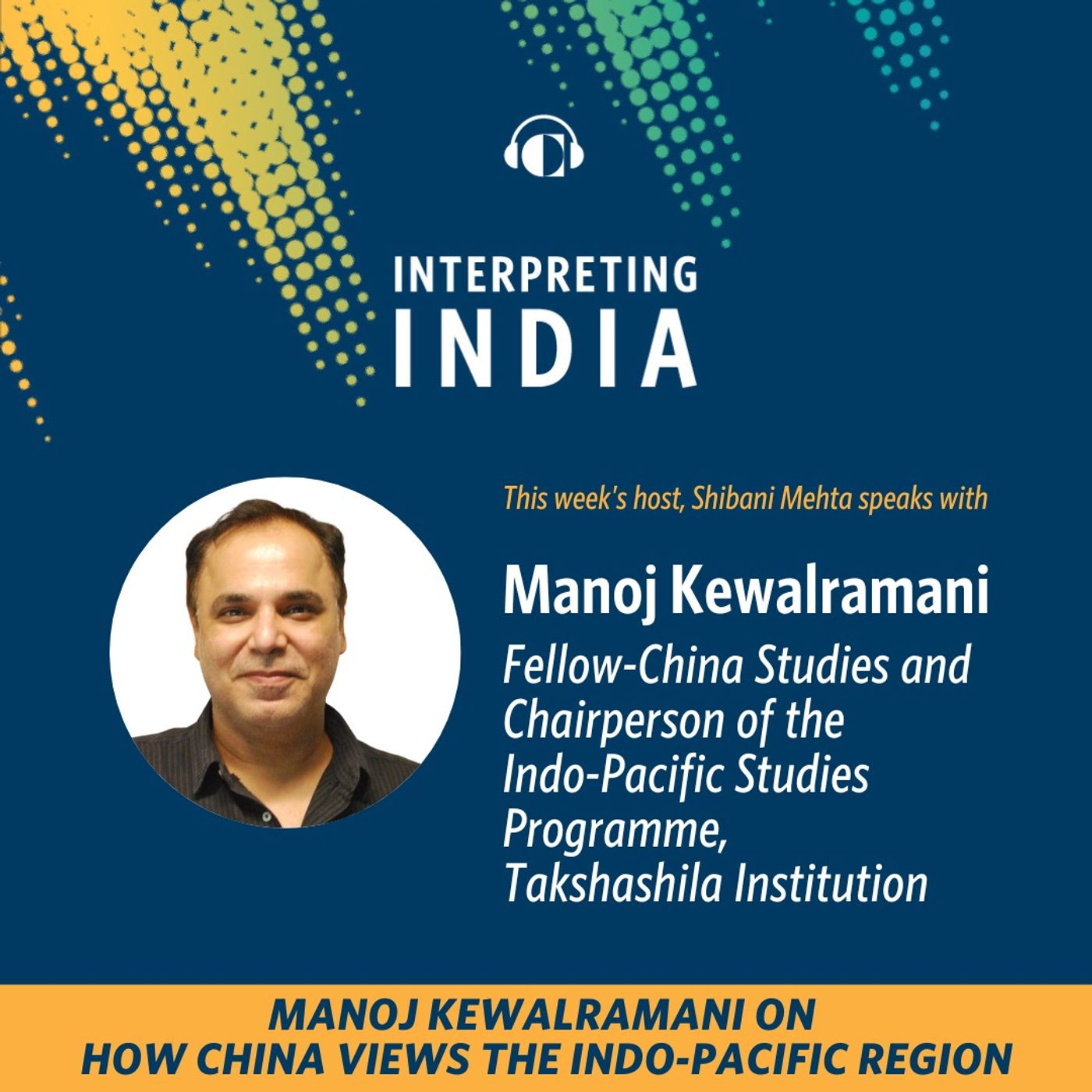
S3 Ep 17Manoj Kewalramani on How China Views the Indo-Pacific Region
In the last decade, there has been a growing convergence of global powers in the Indo-Pacific, evident from the proliferation of multilateral initiatives in the region. It has also emerged as an arena for geopolitical competition between China and the United States. As the competition intensifies, how does China see the Indo-Pacific? How has Beijing's understanding of this region changed over time? What can India learn from the way China sees the Indo-Pacific?In this episode of Interpreting India, Manoj Kewalramani joins Shibani Mehta to answer these questions and more. Episode ContributorsManoj Kewalramani is a fellow in China Studies and the chairperson of the Indo-Pacific Studies Programme at the Takshashila Institution. His research interests range from Chinese politics, foreign policy, and approaches to new technologies to addressing questions on how India can work with like-minded partners to address challenges presented by China's rise. Manoj is the author of Smokeless War: China’s Quest for Geopolitical Dominance, which discusses China’s political, diplomatic, economic, and narrative responses to the COVID-19 pandemic. Shibani Mehta is a senior research analyst with the Security Studies Program at Carnegie India. Her research focuses on the India-China boundary dispute with the purpose of analyzing India’s foreign and security policy decisionmaking.Additional ReadingsSmokeless War: China’s Quest for Geopolitical Dominance by Manoj KewalramaniIndo-Pacific Empire: China, America and the Contest for the World's Pivotal Region by Rory MedcalfKey Moments(0:00); Introduction(2:35); Chapter 1: China’s Role in the Indo-Pacific(8:36); Chapter 2: Changing Threat Perceptions of the Term “Indo-Pacific”(13:25); Chapter 3: Different Interpretations of the Term “Indo-Pacific”(19:55); Chapter 4: The Contradictory Position Undertaken by China(28:36); Chapter 5: Beijing’s Vision for a Global Order(33:59); Chapter 6: India’s Take on China’s View of the Indo-Pacific (43:16); Closing Comments(44:19); Outro Every two weeks, Interpreting India brings you diverse voices from India and around the world to explore the critical questions shaping the nation's future. We delve into how technology, the economy, and foreign policy intertwine to influence India's relationship with the global stage.As a Carnegie India production, hosted by Carnegie scholars, Interpreting India, a Carnegie India production, provides insightful perspectives and cutting-edge by tackling the defining questions that chart India's course through the next decade.Stay tuned for thought-provoking discussions, expert insights, and a deeper understanding of India's place in the world.Don't forget to subscribe, share, and leave a review to join the conversation and be part of Interpreting India's journey.

S3 Ep 16Exploring India’s Data Protection Law with Rahul Matthan
The past week has been momentous for those awaiting the enactment of a legal framework for data protection in India. India’s parliament passed the Digital Personal Data Protection Act, 2023, and the law has now also received the assent of the President of India. This law has been enacted after multiple rounds of deliberations and consultations. Multiple committees have submitted reports on the proposed legislation, and three previous drafts of the legislation have been circulated for public consultation. What changes has this law undergone? How will the cost of data protection and privacy compliance impact Indian businesses?In this episode of Interpreting India, Rahul Matthan joins Anirudh Burman to give us insights into these questions and more.Episode ContributorsRahul Matthan is a partner at Trilegal, one of India’s leading law firms, and heads the technology, media, and telecommunications (TMT) practice of the firm. He has extensive experience advising on high-value TMT transactions in the country. Rahul’s expertise spans several sectors in the technology space, including data protection, digital finance, cryptocurrencies, e-commerce, and more. Rahul has advised the government on the data privacy law and has served on the Kris Gopalakrishnan Committee on Non-Personal Data. He has authored numerous articles and thought pieces on various topical issues relating to computers, the internet, and other new technologies.Anirudh Burman is an associate research director and fellow at Carnegie India. He works on key issues relating to public institutions, public administration, the administrative and regulatory state, and state capacity. He has also worked extensively on financial regulation and regulatory governance.He has published works related to parliamentary oversight in India, the freedom of movement and residence, measuring the responsiveness of independent regulators in India, the design of insolvency professionals as a regulated profession, and the right to information.Additional ReadingsGet On with Data Protection Now That the Law’s Enacted by Rahul MatthanCompanies Must Work Hard to Ensure Data Protection by Rahul MatthanResisting the Leviathan: The Key Change in India’s New Proposal to Protect Personal Data by Anirudh BurmanWill India’s Proposed Data Protection Law Protect Privacy and Promote Growth? by Anirudh Burman—-Key Moments:(0:00); Introduction (3:00); Chapter 1: The Journey of This Act(7:03); Chapter 2: Data Protection in India(10:58); Chapter 3: Key Components of the Data Protection Act (14:19); Chapter 4: Applying GDPR Compliance in India(22:00); Chapter 5: Right to Data Portability(27:57); Chapter 6: Consent Manager Framework (32:44); Chapter 7: The Indian Government’s Data Accessing Powers(37:30); Chapter 8: Restrictions on Data Fiduciaries(42:46); Chapter 9: Blocking Data Fiduciaries’ Access to Public Information (45:18); Chapter 10: Data Localization(46:56); Chapter 11: Establishing a Data Protection Board(49:48); Closing Comments(52:40); Outro Every two weeks, Interpreting India brings you diverse voices from India and around the world to explore the critical questions shaping the nation's future. We delve into how technology, the economy, and foreign policy intertwine to influence India's relationship with the global stage.As a Carnegie India production, hosted by Carnegie scholars, Interpreting India, a Carnegie India production, provides insightful perspectives and cutting-edge by tackling the defining questions that chart India's course through the next decade.Stay tuned for thought-provoking discussions, expert insights, and a deeper understanding of India's place in the world.Don't forget to subscribe, share, and leave a review to join the conversation and be part of Interpreting India's journey.

S3 Ep 15Suresh Narayanan on the Role of the Private Sector in Climate Change
The role of the private sector in facilitating the climate transition journey of our world has been much talked about recently. While many corporations, including those in the fossil fuel sectors, have started drafting out their own journeys to “net zero,” Ajay Banga, the newly appointed president of the World Bank, has also emphasized the need for active private sector finance in the climate transition. There is a growing realization that governments alone cannot do all that is needed to prevent the worst-case scenarios that the world is increasingly faced with. And yet, the full scope of how the private sector can actually expedite this once-in-an-era transition has not been explored enough. In this episode, Suresh Narayanan joins Anirudh Suri to explore the role of the private sector in the climate transition journey.Episode ContributorsSuresh Narayanan is the chairman and managing director of Nestlé India Limited. He has been in this role since August 2015. He also serves as the chairman of the CII National Committee on Food Processing Industries. Under Mr. Narayanan’s leadership, Nestlé India has received several accolades, including, most recently, “MNC in India of the Year” in 2022 by the All India Management Association, “Outstanding Company of the Year 2021” by CNBC TV18 India Business Leader Awards (IBLA), and “MNC of the Year” by Business Standard in 2020.Mr. Narayanan joined Nestlé in 1999 as executive vice president for sales in India. His international career commenced at Nestlé Indochina in 2003, and he has also served in the Philippines, Singapore, Egypt, and the Northeast Africa Region. He was honored as the “Entrepreneurial CEO” at the EY Entrepreneur of The Year™ Awards 2020. Business Today awarded him “Best CEO-FMCG” for two consecutive years in 2019 and 2020.Anirudh Suri is a nonresident scholar with Carnegie India. His interests lie at the intersection of technology and geopolitics, climate, and strategic affairs. He is currently exploring how India is carving and cementing its role in the global tech ecosystem and the role climate technology can play in addressing the global climate challenge.He is the author of The Great Tech Game: Shaping Geopolitics and the Destinies of Nations (HarperCollins, 2022) and is currently the managing partner at India Internet Fund, a technology-focused venture capital fund based in India and the United States. He has also written extensively on foreign policy, geopolitics, cybersecurity, climate, technology, and entrepreneurship in publications such as the Indian Express, Times of India, Hindustan Times, Foreign Policy, The Print, The New Republic, Economic Times, MoneyControl, and Asia Times. --Additional ReadingsA Comprehensive Framework for India’s Climate Finance Strategy by Anirudh SuriWhy Banga Being a Corporate Czar is Good for World Bank by Anirudh Suri—-Key Moments:(0:00); Introduction (4:29); Mr. Narayanan’s Journey(9:45); The Private Sector’s Role in Combating Climate Change(15:49); Nestle’s Application of Common But Differentiated Responsibilities (20:09); Nestle’s Science and R&D-Based Approach (27:51); Obstacles to India’s Private Sector Spending on R&D(37:15); On Packaged Foods and Food Security (38:53); Policy Hurdles in Public-Private Collaborations (42:42); India’s Climate Opportunity Strategy (48:41); Concluding Remarks (49:15); Outro Every two weeks, Interpreting India brings you diverse voices from India and around the world to explore the critical questions shaping the nation's future. We delve into how technology, the economy, and foreign policy intertwine to influence India's relationship with the global stage.As a Carnegie India production, hosted by Carnegie scholars, Interpreting India, a Carnegie India production, provides insightful perspectives and cutting-edge by tackling the defining questions that chart India's course through the next decade.Stay tuned for thought-provoking discussions, expert insights, and a deeper understanding of India's place in the world.Don't forget to subscribe, share, and leave a review to join the conversation and be part of Interpreting India's journey.

S3 Ep 14Sameer Lalwani on India-U.S. Defense-Industrial Cooperation
Defense cooperation is central to the India-U.S. partnership, and it has served as a key enabler for stronger collaboration at the multilateral level. While defense ties between the two countries have gone from strength to strength over the last two decades, defense-industrial cooperation has notably failed to take off thus far. However, of late, the two countries have made a renewed push toward furthering defense-industrial cooperation. They released a roadmap in June 2023, and Prime Minister Narendra Modi’s recent state visit to the United States has given the process further impetus.In this episode of Interpreting India, Sameer Lalwani joins Rahul Bhatia to discuss these points and more.Episode ContributorsSameer Lalwani is a senior expert on South Asia at the U.S. Institute of Peace. He is also a nonresident senior fellow with the Center for Strategic and Budgetary Assessments. His research interests include nuclear deterrence, interstate rivalry, alliances, crisis behavior, counterinsurgency, and Indo-Pacific security. Sameer has been widely published in academic journals and print media alike. He was the co-editor of the book Investigating Crises: South Asia’s Lessons, Evolving Dynamics, and Trajectories, which was published by the Stimson Center in 2018.Rahul Bhatia is a research analyst with the security studies program at Carnegie India. His research focuses on India’s borders and India’s foreign and defense policies. He is currently working on a project that looks at India’s military modernization with a focus on indigenization. He also has a keen interest in the changing geopolitical landscape in the Indo-Pacific.---Additional ReadingsModi’s Trip to Washington Marks New Heights in U.S.-India Ties by Sameer P. Lalwani, Daniel Markey, Tamanna Salikuddin, and Vikram J. SinghA Big Step Forward in U.S.-India Defense Ties by Sameer P. Lalwani and Vikram J. SinghWhat the GE Engine Deal Means for India’s Military Diversification by Rahul BhatiaCan a Defense Innovation Bridge Elevate India-U.S. Defense Cooperation? by Rahul Bhatia and Konark Bhandari---Key Moments:(0:00); Intro(2:10); Chapter 1: The Role of Defense-Industrial Cooperation(4:11); Chapter 2: The Roadmap for Defense-Industrial Partnership(7:07); Chapter 3: Why the DTTI Failed(12:41); Chapter 4: Bureaucratic Differences in the DTTI(16:48); Chapter 5: India’s History of Technology Sharing and Indigenization(24:36); Chapter 7: The Significance of the GE Deal(27:21); Chapter 8: The Role of the Indian Startup Ecosystem(29:03); Chapter 9: India-U.S. Cooperation on Undersea Domain Awareness(31:53); Chapter 10: The Significance of INDUS-X(36:48); Chapter 11: Challenges in India-U.S. Joint Defense Innovation(40:23); Outro---Carnegie India Socials:Instagram: https://www.instagram.com/carnegieindia/ (@CarnegieIndia)Twitter: https://twitter.com/CarnegieIndiaWebsite: https://carnegieindia.orgYouTube: https://www.youtube.com/c/CarnegieIndia/ Every two weeks, Interpreting India brings you diverse voices from India and around the world to explore the critical questions shaping the nation's future. We delve into how technology, the economy, and foreign policy intertwine to influence India's relationship with the global stage.As a Carnegie India production, hosted by Carnegie scholars, Interpreting India, a Carnegie India production, provides insightful perspectives and cutting-edge by tackling the defining questions that chart India's course through the next decade.Stay tuned for thought-provoking discussions, expert insights, and a deeper understanding of India's place in the world.Don't forget to subscribe, share, and leave a review to join the conversation and be part of Interpreting India's journey.

S3 Ep 13Rahul Verma on the Debate on Democratic Backsliding in India
In recent years, international indices and rankings such as the Democracy Index and the V-Dem Index have downgraded India’s democracy. Although there are significant differences in the degrees of downgrading, most major indices suggest that Indian democracy is backsliding.Meanwhile, India is witnessing an increase in voter turnout, and people continue to participate actively and vociferously in politics. What is the reason for this disconnect between scholarly understandings of Indian democracy and ground realities?To help us make sense of this dichotomy, Rahul Verma joins Suyash Rai to discuss his recent essay titled “The Exaggerated Death of Indian Democracy.” In the essay, Dr. Verma argues that the claims of democratic backsliding in India are somewhat exaggerated.Episode ContributorsRahul Verma is a fellow at the Center for Policy Research and a visiting assistant professor at Ashoka University. His research interests include voting behavior, party politics, political violence, and the media. Dr. Verma has published papers in Asian Survey, Economic & Political Weekly, and Studies in Indian Politics. His book, co-authored with Professor Pradeep Chhibber, Ideology and Identity: The Changing Party Systems of India, develops a new approach to defining the contours of what constitutes an ideology in multiethnic countries such as India. He has a PhD in Political Science from the University of California at Berkeley.Suyash Rai is a deputy director and fellow at Carnegie India. His research focuses on the political economy of economic reforms and the performance of public institutions in India. His current research looks at the financial sector, the fiscal system, and the infrastructure sector.---Additional ReadingsThe Exaggerated Death of Indian Democracy by Rahul Verma“Symposium: Is India Still a Democracy?” Journal of Democracy, July 2023The Possibilities of Indian Electoral Politics by Suyash RaiUnderstanding the Debate on Democratic Backsliding Through Two Papers by Suyash RaiIdeology and Identity: The Changing Party Systems of India by Pradeep K. Chhibber and Rahul VermaThe Rise of the Second Dominant Party System in India: BJP’s New Social Coalition in 2019 by Pradeep K. Chhibber and Rahul VermaDalits in the New Millennium, edited by Sudha Pai, D. Shyam Babu, and Rahul VermaHow India’s Ruling Party Erodes Democracy by Ashutosh VarshneyThe Expanding Role of Majoritarianism in India by Suhas PalshikarUnderstanding the Nature of Party Competition and Politics of Majoritarianism by Suhas PalshikarFor India, ‘Middle’ Democracy Works by Subrata K. Mitra---Key Moments(00:00); Intro(4:24); Chapter 1: Why Rahul Wrote the Essay(9:53); Chapter 2: Paradoxes in Indian Polity (12:14); Chapter 3: Biases in Ranking Measures(18:53); Chapter 4: Comparing the Present with the Past(21:22); Chapter 5: Conflating Other Phenomena for Backsliding(29:20); Chapter 6: Party Dominance and Partisanship(35:03); Chapter 7: Unpacking Mass Polarization(41:00); Chapter 8: The Frequency of Protests in Past Years(49:22); Chapter 9: The Pew Survey on Religion in India(50:53); Chapter 10: Scholarly Discourse vs. Public Opinion(55:38); Chapter 11: The Current State of Indian Democracy(1:04:47); Chapter 12: Remaining Hopeful About Indian Democracy(1:08:18); Chapter 13: Closing Remarks by Suyash(1:11:52); Outro--Carnegie India Socials:Instagram: https://www.instagram.com/carnegieindia/ (@CarnegieIndia)Twitter: https://twitter.com/CarnegieIndiaWebsite: https://carnegieindia.orgYouTube: https://www.youtube.com/c/CarnegieIndia/ Every two weeks, Interpreting India brings you diverse voices from India and around the world to explore the critical questions shaping the nation's future. We delve into how technology, the economy, and foreign policy intertwine to influence India's relationship with the global stage.As a Carnegie India production, hosted by Carnegie scholars, Interpreting India, a Carnegie India production, provides insightful perspectives and cutting-edge by tackling the defining questions that chart India's course through the next decade.Stay tuned for thought-provoking discussions, expert insights, and a deeper understanding of India's place in the world.Don't forget to subscribe, share, and leave a review to join the conversation and be part of Interpreting India's journey.

S3 Ep 12Vaidehi Tandel and Sahil Gandhi on How Real Estate Sector Reforms Have Impacted Housing Prices
The Real Estate (Regulation and Development) Act was introduced in 2016 to protect consumers who had invested in residential real estate projects from malpractices by real estate developers. After the law was passed, most states established real estate regulatory authorities to register and oversee the conduct of real estate developers. What changes did this act try to bring in, and how has this regulatory change benefited consumers? Is the increased information about property litigation that the Maharashtra RERA provides affecting housing prices? Does RERA reduce information asymmetry in the housing market?In this episode of Interpreting India, Vaidehi Tandel and Sahil Gandhi join Anirudh Burman to give us insights into these issues and more. They discuss their recent working paper, co-authored with Anupam Nanda and Nandini Agnihotri. Their study analyses how housing prices change in response to mandatory disclosures under the RERA. The paper is titled, “Do Mandatory Disclosures Squeeze the Lemons? The Case of Housing Markets in India.”Episode ContributorsVaidehi Tandel is an economist working in the areas of urban economics, political economy, and public finance, with a focus on India. Currently, Dr. Tandel is a lecturer in real estate and urban economics at the University of Manchester, UK. Her research has been featured in The Financial Times, The New York Times, The Straits Times, Livemint, and others. Her papers have been published in the Journal of Development Economics, the Journal of Urban Economics, the Journal of Regional Science, Environment and Urbanization, Cities, and BMJ Open, among others. Her current work looks at the politician-builder nexus in Mumbai, agglomeration economies in India, and climate change and adaptation across cities in developing countries.Sahil Gandhi is an urban and real estate economist. Dr. Gandhi is a lecturer at The University of Manchester’s School of Environment, Education and Development. His research is in the fields of urban economics, real estate, and land economics. His recent papers are on vacant housing in India, migration and tenure choice, housing supply in Mumbai, and so on. His research has been published in the Journal of Urban Economics, the Journal of Development Economics, the Journal of Regional Science, Environment and Urbanization, and Cities, among others. He has also led a report on affordable housing in India. Dr. Gandhi has bylines in international and Indian media outlets such as The Washington Post, The Hindu, Hindustan Times, The Economic Times, and Livemint, among others. His research has also been cited in The Financial Times, The BBC, The Straits Times, Livemint, and more.---Key Moments(0:00); Introduction(2:39); Chapter 1: The Context Behind RERA(9:56); Chapter 2: Key Regulatory Changes(15:21); Chapter 3: The Case of Maharashtra’s RERA(17:27); Chapter 4: Mumbai’s High Proportion of Litigated Projects(23:04); Chapter 5: The Aim and Findings of the Study(27:35); Chapter 6: Variations Across Housing Submarkets (32:35); Chapter 7: Luxury Housing and Mandatory Disclosures(35:02); Chapter 8: Non-Luxury Housing and Litigation Costs(36:10); Chapter 9: RERA’s Impact on Low- and Middle-Income Consumers(40:36); Chapter 10: Types of Litigation Faced by Projects(43:44); Chapter 11: Future Research in Urban Economics(48:22); Outro---Additional ReadingsDo Mandatory Disclosures Squeeze the Lemons? The Case of Housing Markets in India by Vaidehi Tandel, Sahil Gandhi, Anupam Nanda, and Nandini AgnihotriToo Slow for the Urban March: Litigations and the Real Estate Market in Mumbai, India by Sahil Gandhi, Vaidehi Tandel, Alexander Tabarrok, and Shamika RaviView: Time to Make RERA Roar by Nandini Agnihotri and Sahil GandhiIndia Has to Attack Causes of Land Litigation. Modi’s Ease of Doing Business Depends on It by Anirudh Burman Making Land Titles in India Marketable: Using Title Insurance as a Viable Alternative to Conclusive Titling by Anirudh Burman--Carnegie India Socials:Instagram: https://www.instagram.com/carnegieindia/ (@CarnegieIndia)Twitter: https://twitter.com/CarnegieIndiaWebsite: https://carnegieindia.orgYouTube: https://www.youtube.com/c/CarnegieIndia/ Every two weeks, Interpreting India brings you diverse voices from India and around the world to explore the critical questions shaping the nation's future. We delve into how technology, the economy, and foreign policy intertwine to influence India's relationship with the global stage.As a Carnegie India production, hosted by Carnegie scholars, Interpreting India, a Carnegie India production, provides insightful perspectives and cutting-edge by tackling the defining questions that chart India's course through the next decade.Stay tuned for thought-provoking discussions, expert insights, and a deeper understanding of India's place in the world.Don't forget to subscribe, share, and leave a review to join the conversation and be part of Interpreting India's journey.

S3 Ep 11Arun K. Singh on the iCET and India-U.S. Relations
The iCET was launched on the sidelines of the Quad Summit in Tokyo in May 2022. Both U.S. President Biden and Indian Prime Minister Narendra Modi welcomed the launch of this initiative, which was to be spearheaded by the National Security Councils of the two countries to expand partnership in critical and emerging technologies. Is the iCET more than just a deal? What is the case for comparisons between the iCET and the landmark India-U.S. Civilian Nuclear Deal? What makes the iCET different from earlier initiatives between India and the United States? Does Prime Minister Modi's upcoming state visit to the United States put the iCET under pressure to "deliver" something? What is the importance of export control measures in India-U.S. tech ties?In this episode of Interpreting India, Arun K. Singh joins Konark Bhandari to discuss these questions and more.Episode ContributorsArun K. Singh is a nonresident senior fellow at Carnegie India. Mr. Singh has extensive experience across the globe, including as India’s ambassador to the United States, Israel, and France. Throughout his distinguished career in the Indian Foreign Service spanning thirty-seven years, he has served during pivotal periods in key global capitals and was instrumental in shaping India’s policies, notably the continued progress in the U.S.-India relationship, India’s closer ties to Israel, and the formulation and implementation of India’s policies related to Afghanistan, Pakistan, and Iran, including in the period following 9/11.Konark Bhandari is an associate fellow with Carnegie India. Konark is a lawyer who has researched on certain areas in the digital economy, focusing primarily on approaches to antitrust regulation of companies in the digital realm.---Key Moments:(0:00); Chapter 1: Introduction(2:00); Chapter 2: iCET vs. India-U.S. Civilian Nuclear Deal(10:10); Chapter 3: Private Sector Involvement in the iCET(14:26); Chapter 4: An AUKUS-like Carve-Out for India?(17:48); Chapter 5: The Pressure to "Deliver" Under the iCET(21:25); Chapter 6: Likely Deals and Expectations During PM Modi's Visit(24:15); Chapter 7: Indian Tech Talent and U.S. Immigration Reforms(26:47); Chapter 8: Arriving at a Consensus Under the iCET(29:11); Chapter 9: The Key Factors Making the iCET a Great Bet(32:17); Outro---Additional ReadingIndia and the United States’ Good Bet: One Year of the U.S.-India Initiative on Critical and Emerging Technology (iCET) by Konark Bhandari, Arun K. Singh, and Rudra ChaudhuriTo Compete With China on Tech, America Needs to Fix Its Immigration System by Eric SchmidtAmerica’s Bad Bet on India by Ashley J. TellisForging a High-Technology Partnership Between the United States and India in the Age of Export Controls by Konark BhandariWhat is the United States-India Initiative on Critical and Emerging Technologies (iCET)? by Rudra ChaudhuriThe U.S.-India Initiative on Critical and Emerging Technologies (iCET): The Way Forward by Rudra Chaudhuri, Konark Bhandari, and Ashima SinghHow Washington and New Delhi Can Further Tech Ties by Rudra Chaudhuri, Priyadarshini D., Konark Bhandari, Arjun Kang Joseph, and Shatakratu SahuIndia-U.S. Emerging Technologies Working Group--🎙️ Check out our podcast, Interpreting India, available now on YouTube, Spotify, Amazon Music, and iTunes!Home: https://interpreting-india.simplecast.com/Spotify: https://open.spotify.com/show/51yeOb8SimMIPe2KgIUQ8gApple Podcasts: https://podcasts.apple.com/in/podcast/interpreting-india/id1476357131YouTube: https://www.youtube.com/playlist?list=PLeXQMWQXRkJXF71nDiX9LhlXiSkhR8JJTAmazon Music: https://music.amazon.com/podcasts/f68d7bd9-1589-410f-b20d-65c94c9b3302/interpreting-india--Carnegie India Socials:Instagram: https://www.instagram.com/carnegieindia/ (@CarnegieIndia)Twitter: https://twitter.com/CarnegieIndiaWebsite: https://carnegieindia.orgYouTube: https://www.youtube.com/c/CarnegieIndia/ Every two weeks, Interpreting India brings you diverse voices from India and around the world to explore the critical questions shaping the nation's future. We delve into how technology, the economy, and foreign policy intertwine to influence India's relationship with the global stage.As a Carnegie India production, hosted by Carnegie scholars, Interpreting India, a Carnegie India production, provides insightful perspectives and cutting-edge by tackling the defining questions that chart India's course through the next decade.Stay tuned for thought-provoking discussions, expert insights, and a deeper understanding of India's place in the world.Don't forget to subscribe, share, and leave a review to join the conversation and be part of Interpreting India's journey.

S3 Ep 10Shirin Rai on Gender Parity in the Indian Parliament
The 17th Lok Sabha has seventy-eight women MPs, the highest since independence. Has the increase in women’s participation been meaningful? What narratives of equality and citizenship have framed the issue of electoral representation? Do women MPs carry the burden of shifting welfare policy in a gender-sensitive direction? In this episode of Interpreting India, Shirin Rai joins Shibani Mehta to discuss these questions on gender parity and disparity in the Indian Parliament.Episode ContributorsShirin Rai is an interdisciplinary scholar of international relations, area studies, political economy, history, and comparative politics. She has written extensively on issues of gender, governance and development, and gender and political institutions. Her work within feminist political economy examines gendered regimes of work and survival under globalization, which include the privatization of natural resources and the changing nature of work. Professor Rai is a distinguished research professor of politics and international relations at SOAS, University of London. She is a fellow of the British Academy. In 2022, she was awarded the Distinguished Contribution Prize by the British International Studies Association for her contribution to the promotion of excellence in the discipline of international studies over a substantial period of time. Shibani Mehta is a senior research analyst with the Security Studies Program at Carnegie India. Her research focuses on the India-China boundary dispute with the purpose of analyzing India’s foreign and security policy decisionmaking.-- Key Moments:(0:00); Introduction(2:11); Reflection on the newly built parliament building and its implications for society(7:32); Analysis of the evolution of the Indian Parliament(14:39); Examination of women's representation in Parliament throughout the years(23:33); Discussing boardroom politics and advocating for women's participation in parliament(31:26); Exploring whether women bear the burden of welfare and equality in this debate(43:55); Comparison of women's reservation in parliament at different levels of governance(50:27); Outro Additional Reading70 Years of Parliament by PRS Legislative ResearchPerforming Representation: Women Members in the Indian Parliament by Shirin M. Rai and Carole SparyThe Oxford Handbook of Politics and Performance, edited by Shirin M. Rai, Milija Gluhovic, Silvija Jestrovic, and Michael SawardExplained | On Reservation for Women in Politics by Radhika SanthanamIndian Women Are Voting More Than Ever. Will They Change Indian Society? by Milan Vaishnav--🎙️ Check out our podcast, Interpreting India, available now on YouTube, Spotify, Amazon Music, and iTunes!Home: https://interpreting-india.simplecast.com/Spotify: https://open.spotify.com/show/51yeOb8SimMIPe2KgIUQ8gApple Podcasts: https://podcasts.apple.com/in/podcast/interpreting-india/id1476357131YouTube: https://www.youtube.com/playlist?list=PLeXQMWQXRkJXF71nDiX9LhlXiSkhR8JJTAmazon Music: https://music.amazon.com/podcasts/f68d7bd9-1589-410f-b20d-65c94c9b3302/interpreting-india--Carnegie India Socials:Instagram: https://www.instagram.com/carnegieindia/ (@CarnegieIndia)Twitter: https://twitter.com/CarnegieIndiaWebsite: https://carnegieindia.orgYouTube: https://www.youtube.com/c/CarnegieIndia/ Every two weeks, Interpreting India brings you diverse voices from India and around the world to explore the critical questions shaping the nation's future. We delve into how technology, the economy, and foreign policy intertwine to influence India's relationship with the global stage.As a Carnegie India production, hosted by Carnegie scholars, Interpreting India, a Carnegie India production, provides insightful perspectives and cutting-edge by tackling the defining questions that chart India's course through the next decade.Stay tuned for thought-provoking discussions, expert insights, and a deeper understanding of India's place in the world.Don't forget to subscribe, share, and leave a review to join the conversation and be part of Interpreting India's journey.

S3 Ep 9Varad Pande on India's Climate Finance and Technology Strategy
Climate finance and technology is one of India’s priorities as part of its ongoing G20 presidency. Financing the climate transition of developing countries and the Global South is a complex but critical issue, as is the development, transfer, and sharing of critical climate technologies. What should India’s climate finance and technology strategy be? What role will the various pools of capital—private, public, philanthropic, impact, and multilateral development banks—play in mobilizing the necessary climate financial support for this transition? Will the new World Bank president, Ajay Banga, succeed in leveraging private capital for climate and ultimately make the Bank fit for purpose for the coming decades? Which areas of climate technology should India prioritize? Will India’s EV, solar, green hydrogen, and biofuels push suffice to position it as a climate leader? What lessons can India learn from the journeys, strategies, and priorities of other countries?In this episode of Interpreting India, Varad Pande joins Anirudh Suri to discuss these key issues around India's climate finance and technology strategy.--Episode ContributorsVarad Pande is a partner at BCG. Formerly, he was a partner with Omidyar Network India.Anirudh Suri is a nonresident scholar with Carnegie India. His interests lie at the intersection of technology and geopolitics, climate, and strategic affairs.--Additional ReadingA Comprehensive Framework for India’s Climate Finance Strategy by Anirudh SuriThe Case for a Comprehensive Indian Climate Bill by Anirudh SuriWhy Banga Being a Corporate Czar is Good for World Bank: Activists Are Wrong Because ex-Mastercard Boss Can Mobilise Climate Finance by Tapping Private Sector Capital by Anirudh Suri--🎙️ Check out our podcast, Interpreting India, available now on YouTube, Spotify, iTunes, and Amazon Music!Home: https://interpreting-india.simplecast.com/Spotify: https://open.spotify.com/show/51yeOb8SimMIPe2KgIUQ8gApple Podcasts: https://podcasts.apple.com/in/podcast/interpreting-india/id1476357131YouTube: https://www.youtube.com/playlist?list=PLeXQMWQXRkJXF71nDiX9LhlXiSkhR8JJTAmazon Music: https://music.amazon.com/podcasts/f68d7bd9-1589-410f-b20d-65c94c9b3302/interpreting-india-- Key Moments(00:00); Introduction (02:03); Varad's diving experience in the Andaman Islands and India's ocean ecosystem(05:45); The Indian Ocean Initiative at Carnegie India(06:27); Anirudh speaks on his observations on climate change(07:45); Going from net zero to nature positive(10:11); Change in climate finance trends(12:17); Varad explains why climate finance is such a tricky problem to solve(18:31); Making India more lucrative to global climate finance capital (28:34); Varad on the role of private and public finance in climate change(30:45); Leveraging the newly elected council of the World Bank for climate finance needs(36:55); India's climate tech strategy—EVs and green hydrogen (45:40); Anirudh on the consumption aspect of climate technology strategies(47:13); What can India learn from the climate transition journeys of other countries?(54:34); Outro Carnegie India Socials:Instagram: https://www.instagram.com/carnegieindia/ (@CarnegieIndia)Twitter: https://twitter.com/CarnegieIndiaWebsite: https://carnegieindia.orgYouTube: https://www.youtube.com/c/CarnegieIndia/ Every two weeks, Interpreting India brings you diverse voices from India and around the world to explore the critical questions shaping the nation's future. We delve into how technology, the economy, and foreign policy intertwine to influence India's relationship with the global stage.As a Carnegie India production, hosted by Carnegie scholars, Interpreting India, a Carnegie India production, provides insightful perspectives and cutting-edge by tackling the defining questions that chart India's course through the next decade.Stay tuned for thought-provoking discussions, expert insights, and a deeper understanding of India's place in the world.Don't forget to subscribe, share, and leave a review to join the conversation and be part of Interpreting India's journey.
S3 Ep 8Radhicka Kapoor on Labor-Intensive Manufacturing in India
India’s development has not been uniform and has leapfrogged from agriculture to services, skipping over a manufacturing phase. However, the agriculture and services sectors typically do not create enough productive jobs for those at the bottom of the education and skills ladder. Thus, there is a need for labor-intensive manufacturing to absorb those with low levels of education and skills, but only around 11–12 percent of the total employment is in manufacturing, and this share has been essentially flat for two decades. There is also too much labor employed in the low-productivity unorganized sector, and there are too few jobs in the high-productivity formal sector. As recently as 2015–16, the unorganized sector continued to employ over 70 percent of total manufacturing employment. Inclusive growth would require us to find ways to enable formal manufacturing to prosper.In this episode of Interpreting India, Radhicka Kapoor joins Sayoudh Roy to discuss the state of labor-intensive manufacturing in India.--Episode ContributorsRadhicka Kapoor is a visiting professor at the Indian Council for Research on International Economic Relations, in addition to having previously worked at the Planning Commission and at the International Labour Organization, Geneva. Her research interests include poverty and inequality, labor economics and industrial performance, and she has published extensively on labor-intensive manufacturing in India. Most recently, she has edited A New Reform Paradigm, a collection of essays written in honor of Isher Judge Ahluwalia.Sayoudh Roy is a senior research analyst with the Political Economy Program at Carnegie India. His work focuses on the macroeconomic implications of frictions in labor and financial markets and how interactions between them can affect macroeconomic aggregates.--Additional ReadingA New Reform Paradigm: Festschrift in Honour of Isher Judge Ahluwalia, edited by Radhicka KapoorCreating jobs in India’s organised manufacturing sector by Radhicka KapoorExplaining the contractualisation of India’s workforce by Radhicka Kapoor and P. P. KrishnapriyaStylized Facts on the Evolution of the Enterprise Size: Distribution in India's Manufacturing Sector by Radhicka KapoorEmployment in India by Ajit Kumar GhoseIndia Employment Report by Ajit Kumar GhoseStructural Change and Employment in India by Nomaan MajidSmall-Scale Industry Policy in India: A Critical Evaluation by Rakesh MohanIndustrialisation for Employment and Growth in India: Lessons from Small Firm Clusters and Beyond, edited by Rayaprolu Nagaraj--🎙️ Check out our podcast, Interpreting India available now on YouTube, Spotify, and iTunes!Home: https://interpreting-india.simplecast.com/Spotify: https://open.spotify.com/show/51yeOb8SimMIPe2KgIUQ8gApple Podcasts: https://podcasts.apple.com/in/podcast/interpreting-india/id1476357131YouTube: https://www.youtube.com/playlist?list=PLeXQMWQXRkJXF71nDiX9LhlXiSkhR8JJT--Carnegie India Socials:Instagram: https://www.instagram.com/carnegieindia/ (@CarnegieIndia)Twitter: https://twitter.com/CarnegieIndiaWebsite: https://carnegieindia.orgYouTube: https://www.youtube.com/c/CarnegieIndia/ Every two weeks, Interpreting India brings you diverse voices from India and around the world to explore the critical questions shaping the nation's future. We delve into how technology, the economy, and foreign policy intertwine to influence India's relationship with the global stage.As a Carnegie India production, hosted by Carnegie scholars, Interpreting India, a Carnegie India production, provides insightful perspectives and cutting-edge by tackling the defining questions that chart India's course through the next decade.Stay tuned for thought-provoking discussions, expert insights, and a deeper understanding of India's place in the world.Don't forget to subscribe, share, and leave a review to join the conversation and be part of Interpreting India's journey.
S3 Ep 6Susmita Mohanty on Developments in India's Space Sector
Recently, there have been certain key developments in India's space sector. There are questions that need to be probed for a better understanding of the country's space sector. What does it take to set up a successful space company? What should be made of the space sector reforms unveiled three years ago? How does the recent iCET framework play out when it comes to space cooperation between India and the United States?In this episode of Interpreting India, Susmita Mohanty joins Konark Bhandari to discuss recent developments in India's space sector. --Episode ContributorsSusmita Mohanty is a spaceship designer and serial space entrepreneur. Susmita is the only space entrepreneur in the world to have co-founded companies on 3 different continents: EARTH2ORBIT Bangalore (2009-2021), MOONFRONT, San Francisco (2001-2007) and LIQUIFER Systems Group, Vienna (2004-ongoing). Her latest endeavor launched in October 2021 is Spaceport SARABHAI - India’s first dedicated space think tank that hopes to re-center the global space narrative, give India an international voice, grow the body of knowledge that informs critical areas of space law and policy, and help transform India into a developed space economy by 2030.Konark Bhandari is an associate fellow with Carnegie India. Konark is a lawyer who has researched on certain areas in the digital economy, focusing primarily on approaches to antitrust regulation of companies in the digital realm.--Additional ReadingAre we there yet? The Artemis Accords, India, and the Way Forward by Konark BhandariWhat Does the United States' MTCR Policy Reform Mean for India's Space Sector? by Konark Bhandari--🎙️ Check out our podcast, Interpreting India available now on YouTube, Spotify, and iTunes!Home: https://interpreting-india.simplecast.com/Spotify: https://open.spotify.com/show/51yeOb8SimMIPe2KgIUQ8gApple Podcasts: https://podcasts.apple.com/in/podcast/interpreting-india/id1476357131YouTube: https://www.youtube.com/playlist?list=PLeXQMWQXRkJXF71nDiX9LhlXiSkhR8JJT--Carnegie India Socials:Instagram: https://www.instagram.com/carnegieindia/ (@CarnegieIndia)Twitter: https://twitter.com/CarnegieIndiaWebsite: https://carnegieindia.orgYouTube: https://www.youtube.com/c/CarnegieIndia/ Every two weeks, Interpreting India brings you diverse voices from India and around the world to explore the critical questions shaping the nation's future. We delve into how technology, the economy, and foreign policy intertwine to influence India's relationship with the global stage.As a Carnegie India production, hosted by Carnegie scholars, Interpreting India, a Carnegie India production, provides insightful perspectives and cutting-edge by tackling the defining questions that chart India's course through the next decade.Stay tuned for thought-provoking discussions, expert insights, and a deeper understanding of India's place in the world.Don't forget to subscribe, share, and leave a review to join the conversation and be part of Interpreting India's journey.
S3 Ep 7Philipp Ackermann on India and Germany's Strategic Partnership
The relationship between India and Germany doesn’t receive as much attention as it deserves. In recent years, however, the bilateral partnership has received a big impetus, both economically and geopolitically. India and Germany have had a strategic partnership since 2001, but have recently also embarked on a Green Strategic Partnership for green and sustainable development. What is that about? Where does this relationship stand currently? What are the challenges in taking this relationship to the next level? What are the economic, military and geopolitical drivers of this relationship? And what can India learn from how Germany has become an economic and industrial superpower? What can Germany learn from India’s own dynamic startup ecosystem? And finally, how can the two countries cooperate on major global challenges such as climate?In this episode of Interpreting India, Philipp Ackermann joins Anirudh Suri to discuss India and Germany's strategic partnership and the economic, military, and geopolitical drivers of this relationship. --Episode ContributorsPhilipp Ackermann is the current ambassador of Germany to India. He has studied art history and economics in Bonn, Heidelberg and Utrecht, and received his doctorate in art history in 1993, the same year that he joined the German Foreign Service. Before becoming Ambassador to India, he was Director General for Africa, Latin America, Near and Middle East at the Federal Foreign Office for five years.Anirudh Suri is a nonresident scholar with Carnegie India. His interests lie at the intersection of technology and geopolitics, climate, and strategic affairs. --Additional ReadingGermany woos India as an ally against Russia by Christoph Hasselbach--🎙️ Check out our podcast, Interpreting India available now on YouTube, Spotify, and iTunes!Home: https://interpreting-india.simplecast.com/Spotify: https://open.spotify.com/show/51yeOb8SimMIPe2KgIUQ8gApple Podcasts: https://podcasts.apple.com/in/podcast/interpreting-india/id1476357131YouTube: https://www.youtube.com/playlist?list=PLeXQMWQXRkJXF71nDiX9LhlXiSkhR8JJT--Carnegie India Socials:Instagram: https://www.instagram.com/carnegieindia/ (@CarnegieIndia)Twitter: https://twitter.com/CarnegieIndiaWebsite: https://carnegieindia.orgYouTube: https://www.youtube.com/c/CarnegieIndia/ Every two weeks, Interpreting India brings you diverse voices from India and around the world to explore the critical questions shaping the nation's future. We delve into how technology, the economy, and foreign policy intertwine to influence India's relationship with the global stage.As a Carnegie India production, hosted by Carnegie scholars, Interpreting India, a Carnegie India production, provides insightful perspectives and cutting-edge by tackling the defining questions that chart India's course through the next decade.Stay tuned for thought-provoking discussions, expert insights, and a deeper understanding of India's place in the world.Don't forget to subscribe, share, and leave a review to join the conversation and be part of Interpreting India's journey.
S3 Ep 5Abhishek Anand and Naveen Joseph Thomas on Reigniting India's Manmade Clothing Sector
A major puzzle for the Indian economy in the last one decade has been the weak performance in the textiles and apparel sectors. In real terms, the apparels sector has grown marginally and the textiles sector has witnessed a decline. India’s share in world trade in textiles and apparels has also declined considerably. Between the late-1990s and early 2010s, India’s share in the textiles trade has doubled, as the Indian economy revealed its comparative advantage in a variety of products in this category. But since then, India’s share in textiles trade has declined, even as many other countries have increased their share. The causes for this sudden reversal in a crucial sector is worth understanding. In this episode of Interpreting India, Abhishek Anand and Naveen Joseph Thomas join Suyash Rai to discuss how India can reignite its manmade clothing sector. --Episode ContributorsAbhishek Anand is a consultant with PwC Middle East. Earlier, he has worked at the World Bank as a Robert S. McNamara Fellow and prior to that as a career civil servant with the Government of India. His research interest lies at the intersection of macroeconomics and economic development. Naveen Joseph Thomas completed his Ph.D. in Economics at the Department of Economics, Delhi School of Economics, University of Delhi. He received his M.Sc. in Economics from the TERI School of Advanced Studies and his B.Sc.(H) in Physics from St. Stephen’s College, University of Delhi. His research interest lies in the areas of Household Economics, Growth Theory, Labour Economics and issues of the MSME sector. His current research focusses on the role of intra-household conflict in explaining low labour force participation of women in patriarchal societies, the scope of Mutual Credit Guarantee Schemes for the development of the MSME sector in India, and the analysis of education choice of parents under constrained supply of public-funded education in rural India using the ASER dataset.Suyash Rai is a deputy director and fellow at Carnegie India. His research focuses on the political economy of economic reforms, and the performance of public institutions in India. --Additional ReadingReigniting the Manmade Clothing Sector in India by Abhishek Anand and Naveen Joseph Thomas --🎙️ Check out our podcast, Interpreting India available now on YouTube, Spotify, and iTunes!Home: https://interpreting-india.simplecast.com/Spotify: https://open.spotify.com/show/51yeOb8SimMIPe2KgIUQ8gApple Podcasts: https://podcasts.apple.com/in/podcast/interpreting-india/id1476357131YouTube: https://www.youtube.com/playlist?list=PLeXQMWQXRkJXF71nDiX9LhlXiSkhR8JJT--Carnegie India Socials:Instagram: https://www.instagram.com/carnegieindia/ (@CarnegieIndia)Twitter: https://twitter.com/CarnegieIndiaWebsite: https://carnegieindia.orgYouTube: https://www.youtube.com/c/CarnegieIndia/ Every two weeks, Interpreting India brings you diverse voices from India and around the world to explore the critical questions shaping the nation's future. We delve into how technology, the economy, and foreign policy intertwine to influence India's relationship with the global stage.As a Carnegie India production, hosted by Carnegie scholars, Interpreting India, a Carnegie India production, provides insightful perspectives and cutting-edge by tackling the defining questions that chart India's course through the next decade.Stay tuned for thought-provoking discussions, expert insights, and a deeper understanding of India's place in the world.Don't forget to subscribe, share, and leave a review to join the conversation and be part of Interpreting India's journey.
S3 Ep 4André Aranha Corrêa do Lago on Indo-Brazilian Cooperation
In accordance with the G20 presidency conversations, one of the key conversations that has been missing from the main discourse has been the relationship between Brazil and India. Brazil will be taking over the G20 presidency from India. Therefore, it is imperative that these two countries think about some of the issues around climate finance, energy, technological innovation, global governance, and the SDGs. In this episode of Interpreting India, André Aranha Corrêa do Lago joins Anirudh Suri to discuss issues around climate finance, energy, technological innovation, global governance, and the SDGs. --Episode ContributorsAndré Aranha Corrêa do Lago is the former ambassador of Brazil to India. A recognised architecture critic and writer, has has been a member of the prestigious Pritzker Prize jury, and has served as the curator of the Brazilian Pavilion in the 2014 Venice Architecture Biennale. Between 2011 and 2013, he was also Brazil's Chief Negotiator for Climate Change and Sustainable Development, including for the Rio+20 UN Conference, which launched the Sustainable Development Goals. Between 2005 to 2016, André served as a member of the Architecture and Design Committee of the Museum of Modern Art (MoMA), New York, and is currently a member of the International Council of MoMA.Anirudh Suri is a nonresident scholar with Carnegie India. His interests lie at the intersection of technology and geopolitics, climate, and strategic affairs.--Additional ReadingBrazil, India can steer global transportation towards biofuels by André Aranha Corrêa do LagoBrazilian ambassador offers green growth solution to stubble burning in India by André Aranha Corrêa do LagoThe case for a comprehensive Indian climate bill by Anirudh Suri --🎙️ Check out our podcast, Interpreting India available now on YouTube, Spotify, and iTunes!Home: https://interpreting-india.simplecast.com/Spotify: https://open.spotify.com/show/51yeOb8SimMIPe2KgIUQ8gApple Podcasts: https://podcasts.apple.com/in/podcast/interpreting-india/id1476357131YouTube: https://www.youtube.com/playlist?list=PLeXQMWQXRkJXF71nDiX9LhlXiSkhR8JJT--Carnegie India Socials:Instagram: https://www.instagram.com/carnegieindia/ (@CarnegieIndia)Twitter: https://twitter.com/CarnegieIndiaWebsite: https://carnegieindia.orgYouTube: https://www.youtube.com/c/CarnegieIndia/ Every two weeks, Interpreting India brings you diverse voices from India and around the world to explore the critical questions shaping the nation's future. We delve into how technology, the economy, and foreign policy intertwine to influence India's relationship with the global stage.As a Carnegie India production, hosted by Carnegie scholars, Interpreting India, a Carnegie India production, provides insightful perspectives and cutting-edge by tackling the defining questions that chart India's course through the next decade.Stay tuned for thought-provoking discussions, expert insights, and a deeper understanding of India's place in the world.Don't forget to subscribe, share, and leave a review to join the conversation and be part of Interpreting India's journey.
S3 Ep 3Jennifer Brick Murtazashvili on Central Asia and the Russia-Ukraine War
Since their independence from the Soviet Union, the Central Asian countries, namely Kazakhstan, Kyrgyzstan, Tajikistan, Turkmenistan, and Uzbekistan, have maintained close ties with Moscow. However, Russia’s invasion of Ukraine has complicated the relationship. None of the Central Asian countries have expressed support for Russia’s war and are all abiding by the western sanctions imposed on Moscow. While economic ties between the region and Russia remain strong as of now, Central Asian countries are looking to diversify their economic relations, thereby opening up avenues for other powers.In this episode of Interpreting India, Jennifer Brick Murtazashvili joins Rahul Bhatia to discuss Central Asia and the Russia-Ukraine war. How are the Central Asian countries responding to Russia’s invasion of Ukraine? What could Russia’s preoccupation with the war in Ukraine mean for China’s role in the region? And, what are the implications of this on India and South Asia? --Episode ContributorsJennifer Brick Murtazashvili is a nonresident scholar in the Asia Program at the Carnegie Endowment for International Peace. She is the founding director of the Center for Governance and Markets and a professor at the Graduate School of Public and International Affairs at the University of Pittsburgh. Her research focuses on issues of self-governance, security, political economy, and public sector reform in the developing world. Her book Informal Order and the State in Afghanistan was published by Cambridge University Press in 2016.Rahul Bhatia is a research analyst with the Security Studies Program at Carnegie India. His research focuses on India’s borders and India’s foreign and defense policies.--Additional ReadingKazakhstan’s Tokayev Is Playing With Fire at Home—and With Russia by Jennifer Brick MurtazashviliThe Source of Ukraine’s Resilience by Jennifer Brick Murtazashvili--🎙️ Check out our podcast, Interpreting India available now on YouTube, Spotify, and iTunes!Home: https://interpreting-india.simplecast.com/Spotify: https://open.spotify.com/show/51yeOb8SimMIPe2KgIUQ8gApple Podcasts: https://podcasts.apple.com/in/podcast/interpreting-india/id1476357131YouTube: https://www.youtube.com/playlist?list=PLeXQMWQXRkJXF71nDiX9LhlXiSkhR8JJT--Carnegie India Socials:Instagram: https://www.instagram.com/carnegieindia/ (@CarnegieIndia)Twitter: https://twitter.com/CarnegieIndiaWebsite: https://carnegieindia.orgYouTube: https://www.youtube.com/c/CarnegieIndia/ Every two weeks, Interpreting India brings you diverse voices from India and around the world to explore the critical questions shaping the nation's future. We delve into how technology, the economy, and foreign policy intertwine to influence India's relationship with the global stage.As a Carnegie India production, hosted by Carnegie scholars, Interpreting India, a Carnegie India production, provides insightful perspectives and cutting-edge by tackling the defining questions that chart India's course through the next decade.Stay tuned for thought-provoking discussions, expert insights, and a deeper understanding of India's place in the world.Don't forget to subscribe, share, and leave a review to join the conversation and be part of Interpreting India's journey.
S3 Ep 2Arun K. Singh on India-Pakistan Ceasefire
Over the last three decades, cross-border violence between India and Pakistan has been interspersed with periods of relative peace. Until 2003, ceasefires along the Line of Control and International Border in Jammu and Kashmir (in 1949, 1965, and 1971) were preceded by war between India and Pakistan. On the night of November 23, 2003, an announcement of a unilateral ceasefire, starting on Eid-ul-Fitr, was made by then prime minister of Pakistan Mir Zafarullah Khan Jamali. Following this, during their weekly call, the Director Generals of Military Operations or DGMOs from the two countries agreed on a ceasefire along the Line of Control, International Border, and Actual Ground Position Line. And so, the ceasefire came into effect from 25 November 2003.Given the violence of the previous 14 years, the ceasefire was a welcome move. The years between 1989 and 2003 saw cross-border violence touch record levels. 2001 and 2002 saw 4,134 and 5,767 ceasefire violations respectively by Pakistan, as reported by India. Thus, the ceasefire resulted in a stable border and immediate relief for civilians. According to some reports, there was not a single ceasefire violation between India and Pakistan between 2004 and 2006, while others report that the number was negligible. The larger change in India-Pakistan relations following the institution of the composite dialogue process also enabled different confidence-building measures on the LoC, such as the opening of passenger routes on the Poonch-Rawalakot and Srinagar-Muzaffarabad axes, enabling bus traffic and eventually cross-border trade. The period also saw the completion of border fencing on the LoC as a measure to prevent infiltration. From 2007 onwards, ceasefire violations began to rise, intensifying after 2013. The larger relationship too started to see tensions due to terror attacks in India, civil-military dynamics in Pakistan, cross-border retaliatory actions such as the surgical strikes in 2016, and the Balakot airstrikes in 2019. In 2020, India reported 5,133 CFVs on the border. A reaffirmation of the ceasefire through a DGMO conversation and a subsequent joint statement by India and Pakistan in February 2021 was a major effort to arrest this trend.--Episode ContributorsArun K. Singh is a nonresident senior fellow at Carnegie India. He has extensive experience across the globe, including as India’s ambassador to the United States, Israel, and France. Throughout his distinguished career in the Indian Foreign Service spanning thirty-seven years, he has served during pivotal periods in key global capitals and was instrumental in shaping India’s policies, notably the continued progress in the U.S.-India relationship, India’s closer ties to Israel, and the formulation and implementation of India’s policies related to Afghanistan, Pakistan, and Iran, including in the period following 9/11.Surya Valliappan Krishna is the associate director of projects and operations at Carnegie India. His research interests are India-Pakistan relations, border security, and cross-border violence. In particular, he works on the nature and dynamics of cross-border violence and its impact on civilian communities.--Additional ReadingBordering on Peace: Evaluating the impact of the India-Pakistan Ceasefire by Surya Valliappan KrishnaCaught in the Crossfire: Tension and Trade Along the Line of Control by Surya Valliappan KrishnaSending the Right Signal: Telecom Connectivity along the Line of Control by Surya Valliappan KrishnaMental Health on the Line (of Control) by Surya Valliappan Krishna--🎙️ Check out our podcast, Interpreting India available now on YouTube, Spotify, and iTunes!Home: https://interpreting-india.simplecast.com/Spotify: https://open.spotify.com/show/51yeOb8SimMIPe2KgIUQ8gApple Podcasts: https://podcasts.apple.com/in/podcast/interpreting-india/id1476357131YouTube: https://www.youtube.com/playlist?list=PLeXQMWQXRkJXF71nDiX9LhlXiSkhR8JJT--Carnegie India Socials:Instagram: https://www.instagram.com/carnegieindia/ (@CarnegieIndia)Twitter: https://twitter.com/CarnegieIndiaWebsite: https://carnegieindia.orgYouTube: https://www.youtube.com/c/CarnegieIndia/ Every two weeks, Interpreting India brings you diverse voices from India and around the world to explore the critical questions shaping the nation's future. We delve into how technology, the economy, and foreign policy intertwine to influence India's relationship with the global stage.As a Carnegie India production, hosted by Carnegie scholars, Interpreting India, a Carnegie India production, provides insightful perspectives and cutting-edge by tackling the defining questions that chart India's course through the next decade.Stay tuned for thought-provoking discussions, expert insights, and a deeper understanding of India's place in the world.Don't forget to subscribe, share, and leave a review to join the conversation and be part of Interpreting India's journey.
S3 Ep 1Discussing Urban Governance with Matthew Glasser
India’s patterns of urban growth came under sharp focus during the Covid-19 pandemic. Many highlighted the poor quality of urban services as contributors to the spread of the same. The pandemic laid bare many pre-existing deficiencies in urban governance that have continued to plague India’s urban areas.As India continues to grow and urbanize, the municipal bodies that govern our cities are increasing in relevance. There is a huge diversity of municipal bodies in India—from nagar panchayats or town panchayats at the lowest level to municipalities and municipal corporations. In addition, we have specialised bodies like the DDA in Delhi and the MMRDA in Mumbai responsible for urban planning and development.Cities also have specialized bodies for water and sewerage, transport, and electricity services. The composition, lines of responsibility and accountability, and the manner of appointment and selection varies for each type of body. In most cases, both the state and the local governments have complementary or overlapping powers with respect to such services. And, few municipal bodies are completely financially autonomous of state governments and completely responsible to the residents of the municipality.Given this institutional structure for urban governance, how do we achieve better outcomes in terms of service delivery? Do we need to change how these institutions are designed and their composition and powers? Or are there other solutions that we should explore? In this episode of Interpreting India, Matthew Glasser joins Anirudh Burman to answer these questions.--Episode ContributorsMatthew Glasser is currently the director for municipal law and finance at the Centre for Urban Law and Finance in Africa. Prior to this, he has been the lead urban specialist for the World Bank and has also worked extensively in India and the United States. He has authored a World Bank report titled “Institutional Models for Governance of Urban Services”.Anirudh Burman is an associate research director and fellow at Carnegie India. He works on key issues relating to public institutions, public administration, the administrative and regulatory state, and state capacity.--Additional ReadingInstitutional Models for Governance of Urban Services: Volume 1—Synthesis Report December 2021 by Matthew GlasserUnderstanding Institutions and Accountability Mechanisms in Urban Governance by Anirudh Burman--🎙️ Check out our podcast, Interpreting India available now on YouTube, Spotify, and iTunes!Home: https://interpreting-india.simplecast.com/Spotify: https://open.spotify.com/show/51yeOb8SimMIPe2KgIUQ8gApple Podcasts: https://podcasts.apple.com/in/podcast/interpreting-india/id1476357131YouTube: https://www.youtube.com/playlist?list=PLeXQMWQXRkJXF71nDiX9LhlXiSkhR8JJT--Carnegie India Socials:Instagram: https://www.instagram.com/carnegieindia/ (@CarnegieIndia)Twitter: https://twitter.com/CarnegieIndiaWebsite: https://carnegieindia.orgYouTube: https://www.youtube.com/c/CarnegieIndia/ Every two weeks, Interpreting India brings you diverse voices from India and around the world to explore the critical questions shaping the nation's future. We delve into how technology, the economy, and foreign policy intertwine to influence India's relationship with the global stage.As a Carnegie India production, hosted by Carnegie scholars, Interpreting India, a Carnegie India production, provides insightful perspectives and cutting-edge by tackling the defining questions that chart India's course through the next decade.Stay tuned for thought-provoking discussions, expert insights, and a deeper understanding of India's place in the world.Don't forget to subscribe, share, and leave a review to join the conversation and be part of Interpreting India's journey.
Season 3 Trailer
trailerWelcome to a new season of Interpreting India! Last year, amid the shadow of the coronavirus pandemic, precarious geopolitical relations, and a rapidly evolving technological landscape, the second season of Interpreting India explored the many challenges and opportunities that India will confront in the coming decade. This year as well, we at Carnegie India will continue to bring voices from India and around the world to examine the role of technology, the economy, and international security in shaping India’s future as geopolitical realignments, sustainable growth, healthcare financing, inclusive digital transformations, climate change, urbanization, supply chain disruptions, and several other critical global matters envelope the world in light of India’s G20 presidency.--🎙️ Check out our podcast, Interpreting India available now on YouTube, Spotify, and iTunes!Home: https://interpreting-india.simplecast.com/YouTube: https://www.youtube.com/playlist?list=PLeXQMWQXRkJXF71nDiX9LhlXiSkhR8JJTSpotify: https://open.spotify.com/show/51yeOb8SimMIPe2KgIUQ8gApple Podcasts: https://podcasts.apple.com/in/podcast/interpreting-india/id1476357131--Carnegie India Socials:Instagram: https://www.instagram.com/carnegieindia/ (@CarnegieIndia)Twitter: https://twitter.com/CarnegieIndiaWebsite: https://carnegieindia.orgYouTube: https://www.youtube.com/c/CarnegieIndia/ Every two weeks, Interpreting India brings you diverse voices from India and around the world to explore the critical questions shaping the nation's future. We delve into how technology, the economy, and foreign policy intertwine to influence India's relationship with the global stage.As a Carnegie India production, hosted by Carnegie scholars, Interpreting India, a Carnegie India production, provides insightful perspectives and cutting-edge by tackling the defining questions that chart India's course through the next decade.Stay tuned for thought-provoking discussions, expert insights, and a deeper understanding of India's place in the world.Don't forget to subscribe, share, and leave a review to join the conversation and be part of Interpreting India's journey.
Vijay Gokhale on China's India Policy and India-China Relations
bonus2022 has been a year of geopolitical conflict and tensions. If we were expecting a quieter end to the year, then we were apparently mistaken. On December 9, Chinese and Indian troops had a face-off along the Line of Actual Control (LAC) in the Tawang sector of Arunachal Pradesh. While we don’t have many details yet, it appears that a few hundred soldiers were involved in a physical scuffle, and some thirty to forty, on both sides, sustained injuries. The Indian defence minister, Rajnath Singh, told the Parliament that the Chinese People’s Liberation Army troops had tried to transgress the LAC in this area and were prevented from doing so. Two days after this incident, the local commanders of the Indian Army and the People’s Liberation Army met to discuss the issue. Though it is unclear what, if anything, has been agreed upon to restore tranquility. The relations between India and China have been in deep freeze since May 2020, when troops of the two sides had clashed along the LAC in Ladakh. Both sides have since enhanced their military deployment and upgraded their logistical infrastructure along the LAC. Arunachal Pradesh has several points where the two sides have different perceptions of where the LAC runs, and both sides patrol up to the line they claim. Apropos the recent standoff, the Indian Ministry of Defence has noted that this has been the case in the Tawang sector since 2006. How do we understand China’s posture and actions along the LAC in recent years? Is a purely bilateral framework adequate to grasp Beijing’s motivations, or are larger considerations at work? And, what are India’s options in dealing with Chinese activism along the LAC? In an interesting coincidence, just as the news of the recent face-off hit the headlines a couple of days ago, Carnegie India published an important paper by Mr. Vijay Gokhale titled “A Historical Evolution of China’s India Policy: Lessons for India-China Relations”. While much has been written about India-China relations, most of it tends to be from the Indian perspective. We have few assessments of how Beijing has seen India and sought to deal with it. You can access Mr. Gokhale's excellent paper here, in which he traces and analyzes the arc of Chinese policy towards India from 1949 to the present day.In this special episode of Interpreting India, Vijay Gokhale joins Srinath Raghavan to discuss Mr. Gokhale's paper and the increasingly fraught relationship between India and China, in light of the recent clash between Indian and Chinese troops along the Line of Actual Control in the Tawang sector of Arunachal Pradesh. --Episode ContributorsVijay Gokhale is a nonresident senior fellow at Carnegie India. He retired from the Indian Foreign Service in January 2020 after a diplomatic career that spanned thirty-nine years. He has served as both the foreign secretary of India (from January 2018 to January 2020) and as India’s ambassador to China (from January 2016 to October 2017). He has worked extensively on matters relating to the Indo-Pacific region with a special emphasis on Chinese politics and diplomacy. Mr. Gokhale is the author of three books: Tiananmen Square: The Making of a Protest, The Long Game: How the Chinese Negotiate with India, and most recently After Tiananmen: The Rise of China. Srinath Raghavan is a nonresident senior fellow at Carnegie India. He is also a professor of International Relations and History at Ashoka University. His primary research focus is on the contemporary and historical aspects of India’s foreign and security policies. He is the author of War and Peace in Modern India: A Strategic History of the Nehru Years (2010), and 1971: A Global History of the Creation of Bangladesh (2013), and co-authored Non-Alignment 2.0: A Foreign and Strategic Policy for India in the 21st Century (2013), India’s War: The Making of Modern South Asia, 1939 – 45 (2016), and, most recently, The Most Dangerous Place: A History of the United States in South Asia (2018).--🎙️ Check out our podcast, Interpreting India available now on YouTube, Spotify, and iTunes!Home: https://interpreting-india.simplecast.com/YouTube: https://www.youtube.com/playlist?list=PLeXQMWQXRkJXF71nDiX9LhlXiSkhR8JJTSpotify: https://open.spotify.com/show/51yeOb8SimMIPe2KgIUQ8gApple Podcasts: https://podcasts.apple.com/in/podcast/interpreting-india/id1476357131--Carnegie India Socials:Instagram: https://www.instagram.com/carnegieindia/ (@CarnegieIndia)Twitter: https://twitter.com/CarnegieIndiaWebsite: https://carnegieindia.orgYouTube: https://www.youtube.com/c/CarnegieIndia/ Every two weeks, Interpreting India brings you diverse voices from India and around the world to explore the critical questions shaping the nation's future. We delve into how technology, the economy, and foreign policy intertwine to influence India's relationship with the global stage.As a Carnegie India production, hosted by Carnegie scholars, Interpreting India, a Carnegie India production, provides insightful pe
S2 Ep 35(Interpreting) India at 75
How far has India come since independence, and where is it going? What are the opportunities and challenges it has witnessed in the past, and what all awaits it in the near future? In this episode, Suyash Rai invites his colleagues who have previously hosted episodes of Interpreting India to share insights from their work. Anirudh Burman talks about land markets and policy framework for India’s new technology sectors. Konark Bhandari explicates India’s role in semiconductor supply chains and commercialization of space. Rahul Bhatia sheds light on the indigenization of defense manufacturing. Shibani Mehta and Deep Pal discuss India’s relationship with China, and Priyadarshini D. elucidates the future of digital currencies. Rudra Chaudhuri gives a broader perspective of key transitions in India’s foreign policy regime and the role of think tanks in the modern times. Finally, Suyash Rai gives an overview of India’s growth experience and how he sees the present moment.--Episode ContributorsSuyash Rai is a deputy director and fellow at Carnegie India. His research focuses on the political economy of economic reforms, and the performance of public institutions in India.Anirudh Burman is an associate research director and fellow at Carnegie India. He works on key issues relating to public institutions, public administration, the administrative and regulatory state, and state capacity.Konark Bhandari is an associate fellow with Carnegie India's Technology and Society Program. He has published papers in the areas of antitrust, intellectual property, and corporate law. Rahul Bhatia is a research analyst with the Security Studies Program at Carnegie India. His research focuses on India’s borders and India’s foreign and defense policies.Shibani Mehta is a senior research analyst with the Security Studies Program at Carnegie India. Her research focuses on India’s security and foreign policies.Deep Pal is a visiting scholar in the Asia program at Carnegie Endowment for International Peace. His research focuses on the Indo-Pacific, Indian foreign policy in its immediate and greater neighborhood, and regional security of South Asia, with particular emphasis on China.Priyadarshini D. is an associate fellow with the Technology and Society Program at Carnegie India. She is interested in researching emerging issues at the intersection of law, technology, and finance.Rudra Chaudhuri is the director of Carnegie India. His primary research interests include the diplomatic history of South Asia and contemporary security issues.--Additional ReadingThe Gloss in the Gross Domestic Product Estimate by Suyash RaiThe Changing Imperatives of India’s Land Markets by Anirudh BurmanIndian Space Tech Should Now Build Small Satellites, Forge Big Global Partnerships by Konark Bhandari and Tejas BharadwajWhy the Indian Air Force’s Modernization Process Has Stumbled by Rahul BhatiaHigh Peaks, High Stakes by Shibani MehtaHow South Asian States Are Managing Chinese Influence by Deep PalUPI Powers India’s Digital Transactions. RBI’s eRupee is Compelling But Must Argue Retail Use by Priyadarshini D.Navigating a Curious Chapter in Indo-US Ties by Rudra Chaudhuri--🎙️ Check out our podcast, Interpreting India available now on YouTube, Spotify, and iTunes!Home: https://interpreting-india.simplecast.com/YouTube: https://www.youtube.com/playlist?list=PLeXQMWQXRkJXF71nDiX9LhlXiSkhR8JJTSpotify: https://open.spotify.com/show/51yeOb8SimMIPe2KgIUQ8gApple Podcasts: https://podcasts.apple.com/in/podcast/interpreting-india/id1476357131--Carnegie India Socials:Instagram: https://www.instagram.com/carnegieindia/ (@CarnegieIndia)Twitter: https://twitter.com/CarnegieIndiaWebsite: https://carnegieindia.orgYouTube: https://www.youtube.com/c/CarnegieIndia/ Every two weeks, Interpreting India brings you diverse voices from India and around the world to explore the critical questions shaping the nation's future. We delve into how technology, the economy, and foreign policy intertwine to influence India's relationship with the global stage.As a Carnegie India production, hosted by Carnegie scholars, Interpreting India, a Carnegie India production, provides insightful perspectives and cutting-edge by tackling the defining questions that chart India's course through the next decade.Stay tuned for thought-provoking discussions, expert insights, and a deeper understanding of India's place in the world.Don't forget to subscribe, share, and leave a review to join the conversation and be part of Interpreting India's journey.
S2 Ep 34Sarang Bhoyar on Blockchain
Collaborative technologies like blockchain promise the ability to improve business processes between entities in any domain, radically lowering the "cost of trust." Sarang Bhoyar joins Priyadarshini D. to discuss the adoption and limitations of blockchain in the Indian context.--Episode ContributorsSarang Bhoyar is currently the head of blockchain (Centre of Excellence) at the National Payments Corporation of India (NPCI). He has more than two decades of rich IT experience across technologies, roles, and geographies. Previously, he has worked with Infosys, with his last appointment at Infosys being that of the blockchain programme manager. His past experience of setting up Offshore Development Centers in India for global clients enabled him to set up Blockchain Centres of Excellence (COEs) from the ground up. He is now on a mission to make blockchain technology mainstream.Priyadarshini D. is an associate fellow with the Technology and Society Program at Carnegie India. She is interested in researching emerging issues at the intersection of law, technology, and finance.--🎙️ Check out our podcast, Interpreting India available now on YouTube, Spotify, and iTunes!Home: https://interpreting-india.simplecast.com/YouTube: https://www.youtube.com/playlist?list=PLeXQMWQXRkJXF71nDiX9LhlXiSkhR8JJTSpotify: https://open.spotify.com/show/51yeOb8SimMIPe2KgIUQ8gApple Podcasts: https://podcasts.apple.com/in/podcast/interpreting-india/id1476357131--Carnegie India Socials:Instagram: https://www.instagram.com/carnegieindia/ (@CarnegieIndia)Twitter: https://twitter.com/CarnegieIndiaWebsite: https://carnegieindia.orgYouTube: https://www.youtube.com/c/CarnegieIndia/ Every two weeks, Interpreting India brings you diverse voices from India and around the world to explore the critical questions shaping the nation's future. We delve into how technology, the economy, and foreign policy intertwine to influence India's relationship with the global stage.As a Carnegie India production, hosted by Carnegie scholars, Interpreting India, a Carnegie India production, provides insightful perspectives and cutting-edge by tackling the defining questions that chart India's course through the next decade.Stay tuned for thought-provoking discussions, expert insights, and a deeper understanding of India's place in the world.Don't forget to subscribe, share, and leave a review to join the conversation and be part of Interpreting India's journey.
S2 Ep 33Ashley Townshend on Australia and India’s Convergence on the Indo-Pacific
The Indo-Pacific has emerged as a region of great significance. China is cementing its strategic presence in the region with a push toward financing infrastructure, announcements of alternative security and development mechanisms, and security pacts, most recently, with the Solomon Islands. Meanwhile, the United States remains preoccupied with its various priorities including the war in Ukraine and a broader engagement with European security. As regional dynamics continue to evolve, actors like India and Australia find themselves facing common concerns, as well as opportunities that continue to converge. In this episode of Interpreting India, Ashley Townshend joins Deep Pal to discuss the recent developments in the Indo-Pacific. What would be the contours of an Indo-Pacific strategy that counteracts Chinese adventurism and influence in the region? How can India and Australia strengthen their bilateral relationship by harnessing their national defense industrial bases? And, how can the QUAD countries become significant contributors to public security in the region?--Episode ContributorsAshley Townshend is a senior fellow for Indo-Pacific security at the Carnegie Endowment for International Peace. He is also the founding co-chair of the annual U.S.-Australia Indo-Pacific Deterrence Dialogue and a nonresident senior fellow at the United States Studies Centre at the University of Sydney. A leading Australian expert on Indo-Pacific strategic affairs, Ashley has written extensively on U.S. strategy in Asia, regional strategic competition with China, the U.S.-Australia alliance, and Australian foreign and defense policy. He is also the co-author of the monograph Averting Crisis: American Strategy, Military Spending and Collective Defence in the Indo-Pacific. Deep Pal is a visiting scholar in the Asia program at Carnegie Endowment for International Peace. His research and publications focus on the Indo-Pacific, Indian foreign policy in its immediate and greater neighborhood, and regional security of South Asia, with particular emphasis on China.--Additional ReadingThe U.S. Is Losing Its Military Edge in Asia, and China Knows It by Ashley TownshendUS Indo-Pacific Strategy, Alliances and Security Partnerships by Ashley Townshend--🎙️ Check out our podcast, Interpreting India available now on YouTube, Spotify, and iTunes!Home: https://interpreting-india.simplecast.com/YouTube: https://www.youtube.com/playlist?list=PLeXQMWQXRkJXF71nDiX9LhlXiSkhR8JJTSpotify: https://open.spotify.com/show/51yeOb8SimMIPe2KgIUQ8gApple Podcasts: https://podcasts.apple.com/in/podcast/interpreting-india/id1476357131--Carnegie India Socials:Instagram: https://www.instagram.com/carnegieindia/ (@CarnegieIndia)Twitter: https://twitter.com/CarnegieIndiaWebsite: https://carnegieindia.orgYouTube: https://www.youtube.com/c/CarnegieIndia/ Every two weeks, Interpreting India brings you diverse voices from India and around the world to explore the critical questions shaping the nation's future. We delve into how technology, the economy, and foreign policy intertwine to influence India's relationship with the global stage.As a Carnegie India production, hosted by Carnegie scholars, Interpreting India, a Carnegie India production, provides insightful perspectives and cutting-edge by tackling the defining questions that chart India's course through the next decade.Stay tuned for thought-provoking discussions, expert insights, and a deeper understanding of India's place in the world.Don't forget to subscribe, share, and leave a review to join the conversation and be part of Interpreting India's journey.
S2 Ep 32Soumita Basu on the Evolution of the Women, Peace and Security (WPS) Agenda
Ever since its adoption in October 2000, the Women, Peace and Security (WPS) agenda has emerged as the landmark global framework promoting women’s participation in conflict resolution and achieving sustainable peace. Through its four pillars, participation, conflict prevention, protection, and relief and recovery, the WPS agenda aims to provide a holistic approach to international security. Since the adoption of the agenda, 103 countries have adopted National Action Plans (NAPs) to enhance women’s participation in the security domain at a domestic level. Regional Action Plans (RAPs) have also emerged as an effort to collaboratively implement the WPS agenda. However, despite the domestic and regional efforts to implement the WPS agenda, there are normative and institutional constraints that impede the full realisation of the agenda. In this episode of Interpreting India, Soumita Basu joins Shibani Mehta to discuss how the WPS agenda has evolved since its adoption in 2000. What is its significance, and how does it operate to achieve its goal of ensuring equitable gender participation in peace-building? How is the agenda being interpreted by countries with different contextual and political settings? And finally, what steps should India undertake to advance its approach toward the WPS agenda? --Episode ContributorsSoumita Basu is an associate professor at the Department of International Relations at the South Asian University. She holds a PhD in International Politics from University of Wales, Aberystwyth. She has worked extensively on feminist international relations and the UN Security Council Resolutions on Women, Peace and Security. Her recent publications include New Directions in Women, Peace and Security. She has also contributed to Gendered Dimensions of the United Nations Security Council: Some Notes in View of India's Eighth Term (2021-22)’and Routledge Handbook of Feminist Peace Research.Shibani Mehta is a research analyst with the Security Studies Program at Carnegie India. Her research focuses on India’s security and foreign policies.--🎙️ Check out our podcast, Interpreting India available now on YouTube, Spotify, and iTunes!Home: https://interpreting-india.simplecast.com/YouTube: https://www.youtube.com/playlist?list=PLeXQMWQXRkJXF71nDiX9LhlXiSkhR8JJTSpotify: https://open.spotify.com/show/51yeOb8SimMIPe2KgIUQ8giTunes: https://pcr.apple.com/id1476357131--Carnegie India Socials:Instagram: https://www.instagram.com/carnegieindia/ (@CarnegieIndia)Twitter: https://twitter.com/CarnegieIndiaWebsite: https://carnegieindia.orgYouTube: https://www.youtube.com/c/CarnegieIndia/ Every two weeks, Interpreting India brings you diverse voices from India and around the world to explore the critical questions shaping the nation's future. We delve into how technology, the economy, and foreign policy intertwine to influence India's relationship with the global stage.As a Carnegie India production, hosted by Carnegie scholars, Interpreting India, a Carnegie India production, provides insightful perspectives and cutting-edge by tackling the defining questions that chart India's course through the next decade.Stay tuned for thought-provoking discussions, expert insights, and a deeper understanding of India's place in the world.Don't forget to subscribe, share, and leave a review to join the conversation and be part of Interpreting India's journey.
S2 Ep 31Soner Cagaptay on Turkey's Geopolitical Gamble
Lately, Turkey’s actions have come into the limelight. It notably delayed Sweden's and Finland’s memberships in NATO in exchange for fulfilling its own security demands. Meanwhile, it continues to supply drones and other weapons to Ukraine to resist Russian aggression while maintaining its relationship with Moscow at the same time. Turkey has further been involved in the conflict between Azerbaijan and Armenia as well as in civil wars in Syria and Libya. It has also sought to expand its influence in South Asia by deepening its multifaceted cooperation with Pakistan. In this episode of Interpreting India, Soner Cagaptay joins Rahul Bhatia to discuss Turkey’s role in shaping the Russia-Ukraine war, the rationale behind its actions, and how President Recep Tayyip Erdogan’s electoral priorities impact Turkish foreign policy during the conflict. It further looks into Turkey’s diplomatic efforts in the Middle East and North Africa through the lens of its involvement in regional conflicts, how Turkey’s drones are influencing its foreign policy, and finally, the implications of Turkey’s engagement with South Asia on India.--Episode ContributorsSoner Cagaptay is the Beyer Family fellow and director of the Turkish Research Program at The Washington Institute. He has written extensively on U.S.-Turkish relations, Turkish domestic politics, and Turkish nationalism, publishing in scholarly journals and major international print media, including the Wall Street Journal, Washington Post, New York Times, Foreign Affairs, and The Atlantic. He has been a regular columnist for Hürriyet Daily News, Turkey's oldest and most influential English-language paper, and a contributor to CNN's Global Public Square blog. He appears regularly on Fox News, CNN, NPR, BBC, and CNN-Turk.Rahul Bhatia is a research analyst with the Security Studies Program at Carnegie India. His research focuses on India’s borders and India’s foreign and defense policies.--Additional ReadingErdogan's End Game by Soner CagaptayTurkey's Lethal Weapon by Soner Cagaptay and Rich Outzen--🎙️ Check out our podcast, Interpreting India available now on YouTube, Spotify, and iTunes!Home: https://interpreting-india.simplecast.com/YouTube: https://www.youtube.com/playlist?list=PLeXQMWQXRkJXF71nDiX9LhlXiSkhR8JJTSpotify: https://open.spotify.com/show/51yeOb8SimMIPe2KgIUQ8giTunes: https://pcr.apple.com/id1476357131--Carnegie India Socials:Instagram: https://www.instagram.com/carnegieindia/ (@CarnegieIndia)Twitter: https://twitter.com/CarnegieIndiaWebsite: https://carnegieindia.orgYouTube: https://www.youtube.com/c/CarnegieIndia/ Every two weeks, Interpreting India brings you diverse voices from India and around the world to explore the critical questions shaping the nation's future. We delve into how technology, the economy, and foreign policy intertwine to influence India's relationship with the global stage.As a Carnegie India production, hosted by Carnegie scholars, Interpreting India, a Carnegie India production, provides insightful perspectives and cutting-edge by tackling the defining questions that chart India's course through the next decade.Stay tuned for thought-provoking discussions, expert insights, and a deeper understanding of India's place in the world.Don't forget to subscribe, share, and leave a review to join the conversation and be part of Interpreting India's journey.
S2 Ep 30Crafting a Semiconductor Policy for India with G S Madhusudan
Today, semiconductors are ubiquitous—whether it’s the device on which you’re streaming this episode, the drive assist or safety features of a car, or aerospace and defense equipment. In the last couple of years there has been a dearth of semiconductor supply. The semiconductor shortage today can be attributed to supply chain disruptions and several geopolitical factors that have their origins in the early days of COVID-19. Realizing the importance and potential of semiconductors, countries around the world, including India, have been investing in the semiconductor capabilities. In December 2021, the Indian government unveiled a Rs 76,000 crore scheme to boost semiconductor manufacturing, chip design and assembly, and testing and packaging (ATP) of chips.In this episode of Interpreting India, G S Madhusudan joins Konark Bhandari to take a closer look at the Indian government’s semiconductor policy and the country’s potential in the space. What have governments across the world been doing to strengthen production capability? How do they compare with India’s semiconductor policy of December 2021? What does this ramping up of semiconductor capabilities mean for the world? Episode ContributorsG S Madhusudan is the CEO and Co-Founder of InCore Semiconductors, India’s first Processor IP company. A technology entrepreneur with more than 30 years of experience in creating start-ups, G S Madhusudan is also committed towards engineering diverse software and hardware products, managing R&D labs and is intricately involved in technology/product strategy development. Konark Bhandari is an associate fellow with Carnegie India. He is a lawyer who has researched on certain areas in the digital economy, focusing primarily on approaches to antitrust regulation of companies in the digital realm. --Additional ReadingWe Will Be Competitive With Equivalent ARM Cores, Better In Some Respects Perhaps Lagging In One Or Two Areas by G S MadhusudanIIT-Madras Powers Up a Desi Chip by G S MadhusudanTakeaways from the 2021 Global Technology Summit by Konark Bhandari--🎙️ Check out our podcast, Interpreting India available now on YouTube, Spotify, and iTunes!Home: https://interpreting-india.simplecast.com/YouTube: https://www.youtube.com/playlist?list=PLeXQMWQXRkJXF71nDiX9LhlXiSkhR8JJTSpotify: https://open.spotify.com/show/51yeOb8SimMIPe2KgIUQ8giTunes: https://pcr.apple.com/id1476357131--Carnegie India Socials:Instagram: https://www.instagram.com/carnegieindia/ (@CarnegieIndia)Twitter: https://twitter.com/CarnegieIndiaWebsite: https://carnegieindia.orgYouTube: https://www.youtube.com/c/CarnegieIndia/ Every two weeks, Interpreting India brings you diverse voices from India and around the world to explore the critical questions shaping the nation's future. We delve into how technology, the economy, and foreign policy intertwine to influence India's relationship with the global stage.As a Carnegie India production, hosted by Carnegie scholars, Interpreting India, a Carnegie India production, provides insightful perspectives and cutting-edge by tackling the defining questions that chart India's course through the next decade.Stay tuned for thought-provoking discussions, expert insights, and a deeper understanding of India's place in the world.Don't forget to subscribe, share, and leave a review to join the conversation and be part of Interpreting India's journey.
S2 Ep 29Vijay Gokhale on China and the Indo-Pacific
Over the last few months, the Indo-Pacific has seen a flurry of activity. China launched the Global Security Initiative and its foreign minister Wang Yi embarked on a tour of the Pacific Islands. More significantly, Beijing inked a security agreement with the Solomon Islands that sent shockwaves across the region. Around the same time, the Quad held its second in-person summit in Tokyo, and the United States ushered in a series of regional partnerships including the Indo-Pacific Economic Forum and I2U2. All the while, the war in Ukraine has continued to cast its shadow on the region.In this episode of Interpreting India, Vijay Gokhale joins Srinath Raghavan to discuss the recent developments in the Indo-Pacific. What is the significance of China’s actions, and how are they being perceived by other countries in the region? What are the implications of the growing U.S.-China competition in the Indo-Pacific? And finally, how are India-China relations being impacted by a deepening partnership between Russia and China? Episode ContributorsVijay Gokhale is a non-resident senior fellow at Carnegie India. He retired from the Indian Foreign Service in January 2020 after a diplomatic career that spanned thirty-nine years. He has served as both the foreign secretary of India (from January 2018 to January 2020) and as India’s ambassador to China (from January 2016 to October 2017). He has worked extensively on matters relating to the Indo-Pacific region with a special emphasis on Chinese politics and diplomacy. He is the author of Tiananmen Square: The Making of a Protest and The Long Game: How the Chinese Negotiate with India.Srinath Raghavan is a nonresident senior fellow at Carnegie India. His primary research focus is on the contemporary and historical aspects of India’s foreign and security policies.--🎙️ Check out our podcast, Interpreting India available now on YouTube, Spotify, and iTunes!Home: https://interpreting-india.simplecast.com/YouTube: https://www.youtube.com/playlist?list=PLeXQMWQXRkJXF71nDiX9LhlXiSkhR8JJTSpotify: https://open.spotify.com/show/51yeOb8SimMIPe2KgIUQ8giTunes: https://pcr.apple.com/id1476357131--Carnegie India Socials:Instagram: https://www.instagram.com/carnegieindia/ (@CarnegieIndia)Twitter: https://twitter.com/CarnegieIndiaWebsite: https://carnegieindia.orgYouTube: https://www.youtube.com/c/CarnegieIndia/ Every two weeks, Interpreting India brings you diverse voices from India and around the world to explore the critical questions shaping the nation's future. We delve into how technology, the economy, and foreign policy intertwine to influence India's relationship with the global stage.As a Carnegie India production, hosted by Carnegie scholars, Interpreting India, a Carnegie India production, provides insightful perspectives and cutting-edge by tackling the defining questions that chart India's course through the next decade.Stay tuned for thought-provoking discussions, expert insights, and a deeper understanding of India's place in the world.Don't forget to subscribe, share, and leave a review to join the conversation and be part of Interpreting India's journey.
S2 Ep 28Understanding the Crisis of Inflation with Radhika Pandey
In this episode of Interpreting India, Radhika Pandey joins Suyash Rai to analyze why India and other major economies are experiencing high inflation, the measures that have been taken to control inflation, the expected impact of these measures on economic growth, and the future course of action.Episode ContributorsRadhika Pandey is a Senior Fellow at the National Institute of Public Finance and Policy and has twenty years of teaching and research experience in macroeconomics and financial policy. Her academic work focuses on macroeconomics, business cycles, financial policy, and regulation. She has been part of a number of Ministry of Finance instituted committees and writes regularly on contemporary economic issues.Suyash Rai is a deputy director and fellow at Carnegie India. His research focuses on the political economy of economic reforms, and the performance of public institutions in India.--🎙️ Check out our podcast, Interpreting India available now on YouTube, Spotify, and iTunes! Home: https://interpreting-india.simplecast...YouTube: https://www.youtube.com/playlist?list...Spotify: https://open.spotify.com/show/51yeOb8...iTunes: https://pcr.apple.com/id1476357131--Carnegie India Socials: Instagram: https://www.instagram.com/carnegieindia/ (@CarnegieIndia) Twitter: https://twitter.com/CarnegieIndiaWebsite: https://carnegieindia.orgYouTube: https://www.youtube.com/c/CarnegieIndia/ Every two weeks, Interpreting India brings you diverse voices from India and around the world to explore the critical questions shaping the nation's future. We delve into how technology, the economy, and foreign policy intertwine to influence India's relationship with the global stage.As a Carnegie India production, hosted by Carnegie scholars, Interpreting India, a Carnegie India production, provides insightful perspectives and cutting-edge by tackling the defining questions that chart India's course through the next decade.Stay tuned for thought-provoking discussions, expert insights, and a deeper understanding of India's place in the world.Don't forget to subscribe, share, and leave a review to join the conversation and be part of Interpreting India's journey.
S2 Ep 27Sachin Chaturvedi on Prime Minister Narendra Modi Attending the 48th G7 Summit in Germany
The Group of Seven or G7, an informal forum of leading industrial nations, comprising of the United States, the United Kingdom, Germany, France, Italy, Japan, and Canada, hosted its 48th Summit on June 26-28 in Germany. The Summit, which aims to coordinate global policy, has come at a time when countries across the globe are still coping with the economic and political disruptions caused by the pandemic and the war in Ukraine. The G7 is thus expected to lead a global recovery from the pandemic through initiatives like Build Back Better World (B3W) and take further action against Russia for its invasion of Ukraine. India, which is caught between its desire to build stronger ties with G7 countries, and its old friend, Russia accepted Germany’s invitation and attended the summit.In this episode of Interpreting India, Sachin Chaturvedi joins Deep Pal to analyze what India’s G7 invite signifies amid a contentious geopolitical environment. How do the G7 countries perceive India? How can India partner with the G7 in achieving climate neutrality and green transition? What are the key takeaways of India’s participation in the Summit, and what relevance does this hold for India’s G20 presidency in 2023?Episode ContributorsSachin Chaturvedi is Director General at the Research and Information System for Developing Countries (RIS), a New Delhi-based policy research institute. He is also Member, Board of Governors, Reserve Bank of India. He was a Global Justice Fellow at the MacMillan Center for International Affairs at Yale University. He works on issues related to development economics, involving development finance, Sustainable Development Goals and South-South Cooperation. Deep Pal is a visiting scholar in the Asia program at Carnegie Endowment for International Peace. His research and publications focus on the Indo-Pacific, Indian foreign policy in its immediate and greater neighborhood, and regional security of South Asia, with particular emphasis on China.--🎙️ Check out our podcast, Interpreting India available now on YouTube, Spotify, and iTunes! Home: https://interpreting-india.simplecast...YouTube: https://www.youtube.com/playlist?list...Spotify: https://open.spotify.com/show/51yeOb8...iTunes: https://pcr.apple.com/id1476357131--Carnegie India Socials: Instagram: https://www.instagram.com/carnegieindia/ (@CarnegieIndia) Twitter: https://twitter.com/CarnegieIndiaWebsite: https://carnegieindia.orgYouTube: https://www.youtube.com/c/CarnegieIndia/ Every two weeks, Interpreting India brings you diverse voices from India and around the world to explore the critical questions shaping the nation's future. We delve into how technology, the economy, and foreign policy intertwine to influence India's relationship with the global stage.As a Carnegie India production, hosted by Carnegie scholars, Interpreting India, a Carnegie India production, provides insightful perspectives and cutting-edge by tackling the defining questions that chart India's course through the next decade.Stay tuned for thought-provoking discussions, expert insights, and a deeper understanding of India's place in the world.Don't forget to subscribe, share, and leave a review to join the conversation and be part of Interpreting India's journey.
S2 Ep 26Harsh Vardhan on India's Commodity Markets
In December 2021, the Securities and Exchange Board of India, which also regulates commodity markets, issued directions banning new derivative contracts in seven agricultural commodities. This ban covered more than 70 percent of the traded volumes in the Indian agricultural commodity futures market. What were the reasons for this sudden move, and what repercussions did this have for the spot markets in these commodities? What signals do such sudden moves by regulators send to markets, and how do agricultural markets and commodity derivative markets tend to react to such moves?In this episode of Interpreting India, Harsh Vardhan joins Anirudh Burman to help unpack these issues pertaining to India's commodity markets.Episode ContributorsHarsh Vardhan is a Senior Advisor with leading international management consulting firm Bain & Company. He has over 30 years of experience in the financial services sector and is actively involved in policymaking related to financial sector in India. He chaired the Committee on the Development of Securitisation for Housing Finance appointed by the RBI in2019. Recently he was a member of the Cross Border Insolvency Rules of Regulations Committee (CBIRC) of the Ministry of Corporate Affairs. He is an Independent Director on the board of Karur Vysya Bank and National Commodities Clearing Ltd and chairs the Risk Management Committees of the board for both.Anirudh Burman is an associate research director and fellow at Carnegie India. He works on key issues relating to public institutions, public administration, the administrative and regulatory state, and state capacity.--Additional ReadingDid SEBI's Ban on Agri-Futures Work? by Harsh Vardhan and Bhargavi Zaveri-ShahThe Ban on Agri Commodities Future is Weak in Law and Economics by Bhargavi Zaveri-Shah and Harsh Vardhan--🎙️ Check out our podcast, Interpreting India available now on YouTube, Spotify, and iTunes! Home: https://interpreting-india.simplecast...YouTube: https://www.youtube.com/playlist?list...Spotify: https://open.spotify.com/show/51yeOb8...iTunes: https://pcr.apple.com/id1476357131--Carnegie India Socials: Instagram: https://www.instagram.com/carnegieindia/ (@CarnegieIndia) Twitter: https://twitter.com/CarnegieIndiaWebsite: https://carnegieindia.orgYouTube: https://www.youtube.com/c/CarnegieIndia/ Every two weeks, Interpreting India brings you diverse voices from India and around the world to explore the critical questions shaping the nation's future. We delve into how technology, the economy, and foreign policy intertwine to influence India's relationship with the global stage.As a Carnegie India production, hosted by Carnegie scholars, Interpreting India, a Carnegie India production, provides insightful perspectives and cutting-edge by tackling the defining questions that chart India's course through the next decade.Stay tuned for thought-provoking discussions, expert insights, and a deeper understanding of India's place in the world.Don't forget to subscribe, share, and leave a review to join the conversation and be part of Interpreting India's journey.
S2 Ep 25Understanding Sri Lanka's Ongoing Economic Crisis with Meera Srinivasan
Meera Srinivasan, talking about the Sri Lankan government’s lack of planning to deal with an impending economic disaster, reported, “Hospitals are putting off surgeries without enough medical supplies, ink and newsprint shortages have forced newspapers to suspend editions, and schools have postponed term exams because there is no paper to print the questions.” Moreover, Sri Lanka’s foreign currency reserve has virtually dried up and shortages of food and fuel have caused prices to soar. In early April, people took to the streets of Colombo in protest. Much of the popular anger for the economic crisis has been directed at the country’s president. Why did Sri Lanka default on its debt? Were the signs of misgovernance visible long before the crisis struck? What political cost does it impose on the people? In this episode of Interpreting India, Meera Srinivasan joins Shibani Mehta to look at this crisis, Sri Lanka’s worst since it gained independence in 1948. --Episode ContributorsMeera Srinivasan is the Sri Lanka correspondent of The Hindu and she also covers the Maldives. She has written extensively on the post-war challenges of Sri Lanka. As a resident correspondent for The Hindu, she covered key elections in 2015, 2019 and 2020 along with the Easter Terror Bombings of 2019. Shibani Mehta is a research analyst with the Security Studies Program at Carnegie India. Her research focuses on India’s security and foreign policies. She has a keen interest in understanding foreign policy decision-making and the role of institutions and personalities in diplomacy.--Additional ReadingSri Lanka's Aggravating Economic Crisis by Meera SrinivasanPolarization, Civil War, and Persistent Majoritarianism in Sri Lanka by Ahilan Kadirgamar--🎙️ Check out our podcast, Interpreting India available now on YouTube, Spotify, and iTunes! Home: https://interpreting-india.simplecast...YouTube: https://www.youtube.com/playlist?list...Spotify: https://open.spotify.com/show/51yeOb8...iTunes: https://pcr.apple.com/id1476357131--Carnegie India Socials: Instagram: https://www.instagram.com/carnegieindia/ (@CarnegieIndia) Twitter: https://twitter.com/CarnegieIndiaWebsite: https://carnegieindia.orgYouTube: https://www.youtube.com/c/CarnegieIndia/ Every two weeks, Interpreting India brings you diverse voices from India and around the world to explore the critical questions shaping the nation's future. We delve into how technology, the economy, and foreign policy intertwine to influence India's relationship with the global stage.As a Carnegie India production, hosted by Carnegie scholars, Interpreting India, a Carnegie India production, provides insightful perspectives and cutting-edge by tackling the defining questions that chart India's course through the next decade.Stay tuned for thought-provoking discussions, expert insights, and a deeper understanding of India's place in the world.Don't forget to subscribe, share, and leave a review to join the conversation and be part of Interpreting India's journey.
S2 Ep 24India's Space Sector with Narayan Prasad Nagendra
In this episode, Narayan Prasad Nagendra joins Konark Bhandari to discuss the key developments in India’s space sector. India's space program has been widely recognized for its ability to produce cost effective space technology. This has slowly driven down the costs of missions, including orbital missions, lunar missions, and even Martian missions. However, these endeavors have largely been driven by ISRO, India’s national space agency. Realizing the need for an increased integration of the private sector into the Indian Space story, over the last few years, the Indian government has introduced a wide range of reforms in the Indian Space sector. In this episode of Interpreting India, we will take a closer look at India’s space sector and its key developments. What are these space reforms everyone speaks of? How close are we to seeing the next SpaceX of Indian origin? What is on the wish list for private space companies in India?--Episode ContributorsNarayan Prasad Nagendra is a co-founder at satsearch.co, a global marketplace for space with a mission to consolidate the global space industry supply chain. He also serves as a partner to the SpacePark Kerala, a Government of Kerala initiative to develop a space-economic hub in India. He founded his first company Dhruva Space in 2012, a NewSpace company based out of Bengaluru, India with a vision to lead the privatization of the spacecraft industry in India.Konark Bhandari is an associate fellow with Carnegie India. He is a lawyer who has researched on certain areas in the digital economy, focusing primarily on approaches to antitrust regulation of companies in the digital realm. --Additional ReadingSpace India 2.0: Commerce, Policy, Security, and Governance Perspectives by Rajeshwari Pillai Rajagoplan and Narayan Prasad NagendraSmall Satellites for India’s Security: A Techno-Entrepreneurial View by Narayan Prasad Nagendra What India’s Budget Needs to Do to Move Its Space Program Forward by Konark BhandariThe War in Ukraine and its Implications on India’s Space Program by Konark Bhandari--🎙️ Check out our podcast, Interpreting India available now on YouTube, Spotify, and iTunes! Home: https://interpreting-india.simplecast...YouTube: https://www.youtube.com/playlist?list...Spotify: https://open.spotify.com/show/51yeOb8...iTunes: https://pcr.apple.com/id1476357131--Carnegie India Socials: Instagram: https://www.instagram.com/carnegieindia/ (@CarnegieIndia) Twitter: https://twitter.com/CarnegieIndiaWebsite: https://carnegieindia.orgYouTube: https://www.youtube.com/c/CarnegieIndia/ Every two weeks, Interpreting India brings you diverse voices from India and around the world to explore the critical questions shaping the nation's future. We delve into how technology, the economy, and foreign policy intertwine to influence India's relationship with the global stage.As a Carnegie India production, hosted by Carnegie scholars, Interpreting India, a Carnegie India production, provides insightful perspectives and cutting-edge by tackling the defining questions that chart India's course through the next decade.Stay tuned for thought-provoking discussions, expert insights, and a deeper understanding of India's place in the world.Don't forget to subscribe, share, and leave a review to join the conversation and be part of Interpreting India's journey.
S2 Ep 23The History of India's Nuclear Program with Jahnavi Phalkey
Formal decolonization of India came two years after the terrific demonstration of the power of the atom in a volatile international order. The arrival of the nuclear age, with the departure of the British presented Indian physicists a unique opportunity to take a capable decision on the nuclear question in a new country. In this episode of Interpreting India, Jahnavi Phalkey joins Shibani Mehta to take a look at the relationship between science, state and nationhood in India. What does the history of the beginnings of nuclear research and education tell us about India’s political ambitions? How did collaborations take place between philanthropists and scientists in early and mid-20th century India? Does popular media and culture influence the relationship between the scholar and the public?-- Episode Contributors Jahnavi Phalkey is a historian of science and technology. She is the author of ‘Atomic State: Big Science in Twentieth Century India’ (2013) and is the Founding Director, Science Gallery Bengaluru. In 2020, she produced and directed the documentary film Cyclotron.Twitter: @JahnaviPhalkeyShibani Mehta is a research analyst with the Security Studies Program at Carnegie India. Her research focuses on India’s security and foreign policies.Twitter: @mehtasaurus--🎙️ Check out our podcast, Interpreting India available now on YouTube, Spotify, and iTunes! Home: https://interpreting-india.simplecast...YouTube: https://www.youtube.com/playlist?list...Spotify: https://open.spotify.com/show/51yeOb8...iTunes: https://pcr.apple.com/id1476357131--Carnegie India Socials: Instagram: https://www.instagram.com/carnegieindia/ (@CarnegieIndia) Twitter: https://twitter.com/CarnegieIndiaWebsite: https://carnegieindia.orgYouTube: https://www.youtube.com/c/CarnegieIndia/ Every two weeks, Interpreting India brings you diverse voices from India and around the world to explore the critical questions shaping the nation's future. We delve into how technology, the economy, and foreign policy intertwine to influence India's relationship with the global stage.As a Carnegie India production, hosted by Carnegie scholars, Interpreting India, a Carnegie India production, provides insightful perspectives and cutting-edge by tackling the defining questions that chart India's course through the next decade.Stay tuned for thought-provoking discussions, expert insights, and a deeper understanding of India's place in the world.Don't forget to subscribe, share, and leave a review to join the conversation and be part of Interpreting India's journey.
S2 Ep 22The Russia-India-China Dynamic with P.S. Raghavan and Tanvi Madan
In this episode, Tanvi Madan and P.S. Raghavan join Deep Pal to discuss the evolving dynamic between Russia, India, and China, against the background of the war in Ukraine. The concept of a tripartite alliance between Russia, China, and India was first proposed by then-Russian Prime Minister Yevgeny Primakov in 1998, and Moscow has been working to promote it ever since. After a gap of 12 years, Russia organized the RIC summit on the sidelines of the G20 summit in Argentina in November 2018. It was followed by India holding a RIC summit on the sidelines of the Osaka G20 summit in 2019. While no summit has been possible since 2019 due to the COVID crisis, it is the turn for China to organize the next summit--which, it is believed to hold this year. How do the current developments affect the relationship between these three countries? Specifically, what effect might the war have on India’s close relations with Russia, which has moved closer to China? How might India’s principle of strategic autonomy in foreign policy be affected while navigating through an increasingly complicated geopolitical order? And what do the visits of Chinese foreign minister Wang Yi, and Russian foreign minister Sergei Lavrov to India in March 2022 in rapid succession tell us? --Episode ContributorsTanvi Madan is a senior fellow in the Project on International Order and Strategy in the Foreign Policy program. She is also the director of the India Project at the Brookings Institution in Washington, DC. Her work explores India’s role in the world and its foreign policy, focusing in particular on India's relations with China and the United States. She is the author of the book “Fateful Triangle: How China Shaped US-India Relations during the Cold War” (Brookings Institution Press, 2020).P.S. Raghavan was, from 2016 to 2020, chairman of the National Security Advisory Board, which advises India’s National Security Council on strategic and security issues. He engaged on these issues with departments and think tanks in India and outside. From 1979 to 2016, he held diplomatic positions in USSR, UK, Poland, South Africa and Vietnam, and was India’s Ambassador to Czech Republic, Ireland, and Russia. From 2000 to 2004, he was joint secretary in the Prime Minister's Office, dealing with foreign affairs, nuclear energy, space, defense, and national security.Deep Pal is a visiting fellow in the Asia program at Carnegie Endowment for International Peace.Additional Reading:Fateful Triangle: How China Shaped US-India Relations during the Cold War by Tanvi MadanThe External Dimensions of India-Russia Relations by P.S. Raghavan--🎙️ Check out our podcast, Interpreting India available now on YouTube, Spotify, and iTunes! Home: https://interpreting-india.simplecast...YouTube: https://www.youtube.com/playlist?list...Spotify: https://open.spotify.com/show/51yeOb8...iTunes: https://pcr.apple.com/id1476357131--Carnegie India Socials: Instagram: https://www.instagram.com/carnegieindia/ (@CarnegieIndia) Twitter: https://twitter.com/CarnegieIndiaWebsite: https://carnegieindia.orgYouTube: https://www.youtube.com/c/CarnegieIndia/ Every two weeks, Interpreting India brings you diverse voices from India and around the world to explore the critical questions shaping the nation's future. We delve into how technology, the economy, and foreign policy intertwine to influence India's relationship with the global stage.As a Carnegie India production, hosted by Carnegie scholars, Interpreting India, a Carnegie India production, provides insightful perspectives and cutting-edge by tackling the defining questions that chart India's course through the next decade.Stay tuned for thought-provoking discussions, expert insights, and a deeper understanding of India's place in the world.Don't forget to subscribe, share, and leave a review to join the conversation and be part of Interpreting India's journey.
S2 Ep 21Discussing India's Promise and Struggles with Naushad Forbes
In this episode, Naushad Forbes joins Suyash Rai to discuss his recently published book, 'The Struggle and the Promise: Restoring India’s Potential'. The book, written by Naushad Forbes, is a wide-ranging exploration of India’s developmental potential, and the challenges that could impede the realization of that potential.Naushad Forbes is the co-chairman of Forbes Marshall, India's leading Steam Engineering and Control Instrumentation firm. He chairs the Steam Engineering Companies within the group. He is chairman, Ananta Aspen Centre and was president of CII for 2016-17. He was an occasional lecturer and consulting professor at Stanford University from 1987 to 2004 where he developed courses on Technology in Newly Industrializing Countries. He is on the board of several educational institutions and public companies. Naushad has long been an active member of CII and has at various times chaired the National Committees on Higher Education, Innovation, Technology, and International Business.Suyash Rai is deputy director and fellow at the political economy program at Carnegie India. Every two weeks, Interpreting India brings you diverse voices from India and around the world to explore the critical questions shaping the nation's future. We delve into how technology, the economy, and foreign policy intertwine to influence India's relationship with the global stage.As a Carnegie India production, hosted by Carnegie scholars, Interpreting India, a Carnegie India production, provides insightful perspectives and cutting-edge by tackling the defining questions that chart India's course through the next decade.Stay tuned for thought-provoking discussions, expert insights, and a deeper understanding of India's place in the world.Don't forget to subscribe, share, and leave a review to join the conversation and be part of Interpreting India's journey.
S2 Ep 20Vijay Gokhale on Chinese Foreign Minister Wang Yi's Visit to India
In this episode, Vijay Gokhale joins Rudra Chaudhuri to take stock of the recent meet between Chinese Foreign Minister Wang Yi and the External Affairs Minister of India, Dr. S. Jaishankar. Together, they discuss the significance of Wang Yi’s visit to India, particularly against the backdrop of the Russia-Ukraine crisis. How does the Ukraine crisis shape the Sino-Indian relationship? Separately, what are some of the mechanisms needed to stabilize the relationship between India and China?--Episode ContributorsVijay Gokhale is the former foreign secretary of India and a nonresident senior fellow at Carnegie India. He retired from the Indian Foreign Service in January 2020 after a diplomatic career that spanned thirty-nine years. Between 2016 and 2017, he served as the ambassador of India to the People’s Republic of China. He has worked extensively on matters relating to the Indo-Pacific region with a special emphasis on Chinese politics and diplomacy. He is the author of two books: The Long Game: How the Chinese Negotiate with India and Tiananmen Square: The Making of a Protest. Rudra Chaudhuri is the director of Carnegie India. His primary research interests include the diplomatic history of South Asia and contemporary security issues. --Further Reading:India’s Fog of Misunderstanding Surrounding Nepal–China Relations by Vijay GokhaleThe Road from Galwan: The Future of India-China Relations by Vijay GokhaleHow Russia’s invasion of Ukraine has undermined strategic choices available to India by Rudra Chaudhuri--🎙️ Check out our podcast, Interpreting India available now on YouTube, Spotify, and iTunes! Home: https://interpreting-india.simplecast...YouTube: https://www.youtube.com/playlist?list...Spotify: https://open.spotify.com/show/51yeOb8...iTunes: https://pcr.apple.com/id1476357131--Carnegie India Socials: Instagram: https://www.instagram.com/carnegieindia/ (@CarnegieIndia) Twitter: https://twitter.com/CarnegieIndiaWebsite: https://carnegieindia.orgYouTube: https://www.youtube.com/c/CarnegieIndia/ Every two weeks, Interpreting India brings you diverse voices from India and around the world to explore the critical questions shaping the nation's future. We delve into how technology, the economy, and foreign policy intertwine to influence India's relationship with the global stage.As a Carnegie India production, hosted by Carnegie scholars, Interpreting India, a Carnegie India production, provides insightful perspectives and cutting-edge by tackling the defining questions that chart India's course through the next decade.Stay tuned for thought-provoking discussions, expert insights, and a deeper understanding of India's place in the world.Don't forget to subscribe, share, and leave a review to join the conversation and be part of Interpreting India's journey.
S2 Ep 19Understanding the Rohingya Crisis with Jayita Sarkar
In this episode of Interpreting India, Jayita Sarkar joins Shibani Mehta to take a step back and understand the history of the Rohingya Crisis. Who are the Rohingya people? What does their story tell us about Myanmar’s political history? When did the polarization between the communities begin?In Myanmar, the Rohingya people have been subjected to decades of brutality, prejudice, and persecution. After a tremendous wave of violence erupted in August 2017, more than 7,00,000 people, half of them children, were forced to flee to Bangladesh, India, Thailand, and other Southeast Asian countries. Entire villages were set ablaze, thousands of people were slaughtered or separated from their families, and widespread human rights violations were documented. A military onslaught, later condemned as an “example of ethnic cleansing" by the UN, forced millions to flee by ship or on foot. Nearly one million people are still stranded in Cox's Bazar, the world's largest refugee camp. The recent catastrophic burning in the camp, which forced 50,000 people to flee, served as a sobering warning that not just disease but also rapid-moving fires are common.In this episode of Interpreting India, we take a step back and understand the history of the Rohingya Crisis. Who are the Rohingya people? What does their story tell us about Myanmar’s political history? When did the polarization between the communities begin?--Episode ContributorsJayita Sarkar will be Associate Professor in Economic and Social History at the University of Glasgow from July 2022. She is a tenure-track Assistant Professor at Boston University’s Pardee School of Global Studies until June 2022. Her research areas of specialization include connected partitions. decolonization, global histories of capitalism, and nuclear infrastructures.Shibani Mehta is a research analyst with the Security Studies Program at Carnegie India. Her research focuses on India’s security and foreign policies. She has a keen interest in understanding foreign policy decision-making and the role of institutions and personalities in diplomacy.--Additional Reading:1. Jayita Sarkar: How World War II shaped the crisis in Myanmar 2. Rohingyas and the Unfinished Business of Partition by Jayita Sarkar--🎙️ Check out our podcast, Interpreting India available now on YouTube, Spotify, and iTunes! Home: https://interpreting-india.simplecast...YouTube: https://www.youtube.com/playlist?list...Spotify: https://open.spotify.com/show/51yeOb8...iTunes: https://pcr.apple.com/id1476357131--Carnegie India Socials: Instagram: https://www.instagram.com/carnegieindia/ (@CarnegieIndia) Twitter: https://twitter.com/CarnegieIndiaWebsite: https://carnegieindia.orgYouTube: https://www.youtube.com/c/CarnegieIndia/ Every two weeks, Interpreting India brings you diverse voices from India and around the world to explore the critical questions shaping the nation's future. We delve into how technology, the economy, and foreign policy intertwine to influence India's relationship with the global stage.As a Carnegie India production, hosted by Carnegie scholars, Interpreting India, a Carnegie India production, provides insightful perspectives and cutting-edge by tackling the defining questions that chart India's course through the next decade.Stay tuned for thought-provoking discussions, expert insights, and a deeper understanding of India's place in the world.Don't forget to subscribe, share, and leave a review to join the conversation and be part of Interpreting India's journey.
S2 Ep 18China's Digital Yuan with Robert Greene
In this episode of Interpreting India, Robert Greene joins Priyadarshini D. to explore the use and impact of China’s digital yuan. What's China's motivation behind its e-CNY? How does it work? What are some of the domestic and international implications of its rollout? The digital yuan is a centralized, cash-like digital currency. The People’s Bank of China (PBOC)--the Chinese central bank--and digital yuan operating institutions, which includes some of the largest state owned banks and tech giants like Alibaba and Tencent, have conducted large scale pilot programs in multiple cities over the past year. The 2022 Winter Olympics in Beijing, in February, was originally planned as the grand international debut for the digital yuan. Those plans, however, went sideways with another outbreak of the COVID-19 pandemic.Of all the current CBDC pilots, the digital yuan elicits significant interest, given China's economic heft and geopolitical ambitions. In this episode of Interpreting India, we will delve into the debate surrounding China’s digital yuan. --Episode ContributorsRobert Greene is a nonresident scholar at the Carnegie Endowment for International Peace’s Cyber Policy Initiative and Asia Program. His work focuses on Chinese financial sector trends and on topics at the nexus of cyberspace governance, global finance, and national security. He has worked extensively on the global implications of China’s centrally backed digital currency. Robert is also the vice president and chief of staff at Patomak Global Partners, a financial services consultancy, Priyadarshini D. is an associate fellow with the Technology and Society Program at Carnegie India. She is interested in researching emerging issues at the intersection of law, technology, and finance. Her current research focuses on the impact and implications of introducing digital currencies, such as central bank digital currencies, specifically in the context of an emerging market like India. --Additional Reading:1. What does China's centrally backed digital currency mean for the world? by Robert Greene2. Beijing’s Global Ambitions for Central Bank Digital Currencies Are Growing Clearer by Robert Greene 3. Correct Design Can Ensure CBDCs Don’t Destabilise Banks by Priyadarshini D. 4. China’s Digital Yuan: An Alternative to the Dollar-Dominated Financial System by Rajesh Bansal and Somya Singh--🎙️ Check out our podcast, Interpreting India available now on YouTube, Spotify, and iTunes! Home: https://interpreting-india.simplecast...YouTube: https://www.youtube.com/playlist?list...Spotify: https://open.spotify.com/show/51yeOb8...iTunes: https://pcr.apple.com/id1476357131--Carnegie India Socials: Instagram: https://www.instagram.com/carnegieindia/ (@CarnegieIndia) Twitter: https://twitter.com/CarnegieIndiaWebsite: https://carnegieindia.orgYouTube: https://www.youtube.com/c/CarnegieIndia/ Every two weeks, Interpreting India brings you diverse voices from India and around the world to explore the critical questions shaping the nation's future. We delve into how technology, the economy, and foreign policy intertwine to influence India's relationship with the global stage.As a Carnegie India production, hosted by Carnegie scholars, Interpreting India, a Carnegie India production, provides insightful perspectives and cutting-edge by tackling the defining questions that chart India's course through the next decade.Stay tuned for thought-provoking discussions, expert insights, and a deeper understanding of India's place in the world.Don't forget to subscribe, share, and leave a review to join the conversation and be part of Interpreting India's journey.
S2 Ep 17Semiconductor Supply Chains with Sanjay Gupta
In this episode of Interpreting India, Sanjay Gupta joins Konark Bhandari to shed an industry perspective at semiconductor supply chains and India’s potential in the space. Today, semiconductors are used everywhere. Whether it’s the device on which you’re streaming this episode, the drive assist or safety features of a car, or aerospace and defense equipment—semiconductors are ubiquitous. However, in the last couple of years there has been a dearth of supply of semiconductors. The semiconductor shortage today can be attributed to supply chain disruptions and several geopolitical factors in the early days of COVID-19. Realizing their importance and potential, countries around the world, including India, have been investing in the semiconductor capabilities. In December 2021, the Indian government approved a Rs. 76,000 crore production-linked incentive scheme to boost semiconductor and display manufacturing. Given their ubiquity, what have governments across the world been doing to strengthen production capability? Where does India fit in? What does the increase in semiconductor capabilities mean for the world? --Episode Contributors:Sanjay Gupta is the vice president and India country manager at NXP India. A seasoned professional with more than 25 years in the semiconductor industry, Sanjay is committed towards the development of the sector in India and has been vocal about the importance of government-industry-academia partnership in key industry forums. He leads NXP’s business in India while ensuring local compliance with both government and corporate programs and policies. Konark Bhandari is an associate fellow with Carnegie India. He is a lawyer who has researched on certain areas in the digital economy, focusing primarily on approaches to antitrust regulation of companies in the digital realm. He is currently working on a research project on semiconductor supply chains.--🎙️ Check out our podcast, Interpreting India available now on YouTube, Spotify, and iTunes! Home: https://interpreting-india.simplecast...YouTube: https://www.youtube.com/playlist?list...Spotify: https://open.spotify.com/show/51yeOb8...iTunes: https://pcr.apple.com/id1476357131--Carnegie India Socials: Instagram: https://www.instagram.com/carnegieindia/ (@CarnegieIndia) Twitter: https://twitter.com/CarnegieIndiaWebsite: https://carnegieindia.orgYouTube: https://www.youtube.com/c/CarnegieIndia/ Every two weeks, Interpreting India brings you diverse voices from India and around the world to explore the critical questions shaping the nation's future. We delve into how technology, the economy, and foreign policy intertwine to influence India's relationship with the global stage.As a Carnegie India production, hosted by Carnegie scholars, Interpreting India, a Carnegie India production, provides insightful perspectives and cutting-edge by tackling the defining questions that chart India's course through the next decade.Stay tuned for thought-provoking discussions, expert insights, and a deeper understanding of India's place in the world.Don't forget to subscribe, share, and leave a review to join the conversation and be part of Interpreting India's journey.
S2 Ep 16Discussing Russia-Ukraine Tensions with Dmitri Trenin
In this episode, Dmitri Trenin joins Rudra Chaudhuri to discuss the tensions between Russia and Ukraine. Together, they take a closer look at the current impasse and the geopolitics shaping it. With more than 100,000 Russian troops stationed near Ukraine's northern and eastern borders, the situation between Russia and Ukraine is getting more tense. The United States has deployed nearly 2000 additional troops to Poland. 1000 more troops have been moved from Germany to Romania, along Ukraine’s western borders. As far as Russia’s concerned, 30,000 troops have been deployed to Belarus, where they begin military exercises on the 10th of February. French President Macron met with President Putin, hoping to find a diplomatic solution to the current impasse. On the other hand, President Putin and President Xi Jing Ping held the 38th personnel meeting in China.What are Moscow’s demands? What has the Biden administration missed? Is there any room for a renewed strategic framework between Russia and the west? Is another Helsinki final act even possible? Episode Contributors: Dmitri Trenin is the Director of the Carnegie Moscow Center. He chairs the research council and the Foreign and Security Policy Program. In 1993, he retired from the Russian army. He served in the Soviet and Russian armed forces between 1972 and 1993, including as a liaison officer in the external relations branch of the Group of Soviet Forces and as a staff member of the delegation to the U.S.-Soviet nuclear arms talks in Geneva from 1985 to 1991. He also taught at the War Studies Department of the Military Institute.Rudra Chaudhuri is the Director of Carnegie India. His primary research interests include the diplomatic history of South Asia and contemporary security issues. --Additional Reading:1. Are We On the Brink of War? An Interview With Dmitri Trenin2. What a Week of Talks Between Russia and the West Revealed by Dmitri Trenin3. What Putin Really Wants in Ukraine by Dmitri Trenin4. Russia-India: From Rethink to Adjust to Upgrade by Dmitri Trenin5. Shastri-Ayub Tashkent Pact Ended 1965 War. And Brought Russia into South Asian Politics by Rudra Chaudhuri--🎙️ Check out our podcast, Interpreting India available now on YouTube, Spotify, and iTunes! Home: https://interpreting-india.simplecast...YouTube: https://www.youtube.com/playlist?list...Spotify: https://open.spotify.com/show/51yeOb8...iTunes: https://pcr.apple.com/id1476357131--Carnegie India Socials: Instagram: https://www.instagram.com/carnegieindia/ (@CarnegieIndia) Twitter: https://twitter.com/CarnegieIndiaWebsite: https://carnegieindia.orgYouTube: https://www.youtube.com/c/CarnegieIndia/ Every two weeks, Interpreting India brings you diverse voices from India and around the world to explore the critical questions shaping the nation's future. We delve into how technology, the economy, and foreign policy intertwine to influence India's relationship with the global stage.As a Carnegie India production, hosted by Carnegie scholars, Interpreting India, a Carnegie India production, provides insightful perspectives and cutting-edge by tackling the defining questions that chart India's course through the next decade.Stay tuned for thought-provoking discussions, expert insights, and a deeper understanding of India's place in the world.Don't forget to subscribe, share, and leave a review to join the conversation and be part of Interpreting India's journey.
S2 Ep 15Understanding the Rise and Fall of India's Economic Growth with Arvind Subramanian
In this episode, Arvind Subramanian joins Suyash Rai to discuss the rise and fall of India's economic growth. The pandemic has been costly for the Indian economy, delaying India's journey to prosperity by at least two years. But even before the pandemic, India's economy wasn't necessarily in the best shape. The official GDP estimates show a sharp slowdown since 2017, and investments and exports--the major drivers of growth--have been sluggish through much of the decade preceding the pandemic. How can we assess India's economic growth? Which indicators and factors are the most useful? What are some of the challenges and opportunities that India faces today? --EPISODE CONTRIBUTORSArvind Subramanian is the Former Chief Economic Advisor to the Government of India, having served between 2014 and 2018. He is currently a Senior Fellow at the Watson Institute for International and Public Affairs at Brown University. Previously, he served as Professor of Economics at Ashoka University and a Senior Fellow at the Peterson Institute for International Economics and Center for Global Development. He is a widely cited expert on the economics of India, China, and the changing balance of global economic power. Suyash Rai is Deputy Director and a Fellow at Carnegie India. His research focuses on the political economy of economic reforms and the performance of public institutions in India.--Additional Reading:1. Understanding Economic Development: A Reading List by Arvind Subramanian2. India's Turn: Understanding the Economic Transformation by Arvind Subramanian3. Of Counsel: The Challenges of the Modi-Jaitley Economy by Arvind Subramanian4. Budget 2021: The Ghosts of the Past, Present and Future by Suyash Rai--🎙️ Check out our podcast, Interpreting India available now on YouTube, Spotify, and iTunes! Home: https://interpreting-india.simplecast...YouTube: https://www.youtube.com/playlist?list...Spotify: https://open.spotify.com/show/51yeOb8...iTunes: https://pcr.apple.com/id1476357131--Carnegie India Socials: Instagram: https://www.instagram.com/carnegieindia/ (@CarnegieIndia) Twitter: https://twitter.com/CarnegieIndiaWebsite: https://carnegieindia.orgYouTube: https://www.youtube.com/c/CarnegieIndia/ Every two weeks, Interpreting India brings you diverse voices from India and around the world to explore the critical questions shaping the nation's future. We delve into how technology, the economy, and foreign policy intertwine to influence India's relationship with the global stage.As a Carnegie India production, hosted by Carnegie scholars, Interpreting India, a Carnegie India production, provides insightful perspectives and cutting-edge by tackling the defining questions that chart India's course through the next decade.Stay tuned for thought-provoking discussions, expert insights, and a deeper understanding of India's place in the world.Don't forget to subscribe, share, and leave a review to join the conversation and be part of Interpreting India's journey.
S2 Ep 14India's Cryptocurrency Space with Tanvi Ratna
In this episode, Tanvi Ratna, CEO of Policy 4.0, joins Priyadarshini, Associate Fellow, Carnegie India, to discuss the cryptocurrency space in India. World over, cryptocurrencies have reached a market capitalization of more than 2.5 trillion dollars in a little over a decade, since Satoshi Nakamoto--the person(s) who remain anonymous to this day--released the white paper on Bitcoin and set off this wild ride. In early 2020, the Supreme Court overturned the Reserve Bank of India’s ban on cryptocurrency transactions in India. Following this decision, cryptocurrency purchases in the country have soared. But the rapid rise in cryptocurrencies has met with concern from the government and regulators especially due to their price volatility and lack of transparency. In the last month itself, the squid-game token fiasco led to massive losses for the investors of this cryptocurrency. In recognition of these concerns, the union government will soon introduce a bill which seeks to ban all private cryptocurrencies, in favor of a public digital currency.Tune in to know what sort of investors characterize India’s cryptocurrency space? How could a renewed ban on all private cryptocurrencies play out? And finally, what does the global growth of cryptocurrencies indicate for the future of India’s financial system?-- Global Technology Summit 2021In case you enjoyed the discussion, be sure to register at GTS2021.COM for Carnegie India's Global Technology Summit 2021, where we'll be hosting many such discussions with experts and decision-makers on encryption, cryptocurrencies, data protection, the QUAD, AUKUS, and much more! -- EPISODE CONTRIBUTORSTanvi Ratna has deep and global experience in policymaking and emerging technology. Before founding Policy 4.0 she has worked with leading decision-makers such as the Indian Prime Minister, the Foreign Affairs Committee on Capitol Hill, and multiple central and state government agencies in India. As the founder & CEO for Policy 4.0, Tanvi is responsible for guiding decisions and achieving rational outcomes for decision-makers and regulatory bodies.Priyadarshini is an associate fellow with the Technology and Society Program at Carnegie India. She is interested in researching emerging issues at the intersection of law, technology, and finance. Her current research focuses on the impact and implications of introducing digital currencies, such as central bank digital currencies, specifically in the context of an emerging market like India. --🎙️ Check out our podcast, Interpreting India available now on YouTube, Spotify, and iTunes! Home: https://interpreting-india.simplecast...YouTube: https://www.youtube.com/playlist?list...Spotify: https://open.spotify.com/show/51yeOb8...iTunes: https://pcr.apple.com/id1476357131--Carnegie India Socials: Instagram: https://www.instagram.com/carnegieindia/ (@CarnegieIndia) Twitter: https://twitter.com/CarnegieIndiaWebsite: https://carnegieindia.orgYouTube: https://www.youtube.com/c/CarnegieIndia/ Every two weeks, Interpreting India brings you diverse voices from India and around the world to explore the critical questions shaping the nation's future. We delve into how technology, the economy, and foreign policy intertwine to influence India's relationship with the global stage.As a Carnegie India production, hosted by Carnegie scholars, Interpreting India, a Carnegie India production, provides insightful perspectives and cutting-edge by tackling the defining questions that chart India's course through the next decade.Stay tuned for thought-provoking discussions, expert insights, and a deeper understanding of India's place in the world.Don't forget to subscribe, share, and leave a review to join the conversation and be part of Interpreting India's journey.
S2 Ep 13China's Influence in South Asia with Deep Pal
In this episode, Deep Pal joins Shibani Mehta to delve deep into China’s influence in South Asia. In recent years, China’s engagement in South Asia has expanded significantly beyond commercial and development projects to encompass political and security interests. While this interaction often targets the needs of specific countries, even states with relatively robust state institutions and civil society struggle to grapple with the implications of China’s expanded footprint. Those without strong governance remain even more vulnerable to external interference in national affairs. China’s meteoric economic rise has resulted in a massive expansion in its international economic aid and development programs. China is thus emerging as an attractive alternative to the established players in the global development space, such as the IMF and the World Bank. However, analysts suggest that development aid is often unsustainable for the host country, creating onerous debt obligations while making only marginal contributions to local employment. How has China's profile as a key economic partner developed in the South Asian region? What impact has China’s economic aid had on its political influence in the region? And finally, how should India respond to China’s economic clout in South Asia? --EPISODE CONTRIBUTORSDeep Pal is a visiting scholar in the Asia program at Carnegie Endowment for International Peace. He is also a non-resident fellow at the National Bureau of Asian Research (NBR). Before this, he has worked with NBR, the Center for Strategic and International Studies (CSIS) in Washington, D.C., and at the Institute of International Relations in Taipei, Taiwan. He also has a decade’s experience as a broadcast journalist for some of the most-watched television stations in India. Deep has recently authored the report ‘China’s Influence in South Asia: Vulnerabilities and Resilience in Four Countries’. Twitter: @DeepPal_Shibani Mehta is a research analyst with the Security Studies Program at Carnegie India. Her research focuses on India’s security and foreign policies. Twitter: @mehtasaurus--Additional Reading: 1. China’s Influence in South Asia: Vulnerabilities and Resilience in Four Countries by Deep Pal--🎙️ Check out our podcast, Interpreting India available now on YouTube, Spotify, and iTunes! Home: https://interpreting-india.simplecast...YouTube: https://www.youtube.com/playlist?list...Spotify: https://open.spotify.com/show/51yeOb8...iTunes: https://pcr.apple.com/id1476357131--Carnegie India Socials: Instagram: https://www.instagram.com/carnegieindia/ (@CarnegieIndia) Twitter: https://twitter.com/CarnegieIndiaWebsite: https://carnegieindia.orgYouTube: https://www.youtube.com/c/CarnegieIndia/ Every two weeks, Interpreting India brings you diverse voices from India and around the world to explore the critical questions shaping the nation's future. We delve into how technology, the economy, and foreign policy intertwine to influence India's relationship with the global stage.As a Carnegie India production, hosted by Carnegie scholars, Interpreting India, a Carnegie India production, provides insightful perspectives and cutting-edge by tackling the defining questions that chart India's course through the next decade.Stay tuned for thought-provoking discussions, expert insights, and a deeper understanding of India's place in the world.Don't forget to subscribe, share, and leave a review to join the conversation and be part of Interpreting India's journey.