
Increments
109 episodes — Page 2 of 3

#58 - Ask Us Anything V: How to Read and What to Read
Alright people, we made it. Six months, a few breaks, some uncontrollable laughter, some philosophy, many unhinged takes, a little bit of diarrhea and we're here, the last Ask Us Anything. After this we're never answering another God D*** question. Ever. We discuss Do you wish you could change your own interests? Methods of information ingestion Taking books off their pedestal bit Intellectual influences Veganism (why Ben is, why Vaden isn't) Anti-rational memes Fricken Andrew Huberman again Stoicism Are e-fuels the best of the best or the worst of the worst? Questions (Andrew) Any suggested methods of reading Popper (or others) and getting the most out of it? I'm not from a philosophy background, and although I get a lot out of the books, I think there's probably ways of reading them (notes etc?) where I could invest the same time and get more return. (Andrew) Any other books you'd say added to your personal philosophical development as DD, KP have? Who and why? (Alex) Are you aware of general types of insidious anti-rational memes which are hard to recognise as such? Any ideas on how we can go about recognising them in our own thinking? (I do realise that perhaps no general method exists, but still, if you have any thoughts on this...) (Lorcan) What do you think about efuels? Listen to this take by Fully Charged. References Lying and Free Will by Sam Harris Doing Good Better by MacAskill Animal Liberation by Peter Singer Mortal Questions by Thomas Nagel Death and Life of Great American Cities by Jane Jacobs Peace is Every Step and True Love by Thich Nhat Hanh Seeing like a State by James Scott The Truth Behind Cage-Free and Free-Range | STUFF YOU SHOULD KNOW People Producers of rational memes: Everything: Christopher Hitchens, Vladimir Nabokov, Sam Harris, George Orwell, Scott Alexander, Alexander Solzhenitsyn, Steven Pinker Sex and Relationships: Dan Savage Environment/Progress: Vaclav Smil, Matt Ridley, Steven Pinker, Hans Rosling, Bjorn Lomborg, Michael Shellenburger, Alex Epstein Race: Glenn Loury, John Mcwhorter, Coleman Hughes, Kmele Foster, Chloe Valdery Woke: John Mcwhorter, Yasha Mounk, Coleman Hughes, Sam Harris, Douglas Murrey, Jordan Peterson, Steven Hicks, James Lindsay, Ben Shapiro Feminism: Ayaan Hirsi Ali, Christina Hoff Summers, Camille Paglia (Note: Then follow each thinker's favorite thinker, and never stop. ) Producers of anti-rational memes: Eric Weinstein Bret Weinstein Noam Chomsky (See A Potpourri Of Chomskyan Nonsense: https://lingbuzz.net/lingbuzz/001592/v6.pdf) Glenn Greenwald Reza Aslan Medhi Hassan Robin Diangelo Ibraam x Kendi George Galloway Judith Butler Socials Follow us on Twitter at @IncrementsPod, @BennyChugg, @VadenMasrani Come join our discord server! DM us on twitter or send us an email to get a supersecret link Help us fund the anti-book campaign and get exclusive bonus content by becoming a patreon subscriber here. Or give us one-time cash donations to help therapy costs here. Click dem like buttons on youtube What aren't you interested in, and how might you fix that? Tell us at [email protected]

#57 (Bonus) - A calm and soothing discussion of The Patriarchy
We we're looking for a nice light topic for our patron only episode, so Vaden naturally chosen to chat about the patriarchy. I guess he didn't get into enough trouble in his personal life talking about it so he wanted to make his support and admiration for the patriarchy public. This is a sneak preview into the land of patreon bonus episodes, so be sure to fork over some cold hard cash if you'd like a bit more mansplaining in your life. We discuss Harassment of women in various spheres of life The patriarchy as a set of facts versus a causal explanation Why conflating these two notions of the patriarchy harms progress Domains where women are doing better than men (hint: education, mental health, and psychopathy) Why it's so hard to talk about this Why Canada is different than Afghanistan (OR IS IT) Socials Follow us on Twitter at @IncrementsPod, @BennyChugg, @VadenMasrani Come join our discord server! DM us on twitter or send us an email to get a supersecret link Help us pay for men's rights posters and get exclusive bonus content by becoming a patreon subscriber here. Or give us one-time cash donations to help with upholding the patriarchy here. Click dem like buttons on youtube over hur. Who is a better meninist? Tell us at [email protected]
#56 - Ask Us Anything IV: Certainty, Emergence, and Popperian Imperatives
Perhaps you thought, in your infinite ignorance, that the release of the previous episode marked the end of the age of the AMA! But nay my friends, the age of the AMA has just begun! We'll answer your questions until the cows come home; until Godot arrives; until all the world's babies are potty-trained. Or, at least, until we stop laughing. We discuss Potty training, taking babies seriously, and adult diapers Why Vaden never daydreams, fantasizes, or minds spending 10 hours in a car Whether the subjective notions of certainty, belief, or confidence deserve a spot in the objective world of epistemology Whether sports are authoritarian Whether spreading Popper's epistemology is a moral imperative The role of school and educational institutions Whether emergence is the result of the interplay between physical reality and the reality of abstraction Questions (Tom) Can any thinking take place completely independent of any certainty (explicitly acknowledged or inexplicit) whatsoever? Or can we introduce alternative terms to 'certainty' and 'confidence' to describe how individuals process their convictions, consent, and agreement? If 'certainty' and 'confidence' connote justificationism, can a fallibilist dismiss these terms entirely? (Tom) Can fallibilism, anti-authoritarianism, anti-justificationism, and critical rationalism overall operate effectively in the highly competitive space of sports, especially professional sports? (Andrew) If our best theory of how to make rapid progress comes from Popper's epistemology, should making it more widely known/understood be considered a moral imperative? If not, why? If so, thoughts? (Andrew) This one has been hanging about in my notes for a couple of years so I'm not sure it's a great question any more, but something zingy about the interplay between reality, abstractions and their effects on each other has pushed me to add it here: Is emergence the result of the interplay between physical reality and the reality of abstractions? Socials Follow us on Twitter at @IncrementsPod, @BennyChugg, @VadenMasrani Come join our discord server! DM us on twitter or send us an email to get a supersecret link Help us pay for diapers and get exclusive bonus content by becoming a patreon subscriber here. Or give us one-time cash donations to help with Diarrhea removal here). Click dem like buttons on youtube over hur. Who is more annoying in the mornings? Tell us at [email protected]

#55 - Is all thought problem-solving?
Our argument at the end of last episode spilled over into discord, DMs, and world news, so we felt compelled to dedicate a full episode to addressing the question "Is all thought problem solving?" Some arguments make history, like whether atomic bombs were required in WWII, whether all philosophy is simply a language game, and whether the chicken did indeed come before the egg. Will this be one of them? We cover: How Vaden listens to podcasts and why he thinks Andrew Huberman sucks (but studies show that Andrew Huberman is great!) Popper's evolutionary take on problem-solving Problems defined as "disappointed expectations" Whether all volitional thought is problem-solving Are irrefutable theories ever valuable, or should they all be discarded a-priori? References All life is problem-solving In Search of a Better World Episode 51 of Increments, where we discuss "implicit definitions". Quotes Men, animals, plants, even unicellular organisms are constantly active. They are trying to improve their situation, or at least to avoid its deterioration. Even when asleep, the organism is actively maintaining the state of sleep: the depth (or else the shallowness) of sleep is a condition actively created by the organism, which sustains sleep (or else keeps the organism on the alert). Every organism is constantly preoccupied with the task of solving prob- lems. These problems arise from its own assessments of its condition and of its environment; conditions which the organism seeks to improve. In Search Of A Better World, p.vii At bottom, this procedure seems to be the only logical one. It is also the procedure that a lower organism, even a single-cell amoeba, uses when trying to solve a problem. In this case we speak of testing movements through which the organism tries to rid itself of a troublesome problem. Higher organisms are able to learn through trial and error how a certain problem should be solved. We may say that they too make testing movements - mental testings - and that to learn is essentially to tryout one testing movement after another until one is found that solves the problem. We might compare the animal's successful solution to an expectation and hence to a hypothesis or a theory. For the animal's behaviour shows us that it expects (perhaps unconsciously or dispositionally) that in a similar case the same testing movements will again solve the problem in question. The behaviour of animals, and of plants too, shows that organisms are geared to laws or regularities. They expect laws or regularities in their surroundings, and I conjecture that most of these expectations are genetically determined - which is to say that they are innate. All Life is Problem Solving, p.3 Socials Follow us on Twitter at @IncrementsPod, @BennyChugg, @VadenMasrani Come join our discord server! DM us on twitter or send us an email to get a supersecret link Solve all our problems and get exclusive bonus content by becoming a patreon subscriber here Toss us some coin over hur (patreon subscription approach or the ko-fi, the "just give us cash you animals" approach), and click dem like buttons on youtube over hur. Do studies show that Ben or Vaden is correct? Tell us at [email protected]
#54 - Ask Us Anything III: Emotional Epistemology
Back again with AUA #3 - we're getting there people! Only, uhh, seven questions to go? Incremental progress baby. Plus, we see a good old Vaden and Ben fight in this one! Thank God, because things were getting a little stale with Vaden hammering on longtermism and Ben on cliodynamics. We cover: Is hypnosis a real thing? Types of universality contained within the genetic code Pressures associated with turning political/philosophical ideas into personal identities How do emotions/feelings interface with our rational/logical mind? How should they? Vaden's (hopefully one-off) experience with Bipolar Type-1 and psychosis Is problem solving the sole purpose of thinking? Vaden says yes (with many caveats!) and Ben says wtf no you fool. Then we argue about how to watch TV. Questions (Neil Hudson) Are there any theories as to the type of universality achievable via the genetic code (in BOI it is presumed to fall short of coding for all possible life forms)? (Neil Hudson) Wd be gd to get your take on: riffing on the Sperber/Mercier social thesis v. individual, if one is scarce private space/time then the need to constantly avow one’s public identity may “swamp” the critical evaluation of arguments one hears? Goes to seeking truth v status (Arun Kannan) What are your thoughts on inexplicit knowledge (David Deutsch jargon) and more broadly emotions/feelings in the mind ? How do these interplay with explicit ideas / thoughts ? What should we prioritize ? If we don't prioritize one over the other, how to resolve conflicts between them ? Any tips, literature, Popperian wisdom you can share on this ? (Tom Nassis) Is the sole purpose of all forms of thinking problem-solving? Or can thinking have purposes other than solving a problem? Quotes Reach always has an explanation. But this time, to the best of my knowledge, the explanation is not yet known. If the reason for the jump in reach was that it was a jump to universality, what was the universality? The genetic code is presumably not universal for specifying life forms, since it relies on specific types of chemicals, such as proteins. Could it be a universal constructor? Perhaps. It does manage to build with inorganic materials sometimes, such as the calcium phosphate in bones, or the magnetite in the navigation system inside a pigeon’s brain. Biotechnologists are already using it to manufacture hydrogen and to extract uranium from seawater. It can also program organisms to perform constructions outside their bodies: birds build nests; beavers build dams. Perhaps it would it be possible to specify, in the genetic code, an organism whose life cycle includes building a nuclear-powered spaceship. Or perhaps not. I guess it has some lesser, and not yet understood, universality. In 1994 the computer scientist and molecular biologist Leonard Adleman designed and built a computer composed of DNA together with some simple enzymes, and demonstrated that it was capable of performing some sophisticated computations. At the time, Adleman’s DNA computer was arguably the fastest computer in the world. Further, it was clear that a universal classical computer could be made in a similar way. Hence we know that, whatever that other universality of the DNA system was, the universality of computation had also been inherent in it for billions of years, without ever being used – until Adleman used it. Beginning of Infinity, p.158 (emph added) References Derren brown makes people forget their stop Bari Weiss's conversation with Freddie deBoer on psychosis, bipolar, and mental health. This conversation addresses the New York Times article which views having schizophrenia, bipolar, etc as no better or worse than not having schizophrenia, bipolar, etc. Also contains Vaden's favorite euphemism of 2022: "Nonconsensus Realities" Sad existentialist cat Send Vaden an email with a thought you have not designed to solve a problem at incrementspodcast.com Socials Follow us on Twitter at @IncrementsPod, @BennyChugg, @VadenMasrani Come join our discord server! DM us on twitter or send us an email to get a supersecret link Toss us some coin over hur (patreon subscription approach or the ko-fi, just give us cash you animal approach), and click dem like buttons on youtube over hur.

#53 - Ask Us Anything II: Disagreements and Decisions
Ask us anything? Ask us everything! Back at it again with AUA Part 2/N. We wax poetic and wane dramatic on a number of subjects, including: Ben's dark and despicable hidden historicist tendencies Expounding upon (one of our many) critiques of Bayesian Epistemology Ben's total abandonment of all of his principles Similarities and differences between human and computer decision making What can the critical rationalist community learn from Effective Altruism? Ben's new best friend Peter Turchin How to have effective disagreements and not take gleeful petty jabs at friends and co-hosts. Questions (Michael) A critique of Bayesian epistemology is that it "assigns scalars to feelings" in an ungrounded way. It's not clear to me that the problem-solving approach of Deutsch and Popper avoid this, because even during the conjecture-refutation process, the person needs to at some point decide whether the current problem has been solved satisfactorily enough to move on to the next problem. How is this satisfaction determined, if not via summarizing one's internal belief as a scalar that surpasses some threshold? If not this (which is essentially assigning scalars to feelings), by what mechanism is a problem determined to be solved? (Michael) Is the claim that "humans create new choices whereas machines are constrained to choose within the event-space defined by the human" equivalent to saying "humans can perform abstraction while machines cannot?" Not clear what "create new choices" means, given that humans are also constrained in their vocabulary (and thus their event-space of possible thoughts) (Lulie) In what ways could the critical rationalist culture improve by looking to EA? (Scott) What principles do the @IncrementsPod duo apply to navigating effective conversations involving deep disagreement? (Scott) Are there any contexts where bayesianism has utility? (steelman) (Scott) What is Vaden going to do post graduation? Quotes “The words or the language, as they are written or spoken,” he wrote, “do not seem to play any role in my mechanism of thought. The psychical entities which seem to serve as elements in thought are certain signs and more or less clear images which can be ‘voluntarily’ reproduced and combined...this combinatory play seems to be the essential feature in productive thought— before there is any connection with logical construction in words or other kinds of signs which can be communicated to others.” (Einstein) Contact us Follow us on Twitter at @IncrementsPod, @BennyChugg, @VadenMasrani Check us out on youtube at https://www.youtube.com/channel/UC_4wZzQyoW4s4ZuE4FY9DQQ Come join our discord server! DM us on twitter or send us an email to get a supersecret link Send Ben an email asking him why god why over at incrementspodcast.com
#52 - Ask Us Anything I: Computation and Creativity
We debated calling this episode "An ode to Michael," because we set out to do an AMA but only get through his first two questions. But never fear, there are only 20 questions, so at this rate we should be done the AMA by the end of 2024. Who said we weren't fans of longtermism? Questions: Hey do you guys have a Patreon page or anyway to support you? (Michael) Not clear that humans are universal explainers. Standard argument for this is "to assume o.w. is to appeal to the supernatural," but this argument is weak b/c it does not explain why humans could in principle explain everything. But all Deutch's ideas rests on this axiom. It's almost tautological - there could be things humans cannot explain, but we wouldn't even know about these things b/c we wouldn't be able to explain them. I think this argument that humans are universal explainers and thus can achieve indefinite progress needs more rigor.It might be a step jump from animals to humans, but why could there not be more step jumps in intelligence beyond human intelligence that we do not even know about? I'd love to get your thoughts on this. (Michael) Another pt I'd love to get your perspectives on is the idea of the "creative program." Standard discussion is "humans are special because we are creative, and we don't know what the creative program is." But we need to make progress on creativity at some point and it kind of feels like we are using the word "creativity" as a vague suitcase word to encapsulate "everything we don't yet know about intelligence." Simply saying "humans are creative" without properly defining what it means to be creative in a way that we can evaluate in machines is not helping us make progress on developing creative AI. It's unsatisfying to hear critiques of AI that say "this AI model is not 'truly intelligent' because it is not creative" without also proposing a way to evaluate its creativity. In this sense, critiques of AI that say AI is "not creative" are bad explanations because these critiques are easy to vary. Without a proposing a proper test for creativity that can actually evaluated, it is not possible for us to conduct a test to refute the critique. I'd love to get your thoughts on how we can construct evaluations for creativity in a way that enables us to make scientific progress on understanding the creative algorithm! References: Episode 9: Introduction to Computational Theory, Theory of Anything podcast David Deutsch on Coleman Hughes' podcast: Multiverse of Madness John Cleese's excellent new book Creativity Contact us Follow us on Twitter at @IncrementsPod, @BennyChugg, @VadenMasrani Check us out on youtube at https://www.youtube.com/channel/UC_4wZzQyoW4s4ZuE4FY9DQQ Come join our discord server! DM us on twitter or send us an email to get a supersecret link Support You can support the project on Patreon (monthly donations, https://www.patreon.com/Increments) or Ko-fi (one time donation, https://ko-fi.com/increments). Thank you! How much explaining could a universal explainer explain if a universal explainer could explain explaining? Tell us at [email protected].
#51 - Truth, Moose, and Refrigerated Eggplant: Critiquing Chapman's Meta-Rationality
Vaden comes out swinging against David Chapman's work on meta-rationality. Is Chapman pointing out a fatal flaw, or has Popper solved these problems long ago? Do moose see cups? Does Ben see cups? What the f*** is a cup? We discuss Chapman's concept of nebulosity Whether this concept is covered by Popper The relationship of nebulosity and the vagueness of language The correspondence theory of truth If the concept of "problem situation" saves us from Chapman's critique Why "conjecture and criticism" isn't everything References The excellent Do Explain podcast. Go listen, right now! In the cells of the eggplant, David Chapman Chapman's website Jake Orthwein on Do Explain, Part I Chapman Quotes Reasonableness is not interested in universality. It aims to get practical work done in specific situations. Precise definitions and absolute truths are rarely necessary or helpful for that. Is this thing an eggplant? Depends on what you are trying to do with it. Is there water in the refrigerator? Well, what do you want it for? What counts as baldness, fruit, red, or water depends on your purposes, and on all sorts of details of the situation. Those details are so numerous and various that they can’t all be taken into account ahead of time to make a general formal theory. Any factor might matter in some situation. On the other hand, nearly all are irrelevant in any specific situation, so determining whether the water in an eggplant counts, or if Alain is bald, is usually easy. David Chapman, When will you go bald? Do cow hairs that have come out of the follicle but that are stuck to the cow by friction, sweat, or blood count as part of the cow? How about ones that are on the verge of falling out, but are stuck in the follicle by only the weakest of bonds? The reasonable answer is “Dude! It doesn’t matter!” David Chapman, Objects, objectively We use words as tools to get things done; and to get things done, we improvise, making use of whatever materials are ready to hand. If you want to whack a piece of sheet metal to bend it, and don’t know or care what the “right” tool is (if there even is one), you might take a quick look around the garage, grab a large screwdriver at the “wrong” end, and hit the target with its hard rubber handle. A hand tool may have one or two standard uses; some less common but pretty obvious ones; and unusual, creative ones. But these are not clearly distinct categories of usage. David Chapman, The purpose of meaning Popper Quotes Observation is always selective. It needs a chosen object, a definite task, an interest, a point of view, a problem. And its description presupposes a descriptive language, with property words; it presupposes similarity and classification, which in their turn presuppose interests, points of view, and problems. ‘A hungry animal’, writes Katz, ‘divides the environment into edible and inedible things. An animal in flight sees roads to escape and hiding places . . . Generally speaking, objects change . . . according to the needs of the animal.’ We may add that objects can be classified, and can become similar or dissimilar, only in this way—by being related to needs and interests. This rule applies not only to animals but also to scientists. For the animal a point of view is provided by its needs, the task of the moment, and its expectations; for the scientist by his theoretical interests, the special problem under investigation, his conjectures and anticipations, and the theories which he accepts as a kind of background: his frame of reference, his "horizon of expectations". Conjectures and Refutations p. 61 (italics added) I believe that there is a limited analogy between this situation and the way we ‘use our terms’ in science. The analogy can be described in this way. In a branch of mathematics in which we operate with signs defined by implicit definition, the fact that these signs have no ‘definite meaning’ does not affect our operating with them, or the precision of our theories. Why is that so? Because we do not overburden the signs. We do not attach a ‘meaning’ to them, beyond that shadow of a meaning that is warranted by our implicit definitions. (And if we attach to them an intuitive meaning, then we are careful to treat this as a private auxiliary device, which must not interfere with the theory.) In this way, we try to keep, as it were, within the ‘penumbra of vagueness’ or of ambiguity, and to avoid touching the problem of the precise limits of this penumbra or range; and it turns out that we can achieve a great deal without discussing the meaning of these signs; for nothing depends on their meaning. In a similar way, I believe, we can operate with these terms whose meaning wehave learned ‘operationally’. We use them, as it were, so that nothing depends upon their meaning, or as little as possible. Our ‘operational definitions’ have the advantage of helping us to shift the problem into a field in which nothing

#50 - On the Evolutionary Origins of Storytelling, Art, and Science
Fifty godd*** episodes! 'Tis been a ride full of debate, drinks, questionable arguments, Ben becoming both a dualist and a social media addict, and Vaden stalwartly not changing his mind about a single thing. To celebrate, we dive into a thesis which connects many strands of what we've discussed over the years: Brian Boyd's work on art and fiction. Boyd provides an evolutionary account of why we're heavily invested in both creating and consuming fictional narratives. If this was simply a fun habit without any real advantage, such a propensity would have been selected against long ago because creating fiction requires an enormous amount of time. This raises the question: What is the advantage of fiction? Why is producing it adaptive? Brian Boyd is a distinguished professor emeritus at the University of Auckland. His most well-known for his scholarship on Vladimir Nabokov, and is currently writing a biography on Karl Popper. You can understand why Vaden got so excited about him. Note: We spend a lot of time giving background context for Boyd's theory - if you want to skip all that and get right to the theory itself, we've added chapter markers to take you there. Added after publishing : Looks like chapter markers aren't working correctly on some players, discussion of theory begins at 00:40:43 We discuss Reflections on our 50th episode! Non-evolutionary theories of art and fiction, and why they fail Boyd's thesis that art results from playing with pattern and information Fiction as a kind of art which results from playing with social information How these theories explain why art is adaptive The link between art and creativity How Boyd's theory improves on the two other major evolutionary theories of art References On the Origin of Stories Stacks of Stories, Stories of Stacks. Essay from the book Stalking Nabokov Steven Pinker's thesis on art Geoffrey Miller's thesis Quotes We crave information. But because we have a much more open-ended curiosity than other animals, we have a special appetite for pattern. We crave the high yield of novel kinds of pattern. So we not only chase and tussle, we not only play physically, but we also play cognitively, with patterns of the kinds of information that matter most to us: sound, sight, and, in our ultrasocial species, social information. We play with the rhythm and pitch and shape of sounds in music and song; with colors and shapes in drawing and painting and mudpies or sandcastles; and with patterns of social information in pretend play and story. In the social world, we see patterns of identity (who are they?), personality (what are they like?), society (whom are they related to? whom do they team up with? how do they rank?). In the world of events, we see patterns of cause and effect. In the world of social events, we see patterns of intention, action, and outcome. (Stacks of Stories, Stories of Stacks - Boyd) To sum up: I’ve explored the hypothesis that art—or at least many forms of art—exploit visual aesthetics for no direct adaptive reason. Making and looking at art does not, and probably never did, result in more surviving offspring. There are, to be sure, adaptive explanations why certain visual patterns give human beings aesthetic, intellectual and sexual pleasure: they are cues to understandable, safe, productive, nutritious or fertile things in the world. And since we are a toolmaking, technological species, one of the things that we can do with our ingenuity, aside from trapping animals, detoxifying plants, conspiring against our enemies and so on, is to create purified, concentrated, supernormal, artificial sources of these visual pleasures, just for the sheer enjoyment experienced by both maker and viewer. (Pinker) In the 1950s, when Desmond Morris supplied chimpanzees in his care with paint, brushes, and paper, they threw themselves into painting provided they received no external reward. Those who were offered food would make a few perfunctory strokes and break off quickly to seek another tasty morsel. But those whose motivation remained uncorrupted by “payment” developed a fierce commitment to painting. They painted intensely, persisting, while the session lasted, until they thought a sheet finished, though they would never glance at their work later. (On the Origin of Stories, pg 94) Our capacity to understand other minds so well, which arises especially from our cooperative disposition, allows us to understand false belief: we appreciate clearly that others may not know information relevant to the situation that we happen to know. That also means that we realize * we * may not know what we need to know, and that realization drives human curiosity. (Stacks of Stories, Stories of Stacks - Boyd) Very young children do not readily think offline, away from the here and now. They do not easily recall their recent past, but they can easily use the present props of toys, whether homemade or manufactured, to conjure u

#49 - AGI: Could The End Be Nigh? (With Rosie Campbell)
When big bearded men wearing fedoras begin yelling at you that the end is nigh and superintelligence is about to kill us all, what should you do? Vaden says don't panic, and Ben is simply awestruck by the ability to grow a beard in the first place. To help us think through the potential risks and rewards of ever more impressive machine learning models, we invited Rosie Campbell on the podcast. Rosie is on the safety team at OpenAI and, while she's more worried about the existential risks of AI than we are, she's just as keen on some debate over a bottle of wine. We discuss: Whether machine learning poses an existential threat How concerned we should be about existing AI Whether deep learning can get us to artificial general intelligence (AGI) If AI safety is simply quality assurance How can we test if an AI system is creative? References: Mathgen: Randomly generated math papers Contact us Follow us on Twitter at @IncrementsPod, @BennyChugg, @VadenMasrani Follow Rosie at @RosieCampbell or https://www.rosiecampbell.xyz/ Check us out on youtube at https://www.youtube.com/channel/UC_4wZzQyoW4s4ZuE4FY9DQQ Come join our discord server! DM us on twitter or send us an email to get a supersecret link Prove you're creative by inventing the next big thing and then send it to us at [email protected] Guest: Rosie Campbell.
#48 (C&R Chap. 18) - Utopia and Violence
You may, perchance, have noticed that the sweeping utopian movements of the past did not end well. And most of them involved an horrific amount of violence. Is this connection just chance, or is there something inherent to utopian thinking which leads to violent ends? We turn to Chapter 18 of Conjectures and Refutations where Popper gives us his spicy take. We discuss How do you "see" your early memories? Vaden corrects the record on a few points Rationality grounded in humility versus goal-oriented rationality If ends can be decided rationally How and if goal-oriented rationality leads to violence Working to reduce concrete evils versus working to achieve abstract goods ** Link to chapter **: https://sci-hub.ru/https://www.jstor.org/stable/20672078 Quotes A rationalist, as I use the word, is a man who attempts to reach decisions by argument and perhaps, in certain cases, by compromise, rather than by violence. He is a man who would rather be unsuccessful in convincing another man by argument than successful in crushing him by force, by intimidation and threats, or even by persuasive propaganda. Pg. 478 I believe that we can avoid violence only in so far as we practise this attitude of reasonableness when dealing with one another in social life; and that any other attitude is likely to produce violence—even a one-sided attempt to deal with others by gentle persuasion, and to convince them by argument and example of those insights we are proud of possessing, and of whose truth we are absolutely certain. We all remember how many religious wars were fought for a religion of love and gentleness; how many bodies were burned alive with the genuinely kind intention of saving souls from the eternal fire of hell. Only if we give up our authoritarian attitude in the realm of opinion, only if we establish the attitude of give and take, of readiness to learn from other people, can we hope to control acts of violence inspired by piety and duty. Pg. 479 In the latter case political action will be rational only if we first determine the final ends of the political changes which we intend to bring about. It will be rational only relative to certain ideas of what a state ought to be like. Thus it appears that as a preliminary to any rational political action we must first attempt to become as clear as possible about our ultimate political ends; for example the kind of state which we should consider the best; and only afterwards can we begin to determine the means which may best help us to realize this state, or to move slowly towards it, taking it as the aim of a historical process which we may to some extent influence and steer towards the goal selected. Now it is precisely this view which I call Utopianism. Any rational and non-selfish political action, on this view, must be preceded by a determination of our ultimate ends, not merely of intermediate or partial aims which are only steps towards our ultimate end, and which therefore should be considered as means rather than as ends; therefore rational political action must be based upon a more or less clear and detailed description or blueprint of our ideal state, and also upon a plan or blueprint of the historical path that leads towards this goal. Pg. 481-482 The Utopian method, which chooses an ideal state of society as the aim which all our political actions should serve, is likely to produce violence can be shown thus. Since we cannot determine the ultimate ends of political actions scientifically, or by purely rational methods, differences of opinion concerning what the ideal state should be like cannot always be smoothed out by the method of argument. They will at least partly have the character of religious differences. And there can hardly be tolerance between these different Utopian religions. Utopian aims are designed to serve as a basis for rational political action and discussion, and such action appears to be possible only if the aim is definitely decided upon. Thus the Utopianist must win over, or else crush, his Utopianist competitors who do not share his own Utopian aims and who do not profess his own Utopianist religion. Pg. 483 Work for the elimination of concrete evils rather than for the realization of abstract goods. Do not aim at establishing happiness by political means. Rather aim at the elimination of concrete miseries. Or, in more practical terms: fight for the elimination of poverty by direct means—for example, by making sure that everybody has a minimum income. Or fight against epidemics and disease by erecting hospitals and schools of medicine. Fight illiteracy as you fight criminality. But do all this by direct means. Choose what you consider the most urgent evil of the society in which you live, and try patiently to convince people that we can get rid of it. Pg. 485 But do not try to realize these aims indirectly by designing and working for a distant ideal of a society which is wholly good. However deeply you may feel indebted to its inspiring
#47 (Bonus) - Dualism, Reductionism, and Explanation Pancakes
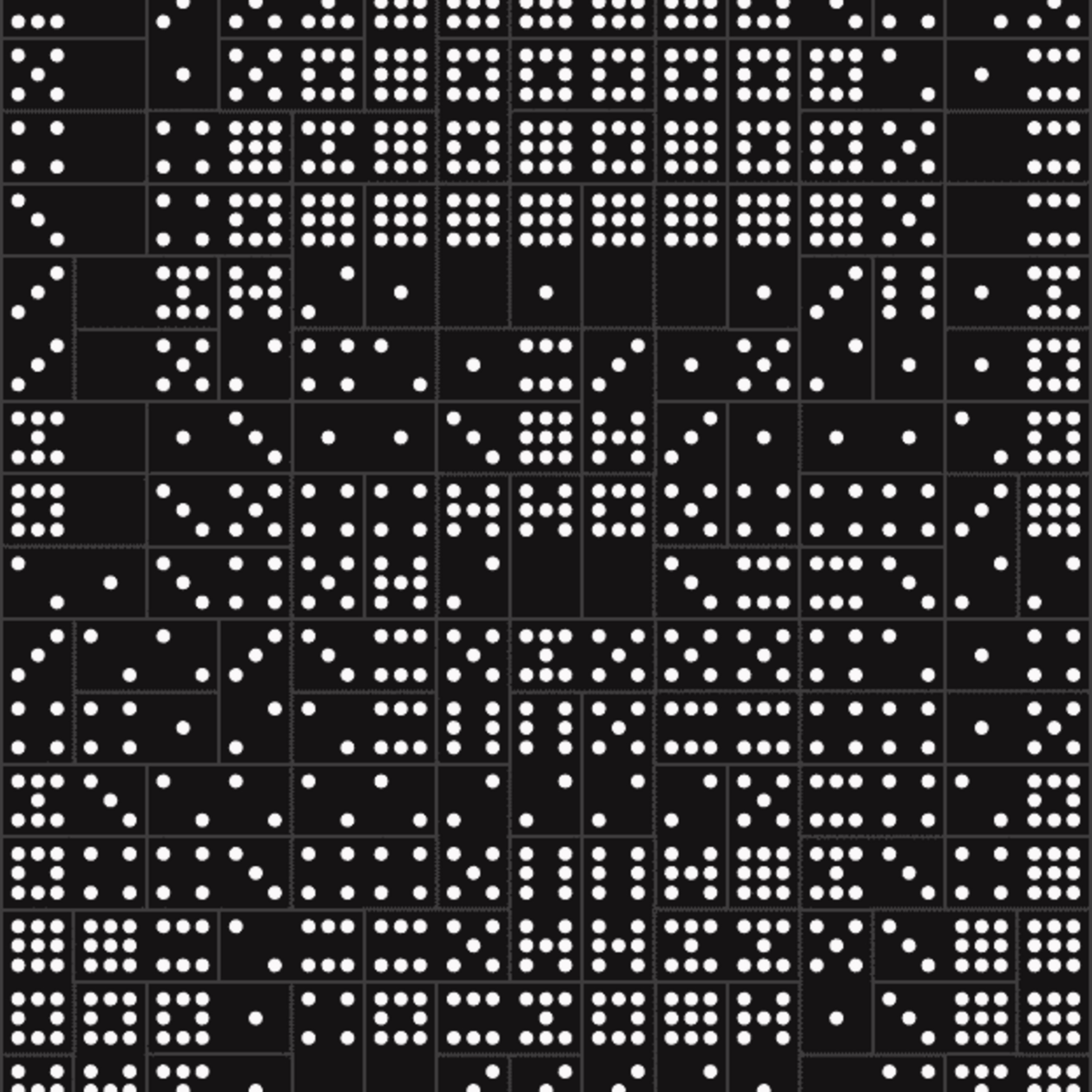
Second holiday season bonus episode! Vaden joins Chesto on The Declaration podcast to talk about monism, dualism, the reality of abstractions, emergence, and reductionism. This convo was recorded in 2019, but much of the content is evergreen and we think it still makes for interestin' listenin'. Except the sound quality, which leaves much to be desired. Thanks Blue Yeti. We discuss: The mind-body problem Why Vaden is a filthy pluralist and Chesto is a sober, sane, rational materialist Reductonism vs dualism vs pluralism The reality of abstractions Why explanations are central to science Would you get into a Star Trek transporter? And, a little bit out of left field, some advice for talking about mental health References: Gödel, Escher, Bach: An Eternal Golden Braid Beginning of Infinity Chesto's instagram for your eyes and soundcloud for your ears. Errata: In the Domino example from BOI the prime number was 641, not whatever number Vaden said The Voyager spacecraft launched in 1977, not 1972 Contact us Follow us on Twitter at @IncrementsPod, @BennyChugg, @VadenMasrani Check us out on youtube at https://www.youtube.com/channel/UC_4wZzQyoW4s4ZuE4FY9DQQ Come join our discord server! DM us on twitter or send us an email to get a supersecret link Are emails real? Tell us at [email protected]. Photo credit: https://www.johndcook.com/blog/2019/11/07/optimization-dominoes-and-frankenstein/
#46 (Bonus) - Arguing about probability (with Nick Anyos)
We make a guest appearance on Nick Anyos' podcast to talk about effective altruism, longtermism, and probability. Nick (very politely) pushes back on our anti-Bayesian credo, and we get deep into the weeds of probability and epistemology. You can find Nick's podcast on institutional design here, and his substack here. We discuss: The lack of feedback loops in longtermism Whether quantifying your beliefs is helpful Objective versus subjective knowledge The difference between prediction and explanation The difference between Bayesian epistemology and Bayesian statistics Statistical modelling and when statistics is useful Links Philosophy and the practice of Bayesian statistics by Andrew Gelman and Cosma Shalizi EA forum post showing all forecasts beyond a year out are uncalibrated. Vaclav smil quote where he predicts a pandemic by 2021: The following realities indicate the imminence of the risk. The typical frequency of influenza pan- demics was once every 50–60 years between 1700 and 1889 (the longest known gap was 52 years, between the pandemics of 1729–1733 and 1781–1782) and only once every 10–40 years since 1889. The recurrence interval, calculated simply as the mean time elapsed between the last six known pandemics, is about 28 years, with the extremes of 6 and 53 years. Adding the mean and the highest interval to 1968 gives a span between 1996 and 2021. We are, probabilistically speaking, very much inside a high-risk zone. - Global Catastropes and Trends, p.46 Reference for Tetlock's superforecasters failing to predict the pandemic. "On February 20th, Tetlock’s superforecasters predicted only a 3% chance that there would be 200,000+ coronavirus cases a month later (there were)." Contact us Follow us on Twitter at @IncrementsPod, @BennyChugg, @VadenMasrani Check us out on youtube at https://www.youtube.com/channel/UC_4wZzQyoW4s4ZuE4FY9DQQ Come join our discord server! DM us on twitter or send us an email to get a supersecret link Errata At the beginning of the episode Vaden says he hasn't been interviewed on another podcast before. He forgot his appearence on The Declaration Podcast in 2019, which will be appearing as a bonus episode on our feed in the coming weeks. Sick of hearing us talk about this subject? Understandable! Send topic suggestions over to [email protected]. Photo credit: James O’Brien for Quanta Magazine

#45 - Four Central Fallacies of AI Research (with Melanie Mitchell)
We were delighted to be joined by Davis Professor at the Sante Fe Insitute, Melanie Mitchell! We chat about our understanding of artificial intelligence, human intelligence, and whether it's reasonable to expect us to be able to build sophisticated human-like automated systems anytime soon. Follow Melanie on twitter @MelMitchell1 and check out her website: https://melaniemitchell.me/ We discuss: AI hype through the ages How do we know if machines understand? Winograd schemas and the "WinoGrande" challenge. The importance of metaphor and analogies to intelligence The four fallacies in AI research: 1. Narrow intelligence is on a continuum with general intelligence 2. Easy things are easy and hard things are hard 3. The lure of wishful mnemonics 4. Intelligence is all in the brain Whether embodiment is necessary for true intelligence Douglas Hofstadter's views on AI Ray Kurzweil and the "singularity" The fact that Moore's law doesn't hold for software The difference between symbolic AI and machine learning What analogies have to teach us about human cognition Errata Ben mistakenly says that Eliezer Yudkowsky has bet that everyone will die by 2025. It's actually by 2030. You can find the details of the bet here: https://www.econlib.org/archives/2017/01/my_end-of-the-w.html. References: NY Times reporting on Perceptrons. The WinoGrande challenge paper Why AI is harder than we think The Singularity is Near, by Ray Kurzweil Contact us Follow us on Twitter at @IncrementsPod, @BennyChugg, @VadenMasrani Check us out on youtube at https://www.youtube.com/channel/UC_4wZzQyoW4s4ZuE4FY9DQQ Come join our discord server! DM us on twitter or send us an email to get a supersecret link Eliezer was more scared than Douglas about AI, so he wrote a blog post about it. Who wrote the blog post, Eliezer or Douglas? Tell us at over at [email protected] Guest: Melanie Mitchell.
#44 - Longtermism Revisited: What We Owe the Future
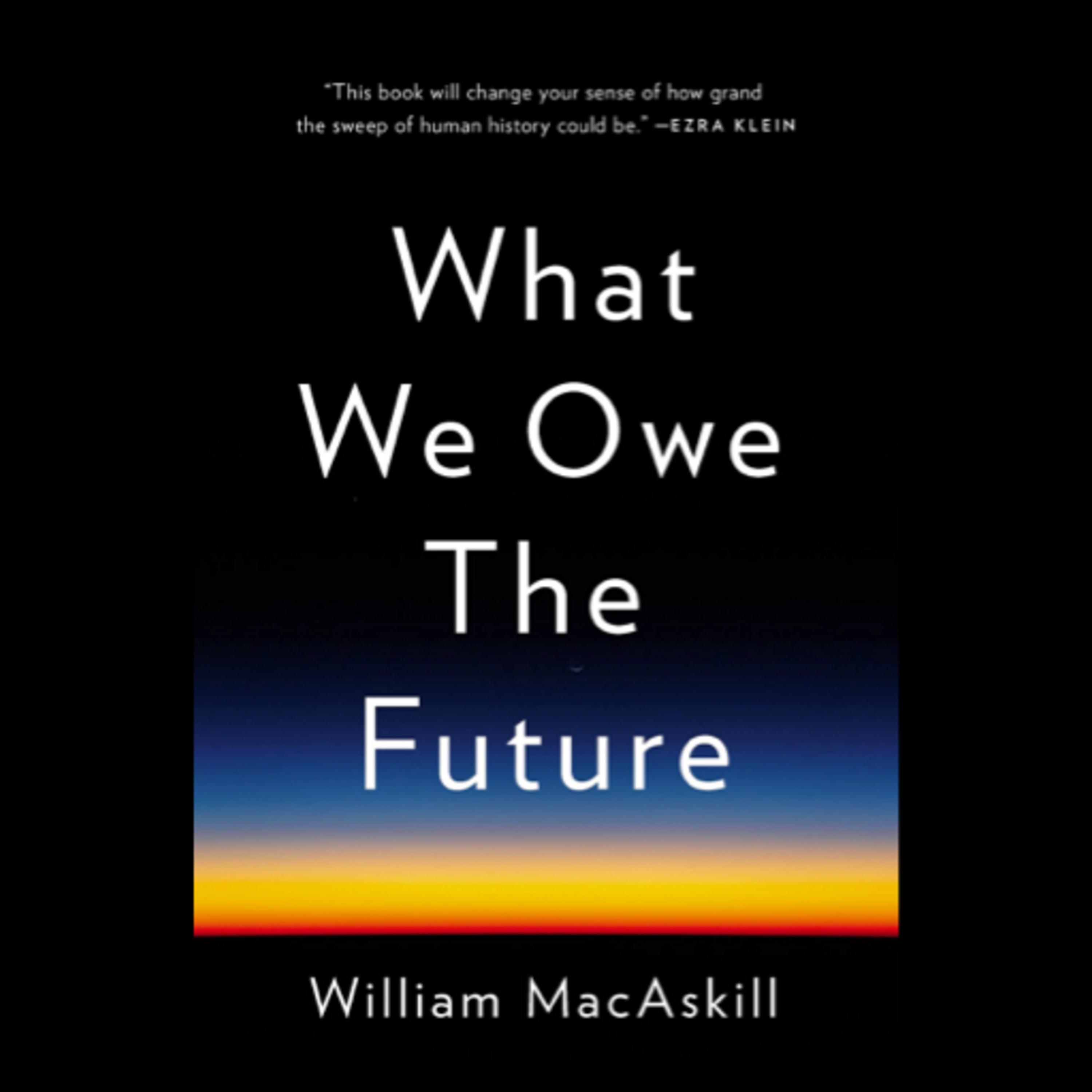
Like moths to a flame, we come back to longtermism once again. But it's not our fault. Will MacAskill published a new book, What We Owe the Future, and billions (trillions!) of lives are at stake if we don't review it. Sisyphus had his task and we have ours. We're doing it for the (great great great ... great) grandchildren. We discuss: Whether longtermism is actionable Whether the book is a faithful representation of longtermism as practiced Why humans are actually cool, despite what you might hear Some cool ideas from the book including career advice and allowing vaccines on the free market Ben's love of charter cities and whether he's is a totalitarian at heart The plausability of "value lock-in" The bizarro world of population ethics References: "Bait-and-switch" critique from a longtermist blogger: https://forum.effectivealtruism.org/posts/9Y6Y6qoAigRC7A8eX/my-take-on-what-we-owe-the-future Quote: "For instance, I’m worried people will feel bait-and-switched if they get into EA via WWOTF then do an 80,000 Hours call or hang out around their EA university group and realize most people think AI risk is the biggest longtermist priority, many thinking this by a large margin." Contact us Follow us on Twitter at @IncrementsPod, @BennyChugg, @VadenMasrani Check us out on youtube at https://www.youtube.com/channel/UC_4wZzQyoW4s4ZuE4FY9DQQ Come join our discord server! DM us on twitter or send us an email to get a supersecret link How long is your termist? Tell us at [email protected]

#43 - Artificial General Intelligence and the AI Safety debate
Some people think that advanced AI is going to kill everyone. Some people don't. Who to believe? Fortunately, Ben and Vaden are here to sort out the question once and for all. No need to think for yourselves after listening to this one, we've got you covered. We discuss: How well does math fit reality? Is that surprising? Should artificial general intelligence (AGI) be considered "a person"? How could AI possibly "go rogue?" Can we know if current AI systems are being creative? Is misplaced AI fear hampering progress? References: The Unreasonable effectiveness of mathematics Prohibition on autonomous weapons letter Google employee conversation with chat bot Gary marcus on the Turing test Melanie Mitchell essay. Did MIRI give up? Their (half-sarcastic?) death with dignity strategy Kerry Vaughan on slowing down AGI development. Contact us Follow us on Twitter at @IncrementsPod, @BennyChugg, @VadenMasrani Check us out on youtube at https://www.youtube.com/channel/UC_4wZzQyoW4s4ZuE4FY9DQQ Come join our discord server! DM us on twitter or send us an email to get a supersecret link Which prompt would you send to GPT-3 in order to end the world? Tell us before you're turned into a paperclip over at [email protected]
#42 (C&R, Chap 12+13) - Language and the Body-Mind Problem
Ben and Vaden sit down to discuss what is possibly Popper's most confusing essay ever: Language and the Body-Mind Problem: A restatement of Interactionism. Determinism, causality, language, bodies, minds, and Ferris Buhler. What's not to like! Except for the terrible writing, spanning the entire essay. And before we get to that, we revolutionize the peer-review system in less than 10 minutes. We discuss Problems with the current peer-review system and how to improve it The Mind-Body Problem How chaos theory relates to determinism The four functions of language Why you don't argue with thermometers Whether Popper thinks we can build AGI Why causality occurs at the level of ideas, not just of atoms References Link to the essay, which you should most definitely read for yourself. Ben's call to abolish peer-review Discrete Analysis Math Journal Pachinko Karl Buhler's theory of language Quotes This, I think, solves the so-called problem of 'other minds'. If we talk to other people, and especially if we argue with them, then we assume (sometimes mistakenly) that they also argue: that they speak intentionally about things, seriously wishing to solve a problem, and not merely behaving as if they were doing so. It has often been seen that language is a social affair and that solipsism, and doubts about the existence of other minds, become selfcontradictory if formulated in a language. We can put this now more clearly. In arguing with other people (a thing which we have learnt from other people), for example about other minds, we cannot but attribute to them intentions, and this means, mental states. We do not argue with a thermometer. - C&R, Chap 13 Once we understand the causal behaviour of the machine, we realize that its behaviour is purely expressive or symptomatic. For amusement we may continue to ask the machine questions, but we shall not seriously argue with it-- unless we believe that it transmits the arguments, both from a person and back to a person. - C&R, Chap 13 If the behaviour of such a machine becomes very much like that of a man, then we may mistakenly believe that the machine describes and argues; just as a man"who does not know the working of a phonograph or radio may mistakenly think that it describes and argues. Yet an analysis of its mechanism teaches us that nothing of this kind happens. The radio does not argue, although it expresses and signals. - C&R, Chap 13 It is true that the presence of Mike in my environment may be one of the physical 'causes' of my saying, 'Here is Mike'. But if I say, 'Should this be your argument, then it is contradictory', because I have grasped or realized that it is so, then there was no physical 'cause' analogous to Mike; I do not need to hear or see your words in order to realize that a certain theory (it does not matter whose) is contradictory. The analogy is not to Mike, but rather to my realization that Mike is here. - C&R, Chap 13 The fear of obscurantism (or of being judged an obscurantist) has prevented most anti-obscurantists from saying such things as these. But this fear has produced, in the end, only obscurantism of another kind. - C&R, Chap 13 When's the last time you argued with your thermometer? Tell us over at [email protected] Image Credit: http://humanities.exeter.ac.uk/modernlanguages/research/groups/linguistics/
#41 - Parenting, Epistemology, and EA (w/ Lulie Tanett)
We're joined by the wonderful Lulie Tanett to talk about effective altruism, pulling spouses out of burning buildings, and why you should prefer critical rationalism to Bayesianism for your mom's sake. Buckle up! We discuss: Lulie's recent experience at EA Global Bayesianism and how it differs from critical rationalism Common arguments in favor of Bayesianism Taking Children Seriously What it was like for Lulie growing up without going to school The Alexander Technique, Internal Family Systems, Gendlin's Focusing, and Belief Reporting References EA Global Taking Children Seriously Alexander Technique Internal Family Systems Gendlin Focusing Social Media Everywhere Follow Lulie on Twitter @reasonisfun. Follow us at @VadenMasrani, @BennyChugg, @IncrementsPod, or on Youtube. Report your beliefs and focus your Gendlin's at [email protected]. Special Guest: Lulie Tanett.
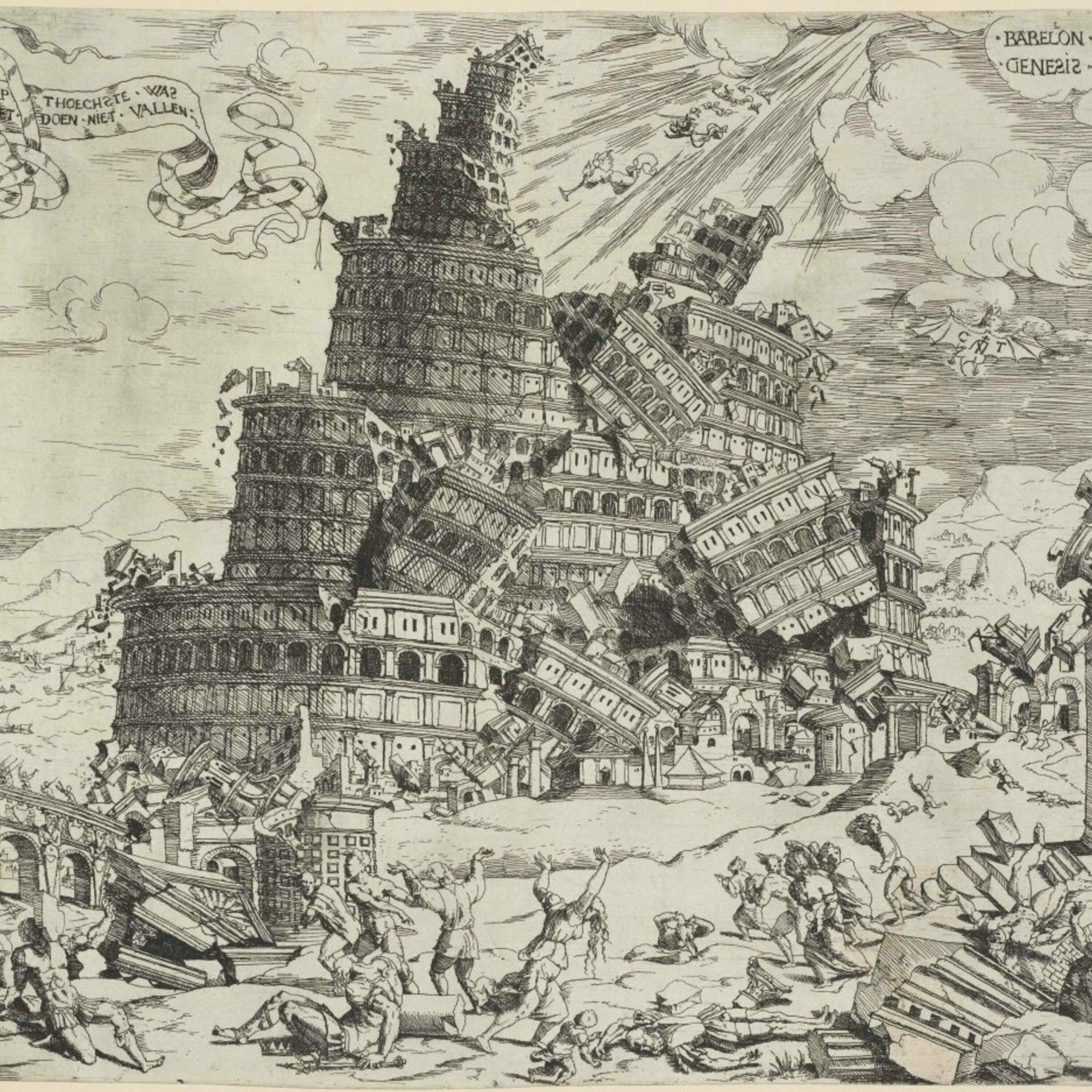
#40 - The Myth of The Framework: On the possibility of fruitful discussion
Is there any possibility of fruitful dialogue with your mildly crazy, significantly intoxicated uncle at Thanksgiving dinner? We turn to Karl Popper's essay, The Myth of the Framework, to find out. Popper argues that it's wrong to assume that fruitful conversation is only possible among those who share an underlying framework of beliefs and assumptions. In fact, there's more to learn in difficult conversations which lack such a framework. We discuss What is The Myth of the Framework? The relationship between the myth of the framework and epistemological and moral relativism Modern examples of the myth, including Jon Haidt's recent Atlantic essay and Paul Graham's Keep your identity small. Why there's more to learn from conversations where the participants disagree, and why conversations with too much agreement are uninteresting Linguistic relativism and the evolution of language as a refutation of the myth The relationship between the myth of the framework and the Enigma of Reason Quotes I think what religion and politics have in common is that they become part of people's identity, and people can never have a fruitful argument about something that's part of their identity. By definition they're partisan. - Paul Graham, Keep your identity small The story of Babel is the best metaphor I have found for what happened to America in the 2010s, and for the fractured country we now inhabit. Something went terribly wrong, very suddenly. We are disoriented, unable to speak the same language or recognize the same truth. We are cut off from one another and from the past. It’s been clear for quite a while now that red America and blue America are becoming like two different countries claiming the same territory, with two different versions of the Constitution, economics, and American history. But Babel is not a story about tribalism; it’s a story about the fragmentation of everything. It’s about the shattering of all that had seemed solid, the scattering of people who had been a community. It’s a metaphor for what is happening not only between red and blue, but within the left and within the right, as well as within universities, companies, professional associations, museums, and even families. - Jonathan Haidt, Why the past 10 years of American life have been uniquely stupid The proponents of relativism put before us standards of mutual understanding which are unrealistically high. And when we fail to meet these standards, they claim that understanding is impossible. - Karl Popper, MotF, pg. 34 The myth of the framework can be stated in one sentence, as follows. A rational and fruiful discussion is impossible unless the participants share a common framework of basic assumptions or, at least, unless they have agreed on such a framework for the purpose of the discussion. As I have formulated it here, the myth sounds like a sober statement, or like a sensible warning to which we ought to pay attention in order to further rational discussion. Some people even think that what I describe as a myth is a logical principle, or based on a logical principle. I think, on the contrary, that it is not only a false statement, but also a vicious statement which, if widely believed, must undermine the unity of mankind, and so must greatly increase the likelihood of violence and of war. This is the main reason why I want to combat it, and to refute it. - Karl Popper, MotF, pg. 34 Although I am an admirer of tradition, and conscious of its importance, I am, at the same time, an almost orthodox adherent of unorthodoxy: _I hold that orthodoxy is the death of knowledge, since the growth of knowledge depends entirely on the existence of disagreement. Admittedly, disagreement may lead to strif, and even to violence. And this, I think, is very bad indeed, for I abhor violence. Yet disagreement may also lead to discussion, to argument, and to mutual criticism. And these, I think, are of paramount importance. I suggest that the greatest step towards a better and more peaceful world was taken when the war of swords was first supported, and later sometimes even replaced, by a war of words. This is why my topic is of some practical significance._ - Karl Popper, MotF, pg. 34 My thesis is that logic neither underpins the myth of the framework nor its denial, but that we can try to learn from each other. Whether we succeed will depend largely on our goodwill, and to some extent also on our historical situation, and on our problem situation. - Karl Popper, MotF, pg. 38 References Why the past 10 years of American life have been uniquely stupid, by Jonathan Haidt Keep your identity small, by Paul Graham The Enigma of Reason by Hugo Mercier and Dan Sperber Glenn Loury and Briahna Joy Grey Normal Science and its Dangers Social media everywhere Follow us on twitter (@Incrementspod, @VadenMasrani, @BennyChugg), and on youtube. Tell us about your shaken framework at [email protected] Image: Cornelis Anthonisz (1
#39 - The Enigma of Reason
The most reasonable and well-reasoned discussion of reason you can be reasonably expected to hear. Today we talk about the book The Enigma of Reason by Dan Sperber and Hugo Mercier. But first, get ready for dogs, modern art, and babies! *We discuss * Reason as a social phenomenon The two roles of reason: To justify our actions, and to evaluate the reasons of others Reason as module of inference, and how that contrasts with dual-process theories The "intellectualist" vs the "interactionist" approach to reason Nassim Taleb's notion of "skin in the game" The consequences of reason having evolved in a particular (social) niche The marshmallow test and other debunked psychological findings Quotes: The interactionist approach, on the other hand, makes two contrasting predictions. In the production of arguments, we should be biased and lazy; in the evaluation of arguments, we should be demanding and objective— demanding so as not to be deceived by poor or fallacious arguments into accepting false ideas, objective so as to be ready to revise our ideas when presented with good reasons why we should. EoR (pg. 332) In our interactionist approach, the normal conditions for the use of reasoning are social, and more specifically dialogic. Outside of this environment, there is no guarantee that reasoning acts for the benefits of the reasoner. It might lead to epistemic distortions and poor decisions. This does not mean reasoning is broken, simply that it has been taken out of its normal conditions. EoR (pg. 247) References Dan Sperber's talk at the Santa Fe Institute Image credit: https://www.theguardian.com/culture/charlottehigginsblog/2009/oct/20/classics-barack-obama Social media everywhere Follow us on Twitter at @IncrementsPod, @BennyChugg, @VadenMasrani Check us out on youtube at https://www.youtube.com/channel/UC_4wZzQyoW4s4ZuE4FY9DQQ Come join our discord server! DM us on twitter or send us an email to get a supersecret link Send a reason, any reason, any reason at all, to [email protected].
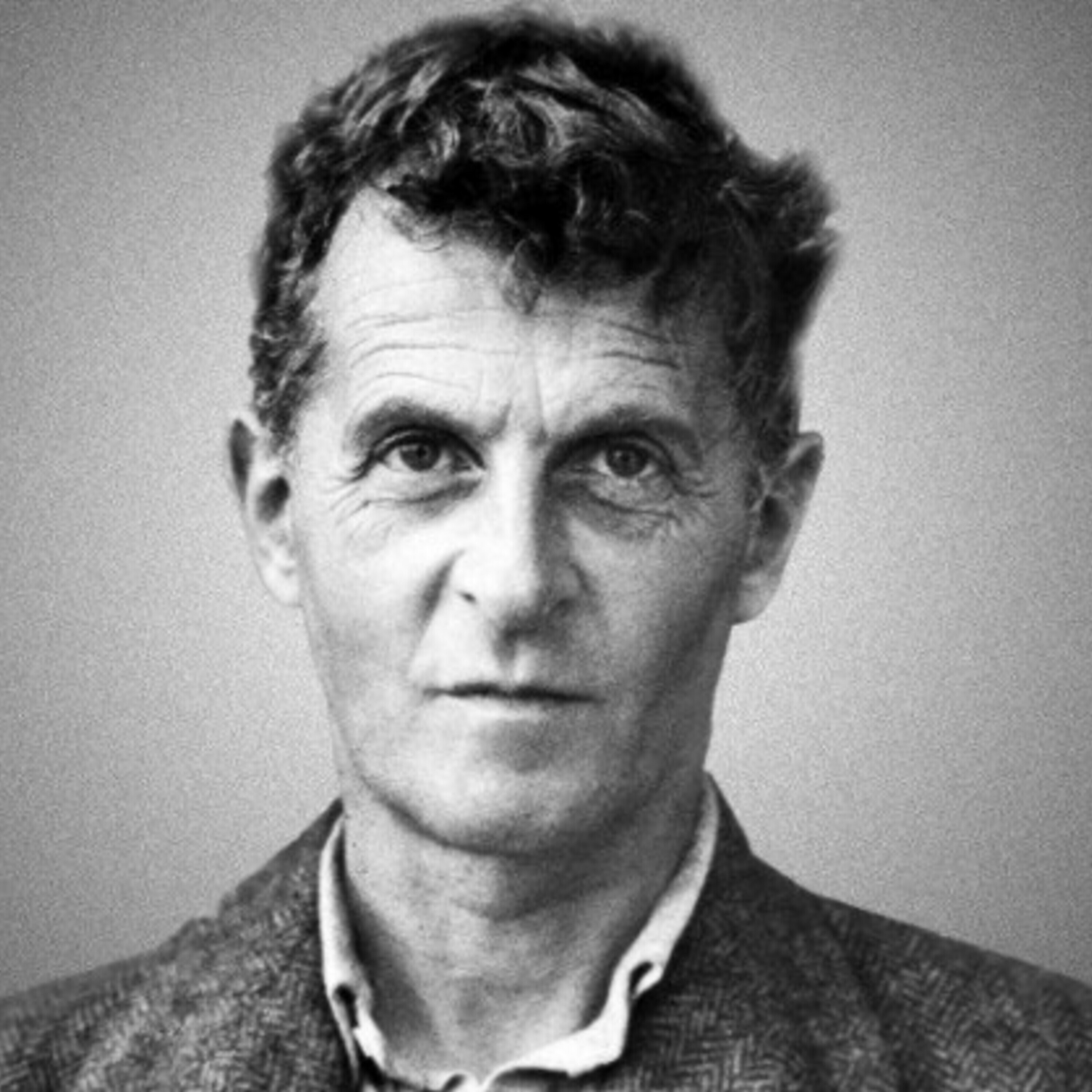
#38 (C&R Series, Ch. 2) - Wittgenstein vs Popper
We cover the spicy showdown between the two of the world's most headstrong philosophers: Ludwig Wittgenstein and Karl Popper. In a dingy Cambridge classroom Wittgenstein once threatened Popper with a fireplace poker. What led to the disagreement? In this episode, we continue with the Conjectures and Refutations series by analyzing Chapter 2: The Nature of Philosophical Problems And Their Roots In Science, where Popper outlines his agreements and disagreements with Mr. Ludwig Wittgenstein. We discuss: Are there philosophical problems? Why are scientific disciplines divided as they are? How much of philosophy is meaningless pseudo-babble? (Hint: Not none) Wittgenstein's background and feud between him and Popper Wittgenstein 1 and 2 (pre and post Tractatus) The danger of philosophical inbreeding Two of Popper's examples of philosophical problems: 1. Plato and the Crisis in Early Greek Atomism 2. Immanuel Kant's Problem of Knowledge. Musica universalis The Problem of Change How is knowledge possible? Quotes My first thesis is that every philosophy, and especially every philosophical ‘school’, is liable to degenerate in such a way that its problems become practically indistinguishable from pseudo-problems, and its cant, accordingly, practically indistinguishable from meaningless babble. This, I shall try to show, is a consequence of philosophical inbreeding. The degeneration of philosophical schools in its turn is the consequence of the mistaken belief that one can philosophize without having been compelled to philosophize by problems which arise outside philosophy—in mathematics, for example, or in cosmology, or in politics, or in religion, or in social life. In other words my first thesis is this. Genuine philosophical problems are always rooted in urgent problems outside philosophy, and they die if these roots decay. C&R p.95 His question, we now know, or believe we know, should have been: ‘How are successful conjectures possible?’ And our answer, in the spirit of his Copernican Revolution, might, I suggest, be something like this: Because, as you said, we are not passive receptors of sense data, but active organisms. Because we react to our environment not always merely instinctively, but sometimes consciously and freely. Because we can invent myths, stories, theories; because we have a thirst for explanation, an insatiable curiosity, a wish to know. Because we not only invent stories and theories, but try them out and see whether they work and how they work. Because by a great effort, by trying hard and making many mistakes, we may sometimes, if we are lucky, succeed in hitting upon a story, an explanation, which ‘saves the phenomena’; perhaps by making up a myth about ‘invisibles’, such as atoms or gravitational forces, which explain the visible. Because knowledge is an adventure of ideas. C&R p.128 If you were to threaten us with a common household object, what would it be? Tell us at [email protected], or on twitter: @VadenMasrani, @BennyChugg, @IncrementsPod.
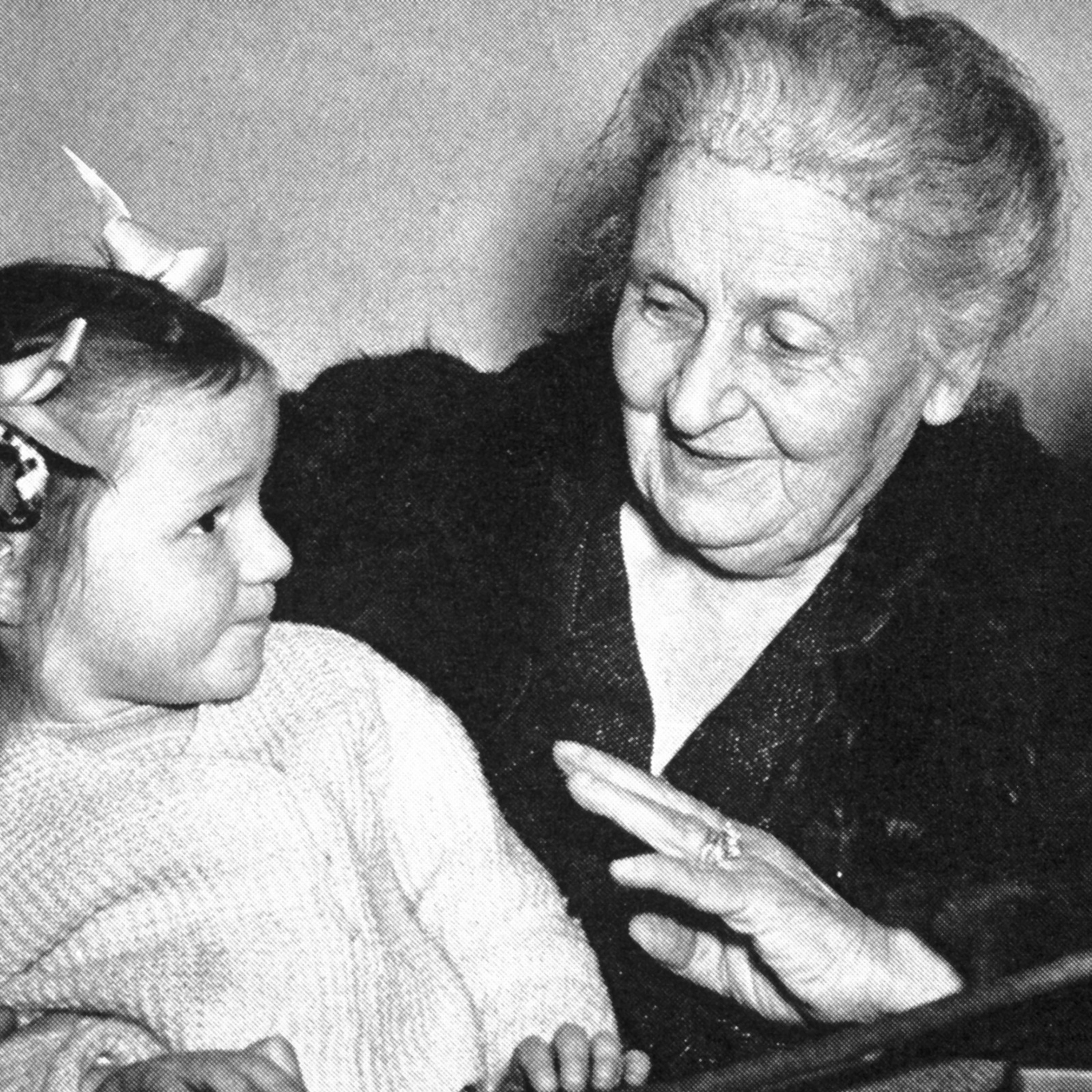
#37 - Montessori Education w/ Matt Bateman
We're joined today by Matt Bateman, one of the founders of Higher Ground Education, to discuss the Montessori method of education and how it compares to other teaching methodologies. Get ready for tiny furniture, putting on your jacket upside down, and teaching your toddler to make eggs benedict. We discuss: Maria Montessori What is a Montessori education (besides tiny furniture)? How Montessori classrooms differ from regular ones Why long periods of interrupted problem solving is important for a child's development How Montessori integrates with technology Drawbacks of traditional methods of testing and grading, and how they might be amended The importance of cultivating a love of work How Matt wants to reform high school education Bio: Matt is one of the founders of Higher Ground Education, a worldwide Montessori network. He runs Montessorium, Higher Ground’s think tank. He holds a PhD in philosophy from the University of Pennsylvania, where he focused on the philosophy of science. Make sure to follow him on twitter for some golden education nuggets References: Matt on the Where We Go Next (formerly New Liberals) podcast. Montessorium Vocational Training for the Soul: Bringing the Meaning of Work to Schools Matt's History of Education Course Social media everywhere Follow us on Twitter at @IncrementsPod, @BennyChugg, @VadenMasrani Check us out on youtube at https://www.youtube.com/channel/UC_4wZzQyoW4s4ZuE4FY9DQQ Come join our discord server! DM us on twitter or send us an email to get a supersecret link Special Guest: Matt Bateman.

#36 - Analyzing Effective Altruism as a Social Movement
In what is hopefully the last installment of Vaden and Ben debate Effective Altruism, we ask if EA lies on the cultishness (yes, that's a word) spectrum. We discuss: The potential pitfall of having goodness as a core value Aspects of Effective Altruism (EA) that put it on the cultishness spectrum Does EA focus on good over truth? Ben's experience with EA Making criticism a core value How does one resist the allure of groupthink? How to (mis)behave at parties How would one create a movement which doesn't succumb to cult-like dynamics? Weird ideas as junk food Error Correction intro segment Scott Alexander pointing out that Ivermectin works indirectly via: There’s a reason the most impressive ivermectin studies came from parts of the world where worms are prevalent, he says. Parasites suppress the immune system, making it more difficult for the human body to fight off viruses. Thus, getting rid of worm infections makes it easier for COVID-19 patients to bounce back from the virus. See full post below and summary news article here Czechoslovakia was not a part of the USSR @lukeconibear pointing out some climate models and data are publicly available. See for instance Goddard Earth Observing System (GEOS) Chem model: https://github.com/geoschem/geos-chem Community Earth System Model (CESM): https://github.com/ESCOMP/CESM Energy Exascale Earth System model: https://github.com/E3SM-Project/E3SM @PRyan pointing out we were confused about the difference between economic growth, division of labour, and free trade Join the movement at [email protected]. Follow us on twitter at @IncrementsPod and on Youtube.

#35 - Climate Change III: Fossil Fuels
Come experience the thrill of the shill as we discuss the somewhat-controversial natural resource called "fossil fuels". In this episode, we drill deep into opto-pessimist Vaclav Smil's excellent book Oil: A Beginner's Guide, in what is possibly our only episode to feature heterodox Russian-Ukrainian science, subterranean sound waves, and that goop lady - what's her name? It's unbelievable, right? We discuss: The science behind fossil fuels: How they're made, found, processed, and used Energy transitions and the shale gas revolution Global oil dependence and human rights The environmental costs of fossil fuels Will we reach Peak Oil? Why natural resources aren't milkshakes The future of fossil fuels (Note to Big Oil: Please send shilling fees to [email protected]) References Vaclav Smil: We Must Leave Growth Behind Vaclav Smil: Growth must end. Our economist friends don’t seem to realise that Oil: A Beginner's Guide Abiogenic petroleum origin - Wikipedia Social media everywhere Follow us on Twitter at @IncrementsPod, @BennyChugg, @VadenMasrani Check us out on youtube at https://www.youtube.com/channel/UC_4wZzQyoW4s4ZuE4FY9DQQ Come join our discord server! DM us on twitter or send us an email to get a supersecret link Quotes Modern life now begins and ends amidst the plethora of plastics whose synthesis began with feedstocks derived from oil - because hospitals teem with them. Surgical gloves, flexible tubing, catheters, IV containers, sterile packaging, trays, basins, bed pans and rails, thermal blankets and lab ware: naturally, you are not aware of these surroundings when a few hours or a few days old, but most of us will become all too painfully aware of them six, seven or eight decades later. And that recital was limited only to common hospital items made of polyvinylchloride; countless other items fashioned from a huge variety of plastics are in our cars, aeroplanes, trains, homes, offices and factories. Oil: A Beginner's Guide, p.10 A free market has not been one of the hallmarks of the 150 years of oil’s commercial history. The oil business has seen repeated efforts to fix product prices by controlling either the level of crude oil extraction or by dominating its transportation and processing, or by monopolizing all of these aspects. The first infamous, and successful, attempt to do so was the establishment of Standard Oil in Cleveland in 1870. The Rockefeller brothers (John D. and William) and their partners used secretive acquisitions and deals with railroad companies to gain the control of oil markets first in Cleveland, then in the Northeast, and eventually throughout the US. By 1904 what was now known as the Standard Oil Trust controlled just over 90% of the country’s crude oil production and 85% of all sales. Oil: A Beginner's Guide, p.32 Photochemical smog was first observed in Los Angeles in the 1940s and its origins were soon traced primarily to automotive emissions. As car use progressed around the world al] major urban areas began to experience seasonal (Toronto, Paris) or near-permanent (Bangkok, Cairo) levels of smog, whose effects range from impaired health (eye irritation, lung problems) to damage to materials, crops and coniferous trees. A recent epidemiological study in California also demonstrated that the lung function of children living within 500m of a freeway was seriously impaired and that this adverse effect (independent of overall regional air quality) could result in significant lung capacity deficits later in life. Extreme smog levels now experienced in Beijing, New Delhi and other major Chinese and Indian cities arise from the combination of automotive traffic and large-scale combustion of coal in electricity-generating plants and are made worse by periodic temperature inversions that limit the depth of the mixing layer and keep the pollutants near the ground. Oil: A Beginner's Guide, p.50

#34 - Climate Change II: Growth, Degrowth, Reactions, Responses
In this episode Ben convinces Vaden to become a degrowther. We plan how to live out the rest of our lives on an organic tomato farm in Canada in December, sewing our own clothes and waxing our own candles. Step away from the thermostat Jimmy. We discuss: The degrowth movement The basics of economic growth, and why it's good for developing economies in particular How growth enables resilience in the face of environmental disasters Why the environment is in better shape than you think Availability bias and our tendency to think everything is falling apart The decoupling of economic growth and carbon emissions Energy dense production and energy portfolios And we respond to some of your criticism of the previous episode, including: Apocalyptic environmental predictions been happening for a while? Really? Number of annual cold deaths exceed the number of annual heat deaths? Really? Your previous episode was very human-centric, and failed to address the damage humans are causing to the environment. What say you? Are we right wing crypto-fascists? (Answer: Maybe, successfully dodged the question) Social media everywhere Follow us on Twitter at @IncrementsPod, @BennyChugg, @VadenMasrani Check us out on youtube at https://www.youtube.com/channel/UC_4wZzQyoW4s4ZuE4FY9DQQ Come join our discord server! DM one of us on twitter, or send an email to [email protected] to get a link References Two natural experiments on curtailing economic growth. Energy Crunch, and the effect of Covid-19 on developing countries (world bank) 10x more cold deaths than heat deaths. Original study in the Lancet. Chilling Effect by Scott Alexander. Decoupling of economic growth and pollution by Zeke Hausfather of the Breakthrough institute. Air Pollution Trends data (EPA) Number of deaths from natural disasters (Our World in Data). Original data taken from the EMDAT Natural Disasters database. Increase in global canopy cover 99 Good News Stories in 2018 you probably didn't hear about ...and 2019 ...and 2020 (also sign up for the FutureCrunch newsletter!) The Environmental Kuznets curves Quotes On Degrowth This would be a way of life based on modest material and energy needs but nevertheless rich in other dimensions – a life of frugal abundance. It is about creating an economy based on sufficiency, knowing how much is enough to live well, and discovering that enough is plenty. In a degrowth society we would aspire to localise our economies as far and as appropriately as possible. This would assist with reducing carbon-intensive global trade, while also building resilience in the face of an uncertain and turbulent future. Wherever possible, we would grow our own organic food, water our gardens with water tanks, and turn our neighbourhoods into edible landscapes as the Cubans have done in Havana. As my friend Adam Grubb so delightfully declares, we should “eat the suburbs”, while supplementing urban agriculture with food from local farmers’ markets. - Samuel Alexander, Life in a 'degrowth' economy, and why you might actually enjoy it It would be nice to hear it straight for once. Global warming is real, it’s here, and it’s mind-bogglingly dangerous. How bad it gets—literally, the degree—depends on how quickly the most profligate countries rein in their emissions. Averting catastrophe will thus require places like the United States and Canada to make drastic cutbacks, bringing their consumption more closely in line with the planetary average. Such cuts can be made more or less fairly, and the richest really ought to pay the most, but the crucial thing is that they are made. Because, above all, stopping climate change means giving up on growth. That will be hard. Not only will our standards of living almost certainly drop, but it’s likely that the very quality of our society—equality, safety, and trust—will decline, too. That’s not something to be giddy about, but it’s still a price that those of us living in affluent countries should prepare to pay. Because however difficult it is to slow down, flooding Bangladesh cannot be an option. In other words, we can and should act. It’s just going to hurt. - Daniel Immerwahr, Growth vs the Climate On Perennial Apocalypticism My offices were so cold I couldn't concentrate, and my staff were typing with gloves on. I pleaded with Jimmy to set the thermostats at 68 degrees, but it didn't do any good. - Paul Sabin, quoting Rosalynn Carter in The Bet Mostafa K. Tolba, executive director of the United Nations environmental program, told delegates that if the nations of the world continued their present policies, they would face by the turn of the century ''an environmental catastrophe which will witness devastation as complete, as irreversible, as any nuclear holocaust.'' - New York Times, 1982 A senior U.N. environmental official says entire nations could be wiped off the face of the Earth by rising sea levels if the global warming trend is not reversed by the yea

#33 (C&R Series, Ch. 3) - Instrumentalism and Essentialism
Galileo vs the church - whose side are you on? Today we discuss Chapter 3 of Conjectures and Refutations, Three Views Concerning Human Knowledge. This is a juicy one, as Popper manages to simultaneously attack both philosophers and physicists, as he takes on instrumentalism and essentialism, two alternatives to his 'conjecture and refutation' approach to knowledge. We discuss: The conflict between Galileo and the church What is instrumentalism, and how did it become popular? How instrumentalism is still in vogue in many physics departments The Problem of Universals The essentialist approach to science Stars, air, cells, and lightning "What is" vs "How does" questions The relationship between essentialism and language, and its influence on politics. Viewing words as instruments See More: Instrumentalism: https://en.wikipedia.org/wiki/Instrumentalism Essentialism: https://en.wikipedia.org/wiki/Essentialism The problem of universals: https://en.wikipedia.org/wiki/Problem_of_universals Quotes: Few if any of the physicists who have now accepted the instrumentalist view of Cardinal Bellarmino and Bishop Berkeley realize that they have accepted a philosophical theory. Nor do they realize that they have broken with the Galilean tradition. On the contrary, most of them think that they have kept clear of philosophy; and most of them no longer care anyway. What they now care about, as physicists, is (a) mastery of the mathematical formalism, i.e. of the instrument, and (b) its applications; and they care for nothing else. -- C&R, Page 134 Thus my criticism of essentialism does not aim at establishing the non-existence of essences; it merely aims at showing the obscurantist character of the role played by the idea of essences in the Galilean philosophy of science (down to Maxwell, who was inclined to believe in them but whose work destroyed this belief). In other words my criticism tries to show that, whether essences exist or not, the belief in them does not help us in any way and indeed is likely to hamper us; so that there is no reason why the scientist should assume their existence. -- C&R, Page 141. But they are more than this, as can be seen from the fact that we submit them to severe tests by trying to deduce from them some of the regularities of the known world of common experience i.e. by trying to explain these regularities. And these attempts to explain the known by the unknown (as I have described them elsewhere) have immeasurably extended the realm of the known. They have added to the facts of our everyday world the invisible air, the antipodes, the circulation of the blood, the worlds of the telescope and the microscope, of electricity, and of tracer atoms showing us in detail the movements of matter within living bodies. All these things are far from being mere instruments: they are witness to the intellectual conquest of our world by our minds. But there is another way of looking at these matters. For some, science is still nothing but glorified plumbing, glorified gadgetmaking—‘mechanics’; very useful, but a danger to true culture, threatening us with the domination of the near-illiterate (of Shakespeare’s ‘mechanicals’). It should never be mentioned in the same breath as literature or the arts or philosophy. Its professed discoveries are mere mechanical inventions, its theories are instruments—gadgets again, or perhaps super-gadgets. It cannot and does not reveal to us new worlds behind our everyday world of appearance; for the physical world is just surface: it has no depth. The world is just what it appears to be. Only the scientific theories are not what they appear to be. A scientific theory neither explains nor describes the world; it is nothing but an instrument. -- C&R, Page 137-8. What's the essential nature of this podcast? Tell us at [email protected]

#32 - Climate Change I: Initial Thought-Crimes
After the immensely positive response to our previous episode on the Weinstein brothers - thanks @robertwiblin! - we thought we would keep giving the people what they want, and what they want is a long discussion on climate change. Specifically, the subject for today is: "The State of the Climate Debate". We touch on: The near perfect partisan split on climate change Will there be a climate apocalypse? The promise of nuclear energy as a solution The limitations of renewables Energy portfolios The rebound effect Degrowth economics Activist tactics and fear mongering Whether The Environment has become A Deity in environmentalist circles We expect very little pushback on this episode. References Apocalypse Never by Michael Shellenberger. Greta Thunberg encouraging you to panic Thunberg's double crossing of the Atlantic in sailboat The Rebound Effect Quotes But real climate solutions are ones that steer these interventions to systematically disperse and devolve power and control to the community level, whether through community-controlled renewable energy, local organic agriculture or transit systems genuinely accountable to their users. -- Naomi Klein in the Nation Even if nuclear power were clean, safe, economic, assured of ample fuel, and socially benign, it would still be unattractive because of the political implications of the kind of energy economy it would lock us into. -- Amory Lovins, quoted from Forbes piece by Michael Shellenberger Send us panic-induced email at [email protected].

#31 - The Fall of the Weinstein Republic
Today we take your twitter questions before doing a deep dive into the Weinstein fiasco (Bret and Eric, not Harvey.) If you haven't heard of the Weinstein's before, then we suggest you run away before we drag you down into a rabbit hole filled with acronyms, anti-vaxxers, and theories of ... everything? anything? literally anything at all? Topics we touch: We take your twitter questions! Filos with a weird one: I have a weird one that could be fun. It seems to me that the idea that we could upload our minds to a computer is nonsense. I agree with Kastrup that what we would upload is a description of our minds and a description of something is not that something. And it seems this desire to immortality is the nerd's reinvention of God via AGI, and heaven via uploading a mind to a silicon substrate. Where do you fall in this mind uploading fantasy? possible? Religious impulse? Reasonable? Dan would like us to talk about: The pervasive skepticism that seems to run through much the Popperian and Crit Rat communities regarding nonhuman animals’ capacity to suffer, particularly factory farmed animals. Karl is interested in: I'm interested in the meta-question of why that issue seems to split the community in two. Why hasn't one view become the dogmatic truth yet as it seems to have in most other communities? WTF is up with Bret and Eric Weinstein The allure of reflexive contrarianism The (horrible! awful! stop it!) tendency of academics to use convoluted language to impress their non-peers The notion of "secular gurus" and what distinguishes a secular guru from a person with a large platform And the special responsibility of researchers to communicate clearly. References: Animal Suffering Bruce Nielson's blog post on whether animals experience qualia, and his second on animal emotions. We mostly discuss the first. Weinsteins Eric Weinstein's excellent first appearance on Sam Harris's podcast Geometric Unity website Geometric Unity pdf See Timothy Nguyen on the Wright Show and Decoding the Gurus for an excellent overview of the whole scandal ... and check out Timothy Nguyen on Eigenbros for a deep dive into the technical nitty-gritty Norbert Blum's original paper purporting to show that P is not equal to NP. A nice answer on Stack Exchange detailing why Blum's proof was wrong. Quotes: Every intellectual has a very special responsibility. He has the privilege and the opportunity of studying. In return, he owes it to his fellow men (or 'to society') to represent the results of his study as simply, clearly and modestly as he can. The worst thing that intellectuals can do - the cardinal sin - is to try to set themselves up as great prophets vis-à-vis their fellow men and to impress them with puzzling philosophies. Anyone who cannot speak simply and clearly should say nothing and continue to work until he can do so. Karl Popper, Against Big Words What would you say to your half million twitter followers who want to know your opinion on everything? Tell us at [email protected].
#30 - Let's all just have a good cry (w/ Christofer Lövgren)
Christofer Lövgren, host of the marvelous Do Explain podcast and world's most famous Swede (second perhaps only to that Alfred fellow with the peace prize), joins us on the pod to teach us how podcasting is really done. And how to pronounce his last name. When we're not all sobbing, we touch on: Does Deutschian epistemology give us with Free Will? Should one identify as a critical rationalist? Does membership in a community, or identification with a label, affect our ability to give and receive criticism? How has reading Deutsch and Popper changed our lives? Can trauma get stored in the body? How often do we cry? Check out Chris on twitter (@ReachChristofer) and Do Subscribe to Do Explain. References: The Beginning of Infinity by David Deutsch Behave by Robert Sapolsky Lecture on Depression by Sapolsky Do Explain episode with Chris and Matt Goldenberg on emotional processing Temple Grandin discussing the "black-hat" horse. Body Keeps the Score by Bessel van der Kolk Sir Peter Brian Medawar whom Richard Dawkins referred to as 'the wittiest of all scientific writers'. Blow your nose, dry your eyes, and send us a tear-stained email at [email protected] Guest: Christofer Lövgren.

#29 - Some Scattered Thoughts on Superforecasting
We're back! Apologies for the delay, but Vaden got married and Ben was summoned to be an astronaut on the next billionaire's vacation to Venus. This week we're talking about how to forecast the future (with this one simple and easy trick! Astrologers hate them!). Specifically, we're diving into Philip Tetlock's work on Superforecasting. So what's the deal? Is it possible to "harness the wisdom of the crowd to forecast world events"? Or is the whole thing just a result of sloppy statistics? We believe the latter is likely to be true with probability 64.9% - no, wait, 66.1%. Intro segment: "The Sentience Debate": The moral value of shrimps, insects, and oysters Relevant timestamps: 10:05: "Even if there's only a one in one hundred chance, or one in one thousand chance, that insects are sentient given current information, and if we're killing trillions or quadrillions of insects in ways that are preventable or avoidable or that we can in various ways mitigate that harm... then we should consider that possibility." 25:47: "If you're all going to work on pain in invertebrates, I pity you in many respects... In my previous work, I was used to running experiments and getting a clear answer, and I could say what these animals do and what they don't do. But when I started to think about what they might be feeling, you meet this frustration, that after maybe about 15 years of research, if someone asks me do they feel pain, my answer is 'maybe'... a strong 'maybe'... you cannot discount the possibility." 46:47: "It is not 100% clear to me that plants are non sentient. I do think that animals including insects are much more likely to be sentient than plants are, but I would not have a credence of zero that plants are sentient." 1:01:59: "So the hard problem I would like to ask the panel is: If you were to compare the moral weight of one ant to the moral weight of one human, what ratio would you put? How much more is a human worth than an ant? 100:1? 1000:1? 10:1? Or maybe 1:1? ... Let's start with Jamie." Main References: Superforecasting: The Art and Science of Prediction - Wikipedia How Policymakers Can Improve Crisis Planning The Good Judgment Project - Wikipedia Expert Political Judgment: How Good Is It? How Can We Know?: Tetlock, Philip E.: 9780691128719: Books - Amazon.ca Additional references mentioned in the episode: The Drunkard's Walk: How Randomness Rules Our Lives The Black Swan: The Impact of the Highly Improbable - Wikipedia Book Review: Superforecasting | Slate Star Codex Pandemic Uncovers the Limitations of Superforecasting – We Are Not Saved My Final Case Against Superforecasting (with criticisms considered, objections noted, and assumptions buttressed) – We Are Not Saved Use your Good Judgement and send us email at [email protected].
#28 (C&R Series, Ch. 9) - Why is Logic Applicable to Reality?
Why do logic and mathematics work so well in the world? Why do they seem to describe reality? Why do they they enable us to design circuit boards, build airplanes, and listen remotely to handsome and charming podcast hosts who rarely go off topic? To answer these questions, we dive into Chapter 9 of Conjectures and Refutations: Why are the Calculi of Logic and Arithmetic Applicable to Reality?. But before we get to that, we touch on some of the good stuff: evolutionary psychology, cunnilingus, and why Robin is better than Batman. References: Conjectures and Refutations, Chapter 9: Why are the Calculi of Logic and Arithmetic Applicable to Reality? https://books.google.ca/books?id=iXp9AwAAQBAJ&printsec=frontcover&source=gbs_ge_summary_r&cad=0#v=onepage&q&f=false Ben on Do Explain with Christofer Lovgren Debate between Spelke and Pinker Very Bad Wizards discussing the paper "Oral Sex as Infidelity detection" (episode, paper). Sturgeon's Law: https://en.wikipedia.org/wiki/Sturgeon%27s_law#:~:text=Sturgeon%27s%20law%20(or%20Sturgeon%27s%20revelation,science%20fiction%20author%20and%20critic. Eugene Wigner's paper The Unreasonable Effective of Mathematics in the Natural Sciences. Stoic versus Aristotelian logic. Here is a nice discussion of the differences between the two. Rob Wiblin's tweet that all probabilities are subjective probabilities (in an otherwise very good thread). Buhler's three functions of language: (i) Expressive, (ii) Signaling, and (iii) Descriptive. See the "Organon Model". Piece on Brett Weinstein and Ivermectin. Quotes: “The indescribable world I have in mind is, of course, the world I have ‘in my mind’—the world which most psychologists (except the behaviourists) attempt to describe, somewhat unsuccessfully, with the help of what is nothing but a host of metaphors taken from the languages of physics, of biology, and of social life.” “In so far as a calculus is applied to reality, it loses the character of a logical calculus and becomes a descriptive theory which may be empirically refutable; and in so far as it is treated as irrefutable, i.e. as a system of logically true formulae, rather than a descriptive scientific theory, it is not applied to reality.” Send us the most bizarre use of evolutionary psychology you've seen at [email protected].
#27 - A Conversation with Marianne
There are many overused internet keywords that could be associated with this conversation, but none of them quite seem right. So here's a poem instead: The Ogre does what ogres can, Deeds quite impossible for Man, But one prize is beyond his reach: The Ogre cannot master speech. About a subjugated plain, Among its desperate and slain, The Ogre stalks with hands on hips, While drivel gushes from his lips - August 1968, W H Auden Send us an email at [email protected] Image from https://www.wilsoncenter.org/blog-post/the-august-1968-red-square-protest-and-its-legacy Audio updated: 05/07/2021
#26 - Moral Philosophy Cage Match (with Dan Hageman)
In a rare turn of events, it just so happened that one or perhaps both of your charming co-hosts spewed a bit of nonsense about Derek Parfit in a previous episode, and we had to bring in a heavy hitter to sort us out. Today we're joined by friend of the podcast Mr. Dan Hageman, immuno-oncologist by day and aspiring ethicist by night, who gently takes us to task for misunderstanding Parfit and the role of ethical theorizing, and for ignoring the suffering of pigeons. The critiques land, and convince Vaden that we should dedicate our resources towards providing safe and affordable contraception for Apex predators. We cover all sorts of ground in this episode, including: Mistakes we made in our thought experiments episode Is it possible to over-theorize? Wild animal suffering Don't fish eat other fish?! Feline family planning Antinatalism Moral Cluelessness Population ethics and the repugnant conclusion (Ha!) Similarities and differences between theoretical physics and theoretical philosophy References: Organization for the Prevention of Intense Suffering (OPIS) Lukas Gloor's post on population ethics Wild Animal Initiative Pigeon Contraception (yes, really) Hilary Greaves on moral cluelessness (talk+transcript, paper) Better Never to Have Been by David Benatar. Dan Hageman is a biomed engineer who works in immuno-oncology, but in his not-so-free time strives to sell himself as an amateur philosopher and aspiring 'Effective Altruist'. He spends much of this time trying to keep up with impactful charities focused on the reduction and/or prevention of extreme suffering, and in 2020 helped co-found a hopefully burgeoning side project called ‘Match for More’. He would like to note that the IPAs are to blame for any and all errors/misapprehensions made during his lively discussion with epic friends and podcast hosts, Ben and Vaden. How many insect lives are morally equivalent to one human life? Send us your best guess at [email protected]. We'll reveal the correct answer in episode 1000. Update 13/06/21: The original title of this episode was "Meta-ethics Cage Match (with Dan Hageman)"Special Guest: Dan Hageman.
#25 - Mathematical Explanation with Mark Colyvan
We often talk of explanation in the context of empirical sciences, but what about explanation in logic and mathematics? Is there such a thing? If so, what does it look like and what are the consequences? In this episode we sit down with professor of philosophy Mark Colyvan and explore How mathematical explanation differs from explanation in the natural sciences Counterfactual reasoning in mathematics Intra versus extra mathematical explanation Alternate logics Mathematical thought experiments The use of probability in the courtroom References: The Unreasonable Effectiveness of Mathematics in the Natural Sciences by Eugene Wigner. Proofs and Refutations by Imre Lakatos. Mark Colyvan is a professor of philosophy at the University of Sydney, and a visiting professor (and, previously, Humboldt fellow) at Ludwig-Maximilians University in Munich. He has a wide array of research interests, including the philosophy of mathematics, philosophy of logic, decision theory, environmental philosophy, and ecology. He has authored three books: The Indispensability of Mathematics (Oxford University Press, 2001), Ecological Orbits: How Planets Move and Populations Grow (Oxford University Press, 2004, co-authored with Lev Ginzburg), and An Introduction to the Philosophy of Mathematics (Cambridge University Press, 2012).Special Guest: Mark Colyvan.
#24 - Popper's Three Worlds
This episode begins with a big announcement! Ben has officially become a cat person, and is now Taking Cats Seriously. Vaden follows up with some news of his own, before diving into the main subject for today's episode - Popper's Three Worlds. In this episode we discuss:The TCS parenting movement Chesto's tweet to DeutschHow Popper's Three Worlds differs from Deutsch's Things/Qualia/Abstractions classificationWould prime numbers exist if humans didn't exist?What constitutes reality?The existence of non-physical entities and the reality of abstractions Having a quick glance at the following wikipedia pages will help ground the conversation:Formal systems Formal languagesModular ArithmeticRules of inferenceAlternative LogicsErrata:Somewhere Vaden says English is a formal language. Nope definitely not - English is natural language, which is distinct from a formal language. Send us your best guess for whether or not we're real at [email protected].
#23 - Physics, Philosophy, and Free Will with Sam Kuypers
We are joined by the great Sam Kuypers for a conversation on physics, philosophy, and free will. Vaden spends most of the episode preparing for a huge debate on free-will, and Ben spends it worried about what alternate versions of himself are up to in parallel universes. Still, we manage to touch on a few topics: Realism and antirealist interpretations of quantum theoryThe advisory styles of Dennis Sciama and John Wheeler and the standardization of education Reconciling the Harris / Deutsch perspectives on Free WillRestorative and Rehabilitative justiceA universe in which Ben spontaneously explodes into dust while speakingLinks: Sam's recent paper with David DeutschFrom Micro to Macro, by Vlatko Vedral Hayek's Constitution of LibertySam Kuypers is a DPhil student at the University of Oxford, where he researches foundational issues in quantum theory. He's also one of the founders of the Oxford Karl Popper Society, an Oxford-based student society created to facilitate discussions about science and philosophy.Follow him on Twitter at: https://twitter.com/crit_rat.Send us an email or explode into dust - your choice: [email protected]. Special Guest: Sam Kuypers.
#22 - Thinking Through Thought Experiments
In this episode, we discuss Peter Singer's famous drowning child thought experiment, the role of moral theories, and the role of thought experiments in moral reasoning. From our perspectives, the conversation went something like this: Ben's POV: Bravely and boldly trying to think through problems, Ben puts forward a stunningly insightful theory about the role of moral argumentation. Vaden, jealous of the profundity of Ben's message, tries to disagree but can't. Vaden's POV: What the eff is Ben talking about? I disagree. No wait nvm I agree. Let's change the subject. References in intro segment: Talk by Joseph AgassiRobert Sapolsky's book BehaveMilgram experimentsStanford Prison Experiments (see also: Radio Lab's The Bad Show)References in main segment:Famine, Affluence, and Morality by Peter SingerThe Organization for the Prevention of Intense Suffering (OPIS) Reasons and Persons by Derek ParfitGalileo's thought experiment: Parts of Falling ObjectsEinstein's thought experiments Put on a suit and drown a child before sending your best moral theory to [email protected].
#21 (C&R Series, Ch.1) - The Problem of Induction
After a long digression, we finally return to the Conjectures and Refutations series. In this episode we cover Chapter 1: Science: Conjectures and Refutations. In particular, we focus on one of the trickiest Popperian concepts to wrap one's head around - the problem of induction. References:Wiki on scientific laws Hume's dialogues concerning natural religion Proof of the impossibility of probability induction One of the YouTube videos on induction. And in case you were wondering what happened to the two unfalsifiable theories Popper attacks in this chapter, you'll be pleased to know that they have merged into a super theory. We give you Psychoanalytic-Marxism: http://oldsite.english.ucsb.edu/faculty/janmohamed/Psychoanalytic-Marxism.pdf. Sent us your favorite unfalsifiable theory at [email protected] audio updated: 29/08/2021
#20 (HTI crossover episode) - Roundtable Longtermism Discussion
Hello and sorry for the delay! We finally got together with Fin and Luca from the excellent HearThisIdea podcast for a nice roundtable discussion on longtermism. We laughed, we cried, we tried our best to communicate across the divide. Material referenced in the discussion:- 80k Hours Problem Profiles- Jon Hamm imprisons us in an Alexa- The Case for Strong Longtermism- A Case Against Strong Longtermism- Nick Bostrom's seminal paper on existential risksQuote: "[Events like Chernobyl, Bhopal, volcano eruptions, earthquakes, draughts, World War I, World War II, epidemics of influenza, smallpox, black plague, and AIDS. ] have occurred many times and our cultural attitudes towards risk have been shaped by trial-and-error in managing such hazards. But tragic as such events are to the people immediately affected, in the big picture of things – from the perspective of humankind as a whole – even the worst of these catastrophes are mere ripples on the surface of the great sea of life. (italics added)"- Nick Bostrom's "A survey of expert opinion" (errata: Vaden incorrectly said this paper was coauthored by Nick Bostrom and Toby Ord. It's actually authored by Vincent C. Müller and Nick Bostrom - Toby Ord and Anders Sandberg are acknowledged on page 15 for having helped design the questionnaire.) Send us a survey of expert credences over at [email protected] Guests: Fin Moorhouse and Luca Righetti.
#19 - Against Longtermism FAQ
Back in the ring for round two on longtermism! We (Ben somewhat drunkenly) respond to some of the criticism of episode #17 and our two essays (Ben's, Vaden's) We touch on: Ben's hate mail from his piece on cliodynamicsLongtermism as implying altruistic portfolio shufflingWhat on earth is Bayesian epistemology The Pasadena gameAuthoritarianism and the danger of seeking perfection Arrow's theoremAlternative decision theories focusing on error correction What's the probability of nuclear war before 2100?When are models reliable What problems to work on You will, dear listener, be either pleased or horrified to learn that this will not be our last foray into longtermism. It's like choose your own adventure ... except we're choosing the adventure, and the adventure is longtermism. Next stop is the Hear this Idea podcast!Send us best longterm prediction at [email protected]
#18 - Work Addiction
Bit of a personal episode this one is! Ben learns how to be a twitter warrior while Vaden has a full-on breakdown during quarantine. Who knew work addiction was actually a real thing? And that there are 12 step programs for people who identify as being "powerless over compulsive work, worry, or activity"? And that mathematics can create compulsive behavior indistinguishable from drug addiction? Vaden does, now. People mentioned in this episode: - Andrew Wiles (look at his face! the face of an addict!) - Grigori Perelman - Terry Tao's blog post ("There is a particularly dangerous occupational hazard in this subject: one can become focused, to the exclusion of other mathematical activity (and in extreme cases, on non-mathematical activity also) on a single really difficult problem in a field (or on some grand unifying theory) before one is really ready (both in terms of mathematical preparation, and also in terms of one’s career) to devote so much of one’s research time to such a project. " - italics added) Work slavishly without sleeping or eating to send email over to [email protected].
#17 - Against Longtermism
Well, there's no avoiding controversy with this one. We explain, examine, and attempt to refute the shiny new moral philosophy of longtermism. Our critique focuses on The Case for Strong Longtermism by Hilary Greaves and Will MacAskill. We say so in the episode, but it's important to emphasize that we harbour no animosity towards anyone in the effective altruism community. However, we both think that longtermism is pretty f***ing scary and do our best to communicate why.Confused as to why there's no charming, witty, and hilarious intro? Us too. Somehow, Ben managed to corrupt his audio. Classic. Oh well, some of you tell us you dislike the intros anyway. ReferencesThe Case for Strong Longtermism, by Greaves and MacAskillVaden's EA forum post on longtermismThe reddit discussion surrounding Vaden's pieceBen's piece on longtermism (which he has hidden in the depths of Medium because he's scared of the EA forum) Ben on Pascal's Mugging and Expected ValuesGwern and Robin Hanson making fun of Ben's piece Yell at us on the EA forum, on Reddit, on Medium, or over email at [email protected].
#16 - Social Media II: Conversation, Privacy, and Odds & Ends
Vaden comes battle-hardened and ready to debate and is met with ... a big soft hug from Ben. Ben repents his apocalyptic sins and admits that Vaden changed his mind. Again. God dammit this is getting annoying. To his credit, Vaden only gloats for 10 minutes. Eventually we touch on some other topics: technology as filling nicheswhen is outrage appropriate? the upsides of social media conversation as a substitute for violence Much love to everyone and stay safe out there! Send us some feedback at [email protected]
#15 - Social Media I: Manipulation, Outrage, and Documentaries
Alright spiders, point this at your brain. Ben and Vaden do a deep dive into the recent Netflix documentary The Social Dilemma and have a genuine debate, just like the good ol' days. Topics touched:Why Vaden dislikes documentaries, and this one in particularIs reliance on social media a problem?The advertisement modelThe relationship between social media and mental health... and political polarization... and outrage in generalEpistemological erosionWars of words and swordsOutraged? Polarized? Radicalized, even? We want to hear about it at [email protected] referenced in episode:"This point being crossed is at the root of addiction, polarization, radicalization, outrageification, vanityification, the entire thing. This is overpowering human nature, and this is checkmate on humanity."- Tristan Harris, The Social Dilemma"If we go down the current status quo for, let's say, another 20 years... we probably destroy our civilization through willful ignorance. We probably fail to meet the challenge of climate change. We probably degrade the world's democracies so that they fall into some sort of bizarre autocratic dysfunction. We probably ruin the global economy. Uh, we probably, um, don't survive. You know, I... I really do view it as existential."- Jaron Lanier, The Social Dilemma "We're pointing these engines of AI back at ourselves to reverse-engineer what elicits responses from us. Almost like you're stimulating nerve cells on a spider to see what causes its legs to respond. So, it really is this kind of prison experiment where we're just, you know, roping people into the matrix, and we're just harvesting all this money and... and data from all their activity to profit from."- Tristan Harris, The Social Dilemma"Although I am an admirer of tradition, and conscious of its importance, I am, at the same time, an almost orthodox adherent of unorthodoxy: I hold that orthodoxy is the death of knowledge, since the growth of knowledge depends entirely on the existence of disagreement. Admittedly, disagreement may lead to strife, and even to violence. And this, I think, is very bad indeed, for I abhor violence. Yet disagreement may also lead to discussion, to argument, and to mutual criticism. And these, I think, are of paramount importance. I suggest that the greatest step towards a better and more peaceful world was taken when the war of swords was first supported, and later sometimes even replaced, by a war of words."- Karl Popper, The Myth Of The FrameworkReferences:Welcome to the Cult Factory (Tristan Harris's latest appearance on Making Sense)Michael Moore’s 13 Rules for Making Documentary FilmsHow to assess a documentaryTwitter Study showing only 1% of users are polarized, and the rest moderateLiterature review of social media use and mental health by Jonathan Haidt and Jean Twenge. Conclusion? It's complicated.Study showing self reports of time spent on social media are not reliable. This is relevant because most studies showing a link between social media use and deteriorating mental health rely on self reports. Not Born Yesterday by Hugo MercierErrata: Vaden keeps saying "Jared Lanier" when it should be "Jaron Lanier". Oops!
#14 (C&R Series, Ch.16) - Prediction, Prophecy, and Fascism
The third in the Conjectures and Refutations series, we cover Chapter 16: Prediction And Prophecy in the Social Sciences. There's a bit more Hitler stuff in this one than usual (retweets ≠ endorsements), but only because he provides a clear example of the motherlode of all bad ideas - historicism. We discuss:What historicism is and why it sucksPrediction vs prophecyDifferences between the physical sciences and social sciencesThe success of prediction in the physical sciencesThe role of the social sciencesWhat are laws of nature?Plus a little easter egg! As always send us a little sumptin' sumptin' at [email protected]:"In memory of the countless men, women and children of all creeds or nations or races who fell victims to the fascist and communist belief in Inexorable Laws of Historical Destiny."- Epigraph of The Poverty of Historicism"It was not by mere chance that the first forms of civilisation arose where the Aryan came into contact with inferior races, subjugated them and forced them to obey his command. The members of the inferior race became the first mechanical tools in the service of a growing civilisation. Thereby the way was clearly indicated which the Aryan had to follow.As a conqueror, he subjugated inferior races and turned their physical powers into organised channels under his own leadership, forcing them to follow his will and purpose.By imposing on them a useful, though hard, manner of employing their powers, he not only spared the lives of those whom he had conquered, but probably made their lives easier than they had been in the former state of so-called 'freedom.'" (italics added)- Mein Kampf (The Stalag Edition), Chapter XI: Nation and Race“But it is clear that the adoption of the conspiracy theory can hardly be avoided by those who believe that they know how to make heaven on earth. The only explanation for their failure to produce this heaven is the malevolence of the devil who has a vested interest in hell.”- Conjectures and Refutations, Chapter 16: Prediction and Prophecy in the Social Sciences
#13 - Privacy with Stephen Caines
Stephen is back for round two! In this episode we learn that Vaden wants to live in a panopticon and Ben in a high tech surveillance state. Also, we're all going to use Bing from now on. Stephen Caines is a research fellow at Stanford law school's CodeX centre for legal informatics, where he specializes in the domestic use of facial recognition technology. He received a J.D. from the University of Miami with a concentration in the Business of Innovation, Law, and Technology. Bring on da feedback at [email protected]; we check it at least once a month ...Special Guest: Stephen Caines.
#12 (C&R Series, Ch. 17) - Public Opinion and Liberal Principles
In the lead up to the American presidential election, one of the largest and most consequential expressions of public opinion, Ben and Vaden do what they always do and ask: "What does Popper say about this?" The second in the Conjectures and Refutations series, we cover Chapter 17: Public Opinion and Liberal Principles. Largely irrelevant and probably unhelpful, we touch A thesis that the far left and right are converging vis-a-vis reactionary politicsThe idea that "truth is manifest", i.e. obvious The role of free speech and diversity of opinionPolitical polarizationLibertarians and their hate of seatbeltsSend us some hate or some love at [email protected]. Chapter excerpt:The following remarks were designed to provide material for debate at an international conference of liberals (...). My purpose was simply to lay the foundations for a good general discussion. Because I could assume liberal views in my audience I was largely concerned to challenge, rather than endorse, popular assumptions favourable to these views.

#11 - Debating Existential Risk
Vaden's arguments against Bayesian philosophy and existential risk are examined by someone who might actually know what they're talking about, i.e., not Ben. After writing a critique of our conversation in Episode 7, which started off a series of blog posts, our good friend Mauricio (who studies political science, economics, and philosophy) kindly agrees to come on the podcast and try to figure out who's more confused. Does Vaden convert? We apologize for the long wait between this episode and the last one. It was all Vaden's fault. Hit us up at [email protected]!Note from Vaden: Upon relistening, I've just learned my new computer chair clicks in the most annoying possible way every time I get enthusiastic. My apologies - I'll work on being less enthusiastic in future episodes. Second note from Vaden: Yeesh lots of audio issues with this episode - I replaced the file with a cleaned up version at 5:30pm September 17th. Still learning...

#10 (C&R Series, Ch. 4) - Tradition
Traditions, what are you good for? Absolutely nothing? In this episode of Increments, Ben and Vaden begin their series on Conjectures and Refutations by looking at the role tradition plays in society, and examine one tradition in particular - the critical tradition. No monkeys were harmed in the making of this episode. References:- C&R, Chapter 4: Towards a Rational Theory of TraditionPodcast shoutout:- Jennifer Doleac and Rob Wiblin on policing, law and incarceration- James Foreman Jr. on the US criminal legal systemaudio updated 26/12/2020

#9 - Facial Recognition Technology with Stephen Caines
The talented Stephen Caines punctures the cloud of confusion that is Ben and Vaden's conception of facial recognition technology. We talk about the development and usage of facial recognition in the private and public spheres, the dangers and merits of the technology, and Vaden's plan to use it a bars. For God's sake don't give that man a GPU. Stephen is a legal technologist with a passion for access to justice. He is a 2019 graduate of the University of Miami School of Law with a concentration in the Business of Innovation, Law, and Technology. While in law school, his work focused on public interest, legal aid organizations, and non-profits. He was a 2018 Access to Justice Technology Fellow and has worked with the Legal Services of Greater Miami, Inc. on a variety of technology initiatives aimed at optimizing their operations. Additionally, he worked on the legislative and technology policy team of the Cyber Civil Rights Initiative. Stephen’s current work focuses on developing standards and best practices for the safe and ethical implementation of technology in the public sector.References: Stephen's website.Perpetual Lineup Project (out of Georgetown)Stephen on the Our Data podcastIBM, Amazon, and Microsoft put moratoria on some aspects of their FRT technology. Clearview AI Special Guest: Stephen Caines.