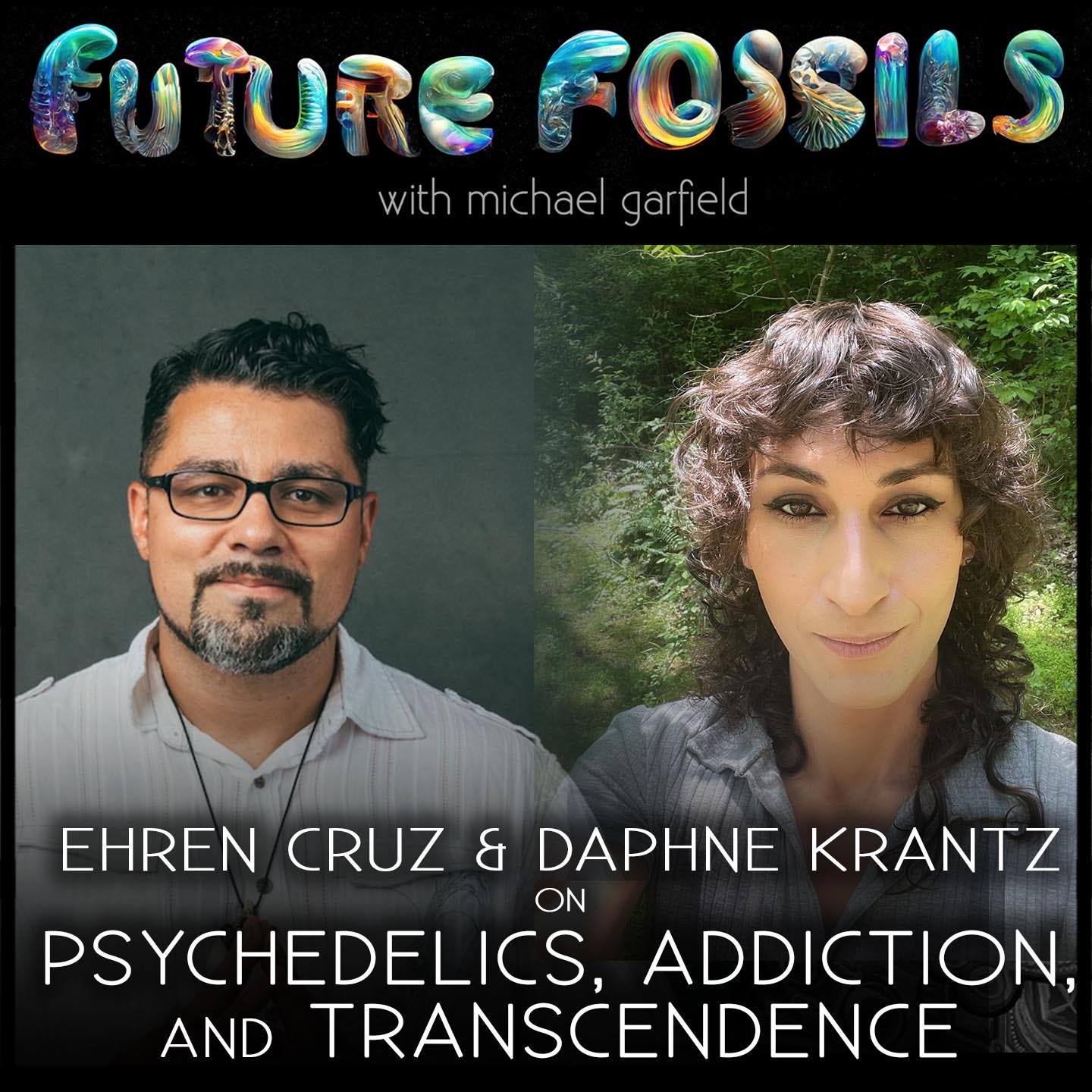
200 - Ehren Cruz & Daphne Krantz on Psychedelics, Addiction, and Transcendence
Audio is streamed directly from the publisher (api.substack.com) as published in their RSS feed. Play Podcasts does not host this file. Rights-holders can request removal through the copyright & takedown page.
Show Notes
Welcome to episode two hundred of Future Fossils! On this episode, I'm joined by Ehren Cruz (LinkedIn, Instagram, Website) and Daphne Krantz (LinkedIn, Instagram, Website) to discuss transcendence, trauma, and transformation. We talk about the festival world, our individual journeys, the rise of psychedelics in therapeutic applications, the potential of these substances, and their cultural roots. We also discuss addiction, trauma, and the consequences of collective consciousness, freedom, and how to provide access to these therapies in a way that respects Indigenous knowledge.
✨ Chapters:
(0:00:01) - Exploring Transcendence, Trauma, and Transformation
(0:08:27) - Psychedelic Use With Intention
(0:17:11) - Psychedelics and Substance Abuse
(0:26:13) - Exploring Relationships to Psychoactive Substances
(0:41:59) - Embodiment in Psychedelic Therapy
(0:54:30) - Addiction, Trauma, and The Transhuman Conditions
(1:03:20) - Healing Through Connection and Community
(1:09:04) - The Freedom of Exploration
(1:12:15) - Authentic Expression & Vulnerability
(1:15:26) - Psychedelics for Exploration
(1:27:55) - The Consequences of Collective Consciousness Freedom
(1:43:02) - Supporting Independent Work
✨ Support Future Fossils:
Subscribe anywhere you go for podcastsSubscribe to the podcast PLUS essays, music, and news on Substack or Patreon.Buy my original paintings or commission new work.Buy my music on Bandcamp! (This episode features “Ephemeropolis” from the EP of the same name & “Olympus Mons” from the Martian Arts EP.)Or if you’re into lo-fi audio, follow me and my listening recommendations on Spotify.This conversation continues with lively and respectful interaction every single day in the members-only Future Fossils Facebook Group and Discord server. Join us!
✨ Tip Jars:
@futurefossils on Venmo$manfredmacx on CashAppmichaelgarfield on PayPal
✨ Affiliate Links:
• These show notes were supplemented with Podium.Page, a very cool new AI service I’m happy to endorse. Sign up at https://hello.podium.page/?via=michael and get three free hours and 50% off your first month.
• I transcribe this show with help from Podscribe.ai — which I highly recommend to other podcasters. (If you’d like to help edit transcripts for the Future Fossils book project, please email or DM me: Email | Twitter | Instagram)
• BioTech Life Sciences makes anti-aging and performance enhancement formulas that work directly at the level of cellular nutrition, both for ingestion and direct topical application. I’m a firm believer in keeping NAD+ levels up and their skin solution helped me erase a year of pandemic burnout from my face.
• Help regulate stress, get better sleep, recover from exercise, and/or stay alert and focused without stimulants, with the Apollo Neuro wearable. I have one and while I don’t wear it all the time, when I do it’s sober healthy drugs.
• Musicians: let me recommend you get yourself a Jamstik Studio, the coolest MIDI guitar I’ve ever played. I LOVE mine. You can hear it playing all the synths on my song about Jurassic Park.
✨ Mentioned & Related Episodes:
7 - Shane Mauss (Psychedelic Comedy)10 - Anthony Thogmartin & David Krantz (Future Music)27 - Rak Razam & Niles Heckman (5-MeO DMT & Consciousness)58 - Shane Mauss (Psychonautic Adventures at the Edge of Genius & Madness)59 - Charles Shaw (Trauma, Addiction, and Healing)62 - David Krantz (Cannabis Nutrigenomics)68 - Charles Shaw (Soul in the Heart of Darkness)96 - Malena Grosz on Community-Led Party Culture vs. Corporate "Nightlife"100 - The Teafaerie on DMT, Transhumanism, and What To Do with All of God's Attention103 - Tricia Eastman on Facilitating Psychedelic Journeys to Recover from An Age of Epidemic Trauma112 - Mitsuaki Chi on Serving the Mushroom117 - Eric Wargo on Time Loops: Precognition, Retrocausation, and the Unconscious131 - Jessica Nielson & Link Swanson on Psychedelic Science & Too Much Novelty136 - Alyssa Gursky on Psychedelic Art Therapy & The Future of Communication156 - Stuart Davis on Zen, Aliens, and Psychedelics168 - Mikey Lion & Malena Grosz on Festival Time, Life-Changing Trips, and Community in COVID171 - Eric Wargo on Precognitive Dreamwork and The Philosophy of Time Travel172 - Tyson Yunkaporta on Indigenous Systems Thinking, Fractal Governance, Ontopunk, and Queering W.E.I.R.D. Modernity176 - Exploring Ecodelia with Richard Doyle, Sophie Strand, and Sam Gandy at the Psilocybin Summit
✨ Keywords:
Transcendence, Trauma, Transformation, Festival World, Psychedelics, Therapeutic Applications, Cultural Roots, Addiction, Collective Consciousness, Freedom, Access, Indigenous Knowledge, Intentionality, Context, Consumer Culture, Spiritual Ego, Health Coaching, Mental Health Counseling, Gender Identity, Substance Abuse, Private Practice, Ancient Cultural Roots, Modern Therapeutic Applications, Transformational Festival Culture, Memory, Embodiment, Rat Park Experiment, Brain Inference, Harlan Ellison, Opioid Crisis, Connection, Community, Oppression, Systems of Power, Self-Harm, Interconnectedness, Consumerism, Mindset, Serotonin, Oxytocin, Courageous Expression, Authentic Self, Right Wing Psychedelia, Commodification, Marginalized Groups, Nurturing Attachment, Reality, Independent Work, Apple Podcasts, Patreon
✨ UNEDITED machine-generated transcript:
Michael (1s):
Greetings, future fossils. This is Michael Garfield welcoming you to episode 200 of the podcast that explores our place in time. My God, we made it here. What a view from this summit. It's incredible. And for this episode, I have two very special guests, two very old friends. I mean they're, they're not very old, they're just friends I've had for a very long time. Aaron Cruz and Daphne Krantz. Aaron is a psychedelic experience facilitator. Daphne is an addiction counselor, but I met them both in the festival world when Aaron and I were working on the Visionary Art Web Magazine Sole Purpose back in like a decade ago.
Michael (55s):
And Daphne was producing electronic music under the Alias FU Texture. Dabney was a self-identified man at the time. David Krantz appeared on the show, episode 63 talking about cannabis and Nutrigenomics. So I mean, all of us have been through just extraordinary transformations. Aaron Cruz was the guy whose ceremonially blessed my Google Glass before I performed with it in a world first self streaming performance Gratify Festival in 2013.
Michael (1m 35s):
So yeah, there's a lot of archival material to unpack here, but we don't spend a lot of time ruminating on history. Instead, we discuss the present moment of the landscape of our society and people's trauma and drive for transcendence and the way that this collides with consumer culture and transformational festival scene where we all met one another. And it's an extraordinary episode and I know a lot of people out there are having a really hard time right now.
Michael (2m 23s):
And I am with you. I have huge news to share soon. I want you to know that you are not alone in your efforts to work things out. And if you need support, there is support for you. I really hope that you get something out of this conversation. I myself found just simply re-listening to the recording to be truly healing. And I'm really grateful that I get to share it with you. But before I do that, I want to pay tribute to everyone who is supporting this show on Patreon and on CK everyone who is subscribing to my music on Band camp, the latest Patreon supporters include Darius Strel and Samantha Lotz.
Michael (3m 17s):
Thank you both so much. Thank you also to the, the hundreds of other people who are helping me pay my mortgage and feed my kids with this subscription service one form or another. I have plenty of awesome new things for you, including speaking of psychedelics, a live taping of the two sets I just played opening for comedian Shane Moss here in Santa Fe. John Cocteau Cinema sold out shows. Excellent evening. I just posted the little teaser clip of the song Transparent, which was the song from that 2013 Google Blast performance.
Michael (4m 2s):
Actually that was, its its inaugural debut and I've refined it over the last decade and I submitted it to NPRs Tiny Desk concert. And you can find that up on my YouTube. If you want to taste of the electro-acoustic inventions that I will be treating subscribers to here in short order patreon.com/michael garfield, michael garfield.ck.com, which is where this podcast is currently hosted RSS feed. And thanks to everybody who's been reading and reviewing the show on Apple Podcast and Spotify and wherever you're wonderful, you've got this, whatever you're going through, you can do it.
Michael (4m 46s):
I believe in you and do not hesitate to reach out to me or to my fabulous guests or to other members of our community if you need the support. Thank you. Enjoy this episode. Be well and much more coming soon. I have two extraordinary conversations in the Can one with Kevin wo, my dear friend here in Santa Fe and Kmo, the notorious, legendary confederate podcaster who just published a trial log, the first part of the trial log between the three of us on his own show.
Michael (5m 27s):
Highly recommend you go check that out. And then also an episode with Caveat Magister, the resident philosopher of Burning Man who published an extraordinary book last year, turned your Life into Art, which resulted in a very long, vulnerable, profound and hilarious conversation between the two of us about our own adventures and misadventures and the relationship between Psycho Magic and Burning Man and Meow Wolf and Disney and Jurassic Park. Oh, and speaking of which, another piece of bait to throw on the hook for you subscribers.
Michael (6m 12s):
I am about to start a Jurassic Park book club this spring. I will be leading the group in the Discord server and in the Facebook group and on live calls chapter by chapter through the book that changed the world. I've an intense and intimate relationship with this book. I was there at the world premier in 1993. I grew up doing Dinosaur Diggs with the book's Primary Paleontological consultant, Robert Bocker. I have a dress for tattoo, et cetera. I've sold the painting to Ian, not to Ian Malcolm, the Jeff Goldblum, but I did name my son after that mathematician.
Michael (6m 59s):
Anyway, yes, much, much, much to discuss, especially because you know, one of the craziest things about this year is that the proverbial velociraptors have escaped the island, you know, and open ai. What, what's in a name? You know, everything is just transforming so fast now. And so I am the dispossessed Cassandra that will lead you through some kibbitz in Doug rush cuffs language. Please join us, everybody subscribing Tock or anybody on Patreon at five bucks or more will be privy to those live calls and I really hope to see you in there.
Michael (7m 47s):
And with all of that shilling behind me now, please give it up for the marvelous Aaron Cruz and Daphne Krantz. Two people with whom I can confidently entrust your minds. Enjoy. Okay, let's just dive in. Sure. Aaron Daphne. Hi, future fossils. You're here.
Michael (8m 26s):
Awesome. This took us like what, nine months to schedule this.
Daphne (8m 30s):
A slow burn, but we, here we go. It's great to hear me here,
Ehren (8m 33s):
Brother. It is, yeah. And once again, anything that gets rescheduled always ends up turning out better. Like I, I was just thinking, I'm really glad we actually didn't do this interview nine months ago, just in terms of life experience between now and then. I don't know what that's gonna translate to in a conversation, but personally I feel a lot more prepared to talk to you right
Daphne (8m 51s):
Now. A hundred percent agree.
Michael (8m 53s):
Cool. Okay, so let's just dive in then. Both of you are doing really interesting work in the explosive emerging sector of, in one way or another, dealing with people's trauma, dealing with people's various like life crisis issues. And having met both of you through the festival world, which was a scene of pretty rampant abuse and escapism. And I met you both as what my friend in town here, Mitch Minno would call like psychedelic conservatives, where I felt like there were a bunch of like elder millennials who were kind of trying to help that had been in the scene for a little long and they were really working to steer people into a more grounded and integrated approach to extasis in the festival world.
Michael (9m 52s):
And all of us have seen our fair share of, and perhaps also lived through our fair share of right and wrong relationship to the tools and technologies of transcendence. So that's kinda where I wanna take this. And I think maybe the way to start is just by having both of you introduce yourselves and talk a little bit about your path and the various roles that you've kept over the years in this, in adjacent spheres and what led you into the work that you're doing now. And then, yeah, from there we can take it wherever the conversation chooses to lead us. Daphne, we've had you on the show before, so why don't we have Aaron go first? Let's do that.
Michael (10m 32s):
Okay,
Daphne (10m 32s):
Awesome. Thank you Mike. Yo, we appreciate you're really eloquent way of creating an environment to kind of settle into here. So Aaron Cruz, I've been really deeply immersed in psychedelics for 15 years. My first foray into the world, or in curiosity, was actually going to school in Ohio State University for fellowship in anthropology. And coming it from the perspective of looking at 16th, 15th century around the time of the, the conquest in indigenous cultures utilizing plant medicine ceremony ritual as a community harmonizer agent, as a tool for collective wisdom, also for ceremonial divine communion, but very much from an ivory tower perspective.
Daphne (11m 15s):
I was not very much engaged with psychedelics at that particular lens outside of a foray into a couple of opportunities at all. Good music festival or different things like that. But I beg the question about is using these plant medicines with intentionality, will it create a more symbiotic way of life? A way of understanding the interdependence between the natural landscape, humanity, culture, community building and personal evolution. So it wasn't until major psychedelic experience in 2008 where I had probably inadvisable amount of L s D in the middle of a, an event and went into a full system to dissolve to the, the good degree. I actually didn't even know my name for several hours, but, but what I did feel that came to recognize was just this deep sense of connection to the soul of, of others.
Daphne (12m 4s):
A sense that e, each one of us sped our best efforts with cultural conditioning, social conditioning, how we're races, peers, we had a desire to appreciated, embraced. There's this deep sense of tribal kinship that I think I felt from everybody wanted to explore whether they were wearing a grateful dead shirt, a ballerina tutu or flat cap or whatever it was. And we wear these different types of masks of her own safety and security and and sense of self. But beneath that facade, I just felt this deep, rich desire to be a sense of belonging and connection and desire to be a p a child of the universe for lack of a better term. So that kind of really set me off from that tone as you shared, is that this rapidly accelerated from place of recreation to a deep of place of deep spiritual potency.
Daphne (12m 46s):
And, and from that place on the alchemical frontier, as I call that kind of festival type of realm where many, whether they're using compounds for escapism or they're trying to embody or embrace a particular lifestyle that they can then translate and seed into their own default realities or wherever that is almost train Jedi training grounds or whatever you could consider that to be. However, your orientation around it, that is, I just felt a deep devotion to trying to support those particular realms. First through workshop ceremony and cultivation of experiences that had some integrity and bones to using these things mindfully, actually to producing events. I was producing a co-producing original back in the day where I believe I met you, Mike, with root wire with the popio about 2010 through 2013 or nine through 12, maybe one of those epox learned a lot.
Daphne (13m 35s):
It was a lot of bootstrapping and blood, sweat and everything else trying to get the, those events going and, but they're really creating these containers for radical creativity and self-expression and where music and visionary arts could be upheld in a new model of, of honoring them and mutual out something that never took, took root as much as I would love it to. And then kind of translated into producing Lee Festival out here in Asheville, North Carolina for six years. And the ethos behind that was trying to create a dynamic cultural atmosphere, 10 to 15 different nations, people of all walks of life and traditions expressing their music arts culture ceremony and using that as a catalyst to kind of break down isms to reveal that the true depth and value that the rich, creative and cultural expression has beyond politic, beyond social conditioning.
Daphne (14m 21s):
It's a, you hear one thing about Iranians on on tv, but if you see them doing their Sufi circle dance and chanting and when they're cooking their food at the end of the day, it just really, it's amazing how humanity and expression in those places would really quickly help people bypass certain prejudices without saying a word. We're often dialogue, even intentional and conscious dialogue tend to fail. The expression goes beyond that. So, and of course there is still a rich culture of psychedelics and but these places are, it's kind of underground. It's not necessarily, there's no curated container specifically to facilitate initiation of rights of passage. It's a little bit more rogue, rogue experiencing.
Daphne (15m 2s):
So after that kind of materialized up to Covid where I was really actually even at that point seeking an exit strategy from that realm, the intensity of producing events is extremely vigorous. I remember in 2019 I had 7,800 emails and countless calls just coordinating three festivals and I'd have children, my three girls just hanging on every limb. And that one more call, one more, one more thing. So it was becoming quite burned out and Covid kind of did me at the time. I didn't think so a bit of a favor and giving me, kind of forcing me into an exit strategy to re-identify myself, not as just a producer and an event organizer, but someone that is deeply passionate about initiatory culture. My catalyst was festivals for initiation or creative initiation.
Daphne (15m 43s):
And then I went back to where it all began, really sat with the medicine once again, brought myself back into sacramental ceremony. And then I started really gazing at the broad sweeping frontier, the vanguard of the psychedelic emergence now, and saying, this may be a time I could be transparent and real and open about my deep care and use of these plants and medicines for almost 15 years. And so I went ahead and I got a professional coaching certification from I C F, I got a third wave psychedelic certification. It was the first a psychedelic coaching program in the nation back in 2020, in six months of learning the panoramic of psychedelics, preparation, integration, the neuroplasticity, the ethics considerations, dosaging compound understanding.
Daphne (16m 24s):
So getting that whole holistic review and then the cultivating a practice, a facilitation coaching practice based upon using that psychedelic as a catalyst but in a continuum of deeply intentional self-work and self-care and, and moving into that space with an openness to receive insights. But then really about embodiment. What do you do after you have those lightning bolts of revelation and how do you make that have an impact in your life? So that's been my last few years is serving as a, a ceremonial facilitator and coach in at the psychedelic realm and also a harm reductionist. People are looking for a high integrity experience but have a compound, don't really know how to go about it in a way that's intentional and safe. Really kind of stepping into that space and holding that container for them and being an ally.
Ehren (17m 6s):
Awesome. Daphne. Hi. Lovely to be back here with you Michael. So I'll start from the beginning and kind of give my whole story inspired by Aaron and the way he just articulated that trajectory. And I started out like we met each other. I think we might have met each other also at Root Wire back in that era. And I found myself in this world as a music producer. I was really heavily investing time and energy into building a music career, DJing, producing under the name few Texture for a long time, starting in around 2009. And that was my main gig for about six years and had some early psychedelic experiences when I was pretty young.
Ehren (17m 52s):
14, 15, 16 kind of set me off on a path to where I really had a strong inclination that there was something there and was always very interested in them and came into the festival world, into the music world with a very idealistic lens of what these substances could do for us individually as humanity and had my ideal ideals broken completely in a lot of ways. And what I experienced personally through relationships with collaborators, through my own inability to show up in the way that I wanted to in terms of my own ideals, thinking that because I took psychedelics, I was gonna somehow magically be this person who could live up to these ideals of relational integrity and honesty and like really being a beacon of what I perceived as like light, right?
Ehren (18m 50s):
And really had some issues with spiritual ego when I was younger and kind of had the sense of I've seen these other realms, I, I know more than other people, I'm special. I had all that story and really ended up harming me and other people around me. And it took some pretty significant relational abuse actually that I was experiencing and participating in through a creative relationship to kind of break me outta that illusion, right? That because I am creating interesting forward thinking music with a psychedelic bent in this kind of wild and free community festival community, that somehow I was immune from all of the shadow that exists in our culture in the psyche, in all of these places that I was just very blind to.
Ehren (19m 44s):
And I think it's a pretty normal developmental thing in your early twenties, and I mean at any age ongoing of course to be, to have places that are less conscious and those are blind spots, right? And so I really was forced through my musical career, through my participation in psychedelic culture to either have the choice to look at those blind spots or continue to ignore them. And I'd look back and I'm really grateful that I, I really did at a certain point be like, damn, I need to go to therapy. You can't do this on my own. I'm really hurting. And in about 2015 I kind of stepped away from music pretty hardcore and really shifted my focus because I was in too much pain.
Ehren (20m 28s):
I had experienced a lot of relational trauma around that time and started to just do other things peripherally related to music. I worked for MOG for a little bit building synthesizers and found myself doing a lot of personal healing work, kind of getting really real about my own inability to show up as what at the time I was perceiving as like a good person. In retrospect there it was so much more complex than that. And over time, being able to drop the layers of shame and the layers of self-judgment around a lot of those relational patterns I was living out that of course are familial and cultural and all these other things. But I ended up starting doing health coaching work around that time.
Ehren (21m 11s):
And Michael, that's something that we've connected on on the past episodes around some of the epigenetic coaching work. I do a lot of genetic testing, I do a lot of personalized nutrition, peak performance type work and was doing that pretty steadily from about 2015 to 2019 and I'm still doing it, but over the last three and a half years or so, went and got a master's in mental health counseling, started to really find that a lot of the people I was working with and drawing from my own experiences in therapy and healing, I was like, okay, nutrition and all of these physiological things are very important.
Ehren (21m 53s):
And what I'm seeing is most of these people need emotional healing. Most of these people need more psycho emotional awareness and healing from trauma and relational patterns. And I just felt really unprepared to do that work as a coach at the time. And also had just tremendous openings into understanding myself better into being able to, yeah, be with discomfort and be with pain in a way that when I was younger was totally off the table. It was like I'm just gonna distract myself fully from all of that through, through jugs, through sensory experiences through the festival world.
Ehren (22m 37s):
And that's where I got drawn and no regret, like I love that it was what shaped me and I still engage in all of that just with this slightly different way of being with it, not as an escape, but as a way of celebration in contrast with really being able to also be with the more difficult, darker shadow aspects of life and seeing that as a pathway to wholeness rather than avoiding those things. And so that's the work I'm doing now as a therapist, as someone who does psychedelic integration work. I've also done publications on psychedelics.
Ehren (23m 18s):
I have an article that was in the Journal of Mental Health Counseling a couple years ago. I have another one that's pending right now on psilocybin assisted group therapy that I hope gets through in the international journal group psychotherapy right now. And I'm planning some research also on gender and psychedelics in terms of the way psychedelic experiences impact gender nonconforming and gender expansive people's perception of gender. And I know for me that was one of the early indications that I was transgender was a mushroom experience when I was in my early twenties when I was like, wait, I think I'm a lesbian, I have no idea what this means. And I had no idea how to process it.
Ehren (23m 58s):
And I kind of stuffed it back down for years and two years until it was just too obvious. But I have, yeah, that's in the works working on IRB approval for that this year. So yeah, kind of have a research bent, do general therapy work with people, do psychedelic assisted work, also still do genetic testing, epigenetic coaching, working on more of the physiological side with people and coming from a holistic health perspective. But yeah, just also to add the other piece in here, I did my internship and worked for a little over a year substance abuse rehab as well, doing therapy there. And so as someone who's been a long time proponent of psychedelics and the potential healing capacity of them, still fully believe that despite my own, and I've had many important experiences to counter what I was saying earlier around them also creating sometimes an idealized version of self without doing the work to get there.
Ehren (24m 57s):
I worked in a rehab working with people who've had maladaptive relationships with substances and it was a very important counter to my own, again, idealized image and idealized perception of the human relationship with substances. And so I, coming out of that, I actually left in December starting in opening up my private practice with I think a much more balanced understanding of all the different ways humans can be in relationship to substances from full on avoidance to transcendence and self-awareness. And I really love to be able to hold both of those perspectives and work with people on all sides of that spectrum because there's not just necessarily a clean one thing one way or the other for people.
Ehren (25m 45s):
I find myself and Michael, you and I have talked about this weaving in and out of those relationships of where we end up relating to different substances in good or more harmful ways. And I think there's an importance to be able to be honest with ourselves and with people that we're working with around, yeah, what is this really? What is this really doing for me? And what am I getting out of this? And sometimes it's okay to lean on a substance for pain relief or for disassociation intentionally, right? But like at a certain point, like how do we learn how to take what, and I think this is true regardless of how we're using any substance, how do we learn from it and take what this substance is helping us with and kind of learn how to do it on our own in certain ways.
Ehren (26m 36s):
And so that's, I think maybe where this roundabout description of my life right now is leading to is that point of I'm very interested in regardless of the substance, regardless of what it is, whether it's heroin, whether you're using heroin to avoid painful emotion, how do you learn how to be without yourself, without the substance, right? Or whether you're using ayahuasca or L s D to access the transcendent and become more aware of the deep capacity for inner love and compassion that's already inside of you. Like how do you learn how to do that in a stable, grounded way on your own right? And I, I think there's a, a parallel, right that I think is lost in the discourse about drugs in general that I'd love to bring in.
Michael (27m 22s):
So that's actually right where I want to be for this cuz I think should not come as a surprise to anyone that there is this rather obvious isomorphism, I guess in people's relationship to ecstatic events generally to the festival as some, as a phenomenon that has its origins in the acknowledgement and re you know, the recognition and enactment of a relationship to sort of vertical access or a horizontal, like a transcendent experience of time rather than just a one damn thing after another duration Kronos clock time that there's, it's an observance of a kind of a holy dimension to our lives.
Michael (28m 17s):
And at one point these were all woven together much more intimately than they are today in our lives. The, the holiday has become something that is, and the festivals generally have become something that is more about a pressure valve or kind of escape from the oppression of our lives rather than something that's woven into the fabric of, or our everyday expect the observances of sacred hours in a monastic sense. And so likewise, I think if you were to believe the anthropological take on substance use, the various substances were held more like, more formally, like I think that all of us have participated in a number of discussions, are well aware of ayahuasca in particular being something that is still very much implicated within this fabric of specific cultural utility under understand and practice.
Michael (29m 24s):
But a lot of these things exist. For instance, ketamine is something that is either in, it's used as a medical anesthetic primarily until just a few years ago, or it's used as a club drug. And so there's a, it doesn't have that same sort of unity of purpose and the same clarity as far as the way that it's being applied and it lacks a, a lineage or a continuity where it's not like John Lilly had a, a tribe of people that he coached on how to do this. He was like people experimenting on their own. And I mean the same goes also for other, more, more recently discovered synthetic substances like L S D and also for substances that had a more focused and time-honored indigenous tradition around them like psilocybin, but either through just the proliferation of GarageBand type experimentation taking over as the primary cultural mode or whatever like we have.
Michael (30m 30s):
So there's this whole spectrum of the ways that different substances either have managed to maintain or never or have gotten away from, or never actually even had a system of protocols within which their use could be more or less responsibly engaged. And of course, I'm not saying that there's a ton of examples in which ayahuasca is not even within, even within settings that claim to be responsible. And anyway, this is just a nimbus of considerations around the question, which is where is the line between escapism healthier approaches or like sometimes escapism, like you just said, Daphne is actually healthy if it's encountered in a way or if we people are en engaging this in a way that is not just con ongoing peak ex seeking of peak experiences.
Michael (31m 28s):
I mean, I think one more thing I'll say to this is that I've seen people, and it should, I'm sure anyone listening to this has also seen people who engage traditions that are about in more, you might think like endogenous substances like running or meditation that have strong cultural containers, but there are always leaks in these containers or these containers themselves are not typically are, are not healthy. Like I've seen ayahuasca ceremonies that were the, the, that particular community depended on the patronage in order to do its work of people who had managed to kind of trick themselves into thinking that they were doing important spiritual work, but were just kind of had become gluttons or for punishment or like masochists that were just in there to purge, heal DNA traumas or whatever for their retroactive lineal healing week after week after week.
Michael (32m 31s):
And nothing was actually changing. They had gotten themselves into a loop. And so I'm, yeah, I'm curious how does one ever, how does one actually even begin to recognize when something has crossed over from healthy into unhealthy? Like what is, where is the line? It seems rather contextual and I mean there were, it's funny because, I mean just to bring it back to festivals and then I'll stop, it wasn't ever really clear to me. I mean, it was clear when lip service was being paid to transformation and that was a load of shit because I think that was used as a lure by and still is by event organizers and promoters to bait people into buying a ticket but wasn't really held in the right way in those events.
Michael (33m 19s):
And then there are times when every effort is made to do this stuff sincerely, but is not really handled in a way that makes it success, you know. And the same can be said for anything, I mean for like educational television is an example of something that people have been fighting over for almost a century. Whether the medium, whether the format of this makes these tools effective, potentially effective, problematic in their actual implementation, et cetera. So this is a much bigger conversation than a conversation about drugs really. It's a conversation about how mu how far we can engage in a particular type of relation to a, a practice of self transformation or transcendence or illumination or education or whatever before it becomes more trouble than it's worth or before.
Michael (34m 11s):
We need to call in some sort of balancing factor. And I'm curious to hear your thoughts at length and I'd love to hear you kind of back and forth about this.
Daphne (34m 19s):
Yeah, there's so much there man. That is a panoramic for sure. One of the things to kind of look at here is that the idea of the recreational use of, of a psychoactive or a psychedelic compound is 50, 60 years old. The lineage of using Sacramento entheogenic compounds is at least 40,000 years old for the time of megalithic cave paintings, size of football fields made with depth pigmentation that is with techniques that have somehow have the endurance to be still on those walls this year later is with sac ceremonial initiations and MAs and sabertooth and many mushrooms along the bottom.
Daphne (34m 59s):
So perhaps even people have said such as stems and McKenna, the origin of cultural or creativity of artistic creativity might have been spawned or germinated through the use of psychedelic compounds, the self-awareness and the potential for di interdimensional realization. But you look at Theon that was used with eloc mysteries, the type of reverence people have taken for one time in their entire life to, to walk to the Elian temple from Athens, the distance of a marathon fasting, moving into that experience with great care, great reverence, having an initiation with an ergo wine, a compound that's now been synthesizing the LSDs in 47. But originally was the, the rye, the barley grain, the ergot there infused into a beverage and seeing the immortality of the soul dramatized in front of you by our initiatory rights of passage theater in Egypt.
Daphne (35m 50s):
And you know, the temples of Ocirus, which had little mandrakes wrapped around its feet, or isis, which had little mushrooms at the feed. And those particular lineages of priesthoods and priestesses would utilize compounds to commune and learn the subtle language of that particular medicine in collaboration with ritual and practice to help to uphold virtues of different aspects of the civilization. And you go all around from the flesh of the god's, Aztec, MasTec, olmec, TOK cultures, ayahuasca, there's probably 10 different brews in that region, thousands of years old Abor, pati bush, west Africa, psilocybins everywhere, Druids Nordic culture.
Daphne (36m 31s):
I mean, but you look at the way upon which peyote cactus, you used it in a way that was like, here is an ally, here is a teacher, here is a compatriot a an essence of something that I work in cohesion with in order for me to learn how to navigate my own life evolutionary process in greater symbiotic relationship with the world around me, how I commune with the divine and with more, I guess visceral potency to allow that philosophical faith that aspiring Christians across the world hold this philosophical arm length faith that when things go sour where send in love and light when things are fine, I forget I'm even affiliated or associated with any kind of denomination.
Daphne (37m 15s):
And it's really an interesting thing when you have a different mindset of we are in a continuum of connectivity to an interdimensional web of life and that there's an interdependence between us and these different realms of being to try to embody and embrace a life that is a virtue or an integrity or create community based around these deeper ethics and values that are being kind of almost divinely inspired. And now you're coming into a timer where that has been systematically eradicated beyond all else, whether it's the early Catholic church with the Council of naia, that plant medicine, the original Nixon move was in 3 89 ad pretty much when plant medicine was absolutely persecuted feminine that he, the hosts or the feminine energy that often was the catalyst of working together in communion with the plants and offering it the original catacombs, the nasta catacombs where they find ergot wines and such that probably the original Eucharist was a psychedelic medicine.
Daphne (38m 13s):
All of that was completely ousted and nothing has been persecuted harder than plant medicine. And so then coming into contemporary society, the reintroduction, whether was through the scientific land, rogue experimentation, GaN coming up with massive amounts of compounds, Albert Hoffman. But when it started to infuse into academia, it again started moving people into this awareness that is, this compound is not just therapeutic, it is creating something within it that is inspiring Nas, a deeper wisdom, a deeper sense of internal communion with life force that is beyond something that can be charted on a bar graph or triangulated with an abacus.
Daphne (38m 56s):
And so that, and then they, the considerations of set and setting and if you're gonna host an experiment, how do you, how do you hold a psychedelic space without being on a psychedelic? And there is a lot of challenges there because it just, it is a type of experience that almost necessitates an A, a visceral embodied awareness to even understand how to support in any kind of way because of the potency and the gravity and the expansion of what that is is something you can't read on chapter seven and have a good grasp on how to facilitate or how to curate. But that whole experience, what it ended up happening is that the disruptive nature of people thinking, perceiving, expanding in a way that is unformed or nonconform to the status quos growing industrial complex and commercial material culture created a real schism reality.
Daphne (39m 47s):
And so people that felt like they wanted to embrace and imbibe had to flee, had to go to the woods and had to lock themselves. And Stella Stellar or like Chris Beige who just came out with L S D in the mining universe of absolutely prolific book for 20 years, had to hide his L S D ceremonial work and testing and deep psychospiritual results until he was 10 years past 10 retired to, to finally come out with the fruits of his labor. It just created his isolatory world and framework. And so now we're saying, escapees, please come back. Like you all had to run away to do your compound and try to find yourself and your consciousness, but you, we want you back in community and the old deadheads and those that are kind of in that lineage is like, it's just not safe over there.
Daphne (40m 30s):
We're gonna keep it in the parks, we're gonna keep it in the fields and if we come back over there, we're gonna be always outcasted as the hippies that are just avantgarde and fringe. And so it's a real interesting dynamic in culture where we want to infuse the intelligence and the beauty of the transformation that these things can uphold. But then we don't actually have a paradigm that allows people to be expansive and allows people to be avantgarde and ecstatic in these different things without feeling that they're actually a real challenge to our core sets of cultural beliefs. So part of this kind of third wave that we're seeing right now is the reintroduction of that outcasted, psychedelic culture.
Daphne (41m 10s):
And it's now in a, into a space of deeper therapeutic respect where they're seeing through the results of John Hopkins in Imperial College of London and all these other studies that the power in P T S D complex, P T S D and a addiction and trauma for, with intentionality with a progressive path that includes a holistic wellbeing, body, mind, spirit care, deep intentionality, using it as a catalyst, catalyst and integration process that this can be something that can allow somebody to at least get a sense where is that inner compass, where is that inner sense of who I am? And it's an immersive culture, so you kind of drip dry, you dunk 'em in that space, they get, oh, that's what home is. I, okay, I remember, oh wait, it's going away from me.
Daphne (41m 51s):
It's go, I'm starting to forget. And that's where devotional practice and self-care and all those things are the real way to really supporting and sustaining that. But I think where psychedelics help is it imprints or imbues a remembrance of where that space is and to your port Michael, like once you get that deep message, then it's time to do the work. What decisions in my life, what relationships, habits, patterns, distractions, what is in my life that is taking me away from that center, make those earnest actions, make those earnest choices, and then have a sense of where that foundation is. Then if you name for growing, maybe you do revisit with the medicine in an alliance in a way that is understanding that it isn't, it's an aid, it's not a, it's not a panacea, it's never meant to be, but it helps you at times to say, okay, here's a reminder, here's your truth, here's where you can be if you let go of the drama, the guilt, shame and baggage and, but really you still got a lot of work to do on those faces before you can say that you're, we're all we're a whole.
Daphne (42m 48s):
So there's a nice, there's a nice kind of panoramic or a dance going on here with this third waves trying to rebrace indigenous culture and the long lineage of ceremony, trying to respect the research, trying to bring people back from the fridge of alchemy and then trying to bring about awareness to those that have been tabooed for 50 years in the Nixon war. That there's actually some vitality and merit to re reengaging with this consciousness expansion. Beautiful.
Ehren (43m 12s):
I wanna pick up on a couple pieces there, Erin, especially around the embodiment piece and where I see that as being a really critical component of the way that psychedelics are being reintroduced into the therapeutic community, into the way we're looking at this. And I kind of want to frame it in the context of the way Western psychotherapy has developed over the last 100 years because Michael, as you brought up, we don't have a lineage necessarily that we're drawing from. As these things are startin