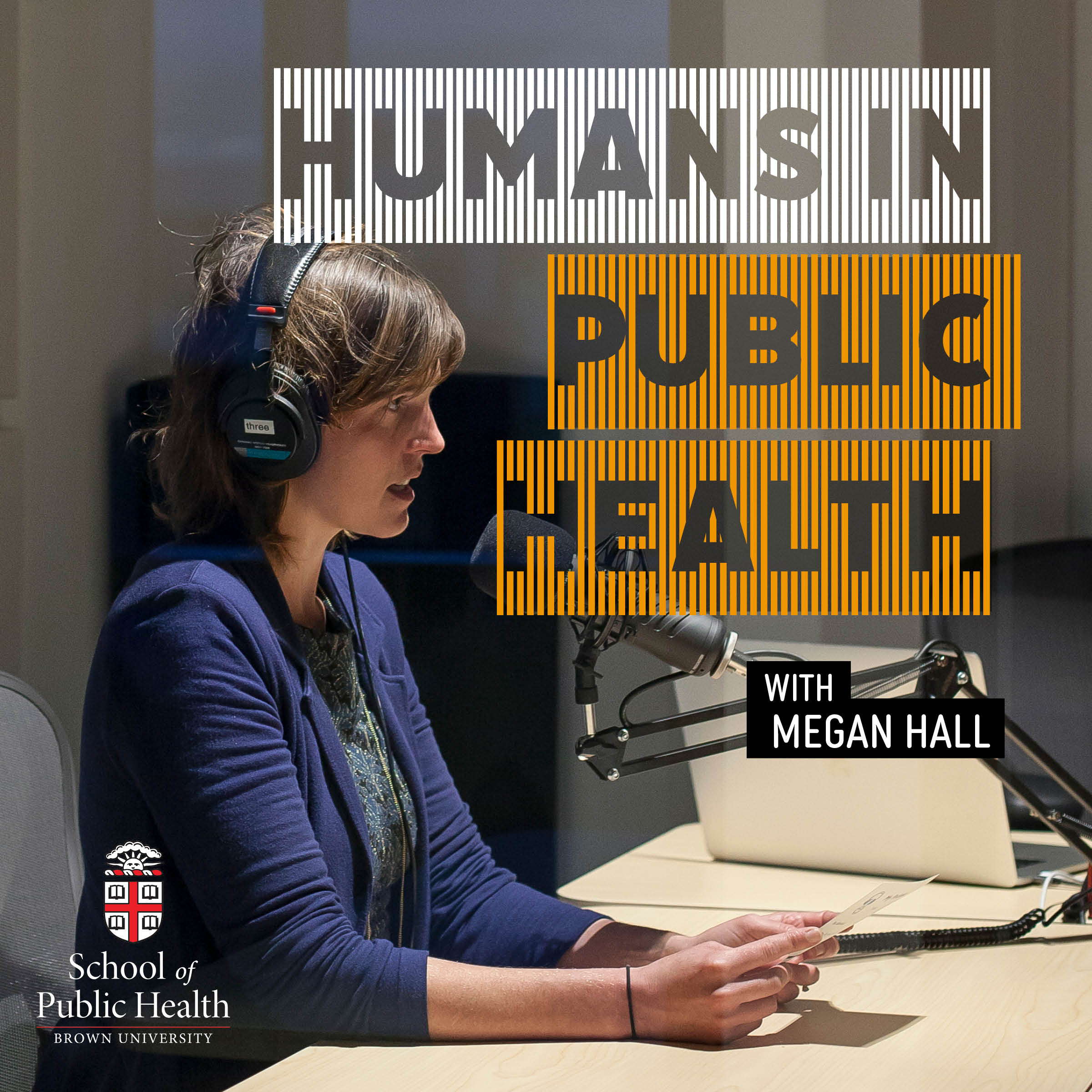
Humans in Public Health
Conversations with Brown University School of Public Health researchers about their work, and what's new and next in the field of public health
Brown University School of Public Health
Show overview
Humans in Public Health has been publishing since 2024, and across the 2 years since has built a catalogue of 26 episodes. That works out to roughly 7 hours of audio in total. Releases follow a monthly cadence.
Episodes typically run ten to twenty minutes — most land between 14 min and 17 min — and the run-time is fairly consistent across the catalogue. None of the episodes are flagged explicit by the publisher. It is catalogued as a EN-language Science show.
The show is actively publishing — the most recent episode landed 1 months ago, with 9 episodes already out so far this year. Published by Brown University School of Public Health.
From the publisher
How should we prepare for the next pandemic? How is noise pollution affecting my neighborhood? And how can we prevent opioid overdose from a public parking lot? From epidemiology to behavioral science, Megan Hall covers it all as she interviews public health researchers about their work and what brought them to the field of public health in this award-winning podcast.
Latest Episodes
View all 26 episodesRethinking Drinking
RERUN: Measles: The Return of a Preventable Disease
Growing a Healthier Climate
Mapping the World Cup
The 2026 Cohort: Two MPH Students on What’s Next
The Great Upside-Down Food Pyramid
Ep 49More Than a Forecast
When you check the weather on your phone, you're getting a "best guess" based on the nearest airport—but your actual neighborhood could be much hotter. And in high-risk communities, this invisible temperature spike or major air quality issue transforms a daily forecast into a serious medical emergency. In this special episode in honor of Brown’s first-ever Climate Week, environmental epidemiologist Allan Just explains how his team uses NASA satellite data to measure hyper-local temperatures and air pollution. Discover why these precise measurements are vital for public health, especially for those on common medications that can unexpectedly increase vulnerability to extreme heat.
Ep 48Student, Scholar, Dean: Francesca Beaudoin on 20 Years at Brown
What does it take to lead a top-tier School of Public Health? For Dr. Francesca Beaudoin, the journey started in the chaos of the ER. In this episode of Humans in Public Health, we sit down with Interim Dean Beaudoin to trace an incredible trajectory. She has experienced Brown from every possible angle: first as a medical resident, then a doctoral student, then as member of the faculty, a department chair and administrative leader. Now she steps into the role of Interim Dean, prepared to propel the school forward with momentum. Host Megan Hall sits down with Dr. Beaudoin to discuss how 20 years in academia and on the medical frontlines—from treating acute trauma to staffing mobile opioid recovery units—prepared her to lead during a time of transition.
Ep 47Navigating the Post-Dobbs Landscape
In this episode, host Megan Hall sits down with the co-directors of Brown University’s new AIM Lab, emergency physician Dara Kass and legal expert Liz Tobin-Tyler, to discuss the chaotic intersection of medicine and law three years after the Dobbs decision. As state abortion bans create a "chilling effect" that leaves clinicians paralyzed by legal fear, the AIM Lab is stepping in to provide a practical roadmap for emergency care and maternal health. Kass and Tobin-Tyler share how they are moving past the political noise to solve the public health crises on the ground, offering a harm reduction approach that protects both doctors and patients while training a new generation of advocates to value the lives of pregnant people in every state.
Ep 46The AI Therapist Will See You Now
A quarter of young adults are turning to AI chatbots like ChatGPT for mental health advice, highlighting a massive shift in how people seek support. Dr. Ateev Mehrotra discusses his research and the urgent need to balance AI's capacity for providing accessible, cost-effective care with its potential to unwittingly cause harm.
Ep 45Messy Data, Real Answers
In a world teeming with health data—from smart watch accelerometry to millions of hospital system electronic records—how do researchers find out which medical treatments truly work? Biostatistician Rebecca Hubbard discusses the messiness of real-world data, the limits of randomized control trials and how both of these powerful—but imperfect—methods are essential for building trustworthy evidence in public health.
Ep 44The Return of a Preventable Disease: Measles, misinformation and the crisis at the CDC
Measles has been declared eliminated in the U.S. for 25 years, but a surge in cases is threatening that status. Jennifer Nuzzo, director of the Pandemic Center at Brown University, joined Humans in Public Health to break down the outbreak, the chaotic federal response and how her team's tracker is stepping in to provide reliable, life-saving data.
Ep 43The Power to Transport
We all understand the power a song can have to recall vivid memories, seemingly sending us back in time. Professor Ellen McCreedy is a musician whose gerontology research harnesses music’s power to recall memories. She’s testing an intervention that brings personalized music playlists to nursing homes in order to help ease dementia symptoms for patients, without using medication. Driven to give dementia sufferers—and their caregivers—moments of having themselves back again, McCreedy joined Humans in Public Health to discuss her work, its challenges and the grandmother who originally inspired her.
Ep 42A Revolutionary Approach to Health Care Pricing
Since the 1980s, the U.S. has experimented with various forms of managed health care. But none of them has managed to control costs or improve health outcomes, argues Senior Fellow Hayden Rooke-Ley. In this episode of Humans in Public Health, he explains a radical new idea from CAHPR researchers for delivering lower health care costs that is actually quite old-fashioned: a return to fee-for-service. Read the JAMA article here.
Ep 41LIVE RECORDING: How Do Urban Landscapes Shape Our Health?
A special live Commencement & Reunion Weekend episode of Humans in Public Health brings experts from epidemiology together with the director of Urban Studies at Brown for a discussion on cities: How they collect public health problems and the ways they might help us to address those same issues.
Ep 40Rhode Island's Response to the Overdose Crisis
This episode of Humans in Public Health features Professor Alex Macmadu, an epidemiologist who has spent her career studying the opioid and overdose crisis. She shares insights on Rhode Island’s bold step in opening the first state-approved overdose prevention center in the U.S. and what her research reveals about community attitudes toward harm reduction. Listen in to learn how evidence, advocacy and compassion are shaping the future of public health responses to drug use.
Ep 39Who Employs Your Doctor?
What happens when private equity firms buy hospitals and doctor’s offices? In this episode of Humans in Public Health, host Megan Hall sits down with health care economist Yashaswini Singh to unpack how private equity is reshaping the American health care system—often behind the scenes. From rising costs to shifting priorities in patient care, Singh explains why the recent collapse of Steward Health Care is just the tip of the iceberg. Whether you’ve heard the term “private equity” or not, this conversation will change the way you think about your next doctor’s visit.
Ep 38The Moment Everything Changed: Voices from the Start of the Pandemic
March 2020—life as we knew it changed overnight. In this special episode of Humans in Public Health, we take you back to the early days of the pandemic, when uncertainty loomed, fear spread and the world held its breath. Through personal stories and firsthand accounts from public health experts, we revisit the emotions, decisions and pivotal moments that shaped those first weeks. How did people react? And what have we learned since? Tune in for a compelling look at the moment everything changed.Sound Effects in this episode from Freesound.org, courtesy of the following users: Isaacburkevideo, Shaunhillyard, Wjoojoo, Charlie72203, Univ_lyon3, Richwise, Hardance, Kyles, Takimeko, nixeno, Humanoide9000, pblzr, Felixblume, Voxhumanamusicurators.

Ep 37Forever Chemicals: Hidden Dangers in Everyday Beauty
They’re not just in your nail polish. Per- and polyfluoroalkyl chemicals are everywhere—in our homes, clothing, the personal care products we use, and in our bodies. Postdoctoral researcher Amber Hall explains the dangers PFAS pose, especially to developing humans, and helps us learn how to avoid them. The burden of protecting our children’s health from toxic chemicals, she argues in the latest episode of Humans in Public Health, shouldn’t be borne by individuals. Regulation, Hall says, is needed to push through product-level change and protect the public’s health.Sound Effects in this episode from Freesound.org, courtesy of: TRPAtks_IngeosDeVernMentioned in this episode:Tell someone you know!And one last thing! If you enjoyed today’s episode, text a friend and let them know about the show.
Ep 36How Research Shapes Health Policy on Capitol Hill
Host Megan Hall sits down with Jared Perkins, director of health policy strategy at Brown University's Center for Advancing Health Policy through Research. They discuss how academic research makes its way from dense journals to policymakers on Capitol Hill, bridging the gap between science and legislation. Jared offers insights into the challenges of health policy under a shifting political landscape and explains how researchers can play a vital role in shaping decisions that impact healthcare nationwide.