
How To Love Lit Podcast
301 episodes — Page 5 of 7
S1 Ep 117Things Fall Apart - Chinua Achebe - Episode 3 - Religion, Gender Issues, The Importance Of Balance And Chapter 13 - The Heart Of The Book!
Things Fall Apart - Chinua Achebe - Episode 3 - Religion, Gender Issues, The Importance Of Balance And Chapter 13 - The Heart Of The Book! I’m Christy Shriver and we’re here to discuss books that have changed the world and have changed us. I’m Garry Shriver and this is the How to Love Lit Podcast. This is our third episode in our four part series on Chinua Achebe’s stunningly complex little novel, Things Fall Apart. In episode one, we looked at Nigeria the country itself, the historical context of the book, Achebe’s life, and also the poem Achebe used for the title of his book. In episode two, we got into a couple of the cultural features Achebe highlights in part one of the book as well as begin discussing chapters 1-7. We are quick to notice that although, this is a story about a man, a very relatable man, that could be from anywhere and struggles with issues that plague us all, Achebe situates him in a cultural context that is uniquely Igbo. So, who are the Igbo? What do they value? These are things we learn organically as we read the story. But this week, as we look at getting through the rest of part one as well as most of part two of the novel, the word I want to highlight is the word complex because like every other great piece of art, when you first engage this book you don’t understand the art of it. This story feels natural, almost simple- the artist in Achebe makes the story feel easy and natural; what we don’t realize is how intentional and complicated all that is to do. It kind of reminds me of Swedish Rock. Are you really going to compare Achebe to Swedish Rock. I am, so disclosure- Christy and I watched this Netflix series called This is Pop. I’m a musician, although not a famous one, but I love learning the stories of great music. Anyway, what the host Jay McCarrol talks about, in this particular episode, one of your favorite bands- Christy-Abba. And it’s a phenomenon-= how does this little band from a little country change the musical landscape for millions around the entire globe..and actually it’s more than just Abba. Britney Spears, Backstreet Boys, and *NSYNC would all be obsolete without the work of Swedes Denniz Pop and Max Martin. But here’s the connection, when you listen to a song like “Waterloo”- it feels simple and easy. The listener just thinks, ohh I really like that. It stands out- why, out of thousands of songs- do some stand out? And how do the same writers do that over and over again? How do they do it? What does Max Martin know that the rest of us don’t. He’s got some trick up his sleeve. So does Achebe? How does his book stand out? Ha! Fair enough, of course, you had me at Abba, and today what we are going to talk about, among other things, some of the fascinating tricks, if you want to call them that or techniques, Achebe uses to make that human connection with all of us. And I think structure is a great place to start because it’s something that often flies under the radar- but the structure of this novel is very deliberate. Last episode we ended by reading the end of chapter 7 of the novel, one of the most important chapters of the book. It’s emotional; it’s important in terms of plot development. It’s important in terms of character development, but let’s notice where it’s placed. There are 13 chapters in part one- and chapter 7 is at the slap dab middle six chapters before- six chapters after. It’s at the heart of the first section. When we get to chapter 13 we see another big plot point. It’s the end of the first section, but it’s also the very middle point of the book- the book has 25 chapters- there are twelve before chapter 13 and 12 after it. It’s the heart of the entire book, and it is where we see Okonkwo commit a feminine crime, an accidental murder and is forced to flee. Why is an accidental murder at the heart of the book? What about this event takes us to one of the most important themes of this entire book? Why is so much attention drawn to the fact that this is a feminine crime? What does crime even have gender? Why is there such a thing as a masculine and femine crime? Achebe, of course, when asked a similar question answered using an Igbo parable- “Wherever Something stands. Something Else will stand beside it.” The idea that life is not one thing- life is duality. This duality applies to everything not just issues of gender- but gender issues may help us understand dualities- but it’s application as it pertains to issues of gender is of central importance and a focus in this book. Achebe draws particular attention to man’s need for balance between the male and female principles. He highlights through Okonkwo’s extremism the difficulty all of us have- in one way or another-in finding this balance- being okay with who we are- and to support this theme- Achebe has created balance in the very physical aspect of the how the book is laid out. Just one of those cool things- structure supporting meaning. It’s one of those subtle things artists do that we don’
S1 Ep 116Things Fall Apart - Chinua Achebe - Episode 2 - The Clash Of Cultures, Foreshadowing, Irony And Rage!
Things Fall Apart - Chinua Achebe - Episode 2 - The Clash Of Cultures, Foreshadowing, Irony And Rage! Hi, I’m Christy Shriver and we’re here to discuss books that have changed the world and have changed us. I’m Garry Shriver and this is the How to Love Lit Podcast. This is our second episode in our four part series discussing the great Nigerian work Things Fall Apart and its author, Chinua Achebe. Last week, we looked at the historical context of Nigerian history- pre-colonial up to the colonial period. We looked, albeit briefly at the life of Achebe himself, how the book got published, and a little bit about the poem that inspired the title. We also introduced the great tragic hero of the novel, Okonkwo. Today, we are going to continue exploring Igboland as we look at some of the cultural traditions that are important to the story, we are going to look at little bit at the structure of the book and hopefully, we will discuss all the way through chapter 7. Did I miss anything, Christy? I think that’s it, but you never know, we may go down a tangent. There are so many things we could talk about that would be culturally relevant to understanding this work. I heard Dr. Achebe do a question and answer session for the BBC one time and a girl asked a question that stood out to me. She said something like this, I am an aspiring writer and it is obvious that you have written a story about the unique particulars of your culture, but you also write about universal things that apply to all people. I think I know how to write about my own experiences, but how do I write about the universal? His answer was interesting to me because I thought- oooh, I need to write down this tip, maybe I could also write a great world renowned novel. He said this and I paraphrase, “You can’t. You can only write about your reality, and if it take on universal qualities it is because the work took on a life of its own.” The poor little girl was likely disappointed in the answer because he couldn’t give her a formula. I’m sure she was, but haven’t we talked about this so often before? And of course musicians are the same way, a writer writes about what he knows and somehow I as a reader or a listener can identify with him/her- their reality touches me, although the setting may be totally different, somehow their world is also my reality. This is what Achebe wanted to communicate more than anything- the story of the Igbo is a human story- the reality of us all is present in Igboland. The relationships in the fictional Igbo community of Umuofia and Mbanta between groups with different pigmentation, between genders and between individuals are complex. And that is really one of the great advantages of novels as opposed to just lectures on culture or history, through novelistic discourse the author is not just telling us information, or explaining rules or models of social and political orders, we are getting someone’s unique perspective on them- an understanding of them. One example that makes me wonder is- What is it like to live in a polygamous society? The gender politics in this book are unapologetically masculine. Achebe doesn’t apologize for that; he isn’t sanctioning it really either as a preferred mode of existence. It’s just the reality. The story is told in the third person omniscient perspective. Things were the way they were. Well, in the case of the Igbo people specifically, it was important to Achebe for the world to understand the unique and deep cultural roots inherent in the way of life in this part of the the world. This is what the Europeans refused to see and understand when they arrived in Africa. The people of this land were not savages simply because they didn’t live or speak like European peoples. There was a culture, a deep culture, with a complex religious tradition, moral values, social structures, political structures, and meaningful recorded histories. As is so often the case with highly educated people even today, there was an arrogance of superiority to which Achebe responds- Just because you don’t see or understand something, doesn’t mean you are not looking straight at it. Goodness, I totally understand that. My very first teaching job right after college was teaching English to business men in Japan. I worked for a company called Interac in the town of Shizuoka. Anyway, after I first moved there, I looked around and saw a Kentucky Fried Chicken, a mall, a Denny’s restaurant, and I remember thinking. wow- well this place is just like the US just in a different language. A year later, I remembering that thought and thinking about how foolish it was. The culture of the United States and the culture of Japan are extremely different and the differences are historical, deep and multi-faceted. When I left Japan after living there only one year, I remember thinking, the only thing I really knew about Japan is that I don’t know almost anything about Japan. The main lesson I had learned over the year was humility. I had
S1 Ep 115Things Fall Apart - Chinua Achebe - Episode 1 - Meet Nigeria's Most Famous Author , Teacher and Philosopher!
Things Fall Apart - Chinua Achebe - Episode 1 - Meet Nigeria's Most Famous Author , Teacher and Philosopher! Hi, I’m Christy Shriver and we’re here to discuss books that have changed the world and have changed us. And I’m Garry Shriver, and this is the How to Love Lit Podcast. I am very excited this series on Nigerian author Chinua Achebe and his first groundbreaking book- Things Fall Apart first published in 1958. There are not many books that have had the kind of positive worldwide impact that this book has had, and the reasons are numerous. The reasons are numerous. I first met Dr. Achebe’s work late as an adult. I was teaching English at Bolton High School here in Memphis, and we had just started the IB program or the International Baccalaureate program, a college prep curriculum acknowledged around the world. In the IB program students must read works from English language writers from around the entire English speaking world, not just from the UK or the US which is what had been traditional for me up to that point in my education even as a teacher. His was the first book I read from an African writer, and it was impactful for so many reasons, some personal, others academic. I became like many readers of his work, all of a sudden aware of new way of thinking about Africa or aware of a way I had perhaps thought about Africa, albeit completely unawares. I have mentioned before that my parents were missionaries and I was raised mostly in Brazil, but for a time we lived in Zimbabwe, Africa. My time in Zimbabwe was my first experience with the continent of Africa. My time in Africa had made a strong impression on me. We lived in a missionary compound in what they called back then “the bush” which means we didn’t live in a village or a town; we just lived in the interior. I had never seen a place like the interior of Zimbabwe. We lived about 30 minutes away from the town of Gweru. The first essay I wrote in college was called, “The African Sunset” and it was about how overwhelming just the physical landscape was. As a 13 year old girl, I would run down the twin-stripped back road for a couple of miles every day. I still remember many times on my way home, I would look out across the Savannah and just stare at the beautiful sky- the many colors against the savannah. Since those days, I’ve always loved Africa. But Christy, Nigeria is not Zimbabwe nor located anywhere near it on the African continent- correct? That is absolutely correct- and what a horrible misconception for people that think of Africa as one place- nothing could be farther from the truth. And you are also absolutely correct in assuming that the landscapes of Zimbabwe are NOT the landscapes of Nigeria- just as the landscapes of Tennessee are not the landscapes of Florida or Minnesota. There are 54 independent countries in Africa. Compare that to North America where we only have 23. Nigeria is in West Africa- it is farther north as well- although you have to remember- much Africa is in the Southern Hemisphere. Nigeria is in the Northern hemisphere, like the United States of Europe, but Zimbabwe is in the Southern Hemisphere- it’s also farther away from the equator than Nigeria so it has a much more moderate climate than Nigeria. Another big difference is that Nigeria is on the coast while Zimbabwe is totally landlocked. Exactly, if you think of Africa like an upside down capital L, think of Nigeria at the bend next to the Atlantic ocean, where as Zimbabwe is way down at the bottom- the second country to the bottom from South Africa. They are far from each other, but I will say Nigeria, like Zimbabwe has savannahs with all of the amazing wildlife like elephants, hippopotamuses, crocodiles and cheetahs!! Nigeria just has more variety of climates than Zimbabwe does including a tropical forest that has gorillas. Another difference from our reality here in North America and an even more complex reality than climate and biodiversity is language. While the majority of people in North America speak either English, French or Spanish as their first and heart language. That is not the case in Africa. In Africa, there are more than 2000 distinct languages. Africa has a third of the world’s languages with less than a seventh of the world’s population. Of course Arabic is the most widely spoken language in Africa, but after Arabic, English is the second most widely spoken language. However, what we need to understand is that English is often not a person’s first language. Many times African students will learn one language at home as in the case of Achebe, that would be Igbo, but English is the language of school and commerce- it’s what we call a trade language. It is not the language of indigenous stories, of traditional music, of the people. An important point, English has become a trade language for a lot of the world. Even though over 1.5 billion people on planet earth speak English, only 400 million speak it as a first language. That’s why, even in Brazi
S1 Ep 106The Great Gatsby - F. Scott Fitzgerald - Episode 4 - The End Of All Kinds Of Dreams!
The Great Gatsby - F. Scott Fitzgerald - Episode 4 - TheEnd Of All Kinds Of Dreams! Hi, I’m Christy Shriver, and we’re here to discuss books that have changed the world and have changed us. I’m Garry Shriver, and this is the How to Love Lit Podcast. This is our fourth and final episode on this little book of constant surprises. We have talked about turns of phrases, irony, the colors, more irony, motifs of the eyes, water and baptism, dust, cars, references to time- and did I mention irony- Are you trying to say that Fitzgerald sees a lot of irony in the world? That things just aren’t what they are pretend or appear to be? I think I want to point out he uses a lot of irony- it just goes on and on. Last week, we also talked about how tightly constructed and deliberate everything is- someone even used the word- geometric- everything fits together. I also can see why you call it poetry- the phrases are often strange, but enjoyable to read. And you’ll love this, Christy, I’m not sure how it all went down- but a lot of Fitzgerald’s metaphors were lifted right out of Zelda’s letters. She was the metaphor master-maker of the family it seems!!! I know- I’ve read that stuff too, although It seems she wasn’t salty about him using her lines- she thought of it as collaboration more than plagiarism- who knows- at this point, I don’t guess it matters. But the metaphors- and there is an endless number of them- really are delightful- and make me smile- they really do – like what we’re going to read today when he says, “Then he kissed her. At his lips’touch she blossomed for him like a flower and the incarnation was complete. What does that even mean? So strange- you have to really visualize something impossible to even begin to get the idea, but even then you’re a little confused- this godlike event of creating Gatsby- became vulnerable man when Gatsby fell for Daisy- or maybe when Fitzgerald fell for Zelda- however far you want to take the metaphor but why do people like hearing it like that? Actually-There is neuroscience about that, and next week when we talk about T.S. Eliot we should talk a little about the neuroscience about why some words are just fun to listen to- that’s worth geeking out a little bit on- and Eliot is kind of like that too. He is, and I’ll look forward to hearing about that- I have to admit, I know next to nothing about neuroscience. This week, though, we are going to have to wrecklessly fly with Daisy and watch her turn Gatsby’s cream colored circus wagon’s into a death car. There is still so much to say, and I know we don’t have time to talk about everything- we’ve skipped so much already- but you will be happy to know- Garry that we will end where we began with a bit of history and yet another reference to the American Dream- but this time- I’ll not complain about it for one thing it is not the dream according to Thomas Jefferson, but according to Benjamin Franklin. Well, that explains your change of attitude- you have a crush on him! I do- he’s my favorite founding father, and one of these days, we’ll do a series on his autobiography- but until then we will just reference him- like we will here. Last episode we delved into the life and times of the young Daisy Fay who I affectionately called the Ice Queen- and then her relationship to Gatsby- I made the case that there is one sense in that Daisy and Gatsby are almost dopplegangers- one is the male- the other female of kind of the same person-. We talked about their connection in Louisville- their dreams but how the different circumstances of their lives, as well as they choices they made develop separately over the last five years and take them to very different places- even if they physically are just across the bay from each other. Even so, today, I want to start with a focus on Gatsby’s origin story- but before we do, let’s remember that this is a book about two men- we started episode 1 with that idea and I want to come back to it- even though it’s called The Great Gatsby- it’s not just Gatsby- some argue- not even mostly -and while we compared Gatsby to Daisy last week- we can also compare Gatsby to Nick- both are searchers-- both are from the Middle West. One achieves awareness- the other…well….does not. This is a story about Nick- he’s the character we are supposed to see ourselves in. However, Nick’s role in the story is kind of interesting in that he really has two personas =- Persona 1 or Nick 1 tells the story- as a detached historian talking to us about events that happened to him in the summer two years ago- he recalls his New York summer from a place of understanding- it’s reflective- and all from the safety of the Middle West- but then there’s Nick 2 -the participant in the story- he’s a star struck 29 year old who’s bored with life back home, who’s enchanted with the East- with the possibilities that New York offers- he wants a part of the fast life- he’s ready for the the modern world- and the non-olfactory money they hand out
S1 Ep 105The Great Gatsby - F. Scott Fitzgerald - Episode 3 - Find Out Why Chapter 5 Is Fitzgerald's Favorite Chapter!
The Great Gatsby - F. Scott Fitzgerald - Episode 3 - Find Out Why Chapter 5 Is Fitzgerald's Favorite Chapter!Hi, I’m Christy Shriver, and we’re here to discuss books that have changed the world and have changed us. And I’m Garry Shriver and this is the How to love lit podcast. This is our third episode featuring what some people consider to be THE Great American Novel, and after two weeks of symbolism and irony and politics and layers and layers of imagery and meaning, I am starting to see why people are so fascinated with this book. It’s so dense. There are so many ways to read it, and I guess that’s what’s kind of fun about it. I liked reading it for the story, and I loved the movie with Leonardo DiCaprio, although I know there are so many hard core Robert Redford fans out there that have taken me to task for that. But, as I’ve read it this time, I’ve really enjoyed reading it for the political commentary. I loved the discussion of the values of Thomas Jefferson and all the distortions or really perversions of the American Dream. An idea that we mentioned and will come back to- although like I said, I don’t really like the term- American Dream because it seems to me to imply the notion of possibility or self- improvement on the basis hard work, personal sacrifice and merit as uniquely American, which is most definitely is NOT. Well, I won’t disagree with that. Of course, that’s the dream of all the world. We can look at the life of Paulo Neruda and his hope for Chile for an example we’ve featured on the podcast as well as Julia de Borges although very differently expressed. But from a political standpoint, what Fitzgerald criticizes is less the idea itself, as I told you, he’s a Thomas Jefferson fan as well, but, he challenges this myth that there is a place on earth that is free from the corruption innate in the human heart- that the United States of America is such a place. Regardless of the system of checks and balances inherent in any system, it is an illusion to believe that those who make it to the top of the social, economic and political worlds escape the damaging mercenary temptations inherent in those positions- whether they are born there or whether they build their wealth themselves- and, as I see it, as we read through this book- we see very clearly the lines blurring between right and wrong- legitimate and illegitimate- reality versus illusion and ultimately even good vs evil, if you want to see it in those terms. And he does it so artfully. He uses colors, and cars and geography and symbols of all sorts and throws all of these into a glamorous setting of his day. The original readers saw this book as being modeled after their own modern moment. This story, if it were set today, would include characters modeled after Kanye West, Tom Brady, Beyonce, and Bill DiBlasio, the music would likely be rap music- the technology would likely include tik tok, iphones, and Zoom. In fact, if you really want to make a good comparison, F. Scott Fitzgerald was sort of the Shonda Rhimes of his day. If you don’t know who that is, Shonda Rhimes, may be the most accomplished television producer and author of our day. She is the head writer, creator and executive producer of shows everyone knows: Grey’s Anatomy, Private Practice, How to Get away with Murder and Scandal. She wrote Crossroads the debut film of Britney Spears , her most recent being Bridgerton. And Fitzgerald was like that. Between 1919 and 1934 he made $400,000 mostly from short stories- think of that like tv episodes. His work was fun, popular and glamorous, like Shonda Rhimes, so when the Great Gatsby came out- it wasn’t taken as the serious work of literature he meant it to me- and if you don’t get the meaning, the story in many ways falls flat. One newspaper called it, ““Fitzgerald’s latest a dud” Ruth Hale of the Brooklyn Daily Eagle said, “Find me one chemical trace of magic, life, irony romance or mysticism in all of The Great Gatsby, and I will bind myself to read one Scott Fitzgerald book a week for the rest of my life.” Ouch, that sounds like one of those Edgar Allen Poe Reviews. Well, it does, and the money speaks for itself. He only made $7000 from the two printings of the book combined. He himself knew it was a masterpiece and believed that all the way til his death. He set out to write, using his own words, ‘something new, something extraordinary and beautiful and simple and intricately patterned.” And he absolutely did every bit of that. In fact that was one of the things the critics didn’t like about it- it was too geometric to be a great novel- in their estimation. What does that mean? How can you be geometric? Well, things in this book are just too tight- there is even one theory that he modeled the entire thing after a vaudeville show (which normally has 9 acts- and he has 9 chapters)- but in each act there’s a theme modeled after what the corresponding Act would be if it were a vaudeville show. Do you think there is any validity
Ep 104The Great Gatsby - F. Scott Fitzgerald - Episode 2 - Colors, Symbolism And Irony!
The Great Gatsby - F. Scott Fitzgerald - Episode 2 - Colors, Symbolism And Irony! Hosted on Acast. See acast.com/privacy for more information.
S1 Ep 103The Great Gatsby-F. Scott Fitzgerald - Episode 1 - Meet The Author Of The Most Iconic American Piece Of Literature!
The Great Gatsby - F. Scott Fitzgerald - Episode 1 - Meet The Author Of One Of The Most Iconic Books Ever! Hosted on Acast. See acast.com/privacy for more information.
S1 Ep 422Night - Elie Wiesel - Episode #4 - The End Of All Things And The Beginning
Night - Elie Wiesel - Episode #4 - The End Of All Things And The Beginning Hi, I’m Christy Shriver and we are here to . We are here to look at books that have changed the world and can even change us. I’m Garry Shriver and this is the How to Love Lit Podcast. Today we conclude one of the most important memoirs to be written in the 20th century- Elie Wiesel’s short narrative, Night. In our first episode, we focused on Wiesel’s life and career, after the holocaust, as a survivor. In episode 2, we talked about chapters 1-2, we discussed the Hungarian holocaust in particular and focused on the role of the railways as they enabled the industrialization of death. Last week we focused on Auschwitz itself. We talked about Birkenau, the killing centers, and we focused on the events, many evil but also many good that Wiesel highlighted- the way love and kindness surfaced in those that survived, and how that actually enabled him to survive. We highlighted the role of God in the camps, the small acts of kindness perhaps that reflected divinity and literally saved lives- we saw men and women who expressed the power individuals have within themselves to resist being reduced to a spiritual nothing. Wiesel highlighted the evil, but also the resistance and humanity or divinity, if you will, in the heart of the inmates. Today, we are going to look at the rest of this book, looking at it in a different way- because as bad as it has been so far- it takes an even darker turn. As we discuss the death marches, Gleiwitz, Buchewald and its liberation, we cannot avoid Wiesel’s emphasis on the malevalence that also resides or hides in all human hearts and is capable of coming out of anyone. No one can claim any moral superiority in being incapable of great evil- and this seems to be what Wiesel seems to see even in himself at the very end. I’ve heard the Canadian psychologist Jordan Peterson say that that’s what PTSD is all about, that it’s about life forcing you to stare into evil, often even in your own heart- and when you see what others but even you yourself are capable of, you are simply knocked off your center of being. Lots of war poetry shows us this same thing, (we even talked about this a little bit when we did discussed. Dulce and Decorum Est, because obviously many soldiers look at evil- things they had done or others had done that they just didn’t believe humans could do to each other and it is deconstructing. World War Two- was certainly deconstructing and really WW2 was just the start of decades of systematic murders all over that the world that deconstructed not just the Western world, but China, Russia, Africa, and other parts of Asia as well. Truly it’s impossible for us today to understand it. The numbers are simply too great. Of course, we can’t talk about all of the 20th century, because just focusing on the events of WW2 is too much for our brains to really comprehend. More than seventy million people died in that war and, most of them civilians- that means, they weren’t even officially involved in war. I know this is an aside- but for us non-msth people- numbers like that don’t mean anything- they are too abstract. There’s a wonderful book by David Schwartz designed to help kids conceptualize how large large numbers are. And in his book, he makes the point that if you wanted to count to one million, it would take you 23 days to do it. So think about how many 70 million is. It’s more than we can understand. And, Of course we know about the assembly lines of death constructed in Nazi killing centers as the Nazi’s systematically sought to annihilate a race of people, but there were more. Millions died in combat. Many were burned alive by incendiary bombs and, of course we can never forget, nuclear weapons. All of this begs the obvious question of how in the world was such a sophisticated world able to create the kind of dehumanization which enabled or really empowered this much carnage. I’ve heard several lectures from Elie Wiesel, obviously from later on in his life, and one of the observations that he made fairly often, as a way of warning us about how we could do something like is, was to point out characteristics of German behavior during the Nazi era- not to suggest that Nazis were somehow different than the rest of us- but to point out just the opposite. They are not different, and they certainly were not worse. He points out how advanced their scientific and technological research actually was. He points out they had a high understanding and appreciation of literature, art and music. They were, in many ways, better than many of this- but—none of these things were sufficient to restrain them from behaving inhumanly. What we see at Auschwitz is strange and counter-intuitive in almost every way. We see that the Nazis did operate on some level based on values. They kept everything worth keeping: clothes, suitcases, gold teeth, even hair. They just didn’t operate on MORAL values. They kept everything except huma
S1 Ep 423Night - Elie Wiesel - Episode #3 - Auschwitz, Birkenau and Buna.
Night - Elie Wiesel - Episode #3 - Auschwitz, Birkenau and Buna. Hi, I’m Christy Shriver. We are here to look at books that have changed the world and can even change us. And I’m Garry Shriver; this is the How to Love Lit Podcast. This is our third episode featuring the great Dr. Elie Wiesel and his holocaust memoir Night. In episode one, we discussed Wiesel’s life story spanning the many years of his life before but then after the holocaust. We highlighted the impact this man has had on planet earth as an advocate for peace. He stands out among the greatest advocates for peace in the 20th century, the most genocidal evil century in the history of our planet, and he spoke of the necessity of man as a matter of survival to forgive: to seek Morality and ethical values, to honor the sanctity of human life, and to pursue the wisdom to distinguish between evil, revenge and justice. Last week, we went back in time to Sighet and listened to little Elie as he introduced to us his friend Moshe the Beadle, his family and his world. We watched his world shrink smaller and smaller until he and his family were confined into a cattle car- where they ironically LONGED to reach their final destination- the ultimate situational irony, a place they had never heard of, a place the world must never forget, Auschwitz. But, Garry, the story is so so sad. Well, it’s incredibly sad. And there is a part of me that rejects wanting to even know about this. It’s horrible and is a reminder of evil. Yet, Wiesel, as a writer was absolutely obsessed with memory. His greatest fear was that one day humanity would forget about the holocaust. We would white wash it, pretend it didn’t happen, or change the way it happened in our collective memory to make it something it wasn’t. He wanted the make a mark through the written word to fight that. But that leads us to an incredibly important question historians who study the holocaust discuss and that is what should we take away from the study of the holocaust. Well, for starters, memory of any kind- be it personal or collective- is an incredibly powerful part of being human. There are so many reasons why we treasure memory. You and I love to travel and a lot of that has to do with the culmination of memories it creates in my head and heart. Some of my favorite memories of my children’s lives are from trips we’ve taken together. I think about remembering my mother who died many years ago, when I hear certain songs or even eat certain foods, I remember her, her love, the lessons she taught me. Yes- and there you are getting closer to its greater purpose. Memory serves to help us extract lessons for the present and help project us into the future, and THIS clearly is Wiesel’s purpose for recording the personally painful events of his life- the most painful of these will be in the chapters we read this week and next. He isn’t the only one Saul Friedlander says that the memory of extreme events carry them an ethical imperative. – meaning survivors MUST. Another thing, as far as writers and survivors go, these witnesses, such as Wiesel and Friedlander among others who have recorded horrific events seem to agree that the memory, the recording of it, is their tool for combating an apathy towards human history that can naturally develop in a comfortable existence when things like that may feel like encyclopedia entries. It’s one thing to say that Kubla Khan or Julius Caesar were ruthless. It’s another thing for a witness to tell his/her story of what that means. You are exactly right. And here we see why public memory or especially collective memory matters. Memory gives people a tool to resist destructive things sometimes ones that are even natural at the present moment. And this can be practical, helpful. That seems all good for historians, but for non-history people, sometimes I have to wonder- What is the point? Why not forget? Wouldn’t Wiesel have been better off to, as they “put all this behind him”? Wouldn’t we, as a culture- to just let it go? Auschwitz is so horrific- such a symbol of the capacity for evil living in man. Do you think stories such as these should be remembered- or is it glorifying it- giving it a place when it doesn’t deserve one. I know there’s the cliché- those who don’t know the past are doomed to repeat it?- to not be guilty of this sort of thing ever again? Is there validity to that. Yes- I think there is. Although, honestly that’s only one part of it. And I will also concede this, historians are not in agreement if that cliche is even true all the time. Sometimes memory creates things like feuds that go back, tribal conflicts that last generations- and things of that nature. It’s so difficult to understand what to do with our memories. How should we let them orient our future is not so simplistic . We don’t understand what it means. Again back to the great holocaust historian Saul Friedlander, he points out that the Nazi regime was unique among all genocides because they took
S1 Ep 424Night - Elie Wiesel - Episode #2 - Irony And The Journey To The Camps
Night - Elie Wiesel - Episode #2 - Irony And The Journey To The Camps Hi, I’m Christy Shriver. I’m Garry Shriver, and this is the How to Love Lit Podcast. This month, we are learning from one of planet earth’s greatest advocates for peace, the holocaust survivor Elie Wiesel. Last week, we spent the entire episode discussing his life and really his calling which is a bit unusual for us. Because, even though we always discuss historical context of any author and piece of literature, Wiesel’s story deserves a closer and more developed look. True, and in some sense we didn’t even scratch the surface. There is a lot to unpack and a lot that we, as humans, truly NEED to absorb from this great man. So, today, we are going to begin the process of unpacking this very short but powerful account of one of the modern world’s most inhumane moments. And there is a lot to process. Beware that there is a lot of historical context, so these episodes really do lean towards a historical discussion agaom more so perhaps than a literary one, but in this case, I think it’s worth it. So, I truly don’t want to dawdle or take away another minute because we have a lot of ground to cover. It starts with young 13 year old Elie. He starts his story by telling us about a gentle wonderful homeless devoutly religious Jewish man who was known as Moishe the Beadle, a hack of all trades in a Hasidic house of prayer in a small town in Translylvania. Garry, how to we understand what that means? Well, there are a lot of different things going on in the world that require us to understand a little bit of context. First let’s start with Judaism. Judaism is the world’s oldest monotheist religion. It’s older than Christianity and Islam which are also monotheist religions. Judaism is over 4000 years old. It is also very different from Christianity because it’s more than an accepted system of beliefs- although it definitely involves what you believe about the nature of the world. But Judaism is an ethnic religion- which for many Western people is a foreign concept. For most in the West, one’s religion is one thing and one’s ethnicity although often may be the same as those in your church- are not intertwined. For this reason it’s not dangerous or even unusual for Western people to change religions- Justin Bieber has recently done that; Brittany Spears has done that, Kanye West has done that- and that’s just on the North American continent- we just don’t think of religion as a cultural identity. Of course Judaism isn’t the only religion that is deeply connected with a national or historical heritage. Islam or even to some degree Buddhism has a strong ethnic component. With Judaism this ethnic heritage is even deeper because the Jewish community for so many hundreds of years didn’t have its own homeland or a physical space- so to be Jewish in many ways, meant to be genetically connected, historically connected, culturally connected and religiously connected. The heritage is rich, it is old and it is traditionally complex which takes us to the case in Hungary- which if you remember from last week is in Eastern Europe. The Jewish community, although they were definitely Hungarian they were never going to be Magyars- which is the larger Hungarian ethnic group. And when it came to the Nazis and the squeeze they put on the country, the loyalty to protect everyone created a conflict with one’s own need to survive. The story of the Jews in Hungary is strange even compared to other holocaust stories as we will see- and this was studied for five decades by the Holocaust historian Randolph Braham if you want to really get into the historical details.- Well, jumping back to little Elie and Moishe- one thing that many don’t understand is that just like in Christianity which has an enormous number of different groups with the religion- the Catholics, the Baptists, the Presbyterians (which is our group, btw), the Pentecoastals, the Orthodox churches- There are many different sects within Judaism- and although they share the same Sacred Text and have many common beliefs, how they practice their faith is very different and we see this in this first sentence. Moishe was a Hasidic Jew, but Elie is an Orthodox Jew. And although for non-Jews that doesn’t mean much, for Elie it was important. Hasidism was a mystical movement. It was a smaller group. It’s connected to Kabbalah and seeks to understand the essence of God. It talks about the connection between sacred text and experience. It talks about intimacy with God- the mystery of the ways of God. And it’s especially important that Wiesel starts his book introducing us to this idea because this is one of the looming questions of the book. It was at the forefront of Wiesel’s mind. It’s one of the most important motifs which goes through the narrative- and if you remember what that means- it means he keeps coming back to religion in every chapter. It haunted him for years after it was all over. What about the essence of God
S1 Ep 425Night - Elie Wiesel - Episode #1 - Meet the Nobel Prize winning author
Night - Elie Wiesel - Episode #1 - Meet the Nobel Prize winning author Hi, I’m Christy Shriver. And I’m Garry Shriver, and this is the how to love lit podcast. Thank you for listening, we hope you enjoy our discussions of the Western World’s most amazing pieces of literature. Today, we begin by discussing one of the most inspiring humans of the twentieth century- among his many other accomplishments, which we’ll talk about today, he produced 57 works, including what is arguably the most moving expressions of holocaust literature ever recorded- the memoir Night and the man Elie Wiesel. And as I think about how to begin to describe this man and his legacy- there is really only one word that comes to my mind. That word is reverence. Elie Wiesel was an author, he was a teacher, he chaired many political action committees, but more than that- he was a moral authority. In 1986 upon winning the Nobel Peace Prize the chairman of that committee, Egal Aarvik in his presentation speech said, Elie Wiesel has emerged as one of the most spiritual leaders and guides in an age when violence, repression and racism continue to characterize the world. . . . Wiesel is a messenger to Mankind. His message is one of peace, atonement, and human dignity. His belief that the forces fighting evil in the world can be victorious is a hard-won belief. And the question is- how can that true? His story is terrible. The upheaval of his life is representative of one of the worst atrocities recorded in human history. Just his little town of Sighet, Hungary, tells the story. When he lived there as a child, it was a vibrant community of both Christians and Jews- it was a large center of Jewish learning. Out of the town’s total population of 25,000, 10,000 people belonged to the Jewish community. Following the Holocaust, only about fifty Jewish families remained there- and that remains true to this day. The people who were slaughtered, many who were slaughtered before Wiesel’s very eyes, were his community- people like his mother, sister who he describes walking away to the ovens before he even understood what those were- his father, friends, cousins- all walked away and into ovens made for humans or died of even worse things like starvation and exposure to cold. Elie Wiesel’s world disintegrated beyond just what could be described as death. But he isn’t unique in this- as we know- what happened to Elie wasn’t an isolated case of a evil human doing one bad thing- as the world watched- before and during the World War 2 holocaust, it is estimated that 6 millions Jews and 5 million non-Jews were systematically erased. Of those that were taken to camps to be slaughtered, only 250,000 lived to tell their stories. But even that number is one of many- Eli Wiesel emerged as a man who did not speak of revenge, reparations or retaliation, as you might expect. He did not live a life full of bitterness and excuses for failure, depression or defeat. His story is a message of redemption and forgiveness that leads to peace. But how did he get there? How does a person like that become a spiritual leader? It is a question that has never been more relevant to ask and is exactly how the Nobel committee understood the meaning of his life? I believe his life and his message are even more important the farther we walk away from the atrocities of the twentieth century and forget the scars they left- of which the Nazi holocaust, is one, but it is not the ONLY one- the atrocities committed by Stalin, Czuauchesdu, Pol Pot- genocides in the Congo, China, North Korea, Japan and Turkey among others dwarf any violence the world had ever known- and in an age of technology, culture and science. Elie Wiesel found an answer- and his soft voice- in his concise style he speaks truth- unarguable truth- as a man who has stared at evil in a way that almost no human has- he walked away as a man of love, healing and redemption. His story is powerful- his life is powerful and his words are powerful. I feel a true sense of humility in discussing his work, and a grave responsibility to communicate it properly. So, this is how I would like to approach his story- this week, we’re going to go throuugh his biography- and tell his whole story, not just the months he was at Auschwitz. We’ll conclude by reading his remarks to President Ronald Reagan in 1985 in regard to President Reagan’s visit to the German cemetery in Bitburg. Next week and for the two weeks after that we will study the text of Night through the lens of history and literature- we’ll explain the historical context of the story itself, the art involved and highlight the important themes Wiesel deliberately laces throughout the text. The last week, we will finish our discussion by reading and studying the now famous address Elie Wiesel gave upon receiving the Nobel Peace Prize. So, with the plan laid out, let’s take a look at the man from Sighet. Garry, where is Sighet? Well, Sighet is this little town situated in the Carpathian
S1 Ep 102William Blake - The Chimney Sweeper - Songs Of Innocence - Songs Of Experience
William Blake - The Chimney Sweeper - Songs Of Innocence - Songs Of Experience Hi. I’m Christy Shriver and we’re here to discuss books that have changed the world and have changed us.I’m Garry Shriver and this is the How to Love Lit Podcast. This week, we’re not discussing books per se- we’re discussing engravings- some of the most famous I know from Songs of Innocence and Experience created by the engraver, poet, artist and likely even musician, William Blake and two works by the same name- The Chimney-Sweeper. Christy, what an unusual human being William Blake was and still so very popular and relevant. I saw on Google that in 2002, the BBC conducted a poll to see who the residents of the UK considered to be the greatest Britons of all time, and he ranked number 38. It’s hard to imagine a poet ranking on a list like that, And of course, ironically, he died basically in utter anonymity. That’s quite the upgrade.Well, it is, but he truly is a remarkable but also really quite strange human being. I’m thrilled to be discussing him, but before we do. I do have to ask, who else was on that list?Well, Winston Churchill was number 1- I guess nothing like defeating Hitler to get you to the top. Princess Diana ranked number 3 right ahead of Charles Darwin, interestingly enough. Queen Elizabeth the First ranked number 7 right ahead of John Lennon- but behind Sir Isaac Newton. So, that tells you the eclectic company he’s keeping. The person who ranked number 2, I would venture to say, most Americans don’t even know.Who would that be?A man by the name of Isambard Kingdom Brunel- the civil engineer who changed England by basically designing and helping to build- in the early 1800s- extremely important pieces of public transportation infrastructure- one of which is the Great Western Railway. BTW- Brunel was sort of a contemporary of William Blake, although 50 years younger. Well, I can see why Brunel’s important, but you’re right- I’ve never heard of him- or at least I can’t recall ever hearing of him- but as with all infrastructure, I do admire his work. All that to say, William Blake although now seated today Britain’s most celebrated dignitaries, was an interesting working class product of the late 18th century early nineteenth century. He was born in 1757 and lived until 1827. And I know years, and for me, really numbers in general, can get confusing- so I when I hear the years of when people are born- I try to think about what famous things happened during that period, so I can envision what they were wearing, maybe what their house looked like, that sort of thing…so for me, as an American, the famous year that jumps during those years is 1776 and American independence. I guess William Blake would be wearing a red coat. HA! Only in that he was British, but beyond being a pacifist in general- Blake was very pro-American- Of course, and for our French friends, the year that will jump out to them is 1789 the year that marked the beginning of the French Revolution- another event that strongly impacted Blake’s view of the world.And like I mentioned, William Blake, unlike a lot of British poets who came from wealthy families and went to university, was lower-middle class. He did not attend university at all. His parents were hosiers- which meant they owned a small shop where you could buy, among other things, stockings and gloves. He lived all of his life except for a couple of years in London- which he describes in his poem titled London as a terrible place at the time. Let me quote you a couple of stanzas where he describes London, “How the chimney-sweepers cry every blackning church appalls, and the hapless soldiers sigh runs in blood down palace walls- but most thro’ midnight streets I hear How the youthful Harlots curse Blasts the new-born Infants tear and blights with plagues the marriage hearse.Wow!!! So much misery in a couple of sentences: blood, tears, plagues. So true- that’s not to say, he didn’t love his city- but he was very much aware of pain- in general- these kinds of images really pervade a lot of his poetry. Blake was very much a visionary- he was anti-colonialism, pro-abolition, pro-women’s suffrage- well before these were in vogue- which explains why the Americans really discovered him and loved him during our reform period-True- in some ways, really before even the British (although that’s a generalization some might take issue with). Garry and I collect old books, specifically old textbooks, and I have a couple of British textbooks from the 1830s- and Blake isn’t in them except a small mention of his engraving work, but nothing of his poetry. I know we’re going to get into a lot about his ideas of social reform which are really revolutionary and unusual in many ways, but I want to point out- that Blake’s calls for reform aren’t because he isn’t patriotic- he did love his country- if you recognized the intro music- that incredibly famous British hymn Jerusalem- which is often kind of a second Britis
S1 Ep 101Emma - Jane Austen - Episode 4- All Is Well That Ends Well - The Conclusion
Emma - Jane Austen - Episode 4- All Is Well That Ends Well - The Conclusion HI, I’m Christy Shriver. We discuss books that have changed the world and have changed us. I’m Garry Shriver and this is the How to Love Lit Podcast. This is our concluding episode to Jane Austen’s masterpiece, Emma. And what a fun series it has been. There have been no deaths, well, unless you count Mrs. Churchill but she was generally ungrieved. There’s no generational abuse, no hysteria, no ghosts or no violence of any kind. Christy, I didn’t realize you in the English department believed in books like this. This is the anti-Wuthering Heights. You books that happiness. It’s true try to avoid that if we can, but in this one case, we’ve made an exception.. Next week, for our poetry supplement, we’re going to discuss William Blake and his poems about chimney sweepers- they’re pretty tragic, so hopefully, if someone comes to the canon of English literature looking for despair and angst, we can find something to offer. We generally do. Well, I guess, I better enjoy the comedic ending of Emma while it’s available- and if the definition of comedy is that we end in marriage- Emma fits the bill. There is not one, not two but three weddings at the end of this book that starts with a wedding. On week one we met our first bride- Miss Taylor who becomes Mrs. Weston. We meet the Woodhouses and learned a little about Regency England. In week two we flew through 17 chapters of the book meeting Emma, her family and being introduced to Harriet- the girl who will be Emma’s matchmaking victim and who narrowing escapes matrimonial destruction- But we follow the near-miss disaster by looking at the silly love triangle constituted by Emma- Harriet- and Mr. Elton finishing with Mr. Elton’s buffoonish confession of love to Emma. We also spent a large part of the discussion defending the claim that Austen is, among other things, making an argument about the nature of what Aristotle calls virtuous friendships claiming that the most satisfying of relationships is between those who are intellectual equals. Last week, we picked up with the second love triangle- Emma- Frank Churchhill and Jane Fairfax. We drew a parallel between Frank and Jane versus Emma and Knightly- a secret love versus a hidden love, as you called it. We also met the entire town of Highbury making the most fun of the ridiculous upstarts, Mr. and Mrs Elton. We finished by reading the end of chapter 38 where we begin to see a little sparkle between Emma and Knightly with the acknowledgement that they are not brother and sister. And that is where we will pick up with chapter 39 and race to the end and all the weddings. These episodes I know have been longer than usual, but on the other hand, I feel like we’ve skipped over so much. We’ve tried to give you something different to look for every episode as you read the book- and while there are some books you can listen to our podcast and skip the books- I’ve heard people do that with the Macchiavelli episodes, Emma is not one of them. There is just too many things to say- and if we went on for much longer, most of you would just turn off your device and call us Miss Bates. So, where to start? Well, before we talk about Frank Churchhill rescuing Harriett, eating strawberrys at Donwell Box Hill and the other events of the story, I want to point out something that I read in Janice Barcha’s article on Austen’s word choice that I just found interesting and thought you might too. It’s about her diction. Now diction is just a fancy term for any person’s choice of words. We all have words that we tend to use and this part of what is called our idiolect- we don’t even think about it but the words that come out of our mouths are unique and really determined by our educational level, the region where we live, our personality- all kinds of thing. No two people have the same idiolect- and if we know someone really well, lot’s of us can recognize who’s texting us or writing just by their diction. This is something, I don’t know Garry what can you tell me about how many words an average native English speaker uses on average. Well, as you knew when you asked me that, that’s a tricky question. The truth is, the majority of native English speakers know thousands of words by the time they are adults- in fact linguists tell us that even most 5 year olds can recognize almost 10,000 words. However, that’s not the same as saying they use all those words. Most of us will use the same 1000 in about 89% of everything they say. I’m assuming this would be what you’re calling our idiolect. Yes- although to be honest- your idiolect isn’t just your vocabulary, but also your speech patterns and pronunciation- but the reason I bring it up is because in Emma, Austen plays around with this in a fun sort of way. She gives each character a very distinctive idiolect, but she also gives the entire community their own sort of sociolect- In the book Emma, Austen uses the word “very” 1
S1 Ep 100Emma - Jane Austen - Episode 3 - The Strategies Of Romantic Intrigue Go Awry!
Emma - Jane Austen - Episode 3 - The Strategies Of Romantic Intrigue Go Awry! Emma- Episode 3 I’m Christy Shriver and we’re here to discuss books that have changed the world and have changed us. This is our 100th episode. Woohoo. It’s hard to believe- but it’s true! We’ve been doing this for 100 weeks- almost two years. We’d love to hear from you via any social media you use. We’ve certainly enjoyed bringing our best analysis of some of the world’s greatest lit. If you’d like to celebrate with us, forward a favorite episode to a friend. Tell them this is your favorite podcast, ever..even if it isn’t, we won’t tell Rogan. I’m Garry Shriver and this is the How to Love Lit Podcast. And Christy, are we competing with joe rogan? I think we are. We don’t have a billion downloads yet, but doesn’t mean we’re not in the game. It is crazy that we’ve been at this for two years. This is our 40th piece of literature- this is episode three in our four part series of Jane Austen’s masterpiece, Emma. Week 1, we introduced Regency England, discussed the idea of Emma as a coming of age novel and got through the first page. Last week, we galloped through chapters 1-16, although leaving much unsaid. There is just no way to treat this or any of Austen’s books properly in under an hour, but the focus was in understanding how she uses point of view to develop among other things, the concept the Greeks called a virtuous friendship. We argued that Austen proposes that for us to live our lives most fully AND NOT lonely- it’s not just being around people or even people that we like or love, we must be intellectually the equal of those who are closest to us- both in platonic as well as romantic relationships. To do otherwise is to be in solitude- this is a book that explores and illustrates these kinds of relationships. Exactly, we also discussed the idea- and this is for those who really want to geek out on Austen -the narrative style she is credited for developing - “free indirect discourse” as she, as an apparent outside narrator takes you in and out of the consciousness of her characters, seamlessly- making you feel and see things from their perspective- likely without realizing it. And I know that sounds so weird to describe and makes you think that this is some James Joyce Oddessy of the mind, but it absolutely isn’t. Plus, it’s one of those things that by my telling you that’s what she’s doing- you can’t help but see it…like in one of those optical illusion pictures. The subtlety and irony that you get when you notice the techniques of the artist kind of reminds me of back when I was in college, and I backpacked through Europe on my way home from studying for a semester in Kazakhstan. We were in Rome and we went to the Sistine chapel. I had heard about how amazing and artful it was, but I myself knew absolutely nothing of art. I remember to this day walking in, looking at the ceiling and going- huh, well that’s nice. I bet you’re ashamed of that attitude now. Well, of course I am. I’ve been back since. But I’ll tell you this, I’ve never one time been back without going inside with a guide. Why go to the Sistine chapel without a guide? You have no idea what you’re doing. True, it’s like drinking water through a fire hose, you’re going to drink very little and the rest is going to fall all over the ground wasted. I agree completely. Reading Jane Austen is like drinking from a garden hose. You can read this book over and over, and still see things you never noticed before. Last week, another thing I wanted to accomplish was attack this notion that the novel is boring- an accusation leveled at me by my father and one, Garry, I think you somewhat agreed with. I told both of you I thought we could make it interesting by understanding the heart of story as something apart from the plot- although there is a plot- perhaps you could even call it a mystery- but the enjoyment comes from loving the characters and listening to the wit. The characters do not serve the plot, but the plot serves only to push forward the characters. Garry, tell me how you feel about it honestly? Now, for the purposes of disclosure, we must confess that Garry had never read this book before. I have to admit the more I read it the more I have enjoyed it- and actually when I went to the audible, I started to enjoy more and more the clever phrases. Her wit grows on you the more you read it. She can be insulting in the most polite way, and she can be satirical almost sarcastic and you barely catch it. Which I think is a trait of genius in people. That’s it exactly- which is why before we get into the fun array of characters, which is really the plan for this episode besides pushing the plot through chapter 38 with the ball at the Crown, I want to bring up Austen’s severest credit, who I think is actually a secret Jane-ite, but would never admit it- the illustrious American satirist, Mark Twain. Mark Twain expressed unparalelled hatred for Austen. Twain said the defin
S1 Ep 99Emma - Jane Austen - Episode 2 - Let The Match Making And Mayhem Begin!
Emma - Jane Austen - Episode 2 - Let The Match Making And Mayhem Begin! Episode 2 Hi, I’m Christy Shriver and we’re here to discuss books that have changed the world and have changed us. I’m Garry Shriver and This is the How to Love Lit Podcast. This is our second episode discussing Jane Austen’s Masterpiece, Emma, and per our usual style, we barely got into the story itself last week. We talked a little about Austen, although I know we’re going to do a little more of that next week, we learned what a Jane-ite was or rather is, something I was unfamiliar with. We explored Regency England, the age of improvement, the period in which this novel, or really all of Austen’s novels are set, and we learned what a bildingroman or a coming of age novel is- I’m not sure I can say that word correctly. . In truth, we only got one page into the story- setting up for us this idea of who Emma is going to be in this book in contrast to what she is NOT- she’s not a Cinderella, not a victim in any way, but a strong heroine in many ways different than many female protagonists, even of even Jane Austen’s female characters. Emma, unlike many women of the time, doesn’t have to find a husband- in fact, she doesn’t need a man at all and says so. She has money, she has an adoring father, she has position- in fact according to the text, in Highbury, her world, she has no equal. So, the question becomes, what’s in a story with no problems for the protagonist. The first line of the book says it all- “Emma Woodhouse, handsome, clever, and rich with a comfortable home and happy disposition, seemed to unite some of the best blessings of existence and had lived nearly 21 years in the world with very little to distress or vex her.” As we see Emma has no hardships; no anxiety, no internal angst- what could this book be about. I know. It’s a ridiculous set up. I want to read a section out of chapter 10 that shows us that even Emma is aware of her very pleasant reality. In chapter 10, in the version that is not divided in different volumes, And this is a little confusing if you’re trying to follow along, the chapters and numbered differently depending on if you’re reading the one divided in to volumes or not, but in straight through version in chapter 10, Emma is trying to set up her friend, Harriet with a man . Harriet responds to Emma and asks her why she doesn’t try to set up herself to marry. This is Emma’s response, “I have very little intention of ever marrying at all. To which Harriet says she finds that very odd to hear in a woman and to which Emma response, “I have none of the inducements of women to marry. Were I to fall in love, indeed, it would be a different thing! But I never have been in love; it is not my way, or my nature; and I do not think I ever shall. And, without love, I am sure I should be a fool to change such a situation as mine. Fortune I do not want; employment I do not want; consequence I do not want; I believe few married women are half as much mistress of their husband’s house as I am of Hartfield and never never could I expect to be so truly beloved and important; so always first and always right in any man’s eyes as I am in my father’s.” Well, now there you have it. Here’s another great quote, ““it is poverty only which makes celibacy contemptible to a generous public! A single woman, with a very narrow income, must be a ridiculous, disagreeable old maid . . . but a single woman, of good fortune, is always respectable, and may be as sensible and pleasant as any body else” .(68–69) That says it all. She is truly a woman with no need of a many for anything-and not even the gossips will have anything to say about it- there’s no story here!!! HA!! Or so it seems. I told my father, who is our greatest fan and who listens to everything we produce and reads all the books we analyze had this to say…and I will read his text. “We are watching Emma. This will be a very boring book for me. If you can make Emma interesting y’all are a genius.” So, daddy, Challenge accepted!!! I believe we can make Emma interesting because Emma IS interesting, just in its own sort of way- last week we discussed the angle of feminism as Austen wants to challenge the status quo of her day on what it means to be a woman, that is one way to see the book, but there is so so much more to it than just that. So, let’s jump into the story. This week, I’d like to get through chapters 1-16, talk about narrative style and Austen’s incredibly innovative techniques when it comes to point of view, and revisit another cultural tidbid of the period that will make our cultural understanding of what’s going on slightly more insightful. That’s quite ambitious, and you still think we can get through before the bell rings in 48 minutes? We’ll try. So… the secret to enjoying Emma is to understand that this book is not about a plot. If you’re looking for plot twists- it’s destined to be boring. There’s a couple of parties with waltzing, Harriet gets knocked over by
S1 Ep 98Emma - Jane Austen - Episode 1- Meet The All Time Favorite Author Of The Regency Period And Modern Times
Emma - Jane Austen - Episode 1- Meet The All Time Favorite Author Of The Regency Period And Modern Times Hi, I’m Christy Shriver and we’re here to discuss the books that have changed the world and have changed us. I’m Garry Shriver and this is the how to love lit podcast. Today we begin our series that tackles arguably the most popular writer in the English language- Jane Austen. One significant critic, Brigid Brophy described Austen as “the greatest novelist of all time!” Wow! I’m sure that’s not uncontested, but suffice it to say she has done what few have done before or after her and that is to become beloved by both critics and general readers alike. The great American critic, Harold Bloom, compares her to William Shakespeare. So, In other words- she scores high on the tomato-meter as well as the audience score- to use Flixster language- do you remember those old days when we went to movie theaters and checked the tomato review? I need to re-load the app on my phone I haven’t used it in so long. Poor Malco, in fact I didn’t even know until my daughter, Anna, told me that a version of Emma was released last year. And I will say, even during a pandemic, a Jane Austen movie will always deliver a win. The Jane Austen fan base is formidable- it’s an everlasting and ever-increasing band of brothers and sisters called “the Jane-ites”. I felt their presence as I prepared for this podcast today, and they frighten me. “Jane-ites” are you making that up? I am absolutely NOT making that up. The term was actually introduce in 1894 by a scholar who wrote the introduction to a new edition of Pride and Prejudice. But it has since taken on a life of its own- there are so many jane-ites. Send me a tweet if you are one. During WW1, Kipling published a story called “The Janeites” that was about a group of soldiers who were secret fans of Austen. I bring that up to show you, that’s it’s not just a bunch of old-marmie suburbanite English teachers that like Jane Austen. The Jane Austin Society of North America boasts thousands of members, but that’s just on the American continent. Obviously the Jane Austen Society of the UK is closer to home and is expectedly well-developed, but there’s a jane Austen society in Brazil, in Australia, in the Netherlands and in the Chech republic- those are the ones I know about. So, you’re saying there is a global passion for all things Jane…and has been for a while. She’s a legend- and a force to be reckoned with. Austen’s storytelling creates an intimacy and sense of humble confidence that endears us to her characters but also to her, but since she’s everyone’s best friend, it makes me nervous to try to talk about her- it’s intimidating. Her works, although readable and enjoyable on first pass, are anything but simple. Austen kind of reminds me how people who are really good at their job make things look deceptively easy- you know how Tom Brady makes throwing a football 50 yards across a field makes you think anyone can do it- I have often wondered during our annual family Thanksgiving game why my passes never seem as far-reaching , or how Tyra Banks makes smiling for a camera look simple- another task I find so much awkward than expected- or here’s a really good example, those people on Pinterest who make DYI projects look like an non-artist could ever make a gorgeous and modern light fixture out of a thirty year old lamp shade and a can of spray paint. I know what you mean, but funny you bring up Tyra Banks and smiling. I know- I never knew how hard modeling was until we started making these video clips for the podcast- I get so nervous and awkward. For those who don’t follow us on social media- and you should follow us- we really do try to be cutesy and entertaining- but dang- one thing I’ve learned, it’s definitely not as easy as yra baVnks makes it look. No, it definitely is not. And that’s how Austen is, that wiley Jane, makes you believe she’s just this little unintimidating Auntie sitting in her living room jotting down a few phrases about everyday life- and all the while, she’s building her cult. She’s turning you into a Jane-ite. She is. It is certainly true that If you are reading in English you know her name. If you read novels, you’ve certainly read hers, and if you like reading, there’s a good chance you’ve read one or more of hers more than once. There are people more knowledgeable than myself, listening, I absolutely know you are there, and respect you- and invite your input. This is episode one- so if there’s a tidbit we definitely should include, send us an email or a message on Instagram or Twitter. An Austen novel is like a Shakespeare play in that every time you read it, you’re going to be enchanted by yet another detail you hadn’t noticed, a turn of phrase you hadn’t appreciated or a nuanced of political irony you failed to be assaulted by. Her subtly is her power. And truth be told, I have to admit, for me I know her better from the film versions than the book versions.
Ep 491Emma - Jane Austen - Episode 1- Meet The All Time Favorite Author Of The Regency Period And Modern Times
Emma - Jane Austen - Episode 1 - Meet The All Time Favorite Author Of The Regency Period And Modern Times! Hosted on Acast. See acast.com/privacy for more information.
S1 Ep 97Julia de Burgos - Meet Puerto Rico's Most Famous Poet!
Julia de Burgos - Meet Puerto Rico's Most Famous Poet! Julia de Burgos- ScriptHI, I’m Christy Shriver and we’re here to discuss books that have changed the world and have changed us. I’m Garry Shriver and this is the How to Love Lit Podcast. Today we are exploring the beautiful and complex island called the Common Wealth of Puerto Rico and one of its most celebrated poets, Julia de Burgos. We are excited for many reasons to be celebrating this beautiful place and its cultural, social and creative contribution to our world. The first and obvious being it is an enchanting place with both mountains and beaches, an expression of the paradise associated with the entirety of Caribbean. But it goes without saying that every place is unique and Puerto Rico is different than even its closest neighbors- the Dominican Republic, Haiti or even Cuba. But for many around the world, Puerto Rico is a mystery. For one thing, It remains politically controversial- although there is no one who argues about its beauty or music. Politically speaking, it’s often misunderstood. Some people think it’s an independent country, others think it’s an American state and although it is part of the United States- Both of these understandings are absolutely incorrect. It’s what today is called a protectorate.That’s a word, you don’t really hear very much and is slightly ambiguous. True and there are those that suggest it’s a euphemism for a far more negative and older word- colony- and although it’s impossible to talk about the politics of Puerto Rico without getting a little controversial, we want to represent as best we can the views of the people who live there- even though, that is obviously not just one perspective so to use the language of the sea, I hope we can navigate today’s discussion respectfully honoring Puerto Rico’s many voices- but more specifically the voice of Julia de Burgos who really did, in her work, attempt to give voice to her homeland. Well, I see you are introducing some water-based imagery- appropriate – I’m ready join the fun throwing caution to the wind and plunging into the Caribbean sea to explore this little enchanting island. Oh dear- don’t go adrift with your storm references there. I know I might be treading water with my poetry as what we’re getting reading to read, but it’s in the spirit of an homage.-get it- treading water It is interesting to note that the island is small. It stretches only 111 miles from one side to the other, but in spite of its physical size- it has a powerfully diverse culture- and I’d like to say, that all the best things come in small packages. Are you speaking from personal experience- Well as a woman of small physical stature, but of undoubtedly great internal strength and diversity- I feel I can testify to this truth.Well, I certainly won’t disagree with that!! And let me say that the width of the main island is even smaller than that, 39 miles wide, but in spite of its small geography, the history of Puerto Rico situates the island and its people inside a very complicated ongoing global narrative. Starting when the Spanish explorers arrived in the 16h century, people from all corners of the world have arrived on these shores bringing with them a wide range of understandings of who they are, what their relationship is with other people and even what their relationship to God should be. This concentration of cultures and worldviews has brought with it a lot of turbulence and power struggle in a small space making Puerto Rico unique, even among its neighbors.Very much so- Puertorriqueno culture diffuses Spanish, American, African and Caribbean cultures into a beautiful mixed heritage, and while obviously no island resident will suggest there are not scars or even open wounds because of its difficult past, there is also something beautiful and promising in the spirit of this place. And this week we want to honor and highlight a Puerto Rican Poet who absolutely embodies every bit of this and more, Julia de Burgos- born on February 17 of 1914, and who died on July 6, 1953, a young woman still aged 39. She was ambitious, brilliant, and in many ways ahead of her time as she experienced and talked openly about issues that today dominate political and social discourse, but at her time were largely not openly discussed. That’s the political side of her- on the personal side of her, she was a woman trying to understand her global identity as a citizen, as a professional and as a woman. In all three ways she stressed the social and religious norms of her family, community and even the world. She was born into the culture of Puerto Rico, but was an ex-patriate living in New York by the age of 25. She remained an expat all the way to her death. She was always very certain in her political drive, but Her pursuit of personal identity was different perhaps more troubled, at least I find it to be so. Having said that when we read her work we see political passion- and not just hers, but the pass
S1 Ep 393The Crucible - Arthur Miller - Episode 4 - My Name! The Disintegration And Reintegration Of John Proctor!
The Crucible - Arthur Miller - Episode 4 - My Name! The Disintegration And Reintegration Of John Proctor! Hi, I’m Christy Shriver, and we’re here to discuss books that have changed the world and have changed us. Hi, I’m Garry Shriver and this is the How to Love Lit Podcast. This is our final week to discuss Arthur Miller’s timeless allegory, The Crucible and wow have we covered a lot of topics. Week 1, we went back to the 1690s and visited Salem, the setting for this disturbing drama. We learned the real story of Salem village and the back story that led to America’s first and perhaps most famous incident of mass hysteria. On week two, we put history aside and spent a little time discussing tragedy and some of the literary aspects of this play. Last week, we jumped into the 1950s, and presented the play as allegory. We told, or at least visited in part, the story of the Red Scare and the Lavender Scare and we introduced the man whose name is synonymous with it: Senator Joseph McCarthy. This week, we will circle back to the literary, except this time we will explore the story of The Crucible as a Love Story, as well as introduce a little psychology. But before we do any of that, Christy, you want to take a little detour and drop back into Miller’s life and talk about Miller’s love life- specifically Marilyn Monroe. That’s right- Miller’s personal love story was a little bumpy- and some say there is a little of Miller in Proctor- maybe that’s true- there’s likely a little bit of Miller in all of his characters, but unlike Proctor’s love story, Miller’s did have a happy ending. I do want to say that looking at the Crucible as a love story is a wonderful way to read the play. In spite of it all, There is a lot of love here, and the lines between Elizabeth and John Proctor in this act are so compelling and beautiful- Elizabeth drawing for us a beautiful picture of redemption, and John embracing it- and being restored. There is a lot of grace here. I told you when we finished Macchiavelli- that redemption stories are my absolute favorite- so I cannot help but be enchanted by this element of this one. So, as a seguey into the love story between John and Elizabeth- let’s look at the love life of Arthur Miller- and like I said, a little bumpity at first. Bumpity- is that a word I don’t think so. But it was fun to say- and as a onomatopoeia- it kind of expresses Miller and Monroe’s relationship- it was something that I will call- bumpity. Yes, well, Marilyn wasn’t the first Mrs. Miller- his first marriage was to a woman named Mary Slattery and lasted 16 years. Arthur said he was drawn to her because she was from a background totally different from his own- midwestern Catholic that sort of thing. She was drawn to him because he was the Jewish new yorker, but in spite of 16 years sounding like a long time- the marriage didn’t work. Mary went on to become a school psychologist and beyond that there is very little publically known about her except that she and Arthur didn’t speak for over 20 years after their bitter divorce- but sadly, his track record was going to get worse before it got better. His second marriage was even less successful than this one. But infinitely more famous. True, but believe it or not, when Marilyn Monroe and Arthur Miller met, Miller was the more famous of the two. He had just won a Pulitzer prize for Death of a Salesman. Elia Kazan, the one we talked about last week who would eventually give names to the HUAC , introduced them. It appears there was an instant attraction on Marilyn’s part because he was the only man in the room who didn’t immediately fawn all over her. I’m sure there was an attraction on his part- as well…as was the case with all men it seems when it came to Marilyn Monroe- he just hid it. Likely, but that’s not unusual. What’s unusual is that she was interested in this nerdy writer at all- although it did start out just as a correspondence. She married to joe Dimaggio first- a professional baseball player in 1954. , so the jock got first dibs. He did. However, she said this about Miller when she first saw him back in 1950, “It was like running into a tree. You know, like a cool drink when you’ve had a fever.” She and Miller wrote to each other for about five years. Eventually their relationship developed into an affair after her relationship with Joe Dimaggio went south in 1955- that marriage lasted less than a year. By 1955 Miller is hooked on Marilyn and has established a residency in Nevada just for the purpose of being able to divorce his first wife and marry Marilyn. She was filming the movie Bus Stop. Now pay attention to the years here, because at the same time he’s in Nevada trying to get divorced and married to Marilyn Monroe, he gets his subpoena to go before the house of UnAmerican Activities. Well, that’s an inconvenient time to be called a communist spy. Well, so here we have the all American pin up girl now hooking up with a supposed nefarious communist. Of cours
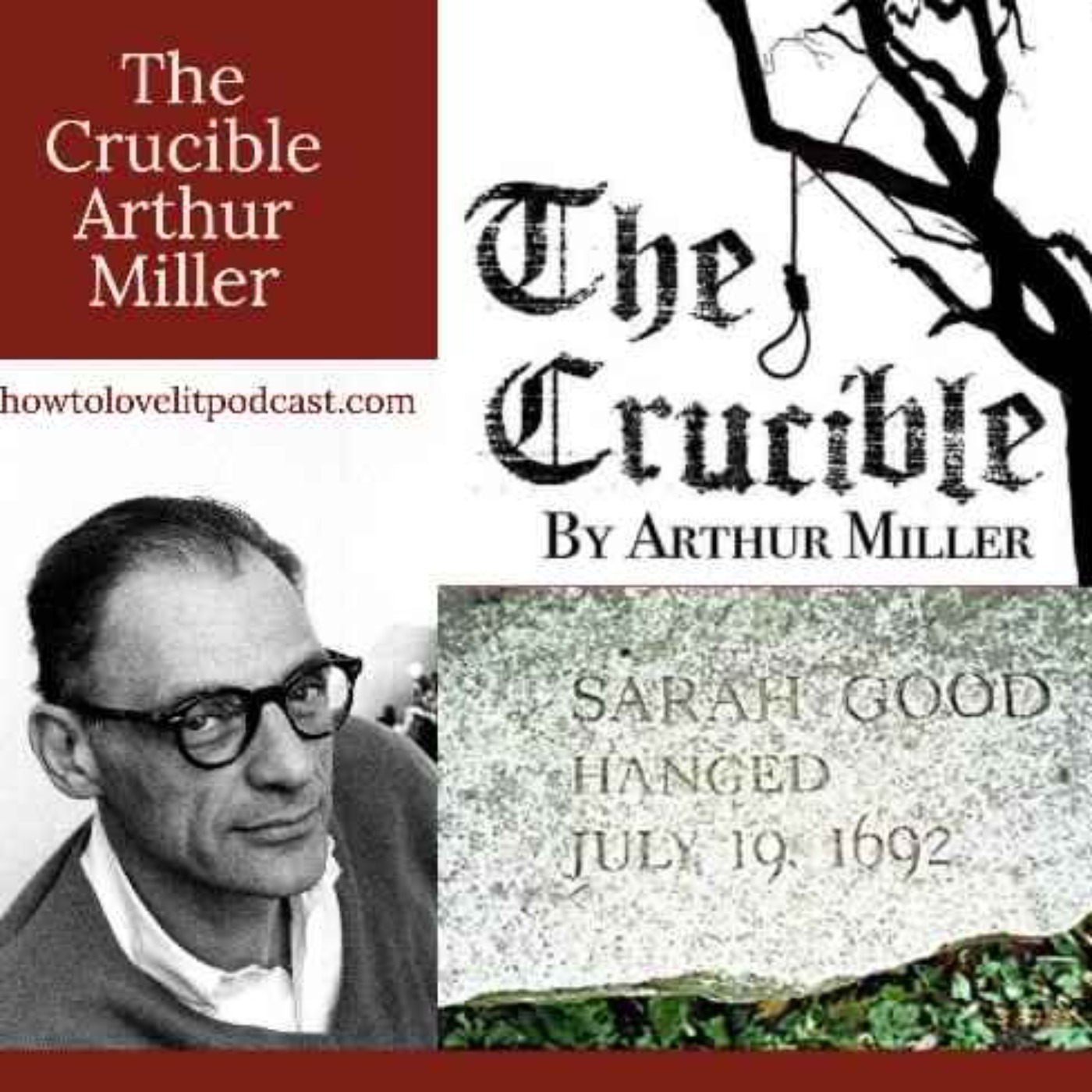
S1 Ep 38The Crucible - Arthur Miller - Episode 3 - Allegories Galore! - How To Incite Hysteria And Create a Bogeyman!
The Crucible || Arthur Miller || Episode 3 || Allegories Galore! || How To Incite Hysteria And Create a Bogeyman! Hosted on Acast. See acast.com/privacy for more information.
S1 Ep 396The Crucible - Arthur Miller - Episode 1 - Witch Hunts In Two Centuries! - Pulitzer Prizes! - Allegories Everywhere!
The Crucible - Arthur Miller - Episode 1 - Witch Hunts In Two Centuries - Pulitzer Prizes - Allegories Everywhere! Hi, I’m Christy Shriver and we’re here to discuss books that have changed the world and have changed us. I’m Garry Shriver and this is the How to Love Lit podcast. Today is new book day, and I always love new book day. We are starting our series on Arthur Miller and his timeless classic about human hysteria, The Crucible. I’m particularly excited about this series because it’s both extremely historical as well as psychological, as lots of things are- but in this case- it’s heightened. For sure, The Crucible is Arthur Miller’s most produced play worldwide becoming one of America’s most popular plays in the 20th century. Ironically, it failed at the box office in its initial production in 1953, so what does that tell you? Initial box offices don’t always get it right. Miller would say, almost never. He was very critical to how we organize theater in this country. I watched an interview he did with Charlie Rose later in his life and he talked about the problems he saw with American theater. It was kind of interesting to me. He complained that, as a nation, we could never get good at play writing and acting because of the financing piece. He wished we had a national theater- I’m not saying I advocate for that idea, because I can see a lot of problems in other ways- but he did make an interesting point. He made the analogy that if you took another profession, like plumbing or something, for example you create a plumbing company and hire people to be professional plumbers- they would have security and work continuously- finishing one starting another- seamlessly- and with each new job, they would learn to perfect their craft- obviously getting better and better all the time and the trade itself would progress in technique and so forth. He said today, our theater does things by the job- and he said it would be like the plumbing company going out and hirng new plumbers every time they have a different job to do, and in the between time the plumbers are out of work doing something else, getting out of practice with no time or incentive to work on things that would have a long term improvements. He says, this financial piece keeps actors from getting better, play writes from getting better, and theaters from taking chances on things that might take more than one week to get popular. He said, doing theater project by project makes that initial box office too important because the immediate return on investment is too high. But anyway, I hadn’t thought of it like that. Maybe he’s right. There’s certainly quite a bit of sequels and redundancy in the movie industry. That is one great thing about researching a person who only died in 2005- which is when Miller died. He was born in 1915 and lived until 2005- there is a lot of video footage of him, especially with his second wife, Marilyn Monroe. Oh my gosh, I know and I guess this is a good of time as any to get into a little bit of the facts about his personal and professional life, although we won’t spend too much time on that today. We can get into the Marilyn Monroe stuff when we talk about the Mccarthy era stuff. But for starters, Miller was a native New Yorker, originally from a well to do family who owned a manufacturing company. Unfortunately, during the depression, his family went bankrupt and to the poor house they all went, not an uncommon depression era story inAmerica. One fun fact about Miller’s early life for all your burgeoning students out there is that- Miller was a terrible student, which is something I always find interesting. He failed Algebra three time. So there you go- there’s hope for us all- even the non-mathematical types. For sure, it took him two years to raise enough money to pay for his college tuition, but He did finally go to a great school- the University of Michigan- all you Blue fans out there- (if you’re not from the US, Michigan is famous not only because it’s a prestigious university but their American football team is very good- although not as good as their SEC counterparts – if you ask me! HA!! Well, they likely could have beat the University of Tennessee this year. Ouch- why would you say something like that?? For those who don’t know, Christy and I are big football fans and Christy’s daughters both attend the University of Tennessee which also is a big and good school with a very historically important football team- although not so much recently. Football rivalries never die! Her best friend’s husband attended the University of Michigan- so she has a little personal vendetta!! Anyway, it was at the University of Michigan that Miller started writing drama. By 1947, he was lucky enough, fortunate to use a Machiavellian phrase- to have a play open on Broadway. The name of that play was All My Sons. It was an immediate hit- and there you go- back to Machiavelli, Miller, being a man of great virtue was able to maximize h
Ep 35Frederick Douglass Meets Elizabeth Cady Stanton-Abolition Meets Women's Suffrage!
Frederick Douglass Meets Elizabeth Cady Stanton-Abolition Meets Women's Suffrage! Hosted on Acast. See acast.com/privacy for more information.
Ep 34The Narrative of the Life of Frederick Douglass - Episode 4-The Power of the Future!
The Narrative of the Life of Frederick Douglass Episode #4-The Power of the Future! Hosted on Acast. See acast.com/privacy for more information.
Ep 33The Narrative of the Life of Frederick Douglass - Episode 3- "You have seen how a man was made a slave; you shall see how a slave was made a man"!
The Narrative of the Life of Frederick Douglass Episode #3- "You have seen how a man was made a slave; you shall see how a slave was made a man"! Hosted on Acast. See acast.com/privacy for more information.
Ep 32The Narrative of the Life of Frederick Douglass - Episode 2 - Pathos, Logos and Ethos - How to change the world!
The Narrative of the Life of Frederick Douglass - Pathos, Logos and Ethos - How to change the world! Hosted on Acast. See acast.com/privacy for more information.
Ep 31The Narrative of the Life of Frederick Douglass - Episode 1 - Meet the rhetorical genius that moved a nation!
The Narrative of the Life of Frederick Douglass - Meet the rhetorical genius that moved a nation! Hosted on Acast. See acast.com/privacy for more information.
S1 Ep 402Petrarch - The World's First Influencer - Father Of The Renaissance - Creator Of The Sonnet - And The World's First Tourist!
Petrarch - Father Of The Renaissance - Creator Of The Sonnet - And The World's First Tourist! Hi, I’m Christy Shriver. We’re here to discuss books that have changed the world and have changed us. I’m Garry Shriver and this is the How to Love Lit Podcast. This week is our poetry supplement that we like to do between books. Next week we’re going to begin our discussion of Arthur Miller and his allegorical work “The Crucible”, but before we leave the Renaissance, we felt we needed to take at least one week to discuss the man who is credited for starting the Renaissance= at least in part- the humanist part of it-- Francesco Petrarca or as we say in English Petrarch. Christy, this is one man that is so differently studied in the field of history versus your field or the study of literature- a testimony to his incredible influence, no doubt. So true, although everything intersects in the Renaissance- they were all renaissance men, of course!! But I neglected to point out and it was something worth mentioning that Machiavelli ends the prince quoting Petrarch’s famous poem, Canzone 128- a beautiful poem where Petrarch calls Italy to unity- The lines- Virtue against furyShall take up arms; and the fight be short; For ancient valourIs not dead in Italian hearts. It’s somewhat strange concept in the 1300s – which is when Petrarch lived two hundred years BEFORE Machiavelli- maybe even strange for the 1500s and Machiavelli’s day but a dream Machiavelli shared with Petrarch for their homeland- as they viewed it not just as Tuscany but as Italy. There is so much strangeness involving with Francesco Petrarch, I really don’t know where to start. First of all 700 years is so long ago- for an American- we can’t even think of history being that old. On our land, the inhabitants were different than those of Europe. The world was so different. Our history locks up that far back because of lack of information really. My colleague and dear friend Bill Bivens who teaches AP European History talks of Petrarch and his important influence on humanistic thought- which as we remember from the intro to Machiavelli episode- is this idea that Italians were going to revive the works of the Greeks and Latins- and Petrarch did this. Petrarch firmly believed that believing in Jesus Christ was not at odds with ancient classical thought and through his work he sought to make this important connection between the two ways of looking at the world- a way that for many during the previous era seemed to be at odds or heretical. People thought that if you were a Christian you didn’t accept anything secular and the ideas of the ancient thinkers were invalid BECAUSE they were not Christian- even today for some- religion and secular thought are at odds but in his day that was a crazy proposition. In an European history class you will likely read of Petrarch’s ascent up Mt. Vintoux. You may even read his famous letter supposedly written to a priest he used to confess his sins to, documenting this climb up the mountain that he claimed he did just to see the view. Christy, explain why do you say supposedly- Good question and one that looms over everything Petrarch- Petrarch addressed the letter to his confessor like it was a private meditation of sorts, but then he circulated it all over the place making it the very public piece of writing that we read to this day. So, there you go- the reason for that-id something I want to talk about. But as far as climbing Mt Vintoux goes, Petrarch’s climb up the mountain is extremely famous, Petrarch is even considered to be the informal patron saint of mountaineering. I know it’s a tangent, but for those of us who have never been to Southern France, I think it’s worth mentioning that Mont Ventoux is a famous mountain in the South of France that we know better today because part of the Tour de France- the bike ride. Geographically it stands out kind of by itself, so you can see it from all around. It’s also unique because the peak covered in limestone making it look like it’s covered in snow all year, even though it’s not. It’s considered one of the most grueling parts of the race, Today of course, most people drive to the top. Regardless, Petrarch’s climb to the top, is the first of thousands of pilgrimages up this famous mountain with the purpose of going up there just to see the view. As he likely intended, I believe. Petrarch is considered to be the first tourist- not necessarily because he climbed Mt. Ventoux, but because he’s the first person to document traveling solely for pleasure- so there you go- that’s a even bigger trend that caught on, But of course, most of his time was spent doing a lot of scholarly work primarily in Latin much of which nobody but scholars ever reads anymore but his ideas have disseminated through a lot of writers who read him- for example, Machiavelli. A good example of this is the phrase- “The Dark Ages”- he coined that phrase and people use it to this day to refer to the Middle Ages.
Ep 91The Prince - Niccolo Machiavelli - Episode 4 - The Glory Of The State Is Liberty! - The Conclusion Of The Prince
The Prince - Niccolo Machiavelli - Episode 4 - The Glory Of The State Is Liberty! - The Conclusion Of The Prince Hosted on Acast. See acast.com/privacy for more information.
Ep 90The Prince - Niccolo Machiavelli - Episode 3 - The Paradoxes Of Power - All Is Not What It Seems!
The Prince - Niccolo Machiavelli - Episode 3 - The Paradoxes Of Power - All Is Not What It Seems! Hosted on Acast. See acast.com/privacy for more information.
Ep 89The Prince - Niccolo Machiavelli - Episode 2 - Virtue, The Occasion And The Art Of Power.
The Prince - Niccolo Machiavelli - Episode 2 - Virtue, The Occasion And The Art Of Power. Hosted on Acast. See acast.com/privacy for more information.
Ep 88The Prince - Niccolo Machiavelli - Episode 1- Meet The Author Of One Of The Most Important Works On Political Thought!
The Prince - Niccolo Machiavelli - Episode 1- Meet The Author Of One Of The Most Important Works On Political Thought! Hosted on Acast. See acast.com/privacy for more information.
Ep 36The Christmas Story Special! The Gospel of Luke Chapter 2.
The Christmas Story Special! The Gospel of Luke Chapter 2.Silent Night Kevin MacLeod (incompetech.com)Licensed under Creative Commons: By Attribution 3.0 Licensehttp://creativecommons.org/licenses/by/3.0/ Hosted on Acast. See acast.com/privacy for more information.
S1 Ep 408Clement Clarke Moore - The Story Behind 'Twas The Night Before Christmas' - Christmas Special!
Clement Clarke Moore - The Story Behind 'Twas The Night Before Christmas' - Christmas Special! Hi, I’m Christy Shriver, and we’re here to discuss books that changed the world and changed us. I’m Garry Shriver and this is the How to Love Lit Podcast- we hope you enjoyed the intro music by Memphis’ very own local musicians- Holly Shotsberger and David Shotberger. Dr. David is a composer here in town and Holly is a professional flutist and singer; they also serve our community by leading music in our church, David teaches at Rhodes College and Holly is a speech pathologist for Shelby County Schools. In this season of giving we want to give out as many shout-outs as we can to the people who make a difference in our world, so if you have a small business or know someone in your community who does, please email us I’m [email protected] so we can post a picture of your favorite spot or some of your favorite peeps. As we get closer to Christmas and the end of the year, there are so many traditions that mean something special. Since I was a little kid, this has always been the most traditional time of year for me, as you know, Christy. I LOVE Christmas and everything about it. I love decorating the house, making homemade Christmas ornaments, the parties, the rich food, the music, the lights on people’s home. I even love the cold weather. Some of my happiest memories as a child and as a parent revolve around Christmas. Well, I share your sentiment. I love Christmas, too. Although, as you know, most of my life, Christmas was NOT about cold weather- au contraire- in Brazil, we also really didn’t go so out of control on the whole holiday decorating thing like we do up here. Another difference for us was that Christmas was about the end of the school year (our school year ended in December). And Since summer vacation was in January, we were also looking forward to time at the beach! One other difference, since we’re talking culture now, is that my Brazilian friends all ate their Christmas dinner at midnight on Christmas Eve, but we had our big dinner at lunch on Christmas day- so we could party at our friends on Christmas Eve, crash out, open presents and then ate again. All the best traditions wrapped up in 24 hours! Speaking of Christmas Eve or the night before Christmas-- that takes us to our poem- the title of which is A Visit from St. Nicholas, but everyone refers to it by its first line- Twas the Night before Christmas presumably by Clement Clark Moore. Christy, before we read the poem, do we know who this guy is? Sort of- I have to admit- I absolutely had never heard of him before in my life and had to really research him to prepare for today. He’s kind of an obscure guy- but let me say the story of this poem, even though it evokes childhood memories for a lot of people- is NOT without its own scandal. Should we share? Well, of course. Let’s start with the uncontested parts and then we’ll get into the controversy and then after the scandal has been settled, we’ll read and discuss the most quintessential Christmas poem ever written on the American continent. Good plan- how about you do the historical stuff and I’ll do the scandalous…although, I will say, it’s not Emily Bronte level scandalous- more like Christmas Lifetime movie scandalous. Sounds good- Clement Clarke Moore was born in 1779 in New York City, now remember, that’s only three years after the declaration of Independence- not the most settled time in US history. But Moore’s family seemed to do okay, even if there were some of them that were British sympathizers and others pro-revolutuion. His father, Benjamin Moore,(Like the paint brand)Yes- was a well-respected Episcopal priest, and rector of the famous Trinity Church. If you’ve ever visited or seen pictures of lower Manhattan in NYC, this is the church right there on Broadway and Wall Street. Christy, you’ll like this , one of Benjamin Moore’s more famous accomplishments was ministering the last rites to Alexander Hamilton after his famous duel with Aaron Burr. Did you throw that tidbit in there for all of us Hamilton fans? I did. Anyway, Clement Moore himself was a very scholarly and religious man and apparently a very serious man very invested in theological education, although not a priest like his father. He was most well-known at the time for translation work for Bible students; he created a lexicon for Bible students studying to translate things into English from Hebrew. Another fun-fact about him is that he inherited quite a nice piece of land right there in what is today the heart of New York city. He subdivided it into lots and sold it to wealthy city residents creating the neighborhood Chelsea (which was the name of his property)- you may recognize that name because today it’s still an upscale neighborhood on the west side of Manhattan- and although it’s likely few Chelsea residents know they are living on the property of the guy who wrote invented our Jolly Ole Santa Claus conc
S1 Ep 410Wuthering Heights - Epsiode 5 - Emily Bronte - Redemption, Forgiveness and Overcoming
Wuthering Heights - Emily Bronte - Episode 5 - Redemption, Forgiveness and Overcoming WH- Episode 5 Hi, I’m Christy Shriver and we’re here to discuss books that have changed the world and have changed us. I’m Garry Shriver, and this is the How to Love lit Podcast. If you have made it this far into Wuthering Heights, I feel like you deserve an award or something. This is our fifth episode analyzing this book, taking five episodes on a single work is something we have only done with two other authors- Hawthorne with the Scarlet Letter, our first series, and then again with our Shakespeare plays. But my goodness-navigating through Wuthering Heights is nothing short of brutal- I’ve gone back and looked at those initial harsh criticisms we read in episode one- and I have to admit, they weren’t wrong in recognizing this. Well, you are right about that. It IS brutal- but honestly, how could a book about generational abuse be anything except brutal- exposing the brutality of abuse is in many ways at the heart of this book, but honestly, an even more important purpose- and for me the reason to suffer the experience of reading this book, is because Emily offers hope. There is literally NOTHING anyone can ever do to undo any abuse anyone has suffered in the past- and Bronte highlights that very clearly- however, she suggests that even under terrible circumstances, there is a way to be free of the curse of abuse and move into a future of new beginnings- and yet she absolutely parallels with this idea that it is also possible and perhaps in some ways easier to live and die in the victimhood of the past- this week we will end this journey and for me she concludes in an almost fairy tale-like way- which is alright with me! My first question about this book when I read it was this- why does Bronte give the girls the exact same name? It’s SO confusing. Even if one had been Catherine and the other Cathy that would have helped= but she even mixes the nick names up- deliberately trying to get us the confuse the two women. Mine too- actually- Of course, it now occurs to me, as I really believe great authors don’t do things accidentally or whimsically- that this confusion is for us to undeniably understand that the journeys of the catherines is perhaps the same journey- the experiences are the same- and yet she juxtaposes two opposite postures in life and two very different outcomes: one a tragedy the other a comedy- one ends in death, the other a wedding. And this last episode absolutely leaves us with a feeling we haven’t felt as we’ve left parts of the book- this last episode leaves us with a feeling of hope, security and empowerment- it also clarifies Emily Bronte’s heterodox religious views- which I will say are very Christian in tradition, but not traditional in their Christianity (that, btw is a chismus- I’m proud of that sentence structure- that’s hard to do. HAHAHA- chiasmus it is- but let me say that hope, security and empowerment are great emotions to carry forward especially this time of year and particularly this year, if you are listening to this episode in real time- this is the first weekend of December, which in the Western tradition is the month where we do focus on hope, peace on earth and good will toward men- and it is the year 2020. So happy December 2020! as we round out the tumultuous or wuthering year of 2020, Christy and I have thought about how WE could use our small voice to give hope, peace and good will to the different communities that we connect with through this podcast and we came up with a small idea. 2020 has been SO brutal to everyone, we thought, if we could do nothing else, we could at least give some recognition and a shout-out to small entrepenuers out there who are braving our 2020 storm, opening their businesses, serving their communities and connecting people. So, this is what we want to propose, if you are a small business or if you have one you love and want to support- email us a picture or a shout out at [email protected] and that is garry with two R’s not one R G-A-R-R-Y. Or just go to our website. We will promote your business and your community on our social media accounts, recognizing and giving respect to all of us pulling together this year in a unique way. Okay- back to the story- let’s give a little recap as how we’ve tried to organize this book. In episode one, we covered chapters 1-3 as we were introduced to the estate and residents of WH. Episode 2 we made it into chapter ten- discussing the childhood years of Catherine and Heathcliff and reading out that most famous, “I am Heathcliff” speech Catheirne gives as she decides to marry Edgar. This is the speech Heathcliff doesn’t hear because after hearing that she thinks it would degrade her to marry him he runs away. Yes- in Episode 3- we’ve jumped three years. Edgar and Catherine are married and then six months later, Heathcliff is back- a changed man- he’s good-looking and rich. He’s also a man on a mission-
S1 Ep 411Wuthering Heights - Episode 4 - Emily Bronte - Marriage, Kidnapping, Co-dependency And Other Signs of Love!
Wuthering Heights - Episode 4 - Emily Bronte - Marriage, Kidnapping, Co-dependency And Other Signs of Love! WH episode 4 Hi, this is Christy Shriver. We’re here to talk about books that changed the world and changed us. I’m Garry Shriver and this is the How to Love lit Podcast. This is our fourth episode discussing the tumultuous inhabitants of Wuthering Heights and its neighboring estate Thrushcross Grange. And I must say, Bronte aptly selected the appropriate metaphor to develop the characters in the book as we have seen in the last three episodes, but just when you thought Bronte has pushed her characters as far as they could go, she takes it one step farther. In episode 1, we introduced Emily Bronte herself, we met Lockwood, our first narrator, and the we met briefly most of the main characters in the book: HC, Catherine, the mom via her ghost, Catherine the daughter, Hareton, Joseph and, of course Nelly. I guess the only reason we didn’t meet the rest of them is because they’re all dead. Yes- here we already started with the name confusion because both female protagonists have the same name- And it’s not surprising once you get to meet Catherine ONE- if you want to call her that- that she doesn’t exit the story- not even upon death. Catherine ONE is one character who will not be ignored, and she basically dominated our discussions in the last three episodes. We discussed her and Heathcliff’s relationship as children, her relationship with the neighbors Edgar and Isabella and then finally the love-triangle that defined her life and untimely death between herself, Edgar and Heathcliff. Yes- Catherine’s presence does dominate and define both Edgar and Heathcliff’s lives from the beginning to the end, but earlier I made the statement that I think Heathcliff himself is the central character in the story- and I know that’s arguable- I still see him as the more interesting character. At the beginning we are made to sympathize with him as he’s abused and neglected by those responsible to care and provide for him. He’s rejected by Catherine who, although claims to love him, chooses to marry Edgar, the rich neighbor. However, after Catherine’s death, there is a vengeful evil in Heathcliff that particularly defines the middle portion of the book- and although it certainly doesn’t make him a likeable person- it does make him a dynamic character- and if you remember what that means- a dynamic character is one that changes over the course of the story- and in his case, we see a stark difference between the Heathcliff that runs away after Catherine crushes him, and the Heathcliff that comes back determined to get revenge on everyone in his life. And this seems to basically center around two people although he targets many more. He wants revenge on Hindley for abusing him as a child, and he wants revenge on Edgar for taking his girl. And this of course brings us to Isabella and their marriage which is nothing short of horrific. It ends as violently as it begins (remember he hangs her dog on the way to the elopement). On the night she leaves him forever, she blames him for Catherine’s death- literally saying Catherine was too smart to bear his abhorent last name without expressing her disgust, then he picks up a dinner knife and flings it at her head. It strikes her beneath her ear…one last abuse…she pulls it out kind of undoing the violence that had united them in marriage...and runs away. Well, and what we find this week, is that that’s just the very beginning of the violence, rage and evil Heathcliff is capable of. Are you sure, Heathcliff’s been called a hero- even a Byronic hero seems a kind description of what this guy seems to be? Ha! Well, he’s definitely not a traditional knight in shining armor, but you have to remember, this is a gothic novel- and gothic novels have different rules. I guess, I should kind of define what that is- although briefly- gothic is the kind of word most of us have heard of and we think we know what it means, but we’re not sure. Gothic novels were really a fad in the late 1700s thrgh Bronte’s lifetime and There is a group of characteristics that came to define what these novels were about and honestly even today we recognize these traits that signal we might be reading a gothic novel-- for example, they usually involve a castle- either ruined or haunted, lots of shadows, beams of moonlight in the blackness, flickering candles, extreme landscapes, omens and/or ancestral curses, magic or supernatural manifestations, a passion-driven willful villain-hero or villain, a heroine with a tendency to faint, a hero who’s true identity is revealed at the end, or a horrifying series of events. Gothic novels have things like necrophilia, incest, diabolism, social chaos, imprisonments, things like that. They play around with the concepts of fear, they push boundaries between life and death, light and darkness- sanity and insanity- so you can see Wuthering Heights meets a LOT of these criteria and y
S1 Ep 412Wuthering Heights - Episode 3 - Emily Bronte - Tantrums, Crazy Relationships, Rejection, Revenge - Part 2!!!
Wuthering Heights - Episode 3 - Emily Bronte - Tantrums, Crazy Relationships, Rejection, Revenge - Part 2!!! ‘WH episode 3 Script HI, I’m Christy Shriver and we’re here to discuss books that changed the world and changed us. And I’m Garry Shriver and this is the How to Love Lit Podcast. This is our THIRD episode in our series on Emily Bronte’s classic Wuthering Heights- and good grief- this book is infinitely complex. Last week we went long talking through chapters 1-9. Before I get any farther, I can’t forget to remind you to please text an episode of our podcasts to a friend and encourage them to listen. Also, give us a rating- preferably 5 stars, we’re trying our best to do our best, but we can’t grow without you. But, back to our story- and what a story it is…today we are going to try to push through til chapter 17. To recap last week we discussed most of the first part of WH. We chronicled the life of Heathcliff and Catherine Earnshaw as they grow up at Wuthering Heights. We discussed the brutal abuses they endured, but honestly for the most part, and especially towards toward the end, we shined the focus on Catherine- and what a trainwreck of a person she is. She’s beautiful, she’s energetic, she’s lively and fun, but she’s also almost entirely about herself…I even used the word I reserve for really complicated situations- maybe even a borderline personality- although, may I reiterate, I would never diagnose a fictional character, but, it’s eerie to me how clearly Emily Bronte describes this most disturbing of conditions…and I should say, before I go further, if you don’t know what I’m talking about but know someone that reminds you of Catherine Earnshaw, research Borderline personality disorder. Emily Bronte predates all of modern psychology, but what she observed and recorded is something many have seen and lived with in their own real world- although we will never know what or who that something or someone was- she nails the lived experiences of many who find themselves as she puts it “honeysuckles embracing the thorn- there were no concessions. Yes- and this week it is just going to get crazier- this section is action packed- full of complications in the plot line- I find myself having to reread some of this stuff over and over again just to figure out what just happened. Bronte artfully throws you into a world- a windy world, as she reminds you, where you can’t catch your breath, you can’t understand what just happened and sometimes you don’t even know what you’re looking at. And while the emphasis of the last episode was on Catherine, this week, we will change directions slightly and give more emphasis (although Catherine will always demand attention) but we will devote most of our attention to Heathcliff and the other characters in this unusual tale. As we clearly saw last week and will continue to see onward, life at Wuthering Heights is absolutely nothing short of violently abusive to anyone who ventures through its doors. And let me point out as we transition from the first generation to the second- Bronte carefully demonstrates for us that the legacy of abuse often does not die with the first generation- what we are going to see here is generational abuse. The children are abused by Hindley and Joseph both physically and verbally but Heathcliff is especially abused emotionally and psychologically- the most damaging of all abuse- and this will all be passed forward. But, Catherine and Heathcliff are not the only two characters in the book- just as Wuthering Heights is not a story about only one house. This book is about doubles. There are two houses- one chaotic- one peaceful and the peaceful is Thrushcross Grange. There are two sets of children- one set that is wild; the other is tame. There are also two types of defective love- and Bronte explores both of these as well and how this impacts adulthood. Yes- and looking at these parallel structures makes it easy to categorize. We have these two children from Wuthering heights who are clearly victims of neglect, abuse and rejection. They are unloved and this defines their adulthood. Although Mr. Earnshaw loves Catherine and Heathcliff, he subjects them to the merciless brutal depravation and degradation that is life with Hindley and Joseph- of course this is much more Heathcliff than Catherine. I want to point out, and it’s easy to overlook because reading Joseph’s dialogue is such a nightmare, I find myself just skipping it, but Joseph is truly a treacherous person and to live under this guy’s physical and mental abuse is something that should not be understated- at one point, Catherine gets so upset she throws her Bible into a dog kennel- and I will also add that he’s abusive to everyone all the way to the next generation as well. But, suffice it to say, Catherine and Heathcliff grow up in an environment where they are not loved. However, Edgar and isablla, although they are loved, live in a household of what you could call too much love- th
S1 Ep 415The Raven - Edgar Allan Poe - Halloween Special!
The Raven - Edgar Allan Poe - Halloween Special!Hi, I’m Christy Shriver. We’re here to read books that have changed the world and have changed us. And I’m Garry Shriver- and this is the How to Love Lit Podcast. Let me remind you one more time to please give us a five star rating and a review. It’s how we can be a part of the podcast game! And If you’re listening to this in real time- HAPPY HALLOWEEN from the Good ole USA and the great state of Tennessee. That’s right, of course lots of us live all over the world and we are so grateful for those of you who tune in from places as far away as Riyadh, Pakistan and Sydney in New South Wales, and if you think about it and have time to check in with us- drop us a line about different days we can shout out and different traditions from all over the world. We all share this great place called Planet earth and it’s fun to compare traditions- as far as the US goes, Halloween is one of our stranger holidays. Yes- everyone dresses up in costumes- some funny, some scary, some made from scratch, some very expensive. I remember, one year, my daughter, Anna, made a costume out of a trash can- she went as the tin- man- in the fifth grade. Then the next year when she started going to dances, she was pippi longstocking. Both of your girls are known for her crazy costumes, didn’t Lizzy dress up as the old man from Up one year? Yes, and Anna went to a party last year dressed as salt- as in the condiment? Since we’re not rich people, we’ve always had to get really creative with whatever leftover clothes we found in the back of closets- sometimes the neigbors closets. And we’ve often tried to be funny. Lizzy and her roommate last year went as Shark Boy and Lava girl- silly things like that. Well, we probably shouldn’t go into the details of our last year’s fiasco as you and I went as Fred and Wilma Flintstone?, but I think people get the idea- that Halloween, for all of the spooky movies and so forth, is supposed to be a time of having fun, playing around, giving candy to children and making connections with neighbors and people you live around but may never socialize with. True- growing up in Brasil, we, of course, didn’t have Halloween, but we did have something in June (which is fall for us south of the equator) but we called it Festa Junina- or june festivals- and to me it served the same purpose. There was dancing, and costumes, and fun foods and community. I really don’t know how Halloween developed, but I really do wish they had kept the scary out of it. Ha! Well, it’s a long history dating back to the Celts and Druids originally, but it has definitely evolved so much so that today- almost ¼ of all the candy sold in the United States is sold around this holiday- so as you can see the emphasis has definitely changed from the semi-serious to a dentists dream holiday!!!! That’s true, and of course, we’re participants- with door decorations, candy, and today we’re celebrating by giving a nod to one of American’s scariest writers- Edgar Allan Poe. Yes- last week, we discussed his very difficult early days. We began with the death of his mother, living with an adopted family, the Allan’s, where the mother died. And his extremely antagonistic relationship with his adopted father. We also discussed his very tumultuous professional career: getting kicked out of school, being discharged from the military, and getting hired and fired up and down the east coast multiple times. His life was not an easy life- there is no doubt- but amid all of this often self-destructive struggle he did produce some very remarkable and iconic art. Poe’s career really lasted over 20 years if you date the beginning from when he published his first book of poetry at the age of 18- and lasted until he died 22 years later. His greatest success came in 1845 with the publication of his most famous poem- the Raven. It came out in the New York Evening Mirror on January 29, 1845 and went viral immediately. I’m not sure he even made ten dollars for publishing the poem itself even though It was republished over and over all over the world. BUT it did lead to him being able to publish a book called “The Raven and Other Poems”- that did sell and helped him stabilize his finances for the first time in his entire life. This poem made him famous in the way “Put a Ring On it” made Beyonce famous- Or maybe- I’ve got Friends in Low Places” for Garth Brooks.Or Dancing Queen- for ABBAOh my- do all roads lead to Mamma Mia…Not all-but many, if I’m drawing the maps!! True- Well, I guess the idea being there is a break out hit that makes someone’s otherwise unnoticed work now visible. Exactly, even though that’s hard for us to conceive that a poem could ever be famous today. We don’t rave over poetry like this now- but if you’ve ever seen Anne of Green Gables, you may can visualize what I’m talking about. People in other eras would memorize great poems and then the would perform and recite them for other people at parties or even
S1 Ep 416The Cask Of Amontillado - Edgar Allan Poe - Halloween Special!
The Cask Of Amontillado - Edgar Allen Poe - Halloween Special! Hi, I’m Christy Shriver. We’re here to talk about books that have changed us and changed the world. I’m Garry Shriver and this is the How to Love Lit Podcast. If you’re listening to us for the first time or have been listening for a while, please take a second and scroll down to the bottom of your podcast app and hit the five stars- that helps us move up in the world!! And if you’re thinking, I don’t know if I want to give them five stars- rest assured- we’ve got a great discussion for your on a great poet and short story writer. You’re going to love it. He’s a fan favorite- even though, I have to be honest, he’s not my favorite- no fault of his, it’s on me. Today and next week we’re talking about the one and only Edgar Alan Poe. Christy, I like Edgar Alan Poe. I remember reading his stories in class as a teenager- one of the few things I actually remember from my high school English classes, and they were entertaining. I know, and he’s still super-popular. All of my kids really like him – even if he is incredibly hard to read, but as you know and I brought this up when we went through Mary Shelley’s Frankenstein= being scared is just not my thing, and Poe is very scary- his writings even find humor in the grotesque and that’s what people like. There’s such a range from gothic horror, to true evil, to the struggle between the rational and the crazy- there is even sadness- all of that- it can be truly frightening. That’s his contribution really- and totally not my genre although I respect the art, so I tried to pick a couple of his less creepy pieces for this series- for myself really- I can’t go down the road of burying people alive- although I know all you Stephen King fans feel the adrenaline rush of the faux-terror!!!. In that case, Christy- thanks for taking one for the team there for this special holiday series- if you’re listening to this in real time we are doing Edgar Alan Poe this week and again next week because here in the United States it’s Halloween and in most of Latin America just south of us it’s followed up by the Day of the Dead, so it is all in the spirit of community- which in Memphis, to be honest- Halloween is more about community than anything else. Even in the year of Covid- houses are decorated, candy has been purchased and everyone is in the spirit of getting outside and seeing your neighbors that you really don’t see much doing the year. My son, Ben, and his wife, Rachel, who live on a street where decorations and trick or treating is particularly serious business have made a special Covid candy shoot, so kids won’t have to come all the way to the door this year. They are going to send candy down a shoot they made out of plumbing pipes into the buckets of the trick or treater children, true innovation and effort for the season. So, Christy, think of that instead of the gore as This week, we highlight the popular short story “The Cask of Amontillado” and next week the very popular poem, “The Raven”. And, per our usual, let’s start with the life and times of Edgar Alan Poe. Yes- and I know we could talk for an entire episode just on his life, but the Cask of Amontillado is so interesting, we’re just going hit a few big highlights of Poe’s life this week- and then we’ll talk about his mysterious death next week- maybe we’ll circle back around next year for Halloween and hit him again with an even creepier tale if I have the nerve, but in summary- Poe’s life very much mirrors the chaos and gore that so often characterized his writing. Poe’s life had so many self-sabotaging events, lots of people have questioned whether he was mentally ill. Garry, do you have any thoughts on that before we start to illustrate what I’m talking about. Well, let me just say that it goes without saying that you cannot and I haven’t seen any articles from any real legitimate sources that medically diagnose a person who is not alive- and since Poe died in 1849, this is nothing but speculation. At that time people used the expression that someone was “mad’. But science has evolved significantly since those days, and we do understand a lot about what haunts us as humans- and from his writings we can see a lot of this reflected. Today there are treatments that can truly change the course of people’s lives who back then would be condemned to feeling lonely, estranged and depressed- things Poe powerfully illustrates. Also, I will say, that genius and insanity, some would say is often entwined. There are many many examples in history of amazing people who stood out in their generation by being great artists but who likely truly struggled with some shadow of mental illness. We obviously think of Van Gogh, but Mark Twain, Hermann Hesse, Ernest Hemingway, Virginia Wolfe and Sylvia Plath are just a few writers that pop out immediately. Poe seems to fall in this category. Heck, Poe himself once said when asked if he was crazy, “The question is not yet settl
S1 Ep 417Romeo & Juliet - Episode 5 - The Worst Way To End A Story... And Become A Classic!
Romeo & Juliet - Episode 5 - One Of The Worst Ways To End A Story And Become A Classic! Hi- I’m Christy Shriver and we’re here to look at works that changed the world and changed us. We do hope you have enjoyed this series on Romeo and Juliet, and we ask that if you did, please give us 5 star rating. That moves us up on the algorithms- you know those spirits that control the inter-webs. And I’m Garry Shriver, and this is the How to Love Lit Podcast.Christy, speaking of those algorithms, of course our minds go straight to the pressures of social media and that’s on your mind- but in some way as we finish out Romeo and Juliet- we can see that social pressure has been detrimental since the 1300s, if you are of the mindset that this is a true story. Well, you know I think it is. Indeed, and although it’s fun to think of Juliet as being real when we think about visiting her house in Verona, as we come to the conclusion today, if we think of her as a real girl struggling with real anxiety and intense pressure, this story gets so much more tragic. If you remember episode 1 of this series, we discussed how in comedies we can laugh at the protagonists because we’re better than they are, but in tragedies we can grieve for the protagonists because they are better than WE are and don’t deserve what’s coming- here as we finish out this book- these two protagonists have gone from the silly teenage lovebirds we all related to and laughed at (slash rom-com charaters) to these incredibly isolated children who find despair and don’t see a way out when everyone else in the world can EASILY see one (tragic heros). Well, of course you know I agree with that. Romeo is loveable albeit a little silly in Act 1 as he pines away for Rosaline all the way until he sees Juliet and than immediately falls head over heals for her. Than of course, you’ve heard me talk admirely about the way Shakespeare has portrayed Juliet from the beginning. She’s strong, extremely intelligent, very decisive and seems to understand how to understand herself and what she wants with her life. Yes- and what we discussed in episode 2 is that- she may be the only one in Verona that IS all those things. Verona is a wreck. The feud is pointless. The teenagers and young adults are drifting around with nothing to do, the adults are self-involved looking out only for their own advancement- if that, and the prince is weak- basically just succumbing to what the important or cool people want him to do or say. We ended episode 2 with Romeo under Juliet’s balcony and these two teenagers trying to escape all this by pronouncing true love to one another. Both teenagers desperate to get away from the chaos of Verona and into a private world of their own making. Something all teenagers dream about- but those who live in particularly chaotic surroundings can certainly identify with this fantasy. I totally agree with that- again- it’s as lovely fantasy- and youthful and optimistic- dreamy. And I want to agree with another artist who has gotten inspiration from this play- the popular artist- Taylor Swift. Now many people know Taylor Swift for her pop music, but she first got her start in Nashville in country music, just up the road from us in Memphis, and one of her first and to be honest it’s still my favorite song of hers, is called Love Story and it’s about Romeo and Juliet. I love that song too, and if I thought we could play it without getting in copyright trouble, I’d play you a clip from it. According to her description of how the song came to be, she had a boyfriend at the time that her parents didn’t like, and her experience with this boyfriend reminded her of this great classic. She identified with the dream of Romeo and Juliet. Yes, although I didn’t know that about the history of the song, but what I did know, is that Taylor Swift tracked with Shakespeare and really understood the character of Juliet probably more than most readers really do. I want to read a section of her song (because that IS allowed according to copyright laws) and because Swift’s interpretation of Juliet’s thinking is spot on…Swift writes Romeo, take me somewhere we can be aloneI'll be waiting, all there's left to do is runYou'll be the prince and I'll be the princessIt's a love story, baby, just say, "Yes"Romeo, save me, they're tryna tell me how to feelThis love is difficult, but it's realDon't be afraid, we'll make it out of this messIt's a love storyy, baby, just say, "Yes"Oh, ohI got tired of waitingWonderin' if you were ever comin' aroundMy faith in you was fadingWhen I met you on the outskirts of town, and I saidRomeo, save me, I've been feeling so aloneI keep waiting for you, but you never comeIs this in my head? I don't know what to thinkHe knelt to the ground and pulled out a ringAnd said, "Marry me, JulietYou'll never have to be aloneI love you and that's all I really knowI talked to your dad, go pick out a white dressIt's a love story, baby, just say, "Yes" What are you seeing here
S1 Ep 418Romeo & Juliet - Episode 4 - The Power Of Impulse And Really Bad Ideas!
Romeo & Juliet - Episode 4 - The Power Of Impulse And Really Bad Ideas!Romeo and Juliet Episode 4 Hi, I’m Christy Shriver- and we’re here to discuss books that changed the world and changed us. Don’t forget, if you enjoy our work, please give us a rating, a comment- both – with your podcast provider-also share an episode with a friend- that’s the only way we grow. I’m Garry Shriver- and this is the How to Love Lit Podcast. This is our fourth episode exploring the Shakespearean world of Romeo and Juliet. Week 1 we met our author, William Shakespeare and introduced the play through the iconic sonnet that sets the scene. Week 2- we explored the political world of Verona, met our feuding families and introduced the star-crossed lovers- Romeo and Juliet -ending by reading the beautiful words spoken to and from that glorious balcony where lovers to this day come as pilgrims. However, last week, Christy tried to destroy all of our fantasies of love at first sight and passionate adolescence by introducing an alternate reading of this famous passage and presenting a theory that Juliet is a young adult exerting power on the universe and changing a fate prescribed to her by her parents. It’s not that she’s not in love with Romeo, or so you propose- it’s that love is secondary to self-preservation or at least aligned with it- Romeo is an extremely good-looking young man- emphasis being that he’s her own age, and she’s facing the prospect of a life with an old geezer. However, we didn’t end there. We ended our discussion; with life in Verona taking a darker turn: a street fight has gotten out of control and two people are dead: Mercutio and Tybalt. Romeo and Juliet, although technically married, have a huge problem- Romeo is the murderer. The Prince in an effort to be merciful has banished him from Verona, and he is basically on the run. We have left our story with our heroine in a tizzy. She, waivers perhaps for a minute but quickly decides she’s staying with Romeo. The nurse has promised to bring him up to her room for one last night of passion, if you want to put it that way, and we are now waiting to see what happens next. That’s where we are- ready to pick up our story in the flat middle, slightly after the climax with the murders- there is so much to say. In fact, so much so, that I am overwhelmed really, I could talk and talk (although I promise I wont) and still feel like we’re not doing justice to the text. I can’t tell you how much research has been done on this play, hundreds of years of analysis.. but just to give you a taste, I thought I’d bring up some fun facts. So one of the things that Shakespeare really makes a big deal about in this play, and we’ve made a big deal about it too, is the fact that Juliet is so young- between 13-14. Well, you know who else is young- Shakespeare when he wrote this play. This is an early play for him, and, this of course, is just me totally running my mouth- but I think a lot of the funsie stuff he does in this play is just to show off that he’s just that good. By the time Hamlet comes around, I think that debate has come and gone. But here’s what I mean by showing off- so back to Juliet’s age- obviously Shakespeare is making her so young that no one can miss that she’s too young to get married. Capulet even tells Paris that “too soon mard are those so early made.” But Shakespeare plays around with the number 14 for the rest of the play- as number symbolism was really popular at this time. Juliet’s name has 13 letters. She’s the 13th character to enter the stage. Romeo refers to her by name 14 times. There are 13 proper nouns on the Capulet’s list to the ball. 14 males. Sonnets obviously have 14 lines. Romeo’s kiss to Juliet is between the 13th and 14th line he speaks to her!! The play begins on July 14th, a fortnight and three daysd before Lammas Day and concludes 13 days short of Juliet’s birthday. There is a major event in the play that occurs every 14 hours- beginning with Romeo meeting Juliet, then 14 hours later are married…fourteen hours fourteen hours all the way til their death. Now, I don’t know what’s weirder-that Shakespeare did that or that someone took the time to figure all that out. But what does it mean? I know, and yet I have no idea. I’ve read articles saying it reflects an indictment her age, others say it reflects a sonnet form and an emphasis on true love- I think it’s Shakespeare showing off the fact that he can do the number thing with the best of him. Who knows for sure, but one think I really do think is that Shakespeare clearly loved Juliet and makes her the heart of the play…and I find that sweet. I like Juliet too, and I don’t like a lot of Shakespeare’s women. I definitely don’t like Ophelia from Hamlet nor either of the Julius Caesar ladies. They’re weak, but Juliet is not- and that brings us to our starting point because when we open up in Scene 3- we don’t find a strong Juliet- we find a dweeby- noodle-brained Romeo. He’s hiding in Friar Law
S1 Ep 419Romeo & Juliet - Episode 3 - From Comedy To Tragedy!
Romeo & Juliet - Episode 3 - From Comedy To Tragedy! ,k Hi- I’m Christy Shriver. We’re here to talk about books that changed the world and change us! Hi, I’m Garry Shriver, and this is the How to Love Lit Podcast. Today we begin our third episode on Shakespeare’s iconic Romeo and Juliet. Week one, we discussed, albeit briefly- Shakespeare’s life. Then we began to explore this idea of what makes something tragic. You proposed that in a tragedy the protagonist must be noble. In a sense, he or she must be better than us- and undeserving of the fate he or she has suffered the concept of fate like we saw in Oedipus or Antigone. But Romeo and Juliet are different they are not traditionally classic heroes- they are not noble leaders fighting mythical beasts or defying kings. You can’t imagine Chris Hemsworth who we all imagine holding Thor’s hammer playing a character like Romeo. And in a similar fashion- it is questionable that Romeo and Juliet’s death is truly decided by fate. They are teenagers making decisions in ways you’d expect teenagers to make. You pointed out that half of this play is very comedic mostly for that reason- and in comedy we laugh because we think we’re better than the fools we’re watching-really the parts we’ve read so far have mostly been comedic. The nurse is funny; Romeo is as love struck as any 14 year old high school freshman, his friends are like any friend group you’d find at a Sonic in Memphis. In fact, there is something loveable and maybe even High School musical-like in how the first half of this play is constructed. That’s very true- and since you mention high school musical- I can almost see Romeo as a young Zac Efron reciting poetry to Vanessa Hudgens- that would have a great remake! The only thing dark in the first half of this play is all the foreshadowing about death- even the fight scene is fun and lively and definitely not deadly- everyone walks away with a scolding- again not unlike you’d expect the principal from a Disney special to do. But today we will see a darker turn in the play because it is in Act 3 when Romeo kills Tybalt and things go awry. Just a little literary review, as you recall from previous episodes- specifically if you listened to the series on Lord of the Flies, a man named Freytag created a diagram to illustrate how drama is traditionally structured- some call it fraytag’s pyramid, others freytag’s triangle- most Americans just call it the plot diagram- anyway- he claims that Shakespearean drama has the hero meet his adversary in the third act- it is a turning point- the climax- that moment from which the hero can no longer retreat. It often reveals a hero’s weakness or weaknesses- and every bit of this we will see today as we hope to trace this story all the way through the climax. By the end of Scene 1 of Act 3, there is no more musical feel; there is no more levity. But before we get to that turning point; there is more to see and pay attention to in the first two acts that is worth thinking about. True and to set it up- last week we entered, albeit slightly, into the area of politics which is not something we think about when discussing Romeo and Juliet- but you contend it is the politics that creates the tragedy, at least in part. The basic argument of last week’s episode is that in Verona- the adults who live there are rotten, and the town itself is the impetus for the tragedy. It is full of petty people, where as you said, adults don’t take seriously their roles as leaders. They do not develop a culture of building, but instead students are indulged and engaged in idleness- of course any school teacher will tell you- teenagers with nothing to do – is always a recipe for disaster. We noticed that the Prince is indulgent- he doesn’t have the backbone to rein in anybody. He’s just not a strong person. It’s a rich comfortable place and so a feud easily perpetuates for something that feels petty and meaningless…so much so that Mercutio, the Prince’s nephew, feels no hesitation in talking his best friend, Romeo Montague,into crashing a party at the house of some supposed sworn enemy. It doesn’t seem that anyone is thinking about murder and danger. Sure they might get in trouble- but that risk elevates the element of fun, a little drama in a somewhat otherwise boring place. Even when Mr. Capulet sees Romeo there, he calls him a fine young man, and tells Tybalt to leave him alone. Romeo isn’t even asked to leave. I’d say there are people in Memphis who have worse feuds than this. That is it exactly- Verona is a very unserious place in this play. And Tybalt isn’t mad about anything – he’s just an angry and bitter person- a bad person looking for trouble. He gets mad because he sees Romeo is getting away with something- the same way an Auburn fan is mad when an Alabama fan puts red dye in a fountain on campus- (For those of you outside the US, there is no place in the US where American football is taken more seriously than in the great state of Alabama-
S1 Ep 420Romeo & Juliet - Episode 2 - The Most Iconic Lines In All Of Literature!
Romeo & Juliet - Episode 2 - The Most Iconic Lines In All Of Literature! Romeo and Juliet episode 2 Hi, I’m Christy Shriver and we are here to look at books that have changed the world and have changed us. I’m Garry Shriver and this is the How to Love Lit Podcast. This is our second week discussing that iconic Shakespearean classic, Romeo and Juliet. And per usual, we didn’t delve too far into the script in our first episode. Last week, we talked quite a bit about the mysterious life and death of William Shakespeare. We introduced the city of Verona, we talked about the difference between Comedy and Tragedy and why this play is halfway between each. We talked through the prologue, or at least we read it and we discussed the first scene. The main thematic takeaway we featured was this idea that Shakespeare is deliberating drawing for us two extremely young fairly average teenagers who are going to be forced to rise to the level of the heroic because of circumstances not created by them, and the impetus that pushes them to greatness- if you will- is really- to use a cliché brought to us by Huey Lewis and the News- the power of love. Am I off course? You are absolutely NOT off course. That’s it exactly- and where we want to drop into the story this week- because this week we are talking politics- I know that’s not why anyone reads Romeo and Juliet- and we’ll delve deep into love and fate and all the rest next week, but there is something very interesting worth mentioning about politics in this play and the importance for leaders to be leaders- and for grown-ups to act like grown-ups- because although this is definitely a love story, and I made the case last week that the beating of the human heart comes through every line- from the love sonnet in the prologue to the epilogue at the end- there is also a large emphasis to be noted that is NOT the love between these two main characters, but the rotten and selfish political world they are forced to indwell. And what we see in these two teenagers is a strong desire to simply get OUT of this rottenness that has become Verona= I read one commentator who called it Verona Disease. So, today, as we jump back in, let’s look at the grown up- world…because honestly, that’s who’s watching this play at the Globe- the grown-ups. Well, that’s a very good point to think about- in terms of who’s watching this play. Last week you brought up the fact that many in the audience would be illiterate or the lower classes, but there were also going to be lots of nobility and/or rich people that would be watching this- but one thing both of these groups have in common is that almost ALL of them would have been adults. Theaters were not the savoriest of environments- in fact they were always being denounced by the church. Prostitutes were so common that most respectable women who went to the theater wore masks so people wouldn’t know who they were. Of course, I’m really not totally sure the age ranges of the play attenders, but I would guess that often the youngest people in the theater were likely the boys who were playing the roles of women on stage- and that’s worth mentioning- all the actors were male. So, just for context here, Juliet would have been played by a very young boy whose voice hadn’t changed yet. So, they could be young teens dressed as girls, but boys none the less. Oh, and Christy, this is an aside but for the history buffs out there it’s kind of interesting- one scandalous thing that has come to light in recent years, is that many of these young boys who played the parts of girls were actually kidnapped- snapped up on their way to school and kept in human bondage for the purpose of playing these parts. There is documentation supporting that even Queen Elizabeth herself knew of this practice and had signed commissions ALLOWING theaters to kidnap and force young boys to perform under threat of being beaten. Dr. Bart Van Es is the researcher that uncovered this. However, having thrown out that tidbit- I will say, Shakespeare is on historical record to being completely against this practice and made certain it was public knowledge that ALL the child actors at the Globe were apprentices and not slaves as was happening at other theaters. OH my gosh!!! That’s horrible and not the direction I thought you were going. I was expecting you to say how the audience, for all its financial inequalities would have been around the same demographic in their ages and would have looked at these characters as adults looking at children. Well, there is that too. I did get off tangent. And I know you were wanting me to tell you my thoughts in terms of the politics of the play from maybe a historical or a psychological bent but that aside is interesting-- one thing that stands out to me in the prologue especially but also throughout the rest of Act 1- is the line “Where civil blood makes civil hands unclean”. It’s obviously a pun that would stand out to a history teacher. Civil has two meaning
S1 Ep 421Romeo & Juliet - Episode 1 - Meet the author and the play!
Romeo & Juliet - Episode 1 - Meet the author you already know - William Shakespeare! Hi, I’m Christy Shriver- and we’re here to discuss books that changed the world and changed us, please look down on your phone, below where you just scrolled through the episodes and hit the five star. It really means something in podcast world. Also, please tell a podcast friend about us too. I’m Garry Shriver- this is the How to Love Lit Podcast. We are here in Memphis, TN, starting up school, and teachers across this city are pulling out those great beloved classes that have been synonymous with school teaching from what feels like the beginning of school- and so, as perhaps the most iconic of all classics- Today, we begin our series on Romeo and Juliet. Christy, this might be the only Shakespeare play I ever read in school (if I read it, which is still slightly dubious). HA!! That’s about almost everyone- it is the one story everyone seems to know whether they read the play or not. Everyone seems to love it- although many would say they don’t like reading Shakespeare. Here’s a stat for you…on any given year, there are over 410 professional companies performing Shakespeare, some of those will be performing for the whole year according to the World Shakespeare Bibliography. That’s a lot especially when you think that these are mostly the same plays over and over again. Let me put that number to you another way, if you spread out the performance hours in a row (which isn’t how it actually works, but just to get the image), there is a Shakespeare performance, on average, going on every hour of every day- always. I’m really always intrigued by that. If you ask people if they sit around and read Shakespeare- almost everyone would say no, but if you look at what people are performing, watching, paying to see, Shakespeare remains very popular. In the summer he’s performed in parks all over the world. His plays sell out everywhere. Even here in small town Memphis, TN, we have the Tennessee Shakespeare Company that has its own theater, works in our schools and last year, even with Covid, had over 20 performances just of Romeo and Juliet with students working in classrooms with over 4000 students across our city. Shakespeare moves everyone- and among the Shakespeare greats, Romeo and Juliet perhaps moves more than any other play. I wondered about that myself and Googled how many Romeo and Juliet Movies there are- a. number I didn’t actually find; the IMB has catalogued at least 34 - the two most popular being the one produced by Frank Zaferelli in 1968, followed by the one that came out in 1996 starring Leonardo Di’Caprio and Claire Danes. But of course, we can’t forget there are countless other movies and plays based on it like West Side Story which is set in New York; of course, it is a musical but it’s basically the same story. ( Which I would like to point out I played in the theater orchestra for a production of West Side Story and reading that music score was very challenging) Christy, any theories about what makes Shakespeare so popular and what makes Romeo and Juliet the most popular of the popular?! If you agree that it is. Well, it’s definitely up there. There are a couple of competing lists, but almost all of them have Midsummer Nights Dream, Romeo Juliet and Hamlet as the most produced plays he wrote. And as far as to why? It’s really amazing and I have my theories- although I will say his popularity is not universally accepted. I was at the AP reading last year, which is this deal where AP teachers spend a week grading exams for the College Board. Well, the lady who was reading essays next to me got in a discussion about this very thing, and she, as a very accomplished and successful English teacher, doesn’t really teach him anymore. She thinks it’s too hard for students to understand and there are better things to do. As for my part, I respectfully disagree. I adore Shakespeare, and I’ll try to make the case for why he’s worth tackling all the big words for. Most of the reasons I love him have to do with all the great things he says about life, but that’s not the only reason people love him- that’s for sure, I’ll throw out a few of the easy ones- For one thing, theater people LOVE performing and sometimes really reinventing Shakespeare- in some way or another. There are a gazillion ways you can interpret his work and, it’s always appropriate, he’s always relevant and the characters are easily adaptable- to just about any context without losing their essence. Let me explain what I mean, I’ve seen a bunch of different productions of Romeo and Juliet for example, one was very traditional. One was in modern language. One had Juliet in a wheel chair and everyone was a drug head. One even had a happy ending- if you can believe that. All of them were exceptional and enjoyable- you can’t really plagiarize a Shakespeare play- and not just because they’re 400 years old, but he copied the stories himself- you could say he refus
S1 Ep 426The Metamorphosis - Franz Kafka - Episode #3 - The lessons on becoming an isolated insect.
The Metamorphosis - Franz Kafka - Episode #3 - The lessons on becoming an isolated insect. Hi, I’m Christy Shriver. And I’m Garry Shriver and this is the How to love lit Podcast. Thanks for being with us. If you’re enjoying our podcast please tell a friend! This is our third and final week to be discussing Kafka’s popular novella The Metamorphosis. In episode one, we looked at the author’s life, his difficult relationship with his abusive father, and the context of the turn of the century to somewhat situate ourselves in Kafka’s world. We also took a look at the title and the first line of the story, trying to navigate the German, albeit poorly, but one of the main takeaways that we want to keep in mind from that discussion is the idea that Kafka is writing a story about a person who has changed into a vermin, a dirty bug unfit not even for human sacrifice. Great point to have in mind as we continue to the end of the book. By way of one interesting little anecdote about Kafka’s life and that word vermin in regard to his father- now, lots and lots has been written and many people ask about Kafka’s Jewishness and how much of his writing is about his experiences as a Jew- especially knowing what we know about the coming holocaust, I don’t think it is necessarily interesting for us to discuss, except for this one story- so Franz had made friends with these Eastern European Jews who were poor and he was hanging out with them about the time he was writing this book. Hermann Kafka did not like Franz hanging out with them and actually used the word “vermin” to describes these people who he found to be unacceptable and beneath kafka’s station. There is speculation that this personal interaction is where he got the name, but I’m not sure anyone knows for absolutely sure. We know the Nazis used it in reference to Jews later, but I couldn’t any direct connection in that regard, although I stand to be corrected if there’s one I don’t know about. Last week, we turned to philosophy and kind of looked at this book, as you called it, through the lens of the existential world view. We talked about how the core value of existentialism is human agency and the importance of taking personal responsibility for one’s life looking at everything through the lens of choice. And, Christy, it was obvious, at least to me, that as an expression of existentialism, you found Gregor to be lacking. Indeed, I do find him lacking. He is passive about his own life. He’s always been passive about his own life. As you said, in his mind, he seems to justify this in his own mind by viewing this irresponsibility as being willing to take responsibility for every one else in the world, and perhaps there is good in that, but yet he refuses to take any responsibility for his own self. He finds ways to justify in his own mind this refusal to assume agency- and even sees it as a noble or as a good thing to do for others but not himself – as a reader, we can clearly see this perspective as confining to his personal growth- it’s expressed as claustrophobic- like being locked up and it breeds despair and what ultimately is killing him really. True- and this is where so many of us can relate. When we look at Gregor’s transformation into a bug and how repulsive he is- it’s easy for many of us to see ourselves. To say- Holy CRAP- this is my life. I’ve been a bug. I AM a bug! I’m letting other people make decisions for me that I should be making. I’m making excuses for my own inaction or using my personal power. Or, maybe it’s just easier to be a martyr in our own minds and serve other people than to figure out what we want for ourselves- questions that are actually harder than you would think. Gregor seems to never ask these kinds of questions. And what you find out- after you have turned yourself into a bug is that you absolutely do NOT get what you thought you would- this kind of living is actually repulsive to others and it doesn’t get for us the meaning in life we think it might. But the other way doesn’t work all that well either- because living selfishly- which is what bug life primarily leads to- isn’t all that great either. Gregor clearly valued his family. He clearly loved his family. He was sacrificing his whole life for his family, but he did not demand reciprocity of respect from them for whatever reason- and so they didn’t give it to him- not even before physically turning into a bug and definitely not after. The relationships in this family were never truly healthy to begin with, and what we see develop into the second and third parts of the book- are larger and larger illustrations of isolation and alienation which ultimately overwhelm Gregor. Indeed- before we move on through the rest of the book, I did want to revisit one more important take away from last week and this is what Kierkegaard calls negative independence- the idea that if you are trapped in a situation like what we’ve been talking about- there is definitely something liberating and
S1 Ep 427The Metamorphosis - Franz Kafka - Episode #2 - Take a trip down existential lane!
The Metamorphosis - Franz Kafka - Episode #2 Hi, I’m Christy Shriver. I’m Garry Shriver and welcome to the How to Love Lit Podcast. This is our second episode in our series on Franz Kafka and his great work “Metamorphosis.” And before I forget, please let me remind you, if you enjoy our work, text an episode to a friend and/or give us a five star rating on your podcast app. It’s through sharing that we grow; we hope our work is resonating and is an educational resource worth sharing. So, last week, we talked about Kafka’s life in the beautiful city of Prague at the cusps of the turbulent times heading into the turn of the 20th century in Eastern Europe. We talked about his family, the important relationships that influenced his work, the title The Metamorphosis and the beginning of this peculiar kafka-esaue novella – the term we still use today when referencing bizarre things in our world. We also mentioned the many different philosophical movements that were swirling around Europe at this time that had a tremendous influence on Kafka the man and his work. Christy, I know this is where you want to go start us today with this idea of worldview, so let’s get started. What is worldview and why does that matter in regard to literature in general and specifically Kafka? Yes- that’s exactly where I want to start. And yes- worldview does matter- actually infinitely so - not just when we talk about literature- but all of life. And it’s worth understanding properly- Dr. James Sire defined it like this- he said- Worldview “is a fundamental orientation from the heart, that can be expressed as a story or in a set of presuppositions which we hold (either consciously or unconsciously) about the basic constitution of reality, and that provides the foundation on which we live and move and have our being.” In other words, it’s HOW you see things when you look at the world. It’s broader than your morals, your religion, your family, your culture- but it includes all of those things. It’s a set of presuppositions- or rather, things you just feel are true for whatever reason and help you understand what you see when you construct your reality. Our worldview helps us orientate ourselves and helps us even build our identity- something we all need to feel safe and engage other people confidently. The reason I even bring this up is because we see the world through lenses- perhaps like glasses, if you want to think of it that way- and these lenses are good things- they provide orientation for us- but there’s a problem- there isn’t just one of them- there are many ways to look at the world- but we generally don’t see it because we only have the one we have- and thus we have fundamental disagreement. Of course this is the kind of thing philosophers have always discussed and really made mathematical schemata's to explain. How do you ascertain what is true in this world? How do we agree on what is important? Of course there are a few things that we can all mostly agree are indisputable. Most of us, but not all of us would say this works great for teaching math- 2 plus 2 is always four- we can rely on that. It won’t change. Science is less certain but we’ve tried to find scientific certainties that are almost as true as the mathematical ones- for example, I am told that matter can neither be created or destroyed- it’s a rule of the universe and as far as I know- has yet to be debunked. Disagreement and disputes often arise when we get into the soft sciences, the arts, interpersonal relationships or even what we term “real world”- How is it that two people can look at the same thing and see different things. Hence- Worldviews collide! I know right!! If you go to our website you can see this very famous sketch that first appeared as an optical illusion on a German postcard in 1888 and was later adapted by British cartoonist William Ely Hill, who published it in a humor magazine in 1915 with the title "My Wife and My Mother-in-Law." - ironically the same year as metamorphosis. It’s the picture that I show my kids in class- , anyway, depending on how your brain works, when you look at it some people see an old woman and some people see a beautiful girl. It’s so funny how people can argue after looking at this picture. I see this happen every year with my kids- and the truth of the matter is- it’s both. And that occurs because of a phenomena called “perceptual bias” Your brain relentlessly tries to make sense of your environment and it uses shortcuts to so. And of course, history is the story of how people look at basically everything totally differently. So, what does this have to do with Kafka and his story about turning into a bug? Well, for one thing there are so many ways to look at this book- and depending on the lense you put on- you will see different things. I want to talk about this book primarily through the lens of what we today call existentialism- although I know it’s controversial to do so..but for me it makes sense and helps m
S1 Ep 428The Metamorphosis - Franz Kafka - Episode #1- I'm a bug!
The Metamorphosis - Franz Kafka - Episode #1 Hi, I’m Christy Shriver. And I’m Garry Shriver, and this is the how to love lit Podcast. We’re glad you’re listening- thank you. We hope you enjoy exploring great writing with us, and I want to remind you- if you enjoy our work please forward an episode to a friend. Obviously, it’s by sharing that we all grow and build- which, as the last series on American documents informs us- building is always the goal. Today, however, we are leaving the Americas, and entering the beautiful and historically rich Bohemian city of Prague where we will meet one of its notable native sons, Franz Kafka- in order to look at his famous novella “Metamorphosis”. Of all the writers we’ve done so far, I have to admit, Kafka intimidates me the most. And it’s not just because he’s one of the most analyzed writers on earth after Shakespeare and the writers of the Bible- although that’s a factor. But kafka gets in people’s heads in a way that is different than other people- the world he creates is a world that we all live in, but at the same time we’re all terrified of- to some degree. Everyone can find themselves in Kafka, and yet- who wants to admit to it- his world feels like a nightmare- in fact, some people call it surreal or dreamlike, except it isn’t. Which takes us to the term that carries his name kafka-esque- Even if you haven’t heard of Kafka or read his work, you may have heard of or even used the term ‘kafka-esque”- a term usually meant to express an experience that is absurd, ridiculous, nightmarish yet terrible. Yes- it does mean that- but in some ways- it means more than that- and it embodies something all of who live in the modern world understand. What Kafka tries to show in all of his works is how the modern world is both absurd, frustrating, cruel but ridiculous to the point of funny. He also wants to show us that we are in part responsible for the messes we make in this world. For example, I remember when I was kid in Belo Horizonte, Brazil, we were at the mall (which unlike in the US is a really nice place to go) and I wanted to purchase a hamburger. I went to the counter and asked for the hamburger, the lady said- you have to go over there and buy a ticket at that other counter, then you come back here with your ticket. So, I went to the other side of the store to the cashier and asked for a hamburger- the cashier said they didn’t have hamburgers only cheeseburgers. I asked if I could have a cheeseburger with no cheese. She said she didn’t know, she was just the cashier. I’d have to talk to the manager. So, I went to the manager, waited in a third line, to ask to purchase the cheeseburger He gave me permission, but wrote me a note that I took to cashier. I bought the cheeseburger, but then had to go back to the first lady who then made my burger- she had to conference back with the manager- I waited quite some time, but somehow it had cheese on it and I had to take it off myself- that situation is kafka-esque- frustrating, angering, nonsensical- pointless- but it was all about the bureaucracy of modern living- the thing thst’s supposed to make things easier. But, it’s also funny if you think about it- so much so that I remember it. I think everyone has a story like that. I remember when I left my job at Shelby County Schools to go to a private school, I then decided to take a part time job from Shelby County Schools at their Virtual Academy. When I went to fill out the application, they asked for a letter of confirmation of employment from my previous employer- and I told them- but YOU are my previous employer. They said, that didn’t matter, I would have to go to downtown office and get the letter regardless. Kafka-esque- a expression of a system that is a tyranny without a tyrant and serves no one but itself to paraphrase the great German-American political theorist Hannah Arendt. The machine is in charge. And the machine isn’t a person- it’s a frustrating. Nothing.The legacy of the term kafka-esque describes what has evolved from this unusual man- he knows how to express the frustrations and discouragments of modern life metaphorically in the most vivid and horrifying ways. There’s so many different directions we could take in exploring Kafka, and we’ll do our best to highlights the big ones. The real scholars- which is not us-btw- will tell you all of his works kind of piece themselves together like a sodoku game and if you read all of them they somewhat fit together to create a unified vision of the world- and I, obviously agree with that assessment, although I’ll admit I havent’ read all his works- although honestly, there aren’t THAT many full length works- most of his writings are letters, but even his fiction consists of a lot of short stories. But the novella Metamorphosis is the most well-known. I want to add- if you’re not up for an entire novella, or even a short story- there is one fun way to explore the ideas of Kafka. I think his aphorisms are pretty gr
S1 Ep 430James Madison - The United States Constitution - Part 3 of the American Document Series!
James Madison - The United States Constitution Hi, I’m Christy Shriver. And I’m Garry Shriver, and this is the how to love lit podcast. We have been steering away from traditional literature for the last three weeks to look at three foundational documents of American history that have been noteworthy not just for their historical importance, but also for their literary value. We started with Patrick Henry’s speech to the virginia convention with the famous phrase, Give me Liberty or Give me Death. Last week, we analyzed the Declaration of Independence, and this week we are looking at the Constitution of the United States of America- all three of these I’m sure many have heard of, but maybe have never had the opportunity to explore. I think that was certainly true for me for most of my life. As you know, I didn’t grow up in the United States, so although I had heard of these documents, and actually to be honest, I had even seen them on display in Washington DC at the Archives (well not Patrick Henry’s Speech)- but, honestly, I had never really looked at them or even really understood entirely their rhetorical context, except to say they were what the country was founded on. I think that’s pretty common- even for many who have studied in American schools- sometimes these documents are discussed in junior high or elementary school and just never revisited when students are old enough to understand them on a more nuanced level. The American Revolution has also been leveraged really since its happened to promote all sorts of political agendas throughout the years and this has created all kinds of confusion as to authencity of even the most basic facts and circumstances of this era. We must remember, that unlike Antigone or the Odyssey The story of the American Revolution a human story of real people- not mythology- and so has been met deservedly with mixed reviews over the years that have to do with what I hope is “progress” in human values and not just an evolution of human values. America was not an empty space “discovered” in the way one might “discover” the moon. 17 million people lived here. Also, everyone who came to America did not necessarily want to be here, and of course that story has never been more eloquently told than through the voice of Frederick Douglass. I would encourage anyone who hasn’t gone back and listened to those podcasts, to check them out. However, the what the American colonists established on this land was unique in many ways and has been utilized by many peoples all over the world as a model- not for what they failed to do- that’s easy enough to find and is undistinguished from all kinds of population migrations around planet earth over the history of the last thousand year or so- but for the things they did right- and in that way there is genuine uniqueness to the American story- and what they did right- comes down to today’s episode- the creation of a constitution- what Madison called “an experiment for mankind” of “good government” a new way of organizing men to live together in a way that would better create honest respect between people and protect the most vulnerable in communities- and these ideas shocked a world that had always been evolutionary- in other words- based up upon the concept of the survival of the fittest- on conquest and subjugation. When we left off last week, Americans were gloriously soaking up their defiance to the mean and arbitrary King George and telling him off in that famous break-up letter better known as The Declaration of Independence. The writers awkwardly sent it away to Europe to be delivered to the King, but at the same time they were hectically were running around spreading copies and getting everybody all psyched up to stand up to the mean tyrant. Yes- and that bravado was all great until until guns fired- Jefferson was right, King George was sending over troops by the thousands and not as a gesture of love. They were moving in- literally. I think those of us who have had the blessed fortune to have only known peace in our lifetimes don’t understand that in warfare when soldiers come, they force themselves on local populations, they move into the homes and sleep in their bedrooms, eat their food, and literally take over their communities - Isn’t that’s what’s called “quartering troops”, if you look at the language of the constitution? Exactly- And this was happening, most famously in the Northeastern colonies. Some Americans were loyalists and welcomed the fighters from across the ocean- like most in New York city. Others were resentful and struck back- again most notably in Boston. This isn’t a history podcast, but bottom line- we had what we today call the revolutionary war. It was long, difficult, bloody and disease-ridden- like all wars. General George Washington famously led the poorly clad and poorly armed troops, but the Americans held their own long enough, the French intervened and finally in 1781 Cornwallis surrendered in Yorktown a
Ep 64Thomas Jefferson - The Declaration of Independence - Part 2 of the American Document Series
Thomas Jefferson - The Declaration of Independence - Part 2 of the American Document Series Hosted on Acast. See acast.com/privacy for more information.
S1 Ep 432Patrick Henry-"Give Me Liberty Or Give Me Death!" - Part 1 of the American Documents Series
Patrick Henry-"Give Me Liberty Or Give Me Death!" - Part 1 of the American Documents Series Hi, I’m Christy Shriver. And welcome to the How to Love Lit Podcast. I’m Garry Shriver. We’re glad you’re joining us, if you enjoy our work, please consider supporting us by giving us a five star rating on your podcast ap, such as apple. Also, consider texting your favorite episode to a friend. That’s how we grow. Today, we begin a three part series where we explore three historical documents that have fallen into the American literary canon, not only for their historical importance, but also for their literary excellence. As the history person, I get very excited when history and literature overlap- and today’s speech is an incredible example of literature changing the world. Yes- that’s right. Today, we are going to analyze Patrick Henry’s Speech to the Virginian Convention- clearly a persuasive writing piece. Next week we’re going to look at the Declaration of Independence, and finally, we’re going to read and discuss the Constitution of the United States of America- primarily from a literary perspective. I’m very excited to explore these works, not just because they ae famous, but because they are rhetorical. As we’ve discussed, a lot of my teaching instruction centers around the analysis of rhetoric and these works are some of the very first in the American Canon- they are foundational but I don’t say BEST, because honestly, America has produced some really remarkable and important pieces of rhetoric. We’ve already featured Frederick Douglass and Elizabeth Cady Stanton, but that’s not even the tip of the iceberg. There is a lot that has gone into the American conversation over the last 200 years, so Garry, since we’re starting at the beginning- which I guess we’re not- we’re onbly starting 200 years ago, but start us 200 years ago with the migration of European peoples to the Americas as our starting point, how do we get to Patrick Henry? The tide of migration from Europe to North America, is only one occasion of the restless movements of mankind on this planet we all share. Of course, just on this podcast, we’ve looked at the Greek spirit as well as the Roman spirit, most notably represented through the person of Julius Caesar. But, of course, world history is the story of this progression- if you want to call it that- all over the globe. What stands as unique in the North American case, and something that was highly unusual, is that the thousands who came to the North American colonies did not only come here to exploit and conquer in the name of the Motherland- although that happened here too- there is little doubt. But strangely, most of the voluntary immigrants, did so because they did not like the country they came from nor many of the patterns of life that had evolved there. In the beginning they were the offscouring of European society whose condition was so bad that moving to a wilderness settlement was a better option. They came to create a new political and religious world- and although the North American story is not a story of perfect people doing perfect things- it’s often bloodly and sad- but what has emerged here after many years of stuggle- has become a notable success story for many on planet earth. The ideals that developed over the last 300 years have elevated the quality of life for millions that today call the United States home. So we want to take the next three weeks to explore three foundational documents that set in motion a system of government that is the basis for the oldest continuous working democracy in the world- today we’re going to look at Patrick Henry’s fiery speech before the Revolutionary war at the Virginia convention. Next week we’ll read through the Declaration of Independence and lastly we’ll look at to the Constitution. Yes- When we think of exploration around the world, or at least me as I was brought up studying the colonization of Brazil and then last week as we saw with the Conquistadores- but I know this is also true for migrations to the African continent- we think of European developers looking for resources from other lands and and taking them back to Europe. For example, in the case of the Brazil, most colonizers were men employed by companies. They wanted gold, wood and other natural resources. Well, don’t think that didn’t happened in North America too because that’s part of our story too. Four of the 13 colonies in North America owed their origins to trading companies. The English, the Dutch, the Swedes all christened settlements that eventually became colonies. So we have that. We also have this unusual religious foundation that we don’t commonly see in other colonizations movements. And in the case of this part of North Americs- it was the most influential faction. There were at least 20,000 pilgrims alone who came over in this group. I know lots of people are familiar with the MayFlower Compact, that very famous document of the pilgrims of Massachusetts.
Ep 62Thornton Wilder - The Bridge Of San Luis Rey - "Love Is The Bridge"
Thornton Wilder - The Bridge Of San Luis Rey - "Love Is The Bridge" Hosted on Acast. See acast.com/privacy for more information.