History of the Germans
294 episodes — Page 4 of 6
Ep 137Ep. 137: The Teutonic Knights (1190-1525) - The Conversion and the End
This week we will talk about the end of the rule of the Teutonic Knights in Prussia. Instead of a land ruled by a chivalric order answering to the pope, Prussia became a secular state, ruled by a protestant prince and run by a newly created class of land-owners, the famous Prussian Junkers whose impact on German history stretched well into the 20th century.But the conversion of the last Grand Master and his submission to the Polish crown wasn’t the end of the order. In fact the order still exists to this day, though on a fundamentally different form, which is another fascinating history we will explore in this episode.Episode Website with transcript, maps and lots more: Episode 137– Conversion • History of the Germans PodcastThe music for the show is Flute Sonata in E-flat major, H.545 by Carl Phillip Emmanuel Bach (or some claim it as BWV 1031 Johann Sebastian Bach) performed and arranged by Michel Rondeau under Common Creative Licence 3.0.As always:Homepage with maps, photos, transcripts and blog: www.historyofthegermans.comIf you wish to support the show go to: Support • History of the Germans PodcastFor do it yourself merchandise go to: Merchandise • History of the Germans PodcastFacebook: @HOTGPod Threads: @history_of_the_germans_podcastBluesky: @hotgpod.bsky.socialInstagram: history_of_the_germansTwitter: @germanshistoryTo make it easier for you to share the podcast, I have created separate playlists for some of the seasons that are set up as individual podcasts. they have the exact same episodes as in the History of the Germans, but they may be a helpful device for those who want to concentrate on only one season.So far I have:The OttoniansSalian Emperors and Investiture ControversyFredrick Barbarossa and Early HohenstaufenFrederick II Stupor MundiSaxony and Eastward ExpansionThe Hanseatic LeagueThe Teutonic KnightsThe Holy Roman Empire 1250-1356The Reformation before the ReformationThe Empire in the 15th centuryThe Fall and Rise of the Habsburgs
Ep 136Ep. 136: The Teutonic Knights (1190-1525) - 13 Years of War
The theocratic state of the Teutonic Knights had survived the devastating defeat at Tannenberg with most of its territory intact. But underneath the foundations of the edifice are crumbling. The economy is in tatters, the theological justification for their existence has disappeared and their power as a military force has failed to keep up with the changing times. The order needs a new business model for absence of a suitable term. How well or badly it did in this attempt is what we will be looking at in this episode.For the episode website with transcripts and links to maps, book recommendations etc. go here: Episode 136– 13 years of war • History of the Germans PodcastThe music for the show is Flute Sonata in E-flat major, H.545 by Carl Phillip Emmanuel Bach (or some claim it as BWV 1031 Johann Sebastian Bach) performed and arranged by Michel Rondeau under Common Creative Licence 3.0.As always:Homepage with maps, photos, transcripts and blog: www.historyofthegermans.comIf you wish to support the show go to: Support • History of the Germans PodcastFor do it yourself merchandise go to: Merchandise • History of the Germans PodcastFacebook: @HOTGPod Threads: @history_of_the_germans_podcastBluesky: @hotgpod.bsky.socialInstagram: history_of_the_germansTwitter: @germanshistoryTo make it easier for you to share the podcast, I have created separate playlists for some of the seasons that are set up as individual podcasts. they have the exact same episodes as in the History of the Germans, but they may be a helpful device for those who want to concentrate on only one season.So far I have:The OttoniansSalian Emperors and Investiture ControversyFredrick Barbarossa and Early HohenstaufenFrederick II Stupor MundiSaxony and Eastward ExpansionThe Hanseatic LeagueThe Teutonic KnightsThe Holy Roman Empire 1250-1356The Reformation before the ReformationThe Empire in the 15th centuryThe Fall and Rise of the Habsburgs
Ep 135Ep. 135: The Teutonic Knights (1190-1525) - After Tannenberg
Last week we ended with the famous battle of Tannenberg or as the Poles would call it Grunwald and the Lithuanians Zalgiris. This battle is not just famous for its outcome but also for the various accounts of what happened. There is a Polish version there is a Lithuanian version and there's obviously a German version, actually 2 German versions. Though the one German version that blames the defeat on betrayal by Polish vassals is now debunked.With that exception I find it rarely matters who did what during the battle but what the outcome was and what happened afterwards.And afterwards the Grand Master Ulrich von Jungingen and all his major officers were dead as well as hundreds of Knights brothers and thousands of secular knights, crusaders, squires and mercenaries. What was also lying there prostrate on the battlefield was the notion of the invincibility off the Teutonic Order. As the Polish and Lithuanian troops pursued what remained of the order’s forces, the Prussian cities and castles opened their gates to the winners.A complete victory? Well as it happened it would take another nearly 60 years before Poland would regain control of Pomerelia and its capital Gdansk. And even that wasn’t the end of the Teutonic Knights. Despite the devastating defeat, the loss of its purpose, and the fundamentally changed political structure inside their state, the Teutonic order soldiered on, how they managed is what we will explore in this episode.Episode Website with transcript, maps and lots more: Episode 135– After Tannenberg • History of the Germans PodcastThe music for the show is Flute Sonata in E-flat major, H.545 by Carl Phillip Emmanuel Bach (or some claim it as BWV 1031 Johann Sebastian Bach) performed and arranged by Michel Rondeau under Common Creative Licence 3.0.As always:Homepage with maps, photos, transcripts and blog: www.historyofthegermans.comIf you wish to support the show go to: Support • History of the Germans PodcastFor do it yourself merchandise go to: Merchandise • History of the Germans PodcastFacebook: @HOTGPod Threads: @history_of_the_germans_podcastBluesky: @hotgpod.bsky.socialInstagram: history_of_the_germansTwitter: @germanshistoryTo make it easier for you to share the podcast, I have created separate playlists for some of the seasons that are set up as individual podcasts. they have the exact same episodes as in the History of the Germans, but they may be a helpful device for those who want to concentrate on only one season.So far I have:The OttoniansSalian Emperors and Investiture ControversyFredrick Barbarossa and Early HohenstaufenFrederick II Stupor MundiSaxony and Eastward ExpansionThe Hanseatic LeagueThe Teutonic KnightsThe Holy Roman Empire 1250-1356The Reformation before the ReformationThe Empire in the 15th centuryThe Fall and Rise of the Habsburgs
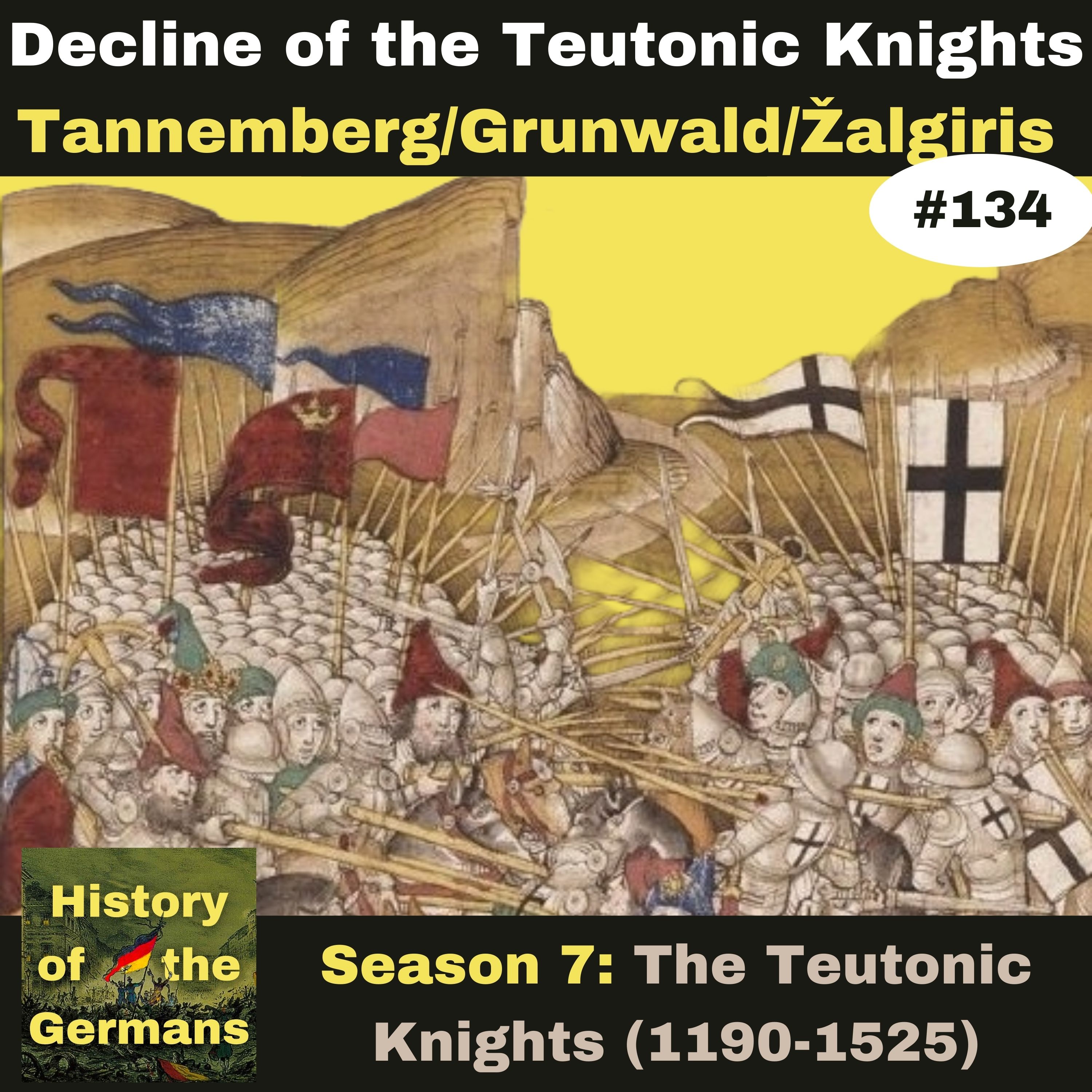
Ep 134Ep. 134: The Teutonic Knights (1190-1525) - Tannenberg / Grunwald / Žalgiris
This week we look at the reasons the golden age of the Teutonic knights came to an abrupt end at the beginning of the 15th century. It is a sequence of events that involve some remarkable Polish and Lithuanian princes, the Templars, and of course – The brothers of the house of St. Mary of the Germans in Jerusalem. Ah, and a very famous battle.Episode Website with transcript, maps and lots more: Episode 134– Tannenberg • History of the Germans PodcastThe music for the show is Flute Sonata in E-flat major, H.545 by Carl Phillip Emmanuel Bach (or some claim it as BWV 1031 Johann Sebastian Bach) performed and arranged by Michel Rondeau under Common Creative Licence 3.0.As always:Homepage with maps, photos, transcripts and blog: www.historyofthegermans.comIf you wish to support the show go to: Support • History of the Germans PodcastFor do it yourself merchandise go to: Merchandise • History of the Germans PodcastFacebook: @HOTGPod Threads: @history_of_the_germans_podcastBluesky: @hotgpod.bsky.socialInstagram: history_of_the_germansTwitter: @germanshistoryTo make it easier for you to share the podcast, I have created separate playlists for some of the seasons that are set up as individual podcasts. they have the exact same episodes as in the History of the Germans, but they may be a helpful device for those who want to concentrate on only one season.So far I have:The OttoniansSalian Emperors and Investiture ControversyFredrick Barbarossa and Early HohenstaufenFrederick II Stupor MundiSaxony and Eastward ExpansionThe Hanseatic LeagueThe Teutonic KnightsThe Holy Roman Empire 1250-1356The Reformation before the ReformationThe Empire in the 15th centuryThe Fall and Rise of the HabsburgsPodcasts on Poland:BBC Radio 4 - In Our Time, The Polish-Lithuanian CommonwealthPoland Is Not Yet Lost — WDFpodcast.comThe History of Poland Podcast (libsyn.com)
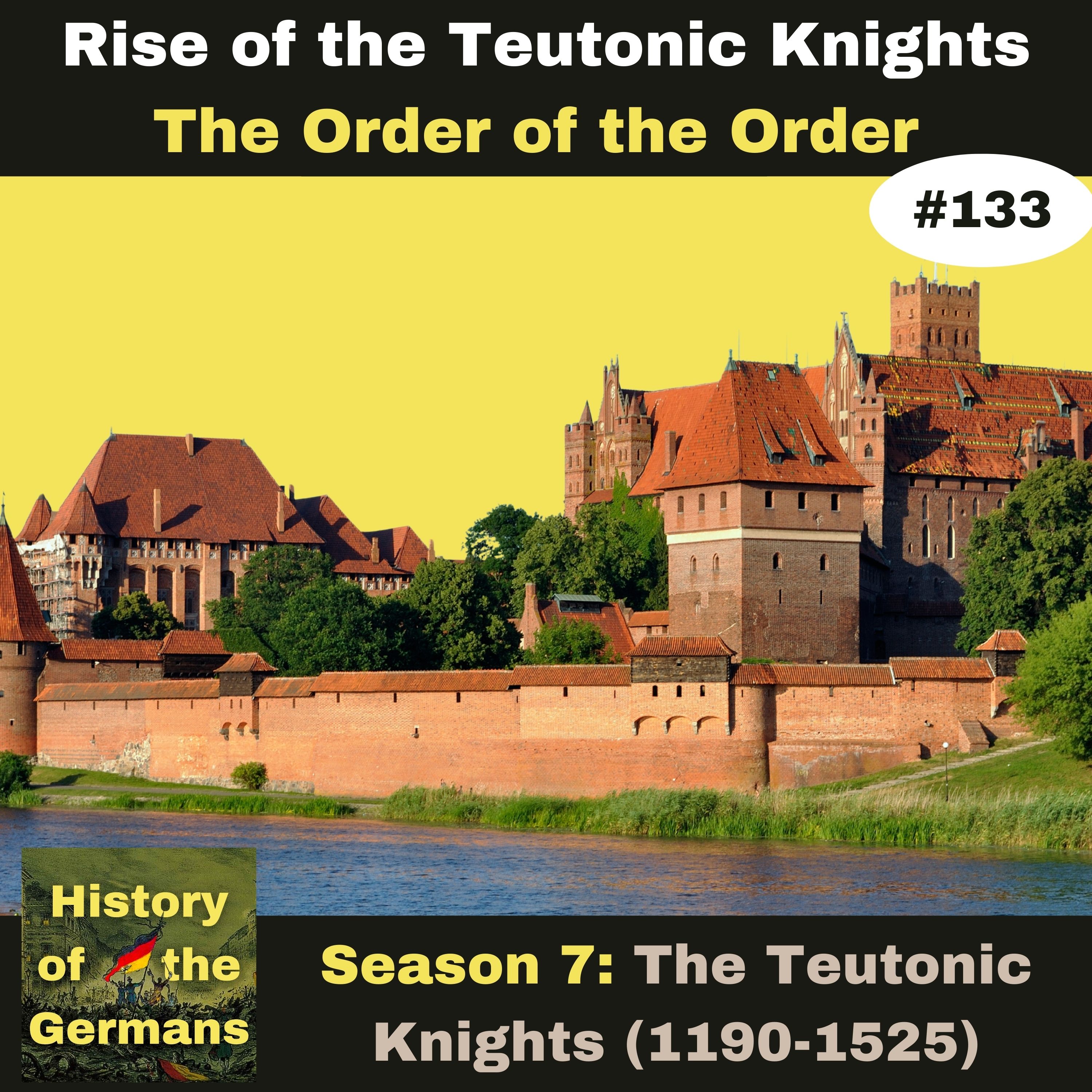
Ep 133Ep. 133: The Teutonic Knights (1190-1525) - The Order of the Order
In the century that followed the last of the Prussian and Livonian uprisings the states of the Teutonic Order in the Baltic experienced a period of economic growth and internal and external stability that is almost unique in the chaotic 14th century. Whilst Europe was in the grip of the Hundred-Years War, an incessant merry go round of internecine feuds, the Black Death, Papal Schisms and a deteriorating climate, this theocracy on the Northern Baltic shore became a beacon of prosperity and peace.How was it possible that a religious order became an astute manager of its estates, a de-facto member, if not by its own claim head of the Hanseatic League and the organizer of the greatest chivalric adventure holidays for Europe’s aristocracy?That is what we try to find out in this episode..The music for the show is Flute Sonata in E-flat major, H.545 by Carl Phillip Emmanuel Bach (or some claim it as BWV 1031 Johann Sebastian Bach) performed and arranged by Michel Rondeau under Common Creative Licence 3.0.As always:Homepage with maps, photos, transcripts and blog: www.historyofthegermans.comIf you wish to support the show go to: Support • History of the Germans PodcastFor do it yourself merchandise go to: Merchandise • History of the Germans PodcastFacebook: @HOTGPod Threads: @history_of_the_germans_podcastBluesky: @hotgpod.bsky.socialInstagram: history_of_the_germansTwitter: @germanshistoryTo make it easier for you to share the podcast, I have created separate playlists for some of the seasons that are set up as individual podcasts. they have the exact same episodes as in the History of the Germans, but they may be a helpful device for those who want to concentrate on only one season.So far I have:The OttoniansSalian Emperors and Investiture ControversyFredrick Barbarossa and Early HohenstaufenFrederick II Stupor MundiSaxony and Eastward ExpansionThe Hanseatic LeagueThe Teutonic KnightsThe Holy Roman Empire 1250-1356The Reformation before the ReformationThe Empire in the 15th centuryThe Fall and Rise of the HabsburgsBibliography:Werner Paravicini Die Preußenreisen des europäischen Adels : https://perspectivia.net/receive/ploneimport_mods_00009997Eric Christiansen: The Northern Crusades
Ep 132Ep. 132: The Teutonic Knights (1190-1525) - The Battle on the Ice
This week we look at the activities of the Teutonic order in Livonia during the 13th century. The situation in Livonia was profoundly different to Prussia and posed a number of new challenges for the brothers. In Livonia there were the powerful bishops of Riga to contend with who had led the crusade there since its inception in the 1180s. The Hanse merchants who have settled in Riga, Reval and Dorpat are no pushovers. Like in Prussia, the Lithuanians are a formidable force able to inflict painful defeats on the brothers as are some of the Baltic peoples who didn’t enjoy conversion at swordpoint as much as the planners back in Bremen, Marburg and Acre had hoped. And let’s not forget some new neighbors, the Danes in Northern Estonia and the great republic of Novgorod.In 1240 a great effort gets under way to forcibly convert the orthodox Rus’ian states, including Novgorod that are already under pressure from the Mongols. In their distress the boyars of Novgorod make the second son of the grand duke of Vladimir becomes their military leader, a man we know as Alexander Nevsky. On April 5, 1242 Alexander Nevsky and his men stand on the shore of Lake Peipus staring at a squadron of heavily armored cavalry thundering across the ice towards them…Whilst the riders almost certainly weren’t accompanied by Prokofief’s amazing soundtrack, they may have brought an organ, but that, like everything else about the Battle on the Ice is subject to intense debate, a debate we will examine in this episode.Epsiode website: Episode 132– The Battle on the Ice • History of the Germans PodcastThe music for the show is Flute Sonata in E-flat major, H.545 by Carl Phillip Emmanuel Bach (or some claim it as BWV 1031 Johann Sebastian Bach) performed and arranged by Michel Rondeau under Common Creative Licence 3.0.As always:Homepage with maps, photos, transcripts and blog: www.historyofthegermans.comIf you wish to support the show go to: Support • History of the Germans PodcastFor do it yourself merchandise go to: Merchandise • History of the Germans PodcastFacebook: @HOTGPod Threads: @history_of_the_germans_podcastBluesky: @hotgpod.bsky.socialInstagram: history_of_the_germansTwitter: @germanshistoryTo make it easier for you to share the podcast, I have created separate playlists for some of the seasons that are set up as individual podcasts. they have the exact same episodes as in the History of the Germans, but they may be a helpful device for those who want to concentrate on only one season.So far I have:The OttoniansSalian Emperors and Investiture ControversyFredrick Barbarossa and Early HohenstaufenFrederick II Stupor MundiSaxony and Eastward ExpansionThe Hanseatic LeagueThe Teutonic KnightsThe Holy Roman Empire 1250-1356The Reformation before the ReformationThe Empire in the 15th centuryThe Fall and Rise of the Habsburgs
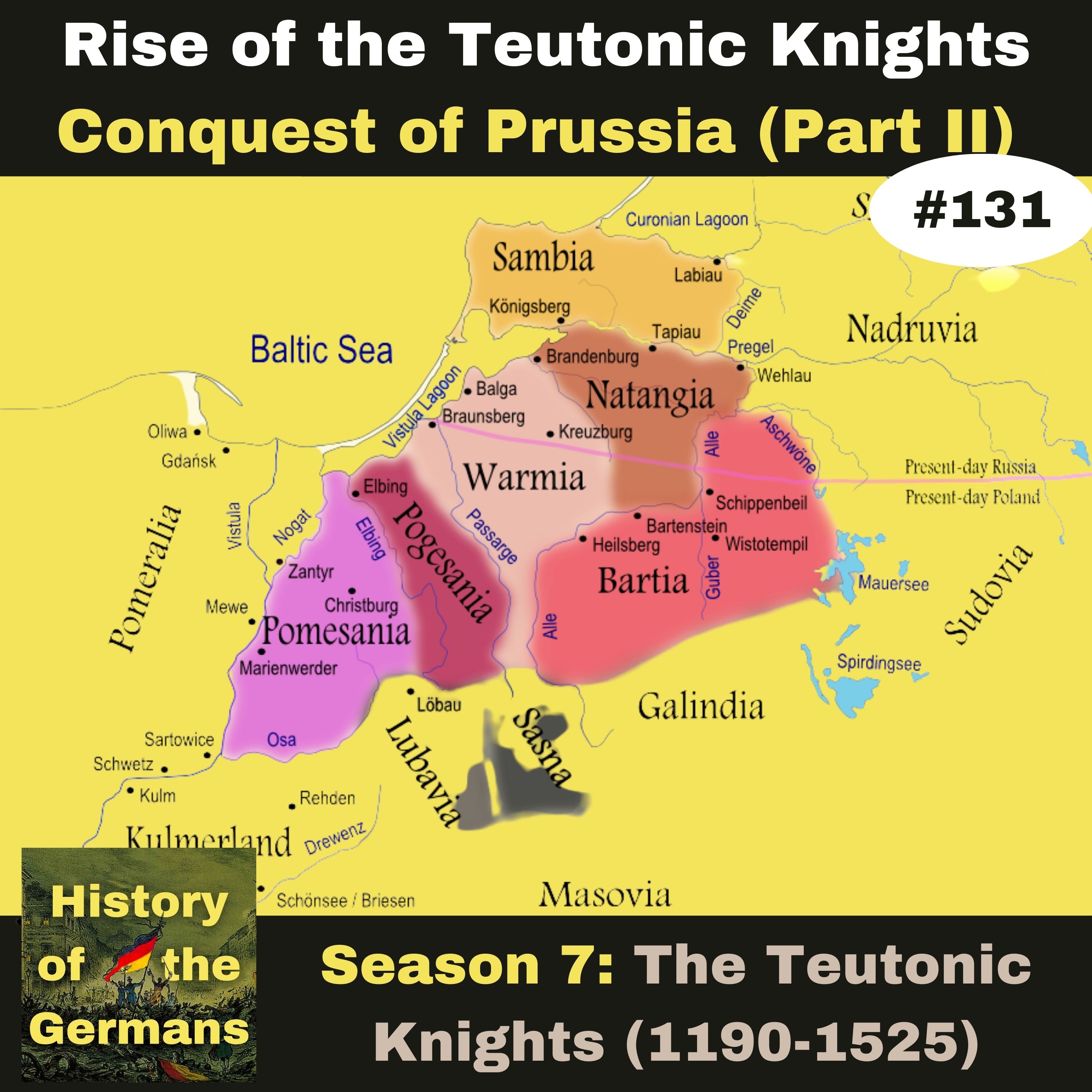
Ep 131Ep. 131: The Teutonic Knights (1190-1525) - The Conquest of Prussia (Part II)
Last week we left the action after the Teutonic Knights had signed the peace of Christburg in 1249 to put an end to the first Prussian revolt. The local population had risen up with the help of duke Swantopolk of Pomerelia who feared for the commercial success of his main city, the city of Danzig/Gdansk. After 7 years of war and devastation the pope had forced both sides to the negotiating table and made them sign a peace agreement intended to be a long term settlement. It constrained the Teutonic Order and gave the converted Prussians civil rights on par with the settlers who had come from the German lands.Things should therefore be calm and peaceful from here – well they weren’t. The fighting continued as the order expanded further north and inland and soon the Prussians and Pomerelains rose up again, and again…The music for the show is Flute Sonata in E-flat major, H.545 by Carl Phillip Emmanuel Bach (or some claim it as BWV 1031 Johann Sebastian Bach) performed and arranged by Michel Rondeau under Common Creative Licence 3.0.As always:Homepage with maps, photos, transcripts and blog: www.historyofthegermans.comIf you wish to support the show go to: Support • History of the Germans PodcastFor do it yourself merchandise go to: Merchandise • History of the Germans PodcastFacebook: @HOTGPod Threads: @history_of_the_germans_podcastBluesky: @hotgpod.bsky.socialInstagram: history_of_the_germansTwitter: @germanshistoryTo make it easier for you to share the podcast, I have created separate playlists for some of the seasons that are set up as individual podcasts. they have the exact same episodes as in the History of the Germans, but they may be a helpful device for those who want to concentrate on only one season.So far I have:The OttoniansSalian Emperors and Investiture ControversyFredrick Barbarossa and Early HohenstaufenFrederick II Stupor MundiSaxony and Eastward ExpansionThe Hanseatic LeagueThe Teutonic KnightsThe Holy Roman Empire 1250-1356The Reformation before the ReformationThe Empire in the 15th centuryThe Fall and Rise of the Habsburgs
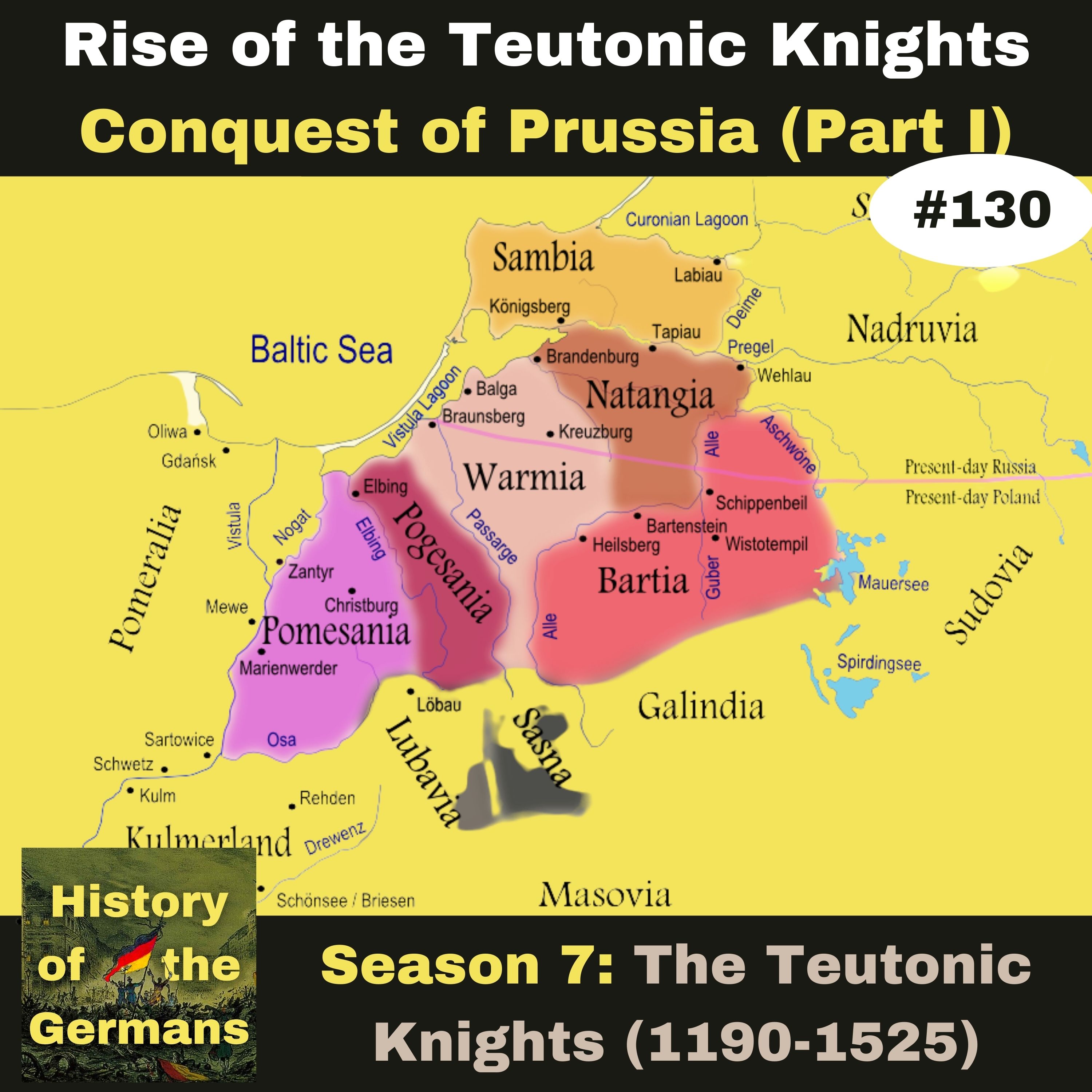
Ep 130Ep. 130: The Teutonic Knights (1190-1525) - The Conquest of Prussia (Part I)
Last week we heard about Konrad of Masovia’s offer of the Kulmer Land to the Teutonic knight. This week we will talk about what they did once they had accepted the offer. The first knights arrived in 1226 but it would take almost 6o years before their new principality of Prussia was fully established.The Prussians, despite initially being lightly armed and disunited were no pushover. Rarely successful in open battle they disappeared into the dense forest or swampy marches before they could be routed. Again and again they rose up, reclaiming their freedom and again and again did the Teutonic Knights and the German and Polish crusaders pushed them back into submission.Do not worry, this will not be an endless litany of battles and raids, but we will look at the relative military strength, the political structure they established and as you would expect, the economic underpinnings of the effort.....Episode Website with transcript, maps and lots more: EPISODE 130 – The Conquest of Prussia (Part I) • History of the Germans PodcastFor Book recommendations, go here: Book Recommendations • History of the Germans PodcastThe translation of Nicolaus of Jeroschin is here: Jeroschin N. The Chronicle of Prussia (2016), OCR.pdfThe music for the show is Flute Sonata in E-flat major, H.545 by Carl Phillip Emmanuel Bach (or some claim it as BWV 1031 Johann Sebastian Bach) performed and arranged by Michel Rondeau under Common Creative Licence 3.0.As always:Homepage with maps, photos, transcripts and blog: www.historyofthegermans.comIf you wish to support the show go to: Support • History of the Germans PodcastFor do it yourself merchandise go to: Merchandise • History of the Germans PodcastFacebook: @HOTGPod Threads: @history_of_the_germans_podcastBluesky: @hotgpod.bsky.socialInstagram: history_of_the_germansTwitter: @germanshistoryTo make it easier for you to share the podcast, I have created separate playlists for some of the seasons that are set up as individual podcasts. they have the exact same episodes as in the History of the Germans, but they may be a helpful device for those who want to concentrate on only one season.So far I have:The OttoniansSalian Emperors and Investiture ControversyFredrick Barbarossa and Early HohenstaufenFrederick II Stupor MundiSaxony and Eastward ExpansionThe Hanseatic LeagueThe Teutonic KnightsThe Holy Roman Empire 1250-1356The Reformation before the ReformationThe Empire in the 15th centuryThe Fall and Rise of the Habsburgs
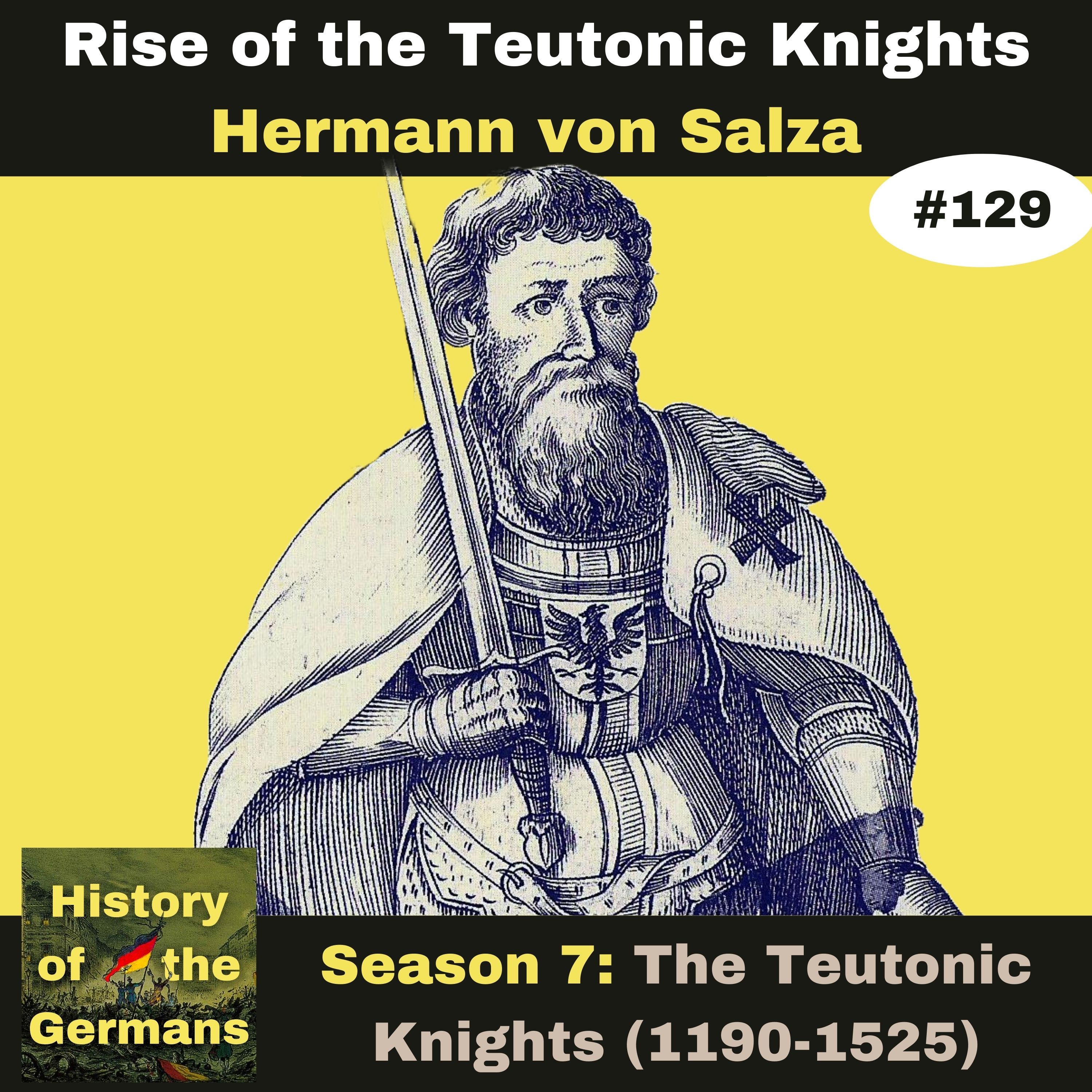
Ep 129Ep. 129: The Teutonic Knights (1190-1525) - The First Grand Master - Hermann von Salza
“.. the far-sighted planning of Grand Master Brother Hermann von Salza had so strengthened the Teutonic Order that it had many members and such power, riches and honour that word of its fame and good reputation had spread the length and breadth of the empire.” So describes the chronicler Nicolaus von Jeroschin the role of the fourth and arguably most influential of the grand Masters of the Teutonic Knights. His role in promoting and expanding the order is hard to exaggerate. Without his skill and energy, the Teutonic Knights would have ended up like the Order of the Knights of St. Thomas. Have you have never heard of the Knights of St. Thomas, a English chivalric military order founded as a field hospital during the siege of the city of Acre in 1191? Well, that is the difference one man can make, at least very occasionally.Episode website with transcript is hereThe music for the show is Flute Sonata in E-flat major, H.545 by Carl Phillip Emmanuel Bach (or some claim it as BWV 1031 Johann Sebastian Bach) performed and arranged by Michel Rondeau under Common Creative Licence 3.0.As always:Homepage with maps, photos, transcripts and blog: www.historyofthegermans.comIf you wish to support the show go to: Support • History of the Germans PodcastFor do it yourself merchandise go to: Merchandise • History of the Germans PodcastFacebook: @HOTGPod Threads: @history_of_the_germans_podcastBluesky: @hotgpod.bsky.socialInstagram: history_of_the_germansTwitter: @germanshistoryTo make it easier for you to share the podcast, I have created separate playlists for some of the seasons that are set up as individual podcasts. they have the exact same episodes as in the History of the Germans, but they may be a helpful device for those who want to concentrate on only one season.So far I have:The OttoniansSalian Emperors and Investiture ControversyFredrick Barbarossa and Early HohenstaufenFrederick II Stupor MundiSaxony and Eastward ExpansionThe Hanseatic LeagueThe Teutonic KnightsThe Holy Roman Empire 1250-1356The Reformation before the ReformationThe Empire in the 15th centuryThe Fall and Rise of the Habsburgs
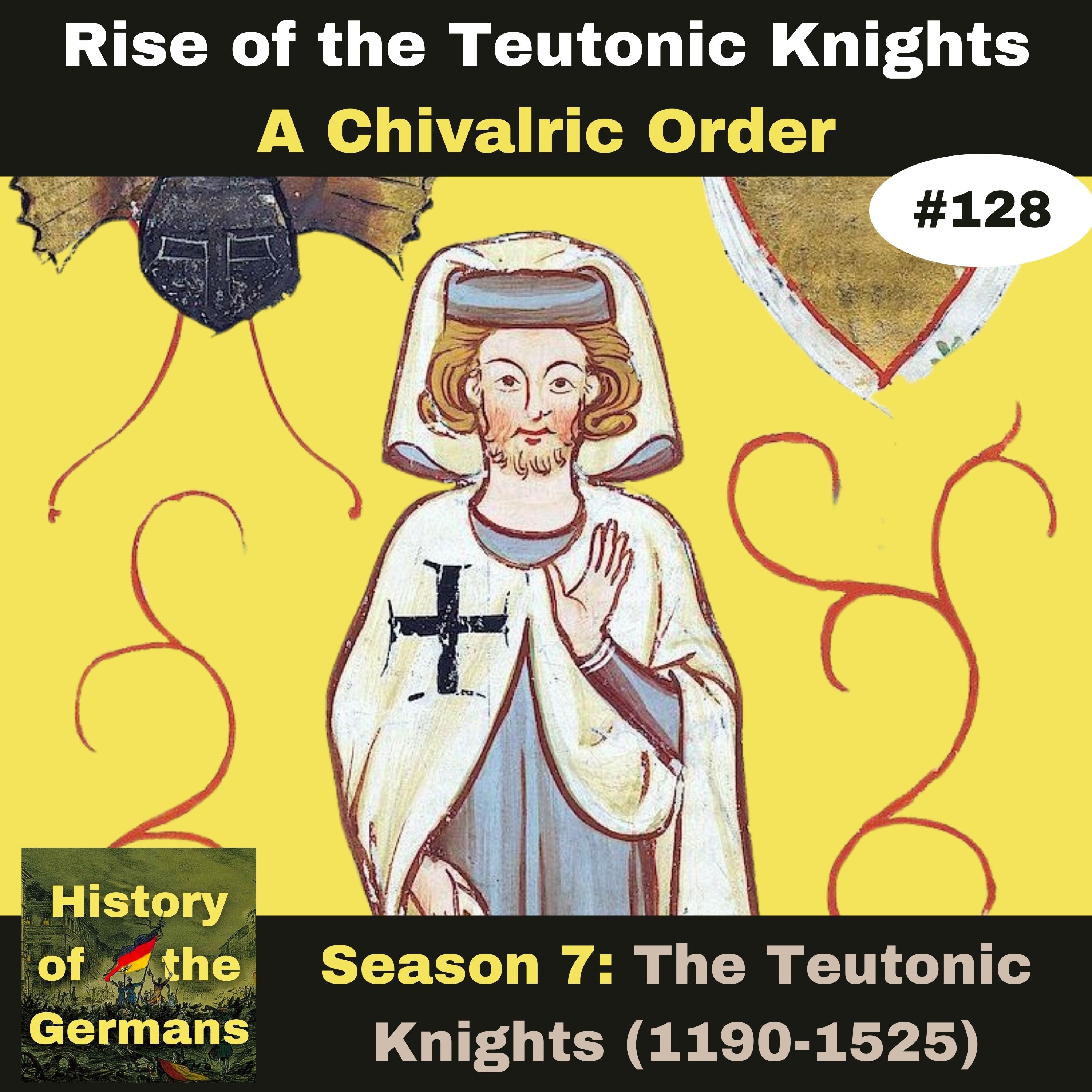
Ep 128Ep. 128: The Teutonic Knights (1190-1525) - Season Opener - A Chivalric Order
Hello and welcome to a new season of the History of the Germans, the Teutonic Knights or to give them their full title, the knights of the hospital of St. Mary of the House of the Germans in Jerusalem.Even though the state they had created in Prussia has been wiped off the map with all its cultural markers, the Teutonic Knights are not forgotten. Less shrouded in nonsense than the Templars, less devoted to social causes than the Knights of St. John they still loom large not just in German history but even more so in Polish and Russian history. Both of these nations have placed victories over the Teutonic Knights at key junctions of their national narrative.But were the Teutonic knights these near invincible, cruel faceless war machines that Sergei Eisenstein had charging over the ice to the sound of Prokofiev brilliant score? That is what we will try to find out over the next few episodes. Expect your fair share of heroic battles, chivalric entertainment all intermingled with twisted theology and astute commercial activity. I hope you will enjoy it.Episode website with transcript is hereThe music for the show is Flute Sonata in E-flat major, H.545 by Carl Phillip Emmanuel Bach (or some claim it as BWV 1031 Johann Sebastian Bach) performed and arranged by Michel Rondeau under Common Creative Licence 3.0.As always:Homepage with maps, photos, transcripts and blog: www.historyofthegermans.comIf you wish to support the show go to: Support • History of the Germans PodcastFor do it yourself merchandise go to: Merchandise • History of the Germans PodcastFacebook: @HOTGPod Threads: @history_of_the_germans_podcastBluesky: @hotgpod.bsky.socialInstagram: history_of_the_germansTwitter: @germanshistoryTo make it easier for you to share the podcast, I have created separate playlists for some of the seasons that are set up as individual podcasts. they have the exact same episodes as in the History of the Germans, but they may be a helpful device for those who want to concentrate on only one season.So far I have:The OttoniansSalian Emperors and Investiture ControversyFredrick Barbarossa and Early HohenstaufenFrederick II Stupor MundiSaxony and Eastward ExpansionThe Hanseatic LeagueThe Teutonic KnightsThe Holy Roman Empire 1250-1356The Reformation before the ReformationThe Empire in the 15th centuryThe Fall and Rise of the HabsburgsHere is the link to the article by Cory Doctorow: https://www.wired.com/story/tiktok-platforms-cory-doctorow/Bibliography:Steven Runciman: A history of the CrusadesEric Christiansen: The Northern CrusadesWilliam Urban: The Teutonic Knights - A mlitary HistoryJurgen Sarnowsky: Der Deutsche orden

The Hanseatic League (1143-1669) - An Interview with Carsten Jahnke
bonusProfessor Carsten Jahnke, one of the leading historians on the Hanse has kindly granted us an interview where we discuss how the Hanse network functioned and how the perception of the Hanse has changed dramatically over the last 200 years, a story that almost as interesting as the history of the Hanse itself.As listeners of the last season of the History of the Germans might have noticed, I have been relying heavily extensively on Carsten Jahnke's work. many of the episodes discussing the economic structure and the way money transfers worked in the network are based on his research. So if you liked those episodes, you will certanly enjoy this interview. Listen in!And here are some links to research Carsten recommends for those of you who want to follow up further:Christian Manger,Behind the scenes: Urban secretaries as managers of legal and diplomatic conflicts in the Baltic region, c.1470–1540: https://www.tandfonline.com/doi/full/10.1080/03044181.2022.2098528Carsten Jahnke, Von Mandeln, Narde, Curcuma und Kümmel. Herkunft, Handel und Verbrauch von „exotischen“ Gewürzen und Lebensmitteln im nördlichen Europa, in: Die Ausgrabungen im Lübecker Gründungsviertel II. Archäoparasitologie, Handelsgeschichte, Paläopathologie und Anthropologie, ed. by Dirk Rieger, Lübeck 2022, s. 131-164Carsten Jahnke, Hansische Kaufleute und deren Religiosität ausserhalb ihrer Heimat, i: Zapiski Historyczne, Tom LXXXIV, Rok 2019, Zeszyt 1, s. 7-41.There is also a lecture Cartsen gave at the German Historical institute in London on teh perception history:https://www.ghil.ac.uk/publications/podcasts/the-hanseatic-league-as-a-national-projectThe music for the show is Flute Sonata in E-flat major, H.545 by Carl Phillip Emmanuel Bach (or some claim it as BWV 1031 Johann Sebastian Bach) performed and arranged by Michel Rondeau under Common Creative Licence 3.0.As always:Homepage with maps, photos, transcripts and blog: www.historyofthegermans.comFacebook: @HOTGPod Twitter: @germanshistoryInstagram: history_of_the_germansReddit: u/historyofthegermansPatreon: https://www.patreon.com/Historyofthegermans
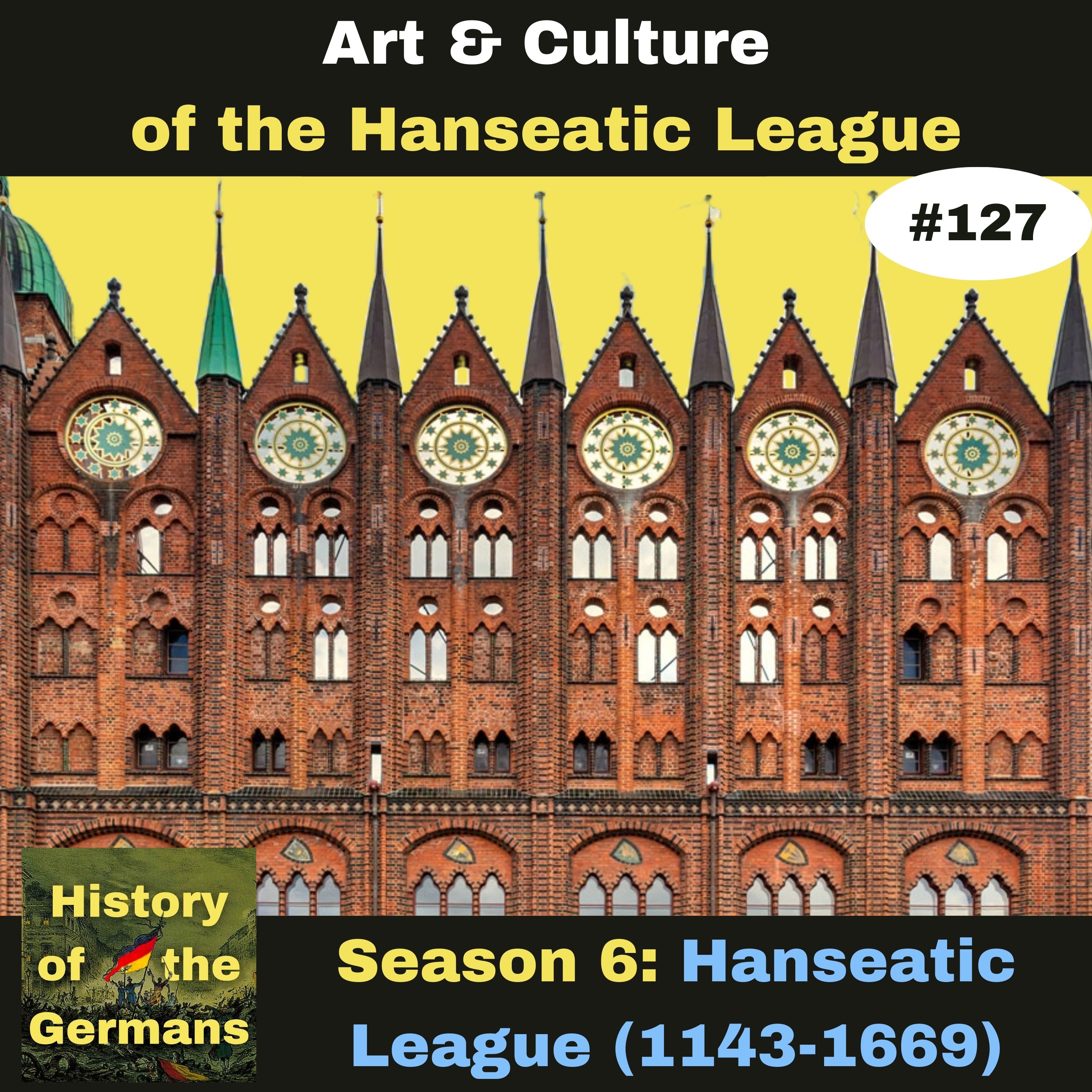
Ep 127Ep. 127: The Hanseatic League (1143-1669) - The Art and Culture of the Hanse
Our history of the Hanse has come to an end, not with a bang but with a whimper. Of the things that have remained we have already talked a lot, the ideal of the honourable Hanseatic merchant, the cultural and political links to Scandinavia and the stories. The stories of the famous pirates, Klaus Störtebecker and Hans Benecke, the heroics of the wars fought with Denmark and the antics of Jurgen Wullenwever.But there is something that reminds us of the days when traders speaking low German fed Europe fish, beer and grain. And that are the cultural achievements, the town halls, weighing houses and stores that became symbols of civic pride, the artists whose works adorn churches and palaces across the Baltic sea and last but not least the brick churches that shaped the way these cities still appear..…let’s have a look.And since podcasting is a most unsuitable medium to talk about visual art, I have added a few images to the episode webpage which you can find at Episode 127 - Art & Culture of the Hanse • History of the Germans PodcastThe music for the show is Flute Sonata in E-flat major, H.545 by Carl Phillip Emmanuel Bach (or some claim it as BWV 1031 Johann Sebastian Bach) performed and arranged by Michel Rondeau under Common Creative Licence 3.0.As always:Homepage with maps, photos, transcripts and blog: www.historyofthegermans.comIf you wish to support the show go to: Support • History of the Germans PodcastFor do it yourself merchandise go to: Merchandise • History of the Germans PodcastFacebook: @HOTGPod Threads: @history_of_the_germans_podcastBluesky: @hotgpod.bsky.socialInstagram: history_of_the_germansTwitter: @germanshistoryTo make it easier for you to share the podcast, I have created separate playlists for some of the seasons that are set up as individual podcasts. they have the exact same episodes as in the History of the Germans, but they may be a helpful device for those who want to concentrate on only one season.So far I have:The OttoniansSalian Emperors and Investiture ControversyFredrick Barbarossa and Early HohenstaufenFrederick II Stupor MundiSaxony and Eastward ExpansionThe Hanseatic LeagueThe Teutonic KnightsThe Holy Roman Empire 1250-1356The Reformation before the ReformationThe Empire in the 15th centuryThe Fall and Rise of the Habsburgs
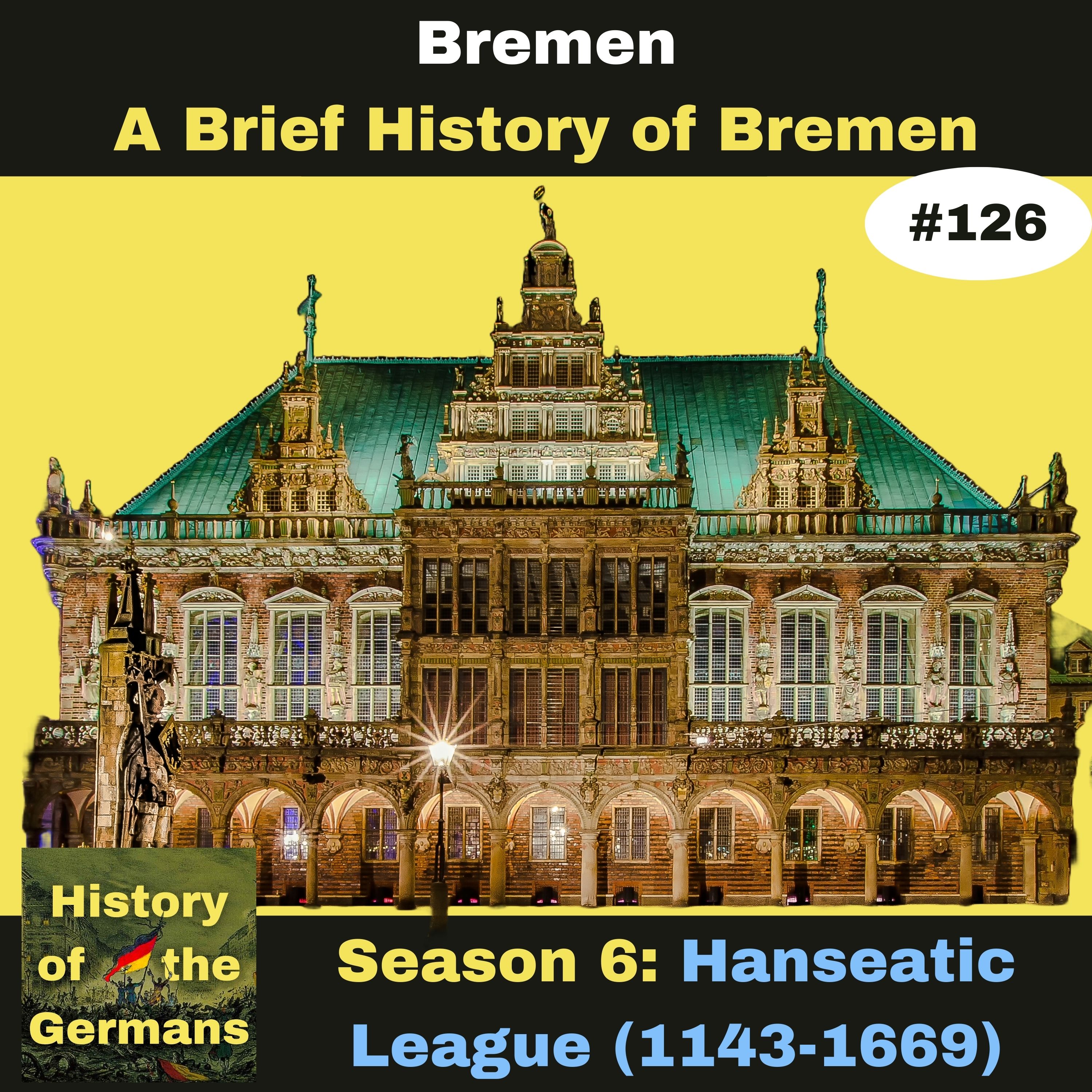
Ep 126Ep. 126: A Brief History of Bremen
Bremen was geographically and politically quite different from the other cities, ploughing its own furrow. In response the other Hansards did not trust the citizens of Bremen. There is also the minor issue that Bremen sheltered a lot of pirates. Still as the Hanse declined politically, Bremen took on an ever-larger role until becoming one of the last three Hanseatic Cities that kept that long-dead medieval relic plodding along until the late 19th century.A story of rebellion, stubbornness, piracy and emigration to America, I thought worth telling.The episode webpage with transcripts and further links is available hereThe music for the show is Flute Sonata in E-flat major, H.545 by Carl Phillip Emmanuel Bach (or some claim it as BWV 1031 Johann Sebastian Bach) performed and arranged by Michel Rondeau under Common Creative Licence 3.0.As always:Homepage with maps, photos, transcripts and blog: www.historyofthegermans.comIf you wish to support the show go to: Support • History of the Germans PodcastFor do it yourself merchandise go to: Merchandise • History of the Germans PodcastFacebook: @HOTGPod Threads: @history_of_the_germans_podcastBluesky: @hotgpod.bsky.socialInstagram: history_of_the_germansTwitter: @germanshistoryTo make it easier for you to share the podcast, I have created separate playlists for some of the seasons that are set up as individual podcasts. they have the exact same episodes as in the History of the Germans, but they may be a helpful device for those who want to concentrate on only one season.So far I have:The OttoniansSalian Emperors and Investiture ControversyFredrick Barbarossa and Early HohenstaufenFrederick II Stupor MundiSaxony and Eastward ExpansionThe Hanseatic LeagueThe Teutonic KnightsThe Holy Roman Empire 1250-1356The Reformation before the ReformationThe Empire in the 15th centuryThe Fall and Rise of the Habsburgs
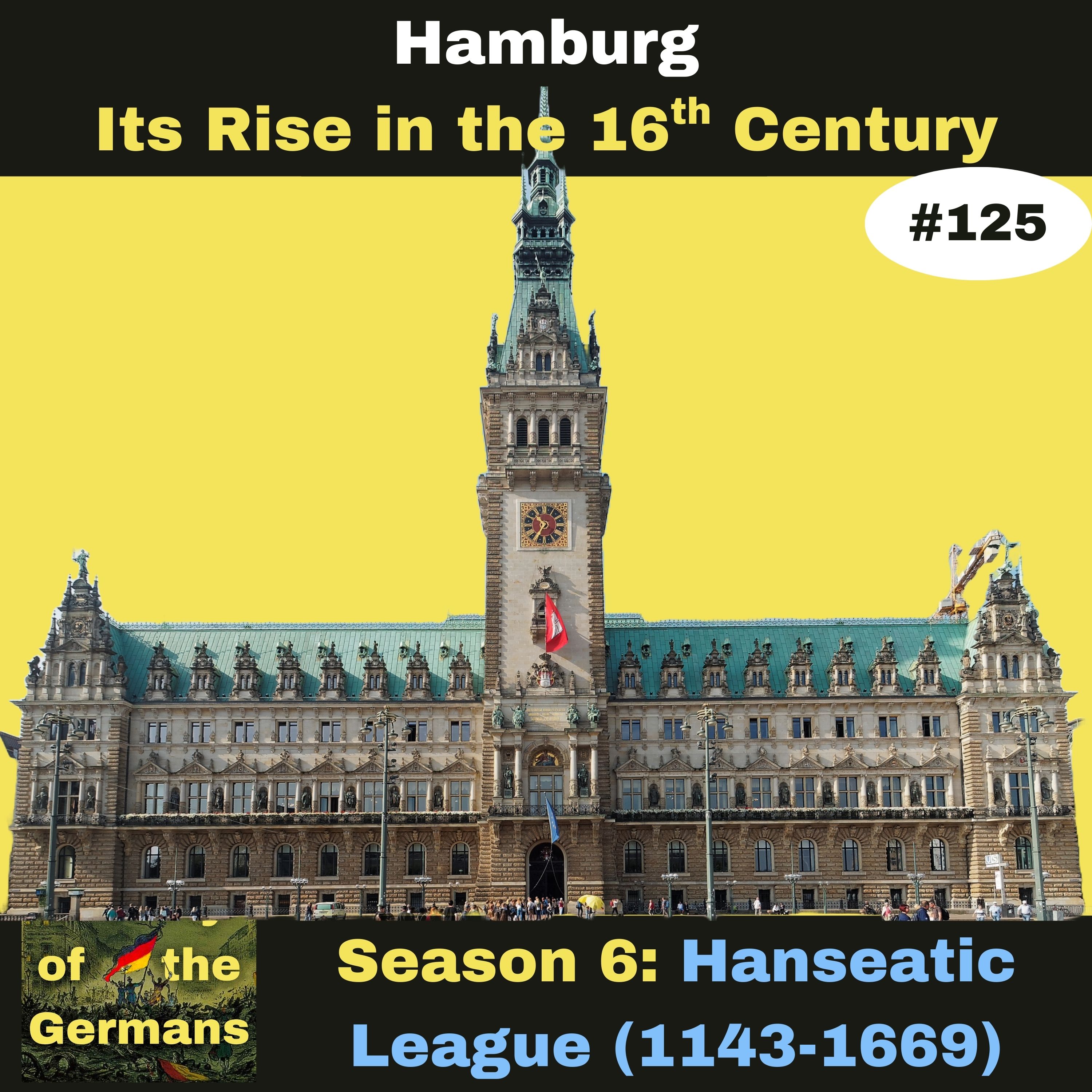
Ep 125Ep. 125: The Rise of Hamburg in the 16th century and beyond
The last two episodes may have left you with a sense of gloom and foreboding about the great Hanseatic cities. But here is the counterintuitive fact, the Hanse may continuously loose political power and economic relevance, but the cities that make up the association are flourishing. Not all of them but some, Hamburg and Danzig in particular.Why it is that the Hanse declines, but the Hansards are doing mightily well is what we are looking into this week. So let’s see….The episode webpage with transcripts and further links is available hereThe music for the show is Flute Sonata in E-flat major, H.545 by Carl Phillip Emmanuel Bach (or some claim it as BWV 1031 Johann Sebastian Bach) performed and arranged by Michel Rondeau under Common Creative Licence 3.0.As always:Homepage with maps, photos, transcripts and blog: www.historyofthegermans.comIf you wish to support the show go to: Support • History of the Germans PodcastFor do it yourself merchandise go to: Merchandise • History of the Germans PodcastFacebook: @HOTGPod Threads: @history_of_the_germans_podcastBluesky: @hotgpod.bsky.socialInstagram: history_of_the_germansTwitter: @germanshistoryTo make it easier for you to share the podcast, I have created separate playlists for some of the seasons that are set up as individual podcasts. they have the exact same episodes as in the History of the Germans, but they may be a helpful device for those who want to concentrate on only one season.So far I have:The OttoniansSalian Emperors and Investiture ControversyFredrick Barbarossa and Early HohenstaufenFrederick II Stupor MundiSaxony and Eastward ExpansionThe Hanseatic LeagueThe Teutonic KnightsThe Holy Roman Empire 1250-1356The Reformation before the ReformationThe Empire in the 15th centuryThe Fall and Rise of the HabsburgsBibliography:J.K. Dunlop, Hamburg 800-1945, Published by the Anglo-German Club E.V.Philippe Dollinger, Die Hanse, 6. Auflage, 2012
Ep 124Ep. 124: The Hanseatic League - Decline and Fall (Part 2) - Jürgen Wullenwever's and Lübeck's last stand
1531-1535, a period of just 4 years is enough to capsize Lübeck’s position as the diplomatic heart of the Baltic Sea, general secretary of the Hanse, ally of both the king of Denmark and the king of Sweden and early member of the Schmalkaldic League. How can that happen?As Edward Gibbon would say: History, in fact, is no more than a list of crimes of humanity, human follies and accidents”.The music for the show is Flute Sonata in E-flat major, H.545 by Carl Phillip Emmanuel Bach (or some claim it as BWV 1031 Johann Sebastian Bach) performed and arranged by Michel Rondeau under Common Creative Licence 3.0.As always:The episode webpage with transcripts and further links is available hereThe music for the show is Flute Sonata in E-flat major, H.545 by Carl Phillip Emmanuel Bach (or some claim it as BWV 1031 Johann Sebastian Bach) performed and arranged by Michel Rondeau under Common Creative Licence 3.0.As always:Homepage with maps, photos, transcripts and blog: www.historyofthegermans.comIf you wish to support the show go to: Support • History of the Germans PodcastFor do it yourself merchandise go to: Merchandise • History of the Germans PodcastFacebook: @HOTGPod Threads: @history_of_the_germans_podcastBluesky: @hotgpod.bsky.socialInstagram: history_of_the_germansTwitter: @germanshistoryTo make it easier for you to share the podcast, I have created separate playlists for some of the seasons that are set up as individual podcasts. they have the exact same episodes as in the History of the Germans, but they may be a helpful device for those who want to concentrate on only one season.So far I have:The OttoniansSalian Emperors and Investiture ControversyFredrick Barbarossa and Early HohenstaufenFrederick II Stupor MundiSaxony and Eastward ExpansionThe Hanseatic LeagueThe Teutonic KnightsThe Holy Roman Empire 1250-1356The Reformation before the ReformationThe Empire in the 15th centuryThe Fall and Rise of the HabsburgsBibliography:Rainer Postel: Der Niedergang der Hansein Hanse, Lebenswirklichkeit und Mythos: RIOPAC (regesta-imperii.de)Jahnke, Carsten: Die Hanse | Reclam VerlagPhilipp Dollinger: Die Hanse
Ep 123Ep. 123: The Hanseatic League - Decline and Fall (Part 1)
1474-1531 was a time of immense change and upheaval for the Hanseatic League, and not just for them. The Habsburg empire is bedded into being, England’s war of the Roses is over, in the North the Polish-Lithuanian commonwealth stretches all the way from Kyiev to Gdansk. The kingdoms and princes are getting stronger. Columbus tries to sail to India and Vasco da Gama actually sails to India. Luther nails his 95 theses on the doors of the churches of Wittenberg. All is in flux, and so is the Hanse and Lübeck, its most important city.Well, is it still the most important city? What about Danzig/Gdansk and Hamburg who take advantage of shifting trade flows whilst Lübeck finds itself on the sidelines. Who do they blame? The Dutch and the Danes. Cometh the time, cometh the man – his name is Jürgen Wullenwever and he has all the solutions, or does he?..The episode webpage with transcripts and further links is available hereThe music for the show is Flute Sonata in E-flat major, H.545 by Carl Phillip Emmanuel Bach (or some claim it as BWV 1031 Johann Sebastian Bach) performed and arranged by Michel Rondeau under Common Creative Licence 3.0.As always:Homepage with maps, photos, transcripts and blog: www.historyofthegermans.comIf you wish to support the show go to: Support • History of the Germans PodcastFor do it yourself merchandise go to: Merchandise • History of the Germans PodcastFacebook: @HOTGPod Threads: @history_of_the_germans_podcastBluesky: @hotgpod.bsky.socialInstagram: history_of_the_germansTwitter: @germanshistoryTo make it easier for you to share the podcast, I have created separate playlists for some of the seasons that are set up as individual podcasts. they have the exact same episodes as in the History of the Germans, but they may be a helpful device for those who want to concentrate on only one season.So far I have:The OttoniansSalian Emperors and Investiture ControversyFredrick Barbarossa and Early HohenstaufenFrederick II Stupor MundiSaxony and Eastward ExpansionThe Hanseatic LeagueThe Teutonic KnightsThe Holy Roman Empire 1250-1356The Reformation before the ReformationThe Empire in the 15th centuryThe Fall and Rise of the Habsburgs
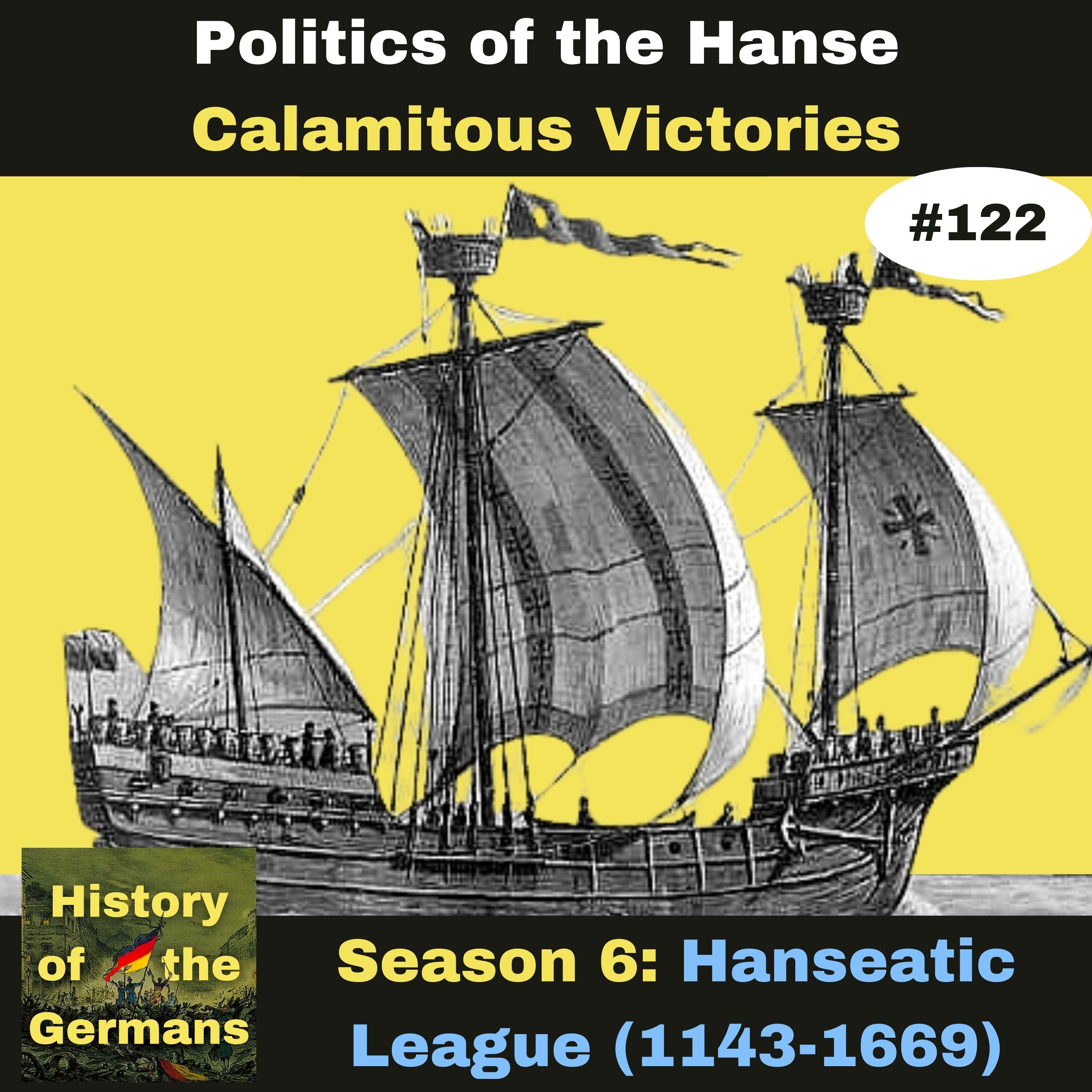
Ep 122Ep. 122: The Hanseatic League - 15th century Politics - Calamitous Victories
In 1435 the Hanse can look back at a string of successes. Another war with Denmark won, the patrician regime in Lübeck and elsewhere restored, conflicts with Burgundy and England settled in their favour. But as Winston Churchill once remarked,“The problems of victory are more agreeable than those of defeat, but they are no less difficult.”And these problems are raising their ugly heads….The episode webpage with transcripts and further links is available hereThe music for the show is Flute Sonata in E-flat major, H.545 by Carl Phillip Emmanuel Bach (or some claim it as BWV 1031 Johann Sebastian Bach) performed and arranged by Michel Rondeau under Common Creative Licence 3.0.As always:Homepage with maps, photos, transcripts and blog: www.historyofthegermans.comIf you wish to support the show go to: Support • History of the Germans PodcastFor do it yourself merchandise go to: Merchandise • History of the Germans PodcastFacebook: @HOTGPod Threads: @history_of_the_germans_podcastBluesky: @hotgpod.bsky.socialInstagram: history_of_the_germansTwitter: @germanshistoryTo make it easier for you to share the podcast, I have created separate playlists for some of the seasons that are set up as individual podcasts. they have the exact same episodes as in the History of the Germans, but they may be a helpful device for those who want to concentrate on only one season.So far I have:The OttoniansSalian Emperors and Investiture ControversyFredrick Barbarossa and Early HohenstaufenFrederick II Stupor MundiSaxony and Eastward ExpansionThe Hanseatic LeagueThe Teutonic KnightsThe Holy Roman Empire 1250-1356The Reformation before the ReformationThe Empire in the 15th centuryThe Fall and Rise of the Habsburgs

Ep 121Ep. 121: The Hanseatic League - 15th century Politics -A Constitutional Crisis
By the end of the 14th century the Hanse is at the top of its game. The Cologne Confederation had shown that they could act in unison if the need arises, can defeat the largest and best run kingdom in Scandinavia. And even the mighty duke of Burgundy had to yield to the power of the merchant cities.But just 10 years into the new century the association faces a mortal crisis. Not because of retaliation from the outside but due to internal tensions. Not everyone in the great trading cities is happy about the war efforts and the impressive infrastructure projects…The music for the show is Flute Sonata in E-flat major, H.545 by Carl Phillip Emmanuel Bach (or some claim it as BWV 1031 Johann Sebastian Bach) performed and arranged by Michel Rondeau under Common Creative Licence 3.0.The episode webpage with transcripts and further links is available hereAs always:The music for the show is Flute Sonata in E-flat major, H.545 by Carl Phillip Emmanuel Bach (or some claim it as BWV 1031 Johann Sebastian Bach) performed and arranged by Michel Rondeau under Common Creative Licence 3.0.As always:Homepage with maps, photos, transcripts and blog: www.historyofthegermans.comIf you wish to support the show go to: Support • History of the Germans PodcastFor do it yourself merchandise go to: Merchandise • History of the Germans PodcastFacebook: @HOTGPod Threads: @history_of_the_germans_podcastBluesky: @hotgpod.bsky.socialInstagram: history_of_the_germansTwitter: @germanshistoryTo make it easier for you to share the podcast, I have created separate playlists for some of the seasons that are set up as individual podcasts. they have the exact same episodes as in the History of the Germans, but they may be a helpful device for those who want to concentrate on only one season.So far I have:The OttoniansSalian Emperors and Investiture ControversyFredrick Barbarossa and Early HohenstaufenFrederick II Stupor MundiSaxony and Eastward ExpansionThe Hanseatic LeagueThe Teutonic KnightsThe Holy Roman Empire 1250-1356The Reformation before the ReformationThe Empire in the 15th centuryThe Fall and Rise of the Habsburgs
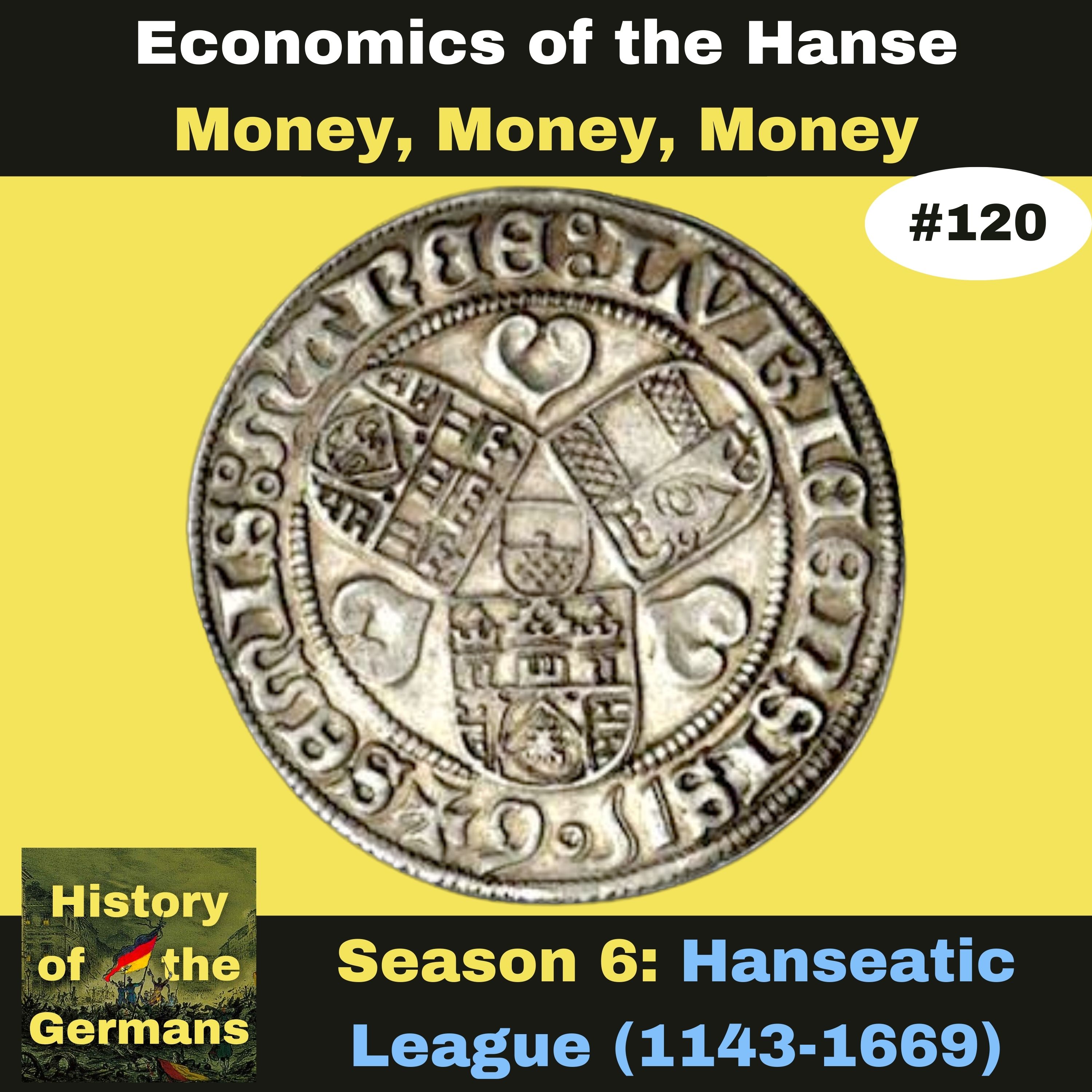
Ep 120Ep. 120: The Hanseatic League (1143-1669) - Economics - Money, Money, Money
This was supposed to be an episode where we talk about the challenges the Hanse was facing after the victory over the Danes and the Peace of Stralsund. But that is not to be. Listeners Mehmet and Nina pointed out a few gaps in what I had been talking about last week and now these need to be filled.It is all good talking about the trading network and the flow of goods across the Baltic and northern Germany. But what about the opposing flow, the flow of money? How do the Merchants get paid? How can they pay for all the goods they, or their agents, are buying way down in Flanders and England? How do they cope with the sometimes erratic monetary policies of late medieval rulers?After all, it is money that makes the world go round!The episode webpage with transcripts and further links is available hereThe music for the show is Flute Sonata in E-flat major, H.545 by Carl Phillip Emmanuel Bach (or some claim it as BWV 1031 Johann Sebastian Bach) performed and arranged by Michel Rondeau under Common Creative Licence 3.0.As always:Homepage with maps, photos, transcripts and blog: www.historyofthegermans.comIf you wish to support the show go to: Support • History of the Germans PodcastFor do it yourself merchandise go to: Merchandise • History of the Germans PodcastFacebook: @HOTGPod Threads: @history_of_the_germans_podcastBluesky: @hotgpod.bsky.socialInstagram: history_of_the_germansTwitter: @germanshistoryTo make it easier for you to share the podcast, I have created separate playlists for some of the seasons that are set up as individual podcasts. they have the exact same episodes as in the History of the Germans, but they may be a helpful device for those who want to concentrate on only one season.So far I have:The OttoniansSalian Emperors and Investiture ControversyFredrick Barbarossa and Early HohenstaufenFrederick II Stupor MundiSaxony and Eastward ExpansionThe Hanseatic LeagueThe Teutonic KnightsThe Holy Roman Empire 1250-1356The Reformation before the ReformationThe Empire in the 15th centuryThe Fall and Rise of the HabsburgsThis episode relied heavily on:Jahnke, Carsten: Die Hanse | Reclam VerlagJahnke, Carsten: Netzwerke in Handel und Kommunikation ander Wende vom 15. zum 16. Jahrhundert am Beispiel zweier Revaler Kaufleute. Netzwerke(hansischergeschichtsverein.de)Stuart Jenks: War die Hanse kreditfeindlich? on JSTORHistorical documents of Hanseatic League added to UNESCO archival heritage list | Tallinn
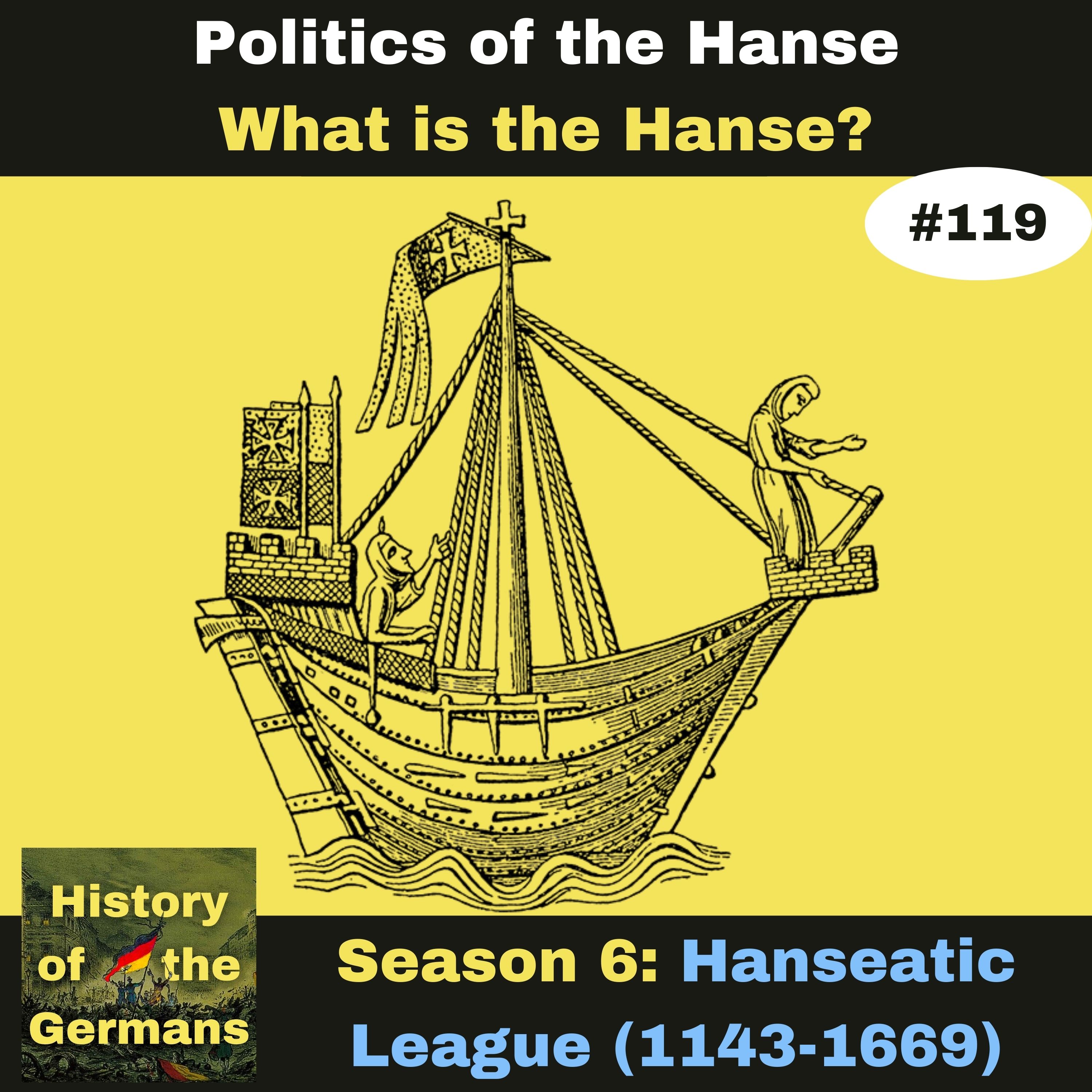
Ep 119Ep. 119: The Hanseatic League - 14th century Politics -What is the Hanse?
That was the question king Edward IV asked the representatives of the Steelyard in 1469. And he had a good reason to ask, because tensions between the English and the Hansa had escalated, ships were captured, and people got killed. He wanted to know who to negotiate with and in particular, who could sign a binding agreement that would put an end to this.The answer he got was not very satisfactory....The episode webpage with transcripts and further links is available hereThe music for the show is Flute Sonata in E-flat major, H.545 by Carl Phillip Emmanuel Bach (or some claim it as BWV 1031 Johann Sebastian Bach) performed and arranged by Michel Rondeau under Common Creative Licence 3.0.As always:Homepage with maps, photos, transcripts and blog: www.historyofthegermans.comIf you wish to support the show go to: Support • History of the Germans PodcastFor do it yourself merchandise go to: Merchandise • History of the Germans PodcastFacebook: @HOTGPod Threads: @history_of_the_germans_podcastBluesky: @hotgpod.bsky.socialInstagram: history_of_the_germansTwitter: @germanshistoryTo make it easier for you to share the podcast, I have created separate playlists for some of the seasons that are set up as individual podcasts. they have the exact same episodes as in the History of the Germans, but they may be a helpful device for those who want to concentrate on only one season.So far I have:The OttoniansSalian Emperors and Investiture ControversyFredrick Barbarossa and Early HohenstaufenFrederick II Stupor MundiSaxony and Eastward ExpansionThe Hanseatic LeagueThe Teutonic KnightsThe Holy Roman Empire 1250-1356The Reformation before the ReformationThe Empire in the 15th centuryThe Fall and Rise of the HabsburgsAnd finally, bibliography. I would like to add a few worksto our usual list, in particular:Jahnke,Carsten: Die Hanse | Reclam VerlagJahnke, Carsten: Netzwerke in Handel und Kommunikation ander Wende vom 15. zum 16. Jahrhundert am Beispiel zweier Revaler Kaufleute. Netzwerke(hansischergeschichtsverein.de)JustynaWubs-Mrozewicz and Stuart Jenks, eds. The Hanse in Medieval and Early ModernEurope. The Northern World: North Europe and the Baltic c. 400–1700 AD:Peoples, Economies and Culture 60. Leiden: Brill, 2013. vi + 296 pp. $171.ISBN: 978-90-04-21252-7. | Renaissance Quarterly | Cambridge CoreTheBoundless Sea: A Human History of the Oceans The Boundless Sea(wolfsonhistoryprize.org.uk)
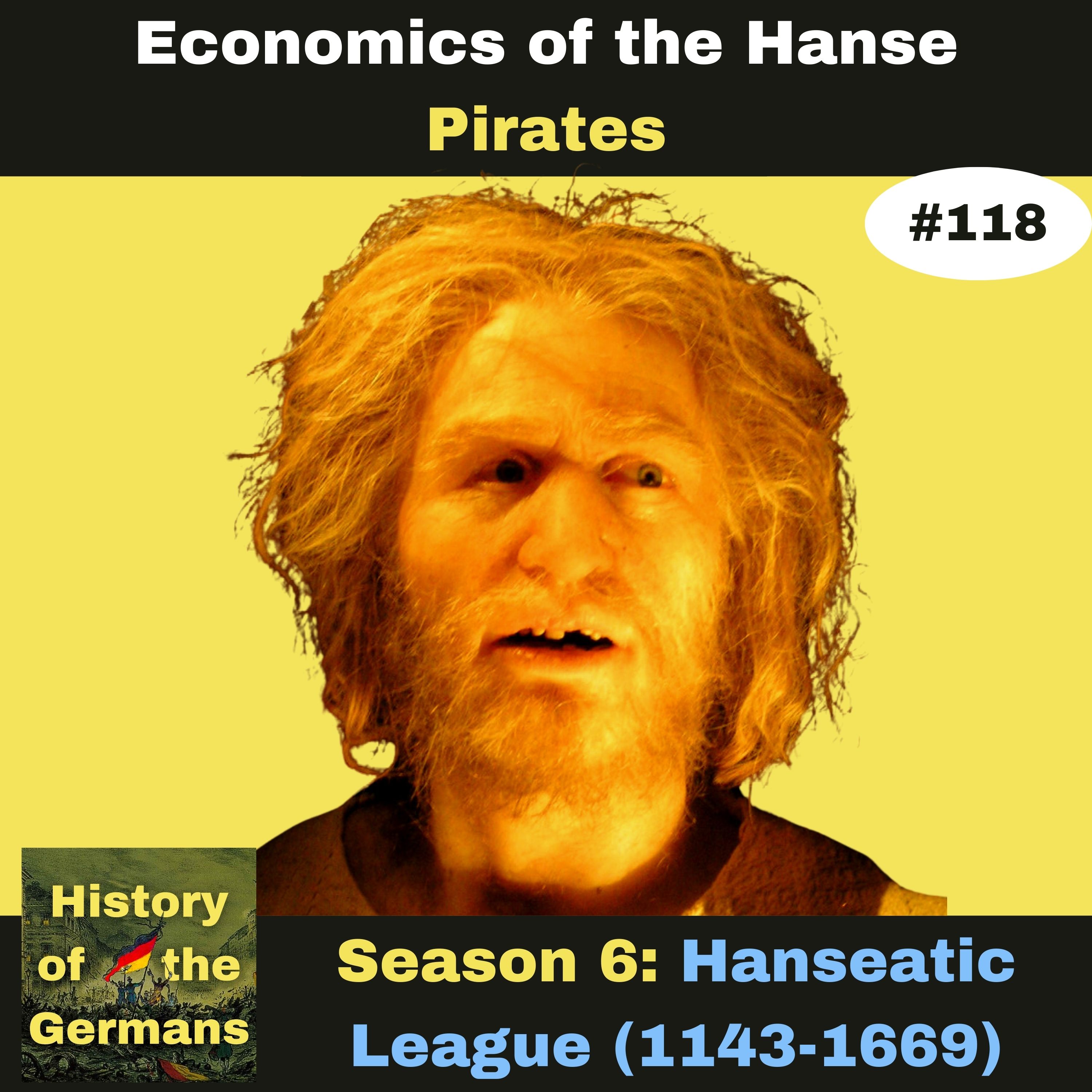
Ep 118Ep. 118: The Hanseatic League - 14th century Politics -Pirates
In 1878 workmen building the Speicherstadt, the magnificent city of warehouses in the harbour of Hamburg made a gruesome discovery. In the mud of the Grasbrook, an island at the entrance of the medieval harbour of Hamburg emerged two piles of wood connected by a wooden bar. An ancient beacon guiding ships. What made it so special was what was nailed on to the bar, human skulls. Whoever these men were, they had been decapitated and their heads displayed as a warning. One of these skulls was quickly identified as that of Klaus Störtebecker, the notorious pirate.The skulls were brought to the Museum für Hamburgische Geschichte, the Museum for the history of Hamburg. There they reconstructed the facial features of Klaus Störtebecker so that vistors can get a better picture of what Hamburg’s greatest nemesis looked like.If you leave the museum and turn right you quickly get to Simon von Utrecht Strasse, named after the man who captured Störtebecker on his agile small cog, the Bunte Kuh, the painted Cow.Störtebecker was brought to the Grasbrook where he and his 72 companions were beheaded on October 20, 1401. As his last wish, Störtebecker asked that all the men he could walk past after his head had fallen should be freed. That wish was granted, but when the headless pirate had passed 11 of his shipmates, one of the members of the city council tripped him up and in the end all of his men were killed, including those he had walked past.Hundreds of books have been and will still be written about Störtebecker and Simon von Utrecht. Some of those I have devoured as a child and this is why it hurts so much to have to tell you – all a lot of nonsense. Störtebecker lived and robbed until 1413, 12 years after his execution, which is a long time for a headless corpse. And Simon von Utrecht was just a lad when he allegedly seized Hamburg’s greatest adversary.The story may be a tall tale, but piracy and the Victual Brothers were real and they were a real threat to the Hanse, or at least I believe it was.The episode webpage with transcripts and further links is available hereThe music for the show is Flute Sonata in E-flat major, H.545 by Carl Phillip Emmanuel Bach (or some claim it as BWV 1031 Johann Sebastian Bach) performed and arranged by Michel Rondeau under Common Creative Licence 3.0.As always:Homepage with maps, photos, transcripts and blog: www.historyofthegermans.comIf you wish to support the show go to: Support • History of the Germans PodcastFor do it yourself merchandise go to: Merchandise • History of the Germans PodcastFacebook: @HOTGPod Threads: @history_of_the_germans_podcastBluesky: @hotgpod.bsky.socialInstagram: history_of_the_germansTwitter: @germanshistoryTo make it easier for you to share the podcast, I have created separate playlists for some of the seasons that are set up as individual podcasts. they have the exact same episodes as in the History of the Germans, but they may be a helpful device for those who want to concentrate on only one season.So far I have:The OttoniansSalian Emperors and Investiture ControversyFredrick Barbarossa and Early HohenstaufenFrederick II Stupor MundiSaxony and Eastward ExpansionThe Hanseatic LeagueThe Teutonic KnightsThe Holy Roman Empire 1250-1356The Reformation before the ReformationThe Empire in the 15th centuryThe Fall and Rise of the Habsburgs
Ep 117Ep. 117: The Hanseatic League - 14th Century Politics -Embargoes
The Hanseatic League undergoes a fundamental transformation in the second half of the 14th century. It turned from a guild of merchants trading across the Baltic and the North Sea into an alliance of trading cities. An alliance that has proven that it can fight and win wars against major territorial powers. That sits quite uncomfortably with the existing European rulers who wonder what to do with this alien inside their body politic.The Hanse had acquired a wide range of trading privileges in their main Kontors in England, Flanders, Norway and the Republic of Novgorod. These privileges did not only disadvantage the locals who were unsurprisingly hostile but also challenged the authority of the princes. That was just about bearable as long as this was just a community of grubby merchants from the Empire. Now that these merchants had built formidable cities, commanded great navies and toppled kings, it became an entirely different ballgame.Furthermore, the legitimacy of the Hansa was fragile. The Hanseatic Cities, apart from Lübeck and Dortmund weren’t free imperial cities, making them at least formally subject to their territorial lords. As such they could not form an actual league of cities as the Northern Italian republics had done a hundred years earlier. Nor were they allowed to conduct foreign policy against their territorial lord, though they sometimes did.These fault lines will become ever more apparent as we go forward with our history. This week we will get a first glimpse at what will lead to the ultimate demise of the League as we get into the year 1388, a year when the cities face off against three of the most powerful political entities in Northern Europe, the kingdom of England, the county of Flanders and the Republic of Novgorod.The episode webpage with transcripts and further links is available hereThe music for the show is Flute Sonata in E-flat major, H.545 by Carl Phillip Emmanuel Bach (or some claim it as BWV 1031 Johann Sebastian Bach) performed and arranged by Michel Rondeau under Common Creative Licence 3.0.As always:Homepage with maps, photos, transcripts and blog: www.historyofthegermans.comIf you wish to support the show go to: Support • History of the Germans PodcastFor do it yourself merchandise go to: Merchandise • History of the Germans PodcastFacebook: @HOTGPod Threads: @history_of_the_germans_podcastBluesky: @hotgpod.bsky.socialInstagram: history_of_the_germansTwitter: @germanshistoryTo make it easier for you to share the podcast, I have created separate playlists for some of the seasons that are set up as individual podcasts. they have the exact same episodes as in the History of the Germans, but they may be a helpful device for those who want to concentrate on only one season.So far I have:The OttoniansSalian Emperors and Investiture ControversyFredrick Barbarossa and Early HohenstaufenFrederick II Stupor MundiSaxony and Eastward ExpansionThe Hanseatic LeagueThe Teutonic KnightsThe Holy Roman Empire 1250-1356The Reformation before the ReformationThe Empire in the 15th centuryThe Fall and Rise of the Habsburgs
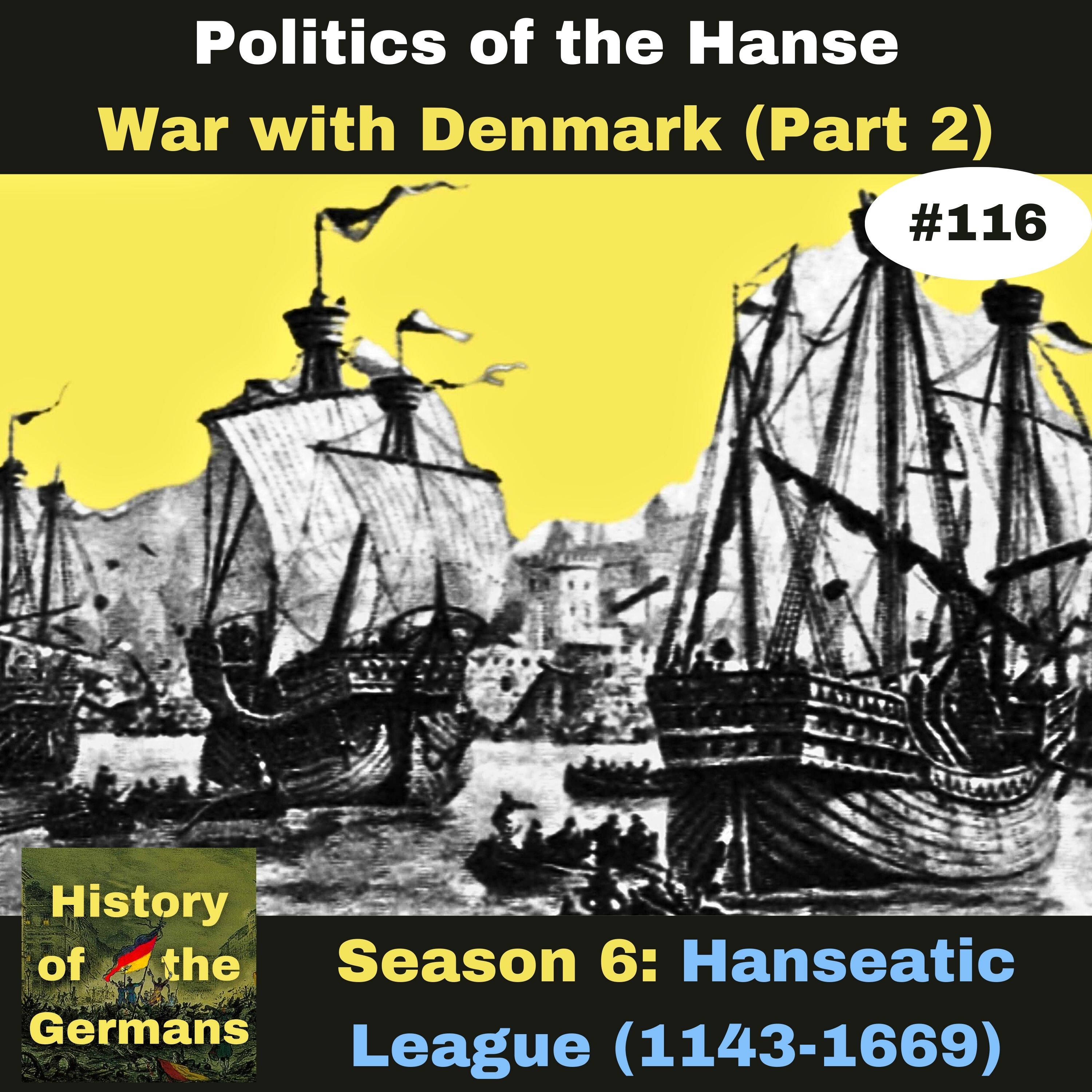
Ep 116Ep. 116: The Hanseatic League - 14th century Politics -The War with Denmark Part II
The Hanseatic League is first and foremost an organisation driven by commerce and commerce rarely sees the necessity of war. But in 1360 the organisation that had only just transitioned from a community of merchants to an alliance of cities found itself in gridlock with Waldemar Atterdag, Waldemar Dawn, king of Denmark.Waldemar’s objective throughout his 35-year reign was to rebuild the kingdom of Denmark that had virtually disintegrated under his predecessors. And for that he needed money. That money he got from the two sources of wealth of the state of Denmark, taxing the trade in herring and the tolls for passing through the Oresund. The Hansards who dominated the herring trade and the traffic through the Oresund were the ones who were supposed to pay for that.If that had not breached the tolerance levels of even the most sober Hanseatic merchant, the attack on Gotland and occupation of the Hanseatic city of Visby did. A fleet leaves Lübeck in 1362 to put the Danish tyrant back into his box…The episode webpage with transcripts and further links is available hereThe music for the show is Flute Sonata in E-flat major, H.545 by Carl Phillip Emmanuel Bach (or some claim it as BWV 1031 Johann Sebastian Bach) performed and arranged by Michel Rondeau under Common Creative Licence 3.0.As always:Homepage with maps, photos, transcripts and blog: www.historyofthegermans.comIf you wish to support the show go to: Support • History of the Germans PodcastFor do it yourself merchandise go to: Merchandise • History of the Germans PodcastFacebook: @HOTGPod Threads: @history_of_the_germans_podcastBluesky: @hotgpod.bsky.socialInstagram: history_of_the_germansTwitter: @germanshistoryTo make it easier for you to share the podcast, I have created separate playlists for some of the seasons that are set up as individual podcasts. they have the exact same episodes as in the History of the Germans, but they may be a helpful device for those who want to concentrate on only one season.So far I have:The OttoniansSalian Emperors and Investiture ControversyFredrick Barbarossa and Early HohenstaufenFrederick II Stupor MundiSaxony and Eastward ExpansionThe Hanseatic LeagueThe Teutonic KnightsThe Holy Roman Empire 1250-1356The Reformation before the ReformationThe Empire in the 15th centuryThe Fall and Rise of the Habsburgs
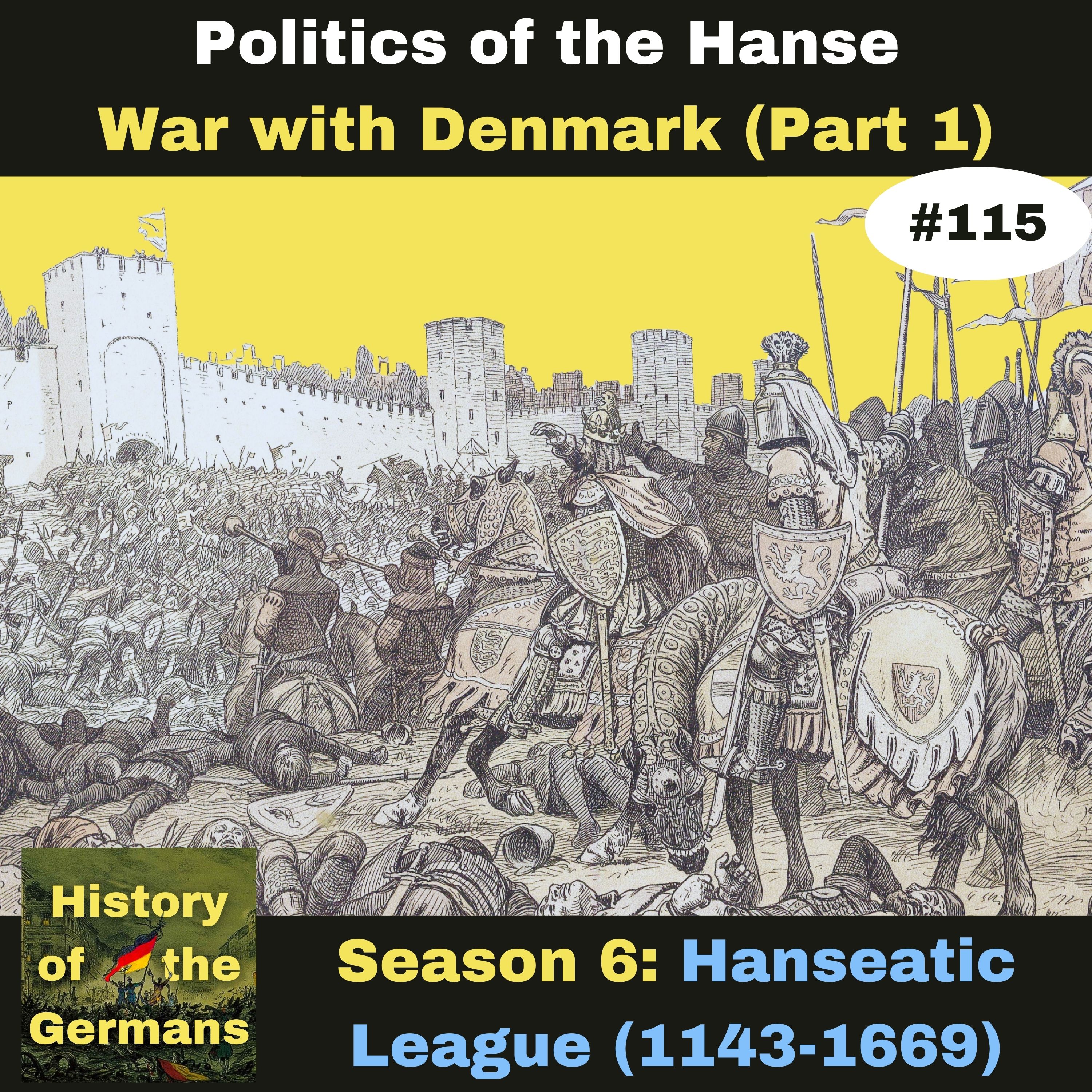
Ep 115Ep. 115: The Hanseatic League - 14th century Politics - The War with Denmark Part I
By the end of the 13th century the key foundations of the Hanseatic League are laid. The trade routes that connect the Baltic to Western Europe are largely under the control of merchants who had come from Northern Germany and settled along the Baltic shore. Four great Kontors in Novgorord, Bergen, Bruges and London have been set up. The cities that make up the League, from Tallin to Cologne have gained city laws, built their walls and selected their city councils.We are now entering the Calamitous 14th Century, a time of war, spiritual disorientation, plague and deteriorating climate. These four riders of the apocalypse devastate formerly flourishing lands and cities across Western Europe, delivering a sucker punch that brings 300 years of economic expansion to a screeching halt. But, as they say in Asterix, “all of Europe is occupied with the challenges of the 14th century. Well not entirely. There is a corner of the world where a league of merchant cities is heading for the zenith of its economic, financial and military power…”The episode webpage with transcripts and further links is available hereThe music for the show is Flute Sonata in E-flat major, H.545 by Carl Phillip Emmanuel Bach (or some claim it as BWV 1031 Johann Sebastian Bach) performed and arranged by Michel Rondeau under Common Creative Licence 3.0.As always:Homepage with maps, photos, transcripts and blog: www.historyofthegermans.comIf you wish to support the show go to: Support • History of the Germans PodcastFor do it yourself merchandise go to: Merchandise • History of the Germans PodcastFacebook: @HOTGPod Threads: @history_of_the_germans_podcastBluesky: @hotgpod.bsky.socialInstagram: history_of_the_germansTwitter: @germanshistoryTo make it easier for you to share the podcast, I have created separate playlists for some of the seasons that are set up as individual podcasts. they have the exact same episodes as in the History of the Germans, but they may be a helpful device for those who want to concentrate on only one season.So far I have:The OttoniansSalian Emperors and Investiture ControversyFredrick Barbarossa and Early HohenstaufenFrederick II Stupor MundiSaxony and Eastward ExpansionThe Hanseatic LeagueThe Teutonic KnightsThe Holy Roman Empire 1250-1356The Reformation before the ReformationThe Empire in the 15th centuryThe Fall and Rise of the Habsburgs
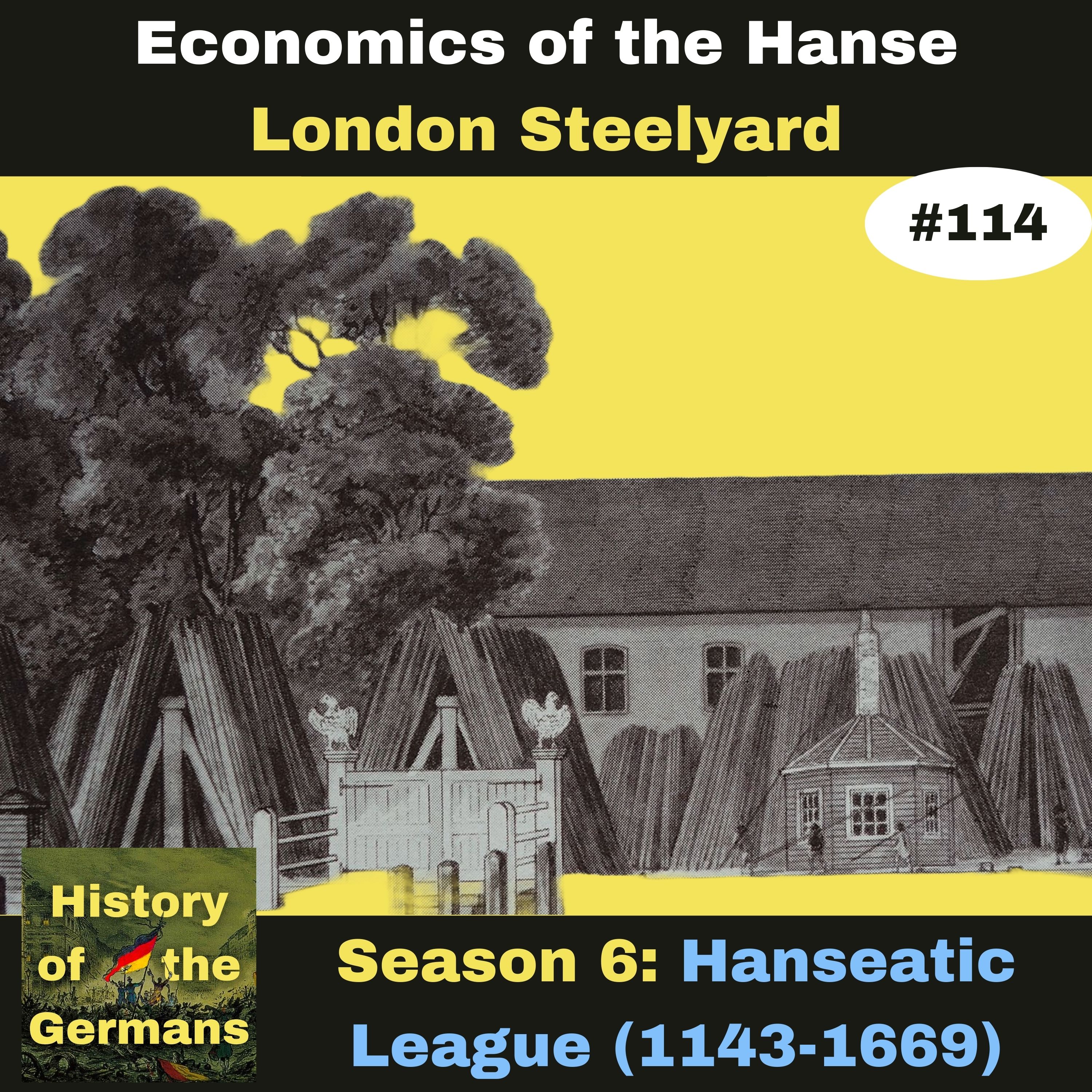
Ep 114Ep. 114: The Hanseatic League (1143-1669) - The Economics - The London Steelyard
If like many of you, you are listening to this podcast on your morning or evening commute and you happen to live in London, you may be one of the 20 million souls going through Cannon Street Station every year. Few of them will be aware that under their feet lay the vestiges of the great Hanseatic Kontor in London that goes back to 1176. If people know about the Steelyard, it is mainly through the portraits of merchants painted by Holbein between 1532 and 1536 at a time when the Kontor had only about 60 years left.But there is a lot to tell about this now vanished building, its inhabitants and trade. It is a story of infighting between the various cities that were still to officially form the Hanseatic league, of trading privileges granted to fund first a crusade and then the hundred year’s war, andit is also a great opportunity to introduce the oldest, largest and richest member of the Hanseatic League, the city of Cologne.As promised here are my favourite German winemakers (and there are lots and lots more..)Nahe Valley (exc. value for money)Weingut Dönnhoff (doennhoff.com)Willkommen auf Gut Hermannsberg (gut-hermannsberg.de)Das Weingut Schäfer-Fröhlich: Weingut Schäfer-Fröhlich (weingut-schaefer-froehlich.de)Rheingau (top quality but expensive)Riesling auf Spitzenniveau | Weingut Schloss Johannisberg (schloss-johannisberg.de)Weingut – Kloster Eberbach (kloster-eberbach.de)Home (sybillekuntz.de)Moselle/AhrWeingut Dr Loosen – Weingut an der Mittel-MoselHome | Weingut Meyer-Näkel (meyer-naekel.de)BadenWeingut Andreas Laible – Wein mit größter Leidenschaft (andreas-laible.com)weingut-huber.comThe episode webpage with transcripts and further links is available hereThe music for the show is Flute Sonata in E-flat major, H.545 by Carl Phillip Emmanuel Bach (or some claim it as BWV 1031 Johann Sebastian Bach) performed and arranged by Michel Rondeau under Common Creative Licence 3.0.As always:Homepage with maps, photos, transcripts and blog: www.historyofthegermans.comIf you wish to support the show go to: Support • History of the Germans PodcastFor do it yourself merchandise go to: Merchandise • History of the Germans PodcastFacebook: @HOTGPod Threads: @history_of_the_germans_podcastBluesky: @hotgpod.bsky.socialInstagram: history_of_the_germansTwitter: @germanshistoryTo make it easier for you to share the podcast, I have created separate playlists for some of the seasons that are set up as individual podcasts. they have the exact same episodes as in the History of the Germans, but they may be a helpful device for those who want to concentrate on only one season.So far I have:The OttoniansSalian Emperors and Investiture ControversyFredrick Barbarossa and Early HohenstaufenFrederick II Stupor MundiSaxony and Eastward ExpansionThe Hanseatic LeagueThe Teutonic KnightsThe Holy Roman Empire 1250-1356The Reformation before the ReformationThe Empire in the 15th centuryThe Fall and Rise of the Habsburgs
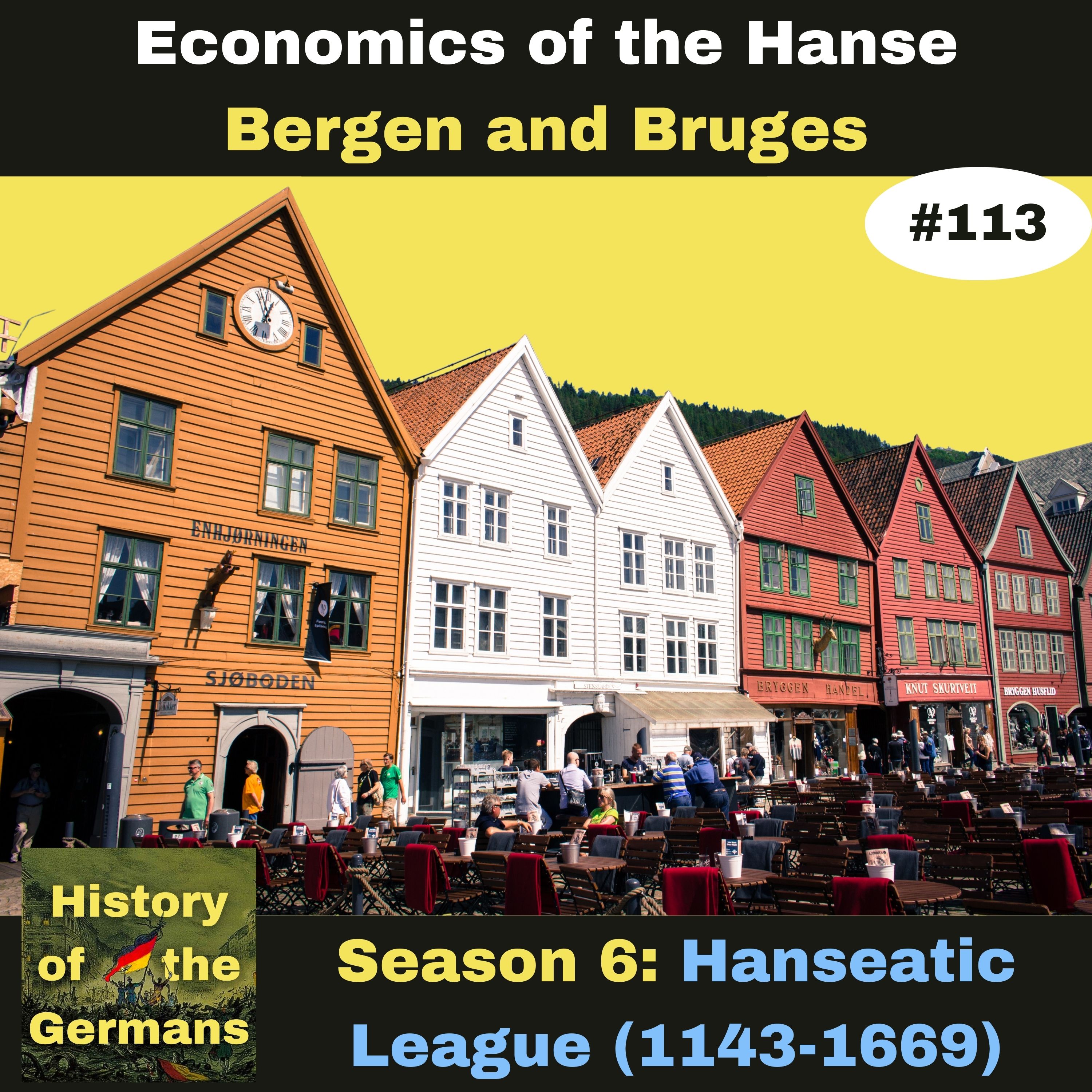
Ep 113Ep. 113: The Hanseatic League (1143-1669) - The Economics - Bergen and Bruges
Today we will talk about the Bryggen, the famous Hanseatic Kontor or trading post in Bergen in western Norway. Bergen itself was never a member of the Hanseatic League, but like The St. Peter’s yard in Novgorod, the steelyard in London and the Kontor of Bruges, the Bryggen in Bergen was a key element of the Hanseatic trading network.The trade in stockfish from Bergen was never on the same scale as the herring trade off Scania or the trade in beeswax and furs from Novgorod, but it was an important springboard for members of the lower classes to join the long-distance merchants. And the way the Hanse was able to gain a stranglehold over the proud Vikings of Norway is a cautionary tale of failed macro-economic policies.If you think the Norwegians are unique in falling prey to aggressive Hanseatic trade policies, think again. Even the mighty Bruges, the warehouse of the medieval world” was made to grant these merchants from the Holy Roman empire far reaching privileges.Some have considered these events as the beginnings of a long process of specialisation in Europe that condemned the East to become the giant breadbasket that fed the industrialising West. I doubt things are that simple, but let’s have a look at the different arguments….The episode webpage with transcripts and further links is available hereThe music for the show is Flute Sonata in E-flat major, H.545 by Carl Phillip Emmanuel Bach (or some claim it as BWV 1031 Johann Sebastian Bach) performed and arranged by Michel Rondeau under Common Creative Licence 3.0.As always:Homepage with maps, photos, transcripts and blog: www.historyofthegermans.comIf you wish to support the show go to: Support • History of the Germans PodcastFor do it yourself merchandise go to: Merchandise • History of the Germans PodcastFacebook: @HOTGPod Threads: @history_of_the_germans_podcastBluesky: @hotgpod.bsky.socialInstagram: history_of_the_germansTwitter: @germanshistoryTo make it easier for you to share the podcast, I have created separate playlists for some of the seasons that are set up as individual podcasts. they have the exact same episodes as in the History of the Germans, but they may be a helpful device for those who want to concentrate on only one season.So far I have:The OttoniansSalian Emperors and Investiture ControversyFredrick Barbarossa and Early HohenstaufenFrederick II Stupor MundiSaxony and Eastward ExpansionThe Hanseatic LeagueThe Teutonic KnightsThe Holy Roman Empire 1250-1356The Reformation before the ReformationThe Empire in the 15th centuryThe Fall and Rise of the Habsburgs
Ep 112Ep. 112: The Hanseatic League (1143-1669) - The Economics - Grain and Beer
This week we will kick off with the string of cities along the Baltic Coast from Lübeck up to Königsberg (modern day Kaliningrad). Who founded them and why? And why so many? Who were the people who came to live there, how did they organise themselves and most importantly, what did they produce and what did they trade?We will dwell on the most splendid of those, Gdansk or Danzig in German, the one city in the Baltic that could give Lübeck a run for its money, a place that developed as six separate cities and only became one entity in the late 15th century. And as we talk about Gdansk, we will also talk about the Vistula River, Europe’s nineth longest that connected Gdansk not just to many of Poland’s great cities, but also to the agricultural wealth of the Prussia of the Teutonic Knights, to the Ukraine and to ancient Lithuania.And all that foodstuff is put on ships and goes to the growing cities of Flanders, the Rhineland, England, Northern France and even Spain. For the first time since the fall of the Roman empire do we hear about large scale grain shipments that sustain urban centres, urban centres that couldn’t otherwise exist.But grain is not the only thing that the Hansa become famous for. The other is Germany’s most popular drink and best-known export, beer. The economics there are even more fascinating, since people did not only drink vast quantities of beer in the Middle Ages, they also cared a lot about where it came from, and Einbecker was Europe’s favourite beer.The episode webpage with transcripts and further links is available hereThe music for the show is Flute Sonata in E-flat major, H.545 by Carl Phillip Emmanuel Bach (or some claim it as BWV 1031 Johann Sebastian Bach) performed and arranged by Michel Rondeau under Common Creative Licence 3.0.As always:Homepage with maps, photos, transcripts and blog: www.historyofthegermans.comIf you wish to support the show go to: Support • History of the Germans PodcastFor do it yourself merchandise go to: Merchandise • History of the Germans PodcastFacebook: @HOTGPod Threads: @history_of_the_germans_podcastBluesky: @hotgpod.bsky.socialInstagram: history_of_the_germansTwitter: @germanshistoryTo make it easier for you to share the podcast, I have created separate playlists for some of the seasons that are set up as individual podcasts. they have the exact same episodes as in the History of the Germans, but they may be a helpful device for those who want to concentrate on only one season.So far I have:The OttoniansSalian Emperors and Investiture ControversyFredrick Barbarossa and Early HohenstaufenFrederick II Stupor MundiSaxony and Eastward ExpansionThe Hanseatic LeagueThe Teutonic KnightsThe Holy Roman Empire 1250-1356The Reformation before the ReformationThe Empire in the 15th centuryThe Fall and Rise of the HabsburgsFor this episode I again reliedheavily on:Philippe Dollinger: Die Hanse –definitely my go-to-book for this seasonDie Hanse, Lebenswirklichkeit und Mythos, herausgegeben von Jürgen Bracker,Volker Henn and Rainer PostelRolf Hammel-Kieslow: Die Hanse
Ep 111Ep. 111: The Hanseatic League (1143-1669) - The Economics - The Copper Mines and Fisheries
“on its eastern side the sea breaks through and cuts off the western side of Skaane; and this sea commonly yields each year an abundant haul to the nets of the fishers. Indeed, the whole sound is apt to be so thronged with fish that any craft which strikes on them is with difficulty got off by hard rowing, and the prize is captured no longer by tackle, but by simple use of the hands.” So writes the the late 12th century Danish chronicler Saxo Grammaticus about Zealand, the island he believed to be the most delightful province and heart of Denmark.In the year 1400, 550 ships arrived in Lübeck, bringing 65,000 barrels of salted Herring to the city at the mouth of the Trave River. But that was only a fraction of the total that is estimated to have been as much as 300,000 barrels of herring a year that were caught in the narrow sound between Copenhagen and Malmo and then processed in a giant temporary market town on the Skanör peninsula. All these vast quantities of fish were needed to feed the European population who had not only acquired a good dose of piety but also as many as 140 fast days per year when the consumption of hot-blooded animals was banned.How the trade in Baltic Herring became a monopoly of the Hanseatic league and the backbone of its trading network is what we will discuss in this episode. No worries, it is not just about salting techniques and the difficulties of shipping a load of fish over thousands of miles. There will be a battle with knights and everything…..and an extended detour into the largest copper mine in Europe that funded the 30-years war. I hope you will enjoy it.The music for the show is Flute Sonata in E-flat major, H.545 by Carl Phillip Emmanuel Bach (or some claim it as BWV 1031 Johann Sebastian Bach) performed and arranged by Michel Rondeau under Common Creative Licence 3.0.As always:Homepage with maps, photos, transcripts and blog: www.historyofthegermans.comIf you wish to support the show go to: Support • History of the Germans PodcastFor do it yourself merchandise go to: Merchandise • History of the Germans PodcastFacebook: @HOTGPod Threads: @history_of_the_germans_podcastBluesky: @hotgpod.bsky.socialInstagram: history_of_the_germansTwitter: @germanshistoryTo make it easier for you to share the podcast, I have created separate playlists for some of the seasons that are set up as individual podcasts. they have the exact same episodes as in the History of the Germans, but they may be a helpful device for those who want to concentrate on only one season.So far I have:The OttoniansSalian Emperors and Investiture ControversyFredrick Barbarossa and Early HohenstaufenFrederick II Stupor MundiSaxony and Eastward ExpansionThe Hanseatic LeagueThe Teutonic KnightsThe Holy Roman Empire 1250-1356The Reformation before the ReformationThe Empire in the 15th centuryThe Fall and Rise of the HabsburgsFor this episode I again reliedheavily on:Philippe Dollinger: Die Hanse – definitely my go-to-book for this seasonDie Hanse, Lebenswirklichkeit und Mythos, herausgegeben von Jürgen Bracker, Volker Henn and Rainer PostelRolf Hammel-Kieslow: Die HanseIf you want to know more about the story of the Swedish copper mining have a look at the Falu Gruva website Falu Gruva - Upptäck tusen år av historia or go to the Unesco world heritage site about Falu Gruva and look through the application for the inclusion on the World heritage List which gives a very detailed account of the mining activities there: Mining Area of the Great Copper Mountain in Falun (unesco.org)And finally I have to thank the Scandinavian History Podcast which helps me understanding the Danish, Swedish and Norwegian perspective on these events: https://podfollow.com/1536322900
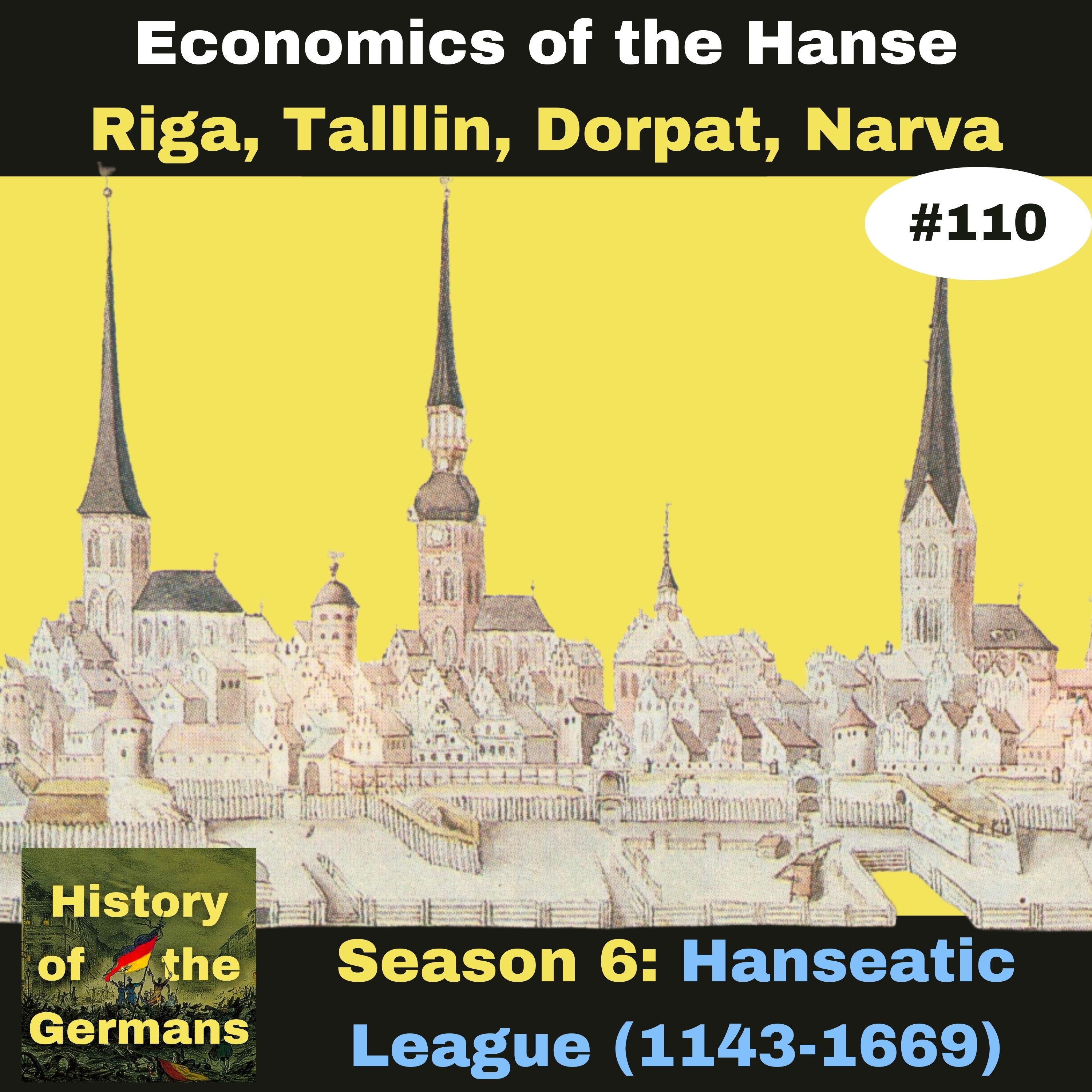
Ep 110Ep. 110: The Hanseatic League (1143-1669) - The Economics - Riga, Tallinn, Dorpat, Narva
“In the monastery of Segeberg there was a man of worthy life, and with venerable gray hair, Meinhard by name, a priest of the Order of Saint Augustine. He came to Livonia with a band of merchants simply for the sake of Christ and only to preach. For German merchants, bound together through familiarity with the Livonians, were accustomed to go to Livonia, frequently sailing up the Daugava River.”So begins the chronicle of Henry of Livonia, a German missionary who tells about the foundation of the bishopric and city of Riga, the conversion of the pagan population of what is today Latvia and Estonia, and the cruel antics of the Livonian brotherhood of the sword.In this episode we will touch upon the Livonian Sword brothers and we take a first glimpse at the Teutonic knights, but this is the history of the Hanseatic League and so what we really focus on are the merchants, specifically the merchants from the “Society of German merchants who frequently travel to Gotland”, the Gotlandfahrer who we have met last week.Because the tale we hear today adds the other important streak to the structure of the Hanseatic League, its willingness to use military force in the pursuit of profits.The music for the show is Flute Sonata in E-flat major, H.545 by Carl Phillip Emmanuel Bach (or some claim it as BWV 1031 Johann Sebastian Bach) performed and arranged by Michel Rondeau under Common Creative Licence 3.0.As always:Homepage with maps, photos, transcripts and blog: www.historyofthegermans.comIf you wish to support the show go to: Support • History of the Germans PodcastFor do it yourself merchandise go to: Merchandise • History of the Germans PodcastFacebook: @HOTGPod Threads: @history_of_the_germans_podcastBluesky: @hotgpod.bsky.socialInstagram: history_of_the_germansTwitter: @germanshistoryTo make it easier for you to share the podcast, I have created separate playlists for some of the seasons that are set up as individual podcasts. they have the exact same episodes as in the History of the Germans, but they may be a helpful device for those who want to concentrate on only one season.So far I have:The OttoniansSalian Emperors and Investiture ControversyFredrick Barbarossa and Early HohenstaufenFrederick II Stupor MundiSaxony and Eastward ExpansionThe Hanseatic LeagueThe Teutonic KnightsThe Holy Roman Empire 1250-1356The Reformation before the ReformationThe Empire in the 15th centuryThe Fall and Rise of the HabsburgsFor this episode I relied heavily on:Philippe Dollinger: Die HanseDie Hanse, Lebenswirklichkeit und Mythos, htsg. von Jürgen Bracker, Volker Henn und Rainer PostelRolf Hammel-Kieslow: Die HanseEric Christiansen: The Nordic CrusadesAnd since we are at it, I came across a really interesting article about the trade in beeswax in the Middle Ages by Dr. Alexandra Sapoznik titled “Bees in the medieval economy”. I have put a link in the transcript that you can find on the History of the Germans Website. A bit niche and geeky but quite fascinating: Bees in the medieval world: economic, environmental and cultural perspectives - King's College London (kcl.ac.uk)
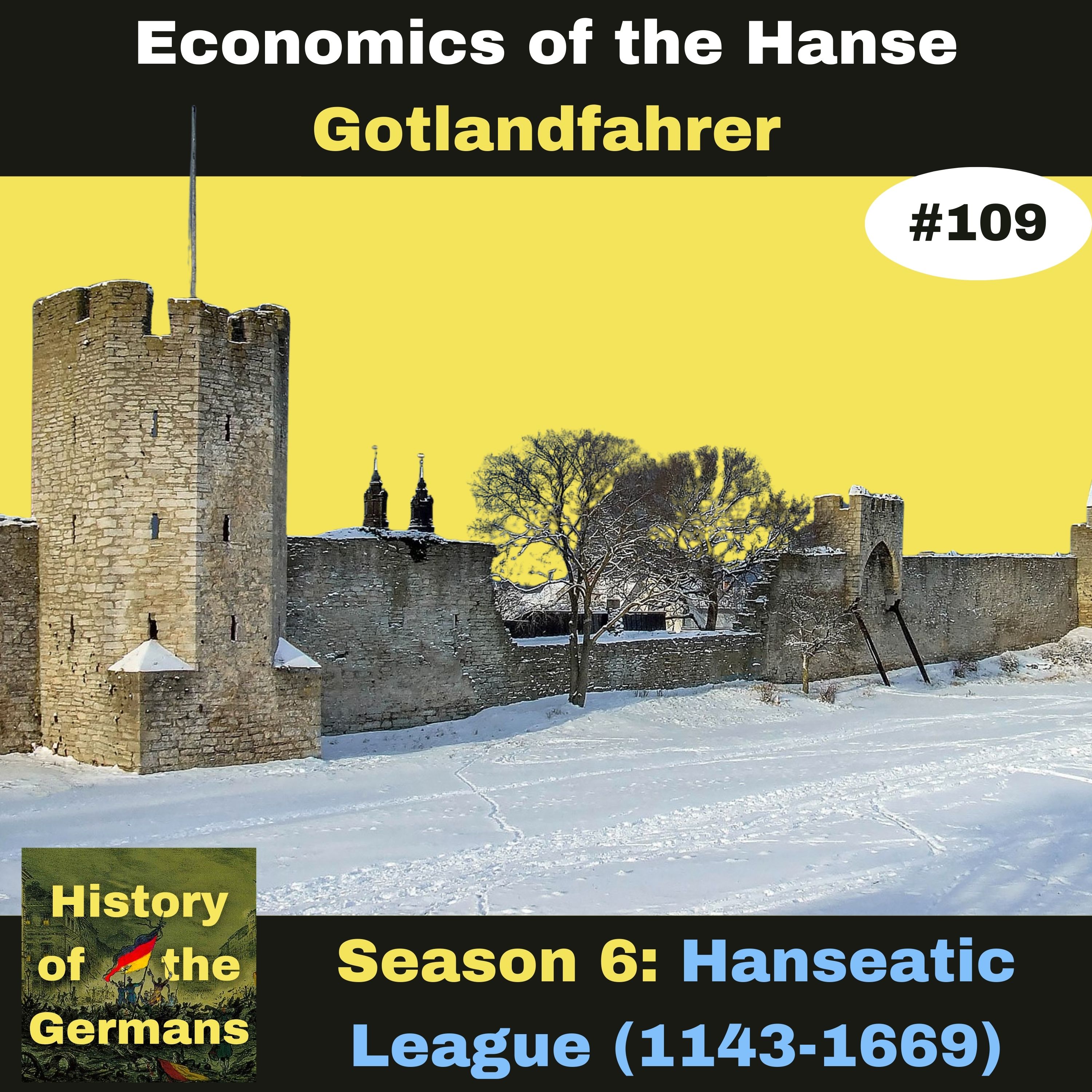
Ep 109Ep. 109: The Hanseatic League (12th century) - The Economics - Gotlandfahrer
If I put the word Hanseatic into Google Search I get as result number 4 “Hanseatic King’s Lynn -Visit West Norfolk”. I can say with absolute confidence that there is not a single German individual, place or organisation that a small town in England would choose to not just associate with but incorporate itself into its history, safe for the Hanseatic League. They may play Zedoch the Priest at the coronation but that is because both Handel and Price Charles are considered English with German roots. Kings Lynn calling itself a Hanseatic city is a different thing. And it happens in many other places, Bergen is proud of its Hanseatic past as is Visby in Gotland or the Dutch former members of the League.The love of all things Hanseatic goes so far that it even overrides the German fascination with all things car related. As you may know, the German system of numberplates is strictly hierarchical. The first 1, 2 or 3 letters indicate the place where the vehicle is registered at the time. The more letters, the smaller the town or county of registration. For instance, WES stands for Wesel and STD for Stade, two of the smaller members of the Hanseatic League. The two-letter cities are plentiful and some, like LG stands for Lüneburg and BS for Brunswick. Only the largest cities get to proudly display just one single letter – for instance K for Cologne, B for Berlin and F for Frankfurt.But what about Germany’s second largest city, the Free and Hanseatic City of Hamburg? Does your honourable Hamburg merchant drive round in a car ostentatiously displaying a proud single H? No, of course he doesn’t. His numberplate is HH, standing for Hansestadt Hamburg, leaving the single H to the inland Hanoverians. Other Hanseatic cities like Bremen, Lübeck, Wismar, Rostock, Greifswald and Stralsund also proudly carry an additional H on their numberplate, a subtle reminder to everyone that their hometowns are different and dare one say, superior to other cities.How can an organisation that had hardly any permanent institutions traded rather pedestrian commodities like grain, Hering, furs and beeswax and ceased to exist in 1669 still stir so many peoples’ hearts with pride, that is what we will try to figure out in this podcast series.The music for the show is Flute Sonata in E-flat major, H.545 by Carl Phillip Emmanuel Bach (or some claim it as BWV 1031 Johann Sebastian Bach) performed and arranged by Michel Rondeau under Common Creative Licence 3.0.As always:Homepage with maps, photos, transcripts and blog: www.historyofthegermans.comIf you wish to support the show go to: Support • History of the Germans PodcastFor do it yourself merchandise go to: Merchandise • History of the Germans PodcastFacebook: @HOTGPod Threads: @history_of_the_germans_podcastBluesky: @hotgpod.bsky.socialInstagram: history_of_the_germansTwitter: @germanshistoryTo make it easier for you to share the podcast, I have created separate playlists for some of the seasons that are set up as individual podcasts. they have the exact same episodes as in the History of the Germans, but they may be a helpful device for those who want to concentrate on only one season.So far I have:The OttoniansSalian Emperors and Investiture ControversyFredrick Barbarossa and Early HohenstaufenFrederick II Stupor MundiSaxony and Eastward ExpansionThe Hanseatic LeagueThe Teutonic KnightsThe Holy Roman Empire 1250-1356The Reformation before the ReformationThe Empire in the 15th centuryThe Fall and Rise of the HabsburgsBibliography:Philippe Dillinger: Die HanseDie Hanse, Lebenswirklichkeit und Mythos, curated by Jürgen Bracker, Volker Henn and Rainer PostelRolf Hammel-Kieslow: Die HanseAnd special thanks for the translation of the Artlenburg Privileg to Dr. Jenny Benham.And special thanks to Dr. justyna Wubs-Montzewicz whose research I found eye-opening
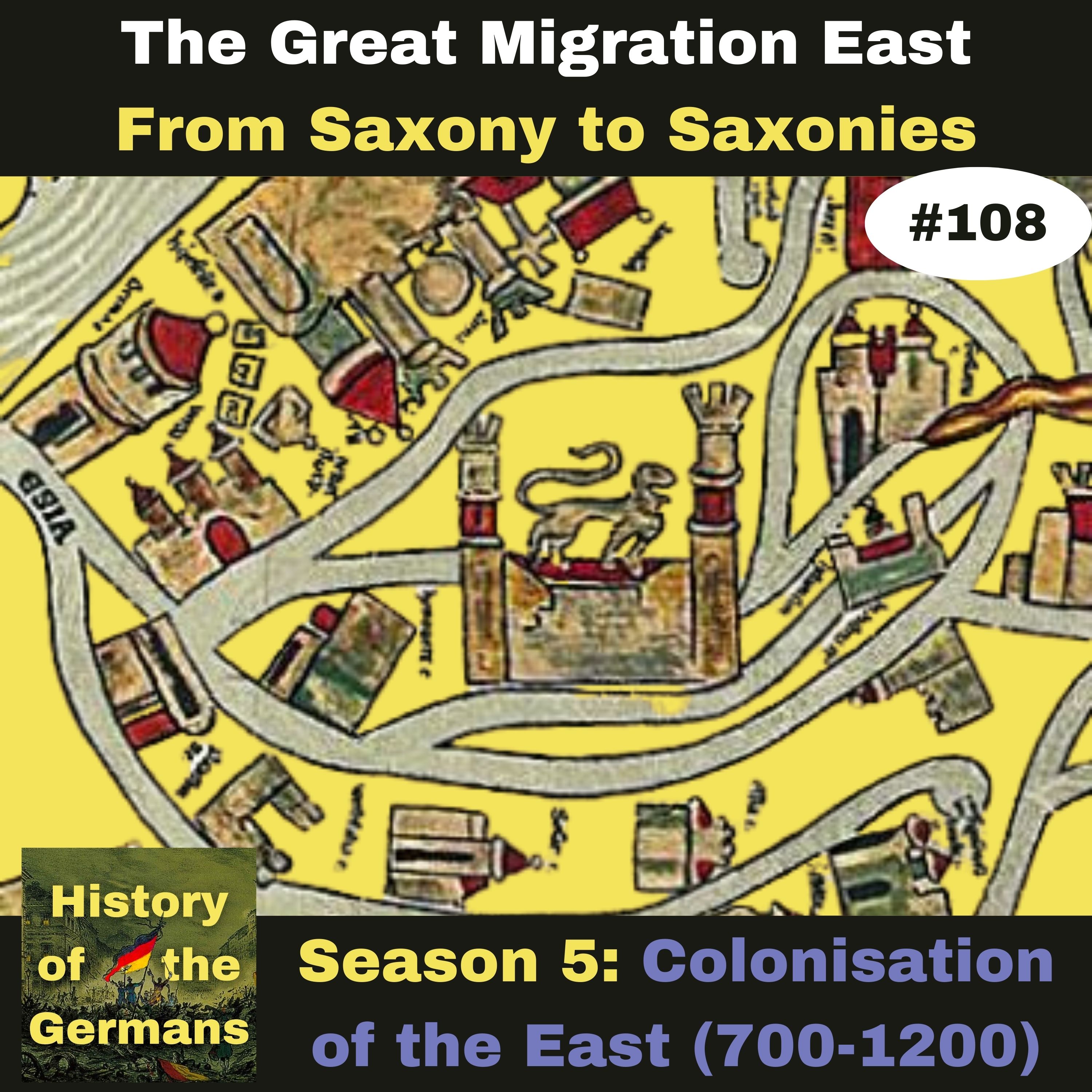
Ep 108Ep. 108: Colonisation of the East(700-1200) - From Saxony to Saxonies
These last few episodes you may have wondered how all this hangs together. This week we will try to resolve this question. What we will talk about is how the great stem duchy of Saxony fell apart. And there are two stories about that. One is the story of Henry the Lion and his fall in 1180. That story has been repeated over and over again and put into a context of rivalry between the Welf and the Hohenstaufen, between Guelfs and Ghibellines. It makes for a great story of betrayal and revenge. But it is also partly wrong and more importantly, not the whole story. The whole story is one about princely opposition against centralising tendencies, about an antagonism between the south and the north and about a broad trend of fragmentation of power that engulfed not just the empire but also Italy, Poland, Denmark and others.It is the resulting environment of warring mid-sized principalities that allowed alternative structures like the Hanseatic League and the Teutonic Knights to emerge. So let’s get straight into it.The music for the show is Flute Sonata in E-flat major, H.545 by Carl Phillip Emmanuel Bach (or some claim it as BWV 1031 Johann Sebastian Bach) performed and arranged by Michel Rondeau under Common Creative Licence 3.0.As always:Homepage with maps, photos, transcripts and blog: www.historyofthegermans.comIf you wish to support the show go to: Support • History of the Germans PodcastFor do it yourself merchandise go to: Merchandise • History of the Germans PodcastFacebook: @HOTGPod Threads: @history_of_the_germans_podcastBluesky: @hotgpod.bsky.socialInstagram: history_of_the_germansTwitter: @germanshistoryTo make it easier for you to share the podcast, I have created separate playlists for some of the seasons that are set up as individual podcasts. they have the exact same episodes as in the History of the Germans, but they may be a helpful device for those who want to concentrate on only one season.So far I have:The OttoniansSalian Emperors and Investiture ControversyFredrick Barbarossa and Early HohenstaufenFrederick II Stupor MundiSaxony and Eastward ExpansionThe Hanseatic LeagueThe Teutonic KnightsThe Holy Roman Empire 1250-1356The Reformation before the ReformationThe Empire in the 15th centuryThe Fall and Rise of the Habsburgs
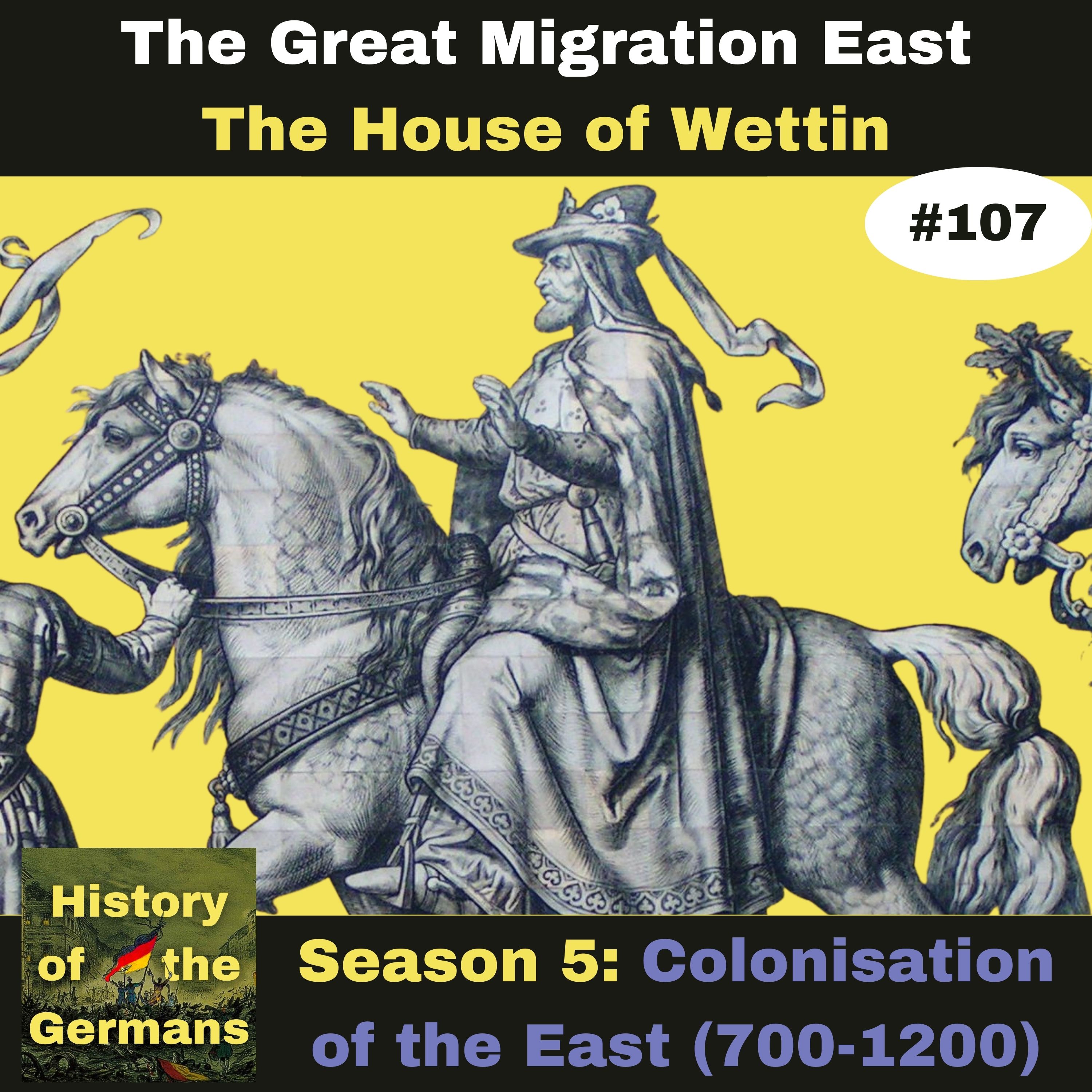
Ep 107Ep. 107: Colonisation of the East(700-1200) - The House of Wettin
If you ever come to Dresden, and if you like art, architecture and history, you very much should, you may want to turn into Augustusstrasse right by the Residenzschloss. What you fnd there is the largest porcelain artwork in the world, 102 metres long and made from 23,000 Meissen porcelain tiles. This is the “Fürstenzug”, the procession of princes.It was made to celebrate 800 years of the House of Wettin who ruled over what we now know as the land of Saxony. It portrays 35 margraves, electors, dukes and kings from 1127 to 1904. Being essentially a 19th century artwork, it depicts all these Saxon rulers as powerful military leaders surrounded by their fighting men and important nobles, all in contemporary costume.There are 94 depictions and only one female figure in the whole procession. So, was the lasting rule of the House of Wettin built upon their martial prowess? Well they did fight a lot, but the true source of their power is depicted in one of the very last figures of the procession coming after the princes, the army, the intellectuals and the artists and largely obscured by the images of the carpenter and the builder involved in the project. What that figure represents and what lay at the heart of the Wettiner success, we will find out…The music for the show is Flute Sonata in E-flat major, H.545 by Carl Phillip Emmanuel Bach (or some claim it as BWV 1031 Johann Sebastian Bach) performed and arranged by Michel Rondeau under Common Creative Licence 3.0.As always:Homepage with maps, photos, transcripts and blog: www.historyofthegermans.comIf you wish to support the show go to: Support • History of the Germans PodcastFor do it yourself merchandise go to: Merchandise • History of the Germans PodcastFacebook: @HOTGPod Threads: @history_of_the_germans_podcastBluesky: @hotgpod.bsky.socialInstagram: history_of_the_germansTwitter: @germanshistoryTo make it easier for you to share the podcast, I have created separate playlists for some of the seasons that are set up as individual podcasts. they have the exact same episodes as in the History of the Germans, but they may be a helpful device for those who want to concentrate on only one season.So far I have:The OttoniansSalian Emperors and Investiture ControversyFredrick Barbarossa and Early HohenstaufenFrederick II Stupor MundiSaxony and Eastward ExpansionThe Hanseatic LeagueThe Teutonic KnightsThe Holy Roman Empire 1250-1356The Reformation before the ReformationThe Empire in the 15th centuryThe Fall and Rise of the Habsburgs

Ep 106Ep. 106: Colonisation of the East(700-1200) - How to make a Mark in Brandenburg
This week we continue our walkabout of the major centres of power in the North of Germany that emerged during the 12th and 13th century. We talked about Holstein and Lübeck and now it is time to talk about the march of Brandenburg which means we need to talk about a character that had bit part roles on the podcast for quite some time, Albrecht the Bear. He was one of the longest lasting protagonists in the story of the German Middle Ages, playing a role in the reigns of Henry V, Lothar III, Konrad III and Frederick Barbarossa, though his lasting impact was on the Eastern European stage where he founded the March of Brandenburg, the political entity that through a lot of twists and turns becomes the Kingdom of Prussia and the heart of the Second Empire. So, let’s see what he was up to.The music for the show is Flute Sonata in E-flat major, H.545 by Carl Phillip Emmanuel Bach (or some claim it as BWV 1031 Johann Sebastian Bach) performed and arranged by Michel Rondeau under Common Creative Licence 3.0.As always:Homepage with maps, photos, transcripts and blog: www.historyofthegermans.comIf you wish to support the show go to: Support • History of the Germans PodcastFor do it yourself merchandise go to: Merchandise • History of the Germans PodcastFacebook: @HOTGPod Threads: @history_of_the_germans_podcastBluesky: @hotgpod.bsky.socialInstagram: history_of_the_germansTwitter: @germanshistoryTo make it easier for you to share the podcast, I have created separate playlists for some of the seasons that are set up as individual podcasts. they have the exact same episodes as in the History of the Germans, but they may be a helpful device for those who want to concentrate on only one season.So far I have:The OttoniansSalian Emperors and Investiture ControversyFredrick Barbarossa and Early HohenstaufenFrederick II Stupor MundiSaxony and Eastward ExpansionThe Hanseatic LeagueThe Teutonic KnightsThe Holy Roman Empire 1250-1356The Reformation before the ReformationThe Empire in the 15th centuryThe Fall and Rise of the Habsburgs
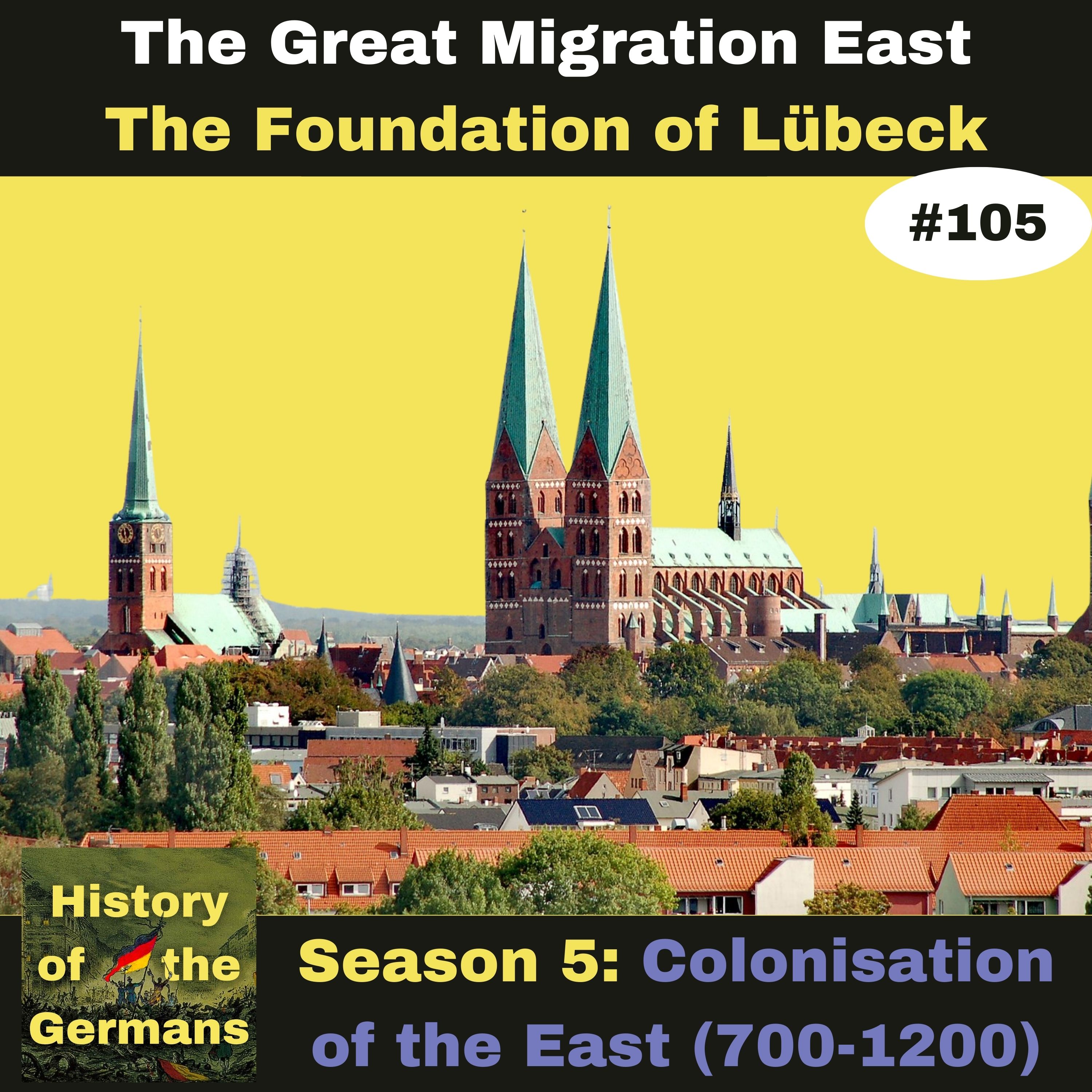
Ep 105Ep. 105: Colonisation of the East(700-1200) - The Foundation of Lübeck
This week we will look at one of the great mysteries of German medieval history, how Lübeck could become the second largest City in the Holy Roman empire within just 100 years from its foundation. Lübeck lies on a small river, the Trave that goes into a small Sea, the Baltic. Not only is the Baltic comparatively small, the peoples who live on its shores are no slouches. They have been famed for travelling as far south as Constantinople and as far north as Greenland for centuries. So how did the future capital of the Hanseatic League manage to grow so fast? We will go through the different theories and maybe we can find out…The music for the show is Flute Sonata in E-flat major, H.545 by Carl Phillip Emmanuel Bach (or some claim it as BWV 1031 Johann Sebastian Bach) performed and arranged by Michel Rondeau under Common Creative Licence 3.0.As always:Homepage with maps, photos, transcripts and blog: www.historyofthegermans.comIf you wish to support the show go to: Support • History of the Germans PodcastFor do it yourself merchandise go to: Merchandise • History of the Germans PodcastFacebook: @HOTGPod Threads: @history_of_the_germans_podcastBluesky: @hotgpod.bsky.socialInstagram: history_of_the_germansTwitter: @germanshistoryTo make it easier for you to share the podcast, I have created separate playlists for some of the seasons that are set up as individual podcasts. they have the exact same episodes as in the History of the Germans, but they may be a helpful device for those who want to concentrate on only one season.So far I have:The OttoniansSalian Emperors and Investiture ControversyFredrick Barbarossa and Early HohenstaufenFrederick II Stupor MundiSaxony and Eastward ExpansionThe Hanseatic LeagueThe Teutonic KnightsThe Holy Roman Empire 1250-1356The Reformation before the ReformationThe Empire in the 15th centuryThe Fall and Rise of the Habsburgs
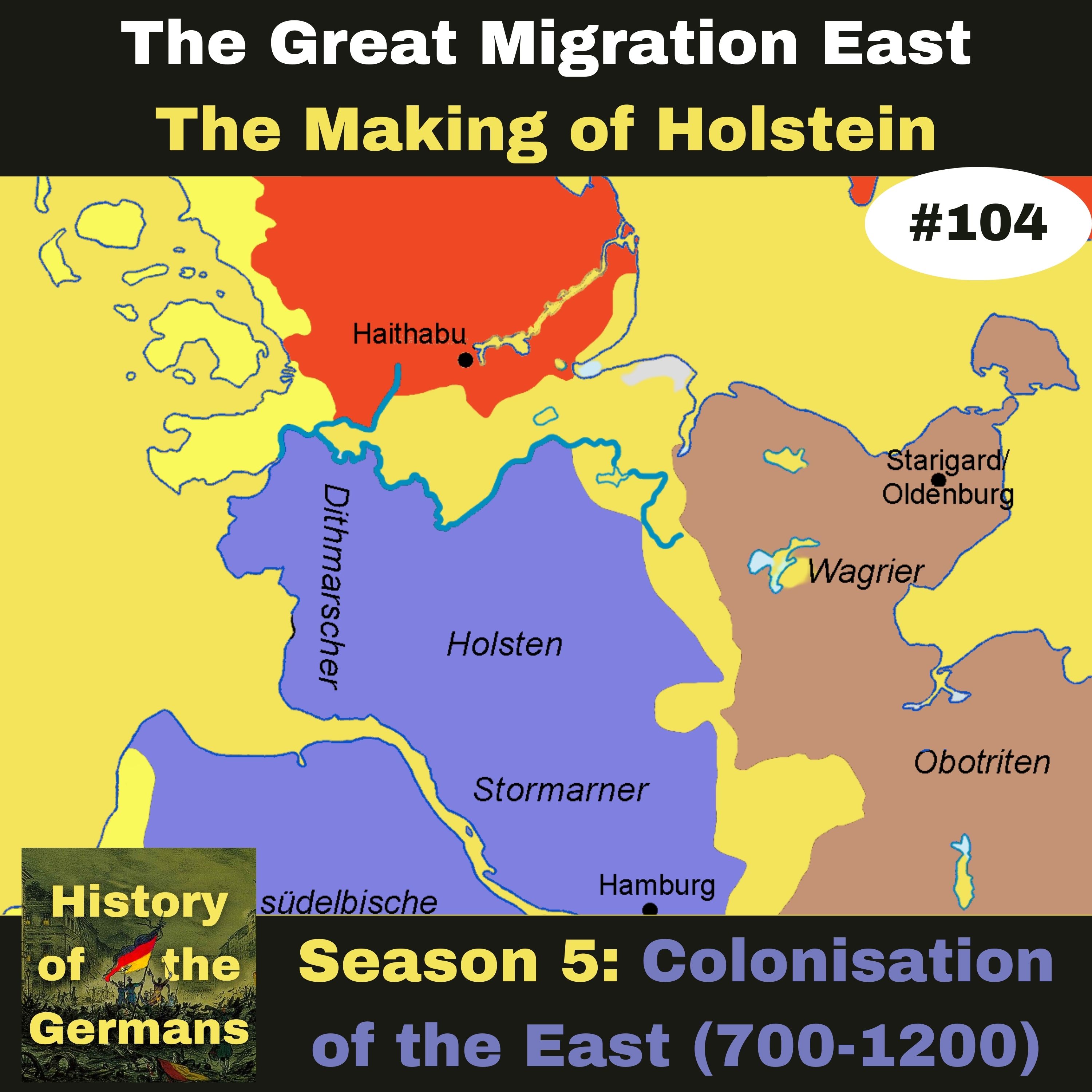
Ep 104Ep. 104: Colonisation of the East(700-1200) - The Making of Holstein
In today’s episode we finally get closer to the history of the Hanseatic League. We will take a look at some of the fundamental changes in the Saxon policy towards the east that were ushered in during the reign of Lothar of Supplinburg and shaped events for a long period thereafter.It is in these decades that the Saxon magnates will realise that raiding and plundering of the lands east of the Elbe is no longer the financially most attractive option. A great organised migration from the overpopulated Rhineland, Holland and Flanders into Northern Germany begins.What we will look at specifically is the county of Holstein and its brand-new counts, the lords of Schauenburg. These ambitious and proactive family will develop these lands and found or re-found two of the most significant cities of the Hanseatic League, Lubeck and Hamburg.The music for the show is Flute Sonata in E-flat major, H.545 by Carl Phillip Emmanuel Bach (or some claim it as BWV 1031 Johann Sebastian Bach) performed and arranged by Michel Rondeau under Common Creative Licence 3.0.As always:Homepage with maps, photos, transcripts and blog: www.historyofthegermans.comIf you wish to support the show go to: Support • History of the Germans PodcastFor do it yourself merchandise go to: Merchandise • History of the Germans PodcastFacebook: @HOTGPod Threads: @history_of_the_germans_podcastBluesky: @hotgpod.bsky.socialInstagram: history_of_the_germansTwitter: @germanshistoryTo make it easier for you to share the podcast, I have created separate playlists for some of the seasons that are set up as individual podcasts. they have the exact same episodes as in the History of the Germans, but they may be a helpful device for those who want to concentrate on only one season.So far I have:The OttoniansSalian Emperors and Investiture ControversyFredrick Barbarossa and Early HohenstaufenFrederick II Stupor MundiSaxony and Eastward ExpansionThe Hanseatic LeagueThe Teutonic KnightsThe Holy Roman Empire 1250-1356The Reformation before the ReformationThe Empire in the 15th centuryThe Fall and Rise of the Habsburgs
Ep 103Ep. 103: Colonisation of the East(700-1200) - Lothar III gets things going for real
This week we talk about what happens after the fight for independence is won. As had happened countless times before in history, precious freedoms gained in bloody struggles can be lost easily in the subsequent peace, not to the old adversary, but to new, homegrown usurpers. That is at least one way of telling the story, the other being, that every major political upheaval is followed by a period of consolidation that embeds the gains made and truncates the excesses that appeared during the revolutionary period.Something like that happened following the Saxon wars when Lothar of Supplinburg, a hitherto minor count from Westphalia is raised to ducal authority in 1106. Before he took the reins of the duchy, Saxony had turned into a free for all. Whenever a rich count or margrave fell victim to the various dangers a civil war generated, his cousins and peers would race to first seize his wife or daughter and then use their claim to grasp as much of his property as possible. A process not much more dignified than the opening of the doors on a Black Friday pre-pandemic.Lothar established a central authority for the duchy that calms things down considerably. It is during this time that four of the five great princely dynasties in the North get established, the Welf, the Wettins, the Ascanier and the counts of Holstein. The rise of these four was however not a given. There were others, like the counts of Stade and Wiprecht of Groitzsch whose burning ambitions came to nought as they stumbled in the race between reproduction and their near inevitable violent death.The music for the show is Flute Sonata in E-flat major, H.545 by Carl Phillip Emmanuel Bach (or some claim it as BWV 1031 Johann Sebastian Bach) performed and arranged by Michel Rondeau under Common Creative Licence 3.0.As always:Homepage with maps, photos, transcripts and blog: www.historyofthegermans.comIf you wish to support the show go to: Support • History of the Germans PodcastFor do it yourself merchandise go to: Merchandise • History of the Germans PodcastFacebook: @HOTGPod Threads: @history_of_the_germans_podcastBluesky: @hotgpod.bsky.socialInstagram: history_of_the_germansTwitter: @germanshistoryTo make it easier for you to share the podcast, I have created separate playlists for some of the seasons that are set up as individual podcasts. they have the exact same episodes as in the History of the Germans, but they may be a helpful device for those who want to concentrate on only one season.So far I have:The OttoniansSalian Emperors and Investiture ControversyFredrick Barbarossa and Early HohenstaufenFrederick II Stupor MundiSaxony and Eastward ExpansionThe Hanseatic LeagueThe Teutonic KnightsThe Holy Roman Empire 1250-1356The Reformation before the ReformationThe Empire in the 15th centuryThe Fall and Rise of the Habsburgs
Ep 102Ep. 102: Colonisation of the East(700-1200) - Investiture Controversy and its impact on the East
This week we will hit the arguably most important set of events in medieval German history often summarised under the banner of the Investiture Controversy. The Investment Controversy came about through a confluence of three major strains, the rise in piety in the wake of improving economic conditions, the establishment of the papacy as a power separate and superior to temporal rulers and thirdly, the opposition of the German magnates against centralising tendency of the emperors, led by the Saxons. And it is the latter part this episode focuses on. If you are interested in the whole story, the episodes 30 to 42 can give you the overarching story. I actually listened to them again and am a little bit proud of what I have done there. So much for self-aggrandization and let’s find out.The music for the show is Flute Sonata in E-flat major, H.545 by Carl Phillip Emmanuel Bach (or some claim it as BWV 1031 Johann Sebastian Bach) performed and arranged by Michel Rondeau under Common Creative Licence 3.0.As always:Homepage with maps, photos, transcripts and blog: www.historyofthegermans.comIf you wish to support the show go to: Support • History of the Germans PodcastFor do it yourself merchandise go to: Merchandise • History of the Germans PodcastFacebook: @HOTGPod Threads: @history_of_the_germans_podcastBluesky: @hotgpod.bsky.socialInstagram: history_of_the_germansTwitter: @germanshistoryTo make it easier for you to share the podcast, I have created separate playlists for some of the seasons that are set up as individual podcasts. they have the exact same episodes as in the History of the Germans, but they may be a helpful device for those who want to concentrate on only one season.So far I have:The OttoniansSalian Emperors and Investiture ControversyFredrick Barbarossa and Early HohenstaufenFrederick II Stupor MundiSaxony and Eastward ExpansionThe Hanseatic LeagueThe Teutonic KnightsThe Holy Roman Empire 1250-1356The Reformation before the ReformationThe Empire in the 15th centuryThe Fall and Rise of the Habsburgs
Ep 101Ep. 101: Colonisation of the East(700-1200) - Mecklenburg - Gottschalk and Adalbert
This week we will follow the history of two men who could not be more different. On one side is Gottschalk, leader of the pagan Abodrites, who first comes to prominence as a brutal raider killing Saxons all across Holstein in revenge for his father’s killing. The other is Adalbert, son of a count, brother of the count palatinate of Saxony, friend and confidant of Henry III, a man who refused the offer of becoming pope for his ambition to convert all of Scandinavia and the Baltic. These two men formed an alliance against the Saxon magnates in general and the Billungs, dukes of Saxony in particular.It is a story of greed and violence, of Christian conversion and attempts to break out of strategic gridlock…The music for the show is Flute Sonata in E-flat major, H.545 by Carl Phillip Emmanuel Bach (or some claim it as BWV 1031 Johann Sebastian Bach) performed and arranged by Michel Rondeau under Common Creative Licence 3.0.As always:Homepage with maps, photos, transcripts and blog: www.historyofthegermans.comIf you wish to support the show go to: Support • History of the Germans PodcastFor do it yourself merchandise go to: Merchandise • History of the Germans PodcastFacebook: @HOTGPod Threads: @history_of_the_germans_podcastBluesky: @hotgpod.bsky.socialInstagram: history_of_the_germansTwitter: @germanshistoryTo make it easier for you to share the podcast, I have created separate playlists for some of the seasons that are set up as individual podcasts. they have the exact same episodes as in the History of the Germans, but they may be a helpful device for those who want to concentrate on only one season.So far I have:The OttoniansSalian Emperors and Investiture ControversyFredrick Barbarossa and Early HohenstaufenFrederick II Stupor MundiSaxony and Eastward ExpansionThe Hanseatic LeagueThe Teutonic KnightsThe Holy Roman Empire 1250-1356The Reformation before the ReformationThe Empire in the 15th centuryThe Fall and Rise of the Habsburgs
Ep 100Ep. 100: Colonisation of the East(700-1200)- The (second) Saxon War
As we go through the story of the Saxon Stem duchy in the 10thand 11th century, two or maybe three main strains of the storyemerge, the gradually drifting away of Saxony from the empire, the relationship between Saxons and Wends and the antagonism between the archbishop of Hamburg and the magnates. As for the first part of the storyline, the conflict between Saxons and the empire we are now hitting the hot stage.I did cover that already a long time ago in Episode 31 “The (second) Saxon War”. I had at some point thought of simply dropping the old episode into the feed as it quite neatly summarises the events of the great Saxon rebellion that precedes the journey of emperor Henry IV to Canossa. But then I thought I should at least put these events more into the context of the history of the North. So, most of what you hear now is recycled material with just a few artfully designed segues –as Wilhelm Busch used to say “wovon sie besonders schwaermt, wenn es wieder aufgewaermt”....The music for the show is Flute Sonata in E-flat major, H.545 by Carl Phillip Emmanuel Bach (or some claim it as BWV 1031 Johann Sebastian Bach) performed and arranged by Michel Rondeau under Common Creative Licence 3.0.As always:Homepage with maps, photos, transcripts and blog: www.historyofthegermans.comIf you wish to support the show go to: Support • History of the Germans PodcastFor do it yourself merchandise go to: Merchandise • History of the Germans PodcastFacebook: @HOTGPod Threads: @history_of_the_germans_podcastBluesky: @hotgpod.bsky.socialInstagram: history_of_the_germansTwitter: @germanshistoryTo make it easier for you to share the podcast, I have created separate playlists for some of the seasons that are set up as individual podcasts. they have the exact same episodes as in the History of the Germans, but they may be a helpful device for those who want to concentrate on only one season.So far I have:The OttoniansSalian Emperors and Investiture ControversyFredrick Barbarossa and Early HohenstaufenFrederick II Stupor MundiSaxony and Eastward ExpansionThe Hanseatic LeagueThe Teutonic KnightsThe Holy Roman Empire 1250-1356The Reformation before the ReformationThe Empire in the 15th centuryThe Fall and Rise of the Habsburgs
Ep 99Ep. 99: Colonisation of the East(700-1200) - Follow the Money
This week we stumble into the next imperial succession where the Saxons are again standing on the side lines. On paper the new guy, Konrad II was a man after their own heart, fearsome warrior untroubled by bookish learning, but he was also a sponsor of the church. His son, Henry III was even more so, and there are many reasons why the Saxon magnates did not like the ecclesiastical princes. And it is not just about them greedily gobbling up lands and privileges, but they are also hitting them where it hurts most – the economy, stupid…The music for the show is Flute Sonata in E-flat major, H.545 by Carl Phillip Emmanuel Bach (or some claim it as BWV 1031 Johann Sebastian Bach) performed and arranged by Michel Rondeau under Common Creative Licence 3.0.As always:Homepage with maps, photos, transcripts and blog: www.historyofthegermans.comIf you wish to support the show go to: Support • History of the Germans PodcastFor do it yourself merchandise go to: Merchandise • History of the Germans PodcastFacebook: @HOTGPod Threads: @history_of_the_germans_podcastBluesky: @hotgpod.bsky.socialInstagram: history_of_the_germansTwitter: @germanshistoryTo make it easier for you to share the podcast, I have created separate playlists for some of the seasons that are set up as individual podcasts. they have the exact same episodes as in the History of the Germans, but they may be a helpful device for those who want to concentrate on only one season.So far I have:The OttoniansSalian Emperors and Investiture ControversyFredrick Barbarossa and Early HohenstaufenFrederick II Stupor MundiSaxony and Eastward ExpansionThe Hanseatic LeagueThe Teutonic KnightsThe Holy Roman Empire 1250-1356The Reformation before the ReformationThe Empire in the 15th centuryThe Fall and Rise of the Habsburgs
Ep 98Ep. 98: Colonisation of the East(700-1200) - The Rift between Emperor and Saxon Princes
This week we are talking about the rift that is opening up between the Saxons and the Empire. For 80 years Saxony had been the centre of imperial power and the Ottonians had been supportive of the Saxon nobles’ policy vis-à-vis the Wends and Poland. All that Is about to change. The new emperor Henry II, though a direct descendant of Henry the Fowler, was no Saxon. For three generations his family had been dukes of Bavaria and all that exposure to the despised southerners had rubbed off. The Saxons were too divided to field their own candidate, but that does not mean they wanted Henry II.And for good reason. The new administration drives a 180 degree turn in imperial policy versus Poland and versus the Slavic tribes in the Marches….The music for the show is Flute Sonata in E-flat major, H.545 by Carl Phillip Emmanuel Bach (or some claim it as BWV 1031 Johann Sebastian Bach) performed and arranged by Michel Rondeau under Common Creative Licence 3.0.As always:Homepage with maps, photos, transcripts and blog: www.historyofthegermans.comIf you wish to support the show go to: Support • History of the Germans PodcastFor do it yourself merchandise go to: Merchandise • History of the Germans PodcastFacebook: @HOTGPod Threads: @history_of_the_germans_podcastBluesky: @hotgpod.bsky.socialInstagram: history_of_the_germansTwitter: @germanshistoryTo make it easier for you to share the podcast, I have created separate playlists for some of the seasons that are set up as individual podcasts. they have the exact same episodes as in the History of the Germans, but they may be a helpful device for those who want to concentrate on only one season.So far I have:The OttoniansSalian Emperors and Investiture ControversyFredrick Barbarossa and Early HohenstaufenFrederick II Stupor MundiSaxony and Eastward ExpansionThe Hanseatic LeagueThe Teutonic KnightsThe Holy Roman Empire 1250-1356The Reformation before the ReformationThe Empire in the 15th centuryThe Fall and Rise of the Habsburgs
Ep 97Ep. 97: Colonisation of the East(700-1200) - Rebellion!
Now that we know the lay of the land it is time for action, and quite some action it will be. The Wends, the pagan Slavic peoples living east of the Elbe who found themselves ever more squeezed by their now Christian neighbours wake up one morning to find their oppressors fatally weakened. Events 2000 km south of Brandenburg create the once in a century opportunity to throw off the yoke of the Saxons. The newly built churches go up in flames and their tormentors flee back across the Elbe. Any plans for retaliation are thwarted by a succession crisis. This loss of control will have a major impact not on German history, but will reset the relationship with Poland and Bohemia as well. In the year 1000, emperor Otto III will manifest this new relationship when he visits one of Poland’s most remarkable monarch, Boleslav the Brave in Gniesno. Let’s find out…The music for the show is Flute Sonata in E-flat major, H.545 by Carl Phillip Emmanuel Bach (or some claim it as BWV 1031 Johann Sebastian Bach) performed and arranged by Michel Rondeau under Common Creative Licence 3.0.As always:Homepage with maps, photos, transcripts and blog: www.historyofthegermans.comIf you wish to support the show go to: Support • History of the Germans PodcastFor do it yourself merchandise go to: Merchandise • History of the Germans PodcastFacebook: @HOTGPod Threads: @history_of_the_germans_podcastBluesky: @hotgpod.bsky.socialInstagram: history_of_the_germansTwitter: @germanshistoryTo make it easier for you to share the podcast, I have created separate playlists for some of the seasons that are set up as individual podcasts. they have the exact same episodes as in the History of the Germans, but they may be a helpful device for those who want to concentrate on only one season.So far I have:The OttoniansSalian Emperors and Investiture ControversyFredrick Barbarossa and Early HohenstaufenFrederick II Stupor MundiSaxony and Eastward ExpansionThe Hanseatic LeagueThe Teutonic KnightsThe Holy Roman Empire 1250-1356The Reformation before the ReformationThe Empire in the 15th centuryThe Fall and Rise of the Habsburgs
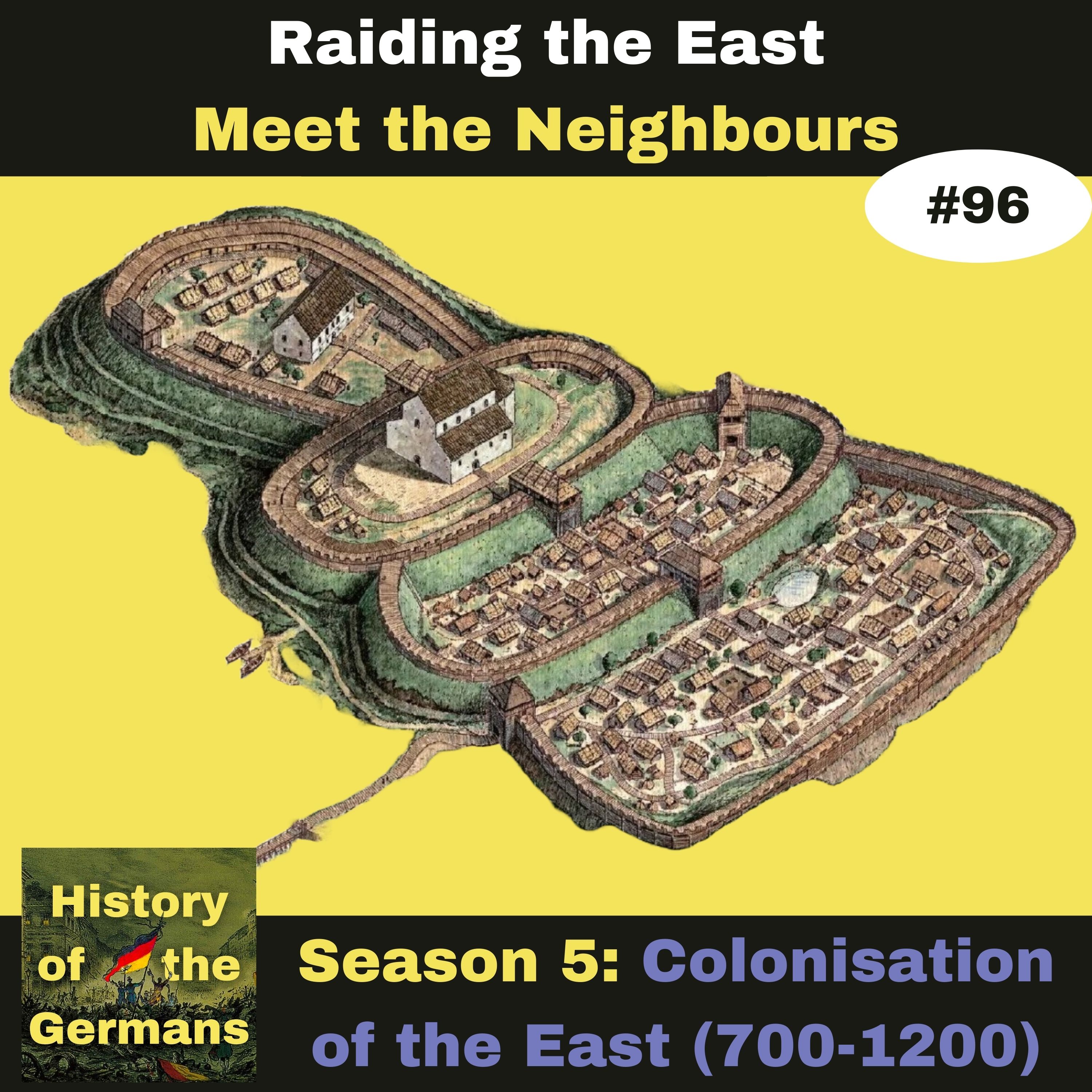
Ep 96Ep. 96: Colonisation of the East(700-1200) - The Neighbours - Poland, Bohemia and Denmark
This week we are still getting our bearings. Last week we saw the emergence of the Stem duchy of Saxony and the Eastern marches. This week we take a look at the most important neighbours to the East and North, the Bohemians, the Poles and the Danes.It is right around this time, the middle of the 10th century that these coalesce into political entities. As always none of this happens smoothly, so expect all sorts of battles and betrayals, including a legion of thieves…The music for the show is Flute Sonata in E-flat major, H.545 by Carl Phillip Emmanuel Bach (or some claim it as BWV 1031 Johann Sebastian Bach) performed and arranged by Michel Rondeau under Common Creative Licence 3.0.As always:Homepage with maps, photos, transcripts and blog: www.historyofthegermans.comIf you wish to support the show go to: Support • History of the Germans PodcastFor do it yourself merchandise go to: Merchandise • History of the Germans PodcastFacebook: @HOTGPod Threads: @history_of_the_germans_podcastBluesky: @hotgpod.bsky.socialInstagram: history_of_the_germansTwitter: @germanshistoryTo make it easier for you to share the podcast, I have created separate playlists for some of the seasons that are set up as individual podcasts. they have the exact same episodes as in the History of the Germans, but they may be a helpful device for those who want to concentrate on only one season.So far I have:The OttoniansSalian Emperors and Investiture ControversyFredrick Barbarossa and Early HohenstaufenFrederick II Stupor MundiSaxony and Eastward ExpansionThe Hanseatic LeagueThe Teutonic KnightsThe Holy Roman Empire 1250-1356The Reformation before the ReformationThe Empire in the 15th centuryThe Fall and Rise of the Habsburgs
Ep 95Ep. 95: Colonisation of the East(700-1200) - Callous Kings and Murderous Margraves
I have to start with an admission. I promised you a History of the Germans but I am afraid there is no such thing. All I can give you is the histories of the German people. The last 94 episodes you have heard one of the histories of the Germans, the one about the mighty emperors and their political, military and spiritual struggle with the papacy. It is a great story, and it was fun to tell it.But today we kick off another of the histories, the history of the North of Germany, the part that looked east, rather than south. It is a story of a frontier culture where an estimated 7% of the population of the western part of the empire pack up their belongings and move east, sometimes under the cover of expansionary princes or knightly orders, sometimes invited by local potentates looking to grow their economies. It is a story about the creation and expansion of trade networks, the foundation of cities, some that will remain modest in size, others that turn into important European capitals. It is the story of a periphery that will in time become the centre.And because it is an almost independent history, we start at the beginning, in the year 772, the year when Charlemagne takes his troops into Saxony hell bent on turning these pagan tribesmen into good Christians and subjects of his emerging empire. If things work out as I hope, we should end this episode with the life of Hermann Billung and Margrave Gero, the first of a wave of chancers and warlords that seek their fortune in the east.And to all of you who may be new to the History of the Germans Podcast, do not panic. You do not have to catch up on all the previous episodes; you can just start right here, and the narrative should make sense in itself – at least I hope it will. However, some say that the previous three seasons weren’t completely shoddy and may be worth listening to.The music for the show is Flute Sonata in E-flat major, H.545 by Carl Phillip Emmanuel Bach (or some claim it as BWV 1031 Johann Sebastian Bach) performed and arranged by Michel Rondeau under Common Creative Licence 3.0.As always:Homepage with maps, photos, transcripts and blog: www.historyofthegermans.comIf you wish to support the show go to: Support • History of the Germans PodcastFor do it yourself merchandise go to: Merchandise • History of the Germans PodcastFacebook: @HOTGPod Threads: @history_of_the_germans_podcastBluesky: @hotgpod.bsky.socialInstagram: history_of_the_germansTwitter: @germanshistoryTo make it easier for you to share the podcast, I have created separate playlists for some of the seasons that are set up as individual podcasts. they have the exact same episodes as in the History of the Germans, but they may be a helpful device for those who want to concentrate on only one season.So far I have:The OttoniansSalian Emperors and Investiture ControversyFredrick Barbarossa and Early HohenstaufenFrederick II Stupor MundiSaxony and Eastward ExpansionThe Hanseatic LeagueThe Teutonic KnightsThe Holy Roman Empire 1250-1356The Reformation before the ReformationThe Empire in the 15th centuryThe Fall and Rise of the Habsburgs
Ep 94Ep. 94 - Questions and Answers
Here we are. 2 years of the History of the Germans Podcast. 93 main episodes and 102 when we count bonus episodes, interviews and the like. That makes 3,223 minutes or 2d, 5h and 43minutes of recorded history. At the last count you have downloaded 914,413 episodes which means if you had all listened to all of the episodes, you would have spent a cumulative 20,000 days listening to me!Wow! It is only fair that I listen to you for once! And that is what this episode is all about.Thank you all for all your questions and comments. It was great to see how much you care about the story we have gone through. I really enjoyed reading them and I think I will attempt to answer all of them.I did organise them by topic going from general to specific, so the podcast in general, the Sources, German history in general, the Hohenstaufen and then Frederick II and his sons.The music for the show is Flute Sonata in E-flat major, H.545 by Carl Phillip Emmanuel Bach (or some claim it as BWV 1031 Johann Sebastian Bach) performed and arranged by Michel Rondeau under Common Creative Licence 3.0.As always:Homepage with maps, photos, transcripts and blog: www.historyofthegermans.comIf you wish to support the show go to: Support • History of the Germans PodcastFor do it yourself merchandise go to: Merchandise • History of the Germans PodcastFacebook: @HOTGPod Threads: @history_of_the_germans_podcastBluesky: @hotgpod.bsky.socialInstagram: history_of_the_germansTwitter: @germanshistoryTo make it easier for you to share the podcast, I have created separate playlists for some of the seasons that are set up as individual podcasts. they have the exact same episodes as in the History of the Germans, but they may be a helpful device for those who want to concentrate on only one season.So far I have:The OttoniansSalian Emperors and Investiture ControversyFredrick Barbarossa and Early HohenstaufenFrederick II Stupor MundiSaxony and Eastward ExpansionThe Hanseatic LeagueThe Teutonic KnightsThe Holy Roman Empire 1250-1356The Reformation before the ReformationThe Empire in the 15th centuryThe Fall and Rise of the Habsburgs
Ep 93Ep. 93: Frederick II's Afterlife - from Fake Emperors to Ernst Kantorowics
On July 7th, 1285, a sunny day in the city of Wetzlar, a day’s ride north of Frankfurt acrid smoke rises from a mighty pyre built up just outside its walls. The pyre was for an emperor, or at least a man who claimed to be the emperor Fredrick II. This man had shown up in the Rhineland, gathered followers, set up a court and sent letters to prince and cities across the realm. Envoys had come from Italy to find out whether the Stupor Mundi had indeed returned. King Rudolf of Habsburg had to turn up in person at the head of an army to sort things out. Just before the fires were lit the (fake) emperor called on to his followers to proceed to Frankfurt as planned where he would re-appear in three days’ time.He did not reappear in Frankfurt but in Utrecht, where the imposter was hanged. The next sighting was in Lübeck in 1286, where he was killed again. In 1295 he was again captured and burned at the stake. The myth of the emperor who lives and does not live persisted over the centuries. Sometime in the 15th or 16the century the myth transfers from Frederick II to Barbarossa who now dwelt in the Khyffhaueser mountain waiting to be called.Frederick II was relegated to a secondary role amongst the great medieval emperors until in 1927 a hitherto unknown writer, Ernst Kantorowics published his biography of Frederick II. This book became the most intensely discussed and most controversial biographies of a medieval ruler – full stop. Its view of the emperor was suffused with the right-wing ideology of the George Kreis. Hitler allegedly read it twice, it was on Goebbels’ bedside table, but at the same time Claus von Stauffenberg, the leader of the July plot to assassinate Hitler was a friend of Kantorowics and Admiral Canaris, another key conspirator asked for the book to read before his execution. Its Jewish author disliked the Nazis despite his extreme right-wing views. He fled Germany in 1938 and distanced himself from his most famous work. In the US he got caught in the nets of McCarthyism when he refused to swear an oath to fight communists. A rare case where the biographers biography is almost as fascinating as his subject, well worth exploring.The music for the show is Flute Sonata in E-flat major, H.545 by Carl Phillip Emmanuel Bach (or some claim it as BWV 1031 Johann Sebastian Bach) performed and arranged by Michel Rondeau under Common Creative Licence 3.0.As always:Homepage with maps, photos, transcripts and blog: www.historyofthegermans.comIf you wish to support the show go to: Support • History of the Germans PodcastFor do it yourself merchandise go to: Merchandise • History of the Germans PodcastFacebook: @HOTGPod Threads: @history_of_the_germans_podcastBluesky: @hotgpod.bsky.socialInstagram: history_of_the_germansTwitter: @germanshistoryTo make it easier for you to share the podcast, I have created separate playlists for some of the seasons that are set up as individual podcasts. they have the exact same episodes as in the History of the Germans, but they may be a helpful device for those who want to concentrate on only one season.So far I have:The OttoniansSalian Emperors and Investiture ControversyFredrick Barbarossa and Early HohenstaufenFrederick II Stupor MundiSaxony and Eastward ExpansionThe Hanseatic LeagueThe Teutonic KnightsThe Holy Roman Empire 1250-1356The Reformation before the ReformationThe Empire in the 15th centuryThe Fall and Rise of the Habsburgs
Ep 92Ep. 92: Pope Boniface VIII - Showdown with the Papacy - Papal Epilogue
The popes have won the 200-year fight with the emperors, first the Salians and then the Hohenstaufen. A total war that ended in total victory. The imperial family of the Henrys of Waiblingen has been annihilated either in battle, through illness or at a last resort by execution. The empire is reduced from dominating power in Europe to coordinating mechanism for the princes. How could anyone deny that, to use the words of pope Boniface VIII, “it is altogether necessary for salvation for every human creature to be subject to the Roman Pontiff”.Well, someone will deny that and six years after these words were uttered the church will march north into its Babylonian Captivity in Avignon. How did that happen? That is an even more intriguing question than how the Hohenstaufen could be wiped out.The music for the show is Flute Sonata in E-flat major, H.545 by Carl Phillip Emmanuel Bach (or some claim it as BWV 1031 Johann Sebastian Bach) performed and arranged by Michel Rondeau under Common Creative Licence 3.0.As always:Homepage with maps, photos, transcripts and blog: www.historyofthegermans.comIf you wish to support the show go to: Support • History of the Germans PodcastFor do it yourself merchandise go to: Merchandise • History of the Germans PodcastFacebook: @HOTGPod Threads: @history_of_the_germans_podcastBluesky: @hotgpod.bsky.socialInstagram: history_of_the_germansTwitter: @germanshistoryTo make it easier for you to share the podcast, I have created separate playlists for some of the seasons that are set up as individual podcasts. they have the exact same episodes as in the History of the Germans, but they may be a helpful device for those who want to concentrate on only one season.So far I have:The OttoniansSalian Emperors and Investiture ControversyFredrick Barbarossa and Early HohenstaufenFrederick II Stupor MundiSaxony and Eastward ExpansionThe Hanseatic LeagueThe Teutonic KnightsThe Holy Roman Empire 1250-1356The Reformation before the ReformationThe Empire in the 15th centuryThe Fall and Rise of the Habsburgs
Ep 91Ep. 91: Konrad IV, Manfred and Konradin (1250-1268) - Hohenstaufen Epilogue
When Frederick II died in 1250 there were four legitimate male descendants of the emperor, his son Konrad IV, elected king of the Romans, his son Henry, a mere six years old, but from most noble blood, his son Manfred from his relationship with Bianca Lancia who had married on her deathbed. And there was a grandson, the child of his unlucky oldest son Henry (VII). 18 years later when this episode ends, the House of Hohenstaufen will be wiped from the face of the earth. Lets find out how that could happen..The music for the show is Flute Sonata in E-flat major, H.545 by Carl Phillip Emmanuel Bach (or some claim it as BWV 1031 Johann Sebastian Bach) performed and arranged by Michel Rondeau under Common Creative Licence 3.0.As always:Homepage with maps, photos, transcripts and blog: www.historyofthegermans.comIf you wish to support the show go to: Support • History of the Germans PodcastFor do it yourself merchandise go to: Merchandise • History of the Germans PodcastFacebook: @HOTGPod Threads: @history_of_the_germans_podcastBluesky: @hotgpod.bsky.socialInstagram: history_of_the_germansTwitter: @germanshistoryTo make it easier for you to share the podcast, I have created separate playlists for some of the seasons that are set up as individual podcasts. they have the exact same episodes as in the History of the Germans, but they may be a helpful device for those who want to concentrate on only one season.So far I have:The OttoniansSalian Emperors and Investiture ControversyFredrick Barbarossa and Early HohenstaufenFrederick II Stupor MundiSaxony and Eastward ExpansionThe Hanseatic LeagueThe Teutonic KnightsThe Holy Roman Empire 1250-1356The Reformation before the ReformationThe Empire in the 15th centuryThe Fall and Rise of the Habsburgs
Ep 90Ep. 90: Frederick II (1196-1250) - Showdown with the Papacy - Things Are Falling Apart
This week things will indeed be falling apart. The never-ending war is exactly what it is, a never ending, unwinnable war against an enemy that hides on the other side of the Alps and cannot be attacked. Money is running seriously low, and Frederick II is getting concerned about the loyalty of his closest associates. And those he will lose, one due to the vagaries of war, the other through a bout of paranoia.The music for the show is Flute Sonata in E-flat major, H.545 by Carl Phillip Emmanuel Bach (or some claim it as BWV 1031 Johann Sebastian Bach) performed and arranged by Michel Rondeau under Common Creative Licence 3.0.As always:Homepage with maps, photos, transcripts and blog: www.historyofthegermans.comIf you wish to support the show go to: Support • History of the Germans PodcastFor do it yourself merchandise go to: Merchandise • History of the Germans PodcastFacebook: @HOTGPod Threads: @history_of_the_germans_podcastBluesky: @hotgpod.bsky.socialInstagram: history_of_the_germansTwitter: @germanshistoryTo make it easier for you to share the podcast, I have created separate playlists for some of the seasons that are set up as individual podcasts. they have the exact same episodes as in the History of the Germans, but they may be a helpful device for those who want to concentrate on only one season.So far I have:The OttoniansSalian Emperors and Investiture ControversyFredrick Barbarossa and Early HohenstaufenFrederick II Stupor MundiSaxony and Eastward ExpansionThe Hanseatic LeagueThe Teutonic KnightsThe Holy Roman Empire 1250-1356The Reformation before the ReformationThe Empire in the 15th centuryThe Fall and Rise of the Habsburgs
Ep 89Ep. 89: Frederick II (1196-1250) - Showdown with the Papacy - Holy War against the Emperor
This week the epic struggle between empire and papacy goes into its final stretch. The pope has fled to Lyon. There he calls a church council which Frederick is now unable to forestall. Pope Innocent IV deposes Frederick, and – for the first time in history – calls a crusade, not against the Muslims, not against pagans, not against heretics or Greek orthodox rulers, but against a Latin Christian monarch who for years had tried to find an amicable solution to what was a political, not a religious disagreement. And all that against the backdrop of Jerusalem having fallen into the hands of the Turks, and the Mongol armies on the march.The music for the show is Flute Sonata in E-flat major, H.545 by Carl Phillip Emmanuel Bach (or some claim it as BWV 1031 Johann Sebastian Bach) performed and arranged by Michel Rondeau under Common Creative Licence 3.0.As always:Homepage with maps, photos, transcripts and blog: www.historyofthegermans.comIf you wish to support the show go to: Support • History of the Germans PodcastFor do it yourself merchandise go to: Merchandise • History of the Germans PodcastFacebook: @HOTGPod Threads: @history_of_the_germans_podcastBluesky: @hotgpod.bsky.socialInstagram: history_of_the_germansTwitter: @germanshistoryTo make it easier for you to share the podcast, I have created separate playlists for some of the seasons that are set up as individual podcasts. they have the exact same episodes as in the History of the Germans, but they may be a helpful device for those who want to concentrate on only one season.So far I have:The OttoniansSalian Emperors and Investiture ControversyFredrick Barbarossa and Early HohenstaufenFrederick II Stupor MundiSaxony and Eastward ExpansionThe Hanseatic LeagueThe Teutonic KnightsThe Holy Roman Empire 1250-1356The Reformation before the ReformationThe Empire in the 15th centuryThe Fall and Rise of the Habsburgs