History of the Germans
294 episodes — Page 3 of 6
Ep 185Ep. 185: A Time Between the Middle Ages and the Renaissance -Season Opener
Many German histories skip over this period in order to get to the Reformation, which is a shame. Because the 15th century did not just shape the physical appearance of the country, but much of its geographical and mental make-up.The music for the show is Flute Sonata in E-flat major, H.545 by Carl Phillip Emmanuel Bach (or some claim it as BWV 1031 Johann Sebastian Bach) performed and arranged by Michel Rondeau under Common Creative Licence 3.0.As always:Homepage with maps, photos, transcripts and blog: www.historyofthegermans.comIf you wish to support the show go to: Support • History of the Germans PodcastFor do it yourself merchandise go to: Merchandise • History of the Germans PodcastFacebook: @HOTGPod Threads: @history_of_the_germans_podcastBluesky: @hotgpod.bsky.socialInstagram: history_of_the_germansTwitter: @germanshistoryTo make it easier for you to share the podcast, I have created separate playlists for some of the seasons that are set up as individual podcasts. they have the exact same episodes as in the History of the Germans, but they may be a helpful device for those who want to concentrate on only one season.So far I have:The OttoniansSalian Emperors and Investiture ControversyFredrick Barbarossa and Early HohenstaufenFrederick II Stupor MundiSaxony and Eastward ExpansionThe Hanseatic LeagueThe Teutonic KnightsThe Holy Roman Empire 1250-1356The Reformation before the ReformationThe Empire in the 15th centuryThe Fall and Rise of the Habsburgs
Ep 184Ep. 184: A German Messallina? - Empress Barbara of Celje (1392-1451)
Barbara ist geil und ruchlos is the title of a 17th century description of emperor Sigismund’s second wife, Barbara of Celje and it goes on as follows:“Barbara, was a German Messalina, a woman of insatiable lust; so nefarious / that she had no god / nor angel nor devil / nor heaven nor hell/that she believed in. When her handmaidens fasted and prayed / she scolded them / that they tortured their bodies / to worship a fictitious god. Instead she admonished them / in her good Sardanapalian way / that they should in every way enjoy the pleasures of this life / because after this there is no other to be hoped for. This godless harlot / sought paradise on this foul earth in doglike lust / although she was already close to 60 years of age.” End quote.But this is not where it ends. The Irish writer Joseph Sheridan Le Fanu described her end, in an abandoned church in Styria thus:The features, though a hundred and fifty years had passed since her funeral, were tinted with the warmth of life. Her eyes were open; no cadaverous smell exhaled from the coffin. The two medical men, one officially present, the other on the part of the promoter of the inquiry, attested the marvelous fact, that there was a faint but appreciable respiration, and a corresponding action of the heart. The limbs were perfectly flexible, the flesh elastic; and the leaden coffin floated with blood, in which to a depth of seven inches, the body lay immersed. Here then were all the admitted signs and proofs of vampirism. The body, therefore, in accordance with the ancient practice, was raised, and a sharp stake driven through the heart of the vampire, who uttered a piercing shriek at the moment, in all respects as might escape from a living person in the last agony. Then the head was struck off, and a torrent of blood flowed from the severed neck. The body and head were next placed on a pile of wood, and reduced to ashes, which were thrown upon the river and borne away, and that territory has never since been plagued by the visits of a vampire.The music for the show is Flute Sonata in E-flat major, H.545 by Carl Phillip Emmanuel Bach (or some claim it as BWV 1031 Johann Sebastian Bach) performed and arranged by Michel Rondeau under Common Creative Licence 3.0.As always:Homepage with maps, photos, transcripts and blog: www.historyofthegermans.comIf you wish to support the show go to: Support • History of the Germans PodcastFor do it yourself merchandise go to: Merchandise • History of the Germans PodcastFacebook: @HOTGPod Threads: @history_of_the_germans_podcastBluesky: @hotgpod.bsky.socialInstagram: history_of_the_germansTwitter: @germanshistoryTo make it easier for you to share the podcast, I have created separate playlists for some of the seasons that are set up as individual podcasts. they have the exact same episodes as in the History of the Germans, but they may be a helpful device for those who want to concentrate on only one season.So far I have:The OttoniansSalian Emperors and Investiture ControversyFredrick Barbarossa and Early HohenstaufenFrederick II Stupor MundiSaxony and Eastward ExpansionThe Hanseatic LeagueThe Teutonic KnightsThe Holy Roman Empire 1250-1356The Reformation before the ReformationThe Empire in the 15th centuryThe Fall and Rise of the Habsburgs
Ep 183Ep. 183: Hussite Revolt (1419-1434) - The Aftermath of a Revolution
This week we bring the series about the reformation before the reformation to an end. It is time to take stock. What changes did 20 years of opposition to the established church and 15 years of war bring to Bohemia?How did Jan Hus, Jan Želivský, Wenceslas Koranda and Petr Chelčický influence Luther, Calvin, Zwingli, Müntzer and von Hutten? How did Zizka’s reform impact the Swiss mercenaries and the German Landsknechte?The music for the show is Flute Sonata in E-flat major, H.545 by Carl Phillip Emmanuel Bach (or some claim it as BWV 1031 Johann Sebastian Bach) performed and arranged by Michel Rondeau under Common Creative Licence 3.0.As always:Homepage with maps, photos, transcripts and blog: www.historyofthegermans.comIf you wish to support the show go to: Support • History of the Germans PodcastFor do it yourself merchandise go to: Merchandise • History of the Germans PodcastFacebook: @HOTGPod Threads: @history_of_the_germans_podcastBluesky: @hotgpod.bsky.socialInstagram: history_of_the_germansTwitter: @germanshistoryTo make it easier for you to share the podcast, I have created separate playlists for some of the seasons that are set up as individual podcasts. they have the exact same episodes as in the History of the Germans, but they may be a helpful device for those who want to concentrate on only one season.So far I have:The OttoniansSalian Emperors and Investiture ControversyFredrick Barbarossa and Early HohenstaufenFrederick II Stupor MundiSaxony and Eastward ExpansionThe Hanseatic LeagueThe Teutonic KnightsThe Holy Roman Empire 1250-1356The Reformation before the ReformationThe Empire in the 15th centuryThe Fall and Rise of the Habsburgs
Ep 182Ep. 182: Hussite Revolt (1419-1434) - Sigismund Returns to Bohemia
We have a tendency to overlook the history of the smaller European nations even though they do quite often provide the laboratory where one could have seen the sign of things to come or calamities that could be avoided. One of these nations is Czechia, where events took place that could, should or did impact the History of the Germans, in 1989, in 1968, in 1938, in 1618 and in 1419-1437. Today we will talk about the very last one on this list, the moment when a complete confessional split was prevented, something Martin Luther, emperor Charles V and pope Leo X so disastrously failed to manage a hundred years later.I will also provide links in the show notes to books or podcasts relating to the other events in case you want to read ahead:Genscher in Prag - ein Polit-Krimi – DW – 30.09.2019Eyewitness to the 1968 Prague Spring – Cold War Conversations PodcastRobert Harris: MunichWDFpodcast.com 30 Years War SeriesThe music for the show is Flute Sonata in E-flat major, H.545 by Carl Phillip Emmanuel Bach (or some claim it as BWV 1031 Johann Sebastian Bach) performed and arranged by Michel Rondeau under Common Creative Licence 3.0.As always:Homepage with maps, photos, transcripts and blog: www.historyofthegermans.comIf you wish to support the show go to: Support • History of the Germans PodcastFor do it yourself merchandise go to: Merchandise • History of the Germans PodcastFacebook: @HOTGPod Threads: @history_of_the_germans_podcastBluesky: @hotgpod.bsky.socialInstagram: history_of_the_germansTwitter: @germanshistoryTo make it easier for you to share the podcast, I have created separate playlists for some of the seasons that are set up as individual podcasts. they have the exact same episodes as in the History of the Germans, but they may be a helpful device for those who want to concentrate on only one season.So far I have:The OttoniansSalian Emperors and Investiture ControversyFredrick Barbarossa and Early HohenstaufenFrederick II Stupor MundiSaxony and Eastward ExpansionThe Hanseatic LeagueThe Teutonic KnightsThe Holy Roman Empire 1250-1356The Reformation before the ReformationThe Empire in the 15th centuryThe Fall and Rise of the Habsburgs
Ep 181Ep. 181: Hussite Revolt (1419-1434) - Zizka's Drum
“And anyone who would not want to keep and truly fulfill the above written pieces and articles, and would not want to help protect and defend them; such a one, without regard to person, we will not suffer amongst us and in this army fighting with God’s help, nor on the castles and in the fortresses, nor in the cities and in the towns, walled or open, nor in the villages and hamlets, no place excepted or exempted. But all persons we will everywhere admonish, advise, push, and urge toward this goodness with the help of our Lord God”That is how the Statutes and Military Ordinance of Jan Zizka’s New Brotherhood sum up their mission. And by Jove, you do not want to be one of those who are admonished, advised, pushed and urged by this new model army. Which leaves the question, who are those who do not “keep the written articles”, and – spoiler alert -they are not just the Catholics.From now on the “raging torrent of the revolution disgorges its quantum of corpses”The music for the show is Flute Sonata in E-flat major, H.545 by Carl Phillip Emmanuel Bach (or some claim it as BWV 1031 Johann Sebastian Bach) performed and arranged by Michel Rondeau under Common Creative Licence 3.0.As always:Homepage with maps, photos, transcripts and blog: www.historyofthegermans.comIf you wish to support the show go to: Support • History of the Germans PodcastFor do it yourself merchandise go to: Merchandise • History of the Germans PodcastFacebook: @HOTGPod Threads: @history_of_the_germans_podcastBluesky: @hotgpod.bsky.socialInstagram: history_of_the_germansTwitter: @germanshistoryTo make it easier for you to share the podcast, I have created separate playlists for some of the seasons that are set up as individual podcasts. they have the exact same episodes as in the History of the Germans, but they may be a helpful device for those who want to concentrate on only one season.So far I have:The OttoniansSalian Emperors and Investiture ControversyFredrick Barbarossa and Early HohenstaufenFrederick II Stupor MundiSaxony and Eastward ExpansionThe Hanseatic LeagueThe Teutonic KnightsThe Holy Roman Empire 1250-1356The Reformation before the ReformationThe Empire in the 15th centuryThe Fall and Rise of the Habsburgs
Ep 180Ep. 180: Hussite Revolt (1419-1434) - Adamites and the battle of Kutna Hora
The Czech language has been a severe impediment to my storytelling this season and you may have noticed that I often avoid to name places and people, instead I talk about a major baron or a medium sized city. There are however two Czech words I have no difficult pronouncing, Howitzer and Pistol. Which may tell you what we will be talking about today, the battle of Kutna Hora, when a blind general saw an escape route that change the world irrevocably.But on the way there we will hear about an accelerating spiral of brutality, attempts at reconciliation, about austere dress and debauched dancing in the woods. This is another one of these episodes that has it all, and some.The music for the show is Flute Sonata in E-flat major, H.545 by Carl Phillip Emmanuel Bach (or some claim it as BWV 1031 Johann Sebastian Bach) performed and arranged by Michel Rondeau under Common Creative Licence 3.0.As always:Homepage with maps, photos, transcripts and blog: www.historyofthegermans.comIf you wish to support the show go to: Support • History of the Germans PodcastFor do it yourself merchandise go to: Merchandise • History of the Germans PodcastFacebook: @HOTGPod Threads: @history_of_the_germans_podcastBluesky: @hotgpod.bsky.socialInstagram: history_of_the_germansTwitter: @germanshistoryTo make it easier for you to share the podcast, I have created separate playlists for some of the seasons that are set up as individual podcasts. they have the exact same episodes as in the History of the Germans, but they may be a helpful device for those who want to concentrate on only one season.So far I have:The OttoniansSalian Emperors and Investiture ControversyFredrick Barbarossa and Early HohenstaufenFrederick II Stupor MundiSaxony and Eastward ExpansionThe Hanseatic LeagueThe Teutonic KnightsThe Holy Roman Empire 1250-1356The Reformation before the ReformationThe Empire in the 15th centuryThe Fall and Rise of the Habsburgs
Ep 179Ep. 179: Sigismund (1410-1433) - Meanwhile in the Empire
Sigismund, king of the Romans, king of Hungary and recently crowned king of Bohemia is not doing too well. Despite his long list of glittering titles he is stuck in the town of Kutna Hora, the revolutionaries have taken Prague, built strongholds, created a completely new army for a completely new form of warfare and were taking over more and more of his ancestral kingdom.When one of his most strategic positions, the castle of Vyšehrad comes under siege, he had to take his forces into another battle with the Hussites, which will set off a string of events that will bring what every true supporter of the Holy Roman Empire must have been craving – taxes.The music for the show is Flute Sonata in E-flat major, H.545 by Carl Phillip Emmanuel Bach (or some claim it as BWV 1031 Johann Sebastian Bach) performed and arranged by Michel Rondeau under Common Creative Licence 3.0.As always:Homepage with maps, photos, transcripts and blog: www.historyofthegermans.comIf you wish to support the show go to: Support • History of the Germans PodcastFor do it yourself merchandise go to: Merchandise • History of the Germans PodcastFacebook: @HOTGPod Threads: @history_of_the_germans_podcastBluesky: @hotgpod.bsky.socialInstagram: history_of_the_germansTwitter: @germanshistoryTo make it easier for you to share the podcast, I have created separate playlists for some of the seasons that are set up as individual podcasts. they have the exact same episodes as in the History of the Germans, but they may be a helpful device for those who want to concentrate on only one season.So far I have:The OttoniansSalian Emperors and Investiture ControversyFredrick Barbarossa and Early HohenstaufenFrederick II Stupor MundiSaxony and Eastward ExpansionThe Hanseatic LeagueThe Teutonic KnightsThe Holy Roman Empire 1250-1356The Reformation before the ReformationThe Empire in the 15th centuryThe Fall and Rise of the Habsburgs
Ep 178Ep. 178: Hussite Revolt (1419-1434) - No Hill to Die On
“It is we, the followers of master Jan Hus, who are obeying the law of God, we who are the true followers of Christ. Thus therefore, who oppose us, oppress us, kill us, are themselves heretics, trying to thwart the will of God. Out of this deep, passionate conviction was born the determination not to yield, not to surrender, but to challenge if need be, all the forces of the religious and political order which had dominated medieval europe for nearly a thousand years, to fight it out against odds the like of which have seldom been seen in history”So it is written in the “Very Pretty Chronicle of the life of John Zizka” which tells the not so very pretty story of the war against the Hussites that is now heating up. Sigismund musters his crusading army in Silesia whilst the radical Hussites take to the hills and then take a hill.The music for the show is Flute Sonata in E-flat major, H.545 by Carl Phillip Emmanuel Bach (or some claim it as BWV 1031 Johann Sebastian Bach) performed and arranged by Michel Rondeau under Common Creative Licence 3.0.As always:Homepage with maps, photos, transcripts and blog: www.historyofthegermans.comIf you wish to support the show go to: Support • History of the Germans PodcastFor do it yourself merchandise go to: Merchandise • History of the Germans PodcastFacebook: @HOTGPod Threads: @history_of_the_germans_podcastBluesky: @hotgpod.bsky.socialInstagram: history_of_the_germansTwitter: @germanshistoryTo make it easier for you to share the podcast, I have created separate playlists for some of the seasons that are set up as individual podcasts. they have the exact same episodes as in the History of the Germans, but they may be a helpful device for those who want to concentrate on only one season.So far I have:The OttoniansSalian Emperors and Investiture ControversyFredrick Barbarossa and Early HohenstaufenFrederick II Stupor MundiSaxony and Eastward ExpansionThe Hanseatic LeagueThe Teutonic KnightsThe Holy Roman Empire 1250-1356The Reformation before the ReformationThe Empire in the 15th centuryThe Fall and Rise of the Habsburgs
Ep 177Ep. 177: Hussite Revolt (1419-1434) - The Day after the End of Days
“To our great shame and sorrow, we must acknowledge how our brethren have been cleverly seduced by Satan, and how they have departed from Holy Scriptures in strange and unheard-of ideas and acts. When Satan first came to them it was not with an open face, as the devil, but in the shining garb of voluntary poverty, [..], and in the zealous work of preaching to and serving the people and in giving them the Body and Holy Blood of God. And [..] a great many people flocked to them. Then the devil came to them clothed in other garb, in the prophets and the Old Testament, and from these they sought to confect the imminent Day of Judgement, saying that they were angels who had to eliminate the scandals of Christ’s kingdom, and that they were to judge the world. And so they committed many killings and impoverished many people; but they did not judge the world according to their words, for the predicted time has elapsed with which they terrified the people, telling them strange things.” End quote.Strange things indeed were happening in Bohemia. Peter Chelcicky whose words you just heard reported how the radical Hussites had called the End of Days for February 14th, 1420. But when that day came, and instead of all the enemies of the faith lying dead with their noses pointing skywards, royalist forces surrounded the radical Hussites in the city of Pilzen. Now the end really seemed nigh, but cometh the time, cometh the man, even if the man is a one-eyed, gruff ex-Highwayman.The music for the show is Flute Sonata in E-flat major, H.545 by Carl Phillip Emmanuel Bach (or some claim it as BWV 1031 Johann Sebastian Bach) performed and arranged by Michel Rondeau under Common Creative Licence 3.0.As always:Homepage with maps, photos, transcripts and blog: www.historyofthegermans.comIf you wish to support the show go to: Support • History of the Germans PodcastFor do it yourself merchandise go to: Merchandise • History of the Germans PodcastFacebook: @HOTGPod Threads: @history_of_the_germans_podcastBluesky: @hotgpod.bsky.socialInstagram: history_of_the_germansTwitter: @germanshistoryTo make it easier for you to share the podcast, I have created separate playlists for some of the seasons that are set up as individual podcasts. they have the exact same episodes as in the History of the Germans, but they may be a helpful device for those who want to concentrate on only one season.So far I have:The OttoniansSalian Emperors and Investiture ControversyFredrick Barbarossa and Early HohenstaufenFrederick II Stupor MundiSaxony and Eastward ExpansionThe Hanseatic LeagueThe Teutonic KnightsThe Holy Roman Empire 1250-1356The Reformation before the ReformationThe Empire in the 15th centuryThe Fall and Rise of the Habsburgs
Ep 176Ep. 176: Hussite Revolt (1419-1434) -A Great Idiot of History?
Revolutions are exceedingly rare in world history. And they are so rare because they require a whole host of things going wrong and going wrong all at the same time. In 1419/1420 a whole host of things are going wrong in the kingdom of Bohemia.We did already hear about the defenestration, the first in Czech history. As dramatic an event that was, there was no reason to believe that death and destruction was inevitable at that point. After all there had been dozens, if not hundreds of bloody revolts that did not end up with a revolution.Amongst Mike Duncan’s very many achievements, the concept of the great idiot theory of history is my absolute favorite. A great idiot of history is someone who out of incompetence, stubbornness, narcissism or other impediments created a situation where historical time accelerates and change occurs. It is the counterpart to the great man theory of history that is presumably a bit better known.Which gets us to what we will discuss in this episode. Looking at my gradually swelling library of books about the Hussite revolt, it appears as if Sigismund, the king of the Romans and heir to the Bohemian crown was one of these great idiots of history. Many an author, not only Czechs, has blamed him for turning a simple revolt into a revolution out of bigotry, incompetence or even malice. But is that fair? That is what we will investigate in this episode, along a spot of street fighting on Europe’s top 3 backpacker destination.The music for the show is Flute Sonata in E-flat major, H.545 by Carl Phillip Emmanuel Bach (or some claim it as BWV 1031 Johann Sebastian Bach) performed and arranged by Michel Rondeau under Common Creative Licence 3.0.As always:Homepage with maps, photos, transcripts and blog: www.historyofthegermans.comIf you wish to support the show go to: Support • History of the Germans PodcastFor do it yourself merchandise go to: Merchandise • History of the Germans PodcastFacebook: @HOTGPod Threads: @history_of_the_germans_podcastBluesky: @hotgpod.bsky.socialInstagram: history_of_the_germansTwitter: @germanshistoryTo make it easier for you to share the podcast, I have created separate playlists for some of the seasons that are set up as individual podcasts. they have the exact same episodes as in the History of the Germans, but they may be a helpful device for those who want to concentrate on only one season.So far I have:The OttoniansSalian Emperors and Investiture ControversyFredrick Barbarossa and Early HohenstaufenFrederick II Stupor MundiSaxony and Eastward ExpansionThe Hanseatic LeagueThe Teutonic KnightsThe Holy Roman Empire 1250-1356The Reformation before the ReformationThe Empire in the 15th centuryThe Fall and Rise of the Habsburgs
Ep 175Ep. 175: Hussite Revolt (1419-1434) - Death and Defenestration
The Bohemians had already protested against the treatment of Jan Hus when he was arrested and anger was brewing throughout his trial. Hus hadn’t come to Constance on his own. Several noblemen, including the brave knight John of Chlum had come along to support him. One these man, Petr Mladenovics returned to Prague shortly after the trial and recounted the proceedings in every little detail, complete with copies of letters and other documents.And from that the Bohemians concluded that there had been foul play. Lawrence of Brezowa summarized the view in Prague as follows: quote “Then on Saturday,[..], 6 July, Master Jan Hus, the scholarly bachelor of Holy Scripture, a man of shining virtue in life and morality and a faithful preacher of the gospel was sentenced to death and unjustly vilified by the Council of Constance. This was based upon the false testimony of the witnesses and the relentless instigations of master Štěpán z Pálče, doctor of Holy Scriptures and Michael de Causis, parish priest of St. Voijtech,[..] representing the Czech clergy and the influence of king Sigismund. This was done despite the fact that he was not given a proper hearing in which to prove his innocence”Bohemian Protest on Display | Rare Books & ManuscriptsThe music for the show is Flute Sonata in E-flat major, H.545 by Carl Phillip Emmanuel Bach (or some claim it as BWV 1031 Johann Sebastian Bach) performed and arranged by Michel Rondeau under Common Creative Licence 3.0.As always:Homepage with maps, photos, transcripts and blog: www.historyofthegermans.comIf you wish to support the show go to: Support • History of the Germans PodcastFor do it yourself merchandise go to: Merchandise • History of the Germans PodcastFacebook: @HOTGPod Threads: @history_of_the_germans_podcastBluesky: @hotgpod.bsky.socialInstagram: history_of_the_germansTwitter: @germanshistoryTo make it easier for you to share the podcast, I have created separate playlists for some of the seasons that are set up as individual podcasts. they have the exact same episodes as in the History of the Germans, but they may be a helpful device for those who want to concentrate on only one season.So far I have:The OttoniansSalian Emperors and Investiture ControversyFredrick Barbarossa and Early HohenstaufenFrederick II Stupor MundiSaxony and Eastward ExpansionThe Hanseatic LeagueThe Teutonic KnightsThe Holy Roman Empire 1250-1356The Reformation before the ReformationThe Empire in the 15th centuryThe Fall and Rise of the Habsburgs

Ep 175John Wycliffe - a Guest Episode from the History of England
Today the History of the Germans is honoured to host David Crowther, doyen of the guild of podcasters and host of the most excellent History of England Podcast. Wycliffe's writings were to prove controversial and proved an interesting early echo of the Reformation. They heavily influenced the view of Jan Hus and the movement in Bohemia. And his ability to develop and present those views owed a lot to Oxford University, and its desire to protect intellectual debate and investigation. Enjoy
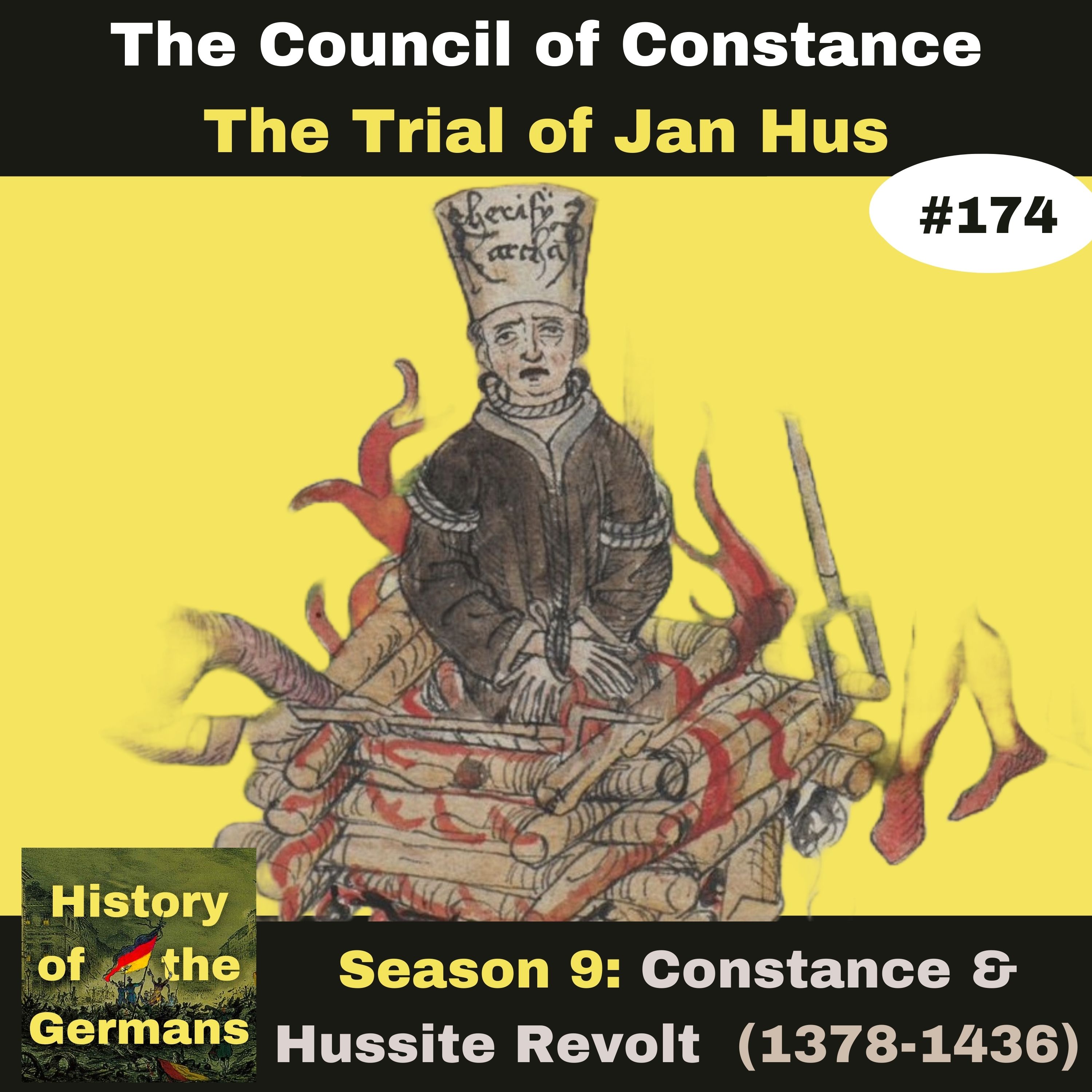
Ep 174Ep. 174: Council of Constance (1414-1418) - The Trial of Jan Hus
“They will roast a goose now, but after one hundred years they will hear a swan sing, and him they will have to endure.” These were allegedly the last words of a certain Jan Hus whose surname meant goose and who was burned at the stake on July 6, 1415.Almost exactly one hundred years later a spiritually tormented monk, frightened by a vengeful God who sought to damn him, was assigned to teach the book of Romans at the new university of Wittenberg. And 2 years later this monk by the name of Martin Luther did (or probably did not) nail his 95 theses on the door of the Castle Church of that same town.As far as prophecies go, this must be one of the most accurate, assuming it was indeed true. But it wasn’t just the foretelling of the next reformer that makes the trial of Jan Hus such a fascinating account. So much is foreshadowed in this tale, it is almost uncanny. The railing against indulgences, the wealth of the clergy, the pope, a promise of safe conduct, a trial, villains and archvillains, accusations upon accusations, defiance in the face of certain death and then the big difference to the diet of Worms, actual death. Have a listen, it is fun.The music for the show is Flute Sonata in E-flat major, H.545 by Carl Phillip Emmanuel Bach (or some claim it as BWV 1031 Johann Sebastian Bach) performed and arranged by Michel Rondeau under Common Creative Licence 3.0.As always:Homepage with maps, photos, transcripts and blog: www.historyofthegermans.comIf you wish to support the show go to: Support • History of the Germans PodcastFor do it yourself merchandise go to: Merchandise • History of the Germans PodcastFacebook: @HOTGPod Threads: @history_of_the_germans_podcastBluesky: @hotgpod.bsky.socialInstagram: history_of_the_germansTwitter: @germanshistoryTo make it easier for you to share the podcast, I have created separate playlists for some of the seasons that are set up as individual podcasts. they have the exact same episodes as in the History of the Germans, but they may be a helpful device for those who want to concentrate on only one season.So far I have:The OttoniansSalian Emperors and Investiture ControversyFredrick Barbarossa and Early HohenstaufenFrederick II Stupor MundiSaxony and Eastward ExpansionThe Hanseatic LeagueThe Teutonic KnightsThe Holy Roman Empire 1250-1356The Reformation before the ReformationThe Empire in the 15th centuryThe Fall and Rise of the Habsburgs
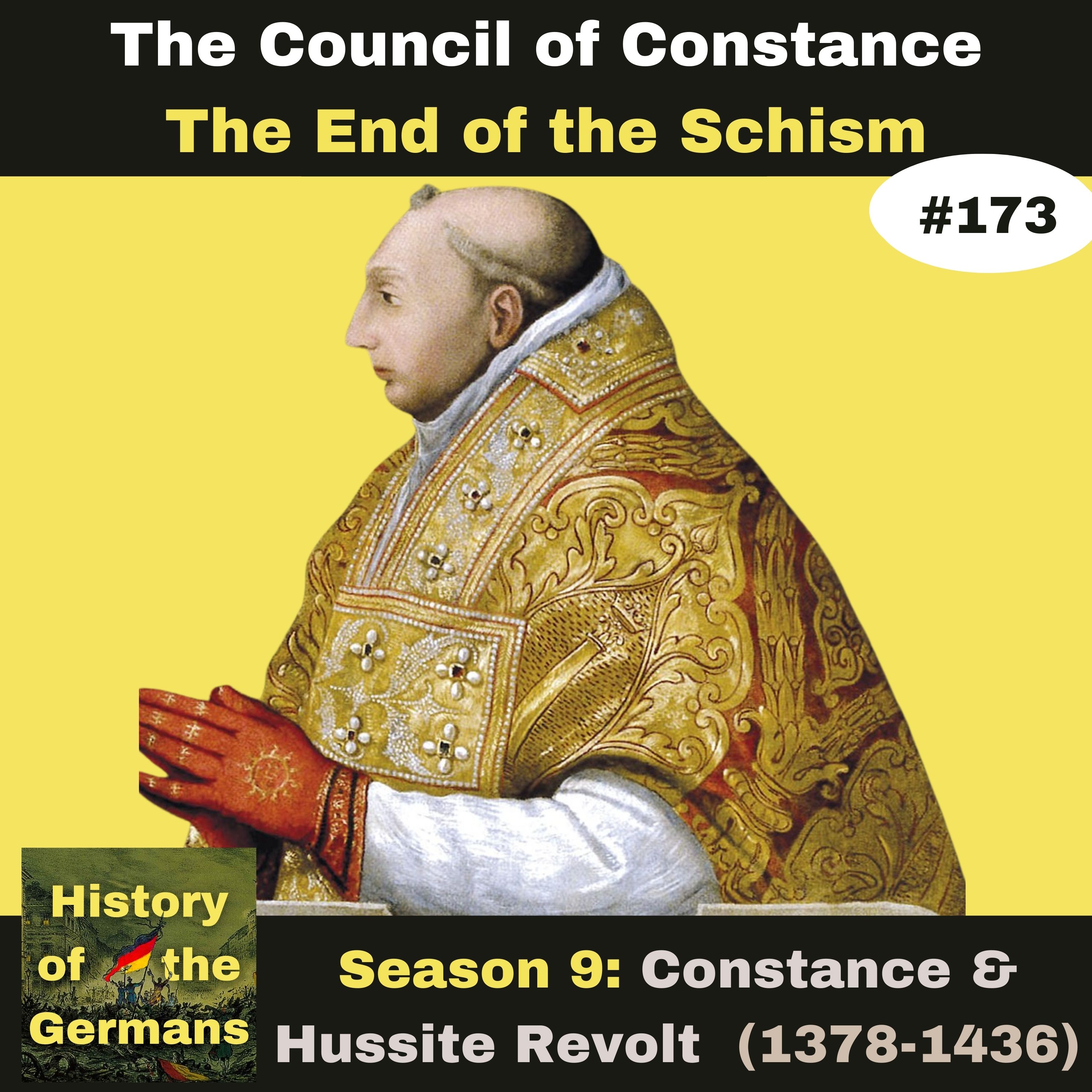
Ep 173Ep. 173: Council of Constance (1414-1418) - The End of the Schism
We have talked about church reform for almost four years, the council of Constance talked about church reform for about the same amount of time and Luther will talk and write about church reform until he did no longer believe that the church could be reformed.But what is church reform. Or more specifically, what did the delegates in Constance mean when they debated church reform, why did they fail to implement much even though they held off electing a pope and the voting system was set up to favour of the national churches and against central papal authority.All this we will discuss in this episode plus we will hear some angelic voices that made even the most hardnosed church politician kneel in prayer.Chapters:00:16 - The Dawn of the Reformation07:28 - Reforming the Church: Key Areas of Discussion11:25 - The Council of Constance: A Turning Point in Church Authority19:03 - The Election of a New Pope29:59 - The Rise and Fall of the Council of BaselChoir music by Schola Sancte Scholasticae and St. Cecilia's Abbey, UK: Veni Creator Spiritus | Gregorian Chant HymnsThe music for the show is Flute Sonata in E-flat major, H.545 by Carl Phillip Emmanuel Bach (or some claim it as BWV 1031 Johann Sebastian Bach) performed and arranged by Michel Rondeau under Common Creative Licence 3.0.As always:Homepage with maps, photos, transcripts and blog: www.historyofthegermans.comIf you wish to support the show go to: Support • History of the Germans PodcastFor do it yourself merchandise go to: Merchandise • History of the Germans PodcastFacebook: @HOTGPod Threads: @history_of_the_germans_podcastBluesky: @hotgpod.bsky.socialInstagram: history_of_the_germansTwitter: @germanshistoryTo make it easier for you to share the podcast, I have created separate playlists for some of the seasons that are set up as individual podcasts. they have the exact same episodes as in the History of the Germans, but they may be a helpful device for those who want to concentrate on only one season.So far I have:The OttoniansSalian Emperors and Investiture ControversyFredrick Barbarossa and Early HohenstaufenFrederick II Stupor MundiSaxony and Eastward ExpansionThe Hanseatic LeagueThe Teutonic KnightsThe Holy Roman Empire 1250-1356The Reformation before the ReformationThe Empire in the 15th centuryThe Fall and Rise of the Habsburgs
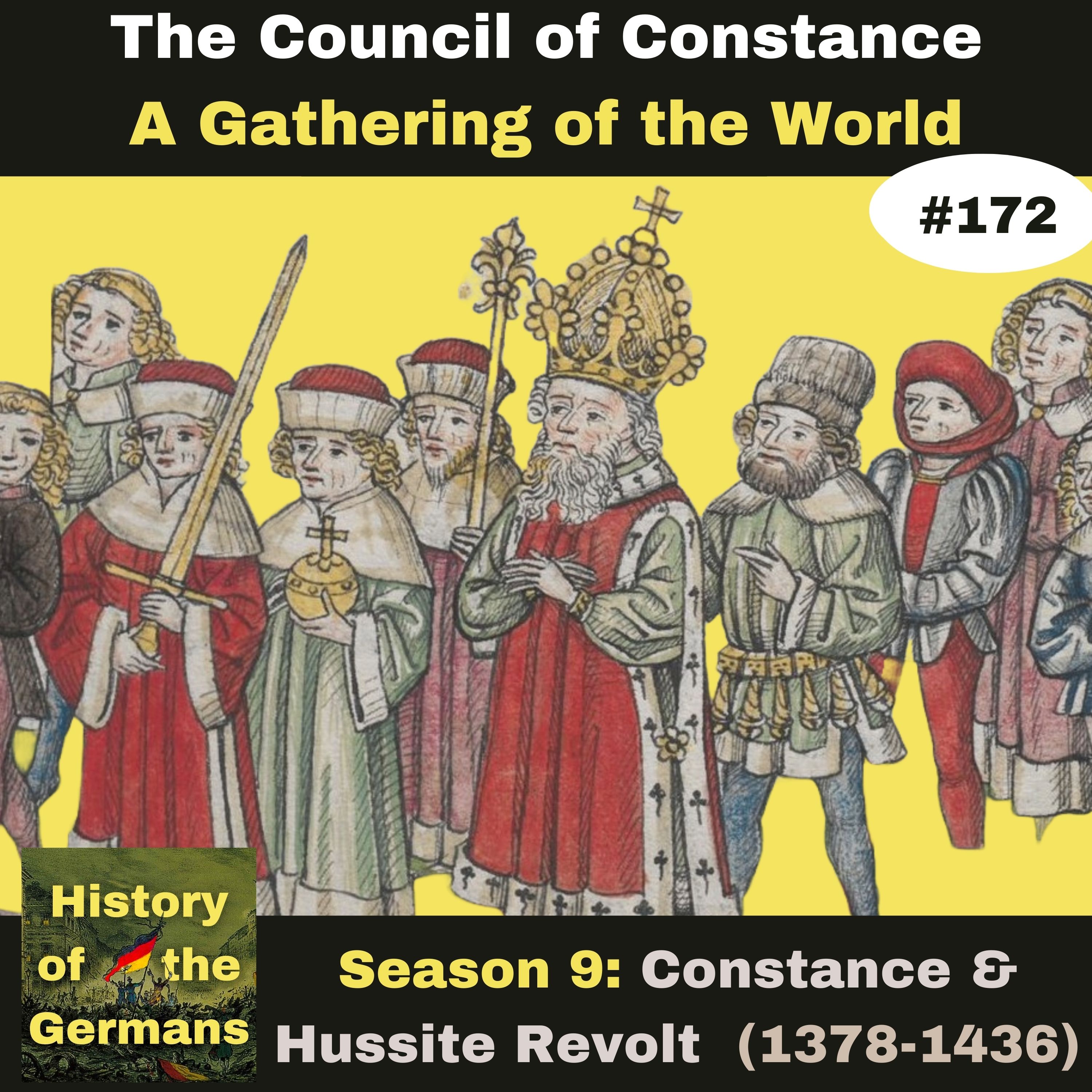
Ep 172Ep. 172: Council of Constance (1414-1418) - A Gathering of the (Christian) World
In November 1414 30,000 academics and aristocrats, bishops, blacksmiths and bakers, cardinals, counts and chefs, doctors, dancers and diplomats, princes, prelates and public girls descended on a town in Southern Germany built to house 6 to 8,000 people. They planned to stay a few weeks, 2-3 months max. But 3 and a half years later most of them were still there.What did they get up to? The great tentpole events, the trial of John XXIII, the burning of Jan Hus and the election of Martin V is what the council of Constance is remembered for, but what about all that time in between?This world event was so much more than a papal election and the trial of a heretic. For 3 years Constance became a never-ending G20 summit, the greatest academic conference of the Middle Ages, a permanent imperial diet and the centre of the catholic church. Everybody who was anybody was there either in the flesh or had at least sent a delegation.Issues and concerns were brought before the council that still plague people today. Is it ever right to kill a tyrant, and if so, when can it be justified? What rights should be guaranteed for indigenous groups, in this case Pagans, and how should their dignity be protected? Other attendees sought justice for crimes committed against them or their families in a world where political murder had become commonplace. Others still demanded their reward for years of service, making the house of Hohenzollern the margraves of Brandenburg.Living cheek by jowl in tiny Constance the leading minds from across Europe, from the ancient universities of Paris, Oxford and Bologna as well as from the newly founded seats of learning in Krakow, Prague, Heidelberg and Vienna shared their ideas, opinions, books and discoveries, paving the way for the intellectual shift we call the Renaissance.Enough, me thinks to provide 30 minutes of great historical entertainment….Chapters:00:13 - The Council of Constance: A Gathering Like No Other03:31 - The Council of Constance: A Gathering of Minds08:16 - The Gathering of Intellectuals at Constance12:57 - The Role of Book Hunters in the Renaissance24:23 - Political Violence in the 14th and 15th Century29:56 - The Debate on Tyrannicide at the Council of Constance35:21 - The Council of Constance and Its ImpactThe music for the show is Flute Sonata in E-flat major, H.545 by Carl Phillip Emmanuel Bach (or some claim it as BWV 1031 Johann Sebastian Bach) performed and arranged by Michel Rondeau under Common Creative Licence 3.0.As always:Homepage with maps, photos, transcripts and blog: www.historyofthegermans.comIf you wish to support the show go to: Support • History of the Germans PodcastFor do it yourself merchandise go to: Merchandise • History of the Germans PodcastFacebook: @HOTGPod Threads: @history_of_the_germans_podcastBluesky: @hotgpod.bsky.socialInstagram: history_of_the_germansTwitter: @germanshistoryTo make it easier for you to share the podcast, I have created separate playlists for some of the seasons that are set up as individual podcasts. they have the exact same episodes as in the History of the Germans, but they may be a helpful device for those who want to concentrate on only one season.So far I have:The OttoniansSalian Emperors and Investiture ControversyFredrick Barbarossa and Early HohenstaufenFrederick II Stupor MundiSaxony and Eastward ExpansionThe Hanseatic LeagueThe Teutonic KnightsThe Holy Roman Empire 1250-1356The Reformation before the ReformationThe Empire in the 15th centuryThe Fall and Rise of the Habsburgs
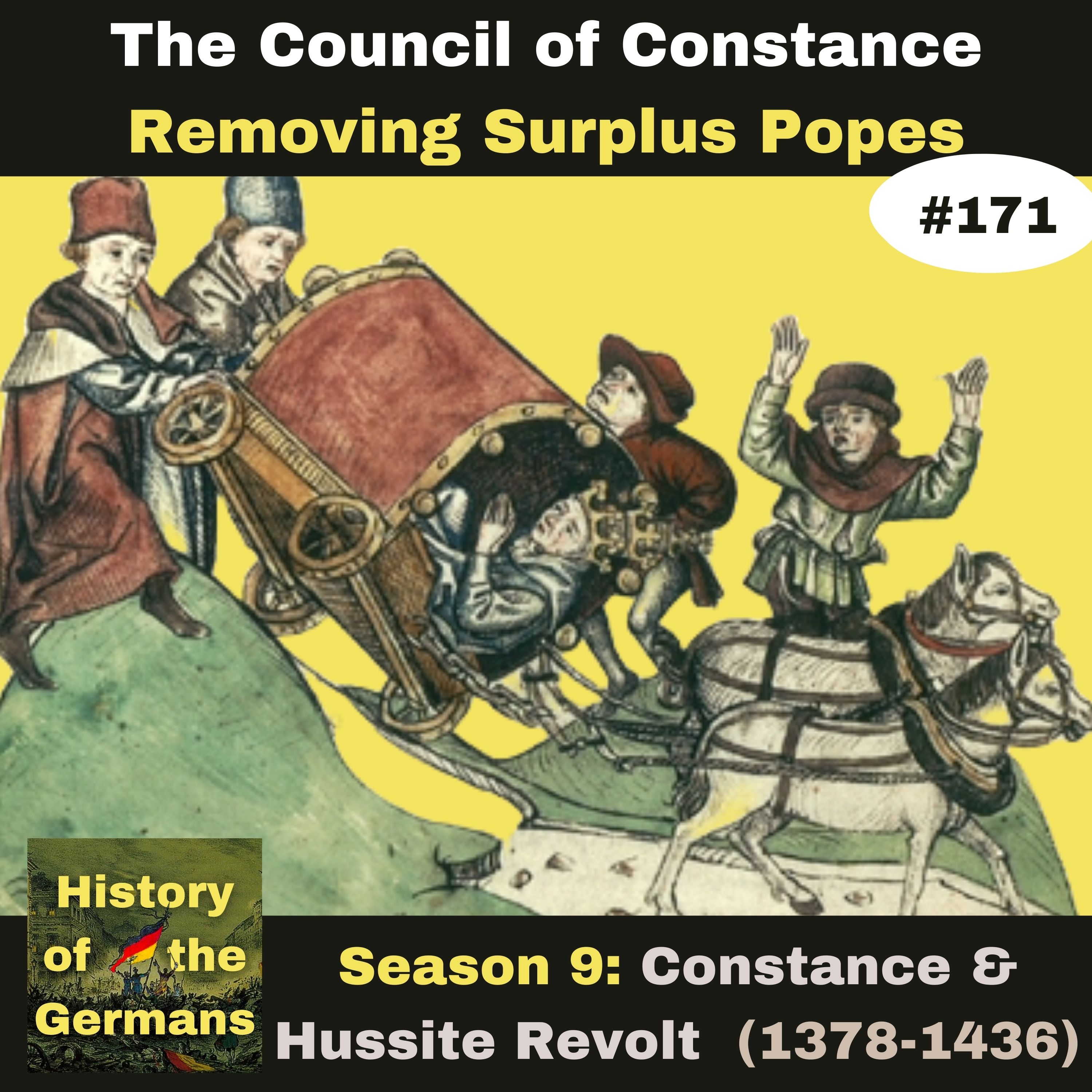
Ep 171Ep. 171: Council of Constance (1414-1418) - Removing surplus Popes
The Council of Constance marked a pivotal moment in the history of the Catholic Church and the history of Europe in general.One issue on the agenda was the ongoing schism that the council of Pisa had failed to resolve. Another the reform of the increasingly corrupt clergy all the way up to the pope himself. And then there were a number of individual questions this gathering of thousands had to address.Whilst all these were crucial questions, the way the council constituted itself foreshadowed a fundamental change in the way European saw themselves.This part 1 deals with the establishment of the council and the removal of the popes, most importantly the pope who had convened the council on the first place, John XXIII and his counterpart, the emperor Sigismund.Chapters:00:18 - The Unusual Procession03:54 - The Journey to Constance10:35 - The Council of Constance: A New Chapter in Church History16:51 - The Arrival of Sigismund20:15 - The Shift Towards National Identity in the Church Council27:41 - The Turning Point: The Council's Decree34:47 - The End of the Schism and the Rise of New LeadershipThe music for the show is Flute Sonata in E-flat major, H.545 by Carl Phillip Emmanuel Bach (or some claim it as BWV 1031 Johann Sebastian Bach) performed and arranged by Michel Rondeau under Common Creative Licence 3.0.As always:Homepage with maps, photos, transcripts and blog: www.historyofthegermans.comIf you wish to support the show go to: Support • History of the Germans PodcastFor do it yourself merchandise go to: Merchandise • History of the Germans PodcastFacebook: @HOTGPod Threads: @history_of_the_germans_podcastBluesky: @hotgpod.bsky.socialInstagram: history_of_the_germansTwitter: @germanshistoryTo make it easier for you to share the podcast, I have created separate playlists for some of the seasons that are set up as individual podcasts. they have the exact same episodes as in the History of the Germans, but they may be a helpful device for those who want to concentrate on only one season.So far I have:The OttoniansSalian Emperors and Investiture ControversyFredrick Barbarossa and Early HohenstaufenFrederick II Stupor MundiSaxony and Eastward ExpansionThe Hanseatic LeagueThe Teutonic KnightsThe Holy Roman Empire 1250-1356The Reformation before the ReformationThe Empire in the 15th centuryThe Fall and Rise of the Habsburgs
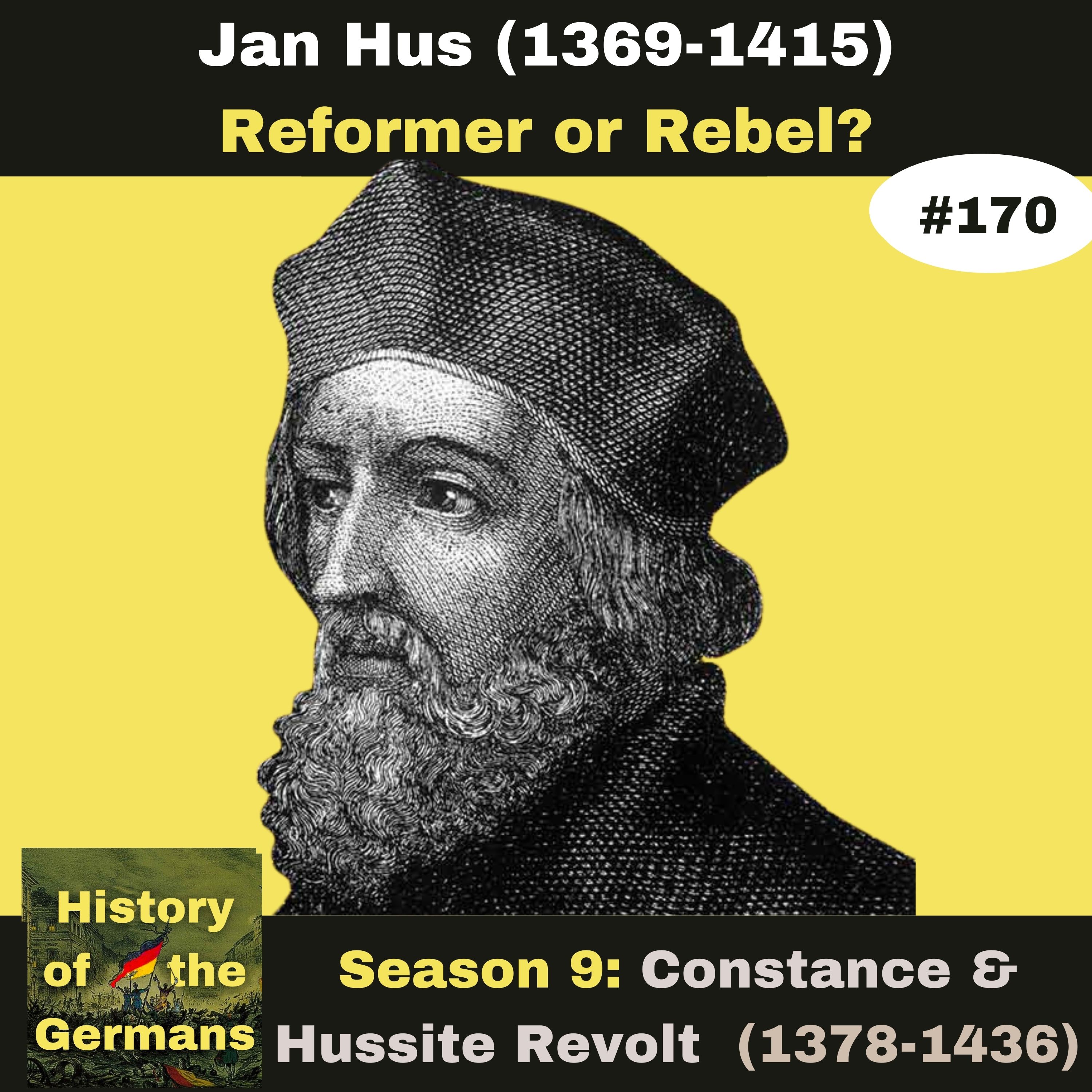
Ep 170Ep. 170: Jan Hus (1369-1415), Reformer and Rebel?
“Master Jan Hus, preacher of the Holy Scriptures from the chapel of Bethlehem, was also present at this council, who in his preaching continuously criticized and exposed the hypocrisy, pride, miserliness, fornication, simony, and other sins of the clergy, in order to bring the priesthood back to the apostolic life. He was immensely hated by these pestiferous clerics.”This is how Laurence of Brezova introduced the great reformer and Czech national hero Jan Hus in his 15th century chronicle of the Hussite uprising.Why should we care about the trials and tribulations of another holy man railing against corrupt prelates and the subsequent “quarrel in a faraway country, between people of whom we know nothing”.Well, that quote itself should be reason enough. It is from Neville Chamberlain speech of September 27, 1938 weighing the importance of protecting Czechoslovakia against an expansionist Nazi Germany.But Jan Hus is interesting beyond his status as a towering figure in Czech history. When he came to Prague in 1390 he was just another ambitious young man from a modest background who wanted to rise up in the world on the back of intelligence and hard work. But by the time he leaves for his fate at the Council of Constance in 1414 he has been excommunicated, exiled and unwillingly or willingly be come he face of a brewing revolt against king and clergy. This is a story about collapsing certainties and emerging truths, about individual beliefs and institutional order. About what the community of the faithful is supposed to be and who is in and who is out. And its tentacles reach deep into the next centuries…The music for the show is Flute Sonata in E-flat major, H.545 by Carl Phillip Emmanuel Bach (or some claim it as BWV 1031 Johann Sebastian Bach) performed and arranged by Michel Rondeau under Common Creative Licence 3.0.As always:Homepage with maps, photos, transcripts and blog: www.historyofthegermans.comIf you wish to support the show go to: Support • History of the Germans PodcastFor do it yourself merchandise go to: Merchandise • History of the Germans PodcastFacebook: @HOTGPod Threads: @history_of_the_germans_podcastBluesky: @hotgpod.bsky.socialInstagram: history_of_the_germansTwitter: @germanshistoryTo make it easier for you to share the podcast, I have created separate playlists for some of the seasons that are set up as individual podcasts. they have the exact same episodes as in the History of the Germans, but they may be a helpful device for those who want to concentrate on only one season.So far I have:The OttoniansSalian Emperors and Investiture ControversyFredrick Barbarossa and Early HohenstaufenFrederick II Stupor MundiSaxony and Eastward ExpansionThe Hanseatic LeagueThe Teutonic KnightsThe Holy Roman Empire 1250-1356The Reformation before the ReformationThe Empire in the 15th centuryThe Fall and Rise of the Habsburgs
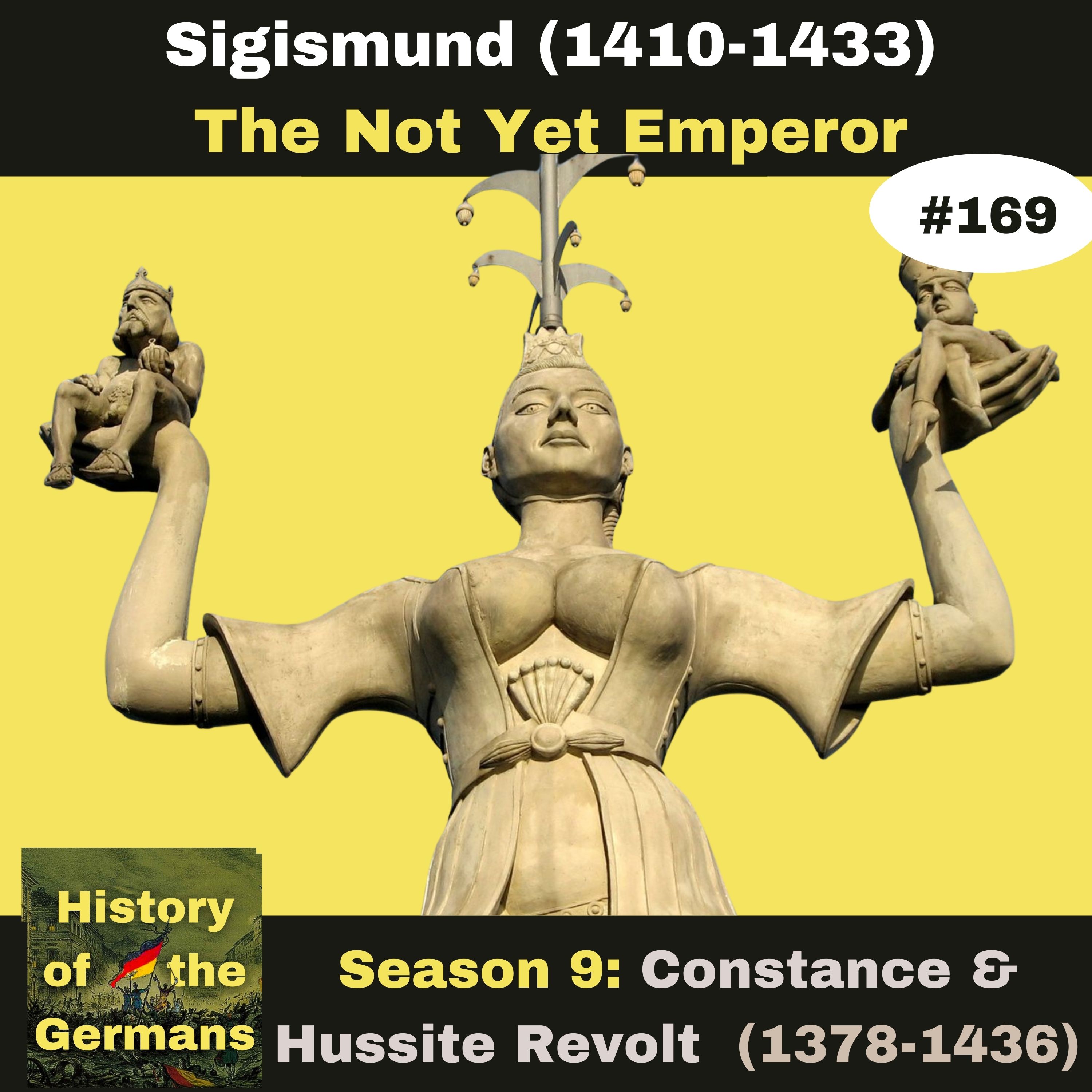
Ep 169Ep. 169: Sigismund (1410-1433) - The Not Yet Emperor
The late 14th and early 15th century was a period of upheaval, the certainties of the Middle Ages, that the pope ruled the world and that knights were invincible were crumbling away, the long period of economic growth, of eastward expansion and conversion of the pagans made way for war, plague and famine. The church was split in half and the Ottomans were coming.This was an age that called forth larger-than-life characters: Joan of Arc, fierce and holy; Henry Bolingbroke, seizing a throne; Jadwiga and Jogaila, uniting kingdoms; the audacious Gian Galeazzo Visconti and fiery Cola di Rienzo; the ever-scheming John the Fearless and Jacob van Artevelde; the tragic Ines de Castro and the unflinching Jan Žižka.Into this glittering and turbulent lineup steps a man whose reputation has not exactly been polished by time. Despised in his kingdoms of Hungary and Bohemia and even Constance, the city that owes him so much, decided to remember him as a fat naked crowned guy with skinny arms and legs, worn-out face, forked beard and disproportionate genitalia balancing on the hand of a nine-meter-tall sex worker. No, I am not making this up.Sigismund, because that was his name, was a true enigma of the late Middle Ages. He had inherited his father’s charm and ruthless cunning, his knack for negotiating compromise in impossible situations, and his unshakeable belief in his role as the head of Christendom. But what he hadn’t inherited was his father’s performative piety, his zeal for relics, his asceticism—or his wealth.Instead, Sigismund was left with a volatile mix of ambition, enormous self-confidence, a lust for life, and, crucially, a chronic shortage of funds. Yet despite his flaws, he took on Christendom’s two greatest crises—the schism and the Ottoman threat—and in doing so, managed to create a third…This is his backstory.The music for the show is Flute Sonata in E-flat major, H.545 by Carl Phillip Emmanuel Bach (or some claim it as BWV 1031 Johann Sebastian Bach) performed and arranged by Michel Rondeau under Common Creative Licence 3.0.As always:Homepage with maps, photos, transcripts and blog: www.historyofthegermans.comIf you wish to support the show go to: Support • History of the Germans PodcastFor do it yourself merchandise go to: Merchandise • History of the Germans PodcastFacebook: @HOTGPod Threads: @history_of_the_germans_podcastBluesky: @hotgpod.bsky.socialInstagram: history_of_the_germansTwitter: @germanshistoryTo make it easier for you to share the podcast, I have created separate playlists for some of the seasons that are set up as individual podcasts. they have the exact same episodes as in the History of the Germans, but they may be a helpful device for those who want to concentrate on only one season.So far I have:The OttoniansSalian Emperors and Investiture ControversyFredrick Barbarossa and Early HohenstaufenFrederick II Stupor MundiSaxony and Eastward ExpansionThe Hanseatic LeagueThe Teutonic KnightsThe Holy Roman Empire 1250-1356The Reformation before the ReformationThe Empire in the 15th centuryThe Fall and Rise of the Habsburgs
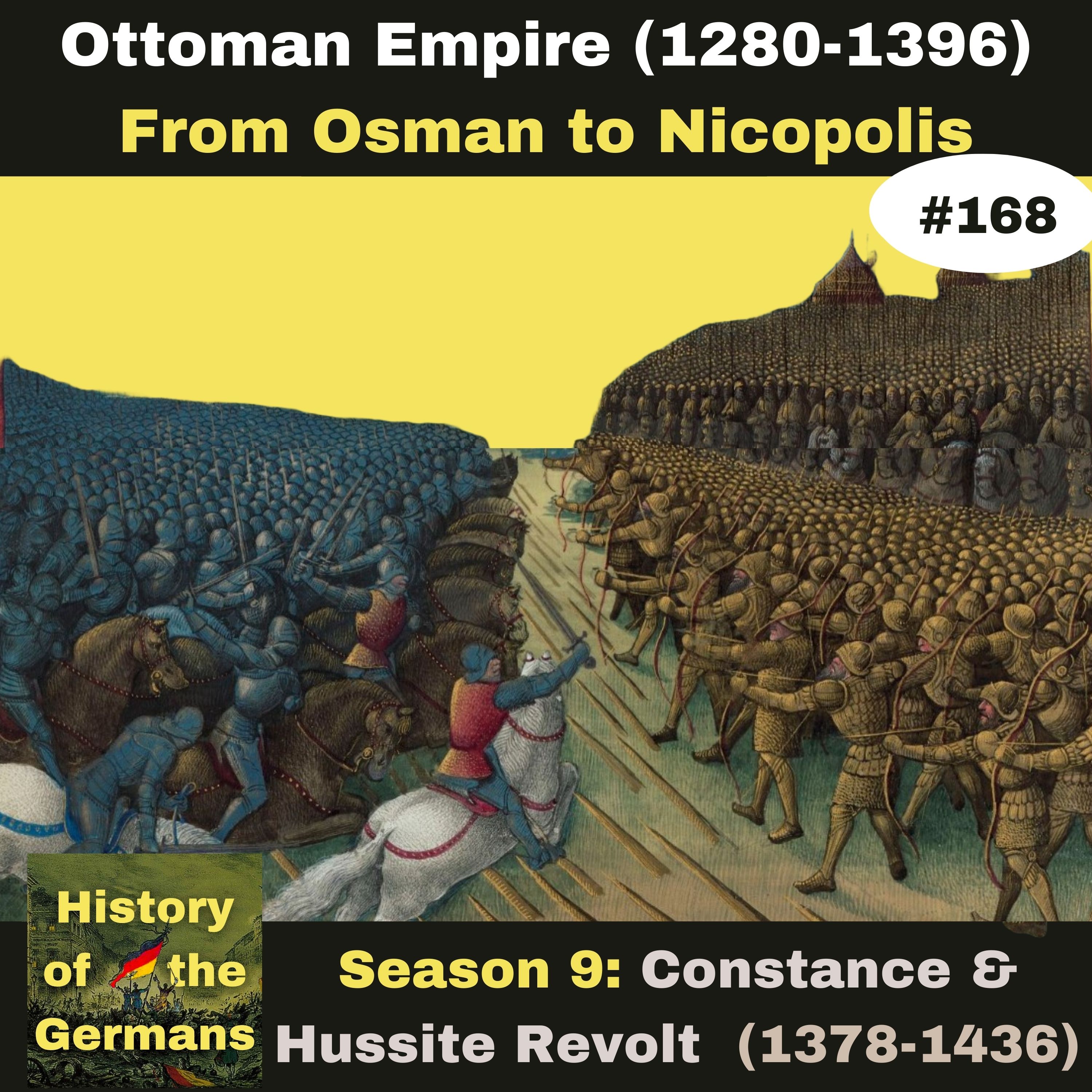
Ep 168Ep. 168: Ottoman Empire (1280-1396) - From Osman to Nicopolis
This week we delve into the transformative period of the Ottomans from Osman to the Battle of Nicopolis. It highlights how Osman, the son of an Anatolian warlord, laid the foundations for what would become one of the world's greatest empires, despite starting as just one of many Turkic beys in a tumultuous landscape. The narrative explores the cultural and military strategies that enabled the Ottomans to expand, emphasizing their approach of gradual assimilation and religious tolerance as they conquered predominantly Christian lands. The episode also recounts the dramatic Battle of Nicopolis in 1396, where a coalition of European knights faced the formidable Ottoman forces, leading to a catastrophic defeat for the crusaders. As the episode unfolds, it illustrates the lasting impact of these events on the geopolitical landscape of Europe and the Ottoman Empire's rise as a dominant power in the centuries to follow.Takeaways:The Ottomans emerged from a small confederation led by Osman, who successfully united various Turkic tribes.Unlike many conquests in history, the Ottomans employed a model of tolerance and integration with conquered populations.The downfall of the Byzantine Empire was marked by its inability to respond effectively to nomadic incursions.Osman's victory at the Battle of Baphis established his reputation and attracted more followers to his cause.Janissaries, elite soldiers of the Ottoman army, were originally recruited from captured Christian boys.The catastrophic defeat of the crusading army at Nikopol in 1396 reshaped the power dynamics in Eastern Europe.Chapters:00:08 - Introduction to the Ottomans00:19 - The Crusades and Eastern Expansion00:51 - The Gathering at Nikopol04:14 - Osman's Vision and the Birth of the Empire13:59 - The Seljuks and Their Legacy20:07 - Osman's Rise and Early Conquests32:03 - The Battle of Kosovo and Its Aftermath34:14 - The Crusade at Nikopol41:34 - The Impact of Timur's Invasion42:55 - Conclusion and Next Episode PreviewThe music for the show is Flute Sonata in E-flat major, H.545 by Carl Phillip Emmanuel Bach (or some claim it as BWV 1031 Johann Sebastian Bach) performed and arranged by Michel Rondeau under Common Creative Licence 3.0.As always:Homepage with maps, photos, transcripts and blog: www.historyofthegermans.comIf you wish to support the show go to: Support • History of the Germans PodcastFor do it yourself merchandise go to: Merchandise • History of the Germans PodcastFacebook: @HOTGPod Threads: @history_of_the_germans_podcastBluesky: @hotgpod.bsky.socialInstagram: history_of_the_germansTwitter: @germanshistoryTo make it easier for you to share the podcast, I have created separate playlists for some of the seasons that are set up as individual podcasts. they have the exact same episodes as in the History of the Germans, but they may be a helpful device for those who want to concentrate on only one season.So far I have:The OttoniansSalian Emperors and Investiture ControversyFredrick Barbarossa and Early HohenstaufenFrederick II Stupor MundiSaxony and Eastward ExpansionThe Hanseatic LeagueThe Teutonic KnightsThe Holy Roman Empire 1250-1356The Reformation before the ReformationThe Empire in the 15th centuryThe Fall and Rise of the Habsburgs
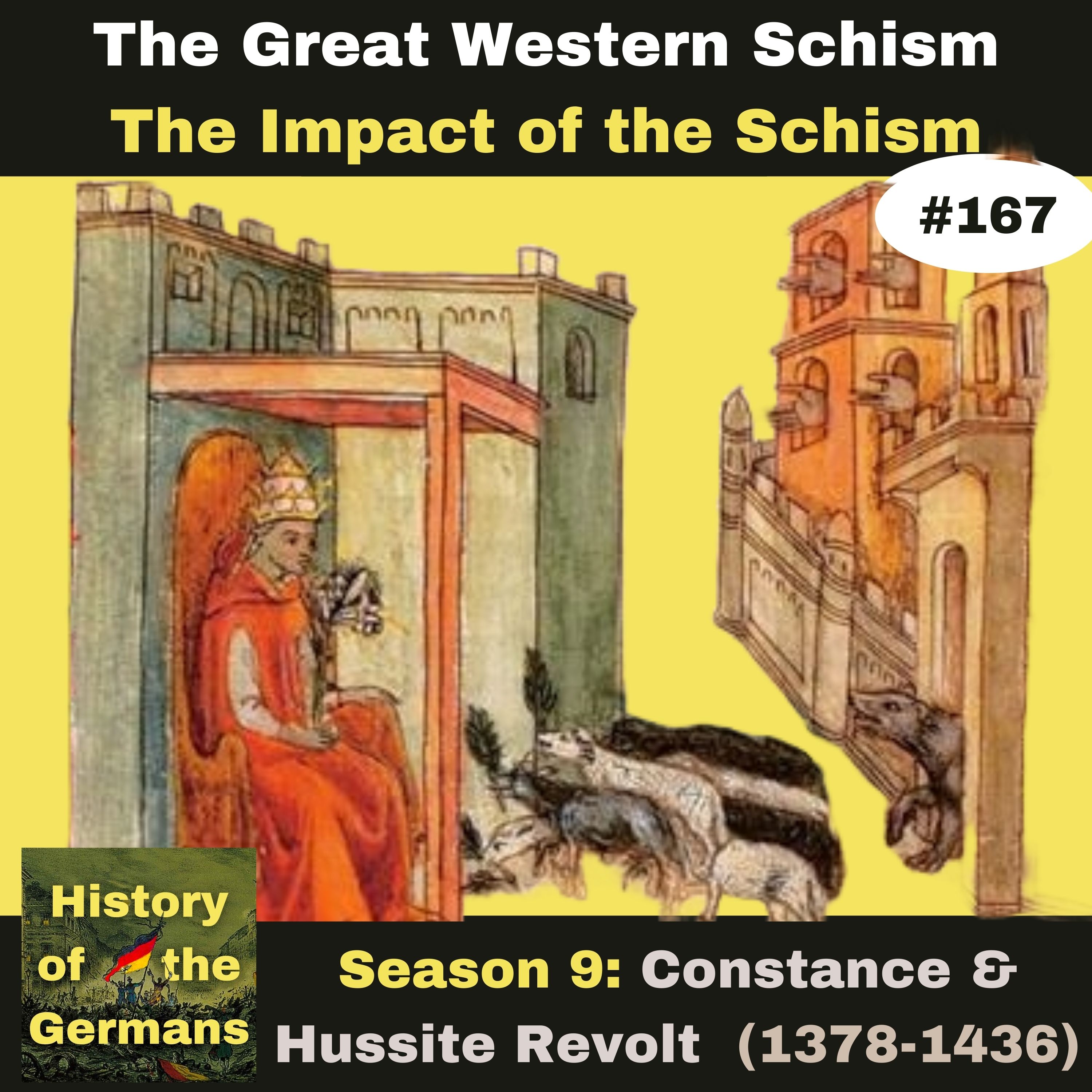
Ep 167Ep. 167: The Great Western Schism (1378-1417) - The Impact of the Schism
When the Great Western Schism was finally resolved at Pisa and Constance, Christendom rejoiced.Or so we have been told. But was it really such a devastating, catastrophic event that left the papacy mortally wounded, so impaired that it crumbled when next the power of the pope “to bind and to loosen” was questioned? Or was it just an affair, a temporary misunderstanding created by some drafting error in canon law that prevented the removal of an incapacitated pope?Me thinks that is worth investigating even if it means diving deep into theology and canon law. But do not worry we will also do a spot of fiscal policy just to lighten things up a bit.The music for the show is Flute Sonata in E-flat major, H.545 by Carl Phillip Emmanuel Bach (or some claim it as BWV 1031 Johann Sebastian Bach) performed and arranged by Michel Rondeau under Common Creative Licence 3.0.As always:Homepage with maps, photos, transcripts and blog: www.historyofthegermans.comIf you wish to support the show go to: Support • History of the Germans PodcastFor do it yourself merchandise go to: Merchandise • History of the Germans PodcastFacebook: @HOTGPod Threads: @history_of_the_germans_podcastBluesky: @hotgpod.bsky.socialInstagram: history_of_the_germansTwitter: @germanshistoryTo make it easier for you to share the podcast, I have created separate playlists for some of the seasons that are set up as individual podcasts. they have the exact same episodes as in the History of the Germans, but they may be a helpful device for those who want to concentrate on only one season.So far I have:The OttoniansSalian Emperors and Investiture ControversyFredrick Barbarossa and Early HohenstaufenFrederick II Stupor MundiSaxony and Eastward ExpansionThe Hanseatic LeagueThe Teutonic KnightsThe Holy Roman Empire 1250-1356The Reformation before the ReformationThe Empire in the 15th centuryThe Fall and Rise of the Habsburgs
Ep 166Ep. 166: The Great Western Schism (1378-1417) - Popes and antipopes from Urban VI-John XXIII
If you are a longstanding listener to the History of the Germans, you will already know that sometime in the late 14th century the catholic church broke apart into 2 and then 3 different obediences, three popes residing in different places and being recognised by different nations.But what you may not know is how exactly this had happened. Why did the exact self-same cardinals elect one pope in April 1378 and another one 4 months later? Who was taking the lead in attempts to resolve the crisis and why did all these attempts fail for 40 years? How far did they go in forcing the various papal contenders to come to the negotiation table. How ridiculous were the popes’ attempts to wiggle out of that…All that we will look into this week in part 1 of the story of the Great Western Schism.The music for the show is Flute Sonata in E-flat major, H.545 by Carl Phillip Emmanuel Bach (or some claim it as BWV 1031 Johann Sebastian Bach) performed and arranged by Michel Rondeau under Common Creative Licence 3.0.As always:Homepage with maps, photos, transcripts and blog: www.historyofthegermans.comIf you wish to support the show go to: Support • History of the Germans PodcastFor do it yourself merchandise go to: Merchandise • History of the Germans PodcastFacebook: @HOTGPod Threads: @history_of_the_germans_podcastBluesky: @hotgpod.bsky.socialInstagram: history_of_the_germansTwitter: @germanshistoryTo make it easier for you to share the podcast, I have created separate playlists for some of the seasons that are set up as individual podcasts. they have the exact same episodes as in the History of the Germans, but they may be a helpful device for those who want to concentrate on only one season.So far I have:The OttoniansSalian Emperors and Investiture ControversyFredrick Barbarossa and Early HohenstaufenFrederick II Stupor MundiSaxony and Eastward ExpansionThe Hanseatic LeagueThe Teutonic KnightsThe Holy Roman Empire 1250-1356The Reformation before the ReformationThe Empire in the 15th centuryThe Fall and Rise of the Habsburgs
Ep 165Ep. 165: Wenceslaus the Lazy (1378-1400) and Ruprecht of the Palatinate (1400-1410)
“And since these especially ruinous harms to all of Christendom are not to be tolerated or suffered any longer, so we have completely agreed – with a well-considered disposition, by means of much and various discussion and counsel, which we have earnestly undertaken concerning this among ourselves and with many other princes and lords of the Holy Empire, for the assistance of the Holy Church, the comfort of Christendom and the honour and profit of the Holy Empire – that we want fully and specifically to remove and depose the above-written Lord Wenceslas as a neglectful procrastinator, dismemberer and one unworthy of the Holy Empire from the same Holy Roman Empire and all the dignities pertaining to it with immediate effect.” End quoteSo concluded the Prince Electors of Cologne, Mainz, Trier and the Palatinate on August 20th 1400. King Wenceslaus IV, son of the great emperor Karl IV, king of Bohemia and duke of Luxemburg was to be deposed for his “evil deeds and afflictions [that are] are so clearly manifest and well known throughout the land that they can neither be justified nor concealed” end quoteHow could that happen. Last time we looked at the house of Luxemburg, they directly held almost a quarter of the German lands, controlled two of the seven electoral votes, had manoeuvred themselves into pole position to gain the Hungarian and the Polish crown, with even a long-term option on Austria, Styria, Carinthia and Tyrol . But now, a mere 22 years later, the great second Carolingian empire lies in tatters. How is that possible? That is what we will look at today.The music for the show is Flute Sonata in E-flat major, H.545 by Carl Phillip Emmanuel Bach (or some claim it as BWV 1031 Johann Sebastian Bach) performed and arranged by Michel Rondeau under Common Creative Licence 3.0.As always:Homepage with maps, photos, transcripts and blog: www.historyofthegermans.comIf you wish to support the show go to: Support • History of the Germans PodcastFor do it yourself merchandise go to: Merchandise • History of the Germans PodcastFacebook: @HOTGPod Threads: @history_of_the_germans_podcastBluesky: @hotgpod.bsky.socialInstagram: history_of_the_germansTwitter: @germanshistoryTo make it easier for you to share the podcast, I have created separate playlists for some of the seasons that are set up as individual podcasts. they have the exact same episodes as in the History of the Germans, but they may be a helpful device for those who want to concentrate on only one season.So far I have:The OttoniansSalian Emperors and Investiture ControversyFredrick Barbarossa and Early HohenstaufenFrederick II Stupor MundiSaxony and Eastward ExpansionThe Hanseatic LeagueThe Teutonic KnightsThe Holy Roman Empire 1250-1356The Reformation before the ReformationThe Empire in the 15th centuryThe Fall and Rise of the Habsburgs
Ep 164Ep. 164: Council of Constance and Hussite Revolt (1378-1437) - Season Opener
On 31st of October 1517 a hitherto unknown professor at the smallish university of Wittenberg published 95 theses. And by doing so, he unleashed a sequence of events that would fundamentally change the face of Europe and still defines communities and nations.The interesting question about the 95 theses is not why Luther rote them, but why they had any impact at all. Martin Luther stands at the end of a mile long queue of learned and sometimes less learned men who railed against the decadence of the church, called for a return to the actual text of the bible and demanded that the clergy lives like the apostles. But somehow the message on that fateful day in 1517 gained traction across the Christian world in a way no previous attempt had.Why? That is a question I believe will be the guiding line through the coming seasons. Something about the social, political, cultural, religious and economic landscape of early modern Germany must have provided the cinder on which protestant ideas could catch fire.You will now ask, why is Dirk talking about the Reformation. The last season ended on the 14th century, a good 150 years before “the day that changed western Christianity”. Aren’t we supposed to go through this chronologically.Oh yes we are. But as we are moving forward at our accustomed pace we will hit the Hussite revolt that started in 1415. This religious uprising has so many common threads with Luther’s reformation, it may be seen as a dress rehearsal for the actual Reformation. Luther himself declared in 1519 “Ich bin ein Hussite” I am a Hussite.Spoiler alert, the Hussite revolt did not lead to the fraction of the catholic church, but that makes it even more interesting. What were the circumstances that led the people of Bohemia and many other parts of the empire to take up arms to defend their convictions, how come they were successful and by what means could a reconciliation be achieved? Knowing that will help us understand why a 150 years later such a settlement failed to materialize, dividing Europe into Protestants and Catholics and spurning some of the bloodiest civil wars in history.To explore the causes and impact of this reformation before the reformation we will take a look at the decline of the house of Luxemburg, the emergence of the Ottoman empire, the creation of Burgundy as a political entity separate from France, the defeat of the Teutonic Knights and the great western schism with its resolution at the Council of Constance where amongst other things Jan Hus was convicted and burned at the stake. We will dive into Jan Hus’ and his predecessor’s thoughts and convictions as well as the military innovations of Jan Zizka and probably a lot more things I have not yet thought about.The music for the show is Flute Sonata in E-flat major, H.545 by Carl Phillip Emmanuel Bach (or some claim it as BWV 1031 Johann Sebastian Bach) performed and arranged by Michel Rondeau under Common Creative Licence 3.0.As always:Homepage with maps, photos, transcripts and blog: www.historyofthegermans.comIf you wish to support the show go to: Support • History of the Germans PodcastFor do it yourself merchandise go to: Merchandise • History of the Germans PodcastFacebook: @HOTGPod Threads: @history_of_the_germans_podcastBluesky: @hotgpod.bsky.socialInstagram: history_of_the_germansTwitter: @germanshistoryTo make it easier for you to share the podcast, I have created separate playlists for some of the seasons that are set up as individual podcasts. they have the exact same episodes as in the History of the Germans, but they may be a helpful device for those who want to concentrate on only one season.So far I have:The OttoniansSalian Emperors and Investiture ControversyFredrick Barbarossa and Early HohenstaufenFrederick II Stupor MundiSaxony and Eastward ExpansionThe Hanseatic LeagueThe Teutonic KnightsThe Holy Roman Empire 1250-1356The Reformation before the ReformationThe Empire in the 15th centuryThe Fall and Rise of the Habsburgs

Karl IV (1346-1378) - A Portrait of a Medieval Ruler - Interview with Vaclav Jurek
bonusThe Emperor and King Charles IV (1316-1378) represents today an untouchable monument in Czech history, carved into the marble of admiration and clichés. Although a new and thorough study of his reign is yet to be written, it is nevertheless useful to introduce Charles IV from a new perspective. In many regards, historical research has already brought new findings, and thus we are now able to shed new light on both his life and his reign.The book will be published this autumn but is already available for pre-orderhere: Charles IV: Portrait of a Medieval Ruler, Žurek, Stone (uchicago.edu)here: Charles IV: Portrait of a Medieval Ruler book by vaclav zurek, (Paperback) | Indigoand also on Amazon:Charles IV: Portrait of a Medieval Ruler: Amazon.co.uk: Žurek, Václav, Stone, Ian Finlay: 9788024655239: Books
Ep 163Ep. 163: Karl IV (1346-1378) - Succession and Legacy
This is the last episode of this season and it is time to say goodbye to Karl IV, Ludwig the Bavarian, Henry VII, Albrecht of Habsburg, Adolf von Nassau and Rudolf of Habsburg. These have been some eventful 138 years.When Karl IV died in 1378 he left behind an impressive list of achievements but also a number of failures. And he left behind a son, Wenceslaus he had invested with so much hope and so many crowns, it not only broke the bank but even chunks of the political edifice he had so patiently built.How and why is what we will discuss in this episode.The music for the show is Flute Sonata in E-flat major, H.545 by Carl Phillip Emmanuel Bach (or some claim it as BWV 1031 Johann Sebastian Bach) performed and arranged by Michel Rondeau under Common Creative Licence 3.0.As always:Homepage with maps, photos, transcripts and blog: www.historyofthegermans.comIf you wish to support the show go to: Support • History of the Germans PodcastFor do it yourself merchandise go to: Merchandise • History of the Germans PodcastFacebook: @HOTGPod Threads: @history_of_the_germans_podcastBluesky: @hotgpod.bsky.socialInstagram: history_of_the_germansTwitter: @germanshistoryTo make it easier for you to share the podcast, I have created separate playlists for some of the seasons that are set up as individual podcasts. they have the exact same episodes as in the History of the Germans, but they may be a helpful device for those who want to concentrate on only one season.So far I have:The OttoniansSalian Emperors and Investiture ControversyFredrick Barbarossa and Early HohenstaufenFrederick II Stupor MundiSaxony and Eastward ExpansionThe Hanseatic LeagueThe Teutonic KnightsThe Holy Roman Empire 1250-1356The Reformation before the ReformationThe Empire in the 15th centuryThe Fall and Rise of the Habsburgs
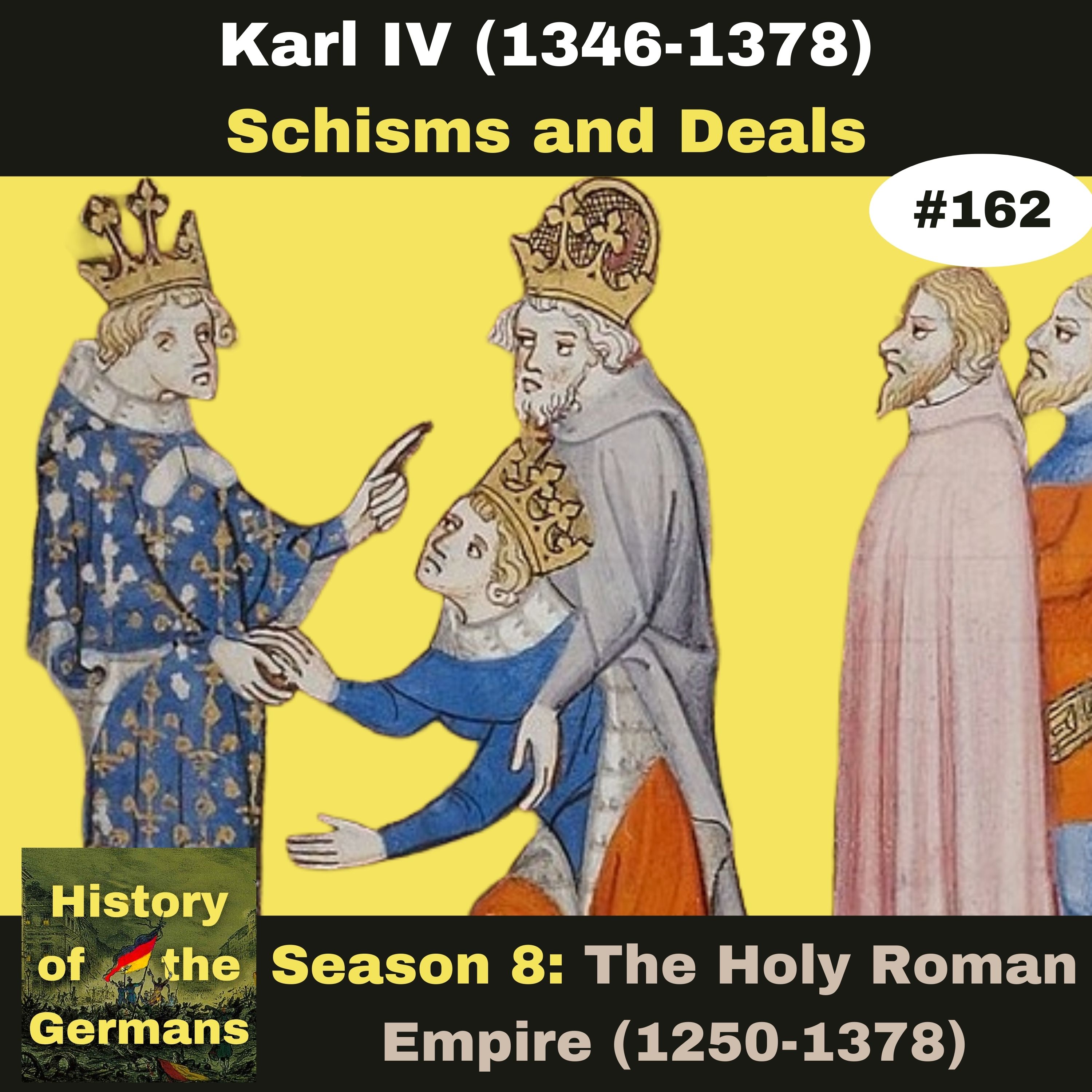
Ep 162Ep. 162: Karl IV (1346-1378) - Schisms and Deals
For more than a hundred years the Holy Roman Empire was a mess of constant infighting between and within the great princely families. But by the 1360s the consistent policies and elaborate diplomacy of emperor Karl IV had produced a degree of stability not seen by anyone alive.With the home front calm, the emperor can again assume a role on the European stage, setting in train seminal events that will reverberate across the centuries…The music for the show is Flute Sonata in E-flat major, H.545 by Carl Phillip Emmanuel Bach (or some claim it as BWV 1031 Johann Sebastian Bach) performed and arranged by Michel Rondeau under Common Creative Licence 3.0.As always:Homepage with maps, photos, transcripts and blog: www.historyofthegermans.comIf you wish to support the show go to: Support • History of the Germans PodcastFor do it yourself merchandise go to: Merchandise • History of the Germans PodcastFacebook: @HOTGPod Threads: @history_of_the_germans_podcastBluesky: @hotgpod.bsky.socialInstagram: history_of_the_germansTwitter: @germanshistoryTo make it easier for you to share the podcast, I have created separate playlists for some of the seasons that are set up as individual podcasts. they have the exact same episodes as in the History of the Germans, but they may be a helpful device for those who want to concentrate on only one season.So far I have:The OttoniansSalian Emperors and Investiture ControversyFredrick Barbarossa and Early HohenstaufenFrederick II Stupor MundiSaxony and Eastward ExpansionThe Hanseatic LeagueThe Teutonic KnightsThe Holy Roman Empire 1250-1356The Reformation before the ReformationThe Empire in the 15th centuryThe Fall and Rise of the Habsburgs

Ep 161Ep. 161: Karl IV (1346-1378) - A Luxemburg Empire
All is well in the empire. The Golden Bull had been debated, agreed, sealed and then celebrated at the great diet in Metz in 1357.The first time in decades that all the Prince Electors had come together and performed the ancient duties of their offices. Even the Dauphin of France had come to do homage to Karl IV for the lands he held inside the empire.But did all the princes join in the joy? No, not really. There are always some who felt left out and they will try to upturn the new order. How they tried to do that and why these efforts laid the foundations for the future Habsburg empire is what we will discuss today…The music for the show is Flute Sonata in E-flat major, H.545 by Carl Phillip Emmanuel Bach (or some claim it as BWV 1031 Johann Sebastian Bach) performed and arranged by Michel Rondeau under Common Creative Licence 3.0.As always:Homepage with maps, photos, transcripts and blog: www.historyofthegermans.comIf you wish to support the show go to: Support • History of the Germans PodcastFor do it yourself merchandise go to: Merchandise • History of the Germans PodcastFacebook: @HOTGPod Threads: @history_of_the_germans_podcastBluesky: @hotgpod.bsky.socialInstagram: history_of_the_germansTwitter: @germanshistoryTo make it easier for you to share the podcast, I have created separate playlists for some of the seasons that are set up as individual podcasts. they have the exact same episodes as in the History of the Germans, but they may be a helpful device for those who want to concentrate on only one season.So far I have:The OttoniansSalian Emperors and Investiture ControversyFredrick Barbarossa and Early HohenstaufenFrederick II Stupor MundiSaxony and Eastward ExpansionThe Hanseatic LeagueThe Teutonic KnightsThe Holy Roman Empire 1250-1356The Reformation before the ReformationThe Empire in the 15th centuryThe Fall and Rise of the Habsburgs
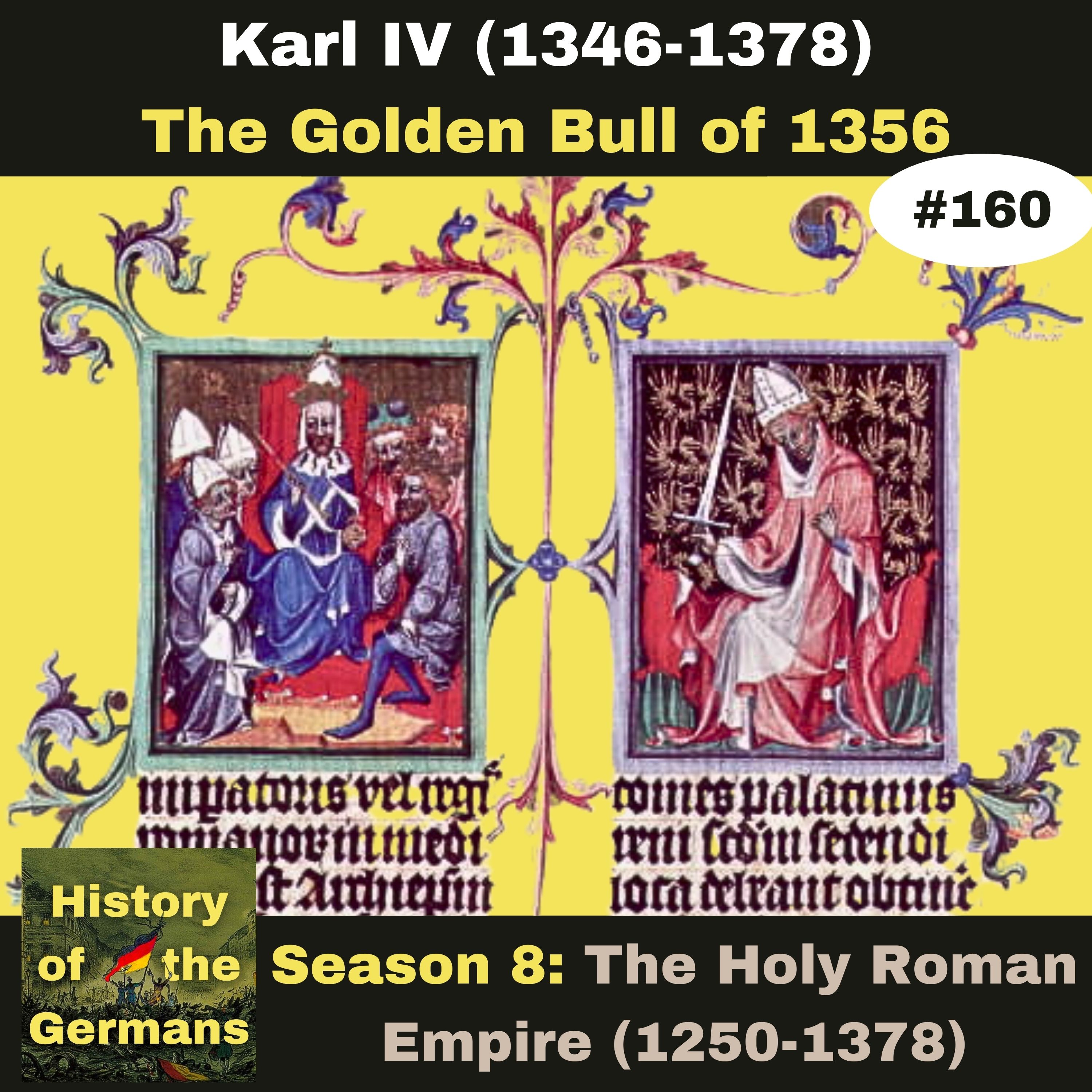
Ep 160Ep. 160: Karl IV (1346-1378 - The Golden Bull of 1356
“Every realm that is divided internally will go to uin, for its princes have become the comrades of thieves. The Lord has poured out the spirit of deceit among them, so that they grope about at midday as though in darkness, and He has withdrawn the light from their dwellings, so that they are blind and leaders of the blind. And those who wander in the dark run into things, and those who are blind of spirit bring about evil deeds, which occur in disunity. [..]You, Jealousy, have soiled the Christian Empire, which was reinforced by God with the virtues of faith hope and love, just like the indivisible Trinity, and whose foundations stand firmly on the kingdom of Christ; you have soiled it with your ancient poison that you have spewed forth like an evil snake on the Empire and its members. And to shatter the pillars and to bring the whole structure to collapse, you have incited disunity among the seven electors, who should illuminate the Empire like the light of the seven lamps of the mind.But in the name of the office which we hold as Emperor we are obliged to act against disunity and struggle among the electors [..] for two reasons: because of our Imperial office, and because of our rights as an elector. In order to increase the unity among them, and to bring about unanimity during elections and to avoid disgraceful divisions and to close the door to the multiple dangers that arise from them, we have issued the laws written down here at our festive Imperial Diet in Nuremberg, in the presence of all the spiritual and worldly electors, and before a large crowd of other princes, counts, free lords, lords, nobles and urban delegates. From our Imperial throne, decorated with the imperial insignias and treasures, wearing the imperial crown, after ripe deliberation, we issued them on the basis of our unrestricted imperial powers, in the year of our Lord 1356, on the 10th of January, in the tenth year of our royal power and the first of our Imperial power.”So begins one of the most important constitutional documents of the Holy Roman Empire, the Golden Bull of 1356. But what did it actually say, and even more important, what did it not say and how does it fit into the context of the history of the Holy Roman Empire. That is what we are going to discuss in this episode.The music for the show is Flute Sonata in E-flat major, H.545 by Carl Phillip Emmanuel Bach (or some claim it as BWV 1031 Johann Sebastian Bach) performed and arranged by Michel Rondeau under Common Creative Licence 3.0.As always:Homepage with maps, photos, transcripts and blog: www.historyofthegermans.comIf you wish to support the show go to: Support • History of the Germans PodcastFor do it yourself merchandise go to: Merchandise • History of the Germans PodcastFacebook: @HOTGPod Threads: @history_of_the_germans_podcastBluesky: @hotgpod.bsky.socialInstagram: history_of_the_germansTwitter: @germanshistoryTo make it easier for you to share the podcast, I have created separate playlists for some of the seasons that are set up as individual podcasts. they have the exact same episodes as in the History of the Germans, but they may be a helpful device for those who want to concentrate on only one season.So far I have:The OttoniansSalian Emperors and Investiture ControversyFredrick Barbarossa and Early HohenstaufenFrederick II Stupor MundiSaxony and Eastward ExpansionThe Hanseatic LeagueThe Teutonic KnightsThe Holy Roman Empire 1250-1356The Reformation before the ReformationThe Empire in the 15th centuryThe Fall and Rise of the Habsburgs
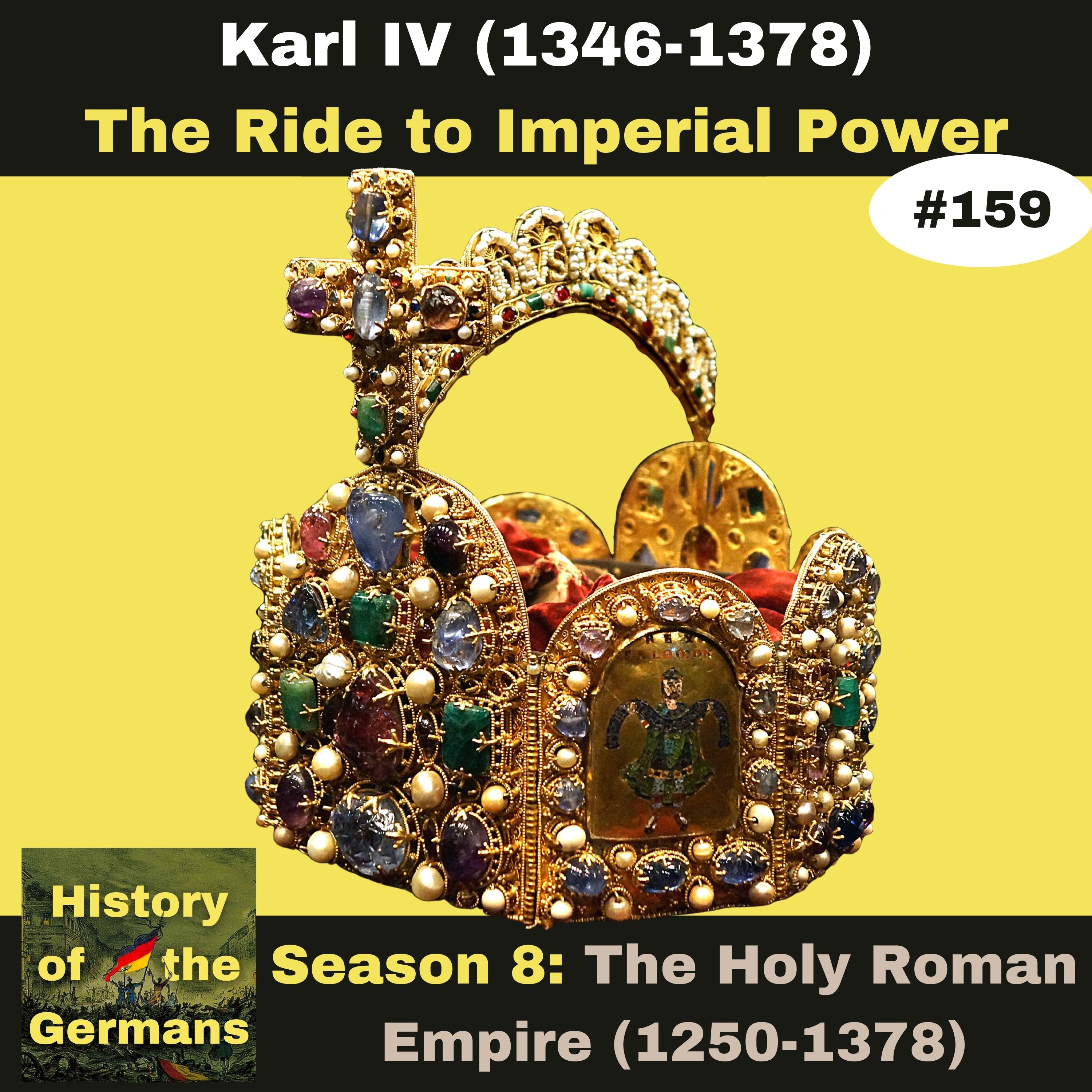
Ep 159Ep. 159: Karl IV (1346-1378) - The Rise to Imperial Power
This season has now gone on for 22 episodes. We started with the interregnum of largely absent rulers and after a brief renaissance under Rudolf von Habsburg the empire became a sort of oligarchy where 3 families, the Luxemburgs, the Wittelsbachs and the Habsburgs took turns on the throne. Succession usually involved some form of armed conflict between the contenders and a struggle with the pope over who had precedence. Whoever emerged victorious then used the ever-dwindling imperial powers to enrich his family at the expense of the others.When in 1349 Karl/Karel/Charles IV emerged triumphant from the latest of these conflicts, chances were that the same game would start anew, civil war between the three families, excommunication and murder. But it did not. Why it did not is what we will talk about in this episode…The music for the show is Flute Sonata in E-flat major, H.545 by Carl Phillip Emmanuel Bach (or some claim it as BWV 1031 Johann Sebastian Bach) performed and arranged by Michel Rondeau under Common Creative Licence 3.0.As always:Homepage with maps, photos, transcripts and blog: www.historyofthegermans.comIf you wish to support the show go to: Support • History of the Germans PodcastFor do it yourself merchandise go to: Merchandise • History of the Germans PodcastFacebook: @HOTGPod Threads: @history_of_the_germans_podcastBluesky: @hotgpod.bsky.socialInstagram: history_of_the_germansTwitter: @germanshistoryTo make it easier for you to share the podcast, I have created separate playlists for some of the seasons that are set up as individual podcasts. they have the exact same episodes as in the History of the Germans, but they may be a helpful device for those who want to concentrate on only one season.So far I have:The OttoniansSalian Emperors and Investiture ControversyFredrick Barbarossa and Early HohenstaufenFrederick II Stupor MundiSaxony and Eastward ExpansionThe Hanseatic LeagueThe Teutonic KnightsThe Holy Roman Empire 1250-1356The Reformation before the ReformationThe Empire in the 15th centuryThe Fall and Rise of the Habsburgs
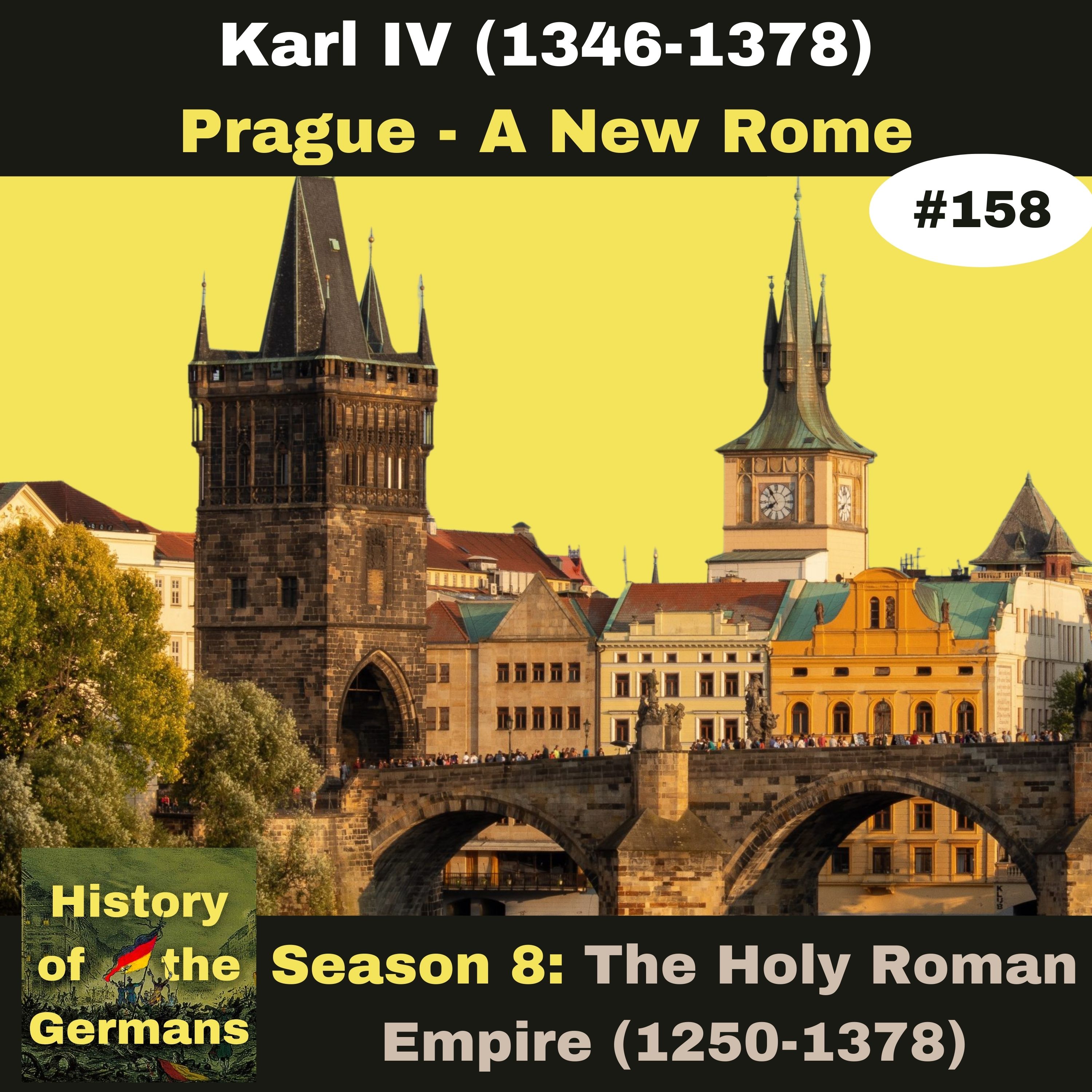
Ep 158Ep. 158: Karl IV (1346-1378) - Prague - a new Rome
“Karl, by the grace of God, King of the Romans, ever august, and King of Bohemia [ ] We have turned over in careful contemplation, and have been diligently pondering howour hereditary kingdom of Bohemia may flourish in all its beauty, thrive in peace, and not fear the loss of its riches to its enemies, and how the general good and benefit of the said kingdom may prosper, how its’ governance may grow from good to better, and how it could plant a new seed for the faith in god. To soundly provide for these things, neither sparing our labours nor expenses, we have decided to extend, expand, and newly delineate the city of Prague, recently elevated to metropolitan status at our insistence and request, situated in the midst of the kingdom and in a most fertile place, frequented by peoples from various regions and parts of the world, whose houses and buildings, inhabitants, and the multitude of people surrounding it, as well as the influx of people to it, which no one can count, especially because of the general study that we have decided to establish in the said city, cannot conveniently accommodate.”So begins the charter that founded one of the Middle Ages most ambitious infrastructure projects, the creation of Prague’s New Town, the third city to be created near the ancient castles of the kings of Bohemia, making the combined city larger in surface area than Cologne, only surpassed by Constantinople and the eternal city. A new Rome was to rise on the shores of the Vitava River, a place adorned with churches and monasteries evoking the holiest places of Christianity and squares on such a monumental scale that reminds one more of the 19th century than the 14th. Prague still today attracts “people to it which no one can count”This is what we will talk about today. Not just what he built, but why and how….The music for the show is Flute Sonata in E-flat major, H.545 by Carl Phillip Emmanuel Bach (or some claim it as BWV 1031 Johann Sebastian Bach) performed and arranged by Michel Rondeau under Common Creative Licence 3.0.As always:Homepage with maps, photos, transcripts and blog: www.historyofthegermans.comIf you wish to support the show go to: Support • History of the Germans PodcastFor do it yourself merchandise go to: Merchandise • History of the Germans PodcastFacebook: @HOTGPod Threads: @history_of_the_germans_podcastBluesky: @hotgpod.bsky.socialInstagram: history_of_the_germansTwitter: @germanshistoryTo make it easier for you to share the podcast, I have created separate playlists for some of the seasons that are set up as individual podcasts. they have the exact same episodes as in the History of the Germans, but they may be a helpful device for those who want to concentrate on only one season.So far I have:The OttoniansSalian Emperors and Investiture ControversyFredrick Barbarossa and Early HohenstaufenFrederick II Stupor MundiSaxony and Eastward ExpansionThe Hanseatic LeagueThe Teutonic KnightsThe Holy Roman Empire 1250-1356The Reformation before the ReformationThe Empire in the 15th centuryThe Fall and Rise of the Habsburgs
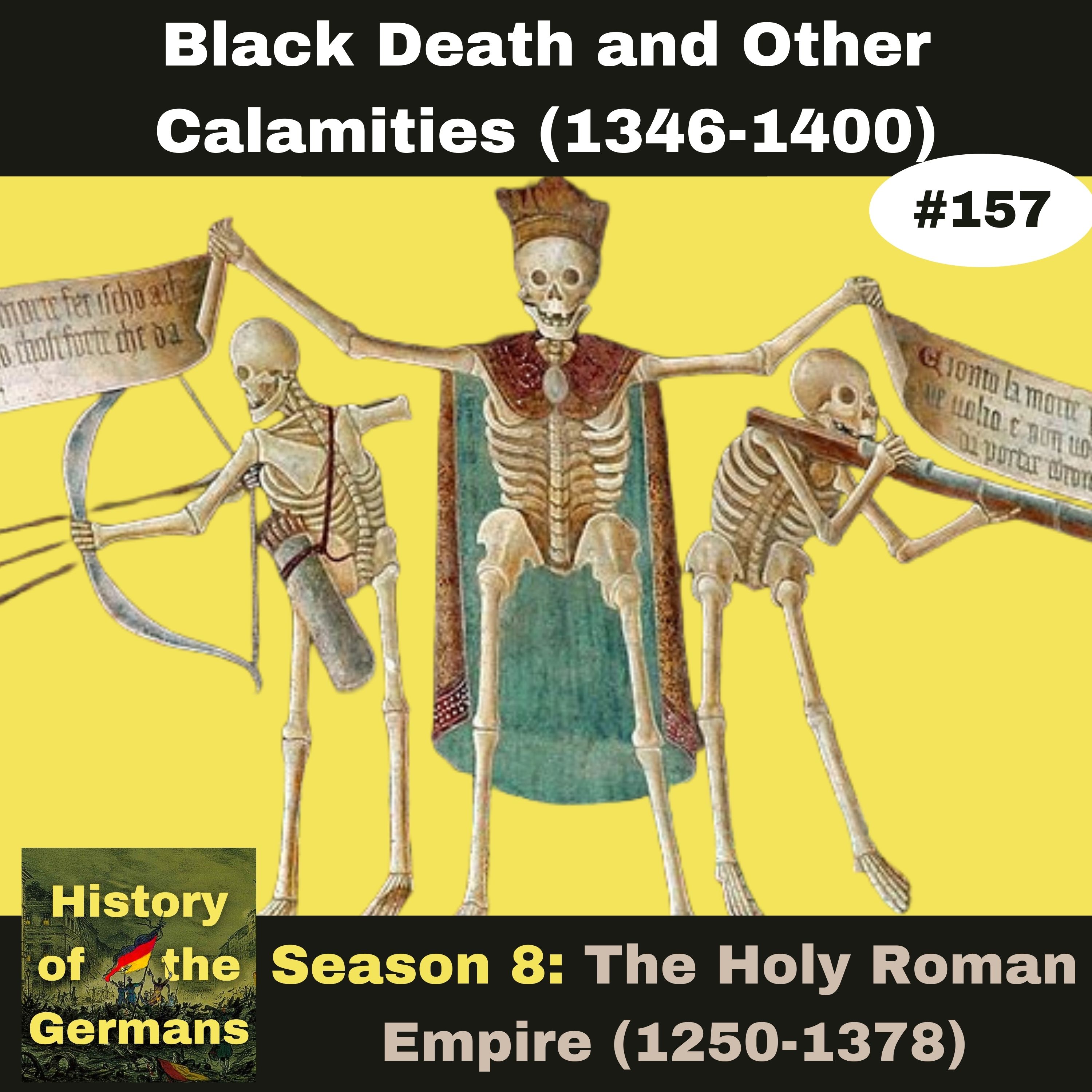
Ep 157Ep. 157: The Black Death and other Calamities (1346-1400)
In around 1320 near the lake Issy-Kul in Kyrgysistan the rats started dying. Shortly after the inhabitants became affected with terrible diseases. Some started coughing up blood and all who did, died within 3 days. Others developed swellings of the lymph nodes, particularly in the groins and armpits. Roughly half of them died within five days. A small number saw their feet and fingertips turn black. All of those died.Everyone who could still leave sought refuge in towns and villages that had not been affected. The disease travelled with them. By 1330 Chinese chroniclers recorded a plague affecting the Mongol hordes. In 1346 a Mongol army besieging the Genoese trading city of Caffa on Crimea succumbed to the disease. In their final push to cow the defenders they catapulted the diseased corpses of their comrades into the city.The siege lifted grain transports from Caffa to Italy resumed. The disease reached Messina in Sicily in 1347. In 1348 it had enveloped most of Italy. 1349 it crossed the alps, by 1350 people died in their thousands in Northern Germany and Scandinavia. It took until 1353 before this wave of the plague petered out, leaving between 20 and 60% of the population of Europe dead. The disease returned in 1361-1363, 1369-71, 1374-75, 1390 and 1400. After that intervals became longer but the plague never went away completely and still today a couple of 100 people die worldwide of Plague every year.Despite having lived through a pandemic only recently, we have all realised that the impact of such an event goes far beyond the gruesome statistics. It is much too recent an event to get a grasp of the impact COVID 19 had on the economy, political system and society in general, but clearly something has changed. Now imagine the plague, which in terms of death toll was between 10 and 30 times worse and crucially affected young and old equally. The fallout was exponentially greater not least because it came on the back ofseveral other calamities. It is these impacts we will mainly focus on in this episode. So let’s dive in..The music for the show is Flute Sonata in E-flat major, H.545 by Carl Phillip Emmanuel Bach (or some claim it as BWV 1031 Johann Sebastian Bach) performed and arranged by Michel Rondeau under Common Creative Licence 3.0.As always:Homepage with maps, photos, transcripts and blog: www.historyofthegermans.comIf you wish to support the show go to: Support • History of the Germans PodcastFor do it yourself merchandise go to: Merchandise • History of the Germans PodcastFacebook: @HOTGPod Threads: @history_of_the_germans_podcastBluesky: @hotgpod.bsky.socialInstagram: history_of_the_germansTwitter: @germanshistoryTo make it easier for you to share the podcast, I have created separate playlists for some of the seasons that are set up as individual podcasts. they have the exact same episodes as in the History of the Germans, but they may be a helpful device for those who want to concentrate on only one season.So far I have:The OttoniansSalian Emperors and Investiture ControversyFredrick Barbarossa and Early HohenstaufenFrederick II Stupor MundiSaxony and Eastward ExpansionThe Hanseatic LeagueThe Teutonic KnightsThe Holy Roman Empire 1250-1356The Reformation before the ReformationThe Empire in the 15th centuryThe Fall and Rise of the Habsburgs
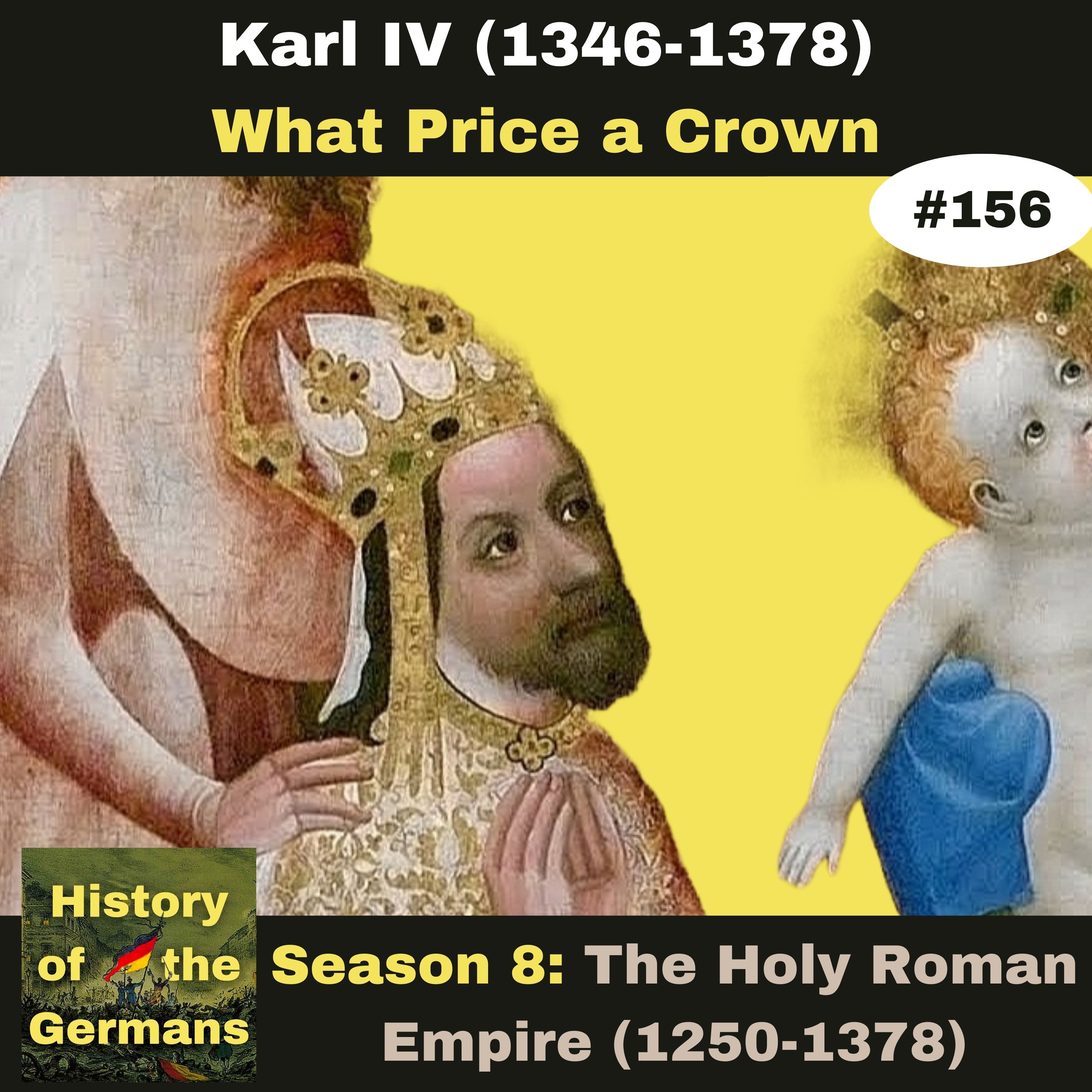
Ep 156Ep. 156: Karl IV (1346-1378) - What Price a Crown
The year is 1346 and we have, yes, another succession crisis. Without checking through my 1500 pages of transcripts, I have counted a total f 14 contested imperial elections in the 427 years we have covered so far. Henry the Fowler, Herny II, Henry IV, Henry V, Lothar III, Konrad III, Philip of Swabia, Otto IV, Frederick II, Konrad IV, Richard of Cornwall, Adolf of Nassau, Albrecht of Habsburg and Ludwig the Bavarians all had to contend with anti-kings or severe opposition to their ascension to the throne.I guess you are bored with these and so were the citizens of the empire. But here is the good news. From Karl IV’s reign onwards these succession crises will become fewer and fewer. Why? One reason is of course the Golden Bull we will discuss in a few episodes time. But there is another one, which had to do with the way Karl IV overcome the opposition. He claimed it was divine providence, but modern historians point to a much more temporal force that tied the imperial title to the heirs of the house of Luxemburg…The music for the show is Flute Sonata in E-flat major, H.545 by Carl Phillip Emmanuel Bach (or some claim it as BWV 1031 Johann Sebastian Bach) performed and arranged by Michel Rondeau under Common Creative Licence 3.0.As always:Homepage with maps, photos, transcripts and blog: www.historyofthegermans.comIf you wish to support the show go to: Support • History of the Germans PodcastFor do it yourself merchandise go to: Merchandise • History of the Germans PodcastFacebook: @HOTGPod Threads: @history_of_the_germans_podcastBluesky: @hotgpod.bsky.socialInstagram: history_of_the_germansTwitter: @germanshistoryTo make it easier for you to share the podcast, I have created separate playlists for some of the seasons that are set up as individual podcasts. they have the exact same episodes as in the History of the Germans, but they may be a helpful device for those who want to concentrate on only one season.So far I have:The OttoniansSalian Emperors and Investiture ControversyFredrick Barbarossa and Early HohenstaufenFrederick II Stupor MundiSaxony and Eastward ExpansionThe Hanseatic LeagueThe Teutonic KnightsThe Holy Roman Empire 1250-1356The Reformation before the ReformationThe Empire in the 15th centuryThe Fall and Rise of the Habsburgs
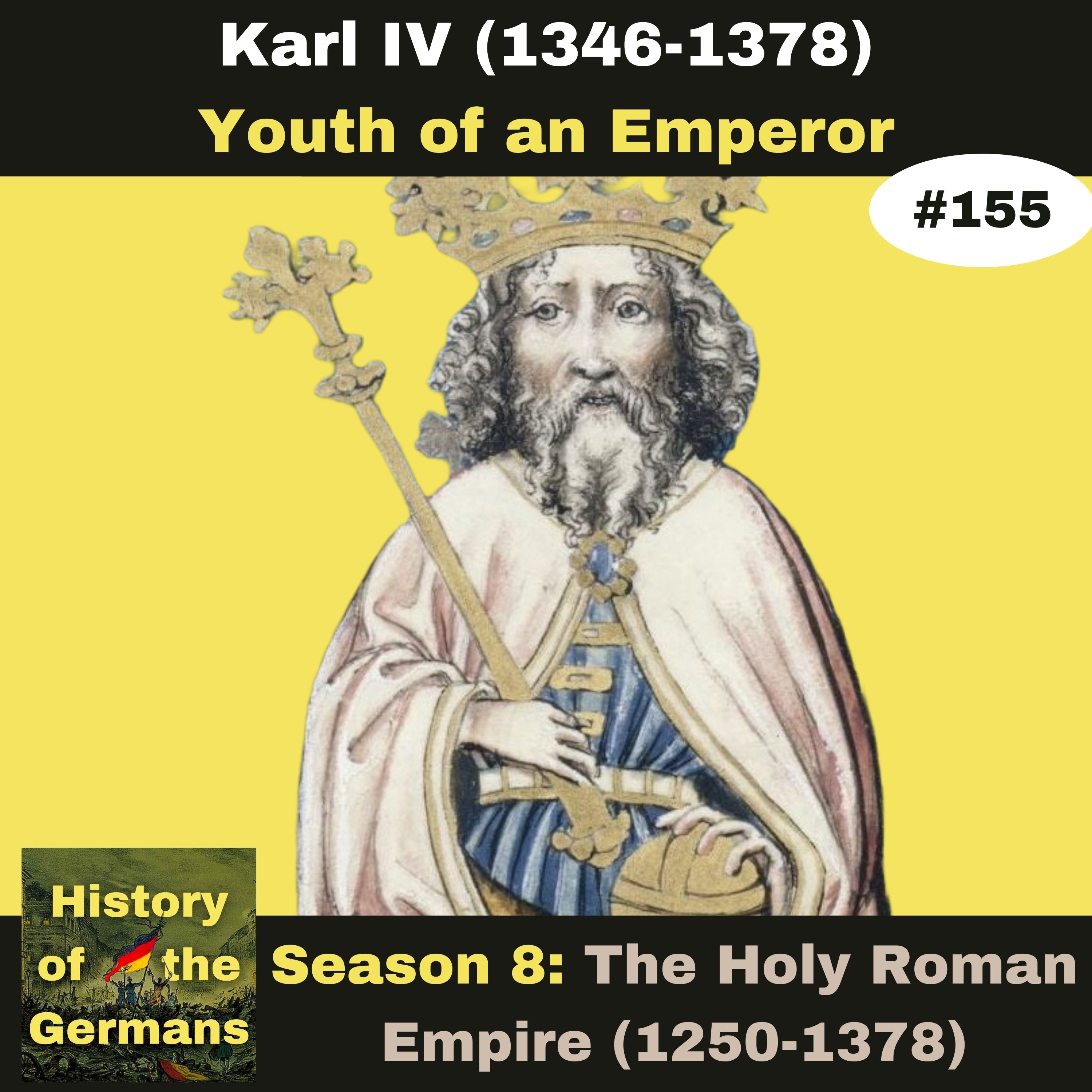
Ep 155Ep. 155: Karl IV (1346-1378) - Youth of an Emperor
You have heard me complaining regularly over the last 154 episodes that what we report as political ambitions or strategic plans of the kings and emperors was pure conjecture derived from their actions and public statement. But we could never know what they were really thinking because none of them kept a diary, or if they did they did not survive to today. The subject of today’s episode however did write an autobiography, which is believed to have been written by the emperor himself, at least in large parts. So, for the first time we hear an emperor telling his own story. Do you want to hear it?Well, here he describes what he called the most seminal moment of his youth:That night, as sleep overcame us, a vision appeared to us: an angel of the Lord stood beside us on our left side, where we lay, and struck us on the side, saying, "Rise and come with me."We responded in spirit, "Lord, I do not know where or how to go with you." And taking us by the hair of the front part of our head, he lifted us into the air over a great line of armed knights who were standing before a castle, ready for battle. Holding us in the air above the line, he said to us, "Look and see." And behold, another angel ascending from the sky, holding a fiery sword in his hand, struck one in the middle of the line and cut off his genital member with the same sword, and he, as if mortally wounded, agonized while sitting on his horse.Then the angel holding us by the hair said, "Do you recognize him who was struck by the angel and mortally wounded?" We said, "Lord, I do not know him, nor do I recognize the place." He said, "You should know that this is the Dauphin of Vienne, who, because of the sin of lust, has been struck by God in this way; therefore, beware and tell your father to beware of similar sins, or worse things will happen to you." [..]”There you go, the emperor Karl IV has divine visions. Not quite what you were expecting, but as it happened a good window into his way of thinking. But do not worry, Karl wasn’t just an excessively devout collector of relics, he was at the same time an astute and often ruthless politician who gave the Holy Roman empire its constitution and placed his heirs on the throne for the next centuries.So let’s talk about Karl’s journey from his youth to becoming the King of the Romans.The music for the show is Flute Sonata in E-flat major, H.545 by Carl Phillip Emmanuel Bach (or some claim it as BWV 1031 Johann Sebastian Bach) performed and arranged by Michel Rondeau under Common Creative Licence 3.0.As always:Homepage with maps, photos, transcripts and blog: www.historyofthegermans.comIf you wish to support the show go to: Support • History of the Germans PodcastFor do it yourself merchandise go to: Merchandise • History of the Germans PodcastFacebook: @HOTGPod Threads: @history_of_the_germans_podcastBluesky: @hotgpod.bsky.socialInstagram: history_of_the_germansTwitter: @germanshistoryTo make it easier for you to share the podcast, I have created separate playlists for some of the seasons that are set up as individual podcasts. they have the exact same episodes as in the History of the Germans, but they may be a helpful device for those who want to concentrate on only one season.So far I have:The OttoniansSalian Emperors and Investiture ControversyFredrick Barbarossa and Early HohenstaufenFrederick II Stupor MundiSaxony and Eastward ExpansionThe Hanseatic LeagueThe Teutonic KnightsThe Holy Roman Empire 1250-1356The Reformation before the ReformationThe Empire in the 15th centuryThe Fall and Rise of the Habsburgs
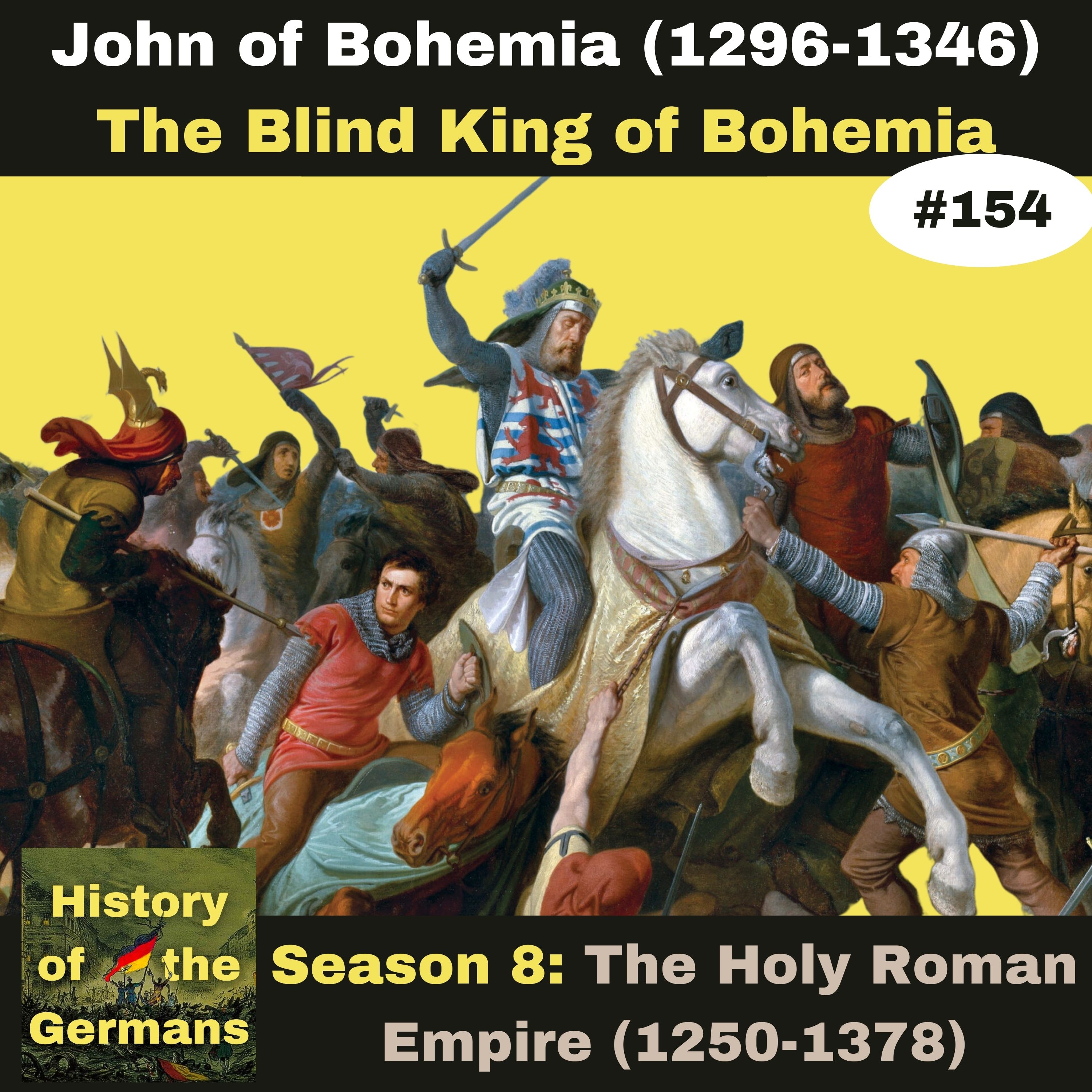
Ep 154Ep. 154 - The Blind King John of Bohemia (1296-1346)
The noble and gallant King of Bohemia, also known as John of Luxemburg because he was the son of the Emperor Henry of Luxemburg, was told by his people that the battle had begun. Although he was in full armour and equipped for combat, he could see nothing because he was blind. He asked his knights what the situation was and they described the rout of the Genoese and the confusion which followed King Philip's order to kill them. Ha,' replied the King of Bohemia. 'That is a signal for us.' […] 'My lords, you are my men, my friends and my companions-in-arms. Today I have a special request to make of you. Take me far enough forward for me to strike a blow with my sword.Because they cherished his honor and their own prowess, his knights consented. [..] In order to acquit themselves well and not lose the King in the press, they tied all their horses together by the bridles, set their king in front so that he might fulfil his wish, and rode towards the enemy.There also was Lord Charles of Bohemia, who bore the title and arms of King of Germany, and who brought his men in good order to the battlefield. But when he saw that things were going badly for his side, he turned and left. I do not know which way he went.Not so the good King his father, for he came so close to the enemy that he was able to use his sword several times and fought most bravely, as did the knights with him. They advanced so far forward that they all remained on the field, not one escaping alive. They were found the next day lying round their leader, with their horses still fastened together. "Anyone with even a passing interest in late medieval history will remember this scene from Froissart’s description of the Battle of Crecy on August 26th, 1346. The Blind King of Bohemia, the epitome of chivalric culture riding into the midst of a battle striking at an enemy he cannot see, relying on his comrades to guide him.This deed made such an impression on the Edward, the Prince of Wales, known as the Black Prince that he honored his foe by adding the Bohemian ostrich feathers and the dead king’s motto “Ich Dien”, to his own coat of arms. So to this day the Blind King’s heraldic symbols and German motto features on Prince William’s coat of arms, the Welsh Rugby Union Badge, some older 2p coins and various regiments in Britain, Australia, Canada and even Sri Lanka.But this death, call it heroic or foolish, was only the end of an astounding life. John Of Bohemia, very much against his own intentions, played a crucial role in the establishment of the key counterweight to French hegemony in Europe. No, not England, but a power centered on Prague, Vienna, Buda and Pest.Let’s dive into this story…The music for the show is Flute Sonata in E-flat major, H.545 by Carl Phillip Emmanuel Bach (or some claim it as BWV 1031 Johann Sebastian Bach) performed and arranged by Michel Rondeau under Common Creative Licence 3.0.As always:Homepage with maps, photos, transcripts and blog: www.historyofthegermans.comIf you wish to support the show go to: Support • History of the Germans PodcastFor do it yourself merchandise go to: Merchandise • History of the Germans PodcastFacebook: @HOTGPod Threads: @history_of_the_germans_podcastBluesky: @hotgpod.bsky.socialInstagram: history_of_the_germansTwitter: @germanshistoryTo make it easier for you to share the podcast, I have created separate playlists for some of the seasons that are set up as individual podcasts. they have the exact same episodes as in the History of the Germans, but they may be a helpful device for those who want to concentrate on only one season.So far I have:The OttoniansSalian Emperors and Investiture ControversyFredrick Barbarossa and Early HohenstaufenFrederick II Stupor MundiSaxony and Eastward ExpansionThe Hanseatic LeagueThe Teutonic KnightsThe Holy Roman Empire 1250-1356The Reformation before the ReformationThe Empire in the 15th centuryThe Fall and Rise of the Habsburgs
Ep 153Ep. 153: The Rise of the City of Nürnberg in the 14th Century
“In the same way that Jerusalem is the navel of the world, is Nurnberg the navel of Germany” is how Matthäus Dresser described the city in 1581. The astronomer Johannes Regiomontanus moved to Nurnberg in 1471 because there" ...one can easily associate with learned men wherever they live. Because of the cosmopolitanism of its merchants, this place is regarded as the center of Europe”. How did this city grow within 200 years from an imperial castle far from the main transport links, without a harbour and on famously poor soil into one of the three most important urban centres in Germany whose merchants were well regarded in all corners of the world, whose printers published the works of Europe’s leading intellectuals, whose artists were and remain of global renown and whose engineers produced breakthrough after breakthrough.Let’s find outThe music for the show is Flute Sonata in E-flat major, H.545 by Carl Phillip Emmanuel Bach (or some claim it as BWV 1031 Johann Sebastian Bach) performed and arranged by Michel Rondeau under Common Creative Licence 3.0.As always:Homepage with maps, photos, transcripts and blog: www.historyofthegermans.comIf you wish to support the show go to: Support • History of the Germans PodcastFor do it yourself merchandise go to: Merchandise • History of the Germans PodcastFacebook: @HOTGPod Threads: @history_of_the_germans_podcastBluesky: @hotgpod.bsky.socialInstagram: history_of_the_germansTwitter: @germanshistoryTo make it easier for you to share the podcast, I have created separate playlists for some of the seasons that are set up as individual podcasts. they have the exact same episodes as in the History of the Germans, but they may be a helpful device for those who want to concentrate on only one season.So far I have:The OttoniansSalian Emperors and Investiture ControversyFredrick Barbarossa and Early HohenstaufenFrederick II Stupor MundiSaxony and Eastward ExpansionThe Hanseatic LeagueThe Teutonic KnightsThe Holy Roman Empire 1250-1356The Reformation before the ReformationThe Empire in the 15th centuryThe Fall and Rise of the Habsburgs
Ep 152Ep.152: Ludwig the Bavarian (1314-1347) - The (not so) Ugly Duchess Margarete Maultasch
“The twelve-year-old Margarete, Princess of Carinthia and Tyrol, was travelling from her seat near Meran to Innsbruck for her wedding with the ten-year old Prince Johann of Bohemia. [..]Still and serious she sat, in ceremonial pomp. Her bodice was so tight that she had had to be laced into it; her sleeves of heavy green satin, in the very extreme of fashion, fell to her feet ; she wore one of the new jeweled hair-nets which an express courier had had to bring from Flanders, where they had recently appeared. A heavy necklace sparkled on her bosom, and large rings on her fingers. So she sat, serious and perspiring, weighed down with magnificence, between the peevish, grumbling women. She looked older than her twelve years. Her thick-set body with its short limbs supported a massive misshapen head. The forehead, indeed, was clear and candid, the eyes quick and shrewd, penetrating and sagacious ; but below the small flat nose an ape-like mouth thrust forward its enormous jaws and pendulous underlip. Her copper colored hair was coarse, wiry and dull, her skin patchy and of a dull greyish pallor.”That is how the author Lion Feuchtwanger described Margarete, the countess of Tirol who is better known as Margarete Maultasch, the ugly duchess. This historic novel that became a huge bestseller in the 1920s describes how a bright and ambitious, but monstrously ugly woman is crushed by society’s habit to judge the inside of a person by its appearance.I still have a copy of this book from the 1980s when I first read it, and on its cover is the same image I used for this episode’s artwork. The picture was painted by Quentin Matsys in 1513 and according to the National Gallery’s catalogue is called a Grotesque Old Woman.It is not a portrait of Margarete Maultasch who had died 150 years earlier. The identification of the sitter as Margarete Maultasch goes back the idea of a postcard seller in Meran in the 1920s. Matsys picture also made its way into the depiction of the Duchess in Alice in Wonderland.But it is all hokum. Chroniclers who knew Margarete personally, like Johann von Viktring either do not mention her appearance at all, or call her beautiful, if not extremely beautiful. So, as much as I love Lion Feuchtwanger’s novel, which btw. is available in an English translation, its premise is simply false.The truth is much more interesting. Her actions to defend her inherited county of Tyrol were the changes that tilted the complex equilibrium between the Habsburgs, the Wittelsbachs and the House of Luxemburg out of kilter with unpredictable, violent results.So, let’s find out why and how and what…The music for the show is Flute Sonata in E-flat major, H.545 by Carl Phillip Emmanuel Bach (or some claim it as BWV 1031 Johann Sebastian Bach) performed and arranged by Michel Rondeau under Common Creative Licence 3.0.As always:Homepage with maps, photos, transcripts and blog: www.historyofthegermans.comIf you wish to support the show go to: Support • History of the Germans PodcastFor do it yourself merchandise go to: Merchandise • History of the Germans PodcastFacebook: @HOTGPod Threads: @history_of_the_germans_podcastBluesky: @hotgpod.bsky.socialInstagram: history_of_the_germansTwitter: @germanshistoryTo make it easier for you to share the podcast, I have created separate playlists for some of the seasons that are set up as individual podcasts. they have the exact same episodes as in the History of the Germans, but they may be a helpful device for those who want to concentrate on only one season.So far I have:The OttoniansSalian Emperors and Investiture ControversyFredrick Barbarossa and Early HohenstaufenFrederick II Stupor MundiSaxony and Eastward ExpansionThe Hanseatic LeagueThe Teutonic KnightsThe Holy Roman Empire 1250-1356The Reformation before the ReformationThe Empire in the 15th centuryThe Fall and Rise of the Habsburgs
Ep 151Ep. 151: Ludwig the Bavarian (1314-1347) - The Kurverein zu Rhens
This week we look at the central intellectual debate of the 14th century, did Jesus own property? If yes, then it was right and proper that the church owned land, privileges, entire counties and duchies, yes that the pope was not just the spiritual but also the secular ruler of all of Christianity. And if not, then the pope as a successor to the apostles should rescind all worldly possessions and all political power. The follow-on question from there was even more hair raising: if indeed power does not come from the grace of god as determined by the Holy church, then where does it come from. One thinker, Marsilius of Padua goes as far as stating the obvious, power comes from election by the people…This is what pope John XXII, Michael of Cesena, William of Ockham and the cast of Umberto Eco’s the Name of the Rose discuss. But there was also a politician, Ludwig IV, elected emperor who took these ideas – and put them into actions….let’s find out just how radical this ruler they call “the Bavarian” really was.The music for the show is Flute Sonata in E-flat major, H.545 by Carl Phillip Emmanuel Bach (or some claim it as BWV 1031 Johann Sebastian Bach) performed and arranged by Michel Rondeau under Common Creative Licence 3.0.As always:Homepage with maps, photos, transcripts and blog: www.historyofthegermans.comIf you wish to support the show go to: Support • History of the Germans PodcastFor do it yourself merchandise go to: Merchandise • History of the Germans PodcastFacebook: @HOTGPod Threads: @history_of_the_germans_podcastBluesky: @hotgpod.bsky.socialInstagram: history_of_the_germansTwitter: @germanshistoryTo make it easier for you to share the podcast, I have created separate playlists for some of the seasons that are set up as individual podcasts. they have the exact same episodes as in the History of the Germans, but they may be a helpful device for those who want to concentrate on only one season.So far I have:The OttoniansSalian Emperors and Investiture ControversyFredrick Barbarossa and Early HohenstaufenFrederick II Stupor MundiSaxony and Eastward ExpansionThe Hanseatic LeagueThe Teutonic KnightsThe Holy Roman Empire 1250-1356The Reformation before the ReformationThe Empire in the 15th centuryThe Fall and Rise of the Habsburgs
Ep 150Ep. 150: Ludwig the Bavarian (1314-1347) - The Last Chivalric Battles – Morgarten and Mühldorf
The 14th century is a time of fundamental change in practically all areas of social, political and economic life. It is a time when the certainties of the Middle Ages are replaced by a process of trial and error, sometimes successful, but almost always violent. We see new frameworks of how society and in particular the religious authorities should operate, how political power should be distributed and how economic growth could be preserved at a time when the climatic benefits of the medieval warming period has come to an end. Ah, and then there was the Black Death.In this episode we will talk about the political dimension of this change. First how the conflict between the three dominating houses, the Habsburgs, the Wittelsbachs and the Luxemburg pans out, though whilst the mighty lords believe it is all about marriage alliances and knights dominating the battlefield, the ground on which their mighty warhorses are galloping is shifting….The music for the show is Flute Sonata in E-flat major, H.545 by Carl Phillip Emmanuel Bach (or some claim it as BWV 1031 Johann Sebastian Bach) performed and arranged by Michel Rondeau under Common Creative Licence 3.0.As always:Homepage with maps, photos, transcripts and blog: www.historyofthegermans.comIf you wish to support the show go to: Support • History of the Germans PodcastFor do it yourself merchandise go to: Merchandise • History of the Germans PodcastFacebook: @HOTGPod Threads: @history_of_the_germans_podcastBluesky: @hotgpod.bsky.socialInstagram: history_of_the_germansTwitter: @germanshistoryTo make it easier for you to share the podcast, I have created separate playlists for some of the seasons that are set up as individual podcasts. they have the exact same episodes as in the History of the Germans, but they may be a helpful device for those who want to concentrate on only one season.So far I have:The OttoniansSalian Emperors and Investiture ControversyFredrick Barbarossa and Early HohenstaufenFrederick II Stupor MundiSaxony and Eastward ExpansionThe Hanseatic LeagueThe Teutonic KnightsThe Holy Roman Empire 1250-1356The Reformation before the ReformationThe Empire in the 15th centuryThe Fall and Rise of the Habsburgs
Ep 149Ep. 149: Ludwig the Bavarian (1314-1347) - The Real Ludwig of Bavaria
A few months after emperor Henry VII had died in the Tuscan village of Buonconvento and before a successor had been elected, a young man, Ludwig, second son of the duke of Upper Bavaria made his name defeating a much larger Habsburg force. This success could not have come at a more opportune time as it propelled him into contention for the title of King of the Romas and ultimately, emperor.His rule, constantly contested but lasting 33 years would become a major turning point in German, if not European history as it triggered the modern notion of the separation of church and state.I know that I cannot always maintain a completely unbiased position in this podcast, but I rarely succumb to my personal bugbears. But this time I will have to expose you to one of my biggest, and that is the weird romanticization of Ludwig II of Bavaria, the mentally ill recluse who built the three kitsch palaces of Neuschwanstein, Herrenchiemsee and Linderhof in the deluded hope of resurrecting an absolutist regime in a kingdom he had sold to Prussia. Don’t get me wrong. The three palaces are worth visiting, if not for their somewhat morbid charm, but what irritates me is that this politically and artistically inconsequential monarch overshadows the more interesting, more complex and more consequential Bavarian rulers, chief amongst them his namesake, Ludwig IV the Bavarian.Let’s see whether HotGPod cannot right this misconception…..The music for the show is Flute Sonata in E-flat major, H.545 by Carl Phillip Emmanuel Bach (or some claim it as BWV 1031 Johann Sebastian Bach) performed and arranged by Michel Rondeau under Common Creative Licence 3.0.As always:Homepage with maps, photos, transcripts and blog: www.historyofthegermans.comIf you wish to support the show go to: Support • History of the Germans PodcastFor do it yourself merchandise go to: Merchandise • History of the Germans PodcastFacebook: @HOTGPod Threads: @history_of_the_germans_podcastBluesky: @hotgpod.bsky.socialInstagram: history_of_the_germansTwitter: @germanshistoryTo make it easier for you to share the podcast, I have created separate playlists for some of the seasons that are set up as individual podcasts. they have the exact same episodes as in the History of the Germans, but they may be a helpful device for those who want to concentrate on only one season.So far I have:The OttoniansSalian Emperors and Investiture ControversyFredrick Barbarossa and Early HohenstaufenFrederick II Stupor MundiSaxony and Eastward ExpansionThe Hanseatic LeagueThe Teutonic KnightsThe Holy Roman Empire 1250-1356The Reformation before the ReformationThe Empire in the 15th centuryThe Fall and Rise of the Habsburgs
Ep 148Ep. 148: Henry VII (1308-1313) - Imperial Swansong
The year is 1312 and Henry VII is finally embarking on his journey to Rome that will bring about the first imperial coronation in almost a century and hence the formal end to the Interregnum, the time without emperors.Becoming emperor is hard enough, but being emperor is even harder, as the first Luxemburger to ascend the throne of Charlemagne will find out. Hope for an end to the never ending civil wars in Italy lay buried under the rotting corpses before Brescia. Henry VII is no longer a unifying figure in Italy, just simply the leader of the Ghibelline faction. And as such he has to tackle the Guelphs led by the commune of Florence and king Robert of Naples. Doing that triggered a domino effect that not only left him dead but also reopened the ancient struggle between the pope and the emperor, now with a new “je ne sais quoi” mixed in. Sounds ominous – come along and find out..Here is the link to Dan and Spencer's excellent podcast I mentioned: Podcast | Not So Quiet On The Western Front! (battleguide.co.uk)The music for the show is Flute Sonata in E-flat major, H.545 by Carl Phillip Emmanuel Bach (or some claim it as BWV 1031 Johann Sebastian Bach) performed and arranged by Michel Rondeau under Common Creative Licence 3.0.As always:Homepage with maps, photos, transcripts and blog: www.historyofthegermans.comIf you wish to support the show go to: Support • History of the Germans PodcastFor do it yourself merchandise go to: Merchandise • History of the Germans PodcastFacebook: @HOTGPod Threads: @history_of_the_germans_podcastBluesky: @hotgpod.bsky.socialInstagram: history_of_the_germansTwitter: @germanshistoryTo make it easier for you to share the podcast, I have created separate playlists for some of the seasons that are set up as individual podcasts. they have the exact same episodes as in the History of the Germans, but they may be a helpful device for those who want to concentrate on only one season.So far I have:The OttoniansSalian Emperors and Investiture ControversyFredrick Barbarossa and Early HohenstaufenFrederick II Stupor MundiSaxony and Eastward ExpansionThe Hanseatic LeagueThe Teutonic KnightsThe Holy Roman Empire 1250-1356The Reformation before the ReformationThe Empire in the 15th centuryThe Fall and Rise of the Habsburgs
Ep 147Ep. 147: Henry VII (1308-1313) - Brescia or Bust
Henry VII had gained control of most of Northern Italy in less than three months. It will take him 9 months to lose it all again. How did he go from bringer of peace and justice and all out saviour of Italy to brutal conqueror and godless tyrant? Let’s find out.The music for the show is Flute Sonata in E-flat major, H.545 by Carl Phillip Emmanuel Bach (or some claim it as BWV 1031 Johann Sebastian Bach) performed and arranged by Michel Rondeau under Common Creative Licence 3.0.As always:Homepage with maps, photos, transcripts and blog: www.historyofthegermans.comIf you wish to support the show go to: Support • History of the Germans PodcastFor do it yourself merchandise go to: Merchandise • History of the Germans PodcastFacebook: @HOTGPod Threads: @history_of_the_germans_podcastBluesky: @hotgpod.bsky.socialInstagram: history_of_the_germansTwitter: @germanshistoryTo make it easier for you to share the podcast, I have created separate playlists for some of the seasons that are set up as individual podcasts. they have the exact same episodes as in the History of the Germans, but they may be a helpful device for those who want to concentrate on only one season.So far I have:The OttoniansSalian Emperors and Investiture ControversyFredrick Barbarossa and Early HohenstaufenFrederick II Stupor MundiSaxony and Eastward ExpansionThe Hanseatic LeagueThe Teutonic KnightsThe Holy Roman Empire 1250-1356The Reformation before the ReformationThe Empire in the 15th centuryThe Fall and Rise of the Habsburgs
Ep 146Ep. 146: Henry VII (1308-1313) - The Return of the Emperor to Rome
In the winter of 1310 the emperor elect Henry VII not yet 40 years of age and every inch a king appears in Italy. An Italy torn apart by incessant violence, between and within the cities. Allegedly it is a struggle between the pro-imperial Ghibellines and the pro-papal Guelphs, but 60 years after the last emperor had set foot on Italian soil and seven years after the pope has left for Avignon, these designations have become just names without meaning, monikers hiding the naked ambitions of the powerful families.The poet Dante Aligheri projects the hopes of many desperate exiles on Henry when he prays that “we, who for so long have passed our nights in the desert, shall behold the gladness for which we have longed, for Titan shall arise pacific, and justice, which had languished without sunshine at the end of the winter's solstice, shall grow green once more”.A lot to get done for our Luxemburg count and his army of 5,000 men. Certainty of death, small chance of success, what are we waiting for?Here is the link to Syrom‘s article:https://generativeai.pub/knowledge-graph-extraction-visualization-with-local-llm-from-unstructured-text-a-history-example-94c63b366fedThe music for the show is Flute Sonata in E-flat major, H.545 by Carl Phillip Emmanuel Bach (or some claim it as BWV 1031 Johann Sebastian Bach) performed and arranged by Michel Rondeau under Common Creative Licence 3.0.As always:Homepage with maps, photos, transcripts and blog: www.historyofthegermans.comIf you wish to support the show go to: Support • History of the Germans PodcastFor do it yourself merchandise go to: Merchandise • History of the Germans PodcastFacebook: @HOTGPod Threads: @history_of_the_germans_podcastBluesky: @hotgpod.bsky.socialInstagram: history_of_the_germansTwitter: @germanshistoryTo make it easier for you to share the podcast, I have created separate playlists for some of the seasons that are set up as individual podcasts. they have the exact same episodes as in the History of the Germans, but they may be a helpful device for those who want to concentrate on only one season.So far I have:The OttoniansSalian Emperors and Investiture ControversyFredrick Barbarossa and Early HohenstaufenFrederick II Stupor MundiSaxony and Eastward ExpansionThe Hanseatic LeagueThe Teutonic KnightsThe Holy Roman Empire 1250-1356The Reformation before the ReformationThe Empire in the 15th centuryThe Fall and Rise of the Habsburgs
Ep 145Ep. 145: Henry VII (1308-1313) - How to make Friends and Influence People
Henry, the new king of the Romans, just 30 years of age, tall and blond, every inch his forebearer the great Charlemagne had a one track mind. There was one thing he wanted and that was the imperial crown.It is now 60 years since there last had been a crowned emperor. We had such an interregnum before, in the 10th century between the death of emperor Berengar of Friuli, yes, me neither, and the coronation of Otto the Great in 962. This, even shorter gap, had resulted in the transfers of the imperial honour from the Carolingians to the rulers of the German Lands.It was high time to go to Rome and be crowned emperor. Otherwise more people will ask as John of Salisbury had: Who appointed the Germans to be judges over the peoples of the earth? Who gave these brutish, unruly people the arbitrary authority to elect a ruler over the heads of the people?But to get to Rome for a medieval imperial coronation requires more than just picking up a plane ticket. First our new Barbarossa needs to assert his position in the empire, gather followers for the journey and establish peace and justice. He needs to convince the pope to send an invitation and the king of France not to send an army to stop him. Most of all he needs to calm down the Empire sufficiently so that it does not fall into anarchy whilst he is away.And whilst he is busy making peace between the warring factions, convincing them that all he cares about is being semper Augustus, always augmenting the empire and reassuring everyone that he is not just enriching his family as his predecessors had done, that is when he walks away with the most valuable prize of them all, the kingdom of Bohemia.The music for the show is Flute Sonata in E-flat major, H.545 by Carl Phillip Emmanuel Bach (or some claim it as BWV 1031 Johann Sebastian Bach) performed and arranged by Michel Rondeau under Common Creative Licence 3.0.As always:Homepage with maps, photos, transcripts and blog: www.historyofthegermans.comIf you wish to support the show go to: Support • History of the Germans PodcastFor do it yourself merchandise go to: Merchandise • History of the Germans PodcastFacebook: @HOTGPod Threads: @history_of_the_germans_podcastBluesky: @hotgpod.bsky.socialInstagram: history_of_the_germansTwitter: @germanshistoryTo make it easier for you to share the podcast, I have created separate playlists for some of the seasons that are set up as individual podcasts. they have the exact same episodes as in the History of the Germans, but they may be a helpful device for those who want to concentrate on only one season.So far I have:The OttoniansSalian Emperors and Investiture ControversyFredrick Barbarossa and Early HohenstaufenFrederick II Stupor MundiSaxony and Eastward ExpansionThe Hanseatic LeagueThe Teutonic KnightsThe Holy Roman Empire 1250-1356The Reformation before the ReformationThe Empire in the 15th centuryThe Fall and Rise of the Habsburgs
Ep 144Ep. 144: Henry VII (1308-1313) -The Rise of the House of Luxembourg
On November 27th, 1308 the prince electors chose Henry VII, count of Luxemburg to be their new king of the Romans and future emperor. Little did they know that this decision will give rise to a dynasty that will rule the empire for as many decades as the Ottonian, the Salian and the Hohenstaufen had. A dynasty that featured such emblems of chivalric pride as the blind king John of Bohemia, builders of cities and empires like Charles IV and finally, in a faint mirror image of the height of medieval imperial power, an emperor who engineers the deposition of three popes and the appointment of a new one, whilst foreshadowing the wars of religion by murdering the reformer Jan Hus.Today’s episode explores the backstory of the house of Luxemburg who have been around since Carolingian times. They were the “Where is Wally“ of the rich tapestry of High Medieval History, always somewhere in the picture, but never really in the foreground. Two women feature highly, the empress Kunigunde, wife of emperor Henry II and Ermesinde, who successful ruled the county for 47 years.But the real step up came when Henry VII, barely 30 years old and running a county much diminished after the disastrous battle of Worringen became the only viable candidate to kingship. How that happened is what we will talk about in this episode..The music for the show is Flute Sonata in E-flat major, H.545 by Carl Phillip Emmanuel Bach (or some claim it as BWV 1031 Johann Sebastian Bach) performed and arranged by Michel Rondeau under Common Creative Licence 3.0.As always:Homepage with maps, photos, transcripts and blog: www.historyofthegermans.comIf you wish to support the show go to: Support • History of the Germans PodcastFor do it yourself merchandise go to: Merchandise • History of the Germans PodcastFacebook: @HOTGPod Threads: @history_of_the_germans_podcastBluesky: @hotgpod.bsky.socialInstagram: history_of_the_germansTwitter: @germanshistoryTo make it easier for you to share the podcast, I have created separate playlists for some of the seasons that are set up as individual podcasts. they have the exact same episodes as in the History of the Germans, but they may be a helpful device for those who want to concentrate on only one season.So far I have:The OttoniansSalian Emperors and Investiture ControversyFredrick Barbarossa and Early HohenstaufenFrederick II Stupor MundiSaxony and Eastward ExpansionThe Hanseatic LeagueThe Teutonic KnightsThe Holy Roman Empire 1250-1356The Reformation before the ReformationThe Empire in the 15th centuryThe Fall and Rise of the Habsburgs
Ep 143Ep. 143: Albrecht I (1298-1308) -The Murder of a King
The late 13th century was the sniper’s alley for many a powerful family. The disappearance of great dynasties, the Arpads of Hungary, the Premyslids of Bohemia, the Zaehringer, Babenbergs, the counts of Holland to name just a few wasn’t down to lack of fertility but down to violence. Murder became so common, even those who did not have swords sticking out of their chest were presumed poisoned. To save them, some were suspended from the ceiling to flush out harmful substances. Violence was not limited to temporal princes, even the pope was getting slapped down for declaring that every Christian ruler was subject to the Roman Pontiff.The fact that Albrecht I von Habsburg the new King of the Romans is murdered is therefore not the most interesting thing about him. What is astonishing is how far this man “with only one eye and a look that made you sick” got in his ambitions. Pressured from all sides, the Prince Electors, his own vassals in Austria, the Pope, the Bohemians, still he ploughed on, picking up principalities like others picking daisies. And a wrath of daisies is what did for him in the end…The music for the show is Flute Sonata in E-flat major, H.545 by Carl Phillip Emmanuel Bach (or some claim it as BWV 1031 Johann Sebastian Bach) performed and arranged by Michel Rondeau under Common Creative Licence 3.0.As always:Homepage with maps, photos, transcripts and blog: www.historyofthegermans.comIf you wish to support the show go to: Support • History of the Germans PodcastFor do it yourself merchandise go to: Merchandise • History of the Germans PodcastFacebook: @HOTGPod Threads: @history_of_the_germans_podcastBluesky: @hotgpod.bsky.socialInstagram: history_of_the_germansTwitter: @germanshistoryTo make it easier for you to share the podcast, I have created separate playlists for some of the seasons that are set up as individual podcasts. they have the exact same episodes as in the History of the Germans, but they may be a helpful device for those who want to concentrate on only one season.So far I have:The OttoniansSalian Emperors and Investiture ControversyFredrick Barbarossa and Early HohenstaufenFrederick II Stupor MundiSaxony and Eastward ExpansionThe Hanseatic LeagueThe Teutonic KnightsThe Holy Roman Empire 1250-1356The Reformation before the ReformationThe Empire in the 15th centuryThe Fall and Rise of the Habsburgs
Ep 142Ep. 142: Adolf von Nassau (1292-1298) - A Shadow of a King
After the death of Rudolf von Habsburg the Prince Electors chose another, now truly impecunious count, Adolf von Nassau to be king. They chose him over Rudolf’s son Albrecht and over the overwhelmingly most powerful prince in the empire, King Wenceslaus II of Bohemia.This cultured and competent man became known to German history as a Schattenkönig, a shadow of a king, unable to wiggle out of his ties to the overbearing Electors. Acting as mercenary in the pay of king Edward of England and failing to create his own Hausmacht in Thuringia, many history books skip over his six years on the throne.Nevertheless, the events of his election and deposition form another crossroads in the history of the German lands that set the Holy Roman empire further down the path to become neither Holy, nor Roman nor an Empire.The music for the show is Flute Sonata in E-flat major, H.545 by Carl Phillip Emmanuel Bach (or some claim it as BWV 1031 Johann Sebastian Bach) performed and arranged by Michel Rondeau under Common Creative Licence 3.0.As always:Homepage with maps, photos, transcripts and blog: www.historyofthegermans.comIf you wish to support the show go to: Support • History of the Germans PodcastFor do it yourself merchandise go to: Merchandise • History of the Germans PodcastFacebook: @HOTGPod Threads: @history_of_the_germans_podcastBluesky: @hotgpod.bsky.socialInstagram: history_of_the_germansTwitter: @germanshistoryTo make it easier for you to share the podcast, I have created separate playlists for some of the seasons that are set up as individual podcasts. they have the exact same episodes as in the History of the Germans, but they may be a helpful device for those who want to concentrate on only one season.So far I have:The OttoniansSalian Emperors and Investiture ControversyFredrick Barbarossa and Early HohenstaufenFrederick II Stupor MundiSaxony and Eastward ExpansionThe Hanseatic LeagueThe Teutonic KnightsThe Holy Roman Empire 1250-1356The Reformation before the ReformationThe Empire in the 15th centuryThe Fall and Rise of the Habsburgs
Ep 141Ep. 141: Rudolf of Habsburg (1273-1291) - Semper Augustus / Allezeit Mehrer des Reiches
Martin Rady in his highly amusing and exceptionally well written book on the Habsburg said: “The remainder of Rudolf’s reign up to his death in 1291 was a failure. He did not manage to have himself crowned emperor by the pope and had to make do with the title of king…it was a false dawn, both for the Holy Roman empire and for the Habsburgs”I most humbly disagree. The 13 years following the battle of Durnkrut are some of the most transformative for the Empire and the fledgling concept of German and Germany. This episode will try to make the case for Rudolf I, founder of the house of Habsburg and one of the most impactful medieval rulers of the empire.The music for the show is Flute Sonata in E-flat major, H.545 by Carl Phillip Emmanuel Bach (or some claim it as BWV 1031 Johann Sebastian Bach) performed and arranged by Michel Rondeau under Common Creative Licence 3.0.As always:Homepage with maps, photos, transcripts and blog: www.historyofthegermans.comIf you wish to support the show go to: Support • History of the Germans PodcastFor do it yourself merchandise go to: Merchandise • History of the Germans PodcastFacebook: @HOTGPod Threads: @history_of_the_germans_podcastBluesky: @hotgpod.bsky.socialInstagram: history_of_the_germansTwitter: @germanshistoryTo make it easier for you to share the podcast, I have created separate playlists for some of the seasons that are set up as individual podcasts. they have the exact same episodes as in the History of the Germans, but they may be a helpful device for those who want to concentrate on only one season.So far I have:The OttoniansSalian Emperors and Investiture ControversyFredrick Barbarossa and Early HohenstaufenFrederick II Stupor MundiSaxony and Eastward ExpansionThe Hanseatic LeagueThe Teutonic KnightsThe Holy Roman Empire 1250-1356The Reformation before the ReformationThe Empire in the 15th centuryThe Fall and Rise of the Habsburgs
Ep 140Ep. 140: Rudolf of Habsburg (1273-1291) and the Golden King Ottokar of Bohemia
This week we will look at what the poor count Rudolf of Habsburg does once he had been elected King of the Romans. This is not the first time the electors have chosen a man of much more modest means than themselves. William of Holland and Hermann von Salm had failed to leverage their elevated status into tangible gains. But Rudolf is different.Through a combination of charm, cunning and fecundity he managed to wrestle the duchies of Austria, Styria and Carinthia from its current owner, the immeasurably rich and profoundly vain king Ottokar II of Bohemia. A story of political acumen, personal bravery and dishonourable tactics on the Marchfeld.The music for the show is Flute Sonata in E-flat major, H.545 by Carl Phillip Emmanuel Bach (or some claim it as BWV 1031 Johann Sebastian Bach) performed and arranged by Michel Rondeau under Common Creative Licence 3.0.As always:Homepage with maps, photos, transcripts and blog: www.historyofthegermans.comIf you wish to support the show go to: Support • History of the Germans PodcastFor do it yourself merchandise go to: Merchandise • History of the Germans PodcastFacebook: @HOTGPod Threads: @history_of_the_germans_podcastBluesky: @hotgpod.bsky.socialInstagram: history_of_the_germansTwitter: @germanshistoryTo make it easier for you to share the podcast, I have created separate playlists for some of the seasons that are set up as individual podcasts. they have the exact same episodes as in the History of the Germans, but they may be a helpful device for those who want to concentrate on only one season.So far I have:The OttoniansSalian Emperors and Investiture ControversyFredrick Barbarossa and Early HohenstaufenFrederick II Stupor MundiSaxony and Eastward ExpansionThe Hanseatic LeagueThe Teutonic KnightsThe Holy Roman Empire 1250-1356The Reformation before the ReformationThe Empire in the 15th centuryThe Fall and Rise of the Habsburgs
Ep 139Ep. 139: Rudolf of Habsburg (1273-1291) - The End of the Interregnum
On October 1, 1273 seven princes elected a new king of the Romans. Their choice was a momentous one that set European history further down its path away from a universal empire to separate kingdoms and principalities.The pope had demanded that they come to a unanimous decision so that the empire could again participate in a crusade to stop the remains of the Kingdom of Jerusalem to be swept away for good.So why did they chose a modest count from what is now Northern Switzerland called rudolf von Habsburg and not any of the kings, dukes and princes who had been vying for the job and who could count on support from Naples, Rome, Prague and Paris is what we will look into in this episode, the first of our new season “from the Interregnum to the Golden Bull – the Holy Roman empire 1250-1273.The music for the show is Flute Sonata in E-flat major, H.545 by Carl Phillip Emmanuel Bach (or some claim it as BWV 1031 Johann Sebastian Bach) performed and arranged by Michel Rondeau under Common Creative Licence 3.0.As always:Homepage with maps, photos, transcripts and blog: www.historyofthegermans.comIf you wish to support the show go to: Support • History of the Germans PodcastFor do it yourself merchandise go to: Merchandise • History of the Germans PodcastFacebook: @HOTGPod Threads: @history_of_the_germans_podcastBluesky: @hotgpod.bsky.socialInstagram: history_of_the_germansTwitter: @germanshistoryTo make it easier for you to share the podcast, I have created separate playlists for some of the seasons that are set up as individual podcasts. they have the exact same episodes as in the History of the Germans, but they may be a helpful device for those who want to concentrate on only one season.So far I have:The OttoniansSalian Emperors and Investiture ControversyFredrick Barbarossa and Early HohenstaufenFrederick II Stupor MundiSaxony and Eastward ExpansionThe Hanseatic LeagueThe Teutonic KnightsThe Holy Roman Empire 1250-1356The Reformation before the ReformationThe Empire in the 15th centuryThe Fall and Rise of the Habsburgs
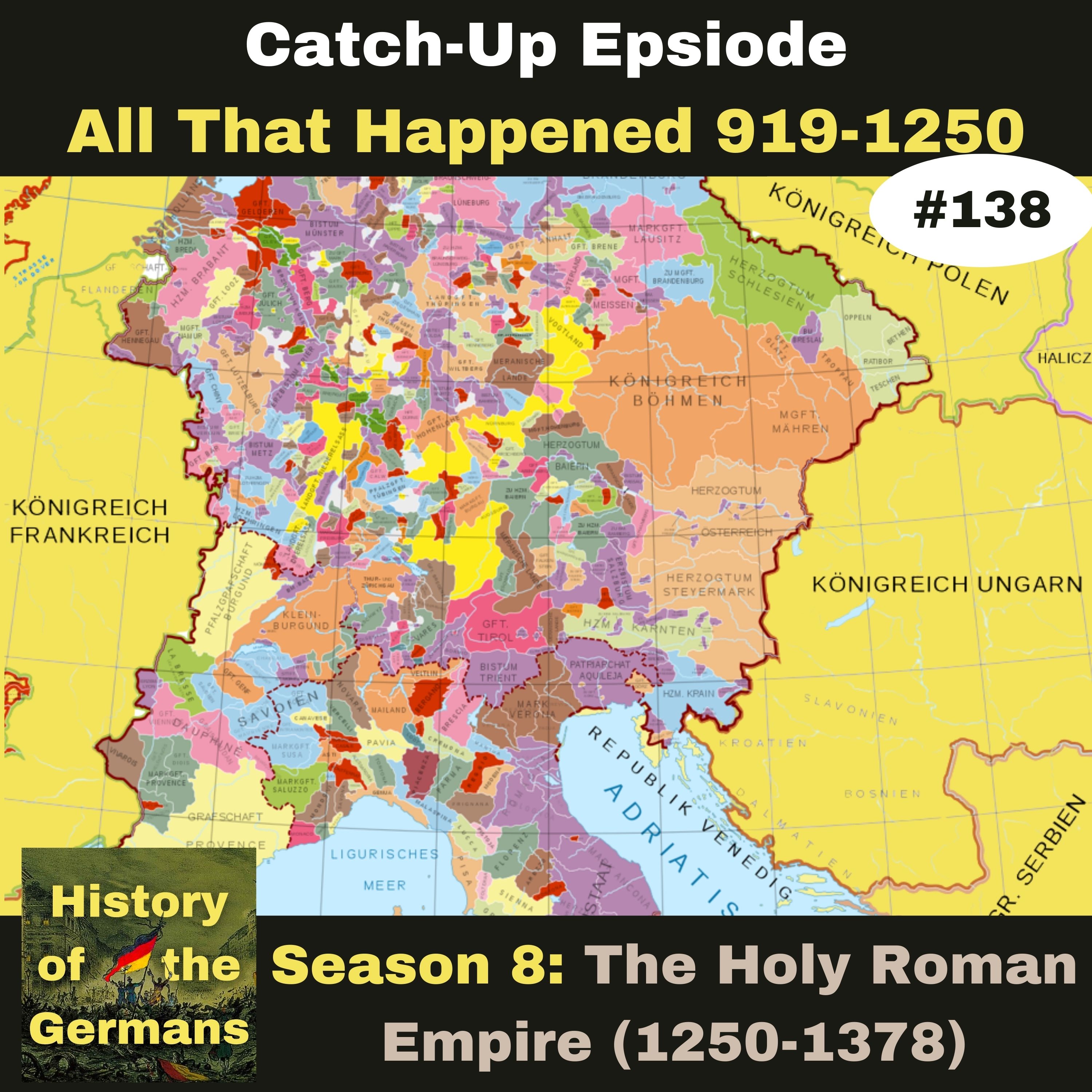
Ep 138Ep. 138: The Holy Roman Empire from 919 – 1250: Catch-up and Season Opener
This episode is something I never thought I would do, it is a run through the history of the Holy Roman Empire from 919 AD to 1250, pretty much most of the periods I have covered so far. Why do it? If you’re one of those who have listened religiously to all 137 episodes so far and feel completely up to date with what happened in the past, this will not contain much news. However it has been a year since we last talked about the emperors and you may like a refresher about the Ottonians, Salians and Hohenstaufen. Just to get your bearings.Or if you have only recently joined the HotGPod family – welcome. These next 40 minutes or so should give you a solid rundown of “The story so far”. And if you follow by reading the transcript on my website historyofthegermans.com, you can find links in the text that connect you to episodes that go deeper into the stories behind the short summaries you find here.Here is the link to the epsisode webpage: https://historyofthegermans.com/2024/02/29/hre-919-12150/The music for the show is Flute Sonata in E-flat major, H.545 by Carl Phillip Emmanuel Bach (or some claim it as BWV 1031 Johann Sebastian Bach) performed and arranged by Michel Rondeau under Common Creative Licence 3.0.As always:Homepage with maps, photos, transcripts and blog: www.historyofthegermans.comIf you wish to support the show go to: Support • History of the Germans PodcastFor do it yourself merchandise go to: Merchandise • History of the Germans PodcastFacebook: @HOTGPod Threads: @history_of_the_germans_podcastBluesky: @hotgpod.bsky.socialInstagram: history_of_the_germansTwitter: @germanshistoryTo make it easier for you to share the podcast, I have created separate playlists for some of the seasons that are set up as individual podcasts. they have the exact same episodes as in the History of the Germans, but they may be a helpful device for those who want to concentrate on only one season.So far I have:The OttoniansSalian Emperors and Investiture ControversyFredrick Barbarossa and Early HohenstaufenFrederick II Stupor MundiSaxony and Eastward ExpansionThe Hanseatic LeagueThe Teutonic KnightsThe Holy Roman Empire 1250-1356The Reformation before the ReformationThe Empire in the 15th centuryThe Fall and Rise of the Habsburgs