Herpetological Highlights
250 episodes — Page 5 of 5

Ep 47047 Iguanas Rock
Iguanas rock, and rock iguana’s doubly so. We check out the status of the Bahamas dwindling populations of Cay-dwelling rock iguana with stories of rampaging raccoons, troublesome translocations and polite pirates. Species of the Bi-week is a micro-endemic treat from Madagascar. FULL REFERENCE LIST AVAILABLE AT: herphighlights.podbean.com Main Paper References: Hayes, W. K., Iii, R. A. E., Fry, S. K., Fortune, E. M., Wasilewski, J. A., Tuttle, D. M., … Carter, R. L. (2016). Conservation Of The Endangered Sandy Cay Rock Iguanas (Cyclura rileyi cristata): Invasive Species Control, Population Response, Pirates, Poaching, And Translocation. Herpetological Conservation and Biology, 16. Hayes, W. K., Jr, S. C., Crutchfield, T., Wasilewski, J. A., Rothfus, T. A., & Carter, R. L. (2016). Conservation Of The Endangered San Salvador Rock Iguanas (Cyclura rileyi rileyi): Population Estimation, Invasive Species Control, Translocation, And Headstarting. Herpetological Conservation and Biology, 17. Species of the Bi-Week: Miralles, A., Glaw, F., Ratsoavina, F. M., & Vences, M. (2015). A likely microendemic new species of terrestrial iguana, genus Chalarodon, from Madagascar. Zootaxa, 3946(2), 201. https://doi.org/10.11646/zootaxa.3946.2.3 Other mentioned papers: Honebrink, R., Buch, R., Galpin, P., & Burgess, G. H. (2011). First documented attack on a live human by a cookiecutter shark (Squaliformes, Dalatiidae: Isistius sp.). Pacific Science, 65(3), 365-375. Malone, C.L., T. Wheeler, J.F. Taylor, and S.K. Davis. 2000. Phylogeography of the Caribbean rock iguana (Cyclura): implications for conservation and insights on the biogeographic history of the West Indies. Molecular Phylogenetics and Evolution 17:269–279. Other Links/Mentions: Link to Ants Canada vs blind snake: https://www.youtube.com/watch?v=4b4H979ia-E Link to HerpConBio edition: http://www.herpconbio.org/contents_vol11_Monograph6.html Music: Intro/outro – Treehouse by Ed Nelson Other Music – The Passion HiFi, www.thepassionhifi.com
Ep 47046 Stinky Turtles
Episode 46 is a Patreon episode about...musk turtles! These endearing little monsters live in the waterways of the USA and we examine their unusual mouths and diet preferences. Species of the Bi-Week is a squishy chelonian. FULL REFERENCE LIST AVAILABLE AT: herphighlights.podbean.com Main Paper References: Heiss, E., Natchev, N., Beisser, C., Lemell, P., & Weisgram, J. (2010). The fish in the turtle: On the functionality of the oropharynx in the common musk turtle Sternotherus odoratus (Chelonia, Kinosternidae) concerning feeding and underwater respiration. The Anatomical Record: Advances in Integrative Anatomy and Evolutionary Biology, 293(8), 1416-1424. Wilhelm, C. E., & Plummer, M. V. (2012). Diet of radiotracked Musk Turtles, Sternotherus odoratus, in a small urban stream. Herpetological Conservation and Biology, 7(2), 258-264. Species of the Bi-Week: Farkas, B., Ziegler, T., Pham, C. T., Ong, A. V., & Fritz, U. (2019). A new species of Pelodiscus from northeastern Indochina (Testudines, Trionychidae). ZooKeys, (824), 71. Other mentioned papers: Snider, A.T. and J.K. Bowler. 1992. Longevity of reptiles and amphibians in North American collections. Second Edition. Herpetological Circulars No. 21. Strokal, M., Ma, L., Bai, Z., Luan, S., Kroeze, C., Oenema, O., ... & Zhang, F. (2016). Alarming nutrient pollution of Chinese rivers as a result of agricultural transitions. Environmental Research Letters, 11(2), 024014. Music: Intro/outro – Treehouse by Ed Nelson Other Music – The Passion HiFi, www.thepassionhifi.com

Ep 46045.5 Question - Snake Eyes
A surprise episode to tackle some of Patreon questions. A long ramble about ourselves changes into a chat about sea snake tongue flicking followed by rotating snake eyes. FULL REFERENCE LIST AVAILABLE AT: herphighlights.podbean.com References: Banks, M. S., Sprague, W. W., Schmoll, J., Parnell, J. A. Q., & Love, G. D. (2015). Why do animal eyes have pupils of different shapes? Science Advances, 1(7), e1500391. https://doi.org/10.1126/sciadv.1500391 Heath, J. E., Northcutt, R. G., & Barber, R. P. (1969). Rotational optokinesis in reptiles and its bearing on pupillary shape. Zeitschrift für vergleichende Physiologie, 62(1), 75-85. Munro, D. F. (1950). Vertical orientation of the eye in snakes. Herpetologica, 84-88. Simões, B. F., Sampaio, F. L., Douglas, R. H., Kodandaramaiah, U., Casewell, N. R., Harrison, R. A., … Gower, D. J. (2016). Visual Pigments, Ocular Filters and the Evolution of Snake Vision. Molecular Biology and Evolution, 33(10), 2483–2495. https://doi.org/10.1093/molbev/msw148 van Doorn, K., & Sivak, J. G. (2013). Blood flow dynamics in the snake spectacle. Journal of Experimental Biology, 216(22), 4190–4195. https://doi.org/10.1242/jeb.093658 Music: Intro/outro – Treehouse by Ed Nelson Other Music – The Passion HiFi, www.thepassionhifi.com

Ep 45045 King Among Cobras
All snakes all episode this fortnight, but not just any snakes. We are talking about snake-eaters. King amongst the snake-eaters is the king cobra, where do they roam and what threats are they facing? Jumping across to Africa we check out a newly described, and smaller, snake-eater. FULL REFERENCE LIST AVAILABLE AT: herphighlights.podbean.com Main Paper References: Marshall, B. M., Strine, C. T., Jones, M. D., Artchawakom, T., Silva, I., Suwanwaree, P., & Goode, M. (2018). Space fit for a king: spatial ecology of king cobras (Ophiophagus hannah) in Sakaerat Biosphere Reserve, Northeastern Thailand. Amphibia-Reptilia. https://doi.org/10.1163/15685381-18000008 Marshall, B. M., Strine, C. T., Jones, M. D., Theodorou, A., Amber, E., Waengsothorn, S., … Goode, M. (2018). Hits Close to Home: Repeated Persecution of King Cobras (Ophiophagus hannah) in Northeastern Thailand. Tropical Conservation Science, 11, 194008291881840. https://doi.org/10.1177/1940082918818401 Species of the Bi-Week: Portillo, F., Branch, W. R., Tilbury, C. R., Nagy, Z. T., Hughes, D. F., Kusamba, C., ... & Greenbaum, E. (2019). A Cryptic New Species of Polemon (Squamata: Lamprophiidae, Aparallactinae) from the Miombo Woodlands of Central and East Africa. Copeia, 107(1), 22-35. Other Mentioned Papers/Studies: Barnes, Curt & Strine, Colin & Suwanwaree, Pongthep & Major, Tom. (2018). Cryptelytrops albolabris (white- lipped viper): Behavior. Herp Review. Available at: https://www.researchgate.net/publication/325251521_Cryptelytrops_albolabris_white-_lipped_viper_Behavior Barve, S., Bhaisare, D., Giri, A., Shankar, P. G., Whitaker, R., & Goode, M. (2013). A preliminary study on translocation of “rescued” King Cobras (Ophiophagus hannah). Hamadryad, 36(6), 80–86. Bhaisare, D., Ramanuj, V., Shankar, P. G., Vittala, M., Goode, M. J., & Whitaker, R. (2010). Observations on a wild King Cobra (Ophiophagus hannah), with emphasis on foraging and diet. IRCF Reptiles Amphibians, 17(2), 95–102. Hart, K. M., Cherkiss, M. S., Smith, B. J., Mazzotti, F. J., Fujisaki, I., Snow, R. W., & Dorcas, M. E. (2015). Home range, habitat use, and movement patterns of non-native Burmese pythons in Everglades National Park, Florida, USA. Animal Biotelemetry, 3(8), 1–13. https://doi.org/10.1186/s40317-015-0022-2 Hyslop, N. L., Meyers, J. M., Cooper, R. J., & Stevenson, D. J. (2014). Effects of body size and sex of Drymarchon couperi (eastern indigo snake) on habitat use, movements, and home range size in Georgia. Journal of Wildlife Management, 78(1), 101–111. https://doi.org/10.1002/jwmg.645 Kusamba, C., A. Resetar, V. Wallach, and Z. T. Nagy. (2013). Mouthful of snake: an African snake-eater’s (Polemon gracilis graueri) large typhlopid prey. Herpetology Notes 6: 235–237. Strine, C. T., Silva, I., Crane, M., Nadolski, B., Artchawakom, T., Goode, M., & Suwanwaree, P. (2014). Mortality of a wild king cobra, Ophiophagus hannah Cantor, 1836 (Serpentes: Elapidae) from Northeast Thailand after ingesting a plastic bag. Asian Herpetological Research, 5(4), 284–286. https://doi.org/10.3724/SP.J.1245.2014.00284 Music: Intro/outro – Treehouse by Ed Nelson Other Music – The Passion HiFi, www.thepassionhifi.com
Ep 44044 Where Those Herps At?
This episode is all about how hard it is to find herpetofauna, and the difficulty that causes when you try to understand their populations. We finish with a handsome web-footed new species. FULL REFERENCE LIST AVAILABLE AT: herphighlights.podbean.com Main Paper References: Barata, I. M., Griffiths, R. A., & Ridout, M. S. (2017). The power of monitoring: optimizing survey designs to detect occupancy changes in a rare amphibian population. Scientific Reports, 7(1), 16491. https://doi.org/10.1038/s41598-017-16534-8 Barata, I. M., Silva, E. P., & Griffiths, R. A. (2018). Predictors of Abundance of a Rare Bromeliad-Dwelling Frog ( Crossodactylodes itambe ) in the Espinhaço Mountain Range of Brazil. Journal of Herpetology, 52(3), 321–326. https://doi.org/10.1670/17-183 Ward, R. J., Griffiths, R. A., Wilkinson, J. W., & Cornish, N. (2017). Optimising monitoring efforts for secretive snakes: a comparison of occupancy and N-mixture models for assessment of population status. Scientific Reports, 7(1), 18074. https://doi.org/10.1038/s41598-017-18343-5 Species of the Bi-Week: Ron, S. R., Caminer, M. A., Varela-Jaramillo, A., & Almeida-Reinoso, D. (2018). A new treefrog from Cordillera del Cóndor with comments on the biogeographic affinity between Cordillera del Cóndor and the Guianan Tepuis (Anura, Hylidae, Hyloscirtus). ZooKeys, 809, 97–124. https://doi.org/10.3897/zookeys.809.25207 Other Mentioned Papers/Studies: Barata, I. M., Santos, M. T., Leite, F. S., & Garcia, P. C. (2013). A new species of Crossodactylodes (Anura: Leptodactylidae) from Minas Gerais, Brazil: first record of genus within the Espinhaço Mountain Range. Zootaxa, 3731(4), 552-560. Other Links/Mentions: Wicked Wildlife on YouTube: https://www.youtube.com/channel/UCWasdfCg-HlxOq4NUOshFFg Music: Intro/outro – Treehouse by Ed Nelson Other Music – The Passion HiFi, www.thepassionhifi.com
Ep 43043 Lazy Dragons, Lazy Newts
This fortnight is a real mix of papers. We cover Komodo dragon dispersal, newts crossing (or not) roads, and a paper looking at reptilian brains. FULL REFERENCE LIST AVAILABLE AT: herphighlights.podbean.com Main Paper References: De Meester, G., Huyghe, K., & Van Damme, R. (2019). Brain size, ecology and sociality: a reptilian perspective. Biological Journal of the Linnean Society, 1–11. Jessop, T. S., Ariefiandy, A., Purwandana, D., Ciofi, C., Imansyah, J., Benu, Y. J., … Phillips, B. L. (2018). Exploring mechanisms and origins of reduced dispersal in island Komodo dragons. Proceedings of the Royal Society B: Biological Sciences, 285(1891), 20181829. https://doi.org/10.1098/rspb.2018.1829 Matos, C., Petrovan, S. O., Wheeler, P. M., & Ward, A. I. (2018). Short‐term movements and behaviour govern the use of road mitigation measures by a protected amphibian. Animal Conservation. Other Mentioned Papers/Studies: Ciofi, C., Puswati, J., Dewa, W., de Boer, M. E., Chelazzi, G., & Sastrawan, P. (2007). Preliminary Analysis of Home Range Structure in the Komodo Monitor, Varanus komodoensis. Copeia, 2007(2), 462–470. https://doi.org/10.1643/0045-8511(2007)7[462:PAOHRS]2.0.CO;2 Harlow, H. J., Purwandana, D., Jessop, T. S., & Phillips, J. A. (2010). Size-related differences in the thermoregulatory habits of free-ranging komodo dragons. International Journal of Zoology, 2010. https://doi.org/10.1155/2010/921371 Purwandana, D., Ariefiandy, A., Imansyah, M. J., Seno, A., Ciofi, C., Letnic, M., & Jessop, T. S. (2016). Ecological allometries and niche use dynamics across Komodo dragon ontogeny. Science of Nature, 103(27), 26–37. https://doi.org/10.1007/s00114-016-1351-6 Music: Intro/outro – Treehouse by Ed Nelson Other Music – The Passion HiFi, www.thepassionhifi.com

Ep 42042 A Christmas Miracle
Discussions of the reptiles of Christmas Island(s) abound in episode 42. We kick off with a paper about juvenile snake sizes and follow up with some info about reptiles crossing oceans. The Species of the Bi-Week is a brand new reptile which takes it's name from a fluffy mammal. FULL REFERENCE LIST AVAILABLE AT: herphighlights.podbean.com Main Paper References: Aubret, F. (2015). Island colonisation and the evolutionary rates of body size in insular neonate snakes. Heredity, 115(4), 349–356. https://doi.org/10.1038/hdy.2014.65 Oliver, P. M., Blom, M. P. K., Cogger, H. G., Fisher, R. N., Richmond, J. Q., & Woinarski, J. C. Z. (2018). Insular biogeographic origins and high phylogenetic distinctiveness for a recently depleted lizard fauna from Christmas Island, Australia. Biology Letters, 14(6), 20170696. https://doi.org/10.1098/rsbl.2017.0696 Species of the Bi-Week: Wostl, E., Hamidy, A., Kurniawan, N., & Smith, E. N. (2017). A new species of Wolf Snake of the genus Lycodon H. Boie in Fitzinger (Squamata: Colubridae) from the Aceh Province of northern Sumatra, Indonesia. Zootaxa, 4276(4), 539. https://doi.org/10.11646/zootaxa.4276.4.6 Other Mentioned Papers/Studies: Andrew, P., Cogger, H., Driscoll, D., Flakus, S., Harlow, P., Maple, D., ... & Tiernan, B. (2018). Somewhat saved: a captive breeding programme for two endemic Christmas Island lizard species, now extinct in the wild. Oryx, 52(1), 171-174. Aubret, F., & Shine, R. (2009). Genetic Assimilation and the Postcolonization Erosion of Phenotypic Plasticity in Island Tiger Snakes. Current Biology, 19(22), 1932–1936. https://doi.org/10.1016/j.cub.2009.09.061 Holt, B. G., Lessard, J.-P., Borregaard, M. K., Fritz, S. A., Araujo, M. B., Dimitrov, D., … Rahbek, C. (2013). An Update of Wallace’s Zoogeographic Regions of the World. Science, 339(6115), 74–78. https://doi.org/10.1126/science.1228282 Herrel, A., Huyghe, K., Vanhooydonck, B., Backeljau, T., Breugelmans, K., Grbac, I., ... & Irschick, D. J. (2008). Rapid large-scale evolutionary divergence in morphology and performance associated with exploitation of a different dietary resource. Proceedings of the National Academy of Sciences, 105(12), 4792-4795. Rocha, S., Carretero, M. A., Vences, M., Glaw, F., & James Harris, D. (2006). Deciphering patterns of transoceanic dispersal: the evolutionary origin and biogeography of coastal lizards (Cryptoblepharus) in the Western Indian Ocean region. Journal of Biogeography, 33(1), 13–22. https://doi.org/10.1111/j.1365-2699.2005.01375.x Music: Intro/outro – Treehouse by Ed Nelson Other Music – The Passion HiFi, www.thepassionhifi.com

Ep 41041 Learned Lizards
Smart lizards!? Traditionally, lizards are thought of as simple, but this episode we look at some smart skinks whose intelligence allows them to learn from each other. We look at a couple factors that influence that itelligence. FULL REFERENCE LIST AVAILABLE AT: herphighlights.podbean.com Main Paper References: Munch, K. L., Noble, D. W. A., Botterill-James, T., Koolhof, I. S., Halliwell, B., Wapstra, E., & While, G. M. (2018). Maternal effects impact decision-making in a viviparous lizard. Biology Letters, 14(4), 20170556. https://doi.org/10.1098/rsbl.2017.0556 Whiting, M. J., Xu, F., Kar, F., Riley, J. L., Byrne, R. W., & Noble, D. W. A. (2018). Evidence for Social Learning in a Family Living Lizard. Frontiers in Ecology and Evolution, 6(May). https://doi.org/10.3389/fevo.2018.00070 Species of the Bi-Week: Grismer, L. L., Wood, P. L., Lim, K. K. P., & Liang, L. J. (2017). A new species of swamp-dwelling skink (Tytthoscincus) from Singapore and Peninsular Malaysia. Raffles Bulletin of Zoology, 65(October), 574–584. Other Mentioned Papers/Studies: Beck, B. B. (1967). A Study of Problem Solving By Gibbons. Behaviour, 28(1–2), 95–109. https://doi.org/10.1163/156853967X00190 Dayananda, B., & Webb, J. K. (2017). Incubation under climate warming affects learning ability and survival in hatchling lizards. Biology Letters, 13(3). https://doi.org/10.1098/rsbl.2017.0002 Duckett, P. E., Morgan, M. H., & Stow, A. J. (2012). Tree-dwelling populations of the skink Egernia striolata aggregate in groups of close kin. Copeia, 2012(1), 130-134. Gardner, M. G., Hugall, A. F., Donnellan, S. C., Hutchinson, M. N., & Foster, R. (2008). Molecular systematics of social skinks: phylogeny and taxonomy of the Egernia group (Reptilia: Scincidae). Zoological Journal of the Linnean Society, 154(4), 781-794. Munch, K. L., Noble, D. W. A., Wapstra, E., & While, G. M. (2018). Mate familiarity and social learning in a monogamous lizard. Oecologia, 188(1), 1–10. https://doi.org/10.1007/s00442-018-4153-z Riley, J. L., Küchler, A., Damasio, T., Noble, D. W. A., Byrne, R. W., & Whiting, M. J. (2018). Learning ability is unaffected by isolation rearing in a family-living lizard. Behavioral Ecology and Sociobiology, 72(2), 20. https://doi.org/10.1007/s00265-017-2435-9 Riley, J. L., Noble, D. W. A., Byrne, R. W., & Whiting, M. J. (2017). Early social environment influences the behaviour of a family-living lizard. Royal Society Open Science, 4(5), 1–16. https://doi.org/10.1098/rsos.161082 Music: Intro/outro – Treehouse by Ed Nelson Other Music – The Passion HiFi, www.thepassionhifi.com
Ep 40040 Complications of Captivity
This episode we are talking about the pet trade - from the livelihoods of people who collect wild reptiles and amphibians in Madagascar and through to one of the issues that sometimes arises: escapees becoming non-native nuisances. We round off with a Species of the Bi-Week in the form of a slippery new lizard. FULL REFERENCE LIST AVAILABLE AT: herphighlights.podbean.com Main Paper References: Robinson, J. E., Griffiths, R. A., Fraser, I. M., Raharimalala, J., Roberts, D. L., & St. John, F. A. V. (2018). Supplying the wildlife trade as a livelihood strategy in a biodiversity hotspot. Ecology and Society, 23(1), art13. https://doi.org/10.5751/ES-09821-230113 Stringham, O. C., & Lockwood, J. L. (2018). Pet problems: Biological and economic factors that influence the release of alien reptiles and amphibians by pet owners. Journal of Applied Ecology, 55(6), 2632–2640. https://doi.org/10.1111/1365-2664.13237 Species of the Bi-Week: Pui, Y. M., Karin, B. R., Bauer, A. M., & Das, I. (2017). A new species of Tropidophorus Duméril & Bibron, 1839 (Squamata: Sauria: Scincidae) from Sarawak, East Malaysia (Borneo). Zootaxa, 4258(6), 539. https://doi.org/10.11646/zootaxa.4258.6.3 Other Mentioned Papers/Studies: Auliya, M., Altherr, S., Ariano-Sanchez, D., Baard, E. H., Brown, C., Brown, R. M., … Ziegler, T. (2016). Trade in live reptiles, its impact on wild populations, and the role of the European market. Biological Conservation, 204, 103–119. https://doi.org/10.1016/j.biocon.2016.05.017 Auliya, M., García-Moreno, J., Schmidt, B. R., Schmeller, D. S., Hoogmoed, M. S., Fisher, M. C., … Martel, A. (2016). The global amphibian trade flows through Europe: the need for enforcing and improving legislation. Biodiversity and Conservation, 25(13), 2581–2595. https://doi.org/10.1007/s10531-016-1193-8 Capinha, C., Seebens, H., Cassey, P., García-Díaz, P., Lenzner, B., Mang, T., … Essl, F. (2017). Diversity, biogeography and the global flows of alien amphibians and reptiles. Diversity and Distributions, 23(11), 1313–1322. https://doi.org/10.1111/ddi.12617 Duffy, R., St John, F. A. V., Büscher, B., & Brockington, D. (2014). The militarization of anti-poaching: Undermining long term goals? Environmental Conservation, 42(4), 345–348. https://doi.org/10.1017/S0376892915000119 Lybbert, T. J., Aboudrare, A., Chaloud, D., Magnan, N., & Nash, M. (2011). Booming markets for Moroccan argan oil appear to benefit some rural households while threatening the endemic argan forest. Proceedings of the National Academy of Sciences, 108(34), 13963-13968. Other Links/Mentions: Conservation chronicles: https://conservationchronicles.podbean.com/ Winter croc fest December 8, 2018 at Gatorama. Gatorama is an alligator farm and visitor attraction in Palmdale, Florida, USA. Sami Asad frog video: https://www.youtube.com/watch?v=7pvwtaZPicI Music: Intro/outro – Treehouse by Ed Nelson Other Music – The Passion HiFi, www.thepassionhifi.com

Ep 39039 An Appetite for Arboreality
Snakes, they’ve adapted to all sorts of environments. But what exactly has changed to allow them to take to the trees? This episode we check out what it takes to be arboreal and the impacts of taking arboreal prey. We head to the neotropics for the Species of the Bi-week for a colourful new snake. FULL REFERENCE LIST AVAILABLE AT: herphighlights.podbean.com Main Paper References: Harrington, S. M., Haan, J. M. D. E., Shapiro, L., & Ruane, S. (2018). Habits and characteristics of arboreal snakes worldwide: arboreality constrains body size but does not affect lineage diversification. Biological Journal of the Linnean Society, XX, 1–11. https://doi.org/10.1093/biolinnean/bly097/5056838 Siers, S. R., Yackel Adams, A. A., & Reed, R. N. (2018). Behavioral differences following ingestion of large meals and consequences for management of a harmful invasive snake: A field experiment. Ecology and Evolution, 8(20), 10075–10093. https://doi.org/10.1002/ece3.4480 Species of the Bi-Week: Bernarde, P. S., Carlos, L., Turci, B., Abegg, A. D., & Franco, F. L. (2018). A remarkable new species of coralsnake of the Micrurus hemprichii species group from the Brazilian Amazon. Salamandra, 54(4), 249–258. Other Mentioned Papers/Studies: Allen WL, Baddeley R, Scott-Samuel NE, Cuthill IC. 2013. The evolution and function of pattern diversity in snakes. Behavioral Ecology 24: 1237–1250. Blouin-Demers, G., & Weatherhead, P. J. (2001). An experimental test of the link between foraging, habitat selection and thermoregulation in black rat snakes Elaphe obsoleta obsoleta. Journal of Animal Ecology, 70, 1006–1013. https://doi.org/10.1046/j.0021-8790.2001.00554.x Das, I. (2010). A field guide to the reptiles of South-East Asia. London: Bloomsbury. Glaudas, X., & Alexander, G. J. (2017). Food supplementation affects the foraging ecology of a low-energy, ambush-foraging snake. Behavioral ecology and sociobiology, 71(1), 5. Ford, N. B., & Shuttlesworth, G. A. (1986). Effects of variation in food intake on locomotory performance of juvenile garter snakes. Copeia, 1986, 999–1001. https://doi.org/10.2307/1445298 Fritts, T. H. (2002). Economic costs of electrical system instability and power outages caused by snakes on the island of Guam. International Biodeterioration & Biodegradation, 49, 93–100. https://doi.org/10.1016/S0964-8305(01)00108-1 Secor, S. M., & Diamond, J. (1998). A vertebrate model of extreme physiological regulation. Nature, 395(6703), 659–662. https://doi.org/10.1038/27131 Wasko, D. K., & Sasa, M. (2012). Food resources influence spatial ecology, habitat selection, and foraging behavior in an ambush-hunting snake (Viperidae: Bothrops asper): An experimental study. Zoology, 115(3), 179–187. https://doi.org/10.1016/j.zool.2011.10.001 Other Links/Mentions: Ahaetulla fronticinctca feeding from the California Academy of Science - https://www.youtube.com/watch?v=dlRHNYUr-PU Music: Intro/outro – Treehouse by Ed Nelson Other Music – The Passion HiFi, www.thepassionhifi.com

Ep 38038 A Frog Over Troubled Water
The News Niche strikes again. A varied podcast starting with some new frog research and moving onto a truly horrifying thunderdome. FULL REFERENCE LIST AVAILABLE AT: herphighlights.podbean.com Main Paper References: Falaschi, M., Mangiacotti, M., Sacchi, R., Scali, S., & Razzetti, E. (2018). Electric circuit theory applied to alien invasions: A connectivity model predicting the balkan frog expansion in Northern Italy. Acta Herpetologica, 13(1), 33–42. https://doi.org/10.13128/Acta_Herpetol-20871 DiRenzo, G. V., Zipkin, E. F., Grant, E. H. C., Royle, J. A., Longo, A. V., Zamudio, K. R., & Lips, K. R. (2018). Eco‐evolutionary rescue promotes host–pathogen coexistence. Ecological Applications. Fitzpatrick, L. D., Pasmans, F., Martel, A., & Cunningham, A. A. (2018). Epidemiological tracing of Batrachochytrium salamandrivorans identifies widespread infection and associated mortalities in private amphibian collections. Scientific Reports, 8(1), 13845. https://doi.org/10.1038/s41598-018-31800-z Van Kleeck, M. J., Smith, T. A., & Holland, B. S. (2018). Paedophagic cannibalism, resource partitioning, and ontogenetic habitat use in an invasive lizard. Ethology Ecology & Evolution, 1-18. Meiri, S. (2018). Traits of lizards of the world: Variation around a successful evolutionary design. Global Ecology and Biogeography, (June 2017), 1–5. https://doi.org/10.1111/geb.12773 Other Mentioned Papers/Studies: Pizzatto, L., Child, T., & Shine, R. (2008). Why be diurnal? Shifts in activity time enable young cane toads to evade cannibalistic conspecifics. Behavioral Ecology, 19(5), 990–997. https://doi.org/10.1093/beheco/arn060 Scharf, A. K., Belant, J. L., Beyer, D. E., Wikelski, M., & Safi, K. (2018). Habitat suitability does not capture the essence of animal-defined corridors. Movement Ecology, 6(1), 18. https://doi.org/10.1186/s40462-018-0136-2 Other Links/Mentions: Namaqua chameleon cannibalism video *graphic* - https://www.youtube.com/watch?v=Ww7km7ADqAo Elephant shrew nose video - https://www.youtube.com/watch?v=U8WVnKT7oEI Music: Intro/outro – Treehouse by Ed Nelson Other Music – The Passion HiFi, www.thepassionhifi.com
Ep 37037 Chameleon Comeback
Chameleons -- perhaps one of the most instantly identifiable herps out there. But beyond their strange morphological adaptations what do we know about their lives? We check out a couple of papers looking at the lives of some East African species who until recently were missing some pretty basic natural history information. They are joined by a newly described species from the hills of Tanzania. FULL REFERENCE LIST AVAILABLE AT: herphighlights.podbean.com Main Paper References: Hughes, D. F., Blackburn, D. G., Wilber, L., & Behangana, M. (2018). New distribution records, observations on natural history, and notes on reproduction of the poorly known Sudanese Unicorn Chameleon (Chamaeleonidae: Trioceros conirostratus) from Uganda, Africa. Amphibian & Reptile Conservation, 12(2), 83–89. Reaney, L. T., Yee, S., Losos, J. B., & Whiting, M. J. (2012). Ecology of the Flap-Necked Chameleon Chamaeleo dilepis In Southern Africa. Breviora, 532(September), 1–18. https://doi.org/10.3099/532.1 Species of the Bi-Week: Menegon, M., Loader, S. P., Davenport, T. R. B., Howell, K. M., Tilbury, C. R., Machaga, S., & Tolley, K. A. (2015). A new species of Chameleon (Sauria: Chamaeleonidae: Kinyongia) highlights the biological affinities between the Southern Highlands and Eastern Arc Mountains of Tanzania. Acta Herpetologica, 10(2), 111–120. https://doi.org/10.13128/Acta_Herpetol-17171 Other Mentioned Papers/Studies: Hebrard, J. J., & Madsen, T. (1984). Dry season intersexual habitat partitioning by flap-necked chameleons (Chamaeleo dilepis) in Kenya. Biotropica, 69-72. Main, D. C., van Vuuren, B. J., & Tolley, K. A. (2018). Cryptic diversity in the common flap-necked chameleon Chamaeleo dilepis in South Africa. African Zoology, 53(1), 11-16. Meiri, S. (2018). Traits of lizards of the world: Variation around a successful evolutionary design. Global Ecology and Biogeography, (June 2017), 1–5. https://doi.org/10.1111/geb.12773 Miller, A. K., Maritz, B., McKay, S., Glaudas, X., & Alexander, G. J. (2015). An ambusher's arsenal: chemical crypsis in the puff adder (Bitis arietans). Proc. R. Soc. B, 282(1821), 20152182. Preest, M. R., Ward, M. J., Poon, T., & Hermanson, J. W. (2016). Chemical Prey Luring in Jackson’s Chameleons. Physiological and Biochemical Zoology, 89(2), 110–117. https://doi.org/10.1086/685455 Stipala, J. 2014. Mountain Dragons: In Search of Chameleons in the Highlands of Kenya. Jan Stipala, Singapore. Tilbury CR, Tolley KA, Branch, WR (2006). A review of the genus Bradypodion (Sauria: Chamaeleonidae), with the descriptions of two new genera. Zootaxa 1363: 23-38. (Kinyongia, new genus). Other Links/Mentions: Video of flap necked chameleon vs boomslang: https://www.youtube.com/watch?v=cnhX_ho9DsE Another, where chameleon loses: https://www.youtube.com/watch?v=23TxyVZiICo Music: Intro/outro – Treehouse by Ed Nelson Other Music – The Passion HiFi, www.thepassionhifi.com

Ep 36036 Crocodiles of the Mekong
Revisiting the world of crocodilians, we take a look at the habitat shared by two Southeast Asian species, and discuss Siamese crocodile conservation. Our Species of the Bi-week is not a crocodile, but it is pretty scaly. FULL REFERENCE LIST AVAILABLE AT: herphighlights.podbean.com Main Paper References: Ihlow, F., Bonke, R., Hartmann, T., Geissler, P., Behler, N., & Rödder, D. (2015). Habitat suitability, coverage by protected areas and population connectivity for the Siamese crocodile Crocodylus siamensis Schneider, 1801. Aquatic Conservation: Marine and Freshwater Ecosystems, 25(4), 544–554. https://doi.org/10.1002/aqc.2473 Staniewicz, A., Behler, N., Dharmasyah, S., & Jones, G. (2018). Niche partitioning between juvenile sympatric crocodilians in Mesangat, East Kalimantan, Indonesia. Raffles Bulletin of Zoology, 66, 528–537. Species of the Bi-Week: Karin, B. R., Freitas, E. S., Shonleben, S., Grismer, L. L., Bauer, A. M., & Das, I. (2018). Unrealized diversity in an urban rainforest: A new species of Lygosoma (Squamata: Scincidae) from western Sarawak, Malaysia (Borneo). Zootaxa, 4370(4), 345–362. https://doi.org/10.11646/zootaxa.4370.4.2 Other Mentioned Papers/Studies: Behler, N., Kopsieker, L., Staniewicz, A., Darmansyah, S., Stuebing, R., & Ziegler, T. (2018). Population size, demography and feeding preferences of the Siamese crocodile Crocodylus siamensis (Schneider, 1801) in the Mesangat Swamp in Kalimantan, Indonesia. Raffles Bulletin of Zoology, 66, 506–516. Eam, S. U., Sam, H., Hor, L., Mizrahi, M., & Frechette, J. L. (2017). Movement of captive-reared Siamese crocodiles Crocodylus siamensis released in the Southern Cardamom National Park , Cambodia. Cambodian Journal of Natural History, 102–108. Starr, J. C. D. A. (2010). Development of a re-introduction and re-enforcement program for Siamese crocodiles in Cambodia. Global Re-introduction Perspectives: Additional Case Studies from Around the Globe, 118. Starr, A., Daltry, J.C. & Nhek R. (2010) DNA study reveals Siamese crocodiles at the Phnom Tamao Wildlife Rescue Centre, Cambodia. Crocodile Specialist Group Newsletter, 28, 5–7. Other Links/Mentions: Siamese croc article Save Our Species: http://www.saveourspecies.org/news/brighter-future-cambodias-siamese-crocodiles Music: Intro/outro – Treehouse by Ed Nelson Other Music – The Passion HiFi, www.thepassionhifi.com
Ep 35035 Caecilians Caecilians Caecilians
This fortnight we are delving into the peculiar world of caecilians. Fossorial amphibians that seldom show their faces on the surface. We chat about caecilians' strange adaptations and how a ten-year study has shed some light on their reproductive habits. The Species of the Bi-week is a suitably elongated and slimy critter. FULL REFERENCE LIST AVAILABLE AT: herphighlights.podbean.com Main Paper References: Jared, C., Mailho-Fontana, P. L., Jared, S. G. S., Kupfer, A., Delabie, J. H. C., Wilkinson, M., & Antoniazzi, M. M. (2018). Life history and reproduction of the neotropical caecilian Siphonops annulatus (Amphibia, Gymnophiona, Siphonopidae), with special emphasis on parental care. Acta Zoologica, (March), 1–11. https://doi.org/10.1111/azo.12254 Jared, C., Mailho-Fontana, P. L., Marques-Porto, R., Sciani, J. M., Pimenta, D. C., Brodie, E. D., & Antoniazzi, M. M. (2018). Skin gland concentrations adapted to different evolutionary pressures in the head and posterior regions of the caecilian Siphonops annulatus. Scientific Reports, 8(1), 1–7. https://doi.org/10.1038/s41598-018-22005-5 Species of the Bi-Week: Maddock, S. T., Wilkinson, M., & Gower, D. J. (2018). A new species of small, long-snouted Hypogeophis Peters, 1880 (Amphibia: Gymnophiona: Indotyphlidae) from the highest elevations of the Seychelles island of Mahé. Zootaxa, 4450(3), 359–375. https://doi.org/10.11646/zootaxa.4450.3.3 Other Mentioned Papers/Studies: Jared, C. et al. (2005). Head co-ossification, phragmosis and defense in the casque-headed tree frog Corythomantis greeningi. Journal of Zoology, 265. Sawaya, P. (1940) Sobre o veneno das glândulas cutâneas, a secreção e o coração de Siphonops annulatus. Bot. Fac. Fill. Ci. Let. Univ. São Paulo. Ser. Zool. 4, 207–270 Wilkinson, M., Kupfer, A., Marques-Porto, R., Jeffkins, H., Antoniazzi, M. M., & Jared, C. (2008). One hundred million years of skin feeding? Extended parental care in a Neotropical caecilian (Amphibia: Gymnophiona). Biology Letters, 4(4), 358–361. https://doi.org/10.1098/rsbl.2008.0217 Wilson, N. J., Stokes, A. N., Hopkins, G. R., Brodie, Jr., E. D., & Williams, C. R. (2014). Functional and physiological resistance of crayfish to amphibian toxins: tetrodotoxin resistance in the white river crayfish (Procambarus acutus). Canadian Journal of Zoology, 92(11), 939–945. https://doi.org/10.1139/cjz-2014-0128 Other Links/Mentions: BBC Life in Cold Blood - https://www.youtube.com/watch?v=UCF4qmxdkkM Video of caecilian babies eating the skin of their mother: https://www.youtube.com/watch?v=6K6szXrBHwM Music: Intro/outro – Treehouse by Ed Nelson Other Music – The Passion HiFi, www.thepassionhifi.com
Ep 34034 Hybrid Pythons
The News Niche has come again. This episode we talk about invasive python genetics (just what are they?) and new conservation tools, with a Species of the Bi-Week that features not one but two new cobras. FULL REFERENCE LIST AVAILABLE AT: herphighlights.podbean.com Main Paper References: Gumbs, R., Gray, C. L., Wearn, O. R., & Owen, N. R. (2018). Tetrapods on the EDGE: Overcoming data limitations to identify phylogenetic conservation priorities. PloS one, 13(4), e0194680. Hunter, M. E., Johnson, N. A., Smith, B. J., Davis, M. C., Butterfield, J. S., Snow, R. W., & Hart, K. M. (2018). Cytonuclear discordance in the Florida Everglades invasive Burmese python (Python bivittatus) population reveals possible hybridization with the Indian python (P. molurus). Ecology and Evolution. Species of the Bi-Week: WÜSTER, W., Chirio, L., Trape, J. F., Ineich, I., Jackson, K., Greenbaum, E., ... & Hall, C. (2018). Integration of nuclear and mitochondrial gene sequences and morphology reveals unexpected diversity in the forest cobra (Naja melanoleuca) species complex in Central and West Africa (Serpentes: Elapidae). Zootaxa, 4455(1), 68-98. Other mentioned papers: Hart, K. M., Cherkiss, M. S., Smith, B. J., Mazzotti, F. J., Fujisaki, I., Snow, R. W., & Dorcas, M. E. (2015). Home range, habitat use, and movement patterns of non-native Burmese pythons in Everglades National Park, Florida, USA. Animal Biotelemetry, 3(1), 8. Hunter, M. E., Oyler-McCance, S. J., Dorazio, R. M., Fike, J. A., Smith, B. J., Hunter, C. T., ... & Hart, K. M. (2015). Environmental DNA (eDNA) sampling improves occurrence and detection estimates of invasive Burmese pythons. PloS one, 10(4), e0121655. Hyslop, N. L., Meyers, J. M., Cooper, R. J., & Stevenson, D. J. (2014). Effects of body size and sex of Drymarchon couperi (eastern indigo snake) on habitat use, movements, and home range size in Georgia. The Journal of Wildlife Management, 78(1), 101-111. Lynch, V. J., & Wagner, G. P. (2010). Did egg‐laying boas break Dollo's law? Phylogenetic evidence for reversal to oviparity in sand boas (Eryx: Boidae). Evolution: International Journal of Organic Evolution, 64(1), 207-216. Pyron, R. A., & Burbrink, F. T. (2014). Early origin of viviparity and multiple reversions to oviparity in squamate reptiles. Ecology letters, 17(1), 13-21. Shine, R. (2015). The evolution of oviparity in squamate reptiles: an adaptationist perspective. Journal of Experimental Zoology Part B: Molecular and Developmental Evolution, 324(6), 487-492. Wang, Y., & Evans, S. E. (2011). A gravid lizard from the Cretaceous of China and the early history of squamate viviparity. Naturwissenschaften, 98(9), 739. Zhu, F., Liu, Q., Che, J., Zhang, L., Chen, X., Yan, F., ... & Guo, P. (2016). Molecular phylogeography of white‐lipped tree viper (Trimeresurus; Viperidae). Zoologica Scripta, 45(3), 252-262. Other links: Captive and field Herpetology Issue 2: http://captiveandfieldherpetology.com/volume-2-issue-1-2018/ A Naturalist’s Guide to the Dangerous Creatures of Australia: https://www.nhbs.com/a-naturalists-guide-to-the-dangerous-creatures-of-australia-book Music: Intro/outro – Treehouse by Ed Nelson Other Music – The Passion HiFi, www.thepassionhifi.com
Ep 33033 Lost in Translocation
Translocation is a popular method for reducing human-wildlife conflict, but does it work for snakes? We delve into a couple of new papers about translocation in venomous species. Our Species of the Bi-week is a viper with an unusual appetite. FULL REFERENCE LIST AVAILABLE AT: herphighlights.podbean.com Main paper references: Devan-Song, A., Martelli, P., Dudgeon, D., Crow, P., Ades, G., & Karraker, N. E. (2016). Is long-distance translocation an effective mitigation tool for white-lipped pit vipers (Trimeresurus albolabris) in South China?. Biological Conservation, 204, 212-220. Wolfe, A. K., Fleming, P. A., & Bateman, P. W. (2018). Impacts of translocation on a large urban-adapted venomous snake. Wildlife Research. Species of the Bi-Week: Shi, J., G. Wang, X. Chen, Y. Fang, L. Ding, S. Huang, M. Hou, J. Liu, and P. Li. 2017. A new moth-preying alpine pit viper species from Qinghai-Tibetan Plateau (Viperidae, Crotalinae). Amphib. Reptil. 38: 517–532. Other mentioned papers: Barve, S., Bhaisare, D., & Giri, A. (2013). A preliminary study on translocation of “rescued” King Cobras (Ophiophagus hannah). Hamadryad, 36, 80-86. Butler, H., Malone, B., & Clemann, N. (2005). The effects of translocation on the spatial ecology of tiger snakes (Notechis scutatus) in a suburban landscape. Wildlife Research, 32(2), 165-171. Hart, K. M., Cherkiss, M. S., Smith, B. J., Mazzotti, F. J., Fujisaki, I., Snow, R. W., & Dorcas, M. E. (2015). Home range, habitat use, and movement patterns of non-native Burmese pythons in Everglades National Park, Florida, USA. Animal Biotelemetry, 3(1), 8. Heiken, K. H., Brusch, G. A., Gartland, S., Escallón, C., Moore, I. T., and Taylor, E. N. (2016). Effects of long distance translocation on corticosterone and testosterone levels in male rattlesnakes. General and Comparative Endocrinology 237, 27–33. doi:10.1016/j.ygcen. 2016.07.023 Tulloch, A. I., Auerbach, N., Avery-Gomm, S., Bayraktarov, E., Butt, N., Dickman, C. R., ... & Lavery, T. H. (2018). A decision tree for assessing the risks and benefits of publishing biodiversity data. Nature ecology & evolution, 2(8), 1209-1217. Zhu, F., Liu, Q., Che, J., Zhang, L., Chen, X., Yan, F., ... & Guo, P. (2016). Molecular phylogeography of white‐lipped tree viper (Trimeresurus; Viperidae). Zoologica Scripta, 45(3), 252-262. Music: Intro/outro – Treehouse by Ed Nelson Other Music – The Passion HiFi, www.thepassionhifi.com
Ep 32032 Duplicitous Dendrobatids
Frogs come in loads of crazy colours - but the reasons why can be quite complicated. We try to get to grips with some fascinating new research which suggests frogs can be both cryptic and shockingly obvious. Of course we have an amphibian Species of the Bi-Week. FULL REFERENCE LIST AVAILABLE AT: herphighlights.podbean.com Main Paper References: Barnett, JB, C Michalis, NE Scott-Samuel, and IC Cuthill. 2018. “Distance-Dependent Defensive Coloration in the Poison Frog Dendrobates Tinctorius , Dendrobatidae.” Proceedings of the National Academy of Sciences, 201800826. Lawrence, JP, M Mahony, and BP Noonan. 2018. “Differential Responses of Avian and Mammalian Predators to Phenotypic Variation in Australian Brood Frogs.” PLoS ONE 13 (4): 1–8. Species of the Bi-Week: Munir, M, A Hamidy, A Farajallah, and EN Smith. 2018. “A New Megophrys Kuhl and Van Hasselt (Amphibia: Megophryidae) from Southwestern Sumatra, Indonesia.” Zootaxa 4442 (3): 389. Other Mentioned Papers/Studies: Beckmann, Christa, and Richard Shine. 2012. “Do Drivers Intentionally Target Wildlife on Roads?” Austral Ecology 37 (5):629–32. Maan, M. E., & Cummings, M. E. (2009). Sexual dimorphism and directional sexual selection on aposematic signals in a poison frog. Proceedings of the National Academy of Sciences, 106(45), 19072-19077. Phillips, Ben, and Richard Shine. 2007. “When Dinner Is Dangerous: Toxic Frogs Elicit Species-Specific Responses from a Generalist Snake Predator.” The American Naturalist 170 (6):936–42. Valkonen, J. K., Mäkelä, A., Mappes, J., & López‐Sepulcre, A. (In Press). Evaluating the potential for evolutionary mismatch in Batesian mimics: a case study in the endangered Smooth Snake (Coronella austriaca). Evolutionary Applications. Wüster, W., C. S. E. Allum, I. B. Bjargardottir, K. L. Bailey, K. J. Dawson, J. Guenioui, J. Lewis, et al. 2004. “Do Aposematism and Batesian Mimicry Require Bright Colours? A Test, Using European Viper Markings.” Proceedings of the Royal Society B: Biological Sciences 271 (1556):2495–99. Xing, L., Caldwell, M. W., Chen, R., Nydam, R. L., Palci, A., Simões, T. R., ... & Wang, K. (2018). A mid-Cretaceous embryonic-to-neonate snake in amber from Myanmar. Science Advances, 4(7), eaat5042. Other Links/Mentions: BBC coverage of snake in amber – https://www.bbc.co.uk/news/science-environment-44872148 Blog of snake in amber - https://natureecoevocommunity.nature.com/users/87830-tiago-r-simoes/posts/36712-a-new-chapter-on-early-snake-evolution-the-tale-of-the-snake-in-amber Music: Intro/outro – Treehouse by Ed Nelson Other Music – The Passion HiFi, www.thepassionhifi.com
Ep 31031 From Tortoise Brutality to Snail-eating Snakes
Another News Niche episode! We talk about all sorts of things this fortnight: Anolis rebuttals, tortoise criminality, mollusc munching snakes and a little about the snakebite crisis. Naturally the Species of the Bi-week is not neglected, with this week hosting more species than you can snake a slug at. FULL REFERENCE LIST AVAILABLE AT: herphighlights.podbean.com Main Paper References: Bush, JM, and D Simberloff. 2018. “A Case for Anole Territoriality.” Behavioral Ecology and Sociobiology 72 (7): 111. Kamath, A, and J Losos. 2018. “Reconsidering Territoriality Is Necessary for Understanding Anolis Mating Systems.” Behavioral Ecology and Sociobiology 72 (7): 106. Golubović, A., Arsovski, D., Tomović, L., & Bonnet, X. (2018). Is sexual brutality maladaptive under high population density?. Biological Journal of the Linnean Society, 124(3), 394-402. Stamps, JA. 2018. “Polygynandrous Anoles and the Myth of the Passive Female.” Behavioral Ecology and Sociobiology 72 (7): 107. Yañez-Arenas, C, AT Peterson, P Mokondoko, O Rojas-Soto, and E Martínez-Meyer. 2014. “The Use of Ecological Niche Modeling to Infer Potential Risk Areas of Snakebite in the Mexican State of Veracruz.” PLoS ONE 9 (6). Species of the Bi-Week: Arteaga, A, D Salazar-Valenzuela, K Mebert, N Peñafiel, G Aguiar, JC Sánchez-Nivicela, RA Pyron, et al. 2018. “Systematics of South American Snail-Eating Snakes (Serpentes, Dipsadini), with the Description of Five New Species from Ecuador and Peru.” ZooKeys 766: 79–147. Other Mentioned Papers/Studies: Hoso, M, Y Kameda, S-P Wu, T Asami, M Kato, and M Hori. 2010. “A Speciation Gene for Left–Right Reversal in Snails Results in Anti-Predator Adaptation.” Nature Communications 1 (9): 133. Hutter, C. R., Lambert, S. M., Andriampenomanana, Z. F., Glaw, F., & Vences, M. (2018). Molecular phylogeny and diversification of Malagasy bright-eyed tree frogs (Mantellidae: Boophis). Molecular phylogenetics and evolution. Kamath, A, and J Losos. 2017. “The Erratic and Contingent Progression of Research on Territoriality: A Case Study.” Behavioral Ecology and Sociobiology 71 (6): 1–13. Kamath, A, and JB Losos. 2018. “Estimating Encounter Rates as the First Step of Sexual Selection in the Lizard Anolis Sagrei.” Proceedings of the Royal Society B: Biological Sciences 285 (1873): 20172244. Le Galliard, J. F., Fitze, P. S., Ferrière, R., & Clobert, J. (2005). Sex ratio bias, male aggression, and population collapse in lizards. Proceedings of the National Academy of Sciences, 102(50), 18231-18236. Sazima, I. (1989). Feeding behavior of the snail-eating snake, Dipsas indica. Journal of Herpetology, 23(4), 464-468. Other Links/Mentions: IUCN Redlist: http://www.iucnredlist.org Rainforest trust: https://www.rainforesttrust.org Music: Intro/outro – Treehouse by Ed Nelson Other Music – The Passion HiFi, www.thepassionhifi.com
Ep 30030 Attack of the Toxic Toads
Generally speaking, toads are laid back, easy-going creatures. But every so often a species will find itself an invader in a new land and wreak total havoc. We discuss one such toad (but not necessarily the one you might think). Of course there is a toad which is brand new to science as well, in our Species of the Bi-Week. FULL REFERENCE LIST AVAILABLE AT: herphighlights.podbean.com Main Paper References: Moore, M, JFSN Fidy, and D Edmonds. 2015. “The New Toad in Town: Distribution of the Asian Toad, Duttaphrynus Melanostictus, in the Toamasina Area of Eastern Madagascar.” Tropical Conservation Science 8 (2): 440–55. Marshall, BM, NR Casewell, M Vences, F Glaw, F Andreone, A Rakotoarison, G Zancolli, F Woog, and W Wüster. 2018. “Widespread Vulnerability of Malagasy Predators to the Toxins of an Introduced Toad.” Current Biology 28 (11): R654–55. Species of the Bi-Week: Landestoy T., MA, DB Turner, AB Marion, and SB Hedges. 2018. “A New Species of Caribbean Toad (Bufonidae, Peltophryne) from Southern Hispaniola.” Zootaxa 4403 (3): 523. Other Mentioned Papers/Studies: Brown, GP, BL Phillips, JK Webb, and R Shine. 2006. “Toad on the Road: Use of Roads as Dispersal Corridors by Cane Toads (Bufo marinus) at an Invasion Front in Tropical Australia.” Biological Conservation 133 (1): 88–94. Feit, B, CE Gordon, JK Webb, TS Jessop, SW Laffan, T Dempster, and M Letnic. 2018. “Invasive Cane Toads Might Initiate Cascades of Direct and Indirect Effects in a Terrestrial Ecosystem.” Biological Invasions. Springer International Publishing, 1–15. Jenkins, RKB, A Rabearivelo, CT Chan, WM Andre, R Randrianavelona, and JC Randrianantoandro. 2009. “The Harvest of Endemic Amphibians for Food in Eastern Madagascar.” Tropical Conservation Science 2 (1): 25–33. Kelly, E, and BL Phillips. 2018. “Targeted Gene Flow and Rapid Adaptation in an Endangered Marsupial.” Conservation Biology, June. Kuo, H-Y, C-W Hsu, J-H Chen, Y-L Wu, and Y-S Shen. 2007. “Life-Threatening Episode after Ingestion of Toad Eggs: A Case Report with Literature Review.” Emergancy Medecine Journal 24 (3): 215–16. Llewelyn, J, K Bell, L Schwarzkopf, RA Alford, and R Shine. 2012. “Ontogenetic Shifts in a Prey’s Chemical Defences Influence Feeding Responses of a Snake Predator.” Oecologia 169 (4): 965–73. O’Shea, M, A Kathriner, S Mecke, C Sanchez, and H Kaiser. 2013. “‘Fantastic Voyage’: A Live Blindsnake (Ramphotyphlops Braminus) Journeys through the Gastrointestinal System of a Toad (Duttaphrynus melanostictus).” Herpetology Notes 6 (1): 467–70. Mohammadi, S, Z Gompert, J Gonzalez, H Takeuchi, A Mori, and AH Savitzky. 2016. “Toxin-Resistant Isoforms of Na+/K+-ATPase in Snakes Do Not Closely Track Dietary Specialization on Toads.” Proceedings of the Royal Society B: Biological Sciences 283: 20162111. Phillips, BL, and R Shine. 2004. “Adapting to an Invasive Species: Toxic Cane Toads Induce Morphological Change in Australian Snakes.” Proceedings of the National Academy of Sciences of the United States of America 101 (49): 17150–55. Pramuk, JB, T Robertson, JW Sites, and BP Noonan. 2008. “Around the World in 10 Million Years: Biogeography of the Nearly Cosmopolitan True Toads (Anura: Bufonidae).” Global Ecology and Biogeography 17 (1): 72–83. Reardon, J. T., Kraus, F., Moore, M., Rabenantenaina, L., Rabinivo, A., Rakotoarisoa, N. H., & Randrianasolo, H. H. (2018). Testing tools for eradicating the invasive toad Duttaphrynus melanostictus in Madagascar. Conservation Evidence 15, 12-19. Ujvari, B, HC Mun, AD Conigrave, A Bray, J Osterkamp, P Halling, and T Madsen. 2013. “Isolation Breeds Naivety: Island Living Robs Australian Varanid Lizards of Toad-Toxin Immunity via Four-Base-Pair Mutation.” Evolution 67 (1): 289–94. Ujvari, B, H Mun, AD Conigrave, C Ciofi, and T Madsen. 2014. “Invasive Toxic Prey May Imperil the Survival of an Iconic Giant Lizard, the Komodo Dragon.” Pacific Conservation Biology 20 (4): 363–65. Ujvari, B, NR Casewell, K Sunagar, K Arbuckle, W Wüster, N Lo, D O’Meally, et al. 2015. “Widespread Convergence in Toxin Resistance by Predictable Molecular Evolution.” Proceedings of the National Academy of Sciences 112 (38): 11911–11916. Vences, M, JL Brown, A Lathrop, GM Rosa, A Cameron, A Crottini, R Dolch, et al. 2017. “Tracing a Toad Invasion: Lack of Mitochondrial DNA Variation, Haplotype Origins, and Potential Distribution of Introduced Duttaphrynus melanostictus in Madagascar.” Amphibia-Reptilia 38 (2): 197–207. Wogan, GOU, BL Stuart, DT Iskandar, and JA McGuire. 2016. “Deep Genetic Structure and Ecological Divergence in a Widespread Human Commensal Toad.” Biology Letters 12 (1): 20150807. Other Links/Mentions: CrocFest - www.crocfest.org Music: Intro/outro – Treehouse by Ed Nelson Other Music – The Passion HiFi, www.thepassionhifi.com
Ep 29029 Striking Snakes
Vipers, sedentary and slow, until it matters most. But how fast can vipers strike? And how do other snakes compare? We check out a couple of papers answering these questions this fortnight as well as checking in on another Species of the Bi-week. FULL REFERENCE LIST AVAILABLE AT: herphighlights.podbean.com Main Paper References: Higham, TE, RW Clark, CE Collins, MD Whitford, and GA Freymiller. 2017. “Rattlesnakes Are Extremely Fast and Variable When Striking at Kangaroo Rats in Nature: Three-Dimensional High-Speed Kinematics at Night.” Scientific Reports 7: 40412. Penning, DA, B Sawvel, and BR Moon. 2016. “Debunking the Viper’s Strike: Harmless Snakes Kill a Common Assumption.” Biology Letters 12 (3): 20160011. Species of the Bi-Week: Wickramasinghe, LJM, DR Vidanapathirana, HKD Kandambi, RA Pyron, and N Wickramasinghe. 2017. “A New Species of Aspidura Wagler, 1830 (Squamata: Colubridae: Natricinae) from Sri Pada Sanctuary (Peak Wilderness), Sri Lanka.” Zootaxa 4347 (2): 275–92. Other Mentioned Papers/Studies: Devan-Song, A, P Martelli, D Dudgeon, P Crow, G Ades, and NE Karraker. 2016. “Is Long-Distance Translocation an Effective Mitigation Tool for White-Lipped Pit Vipers (Trimeresurus Albolabris) in South China?” Biological Conservation 204: 212–20. O’Hanlon, SJ, A Rieux, RA Farrer, GM Rosa, B Waldman, A Bataille, TA Kosch, et al. 2018. “Recent Asian Origin of Chytrid Fungi Causing Global Amphibian Declines.” Science 360 (6389): 621–27. Rundus, A. S., Owings, D. H., Joshi, S. S., Chinn, E. and Giannini, N. (2007). Ground squirrels use an infrared signal to deter rattlesnake predation. Proc. Natl. Acad. Sci. U. S. A. 104, 14372– 14376. Schraft, H. A., & Clark, R. W. (2017). Kangaroo rats change temperature when investigating rattlesnake predators. Physiology & behavior, 173, 174-178. Other Links/Mentions: Videos from Higham et al. 2017 Snake miss: https://www.youtube.com/watch?v=PBEp2LtQwZ8&feature=youtu.be Rat escapes: https://www.youtube.com/watch?v=jCxvIk8wS_8&feature=youtu.be Rattlesnake falls down hill from Barbour and Clark 2012 https://www.youtube.com/watch?v=dJ0EmVnDHkE Music: Intro/outro – Treehouse by Ed Nelson Other Music – The Passion HiFi, www.thepassionhifi.com
Ep 28028 Indigo Snakes
Some snakes are equal parts impressive and mysterious. The indigo snakes are one such group. In this episode we talk about Drymarchon conservation controversies, and what they like to have for their lunch. Finally, we do an unintended Species of the Bi-week mash up. FULL REFERENCE LIST AVAILABLE AT: herphighlights.podbean.com Main Paper References: Folta, B, J Bauder, S Spear, D Stevenson, M Hoffman, J Oaks, C Jenkins, D Steen, and C Guyer. 2018. “Phylogenetic, Population Genetic, and Morphological Analyses Reveal Evidence for One Species of Eastern Indigo Snake (Drymarchon Couperi).” BioRxiv: 1–56. doi:10.1101/318766. Goetz, SM, JC Godwin, M Hoffman, F Antonio, and DA Steen. 2018. “Eastern Indigo Snakes Exhibit an Innate Response to Pit Viper Scent and an Ontogenetic Shift in Their Response to Mouse Scent.” Herpetologica 74 (2): 152–58. Species’ of the Bi-Week: Kraus, F. (2013). A New Species of Hylophorbus (Anura: Microhylidae) from Papua New Guinea. Current Herpetology, 32(2), 102-111. Kraus, F. 2018. “A New Species of Choerophryne (Anura: Microhylidae) from Papua New Guinea.” Proceedings of the Biological Society of Washington 32 (2): 102–11. Other Mentioned Papers/Studies: de Fraga, R, AP Lima, WE Magnusson, M Ferrão, and AJ Stow. 2017. “Contrasting Patterns of Gene Flow for Amazonian Snakes That Actively Forage and Those That Wait in Ambush.” Journal of Heredity 108 (5): 524–34. Hyslop, NL, JM Meyers, RJ Cooper, and DJ Stevenson. 2014. “Effects of Body Size and Sex of Drymarchon Couperi (Eastern Indigo Snake) on Habitat Use, Movements, and Home Range Size in Georgia.” Journal of Wildlife Management 78 (1): 101–11. Krysko, KL, MC Granatosky, LP Nuñez, and DJ Smith. 2016. “A Cryptic New Species of Indigo Snake (Genus Drymarchon) from the Florida Platform of the United States.” Zootaxa 4138 (3): 549. Krysko, KL, LP Nuñez, CA Lippi, DJ Smith, and MC Granatosky. 2016. “Pliocene–Pleistocene Lineage Diversifications in the Eastern Indigo Snake (Drymarchon Couperi) in the Southeastern United States.” Molecular Phylogenetics and Evolution 98 (May): 111–22. Strickland, JL, CL Parkinson, JK McCoy, and LK Ammerman. 2014. “Phylogeography of Agkistrodon Piscivorus with Emphasis on the Western Limit of Its Range.” Copeia 2014 (4): 639–49. Wüster, W, JL Yrausquin, and A Mijares-Urrutia. 2001. “A New Species of Indigo Snake from North-Western Venezuela (Serpentes: Colubridae: Drymarchon).” Herpetological Journal 11 (4): 157–65. Other Links/Mentions: T shirts etc: https://www.redbubble.com/people/HerpHighlights?asc=u https://www.patreon.com/herphighlights Music: Intro/outro – Treehouse by Ed Nelson Other Music – The Passion HiFi, www.thepassionhifi.com
Ep 27027 The Curious Case of the Collapsed Chelonian
Back to the news niche! This fortnight we’re talking about a collection of papers ranging from crocodile colours to frog personalities, as well as the mysterious death of a tortoise. We finish up with a meta-chat about science podcasting and a brief mention of the crazy future world of in-field laboratories. FULL REFERENCE LIST AVAILABLE AT: herphighlights.podbean.com References: Kelleher, S. R., Silla, A. J., & Byrne, P. G. (2018). Animal personality and behavioral syndromes in amphibians: a review of the evidence, experimental approaches, and implications for conservation. Behavioral Ecology and Sociobiology, 72(5), 79. Leary, C. J., & Crocker‐Buta, S. (2018). Rapid effects of elevated stress hormones on male courtship signals suggest a major role for the acute stress response in intra‐and intersexual selection. Functional Ecology, 32(5), 1214-1226. Mackenzie, LE. 2018. “Science Podcasts : Analysis of Global Production and Output from 2004 to 2018.” bioRxiv, Preprint. doi:https://doi.org/10.1101/298356. Merchant, M., Hale, A., Brueggen, J., Harbsmeier, C., & Adams, C. (2018). Crocodiles Alter Skin Color in Response to Environmental Color Conditions. Scientific reports, 8(1), 6174. Pomerantz, A, N Peñafiel, A Arteaga, L Bustamante, F Pichardo, LA Coloma, CL Barrio-Amorós, D Salazar-Valenzuela, and S Prost. 2018. “Real-Time DNA Barcoding in a Rainforest Using Nanopore Sequencing: Opportunities for Rapid Biodiversity Assessments and Local Capacity Building.” GigaScience 7 (4): 1–14. Staniewicz, A, U Youngprapakorn, and G Jones. 2018. “First Report of Physiological Color Change in a Crocodilian.” Copeia 106 (2): 264–67. doi:10.1643/CP-17-711. Urban, MC, BL Phillips, DK Skelly, and R Shine. 2008. “A Toad More Traveled: The Heterogeneous Invasion Dynamics of Cane Toads in Australia.” The American Naturalist 171 (3): E134–48 Ward, M. 2018. “INDOTESTUDO ELONGATA (Elongated Tortoise). UNUSUAL MORTALITY.” Herpetological Review 49 (1): 108–9. Other Links/Mentions: T-shirts etc: https://www.redbubble.com/people/herphighlights Music: Intro/outro – Treehouse by Ed Nelson Other Music – The Passion HiFi, www.thepassionhifi.com
Ep 26026 Assortment of Anoles
Long-time friends of herpetologists, anoles have proven a fruitful area of research for decades. This bi-week we discuss a couple of papers examining anole behaviour and colouration before highlighting a newly discovered (and rather spectacular) species. FULL REFERENCE LIST AVAILABLE AT: herphighlights.podbean.com Main Paper References: Kamath, A, and JB Losos. 2018. “Estimating Encounter Rates as the First Step of Sexual Selection in the Lizard Anolis Sagrei.” Proceedings of the Royal Society B: Biological Sciences 285 (1873): 20172244. Medina, I, JB Losos, and DL Mahler. 2016. “Evolution of Dorsal Pattern Variation in Greater Antillean Anolis Lizards.” Biological Journal of the Linnean Society 120 (2): 427–35. Species of the Bi-Week: Gray, L, R Meza-lázaro, S Poe, and AN De Oca. 2016. “A New Species of Semiaquatic Anolis (Squamata: Dactyloidae) from Oaxaca and Veracruz, Mexico.” Herpetological Journal 26 (October): 253–62. Other Mentioned Papers/Studies: Fidler, F, H Fraser, MA Mccarthy, and ET Game. 2018. “Improving the Transparency of Statistical Reporting in Conservation Letters.” Conservation Letters 11 (e12453): 1–4. Galdino, CAB, G Horta, and RJ Young. 2014. “An Update to a Bead-Tagging Method for Marking Lizards.” Herpetological Review 45 (4): 587–89. Kolbe, J. J., Glor, R. E., Schettino, L. R., Lara, A. C., Larson, A., & Losos, J. B. (2004). Genetic variation increases during biological invasion by a Cuban lizard. Nature, 431(7005), 177. Ríos-Saldaña, CA, M Delibes-Mateos, and C Ferreira. 2018. “Are Fieldwork Studies Being Relegated to Second Place in Conservation Science?” Global Ecology and Conservation, April. Elsevier B.V., e00389. Toda, M., Takahashi, H., Nakagawa, N., & Sukigara, N. (2010). Ecology and control of the green anole (Anolis carolinensis), an invasive alien species on the Ogasawara Islands. In Restoring the oceanic island ecosystem (pp. 145-152). Springer, Tokyo. Wuster, W, CSE Allum, IB Bjargardottir, KL Bailey, KJ Dawson, J Guenioui, J Lewis, et al. 2004. “Do Aposematism and Batesian Mimicry Require Bright Colours? A Test, Using European Viper Markings.” Proceedings of the Royal Society B: Biological Sciences 271 (1556): 2495–99. Other Links/Mentions: Anole Annals blog: http://www.anoleannals.org/ Wildlife, Cake and Cocktails podcast: https://www.facebook.com/WildlifeCakeCocktails/ Morelia Python Radio podcast: http://www.moreliapythonradio.com/ Music: Intro/outro – Treehouse by Ed Nelson Other Music – The Passion HiFi, www.thepassionhifi.com
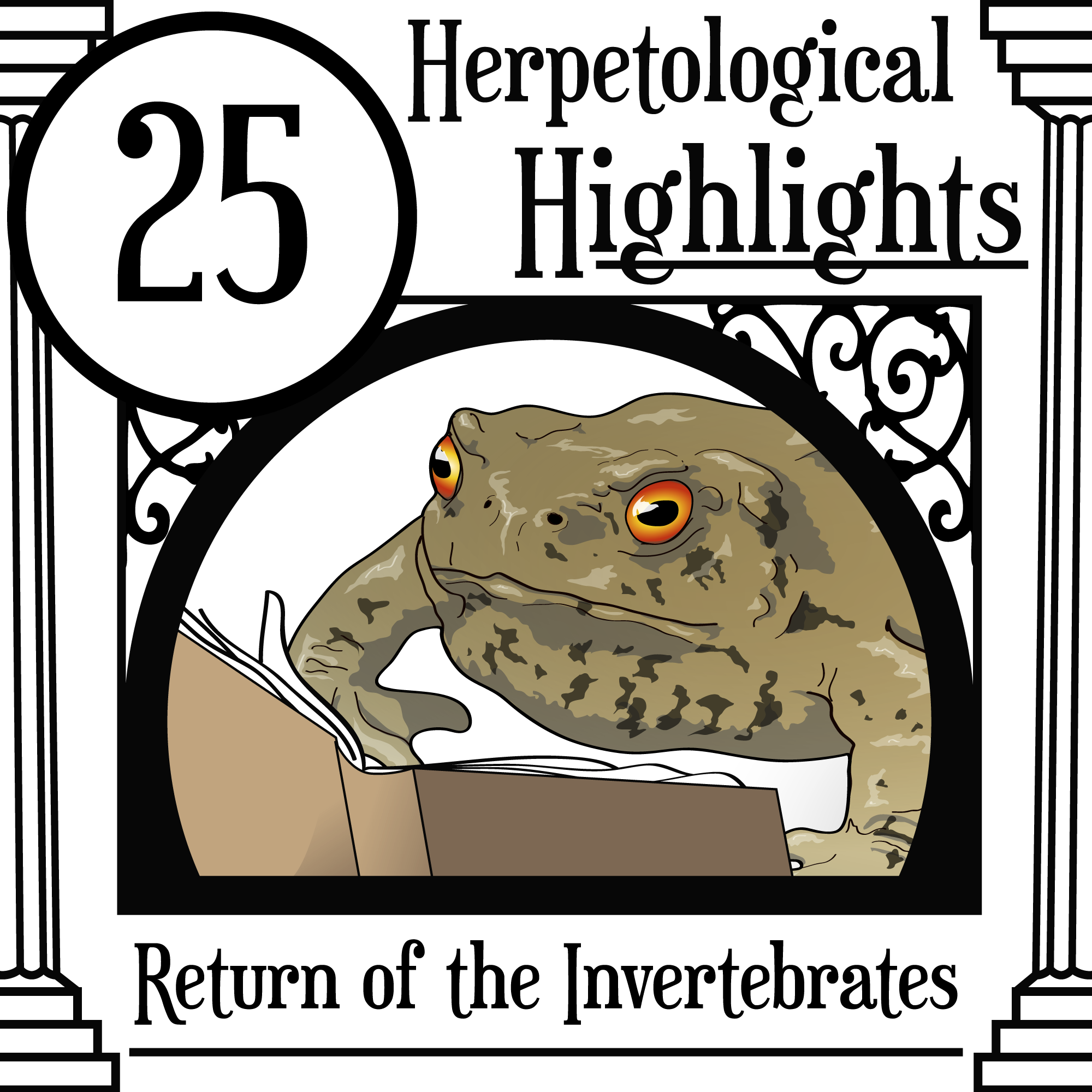
Ep 25025 Return of the Invertebrates
We back for another invertebrate versus amphibian episode. But this time we’re focusing on carabid beetles and their relentless consumption all amphibian life. They have managed to turn the tables on their would be predator in a remarkable case of role-reversal. Species of the Bi-week is a beautiful frog with a fittingly macabre name. FULL REFERENCE LIST AVAILABLE AT: herphighlights.podbean.com Main Paper References: Wizen, G., and A. Gasith. 2011. “Predation of amphibians by carabid beetles of the genus Epomis found in the central coastal plain of Israel.” Zookeys 100: 181–191. Wizen, G., and A. Gasith. 2011. “An unprecedented role reversal: Ground beetle larvae (Coleoptera: Carabidae) lure amphibians and prey upon them.” PLoS One 6: 1–6. Species of the Bi-Week: Dias, I. R., C. F. B. Haddad, A. J. S. Argôlo, and V. G. D. Orrico. 2017. “The 100th: An appealing new species of Dendropsophus (Amphibia: Anura: Hylidae) from northeastern Brazil R. Castiglia.” PLoS One 12: e0171678. Other Mentioned Papers/Studies: Barkai A, McQuaid C (1988) Predator–prey role reversal in marine benthic ecosystems. Science 242: 62–64. Beckmann, C, and R Shine. 2011. “Toad’s Tongue for Breakfast: Exploitation of a Novel Prey Type, the Invasive Cane Toad, by Scavenging Raptors in Tropical Australia.” Biological Invasions 13 (6): 1447–55. Brodie Jr., ED. 1977. “Hedgehogs Use Toad Venom in Their Own Defence.” Nature 268 (5621): 627–28. Choh, Y., Takabayashi, J., Sabelis, M. W., & Janssen, A. (2014). Witnessing predation can affect strength of counterattack in phytoseiids with ontogenetic predator–prey role reversal. Animal Behaviour, 93, 9-13. Escoriza, D., L. Mestre, G. Pascual, and J. Buse. 2017. “First case of attack of an adult Bufo spinosus Daudin, 1803 by a carabid beetle larva of Epomis circumscriptus (Duftschmid, 1812).” Bol. Asoc. Herpetol. Esp. 28: 2006–2008. Petschenka, G, S Fandrich, N Sander, V Wagschal, M Boppré, and S Dobler. 2013. “Stepwise Evolution of Resistance to Toxic Cardenolides via Genetic Substitutions in the Na+/K+-ATPase of Milkweed Butterflies (Lepidoptera: Danaini).” Evolution 67 (9): 2753–61. Scudder, GGE, and J Meredith. 1982. “The Permeability of the Midgut of Three Insects to Cardiac Glycosides.” Journal of Insect Physiology 28 (8): 689–94. Ujvari, B, NR Casewell, K Sunagar, K Arbuckle, W Wüster, N Lo, D O’Meally, et al. 2015. “Widespread Convergence in Toxin Resistance by Predictable Molecular Evolution.” Proceedings of the National Academy of Sciences 112 (38): 11911–11916. Wilson, NJ, AN Stokes, GR Hopkins, ED Brodie, Jr., and CR Williams. 2014. “Functional and Physiological Resistance of Crayfish to Amphibian Toxins: Tetrodotoxin Resistance in the White River Crayfish (Procambarus Acutus).” Canadian Journal of Zoology 92 (11): 939–45. Voyles, J, DC Woodhams, V Saenz, AQ Byrne, R Perez, G Rios-sotelo, MJ Ryan, et al. 2018. “Shifts in Disease Dynamics in a Tropical Amphibian Assemblage Are Not due to Pathogen Attenuation.” Science 359: 1517–19. Other Links/Mentions: Epomis circumscriptus attacking and preying upon Bufo viridis – http://www.youtube.com/watch?v=wFJ_CXJ0qPo Epomis circumscriptus attacking and preying upon Hyla savignyi – http://www.youtube.com/watch?v=RMkFb5n97cU Trophic interactions between Epomis adults and Triturus vittatus – http://www.youtube.com/watch?v=JA46dbEpluI Videos from Wizen and Gasith 2011 PLoS One – http://journals.plos.org/plosone/article?id=10.1371/journal.pone.0025161 Photos from paper two: http://www.tau.ac.il/lifesci/departments/zoology/Amphibia/new.html Rats vs toads: https://www.facebook.com/groups/ukargs/permalink/2092225931007478/ Music: Intro/outro – Treehouse by Ed Nelson Other Music – The Passion HiFi, www.thepassionhifi.com
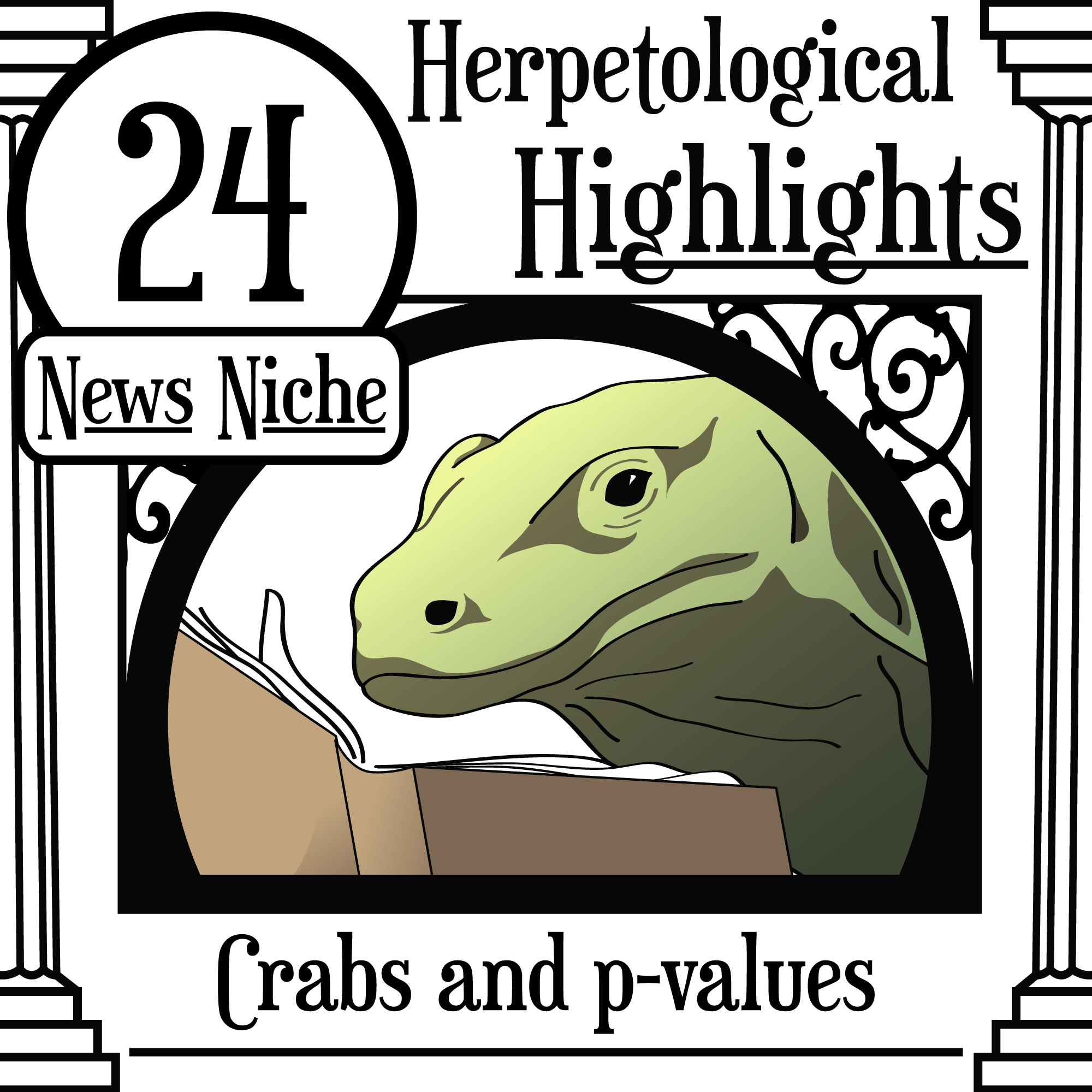
Ep 24024 News Niche - Crabs and p-values
This bi-week we decided to do things a little differently. No main theme, we just read random stuff and chatted about it. Featuring some exciting new developments in the crab vs snake continuum, and some methodological issues to keep an eye on. Huge thank you to our Patreons - if you enjoy the podcast please consider donating at www.patreon.com/herphighlights FULL REFERENCE LIST AVAILABLE AT: herphighlights.podbean.com References: Akçakaya, H. Resit, Elizabeth L. Bennett, Thomas M. Brooks, Molly K. Grace, Anna Heath, Simon Hedges, Craig Hilton-Taylor, et al. 2018. “Quantifying Species Recovery and Conservation Success to Develop an IUCN Green List of Species.” Conservation Biology, 1–15. Alexander, G. J. Reproductive biology and maternal care of neonates in southern African python (Python natalensis). Journal of Zoology. IN PRESS Dolia, Jignasu. 2018. “Notes on the Distribution and Natural History of the King Cobra (Ophiophagus Hannah Cantor, 1836) from the Kumaon Hills of Uttarakhand, India.” Herpetology Notes 11:217–22. Fraser, Hannah, Timothy H. Parker, Shinichi Nakagawa, Ashley Barnett, and Fiona Fidler. 2018. “Questionable Research Practices in Ecology and Evolution.” Pre-Print. https://doi.org/10.17605/OSF.IO/AJYQG. Garnett, S. T., & Christidis, L. (2017). Taxonomy anarchy hampers conservation. Nature News, 546(7656), 25. Jayne, B. C., Voris, H. K., & Ng, P. K. (2018). How big is too big? Using crustacean-eating snakes (Homalopsidae) to test how anatomy and behaviour affect prey size and feeding performance. Biological Journal of the Linnean Society, 123(3), 636-650. Loss, Scott R., and Peter P. Marra. 2018. “Merchants of Doubt in the Free-Ranging Cat Conflict.” Conservation Biology 32 (2):265–66. Thomson, Scott A., Richard L. Pyle, Shane T. Ahyong, Miguel Alonso-Zarazaga, Joe Ammirati, Juan Francisco Araya, John S. Ascher, et al. 2018. “Taxonomy Based on Science Is Necessary for Global Conservation.” PLOS Biology 16 (3):e2005075. Other Links/Mentions: Video of Pareas carinatus eating a snail - https://www.youtube.com/watch?v=gcis86ZSwhE Supplementary material from Alexander 2018 (including videos of baby pythons): https://zslpublications.onlinelibrary.wiley.com/doi/abs/10.1111/jzo.12554 Music: Intro/outro – Treehouse by Ed Nelson Other Music – The Passion HiFi, www.thepassionhifi.com
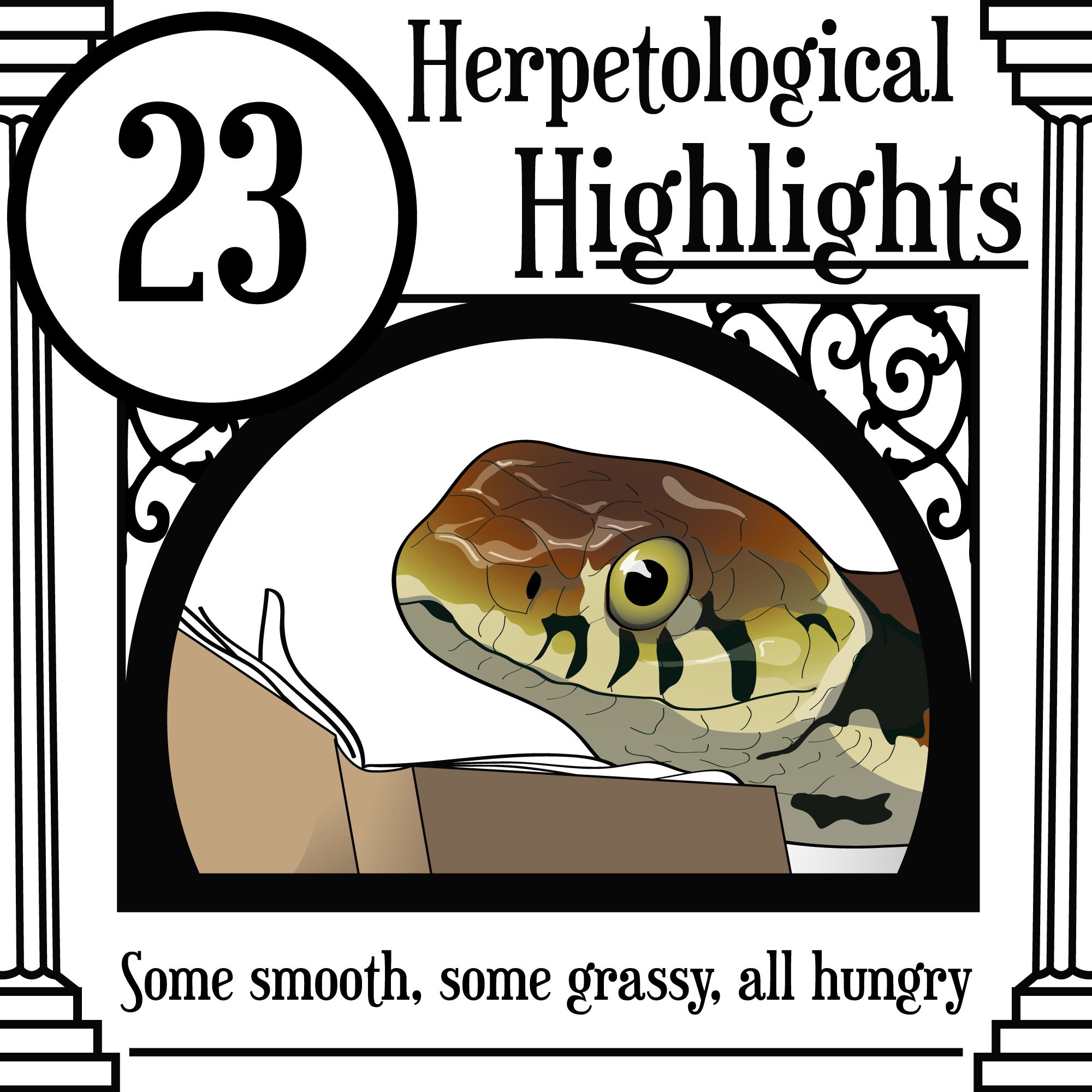
Ep 23023 Some smooth, some grassy, all hungry
We kick off this episode with the announcement of our move onto Patreon: https://www.patreon.com/herphighlights . Research chat this time is all British snakes. We may not have the most extensive array of snake-life in the Britain, but that doesn't mean that there can’t be some exciting herpetofaunal research. This fortnight we are looking at a couple of papers on smooth and grass snakes. And a slight change to the Species of the Bi-week. FULL REFERENCE LIST AVAILABLE AT: herphighlights.podbean.com Main Paper References: Reading, C, and G Jofré. 2013. “Diet Composition Changes Correlated with Body Size in the Smooth Snake, Coronella Austriaca, Inhabiting Lowland Heath in Southern England.” Amphibia-Reptilia 34 (4): 463–70. Sewell, D, JMR Baker, and RA Griffiths. 2015. “Population Dynamics of Grass Snakes (Natrix natrix) at a Site Restored for Amphibian Reintroduction.” Herpetological Journal 25 (July): 155–61. Species of the Bi-Week: Kindler, C, M Chèvre, S Ursenbacher, W Böhme, A Hille, D Jablonski, M Vamberger, and U Fritz. 2017. “Hybridization Patterns in Two Contact Zones of Grass Snakes Reveal a New Central European Snake Species.” Scientific Reports 7 (1): 1–12. Other Mentioned Papers/Studies: Buckley, J, and J Foster. 2005. “Reintroduction Strategy for the Pool Frog Rana Lessonae in England.” English Nature Research Report. Glaudas, X, and GJ Alexander, 2017. “Food supplementation affects the foraging ecology of a low-energy, ambush-foraging snake.” Behavioral ecology and sociobiology, 71(1), 5. Glaudas, X, TC Kearney, and GJ Alexander. 2017. “Museum specimens bias measures of snake diet: a case study using the ambush-foraging puff adder (Bitis arietans).” Herpetologica, 73(2), 121-128. Madsen, T. 1984. “Movements, Home Range Size and Habitat Use of Radio-Tracked Grass Snakes (Natrix Natrix) in Southern Sweden.” Copeia 1984 (3): 707–13. Reading, CJ, and GM Jofré. 2009. “Habitat Selection and Range Size of Grass Snakes Natrix natrix in an Agricultural Landscape in Southern England.” Amphibia-Reptilia 30 (3): 379–88. Wasko, DK, and M Sasa. 2012. “Food Resources Influence Spatial Ecology, Habitat Selection, and Foraging Behavior in an Ambush-Hunting Snake (Viperidae: Bothrops Asper): An Experimental Study.” Zoology 115 (3): 179–87. Wisler, C, U Hofer, and R Arlettaz. 2008. “Snakes and Monocultures: Habitat Selection and Movements of Female Grass Snakes (Natrix natrix l.) in an Agricultural Landscape.” Journal of Herpetology 42 (2): 337–46. Thomson, SA, RL Pyle, ST Ahyong, M Alonso-Zarazaga, J Ammirati, JF Araya, JS Ascher, et al. 2018. “Taxonomy Based on Science Is Necessary for Global Conservation.” PLOS Biology 16 (3): e2005075. Other Links/Mentions: The grass snake and the frog video - https://www.youtube.com/watch?v=4Sa_G9Hhf3o Music: Intro/outro – Treehouse by Ed Nelson Other Music – The Passion HiFi, www.thepassionhifi.com
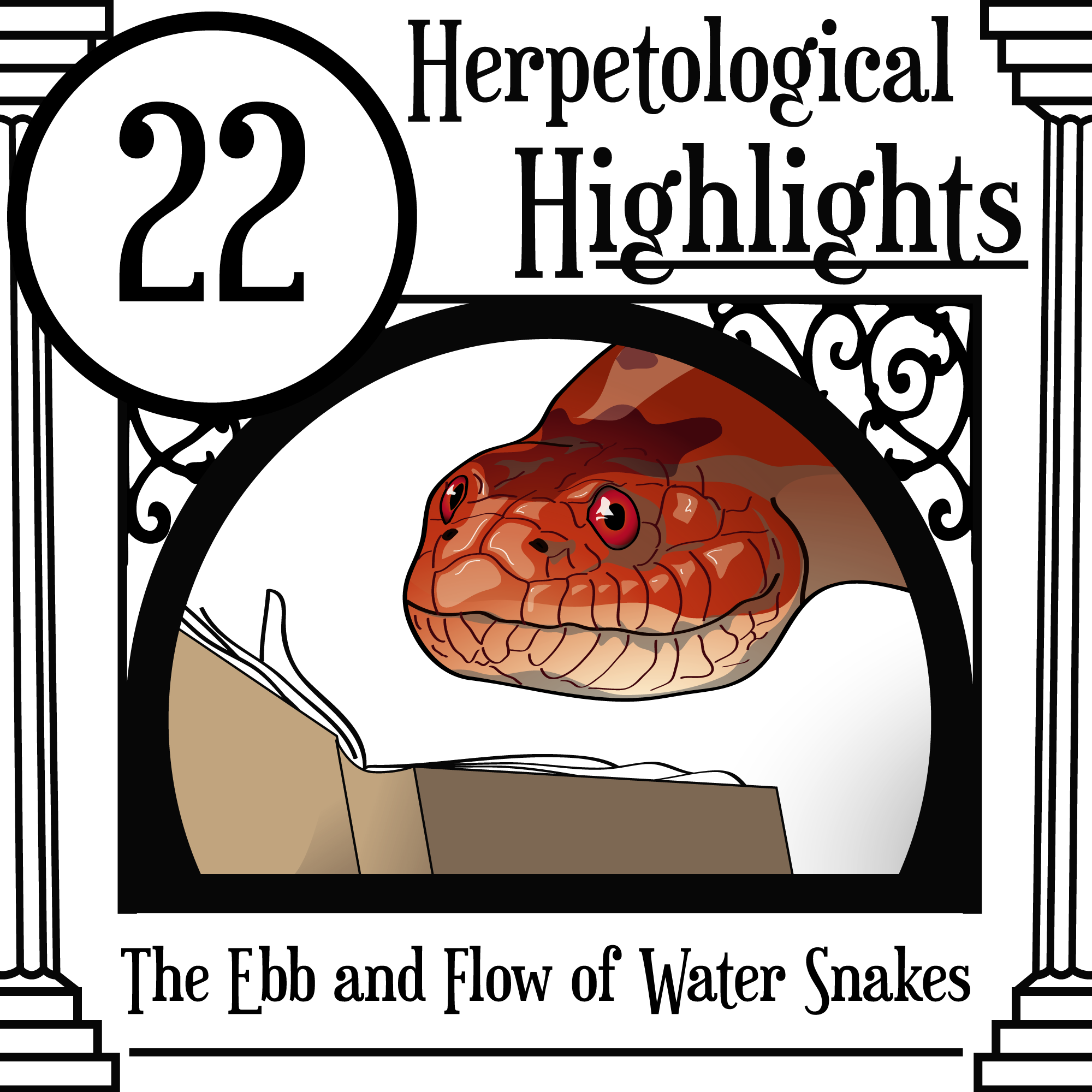
Ep 26022 The Ebb and Flow of Water Snakes
Unsurprisingly, water snakes love water. But what happens when this precious resource dries out? This week we discuss the effects of drought on various American water snakes, and pay homage to a newly described Mesoamerican snake. FULL REFERENCE LIST AVAILABLE AT: herphighlights.podbean.com Main Paper References: Rose, JP, and BD Todd. 2017. “Demographic Effects of Prolonged Drought on a Nascent Introduction of a Semi-Aquatic Snake.” Biological Invasions 19 (10): 2885–98. doi:10.1007/s10530-017-1491-4. Vogrinc, PN, AM Durso, CT Winne, and JD Willson. 2018. “Landscape-Scale Effects of Supra-Seasonal Drought on Semi-Aquatic Snake Assemblages.” Wetlands. Species of the Bi-Week: Campbell, JA. 2015. “A New Species of Rhadinella (Serpentes: Colubridae) from the Pacific Versant of Oaxaca, Mexico.” Zootaxa 3918 (3): 397. Other Mentioned Papers/Studies: Brown, GP, and PJ Weatherhead. 1999. “Growth and Sexual Size Dimorphism in Northern Water Snakes (Nerodia Sipedon).” Copeia 1999 (3): 723. Fernández, M., Hamilton, H., Alvarez, O., & Guo, Q. (2012). Does adding multi-scale climatic variability improve our capacity to explain niche transferability in invasive species?. Ecological modelling, 246, 60-67. Fuller, TE, KL Pope, DT Ashton, and HH Welsh. 2011. “Linking the Distribution of an Invasive Amphibian (Rana Catesbeiana) to Habitat Conditions in a Managed River System in Northern California.” Restoration Ecology 19 (201): 204–13. King, RB, JM Ray, and KM Stanford. 2006. “Gorging on Gobies: Beneficial Effects of Alien Prey on a Threatened Vertebrate.” Canadian Journal of Zoology 84 (1): 108–15. Mahoney, P. J. et al. (2015) ‘Introduction effort, climate matching and species traits as predictors of global establishment success in non-native reptiles’, Diversity and Distributions, 21(1), pp. 64–74. Mazzotti, F. J., Cherkiss, M. S., Hart, K. M., Snow, R. W., Rochford, M. R., Dorcas, M. E., & Reed, R. N. (2011). Cold-induced mortality of invasive Burmese pythons in south Florida. Biological Invasions, 13(1), 143-151. McClelland, P, JT Reardon, F Kraus, CJ Raxworthy, and C Randrianantoandro. 2015. “Asian Toad Eradication Feasibility Report for Madagascar.” Te Anau, New Zealand. Pounds, JA, MPL Fogden, and JH Campbell. 1999. “Biological Response to Climate Change on a Tropical Mountain.” Nature 398 (6728): 611–15. Rose, JP, and BD Todd. 2014. “Projecting Invasion Risk of Non-Native Watersnakes (Nerodia Fasciata and Nerodia Sipedon) in the Western United States.” Edited by Benedikt R. Schmidt. PLoS ONE 9 (6): e100277. Music: Intro/outro – Treehouse by Ed Nelson Other Music – The Passion HiFi, www.thepassionhifi.com
Ep 25021 Frugivorous Monitors
Monitor lizards are renowned savengers... or so is widely thought. There are a few species that have cast aside the scavenger ways of their compatriots, opting for more relaxed arboreal lifestyles, spending their days high in the tree tops foraging for fruit. These frugivorous monitor lizards are are joined by a serpentine Species of the Bi-week. FULL REFERENCE LIST AVAILABLE AT: herphighlights.podbean.com Main Paper References: Bennett, D. 2014. “The Arboreal Foraging Behavior of the Frugivorous Monitor Lizard Varanus Olivaceus on Polillo Island.” Biawak 8 (1): 15–18. Law, SJ, SR De Kort, D Bennett, and M Van Weerd. 2016. “Morphology, Activity Area, and Movement Patterns of the Frugivorous Monitor Lizard Varanus Bitatawa.” Herpetological Conservation and Biology 11 (3): 467–75. Species of the Bi-Week: Brown, RM, U Smart, AE Leviton, and EN Smith. 2018. “A New Species of Long-Glanded Coralsnake of the Genus Calliophis (Squamata: Elapidae) from Dinagat Island, with Notes on the Biogeography and Species Diversity of Philippine Calliophis and Hemibungarus.” Herpetologica 74 (1): 89–104. Other Mentioned Papers/Studies: Bennett, D. 2014. “A Dubious Account of Breeding Varanus Olivaceus in Captivity at the Paradise Reptile Zoo in Mindoro, Philippines.” Biawak 8 (1): 12–14. Bennett, D, and T Clements. 2014. “The Use of Passive Infrared Camera Trapping Systems in the Study of Frugivorous Monitor Lizards.” Biawak 8 (1): 19–30. Gunawardena, S. A. 2016. “Forensic Significance of Monitor Lizard Scavenging Activity on Human Corpses.” Biawak 10 (2): 45-47. Koch, A., and E. Arida. 2017. “A coconut-eating monitor lizard? On an unusual case of frugivory in the melanistic Sulawesi water monitor (Varanus togianus).” Herpetological Bulletin 139: 41. Sugiura, S, and T Sato. 2018. “Successful Escape of Bombardier Beetles from Predator Digestive Systems.” Biology Letters 14 (2): 20170647. Sy, E. Y. 2012. “First record of Varanus bitatawa in the Philippine pet trade.” Biawak 6 (2): 73. Other Links/Mentions: Smallest monitor lizard article/video: http://www.australiangeographic.com.au/blogs/creatura-blog/2015/05/australian-lizard-the-worlds-smallest-monitor Music: Intro/outro – Treehouse by Ed Nelson Other Music – The Passion HiFi, www.thepassionhifi.com
Ep 24020 The Magnificent Vipers
Vipers, vipers everywhere. In this episode we muddle our way through some venom research, and learn about the methods employed working out how widespread bushmasters are. Species of the bi-week is a frankly outstanding forest dweller from Costa Rica. If you enjoy our podcast please vote for us for Reader's Radio Show of the Year on the Reptile Report! http://awards.thereptilereport.com/radio-show-of-the-year-2017/ FULL REFERENCE LIST AVAILABLE AT: herphighlights.podbean.com Main Paper References: González-Maya, José F., Fernando Castañeda, Rufino González, Jesús Pacheco, and Gerardo Ceballos. 2014. “Distribution, Range Extension, and Conservation of the Endemic Black-Headed Bushmaster (Lachesis melanocephala) in Costa Rica and Panama.” Herpetological Conservation and Biology 9 (2):369–77. Roodt, Adolfo Rafael de, Leslie Victoria Boyer, Laura Cecilia Lanari, Lucia Irazu, Rodrigo Daniel Laskowicz, Paula Leticia Sabattini, and Carlos Fabián Damin. 2016. “Venom Yield and Its Relationship with Body Size and Fang Separation of Pit Vipers from Argentina.” Toxicon 121 (October):22–29. Species of the Bi-Week: Doan, Tiffany M., Andrew J. Mason, Todd A. Castoe, Mahmood Sasa, and Christopher L. Parkinson. 2016. “A Cryptic Palm-Pitviper Species (Squamata: Viperidae: Bothriechis) from the Costa Rican Highlands, with Notes on the Variation within B. Nigroviridis.” Zootaxa 4138 (2):271. Other Mentioned Papers/Studies: Dias, Lourdes, Mariana A.P. Rodrigues, André L. Rennó, Alessandra Stroka, Bruna R. Inoue, Patrícia C. Panunto, Anibal R. Melgarejo, and Stephen Hyslop. 2016. “Hemodynamic Responses to Lachesis Muta (South American Bushmaster) Snake Venom in Anesthetized Rats.” Toxicon 123 (December):1–14. Fenwick, A. M., Gutberlet, R. L., Evans, J. A., & Parkinson, C. L. (2009). Morphological and molecular evidence for phylogeny and classification of South American pitvipers, genera Bothrops, Bothriopsis, and Bothrocophias (Serpentes: Viperidae). Zoological Journal of the Linnean Society, 156(3), 617-640. Maritz, Bryan, Johannes Penner, Marcio Martins, Jelka Crnobrnja-Isailović, Stephen Spear, Laura R.V. Alencar, Jesús Sigala-Rodriguez, et al. 2016. “Identifying Global Priorities for the Conservation of Vipers.” Biological Conservation 204:94–102. Quillfeldt, Petra, Jan O. Engler, Janet R.D. Silk, and Richard A. Phillips. 2017. “Influence of Device Accuracy and Choice of Algorithm for Species Distribution Modelling of Seabirds: A Case Study Using Black-Browed Albatrosses.” Journal of Avian Biology 48 (12):1549–55. Rogalski, Aymeric, Christoffer Soerensen, Bianca op den Brouw, Callum Lister, Daniel Dashevsky, Kevin Arbuckle, Alexandra Gloria, et al. 2017. “Differential Procoagulant Effects of Saw-Scaled Viper (Serpentes: Viperidae: Echis ) Snake Venoms on Human Plasma and the Narrow Taxonomic Ranges of Antivenom Efficacies.” Toxicology Letters 280 (June):159–70. Other Links/Mentions: Birds deliberately spreading fire – Bonta, Mark, Robert Gosford, Dick Eussen, Nathan Ferguson, Erana Loveless, and Maxwell Witwer. 2017. “Intentional Fire-Spreading by ‘Firehawk’ Raptors in Northern Australia.” Journal of Ethnobiology 37 (4):700–718. https://doi.org/10.2993/0278-0771-37.4.700. Orca talking, The Guardian – https://youtu.be/hqB1jRVw7Bw Bushmaster video - https://www.youtube.com/watch?v=0hIERce2M30 King cobra vs reticulated python photo – https://www.facebook.com/TheReptileReport/posts/1469028556542349 Music: Intro/outro – Treehouse by Ed Nelson Other Music – The Passion HiFi, www.thepassionhifi.com
Ep 19019 Invertebrates Strike Back
We usually think of invertebrates as a frog’s favourite meal. But in this episode we explore the times when the tables turn and frogs fall victim to mighty invertebrates. Except for the Accra snake-necked frog, they have an ingenious way of avoiding invertebrate conflict. Species of the Bi-week features a double-bill of tree frogs. FULL REFERENCE LIST AVAILABLE AT: herphighlights.podbean.com Main Paper References: Jablonski, Daniel. 2015. “Predation on Pristimantis ridens (Cope, 1866) by a Wandering Spider (Ctenidae Keyserling, 1877) in Mountain Cloud Forest of Costa Rica.” Herpetology Notes 8:1–3. Luiz, Amom Mendes, Thiago Augusto Pires, Victor Dimitrov, and Ricardo Jannini Sawaya. 2013. “Predation on Tadpole of Itapotihyla langsdorffii (Anura: Hylidae) by the Semi-Aquatic Spider Thaumasia Sp. (Araneae: Pisauridae) in the Atlantic Forest, Southeastern Brazil.” Herpetology Notes 6 (1):451–52. Rödel, Mark Oliver, Christian Brede, Mareike Hirschfeld, Thomas Schmitt, Philippe Favreau, Reto Stöcklin, Cora Wunder, and Dietrich Mebs. 2013. “Chemical Camouflage - A Frog’s Strategy to Co-Exist with Aggressive Ants.” PLoS ONE 8 (12). Species of the Bi-Week: Rivadeneira, C. Daniel, Pablo J. Venegas, and Santiago R. Ron. 2018. “Species Limits within the Widespread Amazonian Treefrog Dendropsophus Parviceps with Descriptions of Two New Species (Anura, Hylidae).” ZooKeys 726:25–77. Other Mentioned Papers/Studies: Menin, Marcelo, Domingos de Jesus Rodrigues, and Clarissa Salette de Azevedo. 2005. “Predation on Amphibians by Spiders (Arachnida, Araneae) in the Neotropical Region.” Phyllomedusa 4 (1):39–47. Miranda, Everton B. P. de. 2017. “The Plight of Reptiles as Ecological Actors in the Tropics.” Frontiers in Ecology and Evolution 5:159. Rödel MO, Braun U (1999) Associations between anurans and ants in a West African savanna (Anura: Microhylidae, Hyperoliidae, and Hymenoptera: Formicidae). Biotropica 31: 178–183. Toledo, L. F. (2005). Predation of juvenile and adult anurans by invertebrates: current knowledge and perspectives. Herpetological Review, 36(4), 395-399. Vrcibradic, Davor, Rogério L. Teixeira, and Vitor N.T. Borges-Júnior. 2009. “Sexual Dimorphism, Reproduction and Diet of the Casque-Headed Treefrog Itapotihyla Langsdorffii (Hylidae: Lophiohylini).” Journal of Natural History 43 (35–36):2245–56. Ward-Fear, Georgia, Gregory P. Brown, Matthew J. Greenlees, and Richard Shine. 2009. “Maladaptive Traits in Invasive Species: In Australia, Cane Toads Are More Vulnerable to Predatory Ants than Are Native Frogs.” Functional Ecology 23 (3):559–68. Ward-Fear, Georgia, Gregory P. Brown, and Richard Shine. 2010. “Factors Affecting the Vulnerability of Cane Toads (Bufo Marinus) to Predation by Ants.” Biological Journal of the Linnean Society 99 (4):738–51. Other Links/Mentions: Videos of Paltothyreus tarsatus ignoring Phrynomantis microps from Rödel et al. 2013 – http://journals.plos.org/plosone/article?id=10.1371/journal.pone.0081950 EDGE of Existence programme – https://www.edgeofexistence.org Music – Treehouse by Ed Nelson
Ep 23018 Big Trouble in Little Chameleons
There is no denying that chameleons are fascinating lizards, but why should the tree-dwelling ones get all the credit? In this episode we unearth some recent discoveries concerning Brookesia and friends, as well as taking a look at the world's shortest lived tetrapod, Labord's chameleon. FULL REFERENCE LIST AVAILABLE AT: www.herphighlights.podbean.com Main Paper References: Miller, C. 2017. “Morphological and Roosting Variation in the Dwarf Chameleon Brookesia Stumpffi Between Primary, Secondary, and Degraded Habitats in Nosy Be, Madagascar.” Herpetological Conservation and Biology 12 (3): 599–605. Eckhardt, F, PM Kappeler, and C Kraus. 2017. “Highly Variable Lifespan in an Annual Reptile, Labord’s Chameleon (Furcifer Labordi).” Scientific Reports 7 (1): 11397. Species of the Bi-Week: Branch, WR, J Bayliss, and KA Tolley. 2014. “Pygmy Chameleons of the Rhampholeon Platyceps Compex (Squamata: Chamaeleonidae): Description of Four New Species from Isolated ‘sky Islands’ of Northern Mozambique.” Zootaxa 3814 (1): 1–36. Other Mentioned Papers/Studies: Andrews, R. M., & Donoghue, S. (2004). Effects of temperature and moisture on embryonic diapause of the veiled chameleon (Chamaeleo calyptratus). Journal of Experimental Zoology Part A: Ecological Genetics and Physiology, 301(8), 629-635. Aubret, F, R Shine, and X Bonnet. 2004. “Adaptive Developmental Plasticity in Snakes.” Nature 431 (7006): 261–62. Glaw, F., Köhler, J., Townsend, T. M., & Vences, M. (2012). Rivaling the world's smallest reptiles: discovery of miniaturized and microendemic new species of leaf chameleons (Brookesia) from northern Madagascar. PLoS One, 7(2), e31314. Karsten, K. B., Andriamandimbiarisoa, L. N., Fox, S. F., & Raxworthy, C. J. (2008). A unique life history among tetrapods: an annual chameleon living mostly as an egg. Proceedings of the National Academy of Sciences, 105(26), 8980-8984. Losos, JB, KI Warheitt, and TW Schoener. 1997. “Adaptive Differentiation Following Experimental Island Colonization in Anolis Lizards.” Nature. 387. Lucas, J, E Gora, and A Alonso. 2017. “A View of the Global Conservation Job Market and How to Succeed in It.” Conservation Biology 31 (6): 1223–31. Raxworthy, CJ, MRJ Forstner, and RA Nussbaum. 2002. “Chameleon Radiation by Oceanic Dispersal.” Nature 415 (6873): 784–87. Riedel, J., Boehme, W., Bleckmann, H., & Spinner, M. (2015). Microornamentation of leaf chameleons (Chamaeleonidae: Brookesia, Rhampholeon, and Rieppeleon)—with comments on the evolution of microstructures in the chamaeleonidae. Journal of morphology, 276(2), 167-184. Tessa, G., Glaw, F., & Andreone, F. (2017). Longevity in Calumma parsonii, the World's largest chameleon. Experimental gerontology, 89, 41-44. Music – Treehouse by Ed Nelson
Ep 17017 ANACONDAS
This week’s episode is all about the bulkiest snake beast of them all – the ANACONDA. First we look into what neonate anacondas get up to. Then move onto a paper that investigates the human-anaconda conflict across South America (spoiler: people don’t like monster snakes). In lieu of a newly discovered anaconda we discuss a snake with a strange tail in Species of Bi-week. FULL REFERENCE LIST AVAILABLE AT: herphighlights.podbean.com Main Paper References: Rivas, Jesús A., Cesar R. Molina, Sarah J. Corey, and G. M. Burghardt. 2016. “Natural History of Neonatal Green Anacondas (Eunectes Murinus): A Chip Off the Old Block.” Copeia 104 (2): 402–10. Miranda, Everton B P, Raimundo P Ribeiro-, and Christine Strüssmann. 2016. “The Ecology of Human-Anaconda Conflict: A Study Using Internet Videos.” Tropical Conservation Science 9 (1): 43–77. Species of the Bi-Week: Aengals, R., and S. R. Ganesh. 2013. "Rhinophis goweri-a new species of Shieldtail snake from the southern Eastern Ghats, India." Russian Journal of Herpetology 20 (1): 61-65. Other Mentioned Papers/Studies: De la Quintana, Paola, Jesús A. Rivas, Federico Valdivia, and Luis F. Pacheco. 2017. "Home range and habitat use of Beni anacondas (Eunectes beniensis) in Bolivia." Amphibia-Reptilia 38 (4): 547-553. Denny, MW, BL Lockwood, and GN Somero. 2009. “Can the Giant Snake Predict Palaeoclimate?” Nature 460 (7255): E3–4. Gans, Carl, Herbert C. Dessauer, and Dusan Baic. 1978. "Axial differences in the musculature of uropeltid snakes: the freight-train approach to burrowing." Science 199 (4325): 189-192. Head, JJ, JI Bloch, AK Hastings, JR Bourque, EA Cadena, FA Herrera, PD Polly, and CA Jaramillo. 2009. “Head et Al. Reply.” Nature 460 (7255): E4–5. Head, JJ, JI Bloch, AK Hastings, JR Bourque, EA Cadena, FA Herrera, PD Polly, and CA Jaramillo. 2009. “Giant Boid Snake from the Palaeocene Neotropics Reveals Hotter Past Equatorial Temperatures.” Nature 457 (7230). Nature Publishing Group: 715–17. Headland, TN, and HW Greene. 2011. “Hunter-Gatherers and Other Primates as Prey, Predators, and Competitors of Snakes.” Proceedings of the National Academy of Sciences 108 (52): 1470–74. Makarieva, AM, VG Gorshkov, and B-L Li. 2009. “Re-Calibrating the Snake Palaeothermometer.” Nature 460 (7255): E2–3. Maritz, B, J Penner, M Martins, J Crnobrnja-Isailović, S Spear, LRV Alencar, J Sigala-Rodriguez, et al. 2016. “Identifying Global Priorities for the Conservation of Vipers.” Biological Conservation 204: 94–102. Milanesi, P, FT Breiner, F Puopolo, and R Holderegger. 2017. “European Human-Dominated Landscapes Provide Ample Space for the Recolonization of Large Carnivore Populations under Future Land Change Scenarios.” Ecography 40: 1359–68. Moleón, M, JA Sánchez-Zapata, JM Gil-Sánchez, JM Barea-Azcón, E Ballesteros-Duperón, and E Virgós. 2011. “Laying the Foundations for a Human-Predator Conflict Solution: Assessing the Impact of Bonelli’s Eagle on Rabbits and Partridges.” PLoS ONE 6 (7). Natusch, D. J., and J. A. Lyons. 2012. "Relationships between ontogenetic changes in prey selection, head shape, sexual maturity, and colour in an Australasian python (Morelia viridis)." Biological Journal of the Linnean Society, 107 (2): 269-276. O'Shea, Mark, Steve Slater, Rebecca Scott, Sarah A. Smith, Katie McDonald, Bob Lawrence and Marie Kubiak. 2016. “Eunectes murinus (Green Anaconda) Reproduction / Facultative parthenogenesis.” Herpetological Review 47 (1): 73 Pike, DA, L Pizzatto, BA Pike, and R Shine. 2008. “Estimating Survival Rates of Uncatchable Animals: The Myth of High Juvenile Mortality in Reptiles.” Ecology 89 (3): 607–11. Potts, JM, ST Buckland, L Thomas, and A Savage. 2012. “Estimating Abundance of Cryptic but Trappable Animals Using Trapping Point Transects: A Case Study for Key Largo Woodrats.” Methods in Ecology and Evolution 3 (4): 695–703. Sniderman, JMK. 2009. “Biased Reptilian Palaeothermometer?” Nature 460 (7255): E1–2. Strimple, P. D. 1993. “Overview of the natural history of the green anaconda (Eunectes murinus).” Herpetological Natural History, 1(1): 25-35. Waller T., Micucci P., Alvarenga E. 2007. Conservation biology of the yellow anaconda (Eunectes notaeus) in northeastern Argentina. In: Biology of the boas and pythons. Henderson R.W. and Powell R. (Eds). Eagle Mountain Publishing, Utah Other Links/Mentions: Uropeltidae blog - http://snakesarelong.blogspot.co.uk/2017/02/shield-tailed-snakes-uropeltidae.html Harry Greene. Primates And Snakes, 75 Million Years Of Deadly Dialogue? - https://www.allaboutbirds.org/primates-and-snakes-75-million-years-of-deadly-dialogue-video/ Sami Asad’s. Frogs and deforestation, Science Slam Talk - https://youtu.be/7pvwtaZPicI Music – Treehouse by Ed Nelson
Ep 22016 Slimy Salamander Sociality
Salamanders feature in episode 16, especially North American ones. We chat about the unusual inheritance strategies of Ambystoma, and territorial behaviour and polymorphism (multiple colour patterns) of red-backed salamanders. There will of course be a slippery surprise in our Species of the Bi-week. FULL REFERENCE LIST AVAILABLE AT herphighlights.podbean.com Main Paper References: Bogart, James P., Jessica E. Linton, and Al Sandilands. 2017. “A Population in Limbo: Unisexual Salamanders (Genus Ambystoma) Decline without Sperm-Donating Species.” Herpetological Conservation and Biology 12 (1): 41–55. Reiter, M. K., Anthony, C. D., & Hickerson, C. A. M. (2014). Territorial behavior and ecological divergence in a polymorphic salamander. Copeia, 2014(3), 481-488. Species of the Bi-week: Mccranie, J. R., & Rovito, S. M. (2014). New species of salamander (Caudata: Plethodontidae: Cryptotriton) from Quebrada Cataguana, Francisco Morazán, Honduras, with comments on the taxonomic status of Cryptotriton wakei. Zootaxa, 3795(1), 61-70. Other Mentioned Papers/Studies: Bi, K, and JP Bogart. 2010. “Time and Time Again: Unisexual Salamanders (Genus Ambystoma) Are the Oldest Unisexual Vertebrates.” BMC Evolutionary Biology 10: 238. doi:10.1186/1471-2148-10-238. Cleveland, WS, and R McGill. 1984. “Graphical Perceptions: Theory, Experimentation, and Application to the Development of Graphical Methods.” Journal of the American Statistical Association 79 (387): 531–54. Petruzzi, EE, PH Niewiarowski, and FB-G Moore. 2006. “The Role of Thermal Niche Selection in Maintenance of a Colour Polymorphism in Redback Salamanders (Plethodon Cinereus).” Frontiers in Zoology 3: 10. doi:10.1186/1742-9994-3-10. Verrell, P. A., & Krenz, J. D. (1998). Competition for mates in the mole salamander, Ambystoma talpoideum: tactics that may maximize male mating success. Behaviour, 135(2), 121-138. Music: Treehouse by Ed Nelson
Ep 21The Interviews 002 - Steve Allain
Tom caught up with renowned amphibian man and Imperial College master's student Steve Allain at Venom Day 2017 at Bangor University. Steve's midwife toad project features heavily, along with his upcoming master's research and general amphibian happenings. Steve's twitter: https://twitter.com/stevoallain Steve's blog: http://bioweb.ie/author/steven/
Ep 15015 Serpents of the Sea
Snakes of the sea. Yellow, striped, you name it. We look into some factors changing their colours, and how has the yellow-bellied sea snake become so widespread? Another Species of the Bi-week that’s entirely yellow but not entirely a species. FULL REFERENCE LIST AVAILABLE AT: herphighlights.podbean.com Main Paper References: Brischoux, François, Cédric Cotté, Harvey B. Lillywhite, Frédéric Bailleul, Maxime Lalire, and Philippe Gaspar. 2016. “Oceanic Circulation Models Help to Predict Global Biogeography of Pelagic Yellow- Bellied Sea Snake.” Biology Letters 12: 6–9. Goiran, Claire, Paco Bustamante, and Richard Shine. 2017. “Industrial Melanism in the Seasnake Emydocephalus Annulatus.” Current Biology. 1–4. Species of the Bi-Week: Bessesen, Brooke L., and Gary J. Galbreath. 2017. “A New Subspecies of Sea Snake, Hydrophis Platurus Xanthos, from Golfo Dulce, Costa Rica.” ZooKeys 686: 109–23. Other Mentioned Papers/Studies: Bonnet, Xavier, Marine J. Briand, François Brischoux, Yves Letourneur, Thomas Fauvel, and Paco Bustamante. 2014. “Anguilliform Fish Reveal Large Scale Contamination by Mine Trace Elements in the Coral Reefs of New Caledonia.” Science of the Total Environment 470–471. Elsevier B.V.: 876–82. Chatelain, M., J. Gasparini, L. Jacquin, and A. Frantz. 2014. “The Adaptive Function of Melanin-Based Plumage Coloration to Trace Metals.” Biology Letters 10 (3): 20140164. Cook, Timothée R., Xavier Bonnet, T. Fauvel, Richard Shine, and François Brischoux. 2016. "Foraging behaviour and energy budgets of sea snakes: insights from implanted data loggers." Journal of Zoology 298(2): 82-93. Lillywhite, Harvey B., Coleman M. Sheehy Iii, François Brischoux, and Joseph B. Pfaller. 2015 "On the abundance of a pelagic sea snake." Journal of Herpetology 49(2): 184-189. Pickwell, George V. 1971. "Knotting and coiling behavior in the pelagic sea snake Pelamis platurus (L.)." Copeia 1971(2): 348-350. Reading, C. J., L. M. Luiselli, G. C. Akani, X. Bonnet, G. Amori, J. M. Ballouard, E. Filippi, G. Naulleau, D. Pearson, and L. Rugiero. 2010. “Are Snake Populations in Widespread Decline?” Biology Letters 6: 777–80. Sanders, Kate L., Michael SY Lee, Terry Bertozzi, and Arne R. Rasmussen. 2013. "Multilocus phylogeny and recent rapid radiation of the viviparous sea snakes (Elapidae: Hydrophiinae)." Molecular phylogenetics and evolution 66(3): 575-591. Shine, R., R. Reed, S. Shetty, and H. Cogger. 2002. "Relationships between sexual dimorphism and niche partitioning within a clade of sea-snakes (Laticaudinae)." Oecologia 133(1): 45-53. Shine, Richard, Terri Shine, James M. Shine, and Benjamin G. Shine. 2005. “Synchrony in Capture Dates Suggests Cryptic Social Organization in Sea Snakes (Emydocephalus Annulatus, Hydrophiidae).” Austral Ecology 30 (7): 805–11. Other Links/Mentions: Yellow bellied sea snakes ‘knotting’ and feeding: https://www.youtube.com/watch?v=meGFcJ03bg0 iHerp Magazine Issue 3: https://view.joomag.com/iherp-australia-issue-3/0682664001501470952 Music – Treehouse by Ed Nelson
Ep 20014 Crocs
Crocodylians have been around for a while and they know what they’re doing. In this episode we discuss what they do when they’re ticked off, and how the massive, fascinating, and largely unknown Tomistoma is getting on in SE Asia. As always, we end on a new species, and this time it’s a fractious new species of something crocodile-like. FULL REFERENCE LIST AVAILABLE AT: herphighlights.podbean.com Main Paper References: Brien, Matthew L., Jeffrey W. Lang, Grahame J. Webb, Colin Stevenson, and Keith A. Christian. 2013. “The Good, the Bad, and the Ugly: Agonistic Behaviour in Juvenile Crocodilians.” PLoS ONE 8 (12). Stuebing, R., R. Sommerlad, and A. Staniewicz. 2015. “Conservation of the Sunda Gharial Tomistoma Schlegelii in Lake Mesangat, Indonesia.” International Zoo Yearbook 49 (1): 137–49. Species of the Bi-Week: Foffa, Davide, Mark T. Young, Stephen L. Brusatte, Mark R. Graham, and Lorna Steel. 2017. “A New Metriorhynchid Crocodylomorph from the Oxford Clay Formation (Middle Jurassic) of England, with Implications for the Origin and Diversification of Geosaurini.” Journal of Systematic Palaeontology: 1–21. Other Mentioned Papers/Studies: Brochu, Christopher A. 2001. “Crocodylian Snouts in Space and Time: Phylogenetic Approaches Toward Adaptive Radiation.” American Zoologist 41 (November): 564–85. Brown, Gregory, Richard Shine, Ruchira Somaweera, and Jonathan Webb. 2011. “Hatchling Australian Freshwater Crocodiles Rapidly Learn to Avoid Toxic Invasive Cane Toads.” Behaviour 148: 501–17. Courchamp, Franck, and Corey J A Bradshaw. 2017. “100 Articles Every Ecologist Should Read.” Nature Ecology & Evolution. Galdikas, B. M. 1985. "Crocodile predation on a proboscis monkey in Borneo." Primates, 26(4), 495-496. Letnic, Mike, Jonathan K. Webb, and Richard Shine. 2008. “Invasive Cane Toads (Bufo Marinus) Cause Mass Mortality of Freshwater Crocodiles (Crocodylus Johnstoni) in Tropical Australia.” Biological Conservation 141 (7): 1773–82. Milinkovitch, M. C., L. Manukyan, A. Debry, N. Di-Poi, S. Martin, D. Singh, D. Lambert, and M. Zwicker. 2013. “Crocodile Head Scales Are Not Developmental Units But Emerge from Physical Cracking.” Science 339 (6115): 78–81. Smith, James G., and Ben L. Phillips. 2006. “Toxic Tucker: The Potential Impact of Cane Toads on Australian Reptiles.” Pacific Conservation Biology 12 (1): 40–49. Yeager, C. P. 1991. "Possible antipredator behavior associated with river crossings by proboscis monkeys (Nasalis larvatus)." American Journal of Primatology, 24(1), 61-66. Other Links/Mentions: Tomistoma captive breeding success https://www.youtube.com/watch?v=SDkpwV2vRyM Music – Treehouse by Ed Nelson
Ep 13013 Frog Fungus
Everyone's favourite fungus is the topic of this week’s episode – Batrachochytrium dendrobatidis, otherwise known as Bd or Chytrid. We discuss some of the ways it spreads and a little about the frogs it affects. Species of the Bi-week is back and this time coming out of Amazonia. FULL REFERENCE LIST AVAILABLE AT: herphighlights.podbean.com Main Paper References: Kolby, Jonathan E., Sara D. Ramirez, Lee Berger, Kathryn L. Richards-Hrdlicka, Merlijn Jocque, and Lee F. Skerratt. 2015. “Terrestrial Dispersal and Potential Environmental Transmission of the Amphibian Chytrid Fungus (Batrachochytrium Dendrobatidis).” PLoS ONE 10 (4): 1–13. Barrio-Amorós, César L., Christoph I. Grünwald, Héctor Franz-Chávez, Ángela María Mendoza, and Brandon Thomas La Forest. 2016. “Notes on Natural History and Call Description of the Critically Endangered Plectrohyla Avia (Anura: Hylidae) from Chiapas , Mexico.” Amphibian and Reptile Conservation 10 (2): 11–17. Species of the Bi-Week: Peloso, Pedro L.V., Victor G.D. Orrico, Célio F.B. Haddad, Geraldo R. Lima-Filho, and Marcelo J. Sturaro. 2016. “A New Species of Clown Tree Frog, Dendropsophus Leucophyllatus Species Group, from Amazonia (Anura, Hylidae).” South American Journal of Herpetology 11 (1): 66–80. Other Mentioned Papers/Studies: Arnold, S.J., 1976. "Sexual behavior, sexual interference and sexual defense in the salamanders Ambystoma maculatum, Ambystoma tigrinum and Plethodon jordani." Ethology, 42(3): 247-300. Blooi, Mark, An Martel, Francis Vercammen, and Frank Pasmans. 2013. “Combining Ethidium Monoazide Treatment with Real-Time PCR Selectively Quantifies Viable Batrachochytrium Dendrobatidis Cells.” Fungal Biology 117 (2): 156–62. Gower, D.J., Doherty-Bone, T., Loader, S.P., Wilkinson, M., Kouete, M.T., Tapley, B., Orton, F., Daniel, O.Z., Wynne, F., Flach, E. and Müller, H., 2013. "Batrachochytrium dendrobatidis infection and lethal chytridiomycosis in caecilian amphibians (Gymnophiona)." EcoHealth, 10(2):173-183. Iwai, N., 2013. "Morphology, function and evolution of the pseudothumb in the Otton frog." Journal of Zoology, 289(2): 127-133. Kolby, Jonathan E., Sara D. Ramirez, Lee Berger, Dale W. Griffin, Merlijn Jocque, and Lee F. Skerratt. 2015. “Presence of Amphibian Chytrid Fungus (Batrachochytrium Dendrobatidis) in Rainwater Suggests Aerial Dispersal Is Possible.” Aerobiologia 31 (3): 411–19. doi:10.1007/s10453-015-9374-6. Liew, Nicole, Maria J. Mazon Moya, Claudia J. Wierzbicki, Michael Hollinshead, Michael J. Dillon, Christopher R. Thornton, Amy Ellison, Jo Cable, Matthew C. Fisher, and Serge Mostowy. 2017. “Chytrid Fungus Infection in Zebrafish Demonstrates That the Pathogen Can Parasitize Non-Amphibian Vertebrate Hosts.” Nature Communications 8 (April). Nature Publishing Group: 15048. Lips, Karen R. 2016. “Overview of Chytrid Emergence and Impacts on Amphibians.” Philosophical Transactions of the Royal Society B: Biological Sciences 371 (1709): 20150465. Longcore, J.E., Pessier, A.P. and Nichols, D.K., 1999. "Batrachochytrium dendrobatidis gen. et sp. nov., a chytrid pathogenic to amphibians." Mycologia: 219-227. Olson, Deanna H., David M. Aanensen, Kathryn L. Ronnenberg, Christopher I. Powell, Susan F. Walker, Jon Bielby, Trenton W.J. Garner, George Weaver, and Matthew C. Fisher. 2013. “Mapping the Global Emergence of Batrachochytrium Dendrobatidis, the Amphibian Chytrid Fungus.” PLoS ONE 8 (2). Van Rooij, Pascale, Frank Pasmans, Yanaika Coen, and An Martel. 2017. “Efficacy of Chemical Disinfectants for the Containment of the Salamander Chytrid Fungus Batrachochytrium Salamandrivorans.” PloS One 12 (10): e0186269. Other Links/Mentions: Video of Plectrohyla Avia from Barrio-Amorós et al. (2016) - https://www.youtube.com/watch?v=aa2O-BguqOY&feature=youtu.be Salamander courtship with pheromone transmission - http://plethodon.science.oregonstate.edu/video/shermani%20slapping.avi HARCC are mid fundraiser - go to frogrescue.com Music – Treehouse by Ed Nelson
Ep 12012 Geckos Down Under
Following on from our interview with John McGrath, Australian geckos are our focus for episode 12. We talk about the influences on starred knob tail gecko habitat and why velvet geckos are important food for an elapid snake. Of course there is an Australian gecko for the Species of the Bi-Week. FULL REFERENCE LIST AVAILABLE AT: herphighlights.podbean.com Main Paper References: Driscoll, Don A., Catherine A. Whitehead, and Juliana Lazzari. 2012. “Spatial Dynamics of the Knob-Tailed Gecko Nephrurus Stellatus in a Fragmented Agricultural Landscape.” Landscape Ecology 27 (6): 829–41. Webb, Jonathan K., David A. Pike, and Richard Shine. 2008. “Population Ecology of the Velvet Gecko, Oedura Lesueurii in South Eastern Australia: Implications for the Persistence of an Endangered Snake.” Austral Ecology 33 (7): 839–47. Species of the Bi-Week: Hoskin, Conrad J., and Patrick Couper. 2013. “A Spectacular New Leaf-Tailed Gecko (Carphodactylidae: Saltuarius) from the Melville Range, North-East Australia.” Zootaxa 3717 (4): 543–58. Other Mentioned Papers/Studies: Blay, Nicola, and Isabelle M Côté. 2001. “Optimal Conditions for Breeding of Captive Humboldt Penguins (Spheniscus Humboldti): A Survey of British Zoos.” Zoo Biology 20: 545–55. Brown, G. P., and Shine, R. 2007. "Like mother, like daughter: inheritance of nest-site location in snakes." Biology letters, 3(2): 131-133. Croak BM, Pike DA, Webb JK, Shine R, 2010. "Using artificial rocks to restore nonrenewable shelter sites in human-degraded systems: colonization by fauna." Rest Ecol 18:428–438. Gamble, T. 2010. "A review of sex determining mechanisms in geckos (Gekkota: Squamata)". Sexual Development, 4(1-2): 88-103. James, Alexander N., Kevin J. Gaston, and Andrew Balmford. 1999. “Balancing the Earth’s Accounts.” Nature 401 (6751): 323–24. Llewelyn, John, Ben L. Phillips, Greg P. Brown, Lin Schwarzkopf, Ross A. Alford, and Richard Shine. 2011. “Adaptation or Preadaptation: Why Are Keelback Snakes (Tropidonophis Mairii) Less Vulnerable to Invasive Cane Toads (Bufo Marinus) than Are Other Australian Snakes?” Evolutionary Ecology 25 (1): 13–24. Oliver, P. M., Bauer, A. M., Greenbaum, E., Jackman, T., and Hobbie, T. 2012. "Molecular phylogenetics of the arboreal Australian gecko genus Oedura Gray 1842 (Gekkota: Diplodactylidae): Another plesiomorphic grade?." Molecular Phylogenetics and Evolution, 63(2): 255-264. Shine R., Webb J. K., Fitzgerald M. and Sumner J. 1998. "The impact of bush-rock removal on an endangered snake species, Hoplocephalus bungaroides (Serpentes: Elapidae)." Wildl. Res. 25: 285–95. Smith, A. L., Bull, C. M., and Driscoll, D. A. 2012. "Post-fire succession affects abundance and survival but not detectability in a knob-tailed gecko." Biological Conservation, 145(1): 139-147. Werner, Y. L., Frankenberg, E., Volokita, M., and Harari, R. 1993. "Longevity of geckos (Reptilia: Lacertilia: Gekkonoidea) in captivity: an analytical review incorporating new data." Israel Journal of Zoology, 39(2): 105-124. Music – Treehouse by Ed Nelson
Ep 12The Interviews 001 - John 'Gecko Wrangler' McGrath
bonusIn our first ever interview episode we talk to John McGrath, publisher of digital magazine iHerp Australia. We chat about his experiences in the magazine and publishing industry, and his history with reptiles and amphibians. Read iHerp Magazine FREE here: https://iherpaustralia.com.au/magazine/#id-bookcase iHerp facebook: https://www.facebook.com/iherpaustralia/ iHerp twitter: https://twitter.com/iHerpAustralia Music: Treehouse by Ed Nelson
Ep 11011 Survival of the Vipers
Vipers are found in numerous corners of the globe, and in this episode we explore a little about how they’ve managed it. Starting with pit viper’s use of their heat sensing abilities, moving on to viper reactions to climatic shifts, and finishing up with how they are doing now. Naturally our Species of the Bi-week is a new viper, this time from Africa. FULL REFERENCE LIST AVAILABLE AT: herphighlights.podbean.com Main Paper References: Martínez-Freiría, F, P.-A. Crochet, S. Fahd, P. Geniez, J.C. Brito, and G. Velo-Antón. 2017. “Integrative Phylogeographic and Ecological Analyses Reveal Multiple Pleistocene Refugia for Mediterranean Daboia Vipers in North-West Africa.” Biological Journal of the Linnean Society 122 (2): 366–384. Maritz, Bryan, Johannes Penner, Marcio Martins, Jelka Crnobrnja-Isailović, Stephen Spear, Laura R.V. Alencar, Jesús Sigala-Rodriguez, et al. 2016. “Identifying Global Priorities for the Conservation of Vipers.” Biological Conservation 204: 94–102. Safer, Adam B., and Michael S. Grace. 2004. “Infrared Imaging in Vipers: Differential Responses of Crotaline and Viperine Snakes to Paired Thermal Targets.” Behavioural Brain Research 154 (1): 55–61. Species of the Bi-Week: Gower, David J., Edward O.Z. Wade, Stephen Spawls, Wolfgang Böhme, Evan R. Buechley, Daniel Sykes, and Timothy J. Colston. 2016. “A New Large Species of Bitis Gray, 1842 (Serpentes: Viperidae) from the Bale Mountains of Ethiopia.” Zootaxa 4093 (1): 41–63. Other Mentioned Papers/Studies: Alencar, Laura R.V., Tiago B. Quental, Felipe G. Grazziotin, Michael L. Alfaro, Marcio Martins, Mericien Venzon, and Hussam Zaher. 2016. “Diversification in Vipers: Phylogenetic Relationships, Time of Divergence and Shifts in Speciation Rates.” Molecular Phylogenetics and Evolution 105: 50–62. Böhm, Monika, Ben Collen, Jonathan E M Baillie, Philip Bowles, Janice Chanson, Neil Cox, Geoffrey Hammerson, et al. 2013. “The Conservation Status of the World’s Reptiles.” Biological Conservation 157: 372–85. Breidenbach, Carla Harvey. 1990. “Society for the Study of Amphibians and Reptiles Thermal Cues Influence Strikes in Pitless Vipers.” Journal of Herpetology 24 (4): 448–50. Gracheva, E.O., Ingolia, N.T., Kelly, Y.M., Cordero-Morales, J.F., Hollopeter, G., Chesler, A.T., Sánchez, E.E., Perez, J.C., Weissman, J.S. and Julius, D., 2010. “Molecular basis of infrared detection by snakes.” Nature, 464 (7291): 1006. Krochmal, A.R. and Bakken, G.S., 2003. “Thermoregulation is the pits: use of thermal radiation for retreat site selection by rattlesnakes.” Journal of Experimental Biology, 206(15): 2539-2545. OPEN ACCESS Lourdais, O., Shine, R., Bonnet, X., Guillon, M. and Naulleau, G., 2004. “Climate affects embryonic development in a viviparous snake, Vipera aspis.” Oikos, 104 (3): 551-560. Madsen, Thomas, Bo Stille, and Richard Shine. 1996. “Inbreeding Depression in an Isolated Population of Adders Vipera Berus.” Biological Conservation 75: 113–18. Madsen, Thomas, Beata Ujvari, and Mats Olsson. 2004. “Novel Genes Continue to Enhance Population Growth in Adders (Vipera Berus).” Biological Conservation 120 (1): 145–47. Madsen, Thomas, and Beata Ujvari. 2011. “The Potential Demise of a Population of Adders (Vipera Berus) in Smygehuk, Sweden.” Herpetological Conservation and Biology 6 (1): 72–74. OPEN ACCESS Paulo, O. S., J. Pinheiro, A. Miraldo, M. W. Bruford, W. C. Jordan, and R. A. Nichols. 2008. “The Role of Vicariance vs. Dispersal in Shaping Genetic Patterns in Ocellated Lizard Species in the Western Mediterranean.” Molecular Ecology 17 (6): 1535–51. Van Dyke, J.U. and Grace, M.S., 2010. “The role of thermal contrast in infrared-based defensive targeting by the copperhead, Agkistrodon contortrix.” Animal Behaviour, 79 (5): 993-999. Williams, David, Wolfgang Wüster, and Bryan Grieg Fry. 2006. “The Good, the Bad and the Ugly: Australian Snake Taxonomists and a History of the Taxonomy of Australia’s Venomous Snakes.” Toxicon 48 (7): 919–30. Music – Treehouse by Ed Nelson
Ep 19010 Armoured Lizards
Episode 10 is all about Southern African armoured lizards of the family Cordylidae. Some live in groups - why? Why are they so damn spikey? These and other mysteries at least partially revealed. Plus, a brand new species of cordylid lizard from Angola and an aside about the tokay gecko trade. FULL REFERENCE LIST AVAILABLE AT: herphighlights.podbean.com Main Paper References: Broeckhoven, Chris, Genevieve Diedericks, Cang Hui, Buyisile G. Makhubo, and P. le Fras N. Mouton. 2016. “Enemy at the Gates: Rapid Defensive Trait Diversification in an Adaptive Radiation of Lizards.” Evolution 70 (11): 2647–56. Broeckhoven, Chris, and Pieter Le Fras Nortier Mouton. 2015. “Some like It Hot: Camera Traps Unravel the Effects of Weather Conditions and Predator Presence on the Activity Levels of Two Lizards.” PLoS ONE 10 (9): 1–15. OPEN ACCESS Mouton, P le Fras N, Janine L Glover, and Alexander F Flemming. 2014. “Solitary Individuals in Populations of the Group-Living Lizard Ouroborus Cataphractus: Voluntary or Forced?” African Zoology 49 (2): 307–10. Species of the Bi-Week: Stanley, Edward L., Luis MP Ceriaco, Suzana Bandeira, Hilaria Valerio, Michael F. Bates, and William R. Branch. 2016. "A review of Cordylus machadoi (Squamata: Cordylidae) in southwestern Angola, with the description of a new species from the Pro-Namib desert." Zootaxa 4061(3): 201-226. Other Mentioned Papers/Studies: Ariefiandy, Achmad, Deni Purwandana, Aganto Seno, Claudio Ciofi, and Tim S. Jessop. 2013. “Can Camera Traps Monitor Komodo Dragons a Large Ectothermic Predator?” PLoS ONE 8 (3): 1–8. OPEN ACCESS Brodie III, E.D., and E.D. Brodie Jr. 1999. “Costs of Exploiting Poisonous Prey: Evolutionary Trade-Offs in a Predator-Prey Arms Race.” Evolution 2 (53): 626–31. OPEN ACCESS Buchanan, S. W., Timm, B. C., Cook, R. P., Couse, R., & Hazard, L. C. (2016). Surface Activity and Body Temperature of Eastern Hognose Snakes (Heterodon platirhinos) at Cape Cod National Seashore, Massachusetts USA. Journal of Herpetology. Ivany, L C, W P Patterson, and K C Lohmann. 2000. “Cooler Winters as a Possible Cause of Mass Extinctions at the Eocene/Oligocene Boundary.” Nature 407 (6806): 887–90. Lima, S. L. (1995). Back to the basics of anti-predatory vigilance: the group-size effect. Animal Behaviour, 49(1), 11-20. Losos, Jonathan B., P.Le Fras N. Mouton, Ryan Bickel, Ian Cornelius, and Lanral Ruddock. 2002. “The Effect of Body Armature on Escape Behaviour in Cordylid Lizards.” Animal Behaviour 64 (2): 313–21. Mouton, P., Flemming, A. F., & Kanga, E. M. (1999). Grouping behaviour, tail-biting behaviour and sexual dimorphism in the armadillo lizard (Cordylus cataphractus) from South Africa. Journal of Zoology, 249(1), 1-10. Nijman, Vincent, and Chris R Shepherd. 2015. “TRAFFIC Report: Adding up the Numbers : An Investigation into Commercial Breeding of Tokay Gecko in Indonesia.” Petaling Jaya, Selangor, Malaysia. OPEN ACCESS Stanley, Edward L.; Aaron M. Bauer; Todd R. Jackman, William R. Branch, P. Le Fras N. Mouton 2011. Between a rock and a hard polytomy: rapid radiation in the rupicolous girdled lizard (Squamata: Cordylidae). Molecular Phylogenetics and Evolution, 58(1): 53-70. Truter, Johannes Christoff, Johannes Hendrik VanWyk, and Pieter le Fras Nortier Mouton. 2014. “An Evaluation of Daily, Seasonal and Population-Level Variation in the Thermal Preference of a Group-Living Lizard, Ouroborus Cataphractus (Sauria: Cordylidae).” Amphibia-Reptilia 35 (4): 391–403. Zachos, J., Mark Pagani, Lisa Sloan, Ellen Thomas, and Katharina Billups. 2001. “Trends, Rhythms, and Aberrations in Global Climate 65 Ma to Present.” Science 292 (5517): 686–93. Other links and mentions: iHerp magazine - https://iherpaustralia.com.au/ Music – Treehouse by Ed Nelson

Ep 9009 The Golden Mantella
The Golden Mantella frog is the subject of this fortnights episode. Starting with a little bit about how they live in the wilds of Madagascar; followed by the larger portion of the podcast looking at a couple of the studies that have come out of the captive breeding initiatives. Species of the Bi-week returns, and features a couple of newly described frogs from Papua New Guinea. FULL REFERENCE LIST AVAILABLE AT: herphighlights.podbean.com Main Paper References: Passos, Luiza Figueiredo, Gerardo Garcia, and Robert John Young. 2017. “The Tonic Immobility Test: Do Wild and Captive Golden Mantella Frogs (Mantella Aurantiaca) Have the Same Response ?” PLoS ONE 12 (7): e0181972. OPEN ACCESS Passos, Luiza Figueiredo, Gerardo Garcia, and Robert John Young. 2017. “Neglecting the Call of the Wild : Captive Frogs like the Sound of Their Own Voice.” PLoS ONE 12 (7): 1–11. OPEN ACCESS Woodhead, C., Vences, M., Vieites, D.R., Gamboni, I., Fisher, B.L. and Griffiths, R.A., 2007. “Specialist or generalist? Feeding ecology of the Malagasy poison frog Mantella aurantiaca.” The Herpetological Journal 17 (4): 225-236. Species of the Bi-Week: Günther, Rainer, and Stephen Richards. 2016. “Description of Two New Species of the Microhylid Frog Genus Oreophryne (Amphibia: Anura: Microhylidae) from Southern Papua New Guinea.” Vertebrate Zoology 66 (2): 157–68. OPEN ACCESS Other Mentioned Papers/Studies: Bee, M.A., Perrill, S.A. and Owen, P.C. 1999. “Size assessment in simulated territorial encounters between male green frogs (Rana clamitans).” Behavioral Ecology and Sociobiology 45 (3-4): 177-184. Biju, S.D., and Franky Bossuyt. 2003. “New Frog Family from India Reveals an Ancient Biogeographical Link with the Seychelles.” Nature 425 (2001): 711–14. Bossuyt, Franky, and Kim Roelants. 2009. “Frogs and Toads (Anura).” In The Timetree of Life, edited by S. Blair Hedges and Sudhir Kumar, 357–64. Oxford: Oxford University Press. Burghardt, Gordon M. 2013. “Environmental Enrichment and Cognitive Complexity in Reptiles and Amphibians: Concepts, Review, and Implications for Captive Populations.” Applied Animal Behaviour Science 147 (3–4): 286–98. Gerhardt, H. C., and J. Rheinlaender. 1980. “Accuracy of Sound Localization in a Miniature Dendrobatid Frog.” Naturwissenschaften 67 (7): 362–63. Günther, Rainer, Stephen J. Richards, David Bickford, and Gregory R. Johnston. 2012. “A New Egg-Guarding Species of Oreophryne (Amphibia, Anura, Microhylidae) from Southern Papua New Guinea.” Zoosystematics and Evolution 88 (2): 223–30. Heying, Heather. 2001. “Mantella Laevigata (Climbing Mantella). Aborted Predation.” Herpetological Review 32 (1): 34–34. OPEN ACCESS Janani, S. Jegath, Karthikeyan Vasudevan, Elizabeth Prendini, Sushil Kumar Dutta, and Ramesh K. Aggarwal. 2017. “A New Species of the Genus Nasikabatrachus (Anura, Nasikabatrachidae) from the Eastern Slopes of the Western Ghats, India.” Alytes 34 (1–4): 1–19. OPEN ACCESS Johnson, J.A. and Brodie Jr, E.D. 1975. “The selective advantage of the defensive posture of the newt, Taricha granulosa.” American Midland Naturalist:.139-148. OPEN ACCESS Jovanovic, Olga, Miguel Vences, Goran Safarek, Falitiana C E Rabemananjara, and Rainer Dolch. 2009. “Predation upon Mantella Aurantiaca in the Torotorofotsy Wetlands, Central-Eastern Madagascar.” Herpetology Notes 2 (1): 95–97. Ligon, R.A. and McGraw, K.J. 2013. “Chameleons communicate with complex colour changes during contests: different body regions convey different information.” Biology Letters 9 (6): 20130892. OPEN ACCESS Mayer, Michael, Lisa M. Schulte, Evan Twomey, and Stefan Lötters. 2014. “Do Male Poison Frogs Respond to Modified Calls of a Müllerian Mimic?” Animal Behaviour 89: 45–51. Narins, Peter M, Walter Hödl, and Daniela S Grabul. 2003. “Bimodal Signal Requisite for Agonistic Behavior in a Dart-Poison Frog, Epipedobates Femoralis.” Proceedings of the National Academy of Sciences of the United States of America 100 (2): 577–80. OPEN ACCESS Rabemananjara, Falitiana C E, Noromalala Rasoamampionona Raminosoa, Olga Ramilijaona Ravoahangimalala, D. Rakotondravony, Franco Andreone, P. Bora, Angus I Carpenter, et al. 2008. “Malagasy Poison Frogs in the Pet Trade: A Survey of Levels of Exploitation of Species in the Genus Mantella.” Monografie Del Museo Regionale Di Scienze Naturali Di Torino XLV: 277–300. OPEN ACCESS Rodríguez, Ariel, Dennis Poth, Stefan Schulz, and Miguel Vences. 2011. “Discovery of Skin Alkaloids in a Miniaturized Eleutherodactylid Frog from Cuba.” Biology Letters 7: 414–18. OPEN ACCESS Saporito, Ralph A., Maureen A. Donnelly, Thomas F. Spande, and H. Martin Garraffo. 2012. “A Review of Chemical Ecology in Poison Frogs.” Chemoecology 22 (3): 159–68. Vences, Miguel, Frank Glaw, and Wolfgang Böhme. 1998. “Evolutionary Correlates of Microphagy in Alkaloid-Containing Frogs (Amphibia : Anura).” Zoologischer Anzeiger 236: 217–30. Woodhead, Cindy, Miguel Vences, David R. Vieites, Ilona Gamboni, Brian L. Fisher, and Richard A. Griffiths.
Ep 17008 Deceptive Snakes
Snakes! Episode eight is all about snakes, specifically those snakes that employ mimicry to fool other animals. We talk about spider tailed vipers, chunky puff adders and variety of sneaky coral snakes. FULL REFERENCE LIST AVAILABLE AT: herphighlights.podbean.com Main Paper References: Fathinia, B, N Rastegar-Pouyani, E Rastegar-Pouyani, F Todehdehghan, and F Amiri. 2015. “Avian Deception Using an Elaborate Caudal Lure in Pseudocerastes Urarachnoides (Serpentes: Viperidae).” Amphibia-Reptilia 36 (3): 223–31. Glaudas, X., and G. J. Alexander. 2017. “A Lure at Both Ends: Aggressive Visual Mimicry Signals and Prey-Specific Luring Behaviour in an Ambush-Foraging Snake.” Behavioral Ecology and Sociobiology 71 (1). Raveendran, Dileep Kumar, V. Deepak, Eric Nelson Smith, and Utpal Smart. 2017. “A New Colour Morph of Calliophis Bibroni (Squamata: Elapidae) and Evidence for Müllerian Mimicry in Tropical Indian Coralsnakes.” Herpetology Notes 10: 209–17. OPEN ACCESS Species of the Bi-Week: Koch, Claudia, and Pablo J Venegas. 2016. “A Large and Unusually Colored New Snake Species of the Genus Tantilla (Squamata; Colubridae) from the Peruvian Andes.” PeerJ 4: e2767. OPEN ACCESS Other Mentioned Papers/Studies: Chen, Tianbao, Cherith N. Reid, Brian Walker, Mei Zhou, and Chris Shaw. 2005. “Kassinakinin S: A Novel Histamine-Releasing Heptadecapeptide from Frog (Kassina Senegalensis) Skin Secretion.” Biochemical and Biophysical Research Communications 337 (2): 474–80. Farrell, Terence M., Peter G. May, and Paul T. Andreadis. 2011. “Experimental Manipulation of Tail Color Does Not Affect Foraging Success in a Caudal Luring Rattlesnake.” Journal of Herpetology 45 (3) Fathinia, Behzad, Steven C Anderson, Nasrullah Rastegar-pouyani, Hasan Jahani, and Hosien Mohamadi. 2009. “Notes on the Natural History of Pseudocerastes Urarachnoides (Squamata: Viperidae).” Russian Journal of Herpetology 16 (2): 134–38. OPEN ACCESS Flower, Tom. 2011. “Fork-Tailed Drongos Use Deceptive Mimicked Alarm Calls to Steal Food.” Proceedings of the Royal Society B: Biological Sciences 278: 1548–55. OPEN ACCESS Hagman, M., B. L. Phillips, and R. Shine. 2008. “Tails of Enticement: Caudal Luring by an Ambush-Foraging Snake (Acanthophis Praelongus, Elapidae).” Functional Ecology 22 (6): 1134–39. OPEN ACCESS Hagman, M., Phillips, B.L. and Shine, R., 2009. "Fatal attraction: adaptations to prey on native frogs imperil snakes after invasion of toxic toads." Proceedings of the Royal Society of London B: Biological Sciences, 276 (1668): 2813-2818. Marques, O.A., Martins, M., Develey, P.F., Macarrao, A. and Sazima, I., 2012. "The golden lancehead Bothrops insularis (Serpentes: Viperidae) relies on two seasonally plentiful bird species visiting its island habitat." Journal of Natural History, 46 (13-14): 885-895. Mattute, B, F C Knoop, and J M Conlon. 2000. “Kassinatuerin-1: A Peptide with Broad-Spectrum Antimicrobial Activity Isolated from the Skin of the Hyperoliid Frog, Kassina Senegalensis.” Biochemical and Biophysical Research Communications 268 (2): 433–36. Nelson, X.J., Garnett, D.T. and Evans, C.S., 2010. "Receiver psychology and the design of the deceptive caudal luring signal of the death adder." Animal Behaviour 79 (3): 555-561. Pantanowitz, L, T W Naudé, and A Leisewitz. 1998. “Noxious Toads and Frogs of South Africa.” South African Medical Journal 88 (11): 1408–14. OPEN ACCESS Pfennig, David W, and Sean P Mullen. 2010. “Mimics without Models: Causes and Consequences of Allopatry in Batesian Mimicry Complexes.” Proceedings. Biological Sciences / The Royal Society 277 (1694): 2577–85. OPEN ACCESS Rastegar-Pouyani, Nasrullah, Haji Gholi Kami, Mehdi Rajabzadeh, Soheila Shafiei, and Steven Clement Anderson. 2008. “Annotated Checklist of Amphibians and Reptiles of Iran.” Iranian Journal of Animal Biosystematics 4 (1): 7–30. OPEN ACCESS Silva, Inês, Matt Crane, Taksin Artchawakom, Pongthep Suwanwaree, and Colin T Strine. 2016. “More than Meets the Eye: Change in Pupil Shape by a Mock Viper.” Frontiers in Ecology and the Environment 14 (8): 453–54. doi:10.1002/FEE.1420. OPEN ACCESS Other Links/Mentions: Xavier Glaudas describes his research on puff adders (Bitis arietans) - https://www.youtube.com/watch?v=3umGcQw-JWA Puff Adder Strike Slow-Mo - https://www.youtube.com/watch?v=IPfG4OdGEyI Death adder caudal luring - https://www.youtube.com/watch?v=lSizvBwFL-A Iranian spider-tailed viper tricks bird, SciNews - https://figshare.com/articles/Avian_deception_using_an_elaborate_caudal_lure_in_Pseudocerastes_urarachnoides_Serpentes_Viperidae_/1454446 Link to Supplementary Material of Glaudas et al. 2017 - https://link.springer.com/article/10.1007/s00265-016-2244-6#SupplementaryMaterial Music – http://www.purple-planet.com
Ep 7007 Fossorial Frogs
This week is a fully frog podcast, dedicated to those frogs who dig. We touch on how the climate can induce fossorial adaptations and limit frog’s activity periods. Along with how some frogs manage to sustain populations despite their sedentary and subterranean lives. And look at perhaps the most bizarre looking frog ever to have graced the earth. To round off we have a newly described burrow-utilising frog for our Species of the Bi-week. FULL REFERENCE LIST AVAILABLE AT: herphighlights.podbean.com Main Paper References: Andreone, Franco, Paolo Eusebio Bergò, Vincenzo Mercurio, and Gonçalo M. Rosa. 2013. “Spatial Ecology of Scaphiophryne Gottlebei in the Canyons of the Isalo Massif, Madagascar.” Herpetologica 69 (1): 11–21. Encarnación-Luévano, Alondra, Octavio R. Rojas-Soto, and J. Jesús Sigala-Rodríguez. 2013. “Activity Response to Climate Seasonality in Species with Fossorial Habits: A Niche Modeling Approach Using the Lowland Burrowing Treefrog (Smilisca Fodiens).” PLoS ONE 8 (11): 1–7. OPEN ACCESS Thomas, Ashish, Robin Suyesh, S. D. Biju, and Mark A. Bee. 2014. “Vocal Behavior of the Elusive Purple Frog of India (Nasikabatrachus Sahyadrensis), a Fossorial Species Endemic to the Western Ghats.” PLoS ONE 9 (2). OPEN ACCESS Species of the Bi-Week: Matsui, Masafumi, Kanto Nishikawa, and Koshiro Eto. 2014. “A New Burrow-Utilising Fanged Frog from Sarawak, East Malaysia (Anura: Dicroglossidae).” Raffles Bulletin of Zoology 62: 679–87. OPEN ACCESS Other Mentioned Papers/Studies: Andreone, Franco, Fabio Mattioli, and Vincenzo Mercurio. 2005a. “The Call of Scaphiophryne Gottlebei, a Microhylid Frog from the Isalo Massif, Southcentral Madagascar.” Current Herpetology 24 (1): 33–35. Andreone, Franco, V. Mercurio, F. Mattioli, and T. J. Razafindrabe. 2005b. “Good News for Three Critically Endangered and Traded Frogs from Madagascar.” FrogLog 72: 2–3. Biju, S. D., and Franky Bossuyt. 2003. "New frog family from India reveals an ancient biogeographical link with the Seychelles." Nature 425 (6959): 711-714. Boistel, Renaud, Thierry Aubin, Peter Cloetens, Françoise Peyrin, Thierry Scotti, Philippe Herzog, Justin Gerlach, Nicolas Pollet, and Jean-François Aubry. 2013. “How Minute Sooglossid Frogs Hear without a Middle Ear.” Proceedings of the National Academy of Sciences of the United States of America 110 (38): 15360–64. OPEN ACCESS Crottini, Angelica, Ylenia Chiari, Vincenzo Mercurio, Axel Meyer, Miguel Vences, and Franco Andreone. 2008. “Into the Canyons: The Phylogeography of the Malagasy Frogs Mantella Expectata and Scaphiophryne Gottlebei in the Arid Isalo Massif, and Its Significance for Conservation (Amphibia: Mantellidae and Microhylidae).” Organisms Diversity and Evolution 8 (5): 368–77. OPEN ACCESS Filippi, Piera, Jenna V. Congdon, John Hoang, Daniel L. Bowling, Stephan A. Reber, Andrius Pašukonis, Marisa Hoeschele et al. 2017. "Humans recognize emotional arousal in vocalizations across all classes of terrestrial vertebrates: evidence for acoustic universals." Proceeding of the Royal Society: Biological Sciences 284 (1859): 20170990 Iskandar, Djoko T., Ben J. Evans, and Jimmy A. McGuire. 2014. "A novel reproductive mode in frogs: a new species of fanged frog with internal fertilization and birth of tadpoles." PLoS One 9 (12): e115884. OPEN ACCESS IUCN SSC Amphibian Specialist Group. 2016. “Scaphiophryne Gottlebei, Malagasy Rainbow Frog.” The IUCN Red List of Threatened Species 2016: e.T57998A84182454. OPEN ACCESS Nomura, Fausto, Denise C. Rossa-Feres, and Francisco Langeani. 2009. “Burrowing Behavior of Dermatonotus Muelleri (Anura, Microhylidae) with Reference to the Origin of the Burrowing Behavior of Anura.” Journal of Ethology 27 (1): 195–201. Rosa, Gonçalo M., Vincenzo Mercurio, Angelica Crottini, and Franco Andreone. 2010. “Predation of the Snake Leioheterodon Modestus (Günther, 1863) upon the Rainbow Frog Scaphiophryne Gottlebei Busse & Böhme, 1992 at Isalo, Southern Madagascar.” Herpetology Notes 3 (1): 259–61. Wake, Marvalee H. 1978. "The reproductive biology of Eleutherodactylus jasperi (Amphibia, Anura, Leptodactylidae), with comments on the evolution of live-bearing systems." Journal of Herpetology: 121-133. Zachariah, Anil, Robin Kurian Abraham, Sandeep Das, K. C. Jayan, and Ronald Altig. 2012. "A detailed account of the reproductive strategy and developmental stages of Nasikabatrachus sahyadrensis (Anura: Nasikabatrachidae), the only extant member of an archaic frog lineage." Zootaxa 3510 (1): 53-64. Other Links/Mentions: Audio S1 from Thomas et al. 2014 - https://doi.org/10.1371/journal.pone.0084809.s001 Audio S2 from Thomas et al. 2014 - https://doi.org/10.1371/journal.pone.0084809.s002 Audio S3 from Thomas et al. 2014 - https://doi.org/10.1371/journal.pone.0084809.s003 Video S1 from Thomas et al. 2014 - http://journals.plos.org/plosone/article/file?id=10.1371/journal.pone.0084809.s005&type=supplementary Audio S1 from Boistel et al. 2013 - http://www.pnas.org/content/suppl/2013/08/28/13022181
Ep 6006 Turtle Tides
In episode six of our herpetology podcast we investigate the majestic sea turtles. To begin with we dive into the dispersal capabilities of Leatherback Turtles. Following on from that we discuss some of the threats that wild turtles face - plastics and oil. Finally, for our Species of the Bi-week we lighten the mood with a species which, incidentally, also possesses a hard exterior. FULL REFERENCE LIST AVAILABLE AT: herphighlights.podbean.com Main Paper References: Lauritsen, Ann Marie, Philip M. Dixon, Dave Cacela, Beth Brost, Robert Hardy, Sandra L. MacPherson, Anne Meylan, Bryan P. Wallace, and Blair Witherington. 2017. “Impact of the Deepwater Horizon Oil Spill on Loggerhead Turtle Caretta Caretta Nest Densities in Northwest Florida.” Endangered Species Research 33 (1): 83–93. OPEN ACCESS Pham, Christopher K., Yasmina Rodríguez, Axelle Dauphin, Rita Carriço, João P.G.L. Frias, Frederic Vandeperre, Vanessa Otero, et al. 2017. “Plastic Ingestion in Oceanic-Stage Loggerhead Sea Turtles (Caretta Caretta) off the North Atlantic Subtropical Gyre.” Marine Pollution Bulletin, in press. Scott, Rebecca, Arne Biastoch, Pierre D. Agamboue, Till Bayer, Francois L. Boussamba, Angela Formia, Brendan J. Godley, et al. 2017. “Spatio-Temporal Variation in Ocean Current-Driven Hatchling Dispersion: Implications for the World’s Largest Leatherback Sea Turtle Nesting Region.” Diversity and Distributions, 23: 604–614. OPEN ACCESS Species of the Bi-Week: Thomson, Scott, and Arthur Georges. 2016. “A New Species of Freshwater Turtle of the Genus Elseya (Testudinata: Pleurodira: Chelidae) from the Northern Territory of Australia.” Zootaxa 4061 (1): 18–28. Other Mentioned Papers/Studies: Benson, Scott R., Tomoharu Eguchi, Dave G. Foley, Karin A. Forney, Helen Bailey, Creusa Hitipeuw, Betuel P. Samber, et al. 2011. “Large-Scale Movements and High-Use Areas of Western Pacific Leatherback Turtles, Dermochelys Coriacea.” Ecosphere 2 (7): art84. OPEN ACCESS Boyle, M. C., N. N. FitzSimmons, C. J. Limpus, S. Kelez, X. Velez-Zuazo, and M. Waycott. 2009. "Evidence for transoceanic migrations by loggerhead sea turtles in the southern Pacific Ocean." Proceedings of the Royal Society of London B: Biological Sciences: rspb-2008. Bombelli, Paolo, Christopher J. Howe, and Federica Bertocchini. 2017. “Polyethylene Bio-Degradation by Caterpillars of the Wax Moth Galleria Mellonella.” Current Biology 27 (8). Elsevier: R292–93. Cedervall, Tommy, Lars-Anders Hansson, Mercy Lard, Birgitta Frohm, and Sara Linse. 2012. "Food chain transport of nanoparticles affects behaviour and fat metabolism in fish." PloS one 7 (2): e32254. OPEN ACCESS Eckert, S. 2002. “Distribution of Juvenile Leatherback Sea Turtle Dermochelys Coriacea Sightings.” Marine Ecology Progress Series 230: 289–93. OPEN ACCESS Geyer, Roland, Jenna R. Jambeck, and Kara Lavender Law. 2017. “Production, Use, and Fate of All Plastics Ever Made.” Science Advances 3 (7): 25–29. OPEN ACCESS Jambeck, Jenna R, Roland Geyer, Chris Wilcox, Theodore R Siegler, Miriam Perryman, Anthony Andrady, Ramani Narayan, and Kara Lavender Law. 2015. “Plastic Waste Inputs from Land into the Ocean.” Science Magazine 347 (6223): 768–71. Rossi, Giulia, Jonathan Barnoud, and Luca Monticelli. 2013. "Polystyrene nanoparticles perturb lipid membranes." The journal of physical chemistry letters 5 (1): 241-246. Schuyler, Qamar, Britta Denise Hardesty, Chris Wilcox, and Kathy Townsend. 2014. “Global Analysis of Anthropogenic Debris Ingestion by Sea Turtles.” Conservation Biology 28 (1): 129–39. OPEN ACCESS Other Links/Mentions: Special edition of Endangered Species Research - OPEN ACCESS http://www.int-res.com/abstracts/esr/v33/ Photos from NOAA of Deepwater Horizon - https://oceanservice.noaa.gov/news/apr17/dwh-protected-species.html Turtle in trouble after eating a straw (video) https://www.youtube.com/watch?v=4wH878t78bw Music – http://www.purple-planet.com
Ep 5005 Monsters and Dragons
This episode is focused on venomous lizards. The first half is all about the desert specialist and ultra-efficient Gila Monster. With the latter portion covering possibly the most charismatic lizard still roaming the earth – the iconic Komodo Dragon. We explore how these lizards interact with their environments and discuss the existence of their venoms. At the end we have the usual Species of the Bi-week who also harbours a dangerous toxin. FULL REFERENCE LIST AVAILABLE AT: herphighlights.podbean.com Main Paper References: French, Robert, Daniel Brooks, Anne-Michelle Ruha, Farshad Shirazi, Peter Chase, Keith Boesen, and Frank Walter. 2015. “Gila Monster (Heloderma Suspectum) Envenomation: Descriptive Analysis of Calls to United States Poison Centers with Focus on Arizona Cases.” Clinical Toxicology 53 (1): 60–70. Fry, Bryan G, Stephen Wroe, Wouter Teeuwisse, Matthias J P van Osch, Karen Moreno, Janette Ingle, Colin McHenry, et al. 2009. “A Central Role for Venom in Predation by Varanus Komodoensis (Komodo Dragon) and the Extinct Giant Varanus (Megalania) Priscus.” Proceedings of the National Academy of Sciences of the United States of America 106 (22): 8969–74. OPEN ACCESS Gienger, C. M., C. Richard Tracy, and Kenneth A. Nagy. 2014. “Life in the Lizard Slow Lane: Gila Monsters Have Low Rates of Energy Use and Water Flux.” Copeia 2: 279–87. Purwandana, Deni, Achmad Ariefiandy, M. Jeri Imansyah, Aganto Seno, Claudio Ciofi, Mike Letnic, and Tim S. Jessop. 2016. “Ecological Allometries and Niche Use Dynamics across Komodo Dragon Ontogeny.” Science of Nature 103 (27): 26–37. Species of the Bi-Week: Serrano-Rojas, Shirley J., Andrew Whitworth, Jaime Villacampa, Rudolf Von May, Roberto C. Gutiérrez, José M. Padial, and Juan C. Chaparro. 2017. “A New Species of Poison-Dart Frog (Anura: Dendrobatidae) from Manu Province, Amazon Region of Southeastern Peru, with Notes on Its Natural History, Bioacoustics, Phylogenetics, and Recommended Conservation Status.” Zootaxa 4221 (1): 71–94. Other Mentioned Papers/Studies: Auffenberg W. 1981. “Behavioral ecology of the Komodo monitor. University Presses of Florida, Gainesville.” as cited in Fry et al. 2006 and Purwandana et al. 2016 Ariefiandy, Achmad, Deni Purwandana, Sanggar Abdil Nasu, Maman Surahman, Claudio Ciofi, and Tim Jessop. 2015. “First Record of Komodo Dragon Nesting Activity and Hatchling Emergence from North Flores , Eastern Indonesia.” Biawak 9 (1): 33–35. OPEN ACCESS Ashurst, John, and Robert Cannon. 2013. “Gila Monster Envenomation: A Review for the Emergency Medicine Physician.” JMED Research 2013: 1–4. OPEN ACCESS Daly, J. W., and C. W. Myers. 1967. “Toxicity of Panamanian Poison Frogs (Dendrobates): Some Biological and Chemical Aspects.” Science 156 (3777): 970–73. Davis, J. R., and D. F. DeNardo. 2007. “The urinary bladder as a physiological reservoir that moderates dehydration in a large desert lizard, the Gila monster Heloderma suspectum.” Journal of Experimental Biology 210 (8): 1472-1480. OPEN ACCESS Flannery, Tim 2002. The future eaters: an ecological history of the Australasian lands and people. New York: Grove Press. ISBN 0-8021-3943-4. Fry, Bryan G., Nicolas Vidal, Janette A. Norman, Freek J. Vonk, Holger Scheib, S. F. Ryan Ramjan, Sanjaya Kuruppu, et al. 2006. “Early Evolution of the Venom System in Lizards and Snakes.” Nature 439 (7076): 584–88. Hargreaves, A. D., M. T. Swain, D. W. Logan, and J. F. Mulley. 2014. “Testing the Toxicofera: comparative transcriptomics casts doubt on the single, early evolution of the reptile venom system.” Toxicon 92: 140-156. OPEN ACCESS Hawlitschek, Oliver, Mark D. Scherz, Nicolas Straube, and Frank Glaw. 2016. “Resurrection of the Comoran Fish Scale Gecko Geckolepis Humbloti Vaillant, 1887 Reveals a Disjunct Distribution Caused by Natural Overseas Dispersal.” Organisms Diversity and Evolution 16 (1): 289–98. Köhler, Gunther, Hans-Helmut Diethert, Ronald A. Nussbaum, and Christopher J. Raxworthy. 2009. “A Revision of the Fish Scale Geckos, Genus Geckolepis Grandidier (Squamata, Gekkonidae) from Madagascar and the Comoros.” Herpetologica 65 (4): 419–35. Laver, Rebecca J., Deni Purwandana, Achmad Ariefiandy, Jeri Imansyah, David Forsyth, Claudio Ciofi, and Tim S. Jessop. 2012. “Life-History and Spatial Determinants of Somatic Growth Dynamics in Komodo Dragon Populations.” PLoS ONE 7 (9): 1–10. OPEN ACCESS Sims, David W., Emily J. Southall, Nicolas E. Humphries, Graeme C. Hays, Corey J. A. Bradshaw, Jonathan W. Pitchford, Alex James, et al. 2008. “Scaling Laws of Marine Predator Search Behaviour.” Nature 451 (7182): 1098–1102. Other Links/Mentions: BBC Planet Earth II - Islands Clip on Komodo Dragons (Varanus komodoensis) https://www.youtube.com/watch?v=3Q05CSZAa8U BBC Zoo Quest for a Dragon 6 http://www.bbc.co.uk/archive/attenborough/7005.shtml Music – http://www.purple-planet.com
Ep 4004 Day Gecko Invasion
Episode four is all about day geckos. We get into the lifestyles of these handsome creatures – first exploring Mauritian lowland forest day gecko’s choice of home. Following on from that, we chat about some cheeky Malagasy geckos with some peculiar dietary requirements, and then discuss the startling spread of giant day geckos on Reunion Island. Our Species of the Bi-Week is a gecko with a bizarre adaption to help it evade its foes. FULL REFERENCE LIST AVAILABLE AT: herphighlights.podbean.com Main Paper References: Buckland, Steeves, Nik C. Cole, Ben Godsall, Javier Rodríguez-Pérez, Laura E. Gallagher, Sion M. Henshaw, and Stephen Harris. 2014. “Habitat Selection of the Mauritian Lowland Forest Day Gecko at Multiple Spatial Scales: A Baseline for Translocation.” Global Ecology and Conservation 1: 71–79. OPEN ACCESS Taylor, Benjamin, and Charlie Gardner. 2014. “Nectar Feeding by the Day Gecko Phelsuma Mutabilis (Squamata: Gekkonidae) on the Mangrove Tree Sonneratia Alba (Lythraceae) in Southwest Madagascar.” Herpetology Notes 7: 85–87. OPEN ACCESS Gardner, Charlie, and Louise Jasper. 2015. “Diet of the Endemic Malagasy Day Gecko Phelsuma Modesta Leiogaster Mertens, 1970 in an Urban Environment.” Herpetology Notes 8: 489–92. OPEN ACCESS Sanchez, Mickaël, and Jean-michel Probst. 2014. “Distribution and Habitat of the Invasive Giant Day Gecko Phelsuma Grandis Gray 1870 (Sauria : Gekkonidae ) in Reunion Island, and Conservation Implication.” Phelsuma 22: 13–28. OPEN ACCESS Species of the Bi-Week: Scherz, Mark D., Juan D. Daza, Jörn Köhler, Miguel Vences, and Frank Glaw. 2017. “Off the Scale: A New Species of Fish-Scale Gecko (Squamata: Gekkonidae: Geckolepis) with Exceptionally Large Scales.” PeerJ 5: e2955. OPEN ACCESS Other Mentioned Papers/Studies: Buckland, Steeves, Nik C. Cole, Jesús Aguirre-Gutiérrez, Laura E. Gallagher, Sion M. Henshaw, Aurélien Besnard, Rachel M. Tucker, Vishnu Bachraz, Kevin Ruhomaun, and Stephen Harris. 2014. “Ecological Effects of the Invasive Giant Madagascar Day Gecko on Endemic Mauritian Geckos: Applications of Binomial-Mixture and Species Distribution Models.” PLoS ONE 9 (4). OPEN ACCESS Clémencet, Johanna, Cyril Aubert, Doriane Blottière, and Mickaël Sanchez. 2013. “Kleptoparasitism in the Endemic Gecko Phelsuma Inexpectata: Pollen Theft from Foraging Honeybees on Réunion.” Journal of Tropical Ecology 29: 251–54. Glaw, Frank, and Miguel Vences. 2007. A field guide to the amphibians and reptiles of Madagascar. Grassi, Christina. 2006. “Variability in Habitat, Diet, and Social Structure of Hapalemur Griseus in Ranomafana National Park, Madagascar.” American Journal of Physical Anthropology 131 (1): 50–63. Long, Emma, and Paul a. Racey. 2007. “An Exotic Plantation Crop as a Keystone Resource for an Endemic Megachiropteran, Pteropus Rufus, in Madagascar.” Journal of Tropical Ecology 23 (July 2007): 397. Rocha, S, H Rosler, P S Gehring, F Glaw, D Posada, D. James Harris, and M Vences. 2010. “Phylogenetic Systematics of Day Geckos, Genus Phelsuma, Based on Molecular and Morphological Data (Squamata: Gekkonidae).” Zootaxa 2429: 1–28. Isi:000276751900001. OPEN ACCESS Thomas, Dana L., and Eric J. Taylor. 1990. “Study Designs and Tests for Comparing Resource Use and Availability.” Journal of Wildlife Management 54 (2): 322–30. OPEN ACCESS Other Links/Mentions: Video from Clémencet et al. 2013 – https://www.cambridge.org/core/journals/journal-of-tropical-ecology/article/kleptoparasitism-in-the-endemic-gecko-phelsuma-inexpectata-pollen-theft-from-foraging-honeybees-on-reunion/EAC9B645C3240BAA31B9E6B198B360E0#fndtn-supplementary-materials Music – http://www.purple-planet.com
Ep 3003 Bodacious Boas
This fortnight’s episode is dedicated to boas. The first portion looks into how boas hunt; their ability to subdue prey and potentially hunt in a “coordinated” fashion. After, we dig into some landscape genetics and see how the success of cave dwelling boas could boost their conservation chances. Staying on message, our Species of the Bi-week is another ghostly snake from a tropical island. To round the episode off we slide into a lengthy tangent concerning the “dual purpose” of locality data and how it can feed into poaching activity. FULL REFERENCE LIST AVAILABLE AT: herphighlights.podbean.com Main Paper References: Boback, S. M., K. J. McCann, K. A. Wood, P. M. McNeal, E. L. Blankenship, and C. F. Zwemer. 2015. “Snake Constriction Rapidly Induces Circulatory Arrest in Rats.” Journal of Experimental Biology 218 (14): 2279–88. doi:10.1242/jeb.121384. OPEN ACCESS Dinets, Vladimir. 2017. “Coordinated Hunting by Cuban Boas.” Animal Behaviour and Cognition 4 (1): 24–29. OPEN ACCESS Puente-Rolón, Alberto R., R. Graham Reynolds, and Liam J. Revell. 2013. “Preliminary Genetic Analysis Supports Cave Populations as Targets for Conservation in the Endemic Endangered Puerto Rican Boa (Boidae: Epicrates Inornatus).” PLoS ONE 8 (5). OPEN ACCESS Species of the Bi-Week: Reynolds, R Graham, Alberto R. Puente-Rolón, Anthony J. Geneva, Kevin J. Aviles-Rodriguez, and Nicholas C Herrmann. 2016. “Discovery of a Remarkable New Boa from the Conception Island Bank, Bahamas.” Breviora 549 (1): 1–19. Other Mentioned Papers/Studies: Boback, S. M., A. E. Hall, K. J. McCann, A. W. Hayes, J. S. Forrester, and C. F. Zwemer. 2012. “Snake Modulates Constriction in Response to Prey’s Heartbeat.” Biology Letters 8 (3): 473–76. OPEN ACCESS Chiszar, David, Donal Boyer, Robert Lee, James B. Murphy, and Charles W. Radcliffe. "Caudal luring in the southern death adder, Acanthophis antarcticus." Journal of Herpetology (1990): 253-260. Day, M. and P. Tolson. 1996. “Chilabothrus angulifer.” The IUCN Red List of Threatened Species 1996: e.T7815A12852846. http://dx.doi.org/10.2305/IUCN.UK.1996.RLTS.T7815A12852846.en Dinets, V., J.C. Brueggen, and J.D. Brueggen. 2015. “Crocodilians Use Tools for Hunting.” Ethology Ecology & Evolution 27 (1). Taylor & Francis: 74–78. . Dinets, Vladimir. 2014. “Apparent Coordination and Collaboration in Cooperatively Hunting Crocodilians.” Ethology Ecology & Evolution, 27 (2): 1–7. Hardy, D. L. 1994. ”A re-evaluation of suffocation as the cause of death during constriction by snakes.” Herpetological Review: 25, 45-47 James, M., and T. Fox. 2007. “The Largest of Lizards.” The Newsletter of the Gippsland Plains Conservation Management Network 1 (XII): 9. OPEN ACCESS Lindenmayer, David and Ben Scheele. 2017. “Do Not Publish.” Science Magazine. 356 (6340) : 800-801. Madsen, Thomas, Bo Stille, and Richard Shine. 1996. "Inbreeding depression in an isolated population of adders Vipera berus." Biological conservation 75 (2): 113-118. Murphy, James B., Charles C. Carpenter, and James C. Gillingham. 1978. "Caudal luring in the green tree python, Chondropython viridis (Reptilia, Serpentes, Boidae)." Journal of Herpetology 12 (1): 117-119. O'Shea, M. 2007. Boas and Pythons of the World. New Holland Publishers. Puente-Rolón, Alberto R., and Fernando J. Bird-Picó. 2004. “Foraging Behavior, Home Range, Movements and Activity Patterns of Epicrates Inornatus (Boidae) at Mata de Plátano Reserve in Arecibo, Puerto Rico.” Caribbean Journal of Science 40 (3): 343–52. OPEN ACCESS Pyron, R. Alexander, R. Graham Reynolds, and Frank T. Burbrink. 2014. “A Taxonomic Revision of Boas (Serpentes: Boidae).” Zootaxa 3846 (2): 249–60. Radcliffe, Charles W., D. Chiszar, and H. B. Smith. 1980. "Prey-induced caudal movements in Boa constrictor with comments on the evolution of caudal luring." Bulletin of the Maryland Herpetological Society 16: 19-22. Reynolds, R. Graham, Glenn P. Gerber, and Benjamin M. Fitzpatrick. 2011. "Unexpected shallow genetic divergence in Turks Island Boas (Epicrates c. chrysogaster) reveals single evolutionarily significant unit for conservation." Herpetologica 67 (4): 477-486. Reynolds, R. Graham, Matthew L. Niemiller, S. Blair Hedges, Alex Dornburg, Alberto R. Puente-Rolón, and Liam J. Revell. 2013. “Molecular Phylogeny and Historical Biogeography of West Indian Boid Snakes (Chilabothrus).” Molecular Phylogenetics and Evolution 68 (3). Elsevier Inc.: 461–70. OPEN ACCESS Rocha-Santos, Gilson da, Eder Barbier, and Marcelo Oscar Bordignon. 2014. “Sweet Trap: Boa Constrictor (Serpentes: Boidae) Preying on Passerines on Cecropia Pachystachya (Urticales: Cecropiaceae) in Fruiting Period.” Biota Neotropica 14 (2): e20140003. OPEN ACCESS Tzika, Athanasia C., Susan Koenig, Ricardo Miller, Gerardo Garcia, Christophe Remy, and Michel C. Milinkovitch. 2008. "Population structure of an endemic vulnerable species, the Jamaican boa (Epicrates subflavus)." Molecular ecology 17 (2): 533-544. Wilson, Byron S., Susan E. Koenig, Rick van Veen, Er
Ep 2002 Frog Noise and Snake Space
In episode two of Herpetological Highlights we delve into the world of frogs and how they deal with noisy environments. Followed up by a pair of radiotelemetry studies giving us a glimpse into the lives of two North American snakes. We have two Species of the Bi-week, a ghostly snake from Madagascar and a rediscovered Monitor Lizard from the distant Bismarck Archipelago. FULL REFERENCE LIST AVAILABLE AT: herphighlights.podbean.com Main Paper References: Bauder, Javan M., David R. Breininger, M. Rebecca Bolt, Michael L. Legare, Christopher L. Jenkins, Betsie B. Rothermel, and Kevin McGarigal. 2016. “The Influence of Sex and Season on Conspecific Spatial Overlap in a Large, Actively-Foraging Colubrid Snake.” PLoS ONE 11 (8): 1–19. OPEN ACCESS Fill, Jennifer M., Jayme L. Waldron, Shane M. Welch, J. Whitfield Gibbons, Stephen H. Bennett, and Timothy A. Mousseau. 2015. “Using Multiscale Spatial Models to Assess Potential Surrogate Habitat for an Imperiled Reptile.” PLoS ONE 10 (4): 1–13. OPEN ACCESS Goutte, Sandra, Alain Dubois, and Frédéric Legendre. 2013. “The Importance of Ambient Sound Level to Characterise Anuran Habitat.” PLoS ONE 8 (10): 1–11. doi:10.1371/journal.pone.0078020. OPEN ACCESS Species of the Bi-Week: Ruane, S., F.T. Burbrink, B. Randriamahtantsoa, and Raxworthy. C.J. 2016. “The Cat-Eyed Snakes of Madagascar: Phylogeny and Description of a New Species of Madagascarophis (Serpentes: Lamprophiidae) from the Tsingy of Ankarana.” Copeia 104 (3): 712–21. Weijola, Valter, Fred Kraus, Varpu Vahtera, Christer Lindqvist, and Stephen C Donnellan. 2017. “Reinstatement of Varanus Douarrha Lesson, 1830 as a Valid Species with Comments on the Zoogeography of Monitor Lizards (Squamata: Varanidae) in the Bismarck Archipelago, Papua New Guinea.” Australian Journal of Zoology. Other Mentioned Papers/Studies: Durso, Andrew M, and Richard A Seigel. 2015. “A Snake in the Hand Is Worth 10,000 in the Bush.” Journal of Herpetology 49 (4): 503–6. doi:10.1670/15-49-04.1. Jones, Julia P G, Mijasoa M. Andriamarovololona, and Neal Hockley. 2008. “The Importance of Taboos and Social Norms to Conservation in Madagascar.” Conservation Biology 22 (4): 976–86. Picciulin, M., Sebastianutto, L., Codarin, A., Calcagno, G., & Ferrero, E. A. 2012. “Brown meagre vocalization rate increases during repetitive boat noise exposures: A possible case of vocal compensation.” The Journal of the Acoustical Society of America, 132(5), 3118-3124. Scott, Mitchell L., Martin J. Whiting, Jonathan K. Webb, and Richard Shine. 2013. “Chemosensory Discrimination of Social Cues Mediates Space Use in Snakes, Cryptophis Nigrescens (Elapidae).” Animal Behaviour 85: 1493–1500. Strine, Colin, Curt Barnes, Matthew Crane, Inês Silva, Pongthep Suwanwaree, Bartosz Nadolski, Taksin Artchawakom, and Jacques Hill. 2015. “Sexual Dimorphism of Tropical Green Pit Viper Trimeresurus (Cryptelytrops) macrops in Northeast Thailand.” Amphibia-Reptilia 36 (4): 327–38. York, Daniel S. "The combat ritual of the Malayan pit viper (Calloselasma rhodostoma)." Copeia 1984.3 (1984): 770-772. Other Links and Mentions: Staurios guttatus (Black-spotted Rock Skipper) waves back legs video - https://www.youtube.com/watch?v=5vcnZSkRgpQ Atelopus zeteki (Panamanian golden frog) clip from BBC’s Life in Cold Blood - https://www.youtube.com/watch?v=A1FWQvaBoRg Music – http://www.purple-planet.com
Ep 1001 Cool Colours and Cryptic Camo
On this inaugural episode of Herpetological Highlights we discuss colour changing Bearded Dragons, the temperature efficiency of Bluetongue Skinks, and how snake camouflage may have driven primate evolution. Our Species of the Bi-week is a sexually dichromatic snake from India. FULL REFERENCE LIST AVAILABLE AT: herphighlights.podbean.com Main Paper References: Fan, Marie, Devi Stuart-Fox, and Viviana Cadena. 2014. “Cyclic Colour Change in the Bearded Dragon Pogona Vitticeps under Different Photoperiods.” PLoS ONE 9 (10). doi:10.1371/journal.pone.0111504. OPEN ACCESS Geen, Michael R S, and Gregory R. Johnston. 2014. “Coloration Affects Heating and Cooling in Three Color Morphs of the Australian Bluetongue Lizard, Tiliqua Scincoides.” Journal of Thermal Biology 43 (1). Elsevier: 54–60. doi:10.1016/j.jtherbio.2014.04.004. Kawai, Nobuyuki, and Hongshen He. 2016. “Breaking Snake Camouflage: Humans Detect Snakes More Accurately than Other Animals under Less Discernible Visual Conditions.” PLoS ONE 11 (10): 1–10. doi:10.1371/journal.pone.0164342. OPEN ACCESS Species of the Bi-week: Mohapatra, Pratyush P., S. K. Dutta, Niladri B. Kar, Abhijit Das, B. H. C.K Murthy, and V. Deepak. 2017. “Ahaetulla Nasuta Anomala (Annandale, 1906) (Squamata: Colubridae), Resurrected as a Valid Species with Marked Sexual Dichromatism.” Zootaxa 4263 (2): 318–32. doi:10.11646/zootaxa.4263.2.6. Other Mentioned Papers/Studies: Cook, Edwin W., Robert L. Hodes, and Peter J. Lang. 1986. "Preparedness and phobia: Effects of stimulus content on human visceral conditioning." Journal of abnormal psychology 95 (3): 195. http://dx.doi.org/10.1037/0021-843X.95.3.195 Forsman, Anders. 1995. “Heating Rates and Body Temperature Variation in Melanistic and Zigzag Vipera Berus, Does Colour Make a Difference?” Annales Zoologici Fennici 32 (4): 365–74. http://www.sekj.org/PDF/anzf32/anz32-365-374.pdf. OPEN ACCESS Garcia, Tiffany S, Jodi Stacy, and Andrew Sih. 2014. “Larval Salamander Response to UV Radiation and Predation Risk : Color Change and Microhabitat Use.” Ecological Applications 14 (4): 1055–64. http://onlinelibrary.wiley.com/doi/10.1890/02-5288/full. Price-Rees, Samantha J., Gregory P. Brown, and Richard Shine. 2010. “Predation on Toxic Cane Toads (Bufo Marinus) May Imperil Bluetongue Lizards (Tiliqua Scincoides Intermedia, Scincidae) in Tropical Australia.” Wildlife Research 37 (2): 166. doi:10.1071/WR09170. Price-Rees, Samantha J., Jonathan K. Webb, and Richard Shine. 2011. “School for Skinks: Can Conditioned Taste Aversion Enable Bluetongue Lizards (Tiliqua Scincoides) to Avoid Toxic Cane Toads (Rhinella Marina) as Prey?” Ethology 117 (9): 749–57. doi:10.1111/j.1439-0310.2011.01935.x. Rasmussen, J.B., 1990. The retina of Psammodynastes pulverulentus (Boie, 1827) and Telescopus fallax (Fleischmann, 1831) with a discussion of their phylogenetic significance (Colubroidea, Serpentes). Journal of Zoological Systematics and Evolutionary Research, 28 (4): 269-276. doi:10.1111/j.1439-0469.1990.tb00381.x Soares, Sandra C., Björn Lindström, Francisco Esteves, and Arne Öhman. 2014. “The Hidden Snake in the Grass: Superior Detection of Snakes in Challenging Attentional Conditions.” PLoS ONE 9 (12): 1–26. doi:10.1371/journal.pone.0114724. OPEN ACCESS Tanaka, Koji. 2007. “Thermal Biology of a Colour-Dimorphic Snake, Elaphe Quadrivirgata, in a Montane Forest: Do Melanistic Snakes Enjoy Thermal Advantages?” Biological Journal of the Linnean Society 92 (2): 309–22. doi:10.1111/j.1095-8312.2007.00849.x. Vences, Miguel, Pedro Galán, David R Vieites, Marta Puente, Kerstin Oetter, and Stefan Wanke. 2002. “Field Body Temperatures and Heating Rates in a Montane Frog Population: The Importance of Black Dorsal Pattern for Thermoregulation.” Annales Zoologici Fennici 39: 209–20. http://www.jstor.org/stable/23736709 OPEN ACCESS Vidal, Nicolas. 2002. “Colubroid Systematics: Evidence for an Early Appearance of the Venom Apparatus Followed By Extensive Evolutionary Tinkering.” Journal of Toxicology: Toxin Reviews 21 (1–2): 21–41. doi:10.1081/TXR-120004740. Music – http://www.purple-planet.com