Herpetological Highlights
250 episodes — Page 4 of 5

Ep 97097 Picky Pink Panthers
Chameleons! Specifically Panther Chameleons. We look at the decisions made by female chameleons, what are they looking for in a male chameleon, are they capable of forward planning? And a double-species Species of the Bi-week. Become a Patreon: https://www.patreon.com/herphighlights FULL REFERENCE LIST AVAILABLE AT: herphighlights.podbean.com Main Paper References: Dollion, A. Y., Herrel, A., Marquis, O., Leroux-Coyau, M., & Meylan, S. (2020). The colour of success: Does female mate choice rely on male colour change in the chameleon Furcifer pardalis ? Journal of Experimental Biology, jeb.224550. doi: 10.1242/jeb.224550 Eppley, T. M. (2019). Evidence of spatiotemporal planning in a panther chameleon (Furcifer pardalis) on the Masoala Peninsula, Madagascar. Herpetology Notes, 12. Species of the Bi-Week: Shi, J.-S., Liu, J.-C., Giri, R., Owens, J. B., Santra, V., Kuttalam, S., … Malhotra, A. (2021). Molecular phylogenetic analysis of the genus Gloydius (Squamata, Viperidae, Crotalinae), with description of two new alpine species from Qinghai-Tibet Plateau, China. ZooKeys, 1061, 87–108. doi: 10.3897/zookeys.1061.70420 Other Mentioned Papers/Studies: Gol, S., Pena, R. N., Rothschild, M. F., Tor, M., & Estany, J. (2018). A polymorphism in the fatty acid desaturase-2 gene is associated with the arachidonic acid metabolism in pigs. Scientific reports, 8(1), 1-9. doi: 10.1038/s41598-017-19070-7 Other Links/Mentions: Ross McGibbon Calendar: https://rmrphotography.com.au/2022-calendar-1/ Music: Intro/outro – Treehouse by Ed Nelson Species Bi-week theme – Mike Mooney Other Music – The Passion HiFi, www.thepassionhifi.com

Ep 96096 Livid Lizards
This time we chat about the mighty Australian dragons of genus Ctenophorus. These little dragons have some serious personality, but how does it affect their lives, and can their colour give us clues about how aggro they can be? There's also a brand new dragon species. Become a Patreon: https://www.patreon.com/herphighlights FULL REFERENCE LIST AVAILABLE AT: herphighlights.podbean.com Main Paper References: Johnstone, K. C., McArthur, C., & Banks, P. B. (2021). Catch me if you can: Personality drives technique-specific biases during live-capture trapping. Wildlife Research. https://doi.org/10.1071/WR20121 Yewers, M. S. C., Pryke, S., & Stuart-Fox, D. (2016). Behavioural differences across contexts may indicate morph-specific strategies in the lizard Ctenophorus decresii. Animal Behaviour, 111, 329–339. https://doi.org/10.1016/j.anbehav.2015.10.029 Species of the Bi-Week: Sadlier, R. A., Colgan, D., Beatson, C. A., & Cogger, H. G. (2019). Ctenophorus spinodomus sp. nov., a new species of dragon lizard (Squamata: Agamidae) from Triodia mallee habitat of southeast Australia. Records of the Australian Museum, 71(5), 199–215. https://doi.org/10.3853/j.2201-4349.71.2019.1700 Music: Intro/outro – Treehouse by Ed Nelson Species Bi-week theme – Mike Mooney Other Music – The Passion HiFi, www.thepassionhifi.com

Ep 95095 Imps of Darkness
Spraying salt while chilling next to the shoreline –the M.O. of marine iguanas. But how do they cope with the harsh reality of life in 2021, like dramatic climate fluctuations and the increased pressures from humans? We also check out a tiny new Species of the Bi-week. Become a Patreon: https://www.patreon.com/herphighlights FULL REFERENCE LIST AVAILABLE AT: herphighlights.podbean.com Main Paper References: French SS, Neuman-Lee LA, Terletzky PA, Kiriazis NM, Taylor EN, DeNardo DF. 2017. Too much of a good thing? Human disturbance linked to ecotourism has a “dose-dependent” impact on innate immunity and oxidative stress in marine iguanas, Amblyrhynchus cristatus. Biological Conservation 210:37–47. DOI: 10.1016/j.biocon.2017.04.006. Wikelski M, Thom C. 2000. Marine iguanas shrink to survive El Niño. Nature 403:37–38. DOI: 10.1038/47396. Species of the Bi-Week: Torres-Carvajal O, Parra V, Sales Nunes PM, Koch C. 2021. A New Species of Microtegu Lizard (Gymnophthalmidae: Cercosaurinae) from Amazonian Ecuador. Journal of Herpetology 55. DOI: 10.1670/20-142. Other Mentioned Papers/Studies: D’souza A, Gale GA, Marshall BM, Khamcha D, Waengsothorn S, Strine CT. 2021. Space use and activity of Boiga cyanea – a major songbird nest predator in a seasonal tropical forest in Thailand. Global Ecology and Conservation:e01875. DOI: 10.1016/j.gecco.2021.e01875. Moravec, J., Šmíd, J., Štundl, J., & Lehr, E. (2018). Systematics of Neotropical microteiid lizards (Gymnophthalmidae, Cercosaurinae), with the description of a new genus and species from the Andean montane forests. ZooKeys, (774), 105. Wikelski, M. and P.H. Wrege. 2000. Niche expansion, body size, and survival in Galápagos marine iguanas. Oecologia 124: 107–115 Other Links/Mentions: Cassella, C. 2021. Injecting Algae Into Suffocated Tadpoles Brings Their Brain Cells Back to Life: https://www.sciencealert.com/injecting-algae-into-the-brains-of-suffocating-tadpoles-keeps-their-neurons-alive Music: Intro/outro – Treehouse by Ed Nelson Species Bi-week theme – Mike Mooney Other Music – The Passion HiFi, www.thepassionhifi.com
Ep 94094 Hognose Hodgepodge
Hognose snakes - famous for their funny expressions and death-feigning, but why do Eastern hognoses come in different colours, and are some populations smaller than others? We find out, followed up by a brand new species of amphibian. Become a Patreon: https://www.patreon.com/herphighlights FULL REFERENCE LIST AVAILABLE AT: herphighlights.podbean.com Main Paper References: Lattanzio, M. S., & Buontempo, M. J. (2021). Ecogeographic Divergence Linked to Dorsal Coloration in Eastern Hog-Nosed Snakes (Heterodon platirhinos). Herpetologica, 77(2), 134–145. https://doi.org/10.1655/Herpetologica-D-19-00031.1 Vanek, J. P., & Burke, R. L. (2020). Insular dwarfism in female eastern hog-nosed snakes (Heterodon platirhinos; dipsadidae) on a barrier island. Canadian Journal of Zoology, 98(3), 157–164. https://doi.org/10.1139/cjz-2019-0137 Species of the Bi-Week: De Oliveira, R. F., de Medeiros Magalhães, F., da Veiga Teixeira, B. F., de Moura, G. J. B., Porto, C. R., Guimarães, F. P. B. B., Giaretta, A. A., & Tinoco, M. S. (2021). A new species of the Dendropsophus decipiens Group (Anura: Hylidae) from Northeastern Brazil. PLoS ONE, 16(7 July), 1–23. https://doi.org/10.1371/journal.pone.0248112 Other Mentioned Papers/Studies: Malayan krait spatial ecology pre-print: https://www.biorxiv.org/content/10.1101/2021.09.08.459477v1.full.pdf Music: Intro/outro – Treehouse by Ed Nelson Species Bi-week theme – Mike Mooney Other Music – The Passion HiFi, www.thepassionhifi.com
Ep 93093 Tortoise Talk
How social are tortoises? This episode we look at a paper investigating tortoises’ preference for faces, and a second on whether they stick together. While neither provide definitive answers, they both pose questions about how tortoises interact. Become a Patreon: https://www.patreon.com/herphighlights FULL REFERENCE LIST AVAILABLE AT: herphighlights.podbean.com Main Paper References: Versace E, Damini S, Stancher G. 2020. Early preference for face-like stimuli in solitary species as revealed by tortoise hatchlings. Proceedings of the National Academy of Sciences 117:24047–24049. DOI: 10.1073/pnas.2011453117. Ward M, Marshall BM, Hodges CW, Montano Y, Artchawakom T, Waengsothorn S, Strine CT. 2021. Nonchalant neighbors: Space use and overlap of the critically endangered Elongated Tortoise. Biotropica:btp.12981. DOI: 10.1111/btp.12981. Species of the Bi-Week: David P, Vogel G, Nguyen TQ, Orlov NL, Pauwels OSG, Teynié A, Ziegler T. 2021. A revision of the dark-bellied, stream-dwelling snakes of the genus Hebius (Reptilia: Squamata: Natricidae) with the description of a new species from China, Vietnam and Thailand. Zootaxa 4911:1–61. DOI: 10.11646/zootaxa.4911.1.1. Other Mentioned Papers/Studies: Crane M, Silva I, Marshall BM, Strine CT. 2021. Lots of movement, little progress: a review of reptile home range literature. PeerJ 9:e11742. DOI: 10.7717/peerj.11742. Montano, Y, Marshall, BM, Ward, M., Silva, I., Artchawakom, T., Waengsothorn, S., & Strine, C. 2021. A stable home: Autocorrelated Kernel Density Estimated home ranges of the critically endangered Elongated Tortoise. OSF Preprints. DOI: 10.31219/osf.io/ka5t6 Rai TP. 2020. An Elongated Tortoise Attempting to Prey on a Buff-striped Keelback the Turtle Rescue and Conservation Centre in Eastern Nepal. IRCF Reptiles & Amphibians 27:297–299. Music: Intro/outro – Treehouse by Ed Nelson Species Bi-week theme – Mike Mooney Other Music – The Passion HiFi, www.thepassionhifi.com

Ep 92092 Home is Where the Python's at
In this episode we are talking about the life and times of one of the world’s largest snakes - the Burmese python. We compare their movements in their native and introduced range, and talk a bit about what they get up to. Our Species of the Bi-Week is a colourful mimic. Become a Patreon: https://www.patreon.com/herphighlights FULL REFERENCE LIST AVAILABLE AT: herphighlights.podbean.com Main Paper References: Smith, S. N., Jones, M. D., Marshall, B. M., Waengsothorn, S., Gale, G. A., & Strine, C. T. (2021). Native Burmese pythons exhibit site fidelity and preference for aquatic habitats in an agricultural mosaic. Scientific Reports, 11(1), 1–13. https://doi.org/10.1038/s41598-021-86640-1 Bartoszek, I. A., Smith, B. J., Reed, R. N., & Hart, K. M. (2021). Spatial ecology of invasive Burmese pythons in southwestern Florida. Ecosphere, 12(6). https://doi.org/10.1002/ecs2.3564 Species of the Bi-Week: Qi, S., Shi, J.-S., Ma, Y.-B., Gao, Y.-F., Bu, S.-H., Grismer, L. L., Li, P.-P., & Wang, Y.-Y. (2021). A sheep in wolf’s clothing: Elaphe xiphodonta sp. nov. (Squamata, Colubridae) and its possible mimicry to Protobothrops jerdonii. ZooKeys, 1048, 23–47. https://doi.org/10.3897/zookeys.1048.65650 Music: Intro/outro – Treehouse by Ed Nelson Species Bi-week theme – Mike Mooney Other Music – The Passion HiFi, www.thepassionhifi.com

Ep 91091 Vyper Vyper Biting Bright
In the forests of the night, What immortal pit or eye, Could frame thy venomous symmetry? This episode we look at the biting behaviour, and glowing tails of vipers. Species of the Bi-week is a green treat from Southeast Asia. Become a Patreon: https://www.patreon.com/herphighlights FULL REFERENCE LIST AVAILABLE AT: herphighlights.podbean.com Main Paper References: Mendyk, R. W., & Laurence, P. (2021). Glow and Behold : Biofluorescence and New Insights on the Tails of Pitvipers (Viperidae: Crotalinae) and Other Snakes. Herpetological Review, 52(2), 221-237. Piao, Y., Yao, G., Jiang, H., Huang, S., Huang, F., Tang, Y., Liu, Y., & Qin, C. (2021). Do pit vipers assess their venom? Defensive tactics of Deinagkistrodon acutus shift with changed venom reserve. Toxicon, 199, 101–108. https://doi.org/10.1016/j.toxicon.2021.06.003 Species of the Bi-Week: Liu, S., Hou, M., Lwin, Y. H., Wang, Q., & Rao, D. (2021). A new species of Gonyosoma Wagler, 1828 (Serpentes, Colubridae), previously confused with G. prasinum (Blyth, 1854). Evolutionary Systematics, 5(1), 129–139. https://doi.org/10.3897/evolsyst.5.66574 Other Mentioned Papers/Studies: Paul, L., & Mendyk, R. W. (2021). Glow and Behold: Biofluorescence and New Insights on the Tails of Pitvipers (Viperidae: Crotalinae) and Other Snakes. Herpetological Review, 52(2), 221-237. Music: Intro/outro – Treehouse by Ed Nelson Species Bi-week theme – Mike Mooney Other Music – The Passion HiFi, www.thepassionhifi.com
Ep 90090 Little Snakes in the Big City
Urban snakes - are they more hip than their rural cousins, or do they suffer worse from parasites? We delve into some unexpected outcomes of urban life, followed by a brand new species of amphibian for our Species of the Bi-Week. Become a Patreon: https://www.patreon.com/herphighlights T-shirts and other swag: https://www.redbubble.com/people/herphighlights/shop FULL REFERENCE LIST AVAILABLE AT: herphighlights.podbean.com Main Paper References: Lettoof, D., von Takach, B., Bateman, P. W., Gagnon, M. M., & Aubret, F. (2020). Investigating the role of urbanisation, wetlands and climatic conditions in nematode parasitism in a large Australian elapid snake. International Journal for Parasitology: Parasites and Wildlife, 11, 32–39. https://doi.org/10.1016/j.ijppaw.2019.11.006 Bury, S., & ZajĄc, B. (2020). The loss of sexual size dimorphism in urban populations of a widespread reptile, the European grass snake Natrix natrix. Current Zoology, 66(2), 217–218. https://doi.org/10.1093/cz/zoz034 Species of the Bi-Week: Chávez, G., García-Ayachi, L. A., & Catenazzi, A. (2021). Beauty is in the eye of the beholder: Cruciform eye reveals new species of direct-developing frog (Strabomantidae, Pristimantis) in the Amazonian Andes. Evolutionary Systematics, 5, 81–92. https://doi.org/10.3897/evolsyst.5.63674 Other Mentioned Papers/Studies: Sprent, J. F. A. (1988). Ascaridoid nematodes of amphibians and reptiles: Ophidascaris Baylis, 1920. Systematic Parasitology, 11(3), 165-213. Music: Intro/outro – Treehouse by Ed Nelson Species Bi-week theme – Mike Mooney Other Music – The Passion HiFi, www.thepassionhifi.com
Ep 89089 Flummoxed by Fluorescence
Fluorescing frogs (toadlets) and glowing geckos are topics of discussion this episode. We dig into the whys and ecological context of glowing, but really there remains a lot to learn. Carrying over from last episode is a wonderful Bungarus for the Species of the Bi-week. Become a Patreon: https://www.patreon.com/herphighlights FULL REFERENCE LIST AVAILABLE AT: herphighlights.podbean.com Main Paper References: Prötzel D, Heß M, Schwager M, Glaw F, Scherz MD. 2021. Neon-green fluorescence in the desert gecko Pachydactylus rangei caused by iridophores. Scientific Reports 11:297. DOI: 10.1038/s41598-020-79706-z. Rebouças R, Carollo AB, Freitas M de O, Lambertini C. 2019. Is the conspicuous dorsal coloration of the Atlantic forest pumpkin toadlets aposematic? Salamandra 55:39–47. Species of the Bi-Week: Chen Z-N, Shi S-C, Vogel G, Ding L, Shi J-S. 2021. Multiple lines of evidence reveal a new species of Krait (Squamata, Elapidae, Bungarus) from Southwestern China and Northern Myanmar. ZooKeys 1025:35–71. DOI: 10.3897/zookeys.1025.62305. Other Mentioned Papers/Studies: Taboada, C., Brunetti, A.E., Pedron, F.N., Neto, F.C., Estrin, D.A., Bari, S.E., Chemes, L.B., Lopes, N.P., Lagorio, M.G. and Faivovich, J., (2017). Naturally occurring fluorescence in frogs. Proceedings of the National Academy of Sciences, 114(14), 3672-3677. Other Links/Mentions: Supplementary video for Prötzel et al., 2021: https://www.nature.com/articles/s41598-020-79706-z#Sec18 Mark Scherz blog about geckos: http://www.markscherz.com/archives/4715 Music: Intro/outro – Treehouse by Ed Nelson Species Bi-week theme – Mike Mooney Other Music – The Passion HiFi, www.thepassionhifi.com

Ep 88088 Bungarus Bonanza
Kraits! These banded and venomous beasts are still shrouded in mystery, but we cover some of the things we DO know about them in this Patreon special. Become a Patreon: https://www.patreon.com/herphighlights FULL REFERENCE LIST AVAILABLE AT: herphighlights.podbean.com Main Paper References: Hodges, C. W., Barnes, C. H., Patungtaro, P., & Strine, C. T. (2021). Deadly dormmate: A case study on Bungarus candidus living among a student dormitory with implications for human safety. Ecological Solutions and Evidence, 2(e12047), 1–10. https://doi.org/10.1002/2688-8319.12047 Hodges, C. W., D’souza, A., & Jintapirom, S. (2020). Diurnal observation of a Malayan Krait Bungarus candidus (Reptilia: Elapidae) feeding inside a building in Thailand. Journal of Threatened Taxa, 12(8), 15947–15950. https://doi.org/10.11609/jott.5746.12.8.15947-15950 Crane, M., Oliver, K., Silva, I., Aksornneam, A., Artchawakom, T., Suwanwaree, P., & Strine, C. T. (2016). A report of a Malayan Krait snake Bungarus candidus mortality as by-catch in a local fish trap from Nakhon Ratchasima, Thailand. Tropical Conservation Science, 9(1), 313–320. https://doi.org/10.1177/194008291600900116 Knierim, T. K., Strine, C. T., Suwanwaree, P., & Hill, J. G. (2019). Spatial ecology study reveals nest attendance and habitat preference of banded kraits (Bungarus fasciatus). Herpetological Bulletin, 150, 6–13. https://doi.org/10.33256/hb150.613 Knierim, T. K., Marshall, B. M., Hayes, L., Waengsothorn, S., Suwanwaree, P., & Strine, C. T. (2018). The movements and habitat preferences of a Malayan krait (Bungarus candidus) in an agrarian landscape. Herpetological Bulletin, 143, 30–33. Other Mentioned Papers/Studies: Gaynor KM, Hojnowski CE, Carter NH, Brashares JS. 2018. The influence of human disturbance on wildlife nocturnality. Science 360:1232–1235. DOI: 10.1126/science.aar7121. Karraker NE, Fischer S, Aowphol A, Sheridan J, Poo S. 2018. Signals of forest degradation in the demography of common Asian amphibians. PeerJ 6:e4220. DOI: 10.7717/peerj.4220. Mohammadi S, Kluever BM, Tamashiro T, Amano Y, Hill Iii JG. 2014. Spatial and Thermal Observations of a Malayan Krait (Bungarus candidus) From Thailand. Tropical Natural History 14:21–26. Tucker MA, et al. 2018. Moving in the Anthropocene: Global reductions in terrestrial mammalian movements. Science 359:466–469. DOI: 10.1126/science.aam9712. Other Links/Mentions: “Does ocean acidification alter fish behavior? Fraud allegations create a sea of doubt” By Martin Enserink - https://www.sciencemag.org/news/2021/05/does-ocean-acidification-alter-fish-behavior-fraud-allegations-create-sea-doubt Music: Intro/outro – Treehouse by Ed Nelson Species Bi-week theme – Mike Mooney Other Music – The Passion HiFi, www.thepassionhifi.com

Ep 87087 Invasion Evasion
Frogs: invasive menace, and victim. We look at two papers showing how frogs are faring in the face of human-caused species invasions. One where the frog is the invader, another where the frogs are facing down a novel threat –mongooses. Species of the Bi-week is a wee salamander from Japan. Become a Patreon: https://www.patreon.com/herphighlights FULL REFERENCE LIST AVAILABLE AT: herphighlights.podbean.com Main Paper References: Kim R, Halstead BJ, Routman EJ, Andersen J. 2021. When introduced prey violates trophic hierarchy: Conservation of an endangered predator. Biological Conservation 256:109019. DOI: 10.1016/j.biocon.2021.109019. Komine H, Iwai N, Kaji K. 2021. Rapid responses in morphology and performance of native frogs induced by predation pressure from invasive mongooses. Biological Invasions 23:1293–1305. DOI: 10.1007/s10530-020-02440-0. Species of the Bi-Week: Okamiya H, Sugawara H, Nagano M, Poyarkov NA. 2018. An integrative taxonomic analysis reveals a new species of lotic Hynobius salamander from Japan. PeerJ 6:e5084. DOI: 10.7717/peerj.5084. Other Mentioned Papers/Studies: Cooper, W. (2005). The foraging mode controversy: Both continuous variation and clustering of foraging movements occur. Journal of Zoology, 267(2), 179-190. DOI: 10.1017/S0952836905007375 King, R.B., Ray, J.M., Stanford, K.M. (2006). Gorging on gobies: beneficial effects of alien prey on a threatened vertebrate. Canadian Journal of Zoology, 84, 108–115. Other Links/Mentions: RedBubble Storefront: https://www.redbubble.com/people/herphighlights/shop Voices of Missouri's Toads and Frogs (1985) by Missouri Department of Conservation - https://www.youtube.com/watch?v=uDf_GLpC3uQ&feature=youtu.be&ab_channel=mooutdoors Music: Intro/outro – Treehouse by Ed Nelson Species Bi-week theme – Mike Mooney Other Music – The Passion HiFi, www.thepassionhifi.com
Ep 86086 Illusionary Tortoises
In this instalment we are talking tortoises - how clever are they, and how well do they get on with ravens? We follow up the tortoise double header with a miniature Species of the Bi-Week. Become a Patreon: https://www.patreon.com/herphighlights FULL REFERENCE LIST AVAILABLE AT: herphighlights.podbean.com Main Paper References: Santacà, M., Petrazzini, M. E. M., Agrillo, C., & Wilkinson, A. (2019). Can Reptiles Perceive Visual Illusions? Delboeuf Illusion in Red-Footed Tortoise (Chelonoidis carbonaria) and Bearded Dragon (Pogona vitticeps). Journal of Comparative Psychology, 133(4), 419–427. https://doi.org/10.1037/com0000176 Segura, A., Jimenez, J., & Acevedo, P. (2020). Predation of young tortoises by ravens: the effect of habitat structure on tortoise detectability and abundance. Scientific Reports, 10(1), 1–9. https://doi.org/10.1038/s41598-020-58851-5 Species of the Bi-Week: Loc-Barragán, J. A., Reyes-Velasco, J., Woolrich-Piña, G. A., Grünwald, C. I., de Anaya, M. V., Rangel-Mendoza, J. A., & López-Luna, M. A. (2020). A new species of mud turtle of genus kinosternon (Testudines: Kinosternidae) from the pacific coastal plain of northwestern Mexico. Zootaxa, 4885(4), 509–529. https://doi.org/10.11646/zootaxa.4885.4.3 Other Mentioned Papers/Studies: Smith, S. N., Jones, M. D., Marshall, B. M., Waengsothorn, S., Gale, G. A., & Strine, C. T. (2021). Native Burmese pythons exhibit site fidelity and preference for aquatic habitats in an agricultural mosaic. Scientific Reports, 11(1), 1-13. Soldati, F., Burman, O. H. P., John, E. A., Pike, T. W., & Wilkinson, A. (2017). Long-term memory of relative reward values. Biology Letters, 13, 20160853. http://dx.doi.org/10.1098/rsbl.2016.0853 Music: Intro/outro – Treehouse by Ed Nelson Species Bi-week theme – Mike Mooney Other Music – The Passion HiFi, www.thepassionhifi.com
Ep 85085 Technicolour Dream Lizards
Lizards live in a world of colour. But how do they react to different colours, and what role does colour play in creating new species of lizard? We dip into papers covering Anoles and Geckos, with a bend-toed Species of the Bi-week. Become a Patreon: https://www.patreon.com/herphighlights FULL REFERENCE LIST AVAILABLE AT: herphighlights.podbean.com Main Paper References: Fondren A, Swierk L, Putman BJ. 2020. Clothing color mediates lizard responses to humans in a tropical forest. Biotropica 52:172–181. DOI: 10.1111/btp.12744. Fulgione D, Buglione M, Rippa D, Trapanese M, Petrelli S, Monti DM, Aria M, Del Giudice R, Maselli V. 2019. Selection for background matching drives sympatric speciation in Wall Gecko. Scientific Reports 9. DOI: 10.1038/s41598-018-37587-3. Species of the Bi-Week: Liu S, Rao D. 2021. A new species of Cyrtodactylus Gray, 1827 (Squamata, Gekkonidae) from Yunnan, China. ZooKeys 1021:109–126. DOI: 10.3897/zookeys.1021.60402. Other Mentioned Papers/Studies: Gould, M. L., Green, L., Altenau, B., & Blumstein, D. T. (2004). A study of the species-confidence hypothesis with Spiny-cheeked Honeyeaters (Acanthagenys rufogularis). Emu - Austral Ornithology, 104(3), 267– 271. https ://doi.org/10.1071/MU03033 Huang, B., Lubarsky, K., Teng, T., & Blumstein, D. T. (2011). Take only pictures, leave only fear? The effects of photography on the West Indian anole Anolis cristatellus. Current Zoology, 57(1), 77–82. https :// doi.org/10.1093/czool Swierk, L. (2019). ANOLIS AQUATICUS (= NOROPS AQUATICUS) (Water Anole). UNDERWATER BREATHING. Herpetological Review, 50(1), 134–135. Other Links/Mentions: Dude! Nature podcast https://open.spotify.com/episode/2vlLbzAsEkQLv0YXkMxoB8?si=V1BBt-NfSDarUkAnSLrQaw Pokemon beetles: https://www.enmu.edu/about/news-and-events/enmu-news/academic-news/3088-enmu-professor-s-beetle-discovery-named-after-three-legendary-bird-pokemon Kestrel audio from Xeno-Canto recorded by: Peter Ward & Ken Hall [XC603740], Jerome Fischer [XC570888], Thomas G. Graves [XC565023] Chickadee audio from Xeno-Canto recorded by: Thomas Magarian [XC464517] Music: Intro/outro – Treehouse by Ed Nelson Species Bi-week theme – Mike Mooney Other Music – The Passion HiFi, www.thepassionhifi.com Battle music – “The Ritual/Ancient Battle” composed by Gerald Fried

Ep 84084 Beady Brains on the Move
This episode we delve into the problem solving capabilities of some large lizards, and uncover the lifestyle of Guatemalan beaded lizards. We also discuss the mysterious black beasts that inhabit the Caribbean Islands of the Lesser Antilles. Become a Patreon: https://www.patreon.com/herphighlights FULL REFERENCE LIST AVAILABLE AT: herphighlights.podbean.com Main Paper References: Ariano-Sánchez D, Mortensen RM, Reinhardt S, Rosell F. 2020. Escaping drought: Seasonality effects on home range, movement patterns and habitat selection of the Guatemalan Beaded Lizard. Global Ecology and Conservation 23:e01178. DOI: 10.1016/j.gecco.2020.e01178. Cooper T, Liew A, Andrle G, Cafritz E, Dallas H, Niesen T, Slater E, Stockert J, Vold T, Young M, Mendelson J. 2019. Latency in Problem Solving as Evidence for Learning in Varanid and Helodermatid Lizards, with Comments on Foraging Techniques. Copeia 107:78. DOI: 10.1643/CH-18-119. Species of the Bi-Week: Breuil M, Schikorski D, Vuillaume B, Krauss U, Morton MN, Corry E, Bech N, Jelić M, Grandjean F. 2020. Painted black: Iguana melanoderma (Reptilia, Squamata, Iguanidae) a new melanistic endemic species from Saba and Montserrat islands (Lesser Antilles). ZooKeys 926:95–131. DOI: 10.3897/zookeys.926.48679. Other Mentioned Papers/Studies: Crawford, L. E., Knouse, L. E., Kent, M., Vavra, D., Harding, O., LeServe, D., ... & Lambert, K. G. (2020). Enriched environment exposure accelerates rodent driving skills. Behavioural brain research, 378, 112309. Other Links/Mentions: Varanus prasinus opening a door: https://youtu.be/ukayoMTScXw Heloderma charlesbogerti opening a door: https://youtu.be/JJZ6J1igNNo Music: Intro/outro – Treehouse by Ed Nelson Species Bi-week theme – Mike Mooney Other Music – The Passion HiFi, www.thepassionhifi.com
Ep 83083 Humans and Venom
Humans and snakes share a long and storied past. In this episode we examine one paper that looks at the prehistoric relationship between humans and cobras (namely their spitting), and a second that looks at how we can mitigate the negative impacts of this relationship today. Our stunning Species of the Bi-week looks to be covered in duck-weed. Become a Patreon: https://www.patreon.com/herphighlights FULL REFERENCE LIST AVAILABLE AT: herphighlights.podbean.com Main Paper References: Kazandjian TD, Petras D, Robinson SD, van Thiel J, Greene HW, Arbuckle K, Barlow A, Carter DA, Wouters RM, Whiteley G, Wagstaff SC, Arias AS, Albulescu L-O, Plettenberg Laing A, Hall C, Heap A, Penrhyn-Lowe S, McCabe CV, Ainsworth S, da Silva RR, Dorrestein PC, Richardson MK, Gutiérrez JM, Calvete JJ, Harrison RA, Vetter I, Undheim EAB, Wüster W, Casewell NR. 2021. Convergent evolution of pain-inducing defensive venom components in spitting cobras. Science 371:386–390. DOI: 10.1126/science.abb9303. Samuel SP, Chinnaraju S, Williams HF, Pichamuthu E, Subharao M, Vaiyapuri M, Arumugam S, Vaiyapuri R, Baksh MF, Patel K, Trim SA, Duncombe TE, Vaiyapuri S. 2020. Venomous snakebites: Rapid action saves lives—A multifaceted community education programme increases awareness about snakes and snakebites among the rural population of Tamil Nadu, India. PLOS Neglected Tropical Diseases 14:e0008911. DOI: 10.1371/journal.pntd.0008911. Species of the Bi-Week: Liu X, He Y, Wang Y, Beukema W, Hou S, Li Y, Che J, Yuan Z. 2021. A new frog species of the genus Odorrana (Anura: Ranidae) from Yunnan, China. Zootaxa 4908:263–275. DOI: 10.11646/zootaxa.4908.2.7. Music: Intro/outro – Treehouse by Ed Nelson Species Bi-week theme – Mike Mooney Other Music – The Passion HiFi, www.thepassionhifi.com

Ep 82082 Hey skink, why so blue?
Who doesn't love blue tongue skinks? In this episode we discuss their ability to learn complex tasks, and finally discover why that tongue is so blue. Our Species of the Bi-Week is beautiful in more ways than one. Become a Patreon: https://www.patreon.com/herphighlights FULL REFERENCE LIST AVAILABLE AT: herphighlights.podbean.com Main Paper References: Badiane, A., Carazo, P., Price-Rees, S. J., Ferrando-Bernal, M., & Whiting, M. J. (2018). Why blue tongue? A potential UV-based deimatic display in a lizard. Behavioral Ecology and Sociobiology, 72(7). https://doi.org/10.1007/s00265-018-2512-8 Szabo, B., Noble, D. W. A., Byrne, R. W., Tait, D. S., & Whiting, M. J. (2019). Precocial juvenile lizards show adult level learning and behavioural flexibility. Animal Behaviour, 154, 75–84. https://doi.org/10.1016/j.anbehav.2019.06.003 Species of the Bi-Week: Vanderduys, E., Hoskin, C. J., Kutt, A. S., Wright, J. M., & Zozaya, S. M. (2020). Beauty in the eye of the beholder: A new species of gecko (Diplodactylidae: Lucasium) from inland north Queensland, Australia. Zootaxa, 4877(2), 291–310. https://doi.org/10.11646/zootaxa.4877.2.4 Music: Intro/outro – Treehouse by Ed Nelson Species Bi-week theme – Mike Mooney Other Music – The Passion HiFi, www.thepassionhifi.com
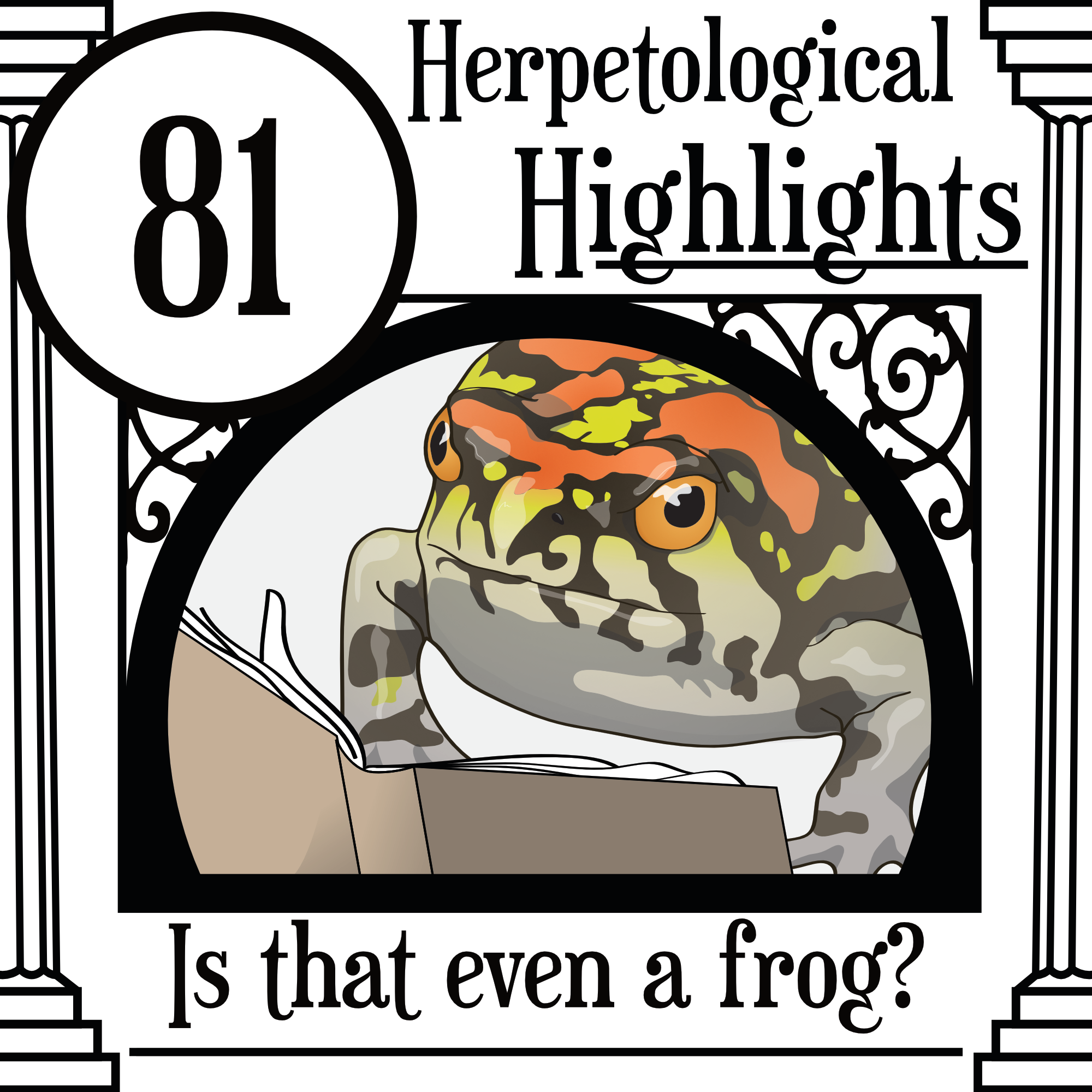
Ep 81081 Is that even a frog?
Frogs come in all shapes and sizes, but some frogs are particularly odd. Rain frogs with their globus bodies are the topic for this episode. Why are they living with mole-rats? And what do people living side-by-side with them think? Species of the Bi-week is a fresh rain frog, with remarkable colour variation. Become a Patreon: https://www.patreon.com/herphighlights FULL REFERENCE LIST AVAILABLE AT: herphighlights.podbean.com Main Paper References: Brom P, Anderson P, Channing A, Underhill LG. 2020. The role of cultural norms in shaping attitudes towards amphibians in Cape Town, South Africa. PLOS ONE 15:e0219331. DOI: 10.1371/journal.pone.0219331. Šklíba J, Jirků M, Šumbera R. 2016. Burrow systems of mole-rats as refuges for frogs in the Miombo woodlands of south-east Africa. Journal of Tropical Ecology 32:158–161. DOI: 10.1017/S0266467415000644. Species of the Bi-Week: Nielsen SV, Conradie W, Ceríaco LMP, Bauer AM, Heinicke MP, Stanley EL, Blackburn DC. 2020. A new species of Rain Frog (Brevicipitidae, Breviceps) endemic to Angola. ZooKeys 979:133–160. DOI: 10.3897/zookeys.979.56863. Other Links/Mentions: Voices of Missouri's Toads and Frogs (1985) by Missouri Department of Conservation - https://www.youtube.com/watch?v=uDf_GLpC3uQ&feature=youtu.be&ab_channel=mooutdoors Music: Intro/outro – Treehouse by Ed Nelson Species Bi-week theme – Mike Mooney Other Music – The Passion HiFi, www.thepassionhifi.com
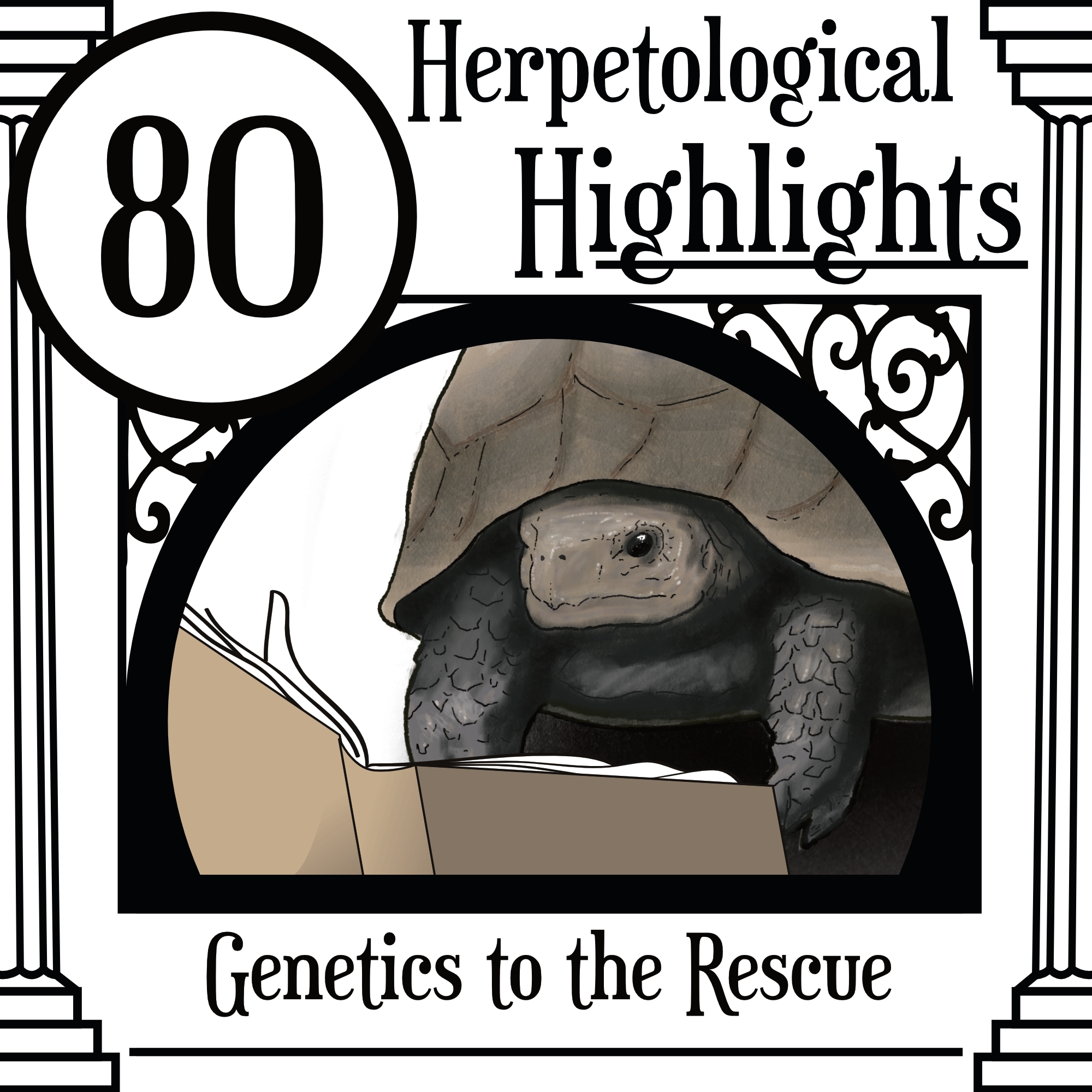
Ep 80080 Genetics to the Rescue
Hello 2021! We are back and this time discussing genetic rescue - can isolated, dwindling populations be assisted by adding individuals from elsewhere? After that, our Species of the Bi-Week has a dewlap but it isn't an anole. Become a Patreon: https://www.patreon.com/herphighlights FULL REFERENCE LIST AVAILABLE AT: herphighlights.podbean.com Main Paper References: Madsen, T., Loman, J., Anderberg, L., Anderberg, H., Georges, A., & Ujvari, B. (2020). Genetic rescue restores long-term viability of an isolated population of adders (Vipera berus). Current Biology, 30(21), R1297–R1299. https://doi.org/10.1016/j.cub.2020.08.059 Scott, P. A., Allison, L. J., Field, K. J., Averill-Murray, R. C., & Shaffer, H. B. (2020). Individual heterozygosity predicts translocation success in threatened desert tortoises. Science, 370(6520), 1086–1089. https://doi.org/10.1126/science.abb0421 Species of the Bi-Week: Sadasivan, K., Ramesh, M. B., Palot, M. J., Ambekar, M., & Mirza, Z. A. (2018). A new species of fan-throated lizard of the genus Sitana Cuvier, 1829 from coastal Kerala, southern India. Zootaxa, 4374(4), 545–564. https://doi.org/10.11646/zootaxa.4374.4.5 Other Mentioned Papers/Studies: Asad, S., Abrams, J. F., Guharajan, R., Sikui, J., Wilting, A., & Rödel, M. O. (2020). Stream Amphibian Detectability and Habitat Associations in a Reduced Impact Logging Concession in Malaysian Borneo. Journal of Herpetology, 54(4), 385-392. Read free here: https://bit.ly/2JoXJz7 Marshall, B. M. & Strine, C. (2021). Make like a glass frog: In support of increased transparency in herpetology. Herpetological Journal. 31, 35-45. Read free here: https://bit.ly/35J8W5L Kyriazis, C. C., Wayne, R. K., & Lohmueller, K. E. (2020). Strongly deleterious mutations are a primary determinant of extinction risk due to inbreeding depression. Evolution Letters. https://doi.org/10.1002/evl3.209 Music: Intro/outro – Treehouse by Ed Nelson Species Bi-week theme – Mike Mooney Other Music – The Passion HiFi, www.thepassionhifi.com
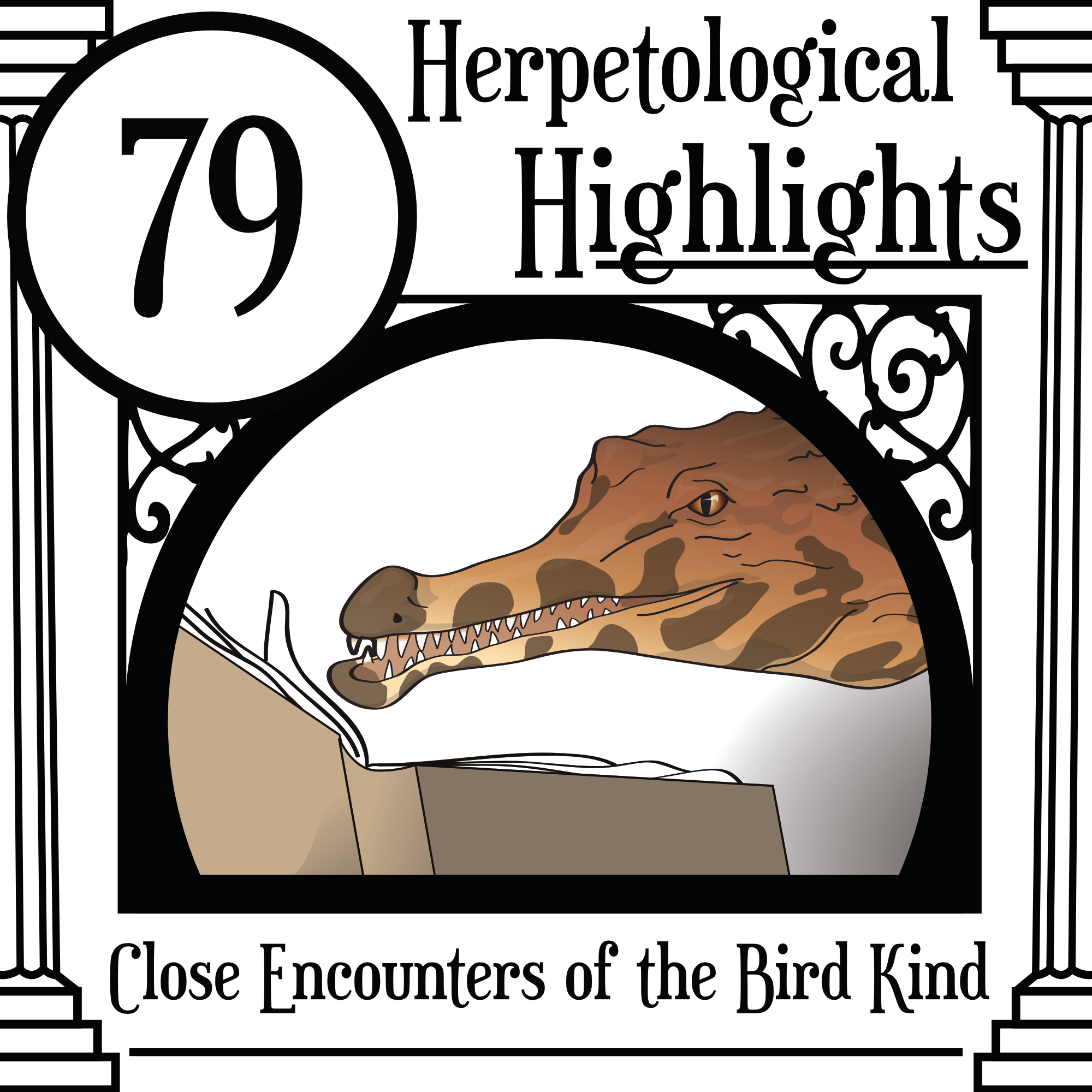
Ep 79079 Close Encounters of the Bird Kind
This week’s episode is a bit jumbled as we focus on whether birds are using alligators to help protect nests. For the Species of the Bi-week we have a tiny tiny toad. Become a Patreon: https://www.patreon.com/herphighlights FULL REFERENCE LIST AVAILABLE AT: herphighlights.podbean.com Main Paper References: Burtner BF, Frederick PC. 2017. Attraction of Nesting Wading Birds to Alligators (Alligator mississippiensis). Testing the ‘Nest Protector’ Hypothesis. Wetlands 37:697–704. DOI: 10.1007/s13157-017-0900-x. Species of the Bi-Week: Li S-Z, Liu J, Wei G, Wang B. 2020. A new species of the Asian leaf litter toad genus Leptobrachella (Amphibia, Anura, Megophryidae) from southwest China. ZooKeys 943:91–118. DOI: 10.3897/zookeys.943.51572. Other Links/Mentions: Alligator eating ducks: https://bit.ly/36VyJZi Alligators regrowing tails: https://bit.ly/3lXtz3k Music: Intro/outro – Treehouse by Ed Nelson Species Bi-week theme – Mike Mooney Other Music – The Passion HiFi, www.thepassionhifi.com
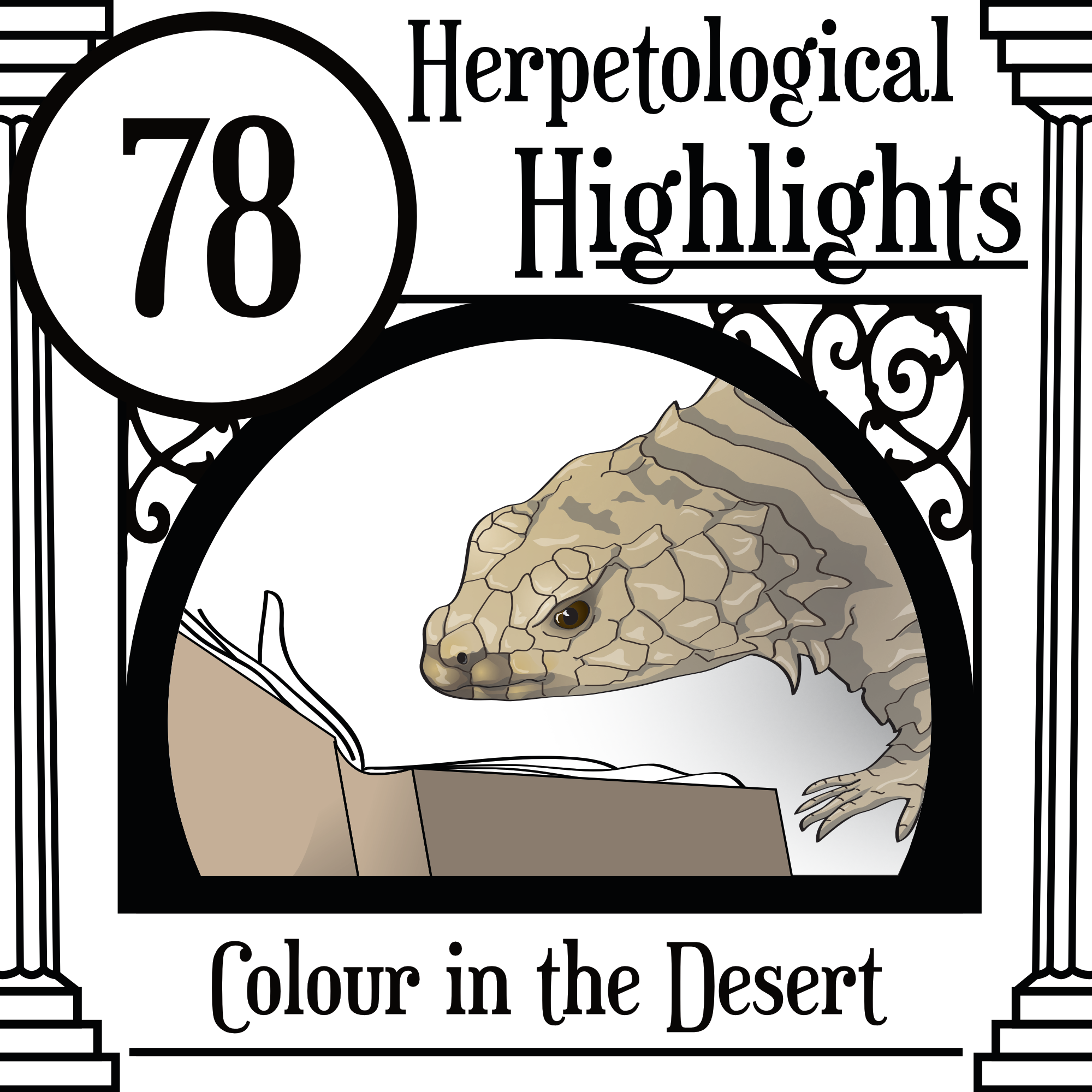
Ep 78078 Colour in the Desert
Greater earless lizards use their tail for all manner of things - but how has this shaped its evolution? We delve into this mystery and find out how horny toads (the lizards) cope with life at hot and cold extremes. Our Species of the Bi-Week is a colourful new desert dweller. Ross McGibbon's 2021 calendar: https://bit.ly/3f93mgp Become a Patreon: https://www.patreon.com/herphighlights FULL REFERENCE LIST AVAILABLE AT: herphighlights.podbean.com Main Paper References: Gilbert, A. L., Brooks, O. L., & Lattanzio, M. S. (2020). Multiple behavioral contexts of a melanized tail display in a desert lizard. Ethology, 126(3), 333–343. https://doi.org/10.1111/eth.12975 Parlin, A. F., Schaeffer, P. J., & Jezkova, T. (2020). Modelling the effect of environmental temperatures, microhabitat and behavioural thermoregulation on predicted activity patterns in a desert lizard across its thermally diverse distribution. Journal of Biogeography, January, 1–13. https://doi.org/10.1111/jbi.13936 Species of the Bi-Week: Huamani-Valderrama, L., Quiroz, A., Gutiérrez, R., Aguilar-Kirigin, A., Huanca-Mamani, W., Valladares-Faundez, P., Cerdeña, J., Chaparro, J. C., Santa-Cruz, R., & Abdala, C. S. (2020). Some color in the desert: description of a new species of Liolaemus (Iguania : Liolaemidae) from southern Peru, and its conservation status. Amphibian & Reptile Conservation, 14(3), 1–30. Other Mentioned Papers/Studies: Outomuro, D., Söderquist, L., Nilsson‐Örtman, V., Cortázar‐Chinarro, M., Lundgren, C., & Johansson, F. (2016). Antagonistic natural and sexual selection on wing shape in a scrambling damselfly. Evolution, 70(7), 1582–1595. https ://doi.org/10.1111/evo.12951 Other Links/Mentions: David, P., Vogel, G., & Dubois, A. (2011). On the need to follow rigorously the Rules of the Code for the subsequent designation of a nucleospecies (type species) for a nominal genus which lacked one: the case of the nominal genus Trimeresurus Lacépède, 1804 (Reptilia: Squamata: Viperidae). Zootaxa, 2992(1), 1-51. Hasson, O., Hibbard, R., & Ceballos, G. (1989). The pursuit deterrent function of tail‐wagging in the zebra‐tailed lizard (Callisaurus dra‐ conoides). Canadian Journal of Zoology, 67(5), 1203–1209. https://doi.org/10.1139/z89‐174 Outomuro, D., Söderquist, L., Nilsson‐Örtman, V., Cortázar‐Chinarro, M., Lundgren, C., & Johansson, F. (2016). Antagonistic natural and sexual selection on wing shape in a scrambling damselfly. Evolution, 70(7), 1582–1595. https ://doi.org/10.1111/evo.12951 Music: Intro/outro – Treehouse by Ed Nelson Species Bi-week theme – Mike Mooney Other Music – The Passion HiFi, www.thepassionhifi.com

Ep 77077 Battle Frogs
A rainy night in a tropical forest; the sound of frog battle calls ring out –but who will be victorious? This episode we dive into the details of frog battles for supremacy, where tiny strawberry frogs of all colours are fierce combatants. Become a Patreon: https://www.patreon.com/herphighlights FULL REFERENCE LIST AVAILABLE AT: herphighlights.podbean.com Main Paper References: Magalhães, R. F. de, Lacerda, J. V. A., Reis, L. de P., Garcia, P. C. A., & Pinheiro, P. D. P. (2018). Sexual Dimorphism in Bokermannohyla martinsi (Bokermann, 1964) (Anura, Hylidae) with a Report of Male–Male Combat. South American Journal of Herpetology, 13(2), 202. doi: 10.2994/SAJH-D-17-00039.1 Yang, Y., Prémel, V., & Richards‐Zawacki, C. L. (2020). Prior residence effect determines success of male–male territorial competition in a color polymorphic poison frog. Ethology, eth.13093. doi: 10.1111/eth.13093 Species of the Bi-Week: Rowley, J. J. L., Le, D. T. T., Hoang, H. D., Cao, T. T., & Dau, V. Q. (2020). A new species of phytotelm breeding frog (Anura: Rhacophoridae) from the Central Highlands of Vietnam. Zootaxa, 4779(3), 341–354. doi: 10.11646/zootaxa.4779.3.3 Other Mentioned Papers/Studies: Farnsworth, E. J., Chu, M., Kress, W. J., Neill, A. K., Best, J. H., Pickering, J., … Ellison, A. M. (2013). Next-generation field guides. BioScience, 63(11), 891–899. doi: 10.1525/bio.2013.63.11.8 Maritz, R. A., & Maritz, B. (2020). Sharing for science: High-resolution trophic interactions revealed rapidly by social media. PeerJ, 8, e9485. doi: 10.7717/peerj.9485 Nali, R. C., & Prado, C. P. (2014). The fight call of Bokermannohyla ibitiguara (Anura: Hylidae): first record for the genus. Salamandra, 50(3), 181-184. Music: Intro/outro – Treehouse by Ed Nelson Species Bi-week theme – Mike Mooney Other Music – The Passion HiFi, www.thepassionhifi.com
Ep 76076 Green Pit Viper Special
They don't come greener than this - but what are they up to? We discuss the behaviour of some (mostly green) pit vipers, and we even have a brand new green species. Become a Patreon: https://www.patreon.com/herphighlights FULL REFERENCE LIST AVAILABLE AT: herphighlights.podbean.com Main Paper References: Strine, C., Brown, A., Barnes, C., Major, T., Artchawakom, T., Hill, J., & Suwanwaree, P. (2018). Arboreal mating behaviors of the big-eyed green pit viper (Trimeresurus macrops) in Northeast Thailand (Reptilia: Viperidae). Current Herpetology, 37(1), 81–87. https://doi.org/10.5358/hsj.37.81 Barnes, C. H., Farren, W., Strine, C. T., & Suwanwaree, P. (2020). Social behavior displayed by the Green Pit Viper Trimeresurus (Cryptelytrops) macrops. Tropical Natural History, 20(1), 95–103. Bhaisare, D., & Pelling, E. (2015). Trimeresurus malabaricus (Malabar pit viper): Diving behaviour and underwater apnoea duration. Herpetological Bulletin, 134, 33–34. Species of the Bi-Week: Chen, Z., Yu, J., Vogel, G., Shi, S., Song, Z., Tang, Y., Yang, J., Ding, L., & Chen, C. (2020). A new pit viper of the genus Trimeresurus (Lacépède, 1804) (Squamata: Viperidae) from Southwest China. Zootaxa, 4768(1), 112–128. https://doi.org/10.11646/zootaxa.4768.1.7 Other Links/Mentions: Wildlife laundering through breeding farms: https://www.sciencedirect.com/science/article/abs/pii/S0006320711003685 Turtle laundering presentation (Starts at 1h50): https://www.youtube.com/watch?v=rCMDKzhzkwU Music: Intro/outro – Treehouse by Ed Nelson Species Bi-week theme- Mike Mooney Other Music – The Passion HiFi, www.thepassionhifi.com

Ep 75075 Trading Blows and Trading Reptiles
In a mixed episode, we explore some gruesome ways to eat a toad practiced by kukri snakes, how the reptile trade looks to be a lot larger than what international trade databases report, and the description of a new cylindrical snake. Become a Patreon: https://www.patreon.com/herphighlights FULL REFERENCE LIST AVAILABLE AT: herphighlights.podbean.com Main Paper References: Bringsøe, H., Suthanthangjai, M., Suthanthangjai, W., & Nimnuam, K. (2020). Eviscerated alive: Novel and macabre feeding strategy in Oligodon fasciolatus (Günther, 1864) eating organs of Duttaphrynus melanostictus (Schneider, 1799) in Thailand. Herpetozoa, 33, 157. Marshall, BM., Strine, CT., Hughes, AC. (2020). Thousands of reptile species threatened by under-regulated global trade. Nature Communications, DOI: 10.1038/s41467-020-18523-4 Species of the Bi-Week: Bernstein, J. M., Bauer, A. M., Mcguire, J. A., Arida, E., Kaiser, H., Kieckbusch, M., & Mecke, S. (2020). Molecular phylogeny of Asian pipesnakes, genus Cylindrophis Wagler, 1828 (Squamata: Cylindrophiidae), with the description of a new species from Myanmar. Zootaxa, 4851(3), 535-558. Other Links/Mentions: Ball python trade: https://www.nationalgeographic.com/animals/2020/03/ball-pythons-west-africa-exports/ HERpers facebook page: https://www.facebook.com/groups/2741262562643265/?ref=share Happy Hour Field Guides Podcast: https://www.bourassawildlife.com/podcast/1-the-pandemic Music: Intro/outro – Treehouse by Ed Nelson Species Bi-week theme – Mike Mooney Other Music – The Passion HiFi, www.thepassionhifi.com
Ep 74074 Actual Cannibal Salamanders
This bi-week we are talking about some underwater cannibals, with a very stylish new species of salamander thrown in too. We also answer a patreon question about arboreal snakes, and how they avoid blood rushing out of their heads. Become a Patreon: https://www.patreon.com/herphighlights FULL REFERENCE LIST AVAILABLE AT: herphighlights.podbean.com Main Paper References: McLean, K. I., Stockwell, C. A., & Mushet, D. M. (2016). Cannibalistic-morph Tiger Salamanders in Unexpected Ecological Contexts. The American Midland Naturalist, 175(1), 64-72. Species of the Bi-Week: Palacios-Aguilar, R., Cisneros-Bernal, A. Y., Arias-Montiel, J. D., & Parra-Olea, G. (2020). A new species of Bolitoglossa (Amphibia: Plethodontidae) from the central highlands of Guerrero, Mexico. Canadian Journal of Zoology, 98(6), 359-365. Other Mentioned Papers/Studies: Seymour, R. S., & Lillywhite, H. B. (1976). Blood pressure in snakes from different habitats. Nature, 264(5587), 664-666. Seymour, R. S., & Arndt, J. O. (2004). Independent effects of heart–head distance and caudal blood pooling on blood pressure regulation in aquatic and terrestrial snakes. Journal of experimental biology, 207(8), 1305-1311. Music: Intro/outro – Treehouse by Ed Nelson Species Bi-week theme- Mike Mooney Other Music – The Passion HiFi, www.thepassionhifi.com
Ep 73073 Lizards of the Night
Lizards of the night - Night lizards - Xantusiidae. We take a close look at the genetics of the island night lizards, and explore some new options for reptile home range estimations. Luck would have it, a new night lizard is our Species of the Bi-week. FULL REFERENCE LIST AVAILABLE AT: herphighlights.podbean.com Main Paper References: O’Donnell RP, Drost CA, Fellers GM, Crabb BA, Mock KE. 2018. Rare long-distance dispersal of the Island Night Lizard, Xantusia riversiana, maintains high diversity in a fragmented environment. Conservation Genetics 19:803–814. DOI: 10.1007/s10592-018-1055-x. Silva I, Crane M, Marshall BM, Strine CT. 2020. Revisiting reptile home ranges: moving beyond traditional estimators with dynamic Brownian Bridge Movement Models. bioRxiv:23. DOI: 10.1101/2020.02.10.941278. Species of the Bi-Week: Palacios-Aguilar R, Santos-Bibiano R, Flores-Villela O. 2018. A New Species of Lepidophyma (Squamata: Xantusiidae) from the Pacific Lowlands of Guerrero, Mexico. Journal of Herpetology 52:327–331. DOI: 10.1670/17-061. Other Mentioned Papers/Studies: Fellers GM, Drost CA. 1991. Ecology of the island night lizard, Xantusia riversiana, on Santa Barbara Island, California. Herpetological Monographs 5:28–78. Noonan MJ, et al. 2020. Effects of body size on estimation of mammalian area requirements. Conservation Biology:cobi.13495. DOI: 10.1111/cobi.13495. Music: Intro/outro – Treehouse by Ed Nelson Species Bi-week theme- Mike Mooney Other Music – The Passion HiFi, www.thepassionhifi.com
Ep 72072 Sidewinders Sighting Sites
Sidewinders, how do they go about life? From their hunting techniques, to how they view the landscape around them, this episode delves into the lives of these iconic vipers. Our Species of the Bi-Week is of course a recently described viper. FULL REFERENCE LIST AVAILABLE AT: herphighlights.podbean.com Main Paper References: Clark RW, Dorr SW, Whitford MD, Freymiller GA, Putman BJ. (2016) Activity cycles and foraging behaviors of free-ranging sidewinder rattlesnakes (Crotalus cerastes): The ontogeny of hunting in a precocial vertebrate. Zoology 119, 196–206. (doi:10.1016/j.zool.2016.02.005) Schraft HA, Bakken GS, Clark RW. (2019) Infrared-sensing snakes select ambush orientation based on thermal backgrounds. Scientific Reports. 9, 1–6. (doi:10.1038/s41598-019-40466-0) Species of the Bi-Week: Sumontha M et al. 2020 Protobothrops kelomohy sp. nov. (Squamata : Viperidae), the Second Known Species of Lance-Headed Pit Viper from Thailand. Tropical Natural History 20, 43–59. Other Mentioned Papers/Studies: Link to Tom’s marking snakes with VIE study: https://bit.ly/2ZNzUGA Other Links/Mentions: Sidewinder videos: Video 1 http://youtu.be/AmGn3eESJkg Video 2 http://youtu.be/pPF0Wupl3lE Video 3 http://youtu.be/N2Nf8uMOZ2c Video 4 http://youtu.be/Jl8Ma7GMLks Video 5 http://youtu.be/epwYN9qp2TI Video 6 http://youtu.be/hREihZCiCd8 Video 7 http://youtu.be/BLLoYSz7DiI Eyewitness doc on reptiles: https://www.youtube.com/watch?v=PuyQsHWpBDQ Music: Intro/outro – Treehouse by Ed Nelson Species Bi-week theme- Mike Mooney Other Music – The Passion HiFi, www.thepassionhifi.com
Ep 71071 Don’t count your Sand Boas before they hatch
Like many a fossorial snake, Sand Boas hold many surprises; this episode we explore some of those. First, an investigation into Dollo’s “Law”, then a couple of natural history notes providing some insight into Sand Boa diets. FULL REFERENCE LIST AVAILABLE AT: herphighlights.podbean.com Main Paper References: Lobo, J. V., & Streepada, K. S. (2015). First report on Whitaker’s boa Eryx whitakeri feeding on common vine snake. Reptile Rap, 17. Londei, T. (2015). Arabian sand boa Eryx jayakari (Squamata: Boidae) preying on Arabian toad-headed agama Phrynocephalus arabicus (Squamata: Agamidae): A nocturnal-to-diurnal species interaction. Herpetology Notes, 8, 155–15. Lynch, V. J., & Wagner, G. P. (2010). Did Egg-laying Boas Break Dollo’s Law? Phylogenetic Evidence For Reversal To Oviparity In Sand Boas (Eryx: Boidae). Evolution, 64(1), 207–216. doi: 10.1111/j.1558-5646.2009.00790.x Species of the Bi-Week: Nguyen, H. N., Tran, B. V., Nguyen, L. H., Neang, T., Yushchenko, P. V., & Poyarkov, N. A. (2020). A new species of Oligodon Fitzinger, 1826 from the Langbian Plateau, southern Vietnam, with additional information on Oligodon annamensis Leviton, 1953 (Squamata: Colubridae). PeerJ, 8, e8332. doi: 10.7717/peerj.8332 Other Mentioned Papers/Studies: Laird, M. K., Thompson, M. B., & Whittington, C. M. (2019). Facultative oviparity in a viviparous skink (Saiphos equalis). Biology Letters, 15(4), 20180827. doi: 10.1098/rsbl.2018.0827 Recknagel, H., Kamenos, N. A., & Elmer, K. R. (2018). Common lizards break Dollo’s law of irreversibility: genome-wide phylogenomics support a single origin of viviparity and re-evolution of oviparity. Molecular Phylogenetics and Evolution, 127, 579-588. Music: Intro/outro – Treehouse by Ed Nelson Other Music – The Passion HiFi, www.thepassionhifi.com

Ep 70070 Amphisbaenian Appetites
In this Patreon special episode we delve into the underground lives of the ultimate oddities - worm lizards. Find out how they go about tackling their invertebrate prey, and hear about a brand new species. FULL REFERENCE LIST AVAILABLE AT: herphighlights.podbean.com Main Paper References: Baeckens, S., García‐Roa, R., Martín, J., Ortega, J., Huyghe, K., & Van Damme, R. (2017). Fossorial and durophagous: implications of molluscivory for head size and bite capacity in a burrowing worm lizard. Journal of Zoology, 301(3), 193-205. López, P., Martín, J., & Salvador, A. (2013). Flexibility in feeding behaviour may compensate for morphological constraints of fossoriality in the amphisbaenian Blanus cinereus. Amphibia-Reptilia, 34(2), 241-247. Species of the Bi-Week: De Almeida, J. P. F. A., De Freitas, M. A., Da Silva, M. B., Valverde, M. C. C., Rodrigues, M. T., Pires, A. M., & Mott, T. (2018). A new four-pored Amphisbaena (Squamata: Amphisbaenidae) from northeastern Brazil. Zootaxa, 4514(4), 553-562. Other Mentioned Papers/Studies: Martín, J., Polo-Cavia, N., Gonzalo, A., López, P., & Civantos, E. (2012). Sexual dimorphism in the North African amphisbaenian Trogonophis wiegmanni. Journal of Herpetology, 46(3), 338-341. Other Links/Mentions: https://in2scienceuk.org/ Fundraiser for Ciliwung Herpetarium: https://bit.ly/3fJw6vj www.herpetofaunaindonesia.org https://www.youtube.com/watch?v=4Mronxhn2sU Amphisbaenia alba https://www.youtube.com/watch?v=LoyrON_kGKw Amphisbaena fuliginosa Music: Intro/outro – Treehouse by Ed Nelson Species of the Bi-Week theme - Mike Mooney Other Music – The Passion HiFi, www.thepassionhifi.com

Ep 69069 Freezing Frogs
We’re back and exploring the toughest of frogs; those frogs braving the harsh northern conditions that literally freezes them to the bone. How do they manage this incredible feat? We head south for a Species of the Bi-week because not all frogs are as tough as the Wood Frog. FULL REFERENCE LIST AVAILABLE AT: herphighlights.podbean.com Main Paper References: Costanzo JP. 2019. Overwintering adaptations and extreme freeze tolerance in a subarctic population of the wood frog, Rana sylvatica. Journal of Comparative Physiology B 189:1–15. DOI: 10.1007/s00360-018-1189-7. Storey KB, Storey JM. 2017. Molecular Physiology of Freeze Tolerance in Vertebrates. Physiological Reviews 97:623–665. DOI: 10.1152/physrev.00016.2016. Species of the Bi-Week: Catenazzi A, Ttito A. 2019. Noblella thiuni sp. n., a new (singleton) species of minute terrestrial-breeding frog (Amphibia, Anura, Strabomantidae) from the montane forest of the Amazonian Andes of Puno, Peru. PeerJ 7:e6780. DOI: 10.7717/peerj.6780. Other Mentioned Papers/Studies: Ward M, Marshall BM, Hodges C, Montano Y, Artchawakom T, Waengsothorn S, Strine C. 2020. Nonchalant neighbours: Space use and overlap of the critically endangered elongated tortoise. OSF Preprints. DOI: 10.31219/osf.io/t34ax. Music: Intro/outro – Treehouse by Ed Nelson Other Music – The Passion HiFi, www.thepassionhifi.com
Ep 68068 Hoplocephalus with Scott Eipper
We had the good fortune to be joined by herpetologist and author Scott Eipper for this special episode on Hoplocephalus. We also talk about Scott and his wife Tie’s new book on Aussie snakes, and of course we have a Species of the Bi-Week - this one is a robust new sand dweller. Grab the new book by Scott and Tie Eipper here: https://bit.ly/2WewX0a FULL REFERENCE LIST AVAILABLE AT: herphighlights.podbean.com Main Paper References: Shelton, M. B., Goldingay, R. L., & Phillips, S. S. (2018). Population ecology of a cryptic arboreal snake (Hoplocephalus bitorquatus). Australian Journal of Zoology, 65(6), 383-390. Species of the Bi-Week: Eskandarzadeh, N. et al. (2020) A new species of Eryx (Serpentes: Erycidae) from Iran. Zootaxa, 4767, 182-192. Other Mentioned Papers/Studies: Mirza, Z. A., Bhosale, H. S., Phansalkar, P. U., Sawant, M., Gowande, G. G., & Patel, H. (2020). A new species of green pit vipers of the genus Trimeresurus Lacépède, 1804 (Reptilia, Serpentes, Viperidae) from western Arunachal Pradesh, India. Zoosystematics and Evolution, 96, 123. Music: Intro/outro – Treehouse by Ed Nelson Other Music – The Passion HiFi, www.thepassionhifi.com
Ep 67067 Flipping Frogs
A selection of papers are discussed in this episode. Starting with a big finding from Central America on the fate of snakes post-frog loss, and ending with a pair of more lighthearted natural history notes. Species of the Bi-week returns with a serpentine ocean dweller. FULL REFERENCE LIST AVAILABLE AT: herphighlights.podbean.com Main Paper References: Anderson, C. V., & Liebl L. A. (2019) MICRURUS ALLENI (Allen’s Coralsnake). DIET. Herpetological Review 50(1), 162-163 Paniagua K. S. & Abarca J. G. (2016). Thanatosis in four poorly known toads of the genus Incilius from the highlands of Costa Rica. Mesoamerican Herpetology 3(1), 135–140. Zipkin, E. F., DiRenzo, G. V., Ray, J. M., Rossman, S., & Lips, K. R. (2020). Tropical snake diversity collapses after widespread amphibian loss. Science, 367(6479), 814-816. Species of the Bi-Week: Nankivell, J. H., Goiran, C., Hourston, M., Shine, R., Rasmussen, A. R., Thomson, V. A., & Sanders, K. L. (2020). A new species of turtle-headed sea Snake (Emydocephalus: Elapidae) endemic to Western Australia. Zootaxa, 4758(1), 141–156. https://doi.org/10.11646/zootaxa.4758.1.6 Other Mentioned Papers/Studies: Arias-Piedra, E., & Chaves-Cordero, G. A. (2013). Dermophis glandulosus. Predation by Micrurus alleni. Dermophis glandulosus. Depredación por Micrurus alleni. Herpetological Review., 44(4), 657-658. Fernández, J., Vargas-Vargas, N., Pla, D., Sasa, M., Rey-Suárez, P., Sanz, L., ... & Lomonte, B. (2015). Snake venomics of Micrurus alleni and Micrurus mosquitensis from the Caribbean region of Costa Rica reveals two divergent compositional patterns in New World elapids. Toxicon, 107, 217-233. Marshall BM, Strine CT. 2020. Make like a glass frog: In support of increased transparency in herpetology. OSF Preprints. DOI: 10.31219/osf.io/74frd. Montgomery, C. E., Lips, K. R., & Ray, J. M. (2011). Ontogenetic shift in height of sleeping perches of Cope's Vine Snake, Oxybelis brevirostris. The Southwestern Naturalist, 358-362. Music: Intro/outro – Treehouse by Ed Nelson Other Music – The Passion HiFi, www.thepassionhifi.com

Ep 66066 Chelonian Sniffing Canines
Reptiles and amphibians are hard to find, so how can you be sure you haven’t missed any? We explore some reptile detectives, some of which are good boys. The Species of the Bi-Week is coming at you from the rainforests of Sri Lanka. FULL REFERENCE LIST AVAILABLE AT: herphighlights.podbean.com Main Paper References: Boback, S. M., Nafus, M. G., Yackel Adams, A. A., & Reed, R. N. (2020). Use of visual surveys and radiotelemetry reveals sources of detection bias for a cryptic snake at low densities. Ecosphere, 11(1). https://doi.org/10.1002/ecs2.3000 Jean-Marie, B., Raphael, G., Fabien, R., Aurélien, B., Sébastien, C., Nicolas, B., & Xavier, B. (2019). Excellent performances of dogs to detect cryptic tortoises in Mediterranean scrublands. Biodiversity and Conservation, 28(14), 4027–4045. https://doi.org/10.1007/s10531-019-01863-z Species of the Bi-Week: Wickramasinghe, L. J. M., Vidanapathirana, D. R., Pushpamal, V., & Wickramasinghe, N. (2020). A new species of Dryocalamus (Serpentes: Colubridae) endemic to the rainforests of southwestern Sri Lanka. Zootaxa, 4748(2), 248–260. https://doi.org/10.11646/zootaxa.4748.2.2 Other Mentioned Papers/Studies: King cobra preprint: https://www.biorxiv.org/content/10.1101/2020.03.24.006676v1 Egg swallowing bridle snake: https://www.researchgate.net/figure/A-inserting-the-upper-jaw-from-the-punctured-point-of-the-shell-B-C-swallowing-the_fig1_327623312 Music: Intro/outro – Treehouse by Ed Nelson Other Music – The Passion HiFi, www.thepassionhifi.com
Ep 65065 Viper X Toad
This episode we take a look at the Gaboon Viper… or is that a toad? Looking at a couple of papers, we check out the characteristics of Gaboon Viper skin, and how a smart toad may be harnessing the looks of a viper to stay safe. Species of the Bi-week returns and continues our African toad journey. FULL REFERENCE LIST AVAILABLE AT: herphighlights.podbean.com Main Paper References: Spinner M, Gorb SN, Balmert A, Bleckmann H, Westhoff G. (2014). Non-Contaminating Camouflage: Multifunctional Skin Microornamentation in the West African Gaboon Viper (Bitis rhinoceros). PLoS ONE 9:e91087. DOI: 10.1371/journal.pone.0091087. Vaughan ER, Teshera MS, Kusamba C, Edmonston TR, Greenbaum E. (2019). A remarkable example of suspected Batesian mimicry of Gaboon Vipers (Reptilia: Viperidae: Bitis gabonica) by Congolese Giant Toads (Amphibia: Bufonidae: Sclerophrys channingi). Journal of Natural History 53:1853–1871. DOI: 10.1080/00222933.2019.1669730. Species of the Bi-Week: Ceríaco LMP, Marques MP, Bandeira S, Agarwal I, Stanley EL, Bauer AM, Heinicke MP, Blackburn DC. (2018). A new earless species of Poyntonophrynus (Anura, Bufonidae) from the Serra da Neve Inselberg, Namibe Province, Angola. ZooKeys 780:109–136. DOI: 10.3897/zookeys.780.25859. Other Mentioned Papers/Studies: Spinner M, Kovalev A, Gorb SN, Westhoff G (2013) Snake velvet black: hierarchical micro- and nanostructure enhances dark colouration in Bitis rhinoceros. Scientific Reports 3: 1846. doi: 10.1038/srep01846 Penner J, Fruteau C, Range F, Rödel M-O. (2008). Finding a needle in a haystack: new methods of locating and working with rhinoceros vipers (Bitis rhinoceros). Herpetological Review 39:310–314. Wittenberg, R.D., Jadin, R.C., Fenwick, A.M. et al. (2015). Recovering the evolutionary history of Africa’s most diverse viper genus: morphological and molecular phylogeny of Bitis (Reptilia: Squamata: Viperidae). Organisms Diversity and Evolution 15, 115–125 https://doi.org/10.1007/s13127-014-0185-3 Music: Intro/outro – Treehouse by Ed Nelson Other Music – The Passion HiFi, www.thepassionhifi.com
Ep 64064 The Art of Turtle War
Painted turtles - cute, and brightly coloured, but are they harbouring a dark secret? We first discuss identifying their gender, followed by talk of some unusual behaviour. Our Species of the Bi-Week is an Angolan lizard. Main Paper References: Moldowan, P. D., Brooks, R. J., & Litzgus, J. D. (2017). Assessing head morphology dimorphism in the Midland Painted Turtle (Chrysemys picta marginata) using a photographic questionnaire. Chelonian Conservation and Biology, 16(1), 76-82. Moldowan, P. D., Brooks, R. J., & Litzgus, J. (2020). Demographics of injuries indicate sexual coercion in a population of Painted Turtles (Chrysemys picta). Canadian Journal of Zoology, (ja). Species of the Bi-Week: Branch, W. R., Conradie, W., & Vaz Pinto, P. (2020). Another Angolan Namib endemic species: a new Nucras Gray, 1838 (Squamata: Lacertidae) from south-western Angola. Amphibian and Reptile Conservation, 13(2), 82–95 (e199). Other Mentioned Papers/Studies: Hawkshaw, D. M., Moldowan, P. D., Litzgus, J. D., Brooks, R. J., & Rollinson, N. (2019). Discovery and description of a novel sexual weapon in the world’s most widely-studied freshwater turtle. Evolutionary Ecology, 33(6), 889-900. Silva, I., Crane, M., Marshall, B. M., & Strine, C. T. (2020). Revisiting reptile home ranges: moving beyond traditional estimators with dynamic Brownian Bridge Movement Models. BioRxiv, 23. doi:10.1101/2020.02.10.941278 Other Links/Mentions: Sexing dolphins by their fins: https://www.nature.com/news/2008/081013/full/news.2008.1166.html Music: Intro/outro – Treehouse by Ed Nelson Other Music – The Passion HiFi, www.thepassionhifi.com
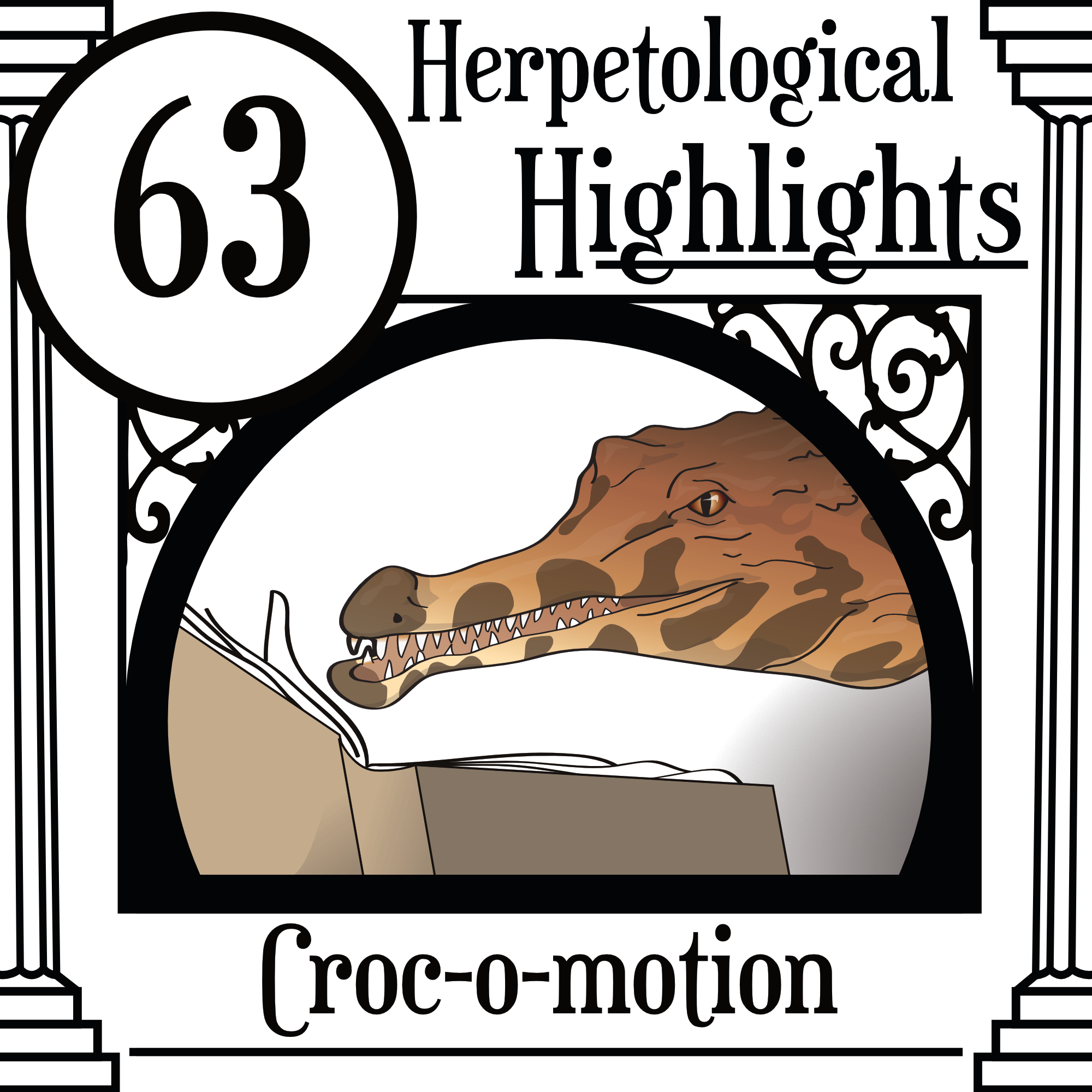
Ep 63063 Croc-o-motion
Crocodiles! What are they doing, running about, biting bones… We take a look at a couple of papers: one examining just how they run, the other examining their role in the study of fossil bones. Species of the Bi-week is back and we finally give the newly rediscovered caiman sub-species the attention it deserves…. And a bonus species! FULL REFERENCE LIST AVAILABLE AT: herphighlights.podbean.com Main Paper References: Domínguez-Rodrigo, M., & Baquedano, E. (2018). Distinguishing butchery cut marks from crocodile bite marks through machine learning methods. Scientific Reports, 8(1), 5786. doi:10.1038/s41598-018-24071-1 Hutchinson, J. R., Felkler, D., Houston, K., Chang, Y.-M., Brueggen, J., Kledzik, D., & Vliet, K. A. (2019). Divergent evolution of terrestrial locomotor abilities in extant Crocodylia. Scientific Reports, 9(19302). doi:10.1038/s41598-019-55768-6 Species of the Bi-Week: Balaguera-Reina, S. A. (2019). Rediscovering the Apaporis Caiman (Caiman crocodilus apaporiensis): Notes from a Long-Anticipated Expedition. Journal of Herpetology, 53(4), 310. doi:10.1670/19-028 Other Mentioned Papers/Studies: Sahle, Y., El Zaatari, S. & White, T. D. (2017). Hominid butchers and biting crocodiles in the African Plio–Pleistocene. Proceedings of the National Academy of Sciences. doi:10.1073/pnas.1716317114 Smales, L. R., Allain, S. J. R., Wilkinson, J. W., & Harris, E. (2020). A new species of Pseudoacanthocephalus (Acanthocephala: Echinorhynchidae) from the guttural toad, Sclerophrys gutturalis (Bufonidae), introduced into Mauritius, with comments on the implications of the introductions of toads and their parasites into the UK. Journal of Helminthology, 94. Other Links/Mentions: Cuban crocodile galloping: https://www.youtube.com/watch?v=O78CxqRl7NE Freshwater croc galloping etc: https://www.youtube.com/watch?v=Co7bJlJliEs Crocodilian movement discoveries: https://www.youtube.com/watch?v=TdaH73fD5dY Music: Intro/outro – Treehouse by Ed Nelson Other Music – The Passion HiFi, www.thepassionhifi.com
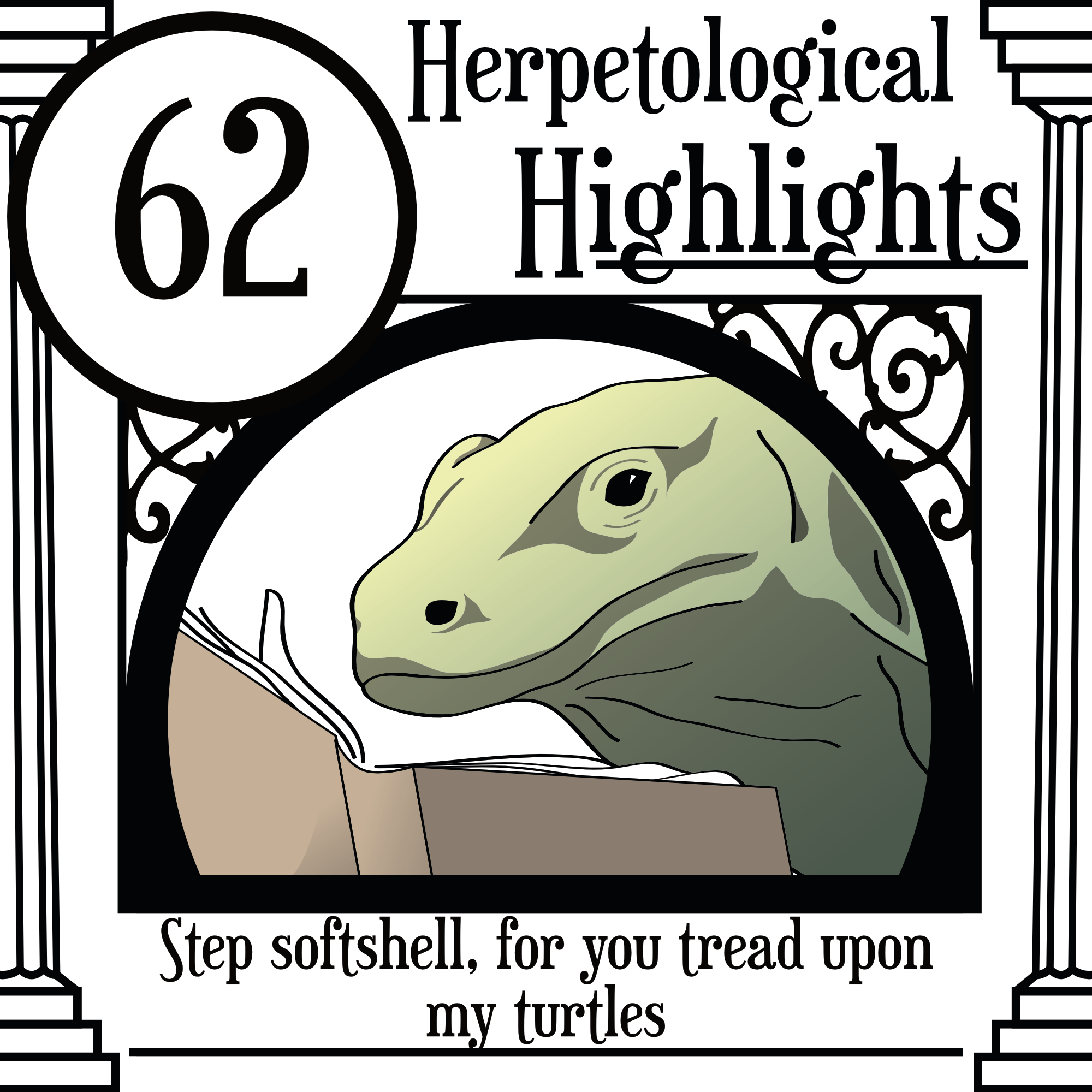
Ep 62062 Step softshell, for you tread upon my turtles
They’re strange, they’re soft, they’re turtles - but where do they go? This episode is all about the comings and goings of softshell turtles living in the rivers of the USA. Species of the Bi-week is back, where we check out a slender character from Laos. FULL REFERENCE LIST AVAILABLE AT: herphighlights.podbean.com Main Paper References: Plummer, M. V., & O’Neal, C. S. (2019). Aerobic Pushups: Cutaneous Ventilation in Overwintering Smooth Softshell Turtles, Apalone mutica. Journal of Herpetology, 53(1), 27. https://doi.org/10.1670/18-038 Ross, J. P., Bluett, R. D., & Dreslik, M. J. (2019). Movement and Home Range of the Smooth Softshell Turtle (Apalone mutica): Spatial Ecology of a River Specialist. Diversity, 11(8), 124. https://doi.org/10.3390/d11080124 Species of the Bi-Week: Luu, V. Q., Bonkowski, M., Nguyen, T. Q., Le, M. D., Calame, T., & Ziegler, T. (2018). A New Species Of Lycodon Boie, 1826 (Serpentes: Colubridae) From Central Laos. Revue Suisse de Zoologie, 125(2), 263–276. https://doi.org/10.5281/ZENODO.1414221 Other Mentioned Papers/Studies: Cahn, A. R. (1937). The turtles of Illinois. Illinois Biological Monographs 16:1–218. Fraser, K. C., Davies, K. T., Davy, C. M., Ford, A. T., Flockhart, D. T. T., & Martins, E. G. (2018). Tracking the conservation promise of movement ecology. Frontiers in Ecology and Evolution, 6(October), 150. https://doi.org/10.3389/FEVO.2018.00150 Other Links/Mentions: Crocfest: https://www.facebook.com/crocfests Music: Intro/outro – Treehouse by Ed Nelson Other Music – The Passion HiFi, www.thepassionhifi.com
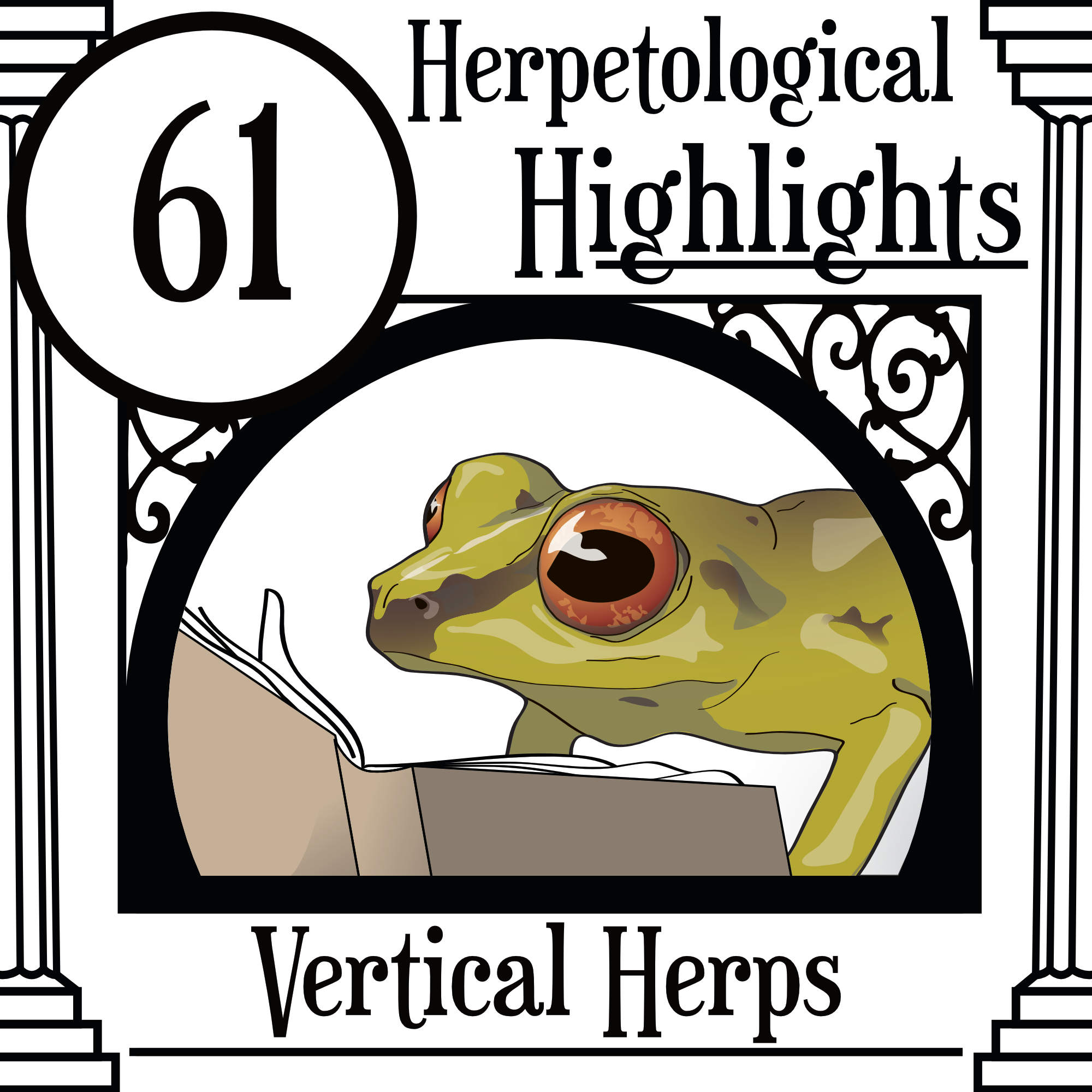
Ep 61061 Vertical Herps
Amphibians can make use of all sorts of places: from underground grottos to the tips of trees –but are there any patterns in where amphibians take to the trees? This episode we discuss a paper exploring just that, followed by an example of some civil serpents. This weeks Species of the Bi-week is tiny and cute. FULL REFERENCE LIST AVAILABLE AT: herphighlights.podbean.com Main Paper References: Oliveira, B. F., & Scheffers, B. R. (2019). Vertical stratification influences global patterns of biodiversity. Ecography, 42(2), 249-249. Barnes, C. H., Farren, W., Strine, C. T., Hill III, Jacques., Waengsothorn, S., & Suwanwaree, P. (2019). Are the habitat niches of female green pit vipers Cryptelytrops macrops and Viridovipera vogeli partitioned by vertical stratification?. Herpetological Bulletin, (149). Species of the Bi-Week: Santa-Cruz, R., von May, R., Catenazzi, A., Whitcher, C., López Tejeda, E., & Rabosky, D. L. (2019). A New Species of Terrestrial-Breeding Frog (Amphibia, Strabomantidae, Noblella) from the Upper Madre De Dios Watershed, Amazonian Andes and Lowlands of Southern Peru. Diversity, 11(9), 145. Other Mentioned Papers/Studies: Scheffers, B. R., Phillips, B. L., Laurance, W. F., Sodhi, N. S., Diesmos, A., & Williams, S. E. (2013). Increasing arboreality with altitude: a novel biogeographic dimension. Proceedings of the Royal Society B: Biological Sciences, 280(1770), 20131581. Strine, C., Barnes, C., Crane, M., Silva, I., Suwanwaree, P., Nadolski, B., … Hill, J. (2015). Sexual dimorphism of tropical green pit viper Trimeresurus (Cryptelytrops) macrops in Northeast Thailand. Amphibia-Reptilia, 36(4), 327–338. https://doi.org/10.1163/15685381-00003010 Other Links/Mentions: Posts concerning the resignation of Diversity and Distributions editorial staff: https://retractionwatch.com/2018/11/28/majority-of-journals-editorial-board-resigns-after-publishers-handling-of-letter-about-move-to-open-access/ https://oanarchy.wordpress.com/2018/09/04/to-the-editors-diversity-and-distributions-and-wiley-publishers/ Music: Intro/outro – Treehouse by Ed Nelson Other Music – The Passion HiFi, www.thepassionhifi.com
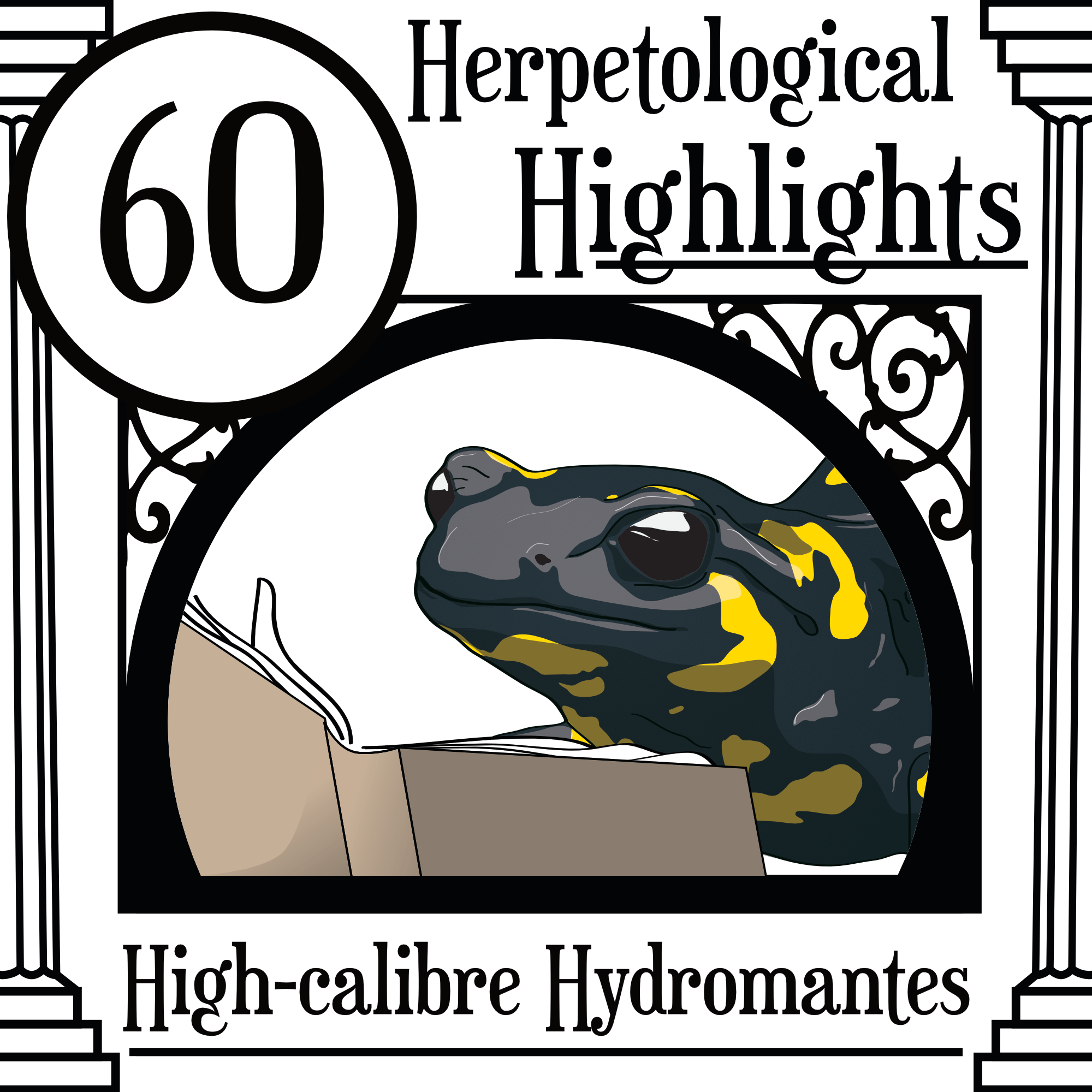
Ep 60060 High-calibre Hydromantes
Episode 60 is a Patreon episode about salamanders from the genus Hydromantes. These little characters have some interesting adaptations, and evolve nearly as quickly as they can shoot one of their appendages. Our Species of the Bi-Week is a lizard that looks like a crocodilian. FULL REFERENCE LIST AVAILABLE AT: herphighlights.podbean.com Main Paper References: Salvidio, S., Crovetto, F., & Adams, D. C. (2015). Potential rapid evolution of foot morphology in Italian plethodontid salamanders (Hydromantes strinatii) following the colonization of an artificial cave. Journal of evolutionary biology, 28(7), 1403-1409. Deban, S. M., & Richardson, J. C. (2011). Cold‐blooded snipers: thermal independence of ballistic tongue projection in the salamander Hydromantes platycephalus. Journal of Experimental Zoology Part A: Ecological Genetics and Physiology, 315(10), 618-630. Species of the Bi-Week: Campbell, J. A., Solano-Zavaleta, I., Flores-Villela, O., Caviedes-Solis, I. W., & Frost, D. R. (2016). A New Species of Abronia (Squamata: Anguidae) from the Sierra Madre del Sur of Oaxaca, Mexico. Journal of Herpetology, 50(1), 149-156. Other Mentioned Papers/Studies: Balaguera-Reina, Sergio. (2019). Rediscovering the Apaporis Caiman (Caiman crocodilus apaporiensis): Notes from a Long-Anticipated Expedition. Journal of Herpetology. 53. 310. 10.1670/19-028. Deban, S. M., Wake, D. B., & Roth, G. (1997). Salamander with a ballistic tongue. Nature, 389(6646), 27. Cureton, J. C., & Broughton, R. E. (2014). Rapid morphological divergence of a stream fish in response to changes in water flow. Biology letters, 10(6), 20140352. Stuart, Y. E., Campbell, T. S., Hohenlohe, P. A., Reynolds, R. G., Revell, L. J., & Losos, J. B. (2014). Rapid evolution of a native species following invasion by a congener. Science, 346(6208), 463-466. Vieites, D. R., Min, M. S., & Wake, D. B. (2007). Rapid diversification and dispersal during periods of global warming by plethodontid salamanders. Proceedings of the National Academy of Sciences, 104(50), 19903-19907. Other Links/Mentions: Salamanders rolling downhill: https://www.youtube.com/watch?v=PK_Jb-LvfC0 Rediscovered Fernandina giant tortoise: https://www.nationalgeographic.com/animals/2019/02/extinct-fernandina-giant-tortoise-found/ Recently rediscovered Abronia species https://www.facebook.com/groups/NAFHA/permalink/2997101796985144/ Music: Intro/outro – Treehouse by Ed Nelson Other Music – The Passion HiFi, www.thepassionhifi.com
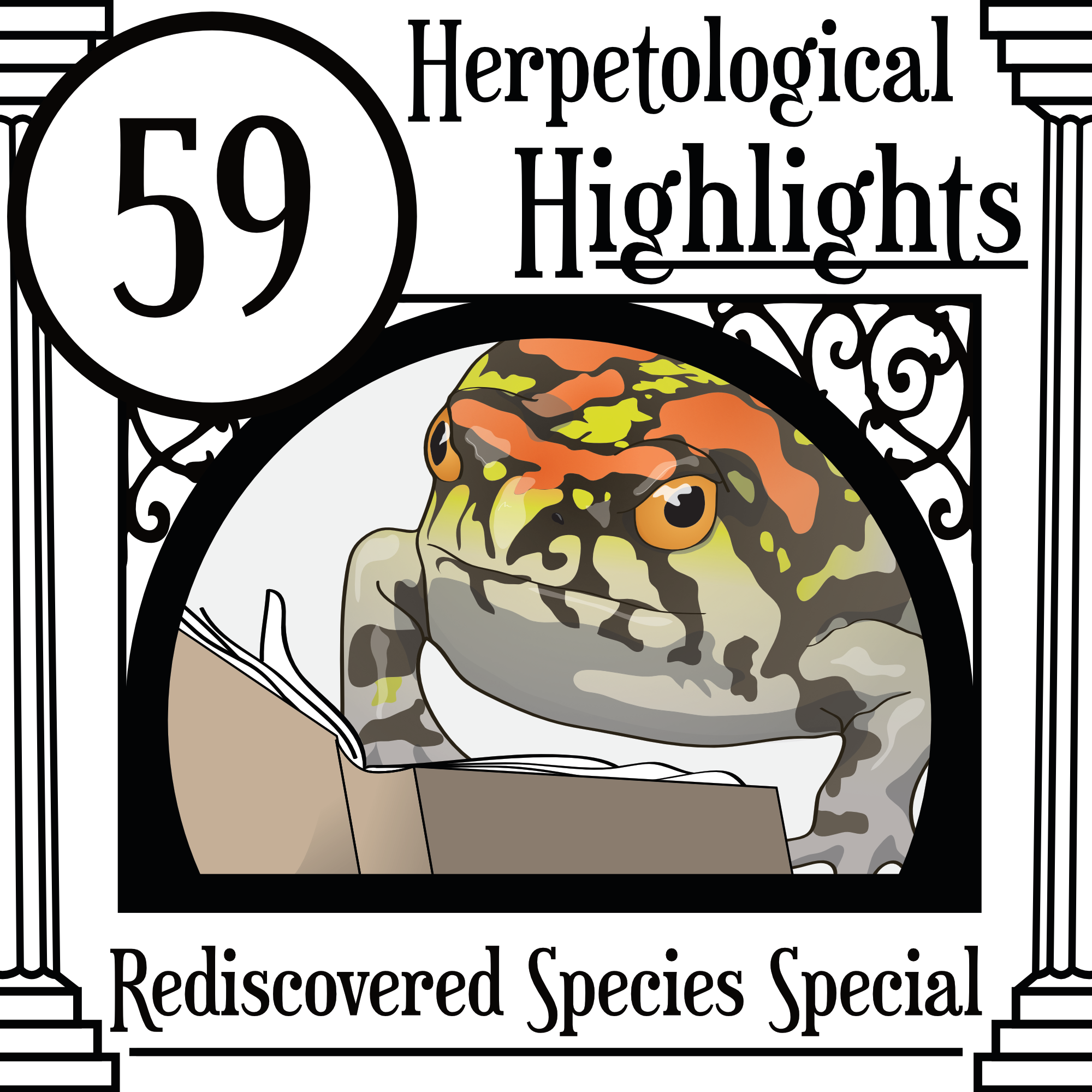
Ep 59059 Rediscovered Species Special
In a slightly shambolic episode we mix up the format, this Bi-week we take a look at some lost species and their recent rediscoveries. FULL REFERENCE LIST AVAILABLE AT: herphighlights.podbean.com References: 1) Jackson’s climbing salamander (Bolitoglossa jacksoni) https://www.nationalgeographic.com/news/2017/10/salamanders-extinct-species-rediscovery-guatemala/ https://www.globalwildlife.org/jacksons-climbing-salamander/ https://amphibiaweb.org/cgi/amphib_query?where-genus=Bolitoglossa&where-species=jacksoni 2) Pygmy blue tongue skink (Tiliqua adelaidensis) Milne, T., Bull, C. M., & Hutchinson, M. N. (2003). Use of burrows by the endangered pygmy blue-tongue lizard, Tiliqua adelaidensis (Scincidae). Wildlife Research, 30(5), 523-528. Milne T, Bull CM, Hutchinson M (2003). "Fitness of the endangered pygmy blue tongue lizard Tiliqua adelaidensis in artificial burrows". Journal of Herpetology. 37 (4): 762–765. Funny skink video: https://www.abc.net.au/news/2016-02-24/monarto-zoos-pygmy-blue-tongue-lizard-breeding-success/7195136?section=sa 3) Palawan Forest Turtle (Siebenrockiella leytensis) https://www.turtleconservancy.org/programs/palawan https://www.pna.gov.ph/articles/1042202 4) Bornean rainbow toad (Ansonia latidisca) https://www.researchgate.net/profile/Leticia_Ochoa-Ochoa/publication/216019689_Planning_amphibian_conservation_in_Mexico/links/0f317535a27be25d88000000/Planning-amphibian-conservation-in-Mexico.pdf#page=6 5) Albany Adder (Bitis albanica) https://www.nationalgeographic.com/news/2017/05/albany-adder-venomous-snake-extinct/ https://www.africansnakebiteinstitute.com/snake/albany-adder-2/ 6) Inland taipan (Oxyuranus microlepidota) https://web.archive.org/web/20090613092123/http://www.qm.qld.gov.au/features/snakes/taipan/rediscovery.asp 7) Armoured Mistfrog, Armoured Frog (Litoria lorica) https://amphibiaweb.org/species/1269 8) Arakan Forest Turtle (Heosemys depressa) Platt, S. G., Myo, K. M., Ko, W. K., Maung, A., & Rainwater, T. R. (2010). Field observations and conservation of Heosemys depressa in the Rakhine Yoma Elephant Range of western Myanmar. Chelonian Conservation and Biology, 9(1), 114-119. 9) Allan's lerista, Greater Robust Fine-lined Slider, Retro slider (Lerista allanae) https://theconversation.com/australian-endangered-species-retro-slider-12076 http://www.environment.gov.au/cgi-bin/sprat/public/publicspecies.pl?taxon_id=1378 10) Cropan’s boa (Corallus cropanii) https://www.nationalgeographic.com/news/2017/02/snakes-boa-rediscovered-brazil/ 11) Andayapa Andes Toad (Rhaebo olallai) https://www.globalwildlife.org/blog/tiny-lost-and-found-toad-becomes-harbinger-of-hope/ Other lost species: https://www.globalwildlife.org/search-for-lost-species/ Music: Intro/outro – Treehouse by Ed Nelson Other Music – The Passion HiFi, www.thepassionhifi.com

Ep 58058 Night of the Gecko
Geckos! In Hawai'i? We know what you're thinking - not by natural biogeographic processes! And you're right, they are there because they are invasive species brought by humans. In this Patreon-chosen episode, we explore some of the more unusual species the island has to offer. Our Species of the Bi-Week is a splendid lizard with an even more splendid name. Check out the Ross McGibbon reptile calendar: http://rmrphotography.com.au/2020-calendar-1/ FULL REFERENCE LIST AVAILABLE AT: herphighlights.podbean.com Main Paper References: Bucol, A., & Alcala, A. (2013). Tokay gecko, Gekko gecko (Sauria: Gekkonidae) predation on juvenile house rats. Herpetol. Notes, 6, 307-308. Seifan, T., Federman, A., Mautz, W. J., Smith, K. J., & Werner, Y. L. (2010). Nocturnal foraging in a diurnal tropical lizard (Squamata: Gekkonidae: Phelsuma laticauda) on Hawaii. Journal of Tropical Ecology, 26(2), 243-246. Goldberg, S. R., & Kraus, F. (2011). Notes on Reproduction of the Gold Dust Day Gecko, Phelsuma laticauda (Gekkonidae) from Hawaii. Current herpetology, 30(1), 79-81. Species of the Bi-Week: Ratsoavina, F. M., Raselimanana, A. P., Scherz, M. D., Rakotoarison, A., Razafindraibe, J. H., Glaw, F., & Vences, M. (2019). Finaritra! A splendid new leaf-tailed gecko (Uroplatus) species from Marojejy National Park in north-eastern Madagascar. Zootaxa, 4545(4), 563-577. Other Mentioned Papers/Studies: Heiss, R. S., Clark, A.B., & McGowan, K.J. (2009) “Growth and Nutritional State of American Crow Nestlings Vary between Urban and Rural Habitats.” Ecological Applications 19(4): 829–39. https://doi.org/10.1890/08-0140.1. Wood, K. R., Burney, D. A., Allison, A., & Fisher, R. (2013). Emoia impar (Squamata, Scincidae): not extinct in the Hawaiian Islands. Oryx, 47(3), 328-328. Other Links/Mentions: Satanic leaf tailed gecko leaf-tail movement pairing: https://youtu.be/JGqYqZnqPRA Phelsuma battle: https://www.youtube.com/watch?v=sZb3xi3OZKs Our patreon: https://www.patreon.com/herphighlights Music: Intro/outro – Treehouse by Ed Nelson Other Music – The Passion HiFi, www.thepassionhifi.com
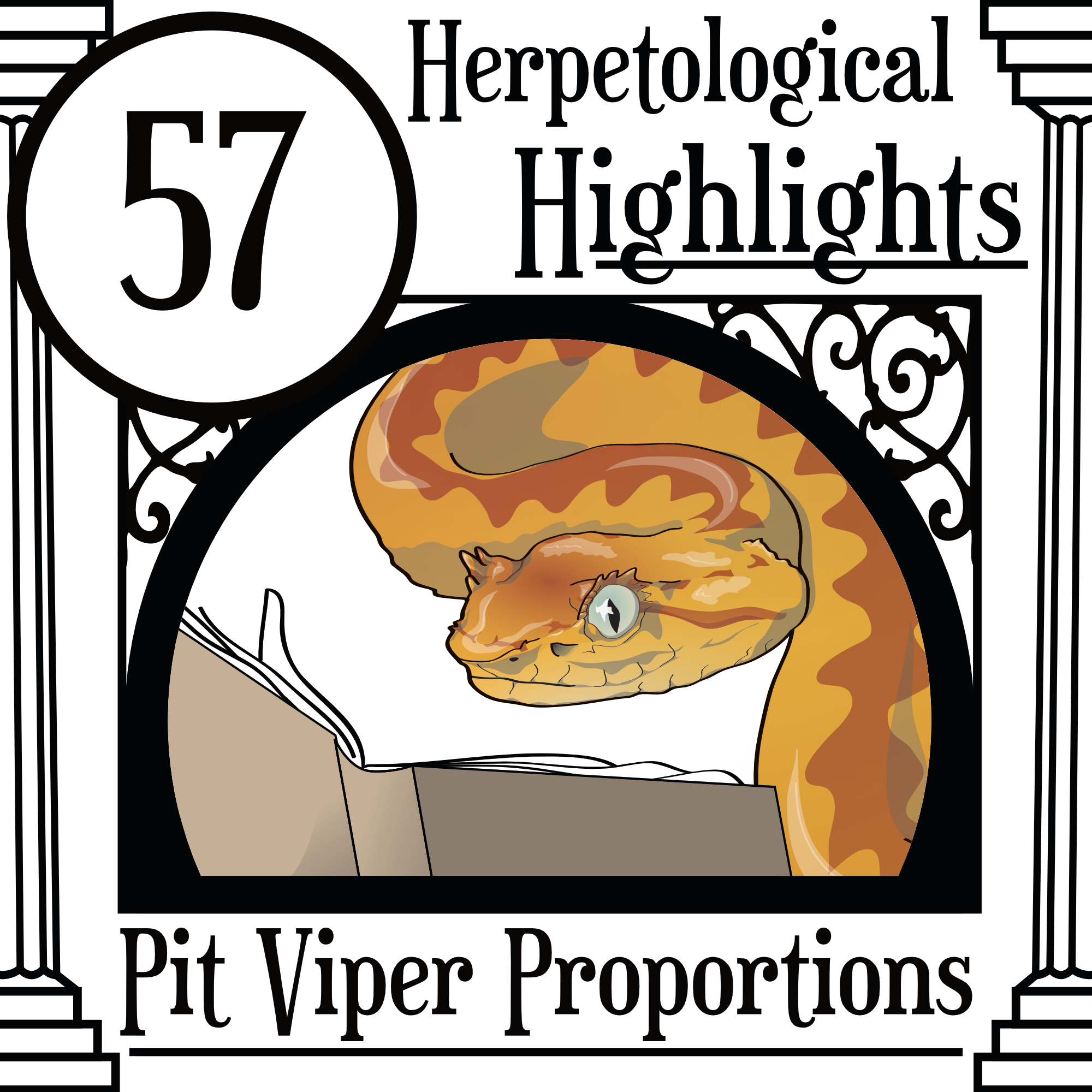
Ep 57057 Pit Viper Proportions
Patreon episode - what’s up with Central American vipers? More specifically how is there size and shape impacted by location and interspecific interactions? We check out a couple of papers looking to explore just that. The Species of the Bi-week is a new moderately small insular viper. FULL REFERENCE LIST AVAILABLE AT: herphighlights.podbean.com Main Paper References: Jadin, R. C., Mihaljevic, J. R., & Orlofske, S. A. (2019). Do New World pitvipers “scale‐down” at high elevations? Macroecological patterns of scale characters and body size. Ecology and evolution, 9(16), 9362-9375. Meik, J. M., Setser, K., Mocino-Deloya, E., & Lawing, A. M. (2012). Sexual differences in head form and diet in a population of Mexican lance-headed rattlesnakes, Crotalus polystictus. Biological Journal of the Linnean Society, 106(3), 633-640. Species of the Bi-Week: Barbo, F. E., Gasparini, J.L., Almeida, A., Zaher, H., Grazziotin, F., Gusmão, R.B., Ferrarini, J. and Sawaya R. (2016). Another new and threatened species of lancehead genus Bothrops (Serpentes, Viperidae) from Ilha dos Franceses, Southeastern Brazil. Zootaxa, 4097(4), 511-529. Other Mentioned Papers/Studies: Strine, C., Barnes, C., Crane, M., Silva, I., Suwanwaree, P., Nadolski, B., … Hill, J. (2015). Sexual dimorphism of tropical green pit viper Trimeresurus (Cryptelytrops) macrops in Northeast Thailand. Amphibia-Reptilia, 36(4), 327–338. https://doi.org/10.1163/15685381-00003010 Mackessy, S., Leroy, J., Mociño-Deloya, E., Setser, K., Bryson, R., & Saviola, A. (2018). Venom ontogeny in the mexican lance-headed rattlesnake (Crotalus polystictus). Toxins, 10(7), 271. Other Links/Mentions: Association of Zoos pdf: https://ams.aza.org/iweb/upload/RCP_Snake2016-76b7ff18.pdf Music: Intro/outro – Treehouse by Ed Nelson Other Music – The Passion HiFi, www.thepassionhifi.com
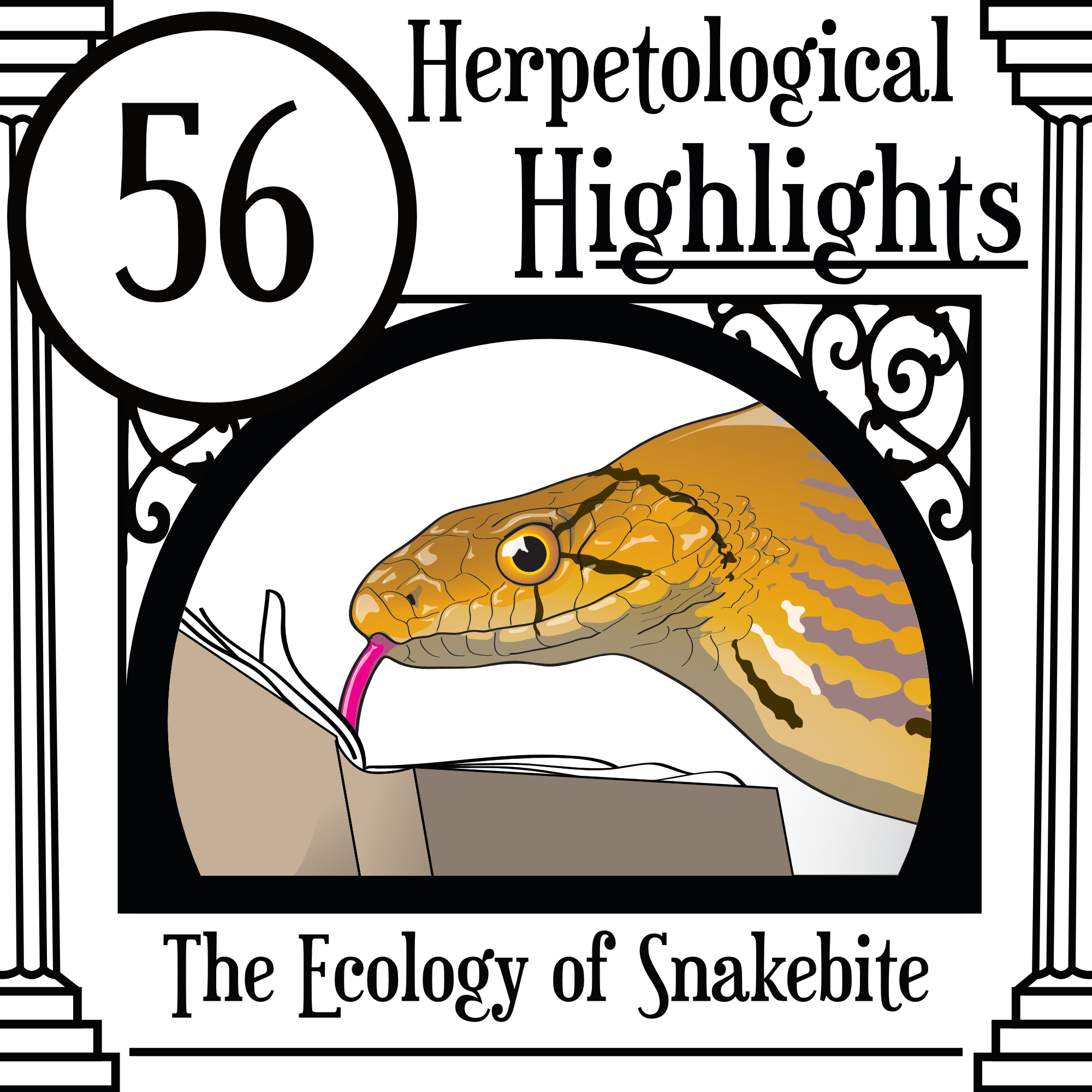
Ep 56056 The Ecology of Snakebite
Snakebite is a worldwide phenomenon which has dramatic consequences for human health. But how does the ecology of snakes influence its incidence and severity? We first look at snakebite globally, and then focus in on a famous island. Our Species of the Bi-Week is a recently described tree-dwelling serpent. FULL REFERENCE LIST AVAILABLE AT: herphighlights.podbean.com Main Paper References: Longbottom, J., Shearer, F. M., Devine, M., Alcoba, G., Chappuis, F., Weiss, D. J., … Pigott, D. M. (2018). Vulnerability to snakebite envenoming: A global mapping of hotspots. The Lancet, 392(10148), 673–684. https://doi.org/10.1016/S0140-6736(18)31224-8 Yue, S., Bonebrake, T. C., & Gibson, L. (2019). Human-snake Conflict Patterns in a Dense Urban-Forest Mosaic Landscape. Herpetological Conservation and Biology, 14(1), 143–154. Species of the Bi-Week: Branch, W. R., Bayliss, J., Bittencourt-Silva, G. B., Conradie, W., Engelbrecht, H. M., Loader, S. P., … Tolley, K. A. (2019). A new species of tree snake (Dipsadoboa, Serpentes: Colubridae) from ‘sky island’ forests in northern Mozambique, with notes on other members of the Dipsadoboa werneri group. Zootaxa, 4646(3), 541–563. https://doi.org/10.11646/zootaxa.4646.3.6 Other Mentioned Papers/Studies: Akani, G. C., Eyo, E., Odegbune, E., Eniang, E. A., & Luiselli, L. (2002). Ecological patterns of anthropogenic mortality of suburban snakes in an African tropical region. Israel Journal of Zoology, 48(1), 1–11. https://doi.org/10.1092/NL55-UK13-XXQ9-NCYE Devan-Song, A., Martelli, P., Dudgeon, D., Crow, P., Ades, G., & Karraker, N. E. (2016). Is long-distance translocation an effective mitigation tool for white-lipped pit vipers (Trimeresurus albolabris) in South China? Biological Conservation, 204, 212–220. https://doi.org/10.1016/j.biocon.2016.10.013 Fourcade, Y., Besnard, A. G., & Secondi, J. (2018). Paintings predict the distribution of species, or the challenge of selecting environmental predictors and evaluation statistics. Global Ecology and Biogeography, 27(2), 245–256. https://doi.org/10.1111/geb.12684 Wilson, K., Hanks, E., & Johnson, D. (2018). Estimating animal utilization densities using continuous-time Markov chain models. Methods in Ecology and Evolution, 9(5), 1232–1240. https://doi.org/10.1111/2041-210X.12967 Other Links/Mentions: https://theconversation.com/unsuitable-antivenoms-are-being-sold-in-africa-costing-lives-83658 Habib AG, Abubakar SB. (2011) Factors affecting snakebite mortality in north-eastern Nigeria. Int Health, 3, 50–55. Iftime, Alexandru and Iftime, O. (2014): Thanatosis and autohaemorrhaging in the Aesculapian Snake Zamenis longissimus (LAURENTI, 1768), Herpetozoa 26, 3/4, 173-4. Music: Intro/outro – Treehouse by Ed Nelson Other Music – The Passion HiFi, www.thepassionhifi.com
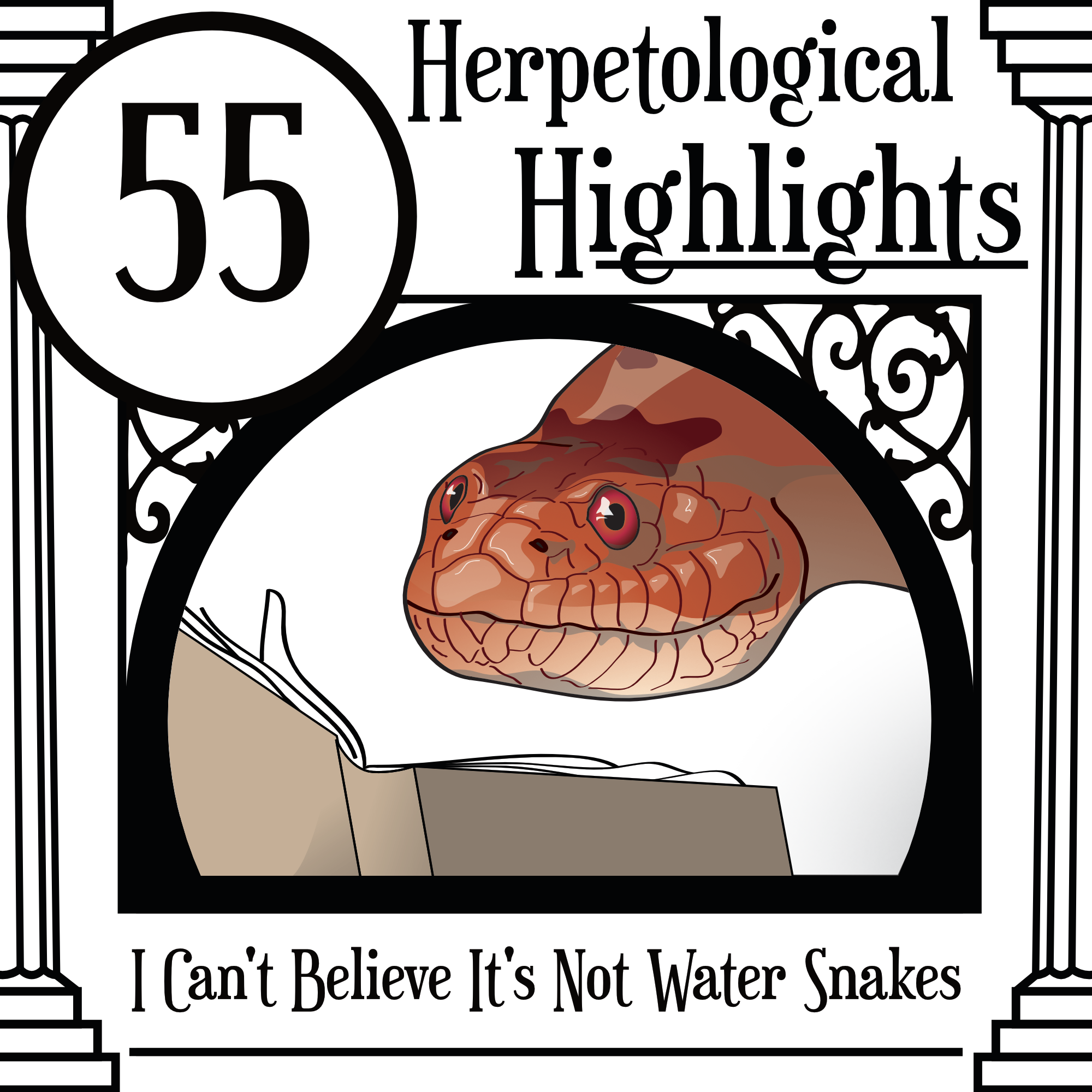
Ep 55055 I Can’t Believe It’s Not Water Snakes
After an unscheduled delay we are back. What better way to return than a look into the lives and diets of water snakes - mysterious creatures of the wetlands, all consuming, and surprisingly numerous. We have a lumpy frog for the Species of the Bi-week. FULL REFERENCE LIST AVAILABLE AT: herphighlights.podbean.com Main Paper References: Virgin, E. E., & King, R. B. (2019). What Does the Snake Eat? Breadth, Overlap, and Non-native Prey in the Diet of Three Sympatric Natricine Snakes. Herpetological Conservation and Biology, 11. Willson, J. D., & Winne, C. T. (2016). Evaluating the functional importance of secretive species: A case study of aquatic snake predators in isolated wetlands. Journal of Zoology, 298(4), 266–273. https://doi.org/10.1111/jzo.12311 Species of the Bi-Week: Yánez-Muñoz, M. H., Veintimilla-Yánez, D., Batallas, D., & Cisneros-Heredia, D. F. (2019). A new giant Pristimantis (Anura, Craugastoridae) from the paramos of the Podocarpus National Park, southern Ecuador. ZooKeys, 852, 137–156. https://doi.org/10.3897/zookeys.852.24557 Other Mentioned Papers/Studies: Brooks, S. E., Allison, E. H., & Reynolds, J. D. (2007). Vulnerability of Cambodian water snakes: Initial assessment of the impact of hunting at Tonle Sap Lake. Biological Conservation, 139(3–4), 401–414. https://doi.org/10.1016/j.biocon.2007.07.009 Other Links/Mentions: “Fantastic Voyage” Trailer, 20th Century Fox: https://www.youtube.com/watch?v=dO5E4wkg0hA Music: Intro/outro – Treehouse by Ed Nelson Other Music – The Passion HiFi, www.thepassionhifi.com
Ep 54054 Venom Variation
Venom can be deadly, but not all venoms are created equal. They serve different purposes and have evolved for different reasons. In this episode we discuss a couple of new papers around the theme of venom, and finish off with a venomous new species for our Species of the Bi-week. Main Paper References: Goetz, S. M., Piccolomini, S., Hoffman, M., Bogan, J., Holding, M. L., Mendonça, M. T., & Steen, D. A. (2019). Serum-based inhibition of pitviper venom by eastern indigo snakes (Drymarchon couperi). Biology Open, 5. Healy, K., Carbone, C., & Jackson, A. L. (2019). Snake venom potency and yield are associated with prey-evolution, predator metabolism and habitat structure. Ecology Letters, 22(3), 527–537. https://doi.org/10.1111/ele.13216 Species of the Bi-Week: Captain, A., Deepak, V., Pandit, R., Bhatt, B., & Athreya, R. (2019). A new species of pitviper (Serpentes: Viperidae: Trimeresurus Lacepède, 1804) from West Kameng District, Arunachal Pradesh, India. Russian Journal of Herpetology, 26, 13. Other Mentioned Papers/Studies: Barlow, A., Pook, C. E., Harrison, R. A., & Wüster, W. (2009). Coevolution of diet and prey-specific venom activity supports the role of selection in snake venom evolution. Proceedings of the Royal Society B: Biological Sciences, 276(1666), 2443-2449. Malhotra, A., & Thorpe, R. S. (2004). A phylogeny of four mitochondrial gene regions suggests a revised taxonomy for Asian pitvipers (Trimeresurus and Ovophis). Molecular Phylogenetics and Evolution, 32(1), 83–100. https://doi.org/10.1016/j.ympev.2004.02.008 Music: Intro/outro – Treehouse by Ed Nelson Other Music – The Passion HiFi, www.thepassionhifi.com
Ep 53053 In Defense of Eggs
A slightly hap-hazard episode looking at some brave lizards facing down an ever present snake menace. Lizards have to stop nest raiding some-how and a couple of recent papers shed some light on how. We also have a well armoured Species of the Bi-week. FULL REFERENCE LIST AVAILABLE AT: herphighlights.podbean.com Main Paper References: Pike, D. A., Clark, R. W., Manica, A., Tseng, H.-Y., Hsu, J.-Y., & Huang, W.-S. (2016). Surf and turf: Predation by egg-eating snakes has led to the evolution of parental care in a terrestrial lizard. Scientific Reports, 6(1), 22207. https://doi.org/10.1038/srep22207 Sherbrooke, W. C. (2017). Antipredator Nest Guarding by Female Horned Lizards (Phrynosoma): Iguanian Parental Care. Herpetologica, 73(4), 331–337. https://doi.org/10.1655/Herpetologica-D-17-00028.1 Species of the Bi-Week: Avila-Pires, T. C., Nogueira, C., & Martins, M. (2019). A new ‘horned’’ Stenocercus from the highlands of southeastern Brazil, and redescription of Stenocercus tricristatus (Reptilia: Tropiduridae)’. Zoologia, 36, 1–16. https://doi.org/10.3897/zoologia.36.e22909 Other Mentioned Papers/Studies: Huang, W.-S., Greene, H. W., Chang, T.-J., & Shine, R. (2011). Territorial behavior in Taiwanese kukrisnakes (Oligodon formosanus). Proceedings of the National Academy of Sciences, 108(18), 7455–7459. https://doi.org/10.1073/pnas.1101804108 Origgi, F. C., Schmidt, B. R., Lohmann, P., Otten, P., Meier, R. K., Pisano, S. R., ... & Gaschen, V. (2018). Bufonid herpesvirus 1 (BfHV1) associated dermatitis and mortality in free ranging common toads (Bufo bufo) in Switzerland. Scientific reports, 8(1), 14737. https://doi.org/10.1038/s41598-018-32841-0 Willson, J. D., & Winne, C. T. (2016). Evaluating the functional importance of secretive species: A case study of aquatic snake predators in isolated wetlands. Journal of Zoology, 298(4), 266–273. https://doi.org/10.1111/jzo.12311 Music: Intro/outro – Treehouse by Ed Nelson Other Music – The Passion HiFi, www.thepassionhifi.com
Ep 52052 Salamanders Vs Plants
Salamanders are famous for being slippery and liking water, but we uncover some new and surprising elements in their ecology. Stay tuned for a Species of the Bi-Week that resembles a breakfast favourite. FULL REFERENCE LIST AVAILABLE AT: herphighlights.podbean.com Main Paper References: Mezebish, T. D., Blackman, A., & Novarro, A. J. (2018). Salamander climbing behavior varies among species and is correlated with community composition. Behavioral Ecology, 29(3), 686–692. https://doi.org/10.1093/beheco/ary022 Moldowan, P. D., Alex Smith, M., Baldwin, T., Bartley, T., Rollinson, N., & Wynen, H. (2019). Nature’s pitfall trap: Salamanders as rich prey for carnivorous plants in a nutrient‐poor northern bog ecosystem. The Scientific Naturalist, e02770. https://doi.org/10.1002/ecy.2770 Species of the Bi-Week: Sugawara, H., Watabe, T., Yoshikawa, T., & Nagano, M. (2018). Morphological and Molecular Analyses of Hynobius dunni Reveal a New Species from Shikoku, Japan. Herpetologica, 74(2), 159–168. https://doi.org/10.1655/Herpetologica-D-17-00002.1 Other Mentioned Papers/Studies: Adams, D. C., & Rohlf, F. J. (2000). Ecological character displacement in Plethodon: Biomechanical differences found from a geometric morphometric study. Proceedings of the National Academy of Sciences, 97(8), 4106–4111. https://doi.org/10.1073/pnas.97.8.4106 Other Links/Mentions: Roberts, W. E. (1994). Explosive breeding aggregations and parachuting in a Neotropical frog, Agalychnis saltator (Hylidae). Journal of Herpetology, 193-199. Stuart YE, Campbell TS, Hohenlohe PA, Reynolds RG, Revell LJ, Losos JB. 2014. Rapid evolution of a native species following invasion by a congener. Science. 346:463–466. Music: Intro/outro – Treehouse by Ed Nelson Other Music – The Passion HiFi, www.thepassionhifi.com
Ep 51051 Python Surprise
Pythons are marvellous beasts: their lives and ways remain mysterious. We check out a paper that lifts the curtain on a secretive Australian snake –the woma python– what do they do with their time? We also look a little closer at python facultative thermogenesis, what is it, who does it? The Species of the Bi-week is a new multi-coloured snake from high in the cloud forests. FULL REFERENCE LIST AVAILABLE AT: herphighlights.podbean.com Main Paper References: Brashears, J., & DeNardo, D. F. (2015). Facultative thermogenesis during brooding is not the norm among pythons. Journal of Comparative Physiology A, 201(8), 817–825. https://doi.org/10.1007/s00359-015-1025-4 Bruton, M. J. (2013). Arboreality, excavation, and active foraging: novel observations of radiotracked woma pythons Aspidites ramsayi. Memoirs of the Queensland Museum, 56(2), 19. Species of the Bi-Week: Meneses-Pelayo, E., & Passos, P. (2019). New Polychromatic Species of Atractus (Serpentes: Dipsadidae) from the Eastern Portion of the Colombian Andes. Copeia, 107(2), 250. https://doi.org/10.1643/CH-18-163 Other Mentioned Papers/Studies: Cantalapiedra, J. L., Aze, T., Cadotte, M. W., Dalla Riva, G. V., Huang, D., Mazel, F., … Mooers, A. Ø. (2019). Conserving evolutionary history does not result in greater diversity over geological time scales. Proceedings of the Royal Society B: Biological Sciences, 286(1904), 20182896. https://doi.org/10.1098/rspb.2018.2896 Chambers, E. A., & Hillis, D. M. (2019). The Multispecies Coalescent Over-splits Species in the Case of Geographically Widespread Taxa. Systematic Biology, syz042. https://doi.org/10.1093/sysbio/syz042 Music: Intro/outro – Treehouse by Ed Nelson Other Music – The Passion HiFi, www.thepassionhifi.com
Ep 50050 Toady, Toady, Tody
In this milestone episode we are talking about toads - how common Asian species are coping with changes in land use and how the same changes in Europe impact the poisonous gunk of the common toad Bufo bufo. Our Species of the Bi-Week has nice tubercles. Main Paper References: Bókony, V., Üveges, B., Verebélyi, V., Ujhegyi, N., & Móricz, Á. M. (2019). Toads phenotypically adjust their chemical defences to anthropogenic habitat change. Scientific Reports, 9(1). https://doi.org/10.1038/s41598-019-39587-3 Karraker, N. E., Fischer, S., Aowphol, A., Sheridan, J., & Poo, S. (2018). Signals of forest degradation in the demography of common Asian amphibians. PeerJ, 6, e4220. https://doi.org/10.7717/peerj.4220 Species of the Bi-Week: Carvalho, T. R. D., Giaretta, A. A., Angulo, A., Haddad, C. F. B., & Peloso, P. L. V. (2019). A New Amazonian Species of Adenomera (Anura: Leptodactylidae) from the Brazilian State of Pará: A Tody-Tyrant Voice in a Frog. American Museum Novitates, 3919(1), 1. https://doi.org/10.1206/3919.1 Other Mentioned Papers/Studies: Arbuckle, K., Brockhurst, M., & Speed, M. P. (2013). Does chemical defence increase niche space? A phylogenetic comparative analysis of the Musteloidea. Evolutionary Ecology, 27(5), 863–881. https://doi.org/10.1007/s10682-013-9629-z Karraker, N. E., & Welsh Jr, H. H. (2006). Long-term impacts of even-aged timber management on abundance and body condition of terrestrial amphibians in Northwestern California. Biological Conservation, 131(1), 132-140. Møller A et al. 2015 Effects of urbanization on bird phenology: a continental study of paired urban and rural populations. Climate Res. 66, 185– 199. (doi:10.3354/cr01344) Pramuk, J. B., Robertson, T., Sites, J. W., & Noonan, B. P. (2008). Around the world in 10 million years: Biogeography of the nearly cosmopolitan true toads (Anura: Bufonidae). Global Ecology and Biogeography, 17(1), 72–83. https://doi.org/10.1111/j.1466-8238.2007.00348.x Other Links/Mentions: Call of Adenomera phonotriccus: https://soundcloud.com/museugoeldi/canto-da-nova-especie-de-ra-da-amazonia-adenomera-phonotriccus Link from Dr Levi Gray on twitter: https://t.co/eyEe6EXxxP Music: Intro/outro – Treehouse by Ed Nelson Other Music – The Passion HiFi, www.thepassionhifi.com
Ep 49049 Great Lizard Escapes
It is a dangerous world for small lizards. To survive a lizard may need to pull off some pretty ingenious escape maneuvers. In this episode we look at two lizards that dodge predators using water. For the Species of the Bi-week we check out a species more likely to elicit escape behaviour than undertake it. FULL REFERENCE LIST AVAILABLE AT: herphighlights.podbean.com Main Paper References: Nirody, J. A., Jinn, J., Libby, T., Lee, T. J., Jusufi, A., Hu, D. L., & Full, R. J. (2018). Geckos Race Across the Water’s Surface Using Multiple Mechanisms. Current Biology, 28(24), 4046-4051.e2. https://doi.org/10.1016/j.cub.2018.10.064 Swierk, L. (2019). ANOLIS AQUATICUS (= NOROPS AQUATICUS) (Water Anole). UNDERWATER BREATHING. Herpetological Review, 50(1), 134–135. Species of the Bi-Week: Carrasco, P. A., Grazziotin, F. G., Farfán, R. S. C., Koch, C., Ochoa, J. A., Scrocchi, G. J., … Chaparro, J. C. (2019). A new species of Bothrops (Serpentes: Viperidae: Crotalinae) from Pampas del Heath, southeastern Peru, with comments on the systematics of the Bothrops neuwiedi species group. Zootaxa, 4565(3), 301. https://doi.org/10.11646/zootaxa.4565.3.1 Other Mentioned Papers/Studies: NICHOLSON, KIRSTEN E.; BRIAN I. CROTHER, CRAIG GUYER & JAY M. SAVAGE (2012). It is time for a new classification of anoles (Squamata: Dactyloidae). Zootaxa 3477: 1–108. NICHOLSON, KIRSTEN E.; BRIAN I. CROTHER, CRAIG GUYER & JAY M. SAVAGE (2018). Translating a clade based classification into one that is valid under the international code of zoological nomenclature: the case of the lizards of the family Dactyloidae (Order Squamata). Zootaxa 4461 (4): 573–586. Other Links/Mentions: Video of surface running in the wild: https://www.cell.com/cms/10.1016/j.cub.2018.10.064/attachment/5ca65509-66ab-4c2e-b882-81b2a32dacc6/mmc2.mp4 Video of surface running in the lab: https://www.cell.com/cms/10.1016/j.cub.2018.10.064/attachment/810c5bcb-6b9f-4294-88cc-0181b6fbe4e3/mmc3.mp4 Video of underwater breathing: https://www.youtube.com/watch?v=gDwqWAv1RO4 Gecko walking on water article: https://cosmosmagazine.com/biology/watch-a-gecko-runs-on-water Which anole are you? https://www.playbuzz.com/item/d14bede2-6d3f-4814-92d2-2bd35caaedf5?utm_source=facebook.com&utm_medium=ff&utm_campaign=ff&pb_traffic_source=facebook&fbclid=IwAR0IOp1Gczd2rrUBHC_ajsXDMKkUyRtJtvySoSPFV_qNTQbvAp9EVvsN06k Music: Intro/outro – Treehouse by Ed Nelson Other Music – The Passion HiFi, www.thepassionhifi.com
Ep 48048 The Frog After Tomorrow
In this Patreon episode we delve into the world of amphibians - how will frogs, toads, salamanders and friends cope with human-induced climate alterations? We round off with a puddle-loving Species of the Bi-Week who is new to science. FULL REFERENCE LIST AVAILABLE AT: herphighlights.podbean.com Main Paper References: Miller, D. A., Grant, E. H. C., Muths, E., Amburgey, S. M., Adams, M. J., Joseph, M. B., ... & Calhoun, D. L. (2018). Quantifying climate sensitivity and climate-driven change in North American amphibian communities. Nature communications, 9(1), 3926. Üveges, B., Mahr, K., Szederkényi, M., Bókony, V., Hoi, H., & Hettyey, A. (2016). Experimental evidence for beneficial effects of projected climate change on hibernating amphibians. Scientific reports, 6, 26754. Species of the Bi-Week: Goutte, S., Reyes-Velasco, J., & Boissinot, S. (2019). A new species of puddle frog from an unexplored mountain in southwestern Ethiopia (Anura, Phrynobatrachidae, Phrynobatrachus). ZooKeys, (824), 53. Other mentioned papers: Morgan, M. J., Hunter, D., Pietsch, R. O. D., Osborne, W., & Keogh, J. S. (2008). Assessment of genetic diversity in the critically endangered Australian corroboree frogs, Pseudophryne corroboree and Pseudophryne pengilleyi, identifies four evolutionarily significant units for conservation. Molecular Ecology, 17(15), 3448-3463. Other Links/Mentions: Ross McGibbon reptile photography: https://www.facebook.com/RossMcGibbonReptilePhotography/ Steve Allain's new crowdfunder: https://www.gofundme.com/where-did-the-toads-come-from Music: Intro/outro – Treehouse by Ed Nelson Other Music – The Passion HiFi, www.thepassionhifi.com