Show overview
Hangin' Out with Bob has been publishing since 2024, and across the 2 years since has built a catalogue of 38 episodes, alongside 1 trailer or bonus episode. That works out to roughly 30 hours of audio in total. Releases follow a monthly cadence, with the show now in its 2nd season.
Episodes typically run thirty-five to sixty minutes — most land between 37 min and 1h 3m — though episode length varies meaningfully from one episode to the next. None of the episodes are flagged explicit by the publisher. It is catalogued as a EN-language Leisure show.
The show is actively publishing — the most recent episode landed yesterday, with 16 episodes already out so far this year. Published by Bob Edholm.
From the publisher
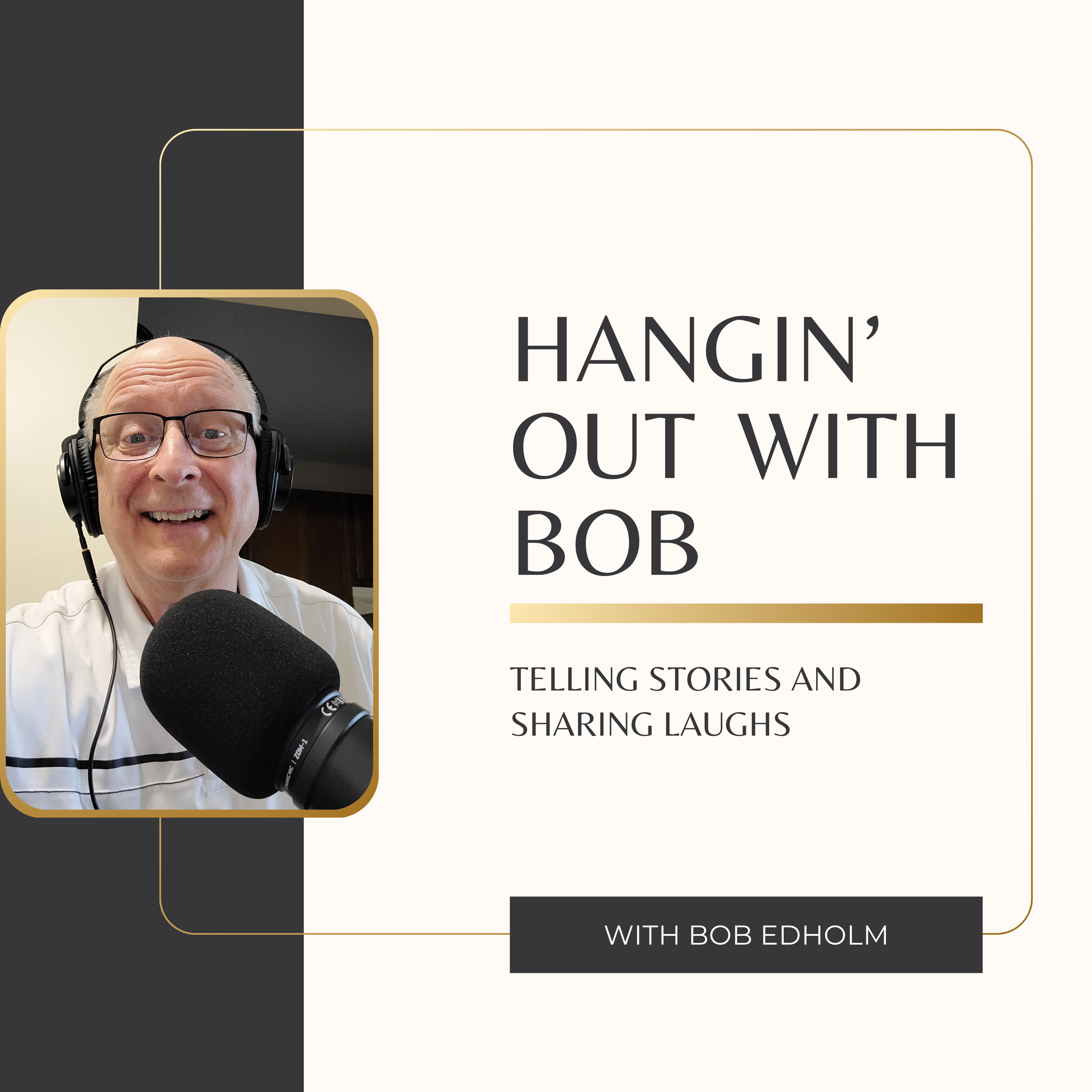
Podcast host Bob Edholm gets together with family and friends as they tell him their stories – where they grew up, what they’re doing now, which shows they stream, which music they listen to, which teams they cheer for, and so on. And the more laughs that come from telling their stories, the better.
Latest Episodes
View all 38 episodesListen to Your Heartbreaker (with Brad Johs)
Catching Up: A Decades-Long Friendship (with Dennis Tkach)
1976: Tracking Tom Petty and the Heartbreakers (with Brad Johs)
A “Golden Era” of Twin Cities music: the mid-1960s through the 1970s (an interview with Paul Groves)
Tom Petty: a timeless rock-and-roll legacy (with guest Brad Johs)
The 1957 Memorial Day Plane Crash in Northeast Minneapolis (with Dave Edholm)
From Surviving to Thriving: An Interview with Author Tom Madigan (Part Two)
From Surviving to Thriving: An Interview with Author Tom Madigan (Part One)
Skating Clean: A Story of Reconciliation (Part Two)
Skating Clean: A Story of Reconciliation (Part One)
Met Center Nights (with Jon Lawrence)
Hangin' Out with Bob (Moody Blues music with Wayne Damerow)
S2 Ep 6State tournament takeaways: Scott Black and Steve Durant look back on the 2026 Minnesota boys’ state prep basketball tournament—and look ahead to teams that might be playing in next year’s state tourney.
It’s been said by some that winter in Minnesota doesn’t really end until the boys’ state high school basketball tournament wraps up. Well, the 2026 edition of Minnesota’s oldest state high school tournament concluded on March 28, when champions from four different classes were crowned. The weather in Minnesota following that state tournament wasn’t necessarily summerlike, but talk of the tourney remained a hot topic for days afterward.In this episode with podcast host Bob Edholm, Scott Black and Steve Durant, two Boomers who follow boys’ high school basketball as closely as anyone in the state, share their thoughts on the 2026 state tournament. Scott and Steve saw several of those games in person, including the quarterfinals at Target Center as well as the finals at the University of Minnesota’s Williams Arena.The 2026 edition of the boys’ state high school basketball tournament had a little bit of everything—upsets of some top-seeded teams, unexpected championship matchups, and breakout performances by several players who were just underclassmen.For years (for decades, actually) Scott and Steve have attended boys’ high school basketball games during the regular season as well as postseason. By the time the state tournament rolls around every year in late March, they’re familiar with many of the best teams and best players in the state.In this podcast episode, Scott and Steve also talk about some of the better teams and players who didn’t make it to the state tournament this year because they lost in their single-elimination sectional tournament. And based on what they saw in this past basketball season, Scott and Steve share their thoughts on which high school squads might appear in the 2027 state tournament.So, listen, learn—and maybe even laugh out loud a few times—as Bob Edholm and his two guests, Scott Black and Steve Durant, talk about Minnesota boys’ state high school basketball.
S2 Ep 5The ‘Paul is dead’ rumor lives on; PLUS, the ’27 Club’ of musicians who left us way too early (with Luke Edholm)
“Paul is dead” is a rumor/conspiracy theory that alleges Paul McCartney of the Beatles died on November 9, 1966, and was secretly replaced by a look-alike. The rumor gained broad popularity in the Fall of 1969 following news articles on some U.S. college campuses.According to the rumor/conspiracy theory, McCartney died in a car crash. To spare the public from grief, the surviving Beatles (John Lennon, George Harrison, and Ringo Starr) replaced him with a McCartney look-alike, subsequently communicating this secret through subtle details of their albums. Proponents perceived clues among elements of Beatles songs, photos, and cover artwork. Clue hunting proved infectious, and by the Fall of 1969 had become an international phenomenon.The “Paul is dead” rumor/conspiracy declined somewhat after Life magazine published an interview with McCartney in November of 1969, but it was ranked among ten of “the world’s most enduring conspiracy theories,” according to Time magazine in 2009.In this podcast episode, host Bob Edholm and his nephew, Luke Edholm, do a “deep dive” into how the rumor/conspiracy theory began, how it grew, and why people still like to talk about it nearly six decades later.Also in this podcast episode, Bob and Luke talk about the “27 Club,” which refers to the phenomenon of musicians, singers, and singer/songwriters who died at age 27, often due to drug abuse, suicide, or violent circumstances. Key members include Rolling Stones founder Brian Jones, influential guitarist Jimi Hendrix, iconic singer Janis Joplin, The Doors vocalist Jim Morrison, Nirvana frontman Kurt Cobain, singer/songwriter Amy Winehouse, and blues musician Robert Johnson.
S2 Ep 4The Transformation of Music Since the '60s: What We Listened to and How We Listened to It
The next best thing to listening to music is…talking about it.In this episode, podcast host Bob Edholm and his guests, brothers Wayne and Al Damerow, talk about the transformation of music from the 1960s to today.They discuss not only the types of music people have listened to since the 1960s (from rock and Motown to pop and hip hop), but how they’ve listened to the music (from transistor radios and record players to CD players and smartphones). And they break down this transformation of music by generation:· Baby Boomers (born 1946-1964), which includes Bob, Wayne, and Al· Generation X (born 1965-1981)· Millennials (born 1982-1996), which includes their children and nieces/nephews· Generation Z (born 1997-2012)· Generation Alpha (born 2013-2024), which includes their grandchildren and great-nephews/great-niecesSo whether you grew up listening to the Beatles on your phonograph, Nirvana on your Boombox, the Foo Fighters on your CD player, or Taylor Swift on your smartphone, this podcast episode will transform the way you think about music from the 1960s to today.
S2 Ep 3The Minnesota Vikings’ “rollercoaster” season in 2025 (with brothers Dave and Tom Edholm)
Talk about a tale of two halves.After the Minnesota Vikings finished the 2024 regular season with a record of 14-3, and despite a first-round loss in the NFL playoffs, hopes for the 2025 season were high for the Vikings and their ever-loyal fans.Instead, the Vikings struggled in 2025. They faced a “quarterback carousel” and a difficult schedule (including back-to back games “across the pond” in Dublin and London). At one point, the Vikings’ record was 4-8, their worst start since 2013.But then they rallied. The Vikings managed to win their final five games, including a 16-3 win in the “border battle” with the Green Bay Packers, turning a potential disaster into a 9-8 winning record. But despite the strong finish, the Vikings failed to make the playoffs in 2025.In this episode, podcast host Bob Edholm gets together again with brothers Dave and Tom Edholm to talk about each of the Vikings’ 17 regular-season games. It’s an episode that Vikings fans will definitely want to listen to.
S2 Ep 2From Worst to First: The Minnesota Twins rebound to win the 1991 World Series (with guest Jon Lawrence)
Talk about a turnaround!The Minnesota Twins finished the 1990 season with a last-place finish in the American League West division. In stark contrast, the Twins improved dramatically in 1991 by winning the American League West, the American League Championship Series, and the World Series championship. It was one of the most thrilling and memorable seasons in Twins history.In this episode, podcast host Bob Edholm gets together again with guest Jon Lawrence, his friend from Northeast Minneapolis, to discuss the Twins’ “worst-to-first” season in 1991 that led to their second World Series Championship in five seasons.They’ll talk about key players and factors, such as:· Star Power: Some of the key performers included Kirby Puckett, Jack Morris, Kent Hrbek, Chili Davis, Dan Gladden, and Gene Larkin.· Team Depth: A magical season where multiple players, including pitchers Scott Erickson, Kevin Tapani, and Rick Aguilera, had career years simultaneously.· Home Field: The Hubert H. Metrodome was a fortress, with the team remaining undefeated at home in the World Series.It’s a Cinderella story that cemented the 1991 Twins as a beloved championship team, known for their resilience and dramatic postseason victories.
S2 Ep 1A super fan since the early Seventies: Scott Black and his trips to the Minnesota boys’ state prep basketball tournament
Just days after celebrating his 14th birthday in March of 1972, Scott Black attended his first Minnesota boys’ state high school basketball tournament with his dad.As Scott watched the players on teams who “made it to state” playing at Williams Arena on the campus of the University of Minnesota in Minneapolis, he dreamed that someday he could play for his high school team—the Columbia Heights Hylanders—in the state tournament. While Scott would go on to play for the Hylanders and serve as co-captain of a team that won the North Suburban Conference in 1976 (Scott also received honorable mention on the all-conference squad that year), the second-seeded Hylanders were upset in the regional semifinal round.But that disappointing loss didn’t stop Scott from attending the boys’ state basketball tournament. In fact, that first tournament in 1972 started a tradition: Scott has attended all but one boys’ state basketball tournament since then, and he’s brought his own son and daughter to the state tourney.Much has changed about this tournament since the early 1970s. The field has expanded from 16 teams to 32. It’s gone from two classes to four. Dunking was not allowed until the mid-1970s. There was no three-point shooting line until the late 1980s. Uniform and shoe styles have changed dramatically over the decades. Venues other than Williams Arena have been used to host tournament games.But what hasn’t changed is Scott’s love for this annual tournament. No matter where the games are played, no matter which teams are playing, no matter what the players’ uniforms or shoes look like, Scott continues to attend the state tourney year after year.In this episode with podcast host Bob Edholm, Scott talks about his decades of dedication to the Minnesota boys’ state high school basketball tourney. You will be impressed by Scott’s wealth of knowledge about the high school teams, coaches, and players he’s watched and followed over the past fifty-plus years.
S1 Ep 19The ‘Run’ to a Cross-Country State Championship (with Darryl Landas)
“STATE CHAMPS!”No doubt about it—winning a high school state championship brings the “thrill of victory” to the teammates, the coach, and the community.Back in October 1976, Decorah High School’s girls‘ cross-country squad did just that. Not only did they win the state championship, but it was only the second year that this school in Northeast Iowa had offered the sport to their female student athletes.Podcast host Bob Edholm, who served as sports editor of Decorah Newspapers for three years in the late 1970s, had worked at that newspaper for just over a month when the Decorah girls captured that state cross-country title.Bob traveled back to Decorah to interview his friend Darryl Landas, who was coach of that 1976 girls’ state championship cross-country squad. Bob and Darryl were in their 20s in the 70s, and now they are in their 70s in the 20s!In this episode, Darryl shares his thoughts and memories of that special squad in a magical season that happened nearly half a century ago.
S1 Ep 18Will Major League Baseball Ever Have a Hard Salary Cap? (with Wayne and Al Damerow)
Should there be a hard salary cap for the Major League Baseball players? The National Football League, the National Hockey League, and the Women’s National Basketball Association all have hard salary caps for their players. Why not for Major League Baseball players?On the one hand, MLB team owners believe that a hard salary cap would foster competitive balance by reducing payroll disparities. On the other hand, the players and their union see a hard salary cap as a tool for reduced player salaries.Podcast host Bob Edholm gets together again with brothers Wayne and Al Damerow to discuss the likelihood of a hard salary cap in Major League Baseball. These three lifelong baseball fans will talk about:· The transition from the Reserve Clause Era to the current Free Agency Era· The difference between a hard salary cap and a soft salary cap (or a “luxury tax,” which Major League Baseball currently has but owners say is not working well)· Possible alternatives to a hard salary cap· Their own predictions on how this all will play out for the future of Major League Baseball.