PLAY PODCASTS
GZERO World with Ian Bremmer

GZERO World with Ian Bremmer

GZERO Media

431 episodesEN

Show overview

GZERO World with Ian Bremmer has been publishing since 2017, and across the 9 years since has built a catalogue of 431 episodes, alongside 1 trailer or bonus episode. That works out to roughly 200 hours of audio in total. Releases follow a weekly cadence.

Episodes typically run twenty to thirty-five minutes — most land between 21 min and 32 min — though episode length varies meaningfully from one episode to the next. None of the episodes are flagged explicit by the publisher. It is catalogued as a EN-language News show.

The show is actively publishing — the most recent episode landed 5 days ago, with 16 episodes already out so far this year. The busiest year was 2023, with 62 episodes published. Published by GZERO Media.

Episodes
431
Running
2017–2026 · 9y
Median length
27 min
Cadence
Weekly

From the publisher

The United States will no longer play global policeman, and no one else wants the job. This is not a G-7 or a G-20 world. Welcome to the GZERO, a world made volatile by an intensifying international battle for power and influence. Every week on this podcast, Ian Bremmer will interview the world leaders and the thought leaders shaping our GZERO World.

Latest Episodes

View all 431 episodes

How AI is transforming warfare and the US military with Katrina Manson

May 9, 202636 min

Cuba's Trump standoff and economic crisis with Michael Bustamante

Apr 25, 202624 min

North Korea's nuclear gamble pays off, with the WSJ's Jonathan Cheng

Apr 18, 202628 min

Assessing the Iran War's "structural damage" with Harvard economist Gita Gopinath
Apr 11, 202632 min

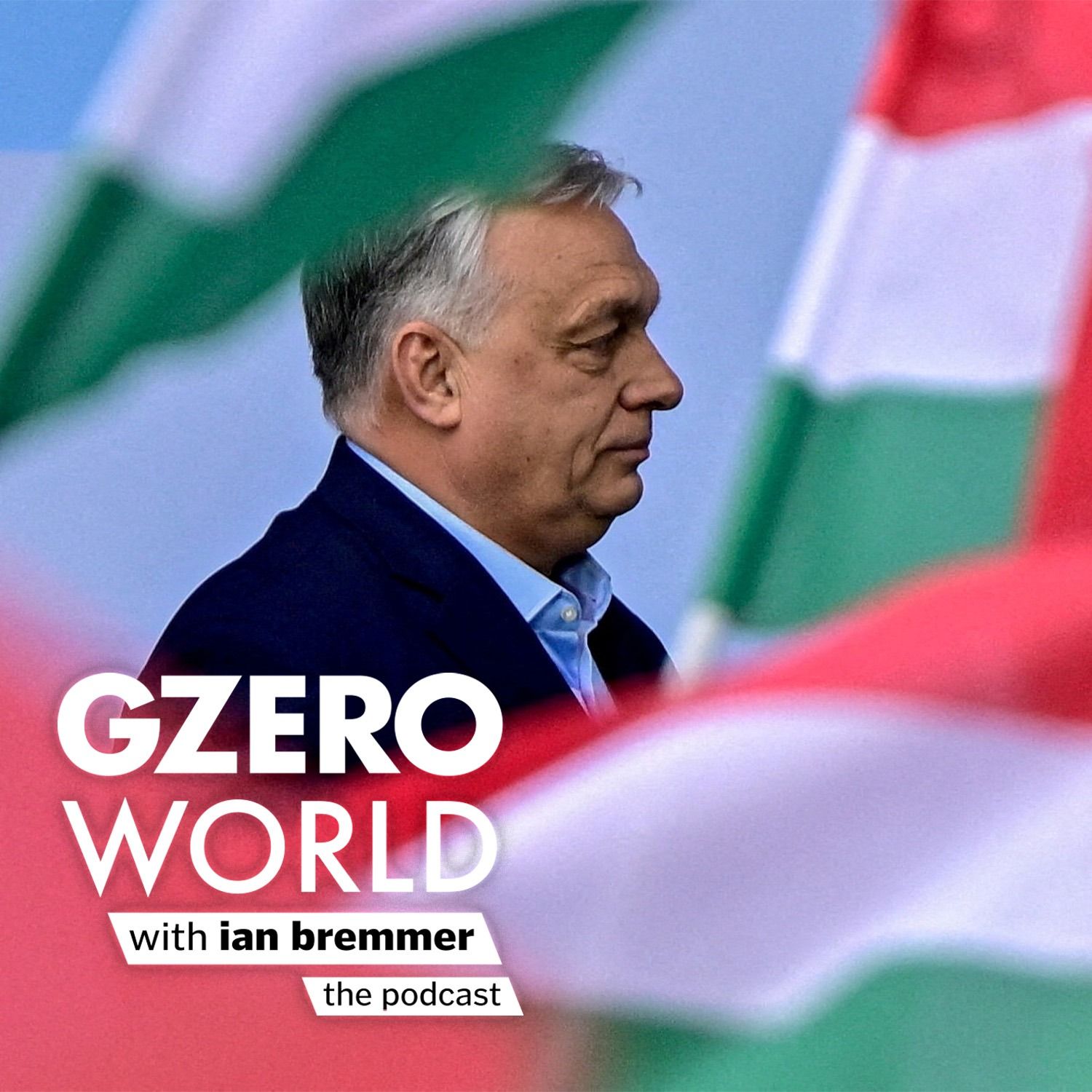
Ep 396Viktor Orbán's last stand, and the future of Europe's far right with Ivan Krastev

Ian Bremmer sits down with Ivan Krastev, Chairman of the Centre for Liberal Strategies and political scientist, to discuss Hungary's consequential upcoming election and what it means for the far right globally. For sixteen years, Viktor Orbán has dominated Hungarian politics, rewriting rules, consolidating power, and positioning himself as Europe's leading nationalist and Donald Trump's closest ally on the continent. But with parliamentary elections approaching on April 12th, his aura of invincibility is finally cracking. Opposition candidate Péter Magyar, a conservative former Orbán insider, is polling ahead by double digits, and the Trump administration is scrambling to help keep its favorite European in office. Krastev explains what most Americans get wrong about Orbán: that his real economic patron isn't Trump but China. Chinese investment in Hungary now exceeds Chinese investment in Germany and France combined, and Beijing's interest is straightforward: Orbán's willingness to veto any EU anti-China policy. Krastev also breaks down Orbán's ideological roots, arguing he is far closer to Putin than to Trump, anchored in 19th-century Hungarian nationalism and the grief of a nation that lost everything after World War I. Together, Krastev and Bremmer look ahead to what an Orbán loss would mean for Europe's far-right parties, for EU policy on Ukraine, and for Trump's own political brand. "For President Trump and for President Putin," Krastev says, "Orbán losing is going to be their personal loss." And if Trump's oldest, best-known European ally falls, being backed by Washington may soon be worth far less than it once was. Subscribe to the GZERO World with Ian Bremmer Podcast on Apple Podcasts, Spotify, or your preferred podcast platform, to receive new episodes as soon as they're published. Hosted by Simplecast, an AdsWizz company. See pcm.adswizz.com for information about our collection and use of personal data for advertising.

Apr 4, 202621 min

Ep 395Rahm Emanuel on Trump's Iran war “of choice” and midterm implications

Ian Bremmer and Rahm Emanuel discuss the deepening conflict in the Middle East, US foreign policy under Trump, and the upcoming midterms. Rahm Emanuel argues that this is a war of choice, one President Trump made himself, not one driven by external pressures like Israel’s influence. While the Prime Minister of Israel has long pushed for military action, Emanuel stresses that the responsibility for war ultimately lies with the US president, not foreign actors. He also highlights how America’s fractured political system has complicated decision-making, making it harder for the US to act with a unified voice on the world stage. Emanuel argues that Trump’s actions have eroded relationships with critical allies, particularly in Europe and the Gulf. “The price of belittling your allies is now coming home to roost,” Emanuel warns, pointing to the growing isolation the US faces at a time when global cooperation is needed most. He also discusses the broader implications of US military deployments in the region and the rising threat of Iran's growing influence. Emanuel also addresses the internal division within the US, explaining how China is carefully watching America’s internal dysfunction. “Nothing China does scares me,” he says. “It’s what we don’t do here at home that scares me.”" Subscribe to the GZERO World with Ian Bremmer Podcast on Apple Podcasts, Spotify, or your preferred podcast platform, to receive new episodes as soon as they're published. Hosted by Simplecast, an AdsWizz company. See pcm.adswizz.com for information about our collection and use of personal data for advertising.

Mar 27, 202650 min

Ep 394Unpacking Iran’s competing endgames with Brookings Institution’s Thomas Wright

Ian Bremmer sits down with Thomas Wright, Brookings Institution fellow and former Senior Director at the US National Security Council, to unpack the deepening war in Iran and the divergent strategies shaping it. What are the possible outcomes for the widening conflict in Iran? What began as a dramatic opening strike has evolved into a far more complex war, with Washington, Jerusalem, and Tehran all pursuing different aims. Wright argues this isn’t simply about degrading military capability; it’s about competing endgames that may pull the region in unpredictable directions. As Wright explains, the United States is hoping for a pragmatic partner inside Iran, while Israel pushes for full regime change. “Trump couldn’t care less if Larijani runs Iran. The Israelis do… They’re going to go full bore for regime change,” he says. At the same time, efforts to fragment the country risk creating “a much bigger problem… a Syria civil war on steroids.” The conversation also examines how other global players are responding. Europe has been muted, trying to accommodate the US, while China and Russia tread carefully, balancing economic and strategic interests without directly confronting Washington. Wright also discusses domestic implications, including the Pentagon’s evolving relationship with Silicon Valley and how frontier technologies like AI are intersecting with national security concerns. Looking ahead, Wright outlines both best-and worst-case scenarios — from the emergence of a more legitimate leadership to the specter of fragmentation that could intensify regional instability. With no clear exit ramp in sight, this conversation explores what might come next and why the endgame of this war remains so uncertain. Host: Ian Bremmer Guest: Thomas Wright Subscribe to the GZERO World with Ian Bremmer Podcast on Apple Podcasts, Spotify, or your preferred podcast platform, to receive new episodes as soon as they're published. Hosted by Simplecast, an AdsWizz company. See pcm.adswizz.com for information about our collection and use of personal data for advertising.

Mar 14, 202635 min

Ep 393Tariffs: what comes next with Paul Krugman and Scott Lincicome

While Washington has become more hostile to globalization, Americans continue to buy foreign goods in record numbers. Lincicome notes that economic nationalism is “about an inch deep,” with support collapsing when Americans face higher prices for domestic products. The conversation also explores the impact of tariffs on businesses and consumers. Lincicome explains that if certain tariffs are ruled illegal, companies could seek refunds totaling up to $175 billion, potentially through litigation rather than administrative action. Krugman emphasizes that while policy debates grab headlines, public perception and midterm politics may ultimately matter more than the details of trade law or corporate strategy. From the immediate fallout of legal challenges to the broader question of how the U.S. navigates trade and globalization, Bremmer, Lincicome, and Krugman explore the delicate balance between politics, policy, and the economy—and what it could mean for American consumers, businesses, and the upcoming midterms. Host: Ian Bremmer Guests: Paul Krugman, Scott Lincicome Subscribe to the GZERO World with Ian Bremmer Podcast on Apple Podcasts, Spotify, or your preferred podcast platform, to receive new episodes as soon as they're published. Hosted by Simplecast, an AdsWizz company. See pcm.adswizz.com for information about our collection and use of personal data for advertising.

Mar 7, 202622 min

Ep 392Iran at war with Carnegie’s Karim Sadjadpour

Ian Bremmer sits down with Karim Sadjadpour of the Carnegie Endowment for Peace to examine Iran’s precarious position on the global stage and the forces shaping the country. At the heart of the discussion is the regime’s internal fragility. Sadjadpour explains that many inside Iran, including elements of the Revolutionary Guards, are “waiting for Ayatollah Khamenei to die.” The conversation also explores Iran’s isolation in the international arena. While 90% of its oil goes to China at deep discounts, Sadjadpour points out that Chinese and Russian interests in Iran diverge sharply. Despite the pressures at home and abroad, Sadjadpour argues that many ordinary Iranians recognize that reconciliation with the United States is essential if the country is ever to realize its enormous potential. From leadership uncertainty to global isolation, Bremmer and Sadjadpour explore the delicate balance Iran faces today—and the choices that will determine its path forward. Subscribe to the GZERO World with Ian Bremmer Podcast on Apple Podcasts, Spotify, or your preferred podcast platform, to receive new episodes as soon as they're published. Hosted by Simplecast, an AdsWizz company. See pcm.adswizz.com for information about our collection and use of personal data for advertising.

Feb 28, 202616 min

Ep 391President Trump's power-first foreign policy with CFR's President

From sweeping tariffs to threats of military action and withdrawal from international institutions, Trump has demonstrated a willingness to break with the United States' approach to international relations. When the US shifts from global order architect to challenger, what kind of system emerges, and how do other countries react? On the GZERO World Podcast, Ian Bremmer sits down with former US Trade Representative and Council on Foreign Relations President Michael Froman to discuss.Michael Froman tells Ian Bremmer that under Trump's second term, he’s been less surprised by a single policy shift than by how quickly other countries have adapted to them. As allies hedge and adversaries like China step into new leadership roles, they unpack how the world order is evolving and discuss the most pressing issues. Subscribe to the GZERO World with Ian Bremmer Podcast on Apple Podcasts, Spotify, or your preferred podcast platform, to receive new episodes as soon as they're published. Hosted by Simplecast, an AdsWizz company. See pcm.adswizz.com for information about our collection and use of personal data for advertising.

Feb 14, 202634 min

Ep 390Cyber resilience for small enterprises

As more small businesses move sales, payments, and customer relationships online, they unlock new opportunities, but they also become easier targets for cyber-criminals and other threat actors.In this episode of Local to global: The power of small business, host JJ Ramberg sits down with Shamina Singh, Founder & President of the Mastercard Center for Inclusive Growth, and Brian Cute, Interim CEO and Director of Capacity & Resilience at the Global Cyber Alliance, to explore what Southeast Asia’s fast-growing digital economy reveals about the cybersecurity challenges facing micro, small and medium-sized businesses everywhere.Together, they unpack what cyber-risk looks like on the ground, from phishing, ransomware, and malware to low-tech scams like QR-code sticker switching. They also examine why the damage rarely stays local; when a small supplier gets hit, disruptions can cascade through regional networks and even global supply chains.The good news is that their collaboration in Southeast Asia is also surfacing solutions that the rest of the world can borrow. Singh and Cute share what works, including public-private partnerships that deliver practical toolkits, localized training, and basic cyber hygiene that businesses can adopt, especially as AI-driven fraud and deepfakes make scams harder to spot.Local to global: The power of small business is a podcast series from GZERO Media’s Blue Circle Studios and Mastercard, exploring why small businesses are poised to play an even bigger role in the future of the global economy. Host: JJ RambergGuests: Shamina Singh, Brian Cute Subscribe to the GZERO World with Ian Bremmer Podcast on Apple Podcasts, Spotify, or your preferred podcast platform, to receive new episodes as soon as they're published. Hosted by Simplecast, an AdsWizz company. See pcm.adswizz.com for information about our collection and use of personal data for advertising.

Feb 12, 202623 min

Ep 389Singapore's global moment, with President Tharman Shanmugaratnam

How does a small country like Singapore, strategically positioned between the US and China, navigate a world of growing uncertainty? On the GZERO World Podcast, Ian Bremmer sits down with Singapore’s President Tharman Shanmugaratnam to unpack a global order in flux. For a small country at a global crossroads, managing the current geopolitical moment isn't an abstract concept. It is central to its survival. Despite "radical uncertainty," the city-state has continued to flourish as a global hub for finance, trade, and technology.From the sidelines of Davos, Bremmer and Shanmugaratnam look at the rapidly changing global order. Shanmugaratnam says the challenge is not to sit back and “be intimidated” but to realize that most issues no longer require leadership by a “single, dominant power.” Take AI. Despite its relatively small size, Singapore has become a global leader. With some of the most advanced real-world adoption of artificial intelligence in the world, the government is working to future-proof its economy by investing in lifelong learning and skills upgrading so that its workforce, especially white-collar workers, can adapt and thrive in the AI future.Host: Ian BremmerGuest: Tharman Shanmugaratnam Subscribe to the GZERO World with Ian Bremmer Podcast on Apple Podcasts, Spotify, or your preferred podcast platform, to receive new episodes as soon as they're published. Hosted by Simplecast, an AdsWizz company. See pcm.adswizz.com for information about our collection and use of personal data for advertising.

Jan 31, 202621 min

Ep 388Europe's wake-up call, with Alexander Stubb and Kristalina Georgieva

The GZERO World Podcast heads to Davos, Switzerland for the World Economic Forum this week for a look at transatlantic relations and how President Trump’s second term is reshaping the global order. Uncertainty and tensions were high this week as Trump doubled down on his desire to control Greenland—before announcing a deal with NATO over the Danish territory’s future and walking back tariff threats. Ian Bremmer spoke with Finnish President Alexander Stubb on the sidelines of Davos to discuss the future of the transatlantic relationship, Arctic security, the war in Ukraine and why, despite so many geopolitical challenges, Europe is more united than ever.Then, Bremmer sits down with Kristalina Georgieva, Managing Director of the International Monetary Fund, for a look at the surprising resilience of the world economy. Georgieva says there are four key reasons why the IMF upgraded its global growth forecast for 2026. They also discuss the importance of independent central banks and Trump’s push for more control over Fed policy.Host: Ian BremmerGuests: Alexander Stubb, Kristalina Georgieva Subscribe to the GZERO World with Ian Bremmer Podcast on Apple Podcasts, Spotify, or your preferred podcast platform, to receive new episodes as soon as they're published. Hosted by Simplecast, an AdsWizz company. See pcm.adswizz.com for information about our collection and use of personal data for advertising.

Jan 24, 202633 min

Ep 387Trump's second term–one year in, with Stephen Walt

It’s been a year since President Trump returned to office, this time with fewer constraints, a better understanding of how government works, and a much more muscular view of US foreign policy. This week on the GZERO World Podcast, Harvard’s Stephen Walt joins Ian Bremmer to help answer a simple question with complicated answers: what kind of presidency is he building this time around?Over the past year, we’ve seen a dramatic expansion of presidential power and a rewriting of America's role in the world. There’s been a retreat from multilateral institutions, targeting of long-standing allies, and a view of global politics where great powers dominate, and weaker ones fall in line. It’s a big departure from 80 years of the postwar order America spent building and leading. How much more will change by the time he leaves office?Host: Ian BremmerGuest: Stephen Walt Subscribe to the GZERO World with Ian Bremmer Podcast on Apple Podcasts, Spotify, or your preferred podcast platform, to receive new episodes as soon as they're published. Hosted by Simplecast, an AdsWizz company. See pcm.adswizz.com for information about our collection and use of personal data for advertising.

Jan 17, 202622 min

Ep 386Venezuela after Maduro with Senator Gallego and Frank Fukuyama

Ian Bremmer unpacks the fallout from the Trump administration’s dramatic operation in Caracas that captured Venezuelan strongman Nicolás Maduro and brought him to the US to face federal charges. The raid was a stark demonstration of American power, and few are mourning the fall of a leader whose rule helped collapse Venezuela and drive millions to flee. But even with Maduro gone, the hard questions start immediately: who governs now, how long does the US stay involved, and how quickly could “stability” turn into something far messier?First, Bremmer speaks with Democratic Senator Ruben Gallego, who says the operation may have been “limited” in scope, but the political and strategic risks are only beginning. Gallego argues that the White House is improvising and that Congress is watching closely for signs of escalation. “There really isn’t a plan,” he warns. “They’re kind of just playing this as it goes, which is very scary that they’re doing that.” He lays out what a more sustainable path could look like, including releasing political prisoners, setting a timeline for elections, and pursuing economic steps that reduce the chances of renewed conflict.Then Bremmer is joined by Stanford political scientist Frank Fukuyama, who cautions against viewing Maduro’s capture as a clean “one and done” victory. The regime, he argues, is bigger than any single leader, and the US may be stepping into a long, unpredictable project whether it admits it or not. “Let’s not kid ourselves,” Fukuyama says. “This is a nation building exercise.” From the risk of economic collapse and refugee flows to the precedent set by a US foreign policy driven by raw leverage, Fukuyama and Bremmer explore what happens when Washington embraces the “law of the jungle,” and why the consequences could extend well beyond Venezuela.Host: Ian BremmerGuests: Ruben Gallego and Francis Fukuyama Subscribe to the GZERO World with Ian Bremmer Podcast on Apple Podcasts, Spotify, or your preferred podcast platform, to receive new episodes as soon as they're published. Hosted by Simplecast, an AdsWizz company. See pcm.adswizz.com for information about our collection and use of personal data for advertising.

Jan 10, 202635 min

Ep 385The biggest geopolitical risks of 2026 revealed

With the global order under increasing strain, 2026 is shaping up to be a tipping point for geopolitics. From political upheaval in the United States to widening conflicts abroad, the risks facing governments, markets, and societies are converging faster—and more forcefully—than at any time in recent memory.To break it all down, journalist Julia Chatterley moderated a wide-ranging conversation with Ian Bremmer, president of Eurasia Group and GZERO Media, and a panel of Eurasia Group experts, to examine the findings of their newly-released Top Risks of 2026 report.One theme dominates the discussion: the United States itself. From an accelerating political revolution at home to a more aggressive projection of power abroad, Washington has become the single biggest driver of global risk. That shift is playing out vividly in the Western Hemisphere, where dramatic developments in Venezuela signal a renewed US willingness to shape political outcomes closer to home.Along with Ian Bremmer, the Eurasia Group panel included Gerald Butts, Vice Chairman; Risa Grais-Targow, Director, Latin America; Cliff Kupchan, Chairman; and Mujtaba (Mij) Rahman, Managing Director, Europe. Their discussion also digs into the wars in Ukraine and the Middle East, rising instability among US allies in Europe, intensifying US-China competition, and the growing geopolitical consequences of artificial intelligence—all against the backdrop of a world with fewer guardrails and weaker global leadership.As Bremmer argues, these risks are not isolated. They are symptoms of a deeper transformation: a GZERO world, where power is unconstrained, alliances are fragile, and no single country can—or will—stabilize the international system.Host: Julia ChatterleyGuests: Ian Bremmer, Risa Grais-Targow, Cliff Kupchan, Mujtaba (Mij) Rahman, Gerald Butts Subscribe to the GZERO World with Ian Bremmer Podcast on Apple Podcasts, Spotify, or your preferred podcast platform, to receive new episodes as soon as they're published. Hosted by Simplecast, an AdsWizz company. See pcm.adswizz.com for information about our collection and use of personal data for advertising.

Jan 8, 20261h 1m

Ep 384War and Peace in 2025, with Clarissa Ward and Comfort Ero

This week, instead of zooming in on a single conflict, the GZERO World Podcast looks back on 2025 and takes stock of a world increasingly defined by conflict. Ian Bremmer sits down with CNN Chief International Correspondent Clarissa Ward and Comfort Ero, President and CEO of the International Crisis Group to look at some of the biggest crises of 2025–-both the headline making wars and the ones the world overlooked.Gaza and Ukraine captured the world’s attention this year. But at the same time, around 60 other armed conflicts and struggles have been raging around the world. It’s the most active period of conflict since the end of World War II. Some are decades-long battles, like Myanmar’s devastating civil war. Others are more recent, like the surge of terrorist insurgent groups in Africa’s Sahel. But each is a symptom of a broader global order breaking down—driven by weakening institutions, regional rivalries, climate shocks, and failing states. Bremmer sits down first with Clarissa Ward, to discuss her reporting from war zones around the world and then with Comfort Ero, for a global perspective on the conditions that have created so much strife.Host: Ian BremmerGuests: Clarissa Ward, Comfort Ero Subscribe to the GZERO World with Ian Bremmer Podcast on Apple Podcasts, Spotify, or your preferred podcast platform, to receive new episodes as soon as they're published. Hosted by Simplecast, an AdsWizz company. See pcm.adswizz.com for information about our collection and use of personal data for advertising.

Dec 20, 202550 min

Ep 383Why we still trust Wikipedia, with cofounder Jimmy Wales

At a moment when Americans can’t agree on much of anything, one unlikely institution still commands broad trust: Wikipedia. Ian Bremmer sits down with Wikipedia cofounder Jimmy Wales to ask why the crowdsourced encyclopedia remains one of the most visited and relied-upon sites in the world, even as trust in media, government, and tech companies continues to collapse.That trust, Wales argues, comes from Wikipedia’s decentralized model and its refusal to speak with a single authoritative voice on contested issues. “We don’t try to answer the question or take a side,” Wales says. “What we do is describe the debate.” But that principle is under strain. Wales addresses recent backlash over Wikipedia’s handling of politically sensitive topics, including Gaza, where he says the site crossed an important line by adopting language that lacked broad consensus. “For Wikipedia to speak in its own voice requires an extremely high bar,” he explains.Bremmer and Wales also explore how artificial intelligence is reshaping the information ecosystem. While AI systems are already trained on Wikipedia’s content, Wales says the platform is moving cautiously, prioritizing transparency, open source tools, and independence over partnerships with big tech. “Wikipedia’s biggest liability is also its biggest strength,” Wales says. “No one owns it.” In an internet increasingly dominated by centralized platforms and opaque algorithms, Wales makes the case that Wikipedia’s model, messy, imperfect, and community-driven, may be more necessary than ever.Host: Ian BremmerGuest: Jimmy Wales Subscribe to the GZERO World with Ian Bremmer Podcast on Apple Podcasts, Spotify, or your preferred podcast platform, to receive new episodes as soon as they're published. Hosted by Simplecast, an AdsWizz company. See pcm.adswizz.com for information about our collection and use of personal data for advertising.

Dec 13, 202537 min

Ep 382The human cost of AI, with Geoffrey Hinton

Computer scientist and Nobel laureate Geoffrey Hinton joins Ian Bremmer on the GZERO World podcast to talk about artificial intelligence, the technology transforming our society faster than anything humans have ever built. The question is: how fast is too fast? Hinton is known as the “Godfather of AI.” He helped build the neural networks that made today’s generative AI tools possible and that work earned him the 2024 Nobel Prize in physics. But recently, he’s turned from a tech evangelist to a whistleblower, warning that the technology he helped create will displace millions of jobs and eventually destroy humanity itself.The Nobel laureate joins Ian to discuss some of the biggest threats from AI: Mass job loss, widening inequality, social unrest, autonomous weapons, and eventually something far more dire: AI that becomes smarter than humans and might not let us turn it off. But he also sees a path forward: if we can model good behavior and program ‘maternal instincts’ into AI, could we avoid a worst-case scenario?Host: Ian BremmerGuest: Geoffrey Hinton Subscribe to the GZERO World with Ian Bremmer Podcast on Apple Podcasts, Spotify, or your preferred podcast platform, to receive new episodes as soon as they're published. Hosted by Simplecast, an AdsWizz company. See pcm.adswizz.com for information about our collection and use of personal data for advertising.

Dec 6, 202525 min

Ep 381Gaming out a US-Venezuela war with ambassador James Story

The US is ramping up pressure on Venezuela, with the USS Gerald R. Ford deployed to the region, CIA covert operations approved by the White House, and strikes on suspected narco‑trafficking vessels attributed to Caracas. Many analysts now see regime change as the ultimate goal. On the GZERO World Podcast, Ian Bremmer and former US Ambassador James Story game out what a US intervention in Venezuela might look like—and more importantly, how the US would manage the aftermath.Story points out that while removing Nicolás Maduro may sound feasible, rebuilding Venezuela’s institutions, economy and social fabric would be far harder. “The country is a failed state,” he says. “You’re going to need the military to help you secure peace while you rebuild.” As Washington talks of sanction relief and diplomatic pressure, Story asks: does the US have the capability, resources or will to stay for the long haul?Host: Ian BremmerGuest: James Story Subscribe to the GZERO World with Ian Bremmer Podcast on Apple Podcasts, Spotify, or your preferred podcast platform, to receive new episodes as soon as they're published. Hosted by Simplecast, an AdsWizz company. See pcm.adswizz.com for information about our collection and use of personal data for advertising.

Nov 22, 202526 min
GZERO Media 2025