
Game Changer - the game theory podcast
107 episodes — Page 2 of 3

The Economist's Brain: Tracing Choices with Neuroeconomic Insights | with Juan D. Carrillo
In this episode, we explore together with our guest Juan D. Carrillo the confluence of economics and neuroscience in understanding human decision-making processes. We delve into how the combination of these two disciplines can illuminate the biological basis of decision making, with a particular focus on complex scenarios like multi-task decision making, self-control, and impulsivity. Juan shares insights from his papers, discussing the innovative approach of neuroeconomic theory and its real-world applications. Juan D. Carrillo is a Professor of Economics at the University of Southern California and a Research Fellow in the Industrial Organization and Public Policy programs at the Center for Economic Policy Research (CEPR). His research spans Neuroeconomic Theory and Experimental Economics, blending insights from neuroscience and economics to understand decision-making processes. Additionally, Juan co-directs the Los Angeles Behavioral Economics Laboratory (LABEL), focusing on experimental research in economic decision-making and strategic interactions. You can find out more about his research on his homepage and read the papers that are discussed in this episode here and here.

Feeding America – allocating food to food banks with innovative market mechanisms | with Canice Prendergast
In this episode, we discuss with Canice Prendergast how market design mechanisms can be applied in social services. Canice shares how he collaborated with Feeding America on optimally allocating about 300 million pounds of food per year to hundreds of food banks across the United States. They were developing a market-based allocation mechanism introducing an internal currency to bid for available food on a daily basis. Canice shares the process itself as well as many anecdotes on its development and introduction. Canice Prendergast is W. Allen Wallis Distinguished Service Professor at the University of Chicago Booth School of Business. He is an economist specialising in economic theory, labour economics, and organizational behaviour.

Does opaque AI lead to a catastrophe? – a Game Theorist's view | with Jeffrey Ely
In this episode, we discuss with Jeff Ely a topic that has gotten significant public attention last year with the introduction of Chat GPT and similar programmes: The role of AI. Jeff shares his research with Balazs Szentes on a natural selection model on AI. They set up a model to study the AI control problem in the context of decentralized economic production. The study illustrates the importance of AI transparency as already deviating from 'perfect transparency' leads to catastrophic consequences. In our discussion he shares all details of the model, and we also discuss potential consequences for future development of AI technology. Jeff Ely is the Charles E. and Emma H. Morrison Professor of Economics at Northwestern University. With interests ranging from pure game theory to behavioral economics, Jeff has made significant contributions to various facets of economics, including mechanism design and the evolution of preferences. You can find the paper titled "Natural Selection of Artificial Intelligence", which he wrote together with Balazs Szentes, here.

Split or Steal? Experiments on lies and self-deception | with Marta Serra-Garcia
In this episode, we explore with Marta Serra-Garcia the paradoxes of human behaviour in the realms of self-deception and lie detection. Marta's research, rooted in behavioural and experimental economics, questions why lying persists in a society that values morality. We delve into her experiments that examine how people reconcile their self-image with material interests, the timing of incentive information in ethical decision-making, and the effectiveness of algorithms in detecting deception. Marta Serra-Garcia is an Associate Professor of Economics and Strategy at the UC San Diego Rady School of Management. Specialising in behavioural and experimental economics, her acclaimed work focuses on the dynamics of ethical decision-making and its influence on behaviours like lying and charitable giving. A prolific researcher, Marta's work has been published in esteemed journals, earning her a place among the 2020 Best 40 under 40 MBA Professors. You can find her paper on self-deception here and her paper on lie detection here.

Fortune's Fairness: The Super-Rich's View on Inequality | with Alain Cohn
In this episode, our guest Alain Cohn helps us to understand the complex relationship between wealth and perceptions of fairness in society. We explore his innovative research methodology, which move beyond traditional surveys to more accurately reflect the nuances of economic behaviors. The conversation also highlights the differences in attitudes towards inequality among the wealthy, particularly contrasting those with inherited wealth and the newly affluent. Through Alain's studies, we gain a deeper understanding of the dynamics at play between wealth, fairness, and policy influence in today's society. Alain Cohn is Associate Professor at the University of Michigan School of Information, focused on the social and psychological determinants of economic behaviors. His work has significantly contributed to our understanding of honesty, financial risk-taking, and the impact of wealth on fairness perceptions and redistribution policies. In the episode, we also briefly mention the ultimatum game and the dictator's game. If you want to find out more about these games, you can also check out our episode on first offers in bargaining with Lionel Page.

Union negotiators are Game Theorists – 2023 UAW strike and its outcomes | with Marc Robinson
In this episode, our guest Marc Robinson, strategy and risk management expert, shares details on the recent UAW strikes and negotiations. With his rich background in the automotive industry and his experience as an economist at General Motors in the past, Marc observed the recent negotiations from a Game Theorist perspective. He shares the key success factors for the UAW to complete the union negotiations in their favor ranging from historical developments to changes in the UAW's strategic moves compared to past union negotiations. We also discuss the broader implications of these negotiations for the automotive industry, its supply chain, and future union negotiations. Marc Robinson works as an independent strategy and risk management consultant, following a career as an internal consultant and economist at General Motors. It was there that he first introduced game theoretic concepts and tools, applying them to a vast range of applications such as strategic product or investment decisions, or negotiations with partners, suppliers, and unions. He also taught at UCLA and Stanford and worked on the Council of Economic Advisers under President George H.W. Bush. If you want to read more on the 2023 UAW strikes, you can check out Marc's website https://www.csuitenewsletter.com/, where he covered the topic extensively in several blog posts.

(Nuclear) Deterrence as a Game Theoretic concept | with Frank Zagare
In this episode we are talking to Frank Zagare about deterrence. The term gained popularity in particular during the cold war to describe the role of nuclear weapons in Soviet-American relations and, in light of recent events, has surfaced again. Together with Frank we look at the concept from a Game Theoretic perspective and discuss the shortcomings of the classical way of modeling deterrence. Frank then walks us through his alternative theory, perfect deterrence theory. He explains to us how it differs from classical way of modeling and which insights it offers on the war in Ukraine. Frank Zagare is UB Distinguished Professor of Political Science at the University at Buffalo and author of several books like 'The Dynamics of Deterrence' and 'Game Theory, Diplomatic History and Security Studies' among others.

Would you return a lost wallet? – Economist's perspective on honesty | with Michel Maréchal
In this episode we are talking to Michel Maréchal about honesty from an economist's perspective. He shares with us two studies he has conducted on honesty: Firstly, we talk about a mega-study in which Michel and his colleagues have tested in more than 300 cities around the globe with more than 17000 wallets whether people would rather return lost wallets if there were a higher or lower amount of money in them. Secondly, he shares a lab experiment in which he studied whether humans are more honest when interacting with other humans versus interacting with machines. Both studies give an understanding on human's behaviour when being incentivized to being dishonest. Michel Maréchal is a Visiting Professor of Economics at the Rady School of Management, UC San Diego and Professor of Economics at the Department of Economics from the University of Zürich. His research is interdisciplinary and lies at the intersections of economics, social psychology, criminology, political science and biology. Here you can find Michel's papers on civic honesty and honesty in the digital age. You can also check out his website for other research topics he is currently working on.

In plain sight - why simplicity should be considered in game theoretic concepts | with Shengwu Li
In this episode we are talking to Shengwu Li about simplicity in game theoretic concepts. He explains to us, what simple means in this context, how this notion facilitates application of game theory to the "real world" and what an obviously dominant strategy is. We discuss how this understanding of game theory can be particularly helpful when conducting auctions and what practitioners need to know beyond that to harness game theory's predictive powers. Shengwu Li is Associate Professor of Economics at Harvard University. His research is focused on Microeconomic Theory, Market Design and Behavioral Economics.

Picking up speed - how companies can make headway in reaching CO2 targets | with Daniel Helmig
For many companies reaching their self-imposed CO2 targets has become quite a tall order. While procurement has tried to rise to the occasion progress is often slow. In this episode we are talking to Daniel Helmig who explains to us how companies can get unstuck and move forward in reaching their CO2 targets. We discuss what the past can teach us about possible solutions, which three important questions CEOs and other leaders should answer for an honest assessment of their situation and what gradual progress for companies could look like in the future. Daniel Helmig is founder and Managing Director of the Helmig Advisory, which supports organizations in uncovering hidden potential in their supply chain, procurement, or operations area. Prior to this he held positions such as Corporate Transformation Leader, Group Head of Operations & Quality, Chief Procurement Officer, Senior Vice President, and Managing Director in five different industries.

Cracking the Code: Incentivising teams in non-routine tasks | with Florian Englmaier
In this episode, our guest Florian Englmaier explores the effectiveness of monetary incentives in driving team efficiency and innovation. He shares insights from an experimental study conducted in an escape room setting, uncovering surprising findings about the impact of incentives on non-routine tasks and the emergence of leadership dynamics within teams. Florian Englmaier is professor of organisational economics at the Ludwig-Maximilians-University in Munich, Germany. His main research interests lie in the fields of the economics of organisations and human resources, where he focuses on agency problems in organisations. You can find the papers on his studies conducted in the escape room setting here and here.

Learning from a negotiation expert - the role of 'tactical empathy' | with Chris Voss
In this episode we are talking to Chris Voss. He is a former FBI hostage negotiator and has written a bestselling book "Never split the difference". We discuss with him, what we can learn from hostage negotiations about negotiations in other settings, especially in the business context. Chris shares his approaches to negotiations and compares the importance of "tactical empathy" with Game Theoretic approaches. He also gives concrete and tangible proposals on how the listeners can improve their negotiation skills. Chris Voss is a former FBI lead hostage negotiator, and founder and CEO of The Black Swan Group, a company focused on negotiation skills trainings. He is author of the bestselling book "Never Split the Difference".

Let's go to the movies! – Game Theory in films | with Santiago Sanchez-Pages
In today's episode, we discuss Game Theory in movies. Santiago shares in which movies the prisoner's dilemma, the chicken game and other concepts are portrayed. The discussion brings us to many known movies, amongst them 'The dark knight', 'A Beautiful Mind', and many others. Below we have listed a list of links of the movie clips we discuss in this episode. Santiago also shares in the discussion which of them were successful in portraying Game Theory and which ones could have done a better job. Santiago Sanchez-Pages is a Reader in Economics in the Department of Political Economy. His background is in economic theory, including bargaining, game theory and political economy, but one of his main research fields is also experimental economics. He has written a book on Economics in movies titled "The Representation of Economics in Cinema. Scarcity, Greed and Utopia". L.A. Confidential (Prisoner's dilemma): L.A. Confidential (3/10) Movie CLIP - The Interrogation (1997) HD The Dark Knight (Prisoner's dilemma): Social experiment || Dark knight Rebel without a cause (chicken run): The Chicken Run: Rebel Without A Cause (1955) Footloose (Chicken run): Holding Out for a Hero Bonnie Tyler Footloose A Beautiful Mind (Nash equilibrium – or lack thereof): A Beautiful Mind - Bar Scene John Nash's Equilibrium Game Theory [1080p english full scene] Dr. Strangelove or: How I Learned to Stop Worrying and Love the Bomb (Commitment): Doctor Strangelove - Doomsday Machine

Hidden Gems – Gathering insights from unconventional data sources | with Stefano DellaVigna
In this episode, our guest Stefano DellaVigna shares his approach to answering research questions through various data sources, including lab experiments, natural experiments, and field experiments. We explore the significance of seeking out natural experiments and their value in enhancing our understanding of human behavior. Using examples such as the impact of violent movies on violence and changes in Fox News subscriptions, Stefano reveals surprising findings and their implications. We also discuss the availability of experimental data and the establishment of nudging units for research purposes. Stefano DellaVigna is the Daniel Koshland, Sr., Distinguished Professor of Economics, Professor of Business Administration at the University of California, Berkeley, and co-director of the Berkeley Initiative for Behavioral Economics and Finance. His research interests are, among others, in the area of behavioral economics, applied microeconomics and media economics. You can find his paper on the influence of movie violence on violent crime here and his paper on the "Fox News effect" here.

Behind the Stars: Uncovering the Biases in Online Reviews | with Tommaso Bondi
In this episode Tommaso Bondi shares his research on cultural markets with us. We take a deep dive into the insights he gained when studying online reviews and he explains to us why, counterintuitively, earning public recognition does not necessarily lead to higher ratings. A finding which, as we learn from Tommaso, is closely related to how well customer preferences and product match. Tommaso's result does not only have theoretical merit but also seems to be observable in practice. We then also discuss the impact of experts on reviews and finally take a short detour to strategies of brick-and-mortar bookstores. Tommaso Bondi is Assistant Professor of Marketing and the Demir Sabanci Faculty Fellow of Marketing and Management at Cornell Tech and the SC Johnson Graduate School of Management at Cornell University. His research is mainly focused on economics of digitization, quantitative marketing, and behavioral and experimental economics. You can find his papers "Alone, Together: A Model of Social (Mis)Learning from Consumer Reviews" and "The Good, The Bad and The Picky: Reference Dependence and the Reversal of Product Ratings" here and here.

A Tale of Two Players: Exploring the Rubinstein Bargaining Model | with Ariel Rubinstein
In today's episode, we explore one of the classics in Bargaining theory: The Rubinstein Bargaining Model. And we have found the perfect guest - who better to explain this bargaining model than its founder Ariel Rubinstein himself! Ariel not only shares how the idea of the model came to be, but he also comments on some results and critically discusses whether the Rubinstein Bargaining Model (and Game Theory in general) has predictive or normative power for real-life situations. Ariel Rubinstein is Professor of Economics at the School of Economics at Tel Aviv University and the Department of Economics at New York University. His research is focused on Economic Theory, in particular Decision Theory and Game Theory. You can download his books for free (also the book "Economic fables" mentioned in our episode) and check out his Atlas of Cafés on his website https://arielrubinstein.tau.ac.il/ . There, you also find his original paper introducing what came to be know the "Rubinstein Bargaining Model": "Perfect Equilibrium in a Bargaining Model"

Can Cash Cloud the Mind? Exploring the Influence of Incentives on Personal Choices | with Sandro Ambühl
Monetary incentives are a part of our daily lives, from work bonuses to fines for minor traffic violations. But can they lead us to make bad decisions? In this episode, our guest Sandro Ambühl presents an empirical study in which he investigates this very question. He explains what constitutes a bad decision in the economic/rational sense and how people's decisions are related to regret, information, and the size of the monetary incentive. Sandro Ambühl is Assistant Professor of Behavioural Economics of Financial Markets at the University of Zurich, where his research is focused on Behavioural Experimental Economics, Behavioural and Experimental Finance, Repugnant Transactions and Rational Inattention. You can find his paper "Can Incentives Cause Harm? Tests of Undue Inducement" here.

Clicking Against the Clock: How time pressure and regret influence our behaviour in online shopping | with Timm Opitz
In this episode, we explore how time pressure and regret can influence our search behavior as customers in the world of online shopping. Our guest, Timm Opitz, sheds light on his research paper titled "Time Pressure and Regret in Sequential Search", which investigates the impact of urgency and regret on optimal search behavior by conducting experiments in a controlled environment. He also shares some strategies we can use to overcome the influence of urgency and regret in our shopping behaviour. Timm Opitz is economist currently pursuing his PhD at the Max-Planck-Institute for Innovation and Competition in Munich, Germany, where he is part of the Innovation and Entrepreneurship Research group. As such, his research interests are Entrepreneurship, Behavioral Market Design and Developmental Psychology. You can find his paper on "Time Pressure and Regret in Sequential Search" here.

AI and Regulation: Finding the Sweet Spot for Consumer Welfare | with Keith Chan
Join us in this episode as we explore the rise of AI technology and the complex decisions that policy makers are facing regarding the protection of privacy and fostering of innovation. Our guest Keith sheds light on how moderately loosening regulations in a competitive market environment may maximize consumer welfare. However, we also discuss how some countries, such as Russia, strongly deviate from this strategy, indicating that consumer welfare may not be their top priority. Keith Chan is Assistant Professor at the Hong Kong University of Science and Technology, where his research is centered on Microeconomics, Environmental Economics and Sustainable and Green Finance. You can find his paper on the tradeoff between regulations and innovation for AI here.

From Connections to Careers: On the Impact of Personal Referrals in the Labour Market | with Felix Mylius
In this episode Felix Mylius shares his insights on personal referrals in labour markets. He explains to us why personal referrals are still relevant for job search today despite the predominant use of online platforms to find jobs and how all this is linked to Game Theory and matching markets. Together we dive into firms' incentives, implications for search platforms and discuss whether this is transferable to other matching markets, like the dating market. Felix Mylius is currently finishing his PhD in economics at the University of Cambridge. His research is mainly focused on applications of microeconomics within the field of matching markets.

The doctor is in! Misguided incentives and regulation in healthcare markets | with Simon Reif
In this episode we are diving into the topic of healthcare markets together with Simon Reif. He explains to us what makes the healthcare market so special, why its characteristics call for regulation and how systems differ substantially across countries. Focusing on Europe we discuss how, counterintuitively, setting a "global budget" for hospitals leads to poorer service and how generating the right incentives could change the healthcare market for the better in future. Simon Reif is a health economist heading the research group "Health Markets and Health Policy" at the Leibniz Centre for European Economic Research (ZEW) in Mannheim, Germany. His research is focused on market structures, reimbursement and digitalization of health care provision.

Truth-telling by design: how Market Design can alleviate inequality | with Piotr Dworczak
In this episode Piotr Dworczak explains to us how Market Design can contribute to alleviating inequality by increasing accuracy of policies targeting inequality. He does so using an example from the housing market which shows that more often than not it is very difficult to ensure that subsidies actually reach people in need since they cannot be easily identified. This is where Market Design comes into play: by generating targeted incentives which have a selection effect, it makes e.g. affordable housing policies more effective. Piotr Dworczak is associate Professor at the Department of Economics at Northwestern University and Researcher at the Group for Research in Applied Economics (GRAPE) in Warsaw, Poland. He does research on Mechanism and Information Design, specifically with more applied interests in inequality-aware Market Design.

Why sometimes we are better off not knowing – on information design and Bayesian persuasion | with Emir Kamenica
In this episode Emir Kamenica introduces us to the research field of information design. He recaps the history of modelling information in economics from the 70s to today, and explains term "Bayesian Persuasion" (and if and how it differs from the term "information design"). He then illustrates how having full information e.g. as a navigation app user can lead to inefficient outcomes and what information design means in the context of mystery novels, gambling and entertainment in general. Emir Kamenica is Professor of Economics at the University of Chicago Booth School of Business and, together with his co-researchers, has founded the field of Bayesian persuasion. Beyond that his research is centered on different topics in microeconomics. During the interview, Emir mentions one of his papers on how information design can reduce congestion. You can find this paper here.

Putting your money where your mouth is – on commitment in auctions | with Vitali Gretschko
In this episode, Vitali Gretschko sheds some light on a fundamental game theoretic concept: Commitment. He explains why commitment is a crucial prerequisite of auctions and introduces different ways of generating commitment. We also explore how commitment is linked to the concept of information and discuss auction concepts which make it less likely for the auctioneer to break their commitment afterwards. Vitali Gretschko is Professor of Market Design at the University of Mannheim and head of the ZEW Research Department "Market Design". In the interview, Vitali mentions papers explaining how to use cryptography to create commitment in mechanism designs. You can find them here and here.

Auctions, bidding strategies and uncertainty | with Bernhard Kasberger
From selling on eBay over Google advertisements to buying a house, auctions are all around us! But what makes it so difficult to find the right bidding strategy? In this episode Bernhard Kasberger sheds some light on what a so called first price auction is, why it is challenging to "bid correctly" and what the recipe for the optimal bid strategy under maximum uncertainty is in theory. He explains how his findings apply to the real life and which additional related topics he is currently working on. Bernhard Kasberger currently works as a Postdoc at the Düsseldorf Institute for Competition Economics (DICE) at the Heinrich Heine University Düsseldorf. His research is focused on auctions, market design, industrial organization and game theory. The research Bernhard presents in the interview is detailed in this paper.

A dangerous game: On Geoengineering and moral hazard | with Gernot Wagner
In this episode Gernot Wagner explains the concept of Geoengineering and its potential role in preventing climate change. He analyses the implications of Geoengineering from a game theoretic perspective and shows the connection to the game theoretic concept of "moral hazard". He also gives some advice on how we can all profit from the (potential) advantages of Geoengineering (and other new technologies), without falling into the "moral hazard trap". Gernot Wagner is climate economist at Columbia Business School where his research is focused on climate risks and climate policy. He is also the author of many books about climate change and what to do against it, with "Geoengineering: the Gamble" being his latest one.

To share or not to share. Credit, incentives and competition among researchers | with Remco Heesen
To share or not to share. Credit, incentives and competition among researchers | with Remco Heesen In this episode Remco Heesen shares his insights on the trade-offs researchers face when deciding whether to share intermediate results with fellow researchers. He explains how incentive structures in research lead to a suboptimal outcome and gives historic examples of prominent researchers who have been subject to these incentives. Remco then discusses possible measures that can be taken to encourage researchers to share intermediate results with their colleagues. Remco Heesen currently works as a researcher and senior lecturer at the University of Western Australia and the University of Groningen. Starting September this year he will take on a position as Assistant Professor at the London School of Economics and Political Sciences in the Department of Philosophy, Logic and Scientific Method. His research is focused on the philosophy of science, and social and formal epistemology. In the interview, Remco mentions his PhD supervisor Kevin Zollman, who also was a guest on our show. You can listen to his episode on evolutionary game theory here.

How to bid in an auction – with Paul Papayoanou
In this episode, we discuss with Paul Papayoanou his real life experience as a consultant applying Game Theory. Paul has worked on over 150 engagements using his expertise. In our discussion we especially focus on Paul's experience in consulting bidders participating in auctions. Paul shares how he prepares his clients when they enter an auction and what makes a good bidding strategy. Paul Papayoanou is a consultant for all things Game Theory and author of the book "Game Theory for Business: A Primer in Strategic Gaming". He has worked as a professor at the University of California San Diego and at Harvard University, and currently is a Senior Advisor with Decision Frameworks, a boutique consultancy based in Houston, Texas that serves clients worldwide.

Celebrating 50 episodes of Game Changer | with Miriam, Simon and Florian
To celebrate 50 episodes of Game Changer, we take a look behind the scenes. The hosts Simon and Florian take the role of interviewees and answer Miriam's questions on their motivation and goals for the game changer podcast and how the episodes are prepared and recorded. We would like to thank all our listeners for sticking with us for 50 episodes and we are looking forward to the next 50 episodes and interesting insights into applications of Game Theory in business and everyday life!

'Would you rather' - what drives our decisions– with Shachar Kariv
In this episode, we focus on 'decision theory' and discuss with Shachar its connection to Game Theory. Shachar shares the three key trade-offs relevant for taking a decision. We also discuss the 'dictator game' and how Shachar applied a modified version of the dictator game to study preferences of decision makers in real life. Shachar Kariv is Benjamin N. Ward Professor of Economics at the University of California, Berkeley. His current research interests are focused on economic/decision theory and on social networks, social learning, personal and social preferences.

Are football players Game Theorists? – scoring the perfect penalty | with Ben Lyttleton
In this episode we talk to Ben Lyttleton about a particular topic in football: how to score the perfect penalty. Ben is an expert on penalties and has gathered a lot of insights on the 'perfect penalty' in his book Twelve Yards: The Art & Psychology of the Perfect Penalty. Ben shares that penalties are much more complex than initial Game Theory models would suggest. For a full understanding of penalties gathering the right data and understanding the psychology of the penalties are both critical elements. During our discussion Ben shares many anecdotes from his work with football clubs and teams. Ben Lyttleton is a British football journalist and author of news articles and books. Our discussion is based on Ben's book "Twelve Yards: The Art & Psychology of the Perfect Penalty".

The 2022 Nobel Prize – why the economy needs banks | with Karolin Kirschenmann
In this episode, Karolin Kirschenmann explains why this year's Nobel Prize in economics was given to Ben Bernanke, Douglas Diamond and Philip Dybvig. We discuss their research on the role of banks in the economy and the models developed by the researchers. We deep-dive into the modelling of bank-runs and their relationship to Game Theory. Karolin Kirschenmann is deputy head of ZEW's Research Unit "Pensions and Sustainable Financial Markets". Her research focuses on the areas of banking and (global) financial intermediation.

Why market designers love NFTs | with Scott Kominers
In this episode, Scott Kominers introduces us to the exciting world of NFTs. We learn about their fascinating properties and their potential for creating new markets or reshaping existing ones. Scott also gives a few practical examples of how NFTs can be used, both in the digital and the real world. Scott also gave us the idea of creating our very own NFT: We used the Proof of Attendance Protocol (POAP) to create a "digital badge or collectible" using blockchain technology. POAPs are typically used to digitally prove attendance of an event. In our case, we use them as a fun way to celebrate this Game Changer episode with our listeners. You can claim your very own POAP by contacting us via email at [email protected]. Scott Duke Kominers is Professor of Business Administration in the Entrepreneurial Management Unit at Harvard Business School, a Faculty Affiliate of the Harvard Department of Economics, and a Research Partner at a16z crypto. He also advises a number of companies on marketplace and incentive design, especially in the world of crypto and web3. He is co-authoring a book about NFTs.

Do we need a price for damaging the climate? – with Achim Wambach
In this episode, we discuss with Achim how addressing climate change and economics, especially market design, are linked. Achim shares which economic incentives we should utilize to ensure we can meet our climate goal. Our discussion is based on Achim's very recent new book publication "Klima muss sich lohnen" (https://www.zew.de/klimapolitik). Achim Wambach is the president of the ZEW, the Leibniz Centre for European Economic Research, and professor of economics at the University of Mannheim. He was a member of the German Monopolies Commission from 2014 to June 2022 and served as its chairman from 2016 to September 2020. Achim also is a member of the Scientific Advisory Board of the Federal Ministry for Economic Affairs and Energy.

Talking about a revolution – how Game Theory can predict the stability of political systems | with Bruce Bueno de Mesquita
In this episode, Bruce shows us how Game Theory can be successfully applied in the field of political science. In particular, we discuss the explanatory and predictive power of the Selectorate Theory, which analyses political systems regarding their properties as democracy or autocracy. Bruce explains the underlying game theoretic model of this theory, how he obtains the data, and which conclusions he can draw from the results, including predictions on coups or revolutions. Bruce Bueno de Mesquita is the Julius Silver professor at New York University and emeritus senior fellow at Stanford University's Hoover Institution. He is a political scientist, specializing in policy forecasting, political economy, and international security policy. He is also the author of many books, like "The predictioneer's game" and "The dictator's handbook", among others. You can read more on the Selectorate Theory here, here and here, and develop your own predictions using the online version of the Predictioneer's Game software.

Dinner's ready! On Common Knowledge and the value of information | with Christoph Kuzmics
In this episode Christoph Kuzmics explains the game theoretic concept of Common Knowledge, using fun anecdotes from his personal life. We also learn that Common Knowledge is much more than just passing information to all parties, and that in some situations, it is desirable not to establish full information. Christoph Kuzmics is professor of microeconomics at the university of Graz, Austria. His research focusses on the development of the theory of strategic interaction and its application to the social sciences. He also runs the Game Theory blog gametheory.life, where he shares fun anecdotes and examples of game theory from everyday life. This podcast episode is based on his blog articles "The dinner gong" and "non-secret-voting".

Summer break
This is a short announcement of Game Changer Podcast going on summer break and returning on September 13th. Enjoy your summer and until September – the TWS Game changer team!

Why do we cooperate and help others - Game theory & altruism | with Erez Yoeli
This episode is all about cooperation and altruism. Erez Yoeli explains how these concepts can be modelled using game theory, and which measures can be taken to increase altruism in different situations. He also shares the success story of the company Keheala, which uses game theoretic insights to foster altruistic behaviour in the healthcare context. Erez Yoeli is a research scientist at MIT's Sloan School of Management where he directs the Applied Cooperation Team. He is also co-author of the book "Hidden Games: The Surprising Power of Game Theory to Explain Irrational Human Behavior". His research interests are in the areas of altruism, game theory and cooperation.

How clever fishermen outsmarted a uniform price auction | with Alex Teytelboym
In this episode Alexander Teytelboym walks us through the intricacies of uniform-price auctions. While often praised for their theoretical properties, putting them into practice successfully can turn out to be quite the challenge. Alex shares with us what can be learned about auction design from observing uniform-price auctions in the fishing industry and how game theory can explain fishermen's bids that resemble "crank handles". This research by Alex is based on joint work with Sanna Laksa and Daniel Marszalec. Alex Teytelboym is associate professor at the Department of Economics at the University of Oxford. His research interests are in the areas of market design and the economics of networks including their applications to environmental economics and energy markets, among others.

Think like a Virus! Viewing the Pandemic through the Lens of Game Theory | with Joshua Gans
Think like a Virus! Viewing the Pandemic through the Lens of Game Theory | with Joshua Gans In this episode Joshua Gans shares his insights on the ongoing pandemic from a game theoretic perspective. He explains how he first got into the topic, why being deadly is generally not the best strategy for any virus, and how hidden information can help a virus thrive. Joshua then walks us through ways to counter a virus and how to prepare for the future. Joshua Gans is professor of Strategic Management and holder of the Jeffrey S. Skoll Chair of Technical Innovation and Entrepreneurship at the Rotman School of Management of the University of Toronto. His research interests are in the areas of technological competition and innovation, industrial organization and regulatory economics, among others. He is also author of several books such as "The pandemic information solution".

Cross at red light? – Game Theory in traffic interaction and the impact of autonomously driving vehicles | with Jason Thompson
In this episode, Jason Thompson explains how Game Theory can help understand interactions on the roads and in traffic. We discuss agent-based-modelling and its application to analysing the behaviour of road users in traffic intersection. Jason gives examples on 'different games' at traffic intersections and compares the game induced by traffic regulations with the one originating from varying powers of the road users (e.g. truck vs cyclist). We also discuss how such interactions will change with the introduction and increase of autonomously driving vehicles. Jason Thompson is associate professor at University of Melbourne School of Design and School of Medicine. His interest, among other, is focused on the translation of research into practice across the areas of transportation, heavy-vehicle safety, and health system design.

Digital Players & Future Markets – Game Theory in Machine Learning & Common Ownership topics | with Martin Schmalz
Digital Players & Future Markets – Game Theory in Machine Learning & Common Ownership topics | with Martin Schmalz In this episode, Martin Schmalz explains what machine learning has to do with economics and game theory and its relationship to common ownership. He gives some practical examples for game theoretic situations in which machine learning is already used, and shows where potential benefits and risk for consumers might lie. In addition, we discuss the topic of common ownership – another one of Martins' fields of research, i.e. situations in which individuals or groups simultaneously hold shares of competing companies in a market sector. According to Martin, this phenomenon occurs much more often than you might think. He explains its effect on competition and we discuss its potential for collusive market behaviour. Martin Schmalz is professor of Finance and Economics at the University of Oxford Saïd Business School and co-author of the book 'The Business of Big Data'. His research interests, among others, are in the areas of financial economics, artificial intelligence and machine learning.
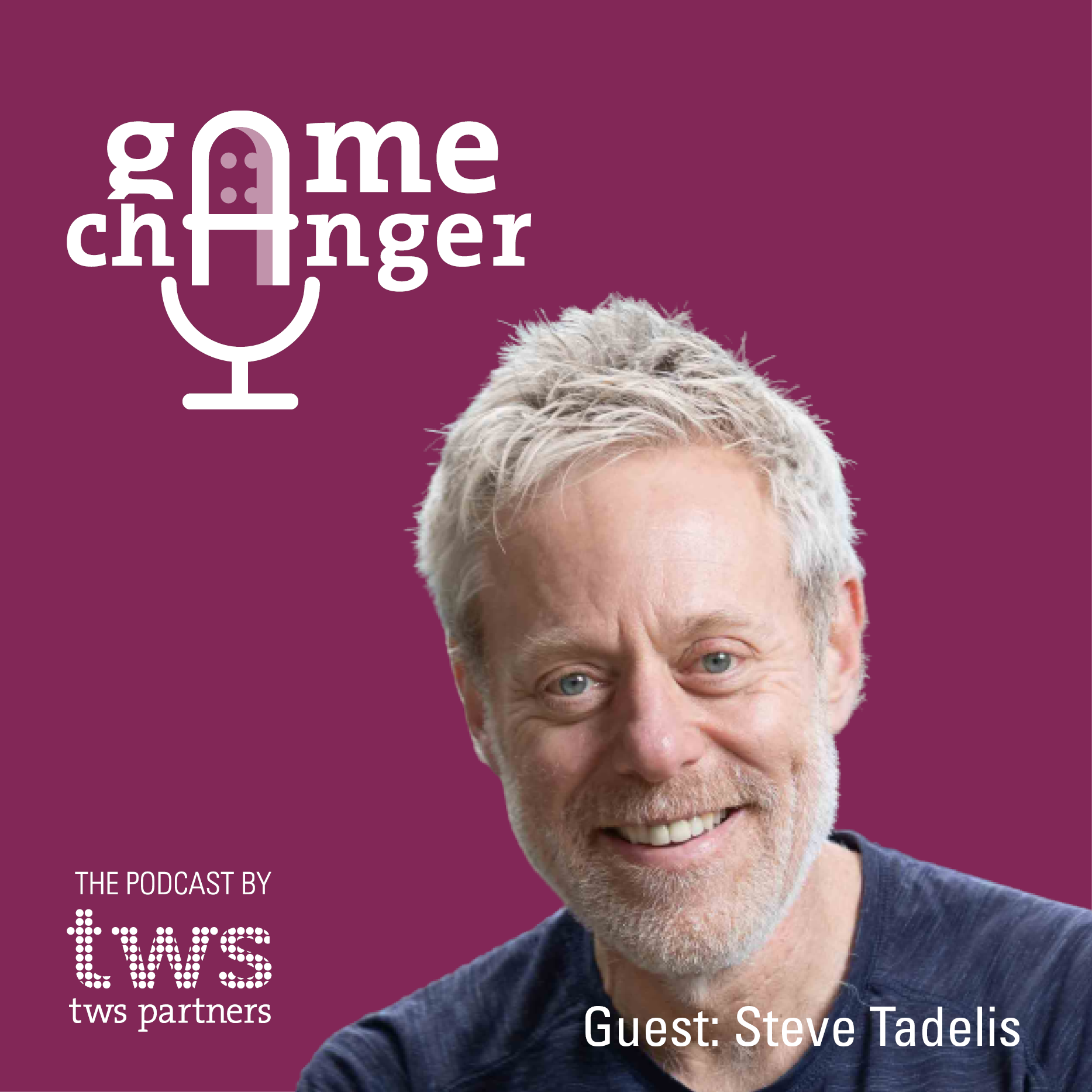
Playing nice – Trust and reputation in Game Theory, eCommerce and vaccinations | with Steve Tadelis
Playing nice – Trust and reputation in Game Theory, eCommerce and vaccinations | with Steve Tadelis In this episode we talk to Steve Tadelis about reputation and trust. He explains how he first got into the topic, what reputation means in the context of Game Theory and how even leaving no review at all could signal reputation on platforms like ebay. He also shows how powerful reputation and trust can be beyond the business context, e.g. when increasing vaccination rates with the help of Donald Trump. Steve Tadelis is professor of economics, business and public policy at UC Berkeley. His research interests include the economics of eCommerce and incentives & organisations. On top of his academic experience he has worked as senior economist at Amazon and eBay. In the episode, Steve mentions the following papers: Rational cooperation in the finitely repeated prisoners' dilemma, by David Kreps, Paul Milgrom, John Roberts and Robert Wilson Using Donald Trump's COVID-19 Vaccine Endorsement to Give Public Health a Shot in the Arm: A Large-Scale Ad Experiment, by Bradley Larsen, Marc J. Hetherington, Steven H. Greene, Timothy J. Ryan, Rahsaan D. Maxwell & Steven Tadelis

Feeling lucky! – On the game theoretic aspects of lotteries | with Nick Arnosti
In this episode, we discuss with Nick Arnosti the economic aspects of lotteries. Nick explains in which sense lotteries are a relevant economic mechanism, and gives some examples of where and why they are used. We focus in particular on the use of lotteries in the allocation of affordable housing in New York. Nick Arnosti is assistant professor at the University of Minnesota. His research is focussed on systems for allocating public resources. During the interview, Nick mentions a paper which compares lotteries and waiting lists; this paper can be found here.

"More art than science" – Translating game theoretic predictions into practical recommendations | with Eyal Winter
In this episode we are talking to Economics Professor Eyal Winter, who works as both an academic researcher and as a consultant who supports his clients in various auction settings. We discuss how consulting differs from theoretical research, and how to best behave in an auction setting. Eyal also shows how emotions can sometimes strongly influence people's behaviour in auctions. Eyal Winter is the Silverzweig professor of economics at the Hebrew University and the Andrews & Brunner professor at Lancaster University. His research interests are broadly spread, ranging from Behavioural Economics to Decision Making, Game Theory and Finance. He is also the author of the book "Feeling Smart - Why Our Emotions Are More Rational Than We Think", in which he explores the use and logic in emotions. During the interview, Eyal mentions a spectrum auction in New Zealand, which yielded a very disappointing outcome for the New Zealand government. More information on this auction can be found e.g. here and here.

Backward Induction, Child Penalties and the Gender Pay Gap | with Carlotta Pilgram
Backward Induction, Child Penalties and the Gender Pay Gap | with Carlotta Pilgram In this episode we are talking to Carlotta Pilgram, Consultant at TWS Partners and Economics graduate from Lund University in Sweden. We discuss the role of Game Theory in analysing the gender pay gap, the current state of research, why many intuitive explanations have little explanatory power and what measures can be taken to reduce payment differences which can be traced back to gender. Carlotta Pilgram works as a Consultant at TWS Partners. Previously she has studied Economics at Lund University in Sweden, focusing on gender Economics and in particular payment inequality. She finished her Master's degree with her thesis entitled "Are Women leaving their Jobs before they are actually leaving", where she analysed potential economic causes for the gender pay gap. During the interview, Carlotta refers to a study by Marianne Bertrand et. al. from 2010, which can be found here.

Good intentions, bad outcomes: why Game Theory matters in policy making | with Hannah Rubin
In this episode we are talking to Hannah Rubin about policy making, incentive structures and Game Theory in the world of sciences. Together we dig into why policies set up with the best intentions can backfire when existing incentive structures are not taken into account, e.g. when it comes to the goal of increasing diversity in grant applications, and how these policies could be improved. We discuss more generally what it takes to break out of existing structures in sciences such as e.g. the so called "peer-review-system". Hannah Rubin works as an Assistant Professor at the University of Notre Dame, Indiana. She is an Evolutionary Game Theorist, Philosopher of Biology and Philosopher of Science. In her research she uses game theory to understand how social structures come to be and how they evolve over time.

What keeps our lights on? Strategic interactions in the electricity market | with Peter Cramton
In this episode, we talk to Peter Cramton about the electricity market. We discuss the 2021 Texas electricity crisis that left millions of Texans without electricity for four extremely cold days. Peter explains how understanding the crisis is important for markets everywhere. He shares with us that a reliable gas supply is essential for resilient electricity and Europe must reduce its dependence on Russian gas. Peter Cramton is Professor of Economics at the University of Cologne and the University of Maryland. His research is focused on auctions and market design. Applications include communications, electricity, and financial markets. His innovative market designs are seen worldwide.

Chess, computers and game theory | with Daniel King
The game of chess has been around for centuries and still hasn't lost its touch which is demonstrated by the sheer number of professional and non-professional players and countless pop culture references. In this episode chess grandmaster Daniel King walks us through his very own journey from being a professional chess player to becoming author, live commentator and YouTuber and what it takes to come up with the perfect strategy. We talk about why chess theoretically can be solved but still hasn't lost its appeal as one of the most popular board games in history and how professional players' strategies have evolved due to the rise of powerful computers and machine learning. Daniel King is known for being an English chess grandmaster, a well-known chess live commentator, an award-winning author of several books, a freelance journalist and many more. On top of that he has his own YouTube channel called PowerPlayChess where he shares knowledge and passion for all things chess.

What Twitter can teach us about identity signaling | with Paul Smaldino
In this episode we talk to Paul Smaldino about identity signaling. He walks us through its definition, the most common examples of identity signaling like language or fashion choices and how game theory can be used to model it. He explains why it is sometimes wise to signal covertly rather than overtly, how this depends on the heterogeneity of groups and what experimental evidence from Twitter has to say about all this. Paul Smaldino is associate professor of cognitive and information sciences at UC Merced. His research interests include social and cultural evolution, cooperation, communication, and the philosophy of sciences. He studies the feedback between individual behaviors and the sociocultural environments in which they are situated, using both empirical studies and theoretical models (e.g. Game Theory models).