
Fun Facts Daily
390 episodes — Page 6 of 8

Fun Facts About Turkeys
Wild turkeys are powerful and athletic birds, possessing surprising speed. They can run at speeds up to 25 mph and fly in short bursts at 55 mph. A turkey's survival is aided by its exceptional senses; it has a 270-degree field of vision, estimated to be three times clearer than 20/20 human eyesight. Male turkeys, or "toms," are distinguished by their vocalizations and unique facial features. Only toms make the famous "gobble" sound, while females (hens) use quieter clicks and purrs. The bare skin on a tom's head, including the "snood" (which dangles over the beak) and "wattle" (under the chin), can change color to bright red, white, and blue to communicate mood and health. The history of turkeys is deeply connected to the Americas. Archaeological evidence shows they were first domesticated in southern Mexico by the Aztecs around 800 BCE. When preparing a modern-day frozen turkey, food safety is crucial. The safest thawing method is in the refrigerator, allowing 24 hours for every 4-5 pounds. A popular myth suggests the L-tryptophan in turkey causes sleepiness after a large meal. In reality, the "food coma," or postprandial somnolence, is primarily caused by the body's digestive response to a large, high-carbohydrate meal, not by the turkey itself. Want to learn about other amazing animals? Check out my Spotify playlist, Fun Facts About Animals Want to learn more? Head over to my website www.funfactsdailypod.com and be sure to listen to my other podcasts Who ARTed: Weekly Art History for All Ages or Art Smart. For family fun, check out my son's podcast Rainbow Puppy Science Lab Fun Facts Daily is an Airwave Media Podcast. If you are interested in advertising on this or any other Airwave Media show, email: [email protected] Learn more about your ad choices. Visit megaphone.fm/adchoices

Fun Facts About Neptune
Neptune, the eighth planet from the sun, is an ice giant known for its striking deep blue color, which is caused by methane in its atmosphere rather than a surface ocean. It is the windiest planet in the solar system, featuring supersonic winds over 1,200 mph that drive massive storms like the Great Dark Spot. Neptune holds a unique place in history as the only planet discovered through mathematical prediction, based on irregularities in the orbit of Uranus, before it was visually confirmed by telescope. While a year on Neptune lasts 165 Earth years, its day is only about 16 hours long. The planet's largest moon, Triton, is also remarkable. It has a retrograde orbit, meaning it travels backward compared to Neptune's rotation, which strongly suggests it was a dwarf planet captured by Neptune's gravity. Triton is one of the coldest objects in the solar system and features active cryovolcanoes that erupt frozen nitrogen. Neptune itself possesses a wild, lopsided magnetic field that is tilted by 47 degrees and significantly offset from the planet's physical center. This chaotic field is believed to be generated not by a solid core, but by a moving, slushy mantle of super-pressurized water and ammonia. What to learn more about outer space? Check out my Spotify Playlist: Fun Facts About Space Exploration Want to learn more? Head over to my website www.funfactsdailypod.com and be sure to listen to my other podcasts Who ARTed: Weekly Art History for All Ages or Art Smart. For family fun, check out my son's podcast Rainbow Puppy Science Lab Fun Facts Daily is an Airwave Media Podcast. If you are interested in advertising on this or any other Airwave Media show, email: [email protected] Learn more about your ad choices. Visit megaphone.fm/adchoices

Fun Facts About Deciduous Trees
Explore the world of deciduous trees, the remarkable plants that shed their leaves as a brilliant survival strategy. This process, known as abscission, allows trees to conserve water and energy during the harsh winter months. Discover the science behind fall's stunning colors: the vibrant yellows and oranges (carotenoids) are present all year but are only revealed when the dominant green chlorophyll fades, while the rich reds and purples (anthocyanins) are new pigments created in the fall to protect the leaves. Learn fascinating facts about these trees, from the "Wood Wide Web"—a vast underground fungal network that lets trees share nutrients and send warnings—to Pando, a colossal colony of quaking aspen in Utah that is the single largest and heaviest known living organism on Earth. Understand how a single large tree can act as a natural air conditioner through transpiration, releasing over 100 gallons of water a day to cool the surrounding air. Want to learn more? Head over to my website www.funfactsdailypod.com and be sure to listen to my other podcasts Who ARTed: Weekly Art History for All Ages or Art Smart. For family fun, check out my son's podcast Rainbow Puppy Science Lab Fun Facts Daily is an Airwave Media Podcast. If you are interested in advertising on this or any other Airwave Media show, email: [email protected] Learn more about your ad choices. Visit megaphone.fm/adchoices

Fun Facts About the Longmen Grottoes
Discover the magnificent Longmen Grottoes, a UNESCO World Heritage Site in Luoyang, China. This incredible complex contains an estimated 110,000 Buddhist statues and 2,300 caves carved into a mile-long limestone cliffside. The carving began in 493 CE with the Northern Wei dynasty and continued for over 400 years, showcasing a clear artistic evolution from the slender, abstract figures of the Wei period to the powerful, realistic art of the Tang dynasty. While the statues appear as bare stone today, they were originally painted in vibrant blues, reds, and golds. Sadly, many of the figures are headless, not due to natural erosion, but from widespread theft and vandalism in the 20th century. The centerpiece of the grottoes is the 57-foot-tall Vairocana Buddha, a colossal masterpiece completed in 675 CE. This statue is historically linked to Empress Wu Zetian, China's only female emperor, who personally funded the project. Its serene and powerful features are widely believed to be an idealized portrait of the empress herself, blending divine authority with political power. The site also holds other unique treasures, such as the 6th-century "Prescription Cave" (Yafeng dong), which features over 140 ancient medical remedies carved directly into its walls, illustrating the grottoes' role as a center for both faith and knowledge. Want to learn more? Head over to my website www.funfactsdailypod.com and be sure to listen to my other podcasts Who ARTed: Weekly Art History for All Ages or Art Smart. For family fun, check out my son's podcast Rainbow Puppy Science Lab Fun Facts Daily is an Airwave Media Podcast. If you are interested in advertising on this or any other Airwave Media show, email: [email protected] Learn more about your ad choices. Visit megaphone.fm/adchoices

Fun Facts About Halloween
Halloween's origins trace back over 2,000 years to the ancient Gaelic festival of Samhain. This festival marked the end of the harvest season and the beginning of winter, a time when the boundary between the living and the spirit world was believed to thin. This belief led to the practice of wearing costumes and masks, originally intended as disguises to hide from wandering ghosts. The holiday's name itself is a shortened version of "All Hallows' Eve," the night before All Saints' Day. The traditional orange and black colors are also symbolic, with orange representing the autumn harvest and black signifying the darkness of winter. The specific phrase "trick-or-treat" is a more recent development, with its first known print appearance in Canada in 1927. One of the most persistent modern fears associated with the holiday is tampered Halloween candy; however, this is just an urban legend. Sociological research has found zero confirmed reports of a child ever being seriously harmed by a random stranger's booby-trapped treat. The custom of giving out candy became widespread in the 1950s, when companies marketed individually-wrapped treats as a safe and convenient alternative to homemade items. Another common superstition involves black cats, but contrary to their association with bad luck in the U.S., they are considered a sign of good fortune and prosperity in many other cultures, such as in Japan and Scotland. Want to learn more? Head over to my website www.funfactsdailypod.com and be sure to listen to my other podcasts Who ARTed: Weekly Art History for All Ages or Art Smart. For family fun, check out my son's podcast Rainbow Puppy Science Lab Fun Facts Daily is an Airwave Media Podcast. If you are interested in advertising on this or any other Airwave Media show, email: [email protected] Learn more about your ad choices. Visit megaphone.fm/adchoices

Fun Facts About Spirit Photography
Spirit photography emerged in the 19th century as a popular trend, largely initiated by Boston photographer William H. Mumler in the 1860s. He gained significant notoriety for his portraits that appeared to show living subjects alongside the ghostly apparitions of deceased loved ones. His most famous work is a portrait of a grieving Mary Todd Lincoln with the faint figure of her late husband, President Abraham Lincoln, standing behind her. The phenomenon's rise coincided with the Spiritualism movement and the widespread grief following the Civil War, offering tangible comfort to many. However, these "spirit" effects were typically created using simple darkroom techniques, most commonly double exposure. The practice drew prominent skeptics, including the magician Harry Houdini, who dedicated much of his life to exposing fraudulent spirit photographers and mediums. The controversy surrounding the practice led to an 1869 fraud trial against Mumler. Famed showman P.T. Barnum testified for the prosecution, demonstrating how easily such images could be faked. Modern versions of "spirit photos," such as glowing orbs, are scientifically explained as a photographic effect called backscatter, where the camera's flash illuminates airborne particles like dust or pollen. The human tendency to see figures or faces in random patterns, known as pareidolia, also accounts for many perceived ghostly images. Want to learn more? Head over to my website www.funfactsdailypod.com and be sure to listen to my other podcasts Who ARTed: Weekly Art History for All Ages or Art Smart. For family fun, check out my son's podcast Rainbow Puppy Science Lab Fun Facts Daily is an Airwave Media Podcast. If you are interested in advertising on this or any other Airwave Media show, email: [email protected] Learn more about your ad choices. Visit megaphone.fm/adchoices

Fun Facts About Vampires
Delve into the surprising history and science behind vampire folklore. Explore the origins of the word "vampire," which entered the English language in the 1730s following reports from Eastern Europe, and the etymology of the word "sanguine," connecting it from its Latin root for "blood" to the ancient theory of the four humours. Discover the real-life creatures behind the myth, specifically the three species of vampire bats native to Central and South America, and learn about their unique feeding habits (they lap, not suck, blood) and the anticoagulant "Draculin" found in their saliva. Learn the literary roots of the modern vampire, revealing how Sheridan Le Fanu's 1872 novella Carmilla established many famous tropes 25 years before Bram Stoker's Dracula. This summary also uncovers the practical, historical origins of the vampire-hunting toolkit, explaining how garlic was used to ward off "miasma" (bad air) and how wooden stakes were used to pin bodies to their graves, a practice rooted in a misunderstanding of natural decomposition. Finally, explore the compelling medical theory that the rare blood disorder porphyria, with its symptoms of severe sun sensitivity, receding gums, and pale skin, may have inspired the classic vampire characteristics. Want to learn more? Head over to my website www.funfactsdailypod.com and be sure to listen to my other podcasts Who ARTed: Weekly Art History for All Ages or Art Smart. For family fun, check out my son's podcast Rainbow Puppy Science Lab Fun Facts Daily is an Airwave Media Podcast. If you are interested in advertising on this or any other Airwave Media show, email: [email protected] Learn more about your ad choices. Visit megaphone.fm/adchoices

Fun Facts About the Ouija Board
The Ouija board, often associated with the supernatural, was actually patented in 1890 by Baltimore businessmen Elijah Bond and Charles Kennard as a parlor game. Its name, "Ouija," is speculated to be a combination of the French ("oui") and German ("ja") words for "yes." For most of the 20th century, it was considered a wholesome family pastime, even appearing on a 1919 Saturday Evening Post cover by Norman Rockwell. The board's reputation shifted significantly in 1973 after the horror film The Exorcist portrayed it as a tool for demonic possession. The seemingly mysterious movement of the board's planchette is explained by a psychological phenomenon called the ideomotor effect. First named in 1852, this concept describes how individuals make tiny, involuntary muscle movements based on their own subconscious thoughts and expectations. It is these unconscious movements from the users, not spirits, that guide the pointer. The common "rule" that users must move the planchette to "Goodbye" to "close a portal" is not part of the original game but rather a piece of modern folklore popularized by movies. Want to learn more? Head over to my website www.funfactsdailypod.com and be sure to listen to my other podcasts Who ARTed: Weekly Art History for All Ages or Art Smart. For family fun, check out my son's podcast Rainbow Puppy Science Lab Fun Facts Daily is an Airwave Media Podcast. If you are interested in advertising on this or any other Airwave Media show, email: [email protected] Learn more about your ad choices. Visit megaphone.fm/adchoices

Fun Facts About Transylvania
Explore the real Transylvania, a region in central Romania whose name fittingly means "the land beyond the forest." This area is defined by the sweeping Carpathian Mountains, which are home to Europe's largest population of brown bears outside of Russia. The region's history is preserved in over 150 unique fortified Saxon churches—seven of which are a UNESCO World Heritage Site—and in cities like Sighișoara, Brașov, and Sibiu. Visitors can also experience one-of-a-kind attractions, from the world-famous, winding Transfăgărășan Highway to Salina Turda, a massive, ancient salt mine that has been converted into a futuristic underground theme park complete with a Ferris wheel and a boating lake. While Transylvania is famous for the Dracula legend, the true story is often misunderstood. The historical figure Vlad Țepeș, also known as Vlad the Impaler, was born in Transylvania but was the ruler of neighboring Wallachia, and the fortress commonly known as "Dracula's Castle" (Bran Castle) has little historical connection to him. However, the novel's famous use of garlic as protection is based on authentic Romanian folklore, where it was used for centuries to ward off evil spirits known as strigoi. Want to learn more? Head over to my website www.funfactsdailypod.com and be sure to listen to my other podcasts Who ARTed: Weekly Art History for All Ages or Art Smart. For family fun, check out my son's podcast Rainbow Puppy Science Lab Fun Facts Daily is an Airwave Media Podcast. If you are interested in advertising on this or any other Airwave Media show, email: [email protected] Learn more about your ad choices. Visit megaphone.fm/adchoices

Fun Facts About Squirrels
Squirrels, members of the Sciuridae family, possess several unique biological adaptations. Their front incisors grow continuously throughout their lives, requiring them to gnaw constantly to maintain a manageable length. A key anatomical feature is their highly flexible hind ankles, which can rotate 180 degrees, allowing them to grip bark and climb down trees head-first. These acrobatic mammals can also survive falls from over 100 feet by splaying their limbs and using their bushy tails as parachutes to slow their terminal velocity. Beyond their physical traits, squirrels play a vital role in forest regeneration. Through "scatter hoarding," they bury thousands of nuts across their territory. The nuts they inevitably forget sprout into new trees, such as oaks and hickories. Their behavior also reveals high intelligence. A squirrel's zigzag run is not panic but a deliberate tactic to evade predators, a defense aided by their nearly 360-degree vision. Want to learn more? Head over to my website www.funfactsdailypod.com and be sure to listen to my other podcasts Who ARTed: Weekly Art History for All Ages or Art Smart. For family fun, check out my son's podcast Rainbow Puppy Science Lab Fun Facts Daily is an Airwave Media Podcast. If you are interested in advertising on this or any other Airwave Media show, email: [email protected] Learn more about your ad choices. Visit megaphone.fm/adchoices
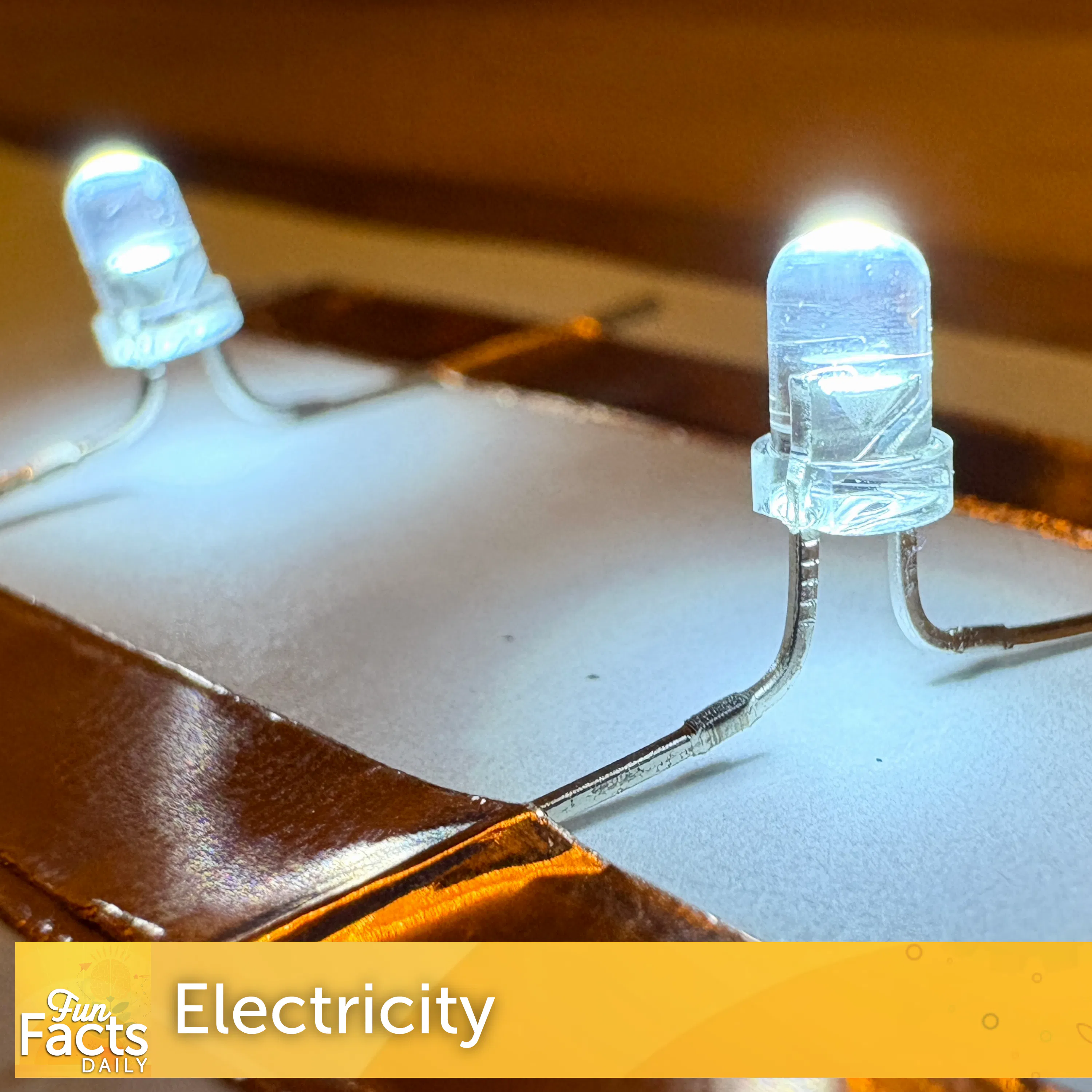
Fun Facts About Electricity
Electricity involves the flow of electrons, subatomic particles named after the ancient Greek word for amber ("elektron"), which was used in early experiments with static electricity. While an electric field's signal travels near the speed of light, the actual electrons move at a very slow "drift velocity," often less than one millimeter per second. Nature provides much more powerful examples. A single lightning bolt can heat the air to 54,000°F, roughly five times hotter than the surface of the sun, which causes the sonic boom known as thunder. Some animals also utilize electricity. Electric eels, which are a type of knifefish, have specialized organs that can discharge over 860 volts to hunt or defend themselves. They also use weaker electric pulses for navigation, a sense called electrolocation. Humans may have harnessed electricity much earlier than believed. Archaeologists have found 2,000-year-old "Baghdad batteries," clay pots that could produce an electric current, though their exact use is unknown. Later, Benjamin Franklin proved that lightning is electricity (he did not discover electricity itself) and invented the lightning rod to safely ground the charge. Several common beliefs about electricity are incorrect. Pure, distilled water is actually an electrical insulator; it is the salts and minerals dissolved in regular water that make it conductive. Additionally, a car is safe in a storm not because of its rubber tires, but because its metal shell acts as a Faraday cage, conducting the lightning strike around the occupants and safely into the ground. Want to learn more? Head over to my website www.funfactsdailypod.com and be sure to listen to my other podcasts Who ARTed: Weekly Art History for All Ages or Art Smart. For family fun, check out my son's podcast Rainbow Puppy Science Lab Fun Facts Daily is an Airwave Media Podcast. If you are interested in advertising on this or any other Airwave Media show, email: [email protected] Learn more about your ad choices. Visit megaphone.fm/adchoices

Fun Facts About Chili
The dish chili con carne, Spanish for "chili with meat," is a stew that originated in Texas, rather than Mexico or Spain. Its name combines the Nahuatl (Aztec) word for the pepper with Spanish. The stew was widely popularized in the late 19th and early 20th centuries by the "Chili Queens" of San Antonio, women who sold bowls of chili in the city's open-air plazas. It was also introduced to a national audience at a stand during the 1893 World's Columbian Exposition in Chicago. In 1977, Texas proclaimed chili its official state dish, defining the authentic "Texas Red" style as strictly containing meat and a red chili sauce, with no beans and often no tomatoes. This purist approach traces back to "chili bricks" used by cowboys on cattle drives. Today, common "secret" ingredients used to enhance chili include unsweetened chocolate or coffee for depth, masa harina for thickening, and a splash of vinegar or lime juice at the end to brighten the flavors. The world's largest pot of chili weighed over 11,750 pounds, and after cooking, it was served free of charge at a community festival. The famous Terlingua International Chili Championship was founded in 1967 and it began as a publicity stunt. Want to learn more? Head over to my website www.funfactsdailypod.com and be sure to listen to my other podcasts Who ARTed: Weekly Art History for All Ages or Art Smart. For family fun, check out my son's podcast Rainbow Puppy Science Lab Fun Facts Daily is an Airwave Media Podcast. If you are interested in advertising on this or any other Airwave Media show, email: [email protected] Learn more about your ad choices. Visit megaphone.fm/adchoices

Fun Facts About Sand
Sand is one of the world's most vital, and surprisingly scarce, natural resources. While it seems abundant, the specific angular sand from rivers, lakes, and coastlines is essential for making concrete, asphalt, and glass. Wind-blown desert sand is too smooth and rounded to be used in construction. This high demand has triggered a global sand shortage, making it the second most-used natural resource on Earth after water, with humans consuming about 50 billion tons of it annually. The resource is so precious that in 2008, thieves in Jamaica stole an entire 400-meter public beach, likely to sell the sand for hotel construction. The modern word "arena" meaning a large space with seats for spectators actually comes from the Latin word for sand, arena, because the floors of Roman amphitheaters like the Colosseum were covered in sand to absorb fluids. The composition and color of sand tell the geological story of a coastline, varying from the black basalt beaches of Iceland to the green olivine sand of Hawaii. The famous pink sands of Bermuda get their color from the shells of foraminifera, while the perfect star-shaped sand found in Japan, is the exoskeleton of another microscopic organism. Even the iconic white sand of the Caribbean has a unique origin: it is often the excreted, undigested coral skeletons from parrotfish, which can produce hundreds of pounds of new sand each year. Want to learn more? Head over to my website www.funfactsdailypod.com and be sure to listen to my other podcasts Who ARTed: Weekly Art History for All Ages or Art Smart. For family fun, check out my son's podcast Rainbow Puppy Science Lab Fun Facts Daily is an Airwave Media Podcast. If you are interested in advertising on this or any other Airwave Media show, email: [email protected] Learn more about your ad choices. Visit megaphone.fm/adchoices

Fun Facts About The Great Barrier Reef
The Great Barrier Reef is a massive ecosystem built on the critical concept of symbiosis. The reef's foundation relies on the partnership between coral polyps, which are animals, and microscopic algae called zooxanthellae. The algae provide food and vibrant color to the coral in exchange for a protected home. This theme of cooperation is found throughout the reef, including the fascinating relationship between the nearly blind pistol shrimp, which builds a burrow, and the sharp-eyed goby fish, which acts as a lookout. The reef is home to a "Great Eight" list of must-see animals, including giant clams, manta rays, sea turtles, and whales. It also features unique human touches, like an official Australia Post mailbox floating miles offshore. Geologically, the modern reef structure is surprisingly young, having formed only after the last Ice Age. Protecting this ecosystem is critical, and one way to help is by using reef-safe mineral sunscreens containing zinc oxide or titanium dioxide, while avoiding chemicals like oxybenzone and octinoxate, which are harmful to coral. Want to learn more? Head over to my website www.funfactsdailypod.com and be sure to listen to my other podcasts Who ARTed: Weekly Art History for All Ages or Art Smart. For family fun, check out my son's podcast Rainbow Puppy Science Lab Fun Facts Daily is an Airwave Media Podcast. If you are interested in advertising on this or any other Airwave Media show, email: [email protected] Learn more about your ad choices. Visit megaphone.fm/adchoices

Fun Facts About the Piano
The piano was invented around 1700 in Florence, Italy, by Bartolomeo Cristofori. Its original name was the fortepiano, combining the Italian words for loud (forte) and soft (piano), which highlighted its revolutionary ability to vary volume based on the player's touch—a feature the harpsichord lacked. An acoustic piano is a complex machine with over 12,000 individual parts. Its steel strings are held under immense pressure, creating a combined tension of up to 30 tons that must be supported by a heavy cast-iron frame. Many grand pianos feature a middle sostenuto pedal, which allows the player to sustain select notes while playing others without a blur. The upright piano, a more compact version designed to fit in smaller homes, was invented by John Isaac Hawkins in 1800, making the instrument widely accessible. The world's largest playable piano, built by Adrian Mann, is over 18 feet long. Want to learn more? Head over to my website www.funfactsdailypod.com and be sure to listen to my other podcasts Who ARTed: Weekly Art History for All Ages or Art Smart. For family fun, check out my son's podcast Rainbow Puppy Science Lab Fun Facts Daily is an Airwave Media Podcast. If you are interested in advertising on this or any other Airwave Media show, email: [email protected] Learn more about your ad choices. Visit megaphone.fm/adchoices

Fun Facts About Cells
Cells are the fundamental building blocks of all living things, and the human body contains a staggering number of them—an estimated 30 to 40 trillion, which is more than the number of stars in the Milky Way galaxy. Within each cell are specialized structures called organelles, such as the energy-producing mitochondria and the nucleus that contains the cell's DNA. The term "cell" was first used in 1665 by scientist Robert Hooke, who thought the microscopic compartments he saw in a slice of cork resembled the small rooms, or cellae, of a monastery. The diversity of cellular life is vast, with sizes ranging from the microscopic Mycoplasma bacteria to the ostrich egg yolk, the largest single cell on Earth. Although most cells in an organism share the same DNA, they become specialized for different roles through a process called cell differentiation, where each cell type reads only the parts of the DNA relevant to its job. The mitochondria within our cells are believed to have originated as independent bacteria that were absorbed by larger cells billions of years ago. Want to learn more? Head over to my website www.funfactsdailypod.com and be sure to listen to my other podcasts Who ARTed: Weekly Art History for All Ages or Art Smart. For family fun, check out my son's podcast Rainbow Puppy Science Lab Fun Facts Daily is an Airwave Media Podcast. If you are interested in advertising on this or any other Airwave Media show, email: [email protected] Learn more about your ad choices. Visit megaphone.fm/adchoices

Fun Facts About Uranus
Countless people have cracked jokes about Uranus being filled with gas that smells like rotten eggs, but could it actually be true? While nobody can drop in on the planet and take sniff, scientists have analyzed the compounds in the atmosphere giving us an idea of what the planet smells like. Find out the truth at the end of this episode of Fun Facts Daily. Uranus is the seventh planet from the sun, an ice giant first discovered by astronomer William Herschel in 1781, making it the first planet found with a telescope. Named for the Greek god of the sky, its most defining characteristic is its extreme axial tilt of nearly 98 degrees, which causes it to orbit the sun on its side. This unique orientation results in the most extreme seasons in the solar system, with each of its four seasons lasting for 21 Earth years. A day on Uranus is significantly shorter than on Earth, lasting about 17 hours, while a single Uranian year takes 84 Earth years to complete. It is the coldest planet in the solar system, with temperatures in its upper atmosphere dropping to a frigid -371°F (-224°C). Uranus also possesses a system of 13 faint, dark rings made of rock and ice. What to learn more about outer space? Check out my Spotify Playlist: Fun Facts About Space Exploration Want to learn more? Head over to my website www.funfactsdailypod.com and be sure to listen to my other podcasts Who ARTed: Weekly Art History for All Ages or Art Smart. For family fun, check out my son's podcast Rainbow Puppy Science Lab Fun Facts Daily is an Airwave Media Podcast. If you are interested in advertising on this or any other Airwave Media show, email: [email protected] Learn more about your ad choices. Visit megaphone.fm/adchoices

Fun Facts About Bob Ross
Bob Ross was the iconic host of "The Joy of Painting." Take time to appreciate the man behind the canvas with the famously calm demeanor. Learn about his signature "alla prima" (wet-on-wet) painting technique, which, combined with his use of Liquid White, made it possible to complete a masterpiece in under 30 minutes and made painting accessible to millions. The discussion also covers fascinating details, such as how his iconic perm was a cost-saving measure he disliked but kept for his brand, and the incredible fact that he produced an estimated 30,000 paintings in his lifetime. Delve into the business-savvy philosophy of Bob Ross, who never earned a salary from his beloved PBS show, instead using it to promote his successful line of art supplies and certified instructors. Uncover personal details, like the teenage carpentry accident that cost him part of a finger and his deep love for animals, often featuring rescued squirrels and other wildlife on his show. From the minimalist studio in a Muncie, Indiana home to his core belief in "happy little accidents," Bob Ross turned a simple painting show into an enduring cultural phenomenon built on kindness, creativity, and happy little trees. Want to learn more? Head over to my website www.funfactsdailypod.com and be sure to listen to my other podcasts Who ARTed: Weekly Art History for All Ages or Art Smart. For family fun, check out my son's podcast Rainbow Puppy Science Lab Fun Facts Daily is an Airwave Media Podcast. If you are interested in advertising on this or any other Airwave Media show, email: [email protected] Learn more about your ad choices. Visit megaphone.fm/adchoices

Fun Facts About Oak Island
Oak Island, a small island off the coast of Nova Scotia, has been the site of one of history's longest and most elaborate treasure hunts. It all began in 1795 when three teenagers discovered a peculiar depression in the ground, leading them to unearth layers of oak logs every ten feet in what is now known as the "Money Pit." Early excavators were thwarted by an ingenious booby trap—a series of sophisticated flood tunnels that fill the pit with seawater. The mystery deepened with the alleged discovery of a now-vanished stone tablet covered in cryptic symbols, which was said to translate to: "Forty feet below two million pounds lie buried." The treasure hunt's allure has attracted notable figures, including U.S. President Franklin Delano Roosevelt and actor John Wayne, who both invested in excavation efforts. While the Money Pit remains a focal point, recent technological advancements have shifted attention to a man-made swamp on the island. This new area has yielded intriguing finds, including a centuries-old lead cross, paved structures, and seismic data pointing to a large, ship-shaped anomaly buried deep within the mud. Want to learn more? Head over to my website www.funfactsdailypod.com and be sure to listen to my other podcasts Who ARTed: Weekly Art History for All Ages or Art Smart. For family fun, check out my son's podcast Rainbow Puppy Science Lab Fun Facts Daily is an Airwave Media Podcast. If you are interested in advertising on this or any other Airwave Media show, email: [email protected] Learn more about your ad choices. Visit megaphone.fm/adchoices

Fun Facts About Time
Time is not a universal constant. According to Albert Einstein's theory of relativity, time is relative and is affected by both speed and gravity. This phenomenon, known as time dilation, means that astronauts traveling at high speeds age slightly slower than people on Earth, while time also passes infinitesimally faster at higher elevations where gravity is weaker. On a cosmic scale, the universe is approximately 13.8 billion years old. To put historical time into perspective, the ancient Egyptian queen Cleopatra lived closer in time to the modern era than she did to the construction of the Great Pyramid of Giza. The measurement of time has reached incredible precision, with the shortest unit ever recorded being the zeptosecond. This stands in stark contrast to early timekeeping methods, such as the sundials and water clocks used by ancient civilizations. Earth's own timekeeping is not static; the planet's rotation is gradually slowing, causing days to become slightly longer over centuries. Time perception also varies in the animal kingdom, as smaller creatures with faster metabolisms experience the world in slow motion compared to humans. For managing personal time, the Pomodoro Technique is a popular productivity method that improves focus by breaking work into 25-minute intervals. Want to learn more? Head over to my website www.funfactsdailypod.com and be sure to listen to my other podcasts Who ARTed: Weekly Art History for All Ages or Art Smart. For family fun, check out my son's podcast Rainbow Puppy Science Lab Fun Facts Daily is an Airwave Media Podcast. If you are interested in advertising on this or any other Airwave Media show, email: [email protected] Learn more about your ad choices. Visit megaphone.fm/adchoices

Fun Facts About Pumpkins
Pumpkins are botanically classified as a fruit, specifically a type of berry called a pepo. They are one of the oldest domesticated crops, with origins tracing back 7,000 to 9,000 years ago in Mexico. The common autumn tradition of the jack-o'-lantern began in Ireland, where people originally carved turnips, not pumpkins, inspired by the myth of "Stingy Jack." The practice shifted to pumpkins after Irish immigrants arrived in North America, where pumpkins were larger and easier to carve. There are over 45 varieties of pumpkin, which come in a wide range of colors and styles, such as the blue-grey Jarrahdale from Australia and the warty French heirloom Galeux d'Eysines. Every part of the pumpkin plant is edible, from the skin and seeds to the flowers and leaves. In towns like Windsor, Nova Scotia, and Tualatin, Oregon, giant pumpkins are even hollowed out and raced as boats in annual regattas. Want to learn more? Head over to my website www.funfactsdailypod.com and be sure to listen to my other podcasts Who ARTed: Weekly Art History for All Ages or Art Smart. For family fun, check out my son's podcast Rainbow Puppy Science Lab Fun Facts Daily is an Airwave Media Podcast. If you are interested in advertising on this or any other Airwave Media show, email: [email protected] Learn more about your ad choices. Visit megaphone.fm/adchoices

Fun Facts About Aristotle
Explore the life and vast intellectual legacy of the ancient Greek philosopher Aristotle. Discover his profound concepts for living a meaningful life, such as eudaimonia—the idea of true flourishing that goes beyond simple happiness—and the "Golden Mean," a practical guide to finding virtue by balancing between extremes. This exploration delves into how Aristotle earned the title "Father of Biology" through his meticulous, hands-on observation of the animal kingdom, detailed in his work History of Animals. His development of empirical methods and early taxonomy laid the groundwork for modern science. Learn about Aristotle's unique teaching methods at his school, the Lyceum, which earned his followers the name "Peripatetics" because he lectured while walking. His invention of formal logic, including the syllogism, became a foundational pillar of Western thought that remained the standard for over two thousand years. Want to learn more? Head over to my website www.funfactsdailypod.com and be sure to listen to my other podcasts Who ARTed: Weekly Art History for All Ages or Art Smart. For family fun, check out my son's podcast Rainbow Puppy Science Lab Fun Facts Daily is an Airwave Media Podcast. If you are interested in advertising on this or any other Airwave Media show, email: [email protected] Learn more about your ad choices. Visit megaphone.fm/adchoices

Fun Facts About the Olmecs
The Olmec civilization was Mesoamerica's foundational "mother culture," flourishing in south-central Mexico from approximately 1500 to 400 BCE. They established a cultural framework for later empires, including the Maya and Aztecs, by developing innovations like an early writing system, complex calendars, and extensive trade networks. Among the Olmec's most significant achievements are the colossal stone heads. These massive portraits of rulers were carved from volcanic basalt and transported over 90 miles without wheeled transport. The Olmec also invented the ritualistic Mesoamerican ballgame, producing the world's first rubber balls for it, and were one of the first cultures to process cacao into a ceremonial chocolate beverage. The civilization's decline around 400 BCE remains an unsolved mystery. Related Episode: Fun Facts About Chocolate Want to learn more? Head over to my website www.funfactsdailypod.com and be sure to listen to my other podcasts Who ARTed: Weekly Art History for All Ages or Art Smart. For family fun, check out my son's podcast Rainbow Puppy Science Lab Fun Facts Daily is an Airwave Media Podcast. If you are interested in advertising on this or any other Airwave Media show, email: [email protected] Learn more about your ad choices. Visit megaphone.fm/adchoices

Fun Facts About Toilets
Like it or not, the average person will spend over a year of their life on the toilet. This daily fixture has a surprisingly long history, with the first flushing toilets dating back over 4,000 years to the ancient Minoan civilization in Crete. Today, toilet technology has reached new heights, with NASA's space toilets on the International Space Station costing over $23 million and using a powerful suction system instead of water. The complete 4,500-year history of sanitation is on display at the Sulabh International Museum of Toilets in New Delhi, India. A critical invention in toilet history is the U-bend pipe, patented by Alexander Cumming in 1775, which uses a simple water seal to block harmful sewer gas from entering homes. For modern toilet cleaning, an effective, eco-friendly method involves using baking soda and white vinegar to naturally sanitize the bowl. Want to learn more? Head over to my website www.funfactsdailypod.com and be sure to listen to my other podcasts Who ARTed: Weekly Art History for All Ages or Art Smart. For family fun, check out my son's podcast Rainbow Puppy Science Lab Fun Facts Daily is an Airwave Media Podcast. If you are interested in advertising on this or any other Airwave Media show, email: [email protected] Learn more about your ad choices. Visit megaphone.fm/adchoices
Fun Facts About Wild Crimes
The first Friday of every month is a Family Fun Friday here on Fun Facts Daily. This month, we are exploring history with some of the most amazingly audacious criminals on the planet. Han van Meegeren was a highly skilled Dutch painter who became a legendary art forger. He duped high-ranking Nazi officials with a fake Vermeer and later had to prove his fraud in court to avoid charges of treason. Learn about the enduring mystery of D.B. Cooper, the anonymous hijacker who, in 1971, extorted a $200,000 ransom before parachuting from a Boeing 727 into a stormy night, vanishing forever in America's only unsolved air piracy case. Learn about the brazen theatrics of Victor Lustig, the man who famously "sold" the Eiffel Tower for scrap metal and later conned Al Capone. Related episodes Who ARTed | The Unvelievable Story of Han van Meegeren Fun Facts About the Eiffel Tower Want to learn more? Head over to my website www.funfactsdailypod.com and be sure to listen to my other podcasts Who ARTed: Weekly Art History for All Ages or Art Smart. For family fun, check out my son's podcast Rainbow Puppy Science Lab Fun Facts Daily is an Airwave Media Podcast. If you are interested in advertising on this or any other Airwave Media show, email: [email protected] Learn more about your ad choices. Visit megaphone.fm/adchoices

Fun Facts About Koalas
The koala is one of Australia's most iconic marsupials. Learn how these animals survive on a highly specialized diet of eucalyptus leaves, which are toxic to most other creatures. This low-energy food source means koalas must conserve energy by sleeping up to 20 hours a day. Learn about their unique life cycle, starting as a tiny, jellybean-sized "joey" that completes its development in its mother's pouch, and the surprising reason the name "koala" is thought to mean "no drink." Despite their cuddly appearance, male koalas can produce a deep, powerful bellow thanks to a second set of vocal cords—a feature unique among land mammals. Find out why calling them "koala bears" is incorrect and who their closest living relative actually is. Uncover the incredible adaptations for their tree-dwelling lifestyle, including two opposable thumbs on each front paw for a vice-like grip. Related episode: Fun Facts About Wombats Check out my Spotify playlist, Fun Facts About Animals Want to learn more? Head over to my website www.funfactsdailypod.com and be sure to listen to my other podcasts Who ARTed: Weekly Art History for All Ages or Art Smart. For family fun, check out my son's podcast Rainbow Puppy Science Lab Fun Facts Daily is an Airwave Media Podcast. If you are interested in advertising on this or any other Airwave Media show, email: [email protected] Learn more about your ad choices. Visit megaphone.fm/adchoices

Fun Facts About Saturn
Saturn is the least dense planet in our solar system; made mostly of hydrogen and helium, it's less dense than water and would float in a large enough pool. The planet is also known for its extreme weather, including a massive, stable hexagon-shaped storm at its north pole with sides wider than the diameter of Earth. Saturn's winds are some of the fastest in the solar system, reaching speeds of 1,800 km/h. While a day on Saturn is very short (under 11 hours), its year is incredibly long, taking about 29.5 Earth years to orbit the sun. Beyond its famous rings, Saturn is the "king of the moons," with over 270 confirmed moons, more than any other planet. Among them are Titan, which is larger than Mercury and has its own dense atmosphere and liquid methane lakes, and Enceladus, an icy moon with a subsurface ocean that erupts into space, making it a key target in the search for extraterrestrial life. What to learn more about outer space? Check out my Spotify Playlist: Fun Facts About Space Exploration Want to learn more? Head over to my website www.funfactsdailypod.com and be sure to listen to my other podcasts Who ARTed: Weekly Art History for All Ages or Art Smart. For family fun, check out my son's podcast Rainbow Puppy Science Lab Fun Facts Daily is an Airwave Media Podcast. If you are interested in advertising on this or any other Airwave Media show, email: [email protected] Learn more about your ad choices. Visit megaphone.fm/adchoices

Fun Facts About Cake
Let them learn about cake! German Chocolate Cake is not from Germany, but an American invention named after baker Samuel German. Learn how carrot cake gained worldwide popularity due to sugar rationing during World War II, and how the original Red Velvet Cake got its distinct color from a chemical reaction between cocoa and vinegar, not red dye. The classic Pound Cake earned its name from its straightforward original recipe: one pound each of flour, butter, sugar, and eggs. Even the grand tiered wedding cake has a unique origin story, inspired by the steeple of a London church. Beyond the history, get practical tips for better baking, from understanding the happy accident that created ganache—a simple mix of chocolate and cream—to learning the science behind why using room-temperature ingredients and avoiding overmixing your batter are the keys to a perfectly moist and tender cake every time. Want to learn more? Head over to my website www.funfactsdailypod.com and be sure to listen to my other podcasts Who ARTed: Weekly Art History for All Ages or Art Smart. For family fun, check out my son's podcast Rainbow Puppy Science Lab Fun Facts Daily is an Airwave Media Podcast. If you are interested in advertising on this or any other Airwave Media show, email: [email protected] Learn more about your ad choices. Visit megaphone.fm/adchoices

Fun Facts About The Great Wall of China
Enjoy the rich history and surprising facts about the Great Wall of China, a monumental structure that is more than just a single wall. It's a vast network of fortifications, watchtowers, and barracks built by various dynasties over two millennia. The most well-preserved sections, built during the Ming Dynasty, feature incredible engineering, including a unique mortar strengthened with sticky rice for superior durability. This ancient wonder served not only as a defensive barrier but also as a vital transportation and communication superhighway, allowing troops and messages to move swiftly across rugged terrain using smoke and fire signals. Want to learn more? Head over to my website www.funfactsdailypod.com and be sure to listen to my other podcasts Who ARTed: Weekly Art History for All Ages or Art Smart. For family fun, check out my son's podcast Rainbow Puppy Science Lab Fun Facts Daily is an Airwave Media Podcast. If you are interested in advertising on this or any other Airwave Media show, email: [email protected] Learn more about your ad choices. Visit megaphone.fm/adchoices

Fun Facts About Drums
The oldest known drums were made from alligator skins in China and date back to 5500 BCE. In West Africa, special hourglass-shaped instruments known as "talking drums" can mimic the tones of human speech and were historically used for long-distance communication. A foundational concept in drumming is the rudiment, which is a basic pattern that forms the building blocks of more complex rhythms. There are 40 official rudiments recognized by the Percussive Arts Society. In pop culture, The Beatles' 1964 appearance on The Ed Sullivan Show created such a demand for drums that the Ludwig Drum Company had to run 24/7 production to keep up. The iconic drum solo in The Surfaris' 1963 hit "Wipe Out" was an unplanned filler based on a high school marching band cadence. Playing the drums is also a full-body workout that can burn 400-600 calories an hour. Studies have shown that drummers may have superior problem-solving skills and higher IQs, as the act of playing strengthens connections in the brain. See astronauts jamming with a variety of instruments including a makeshift drum on the Insternational Space Station at NASA's website Want to learn more? Head over to my website www.funfactsdailypod.com and be sure to listen to my other podcasts Who ARTed: Weekly Art History for All Ages or Art Smart. For family fun, check out my son's podcast Rainbow Puppy Science Lab Fun Facts Daily is an Airwave Media Podcast. If you are interested in advertising on this or any other Airwave Media show, email: [email protected] Learn more about your ad choices. Visit megaphone.fm/adchoices

Fun Facts About TV
You know you want to learn about television through an audio podcast, so give this one a listen! Learn about the technology that revolutionized the entertainment industry in the 20th century. Learn about the first TV remote control, which was actually wired to the set, and how the remote evolved using different signals to change the channels. Learn how television screens create the illusion of movement by playing back a series of images very quickly, and how they create millions of colors on the screen using the additive primary colors, which are different from the primary colors you were always taught to use when mixing paints in art class. Learn about the longest-running drama in TV history, which actually began broadcasting before television was even invented. Want to learn more? Head over to my website www.funfactsdailypod.com and be sure to listen to my other podcasts Who ARTed: Weekly Art History for All Ages or Art Smart. For family fun, check out my son's podcast Rainbow Puppy Science Lab Fun Facts Daily is an Airwave Media Podcast. If you are interested in advertising on this or any other Airwave Media show, email: [email protected] Learn more about your ad choices. Visit megaphone.fm/adchoices

Fun Facts About Art in Unexpected Locations
Art is a big part of how people express themselves and come to understand the world around them. From the bottom of the ocean all the way to the Moon, people have put art everywhere you could imagine. In this episode we are looking at art in some unexpected locations. Explore the history of "dazzle camouflage," a wild art form painted on WWI warships not to hide them, but to confuse enemy torpedo operators about their speed and direction. Learn about Fallen Astronaut, a small memorial on the Moon honoring fallen space explorers. The waters off the coast of Mexico are home to the Museo Subacuático de Arte (MUSA), where hundreds of sculptures form an artificial reef and a unique habitat for marine life. From the world's largest science experiment at CERN, which hosts an artist residency program, to the world's smallest art gallery inside a classic red telephone box in a quaint English village, you'll see how art is a powerful force that thrives far beyond the museum walls. Related Episodes: Paul Van Hoeydonck | Fallen Astronaut Artist Interview | Jason deCaires Taylor Want to learn more? Head over to my website www.funfactsdailypod.com and be sure to listen to my other podcasts Who ARTed: Weekly Art History for All Ages or Art Smart. For family fun, check out my son's podcast Rainbow Puppy Science Lab Fun Facts Daily is an Airwave Media Podcast. If you are interested in advertising on this or any other Airwave Media show, email: [email protected] Learn more about your ad choices. Visit megaphone.fm/adchoices

Fun Facts About Cats
Cats have been living with and even working for people for thousands of years. Learn some fascinating facts about our feline friends. For example, a cat's purr at a specific frequency, between 25 and 150 Hz, may possess therapeutic properties that promote healing in bones and tissues for both the cat and its human companions. Journey into space with Félicette, the first and only cat to travel to space and return safely, and learn about her crucial 1963 mission for the French space program. Uncover the long history of cats as official working animals, from their roles as pest-controlling postal employees in the United Kingdom to the esteemed position of Chief Mouser to the Cabinet Office, a tradition that continues today at 10 Downing Street. Ancient Egyptians had a deep reverence for cats, where the goddess Bastet was depicted with a cat's head and families would shave their eyebrows as a sign of mourning when a pet cat passed away. Finally, learn a practical tip for befriending felines by using the "slow blink" to communicate trust and affection. Check out my Spotify playlist, Fun Facts About Animals Want to learn more? Head over to my website www.funfactsdailypod.com and be sure to listen to my other podcasts Who ARTed: Weekly Art History for All Ages or Art Smart. For family fun, check out my son's podcast Rainbow Puppy Science Lab Fun Facts Daily is an Airwave Media Podcast. If you are interested in advertising on this or any other Airwave Media show, email: [email protected] Learn more about your ad choices. Visit megaphone.fm/adchoices

Fun Facts About Tokyo, Japan
Explore the fascinating city of Tokyo, Japan, a metropolis where ancient tradition and futuristic innovation collide. Our word of the day is ikigai, or finding one's "reason for being," a philosophy with roots stretching back to the Heian period. Learn when and why the city got the name Tokyo which means "Eastern Capital." The city is the world's culinary king, boasting more Michelin-starred restaurants than any other. Learn about everything from a family business stretching back 1400 years, to its modern transportation with Shinjuku Station, the planet's busiest transport hub, serving over 3.5 million people daily. Want to learn more? Head over to my website www.funfactsdailypod.com and be sure to listen to my other podcasts Who ARTed: Weekly Art History for All Ages or Art Smart. For family fun, check out my son's podcast Rainbow Puppy Science Lab Fun Facts Daily is an Airwave Media Podcast. If you are interested in advertising on this or any other Airwave Media show, email: [email protected] Learn more about your ad choices. Visit megaphone.fm/adchoices

Fun Facts About Soccer
Explore the fascinating history and incredible facts behind the world's most popular sport: soccer, or as most of the world calls it, football. Discover the surprising English origins of the word "soccer" and learn the meaning behind the skillful, cheeky move known as a "nutmeg." The journey through soccer history includes the story of the very first international match between Scotland and England in 1872, which ended in a 0-0 draw, and learn about the highest-scoring match in history, a 149-0 game in Madagascar that was actually a deliberate protest. Another of soccer's most dramatic moments, the penalty kick, was invented by an Irish goalkeeper, William McCrum. Learn how the iconic black-and-white Telstar ball was specifically designed by Adidas for the 1970 World Cup to be more visible on television screens. Want to learn more? Head over to my website www.funfactsdailypod.com and be sure to listen to my other podcasts Who ARTed: Weekly Art History for All Ages or Art Smart. For family fun, check out my son's podcast Rainbow Puppy Science Lab Fun Facts Daily is an Airwave Media Podcast. If you are interested in advertising on this or any other Airwave Media show, email: [email protected] Learn more about your ad choices. Visit megaphone.fm/adchoices

Fun Facts About Jupiter
Discover key facts about Jupiter, the largest gas giant in our solar system. This planet is so immense that all other planets in the solar system could fit inside it, and its mass is 2.5 times greater than all other planets combined. This massive size results in a powerful gravitational pull that acts as a protective shield for Earth, deflecting comets and asteroids. Jupiter is home to the Great Red Spot, a persistent storm larger than Earth itself, with winds reaching up to 400 miles per hour. The planet also boasts a mini-solar system of its own, with 95 officially recognized moons, including the largest moon in the solar system, Ganymede. Learn about the term "Jovian," used to describe Jupiter and other gas giants like it. While not as famous as Saturn's, Jupiter has a faint ring system made of dust, discovered by the Voyager 1 spacecraft in 1979. Its magnetic field is nearly 20,000 times stronger than Earth's, creating spectacular auroras larger than our entire planet. Space enthusiasts can even participate in NASA's Juno mission as citizen scientists, helping to process images and vote on what the JunoCam photographs. Visit https://www.missionjuno.swri.edu/junocam for more information. Want to learn more? Head over to my website www.funfactsdailypod.com and be sure to listen to my other podcasts Who ARTed: Weekly Art History for All Ages or Art Smart. For family fun, check out my son's podcast Rainbow Puppy Science Lab Fun Facts Daily is an Airwave Media Podcast. If you are interested in advertising on this or any other Airwave Media show, email: [email protected] Learn more about your ad choices. Visit megaphone.fm/adchoices

Fun Facts About Bananas
Explore the fascinating world of the banana, a fruit with a surprisingly complex identity. Botanically, the familiar yellow fruit is considered a berry and it grows on the world's largest herb, not a tree. The common Cavendish banana is a product of parthenocarpy, meaning it develops without seeds, which is why every plant is a genetic clone grown from a cutting. This lack of genetic diversity makes it vulnerable to fungus or disease. There are over 1,000 other banana varieties grown globally, such as the creamy Red banana or the vanilla-like Blue Java. While India is the world's top producer, most of its crop is consumed domestically, leaving countries like Ecuador and the Philippines as the leading exporters. Discover practical tips and surprising facts, from the science behind banana ripening to its unusual history. Learn how to speed up ripening using ethylene gas from an apple in a paper bag or slow it down by wrapping the stems in plastic. Finally, find out why banana-flavored candy doesn't taste like the bananas we eat today. Want to learn more? Head over to my website www.funfactsdailypod.com and be sure to listen to my other podcasts Who ARTed: Weekly Art History for All Ages or Art Smart. For family fun, check out my son's podcast Rainbow Puppy Science Lab Fun Facts Daily is an Airwave Media Podcast. If you are interested in advertising on this or any other Airwave Media show, email: [email protected] Learn more about your ad choices. Visit megaphone.fm/adchoices

Fun Facts About Dolly Parton
Dolly Parton is a national treasure. Over the decades she has become a cultural icon celebrated as much for her boundless generosity as for her chart-topping music. Discover incredible true stories behind her career, including the monumental day in 1972 when she composed two of her most iconic and vastly different hits, "Jolene" and "I Will Always Love You," in a single session. Learn about Dollywood, her Tennessee theme park that has become the state's largest ticketed attraction and a major employer for her home community. You'll also hear surprising facts, from the scientific tribute that led to the world's first cloned sheep being named "Dolly," to the fact that despite writing over 3,000 songs, she never learned to read standard sheet music. Want to learn more? Head over to my website www.funfactsdailypod.com and be sure to listen to my other podcasts Who ARTed: Weekly Art History for All Ages or Art Smart. For family fun, check out my son's podcast Rainbow Puppy Science Lab Fun Facts Daily is an Airwave Media Podcast. If you are interested in advertising on this or any other Airwave Media show, email: [email protected] Learn more about your ad choices. Visit megaphone.fm/adchoices

Fun Facts About Castles
Explore the brilliant and brutal defensive architecture, from the cleverly designed clockwise spiral staircases that gave right-handed swordsmen an advantage, to the aptly named "machicolations" used to drop projectiles on attackers below. Discover why Wales has more castles per square mile than any other country in Europe—a legacy of conquest and control left by English kings. Journey to the Czech Republic to learn about Prague Castle, the largest ancient castle complex in the world, and contrast these mighty fortresses with the purely decorative "sham castles" built by English aristocrats centuries later simply as elaborate garden ornaments. Castle life included some less-than-glamorous daily details, such as the rudimentary toilets known as "garderobes," which were little more than a hole in the wall above a moat. Want to learn more? Head over to my website www.funfactsdailypod.com and be sure to listen to my other podcasts Who ARTed: Weekly Art History for All Ages or Art Smart. For family fun, check out my son's podcast Rainbow Puppy Science Lab Fun Facts Daily is an Airwave Media Podcast. If you are interested in advertising on this or any other Airwave Media show, email: [email protected] Learn more about your ad choices. Visit megaphone.fm/adchoices

100th Episode! Fun Facts About 100
Celebrate the 100th episode of Fun Facts Daily with a collection of facts related to the number 100. Discover the surprising history and significance of the number one hundred. This milestone number is the foundation of the Celsius temperature scale, the globally accepted system for measuring temperature, which sets the freezing and boiling points of water one hundred degrees apart. The Karman Line, is the internationally recognized boundary 100 kilometers above Earth that marks the beginning of outer space. Learn fascinating details about U.S. currency, such as why founding father Benjamin Franklin, a non-president, is featured on the $100 bill. The number also has a surprising linguistic history; the word "hundred" originally referred to the "long hundred," which was 120. Check out my Spotify playlists: Fun Facts for Social Studies Class Fun Facts About Animals Fun Facts About Space Fun Facts About Food Want to learn more? Head over to my website www.funfactsdailypod.com and be sure to listen to my other podcasts Who ARTed: Weekly Art History for All Ages or Art Smart. For family fun, check out my son's podcast Rainbow Puppy Science Lab Fun Facts Daily is an Airwave Media Podcast. If you are interested in advertising on this or any other Airwave Media show, email: [email protected] Learn more about your ad choices. Visit megaphone.fm/adchoices

Fun Facts About Your Eyes
Discover the astonishing capabilities of the human eye and the powerful brain that processes what we see. Learn how the world is projected upside-down onto our retinas and how the brain's visual cortex flawlessly flips the image right-side up. The eye's perception of color is made possible by three types of cone cells, which allow the brain to distinguish between an incredible 10 million different hues. Delve into fascinating biological quirks, such as the natural blind spot in each eye that our brain cleverly conceals, and the intricate patterns of the iris, which contain 256 unique characteristics, making it more secure for identification than a fingerprint. The muscles controlling eye movement are the fastest and most active in the body, performing over 100,000 movements each day. Learn about the fascinating phenomenon of synesthesia, where one sense triggers another so allowing a person to hear colors or taste sounds. Finally, for those experiencing digital eye strain, the simple and effective "20-20-20 rule" is presented as a practical way to give our hardworking eyes a much-needed break. Related episode: Who ARTed Neil Harbisson, Cyborg Artist Want to learn more? Head over to my website www.funfactsdailypod.com and be sure to listen to my other podcasts Who ARTed: Weekly Art History for All Ages or Art Smart. For family fun, check out my son's podcast Rainbow Puppy Science Lab Fun Facts Daily is an Airwave Media Podcast. If you are interested in advertising on this or any other Airwave Media show, email: [email protected] Learn more about your ad choices. Visit megaphone.fm/adchoices

Fun Facts About Mice
Learn some fun facts about the common house mouse, a creature far more complex and capable than you might imagine. Discover the science behind their vibrissae, or whiskers, which act as a sophisticated, built-in radar system for navigating in complete darkness. Learn about the mouse's astounding physical prowess, including their ability to squeeze through an opening the size of a dime thanks to a uniquely flexible skeleton, and leap over a foot into the air. Delve into their hidden social lives and find out how male mice court mates by singing complex, ultrasonic love songs that are completely inaudible to the human ear. The mouse's staggering rate of reproduction means a single pair can be responsible for thousands of descendants in just one year. Trace the house mouse's journey from its origins in Asia to its global presence, a spread made possible by hitching rides with early human farmers. Finally, get practical, humane tips for mouse-proofing your home, from sealing tiny cracks to using natural repellents like peppermint oil. Check out my Spotify playlist, Fun Facts About Animals Want to learn more? Head over to my website www.funfactsdailypod.com and be sure to listen to my other podcasts Who ARTed: Weekly Art History for All Ages or Art Smart. For family fun, check out my son's podcast Rainbow Puppy Science Lab Fun Facts Daily is an Airwave Media Podcast. If you are interested in advertising on this or any other Airwave Media show, email: [email protected] Learn more about your ad choices. Visit megaphone.fm/adchoices

Fun Facts About the Cello
Explore the rich history and fascinating science of the cello, from its surprising origins to the intricate details of its sound. Delve into the acoustics of this beloved string instrument to understand the "wolf tone," a complex resonance that luthiers and musicians have worked to tame for centuries. Learn about key innovations that shaped the modern cello, such as the endpin, a revolutionary addition by 19th-century virtuoso Adrien-François Servais that transformed playing posture and technique. Discover the stories behind some of the world's most valuable instruments, including the legendary "Duport" Stradivarius once owned by master cellist Mstislav Rostropovich, and learn what gives a Stradivarius its priceless and inimitable voice. Want to learn more? Head over to my website www.funfactsdailypod.com and be sure to listen to my other podcasts Who ARTed: Weekly Art History for All Ages or Art Smart. For family fun, check out my son's podcast Rainbow Puppy Science Lab Fun Facts Daily is an Airwave Media Podcast. If you are interested in advertising on this or any other Airwave Media show, email: [email protected] Learn more about your ad choices. Visit megaphone.fm/adchoices

Fun Facts About the Grand Canyon
Explore one of the world's most spectacular natural wonders, the Grand Canyon. Uncover the secrets of its formation through the science of geomorphology, learning how the Colorado River carved this geological masterpiece over the last five to six million years. While the canyon itself is relatively young, it exposes some of the planet's most ancient rocks, with layers at the bottom dating back an astonishing 1.8 billion years. The canyon is a unique ecosystem and a cultural landmark. Discover the remote village of Supai, home to the Havasupai tribe, a community accessible only by foot, mule, or helicopter, and known for its brilliant blue-green waterfalls. Learn about the incredible biodiversity, including the Grand Canyon pink rattlesnake, a species found nowhere else on Earth, perfectly camouflaged against the canyon's reddish rocks. Delve into the canyon's extreme environment, from the massive temperature swings between the pine-covered rims and the desert floor to the profound natural quiet found in its most secluded areas. Want to learn more? Head over to my website www.funfactsdailypod.com and be sure to listen to my other podcasts Who ARTed: Weekly Art History for All Ages or Art Smart. For family fun, check out my son's podcast Rainbow Puppy Science Lab Fun Facts Daily is an Airwave Media Podcast. If you are interested in advertising on this or any other Airwave Media show, email: [email protected] Learn more about your ad choices. Visit megaphone.fm/adchoices

Fun Facts About Dolphins
The first Friday of every month, is a Family Fun Friday where my kids co-host and share a topic my family has found interesting and hopefully yours will too. This week, we're diving into the brilliant and complex world of dolphins, some of the ocean's most intelligent creatures. The largest member of the dolphin family is actually the orca (dolphins are whales in the suborder of odontoceti or toothed whales and the orca is a part of the dolphin family), or killer whale, a powerful apex predator that can be longer than a school bus. Journey back 50 million years to learn how the ancestors of modern dolphins were once wolf-like mammals (Pakicetus) that walked on land before evolving for a life at sea. This evolutionary path led to incredible adaptations, including the ability to sleep with only half of their brain at a time—a process called unihemispheric sleep—which allows them to swim and stay alert for predators even while resting. The unique bond between dolphins and humans is highlighted through amazing true stories. Hear about Pelorus Jack, a legendary Risso's dolphin who safely guided ships through a treacherous channel in New Zealand for 24 years. Learn about documented accounts of heroic dolphin pods protecting surfers and swimmers from great white sharks by forming a defensive shield. Find out how you can help protect these amazing animals by looking for the "Dolphin-Safe" label when you shop for tuna. Want to learn about other amazing animals? Check out my Spotify playlist, Fun Facts About Animals Be sure to listen to my other podcasts Who ARTed: Weekly Art History for All Ages or Art Smart. For family fun, check out my son's podcast Rainbow Puppy Science Lab Fun Facts Daily is an Airwave Media Podcast. If you are interested in advertising on this or any other Airwave Media show, email: [email protected] Learn more about your ad choices. Visit megaphone.fm/adchoices

Fun Facts About Buster Keaton
Explore the incredible life and career of the comedic genius and silent film legend, Buster Keaton. Discover the origin of his famous nickname. Keaton, known as "The Great Stone Face," mastered the art of deadpan comedy, believing that a stoic expression made his wildly acrobatic stunts even funnier. This episode delves into his most iconic and dangerous feats, including the legendary building facade stunt from Steamboat Bill, Jr. (1928), where a two-ton wall fell around him with only inches to spare. Learn about Keaton's rough beginnings in his family's chaotic vaudeville act, "The Three Keatons," which honed his incredible physical skills from a young age. Beyond his on-screen fearlessness, Keaton was a mechanical mastermind who engineered many of his own complex gags and visual effects. Want to learn more? Head over to my website www.funfactsdailypod.com and be sure to listen to my other podcasts Who ARTed: Weekly Art History for All Ages or Art Smart. For family fun, check out my son's podcast Rainbow Puppy Science Lab Fun Facts Daily is an Airwave Media Podcast. If you are interested in advertising on this or any other Airwave Media show, email: [email protected] Learn more about your ad choices. Visit megaphone.fm/adchoices

Fun Facts About Water
Water is often overlooked but a vital resource for all life on earth. Explore the incredible journey of water, from the refreshing scent of petrichor after a rain shower to the mind-bending reality that the water you drink could have once been sipped by a dinosaur. Discover the science behind the planet's hydrologic cycle and why only a tiny fraction of Earth's water is available for us to use, with about 97.5% being saltwater. Uncover fascinating facts, such as how a single large tree can release 100 gallons of water into the air daily through transpiration, and why ice's unique property of being less dense than liquid water is crucial for life. Learn about the staggering 322 billion gallons of water the United States uses daily and the simple, effective water conservation techniques you can use at home, like installing a rain barrel or detecting silent toilet leaks. Want to learn more? Head over to my website www.funfactsdailypod.com and be sure to listen to my other podcasts Who ARTed: Weekly Art History for All Ages or Art Smart. For family fun, check out my son's podcast Rainbow Puppy Science Lab Fun Facts Daily is an Airwave Media Podcast. If you are interested in advertising on this or any other Airwave Media show, email: [email protected] Learn more about your ad choices. Visit megaphone.fm/adchoices

Fun Facts About Cars
The automobile has had a wild ride through history from its earliest days to the cutting-edge technology on the road today. Discover the incredible true story of Bertha Benz, who undertook the world's first long-distance road trip in 1888 to prove her husband's invention was viable. Learn surprising facts about automotive history, including the unexpected popularity of electric cars at the turn of the 20th century and the origin of the word "chauffeur" from the era of steam-powered engines. Learn the staggering number of cars on the planet (over 1.4 billion!), the chemical composition of that famous "new car smell," and the story of the first-ever speeding ticket, issued for going just eight miles per hour. Finally, get practical, need-to-know advice with a step-by-step guide on how to safely jump-start a dead car battery. Want to learn more? Head over to my website www.funfactsdailypod.com and be sure to listen to my other podcasts Who ARTed: Weekly Art History for All Ages or Art Smart. For family fun, check out my son's podcast Rainbow Puppy Science Lab Fun Facts Daily is an Airwave Media Podcast. If you are interested in advertising on this or any other Airwave Media show, email: [email protected] Learn more about your ad choices. Visit megaphone.fm/adchoices

Fun Facts About Labor Unions
Explore the history and impact of labor unions on the modern workplace. Learn how the collective power of workers led to fundamental rights we often take for granted, such as the eight-hour workday and the five-day workweek. The concept of collective bargaining is explained, highlighting how the unified voice of employees creates a more level playing field when negotiating for fair wages, benefits, and safer conditions. Discover the origins of the first national union in the United States, the National Labor Union, and its crucial role in establishing protections for federal employees after the Civil War. This overview of organized labor also uncovers some surprising facts. Find out which country boasts the world's highest rate of union membership (over 90%!), and learn about the diverse range of unionized professions, from professional athletes and animators to the performers at Walt Disney World. Unions can play a powerful role in social and political change, exemplified by Poland's Solidarność movement, which was instrumental in ending communist rule. Finally, learn about a key protection under the National Labor Relations Act (NLRA) that gives all employees the right to discuss their pay and working conditions with colleagues. Want to learn more? Head over to my website www.funfactsdailypod.com and be sure to listen to my other podcasts Who ARTed: Weekly Art History for All Ages or Art Smart. For family fun, check out my son's podcast Rainbow Puppy Science Lab Fun Facts Daily is an Airwave Media Podcast. If you are interested in advertising on this or any other Airwave Media show, email: [email protected] Learn more about your ad choices. Visit megaphone.fm/adchoices

Fun Facts About Math
Discover the surprising and counterintuitive truths hidden within the world of mathematics. Explore mind-bogglingly large numbers like a googol and a googolplex. Learn about famous probability puzzles, such as the Birthday Paradox, which explains why in a group of just 23 people, there's a greater than 50% chance two share a birthday, and the Monty Hall problem, which reveals why you should always switch your choice on a game show to double your odds of winning. Uncover the history of the number zero, a revolutionary concept from ancient India that paved the way for modern technology. Learn about the mysterious nature of Pi (π), an irrational and transcendental number whose digits stretch into infinity without repeating. Finally, learn about Gabriel's Horn, a bizarre geometric shape that has a finite volume but an infinite surface area. Want to learn more? Head over to my website www.funfactsdailypod.com and be sure to listen to my other podcasts Who ARTed: Weekly Art History for All Ages or Art Smart. For family fun, check out my son's podcast Rainbow Puppy Science Lab Fun Facts Daily is an Airwave Media Podcast. If you are interested in advertising on this or any other Airwave Media show, email: [email protected] Learn more about your ad choices. Visit megaphone.fm/adchoices