
Freakonomics Radio
941 episodes — Page 5 of 19
Extra: Mr. Feynman Takes a Trip — But Doesn’t Fall
bonusA wide-open conversation with three women who guided Richard Feynman through some big adventures at the Esalen Institute. (Part of our Feynman series.) SOURCES: Barbara Berg, friend of Richard Feynman.Cheryl Haley, friend of Richard Feynman.Debby Harlow, friend of Richard FeynmaSam Stern, content creator at the Esalen Institute. EXTRAS: Richard Feynman Series, by Freakonomics Radio (2024)."The Future of Therapy Is Psychedelic," by People I (Mostly) Admire (2023). Hosted by Simplecast, an AdsWizz company. See pcm.adswizz.com for information about our collection and use of personal data for advertising.
Ep 577The Vanishing Mr. Feynman
In his final years, Richard Feynman's curiosity took him to some surprising places. We hear from his companions on the trips he took — and one he wasn’t able to. (Part three of a three-part series.) SOURCES: Alan Alda, actor and screenwriter.Barbara Berg, friend of Richard Feynman.Helen Czerski, physicist and oceanographer at University College London.Michelle Feynman, photographer and daughter of Richard Feynman.Cheryl Haley, friend of Richard Feynman.Debby Harlow, friend of Richard Feynman.Ralph Leighton, biographer and film producer.Charles Mann, science journalist and author.John Preskill, professor of theoretical physics at the California Institute of Technology.Lisa Randall, professor of theoretical particle physics and cosmology at Harvard University.Christopher Sykes, documentary filmmaker.Stephen Wolfram, founder and C.E.O. of Wolfram Research; creator of Mathematica, Wolfram|Alpha, and the Wolfram Language. RESOURCES: I Love My Wife..., directed by Ian Tierney (2020).Quantum Man: Richard Feynman's Life in Science, by Lawrence M. Krauss (2011).Perfectly Reasonable Deviations From the Beaten Track: Selected Letters of Richard P. Feynman, edited by Michelle Feynman (2005).The Pleasure of Finding Things Out, by Richard Feynman (1999).The Demon-Haunted World: Science as a Candle in the Dark, by Carl Sagan and Ann Druyan (1995).Genius: The Life and Science of Richard Feynman, by James Gleick (1992).The Quest for Tannu Tuva, by Christopher Sykes (1988)“What Do You Care What Other People Think?” by Richard Feynman and Ralph Leighton (1988).The Second Creation: Makers of the Revolution in Twentieth-century Physics, by Robert Crease and Charles Mann (1986).Surely You're Joking, Mr. Feynman!, by Richard Feynman and Ralph Leighton (1985).Fun to Imagine, BBC docuseries (1983). EXTRAS: “The Curious, Brilliant, Vanishing Mr. Feynman,” series by Freakonomics Radio (2024). Hosted by Simplecast, an AdsWizz company. See pcm.adswizz.com for information about our collection and use of personal data for advertising.
Ep 576The Brilliant Mr. Feynman
What happens when an existentially depressed and recently widowed young physicist from Queens gets a fresh start in California? We follow Richard Feynman out west, to explore his long and extremely fruitful second act. (Part two of a three-part series.) SOURCES:Seamus Blackley, video game designer and creator of the Xbox.Carl Feynman, computer scientist and son of Richard Feynman.Michelle Feynman, photographer and daughter of Richard Feynman.Ralph Leighton, biographer and film producer.Charles Mann, science journalist and author.John Preskill, professor of theoretical physics at the California Institute of Technology.Lisa Randall, professor of theoretical particle physics and cosmology at Harvard University.Christopher Sykes, documentary filmmaker.Stephen Wolfram, founder and C.E.O. of Wolfram Research; creator of Mathematica, Wolfram|Alpha, and the Wolfram Language.Alan Zorthian, architect. RESOURCES:"Love After Life: Nobel-Winning Physicist Richard Feynman’s Extraordinary Letter to His Departed Wife," by Maria Popova (The Marginalian, 2017).Quantum Man: Richard Feynman's Life in Science, by Lawrence M. Krauss (2011).The Pleasure of Finding Things Out, by Richard Feynman (1999).Genius: The Life and Science of Richard Feynman, by James Gleick (1992)."G. Feynman; Landscape Expert, Physicist’s Widow," (Los Angeles Times, 1990)."Nobel Physicist R. P. Feynman of Caltech Dies," by Lee Dye (Los Angeles Times, 1988).The Second Creation: Makers of the Revolution in Twentieth-century Physics, by Robert Crease and Charles Mann (1986).Surely You're Joking, Mr. Feynman!, by Richard Feynman and Ralph Leighton (1985).Fun to Imagine, BBC docuseries (1983)."Richard P. Feynman: Nobel Prize Winner," by Tim Hendrickson, Stuart Galley, and Fred Lamb (Engineering and Science, 1965).F.B.I. files on Richard Feynman. EXTRAS:"The Curious Mr. Feynman," by Freakonomics Radio (2024). Hosted by Simplecast, an AdsWizz company. See pcm.adswizz.com for information about our collection and use of personal data for advertising.
How the San Francisco 49ers Stopped Being Losers (Update)
bonusThey’re heading to the Super Bowl for the second time in five years. But back in 2018, they were coming off a long losing streak — and that’s the year we sat down with 49ers players, coaches, and executives to hear their turnaround plans. It’s probably time to consider the turnaround a success. SOURCES:Jimmy Garoppolo, quarterback for the Las Vegas Raiders; former quarterback for the San Francisco 49ers.Al Guido, president of the San Francisco 49ers.Kyle Juszczyk, fullback for the San Francisco 49ers.Bob Lange, senior vice president of communications for the Philadelphia Eagles; former vice-president of communications for the San Francisco 49ers.John Lynch, general manager of the San Francisco 49ers.Paraag Marathe, president of 49ers Enterprises and executive vice-president of football operations for the San Francisco 49ers.Victor Matheson, economist at College of the Holy Cross.Kyle Shanahan, head coach of the San Francisco 49ers.Malcolm Smith, former linebacker for the San Francisco 49ers.Joe Staley, former offensive tackle for the San Francisco 49ers.Solomon Thomas, defensive tackle for the New York Jets; former defensive end for the San Francisco 49ers.Jed York, C.E.O. of the San Francisco 49ers. RESOURCES:"49ers Overreactions: Have Shanahan, Lynch Built Team That Can Last?" by Matt Maiocco (NBC Sports, 2023).“Jimmy Garoppolo Leads a 49ers Resurgence,” Victor Mather, The New York Times (December 29, 2017).“Why American Sports Are Organized As Cartels,” Tim Worstall, Forbes (January 14, 2013).NFL History - Super Bowl Winners (ESPN). EXTRAS:"When Is a Superstar Just Another Employee?" by Freakonomics Radio (2023)."How Does Playing Football Affect Your Health?" by Freakonomics, M.D. (2023)."Why Does the Most Monotonous Job in the World Pay $1 Million?" by Freakonomics Radio (2022)."The Hidden Side of Sports," series by Freakonomics Radio (2018-2019)."An Egghead’s Guide to the Super Bowl," by Freakonomics Radio (2017). Hosted by Simplecast, an AdsWizz company. See pcm.adswizz.com for information about our collection and use of personal data for advertising.
Ep 575The Curious Mr. Feynman
From the Manhattan Project to the Challenger investigation, the physicist Richard Feynman loved to shoot down what he called “lousy ideas.” Today, the world is awash in lousy ideas — so maybe it’s time to get some more Feynman in our lives? (Part one of a three-part series.) SOURCES:Helen Czerski, physicist and oceanographer at University College London.Michelle Feynman, photographer and daughter of Richard Feynman.Ralph Leighton, biographer and film producer.Charles Mann, science journalist and author.John Preskill, professor of theoretical physics at the California Institute of Technology.Stephen Wolfram, founder and C.E.O. of Wolfram Research; creator of Mathematica, Wolfram|Alpha, and the Wolfram Language. RESOURCES:"How Legendary Physicist Richard Feynman Helped Crack the Case on the Challenger Disaster," by Kevin Cook (Literary Hub, 2021).Challenger: The Final Flight, docuseries (2020).Perfectly Reasonable Deviations From the Beaten Track: Selected Letters of Richard P. Feynman, edited by Michelle Feynman (2005).The Pleasure of Finding Things Out, by Richard Feynman (1999).Genius: The Life and Science of Richard Feynman, by James Gleick (1992).“What Do You Care What Other People Think?” by Richard Feynman and Ralph Leighton (1988)."Mr. Feynman Goes to Washington," by Richard Feynman and Ralph Leighton (Engineering & Science, 1987).The Second Creation: Makers of the Revolution in Twentieth-century Physics, by Robert Crease and Charles Mann (1986).Surely You're Joking, Mr. Feynman!, by Richard Feynman and Ralph Leighton (1985)."The Pleasure of Finding Things Out," (Horizon S18.E9, 1981)."Los Alamos From Below," by Richard Feynman (UC Santa Barbara lecture, 1975)."The World from Another Point of View," (PBS Nova, 1973). EXTRAS:"Exploring Physics, from Eggshells to Oceans," by People I (Mostly) Admire (2023). Hosted by Simplecast, an AdsWizz company. See pcm.adswizz.com for information about our collection and use of personal data for advertising.
Ep 574574. “A Low Moment in Higher Education”
Michael Roth of Wesleyan University doesn’t hang out with other university presidents. He also thinks some of them have failed a basic test of good sense and decency. It’s time for a conversation about college, and courage. SOURCE:Michael S. Roth, president of Wesleyan University. RESOURCES:"Opinion: College Presidents Are Supposed to Be Moral Leaders, Not Evasive Bureaucrats," by Michael S. Roth (Los Angeles Times, 2023)."Transcript: What Harvard, MIT and Penn Presidents Said at Antisemitism Hearing," by CQ Roll Call Staff (Roll Call, 2023)."To Testify or Not to Testify in Congress? Your Job Could Hang in the Balance," by Annie Karni (The New York Times, 2023)."You Could Not Pay Me Enough to Be a College President," by Daniel W. Drezner (The Chronicle of Higher Education, 2023)."The Case for College: Promising Solutions to Reverse College Enrollment Declines," by Katharine Meyer (Brookings, 2023)."Arab Funding of American Universities: Donors, Recipients, and Impact," by Mitchell G. Bard (American-Israeli Cooperative Enterprise, 2023)."Racist Attack Spotlights Stefanik’s Echo of Replacement Theory," by Annie Karni (The New York Times, 2022)."Why Is There So Much Saudi Money in American Universities?" by Michael Sokolove (The New York Times Magazine, 2019).Safe Enough Spaces: A Pragmatist’s Approach to Inclusion, Free Speech, and Political Correctness on College Campuses, by Michael S. Roth (2019)."The Opening of the Liberal Mind," by Michael S. Roth (The Wall Street Journal, 2017). EXTRAS:"Academic Fraud," series by Freakonomics Radio (2024)."Freakonomics Radio Goes Back to School," series by Freakonomics Radio (2022). Hosted by Simplecast, an AdsWizz company. See pcm.adswizz.com for information about our collection and use of personal data for advertising.
5 Psychology Terms You’re Probably Misusing (Replay)
bonusWe all like to throw around terms that describe human behavior — “bystander apathy” and “steep learning curve” and “hard-wired.” Most of the time, they don’t actually mean what we think they mean. But don’t worry — the experts are getting it wrong, too. SOURCES:Sharon Begley, senior science writer for Stat at The Boston Globe.Jerome Kagan, emeritus professor of psychology at Harvard University.Bibb Latané, social psychologist and senior fellow at the Center for Human Science.Scott Lilienfeld, professor of psychology at Emory University.James Solomon, director and producer of The Witness. RESOURCES:“Tech Metaphors Are Holding Back Brain Research,” by Anna Vlasits (Wired, 2017).Can’t Just Stop: An Investigation of Compulsions, by Sharon Begley (2017).The Witness, film by James Solomon (2016).“Fifty Psychological and Psychiatric Terms to Avoid: a List of Inaccurate, Misleading, Misused, Ambiguous, and Logically Confused Words and Phrases,” by Scott Lilienfeld, Katheryn Sauvigne, Steven Jay Lynn, Robin Cautin, Robert Latzman, and Irwin Waldman (Frontiers in Psychology, 2015).SuperFreakonomics, by Steven Levitt and Stephen Dubner (2011).Fifty Great Myths of Popular Psychology, by Scott Lilienfeld, Steven Jay Lynn, John Ruscio, and Barry Beyerstein (2009).Train Your Mind, Change Your Brain, by Sharon Begley (2007).“Kitty, 40 Years Later,” by Jim Rasenberger (The New York Times, 2004).“37 Who Saw Murder Didn’t Call the Police,” by Martin Gansberg (The New York Times, 1964). EXTRAS:"Academic Fraud," series by Freakonomics Radio (2024).“This Idea Must Die,”Freakonomics Radio (2015). Hosted by Simplecast, an AdsWizz company. See pcm.adswizz.com for information about our collection and use of personal data for advertising.
Ep 573573. Can Academic Fraud Be Stopped?
Probably not — the incentives are too strong. Scholarly publishing is a $28 billion global industry, with misconduct at every level. But a few reformers are gaining ground. (Part 2 of 2) SOURCES:Max Bazerman, professor of business administration at Harvard Business School.Leif Nelson, professor of business administration at the University of California, Berkeley Haas School of Business.Brian Nosek, professor of psychology at the University of Virginia and executive director at the Center for Open Science.Ivan Oransky, distinguished journalist-in-residence at New York University, editor-in-chief of The Transmitter, and co-founder of Retraction Watch.Joseph Simmons, professor of applied statistics and operations, information, and decisions at the Wharton School at the University of Pennsylvania.Uri Simonsohn, professor of behavioral science at Esade Business School.Simine Vazire, professor of psychology at the University of Melbourne and editor-in-chief of Psychological Science. RESOURCES:"The Harvard Professor and the Bloggers," by Noam Scheiber (The New York Times, 2023)."They Studied Dishonesty. Was Their Work a Lie?" by Gideon Lewis-Kraus (The New Yorker, 2023)."Evolving Patterns of Extremely Productive Publishing Behavior Across Science," by John P.A. Ioannidis, Thomas A. Collins, and Jeroen Baas (bioRxiv, 2023)."Hindawi Reveals Process for Retracting More Than 8,000 Paper Mill Articles," (Retraction Watch, 2023)."Exclusive: Russian Site Says It Has Brokered Authorships for More Than 10,000 Researchers," (Retraction Watch, 2019)."How Many Scientists Fabricate and Falsify Research? A Systematic Review and Meta-Analysis of Survey Data," by Daniele Fanelli (PLOS One, 2009). EXTRAS:"Why Is There So Much Fraud in Academia?" by Freakonomics Radio (2024)."Freakonomics Goes to College, Part 1," by Freakonomics Radio (2012). Hosted by Simplecast, an AdsWizz company. See pcm.adswizz.com for information about our collection and use of personal data for advertising.
Ep 572572. Why Is There So Much Fraud in Academia?
Some of the biggest names in behavioral science stand accused of faking their results. Last year, an astonishing 10,000 research papers were retracted. We talk to whistleblowers, reformers, and a co-author who got caught up in the chaos. (Part 1 of 2) SOURCES:Max Bazerman, professor of business administration at Harvard Business School.Leif Nelson, professor of business administration at the University of California, Berkeley Haas School of Business.Brian Nosek, professor of psychology at the University of Virginia and executive director at the Center for Open Science.Joseph Simmons, professor of applied statistics and operations, information, and decisions at the Wharton School at the University of Pennsylvania.Uri Simonsohn, professor of behavioral science at Esade Business School.Simine Vazire, professor of psychology at the University of Melbourne and editor-in-chief of Psychological Science. RESOURCES:"More Than 10,000 Research Papers Were Retracted in 2023 — a New Record," by Richard Van Noorden (Nature, 2023)."Data Falsificada (Part 1): 'Clusterfake,'" by Joseph Simmons, Leif Nelson, and Uri Simonsohn (Data Colada, 2023)."Fabricated Data in Research About Honesty. You Can't Make This Stuff Up. Or, Can You?" by Nick Fountain, Jeff Guo, Keith Romer, and Emma Peaslee (Planet Money, 2023).Complicit: How We Enable the Unethical and How to Stop, by Max Bazerman (2022)."Evidence of Fraud in an Influential Field Experiment About Dishonesty," by Joseph Simmons, Leif Nelson, and Uri Simonsohn (Data Colada, 2021)."False-Positive Psychology: Undisclosed Flexibility in Data Collection and Analysis Allows Presenting Anything as Significant," by Joseph Simmons, Leif Nelson, and Uri Simonsohn (Psychological Science, 2011). EXTRAS:"Why Do We Cheat, and Why Shouldn’t We?" by No Stupid Questions (2023)."Is Everybody Cheating These Days?" by No Stupid Questions (2021). Hosted by Simplecast, an AdsWizz company. See pcm.adswizz.com for information about our collection and use of personal data for advertising.
Ep 571571. Greeting Cards, Pizza Boxes, and Personal Injury Lawyers
In a special episode of The Economics of Everyday Things, host Zachary Crockett explains what millennials do to show they care, how corrugated cardboard keeps your food warm, and why every city has a billboard for a guy who calls himself “The Hammer.” SOURCES:Jason Abraham, managing partner of Hupy & Abraham.Nora Engstrom, professor at Stanford Law School.Kyle Hebenstreit, C.E.O. of Practice Made Perfect.Patrick Kivits, president of corrugated packaging at WestRock.Mia Mercado, writer and former editor at Hallmark.Eric Nelson, green business program manager for Johnson County, Kansas.Scott Wiener, founder of Scott's Pizza Tours.George White, president of Up With Paper and former president of the American Greeting Card Association. RESOURCES:34th Louie Awards - Finalists & Winners, (2022-2023)."Personal Injury Settlement Amounts Examples (2024 Guide)," by Jeffrey Johnson (Forbes Advisor, 2022)."Who Is the Fastest Pizza Box Folder?! World Pizza Games 2021," video by The Laughing Lion (2021)."Season’s (and Other...) Greetings," by Maria Ricapito (Marie Claire, 2020)."Scott's Pizza Chronicles: A Brief History of the Pizza Box," by Scott Wiener (Serious Eats, 2018)."Apple Patented a Pizza Box, for Pizzas," by Jacob Kastrenakes (The Verge, 2017)."Hallmark Greeting Cards Have Adjusted to the Digital Revolution," by Trent Gillies (CNBC, 2017)."We Eat 100 Acres of Pizza a Day in the U.S.," by Lenny Bernstein (The Washington Post, 2015)."Low Ball: An Insider’s Look at How Some Insurers Can Manipulate Computerized Systems to Broadly Underpay Injury Claims," by Mark Romano and J. Robert Hunter (Consumer Federation of America, 2012)."A Century of Change in Personal Injury Law," by Stephen D. Sugarman (UC Berkeley Public Law Research Paper, 2000).Pizza Tiger, by Thomas Monaghan (1986).Bates v. State Bar of Arizona, in the Supreme Court of Arizona (1977). Hosted by Simplecast, an AdsWizz company. See pcm.adswizz.com for information about our collection and use of personal data for advertising.
Ep 570570. Is Gynecology the Best Innovation Ever?
In a special episode of People I (Mostly) Admire, Steve Levitt talks to Cat Bohannon about her new book Eve: How the Female Body Drove 200 Million Years of Human Evolution. SOURCE:Cat Bohannon, researcher and author. RESOURCES:Eve: How the Female Body Drove 200 Million Years of Human Evolution, by Cat Bohannon (2023)."Genomic Inference of a Severe Human Bottleneck During the Early to Middle Pleistocene Transition," by Wangjie Hu, Ziqian Hao, Pengyuan Du, Fabio Di Vincenzo, Giorgio Manzi, Jialong Cui, Yun-Xin Fu, Yi-Hsuan, and Haipeng Li (Science, 2023)."The Greatest Invention in the History of Humanity," by Cat Bohannon (The Atlantic, 2023)."A Newborn Infant Chimpanzee Snatched and Cannibalized Immediately After Birth: Implications for 'Maternity Leave' in Wild Chimpanzee," by Hitonaru Nishie and Michio Nakamura (American Journal of Biological Anthropology, 2018)."War in the Womb," by Suzanne Sadedin (Aeon, 2014)."Timing of Childbirth Evolved to Match Women’s Energy Limits," by Erin Wayman (Smithsonian Magazine, 2012)."Bonobo Sex and Society," by Frans B. M. de Waal (Scientific American, 2006). EXTRAS:"Yuval Noah Harari Thinks Life Is Meaningless and Amazing," by People I (Mostly) Admire (2022)."Jared Diamond on the Downfall of Civilizations — and His Optimism for Ours," by People I (Mostly) Admire (2021). Hosted by Simplecast, an AdsWizz company. See pcm.adswizz.com for information about our collection and use of personal data for advertising.
Ep 569569. Do You Need Closure?
In a special episode of No Stupid Questions, Angela Duckworth and Mike Maughan talk about unfinished tasks, recurring arguments, and Irish goodbyes. SOURCES:Roy Baumeister, social psychologist and visiting scholar at Harvard University.Daniel Gilbert, professor of psychology at Harvard University.John Gottman, professor emeritus of psychology at the University of Washington.Kurt Lewin, 20th-century German-American psychologist.E. J. Masicampo, professor of psychology at Wake Forest University.Timothy Wilson, professor of psychology at the University of Virginia.Bluma Zeigarnik, 20th-century Soviet psychologist. RESOURCES:"Life and Work of the Psychologist Bluma Zeigarnik," by M. Marco (Neurosciences and History, 2018)."Why We Need Answers," by Maria Konnikova (The New Yorker, 2013)."Consider It Done! Plan Making Can Eliminate the Cognitive Effects of Unfulfilled Goals," by E. J. Masicampo and Roy Baumeister (Journal of Personality and Social Psychology, 2011).The Science of Trust: Emotional Attunement for Couples, by John Gottman (2011)."'Let Me Dream On!' Anticipatory Emotions and Preference for Timing in Lotteries," by Martin Kocher, Michal Krawczyk, and Frans van Winden (Tinbergen Institute Discussion Paper, 2009)."Explaining Away: A Model of Affective Adaptation," by Timothy Wilson and Daniel Gilbert (Perspectives on Psychological Science, 2008)."On Finished and Unfinished Tasks," by Bluma Zeigarnik (A Source Book of Gestalt Psychology, 1938). EXTRAS:"Can We Disagree Better?" by No Stupid Questions (2023)."Would You Be Happier if You Were More Creative?" by No Stupid Questions (2023)."How Can You Be Kinder to Yourself?" by No Stupid Questions (2023)."What’s Wrong With Holding a Grudge?" by No Stupid Questions (2022).Somebody Loves You, Mr. Hatch, by Eileen Spinelli (1991). Hosted by Simplecast, an AdsWizz company. See pcm.adswizz.com for information about our collection and use of personal data for advertising.
Ep 568568. Why Are People So Mad at Michael Lewis?
Lewis got incredible access to Sam Bankman-Fried, the billionaire behind the spectacular FTX fraud. His book is a bestseller, but some critics say he went too easy on S.B.F. Lewis tells us why the critics are wrong — and what it’s like to watch your book get turned into a courtroom drama. SOURCES:Michael Lewis, author. RESOURCES:Going Infinite: The Rise and Fall of a New Tycoon, by Michael Lewis (2023)."Column: In Michael Lewis, Sam Bankman-Fried Found His Last and Most Willing Victim," by Michael Hiltzik (Los Angeles Times, 2023)."Even Michael Lewis Can’t Make a Hero Out of Sam Bankman-Fried," by Jennifer Szalai (The New York Times, 2023)."Michael Lewis Goes Close on Sam Bankman-Fried — Maybe Too Close," by James Ledbetter (The Washington Post, 2023)."What You Won’t Learn From Michael Lewis’ Book on FTX Could Fill Another Book," by Julia M. Klein (Los Angeles Times, 2023)."Michael Lewis’s Big Contrarian Bet," by Gideon Lewis-Kraus (The New Yorker, 2023)."He-Said, They-Said," by John Lanchester (London Review of Books, 2023)."Downfall of the Crypto King," by Jesse Armstrong (The Times Literary Supplement, 2023)."FTX Debtors vs. Joseph Bankman and Barbara Fried," in the United States Bankruptcy Court for the District of Delaware (2023).Federal Prosecution of Election Offenses: Eighth Edition, by Richard C. Pilger (2017)."Pay Candidates to Drop Out? That Should Be Legal," by Stephen L. Carter (Bloomberg, 2016)."The History of the Term 'Effective Altruism,'" by William MacAskill (Effective Altruism Forum, 2014). EXTRAS:"Is This 'The Worst Job in Corporate America' — or Maybe the Best?" by Freakonomics Radio (2023)."A Million-Year View on Morality," by People I (Mostly) Admire (2022).“Did Michael Lewis Just Get Lucky with 'Moneyball'?” by Freakonomics Radio (2022). Hosted by Simplecast, an AdsWizz company. See pcm.adswizz.com for information about our collection and use of personal data for advertising.
Ep 567567. Do the Police Have a Management Problem?
In policing, as in most vocations, the best employees are often promoted into leadership without much training. One economist thinks he can address this problem — and, with it, America’s gun violence. SOURCESKenneth Corey, director of outreach and engagement for the Policing Leadership Academy at the University of Chicago and retired chief of department for the New York Police Department.Stephanie Drescher, operations captain in the City of Madison Police Department.Max Kapustin, assistant professor of economics and public policy at Cornell University.Jens Ludwig, economist and director of the Crime Lab at the University of Chicago.Sandy Jo MacArthur, curriculum design director for the Policing Leadership Academy at the University of Chicago.Sean Malinowski, D.O.J. strategic site liaison for the Philadelphia Police Department and retired chief of detectives from the Los Angeles Police Department.Sindyanna Paul-Noel, lieutenant with the City of Miami Police Department.Michael Wolley, deputy chief of operations with the Indianapolis Metropolitan Police Department. RESOURCES:"Policing Leadership Academy (PLA) Graduation of Inaugural Cohort," by the University of Chicago Crime Lab (2023)."Policing and Management," by Max Kapustin, Terrence Neumann, and Jens Ludwig (NBER Working Paper, 2022)."Getting More Out of Policing in the U.S.," by Jens Ludwig, Terrence Neumann, and Max Kapustin (VoxEU, 2022)."University of Chicago Crime Lab Launches National Policing and Community Violence Intervention Leadership Academies," by the University of Chicago Crime Lab (2022)."What Drives Differences in Management?" by Nicholas Bloom, Erik Brynjolfsson, Lucia Foster, Ron S. Jarmin, Megha Patnaik, Itay Saporta-Eksten, and John Van Reenen (NBER Working Paper, 2017)."Management as a Technology?" by Nicholas Bloom, Raffaella Sadun, and John Van Reenen (NBER Working Paper, 2017)."Measuring and Explaining Management Practices Across Firms and Countries," by Nick Bloom and John Van Reenen (NBER Working Paper, 2006)."Crime, Urban Flight, and the Consequences for Cities," by Julie Berry Cullen and Steven D. Levitt (SSRN, 1997). EXTRAS:"Why Are There So Many Bad Bosses?" by Freakonomics Radio (2022)."What Are the Police for, Anyway?" by Freakonomics Radio (2021). Hosted by Simplecast, an AdsWizz company. See pcm.adswizz.com for information about our collection and use of personal data for advertising.
Ep 513513. Should Public Transit Be Free? (Update)
It boosts economic opportunity and social mobility. It’s good for the environment. So why do we charge people to use it? The short answer: it’s complicated. Also: We talk to the man who gets half the nation’s mass-transit riders where they want to go (most of the time). SOURCES:Marcus Finbom, traffic planner in Stockholm, Sweden.Robbie Makinen, former president and C.E.O. of the Kansas City Area Transportation Authority.Janno Lieber, chair and C.E.O. of the M.T.A. in New York City.Brian Taylor, professor of urban planning and public policy and director of the Institute of Transportation Studies at U.C.L.A.Shashi Verma, director of strategy and C.T.O. at Transport for London.Michelle Wu, mayor of Boston. RESOURCES:"Free Bus Service Starts Sunday on 5 Routes in New York City," by Ana Ley (The New York Times, 2023).“Vehicle Access and Falling Transit Ridership: Evidence From Southern California,” by Michael Manville, Brian D. Taylor, Evelyn Blumenberg, and Andrew Schouten (Transportation, 2023).“Route-28 Fare-Free Pilot Evaluation: Summary Findings,” by the City of Boston Transportation (2022).“Forget Fare Hikes — Make the T Free,” by Michelle Wu (The Boston Globe, 2019).Traffic Power Structure, by Planka.nu (2016)."The Impacts of Neighborhoods on Intergenerational Mobility: Childhood Exposure Effects and County-Level Estimates," by Raj Chetty and Nathaniel Hendren (NBER Working Paper, 2015)."Fare, Free, or Something in Between?" by Jennifer S. Perone and Joel M. Volinski (World Transit Research, 2003).Planka.Nu. EXTRAS:"Why Is the U.S. So Good at Killing Pedestrians?" by Freakonomics Radio (2023)."Should Public Transit Be Free?" by Freakonomics Radio (2022).“Should Traffic Lights Be Abolished?” by Freakonomics Radio (2021).“The Perfect Crime,” by Freakonomics Radio (2014).“Parking Is Hell,” by Freakonomics Radio (2013). Hosted by Simplecast, an AdsWizz company. See pcm.adswizz.com for information about our collection and use of personal data for advertising.
Ep 566566. Why Is It So Hard (and Expensive) to Build Anything in America?
Most industries have become more productive over time. But not construction! We identify the causes — and possible solutions. (Can you say ... “prefab”?) RESOURCES:"The Strange and Awful Path of Productivity in the US Construction Sector," by Austan Goolsbee and Chad Syverson (BFI Working Paper, 2023)."Infrastructure Costs," by Leah Brooks and Zachary D. Liscow (American Economic Journal: Applied, 2023)."The Silicon Valley Elite Who Want to Build a City From Scratch," by Conor Dougherty and Erin Griffith (The New York Times, 2023)."A Decent Home," report by the President's Committee on Urban Housing (1968). EXTRAS:"Edward Glaeser Explains Why Some Cities Thrive While Others Fade Away," by People I (Mostly) Admire (2021)."Why Are Cities (Still) So Expensive?" by Freakonomics Radio (2020). SOURCES:Vaughan Buckley, founder and C.E.O. of the Volumetric Building Companies.Carrie Sturts Dossick, professor of construction management at the University of Washington.Ed Glaeser, professor of economics and chair the economics department at Harvard University.Michael Hough, director of MJH Structural Engineers.Ivan Rupnik, professor of architecture at Northeastern University.Chad Syverson, professor of economics at the University of Chicago. Hosted by Simplecast, an AdsWizz company. See pcm.adswizz.com for information about our collection and use of personal data for advertising.
Extra: Jason Kelce Hates to Lose
bonusPro footballer and star podcaster Jason Kelce is ubiquitous right now (almost as ubiquitous as his brother and co-host Travis, who's been in the limelight for his relationship with Taylor Swift). After you hear this wide-ranging interview, you might want even more Kelce in your life. RESOURCES:“N.F.L. Player Team Report Cards,” by the National Football League Players Association (2023).Kelce, documentary (2023).New Heights with Jason and Travis Kelce, (produced by Wave Sports + Entertainment).EXTRAS:"When Is a Superstar Just Another Employee?" by Freakonomics Radio (2023).SOURCES:Jason Kelce, center for the Philadelphia Eagles. Hosted by Simplecast, an AdsWizz company. See pcm.adswizz.com for information about our collection and use of personal data for advertising.
Ep 565565. Are Private Equity Firms Plundering the U.S. Economy?
They say they make companies more efficient through savvy management. Critics say they bend the rules to enrich themselves at the expense of consumers and employees. Can they both be right? (Probably not.) RESOURCES:Plunder: Private Equity's Plan to Pillage America, by Brendan Ballou (2023).Two and Twenty: How the Masters of Private Equity Always Win, by Sachin Khajuria (2022)."Local Journalism under Private Equity Ownership," by Michael Ewens, Arpit Gupta, and Sabrina T. Howell (NBER Working Paper, 2022).“Owner Incentives and Performance in Healthcare: Private Equity Investment in Nursing Homes,” by Atul Gupta, Sabrina T. Howell, Constantine Yannelis, and Abhinav Gupta (NBER Working Paper, 2021).“Leveraged Buyouts and Financial Distress,” by Brian Ayash and Mahdi Rastad (Finance Research Letters, 2021).“Have Private Equity Owned Nursing Homes Fared Worse Under COVID-19?” by Ashvin Gandhi, YoungJun Song, and Prabhava Upadrashta (SSRN, 2020).“When Investor Incentives and Consumer Interests Diverge: Private Equity in Higher Education,” by Charlie Eaton, Sabrina T. Howell, and Constantine Yannelis (The Review of Financial Studies, 2020).“The Economic Effects of Private Equity Buyouts,” by Steven J. Davis, John Haltiwanger, Kyle Handley, Ben Lipsius, Josh Lerner, and Javier Miranda (SSRN, 2019).“How Acquisitions Affect Firm Behavior and Performance: Evidence from the Dialysis Industry,” by Paul J. Eliason, Benjamin Heebsh, Ryan C. McDevitt, and James W. Roberts (The Quarterly Journal of Economics, 2019)."In Silicon Valley, Even Mobile Homes Are Getting Too Pricey for Longtime Residents," by Tracy Lien (Los Angeles Times, 2017).“The Operational Consequences of Private Equity Buyouts: Evidence from the Restaurant Industry,” by Shai Bernstein and Albert Sheen (SSRN, 2013)."Private Equity and Employment," by Steven J. Davis, John C. Haltiwanger, Ron S. Jarmin, Josh Lerner, and Javier Miranda (NBER Working Paper, 2011).EXTRAS:"Should You Trust Private Equity to Take Care of Your Dog?" by Freakonomics Radio (2023)."Do You Know Who Owns Your Vet?" by Freakonomics Radio (2023)."Mobile Home Parks," by The Economics of Everyday Things (2023)."The Secret Life of a C.E.O.," series by Freakonomics Radio (2018)."Extra: David Rubenstein Full Interview," by Freakonomics Radio (2018).SOURCES:Brendan Ballou, special counsel at the Department of Justice.Dan Glickberg, venture-capital investor.Hannah Howard, food writer.Sachin Khajuria, investor. Hosted by Simplecast, an AdsWizz company. See pcm.adswizz.com for information about our collection and use of personal data for advertising.
Ep 480480. How Much Does Discrimination Hurt the Economy? (Replay)
Evidence from Nazi Germany and 1940’s America (and pretty much everywhere else) shows that discrimination is incredibly costly — to the victims, of course, but also the perpetrators. One modern solution is to invoke a diversity mandate. But new research shows that’s not necessarily the answer. RESOURCES:"Discrimination, Managers, and Firm Performance: Evidence from 'Aryanizations' in Nazi Germany," by Kilian Huber, Volker Lindenthal, and Fabian Waldinger (Journal of Political Economy, 2021)."Diversity and Performance in Entrepreneurial Teams," by Sophie Calder-Wang, Paul A. Gompers, and Kevin Huang (SSRN, 2021)."Systemic Discrimination Among Large U.S. Employers," by Patrick M. Kline, Evan K. Rose, and Christopher R. Walters (NBER Working Papers, 2021).City of Champions: A History of Triumph and Defeat in Detroit, by Silke-Maria Weineck and Stefan Szymanski (2020)."The Allocation of Talent and U.S. Economic Growth," by Chang-Tai Hsieh, Erik Hurst, Charles I. Jones, and Peter J. Klenow (Econometrica, 2019).Genius & Anxiety: How Jews Changed the World, 1847-1947, by Norman Lebrecht (2019)."And the Children Shall Lead: Gender Diversity and Performance in Venture Capital," by Paul A. Gompers and Sophie Q. Wang (NBER Working Papers, 2017)."The Political Economy of Hatred," by Edward Glaeser (The Quarterly Journal of Economics, 2005)."Statistical Theories of Discrimination in Labor Markets," by Dennis J. Aigner and Glen G. Cain (Industrial and Labor Relations Review, 1977).The Economics of Discrimination, by Gary S. Becker (1957).EXTRAS:"A New Nobel Laureate Explains the Gender Pay Gap (Replay)," by Freakonomics Radio (2023)."Edward Glaeser Explains Why Some Cities Thrive While Others Fade Away," by People I (Mostly) Admire (2021)."What Are the Secrets of the German Economy — and Should We Steal Them?" by Freakonomics Radio (2017).SOURCES:Kilian Huber, professor of economics at the University of Chicago.Silke-Maria Weineck, professor of German studies and comparative literature at the University of Michigan.Sophie Calder-Wang, professor of economics at the University of Pennsylvania. Hosted by Simplecast, an AdsWizz company. See pcm.adswizz.com for information about our collection and use of personal data for advertising.
Ep 564564. How to Succeed at Failing, Part 4: Extreme Resiliency
Everyone makes mistakes. How do you learn from them? Lessons from the classroom, the Air Force, and the world’s deadliest infectious disease. RESOURCES:Right Kind of Wrong: The Science of Failing Well, by Amy Edmondson (2023)."You Think Failure Is Hard? So Is Learning From It," by Lauren Eskreis-Winkler and Ayelet Fishbach (Perspectives on Psychological Science, 2022)."The Market for R&D Failures," by Manuel Trajtenberg and Roy Shalem (SSRN, 2010)."Performing a Project Premortem," by Gary Klein (Harvard Business Review, 2007).EXTRAS:“How to Succeed at Failing,” series by Freakonomics Radio (2023)."Moncef Slaoui: 'It’s Unfortunate That It Takes a Crisis for This to Happen,'" by People I (Mostly) Admire (2020).SOURCES:Will Coleman, founder and C.E.O. of Alto.Amy Edmondson, professor of leadership management at Harvard Business School.Babak Javid, physician-scientist and associate director of the University of California, San Francisco Center for Tuberculosis.Gary Klein, cognitive psychologist and pioneer in the field of naturalistic decision making.Theresa MacPhail, medical anthropologist and associate professor of science & technology studies at the Stevens Institute of Technology.Roy Shalem, lecturer at Tel Aviv University.Samuel West, curator and founder of The Museum of Failure. Hosted by Simplecast, an AdsWizz company. See pcm.adswizz.com for information about our collection and use of personal data for advertising.
Ep 563563. How to Succeed at Failing, Part 3: Grit vs. Quit
Giving up can be painful. That's why we need to talk about it. Today: stories about glitchy apps, leaky paint cans, broken sculptures — and a quest for the perfect bowl of ramen. RESOURCES"Data Snapshot: Tenure and Contingency in US Higher Education," by Glenn Colby (American Association of University Professors, 2023).Grit: The Power of Passion and Perseverance, by Angela Duckworth (2016)."Entrepreneurship and the U.S. Economy," by the U.S. Bureau of Labor Statistics (2016)."A CV of Failures," by Melanie Stefan (Nature, 2010).EXTRAS“How to Succeed at Failing,” series by Freakonomics Radio (2023)."Annie Duke Thinks You Should Quit," by People I (Mostly) Admire (2022)."How Do You Know When It’s Time to Quit?" by No Stupid Questions (2020).“Honey, I Grew the Economy,” by Freakonomics Radio (2019).“The Upside of Quitting," by Freakonomics Radio (2011)."The Ramen Now - Rapid Desktop Cooking for Delicious Meals," Kickstarter campaign by Travis Thul.SOURCES:John Boykin, website designer and failed paint can re-inventor.Angela Duckworth, host of No Stupid Questions, co-founder of Character Lab, and professor of psychology at the University of Pennsylvania.Amy Edmondson, professor of leadership management at Harvard Business School.Helen Fisher, senior research fellow at The Kinsey Institute and chief science advisor to Match.com.Eric von Hippel, professor of technological innovation at M.I.T.’s Sloan School of Management.Jill Hoffman, founder and C.E.O. of Path 2 Flight.Gary Klein, cognitive psychologist and pioneer in the field of naturalistic decision making.Steve Levitt, host of People I (Mostly) Admire, co-author of the Freakonomics books, and professor of economics at the University of Chicago.Joseph O’Connell, artist.Mike Ridgeman, advocacy manager at Trek Bicycles and former professor.Melanie Stefan, professor of physiology at Medical School Berlin.Travis Thul, director of operations and senior fellow at the University of Minnesota Technological Leadership Institute. Hosted by Simplecast, an AdsWizz company. See pcm.adswizz.com for information about our collection and use of personal data for advertising.
Ep 562562. How to Succeed at Failing, Part 2: Life and Death
In medicine, failure can be catastrophic. It can also produce discoveries that save millions of lives. Tales from the front line, the lab, and the I.T. department. RESOURCES:Right Kind of Wrong: The Science of Failing Well, by Amy Edmondson (2023)."Reconsidering the Application of Systems Thinking in Healthcare: The RaDonda Vaught Case," by Connor Lusk, Elise DeForest, Gabriel Segarra, David M. Neyens, James H. Abernathy III, and Ken Catchpole (British Journal of Anaesthesia, 2022)."Dispelling the Myth That Organizations Learn From Failure," by Jeffrey Ray (SSRN, 2016)."A New, Evidence-Based Estimate of Patient Harms Associated With Hospital Care," by John T. James (Journal of Patient Safety, 2013).To Err is Human: Building a Safer Health System, by the National Academy of Sciences (1999)."Polymers for the Sustained Release of Proteins and Other Macromolecules," by Robert Langer and Judah Folkman (Nature, 1976).EXTRAS:"How to Succeed at Failing," series by Freakonomics Radio (2023)."Will a Covid-19 Vaccine Change the Future of Medical Research?" by Freakonomics Radio (2020)."Bad Medicine, Part 3: Death by Diagnosis," by Freakonomics Radio (2016).SOURCES:Amy Edmondson, professor of leadership management at Harvard Business School.Carole Hemmelgarn, co-founder of Patients for Patient Safety U.S. and director of the Clinical Quality, Safety & Leadership Master’s program at Georgetown University.Gary Klein, cognitive psychologist and pioneer in the field of naturalistic decision making.Robert Langer, institute professor and head of the Langer Lab at the Massachusetts Institute of Technology.John Van Reenen, professor at the London School of Economics. Hosted by Simplecast, an AdsWizz company. See pcm.adswizz.com for information about our collection and use of personal data for advertising.

Ep 561561. How to Succeed at Failing, Part 1: The Chain of Events
We tend to think of tragedies as a single terrible moment, rather than the result of multiple bad decisions. Can this pattern be reversed? We try — with stories about wildfires, school shootings, and love. RESOURCESRight Kind of Wrong: The Science of Failing Well, by Amy Edmondson (2023)."Michigan School Shooter Is Found Eligible for Life Sentence Without Parole," by Stephanie Saul and Dana Goldstein (The New York Times, 2023)."How Fire Turned Lahaina Into a Death Trap," by Nicholas Bogel-Burroughs, Serge F. Kovaleski, Shawn Hubler, and Riley Mellen (The New York Times, 2023).The Violence Project: How to Stop a Mass Shooting Epidemic, by Jillian Peterson and James Densley (2021)."I Was Almost A School Shooter," by Aaron Stark (TEDxBoulder, 2018).EXTRAS "Is Perfectionism Ruining Your Life?" by People I (Mostly) Admire (2023)."Why Did You Marry That Person?" by Freakonomics Radio (2022)."What Do We Really Learn From Failure?" by No Stupid Questions (2021)."How to Fail Like a Pro," by Freakonomics Radio (2019)."Failure Is Your Friend," by Freakonomics Radio (2014).SOURCES:Amy Edmondson, professor of leadership management at Harvard Business School.Helen Fisher, senior research fellow at The Kinsey Institute and chief science advisor to Match.com.Ed Galea, founding director of the Fire Safety Engineering Group at the University of Greenwich.Gary Klein, cognitive psychologist and pioneer in the field of naturalistic decision making.David Riedman, founder of the K-12 School Shooting Database.Aaron Stark, assistant manager at Kum & Go and keynote speaker.John Van Reenen, professor at the London School of Economics. Hosted by Simplecast, an AdsWizz company. See pcm.adswizz.com for information about our collection and use of personal data for advertising.
232. A New Nobel Laureate Explains the Gender Pay Gap (Replay)
bonusClaudia Goldin is the newest winner of the Nobel Prize in Economics. We spoke with her in 2016 about why women earn so much less than men — and how it’s not all explained by discrimination. SOURCES:Claudia Goldin, professor of economics at Harvard University. Hosted by Simplecast, an AdsWizz company. See pcm.adswizz.com for information about our collection and use of personal data for advertising.
Ep 560560. Is This “the Worst Job in Corporate America” — or Maybe the Best?
John Ray is an emergency C.E.O., a bankruptcy expert who takes over companies that have succumbed to failure or fraud. He’s currently cleaning up the mess left by alleged crypto scammer Sam Bankman-Fried. And he loves it. RESOURCES:"United States of America v. Samuel Bankman-Fried, a/k/a 'SBF,'" by the United States District Court Southern District of New York (2023)."Does FTX’s New CEO Have the Worst Job in Corporate America?" by Ben Cohen (The Wall Street Journal, 2022)."John J. Ray III, a St. Joseph’s Grad From Pittsfield, Is Earning $1,300 an Hour to Sort Out the Remains of the FTX Cryptocurrency Collapse," by Larry Parnass (The Berkshire Eagle, 2022)."'Pit Bull' Fights to Pick Up Enron's Pieces," by Ameet Sachdev (Chicago Tribune, 2007).EXTRAS:“The Secret Life of a C.E.O.,” series by Freakonomics Radio (2018-2023)."Did Michael Lewis Just Get Lucky with Moneyball?" by Freakonomics Radio (2022)."Does the Crypto Crash Mean the Blockchain Is Over?" by Freakonomics Radio (2022)."What Can Blockchain Do for You?" series by Freakonomics Radio (2022).SOURCES:John Ray, C.E.O. of FTX. Hosted by Simplecast, an AdsWizz company. See pcm.adswizz.com for information about our collection and use of personal data for advertising.
Ep 559559. Are Two C.E.O.s Better Than One?
If two parents can run a family, why shouldn’t two executives run a company? We dig into the research and hear firsthand stories of both triumph and disaster. Also: lessons from computer programmers, Simon and Garfunkel, and bears versus alligators.RESOURCES:"How Allbirds Lost Its Way," by Suzanne Kapner (The Wall Street Journal, 2023)."Is It Time to Consider Co-C.E.O.s?" by Marc A. Feigen, Michael Jenkins, and Anton Warendh (Harvard Business Review, 2022)."The Costs and Benefits of Pair Programming," by Alistair Cockburn and Laurie Williams (2000)."Strengthening the Case for Pair Programming," by Laurie Williams, Robert R. Kessler, Ward Cunningham, and Ron Jeffries (IEEE Software, 2000). EXTRAS:"The Facts Are In: Two Parents Are Better Than One," by Freakonomics Radio (2023)."The Secret Life of a C.E.O.," series by Freakonomics Radio (2018-2023). SOURCES:Jim Balsillie, retired chairman and co-C.E.O. of Research In Motion.Mike Cannon-Brookes, co-founder and co-C.E.O. of Atlassian.Scott Farquhar, co-founder and co-C.E.O. of Atlassian.Marc Feigen, C.E.O. advisor.Jeffrey Sonnenfeld, professor of management studies and senior associate dean at the Yale School of Management and founding president of the Chief Executive Leadership Institute.Laurie Williams, professor of computer science at North Carolina State University... Hosted by Simplecast, an AdsWizz company. See pcm.adswizz.com for information about our collection and use of personal data for advertising.
Ep 558558. The Facts Are In: Two Parents Are Better Than One
In her new book The Two-Parent Privilege, the economist Melissa Kearney says it’s time for liberals to face the facts: U.S. marriage rates have plummeted but the babies keep coming, and the U.S. now leads the world in single-parent households. Plus: our friends at Atlas Obscura explore just how many parents a kid can have. Hosted by Simplecast, an AdsWizz company. See pcm.adswizz.com for information about our collection and use of personal data for advertising.
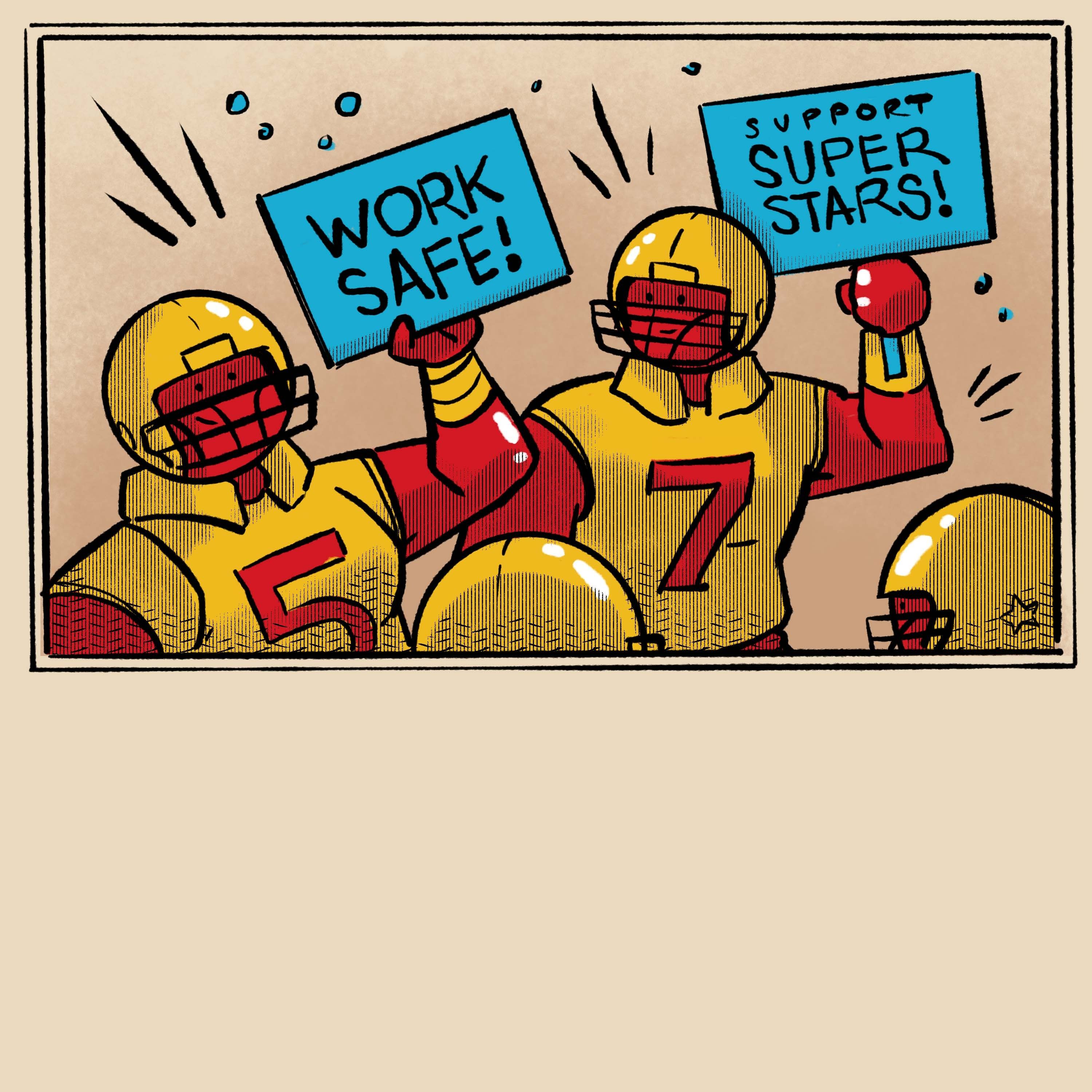
Ep 557When Is a Superstar Just Another Employee?
The union that represents N.F.L. players conducted their first-ever survey of workplace conditions, and issued a report card to all 32 teams. What did the survey reveal? Clogged showers, rats in the locker room — and some helpful insights for those of us who don’t play pro football. For show notes, visit freakonomics.com/podcast/when-is-a-superstar-just-another-employee/ Hosted by Simplecast, an AdsWizz company. See pcm.adswizz.com for information about our collection and use of personal data for advertising.

Ep 556556. A.I. Is Changing Everything. Does That Include You?
For all the speculation about the future, A.I. tools can be useful right now. Adam Davidson discovers what they can help us do, how we can get the most from them — and why the things that make them helpful also make them dangerous. (Part 3 of "How to Think About A.I.") Hosted by Simplecast, an AdsWizz company. See pcm.adswizz.com for information about our collection and use of personal data for advertising.
Ep 555555. New Technologies Always Scare Us. Is A.I. Any Different?
Guest host Adam Davidson looks at what might happen to your job in a world of human-level artificial intelligence, and asks when it might be time to worry that the machines have become too powerful. (Part 2 of "How to Think About A.I.") Hosted by Simplecast, an AdsWizz company. See pcm.adswizz.com for information about our collection and use of personal data for advertising.
Ep 554554. Can A.I. Take a Joke?
Artificial intelligence, we’ve been told, will destroy humankind. No, wait — it will usher in a new age of human flourishing! Guest host Adam Davidson (co-founder of Planet Money) sorts through the big claims about A.I.'s future by exploring its past and present — and whether it has a sense of humor. (Part 1 of "How to Think About A.I.") Hosted by Simplecast, an AdsWizz company. See pcm.adswizz.com for information about our collection and use of personal data for advertising.
Ep 553553. The Suddenly Diplomatic Rahm Emanuel
The famously profane politician and operative is now U.S. ambassador to Japan, where he’s trying to rewrite the rules of diplomacy. But don’t worry: When it comes to China, he’s every bit as combative as you’d expect. Hosted by Simplecast, an AdsWizz company. See pcm.adswizz.com for information about our collection and use of personal data for advertising.
Should Traffic Lights Be Abolished? (Ep. 454 Replay)
Americans are so accustomed to the standard intersection that we rarely consider how dangerous it can be — as well as costly, time-wasting, and polluting. Is it time to embrace the lowly, lovely roundabout? Hosted by Simplecast, an AdsWizz company. See pcm.adswizz.com for information about our collection and use of personal data for advertising.
Extra: A Modern Whaler Speaks Up
Bjorn Andersen killed 111 minke whales this season. He tells us how he does it, why he does it, and what he thinks would happen if whale-hunting ever stopped. (This bonus episode is a follow-up to our series “Everything You Never Knew About Whaling.") Hosted by Simplecast, an AdsWizz company. See pcm.adswizz.com for information about our collection and use of personal data for advertising.
Ep 552552. Freakonomics Radio Presents: The Economics of Everyday Things
In three stories from our newest podcast, host Zachary Crockett digs into sports mascots, cashmere sweaters, and dinosaur skeletons. Hosted by Simplecast, an AdsWizz company. See pcm.adswizz.com for information about our collection and use of personal data for advertising.
Ep 551551. What Can Whales Teach Us About Clean Energy, Workplace Harmony, and Living the Good Life?
In the final episode of our whale series, we learn about fecal plumes, shipping noise, and why "Moby-Dick" is still worth reading. (Part 3 of "Everything You Never Knew About Whaling.") Hosted by Simplecast, an AdsWizz company. See pcm.adswizz.com for information about our collection and use of personal data for advertising.
Ep 550550. Why Do People Still Hunt Whales?
For years, whale oil was used as lighting fuel, industrial lubricant, and the main ingredient in (yum!) margarine. Whale meat was also on a few menus. But today, demand for whale products is at a historic low. And yet some countries still have a whaling industry. We find out why. (Part 2 of “Everything You Never Knew About Whaling.”) Hosted by Simplecast, an AdsWizz company. See pcm.adswizz.com for information about our collection and use of personal data for advertising.
Ep 549549. The First Great American Industry
Whaling was, in the words of one scholar, “early capitalism unleashed on the high seas.” How did the U.S. come to dominate the whale market? Why did whale hunting die out here — and continue to grow elsewhere? And is that whale vomit in your perfume? (Part 1 of “Everything You Never Knew About Whaling.”) Hosted by Simplecast, an AdsWizz company. See pcm.adswizz.com for information about our collection and use of personal data for advertising.
Ep 548548. Why Is the U.S. So Good at Killing Pedestrians?
Actually, the reasons are pretty clear. The harder question is: Will we ever care enough to stop? Hosted by Simplecast, an AdsWizz company. See pcm.adswizz.com for information about our collection and use of personal data for advertising.
Why Did You Marry That Person? (Ep. 511 Replay)
Sure, you were “in love.” But economists — using evidence from Bridgerton to Tinder — point to what’s called “assortative mating.” And it has some unpleasant consequences for society. Hosted by Simplecast, an AdsWizz company. See pcm.adswizz.com for information about our collection and use of personal data for advertising.
Ep 547547. Satya Nadella’s Intelligence Is Not Artificial
But as C.E.O. of the resurgent Microsoft, he is firmly at the center of the A.I. revolution. We speak with him about the perils and blessings of A.I., Google vs. Bing, the Microsoft succession plan — and why his favorite use of ChatGPT is translating poetry. Hosted by Simplecast, an AdsWizz company. See pcm.adswizz.com for information about our collection and use of personal data for advertising.
Ep 546546. Are E.S.G. Investors Actually Helping the Environment?
Probably not. The economist Kelly Shue argues that E.S.G. investing just gives more money to firms that are already green while depriving polluting firms of the financing they need to get greener. But she has a solution. Hosted by Simplecast, an AdsWizz company. See pcm.adswizz.com for information about our collection and use of personal data for advertising.
Ep 545545. Enough with the Slippery Slopes!
Gun control, abortion rights, drug legalization — it seems like every argument these days claims that if X happens, then Y will follow, and we’ll all be doomed to Z. Is the slippery-slope argument a valid logical construction or just a game of feelingsball? Hosted by Simplecast, an AdsWizz company. See pcm.adswizz.com for information about our collection and use of personal data for advertising.
Ep 544544. Ari Emanuel Is Never Indifferent
He turned a small Hollywood talent agency into a massive sports-and-entertainment empire. In a freewheeling conversation, he explains how he did it and why it nearly killed him. Hosted by Simplecast, an AdsWizz company. See pcm.adswizz.com for information about our collection and use of personal data for advertising.
Make Me a Match (Ep. 209 Update)
Sure, markets work well in general. But for some transactions — like school admissions and organ transplants — money alone can’t solve the problem. That’s when you need a market-design wizard like Al Roth. Plus: We hear from a listener who, inspired by this episode, made a remarkable decision. Hosted by Simplecast, an AdsWizz company. See pcm.adswizz.com for information about our collection and use of personal data for advertising.
Ep 543543. How to Return Stolen Art
Museums are purging their collections of looted treasures. Can they also get something in return? And what does it mean to be a museum in the 21st century? (Part 3 of “Stealing Art Is Easy. Giving It Back Is Hard.”) Hosted by Simplecast, an AdsWizz company. See pcm.adswizz.com for information about our collection and use of personal data for advertising.
Ep 542542. Is a Museum Just a Trophy Case?
The world’s great museums are full of art and artifacts that were plundered during an era when plunder was the norm. Now there’s a push to return these works to their rightful owners. Sounds simple, right? It's not. (Part 2 of “Stealing Art Is Easy. Giving It Back Is Hard.”) Hosted by Simplecast, an AdsWizz company. See pcm.adswizz.com for information about our collection and use of personal data for advertising.
Ep 541541. The Case of the $4 Million Gold Coffin
How did a freshly looted Egyptian antiquity end up in the Metropolitan Museum of Art? Why did it take Kim Kardashian to crack the case? And how much of what you see in any museum is stolen? (Part 1 of “Stealing Art Is Easy. Giving It Back Is Hard.”) Hosted by Simplecast, an AdsWizz company. See pcm.adswizz.com for information about our collection and use of personal data for advertising.
Why Your Projects Are Always Late — and What to Do About It (Ep. 323 Replay)
Whether it’s a giant infrastructure plan or a humble kitchen renovation, it’ll inevitably take way too long and cost way too much. That’s because you suffer from “the planning fallacy.” (You also have an “optimism bias” and a bad case of overconfidence.) But don’t worry: we’ve got the solution. Hosted by Simplecast, an AdsWizz company. See pcm.adswizz.com for information about our collection and use of personal data for advertising.
Ep 540540. Swearing Is More Important Than You Think
Every language has its taboo words (which many people use all the time). But the list of forbidden words is always changing — and those changes tell us some surprising things about ourselves. Note: The swear words in this episode have been bleeped out. To hear a version of this episode without the bleeps, go to freakonomics.com. Hosted by Simplecast, an AdsWizz company. See pcm.adswizz.com for information about our collection and use of personal data for advertising.