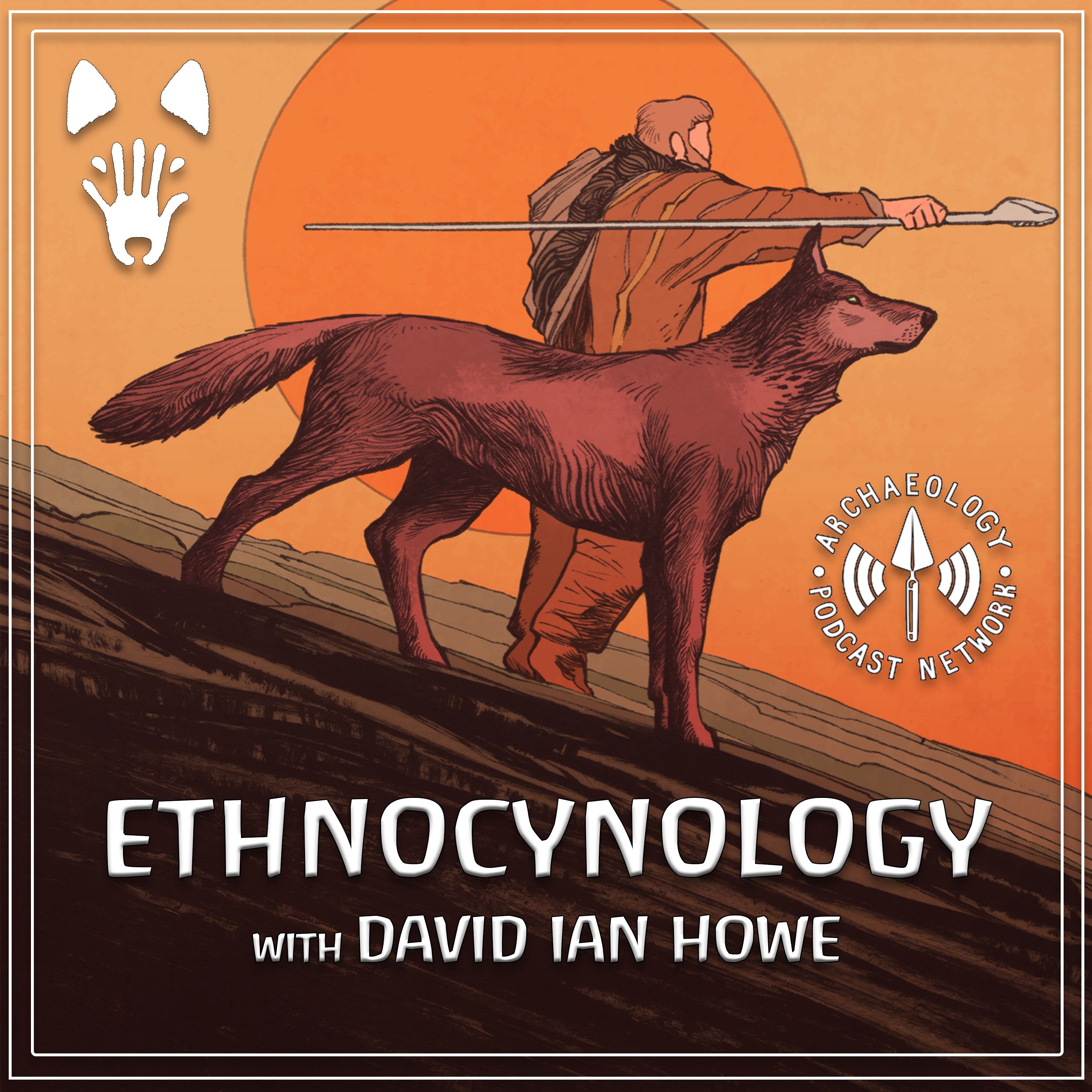
Show overview
Ethnocynology with David Ian Howe has been publishing since 2024, and across the 2 years since has built a catalogue of 44 episodes. That works out to roughly 35 hours of audio in total. Releases follow a fortnightly cadence.
Episodes typically run thirty-five to sixty minutes — most land between 41 min and 58 min — though episode length varies meaningfully from one episode to the next. None of the episodes are flagged explicit by the publisher. It is catalogued as a EN-language Education show.
The show is actively publishing — the most recent episode landed 1 weeks ago, with 10 episodes already out so far this year. The busiest year was 2025, with 25 episodes published. Published by Host.
From the publisher
Ethnocynology is the study of dogs in human cultural contexts. This podcast, hosted by anthropologist and comedian David Ian Howe, explores the history and archaeology of dogs, the roles of dogs in modern media, and the latest findings from archaeology in general.
Latest Episodes
View all 44 episodesWomen for Wolves with Anjali Ranadive - Ep 36
Ep 35New Dog Studies and New Dog Course! - Ep 35
With two new dog genetic and archaeological studies in the news, David briefly overviews his thoughts on them before he interviews the researchers in the coming Episodes. One was found in Britain, and another in Turkey, and they help fill in the gaps of previously published genetic studies. Secondly, David discusses his newly launched The History of Dogs Course hosted by FluentPet! Check the link below to sign up for the course and to get a special APN listener discount. OR use code DAVIDDOGS at checkout. That is FLUENT.PET / DAVID The History Of Dogs (NOT fluentpet. com /david) As well, David discusses the newly launched Office Hours and Media Consulting services hoste don his website. You can find them at davidianhowe.com! Transcripts For a rough transcript head over to: https://www.archaeologypodcastnetwork.com/ethnocynology/35 Links: davidianhowe.com Davidianhowe.com/store FluentPet History of Dogs Course David’s Website Office Hours Media Consulting ArchPodNet APN Website: https://www.archpodnet.com APN on Facebook: https://www.facebook.com/archpodnet APN on Twitter: https://www.twitter.com/archpodnet APN on Instagram: https://www.instagram.com/archpodnet APN Shop Affiliates Motion Hosted by Simplecast, an AdsWizz company. See pcm.adswizz.com for information about our collection and use of personal data for advertising.
Ep 34Monte Verde Discussion Panel with Drs. Shane Miller, Spencer Pelton, Jesse Tune, and Carlton Gover - Ep 34
In this episode of Ethnocynology, David hosts a panel of guests, including Drs. Shane Miller, Spencer Pelton, Jesse Tune, and Carlton Gover, to discuss the recent Monte Verde paper by Surovell et al. They discuss the recent paper, the synopsis, and address the many professionally published comments and critiques of the paper, as well as the conversation of the paper on the YouTube video of the previous episode. Links: davidianhowe.com Davidianhowe.com/store ArchPodNet APN Website: https://www.archpodnet.com APN on Facebook: https://www.facebook.com/archpodnet APN on Twitter: https://www.twitter.com/archpodnet APN on Instagram: https://www.instagram.com/archpodnet APN Shop Affiliates Motion Hosted by Simplecast, an AdsWizz company. See pcm.adswizz.com for information about our collection and use of personal data for advertising.
Ep 33BREAKING NEWS - Monte Verde is no longer a pre-Clovis site, with Dr. Todd Surovell - Ep 33
For decades, Monte Verde in southern Chile has been one of the most famous archaeological sites in the Americas. The site was widely accepted as 14,500 years old, making it one of the strongest pieces of evidence for human presence in the Americas before Clovis. But what if that interpretation was wrong? In this special episode, I sit down with Dr. Todd Surovell, professor of anthropology at the University of Wyoming, to discuss new research that re-examines Monte Verde using modern geoarchaeological methods. The results suggest that the famous site may actually be much younger than previously believed, dating to the Holocene rather than the Ice Age. If true, this would mean that Monte Verde is not evidence for pre-Clovis humans in South America, and it could force archaeologists to reconsider one of the most influential discoveries in American archaeology. We discuss: The history of the Monte Verde discovery Why it reshaped textbooks in the 1990s How new geological and dating analyses challenge the original interpretation What this means for Clovis-first vs. pre-Clovis models Why independent verification and skepticism are essential in science This episode explores how science evolves—and how even the most famous discoveries can be re-examined. Links: Video Version to follow along Surovell’s Study Surovell’s UW Page davidianhowe.com Davidianhowe.com/store ArchPodNet APN Website: https://www.archpodnet.com APN on Facebook: https://www.facebook.com/archpodnet APN on Twitter: https://www.twitter.com/archpodnet APN on Instagram: https://www.instagram.com/archpodnet APN Shop Affiliates Motion Hosted by Simplecast, an AdsWizz company. See pcm.adswizz.com for information about our collection and use of personal data for advertising.
Ep 32The Anthropology of Tattooing with Aaron Deter-Wolf - Ep 32
In this episode, David sits down in Nashville with archaeologist Aaron Deter-Wolf, a leading researcher in the archaeology of tattooing and co-editor of Ancient Ink: The Archaeology of Tattooing. They explore how tattoos function as deep cultural expressions across human societies, from Ötzi the Iceman’s 5,000-year-old tattoos to newly documented tattooed mummies in Peru. The conversation dives into experimental archaeology, ancient tattoo tools made from bone and stone, and what tattoos can reveal about identity, belief, and social structure in the past. Together they discuss how tattoo traditions changed under empires, how archaeologists identify tattooing in the archaeological record, and why body modification may be one of humanity’s oldest cultural universals. Links: davidianhowe.com Davidianhowe.com/store Aaron’s Book: Ancient Ink ArchPodNet APN Website: https://www.archpodnet.com APN on Facebook: https://www.facebook.com/archpodnet APN on Twitter: https://www.twitter.com/archpodnet APN on Instagram: https://www.instagram.com/archpodnet APN Shop Affiliates Motion Hosted by Simplecast, an AdsWizz company. See pcm.adswizz.com for information about our collection and use of personal data for advertising.
Ep 31David's Trip to Mexico - Ep 31
In this episode of Ethnocynology, David talks about his recent trip to Mexico. Initially, David went to Oaxaca to experience the local culture and take pictures of dogs, and he also spent a lot of time touring mezcal facilities and archaeological sites. After Oaxaca, David then took a bus to Mexico City, where he gave a talk about his upcoming book at UNAM, the largest university in Latin America. As well, David details how incredible the Museum of Anthropology is and takes you on a tour of the museum through his words, describing what he saw and how large and grand the collections and displays are. Links: davidianhowe.com Davidianhowe.com/store ArchPodNet APN Website: https://www.archpodnet.com APN on Facebook: https://www.facebook.com/archpodnet APN on Twitter: https://www.twitter.com/archpodnet APN on Instagram: https://www.instagram.com/archpodnet APN Shop Affiliates Motion Hosted by Simplecast, an AdsWizz company. See pcm.adswizz.com for information about our collection and use of personal data for advertising.
Ep 30Dogs, Death, and Mourning in Human Culture - Ep 30
In this episode of Ethnocynology, David talks about the book he's writing, reflects on the recent passing of his dog and his uncle, and what those have in common. With an upcoming trip to Mexico to research dogs in ancient and classical Mexican culture, David weaves in themes of dogs as spiritual constants and symbols of death around the world, including ancient Persia and China. He also asks the audience to consider how dogs and death may go hand in hand in their own lives.TranscriptsFor a rough transcript head over to: https://www.archaeologypodcastnetwork.com/ethnocynology/30Links:davidianhowe.comDavidianhowe.com/storeArchPodNetAPN Website: https://www.archpodnet.comAPN on Facebook: https://www.facebook.com/archpodnetAPN on Twitter: https://www.twitter.com/archpodnetAPN on Instagram: https://www.instagram.com/archpodnetAPN ShopAffiliatesMotion Hosted by Simplecast, an AdsWizz company. See pcm.adswizz.com for information about our collection and use of personal data for advertising.
Ep 29The History of Dogs: Evolution, Archaeology, and Mythology - Ep 29
In this episode of ethnocynology, David gets back to dogs!Ever wanted to hear his full manifesto on dogs, culminating nearly a decade of research? Well, here it is!What are dogs, where do they come from, and why are they so prevalent in history, legend, and mythology?TranscriptsFor a rough transcript head over to: https://www.archaeologypodcastnetwork.com/ethnocynology/29Links:David’s video lecturedavidianhowe.comDavidianhowe.com/storeArchPodNetAPN Website: https://www.archpodnet.comAPN on Facebook: https://www.facebook.com/archpodnetAPN on Twitter: https://www.twitter.com/archpodnetAPN on Instagram: https://www.instagram.com/archpodnetAPN ShopAffiliatesMotion Hosted by Simplecast, an AdsWizz company. See pcm.adswizz.com for information about our collection and use of personal data for advertising.
Ep 28Getting a Doctorate in Ice Age Archaeology with Dr. Mckenna Litynski - Ep 28
What if one of the most important technologies in human history wasn’t a spear, a stone tool, or writing, but a bone needle?In this episode of Ethnocynology, David sits down with Dr. McKenna Litynski, an interdisciplinary anthropologist, to explore how sewing needles, clothing, and thermoregulation fundamentally reshaped human survival during the Ice Age. And helped Homo sapiens expand across the globe.This conversation is both a deep dive into Ice Age archaeology and a clear, behind-the-scenes walkthrough of how you actually earn a PhD in anthropology, from preliminary exams to dissertation defense. This episode acts as both a spiritual successor to the viral “Why a Clovis Bone Needle Is the Most Important Artifact in North America” video and a practical guide for students curious about graduate school.Links:davidianhowe.comDavidianhowe.com/storeArchPodNetAPN Website: https://www.archpodnet.comAPN on Facebook: https://www.facebook.com/archpodnetAPN on Twitter: https://www.twitter.com/archpodnetAPN on Instagram: https://www.instagram.com/archpodnetAPN ShopAffiliatesMotion Hosted by Simplecast, an AdsWizz company. See pcm.adswizz.com for information about our collection and use of personal data for advertising.
Ep 27PROMO: The Archaeology Show Ep 311
As the APN takes a break this holiday season we’re taking this opportunity to bring you episodes of shows you may not be aware of. Today we have an episode from The Archaeology Show about lost cities.The Archaeology Show: Lost City or Lost Cause? Diving Into the Latest Atlantis ClaimsIn this episode of The Archaeology Show, we kick things off with a look at the recent discovery of a treasure-filled tomb belonging to the first known ruler of a Maya city in Belize, shedding light on ancient Maya leadership and ritual. In segments two and three, we dive into the latest headline-grabbing claim that Atlantis has been found off the coast of Spain. We break down what was actually discovered, examine the credentials of the lead researcher, and explore why the scientific community remains highly skeptical. Join us for a smart, approachable discussion that separates archaeological fact from fiction.The Archaeology Show on the APN Links:Segment 1Archaeologists Unearth Treasure-Filled Tomb Belonging to the First Known Ruler of a Maya City in BelizeScientists find tomb of a Maya king and his ancient treasures. But who was he?Segments 2/3Archaeologist Says He's Found Atlantis in Groundbreaking DiscoveryArchaeologist claims to have found Atlantis off the coast of Spain and has video to prove itAtlantis Found (Again)! And Exasperated Scientists (Again) Raise Their EyebrowsCosmic Summit 2025: The Mount Everest of Laughable Pseudoarchaeological Nonsense! - Ep 165Cosmic Summit 2025. Flint's BRUTAL Reaction with Dr Andrew KinkellaArchPodNetAPN Website: https://www.archpodnet.comAPN on Facebook: https://www.facebook.com/archpodnetAPN on Twitter: https://www.twitter.com/archpodnetAPN on Instagram: https://www.instagram.com/archpodnetAPN ShopAffiliatesMotion Hosted by Simplecast, an AdsWizz company. See pcm.adswizz.com for information about our collection and use of personal data for advertising.
Ep 9ENCORE - Why this Ice Age Bone Needle is so Important. - Ep 09
Do you have your pens at the ready? It’s pop-quiz time! Since David’s away for this episode, he’s given you a refresher on why bone needles are so important! This may or may not relate to a certain episode sequel he’s been working on…Here’s a recap of Episode 9!In this episode of Ethnocynology, David highlights a recent paper published about a bone needle he helped excavate in the summer of 2022.While David wasn’t an author on the paper, he was there when it was excavated, recorded the moment, and recently conducted interviews with the two leading authors of the paper.David discusses how he read a comment on his post about the needle that made him stop to think about how important such a small item could be to people on the ice age plains.David discusses how to read an academic paper, while conducting interviews with the researchers into the podcast.Links:Early Paleoindian use of canids, felids, and hares for bone needle production at the La Prele site, Wyoming, USAdavidianhowe.comDavidianhowe.com/storeArchPodNetAPN Website: https://www.archpodnet.comAPN on Facebook: https://www.facebook.com/archpodnetAPN on Twitter: https://www.twitter.com/archpodnetAPN on Instagram: https://www.instagram.com/archpodnetTee Public Store: https://www.teepublic.com/stores/archaeology-podcast-network?ref_id=5724AffiliatesMotion Hosted by Simplecast, an AdsWizz company. See pcm.adswizz.com for information about our collection and use of personal data for advertising.
Ep 30Promo - Life Along the Trails: 19th Century Nebraska Archaeology with Nolan Johnson - Plains 30
Please enjoy this Promo episode from the Great Plains Podcast this week!In this episode, I sit down with Nebraska archaeologist Nolan Johnson to talk about his work uncovering and interpreting the state’s rich historic past. We begin with the Beaver Creek Trail Crossing, a site that offers a glimpse into the experiences of travelers along the overland trails and the material traces they left behind. Nolan shares the story of how the site was investigated, what artifacts reveal about life on the move, and why these places remain important today.In the second half, our discussion broadens to post-1492 archaeology across Nebraska, what makes it distinct, what challenges archaeologists face in preserving and interpreting recent pasts, and why connecting communities to these stories continues to matter.Links:For more episodes of The Great Plains Archaeology Podcast head over to: https://www.archaeologypodcastnetwork.com/great-plains-archaeology/30ArchPodNetAPN Website: https://www.archpodnet.comAPN on Facebook: https://www.facebook.com/archpodnetAPN on Twitter: https://www.twitter.com/archpodnetAPN on Instagram: https://www.instagram.com/archpodnetAPN ShopAffiliatesMotion Hosted by Simplecast, an AdsWizz company. See pcm.adswizz.com for information about our collection and use of personal data for advertising.
Ep 27The Dogs of Mesoamerica with Zac Lindsey - Ep 27
In this episode David sits down with Zach Lindsay, a Mayanist archaeologist and board member of the Institute of Maya Studies, to explore the intersection of Mesoamerican archaeology, art, mythology, and—of course—dogs! From the monumental pyramids of Teotihuacan to the symbolic underworld journeys of ancient Maya souls, Zach brings a journalist’s curiosity and an archaeologist’s precision to one of the world’s oldest human–dog relationships.TranscriptsFor a rough transcript head over to: https://www.archaeologypodcastnetwork.com/ethnocynology/27Links:davidianhowe.comDavidianhowe.com/storeFollow Zach on Instagram: @arkeogatoArchPodNetAPN Website: https://www.archpodnet.comAPN on Facebook: https://www.facebook.com/archpodnetAPN on Twitter: https://www.twitter.com/archpodnetAPN on Instagram: https://www.instagram.com/archpodnetAPN ShopAffiliatesMotion Hosted by Simplecast, an AdsWizz company. See pcm.adswizz.com for information about our collection and use of personal data for advertising.
Ep 26Horses (Part 3) The Pawnee, the Plains, and the Spanish Caribbean with Dr. Carlton Shield Chief Gover - Ep 26
In this third installment of the “Horse Series,” David sits down with Dr. Carlton Shield Chief Gover to explore the intersections of Indigenous oral traditions, radiocarbon dating, and the archaeology of horses across the Great Plains and the Caribbean.Carlton shares how Pawnee oral traditions align with archaeological evidence, revealing new insights into the transitions from hunter-gatherer to agricultural societies. The conversation expands into how the reintroduction of horses revolutionized Plains warfare, movement, and culture — transforming not just how people traveled, but how they defined bravery, honor, and trade.The episode then dives underwater — literally — as Carlton recounts his work with the Indiana University Underwater Science Program in the Dominican Republic. From Spanish shipwrecks to 400-year-old hazelnuts used to fight scurvy, the discussion highlights how horses, colonization, and trade converged across continents and oceans.Topics CoveredIntroduction to Carlton Shield Chief Gover’s background and Pawnee heritageMerging radiocarbon dating with Indigenous oral historiesThe importance of corn, maize agriculture, and Plains village lifeHow the horse transformed Indigenous cultures and warfareThe practice of “counting coup” and individual honor in combatThe spread of horses before European contactCarlton’s archaeological work in Ukraine and comparisons to the Great PlainsUnderwater archaeology in the Dominican RepublicSpanish shipwrecks, horseshoes, and gold-gilded stirrupsHazelnuts as a 16th-century Spanish cure for scurvyDangers and logistics of underwater fieldworkHow early Caribbean horses may connect genetically to modern mustangsThe future of Plains and underwater archaeologyAbout the GuestDr. Carlton Shield Chief Gover is a citizen of the Pawnee Nation and a leading voice in Indigenous and Plains archaeology. His research integrates oral histories, Bayesian radiocarbon analysis, and archaeological evidence to create a fuller understanding of the Great Plains’ deep past. He currently serves as Assistant Professor and Curator of Archaeology at the University of Kansas and hosts The Great Plains Archaeology Podcast.Follow Carlton on InstagramListen to The Great Plains Archaeology PodcastMentioned in This EpisodeHoof Beats: The Horse in Human History — Dr. William TaylorCassidy Thornhill’s work on the Blacks Fork HorseYvette and Paulette Steeves’ research on pre-contact horsesIndiana University Underwater Science Program (Dr. Charles Beeker)University of Kansas Natural History MuseumKey Quote“When you reanalyze radiocarbon data with Indigenous oral traditions, you actually illustrate a much more holistic picture of human history.” — Dr. Carlton Shield Chief GoverTranscriptsFor a rough transcript head over to: https://www.archaeologypodcastnetwork.com/ethnocynology/26Links:davidianhowe.comDavidianhowe.com/storeArchPodNetAPN Website: https://www.archpodnet.comAPN on Facebook: https://www.facebook.com/archpodnetAPN on Twitter: https://www.twitter.com/archpodnetAPN on Instagram: https://www.instagram.com/archpodnetAPN ShopAffiliatesMotion Hosted by Simplecast, an AdsWizz company. See pcm.adswizz.com for information about our collection and use of personal data for advertising.
Ep 25Remembering Jane Goodall with Primatologist Carson Black - Ep 25
Remembering Jane Goodall with Primatologist Carson BlackIn this deeply heartfelt episode, David speaks with Primatologist, Biological Anthropologist, and Conservationist, Carson Black, who has spent her academic career studying chimpanzees in Senegal and howler monkeys in Costa Rica.Together, they reflect on the life and legacy of Jane Goodall, the “living Darwin of the modern era,” and how her groundbreaking work continues to shape the way we understand both chimpanzees and ourselves.Carson shares vivid stories from the field—bucket showers under the Milky Way, mischievous chimps throwing rocks, and the humbling power of seeing the world from their perspective. The two also discuss the history of primatology, the pioneering “Trimates” (Jane Goodall, Dian Fossey, and Biruté Galdikas), and the role of indigenous knowledge in modern science.This episode serves as both a tribute to Jane Goodall and a reminder that anthropology isn’t just about the past—it’s about the relationships that continue to define what it means to be human.Links:davidianhowe.comDavidianhowe.com/storeArchPodNetAPN Website: https://www.archpodnet.comAPN on Facebook: https://www.facebook.com/archpodnetAPN on Twitter: https://www.twitter.com/archpodnetAPN on Instagram: https://www.instagram.com/archpodnetAPN ShopAffiliatesMotion Hosted by Simplecast, an AdsWizz company. See pcm.adswizz.com for information about our collection and use of personal data for advertising.
Ep 24Horses (Part 2) | Horses in Early Contact North America with Cassidee Thornhill - Ep 24
In this episode of Ethnocynology with David Ian Howe, I sit down with my good friend and former graduate school cohort member Cassidee Thornhill, Collections Manager at the University of Wyoming Archaeological Repository.Cassidee’s research dives into the early contact era in Wyoming, focusing on the arrival and spread of horses before and during European colonization. We discuss her fascinating thesis work on the Black’s Fork River site, where a young foal was found buried alongside three coyote skulls—an extraordinary archaeological discovery that sheds light on early human–horse relationships on the Plains.Topics we cover include:The Black’s Fork horse burial and its cultural significanceEarly radiocarbon dates showing horses in Wyoming decades before the Pueblo RevoltEvidence of early veterinary care and human–horse bondsHow horses transformed Native economies, sovereignty, and resistanceGenetic research linking early horses in the Americas to Spanish (and later British) stockThe broader story of how horses reshaped Indigenous life across the PlainsCassidee also shares her perspective on whether horses or dogs have been more influential in human history—a big question we love to ask on this show.This episode is the extended interview version you won’t find on YouTube—perfect for listeners who want the full deep dive into Cassidee’s groundbreaking work.TranscriptsFor a rough transcript head over to: https://www.archaeologypodcastnetwork.com/ethnocynology/24Links:davidianhowe.comDavidianhowe.com/storeArchPodNetAPN Website: https://www.archpodnet.comAPN on Facebook: https://www.facebook.com/archpodnetAPN on Twitter: https://www.twitter.com/archpodnetAPN on Instagram: https://www.instagram.com/archpodnetAPN ShopAffiliatesMotion Hosted by Simplecast, an AdsWizz company. See pcm.adswizz.com for information about our collection and use of personal data for advertising.
Ep 23Horses (Part 1) | Hoof Beats with Dr. William Taylor - Ep 23
In this episode of Ethnocynology, host David Ian Howe sits down with archaeologist and anthropologist Dr. William Taylor (University of Colorado Boulder), author of Hoofbeats: How Horses Shaped Human History.While this show usually focuses on dogs, today we shift to the other animal that transformed humanity: the horse. Dr. Taylor walks us through the evolutionary history of horses, their domestication on the Eurasian steppe, and their reintroduction to the Americas after the Ice Age. Together we explore how humans first interacted with horses—as prey, symbols in cave art, sources of milk and meat, and eventually as partners in transport, warfare, and belief systems.Topics include:The origins of domestic horses around 2000 BC in the Caucasus steppesHorses evolving in North America, going extinct, and being reintroduced by the SpanishHunting evidence from sites like Schöningen in Germany and Bluefish Caves in the YukonHorses in Paleolithic cave art (Lascaux, Chauvet) and the Vogelherd ivory carvingEvidence for early horse riding and chariot use in Egypt, Assyria, and beyondThe role of horses in indigenous North and South American societies before widespread European contactEthno-equine parallels in Mongolia, Australia, and Patagonia, where horses shaped cultural, spiritual, and economic lifeThis is Part 1 of a two-part series: next time, David speaks with Cassidy Thornhill of the University of Wyoming, who researches the protohistoric introduction of horses into the Americas.If you enjoy the episode, please rate and review Ethnocynology on Apple Podcasts and Spotify. It helps more people discover the show and supports the entire Archaeology Podcast Network.Links:Hoofbeats: How Horses Shaped Human History by Dr. William Taylor — available on Amazon and other retailers.davidianhowe.comDavidianhowe.com/storeArchPodNetAPN Website: https://www.archpodnet.comAPN on Facebook: https://www.facebook.com/archpodnetAPN on Twitter: https://www.twitter.com/archpodnetAPN on Instagram: https://www.instagram.com/archpodnetAPN ShopAffiliatesMotion Hosted by Simplecast, an AdsWizz company. See pcm.adswizz.com for information about our collection and use of personal data for advertising.
Ep 22The Old Copper Culture with North02 - Ep 22
In this episode of Ethnocynology, host David Ian Howe sits down with friend and creator North02 to dive into one of North America’s most fascinating and overlooked archaeological stories—the Old Copper Culture.Together, they explore how Native communities in the Great Lakes region began shaping some of the world’s earliest metal tools and weapons, thousands of years before metallurgy took hold in Europe. From massive copper swords and fishing hooks to spear throwers and intricate ornaments, this culture reveals a technological world far beyond the usual “stone tool” narrative.We discuss:Why Michigan and the Great Lakes hold the purest copper deposits in the worldHow hunter-gatherers mined and hammered copper into tools as early as 9,500 years agoThe mysterious rise and fall of copper mining, and why production suddenly stoppedConnections to Paleoindian cultures like Clovis and Agate BasinThe difference between copper use in the Americas and the Old World’s Bronze AgeHow copper shifted from practical tools to symbols of power and statusAlong the way, North shares insights from his upcoming documentary on the Old Copper Culture, his hands-on experiments with copper tools, and why this forgotten chapter of prehistory deserves a place in public imagination.If you’ve ever wondered whether North America had its own “Copper Age”, this episode will change the way you think about early technology, innovation, and the ingenuity of ancient peoples.TranscriptsFor a rough transcript head over to: https://www.archaeologypodcastnetwork.com/ethnocynology/22Links:Great Water: The Lost Mines of Lake Superior by David P. Pompeanidavidianhowe.comDavidianhowe.com/storeArchPodNetAPN Website: https://www.archpodnet.comAPN on Facebook: https://www.facebook.com/archpodnetAPN on Twitter: https://www.twitter.com/archpodnetAPN on Instagram: https://www.instagram.com/archpodnetAPN ShopAffiliatesMotion Hosted by Simplecast, an AdsWizz company. See pcm.adswizz.com for information about our collection and use of personal data for advertising.
Ep 101ENCORE - Talking Dogs, Data, and Mental Health (but mostly dogs) with Dr. Angela Perri - Ruins 101
On this episode of A Life in Ruins Podcast, David and Connor talk to Dr. Angela Perri about her lengthy CV and her academic/professional career. Dr. Perri is currently the top researcher in the world in terms of understanding the relationship between humans and dogs in the ancient world. So clearly, David's ears perked up.As usual, we first dive into Angela's early life and career in anthropology, and talk about her interesting transition from a Las Vegas bartender and Oregonian undergrad, to being a PhD student in the UK.We then discuss her time at Durham University and her dissertation research, which took her to Japan, Mongolia, and the American Southeast. We also talk about her time and research at the Max Planck Institute studying dog genomics and DNA. David and Connor also ask Angela multiple questions about dogs, dog domestication, and the human/dog relationship.We then end on Angela's career advice and have a heart to heart conversation about mental health, Academia, and CRM.Links:Dog Domestication published on YouTube by The AtlanticOrigin: A Genetic History of the Americas by Jennifer RaffDog Is Love: Why and How Your Dog Loves You by Clive D. L. WynneA Dog's History of the World: Canines and the Domestication of Humans by Laura Hobgood-OsterWhite Fang by Jack LondonCall of the Wild by Jack Londondavidianhowe.comDavidianhowe.com/storeArchPodNetAPN Website: https://www.archpodnet.comAPN on Facebook: https://www.facebook.com/archpodnetAPN on Twitter: https://www.twitter.com/archpodnetAPN on Instagram: https://www.instagram.com/archpodnetAPN ShopAffiliatesMotion Hosted by Simplecast, an AdsWizz company. See pcm.adswizz.com for information about our collection and use of personal data for advertising.
Ep 21Anthro Chat with Stefan Milo - Ep 21
An Anthro Chat With Stefan Milo.In this episode of ethnic psychology, David sits down with good friend Stefan Milo, archaeologist, YouTuber, and overall outstanding chap.David and Steve catch up on recent anthropology news and discussed the recent archaeological findings at White Sands national Park, as well as the recent genetic findings surrounding Dragon Man, the Denisovans, and the peopling of the Americas.David and Stefan also discuss the growing concern among content creators regarding automated intelligence and whether or not the recent advancements with AI video generation will put people like David and Stefan out of work.Stefan is a brilliant guy, and this conversation is as educational as it is pretty funny. So be sure to give it a listen!Links:davidianhowe.comDavidianhowe.com/storeArchPodNetAPN Website: https://www.archpodnet.comAPN on Facebook: https://www.facebook.com/archpodnetAPN on Twitter: https://www.twitter.com/archpodnetAPN on Instagram: https://www.instagram.com/archpodnetAPN ShopAffiliatesMotion Hosted by Simplecast, an AdsWizz company. See pcm.adswizz.com for information about our collection and use of personal data for advertising.