
Eric Hörst's Training For Climbing Podcast
108 episodes — Page 3 of 3
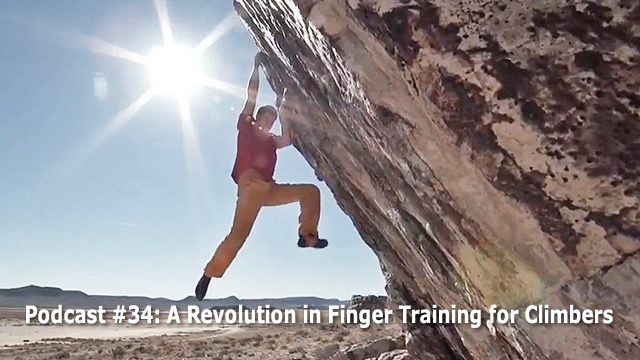
Episode #34: A Revolution in Finger Training for Climbers
This may be the most important podcast you've heard in a long time...or, perhaps, ever! If you engage in hard finger training, frequently push your physical limits, and/or occasionally experience tendon or joint pain...then this podcast could be a game-changer for you. Traditionally, tendons and ligaments (such as the A2 pulleys of the fingers) have been viewed as inert structures that changed little after adolescence. We now know, however, that these connective tissues are dynamic and metabolically active. New studies provide clues as to how athletes can play an active role in developing stronger, more robust, and higher performance connective tissues. This is a revolutionary distinction for hard-training climbers...and it may change the way you train, eat, and recover going forward. This podcast is the second in a series on sinew training for improved health and enhanced performance. Revisit podcast #33 for an introduction to the topic. Podcasts #34 and #35 will break much new ground on the topic of training for climbing--don't miss them! RUNDOWN 0:15 – Introduction to this series of 4 podcasts on connective tissue training—this is revolutionary information. 2:07 – Question: What sport is as hard on tendons and ligaments as climbing? Is there one? Perhaps not. Consider that finger flexor tendon pulleys are just 1 to 2 mm thick, yet they have to carry a large percentage of a climber's body weight. 4:00 – Collagen-based tissues carry the load, from muscle to fingertips, with every hold you grab…every move you make…every lunge you make! 6:30 – The best climber in the world isn't the best if he's injured. Injuries, big and small, are setbacks that change your trajectory. 7:35 – New paradigm: Your top priority in training for climbing: Develop stronger tendons, pulleys, and muscle matrix. 8:45 – Sinew have poor blood flow, and therefore may be poorly nourished. 9:30 – Key distinction: collagen breaks down with every intense work. Collagen synthesis takes 72 hours (or more) to remodel the connective tissue. 11:00 – Too much collagen breakdown and too little recovery time between workouts may lead to injury. 11:50 – Sinew gets much of their nutrition from fluid diffusion during mechanical loading (climbing and training). Therefore, consuming Supercharged Collagen 30 to 60 minutes training is the optimal nutritional protocol for supporting collagen synthesis in finger tendons and ligament pulleys. 15:30 – Anything you can do to promote collagen synthesis and connective tissue remodeling is a game-changer for a hard training climber. It's with this goal in mind that I founded PhysiVantage. 16:30 – Learn about my new brand PhysiVāntage and our flagship product, Supercharged Collagen. This is a totally novel and premium produce. 19:40 – The genesis of PhysiVāntage—almost three years in the making. Here's the back story. 22:00 – How decreasing collagen turnover after age 30 slows recovery and may increase the risk of injury. 25:50 – Most important amino acids for collagen synthesis are glycine, proline, hydroxyproline—these are hard to come by if you don't consume a lot of meat. 27:30 – I created Supercharged Collagen to provide climbers with the perfect glycine and proline-rich pre-workout supplements for feeding their sinew the nutrients for optimal collagen synthesis. It's research-based and athlete-tested. 32:00 – A quick research review. Here are six of the more than a dozen studies that I drew on in developing Supercharged Collagen. 41:20 – 6 questions and answers… 41:45 – Question #1: Will Supercharged Collagen fix my injury? (No, but it may enhance your rehabilitation program and, possibly, accelerate your return to climbing.) 43:20 – Question #2: How much Supercharged collagen should I consume each day? (One to three servings per day, depending on your situation.) 45:15 – Learn the benefits of doing a brief (15 minutes) "protective workout" each morning. This may be the biggest secret to building stronger tendons and ligaments in the long term! 47:40 – Question #3: What usage do I recommend for injured climbers? (First, see a doctor for a correct diagnosis. Second, research indicates that a 15 to 20 gram serving, 30 to 60 minutes before exercise, is ideal for supporting injury rehab.) 49:20 – Question #4: Can I consume Supercharged Collagen post-workout as a protein source for muscles. (Yes! But consuming a high-quality Whey protein is just as good for muscle recovery.) 50:35 – Question #5: Is there a vegan version of Supercharged Collagen? (No, there's no such thing as vegan hydrolyzed collagen.) 52:08 – Question #6: How long does it take to feel the beneficial effects of Supercharged Collagen? (It's unlikely you'll feel much difference in your sinew short-term, however, multiple studies have shown a statistically significant reduction in joint pain from several months of collagen peptide use.) 55:00 – I formed PhysiVantage to my difference-making supplements for passionate climbers who place great demands
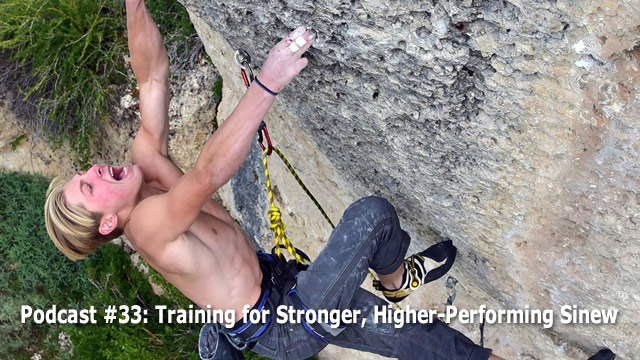
Episode #33: Intro to Training for Stronger Tendons and Ligaments
Get ready for some breakthrough research-based information that, I believe, is revolutionary for hard-training climbers! The topic is sinew training—that is, new training and nutritional interventions shown to promote tendon, ligament, and muscle matrix strength and health. We all know how hard climbing (and training) is on the flexor tendons and ligament pulleys of the fingers, as well as the elbows and shoulders; so what could be more valuable to climbers than strategies to improve sinew health, strength, and performance? This is an information-rich podcast that might require a couple of listens...to determine how you can best apply and benefit from this new material. The next three podcasts will expand on this topic with details on specific training interventions for strengthening (and rehabbing) sore or tweaked tendons and pulleys. If you are a proactive, early adapter kind of person, then this is cutting-edge information I'm sure you'll be all over...like chalk on a crux hold! A final note: If you enjoy this podcast, then please share it with a friend, post to social media, or write a review. Thank you! Rundown 1:00 – Introduction to a new series of podcasts on sinew training—how to develop stronger, stiffer, healthier tendons and ligaments. This is the first of four episodes in the series…breaking new ground that I feel is revolutionary for climbers. 3:00 – Tendons and ligaments are not inert—they change and adapt to training in adulthood, but at a much slower rate than muscles do. And, sinew training requires unique training modalities and nutritional interventions. PhysiVāntage 5:20 – A quick rundown of the next 3 episodes in this series….and the exciting ground I'll be covering. 7:00 – Eric gives a brief introduction of himself and his background for new listeners. Additional comments of recent advances in training for climbing. 10:10 – A reflection on last year's series of podcasts on Energy System Training—powerful material for intermediate, advanced, and elite climbers. If you haven't already, listen to these podcasts! # ??? 13:00 – Introduction to sinew training…and the exciting new sport science I'm bringing to the climbing world in this series of podcasts. 15:30 – The importance of training to avoid injury and stay healthy, so that you can reach your goals! There's a huge cost to injuries…lost seasons, missed competitions, setbacks and lost seasons. 20:00 – There are decades of knowledge gathered and distributed on muscle training and adaptations…but until recently there's little research and scant instruction on sinew training. 23:00 – The importance of staying curious! Embracing and applying the latest research is key to progress and breakthroughs in most complex fields/endeavors. 28:00 – Three findings of my two years of research into sinew health and sinew training. 28:30 – Finding #1: Sinew is plastic. Tendons, ligaments, and extracellular muscle matrix change, adapt, and remodel very slowly…and you can play a role in this process! 34:00 – Distinct training and nutritional interventions do influence sinew health, strength, and performance. 35:00 – Finding #2: Tendons can hypertrophy. In certain situations, chronic mechanical loading can lead to slightly hypertrophy over years of exercise. Research has documented that the finger flexor tendons of veteran climbers are up to 50% thicker than non-climbers. 39:00 – Hypertrophy results from long-term training stimulus that slightly degrades collagen…followed by a rise in collagen synthesis during a recovery period of 48 to 72 hours. This cyclic process will gradually build stronger connective tissues given appropriate mechanical loading and rest periods. Nutrition plays an important role in the process, too—more on this in a bit! 41:35 – Sinew has poor blood flow compared to muscles…and there's scant blood flow to sinew after training. 44:45 – Homeostasis perturbation from long-term overtraining (under-resting and perhaps poor nutrition) leads to disorganized and damaged collagen fibrils…that may be the root cause of the sudden "surprise" finger pulley tweak or onset of painful tendons in the elbows and shoulders. 48:15 – Finding #3: There is a proven nutritional intervention that increases collagen synthesis in connective tissues…and can support sinew recovery and strengthening. Research by Keith Baar and Greg Shaw has shown a doubling of collagen synthesis with vitamin C enriched hydrolyzed collagen consumed 30 to 60 minutes before exercise. 55:30 – Why nutrients consumed after exercise aren't as effective for nourishing tendons. Synovial fluid diffusion during mechanical loading is the primary method of nourishment to sinew—thus, consuming a glycine and proline rich food before training is the best method of "feeding" sinew. 59:20 – My morning ritual for optimally feeding the tendon and ligaments of my fingers, arms and shoulders—15 minutes to stronger tendons. Supercharged Collagen works! 1:03:00 – You are playing a role in your tendon hea
Episode #32: Success Strategies for Peak Performance
New Year's is a great time to think deeply about your goals, re-evaluate your course and strategy, and perhaps even reinvent yourself! Taking your performance to the next level—in climbing or anything—demands CHANGE, courage and commitment, and consistent goal-focused action. In this episode, Eric takes you through a series of thought-provoking exercises and, along the way, he will arm you with powerful techniques and tips to make massive progress toward your climbing and non-climbing goals! Rundown 0:15 – Introduction and New Year's best wishes! 1:30 – "Climbing performance" and "human performance" are the same thing…so this episode will be wide-ranging. 2:25 – Setting goals isn't enough—you need a SYSTEM to get you to your goals. 3:15 – This podcast has 5 parts, each with a drill down into a topic that will improve your performance in climbing and beyond. 5:23 – PART 1: Decide that CHANGE is a must! Improving at climbing—or anything—comes no other way. 8:10 – Exercise (pause the podcast): Write down your top 5 to 10 high-value goals/endeavors. Climbing can be one item, but write down your other important life goals (in the next 3 to 10 years). 9:45 – Exercise: Rank your goals in order of importance. Now divide your list into three tiers—the top tier (2 or 3 items) defines your MISSION! 12:50 – Exercise: Now write down 1 or 2 things that MUST give up or change in order to liberate yourself to achieve greatly. What person, activity, or thing is weighing you down…making you miserable and/or consuming your time? 14:45 – Learn how to create massive leverage for change...and supercharge your motivation and progress toward your goals! 17:15 – PART 2: Build Stronger Mental Muscle. Essential for progress, since all performance begins with your thoughts. 18:45 – What we can learn from pro climbers…most of whom exhibit incredible mental muscle, day in and day out. 20:30 – Learn about Eric's "CHHOM gang" of climbers. What is CHHOM? Who are CHHOM? Strive to be like CHHOM! 22:00 – 4 mental training tips and techniques… 23:20 – a.) Supercharge your visualization. 27:25 – b.) Take control of your self-talk. Keep it 90%+ positive! 31:00 – c.) Act the part. Your posture, facial expression, and attitude create an aura that brings magical energy and synchronicity to you! 33:09 – d.) Surround yourself with positive, goal-oriented, successful people. Also, bathe your mind with positive media, books, images, etc. 35:49 – Side note: Eric's most powerful book—bet you haven't read it yet, but you should—is called Maximum Climbing: Mental Training for Peak Performance. A must-read for every serious climber! 36:35 – PART 3: Learn how to Optimize Your Training Program 37:20 – The best training program for you…is one you're not doing! 38:30 – Advice for Beginner, Intermediate, and Advanced climbers. 40:05 – Access to new technology, the latest sports-science, and novel training techniques is essential for Elite climbers to improve. 41:45 – The difference between "copycat" training and "modeling"—the former is bad, the latter is good! 42: 28 – Access to a good veteran coach is extremely helpful…but you can study and learn to be an effective self-coach. 43:45 – PART 4: Simplify your training—simplify your life! Learn how to apply the 80-20 Rule to improve your effectiveness and advance more quickly toward your goals. 45:05 – Eric reveals one of his weaknesses…and his decade-long battle of passions! 49:05 – Eliminate trivial pursuits, trolls, critics, and naysayers...and you'll be happier and more effective—just like CHHOM! 50:36 – Learn how to use Pareto's Principle ("the 80-20 Rule") to act more effectively in climbing, training, and other important life aspects. 53:10 – Eric comments on the advantages of occasional two-a-day training for advanced/elite climbers. 54:55 – PART 5: Strong shoulders beget stronger fingers! Make this a mantra in developing your finger training program. 57:50 – Your fingers are only as strong as your brain allows! A strong, stable foundation (rotator cuff and scapular stabilizer muscles) is essential for high-end finger training. 1:00:50 – Horst principle: "Develop stability before strength, and strength before power." This conceptual model will support long-term strength gains and reduce risk. Eric's book Training For Climbing (3rd edition) has a fully chapter (Ch. 6) on exercises for developing comprehensive shoulder stabilizer strength. 1:02:50 – Summary comments about seeing the big picture for motivation and guidance, but narrowing your daily focus on important steps you can take toward your goal. Making meaningful progress towards a goal is the simplest, yet richest source of happiness. 1:05:55 – Check out Eric's T4C Youtube channel for a short video on how to increase your effectiveness—and accelerate movement towards your goals—in any important life area. If you enjoyed this podcast, PLEASE SHARE it with your friends via Social Media or an embed on your climbing blog. And please write an iTunes revie
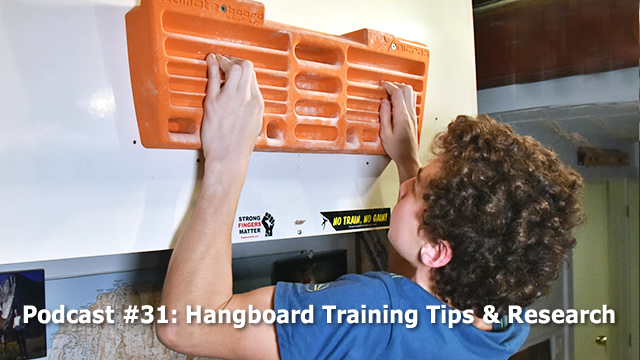
Episode #31: Hangboard Training Tips & Research
This episode provides critical framework and guidelines for effective hangboard training. Based on 30+ years of hangboard training experience--and the latest research--you'll learn the importance of a proper warm up, why you must train different finger grip positions, how to maintain forearm muscle balance and lower injury risk, as well as valuable tips on organizing your hangboard training for optimal results and continued gains in the long-term! Rundown 0:22 - Introduction 2:00 - Who should hangboard train? Guidelines for beginner, intermediate, advanced, and elite climbers. 8:30 - The value of hangboard training for intermittent year-round...and the importance of finding your "best" personalized program. 9:45 - Get compliant! Learn the "120-move" rule for warming up. 15:45 - Why elite level climbers need to do some two-a-day workouts. 16:55 - Beginner guidelines. To hang or not to hang? 17:35 - How proper training (and rest) can make your tendons stronger, stiffer, and slightly thicker given long-term, prudent hangboard training. 18:10 - Which grip positions you should train? How grip position effects forces placed on the flexor tendons and pulleys. Important stuff! 21:00 - Biomechanics of the full crimp grip. 23:12 - Biomechanics of the open-hand grip. 23:30- What about the "open-crimp" grip? 25:15 - Importance of targeting a specific grip position. 26:50 - Research findings on the forces places on the FDP and FDS flexor tendons with different grip positions. 31:50 - Forces placed on A2 and A4 pulleys...and how to train around a minor annular pulley injury. 33:32 - Finger extensor muscle imbalances...and how to train to combat them. 39:45 - Pinch grip training--Eric's "two birds with one stone" training recommendation. 42:08 - Why every serious climbing much do two brief antagonist exercise sessions per week. 43:55 - Reminder that specific hangboard training protocols are detailed in Podcast #10. 45:08 - Tips on exercise programming. 46:50 - Tips for advanced climbers. 48:00 - Elite climber advice: The importance of doing periods of high volume training for Central Governor recalibration--one of the keys to breaking new performance barriers! Learn more on this in my book, Training for Climbing. 50:30 - Keys to long-term gains over decades. Yes, you can do it with dedicated & smart training--if you stay uninjured! 51:35 - Teaser on the next few podcasts...which will break some new ground. Don't miss them! 52:40 - Closing comments about the transcending spirit of climbing...and Eric's good wishes to you for the holidays and New Year! If you enjoy this podcast, PLEASE SHARE it with your friends via Social Media or an embed on your climbing blog. Thank you! For a comprehensive study of Training for Climbing, check out the 3rd edition of Hörst's best-selling book! Follow Eric on Twitter @Train4Climbing Check out Eric's YouTube channel. Follow Eric on Facebook! Music by: Misty Murphy Subscribe on iTunes (or other podcast player) to "Eric Hörst's Training For Climbing" podcast. You can also listen to the T4C podcast on Spotify! Please write a review on iTunes!
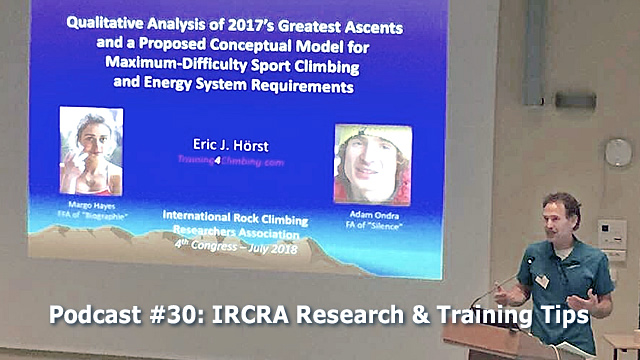
Episode #30: IRCRA Research Highlights & Training Tips
0:25 – Preview of this and upcoming podcasts. 5:55 - Overview of this summer's International Rock Climbing Researchers Association 4th Congress in Chamonix, France. 10:40 - Research highlight #1: 3-D motion analysis of speed climbing performance, and interpretation of hip mechanical energy in official speed climbing route. (Lionel Reveret - France). 14:45 - Research highlight #2: Effect of climbing hold depth on biomechanical arm action during pull-ups. (Laurent Vigouroux - France) 22:55 - Research highlight #3: PIP joint contact incongruency in different grip positions as a trigger for epiphyseal fatigue fracture in adolescent climbers. (Andreas Schweizer - Switzerland) 31:20 - Research highlights #4 & 5: Association between different Rate of Force Development-measurements and climbing performance (Vegard Vereide - Norway), and the Rate of Force Development: a new biomechanical key factor in climbing (Guillaume Levernier - France). 40:45 - Research highlight #6: The effects of weighted dead-hang training program on grip strength and endurance in experienced climbers with different levels of strength (Eva Lopez-Rivera - Spain). 52:52 - Research highlight #7: Qualitative analysis of two of 2017's greatest ascents and a proposed conceptual model for maximum-difficulty sport climbing and energy system requirements (Eric Hörst - USA) 1:05:08 - The ultimate lesson from Hayes' and Ondra's ascents—climb quickly, accurately, and efficiently, and pause to rest only at effective rest positions. In short, the Hörst rule for lead climbing peak performance: Climb fast and rest well! 1:07:24 - My shout out to a few of the numerous coaches now bringing climbing science to their work as trainers! If you enjoy this podcast, PLEASE SHARE it with your friends via Social Media or an embed on your climbing blog. Thank you! For a comprehensive study of Training for Climbing, check out the 3rd edition of Hörst's best-selling book! Follow Eric on Twitter @Train4Climbing Check out Eric's YouTube channel. Follow Eric on Facebook! Music by: Misty Murphy Subscribe on iTunes (or other podcast player) to "Eric Hörst's Training For Climbing" podcast. You can also listen to the T4C podcast on Spotify! Please write a review on iTunes! Photo: Eric Hörst presenting at the IRCRA conference in Chamonix, France, July 2018.
Episode #29: Ask Coach Hörst - Round 4
In this episode of Ask Coach Hörst...Eric answers 7 wide-ranging questions from listeners, including in-depth coverage of effective hangboard training, the importance of developing a climbing "talent stack", details on Threshold training for climbing-specific aerobic development, training while recovering from a lower-leg injury, training for middle-aged climbers, and more! Podcast Rundown 1:35 - Question #1 - A two-part question on effective hangboard training...with a long, detailed answer offering rich guidance on developing strength and endurance using a hangboard. Part 1: Is it better to train on small edges with body weight or larger holds with added weight? Part 2: How does the length of rest between hangboard reps and sets effect the training adaptation? 19:15 - Question #2 - How can I find the proper training intensity when doing Threshold Intervals…to best develop my climbing-specific aerobic energy system? Consider listening to podcast #26 for a complete study of aerobic system training for climbing. 26:20 - Question #3 - I'm out of climbing for several months due to lower leg surgery...so, Eric, what kind of training do you suggest for me during this forced withdrawal from climbing? 32:37 - Question #4 - Why don't you recommend any low-rep hypertrophy training for antagonist and core muscles? 38:01 - Question #5 - I get so incredibly pump—and quickly!—on steep routes. How can I assess my energy systems and determine which energy system (Aerobic or Anaerobic) I need to train? Can you give me some training advice? For a super detailed study of anaerobic lactic training, listen to podcasts #23 and #24. 44:32 - Question #6 - Climbing is now my passion, however I previously was a serious rugby player. How might I train to reduce the size (weight) of my rather large leg muscle? Eric also explains the importance of developing a climbing "talent stack". 51:55 - Question #7 - I'm 47 years old (been climbing 28 years) and very experienced at hard multi-pitch routes...but I have also climbed 5.13a sport and V7 boulders. My goal is to climb some multi-pitch 5.12 routes, and I'd like to improve my physical fitness. What training do you recommend for someone my age? NOTE: If you'd like to submit a question for the next, please leave it as a comment to the Ask Coach Horst post on my Twitter @Train4Climbing -- include your first name, location, climbing ability level, and years climbing. Music by Misty Murphy Follow Eric on Twitter @Train4Climbing Check out Eric's YouTube channel. Follow Eric on Facebook! And on Instagram at: Training4Climbing

Episode #28: Energy System Training (part 5) - The Art of the Science
This is the fifth and final episode in our study of Energy System Training theory and application. In this 90-minute tour de force, Eric presents the art of the science via 8 key ideas and distinctions to make your energy system training optimally effective. This is powerful material—understanding and applying this cutting-edge sports science will empower you to elevate your training outcomes...and climb harder! Podcast Rundown 2:50 – Recap of the genesis of my study of energy systems more than 5 years ago. After a two-year review of the latest research and sports science, I discovered that some aspect of the old school sports science—and even some physiology textbooks—were outdated and even wrong on some important details. Therefore, what I'm trying to do with my book Training for Climbing and these podcasts is apply the latest sports science, research, and training technology to climbing. Only this way will we optimize training programs and advance the sport! 5:20 – What I'm presenting in this series of 5 podcasts is the cutting edge of training for climbing…that may open the door to 5.16a in the next 5 to 10 years...and help the mass of climbers achieve their climbing goals and beyond! 8:15 – Eric shares a brief anecdote from his week at the International Rock Climbing Researchers congress in Chamonix, France...about meeting the Japan National Climbing Team head coach Hiroshi Yasui. 10:58 – The focus of this podcast is the art of the science…via 8 key ideas and distinctions to make energy system training optimally effective. This is important and powerful summary material that will pull together the key concepts from the 4 previous podcasts…and empower you to get the most out of your training both in the short and long term. 13:08 – How advanced training is like playing 3-D chess. 14:20 – Key Idea #1: Though we talk about (and train) them separately, all 3 energy systems contribute toward power in almost every climbing move and training exercise. It's vitally important to understand how the three energy pathways influence, support, and even inhibit each other. 17:10 – Key Idea #2: Effective energy system training must target a specific pathway as much as possible. To optimally trigger training adaptations, the goal is to maximize the flux through a single energy pathway. You can't train intuitively…or go to the gym and "just climb"—this approach is too imprecise for an advanced climber to make meaning gains. 21:30 – Key Idea #3: Working on your project is not effective energy system training. Listen and learn why… 24:55 – A quick side story about Alex Megos working on the "Bibliography" project at Céüse…quite possibly a 9c/5.15d route. 27:54 - Key Idea #4: Energy system training for short-term adaptations and long-term gains are two very different things. While the former may help you send your current project, it's a commitment to the latter that will help you reach your genetic potential. 31:54 – Learn the secrets to long-term gains—which energy system(s) will advance your climbing…and what novel training adaptations you are after. This is brand new material to the climbing world—listen closely! (I first introduced this cutting-edge sport science in the first energy system training podcast in March 2018.) 36:40 – A brief, but important tangent on long-term development and mastery. As exemplified by Chris Sharma and Tommy Caldwell, you too can build-up strength, power, and endurance for 15 or 20 years (perhaps longer)….if you stay uninjured! 43:00 – Key Idea #5: Genetics do play a roll in determining your training gains and absolute climbing potential. Like it or not, genetics does play a role in training adaptations and how hard you may someday climb. That said, you can exert significant influence over your gene expression via the epigenetic effects of your day-to-day diet, training, and lifestyle. Energy System Training is one way to exert influence over your genes! 54:06 – Key Idea #6: A two-a-day workout schedule can be very beneficial for advanced/elite climbers, but the two sessions should be separated by 6 to 8 hours to optimize workout quality and minimize interference (of adaptation signaling). Intense strength/power workouts are best done in the afternoon or evening, so other forms of training—aerobic climbing, generalized aerobic activity, and similar—are best done early in the day (based on science). Of course, everyone is different (genetics, time available, other life issues)...and so your "best schedule" might require a different approach. #Nuance 1:00:30 – Bonus tip: Reduce or eliminate your antagonist training during your climbing performance season. Learn why this will help a well-trained, non-injured climber perform a bit better. 1:03:00 – Key Idea #7: You can learn and benefit a lot by keeping records of your workouts, subjective feelings, key performance indicators, and your climbing achievements. Digital and other online records, like 8a.nu and Vertical-Life.info, are a good place
Episode #27: Ask Coach Horst - Round 3
Welcome to Round #3 of "Ask Coach Hörst"...where I will answer 6 listener questions that I believe you will find interesting and informative. This episode covers wide-ranging topics from the pros/cons of calorie restriction vs. surplus, the possible unintended consequences of a vegan diet or vegetarianism, training while on business trips, training during long spells between climbing trips, the type of training program that's best for an intermediate (~5.10 climber), and more! 4:58 - Question #1 - How can I train effectively given my business travel (as a pilot) that typically lasts 8 days...followed by 6 days at home? 12:28 - Question #2 - My girlfriend and I are avid climbers of 5.10 ability...and we're wondering what the best training program is for us to progress into the higher grades? 17:54 - Question #3 - My outdoor "climbing season" comes down to a 2-week trips in the summer and winter. How can I best train as an indoor climber during the 5+ months between trips? Also, given my schedule, how often should I train the anaerobic lactic energy system? 24:18 - Question #4 - I seem to have reached a plateau at my current ability level of V8 boulders and 5.12d (sport climbs)...and I'm wonder which of your books would be best to guide me in training effectively for further improvement? 28:44 - Question #5 - I struggle with undercling and side-pull moves on steep terrain. How can I train to improve on these moves? 34:09 - Question #6 - I have a 3-part question relating to diet and specifically my vegan diet. Is there an advantage to consuming a calorie surplus while training? [42:00] As a hard-training climber (V10/5.13+), what are the possible cons of being a vegetarian or vegan? [46:50] How much difference does a few pounds of bodyweight make in climbing performance? NOTE: If you'd like to submit a question for the next, please leave it as a comment to the Ask Coach Horst post on my Twitter @Train4Climbing -- include your first name, location, climbing ability level, and years climbing. Music by Misty Murphy Follow Eric on Twitter @Train4Climbing Check out Eric's YouTube channel. Follow Eric on Facebook! And on Instagram at: Training4Climbing