Education, The Creative Process: Educators, Writers, Artists, Activists Talk Teachers, Schools & Creativity
315 episodes — Page 5 of 7

The SDGs & UN Summit of the Future - Highlights - GUILLAUME LAFORTUNE
“The SDSN has been set up to mobilize research and science for the Sustainable Development Goals. Each year, we aim to provide a fair and accurate assessment of countries' progress on the 17 Sustainable Development Goals. The development goals were adopted back in 2015 by all UN member states, marking the first time in human history that we have a common goal for the entire world. Our goal each year with the SDG index is to have sound methodologies and translate these into actionable insights that can generate impactful results at the end of the day. Out of all the targets that we track, only 16 percent are estimated to be on track. This agenda not only combines environmental development but also social development, economic development, and good governance. Currently, none of the SDGs are on track to be achieved at the global level.”In today's podcast, we talk with Guillaume Lafortune, Vice President and Head of the Paris Office of the UN Sustainable Development Solutions Network (SDSN), the largest global network of scientists and practitioners dedicated to implementing the Sustainable Development Goals (SDGs). We discuss the intersections of sustainability, global progress, the UN Summit of the Future, and the daunting challenges we face. From the impact of war on climate initiatives to transforming data into narratives that drive change, we explore how global cooperation, education, and technology pave the way for a sustainable future and look at the lessons of history and the power of diplomacy in shaping our path forward.Guillaume Lafortune joined SDSN in 2017 to lead work on SDG data, policies, and financing including the preparation of the annual Sustainable Development Report (which includes the SDG Index and Dashboards). Between 2020 and 2022 Guillaume was a member of The Lancet Commission on COVID-19, where he coordinated the taskforces on “Fiscal Policy and Financial Markets” and “Green Recovery”, and co-authored the final report of the Commission. Guillaume is also a member of the Grenoble Center for Economic Research (CREG) at the Grenoble Alpes University. Previously, he served as an economist at the OECD in Paris and at the Ministry of Economic Development in the Government of Quebec (Canada). Guillaume is the author of 50+ scientific publications, book chapters, policy briefs and international reports on sustainable development, economic policy and good governance.SDSN's Summit of the Future RecommendationsSDG Transformation CenterSDSN Global Commission for Urban SDG Financewww.creativeprocess.infowww.oneplanetpodcast.orgIG www.instagram.com/creativeprocesspodcast

How Can We Unite 193 Countries for a Sustainable Future? - GUILLAUME LAFORTUNE - VP, UN SDSN, Paris
How can we get 193 countries to move in the same direction for a better tomorrow?In today's podcast, we talk with Guillaume Lafortune, Vice President and Head of the Paris Office of the UN Sustainable Development Solutions Network (SDSN), the largest global network of scientists and practitioners dedicated to implementing the Sustainable Development Goals (SDGs). We discuss the intersections of sustainability, global progress, the UN Summit of the Future, and the daunting challenges we face. From the impact of war on climate initiatives to transforming data into narratives that drive change, we explore how global cooperation, education, and technology pave the way for a sustainable future and look at the lessons of history and the power of diplomacy in shaping our path forward.Guillaume Lafortune joined SDSN in 2017 to lead work on SDG data, policies, and financing including the preparation of the annual Sustainable Development Report (which includes the SDG Index and Dashboards). Between 2020 and 2022 Guillaume was a member of The Lancet Commission on COVID-19, where he coordinated the taskforces on “Fiscal Policy and Financial Markets” and “Green Recovery”, and co-authored the final report of the Commission. Guillaume is also a member of the Grenoble Center for Economic Research (CREG) at the Grenoble Alpes University. Previously, he served as an economist at the OECD in Paris and at the Ministry of Economic Development in the Government of Quebec (Canada). Guillaume is the author of 50+ scientific publications, book chapters, policy briefs and international reports on sustainable development, economic policy and good governance.“The SDSN has been set up to mobilize research and science for the Sustainable Development Goals. Each year, we aim to provide a fair and accurate assessment of countries' progress on the 17 Sustainable Development Goals. The development goals were adopted back in 2015 by all UN member states, marking the first time in human history that we have a common goal for the entire world. Our goal each year with the SDG index is to have sound methodologies and translate these into actionable insights that can generate impactful results at the end of the day. Out of all the targets that we track, only 16 percent are estimated to be on track. This agenda not only combines environmental development but also social development, economic development, and good governance. Currently, none of the SDGs are on track to be achieved at the global level.”SDSN's Summit of the Future RecommendationsSDG Transformation CenterSDSN Global Commission for Urban SDG Financewww.creativeprocess.infowww.oneplanetpodcast.orgIG www.instagram.com/creativeprocesspodcast

PRIYAMVADA GOPAL & FRANÇOISE VERGÈS on the Recent Elections in Britain & France
"I would say what we can celebrate is the incredible mobilization of the young people. They went everywhere, they knocked on the door, they mobilized. This was an incredible, incredible mobilization. So that was extraordinary because it showed real mobilization and an understanding that the National Rally was a real threat. We knew that if they came to power, the first people who would be targeted would be people of color, and that was absolutely clear."For our snap episode on the snap elections in the UK and France, Professor David Palumbo-Liu and Azeezah Kanji talk with eminent decolonial scholar activists, Françoise Vergès in France and Priyamvala Gopal in the UK. Following the defeat of right wing parties in both countries in the polls, we discuss what's changed with the elections, what hasn't changed, and what should movements, activists, and organizers be focusing on.Priyamvada Gopal is Professor of Postcolonial Studies at the Faculty of English, University of Cambridge and Professorial Fellow, Churchill College. Her present interests are in the literatures, politics, and cultures of empire, colonialism and decolonisation. She has related interests in the novel, South Asian literature, and postcolonial cultures. Her published work includes Literary Radicalism in India: Gender, Nation and the Transition to Independence (Routledge, 2005), After Iraq: Reframing Postcolonial Studies (Special issue of New Formations co-edited with Neil Lazarus), The IndianEnglish Novel: Nation, History and Narration (Oxford University Press, 2009) and, most recently, Insurgent Empire: Anticolonial Resistance and British Dissent (Verso, 2019) which was shortlisted for the British Academy Prize for Global Cultural Understanding and the Bread and Roses Prize. Her writing has also appeared in The Hindu, Outlook India, India Today, The Independent, Prospect Magazine, The New Statesman, The Guardian, Al-Jazeera English (AJE) and The Nation (USA). She is working on a new project called Decolonization: the Life and Times of an Idea which examines a range of thinkers, contexts and struggles across the Global South.Françoise Vergès is a writer and decolonial antiracist feminist activist. A Reunionnese, she received an education that ran counter to the French hegemonic school from her anticolonial communist and feminist parents and the members of their organisations. She received her Ph.D in Political Theory from Berkeley University in 1995. She remained an activist during these years, collaborated on Isaac Julien’s film "Black Skin, White Masks » and published in feminist and theory journals. She has taught at Sussex University and Goldsmiths College and has been a visiting professor at different universities. She has never held a teaching position in France but created the Chair Global South(s) at Collège d’études mondiales where she held workshops on different topics (2014-2018). She was president of the National Committee for the History and Remembrance of Slavery (2009-2012), was a co-founder of Decolonize the Arts (2015-2020), the director of the scientific and cultural programme for a museum project in Reunion Island (2004-2010, a project killed by the State and the local conservatives). She is the convener and curator of L’Atelier a collective and collaborative seminar/public performance with activist and artists of color. Recent publications include: Programme de désordre absolu. Décoloniser le musée (2023), A Feminist Theory of Violence (2021), De la violence coloniale dans l’espace public (2021), The Wombs of Women. Capital, Race, Feminism (2021), A Decolonial Feminism (2020).www.palumbo-liu.comhttps://speakingoutofplace.comhttps://twitter.com/palumboliu?s=20www.instagram.com/speaking_out_of_place

How Do Utopian Visions Shape Our Reality & Future? - Highlights - S. D. CHROSTOWSKA
“I'd like young people not to limit their world to content they can find on the internet. I think that's a real danger. Many of my students say, “well, I haven't thought about this,” “I haven't read this because I didn't find it online for free.” I want them to remember that not all knowledge is digitized, that much remains elusive to the nets of the internet even in its effort to make knowledge accessible on one platform, to create this kind of enormous encyclopedia. And in this quest, we also reduce the past to the present. The past is more virtually present in our lives than for any other generation, because it's available online in the form of textual and audiovisual archives. This proximity actually affects the past's pastness. The appearance of distance is lost in the digital reproduction, whether it's paintings, or archival documents, or photographs. I think it's erroneous to think that everything that is extant from the past is at our fingertips and that we don't have to go out and look for it. So what I would like to pass on is curiosity; curiosity about the past shouldn't stop at the digital. It's tempting to think that all the answers are already there online because it's so vast, this web we are spinning, but that’s not the case.”S. D. Chrostowska is professor of humanities at York University, Canada. She is the author of several books, among them Permission, The Eyelid, A Cage for Every Child, and, most recently, Utopia in the Age of Survival: Between Myth and Politics. Her essays have appeared in such venues as Public Culture, Telos, Boundary 2, and The Hedgehog Review. She also coedits the French surrealist review Alcheringa and is curator of the 19th International Exhibition of Surrealism, Marvellous Utopia, which runs from July to September 2024 in Saint-Cirq-Lapopie, France.https://profiles.laps.yorku.ca/profiles/sylwiac/www.sup.org/books/title/?id=33445https://chbooks.com/Books/T/The-Eyelidhttps://ciscm.fr/en/merveilleuse-utopiewww.creativeprocess.infowww.oneplanetpodcast.orgIG www.instagram.com/creativeprocesspodcast

Utopia in the Age of Survival with S. D. CHROSTOWSKA
As Surrealism turns 100, what can it teach us about the importance of dreaming and creating a better society? Will we wake up from the consumerist dream sold to us by capitalism and how would that change our ideas of utopia?S. D. Chrostowska is professor of humanities at York University, Canada. She is the author of several books, among them Permission, The Eyelid, A Cage for Every Child, and, most recently, Utopia in the Age of Survival: Between Myth and Politics. Her essays have appeared in such venues as Public Culture, Telos, Boundary 2, and The Hedgehog Review. She also coedits the French surrealist review Alcheringa and is curator of the 19th International Exhibition of Surrealism, Marvellous Utopia, which runs from July to September 2024 in Saint-Cirq-Lapopie, France.“I'd like young people not to limit their world to content they can find on the internet. I think that's a real danger. Many of my students say, “well, I haven't thought about this,” “I haven't read this because I didn't find it online for free.” I want them to remember that not all knowledge is digitized, that much remains elusive to the nets of the internet even in its effort to make knowledge accessible on one platform, to create this kind of enormous encyclopedia. And in this quest, we also reduce the past to the present. The past is more virtually present in our lives than for any other generation, because it's available online in the form of textual and audiovisual archives. This proximity actually affects the past's pastness. The appearance of distance is lost in the digital reproduction, whether it's paintings, or archival documents, or photographs. I think it's erroneous to think that everything that is extant from the past is at our fingertips and that we don't have to go out and look for it. So what I would like to pass on is curiosity; curiosity about the past shouldn't stop at the digital. It's tempting to think that all the answers are already there online because it's so vast, this web we are spinning, but that’s not the case.”https://profiles.laps.yorku.ca/profiles/sylwiac/www.sup.org/books/title/?id=33445https://chbooks.com/Books/T/The-Eyelidhttps://ciscm.fr/en/merveilleuse-utopiewww.creativeprocess.infowww.oneplanetpodcast.orgIG www.instagram.com/creativeprocesspodcast

Climate Change, Mental Health & Fighting for a Better Future - Highlights - CHARLIE HERTZOG YOUNG
“There's a whole section in my book about tips and advice. One of the ways that I try to maintain a feeling of safety while also not collapsing into a state of passivity, and it's taken a very long time for me to learn this, but it’s being forgiving with myself. One of the people who I write about a lot in the book is Jennifer Uchandu, a Nigerian climate activist and mental health activist who sets up an organization called The Eco-Anxiety in Africa Project. She talks about needing to remind herself constantly. Her test is not whether she's doing enough, it's whether she's doing her best. And doing her best doesn't mean doing as much as she possibly can, it means having the right balance of self care and action. Recently I've been really struggling with insomnia because I've still got quite bad nerve pain from my surgeries. And it sounds so simple and I used to get annoyed at these things, but just breathing. You know, deep breathing and kind of breathing into my back. Spending time in nature is also helpful. It can be quite hard for me because my mobility isn't always great on my prosthetics or if I'm in a wheelchair, but I swim a lot. And I draw a lot. One of the things that's been really amazing is that over the last few years, me and my friends have gotten into the habit of calling one another as first points of contact, not just in crisis, but if we've had a tricky day.”Charlie Hertzog Young is a researcher, writer and award-winning activist. He identifies as a “proudly mad bipolar double amputee” and has worked for the New Economics Foundation, the Royal Society of Arts, the Good Law Project, the Four Day Week Campaign and the Centre for Progressive Change, as well as the UK Labour Party under three consecutive leaders. Charlie has spoken at the LSE, the UN and the World Economic Forum. He studied at Harvard, SOAS and Schumacher College and has written for The Ecologist, The Independent, Novara Media, Open Democracy and The Guardian. He is the author of Spinning Out: Climate Change, Mental Health and Fighting for a Better Future.https://charliehertzogyoung.mehttps://footnotepress.com/books/spinning-out/www.creativeprocess.infowww.oneplanetpodcast.orgIG www.instagram.com/creativeprocesspodcast

The Mind, Climate Change & Community Resilience with CHARLIE HERTZOG YOUNG
The planet’s well-being unites us all, from ecosystems to societies, global systems to individual health. How is planetary health linked to mental health?Charlie Hertzog Young is a researcher, writer and award-winning activist. He identifies as a “proudly mad bipolar double amputee” and has worked for the New Economics Foundation, the Royal Society of Arts, the Good Law Project, the Four Day Week Campaign and the Centre for Progressive Change, as well as the UK Labour Party under three consecutive leaders. Charlie has spoken at the LSE, the UN and the World Economic Forum. He studied at Harvard, SOAS and Schumacher College and has written for The Ecologist, The Independent, Novara Media, Open Democracy and The Guardian. He is the author of Spinning Out: Climate Change, Mental Health and Fighting for a Better Future.“There's a whole section in my book about tips and advice. One of the ways that I try to maintain a feeling of safety while also not collapsing into a state of passivity, and it's taken a very long time for me to learn this, but it’s being forgiving with myself. One of the people who I write about a lot in the book is Jennifer Uchandu, a Nigerian climate activist and mental health activist who sets up an organization called The Eco-Anxiety in Africa Project. She talks about needing to remind herself constantly. Her test is not whether she's doing enough, it's whether she's doing her best. And doing her best doesn't mean doing as much as she possibly can, it means having the right balance of self care and action. Recently I've been really struggling with insomnia because I've still got quite bad nerve pain from my surgeries. And it sounds so simple and I used to get annoyed at these things, but just breathing. You know, deep breathing and kind of breathing into my back. Spending time in nature is also helpful. It can be quite hard for me because my mobility isn't always great on my prosthetics or if I'm in a wheelchair, but I swim a lot. And I draw a lot. One of the things that's been really amazing is that over the last few years, me and my friends have gotten into the habit of calling one another as first points of contact, not just in crisis, but if we've had a tricky day.”https://charliehertzogyoung.mehttps://footnotepress.com/books/spinning-out/www.creativeprocess.infowww.oneplanetpodcast.orgIG www.instagram.com/creativeprocesspodcast
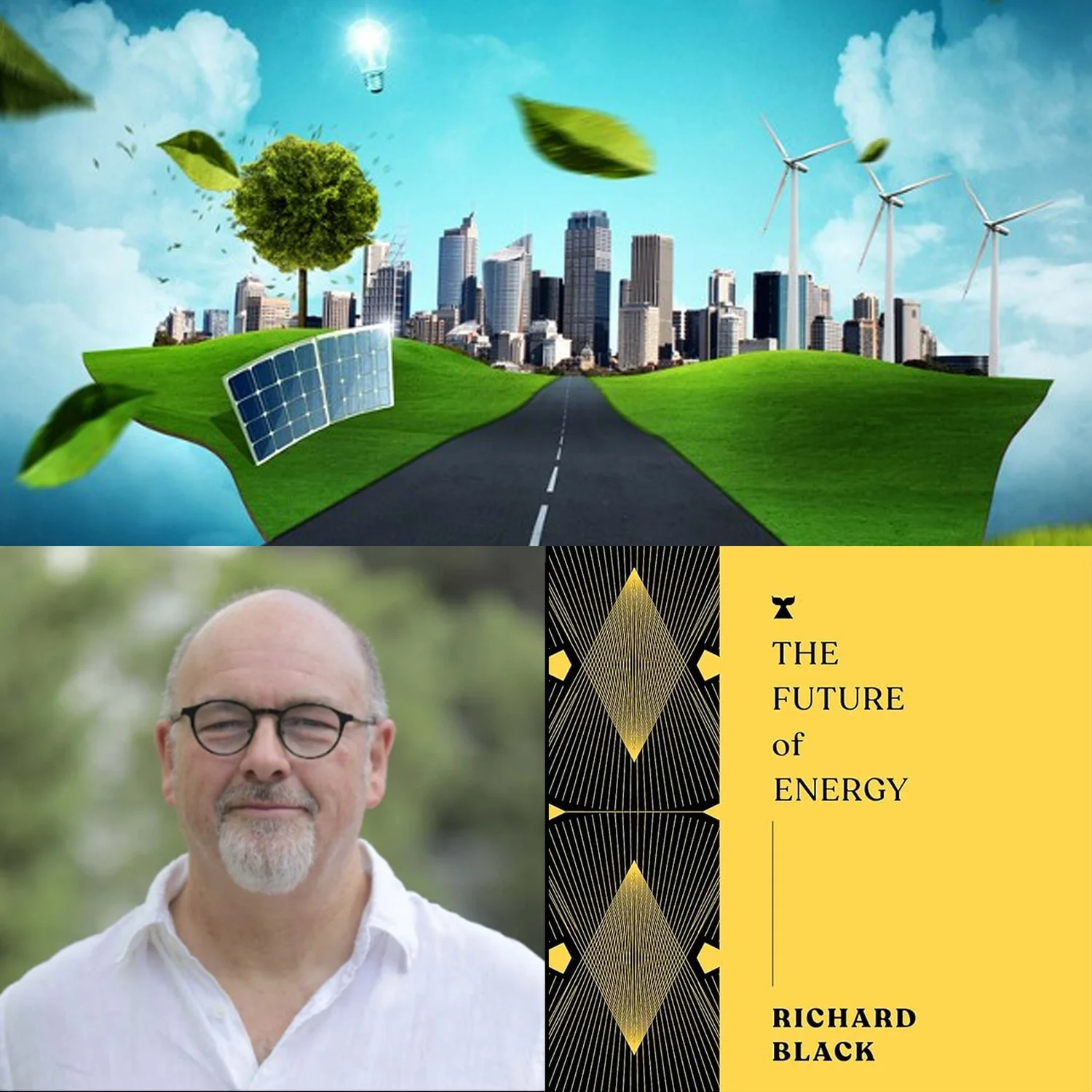
How and when will we transition to a clean energy future? - Highlights - RICHARD BLACK
The Five-pronged Clean Energy Future“I thought about it, and I was wondering, what do we actually need in the world? Because we don't need petrol and we don't need coal. We need energy to power various things. So, we need these energy services. So, what's the simplest way of providing all of the energy services? And it really seems to me that we can basically do it all with about five different types of goods. So the system of the future I put out in the book is first of all, you have the generation of electricity, which is mainly going to be with renewables, mainly with wind and solar because they are the cheapest and they're getting cheaper thanks to Wright's Law. Then you need energy storage and other means of sharing matching demand to supply. So, storage is the one that people will be most familiar with, which can be batteries, for example. And again, the price of batteries has also plummeted about 85 percent price reduction in a decade. And it continues because, again, we have mounting volumes. In a competitive market, there's lots of innovation going on in terms of battery design, in terms of construction, and all of this stuff, new materials coming into batteries. So, that's your first two, that's your renewable generation and your battery storage. Electric vehicles will be the main method of transportation. Already, they dominate sales in the two-wheeler market in China and India. They're already eating into global oil demand. They're taking about 1.5 percent of global oil demand already, and the sales are increasing exponentially in China and other countries as well. They are cost-competitive. It's just on the purchase price in some markets with some models now. And it's going to get cheaper again because battery costs will fall. Heating and cooling, which is a big demand for energy. We can use heat pumps, which are super efficient running on electricity…Hydrogen, that will probably be the fifth prong, but a smaller prong, rather like the little finger on your hand.”Richard Black spent 15 years as a science and environment correspondent for the BBC World Service and BBC News, before setting up the Energy & Climate Intelligence Unit. He now lives in Berlin and is the Director of Policy and Strategy at the global clean energy think tank Ember, which aims to accelerate the clean energy transition with data and policy. He is the author of The Future of Energy; Denied:The Rise and Fall of Climate Contrarianism, and is an Honorary Research Fellow at Imperial College London.https://mhpbooks.com/books/the-future-of-energyhttps://ember-climate.org/about/people/richard-blackhttps://ember-climate.orgwww.therealpress.co.uk/?s=Richard+blackwww.creativeprocess.infowww.oneplanetpodcast.orgIG www.instagram.com/creativeprocesspodcast

The Future of Energy - RICHARD BLACK - Director, Policy & Strategy, Ember - Fmr. BBC Environment Correspondent
How and when will we transition to a clean energy future? How will the transition empower individuals and transform global power dynamics? How did China become the world’s first electrostate, leading the drive for renewable energy, and what can we learn from this?Richard Black spent 15 years as a science and environment correspondent for the BBC World Service and BBC News, before setting up the Energy & Climate Intelligence Unit. He now lives in Berlin and is the Director of Policy and Strategy at the global clean energy think tank Ember, which aims to accelerate the clean energy transition with data and policy.He is the author of The Future of Energy; Denied:The Rise and Fall of Climate Contrarianism, and is an Honorary Research Fellow at Imperial College London.The Five-pronged Clean Energy Future“I thought about it, and I was wondering, what do we actually need in the world? Because we don't need petrol and we don't need coal. We need energy to power various things. So, we need these energy services. So, what's the simplest way of providing all of the energy services? And it really seems to me that we can basically do it all with about five different types of goods. So the system of the future I put out in the book is first of all, you have the generation of electricity, which is mainly going to be with renewables, mainly with wind and solar because they are the cheapest and they're getting cheaper thanks to Wright's Law. Then you need energy storage and other means of sharing matching demand to supply. So, storage is the one that people will be most familiar with, which can be batteries, for example. And again, the price of batteries has also plummeted about 85 percent price reduction in a decade. And it continues because, again, we have mounting volumes. In a competitive market, there's lots of innovation going on in terms of battery design, in terms of construction, and all of this stuff, new materials coming into batteries. So, that's your first two, that's your renewable generation and your battery storage. Electric vehicles will be the main method of transportation. Already, they dominate sales in the two-wheeler market in China and India. They're already eating into global oil demand. They're taking about 1.5 percent of global oil demand already, and the sales are increasing exponentially in China and other countries as well. They are cost-competitive. It's just on the purchase price in some markets with some models now. And it's going to get cheaper again because battery costs will fall. Heating and cooling, which is a big demand for energy. We can use heat pumps, which are super efficient running on electricity…Hydrogen, that will probably be the fifth prong, but a smaller prong, rather like the little finger on your hand.”https://mhpbooks.com/books/the-future-of-energyhttps://ember-climate.org/about/people/richard-blackhttps://ember-climate.orgwww.therealpress.co.uk/?s=Richard+blackwww.creativeprocess.infowww.oneplanetpodcast.orgIG www.instagram.com/creativeprocesspodcast

Making Impactful Films with Oscar & Emmy-winning Director SHARMEEN OBAID-CHINOY - Highlights
“As a filmmaker, I've always made films about extraordinary women whose lives are faced with extenuating circumstances who've had adversity thrown at them and who've risen to the occasion. And when I began to look at Diane's story, for me, Diane is a fashion designer, but she's so much more. Her central ethos is woman before fashion, and we felt it was very important to take that ethos and weave it into the spine of our film, and make it about the woman.In making this film, every single person who we called whose voice we wanted to include wanted to contribute. They wanted to say something about Diane, because she had left such a mark on their lives. Our producers’ jobs, Tracy and Fabiola, was to juggle those schedules. How do you juggle the schedule of secretary Hillary Clinton with Oprah Winfrey? How do you make sure that Anderson Cooper and Mark Jacobs, you know, in the filming time that we had, that we could put all of these people together? But Diane's friendships run deep with people, and people made sure to make time.You know, she was a single mother, and I think that young single mothers watching this film will feel for Diane, especially single mothers who are trying to be entrepreneurs, and creating businesses, and trying to find their way into the world to be able to raise a family. To do that as an immigrant in a new country is challenging, and Diane shows you just how challenging it is. In making choices about living her life, in being with her children or expanding her business, there were sacrifices that were made, and those sacrifices are boldly put on the screen for viewers to watch.”Sharmeen Obaid-Chinoy is an Oscar and Emmy award-winning Canadian-Pakistani filmmaker whose work highlights extraordinary women and their stories. She earned her first Academy Award in 2012 for her documentary Saving Face, about the Pakistani women targeted by brutal acid attacks. Today, Obaid-Chinoy is the first female film director to have won two Oscars by the age of 37. In 2023, it was announced that Obaid-Chinoy will direct the next Star Wars film starring Daisy Ridley. Her most recent project, co-directed alongside Trish Dalton, is the new documentary Diane von Fürstenberg: Woman in Charge, about the trailblazing Belgian fashion designer who invented the wrap dress 50 years ago. The film had its world premiere as the opening night selection at the 2024 Tribeca Festival on June 5th and premiered on June 25th on Hulu in the U.S. and Disney+ internationally. A product of Obaid-Chinoy's incredibly talented female filmmaking team, Woman in Charge provides an intimate look into Diane von Fürstenberg’s life and accomplishments and chronicles the trajectory of her signature dress from an innovative fashion statement to a powerful symbol of feminism.www.hulu.com/movie/diane-von-furstenberg-woman-in-charge-95fb421e-b7b1-4bfc-9bbf-ea666dba0b02https://www.disneyplus.com/movies/diane-von-furstenberg-woman-in-charge/1jrpX9AhsaJ6https://socfilms.comwww.creativeprocess.infowww.oneplanetpodcast.orgIG www.instagram.com/creativeprocesspodcast

DIANE VON FURSTENBERG: Woman in Charge w/ Oscar-winning Director SHARMEEN OBAID-CHINOY
How can we free ourselves from fear and social barriers to live more fulfilling and meaningful lives? What does it take to overcome trauma and turn it into triumph, and failure into reinvention? How can we shine a light on the marginalized and misunderstood to create social change that transforms the lives of women?Sharmeen Obaid-Chinoy is an Oscar and Emmy award-winning Canadian-Pakistani filmmaker whose work highlights extraordinary women and their stories. She earned her first Academy Award in 2012 for her documentary Saving Face, about the Pakistani women targeted by brutal acid attacks. Today, Obaid-Chinoy is the first female film director to have won two Oscars by the age of 37. In 2023, it was announced that Obaid-Chinoy will direct the next Star Wars film starring Daisy Ridley. Her most recent project, co-directed alongside Trish Dalton, is the new documentary Diane von Fürstenberg: Woman in Charge, about the trailblazing Belgian fashion designer who invented the wrap dress 50 years ago. The film had its world premiere as the opening night selection at the 2024 Tribeca Festival on June 5th and premiered on June 25th on Hulu in the U.S. and Disney+ internationally. A product of Obaid-Chinoy's incredibly talented female filmmaking team, Woman in Charge provides an intimate look into Diane von Fürstenberg’s life and accomplishments and chronicles the trajectory of her signature dress from an innovative fashion statement to a powerful symbol of feminism.“As a filmmaker, I've always made films about extraordinary women whose lives are faced with extenuating circumstances who've had adversity thrown at them and who've risen to the occasion. And when I began to look at Diane's story, for me, Diane is a fashion designer, but she's so much more. Her central ethos is woman before fashion, and we felt it was very important to take that ethos and weave it into the spine of our film, and make it about the woman.In making this film, every single person who we called whose voice we wanted to include wanted to contribute. They wanted to say something about Diane, because she had left such a mark on their lives. Our producers’ jobs, Tracy and Fabiola, was to juggle those schedules. How do you juggle the schedule of secretary Hillary Clinton with Oprah Winfrey? How do you make sure that Anderson Cooper and Mark Jacobs, you know, in the filming time that we had, that we could put all of these people together? But Diane's friendships run deep with people, and people made sure to make time.You know, she was a single mother, and I think that young single mothers watching this film will feel for Diane, especially single mothers who are trying to be entrepreneurs, and creating businesses, and trying to find their way into the world to be able to raise a family. To do that as an immigrant in a new country is challenging, and Diane shows you just how challenging it is. In making choices about living her life, in being with her children or expanding her business, there were sacrifices that were made, and those sacrifices are boldly put on the screen for viewers to watch.”www.hulu.com/movie/diane-von-furstenberg-woman-in-charge-95fb421e-b7b1-4bfc-9bbf-ea666dba0b02https://www.disneyplus.com/movies/diane-von-furstenberg-woman-in-charge/1jrpX9AhsaJ6https://socfilms.comwww.creativeprocess.infowww.oneplanetpodcast.orgIG www.instagram.com/creativeprocesspodcast

How can music disrupt oppression & bring about social change? - Highlights - JAKE FERGUSON, ANTHONY JOSEPH & JERMAIN JACKMAN
“I think as humans, we forget. We are often limited by our own stereotypes, and we don't see that in everyone there's the potential for beauty and love and all these things. And I think The Architecture of Oppression, both parts one and two, are really a reflection of all the community and civil rights work that I've been doing for the same amount of time, really - 25 years. And I wanted to try and mix my day job and my music side, so bringing those two sides of my life together. I wanted to create a platform for black artists, black singers, and poets who I really admire. Jermain is somebody I've worked with for probably about six, seven years now. He's also in the trenches of the black civil rights struggle. We worked together on a number of projects, but it was very interesting to then work with Jemain in a purely artistic capacity. And it was a no-brainer to give Anthony a call for this second album because I know of his pedigree, and he's much more able to put ideas and thoughts on paper than I would be able to.”Jake Ferguson is an award-winning musician known for his work with The Heliocentrics and as a solo artist under the name The Brkn Record. Alongside legendary drummer Malcolm Catto, Ferguson has composed two film scores and over 10 albums, collaborating with icons like Archie Shepp, Mulatu Astatke, and Melvin Van Peebles. His latest album is The Architecture of Oppression Part 2. The album also features singer and political activist Jermain Jackman, a former winner of The Voice (2014) and the T.S. Eliot Prize winning poet and musician, Anthony Joseph.www.creativeprocess.infowww.oneplanetpodcast.orgIG www.instagram.com/creativeprocesspodcast

The Architecture of Oppression with JAKE FERGUSON, ANTHONY JOSEPH & JERMAIN JACKMAN
How can music challenge systemic oppression and bring about social change? How can we envision alternative paths while avoiding the pitfalls of past paradigms?Jake Fergusonis an award-winning musician known for his work with The Heliocentrics and as a solo artist under the name The Brkn Record. Alongside legendary drummer Malcolm Catto, Ferguson has composed two film scores and over 10 albums, collaborating with icons like Archie Shepp, Mulatu Astatke, and Melvin Van Peebles. His latest album is The Architecture of Oppression Part 2. The album also features singer and political activist Jermain Jackman, a former winner of The Voice (2014) and the T.S. Eliot Prize winning poet and musician, Anthony Joseph.“I think as humans, we forget. We are often limited by our own stereotypes, and we don't see that in everyone there's the potential for beauty and love and all these things. And I think The Architecture of Oppression, both parts one and two, are really a reflection of all the community and civil rights work that I've been doing for the same amount of time, really - 25 years. And I wanted to try and mix my day job and my music side, so bringing those two sides of my life together. I wanted to create a platform for black artists, black singers, and poets who I really admire. Jermain is somebody I've worked with for probably about six, seven years now. He's also in the trenches of the black civil rights struggle. We worked together on a number of projects, but it was very interesting to then work with Jemain in a purely artistic capacity. And it was a no-brainer to give Anthony a call for this second album because I know of his pedigree, and he's much more able to put ideas and thoughts on paper than I would be able to.”www.creativeprocess.infowww.oneplanetpodcast.orgIG www.instagram.com/creativeprocesspodcast

Does AI-generated Perfection Detach Us from Reality, Life & Human Connection? - Highlights - HENRY AJDER
“From an educational perspective, I believe AI has the potential to level the playing field and provide broader access to digital resources akin to having a digital Aristotle – offering dialogue and bouncing of ideas. I've observed some exciting use cases and tools in universities that demonstrate the cost-effective power of these technologies. In addition to text, AI-generated content has the potential to bring history to life and create innovative forms of assessment and engagement for teachers and students. Despite its reliability issues, AI can provide valuable data points in subjects like history and science and also revolutionize content presentation. However, there is an ongoing crisis in higher and secondary education related to cheating, as educators struggle to detect AI-generated content in student submissions. While many in the industry are enthusiastic about the opportunities AI presents, detection tools are currently insufficient to confidently identify AI-generated work as cheating. To address this issue, alternate assessment methods such as Viva style examinations have been suggested. However, implementing such methods would require a significant increase in resources. There are also proposals for randomized defenses of submitted work, similar to a "drug test," to deter students from using AI to complete assignments. The prevalence of AI-generated assignments poses a significant challenge, particularly as educators and students are reluctant to revert to traditional examination methods. While there are creative solutions we can explore, such as engaging with chatbots for critique and limitations, it's evident that the issue requires attention, especially in state education where resources and AI expertise may be lacking.”Henry Ajder is an advisor, speaker, and broadcaster working at the frontier of the generative AI and the synthetic media revolution. He advises organizations on the opportunities and challenges these technologies present, including Adobe, Meta, The European Commission, BBC, The Partnership on AI, and The House of Lords. Previously, Henry led Synthetic Futures, the first initiative dedicated to ethical generative AI and metaverse technologies, bringing together over 50 industry-leading organizations. Henry presented the BBC documentary series, The Future Will be Synthesised.www.henryajder.comwww.bbc.co.uk/programmes/m0017cgrwww.creativeprocess.infowww.oneplanetpodcast.orgIG www.instagram.com/creativeprocesspodcast

How is AI Changing Our Perception of Reality, Creativity & Human Connection? w/ HENRY AJDER - AI Advisor
How is artificial intelligence redefining our perception of reality and truth? Can AI be creative? And how is it changing art and innovation? Does AI-generated perfection detach us from reality and genuine human connection?Henry Ajder is an advisor, speaker, and broadcaster working at the frontier of the generative AI and the synthetic media revolution. He advises organizations on the opportunities and challenges these technologies present, including Adobe, Meta, The European Commission, BBC, The Partnership on AI, and The House of Lords. Previously, Henry led Synthetic Futures, the first initiative dedicated to ethical generative AI and metaverse technologies, bringing together over 50 industry-leading organizations. Henry presented the BBC documentary series, The Future Will be Synthesised.“From an educational perspective, I believe AI has the potential to level the playing field and provide broader access to digital resources akin to having a digital Aristotle – offering dialogue and bouncing of ideas. I've observed some exciting use cases and tools in universities that demonstrate the cost-effective power of these technologies. In addition to text, AI-generated content has the potential to bring history to life and create innovative forms of assessment and engagement for teachers and students. Despite its reliability issues, AI can provide valuable data points in subjects like history and science and also revolutionize content presentation. However, there is an ongoing crisis in higher and secondary education related to cheating, as educators struggle to detect AI-generated content in student submissions. While many in the industry are enthusiastic about the opportunities AI presents, detection tools are currently insufficient to confidently identify AI-generated work as cheating. To address this issue, alternate assessment methods such as Viva style examinations have been suggested. However, implementing such methods would require a significant increase in resources. There are also proposals for randomized defenses of submitted work, similar to a "drug test," to deter students from using AI to complete assignments. The prevalence of AI-generated assignments poses a significant challenge, particularly as educators and students are reluctant to revert to traditional examination methods. While there are creative solutions we can explore, such as engaging with chatbots for critique and limitations, it's evident that the issue requires attention, especially in state education where resources and AI expertise may be lacking.”www.henryajder.comwww.bbc.co.uk/programmes/m0017cgrwww.creativeprocess.infowww.oneplanetpodcast.orgIG www.instagram.com/creativeprocesspodcast
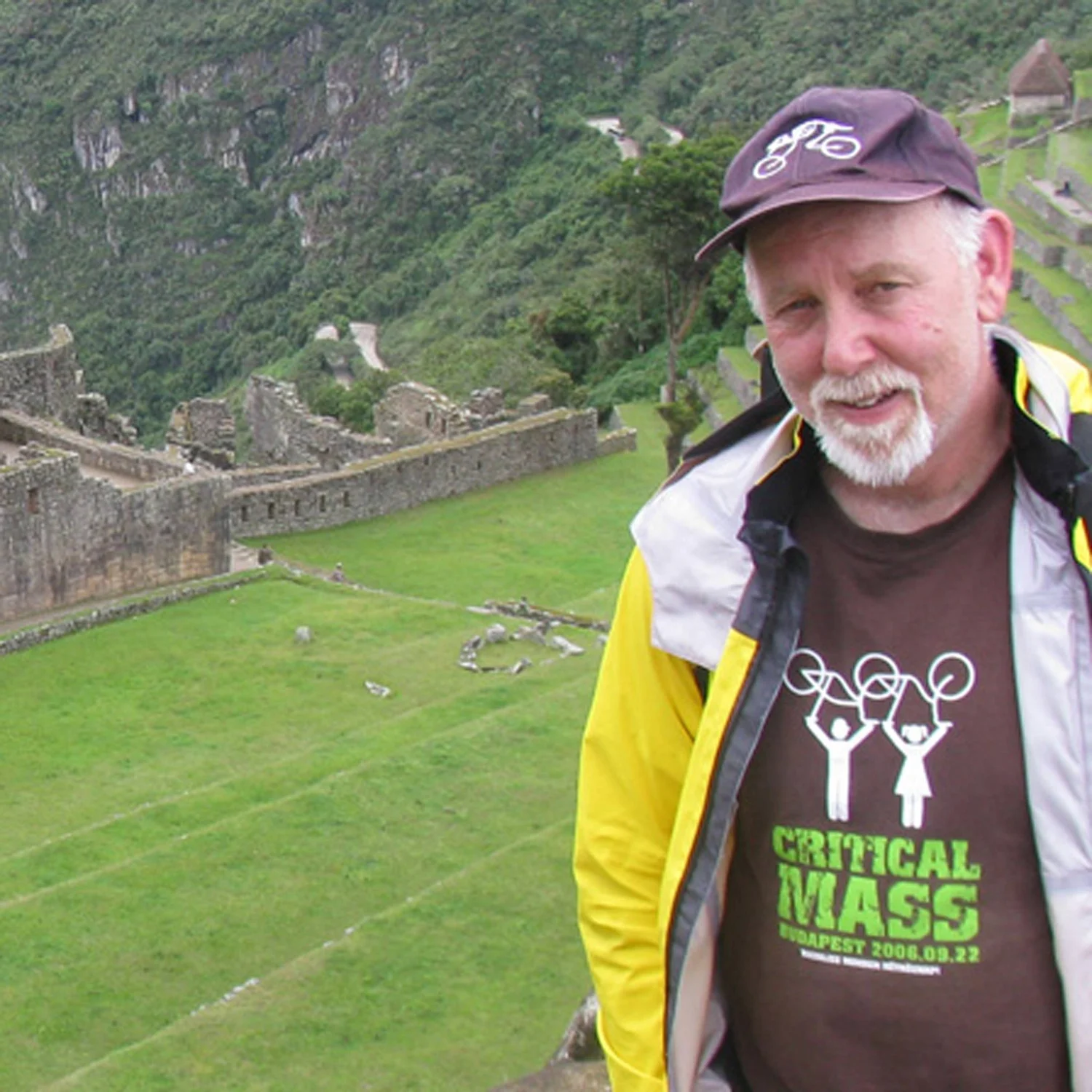
Resisting Fascism & Ecological Collapse with Writer-Organizer-Activist CHRIS CARLSSON
In this episode of the Speaking Out of Place podcast Professor David Palumbo-Liu talks with acclaimed author and activist, and San Francisco legend, Chris Carlsson about his new novel, When Shells Crumble. It begins in December 2024, when the US Supreme Court nullifies the popular vote in the Presidential election and awards the presidency to an authoritarian Republican, who proceeds to demolish democracy and install a fascistic state that hastens ecological havoc. The novel is much more than your usual dystopian tale—it focuses on how to resist political cynicism and defeatism, and rebuild on planetary wreckage. It is a world-building project filled with wisdom, sadness, and joy. We specifically put this fictional text in conservation with his brilliant non-fiction work, Nowtopia, which offers a radical redefinition of “work” that restores dignity and value to their proper places.Chris Carlsson, co-director of the “history from below” project Shaping San Francisco, is a writer, publisher, editor, photographer, public speaker, and occasional professor. He was one of the founders in 1981 of the seminal and infamous underground San Francisco magazine Processed World. In 1992 Carlsson co-founded Critical Mass in San Francisco, which both led to a local bicycling boom and helped to incubate transformative urban movements in hundreds of cities, large and small, worldwide. In 1995 work began on “Shaping San Francisco;” since then the project has morphed into an incomparable archive of San Francisco history at Foundsf.org, award-winning bicycle and walking tours, and almost two decades of Public Talks covering history, politics, ecology, art, and more (see shapingsf.org). Beginning in Spring 2020, Carlsson has hosted Bay Cruises along the San Francisco shoreline.His latest novel, When Shells Crumble was published by Spuyten Duyvil in Brooklyn, NY at the end of 2023. At the dawn of the pandemic, he published a detailed historical guidebook of the city, Hidden San Francisco: A Guide to Lost Landscapes, Unsung Heroes, and Radical Histories (Pluto Press: 2020). His full-length nonfiction work Nowtopia(AK Press: 2008), offers a groundbreaking look at class and work while uniquely examining how hard and pleasantly we work when we’re not at our official jobs. He published his first novel, After The Deluge, in 2004, a story of post-economic utopian San Francisco in the year 2157. He has edited six books, including three “Reclaiming San Francisco” collections with the venerable City Lights Books. He redesigned and co-authored an expanded Vanished Waters: A History of San Francisco’s Mission Bay after which he joined the board of the Mission Creek Conservancy. He has given hundreds of public presentations based on Shaping San Francisco, Critical Mass, Nowtopia, Vanished Waters, and his “Reclaiming San Francisco” history anthologies since the late 1990s, and has appeared dozens of times in radio, television and on the internet.www.palumbo-liu.comhttps://speakingoutofplace.comhttps://twitter.com/palumboliu?s=20www.instagram.com/speaking_out_of_place

PETA Founder INGRID NEWKIRK turns 75: A Lifetime of Animal Advocacy
How can we show more kindness, respect, and love to the animals we share this planet with? What lessons can we learn from non-human animals about living in greater harmony with nature?Ingrid Newkirk is the Founder and President of PETA, actively leading the organization and advocating for animal rights. PETA is the largest animal rights organization in the world with more than 9 million members and supporters globally. Under her leadership, PETA has achieved significant victories, such as ending car-crash tests on animals, pushing major fashion brands to go fur-free, influencing Ringling Bros. to become an animal-free circus, and helping pass a law that allows the U.S. Food and Drug Administration to approve new medications without conducting cruel tests on animals. Ingrid has written 14 books and has been featured in major publications like The New Yorker and The Guardian, and was the subject of HBO's documentary I Am an Animal and was named one of Forbes’ “100 Most Powerful Women.” She joined One Planet Podcast to reflect on her 75 years as animal rights advocate.“I think things do change because of agitation. So agitation is vital. I mean, nobody who is in a cause should be there to win a popularity contest, whether you're working for children or the elderly or working for peace animals, it's all against nonviolence, aggression, domination, and needless cruelty and suffering. It's all for respect. So you have to be vigorous. You have to use your voice. You can use it politely, but if people don't listen, at PETA, we escalate. So we always start off with a polite letter, a polite entreaty. We always try to, as I say, do the homework. So we have the options that we put out on the table to say, look, instead of doing this, you could do that, and we will help you transition to that.They’re not human traits. They’re all shared traits because, of course, we all love. We all love our families, or not. We all grieve if somebody we love disappears or dies. A family dog, perhaps. A grandfather. We all feel loneliness, we all feel joy. We all really value our freedom. And so I think, if anything, looking into the eyes of the animal, even online, you see a person in there. There’s a someone in whatever the shape or the physical properties of that individual are. And that lesson is that I am you. You are me, only different. We are all the same in all the ways that count…Any living being teaches you– Look into my eyes. And there you are, the reflection of yourself. So we need to learn from the animals how to live more gently and consume less and be more thoughtful and look out for each other in this great circle of life.”www.peta.orgwww.ingridnewkirk.comwww.creativeprocess.infowww.oneplanetpodcast.orgIG www.instagram.com/creativeprocesspodcast

How to Fight for Truth & Protect Democracy in A Post-Truth World? - Highlights - LEE McINTYRE
“I had an absolutely wonderful high school history teacher, Dave Corkran. I dedicated On Disinformation to him. He taught me to think for myself and not to be afraid to express what I thought. And in college, Richard Adelstein, a very philosophical economist, who basically said, “Do not go to graduate school in economics, they won't let you do what you're interested in. You've got to go to philosophy graduate school.” So he was really my mentor in thinking that I could become a philosopher. Then there’s my mom. She didn't go to college, but was extraordinarily intelligent and interested in all sorts of things. She was fascinated with Einstein and wanted to understand physics. When I was a little boy, she would wrap me up in a blanket on cold nights, and we would look at the stars. I was four years old, so I would ask, “What are the stars?” And she said, “They're suns. They're just very far away.” I also asked, “So all those stars in the sky, do they have planets like the Earth?” I still remember this to this day. She said, “Probably. We just haven't found them yet.” And this was 1967, so they hadn't found any yet. But when I gave her eulogy a few years ago, they had found 4,000 exoplanets, so she was right. What my mom was saying in 1967, that yes, there are other worlds out there, we just haven't found them yet, was so inspiring to me. She really was the one who made me become a philosopher. I try to channel the teaching she did in raising my own kids. The answer should never be “Because I said so.” It should be “What do you think? Let's have a conversation.” We never talked baby talk to our kids because my mom never talked baby talk to me. She treated me seriously as if my opinions mattered. My mom taking me seriously as a thinker from the age at which I could talk allowed me the confidence to go forward. Even though we grew up in a blue collar family, my dad became disabled, we were poor, I went to terrible public schools for the first part of my life, I always had it better than the other kids because I had parents who believed in education and a mom who talked to me.”Lee McIntyre is a Research Fellow at the Center for Philosophy and History of Science at Boston University and a Senior Advisor for Public Trust in Science at the Aspen Institute. He holds a B.A. from Wesleyan University and a Ph.D. in Philosophy from the University of Michigan. He has taught philosophy at Colgate University, Boston University, Tufts Experimental College, Simmons College, and Harvard Extension School (where he received the Dean’s Letter of Commendation for Distinguished Teaching). Formerly Executive Director of the Institute for Quantitative Social Science at Harvard University, he has also served as a policy advisor to the Executive Dean of the Faculty of Arts and Sciences at Harvard and as Associate Editor in the Research Department of the Federal Reserve Bank of Boston. His books include On Disinformation and How to Talk to a Science Denier and the novels The Art of Good and Evil and The Sin Eater.https://leemcintyrebooks.comwww.penguinrandomhouse.com/books/730833/on-disinformation-by-lee-mcintyrehttps://mitpress.mit.edu/9780262545051/https://leemcintyrebooks.com/books/the-art-of-good-and-evil/https://leemcintyrebooks.com/books/the-sin-eater/www.creativeprocess.infowww.oneplanetpodcast.orgIG www.instagram.com/creativeprocesspodcast

How will AI Affect Education, the Arts & Society? - Highlights - STEPHEN WOLFRAM
“My mother was a philosophy professor in Oxford, and when I was a kid, I would always say, if there's one thing I'll never do when I'm grown up, it's philosophy, because how can one be serious about a field where people are still arguing about the same things that they were arguing about 2,000 years ago, and there's no kind of apparent progress. But actually, the exciting thing has been that both in my kind of work in building computational language, and in my work in understanding the computational foundations of physics, that it turns out that a bunch of those things that people have been arguing about for a couple of thousand years, we can actually say some real things about.It’s a funny thing because I've spent my life sort of building this big tower of science and technology and, every so often, something comes out of that tower that people say, "This is a cool thing, we're really going to be excited about this particular thing." For me, the whole tower is the thing that's really important. And in the future, that's what the tower that I've tried to build is certainly the most significant thing I've been able to do. And it's something that, you know, I've been able to see now over the course of half a century or so, kind of how various ideas I've had and directions I've gone have actually played out.”Stephen Wolfram is a computer scientist, mathematician, and theoretical physicist. He is the founder and CEO of Wolfram Research, the creator of Mathematica, Wolfram|Alpha, and the Wolfram Language. He received his PhD in theoretical physics at Caltech by the age of 20 and in 1981, became the youngest recipient of a MacArthur Fellowship. Wolfram authored A New Kind of Science and launched the Wolfram Physics Project. He has pioneered computational thinking and has been responsible for many discoveries, inventions and innovations in science, technology and business.www.stephenwolfram.comwww.wolfram.comwww.wolframalpha.comwww.wolframscience.com/nks/www.amazon.com/dp/1579550088/ref=nosim?tag=turingmachi08-20www.wolframphysics.orgwww.wolfram-media.com/products/what-is-chatgpt-doing-and-why-does-it-work/www.creativeprocess.infowww.oneplanetpodcast.orgIG www.instagram.com/creativeprocesspodcast

What Role Do AI & Computational Language Play in Solving Real-World Problems?
How can computational language help decode the mysteries of nature and the universe? What is ChatGPT doing and why does it work? How will AI affect education, the arts and society?Stephen Wolfram is a computer scientist, mathematician, and theoretical physicist. He is the founder and CEO of Wolfram Research, the creator of Mathematica, Wolfram|Alpha, and the Wolfram Language. He received his PhD in theoretical physics at Caltech by the age of 20 and in 1981, became the youngest recipient of a MacArthur Fellowship. Wolfram authored A New Kind of Science and launched the Wolfram Physics Project. He has pioneered computational thinking and has been responsible for many discoveries, inventions and innovations in science, technology and business.“My mother was a philosophy professor in Oxford, and when I was a kid, I would always say, if there's one thing I'll never do when I'm grown up, it's philosophy, because how can one be serious about a field where people are still arguing about the same things that they were arguing about 2,000 years ago, and there's no kind of apparent progress. But actually, the exciting thing has been that both in my kind of work in building computational language, and in my work in understanding the computational foundations of physics, that it turns out that a bunch of those things that people have been arguing about for a couple of thousand years, we can actually say some real things about.It’s a funny thing because I've spent my life sort of building this big tower of science and technology and, every so often, something comes out of that tower that people say, "This is a cool thing, we're really going to be excited about this particular thing." For me, the whole tower is the thing that's really important. And in the future, that's what the tower that I've tried to build is certainly the most significant thing I've been able to do. And it's something that, you know, I've been able to see now over the course of half a century or so, kind of how various ideas I've had and directions I've gone have actually played out.”www.stephenwolfram.comwww.wolfram.comwww.wolframalpha.comwww.wolframscience.com/nks/www.amazon.com/dp/1579550088/ref=nosim?tag=turingmachi08-20www.wolframphysics.orgwww.wolfram-media.com/products/what-is-chatgpt-doing-and-why-does-it-work/www.creativeprocess.infowww.oneplanetpodcast.orgIG www.instagram.com/creativeprocesspodcast

Can we have real conversations with AI? How do illusions help us make sense of the world? - Highlights - KEITH FRANKISH
Keith Frankish is an Honorary Professor of Philosophy at the University of Sheffield, a Visiting Research Fellow with The Open University, and an Adjunct Professor with the Brain and Mind Programme in Neurosciences at the University of Crete. Frankish mainly works in the philosophy of mind and has published widely about topics such as human consciousness and cognition. Profoundly inspired by Daniel Dennett, Frankish is best known for defending an “illusionist” view of consciousness. He is also editor of the journal Illusionism as a Theory of Consciousness and co-edits, in addition to others, The Cambridge Handbook of Cognitive Science.www.keithfrankish.comwww.cambridge.org/core/books/cambridge-handbook-of-cognitive-science/F9996E61AF5E8C0B096EBFED57596B42www.imprint.co.uk/product/illusionismwww.creativeprocess.infowww.oneplanetpodcast.orgIG www.instagram.com/creativeprocesspodcast

Is Consciousness an Illusion? with Philosopher KEITH FRANKISH
Is consciousness an illusion? Is it just a complex set of cognitive processes without a central, subjective experience? How can we better integrate philosophy with everyday life and the arts?Keith Frankish is an Honorary Professor of Philosophy at the University of Sheffield, a Visiting Research Fellow with The Open University, and an Adjunct Professor with the Brain and Mind Programme in Neurosciences at the University of Crete. Frankish mainly works in the philosophy of mind and has published widely about topics such as human consciousness and cognition. Profoundly inspired by Daniel Dennett, Frankish is best known for defending an “illusionist” view of consciousness. He is also editor of the journal Illusionism as a Theory of Consciousness and co-edits, in addition to others, The Cambridge Handbook of Cognitive Science.www.keithfrankish.comwww.cambridge.org/core/books/cambridge-handbook-of-cognitive-science/F9996E61AF5E8C0B096EBFED57596B42www.imprint.co.uk/product/illusionismwww.creativeprocess.infowww.oneplanetpodcast.orgIG www.instagram.com/creativeprocesspodcast

How Can We End the Climate Crisis in One Generation? - Highlights - PAUL HAWKEN
“We and all living beings thrive by being actors in the planet’s regeneration, a civilizational goal that should commence and never cease. We practiced degeneration as a species and it brought us to the threshold of an unimaginable crisis. To reverse global warming, we need to reverse global degeneration.”Can we really end the climate crisis in one generation? What kind of bold collective action, technologies, and nature-based solutions would it take to do it?Paul Hawken is a renowned environmentalist, entrepreneur, author, and activist committed to sustainability and transforming the business-environment relationship. A leading voice in the environmental movement, he has founded successful eco-friendly businesses, authored influential works on commerce and ecology, and advised global leaders on economic and environmental policies. As the founder of Project Regeneration and Project Drawdown, Paul leads efforts to identify and model solutions to reverse global warming, showcasing actionable strategies. His pioneering work in corporate ecological reform continues to shape a sustainable future. He is the author of eight books, including Regeneration: Ending the Climate Crisis in One Generation.https://regeneration.orghttps://paulhawken.comhttps://drawdown.orghttps://regeneration.org/nexuswww.creativeprocess.infowww.oneplanetpodcast.orgIG www.instagram.com/creativeprocesspodcast

Regeneration: Ending the Climate Crisis in One Generation with PAUL HAWKEN
Can we really end the climate crisis in one generation? What kind of bold collective action, technologies, and nature-based solutions would it take to do it?Paul Hawken is a renowned environmentalist, entrepreneur, author, and activist committed to sustainability and transforming the business-environment relationship. A leading voice in the environmental movement, he has founded successful eco-friendly businesses, authored influential works on commerce and ecology, and advised global leaders on economic and environmental policies. As the founder of Project Regeneration and Project Drawdown, Paul leads efforts to identify and model solutions to reverse global warming, showcasing actionable strategies. His pioneering work in corporate ecological reform continues to shape a sustainable future. He is the author of eight books, including Regeneration: Ending the Climate Crisis in One Generation.“We and all living beings thrive by being actors in the planet’s regeneration, a civilizational goal that should commence and never cease. We practiced degeneration as a species and it brought us to the threshold of an unimaginable crisis. To reverse global warming, we need to reverse global degeneration.”https://regeneration.orghttps://paulhawken.comhttps://drawdown.orghttps://regeneration.org/nexuswww.creativeprocess.infowww.oneplanetpodcast.orgIG www.instagram.com/creativeprocesspodcast
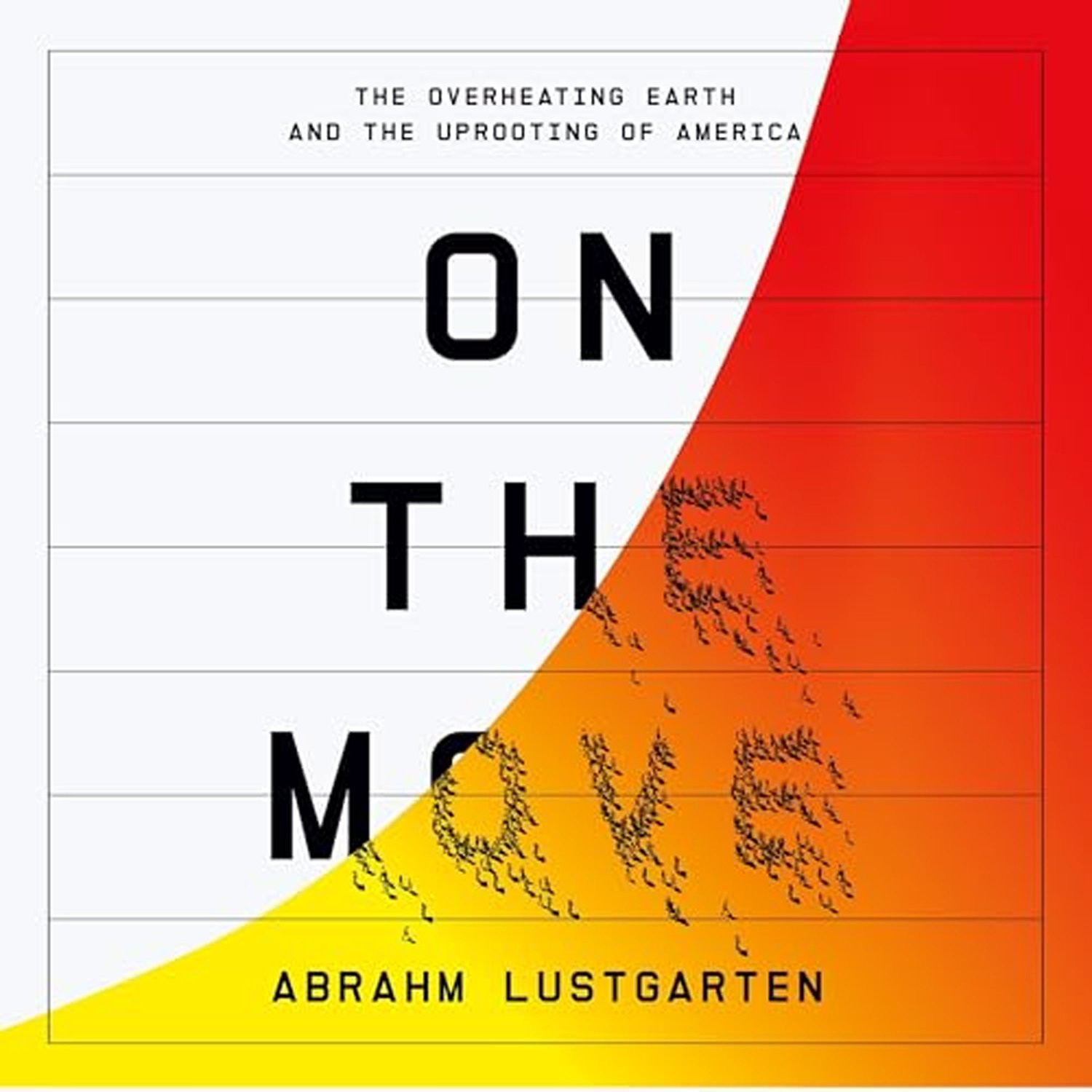
How Will Our Cities, Communities & Country Cope with Climate Migration - Highlights - ABRAHM LUSTGARTEN
“What we do still really, really matters in terms of defining what the future looks like. I don't think that climate change in an apocalyptic sense is a foregone conclusion. Our efforts to change that trajectory to lower emissions will change how severe the impacts are in the future. So I really want people to understand that. And I really want my kids to understand that. I also trust that I want people to understand that we might be entering an era of unprecedented change and disruption.This is the life that we've got and I feel great sadness for the things that I know that we've lost, but younger people don't have that perspective, which in this particular context is maybe a relief, and all there is, is what's in front of them. And, there is an ample supply of natural beauty of rejuvenating resources and inspiring resources in our natural environment and in the people around us. I would just say, as we all settle into a less predictable future with all sorts of bumpy roads and rollercoaster rides, that we also stay focused on experiencing what's in the moment, in that beauty and in that community.”Abrahm Lustgarten is an investigative reporter, author, and filmmaker whose work focuses on human adaptation to climate change. His 2010 Frontline documentary The Spill, which investigated BP’s company culture, was nominated for an Emmy. His 2015 longform series Killing the Colorado, about the draining of the Colorado river, was nominated for a Pulitzer Prize. Lustgarten is a senior reporter at ProPublica, and contributes to publications like The New York Times Magazine and The Atlantic. His research on climate migration influenced President Biden’s creation of a climate migration study group. This is also the topic of his newly published book, On The Move: The Overheating Earth and the Uprooting of America in which he explores how climate change is uprooting American lives.https://abrahm.comhttps://us.macmillan.com/books/9780374171735/onthemovewww.creativeprocess.infowww.oneplanetpodcast.orgIG www.instagram.com/creativeprocesspodcast
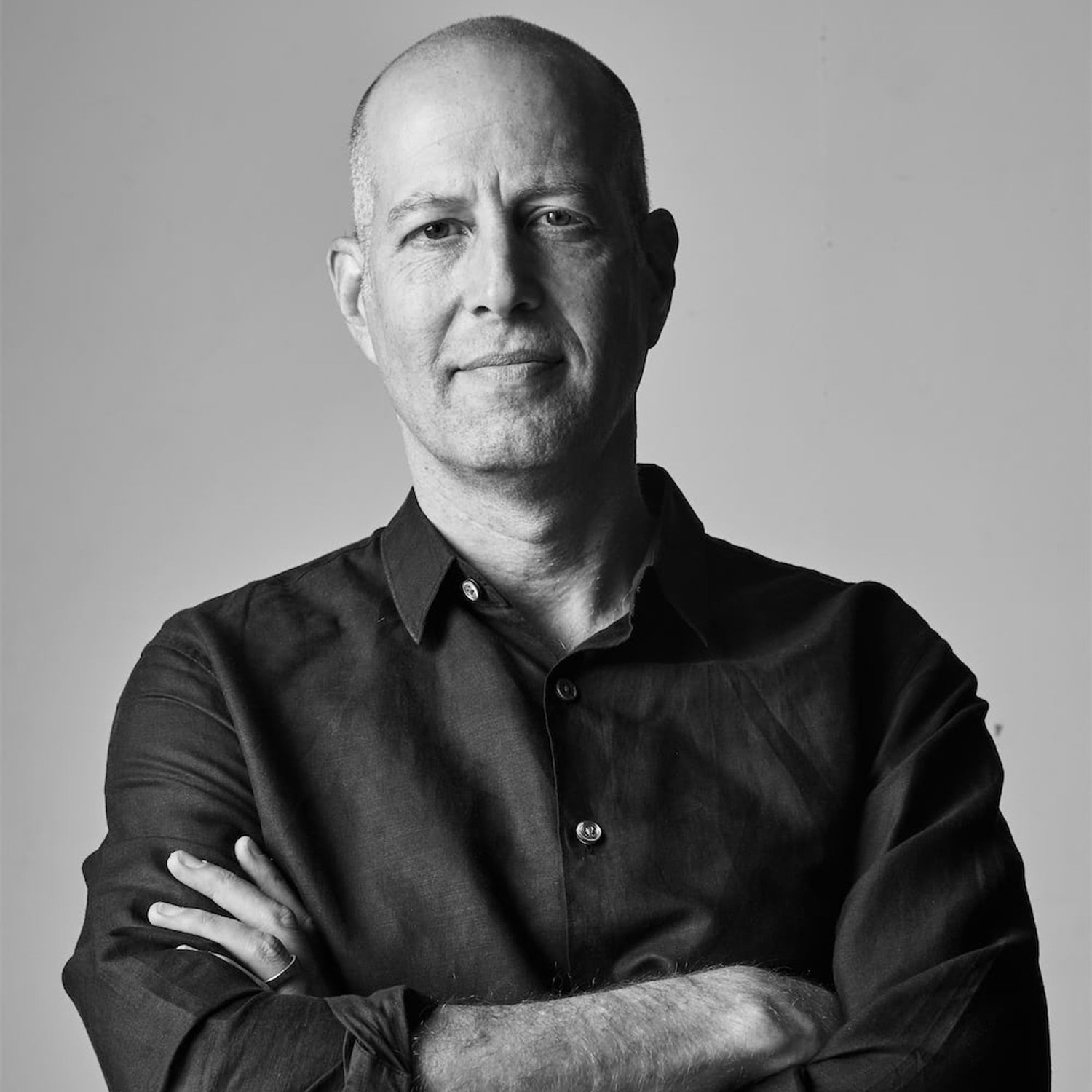
On The Move: The Overheating Earth & the Uprooting of America with ABRAHM LUSTGARTEN
An estimated one in two people will experience degrading environmental conditions this century and will be faced with the difficult question of whether to leave their homes. Will you be among those who migrate in response to climate change? If so, where will you go?Abrahm Lustgarten is an investigative reporter, author, and filmmaker whose work focuses on human adaptation to climate change. His 2010 Frontline documentary The Spill, which investigated BP’s company culture, was nominated for an Emmy. His 2015 longform series Killing the Colorado, about the draining of the Colorado river, was nominated for a Pulitzer Prize. Lustgarten is a senior reporter at ProPublica, and contributes to publications like The New York Times Magazine and The Atlantic. His research on climate migration influenced President Biden’s creation of a climate migration study group. This is also the topic of his newly published book, On The Move: The Overheating Earth and the Uprooting of America in which he explores how climate change is uprooting American lives.“What we do still really, really matters in terms of defining what the future looks like. I don't think that climate change in an apocalyptic sense is a foregone conclusion. Our efforts to change that trajectory to lower emissions will change how severe the impacts are in the future. So I really want people to understand that. And I really want my kids to understand that. I also trust that I want people to understand that we might be entering an era of unprecedented change and disruption.This is the life that we've got and I feel great sadness for the things that I know that we've lost, but younger people don't have that perspective, which in this particular context is maybe a relief, and all there is, is what's in front of them. And, there is an ample supply of natural beauty of rejuvenating resources and inspiring resources in our natural environment and in the people around us. I would just say, as we all settle into a less predictable future with all sorts of bumpy roads and rollercoaster rides, that we also stay focused on experiencing what's in the moment, in that beauty and in that community.”https://abrahm.comhttps://us.macmillan.com/books/9780374171735/onthemovewww.creativeprocess.infowww.oneplanetpodcast.orgIG www.instagram.com/creativeprocesspodcast

How Can Music Heal Trauma & Foster Identity? - Highlights - MATTIA MAURÉE
“So for me, it just kind of removing a lot of the shame and then a lot of the energy that I was wasting trying to fit myself into a neurotypical process or framework or way of thinking or being. So, you know, some people call that unmasking, just kind of removing. I was wasting a lot of energy, basically trying to be someone else and function in a different way. And then just beating myself up internally for not being able to do that. And throughout my healing journey, as I really realized, Oh, that's actually what's happening. Like there's not actually anything wrong with me being able to...That's why it's called Love Your Brain. It's not just, you know, tolerate your brain. Or, fine, you can work with this brain that you have. It's like, no, I genuinely love the weird experiences that my brain can give me and the incredibly rich, deep experience I have of the world. Like I experience nature so deeply and so intensely. I have really strong connections with animals. I have really great intuition, which I think is just from picking up all this sensory data and putting it together. All these experiences that I get to have, but I don't get to have those experiences if I'm just trying to make myself be something else, which I think is most people who are late diagnosed, I feel like that's their experience. It's just like I've been trying to be someone else for so long. It's exhausting. And then you don't have the energy then to be creative, the carving out the time, making the time to actually create.”Mattia Maurée is an interdisciplinary composer whose work centers around themes of perception, body, sensation, trauma, and resilience. Their scores for critically acclaimed films have been played in 13 countries. Their poems have been featured in Boston City Hall as part of the Mayor's Poetry Program, Guerrilla Opera, and Arc Poetry Magazine. Mattia composes and performs on violin, voice, and piano, and has taught music for over 20 years. They have received a Master's of Music in Composition at New England Conservatory and a Bachelor's of Music from St. Olaf College. They also are an AUDHD coach, host the AuDHD Flourishing podcast and help other neurodivergent folks heal and find their creative flow in their course Love Your Brain.http://mattiamauree.comhttps://studio.com/mattiahttps://mattiamauree.com/love-your-brainhttps://www.audhdflourishing.com/hellowww.creativeprocess.infowww.oneplanetpodcast.orgIG www.instagram.com/creativeprocesspodcast

Exploring the Sensory World of Autism, ADHD & Non-Binary Artists with MATTIA MAURÉE
How can we learn to flourish because of who we are, not in spite of it? What is the sensory experience of the world for people with autism and ADHD? How can music help heal trauma and foster identity?Mattia Maurée is an interdisciplinary composer whose work centers around themes of perception, body, sensation, trauma, and resilience. Their scores for critically acclaimed films have been played in 13 countries. Their poems have been featured in Boston City Hall as part of the Mayor's Poetry Program, Guerrilla Opera, and Arc Poetry Magazine. Mattia composes and performs on violin, voice, and piano, and has taught music for over 20 years. They have received a Master's of Music in Composition at New England Conservatory and a Bachelor's of Music from St. Olaf College. They also are an AUDHD coach, host the AuDHD Flourishing podcast and help other neurodivergent folks heal and find their creative flow in their course Love Your Brain.“So for me, it just kind of removing a lot of the shame and then a lot of the energy that I was wasting trying to fit myself into a neurotypical process or framework or way of thinking or being. So, you know, some people call that unmasking, just kind of removing. I was wasting a lot of energy, basically trying to be someone else and function in a different way. And then just beating myself up internally for not being able to do that. And throughout my healing journey, as I really realized, Oh, that's actually what's happening. Like there's not actually anything wrong with me being able to...That's why it's called Love Your Brain. It's not just, you know, tolerate your brain. Or, fine, you can work with this brain that you have. It's like, no, I genuinely love the weird experiences that my brain can give me and the incredibly rich, deep experience I have of the world. Like I experience nature so deeply and so intensely. I have really strong connections with animals. I have really great intuition, which I think is just from picking up all this sensory data and putting it together. All these experiences that I get to have, but I don't get to have those experiences if I'm just trying to make myself be something else, which I think is most people who are late diagnosed, I feel like that's their experience. It's just like I've been trying to be someone else for so long. It's exhausting. And then you don't have the energy then to be creative, the carving out the time, making the time to actually create.”http://mattiamauree.comhttps://studio.com/mattiahttps://mattiamauree.com/love-your-brainhttps://www.audhdflourishing.com/hellowww.creativeprocess.infowww.oneplanetpodcast.orgIG www.instagram.com/creativeprocesspodcast
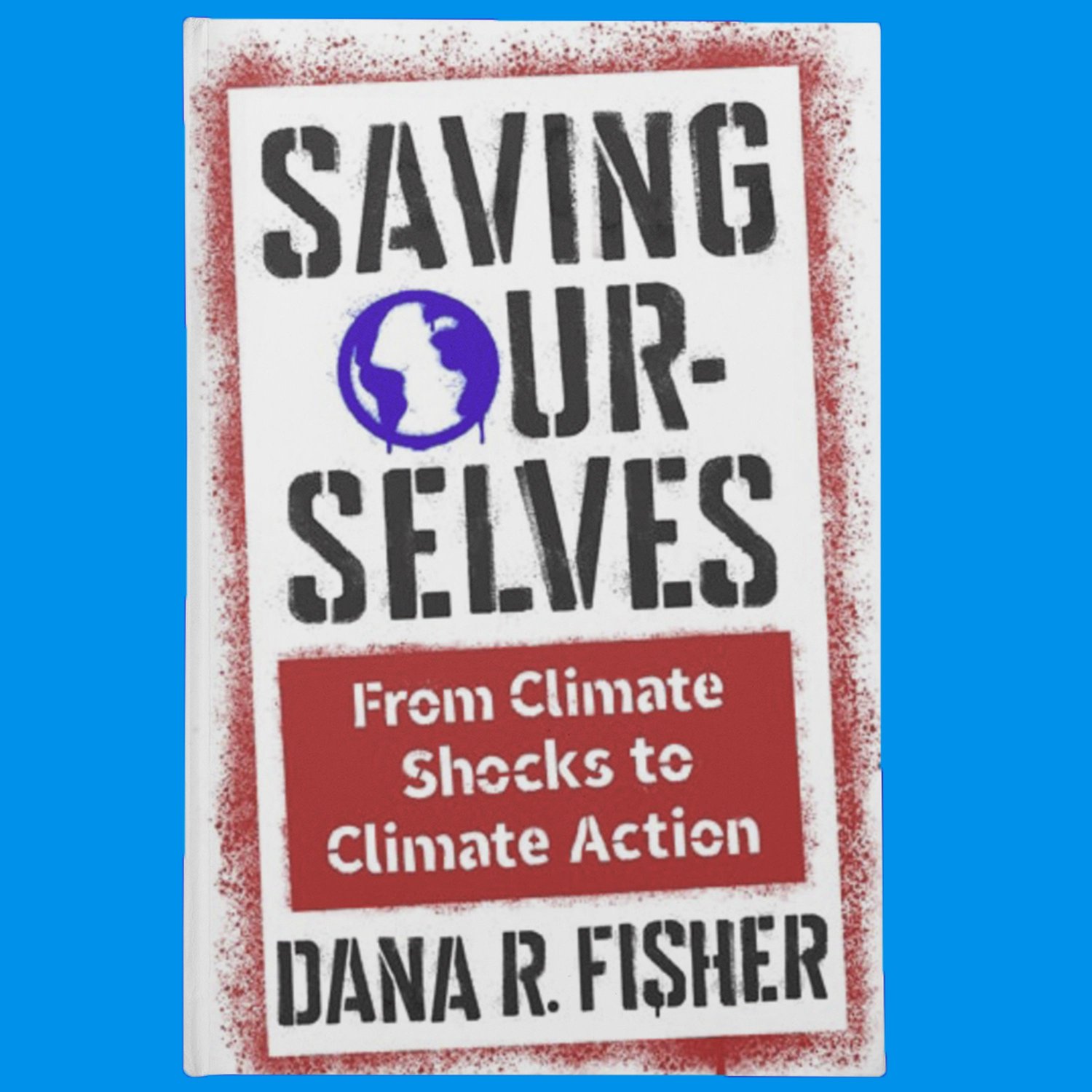
Apocalyptic Optimism: How We Can We Save Ourselves from the Climate Crisis? - Highlights - DANA FISHER
“The American Climate Corps builds on the legacy of the Civilian Conservation Corps, which came out of the New Deal after the Great Depression in the United States when the country was getting very close to there being a toppling of the government because there was such a crisis here after the Depression. There were Dust Bowls. People were migrating all over the country to try to find work. And it was a really dark time in the United States. So part of the New Deal included establishing this Conservation Corps, where–and it was only men at the time–young men could go to work, earn a liveable wage, work on teams, and help to build things in the United States. And some of them planted trees. So some of it was conservation, some of them planted trees. They helped with the railroads. They built all sorts of things with the Army Corps of Engineers. So there has been a call for a while now to build an American Climate Corps, which is building off of this legacy. The Biden administration finally announced the American Climate Corps last September during Climate Week. In fact, the announcement came out, and one of the unfortunate things about the Climate Corps is that it builds on this amazing legacy, but it didn't receive much funding because the funding was originally going to be part of the Build Back Better Act, which the Biden administration proposed early on. The climate-related policy that ended up being reformulated and repackaged as the Inflation Reduction Act. the Climate Corps was not funded as part of that. So it's coming out in a much more limited manner, but what it basically is doing is merging a number of preexisting programs that are designed to help train young people to do work around climate change broadly defined across different agencies in the U. S. government to train them so that they have experience working on addressing climate change in a variety of ways, and also have a pathway into doing green jobs. Be they in the federal government, for nonprofits, or elsewhere in the government. And so it's a wonderful opportunity. The hope is that it will expand out to be thousands, if not more than thousands, tens of thousands of jobs.”Dana R. Fisher is the Director of the Center for Environment, Community, & Equity and Professor in the School of International Service at American University. Fisher’s research focuses on questions related to democracy, civic engagement, activism, and climate politics. Current projects include studying political elites’ responses to climate change, and the ways federal service corps programs in the US are integrating climate into their work. She is a self-described climate-apocalyptic optimist and co-developed the framework of AnthroShift to explain how social actors are reconfigured in the aftermath of widespread perceptions and experiences of risk. Her seventh book is Saving Ourselves: From Climate Shocks to Climate Action.https://danarfisher.comhttps://cece.american.eduwww.acc.govwww.creativeprocess.infowww.oneplanetpodcast.orgIG www.instagram.com/creativeprocesspodcast

Saving Ourselves: From Climate Shocks to Climate Action - DANA FISHER
How can we make the radical social changes needed to address the climate crisis? What kind of large ecological disaster or mass mobilization in the streets needs to take place before we take meaningful climate action?Dana R. Fisher is the Director of the Center for Environment, Community, & Equity and Professor in the School of International Service at American University. Fisher’s research focuses on questions related to democracy, civic engagement, activism, and climate politics. Current projects include studying political elites’ responses to climate change, and the ways federal service corps programs in the US are integrating climate into their work. She is a self-described climate-apocalyptic optimist and co-developed the framework of AnthroShift to explain how social actors are reconfigured in the aftermath of widespread perceptions and experiences of risk. Her seventh book is Saving Ourselves: From Climate Shocks to Climate Action.“The American Climate Corps builds on the legacy of the Civilian Conservation Corps, which came out of the New Deal after the Great Depression in the United States when the country was getting very close to there being a toppling of the government because there was such a crisis here after the Depression. There were Dust Bowls. People were migrating all over the country to try to find work. And it was a really dark time in the United States. So part of the New Deal included establishing this Conservation Corps, where–and it was only men at the time–young men could go to work, earn a liveable wage, work on teams, and help to build things in the United States. And some of them planted trees. So some of it was conservation, some of them planted trees. They helped with the railroads. They built all sorts of things with the Army Corps of Engineers. So there has been a call for a while now to build an American Climate Corps, which is building off of this legacy. The Biden administration finally announced the American Climate Corps last September during Climate Week. In fact, the announcement came out, and one of the unfortunate things about the Climate Corps is that it builds on this amazing legacy, but it didn't receive much funding because the funding was originally going to be part of the Build Back Better Act, which the Biden administration proposed early on. The climate-related policy that ended up being reformulated and repackaged as the Inflation Reduction Act. the Climate Corps was not funded as part of that. So it's coming out in a much more limited manner, but what it basically is doing is merging a number of preexisting programs that are designed to help train young people to do work around climate change broadly defined across different agencies in the U. S. government to train them so that they have experience working on addressing climate change in a variety of ways, and also have a pathway into doing green jobs. Be they in the federal government, for nonprofits, or elsewhere in the government. And so it's a wonderful opportunity. The hope is that it will expand out to be thousands, if not more than thousands, tens of thousands of jobs.”https://danarfisher.comhttps://cece.american.eduwww.acc.govwww.creativeprocess.infowww.oneplanetpodcast.orgIG www.instagram.com/creativeprocesspodcastCredit Sarah Fillman from FillmanFoto, 2023

Working to Restore: Harnessing the Power of Business to Heal the Earth - Highlights - ESHA CHHABRA
“I'm inspired by a lot of young people who are in their early twenties. They're very interested in these topics. They love thrifting because it is trendy, cool, and affordable. And it's also really good for the environment. I hope that they continue to fight for what is right. I think that what's needed in today's world is that we do create more equitable models, whether it's in business or elsewhere. And that we do have some kind of respect for the planet because the reality is, if we don't, we're the ones that are going to suffer at the end of the day. It's only going to become harder for us, whether it's getting food to eat, whether it's having an environment that's comfortable and hospitable, whether it's having the supply chains we need for all the products in the world. I hope that there is a business model and a path forward, and I hope they're the trailblazers who sort of make it happen. We need to encourage that. We need to create policies that also allow for some of this stuff to flourish.”Esha Chhabra has written for national and international publications over the last 15 years, focusing on global development, the environment, and the intersection of business and impact. Her work has been featured in The New York Times, The Economist, The Guardian, and other publications. She is the author of Working to Restore: Harnessing the Power of Business to Heal the Earth.www.eshachhabra.comwww.beacon.org/Working-to-Restore-P2081.aspxwww.creativeprocess.infowww.oneplanetpodcast.orgIG www.instagram.com/creativeprocesspodcast

How can Regenerative Business Help Heal the Earth? - ESHA CHHABRA
What is regenerative business? How can we create a business mindset that addresses social, economic and environmental issues?Esha Chhabra has written for national and international publications over the last 15 years, focusing on global development, the environment, and the intersection of business and impact. Her work has been featured in The New York Times, The Economist, The Guardian, and other publications. She is the author of Working to Restore: Harnessing the Power of Business to Heal the Earth.“I'm inspired by a lot of young people who are in their early twenties. They're very interested in these topics. They love thrifting because it is trendy, cool, and affordable. And it's also really good for the environment. I hope that they continue to fight for what is right. I think that what's needed in today's world is that we do create more equitable models, whether it's in business or elsewhere. And that we do have some kind of respect for the planet because the reality is, if we don't, we're the ones that are going to suffer at the end of the day. It's only going to become harder for us, whether it's getting food to eat, whether it's having an environment that's comfortable and hospitable, whether it's having the supply chains we need for all the products in the world. I hope that there is a business model and a path forward, and I hope they're the trailblazers who sort of make it happen. We need to encourage that. We need to create policies that also allow for some of this stuff to flourish.”www.eshachhabra.comwww.beacon.org/Working-to-Restore-P2081.aspxwww.creativeprocess.infowww.oneplanetpodcast.orgIG www.instagram.com/creativeprocesspodcast

What can AI teach us about human cognition & creativity? - Highlights - RAPHAËL MILLIÈRE
“I don't think universities and schools will be replaced by AI systems any more than, say, YouTube has replaced universities. I think there will always be a place for universities. As a professor and educator, I have a lot of these discussions with my colleagues. I would say it is a bit like the difference between trying to learn a language exclusively through Duolingo and actually learning a language through immersion into a linguistic community. Anyone who is serious about learning languages will tell you that nothing will replace actual immersion, and Duolingo does not compare. It could be useful to learn vocabulary, for example, but it will not replace the other important aspects of learning language. Learning in general can be like that. Having actual immersion in an educational context at the university, and interactions with educators, with a teacher, with a professor, this back-and-forth of writing essays, asking questions, receiving feedback, and being guided by an actual human being, I think people will always value that. But that's not to say that AI will not have an important role to play, and I think that educators will need to adapt and perhaps harness some of these tools for good. For example, one thing I've started doing with some of my students when it's appropriate—I did this when I taught the first class on the philosophy of AI at Columbia University—is to have some students actively use language models to generate arguments for and against a particular claim, and then in class assess the strength of these generated arguments and kind of tear them apart together to see whether we can poke holes in them. That's one way to use AI-related technology not as a substitute for critical thinking, but instead precisely as a way to stimulate the student's critical thinking skills, and to make learning interactive in a way that wouldn't be possible without using these tools.”Dr. Raphaël Millière is Assistant Professor in Philosophy of AI at Macquarie University in Sydney, Australia. His research primarily explores the theoretical foundations and inner workings of AI systems based on deep learning, such as large language models. He investigates whether these systems can exhibit human-like cognitive capacities, drawing on theories and methods from cognitive science. He is also interested in how insights from studying AI might shed new light on human cognition. Ultimately, his work aims to advance our understanding of both artificial and natural intelligence.https://raphaelmilliere.comhttps://researchers.mq.edu.au/en/persons/raphael-millierewww.creativeprocess.infowww.oneplanetpodcast.orgIG www.instagram.com/creativeprocesspodcast

How can we ensure that AI is aligned with human values? - RAPHAËL MILLIÈRE
How can we ensure that AI is aligned with human values? What can AI teach us about human cognition and creativity?Dr. Raphaël Millière is Assistant Professor in Philosophy of AI at Macquarie University in Sydney, Australia. His research primarily explores the theoretical foundations and inner workings of AI systems based on deep learning, such as large language models. He investigates whether these systems can exhibit human-like cognitive capacities, drawing on theories and methods from cognitive science. He is also interested in how insights from studying AI might shed new light on human cognition. Ultimately, his work aims to advance our understanding of both artificial and natural intelligence.“I don't think universities and schools will be replaced by AI systems any more than, say, YouTube has replaced universities. I think there will always be a place for universities. As a professor and educator, I have a lot of these discussions with my colleagues. I would say it is a bit like the difference between trying to learn a language exclusively through Duolingo and actually learning a language through immersion into a linguistic community. Anyone who is serious about learning languages will tell you that nothing will replace actual immersion, and Duolingo does not compare. It could be useful to learn vocabulary, for example, but it will not replace the other important aspects of learning language. Learning in general can be like that. Having actual immersion in an educational context at the university, and interactions with educators, with a teacher, with a professor, this back-and-forth of writing essays, asking questions, receiving feedback, and being guided by an actual human being, I think people will always value that. But that's not to say that AI will not have an important role to play, and I think that educators will need to adapt and perhaps harness some of these tools for good. For example, one thing I've started doing with some of my students when it's appropriate—I did this when I taught the first class on the philosophy of AI at Columbia University—is to have some students actively use language models to generate arguments for and against a particular claim, and then in class assess the strength of these generated arguments and kind of tear them apart together to see whether we can poke holes in them. That's one way to use AI-related technology not as a substitute for critical thinking, but instead precisely as a way to stimulate the student's critical thinking skills, and to make learning interactive in a way that wouldn't be possible without using these tools.”https://raphaelmilliere.comhttps://researchers.mq.edu.au/en/persons/raphael-millierewww.creativeprocess.infowww.oneplanetpodcast.orgIG www.instagram.com/creativeprocesspodcast
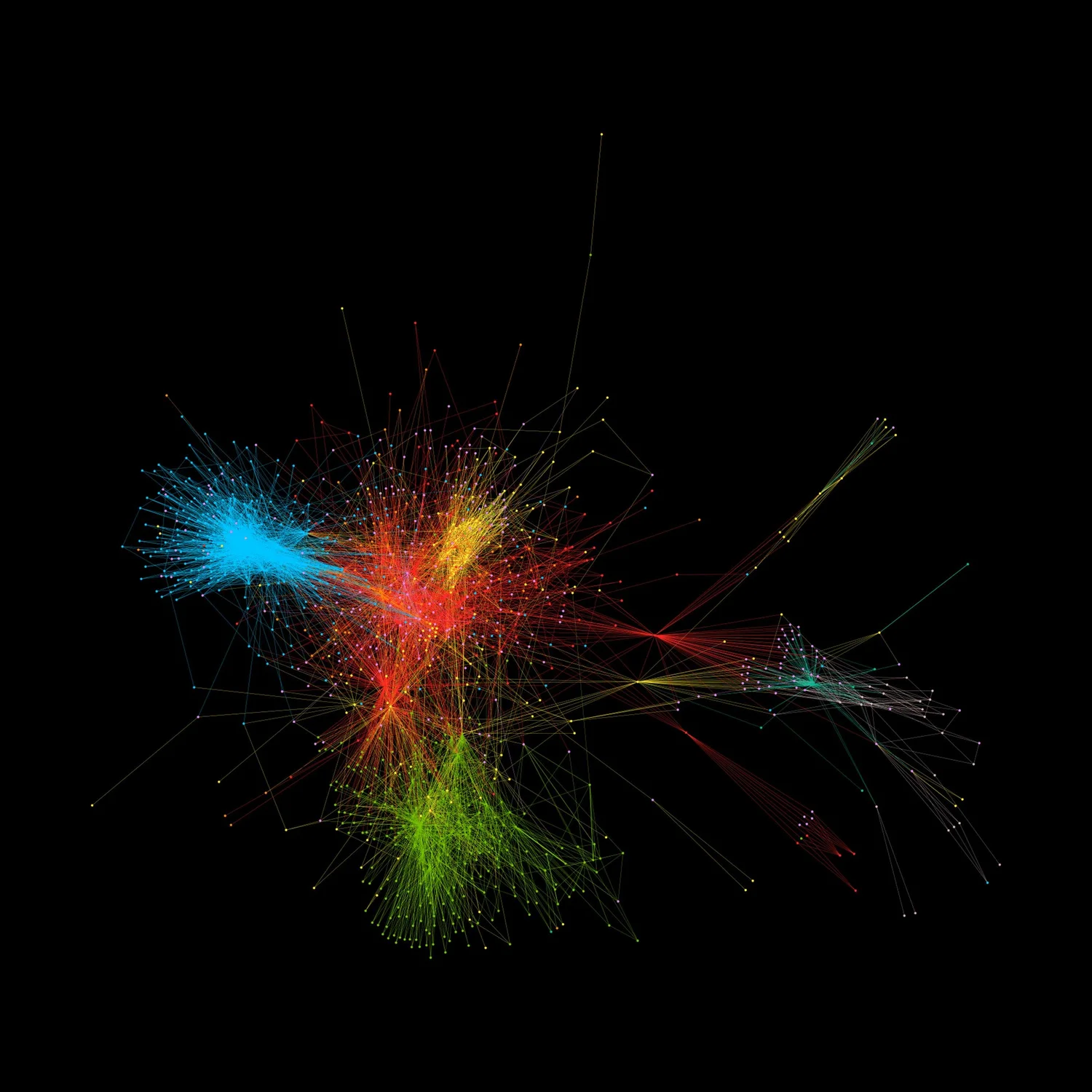
Is understanding AI a bigger question than understanding the origin of the universe? - Highlights, NEIL JOHNSON
“I'm so happy for young people because I think the era of having to memorize things is going to go by the wayside. I think we're going to turn into a very creative period where education becomes creative, rather than jumping through the hoops and remembering things. I'm really excited for anybody who's entering there. I was my first generation going to college. There was one that stands out by miles—a teacher I had in elementary school when I was eight. He was from Jamaica and just arrived in England. He was a jazz musician. He would start off the day playing jazz. He taught math as well, but he brought in a technique, which I still use to this day, to multiply numbers together. I've never seen it taught anywhere, it was done in some kind of slanted table. We'd done multiplication the previous year and I couldn't understand it, but he drew these tables and I thought this was just remarkable. That set me off and it showed me there was this interesting thing called jazz, and you don't have to do much to actually change a lot. Passing on some idea that might be unusual, as long as you can back it up, can have a really positive benefit going forward for future generations.”How can physics help solve messy, real world problems? How can we embrace the possibilities of AI while limiting existential risk and abuse by bad actors?Neil Johnson is a physics professor at George Washington University. His new initiative in Complexity and Data Science at the Dynamic Online Networks Lab combines cross-disciplinary fundamental research with data science to attack complex real-world problems. His research interests lie in the broad area of Complex Systems and ‘many-body’ out-of-equilibrium systems of collections of objects, ranging from crowds of particles to crowds of people and from environments as distinct as quantum information processing in nanostructures to the online world of collective behavior on social media. https://physics.columbian.gwu.edu/neil-johnson https://donlab.columbian.gwu.eduwww.creativeprocess.infowww.oneplanetpodcast.org IG www.instagram.com/creativeprocesspodcast
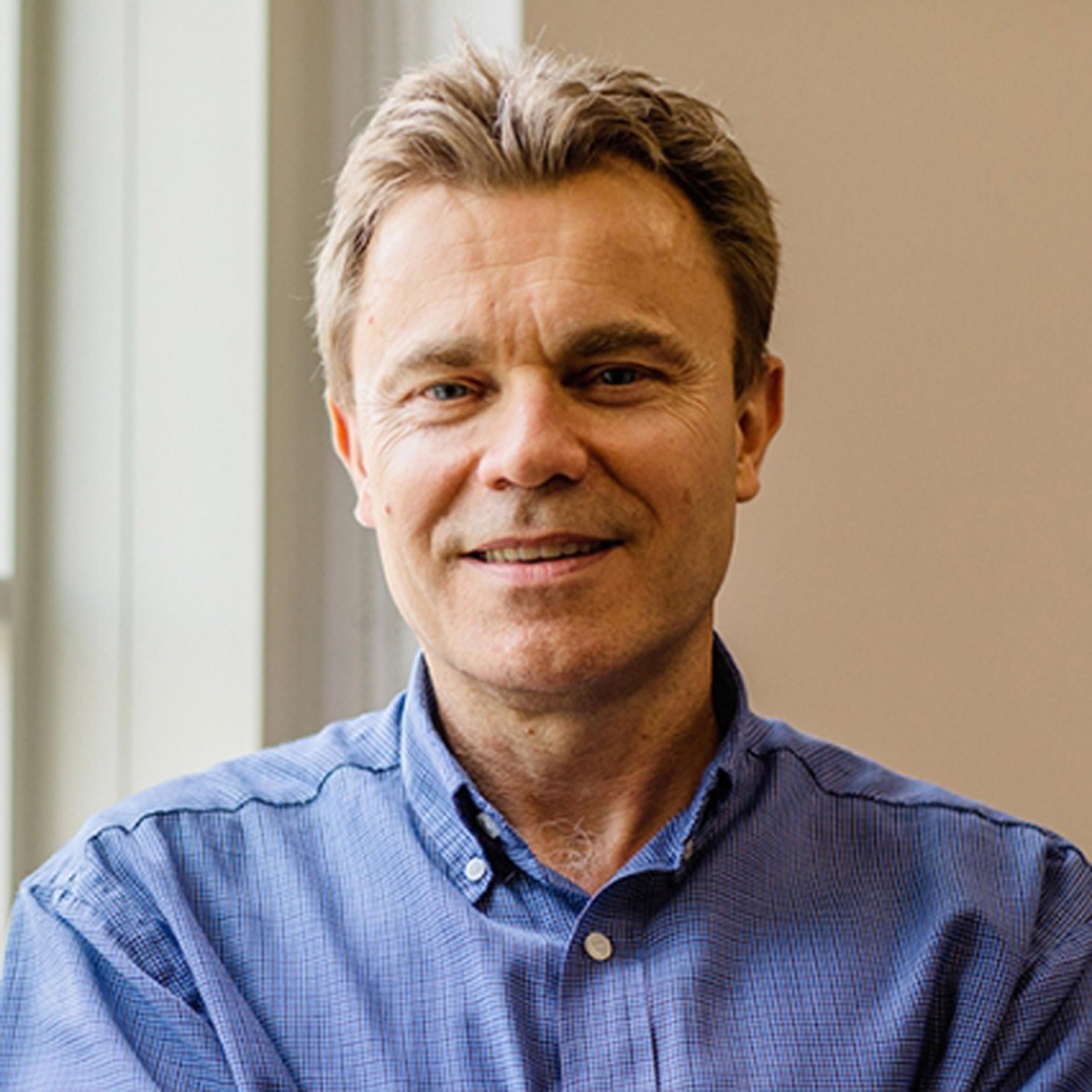
How can physics help solve real world problems? - NEIL JOHNSON, Head of Dynamic Online Networks Lab
How can physics help solve messy, real world problems? How can we embrace the possibilities of AI while limiting existential risk and abuse by bad actors?Neil Johnson is a physics professor at George Washington University. His new initiative in Complexity and Data Science at the Dynamic Online Networks Lab combines cross-disciplinary fundamental research with data science to attack complex real-world problems. His research interests lie in the broad area of Complex Systems and ‘many-body’ out-of-equilibrium systems of collections of objects, ranging from crowds of particles to crowds of people and from environments as distinct as quantum information processing in nanostructures to the online world of collective behavior on social media.“I'm so happy for young people because I think the era of having to memorize things is going to go by the wayside. I think we're going to turn into a very creative period where education becomes creative, rather than jumping through the hoops and remembering things. I'm really excited for anybody who's entering there. I was my first generation going to college. There was one that stands out by miles—a teacher I had in elementary school when I was eight. He was from Jamaica and just arrived in England. He was a jazz musician. He would start off the day playing jazz. He taught math as well, but he brought in a technique, which I still use to this day, to multiply numbers together. I've never seen it taught anywhere, it was done in some kind of slanted table. We'd done multiplication the previous year and I couldn't understand it, but he drew these tables and I thought this was just remarkable. That set me off and it showed me there was this interesting thing called jazz, and you don't have to do much to actually change a lot. Passing on some idea that might be unusual, as long as you can back it up, can have a really positive benefit going forward for future generations.”https://physics.columbian.gwu.edu/neil-johnsonhttps://donlab.columbian.gwu.eduwww.creativeprocess.infowww.oneplanetpodcast.org IG www.instagram.com/creativeprocesspodcast

Road Ecology, The Secret Life of Beavers & Ecosystem Regeneration - Highlights - BEN GOLDFARB
“We actually do need these animals on the landscape, and we're going to protect them and restore them and help their populations increase. And so, to me, beavers are proof that what we're doing as conservationists is not futile, right? That there really is reason for hope and optimism, which beavers demonstrate. I think that's a really important lesson for young people to hear is that you're not just entering this world of eco-anxiety and climate change and depression. There are some really hopeful wildlife stories out there, and you can be part of that future.”Ben Goldfarb is a conservation journalist. He is the author of Crossings: How Road Ecology Is Shaping The Future of Our Planet, named one of the best books of 2023 by the New York Times, and Eager: The Surprising, Secret Life of Beavers and Why They Matter, winner of the 2019 PEN/E.O. Wilson Literary Science Writing Award.www.bengoldfarb.comhttps://wwnorton.com/books/9781324005896www.chelseagreen.com/product/eager-paperbackwww.creativeprocess.infowww.oneplanetpodcast.orgIG www.instagram.com/creativeprocesspodcast
How Road Ecology is Shaping the Future of Our Planet with BEN GOLDFARB
Every year, humanity's footprint casts a deadly shadow over our skies and landscapes, claiming the lives of billions of birds and other wildlife. What is road ecology? How are our roads driving certain species towards extinction? And what can we do about it?Ben Goldfarb is a conservation journalist. He is the author of Crossings: How Road Ecology Is Shaping The Future of Our Planet, named one of the best books of 2023 by the New York Times, and Eager: The Surprising, Secret Life of Beavers and Why They Matter, winner of the 2019 PEN/E.O. Wilson Literary Science Writing Award.“We actually do need these animals on the landscape, and we're going to protect them and restore them and help their populations increase. And so, to me, beavers are proof that what we're doing as conservationists is not futile, right? That there really is reason for hope and optimism, which beavers demonstrate. I think that's a really important lesson for young people to hear is that you're not just entering this world of eco-anxiety and climate change and depression. There are some really hopeful wildlife stories out there, and you can be part of that future.”www.bengoldfarb.comhttps://wwnorton.com/books/9781324005896www.chelseagreen.com/product/eager-paperbackwww.creativeprocess.infowww.oneplanetpodcast.orgIG www.instagram.com/creativeprocesspodcast

Environmental Crisis, Philosophy & the Search for Meaning - ROBERT PIPPIN - Highlights
“Philosophy is both an academic discipline and also something that everybody does. Everybody has to have reflective views about what's significant. They also have to justify to themselves why it's significant or important. The nature of justice itself, and the various opinions that have been written about in philosophy about justice, can get to a very high level. So there's this unusual connection between philosophy and human life. We've inherited from the Middle Ages, this incredible tradition that's now developed into a chance for young people to spend four or five years, in a way, released from the pressures of life. The idea to pursue your ideas a little further in these four years you have, exempt from the pressures of social life, allows philosophy to have a kind of position unique in the academy. In confronting what the best minds in the history of the world have had to say about these issues, the hope is that they provide for the people who are privileged enough to confront philosophy a better and more thoughtful approach to these fundamental questions that everybody has to confront.”What is the importance of philosophy in the 21st century as we enter a post-truth world? How can we reintroduce meaning and uphold moral principles in our world shaken by crises? And what does philosophy teach us about living in harmony with the natural world?Robert Pippin is the Evelyn Stefansson Nef Distinguished Service Professor at the University of Chicago where he teaches in the College, Committee on Social Thought, and Department of Philosophy. Pippin is widely acclaimed for his scholarship in German idealism as well as later German philosophy, including publications such as Modernism as a Philosophical Problem, and Hegel’s Idealism. In keeping with his interdisciplinary interests, Pippin’s book Henry James and Modern Moral Life explores the intersections between philosophy and literature. Pippin’s most recent published book is The Culmination: Heidegger, German Idealism, and the Fate of Philosophy.https://socialsciences.uchicago.edu/directory/Robert-Pippinhttps://press.uchicago.edu/ucp/books/book/chicago/C/bo208042246.htmlwww.creativeprocess.infowww.oneplanetpodcast.orgIG www.instagram.com/creativeprocesspodcast
Reflections on Philosophy, Art & Crisis in the 21st Century with ROBERT PIPPIN
What is the importance of philosophy in the 21st century as we enter a post-truth world? How can we reintroduce meaning and uphold moral principles in our world shaken by crises? And what does philosophy teach us about living in harmony with the natural world?Robert Pippin is the Evelyn Stefansson Nef Distinguished Service Professor at the University of Chicago where he teaches in the College, Committee on Social Thought, and Department of Philosophy. Pippin is widely acclaimed for his scholarship in German idealism as well as later German philosophy, including publications such as Modernism as a Philosophical Problem, and Hegel’s Idealism. In keeping with his interdisciplinary interests, Pippin’s book Henry James and Modern Moral Life explores the intersections between philosophy and literature. Pippin’s most recent published book is The Culmination: Heidegger, German Idealism, and the Fate of Philosophy.“Philosophy is both an academic discipline and also something that everybody does. Everybody has to have reflective views about what's significant. They also have to justify to themselves why it's significant or important. The nature of justice itself, and the various opinions that have been written about in philosophy about justice, can get to a very high level. So there's this unusual connection between philosophy and human life. We've inherited from the Middle Ages, this incredible tradition that's now developed into a chance for young people to spend four or five years, in a way, released from the pressures of life. The idea to pursue your ideas a little further in these four years you have, exempt from the pressures of social life, allows philosophy to have a kind of position unique in the academy. In confronting what the best minds in the history of the world have had to say about these issues, the hope is that they provide for the people who are privileged enough to confront philosophy a better and more thoughtful approach to these fundamental questions that everybody has to confront.”https://socialsciences.uchicago.edu/directory/Robert-Pippinhttps://press.uchicago.edu/ucp/books/book/chicago/C/bo208042246.htmlwww.creativeprocess.infowww.oneplanetpodcast.orgIG www.instagram.com/creativeprocesspodcast
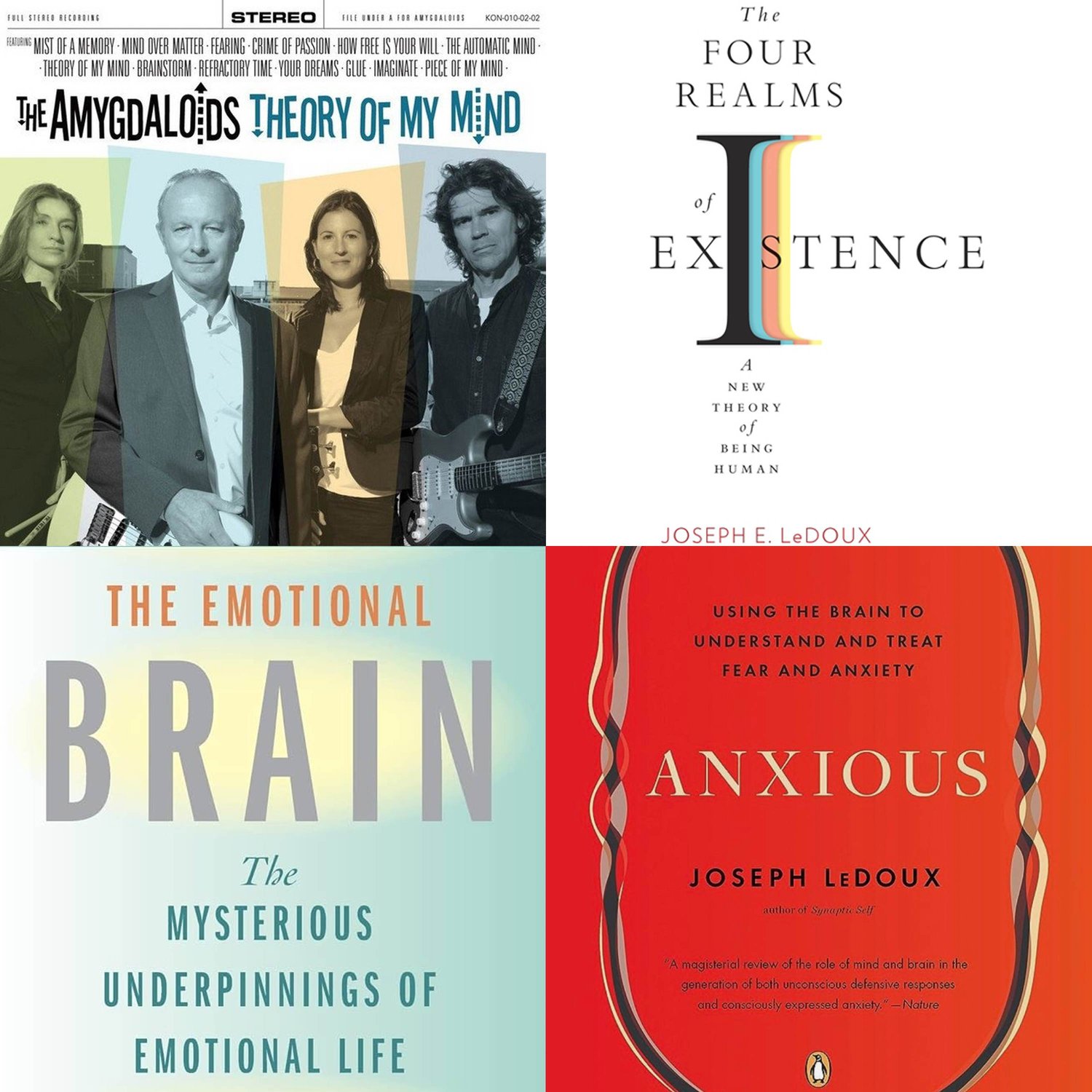
The Emotional Brain, Music, Consciousness & Memory with JOSEPH LEDOUX - Highlights
“When you're playing music with a group of people, there are those special moments when it all works, and you're in the groove. As soon as you begin to think about it, you lose it because you've introduced thought, and it's trying to take over. There's something at a lower level, a different level altogether, where all that is happening and working. And I think that's true of the whole body, that sometimes when we start thinking that introduces problems rather than solutions.”Joseph LeDoux is a Professor of Neural Science at New York University at NYU and was Director of the Emotional Brain Institute. His research primarily focuses on survival circuits, including their impacts on emotions, such as fear and anxiety. He has written a number of books in this field, including The Four Realms of Existence: A New Theory of Being Human, The Emotional Brain, Synaptic Self, Anxious, and The Deep History of Ourselves. LeDoux is also the lead singer and songwriter of the band The Amygdaloids. www.joseph-ledoux.comwww.cns.nyu.edu/ebihttps://amygdaloids.netwww.hup.harvard.edu/books/9780674261259www.creativeprocess.infowww.oneplanetpodcast.orgIG www.instagram.com/creativeprocesspodcastMusic courtesy of Joseph LeDoux
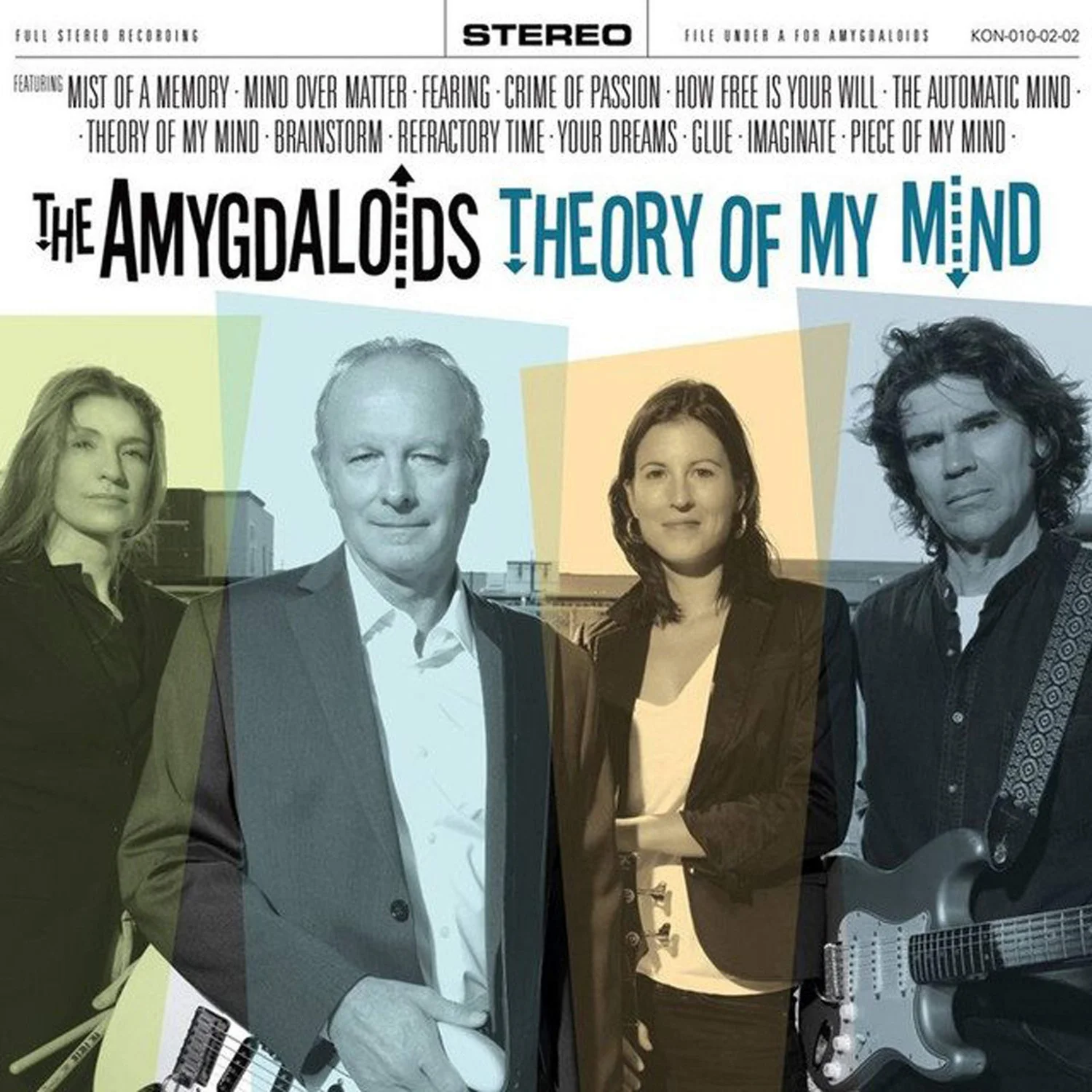
How does the brain process emotions and music? JOSEPH LEDOUX - Neuroscientist, Author, Musician
How does the brain process emotions? How are emotional memories formed and stored in the brain, and how do they influence behavior, perception, and decision-making? How does music help us understand our emotions, memories, and the nature of consciousness?Joseph LeDoux is a Professor of Neural Science at New York University at NYU and was Director of the Emotional Brain Institute. His research primarily focuses on survival circuits, including their impacts on emotions, such as fear and anxiety. He has written a number of books in this field, including The Four Realms of Existence: A New Theory of Being Human, The Emotional Brain, Synaptic Self, Anxious, and The Deep History of Ourselves. LeDoux is also the lead singer and songwriter of the band The Amygdaloids. “When you're playing music with a group of people, there are those special moments when it all works, and you're in the groove. As soon as you begin to think about it, you lose it because you've introduced thought, and it's trying to take over. There's something at a lower level, a different level altogether, where all that is happening and working. And I think that's true of the whole body, that sometimes when we start thinking that introduces problems rather than solutions.”www.joseph-ledoux.comwww.cns.nyu.edu/ebihttps://amygdaloids.netwww.hup.harvard.edu/books/9780674261259www.creativeprocess.infowww.oneplanetpodcast.orgIG www.instagram.com/creativeprocesspodcastMusic courtesy of Joseph LeDoux
Remembering PAUL AUSTER - Writer, Director (1947-2024)
It is said that people never die until the last person says their name. In memory of the writer and director Paul Auster, who passed away this week, we're sharing this conversation we had back in 2017 after the publication of his novel 4 3 2 1. Auster reflects on his body of work, life, and creative process.Paul Auster was the bestselling author of Winter Journal, Sunset Park, Invisible, The Book of Illusions, and The New York Trilogy, among many other works. He has been awarded the Prince of Asturias Award for Literature, the Prix Médicis étranger, an Independent Spirit Award, and the Premio Napoli. He is a member of the American Academy of Arts and Letters, the American Academy of Arts and Sciences, and is a Commandeur de l'Ordre des Arts et des Lettres. He has also penned several screenplays for films such as Smoke (1995), as well as Lulu on the Bridge (1998) and The Inner Life of Martin Frost (2007), which he also directed.“But what happens is a space is created. And maybe it’s the only space of its kind in the world in which two absolute strangers can meet each other on terms of absolute intimacy. I think this is what is at the heart of the experience and why once you become a reader that you want to repeat that experience, that very deep total communication with that invisible stranger who has written the book that you’re holding in your hands. And that’s why I think, in spite of everything, novels are not going to stop being written, no matter what the circumstances. We need stories. We’re all human beings, and it’s stories from the moment we’re able to talk.”We apologize for the quality of the recording since it was not originally meant to be aired as a podcast. Portrait of Paul Auster by Mia Funk, inspired by his novel 4 3 2 1.www.penguinrandomhouse.com/authors/1045/paul-austerwww.creativeprocess.infowww.oneplanetpodcast.orgIG www.instagram.com/creativeprocesspodcast
How to achieve Optimal Well-Being with Emotional Intelligence - Highlights - DANIEL GOLEMAN
“I'm also a big advocate of teaching attention training skills to kids in school. This can help them develop focus, become more self aware, better able to manage their unruly emotions, more able to tune in to those around them, and to understand that their actions matter. All of these things can be instilled in kids, and there are programs in social and emotional learning that are very good at doing this. I think it's great to give people that scaffolding for life early on. If you learn how to handle anxiety early on in life, then eco-anxiety, for example, won't be as big a problem. You'll still be able to do what needs to be done, and you'll be able to do it better because you're less anxious. You’ll have clarity and calm, which is the better state in which to be effective. I would like everyone, including young people, to remember that the classic traditional human capacities, like paying full attention to yourself and to other people, and caring about yourself and those people, matter enormously. As does spending time in nature to feel at home, to feel calm, to feel good.”Daniel Goleman is an American psychologist, author, and science journalist. Before becoming an author, Goleman was a science reporter for the New York Times for 12 years, covering psychology and the human brain. In 1995, Goleman published Emotional Intelligence, a New York Times bestseller. In his newly published book Optimal, Daniel Goleman discusses how people can enter an optimal state of high performance without facing symptoms of burnout in the workplace.www.danielgoleman.infowww.harpercollins.com/products/optimal-daniel-golemancary-cherniss?variant=41046795288610www.penguinrandomhouse.com/books/69105/emotional-intelligence-by-daniel-goleman/www.creativeprocess.infowww.oneplanetpodcast.orgIG www.instagram.com/creativeprocesspodcast
Author of Emotional Intelligence DANIEL GOLEMAN on Focus, Balance & Optimal Living
How can we enhance our emotional intelligence and avoid burnout in a changing world? How can we regain focus and perform in an optimal state? What do we mean by ecological intelligence?Daniel Goleman is an American psychologist, author, and science journalist. Before becoming an author, Goleman was a science reporter for the New York Times for 12 years, covering psychology and the human brain. In 1995, Goleman published Emotional Intelligence, a New York Times bestseller. In his newly published book Optimal, Daniel Goleman discusses how people can enter an optimal state of high performance without facing symptoms of burnout in the workplace.“I'm also a big advocate of teaching attention training skills to kids in school. This can help them develop focus, become more self aware, better able to manage their unruly emotions, more able to tune in to those around them, and to understand that their actions matter. All of these things can be instilled in kids, and there are programs in social and emotional learning that are very good at doing this. I think it's great to give people that scaffolding for life early on. If you learn how to handle anxiety early on in life, then eco-anxiety, for example, won't be as big a problem. You'll still be able to do what needs to be done, and you'll be able to do it better because you're less anxious. You’ll have clarity and calm, which is the better state in which to be effective. I would like everyone, including young people, to remember that the classic traditional human capacities, like paying full attention to yourself and to other people, and caring about yourself and those people, matter enormously. As does spending time in nature to feel at home, to feel calm, to feel good.”www.danielgoleman.infowww.harpercollins.com/products/optimal-daniel-golemancary-cherniss?variant=41046795288610www.penguinrandomhouse.com/books/69105/emotional-intelligence-by-daniel-goleman/www.creativeprocess.infowww.oneplanetpodcast.orgIG www.instagram.com/creativeprocesspodcast

Feminism, Resistance & the Global South - Highlights - INTAN PARAMADITHA
“I grew up with folktales and fairytales from the Indonesian archipelago, from the Nusantara. And of course I grew up with the stories from the Grimm brothers and Hans Christian Andersen and actually I like them better than the Disney version because they're more bloody and gory. I guessed that also shaped my preferences for more dark and gothic stories as I grew up. I did English literature at the University of Indonesia. I wrote a BA thesis on Mary Shelley's Frankenstein. And my mother was a very imaginative person. She loved making her own stories, so I think I inherit that from her. But she never had the chance to explore her creative side—there were certain expectations for women at that time to get married. She was harsh. But I know why I considered her monstrous when she was younger. She was trying to reject society's expectations in her own way, but we didn't understand her. And so I became really interested in the so-called bad women or monstrous women, in a way that these women allow me to ask questions around the structures that create them. Her whole presence taught me to really appreciate the knowledge that was created by generations of women before me. Part of the work I do now is work with a feminist collective to actually question knowledge production, who is excluded from it, who is being marginalized because of it, and my mother played a great role in steering me in that direction.”Intan Paramaditha is a writer and an academic. Her novel The Wandering (Harvill Secker/ Penguin Random House UK), translated from the Indonesian language by Stephen J. Epstein, was nominated for the Stella Prize in Australia and awarded the Tempo Best Literary Fiction in Indonesia, English PEN Translates Award, and PEN/ Heim Translation Fund Grant from PEN America. She is the author of the short story collection Apple and Knife, the editor of Deviant Disciples: Indonesian Women Poets, part of the Translating Feminisms series of Tilted Axis Press and the co-editor of The Routledge Companion to Asian Cinemas (forthcoming 2024). Her essay, “On the Complicated Questions Around Writing About Travel,” was selected for The Best American Travel Writing 2021. She holds a Ph.D. from New York University and teaches media and film studies at Macquarie University, Sydney.https://intanparamaditha.com www.penguinrandomhouse.ca/books/626055/the-wandering-by-intan-paramaditha/9781787301184www.creativeprocess.info www.oneplanetpodcast.orgIG www.instagram.com/creativeprocesspodcast

Travel, Literature & Identity with INTAN PARAMADITHA - Author of The Wandering
How are writing and travel vehicles for understanding? How can we expand the literary canon to include other voices, other cultures, other experiences of the world?Intan Paramaditha is a writer and an academic. Her novel The Wandering (Harvill Secker/ Penguin Random House UK), translated from the Indonesian language by Stephen J. Epstein, was nominated for the Stella Prize in Australia and awarded the Tempo Best Literary Fiction in Indonesia, English PEN Translates Award, and PEN/ Heim Translation Fund Grant from PEN America. She is the author of the short story collection Apple and Knife, the editor of Deviant Disciples: Indonesian Women Poets, part of the Translating Feminisms series of Tilted Axis Press and the co-editor of The Routledge Companion to Asian Cinemas (forthcoming 2024). Her essay, “On the Complicated Questions Around Writing About Travel,” was selected for The Best American Travel Writing 2021. She holds a Ph.D. from New York University and teaches media and film studies at Macquarie University, Sydney.“I grew up with folktales and fairytales from the Indonesian archipelago, from the Nusantara. And of course I grew up with the stories from the Grimm brothers and Hans Christian Andersen and actually I like them better than the Disney version because they're more bloody and gory. I guessed that also shaped my preferences for more dark and gothic stories as I grew up. I did English literature at the University of Indonesia. I wrote a BA thesis on Mary Shelley's Frankenstein. And my mother was a very imaginative person. She loved making her own stories, so I think I inherit that from her. But she never had the chance to explore her creative side—there were certain expectations for women at that time to get married. She was harsh. But I know why I considered her monstrous when she was younger. She was trying to reject society's expectations in her own way, but we didn't understand her. And so I became really interested in the so-called bad women or monstrous women, in a way that these women allow me to ask questions around the structures that create them. Her whole presence taught me to really appreciate the knowledge that was created by generations of women before me. Part of the work I do now is work with a feminist collective to actually question knowledge production, who is excluded from it, who is being marginalized because of it, and my mother played a great role in steering me in that direction.”https://intanparamaditha.com www.penguinrandomhouse.ca/books/626055/the-wandering-by-intan-paramaditha/9781787301184www.creativeprocess.info www.oneplanetpodcast.orgIG www.instagram.com/creativeprocesspodcast
Voices of the Earth: Reflections on Nature, Humanity & Climate Change
Environmentalists, writers, artists, activists, and public policy makers explore the interconnectedness of living beings and ecosystems. They highlight the importance of conservation, promote climate education, advocate for sustainable development, and underscore the vital role of creative and educational communities in driving positive change.00:00 "The Conditional" by U.S. Poet Laureate Ada Limón01:27 The Secret Language of Animals: Ingrid Newkirk, President of PETA03:03 A Love Letter to the Living World: Carl Safina, Ecologist & Author04:11 Exploring the Mysteries of Soil and Coral Reefs: Merlin Sheldrake, Biologist, Author of Entangled Life04:47 Exploring Coral Reefs: Richard Vevers, Founder of The Ocean Agency05:56 The Importance of Climate Education: Kathleen Rogers, President of EarthDay.org07:02 The Timeless Wisdom of Turtles: Sy Montomery, Naturalist & Author07:38 Optimism in the Face of Environmental Challenges: Richard Vevers08:32 Urban Solutions for a Sustainable Future: Paula Pinho, Director, Just Transition, Consumers, Energy Efficiency & Innovation, European Commission08:57 The Circular Economy: Walter Stahel, Founder & Director of the Product-Life Institute09:39 The Power of Speaking Out for Sustainability: Paula Pinho10:16 Empowering the Next Generation Through Education: Jeffrey Sachs, President of the UN Sustainable Development Solutions Networkwww.creativeprocess.info www.oneplanetpodcast.orgIG www.instagram.com/creativeprocesspodcastwww.maxrichtermusic.comhttps://studiorichtermahr.comMax Richter’s music featured in this episode are “On the Nature of Daylight” from The Blue Notebooks, “Path 19: Yet Frailest” from Sleep.Music is courtesy of Max Richter, Universal Music Enterprises, and Mute Song.

Exploring Science, Music, AI & Consciousness with MAX COOPER - Highlights
“As technology becomes more dominant, the arts become ever more important for us to stay in touch the things that the sciences can't tackle. What it's actually like to be a person? What's actually important? We can have this endless progress inside this capitalist machine for greater wealth and longer life and more happiness, according to some metric. Or we can try and quantify society and push it forward. Ultimately, we all have to decide what's important to us as humans, and we need the arts to help with that. So, I think what's important really is just exposing ourselves to as many different ideas as we can, being open-minded, and trying to learn about all facets of life so that we can understand each other as well. And the arts is an essential part of that.”How is being an artist different than a machine that is programmed to perform a set of actions? How can we stop thinking about artworks as objects, and start thinking about them as triggers for experiences? In this conversation with Max Cooper, we discuss the beauty and chaos of nature and the exploration of technology music and consciousness.Max Cooper is a musician with a PhD in computational biology. He integrates electronic music with immersive video projections inspired by scientific exploration. His latest project, Seme, commissioned by the Salzburg Easter Festival, merges Italian musical heritage with contemporary techniques, was also performed at the Barbican in London. He supplied music for a video narrated by Greta Thunberg and Pope Francis for COP26.In 2016, Cooper founded Mesh, a platform to explore the intersection of music, science and art. His Observatory art-house installation is on display at Kings Cross until May 1st.https://maxcooper.nethttps://osterfestspiele.at/en/programme/2024/electro-2024https://meshmeshmesh.netwww.kingscross.co.uk/event/the-observatoryThe music featured on this episode was Palestrina Sicut, Cardano Circles, Fibonacci Sequence, Scarlatti K141. Music is from Seme and is courtesy of Max Cooper.www.creativeprocess.infowww.oneplanetpodcast.orgIG www.instagram.com/creativeprocesspodcast

What can music teach us that science can’t? - MAX COOPER - Musician, Fmr. Computational Biologist
How is being an artist different than a machine that is programmed to perform a set of actions? How can we stop thinking about artworks as objects, and start thinking about them as triggers for experiences? In this conversation with Max Cooper, we discuss the beauty and chaos of nature and the exploration of technology music and consciousness.Max Cooper is a musician with a PhD in computational biology. He integrates electronic music with immersive video projections inspired by scientific exploration. His latest project, Seme, commissioned by the Salzburg Easter Festival, merges Italian musical heritage with contemporary techniques, was also performed at the Barbican in London. He supplied music for a video narrated by Greta Thunberg and Pope Francis for COP26.In 2016, Cooper founded Mesh, a platform to explore the intersection of music, science and art. His Observatory art-house installation is on display at Kings Cross until May 1st.“As technology becomes more dominant, the arts become ever more important for us to stay in touch the things that the sciences can't tackle. What it's actually like to be a person? What's actually important? We can have this endless progress inside this capitalist machine for greater wealth and longer life and more happiness, according to some metric. Or we can try and quantify society and push it forward. Ultimately, we all have to decide what's important to us as humans, and we need the arts to help with that. So, I think what's important really is just exposing ourselves to as many different ideas as we can, being open-minded, and trying to learn about all facets of life so that we can understand each other as well. And the arts is an essential part of that.”https://maxcooper.nethttps://osterfestspiele.at/en/programme/2024/electro-2024https://meshmeshmesh.netwww.kingscross.co.uk/event/the-observatoryThe music featured on this episode was Palestrina Sicut, Cardano Circles, Fibonacci Sequence, Scarlatti K141. Music is from Seme and is courtesy of Max Cooper.www.creativeprocess.infowww.oneplanetpodcast.orgIG www.instagram.com/creativeprocesspodcast