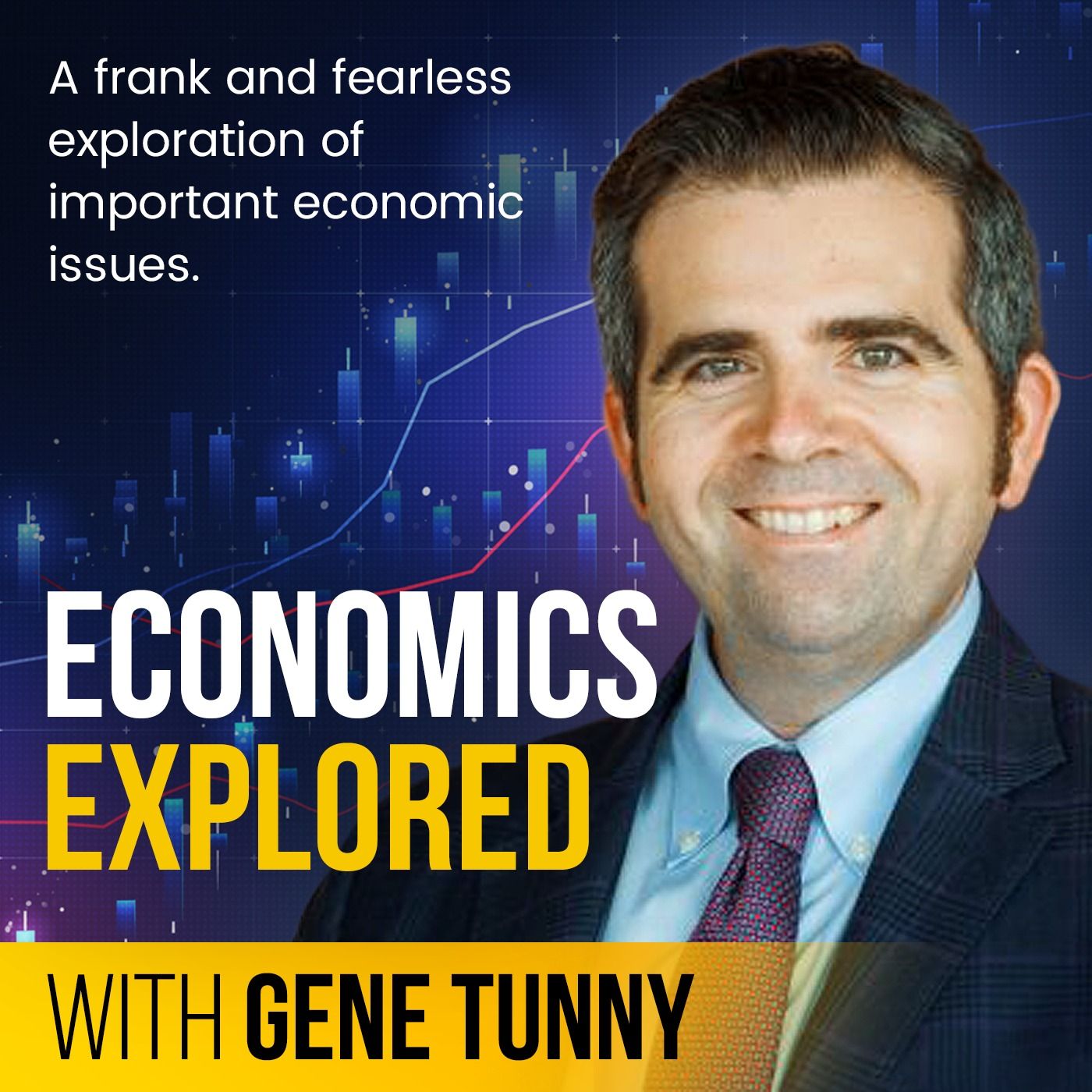
Economics Explored
323 episodes — Page 2 of 7
Ep 270How LBOs, Share Buybacks & Private Equity Revolutionized Corporate America: Don Chew’s Case for Transformation - EP270
Donald Chew discusses the evolution of corporate finance, emphasizing the shift from old-fashioned corporate finance, which focused on steady earnings growth, to modern corporate finance, which aims for high returns on capital. He highlights the decline of conglomerates in the 1970s and the rise of private equity. Despite criticism, Chew argues that modern corporate finance has been a success story, citing the doubling of U.S. public company market capitalization in the 1980s and the significant correlation of R&D and selling, general and administrative expenses (SG&A) expenses with corporate value. He also addresses the financial crisis, arguing it was due to mispriced mortgages and government policies, not market inefficiencies. Donald Chew is the founding editor of the Journal of Applied Corporate Finance, and joins show host Gene Tunny to discuss his latest book, The Making of Modern Corporate Finance, published by Columbia University Press.If you have any questions, comments, or suggestions for Gene, please email him at [email protected] this episode’s guest: Donald ChewDon Chew is the founding editor and Editor-in-Chief of the Journal of Applied Corporate Finance (JACF), a publication he started almost 30 years ago. He has published over ten books on corporate finance, including The New Corporate Finance: Where Theory Meets Practice and The Revolution in Corporate Finance (with Joel Stern), which are both widely used in business schools throughout the United States and Europe. Don has both a Ph.D. in English and an MBA in finance from the University of Rochester.Timestamps for EP270Introduction (0:00)The Decline of Conglomerates and the Rise of Modern Corporate Finance (5:58)The Role of Private Equity and Corporate Governance (14:25)The Impact of Modern Corporate Finance on Corporate Value (15:03)The Future of Corporate Finance and Productivity Measurement (16:37)The Role of Corporate Finance in Economic Growth (19:27)The Critique of Modern Corporate Finance and Corporate Social Responsibility (27:26)The Financial Crisis and the Role of Government Policy (35:40)The Future of Corporate Finance and the Role of Private Equity (43:21)TakeawaysModern Corporate Finance Principles: The shift from prioritizing steady earnings growth to maximizing long-term firm value has reshaped corporate strategies globally.The Importance of R&D: Increases in R&D and SG&A spending are now critical indicators of corporate value and long-term success, according to Don Chew.Private Equity’s Role: Private equity has transformed underperforming companies, streamlining operations and reallocating capital for growth.The Evolution of Corporate Governance: Shareholder activism has replaced hostile takeovers as the primary tool for enforcing corporate accountability.ESG and Value Creation: Enlightened value maximization is the idea that corporations can address societal concerns while enhancing long-term profitability.Links relevant to the conversationDon Chew’s new book The Making of Modern Corporate Finance:https://www.amazon.com.au/Making-Modern-Corporate-Finance-History/dp/0231211104Econometric study of benefits to consumers of Wal-Mart:https://onlinelibrary.wiley.com/doi/abs/10.1002/jae.994Lumo Coffee promotion10% of Lumo Coffee’s Seriously Healthy Organic Coffee.Website: https://www.lumocoffee.com/10EXPLOREDPromo code: 10EXPLORED Full transcripts are available a few days after the episode is first published at www.economicsexplored.com.
Ep 269Jimmy Carter the Great Deregulator, AmFest, MAGA & Migration, and Why Competition? w/ Darren Brady Nelson - EP269
Gene Tunny and Darren Brady Nelson discuss the economic legacy of President Jimmy Carter, highlighting his deregulation efforts, particularly in aviation, which led to increased competition and significant cost savings. They also touch on Carter’s appointment of Paul Volcker as Federal Reserve Chairman, credited with fighting inflation. The conversation shifts to the America Fest conference in Phoenix, where key speakers included Charlie Kirk, Tucker Carlson, and Glenn Beck. They discuss the tensions within the MAGA movement, particularly around immigration policies. Lastly, they explore the intersection of Christian economics and competition, emphasizing its ethical foundations and the potential for a moral case for free markets.If you have any questions, comments, or suggestions for Gene, please email him at [email protected] for EP269President Jimmy Carter's Legacy and Deregulation (0:00)Carter's Economic Policies and Personal Anecdotes (5:16)America Fest Conference in Phoenix (14:36)Trump’s Speech and MAGA Movement Dynamics (27:46)Christian Economics and Competition (36:34)Darren's Critique of Mainstream Economics and Antitrust Regulation (51:22)Regulatory Challenges and Natural Monopolies (55:55)Final Thoughts and Future Directions (59:26)TakeawaysJimmy Carter’s Deregulation Impact: Carter’s policies in aviation, trucking, and beer production revolutionized U.S. markets, creating long-lasting consumer benefits.MAGA’s Immigration Debate: Tensions exist between Bannon's nationalist stance and Musk's globalist vision for high-skilled immigration policies.The Role of Competition: Darren highlighted the economic and ethical importance of competition, criticizing overreach in antitrust regulations.Links relevant to the conversationMises Institute article “Jimmy Carter’s Legacy Is Much More than Good Deeds Done in His Later Years”:https://mises.org/mises-wire/jimmy-carters-legacy-much-more-good-deeds-done-his-later-yearsThe previous episode with Darren:https://economicsexplored.com/2024/11/10/trump-2-0-w-top-wisconsin-door-knocker-economist-darren-brady-nelson-ep261/Great Reset discussion with Darren from 2020:https://economics-explained.simplecast.com/episodes/the-great-resetLarry Reed, President Emeritus of FEE, speaking about the Parable of the Vineyard Workers:https://economicsexplored.com/2022/02/05/price-controls-to-fight-inflation-a-bad-idea-infrastructure-lessons-from-potus-21-ep125/Darren’s articles in Concurrences on competition and antitrust (paywalled, alas):https://www.concurrences.com/en/page/recherche/?recherche=darren+nelson#Alfred Kahn’s Economics of Regulation:https://www.amazon.com.au/Economics-Regulation-Principles-Institutions/dp/0262610523Lumo Coffee promotion10% of Lumo Coffee’s Seriously Healthy Organic Coffee.Website: https://www.lumocoffee.com/10EXPLOREDPromo code: 10EXPLORED Full transcripts are available a few days after the episode is first published at www.economicsexplored.com.
Ep 268US Debt Ceiling: Why Trump is Right to Call for its Abolition & Gene’s Experience with Aussie Debt Ceiling - EP268
Show host Gene Tunny discusses the ineffectiveness of the U.S. debt ceiling, citing its frequent increases and the political grandstanding it entails. He notes that since 1960, Congress has amended the debt limit 78 times. Tunny argues that the debt ceiling does not enforce fiscal discipline and highlights the need for better fiscal rules, such as the Swiss Debt Brake or the Taxpayer Bill of Rights. He also shares his experience with Australia's debt ceiling during the late 2000s financial crisis. Tunny concludes that Trump's criticism of the debt ceiling is justified.If you have any questions, comments, or suggestions for Gene, please email him at [email protected] for EP268US Debt Ceiling Overview (0:00)Historical Context and Modern Monetary Theory (4:09)Ineffectiveness of the Debt Ceiling (7:07)Australian Experience with the Debt Ceiling (13:00)Conclusion and Alternative Fiscal Rules (24:49)TakeawaysDebt Ceilings Are Ineffective: The US debt ceiling fails to control spending or debt accumulation, as it is consistently raised to avoid financial crises.Alternative Fiscal Rules: Spending caps or frameworks like Switzerland’s debt brake are more effective at managing fiscal discipline than nominal debt ceilings.Political Grandstanding: The debt ceiling often serves as a stage for political drama rather than meaningful fiscal reform.Modern Monetary Theory Critique: Printing money to avoid debt constraints, as proposed by some MMT advocates, risks inflation and economic instability.Lessons from Australia: Australia abolished its debt ceiling a decade ago after recognizing its downsides, offering a model for US fiscal policy reform.Links relevant to the conversationUseful information on the US debt and deficit from the US Treasury:https://home.treasury.gov/policy-issues/financial-markets-financial-institutions-and-fiscal-service/debt-limit (discusses how many times the debt ceiling has been amended)https://fiscaldata.treasury.gov/americas-finance-guide/national-deficit/ (contains the spending, revenue, and deficit figures that Gene mentions)Lumo Coffee promotion10% of Lumo Coffee’s Seriously Healthy Organic Coffee.Website: https://www.lumocoffee.com/10EXPLOREDPromo code: 10EXPLORED Full transcripts are available a few days after the episode is first published at www.economicsexplored.com.
Ep 267How Global Events are Affecting Coffee Prices w/ Raihaan Esat, International Coffee Traders - EP267
Coffee prices have surged dramatically over the past year, with green coffee increasing by 78%. In this episode, International Coffee Traders GM Raihaan Esat joins hosts Gene Tunny and Tim Hughes to explore the key drivers behind this spike, including harvest shortages, supply chain disruptions, and geopolitical factors. Discover why your morning brew may soon cost more and how the coffee industry is navigating these challenges.If you have any questions, comments, or suggestions for Gene, please email him at [email protected] our guest: Raihaan Esat, General Manager, International Coffee TradersRaihaan Esat is a passionate and seasoned coffee professional with extensive experience across the coffee industry. From working in bustling espresso bars and competing at the highest levels of barista competitions to managing roasteries and developing quality control systems, Raihaan has cultivated a deep understanding of every facet of coffee craftsmanship.As General Manager of International Coffee Traders (ICT), a green coffee sales business, Raihaan connects both commercial and home roasters with premium green beans and equipment, sharing his love for exceptional coffee. Inspired by mentors like Phillip Di Bella and a history of innovation, Raihaan is also spearheading coffee events at The Coffee Commune, fostering a thriving community of coffee enthusiasts. Dedicated to excellence and driven by a lifelong passion, Raihaan continues to inspire others through mentorship, entrepreneurship, and a relentless pursuit of the perfect cup.Source: https://www.roastmagazine.com/roastsummit/events/raihann-esatTimestamps for EP267Coffee Market Overview and Initial Discussion (0:00)Factors Contributing to Coffee Price Increases (7:36)Quality Concerns and Market Dynamics (19:41)Consumer Behavior and Market Volatility (26:44)Impact on Coffee Shops and Consumers (47:07)Geopolitical and Weather Impact on Coffee Prices (54:20)TakeawaysGreen Coffee Prices Surge: Over the past 12 months, green coffee prices have increased by 78%, impacting every part of the supply chain.Major Producers Facing Challenges: Brazil and Vietnam, responsible for a large share of global coffee production, are experiencing lower yields due to weather conditions and harvest quality issues.Geopolitical Factors: Disruptions in trade routes, such as those caused by Middle East conflicts, have further strained the coffee supply chain, driving up costs.Changing Consumer Expectations: As prices rise, consumers may need to reconsider what they expect for a $5 cup of coffee and the value they receive in return.Sustainability of Cafes: For cafes to survive, they need to adjust their pricing to reflect increasing costs in labor, rent, and coffee supplies.Links relevant to the conversationOur previous conversation with Raihaan, “The Future of Coffee: Climate Change & Rising Prices w/ Raihaan Esat, International Coffee Traders – EP217”:https://economicsexplored.com/2023/12/06/the-future-of-coffee-climate-change-rising-prices-w-raihaan-esat-international-coffee-traders-ep217/Raihaan’s slide explaining factors driving up coffee prices:https://drive.google.com/file/d/1JAhmCl_TmfSoWRkh9wF9fDFU395mPnyL/view?usp=sharingChart of the green coffee price:https://drive.google.com/file/d/1qnX28VagJ3FtD40JntMujADsNKI-NhBs/view?usp=sharingInternational Coffee Traders at the Coffee Commune:https://www.coffeecommune.com.au/international-coffee-traders/ABC News article “Coffee prices hit record high after bad weather”:https://www.abc.net.au/news/2024-12-11/coffee-prices-hit-record-high-after-bad-weather/104711708Greensquare coffee roaster app:https://www.greensquare.co/Lumo Coffee promotion10% of Lumo Coffee’s Seriously Healthy Organic Coffee.Website: https://www.lumocoffee.com/10EXPLOREDPromo code: 10EXPLORED Full transcripts are available a few days after the episode is first published at www.economicsexplored.com.
Ep 266Trump & Trade, France in Crisis, Global Capitalism’s Flaws & Job Losses from AI w/ Jean-Baptiste Wautier - EP266
This episode explores the economic implications of Trump’s re-election, France’s political deadlock under Macron, and the future of global capitalism. Jean-Baptiste Wautier, a private equity investor and World Economic Forum speaker, shares insights on trade wars and deficits. He argues that short-term profit motives undermine the global capitalist system. Jean-Baptiste also discusses AI's transformative potential. Please note this episode was recorded on 11 December 2024, before French President Macron appointed François Bayrou as the new PM. If you have any questions, comments, or suggestions for Gene, please email him at [email protected] for EP266Introduction (0:00)Economic Implications of Trump's Re-Election (2:55)Potential Global Trade War (5:50)Global Trade and Economic Interdependence (8:29)Challenges Facing France and the Fifth Republic (13:55)Risks to the Eurozone (20:07)Flaws in Global Capitalism and Potential Solutions (27:34)Examples of Enlightened Capitalism (33:01)The Impact of Artificial Intelligence on Jobs (39:59)Final Thoughts and Future Directions (44:50)TakeawaysTrump’s Second Term Risks: His proposed tax cuts and tariffs could reignite inflation and exacerbate the US federal deficit, leading to global economic consequences.France’s Political Instability: Macron’s government faces gridlock, which could potentially destabilize the Eurozone due to France’s growing budget deficit and political deadlock.Global Trade War Unlikely: Despite harsh rhetoric, economic interdependence makes a full-scale global trade war improbable, in Jean-Baptiste’s view.Capitalism’s Short-Term Focus: Jean-Baptiste argues the current capitalist model prioritizes short-term profits over long-term sustainability, causing inefficiencies and negative externalities like mental health crises and economic inequality.The Role of AI: AI is transforming industries at an unprecedented speed, raising concerns about job displacement and the need for economic adjustments, possibly extending to UBI (Universal Basic Income), depending on the scale of the displacement.Links relevant to the conversationJean-Baptiste Wautier’s website:https://wautier.co.uk/EXPLAINER: Why is natural gas still flowing from Russia to Europe across Ukraine?https://apnews.com/article/russia-ukraine-war-natural-gas-f9f00df7195d01404f8cb2a43152a8b1Lumo Coffee promotion10% of Lumo Coffee’s Seriously Healthy Organic Coffee.Website: https://www.lumocoffee.com/10EXPLOREDPromo code: 10EXPLORED Full transcripts are available a few days after the episode is first published at www.economicsexplored.com.
Ep 2652024 Highlights: Reagan’s Budget Boss on Trump | Greedy Jobs | Super Abundance | Buffett in Omaha | Housing & Immigration
Host Gene Tunny discusses significant economic issues from the year. He features clips from interviews with experts on various topics, including the economic consequences of Donald Trump's re-election, the U.S. budget deficit, the gender pay gap, and environmental impact. President Reagan’s budget director David Stockman criticizes Trump’s policies for being anti-capitalist, citing a $8 trillion increase in public debt. Fiscal policy wonk Dan Mitchell argues that higher taxes are not the solution to the U.S. budget deficit, as spending is the primary issue. Leonora Risse (Assoc. Prof., University of Canberra) explains the concept of "greedy jobs" contributing to the gender pay gap. Marion Tupy of the Cato Institute discusses the long-term decline in commodity prices, and Daniel Lawse of Verdis Group emphasizes the need for sustainable, long-term thinking in business and policy. Daniel also reflects on the modest lifestyle of Warren Buffett, another Omaha resident. John August discusses the impact of immigration on Australia's housing crisis.If you have any questions, comments, or suggestions for Gene, please email him at [email protected] for EP265Introduction (0:00)David Stockman (6:20)Dan Mitchell (11:20)Leonora Risse (23:50)Marian Tupy (32:15)Daniel Lawse (41:49)John August (48:06)Links relevant to the conversationEpisodes featuring the clips:https://economicsexplored.com/2024/01/28/reagans-budget-boss-david-stockman-on-trumps-economic-policies-ep224/https://economicsexplored.com/2024/04/17/is-uncle-sam-running-a-ponzi-scheme-with-the-national-debt-w-dr-dan-mitchell-ep235/https://economicsexplored.com/2024/03/10/the-gender-pay-debate-understanding-the-factors-behind-the-gap-w-dr-leonora-risse-ep230/https://economicsexplored.com/2024/10/16/abundance-mindset-exploring-the-super-abundance-thesis-w-marian-tupy-cato-institute-ep258/https://economicsexplored.com/2024/06/01/helping-seattle-aquarium-others-go-to-net-zero-and-beyond-w-daniel-lawse-verdis-group-ep242/https://economicsexplored.com/2024/04/17/housing-crisis-and-immigration-australias-tough-choices-w-john-august-ep236/Leonora’s review of Career and Family: Women's Century-Long Journey toward Equity, by Claudia Goldinhttps://onlinelibrary.wiley.com/doi/abs/10.1111/1475-4932.12716?domain=author&token=UPATKK2WTIAEZ49UMRMVPrinciple of Charity podcast episodes on degrowth:https://podcasts.apple.com/au/podcast/can-degrowth-save-the-planet/id1571868650?i=1000674757240https://podcasts.apple.com/au/podcast/can-degrowth-save-the-planet-pt-2-on-the-couch/id1571868650?i=1000675655623Lumo Coffee promotion10% of Lumo Coffee’s Seriously Healthy Organic Coffee.Website: https://www.lumocoffee.com/10EXPLOREDPromo code: 10EXPLORED Full transcripts are available a few days after the episode is first published at www.economicsexplored.com.
Ep 264Uncertainty and Enterprise: Harnessing Imagination and Narrative w/ Prof. Amar Bhidé - EP264
Professor Amar Bhidé of Columbia University discusses his new book “Uncertainty and Enterprise”, published by Oxford University Press. It emphasizes the limitations of standard economic models that rely on probability distributions. He argues that entrepreneurship involves dealing with unique, non-quantifiable uncertainties, which require imagination and narrative skills. Bhide critiques the over-reliance on incentives and statistical analysis, advocating for a more imaginative and contextual approach. He highlights the importance of routines and the need for accountability in expert decision-making, particularly in areas like public health and monetary policy. Bhide also discusses the role of narratives in business success and the challenges posed by tech monopolies.If you have any questions, comments, or suggestions for Gene, please email him at [email protected] this episode’s guest Professor Amar BhidéProfessor of Health Policy and Management at Columbia University Irving Medical CenterBhidé has researched and taught about innovation, entrepreneurship, and finance for over three decades. He now focuses on teaching, developing, and disseminating case histories of transformational technological advances.A member of the Council on Foreign Relations, a founding member of the Center on Capitalism and Society at Columbia – and a founding editor of Capitalism and Society, Bhide is the author of the forthcoming book Uncertainty, Judgment, and Enterprise (Oxford). His earlier books include A Call for Judgment: Sensible Finance for a Dynamic Economy (Oxford, 2010), The Venturesome Economy: How Innovation Sustains Prosperity in a More Connected World (Princeton, 2008), The Origin and Evolution of New Businesses (Oxford, 2000) and Of Politics and Economic Reality (Basic Books, 1984). Starting in the early 1980s, he has written numerous articles for the Harvard Business Review, the Wall Street Journal, the New York Times, and The Financial Times. He has periodically appeared on Bloomberg TV and CNBC.Bhidé was previously the Lawrence Glaubinger Professor of Business at Columbia University and the Thomas Schmidheiny Professor of Business at Tufts University. He has also taught at Harvard Business School (as an Assistant, Associate, and Visiting Professor)and at the University of Chicago's Booth School of Business.His professional experience includes directorship of a FTSE 100 company. In the 1980s, Bhidé was a Senior Engagement Manager at McKinsey & Company, a Proprietary Trader at E.F. Hutton, and served on the Brady Commission staff, investigating the 1987 stock market crash.Bhidé earned a DBA and MBA from Harvard Business School with High Distinction and a B. Tech from the Indian Institute of Technology (Bombay).LinkedIn: https://www.linkedin.com/in/amar-bhide-8202ba10/Timestamps for EP264Uncertainty in Economic Theory and Practice (0:00)The Role of Imagination in Economic Decision-Making (6:44)Narrative and Storytelling in Entrepreneurship (15:01)The Impact of Narratives on Markets and Investment (25:29)Challenges of Regulating Tech Monopolies (32:34)Accountability and Expertise in Governance (41:04)Building Narrative Skills for Entrepreneurs (48:31)Final Thoughts (52:14)TakeawaysThe Distinction Between Risk and Uncertainty: Frank Knight’s distinction highlights that risk is quantifiable, but uncertainty involves unknowns, requiring judgment and imagination.The Importance of Narrative in Business: Entrepreneurs use storytelling to make ventures plausible to investors and stakeholders, even when data is incomplete or speculative.Imagination is Key to Profit: Success in entrepreneurship often depends on the ability to imagine scenarios, adapt to setbacks, and create compelling business models.Challenges of Accountability in Modern Institutions: Bhide critiques the lack of accountability among experts in fields like public health and monetary policy, advocating for more robust governance structures.The Role of Plausibility in Decision-Making: Investors and entrepreneurs alike rely on plausible, if not always precise, projections to guide business choices.Links relevant to the conversationAmar’s new book Uncertainty and Enterprise:https://www.amazon.com.au/Uncertainty-Enterprise-Venturing-Beyond-Known/dp/0197688357/ref=tmm_hrd_swatch_0?_encoding=UTF8&qid=&sr=Corralling the Info-Monopolists (Project Syndicate Op-ed):https://sites.tufts.edu/amarbhide/2018/05/14/corralling-the-info-monopolists-project-syndicate-op-ed/Lumo Coffee promotion10% of Lumo Coffee’s Seriously Healthy Organic Coffee.Website: https://www.lumocoffee.com/10EXPLOREDPromo code: 10EXPLORED Full transcripts are available a few days after the episode is first published at www.economicsexplored.com.
Ep 263Elite Networks: The Hidden Driver of Inequality? w/ Vuk Vukovic - EP263
Dr Vuk Vukovic, economist and founder of Oraclum Capital, joins Gene Tunny to discuss elite networks, their economic impact, and the future of democracy. Delving into his research, Dr Vukovic examines how political connections affect income inequality and corporate success. He shares his innovative Bayesian approach to predicting financial and political trends, offering a glimpse into his hedge fund’s methods. The episode also tackles the dangers of centralized political power and explores solutions for empowering communities and fostering trust in democratic institutions. If you have any questions, comments, or suggestions for Gene, please email him at [email protected] this episode’s guest Dr Vuk VukovicIn brief: an academic and practitionerAcademic...Oxford PhD, LSE Masters, Harvard, Berkeley5-year university teaching experiencePublished in top journals, published a book (@Oxford University Press) => Elite NetworksExpert member of Parliament committeePractitioner...Running a hedge fund in NYC, Oraclum Capital (ORCA), based on our scientific innovation in network theory Before that, founded two companies: market research consultancy & boutique rating agencyMacro-based trader & investor for over 10 years (learning by doing: lots of mistakes, lots of helpful lessons).Timestamps0:00 - Gene introduces Vuk and his work on elite networks and Bayesian analysis3:54 - Vuk explains how they use social network analysis to identify "super forecasters"7:47 - Vuk discusses the performance of his hedge fund Oraclum Capital9:29 - Vuk goes into more detail on their social network survey approach12:54 - Gene and Vuk discuss Vuk’s thesis on how political connections contribute to inequality20:21 - Discussion of Lina Khan and potential risks of Trump-Musk connections25:02 - Vuk discusses how corruption and concentrated power can lead to poor economic outcomes33:30 - Vuk outlines recommendations for decentralizing political power and re-empowering citizens39:13 - Vuk's final thoughts on the role of elites and the need for system design to channel their influence positivelyTakeawaysElite Networks Drive Inequality: Dr Vukovic’s research shows that corporate executives with political connections earn significantly higher salaries, fueling income inequality.Bayesian Analysis Enhances Forecasting: Dr Vukovic argues his approach improves financial and political predictions by weighting opinions based on network diversity and historical accuracy.Centralization vs. Decentralization: Dr. Vukovic argues for reducing centralized political power to lower inequality and enhance democratic processes.Democracy’s Resilience: While acknowledging current challenges, Dr Vukovic remains optimistic about democracy’s ability to adapt through trial and error.Links relevant to the conversationInfo on Dr Vuk Vukovic:https://www.vukvukovic.org/Elite Networks book:https://www.amazon.com.au/Elite-Networks-Political-Economy-Inequality/dp/0197774237Oraclum Capital:https://oraclumcapital.com/Lumo Coffee promotion10% of Lumo Coffee’s Seriously Healthy Organic Coffee.Website: https://www.lumocoffee.com/10EXPLOREDPromo code: 10EXPLORED Full transcripts are available a few days after the episode is first published at www.economicsexplored.com.
Ep 262Is DeFi the Future of Finance? Exploring VirtuSwap’s Vision w/ Prof. Evgeny Lyandres - EP262
Explore the mechanics of decentralized finance (DeFi) with Professor Evgeny Lyandres, who breaks down how decentralized exchanges work and how VirtuSwap stands out in providing liquidity for small-cap crypto assets. With insights into the challenges and future of tokenization, this episode offers a clear view of where DeFi may be heading. Evgeny is Professor of Finance and Head of the Blockchain Research Institute at Tel Aviv University. Disclaimer: This podcast episode contains general information only and is not financial or investment advice. If you have any questions, comments, or suggestions for Gene, please email him at [email protected] for EP262Introduction to Decentralized Exchanges and Their Potential (0:00)The Evolution and Functionality of Decentralized Exchanges (6:38)Challenges and Solutions in Decentralized Finance (22:18)The Future of Crypto and Decentralized Finance (43:32)Optimizing Liquidity and the Role of AI in Decentralized Exchanges (55:15)TakeawaysTokenization of traditional assets, such as stocks or real estate, is a future possibility for DeFi that could expand its impact well beyond the current crypto market.Liquidity pools and smart contracts are essential to DeFi, providing a protocol-based framework where trades occur automatically based on programmed rules.VirtuSwap’s unique pool structure, including virtual liquidity reserves, is designed to address the liquidity challenges for less-traded assets in DeFi.With the aid of AI-driven systems like Minerva, DeFi platforms can optimize liquidity allocation, potentially offering higher returns for liquidity providers and more efficient trades for users.Links relevant to the conversationEvgeny’s academic web page:https://lyandres.sites.tau.ac.il/VirtuSwap website: https://virtuswap.io/Previous episodes on web3, DeFi, crypto or blockchain:The Future of VC: Blockchain, Web3, and Emerging Markets w/ Qin En Looi, Partner, Saison Capital – EP256https://economicsexplored.com/2024/10/01/the-future-of-vc-blockchain-web3-and-emerging-markets-w-qin-en-looi-partner-saison-capital-ep256/Navigating Volatile Crypto Markets & Avoiding Scams w/ Ben Simpson, Collective Shift – EP249 https://economicsexplored.com/2024/08/14/navigating-volatile-crypto-markets-avoiding-scams-w-ben-simpson-collective-shift-ep249/Digital Money Demystified w/ Prof. Tonya Evans – EP216https://economicsexplored.com/2023/11/30/digital-money-demystified-w-prof-tonya-evans-ep216/Crypto arbitrage searcher Dave Belvedere on crypto and dApps such as Wizards & Dragons – EP178https://economicsexplored.com/2023/03/08/crypto-arbitrage-searcher-dave-belvedere-on-crypto-and-dapps-such-as-wizards-dragons-ep178/Bitcoin & books w/ author & ex-fighter pilot Lars Emmerich – EP157https://economicsexplored.com/2022/09/18/bitcoin-books-w-author-ex-fighter-pilot-lars-emmerich-ep157/Lumo Coffee promotion10% of Lumo Coffee’s Seriously Healthy Organic Coffee.Website: https://www.lumocoffee.com/10EXPLOREDPromo code: 10EXPLORED Full transcripts are available a few days after the episode is first published at www.economicsexplored.com.
Ep 261Trump 2.0 w/ Top Wisconsin Door-Knocker & Economist Darren Brady Nelson - EP261
Economist and returning guest Darren Brady Nelson shares insights from his time as the top door-knocker for the Trump campaign in the battleground state of Wisconsin. He explains why Trump’s messages on inflation, immigration, and cultural issues resonated with voters. He breaks down Trump’s economic vision for the second term, including plans for Elon Musk to lead a government reorganisation. Show host Gene Tunny and Darren discuss the prospects for repairing the US budget and the possible economic implications of Trump’s fiscal and trade policies. If you have any questions, comments, or suggestions for Gene, please email him at [email protected] or send a voice message via https://www.speakpipe.com/economicsexplored. Timestamps for EP261Introduction (0:00)Darren’s experience as Trump’s top doorknocker in Wisconsin (3:00)Why Trump won (11:40)Illegal immigration (15:05)Trump and monetary policy (27:30)Elon Musk and government efficiency (33:00)Trump and trade (48:15)Final Thoughts (57:00)Links relevant to the conversationBio for Darren Brady Nelson available here:https://economicsexplored.com/regular-guests/Statistics on illegal immigration in the US:https://cmsny.org/us-undocumented-population-increased-in-july-2023-warren-090624/https://lamborn.house.gov/issues/illegal-immigrationStanford University briefing on China’s Use of Unofficial Trade Barriers in the U.S.-China Trade War:https://sccei.fsi.stanford.edu/china-briefs/chinas-use-unofficial-trade-barriers-us-china-trade-warRelevant previous episodes:Is Uncle Sam Running a Ponzi Scheme with the National Debt? w/ Dr Dan Mitchell – EP235 - https://economicsexplored.com/2024/04/17/is-uncle-sam-running-a-ponzi-scheme-with-the-national-debt-w-dr-dan-mitchell-ep235/US infrastructure: lessons from Australia, with Darren Brady Nelson - https://dashboard.simplecast.com/accounts/a4c530a8-52a1-4290-95a3-19c00e80602c/shows/a3789cf6-a26b-464a-ab7f-551db331ee09/episodes/6134a946-eab5-4a0c-bbe3-dfae5a6bf200/Lumo Coffee promotion10% of Lumo Coffee’s Seriously Healthy Organic Coffee.Website: https://www.lumocoffee.com/10EXPLOREDPromo code: 10EXPLORED Full transcripts are available a few days after the episode is first published at www.economicsexplored.com.
Ep 260Japan’s Corporate Comeback: Inside the Resolute Japan Model, w/ Wharton Prof. Michael Useem - EP260
Wharton Professor Michael Useem joins host Gene Tunny to discuss his new book, Resolute Japan, which unveils Japan’s emerging shift in management practices fueling a corporate revival. Japanese companies are adopting ambidextrous management, empowering frontline employees, and embracing Western practices while retaining stakeholder-first traditions. He emphasizes the importance of top management in driving change and the potential for Japan to regain global economic prominence by learning from domestic and international best practices.If you have any questions, comments, or suggestions for Gene, please email him at [email protected] or send a voice message via https://www.speakpipe.com/economicsexplored. Timestamps for EP260Introduction and Overview of the Podcast (0:00)Japan's Economic Downturn and Resurgence (3:30)Methodology and Interview Process (5:44)Innovative Management Practices in Japan (11:29)Ambidextrous Management and Global Influence (21:51)Challenges and Opportunities for Japan (42:36)Economic Research on Management Impact (42:58)Final Thoughts and Recommendations (52:47)TakeawaysJapanese companies are adopting innovative management practices, such as empowering frontline employees and embracing the "gemba walk" to better understand operations.Japanese companies are retaining their commitment to stakeholders, including employees, the community, and the country, while also becoming more open to adopting Western-style management principles.The concept of "ambidextrous management" is emerging, where companies are exploring new industries while exiting declining ones, demonstrating a willingness to adapt to changing market conditions.There is an increasing openness among Japanese companies to learn from and adopt best practices from other countries, which is helping drive their resurgence.The impact of top management changes can significantly influence a company's performance, suggesting the importance of resolute leadership in driving change and improvement.Links relevant to the conversationProfessor Michael Useem’s profile:https://mgmt.wharton.upenn.edu/profile/useem/Resolute Japan book:https://www.amazon.com.au/Resolute-Japan-Leaders-Corporate-Resurgence/dp/1613631820OECD Economic Surveys - Japan 2024:https://www.oecd-ilibrary.org/economics/oecd-economic-surveys-japan-2024_41e807f9-enLumo Coffee promotion10% of Lumo Coffee’s Seriously Healthy Organic Coffee.Website: https://www.lumocoffee.com/10EXPLOREDPromo code: 10EXPLORED Thanks to Obsidian Productions for mixing the episode and to the show’s sponsor, Gene’s consultancy business www.adepteconomics.com.au. Full transcripts are available a few days after the episode is first published at www.economicsexplored.com.
Ep 259The China Business Conundrum: One Bed, Two Dreams w/ Ken Wilcox, former CEO, SVB - EP259
Ken Wilcox, former CEO of Silicon Valley Bank, discusses his book "The China Business Conundrum" and the challenges of doing business in China. He explains the concept of "one bed, two dreams," highlighting the disparity in goals between western and Chinese joint venture partners. Wilcox details his bank's entry into China, emphasizing the strategic invitations and control exerted by the Chinese Communist Party. He recounts the extensive regulations and control mechanisms, including a three-year restriction on using Chinese currency. Despite the challenges, Wilcox values the experience, noting the complex interdependence between the U.S. and China.If you have any questions, comments, or suggestions for Gene, please email him at [email protected] or send a voice message via https://www.speakpipe.com/economicsexplored. About this episode’s guest: Ken WilcoxKen Wilcox was the CEO of Silicon Valley Bank (SVB) from 2001 to 2011, then the CEO of SVB's joint venture with Shanghai Pudong Development Bank (SPDB-SVB) in Shanghai until 2015, followed by four years as its Vice Chairman. He currently serves on the boards of the AsiaSociety of Northern California, the Asian Art Museum, and UC San Diego's 21st Century China Center, as well as Columbia Lake Partners, a European venture-debt fund. He is on the Board of Advisors of the Fudan University School of Management in Shanghai and an Adjunct Professor at U.C. Berkeley.Ken holds a PhD in German from Ohio State University and an MBA from Harvard Business School. He has given numerous speeches in both English and Chinese, published a variety of articles in the banking press, and recently wrote the management book Leading Through Culture: How Real Leaders Create Cultures That Motivate People to Achieve Great Things (Waterside Productions, 2020) and its accompanying workbook, How About You? (Waterside Productions, 2023). His account of establishing an innovation bank in China, The China Business Conundrum: Ensure that Win-Win Doesn’t Mean Western Companies Lose Twice, is forthcoming from Wiley.To connect with Ken, please visit: www.linkedin.com/in/kenwilcoxsvb/Timestamps for EP259Introduction and Overview of the Podcast (0:00)Ken Wilcox's Journey into China (4:40)Challenges and Strategic Invitations in China (8:10)Guanxi and Corruption in Business Relationships (14:13)State Control and Joint Venture Challenges (20:42)Impact of SVB's Collapse and Final Reflections (40:02)TakeawaysJoint ventures in China often suffer from differing goals between Western companies and their Chinese partners, a phenomenon Ken Wilcox refers to as "One Bed, Two Dreams."The Chinese Communist Party (CCP) holds significant control over both private and state-owned companies, making it difficult for foreign businesses to operate independently.Guanxi, a system of mutual obligation and trust, plays a critical role in business relationships in China, but it often involves navigating corruption and complex social expectations.Foreign companies entering China are often targeted for their intellectual property, and the CCP uses strategic partnerships to gain technological insights.Ken Wilcox’s experience with Silicon Valley Bank in China illustrates the frustrations foreign firms face due to slow regulatory processes and overwhelming state control.Links relevant to the conversationKen’s book “The China Business Conundrum”:https://www.amazon.com.au/China-Business-Conundrum-Win-Win-Companies/dp/1394294166Previous Economics Explored episodes on China:China’s Economic Future Under Xi & the Australia-China Relationship w/ Emmanuel Daniel – EP253 https://economicsexplored.com/2024/09/17/chinas-economic-future-under-xi-the-australia-china-relationship-w-emmanuel-daniel-ep253/Enterprise China: what western businesses need to know w/ Prof. Allen Morrison – EP171https://economicsexplored.com/2022/12/26/enterprise-china-what-western-businesses-need-to-know-w-prof-allen-morrison-ep171/Why we’re in the Decisive Decade with China & what the West should do w/ Dr Jonathan D. T. Ward – EP182https://economicsexplored.com/2023/04/09/why-were-in-the-decisive-decade-with-china-what-the-west-should-do-w-dr-jonathan-d-t-ward-ep182/China, Taiwan & the Indo-Pacific w/ Dr Greta Nabbs-Keller – EP146https://economicsexplored.com/2022/07/04/china-taiwan-the-indo-pacific-w-dr-greta-nabbs-keller-ep146/Lumo Coffee promotion10% of Lumo Coffee’s Seriously Healthy Organic Coffee.Website: https://www.lumocoffee.com/10EXPLOREDPromo code: 10EXPLORED
Ep 258Abundance Mindset: Exploring the Super Abundance Thesis w/ Marian Tupy, Cato Institute - EP258
Marian Tupy, a senior fellow at the Cato Institute, discusses his book "Super Abundance" with Gene Tunny. Tupy argues that resources are becoming more abundant relative to global population, a concept he calls "super abundance." He explains that human ingenuity has led to cheaper commodities over time. Tupy refutes Malthusian predictions of resource scarcity, citing examples like the Haber-Bosch process for synthetic fertilizer. He also addresses environmental concerns, emphasizing that economic growth and technological advancements can mitigate issues like ocean and air pollution and resource depletion.If you have any questions, comments, or suggestions for Gene, please email him at [email protected] or send a voice message via https://www.speakpipe.com/economicsexplored. About this episode’s guest: Marian Tupy, Cato InstituteMarian L. Tupy is the founder and editor of HumanProgress.org, and a senior fellow at the Cato Institute’s Center for Global Liberty and Prosperity.He is the co-author of the Simon Abundance Index, Superabundance: The Story of Population Growth, Innovation, and Human Flourishing on an Infinitely Bountiful Planet (2022) and Ten Global Trends Every Smart Person Should Know: And Many Others You Will Find Interesting (2020).His articles have been published in the Financial Times, the Washington Post, the Los Angeles Times, the Wall Street Journal, The Atlantic, Newsweek, the U.K. Spectator, Foreign Policy, and various other outlets both in the United States and overseas. He has appeared on BBC, CNN, CNBC, MSNBC, Fox News, Fox Business, and other channels.Tupy received his BA in international relations and classics from the University of the Witwatersrand in Johannesburg, South Africa, and his PhD in international relations from the University of St. Andrews in the United Kingdom.Source: https://www.cato.org/people/marian-l-tupyTimestamps for EP258Introduction and Overview of the Podcast (0:00)Explaining the Concept of Super Abundance (2:30)Methodology and Stylized Facts (6:48)Julian Simon and the Bet with Paul Ehrlich (9:46)Future Prospects and Human Ingenuity (12:45)Environmental Concerns and Degrowth (22:59)Population Growth and Resource Use (33:11)Final Thoughts and Future Prospects (34:08)TakeawaysTupy argues that human ingenuity continuously expands the resource base, making resources more abundant even as populations grow.The concept of "time prices" shows that resources are becoming cheaper relative to wages, supporting the thesis of super abundance.The famous Simon-Ehrlich bet demonstrates that commodities became cheaper over time, disproving doomsday predictions about resource depletion.Technological advancements, such as desalination and agricultural productivity, are key to sustaining resource abundance.Economic prosperity and technological innovation are essential for environmental protection.Links relevant to the conversationMarian’s book Superabundance:https://www.amazon.com.au/Superabundance-Population-Growth-Innovation-Flourishing/dp/1952223393Simon–Ehrlich wager Wikipedia entry:https://en.wikipedia.org/wiki/Simon%E2%80%93Ehrlich_wagerRegarding the question, “Is it true that the majority of plastic in the oceans comes from Asia and Africa?” see:https://www.perplexity.ai/search/is-it-true-that-the-majority-o-3aYOSMTyT6m9CcULDm7IugLumo Coffee promotion10% of Lumo Coffee’s Seriously Healthy Organic Coffee.Website: https://www.lumocoffee.com/10EXPLOREDPromo code: 10EXPLORED
Ep 257UBI Experiment: Success or Failure? Insights from Sam Altman’s Trial - EP257
In this episode, Gene Tunny dives into a recent Universal Basic Income (UBI) experiment funded by Sam Altman, CEO of OpenAI. Gene explores the key findings of the randomised controlled trial and discusses whether the positive outcomes are enough to convince sceptics. Are UBI recipients more financially secure, or are there deeper concerns about its impact on labour force participation and long-term wealth? Get Gene’s balanced analysis of this major UBI trial and its broader implications.If you have any questions, comments, or suggestions for Gene, please email him at [email protected] or send a voice message via https://www.speakpipe.com/economicsexplored. Timestamps for EP257Introduction (0:00)Defining Universal Basic Income (UBI) (4:21)Overview of the OpenAI UBI Experiment (8:09)Positive Findings from the OpenAI UBI Experiment (13:54)Concerns and Criticisms of the OpenAI UBI Experiment (21:55)Financial Impact of UBI on Household Net Worth (22:50)Gene Tunny's Skepticism About UBI (34:17)Closing Remarks and Previous Episode Clips (37:57)TakeawaysMixed Outcomes of UBI: The experiment showed some positive effects, such as increased financial flexibility and well-being, but also concerning results, such as a slight decrease in labour market participation.Spending Behavior: UBI recipients spent more on necessities like food and rent; interestingly, they were more likely to help others financially.Limited Educational and Employment Impact: Younger participants showed interest in further education, but there was no significant boost in human capital or labour productivity.Debate Over Financial Impact: UBI did not lead to clear improvements in recipients' financial health. The study found increased debt in some cases, raising questions about UBI's long-term benefits.AI and UBI: As technological advancements continue, UBI is seen by some as a solution to technological unemployment, though Gene and some experts remain sceptical about the scale of potential job loss.Links relevant to the conversationBloomberg article “Sam Altman-Backed Group Completes Largest US Study on Basic Income”:https://www.bloomberg.com/news/articles/2024-07-22/ubi-study-backed-by-openai-s-sam-altman-bolsters-support-for-basic-incomeOpenResearch’s website:https://www.openresearchlab.org/Pete Judo’s video on UBI experiment failing:https://youtu.be/oyoMgGiWgJQ?si=j3T-3yaEL5RajcpwNBER working papers on the studyThe Employment Effects of a Guaranteed Income: Experimental Evidence from Two U.S. States:https://www.nber.org/papers/w32719The Impact of Unconditional Cash Transfers on Consumption and Household Balance Sheets: Experimental Evidence from Two US States:https://www.nber.org/papers/w32784Two Computer Scientists Debunk A.I. Hype with Arvind Narayanan and Sayash Kapoor:https://youtu.be/M3U5UVyGTuQ?si=qcqSflHCf837GisAAI can do only 5pc of jobs, says MIT economist who fears crash:https://www.afr.com/world/north-america/ai-can-do-only-5pc-of-jobs-says-mit-economist-who-fears-crash-20241003-p5kfilPrevious episodes:https://economicsexplored.com/2022/05/03/a-ubi-advocate-on-its-benefits-and-costs-ep137-show-notes-transcript/https://economicsexplored.com/2022/02/13/ubi-universal-basic-income-w-ben-phillips-anu-ep126/Lumo Coffee promotion10% of Lumo Coffee’s Seriously Healthy Organic Coffee.Website: https://www.lumocoffee.com/10EXPLOREDPromo code: 10EXPLORED
Ep 256The Future of VC: Blockchain, Web3, and Emerging Markets w/ Qin En Looi, Partner, Saison Capital - EP256
Qin En Looi, a partner at Saison Capital, discusses the venture capital landscape, particularly in emerging markets like Southeast Asia, India, and Latin America. Saison Capital, backed by Credit Saison, focuses on early-stage investments and has $150 million in assets under management. The firm has seen three exits and emphasizes the potential of Web3 and decentralized finance (DeFi). Looi highlights the efficiency and cost advantages of DeFi, citing examples like Thala, a decentralized currency exchange, and Helix, which tokenizes private credit. He also notes the geopolitical implications, such as near-shoring to Mexico, and the positive impact of the recent Fed rate cut on private investments. NB This episode contains general information and should not be considered financial or investment advice. If you have any questions, comments, or suggestions for Gene, please email him at [email protected] or send a voice message via https://www.speakpipe.com/economicsexplored. About Qin En Looi, Partner at Saison CapitalQin En Looi is a seasoned venture capitalist with a wealth of experience in fintech, B2B commerce, and web3 startups. At Saison Capital, he leads pre-seed and seed investments and advises multiple Southeast Asia-based web3 startups. His previous roles include co-founding Glints, the leading talent ecosystem in Southeast Asia, and earning recognition from Forbes 30 Under 30. Qin En is also the creator and host of the successful podcast “Parents in Tech.”Timestamps for EP256Introduction (0:00)Venture Capital Terminology and Investment Strategy (3:19)Evolution of Venture Capital and Web3 (5:49)Qin En Looi's Journey into Venture Capital (9:56)Investment Focus on Web3 and Decentralized Finance (12:29)Helix and the Future of Private Credit (20:02)Geographic Expansion and Global Opportunities (26:34)Concerns About Geopolitical and Economic Tensions (33:59)Impact of Fed Rate Cuts on Private Investments (36:40)Final Thoughts and Future Outlook (39:27)TakeawaysWeb3 Opportunities in Emerging Markets: Southeast Asia and Latin America are ripe for blockchain and decentralized finance innovations, with venture capitalists looking to capitalize on these growing markets.Blockchain and Financial Inclusion: Qin En argues Blockchain technology offers faster and more efficient financial services, helping to increase financial inclusion in underserved regions.Decentralized Finance (DeFi) as a Game Changer: Qin En argues DeFi platforms such as decentralized exchanges are transforming traditional financial models by enabling permissionless, trustless transactions.Private Credit on Blockchain: According to Qin En, tokenizing real-world assets like private credit offers new ways to reduce costs and increase liquidity, opening up more investment opportunities.Geopolitical Risks and Global Expansion: VC firms like Saison Capital are navigating geopolitical tensions by expanding into new markets such as Mexico, taking advantage of nearshoring trends.Links relevant to the conversationSaison Capital: https://www.saisoncapital.com/Information on United States-Mexico-Canada Agreement (USMCA) which replaced NAFTA:https://ustr.gov/trade-agreements/free-trade-agreements/united-states-mexico-canada-agreementLumo Coffee promotion10% of Lumo Coffee’s Seriously Healthy Organic Coffee.Website: https://www.lumocoffee.com/10EXPLOREDPromo code: 10EXPLORED
Ep 255Balancing Needs & Wants: Chris Ball, Hoxton Wealth, on Global Wealth Management in an Uncertain World - EP255
Chris Ball, CEO of Hoxton Wealth, discusses the company's focus on wealth management for internationally mobile individuals, particularly in Dubai. Hoxton Wealth, with offices globally, offers fee-based services to high net worth and mass affluent clients, emphasizing comprehensive financial planning. Ball highlights the use of AI for administrative tasks and the challenges of property investing in the current political climate. He also addresses the debate on retirement income withdrawal rates, advocating for a balanced approach between needs and wants. Ball mentions the impact of geopolitical risks and economic trends on their business and the importance of risk-tailored investment strategies. NB This episode contains general information and should not be considered financial or investment advice. If you have any questions, comments, or suggestions for Gene, please email him at [email protected] or send a voice message via https://www.speakpipe.com/economicsexplored. Timestamps for EP255Introduction (0:00)Hoxton Wealth's Services and Client Base (4:59)Challenges in Property Investing and Political Climate (5:14)Client Profiles and Financial Planning (5:28)Investment Strategies and Risk Management (14:43)Cryptocurrency and Geopolitical Risks (20:35)Economic and Demographic Trends (23:59)AI in Wealth Management (31:58)Technology and Client Communication (34:37)Final Thoughts and Contact Information (35:44)TakeawaysThe complexity of Global Wealth Management: Managing assets across multiple jurisdictions requires expertise in different tax regimes and regulatory environments, especially for high-net-worth individuals and ex-pats.AI’s Role in Financial Planning: While AI may not replace human financial advisors, it helps streamline administrative tasks, reduce costs, improve efficiency, and allow advisors to serve more clients.Property Investment Challenges: Rising interest rates and increasing regulation make property investments less attractive, especially for those looking for passive income in retirement.Retirement Strategies Vary: Wealth management clients need personalized plans that balance their wants and needs for a comfortable retirement.Crypto’s Place in Wealth Management: Chris Ball believes cryptocurrencies are here to stay. However, investors need to be prepared for volatility and risk with crypto, making it unsuitable for many traditional clients.Links relevant to the conversationChris’s business, Hoxton Wealth: https://hoxtonwealth.com/Chris’s bio: https://hoxtoncapital.com/staff/chris-ball/Chris Ball’s LinkedIn page: https://www.linkedin.com/in/chrisballhx/Fundsmith Equity Fund, mentioned by Chris in the episode: https://www.fundsmith.co.uk/Controversy over Dave Ramsey’s retirement withdrawal rate recommendation:https://youtu.be/Rc1nJj4vE_w?si=_7fVgjShgFKg6VX-https://youtu.be/kghKiz1Mi_8?si=2jAP9DtWKN-LoR50https://youtu.be/dM6Jqm7PPpg?si=pPvYh08bieusPBzOInfo on tax in UAE:https://taxsummaries.pwc.com/united-arab-emirates/individual/taxes-on-personal-income Lumo Coffee promotion10% of Lumo Coffee’s Seriously Healthy Organic Coffee.Website: https://www.lumocoffee.com/10EXPLOREDPromo code: 10EXPLORED
Ep 254Efficiency and Externalities: A Q&A on Market Failures - EP254
Show host Gene Tunny responds to listener feedback about the private versus public sector's role in wealth creation, particularly addressing externalities like environmental harm and whether governments should fund facilities like Men’s Sheds. He also explores the efficiency of the private sector compared to government spending.If you have any questions, comments, or suggestions for Gene, please email him at [email protected] or send a voice message via https://www.speakpipe.com/economicsexplored. Timestamps for EP254Introduction (0:00)Externalities and Market Efficiency (4:47)Government's Role in Addressing Externalities (11:30)Coase Theorem and Market Failures (19:43)Government Spending and Efficiency (26:31)Men's Sheds and Government Support (32:51)Scott Prasser's Critique of Government Spending (39:43)Balancing Government and Private Sector Roles (45:49)TakeawaysExternalities in Wealth Creation: Private markets can overlook externalities such as pollution or public health impacts, justifying government intervention in some cases.Incentives for Efficiency: Due to market competition, the private sector generally has stronger incentives for efficiency, while government projects typically lack the same discipline.Government Spending Criticism: Many government projects, particularly those done for political reasons, are inefficient and do not consistently deliver expected benefits.Cost-Benefit Analysis is Crucial: Government spending should be evaluated through cost-benefit analysis to avoid wasting public funds.Coase Theorem and Market Solutions: While private negotiation can theoretically resolve externalities (as per the Coase Theorem), it typically does not work in practice due to high transaction costs and imperfect information.Links relevant to the conversationRelevant previous episodes:Government vs Private Sector in Wealth Creation:https://economicsexplored.com/2024/07/05/government-vs-private-sector-who-generates-wealth-ep247/White Elephant Stampede:https://economicsexplored.com/2022/10/17/white-elephant-stampede-w-scott-prasser-ep161/Coase theorem paper - “Does the Coase theorem hold in real markets? An application to the negotiations between waterworks and farmers in Denmark”https://www.sciencedirect.com/science/article/pii/S0301479711003331Urbis review of Men’s Sheds:https://www.health.gov.au/sites/default/files/documents/2022/01/review-of-support-for-the-men-s-shed-movement-current-state-report_0.pdfBeyond Blue Report on Men’s Sheds:https://mensshed.org/wp-content/uploads/2022/05/Ultrafeed-beyondblue-Mens-Shed-in-Australia-Final-Executive-Report-2013.pdfLumo Coffee promotion10% of Lumo Coffee’s Seriously Healthy Organic Coffee.Website: https://www.lumocoffee.com/10EXPLOREDPromo code: 10EXPLORED
Ep 253China’s Economic Future Under Xi & the Australia-China Relationship w/ Emmanuel Daniel - EP253
Show host Gene Tunny talks with Emmanuel Daniel, founder of The Asian Banker, about China's evolving economic policies under Xi Jinping. They explore China’s state intervention, the country's property sector, and the global implications of Xi's economic vision. Emmanuel also shares insights into Southeast Asia's rise, focusing on Indonesia's growth prospects. The conversation concludes with a discussion of Australia’s role in the region, its economic ties with China, and its alliance with the US and UK.If you have any questions, comments, or suggestions for Gene, please email him at [email protected] or send a voice message via https://www.speakpipe.com/economicsexplored. What’s covered in EP253Introduction (0:00)China's Property Sector and Economic Challenges (6:32)State's Role in Economic Development and Social Infrastructure (15:20)China's Economic Growth and Productivity (29:15)China's Geopolitical Challenges and US Relations (35:58)Southeast Asia and the Rise of the Rest (44:50)Australia's Role in the Region and Economic Ties with China (53:38)Final Thoughts and Future Directions (56:07)TakeawaysChina’s State Activism: The Chinese state has reasserted itself in the economy, implementing policies restricting private sector growth with the objective of promoting long-term social stability.Challenges of State-Led Development: There are limitations to what the state can achieve compared to the dynamism of private markets, especially in frontier technologies.The Socialist-Capitalist Tension: China’s current policies reflect a unique blend of socialism and capitalism (aka socialism with Chinese characteristics), with the state playing a more prominent role than in Western economies.Global Implications: China's economic trajectory under Xi Jinping will profoundly affect global markets, particularly as the state asserts more control over private companies.Rise of Southeast Asia: Countries like Indonesia are emerging as economic powerhouses, with domestic consumption and political stability driving their growth.Links relevant to the conversationAbout this episode’s guest Emmanuel Daniel:https://www.emmanueldaniel.com/biography-and-contact/Economics Explored ep171 on the Enterprise China model:https://economicsexplored.com/2022/12/26/enterprise-china-what-western-businesses-need-to-know-w-prof-allen-morrison-ep171/Reuters report “Indonesia minister says Musk to consider offer to build EV battery plant in country”:https://www.reuters.com/business/autos-transportation/indonesia-minister-says-musk-consider-building-ev-battery-plant-country-2024-05-20/Lumo Coffee promotion10% of Lumo Coffee’s Seriously Healthy Organic Coffee.Website: https://www.lumocoffee.com/10EXPLOREDPromo code: 10EXPLORED
Ep 252Franchising Fitness: Lessons from the Expansion of Spartans Boxing Clubs w/ Russell Harrison, CEO - EP252
Show host Gene Tunny interviews Russell Harrison, CEO of Spartans Boxing Club. They discuss the rise of boutique boxing gyms, the benefits of boxing for fitness and mental health, and the challenges of expanding a fitness franchise globally. Russell describes how Spartans uses technology to enhance the member experience and how boxing training can benefit corporate executives and employees. Hear from Russell about Spartans’ "White Collar Boxing" events, where high-performing corporate executives and professionals undergo 12 weeks of boxing training, culminating in a black-tie gala event. If you have any questions, comments, or suggestions, please email us at [email protected] or send a voice message via https://www.speakpipe.com/economicsexplored. What’s covered in EP252Introduction (0:00)Ensuring Safety in Boxing (3:13)Fitness Benefits of Boxing (6:01)Training and Techniques at Spartans Boxing Clubs (8:32)Expansion into the Australian Market (10:20)Boutique Fitness Market and Franchise Model (13:43)Gender Balance and Market Demographics (35:03)Corporate Wellness and Holistic Health (35:20)White Collar Boxing (43:10)Final Thoughts and Future Plans (45:16)TakeawaysCommunity-Driven Gyms: Spartans Boxing Club focuses on creating accessible, community-oriented gyms that cater to a wide demographic, including families and professionals.Franchise Success: Spartans Boxing's franchise model is designed to be mutually beneficial, with a focus on providing value and support to franchisees.Holistic Wellness: Beyond physical fitness, Spartans Boxing integrates mental health programs, showing the importance of a holistic approach to well-being.Global Expansion: Spartans Boxing has successfully expanded into multiple countries by adapting its business model to local markets and regulations.Boutique Fitness Trends: The rise of boutique gyms like Spartans Boxing reflects a shift towards more personalised, community-focused fitness experiences.Links relevant to the conversationSpartans Boxing Club:https://spartansboxing.com/A study reporting “Boxing appears to be an effective treatment for persons with Parkinson’s disease”:https://www.ncbi.nlm.nih.gov/pmc/articles/PMC9837687/Lumo Coffee promotion10% of Lumo Coffee’s Seriously Healthy Organic Coffee.Website: https://www.lumocoffee.com/10EXPLOREDPromo code: 10EXPLORED
Ep 251From Academia to Impact: Transforming Workplaces w/ Achyuta Adhvaryu, Good Business Lab - EP251
This episode delves into the work of Good Business Lab (GBL), co-founded by Professor Achyuta Adhvaryu. GBL focuses on innovative workplace interventions to improve worker well-being and firm productivity, and it typically evaluates these interventions using Randomized Controlled Trials (RCTs). Show host Gene Tunny and Ach discuss the effectiveness of soft skills training programs and the importance of worker voice in creating a more engaged and productive workforce. They discuss methodological issues regarding RCTs and whether the Hawthorne effect is a concern. Ach is Tata Chancellor’s Professor of Economics and Director of the 21st Century India Center at UC San Diego.If you have any questions, comments, or suggestions, please email us at [email protected] or send a voice message via https://www.speakpipe.com/economicsexplored. About this episode’s guest: Professor Achyuta AdhvaryuAchyuta Adhvaryu is the Tata Chancellor’s Professor of Economics at the School of Global Policy and Strategy and is the inaugural director of the 21st Century India Center at UC San Diego. Adhvaryu’s research interests are in development economics, organizational economics and health economics, and his experience in organizational development make him well-suited to lead our new center. Prior to this role, Adhvaryu was a professor at the University of Michigan and an assistant professor at the Yale School of Public Health.https://gps.ucsd.edu/faculty-directory/achyuta-adhvaryu.htmlWhat’s covered in EP251Introduction. (0:00)Achyuta's Early Career and Research in East Africa (1:53)Historical Examples of Private Sector Impact (17:03)Good Business Lab's Approach and Findings (21:45)Methodology and Measurement of Impact (37:56)Hawthorne Effect and Replication of Findings (43:33)Economic Development and Convergence (49:44)TakeawaysSoft skills training can significantly improve productivity, even in blue-collar settings.Worker voice, when effectively harnessed, can reduce turnover and absenteeism while boosting productivity.Good Business Lab demonstrates the practical value of academic research when applied to real-world business challenges.A growing body of evidence supports the integration of worker wellbeing initiatives into business strategies globally.Links relevant to the conversationGood Business Lab:https://goodbusinesslab.org/UC San Diego 21st Century India Center that Ach directs:https://india.ucsd.edu/Full transcripts are available a few days after the episode is first published at www.economicsexplored.com.Lumo Coffee promotion10% of Lumo Coffee’s Seriously Healthy Organic Coffee.Website: https://www.lumocoffee.com/10EXPLOREDPromo code: 10EXPLORED
Ep 250RBA Deputy Governor’s ‘Beware False Prophets’ talk: Reactions w/ Michael Knox - EP250
Show host Gene Tunny and Morgans Chief Economist Michael Knox explore the recent insights Reserve Bank of Australia Deputy Governor Andrew Hauser shared on monetary policy at the 2024 Economic Society of Australia (QLD) business lunch. They examine the RBA's data-driven approach to interest rates, the equilibrium real interest rate concept, and the impacts of Quantitative Tightening (QT). Michael is one of Australia’s leading market economists and RBA watchers, and he led the Q&A session with the Deputy Governor at the lunch. If you have any questions, comments, or suggestions, please email us at [email protected] or send a voice message via https://www.speakpipe.com/economicsexplored. What’s covered in EP250Introduction. (0:00)RBA's monetary policy decisions and the influence of high US debt on interest rates. (4:13)The equilibrium real interest rate. (10:29)Monetary policy, inflation, and interest rates. (14:16)Central bank balance sheet unwind and its potential impact on interest rates. (21:42)US budget deficits, bond yields, and quantitative tightening. (27:09)Chinese RMB's decline in international reserve currency status. (34:18)TakeawaysRBA's Data-Driven Approach: The Reserve Bank of Australia relies on actual data more than forecasts when making interest rate decisions.Criticism of Overconfidence: RBA Deputy Governor Andrew Hauser criticised the unwarranted confidence with which some commentators argue for monetary policy moves.Implications of Quantitative Tightening (QT): The recent period of quantitative easing has complicated the relationship between government budget deficits and bond yields. However, there are concerns that as QT continues and deficits remain high, this relationship could reassert itself and lead to higher long-term interest rates than otherwise.Links relevant to the conversationRBA Deputy Governor Andrew Hauser’s Beware False Prophets speech:https://www.rba.gov.au/speeches/2024/sp-dg-2024-08-12.htmlChris Joye’s article ‘Arrogant RBA boss should stop trying to muffle opponents’:https://www.afr.com/policy/economy/arrogant-rba-boss-should-stop-trying-to-muffle-opponents-20240813-p5k25pKevin M Warsh: Financial market turmoil and the Federal Reserve – the plot thickens https://www.bis.org/review/r080415e.pdfFull transcripts are available a few days after the episode is first published at www.economicsexplored.com.
Ep 249Navigating Volatile Crypto Markets & Avoiding Scams w/ Ben Simpson, Collective Shift - EP249
Ben Simpson, founder of Collective Shift, a crypto education and research company, shares valuable insights into the volatile world of cryptocurrency. Because the crypto field is filled with misinformation and scams, Ben emphasises the need for comprehensive education and reliable research before making investment decisions. He emphasises the importance of understanding the risks and potential of Bitcoin and other digital assets. He also discusses the regulatory landscape in Australia and the disruptive potential of decentralised finance (DeFi). NB This podcast episode contains general information only and should not be considered financial or investment advice.If you have any questions, comments, or suggestions, please email us at [email protected] or send a voice message via https://www.speakpipe.com/economicsexplored. What’s covered in EP249Introduction. (0:00)Crypto market volatility and how to navigate it. (1:40)Bitcoin as a digital gold with potential for long-term growth. (6:54)Crypto regulation, tax treatment, and education. (12:21)Investing in cryptocurrency, avoiding scams, and seeking professional help. (16:44)Bitcoin ETFs and investment options in Australia. (21:06)Crypto market volatility, correlation with the stock market, and investment strategies. (25:20)Crypto investing and decentralised finance with Ben Simpson. (31:03)TakeawaysUnderstanding Crypto Volatility: Cryptocurrency markets, especially Bitcoin, are highly volatile. Investors must be prepared for significant price swings and understand the underlying factors driving these fluctuations.Importance of Education: The crypto space is filled with misinformation and scams. Ben emphasises the need for comprehensive education and reliable research before making investment decisions.Regulatory Landscape: The regulatory environment for cryptocurrencies, particularly in Australia, is still evolving. While Bitcoin and Ethereum are generally considered safe from a regulatory standpoint, many other cryptocurrencies could face challenges.Decentralised Finance (DeFi): DeFi has the potential to disrupt traditional banking by offering financial services without intermediaries. This space is growing and may offer exciting opportunities for investors.Safe Investing Strategies: Ben advises new investors to start with Bitcoin and be cautious of lesser-known cryptocurrencies, many of which may lack real value and be risky investments.Links relevant to the conversationCollective Shift: https://collectiveshift.io/Ben’s YouTube channel: https://www.youtube.com/@BenCollectiveShiftBen and Bergs podcast: https://open.spotify.com/show/5xir3V8fvtmHTAQy2D9dQdFull transcripts are available a few days after the episode is first published at www.economicsexplored.com.
Ep 248Australia's Lost Policy Exceptionalism w/ Nicholas Gruen - EP248
Gene Tunny welcomes Dr Nicholas Gruen from Lateral Economics to explore the decline of Australia's policy exceptionalism. They delve into the era of microeconomic reforms, the role of neoliberalism, and the challenges current policymakers face. Nicholas provides a historical perspective and discusses potential ways forward. He shares insights from his time advising the Hawke and Keating governments, discussing the successes and failures of Australia’s economic reforms from the 1980s and 1990s.This is the last episode before a four-week break. Economics Explored will return in August 2024. If you have any questions, comments, or suggestions, please email us at [email protected] or send a voice message via https://www.speakpipe.com/economicsexplored. What’s covered in EP248Introduction to Australia's loss of policy exceptionalism. (0:00)Regulation, economics, and politics in Australia in the 1960s and 1970s. (4:59)Early Australian economic reform and its challenges. (10:45)Australian economic reform under Hawke and Keating governments. (16:20)Car industry policy. (21:36)Free education vs HECS - why was HECS a good reform? (32:06)Airline deregulation. (36:48)Privatisation of public assets and its consequences. (42:55)Economics of toll roads (48:18)TakeawaysSince the early 2000s, Australia seems to have lost the problem-solving spirit and policy exceptionalism of the 1980s and 1990s, struggling in various policy areas like energy.Impact of Neoliberalism: Neoliberal reforms, initially embraced by the left, significantly improved Australia’s economic landscape but also led to unintended consequences.Key reforms included cutting tariffs, higher education policy changes, airline deregulation, and other competition policy reforms, but some privatised infrastructure assets have not been appropriately regulated post-privatisation.Challenges in Current Policy: Australia faces challenges in various policy areas, including energy and housing, indicating a need for renewed reform efforts.Moving forward will require reinvigorating honest, evidence-based policy conversations focusing on problem-solving rather than fixed ideological positions.Links relevant to the conversationNicholas’s YouTube channel where Uncomfortable Collisions with Reality episode will be published:https://www.youtube.com/@NicholasGruenNicholas’s Club Troppo post on economic reform featuring Colin Clark quote:https://clubtroppo.com.au/2008/03/01/compare-and-contrast/Lumo Coffee promotion10% of Lumo Coffee’s Seriously Healthy Organic Coffee.Website: https://www.lumocoffee.com/10EXPLOREDPromo code: 10EXPLORED Full transcripts are available a few days after the episode is first published at www.economicsexplored.com.
Ep 247Government vs. Private Sector: Who Generates Wealth? - EP247
In this episode, Gene Tunny explores the relationship between government spending and wealth creation. He talks about President Obama’s memorable expression, “You didn’t build that”, and how economists think about the role of government and wealth creation. Gene discusses the roles of both the government and private sector in generating wealth and their impact on productivity, GDP and living standards. If you have any questions, comments, or suggestions, please email us at [email protected] or send a voice message via https://www.speakpipe.com/economicsexplored. What’s covered in EP247Government role in the economy - private sector vs public sector. (0:00)Government spending and its impact on the economy. (5:52)Keynesian economics and the role of aggregate demand in determining GDP. (11:51)Government spending and its impact on productivity. (18:13)Government intervention in the economy, with a focus on public goods and cost-benefit analysis. (25:11)Government's role in the economy, potential for crowding out the private sector. (31:32)Government impact on the economy and living standards. (38:20)TakeawaysGovernment Spending and GDP: Government expenditures can contribute to GDP, but their efficiency and the type of spending critically determine their economic impact.Private Sector's Role: The private sector is essential in wealth creation due to its efficiency incentives, but it also depends on government-provided infrastructure and services.Crowding-out Effect: Excessive government spending can crowd out private investment, potentially reducing overall economic efficiency and growth.Cost-Benefit Analysis: It is vital to conduct thorough cost-benefit analyses for government projects to ensure that public funds are used effectively and do not become a drain on the economy.Links relevant to the conversationDan Mitchell’s article on the impact of government spending on economic growth:https://www.heritage.org/budget-and-spending/report/the-impact-government-spending-economic-growthDan’s article “OECD Economic Research Finds that Government Spending Harms Growth”https://danieljmitchell.wordpress.com/2016/11/28/oecd-economic-research-finds-that-government-spending-harms-growth/Episode on Alvin Hansen and Evsey Domar:https://economicsexplored.com/2024/06/19/popularizing-keynes-how-alvin-hansen-and-evsey-domar-shaped-post-war-macroeconomics-ep245/Episode on Thatcher:https://economicsexplored.com/2020/12/06/ep64-adam-smith-margaret-thatcher-with-dr-eamonn-butler/Bacon and Eltis’s 1978 book “Britain’s Economic Problem: Too Few Producers”:https://link.springer.com/book/10.1007/978-1-349-15863-8 Lumo Coffee promotion10% of Lumo Coffee’s Seriously Healthy Organic Coffee.Website: https://www.lumocoffee.com/10EXPLOREDPromo code: 10EXPLORED Full transcripts are available a few days after the episode is first published at www.economicsexplored.com.
Ep 246Dollar Dominance: Can the US Keep Its Edge? w/ Stephen Kirchner - EP246
This episode features a conversation between Gene Tunny and Stephen Kirchner about the US dollar's dominance in global finance. They examine the reasons behind the dollar's strong position, the effects of US fiscal policy and public debt, and the debate over its future role. Kirchner explains how the US's status as a net oil exporter influences currency dynamics and global trade.If you have any questions, comments, or suggestions, please email us at [email protected] or send a voice message via https://www.speakpipe.com/economicsexplored. About Stephen KirchnerStephen Kirchner is the Senior Economist at the Business Council of Australia, the former Program Director for Trade and Investment at the United States Studies Centre at the University of Sydney, and a Senior Fellow of the Fraser Institute. An expert in monetary and fiscal policy, financial markets, and trade economics, Mr. Kirchner was formerly a research fellow at Australia's Centre for Independent Studies, an economist with Action Economics, LLC and a former director of economic research with Standard & Poor's Institutional Market Services, based in Sydney and Singapore. He has also worked as an advisor to members of the Australian House of Representatives and Senate.Mr. Kirchner holds a BA (Hons) from the Australian National University, a Master of Economics (Hons) from Macquarie University, and a PhD in Economics from the University of New South Wales. He blogs at www.institutional-economics.com and is active on Twitter (@insteconomics).What’s covered in EP246US dollar's global role as reserve currency, benefits, and potential challenges. (0:00)US fiscal policy and its impact on the US dollar's global role. (8:40)Monetary vs fiscal policy dominance in determining interest rates and exchange rates. (14:39)US dollar's role in global finance and its potential replacement by other currencies. (20:39)China's economy, currency, and trade agreements. (29:59)TakeawaysThe US dollar's dominant role in global finance is largely due to the unparalleled size, depth, and liquidity of US capital markets.Despite concerns about the US fiscal position, the demand for US assets remains strong, which supports the dollar's value.Other economies, like the Eurozone and China, face challenges in rivaling the US dollar due to less developed capital markets.The US becoming a net oil exporter has altered the traditional relationship between the US dollar and commodity prices.Fiscal policy in the US, while concerning, does not currently pose an immediate threat to the dollar's global dominance due to strong international demand for US assets.Links relevant to the conversationStephen’s post on dollar dominance:https://stephenkirchner.substack.com/p/dollar-dominance-if-you-can-keepStephen’s US Studies Centre article “The ‘reserve currency’ myth: The US dollar’s current and future role in the world economy”:https://www.ussc.edu.au/the-reserve-currency-myth-the-us-dollars-current-and-future-role-in-the-world-economyStephen’s post on how the US dollar is now a commodity currencyhttps://stephenkirchner.substack.com/p/why-is-the-australian-dollar-so-weakLumo Coffee promotion10% of Lumo Coffee’s Seriously Healthy Organic Coffee.Website: https://www.lumocoffee.com/10EXPLOREDPromo code: 10EXPLORED Full transcripts are available a few days after the episode is first published at www.economicsexplored.com.
Ep 245Popularizing Keynes: How Alvin Hansen and Evsey Domar Shaped Post-War Macroeconomics - EP245
In this episode, show host Gene Tunny explores the influential theories of economists Alvin Hansen, the “American Keynes", and Evsey Domar. The episode was inspired by a first edition copy of Hansen and Perloff’s 1944 book “State and Local Finance in the National Economy” that Gene was gifted. It includes a handwritten inscription from Hansen to Domar, his student at Harvard. Key topics include the Keynesian IS-LM model, the secular stagnation hypothesis, and the Harrod-Domar growth model. The episode provides a rich historical context and examines the relevance of these theories to today's economic challenges.If you have any questions, comments, or suggestions, please email us at [email protected] or send a voice message via https://www.speakpipe.com/economicsexplored. What’s covered in EP245Book by Alvin Hansen and Harvey Perloff on State and Local Finance in the National Economy. (0:00)Alvin Hansen's contributions to economics, including popularizing Keynes's theory and teaching influential students such as Paul Samuelson and Evsey Domar. (5:06)IS-LM model. (11:13)Keynesian economics and secular stagnation hypothesis. (17:42)Fiscal policy and its impact on the economy. (25:28)Domar's life and growth model. (32:29)Harrod-Domar model and its implications for economic policy. (39:00)Economic growth models and their limitations. (45:22)TakeawaysSecular Stagnation Hypothesis: Hansen's theory suggesting that mature economies could face prolonged periods of low growth due to structural factors.IS-LM Model: Developed by Hansen and Hicks, this model became a foundational tool in macroeconomics for analyzing the effects of fiscal and monetary policy.Fiscal Perversity Hypothesis: Hansen and Perloff's analysis showing that state and local fiscal policies can sometimes exacerbate economic downturns.Harrod-Domar Growth Model: An important Keynesian model that emphasizes the relationship between investment and economic growth, though not fully explaining long-term growth.Legacy and Influence: Both Hansen and Domar significantly shaped the development of economic theory and policy, influencing key areas such as social security and public investment strategies.Links relevant to the conversationInscription from Hansen to Domar on Gene’s copy of State and Local Finance in the National Economy:https://drive.google.com/file/d/167cJbNhxBJpsKRwSYGHxbjupX1Q3Iacx/view?usp=sharingWilliam Easterly’s paper on the Harrod-Domar model:https://papers.ssrn.com/sol3/papers.cfm?abstract_id=11020Fiscal perversity papers:Fabrizio Carmignani’s article “Can public expenditure stabilize output? Multipliers andpolicy interdependence in Queensland and Australia”:https://www.sciencedirect.com/science/article/abs/pii/S0313592615300242?via%3DihubTamim Bayoumi and Barry Eichengreen’s paper “Restraining Yourself: The Implications of Fiscal Rules for Economic Stabilization”:https://www.elibrary.imf.org/view/journals/024/1995/001/article-A002-en.xmlAn abridged version of Skidelsky’s three-volume biography of Keynes:https://www.penguin.com.au/books/john-maynard-keynes-9780143036159Lumo Coffee promotion10% of Lumo Coffee’s Seriously Healthy Organic Coffee.Website: https://www.lumocoffee.com/10EXPLOREDPromo code: 10EXPLORED Thanks to Obsidian Productions for mixing the episode and to the show’s sponsor, Gene’s consultancy business www.adepteconomics.com.au. Full transcripts are available a few days after the episode is first published at www.economicsexplored.com.
Ep 244Economic Freedom & Efficiency: Lessons from Australia’s Competition Reforms - EP244
Darren Brady Nelson joins Gene Tunny to discuss the evolution of competition policy in Australia over the past few decades. Darren draws on his experience as an economist in the NSW Treasury and the Queensland Competition Authority. Gene and Darren reflect on the successes of the original National Competition Policy reforms and assess the more limited scope of the subsequent competition policy review. Darren analyzes CPI data to understand rising living costs and argues for reducing government interventions. The conversation also covers unintended policy consequences (e.g. fraud in disability services provision), the US Founding Fathers’ vision for limited government, and debates around the appropriate roles and sizes of government in Australia and the US. If you have any questions, comments, or suggestions, please email us at [email protected] or send a voice message via https://www.speakpipe.com/economicsexplored. What’s covered in EP244Australian competition policy history and reforms. (0:00)Free market competition and its impact on living standards. (7:56)Economic policy and its impact on individuals, including a tragic story from Karen Chester illustrating the costs of high tariffs. (12:31)Economic policy reforms in Australia during the 1980s and 1990s, including the Hilmar report and National Competition Policy (16:08)The benefits and costs of National Competition Policy in Australia. (23:36)Sequels and the original, with examples from movies and economics. (31:51)Competition policy and its benefits, challenges, and potential reforms in Australia. (35:27)Cost of living and government interventions. (40:12)Government intervention in various sectors, including energy, childcare, and alcohol/tobacco. (44:42)Government policies and their unintended consequences, including fraud in disability support programs. (49:23)The size and role of government in Australia and the US, focusing on the founding fathers' intentions. (53:43)Competition policy in Australia and the US, focusing on regulation and deregulation. (1:00:10)Economics, regulation, and antitrust law with a focus on Australia and the US. (1:06:07)TakeawaysNational Competition Policy (NCP) significantly improved economic efficiency and consumer benefits in Australia.Reforms under NCP included corporatization and privatization of government-owned businesses, and opening up markets such as telecommunications and airlines to competition, leading to lower prices and better services in many cases.Despite being from a traditionally left-wing political party, the Hawke-Keating Government was crucial in initiating market-friendly reforms.Future competition policy reforms face challenges due to political and lobbying pressures, especially in regulated sectors like pharmacies.Transparent and rational community service obligations were key to ensuring fair distribution of competition policy benefits. Links relevant to the conversationWhere you can find Darren’s submission to the Productivity Commission’s National Competition Policy analysis inquiry:https://www.pc.gov.au/inquiries/current/competition-analysis/submissionsAFR article “PC's Karen Chester's love of economics born of despair” (pay-walled):https://www.afr.com/politics/pcs-karen-chesters-love-of-economics-born-of-despair-20161206-gt4pohWhitlam Era book featuring Gene’s article on Whitlam and the Economy:https://www.connorcourtpublishing.com.au/THE-WHITLAM-ERA-A-REAPPRAISAL-OF-GOVERNMENT-POLITICS-AND-POLICY_p_511.htmlProductivity Commission’s 2005 NCP review:https://www.pc.gov.au/inquiries/completed/national-competition-policy/report/ncp.pdfEpisode featuring John Nantz, Free Markets & Limited Government: Lessons from the Founding Fathers for Today – EP218: https://economicsexplored.com/2023/12/14/free-markets-limited-government-lessons-from-the-founding-fathers-for-today-ep218/Lumo Coffee promotion10% of Lumo Coffee’s Seriously Healthy Organic Coffee.Website: https://www.lumocoffee.com/10EXPLOREDPromo code: 10EXPLORED Thanks to Obsidian Productions for mixing the episode and to the show’s sponsor, Gene’s consultancy business www.adepteconomics.com.au. Full transcripts are available a few days after the episode is first published at www.economicsexplored.com.
Ep 243The Revival of Industrial Policy: Should Governments Pick Winners? - EP243
This episode explores the resurgence of industrial policy in the US and Australia. We critically analyze whether government interventions can truly shape industries or if they are doomed to repeat past mistakes, such as those experienced during the 1970s and with the Concorde project. The episode includes clips featuring Saxon Davidson from the Institute of Public Affairs and Eamonn Butler from the Adam Smith Institute. If you have any questions, comments, or suggestions, please email us at [email protected] or send a voice message via https://www.speakpipe.com/economicsexplored. What’s covered in EP243Introduction to Industrial policy and its potential consequences. (0:00)Budget, inflation, and economic policies in Australia. (8:34)Climate change policy and government incentives for renewable energy. (13:59)Australian economy, productivity, and government intervention. (19:44)UK's economic struggles in the 1970s, including strikes. (29:41)The failure of the Concorde supersonic jet project. (35:59)Failures of activist industrial policy - e.g. in Australia's car industry. (49:16)TakeawaysRevival of Industrial Policy: Governments in the US and Australia are reintroducing industrial policies to shape their economies, sparking debate among economists.Historical Lessons: The economic turmoil of the 1970s and failures such as the Concorde serve as cautionary tales against heavy government intervention in industry.Climate Policy Challenges: The push for renewable energy in Australia raises concerns about the rapid transition and its impact on the economy and energy grid reliability.Productivity Focus: Effective economic policies should enhance productivity through structural reforms rather than picking winners.Government's Role: While there is a place for government to address market failures, extensive intervention often leads to inefficiencies and unintended consequences.Links relevant to the conversationAustralian Taxpayers’ Alliance Budget Chat:https://www.youtube.com/live/MYX35Lk_ZYA?si=0kJzBt47Yh_5sUnSGene’s CIS issues analysis paper on the Australian budget, co-authored with Robert Carling:https://www.cis.org.au/publication/budget-fails-important-policy-tests/Episode with Eamonn Butler on Thatcher:https://economics-explained.simplecast.com/episodes/adam-smith-and-margaret-thatcher-with-dr-eamonn-butler-1oXNvQg_Episode on Concorde:https://economicsexplored.com/2022/03/20/concordes-economic-lessons-a-closer-look-ep131/Previous episodes on Australia’s energy transition:https://economicsexplored.com/2023/08/24/australias-net-zero-transition-successes-challenges-w-andrew-murdoch-arche-energy-ep202/https://economicsexplored.com/2022/12/19/aussie-energy-crisis-net-zero-transition-w-josh-stabler-energy-edge-ep170/Australia’s Hydrogen Production and Critical Minerals Tax Incentives:https://www.ato.gov.au/about-ato/new-legislation/in-detail/businesses/hydrogen-production-and-critical-minerals-tax-incentivesLumo Coffee promotion10% of Lumo Coffee’s Seriously Healthy Organic Coffee until 30 June 2024.Website: https://www.lumocoffee.com/10EXPLOREDPromo code: 10EXPLORED Thanks to Obsidian Productions for mixing the episode and to the show’s sponsor, Gene’s consultancy business www.adepteconomics.com.au. Full transcripts are available a few days after the episode is first published at www.economicsexplored.com.
Ep 242Helping Seattle Aquarium & Others Go to Net Zero and Beyond w/ Daniel Lawse, Verdis Group - EP242
Daniel Lawse, Chief Century Thinker at Verdis Group, helps many organizations, such as Seattle Aquarium, become more sustainable and contribute positively to the environment. Daniel joins Gene Tunny to discuss how organisations can make meaningful climate and environmental actions. They cover regenerative practices, the journey from sustainability to net-zero emissions, and the crucial role of long-term strategic planning. They also discuss the degrowth movement and how Warren Buffett’s annual Berkshire Hathaway meeting boosts local businesses in Omaha, where Verdis Group is based. If you have any questions, comments, or suggestions, please email us at [email protected] or send a voice message via https://www.speakpipe.com/economicsexplored. What’s covered in EP242Introduction. (0:00)Climate action plans and sustainability implementation for organizations. (3:05)Regenerative systems, circular economy, and ecosystem types. (10:29)Sustainability and environmental economics, enlightened self-interest and long-term thinking. (16:09)Sustainable growth and development, comparing nature’s regenerative approach with human economies. (23:15)Growth vs degrowth. (29:20)Warren Buffett’s impact on Omaha. (34:20)TakeawaysThrough climate action plans, organizations can take practical steps to reduce their environmental impacts and work towards goals like net zero emissions.Shifting mindsets from short-term to long-term thinking and considering impacts on future generations can drive more sustainable decision-making.Nature provides many examples of regenerative and circular systems that organizations can learn from using approaches like biomimicry.Enlightened self-interest and purpose-driven values can be strong motivators for sustainability action in addition to regulatory requirements.Balancing economic and environmental considerations is an important topic for debate.Links relevant to the conversationVerdis Group: https://verdisgroup.com/Seattle Aquarium case study: https://verdisgroup.com/case_studies/seattle-aquarium/Patagonia - Don’t Buy This Jacket, Black Friday and the New York Times: https://www.patagonia.com.au/blogs/stories/don-t-buy-this-jacket-black-friday-and-the-new-york-timesBooks on the role of energy in growth and relevant to the degrowth debatehttps://www.e-elgar.com/shop/gbp/the-economic-growth-engine-9781849804356.htmlhttps://www.amazon.com.au/Civilization-Distinguished-Professor-Emeritus-University/dp/0262035774https://www.amazon.com.au/Growth-Microorganisms-Megacities-Vaclav-Smil/dp/0262042835Previous episode on degrowth:https://economicsexplored.com/2023/10/06/growth-or-degrowth-w-oliver-hartwich-nz-initiative-ep208/Lumo Coffee promotion10% of Lumo Coffee’s Seriously Healthy Organic Coffee until 30 June 2024.Website: https://www.lumocoffee.com/10EXPLOREDPromo code: 10EXPLORED Thanks to Obsidian Productions for mixing the episode and to the show’s sponsor, Gene’s consultancy business www.adepteconomics.com.au. Full transcripts are available a few days after the episode is first published at www.economicsexplored.com.
Ep 241Unveiling Shrinkflation: How Companies Sneak in Price Hikes - EP241
Consumers have noticed bags of chips, chocolates, and many other products have shrunk, but prices have not come down. This episode of Economics Explored features a detailed discussion on shrinkflation with Gene Tunny and Arturo Espinoza Bocangel. They analyze various examples of shrinkflation and its impact on the cost of living. The episode also considers the potential for regulatory and other measures to address this practice. For instance, a US Senator wants to outlaw shrinkflation, and a French supermarket chain puts a sticker on shelves identifying shrunken products. Gene and Arturo also consider the high degree of market concentration in the grocery sector and what the FTC in the US and the ACCC in Australia can do about it.If you have any questions, comments, or suggestions, please email us at [email protected] or send a voice message via https://www.speakpipe.com/economicsexplored. What’s covered in EP241Introduction to Shrinkflation (product shrinking in size while price remains the same). (0:00)Shrinkflation in the food industry, with examples of product size reductions and price increases. (5:04)Senator Casey’s proposal to stop corporations from deceiving consumers through shrinkflation. (10:05)Shrinkflation and its impact on consumer prices. (13:38)Shrinkflation as a business strategy. (19:10)Market power and concentration in the Australian supermarket industry. (25:25)Supermarket competition in Australia, with a focus on Coles and Woolworths. (30:12)Supermarket power and calls for regulation. (35:47)Coles and Woolworths' market power and supplier squeeze. (40:41)TakeawaysShrinkflation Explained: Shrinkflation occurs when manufacturers reduce the size of products while maintaining the same price, effectively increasing the unit price without consumers' direct awareness.Impact on Consumers: This practice can be deceptive, as it often goes unnoticed by consumers who end up paying more for less, affecting their purchasing power and overall cost of living.Supermarket Power: Large supermarkets like Coles and Woolworths have significant market power, which they can use to negotiate lower prices from suppliers. There are allegations of unfair use of this market power and there are a couple of government inquiries investigating this among other market power issues. Regulatory Responses: There are ongoing discussions and legislative efforts, such as those led by Senator Bob Casey in the US, to classify shrinkflation as a deceptive practice and regulate it more strictly.Market Concentration: The high level of market concentration in the supermarket sector, particularly in Australia and to an extent in the US, means that major supermarkets can allegedly make it harder for new entrants like Aldi and Costco to compete effectively.Links relevant to the conversationSenator Casey's Report on Shrinkflation: https://www.casey.senate.gov/imo/media/doc/shrinkflation_report.pdfABS on how shrinkflation is accounted for in CPI calculation:https://www.abs.gov.au/articles/quality-change-australian-cpiCarrefour’s Shrinkflation Warning:https://www.bbc.com/news/business-66809188 Sanjoy Paul's article on eight ways Woolworths and Coles squeezed their suppliers and customers:https://theconversation.com/8-ways-woolworths-and-coles-squeeze-their-suppliers-and-their-customers-223857Details on the exchange between the Woolworths CEO and an Australian Senator during an inquiry - “Greens senator threatens Woolworths CEO with six months in prison for contempt of Senate”:https://www.abc.net.au/news/2024-04-16/woolworths-ceo-threatened-with-contempt-by-senate-committee/103728244Bloomberg report on Lina Khan and FTC:https://www.theguardian.com/us-news/2024/mar/09/lina-khan-federal-trade-commission-antitrust-monopoliesPrevious episodes discussing supermarkets and market power with Simon Cowan and Danielle Wood:https://economicsexplored.com/2023/08/31/how-to-improve-housing-affordability-and-why-the-greedflation-thesis-is-wrong-w-simon-cowan-cis-ep203/https://economicsexplored.com/2024/03/12/from-the-vault-antitrust-with-danielle-wood-now-australian-productivity-commission-chair/Lumo Coffee promotion10% of Lumo Coffee’s Seriously Healthy Organic Coffee until 30 June 2024.Website: https://www.lumocoffee.com/10EXPLOREDPromo code: 10EXPLORED Thanks to Obsidian Productions for mixing the episode and to the show’s sponsor, Gene’s consultancy business www.adepteconomics.com.au. Full transcripts are available a few days after the episode is first published at www.economicsexplored.com.
Ep 240Incubating Startups at the Intersection of Insurance and Technology - Insurtech Gateway w/ Stephen Brittain - EP240
Stephen Brittain, co-founder of Insurtech Gateway, explains how insurance technology, ‘insurtech,’ provides solutions to real-world problems. From aiding farmers in India to deal with the ‘hot cow’ problem to rethinking commercial flood insurance in the US, startups incubated by Insurtech Gateway are crucial players in helping people and businesses better handle risks.If you have any questions, comments, or suggestions, please email us at [email protected] or send a voice message via https://www.speakpipe.com/economicsexplored. What’s covered in EP240Introduction. (0:00)Incubating startups in the insurance industry, reducing early stage risk. (4:53)Innovation in insurance industry, including use of data and AI to predict risk and personalize policies. (9:40)Using parametric insurance to manage flood risk. (14:28)Flood insurance and risk management using technology. (19:36)Using technology to mitigate risks in agriculture and the insurance industry. (24:44)Disrupting the insurance industry with new technologies and innovations. (31:21)De-risking climate innovation and insuring against natural disaster risks. (37:17)Using technology to manage natural disaster risks. (40:48)TakeawaysInsurtech is leveraging technology to fundamentally change the relationship between insurers and customers, focusing on transparency and proactive risk management.Technological advances in the insurance sector are now tackling real-world problems by enhancing predictive models and using data more effectively to mitigate risks.InsurTech innovations improve customer service and efficiency and can also address big challenges such as climate change and disaster management.Collaboration between tech innovators and traditional insurance companies can potentially redefine industry standards and expectations, leading to more tailored insurance products.Regulatory challenges remain significant, but the evolving landscape of insurtech suggests a promising future.Links relevant to the conversationInsurtech Gateway website:https://www.insurtechgateway.com/ (scroll down for the video summary of what they do)Article about the cost-benefit analysis Gene did for IND Technology:https://adepteconomics.com.au/early-fault-detection-for-rural-power-lines-can-reduce-bushfire-risk/FloodFlash:https://floodflash.co/us/Thanks to Obsidian Productions for mixing the episode and to the show’s sponsor, Gene’s consultancy business www.adepteconomics.com.au. Full transcripts are available a few days after the episode is first published at www.economicsexplored.com.
Ep 239How Good was Adam Smith? 4 Tax Maxims from 250 Years Ago that are Still Fresh - EP239
This episode delves into Adam Smith’s four maxims of taxation and examines their relevance in today's economic environment. Host Gene Tunny explores the balance between efficiency and equity, discussing historical perspectives and contemporary debates, such as the proposed billionaire tax.Please email us at [email protected] or send a voice message via https://www.speakpipe.com/economicsexplored with any questions, comments, or suggestions. What’s covered in EP239Introduction. (0:00)Important taxation principles. (5:33)Taxation principles and maxims from Adam Smith's "The Wealth of Nations". (13:19)Wealth inequality and proposed taxes on billionaires. (20:30)A classically liberal perspective from Simon Cowan. (28:33)Taxation principles, including horizontal and vertical equity, convenience, and efficiency. (33:29)Taxation and its impact on economic activity. (41:19)Adverse impacts of high taxes: example from Australia's tobacco industry. (47:54)Wrap up of taxation principles from Adam Smith's "Wealth of Nations." (54:04)TakeawaysAdam Smith’s maxims of taxation remain highly relevant, advocating for efficiency, equity, certainty, and convenience in tax systems.Contemporary tax debates often reflect a trade-off between efficiency (minimizing economic distortions) and equity (ensuring fairness across different income groups and treating similar people in the same way).The episode highlights the potential adverse consequences of high taxation, such as reduced economic growth and black markets and organized crime.Discussions on billionaire taxes illustrate ongoing disagreements about how to design tax systems that balance economic incentives and equity.The taxation principles discussed are essential for understanding governmental approaches to raising revenue while minimizing negative economic impacts.Links relevant to the conversationRecent episode with Dan Mitchell on US debt:https://economicsexplored.com/2024/04/17/is-uncle-sam-running-a-ponzi-scheme-with-the-national-debt-w-dr-dan-mitchell-ep235/Episode featuring Simon Cowan on tax:https://economicsexplored.com/2024/02/23/the-tax-reform-debate-cutting-through-the-spin-w-simon-cowan-cis-ep228/Episode with Miranda Stewart on Billionaire and inheritance taxes:https://economicsexplored.com/2021/11/06/ep112-taxing-the-rich-billionaire-and-inheritance-taxes/Episode with Steve Rosenthal on Tax rules benefiting tech titans and hedge fund managers:https://economicsexplored.com/2021/11/22/ep114-tax-rules-benefiting-tech-titans-and-hedge-fund-managers/Adam Smith’s The Wealth of Nations: Books IV-V: https://www.amazon.com.au/Wealth-Nations-Books-IV-V/dp/0140436154One of Dan Mitchell’s posts at International Liberty on the adverse impact of taxation on economic growth:https://danieljmitchell.wordpress.com/2018/03/10/new-imf-study-shows-u-s-would-benefit-from-lower-tax-rates-and-less-government-spending/Thanks to Obsidian Productions for mixing the episode and to the show’s sponsor, Gene’s consultancy business www.adepteconomics.com.au. Full transcripts are available a few days after the episode is first published at www.economicsexplored.com.
Ep 238Reagan, Supply-Side Economics, and Trump w/ Ed Oswald - EP238
This episode explores the profound influence of Reaganomics and its enduring legacy in American economic policy with tax expert and former US Treasury attorney Ed Oswald. He is the author of a new book, “From Ronald to Donald: How the Myth of Reagan Became the Cult of Trump”. Oswald discusses the transition from Reagan’s tax reforms to Trump's tax policies, highlighting the continuity in supply-side economics and its implications for fiscal policy and the national debt.Please email us at [email protected] or send a voice message via https://www.speakpipe.com/economicsexplored with any questions, comments, or suggestions. About this episode’s guest: Edwin G. OswaldEdwin G. Oswald is a partner with the law firm of Orrick, Herrington & Sutcliffe LLP, resident in Washington D.C. He served as an attorney-advisor in the United States Treasury's Office of Tax Legislative Counsel during the Clinton Administration. He is a Fellow of the American College of Tax Counsel and a frequent lecturer on financing State and local infrastructure and the federal taxation of municipal debt. The book is a personal project of Mr. Oswald's and the views and opinions expressed herein are those of the co-authors and do not represent the views and opinions of Orrick.What’s covered in EP238Reagan's economic policies and their impact on the US deficit. (0:00)Supply-side economics and its impact on US deficits. (6:55)Reaganomics and its impact, and the impact of Clinton administration policies (e.g. NAFTA, repeal of Glass-Steagall). (16:14)Reagan and Trump similarities, tax cuts, and budget. (26:24)Tax policy and its impact on the economy. (33:22)TakeawaysReagan’s economic policies, particularly his tax cuts, have had a lasting influence on American politics, setting a precedent followed by later administrations, including Trump’s.Ed Oswald argues that supply-side economic policies from Reagan to Trump show a consistent belief in tax cuts for the wealthy as a means to stimulate economic growth, despite debates about their effectiveness and impact on the national debt.In Ed's view, addressing the US debt will likely require a balanced approach of tax increases and spending cuts.Links relevant to the conversationEd’s book: https://www.amazon.com.au/Ronald-Donald-Reagan-Became-Trump/dp/1476690324Ed’s bio: https://www.edwingoswald.com/Recent episode with Dan Mitchell on US debt:https://economicsexplored.com/2024/04/17/is-uncle-sam-running-a-ponzi-scheme-with-the-national-debt-w-dr-dan-mitchell-ep235/
Ep 237The Tax Guru the WSJ says has Wall Street’s “Strangest Hustle”: w/ Andy Lee, Parallaxes Capital - EP237
According to the Wall Street Journal, this episode’s guest, Andy Lee, is “The Tax Whiz With the Strangest Hustle on Wall Street”. He’s the founder and CIO of Parallaxes Capital, and he joins us to talk about tax receivable agreements (TRAs). Andy explained what TRAs are, how they come about for companies going public such as Shake Shack in 2015, and why he’s investing in them. Disclaimer: Nothing in this episode should be construed as financial or investment advice. Please contact us with any questions, comments and suggestions by emailing us at [email protected] or sending a voice message via https://www.speakpipe.com/economicsexplored. About this episode’s guest: Andy Lee, Founder and CIO of Parallaxes CapitalAndy founded Parallaxes Capital in 2017. Previously, he was with Lone Star Funds, focused on investing in the Americas. He began his career at Citigroup.Andy graduated from the University of Illinois at Urbana-Champaign with a Masters in Accountancy and a Bachelors in Finance and Accountancy.Andy has been featured in publications including Wall Street Journal, Capital Allocators, Institutional Investor, NBC, Forbes, ReOrg Radio and Fitch’s LevFin Insights. He has spoken at events and conferences for organizations such as the Association of Asian American Investment Managers (“AAAIM”) and leading academic institutions including the University of Illinois, University of Pennsylvania and Texas Christian University (“TCU”)When Andy is not working, he enjoys taking his corgi (Taco) on long walks.Fun Fact: Andy, rarely one to back down from highly ambitious goals, ran a marathon less than 180 days from ACL, MCL and PCL surgery.Source: https://parallaxescapital.com/our-team/What’s covered in EP237Introduction. (0:00)TRAs for companies going public in the US. (6:18)TRAs agreements and their value for private equity investors (i.e. pre-IPO owners). (12:52)Tax refunds, risk management, and investment opportunities. (19:57)TRAs and investment strategies. (24:47)TRAs and their potential as a diversified investment. (30:55)TakeawaysTRAs convert future corporate tax savings (e.g. from depreciation expenses) into current income streams.TRAs provide long-dated, typically 15-year income streams that can be sold by pre-IPO owners (e.g., private equity investors). Private equity firms use TRAs to increase their earnings from the sale of businesses they’ve invested in. Ideal Candidates for TRAs are large, stable companies with predictable long-term profitability (e.g. Shake Shack), rather than high-growth tech startups which often lack immediate profitability.US tax expertise is required to properly analyze and invest in TRAs.Links relevant to the conversationWSJ article about Andy, “The Tax Whiz With the Strangest Hustle on Wall Street”: https://www.wsj.com/finance/investing/tax-whiz-strange-hustle-wall-street-d51ddbc6Parallaxes Capital: https://parallaxescapital.com/Lumo Coffee promotionLumo Coffee Discount: Visit Lumo Coffee (lumocoffee.com) and use code EXPLORED20 for a 20% discount until April 30, 2024.Thanks to Obsidian Productions for mixing the episode and to the show’s sponsor, Gene’s consultancy business www.adepteconomics.com.au. Full transcripts are available a few days after the episode is first published at www.economicsexplored.com.
Ep 236Housing Crisis and Immigration: Australia's Tough Choices w/ John August - EP236
This episode of Economics Explored features a deep dive into the ongoing housing crisis in Australia with John August, a Pirate Party of Australia official and Sydney radio host. Gene and John discuss the significant influence of immigration rates and building restrictions on housing availability and prices. They also consider potential policy solutions to ensure more equitable housing access, including developing a charter city named Turing. Please contact us with any questions, comments and suggestions by emailing us at [email protected] or sending a voice message via https://www.speakpipe.com/economicsexplored. About this episode’s guest: John AugustJohn August is the Treasurer of the Pirate Party Australia. John does computer support work in retail and shareholder communication. He is passionate about justice and ethics in our world, particularly as it plays out in law generally and intellectual property in particular. He has stood on behalf of the Pirate Party in the Federal seat of Bennelong and also as a Councillor for Ryde City Council.Along with technology and law John is also interested in spoken word and poetry. He broadcasts on community radio and hosts the program “Roving Spotlight” on Tuesdays from noon-2pm on Radio Skid Row Marrickville Sydney, and writes about his ideas on the website www.johnaugust.com.au. You can keep up to date with what John is up to via his Facebook page: https://www.facebook.com/profile.php?id=100063805005395What’s covered in EP236Introduction. (0:00)Housing crisis in Australia, with a focus on supply and demand issues, affordability, and government policies. (2:44)Population growth, immigration, infrastructure, and housing affordability in Australia. (8:04)Housing affordability and land value taxation. (13:40)A Georgist approach to taxing land. (22:05)Immigration and foreign aid in Australia. (31:24)Reducing immigration and addressing housing challenges in Australia. (37:46)Immigration policy, infrastructure, and zoning regulations in Australia. (41:45)Potential for charter cities (e.g. Turing) and high-speed rail links. (47:34)Foreign aid, shipping, and taxation. (53:35)TakeawaysThe housing crisis in Australia is exacerbated by high immigration levels and stringent building restrictions, which affect affordability.Policy debates are intensifying around whether to restrict immigration to ease housing demand or to relax zoning restrictions on development to boost supply.The concept of "upzoning," similar to Auckland’s approach, could be a viable solution to create more housing in existing urban areas.Proponents of high immigration levels often overlook the infrastructural and social costs associated with a rapidly increasing population through high immigration rates.The discussion of housing involves not only economic metrics but also the quality of life and housing accessibility for all population segments.Links relevant to the conversationLeith Van Onselen on immigration and housing: https://www.macrobusiness.com.au/2024/04/albo-lies-his-way-out-of-rental-crisis/Previous episode with Natalie Rayment: https://queenslandeconomywatch.com/2021/04/16/missing-middle-housing-podcast-chat-with-natalie-rayment-of-wolter-consulting/John’s conversation with Cameron Murray on housing: https://www.mixcloud.com/Johnorg/roving-spotlight-28-november-reviewing-a-pirate-look-at-the-housing-market-with-cameron-murray/Freightened documentary about the cost of shipping: https://thoughtmaybe.com/freightened/Lumo Coffee promotionLumo Coffee Discount: Visit Lumo Coffee (lumocoffee.com) and use code EXPLORED20 for a 20% discount until April 30, 2024.Thanks to Obsidian Productions for mixing the episode and to the show’s sponsor, Gene’s consultancy business www.adepteconomics.com.au. Full transcripts are available a few days after the episode is first published at www.economicsexplored.com.
Ep 235Is Uncle Sam Running a Ponzi Scheme with the National Debt? w/ Dr Dan Mitchell - EP235
In this episode, show host Gene Tunny engages with Dr Dan Mitchell in a frank discussion about the US’s looming debt crisis. The conversation covers Dan’s new book, co-authored with Les Rubin, The Greatest Ponzi Scheme on Earth: How the US Can Avoid Economic Collapse. In the episode, Dan talks about the unsustainable trajectory of federal debt, the consequences of government overspending, and the tough choices needed to avert economic disaster. Hear how Dan reacts to the Modern Monetary Theory view that debt and deficits aren’t a problem. Please contact us with any questions, comments and suggestions by emailing us at [email protected] or sending a voice message via https://www.speakpipe.com/economicsexplored. About this episode’s guest: Dr Dan MitchellDaniel J. Mitchell is a top expert on fiscal policy issues such as tax reform, the economic impact of government spending, and supply-side tax policy. Mitchell is a former senior fellow with The Cato Institute and The Heritage Foundation and served as an economist for Senator Bob Packwood and the Senate Finance Committee. His articles can be found in such publications as the Wall Street Journal, New York Times, Investor's Business Daily, and Washington Times. He is a frequent guest on radio and television and a popular speaker on the lecture circuit. Mitchell holds bachelor's and master's degrees in economics from the University of Georgia and a Ph.D. in economics from George Mason University. What’s covered in EP235Introduction. (0:00)US government debt and entitlement programs. (4:48)Government spending and its impact on the economy. (9:05)US government spending, Social Security, and fiscal policy. (14:06)US retirement systems and entitlement programs. (18:32)Medicare reform and the federal budget. (24:05)US budget deficits and entitlement programs. (27:59)Taxes, spending, and economic growth. (33:01)Kyle Kulinksi clip. (38:11)Dan responds to Monetary Monetary Theory (41:00).Entitlement programs and government spending. (44:40)TakeawaysThe US federal debt is soaring, with projections showing a large increase in the debt-to-GDP ratio in the coming decades.Government spending, particularly on entitlement programs, is the primary driver of fiscal imbalance.Addressing the debt crisis requires significant policy changes, including reforming entitlement programs like Social Security and, to a lesser extent, Medicare and Medicaid.Reforming Social Security through personal retirement accounts could save trillions over the long run.Lessons from other countries show that fiscal discipline and restructuring can improve economic stability.Links relevant to the conversationThe Greatest Ponzi Scheme on Earth: How the US Can Avoid Economic Collapse: https://www.amazon.com.au/Greatest-Ponzi-Scheme-Earth-Economic/dp/1637632770 Dan’s bio: https://mises.org/profile/daniel-j-mitchellDan’s International Liberty blog: https://danieljmitchell.wordpress.com/Dan’s post “OECD Economic Research Finds that Government Spending Harms Growth”: https://danieljmitchell.wordpress.com/2016/11/28/oecd-economic-research-finds-that-government-spending-harms-growth/Dan’s post “The IMF, The Laffer Curve, And Supply-Side Economics”: https://freedomandprosperity.org/2022/blog/the-imf-the-laffer-curve-and-supply-side-economics/Lumo Coffee promotionLumo Coffee Discount: Visit Lumo Coffee (lumocoffee.com) and use code EXPLORED20 for a 20% discount until April 30, 2024.Thanks to Obsidian Productions for mixing the episode and to the show’s sponsor, Gene’s consultancy business www.adepteconomics.com.au. Full transcripts are available a few days after the episode is first published at www.economicsexplored.com.
Ep 234What’s the Future for Charter Cities after the Honduran ZEDE controversy? w/ Jeffrey Mason, Charter Cities Institute - EP234
In this episode, we delve into the controversy surrounding the Prospera charter city in Honduras, which has embraced libertarian principles and adopted Bitcoin as legal tender and a unit of account. The city is currently embroiled in a legal battle with the Honduran government. Gene asks Jeffrey Mason, from Charter Cities Institute, what it all means for the future of charter cities. Jeffrey provides some good examples of how charter cities still have a lot of potential, and he talks about projects CCI is involved in in Africa, particularly in Zanzibar. Tune in to gain insights into the intersection of governance, economics, and innovation in the context of charter cities.Please get in touch with any questions, comments and suggestions by emailing us at [email protected] or sending a voice message via https://www.speakpipe.com/economicsexplored. About this episode’s guest: Jeffrey Mason, Head of Research, Charter Cities Institute Jeffrey joined CCI as a Researcher in 2019. His research interests include urban economics, structural transformation, special economic zones, and technology ecosystems. He has worked on policy advisory projects in Nigeria, Tanzania, Zambia, and Honduras, among other countries. Prior to joining the Charter Cities Institute, Jeffrey worked as an MA Fellow at the Mercatus Center at George Mason University. He holds a BA in economics from the University of Maryland and an MA in economics from George Mason University. His writing has been featured in publications including City Journal, Works in Progress, Investment Monitor, Quartz Africa, and The American Mind.What’s covered in EP234Introduction. (0:00)Honduran ZEDEs: zones for employment and economic development. (4:12)Honduran ZEDEs and impacts on local communities. (9:41)Investor-state dispute settlement mechanisms. (15:15)Charter cities and their potential to improve governance and economic growth. (20:37)Charter cities and urban development in Zanzibar. (26:15)Affordable housing development in Zanzibar, Tanzania. (30:56)Urban development and new city projects. (39:27)TakeawaysThe controversy surrounding Prospera in Honduras highlights the risks and uncertainties involved in charter city projects.The concept of charter cities is evolving, with a growing emphasis on affordability, local engagement, and sustainable development to ensure their long-term success.Legal and political stability, along with government partnerships, are crucial for the success of charter cities, as demonstrated by the contrasting experiences of Prospera and the Zanzibar project, Fumba Town, that Charter Cities Institute is involved in.Links relevant to the conversationJeffrey’s bio: https://chartercitiesinstitute.org/people/jeffrey-mason/Ryan Grim’s report at the Intercept “Honduras Ratchets Up Battle With Crypto-Libertarian Investors, Rejects World Bank Court”: https://theintercept.com/2024/03/19/honduras-crypto-investors-world-bank-prospera/Counter Points report “Honduras GOES TO WAR With Crypto Bros”, CCI's involvement with Fumba Town: https://chartercitiesinstitute.org/fumba-town/Fumba Town: https://chartercitiesinstitute.org/fumba-town/EP147 with Kurtis Lockhart on charter cities: https://economicsexplored.com/2022/07/11/charter-cities-a-public-private-partnership-ppp-model-w-kurtis-lockhart-ep147/Lumo Coffee promotionLumo Coffee Discount: Visit Lumo Coffee (lumocoffee.com) and use code EXPLORED20 for a 20% discount until April 30, 2024.Thanks to Obsidian Productions for mixing the episode and to the show’s sponsor, Gene’s consultancy business www.adepteconomics.com.au. Full transcripts are available a few days after the episode is first published at www.economicsexplored.com.
Ep 233America’s Retirement Crisis: The Pressing Need to Address Social Security's Financial Woes - EP233
Michael Johnston, CFA of WealthChannel and show host Gene Tunny dissect the pressing issues facing the US Social Security system. Amid predictions of future insolvency, they discuss the demographic trends, financial realities, and policy adjustments needed to safeguard retirement incomes for future generations.Please contact us with any questions, comments and suggestions by emailing us at [email protected] or sending a voice message via https://www.speakpipe.com/economicsexplored. About this episode’s guest: Michael Johnston, CFAMichael Johnston, CFA is a financial industry veteran with a passion for improving outcomes for retail investors.Following stints in corporate finance and investment banking, Michael founded ETF Database (ETFdb) and grew it into the largest independent media property covering exchange-traded funds (ETFs). Under Michael’s leadership, the company achieved a commanding position within the ETF industry and played a key role in the “low cost revolution” that saw hundreds of billions of dollars flow from expensive mutual funds to low cost ETFs.ETFdb is now a part of TSX Group, a publicly-traded financial services company that operates the Toronto Stock Exchange.Michael co-founded WealthChannel with a mission of helping investors achieve financial independence by radically simplifying retirement planning and investing. Michael is responsible for WealthChannel’s content and education initiatives, including its flagship WealthChannel Academy.Michael graduated from the University of Notre Dame with a degree in finance, and now resides in Oregon with his wife and son. He is active in his community as a member of the Board of Directors of the Lane Regional Air Protection Agency (LRAPA) and a volunteer at Hosea Youth Services.What’s covered in EP233[00:02:59] Sustainability of Social Security.[00:03:52] Retirement crisis in America.[00:09:43] Americans living longer.[00:13:25] Social Security trust fund depletion.[00:17:38] Social Security sustainability.[00:18:59] Social Security Funding Solutions.[00:24:36] Frankenstein policy solutions.[00:27:50] Immigration and Social Security.[00:30:46] Retirement age and social security.[00:35:54] Retirement savings statistics.[00:38:19] Retirement and financial literacy.[00:41:26] Retirement savings options in the States.[00:45:02] Social Security explained.[00:50:26] Social Security and retirement accounts.TakeawaysSocial Security Sustainability: The Social Security program in the US faces sustainability challenges due to changing demographics and financial dynamics.Retirement Crisis: There is a retirement crisis in the US, with nearly half of Americans having no retirement savings and relying heavily on Social Security for income in retirement.Potential Solutions: Various solutions were discussed, including raising the retirement age, adjusting cost-of-living adjustments, and increasing contributions to shore up the system.Individual Retirement Accounts: The US offers tax-effective retirement savings options like 401(k)s and Roth IRAs, but many Americans are not effectively using these tools.Comparison with Other Countries: The discussion highlighted differences in retirement systems between the US and countries like Australia, where superannuation accounts play a significant role in retirement planning.Links relevant to the conversationMichael Johnston’s bio: https://wealthchannel.com/about/michael-johnston/Wealth Channel Academy, Michael Johnston's initiative to demystify retirement planning: https://wealthchannel.comLumo Coffee, sponsor of the episode offering antioxidant-rich coffee: https://lumocoffee.comSocial Security Administration: https://www.ssa.gov/Millions of Americans nearing retirement age with no savings - CBS News: https://www.cbsnews.com/news/millions-of-americans-nearing-retirement-age-no-savings/EP87 – Saving & investing for retirement: 401(k)s, IRAs, mutual funds, ETFs, etc: https://economicsexplored.com/2021/05/15/ep87-saving-investing-for-retirement-401ks-iras-mutual-funds-etfs-etc/Lumo Coffee promotionLumo Coffee Discount: Visit Lumo Coffee (lumocoffee.com) and use code EXPLORED20 for a 20% discount until April 30, 2024.Thanks to Obsidian Productions for mixing the episode and to the show’s sponsor, Gene’s consultancy business www.adepteconomics.com.au. Full transcripts are available a few days after the episode is first published at www.economicsexplored.com.
Ep 232Unlocking the Financial Black Box: Transforming Business Efficiency w/ Andrew Walker - EP232
This episode explores the crucial role of efficient financial management in driving business performance and productivity. Guest Andrew Walker, a seasoned financial consultant, shares his extensive experience advising businesses on utilizing data for improved cash flow and strategic decisions. Walker emphasizes the transformation from traditional bookkeeping to strategic financial planning as businesses scale.Please contact us with any questions, comments and suggestions by emailing us at [email protected] or sending a voice message via https://www.speakpipe.com/economicsexplored. About this episode’s guest: Andrew Walker, CEO, Improcus Andrew, with over 30 years of executive management and accounting experience, across global and local markets, brings a depth of experience and credibility built across the manufacturing, retail, franchise, construction and transport sectors. Whether as CEO or on the shop floor, Andrew understands the challenges and demands of business. Andrew has an intuitive understanding of business in both financial and functional areas. His work experience includes:CEO of Improcus, a South East Queensland business improvement consultants company/business and has worked with 100 companies in 10 years with an aggregate annual turnover of $1.0b CEO of AAF Industries Plc, a London stock exchange listed company specialising in design, manufacture and installation of modular buildings in Europe. The Group also included a laboratory furniture manufacturing business and a scaffolding division.CFO BTR Dunlop Ltd, listed on the Johannesburg Stock Exchange, responsible for all South African operations and the Financial Controller for Africa reporting to BTR PLc. Turnover R1.0billionDivisional Finance Director of Dorbyl Automotive Components consisting of 16 divisions supplying various automotive components to OEM’s.Financial Controller for the Aberdare Power Group, the largest manufacturer of power cables in South AfricaWhat’s covered in EP232Introduction (0:00)Streamlining business processes to improve cash flow. (4:15)Automating business processes for efficiency and growth. (9:19)Improving business performance through financial analysis. (13:54)Financial management and growth in a business. (18:30)Financial management and business growth. (23:55)When businesses need a CFO or financial controller. (28:52)Private equity, AI, and business trends. (32:09)Business software and data analysis. (36:22)Business productivity, taxes, and insolvency. (42:37)Financial reporting and cash flow management in businesses. (46:54)TakeawaysThe Peter Principle in Finance: Promotion beyond competence in finance roles can critically hinder a business’s growth. It's crucial to elevate financial management capabilities as the business scales.Automation and Efficiency: Leveraging modern software and automating processes can significantly reduce time and errors in financial reporting, enabling quicker strategic decisions.Strategic Role of Chief Financial Officers: A CFO’s role transcends traditional bookkeeping, focusing on external growth opportunities, mergers, acquisitions, and stakeholder management. Understanding when to transition from a bookkeeper to a CFO is key for business evolution.Data Utilization for Decision Making: Effective use of data, including forecasting and performance analysis, is essential for driving strategic business decisions and identifying areas for improvement.Cash Flow Management: Proactive cash flow forecasting and management are critical for navigating financial challenges and seizing opportunities, underscoring the importance of a competent finance department.Abbreviations used in the showATO - Australian Taxation OfficeBOM - Bill of materialsCFO - Chief financial officerCV - constant velocity, as in CV jointDIFOT - Delivery in full on timeERP - Enterprise resource planningGST - Goods and Services TaxIPO - Initial public offeringPAYG - Pay as you goLinks relevant to the conversationImprocus Business Improvement SpecialistsCustomer Success Stories – Get inspired by our customers (jedox.com)Why Jedox? | Simple – Adaptable – IntegratedAlan Jackson (businessman) - WikipediaLumo Coffee Discount: Visit Lumo Coffee (lumocoffee.com) and use code EXPLORED20 for a 20% discount until April 30, 2024.Thanks to Obsidian Productions for mixing the episode and to the show’s sponsor, Gene’s consultancy business www.adepteconomics.com.au. Full transcripts are available a few days after the episode is first published at www.economicsexplored.com
Ep 231Alternative Investments & Investable Mega-Trends w/ Ben Fraser, Aspen Funds - EP231
Ben Fraser, Managing Director of Aspen Funds, argues, “There's a huge opportunity to get into fossil fuel production.” He discusses macro-driven alternative investments, investable megatrends, including the disruption to energy markets as advanced economies decarbonise, and the outlook for the US economy, particularly inflation. Disclaimer: this episode presents general information only and is not financial or investment advice.Please contact us with any questions, comments and suggestions by emailing us at [email protected] or sending a voice message via https://www.speakpipe.com/economicsexplored. About this episode’s guest: Ben Fraser Ben Fraser is the Chief Investment Officer at Aspen Funds, where he combines his analytical nature with a passion for delivering outstanding client service and strong returns through out-of-the-box investments. With a professional background that spans over a decade, Ben has become an expert in the field of investment management and has worked for several reputable financial institutions.Ben is the co-host of the Invest Like a Billionaire podcast, where he joins his father, Robert, co-founder and CFO of Aspen Funds, along with co-founder Jim Maffuccio, to discuss economic trends and best practices for alternative investing.Prior to joining Aspen, Ben served as a Commercial Lender at First Business Bank, one of the top SBA lenders in the nation. There, he specialized in government-backed loan originations, specifically SBA and USDA loans. Before that, he worked as a Commercial Credit Underwriter for Crossfirst Bank, where he personally underwrote over $125MM in C&I and CRE loans across various industries.Ben also has experience working in the asset management industry, having served as a key member of the team at Tortoise Capital Advisors. At Tortoise, he helped grow institutional managed accounts from ~$3BN AUM to ~$7BN AUM.Ben holds an MBA from Azusa Pacific University and a Bachelor of Science in Finance from the University of Kansas, where he graduated magna cum laude. Ben’s commitment to excellence and his ability to deliver strong returns for clients make him an invaluable asset to the Aspen Funds team.What’s covered in EP23100:00:04 - Global Energy from Fossil Fuels (excerpt from interview)00:00:33 - Introduction to Economics Explored Podcast00:01:06 - Guest Introduction: Ben Fraser of Aspen Funds00:02:08 - Aspen Funds' Investment Focus00:05:17 - Accredited Investors and Investment Opportunities00:06:04 - Expanding Accredited Investor Definitions00:08:47 - Alternative Investments and Client Strategy00:11:29 - Investable Megatrends for the Next Decade00:13:03 - Inflation and Energy Market Outlook00:15:37 - Private Credit in Real Estate00:20:37 - Commercial Real Estate Market Dynamics00:23:42 - Energy Investments and Fossil Fuel Outlook00:29:10 - OPEC's Influence on Oil Prices00:31:28 - Gold, Bitcoin, and Investment Hedges00:35:09 - US Fiscal Policy and Debt Concerns00:38:40 - Closing RemarksTakeawaysMacro-Driven Alternative Investments: Aspen Funds focuses on macro-driven alternative investments, which involve understanding long-term economic trends to identify investment opportunities.Investable Megatrends: Aspen Funds has identified investable megatrends for the next decade, including higher inflation for longer and an energy crisis due to a transition to green energy.Opportunities in Real Estate: Aspen Funds sees opportunities in private credit within the real estate market, particularly in the midsection of the capital stack, where risk can be reduced while achieving good returns.Energy Market Insights: Ben Fraser discusses the impact of transitioning to green energy on fossil fuel production, highlighting potential supply shortages and investment opportunities in fossil fuel production.Views on Gold and Bitcoin: Ben Fraser comments on gold and Bitcoin as alternative investments, acknowledging their role as hedges against fiat currency but cautioning against heavy allocations due to the risks involved.Links relevant to the conversationAspen FundsInvest Like a Billionaire PodcastFull transcripts are available a few days after the episode is first published at www.economicsexplored.com.
Ep 230The Gender Pay Debate: Understanding the Factors Behind the Gap w/ Dr Leonora Risse - EP230
This episode of Economics Explored analyzes Australia's new gender pay gap data reported by large companies. Are the data valuable or nonsense, as some critics have alleged? Host Gene Tunny interviews Dr Leonora Risse to discuss the report's methodology, findings, and criticisms. Risse provides context on factors influencing the gender pay gap, like occupational segregation. Tunny and Risse also debate the impact of societal norms and long work hours or ‘greedy jobs’. While acknowledging limitations, Risse argues the data highlights the need to address remaining gender inequities. Please get in touch with us with any questions, comments and suggestions by emailing us at [email protected] or sending a voice message via https://www.speakpipe.com/economicsexplored. About this episode’s guest Dr Leonora RisseDr Leonora Risse is an Associate Professor in Economics at the University of Canberra and a Research Fellow with the Women’s Leadership Institute Australia and serves as an Expert Panel Member on gender pay equity for the Fair Work Commission. She formerly held roles with the Women and Public Policy Program at Harvard University, the Australian Government Productivity Commission, and RMIT University. She earned her PhD in Economics from the University of Queensland. Leonora is a co-founder and former National Chair of the Women in Economics Network (WEN) in Australia.What’s covered in EP230Introduction to the Episode and Topic (00:36)Overview of Gender Pay Gap Data Reporting (02:59)Calculation and Implications of Gender Pay Gap Data (04:48)Insights on Compositional Factors and Industry Dynamics (16:28 & 16:41)Critical Analysis of Gender Pay Gap Reporting (33:29)Claudia Goldin's Work and Nobel Prize Discussion (41:02)TakeawaysThe new gender pay gap data reveal significant disparities across companies in male and female median earnings, with factors like occupation and industry composition playing crucial roles.In Leonora’s view, transparency in reporting pay gaps is crucial for raising awareness but also poses some risks of normalization and misinterpretation.Leonora argues societal norms and gender biases significantly influence occupational choices and bargaining power, contributing to the gender pay gap.Future research and data analysis are essential for understanding the drivers of the gender pay gap. Links relevant to the conversationLink to WGEA Data Explorer (can look up each company’s pay gap and other gender equality statistics)https://www.wgea.gov.au/data-statistics/data-explorerLeonora’s Twitter exchange with Senator Matt Canavanhttps://x.com/leonora_risse/status/1762395543366717877?s=20Gender wage transparency and the gender pay gap: A surveyhttps://onlinelibrary.wiley.com/doi/full/10.1111/joes.12545Do Firms Respond to Gender Pay Gap Transparency?https://onlinelibrary.wiley.com/doi/abs/10.1111/jofi.13136Pay Transparency and Gender Equalityhttps://papers.ssrn.com/sol3/papers.cfm?abstract_id=3584259Claudia Goldin's “Career and Family: Women’s Century-Long Journey toward Equity”https://press.princeton.edu/books/hardcover/9780691201788/career-and-familyLeonora’s book review in Economic Record (copy attached)https://onlinelibrary.wiley.com/doi/epdf/10.1111/1475-4932.12716 Leonora’s Conversation article on WGEA pay gap datahttps://theconversation.com/qantas-pays-women-37-less-telstra-and-bhp-20-fifty-years-after-equal-pay-laws-we-still-have-a-long-way-to-go-223870Full transcripts are available a few days after the episode is first published at www.economicsexplored.com.
Ep 229AI in Finance: Empowering Investors with Real-time Market Insights w/ Andrew Einhorn, LevelFields - EP229
Andrew Einhorn from LevelFields shares insights into leveraging AI for financial market analysis. Their innovative platform is designed to detect critical events affecting stock prices, enabling investors to react swiftly. The conversation covers the benefits of AI in democratizing financial information and the future implications for investment strategies. Disclaimer: Nothing in this episode should be considered financial or investment advice. Always conduct your own research or consult a financial advisor before making investment decisions.Please contact us with any questions, comments and suggestions by emailing us at [email protected] or sending a voice message via https://www.speakpipe.com/economicsexplored. About this episode’s guest Andrew EinhornAndrew Einhorn is the visionary CEO and co-founder behind Level Fields, a groundbreaking company leveraging artificial intelligence (AI) to revolutionize the way investors interact with the stock market. With a career deeply rooted in technology and finance, Einhorn has dedicated himself to democratizing access to advanced investment strategies, making it possible for the average investor to make informed decisions swiftly and with confidence. Before establishing Level Fields, Einhorn led a successful event monitoring system company for a decade, serving publicly traded companies and offering insights into how market events affect stock prices. His passion for utilizing technology to enhance market transparency and fairness has led to the creation of Level Fields' AI-driven platform, designed to scan the market for events impacting stock prices, thereby leveling the playing field between retail investors and the larger, more resource-rich players in the market.What’s covered in EP229Introduction. (0:00)Using AI to analyze financial news and announcements. (2:47)Using AI for stock market analysis and avoiding fraudulent companies. (7:19)AI applications and their limitations. (13:38)Using AI to analyze market data for investment insights. (18:24)AI-powered stock market analysis. (23:26)AI-powered investment research platform for retail investors. (28:01)Using AI to analyze audio transcripts for investment insights. (33:12)Using AI for event monitoring and investment analysis. (38:45)Using historical data for investment strategies. (44:10)AI's role in investing and the financial establishment's reaction. (49:19)Takeaways1. AI can help democratize access to investment strategies by scanning vast amounts of market data and financial reports that individual investors cannot monitor themselves.2. Understanding how historical events have impacted stock prices can provide insights on predicting future price movements and avoiding losses from overreacting to news.3. While AI is not a crystal ball, it can be a useful tool for investors when combined with human judgment, by automating tedious research tasks and identifying potential opportunities that may otherwise be missed.Links relevant to the conversationLevelFields website: https://www.levelfields.ai/Andrew’s interview on the Side Hustle City podcast: https://www.sidehustle.money/1350142/14348901-revolutionizing-investing-andrew-einhorn-unveils-levelfields-the-game-changing-tool-in-stock-market-analysisThanks to Obsidian Productions for mixing the episode and to the show’s sponsor, Gene’s consultancy business www.adepteconomics.com.au. Full transcripts are available a few days after the episode is first published at www.economicsexplored.com.
Ep 228The Tax Reform Debate: Cutting Through the Spin w/ Simon Cowan, CIS - EP228
This episode examines the need for tax reform in Australia and reviews various options for overhauling the country's tax system. Simon Cowan joins host Gene Tunny from the Centre for Independent Studies to discuss issues like bracket creep, the tax system's progressivity, mining royalties, and negative gearing. They also analyse the political strategies around the stage three tax cuts and how expenditure reform, including controlling the growth of programs like the NDIS, is needed to reduce the tax burden. Cowan argues the tax system has become too reliant on income tax and higher-income individuals. Please get in touch with us with any questions, comments and suggestions by emailing us at [email protected] or sending a voice message via https://www.speakpipe.com/economicsexplored. About this episode’s guest Simon CowanSimon Cowan is Research Director at the CIS. He is a leading commentator on policy and politics, with a regular column in the Canberra Times newspaper, frequent interviews on Sky and the ABC, and multiple appearances before parliamentary committees discussing the budget, citizenship, taxation and health policy. He has written extensively on government spending and fiscal policy, with a specific focus on welfare and superannuation policy. He earlier work focused on government industry policy, defence and regulation.What’s covered in EP228Australian tax system overhaul and cost of living relief. (0:04)Tax bracket creep and its impact on income. (5:14)Tax system and progressivity. (9:44)Tax cuts and political strategy in Australia. (15:29)Tax system in Australia, income tax reliance, and potential changes. (21:13)Taxation, welfare, and the burden on working-age population. (26:02)Tax reform and its challenges in Australia. (31:03)Taxation and resource extraction in Australia. (38:05)Australian tax system and potential reforms. (45:42)Takeaways1. Australia's tax system has become overly reliant on income tax and needs to diversify its revenue sources.2. Bracket creep is a real problem that has not been adequately addressed, particularly for higher-income earners.3. Both major political parties have taken cynical, short-term positions on tax reforms that are not in the community's best interests.4. Expenditure reform, including controlling the growth of programs like the NDIS, is needed to reduce the tax burden.5. Lowering company taxes could boost business investment and economic growth in Australia.Links relevant to the conversationSimon’s article on the stage 3 tax cuts:https://www.cis.org.au/commentary/opinion/labors-tax-backflip-all-the-easier-against-an-opposition-with-no-spine/AFR article (pay-walled) “Royalty hike and IR overhaul threaten critical mineral pipeline: BHP”:https://www.afr.com/policy/economy/royalty-hike-and-ir-overhaul-threaten-critical-mineral-pipeline-bhp-20231119-p5el3yQLD Government announcement on coal royalty hike:https://statements.qld.gov.au/statements/95467Grattan Institute’s view on tax reform:https://grattan.edu.au/news/thats-not-tax-reform-this-would-be-tax-reform/Thanks to Obsidian Productions for mixing the episode and to the show’s sponsor, Gene’s consultancy business www.adepteconomics.com.au. Full transcripts are available a few days after the episode is first published at www.economicsexplored.com.
Ep 227Revisiting Ricardo: The Rise and Fall of Ricardian Equivalence
This episode of Economics Explored explores the theory of Ricardian equivalence, a proposition that fiscal policy measures like tax cuts or stimulus payments may not effectively boost the economy if households anticipate higher future taxes to pay off government debt. Host Gene Tunny explains the concept originating from David Ricardo and popularized by Robert Barro, involving ultra-rational consumer optimization over infinite time horizons. While an elegant theoretical model, Ricardian equivalence relies on unrealistic assumptions and fails empirical tests. Evidence shows households do increase spending after rebates or transfers, although not always by as much as policy makers would like. Ultimately, while the merits of discretionary fiscal policy are debatable, Ricardian equivalence is too extreme a hypothesis. Households do not behave as ultra-rational dynamic optimizing models predict.Please get in touch with us with any questions, comments and suggestions by emailing us at [email protected] or sending a voice message via https://www.speakpipe.com/economicsexplored. You can listen to the episode via the embedded player below or via podcasting apps including Google Podcasts, Apple Podcast and Spotify.TakeawaysFive takeaways from this episode are:1. Ricardian equivalence is an elegant theoretical model but relies on unrealistic assumptions about rational consumer behavior.2. Empirical evidence overwhelmingly finds that households do increase spending after tax rebates or fiscal stimulus, contrary to Ricardian equivalence predictions.3. Related concepts like Friedman's permanent income hypothesis are more nuanced but also face limitations in fully explaining consumer decisions.4. While fiscal policy faces challenges, Ricardian equivalence is not a compelling argument against its effectiveness due to failures of the underlying theory.5. Examining economic models against real-world evidence is important for evaluating their validity and implications for policy.TimestampsIntroduction. (0:00)David Ricardo's economic theories and their relevance today. (5:30)Ricardian equivalence in macroeconomics. (11:02)Consumption function and fiscal policy. (17:48)Rational economic models and their implications. (23:18)Ricardian equivalence theory and its limitations. (26:41)Ricardian equivalence theory and its empirical support. (33:59)Consumer spending after receiving tax rebates. (39:10)Ricardian equivalence in economics. (43:55)LinksPrevious episode in which Ricardian Equivalence was mentioned:https://economicsexplored.com/2024/01/11/the-limits-of-fiscal-policy-insights-from-tony-makin-alex-robson-others-ep222/Robert Barro’s 1974 article “Are Government Bonds Net Wealth?”https://eml.berkeley.edu/~saez/course131/Barro74JPE.pdfJames M. Buchanan on “Barro on the Ricardian Equivalence Theorem”https://www.journals.uchicago.edu/doi/abs/10.1086/260436Geoffrey Brennan and James M. Buchanan on “The Logic of the Ricardian Equivalence Theorem”https://www.jstor.org/stable/40911555John J. Seater on “Ricardian Equivalence”https://www.jstor.org/stable/2728152T. D. Stanley on “New Wine in Old Bottles: A Meta-Analysis of Ricardian Equivalence”https://www.jstor.org/stable/1060788Economist 2008 column “Ricardian equivalence is dead”https://www.economist.com/free-exchange/2008/05/19/ricardian-equivalence-is-deadAnrdrew Leigh’s paper “How Much Did the 2009 Australian Fiscal Stimulus Boost Demand? Evidence from Household-Reported Spending Effects”http://andrewleigh.org/pdf/FiscalStimulus.pdfMatthew D. Shapiro & Joel B. Slemrod’s study “Did the 2008 Tax Rebates Stimulate Spending?”https://www.nber.org/papers/w14753Claudia R. Sahm, Matthew D. Shapiro and Joel Slemrod’s analysis “Check in the Mail or More in the Paycheck: Does the Effectiveness of Fiscal Stimulus Depend on How It Is Delivered?” https://www.aeaweb.org/articles?id=10.1257/pol.4.3.216Ikuo Saito’s paper “Fading Ricardian Equivalence in Ageing Japan”https://www.imf.org/en/Publications/WP/Issues/2016/12/31/Fading-Ricardian-Equivalence-in-Ageing-Japan-44302Thanks to Obsidian Productions for mixing the episode and to the show’s sponsor, Gene’s consultancy business www.adepteconomics.com.au. Full transcripts are available a few days after the episode is first published at www.economicsexplored.com. Economics Explored is available via Apple Podcasts, Google Podcast, and other podcasting platforms.
Ep 226From Jekyll to Hyde: Exploring the Dual Nature of Finance | The Bankers' Club w/ Prof. Gerald Epstein - EP226
Show host Gene Tunny interviews UMass Amherst Professor Gerald Epstein about his new book "Busting the Bankers’ Club", which is about the powerful influence of banks in politics and regulation. Epstein argues the bankers’ club maintains control through political allies and regulators. The conversation also covers financial deregulation, insufficient Dodd-Frank reforms, Quantitative Easing impacts, and alternatives like public banking and non-profit financial institutions.Please contact us with any questions, comments and suggestions by emailing us at [email protected] or sending a voice message via https://www.speakpipe.com/economicsexplored. About this episode’s guest Prof. Gerald EpsteinGerald Epstein received his Ph.D. in economics from Princeton University, is a professor of economics, and is a founding co-director of the Political Economy Research Institute (PERI) at the University of Massachusetts Amherst. He has published widely on various economic policy issues, especially in central banking and international finance. His most recent book, Busting the Bankers' Club: Finance for the Rest of Us, was forthcoming in January 2024 from the University of California Press. What’s covered in EP226Banking industry's influence in politics and regulation. (0:04)Financial deregulation and its impact on the economy. (8:58)Financial system's impact on democracy and fairness. (13:24)Financial system issues and regulation. (16:24)Economic policy after the financial crisis, including impacts of Quantitative Easing. (22:50)Financial regulation and publicly owned institutions. (28:08)Public banking, crypto, and risk-taking in finance. (33:30)TakeawaysProfessor Epstein argues in this episode:The "bankers’ club" of allies including politicians, central banks, and economists helps sustain the power and influence of large banks.Financial deregulation in the US and weak Dodd Frank reforms failed to address issues like too-big-to-fail banks and accountability.Quantitative easing policies after the financial crisis disproportionately benefited wealthy asset holders over others. There is a need for more diverse public and non-profit financial institutions focused on social missions over profits.Crypto poses risks if it infects the core banking system or continues high-carbon polluting practices.Links relevant to the conversationGerald Epstein’s book Busting the Bankers’ Club: Finance for the Rest of Ushttps://www.amazon.com/Busting-Bankers-Club-Finance-Rest/dp/0520385640Working paper co-authored by Prof. Epstein “Did Quantitative Easing Increase Income Inequality?”https://www.ineteconomics.org/research/research-papers/did-quantitative-easing-increase-income-inequalityThanks to Obsidian Productions for mixing the episode and to the show’s sponsor, Gene’s consultancy business www.adepteconomics.com.au. Full transcripts are available a few days after the episode is first published at www.economicsexplored.com.
Ep 225How Wall Street Can Help Democracies Survive w/ Marcos Buscaglia - EP225
Show host Gene Tunny interviews Marcos Buscaglia, former head of the Latin America economics team at Bank of America Merrill Lynch, and author of the book "Beyond the ESG Portfolio, How Wall Street Can Help Democracies Survive." Buscaglia argues that, through their investment choices, many investors have inadvertently been supporting autocratic regimes, and he calls for a change in investment practices. Tune in to this thought-provoking episode to learn more about the ultimate impacts of our investments and how Wall Street can contribute to the survival of democracies.Please get in touch with us with any questions, comments and suggestions by emailing us at [email protected] or sending a voice message via https://www.speakpipe.com/economicsexplored. What’s covered in EP225Introduction to the episode. (0:03)Aligning investments with values and democratic growth. (4:32)Autocratic regimes, EU funding, and corruption in Hungary. (9:41)Investing in emerging markets while avoiding autocratic countries. (22:31)Economic sanctions, autocratic regimes, and investment strategies. (28:06)Economics, democracy, and the role of finance.TakeawaysInvesting in autocratic regimes can inadvertently support and strengthen those regimes.ESG (environmental, social, governance) investing should also consider whether countries are democratic.ESG metrics and indices currently do not prioritize democracy as a factor.There are limited investment options that exclude autocratic countries, but investor demand can drive change in this area.Sanctions can be an effective tool in limiting financial support to autocratic regimes.Links relevant to the conversationMarcos Buscaglia’s book: Beyond the ESG Portfolio: How Wall Street Can Help Democracies Survivehttps://www.amazon.com/Beyond-ESG-Portfolio-Democracies-Survive/dp/1265115605Thanks to Obsidian Productions for mixing the episode and to the show’s sponsor, Gene’s consultancy business www.adepteconomics.com.au. Full transcripts are available a few days after the episode is first published at www.economicsexplored.com.
Ep 224Reagan’s Budget Boss David Stockman on Trump’s Economic Policies - EP224
Economics Explored host Gene Tunny speaks with David Stockman, President Reagan’s first Office of Management and Budget director. Stockman discusses his new book, "Trump's War on Capitalism," and shares his frank and fearless commentary on the former president's economic policies. In his foreword to the book, Robert F. Kennedy Jr wrote, “Stockman has become one of the nation’s most steadfast and eloquent crusaders against the corrupt merger of state and corporate power.”Please get in touch with us with any questions, comments and suggestions by emailing us at [email protected] or sending a voice message via https://www.speakpipe.com/economicsexplored. What’s covered in EP224Trump and capitalism. (0:04)Trump's fiscal and monetary policies. (4:41)Government spending and lockdowns during the Trump presidency. (10:04)Trump's handling of the COVID-19 pandemic and its economic impact. (15:06)COVID-19 response and blame game. (20:05)US economy under Trump, job growth, and performance. (25:51)Economic growth and tax cuts during Trump's administration. (30:10)Monetary policy and inflation during Trump's presidency. (36:26)Corruption in US government and military spending. (41:56)Alan Greenspan's legacy and economic challenges. (49:54)TakeawaysDavid Stockman argues that while Trump portrayed himself as a capitalist, his fiscal and monetary policies like large tax cuts, increased spending and pressure on the Fed to keep rates low were reckless and a threat to capitalism.According to Stockman, the data shows the US economy was not in its strongest position ever pre-COVID, as Trump claimed, with key metrics like GDP growth, job growth and investment lower under Trump compared with some previous presidents.Stockman believes Trump bears responsibility for the unprecedented pandemic spending and deficits, as he could have resisted lockdowns but instead endorsed huge stimulus packages.Stockman views Trump as the worst president for sound money policy due to his pressure on the Fed to keep rates low.Links relevant to the conversationAmazon page for Trump’s War on Capitalism:https://www.amazon.com/Trumps-War-Capitalism-David-Stockman/dp/1510779329William Greider’s famous 1981 Atlantic article “The Education of David Stockman”:https://www.theatlantic.com/magazine/archive/1981/12/the-education-of-david-stockman/305760/Thanks to Obsidian Productions for mixing the episode and to the show’s sponsor, Gene’s consultancy business www.adepteconomics.com.au. Full transcripts are available a few days after the episode is first published at www.economicsexplored.com.
Ep 223Nature Tech and the Future of Business w/ Handprint Tech founder Simon Schillebeeckx - EP223
In this episode, host Gene Tunny sits down with Simon Schillebeeckx, co-founder of Handprint, a nature tech startup. Handprint aims to help companies profitably and seamlessly integrate planet-positive actions into business activities. Simon shares examples of companies that have gone above and beyond regulatory requirements to contribute to the environment positively. Among other questions, Gene asks Simon about the scalability of Handprint’s approach and the role of consumers in driving profit-maximizing businesses to make positive contributions. Please get in touch with us with any questions, comments and suggestions by emailing us at [email protected] or sending a voice message via https://www.speakpipe.com/economicsexplored. About this episode’s guest, Dr Simon SchillebeeckxSimon is co-founder and Chief Strategy Officer of Handprint Tech. Published author, former sustainability consultant, TEDx speaker. Strategic Management Professor at Singapore Management University (SMU), specialising in Digital Sustainability. He holds a PhD in Innovation Management from Imperial College London.What’s covered in EP223[00:01:18] Regenerative economy and business activities.[00:04:33] The concept of Handprint.[00:11:28] Capturing value through sustainability.[00:16:02] A-B testing to determine how consumers respond to sustainability measure.[00:18:30] Linking ads to social impact.[00:23:06] Gamifying sustainability initiatives.[00:26:31] The potential for Handprint.[00:32:45] Plastic pollution and its impact.[00:36:03] Regenerative practices in agriculture.[00:41:28] Trust in carbon crediting.[00:48:49] Large-scale mangrove conservation and afforestation.TakeawaysAccording to Simon, companies are increasingly looking to go beyond just reducing their negative environmental impacts and instead create positive impacts through initiatives like planting trees or restoring coral reefs.Done right, these types of regenerative initiatives have the potential to improve business metrics like sales, click-through rates, and employee engagement.Handprint is working to make it easier for companies of all sizes to integrate positive impact actions into their business activities in a profitable wayHandprint offers a marketplace for companies to invest in credible positive impact projects, such as mangrove restoration and carbon sequestration, and provides tools for companies to visualize and capture value from their positive impact initiatives.Links relevant to the conversationHandprint Tech website:https://handprint.tech/Companies/organisations mentioned by Simon:https://www.sevencleanseas.com/https://plasticbank.com/https://oxcarbon.org/https://globalmangrove.org/Lumo Coffee (NB promo code for 20% discount on first order: EXPLORED20)https://lumocoffee.com/ Thanks to Obsidian Productions for mixing the episode and to the show’s sponsor, Gene’s consultancy business www.adepteconomics.com.au. Full transcripts are available a few days after the episode is first published at www.economicsexplored.com.
Ep 222The Limits of Fiscal Policy: Insights from Tony Makin, Alex Robson & others - EP222
This episode on the limits of fiscal policy features highlights from host Gene Tunny's past conversations with the late Australian economist Professor Tony Makin and former OECD Ambassador Alex Robson. In the discussions, Tony Makin provides a balanced and insightful analysis of Australia's fiscal response to the COVID-19 pandemic, critiquing programs like JobKeeper while recognizing some justification. He and Alex Robson discuss the importance of considering the open economy impacts of fiscal stimulus and the long-term burdens of debt. The episode looks to validate Makin's warnings about the limits of discretionary fiscal policy through subsequent evidence and events. Gene summarizes the JobKeeper evaluation results and what happened in the Australian housing market following the pandemic fiscal stimulus. Please get in touch with us with any questions, comments and suggestions by emailing us at [email protected] or sending a voice message via https://www.speakpipe.com/economicsexplored. What’s covered in EP222Fiscal policy limits and its impacts: introduction (0:03)Economic stimulus measures during the COVID-19 pandemic. (9:36)JobKeeper program design and targeting. (15:44)JobKeeper program's effectiveness and infrastructure spending challenges. (21:31)Keynesian economics and infrastructure spending. (27:50)Fiscal policy and its impact on the economy. (33:13)Fiscal policy and its unintended consequences. (40:12)The economic impact of public debt with Tony Makin and Alex Robson. (48:31)Fiscal policy and its impact on the economy: wrap up. (53:39)TakeawaysFiscal stimulus packages must be carefully designed and limited in size to avoid unintended consequences.The nature of the workforce is important to consider when implementing fiscal policy, as not all workers can easily transfer to different industries.The burden of public debt, including interest payments, can have long-term impacts on national income and economic growth.The effectiveness of fiscal policy in an open economy is influenced by factors such as capital mobility and exchange rates.Tony Makin was a leading advocate for sensible fiscal policy in Australia, and his contributions to the field are greatly missed.Episodes the highlights are clipped fromEP119: What Tony Makin taught us about macroeconomics – Economics ExploredA Fiscal Vaccine for COVID-19 with Tony Makin – new podcast episode | Queensland Economy WatchLinks relevant to the conversationFiscal policy papers by Tony Makin:The Effectiveness of Federal Fiscal Policy: A Review(PDF) Australia's Competitiveness: Reversing the SlideA Fiscal Vaccine for COVID-19Treasury analysis of JobKeeper:Independent Evaluation of the JobKeeper Payment Final Report | Treasury.gov.auThe employment effects of JobKeeper receipt | Treasury.gov.au News regarding unintended consequences of fiscal stimulus:Building company collapses into liquidation days before Christmas, impacting four Guzman Y Gomez sitesThanks to Obsidian Productions for mixing the episode and to the show’s sponsor, Gene’s consultancy business www.adepteconomics.com.au. Full transcripts are available a few days after the episode is first published at www.economicsexplored.com.
Ep 221The Power of Economics: A Look Back at the Past 20 Episodes - EP221
This episode features highlights from the past 20 episodes. Economics Explored host Gene Tunny plays clips that illustrate key themes like using economics as a scientific framework, considering different perspectives, and remembering the limitations of models. The clips feature discussions on COVID policies, the role of experts, projections of resource depletion, nuclear energy, and the challenges of development economics. Gene hopes listeners find the highlights thought-provoking and looks forward to feedback on improving the podcast in the new year.Don't hesitate to contact us with any questions, comments and suggestions by emailing us at [email protected] or sending a voice message via https://www.speakpipe.com/economicsexplored. What’s covered in EP221Economics and decision-making with a focus on open-mindedness. (0:03)Using experts in decision-making and tolerating dissent. (3:12)COVID-19 modelling and its limitations. (9:34)Economic development, critical thinking, and foreign aid. (12:41)The limitations of economics and the need for interdisciplinary approaches. (19:25)Takeaways1. Economics is a powerful framework, but we should remember its limitations and consider insights from other disciplines like psychology.2. We must be open-minded and tolerant of dissenting views when relying on experts to inform policy decisions.3. Numerical models and projections should be viewed cautiously as they can exaggerate outcomes, given the complexity of real-world systems.4. It's important to think critically about all options when analyzing issues and not come to them with preconceived notions or biases.5. Effective policymaking requires understanding incentives, weighing tradeoffs, and considering how people may respond differently based on cultural and social factors.Episodes the highlights are clipped fromhttps://economicsexplored.com/2023/11/09/is-the-american-dream-a-broken-promise-for-latinos-w-dr-paul-rivera-ep213/https://economicsexplored.com/2023/10/13/private-vs-public-sector-jobs-consulting-scandals-economics-as-an-imperialist-discipline-w-uqppes-ep209/https://economicsexplored.com/2023/10/06/growth-or-degrowth-w-oliver-hartwich-nz-initiative-ep208/https://economicsexplored.com/2023/09/14/gigi-foster-estimates-covid-lockdowns-cost-young-people-116x-any-benefits-ep205/https://economicsexplored.com/2023/08/24/australias-net-zero-transition-successes-challenges-w-andrew-murdoch-arche-energy-ep202/https://economicsexplored.com/2023/08/19/the-role-of-experts-in-a-democracy-pandemics-monetary-policy-ai-w-peter-kurti-cis-ep201/Links relevant to the conversationArticle about the Second Fleet of convicts transported to Australia:https://www.themandarin.com.au/73989-contracts-and-convicts-how-perverse-incentives-created-the-death-fleet/Thanks to Obsidian Productions for mixing the episode and to the show’s sponsor, Gene’s consultancy business www.adepteconomics.com.au. Full transcripts are available a few days after the episode is first published at www.economicsexplored.com.