East Bay Yesterday
150 episodes — Page 2 of 3
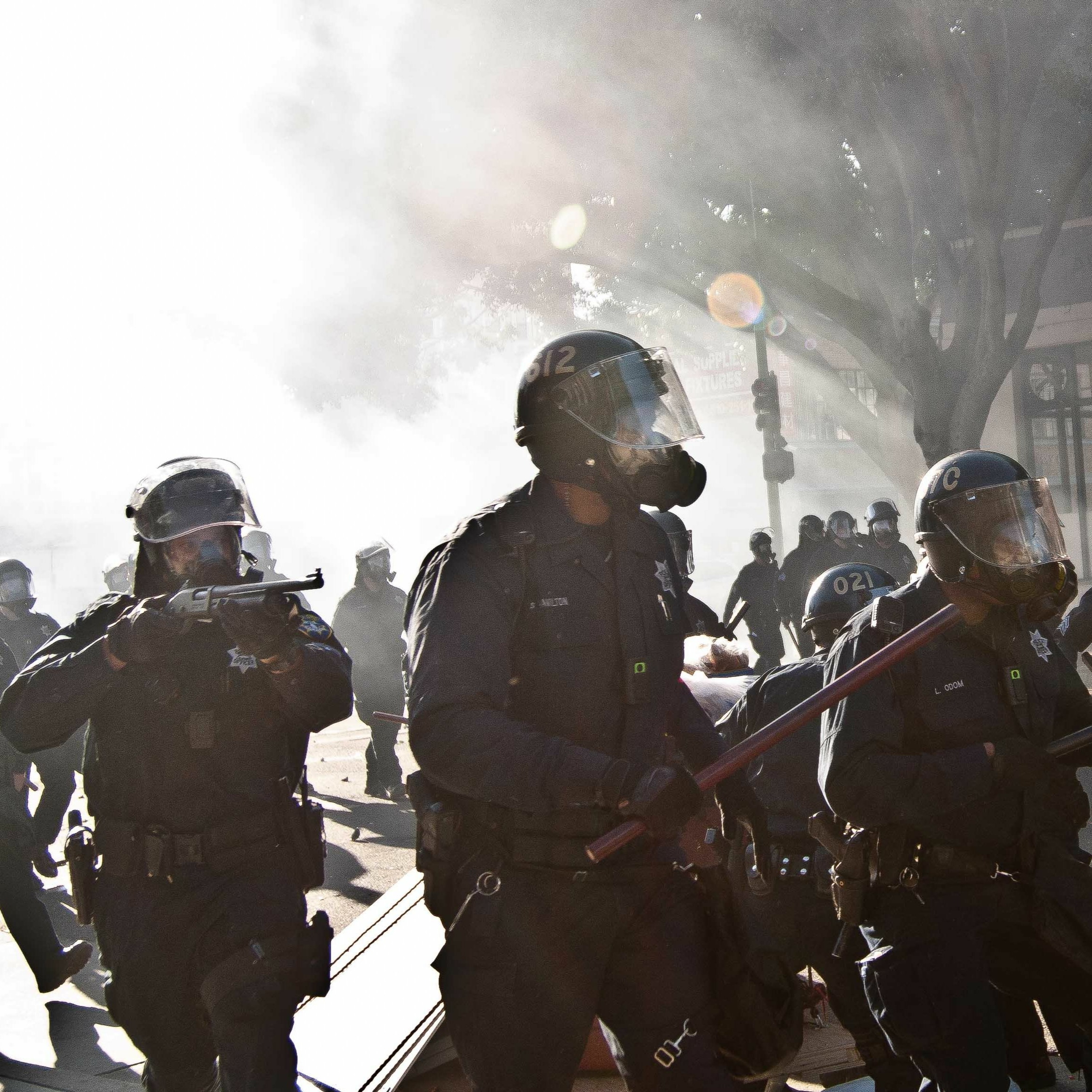
“Is reform possible?”: Investigating Oakland’s dysfunctional police department
Journalists Ali Winston and Darwin Bondgraham have been investigating the Oakland Police Department for more than a decade. Their coverage of violent misconduct, corruption, and sexual abuse has led to multiple resignations and terminations within the department, but even more shocking is the relative lack of consequences for many of the officers responsible for this illegal behavior. Winston and Bondgraham’s new book “The Riders Come Out at Night: Brutality, Corruption, and Cover Up in Oakland” proves that this pattern of impunity has characterized the department since its very inception. “The Riders Come Out at Night” compiles more than a century of OPD scandals in order to understand why the department has been unable to reform itself according to the demands of a court-ordered consent decree, despite two decades of federal oversight. History repeats itself in scandal after scandal as a toxic stew of racism, machismo, resentment, carelessness and lethal violence is brushed aside or even rewarded, while taxpayers cover the costs and victims’ families are left devastated. For Oaklanders desperately yearning for safer streets, this book paints a sad and frustrating picture about the relationship between law enforcement and public safety. On January 21, I recorded an interview with Winston and Bondgraham in front of a live audience at Clio’s Books in Oakland. We discussed the history of the Oakland Police Department, the current scandal that has resulted in Chief LeRonne Armstrong being placed on administrative leave, and much more. For more info, visit: https://eastbayyesterday.com/episodes/is-reform-possible/ East Bay Yesterday can’t survive without your support. Please donate to keep this show alive:www.patreon.com/eastbayyesterday
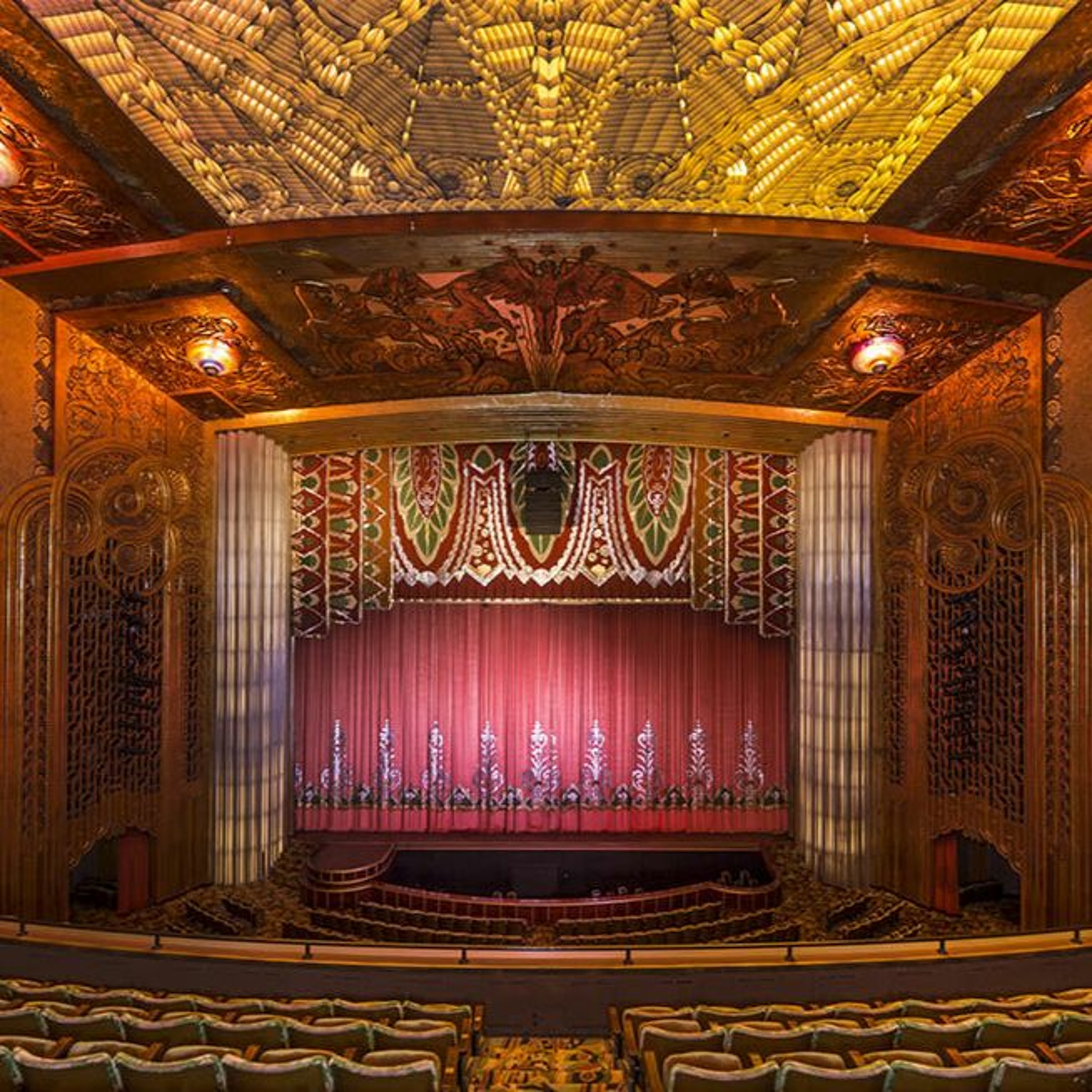
Saved from the wrecking ball: The resurrection of Oakland’s Paramount Theater
Oakland’s Paramount Theater is now recognized as one of the grandest examples of Art Deco architecture still in existence, but this masterpiece almost met the same fate as many other prestigious movie palaces of its era. Originally constructed in 1931, the Paramount was a torn and tattered dump by the late 1960s. At the time, the Oakland Symphony was looking for a new home, and its leaders realized that beneath decades of grime lay a unique gem. After extensive restoration, the Paramount reopened in 1973, and has been hosting icons like Bob Marley, Prince, Diana Ross, Bruce Springsteen, Jerry Seinfeld, and Chris Rock ever since. On today’s episode, the Paramount’s head curator David Boysel discusses the turbulent history of this 2,996-seat venue as well as the backstory to his never-ending quest to keep the building in perfect condition. Expect to hear about the Paramount’s famed architect Timothy Pflueger, the many historical mysteries that Boysel has solved over the years, the network of local artisans who keep the Paramount looking pristine, and much more. One additional note: This episode is a followup to a profile that I wrote for SF Gate last month. To see some truly stunning photos of the Paramount in all its glory and to read the article, visit: https://www.sfgate.com/local/article/paramount-theatre-curator-david-boysel-17595816.php If you have suggestions for topics I should cover in an upcoming article, please drop me a line: eastbayyesterday [at] gmail. I’m primarily interested in East Bay-related stories with a local history angle.
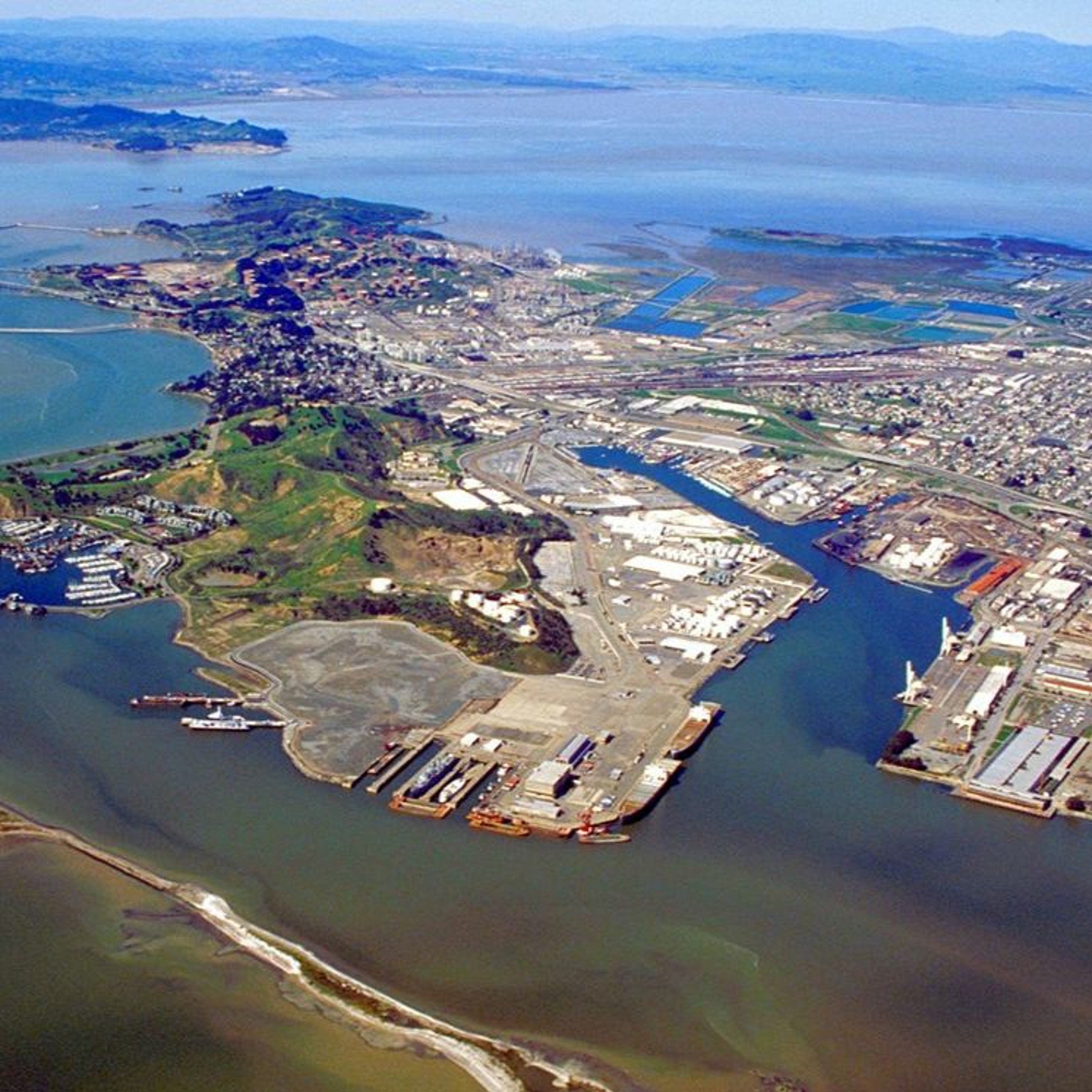
Rooted in Richmond: Touring a "cultural gold mine"
For the past year, I’ve been part of a team developing Rooted in Richmond, a free app that allows visitors to take a self-guided tour through the city’s history. The tour covers 16 locations over 6 miles and includes maps, photos, videos, 3D renderings of historic objects, and more. Topics range from sacred Ohlone shellmounds to the formation of environmental justice groups in the wake of a toxic industrial accident. Now that the app has launched, I wanted to share a preview of the oral histories I gathered to accompany various tour stops. In this episode, you’ll hear audio clips featuring: –Shirley Ann Wilson Moore on how Black residents stood up against a front yard cross-burning –Flora Ninomiya on what happened to flower nurseries owned by Japanese-Americans during World War II –Melinda McCrary on saving a long-long treasure from a flooded basement –Ahmad Anderson on how Martin Luther King Jr’s visit inspired a generation of Black political leaders –Rebeca Garcia-Gonzalez on the remarkable transformation of a trash-strewn lot into a community oasis -Bonus segment: Shirley Ann Wilson Moore on why so many blues clubs were run by women Joining me on today’s episode is Desiree Heveroh, a born and raised Richmondite who is currently the innkeeper at Point Richmond’s historic Hotel Mac and also a live-in caretaker aboard the SS Red Oak Victory, the last surviving vessel manufactured at the Kaiser Shipyards during World War II. Desiree is also the former director of the Richmond Museum of History and Culture and she spent the first 14 months of the pandemic living in Richmond’s oldest building, the East Brother Light Station, which was built on a tiny island in the Bay in 1873. For more info and to see photos related to this episode, visit https://eastbayyesterday.com/episodes/rooted-in-richmond/
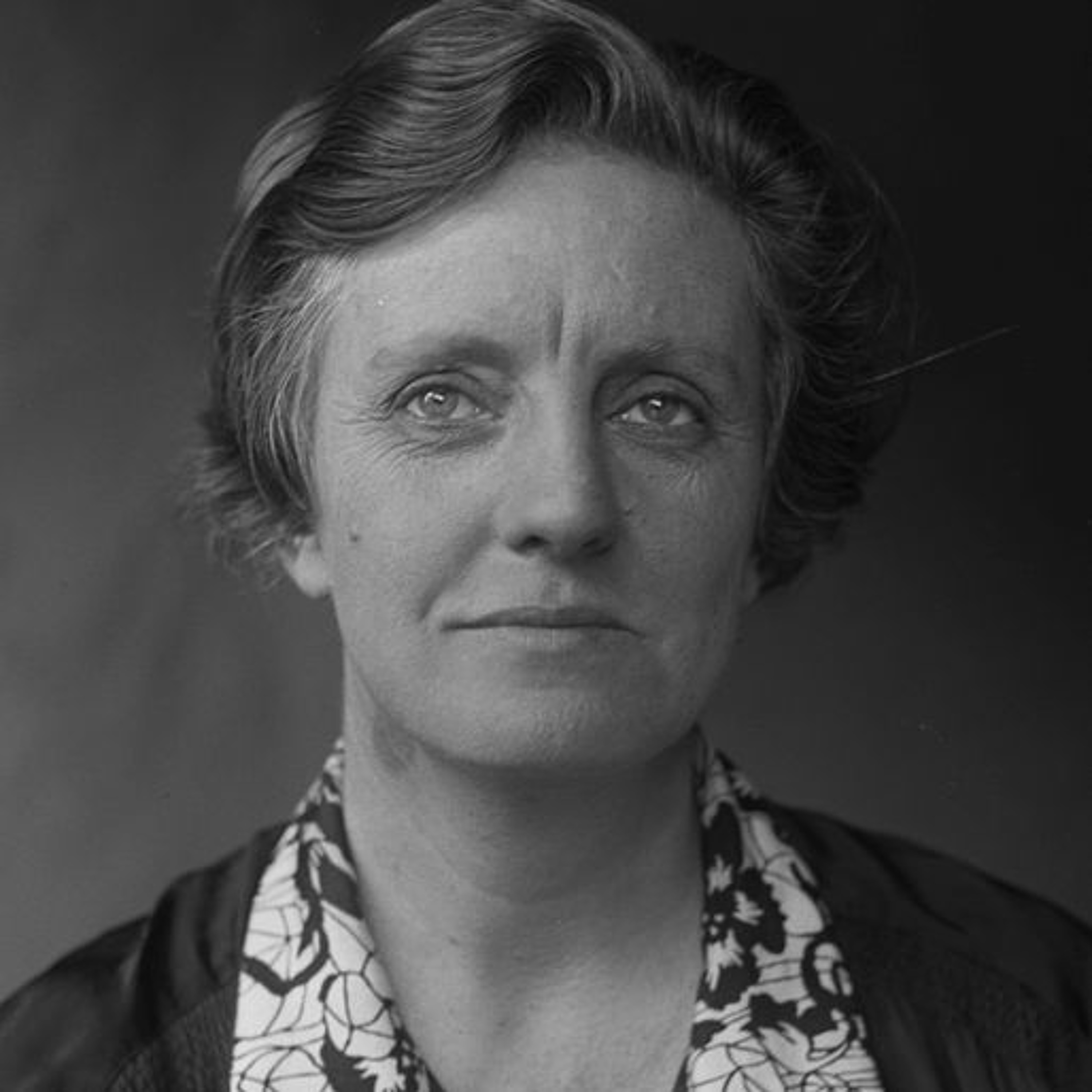
What happened to “America’s most-read woman”? Rediscovering Elsie Robinson
Elsie Robinson was a pioneer of women in media, an early advocate for equal rights, and at one point the highest-paid woman writer in the nation. Before launching her journalism career, Elsie’s life was an astonishing rollercoaster that included everything from a marriage to a wealthy Victorian gentleman to a job working deep within the bowels of the Sierra foothills mining for gold. So how is it possible that her name has been largely forgotten? Julia Scheeres and Allison Gilbert confront this mystery in a fascinating new biography called “Listen, World! How the Intrepid Elsie Robinson became America’s Most-Read Woman.” In this episode, recorded at the Oakland Library in front of a live audience, we discuss Robinson’s unlikely rise from the Oakland Tribune to the upper echelons of national media, her legacy, and the challenges of uncovering this nearly forgotten story. To see photos and links related to this story, visit: https://eastbayyesterday.com/episodes/what-happened-to-americas-most-read-woman/ East Bay Yesterday can’t survive without your support. Please donate to keep this show alive: www.patreon.com/eastbayyesterday
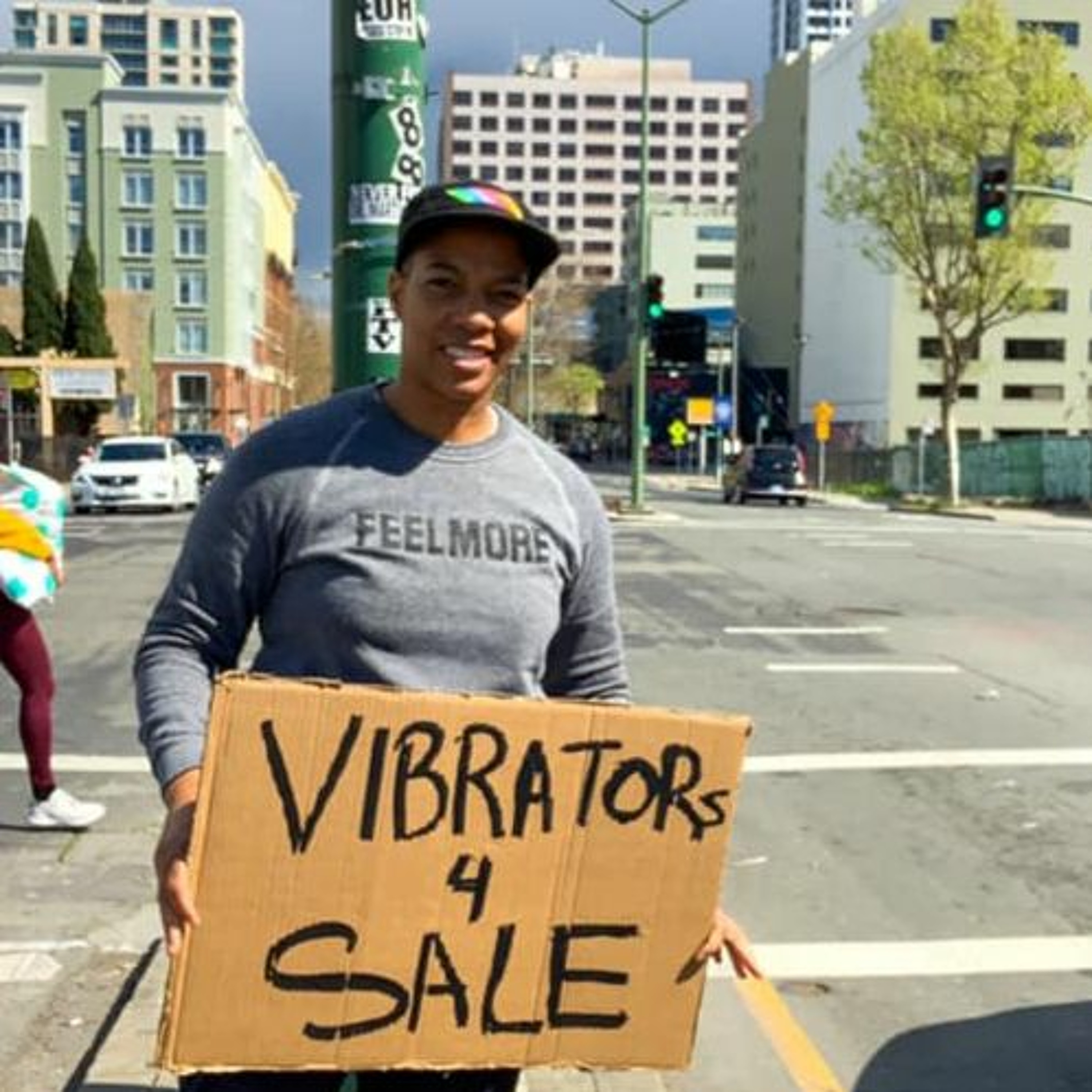
“It’s okay to talk about sex toys”: Nenna Joiner digs deep into pleasures of the past
After years of working a corporate job in downtown Oakland, Nenna Joiner woke up one morning with a dream: They wanted to be in the sex industry. After their job applications were rejected by every adult pleasure shop in the area, Nenna decided to launch their own business. They started by selling sex toys and porn DVDs out of a box at bars (and sometimes even at BART stations), but from these humble beginnings grew a mini-empire. More than a decade later, Nenna now owns two Feelmore Adult Galleries, plans to open a sex-themed bar called Feelmore Social later this year, and is running for a seat on Oakland’s City Council. Nenna’s first position in politics was as a member of the Landmarks Preservation Advisory Board, which led them to an interest in the East Bay’s sex history. Years of purchasing adult artifacts from Oakland collectors and now-defunct sex shops deepened their knowledge of former bordellos, theaters, underground sex clubs, and nightlife institutions. For obvious reasons, “sex history” isn’t an easy topic to document, but in this episode Nenna discusses everything from how to find brothels on old maps to their personal journey in the sex industry. To hear about why Ronald Reagan is responsible for the lack of strip clubs in Oakland, the rise and fall of burlesque theaters, the unintended consequences of the Red Light Abatement Act, and much more, listen to the full episode now. To see photos related to this story, visit: https://eastbayyesterday.com/episodes/its-okay-to-talk-about-sex-toys/ East Bay Yesterday can’t survive without your support. Please donate to keep this show alive: www.patreon.com/eastbayyesterday
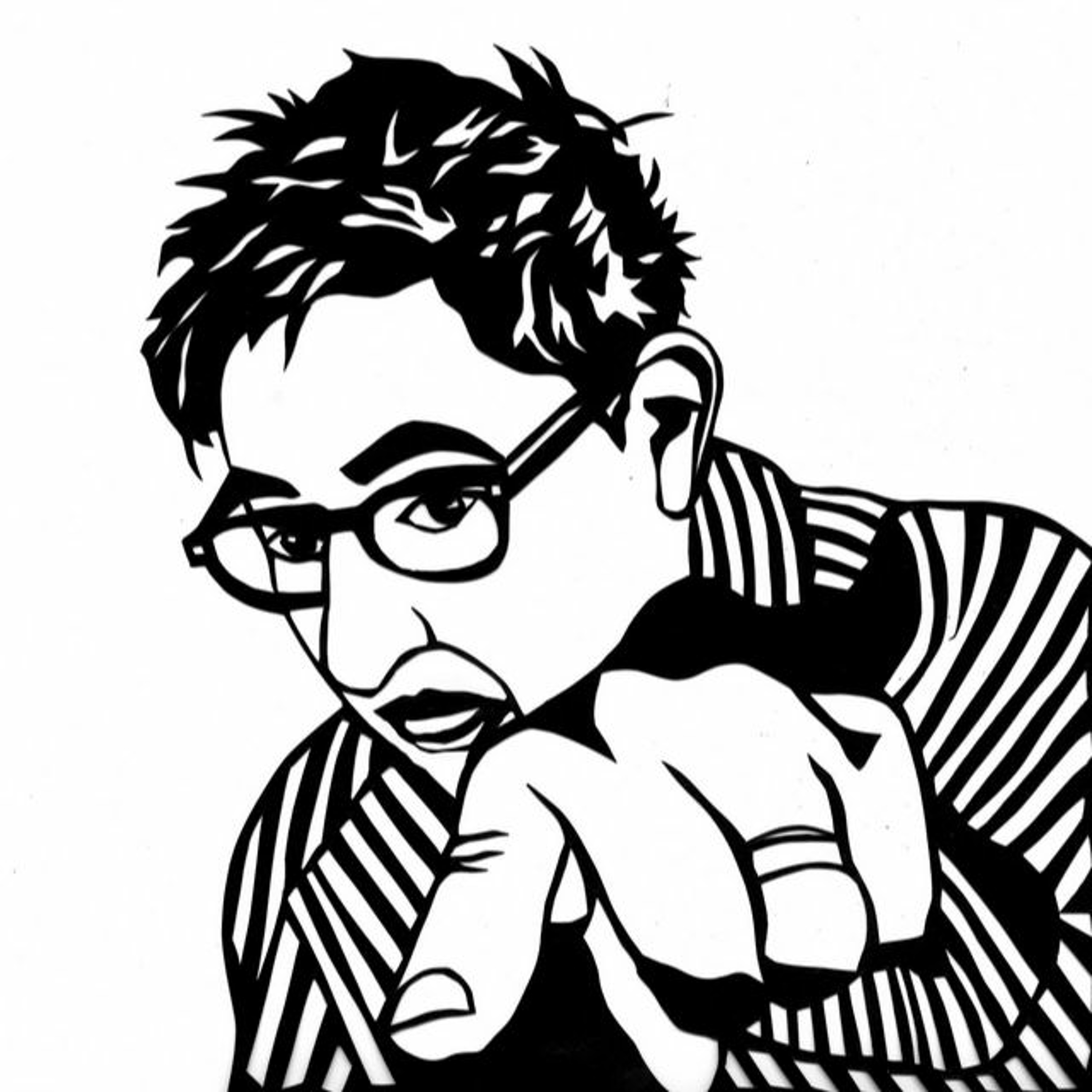
Nurses, Novelists, Politicians, and Punks: Miriam Klein Stahl’s “Hella Feminist” portraits
Miriam Klein Stahl came to the Bay Area in the late ‘80s seeking a community of queer punks that she’d read about in underground zines like Homocore. She wasn’t a musician, but she loved working with her hands and quickly realized that she could contribute to this thriving scene by drawing flyers and creating illustrations. Miriam’s rebellious passion infused her heavily politicized images with confrontational power and urgency. More than three decades later, she’s still making radical art, but now her work is adorning museums as well as punk clubs. An entire wall of the Oakland Museum of California’s Hella Feminist exhibition is covered with 200 paper-cut portraits of “women/nonbinary humans whose lives and work intersect and impact the East Bay.” These figures range from Gilded Age bohemian poets and pre-WWII civil rights leaders to witches, welders, and high school activists. The co-creator of this Hella Feminist portrait project is local author Kate Schatz, who Miram also collaborated with for a series of best-selling books such as “Rad American History A-Z” and “Rad Women Worldwide.” In this episode, Miriam discusses her philosophy of public art, her career as an art teacher at Berkeley High, and the histories of the women and nonbinary people featured in her illustrations. See images related to this episode at: https://eastbayyesterday.com/episodes/nurses-novelists-politicians-and-punks/ East Bay Yesterday can’t survive without your support. Please donate to keep this show alive: www.patreon.com/eastbayyesterday
“What made Julia Morgan different?”: Exploring the early years of a superstar architect
Julia Morgan wasn’t just one of the most renowned architects of the 20th century, she was a true pioneer of her profession. She was the first woman to be admitted to the École des Beaux-Arts in Paris, which was the most important architecture school of its era, as well as the first woman in California to earn an architecture license and eventually the first woman to win the American Institute of Architects’ highest honor. Then there’s her buildings. She’s best known for Hearst Castle, but over her long career she designed hundreds of impressive structures – the Berkeley City Club, Oakland’s YWCA, the Asilomar Conference Center, El Campanil at Mills College, and the list goes on and on. As a woman, Morgan didn’t always get the recognition she deserved, but in more recent decades, she’s been the subject of numerous books, documentaries, and museum exhibits. However, a new book takes a different approach by imagining Julia’s early years, as a young woman growing up in Victorian era East Bay. In “Drawing Outside the Lines,” Susan J. Austin tells the story of the architect’s formative time at Oakland High School and UC Berkeley during the 1880s and 90s. The book is a work of historical fiction, but Austin spent years on research in order to make the story as realistic as possible. In this episode, Susan J. Austin discusses her favorite Julia Morgan buildings, why she thinks Julia Morgan’s story will be relevant for young readers, and some of the famous figures, such as Gertrude Stein and Frank Norris, who make cameo appearances in “Drawing Outside the Lines.” To see photos related to this episode: https://eastbayyesterday.com/episodes/what-made-julia-morgan-different/ East Bay Yesterday can’t survive without your support. Please donate to keep this show alive: www.patreon.com/eastbayyesterday
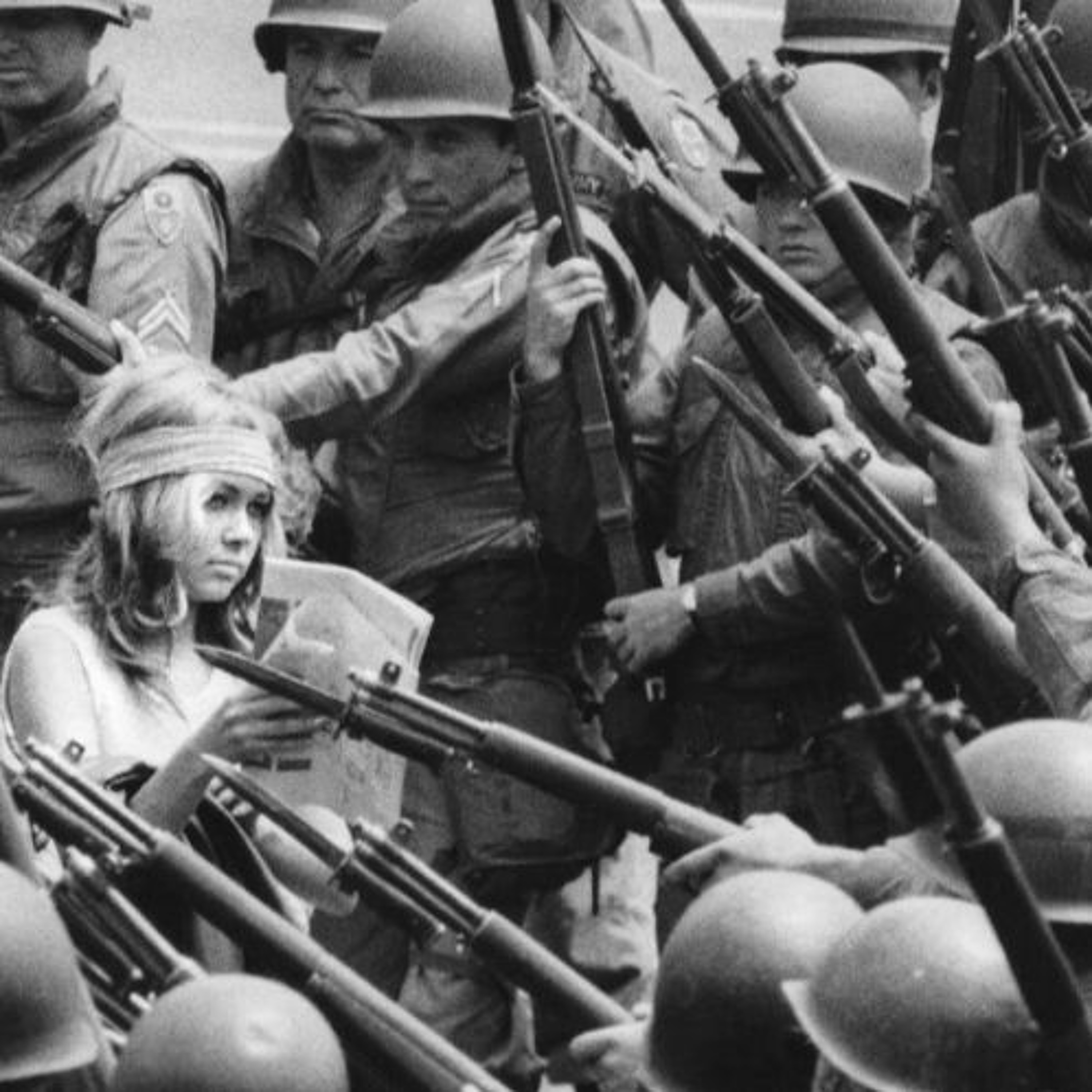
“If it takes a bloodbath, let's get it over with”: When Ronald Reagan sent troops into Berkeley
[This is a re-broadcast of an episode originally aired in 2019.] 50 years ago, a group of students, activists and community members transformed a muddy, junk-filled parking lot into a park. When the University of California, under heavy pressure from Gov. Ronald Reagan, tore up the grass and surrounded the land with a heavily-guarded fence, this response triggered a surreal and tragic set of events. The maelstrom of violence that engulfed Berkeley in May 1969 would be almost impossible to believe if the cameras hadn't been rolling. Dozens were shot, hundreds were arrested, and thousands were teargassed – protesters and innocent bystanders alike. During the military occupation of Berkeley by National Guardsmen, a helicopter launched a chemical attack on the University campus, children were surrounded by bayonet-wielding soldiers, and journalists were detained under the supervision of brutally sadistic guards. Amidst this upheaval, Gov. Reagan told a group of reporters, “If it takes a bloodbath, let’s get it over with, no more appeasement.” This episode explores the conflict with Tom Dalzell, the author of “The Battle for People’s Park” (Heyday Books), and through archival audio captured by KPFA-FM reporters in 1969 and 1970. If you enjoy the episode, please support East Bay Yesterday: www.patreon.com/eastbayyesterday To see photos related to this episode: https://eastbayyesterday.com/episodes/if-it-takes-a-bloodbath-lets-get-it-over-with/ To purchase “The Battle for People’s Park, Berkeley 1969”: https://aerbook.com/maker/productcard-4196911-4706.html Episode art: Photo: Ted Streshinsky; courtesy of the Streshinsky Family. Image used by kind permission of Heyday Books.
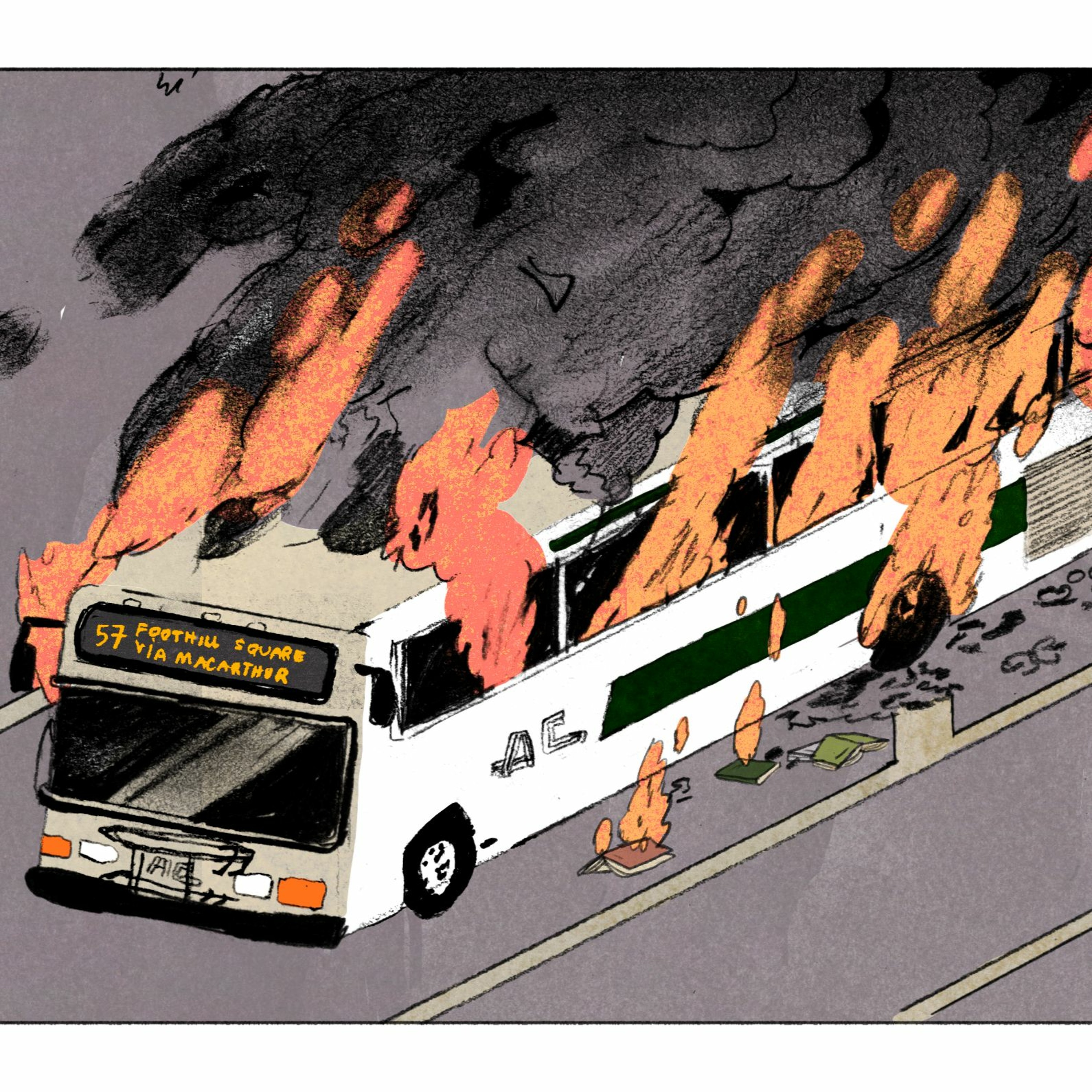
“They’re scared of this book”: Oakland history under attack
Over the past few years, there’s been a huge upsurge in efforts to remove books about gender and race from libraries and schools, and in some cases even ban them from being sold to minors altogether. One of the books frequently targeted by these campaigns is “The 57 Bus,” which examines a 2013 incident involving a nonbinary teenager who was lit on fire by an Oakland High student while taking AC Transit home from school. The book was a bestseller and won critical acclaim for its nuanced portrayal of what it’s like to be a young person who doesn’t fit into “traditional” gender roles, as well as its critical look into the failings of America’s criminal justice system, but now it’s being illegitimately denounced as “pornographic” by parents parroting the talking points of conservative organizations like Moms for Liberty. In reality, there’s nothing sexual in the book—they’re simply scared of it. Besides book banning, there are hundreds of anti-LGBTQ laws being proposed across the country right now, not to mention rising cases of violent intimidation like the Proud Boys’ disruption of a “Drag Queen Story Hour” event right here in the East Bay earlier this month. Amidst this reactionary backlash, I interviewed the author of “The 57 Bus,” Dashka Slater, a longtime Oakland resident and former East Bay Express staff writer. In this episode, we discuss the battle over controversial books, the political power of historical narratives, and, of course, the disturbing crime at the center of “The 57 Bus.” Listen now on Apple, SoundCloud, Spotify, or wherever you get podcasts. To see images related to this story, visit: https://eastbayyesterday.com/episodes/theyre-scared-of-this-book/ East Bay Yesterday can’t survive without your support. Please donate to keep this show alive: www.patreon.com/eastbayyesterday
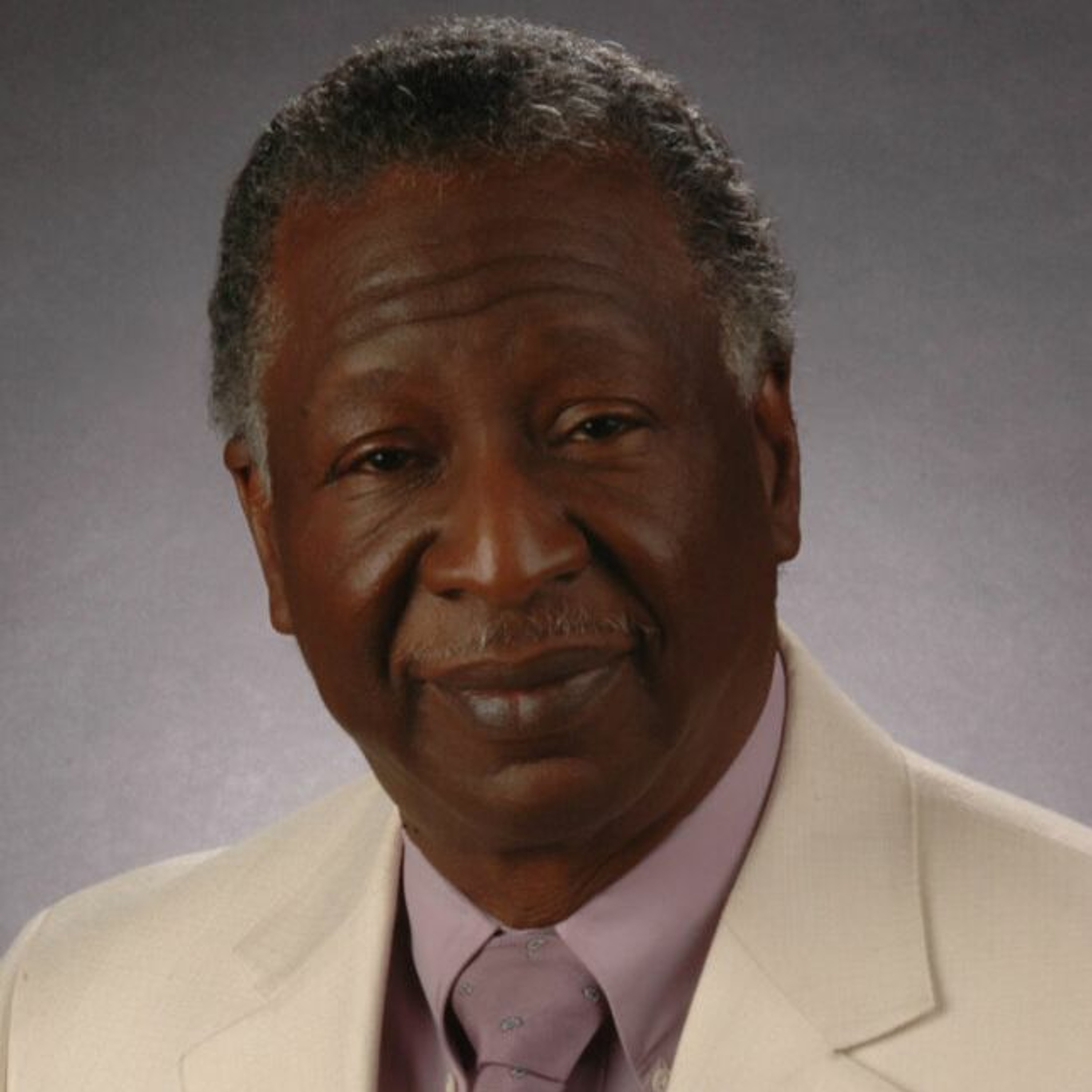
“Oakland isn’t a bad place”: Ed Howard’s lifelong mission to uplift The Town
Looking back to the West Oakland of his childhood during the World War II era, Ed Howard remembers a place where kids felt safe roaming the streets, Black businesses thrived along 7th Street, and a flood of newcomers from the South created a prosperous, tight-knit community. His own memories present a jarring contrast to the contemporary media’s portrayal of this neighborhood as a dangerous slum. “Any time they see a group of Black people together, they say it’s bad,” Ed recalled. “But me and my friends weren’t bad. And Oakland isn’t bad.” From his early days as community organizer based in DeFremery Park, Ed was motivated to challenge these negative messages, and as he climbed each level of his career ladder, he brought friends from his community with him. After becoming one of the first Black mechanical engineers at Kaiser Industries, he created a program to train and hire more Black workers, a model that was soon adopted by other local companies in the 1960s. Ed went on to produce “Black Dignity,” one of the first TV talk shows hosted by an African American. His resume doesn’t end there: Ed built a thriving nightclub in East Oakland, he created a consulting firm to help launch other Black businesses, he directed a documentary about Ron Dellums, and he even invented a comb specifically designed for Black hair. Now, at the age of 84, Ed is running the West Oakland Stories Positive Feeling Movement, a local history project aimed at countering persistently derogatory narratives about his home town. In this episode, Ed Howard shares the life lessons that informed his philosophy of positivity. Considering the seemingly nonstop barrage of horrific news that we’re all now constantly bombarded with, I’ll admit I was a little skeptical at first, but Ed won me over with his pragmatic optimism. If you’re feeling depressed, cynical, and frustrated, listening to Ed share the wisdom he’s gained from overcoming countless challenges might just give you a glimmer of hope. You can learn more about West Oakland Positive Feeling Movement and donate here: http://westoaklandstories.org/
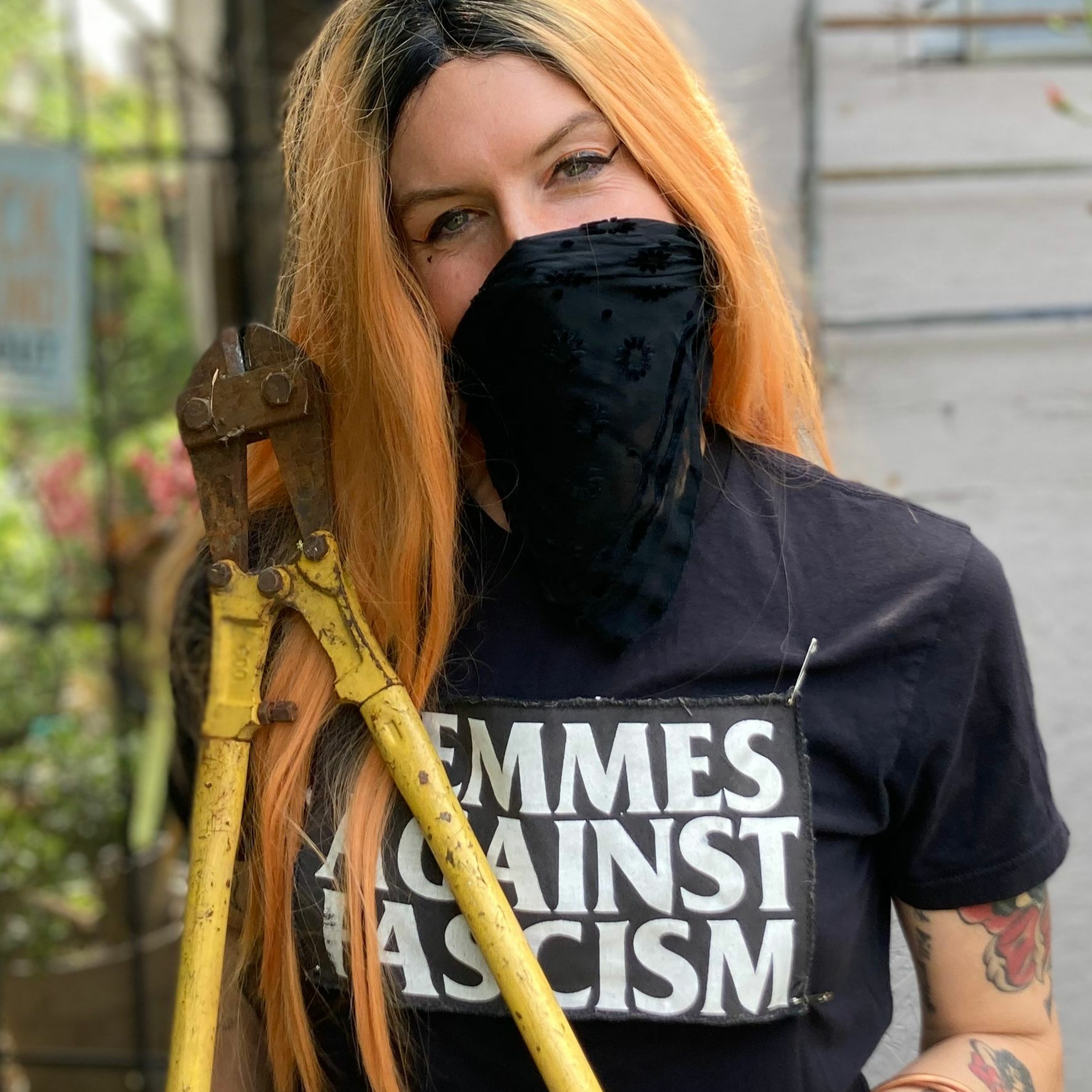
How to not pay rent: Long-term squatter Violet Thorns on “the art of becoming untouchable”
Instead of waiting around for a solution to California’s housing crisis, about a decade ago Violet Thorns decided to move into one of the hundreds of vacant homes scattered throughout Oakland. During the Occupy era, she was part of a loose network of dozens of squats, but since then nearly all of those were evicted as local property values soared. After her community crumbled, Violet found herself living in a squalid, burned out building with no money and few resources. As a trans woman she was desperate to remain in the Bay Area, despite not being able to afford this region’s astronomical rents. Then one day, she noticed a vacant lot on a residential street that was so overgrown with fennel that she knew the owners hadn’t been there for years. Today’s episode is about how Violet built a tiny home and a thriving garden on that abandoned land and gotten away with living there for nearly eight years without paying rent. Listen now to hear about the rise and fall of an anarchic squatting scene, how to deal with angry landlords, the Gold Rush-era laws squatters use to stave off evictions, guerilla gardening tips, and much more. See photos related to this episode at: https://eastbayyesterday.com/episodes/how-to-not-pay-rent/ East Bay Yesterday can’t survive without your support. Please donate to keep this show alive: www.patreon.com/eastbayyesterday
“They wouldn’t sell us rice”: A Filipina elder’s memories of survival and song
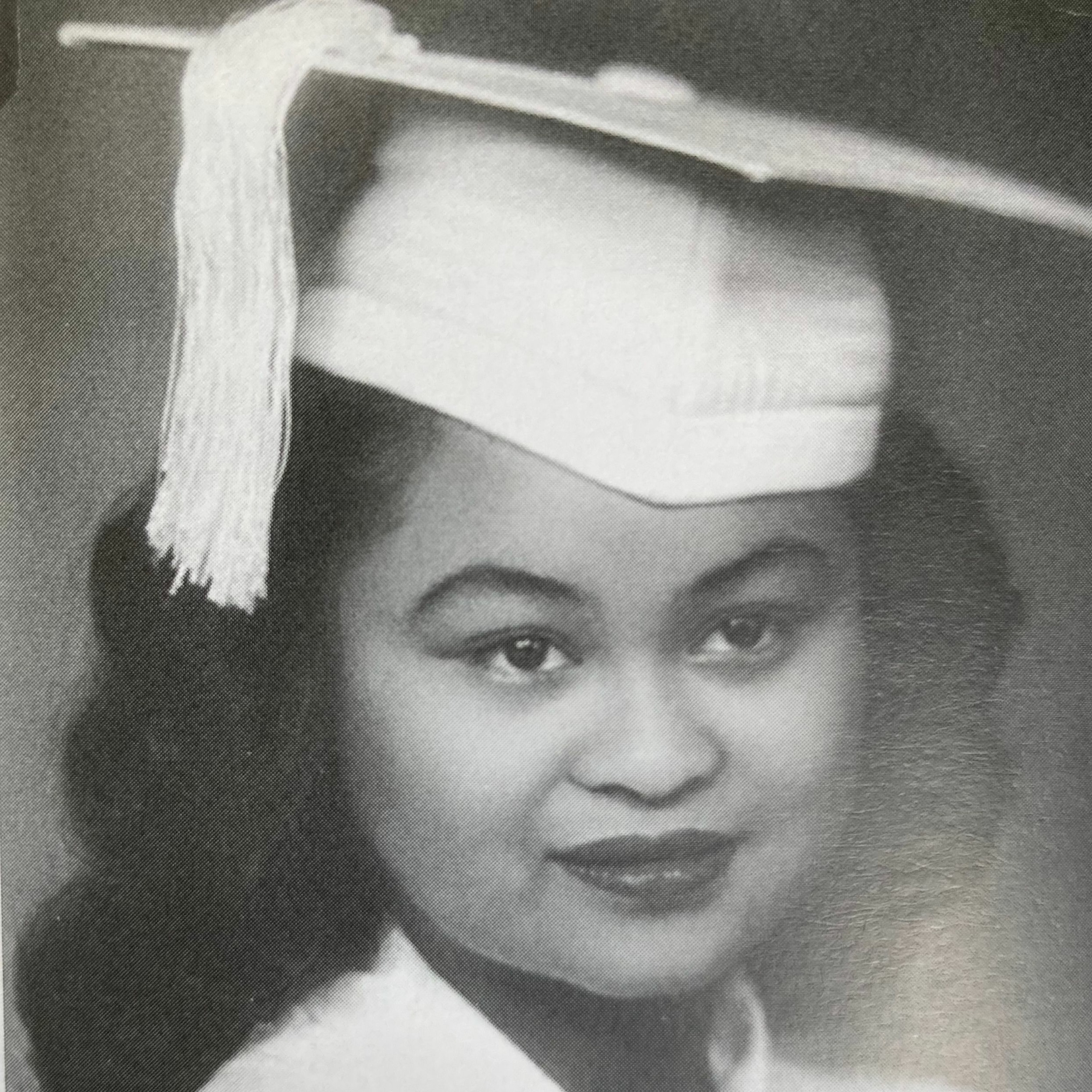
Growing up in West Oakland during the 1940s, Evangeline Canonizado Buell remembers the neighborhood as “a melting pot of… adobo, linguisa, tamales, blues, and jazz.” From an early age, this child of Filipino immigrants learned how to connect with her Black, Portuguese, Mexican, Greek and Japanese neighbors through food and music, skills that she later built into careers as a guitar teacher, historian, and program coordinator for the Berkeley Co-Op. Her memoir, “Twenty-Five Chickens and a Pig for a Bride,” intertwines her personal journey of overcoming abuse and discrimination with the growth of California’s Filipino community, mixing tantalizing stories of backyard pig roasts with infuriating memories of racist harassment. In this episode, Evangeline shares some of the wisdom, humor, and music that she’s accumulated throughout her nine decades living in the East Bay. Listen now to hear a conversation that covers everything from the agricultural origins of Bay Farm Island to the long legacy of the Spanish-American War. See photos related to this episode at: https://eastbayyesterday.com/episodes/they-wouldnt-sell-us-rice/ East Bay Yesterday can’t survive without your support. Please donate to keep this show alive: www.patreon.com/eastbayyesterday
From playgrounds to the pros: The rise (and fall?) of Oakland as a sports mecca
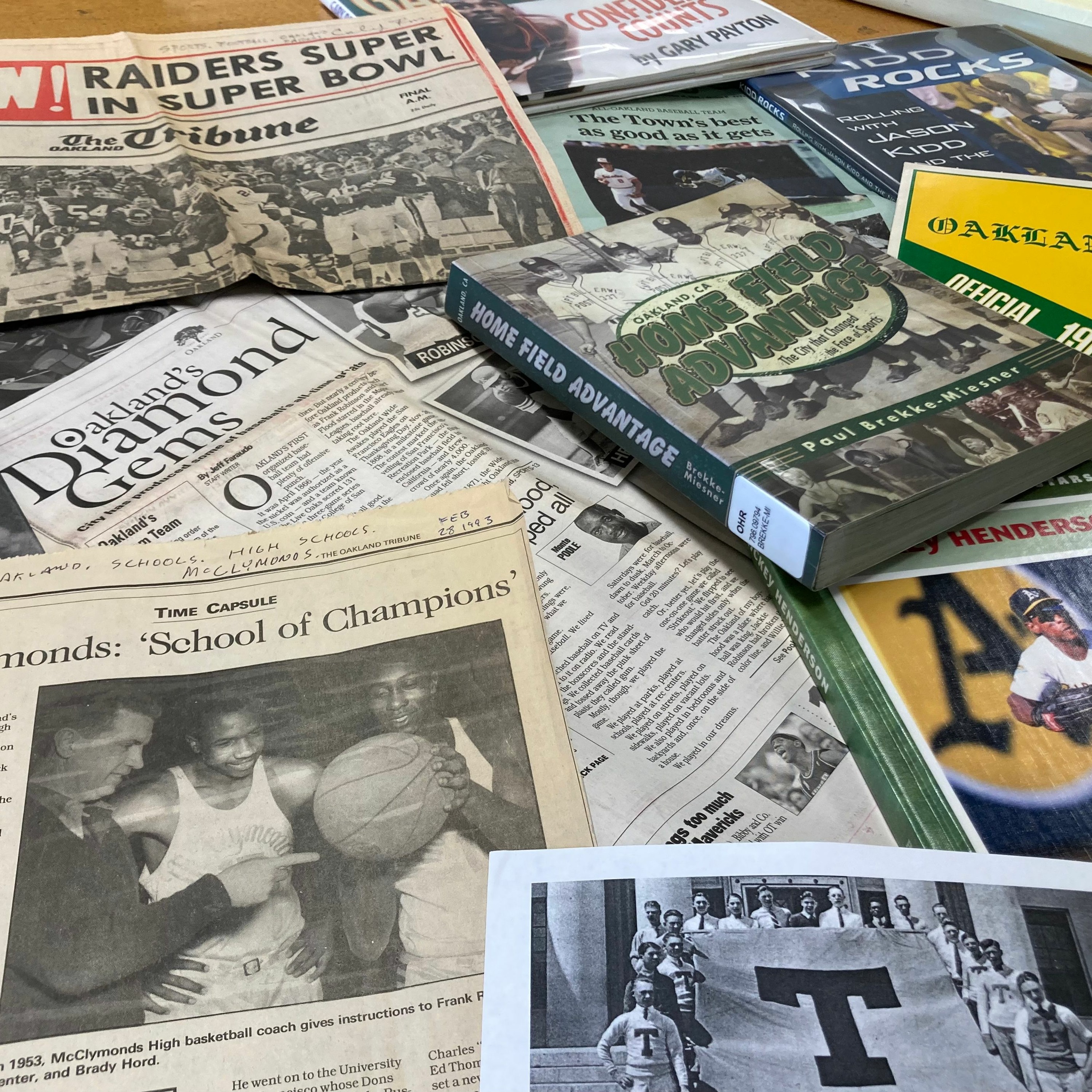
Why has Oakland produced so many all-star athletes? This is the question that propels Paul Brekke-Miesner’s book “Home Field Advantage: The City That Changed the Face of Sports” through decades of local history, from the playgrounds to stadiums. His exploration helps explain not only the origins of this highly concentrated pool of athletic ability, but also why so many local stars have used their visibility to call attention to social struggles, long before Colin Kaepernick famously took a knee to protest police violence. An Oakland native who grew up playing ball in the Eastmont neighborhood and began covering sports at Castlemont High more than half a century ago, Brekke-Miesner brings deep knowledge about such iconic athletes as Bill Russell, Ricky Henderson, Frank Robinson, Curt Flood and many others to our conversation in this episode. Along the way, we also discuss the impact of Prop. 13 on youth sports, some very unlikely superstars, and why The Town might be better off without the billionaire owners who keep breaking our hearts. To see photos related to this episode, visit: https://eastbayyesterday.com/episodes/from-playgrounds-to-the-pros/ East Bay Yesterday can’t survive without your support. Please donate to keep this show alive: www.patreon.com/eastbayyesterday
“They were real macks”: How the Ward Brothers inspired a cult classic
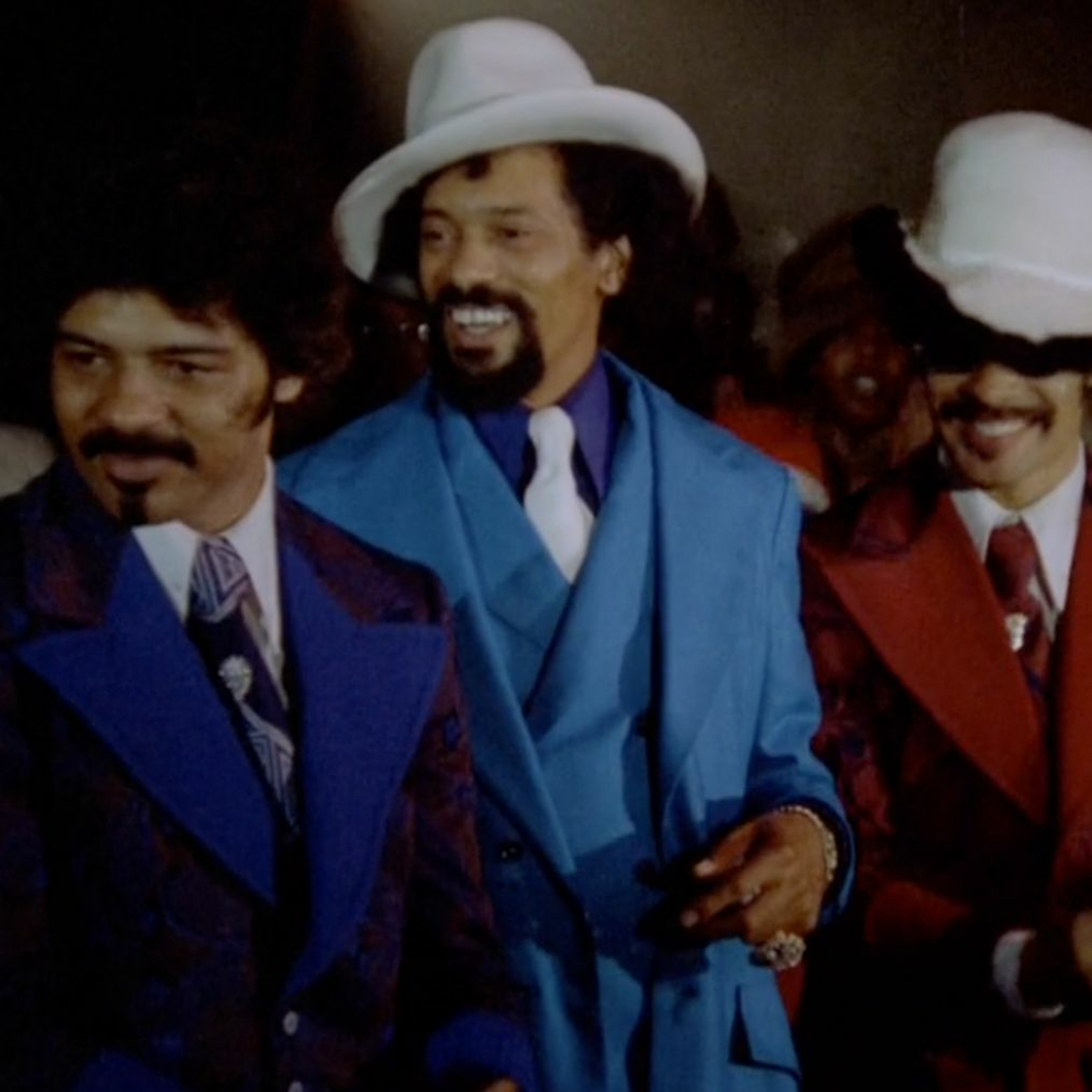
Although most “blaxploitation” flicks from the 1970s were action thrillers, “The Mack” feels more like a documentary. The film was shot on location in pool halls, barber shops and speakeasies throughout Oakland and features real people, not professional actors, as extras. But the driving force of the film’s authenticity came from the Ward Brothers, a family of pimps who dominated the Bay Area’s underground sex trade during this era. The movie’s protagonist, Goldie, was modeled on Frank Ward, the crew’s charismatic leader, and the rest of the brothers lent their clothes, cars, and expertise to the production, which was filmed on a shoestring budget. Immortalized by dozens of rap hits that sampled the film’s streetwise dialogue and funky soundtrack, “The Mack” went on to become a cult classic that’s still relevant five decades after its release. However, Frank Ward never got to enjoy the film he inspired – along with Blanche Bernard, he was murdered in October 1972, sparking a persistent rumor that the Black Panthers were involved in his assassination. Now, on the 50th anniversary of this unsolved crime, Oakland native Chloe Sylvers has published “The Fabulous Ward Brothers,” the first book to explore the real origins of this family’s brief empire, investigate the double homicide that shattered them, and separate facts from sensationalized myths. Listen now to hear how she tracked down the story of “the original macks.” To see more photos related to this episode, visit: https://eastbayyesterday.com/episodes/they-were-real-macks/ East Bay Yesterday can’t survive without your support. Please donate to keep this show alive: www.patreon.com/eastbayyesterday
“A new Pacific frontier”: The beginnings of Berkeley
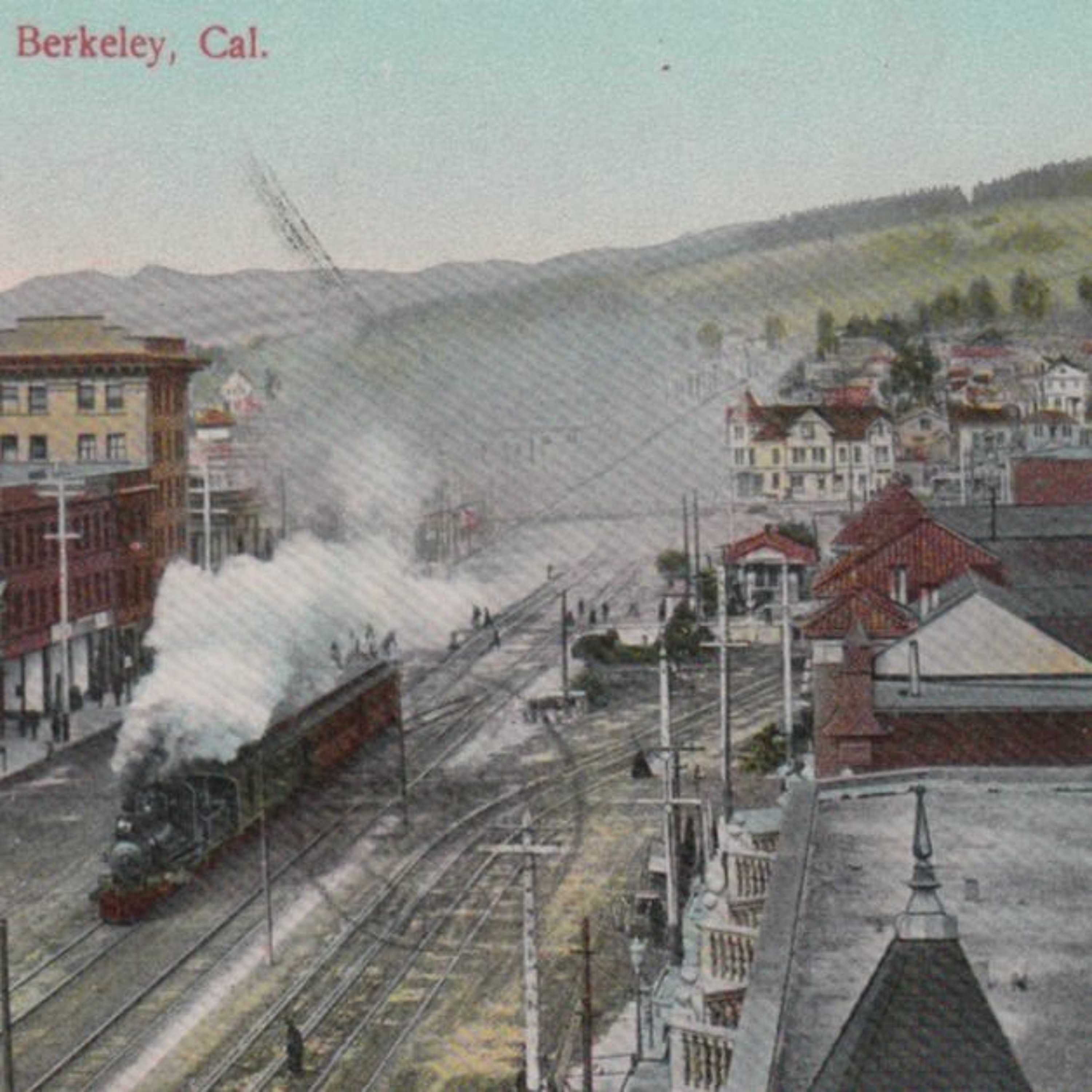
In many ways, Berkeley is a city defined by dichotomies. The hills and the flatlands, academia and industry, counterculture and The Establishment. Despite the city’s progressive reputation, Berkeley has never been a monolithic place. The tensions between conflicting political and cultural forces are what have made it so dynamic and unique. Although Berkeley’s reputation will forever be tied to the student uprisings of the 1960s, the century or so leading up to those conflicts is just as fascinating. Charles Wollenberg wrote the definitive book on Berkeley’s early years, “Berkeley: A City in History” (UC Press) and on today’s episode we cover major milestones between the Gold Rush and the Great Depression. Listen now to hear about Berkeley’s first businesses, a socialist mayor, some very ironic squatters, Bernard Maybeck, single family zoning laws, Phoebe Hearst, a boozy urban legend, and even an extremely symbolic sword fight. To see photos related to this episode, visit: https://eastbayyesterday.com/episodes/a-new-pacific-frontier/ East Bay Yesterday can’t survive without your support. Please donate to keep this show alive: www.patreon.com/eastbayyesterday
"He stole the town": Oakland's founding father was a villain
Some cities were founded by warriors, prophets, or idealistic visionaries. The man who established Oakland was an unscrupulous lawyer looking to get rich quick. This 1877 newspaper quote captures the sentiment shared by many residents about The Town’s first mayor: “If the early settlers had taken Horace W. Carpentier to a convenient tree and hung him, as they frequently threatened to do, the act would have been beneficial to immediate posterity.” Featuring an interview with local historian and author Dennis Evanosky, this episode travels back to Oakland’s origins to explore what made our founding father such a widely detested villain. See photos related to this episode here: https://eastbayyesterday.com/episodes/he-stole-the-town/ East Bay Yesterday can’t survive without your support. Please donate to keep this show alive: www.patreon.com/eastbayyesterday
“Black Art was her language”: Searching for the mother of a movement
In 1968, an exhibition titled “New Perspectives in Black Art” opened in the Kaiser Center Gallery of the Oakland Museum. The show was curated by Evangeline “E.J.” Montgomery, a woman who was at the nucleus of the West Coast’s vibrant Black Arts movement during that radical era. According to Montgomery, the “New Perspectives” collection was “the first time that a Black Arts association has organized and set up their own art exhibit in a museum of this size.” Now, more than five decades later, Oakland-raised radio producer Babette Thomas is revisiting the life and legacy of E.J. Montgomery in a new season of SFMOMA’s Raw Material podcast called “Visions of Black Futurity.” Across seven episodes, Thomas will explore the local roots of the Black Arts movement to understand how this often overlooked past could inform the kind of future they want to see, a future of Black creative expression released from the limitations of traditional art institutions. Explaining why they chose to focus this series on E.J. Montgomery, Thomas explained, “Black Art was her language, and she used it to advocate for the role and work of Black artists and ensure that Black art was accessible to the communities to whom it mattered to the most.” Listen to the podcast now to hear episode one of Raw Material’s “Visions of Black Futurity” and an interview with Babette Thomas covering what they discovered about the history of California Black Arts while making this series. See photos related to this episode here: https://eastbayyesterday.com/episodes/black-art-was-her-language/ More about Raw Material: https://www.sfmoma.org/raw-material-a-podcast-from-sfmoma/ East Bay Yesterday can’t survive without your support. Please donate to keep this show alive: www.patreon.com/eastbayyesterday
"More than just the 1960s": Following the footsteps of rock & roll legends
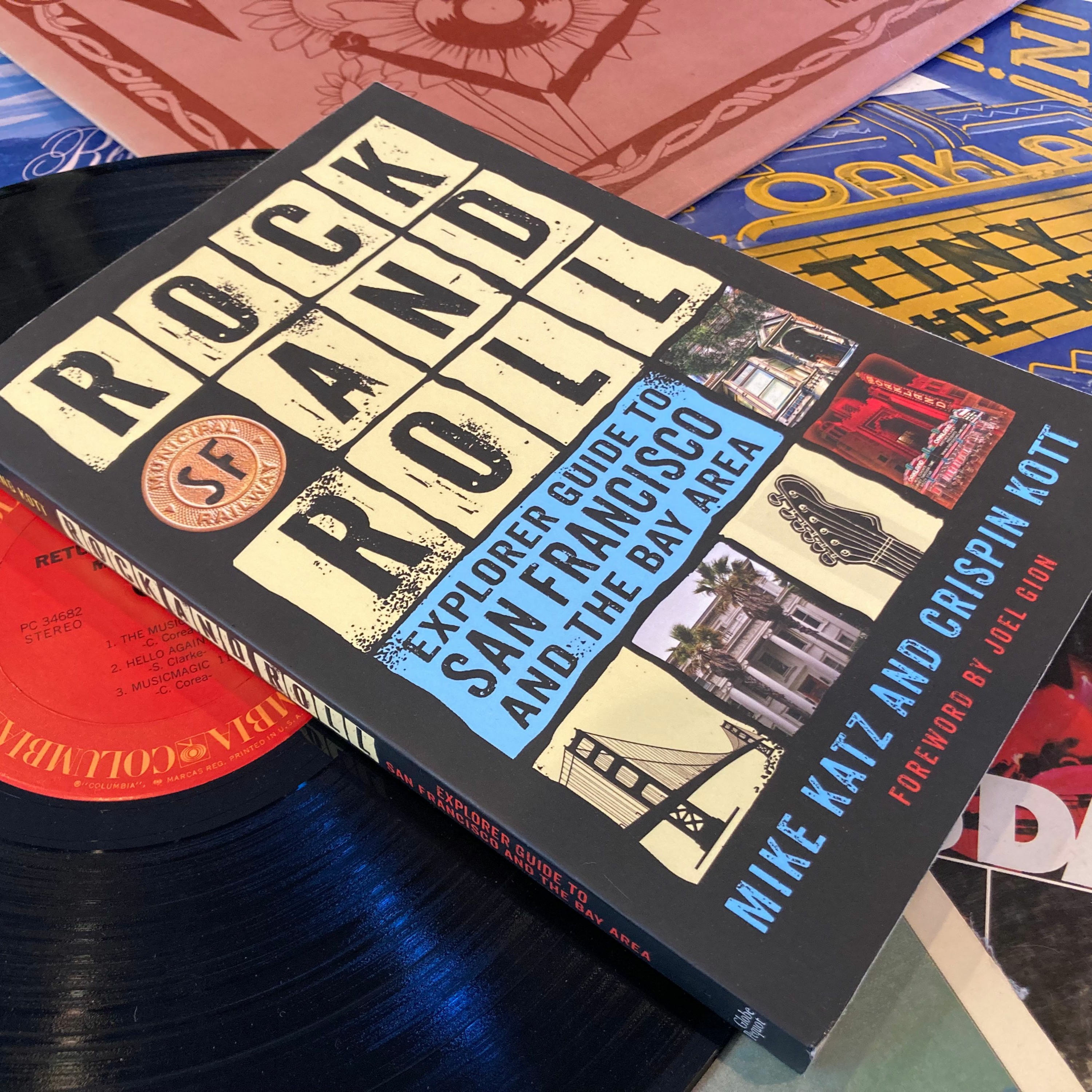
The Bay Area’s status as a rock & roll mecca may have peaked during the psychedelic sixties, but the party didn’t stop after the hippies took the flowers out of their hair. Following the height of the Haight-Ashbury scene, a wild diversity of styles and iconic performers continued to emerge from this region’s clubs, cafes, and even churches. These locations are compiled in “Rock and Roll Explorer Guide to the San Francisco Bay Area,” a new book that traces the rise of groups ranging from The Pointer Sisters to Primus by literally following in these superstars’ footsteps. This episode features an interview with authors Mike Katz and Crispin Kott about the geographic history of Bay Area rock & roll and also explores the profound ways this terrain has shifted over the past few decades. If you want to hear about how they tracked down all the East Bay landmarks mentioned in Green Day lyrics, why Metallica ditched L.A. for the Bay, and much more, listen to the full episode. To see photos related to this episode, visit: https://eastbayyesterday.com/episodes/more-than-just-the-1960s/ East Bay Yesterday can’t survive without your support. Please donate to keep this show alive: www.patreon.com/eastbayyesterday
“The porters were fed up”: C.L. Dellums and the rise of America’s first Black union
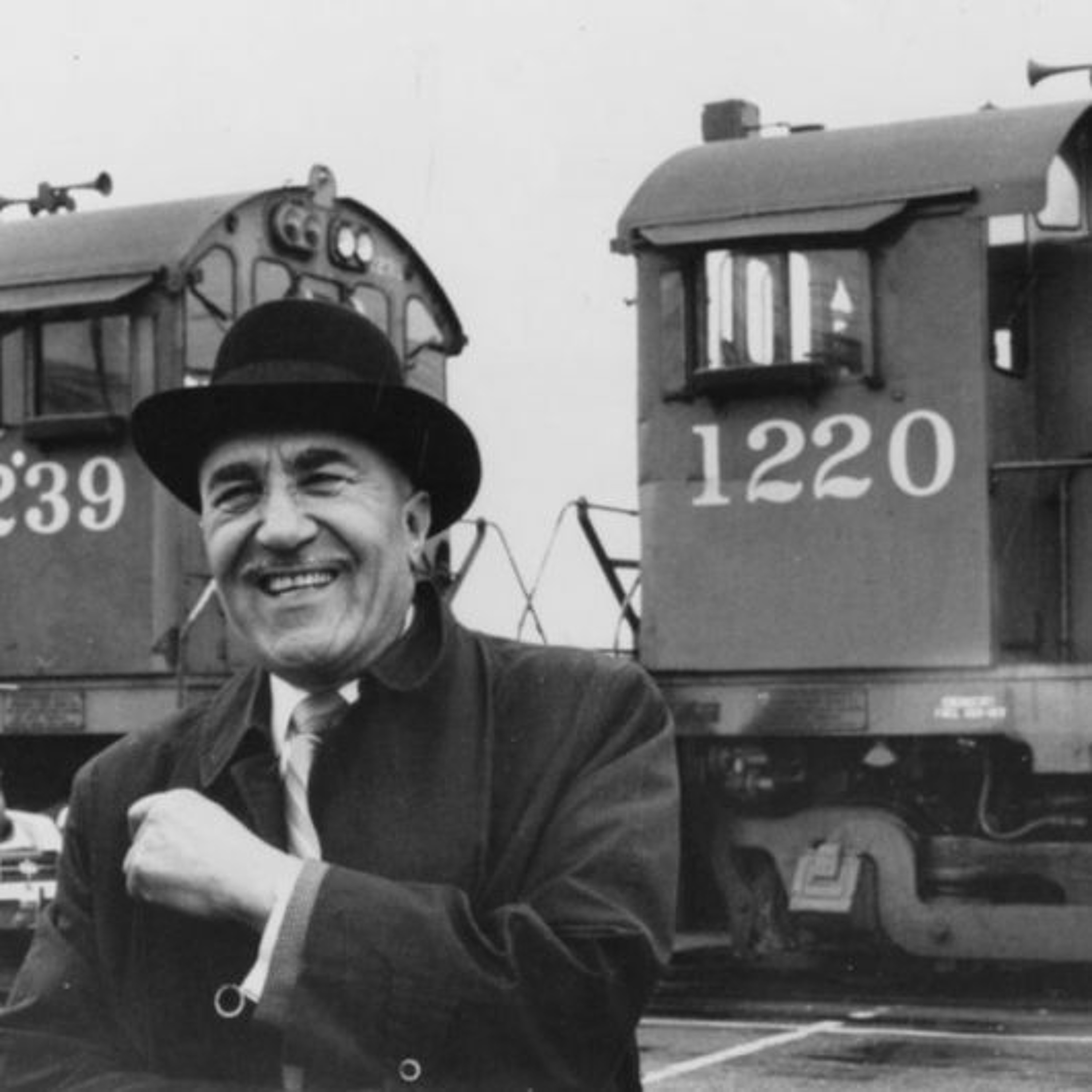
In the early 20th century, the largest employer of Black men in the United States was the Pullman Car Company, which operated luxurious trains that carried millions of passengers around the booming nation in an era before airplanes and interstate highways. Ever since the company’s founding during the Civil War, Pullman exclusively hired Black men as porters to keep the train cars clean and serve the white passengers. Although the job was prestigious, by the 1920s porters were fed up with the low pay, long hours, and abusive conditions. Their struggle to unionize became one of the most significant civil rights conflicts of the pre-WWII era and laid the groundwork for the movement led by Martin Luther King Jr. in later years. This episode explores how Oakland’s C.L. Dellums helped the Brotherhood of Sleeping Car Porters triumph over one of the nation’s most powerful corporations, and also his massive impact on challenging widespread racial discrimination throughout California. Dellums helped open jobs in wartime industries up for Black workers, setting the stage for the “second great migration” on the West Coast; he organized early protests against police brutality; and he helped end widespread racial segregation among powerful labor unions. His goal was nothing short of “total freedom and equality.” Today’s guest is Susan D. Anderson, the History Curator and Program Manager at the California African American Museum, and the author of a forthcoming book on California’s Black history. This episode also features a segment from the Black Liberation Walking Tour which includes the voices of C.L. Dellums and his daughter Marva. See photos and more information about this episode here: https://eastbayyesterday.com/episodes/the-porters-were-fed-up/ East Bay Yesterday can’t survive without your support. Please donate to keep this show alive: www.patreon.com/eastbayyesterday
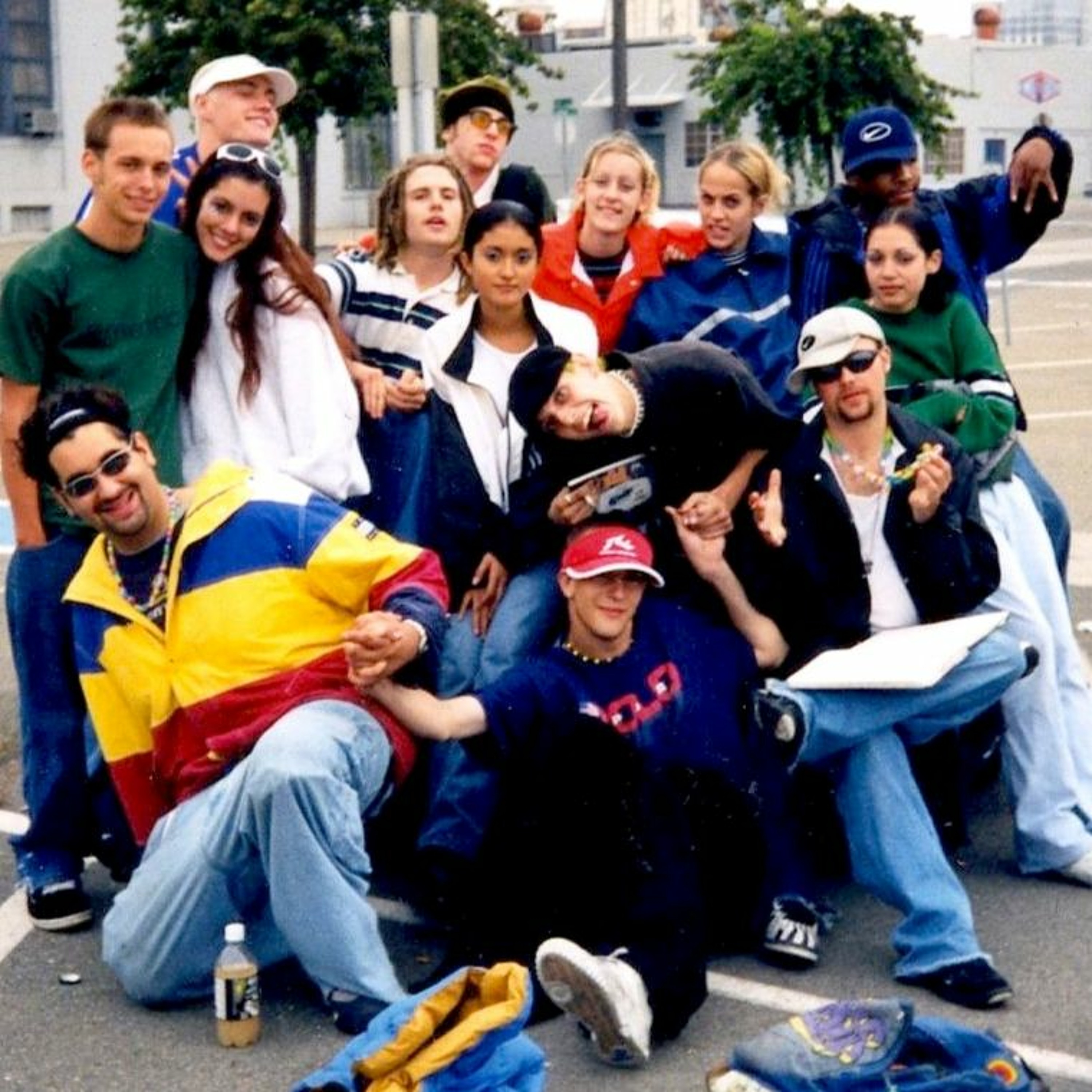
“Like a neon space carnival”: The trippy memories of a 90’s “Raver Girl”
Samantha Durbin’s acid was just kicking in as she entered an Oakland donut shop to score a handmade map to a secret warehouse party. On that chilly winter night in 1996, she ended up dancing to pulsing beats and kaleidoscopic lights until the sun came up. Thinking back to her first rave, Samantha remembers it feeling “like a neon space carnival.” Soon the highschool sophomore was chasing after bigger parties and higher highs every weekend. In her new memoir, “Raver Girl: Coming of Age in the 90s” Durbin bring readers along to sweat-soaked raves at roller rinks and farm fields, into a world of comically huge pants and ridiculously tripped-out teenagers, where there’s always room for one more to join the cuddle puddle in the corner of the chill room. Listen to the podcast to hear us discuss candyflipping, raver fashion, and, of course, Homebase – the legendary Oakland venue that hosted some of the most massive underground parties the Bay Area has ever seen. To see photos related to this episode: https://eastbayyesterday.com/episodes/like-a-neon-space-carnival/ East Bay Yesterday can’t survive without your support. Please donate to keep this show alive: www.patreon.com/eastbayyesterday
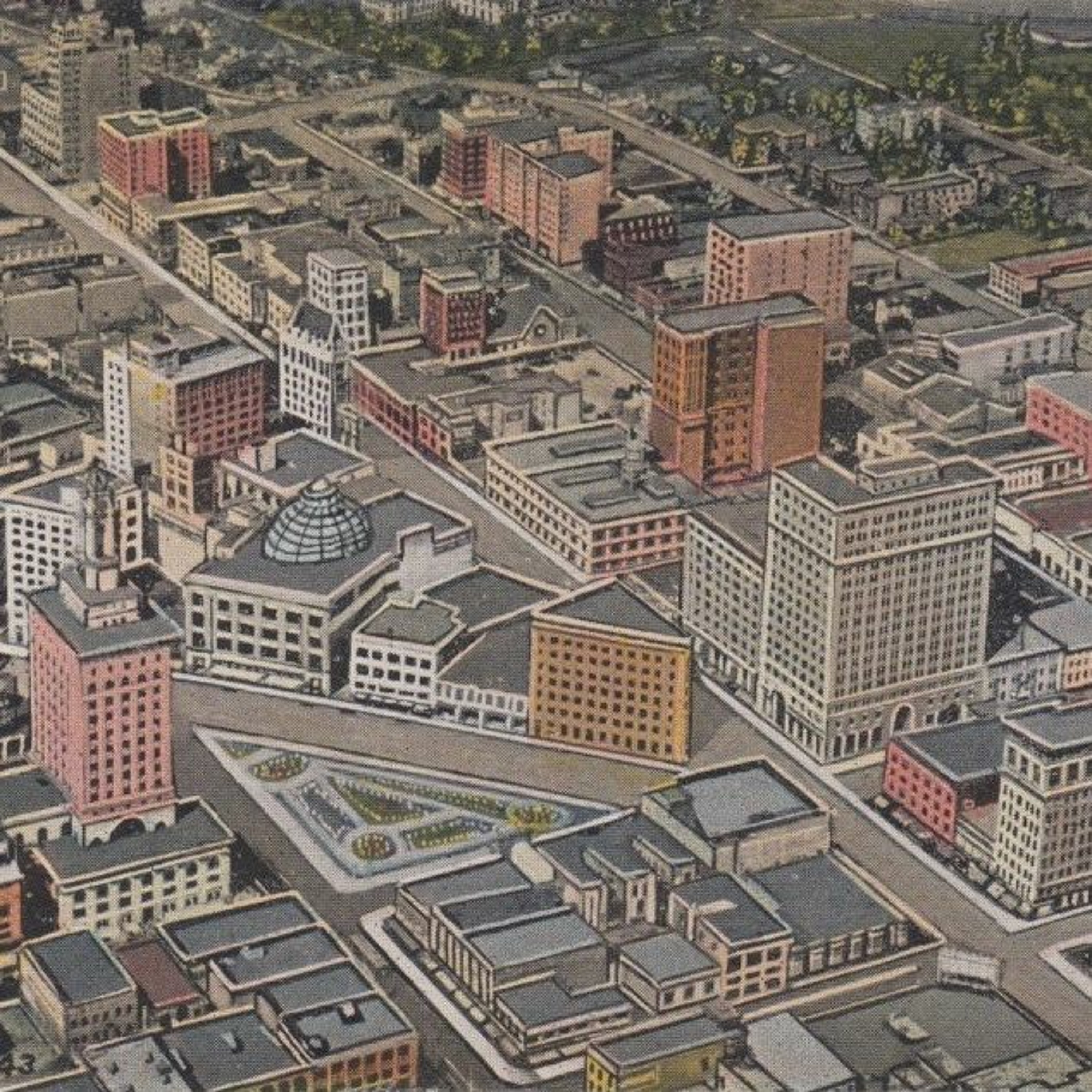
“There’s no reason to be San Francisco”: The mixed legacy of Oakland’s ambition
Thanks to its natural deepwater port, San Francisco quickly emerged as the West Coast’s leading metropolis during California’s Gold Rush era. In the decades since, many of Oakland’s development patterns have been influenced by its competitive relationship with the sparkling and sophisticated city across the Bay. As a result, the elitist ambitions of Oakland’s political and business leaders often overlooked, or actively harmed, many of The Town’s existing residents. For wealthy developers dreaming of car-friendly, upscale shopping malls and homogenous office towers, Black neighborhoods, immigrant enclaves, and working class districts were treated as obstacles to be bulldozed. This paradigm pre-dates common usage of the term “gentrification” by generations. Cycles of displacement are one of the main themes explored in “Hella Town: Oakland’s History of Development and Disruption” (UC Press) by Mitchell Schwarzer. As opposed to focusing primarily on individual power brokers, Schwarzer, a professor of architectural and urban history at California College of the Arts, zooms out to identify the broad economic and technological trends that have shaped the place where he’s lived for most of the past four decades. The book weaves together topics ranging from the rise of car culture to the consolidation of commerce in order to explain more than a century of policies and priorities that shaped our current landscape. In this episode of East Bay Yesterday, we discuss Oakland’s tumultuous evolution, and also some of the best and worst development proposals that failed to become reality. To see photos related to this episode, visit: https://eastbayyesterday.com/episodes/theres-no-reason-to-be-san-francisco/ East Bay Yesterday can’t survive without your support. Please donate to keep this show alive: www.patreon.com/eastbayyesterday
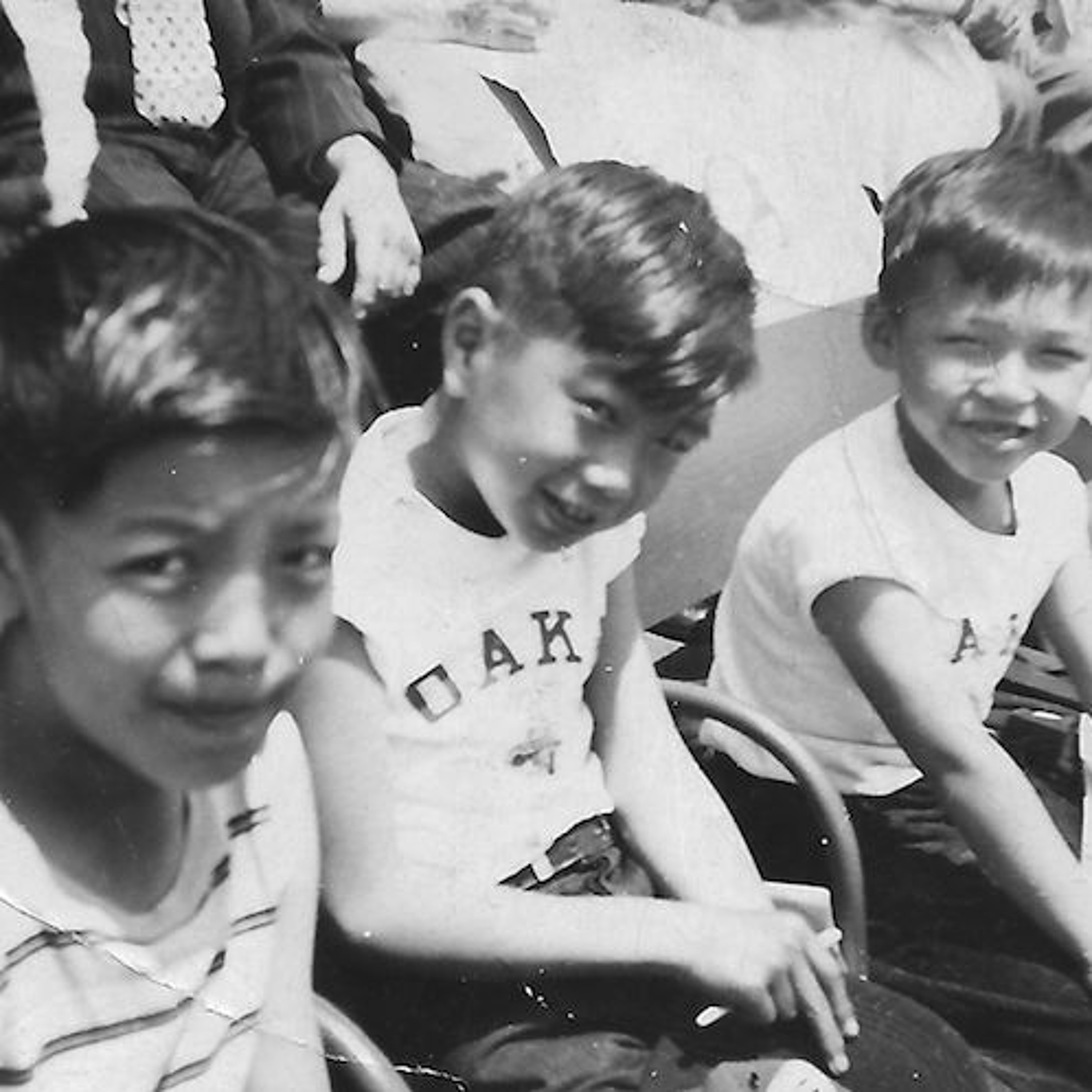
“It was my whole universe”: William Gee Wong on growing up in Oakland’s Chinatown
William Gee Wong almost didn’t exist. A few years before Wong was born, his father was shot four times over a dispute involving Oakland Chinatown’s underground lottery. Thanks to the quick work of doctors at Highland Hospital, Wong’s father survived, and after retiring from the gambling business, he opened the Great China restaurant on a busy commercial stretch of Webster Street. William Gee Wong was born just around the corner, at the family’s house on Harrison Street, the youngest of seven children. Even after his family moved to the “China Hill” area east of Lake Merritt, one of the few neighborhoods open to Asian-Americans during the 1940s, William spent most of his time either working for the family business or at Lincoln School. This is why he says “Chinatown was my whole universe” for about the first 20 years of his life. As the decades passed, Bill learned journalism writing for The Daily Cal, before breaking racial barriers at the San Francisco Chronicle and Wall Street Journal. Eventually, he returned to his hometown to write for The Oakland Tribune about culture and politics from an Asian-American perspective, something practically unheard of at mainstream media outlets in the 1980s. Since retiring he’s published two books, “Yellow Journalist” and “Oakland’s Chinatown,” and he’s currently working on a memoir about his father, who immigrated from China in 1912. In today’s episode, William Gee Wong discusses the history of Chinese immigration to California, the rise of Oakland’s Chinatown, his memories of working in a “hybrid” restaurant, the systemic racism of urban renewal projects that gutted his neighborhood, and much more. To see photos related to this story, visit: https://eastbayyesterday.com/ East Bay Yesterday can’t survive without your support. Please donate to keep this show alive: www.patreon.com/eastbayyesterday
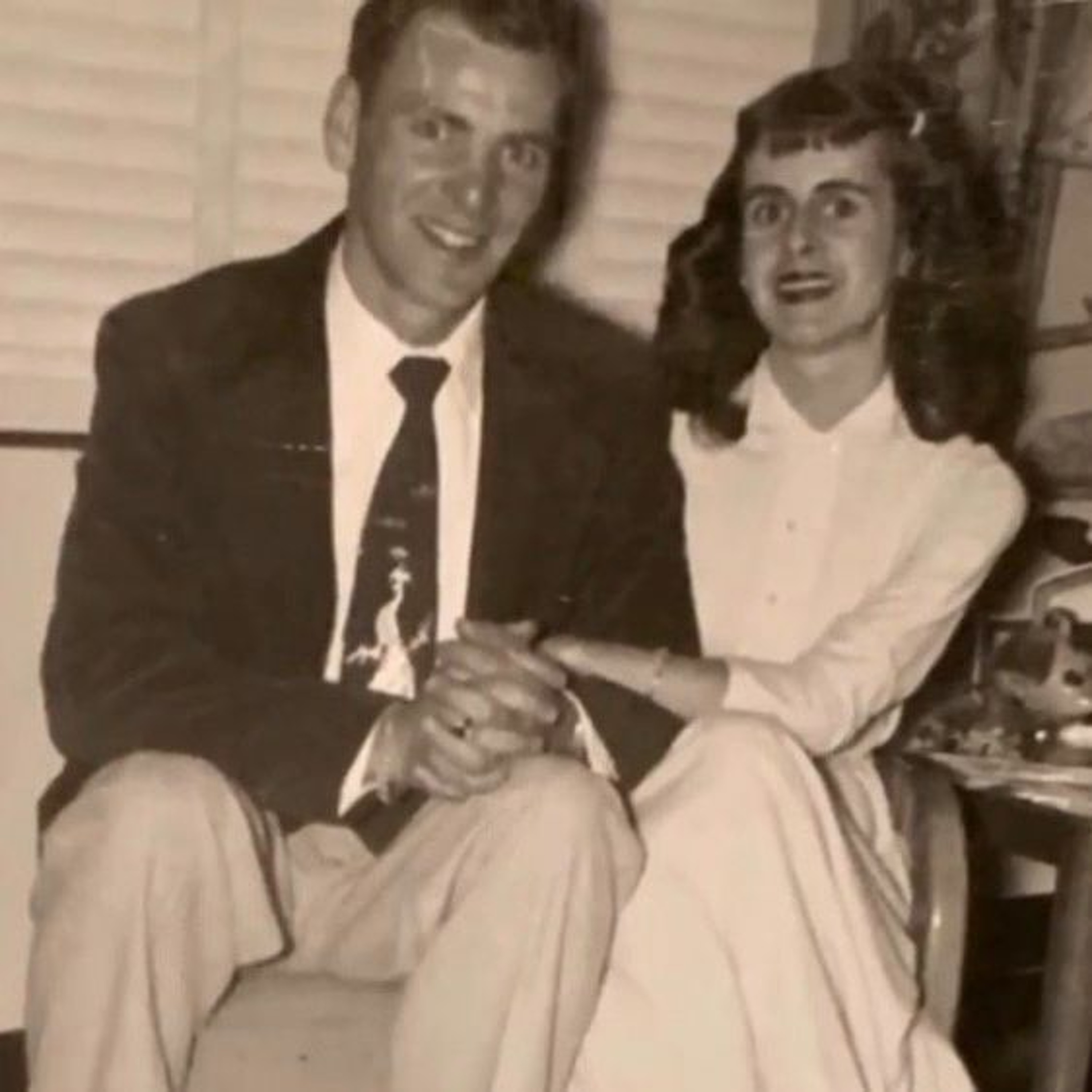
“Dear Brown Eyes”: How a stash of old letters helped heal a family
A few years ago, Aussie Holcomb was going through a divorce, and her relationship with her dad wasn’t going well, either. Feeling lost and lonely, she began reading her grandparents’ old love letters, which had recently been uncovered after sitting at the back of a dusty closet for more than 60 years. As Aussie made her way through bundles of envelopes, the emotions captured in those letters spilled off the pages and infused her life with the contagious joy of young love. Wanting to retrace her grandparents’ path, the letters sparked an adventure that led Aussie to a remote corner of California, far from home. In this unlikely place, she found reconciliation with her dad, and much more. Listen to the full episode now to hear the love story of Ray Hertz and Ginny Stewart, as told by their granddaughter, Aussie Holcomb, and their son, Mark Hertz. Ray and Ginny’s letters, which were written between 1949 and 1951, are read by their dear friend Carl Weinberg and their daughter Tracy Hertz. You can see photos related to this story at: https://eastbayyesterday.com/episodes/dear-brown-eyes/ East Bay Yesterday can’t survive without your support. Please donate to keep this show alive: www.patreon.com/eastbayyesterday
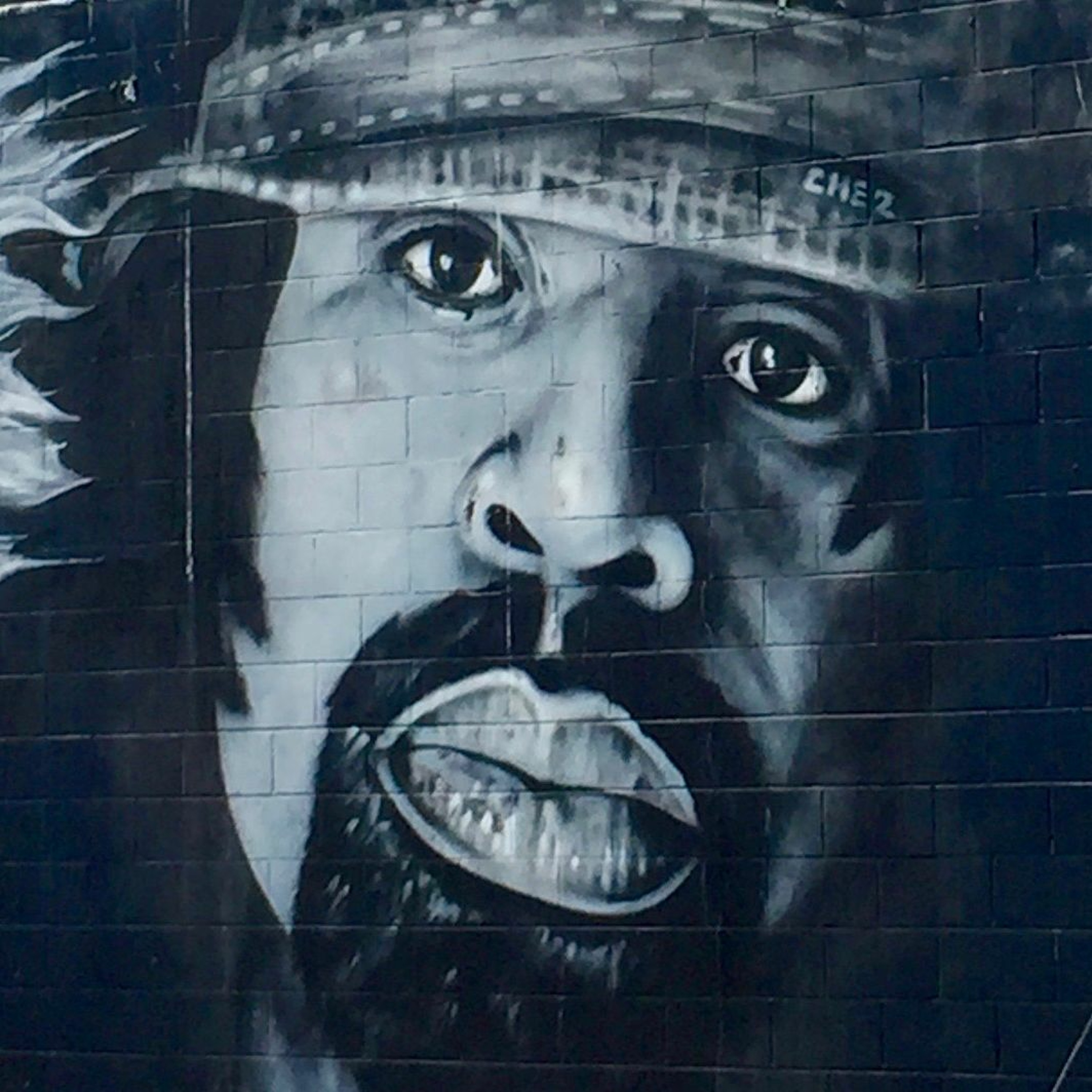
“Who ordered the hit?” Investigating Mac Dre’s tragic murder
The quickest way to start a dance party in the Bay Area is to play a Mac Dre song. Countless times, I’ve seen mellow crowds instantly transform as soon as the first few beats from hyphy hits like “Feelin’ Myself” and “Thizzle Dance” come blasting out of the speakers. Everyone from little kids to grandmas know how to bust the lyrics, the dance moves, and, of course, the thizz face. In the 17 years since his death, the Oakland-born, Vallejo-raised rapper’s popularity only continues to grow. Since his 2004 murder in Kansas City, rumors, accusations, and retaliatory violence have swirled around the unsolved case. Although nobody has ever been charged for the crime, investigative journalist Donald Morrison recently published an investigation that draws on 1,200 documents and dozens of interviews in order to fill in some of the missing puzzle pieces. Nothing will bring back the “Legend of the Bay”, but this article provides some stunning new clues that may help shed light on the devastating question: “Who killed Mac Dre?” To see photos related to this episode, visit: https://eastbayyesterday.com/episodes/who-ordered-the-hit/ East Bay Yesterday can’t survive without your support. Please donate to keep this show alive: www.patreon.com/eastbayyesterday
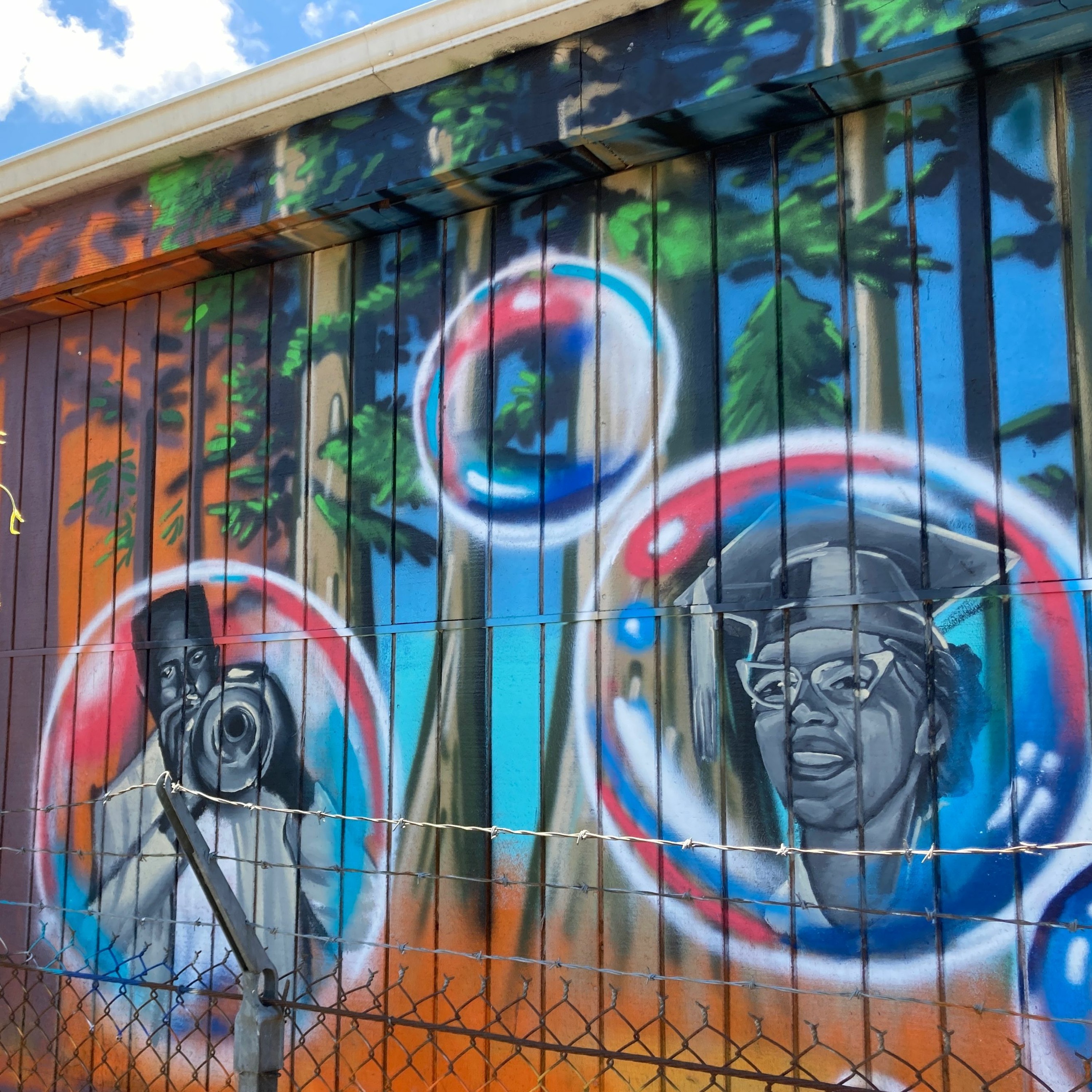
Hoover-Foster Stories, Vol. 2: “You become an art anthropologist”
When Andre Jones (AKA Natty Rebel) does a mural in Oakland’s Hoover-Foster neighborhood, he doesn’t just paint whatever he feels like. Andre meets with longtime residents, shop owners, and other local artists to dig into the area’s rich history. He’ll study old family photos to make sure the vibrant images that cover the walls along San Pablo Ave. reflect the people who walked these streets in the decades before he got here. Explaining this collaborative process, Jones said, “As a public artist, you become an art anthropologist, because you have to do the research so that you can add a little bit of background imagery to the [mural] that adds to the overall narration.” For the second volume of this Hoover-Foster Stories mini-series, I wanted to interview Jones because one of the most striking things that participants of the Black Liberation Walking Tour will notice in this neighborhood is the proliferation of street art. The organization that Jones founded, Bay Area Mural Program, has collaborated with crews and artists like Refa One (Aerosoul), Del Phresh, Dead Eyes, Kiss My Black Arts, and others, on an ever-evolving outdoor gallery full of tributes to the Black Panther Party, deceased community members, and other symbols celebrating Hoover-Foster’s cultural legacy. Long before Bay Area Mural Program moved into its current headquarters in the iconic California Hotel, this building hosted Expressions Art Gallery, which served not only as a place to showcase art, but also an informal gathering space for unhoused folks living in the area. This episode also features an interview with Oakland native Alan Laird, who ran Expressions in the early 2000s, and had previously experienced housing insecurity himself. In our conversation, Laird recalls the mid-century heyday of the California Hotel, when a ground floor nightclub called the Zanzibar hosted musicians like Pete Escovedo, Ray Charles, and Billie Holliday. He also recalls some of the more disturbing elements of this era, such as how Oakland police enforced segregation by stopping Black people who ventured “above Broadway.” This episode is co-hosted by 3rd generation Hoover-Foster resident David Peters, one of the main organizers of the Black Liberation Walking Tour. Peters shares what visitors can expect at the Tour’s launch party this weekend, his thoughts on how street art can be used to challenge displacement, and much more. To see images related to this story and a link to the tour, visit: https://eastbayyesterday.com/episodes/hoover-foster-stories-vol-2/
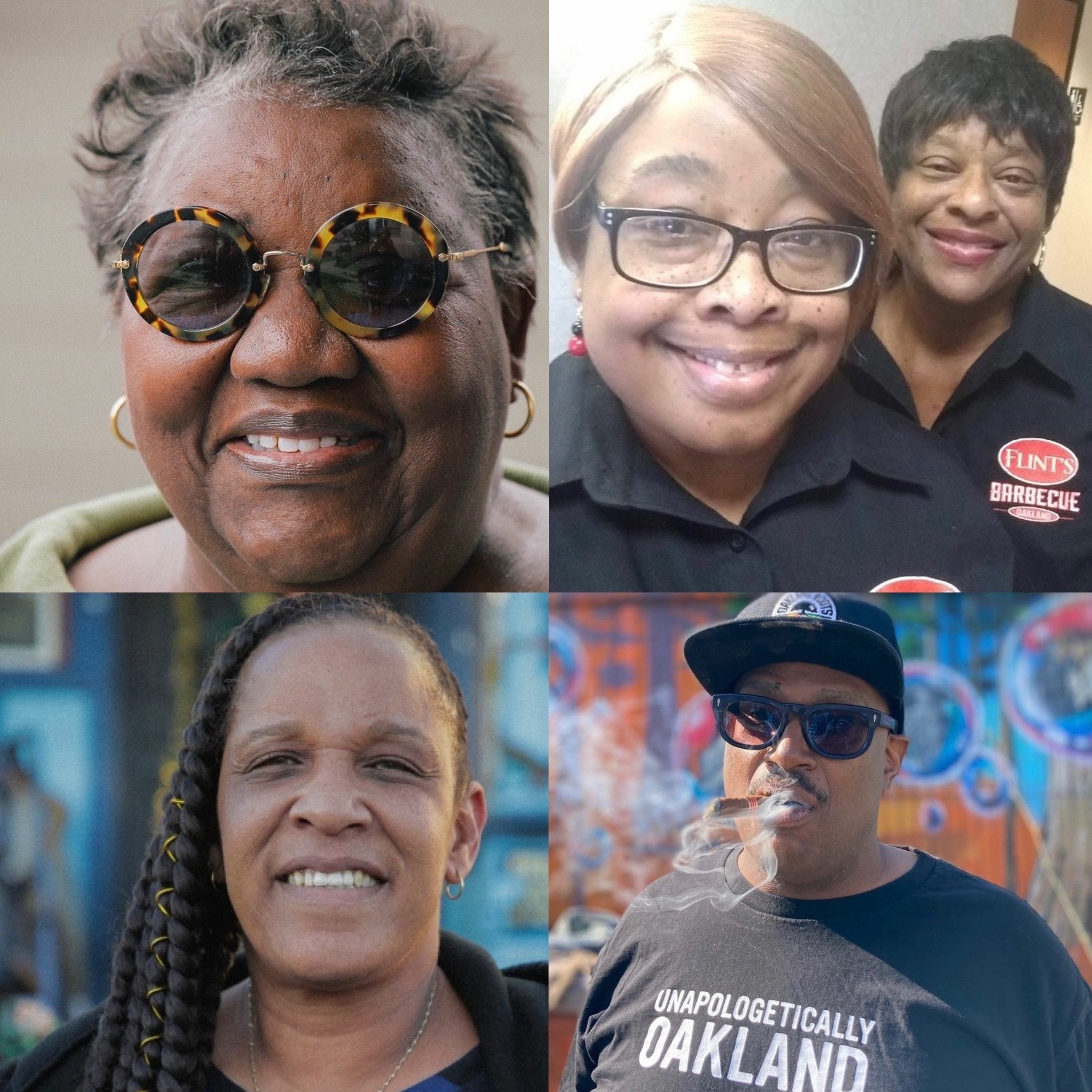
Hoover-Foster Stories, Vol. 1: BBQ, books, and big banks
Oakland’s Hoover-Foster neighborhood encapsulates more than a century of Black Liberation struggles. It was a destination for migrants fleeing the Jim Crow South to find work in the East Bay’s booming shipyards or as Pullman Porters. The newcomers brought their music, cuisine, and creativity with them, changing California forever. Civil rights leaders, pioneering writers, revolutionary activists, and athletes who smashed through racist color barriers all lived and worked here. The elders who came of age during the post-World War II years recall growing up in a flourishing and close-knit community. However, as this ethnically diverse neighborhood became predominantly African American, the forces of institutional racism literally came crashing down upon it. The construction of freeways destroyed dozens of blocks of homes and businesses, displaced thousands, and encircled the area with a dangerous border of pollution and noise. Then a Drug War characterized by mass incarceration and police abuse flooded these streets with misery and death, leaving a legacy that still lingers heavily. In more recent years, predatory banks, institutional investors, and real estate speculators exploited this devastation for quick profits, pushing many long-time residents out of Oakland altogether. But instead of giving up hope, many who still remain are working to restore this neighborhood’s reputation as a beacon of Black self-determination and achievement. One of the organizations leading this push is the Friends of Hoover-Durant Public Library, who have been hosting “pop-up streetcorner libraries” to build momentum towards re-establishing a permanent library in this community, which hasn’t had its own branch in four decades. As an outgrowth of this effort, third generation Oaklander David Peters brought together a group of neighbors, artists, educators, programmers, and other volunteers to highlight this neighborhood’s history through a self-guided Black Liberation Walking Tour. For the past several months, I’ve been collecting oral histories of current and former Hoover-Foster residents and today’s episode of East Bay Yesterday is a preview of the Black Liberation Walking Tour, based on what I’ve gathered. More details will be coming soon, but the plan is to launch the first phase of this tour in June, with additional phases and attractions to follow in the coming months, including a new mural created by the Bay Area Mural Program. Many people are involved with making the Black Liberation Walking Tour happen – my interviews are only one part of a much bigger project – but if you want a taste of what to expect, listen now to the the first episode of the “Hoover-Foster Stories” mini-series, co-hosted by David Peters and featuring interviews with: Crystal and Lynette Martin of Flint’s Barbecue, Alternier Baker Cook of the Friends of Hoover-Durant Public Library, and community organizer Annette Miller. To get involved, visit: https://black-liberation-tour.vercel.app/ To see photos and more details related to this episode: https://eastbayyesterday.com/episodes/hoover-foster-stories-vol-1/
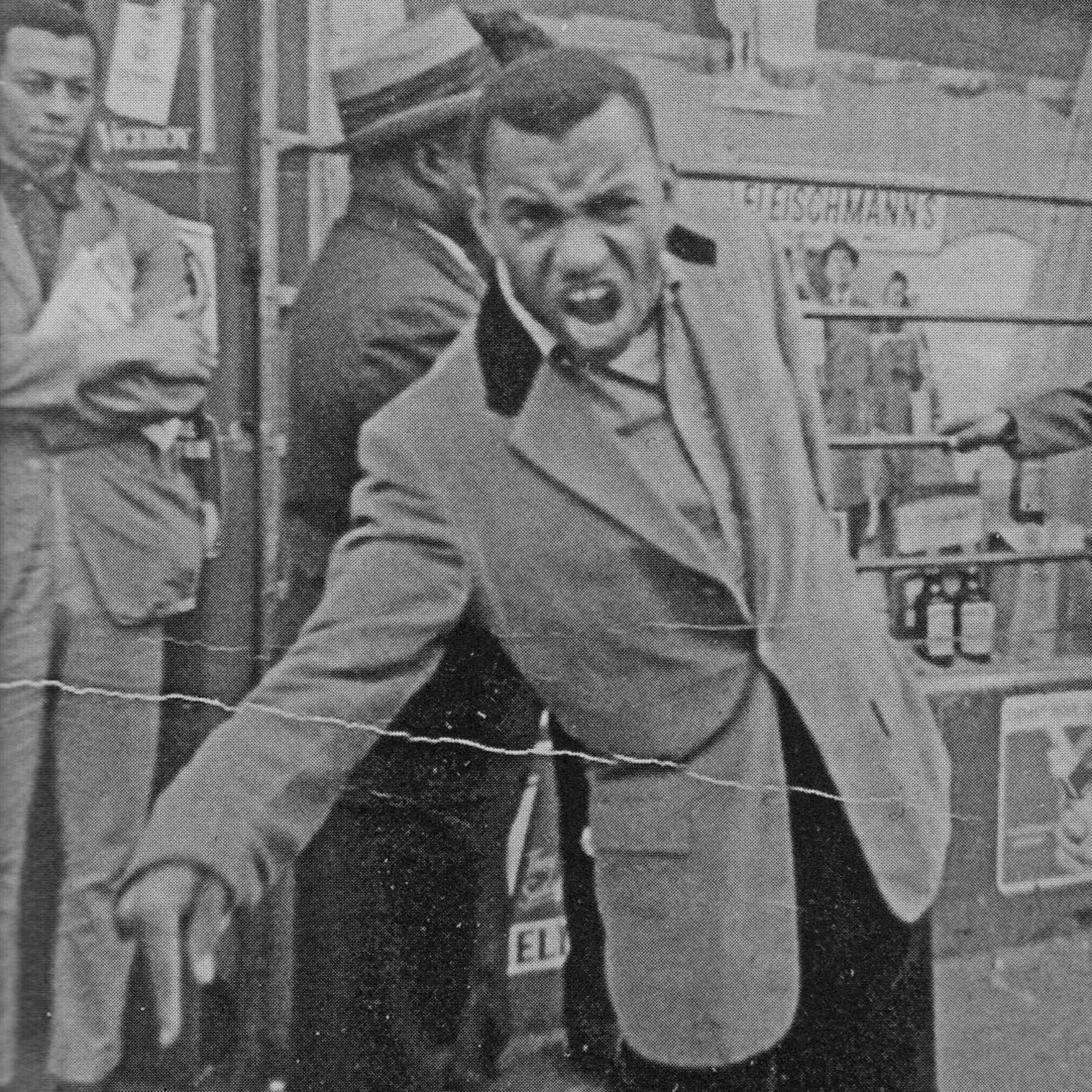
“We’re no longer afraid to be Black”: Before the Panthers, this group was the vanguard
Before Huey Newton and Bobby Seale started the Black Panther Party, they spent years learning from the leaders of the Afro-American Association. During the early 1960s, when the struggle for racial justice was evolving from a civil rights movement led by Dr. Martin Luther King Jr. to the rise of Black Power, the Afro-American Association brought leaders like Malcolm X and Muhammad Ali to the East Bay for public conversations about philosophy, religion, economics, politics, and more. Members and close associates of this organization, such as Ron Dellums, Judge Thelton Henderson, and Cedric Robinson, went on to become some of the most influential cultural and political Black leaders of their generation. Kamala Harris’ parents even met at one of these gatherings. This episode explores the mostly forgotten* legacy of the Afro-American Association and its leader, Donald Warden (who later changed his name to Khalid Abdullah Tariq al Mansour), through interviews with four former members – Anne Williams, Margot Dashiell, and brothers Loye and Lee Cherry – as well as Oakland History Center head librarian Dorothy Lazard. Listen now to hear about this group’s origins on the campus of UC Berkeley, their “Mind of the Ghetto” conferences in West Oakland, and much more. To see photos related to this episode, check out: https://eastbayyesterday.com/episodes/were-no-longer-afraid-to-be-black/ East Bay Yesterday can’t survive without your support. Please donate to keep this show alive: www.patreon.com/eastbayyesterday
“We’re uncovering a lost civilization”: A look at the New Deal’s local legacy
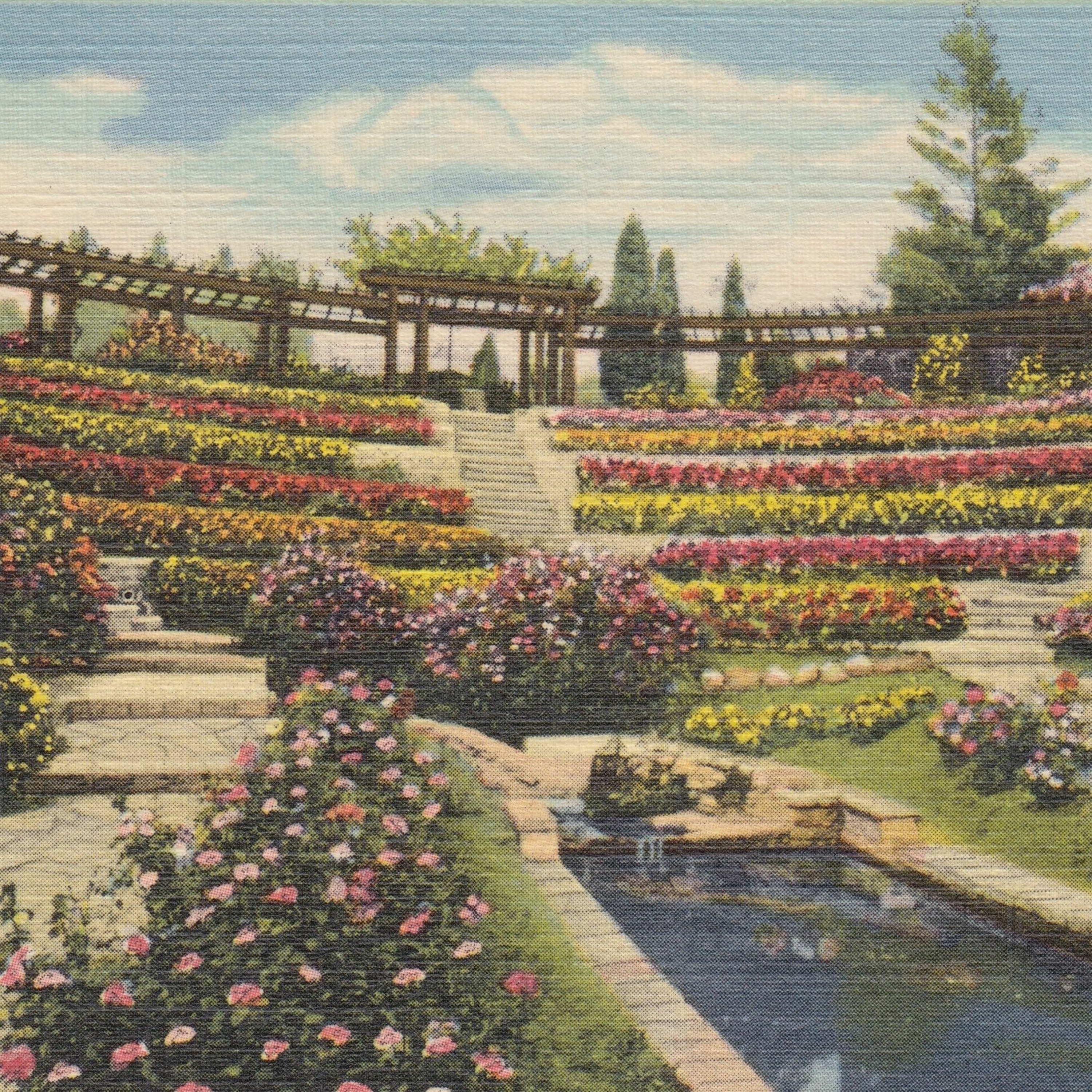
It’s nearly impossible to summarize the magnitude of the New Deal’s impact in the Bay Area. From the creation of Lake Anza, Woodminster Amphitheater, and Treasure Island to countless murals, schools, and other public amenities, federal funding dramatically transformed the local landscape and culture during the 1930s. President Roosevelt’s decision to invest in arts and infrastructure as a response to the Great Depression is one of the greatest success stories in the history of American politics. Could something on this scale ever happen again? As a new Democratic administration takes power amidst a crisis of unemployment and vast inequality, today’s episode explores the lessons of the New Deal with historians Gray Brechin and Harvey Smith of The Living New Deal, an organization dedicated to uncovering and preserving public works from this era. From airports to sewers, the legacy of the New Deal is still utilized by millions, even if the history connecting these crucial components of modern society has mostly been forgotten. Listen now to hear about how a trip to Berkeley’s rose garden inspired a lifelong obsession with “uncovering a lost civilization” – and why the New Deal is still such a controversial topic. See images for this story here: https://eastbayyesterday.com/episodes/were-uncovering-a-lost-civilization/ East Bay Yesterday can’t survive without your support. Please donate to keep this show alive: www.patreon.com/eastbayyesterday
BART, bathhouses, and beyond: The friendship behind “The Cruising Diaries”
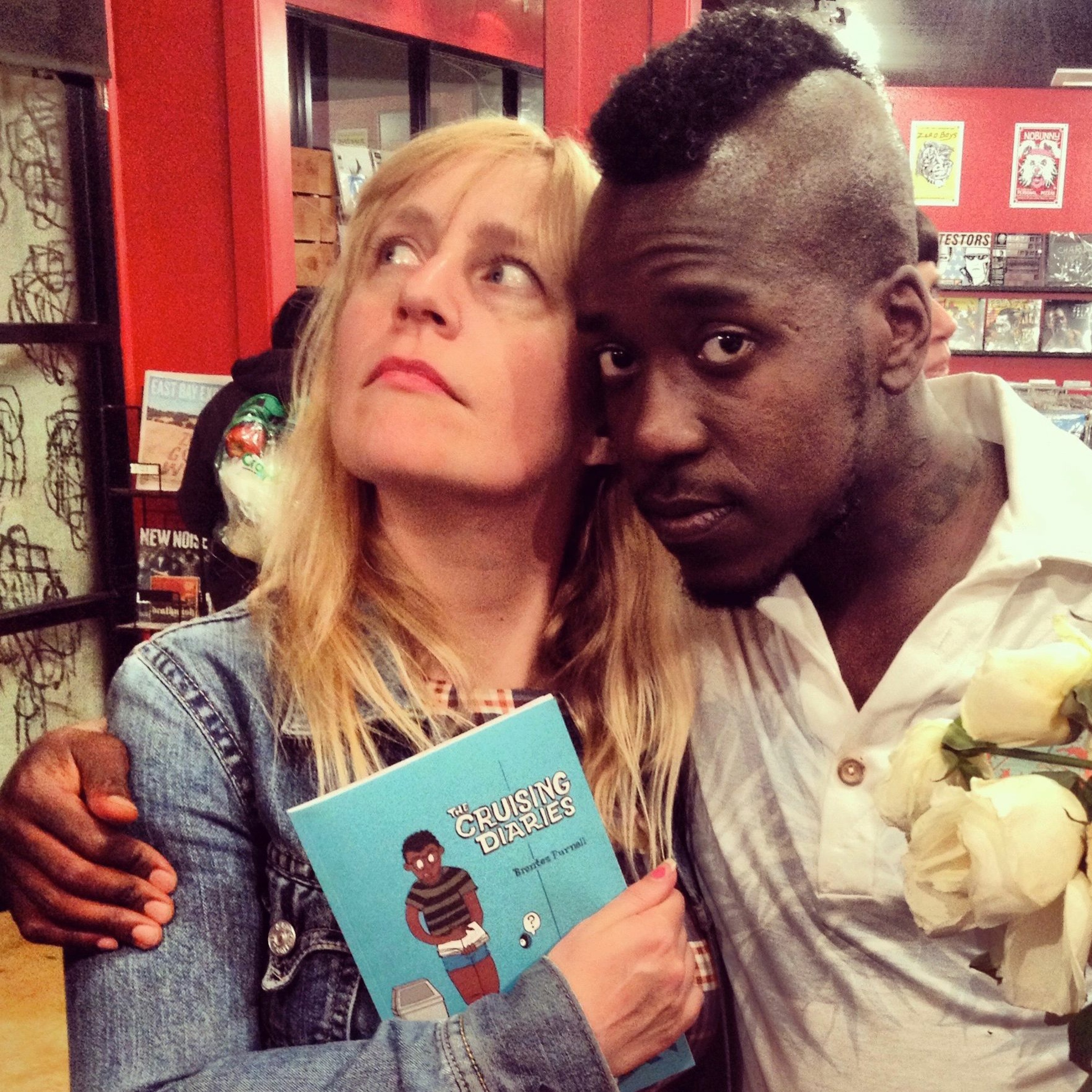
Two decades ago, Brontez Purnell fled his Christian family in Alabama, landed in a warehouse full of punks in East Oakland, and quickly got to work hooking up with as many guys as he could get his hands on. Janelle Hessig, creator of influential zines like Tales of Blarg and Desperate Times, urged Brontez to chronicle his eclectic trysts, and in 2014 they published an illustrated compilation of this self-described “anti-erotica.” The combination of Brontez’s gleeful debauchery and Janelle’s laughably lurid drawings made “The Cruising Diaries” an instant Bay Area underground classic, with the first print run (that Janelle financed with settlement money from getting hit by a car) selling out rapidly. Since then, Brontez has written three acclaimed novels and been celebrated by the New York Times as an essential “Black male writer for our time.” In this episode, Brontez and Janelle recall the roots of the friendship that helped launch this distinguished career. First, we discuss the thriving 1990s/2000s warehouse culture that incubated a generation of broke Bay Area artists and musicians. Then, Brontez takes us on a tour of some notable East Bay cruising spots of yesteryear. Listen now to hear stories of nefarious potlucks, horny wizards, landfill parties, go-go boys, and more. Images for this story can be found at: https://eastbayyesterday.com/episodes/bart-bathhouses-beyond/ East Bay Yesterday can’t survive without your support. Please donate to keep this show alive: www.patreon.com/eastbayyesterday
“We were here before California was a state”: Talking Latino history with Jose Rivera
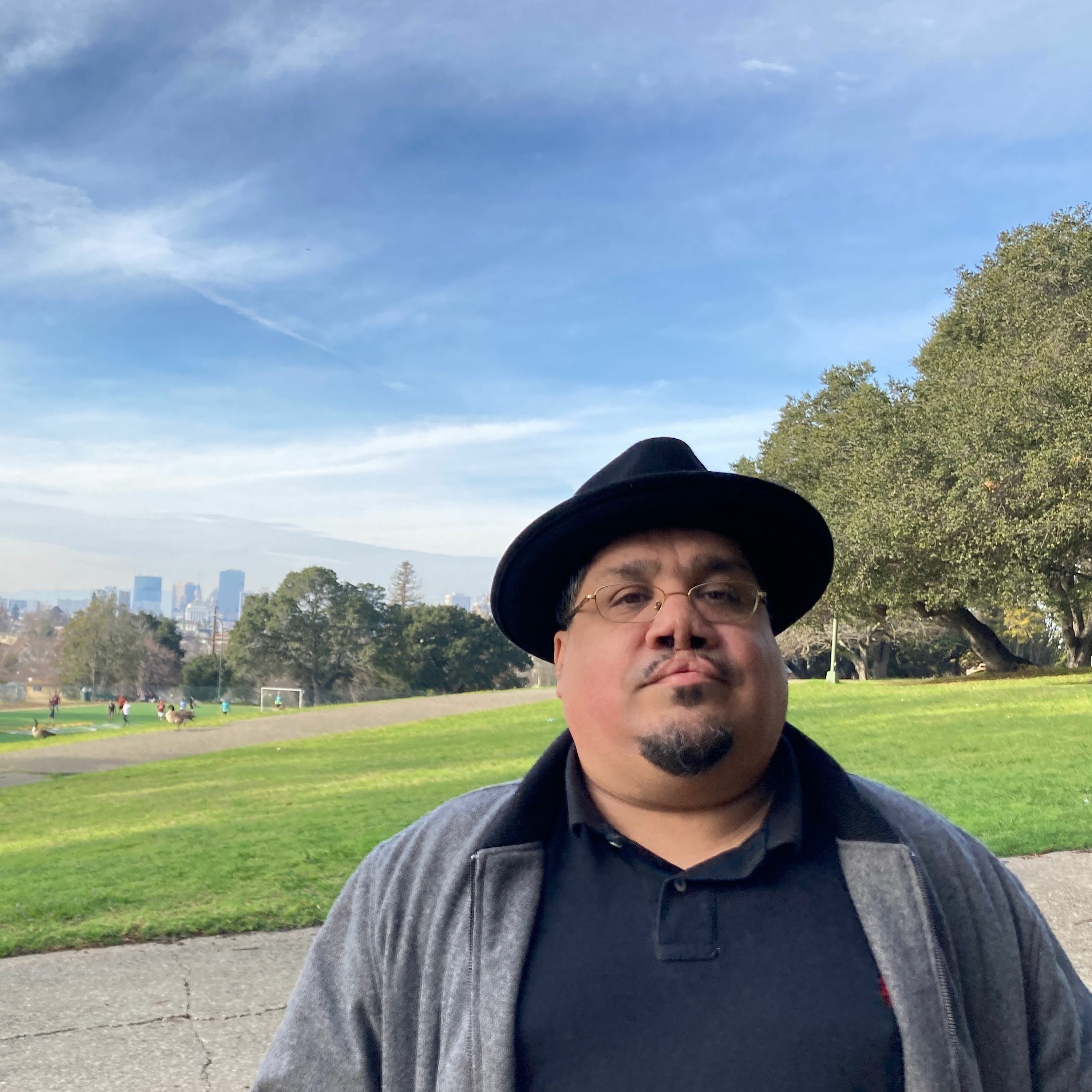
When Jose Rivera started researching the Bay Area’s Chicano history, he was frustrated by how difficult it was to find information. To remedy this problem, Jose created Oakland Latinos Unidos as a platform for sharing stories that are often left out of mainstream narratives. We recently met up at a picnic table in San Antonio Park where Jose laid out some of the archives he’s amassed over the past two decades – newspaper clippings, grainy black-and-white photographs, and rare, out-of-print books. Under a redwood tree, we discussed everything from the De Anza expedition to the gang wars that Jose lived through while growing up in Jingletown. See images for this episode here: https://eastbayyesterday.com/episodes/we-were-here-before-california-was-a-state/ Follow Oakland Latinos Unidos: https://www.facebook.com/Oakland-Latinos-United-353349838807/ East Bay Yesterday can’t survive without your support. Please donate to keep this show alive: www.patreon.com/eastbayyesterday
“It was like a carnival”: The betrayal of Oakland’s 1946 General Strike
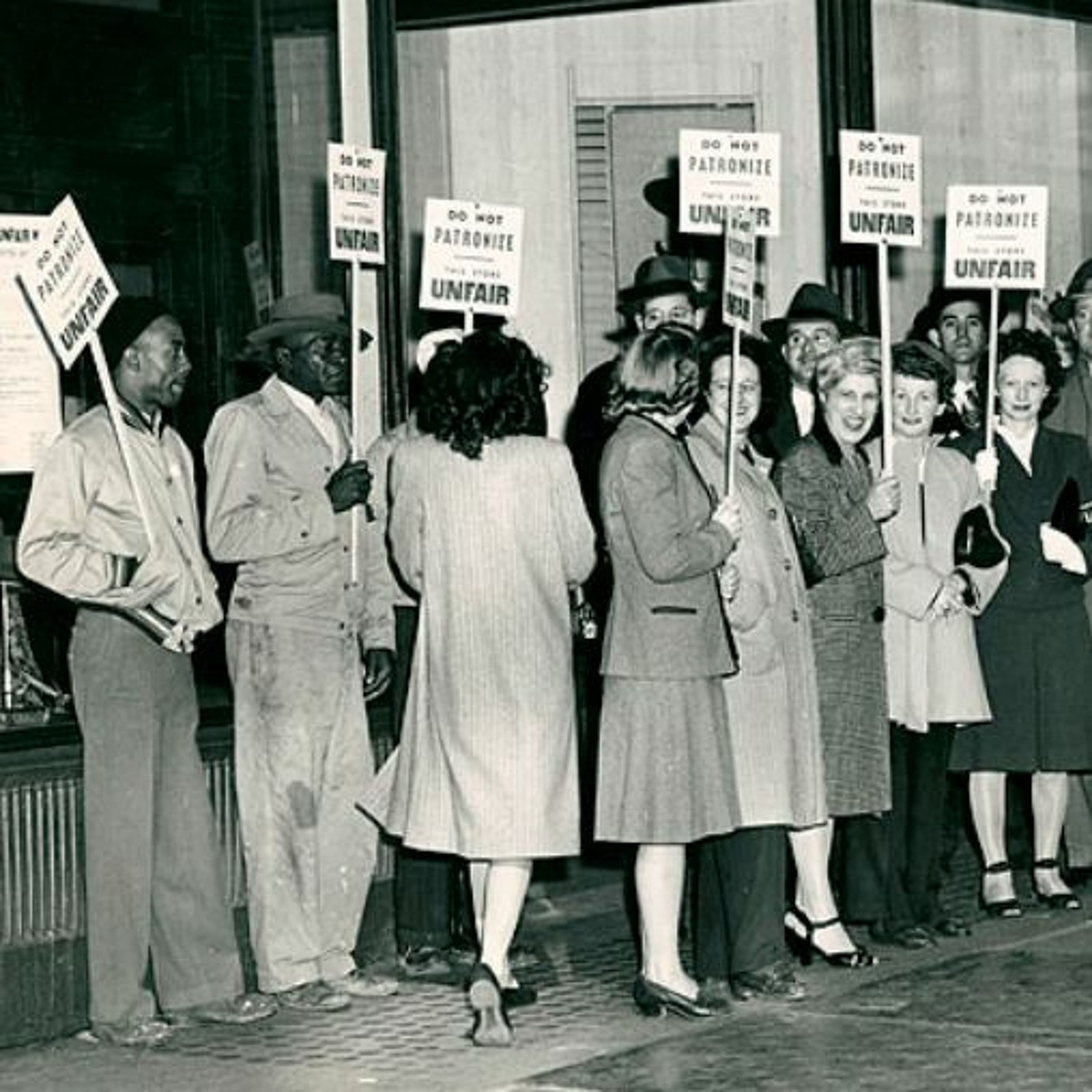
In 1946, a few hundred department store employees, mostly women, walked off the job and started a picket line in downtown Oakland. Within a few weeks, more than 100,000 workers joined them, filling the streets with protesters who danced under holiday wreaths hanging from downtown lampposts. “This seemingly small action turned into the biggest challenge to corporate domination of American workers in the postwar years,” according to Erik Loomis, author of “A History of America in Ten Strikes.” Despite an unprecedented outpouring of support, the story of those department store workers turned out to be a cautionary tale, rather than a triumph, for workers seeking to unionize. In the backlash that followed the strike, Congress passed the Taft-Hartley Act, legislation that continues to hobble labor organizing to this day. Featuring interviews with Erik Loomis, labor historian Gifford Hartman, and archival recordings of workers who participated in the 1946 uprising, this episode explores why Oakland was the site of “America’s last great general strike” – and the connections between this 74-year-old conflict and the struggles of today’s “gig economy” workers. To see images related to this story, check out https://eastbayyesterday.com/episodes/it-was-like-a-carnival/ East Bay Yesterday can’t survive without your support. Please donate to keep this show alive: www.patreon.com/eastbayyesterday
Goodbye, Telegraph Avenue: An audio time capsule of the past decade
Greetings to whoever finds this time capsule. If you want to know what’s inside, you’ll just have to listen.
“We’re not selling a neighborhood”: A new guidebook spotlights landmarks of conflict and resilience
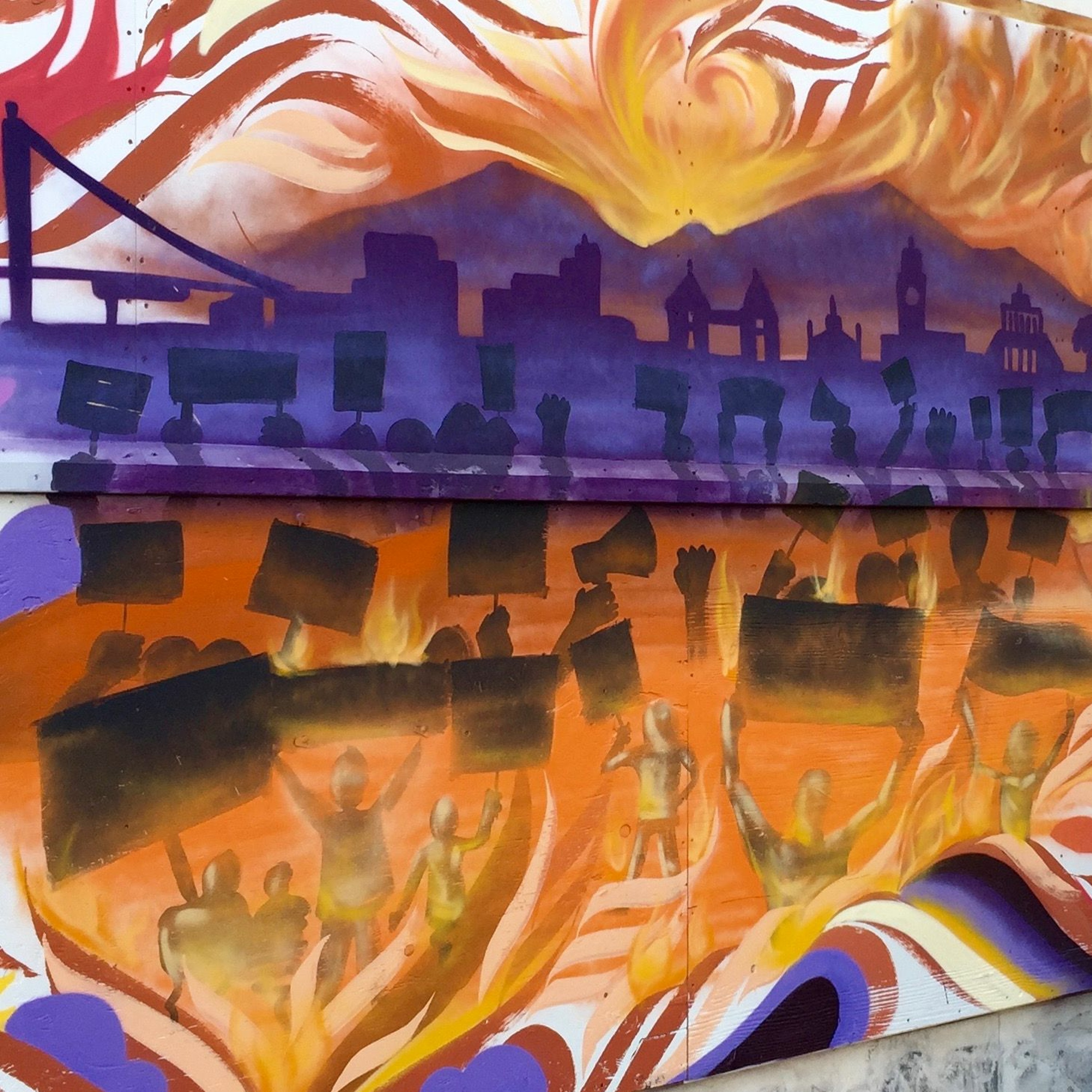
Amidst this year’s bombardment of campaign ads and nonstop election news, it’s easy to forget that the ballot box is only one of many ways that people participate in politics and drive systemic change. Although often ignored by history books, which tend to focus on politicians, “bottom up” movements led by students, workers, and other “regular people” have been a major force in shaping the Bay Area. From criminal justice reform to LGBTQ equality, the changes happening now at the policy level emerged from years of organizing, and are built upon mountains of frustrating setbacks. At a time when the federal government is characterized by gridlock and dysfunction, looking back at the strength of local activism through the decades is a healthy reminder that much can be accomplished between elections, far from the halls of power. If you’ve been staring into the soul-sucking abyss of cable news or doomscrolling through the implosion of American democracy, delving into the stories of anti-eviction battles, Ohlone resistance, strikes, and resilient celebration featured in “A People’s Guide to the San Francisco Bay Area” (UC Press) will provide a welcome glimmer of hope. Not naive optimism, but the kind of tempered determination that comes when you remember how bad things have been before – and how people successfully fought to keep them from getting worse. This might be hard to believe right now, but some things even got better. (Case in point: Many of the Bay Area’s most beautiful parks are located on the sites of former military installations.) Although formatted similarly to popular travel books, “A People’s Guide to the San Francisco Bay Area” does not include the region’s most obvious tourist destinations. Instead, it explores the landscape from a historical perspective, highlighting significant places associated with social conflict, ecological restoration, and radical activism. For those wishing to combine their education with a bit of exercise, it even includes a series of thematic tours organized by themes such as “Youth in Revolt” and “The Intertribal Bay.” This episode features interviews with co-author Rachel Brahinsky, an associate professor at the University of San Francisco, and Diana Negrín da Silva, who contributed many of the book’s East Bay entries and also teaches in the geography department of UC Berkeley. Listen now to hear us discuss Oakland’s long history of dancing during protests, the origins of Contra Costa County’s “fossil fuel corridor” and much more: Apple / SoundCloud / Spotify. East Bay Yesterday can’t survive without your support. Please donate to keep this show alive: www.patreon.com/eastbayyesterday See images for this story here: https://eastbayyesterday.com/episodes/were-not-selling-a-neighborhood/
“A home burned every 11 seconds”: A deadly tragedy that could happen again
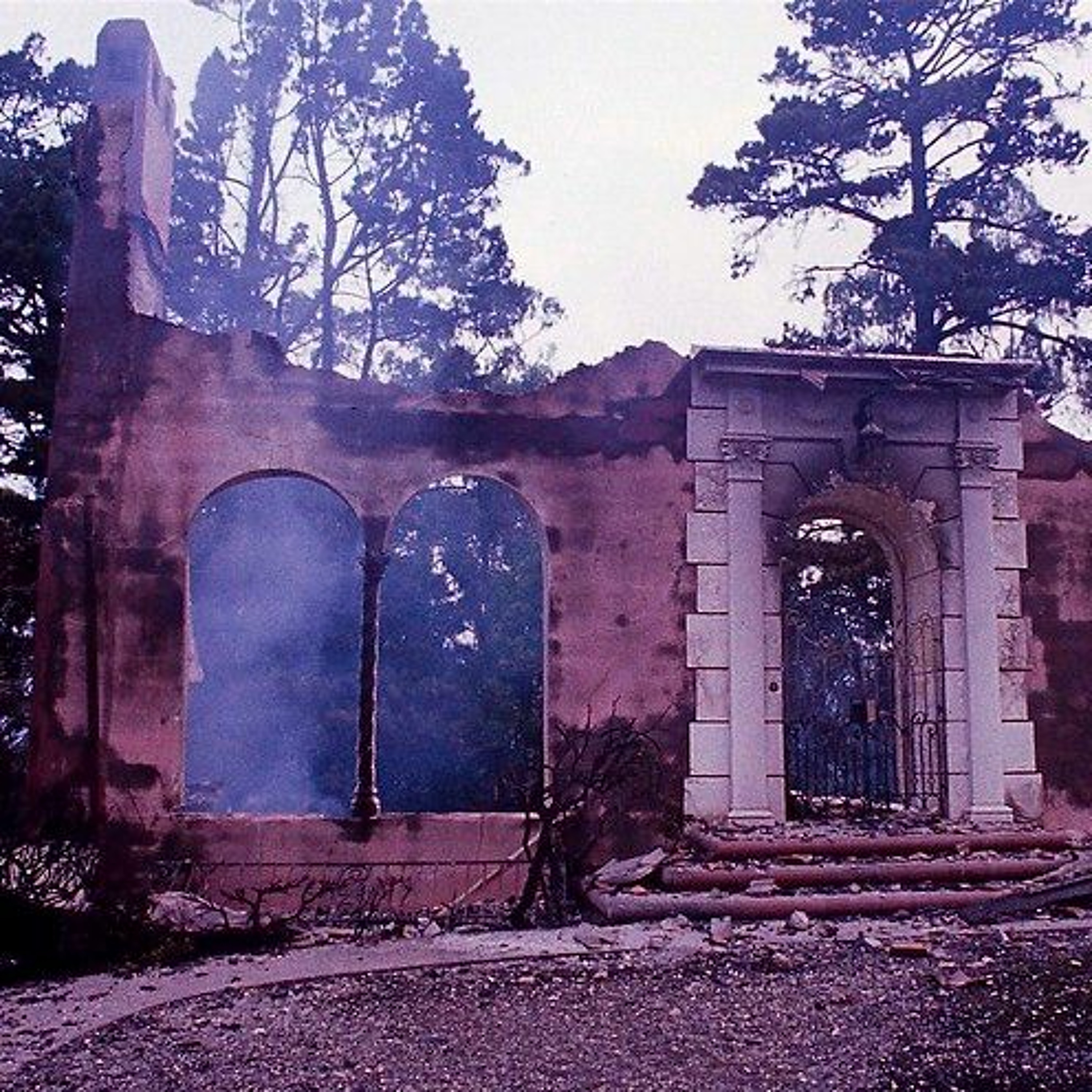
On the morning of October 20, 1991, towering clouds of black smoke blocked out the sun as “diablo winds” whipped flames hot enough to melt gold throughout the hills above Oakland and Berkeley. By the end of that day, 25 people were dead and more than 3000 homes lay in ashes and charred rubble, little remaining but chimneys and the blackened skeletons of trees. Nearly 30 years later, as California suffers its most widespread wildfire season in living memory, this episode looks back at the inferno that gave us a terrifying glimpse of the future we’re now living through. Retired East Bay Regional Parks Department firefighter Bill Nichols provides a first-hand account of battling the blaze and the lessons he learned that day that shaped the rest of his career. Risa Nye, author of the memoir “There Was a Fire Here,” discusses how she coped with watching her entire neighborhood burn down, including her home and all her family’s possessions, and explains how she navigated the lengthy recovery process. See images for this story here: https://eastbayyesterday.com/episodes/a-home-burned-every-11-seconds/ East Bay Yesterday can’t survive without your support. Please donate to keep this show alive: www.patreon.com/eastbayyesterday
“They insist on being here”: Oakland’s official bird refuses to be moved
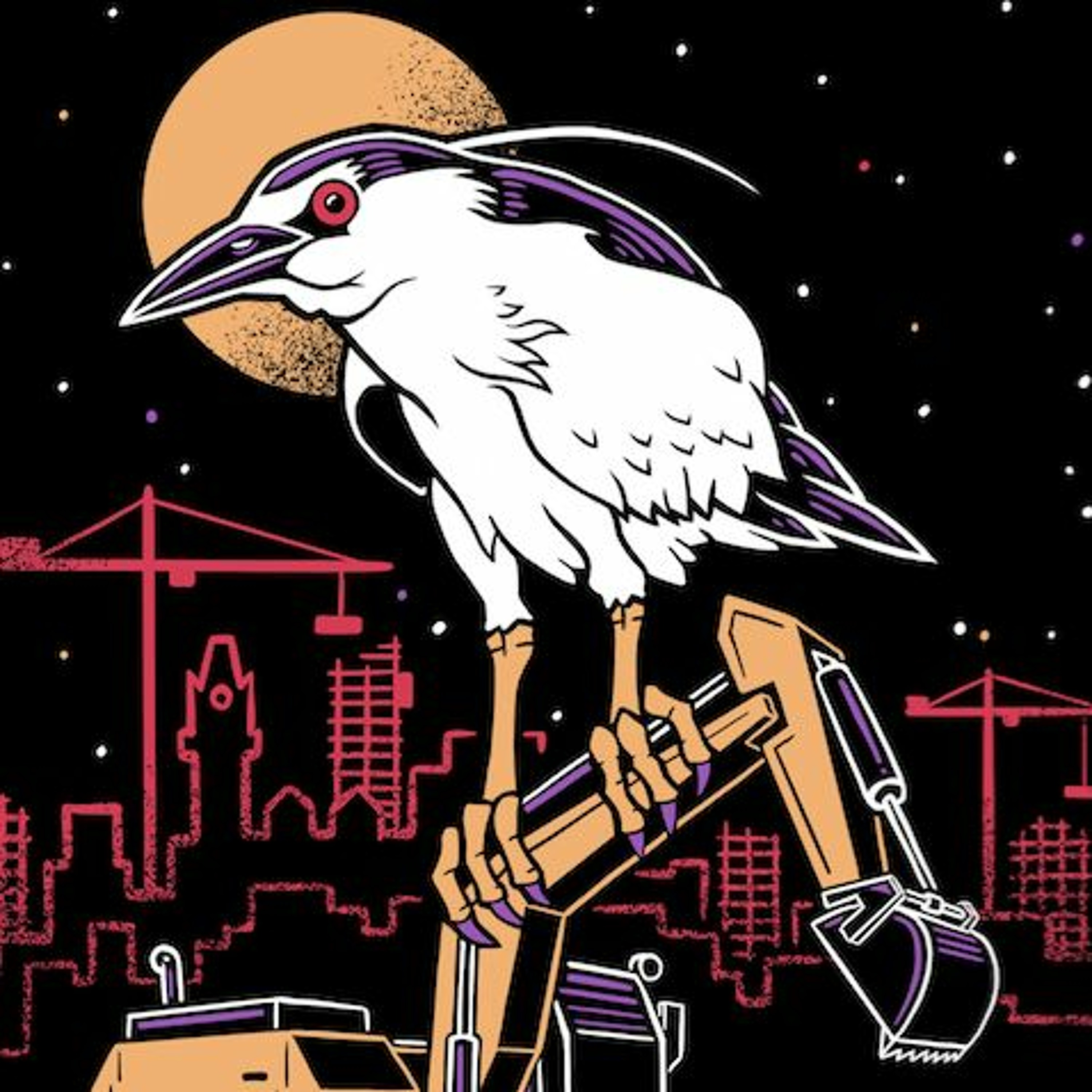
A few years ago developers destroyed downtown Oakland’s largest rookery of black-crowned night herons. Workers removed dozens of nests before chopping down the curbside ficus trees where the birds had lived for years. The plan was to relocate them to a grove near Lake Merritt, but the night herons never agreed to this arrangement – and they weren’t tricked by the decoys meant to entice them away from their preferred territory. They simply found other trees in the downtown vicinity where they remain to this day. When Oakland declared the black-crowned night heron the city’s official bird in 2019, the resolution described the species as “a resilient bird with remarkable adaptability in urban areas while remaining wild and retaining their natural behaviors.” This defiant attitude, along with the bird’s unconventional beauty and deep local roots, is why I’ve chosen to feature the night heron on East Bay Yesterday’s first t-shirt, a collaboration with Oaklandish illustrated by T.L Simons. This project is a celebration of those who refused to be displaced. But, of course, the story is never that simple. That’s why today’s episode digs into the local history of night herons and explores the relationship between development and Oakland’s natural ecosystems – featuring interviews with Golden Gate Audubon Society’s youth programs manager Clayton Anderson and journalist Sam Lefebvre, who recently asked “Is Oakland failing its official bird?” in The Oaklandside. Get the t-shirt here: https://oaklandish.com/collections/east-bay-yesterday See images for this story here: https://eastbayyesterday.com/episodes/they-insist-on-being-here/ See more work from T.L.Simons here: https://www.tlsimons.com/ East Bay Yesterday can’t survive without your support. Please donate to keep this show alive: www.patreon.com/eastbayyesterday
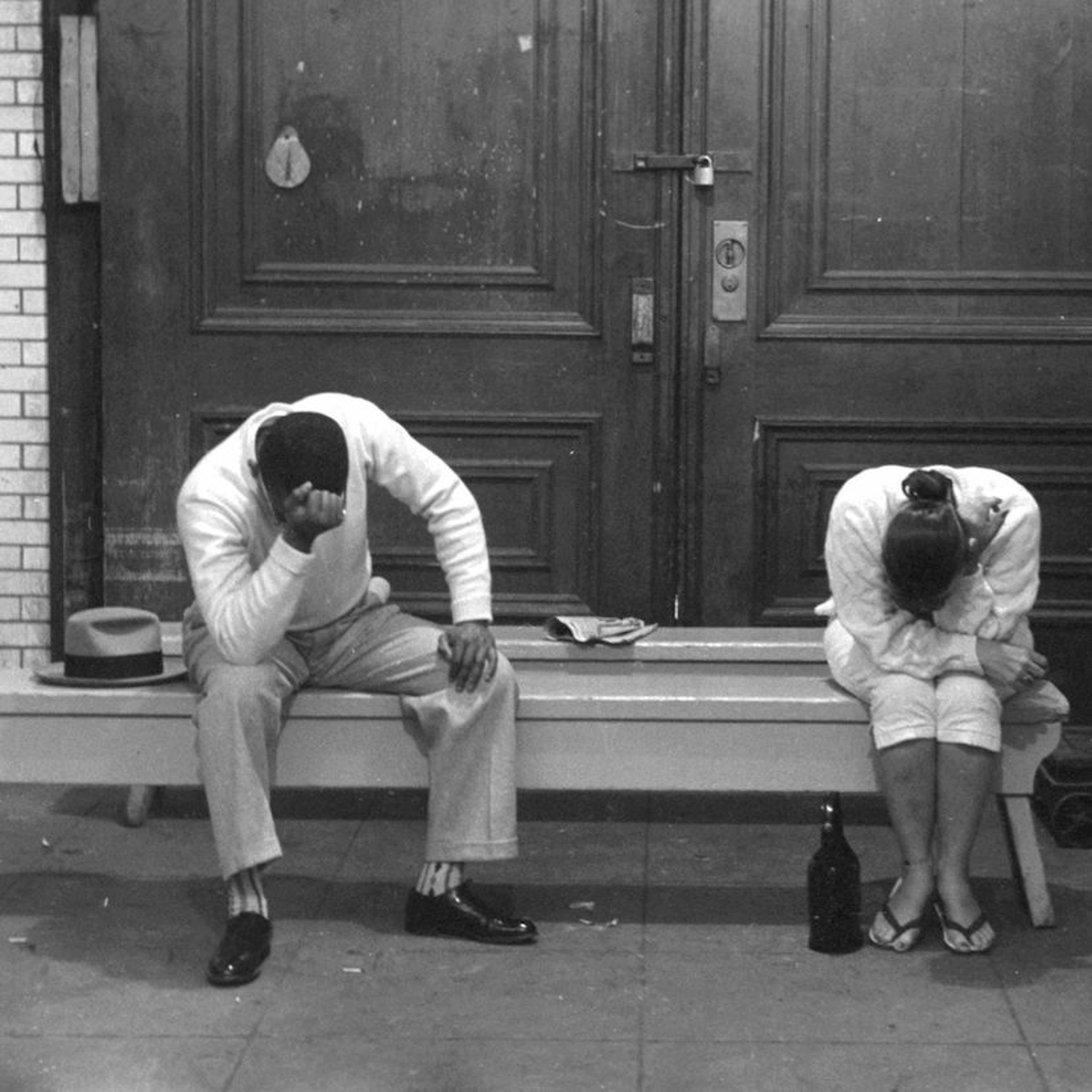
Why Dorothea Lange still matters: Q&A with Oakland Museum's Drew Johnson
The first part of this episode originally aired three years ago, when the Oakland Museum opened an exhibit of Dorothea Lange photos called Politics of Seeing. Now, the Oakland Museum is launching a huge digital archive of Lange’s work, so I’ve decided to re-run the original episode plus a new interview with Drew Johnson, OMCA’s Curator of Photography and Visual Culture, about why these photos are worth a new look in 2020. Here’s the description for the original episode: Dorothea Lange is one of the most famous photographers of all time, but the local work she did during her many decades as an East Bay resident is often overlooked. This episode explores how she went from taking portraits of the Bay Area’s wealthiest families to documenting the poor and working class. Dorothea’s goddaughter, Elizabeth Partridge, and Drew Johnson, curator of the Oakland Museum’s new Dorothea Lange exhibition, share insights on what makes her photographs so iconic—and why they’re still so relevant. To see the Dorothea Lange Digital Archive, visit: https://dorothealange.museumca.org/ To see images and links to related to this story, visit: https://eastbayyesterday.com/ East Bay Yesterday can’t survive without your support. Please donate to keep this show alive: www.patreon.com/eastbayyesterday
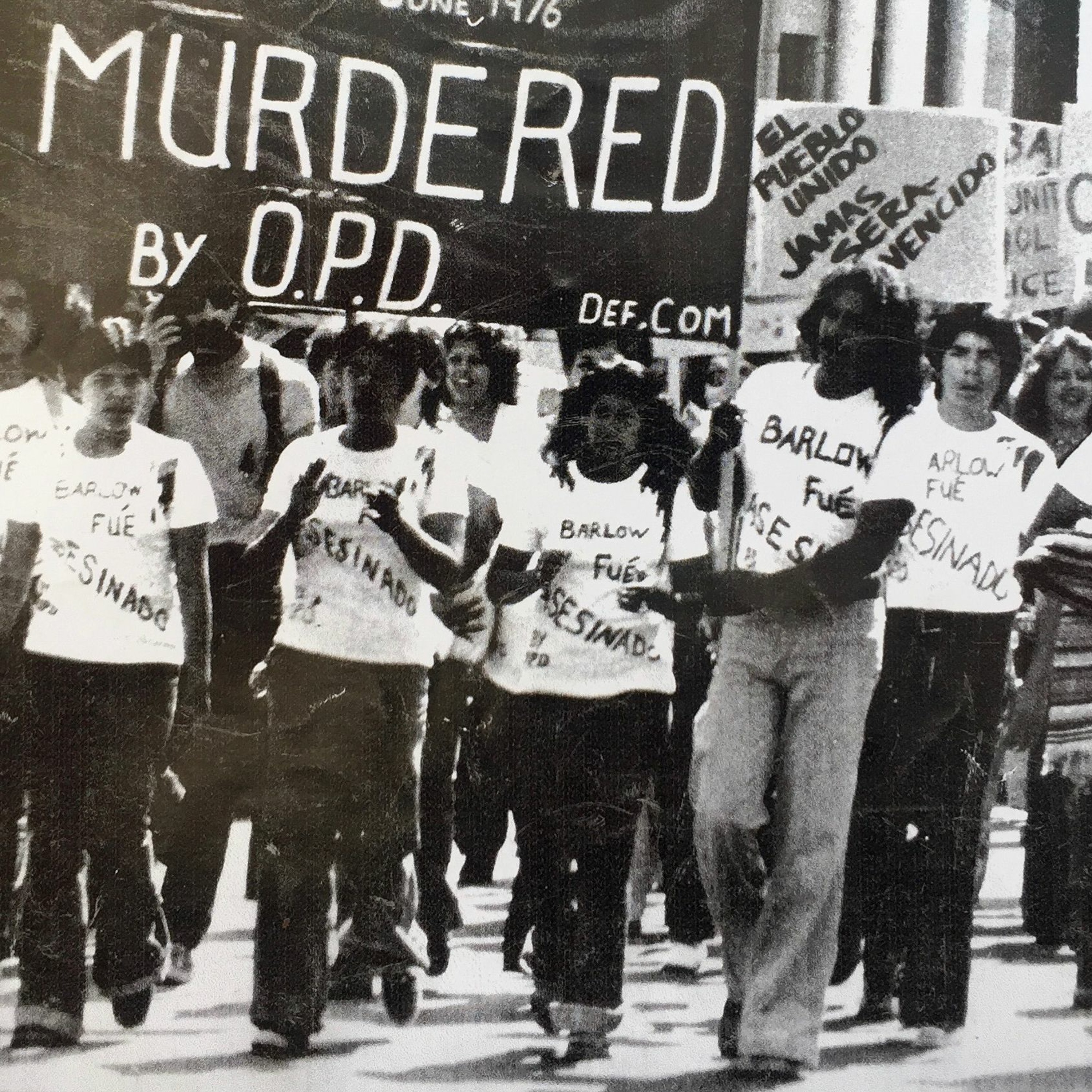
“How you organize that rage”: Challenging the police before Black Lives Matter
Massive protests in the wake of George Floyd’s death have brought unprecedented attention to the intertwined issues of police violence and structural racism, but the legacy of challenging police abuse in the East Bay goes back many decades. This episode explores several pivotal confrontations in the long struggle to hold police accountable for brutality against people of color. To read more about this story and see additional images, visit The Oaklandside: https://oaklandside.org/2020/07/24/oaklandside-east-bay-yesterday-police-violence-oakland/ This episode features interviews with: Xavier Buck, Deputy Director of the Dr. Huey P. Newton Foundation Andrea Benavidez and Veronica Salazar, sisters of Barlow Benavidez Tony Valladolid, attorney Brenda Payton, retired journalist John Burris, civil rights attorney
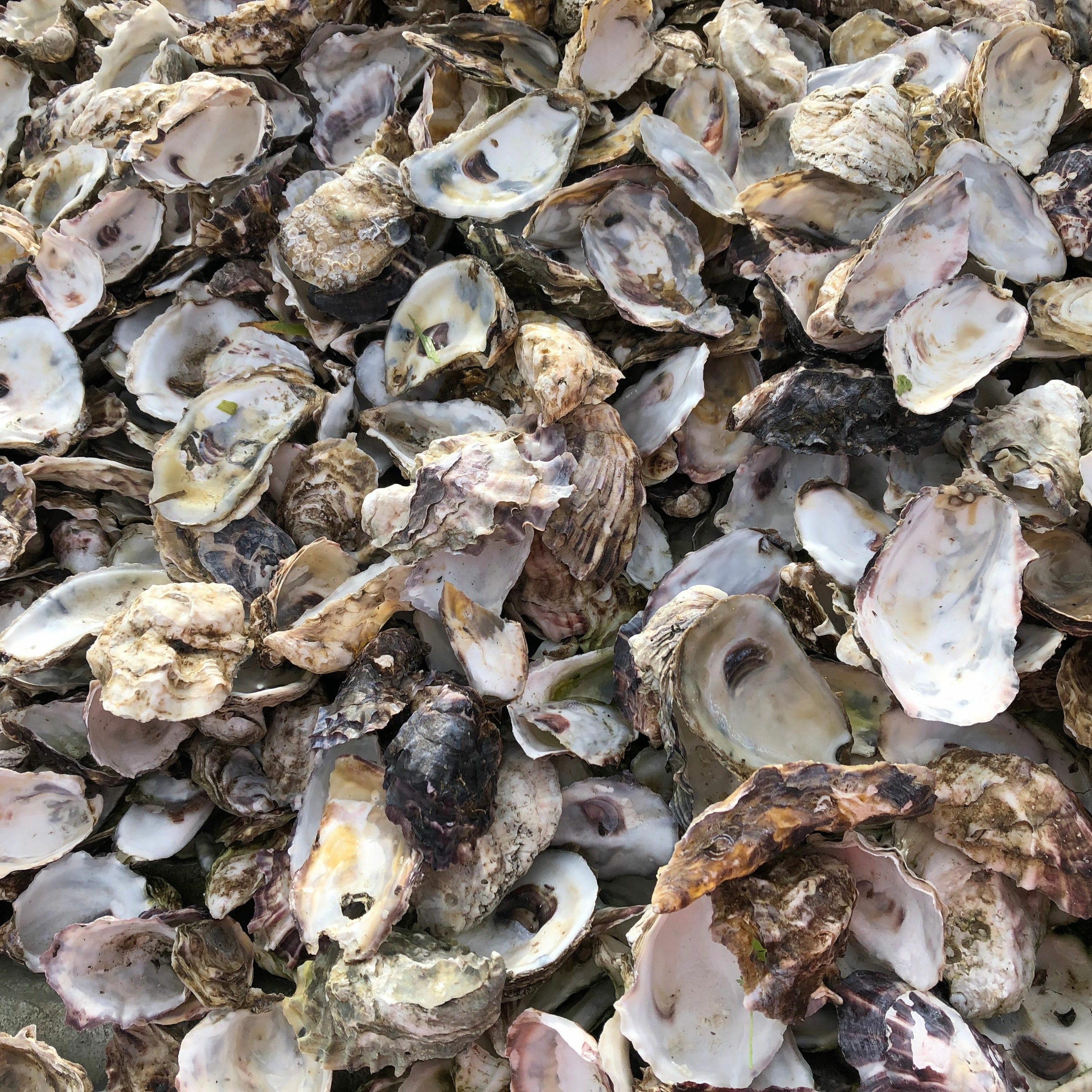
EBY Q&A Live: Opening up about oysters
Oysters may seem like a simple creature at first glance – they can’t even move on their own – but their presence can determine the health of an entire ecosystem. Just like tree rings hold clues to Earth’s history, oyster shells can reveal much about past millennia. In the San Francisco Bay, studying the rise and fall of oysters illuminates Ohlone culture, the Gold Rush era, industrialization, public health, and much more. Today’s episode, which was originally recorded as a virtual event, explores the history of Bay Area bivalves with Casey Harper, deputy director of Wild Oyster Project. Although local oyster populations were nearly wiped out following decades of pollution and habitat destruction, a few survivors were discovered in recent years, leading to a surge in restoration efforts. Despite challenges ranging from invasive predators to ocean acidification, groups like Wild Oyster Project are hopeful that these projects will grow to provide shelter for marine life, filter pollutants out of the water, and eventually mitigate sea level rise more effectively than concrete barriers. Listen now to hear all about the past (and potential future) of Bay Area oysters. Thank you to Daniel Wolfe of Creative Mornings Oakland for organizing this virtual event and to Christie Goshe from Tiny Oak Media for recording it. East Bay Yesterday can’t survive without your support. Please donate to keep this show alive: www.patreon.com/eastbayyesterday
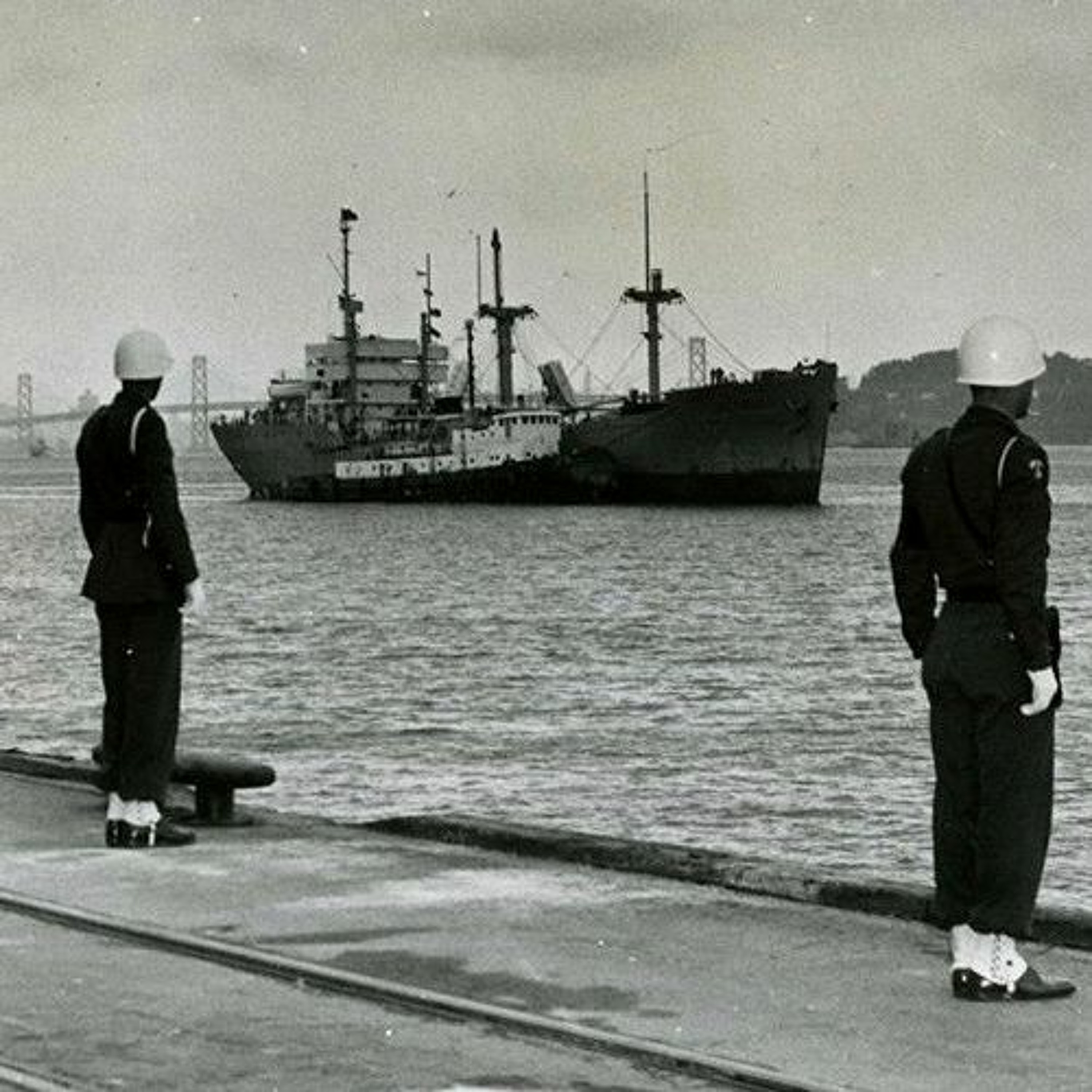
A town within The Town: Oakland Army Base workers on its rise and fall
From World War II until Desert Storm, the Oakland Army Base was the U.S. military’s largest seaport West of the Mississippi. This site had been a sandy marsh the previous century, and for millennia before that, but at its peak during the Vietnam War, it grew into “the largest military port complex in the world.” Situated at an industrial confluence of roads, rails, and shipping lanes, it served as a supply hub for the entire Pacific. Although hundreds of thousands of service members passed through en route to overseas assignments, most of the day-to-day workers at this “town within The Town” were civilians. For decades, burly ILWU members hoisted a nonstop stream of cargo, college girls working as part-time secretaries filed mountains of paperwork, determined clerks climbed the ranks of civil service, and countless others staffed the Base’s grocery store, morgue, bowling alley, night club, and other facilities. After the Base was decommissioned in 1999, during a wave of closures that wiped out the Bay Area’s formerly substantial military presence, UC Berkeley’s Oral History Center spoke with dozens of people (military and civilian) about their connections to this site. The interviews, compiled in “The Oakland Army Base: An Oral History,” span topics ranging from an astonishing tale about President Roosevelt’s visit to resentments still lingering over the Base’s unexpected termination and controversial redevelopment process. In these stories, whiskey flows, fists fly, foundations are driven deep into mud, careers flash by, trust is earned, orders are disobeyed, victories are celebrated with songs and parades, roads crumble, and cold, wooden coffins are draped with American flags. Instead of contextualizing these memories with narration, per this podcast’s usual format, I’ve decided to present these voices as an audio collage, assembled in roughly chronological order. Hearing these interview tapes felt like time-traveling and my goal was to create an episode that captures the feeling of taking a four-dimensional guided personal tour through the kaleidoscopic history of this sprawling complex. If you want the full, immersive experience of tasting the salty wind while you listen, head down to Middle Harbor Shoreline Park (which is adjacent to the former Base site) or the path that parallels Burma Rd. Social distancing shouldn’t be a problem – truck drivers far outnumber pedestrians in this flat, grey stretch of far West Oakland. I wouldn’t recommend walking along Maritime St, the main drag that cuts through the heart of the Base site, due to the constant flow of noisy semis and gritty construction dust, which tends to get in your eyes during the often gusty days. To see images related to this episode, visit: https://eastbayyesterday.com/ Special thanks to Oral History Center’s project team: Martin Meeker (director), David Dunham, Vic Geraci, Lisa Rubens, Ann Lage, Robin Li, Jess Rigelhaupt, and Julie Allen. Additional thanks to the interview subject whose voices are heard in this episode: Eleanor Bollinger, Mark Braly, George Bolton, George Cobbs Gordon Coleman, Steve Darrow, Grant Davis, George Gabler, Aliza Gallo, Thomas Galvin, Margaret Gordon, Fred Gowan, Jim Johnson, Robert Lippincott, Janice McDonald, Rose Medina, Mary Meyers, Monsa Nitoto, Bob Nordan, Leo Robinson, Stan Rudney, Lee Sandahl, Sydney Santos, Robert Taylor, Davetta Thibeux, Michael Thomas, Queen Thurston, and Cleophas Williams. Here’s a link to additional biographical information and full interview transcripts: https://bancroft.berkeley.edu/ROHO/projects/oab/transcripts.html East Bay Yesterday can’t survive without your support. Please donate to keep this show alive: www.patreon.com/eastbayyesterday
From war to love: My grandma remembers the Oakland Army Base
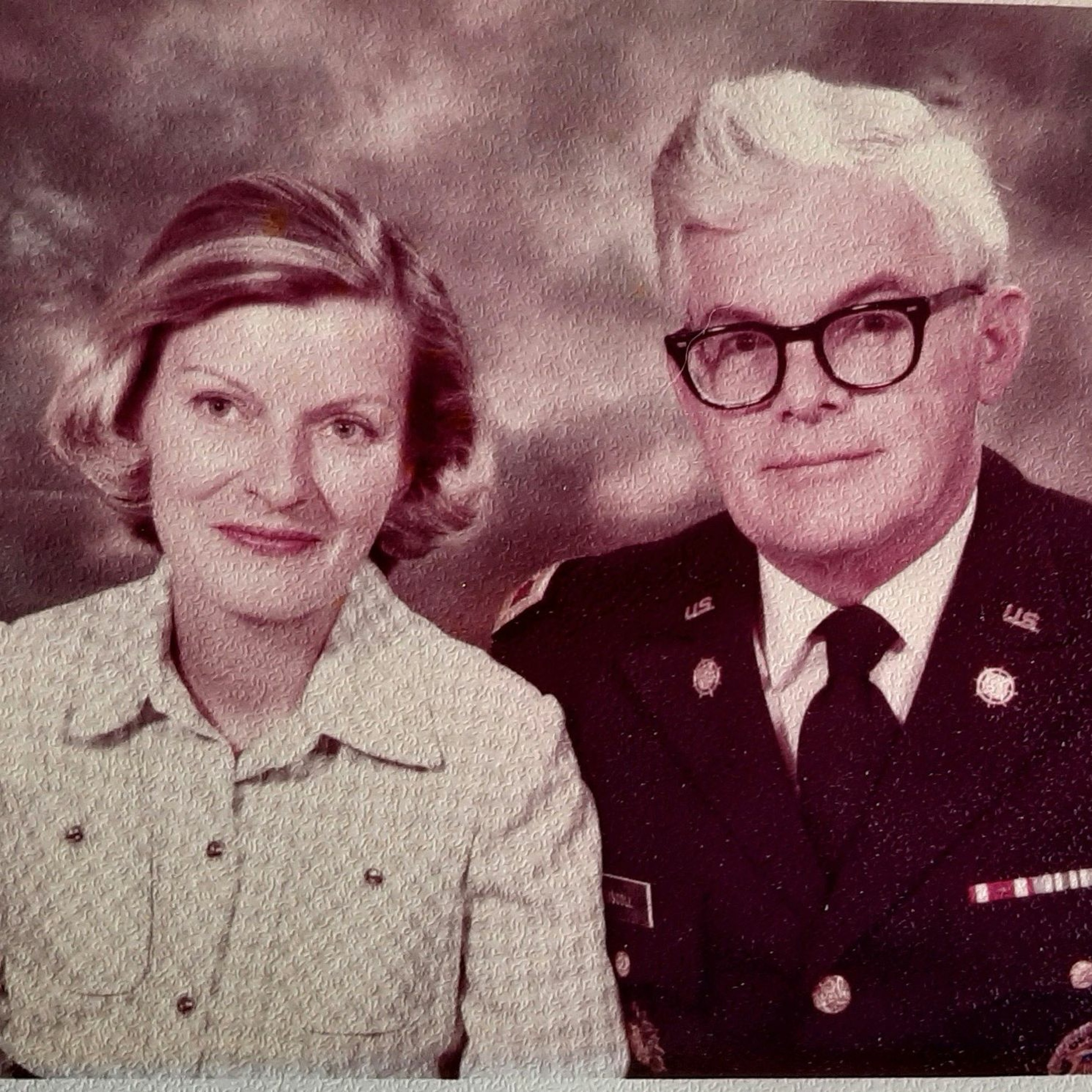
I never planned to make an episode of this podcast about my own family history, but I’ve been spending more time thinking about my relatives, who are scattered across the country, ever since the coronavirus pandemic started. In particular, I’ve been worried about my grandmother (I call her Oma), who has been isolated in a Florida nursing home that banned visitors more than a month ago. From 1971 until 1975, my grandfather, Col. Jim Driscoll (I called him Opa), was stationed at the Oakland Army Base and during that time Oma volunteered there. I interviewed her a while ago about her East Bay years, but I never listened to the conversation until recently. Hearing it now, during this time of isolation and uncertainty, was a powerful experience. We discussed the improbability of finding love amidst war, the challenges of balancing military service with family, and the unexpected ways that life can spontaneously intersect with historical events. I’ll admit that revealing so much about my family make me anxious, but I hope that hearing my Oma look back on her tumultuous life with the kind of amused serenity that comes with old age will provide some solace, or at least a momentary escape, for everyone struggling with the surreal horrors and grinding frustrations of present reality. Another motivation for releasing this episode – and I say this with as much humility as possible – is that I’m hoping that it might inspire some of you to talk with your elders. Or, if you are an elder, to talk with the young people in your family or community. With loneliness spiking during this time of social distancing, what better remedy than dusting off that old treasure chest of distant memories and bonding over the process of unpacking them (and recording them)? If this prospect sounds intimidating, UC Berkeley’s Oral History Center has shared some tips for getting the most out of these kinds of conversations. Throughout my years of interviewing people about their lives, one thing I’ve realized is that the first few minutes are always the most awkward. People who have never been interviewed before are often self-conscious or shy about unearthing long-buried memories. With a bit of patience and encouragement, however, tiny trickles of recollections will inevitably start flowing together and a flood of stories will eventually pour forth. You just have to be willing to listen. East Bay Yesterday can’t survive without your support. Please donate to keep this show alive: www.patreon.com/eastbayyesterday
“We were being erased”: The woman who saved California’s Black history
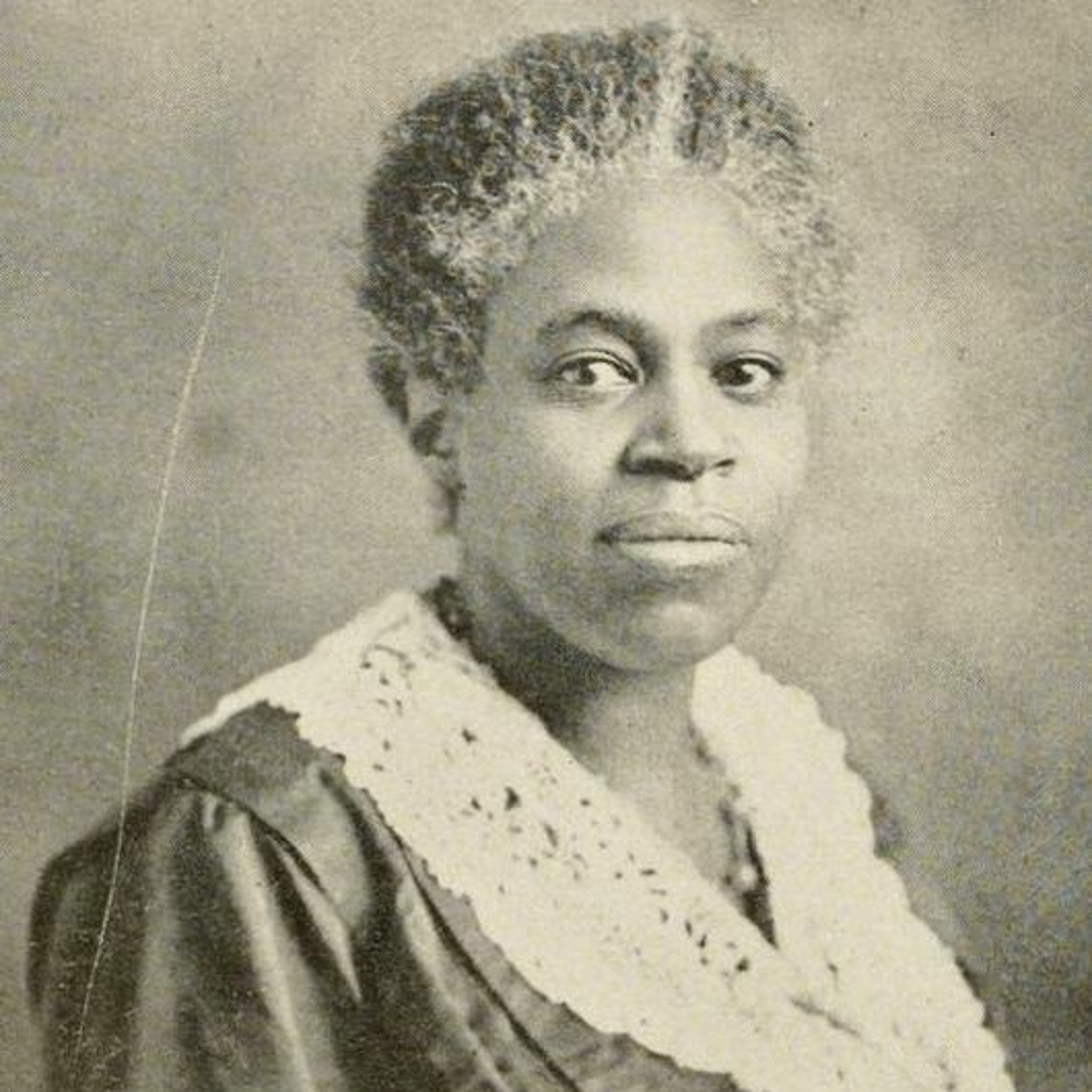
Delilah Beasley didn’t have much education or money, but when she saw that African Americans were being ignored by history books, she knew she had to do something. Beasley ended up spending nearly a decade interviewing elders and digging through crumbling archives to compile “The Negro Trailblazers of California,” a book that rescued dozens of notable Black figures from historical oblivion. However, Beasley didn’t just focus on the past. Her weekly Oakland Tribune column, “Activities among the Negroes,” documented the East Bay’s Black community at a time when positive portrayals of people of color in the media were almost nonexistent. This episode explores Beasley’s life as a historian and journalist through a conversation with the authors of “Trailblazer: Delilah Beasley’s California” (Published by Clockshop), a new work by Dana Johnson and Ana Cecilia Alvarez. We discuss Beasley’s motivation, her impact, and why her work still remains so valuable. To see more about this episode, visit: https://eastbayyesterday.com/episodes/we-were-being-erased/ East Bay Yesterday can’t survive without your support. Please donate to keep this show alive: www.patreon.com/eastbayyesterday
EBY Q&A: The Bay and beyond with Chris Carlsson
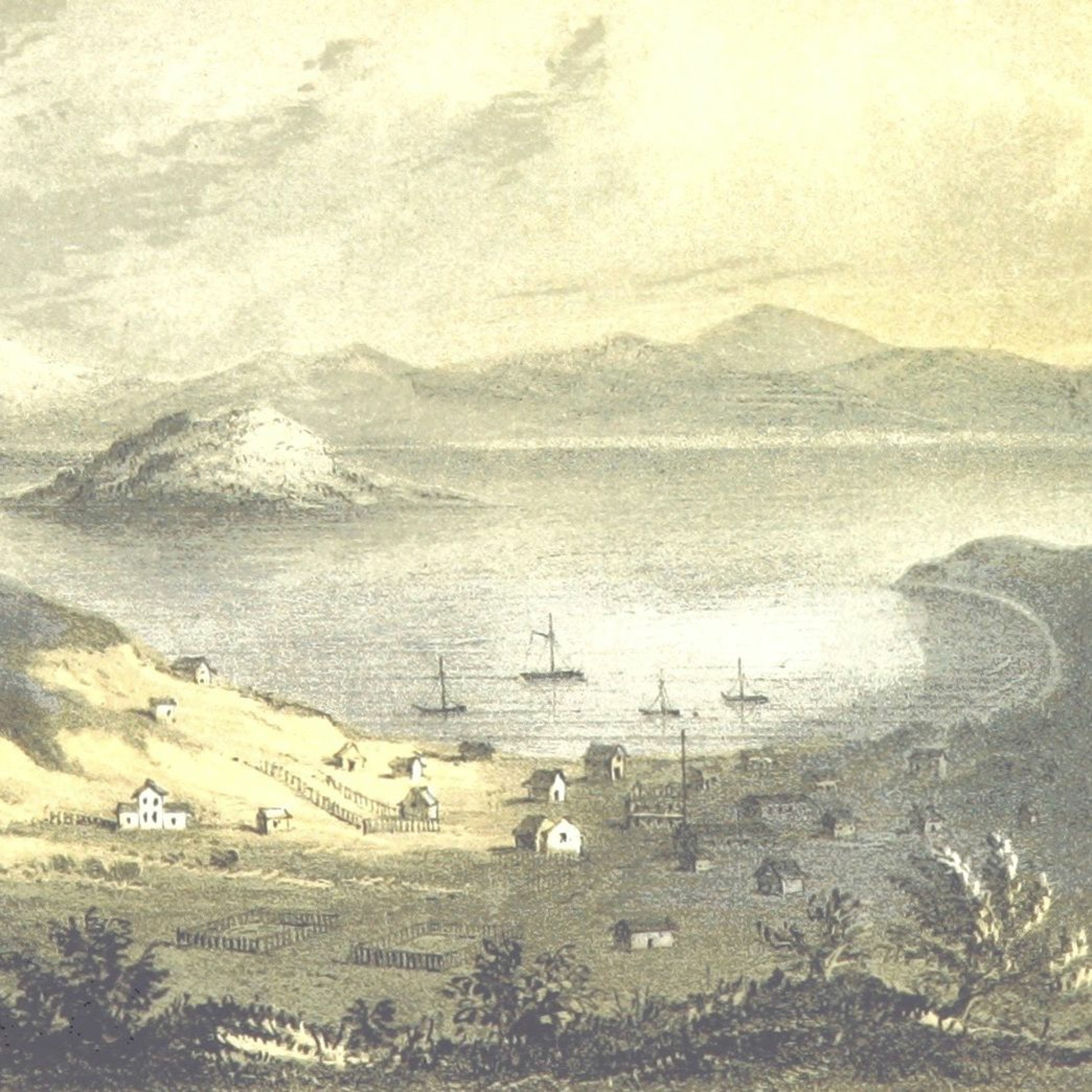
Since I’ve had to postpone my boat tours due to the Coronavirus crisis, I’ve decided to move the discussion about Bay history to the podcast. My guest is Chris Carlsson, who also leads boat tours on the Bay and just published “Hidden San Francisco: A Guide to Lost Landscapes, Unsung Heroes & Radical Histories” (Pluto Press). Our conversation begins with the arrival of the Spanish in 1776 and then explores how subsequent waves of newcomers radically impacted native people and ecosystems, often in devastating ways. Although we take a critical look at colonization, we don’t dwell exclusively on tragedies. Since the rise of the Save the Bay movement, an activist campaign spearheaded by three Berkeley women, the Bay has transformed from a vast cesspool of human and industrial waste to the site of dozens of restoration projects that are expanding marsh habitats and enticing great numbers of fish, birds, and marine mammals to return. Against the backdrop of our current economic turmoil and political uncertainty, we look back at the Bay as a contested space, and try to find lessons in its ebbs and flows. To see more about this episode, visit: https://eastbayyesterday.com/episodes/eby-qa-8/ East Bay Yesterday can’t survive without your support. Please donate to keep this show alive: www.patreon.com/eastbayyesterday
EBY Q&A: How did it get so expensive to live here?
How did the Bay Area’s housing crisis get so bad – and what might be done to solve it? These are the main questions Oakland-based New York Times reporter Conor Dougherty tackles in “Golden Gates: Fighting for Housing in America.” In addition to tracing the origins of policies that led to some of the most expensive property values in the nation, this wide-ranging book also follows the trajectories of families fighting massive rent increases, pro-development activists, besieged politicians and profit-seeking speculators. Refreshingly, Dougherty brings much-needed nuance to political battles that are often characterized by bitterness, hyperbole and scorched Earth-style Twitter wars. By exploring the many failures (and well-intentioned missteps) that led to this current shortage, the book offers a useful primer for anyone seeking to understand how Bay Area housing politics became so gridlocked and dysfunctional. “If there’s a rhyme to postwar history,” Dougherty writes. “It’s that whatever system we use, and whatever level of government is orchestrating it, when we think of cities as buildings and markets, and not collections of people, we are doomed to make the same mistakes.” Listen to the new episode to hear Conor Dougherty discuss what some of those mistakes were, why it’s so challenging to build affordable housing, the sharp rise in homelessness since the Reagan era, and much more To see images and links to related to this story, visit: eastbayyesterday.com/ East Bay Yesterday can’t survive without your support. Please donate to keep this show alive: www.patreon.com/eastbayyesterday
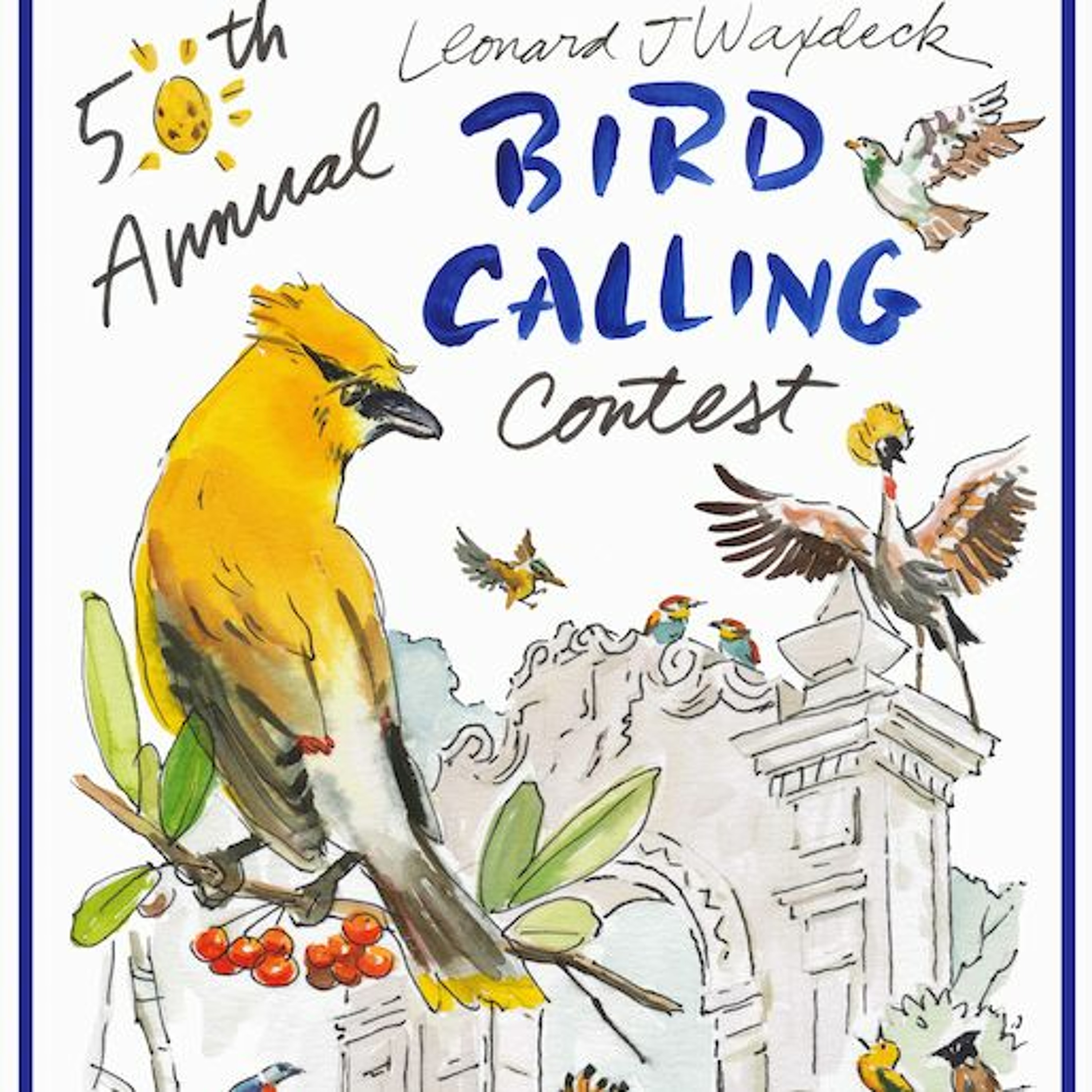
“OK, let’s go crazy”: How an unusual contest became the pride of Piedmont
In 1963, a Piedmont High science teacher decided to liven up biology class with a bird calling competition. This hatched an annual tradition that led to students shrieking and squawking in front of millions of TV viewers for nearly half a century. Today’s episode follows the trajectory of the Leonard J. Waxdeck Bird Calling Contest from the nest to the airwaves. How did this tiny enclave in the Oakland hills end up in the national spotlight for such a bizarre spectacle? Listen now to find out. Featuring interviews with: Piedmont High School librarian and Bird Calling Contest producer Kathryn Levenson and former participants Laurel Cecila, Joe Fendel, and Will Reicher. This episode is dedicated to the memory of Leonard J. Waxdeck. To see images and links to related to this story, visit: https://eastbayyesterday.com/episodes/ok-lets-go-crazy/ East Bay Yesterday can’t survive without your support. Please donate to keep this show alive: www.patreon.com/eastbayyesterday
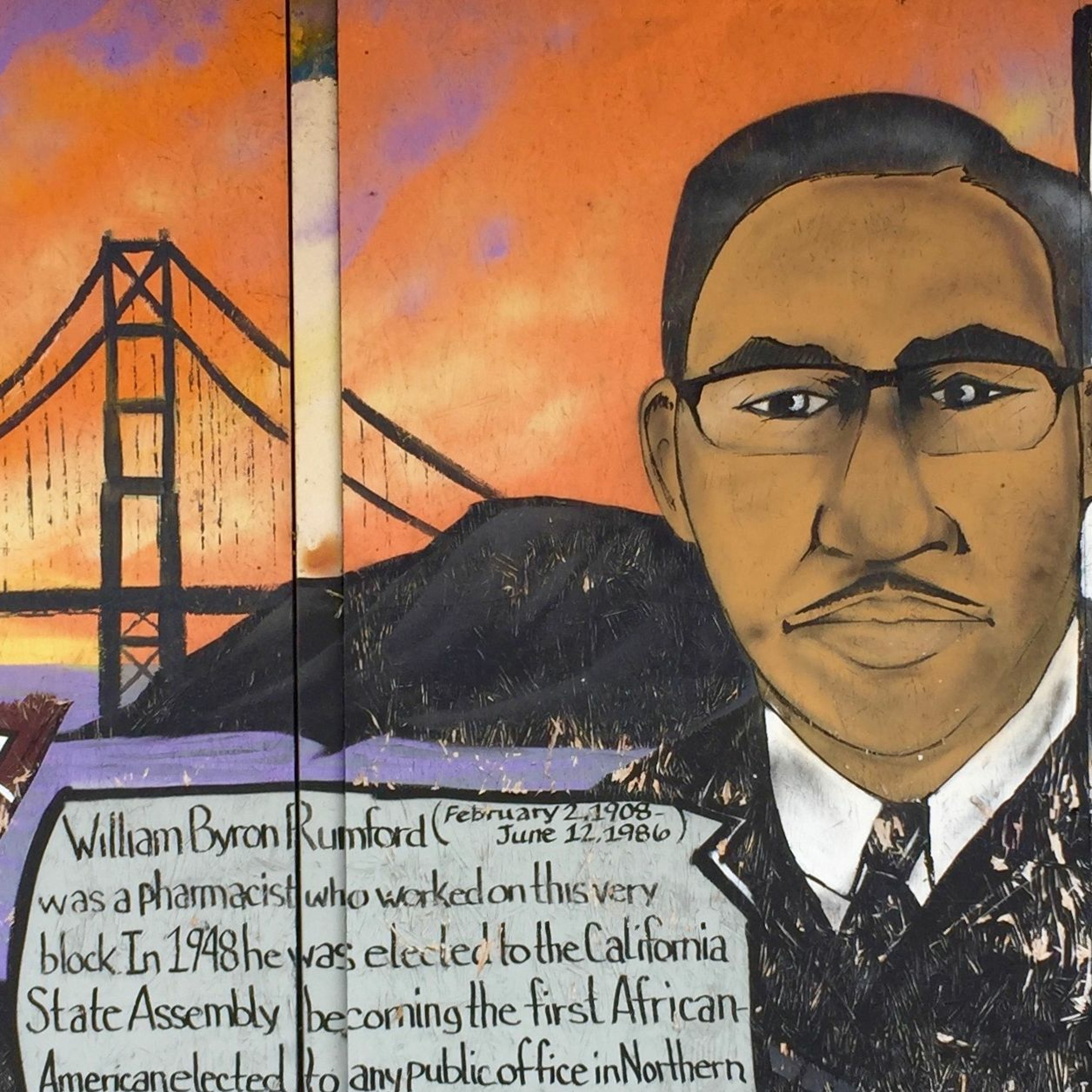
Unfair housing: Why racism and real estate are so hard to untangle
In 1963, Northern California’s first African American State Assemblymember, Byron Rumford, championed a Fair Housing Act designed to prevent racial discrimination that severely limited where people of color could live. This bill, and the national laws it helped inspire, banned property owners from refusing to sell to potential buyers on the basis of race. As the Civil Rights movement gained momentum through these legislative victories, the end of segregation seemed within grasp. But now in 2020, amidst a tech-fueled real estate boom that’s sent home values soaring, the Bay Area is re-segregating as Black populations in wealthy areas dwindle and “neighborhoods with low pollution, high-quality schools and other resources have become increasingly inaccessible for African Americans.” In Byron Rumford’s former hometown of Berkeley, the percentage of African American residents has dropped from a high of nearly 25% during the 1970s to less than 10% today. The problem isn’t limited to California. According to The Center for Investigative Reporting, “a new epidemic of modern-day redlining has crept quietly across America. The gap in homeownership between African Americans and whites is now wider than it was during the Jim Crow era.” More than half a century after the Civil Rights Act was supposed to end housing discrimination the problem is getting worse in some ways. So what went wrong? The new episode explores this question through interviews with William Byron Rumford III, former California State Assemblymember E. Dotson Wilson, documentary filmmaker Doug Harris, and historian Ryan Reft. Listen now to learn what Byron Rumford’s story can tell us about why racism and real estate are so hard to untangle. To see images and links related to this story, visit: https://eastbayyesterday.com/episodes/unfair-housing/ East Bay Yesterday can’t survive without your support. Please donate to keep this show alive: www.patreon.com/eastbayyesterday
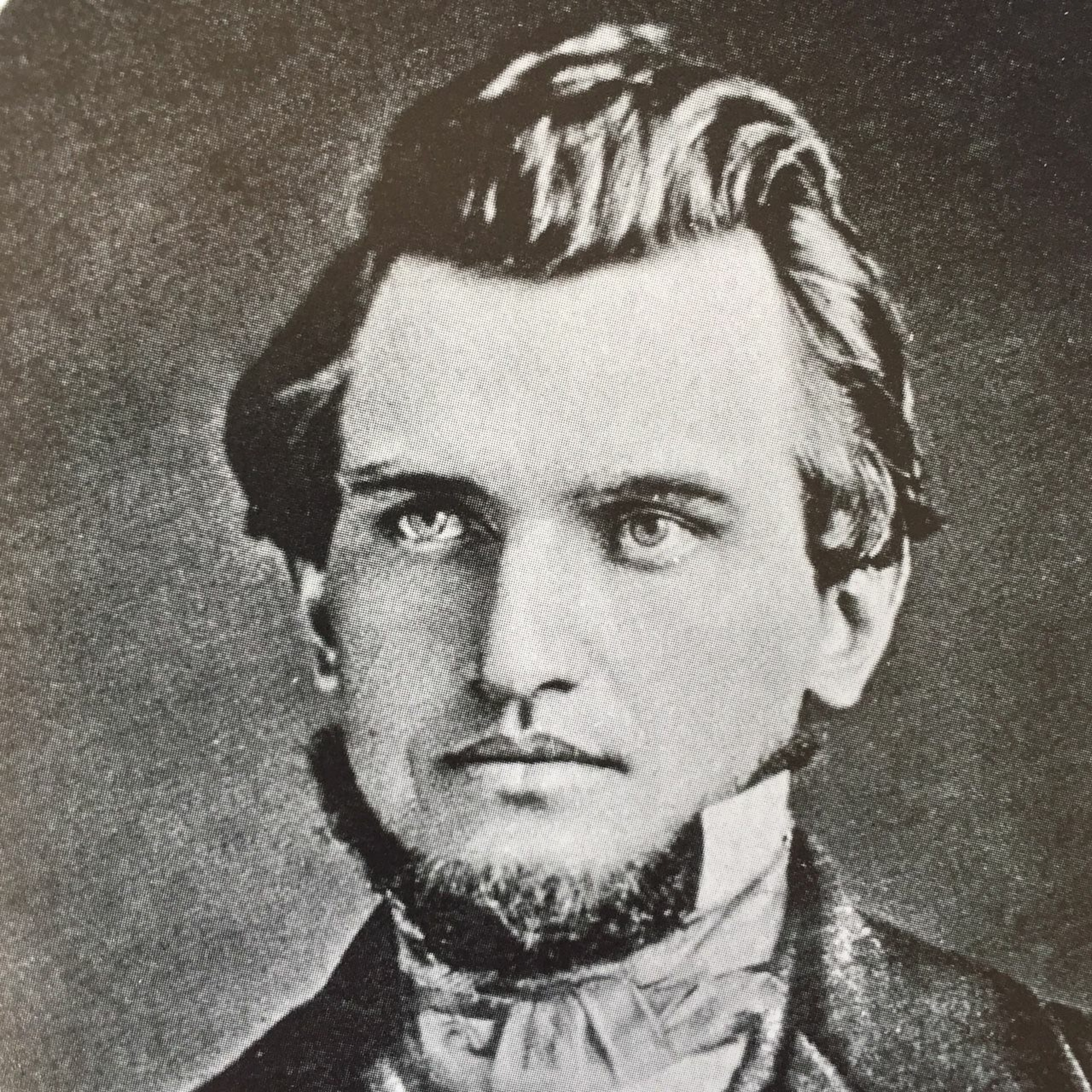
EBY Q&A: Leland Stanford, the original tech bro
It's almost impossible to image what Oakland would look like today if the Western terminus of the Transcontinental Railroad hadn't been established here in 1869. Where there had once been marshy wetlands, industry rushed in to build factories at this nexus of steel and sea. The railroad connected a broken country still recovering from the Civil War and solidified Oakland's position as a hub of global commerce, for better or worse. Oakland didn't choose this destiny for itself – the decision was made by "The Big Four," a cadre of robber barons who controlled the Central and Southern Pacific Railroad lines (and a host of related shell companies). This episode features an interview with Roland De Wolk, author of "American Disruptor: The Scandalous Life of Leland Stanford," a new book that explores the life of the man who served as president of the railroad companies as well as senator and governor of California. De Wolk also highlights undeniable parallels between the Big Four's predatory, monopolistic ethos and today's Silicon Valley business culture. The seed of Big Tech was planted by Leland Stanford and the university he founded. And just like during the Gilded Age, the East Bay is being impacted by tycoons disconnected from what their decisions mean to people living here. As Richard White, a Professor of American History at Stanford, wrote about the railroad bosses, “They laid hands on technology they did not understand, initiated sweeping changes, and saw these changes often take on purposes they did not intend.” To see photos related to this story, visit: https://eastbayyesterday.com/episodes/eby-qa-6/ East Bay Yesterday can't survive without your support. Please donate to keep this show alive: www.patreon.com/eastbayyesterday
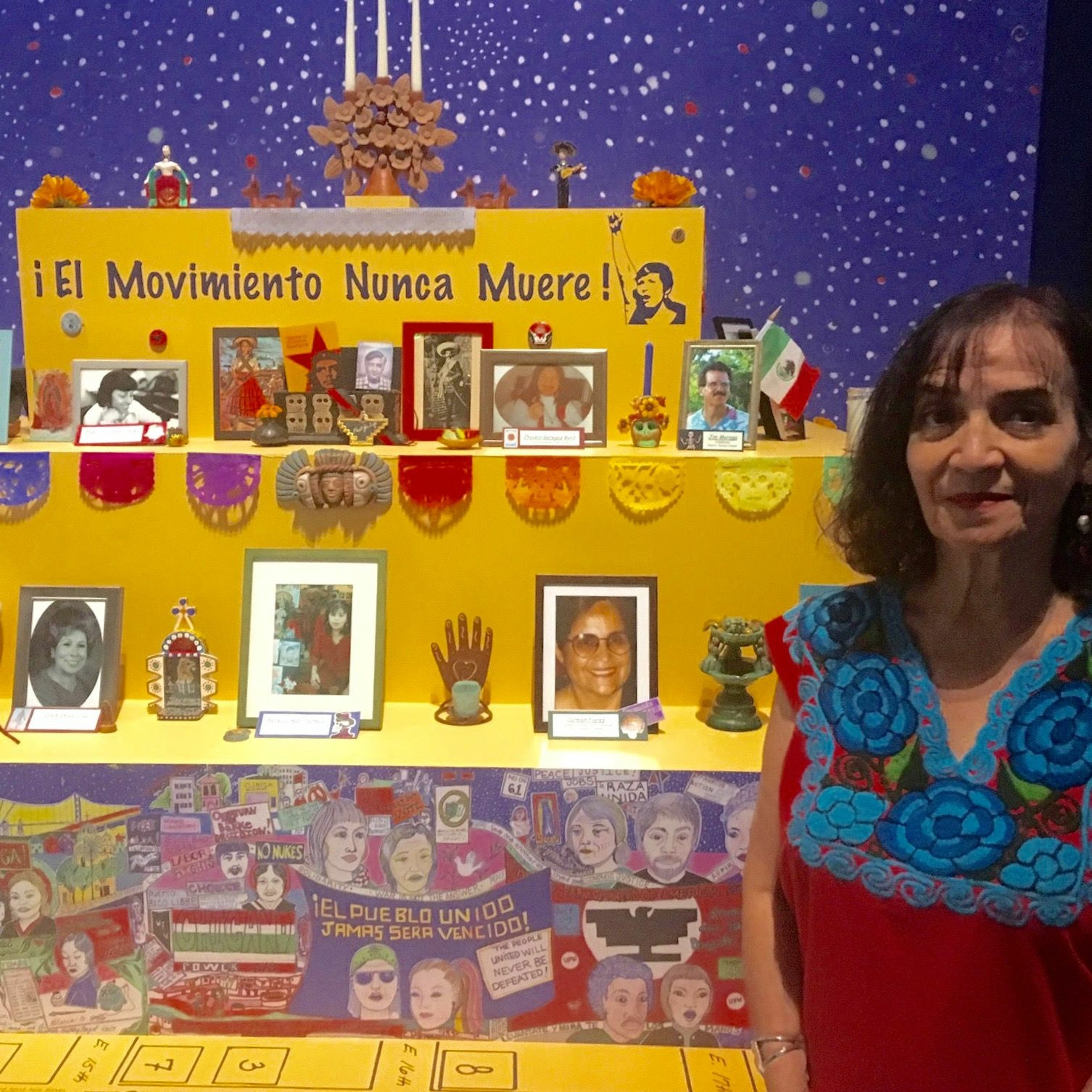
“It wasn’t part of my childhood”: Chicano Power and the rise of Día de los Muertos in Oakland
Many Mexican-Americans growing up during the 1950s and ’60s had no awareness of Día de los Muertos. Due to the pressures of assimilation, relatively few Chicano families celebrated this ancient tradition, which combines elements of Christian and indigenous rituals. A new exhibit at the Oakland Museum of California, ¡El Movimiento Vivo! Chicano Roots of El Día de los Muertos, celebrates the resurrection of this holiday in the Fruitvale district and throughout California. As the Museum celebrates the 25th anniversary of its Día de los Muertos ceremonies, this episode explores connections between the rise of the Chicano Power movement and surging interest in Day of the Dead. Listen now to hear Fruitvale History Project co-founder Annette Oropeza and Latino mental health pioneer Roberto Vargas share memories of how they came to embrace Día de los Muertos, their concerns about its growing mainstream recognition, and much more. See photos and more here: https://eastbayyesterday.com/episodes/it-wasnt-part-of-my-childhood/ Do you want more East Bay Yesterday? Please donate to help keep this show alive: www.patreon.com/eastbayyesterday
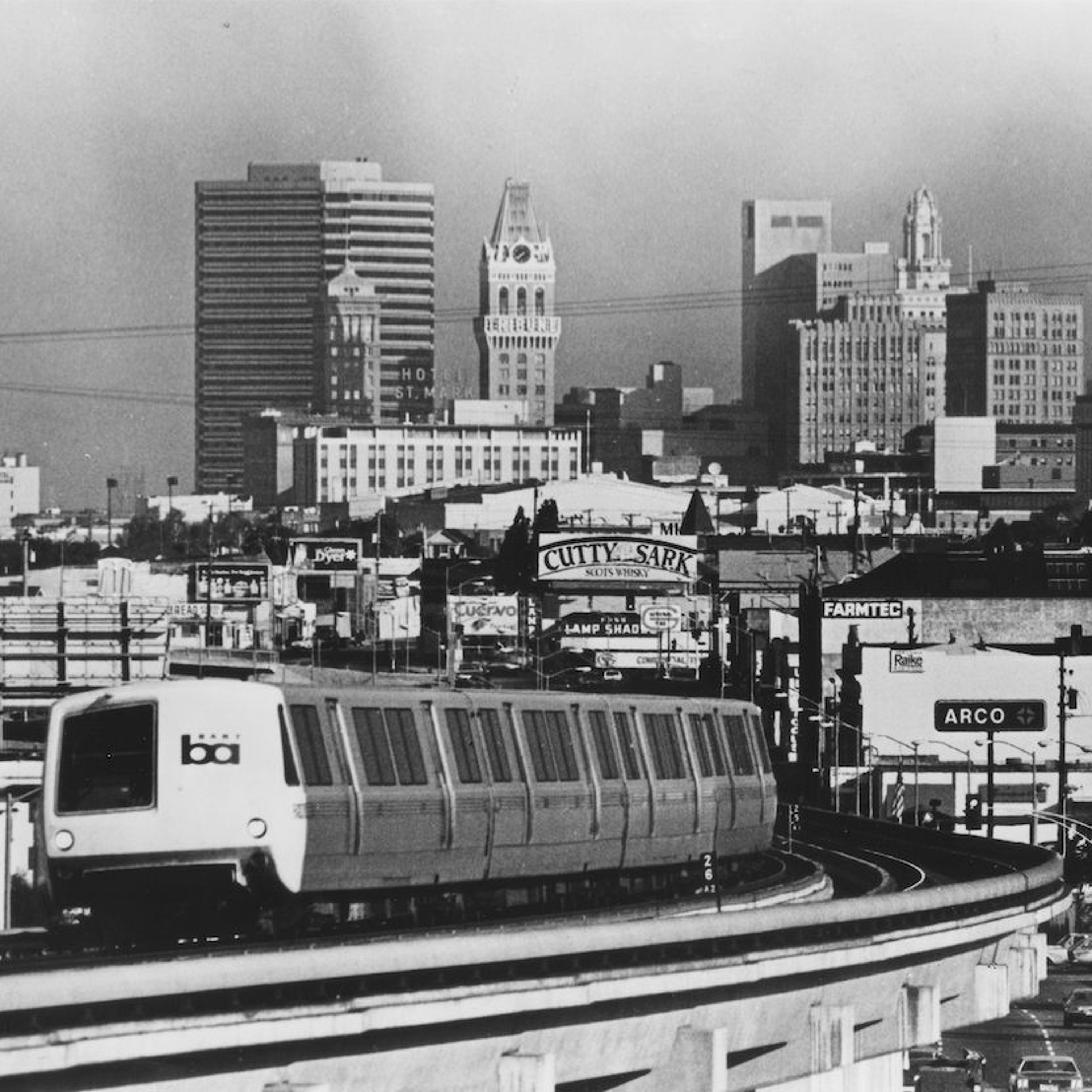
EBY Q&A live: A wild ride through BART history
Why did BART come "within a gnat's eyelash" of being derailed by voters before the first track had ever been laid? How did Berkeley force BART to go underground? What's the deal with BART managers getting busted by FBI sting operations? All these questions and many more are answered in this week's episode, which was recorded live at the Oakland Public Library on October 9, 2019. Michael Healy, who was BART's spokesperson for 32 years and wrote "The Dramatic History of the Bay Area Rapid Transit System" (Heyday), shares an insider's look at the many triumphs, setbacks, and controversies that BART has faced since its mid-20th century inception. Listen now to hear the wide-ranging interview and audience Q&A. (Special thanks to Katie McMurran for recording this event.) East Bay Yesterday relies on listener support to survive. If you enjoy the episode, please donate: www.patreon.com/eastbayyesterday
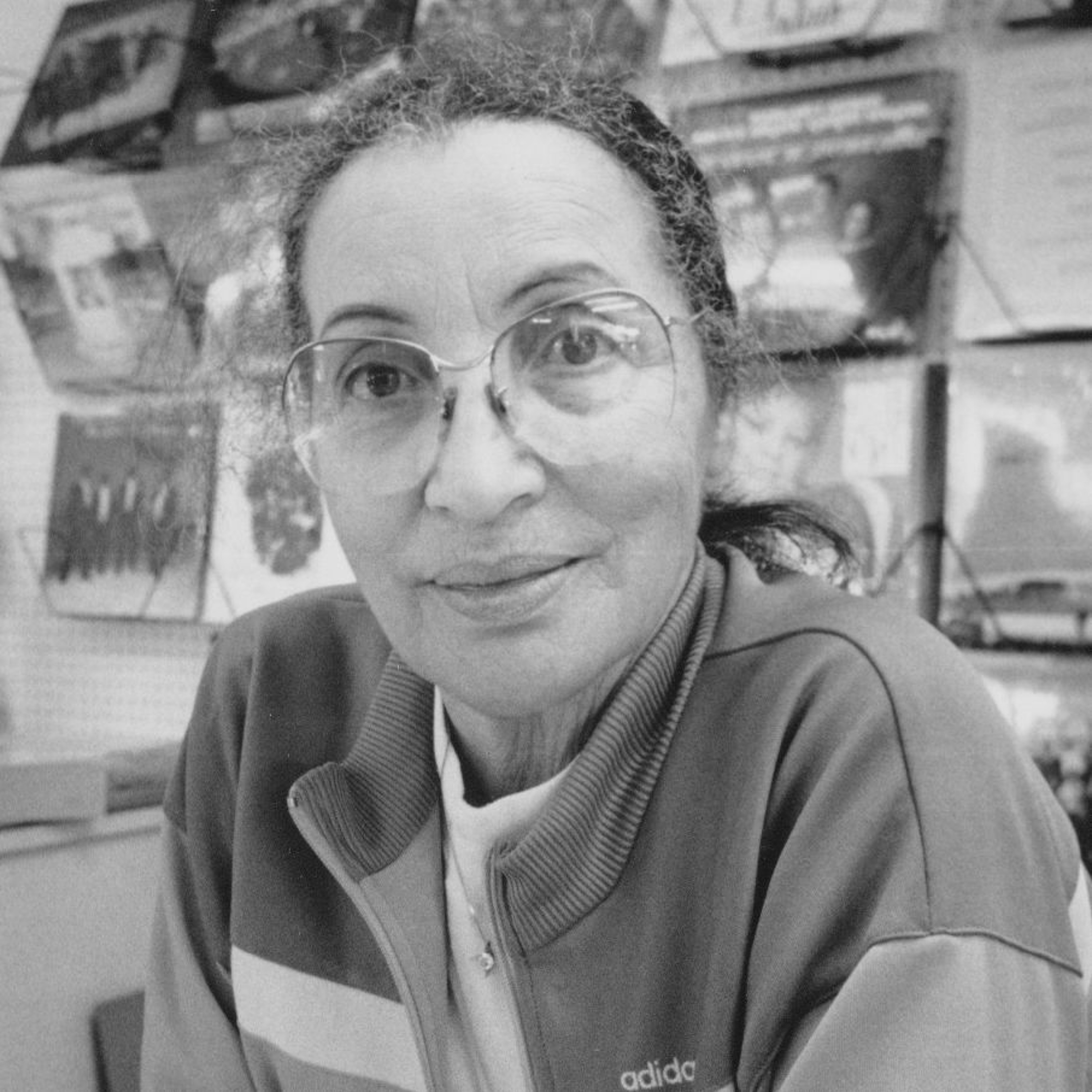
EBY Q&A: Betty Reid Soskin's century of chaos and hope
Betty Reid Soskin is a living link to America’s long history of slavery. As a young woman, her best friend was her great-grandmother, who was enslaved for the first two decades of her life. When Betty attended the inauguration of Barack Obama she carried a photo of her great-grandma in her breast pocket – and she also carried memories of the many struggles that led to the election of America’s first black president. In this episode, Betty Reid Soskin shares stories of growing up in Oakland during the 1920s “when the hills used to burn every year.” She traces her journey from working in a segregated union hall during World War II to co-founding one of the East Bay’s first Black record stores to becoming “America’s oldest National Park ranger” at the age of 85. And she explains how living for nearly a century has allowed her to see patterns in history that give her hope for the future. Even though Betty’s 98th birthday is approaching, she’s still incredibly active. She recently published an autobiography, “Sign My Name to Freedom,” she’ll be releasing an album of her music next year, and a documentary about her life “No Time to Waste” will be premiering throughout the Bay Area starting later this month. Plus, she’s still delivering her renowned presentations to sold-out crowds at Rosie the River WWII Homefront National Park several times per week. Betty has no plans to retire any time soon. “As long as there are faces in that audience who have never heard those stories, they simply come alive for me,” she told me during our interview. East Bay Yesterday relies on listener support to survive. If you enjoy the episode, please donate: www.patreon.com/eastbayyesterday
EBY Q&A: 50 Years of free health care
As hippies and radicals flooded into Berkeley during the sixties, the city faced mounting public health problems that ranged from bad acid trips to riot injuries. The Berkeley Free Clinic launched in 1969 to provide no-cost treatment to those who couldn’t afford (or didn’t feel comfortable dealing with) the mainstream healthcare system. 50 years later, this volunteer-driven collective running on a shoestring budget out of the basement of a vacant church is still delivering free medical and dental services to thousands. Featuring interviews with volunteers Clay Carter and Scott Carroll, who is also a board member, this episode explores the Berkeley Free Clinic’s origins, its evolution, and what other healthcare providers can learn from this model. Anyone interested in learning more about the clinic’s history is welcome to attend the 50th Anniversary Party on Saturday August 24 at Live Oak Park, which will include an appearance by co-founders Susan Cady McAllister & Ellen Koteen. East Bay Yesterday relies on listener support to survive. If you enjoy the episode, please donate: www.patreon.com/eastbayyesterday