Kenny Laynez-Ambrosio & Emmett Till: State Violence Then and Now : Immigration Brutality Analysis | Till Anniversary Historical Parallel
Earl & Kate Deep Dive · Earl Cotten and Katherine Mayfield
Audio is streamed directly from the publisher (api.substack.com) as published in their RSS feed. Play Podcasts does not host this file. Rights-holders can request removal through the copyright & takedown page.
Show Notes
Key Takeaways
* Kenny Laynez-Ambrosio, an 18-year-old U.S. citizen, was violently detained by Border Patrol agents who declared, “You’ve got no rights here” during a May 2025 traffic stop .
* Emmett Till’s 1955 lynching and his mother Mamie Till-Mobley’s demand to “let the world see” his body galvanized the Civil Rights Movement; his 84th birthday was commemorated July 25, 2025 .
* Both cases reveal systemic patterns: state agents acting with impunity, suppressed accountability, and documentation (video/open casket) as tools for justice .
* Federal immigration quotas (e.g., 3,000 daily arrests) incentivize brutality; agents referenced “$30,000 bonuses” during Kenny’s arrest .
* Misleading narratives linking immigrants to crime persist despite data showing lower offending rates among immigrants vs. U.S.-born citizens .
The Brutal Arrest of Kenny Laynez-Ambrosio: A Secret Recording Exposes Systemic Violence
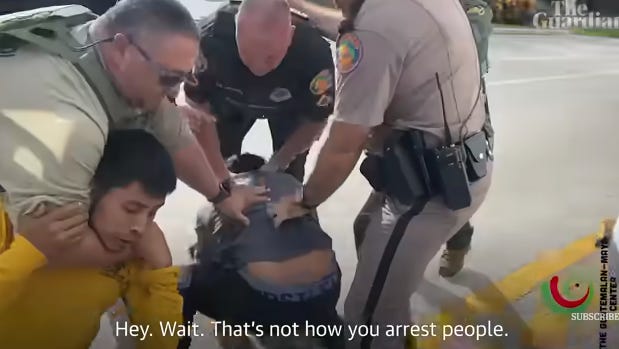
Kenny Laynez-Ambrosio never expected a drive to his landscaping job would end with him jailed. On May 2, 2025, Florida Highway Patrol pulled over the van he shared with his mother and two friends. His mother had a suspended license—routine enough. But when officers asked about immigration status, everything changed. One friend admitted being undocumented. Border Patrol arrived fast. Tactical gear. Aggression. Kenny grabbed his phone. He’d been showing his mom a TikTok. Now he hit record.
Agents yanked his friend from the van, using a chokehold. Another officer deployed a stun gun on his second friend, who cried out in pain. Kenny protested: “You can’t grab me like that.” An agent responded: “You’ve got no rights here. You’re a migo, brother.” Kenny insisted he was a U.S. citizen. Born and raised locally. They pushed him down. Aimed a stun gun at him. He spent six hours in a Customs and Border Protection cell .
Later, the video captured agents laughing. One joked about the stun gun: “You’re funny, bro.” Another bragged: “You can smell that … $30,000 bonus.” Kenny faced charges for “obstruction without violence”—retaliation, his lawyer said, for filming. He got 10 hours community service and anger management . His friends? Detained at Krome detention center. Likely released on bail. But Kenny lost touch. The incident wasn’t isolated. Florida’s 2025 agreement lets state troopers enforce federal immigration law. Trust between police and immigrants? Eroded badly .
Emmett Till’s Legacy: How a Mother’s Defiance Ignited a Movement
Emmett Till’s story starts in summer 1955. The 14-year-old boarded a train from Chicago to Mississippi. Excited to visit family. His mother, Mamie Till-Mobley, warned him: Mississippi’s different. Be careful. Days later, Emmett walked into Bryant’s Grocery. What happened inside remains disputed. Carolyn Bryant, a white woman, later claimed he whistled at her. On August 28, her husband Roy Bryant and brother-in-law J.W. Milam kidnapped Emmett from his uncle’s home. Gunpoint. They beat him. Shot him. Dumped his body in the Tallahatchie River, tied to a cotton-gin fan .
Three days later, a fisherman found Emmett. His face mutilated. One eye detached. An ear missing. Mamie demanded his body returned to Chicago. She chose an open-casket funeral: “Let the world see what they did to my boy.” Tens of thousands attended. Jet magazine published photos. The images horrified the nation. White violence against Black Americans wasn’t new. But this visibility? Unprecedented. At the trial, Bryant and Milam were acquitted by an all-white jury. Protected by double jeopardy, they later confessed in a paid interview. Emmett’s murder—and Mamie’s defiance—sparked the Montgomery Bus Boycott. Galvanized a generation into activism .
July 25, 2025, marked Emmett’s 84th birthday. The Two Mississippi Museums held free tours honoring his legacy. His story remains a cornerstone of racial justice education. A reminder: Documentation challenges impunity .
Documentation as Resistance: From Open Caskets to Secret Recordings
Mamie Till-Mobley understood power in visibility. By forcing the public to witness Emmett’s brutalized body, she transformed private grief into collective outrage. The photos in Jet magazine? They didn’t just report news. They screamed injustice. Made complacency impossible. “Let the world see,” she declared. And the world did .
Seventy years later, Kenny Laynez-Ambrosio wielded a different tool: his smartphone. When Border Patrol agents escalated force, he recorded it. Secretly. His footage shows an officer using a chokehold. A stun gun deployed on a compliant man. Agents mocking: “They’re starting to resist more now … We’re going to end up shooting some of them.” Their celebration: “Goddamn! Woo! Nice!” and “$30,000 bonus.” Kenny refused orders to delete the video. Even when charged with obstruction. His attorney, Jack Scarola, called it retaliation. An attempt to silence evidence .
Both acts—Mamie’s open casket, Kenny’s recording—share a core truth. When state violence operates in shadows, exposing it becomes revolutionary. The video forced public scrutiny on ICE quotas. On bonuses tied to arrests. It showed agents dismissing a citizen’s rights. Without it? Kenny’s arrest might’ve been another unverified story. Like Emmett’s case, visibility here isn’t passive. It’s resistance .
Patterns of Power: State Agents, Impunity, and Dehumanizing Language
Emmett’s killers saw him as disposable. A Black teen who “stepped out of line.” Their defense? Upholding racial hierarchy. At trial, defense attorneys called Emmett “wolf-whistling.” Implying he deserved punishment. The jury agreed. Acquitted in 67 minutes. One juror said: “If we hadn’t stopped to drink pop, it wouldn’t have taken that long.”
Kenny’s encounter echoed this dehumanization. Agents dismissed his citizenship: “You’re a migo”—likely slang for “amigo,” mocking Hispanic identity. They laughed while his friend convulsed from a stun gun. Discussed bonuses like it was a game. Their language framed migrants as less than human. As obstacles to quotas. Or payouts. Jack Scarola, Kenny’s lawyer, tied this to policy: “The federal government has imposed quotas for the arrest of immigrants … [that] pose significant risk to other rights.”
Policy Incentives: How Quotas and Bonuses Fuel Brutality
Kenny’s video exposed a terrifying incentive. Agents referenced a “$30,000 bonus.” While unclear, it aligns with Trump’s 2025 funding. $170 billion for immigration enforcement. Recruitment bonuses. Retention pay. Stephen Miller, White House deputy chief, set a target: 3,000 daily arrests. To meet it, ICE expanded targets. Beyond criminals. To noncriminals. Visa holders. Even citizens like Kenny .
Table: U.S. Border Patrol Criminal Convictions (FY2025 as of June)
The data reveals a focus. Over 60% of convictions are for immigration offenses (re-entry) or DUIs. Violent crimes like homicide? Just 15 cases. Yet rhetoric paints migrants as inherent threats. Jacob Stowell, a criminologist, refutes this: “Communities with more immigrants have lower crime rates … an established fact.” Deporting nonviolent immigrants, he warns, “could actually lead to more crime” by fracturing communities .
Community Distrust: When Law Enforcement Becomes a Threat
After Emmett’s murder, Black Mississippians lived in terror. The killers walked free. Police offered no protection. Many feared speaking out. The message was clear: The state wouldn’t save you. It might kill you .
Kenny’s arrest deepened similar fears. Father Frank O’Loughlin of the Guatemalan-Maya Center noted eroded trust: “This is … brutality … towards nonviolent people.” Studies show over 60% of immigrants feel unsafe around police. Why report crimes if officers might deport you? Florida’s 2025 agreement trains state troopers as ICE deputies. Blurring lines. Community policing suffers. People hide. Avoid hospitals. Schools. Crimes go unreported. Everyone’s less safe .
Historical Echoes: Media Complicity and Suppressed Narratives
Emmett’s initial murder report? Minimal. Local papers buried it. Only after Mamie’s open casket did national media engage. Still, many outlets echoed defense smears. Called Emmett “brash.” Focused on Carolyn Bryant’s “distress.” The trial? Covered as spectacle, not injustice .
Kenny’s story faced modern suppression. Police threatened charges if he didn’t delete his video. Charged him with obstruction. Mainstream media ignored it until The Guardian published the footage. Even then, narratives diverged. Some focused on “quotas.” Others on Kenny’s “anger.” Not the agents laughing about bonuses. Or the chokehold. The suppression playbook evolved. But its goal? Unchanged: Protect power. Silence witnesses .
Pathways to Justice: Accountability and Solidarity
Emmett’s legacy isn’t just trauma. It’s mobilization. His death inspired Rosa Parks. John Lewis. The Civil Rights Act. The Till family still fights. The Emmett Till Interpretive Center pushes for truth. Commemorations like his 70th anniversary (August 2025) educate new generations .
For Kenny and migrants, justice demands:
* End arrest quotas/bonuses that incentivize brutality .
* Repeal state-federal enforcement pacts like Florida’s ICE agreement .
* Amplify documentation—support citizens recording police .
* Challenge dehumanizing rhetoric with data: Immigrants don’t increase crime .
Table: Comparing Key Aspects of the Emmett Till and Kenny Laynez-Ambrosio Cases
Solidarity matters. Kenny’s mom drove him that day. Saw her son jailed. Mamie stood alone at Emmett’s funeral. But their courage? It demands we see the threads connecting past and present. And act.
Frequently Asked Questions
What happened to the Border Patrol agents in Kenny’s video?As of July 26, 2025, no agents were publicly disciplined. CBP and ICE didn’t comment on the incident. Kenny’s legal team seeks accountability .
Did Emmett Till’s killers ever face justice?No. Acquitted in 1955. Protected from retrial by double jeopardy. They confessed to the murder in a 1956 Look magazine interview. Paid $4,000. Neither served time .
Are immigrants really linked to higher crime rates?Data shows the opposite. Between 2023-2024, violent crime fell 10.3% as immigration grew. Undocumented immigrants have lower offending rates than U.S.-born citizens. Criminologists call crime reduction in immigrant-heavy areas “the immigration effect” .
How can individuals support targets of state violence?
* Document ethically: Record incidents if safe; share responsibly.
* Demand policy changes: End quotas; defund state-ICE partnerships.
* Support organizations: Like the Emmett Till Interpretive Center or the Guatemalan-Maya Center.
* Challenge narratives: Correct myths linking immigrants to crime.
What’s the significance of the $30,000 bonus mentioned by agents?Though unconfirmed, it aligns with Trump’s 2025 funding bill allocating $170 billion for immigration enforcement, including recruitment/retention bonuses. Quotas (3,000 daily arrests) likely incentivize such payouts.
The Earl Angle is a reader-supported publication. To receive new posts and support my work, consider becoming a free or paid subscriber.
This is a public episode. If you'd like to discuss this with other subscribers or get access to bonus episodes, visit earlcotten.substack.com/subscribe