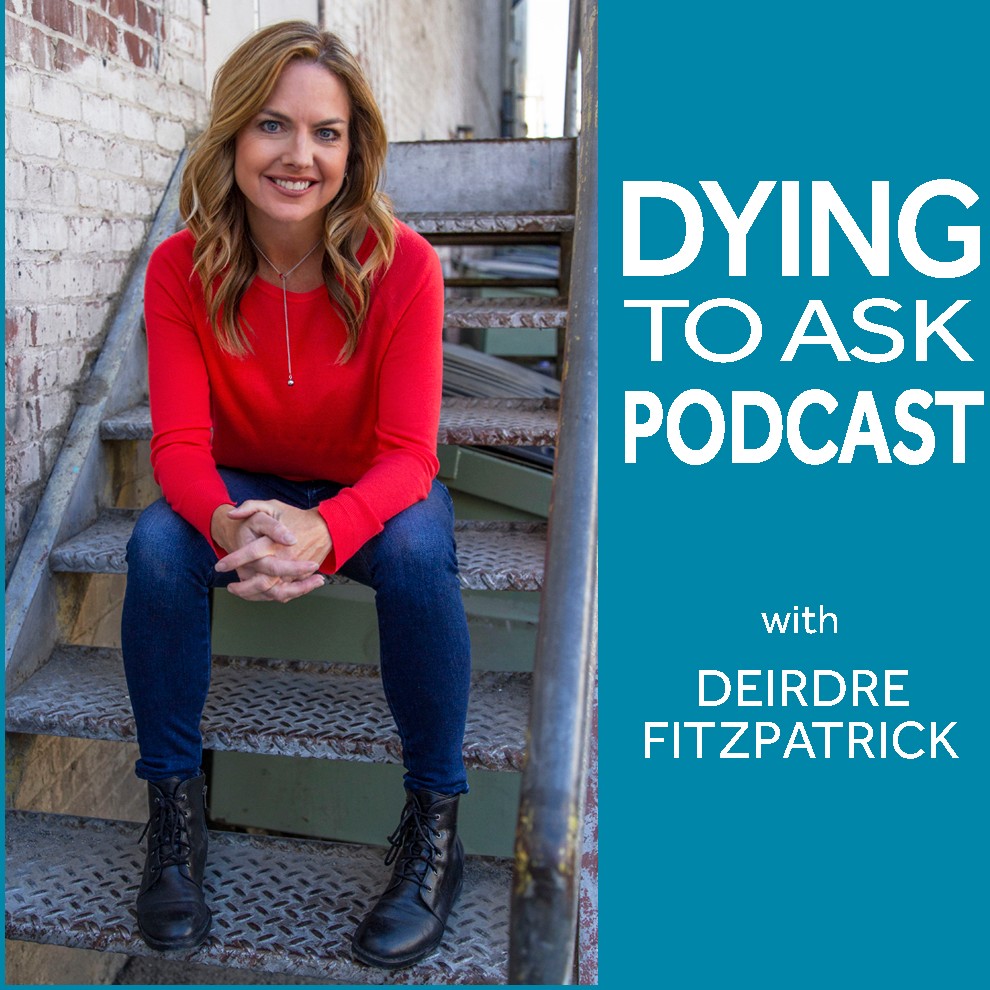
Dying To Ask
dyingtoask
Show overview
Dying To Ask has been publishing since 2023, and across the 3 years since has built a catalogue of 106 episodes. That works out to roughly 40 hours of audio in total. Releases follow a fortnightly cadence, with the show now in its 13th season.
Episodes typically run twenty to thirty-five minutes — most land between 13 min and 30 min — though episode length varies meaningfully from one episode to the next. None of the episodes are flagged explicit by the publisher. It is catalogued as a EN-language Education show.
The show is actively publishing — the most recent episode landed 2 days ago, with 15 episodes already out so far this year. Published by dyingtoask.
From the publisher
Join KCRA TV morning news anchor Deirdre Fitzpatrick for a podcast that asks her favorite question: how did you do that? Her guests wrote the book, launched the product, won the race, influenced social media or figured out a must-try life hack. Master your mindset while learning how to live bigger and better.
Latest Episodes
View all 106 episodesHow Dying to Ask Ended Up On A List With Oprah Winfrey
Networking Without The Ick Factor With Dr. Ivan Misner
Laura Vanderkam Says You Have More Time Than You Think
Walk in Winning With Traci Mitchell: How To Negotiate With Yourself
The Right-Sized Life: Finding Contentment At Any Age With Amy Schmidt
Make Space For What Matters With Tidy Dad
S13 Ep 300Visualize Your Life Like An Olympian With Chris Lillis
Saying Chris Lillis is a details guy is like saying he kind of wants to win another Olympic gold medal. Lillis won gold in mixed team aerials at the 2022 Beijing Winter Games. Making a second Olympic team in his discipline of freestyle skiing is arguably more mental than physical. Tracking the details of how he eats, sleeps, trains and recovers is crucial to unlocking what does and doesn't work for him as an athlete. The data helps shape his mindset training. The key to mental preparation is visualization. Chris says, "Visualization can just be like a kind of mental imagination, whether it's in the first person or the third person. You really just imagine yourself doing that jump." Aerialists are like acrobats on skis. They ski down a ramp, launch themselves in the air and complete a series of flips and twists while maintaining enough spatial awareness to land on on snow. Jumps last seconds. But Chris says the time in the air feels a lot longer than that because of how in tune he is with every small move his body makes. Just making the 2026 Olympic Team isn't enough. "It's different when you've won before because the only question anyone has for you is, are you going to win again? My answer is always the same. It's yes," says Chris. On this Dying to Ask: What it's like to live your life with that much attention to detail The move Chris had to make to follow his Olympic dream and how he spends his summers Going from newbie to veteran. The importance of mentoring the next generation of Olympians And how to master the art of visualization like an Olympic athlete
S13 Ep 299Redefining Longevity With The Women Of Team USA And Women's Health
From grit to glam. The women of Team USA are flipping the script on what longevity looks like the winter edition of Women's Health. Amanda Lucci is the director of special projects for Women's Health. Editors created a mirrored set to evoke icy, wintry vibes and Amanda says the athletes turned models understood the assignment. "They just turned it on the second they got on set and it was so much fun," says Amanda. The Olympics issue celebrates longevity. "We really wanted to explore what it takes to be an athlete for actual decades, while also living a lot of life outside of that," says Amanda. Snowboarder Jamie Anderson is an Olympic gold medalist. She took three years off since the 2022 Winter Games to have two kids. Her Olympic push for Milan Cortina involved a lot of multi-tasking. Amanda says, "She's still talking about how she's still getting into her flow of how she's training and also being a mom but at the same time, she's so much stronger." Cover model Chloe Kim left the last Olympics with more than a gold medal in the halfpipe. She describes extreme burnout and what she's done to work through it and fall in love with snowboarding again. Peak performance means new things. It's not just medals. It's mental health, motherhood, rest, and redefining success. On this Dying to to Ask: Proof it's never too late to pivot careers, even as an athlete How female athletes are fitting in or making backup plans for kids Redefining what's a win. Advice on giving yourself some grace to work on your grit Behind the scenes of the Olympic shoot. How Women's Health made Team USA's top female athletes feel like super models
S13 Ep 296Growing Up In The Shadow Of The Olympics With Casey Dawson
It's one thing to grow up with Olympic spirit. It's another to grew up in it like long track speedskater Casey Dawson did. Casey grew up in Salt Lake City. His hometown hosted its first Winter Games in 2002 and in some ways, the Olympics never left. "I grew up here, so I was surrounded by it. So ever since I was born, pretty much," says Casey. Casey was 2 years old during the 2002 Games. He and kids he grew up with benefitted from the Olympic venues. Most, like the Utah Olympic Oval, are still in existence today and serve as both elite training grounds and community recreation centers. Kids get into Olympic sports like speedskating through after school programs. Casey took an "intro to speed skating" class at the age of 10 and got hooked. Casey says, "I got coached by Olympians when I was 10 years old. I think that's what kept me in sports. I could go speedskating and go to ski in the mountains." Casey went from that intro program to the national team in just seven years. He made his Olympic debut in 2022 and won bronze in team pursuit at the 2022 Beijing Games. Milan-Cortina will be his second shot at Olympic gold. On this Dying to Ask: What Utah does to get kids into Olympic sports at a very early age Why the Utah Olympic Oval is known as the fastest ice on earth. And we'll start with a funny, yet kind of gross story about a badge of honor for U.S. long track speed skaters. Find out what it takes to make Coach Ryan Shimabukuro's Instagram page!
S1 Ep 298Fear, Flips, and Full-Full-Fulls with Kaila Kuhn
Living life in threes is paying off for freestyle skier Kaila Kuhn. "All of the men in the world are competing triples. Whereas a maximum [of] eight to 10 women on the Olympic year are actually competing [in] triples," Kuhn said. "Triples" refers to the complexity of an aerial skier's jump. It's an elite-level move, and Kuhn successfully performed a full-full-full to win a recent World Cup event. The full-full-full involves three flips with 360-degree twists. Kuhn admits that "it's dangerous. It's scary. And there's a reason why not many of us do it." Triples are a standard maneuver for male aerial skiers. But Kuhn predicts only eight to 10 women at the Olympics will attempt one. She sees triples as key to winning gold at the 2026 Milan Cortina Olympics. Kuhn was the youngest American to win an individual world title in aerials at the age of 21. She finished eighth in her Olympic debut at the 2022 Games. She transitioned from doubles to triples following her first Olympics. Perfecting triples puts her in line for gold in Milan at the age of 22. On this Dying to Ask: Harnessing fear. The role fear plays in preventing injuries and creating an edge How Kuhn mastered triples. How she perfected a complex move in water before trying it on snow The two stars of American aerial skiing are a real-life couple. How they've supported each other in this Olympic journey And read anything good lately? It's Olympic book club time. Why Kuhn is Team USA's go-to for a book recommendation Other places to listen CLICK HERE to listen on iTunes CLICK HERE to listen on Stitcher CLICK HERE to listen on Spotify See more coverage of top California stories here | Download our app | Subscribe to our morning newsletter | Find us on YouTube here and subscribe to our channel
S13 Ep 297Fear, Flight & Fast-Tracking the Olympics With Quinn Dehlinger
Time is currency. And freestyle Olympic skier Quinn Dehlinger cashed in on an opportunity he earned last June. That's when Quinn got a call from his coach that he'd made the 2026 U.S. Winter Olympic Team. Quinn narrowly missed out on qualifying for the 2022 Olympics. Qualifying eight months before the Olympics in Italy was a game changer. "Going into the competitions this year, if I got sick or had a minor injury it lifted a little of the weight off the shoulders," says Quinn. Aerial skiing is a freestyle discipline. Athletes are often compared to acrobats on skis. The team trains year-round at its home base in Park City at the Utah Olympic Park where skiers spend all summer perfecting tricks in a pool. But Quinn grew up in Cincinnati which has become a pipeline for aerial skiers. Four skiers on the Olympic team have ties to the Cincinnati area and they credit the smaller hill for high reps they did on rails and jumps. On this Dying to Ask: The greatest advantage of making the Olympic team so early. How did Cincinnati become a pipeline for Olympic aerial skiers? Why fear is a good thing when you you're an acrobat on skis And what it's like to pursue an Olympic dream when your girlfriend is also an Olympian
S13 Ep 295Fast And Fancy Mia Manganello Enjoys Last Olympic Ride
How do you know when it's time to walk away from an Olympic career? Mia Manganello says it's a feeling. But that's where is gets tricky. Most of the time, those feelings are because an athlete's results aren't what they used to be. Mia is still very much on top in the world of long track speedskating. She just qualified for her third Olympic Team in team pursuit and mass start. At 36, she just feels ready to do something else and she's determined to finish her skating career with as much grace as she has grit. "This is also going to be my last Olympics. That was hard to say," admits Mia. Mia describes the Olympic journey as addictive. "When you get a taste of the Olympics, it's so addicting and just pushing yourself to that limit and and working hard every single day and having someone around you, the team atmosphere, the whole thing is intoxicating," says Mia. Intoxicating and in Mia's case, fancy. Her skate bag has a Chanel logo and she gets a manicure every four weeks! Mia says, "We spend all day, every day in spandex. So I like to feel like a girl. So I get my hair done and my nails done, and I like my my nice things!" On this Dying to Ask: The Road to Milan-Cortina: What makes the grueling Olympic journey so addictive How an athlete weighs the end of a career, especially when they're still on top The lessons Mia learned working in her family's Italian restaurant that define her as an athlete The link between feeling cute and feeling fierce
S13 Ep 294Hypnotherapy, Gratitude And Going For Gold With Brittany Bowe
The U.S. Olympic Long Track speedskating roster is set and it's a mixture of up and comers and veterans like Brittany Bowe. Bowe has won two Olympic bronze medals and she have very clear goals for the 2026 games in Milan-Cortina. "I'm still chasing that ultimate dream of becoming Olympic champion. I want nothing less than to step on the top of that podium," says Bowe. Long track pits skaters against the clock and each other on a 400 meter track. It's the same distance as a high school running track. Competitors race distances ranging from 500 meters to 5-thousand meters. It takes extraordinary physical and mental endurance. The 2026 Winter Games will be Brittany's fourth Olympics. She grew up in Florida and made the transition from inline skating to speedskating in 2010. At 37, she's a veteran athlete. That requires training smarter not harder. Brittany credits tools like hypnotherapy for her continued success. And, her outlook this Olympic run is different. She's operating from a true sense of gratitude. Brittany says, "I'm going to enjoy the process. I'm going to enjoy everything it takes to set myself up for success, to be an able to perform on the highest level, to have the opportunity, to chase that gold medal." On this Dying to Ask: What it's like to plan your life in four year increments like longtime Olympians do How Brittany and Olympic hockey player Hillary Knight became an Olympic power couple Learn how to train your brain Olympian to increase mental endurance
S13 Ep 291Finding Grit And Doing The Macarena With Hanna Percy
Imagine all your dreams coming true at the age of 18. It's a real possibility for snowboarder Hanna Percy. The athlete from Truckee, California, is the youngest member of the U.S. female snowboard cross team. Typically, elite snowboarders earn a place on the U.S. Development Team before moving to the Pro Team and then onto an Olympic Team. Hanna's results were so good that she skipped the development level and went straight to the pro team. Now, at 18, she has a shot at representing Team USA at the 2026 Milan-Cortina Olympics. Hanna says, "We have six girls competing for three spots right now." Hanna's parents were pro snowboarders in the 1990s. Their daughter's talent and need for speed showed up early. Her mother, Kim Percy, remembers "she was probably 10 when she passed me on the hill. It's like her board is a connection to her feet." Hanna left Northern California when she was 16 and enrolled at the prestigious Gould Academy, where her snowboarding results soared. The small co-ed academy in Western Maine is a favorite for winter sports athletes with Olympic ambitions. The move paid off. The environment allowed her to finish high school while launching her pro career. In person, Hanna is incredibly likable and friendly. But on the snow she's known for a grit and fierce need to win that's propelling her career at record speed. "I just like, kind of have to win," Hanna admits. But there a playful side too. And, it's evident in every start gate where she Macarenas to loosen up and lessen the stress! On this Dying to Ask - The Road to Milan-Cortina: How to fuel your own competitive spirit How an 18 year old rose so quickly in snowboard cross and who taught this Gen Zer to Macarena? How Hanna stays grounded when life and it's possibilities seem endless right now And my favorite attribute: grit. Where Hanna's comes from and the mentor who taught her how to dig in
S13 Ep 293Jamie Anderson Chasing Gold While Chasing Kids
Jamie Anderson defies gravity and stereotypes in her latest push to make an Olympic team. Jamie is a 3-time Olympic snowboarder and 3-time Olympic medalist. She has two golds and a silver. She grew up in South Lake Tahoe and is one of eight children. She started snowboarding at the age of nine after being introduced to the sport by her two older sisters. Jamie competed in her first X Games at the age of 13. At 35, she has the most the most X Games hardware of any woman in history and the second-most winter medals of any athlete. She's a 5-time ESPY female action sports award winner. Jamie acknowledges she was pretty untouchable for years. "There were years that I was like winning with my eyes shut and there wasn't a lot of competition," says Jamie. She took a three year break to have two daughters with her fiancée, fellow pro snowboarder Tyler Nicholson. Five months after the birth of their second daughter, Jamie became the 2025 Big Air National Champion. And she's breaking new ground as a working mom in her sport. Jamie says, "Just having the opportunity to go for a fourth Olympics with my family, my two little ones, and my partner feels like very special." On this Dying to Ask: The Road to Milan- Cortina: How Jamie is blazing new trails in her sport as a working mom The biggest change she's seen in more than 20 years of competing in how snowboarders prepare for the Olympics And the pure joy she's experiencing taking her family on this Olympic journey
S13 Ep 290Snowboarding, Sacramento and Chasing Cortina with Brooklyn DePriest
It takes a village to raise an Olympic hopeful. And sometimes, that village has to change ZIP codes. Brooklyn DePriest is a snowboarder for Team USA, hoping to make his Olympic debut at the 2026 Milan-Cortina Games. He competes in slopestyle. Brooklyn grew up in Northern California in a Sacramento-area suburb called Rocklin. The DePriests spent their winter weekends in Tahoe. Brooklyn's snowboarding talent quickly became apparent as competitions would result in him standing on podiums. By the time he was 12, his parents were advised that their son had the potential to go pro and maybe even go to the Olympics. The catch? He'd need to move for more specialized coaching. The problem? The entire DePriest family loved their home and neighborhood in Rocklin. "There were probably about 10 families involved in the neighborhood," Brooklyn DePreist said. We would ride to school on our bikes and skateboards every single day. We all played the same sport, so we were on the same sports teams." Neither of Brooklyn's parents came from a winter sports background. "The coaches are telling us, like, he has real talent, but we're like, does he? I don't know," Courtney DePriest, Brooklyn's mom, said. The DePriests made the tough decision to relocate to Vail, Colorado, where both their sons could attend a good school while Brooklyn pursued his Olympic goals. Seven years later, Brooklyn DePriest is a contender to compete at the 2026 Winter Olympics. This is one of the most candid conversations I've ever had with an athlete's parents about the sacrifice entire families make to follow Olympic dreams. On this Dying to Ask: The Road to Milan-Cortina: How the DePriests made the call to go all-in on Brooklyn's snowboarding future when he was only 12 The pressure young athletes feel to perform when their parents sacrifice so much How Olympic hopefuls handle the mental health challenges of injuries Learn tricks to calm your brain while your body is healing And did they or didn't they? The DePriests reveal whether they purchased Olympic tickets before knowing whether or not their kid has made the team Other places to listen CLICK HERE to listen on iTunes CLICK HERE to listen on Stitcher CLICK HERE to listen on Spotify See more coverage of top California stories here | Download our app | Subscribe to our morning newsletter | Find us on YouTube here and subscribe to our channel
S13 Ep 288AJ Hurt on Pressure, Perspective, and the Power of a Good Piano Jam
Olympic skier AJ Hurt is the ultimate "bring your kid to work" success story. Her dad is on the ski patrol at Palisades Tahoe resort and AJ grew up hanging out with her dad on the mountain. AJ competed for Palisades Tahoe before making it onto the U.S. Ski Team as a teenager. "I was 16 when I raced my first World Cup. No one knows what they're doing at 16!" says AJ. But AJ figured it out quickly. She's an eight year member of the U.S. Ski Team, a three-time U.S. Alpine champ, and competed in the 2022 Beijing Olympics. She's as dedicated to her studies as she is her efforts on the snow. AJ studied engineering at Dartmouth. And, she's an accomplished musician as well. Fellow U.S. ski team members rely on her piano skills for impromptu singalongs on the road during the ski season. We caught up with AJ during off-season training in Tahoe to talk about how to maintain life perspective while competing at such a high level. On this Dying to Ask, The Road to Milan- Cortina: What AJ does in the summer to get ready for an Olympic year The role music plays in relaxing her brain And we'll enjoy an impromptu concert in an history Olympic Valley, CA chapel from AJ
S13 Ep 292Sliding Back: Kendall Wesenberg’s 600-Day Comeback
"Head first" isn't a choice for Kendall Wesenberg. It's a job requirement. The skeleton slider has also turned it into her life mantra. And her grit to push through life and it's challenges is becoming legendary. The 2018 Olympian is working toward qualifying for her second Olympic Team. But she's already put in a gold medal worthy effort just trying to qualify for the 2026 Winter Games. Kendall grew up in Modesto, California, playing a variety of sports. She graduated from CU-Boulder and in 2010 watched the sport of skeleton for the first time during the Vancouver Olympics. She thought, "I wonder if I could do that?" She attended a sliding athletes combine and discovered she had an irrational need for speed and the innate talent to get good at one of the most niche Olympic sport. Skeleton athletes slide head first on their stomachs down the same icy track the bobsleds go down. Athletes use their shoulder sand knees to steer. Kendall explains, "There are anywhere from 12 to 20-something curves that you try and cover in about a minute, usually less." She's gone as fast at 86 miles per hour on a track. And, she competed in the 2018 Pyeongchang Winter Olympics. But she failed to make the 2022 Olympic Team. It turns out she had an undiagnosed spinal injury that had gone untreated for three years. It explained the immense pain she'd experienced training and competing. "The things that hold your spine in place snapped off of my back. And when it didn't get diagnosed, my vertebrae just slid out of my spinal column. So it was like fully pinching my nerves. I couldn't feel my legs," says Kendall. Her surgeon recommended a spinal fusion, a surgery with a very long recovery. Kendall jokes, "The playbook's pretty thin on a return to sport post spine fusion." But her doctor didn't close the door on a return to the sport she loved. Kendall spent three months in a back brace, seven months barely walking and couldn't start serious physical therapy until 10 months post surgery. 600 days later she returned to the ice describing her return to a track as "awesome." A year later, she's earned a spot on the U.S. World Cup Skeleton Team and she's actively trying to qualify for that second Olympic Team. On this Dying to Ask: The Road to Milan- Cortina: Advice for anyone trying to heal from a major injury How Kendall stays positive despite spending years healing her body Kendall's wife did some sliding...into her DMs. How being married has added balance to her athletic life
S13 Ep 289From Burnout to World Champion: Alysa Liu’s Unlikely Comeback
Whoever said quitters never win never met Olympic figure skater Alysa Liu. Liu quit figure skating after the 2022 Winter Olympics. At age 16, she was burned out and wanted to be a normal teenager. "I was done a year before I quit. I knew I wanted to be done way before I actually announced my retirement," Liu said. For two years, Liu embraced life as a teenager, making up for lost time she'd spent on the ice. She got a driver's license, drove her four siblings to school, stayed up late and hung out with friends. She traveled for fun instead of competitions and even hiked in the Himalayas. She enrolled at UCLA and even took up skiing, a sport she'd never had time to try as an elite figure skater. She loved the feel of the cold air on her face when she was skiing. It reminded her of skating and two years after retiring, Alysa went to a local rink with a friend. Alysa started skating for fun, and it wasn't long before she got the itch to skate more seriously. She called a former coach, Phillip DiGuglielmo, and asked him what he thought about her coming out of retirement. At first, he wasn't a fan. "I said, 'Please don't. I really did.' I said, 'Please don't. Respect your legacy,'" DiGuglielmo said. "We had a Zoom call for two hours. The story is I had a lot of glasses of wine over those two hours. And she talked me into a comeback." The two started training together, and seven months later, Liu won a world title in a sport she left as a child but returned to as an adult. On this Dying to Ask, The Road to Milan-Cortina: The power of taking a break Re-thinking how we look at the role age plays in sports like figure skating A frank look at what young teen athletes give up to be the best in their sport and the impact that can have long-term on mental health And why Alysa's coach thinks she could pull off a two-year gap in training and emerge stronger than ever Other places to listen CLICK HERE to listen on iTunes CLICK HERE to listen on Stitcher CLICK HERE to listen on Spotify See more coverage of top California stories here | Download our app | Subscribe to our morning newsletter | Find us on YouTube here and subscribe to our channel
S13 Ep 287Bryce Bennett Finds Olympic Edge In Parenthood
Bryce Bennett has a new title, and it's his favorite one yet: dad. The two-time Olympic skier is going for his third Olympic Team. Bryce is 33 and has spent nearly half his life on the U.S. Ski Team. Bryce and his wife, Kelley, welcomed their first child, a daughter, this spring. "You have this thing that is totally dependent on you," Bennett said. "You're in total love with it. And you will do anything to give it as many opportunities as you can." One of those opportunities will be a front row seat to her dad trying to make his third Olympic Team after 14 years of competing with the U.S. Ski Team around the world. "Kelley is going to come over, and we're going to rent an apartment and spend a lot of time in Europe this winter. The little baby is going to come over, and we're just going to live life and figure it out," Bennett said. Bryce grew up in Tahoe City, CA, and skied at Palisades Tahoe as a kid. He was a teenager when he made the U.S. Ski Team. In the 2022 Beijing Winter Olympics, he finished 17th (Super G-Men) and 19th (Downhill - Men). In the 2018 PyeongChang Winter Olympics, he finished 16th (Downhill - Men) and 17th (Super Combined - Men). His goal for 2026? "My ideal year this year would be have an insane season, which is doable. Win the Olympics, take your trophies, and put them deep in the basement. And then go on and live your life," Bennett said. Bryce is known for a few things off the snow. One, he has a lot of hobbies, including fishing. You'll see as many "big ole fish" pictures on his Instagram feed as you do ski runs. The second is his incredible sense of humor. And that's why I picked Bryce to lead off our launch of Dying to Ask: The Road to Milan-Cortina. Get ready to laugh out loud as Bryce describes what it's like to be a pro skier when you're 6 feet 7 inches tall. Find out why being a parent as a winter Olympic athlete is like being a unicorn on the U.S. Olympic Team. And get some perspective on why being in tunnel vision with a goal is pointless. On this Dying to Ask: The Road to Milan-Cortina: How rare it is to be a parent on the U.S. Olympic Team The edge Olympians say parenthood gives them How Bryce stays motivated after spending nearly half his life on the U.S. Ski Team The value of having hobbies outside your day job Other places to listen CLICK HERE to listen on iTunes CLICK HERE to listen on Stitcher CLICK HERE to listen on Spotify See more coverage of top California stories here | Download our app | Subscribe to our morning newsletter | Find us on YouTube here and subscribe to our channel