
DevReady Podcast
328 episodes — Page 2 of 7
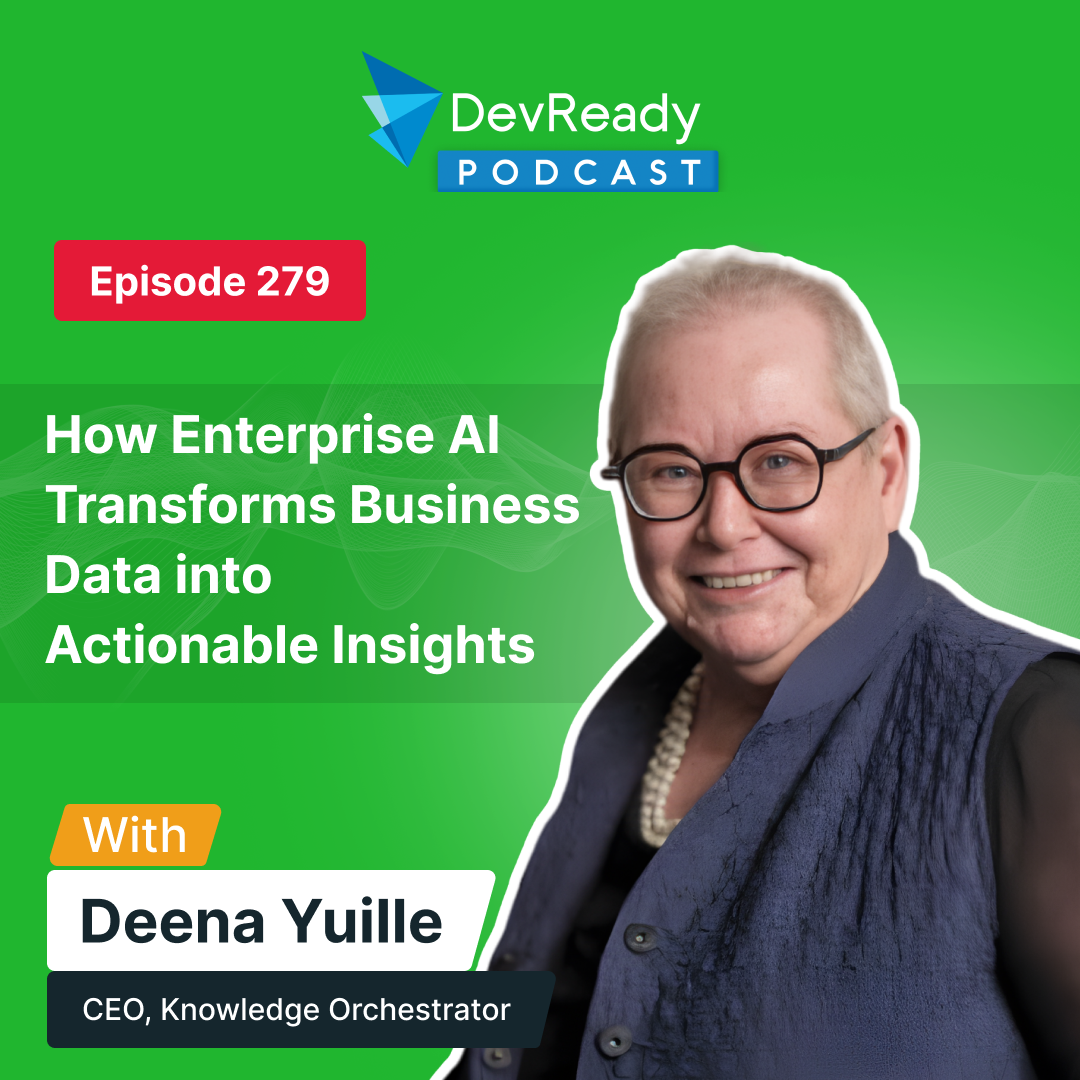
Ep 275How Enterprise AI Transforms Business Data into Actionable Insights | Ep 279 | DevReady Podcast
Deena Yuille, CEO and Co-Founder of Knowledge Orchestrator, to the DevReady Podcast for a wide-ranging conversation on enterprise AI, customer experience and practical innovation. Deena is a respected Australian business leader with deep experience in transformation and governance and brings a distinctive perspective shaped by her non-technical background in business process, organisational design and people leadership. In this episode, she shares how those foundations influence her approach to building human-centred AI that delivers real business value. Throughout the discussion, Deena explains how Knowledge Orchestrator focuses on outcomes and actionable insights rather than traditional dashboards and static reports. The platform brings together fragmented data from across a business and converts it into personalised, real-time analytics that clearly explain why the information matters. By delivering insights in plain language, teams can make faster decisions without spending days analysing spreadsheets. Anthony and Deena explore how this approach supports sales, inventory management, procurement and post-acquisition integration, while keeping human judgement at the centre of decision-making. Deena also shares the pivotal moment that led to the creation of Knowledge Orchestrator, following the sudden loss of a colleague whose knowledge was never documented and was critical to the business. This experience highlighted the operational risk of information being locked inside individuals rather than captured in systems. It shaped the company’s mission to transform spreadsheets and raw analytics into structured language that can train large language models efficiently. The result is near-instant insights that reduce cognitive load, save time and scale knowledge across organisations. Looking back, Anthony and Deena reflect on building Knowledge Orchestrator well before the recent surge in mainstream AI adoption. Deena explains how her team’s background in customer support and customer experience has driven a strong focus on usability, clarity and intuitive design. She highlights how technically robust products often fail when they overlook the everyday user, and why simplicity and clear language are critical for adoption. Customer experience reviews are embedded into the product release process to ensure the platform remains accessible and effective. The conversation also covers the realities of growing an enterprise AI startup in the Australian B2B market, where innovation often moves cautiously and trust must be earned. Deena discusses balancing speed with thoughtful design, iterating on prototypes and wireframes, and supporting customers through regular reviews and integrated data insights. As AI models continue to evolve, Anthony and Deena agree that turning complex business data into clear, language-driven insights gives leaders a complete and timely view of performance. This shift empowers executives to ask better questions, see trends sooner and make informed decisions in a fast-moving business environment. #EnterpriseAI #BusinessLeadership #DevReadyPodcast

Ep 274How to Sell Your Business for Maximum Value: Exit Strategy Insights with Simon Bedard | Ep 278 | DevReady Podcast
In this episode of the DevReady Podcast, Anthony Sapountzis, CTO and Co-Founder of Anthony Sapountzis, CTO and Co-Founder of Aerion Technologies and DevReady.Ai, is joined by Simon Bedard, Managing Director of Exit Advisory Group. Simon brings deep experience from investment banking, business ownership, and sell-side mergers and acquisitions, where he now helps founders prepare for and execute successful business exits. After working with high-net-worth individuals and selling his own businesses, Simon identified a significant gap in professional, end-to-end exit support for business owners. His work focuses on business valuations, exit strategy, and advisory services that help founders understand what their business is worth and how to maximise value before selling. The conversation explores why selling a business is far more complex than many founders expect. Simon explains that while business owners are naturally comfortable with uncertainty and risk, investors approach acquisitions with a fundamentally different mindset that prioritises risk reduction. This difference often leads to friction during negotiations, particularly when emotional attachment and legacy considerations come into play. Simon shares practical insights into how founders and buyers can view the same business very differently, and why understanding investor psychology early can significantly reduce stress and improve outcomes during a sale. Anthony and Simon also unpack the differences between selling smaller owner-operated businesses and larger corporate-style companies. Smaller businesses may attract a wider pool of potential buyers, but owners often lack the time, resources, and transaction experience required to manage a sale effectively. Larger businesses typically have stronger internal teams, experienced advisers, and more sophisticated buyers who understand the mergers and acquisitions process. Simon notes that the current market is characterised by historically high levels of available capital, creating strong competition for quality businesses, while also increasing the risks for owners who engage buyers without proper representation. The discussion then turns to the dangers of unsolicited acquisition approaches. Simon explains that buyers usually operate within structured, sales-driven processes designed to maximise value for the acquirer. Without independent advisers and a seller-led process, business owners can lose control, endure lengthy due diligence, and still end up without a firm offer. Emotional fatigue and time pressure often weaken negotiating positions, leading to reduced valuations and unfavourable deal terms. Running a competitive process with the right advisers is essential to protecting value and maintaining leverage. Finally, Simon outlines what business owners should prioritise when preparing for an exit. He stresses the importance of early planning, often three to five years in advance, to reduce owner dependency and address risks such as key person exposure and customer or supplier concentration. Simon explains that time and value are closely linked, and delaying preparation often forces founders to compromise on price or terms. The episode concludes with a clear message that thoughtful planning, realistic timelines, and experienced guidance are critical to achieving a successful and well-managed business exit. #BusinessExit #ExitStrategy #SellYourBusiness #BusinessValuation #MergersAndAcquisitions #FounderJourney #Entrepreneurship #PrivateEquity #BusinessGrowth #DevReadyPodcast

Ep 273Why Most Corporate Innovation Fails and How to Scale Beyond Proof of Concept | Ep 277 | DevReady Podcast
Andrew Romeo welcomes listeners to the DevReady Podcast for a deep dive into corporate innovation, open innovation strategy, and how startups and enterprises can work together more effectively. In this episode, Andrew is joined by Spiro El Khoury, Head of Growth (Australia) and founding team member at The Bakery, as well as a mentor at Startmate. Spiro shares insights from his journey into the innovation ecosystem, spanning corporate venturing, startup mentorship, and building stronger innovation pathways in Australia. Spiro reflects on his move from Lebanon to Australia during the COVID period, explaining how unexpected circumstances shaped his career in technology consulting and innovation. From early roles as a business analyst and product owner, he remained closely connected to the fast-moving startup world while helping corporates deliver solutions. He emphasises that the most effective innovation happens when organisations collaborate with external ecosystems, including startups, universities, and research institutions, particularly in complex sectors such as mining, healthcare, and decarbonisation. The conversation explores The Bakery’s role as a corporate innovation management firm supporting large organisations with sustainable innovation strategies. Spiro explains that innovation must go beyond branding or “innovation theatre” and instead become a structured growth engine delivering measurable outcomes. The Bakery helps corporates strengthen internal innovation teams, engage in Horizon Two and Horizon Three initiatives, and connect with scale-up startups through models such as venture client partnerships. Andrew notes that many corporate innovation efforts lose momentum over time, making execution and long-term commitment essential. Spiro breaks down the concept of open innovation, where corporates acknowledge that the best ideas and solutions often exist outside their own walls. He shares how global organisations like Procter & Gamble use external partnerships to reduce risk, accelerate R&D, and avoid reinventing proven solutions. The Bakery applies this approach by helping corporates define major challenges, run open innovation programs, and identify the right innovators through structured processes like demo days, while avoiding the common “proof of concept graveyard” where pilots fail to scale. The episode also offers practical guidance for startups seeking corporate customers, with Spiro stressing the importance of traction, proven value, and understanding enterprise buying cycles. Through his work with Startmate and Launch Club, he mentors founders to acquire early customers and navigate corporate complexity. Spiro also highlights Australia’s opportunity to improve innovation output through better education, stronger frameworks, and community-driven initiatives like the Corporate Innovation Series and the Corporate Innovation Summit, positioning innovation as a long-term strategy for national and business growth. #DevReadyPodcast #CorporateInnovation #OpenInnovation #AerionTechnologies

Ep 272AI for Small Business: Tim Krotiris on Backable and Better Decisions | Ep 276 | DevReady Podcast
For this episode of the DevReady Podcast, host Anthony Sapountzis, CTO and Co-Founder of Aerion Technologies and Co-Founder of DevReady.ai | AI-Powered App Planning for Non-Tech Founders , sits down with Tim Krotiris, Founder and CEO of Backable and Founder of Philotimo Global, to unpack what AI means for founders who are building in the real world. Tim shares the hard-won lessons from two decades of entrepreneurship, why small business owners have historically been underserved compared to big enterprises, and how Backable is designed to provide practical, always-on support without becoming another distraction. Tim’s story starts early, with a first attempt at entrepreneurship at 16 and a career shaped by building, scaling, and selling businesses across industries. From martial arts promotions and gym ownership to property, apparel, and marketing agencies, Tim’s path led him to a deeper focus on helping SMBs grow through Philotimo Global. That experience also exposed a pattern: two founders can have similar opportunities and advice, yet produce dramatically different results, and Tim became obsessed with understanding why. That obsession evolved into a decade-long effort to rebuild advisory support into something more intelligent, consistent, and founder-friendly. Tim explains how they approached the problem like a research project, mapping conversations, decisions, and outcomes to uncover the variables behind success, scaling, and failure. While early assumptions leaned towards traditional machine learning and predictive analytics, the emergence of modern large language models accelerated their progress and reshaped the implementation, turning years of groundwork into leverage rather than redundancy. A key theme throughout the conversation is the reality of speed. Anthony and Tim explore how AI reduces the lag between ideas and implementation, making it possible to prototype quickly, gather feedback, and decide whether to pivot or kill an idea within days. They also offer a clear warning about “vibe coding” and AI wrappers: moving faster is only helpful if you can plan, evaluate, and understand what is happening under the hood, otherwise you risk doing the wrong thing faster. The goal is not endless experimentation, but sharper decision-making, clearer prioritisation, and better outcomes. Finally, Tim brings it back to founder psychology and leadership, sharing lessons that apply whether you are using AI or not. He emphasises that tough periods are moments in a business lifecycle, not a verdict on your identity, and that leaders must avoid becoming psychologically fused to the business. He advocates for falling back in love with the problem and the customer, staying open to the right support network, and embracing vulnerability with people who understand the journey. Backable’s mission reflects that belief, with a focus on helping founders feel “never alone, always ahead” while building the business that supports the life they actually want. #AIForSmallBusiness #Entrepreneurship #StartupLife #BusinessGrowth #AI #DevReadyPodcast #AerionTechnologies

Ep 271Startup Hiring, Culture Fit and Customer Discovery with Jarren Pinchuck | Ep 275 | DevReady Podcast
Andrew Romeo, CEO and Co-Founder of Aerion Technologies and Co-Founder of DevReady.Ai, welcomes Jarren Pinchuck, Operations and Growth Executive and Advisor at Startmate, to the DevReady Podcast to unpack what it really takes to build and scale a startup. In this episode, Andrew and Jarren explore the practical lessons that sit behind successful growth, including customer-led product development, early-stage customer discovery, and how to hire for culture fit when every role can make or break momentum. Jarren shares his journey from South Africa into entrepreneurship, starting with an unexpected turn away from advertising after only six weeks and into hospitality. Working in restaurants taught him how to communicate under pressure, handle real-time customer feedback, and spot problems by listening closely to people. Those frontline experiences shaped his approach to business and product, reinforcing that the fundamentals do not change across industries: you must market and sell a service, retain customers through a strong experience, and earn referrals by consistently delivering value. That customer-first mindset carried into Jarren’s first tech product, which was born from a simple operational frustration in restaurants: the noisy, inefficient kitchen bell system. After seeing pager technology in the US, he identified a practical alternative for busy venues where staff could not hear the kitchen and distances made coordination difficult. He and his team introduced a hardware-led paging solution into South Africa, managed setup and basic programming as part of onboarding, and learned first-hand what it takes to translate a real-world workflow problem into a sellable product. The episode also covers the hard realities of early go-to-market execution. Jarren explains how being too early to market, combined with a low-volume sales approach and ongoing servicing demands, limited the business’s scalability. He reflects on missed opportunities to pivot sooner towards higher-need environments like food courts and takeaway, then outlines how he and his partner adapted by moving into a lease-style corporate coffee model built around servicing and recurring revenue through coffee bean distribution. His path later took him to London, where he worked in online gaming and casinos and gained deeper experience in technology, payments, platforms, and SEO-driven growth, before relocating to Australia. From there, Andrew and Jarren move into the core scaling topic: hiring the right people and building culture intentionally in a fast-moving startup environment. Jarren argues that people are the most important lever in any business, but especially in early-stage teams where the margin for error is small and misalignment can quickly derail product direction and customer outcomes. He shares a structured approach to hiring that assesses communication, curiosity, and cultural alignment alongside role capability, and he advocates for bringing engineers and product leaders closer to customers through habits like monthly customer show-and-tell sessions. The key takeaway is clear: strong internal communication and trust tend to mirror the customer experience, and the best startups stay customer-led by using discovery conversations and continuous feedback to shape the product from day one. #DevReadyPodcast #StartupAdvice #CustomerDiscovery #StartupHiring #CultureFit #ProductDevelopment #Founders

Ep 270Why Most Startups Build the Wrong Product and How to Get It Right | Ep 274 | DevReady Podcast
In this episode of the DevReady Podcast, Anthony Sapountzis, CTO and Co-Founder of Aerion Technologies and DevReady.ai | AI-Powered App Planning for Non-Tech Founders , is joined by Karina Carter, Fractional Chief Product Officer and Leadership Coach. With over 12 years of experience spanning the United Nations, government research, startups and global tech companies, Karina brings a deeply practical perspective on modern product leadership. She shares insights from her journey into product management, her work building technology across complex markets like China, and her current role helping underperforming companies realign strategy, teams and execution. This conversation is essential listening for founders, product leaders and teams looking to build better software through strong product strategy, customer insight and disciplined decision making. Karina explains how transitioning from academic research at the UN into product allowed her to move faster, work directly with customers and turn data into action. Her experience running a venture studio in China required building bespoke technology to operate across the Great Firewall, giving her a unique perspective on solving complex problems in constrained environments. Today, as a fractional CPO, she is often brought into organisations that are struggling to perform, where she audits product strategy, uncovers misalignment and identifies untapped opportunities hidden in existing data. These discoveries frequently lead to new use cases and significant revenue growth without increasing team size. The discussion highlights how cultural context, data literacy and customer understanding are foundational to sustainable product growth. A core theme of the episode is Karina’s belief that better products do not come from bigger teams, but from people with a growth mindset and a sense of radical responsibility. She explains how she uses data to understand what is happening inside a product, then pairs that insight with deep customer conversations to uncover why it is happening. Customer interviews, she argues, are not about asking users what to build, but about understanding their real problems, fears and motivations. This approach allows product, design and engineering teams to focus on value rather than features. Anthony reinforces that most customers buy based on perceived value, not technical specifications. The conversation also explores why so much user research fails to deliver meaningful insight. Karina highlights how confirmation bias, inconsistent interview questions and poor research design often lead teams to hear only what they want to hear. She stresses the importance of structured interview frameworks, representative sampling and an understanding of cognitive bias when interpreting feedback. Together, Anthony and Karina explain why product teams should not overreact to the loudest customers, who are often a small and unrepresentative minority. Instead, feedback should be evaluated holistically, guided by a clear product vision, strategy and well defined OKRs, with every product decision treated as a hypothesis to be tested after launch. Finally, Anthony and Karina discuss the impact of AI tools like ChatGPT and vibe coding platforms on modern software development. While Karina supports experimentation and creative exploration using AI, she warns that these tools can accelerate poor decisions if foundational product thinking is skipped. They explore the risks of AI hallucinations, overreliance on automated analysis and the erosion of critical thinking in product teams. Both agree that AI is most powerful when used to support synthesis, competitor analysis and ideation, not as a replacement for human judgement. The episode concludes with a clear message that great products are built through disciplined discovery, thoughtful design and human insight, with AI used as an assistant rather than the decision maker.

Ep 269AI in 2026: Predictions for Australian Businesses | Ep 272 | DevReady Podcast
AI is moving fast but what actually matters in 2026? In this finale episode of the 12 Days of AI Christmas series, Anthony Sapountzis (Aerion Technologies) and Gareth Rydon (Friyay) reflect on the biggest AI shifts of the past year and share what Australian businesses should really be paying attention to next. They discuss the rise of Google and Gemini, how AI advertising will be woven into content, why sovereign AI is becoming a serious priority, and why most businesses don’t need dozens of AI tools to get value. The conversation also explores why human creativity and real expertise will become more valuable as AI-generated content floods the internet, and how the global AI race between Google, Microsoft, OpenAI, and others is shaping the future. A grounded, no-hype look at what 2026 holds for AI, business, and work. Subscribe to the DevReady Podcast for practical conversations on AI, software, and building smarter businesses. #AI2026 #DevReadyPodcast #ArtificialIntelligence #AustralianBusiness #AITrends #Gemini #ChatGPT #FutureOfWork #Podcast

Ep 268ChatGPT Is Not Enough Why AI Workflows Matter for Business | Ep 273 | DevReady Podcast
Anthony Sapountzis, CTO and Co-Founder of Aerion Technologies and Co-Founder of DevReady.ai | AI-Powered App Planning for Non-Tech Founders , is joined on the DevReady Podcast by Nikhil Singh, Co-Founder of AI2Easy and Co-Founder and CTO of Deciphr AI. With over two decades of experience in software development and startup growth, Nikhil brings a deeply practical perspective on how artificial intelligence is evolving inside real businesses. In this episode, Anthony and Nikhil explore the journey from early machine learning systems to modern AI workflows, unpack the realities behind AI hype, and share grounded advice for organisations looking to move beyond basic chat-based tools. Nikhil shares how Deciphr AI emerged from a personal frustration with long form content and the challenge of knowing what was worth deeper attention. Designed to semantically understand audio, video and large documents, Deciphr AI transforms content into summaries, quotes, blogs, show notes and social media assets. The discussion traces the technical evolution behind this capability, from early approaches using entity extraction, knowledge graphs and topic modelling to a hybrid architecture incorporating large language model APIs. Anthony and Nikhil also reflect on how concepts like neural networks, computer vision and APIs have existed for decades, even if recent infrastructure investment has finally made them accessible at scale. A key theme throughout the episode is that successful AI adoption depends far more on processes than tools. Nikhil explains how customer feedback revealed that most businesses need AI to integrate into existing workflows rather than operate as isolated SaaS products. Layering AI on top of CRMs, ERPs and internal systems requires clearly documented processes, strong operational foundations and realistic expectations. AI, like a new employee, must be trained and tuned to the business rather than expected to deliver instant results out of the box. Anthony and Nikhil also cut through the noise surrounding AI agents and automation trends. They note that most so called agent workflows in the market are still single agent systems with limited decision making, despite being presented as advanced multi agent solutions. True autonomous agents capable of planning, reasoning and executing towards a goal remain rare outside domains like software development and creative experimentation. The conversation also highlights the rise of shadow AI, where employees bypass official tools due to poor enterprise rollouts, reinforcing the need for secure, well implemented AI strategies rather than outright bans. The episode concludes with practical guidance for organisations ready to move beyond chat interfaces into full AI workflows. Nikhil emphasises the importance of defining clear metrics and outcomes, such as reduced reporting time or improved turnaround, before starting any AI initiative. He shares examples of high impact workflows in document heavy industries, where AI powered knowledge bases turn unstructured data into structured insights while keeping humans firmly in the review loop. The ultimate goal, as Anthony and Nikhil agree, is not replacing people but augmenting teams so they can focus on higher value, strategic work. #AIinSoftwareDevelopment #SoftwareEngineering #TechLeadership #AerionTechnologies #AIWorkflows #BusinessAI #Automation #DevReadyPodcast #ArtificialIntelligence

Ep 267AI in Software Development: Hype vs Reality in 2025 | Ep 271 | DevReady Podcast
In this follow-up episode of the DevReady Podcast, Anthony Sapountzis sits down again with Bill Lennan, Founder of 40 Percent Better, to explore how AI is changing software development, tech careers, and business decision-making. Bill brings a grounded, executive-level view on what is working, what is not, and why the AI boom feels both exciting and unsettling for teams worldwide. Connect with Bill on LinkedIn for more of his thinking on leadership, technology, and practical innovation. Together, Anthony and Bill unpack what staying relevant in an AI-driven tech industry really requires, and why human skills remain central to future-proofing your career. They begin by tackling the rapid shifts happening across the industry and the myth that AI can already replace great engineers. Bill explains that while AI can speed up prototyping, high-quality software still needs experienced developers to review outputs for reliability, maintainability, and security. He also points to a growing adoption barrier that executives keep raising: the economics of AI remain unclear. Flexible and unpredictable operating costs make it hard for companies to plan return on investment, which slows rollout even when the technology looks promising. Anthony then shares what he sees in the wider conversation: founders celebrating “vibe coding” as if it removes the need for engineers, while developers warn about security risks and brittle code. Bill feels this debate echoes earlier technology waves like the early internet, where big ideas arrived before infrastructure, standards, and safeguards were ready. The pattern is familiar: early optimism, unexpected failures, then gradual maturity. Both agree that AI will improve and start prompting builders about security and trade-offs more like a senior engineer, but it will still need human judgement to align solutions with real user value. From there, the discussion moves into AI’s limits in human-centred work. Anthony argues that AI lacks emotional intelligence and empathy, which makes it unsuitable for roles that require care and context, such as nursing. Bill expands this to a broader point about data quality: AI reflects what humans have studied and published, and much of human behaviour research is narrow, culturally limited, or based on small sample sizes. That means AI can confidently generate answers that are incomplete or biased, and people’s tendency to accept written outputs at face value only worsens the risk through confirmation bias. Finally, they turn to career resilience. Bill urges people in tech, especially students, to build a broader skill set that includes communication, curiosity, and user-focused problem solving, because the market now has a surplus of programmers. AI may keep pushing coding up the abstraction ladder, but the ability to work with people, understand real needs, and lead collaborative teams will remain a competitive edge. They also touch on AI’s hidden energy costs, the learning downside of overreliance on tools, and even the value of practical life skills as a hedge against automation. The takeaway is simple: in a fast-changing AI era, soft skills and adaptability are not optional extras, they are the safest long-term investment. #DevReadyPodcast #AIinSoftwareDevelopment #SoftwareEngineering #TechCareers #AerionTechnologies #AIAdoption #VibeCoding #FutureOfWork

Ep 266Kevin Surace on The Future of Generative AI and QA Testing | Ep 270 | DevReady Podcast
In this episode of the DevReady Podcast, host Anthony Sapountzis is joined by Kevin Surace, CEO and CTO of Appvance.ai and one of the original pioneers of voice AI and virtual assistants. Kevin’s work dates back to the early days of AI driven speech interfaces, and his career spans innovations in semiconductors, aerospace, building materials, cybersecurity, and generative AI. Together, Anthony and Kevin unpack how generative AI is reshaping the software development lifecycle, especially enterprise QA testing, and why AI literacy has become a defining advantage for developers and teams. Kevin begins by reflecting on his early role in building voice AI long before it became mainstream, and on how inventions can create unexpected ripple effects, including job displacement in customer support. He frames this not as a reason to slow innovation, but as a reminder that technology must be developed responsibly and used thoughtfully. Drawing on experience across semiconductors, aerospace, building materials, cybersecurity, and AI, Kevin positions curiosity and problem solving as the through line of his career. That mindset now drives AI-Driven Autonomous Software Testing Tools | Appvance ’s mission to automate end to end testing against business requirements, tackling one of the most expensive and disliked bottlenecks in modern software delivery. A central theme of the conversation is the hidden scale and cost of enterprise QA. Kevin explains that most organisations test only a small fraction of real user flows, often around 10 percent, because thorough coverage is too slow and costly for human teams. The result is that customers regularly uncover bugs in common scenarios that were never validated across the many states of complex applications. Appvance’s AI script generation tackles this gap by producing thousands of meaningful tests in hours and identifying the vast majority of defects, which Kevin argues will soon make AI the dominant force in regression and end to end testing. They also discuss resistance inside organisations, where fear of change can lead to quiet sabotage of AI tools, echoing the historical backlash against automation. From there, Anthony and Kevin broaden the lens to AI adoption across industries and business models. They note rising client scrutiny around pricing when AI is used, using the Deloitte Australia fake citation incident as a cautionary tale about choosing the wrong model and skipping basic human verification. Kevin stresses that AI value comes from pairing the right tool with expert oversight and points out that some models are far better than others at tasks like citation accuracy. He predicts that AI will keep pushing costs down towards near zero, making hourly labour based outsourcing models increasingly untenable, especially in QA and customer support. Appvance’s use of digital twins, instant simulation environments that generate scripts at machine speed before validating on real systems, is presented as a practical example of where autonomous testing is heading. The conversation closes on a pragmatic and motivational note about skills, productivity, and the future of work. Kevin argues that AI is not replacing good developers so much as accelerating what they already do, like adapting open-source solutions, and that the real differentiator is how well you can direct AI with clear context and outcomes. He cites productivity gains of around 55 percent for developers who embrace these tools and warns that entry level roles are shrinking unless graduates are genuinely GenAI literate. Anthony agrees, highlighting the lag in education and the risk of training people on outdated workflows. Their shared message is simple: AI will not take your job, but someone who uses AI expertly will, and the best way forward is consistent, curious, hands-on adoption. #DevReadyPodcast #AITesting #SoftwareQA #DigitalTwins #GenerativeAI #AerionTechnologies

Ep 265How AI Is Transforming Product Management with Eric Neuman | Ep 269 | DevReady Podcast
Eric Neuman, Co Founder and CEO of Dotted, joins the host Anthony Sapountzis, CTO and Co-Founder of Aerion Technologies and DevReady.Ai on the DevReady Podcast to explore the future of product management, AI driven strategy and enterprise decision making. Eric, whose background spans engineering, product leadership and multiple startup exits, has built a career at the intersection of technology and organisational efficiency. After formative roles at Amazon, Microsoft and Digital Domain, he founded Dotted to solve a challenge he experienced repeatedly in big tech: product managers drowning in communication, reporting and alignment work instead of focusing on genuine innovation. This episode is ideal for technology leaders, product managers, founders and anyone looking to understand how AI is reshaping strategic work, product delivery and enterprise culture. Eric reflects on his journey from childhood coder to serial founder, eventually discovering that his greatest value lay in product management. His time at Amazon revealed just how fragmented and decentralised large enterprise environments can be, where every visual element on Amazon.com. Spend less. Smile more. is treated as a standalone product owned by its own team. This scale creates a system driven not by strict processes but by persuasion, negotiation and meticulously structured documents. At Microsoft, he encountered similar challenges, where each team follows its own communication expectations and templates, making alignment far more complex than it appears from the outside. These experiences led Eric to build Dotted, an AI powered platform designed to reduce the heavy reporting load placed on product managers and strategic leaders. He explains that while AI has accelerated coding dramatically, most strategic work still exists in PowerPoint, Excel and manual status reports. Dotted aims to bring a continuous integration style workflow to strategic decision making, automating up to 90 percent of repetitive reporting tasks and generating virtual stakeholders that offer predictive feedback on documents before they reach real executives. This shift enables teams to focus on what truly matters: deciding what to build and aligning effectively across the organisation. Anthony and Eric also unpack the current AI landscape, arguing that many AI initiatives fail due to unrealistic expectations, poor understanding of the technology and misaligned use cases. They discuss the overlapping hype cycles of chatbots, agents and multimodal capabilities, as well as the rise of “vibe coded” software built quickly but without architectural discipline. While senior developers with AI tools can perform like entire teams, juniors and no code builders often produce fragile, inconsistent systems due to limited context and lack of foundational engineering practices. They expect AI assisted code quality checks and guardrails to become standard as development speeds continue to accelerate. Despite the rapid pace of AI driven execution, both Anthony and Eric reinforce that successful products still rely on focus, clarity and genuine business value. DevReady’s planning framework helps teams avoid building the wrong solution faster by defining the vision, requirements and outcomes before a single line of code is written. Eric compares today’s feature explosion to the fashion industry’s experimental eras, where possibilities grow faster than purpose. In the end, they agree that the products that win will be the ones grounded in real human needs, helping people save time, save money or create more value, rather than simply generating features for the sake of speed. #DevReadyPodcast #AIInnovation #AerionTechnologies #Leadership #AIinResearch #PaperLab #Automation #TechLeadership #ScientificDiscovery

Ep 264How Audience Intelligence and Data Innovation Are Shaping the Future of Marketing with Tyler Lubben | Ep 268 | DevReady Podcast
In this episode of the DevReady Podcast, host Andrew Romeo, CEO and Co-Founder of Aerion Technologies, sits down with Tyler Lubben, Founder of Relentless Labs, to discuss how data, analytics and authentic audience insights are reshaping the future of marketing and sales. Tyler introduces the concept of audience intelligence, which focuses on analysing genuine online conversations across platforms like Reddit and TikTok, where people share their honest opinions and frustrations. By drawing from unfiltered discussions instead of curated professional personas, Tyler believes businesses can uncover deeper emotional drivers and more accurately predict market opportunities. Tyler explains how he uses Reddit as a key source of raw, authentic data to identify audience pain points and competitive gaps. He shares how he applies sentiment and language analysis to online comments and discussions to build marketing messages that resonate more naturally with real audiences. However, he notes the growing challenge of achieving authentic engagement in today’s noisy digital landscape, where platforms like LinkedIn have shifted from social interaction to self-promotion. Andrew agrees, observing that genuine conversations are rare online, making insight-led communication even more valuable. Expanding on this, Tyler details his data-driven outreach techniques, including personalised cold emails with embedded dashboards and AI-generated insights tailored to each recipient’s needs. Despite the technological sophistication, he acknowledges that breaking through the overwhelming digital noise remains a major hurdle. Andrew suggests that such audience and data insights can have greater impact when applied to targeted advertising, where audiences expect to see offers and are more open to engagement. The pair emphasise the importance of aligning data strategy with real-world communication to create meaningful marketing impact. Tyler also discusses his innovative use of podcasts as a marketing tool, creating targeted episodes that address specific industry pain points and using them as conversation starters rather than sales pitches. Yet, he highlights the difficulty of building genuine relationships in an era of constant cold outreach and overselling. Andrew contrasts this with the effectiveness of ad-based marketing, noting that people are more receptive when they choose to engage with a message rather than being approached unexpectedly. The episode closes with a look into Relentless Labs’ internal technology, designed to scrape and analyse online data for insights, particularly in the Amazon marketplace. Tyler outlines how this evolved into intelligent lead magnets that offer sellers competitive dashboards and tailored recommendations. Reflecting on past lessons from his earlier SaaS ventures, he stresses the need to balance technical innovation with market understanding and effective packaging. Andrew ties this back to Aerion Technologies’ own journey in AI-assisted software development, emphasising how contextual AI and strategic framing can transform both marketing and product development. Together, they highlight how blending creativity, analytics and human insight will define the next evolution of tech-enabled marketing. #DevReadyPodcast #AI #DataAnalytics #Innovation #TechLeadership #RelentlessLabs #AerionTechnologies #Podcast #MarketingIntelligence

Ep 263AI in Research: How PaperLab Helps Scientists Accelerate Innovation | Ep 267 | DevReady Podcast
In this episode of the DevReady Podcast, host Anthony Sapountzis, CTO and Co-Founder of Aerion Technologies and DevReady.Ai, speaks with Antonios Meimaris, Founder and CEO/CTO of PaperLab. Antonios shares how his company is redefining AI in research by giving scientists and professionals tools to speed up innovation. PaperLab automates the labour-intensive process of literature review, analysing millions of academic papers to extract insights that traditional databases often miss. This breakthrough allows researchers to focus less on manual research tasks and more on experimentation and discovery. Antonios explains how PaperLab dramatically improves the efficiency of research and peer review by using advanced AI to analyse academic papers and complex data sources. Researchers can now process thousands of references in minutes, significantly reducing project timelines and improving the quality of their work. Beyond academia, PaperLab’s intelligent automation has broad applications in fields like consulting and law, where professionals must analyse extensive documentation. Unlike general-purpose AI tools such as ChatGPT or Gemini, PaperLab’s technology can accurately interpret formulas, tables, and technical structures, ensuring reliable and contextually accurate outputs that professionals can trust. At the core of PaperLab lies a custom-built AI system designed to process research documents securely and accurately. Rather than relying on off-the-shelf tools, PaperLab converts PDFs into markdown format, maintaining equations, special characters, and tables for precise understanding. Antonios explains that the platform integrates diffusion models and large language models (LLMs) to ensure both accuracy and depth of insight. Diffusion models refine data iteratively, mimicking how humans think and write by forming an idea and improving it over multiple passes. This enables faster, more accurate text and data processing while maintaining security, as all files are stored privately on PaperLab’s servers, critical for unpublished or sensitive research. Antonios’ passion for diffusion models began during his undergraduate studies in Greece in 2013, long before the explosion of AI tools like ChatGPT. His academic research focused on creating faster and more efficient algorithms without the need for extensive computing resources. He recalls how the release of Google’s 2017 “Attention Is All You Need” paper introduced transformer architecture, which revolutionised modern AI. However, Antonios believes the industry is reaching a scaling plateau, adding more data and compute power is producing diminishing returns. The next leap forward, he says, will come from smarter, more efficient AI frameworks that prioritise algorithmic innovation over brute force scaling. As AI adoption surges globally, Antonios urges business leaders to take a more strategic approach. He points out that most organisations should first establish strong automation processes before integrating complex AI systems. Both Antonios and Anthony highlight the risks of premature AI implementation, including higher costs, inefficiencies, and potential data security issues. They emphasise that not every problem requires an AI solution—sometimes, simple automation achieves better outcomes. As Anthony notes, using AI for basic processes is like “hiring Picasso to paint your walls”, technically possible, but an inefficient use of resources. Antonios closes by sharing his vision for PaperLab as a catalyst for global scientific progress. He hopes the platform will empower researchers to accelerate discoveries in fields such as healthcare, environmental science, and technology. By dramatically reducing the time spent on literature reviews and data processing, PaperLab enables scientists to focus on innovation and experimentation. Antonios envisions a future where AI not only enhances efficiency but also fuels groundbreaking advancements that change lives. As Anthony summarises, giving researchers better tools means accelerating the path to the next generation of breakthroughs. #DevReadyPodcast #AIinResearch #PaperLab #Innovation #ArtificialIntelligence #ScientificDiscovery #AerionTechnologies #ResearchAutomation

Ep 262Matt Allen on Sustainable Startup Funding, Angel Investing and Smarter Capital Strategies | Ep 266 | DevReady Podcast
In this episode of the DevReady Podcast, host Andrew Romeo speaks with Matt Allen, Head of Capital & New Markets at Tractor Ventures, about building sustainable startups, navigating investment options and leveraging non-dilutive funding to scale responsibly. Matt shares his evolution from software engineer to angel investor and venture leader, exploring how modern AI-driven tools have reshaped his technical and financial perspective. He reveals how Tractor Ventures is helping founders grow without losing equity or control, redefining how startups fund long-term success. Matt began his career as a self-taught software developer in Sydney, running startups and a hosting company before moving into tech recruitment and later joining Amazon Web Services (AWS). At AWS, he supported founders through the startup and venture capital ecosystem, helping them scale with cloud infrastructure and early-stage resources. His entrepreneurial mindset, however, led him away from corporate life and towards creating something new, a journey that would ultimately lead to Tractor Ventures. Matt shares how his first successful investment in Xero gave him the foundation to become an angel investor, backing startups that built tools for developers. By connecting with startup communities and Blackbird Ventures, he learned that angel investing is about conviction, people and execution, not just technology or spreadsheets. He also realised that sustainable growth comes from founders who understand their customers deeply and can sell beyond their network, not from chasing “unicorn” valuations. Inspired by his time at AWS, Matt saw a gap for tech founders running profitable businesses that weren’t eligible for venture capital or bank loans. Tractor Ventures was built to bridge that funding gap, providing revenue-based, non-dilutive financing to founders with recurring income and high gross margins. Matt explains how Tractor’s credit engine analyses real business data to lend responsibly, helping founders scale without sacrificing ownership or personal assets. This model creates a new category of funding that sits between equity and traditional debt. Matt and Andrew discuss when startups should consider debt financing versus equity investment. Debt suits businesses with proven, predictable revenue streams, while equity is better for companies seeking rapid expansion in large markets. Matt advises founders to view customer revenue as the best source of capital, followed by grants and borrowing, since selling equity often dilutes ownership and slows growth. The key, he says, is building a profitable, sustainable business before chasing external capital. Modern founders, Matt explains, can blend debt and equity to fuel growth without over-reliance on either. Raising equity can take months and distract teams from building products or generating revenue, whereas private credit or revenue-based finance offers faster, flexible solutions. Matt urges founders to calculate the true cost of capital, considering how each choice affects control, growth speed and long-term outcomes. In closing, Matt highlights how interest rates directly influence startup funding cycles. When rates are low, investors chase higher returns through startups; when rates rise, safer investments like term deposits become more appealing, drying up venture capital. This affects both investor sentiment and founder confidence, reducing risk appetite across the ecosystem. Matt’s insights reveal how macroeconomic factors shape access to capital and underline the importance of resilient, adaptable business models. #DevReadyPodcast #MattAllen #TractorVentures #StartupFunding #SustainableGrowth #AI #SaaS #Founders #Entrepreneurship #AerionTechnologies

Ep 261How Leah Houston is Using AI to Fix Healthcare’s Broken Credentialing System | Ep 265 | DevReady Podcast
In this episode of the DevReady Podcast, host Anthony Sapountzis, CTO and Co-Founder of Aerion Technologies and DevReady.Ai, speaks with Leah Houston, Founder of evercred, about her remarkable journey from emergency medicine to healthtech entrepreneurship. Leah reveals how a case of identity theft and Medicare fraud exposed deep flaws in the medical credentialing system, sparking her mission to build a secure, AI-powered platform that eliminates friction and protects professional identities. Her decade-long medical experience gave her unique insight into the inefficiencies and risks of the existing 4–6-month verification process, inspiring her to leverage technology to transform how doctors manage credentials and compliance. After discovering that many other doctors faced similar issues, Leah harnessed her Silicon Valley network to design and build evercred, a platform that simplifies credential management and safeguards data integrity. Through an SEC-approved crowdfunding campaign, she raised capital from 600 physician investors, creating a community-driven approach to innovation in healthcare technology. Despite launching during the COVID-19 pandemic, Leah successfully led a distributed team, building evercred from concept to functional product while learning the fundamentals of software development and startup leadership along the way. Leah opens up about the hard lessons of her early startup journey, from hiring the wrong technical co-founder to rebuilding an entire product that was poorly architected. Comparing software development to “building a house without blueprints,” she and Anthony discuss the importance of planning, technical accountability, and recognising the difference between genuine full-stack expertise and overconfidence. Today, Leah’s team leverages modern tools like DevSwarm and PostHog, using AI-driven parallel development and analytics to accelerate delivery, ensure scalability, and gain real-time visibility into user experience. She also shares her first-hand experience learning to code through platforms like Cursor and Vercel, deepening her understanding of workflows, prototyping, and product communication. As evercred grows, Leah remains focused on aligning technical innovation with business goals. She explains how the platform manages both medical and personal identification data under HIPAA-level compliance, with new features like advanced OCR for credential detection, expiry notifications, and upcoming AI-powered agent automation. Through practical analogies, such as Heinz’s multi-million-dollar investment in designing its iconic ketchup cap, Leah underscores the importance of knowing when to prioritise design, usability, and iteration. The conversation highlights how startups must balance ambition, design precision, and resource constraints while maintaining long-term strategic vision. Leah also reveals the broader mission behind evercred—to build a decentralised network of physicians that empowers doctors to collaborate, coordinate care, and receive fair compensation through direct payment engines and AI-enabled autonomy. Her long-term vision is to tackle the inefficiency of healthcare systems where up to 70% of funding is lost to waste and administration. By combining decentralisation, automation, and collective intelligence, Leah aims to redefine how healthcare operates, creating a transparent, efficient, and equitable future where physicians regain control of their data and their profession. #DevReadyPodcast #LeahHouston #evercred #AIinHealthcare #MedicalCredentialing #HealthTech #Automation #DecentralisedHealthcare #AerionTechnologies

Ep 260AI Innovation & Startup Growth with Nikos Patsis | Ep 264 | DevReady Podcast
In this episode of the DevReady Podcast, Anthony Sapountzisspeaks with Nikos Patsis, CEO of DisruptIQ, about his journey from engineering to AI entrepreneurship and building global technology ventures. Nikos shares insights from his studies at Harvard and his experience in financial innovation before founding VoiceWeb, one of the early pioneers in conversational AI. He discusses how he scaled his companies across 30+ countries, navigated investor challenges, and built adaptable teams. This conversation explores real-world lessons in AI innovation, startup funding, leadership, and sustainable business growth. Nikos began his career studying engineering at the National Technical University of Athens and later specialised in financial engineering at Harvard University. His research on exotic options pricing led to a role at a private equity fund in New York, where he applied his models to real-world investments. After gaining international experience in Bermuda’s financial sector, he returned to Greece to launch his ventures, including a successful mobile value-added services company across Central America. Eventually, his passion for technology and innovation led him to found VoiceWeb, a company that would reshape the future of customer service through AI. Founded in the early 2000s, VoiceWeb was one of the first companies to automate customer care using voice and chatbot technologies. The company worked with major banks and telecoms, transforming call centres through voice recognition long before AI became mainstream. Nikos reflects on the challenges of educating a sceptical market and how perceptions of automation have evolved. He also emphasises the need for governments and businesses to prepare for AI’s societal impact as the technology continues to accelerate globally. VoiceWeb’s commitment to local market understanding helped it expand into over 30 countries across Europe, the Middle East, and Africa, partnering with industry giants like Vodafone, Raiffeisen Bank, and MTN. Nikos explains how cultural sensitivity and adaptability allowed them to outperform larger competitors like Google and IBM. He also shares lessons from securing Series A funding, warning founders about the “time tax” that comes with institutional investors and the need to choose backers who offer strategic support rather than just capital. Nikos distinguishes between passive investors and operational VCs: those who bring value through experience, networks, and practical guidance. He stresses that scaling from 0–1 is very different from scaling from 1–3, and operational expertise can make or break a company’s growth. As an investor himself, Nikos looks for teams who build businesses, not just products. He believes that successful startups combine strong distribution, cultural intelligence, and the ability to adapt quickly to changing markets. To close, Nikos offers actionable advice for founders navigating today’s competitive talent market. He advocates hiring based on results rather than résumés, setting clear performance milestones, and making fast decisions when hires do not work out. Loyalty, he warns, cannot replace competence. Poor hiring decisions can weaken culture, reduce morale, and hinder scalability. For Nikos, the foundations of long-term success are decisive leadership, outcome-driven teams, and a clear focus on business results. #DevReadyPodcast #AIInnovation #StartupGrowth #Leadership #Entrepreneurship #DisruptIQ #VoiceWeb #AerionTechnologies #AI #Founders #TechLeadership

Ep 259AI Roundup with Gareth Rydon: How AI Is Redefining Creativity and Productivity | Ep 263 | DevReady Podcast
In this AI Roundup episode of the DevReady Podcast, Anthony Sapountzis, CTO and Co-Founder of Aerion Technologies and DevReady.ai | AI-Powered App Planning for Non-Tech Founders , is joined by Gareth Rydon, Co-Founder of Friyay.ai, to explore how artificial intelligence is reshaping creativity, collaboration and productivity. Together they discuss OpenAI’s Sora app, the future of AI filmmaking, the evolution of AI assistants like ChatGPT, Claude and Gemini, and how teams can integrate AI more effectively. This episode offers actionable insights for creators, developers and business leaders looking to embrace the power of AI tools in smarter, more intentional ways. Anthony and Gareth begin by examining the cultural impact of OpenAI’s Sora app, which has sparked a flood of low-quality, AI-generated videos across social media. Gareth calls this “AI slop”, highlighting the danger of creativity being replaced by noise and spectacle. Anthony likens it to “TikTok at its worst”, questioning whether such platforms can sustain meaningful content or ethical monetisation. Both agree that while AI tools can unlock creativity, their true potential lies in empowering skilled creators and storytellers rather than fuelling superficial trends. The discussion turns to how AI could make filmmaking more accessible to creators with big ideas but limited resources. Gareth believes AI will open the door for new creative voices, while Anthony notes that truly exceptional work will still stand out. They reference OpenAI’s $10 million investment in an AI-made film, debating whether it will be seen as “an AI-made film” or simply “a great film that happens to use AI.” Both agree the future of AI in creative industries depends on how well these tools integrate into authentic storytelling and artistic expression. Gareth and Anthony explore the evolution of AI assistants across major tech platforms. Gareth discusses Apple’s upcoming Apple Intelligence update that connects Siri to ChatGPT, while Anthony notes Microsoft’s integration of Claude into Copilot, showing a clear trend toward flexibility and model diversity. They also unpack the latest ChatGPT Teams features, praising its project-sharing improvements but highlighting the ongoing lack of true team collaboration. For AI to thrive in enterprise environments, they argue, it must evolve from personal tools to shared digital teammates that enhance productivity and transparency. Anthony and Gareth dive into OpenAI’s Agent Builder, assessing its impact on existing automation platforms like n8n, Zapier and Make. Gareth stresses that learning how to design and optimise workflows is more valuable than jumping from one platform to another. They discuss combining AI agents with simpler automations to improve reliability and debugging. The pair also touch on voice-driven workflows using tools like WhisperFlow, praising its creative potential but acknowledging privacy considerations. Their advice is clear: the future belongs to those who understand processes, not just prompts. Gareth shares his daily “AI stand-up” ritual, where he briefs tools like Claude, Gemini and Activity to plan his day before team meetings. This structured approach helps him maintain focus and efficiency. Anthony compares it with his own spontaneous use of AI and introduces ChatGPT Pulse, a new feature that proactively updates users on ongoing tasks. They explore how AI is moving from reactive to proactive assistance, signalling a shift toward intelligent automation that anticipates user needs. In the final segment, Gareth explains how prompting styles should adapt to different contexts. When using AI within apps like Google Sheets or Docs, he recommends being more precise and task-specific, treating AI as a contextual assistant rather than a general chatbot. Anthony shares his “keyword-first” prompting strategy, shaped by years of expert Googling, and praises its clarity and speed. Together, they discuss how voice feedback tools such as WhisperFlow improve real-time collaboration, and they highlight the need for better task management in AI platforms. Until then, Anthony uses Trello as a practical workaround to keep track of open AI projects. #AIConversations #AIPodcast #ArtificialIntelligence #Automation #AIWorkflows #DevReadyPodcast #AerionTechnologies

Ep 258Joe Woodham on Building Torii Consulting and the Future of UX Design | Ep 262 | DevReady Podcast
In this episode of the DevReady Podcast, host Anthony Sapountzis sits down with Joe Woodham, CEO and Founder of Torii Consulting. Joe shares his entrepreneurial journey from door-to-door sales and recruitment to building one of Australia’s leading UX and service design consultancies. He reflects on the lessons learned from failed ventures, like importing kitchen sinks from China, and how he leveraged those experiences to successfully pivot into recruitment and later into human-centred design. Today, Torii Consulting partners with some of the biggest enterprise brands in Australia, including Australia Post, NAB, Telstra and Coles, helping them improve digital experiences, streamline customer journeys, and maximise ROI through thoughtful design. Joe explains how his recruitment business evolved into a consultancy by spotting gaps in the market and staying ahead of industry trends. Unlike large consultancies that dominated the development space, he recognised that design remained relatively under-served and offered opportunities to deliver more tailored value. By building strong connections and maintaining a people-first approach, he positioned Torii as a specialist in UX and service design. He emphasises that design is not just about aesthetics but about improving usability, reducing friction, and creating digital products that deliver measurable business outcomes. A key theme in this conversation is how poor design drives dependency on customer support and chatbots, while great design eliminates these problems entirely by enabling users to self-serve. Joe illustrates this with examples such as Amazon’s one-click purchase, which removes friction in the buying journey and boosts conversions at scale. He contrasts the rapid but often short-sighted approach of startups, which rush products to market without sufficient design research, with enterprises that eventually circle back to fix these gaps. Both he and Anthony agree that designing upfront is far more cost-effective than retrofitting fixes later in the process, which is also the foundation of the DevReady methodology. The discussion also explores the role of AI in design and product development. Joe highlights how many enterprises treat AI as a tick-box exercise, adding tools like chatbots without a real strategy or measurable value. To address this, Torii Consulting has partnered with Gen AI Labs to provide AI-led training for design teams, giving them the knowledge and confidence to integrate AI effectively into workflows. He argues that without training and proper adoption, businesses risk falling behind, as employees cannot deliver meaningful results with AI. This focus on education, accessibility, and adoption reflects Torii’s commitment to preparing both enterprises and smaller businesses for an AI-first future. Finally, Joe shares how he personally keeps up with the pace of AI innovation by actively learning, experimenting, and cascading insights to his team. He acknowledges that resistance to change is common but stresses the importance of fostering a culture of continuous upskilling. Anthony reinforces this point by describing his own approach to consuming hours of AI content each week and using automation to share key takeaways with his team. Together, they underline the urgency for businesses to adopt AI thoughtfully and train their teams effectively. Torii Consulting’s strategy of evolving with SMEs and scale-ups ensures they stay ahead of enterprise adoption cycles, positioning themselves as trusted partners when larger organisations inevitably accelerate their AI adoption. #DevReadyPodcast #UXDesign #AI #HumanCentredDesign #Entrepreneurship

Ep 257Emma Lo Russo on AI Marketing, Digivizer and Sustainable Growth | Ep 261 | DevReady Podcast
In this episode of the DevReady Podcast, host Anthony Sapountzis welcomes Emma Lo Russo, CEO of Digivizer and Founder of goto.game, for a candid conversation about AI marketing, the creator economy and sustainable growth. Emma shares how Digivizer helps brands measure and improve performance across social, search, web, organic and paid channels for clients including Lenovo, Barilla, and major banks. She also explains how goto.game helps endemic and non-endemic brands build authentic engagement in gaming and esports communities. Emma traces her journey from senior corporate marketing roles to building data-driven businesses. She highlights Twitch as a rare live medium where creator-led, long-form streams cultivate loyal audiences, noting that genuine influence cannot be scripted or bought. The lesson for marketers is clear. Work with creators as partners, respect their voice and lean into improvisation and roleplay that audiences return to week after week. Emma then unpacks the leap from corporate to founder. As social, mobile and cloud converged, she saw a gap for real-time digital insight, completed an MBA to rebuild her Australian network and applied every subject directly to the venture. Early traction followed. A $1.5 million Sensis contract, focus on Digivizer and a $2.1 million raise off her MBA strategy paper helped the company serve B2C and B2B brands at global scale. Emma and Anthony compare founder realities with salaried certainty. Launched in 2010 among 87 local social analytics startups, Digivizer is one of two that remain from that cohort, with Local Measure acquired by Zendesk and Digivizer continuing as the independent survivor. Culture, hiring and the ability to sell into enterprise became foundations for growth, while Emma echoes Mike Cannon-Brookes’ advice that financial pressure never stops, it simply scales. On funding, Emma prioritised control and customer value over reporting theatre. She raised selectively, provided investors read-only access to Xero for transparency and kept conversations focused on advice that moved the business forward. That discipline underpinned profitability and self-funded growth through changing market cycles, from growth at all costs to today’s profit first reality. Looking ahead, Digivizer is growing at around 30% year on year and expanding a hybrid model of SaaS reach plus agency expertise, supported by top-tier partnerships such as LinkedIn Marketing Partner in Australia and premier badges across Google, Meta, Amazon and Microsoft. Emma sees AI opening new possibilities but says winners will combine AI with human storytelling that is authentic, contextual and useful. Measure everything, learn what resonates and double down on content, formats and timing that create real value. #AIMarketing #DigitalMarketing #Leadership #SaaS #CreatorEconomy #EsportsMarketing #DataDriven #ScaleUp

Ep 256Joni Pirovich on Crypto Compliance, Stablecoins and DeFi | Ep 260 | DevReady Podcast
In this episode of the DevReady Podcast, host Anthony Sapountzis sits down with Joni Pirovich, Founder of Crystal Agentic Operating System and Australia’s specialist crypto law firm B’DASL (Blockchain & Digital Assets: Services + Law), to unpack how blockchain is moving from speculation to real utility. Joni explains where stablecoins, DeFi and tokenisation fit, why regulation and licences matter, and how Crystal reduces the compliance burden so individuals and enterprises can safely participate. In this episode, expect clear examples from Australia and abroad, plus practical insight into self-custody, institutional adoption and the road to mainstream. Joni outlines why stablecoins matter for faster, lower cost payments and why self-custody appeals to users who want control, while acknowledging that responsibility and security still sit with the individual. She contrasts slow, fee-heavy banking rails with near-instant settlement on chain, and counters the “speculation only” narrative with real use cases such as automating governance, security reviews and company procedures across open protocols that already process significant transaction volume. Regulatory uncertainty has slowed this progress, but US-led clarity is emerging and other jurisdictions are following with clearer rules of the road. In Australia, first-wave crypto ETFs have opened exposure for brokers, super funds and everyday investors, while DeFi lets users connect a wallet to aggregation and investment protocols to automate asset management and routing. Locally, corporates are beginning to add Bitcoin to treasuries, and standout projects include Immutable in gaming and Synthetix in DeFi. At the same time, stricter licensing has pushed some builders offshore to crypto-friendly regimes, a pragmatic move until domestic frameworks catch up. Tokenisation is gathering pace, from fractional property exposure to real-world assets more broadly. Joni explains why Dubai is further along, whereas Australia still contends with stamp duty, land tax, CGT and state-based land titles. For teams seeking to launch at speed, she points to Cayman Islands, BVI, Panama, Isle of Man, Gibraltar and Malta, while EU pathways allow firms to obtain a crypto-asset licence and passport across Italy, France, Germany and Portugal. Switzerland remains a long-standing, crypto-friendly hub, albeit with higher costs. Looking ahead, Joni’s vision is simple. Crystal Agentic OS becomes a daily companion that surfaces your crypto activity, highlights value-aligned communities and recommends compliant actions that could improve outcomes. Her thesis is that every business will become a crypto business and most online actions will create tokenised value, which brings tax and reporting obligations that Crystal abstracts away. Built first for her own workflow after a decade advising in crypto, Crystal is now being shared so users can enjoy innovation without the compliance headache. The mainstream moment is still ahead, and better UX, clearer regulation and trusted automation are what will unlock it. #DevReadyPodcast #AerionTech #JoniPirovich #CrystalAgenticOS #BDASL #Web3 #CryptoCompliance #Stablecoins #DeFi #Tokenisation #RWA #SelfCustody

Ep 255Bill Lennan on Communication, Coaching and 40% Team Turnarounds | Ep 259 | DevReady Podcast
In this episode of the DevReady Podcast, host Anthony Sapountzis interviews Bill Lennan, Founder of 40 Percent Better, on how communication, coaching and business first engineering drive real outcomes, including 40 percent team turnarounds. Bill unpacks practical tactics to prioritise the right problems, align stakeholders and win executive buy in, from tiny habits that help engineers speak up to tailored pitches that secure budget for tools and training. He explains why cross functional discovery with sales and support beats the telephone game, how side projects accelerate learning and how giving teams ownership improves delivery and morale. Listeners will take away a clear, teachable framework for happier, higher performing engineering teams that build the right product faster. Bill charts a 30-year journey in Silicon Valley, moving from cold-call sales into engineering at 32 and shipping code within six months. His guiding principle is simple and powerful: prioritise the business problem over the tech stack. Drawing on a coaching culture from fine-dining, he shows how peer coaching across the team lifts happiness and output and why hiring for problem-solving and design thinking outperforms chasing specific frameworks. Anthony and Bill explore how passion and side projects compound learning, with insights from documentaries and other fields often sparking better solutions. Bill openly shares how he overcame severe social anxiety using tiny, incremental habits, then taught the same method to hundreds. The message is clear: communication is a core engineering skill. Silent brilliance stalls careers; great products emerge when engineers collaborate, verbalise ideas and contribute beyond code. To build better products, Bill advocates back-channel conversations across the organisation, from sales to support, to collect unfiltered signals that rarely travel cleanly through layers of management. By socialising ideas early, incorporating feedback and building allies, he secures executive buy-in and genuine team ownership. Even inside large silos, deliberate outreach across regions surfaces the right inputs faster than waiting for the chain of command, while Agile administration remains light enough to leave time for this essential discovery work. Anthony outlines the DevReady philosophy: understand the business, solve root causes rather than symptoms and agree value before touching code. Bill agrees that upfront homework matters, yet he also shares a green-field story where scrappy prototyping proved value quickly, from an early “snow cam” on dial-up to real-world social proof at ski resorts. His turnaround playbook combines upgraded mental models, emotional resilience to take high-leverage actions and tailored communication that speaks to each audience’s success metrics. The result is teams that win budget, choose impactful projects, systematise habits and sustain performance improvements, including a 40% lift in throughput in just six months. #EngineeringLeadership #DevReadyPodcast #SoftwareEngineering #TeamPerformance #Communication #CoachingCulture #ProductStrategy #Startups #TechLeadership #AerionTech

Ep 254LinkedIn B2B Lead Gen: 3 DMs Framework to Book 8 to 10 Weekly Sales Meetings | Ep 258 | DevReady Podcast
In this episode of the DevReady Podcast, host Anthony Sapountzis sits down with Maarij Qureshi, Founder of Simplify Sales and host of Simplify Success, to unpack a practical, trust-led approach to B2B lead generation on LinkedIn. Maarij’s agency helps service businesses land £24k–£80k+ retainers and book 5–10 meetings a week, often within days, using his simple “3-DM” framework. From face-to-face sales and building a 40-person team to a rapid online pivot after COVID, Maarij blends proven sales systems with personalised outreach that actually gets replies. Anthony shares Aerion Technologies’ journey from a university start-up to a team of six in Australia and 40+ in Nepal, highlighting how the business relied on referrals for 17 years before switching on paid ads and seeing steady inbound enquiries. He outlines today’s client acquisition reality: anchor long-form content (like this podcast) repurposed into short-form clips for LinkedIn, TikTok, Instagram and YouTube now outperforms text-and-image posts. The aim is to stay top of mind with helpful, consistent content while widening reach beyond the immediate network. Trust sits at the heart of effective outreach. Consultants are inundated with sales DMs each week, so formats that build trust quickly (podcasts, white papers and useful posts) cut through the noise. DevReady itself is a networking engine and content flywheel: clear guest prep, automated follow-ups and streamlined show-note collection make the process repeatable and respectful of everyone’s time. The result is meaningful connections, direct client wins even from a modest audience, and compounding learning across 250+ episodes. Maarij breaks down the 3-DMs framework: start with a short, profile-specific “this or that” question; follow with a message that acknowledges, relates and asks a quick follow-up; then make a value-first ask such as sharing a relevant win, inviting someone to a white paper interview, or offering a podcast spot. This human sequence lowers defences and delivers about 4% conversion from connections sent (around 8–10 meetings per 200 requests, roughly 40 a day in two hours). Anthony contrasts this with DevReady’s direct podcast invitations on LinkedIn, which convert at roughly 10% because there is no sales pitch, just a genuine invitation to talk. Looking ahead, Maarij talks about how Simplify Sales is evolving into a fractional CRO partner for companies at £3m+ revenue, adding cold email, content creation and editing, and full-funnel systems, sequenced as outreach for speed, then content and SEO plus brand, and finally paid ads once positioning is dialled in. Clients have grown 3–4× in a year, thanks to rigorous SOPs and a focus on ideal-fit prospects over spray and pray tactics. In parallel, Aerion is developing the next version of its platform with deeper automation and AI agents to further streamline delivery. Across the discussion, one theme stands out for SEO-savvy B2B growth: personalisation beats automation, be human, be useful, and your pipeline will follow. #LinkedIn #B2B #LeadGen #Sales #DevReadyPodcast #AerionTechnologies

Ep 253Stop Selling Time: David Werdiger’s Recurring Revenue Blueprint | Ep 257 | DevReady Podcast
In this week’s DevReady Podcast, host Andrew Romeo, CEO & Co-Founder, Aerion Technologies, sits down with David Werdiger, Executive Coach with Asian Leadership International Executive Coaching, author, entrepreneur, and adviser to SMEs on intergenerational wealth transition, governance, and strategy. David shares lessons from growing up in a family business to building scalable tech, the power of founder-led sales, and how governance turns ventures into valuable, transferable assets. Themes include moving from “owning a job” to owning a business, advisory boards and CEO autonomy, values-driven decision-making, and David’s Time Purpose Map for balancing work and life. David’s journey begins in his family’s textile business, shaped by a strong provider ethic and community leadership. Strong in maths and computing, he validated himself outside the family by becoming a quant analyst in stockbroking before pivoting into software. During mid-90s telco deregulation he built a telecommunications billing system, shifted to owning the IP, and pioneered a revenue-share leasing model, an early SaaS approach that delivered recurring revenue and better customer fit. Listening to cash-constrained start-ups informed flexible pricing and roadmap decisions, and a later partnership path led to a telco that reverse listed on the ASX. Andrew and David explore why founder-led sales often outperform hiring a BDM, particularly for complex products. Acting as owner-seller let David make real-time decisions, architect solutions on the spot, and avoid script-driven mis-selling, while acknowledging the productive tension between sales and dev. Influenced by Rich Dad, Poor Dad and Gerber’s E-Myth, he reframed success around systems and clarity of purpose, anchored by the pivotal question, “What is the business for?” Without that clarity, founders risk burnout through overstretch, juggling ventures, boards, and family, rather than building a scalable enterprise. Facing growing pains, a failed partnership, and clashes with a general manager, David chose to step back properly by establishing an advisory board, elevating the GM to CEO, and setting clear delegations and boundaries. “Don’t buy a dog and bark yourself” became the operating principle. Monthly board rhythms matured the firm into a “grown-up” business that now consumes roughly 10% of his time, enabling space for health, study, and a Masters of Entrepreneurship & Innovation (Swinburne). From this phase emerged the Time Purpose Map (a 2×2 of active/passive and for-profit/non-profit) and a commitment to contribute time, talent, and treasure, not just capital. Today, David coaches multigenerational families on values, mission, purpose, governance, and building a rigorous family charter. As an external facilitator he helps shift conversations from the “kitchen table” to a disciplined, respectful forum with a clear code of conduct so every voice is heard and conflict is handled constructively. He notes repeating patterns, including money as a proxy for power, the primacy of relationships and time as true wealth, and the importance of setting values-based red lines by asking, “What would we not do?” The episode closes with a practical takeaway for founders and leaders alike, namely to align personal and business goals, because if you do not know where you want to go, any road will do. #DevReadyPodcast #Leadership #RecurringRevenue #FounderLedSales #Governance #FamilyBusiness #ProductStrategy #SaaS #ScaleUp #AustraliaTech

Ep 252Stop Building AI Agents: Brief and Control Them Safely | Ep 256 | DevReady Podcast
On this episode of the DevReady Podcast, host Anthony Sapountzis speaks with Gareth Rydon, Co-Founder of Friyay.ai, about why most organisations should stop building AI agents and start briefing them properly for safer, more reliable results. They cover human in the loop controls, secure login checkpoints, prompt injection risks, how to monitor agent behaviour, when simple workflow automation beats a free roaming agent, and practical tool choices across Claude, Copilot, Gemini and ChatGPT. The discussion begins with the rapid rise of pre-built agents in tools like ChatGPT and the parallel increase in risks. Rather than handing over passwords and hoping for the best, Gareth recommends explicit checkpoints, for example pausing at log-ins so a human enters credentials, and monitoring early runs to see which sites an agent visits and why. Anthony adds a security lens, noting spoofed pages, homograph domains, and other phishing traps that emerge when browser agents roam the web. Both advocate a human-in-the-loop approach that balances capability with oversight, especially for sensitive tasks. They then explore when not to use agents. For repeatable processes such as content pipelines, a simple workflow often beats a free-roaming agent on cost, speed, and reliability. Anthony cites scraping projects where agent costs ballooned, while Gareth shares a LinkedIn workflow that runs on lightweight steps in a shared sheet, with research, condensing, tone-of-voice prompts, and human review. This approach is easier to debug, avoids the variability of large models, and delivers predictable ROI for marketing and operations teams. On talent and skills, Gareth acknowledges that roles will change and some jobs will go, yet the best response is to upskill and let AI amplify existing strengths. Drawing on examples from law and creative work, they note that experts using AI are busier than ever because they combine judgement with acceleration. Anthony cautions that DIY builds can hide structural issues such as empty databases or non-functional features, which is why domain knowledge and clear instructions still matter. The takeaway is simple: AI raises the floor and the ceiling; invest in skills, keep humans in the loop, and choose pragmatic workflows over hype. Finally, they assess today’s tool choices. The uplift from recent model shifts feels modest compared with the collaboration gap, where shareable projects and team workflows remain the blocker. Gareth sees strong enterprise adoption of Claude and advises buyers not to default to Microsoft Copilot or ChatGPT by habit. Instead, run a one-week bake-off with Claude, ChatGPT, and Gemini, compare security posture, collaboration features, and day-to-day usability, then standardise on the platform that fits your organisation. The goal is faster, safer collaboration rather than chasing headlines. #DevReadyPodcast #AIAgents #HumanInTheLoop #AISecurity #PromptInjection #WorkflowAutomation #EnterpriseAI #ClaudeAI #ChatGPT

Ep 251AI for SMEs: Luke Chaffey’s playbook to automate and drive ROI | Ep 255 | DevReady Podcast
Luke Chaffey, Managing Director of AIWise, joins host Anthony Sapountzis (CTO and Co-Founder of Aerion Technologies and Co-Founder of DevReady.ai | AI-Powered App Planning for Non-Tech Founders ) in this episode of the DevReady Podcast to unpack how small and medium-sized enterprises can turn AI from hype into business value. From early chatbot and augmented reality experiments to production-ready automation, Luke shares practical lessons on strategy, tooling and evaluation frameworks that keep outputs accurate, consistent and on brand. Expect real examples: cutting document creation time, prioritising high-value leads, and natural-language product search, plus a simple roadmap to get started with AI today. Luke charts his journey from web development to co-founding Capillary Digital with David Koch, then into startups building AR, AI and chatbots for international clients before launching AIWise. Early prototypes paired AR “place-in-room” visualisation with AI trained on product data to answer questions and support sales, an approach that saw stronger uptake in the U.S. than Australia. Alongside hands-on tech, Luke built authority with 400+ articles and frequent media appearances, emphasising how writing and communication skills accelerate technical leadership and client education. Inside AIWise, the playbook starts with clarifying strategy and a roadmap, then moves to implementation (or hand-off to internal dev teams) and leadership training. For automation, Luke mixes code and no-code: Python for control, reliability and richer state handling; Make (and, for developers, n8n) for fast proofs-of-concept that clients can self-manage. The north star is embedding AI directly inside core systems and workflows, shipping quick wins via no-code where sensible, then migrating in-house for scale, orchestration (containers, agents) and long-term maintainability. On common missteps, Luke sees SMEs either assuming AI is “only for big companies” or dabbling without context. The remedy is to start hands-on with models like ChatGPT or Gemini, provide rich business context, and then rigorously validate outputs. He warns about hallucinations and “sycophantic” responses; best practice includes cross-model checks, human fact-checking in unfamiliar domains, and a robust evaluation framework that bulk-tests answers for factuality, tone and correct source use—crucial for customer-facing chatbots. Results follow when AI targets repeatable work: prioritising referral conversations so teams focus on high-value customers; turning bullet points into polished job descriptions in seconds; and compressing a tax report workflow from eight hours to two by auto-drafting the repeatable 80%. For newcomers, Luke suggests a simple path: start with ChatGPT for everyday tasks (emails, briefings, document drafts), then add no-code automation with Make to streamline processes; explore off-the-shelf tools (e.g., voice with ElevenLabs) before going bespoke. When needs grow, engage experts to productionise and integrate so AI delivers reliable, measurable outcomes rather than one-off experiments. #AI #Automation #SMEs #SmallBusiness #ChatGPT #Gemini #Makecom #n8n #Python #Ecommerce #AugmentedReality #DevReadyPodcast #AerionTechnologies #LukeChaffey #AIWise

Ep 250How Ryan Zahrai and Zed Law Achieved 10x Growth with AI for Startups | Ep 254 | DevReady Podcast
In this episode of the DevReady Podcast, host Anthony Sapountzis, CTO and Co-Founder of Aerion Technologies, speaks with Ryan Zahrai, Founder of Zed Law, a cutting-edge legal and advisory firm built for fast-growing startups and ambitious scale-ups. Over the past 18 months, Zed Law has achieved 10x growth by bridging a key gap in the market by delivering agile legal services and strategic corporate advisory to clients who have outgrown the startup hustle but find traditional mid-tier law firms too slow and bloated. Beyond legal work, Zed Law supports clients with venture capital fundraising, debt financing, and market entry strategies, even investing directly in early-stage companies. With a founder-first, synergy-driven approach, Ryan and his team have cultivated a thriving network of bootstrapped and mission-led entrepreneurs who value speed, collaboration, and results. Ryan’s unconventional legal career journey began in top-tier Australian law firms, took him to Israel for a global in-house legal role, and later into the private equity-backed healthcare sector. Working closely with CTOs, startup founders, and business leaders shifted his perspective on intelligence, challenging the legal profession’s over-reliance on academic credentials. He discovered that innovation in law often comes from those who think differently and operate outside rigid structures. This led Ryan to abandon the billable hour model, which he views as inherently limiting, in favour of tech-enabled legal solutions that deliver scale, efficiency, and greater client impact. The discussion also explores the surge in venture capital investment driven by AI FOMO (fear of missing out). Ryan compares the trend to the crypto boom, with companies repositioning themselves or launching niche AI products to attract investors; with some securing funding without even an MVP. He envisions the future law firm as a small, expert legal team supported by hundreds of AI agents, from M&A specialists to contract drafting bots, enabling unprecedented efficiency. Anthony and Ryan also discuss the AI talent war, where top engineers are being courted with bonuses and salaries comparable to elite sports transfers. AI’s transformation of the legal industry is already evident through platforms like Harvey – Professional Class AI , Crosby AI, and Veraty, Zed Law’s chosen partner for delivering AI-first legal services. Veraty’s platform resolves about 75% of legal queries via AI, with optional human lawyer verification for added accuracy. Ryan believes that AI already outperforms many mid-tier lawyers in efficiency and accuracy, much like how AI in healthcare has surpassed human performance in early-stage cancer detection. He predicts that while AI will dominate routine legal tasks, the optimal model will remain AI plus human oversight. He also outlines how AI will reduce demand for junior lawyers and paralegals, with fewer traditional entry roles but greater opportunities for those skilled in AI tool mastery and output verification. As the episode closes, Ryan emphasises the importance of business agility in the AI era. He urges small and mid-sized firms to review strategies quarterly, run market tests, and pivot quickly based on early data, warning that failure to adapt will lead to being left behind. In contrast, large, inflexible firms often struggle to change at the necessary pace. Ryan’s key takeaway is clear: whether you’re in law, technology, or any AI-impacted industry, regular strategic adaptation isn’t optional; it’s the only path to long-term success. #DevReadyPodcast #RyanZahrai #AIinLaw #LegalTech #Startups #FutureOfWork #VentureCapital

Ep 249Why Weird Leaders Will Win in the Age of AI | Ep 253 | DevReady Podcast
In this episode of the DevReady Podcast, host Anthony Sapountzis, CTO and Co-Founder of Aerion Technologies, welcomes Michael Meyer, Founder & CEO of M31 Consulting, for a thought-provoking conversation on digital leadership. Michael brings nearly three decades of experience across infrastructure, data, and software, with a mission to help business leaders reframe how they lead in a world increasingly defined by the virtual. As the author of Weird Is the New Normal, Michael blends imagination, strategy, and storytelling to empower leaders navigating complexity, digital disruption, and the rise of artificial intelligence. Michael reflects on his journey from help desk support in the ’90s to executive leadership and consulting, unpacking how value creation has shifted from physical assets to soft assets like intellectual property, speed, and adaptability. He challenges the outdated perception of IT as a cost centre and urges businesses to harness the full power of their tech teams. Using the example of visionaries like Steve Jobs, Michael highlights the value of conviction, curiosity, and the ability to interpret a world we can’t always see: a world that operates through screens, data, and distributed systems. Drawing rich parallels with fantasy narratives like The Lord of the Rings, Michael explains how leadership in the digital economy often mirrors an unpredictable quest. He explores how traditional organisations struggle with black-box decision-making, siloed departments, and missed opportunities, often because leaders unknowingly give away their power when delegating technology decisions. Using powerful metaphors like steamboats navigating rapids, Michael reframes digital transformation as something that must be both imagined and steered. His call for stronger digital leadership literacy is a reminder that technology alone isn’t enough and humans must lead it with clarity and intent. Michael also cautions against the dangers of hype-driven adoption, particularly with AI. He shares a sobering real-world example of a company laying off 700 employees after poorly implementing AI, only to rehire many of them after realising the damage caused by rushed, uninformed decision-making. Rather than chase trends, he urges organisations to focus on empathy, systems thinking, and long-term human value. Tools like Scrum, he argues, offer transferable frameworks for adaptability and should be applied beyond tech into broader organisational strategy. As the episode wraps, Michael offers leaders a lasting mantra for navigating this uncertain and ever-changing world: “Be curious. Be weird.” Curiosity, he says, unlocks growth and drives innovation. In an era where AI can generate code but not lead people, and where unexpected consequences are the norm, embracing our own weirdness and asking better questions is more valuable than ever. If you’re a business or tech leader grappling with the fast-moving digital world, this episode will challenge your thinking and leave you inspired to lead differently. #Leadership #AI #DevReadyPodcast #WeirdIsTheNewNormal #MichaelMeyer #TechStrategy #AerionTechnologies #DigitalLeadership

Ep 2483-Step Trading System to Beat the Market by Louise Bedford | Ep 252 | DevReady Podcast
In this episode of the DevReady Podcast, Anthony Sapountzis is joined by Louise Bedford, an acclaimed financial educator, author of six bestselling books and entrepreneur, best known as the founder of Trading Game and host of the Talking Trading podcast. With a background in corporate finance and early experience running her own business, Louise has dedicated over a decade to mentoring traders across the globe, helping them develop the discipline and systems needed to thrive in the share market. Her unique blend of self-development, structured planning and real-world trading experience has empowered thousands to approach investing with confidence and clarity. Louise’s journey into trading began at just 20 years old, sparked by a seminar that outlined three paths to wealth: property, business and shares; and led her to choose the share market for its flexibility and potential income streams. Her first three years were emotionally turbulent: repeated losses, tears and moments of self-doubt taught her that success on the market demands a calm mindset and a rigorous trading plan. Drawing on lessons from a failed early business, she learned the importance of responsibility, clear communication and a structured approach, principles that now underpin her mentoring programmes. Central to Louise’s philosophy is the construction of a bullet-proof trading plan built on three pillars: precise entry criteria, disciplined exit rules and sensible position sizing. She explains that short-term trades span hours to days, medium-term trades last weeks to a year, and long-term positions can endure for years, with automatic contingent orders and stop-losses set on the broker’s platform to free traders from constant screen monitoring. Louise also champions ETF and index strategies for instant diversification and an inherent upward bias, while advising traders to maintain a day job during their early market endeavours to preserve financial freedom and reduce emotional pressure. Louise and Anthony explore the role of AI as an augmenting partner rather than a standalone adviser. While tools like Gemini and Claude can expedite deep industry research and data analysis, they caution against relying on generic chatbots for specific financial advice, noting their tendency to hallucinate and lack real-time data. Instead, they advocate a collaborative workflow: perform initial planning manually, use AI to refine and translate complex algorithms into plain English, then meticulously review every output to preserve critical thinking and guard against over-reliance on automated responses. Finally, Louise challenges the conventional chase for dividends alone, demonstrating that capital gains from trending shares typically outpace dividend yields. She recommends enrolling in a Dividend Reinvestment Plan (DRP) so that dividends automatically purchase additional shares supercharging returns through compounding. Framing investing as a strategic “game” of maximising returns with minimal effort, Louise combines DRPs with indices’ natural upward drift to achieve both strong financial outcomes and personal freedom. Her message is clear: with the right systems, mindset and disciplined use of technology, the share market can become a powerful engine for long-term wealth and fulfilment. Here's the Simulcast on Louise's Talking Trading: https://talkingtrading.com.au/ai-meets-trading/ #TradingPlan #TradingEducation #AIinTrading #FinancialFreedom #DividendReinvestment #ETFTips #DevReadyPodcast

Ep 247AI, Copilot & Microsoft Partnerships: What Founders Need to Know Before Building | Ep 251 | DevReady Podcast
In this episode of the DevReady Podcast, Anthony Sapountzis is joined by Lee-ann Dias, Director & Founder of Sasbri Consulting. With a career spanning global roles in business and technology consulting, Lee-ann has built a reputation for helping organisations go to market faster and smarter through strategic process improvement and technological enablement. Formerly with Microsoft and a trusted advisor to Microsoft Partners across ANZ, she brings unique insight into how organisations can navigate complexity, maximise the value of AI tools like Copilot, and remain competitive in a rapidly evolving tech landscape. Her work bridges technical know-how and business strategy, grounded in curiosity, analytical rigour, and an unrelenting drive to deliver value. The conversation opens with Lee-ann talking about her unconventional entry into tech consulting, transitioning from business development to workshop facilitation where she discovered her passion for problem-solving and stakeholder engagement. She now collaborates with Microsoft Partners and tech studios to ensure solutions are aligned with actual business needs, not just perceived ones. Lee-ann and Anthony delve into why so many projects fail due to poor upfront planning, unclear requirements, and the tendency to build prematurely. They stress the value of discovery workshops, foresight in system design, and embedding security at the outset, practices that save time, reduce risk, and ensure a stronger foundation for scale. The discussion then shifts to the growing number of non-technical founders entering the product space, often relying on low-code platforms and AI tools to launch MVPs. While such tools can accelerate development, Lee-ann explains that they’re no substitute for structured planning, proper architecture, and real developer oversight. Using accessible analogies like house-building, she and Anthony demystify the layers of application development and reinforce the need to educate clients on timelines, cost structures, and technical constraints. The consensus: low-code may get you started, but it takes expert guidance to build scalable, secure, and commercially viable software. AI’s role in software creation also comes under the spotlight, with both guests cautioning against over-reliance. Lee-ann emphasises that while AI can write code, it doesn’t guarantee the right code, nor does it replace the critical thinking, debugging, and reverse engineering skills of experienced professionals. Anthony adds that although AI can increase output, it rarely decreases costs, as testing and validation remain essential. Their shared view is clear: AI is a powerful enabler, but human expertise is still the cornerstone of quality software delivery. Lee-ann also offers insights into the challenges Microsoft Partners face when navigating Microsoft’s vast ecosystem. Drawing from her time on both the partner and vendor sides, she developed a Partner Maturity Assessment to help organisations better align with Microsoft’s go-to-market strategies. From guiding System Integrators and Managed Service Providers (MSPs) on cloud migration and AI readiness to assisting partners with Dynamics and Power Platform implementations, Lee-ann plays a pivotal role in helping businesses optimise their partnership with Microsoft. She also champions the creation of internal Centres of Excellence, communities of tech advocates who can champion tools like Copilot, drive adoption, and unlock the true value of time-saving innovations. #AI #MicrosoftCopilot #TechForFounders #LowCodeDevelopment #MicrosoftPartner #StartupTech #DigitalTransformation #SoftwareDevelopment #DevReadyPodcast

Ep 246From Burnout to Business Systems: How Justeen Kirk Built ISO Matters | Ep 250 | DevReady Podcast
Justeen Kirk, Founder and CEO of ISO Matters, joins host Anthony Sapountzis on the DevReady Podcast to share her mission of making quality systems accessible, scalable, and practical for small businesses. Based in Wagga Wagga, ISO Matters helps business owners build clarity and confidence through better systems, whether they need to define a single process or pursue full ISO certification. Justeen, who has over two decades of experience across government and private sectors, is passionate about equipping businesses with fit-for-purpose solutions that align with how they already operate. With new offerings, including a hands-on 12-week systemisation program and an AI-powered tool designed to generate custom quality management systems, Justeen is on a mission to level the playing field and redefine what quality looks like for growing businesses. In a refreshingly honest and inspiring conversation, Justeen opens up about the unexpected circumstances that led to the founding of ISO Matters. After losing her job under difficult circumstances and with no immediate career prospects, she took a leap of faith, backed only by the savings from selling her house and a heartfelt LinkedIn post that secured her first client. Justeen candidly reflects on her early missteps like choosing a placeholder business name and offering services to anyone and everyone but these lessons became the foundation of her current philosophy: to help other small businesses avoid chaos and build confidence through structured, meaningful systems. Throughout the episode, Justeen and Anthony explore the challenges and burnout that come from trying to do everything as a solo founder, especially during the height of the COVID pandemic. From juggling home schooling and managing geographically dispersed teams to ultimately stepping away from leadership, Justeen shares how those struggles became a catalyst for building a business that empowers others. They also delve into the complex world of marketing what Justeen jokingly calls “voodoo” and the deep divide between process-driven thinking and creative content development. It's a relatable conversation for anyone navigating the demands of modern entrepreneurship. On the operational side, Justeen explains how businesses can simplify process mapping by focusing first on service delivery, the “bullseye” of every business and working outward. With practical tools like Loom and Scribe, she demonstrates how documenting processes doesn’t have to be time-consuming or overwhelming. More importantly, she underscores the importance of involving the entire team in building these systems to ensure engagement, clarity, and a culture of continuous improvement. The payoff? Saved time, reduced stress, and potentially tens of thousands in operational value. Rounding out the conversation, Justeen makes a compelling case for integrating ISO-based quality management systems, even without formal certification. By adopting the core principles of ISO and tailoring them to suit each unique business, owners can gain structure, visibility, and long-term scalability without bloated costs. She introduces her latest initiative, an AI-powered tool built on her consulting expertise which aims to replace generic, one-size-fits-none templates with dynamic, contextualised systems. It’s a game-changing vision for small businesses ready to scale without compromising on quality. #SmallBusinessTips #EntrepreneurJourney #BusinessSystems #ProcessImprovement #ISO9001 #FounderStories #AIForBusiness #QualityManagement

Ep 245Real-World AI Hacks That Save Time, Money and Sanity | Ep 249 | DevReady Podcast
On this episode of the DevReady Podcast, our host Anthony Sapountzis welcomes back Gareth Rydon, Co-Founder of Friyay.ai and a seasoned expert in human-centred design and AI-led innovation. Gareth brings his strategic perspective shaped by years of experience helping businesses integrate generative AI into a fifth monthly update (and sixth podcast appearance) filled with practical insights, real-world use cases, and refreshing candour. As an advisor and speaker in the AI space, and someone deeply embedded in helping organisations rethink the way they work, Gareth offers a compelling look at how the latest tools are reshaping productivity, collaboration, and even tax season. Gareth kicks things off by spotlighting Whispr Flow, a voice-first tool that’s completely reshaped his digital workflow. With near-total abandonment of the keyboard, Gareth shares how he now navigates across platforms and communicates with AI agents using only his voice, freeing up time and dramatically streamlining tasks. Anthony explores similar shifts in his own habits, describing how he’s integrated Gemini into both his Android phone and Galaxy Watch to support hands-free interaction. Their conversation reflects a wider transformation in how professionals are leveraging multimodal AI tools in day-to-day life, especially for ideation, task management, and even parenting on the go. From there, the pair dig into the importance of clarity and intentionality when working with powerful AI agents like ChatGPT, Claude, and Lovable. Gareth emphasises that users should treat these tools less like magic buttons and more like collaborators, approaching them the same way you’d guide a junior team member. By clearly defining a desired outcome, users avoid getting lost in suggestion spirals and instead co-create solutions that are actually fit for purpose. Gareth shares a useful prompt: ask the AI to act like a product manager and help you gather requirements. This approach, they agree, aligns closely with DevReady.ai | AI-Powered App Planning for Non-Tech Founders ’s mission of planning smarter, not just building faster. In an era where low-code and no-code solutions are proliferating, Gareth and Anthony reflect on the continued (and growing) demand for skilled engineers, particularly those who can bring products through to commercialisation. While founders can now prototype faster than ever, they explore the need for hybrid workflows that blend rapid iteration with robust development standards. This leads to a valuable discussion on how to manage shared codebases between technical and non-technical collaborators, maintain quality and security, and ensure products can scale effectively in production environments. The episode rounds out with a brilliant real-world use case: Gareth’s AI-powered tax return workflow, a shining example of what’s possible when tools like Claude and Gemini are used creatively. Without maintaining a spreadsheet all year, he leveraged contextual prompting to build a dynamic tracking system, recover forgotten deductions, and extract travel data from Gmail and calendar entries. The outcome? A faster, smarter, and more comprehensive tax submission. Gareth uses this case to advocate for process-first thinking in automation, reminding listeners that true productivity comes not from the tools themselves, but from how clearly we define our desired outcomes before inviting AI in. #AIProductivity #VoiceAI #AIWorkflows #NoCodeTools #AutomationTips #TechPodcast #AIInBusiness #GarethRydon

Ep 244The Untold Secrets of a Nine-Time CEO: Des Hague Reveals All | Ep 248 | DevReady Podcast
In this episode of the DevReady Podcast, Anthony Sapountzis is joined by Des Hague, a two-time best-selling author and seasoned business leader whose extraordinary career has seen him lead globally renowned companies like IHOP, Safeway, and Centerplate. Hague, who has served on 20 boards and returned billions to shareholders, is currently the CEO of Hague Enterprises, offering advisory and consultancy services, and is the founder of the Thinking Academy. Beyond his corporate achievements, he is a dedicated philanthropist, having helped raise over $100 million for nonprofits, and is a proud father and grandfather. Together, Anthony and Des unpack the principles, mindset, and strategies that have underpinned Des’s success and his mission to help others rise in their own careers. Des shares his remarkable journey from humble beginnings, marked by childhood adversity and teenage homelessness, to leading billion-dollar enterprises. His story is a testament to resilience, hard work, and an unwavering commitment to lifelong learning. Drawing inspiration from leaders like Sam Walton and Barack Obama, Des argues that grit, preparation, and consistent effort are the true foundations of lasting success, while both he and Anthony debunk the myth of overnight achievement, highlighting how genuine accomplishments stem from years of dedication. The conversation explores the irreplaceable value of developing talent and building great teams. Des outlines his proven four-part blueprint: hire the best people, deliver exceptional service, drive sales, and achieve profit; all underpinned by empowering teams with autonomy. He emphasises that real leadership is measured not by personal accolades but by the success of those you help advance. Anthony and Des share stories from their early work experiences, agreeing that even the most mundane jobs can instil resilience, discipline, and a mindset essential for long-term success. Des also highlights the dangers of today’s cancel culture and the importance of embracing diverse perspectives instead of demonising dissenting opinions. Together, he and Anthony stress the need for cognitive openness, staying curious, and continuously seeking new ideas and technologies beyond one’s echo chamber. They argue that creativity often comes from remixing existing concepts, and that leaders should create environments where innovation and adaptability thrive. Finally, Des introduces his powerful “plan on a page” framework, encouraging listeners to craft focused, actionable five-year visions for their careers. He underscores that many people spend more time planning weekends than charting their future, and explains how having clarity on objectives can give individuals the courage and purpose needed to navigate an increasingly chaotic world. Des and Anthony also discuss how tools like Google and AI should be used to accelerate thinking rather than replace it, concluding that true success lies in remaining a lifelong student, setting clear goals, and actively shaping your own path forward. #Leadership #Entrepreneurship #BusinessSuccess #CareerGrowth #LifelongLearning #DesHague #StartupMindset #InvestingInPeople #DevReadyPodcast

Ep 243Global Startup Success: Tahreem Shah on Scalable Tech and Ethical AI | Ep 247 | DevReady Podcast
In this episode of the DevReady Podcast, host Anthony Sapountzis sits down with Tahreem Shah, an accomplished entrepreneur, Regional Business Advisor at Odoo, and Co-Founder of Scailr. With a career spanning architecture, tech sales, and social entrepreneurship, Tahreem brings a unique perspective on building impactful ventures across borders. From her early days working in Norway to her current base in Dubai, she has dedicated herself to empowering marginalised communities and creating technology solutions that bridge the gap between business and innovation. This candid conversation explores her inspiring journey, the realities of scaling startups in emerging markets, and her latest venture aimed at transforming how founders interact with business data. Anthony and Tahreem unpack the opportunities and barriers within Bangladesh’s startup ecosystem, where infrastructure and policy limitations often stifle promising, tech-driven ventures. Tahreem shares examples like ShopUp’s rare success story of scaling internationally through acquisition, while reflecting on her own experience learning from a seasoned ex-Google engineer. Together, they highlight the crucial need for founders to align product features with clear value propositions to succeed both locally and globally. Tahreem’s insights offer a nuanced look at the challenges of translating local innovation into broader markets and the importance of bridging technical and business perspectives. The conversation explores the complexities of building startups in hyperlocal contexts, where strategies such as agent-led onboarding and education campaigns are necessary to reach non-digitised communities. Tahreem illustrates how these efforts helped her navigate Bangladesh’s unique landscape, but also underscores how achieving product-market fit at home doesn’t guarantee success abroad. The discussion reveals how differences in infrastructure, technology adoption, and user behaviour between regions make global scalability a far more complex challenge than often assumed. Anthony and Tahreem agree that understanding these nuances is vital before attempting to expand beyond familiar markets. Tahreem recounts the deeply personal decision to pause her first startup, Bhorosha, following her co-founder’s struggles after a traumatic event, despite its recognition on global stages such as Unleashed and Dragon’s Den India. Transitioning to Antler’s Entrepreneur in Residence programme, she describes how her initial idea of leveraging Bangladesh’s garment industry evolved into Scailr. Mentor feedback pushed her and John to move beyond regional solutions and build a cutting-edge global product, highlighting the resilience, adaptability, and alignment required to pivot successfully in the face of shifting market realities. Delving into Scailr’s development, Tahreem shares how the platform aims to become a “business co-pilot”, enabling executives to converse with their data to make informed, strategic decisions. Prioritising data security and ethical standards, Scailr has partnered with academic experts to ensure responsible data handling while providing contextual, actionable insights. Tahreem explains how advances in generative AI allowed them to leverage evolving models instead of building their own, saving resources and accelerating development. The episode closes with a discussion on the importance of fostering a company culture that empowers innovation and the need for founders to focus on solving real problems rather than assuming funding alone will drive success. #Startups #Entrepreneurship #Innovation #AI #TechForGood #WomenInTech #EmergingMarkets #Bangladesh #ScalableTech

Ep 242Skyrocket Your LinkedIn Profile with These Expert Tips | Ep 246 | DevReady Podcast
In this episode of the DevReady Podcast, host Anthony Sapountzis is joined by Con Sotidis, renowned LinkedIn and AI Strategist, to explore the art of building a powerful personal brand on LinkedIn. Con, founder of Social Selling Warrior and a specialist in social selling strategies, shares actionable insights to help professionals elevate their profiles, grow their networks, and attract new opportunities. Drawing on years of experience, Con demonstrates how a well-crafted LinkedIn presence can be a game changer for professionals across industries. Anthony and Con reflect on Con’s unique career journey, from starting out as an accountant in the tax office to discovering his passion for connecting with people and shifting into business development. Con shares how growing up with cultural expectations of job security kept him in the public service for decades, despite his creative drive. Once he stepped out of the bureaucratic environment, he embraced the freedom to innovate and build his own business, finally aligning his career with his extroverted nature. Together, they discuss how family influences and personal realisations often shape the path to entrepreneurship, and how leaning into one’s strengths ultimately leads to greater satisfaction and success. Con delves into a common challenge faced by small business owners: becoming so absorbed in day-to-day operations that they overlook building and projecting their personal brand. He argues that a professional, engaging LinkedIn profile is an underutilised but powerful tool for sparking conversations and showcasing credibility in the B2B space. Con contrasts LinkedIn with platforms like Facebook, noting that while Facebook serves some industries well, LinkedIn remains unparalleled for creating professional connections in fields like finance, law, and consultancy. He highlights how investing time in a strong LinkedIn profile helps entrepreneurs stand out and attract valuable opportunities. As the conversation turns to the changing dynamics of LinkedIn, Con acknowledges that the platform’s feed increasingly resembles Facebook’s, yet insists that sharing genuine, value-driven content remains essential. He explains how LinkedIn’s algorithm rewards authentic engagement and meaningful interactions, stressing the importance of promptly responding to comments to maximise post reach. Con and Anthony explore the power of video, agreeing that short, personable clips build credibility, capture attention, and foster deeper connections more effectively than static text. They share personal experiences on overcoming discomfort with video to leverage it as a key branding tool. Rounding out their discussion, Con emphasises that a person’s name is their most valuable brand asset, and maintaining its integrity is vital in today’s professional landscape. He advocates for professionals to make themselves memorable by consistently providing value and nurturing authentic relationships on LinkedIn. Through a live profile walkthrough, Con highlights best practices, such as using a professional headshot, a keyword-rich headline, and gathering recommendations to build social proof. He also shares creative yet compliant ways to personalise profiles, reinforcing that success on LinkedIn hinges on relationships, relevance, and thoughtful branding. #LinkedInTips #PersonalBranding #SocialSelling #BusinessGrowth #Entrepreneurship #ProfessionalNetworking #DigitalMarketing

Ep 241Bridging Climate and Finance: The Startup Turning Carbon Metrics into Money | Ep 245 | DevReady Podcast
In this episode of the DevReady Podcast, host Anthony Sapountzis is joined by Stefan Pagacik, Founder and CEO of Ampresta and Executive Advisor at 528Connect. A systems thinker and long-time advocate for leveraging market dynamics to accelerate decarbonisation, Stefan has dedicated his career to creating innovative tools that turn climate commitments into measurable financial outcomes. With a rich background spanning media, technology, and sustainability, including senior roles at Apple and Adobe, he has spent the past 17 years focused on helping businesses and investors move beyond traditional sustainability reporting to actionable, impact-driven strategies. Stefan’s mission is clear: to make climate resilience a core component of every business model by bridging the worlds of carbon metrics and capital markets. Stefan begins by sharing his journey from a dual career in media and entertainment to becoming a product developer and senior leader, highlighting how his self-taught technology expertise enabled him to work closely with developers and deeply engage with customers. He recounts how this balanced approach helped him identify pain points and design scalable solutions, ultimately laying the foundation for his entrepreneurial pursuits. His early experiences at large corporations inspired him to seek more meaningful, hands-on roles in smaller companies, where he felt a greater sense of connection and purpose. This drive led him to focus on sustainability technologies that align with his belief in creating a positive legacy for the planet. Reflecting on repeated frustrations expressed by CEOs over the ineffectiveness of traditional sustainability reporting, Stefan describes how these insights became the catalyst for founding Ampresta. He explains that most reports fell short, taking organisations only halfway towards tangible impact, and identified a critical need to integrate decarbonisation metrics with financial data. By bridging this gap, Stefan aims to transform sustainability from a box-ticking exercise into a core business strategy. Through conversations with asset managers struggling to build decarbonisation-focused financial products, he realised the urgency of creating tools that help companies and investors measure and monetise sustainability outcomes. As the discussion deepens, Stefan shares the challenges of building a credible financial model without a background in financial modelling, revealing how he dissected companies into functional business units to pinpoint where decarbonisation and financial data intersect. He details early setbacks with dummy data and highlights more promising results from real-world tests in Manhattan flood zones, which validated his approach. Stefan underscores the need to adapt the model for industries like insurance and banking, stressing that quantifying physical and financial risks is essential to motivate proactive investment, especially given the unpredictable nature of climate events. In the closing moments, Stefan reflects on the cultural lessons he has carried into Ampresta, from avoiding the pitfalls of careless spending to prioritising clear communication that resonates beyond technical audiences. He emphasises the importance of addressing customers’ fears, arguing that trust is built not through technology alone but by demonstrating a deep understanding of their challenges. Above all, Stefan shares that his unwavering North Star is integrity, which he believes must guide every action and decision. He candidly describes challenging his team to commit fully as they approach pivotal projects, recognising that sticking to their principles will determine whether they seize the moment or let it slip away. #ClimateTech #Sustainability #Decarbonisation #GreenFinance #StartupLeadership #CleanTech #CarbonAccounting #ImpactInvesting

Ep 240Startups, You're Doing Security Wrong. Here's the Smarter Cheaper Way to Fix It | Ep 244 | DevReady Podcast
In this episode of the DevReady Podcast, host Anthony Sapountzis is joined by cybersecurity veteran and founder of DarkHorse Security, Grant McCracken. With over 13 years of experience across roles at WhiteHat Security and Bugcrowd, where he led global service delivery, Grant has been at the forefront of application and information security. His deep industry knowledge spans triage engineering, customer success, solutions architecture, and penetration testing, which laid the groundwork for founding DarkHorse. The startup focuses on delivering accessible, affordable, and effective cybersecurity services for small to medium-sized businesses, offering a platform that automates complex security workflows and reduces barriers to entry. Grant shares the unexpected and organic origin of DarkHorse, which emerged after stepping away from Bugcrowd to figure out his next move. He admits there was no original blueprint, just a desire to use his skills for good. Driven by purpose more than profit, Grant discusses how DarkHorse occasionally operates on a pro-bono basis, particularly for non-profits and organisations with limited budgets. He speaks openly about maintaining sustainability by living simply, and how the ability to work on his own terms has allowed him to create something truly mission-driven. Together, he and Anthony delve into the philosophical tension between doing meaningful work and the traditional pressures of commercial success. Their conversation also explores Grant’s hacker mindset, one rooted in a relentless curiosity about how things work. He likens ethical hacking to running through a house with a sledgehammer to uncover structural weaknesses: breaking, not fixing, purely to learn. This innate curiosity has not only shaped how Grant approached application security but also how he now builds software systems himself. Through DarkHorse, he’s had the chance to switch hats from breaker to builder, crafting platforms that are both robust and intuitive. Anthony and Grant find common ground in how curiosity powers problem-solving, learning, and innovation across their technical disciplines. As the discussion turns to the influence of AI, both Grant and Anthony unpack how large language models are reshaping software development and security. Grant notes the rise of novel vulnerabilities like prompt injection, while also pointing out the increased development efficiency tools like Cursor bring. However, they also raise concerns about the diminishing presence of human knowledge-sharing platforms like Stack Overflow, replaced by interactions with AI systems. This shift, they warn, could create future knowledge gaps and dangerous feedback loops where synthetic data trains on itself—degrading the quality and trustworthiness of future models. To close, Grant outlines the core offering of DarkHorse: a platform that simplifies and standardises penetration testing for modern teams. Rather than relying on outdated and expensive consulting-heavy models, DarkHorse enables organisations to perform high-quality security assessments via a streamlined, self-serve interface. The platform recommends testing approaches based on user input and uses transparent methodologies like the OWASP Testing Guide to ensure rigour. In a landscape lacking clear definitions of what constitutes a valid pen test, Grant takes a firm stance on upholding standards ensuring that organisations aren’t just ticking boxes but actually improving their security posture. #DevReadyPodcast #Cybersecurity #AI #StartupSecurity #DarkHorseSecurity #GPTReady #AerionTechnologies

Ep 239Behind the Automation Curtain: What Businesses Get Wrong and Right | Ep 243 | DevReady Podcast
In this episode of the DevReady Podcast, host Anthony Sapountzis welcomes Tim King, Founder and Automation Strategist at Regravity, a consultancy helping mid-sized businesses scale through process automation. With a rich and diverse background that spans visual arts, digital media, corporate finance, and copywriting, Tim brings a uniquely creative and strategic lens to automation. His expertise lies in streamlining operations and removing bottlenecks using tools like PowerShell, Power Automate, Make (formerly Integromat), and n8n. Tim’s journey into automation began by solving his own workflow inefficiencies and grew into a broader mission: helping businesses operate smarter, not harder, by leveraging automation in thoughtful, human-centred ways. Tim explains that a big part of his role involves guiding companies to understand what’s actually possible with automation. Many businesses default to hiring more staff instead of exploring how automation can reduce repetitive tasks and unlock team productivity. He promotes a human-first approach, augmenting rather than replacing people, which helps alleviate common fears around job loss. By focusing on strategic automation, Tim shows how businesses can improve ROI, enhance system performance, and ultimately boost both customer and employee experience. He and Anthony also note that automation must be purposeful, not simply implemented for the sake of looking innovative. In their discussion, Tim challenges the common perception that automation is just a quick-fix plugin. He argues that off-the-shelf solutions often fail because they don't consider the unique processes of each organisation. Many mid-sized businesses still rely on manual and paper-based workflows, which creates friction when trying to digitise. He stresses the importance of transparency and trust, often advising clients to delay automation until they’re truly ready, rather than rushing into ill-fitting solutions. This mindset fosters sustainable, long-term partnerships based on real impact rather than superficial wins. Anthony and Tim also dive into the consequences of “vibe coding”, a trend where inexperienced developers build automations without understanding the underlying tech. This leads to significant risks such as open ports, unsecured bots, and no maintenance strategy. Tim has seen many “console cowboys” deliver flashy demos only to disappear, leaving unstable systems behind. These projects often require rescue and rebuilding, costing businesses both time and money. Together, they warn that automation must be secure, scalable, and properly planned; otherwise, it can leave companies more exposed than empowered. Finally, Tim reflects on current trends in automation. While platforms like Make and n8n are maturing rapidly and enabling more advanced capabilities, he predicts a renewed appreciation for simpler, functional workflows. As businesses move beyond the “rule of cool,” they’ll seek real utility, automations that genuinely make work easier and more efficient. Tim advocates for better business education around automation and encourages companies to begin with audits that reveal their true needs. With greater awareness and less fear, more organisations will be ready to harness automation and AI not as threats, but as powerful tools for growth and innovation. 💥 Special Listener Offer Get $1,000 off your first automation project with Regravity: https://l.regravity.com/devready #Automation #AI #DigitalTransformation #BusinessGrowth #Podcast #LowCode #CyberSecurity #Innovation

Ep 238From Deloitte to Disruptor: How Brittany Fox Built a Startup in 12 Weeks | Ep 242 | DevReady Podcast
In this episode of the DevReady Podcast, host Anthony Sapountzis sits down with Brittany Fox, Founder and CEO of Nevam, to explore her transition from corporate consultancy to tech entrepreneurship. With over a decade of experience across strategy, marketing, and digital transformation—including at firms like Deloitte, Origin, and GAP—Brittany brings deep insights into customer experience design and operational inefficiencies within enterprise environments. Her platform, Nevam, empowers businesses to visualise and optimise the customer journey in real time through what she calls "living journey maps". Drawing on both her technical fluency and strategic background, Brittany is reimagining how teams self-audit, collaborate, and drive decisions. This conversation uncovers the thinking, grit, and clarity that have propelled Nevam from idea to market validation in record time. Brittany shares how the idea for Nevam emerged from repeated frustrations she faced across large organisations, where disconnected tools and siloed teams made cohesive customer experiences difficult to achieve. Even with access to top-tier Martech stacks, the processes were rigid and inaccessible across teams, with audits often biased by individual consultants’ tooling preferences. Nevam was designed to close this gap, offering visibility, continuity, and a self-auditing layer that empowers organisations to take control of their own transformation journeys. Anthony and Brittany also dive into the importance of auditing current tools before migrating to new platforms, building a "blue sky" vision, and ensuring upgrades align with real strategic goals—not just shiny new tech. The conversation shifts to the role of Agile in startups, where both guest and host challenge common misconceptions. Brittany explains how she adopted a hybrid "managed Agile" approach, establishing a clear fixed scope for MVP builds, while remaining flexible enough to reprioritise based on real user feedback. Her roadmap process keeps her team two to three sprints ahead, with every feature grounded in user needs and client feedback. Together, Anthony and Brittany champion the concept of building “Minimum Valuable Products” rather than just the bare minimum, with an emphasis on delivering maximum value early and iterating purposefully. Brittany’s entrepreneurial journey truly gained momentum during her maternity leave in 2023, when she began validating Nevam with potential users. After being accepted into Techstars, she quickly onboarded a pilot client, one of Australia’s largest retailers, and delivered a working product within 12 weeks. Through this experience, she built a highly aligned, high-performing dev team, creating structure and clarity that enabled them to deliver at speed. One of her most surreal moments came when a Swedish agency presented Nevam as their own internal innovation to their team, speaking passionately about its value, entirely in Swedish, while Brittany sat in the room watching it unfold. Finally, Brittany opens up about the realities of being a founder and a parent. As part of a predominantly female Techstars cohort, she found solidarity and inspiration among other working parents. Rejecting the toxic "hustle culture" narrative, Brittany advocates for building sustainable, balanced businesses that serve not only users and investors, but also the personal lives of their founders. Her leadership philosophy is deeply human-centred, rooted in empathy, efficiency, and empowerment, and Nevam’s continued growth is a reflection of that same approach. With new features, client wins, and investor backing on the horizon, Nevam is on track to scale with clarity and purpose. #DevReadyPodcast #BrittanyFox #Nevam #WomenInTech #StartupJourney #AgileLeadership #CustomerExperience #SaaSInnovation

Ep 238Why Most AI Tools Fail And How to Actually Use Them in Your Business | Ep 241 | DevReady Podcast
In this episode of the DevReady Podcast, host Anthony Sapountzis is joined once again by Gavin Reddrop, Founder of Airtok AI and a seasoned entrepreneur helping businesses navigate the AI revolution. With a background spanning digital marketing, startup acceleration, and tech innovation, Gavin is now focused on demystifying AI for service-based businesses. He shares his latest ventures in AI, including a platform aimed at helping business owners understand and implement AI, and an image generator that leverages LoRA models to create high-quality, personalised visuals. The conversation touches on how businesses can avoid being swept up by the hype and instead focus on strategic, value-driven adoption of AI technologies. Gavin recounts the evolution of his image generation tool, which began as a community-driven crypto project integrated with Telegram. Originally built to offer automated, knowledge-based responses for crypto communities, the platform soon expanded into meme and image generation tailored for gaming and professional use. Despite setbacks like a liquidity hack, Gavin and his team relaunched the platform successfully, now with over 400 projects using the technology. This experience highlighted not only the resilience required to build in the volatile crypto space, but also the versatility and staying power of well-built AI infrastructure. The episode moves into a broader discussion about the realities of AI adoption in business. Gavin outlines how many business owners remain unsure of how to implement AI meaningfully, often overwhelmed by technical jargon or seduced by shiny tools that underdeliver. Together, Gavin and Anthony explore the false promises of AI agents that lack consistency, and how businesses with well-defined processes are in a much better position to leverage automation effectively. They stress the importance of using AI to enhance human connection and operational clarity, not replace it blindly. Anthony and Gavin also reflect on their experiences with “vibe coding” tools, AI-assisted code generators that, while promising in theory, often introduce subtle errors that snowball into bigger issues. They discuss the common “drift” phenomenon, where repeated AI prompts gradually stray from the original objective. Security risks, such as hardcoded API keys or exposed credentials, also highlight the dangers of relying solely on AI for production-ready apps. Both agree that while AI is incredibly useful for rapid prototyping and layout generation, critical aspects like stability, security, and final-mile polish still require human expertise. Closing the episode, they explore how frameworks like DevReady are reshaping how businesses can safely and efficiently integrate AI. Gavin praises the approach of combining AI tooling with a solid strategic foundation thus empowering founders to be part of the build process while ensuring developers can deliver production-grade results. With AI tools evolving rapidly and new products launching constantly, they argue for the need to stay adaptable without losing sight of structure. Ultimately, success in the AI age won’t come from chasing every shiny new app, but from having a clear plan, the right guidance, and a stack that evolves with your business, not against it. #DevReadyPodcast #AIforBusiness #GPTReady #AutomationStrategy #StartupTech #DigitalTransformation #BusinessGrowth #GavinReddrop

Ep 237Build a Month of Marketing Content in Minutes with Deborah Szabo’s Blueprint | Ep 240 | DevReady Podcast
In this episode of the DevReady Podcast, Anthony Sapountzis is joined by Deborah Szabo, Digital Marketing Strategist, Video Coach, and founder of The Content Catalyst. With a background in the wine industry and a deep understanding of both strategic content and technology, Deborah now empowers service-based businesses, coaches, and digital entrepreneurs to maximise their visibility through video and AI. She shares her insights on modern content marketing, the shift away from outdated tactics, and how leveraging artificial intelligence can give business owners a powerful competitive edge without sacrificing authenticity or personal touch. Deborah introduces her signature approach to helping people show up on camera confidently, explaining that understanding one’s personality type, like the hesitant “Penelope Perfectionist” or spontaneous “Wing-it Wendy”, can transform how content is created and shared. By tailoring strategies to individual creators and redefining “content” as anything a business communicates publicly, she underscores the value of intentional messaging across platforms. As AI continues to integrate into tools like Canva and CapCut, Deborah believes the opportunity lies in combining these technologies with personalised, strategic guidance. The conversation explores how business owners can overcome common hurdles such as lack of time, camera shyness, and creative block by incorporating content creation into daily habits. Deborah champions the use of long-form video, particularly on YouTube, as a sustainable and scalable strategy for building digital presence. Anthony echoes this sentiment, pointing out that unscripted, knowledge-driven content often performs better than overly polished production. Together, they encourage a workflow where live video and AI-enabled repurposing do the heavy lifting, helping brands stay visible without burning out. Deborah also unpacks her custom-built AI blueprint system designed to align content strategy with business goals in just a few clicks. From planning monthly marketing calendars to producing blogs, video scripts, and even B-roll lists, she showcases how AI assistants can streamline operations without compromising on quality. With tools like Claude, Perplexity, and ChatGPT, she demonstrates how to personalise outputs by training models to reflect your tone and brand. Her goal is to demystify AI and empower everyday business owners to integrate it into their workflows with confidence. Rounding off the episode, Anthony and Deborah discuss the future of AI in business, agreeing that the greatest risk is standing still. Anthony shares his own method of staying ahead, from curated YouTube roundups to using bots that summarise key insights for his team. He urges businesses to focus on automating repetitive tasks and warns against misusing AI agents for jobs better suited to workflows. Deborah reinforces this by highlighting the power of equipping remote teams and VAs with tailored AI systems, ensuring they’re not just replaced by AI—but elevated by it. Together, they offer a practical roadmap for small businesses ready to embrace the future of tech-enabled marketing. #AIContentMarketing #DigitalMarketingStrategy #VideoMarketingTips #ContentCreationTools #SmallBusinessGrowth #MarketingAutomation #YouTubeForBusiness #DeborahSzabo

Ep 236Stop Wasting Time on Auth & Billing and Build What Matters with Kinde | Ep 239 | DevReady Podcast
In this episode of the DevReady Podcast, host Anthony Sapountzis is joined by Ross Chaldecott, a seasoned product leader and the Co-Founder & CEO of Kinde. With a background spanning key leadership roles at Atlassian, Shopify, and Campaign Monitor, Ross brings a wealth of insight into building impactful tech businesses. At Kinde, he’s on a mission to remove the burdens of repetitive infrastructure—like authentication and billing—so founders can focus on what truly matters: delivering value. Ross shares how his own entrepreneurial journey, combined with decades of experience in scaling global tech companies, led to the creation of Kinde: a platform designed to simplify SaaS development and empower a new wave of product creators. Ross traces the roots of Kinde back to his early days as a founder in the late 1990s, where he encountered the same problem time and again: getting bogged down in building infrastructure instead of actual products. This challenge resurfaced even at tech giants like Atlassian and Shopify, where infrastructure complexities slowed down progress. These experiences crystallised Ross’s vision to build a platform that could abstract away these headaches for SaaS businesses, much like Shopify does for e-commerce. Kinde was born to give founders a genuine head start by handling the “boilerplate” code, allowing them to focus on innovation instead of plumbing. The conversation dives deep into what sets Kinde apart in a crowded landscape of tools like Firebase, Auth0, Supabase, and Stripe. Rather than specialising in just one function, Kinde integrates authentication, billing, and entitlements into a cohesive infrastructure layer. This fusion enables SaaS teams to manage subscriptions, user permissions, and tiered access without the typical complexity of stitching together multiple services. Anthony validates this value proposition through his own development experience, and Ross reveals that anticipation around Kinde’s new billing product is immense and how developers see it as the missing link they’ve long needed. Cultural foundations are equally critical to Kinde’s success. Ross shares how the company draws from lessons learned at Atlassian and Shopify to prioritise transparency, autonomy, and values-driven leadership. From giving every employee equity to embedding values in hiring and pricing decisions, Kinde operates with intentionality. Keeping the team small and nimble has also enabled them to move with speed and precision. With guidance from industry veterans and a clear strategic vision, Ross emphasises that asking for help and surrounding yourself with people who genuinely care—can be one of a founder’s greatest strengths. The episode wraps with a look ahead at what’s next for Kinde. The team is focused on launching its billing module and expanding the platform's extensibility with webhooks, workflows, and eventually a full-fledged marketplace. Ross also discusses the company’s nuanced use of AI: while it boosts productivity and supports prototyping, it’s not yet a substitute for experienced engineers when building robust infrastructure. And finally, he shares the quirky story behind the brand’s name “Kinde” with an “e”, explaining that the ambiguity is intentional and reflects the team’s ethos of staying curious and playful, or as their core value puts it: “Stay Foolish.” #SaaSStartups #ProductDevelopment #FounderJourney #StartupTools #Kinde #DevReadyPodcast #TechLeadership #BuildWhatMatters

Ep 235Why Ignoring AI Could Cost You Your Career and How to Prevent It! | Ep 238 | DevReady Podcast
In this fifth collaborative episode of the DevReady Podcast and the very first live-streamed on LinkedIn, host Anthony Sapountzis is once again joined by Gareth Rydon, Co-Founder of Friyay.ai, to explore recent advancements and practical insights into AI tools and their implications across businesses. They delve deeply into the evolving functionalities of popular AI platforms, notably ChatGPT’s O3 Pro, highlighting its advanced autonomous capabilities for executing tasks end-to-end, such as coding and deploying applications. Gareth, speaking from a business operations perspective, praises O3 Pro for bridging technical gaps for non-developers, while Anthony underscores its superior deep research capabilities and precision in responses, along with discussing effective prompting techniques to maximise efficiency. Comparing AI platforms, Anthony and Gareth evaluate their experiences with Perplexity Labs and Claude against ChatGPT. Gareth offers balanced feedback, appreciating Perplexity Labs' decent abilities in deep research and content creation, yet finds it does not significantly surpass existing AI tools. Anthony particularly endorses Claude for coding tasks, emphasising its strengths in technical scenarios and collaborative content creation. They agree that choosing the right AI tool ultimately depends more on personal preference, practical needs, and familiarity rather than inherent technical superiority. Anthony and Gareth then discuss strategic approaches for maintaining brand consistency through ChatGPT's Projects feature, especially across diverse marketing platforms such as TikTok, LinkedIn, and Instagram. Gareth recounts successful experiences helping startups tailor content to suit different audiences efficiently, although Anthony points out the current limitation around team-based sharing and collaboration. Both remain optimistic, hoping future updates will resolve these collaboration issues, thus enhancing team productivity. Shifting focus to the broader implications and practical usage of AI, Anthony and Gareth reflect on the rapid pace of AI development. They note how organisations such as Anthropic leverage AI to continually enhance their own tools, enabling accelerated releases and increased productivity through autonomous "background agents." Gareth provides entertaining examples of educational, AI-generated content gaining popularity on platforms like YouTube, while Anthony illustrates pragmatic business applications, including animated testimonials and quickly-produced promotional videos to captivate audience attention. Finally, the conversation addresses the critical importance of developing clear objectives and structured thinking when integrating AI into workflow automation and content generation. Gareth stresses the necessity for clear articulation of problems before using AI tools, warning against common pitfalls such as incomplete tasks and "scope creep." Anthony offers practical advice, suggesting tools like Kanban boards to manage tasks effectively. The episode concludes by underscoring the need for everyone to achieve fluency in AI tools, citing predictions of substantial economic disruption and highlighting resources such as Anthropic’s AI Fluency course. Both Gareth and Anthony advocate proactive experimentation and deliberate use of AI as crucial strategies for staying relevant in an increasingly automated future. #AI #ChatGPT #Claude #AIFluency #Productivity #FutureOfWork #DevReadyPodcast #AerionTechnologies

Ep 234Community, Curiosity and Closing Deals: Lessons from a Serial Connector | Ep 237 | DevReady Podcast
In this DevReady Podcast episode, host Anthony Sapountzis welcomes Jonathan Sermon, a seasoned partnerships and alliances specialist with a rich background in business development, foreign exchange, and property. Currently serving as Partnerships & Alliances Manager at Your Empire Buyers Agent and Co-Founder & Director of Bio Australia, Jon brings a wealth of experience across multiple industries. With a career that began in the UK's fintech space, he has become known as a “serial connector”, having spent over 15 years building referral networks and empowering professionals through authentic, value-driven relationships. He also co-hosts the Lifestyle Pirates podcast, where he unpacks life, business, and culture through relaxed, insightful conversations. Throughout the conversation, Jon underscores the enduring power of human connection, particularly in the context of startups, solo founders, and relationship-led businesses. He reflects on how his community-building efforts began with curiosity and a desire to learn, leading to the creation of Bio, a networking group that connects people through shared passions like music, wine, and motorsport, rather than forced corporate settings. From hosting club nights in Sydney to connecting doctors with aircraft finance over dinner, Jon’s approach to relationship-building is grounded in authenticity, storytelling, and simply showing up. His perspective reaffirms that the strongest connections often stem from serendipitous conversations and shared values, not sales scripts. Jon also shares how a seemingly casual connection made at a networking event a decade ago evolved into his current leadership role at Your Empire, highlighting the long-term value of investing in people. Together, he and Anthony lament the shift towards transactional interactions in remote work environments, advocating instead for moments of spontaneity and “learning by osmosis”, like the organic chats over lunch that used to shape team culture. They explore the role of podcasts as a learning tool, especially for those who struggle with traditional reading, and stress the importance of time investment: building trust, learning from others, and keeping an open mind are what fuel personal and professional growth. As the conversation pivots towards the role of AI in business, both Jon and Anthony acknowledge the fast-changing landscape and the increasing pressure to stay ahead. Jon draws parallels between business partnerships and personal relationships, noting that trust is built over time, not through automated outreach. He warns against overreliance on impersonal, volume-driven tactics and instead champions the importance of value-aligned networks and regular feedback between partners. Jon’s approach is firmly rooted in the belief that relationships should be cultivated with care, consistency, and clarity. In their final exchange, Jon raises a pressing question about AI’s impact on skill development—what happens to junior employees if machines do all the remedial work? Anthony suggests that while tasks may change, learning still happens through supervision and interpretation. They discuss how AI has transformed creative and technical work, making some outputs more disposable, and reflect on how intuition, human insight, and strategic thinking remain irreplaceable. In a compelling analogy, Anthony compares AI to the evolution of tools in construction, from spirit levels to laser levels, not a threat to craftsmanship, but an upgrade in efficiency. The episode closes with a simple truth: be curious, show up, and treat people with respect because that's where the real value lies. #NetworkingTips #BusinessGrowth #AIandBusiness #PartnershipsThatWork #EntrepreneurMindset #AuthenticConnections #FutureOfWork #DevReadyPodcast

Ep 234Why Most AI Startups Are Faking It and What Actually Works | Ep 236 | DevReady Podcast
David Colwell, Vice President of Artificial Intelligence and Machine Learning at Tricentis, brings a wealth of industry experience and academic curiosity to the DevReady Podcast. With a background that spans automation, quality engineering, and cutting-edge AI research, David leads the charge in making enterprise AI practical and effective. Having spent years building and training neural networks and raising five "natural networks" at home, David blends technical rigour with a wry sense of humour, offering a grounded and entertaining take on the challenges of AI adoption in business today. In this episode, David joins host Anthony Sapountzis to unpack the reality behind the AI hype and what it takes to build systems that truly deliver value. The episode opens on a light-hearted note, with David comparing the training of AI models to parenting his children, drawing a parallel between machine learning hallucinations and childhood fibs. He shares his journey from automating his own QA role to spearheading Tricentis’ Vision AI product, reflecting on the early days of experimentation with models like BERT and GPT-2. David recalls how, in the past, it was a struggle to convince stakeholders that AI had practical utility, whereas now, the challenge lies in tempering the overwhelming demand for AI solutions with thoughtful implementation. As the conversation deepens, David and Anthony discuss the growing trend of companies branding themselves as “AI startups” despite simply integrating off-the-shelf language models. David likens this to previous hype cycles around blockchain and cloud, pointing out that while we’re currently in a “quick wins” phase of AI, lasting value will come from building proprietary tools and tapping into unique data sets. He warns that early movers relying solely on public LLMs may struggle to differentiate, especially as customers become more agile in switching providers. The duo also delve into the practical limitations of today’s AI tools, especially in areas where precision, repeatability, and auditability are non-negotiable. David argues that while hallucinations can be creatively useful (such as stress-testing systems with unpredictable input), they’re unacceptable in high-stakes environments like finance. He emphasises that any AI-powered system must be designed to tolerate and recover from failure, with humans in the loop where necessary. At Tricentis, generative AI is used to accelerate creative tasks like generating test ideas, but the execution remains deterministic to ensure reliability. Closing the episode with wit and technical insight, David and Anthony critique the current obsession with AI agents. They explore how unnecessarily complex agent setups often lead to inefficiencies, especially when predictable outcomes could be achieved with simpler workflows. David amusingly describes his ongoing side project—testing how AI models choose between tools based on psychologically manipulative prompts, a concept he calls “SEO for tools.” It's a fitting end to a conversation that blends sharp analysis, ethical considerations, and a deep understanding of the balance between human and machine intelligence. #ArtificialIntelligence #MachineLearning #AIStartups #TechPodcast #Automation #AIEthics #DevReadyPodcast

Ep 233Stuck in the 9–5? Here’s How to Pivot with Purpose | Ep 235 | DevReady Podcast
In this episode of the DevReady Podcast, host Anthony Sapountzis is joined by Natalie Tran, Founder of Transition With Purpose and a highly regarded Transition and Business Coach. Based in Melbourne, Natalie supports mid-career professionals to navigate pivotal career changes with clarity and confidence. With a background in finance and over nine years of coaching experience, she now focuses on guiding individuals from unfulfilling 9-to-5 roles into purpose-driven work, portfolio careers, or entrepreneurship. Natalie’s holistic approach combines mindset work, strategic planning, and practical financial considerations, empowering clients to redefine success and take meaningful steps forward. Natalie opens up about her personal journey from chartered accounting to coaching, a shift catalysed by the sudden collapse of an international career opportunity following the events of 9/11. Raised in a Vietnamese refugee family, Natalie originally pursued a “safe” and stable career path, working at Deloitte and later in funds management. But despite lateral moves and professional milestones, she felt unfulfilled. A series of life events, including the birth of her children and the limitations of part-time work in finance, eventually pushed her to resign without a plan B. This turning point sparked the beginning of her coaching journey and serves as a powerful example of embracing uncertainty in pursuit of purpose. Throughout the episode, Natalie identifies common themes that emerge in her work with clients, from a deep sense of misalignment to unfulfilled creativity and a longing to make meaningful impact. Many of her clients come from migrant backgrounds and wrestle with the burden of family expectations and financial responsibility. Natalie advocates for the concept of portfolio careers and flexible income streams as a way to de-risk career transitions. Drawing on her background in finance, she helps clients map out sustainable pathways, often starting with side projects and testing new ideas before making the leap into full-time entrepreneurship or consulting. Natalie also explores the mindset barriers that keep people stuck, particularly the fear of starting, the fear of failure, and the belief that it’s too late to change. She stresses the importance of cultivating daily habits that build resilience, such as exercise, structure, and staying connected to community. These small but consistent actions help restore agency during periods of uncertainty. For Natalie, personal growth often begins not with major breakthroughs, but with showing up in the face of discomfort and reframing failure as learning. Finally, Natalie shares how her first coaching clients weren’t from her previous finance network but from her time teaching yoga and working in the fitness industry. This unplanned pivot became foundational to her entrepreneurial journey. By leveraging her wellness background, she learned how to facilitate, profile clients, and run a freelance business, skills that seamlessly transferred to her coaching practice. Her story is a testament to starting where you are, using the resources you have, and being open to where the journey might take you. #CareerChange #PivotWithPurpose #LifeAfter9to5 #MidCareerCoach #EntrepreneurMindset #CareerTransition #FindYourPurpose #DevReadyPodcast

Ep 232From Pivot to Product-Market Fit: How Nobi Is Redefining AI in E-Commerce | Ep 234 | DevReady Podcast
In this episode of the DevReady Podcast, host Anthony Sapountzis is joined by Shanif Dhanani, founder of Nobi and a seasoned data scientist, software engineer, and AI strategist. Shanif shares his journey from building generalist AI tools to launching Nobi, a specialised e-commerce AI sales assistant designed to help online retailers drive conversions and enhance customer interactions. With a background spanning roles at Twitter and TapCommerce, and deep experience in both engineering and product strategy, Shanif offers rich insights into the evolution of AI tooling, startup pivots, and the realities of building meaningful, scalable tech solutions in today’s fast-paced environment. The conversation begins with Shanif recounting the strategic pivot from his earlier venture, Locusive to Nobi. Although the original product was technically robust, it lacked a clear market fit. Shanif and his team made the difficult but essential decision to shift their focus entirely, eventually landing on e-commerce, a domain he was deeply familiar with from his work in predictive analytics and ad tech. This pivot, while not triggered by direct customer demand, was informed by a sharper understanding of industry pain points and the market’s readiness for AI-driven solutions. The narrower focus led to greater traction and engagement with clients who lacked the internal technical resources to implement advanced solutions themselves. Throughout the episode, Shanif and Anthony reflect on the developer-founder journey, including the challenge of moving beyond code to embrace storytelling, marketing, and sales. They discuss the concept of "vibe coding", a tendency among non-technical founders to blindly copy and paste AI-generated code without truly understanding it. Shanif stresses that AI should be treated like a junior developer: incredibly helpful, but still in need of clear direction, review, and oversight. The duo also discuss the power and limitations of tools like GitHub Copilot, Claude, and Cursor, and how real productivity gains come only when these are paired with technical knowledge and thoughtful planning. The discussion also explores the broader impact of AI on the SaaS landscape, including pricing models, startup costs, and investor expectations. Shanif explains how Nobi is navigating the shift from subscription-based models to usage-based pricing, particularly as API and infrastructure costs rise dramatically depending on the AI models used. He also notes the growing demand for self-hosted AI solutions from enterprise clients and shares his optimism for AI's role in amplifying—not replacing—human developers. Both founders underscore that, while AI is revolutionising product development, success still depends on the fundamentals: solving real problems, achieving product-market fit, and delivering measurable value. Looking ahead, Shanif outlines Nobi’s ambitious roadmap. The team is working toward creating an integrated AI assistant capable of performing both sales and customer service functions within e-commerce platforms. As they gain traction with high-revenue clients, Shanif envisions a future where agents communicate and transact autonomously, drastically reducing human error and creating seamless shopping experiences. He also expresses excitement about emerging infrastructure like the Multi-Agent Collaboration Protocol (MCP) and hints at Nobi potentially becoming a key backend provider for agent-driven commerce. For now, Shanif is focused on scaling sustainably, bootstrapping where possible, generating revenue, and hiring strategically to meet growing demand. #AIStartups #EcommerceInnovation #ProductMarketFit #StartupJourney #TechFounders #AITools #SaaSRevolution #DevReadyPodcast

Ep 231How Small Businesses Are Beating Big Tech at Their Own Game with AI in 2025 | Ep 233 | DevReady Podcast
In this episode of the DevReady Podcast, Anthony Sapountzis welcomes back Gareth Rydon, Co-Founder of Friyay.ai, for his fourth appearance on what’s fast becoming a regular monthly AI catch-up. Gareth, a seasoned product strategist and startup advisor with a passion for practical AI adoption, brings his signature insight and candour to a wide-ranging discussion. From hands-on use cases with Claude’s Gmail and Calendar integration to big-picture reflections on education, disruption, and the future of work, this episode offers something for tech leaders, builders, and business owners navigating the evolving AI landscape. The conversation kicks off with Gareth sharing a “discovering fire” moment using Claude’s integration with Gmail and Google Calendar. Despite its limitations, the tool’s ability to categorise emails, find calendar gaps, and prioritise tasks significantly enhanced his productivity. This led into a broader discussion on how businesses are moving away from rigid, custom-built systems in favour of exploring AI-native capabilities within existing platforms like ChatGPT. Gareth and Anthony both highlight the need for teams to simply spend time using these tools, discovering how features like web search integration or native assistant functionalities can streamline daily work. They also dive into the rising importance of making digital content discoverable by AI agents. As Gareth explains, businesses must begin optimising their web presence not just for Google SEO, but for what he calls “agent search”, ensuring tools like ChatGPT, Claude, or Perplexity can extract, understand, and act on their content. Despite this being a clear gap in the digital marketing space, few agencies are actively tackling it. Anthony shares strategies around structured data and schema markup, reinforcing that the early adopters of agent optimisation will have a distinct advantage, at least before the landscape becomes monetised and competitive. The episode then shifts to Model-Connected Plugins (MCPs) and how small businesses can tap into their potential without needing to code. Using examples like Shopify or Stripe integrations, Anthony explains how AI assistants can act on behalf of business owners by interacting directly with their tools. Gareth notes that this evolution in tech is empowering everyday people to take ideas further, faster; especially when combined with user-friendly automation tools like N8N. As he puts it, the time to get fluent with prompting and working alongside your digital assistant is now, not later. In lighter but equally eye-opening moments, Gareth describes an experiment where he got different AI models: ChatGPT, Claude, and Gemini—to critique each other’s writing. The resulting “prompt battle” showed just how rapidly these models are evolving and improving. From there, the conversation deepens into AI safety, with references to new guardrails in Claude, and even reports of companies preparing “AGI bunkers” to protect research teams. Both speakers agree that while we’re far from true Artificial General Intelligence (AGI), the trajectory is steep and public trust will hinge on how responsibly this tech is developed. The discussion wraps with a thoughtful look at how AI is reshaping education, creativity, and economic opportunity. Referencing a post by Darren Coxon, Gareth questions the ROI of traditional degrees in an era where AI can teach and guide learners for a fraction of the cost. He and Anthony reflect on outdated university curricula, the skill of "learning to learn", and the future of work, from developers to labourers, facing increasing automation. With AI tools flooding the market and even Amazon capping eBook uploads due to AI content overload, Gareth ends with a grounded reminder: focus on what you can control today. Try one thing. Switch on an integration. Ask better questions. And above all, keep learning. #AIforBusiness #SmallBizInnovation #FutureOfWork #ChatGPT #AgentOptimisation #TechDisruption #ProductivityTools #DevReadyPodcast

Ep 230Why Most AI Projects Fail & How to Fix Them with Design Thinking | Ep 232 | DevReady Podcast
In this episode of the DevReady Podcast, host Anthony Sapountzis sits down with Sharbani Dhar, CEO of DotInfinity and a seasoned human-centred design expert with over two decades of experience. Sharbani shares her inspiring journey from a fulfilling corporate role at Australia Post to launching her own consultancy focused on strategic, design-led transformation. Motivated by a desire to truly own the problem-solving process, she stepped away from the security of a 9-to-5 role, driven by a passion for learning and a hunger for challenge. With support from her partner and mentors, she embraced the leap into entrepreneurship and has since built a business that thrives on delivering value through empathy, design thinking, and innovation. Sharbani reflects on how her career has been guided by an unwavering commitment to learning. When work stops challenging her intellectually, it signals time for a change, something she encourages others to recognise in themselves. At DotInfinity, she’s created a space where learning is continuous and problem-solving is approached holistically. Rather than focusing on surface-level fixes, she champions end-to-end collaboration across teams to design solutions that align business goals with real human needs. She unpacks the essence of human-centred design as a way to solve the right problems by understanding the entire journey of both the customer and the internal stakeholders involved. Through real-world examples, Sharbani illustrates how businesses often mistake symptoms for root causes. Drawing from her past experiences, she details how initiatives like reducing call centre volumes often miss the point by focusing on digital interfaces rather than underlying process failures and misaligned KPIs. True impact, she asserts, comes from empowering staff, aligning incentives, and redesigning systems from the ground up. Her insights reveal how thoughtful design leads to better outcomes for both employees and customers and ultimately, a healthier bottom line. The conversation then shifts to the complexities of AI adoption. Sharbani highlights how many organisations rush into AI implementation without addressing data quality, infrastructure, or internal readiness. The result? Frustrating, low-impact solutions that rarely justify the investment. To combat this, she introduces the Responsible AI Canvas, a free, three-stage framework developed by DotInfinity to help businesses plan, assess, and govern AI projects responsibly. With guidance on data, ethics, stakeholder involvement, and human oversight, the tool ensures organisations don’t just adopt AI, but do it right. Wrapping up, Sharbani outlines the foundational pillars of human-centred design: inclusion, empathy, iterative problem-solving, and the willingness to abandon ideas that no longer serve. She underscores the importance of external consultants who challenge assumptions rather than echoing them, serving as critical sounding boards rather than order-takers. By championing open collaboration and encouraging businesses to value outcomes over attachment to ideas, Sharbani leaves listeners with a powerful reminder: the best solutions are rarely the fastest, they’re the most human. #AIReadiness #DesignThinking #HumanCentredDesign #TechLeadership #DigitalTransformation #InnovationStrategy #AIUX #StartupJourney

Ep 229Stuck in Your Career? Miriam Wood Shares How to Get Unstuck | Ep 231 | DevReady Podcast
In this episode of the DevReady Podcast, host Anthony Sapountzis is joined by Miriam Wood, Men's Coach, Director at Miriam Wood Coaching, and Business Connector & Member Experience at BIO Australia. With a dynamic and eclectic career path spanning the fitness industry, events, tech, and coaching, Miriam brings a unique perspective on the intersection between technology, human connection, and personal growth. From supporting engineers during lockdown to helping midlife professionals rediscover purpose, Miriam's mission is to empower people with the tools to navigate life transitions and career change with clarity and confidence. Miriam recounts her unconventional journey from managing nightclubs and working in the fitness world to marketing pharmacy software where she first fell in love with tech and the customer experience. Her curiosity led her to sit alongside developers to understand how products were built and how they ultimately served the wider community. That same drive to understand systems and people pushed her into coaching, a field where she could apply her interest in how people think, operate, and transform. During the pandemic, she was brought into a global managed services company not for her tech expertise, but to support engineers' wellbeing and performance, proving that empathy and insight are as critical to team success as any hard skill. Transitioning into the tech space was not without its challenges. Miriam describes the difficulty of bridging communication gaps between herself and introverted, highly technical teams. However, this contrast became the catalyst for her passion: coaching men in midlife, many of whom were beginning to question what’s next after years of working in the same industry. Today, through her private coaching practice, Miriam helps clients navigate career and life changes by integrating wellbeing, mindset, and professional development. She highlights the importance of self-awareness and the role of major life events as powerful perspective shifters. The conversation delves into common struggles faced by tech professionals moving into leadership or consulting roles, particularly the discomfort with communication, self-promotion, and sales. Miriam challenges the notion that sales is inherently “sleazy”, reframing it as helping people and solving problems through genuine conversations. She introduces frameworks like DISC profiling to help clients build emotional intelligence and adaptive communication skills. This, she argues, is the key to unlocking personal growth and leadership potential in a human-first tech culture. In the final segment, Anthony and Miriam reflect on how small shifts in mindset can create profound change. Whether it's learning to speak up in meetings, overcoming imposter syndrome, or exploring a career pivot, they agree that progress starts with taking deliberate steps. Miriam encourages anyone feeling stuck to start with reflection, using AI tools, coaching, or even a trusted friend to map out values, blockers, and beliefs. From there, it’s about building a realistic, actionable plan that transforms confusion into clarity and momentum. As she puts it, no one climbs Everest in a day, but with the right plan and support, every mountain becomes scalable. #CareerChange #TechLeadership #MindsetMatters #PersonalGrowth #MidlifeTransition #CoachingForMen #DevReadyPodcast

Ep 228The Real Reason Your Business Isn’t Growing and How to Fix It | Ep 230 | DevReady Podcast
In this episode of the DevReady Podcast, host Anthony Sapountzis is joined by Aaron Crossin, , a seasoned Fractional General Manager with over 15 years of experience in business operations, growth strategy, and leadership across multiple industries. Aaron’s career began in hospitality, launching his first venture before finishing school. That hands-on experience, rooted in catering, kitchen management, and food service innovation—evolved into a passion for business strategy. His journey, shaped by mentorship from business coaches and scaling high-pressure hospitality operations, revealed the immense value of structured systems, cross-industry application, and people-centred leadership. Aaron reflects on how practical, real-world challenges provided a richer learning experience than any formal MBA. One pivotal example was running over 30 catering events in a single weekend, a crash course in logistics, process, and performance under pressure. Today, he brings that same rigor and adaptability to his fractional GM roles, helping founders break through growth barriers without losing control of their core passion or culture. Unlike traditional coaches, Aaron embeds himself within the business, rolling up his sleeves to execute, not just advise, while developing systems that eventually make his role redundant. He shares how his approach suits fast-paced environments and founder-led businesses looking to scale sustainably. With a strong bias towards action over red tape, Aaron focuses on building frameworks, optimising teams, and aligning strategic goals with daily operations. His engagements are highly tailored, ranging from light strategic check-ins to in-depth monthly support, depending on a business’s growth stage and operational maturity. He is highly selective in the clients he takes on, looking for those open to change, execution-focused, and committed to results. Throughout the conversation, Aaron and Anthony explore the challenges faced by entrepreneurs, especially those transitioning from specialised corporate roles. While technically skilled, many founders struggle with the multifaceted demands of business: marketing, sales, hiring, and operations. Aaron offers a clear path forward, starting with diagnosing root issues: lack of strategic direction, unclear KPIs, inefficiencies, and ineffective marketing. His ability to identify low-hanging fruit and transform those into meaningful outcomes is what sets him apart, whether that’s repositioning a brand, streamlining delivery, or improving sales conversations. Aaron also weighs in on the integration of AI into business operations. While acknowledging its potential, he warns against deploying AI without first establishing strong internal processes. AI is a tool, not a solution, and its success hinges on the foundations already in place. For Aaron, the most rewarding part of his work lies in transforming perceptions—winning over sceptical teams, empowering business owners, and ultimately freeing up time and energy so leaders can focus on what matters. Success, in Aaron’s view, isn’t just about profit, it’s about building a business that thrives holistically. #FractionalGM #StartupGrowth #BusinessStrategy #FounderLife #ScaleYourBusiness #LeadershipMatters #EntrepreneurTips #DevReadyPodcast