Contrarian Marketing Podcast
37 episodes
SGE is launching! Or is it?
This episode is available on Spotify and Apple PodcastsIn this episode of the Contrarian Marketing podcast, hosts Kevin and Eli debate whether Google's new search experience powered by generative AI (SGE) will actually launch publicly soon or remain stuck in beta.They discuss the motivation behind SGE, predictions for how it could launch, and whether AI hype in search will fade."I think the whole point of s g is they need to get Wall Street and the media off their backs.""Putting it behind a paid wall is exactly like saying, guess what? We also have an LLM, but you have to go to, like, gemini.google.com to check it out."Main Discussion Points- SGE is already live in small ways, like product recommendations in Google Shopping- Google needs to launch SGE, even in a limited capacity, to show they are innovating in AI- SGE may be useful for certain verticals and listicle-style queries- But LLMs can frustrate users by removing choice from search- Google search has declined in quality and become too commercialized- Voice search assistants still have lots of room for improvement with AI- Both hosts believe Google search needs to improve, but disagree on whether SGE specifically will help This is a public episode. If you would like to discuss this with other subscribers or get access to bonus episodes, visit www.contrarianmarketingpodcast.com
Why is Trader Joe's so successful?
In this episode of the Contrarian Marketing Podcast, hosts Eli and Kevin discuss how to bring the beloved Trader Joe's shopping experience online. This is a public episode. If you would like to discuss this with other subscribers or get access to bonus episodes, visit www.contrarianmarketingpodcast.com
2024 predictions
This episode is available on Spotify and Apple PodcastsIn this episode of Contrarian Marketing podcast, hosts Kevin and Eli make predictions for 2024, including updates on the economy, artificial intelligence advancements, political developments, and the tech industry.They discuss controversial topics like Donald Trump's potential election, changes in SEO with the release of Google's new search engine SGE, and how new AI technologies may disrupt companies like Meta.Main Discussion Points- New hardware and AI voice assistants like the Revit R1 gaining traction (00:03:43)- TikTok facing government restrictions due to national security concerns (00:17:14) - A potential economic rebound creating excitement and innovation (00:15:53)- The launch of powerful AI assistants by big tech companies (00:18:37)- Traditional media struggling while creators gain more prominence (00:24:12) Key Quotes"Google treats [SGE] almost like a reservist, where it will keep working on SGE and elaborating it, but it will keep it in beta until it's forced by some other player like OpenAI or Microsoft or Perplexity to actually roll it out and change the search landscape." (00:07:08)"I'm pretty sure that Donald Trump's gonna get elected president, so that means everything's gonna change." (00:14:18) This is a public episode. If you would like to discuss this with other subscribers or get access to bonus episodes, visit www.contrarianmarketingpodcast.com
#36 How to find the right SEO agency for you
This episode is available on Spotify and Apple PodcastsIn this episode of the Contrarian Marketing podcast, hosts Eli and Kevin have an in-depth discussion about marketing agencies - the good, the bad, and the ugly.They talk about their personal experiences working with agencies, red flags to watch out for when evaluating an agency, and green flags that indicate a great agency partner. They also discuss the pros and cons of building your own agency versus remaining a solo consultant.Main discussion points:* Common issues with agencies - poor deliverables, lack of actionable recommendations, expanding contracts when scope changes, long delays before providing value (00:10:28 - 00:12:13)* Signs of a good agency - not requiring payment upfront before doing work, access to account manager, polished materials (00:20:28 - 00:22:17)* The exit strategy - Building an agency as an asset that can eventually be acquired so the founders can "exit" versus remaining a solo consultant (00:18:43 - 00:20:05)* Wanting to hire the person, not just the agency - Evaluating if the people you meet initially are the ones who will actually be working on your account (00:29:46 - 00:31:44) This is a public episode. If you would like to discuss this with other subscribers or get access to bonus episodes, visit www.contrarianmarketingpodcast.com
#35 Do backlinks still matter for SEO?
This episode is available on Spotify and Apple PodcastsBacklinks have always been a hot topic in the world of SEO. They play a crucial role in improving a website's search engine ranking and overall visibility. But when it comes to backlinks, not all links are created equal. In this blog post, we're going to dive into a LinkedIn poll that raises an interesting question: Which would you prefer - a deep link on The New York Times website or a front page link on Reddit for 24 hours? Let's explore the insights and varying perspectives on the value of these two backlinks.New York Times or Reddit?According to the LinkedIn poll, the majority of respondents favored a deep link on The New York Times website over a front page link on Reddit. The preference for The New York Times link is primarily based on its perceived value from an SEO perspective. The New York Times is a highly authoritative and reputable website, and a backlink from such a site can significantly boost a website's credibility and search engine rankings.The Business Value of a Reddit Front Page LinkHowever, when we consider the broader business objectives, the front page link on Reddit may hold more value. While Reddit may not have the same level of authority as The New York Times, it has a massive user base and can potentially reach hundreds of thousands of people within 24 hours. This kind of exposure can lead to direct engagement, retargeting opportunities, and potential conversions.Perspectives on Backlink ValueThe differing perspectives on the value of these backlinks highlight the distinction between SEO considerations and broader business objectives. From an SEO standpoint, The New York Times link is seen as more valuable due to its influence on search engine rankings. On the other hand, the front page link on Reddit offers the potential for direct business impact through increased visibility and engagement.Real-World ExamplesTo further illustrate the potential impact of backlinks, let's take a look at a couple of real-world examples. Hoppin, a company worth $7.7 billion two years ago, recently sold its assets to Ring Central for a significantly lower price of $15,000,000.01. This sale raises concerns about the company's declining value and whether Ring Central may have overpaid for the assets. It highlights the potential difference between a link that Google sees as valuable and a link that generates direct business impact.Similarly, Overstock recently purchased the brand assets of Bed Bath & Beyond, which had filed for bankruptcy. The purchase included a domain with 43,000 unique backlinks, estimated to have a value of almost $15 million. This acquisition not only provided Overstock with valuable backlinks but also led to a significant increase in their stock price. It shows how backlinks can play a role in enhancing a brand's overall value and market position.The Importance of Backlinks in SEOEli, one of the voices in the LinkedIn poll, believes that backlinks have not mattered in the same way for many years. He suggests that contextual power is more important than domain authority when it comes to backlinks. To have an impact, the article that links to a website should be topically relevant. This aligns with the idea that backlinks that drive traffic and are more likely to be clicked will have higher quality and, therefore, be more valuable.While backlinks may have lost some of their importance over time, they can still make a significant difference for a website's rankings. AI algorithms, like those used by Google, play a role in how websites are ranked based on backlinks. Manipulating backlinks has become more complex due to AI and the intricacies of search engine algorithms. However, building good backlinks remains an essential part of any comprehensive SEO strategy.ConclusionBacklinks continue to be a crucial component of SEO strategies. While their significance may have evolved over time, backlinks still have the potential to positively impact a website's visibility and authority. The relevance and quality of backlinks are considered more important than their sheer quantity. Building a strong backlink profile requires producing backlink-worthy content and establishing a strong brand presence.Although the debate over the value of backlinks from high-profile sites like The New York Times versus highly trafficked platforms like Reddit continues, it ultimately depends on the goals and objectives of each website and its business. SEO considerations and broader business objectives may influence preferences and strategies when it comes to backlinks. By understanding the nuances and varying perspectives, you can make informed decisions on how to leverage backlinks effectively for your website's success. This is a public episode. If you would like to discuss this with other subscribers or get access to bonus episodes, visit www.contrarianmarketingpodcast.com
#34 Overstock, Hopin, Recruiters
This episode is available on Spotify and Apple PodcastsIn this episode of the Contrarian Marketing Podcast, hosts Kevin and Eli have an energetic discussion covering a range of marketing and business topics. They provide commentary on recent rebranding efforts by Overstock and Buy.com, analyze the dramatic rise and fall of the virtual events platform Hopin, and share thoughts on best practices for hiring and interviewing. The conversation pivots to the prevalence of advertising in sports, with a debate around embracing advertising opportunities versus preserving commercial-free spaces. Listeners can expect a free-flowing and insightful dialogue on current events and trends in marketing.Main Discussion Points:- Overstock's acquisition of Bed Bath & Beyond and the botched domain migration that redirected Overstock.com to BedBathAndBeyond.com (00:07 - 00:11)- Hopin's meteoric growth during the pandemic to a $7.6 billion valuation, followed by its recent demise and pivot under new ownership (00:17 - 00:22) - Observations on unhealthy hiring and interviewing practices like ghosting candidates (00:22 - 00:30)- The prevalence of advertising in European sports compared to the US, and whether there should be limits (00:30 - 00:34) This is a public episode. If you would like to discuss this with other subscribers or get access to bonus episodes, visit www.contrarianmarketingpodcast.com
#33 Secrets to Success: Expert Strategies from Consulting Guru, Alan Weiss
This episode is available on Spotify and Apple PodcastsIn this special episode of the Contrarian Marketing Podcast, hosts Kevin and Eli have an in-depth conversation with Alan Weiss, author of over 60 books on consulting and considered an icon in the field.They discuss Alan's background, his approach to consulting, writing, learning, and more. Listeners can expect to gain insights into becoming a successful consultant as well as Alan's perspectives on technology, AI, relationships, and personal development.⚠️ In the episode, we announce the launch of a cohort-based SEO course!Key Discussion Points- On learning to become a consultant: get a coach, focus on marketing yourself, have money set aside, get buy-in from loved ones (00:39:00)- On specializing vs generalizing: "You can generalize and thrive or specialize and die." Specialists become commoditized. (00:41:30)- On what makes a great consultant: Have original intellectual property (IP), be resilient, tolerate ambiguity, have a sense of humor (00:34:25)- On writing books: Writes books in 2 months, 20 pages a day, doesn't do much editing, has sold over 100k copies of books (00:12:23)- On technology and AI: Sees it as an aid but doesn't think it can replace human creativity and relationships (00:18:15)Quotes"A consultant is somebody who is six yards ahead of you on the skis, demonstrating how to bend your knees and traverse the mountain." (00:39:37)"It's not about what you do, it's about what you create." (00:08:02)"You have to have original IP, original intellectual capital, and that doesn't mean it has to be brand new." (00:34:09)About Alan WeissAlan Weiss, Ph.D., is the author of over 60 business books and founder of Summit Consulting Group. He has consulted for Fortune 500 companies for over 30 years and was inducted into the Professional Speaking Hall of Fame. Alan popularized the concept of value-based fees and has written several bestselling books on consulting, including Million Dollar Consulting and The Consulting Bible. This is a public episode. If you would like to discuss this with other subscribers or get access to bonus episodes, visit www.contrarianmarketingpodcast.com
#32 SGE, Treads, X - who wins, who loses?
This episode is available on Spotify and Apple PodcastsIn this week's Contrarian Marketing Podcast episode, we discussed several timely topics in the world of marketing and technology. We talked about Twitter's controversial rebranding to "X" under new owner Elon Musk. We debated whether this rebrand would significantly hurt Twitter's user base and engagement. While the platform has already lost some users, we disagreed on whether a core community will remain loyal to Twitter regardless of the name. Next, we explored the launch of Meta's new texting app Threads as a potential rival to Twitter. We had differing views on whether Threads can gain traction and find an engaged user base. While some marketers may join, we questioned whether Threads offers enough unique value to attract the masses away from Twitter.We also addressed concerns about a potential recession and its impact on marketing budgets. We discussed the difference between "growth" budgets being cut and "fear of missing out" budgets still allocated to things like AI. While business is slowing, we considered whether companies have already squeezed budgets as far as they can go.In addition, we discussed Google's new Search Experience called SGE. We felt it still needs improvement but may be better received by non-SEO users. We debated whether Google is overstating SGE's capabilities for now.Finally, we previewed our upcoming interview with renowned consultant Alan Weiss 🎆. We highlighted insights he shared on consulting best practices and "value-based" pricing models. It promises to be a great episode for anyone interested in consulting. This is a public episode. If you would like to discuss this with other subscribers or get access to bonus episodes, visit www.contrarianmarketingpodcast.com
#31 SGE, affiliate marketing & WFH
This episode is available on Spotify and Apple PodcastsIn a recent episode of the Contrarian Marketing Podcast, hosts Kevin and Eli discuss various topics, including * Google's new remote work policies* the impact of return-to-office on employees* the future of AI-generated content* the challenges faced by affiliates in the SEO landscapeGoogle's Remote Work Policies and Traffic WoesGoogle's implementation of new remote work policies, specifically the crackdown on hybrid work, has caused quite a stir. Employees are now required to be in the office. As a result, Bay Area traffic has significantly increased, leading to frustration among commuters.Kevin and Eli speculate that companies might be using the return-to-office shift as an opportunity for silent layoffs, as many employees are unable to relocate back to the office after working remotely for an extended period.The Hybrid Model's Impact on Career GrowthOne of the concerns raised by Kevin is the disadvantage faced by remote workers in terms of career growth and relationship building. Eli agrees, emphasizing the importance of building connections and relationships in the office, which cannot be fully replaced by technology like virtual or augmented reality.The hosts mention a previous episode that delves into the detrimental effects of the hybrid model, particularly its impact on the career growth of parents who prefer working from home. They also express skepticism towards the idea of VR/AR completely taking over the office environment.Google's Responsibility and the Impact of AI AnswersGoogle has faced pushback for its Search Generative Experience (SGE) program, which tests AI answers and results. Critics argue that the program may harm the Open Web, as Google's traffic is pivotal for numerous websites and businesses.AI-generated results provided by Google can potentially impact organic traffic and ad revenue for websites. Currently, the quality of AI-generated answers varies, with some being thin or incorrect. Google has been experimenting with ad placement in relation to AI answers, aiming to leverage the increasing availability of AI tools and compete with the abundance of quality content.Eli and Kevin acknowledge the pros and cons of AI-generated content. While it has the potential to generate more low-quality content, it also enables search engines to provide more personalized and relevant information to users. They stress the need for a paradigm shift in the SEO model that goes beyond simply creating content.The Evolution of SEO and Google's RoleGoogle search experiences often fall short of users' expectations, driving them to seek answers on platforms like Reddit. The quality of content on the web is declining.Google's indexing of the web reflects the existence of subpar content rather than being the cause. Google has struggled to move beyond content as a ranking factor. Long tail search results were never satisfactory. The absence of a benchmark competitor may have contributed to Google's stagnation. This is a public episode. If you would like to discuss this with other subscribers or get access to bonus episodes, visit www.contrarianmarketingpodcast.com
#30 SGE, Affiliates, WFH
This episode is available on Spotify and Apple PodcastsKevin here. Let's dive into a hot topic - the return to office and hybrid work. I strongly believe more employees should have the option to work from home. But not just to avoid traffic - there are more twisted nuances to this issue.Companies are seemingly encouraging employees to move back to offices. And here's my theory - many are secretly using it as a ploy for silent layoffs. Forcing staff who made lifestyle changes during the pandemic to suddenly return can cause resignations.Fact check: Execs from Apple, Meta, and Google resigned because they couldn't move back. Some companies even denied severance, stating office presence is a contractual matter. Is this fair? We're not so sure.Now, let's talk about hybrid work. No, not the kind where all employees have both on-site and remote work days. Rather, companies that have some staff exclusively remote while others are regularly in-office. This can cause a huge divide.In theory, a hybrid system sounds great. But in practice - if you're out of sight, you might just be out of mind...and opportunities. Remote employees may struggle to form relationships or read those contextual, subliminal cues in conversations. #RemoteWorkChallengesUntil we have groundbreaking tech like VR, AR glasses or the metaverse that accurately mimic a person's subconscious signals, it's only fair to have a unified system for all employees. Same rules for everyone. #workforceequalityHere's Eli's take - the whole AR VR tech replacing traditional office experiences seems implausible to him. Those water-cooler chats, hallway meetups - they hold value. You can't replicate these spontaneous interactions in a VR space. #workplaceinteractionI agree with Eli - a full or partial switch to remote invites career growth challenges. The best assignments, the most visibility - they usually go to those present in the office. It's harsh, but true.If given an option for hybrid work, individuals may make choices based on their personal situation rather than career progression. e.g., parents may choose to stay home for their kids, ending up compromising on their career growth. #WorkLifeBalance To sum up, mandating return to office or hybrid work can come with repercussions to employee well-being and career progression. The key is to find a balance and ensure equitable opportunities for all. More to come as we explore this further! This is a public episode. If you would like to discuss this with other subscribers or get access to bonus episodes, visit www.contrarianmarketingpodcast.com
#29 Reddit = future of online communities?
This episode is available on Spotify and Apple PodcastsIn this episode of the Contrarian Marketing Podcast, Kevin and Eli debate whether Reddit will live or die and what other UGC platforms can learn from that.The Power of Reddit and the Open WebReddit is one of the largest online forums in the world, with over 400 million monthly active users. The platform hosts diverse communities centered around various topics and interests.While Reddit's value lies in its user-generated content, recent controversies surrounding pricing changes for its API and its IPO plans have stirred up concerns within the Reddit community. Eli cautions that if Reddit continues to alienate its moderators, who are the backbone of the platform, it could potentially lead to the downfall of the company. He draws parallels to platforms like StumbleUpon and Digg, which faced challenges when they tried to change their algorithms and reduce the power of their users. Reddit must tread carefully to maintain its reputation and user base.The Importance of Community-led GrowthCompanies like Notion, Figma, and Miro rely on their communities to spread the word and drive user adoption. They moderate in-house and collaborate with community champions and ambassadors.Rather than outsourcing moderation, which can lead to a loss of control and user trust, companies should establish clear boundaries and guidelines for their communities.Reddit, being a platform that aggregates people and communities, must find a balance between retaining autonomy for individual communities and ensuring consistent content moderation is crucial for long-term success.The platform heavily relies on volunteer moderators who have significant autonomy in governing their respective communities. While Reddit's leadership desires more control over content moderation to avoid controversies, attempts to exert control have sparked backlash from moderators and users.❓What’s your take? This is a public episode. If you would like to discuss this with other subscribers or get access to bonus episodes, visit www.contrarianmarketingpodcast.com
#28: How SGE shapes the future of SEO
This episode is available on Spotify and Apple PodcastsSEO and Marketing friends,We've recently been on the Evergreen Media Podcast, discussing:1️⃣ The role of SGE in shaping the future of SEO.2️⃣ Identification of verticals that AI search might severely affect.3️⃣ Understanding how to prep for an AI-driven world.4️⃣ Leveraging AI for a competitive advantage in SEO.5️⃣ Some of our favorite AI tools that can aid your SEO strategy.🚀 Key takeaways from the podcast:• How to understand and adapt to the way AI might change SEO.• Certain verticals, like publishing, are likely to face significant impact from AI search.• There are tools out there that use AI to give competitive advantages in SEO.The question about AI is not 'If' but 'When'. And we believe the 'When' is Now! Are you prepared?Your thoughts and opinions are appreciated. Please leave a comment! This is a public episode. If you would like to discuss this with other subscribers or get access to bonus episodes, visit www.contrarianmarketingpodcast.com
#27: AUA - Ask Us Anything
This episode is available on Spotify and Apple PodcastsIn this "Ask Us Anything" (AUA) session, we answer questions from a Linkedin live about SEO & AI, the state of the economy, careers and more.Topics* Breakfast Routines* Predictions on Economic Recovery* AI and SEO* Preparing for AI and SGE* Eli shares the best career advice he didn't take* The Importance of Working at Big Brands Early in Your Career* Best Practices for Prioritizing and Implementing SEO Initiatives in Companies* Impact of Generative AI on Jobs and Medical Professionals* Building a Nerd Wallet Competitor in 2023* Impressive AI SEO Marketing Tools* Workspace Labs beta and Google's Keyword blog* Eli and Kevin Discuss Marketing Evolution and Tactics in Today's Digital Landscape* Companies Collaborating with Influencers* Discussing AI advancements and future implicationsTranscript[00:00:05] Kevin and Eli Go Live: A Friday Conversation[00:00:05] kevin: We're live.[00:00:06] eli: We're actually live.[00:00:07] kevin: Is this real?[00:00:08] eli: Yes, it is real. We did it. Oh, my God. Eli, what's going on this Friday? How are you?[00:00:14] kevin: Let's enjoy the podcast for the sake of all the people, all the millions of people that are not watching us live.[00:00:20] Contrary Marketing Podcast: Live AMA[00:00:20] eli: All right, sounds good.[00:00:21] kevin: Hello.[00:00:21] eli: Welcome to the Contrary marketing podcast, where we give you ideas you might not be thinking about today. Eli and I are doing a live AMA. Not MMA live. AMA we're beating ourselves up only verbally.[00:00:33] kevin: No, AMU sorry. Aua ask us anything.[00:00:38] eli: Ask us a good point where you can already tell by this highlevel. We ask each other questions, and we want questions from the live crowd that we're going to ask each other as well. Eli, you want to hit it off?[00:00:49] kevin: Yeah, but Kevin, I hate to interrupt the flow here, but I'm not sure that we're live.[00:00:52] eli: I'm pretty sure we have 33 viewers.[00:00:54] kevin: We do. Okay, so they're there on my LinkedIn event. I just see our logo.[00:01:00] eli: It's not a multiverse or what do you call it? Metaverse.[00:01:03] kevin: Can't see myself. Okay, well, we have 33 viewers. Welcome, everyone. Welcome.[00:01:06] Morning Q&A and Discussing Breakfast Routines[00:01:06] eli: Eli, hit me with a question here.[00:01:08] kevin: What do you have for breakfast?[00:01:09] eli: I had egg beaters, cherry cheese, and two slices of bread. Kind of my standard breakfast. I have that almost every morning, and I don't mind it at all. And of course, coffee. Can't forget the coffee shopify, mark. Exclusive for the growth team.[00:01:24] kevin: How about you? So it's a little bit earlier in the morning here on the West Coast, so I had to skip breakfast today. But I did have my coffee, and it's the first thing I do is wake up, think about the coffee, and run to go get it. But let's do a real question here.[00:01:35] eli: Let's do a real question.[00:01:37] kevin: I think we're full of SEO questions. One day we won't have SEO questions. Let's do a non SEO question.[00:01:43] Predictions on Economic Recovery and AI-related Stocks Driving Bull Market[00:01:43] kevin: When do you think the economy will get better?[00:01:45] eli: Man, if I knew that, I would put all my money into the stock market at some point in time. Look, I'm not an economist, but I have very deep insights into a lot of companies right now and some companies who make a lot that make a lot of money. And I don't yet think we have bottomed out. I think we have seen some of the worst B, two B businesses that sell to other companies and that might slowly turn around or at least flatten out, but I think consumer businesses might get hit even harder. And so, again, this is not financial advice, and I cannot see the future. But if I had to make a guess, I think Christmas this year or maybe even summer next year. That's kind of a span where I think the economy will get better. But I can only tell by how good business is going for some of the companies that are working with. And right now, demand is down. Sales cycles are still very long. Revenue is down year over year. So that's my prediction. What do you think?[00:02:44] kevin: I actually think the stock market has probably bottomed out. I don't know if you saw this, but we're in a bull market, which is crazy, because I always tell people, you can't pull your money out of the market because you don't know the bottom until you're months past the bottom. I forget the number, but this financial advisor told me that if you would have invested in the top of the market in 2008, right before the market, like, plummeted. So if you invested in the top of the market in 2008, and then you would have pulled your money out at the bottom of the market in March of 2020, when the market had dropped like 40% or something, you would have still made like 180%. So that's the market, right? So you look at trends and you think eve
#26: Apple vr headset, Whatsapp communities, CNN & Gamestop fire their CEO
This episode is available on Spotify and Apple Podcasts.In this episode of the Contrarian Marketing Podcast, we discuss Apple's VR headset, WhatsApp channels, and the future of Meta, formerly known as Facebook.With TikTok taking headlines at the Mobile Apps Unlocked conference and Meta nowhere to be found, what does this mean for the future of tech companies? Can we really count them out? As Kevin says, "I think you can never ever count a tech company out, especially a tech company with tons of cash."They also delve into* The psychology behind contrarian marketing strategies * How Apple's VR headset might change the game for communication and productivity* Whether WhatsApp channels disrupt conventional brand marketing* If AI can change the playing field in searchJoin Kevin and Eli as they dissect these questions and much more!Transcript[00:00:00] Contrarian Marketing Podcast: Apple's VR headset, WhatsApp channels, and TikTok at Mobile Apps Unlocked[00:00:00] Kevin: Stop.[00:00:05] Eli: Hi, welcome to another episode of the Contrarian Marketing podcast where we give you ideas you might not be thinking about today.[00:00:11] Eli: We're talking about Apple's VR headset, WhatsApp channels and other news.[00:00:16] Eli: Eli, you just went to an event that is not the Apple WWDC.[00:00:21] Eli: Tell us about it.[00:00:22] Kevin: So I went to an event in Vegas call the Mobile Apps Unlocked conference and they did an interesting thing where they allowed all marketers who are not at agencies to go for free.[00:00:33] Kevin: So I'm not a big fan of paying 1000 $502,500 to go and attend a conference because if anything we've learned from the Pandemic, you could do a lot of learning without going anywhere.[00:00:44] Kevin: I go for the network, but I don't know necessarily if a network is worthwhile.[00:00:48] Kevin: So I don't really want to invest 1000 $502,500 in that conference because I can't go to that many.[00:00:52] Kevin: Like I would certainly do that for most the most awesome conference, but for a conference I've never heard of before or vaguely knew about, not sure I'd do that.[00:01:00] Kevin: But this conference was free for marketers.[00:01:02] Kevin: Obviously I had to pay my own travels in Las Vegas.[00:01:05] Kevin: It's called mobile apps.[00:01:06] Kevin: Unlocked.[00:01:06] Kevin: I think it was 1000 2000.[00:01:08] Eli: People talks about mobile.[00:01:10] Kevin: Of course, a lot of growth marketers there met fascinating people.[00:01:13] Kevin: But TikTok was a headline sponsor and they had dozens of TikTok employees.[00:01:18] Kevin: And they talked about all the things that TikTok does gaming, creative partnerships, a lot of things that go well beyond influencers.[00:01:26] Kevin: Dancing to the latest pop on TikTok videos, but really like how they integrate and how they monetize and how they can partner with creators.[00:01:34] Kevin: But what I felt was thought was fascinating was TikTok was headline sponsor.[00:01:38] Kevin: Facebook was not there.[00:01:40] Kevin: Meta was not there at all as a sponsor, as a booth, as anything, and they didn't even have any employees there.[00:01:47] Kevin: Now I get there are austere times at Meta, they're doing layoffs, maybe they are not out there as much as they used to be, but to not be there at all seemed fascinating to me.[00:01:57] WhatsApp and the future of Meta[00:01:57] Kevin: So we're going to talk today about WhatsApp which is a Meta company.[00:02:02] Kevin: But I think it's interesting that where Facebook is going and how they're going to retrench and how they're going to pivot.[00:02:08] Kevin: I think you can never ever count a tech company out, especially a tech company with tons of cash.[00:02:13] Kevin: Like how many times has Microsoft been counted out or how many times has even IBM been counted out?[00:02:18] Kevin: And then they came out there with Watson and you're like, oh, IBM is cool again.[00:02:21] Kevin: And people are saying maybe Google is behind the times because of chat JBT, lots of cash.[00:02:27] Kevin: So Facebook, certainly the usage of Facebook has been declining.[00:02:32] Kevin: I just saw this quote.[00:02:33] Kevin: I don't know if you watch Ted.[00:02:34] Eli: Lasso, of course, I just watched the last season of the third sorry, the last episode of the third season.[00:02:40] Eli: Yesterday.[00:02:40] Eli: I'm not going to spoil it.[00:02:41] Kevin: No, don't spoil it because I watched it.[00:02:43] Kevin: But we don't want to spoil it for our listeners.[00:02:44] Kevin: But did you see the part where Keeley got in trouble because she had a it wasn't a sex tape but it was just like a tape leak.[00:02:51] Eli: It was pretty close to sex tape.[00:02:53] Kevin: Yeah, close enough.[00:02:54] Kevin: Whatever.[00:02:54] Kevin: It's not real anyways.[00:02:55] Kevin: It's a show.[00:02:56] Kevin: And they told her that she had to put out her apology on the socials and they said you don't need to put it on Facebook because
Google SGE: tough times for SEO traffic
This episode is available on Spotify and Apple Podcasts.🚀Get Ready for a Game-Changer in SEO and Marketing: Google's Large Language Model (LLM) Integration🔥Calling all aspiring SEO mavens and digital marketing enthusiasts! We've got a front-row seat to what might become a seismic shift in search and marketing landscapes. Google is integrating its generative AI technology (LLM) into search results. Say goodbye to outdated approaches, and say hello to disruptive innovations! 😲Here's what you need to know:✅ Google's LLM uses predictive statistics to provide an unprecedented search experience.✅ This integration runs EVERY query through a decision matrix with the potential of AI response generation.✅ Expect a massive impact on the SEO channel and top-of-funnel marketing tactics.✅ Early industry examples show Google now offering auto-generated responses for multiple types of search queries, replacing traditional search results.So, what does this mean for digital marketing pros?🔹 Prepare for new strategies to capture user intent through advanced search techniques.🔹 Stay agile and adapt your content strategy to maximize organic visibility amidst this change.🔹 Keep an eye on further developments and industry conversations to stay ahead of the curve.Remember, the best offense is a strong defense - Stay informed and be ready to tackle the challenges of LLM integration head-on. 💪Are you ready to embrace this LLM-driven future of search? Share your thoughts in the comments below! 👇Highlights1. The rise of newsletters and their effectiveness in promoting deeper thinking and engagement2. Google's new AI-driven search engine incorporating large language models (LLMs)3. Potential impact of the AI-driven search engine on SEO, user behavior, and brand visibility4. The future of search and how AI will disrupt the current status quo5. Adapting to changes in search engines and keeping a close eye on third-party reviews6. The interplay between humans and machines in SEO and the critical role of prompt engineering7. SEO predictions for the future, including the impact of Google's MUM update8. Approaching content marketing with a focus on audience rather than on search engines.Show notesAleyda’s newsletter SEOFOMONerdwriter Youtube channelSGE announcement by GoogleStephen Wolfram’s book on AI This is a public episode. If you would like to discuss this with other subscribers or get access to bonus episodes, visit www.contrarianmarketingpodcast.com
Navigating Bans on Big Tech Platforms: Strategies and Risks
This episode is available on Spotify and Apple Podcasts.In this thought-provoking podcast episode, we dive deep into strategies for becoming better marketers and the power big tech companies have on our lives. We cover topics such as:* Are users powerless against big tech algorithms?* How can one protect themselves from unjust bans by tech giants?* In what ways is AI impacting marketing and the tools available?* How can marketers reduce the risk of being banned from major platforms?Back when Eli was responsible for SEO and driving traffic at a previous company, he had to hit the front page of social media, and Digg was an important part of the job. But one day, shockingly, the platform closed his account without warning.Despite not doing anything wrong, Eli couldn't get his original account back, and even worse - the CEO of Digg misattributed an unrelated account to him, worsening the situation. Transparency on these platforms can sometimes be seriously lacking.Eventually, he started a new account, which ended up being more successful. But the lesson was clear: algorithms have power, and they aren't always right. This raises questions about our reliance on Big Tech platforms and their potential repercussions.Fast forward to today, and we see this power dynamic continue to evolve. For example, Substack, Facebook, and other platforms can sometimes inaccurately or unfairly penalize individuals, leading to loss of income and reputation damage.So, what can we take away from these experiences? Recognize that Big Tech wields significant power over our work and lives and that their decisions aren't always accurate or fair. Be proactive in diversifying your online presence and digital strategy!Keep an eye on the power dynamics in your online interactions and identify where it makes sense to mitigate risks.Show notes* https://www.nytimes.com/2022/08/21/technology/google-surveillance-toddler-photo.html* Why accounts get disabled by Google* Neuron* Chat GPT for iOS* Learn.xyz* AudioPen* The Verge* PassionfrootTime stamps[00:00:05] Improving as a Marketer: Prioritizing Time for Thinking and Copywriting Skills[00:04:15] The Importance of Copywriting in Social Media and Digital Marketing[00:05:19] The Power of Big Tech and the Impact on Everyday Lives[00:07:31] The Power and Potential Dangers of Big Tech Algorithms[00:14:26] Google Ads Account Bans and Difficulty Reaching Support[00:17:11] Unbanning and Reconciliation in Tech Companies[00:22:15] Derisking a Ban from Big Tech Companies[00:24:35] Eli Schwartz and Kevin Indig discuss AI's history and cool AI apps[00:25:54] AI and Marketing: How Artificial Intelligence is Changing the Game[00:28:57] The Art of Contrarian Marketing with Fred JoyalIf you want to sponsor this podcast and newsletter, please book a slot via Passionfroot. This is a public episode. If you would like to discuss this with other subscribers or get access to bonus episodes, visit www.contrarianmarketingpodcast.com
Innovative Marketing Channels for Startups
This episode is available on Spotify and Apple Podcasts.In this episode, we discuss our favorite creative marketing channels.Kevin shares how Atlassian used Trello's email list to boost content from an SEO perspective, resulting in a significant increase in visits and shares.Eli shares his experience partnering with the Toilet Association of Singapore to create a humorous survey on bathroom cleanliness, which went viral and garnered media attention.Key takeaways- Think beyond digital: Radio ads, Hulu ads, and outdoor media (such as billboards and TV shoutouts) can offer cheaper and more creative ways to reach your audience.- Utilize community marketing: Building strong online communities around your product can surface product ambassadors who help push the product forward. These ambassadors can feel more genuine and effective compared to traditional influencers.- Don't forget email lists and messaging apps: Email lists, text, and WhatsApp can potentially reach many users, but it's important not to overdo it or cause brand damage. Being careful with communication and frequency is key.Show notes* Eli’s SEO course: https://www.domestika.org/en/courses/3824-seo-growth-strategy-and-content-planningTime stamps[00:00:05] Discussing New Life and Creative Marketing Channels for Customer Acquisition[00:01:54] Eli Schwartz Launches SEO Course for Beginners[00:04:02] Innovative and Creative Marketing Channels[00:05:56] The value of out-of-home advertising[00:07:22] Discussing Growth Strategy for a Fictitious Self-Cleaning Diaper Product[00:07:47] Innovative Marketing Channels: Product Ambassadors and Online Communities[00:10:16] Exploring Innovative Marketing Channels with Eli Schwartz and Kevin Indig[00:15:17] Exploring Untapped Advertising Channels Such as Radio Ads and More[00:18:06] Innovative and Creative Traffic Channels for Growth Marketing[00:20:54] Exploring unconventional digital marketing channels[00:21:58] Quick Marketing Channels for Startups[00:24:19] Leveraging Email Lists and Creative Marketing for SEO[00:27:55] SEO Emergency? Be Proactive, Communicate, and Prioritize[00:28:58] The Contrarian Marketing Podcast: Disrupting and Challenging Common Marketing Practices This is a public episode. If you would like to discuss this with other subscribers or get access to bonus episodes, visit www.contrarianmarketingpodcast.com
Dirty Diapers and Marketing: Lessons from Parenthood for Problem-Solving
This episode is available on Spotify and Apple Podcasts.🤔 Did you ever think that becoming a parent could make you a better marketer?👶 As Kevin Indig and Eli Schwartz discuss in their recent conversation, there are some hidden lessons in parenthood that can actually make you a better digital marketer.Here's what they learned:1️⃣ Patience: A key skill trained by parenthood.- SEO campaigns and content marketing often take time to generate results.- Patience helps you maintain a consistent strategy and not jump to conclusions prematurely.2️⃣ Emotions: Connecting with your audience on a deeper level.- Children express raw, unfiltered emotions, making it a learning opportunity to understand human emotions better.- Marketing is all about connecting with emotions, and observing children can provide valuable insights.3️⃣ Management & Adaptation: Parenthood hones your management skills.- Managing a child's needs and emotions requires flexibility, adaptability, and quick decision-making.- These skills can be translated into managing marketing campaigns and client relationships.👉 While children may not be direct consumers, they can teach us valuable lessons in marketing, especially in understanding emotions and managing different situations effectively.Timestamps00:02:10 Parenting lessons and how they apply to life00:11:15 Changing the narrative00:13:24 Learning marketing principles from observing children00:14:59 North Stars in Marketing and Life This is a public episode. If you would like to discuss this with other subscribers or get access to bonus episodes, visit www.contrarianmarketingpodcast.com
What disappointed and excited us about Google I/O 2023
This episode is available on Spotify and Apple Podcasts.In this Contrarian Marketing podcast, we discuss Google I/O 2023 and highlight several key announcements:* The Google Workspace integration with search results, which allows users to quickly copy information to a Google sheet* Google's AI music tool, Music lm, which Eli was not impressed with* AI search results and the inefficiency of SEOFinally, we debate whether AI will replace artists in the future, with Kevin arguing that AI will make it easier to bring ideas to life and allow for more remixing and ideation, while Eli believes we are heading towards a future where people will date computers and stay home.Shownotes* All Google IO announcementsTimestamps00:01:00 - Introduction to the Google I/O event00:06:00 - Discussion of the Material You design language00:09:30 - Google Maps updates00:13:30 - Google Workspace integration with search results00:16:25 - Launch of Google's AI music tool, Music lm, and debate on whether AI will replace artists in the future This is a public episode. If you would like to discuss this with other subscribers or get access to bonus episodes, visit www.contrarianmarketingpodcast.com
The Future of Media: AI, Niche Companies, and Non-Media Brands
This episode is available on Spotify and Apple Podcasts.In this episode of Contrarian Marketing, we discuss the current state of media based on the near-bankruptcy of Vice and the shutdown of BuzzFeed News.We think smaller, niche media companies can provide content that larger media companies cannot fulfill, and non-media companies like retailers can fund media teams to fill the gap.We predict that AI will play a significant role in the future of media, for example, in gathering and distributing news and sports coverage.We also announced plans to create a highly curated Slack group for solopreneurs to share experiences and help each other navigate the challenges of running a business. Apply!Show notes* Kevin’s LinkedIn post* Episode about remote work:Time stamps00:00:45 - Introduction to the state of media industry00:04:20 - Non-media companies funding media teams00:08:40 - Smaller, niche media companies filling the gaps left by larger media companies00:14:00 - The Role of AI in the future of media00:23:00 - Announcement of highly curated Slack group for solopreneurs This is a public episode. If you would like to discuss this with other subscribers or get access to bonus episodes, visit www.contrarianmarketingpodcast.com
Tricks for audience building and career-boosting on LinkedIn
In this episode of the Contrarian Marketing podcast, we discuss the benefits of using LinkedIn to build a following or boost your career.We share tips on how to optimize your profile, engage with your audience, and create effective content. This is a public episode. If you would like to discuss this with other subscribers or get access to bonus episodes, visit www.contrarianmarketingpodcast.com

How to not mess up your influencer campaign
Influencer marketing has become an essential part of any marketing strategy. It involves partnering with individuals who have a significant following on social media platforms to promote a brand's products or services. However, finding the right influencers for your brand can be challenging. In this podcast episode, we discuss the importance of influencer marketing and how to approach it effectively. This is a public episode. If you would like to discuss this with other subscribers or get access to bonus episodes, visit www.contrarianmarketingpodcast.com

Google Bard - still not as good as Bing
This episode is available on Spotify and Apple Podcasts.In this podcast, we compare Google's AI language model, Bard, to Microsoft's Bing. We look at the user experience, utility, and creative capabilities of both models through various scenarios.Bard has serious accuracy and reliability issues, and we don’t see a strategy for integration and monetization. Ultimately, Bing has a more effective approach to capitalizing on its head start and providing a seamless user experience.We really stress-tested Bard for this show and even went as far as asking it to create a commercial script for Donald Trump, but Bing's AI politely refused and told us it would not be appropriate.Well, listen for yourself…5 ways Bing is better than Bard* User Experience: Bing provides a smoother and more enjoyable user experience, allowing users to be precise or creative in their queries.* Citations: Bing offers citations for its answers, making it more reliable and trustworthy compared to Bard.* Answer Quality: Bing tends to give better and more accurate answers, while Bard sometimes makes up information or provides incorrect responses.* Responsiveness and Adaptability: Bing seems to move faster and improve more quickly, capitalizing on its head start in the AI language model space.* Monetization and Integration: Bing effectively connects users to monetized search results, while Google has not tied Bard's utility as well to its search ecosystem.Join the conversationSubscribe to the newsletter for a free summary, key takeaways, and community content once a week.Enjoyed this episode? – Subscribe to Contrarian Marketing on Spotify/Apple podcasts/Youtube to listen to past episodes and get notified of upcoming releases.Thank you!Eli and Kevin This is a public episode. If you would like to discuss this with other subscribers or get access to bonus episodes, visit www.contrarianmarketingpodcast.com

The Art of turning Marketing Budget Cuts into Strategic Opportunities
This episode is available on Spotify and Apple Podcasts.In this episode of the Contrarian Marketing podcast, we dive deep into the challenges of navigating marketing budget cuts, layoffs, and job hunting in the ever-changing tech landscape.We share our insights and experiences on how to make the most of shrinking budgets, renegotiate targets, and adapt to the new reality.This episode is sponsored by SEO Monitor Forecasting is one of the trickiest topics in the SEO industry, especially when you have to do it. SEOmonitor has created a tool to help you easily eliminate error-prone spreadsheets, unreliable data, and hard-to-maintain formulas. Simply choose your keywords and select your ranking goals to get estimated sessions & conversions. The forecastgin algorithm is completely transparent. Sign up now and get a 3-month free trial for simplified and accurate SEO forecasts!4 key strategies for successfully navigating marketing budget cuts:* Focus on what works: When making budget decisions, prioritize the marketing strategies that have proven to deliver results. This will help maximize the effectiveness of the budget you do have.* Renegotiate targets: If your budget is cut, be proactive in renegotiating your targets with stakeholders to set more realistic expectations.* Be specific and logical: Clearly communicate the impact of budget cuts on your forecasts and outcomes. Use data and logical reasoning to illustrate the consequences of reduced budgets.* Outsource: Find ways to work more efficiently with a smaller budget, such as utilizing contractors or freelancers instead of full-time employees to maintain flexibility and reduce costs.Join the conversationSubscribe to the newsletter for a free summary, key takeaways, and community content once a week.We have opened a paid assistant position to get help with the pre and post-production of this podcast – so do reach out to us for more details.Also, if you have any good ideas on how to hack a budget, save money, or look better in recessionary times – share them in the comments!Enjoyed this episode? – Subscribe to Contrarian Marketing on Spotify/Apple podcasts/Youtube to listen to past episodes and get notified of upcoming releases.Thank you!Eli and Kevin This is a public episode. If you would like to discuss this with other subscribers or get access to bonus episodes, visit www.contrarianmarketingpodcast.com

How to save yourself from a culture of meeting addiction
This episode is available on Spotify and Apple Podcasts.In this conversation, we discuss one of the hottest topics during the pandemic's shift to remote work: meetings.Meetings can be helpful in some cases, but they are often unnecessary and a waste of time. Even for those that are helpful, there is a big spectrum in efficiency based on how they’re run.The most common issues with meetings are:* Too many attendees* Lack of preparation* Unclear agendasPeople often feel obligated to attend meetings, even if they are not necessary or relevant to their work.Overall, the key points of the conversation are:* Meetings can be unproductive and inefficient, but they can also be beneficial if run properly.* Common issues with meetings include too many attendees, lack of preparation, and unclear agendas.* Good meeting hygiene includes being on time, taking good notes, preparing in advance, sticking to the agenda, and following up on action items. It's also important to be intentional about scheduling meetings and deciding whether they are necessaryTop tools for better meetings* Bubbles* Notion* Range* Coda* Otter AiTop 10 tips for better meetings* Have a clear goal and purpose for the meeting.* Set a definition of success or a definition of done for the meeting.* Prepare in advance, including sending out pre-read materials and an agenda.* Be on time and have good meeting etiquette.* Take notes during the meeting.* Follow up after the meeting with action items and hold people accountable.* Determine if a meeting is necessary or if information can be conveyed in an email.* Discourage multitasking during meetings to improve engagement.* Use tools such as Koda and Otter Ai to improve productivity during meetings.* Continuously evaluate the effectiveness of your meetings and make adjustments as needed.Join the conversationSubscribe to the newsletter for a free summary, key takeaways, and community content once a week.We have opened a paid assistant position to get help with the pre and post-production of this podcast – so do reach out to us for more details.Also, if you have any good ideas on how to hack a budget, save money, or look better in recessionary times – share them in the comments!Enjoyed this episode? – Subscribe to Contrarian Marketing on Spotify/Apple podcasts/Youtube to listen to past episodes and get notified of upcoming releases.Thank you!Eli and KevinThis episode has been sponsored by Bubbles: Fewer meetings, more work done This is a public episode. If you would like to discuss this with other subscribers or get access to bonus episodes, visit www.contrarianmarketingpodcast.com

How to score big marketing budgets - even in a recession
This episode is available on Spotify and Apple Podcasts.Today we teach you how you can still score a strong marketing budget in a recession. We also cover:* How to cut a marketing budget the right way* How to make the most of your marketing budget* Hacks on saving money on your marketing spendsKey Takeaways* Know how your budget decision-maker ticks* Optimize your current campaigns for payback period* Reduce your ad budget for branded keywords* If your organization is facing a hiring freeze, propose to outsource those tasks to freelancers or contractors instead of employees* Narrow your focus down to best-performing market segments, geographies, product verticals, or customer segments.* Negotiate with your tool vendors for annual discounts, long-term contracts, or retainer prices* Repurpose the top 20% of the content or pages that are performing well.Understand the motivation behind the budget allocationEli advises how as a first step, one should understand the motivation of the person allocating the budget –“I think anybody who wants to be successful at really maximizing budget and maximizing their effectiveness is to understand the motivations of whoever is giving that directive.So, for a public company, it might be the investor, for a private company, it might be the VCs, for a very small company, it might be the small business owner. So, it really comes down to how you position yourself most effectively and utilize that budget so that person is the happiest and feels like you're achieving their goals. It's not about I saved you a thousand dollars.”Take a look at the payback period of your customer acquisition costsKevin shares how brands are becoming mindful of a campaign’s payback period as they look to save costs –“Right now, especially in the SaaS space, a lot of companies are looking at their payback period – (which is) how much money they spend to acquire the customer and how long it takes for those customers to spend enough money with the company so that they can recoup the acquisition cost. So, companies are looking to shorten the payback period – which basically means that they try to acquire the same customers with less money. (For this) you may want to look at which campaigns drive the most customers. Where do we spend more than we get back? That sounds like something you would do anyway all the time, but it's not true. (That’s because) for the last maybe 15 years, the default has been growth – to just get in as many customers as possible. You still want to look at the payback period, but it's not the deciding factor.But now, it's a deciding factor. So, companies are trimming the edges of their ad budgets. They're trimming the fat and trying to reduce the spend it takes to get customers.”Reduce spend on your branded keywordsKevin advises reducing the budget on branding during tough market conditions –“One of the best practices that I noticed is to just reduce the spending on your brand. Companies spend a lot of money on bidding on their brands in Google Ads. The margins or the net benefits of that are not always that great.I think now is a good time to see, – hey, what happens when if we stop bidding on our brands? Or at least what happens when we cut our brand spend in half? How many customers do we still get versus how many would we lose potentially?”Outsource more by hiring freelancersEli advises hiring freelancers or contractors instead of full-time people —“If you've been told that you have a hiring freeze, instead of not hiring people, just hire freelancers.I don't think there's a chance that the companies that went through the big layoffs, Google, Facebook, and all the other companies are not hiring freelancers or contractors. There are still jobs that need to be done and unfortunately, they need to cut full-time employees to make the street, their budget, and CFOs happy, – but they still need someone to do it. So they shift that budget over to freelancers. When you agree to hire a freelancer and you make the pitch for a freelancer, remind them that it would be ideal if you would actually have a full-time employee – and this is a compromise to have the freelancer. So hiring freelancers, even if they cost more money, that's my favorite hack in a tight budget environment.”Focus on impact and efficiencyKevin advises brands should double down on what is already working for them. He explains how you can apply this across customer segments, resource management, target geography, market segment, and verticals –“Biggest hacks for doing more with less is just to refocus on what works and refocus on impact and efficiency.So what that means is – you can ask everyone to track their time, or you can just do the work yourself. See where your time goes, and then just do less of the things that don't yield results. You can adopt that philosophy as a single person, as a team, or as a whole company. It's basically refocusing the organization and refocusing the team.This can also apply to customer segment

Why AI chatbots might be good for SEO
This episode is available on:* Spotify* Apple PodcastsAfter Bing and Microsoft both announced new AI chatbots in Search, Marketers are worried that search engines won’t send traffic to websites anymore. However, what if sites receive less but more qualified traffic?Tune in to learn how we think about AI chatbots in Search, what search arbitrage is and whether users really change their habits.Thanks for tuning in,Eli & Kevin This is a public episode. If you would like to discuss this with other subscribers or get access to bonus episodes, visit www.contrarianmarketingpodcast.com

How to build a successful consulting business?
This episode is available on:* Spotify* Apple PodcastsToday we talk about building and thriving a consulting business based on our combined SEO and consulting experience of over 10 years.In this episode of Contrarian Marketing, we cover:* How to transition into a consultant role* What makes one a good consultant* Why Neil Patel Digital works as an SEO brandKey Takeaways* Many people do not understand SEO and accept mediocre work as ‘quality output’. Thus, real SEO experts can use this gap as a good opportunity to grow in the SEO industry.* Focus on gaining experience in-house or at an agency before venturing out as a consultant.* Work on creating a strong referral network by building a trustworthy personal brand among your peers and clients.* Learn to pitch and sell your expertise with confidence* The best way to get promoted is to make a switchThere is potential in consulting for the SEO industryEli shares why there is a huge untapped potential in the SEO industry for talented experts and where the opportunity lies:“I don't know him (Neil Patel). I don't know his practices. I've never worked with him. But I do think that Neil Patel and Neil Patel Digital, in particular, demonstrate the massive upside there is in this (SEO) industry. He was recently on the My First Million podcast, and I think he said they do over a hundred million dollars a year in revenue – most of it from SEO. That's the potential.There are so many companies out there that don't understand SEO.”He also shares his experience with PRNewswire on how people accept not-so-great quality output, and true experts can tap onto this potential to deliver great work:“I remember PR Newswire approached me pre-Covid about this webinar and they were charging $900 to go to this webinar and – they sold it to their customers. There are so many people out there that don't understand marketing. They don't understand SEO.Then, they look at Neil Patel, PR Newswire, and all these other agencies who may not do the kind of work that we think is of high quality, but everyone else thinks it's of high quality. And to me, that's the potential of this industry.”The key is to build a strong personal networkKevin shares how his 12+ experience in the SEO industry via his job, speaker opportunities, and personal branding efforts helped him successfully transition into an independent consultant role:“How people perceive you, whether you're an agency or a consultant, is incredibly important, and I have never thought about it more than right now. I have been active in this industry for 12-13 years now. I've worked even at Shopify and did things outside of SEO, but I'm still recognized as an SEO (expert).But having the blog, having spoken at conferences and all that kind of stuff has contributed massively. I was lucky to get a full portfolio of clients before I even announced that I am a consultant now.So, a strong network helped immensely. People were so kind to connect me with clients and all that kind of stuff.”Eli agrees by sharing his personal experience about the power of sales and having a strong network:“There was a company I talked to recently, which I was referred to by someone I sat next to at my very first job 16 years ago. So the longer time you spend within companies, the bigger network you'll build, and some of the best deals that I have signed have come from my former coworkers – they've referred me, and they've been at these companies. You have to build that expertise within your network.I don't have a blog, but I wrote a book, which really helps in closing deals.But it's so much more important that you have a network that can refer things to you, whether it's investors or friends, or past coworkers or past clients – that's where you're going to get so many things. And I've met some terrible consultants who do just fine because they have that network.”First, get hands-on experience in the industry Kevin also advises that its crucial to get legit experience in your industry before getting into consultation:“You and I were both fans of Alan Weiss's Million Dollar Consulting and how he approaches this practice. One of the things that he preaches is to be out there to build a brand, put content out, and demonstrate your expertise.I think that's something that you need to do to send out, and build a reputation, and this is also something that needs to be built on (top of) experience, right?So if somebody would really ask me – Hey, I'm a college grad, should I become a consultant?I would actually say, – No, that's a stupid idea. You need to gain experience first. As somebody new to the industry, I think you need to learn from others first – for which an agency or in-house is your best bet.”Be confident about yourself and your workEli shares his experience of an encounter with a confident consultant and how being confident helps build trust and close deals.“I have seen some fantastic consultants and I'd say the thing I learned the most from is a guy named Aaron Shee

Marketing predictions for 2023
This episode is available on:* Spotify* Apple PodcastsToday we discuss the big Marketing themes of 2023:* The impact of AI on marketing* Social media platforms that could replace TikTok* Trends in attribution and privacyKey Takeaways* AI, especially products by OpenAI, will have a significant impact on marketing.* AI Content still requires editors to produce good quality content. Writers should upskill themselves to write better than what AI Content generates.* YouTube and Meta can potentially fill the gap if TikTok gets banned.* Blunders caused by Google Analytics 4 may flourish new attribution products in the market that provide a complete data picture.* Apple’s App Tracking Transparency and GDPR will impact users’ privacy and business models of performance marketing solution providers.How AI impacts marketingKevin thinks AI is hyped and has the potential to significantly impact marketing:“If I had to make some definite statements for this year, first of all, I 100% expect Google to launch a chatGPT competitor. I'm very surprised that they haven't reacted to a lot of this stuff yet. Other search engines like Neva and Perplexity.ai have already started to embed a chatGPT-like feature in the search engine and it looks really good.I'm not saying Google is doomed, but I expect them to react and publish something that makes them compete directly with OpenAI. Then there is Bing, which is also set to embed ChatGPT in Bing search. I also think we will see a lot more multimodal AI happening.I also think that we're going to see some companies build a generative AI video feature where they show you a video that stitches together some of the best moments from other videos about a specific topic – I call it the video summary.”Eli shares a contrarian view on how AI is not going to change much as it has always been here for quite a long time and is expensive:“Google Assistant is like ChatGPT, except they can't write papers. I also think from an AI standpoint, it can do things on video, it can identify things, stitch things together, and it's just going to be an improvement on something that already exists.I'm going to give a real-time answer that AI is very expensive from a computing standpoint.So right now, open AI is free. There are free tools to play around with it. I think once the doors get shut and it starts costing a lot of money from a computing standpoint, I don't think it will be as simple for people to do. There's a reason people pay subscriptions for Jasper and all these other AI tools. AI is expensive, and it's very expensive.So I think AI's here, it's been here. Not necessarily new, and I don't think it changes much.”Is AI content worth the hype?Kevin shares how AI content will increase the demand for editors and writers with domain expertise:“You still need a human editor to fix spelling errors, grammar errors, and to just make the thing pop a bit more.We've seen some big companies experimenting with and launching AI content like CNET, and Yahoo has started to experiment with AI content. I'm not talking about the type of AI content Associated Press has been publishing since 2015 where they launched about 1700 pages with AI content that are only two or three sentences long. This is not the type of content I'm talking about.I'm talking about long-form content and for that to come from an AI, it's just not yet ready to be published raw. It still needs editing, grooming, and some maintenance.”He further adds how mediocre writers may face a challenge from AI content if they do not upskill:“I think this (AI Content) is the biggest threat to Upwork and Fiverr right now. A huge swath of writers that write very mediocre content will just go away.Editors will gain in value and will be in high demand, but I think the writers that are writing basically on a level or maybe below the level of what ChatGPT can produce today, I think they really need to retrain and look for other work because they're not going to have a future.”Eli thinks that AI content lowers the bar for what content will cost, and bad quality content gets ignored even today anyway:“One goes to other countries that are a lot cheaper to pay writers and the quality might not be as good. You pay like $5 a piece of content, $50 a piece of content.Now it's basically free – so there's just too much content out there.There is a huge use case for AI content – writing up the news, and sports scores, and doing financial reporting. You can just write an article about the latest earnings report that extracts the numbers from the earnings report and puts it into a blog post. It's a great use of resources rather than having some analyst in some country, and you're paying 50 bucks to put it together.So I think AI content is just a tool. I agree with you that it just needs to be groomed and improved. But I don't think like there's doom, and gloom for real writers and copyeditors out there.This is a research tool. It allows people to gather information and produce info
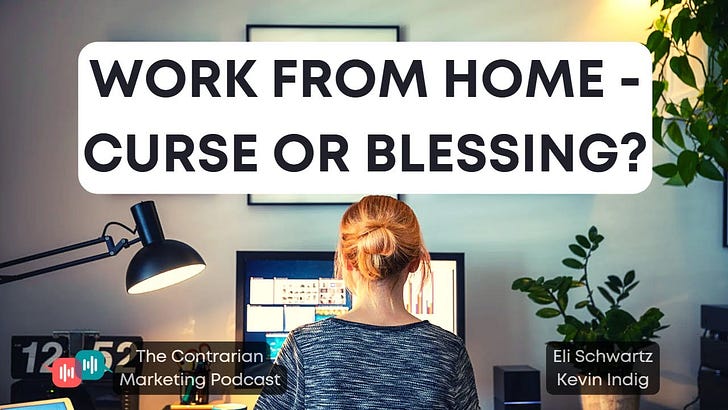
Working from home - great or terrible?
This episode is available on:* Spotify* YouTube* Apple PodcastsToday we discuss if ‘work from home’ as a concept is truly beneficial for the dynamics of employees and managers in an organization.Thanks to the pandemic, many organizations switched to work-from-home, but some of them, Goldman Sachs, Google, Microsoft, etc., pull employees back to the office. They have realized that in-person interaction may outweigh the many stated advantages of a WFM culture.✅Kevin says working from home enables an employee to take control of their time for a better work-life balance.⛔Eli says working from home limits an employee’s growth within an organization and beyond.In this episode of Contrarian Marketing, we discuss:* Impact of work from home on today’s workers* How work from home impacts the various players of an economy* Tips on how to work from homeShoutout to our sponsor, Ahrefs!If you’re looking for ways to drive more SEO traffic, you need to take a look at Ahrefs.Ahrefs allows you to find and fix technical errors, keyword gaps with your competitors and internal link opportunities.Many of the best SEOs in the game use Ahrefs, and so do Eli and I. It’s a key tool in our work; we’ve been using it for many years with some of the best tech companies in the world.Check out ahrefs.com and sign up for free!Key Takeaways* Working from home is great for individuals who are disciplined and can work independently. Consecutively, one should work on these skills to truly ace working from home.* Companies should choose between in-office or WFH culture but not mix since that could lead to remote employees being left behind in their careers.* Young workers and recent graduates should explore in-office culture for better opportunities and professional development.* Organizations should understand the mechanics of working from home to build or transition into a successful remote-first company.* Organizations should explore repurposing the cost savings from adopting remote work for employee benefits.Kevin’s take: Work from home enables employees for a better work-life balanceKevin states how working from home has significantly cut down his commute time:“My commute is now five seconds as opposed to over an hour. When I lived back in San Francisco in the Bay Area, I had to take the train from Palo Alto to the city which took me over an hour one way. The time on that train was not very productive. You can maybe answer a couple of emails or do some things, but you're constantly interrupted and oftentimes you cannot sit down - so it comes with all this stress.Now, I wake up, make coffee, make breakfast, and go into the office. I work a bunch of hours and then I go to the gym, and then I'm done for the day. I'm saving over two hours that I used to have to spend on commuting.”Eli shares a different take by giving an example of how he used his commute time productively:“I use my commute time effectively to listen to audiobooks, and read physical books, and podcasts. That's the stuff I don't do right now (during work from home) - I hardly ever read. I hardly ever listen to other podcasts cause I don't have that time.There's no buffer time. To be fair, I love working from home - I love that flexibility, but I don't know that it's necessarily good for everyone. The idea of working from home is permanent and being granted to people actually takes away something that many people benefit from.”Kevin states that a ‘Hybrid’ arrangement, where companies have employees working full-time remotely or in-office, is the worst form of WFM culture:“If some people work remotely and others in the office, then the people working remotely don't have the same access to other people to build the same relationships. They're not as present, not as visible, and that is a losing position.I remember when I worked at Atlassian, some people were allowed to work from home completely remotely on a full-time basis. But these people were always passed for promotions. They didn't get a lot of visibility or the best projects.So, in my mind, it's an either/decision - either everyone can work from home or maybe contractors can, but full-time people should ideally not work from home.”Kevin also highlights the ‘silent layoffs’ culture, where organizations tend to misuse the growing WFH trend for laying off employees:“A lot of big tech companies hired in the pandemic and now that revenues are coming back to baseline after the pandemic, they still have these people. Now, they have to reduce their headcount, for which there's no way around.So, some companies are forcing people to return to offices as a way to reduce their headcount because they know that not everybody can come back or will come back - they moved during the pandemic, bought a house somewhere else, moved to their parents, etc. Now they're forced to come back and there's just no way that this is going to work.So they're quitting and it's good for the companies - they saved their severance because the employee decided

The Marketing trends that shaped 2022
This episode is available on:* Spotify* YouTube* Apple PodcastsIn this episode, we talk about the big trends that shaped 2022, so you can prepare for what’s to come in 2023. This is a public episode. If you would like to discuss this with other subscribers or get access to bonus episodes, visit www.contrarianmarketingpodcast.com

TikTok: can it replace Google Search?
This episode is available on:* Spotify* YouTube* Apple PodcastsToday we discuss the future course of one of the most addictive, engaged, and controversial social media platforms: TikTok.Increasing privacy risk and disappointing revenues have raised questions about TikTok’s sustainability and position as a leading social platform.As the US government bans the app from government-issued cell phones and its users gain visibility on its privacy concerns, will TikTok lose its sheen to get permanently banned?✅Eli says TikTok will never get banned by the government, but maybe by the big app stores⛔Kevin says TikTok will get banned by the US government by November next yearIn this episode of Contrarian Marketing, we discuss:* How TikTok can acquire serious and talented creators* Whether TikTok might get banned in the US* How marketers can use TikTokKey Takeaways* TikTok cannot replace Google search* TikTok should adopt a revenue-sharing-based monetization model with creators (like YouTube does) to attract quality creators* TikTok is an undervalued channel for B2B Marketing* Use TikTok for content repurposing and advertising* TikTok provides a first-mover advantage opportunity for niche creatorsKevin’s take: TikTok has no futureKevin states how rising privacy concerns with the US government and beyond can strongly put an end to TikTok:“I don't think TikTok has a future, not because of the product and the platform, but more so because of regulation.The US government already imposes sanctions on lots of companies, especially Chinese companies, manufacturers, and creators. So I don't think it's completely unrealistic that the US government would put a sanction on Bytedance or force the company to sell TikTok.”Even with its popularity and addictive algorithm, TikTok indeed faces competition with many other platforms like Google, Netflix, YouTube, etc. But this doesn’t mean it can replace Google.Eli:“I tried a bunch of searches and the quality is terrible. Let's say you do a search for the top place in the city. You're going to find content, you're going to find engaging videos. If you are the kind of person that is led by influencers, by all means, you will find the greatest things to do.But if you are the kind of person that really wants to curate your experience, TikTok does not offer that to you. You have to go through so many videos before you find something that's not on the popular list on Google.”TikTok also has an opportunity to share revenue with its creators to truly make them stick to the platform.“The monetization is very different (than YouTube). I don't know how much exactly Charli D’Amelio got, but she got some money from TikTok and also made a ton of money from just influencer gigs.Whereas Mr. Beast gets a lot of money from YouTube itself. YouTube shares about 50% of its revenue with creators. And I think that's what TikTok has to do as well in order to keep the creators and make sure they're not making money in other ways. This could also raise and groom the next wave of creators on TikTok.”Eli’s take: TikTok might get shadowbannedEli predicts that TikTok will get shadow banned:“My prediction is that the government's gonna make it very uncomfortable for the platforms, which are Apple and, and Google to host the TikTok app and provide TikTok updates to people that have the TikTok app on their phones. Apps like that have been dropped from the app stores and then it's effectively bent. Then in order to get TikTok on your phone, you have to sideload it and no one's going to do that. So that's done.I just think that if they go this regulation route, it will be challenged. Trump tried really hard and he wasn't successful. I just don't know that we have tools in our system of laws to ban things – like FTX could have been banned, and Crypto could have been illegal. So they don't have the tools to make things illegal like that. To make something really stop, you just tell Google and Apple to do it, so that there's no pathway for them to be successful.”Rev share is key to keeping quality creatorsEli states how TikTok has reduced the entry barrier to becoming a ‘creator’. But it needs to become a platform that makes it worthwhile for genuinely talented creators to come and stay.“I'm saying the creators are the future stars. They're not just TikTok stars - they're actual stars and real artists. TikTok needs to get them to stick to the platform. Here’s an interesting parallel – Think about Facebook or Meta - five years ago, who was going to compete with Facebook? Well, no one can, as all the users in the world are on Facebook.Now look at them today - they're declining in users because users have found somewhere else to go, and that place happens to be TikTok. So TikTok needs to make the platform sticky for the people that create the content because, without the right content, you don't get the users.”Eli further stresses how TikTok needs creators who are true subject matter experts to keep the content quality high:“

AI content: tool or toy?
This episode is available on:* Spotify* YouTube* Apple PodcastsToday we cover one of the requested topics by our listeners - AI Content.ChatGPT took over the internet to reach 1 million users within 5 days - and many wondered about their next business idea, feared job security or simply poked holes in it.We also checked the search demand for crypto versus ChatGPT, and it already shows a very different trend compared to Crypto.So, is AI content the next big tool, or will it fizz out as a trendy toy?✅Kevin says yes, AI content tools are valuable to help work better, faster, and smarter⛔Kevin says no, AI content tools are a cool technology toy, where utmost they can be used for applications having defined boundaries.In this episode of Contrarian Marketing, we discuss:* How is AI content used today?* What are the limitations of using AI for content?* How will AI content shape in the next 12 months?Key Takeaways* AI content tools can already solve small problems like writer’s block today.* AI content opens up many possibilities for new tools, job roles, and business ideas.* AI content cannot think or conduct original research on your behalf.* AI content doesn’t yet have clearly defined boundaries, which is why you should fact-check and copyright-check its output before using it.Kevin’s take: AI content tools are valuable and can make you better, faster, and smarterKevin mentions how AI tools already provide practical use cases for content creation today:* Create content for topics with clear definitions, like glossary blogs* Write product descriptions and category text for e-commerce sites* Unblock writer’s block with tools like Lex* Draft article outlines* Add schema markup* Improve grammar and spelling* Suggest images or graphics* Adopt the writing style or tone of famous writers or personalities* Auto-completion of sentences for emailsKevin further adds how it also opens up new possibilities and fields for individuals and brands to explore:“It might be true that when everybody has access to the same technology, then the output is not valuable anymore. But I think it will open up the door to a lot of new possibilities. The central question in my mind when we talk about AI, generative AI, and content is when you can create anything – what do you create?”"Prompt engineering will be a new, hot field. Some people and companies will have an advantage, and others won't.An interesting question is: what new fields of work all of a sudden open up when others have been solved by AI?AI content receives a lot of press and excitement from the public, but one should be careful about how they plan on using the tool:“I think the AI tools that are coming out create hype not because AI is good enough to do all these things perfectly today, but because the next step is so clearly visible. But I would not outsource something completely to AI that does not have incredibly clear boundaries.”Speaking about boundaries, Eli shares an example of how AI doesn’t work well in poorly defined conditions:I asked ChatGPT if Kanye West was an anti-Semite, and it told me definitively no. But that's probably because it's not updated with the latest news. Still, I don't think you can completely rely on AI for things that don't have defined boundaries.Eli’s take: AI content tools are a cool tech toyEli states that in the existing sea of content, AI content tools may be more useful for learning and simple fact-finding purposes.I think these AI tools are great foundations. They're research tools the same way you use Ahrefs or SemRush – you do some keyword research to find ideas and then build on top of it. That's what I think AI content and AI tools are good at, but it's not the end.Eli also mentions that many people make buying decisions when they consume content online - and bad AI content will lead to a terrible purchase or customer experience.“If people have to make buying decisions and look at this terrible content that's written by bots, to make that buying decision, that doesn't make a lot of sense.But, if we live in a world where bots buy from bots, that's totally different. If you just say to your Siri or Google Assistant that ‘I need soft toilet paper’, then Siri and Google can just look at what Amazon has, and choose it for you. But again, if it makes a mistake, you're the one using the toilet paper. So it's always going to be hard to live in a world where AI is just working with AI.”Eli also highlights how you cannot make AI do original research, nor can it replace human intuition.“I think you can use AI for text-related content, for which you were already going on Upwork and paying someone ridiculously low amounts of money to just write little bits of content. But if it's writing a book or writing a journalistic research piece, I don't think we're there.ChatGPT, Google Assistant, or Siri also can’t help you decide who is the best plumber based on their distance, pricing, or services. Or it can’t decide where you should go on vacation or

Should Personal branding have rules and limits?
This episode is available on:* Spotify* YouTube* Apple PodcastsFirst, a word of gratitude: The Contrarian Marketing Podcast has hit 1,100+ downloads and 150+ newsletter subscribers from just the first 2 episodes. All thanks to you!Personal branding helps entrepreneurs raise funds, job seekers get offers and salespersons close leads. Being out there can be overwhelming but also incredibly rewarding.So, should you pull any strings to build your personal brand or stay within limits?✅Eli says yes, do anything and everything to build your personal brand!⛔Kevin says no, there are limits to what you should do to not hurt your reputation.In this episode of Contrarian Marketing, we discuss:* The limits of personal branding* How to not kill your reputation* 10 tips to build your personal brandKey Takeaways* Personal branding helps you stand out from the crowd and elevates you as an expert in your professional domain.* To avoid unnecessary attention, draw boundaries about how you present yourself by knowing your target audience’s mindset and trigger points.* Ensure you maintain a positive perception about yourself within the industry peer circle and not just your audience.Eli’s take — Building a personal brand helps accelerate your professional goalsEli shares what it means to build a personal brand –“A personal brand doesn't have to be something that you're super famous for and everyone knows about you in the industry. It just means that you carry more weight than just your resume – that when you are introduced to someone, they already know who you are.”He mentions how one should focus on gaining the perception of an ‘expert’ with your personal branding efforts –“Personal brand should be a deliberate process of how one would like to appear as something – like, I would like to be known for something, and these are the actions that I'm going to take because I want to be known for doing that.”Sharing the example of Neil Patel’s personal brand, Eli states how in the end, the way your target audience perceives your brand is what matters irrespective of what everyone else thinks or says –“Neil Patel has built a fantastic brand, and the negative attributes of his brand are within the digital marketing industry. But his tribe is not these people – his tribe are the corporations. When they hear of SEO or digital marketing, they're like – I've seen Neil Patel everywhere and he did SEO for TechCrunch, so now I too want to hire him. Fortune 50 brands are working with Neil Patel Digital, and that's because of that brand. So, he knows his tribe includes people in these corporations that will hire his agency.He focuses on his audience and doesn’t care about the other audience, because that doesn't really support what he's trying to do. Thus, he doesn't care if the digital marketers that maybe are on the same level as him hate him. The power of his brand is what makes those negative people look like the minority and not the majority.”To this, Kevin highlights how many corporates vet agencies or partners by asking for opinions from other industry professionals –“Everybody knows each other. Even if you have many clients but everybody in the industry doesn't have a higher opinion of you – over time you fade out. Hence, it's important to have a good reputation with other people in the industry and with your peers.”Kevin’s take — Personal branding may attract the wrong kind of attention or audience that may hurt your overall credibilityKevin warns about being mindful about how one conducts themselves since being known exposes you to criticism or unnecessary attention.“There are limits to what you should do when building a personal brand because it's all about getting attention. But remember that getting attention at any price can get really expensive – and it can get very expensive very quickly.”Eli agrees to be careful when putting yourself out there – “You shouldn't do things that are dumb unless it's a part of your strategy.”Kevin shares how one can draw a line while building a personal brand –* Define your moral limits* Define your audience and understand their mindset as to what they like or dislike* Know what your audience stands for and its limits. Align yourself as needed.Kevin shares the example of Gary Vaynerchuck’s personal brand when it comes to staying within your limits –“Gary Vaynerchuck stays within the boundaries of his tribe. He admits that he's a workaholic, curses and he shows how he fits that into his life. He owns that. It surely triggers people, but those people are not his tribe. He is respectful and doesn't care about that too much. So, I would say that Gary Vaynerchuck is a perfect example of staying within your limits and knowing where the boundaries are, and not doing everything.”10 Tips to build your personal brand* Use storytelling frameworks in your content to speak with your audience.* Get logos and testimonials to bring credibility to your personal brand.* Be open to being a student by sharing what you se

Is Linkedin the social network of the future?
Is LinkedIn truly becoming the next hot social network or will its creator-first pivot lead to the path of Facebook?✅Kevin says — Yes, LinkedIn has all the tools it needs to become the next hot social platform beyond professional communities.⛔Eli says — No, Linkedin has become too much like Facebook and is moving away from its goal of being a professional social network. This is a public episode. If you would like to discuss this with other subscribers or get access to bonus episodes, visit www.contrarianmarketingpodcast.com

Smart devices have no impact on marketing… or do they?
Will new devices fundamentally change marketing?71% of Americans say they check their phones within the first 10 minutes of waking up — Reviews.orgWhile we’re busy being addicted to smartphones, the tech industry is pushing more devices like smartwatches, fitness bands, pods and glasses. Tech research firm IDC predicts that the AR/VR market will grow by 8x to $26b by 2025.The explosive growth of smart devices raises the question, “will devices fundamentally change marketing or not?”✅Eli says yes, devices remove friction and make reaching consumers easier.⛔Kevin says no, the fundamentals of marketing remain the same, only the format changes.In this episode, we talk about:* the impact of new devices on marketing* whether new devices open new marketing channels* the role of privacy for devices This is a public episode. If you would like to discuss this with other subscribers or get access to bonus episodes, visit www.contrarianmarketingpodcast.com

2023 will get tough, but you still need to win
Many marketers are crafting their 2023 marketing plans right now and like every year, they have initiatives on things they will build, optimize and expand. But there's a surprise brewing: most of these marketers are going to fail if their goals are tied to top-line acquisition.We are either in the midst of or entering an economic downturn which means demand is going to be on the decline. Marketers who don't get ahead of communicating this now are going to find themselves falling short of their goals to no fault of their own.Without communication on how demand factors into marketing performance, marketers are going to be asked to tactically recover the losses in traffic. That is an impossible task and will only lead to further disappointment. No amount of tweaks on content, titles and links are going to make people search if they aren't searching.In this episode, Eli and Kevin Indig discuss how marketers can still win in 2023 when the macro realities are likely going to overpower micro initiatives. This is a public episode. If you would like to discuss this with other subscribers or get access to bonus episodes, visit www.contrarianmarketingpodcast.com