Choosing Leadership with Sumit Gupta
334 episodes — Page 6 of 7
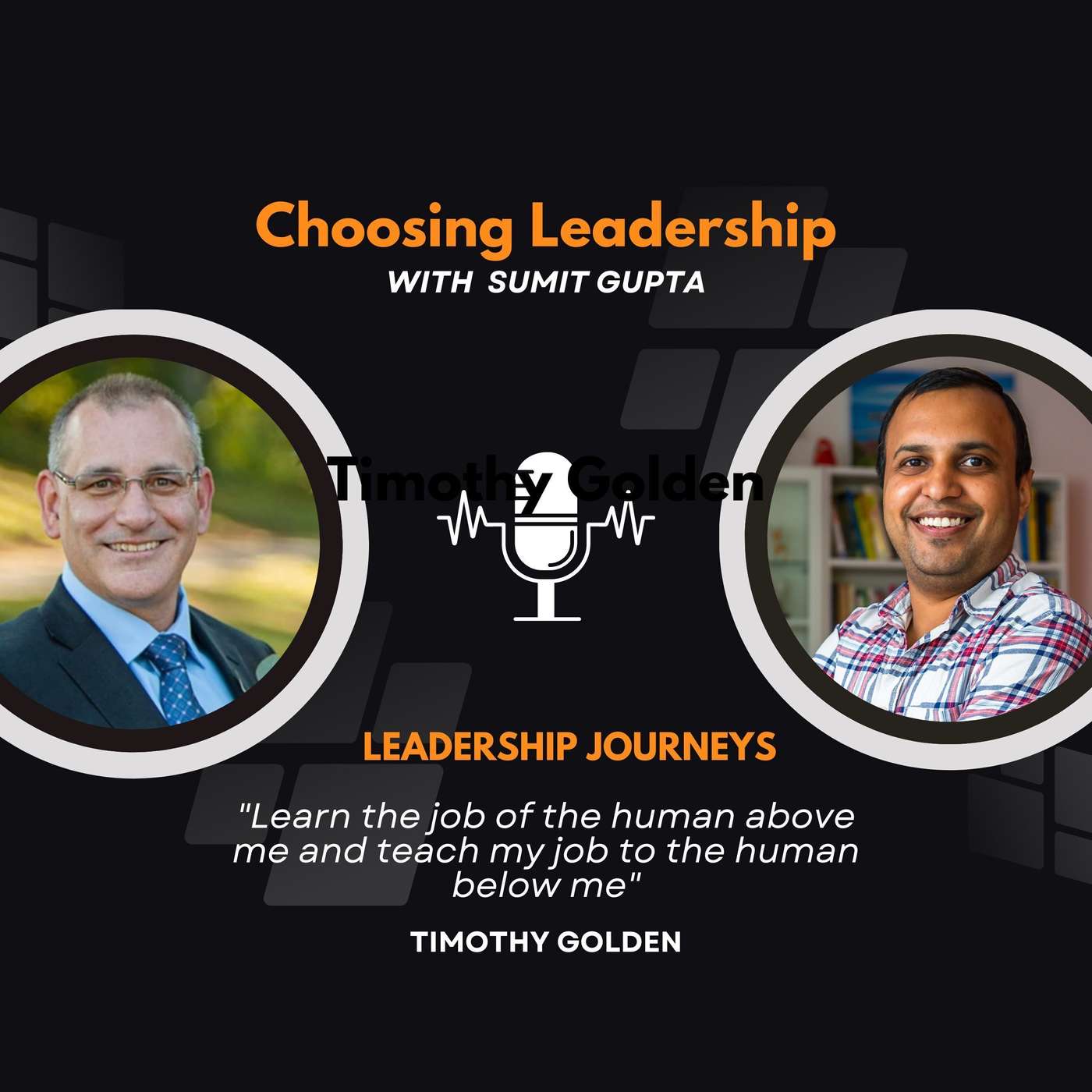
Leadership Journeys [68] -Timothy Golden - "Learn the job of the human above me and teach my job to the human below me"
This is the Leadership Journey series on the Choosing Leadership Podcast.I believe we all have a lot to learn from each other's stories - of where we started, where we are now, and our successes and struggles on the way. With this series of interviews, my attempt is to give leaders an opportunity to share their stories and for all of us to learn from their generous sharing. If you know a leader whom you would like to see celebrated on the show, please send me a message on LinkedIn with their name.In the interview, Tim shares how programming came very naturally to him but the transition from programming to leadership and management meant he needed to learn to compromise and not always being right and what it means to effectively communicate. He also shares the importance of discipline and camaraderie which he learned from the military. He also shares the lesson of learning the job of the human above me and teaching my job to the human below me. You can find Tim at the below linkshttps://www.linkedin.com/in/timothygolden/https://twitter.com/goldeneyeIn the interview, Tim sharesWhen dealing with humans cuz you can't program them like you can program computers. Um, I really needed to learn some effective communication techniques. I needed to learn compromise not always being right . In fact, one of the hardest lessons I had to learn was that, you know, there are way, there are people way smarter than me in some of these disciplines and I used that as a way for me to grow.I have a core group of people that speak the truth and love to me and tell me where, you know, where I'm doing wrong, where I could improve, and I take their advice to heart and I try to make those changes along the waylearn from others, but give back twice as much as you can. Being able to get that discipline, being able to get that sense of camaraderie, that sense. of Family, uh, which is kinda lacking nowadays in our world, We're so disjointedone of the probably single most important thing that I learned was learn the job of the human above me and teach my job to the human below me.one of the things I picked up on was initiative, right? Taking the initiative on oneself to not only better yourself, but better the person next to you,
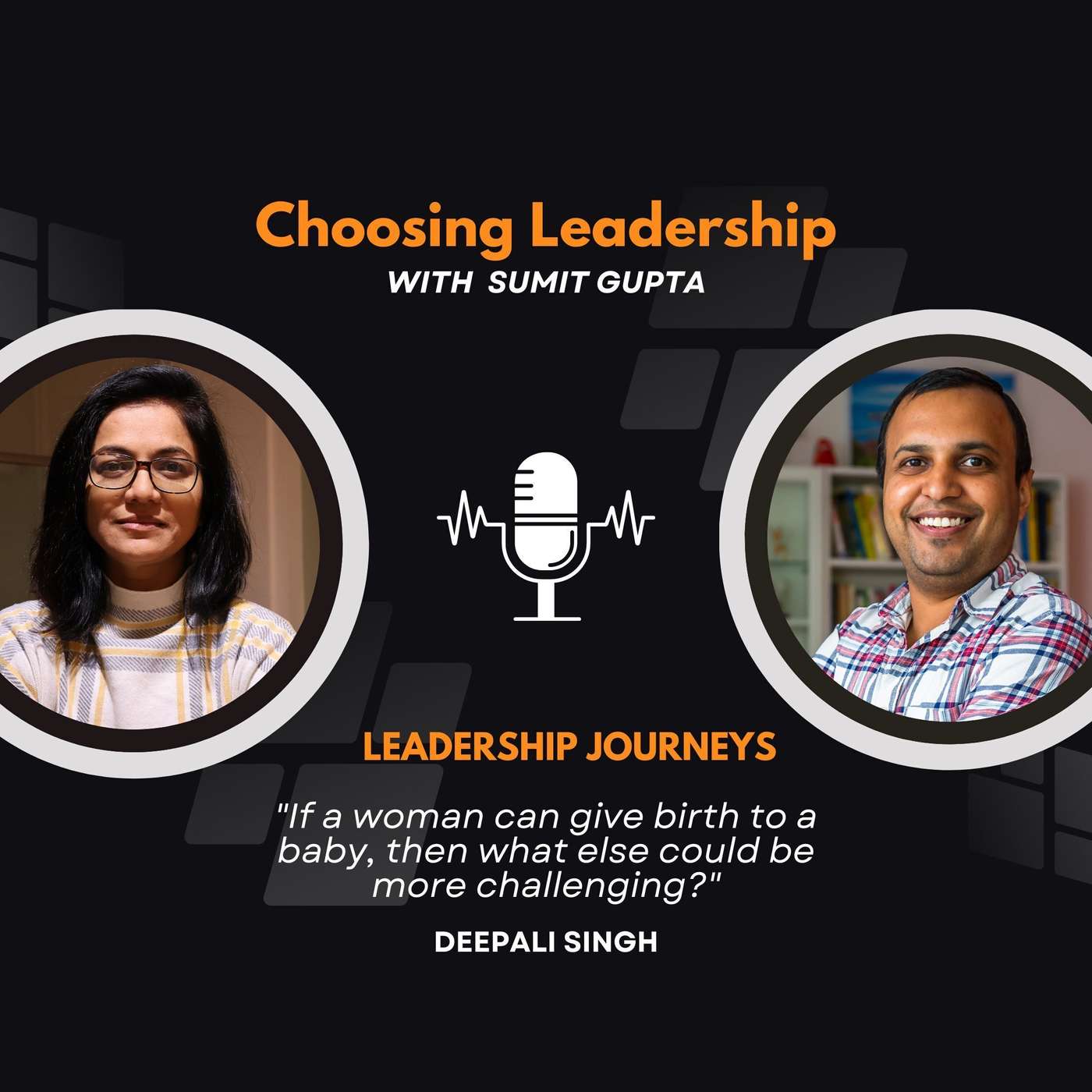
Leadership Journeys [67] - Deepali Singh - "If a woman can give birth to a baby, then what else could be more challenging?"
This is the Leadership Journey series on the Choosing Leadership Podcast.I believe we all have a lot to learn from each other's stories - of where we started, where we are now, and our successes and struggles on the way. With this series of interviews, my attempt is to give leaders an opportunity to share their stories and for all of us to learn from their generous sharing. If you know a leader whom you would like to see celebrated on the show, please send me a message on LinkedIn with their name.In the interview, Deepali shares about being a risk taker and putting her heart and soul into everything she has done. We also spoke about the challenges of being a female leader, and how to deal with stereotypes and gender biases at work. We also reflected on the time when we worked together, the positive influence she has had on me, and how leadership is about continuously evolving and growth.You can find Deepali at the below linkshttps://www.linkedin.com/in/deepalis/https://www.myfurries.com/In the interview, Deepali sharesbeing a woman, you have to always stand up for yourself.whenever I have had given interviews in the past, uh, I was always asked, what will you do? Will you continue to work after marriage? What will you do when you have kids? Will you continue to work? What's going to happen to your career? Right or wrong, these kind of questions are never, ever going to be ever asked from a guy. key is awareness. Standing up, asking for it, and if you, uh, you don't know what to do, find a mentor, find a champion for your cause, but then you have to Be vocal about what you feel should be done with you and how exactly do you want your career or whatever it is. you are categorized as somebody who always is a troublemaker because you'll always stand up and always ask for something which is rightfully should be rightfully done to youGod has given this privilege to women to be able to bear kids right now. Organizations, I'll not say organizations, but I've seen situations where, roles are withdrawn from women, but just because, you know, they, they've taken a break or they're expecting, I mean, for God's sake, they're just delivering a baby. They haven't becoming a, they haven't become brain dead, right. And the reasons they will give you that. Oh no. We want you to, uh, be relaxed, calm. We don't want to give a stressful job. And you know that when once you are coming, when you come back after that break, you are never ever going to be given those prestigious projects or the job or the assignment that was yours earlier.So you have to flag it, you have to take it to the concerned authorities and say that, see this. you have to spend a lot of time with yourself and try and ask questions from yourself that what exactly do you want?why I am doing this is also is a very difficult question to answer, and, um, because it's difficult, you don't want to answer it, you kind of always keep on running about it.
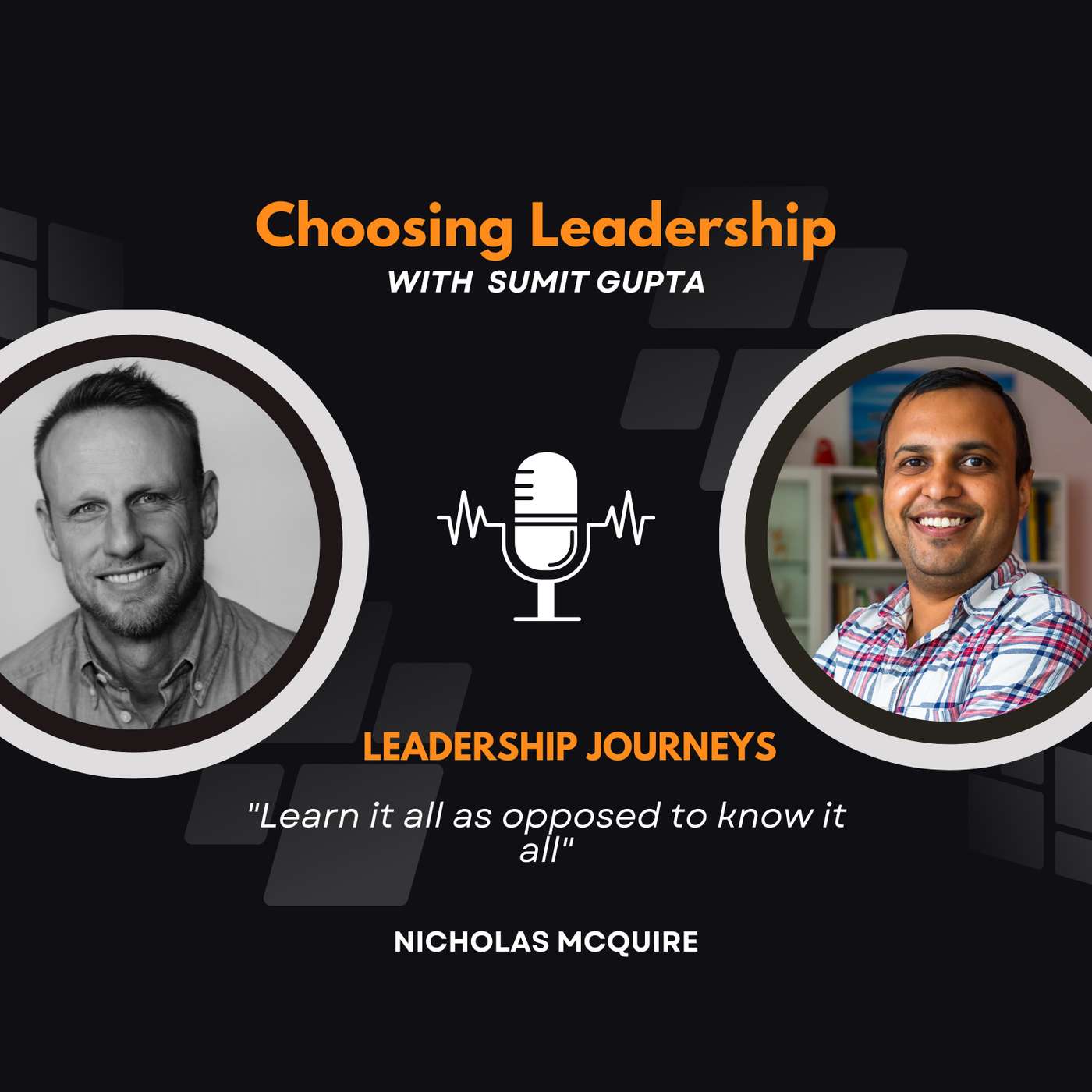
Leadership Journeys [66] - Nick McQuire - "Learn it all as opposed to know it all"
This is the Leadership Journey series on the Choosing Leadership Podcast.I believe we all have a lot to learn from each other's stories - of where we started, where we are now, and our successes and struggles on the way. With this series of interviews, my attempt is to give leaders an opportunity to share their stories and for all of us to learn from their generous sharing. If you know a leader whom you would like to see celebrated on the show, please send me a message on LinkedIn with their name.In the heartfelt conversation, Nick shares about his unusual background and how that gives him an advantage. We talk about how he maintains a harmony between work, family, and health - while living in London and leading his team based on the west coast of the US. Listen to this one for some practical tactics on how to structure your day and when and where to draw boundaries.You can find Nick at the below linkshttps://www.linkedin.com/in/nicholasmcquire/In the interview, Nick sharesmy route through to where I'm at, uh, at the moment, has certainly been a kind of a meandering path through a number of different opportunities and challengesmindfulness works for me is as long as I've got that structure and it's communicated well with the team that and everyone understands and we've got a mutual respect for that, it works.if you can have those transparent discussions and there's flex on either side. I think it ultimately, that's the place you want to get to and that transparency and respectful approach to your colleagues, I think is so important.the big changes that happened in my life and career as a result of setbacks ultimately turned to be really good things.The temptation and the visceral reaction is quite natural, is to be downbeat and to be a little bit oh my goodness, you know, what's happening, type of, uh, reactions. But I think in the long run, kind of hold onto the point that actually these tend to be really positive events, cuz you'll be able to, it'll take you onto, you'll either trampoline into another area.
Leadership Journeys [65] - Gerbert Vandenberghe - "The bigger the company grows, the less I am involved."
This is the Leadership Journey series on the Choosing Leadership Podcast.I believe we all have a lot to learn from each other's stories - of where we started, where we are now, and our successes and struggles on the way. With this series of interviews, my attempt is to give leaders an opportunity to share their stories and for all of us to learn from their generous sharing. If you know a leader whom you would like to see celebrated on the show, please send me a message on LinkedIn with their name.Gerbert is the COO & co-founder of Venly.io based in Belgium. In the interview, we spoke about the importance of culture when working remotely. Gerbert shares the lessons they learnt when they went fully remote and the practical things they do to listen, share, and strengthen human relationships, even when they have employees from 15 different countries. We also talk the most difficult time for them when they had almost ran out of money, and how they persevered and come out on the other side of the struggle.You can find Gerbert at the below linkshttps://www.linkedin.com/in/gerbertvandenberghe/In the interview, Gerbert sharesSo we ran out of money while still building a company. We worked like nine months without any salary.it was quite painful because after working two years together with these people, we were very close to them. We were fond of them. We went together on skiing trips. Um, so yeah, that was quite painful if you believe in your vision and you have some proof of the market that, that your product fits the market, I think you just have to keep going and pushing and not give up because of some setback I used to be involved in every aspect of the business. Um, I used to be much closer to technology and to product while I'm not really involved on that anymore. So the bigger the company grows, they're less involved in every, um, department in nitty gritty detail.my goal is to make me myself obsolete in the company,I make sure I have enough sleep, so I'm well rested and I love to go to the golf club and hit some balls.
Leadership Journeys [64] - Eva Poppe - "When you get out of your comfort zone, you learn so much about yourself."
This is the Leadership Journey series on the Choosing Leadership Podcast.I believe we all have a lot to learn from each other's stories - of where we started, where we are now, and our successes and struggles on the way. With this series of interviews, my attempt is to give leaders an opportunity to share their stories and for all of us to learn from their generous sharing. If you know a leader whom you would like to see celebrated on the show, please send me a message on LinkedIn with their name.In the interview, we talk about learning from different cultures, how people’s expectations from leaders have changed in the last few years, and how you can be both loving and empathetic towards your people while at the same time holding each other accountable for our responsibilities as a team/company. You can find Eva at the below linkshttps://www.linkedin.com/in/evapoppe/In the interview, Eva sharesexperiences in a different country make you humble. You learn so much about yourself as much as you learn about other cultures.people are expecting different things from leadersit's crucially important that you can have a joke from time to time. the good thing is that I'm a very positive person I've been working in the tech industry for more than a decade now, and I've figured already that in the tech industry, there are not as many females.Getting out of your comfort zone, you learn so much about yourself, about others, about empathy. It makes you humble. Um, which I think is very important because You're no better than others.I think it is very important if you talk to people from, like other views who give you like an outside view on where you're at because you're in your own zone a lot of times you can, um, then not see left or right.So if someone is coming in and kind of puts a little bit into the right in into the right context. It helps tremendously.
Leadership Journeys [63] - Maria Pennanen - "Over the years you become more forgiving to yourself."
This is the Leadership Journey series on the Choosing Leadership Podcast.I believe we all have a lot to learn from each other's stories - of where we started, where we are now, and our successes and struggles on the way. With this series of interviews, my attempt is to give leaders an opportunity to share their stories and for all of us to learn from their generous sharing. If you know a leader whom you would like to see celebrated on the show, please send me a message on LinkedIn with their name.In the interview, Maria shares the role curiosity has played in her life to bring her where she is today. We talk about the fear of failure, how often people perceive her as being scary, and how she deals with that by sharing and being open about her own imperfections and vulnerabilities.You can find Maria at the below linkshttps://www.linkedin.com/in/mariapennanen/https://twitter.com/PennanenMariaIn the interview, Maria sharesa feature that's missing from many of these kind of evaluation programs or let's say coaching workshops, is that they focus on the individual. And I realized that you have to always think about the whole team.my driver has always been curiosity,I think my mistake was always that. Mixed up empathy with sympathy and didn't understand that actually empathy is that you just have to understand that they, people have the right to think what they want about things And you don't have to agree with that. And for me, that was really a, you know, big Aha moment.what would you do if you couldn't fail? And I think we have all probably, inside of us this fear of failing that we are not, I don't know whether we are not good enoughsometimes it's very hard to, to admit that, okay, now it's time to just to stop and let the company go down.it makes us just humanyou can't force peopleI'm told that I'm very scaryI meditate every morning, 20 minutes and I do write this kind of thing called Morning paper. Which is like, just like a, brain flow on the paper, whatever is in your mind, or, and sometimes, of course, new ideas come that, that you want to use. Exercising, I think keeping yourself fit is very important.Less is more
Leadership Journeys [62] - Violetta - "If you are an entrepreneur & unhappy, your company will suffer."
This is the Leadership Journey series on the Choosing Leadership Podcast.I believe we all have a lot to learn from each other's stories - of where we started, where we are now, and our successes and struggles on the way. With this series of interviews, my attempt is to give leaders an opportunity to share their stories and for all of us to learn from their generous sharing. If you know a leader whom you would like to see celebrated on the show, please send me a message on LinkedIn with their name.In the interview, Violetta shared her journey from being an academic researcher to an entrepreneur, and what she has learned along the way. She shares how her background in linguistics, neuroscience, psychology, and game-theory all come together in her role as a leader of her organisation. She also shares her journey from being a quiet shy kid to someone who loves being on stage today.You can find Violetta at the below linkshttps://www.linkedin.com/in/meanceo/https://cadchain.com/https://www.femaleswitch.com/In the interview, Violetta sharesI'm the kind of person who thought that I would never become an entrepreneur.I actually have, uh, five high education degrees. I've really enjoyed studying my whole life.at some point, after I think a year and a half I realize that I'm, I'm burning out because, uh, I'm working nonstop.As an entrepreneur, you always think, Oh my God, I, there's so much more that needs to be done. Why am I not moving? Why are we so slow? And now I realize that if I continue in that rhythm my whole life, then I'm, you know, I'm not gonna be able to run for much longer. if I look at myself like four years ago and now these are two totally different peopleIf I remember myself, uh, at school, I was, always trying to keep quiet. And now I love being on stagesometimes you need to. Allow yourself to express all those negative emotions, because if you keep them inside of you, you're gonna explode at some pointHopefully one day I will be able to switch from wartime CEO to a peacetime ceo.
Leadership Journeys [61] - Patrick Strauss - "There are so many opportunities for organizations to do better."
This is the Leadership Journey series on the Choosing Leadership Podcast.I believe we all have a lot to learn from each other's stories - of where we started, where we are now, and our successes and struggles on the way. With this series of interviews, my attempt is to give leaders an opportunity to share their stories and for all of us to learn from their generous sharing. If you know a leader whom you would like to see celebrated on the show, please send me a message on LinkedIn with their name.In the interview, Patrick shares how moving to a foreign country forced him to step out of his comfort zone and start from scratch. At the same time, he shares how he has learned to come in with a very clear intention, asking questions, and geting started from day 1 when starting in a new job - which he feels is very similar to moving countries. You can find Patrick at the below linkshttps://www.linkedin.com/in/patrickstrauss/In the interview, Patrick sharesit is very hard to find good people that embrace change quicklythere are so many opportunities for organizations to get it and do it betterbe very open and resilient against the feedback that you getI think my main message really to everybody is to embrace change. Don't be afraid of it. Um, change does not always have negative or bad things attached to it. the biggest challenge is finding the right people that, understand and want to go the same way.Listen more rather than talk.You don't have to be the centre of attention.
Leadership Journeys [60] - Anastasia - "My best ideas come either during meditation or after meditation."
This is the Leadership Journey series on the Choosing Leadership Podcast.I believe we all have a lot to learn from each other's stories - of where we started, where we are now, and our successes and struggles on the way. With this series of interviews, my attempt is to give leaders an opportunity to share their stories and for all of us to learn from their generous sharing. If you know a leader whom you would like to see celebrated on the show, please send me a message on LinkedIn with their name.In the interview, Anastasia shares about her meditation practice and how that helps her maintain a grounded sense of balance as she deals with being a women entrepreneur in a world where there are not many. She also shares about her vision for women leaders, and how she is driven by curiosity and yet how she has learned to accept and move on while taking huge risks as an entrepreneur.You can find Anastasia at the below linkshttps://www.linkedin.com/in/anastasia-petrova-24504073/http://social-butter.com/In the interview, Anastasia sharesI am result oriented and I really want to see the input of my actions. you learn to accept because sometimes you plan something in a very perfect ideal, uh, way. In a perfect ideal world that doesn't exist I was basically locked in my comfort zone and right now I feel like I get bored if there is no risk. this mission is more emotional, . It lays really deeply to my heartas soon as you understand who you are, you understand what you're doing and you start to value what you're doing. And if you value what you're doing, I mean, this is exactly the ground you're talking aboutFear is blocking the potential always. For me, it was always fear like, uh, procrastination and fear. are Connected. So if you are afraid, like I think fear is actually lays in the very basis on each and every negative feeling that you can have on top of it.fear lays always in the very like root and then it can mutate in all sorts of like, procrastination or, um, I dunno, grief or any other like, bad feelings that you might have, but in the root is always fear. So what I can say is that it is important to realize that fear blocks your potential.So as soon as you recognize it, you start to get even angry because as if you feel that there is something that is blocking you, you know, and at that moment you will start to actually release this fear a little.
Leadership Journeys [59] - Sudhanshu Ahuja - "All the companies that I applied for a job and got rejected, are now our customers"
This is the Leadership Journey series on the Choosing Leadership Podcast.I believe we all have a lot to learn from each other's stories - of where we started, where we are now, and our successes and struggles on the way. With this series of interviews, my attempt is to give leaders an opportunity to share their stories and for all of us to learn from their generous sharing. If you know a leader whom you would like to see celebrated on the show, please send me a message on LinkedIn with their name.In the interview, Sudh shares how growing up in a small town in India in a family of entrepreneurs inspired him to start his own company. We also talk about moving to a big city like Singapore and yet not being intimidated by that. He shares the big risks he has taken as an entrepreneur, and how he was rejected by some companies for a job which turned out to be a blessing as those companies are his customers now.You can find Sudh at the below linkshttps://www.linkedin.com/in/sudh8/https://impress.ai/In the interview, Sudh sharesthat one of the biggest responsibilities in our business is to our customerswe put focus on new customers, new sales to existing customers. And all of this meant that we were able to retain a hundred percent of our customers it became really sustainable. We had nothing to worry about in terms of keeping our employees well rewarded, so we didn't have to do mass layoffs, uh, to achieve that. We didn't have to cut bonuses or salariesWealth is created during bear markets and harvested during bull markets. You start to get this realization when you get older, that your younger years are not going to come back and the equation starts to change.the challenge is how do you grow into what is needed to take the company to the next stage?All the companies that I applied to a job for, um, are now our customers. All of them. Absolutely all of them. So that's been. One of the things that make me feel like a winner,
Leadership Journeys [58] - Dinesh Juneja - "Partnerships are the backbone of running a company."
This is the Leadership Journey series on the Choosing Leadership Podcast.I believe we all have a lot to learn from each other's stories - of where we started, where we are now, and our successes and struggles on the way. With this series of interviews, my attempt is to give leaders an opportunity to share their stories and for all of us to learn from their generous sharing. If you know a leader whom you would like to see celebrated on the show, please send me a message on LinkedIn with their name.In this interview, Dinesh very humbly shares his story in his own unique down-to-earth way. He shares about being inspired as a teenager to starting his own company which grew quite fast, and then facing difficulties or challenges in his second startup, and how that changed him as a person and made him a better entrepreneur. He also shares how his father and also MS Dhoni - the former Indian cricket captain has influenced his personality.You can find Dinesh at the below linkshttps://www.linkedin.com/in/dineshjuneja/https://twitter.com/dineshjunejaIn the interview, Dinesh sharesSo patience is a virtue I've developed over a period of, and I think that really stuck with me very strongly.we are investing a lot is in building a strong second line of commandI think I have more failures than successes as a person, and I think it's true for anybody who is relentlessI think the biggest advice is always to think why you started up in the first place. this journey has been really beautiful, has been very rewarding
Leadership Journeys [57] - Marc Munier - "If people aren't willing to accept you for the way that you are, then that's their problem"
This is the Leadership Journey series on the Choosing Leadership Podcast.I believe we all have a lot to learn from each other's stories - of where we started, where we are now, and our successes and struggles on the way. With this series of interviews, my attempt is to give leaders an opportunity to share their stories and for all of us to learn from their generous sharing. If you know a leader whom you would like to see celebrated on the show, please send me a message on LinkedIn with their name.In the interview, Marc shares his background and how he got some early wins which build confidence very early in his career. He also shared how he now pays it forward by helping those on his team get some early and easy wins. We also talk about the importance of celebrating small wins, measuring the process, the role of honesty and transparency in leadership, and why change is often hard but not impossible.You can find Marc at the below linkshttps://www.linkedin.com/in/marcmunier/In the interview, Marc sharesIf you trust people with the information, nobody judges you.Celebrate the small wins. Celebrate the stages towards the end objectiveI'm a fundamental believer in the goodness of people. So I believe that people given the right information will make the right choiceI always say that you can change behaviours, but you can't change nature.As a citizen, we've got a responsibility to do more and so to help combat the effects.The way that I cope with that stuff is I kind of think worst-case scenario. So I go, Well look, if I in option A, if I carry on doing this and it completely implodes. You know, probably not gonna starve. I'll have to go get another job, which will hurt my ego. But I'll probably be. Um, but I would've done my best, I suppose.I love a soppy movie or a soppy series.If people aren't willing to accept you for the way that you are, then that's just kind of okay. That's their problemI'm a massive believer in getting outside and just kind of breathing the air, getting away from the cityYour brain needs that time to relax.
Can't Stay Silent [04] - There Is No Forcing In Nature
This is the Can't Stay Silent series on the Choosing Leadership Podcast.For most of my life, I have kept my voice buried beneath layers of fear and insecurity. In each episode of this series, I will find the strength to express myself from the bottom of my heart.These short episodes will be filled with honest reflections, simple stories and metaphors, and some gentle provocations - all to help you Deploy Yourself in your own life.Together, we'll discover how we can create a world where all of us can show up as leaders. So, if you are ready to allow the leader in you to bravely listen to my call of leadership, join me on Can’t Stay Silent.You can find more about me & the Deploy Yourself School of Leadershiphttp://deployyourself.com/https://www.deployyourself.com/podcast/https://deployyourself.com/newsletterhttps://www.linkedin.com/in/sumit4all/https://twitter.com/sumitgupta4allhttps://www.youtube.com/@leadership-sumithttps://www.tiktok.com/@sumitguptacoachShow Notes life Is the balance. between making things happen. And letting them happen.The moment we try to force or the moment anybody, or anything tries to force something. It creates friction.Nobody likes resistance. When we push people, they push back. We can create anything which we are creating as leaders with or without force. And that is something I think, which is the balance between making things happen and letting them happen. You cannot force music. You have to let it flow.If a musician is trying to force. The music. Or if a singer is trying to force the singing, it loses its beauty.Trying to control something or somebody's always create friction because it is not natural. You must learn to use the right leverage at the right time. You must learn to use the right action. At the right time. Or do the right thing. At the right time. Which is not forcing against anything, which is natural.You cannot force yourself to fall asleep. Now sleeping is as natural. As it can be. Everybody sleeps. But you have to let yourself fall asleep. Everything else works the same way.It doesn't mean that you do not do anything or it is wrong or bad to do something. But you identify actions, would you use leverage or which flow with the natural flow of things and then you take them.And it is only when you stop trying to go to sleep, that you can fall asleep. And it is only when you stop trying to play. Beautiful music that the beautiful music. Can actually flow or happen through you. The best musicians are not who can play the fastest or the most number of hours in a day. The best are those who let the music flow through them. And let their action and their bodies be guided by that flow.Just because letting anything be or letting something happen is so uncomfortable for us to be there with our own self in silence and solitude. That we try to fill that gap with forcing something and that creates a whole lot of problems on the outside.It is only in silence and in solitude with yourself that you can understand. What is yours to make happen? What is it that calls you? And what is it that deeply matters to you? we can let go of wanting to be somewhere else. Where we are right now. Right. The whole point of music. Is what you are listening to right now, not what you are going to listen to five seconds or five hours in the future. The whole point of dancing is the dance itself. Not to get somewhere else.. So wanting to be anywhere else is forcing an idea. this is a paradox, right? By trying to make things happen. We actually make it difficult for them to happen. Stop taking things too seriously all the time. And it is only by stopping to take something too seriously that we can be serious. About doing the best that we can in any given moment. For your commitment to be strong. You have to hold it firmly, but not too tightly. There is no forcing or pushing when you're fully committed to something. Your commitment has its own flow. Once you commit to something, it has its own flow. Just like everything else in nature. We forget that work can be musical too, because work is nature and nature is musical just by its own nature. We forget that politics can be musical too. We forget that the biggest debates or social issues of our time. Can also be like music and nature. Let it happen. Learn to use the right action at the right time. Learn to use the right leverage. At the right time.
Leadership Journeys [56] - Ian Fishwick - "Everybody wants the best people, but what I say is, get the best out of people."
This is the Leadership Journey series on the Choosing Leadership Podcast.I believe we all have a lot to learn from each other's stories - of where we started, where we are now, and our successes and struggles on the way. With this series of interviews, my attempt is to give leaders an opportunity to share their stories and for all of us to learn from their generous sharing. If you know a leader whom you would like to see celebrated on the show, please send me a message on LinkedIn with their name.In the interview, Ian shares multiple stories about the lessons he has learnt as a leader. We talk about getting fired from multiple roles and how that shaped him as a leader. We speak about the difference between hiring the best people and getting the best out of people, and how he found out that everybody expects respect first of all from their leaders and organisations.You can find Ian at the below linkshttps://www.linkedin.com/in/ianfishwick/In the interview, Ian shares I believe that you don't train people by sticking them in a classroomAnd I think people make the mistake of saying, let's hire the best people. I get that everybody wants the best people, but what I say is, get the best out of people.We all have bad days. Let's not pretend that I'm fantastic and I'm fantastic every day. It's a bit like being a footballer. It doesn't look like that. You need constant motivation and help, so the same people can be good, better an average. I feel good about what I do, I'll probably do a great jobkeep it really simple. Treat other people the way you want to be treated yourself, and you're not gonna go very far wrong.those who get into management positions who then start to love the authority of it. You've lost it, you've lost it completely. the higher you get in an organization, the more likely there are to be restructures
Leadership Journeys [55] - Philip Johnston - "Blitzscaling a startup is stressful, but also pretty exhilarating and fun."
This is the Leadership Journey series on the Choosing Leadership Podcast.I believe we all have a lot to learn from each other's stories - of where we started, where we are now, and our successes and struggles on the way. With this series of interviews, my attempt is to give leaders an opportunity to share their stories and for all of us to learn from their generous sharing. If you know a leader whom you would like to see celebrated on the show, please send me a message on LinkedIn with their name.In the interview, Philip shares his background in statistics and finance, and how that allows him to be a better entrepreneur. He also shares how being the youngest of five boys while growing up in his family has helped him have a high-risk tolerance and a spirit of competitiveness. We also spoke about the challenges that come with a startup growing very fast, and how he likes to run to calm and clear his system of stress to be able to make sound decisions. You can find Philip at the below linkshttps://www.linkedin.com/in/johnstonphilipIn the interview, Philip sharesThe essence of finance is predicting the future.I would say that I have an extremely high-risk tolerance. Growing fast is stressful, but it's also very exciting.What I do is I try and run on the day that I'm having the mania so that it kind of clears my system of these like endorphinsI'm quite into standup comedy and podcastsStandup comedy makes you about 500 times better at public speaking.You can hack this whole entrepreneurship game. It doesn't need to be as hard as it looks
Can't Stay Silent [03] - Can We Face What We Do Not Want To Face?
This is the Can't Stay Silent series on the Choosing Leadership Podcast.For most of my life, I have kept my voice buried beneath layers of fear and insecurity. In each episode of this series, I will find the strength to express myself from the bottom of my heart.These short episodes will be filled with honest reflections, simple stories and metaphors, and some gentle provocations - all to help you Deploy Yourself in your own life.Together, we'll discover how we can create a world where all of us can show up as leaders. So, if you are ready to allow the leader in you to bravely listen to my call of leadership, join me on Can’t Stay Silent.You can find more about me & the Deploy Yourself School of Leadershiphttp://deployyourself.com/https://www.deployyourself.com/podcast/https://deployyourself.com/newsletterhttps://www.linkedin.com/in/sumit4all/https://twitter.com/sumitgupta4allhttps://www.youtube.com/@leadership-sumithttps://www.tiktok.com/@sumitguptacoachShow NotesCan we get on the same side and talk about the challenge together, rather than sitting on opposite sides of their table and holding, holding onto our positions? And I think what leads us to hold onto our positions is our fear of failure - that we do not want to face that we can fail, and that fear of failure leads and keeps us stuck in these endless conversations.Simply because of the fact that we are unable to deal with that we might fail, it leads to a mess on the surface. There is nothing wrong with being scared of losing a position or disappointing those who support you but it keeps you away from playing fully on the outside. It keeps you away from having the real conversation on challenging yourself and others as well and talking about real stuff rather than getting lost in intellectual conversations.If you practice any martial art you will know that, uh, hesitation will get you killed. if you practice any sports. Hesitation will make you lose. , but this is what we are doing. our fear of failure and inability to deal with the mess inside is suffocating us from the inside, but also keeping us stuck on the outside.There's nothing wrong with being scared and terrified, but to hide it, to not be okay with it is taking us nowhere.I must say I was terrified and I still am, but I'm not afraid of acknowledging it. I'm not going to let it stop me. I'm not going to let it hold me in a position and not see things from the other side as well. And I'm, I might fail as an entrepreneur. I might fail as a professional, I might fail in my career as a CEO, I might fail as a coach, as a father, as a husband, as a parent, as a friend, I might fail. But so what? I mean there is, there's a world beyond I, right?I might fail, but what is better is playing a half-life is that acceptable? Certainly to me, it is notWe would all be crawling if children would behave as adults behave. These days. If children would be afraid of falling, we would all be crawlingThis is how you get to any success, not by trying to be safe and hesitating, but by being fully willing to fail. The way you get to success is not by trying to be safe and hesitating but by being fully willing to fail, fully willing to fail is a precondition for your full commitment to whatever that you're trying to achieve.Otherwise, you are always keeping one foot behind. and you cannot take a leap of faith. You cannot take a jump if your one foot is still on the ground.
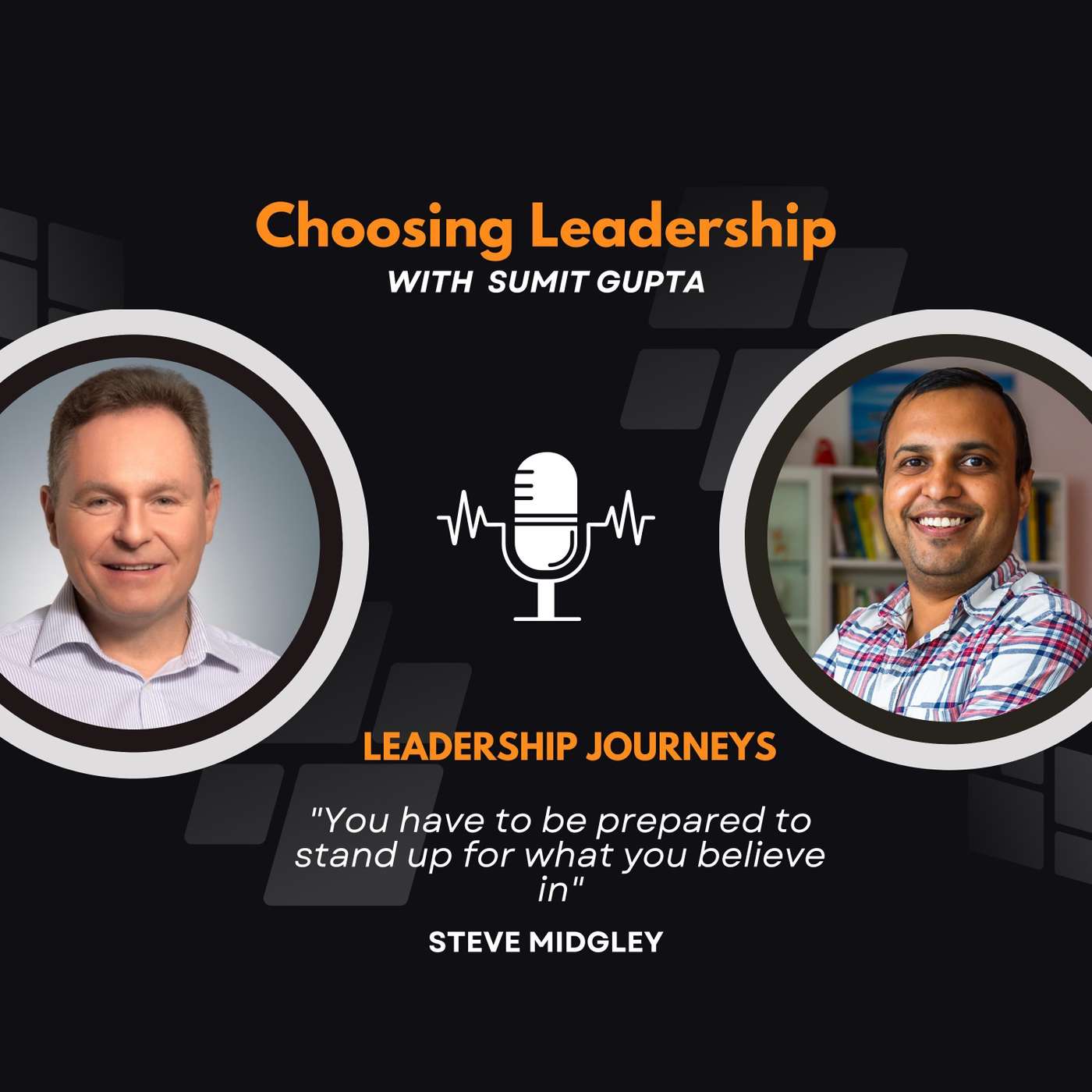
Leadership Journeys [54] - Steve Midgley - "You have to be prepared to stand up for what you believe in"
This is the Leadership Journey series on the Choosing Leadership Podcast.I believe we all have a lot to learn from each other's stories - of where we started, where we are now, and our successes and struggles on the way. With this series of interviews, my attempt is to give leaders an opportunity to share their stories and for all of us to learn from their generous sharing. If you know a leader whom you would like to see celebrated on the show, please send me a message on LinkedIn with their name.In the interview, Steve shares how travelling around the world as a child has shaped him into a curious and open person. He also spoke about the challenges of working with people of different cultures and how he learned to compromise and look for win-win solutions, and yet doing that without compromising on his foundational set of values.You can find Steve at the below linkshttps://www.linkedin.com/in/stevemidgley/In the interview, Steve sharesI was blessed to work on every, literally every continent of the world.Fortune had favoured me and I didn't have any debt in my life.I'm a straight shooter. I'm very, you know, I believe authentic and transparentYou have to be prepared. To stand up for what you believe inSometimes you have to stick to your principles and it might mean that you have to step out, and that's not pleasant, right? But that comes with the territory.You have to be extremely resolute and resourceful and make sure that you're managing your own energiesI have a personal dream, uh, to build a charity that will fundamentally change underprivileged children's lives.I think navigating, uh, the ambiguity at the moment is extremely challenging.You've gotta let your team see the human side of you, uh, as much as possible.
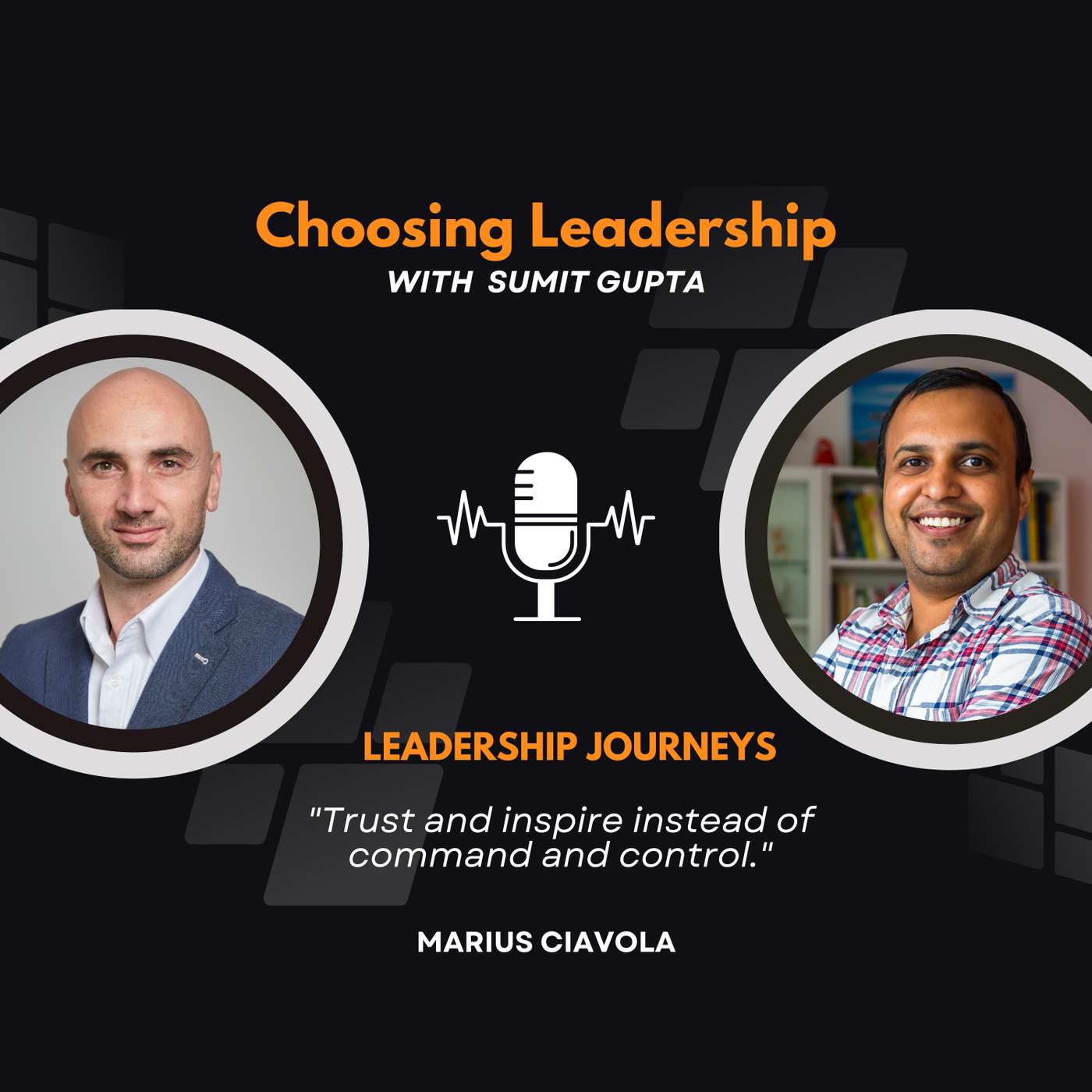
Leadership Journeys [53] - Marius Ciavola - "Trust and inspire instead of command and control."
This is the Leadership Journey series on the Choosing Leadership Podcast.I believe we all have a lot to learn from each other's stories - of where we started, where we are now, and our successes and struggles on the way. With this series of interviews, my attempt is to give leaders an opportunity to share their stories and for all of us to learn from their generous sharing. If you know a leader whom you would like to see celebrated on the show, please send me a message on LinkedIn with their name.In the interview, Marius shares about his childhood and how growing up in a family of 6 siblings set him up for learning continuously and leadership. We also spoke about the very critical role of purpose to keep everyone together in an unpredictable environment. You can find Marius at the below linkshttps://www.linkedin.com/in/mariusciavola/In the interview, Marius sharesComing from a considerably large family, you can imagine that I had to fight for what I wanted or what was oursI've learned that the best way to learn is actually to teachWhen you create that environment people will not shy away from speaking their mindyou're entering an area of unknowns and you've gotta be comfortable with the uncomfortableyou've gotta have trust in yourself and trust in the people that you are surrounded byWhat keeps us together is that common purposeThe fear comes when you have an environment that's commanding and controllingWe don't fail twice on the same thing. We don't make the same mistake twiceSome of the challenges we face are also self-inflictedYou need to say no to so many things more often than you say yes to. But those things that you say yes to, you know you wanna do them really well, and that will help you stand out I prefer to be the serving CEO than the commanding CEO.
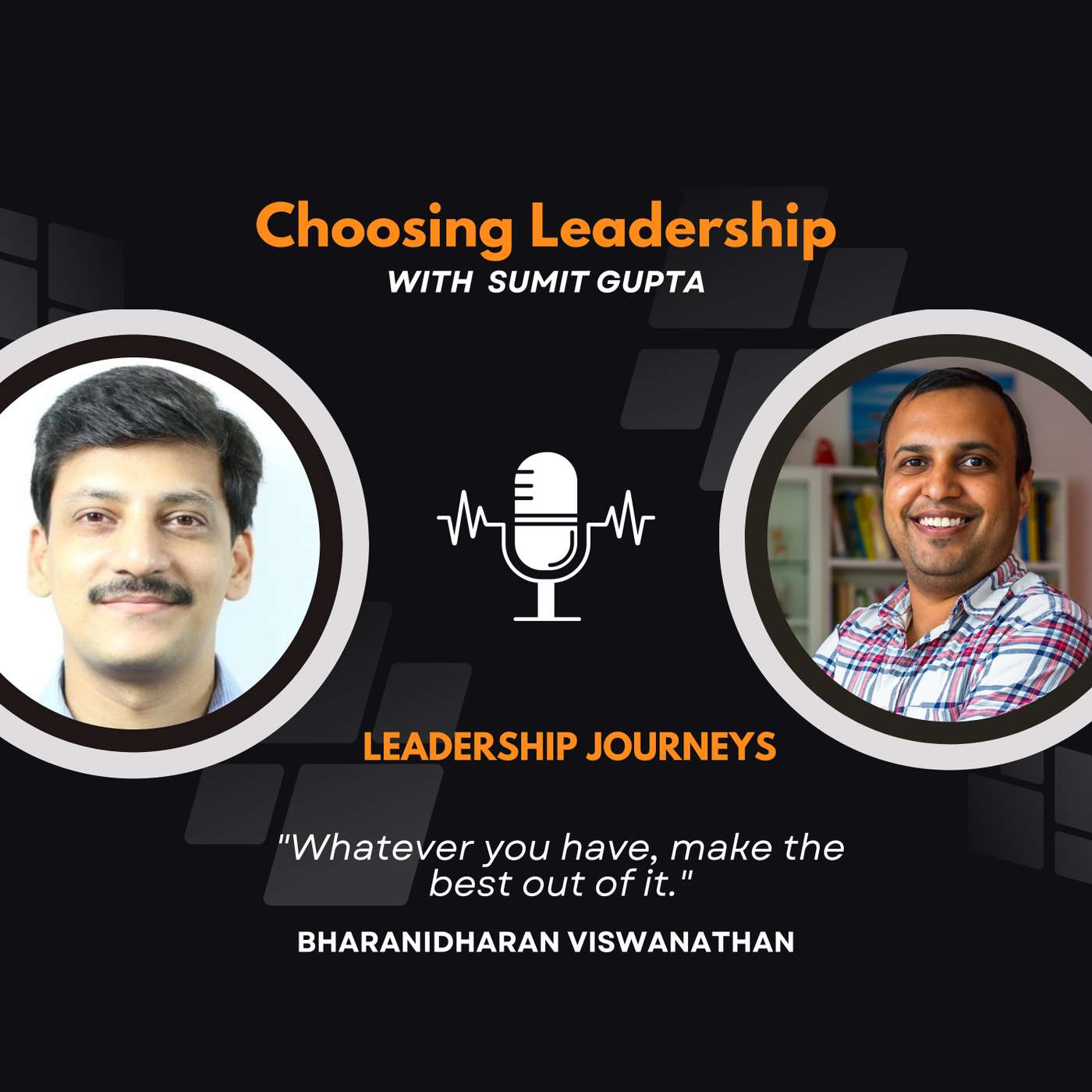
Leadership Journeys [52] - Bharanidharan - "Whatever you have, make the best out of it."
This is the Leadership Journey series on the Choosing Leadership Podcast.I believe we all have a lot to learn from each other's stories - of where we started, where we are now, and our successes and struggles on the way. With this series of interviews, my attempt is to give leaders an opportunity to share their stories and for all of us to learn from their generous sharing. If you know a leader whom you would like to see celebrated on the show, please send me a message on LinkedIn with their name.In a very candid and honest conversation, Bharani shares his life and how we wanted to shape his own destiny - even as a child. We spoke about growing up seeing your parents struggle, and how that teaches you to make the best out of what you have. He also shares how entrepreneurs must learn to change and shape their role as the company grows. You can find Bharani at the below linkshttps://www.linkedin.com/in/bharanidharanviswanathan/In the interview, Bharani sharesSomehow in my childhood days, I got this inspiration and deep motivation to shape my own destiny.my only philosophy to make the best out of what you canwhatever you have, make the best out of it. when you don't have much privilege and opportunities, you have to learn to make the best out of it and accept what you have.when you come from a lesser privileged background and when you suddenly get into a world full of opportunities and life, you will be overwhelmed. Um, and it'll not be easy to adapt.You don't have to do everything in one stretchyou have to let go of a few things so that other people can take it forward and run while you can focus back and, uh, look at the big picture and take your time. So, it is very counterintuitive. It is not easy for people to let goit's a very difficult journey to go through, you know because you will have an innate fear that, uh, nobody in the company will be able to operate at your level, right? As a human being. Most of us fall in that trap. Uh, but it's important to realize that, et cetera. Otherwise, you are on a treadmill constantly. It'll be uncomfortable, but please go through it.I have invested in myself to understand more about myself. I completely agree with this because money and title are hygiene, but people want purpose and culture and values beyond that.it's important that you have some breathing space to reflect upon what is happening, otherwise, you are constantly Reacting to the world.Don't worry about the outcome because you are given everything. The best will happen. Trust the process.
Leadership Journeys [51] - Thomas Van Eeckhout - "The CEO is not the most important person in the company"
This is the Leadership Journey series on the Choosing Leadership Podcast.I believe we all have a lot to learn from each other's stories - of where we started, where we are now, and our successes and struggles on the way. With this series of interviews, my attempt is to give leaders an opportunity to share their stories and for all of us to learn from their generous sharing. If you know a leader whom you would like to see celebrated on the show, please send me a message on LinkedIn with their name.In the interview, Thomas very humbly shares his experience as an employee and how his journey to CEO has been. He talks about his family, balance, and a very different look at leadership. I am sure everybody who listens to this will be left deeply touched and moved.You can find Thomas at the below linkshttps://www.linkedin.com/in/thomas-van-eeckhout-b0b9ab2/https://easi.net/enIn the interview, Thomas sharesI joined the company back in 2006 as an internal sales officer and made my way throughout the organization and took on the role of CEO three years ago. I noticed that the more ambitious I was, the better my results became so, so quite fast. I started to work quite hard. Um, and I still believe that if you want to achieve something, you have to put in, you have to put in the work so that there is no secret We really have a default YES Culture, whereas I think most of the companies have a default NO culture.we allow people to take ownership over their career and they can basically chase their dreams. And that's something what I had the opportunity to do as well. We need to create a context where people can be successful, a context, where people can actually be happy at work. They have to have a vision. Um, we have to. Indicate where we want to be next year in three years, in five years and in 10 or 15 yearsIt's 50% or even more 60 or maybe 70% is about communication. You need to repeat and repeat time after time again. What we want to achieve, who we want to be as a company, why we want to do what we are doing where we want to end up with that strategy becomes more and more important.We need to have, as a company, we need to have a personality. People, both potential customers and candidates, people that, that might come to work with us. They really have to feel in what way we are different from other companies.We have 115 shareholders, 115 colleagues who are working at Easy that have decided to invest in the company, to basically become a co-owner of the company, which is something we want to continue. The main challenge is to stay true to who we areI want every colleague. Who joins us needs to strengthen the culture we have. I want to be I want to have a company with the strongest culture possible. I want that or my dream is that That's the reason our customers have to work with us because they feel the difference It's about consistently putting our words into practice. We really need to practice what we preachI'm a father of two daughters. And it's my responsibility to raise them as the people that I want them to be, um, in this world. And in order to do that, I need to balance Easi with the time I spend with my family and doing the things that allow me to do those first things in the best way possible. So I need to make sure that I sleep enough, that I do enough sports, that I remain, uh, healthy and fit as well.I believe culture can be managed. It can it, it should be managed.I might be a CEO at Easy. Whenever I'm at home I forget the CEO part and I'm just doing whatever my girls want me to do. . Um, so I'm not very I don't have much authority at home. I basically just try to raise. I try to raise girls that I'm proud of.The way I see it, the CEO is not the most important person in the company. That is, uh, that, that's something that I'm very much convinced of.Whenever I experienced pressure, it was always pressure that I invented myself
Leadership Journeys [50] - Karl Feilder- "Just because I have a big title doesn't mean that I'm any better than others"
This is the Leadership Journey series on the Choosing Leadership Podcast.I believe we all have a lot to learn from each other's stories - of where we started, where we are now, and our successes and struggles on the way. With this series of interviews, my attempt is to give leaders an opportunity to share their stories and for all of us to learn from their generous sharing. If you know a leader whom you would like to see celebrated on the show, please send me a message on LinkedIn with their name.In the interview, we talk about entrepreneurship as a mindset and whether entrepreneurs are born or made. We talk about the transition from a functional or technical role to working with people, which every entrepreneur has to learn at one point. He shares the importance of appreciating people, self-awareness, and to have a healthy relationship with standing out from the crowd. You can find Karl at the below linkshttps://www.linkedin.com/in/karlwfeilder/https://www.karlwfeilder.com/In the interview, Karl sharesEntrepreneurs are born and not madeYou could probably make a natural entrepreneur a little bit better, but I'm not sure you can train them from scratch. My PhD thesis is that, um, entrepreneurism is an undiagnosed spectrum disorder. Uh, a little bit like autism or one of the other, um, psychological trades.My parents, uh, my mom and my stepfather, uh, in the end, took three jobs each in order to pay for me to get through school. Um, this led me to really, really want to succeed, but I think I had that natural drive.Rubbing shoulders with people that had got lots and lots of money when we didn't, made me aspire to have more than I would've normally aspired for.It's more about appreciating the people that are around you. And it's definitely about enjoying the. Um, the destination, growing a company and then selling it.The growing is where all the fun is and, uh, that's almost always about the people that you either work with as customers, as suppliers, or as your colleagues in the business. The thing about building a business is always about the people, and you're gonna need to employ some people that maybe have different skill sets from you and therefore different ways of communicating. But that still means you need them in the business, and you've gotta be able to identify your own weaknesses and recruit people that complement those.The thing about being an entrepreneur is you really got to believe in yourself. Um, in many ways being a CEO and being an entrepreneur are similar in that they're both very, very lonely jobs.
Leadership Journeys [49] - Gernot Schwendtner - ''Fear is natural & makes you aware of risks but is one of the worst counsellor''
This is the Leadership Journey series on the Choosing Leadership Podcast.I believe we all have a lot to learn from each other's stories - of where we started, where we are now, and our successes and struggles on the way. With this series of interviews, my attempt is to give leaders an opportunity to share their stories and for all of us to learn from their generous sharing. If you know a leader whom you would like to see celebrated on the show, please send me a message on LinkedIn with their name.In the interview, we discuss how growth and growing hurts, and why is it important to be aware of that. He also shares the importance of staying balanced and having the support of a coach, and taking small breaks, and taking the right steps at the right moment when it comes to fast growth.You can find Gernot at the below linkshttps://www.linkedin.com/in/gernotschwendtner/https://www.wegrow.company/In the interview, Gernot sharesGrowing hurts. So this is something I think it's important to accept it and be aware of it. It is important to stay balanced.We did one very useful exercise for ourself. We killed the company mentally, right? So we went through that process and said, What if, you know, like what would still be left? And we discovered a lot of network know how, personal assets, experience et, et cetera. So we could easily scale. Again, that set us mentally free and gave me a lot of freedom in saying like, Okay, now let's buckle down all hands on deck.Yoga and meditation help me in a way where I can recognize my own stress level. So I become aware of it and I can try to let it go, or sometimes I need to live through it. And sometimes I had meetings where I need to get up and say, Excuse me, I really have to take a break now. And then I take, uh, five minutes, walk around the block, do the breathing, and then I come back and I say what I did, and we laugh about it.I can be like spiralling out of into the future and I'm, or around the other street corner and. I became aware in that moment of a pattern. So this is a strength but also a weakness. So what helps me is I need to have people around me who can help me keep the connection with the team and sometimes shake me and say like, Hey, Gernot um, the team needs that, has those issues, whereas I'm mentally maybe already a year or two years ahead.Fear is natural reaction, right? There are also some good things in it, um, in a way. That might make you aware of risks that you were not aware, but fear is one of the worst, uh, counselors if you make decisions based out of fear. They will never, never never be good decisions. You run away from things or you avoid things or whatsoever. What helps me is, um, is a technique that I also learned in the last couple of years is it's called shadow light on your fears or look at the monster under your bed, right when we were afraid, uh, maybe as kids that there was a monster, your bed, and then maybe our parents put the nightstand lamp and looked with you together.
Can't Stay Silent [02] - Our Pain Unites Us
This is the Can't Stay Silent series on the Choosing Leadership Podcast.For most of my life, I have kept my voice buried beneath layers of fear and insecurity. In each episode of this series, I will find the strength to express myself from the bottom of my heart.These short episodes will be filled with honest reflections, simple stories and metaphors, and some gentle provocations - all to help you Deploy Yourself in your own life.Together, we'll discover how we can create a world where all of us can show up as leaders. So, if you are ready to allow the leader in you to bravely listen to my call of leadership, join me on Can’t Stay Silent.You can find more about me & the Deploy Yourself School of Leadershiphttp://deployyourself.com/https://www.deployyourself.com/podcast/https://deployyourself.com/newsletterhttps://www.linkedin.com/in/sumit4all/https://twitter.com/sumitgupta4allhttps://www.youtube.com/@leadership-sumithttps://www.tiktok.com/@sumitguptacoachShow Noteshow often we numb ourselves down. Not to see the pain or the joy. in the person who is right next to us or in front of us. like, how often we numb ourselves to the pain and joy. of our closest friends of our Spouses. Of our. Children or parents. of our team-mates, of the people who report to us, or our own managers and bosses. And to take it a step beyond our customers. Our investors. Any other person, who is a stakeholder in what we are doing on a day-to-day basis.We busy ourselves about work about being smart about. Competing. With each other about beating each other, coming one up. About proving ourselves, right. Or proving somebody else wrong. And that we lose touch with what connects us are our hearts. and emotions Because no matter, what you're doing, the starting place is that connection. Right. The starting place of a family, the starting place of a team of an organization. Or a community. Is that connection? It is through that connection that we build a team. Not through a goal, which we set for the team. The team is created by that. Connection among people. Who can laugh and cry together. And then they can go after whatever goal they want to go. But it is our hearts and our emotions, which connect us as human beings as leaders. And we talk, we plan, we discuss, we analyze, we do all of that. We talk about diversity. We talk about inclusion, emotions, emotional. Uh, intelligence trust relationships. Mental health these days. And yet we forget that trust relationship, inclusion. Empathy. Are all matters of the heart. You cannot plan. Strategize. And analyze and create a trusting relationship. You can not build inclusion and empathy just by planning, strategizing. It is about being human. It is not about being smart. It is not about being intelligent. It is also not about being right. It is about being human. And realizing that we are already connected through our joys, our pains, our deepest desires, what we care about about most deeply. Any result, If that takes you away from being connected as individuals. Then It is going to Impact the result that you are trying to produce. I, because it is so paradoxical that we get lost in the achieving, in the doing of the work that we ignore the foundation of that work. In the first place, which is that connection that we all have, which creates teams relationships. And then even organizations. Whenever we feel whenever you feel, the pain and suffering, or even joy or celebration of somebody else. either sitting next to you or. sitting on another continent, It is a call and a reminder to your humanity. And by extension to your leadership. It is important to move forward. That is what leadership is producing results. But. Not while forgetting that. The foundation of that, of any team, any business, any relationship, any result? Is that connection that we all have; is that emotion, that empathy that we have. And in moments like these, when we are talking about a tragedyAnd this is a wonderful In this case also painful reminder. That we are all connected. Our pain and suffering. And at the same time our joys and celebrations, unites us. That is what makes us human. That is what makes a team, a relationship and organization. And by extension all results. which you have committed to producing as a leader.
Can't Stay Silent [01] - Fall or Flight?
This is the Can't Stay Silent series on the Choosing Leadership Podcast.For most of my life, I have kept my voice buried beneath layers of fear and insecurity. In each episode of this series, I will find the strength to express myself from the bottom of my heart.These short episodes will be filled with honest reflections, simple stories and metaphors, and some gentle provocations - all to help you Deploy Yourself in your own life.Together, we'll discover how we can create a world where all of us can show up as leaders. So, if you are ready to allow the leader in you to bravely listen to my call of leadership, join me on Can’t Stay Silent.You can find more about me & the Deploy Yourself School of Leadershiphttp://deployyourself.com/https://www.deployyourself.com/podcast/https://deployyourself.com/newsletterhttps://www.linkedin.com/in/sumit4all/https://twitter.com/sumitgupta4allhttps://www.youtube.com/@leadership-sumithttps://www.tiktok.com/@sumitguptacoachShow NotesWe have the same two choices we can. Uh, we can look down and we can be afraid of falling. Or we can look up. To where we want to go. And. Take a flight.Looking at the sky, but not taking the flight. Serves no one. It doesn't serve me. Doesn't serve those around me. Doesn't serve the companies that I'm working with.There's nothing wrong with it. There's nothing wrong about it. Uh, feeling fear. There is nothing wrong with wanting security. Uh, but at the same time, it doesn't help you get where you say that you want to go.obviously, in the physical world, we do not have wings like birds. Do. But I am talking from the context of leadership and in the leadership world. We do have wings. And perhaps we have never opened them. Perhaps we have never believed that we can fly. Another way to ask this question. If you had wings, where would you fly to? Or if I stop using metaphorical language and use more direct language I can ask you - If you could not fail. What would you do? Or if you had complete freedom, what would you do?it's not like the bird who flies doesn't have fear. And it is not like, like the entrepreneur leader who goes after the impossible, and doesn't have fear. But I don't think I have been. More fearful. Uh, I have experienced fear more this year than any other year. But at the same time, I have not stopped myself because of the fear. And that's the difference between fear and courage or the fall or flight like the flight is acknowledging that. You can fall and still. Flying still opening up your wings and flying. And it's a choice. It's a choice, what do you trust more? Do you trust gravity more or do you trust your commitment, your skill. That even if gravity wins it's okay. Like, even if you fall down, you will get back up.
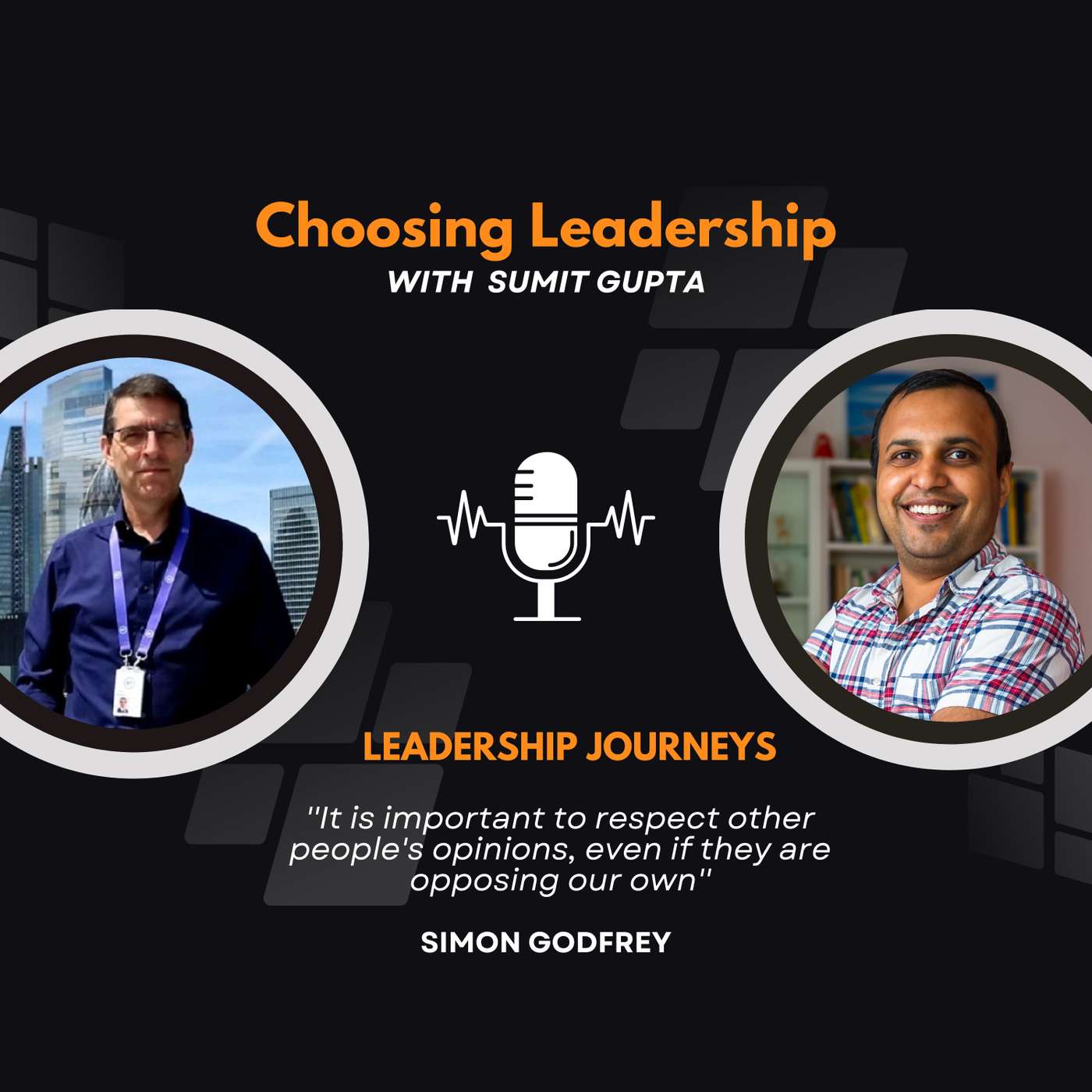
Leadership Journeys [48] - Simon Godfrey - ''It is important to respect other people's opinions, even if they are opposing our own''
This is the Leadership Journey series on the Choosing Leadership Podcast.I believe we all have a lot to learn from each other's stories - of where we started, where we are now, and our successes and struggles on the way. With this series of interviews, my attempt is to give leaders an opportunity to share their stories and for all of us to learn from their generous sharing. If you know a leader whom you would like to see celebrated on the show, please send me a message on LinkedIn with their name.In the interview, Simon spoke about the importance of respecting other people’s opinions, even if they are opposing ours. We spoke about continuously learning, the art form of working with people and building relationships, and how people are always wanting to do good, look good or feel good.You can find Simon at the below linkshttps://www.linkedin.com/in/simon-godfrey/In the interview, Simon sharesI'm a serial learner. I love to learn things and read.My thirst for knowledge Is really what drives me.No two people are the same. People might dress similarly and look similar, but actually their motivations, their backgrounds, shape who they are really.People generally have three sorts of main motivators. They either want to do good, look good, or feel good about what they're doing. I take every interaction very seriously. One should always do one's homework and make sure that one understand the people you are dealing with, whether that's governmental, whether that's political, whether that's industrial or otherwise.You've gotta be likeable. I mean, you've got to, you know, genuinely show interest. You've gotta be inquisitive in your nature and you've gotta ask lots of questions that aren't deeply personal necessarily, but are informative.The evidence really matters and being authentic and then saying to people, Here's my evidence trail or my vapour trail of evidence and things I've done. So judge me on that. Don't just judge me on what we're doing here right now.I write a lot of poetry. Um, and I find it very therapeutic. I dunno, I must, I'm 200 poems some of them are brilliant in my own mind. Some of the just are slightly average, but nevertheless, they're all heartfelt and they were all written with a purpose in mind.I enjoy language immensely. Um, and I enjoy playing with the words. That makes me happy.
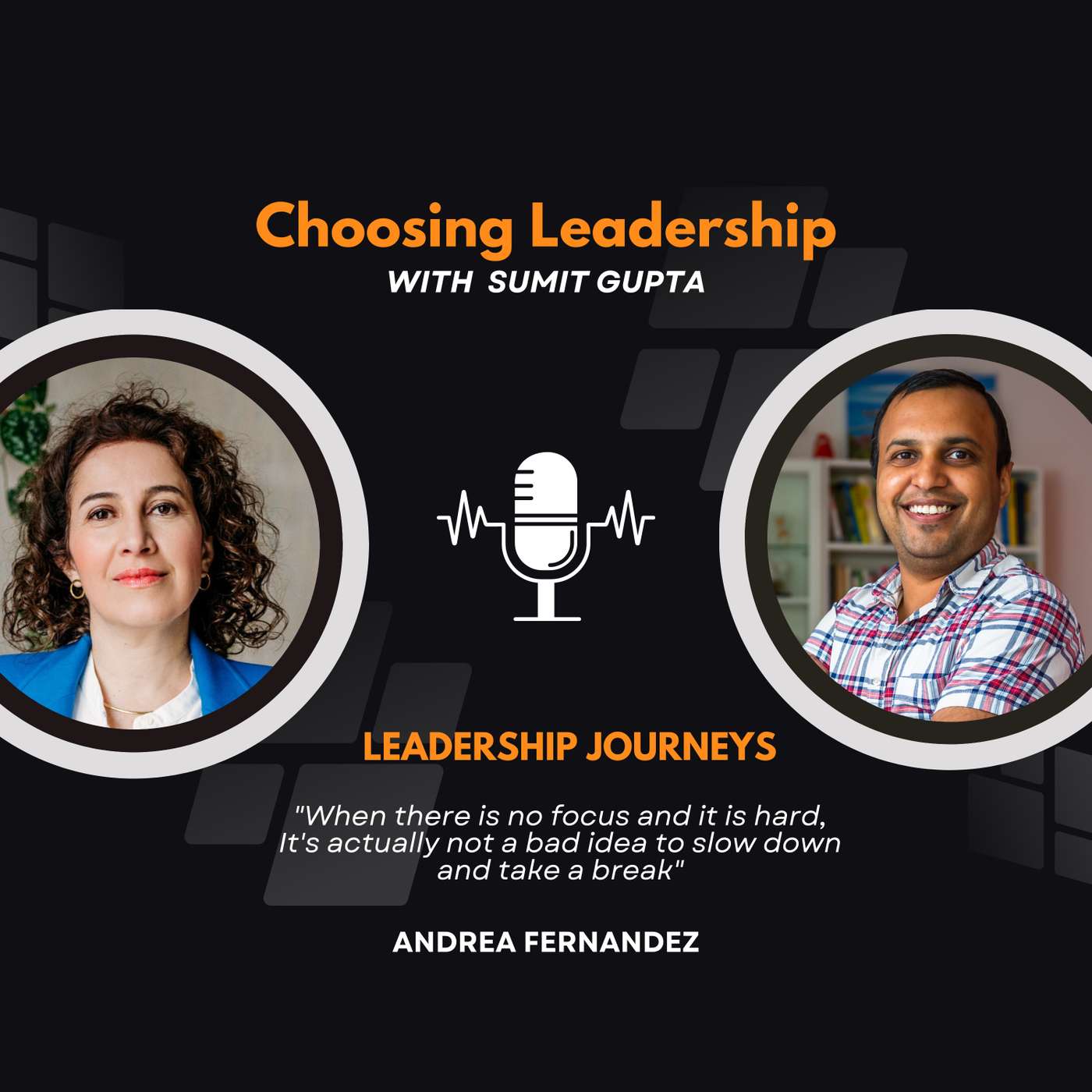
Leadership Journeys [47] - Andrea Fernandez - "When there is no focus and it is hard, It's actually not a bad idea to slow down and take a break"
This is the Leadership Journey series on the Choosing Leadership Podcast.I believe we all have a lot to learn from each other's stories - of where we started, where we are now, and our successes and struggles on the way. With this series of interviews, my attempt is to give leaders an opportunity to share their stories and for all of us to learn from their generous sharing. If you know a leader whom you would like to see celebrated on the show, please send me a message on LinkedIn with their name.In the interview, Andrea spoke about constantly moving across continents and how that has shaped her attitude to flexibility and adaptability. She spoke about a key moment while leading a team at Fresh Direct in which she showed up a leader in an emergency situation. We also discuss confidence, finance, creativity, and storytelling from a leadership perspective.You can find Andrea at the below linkshttps://www.linkedin.com/in/andrea-fernandez-coto/https://joinvitamin.com/enIn the interview, Andrea sharesI always had like a very big interest In the world in general.I think there are many different things you pick up, uh, when you live in different countries. I think you become very flexible. Um, because, and adaptable, because you have to do it every so often. Um, I think you also, um, learn appreciation actually because you learn to appreciate like the different things in different places.because you are faced with making new friendships from start, so, You actually kind of get skills in how to understand people, in how to deal with different kinds of people, obviously languages and the ability, to communicate with people at different levels.at the end of the day, leadership is about dealing with people I'm not doing it because I think it's a fancy thing to do. or a, let's say timely thing only. It's like a trendy thing to do, rather, That's the right word to use. It is a real problem in society. there will always be doubters like, there will always be doubters on anything you do, so you might as well just find the ones that believe in it and go for those and, partner with those people.I'm a strong believer that there are new ways of managing and leading than I think the ones that I have seen used many times in my career.I'd like to refer you to a professor that I had at Harvard. Her name is Frances Frei, she uses this methodology. It's a triangle that she says that it is really critical factors in leadership if I remember them correctly. It's one authenticity two empathy and three logic and basic ability to do what you to do, to execute, to think, to put your mind, uh, and develop interesting solutions.I have seen many times when people leave companies and are very destroyed because of management styles, and leadership styles, and I think that's a pretty bad outcome for an organization. if we would measure things a little bit differently, um, then we would lead differently if you have a person come to work and being fearful, uh, scared about the reaction of the manager or the boss, uh, insecure about what he or she's bringing to the table, you may not get to listen to really great ideas that can change the outcome of a project, you may not get to experience a great team, an environment that can actually create different outcomes. So I think there's much more to be done on that side still in the world of business I think children are a great source of creativity and like really, like it almost feels, um, weird, but when you spend time with kids, I think you really. Kind of disconnect from the day-to-day and therefore kind of a new window opens up in your head.
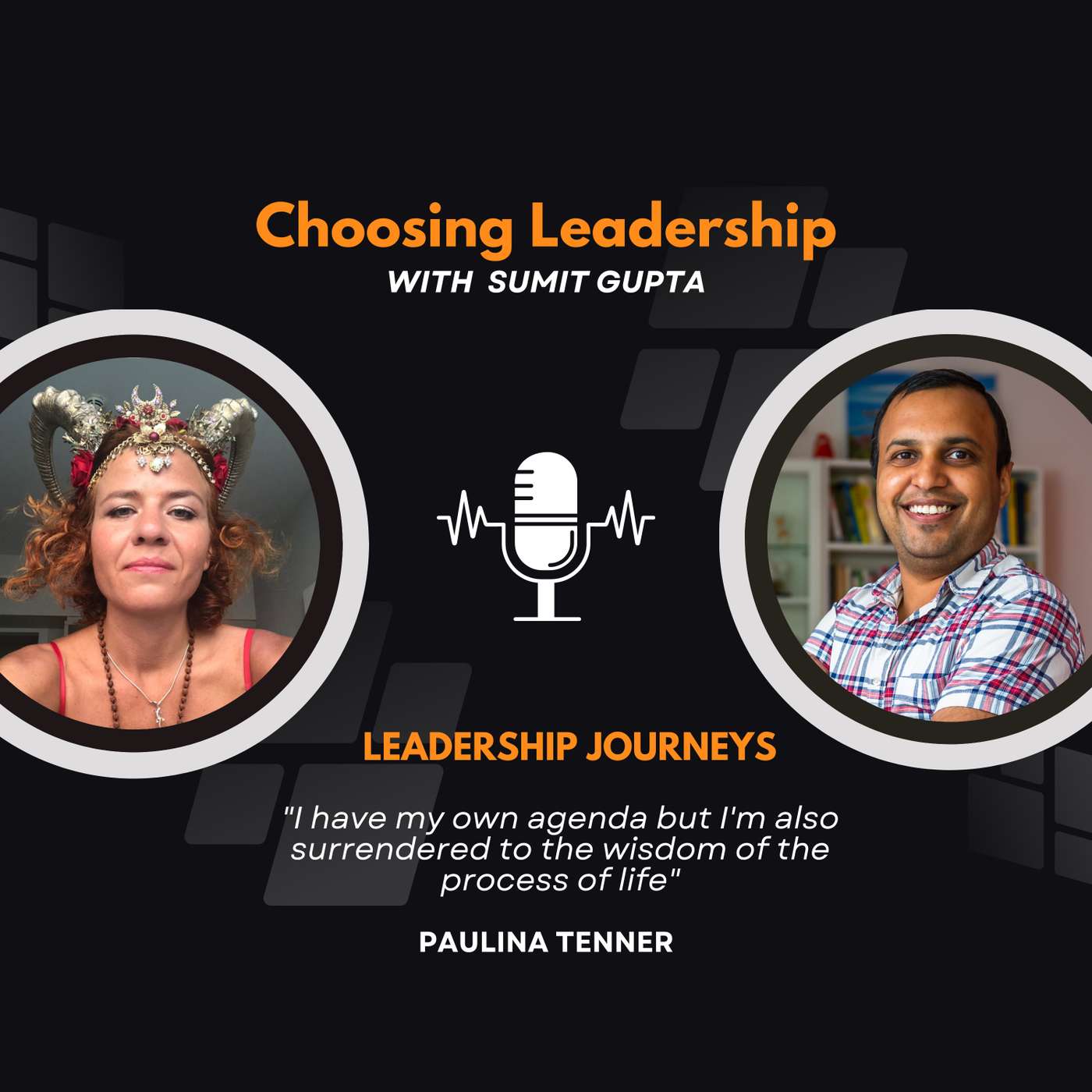
Leadership Journeys [46] - Paulina Tenner - "I have my own agenda but I'm also surrendered to the wisdom of the process of life"
This is the Leadership Journey series on the Choosing Leadership Podcast.I believe we all have a lot to learn from each other's stories - of where we started, where we are now, and our successes and struggles on the way. With this series of interviews, my attempt is to give leaders an opportunity to share their stories and for all of us to learn from their generous sharing. If you know a leader whom you would like to see celebrated on the show, please send me a message on LinkedIn with their name.In the interview, Paulina opens up about her mental health challenges and how life has prepared her for what she does rather than any formal education. We spoke about her unusual background, and how she continues to draw lessons and inspiration from that - for herself and others. We spoke about the role meditation plays in her life, and the value of nourishing important relationships.You can find Paulina at the below linkshttps://www.linkedin.com/in/paulinatenner/https://paulinatenner.com/In the interview, Paulina sharesthe biggest challenges for me will always be related to things I care the most about, and that would be my relationships with people that love me and support me.when we talk about choosing leadership, I would kind of bring it to choosing inner or self-leadership first. How you want to show up? Is what you're doing aligned with your values? And if it is, it almost doesn't matter whether your message is heard. Two people or 200,000 because that authenticity means everything.I totally believe that if you choose to show your authenticity and in your self-readership over and over again, sooner or later the world will pay attention.I would say come back to what feels really good in your body. So when you are doing it, it feels meaningful. And after you've done it, you get this internal feeling of satisfaction and prioritize these things like taking courage enough to prioritize yourself, your desires, and your passions. Just be prepared for the fact that some people love you, some people will be neutral and some people will hate you. And that is the journey of any person that chooses to be real In the world.
Leadership Journeys [45] - Faisal Hoque - "Life is somewhere in between letting it happen and making it happen."
This is the Leadership Journey series on the Choosing Leadership Podcast.I believe we all have a lot to learn from each other's stories - of where we started, where we are now, and our successes and struggles on the way. With this series of interviews, my attempt is to give leaders an opportunity to share their stories and for all of us to learn from their generous sharing. If you know a leader whom you would like to see celebrated on the show, please send me a message on LinkedIn with their name.In the interview, Faisal shares how he himself financed coming to America at the age of 17 from Bangladesh, and the wisdom he learned from his supervisor when he was working as a janitor. He shared the health challenges of his mother and son, and how he derives meaning from what he does. He shared about travelling to Japan and being influenced by Zen meditation - and the role and relevance of meditation for today’s leaders.You can find Faisal at the below linkshttps://www.linkedin.com/in/faisalhoque/https://faisalhoque.com/In the interview, Faisal sharesThe definition of entrepreneurship is at the end of the day. It's taking care of Your, financial well-being with your own venture.Life is a journey and you have ups and down, you have failures after failures, and then you have few successes, and then you have failures. So it's never like a straight line.I've always been a dreamer, but I'm pragmatic and now I prepare for the worst-case scenario with a pragmatic mindset.You connect with what's your true calling and try to make an impact. So it's evolution, and it's a journey and I, despite the ups and downs, I totally enjoy it. Experience is the best teacher.If you want to lift others first you have to lift yourself. Because of technology, today's also an opportunity to make an impact, to be able to connect with people wherever and able to really take advantage of whatever gift that you may have.You can't follow somebody else's path. It's your own unique journey. Inspiration can come from anywhere and everywhere.Life is somewhere in between letting it happen and making it happen. There's a fine balance.A lot of people think mindfulness is about - you meditate and completely emptying your mind and you get lost and as a result you connect with yourself. That is a method, that's a formal method of practising meditation, and then as a result you achieve mindfulness. But, since you mentioned Zen Buddhism, the monks two activities they treasure and practice repeatedly is sweeping and cleaning and cooking. The definition of mindfulness is really just focusing on the present moment.Let's not get confused that you can make things happen without systemic execution. This combination of mindfulness and being empathetic to other people's needs and where they are, combining those two things, that's the hallmark of new leadership.We have absolutely entered into a creative innovative phase of evolution where mundane work is being taken over by automation and the real value comes from creativity and innovation.The best leaders are very mindful and they're also very empathetic.
Leadership Journeys [44] - Colleen Nagle - "Holding yourself accountable is half the battle in success"
This is the Leadership Journey series on the Choosing Leadership Podcast.I believe we all have a lot to learn from each other's stories - of where we started, where we are now, and our successes and struggles on the way. With this series of interviews, my attempt is to give leaders an opportunity to share their stories and for all of us to learn from their generous sharing. If you know a leader whom you would like to see celebrated on the show, please send me a message on LinkedIn with their name.In the interview, Colleen opens up and shares about her early fascination with tech and data, and how she has continued to be an innovator. She also spoke about her health challenges and what has that taught her as a leader. We speak about the importance of having hope, facing our own fears, and the importance of holding ourselves accountable.You can find Colleen at the below linkshttps://www.linkedin.com/in/colleennagle/In the interview, Colleen sharesWhether it's the smallest thing in the world or the biggest objective, I think, Learning to have hope and being in that mindset of, I can do this, I see that this can be overcome is a really big part of it.I'm so grateful, certainly not for going through difficulties with health, but I'm certainly super grateful for that silver lining of what it taught me.Holding yourself accountable is so much half the battle. , Because if you continually hold yourself accountable and end up experiencing success, you're gonna associate success with holding yourself accountable.Having my ups and downs of coping and yet, still being able to go out there. And focus on achieving the overall goal. It was coming not necessarily from this place of confidence, but I was doing confidence-building things along the way that I think, with that momentum eventually added up to something.If you keep your agreement, that's one thing. But if everybody keeps their agreements now, that's the story. I think leadership isn't something with a small l it's something with a capital L and we each need to figure out what that capital L looks like for each of us. Stepping forward because leadership is not, also not something that comes with the title.
Leadership Journeys [43] - Radmila Blazheska - "Leadership is the combination of determination and openness to listen to others."
This is the Leadership Journey series on the Choosing Leadership Podcast.I believe we all have a lot to learn from each other's stories - of where we started, where we are now, and our successes and struggles on the way. With this series of interviews, my attempt is to give leaders an opportunity to share their stories and for all of us to learn from their generous sharing. If you know a leader whom you would like to see celebrated on the show, please send me a message on LinkedIn with their name.In our conversation, we spoke about how moving from Macedonia to the UK has shaped her as a leader. We talked about resilience, persistence, and the difficult choice she had to make once she moved to the UK. We speak about how people are often surprised by her determination, and how she has learned to show vulnerability as well as be open to criticism.You can find Radmila at the below linkshttps://www.linkedin.com/in/radmilablazeska/In the interview, Radmila sharesEven if you are a successful person at what you did, There's always something that you can train and do a little bit better.If you have a passion, if you have ambition, don't give up on it. It doesn't matter when it's gonna pan out, it will pan out in the end.I also show that I'm vulnerable as well. I do mistakes and I honor them, and I also am open to criticism whether it's negative, positive criticism. I'm open to it.I am looking at everyone's on a level that we are all people, whether we are leaders, whether we are all working together for someone's objective.If there is a friction. You need to work on that section. Never let it go. Never let it just under the carpet because at some point in your life or your working career will come back and bite you.I guess the combination of my determination and openness to listen to other people in their opinion, I think that's the combination that makes me a good leader.And I think one of the key things is that also, even if you are in a boardroom and you're talking to your board and you know that you want to say something, but you are fearing to say that, say it's better to be said and done rather than keep it to yourself.
Leadership Journeys [42] - David Jayatillake - "As a Leader, If you're not involved with your team, you will be isolated."
This is the Leadership Journey series on the Choosing Leadership Podcast.I believe we all have a lot to learn from each other's stories - of where we started, where we are now, and our successes and struggles on the way. With this series of interviews, my attempt is to give leaders an opportunity to share their stories and for all of us to learn from their generous sharing. If you know a leader whom you would like to see celebrated on the show, please send me a message on LinkedIn with their name.In the interview, David shares how he grew up with a love for Math and Physics, and how that changed once he started managing people. We spoke about mentoring and coaching, and the important role of emotions and empathy in building strong relationships. He shared an example of how playing football led to a breakthrough in conversation which was not happening otherwise, and that led to an interesting conversation.You can find David at the below linkshttps://www.linkedin.com/in/david-jayatillake-9962748a/In the interview, David sharesA lot of people who go into leadership for the first time still think they need to be firing on all cylinders as an individual contributor as well. And really, once you've got a team of three or four, that's actually the minority of your time, the majority of your time is looking after your team.And then, suddenly I'm looking after a team of three or four, and I've learned to that I'm supposed to be delegating a fair amount. I think that was helpful for me.You need to be doing organizational impact work. And if that's not there, you begin to feel a bit lost.if you're not involved, you just get isolated. There's, it's very difficult.
Leadership Journeys [41] - Jami Kiran - "Having clarity as a leader helps us understand who we are while making choices."
This is the Leadership Journey series on the Choosing Leadership Podcast.I believe we all have a lot to learn from each other's stories - of where we started, where we are now, and our successes and struggles on the way. With this series of interviews, my attempt is to give leaders an opportunity to share their stories and for all of us to learn from their generous sharing. If you know a leader whom you would like to see celebrated on the show, please send me a message on LinkedIn with their name.In the interview, Jami shares about the people who have impacted his journey, the importance of clarity and self-leadership, and how that allows you to move forward with purpose and courage. We spoke about his dreams and ambitions, how he deals with change, and the power of choosing to do something instead of it being an obligation.You can find Jami at the below linkshttps://www.linkedin.com/in/jami-kiran-7a0b1324/In the interview, Jami sharesWe have to have very good clarity. Clarity is very important and having core clarity helps us to understand who we are while we are, making choices.Leadership is part of life, it is not only related to the business layer but also to the personal layer and on the social and civic and every aspect of it.Leadership is not only from driving value, it's also about the identity and also how you advocate your ideas and how you boldly take the decisions and how you stand for yourself and for others, and how you develop and hope you double up and drive the influence, not only with your connection, with your community, but also how you support to build trust, which will act as an enabler.Multi-lateral communication is vital.Leadership need two things. One is mind and heart, but now it is heart and mind together.
Leadership Journeys [40] - Kevin O'Loughlin - "Possessions and things don't amend happiness, but people around us do"
This is the Leadership Journey series on the Choosing Leadership Podcast.I believe we all have a lot to learn from each other's stories - of where we started, where we are now, and our successes and struggles on the way. With this series of interviews, my attempt is to give leaders an opportunity to share their stories and for all of us to learn from their generous sharing. If you know a leader whom you would like to see celebrated on the show, please send me a message on LinkedIn with their name.Kevin spoke about the lessons he learnt from that experience, the value of transparency and honesty, and putting people first. He shares his vision for Nostra for the next 10-15 years, while at the same time expressing gratitude to his family and everybody he works with.You can find Kevin at the below linkshttps://www.linkedin.com/in/kevino11http://www.nostra.ie/In the interview, Kevin sharesOur key strategy has been getting a customer, look after everything to do with it, including the supply of people, if they're required and then keeping the customer for as long as you possibly can.We very rarely lose a customer.I've learned that my wife and kids are far more important than any of those things.People's happiness comes from the people that are around them. And one of the things, that I'm blessed with is having a great family, a very supportive wife, and amazing kids who are all flying. Every business is about people and you have to get yourself in a place that you're in a good place personally. And then you can grow a business The number of times that the directors and the company had to have their salaries delayed for the following couple of years, it was very difficult, but the learning, it was, we learned. How to survive. We learned how to negotiate. We didn't lose any people during that period. And, we even had some of the internal staff saying, listen, I've got a credit card. If we need to use it to buy things, I had unbelievable support from everybody.One of the reasons our accounts were so bad was I wanted to look after the people. So at no point was I gonna let good people go that I cared about, we would carry everyone.There are lots in companies that is left unsaid and left undone. And for me, it's, if you're not enjoying leadership, there's something wrong. Go find it, figure it out, have the conversation and deal with things as they come up.We said we would get through which we did. And then we'd move on. And that's something I'm very proud of.No matter what challenge or headwind comes out at an organization, there is always a way out.
Leadership Journeys [39] - Nermeen Ghoniem - "I cannot dictate how people feel about me, but I can dictate how I react to it."
This is the Leadership Journey series on the Choosing Leadership Podcast.I believe we all have a lot to learn from each other's stories - of where we started, where we are now, and our successes and struggles on the way. With this series of interviews, my attempt is to give leaders an opportunity to share their stories and for all of us to learn from their generous sharing. If you know a leader whom you would like to see celebrated on the show, please send me a message on LinkedIn with their name.In the interview, she talks about being a women in a male-dominated tech world, and how her mother inspired her to be her own self. We discussed how knowing who you are and trusting yourself first is the key to move forward in a world where you do not feel like you fit in or understand what you are permitted to do. She gave a powerful message of not giving anybody else the permission to make you upset, stressed, or impact your mental health. I loved interviewing her, and I am sure you - the listener - will take a lot away too from this interview.You can find Nermeen at the below linkshttps://www.linkedin.com/in/nermenghoniem/https://helloada.ai/In the interview, Nermeen sharesI've continued to live my life from a very young age being a hybrid between I like to be involved in storytelling and impacting people's life.At the same time, I'm also very much a scientist at heart and to sit down and really nerd out the technologies. So I think I have always been balancing these two The technology world is very male dominated and I'm also currently based now in Silicon valley and it's also very male dominated.I realized that there is a really big gap in how we communicate these fields to women.I want more women in technology and especially more women in AI engineeringMore women are working and more women are taking into leadership positions. And a lot of men are welcoming to it and some are less welcoming to it. But that's part of the journey.Unapologetically, be yourself because I think confidence comes up from within. And you can strongly believe that you are being your best self and at the same time also allow room for constructive criticism.I cannot dictate what other people will say to me. I cannot dictate how people feel about me, but I can dictate how I react to it.I don't think it's worth getting personalYou can control how things affect you. You can control what you want to hear, and if it doesn't serve your purpose, if it doesn't serve your growth, it's not worth putting your energy in. We become too sensitive as the generation sometimes. And if we consider everything to be a negative message, then we will not grow.And if you trust a little bit more, I think you were able to do whatever you put your heart to. You are also much more powerful than you think you are. I think a lot of women sometimes put themselves down and don't think they're good enough for the job or good enough to get into the engineering field or good enough to start their dream.I can do whatever I want.I think people don't realize that I am a work in progress to get to this place. And there are moments where I feel insecure and where I'm like, I don't know what I'm doing, where I'm going and it's okay.
Leadership Journeys [38] - Ennio R. Neumann Senese - "I recommend people who work with me to do a couple of days retreat in complete silence"
This is the Leadership Journey series on the Choosing Leadership Podcast.I believe we all have a lot to learn from each other's stories - of where we started, where we are now, and our successes and struggles on the way. With this series of interviews, my attempt is to give leaders an opportunity to share their stories and for all of us to learn from their generous sharing. If you know a leader whom you would like to see celebrated on the show, please send me a message on LinkedIn with their name.In our conversation, we talk about nature vs nurture, how we are shaped as individuals, and how growing up in an entrepreneurial family shaped him. He shared a couple of serendipitous moments which have turned out to be instrumental in his journey. We touched upon the important role of meditation in helping him stay balanced as a leader, and how his leadership style has evolved over the years.You can find Ennio at the below linkshttps://www.linkedin.com/in/enniosenese/https://twitter.com/enniosnIn the interview, Ennio sharesI believe that people have to be self-supportive. But if we can't be, if they can't be self-supportive, then we as a state or as a society needs need to help those people in moving along.There are so many books about leadership. If you have read them all, the risk is that by the end, you still don't know what leadership is.Some bits of an ego you need to have in order to move on because otherwise, it becomes a very passive life, So I'm very grateful for the fact that I've been able to fail. On a couple of occasions, which gave me the opportunity to learn and to see that there are better ways to move on.I think it's about balance first thing. So that's a key word balance.In the end, you need to ask yourself, what am I doing? Is that what I'm contributing to? Is that really something that is contributing to, the better of mankind, to improve the world to have some, another type of gold than just purely commercial?Those types of existential questions. I think if people would dedicate more time without having their relatives or loved and dying around them but dedicate more time to think about those types of existential questions. I think, first of all, we would live in a better world for sure.I always recommend also to people who work with me to do a bit of a retreat for a couple of days in complete silence and just think about, the purpose of life, things that you are grateful for, things that you have experienced, lessons learned, over a period of time.I meditate but sometimes events happen. Also, unexpected events, which basically prevent you from, from staying calm because it's easy to stay calm in a very calm environment where there is no pressure, et cetera, et cetera.In the end, it's always about reflection and the ability to see how unimportant you really are. at the end.
Leadership Journeys [37] - Natalie Kaminski- ''You can accomplish a lot more by being an empathetic leader rather than being a demanding manager."
This is the Leadership Journey series on the Choosing Leadership Podcast.I believe we all have a lot to learn from each other's stories - of where we started, where we are now, and our successes and struggles on the way. With this series of interviews, my attempt is to give leaders an opportunity to share their stories and for all of us to learn from their generous sharing. If you know a leader whom you would like to see celebrated on the show, please send me a message on LinkedIn with their name.In the interview, we speak about how starting JetRockets was not planned but accidental, and why she is running a TEAL self-managed organisation. We spoke about her views on leaders, some of the recent mistakes she had made, and her commitment to her employees was evident from how they moved their employees out of Russia because “it was the right thing to do”.You can find Natalie at the below linkshttps://www.linkedin.com/in/nataliekaminski/https://jetrockets.com/In the interview, Natalie sharesI had to take a step back and learn to delegate. And to learn to focus on working on the business, not in the business.You can accomplish a lot more by being an empathetic leader as opposed to being a demanding managerif a mistake is made, it's okay. It's a learning, it's a learning opportunity and I actually encourage my people, my employees, to go outside of their box, their thinking box, to try new things because that's what contributes to creativity and improvement over time.You have to treat your employees as children in a right and you allow your children to make mistakes, and that's how to learn to walk.I've learned a lesson never to try and address the issue immediately. So if something were to happen, you gotta take a break of a few minutes, 15 minutes, 30 minutes, or even an hour is not going to change anything dramatically in terms of your response, but it will definitely, in terms of your response time, but it'll definitely have a drastic effect and quality of your response.I want to understand what happened instead of coming to that employee and being, How could you have done this? The question is, what do you think went wrong? What could you have done differently?If they take ownership, There are two things that happen. First of all, they see that you're trying to help them grow. Second of all, they remember that lesson and it, they retain it in their mind. So the likelihood of the same issue occurring again decreases dramatically.Ultimately your goal as a leader is to build that relationship with your team so that they come to you. It has nothing to do with fear of punishment or repercussion or anything like that.We're business. We're not an army.So it's my job to serve them, to empower them to then service our clients, which in turn helps me accomplish my goal of building a, larger and more successful organization.
Leadership Journeys [36] - Tauseef Ahmad - "Capital deprived? Yes, we are. Are we worried? No, we are not"
This is the Leadership Journey series on the Choosing Leadership Podcast.I believe we all have a lot to learn from each other's stories - of where we started, where we are now, and our successes and struggles on the way. With this series of interviews, my attempt is to give leaders an opportunity to share their stories and for all of us to learn from their generous sharing. If you know a leader whom you would like to see celebrated on the show, please send me a message on LinkedIn with their name.In the interview, Tauseef opens up about the very personal loss of his mother and cousin and how that inspired him to start a company to make healthcare easier to access for people from their homes. The conviction in his voice, despite all his challenges, was very strong and decisive, and that is a lesson in the embodiment of a purpose for anybody listening.You can find Tauseef at the below linkshttps://www.linkedin.com/in/tauseefahmad1/https://sprintmedical.in/In the interview, Tauseef sharesWe have a great mission. And that mission Is the only fuel that we have right now. I am changing The culture and the standard of healthcare in, especially in my community. And I think I will continue to do that. No matter Capital deprived? Yes, we are. Are we worried? No, we are notMy biggest fear is if you raise venture capital dollars, okay. And five years down the line, I will. I'm sure that we will be very valuable. Okay. And there would be times when people want to acquire us. People wanted to change the direction that we are presently in right now.
Leadership Journeys [35] - Shahram Maralani- "As a leader you need to be a good simulator of the situations your people are in."
This is the Leadership Journey series on the Choosing Leadership Podcast.I believe we all have a lot to learn from each other's stories - of where we started, where we are now, and our successes and struggles on the way. With this series of interviews, my attempt is to give leaders an opportunity to share their stories and for all of us to learn from their generous sharing. If you know a leader whom you would like to see celebrated on the show, please send me a message on LinkedIn with their name.In the interview, he spoke about growing up in Iran and the importance of a multicultural approach to leadership today. We talked about the role of chance and serendipity in our journeys, the new skills required when any individual contributor grows to be a manager, and the importance of balance in life.You can find Shahram at the below linkshttps://www.linkedin.com/in/shahrammaralani/https://www.amazon.com/Shahram-G.-Maralani/e/B08FCN8GFNIn the interview, Shahram sharesThe balance between taking the opportunities as they unfold, But also planning your career properly is quite important in shaping a successful career. You will never be a hundred per cent correct. Maybe you are only 50, 60% correct. But being able to assume how people perceive how people are seeing their own situation and what are their opportunities and challenges is quite important as an authentic leader. Culture is like the operating system of our brainOn the other hand, the operating system, which is loaded in our body, which is our culture and the way we grow up and what we experience in life shapes most of who we become as a person, as a professional, but also as a leader.But I think in, as a leader, if you want to be successful, maybe the exact opposite is the honest advice because you need to a bit dismantle yourself from the culture you belong to and analyze the situation with the different views you have. And as a leader, you need to understand that and be flexible and allow people to basically express themselves properly.
Leadership Journeys [34] - Vinod Kumar- "An entrepreneur needs to be comfortable with ambiguity and things going wrong"
This is the Leadership Journey series on the Choosing Leadership Podcast.I believe we all have a lot to learn from each other's stories - of where we started, where we are now, and our successes and struggles on the way. With this series of interviews, my attempt is to give leaders an opportunity to share their stories and for all of us to learn from their generous sharing. If you know a leader whom you would like to see celebrated on the show, please send me a message on LinkedIn with their name.Vinod shares in the interview how he and his wife started a coffee house in 2015 to provide a sip of happiness to every customer, and to enhance the experience around coffee. He shares how they navigated covid and are now looking to expand, and how they have leveraged technology during covid. He also talks about caring for people and building a team on a solid foundation of values.You can find Vinod at the below linkshttps://www.linkedin.com/in/kvinod77/https://www.vinodkumar.me/In the interview, Vinod sharesWe knew immediately that was the first opportunity that we gotta pursue it. So we put our eggs in that basket and we went forward with it.It took me five years to find the connection and when I found it, It clicked immediately because we were then able to leverage my background.Most business schools don't necessarily focus on running a small business. This is what we realized.only when you make an attempt to actually get closer to the customer, understand the customer, you understand the challenges in it and the actual value of why it is so important.We never thought we will be delivering a cup of cappuccino. Pizza is one thing. But delivering a cappuccino is a totally different problem that we never thought we'd be delivering a cappuccino, but now we do. In hindsight, everything is easy and clear, but when you're going through the process it's a mess.The second thing that motivates us is we feel like we need to take care of the people That work for us. And it's important to take care of them because quite literally, their livelihood is dependent on the business.an entrepreneur needs to be very comfortable with ambiguity. I think that's the thing. You have to be comfortable with ambiguity and you have to be comfortable with things going wrong and things not going according to plan. And you have to know what the non-negotiables are, You have to pick the right fight, cuz when things go wrong and you have to fight the circumstances, it's easy to lose energy.
Leadership Journeys [33] - Raymond Aaron- "It's wonderful to have goals and intentions because that's the fuel of the soul."
This is the Leadership Journey series on the Choosing Leadership Podcast.I believe we all have a lot to learn from each other's stories - of where we started, where we are now, and our successes and struggles on the way. With this series of interviews, my attempt is to give leaders an opportunity to share their stories and for all of us to learn from their generous sharing. If you know a leader whom you would like to see celebrated on the show, please send me a message on LinkedIn with their name.In the interview, Raymond shares about his journey of being 100k dollars in debt before becoming a teacher, coach, and successful businessman. He also shares that he only does what he loves to do, and spoke a bit about some of his crazy adventures - including a 350-mile foot race to the North Pole. We spoke about leadership, growth, commitment, and how to have more than 24 hours in a day.You can find Raymond at the below linkshttps://www.linkedin.com/in/raymondaaron/In the interview, Raymond sharesPeople typically underguess my age by five to 15 years, and my secret is that I do only what I love. I tried all these businesses and they all failed, and I did extremely well as a salaried employee in math and computer. But I didn't enjoy it, and so at age 39, I was a 39-year-old life loser. I was a hundred thousand dollars in debt, completely broke. My boss had just fired me. I told my wife I got fired, and she did the only thing a reasonable woman could do. She dumped me out of our marriage and I was depressed. I didn't know what to do.It just exploded because I was meant to be a teacher. And so if you want to know how it all really got started, it's the day I found out that I was supposed to be a teacher.Once you commit the resources come to you. Once you commit, the physical universe gets pushed to the side and the spiritual universe delivers to you whatever you want.You can't know what's gonna happen. You have to be able to allow chance encounters.Not only should you burn plan B and C, which I really love, I've never heard that before, but I say you should burn Plan A, and just go for it. Ready, Fire, aim.It's wonderful to have intentions because that's the fuel of the soul.If you don't have an assistant, you are one. There are always ways to have people help you.
Leadership Journeys [32] - Silvia Hecher- "Get a coach way before there are conflicts/struggles or things are falling apart."
This is the Leadership Journey series on the Choosing Leadership Podcast.I believe we all have a lot to learn from each other's stories - of where we started, where we are now, and our successes and struggles on the way. With this series of interviews, my attempt is to give leaders an opportunity to share their stories and for all of us to learn from their generous sharing. If you know a leader whom you would like to see celebrated on the show, please send me a message on LinkedIn with their name.In the interview, Silvia shares how she is empowering women and couples by translating medical research into valuable information for family planning. She shares how the mission of her startup is also her personal mission, how similar leadership is to parenting, and the challenges of convincing investors as well as other stakeholders about what they are doing and why.You can find Silvia at the below linkshttps://www.linkedin.com/in/silvia-hecher-b637b598/https://www.levy.health/In the interview, Silvia sharesWhen you're struggling to conceive, it's not just women who are part of the equation, but also men.Part of my life that led me here was wanting to be a mom for a long time.And you wanna have kids and then it didn't work. And I was overwhelmed by that sense of urgency, that belonging, or that desire to have a child. Was so strong all of a sudden, and then realizing that you want something badly, then not able to get it. That like really sparked something in me and gave me the energy to do something about that.There are so many hundreds and thousands of clinical studies where issues regarding fertility diagnostics and fertility therapy are discussed. Are found great results, but they're not made available to the people who really need them.Patients typically think that doctors should have all the answers. They should know everything, but that is an unrealistic expectation from my point of view. We have to empower women to make good decisions for family planning and for diagnosing fertility and addressing fertility issues.I wouldn't say that it's so niche because every sixth to seventh, a couple struggles to conceive it really depends on who, and how open your friends and family are.People just don't open up that they're doing IVF because they're embarrassed. Very few couples share fertility struggles openly, or even with their family and friends. It's impossible to know everything. When it comes to coaches the important thing is to not get a coach when everything is falling apart, but to get a coach way before and when you're doing well.many people tell you no, you can't do this. No, this can't be done. No, you're too early for this. No, you're not the right person. And I think having a coach helps you navigate all the different responses from your environment and the different expectations from customers and the expectations from your team and how you grow with that and how you struggle with that.I see a coach like a mirror on the wall, really reflecting things and pushing back things to me and giving me things to think about. And to question not as somebody who's giving me the solutions.Motherhood for me is challenging just like, for everybody, I would say it is very fulfilling. It is a lot of fun. I just love the directness and the honesty that you get from your kids.I struggle to be a mother and have a startup at the same time, I feel like I'm never doing enough on the one end and I'm never doing enough on the other. I always would like to have more time for my children more quality time. And I always have things for my startup at the end of the day.
Leadership Journeys [31] - Chris Federspiel - "This is about the journey and not about achieving the thing at the end"
This is the Leadership Journey series on the Choosing Leadership Podcast.I believe we all have a lot to learn from each other's stories - of where we started, where we are now, and our successes and struggles on the way. With this series of interviews, my attempt is to give leaders an opportunity to share their stories and for all of us to learn from their generous sharing. If you know a leader whom you would like to see celebrated on the show, please send me a message on LinkedIn with their name.In a very candid conversation, I don’t even want to call it an interview, Chris shares so much of his life that we normally keep hidden - not just from others but also from ourselves. He opens up and shares about his childhood, his tryst with entrepreneurship, failure, success, mental heath challenges, and what gives his life meaning. Listen to this conversation to understand who Chris is and his story. We talk about material success as well as meditation, doing more as well as doing nothing, and fear as well as courage.You can find Chris at the below linkshttps://www.linkedin.com/in/chrisfederspiel/https://blackthorn.io/In the interview, Chris sharesI ended up spending a lot of time after my parents split and got divorced when I was very depressed, just sitting at my computer and it helped me be very comfortable with computers.And I ended up finding computers to be very safe. There was nothing that could like physically or emotionally hurt me with a computer.I got diagnosed with bipolar two when I was 20 or 21.Whenever I had to do something interpersonal, I did not deal with it very well. I tended to be very abrupt or brash when talking to people like they were a computer I wasn't empathetic and I tended to type strong messagesIt was very painful. Going through therapy sucks. I don't enjoy one bit of it, but the benefits of it really helped me in my life.If anyone has a mental illness where there's like heavy anxiety, it helps to do a lot of exercises to manage that it helps to level it out.From the base of the mountain, you can see the mountain, but from the top of the mountain, you can no longer see the mountain. And the concept is about the journey. It's not about achieving the thing in the end. And there's something rewarding about the journey that I look forward to.Boys are taught to not talk about their emotions and girls are taught to shut up. And it's interesting the struggles that men and women have after getting a bit olderThe last company I co-founded, when I sold it when I sold my interest, it really hurt because this thing that I had devoted, like almost every waking hour or two for a year and a half, it was suddenly gone.And it made me realize one, one day, I want to be able to change that dynamic if I can because you hear all these things. If you had a day to live, what would you do? And if your company's gonna go away from you, what would you do? It was a big lesson I learned.
Leadership Journeys [30] - Brian Curtis - "When people become more and more separated and the less time we spend around one another, our relationships suffer"
This is the Leadership Journey series on the Choosing Leadership Podcast.I believe we all have a lot to learn from each other's stories - of where we started, where we are now, and our successes and struggles on the way. With this series of interviews, my attempt is to give leaders an opportunity to share their stories and for all of us to learn from their generous sharing. If you know a leader whom you would like to see celebrated on the show, please send me a message on LinkedIn with their name.In the interview, we talk about how that led him to create a software solution to fix communication breakdowns. Brian shared how any corporate group behaves like a larger organism. We spoke about the transition from working in a company to starting your own thing, and how that requires stopping being anonymous and becoming comfortable with being in the limelight.You can find Brian at the below linkshttps://www.linkedin.com/in/brian-curtis-78842358/https://decentralizedsystems.netIn the interview, Brian sharesWhat happens is there's this slow disengagement of the employee over a long period of time.The decentralized process has more to do with the efficiency of creating better relationships than it does, even information because information only travels when the relationships are in a growth cycle.You have to put yourself out there and say, Hey, this is what I've got. This is who I am. And it's a totally different process. You become a promoter of yourself and then you're creating, new relationships constantly on the outside.We're all part of basically the same growing organism, and that organism works better when our relationships work better.COVID pulled us apart. And we saw the, I think we're seeing the after-effects of that.Unfortunately, sometimes it takes an accident before people realized how important they are to one another.A bigger group has an emotional body and a mental body just like you.Organizations are built like a tree.I don't think anybody wants to be in a state of conflict. So any system that we can put in place where. We get out of that state of conflict. All you have to do is start the growing cycle. Conflict is a negative growing cycle where you're, you're growing up apart. You just have to overcome that negative growing cycle.Nobody grows without failures. And well, what we conceive as failures actually tell us more about ourselves in order for us to keep moving forward. So I think I'm grateful for all those experiences
Leadership Journeys [29] - Yasmina Kazitani - "As a leader, do not fear being wrong or not knowing everything"
This is the Leadership Journey series on the Choosing Leadership Podcast.I believe we all have a lot to learn from each other's stories - of where we started, where we are now, and our successes and struggles on the way. With this series of interviews, my attempt is to celebrate leaders for the choices they have made, which are not always easy or comfortable, and for all of us to learn from their generous sharing.In the interview, Yasmina spoke about the power of being yourself and then demonstrated it wonderfully by being her wonderful self. We talked about thinking outside the box, connecting with people as human beings first, and her journey from her roots in Africa to working in many male-dominated industries. She shares with us the valuable lesson she learned from her dad about working for passion and not for making money.You can find Yasmina Kazitani at the below linkshttps://www.linkedin.com/in/yasmina-kazitani-mba-ms-52576bb/https://twitter.com/ferielyasminaIn the interview, Yasmina sharesWe are doing it because we love doing it. And we impress people because we are driven by our passion. So passion is, again, all about your leadership.I do not consider my teams like team members. I always keep them as a family because we grow together. We nurture together. I'm not your leader or your manager. I'm the person who's just having the job title.When we talk about leadership. It's tribal, it's really, tribal's ways of doing.Don't be nice. Be yourself because you have your ups and downs.As a leader, you can not fear being wrong or being not knowing.
Leadership Journeys [28] - Gilad Regev - "Fear can be my friend, I'm not trying to control my fear or ego. I look at them and get the information from them but I'm not trying to suppress them."
This is the Leadership Journey series on the Choosing Leadership Podcast.I believe we all have a lot to learn from each other's stories - of where we started, where we are now, and our successes and struggles on the way. With this series of interviews, my attempt is to give leaders an opportunity to share their stories and for all of us to learn from their generous sharing.In the interview, Gilad talks about how he spent 25 years of his life doing M&As and realised he doesn’t want to spend the rest of his career making rich people richer. He now works to solve the biggest challenge humanity faces - climate change - through a rewards based approach. Listen to this episode as we discuss fear, ego, greed, taking responsibility without burden, seeing money as energy, and the importance of our body when it comes to leadership. You can find Gilad at the below linkshttps://www.linkedin.com/in/gilad-regev/In the interview, Gilad sharesThe way to scale up climate action is through changing of the economy.I started many years ago to work on my fears. I didn't want my fears to control me. And then suddenly I realized that there is another guy that controls my life and that's the ego. And. I see by the way, ego and fear as a ying-yangAnd then once you start to look at your ego, it's much easier for you to look at the mirror and say, Hey where is my responsibility?There was less and less resistance from my being for me to ask these questions. It was less and less. I could be more and more honest with myself because that ego, that small devil did not take over and reject those thoughts. And I think that really what helped a lot.Fear can be my friend, which means I'm not trying to control my fear. I also don't try to control my ego. When they're popping out, I look at them, they look at me, and I get the information from them but I'm not trying to suppress them.I physically felt that money is energy. Because when you're practising Tai Chi, you're practising on energies. I'm more in harmony with myself. Hence I'm not afraid of letting go.Maybe the best advice I can give is if any person can, from time to time, just stop all the noise. We have so much noise around. It's coming from all directions. And just try to be with oneself and try to become observant. It doesn't have to be meditation, people sometimes afraid, but just to breathe, just to turn off everything, for five minutes or for seven minutes, and maybe that's can be the starting of the process.Everything is in front of you, but because you are not stopping or you are always in that rush, you're not seeing it. And sometimes by just stopping pausing, and allowing things to settle down, you will see it for yourself.
Leadership Journeys [27] - Anshul Kamath - "The privilege of a lifetime is to discover who you truly are"
This is the Leadership Journey series on the Choosing Leadership Podcast.I believe we all have a lot to learn from each other's stories - of where we started, where we are now, and our successes and struggles on the way. With this series of interviews, my attempt is to give leaders an opportunity to share their stories and for all of us to learn from their generous sharing.In the interview, Anshul shares how his life took a sudden turn from the world of corporates and finance when he listened to a deep inner voice and pursued the unknown path. We talk about how that path led him to many serendipitous moments - including meeting many coaches and mentors who have taught him how to listen to the deep wisdom and intelligence of our intuition and body - and the science behind it.You can find Anshul at the below linkshttps://www.linkedin.com/in/anshulkamath/https://evolveinc.ioIn the interview, Anshul sharesat some point, you start to pay attention to some of the subtler signs. It's very hard to describe it, but there is just an internal feeling that feels this is not right.I know how you just tune in and listen in to yourself and understand what your body's really telling you.There are three kinds of lives people lead, which are survival, success and significance.Ever since I left. I was very clear that I'm just gonna pave my own path. And there is no set path for me in front of me.This is scientific stuff. 75% of the communication that happens is actually your body trying to tell your mind something. And only 25% is your mind actually trying to tell your body, but we only pay attention to that 25%. The answers don't come to your mind because a lot of times we will tell ourselves the stories we want to listen to in our mind.The best decisions when you are actually listening to yourself come from a place of absolute common stillness.I've always believed in authenticity. One of the defining kinds of quotes, I remember when I was when I just left shell and started this sort of unknown path and life was the privilege of a lifetime is to discover who you truly are.

Leadership Journeys [26] - Laimonas Noreika - "If you want to outshine in this world, be yourself"
This is the Leadership Journey series on the Choosing Leadership Podcast.I believe we all have a lot to learn from each other's stories - of where we started, where we are now, and our successes and struggles on the way. With this series of interviews, my attempt is to give leaders an opportunity to share their stories and for all of us to learn from their generous sharing.In the interview, Laimonas shares how he is building his 10th company, and how being bullied at school gave him the drive to succeed and prove others wrong. He also talks about family and the importance of placing people first, and how business is only a reflection of the energy of its people. He also shares how he has learned to hire people smarter than himself and not try to do everything by himself - which was limiting his growth at one point. You can find Arturs at the below linkshttps://www.linkedin.com/in/laimonasnoreika/In the interview, Laimonas sharesWhile you're actually failing you're learning a lot. That's what created me as an entrepreneur,I was bullied at school and that made me a bit angry with the world. So I have to go and prove things.I really want to show that it's possible to seek success while you're smiling while you're good to people while you are helping. And don't be that douchebag businessman who is mean and really controlling things.I want to prove the other way of doing business. That it's fun. It's pleasant and it's doableBusiness is just a reflection of people and the energy people create.When I started my business, I tried to do everything myself. Like I did marketing, I did sales. I did a one-man show, but that limited my organization from growing.when you go to do business, you expect stressful situations. You expect things to change super fast. So if you expect that, so why stress then? Why would you stress? This is the normal life of the startup things change so fast. So just don't stress about it.a lot of times people sometimes think that I'm, too relaxed too optimistic, but it's just me being myselfif you want to outshine in this world, be yourself. focus on building something meaningful provide results for yourself, and your team and keep building,you can be a leader and still be yourself.
Leadership Journeys [25] - Henny Hoekstra- "Life is too short to make decisions that you don't want"
This is the Leadership Journey series on the Choosing Leadership Podcast.I believe we all have a lot to learn from each other's stories - of where we started, where we are now, and our successes and struggles on the way. With this series of interviews, my attempt is to give leaders an opportunity to share their stories and for all of us to learn from their generous sharing.Henny is someone who doesn’t follow the normal route in life. She lost both her parents at an early age and learnt quickly that life is too short to not make your own decisions. She wants to be happy and also create an environment where her teams can also learn, grow, and be happy at work. She acknowledges that she can be too hard on herself, and tries to let things go and find a balance.You can find Henny at the below linkshttps://www.linkedin.com/in/hennyhoekstra/In the interview, Henny sharesLife is too short to make decisions that you don't want to have. I also feel like no matter what happens, if I die out, I will be happy because I have the feeling that I created a positive impact on the world.If you look at leaders there they're mostly like very angry or tough people. Not exactly, always vulnerable. I do believe that people that are able to show vulnerability make sense because we're all human beings. And if, and then we connect with each other when we're trying to be vulnerable, when we try to open up with each other, we get more connected.Our emotions and our inclusion play a bigger role in our decision-making than our rational minds.it is better to also take the time for yourself. So when you're working you're doing the right things, because if you're very tired, you make bad decisions and that's not what you want to do as a leader.almost all choices are reversible. So it is worse to not choose.Always be learning. Always develop yourself. Always you can learn something from someone. Everybody can teach you something, be open to it, keep developing yourself, and they will also keep developing everything around you.
Humble Inquiries [10] - Focus for leaders and teams
This is the Humble Inquiries series. In this episode, Leslie joins me as my co-host to humbly inquire into Focus for leaders and teams. How to stay focused and get quality work done in the age of distraction? How to train your mind to get into a state of flow without getting interrupted every now and then? In each episode of Humble Inquiries, we are deliberately going to put ourselves in the uncomfortable space of not knowing the answer and humbly inquiring about these challenges - with the aim to provoke new thoughts, actions, and practices - to help us better serve our coaching clients, and also to help the leader in you navigate the biggest challenges - at life and at work.Show NotesLeslie - "coming back to the why and why am I doing this is really what has helped me generate more focus. "Sumit - "before we talk about focus, it's very important to identify what to focus on and not just focus for the sake of focus, but focus always for the sake of producing a result." Sumit - "we have to choose because if you try to focus on everything in a way you're not focused on anything, "Sumit - "focus is also very closely tied to being committed, being responsible for what big responsibility that you have taken on."Leslie - "not only does productivity go down because you're flipping back and forth and then you're slower. Your risk of errors is greater. "Sumit - "So if you're driving, you can keep the whole route in your mind, but you have to focus on the road in front of you. So focusing on the present moment or the today is very important. "Leslie - "You think you need to do more, but that's not necessarily how it pays off."Sumit - "Does the phone owns you or do you own the phone? So again, as you said just because you have a phone doesn't mean that you have to answer every call or you don't mean that you have to keep it on at all times."Sumit - "It's just not healthy to hear a ping sound every five seconds or every five minutes, even, it's just, or brains or bodies are not built for that. "Sumit - " It's not just about productivity. It's also about health and wellbeing, which is so much more important. "Sumit - "You're choosing at any moment. If you're in a meeting and your phone rings, you're choosing to answer that phone, right? If you're in a meeting and your boss suddenly calls you, you're choosing to answer your boss or choosing not to, but all of these are choices and we get away. We make it easier psychologically by using these like defence mechanisms or escapist language. Like I did not have a choice or I have been trying, but I have not been able to."Leslie - "There are those moments of when and what suits, your kind of biological clock. So paying attention to it is really important. And, my way of doing that is noticing it and capturing it and journaling it and then adjusting my schedule so that I can take advantage of when suits me the best."Sumit - "Multitasking is a myth. "Sumit - "the human brain is just not capable of doing two things at a time. You can do as many things as you want, but in any given moment, you can only focus on one thing."Leslie - "you can quickly see how slow you are when you're switching back and forth, as opposed to accomplishing one and then accomplishing the other task."Sumit - "focus requires energy."Leslie - "Just like your windows browsers, and you have too many tabs open, I have too many tabs open in my brain and I need to shut them down so that I can focus."Sumit - " we can hold only five to seven things in our short-term memory at a time."Sumit - "If you take a bike and load it with so much stuff that it can't move, that's not the problem of the bike."Leslie - " I've now gone back to, headphones free and just enjoy the sight and sounds of nature."Sumit - "there is also that notion associated that if I take time for myself then to feel guilty about that, that's wrong or that's selfish. But again, coming back to the metaphor of you always putting your own oxygen mask first, and in fact, that is necessary."As quoted by Edgar Schein in his book Humble Inquiry, an humble inquiry is recognizing that insights most often come from conversations and relationships in which we have learned to listen to each other and have learned to respond appropriately, to make joint sense out of our shared context, rather than arguing with each other into submission.

Humble Inquiries [09] - How to prioritise and balance the long and short-term?
This is the Humble Inquiries series. In this episode, Leslie joins me as my co-host to humbly inquire into how to prioritise the long-term and short-term as a leader. How to find the critical balance in business as leaders - where we are responsible for short-term metrics - and yet also for the long-term growth and sustainability of our business? In each episode of Humble Inquiries, we are deliberately going to put ourselves in the uncomfortable space of not knowing the answer and humbly inquiring about these challenges - with the aim to provoke new thoughts, actions, and practices - to help us better serve our coaching clients, and also to help the leader in you navigate the biggest challenges - at life and at work.Show NotesSumit - "we all agree on this is a big problem but we still can't agree on what to do because the structures of the world we live in is still derived or run by a lot of short-term thinking"Leslie - " it's really, what is that most important thing of where we're going? So that then as a leader, you can help decide for your team, how. Support the organization in getting there. I think the first is to have courage and ask specific questions to get that direction. "Sumit - " if you realize something is missing from a long-term point of view, The way to do it is not to do it alone, but to build a consensus so that the team or the company can do it as a group, as a unit."Leslie - "Having the courage to ask, and then when you get the answer of the direction, ensuring that's something that you feel passionate about and is the right thing to do, and you want to do it so that you can convey that to your team."Leslie - "To step into that space and maybe not know how we're gonna get there. But this is where we know we should be going."Sumit - "it shouldn't become a match like somebody needs to win and somebody needs to lose. It needs to become a partnership. It needs to become a team effort."Sumit - "it's very important to measure numbers in the short term, but not to see those numbers going up and down as a direct measure of the performance of your people, of your teams. Because then there is a lot of hidden elements."Sumit - "What if you like hit your numbers, but destroy your reputation in the market, in the industry. So there's a lot of things which you cannot measure like trust. What if you like, you certainly go through a downturn. And to save cost in the short term you do a round of layoffs, but it destroys the culture and the trust in the organization."Sumit - "If leaders who want to focus on the short term will not get followers, they will automatically have to change."Leslie - "It requires courage and trust in self to know what is right for you."Sumit - "Nothing stops you from sending an email to the CEO or sending an email to, to your high people, higher up in your hierarchy or to or to find them somewhere and to engage them in a conversation."Sumit - "There are many places that you can find help if you go looking for it."Sumit - "That's the definition of courage, right? Courage is not about giving up at the first disappointment, but courage is about trusting that this is important and then moving forward, no matter how slow or fast the progress is."Asquoted by Edgar Schein in his book Humble Inquiry, an humble inquiry is recognizing that insights most often come from conversations and relationships in which we have learned to listen to each other and have learned to respond appropriately, to make joint sense out of our shared context, rather than arguing with each other into submission.