PLAY PODCASTS
Capitalisn't

Capitalisn't

University of Chicago Podcast Network

240 episodesEN

Show overview

Capitalisn't has been publishing since 2017, and across the 9 years since has built a catalogue of 240 episodes, alongside 3 trailers or bonus episodes. That works out to roughly 170 hours of audio in total. Releases follow a fortnightly cadence, with the show now in its 2nd season.

Episodes typically run thirty-five to sixty minutes — most land between 35 min and 50 min — though episode length varies meaningfully from one episode to the next. It is catalogued as a EN-language Government show.

The show is actively publishing — the most recent episode landed 1 weeks ago, with 13 episodes already out so far this year. Published by University of Chicago Podcast Network.

Episodes
240
Running
2017–2026 · 9y
Median length
44 min
Cadence
Fortnightly

From the publisher

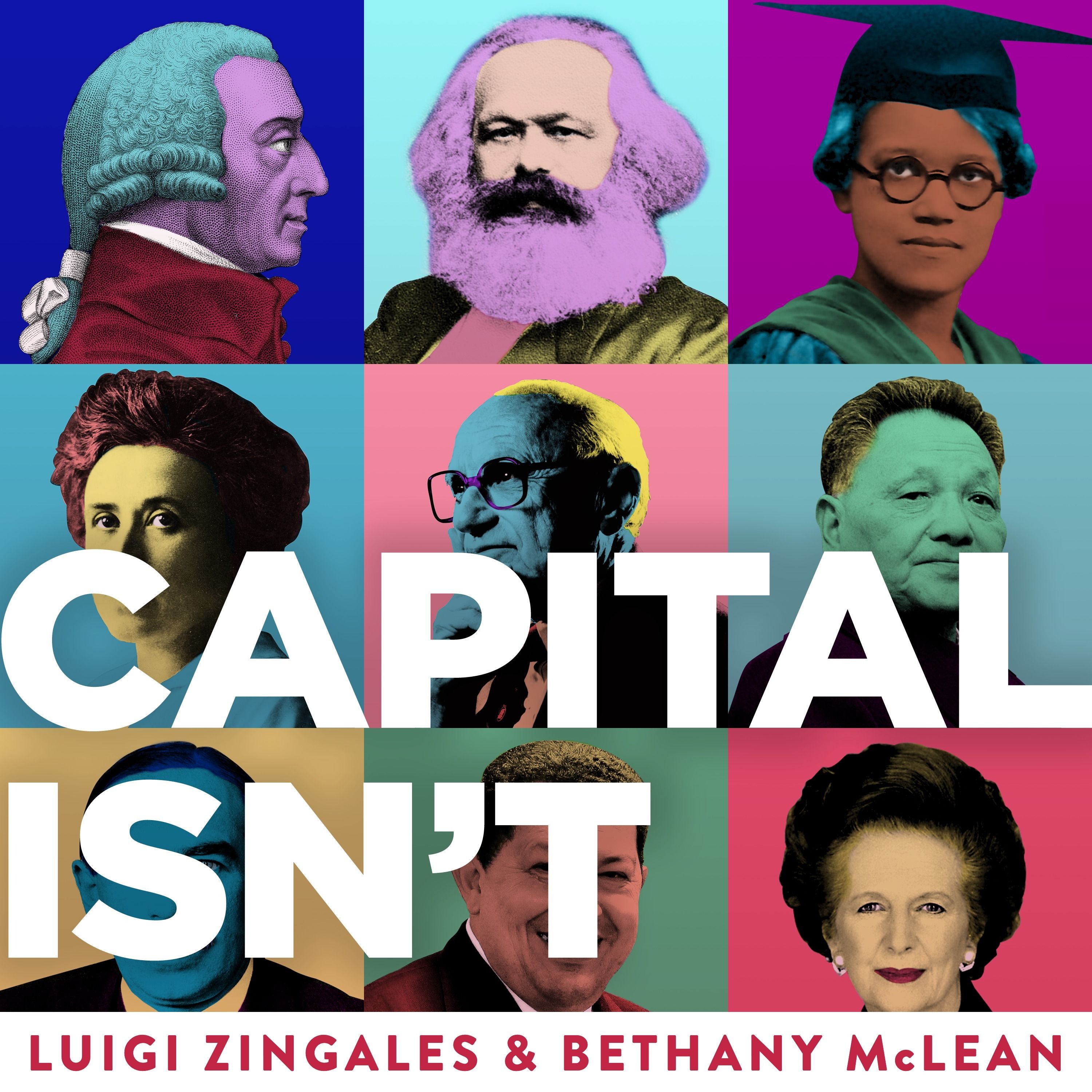
We investigate how capitalism is—or more often isn’t—working in our world today. Hosted by economist Luigi Zingales and business journalist Bethany McLean, our podcast explains why capitalism can go wrong and what we can do to fix it. Send us your questions or comments by emailing [email protected] Cover photo attributions: https://www.chicagobooth.edu/research/stigler/about/capitalisnt.

Latest Episodes

View all 240 episodes

How “Muskism” Is Changing American Capitalism - ft. Quinn Slobodian

May 7, 202655 min

Is Capitalism Delivering For The Majority? - ft. Steve Kaplan

Apr 23, 20261h 5m

Is The College Promise Broken? - ft. Noam Scheiber

Apr 16, 202641 min

S2 Ep 158The Real Cause Of Wage Stagnation - ft. Arin Dube

Economic models have treated the labor market like a perfectly competitive system where wages naturally align with worker value. Arin Dube, economics professor at the University of Massachusetts Amherst and author of “The Wage Standard”, challenges this long-held assumption. He argues that modern labor markets are riddled with invisible frictions that give employers outsized power over your paycheck. These uneven power dynamics help explain why salaries at the bottom of the distribution have historically stagnated while the broader economy grew. Dube unpacks decades of data to show what actually happens when minimum wages rise, pushing back against the classic warning that wage floors automatically destroy jobs. Instead, he presents evidence suggesting that higher pay can actually reduce turnover and push workers toward more productive companies. Hosts Luigi Zingales and Bethany McLean press Dube on the missing pieces of his labor puzzle. Zingales questions whether Dube is ignoring the massive impact of immigration on the supply and demand for low-wage labor. Meanwhile, McLean digs into the elusive concept of fairness, asking whether outsourced corporate janitors should compare their pay to Wall Street bankers or just to other janitors. Subscribe to our Youtube Channel Follow Capitalisn’t on Instagram & TikTok Send us your questions or comments by emailing [email protected] You can find Arin Dube's book "The Wage Standard" here Hosted by Simplecast, an AdsWizz company. See pcm.adswizz.com for information about our collection and use of personal data for advertising.

Apr 2, 202647 min

S2 Ep 157Is Everyone Getting Adam Smith Wrong? - ft. Glory Liu

Most people associate Adam Smith with free markets and “the invisible hand”. But does this conventional narrative purposefully ignore Smith’s deep suspicions about monopolies and power? Georgetown assistant professor Glory Liu argues this narrow interpretation is actually a deliberate historical reconstruction. In her book, “Adam Smith’s America”, Liu reintroduces the famous philosopher as a theorist of power who worried deeply about organized wealth distorting society. She notes that Smith watched early merchants use their disproportionate resources to capture political influence and actively suppress workers. Hosts Luigi and Bethany debate whether early merchant wealth accumulation truly mirrors the massive capital concentration seen in today's corporate landscape. They also explore the argument that reintroducing moral foundations to economic theory might provide a better foundation for capitalism itself. Subscribe to our Youtube Channel Follow Capitalisn’t on Instagram & TikTok Send us your questions or comments by emailing [email protected] Hosted by Simplecast, an AdsWizz company. See pcm.adswizz.com for information about our collection and use of personal data for advertising.

Mar 26, 202631 min

S2 Ep 156Why Human Progress Is Not Inevitable - ft. Carl Frey

We tend to view technological advancement as an unstoppable force that naturally improves our living standards over time. From the printing press to the internet, modern society assumes that groundbreaking ideas will always find their way into the marketplace. However, beneath the surface of our rapid digital expansion, global productivity is actually facing a troubling and persistent slowdown. Many people are beginning to wonder if our relentless push forward is practically sustainable or if we could be approaching a sudden halt. In this episode, Oxford Professor Carl Frey joins the podcast to share the unsettling message of his new book, “How Progress Ends”. He argues that technological progress is far from inevitable and can easily reverse when entrenched institutions block new ideas from transforming society. Frey explores the historical tension between decentralized innovation and centralized bureaucracies, suggesting that both the United States and China might be heading toward a period of stagnation. Instead of a guaranteed bright future fueled by artificial intelligence, we face a reality where corporate power and political self-preservation could permanently trap us in the status quo. This conversation digs into whether our modern institutions are robust enough to foster the next wave of human ingenuity or if they are fundamentally designed to suppress it. Listeners will discover exactly how historical empires have stifled their own growth and why those same warning signs are flashing today. Subscribe to our Youtube Channel Follow Capitalisn’t on Instagram & TikTok Send us your questions or comments by emailing [email protected] Hosted by Simplecast, an AdsWizz company. See pcm.adswizz.com for information about our collection and use of personal data for advertising.

Mar 12, 202641 min

S2 Ep 155The Hidden Economic Dangers Of Supreme Court Overreach - ft. Steve Vladeck

For decades, Americans viewed the Supreme Court as an impartial referee standing above the political fray. However, public trust in this vital institution has recently plummeted to historic lows. Many observers blame a surge in ideological rulings that align with the party of the President who appointed each justice. If the referee is suddenly wearing a team jersey, the fundamental systems of democracy and capitalism begin to break down. Georgetown University Law Professor Steve Vladeck joins Luigi and Bethany to argue that the real culprit isn't just partisan justices, but a complete abdication of responsibility by Congress. Rather than viewing judicial reform as a zero-sum game of packing the court, he proposes that lawmakers must reclaim their constitutional authority to check judicial overreach. He explains how special interest groups have successfully manipulated this power vacuum to reshape American regulations. This perspective completely reframes the crisis from a partisan dispute into a structural collapse of institutional power. This episode explores the hidden mechanisms that allow unaccountable judges to unilaterally rewrite the rules of our economic system, why decades of political complacency allowed this shift and what actionable steps can actually fix it. Vladeck answers whether the business community will ultimately regret enabling a system that erodes the reliable rule of law and why saving our markets may require Congress to finally stand up and do its job. Subscribe to our Youtube Channel Follow Capitalisn’t on Instagram & TikTok Send us your questions or comments by emailing [email protected] Hosted by Simplecast, an AdsWizz company. See pcm.adswizz.com for information about our collection and use of personal data for advertising.

Mar 5, 202650 min

S2 Ep 154Adam Smith In The Age of The “Epstein Class” - ft. MP Jesse Norman

As we approach the 250th anniversary of Adam Smith's “Wealth of Nations" this March, his theories on competition and the invisible hand remain part of the bedrock of modern economics. But, have we undermined those theories in our economy today? Widespread public anger suggests there is a growing belief that our current economic system is fundamentally rigged by those at the top. In many instances, backroom access and elite networking appear to be driving who becomes wealthy and successful instead of meritocratic competition. What would the father of economics think about today's crony capitalism, and what would he make of the so-called "Epstein class"? In this episode, we are joined by British Member of Parliament and author of “Adam Smith: Father of Economics” Jesse Norman. He argues that people often forget Smith deeply distrusted concentrated power, highlighting that Smith was heavily critical of wealth generated from insider knowledge or collusion. Smith condemned these practices precisely because they destroy the genuine competition required for free markets to actually benefit society. Applying this historical lens to current events, co-host Luigi Zingales provocatively asks if the so-called “Epstein Class” embody Adam Smith’s worst fears, coordinating favors to bypass free market competition. Co-host Bethany McLeans debates whether we should call it a class, or if fixating on Epstein is a distraction from the broader systemic corruption threatening capitalism today. Subscribe to our Youtube Channel Follow Capitalisn’t on Instagram & TikTok Send us your questions or comments by emailing [email protected] Hosted by Simplecast, an AdsWizz company. See pcm.adswizz.com for information about our collection and use of personal data for advertising.

Feb 26, 202655 min

S2 Ep 153How Inequality Distorts the Law - ft. Katharina Pistor

If we want to understand why capitalism feels broken, do we need to stop looking at the economy and start looking at the legal code that underpins it? In our system, capital is often described as money, machinery, or raw materials. But Columbia Law School professor Katharina Pistor argues that capital is actually a legal invention. An asset, whether it's a plot of land, an idea, or a promise of future pay, only becomes capital when it is given the right legal coding. Pistor suggests that lawyers are the true coders of capitalism. They use the law to "enclose" assets, from land to user data, giving owners the power to exclude others and monetize that value. She argues for injecting principles of "fairness and reciprocity" back into private law, ensuring that contracts aren't just tools for the powerful to extract value from the weak. Luigi Zingales suggests that large corporations have become so powerful we may need a new branch of "quasi-public law" to govern the asymmetry between an individual consumer and a corporate giant. This episode explores the deep, often invisible architecture of our economic system and asks whether we can ever truly tame corporate power without rewriting the rules of the game. Subscribe to our Youtube Channel Follow Capitalisn’t on Instagram & TikTok Send us your questions or comments by emailing [email protected] Hosted by Simplecast, an AdsWizz company. See pcm.adswizz.com for information about our collection and use of personal data for advertising.

Feb 19, 202648 min

S2 Ep 152Are Betting Apps Engineered for Addiction? - ft. Jonathan Cohen

If a sports betting app has the data to know exactly when a user is struggling financially, should it have a legal duty to cut that person off? On this episode of Capitalisn't, we dive into the murky waters of the American sports betting explosion. We are often told that legalization simply moves an existing black market into the light, but guest Jonathan Cohen argues that the issue isn’t that we legalized the industry—it’s that we did it "recklessly." Cohen, the Policy Lead at the American Institute for Boys and Men and author of Losing Big: America's Reckless Bet on Sports Gambling, joins Bethany and Luigi to outline the serious costs of this rapid liberalization. His data shows that legalized online sports betting is associated with a 25% to 30% increase in personal bankruptcies, a notable rise in auto loan defaults and credit card delinquencies, and increased cases of childhood neglect. Is there a way to fix this market so that it is fair for consumers without imposing such a high degree of societal cost? Host Luigi Zingales suggests a broader solution: a "fiduciary duty" for data collectors. When you give sensitive information to a doctor, accountant, or lawyer, they are bound to use that data only in your interest. If a betting app sees a user's credit card deposits being declined or identifies a pattern of "loss chasing," should they be legally required to act in your interest instead of targeting you with VIP offers? Subscribe to our Youtube Channel Follow Capitalisn’t on Instagram & TikTok Send us your questions or comments by emailing [email protected] Hosted by Simplecast, an AdsWizz company. See pcm.adswizz.com for information about our collection and use of personal data for advertising.

Feb 5, 202656 min

S2 Ep 151Can We Build a Middle Class Without Factories? - ft. Dani Rodrik

Is the era of manufacturing-led growth officially over? For decades, the path to a stable middle class was paved through industrialization, but today, even manufacturing giants like China are losing millions of factory jobs to automation. In this episode, Bethany McLean and Luigi Zingales sit down with Dani Rodrik, Ford Foundation Professor of International Political Economy at Harvard and author of Shared Prosperity in a Fractured World. Rodrik argues that we have "no other choice" but to look toward the service sector to anchor our future economy. But there’s a problem: we still treat these essential roles as "bottom rung" jobs in terms of pay and respect. Is it possible to elevate a job’s status and pay simply because society needs it to be better? As Rodrik argues, it’s a future we must learn to navigate if we want to preserve a stable society. Subscribe to our Youtube Channel Follow Capitalisn’t on Instagram & TikTok Send us your questions or comments by emailing [email protected] Hosted by Simplecast, an AdsWizz company. See pcm.adswizz.com for information about our collection and use of personal data for advertising.

Jan 22, 202641 min

S2 Ep 150Who Should The Fed Answer To? - ft. Sir Paul Tucker

Is the Federal Reserve’s independence a pillar of democracy or a convenient shield that allows elected officials to duck their responsibilities? This week on Capitalisn’t, we confront a shift in Washington after the Justice Department served subpoenas on the Fed. Joining the conversation is Former Deputy Governor of the Bank of England, Sir Paul Tucker, who complicates the definition of central bank autonomy. If monetary policy is a "latent instrument of taxation," should it be shielded from the King—the executive branch—and reclaimed by the legislature? We explore the provocative argument that the Fed has become dangerously wary of its relationship with Congress, acting as a self-governing entity rather than a delegated authority. Does the U.S. model, where the Fed defines its own version of price stability, explain the accountability gap we see when supervisory failures like the SVB collapse result in zero consequences for leadership? Finally, we address an unsettling mystery regarding the global financial system. If Fed independence is truly degrading, why are the markets so strangely sanguine? Are global investors simply anesthetized by the AI boom, or does the dollar’s global monopoly allow the U.S. to decay without paying an immediate price? We debate whether the market has ceased to be a barometer for institutional health and instead become a tool for protecting shareholder rents—failing to interpret a "catastrophic forecast" until it is already too late. Tucker is also the author of "Unelected Power: The Quest for Legitimacy in Central Banking and the Regulatory State" & "Global Discord: Values and Power in a Fractured World Order". Subscribe to our Youtube Channel Follow Capitalisn’t on Instagram & TikTok Send us your questions or comments by emailing [email protected] Hosted by Simplecast, an AdsWizz company. See pcm.adswizz.com for information about our collection and use of personal data for advertising.

Jan 15, 202653 min

S2 Ep 149How To Fix The American Tax System - ft. Ray Madoff

Is the American tax code a fair engine for growth, or a "second estate" where the rich choose whether or not to pay? We are often told that the top 1% of earners already pay 40% of all taxes, while nearly half of Americans pay nothing at all. Legal scholar Ray Madoff argues that this statistic is a deliberate "bait-and-switch" designed to confuse the public. The reality is that the truly rich often have little to no income to tax, living instead on borrowed gains and tax-free inheritances. In this episode, Madoff joins Luigi Zingales and Bethany McLean to discuss her new book "The Second Estate: How The Tax Code Made An American Aristocracy" covering how and why our current tax system allowed the ultra-wealthy to opt out altogether. She argues that to fix the system, we shouldn't just raise rates, we need to bring inheritances and investment gains directly into the income tax system and eliminate the "cover" provided by a broken estate tax. Subscribe to our Youtube Channel Follow Capitalisn’t on Instagram & TikTok Send us your questions or comments by emailing [email protected] Hosted by Simplecast, an AdsWizz company. See pcm.adswizz.com for information about our collection and use of personal data for advertising.

Jan 6, 202654 min

S2 Ep 148How Capitalism Became Global ft. Sven Beckert

Is capitalism a force of nature, or a human-made order that we have the power to shape? In this episode, Luigi and Bethany sit down with Sven Beckert, a Harvard historian and author of the new book A Global History of Capitalism, to tackle a question that seems basic but remains surprisingly difficult to answer: what exactly is capitalism?Beckert argues that capitalism is not defined simply by the existence of markets—which are found in all human societies—but rather by a specific economic logic of privately owned capital productively invested to produce more capital. He challenges the popular narrative that capitalism and the state are antithetical, suggesting instead that the state has been constitutive of capitalism throughout its history, from the colonization of the Americas to the industrial expansion of the 19th century.Beckert also argues that capitalism is fundamentally "undogmatic", pointing out that it has thrived under radically different political systems from the British Empire and the slave plantations of the Caribbean to modern liberal democracies and authoritarian city-states. Rather than existing in opposition to the state, does capitalism actually rely on state power to construct markets and enforce the expansion of its logic? Hosted by Simplecast, an AdsWizz company. See pcm.adswizz.com for information about our collection and use of personal data for advertising.

Dec 18, 202552 min

S2 Ep 147How to Stop “Ensh*ttification” Before It Kills the Internet - ft. Cory Doctorow

There’s a word that’s gained a lot of popularity in the last year: “ensh*ttification”. It refers to a trajectory many see with digital platforms: they initially offer immense value to users, only to systematically degrade that quality over time in order to extract maximum surplus for shareholders. We invited the coiner of this term, science fiction author and activist Cory Doctorow, on the podcast to discuss whether he thinks this decline is an inevitable feature of digital markets or a consequence of specific policy failures. And, most importantly, how he thinks it could be reversed.For Doctorow, "ensh*ttification" is not simply a result of "revealed preferences", where users tolerate worse service because they value the platform, but rather the outcome of a regulatory environment that has permitted the creation of high switching costs and the elimination of competitors. Doctorow also argues that historically, interoperability acted as an engine of dynamism, allowing new entrants to lower the barriers to entry. But current IP frameworks, such as anti-circumvention laws, have been "weaponized" to prevent this, effectively allowing firms to enforce cartels and engage in rent-seeking behavior.Finally, Doctorow offers a critical assessment of the current AI boom, arguing that the sector is creating "reverse centaurs", where human labor is conscripted to correct algorithmic errors, and warns of a potential asset bubble driven by inflated revenue attribution. Hosted by Simplecast, an AdsWizz company. See pcm.adswizz.com for information about our collection and use of personal data for advertising.

Dec 11, 202556 min

S2 Ep 146Why Matthew Yglesias Is Skeptical Of Anti-Monopoly Policies

A recent proposal by Lina Khan, co-chair of Zohran Mamdani's mayoral transition team, to cap the price of beer at stadiums in New York City sparked a debate on X last month. At the center of that debate was Matthew Yglesias, editor and author of the Slow Boring newsletter, who argued that the modern antitrust movement has become "slipshod" and is ignoring basic economic trade-offs in favor of political wins.In this episode, Yglesias joins Luigi and Bethany to discuss his views on the theoretical and practical limitations of the "Neo-Brandeisian" approach to antitrust. He contends that proposals like price caps for complementary goods like stadium concessions reveals a lack of economic rigor, arguing that such measures often result in higher ticket prices rather than consumer savings . He suggests that the movement increasingly attempts to use antitrust law as a universal tool for societal grievances.Bethany and Luigi debate Yglesias on the limits of this modern anti-monopoly movement, arguing that he sounds like a "Chicago economist circa 1970" who assumes markets are always efficient and rational. From the lobbying might of the banking industry to the extractive fees of Amazon, Luigi argues that economic concentration inevitably morphs into political power. He posits that even if consolidated industries remain price-efficient, their size allows for the capture of the regulatory process—citing the banking and tobacco industries as historical precedents.Of course, antitrust enforcement isn't the only proposal on the table to address people's concerns about price levels, as the current excitement around the "affordability" and "abundance" movements demonstrate. But Yglesias argues neither abundance, affordability nor antitrust is going to drive down nominal prices. As he puts it: the only thing that could do that is “a catastrophic depression…but that's not going to make people happier". Hosted by Simplecast, an AdsWizz company. See pcm.adswizz.com for information about our collection and use of personal data for advertising.

Dec 4, 202557 min

S2 Ep 145Are Big Tech’s Regulators “Cowards”? ft. Tim Wu

Did you know Amazon makes $37 billion a year—more than double the revenue of all the newspapers in the world combined—from its sponsored results alone? Yes, the same, spammy, sponsored results at the top of a search that bilk shoppers with fake or low-quality items and can starve legitimate businesses of traffic and revenue.This is one of the many insights shared by our guest this week, Tim Wu, in his new book, “The Age of Extraction: How Tech Platforms Conquered the Economy and Threaten Our Future Prosperity.” He argues that the defining story of the modern internet isn’t openness or democratization, but rather wealth extraction: the ability of gatekeeping Big Tech platforms, such as Amazon, Facebook, or X, to take money from everyone else without actually providing net value in return. Platforms weaponize convenience, he writes, so switching to competitors or smaller platforms is designed to be exhausting. Add in AI technologies that foster emotional relationships with users, and our dependence on them may deepen even more.An author and professor at Columbia Law School, Wu served in the Biden administration as Special Assistant to the President for Technology and Competition Policy. He discusses with Bethany and Luigi why we should care about Big Tech value extraction and posits how Big Tech power arose in the first place: from centralized power to shareholder pressure, from poorly aligned corporate structures to nefarious intentions. Together, they also chart how we can make our way out of this era of extraction. They discuss the feasibility of treating Big Tech platforms like utilities, applying frameworks for structural separation between the platforms’ various services, decentralizing digital network infrastructures through interoperability to allow users to switch more easily between different platforms, and how economic populism influences the political messaging around these issues. Ultimately, Wu makes the case for embracing a philosophy of decentralized capitalism to achieve a fairer and beneficial balance between public and private power. Read more from Tim Wu in ProMarket:The Consumer Welfare Standard is Too TaintedOver recent years, the antitrust law appears to be returning to its historical standard, the “competition and competitive process” standard, often referred to in the Supreme Court as the goal of “protecting competition.” In this post, Tim defends this trend for rule-of-law reasons and presents a realistic assessment of the legal system’s capabilities and its limits.A Conversation with Tim WuA transcript of Tim Wu’s keynote in conversation with Binyamin Appelbaum of The New York Times from the Stigler Center’s annual Antitrust and Competition Conference archives. Hosted by Simplecast, an AdsWizz company. See pcm.adswizz.com for information about our collection and use of personal data for advertising.

Nov 20, 20251h 2m

S2 Ep 144Why Economists Should Care About Inequality, with Branko Milanovic

Recently, Bethany and Luigi joined economist and wealth inequality expert Branko Milanovic in front of a live audience at the Aspen Ideas Festival to explore how capitalism, democracy, and income inequality interact. Together, the three discussed the pervasiveness of income inequality around the world, its connections with democracy and political stability, if the inequality that really matters is that between countries, and if capitalism and democracy aren't as intricately connected as we thought. As a scholar of China’s economic system, Milanovic discussed how much of the country’s success can even be attributed to capitalism. In the process, the three unpacked if capitalist societies, particularly in the West, are able to address the very inequality they have produced. Are there free-market mechanisms to correct for inequality or does there need to be government intervention? If income inequality poses a dire threat to democracy, what should capitalists do to preserve the institutions that enabled their wealth in the first place?Read a book review of Branko Milanovic's Visions of Inequality: From the French Revolution to the End of the Cold War and how his analysis of class and inequality applies to contemporary America, written by former ProMarket student editor Surya GowdaAlso mentioned: Revisit our episode with Thomas Piketty on creating a more equal society and with Martin Wolf: Is Capitalism Killing Democracy?Also revisit our episodes with Sen. Phil Gramm and Matthew Desmond on Poverty in America: Terrible Scourge or a Measurement Error? Hosted by Simplecast, an AdsWizz company. See pcm.adswizz.com for information about our collection and use of personal data for advertising.

Nov 6, 202546 min

S2 Ep 143Nobel Economist Reveals Why Economic Models Keep Failing Us, ft. Richard Thaler

Standard economic theory informs how we think about business strategy and the economy and presumes that people are selfish, have well-defined preferences, and consistently make welfare-maximizing choices. In other words, we are rational. But what if that is not the case?Nobel Prize-winning economist Richard Thaler is out with an updated edition of his bestselling 1991 book, "The Winner's Curse: Paradoxes and Anomalies of Economic Life." In the new edition, he and his co-author Alex Imas (both professors at the University of Chicago Booth School of Business) reflect on the last thirty years of behavioral economics and how it makes sense of tensions between our psychological biases and impulses that make us less than fully rational in practice. Using a wealth of empirical evidence, the authors explore the behavioral anomalies that contradict the expectations of standard economic theory and explain a wide range of real-world examples from banking crises to social media addiction.Earlier this month, Thaler joined Bethany and Luigi for a sold-out Capitalisn’t recording in front of a live audience in Chicago to walk through the anomalies of human behavior that have endured from biblical times to the age of Big Tech. Thaler reflects on how views and the adoption of behavioral economics have changed over the last thirty years, both within academia and beyond (wonder why you can’t put down your phone? Silicon Valley has read Thaler). He also shares how behavioral economics can influence public policy from canceling “junk fees” and dubious subscriptions to deciding which parts of the Affordable Care Act to keep and which are unlikely to produce their desired outcomes. Over conversation, light banter, and audience Q&A, Thaler shares his views on the state of capitalism and reveals how there is no grand unified theory of human behavior that incorporates all its irrationalities—only departures from the standard model. Hosted by Simplecast, an AdsWizz company. See pcm.adswizz.com for information about our collection and use of personal data for advertising.

Oct 30, 202545 min

S2 Ep 142What Everyone’s Getting Wrong About AI, with Arvind Narayanan

Every major technological revolution has come with a bubble: railroads, electricity, dot-com. Is it AI’s turn? With investments skyrocketing and market valuations reaching the trillions, the stakes are enormous. But are we witnessing a genuine revolution—or the early stages of a spectacular crash?Princeton professor Arvind Narayanan joins Luigi Zingales and Bethany McLean to explain why he believes AI’s transformative impact is overstated. Drawing on his book AI Snake Oil, co-authored with Sayash Kapoor, Narayanan argues that capitalism’s incentives can distort technological progress, pushing hype faster than reality can deliver. They examine how deregulation, geopolitical competition, and private control over data shape the trajectory of AI’s development.They also explore what could happen if the bubble bursts: massive market shocks, exposed structural weaknesses in the economy, and a wave of painful restructuring that could echo the dot-com crash—but on a far larger scale. It’s a conversation that cuts through the hype and asks what’s at stake when an entire economy bets on one technology. Hosted by Simplecast, an AdsWizz company. See pcm.adswizz.com for information about our collection and use of personal data for advertising.

Oct 16, 202548 min