
Show overview
Capital for Good has been publishing since 2021, and across the 5 years since has built a catalogue of 55 episodes, alongside 4 trailers or bonus episodes. That works out to roughly 30 hours of audio in total. Releases follow a roughly quarterly cadence, with the show now in its 5th season.
Episodes typically run twenty to thirty-five minutes — most land between 27 min and 36 min — and the run-time is fairly consistent across the catalogue. None of the episodes are flagged explicit by the publisher. It is catalogued as a EN-language Business show.
The show is actively publishing — the most recent episode landed 3 months ago, with 11 episodes already out so far this year. Published by Tamer Institute for Social Enterprise and Climate Change.
From the publisher
We find ourselves at a moment of unprecedented challenge – and opportunity. While the COVID-19 health, economic, and racial crises have laid bare and exacerbated any number of structural inequalities, and global climate change remains an existential – and very urgent – threat, they also compel us to reimagine how leaders across the private, nonprofit, and public sectors can champion social and environmental change in ways that truly advance shared prosperity and a sustainable future. Presented by the Tamer Institute for Social Enterprise and Climate Change at Columbia Business School, Capital for Good provides a window into this reimagined future: a chance to hear from corporate and civic leaders about their visions, plans, commitments, and on-the ground efforts to build a more just, inclusive, and sustainable society. Through in depth and candid conversations, we will explore and unpack solutions to some of our most urgent challenges. Can business be a force for good? What is stakeholder capitalism? What is the role of capital markets and philanthropy along the pathways to inclusive growth? How do we encourage and scale grassroots and broad-based innovation? How can public private partnerships help bring all of our resources and ingenuity to bear? About the Tamer Institute for Social Enterprise and Climate Change The institute educates leaders to use business knowledge, entrepreneurial skills, and management tools to address social and environmental challenges. About the Host Georgia Levenson Keohane is a seasoned executive in the private and nonprofit sectors at the intersection of capital markets, responsible investing and business, and philanthropy and public policy; an award winning author; and an adjunct professor of social enterprise at Columbia Business School.
Latest Episodes
View all 55 episodesJulie Samuels, Tech:NYC and New York's Innovation Economy
Antony Bugg-Levine: Investing in America
New York Media Matters – and Leaders: Christy Tanner '99 and Carroll Bogert
Robert K. Steel: Leadership Across the Private, Public, and Nonprofit Sectors
Rabbi Angela Buchdahl: The Heart of a Stranger
Marla Blow, President and CEO of the Skoll Foundation: Transformation and Renewal
Anthony W. Marx, President and CEO, The New York Public Library: Master Class in Transformative Leadership
John Witt and The Radical Fund: How a Band of Visionaries and a Million Dollars Upended America

S5 Ep 2Deven Parekh, Insight Partners: Software, Startups, and Scale-ups in the Age of AI
In this episode of Capital for Good we speak with Deven Parekh, renowned technology investor, civic leader, and managing director of Insight Partners, the global software investment firm. Over the course of the wide-ranging conversation, we learn about Insight's deep expertise and differentiation in software investing, Parekh's own evolution as a business leader, and how he thinks about the current moment — as an investor, engaged nonprofit board member, and New Yorker. We begin with Parekh's early days. He entered college as a budding scientist, but soon "traded his early love of biochemistry for economics," and graduated from Wharton into a career in finance, first at Blackstone and then the merchant bank Berenson Minella & Company. When Parekh joined Insight Partners in 1999, it was a team of approximately ten; today Insight is a 450-person global firm, with over $90 billion in assets under management, and investing out of its thirteenth fund. Parekh walks us through the distinguishing elements of Insight's strategy, including a singular focus on software across the full investment continuum from early-stage venture to private equity like buyouts; a nearly 70-person strong and proactive sourcing team; and a dedicated operations group, Insight OnSite, that works in a hands-on way with portfolio companies. Having made over 140 investments over his career — across business cycles and dynamic market conditions — Parekh underscores the value of flexibility in Insight's approach. For example, "venture buyouts" — acquiring controlling interests in strong but not-yet-public software companies — initially structured in response to liquidity challenges in private markets — have become one of Insight's strongest-performing deal archetypes, with over 70 completed to date. Parekh also explains Insight's approach to artificial intelligence: as an investment opportunity, particularly in early-stage companies; as a tool to improve Insight's own operations; and as a lever for value creation across the portfolio, where the OnSite team helps incumbent software companies integrate AI into their products and business models. We touch on Parekh's civic commitments, including as a board member of the Council on Foreign Relations, the Carnegie Endowment for International Peace, and the US International Development Finance Corporation. In this moment of market and geopolitical volatility and uncertainty, Parekh believes nonpartisan policy institutions have a particularly important role to play. Parekh is also a devoted New Yorker. He believes the city — where Insight is based, where he and his wife (and partner in all things, including philanthropy) raised their family, where he serves on several boards — is thriving in the post-Covid world. "I feel really bullish about New York," he says. Parekh's optimism is also abundant when we speak about the next generation. "Young people give me hope," he says. And his advice to them: "Have a plan, but follow your passion." Mentioned in this episode: Insight Partners Council on Foreign Relations Carnegie Endowment for International Peace US International Development Finance Corporation The Economic Club of New York NYU Langone Tisch New York MS Research Center

S4 Ep 11Mellody Hobson, Co-CEO, Ariel Investments: Everything is Possible
In this episode of Capital for Good we speak with Mellody Hobson, one of the country's preeminent investors and business and civic leaders. Hobson is the co-CEO of Ariel Investments, a board director of several Fortune 500 companies and nonprofit organizations, and a nationally recognized advocate for financial literacy and economic inclusion. We begin with a discussion of the formative childhood experiences that would shape Hobson's personal and professional trajectory. Hobson recalls how, as a young girl on the South Side of Chicago who regularly experienced economic insecurity, she was driven to work very hard and "to understand money" as a path to economic security for herself and for others. "My purpose was sealed very early," she says. After graduating from Princeton in 1991, Hobson joined the Chicago-based Ariel Investments. In the thirty-five years since, she has traveled from intern to co-CEO, building a $14 billion asset management firm with a mission to "transform the lives of everyone who entrusts us with their financial futures." Hobson walks us through her evolution as a leader, and describes Ariel's signature approach to long-term investing in companies and sectors that are "misunderstood, ignored and underfollowed," where vigorous and original research allows the team to identify mispriced securities and the opportunity to outperform. According to Hobson, Ariel's success has derived from the principles and practices of active patience ("being patient is really hard, it requires great restraint, great study, great discipline"), bold teamwork, and independent thinking – the focused expertise that supports the "conviction to have a different opinion." This approach made Ariel a pioneer, first in small cap stocks, where the firm's founder John Rogers tested the long-term value investment thesis, and later in mid cap and international markets. In 2021, Hobson launched Ariel Alternatives, which included its inaugural private equity fund, Project Black, focused on building to scale minority businesses that will be tier one suppliers to Fortune 500 companies, and Project Level, a new vehicle focused on "changing the game" in women's sports. Given the seismic and secular shifts in the industry, Hobson believes women's sports are "the next big growth opportunity… the small cap of sports." Hobson speaks passionately about all she has learned as a corporate director. Today, she serves on the board of JP Morgan Chase, and was a director of Estée Lauder Companies, DreamWorks Animation, and Starbucks, which she led as chair. She is equally animated by her civic commitments, learning early on it was "part of your job to be of service to others… it was sewn into my DNA." We discuss the inspiration she finds in her work with a number of nonprofit organizations, including After School Matters, Bloomberg Philanthropies, and the Lucas Museum of Narrative Art, a new cultural institution she has created with her husband and filmmaker George Lucas. Hobson is fervent about the power of storytelling, and her and Lucas's belief that "everyone's story matters." Hobson has captured part of her own story in the New York bestselling Priceless Facts about Money, an immaculately researched and illustrated children's book that makes learning about money and finance accessible — and fun. And it is in young people that Hobson sees hope, even in challenging times, as they affirm her faith in the wonder and promise of human potential. "If you believe that is true," she says, "then everything is possible. Not anything — everything." Mentioned in this episode John W. Rogers, Jr., Ariel Founder, Chairman, and Co-CEO A Random Walk Down Wall Street (Burton Malkiel, 2024) Ariel Alternatives: Project Black, Project Level After School Matters Bloomberg Philanthropies Lucas Museum of Narrative Art Priceless Facts about Money (Mellody Hobson, 2024)

Introducing Capital for Good Season Five
Welcome to Capital for Good, the podcast where we hear from business and civic leaders about their visions, plans, and hard work to build a vibrant, inclusive and sustainable society. Hosted by seasoned executive and award winning author Georgia Levenson Keohane, and presented by Columbia Business School's Tamer Institute for Social Enterprise and Climate Change, Capital for Good features in-depth and candid conversations with leaders across the private, nonprofit, and public sectors exploring solutions to some of our most urgent challenges. Season five offers an extraordinary line up of guests including business and civic leader Mellody Hobson, the Co-CEO of Ariel Investments; Tony Marx, the President & CEO of the New York Public Library; Yale Law Professor, legal historian and award winning author John Witt; Marla Blow, the CEO of the Skoll Foundation; Technology investor and Managing Director of Insight Partners, Deven Parekh; Rabbi Angela Buchdahl, the renown religious leader and author of the new bestselling book, Heart of a Stranger; Bob Steel, whose storied career in finance and government service now finds him as Vice Chairman of Perella Weinberg; and impact investing pioneer Antony Bugg Levine. Learn more and subscribe today at The Tamer Institute for Social Enterprise and Climate Change at Columbia Business School – or wherever you get your podcasts.
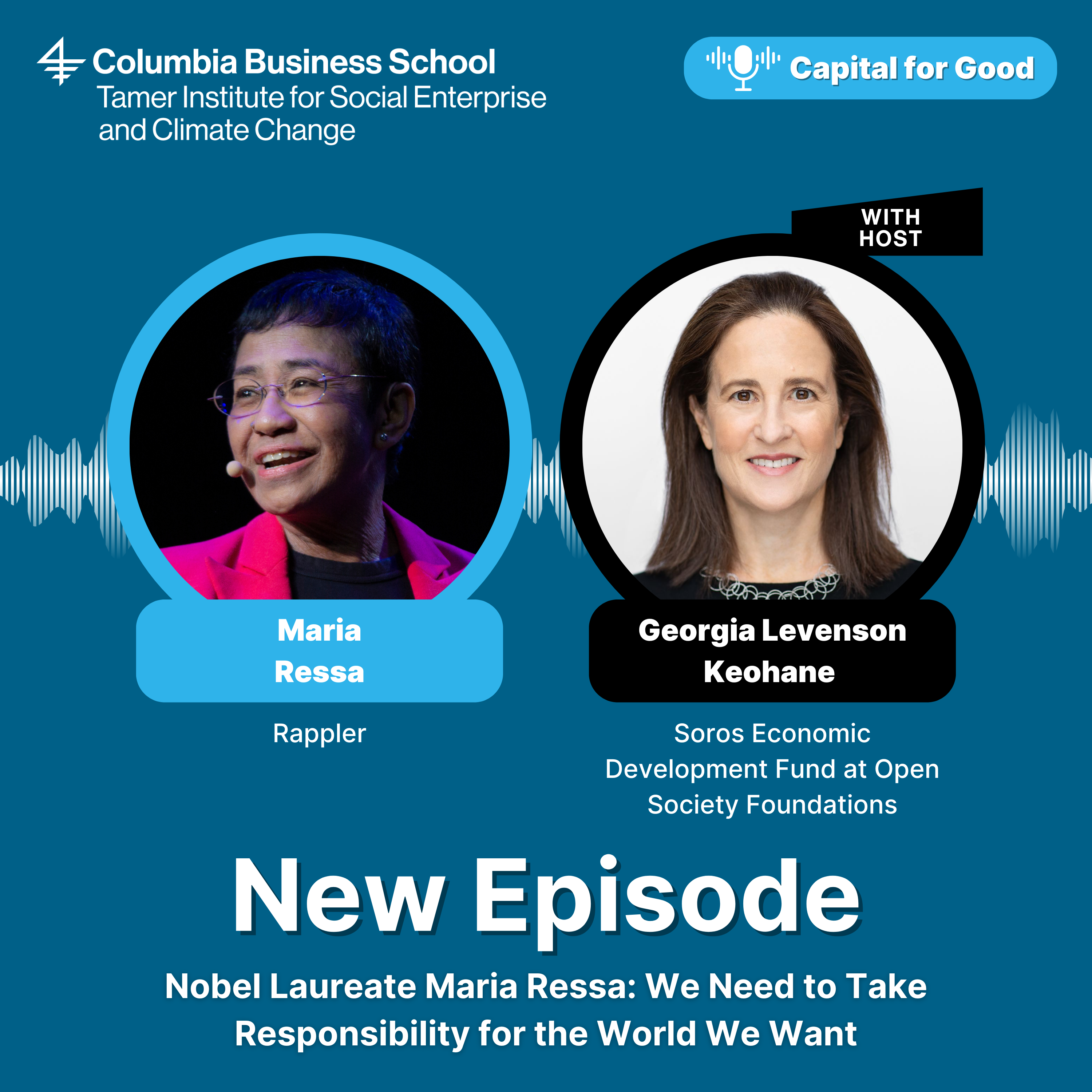
S4 Ep 10Nobel Laureate Maria Ressa: We Need to Take Responsibility for the World We Want
In this episode of Capital for Good we speak with Maria Ressa, the globally celebrated free speech champion, journalist, entrepreneur, dissident, and winner of the 2021 Nobel Peace Prize for her work "to safeguard freedom of expression, which is a precondition for democracy and lasting peace." Ressa is a co-founder of Rappler, one of the most influential media platforms in the Philippines. For her reporting on the administration of President Rodrigo Duterte, Ressa was threatened, arrested, tried, and convicted of cyberlibel, facing over one hundred years imprisonment. Today Duterte has been arrested by the International Criminal Court and awaits trial in the Hague, Ressa has been cleared of nearly all charges, and her work as a journalist and activist continues as she warns of the very real world challenges of online disinformation. We begin with Ressa's earliest days in the United States, when her family immigrated in 1973 after martial law had been declared in the Philippines. We discuss the importance of her education in those years, in elementary, high school, and at Princeton, and the support of those who "taught her to keep learning," lessons that would inform her pursuit of journalism when she returned to the Philippines. "I fell into journalism," Ressa says, as she found it to be critical "connective tissue between government and the people," and a way to "hold power to account." She and three fellow journalists launched Rappler in 2012; by 2016, when Duterte was elected President, Ressa found herself persecuted by the government — threatened, arrested, tried and sentenced to over one hundred years in prison — for reporting on its corrupt and increasingly authoritarian practices. We discuss Ressa's fight for her rights "as a journalist and a citizen" and her realization that technology could accelerate misinformation, distort truth, and blur the boundaries between the virtual and real world. "A lie told a million times becomes a fact," she says. Ressa chronicles these experiences in her 2022 memoir and call-to-arms How to Stand up to a Dictator: The Fight for our Future. Ressa cautions about the dangers of and linkages between the weaponization of algorithmically driven disinformation — and illiberalism worldwide. "Without facts you can't have truth, and without truth you can't have trust. The only government that exists without trust is a dictatorship: you can't have journalism or democracy." In her own work, she and Rappler are building upon the Matrix protocol, a secure, open-source decentralized platform that has the potential to become a global independent news distribution outlet. Although she is deeply concerned — "I feel like Cassandra and Sisyphus combined," she says – Ressa also maintains her faith in the power of people to come together for change. "It's all about community," she explains. "We are standing on the rubble of the world that was; we need to take responsibility for the world we want. We can build a world that is more just, more equitable, more sustainable; we can do this if we decide to come together, to demand better." Thanks for Listening! Subscribe to Capital for Good on Apple, Amazon, Google, Spotify, or wherever you get your podcasts. Drop us a line at [email protected]. Mentioned in this podcast: Maria Ressa Nobel Prize Lecture, (2021) How to Stand up to a Dictator: The Fight for our Future, (Harper Collins, 2022) A Thousand Cuts, (Frontline, 2021)

S4 Ep 9Brad Lander, New York City Comptroller: the Virtuous Cycle of a Successful City
In this episode of Capital for Good with we speak with Brad Lander, New York City Comptroller and recent Mayoral candidate. As Comptroller, Lander serves as the city's chief financial officer, budget watchdog, auditor, and custodian of the City's five public pension funds, representing the retirement security — $275 billion in assets — of over 750,000 current and retired public sector workers. As fiduciary, Lander has ensured these assets are invested with a prudent, diversified, long-term approach, while also becoming a national leader on responsible investment when it comes to issues of climate change, worker protections, strong governance, and diversity. At the time of this interview, ranked choice voting had just concluded for the Democratic primary for New York mayor, with Zohran Mamdani winning in an upset over both Lander and former Governor Andrew Cuomo. We begin the conversation with Lander's early days working in community and economic development at the Fifth Avenue Committee and the Pratt Center, where he learned how to use "capital for good:" creative financing for affordable housing, including new ownership and equity models for wealth creation for lower income families, small business support and job training. These issues would inform Landers' decade in the City Council, where he co-founded the Progressive Caucus and advanced legislation on workers' rights, tenant protections, affordable housing, education, and public safety. We also explore Lander's work leading the rezoning of the Gowanus neighborhood (and former Superfund site) to create 8,500 new housing units, nearly half affordable, and affordable art studios and community spaces, as a successful model of inclusive development. Lander discusses the Comptroller's "most sacred responsibility:" its role as fiduciary of the city's pension funds, and Lander's work to deliver retirement security — achieve market rate returns — while stewarding resources "in ways that build on the values New Yorkers share." We walk through a number of examples where the Comptroller's engagement as asset owner led to better conditions for workers, greater accountability on corporate net zero commitments, enhanced board oversight, and improved financial returns. His office has also hit its performance targets while expanding the diversity of partner fund managers. "I believe firmly that attending to environmental, social and governance risks, the ESG work, is not just consistent with fiduciary duty, but an essential part of fiduciary duty," Lander says. In recent years he has worked closely on these issues with other comptrollers and state treasurers across the country. We touch on the New York City mayoral race, the twist and turns of ranked choice voting, and the developments just before the June primary that brought additional attention to the election: Lander's arrest escorting a migrant out of immigration court, the Office of the Comptroller's recovery of $80 million illegally removed from a New York City account by DOGE, and Lander and Mamdani's cross-endorsement. Of the latter, Lander notes, "it wound up unlocking a very lovely response I hadn't anticipated," a kind of hopefulness, as voters and young people especially saw that "politics can involve people working together towards shared goals for the city we love." Lander is clear eyed about the very real challenges facing the New York: affordability, government capacity to deliver a well-run city — to keep streets and subways safe and clean — and to manage budgets and growth in the face of significant headwinds from Washington. This means continuing to strengthen the cross-sector coalition he ran on to create what Dan Doctoroff has called "the virtuous cycle of a successful city," one that harnesses and celebrates growth while investing in the public goods that make that growth possible and more inclusive, and make opportunity and prosperity more broadly shared. If we can do that, he says, "I know we can keep that virtuous cycle going." Thanks for Listening! Subscribe to Capital for Good on Apple, Amazon, Google, Spotify, or wherever you get your podcasts. Drop us a line at [email protected]. Mentioned in this podcast: This Is Brad Lander's New York, (New York Times, 2025) For the Long Term Who Should Lead New York City?, (New York Times, 2025)

S4 Ep 8Emma Bloomberg and Murmuration: Technology, Data, Research, and the Power of Community-driven Civic Engagement
In this episode of Capital for Good we speak with Emma Bloomberg, the founder and CEO of Murmuration, a nonprofit technology company that works with local organizations to amplify the power of civic engagement by providing the data, tools, and research necessary to build healthier and more equitable communities. Bloomberg has been working with communities and leaders for over 20 years to tackle some of our country's most pressing challenges. She founded Murmuration with the belief in the power of community driven civic engagement to affect sustainable systems change. We begin the conversation with some of Bloomberg's formative personal and professional experiences: her childhood "rooted in deep civic engagement," and the belief that we all have "a responsibility to help make our community a better place;" the opportunity, just out of college, to work on her father Mike Bloomberg's first mayoral campaign; an early stint in city government focused on the creation of the 311, New York City's government service information line, and her time at the Robin Hood foundation, New York City's largest poverty fighting nonprofit and philanthropy. Over the years, and through her work with many community-based organizations, Bloomberg observed how access to better tech and data infrastructure could make their work more efficient, effective, and therefore higher impact. Murmuration set out to solve this problem by serving community organizations with tools, data, and, more recently, research and insights — often tailored to a very local context. We explore critical decision points in Murmuration's ten-year evolution, including the choice to understand community organization needs and fit with existing products in the marketplace, curate those off the shelf tools and data, identify gaps, acquire the IP of existing tech companies, and only then begin to create tools in-house with requisite partner knowledge and engineering and product development expertise. Bloomberg also explains what it means to be a truly mission driven technology company, electing to incorporate as a nonprofit (versus a fully commercial entity) to better serve the needs of community-based organizations. We end with a discussion of Murmuration's newest offerings — original research and insights — among them a three-year deep dive into the aspirations, concerns, beliefs and behaviors of Gen Z, including those related to political and civic engagement, and "civic pulse," a continuous tracking survey that collects daily responses from Americans across the country about how they feel and what they care about, providing real time insights into community well-being and local engagement. Despite the many challenges nationally, Bloomberg remains optimistic. "I am hopeful because I believe in the importance of community organizations; I think of them as the engine of sustainable change," she says. "Local organizing, in communities, in neighborhoods, that's where people can feel impact, and that impact is ultimately power." Thanks for Listening! Subscribe to Capital for Good on Apple, Amazon, Google, Spotify, or wherever you get your podcasts. Drop us a line at [email protected]. Mentioned in this podcast: Murmuration The Memphis Lift Insights by Murmuration Substack Murmuration Research and Insights (website)
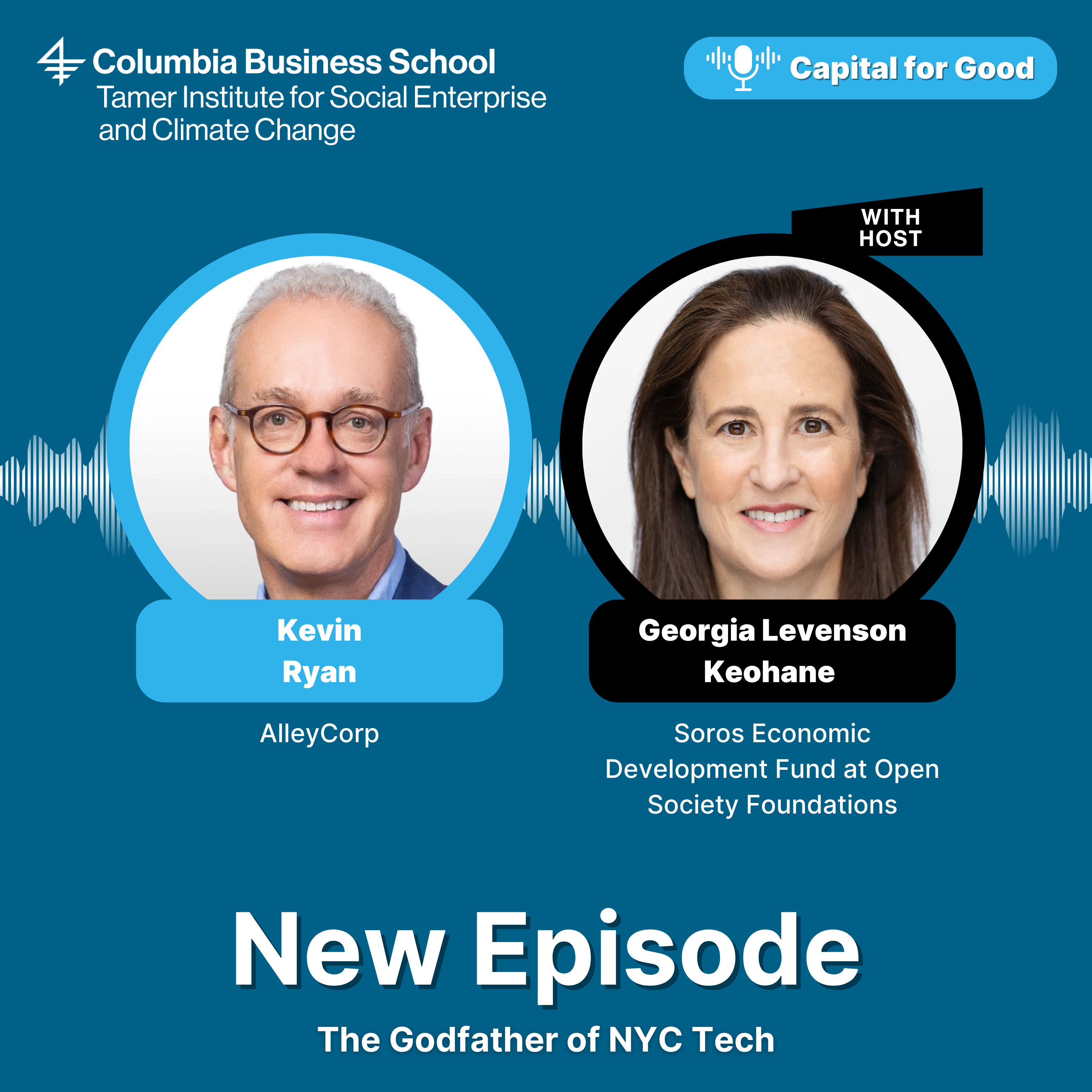
S4 Ep 7Kevin Ryan, the Godfather of NYC Tech
In this episode of Capital for Good we speak with Kevin Ryan, one of New York's leading internet entrepreneurs and investors, and often called the "Godfather of NYC tech." Ryan is a co-founder of MongoDB, Business Insider, Gilt Groupe, Zola, Pearl Health, and Transcend Therapeutics, and every year founds and invests in new companies through AlleyCorp, the New York based venture fund and incubator. Ryan is also one of New York's driving civic leaders, serving as vice chair of the Partnership for New York City, a founding board member of Tech:NYC, and a gubernatorial appointee to numerous commissions focused on New York's economic and civic health and well-being. We begin with Ryan's early and pioneering days as a 1990s internet entrepreneur. As the president of DoubleClick, he grew the company in two years to 2,000 people across 25 countries, took it public, navigated the dotcom bust and sold it to Google in 2007. We discuss AlleyCorp's unusual model as early-stage investor and incubator, and Ryan describes AlleyCorp's most recent investment vertical, economic infrastructure, focused on the economic mobility of low- or middle-income Americans: "the 80% of families who power our economy." This has meant identifying and backing entrepreneurs pursuing innovations in health equity, fintech, and workforce development with companies like Patch Caregiving, a first of its kind employer sponsored emergency childcare provider for frontline workers. We also explore the growth and vibrancy of New York's tech industry. New York City is one of the world's fastest growing and most valuable technology hubs, and Ryan explains how and why it powers the local and regional economy, and measures the city and state can take to continue to foster the ecosystem and its critical contributions to New York's dynamism and social fabric. Thanks for Listening! Subscribe to Capital for Good on Apple, Amazon, Google, Spotify, or wherever you get your podcasts. Drop us a line at [email protected]. Mentioned in this podcast: AlleyCorp Patch Caregiving Partnership for New York City Tech:NYC "Empire AI": New York State AI Consortium

S4 Ep 6Maria Teresa Kumar: We Market Democracy Every Single Day
In this episode of Capital for Good we speak with Maria Teresa Kumar, the nationally celebrated social entrepreneur, civic and political operative, journalist, commentator and co-founder and CEO of Voto Latino, the nation's largest Latino voter registration organization. We begin by discussing some of the formative experiences that shaped Kumar's passion for politics and civic engagement, including her childhood in a bicultural family and community in Northern California, where she learned how to navigate and bridge difference, real and perceived, to find common cause. In these years and environment, shaped in part by Prop 187 and anti-immigrant sentiment and policy, Kumar learned first-hand how young people in Latino and other immigrant households were critical to mobilizing their families and communities — to become citizens and voters — and in the process dramatically shift electoral outcomes to better reflect community needs. In 2004, with the recognition that Latinos were the second largest demographic group in the country, Kumar and Rosario Dawson founded Voto Latino, centering voter mobilization efforts on young people, and using technology and other pop culture and media tools "to market democracy every single day." In the twenty years since, Voto Latino has registered over two million voters and played a central role in flipping a number of swing states in various elections. We cover the 2024 election, and the widely held interpretation that Latino voters' shift to the right contributed to the election of Donald Trump. Kumar notes that while some Latino voters did shift right, many more stayed home in 2024 (38 percent) than in 2020 (27 percent). She believes this reflects broader anxiety and frustration; Latinos, who disproportionately bore the economic toll of the pandemic, and have continued to struggle with persistent affordability challenges and unresolved immigration reform, did not see their needs adequately addressed by either party. Today, Kumar suggests that most Latinos, even those who voted for Trump, believe the President has gone too far, a sentiment reflected in recent survey data from Voto Latino and the Latino Community Foundation. Looking ahead, Kumar argues that it is critical to re-engage voters, and to use "culture at scale" — thoughtful conversations, podcasts, influencers, other creative engagement tools, to address needs and "remind people that when they participate government does work, government can be kind, and it's the will of the people." She also notes that at this moment it is critical for citizens to hold government accountable. "2024 was really painful," Kumar says. "We're feeling what happens when we don't participate. But 2026 is right around the corner… We have the ability to inspire, aspire, and to imagine getting to that more perfect union. And that takes all of us." Thanks for Listening! Subscribe to Capital for Good on Apple, Amazon, Google, Spotify, or wherever you get your podcasts. Drop us a line at [email protected]. Mentioned in this podcast: Voto Latino Survey Data and Report, (Voto Latino and Latino Community Foundation, 2025)

S4 Ep 5Looking to the Horizon With Goldman Sachs Alternatives' Greg Shell
In this episode of Capital for Good we speak with Greg Shell, a seasoned investor, civic leader, and partner at Goldman Sachs Alternatives, where he leads the firm's inclusive growth strategy. Over the course of the conversation, we discuss how Shell's three decades and expertise in investing, and his commitments to creating opportunity and greater economic and social mobility, for many years pursued through board leadership and community and nonprofit engagement, have come together in impact investing, first at Bain Capital, and now at Goldman Sachs Alternatives. Shell explains that he believes deeply in the power of capitalism — the power of the profit model to drive innovation, opportunities for ownership and wealth building, economic growth — and that the current system is failing to deliver broad based economic and social mobility. He notes that stagnant wages, growing income and wealth inequality, and deep and real economic insecurity, are all profound challenges, but ones that must and can be addressed. "Our economy would be bigger and faster growing if more people could participate and contribute fully," Shell says. This is also the thesis of the private equity strategy he leads at Goldman Sachs Alternatives that invests into affordable and high-quality health care, education and workforce development, and financial inclusion. In each vertical, Shell's team identifies companies that focus on remedying exclusion as social and economic challenge and market opportunity, where need drives demand, innovation expands access, and both lead to social impact and strong business fundamentals. We walk through two portfolio examples in education (online literacy intervention) and health care (autism services). Despite the turbulence of the current environment, Shell is optimistic. "Human capital is the first, best and greatest asset we have," he says. "Investing in human capital is always the right decision, and if we do it the right way" can deliver extraordinary returns, on every dimension. Thanks for Listening! Subscribe to Capital for Good on Apple, Amazon, Google, Spotify, or wherever you get your podcasts. Drop us a line at [email protected]. Mentioned in this Episode Goldman Sachs Inclusive Growth
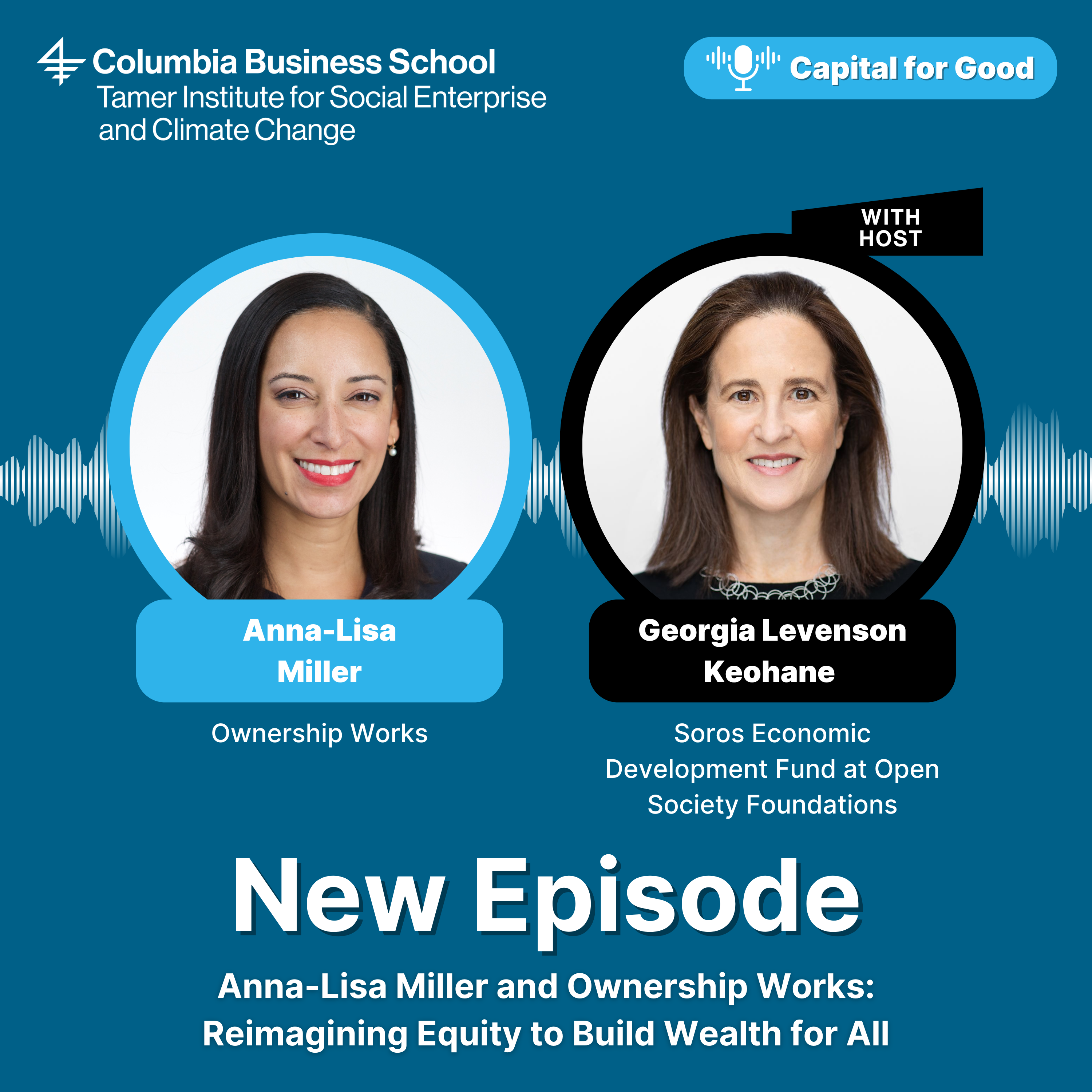
S4 Ep 4Anna-Lisa Miller and Ownership Works: Reimagining Equity to Build Wealth for All
In this episode of Capital for Good we speak with Anna-Lisa Miller, the Executive Director of Ownership Works, and a long time advocate of economic inclusion, empowerment and mobility. Miller started her career in corporate law at Paul, Weiss, Rifkind, Wharton and Garrison, and transitioned to the nonprofit sector – the Kohala Center and Project Equity – to pursue her passion for creating opportunities that uplift workers and families. Today, at Ownership Works, she leads an organization and movement focused on employee ownerships models that "reimagine equity to build wealth for all." In 2024, Miller was named as one of Business Insider's top 10 business leaders spearheading industry-transforming change. In this wide ranging interview, we learn how Miller's commitment to finding pathways to economic opportunity and mobility for workers and families is rooted in her childhood experiences; she moved to the U.S. at a young age and was raised by a single mother who rebuilt her career as a nurse, supporting three children paycheck to paycheck -- and never far from financial insecurity. Trained as a corporate lawyer, Miller moved into the nonprofit sector to test various models of employee ownership and economic mobility before meeting Pete Stavros, who had been successfully experimenting with owner equity in various portfolio companies he oversaw at KKR. Both understood the broader potential of the approach as a way to build employee wealth and improve business performance, and in 2021 formally launched Ownership Works (OW). Today, with 30 employees, nearly 100 partners (including 37 private equity firms, publicly traded companies, professional service firms, institutional investors, labor groups and foundations), and 130 companies across a wide range of industries implementing the model, OW aims to create $30 billion in wealth by 2030 and create proof points that influence how companies across the private sector harness the power of employee engagement and ownership. Miller walks us through various components of the OW model, sharing the example of Charter Next Generation, an Illinois manufacturing company that has used employee ownership to improve substantially employee engagement, retention and company profitability. She hopes that the long-standing bipartisan support for employee ownership as a path to economic inclusion and opportunity serves the movement well in this moment. In the meantime, she and OW are focused on collecting additional data and case studies that demonstrate employee ownership's value and feasibility, to encourage broader adoption and new norms in business. "You hear a lot about win-wins," Miller says. "This truly is." Thanks for Listening! Subscribe to Capital for Good on Apple, Amazon, Google, Spotify, or wherever you get your podcasts. Drop us a line at [email protected]. Mentioned in this podcast: Ownership Works Private Equity Is Starting to Share With Workers, Without Taking a Financial Hit New York Times January 2024 Charter Next Generation: Follow a Real Life Journey to Shared Ownership

S4 Ep 3Tom Steyer: Cheaper, Faster, Better: How We'll Win the Climate War
In this episode of Capital for Good we speak with veteran investor and climate activist Tom Steyer. Over twenty-five years, Steyer founded and ran Farallon Capital Management, a $36 billion multi-strategy global investment firm. In 2012 he stepped away from Farallon to dedicate his time, resources, and energy to mobilizing climate action: clean air and energy initiatives in California; climate focused ballot initiatives in numerous states; youth voter engagement and mobilization (NextGen America); and a 2020 Presidential run largely focused on the climate crisis. Today, Steyer is the co-executive chair of Galvanize Climate Solutions, a climate-focused investment firm, and the author of Cheaper, Faster, Better: How We'll Win the Climate War. We begin the interview by discussing Steyer's parents, both civically engaged members of the Greatest Generation. In his father's case, a lawyer who served in the Navy and then as a prosecutor at Nuremberg. Steyer describes World War II as a crucible moment for Americans — galvanizing collective action and a sense of being part of something larger than oneself. For Steyer, the climate fight is a similar calling. We discuss why, despite current political headwinds, the momentum behind the climate revolution — the transition to net zero via the development and adoption of low carbon technologies — is very much alive, well, and accelerating. In Steyer's view, this is because of the dramatic decline in costs of renewables — solar and wind are now the cheapest forms of energy — and because applied technologies like batteries and electric vehicles continue to improve in quality and cost, driving demand. "This is not eat your gruel," he says. "It's cheaper, faster, better. When you put eight billion people on a problem, they solve it." We also explore promising new technologies coming on-line, from geothermal energy and AI optimization of the electric grid to geosynthetic seawalls. While these new technologies will enable the transition, Steyer notes that "climate capitalism" also requires new rules and policies to speed innovation and deployment; ultimately this means paying for carbon pollution. He argues that despite objections to the idea of a "tax," people are already paying — in the form of destruction to homes, businesses, livelihoods, health — though often it is the most vulnerable, those who have contributed the least to the problem, in the United States and around the world, who bear the cost. We conclude with a call to action. Historically, Steyer reminds us, "we've chosen to do the right things, even when they're hard, and that has always paid off for us, and it will always pay off for us. That is who we are, and that is where this world is going. This revolution is happening. Our job, as Americans, is to be at the forefront." Thanks for Listening! Subscribe to Capital for Good on Apple, Amazon, Google, Spotify, or wherever you get your podcasts. Drop us a line at [email protected]. Mentioned in this podcast: Cheaper, Faster, Better: How We'll Win the Climate War, (Spiegel and Grau, 2024)

S4 Ep 2Michael Posner, Conscience Incorporated: The Role of Business and Investment in Protecting Human Rights
In this episode of Capital for Good we speak with Michael Posner, the Jerome Kohlberg Professor of Ethics and Finance at NYU's Stern School of Business, director of the school's Center for Business and Human Rights, a long-time leader in the field, luminary thinker, advocate, former State Department Official, and the author of the new book, Conscience Incorporated. We begin with Posner's early interests in international human rights issues, sparked in law school when he was tasked with investigating atrocities in Uganda under Idi Amin. He lays out the principals of early, post-World War II and UN inspired human rights law focused on universality, and the responsibility of governments to promote, protect and enforce human rights. Notably absent from this early framework is the role of business. Posner explains that his interest in the intersection of human rights took shape when he began to observe that large multinational corporations had a critical role to play, particularly when they operated in weak states that lacked the ability to protect human rights. We discuss why companies should care, fundamentally, about human rights on ethical dimensions ("outsourcing might be a smart business strategy, but you can't outsource responsibility if you're the main economic beneficiary,") and because there are material costs that can arise from irresponsible practices, often reputational crises and/or regulation. We explore the deficiencies of various business frameworks: how and why Milton Friedman's shareholder primacy worldview fails to account for environmental and social externalities and a broader set of stakeholders; how and why ESG conflate environmental and social considerations and emphasize risk rather than meaningful performance on issues like climate change or worker protections. Posner suggests that this moment of backlash against all things ESG, DEI and "woke capitalism" offers us an opportunity to do better. We touch on sometimes complex tensions between climate change and human rights concerns, acknowledging that climate change can only be solved if we transition to a lower carbon economy, with the scale up of renewable energy and the development of technologies like electric vehicles, which in turn rely on things like batteries. We know that today batteries are reliant on inputs like critical minerals, long mined in ways and places rife with human rights challenges, and today often controlled by Chinese companies. China is also the world's largest and lowest cost producer of solar panels, and much of that production occurs in Xinjiang, with forced labor of the Uyghur ethnic minority. Posner discusses a number of ways to better integrate climate and human rights considerations. Before opening the floor to audience questions, we discuss the evolution of technology and human rights issues. When Posner was at the State Department from 2010 to 2012, he had a front tow seat to the Arab Spring and the "Facebook Revolution," witnessing how activists used social media to fight authoritarianism. Although he says he still believes in the power of technology to open up political discourse, he has become much more concerned about issues of data privacy, surveillance, harmful violent and incendiary content, information and disinformation, and ways in which companies try to shield themselves with first amendment (to which they are not legally subject) to avoid more vigorous content moderation or human rights engagement. We conclude with the role of corporate leaders when it comes to human rights. While Posner notes he is typically conservative about how much executives should speak out on specific issues, he believes strongly that "business leaders need to be attentive and active if there are fundamental threats to our democracy." This episode of Capital for Good was recorded as part of Social Impact Week 2025, a week of social impact-related events for the Columbia Business School community, organized by the Social Enterprise Club, Green Business Club, Community Impact Club, and LEO Impact Fund. Thanks for Listening! Subscribe to Capital for Good on Apple, Amazon, Google, Spotify, or wherever you get your podcasts. Drop us a line at [email protected]. Mentioned in this Episode Conscience Incorporated: Pursue Profits While Protecting Human Rights The Fair Labor Association