Campus Beat
209 episodes — Page 2 of 5
In Conversation with Owen Crawford-Lem, 38th Rector of Queen’s University
In recent Queen’s University news, students elected Owen Crawford-Lem (ArtSci ’23) on March 21st 2022. Following Rector Sam Heimstra’s resignation in March 2021, Crawford-Lem won the contested election to become the University’s 38th Rector. In this segment, we chat with Crawford-Lem about his inspirations to run for the highest student office at Queen’s University and what he expects to accomplish during his 2 year term. He also sheds light on the Tricolour Awards, which we will cover in our next episode when we chat with this year’s winners.
Trace & Two-Eyed Seeing-An Evening of Dance Indigenous Astronomy
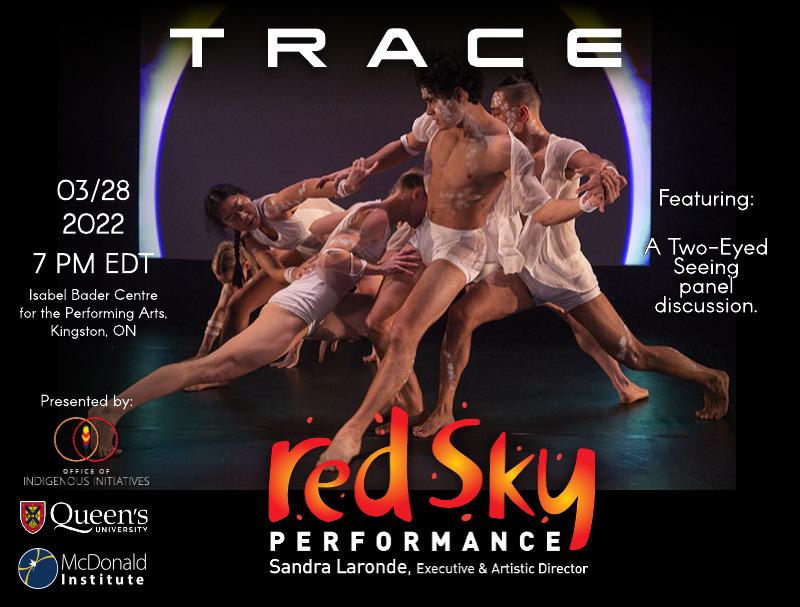
Coming up on March 28th, 2022 the McDonald Institute and Queen’s University Office of Indigenous Initiatives is presenting Red Sky Performance’s Trace, with a Two-Eyed Seeing Astronomers’ discussion to follow at the Isabel Bader Centre for the Performing Arts. Joining us in this episode to talk about this event, its inspirations and the collaborations that are making it happen is Dr. Mark Richardson, Education and Outreach Officer at the Arthur B. McDonald Canadian Astroparticle Physics Research Institute. We are also joined by the western and Indigenous Two-Eyed Seeing Astronomy event speakers, Professor Dave Hanes of Physics, Engineering Physics and Astronomy at Queen’s University and Melanie Demers, instructor of Indigenous Astronomy from Six Nations and raised in Aylmer Quebec. Demers and Hanes discuss the meaning of western and Indigenous astronomy and the contributions that seeing through ‘two (Western & Indigenous) eyes’ can make toward greater understanding of our universe.

Canada Nears Record Low Unemployment Rate…but What of the ‘Guardrails?’
In recent national news, headlines have been focusing on the surge in Canadian employment to 337,000 jobs and the drop in the unemployment rate to 5.5 per cent in February, close to the record low of 5.4 per cent in May 2019. Many key labour market indicators — employment, employment-to-population ratio, and hours worked — have returned to their pre-pandemic levels. However, despite these labour market indicators, monetary and fiscal policy are still piling on stimulus. The federal government said it would use labour market “guardrails” to determine when and how quickly to withdraw the extraordinary fiscal stimulus in place since the onset of the pandemic. The government, however, has remained vague as to how the guardrails were to be defined. In this segment, we’re chatting with Don Drummond, Stauffer Dunning Fellow and Adjunct Professor in Policy studies about nearly record-low unemployment rates in Canada and how the labour market has crashed into the federal government’s guardrails.
Queen’s Receives New Residency and Medical School Spots in Provincial Announcment
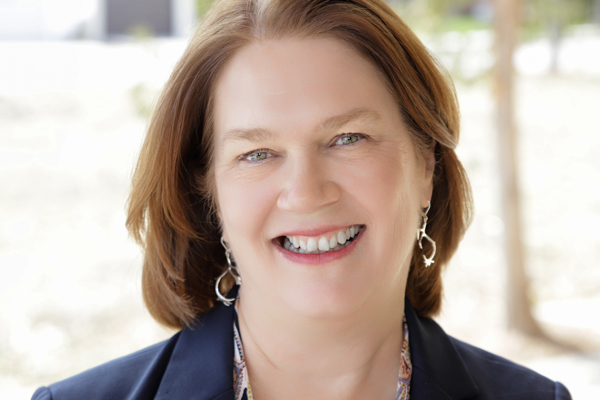
On Tuesday March 15th, the Government of Ontario announced that it is boosting the number of medical school and residency spots over the next five years, in an effort to increase doctor numbers. Included in this announcement is that Queen’s University will receive 20 undergraduate seats and 30 postgraduate positions. With us in this segment to chat about this announcement and the advantages for medical studies at Queen’s and the Kingston community is Dr Jane Philpott, Dean of the Faculty of Health Sciences here at Queen’s.

UNESCO Sites in Ukraine under Threat
The Russian invasion of Ukraine has had many humanitarian, geopolitical and international strategic impacts, some of which we discussed in a special roundtable last week on our program. Russia’s invasion has also put many historic structures, monuments, and UNESCO World Heritage Sites in danger of destruction. These artifacts represent irreplaceable cultural history and architectural heritage, with many dating back to the Middle Ages. Joining us to discuss cultural monuments in Ukraine, especially in the UNESCO cities of Kyiv and Lviv is Dr. Gauvin Baily, an expert in Ukrainian Baroque architecture from the Department of Art History and Art Conservation. Welcome Gauvin. He discusses UNESCO World Heritage Sites generally, those located in Kyiv and Lviv, and what has happened elsewhere when such monuments are damaged or destroyed. Photo: Saint-Sophia Cathedral, Kyiv, Ukraine courtesy of UNESCO
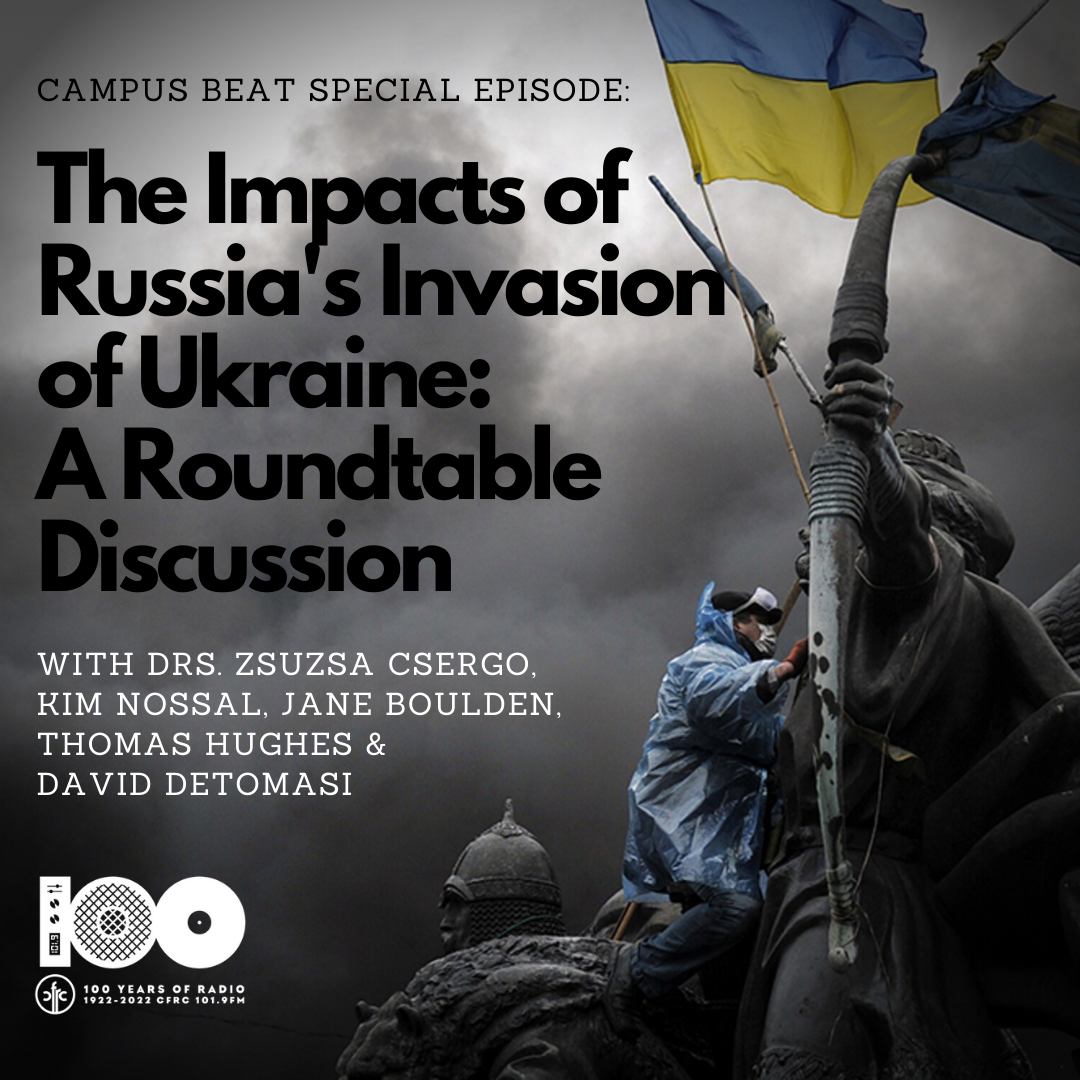
The Impacts of Russia’s Invasion of Ukraine: A Roundtable Discussion
In this special extended episode of Campus Beat airing weekly on CFRC 101.9 FM at Queen’s University, we welcome five esteemed Queen’s University scholars in a roundtable discussion about the impact of Russia’s invasion on Ukraine, Russia itself and the West. With us in this episode are Drs. Jane Boulden, Zsuzsa Csergo, Thomas Hughes and Kim Nossal of Political Studies and Dr. David Detomasi of the Smith School of Business. In this roundtable discussion, our guests explore the question of the Russian invasion’s broad impacts thru a variety of lenses including international law, regional stability, foreign policy and trade, NATO strategy and more. In particular, they discuss the following questions: How is this war justified by the Russian state but also unjustified from the perspectives of the international community let alone international law? What is the current military situation in Ukraine and the impact on civilian people, governance, trade and infrastructure? What has NATO’s strategy been toward Russia and Ukraine and how has it evolved since the invasion? What are some of the implications for regional stability especially with the mass movement of people? Do international sanctions go far enough? What are the intended goals and potentially unforeseen consequences? Can sanctions be enforced in such a way as to ensure success in this scenario? Can Russia survive sanctions? What has Canada’s position been toward the war and how has this war modified its trade or defence policies?
Mayor’s Innovation Challenge: This Year’s Winners
On Friday March 4th 2022, students from across the city participated in the Fifth Annual Mayor’s Innovation Challenge Pitch Competition. In its goal to make Kingston smart, livable, and leading, the City of Kingston challenged students to present innovative ideas that will guide the city to its goal of making Kingston a better place to live, work, and play. The hope is to identify and ultimately retain these talented students to make a positive impact in their careers and Kingston. In this episode we first chat with Kingston Mayor Bryan Paterson about the pitch competition and internships inception and goals. We also speak with each of the winners in each of the competition’s two streams. In our second segment following our chat with Mayor Paterson, we learn about the pitch and project Salvador Lara Rodriguez and Sean McKnight of St. Lawrence College will bring with them through the Dunin-Deshpande Smart Kingston Stream this year. In our third segment, we also chat with Ethan Fung and Kieran D’Mello (ComSoc ’22) about their Public Sector Innovation Stream pitch. Dunin-Deshpande stream winners will have the opportunity to participate in a four-month incubator program with the Dunin-Deshpande Queen’s Innovation Centre. The winning pitch also earns a $7,000 stipend for up to three co-founders as well as seed capital, as much as $4,000, to develop the winning concept. They will also gain full participation in the Queen’s Innovation Centre Summer Initiative (QICSI 2022) program, which includes the chance to pitch in August for a grand prize of $30,000. The Public Sector Innovation Stream receives a four-month paid internship within one of the City of Kingston’s municipal departments. City staff will also provide the individual or team with resources and mentorship opportunities. An additional perk to winning the Public Sector stream is the exposure to ongoing City of Kingston projects and the chance to gain government experience. For more information about the Mayor’s Fifth Annual Innovation Challenge Pitch, visit the Mayor’s Innovation Challenge website.
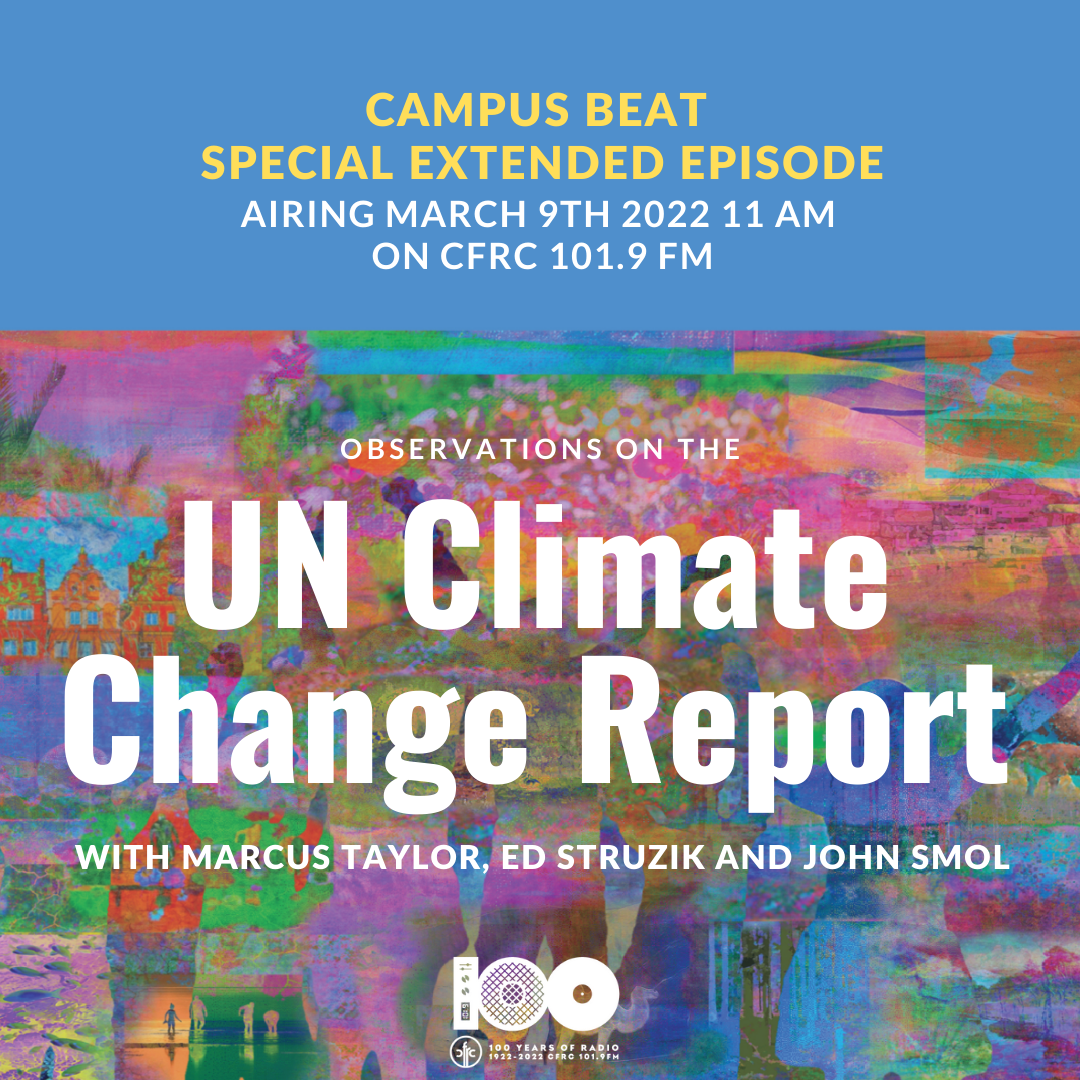
Observations: UN Climate Change Report
On February 28th, the UN Intergovermental Panel on Climate Change, the IPCC – a United Nations body tasked with educating global policy-makers through regular assessments of the climate situation worldwide – released its most recent report on climate change. And the results appear grim as the report projects rising sea levels in addition to drought, heat, hunger and higher intensity disasters causing dangerous and widespread disruption for the natural world as well as the billions of people inhabiting the planet. With its focus on how climate change is impacting humans and the natural world, the IPCC report calls for immediate, drastic action—including the need to protect over a third of the planet to ensure food and fresh water for future generations and to ultimately prevent the worst-case scenarios through nothing less than transformational change on a global scale. In this special extended Campus Beat episode, we’re chatting with several Queen’ University scholars about the latest UN climate change report. In our first segment, we sit down with with Prof. Marcus Taylor – Head of the Department of Global Development Studies and also a contributing author to the IPCC’s Sixth Assessment Report – about the report and his work wihin related to the issue of climate change maladaptation. Our second segment begins around the 29 minute mark. There, we are joined by Ed Struzik, Fellow at the Queen’s Institute for Energy and Environmental Policy in the School of Policy Studies and also the 2022 Jarislowsky Fellow at the University of Waterloo. He chats with us about the UN’s IPCC climate change report findings related to wildfires, a phenomenon identified as a top threat to Canada. Distinguished University Professor, Dr. John Smol from the Department of Biology joins us in our third segment around the 36 minute mark. He chats with us about ecological and environmental issues covered in the report related to flooding and water quality in addition to broader thoughts on the historical ‘snooze button’ set by policy-makers on the climate action clock.

Impacts of Road De-Icing on Freshwater Lakes
On Tuesday February 22nd, Queen’s University announced the completion of an international study conducted in partnership with the University of Toledo that confirmed that current water quality guidelines do not go far enough to address the ecological impact of road de-icing salts, agricultural fertilizers, mining operations and climate change on the salinity of freshwater ecosystems. With us in this episode to talk about this new research is Dr. Shelley Arnott, Professor of aquatic ecology in the Department of Biology and co-leader on the project and paper.
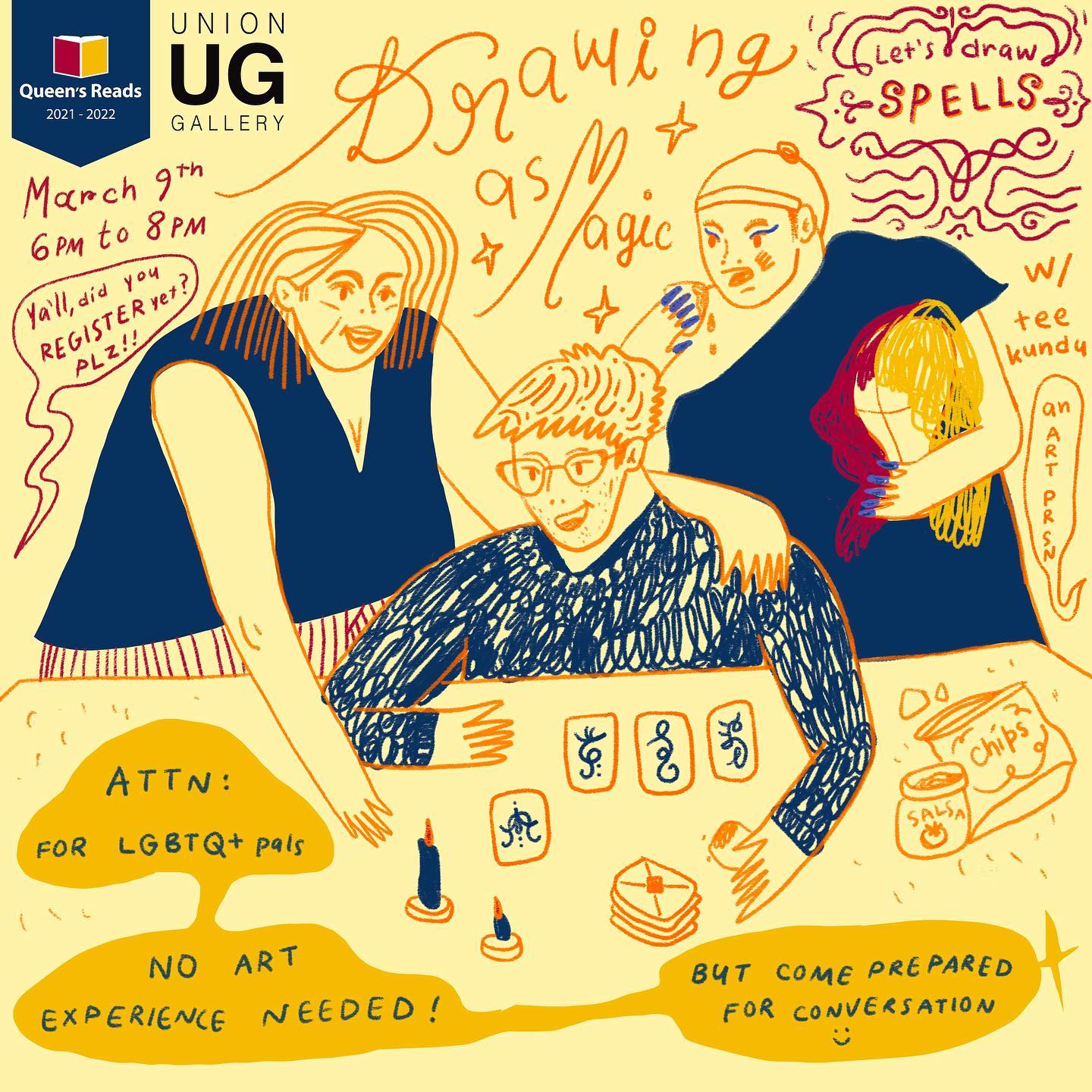
Drawing as Magic with Union Gallery
Coming up on March 9th, Union Gallery is hosting a free and virtual drawing event called Drawing as Magic. The event incorporates the use of sensory experiences, movement and personal histories to think about the kinds of things we’d like to manifest in the world for ourselves, others and the communities in which we all move. With us to chat in this segment to chat about about this super fun and totally free program run by Union Gallery is Abby Nowakowski, Administrative and Communications Coordinator for the Union Gallery.
A New Algorithm and Master’s Level IPAC Program
On February 16th, Queen’s University announced that some of its researchers have developed a new algorithm to identify pulmonary hypertension from available Ontario healthcare data, an algorithm that is the first of its kind in Canada. Pulmonary hypertension is an often under-recognized chronic disease that involves a congestion of blood supply in the lungs and heart, and is associated with other life-threatening diseases like heart failure. We welcome Dr. Don Thiwanka Wijeratna from the Department of Medicine here at Queen’s University to discuss the new algorithm, its development and impact in the first segment. In the second segment (20:27) we’re discussing the introduction of a Canada’s first Master’s level training program in Infection prevention and Control here at Queen’s University in partnership with IPAC Canada. We chat with Dr. Bradley Stoner, Professor in the Department of Medicine and Head of the Department of Public Health Sciences alongside Gerry Hansen, Executive Director of IPAC Canada about the new program and the demand for trained infection prevention and control professionals.
Cause and Effect & Cezanne’s Closet 2022
In this two part episode, we welcome folks from the Alumni Review and Union Gallery at Queen’s University. In the first segment, Deborah Melman-Clement, Senior Development Writer , Marketing, Communications, and Donor Relations in the Office of Advancement at Queen’s University joins us. She chats Alumni Review’s new podcast, Cause and Effect, a new series exploring Queen’s philanthropists’ motivations and passions in addition to the broad influence they have worldwide. Check out the podcast here! In our second segment, we’re chatting about the Union Gallery’s Cezanne’s Closet Gala coming virtually on February 19th with Abby Nowakowki, UG’s Administrative & Communications Coordinator alongside Cezanne’s 2022 Co-Curators, Maggie Whitmore and Katie Heatherington, both current Master’s Candidates in the Art History Program. Lot’s to learn about this perennially popular gala fundraiser and its goals! More info and tickets available on UG’s website.

Olympic Implications
The Olympics is a time when teamwork is put to the ultimate test in events like hockey, skiing, and snowboarding. This month, eyes from around the world will be on Beijing—and not just because of the sporting events. The 2022 Winter Olympics brings questions around surveillance, with reports that the app that athletes are expected to download to their phones could in fact be monitoring them. There has been speculation around whether Russia will invade Ukraine during the Games or hold off for political reasons. As well, this is the first Winter Olympics with 100 per cent artificial snow, which leads to the larger discussion of climate change and the future of winter sports. With the Beijing Winter Olympics underway as of February 4th, in this episode we chat with three scholars about the Olympics beyond the spectacle of sport. In our first segment, we sit down with with Dr. David Murakami-Wood, Director of the Surveillance Studies Centre about the surveillance implications arising from the my2022 app used by all attendees at this year’s Olympics. Then we discuss the use of artificial snow at this year’s games and what the usage suggests about climate change and the future of winter sport with Distinguished Professor John Smol from the Department of Biology. In our last segment, we discuss Russia’s relations with China and how the Olympics might determine the former’s strategy at Ukraine’s borders with Dr. Thomas Hughes, a recent graduate from the Department of Political Studies.
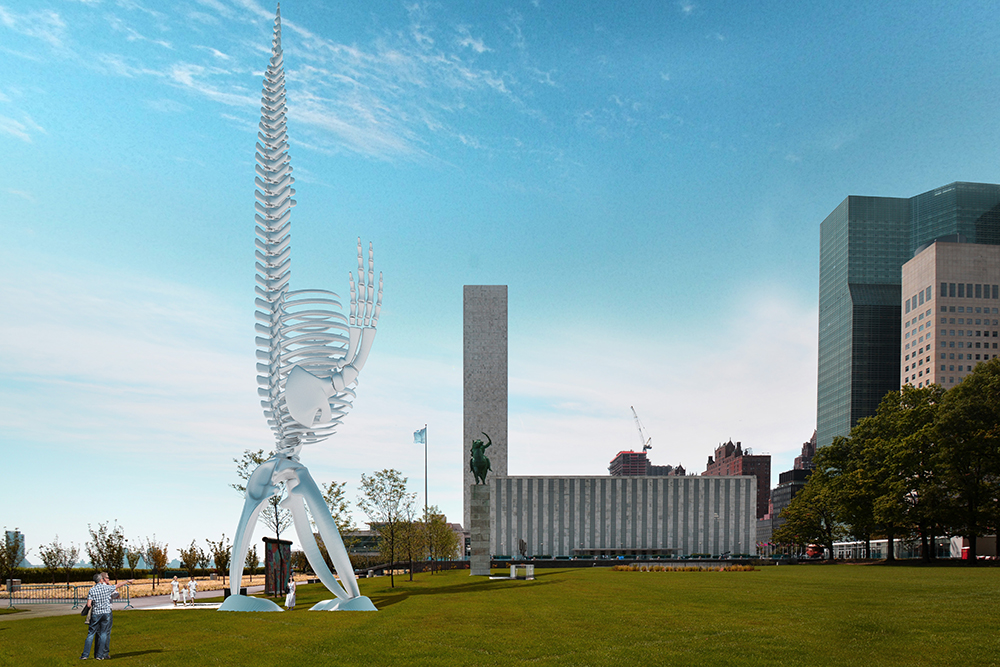
Standing Whale: Edward Burtynsky’s Collaborations with Queen’s
Welcome back to another great edition of Campus Beat! On January 18th 2022, Queen’s University announced a new creative partnership with world-renowned Canadian photographer, and Queen’s Honorary Doctorate recipient (2007), Edward Burtynsky to help realize his new public art piece titled Standing Whale. The partnership will engage the expertise and innovative thinking of students in multiple programs across the Faculties of Engineering and Applied Science, and the Faculty of Arts and Science here at Queen’s. As part of the 2021-22 curriculum, special projects in these programs will be designed to tackle structural and conceptual challenges with the aim of bringing this artwork to life in a public setting. World-renowned photographer Dr. Edward Burtynsky and Dr. Kevin Deluzio, Dean of the Faculty of Engineering and Applied Science join us in this episode to discuss this exciting new project. Burtynsky sheds light on his inspirations and vision for the project, the expansion of his artistic practice into the third dimension, and the collaborative opportunities this project lends. Deluzio expands on the collaborations for FEAS and FAS faculty and students, including compelling opportunities to problem-solve and apply applied science to artistic craft.
QFLIP Conference & USSRF Opportunities
This episode features two exciting segments. First, we chat with undergraduate student leaders, Tess Shields and Caroline Leclerc of the Delegates Team for Queen’s Female Leadership in Politics. Shields and LeClerc talk about the upcoming Evolve 2022 Conference that QFLIP is running virtually on February 5th and 6th, the work QFLIP engages in, the fun and skills-building Case Challenge that will accompany the conference proceedings and of course, how people can register and learn more for the conference itself. Visit QFLIP online to learn more! In the next segment, we chat with two more undergraduate students, Zoe Mack and Aidan Gurung, both of whom participated in the Undergraduate Student Summer Research Fellowships (USSRF) program. From Mack and Gurung, we learn more about their inspirations to apply, how they did so, the research they conducted, the skills they gained and also what they hope they will do to mobilize their learning moving forward. New applications for the USSRF program are open with a deadline of Tuesday March 1st. In this year’s program, 19 fellowships of $6000 are available on campus between May and August and 2 fellowships of $5000 are available at the Bader International Study Centre at Herstmonceux Castle from May through July. The Fellowships provide experiential learning opportunities for continuing undergraduate students enrolled in a bachelor’s degree program at Queen’s University to participate in social sciences, humanities and/or creative arts research under the supervision of a Queen’s faculty member. Further, the fellowship program is intended to provide students with meaningful opportunities to engage in discovery-based learning and to develop their research and presentation skills. More information about USSRF and application guidelines are available on the Queen’s University Vice Principal Research Portfolio website here.
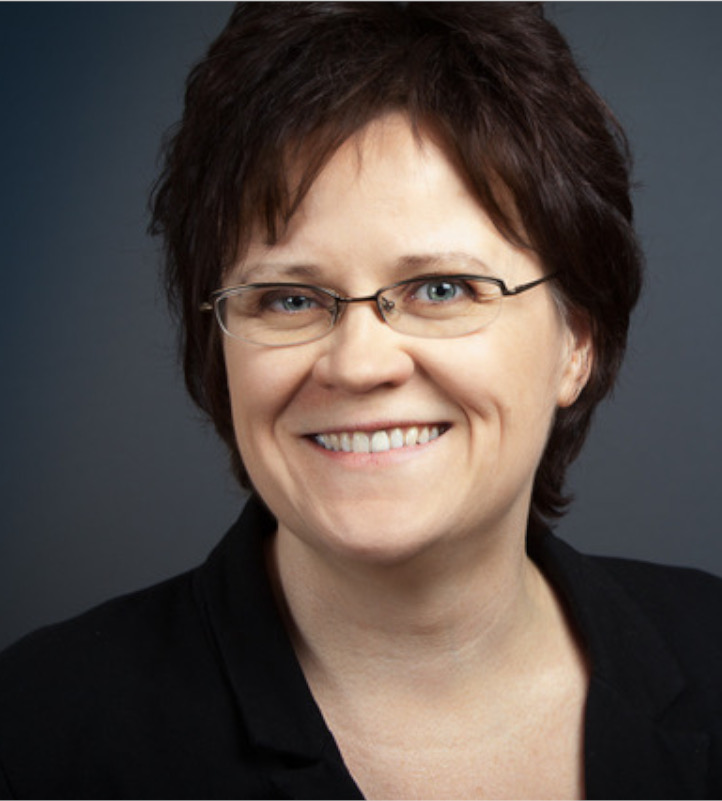
New Frontiers in Metals Protection: In Conversation with Dr. Cathleen Crudden
On January 12th 2022, Queen’s University announced that the federal government has committed $24 million through the New Frontiers in Research Funding Transformation Stream to Queen’s University-led research poised to extend the lifespan of metals using unique molecular coatings that could save billions of dollars on maintenance across a number of sectors, including aerospace, automotive, cancer therapy, consumer electronics and infrastructure. The work could position Canada at the forefront of the barrier coatings industry, which has a national economic impact of $31 billion per year, and currently employs 211,000 people across the country. In this episode, we are joined by Dr. Cathleen Crudden, Organic, Organometallic and Materials Professor in the Department of Chemistry at Queen’s University, Canada Research Chair in Metal Organic Chemistry and the lead researcher on this New Frontiers project. From Dr. Crudden, we learn more about the problems and potential solutions she and her team have identified in preserving the longevity of metals, the importance of cross-disciplinary collaboration in undertaking research on this project, and the anticipated impacts for both industry and the research field.
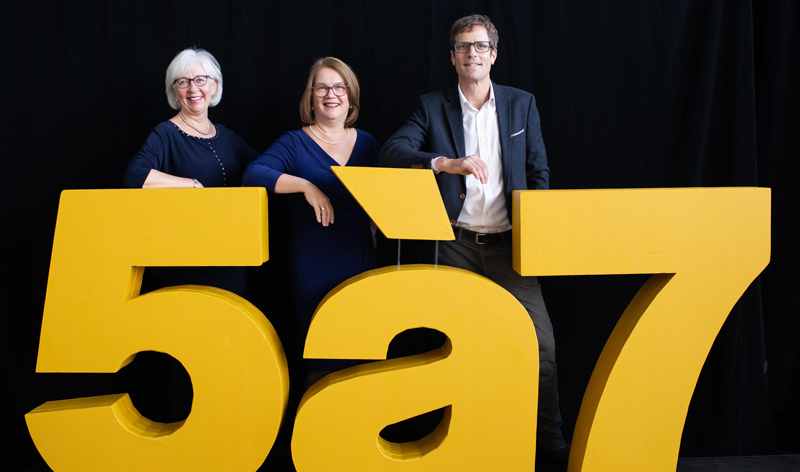
Cinq à Sept at Queen’s: In Conversation with Drs. Mary Ann McColl & Chris Booth
(Pictured: Dr. Mary Ann McColl, Dean Jane Philpott and, Dr. Christopher Booth)* Earlier this fall, the Faculty of Health Sciences (FHS) at Queen’s University launched Dean Jane Philpott’s Cinq à Sept Research Talks. The monthly series, which will showcase innovations in health research at Queen’s, is like nothing FHS has hosted before and is modeled on the French tradition of gathering at the end of the workday. In this episode, we chat with Dr. Mary Ann McColl, Professor in the School of Rehabilitation Therapy and Associate Director, Health Services Research and Policy Institute followed by a chat with Dr. Chris Booth, Professor in the Departments of Oncology and Public Health Sciences and Canada Research Chair in Population Cancer Care. Our discussions focus on themes arising from their respective talks entitled “The Ten Stories: Intergenerational Conversations” and “The Emperor Has No clothes: Finding our Way again in Cancer Care,” that were delivered at the inaugural Cinq à Sept Research Talks event on October 27th 2021. *photo courtesy of the Faculty of Health Sciences.
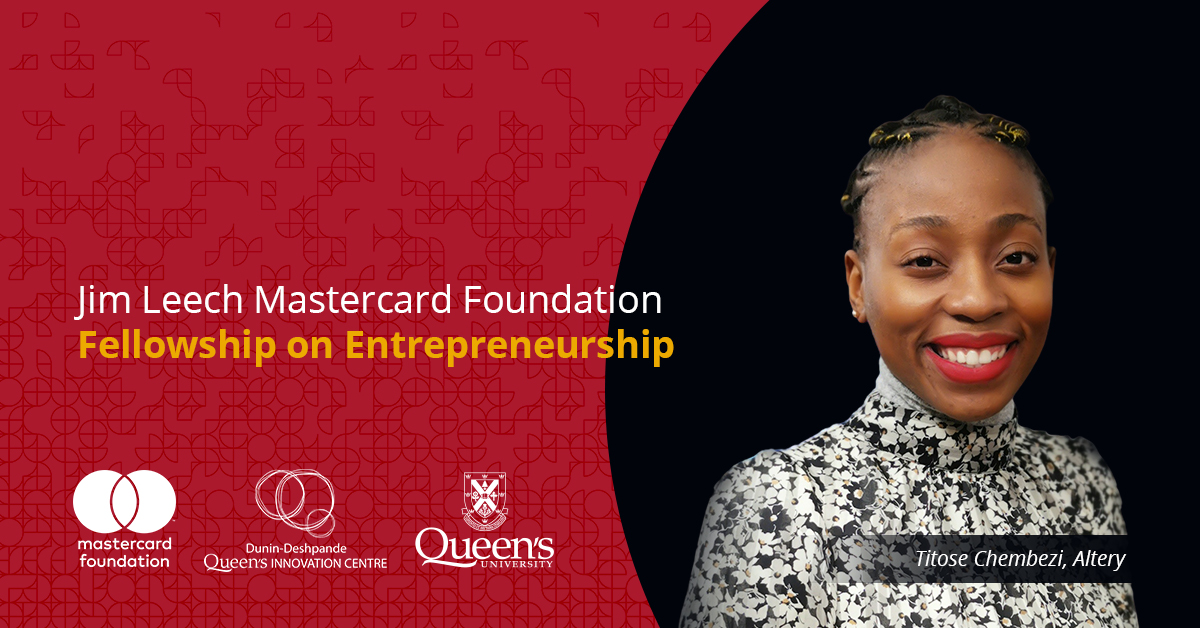
Supporting Entrepreneurship in Africa
On December 3rd, The Mastercard Foundation and the Dunin-Deshpande Queen’s Innovation Centre (DDQIC) have announced a partnership offering free virtual entrepreneurship training, and an opportunity to receive startup funding to more than 1,000 students through the Jim Leech Mastercard Foundation Fellowship on Entrepreneurship for African Students at Queen’s University. The program launched in September 2020. It provides students and recent graduates from African universities within the Mastercard Foundation Scholars Program with the opportunity to apply to a free virtual entrepreneurship training program delivered by Queen’s University’s DDQIC Program. Through this program, award-winning faculty and some of the best innovators, policymakers, and business strategists collaborate to support students to become Jim Leech Mastercard Foundation Fellows. During the 2020-2021 Academic year, 1,252 students participated, and more than 60 percent of the cohort were women, recognizing the additional barriers women face when starting a business or seeking employment in Africa. Prospective fellows receive access to a curated list of online entrepreneurship courses developed at DDQIC and work through the Disciplined Entrepreneurship Framework developed at the Massachusetts Institute of Technology. The fellowship is designed to address unemployment among post-secondary graduates by equipping thousands of students and recent graduates with sufficient entrepreneurial training to initiate and continue to grow their businesses. In this episode, we have the pleasure of chatting first with Titose Chembezi at the University of Cape Town in South Africa. She was the $5000 prize at the Dunin-Deshpande Queen’s Innovation Centre DDQIC Summer Pitch Competition and said the pitch experience provided her with a boost of confidence. Following our chat with Chembezi, we sit down again with Jim Leech, member of the Order of Canada, former Chair of the Board of Directors of the Mastercard Foundation and, of course, Chancellor Emeritus of Queen’s University about the Jim Leech Mastercard Foundation Fellowship on Entrepreneurship for African Students. The applications for the upcoming academic year close on Dec. 10, 2021. Learn more about the Jim Leech Mastercard Foundation Fellowship and complete your application today. For application inquiries, please contact: Dunin-Deshpande Queen’s Innovation Centre Megan Sieroka Program Coordinator at the Jim Leech Mastercard Foundation Fellowship on Entrepreneurship for African Students [email protected]
In Focus: Top 40 under 40 and Rhodes Scholarship Recipients
In this episode, we have two guests-Dr. Teresa Purzner and Jane Hutchings. On November 25th, Queen’s University announced that one of it’s neurosurgeons, Dr. Teresa Purzner has been named one of Canada’s top 40 under 40, an annual leadership award that recognizes exceptional achievement by 40 outstanding Canadians who are under 40 years of age. Dr. Purzner joins us to chat about her research achievements and teaching with Department of Neurosurgery and as an attending physician at the Kingston Health Sciences Centre in addition to her co-founding of the baby food brand, Cerebelly. Then Jane Hutchings joins us. Hutchings, a recent graduate from the Commerce program at Queen’s University’s Smith School of Business, has been selected as a 2022 Rhodes Scholar, earning this prestigious scholarship to the University of Oxford worth more than $100,000 that covers postgraduate study costs including tuition, fees and living expenses. She chats about her many leadership initiatives as a Queen’s student and how she’ll build on these at Oxford during her Master’s studies.

Mapping the Universe and Mudslides
In this episode we are joined by two guests. First, Dr. Mark Richardson, Education and Outreach Officer at the Arthur B. McDonald Canadian Astroparticle Physics Research Institute and then around the 20 minute mark, Lisa Tauskela, Masters Candidate in Civil Engineering. Dr. Richardson talks about the upcoming George and Maureen Ewan lecture to be delivered by Dr. Juna Kollmeier on November 29th at the McDonald Institute, shedding light on how the Sloan Digital Sky Survey and its use of spectra reveals much information that helps map and decode the history of the cosmos. Tauskela then joins us to chat about the recent spate of mudslides caused by record-breaking rainfall and highwinds in the lower southcoast mainland area of British Columbia. She discusses her own research triggering mudslides at the Queen’s coastal engineering lab near Richardson stadium and how such research can help determine pathways land and mudslides can take.
The Legacy of Bader Philanthropy at Queen’s
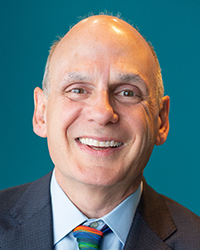
In this episode of Campus Beat, we welcome Dan Bader, President and CEO of Bader Philanthropies Inc. On the occasion of celebrating the newly proclaimed Bader Day on November 15th, Dan talks about his father, Dr. Alfred Bader’s, extraordinary journey to Queen’s University where he began his studies on November 15th, 1941. Dan also shares much about the many years and many extraordinary gifts including Herstmonceux Castle, home of the Bader International Study Centre in the UK, their $31 million gift to support the construction of the world class Isabel Bader Centre for the Performing Arts, their $40 million (USD) lead gift in support of Agnes Reimagined, in addition to gifting more than 500 paintings and works on paper to the Agnes Etherington Art Centre. We also learn more about Bader Day celebrations Dan took part in and the Bader family’s most recent gifts to Queen’s including 12 17th century Dutch paintings to Agnes Etherington Art Centre; Nine Leica S9i microscopes to help students in the Queen’s Art Conservation program examine and treat cultural artifacts; and funding that will allow for the creation of a new Outdoor Gathering Space modelled after an Ojibway round house and the endowment of a new full-time, permanent Curator, Indigenous Arts and Culture at Agnes. Tune in, learn more about what drives the Bader family’s continued legacy of philanthropy at Queen’s and enjoy!
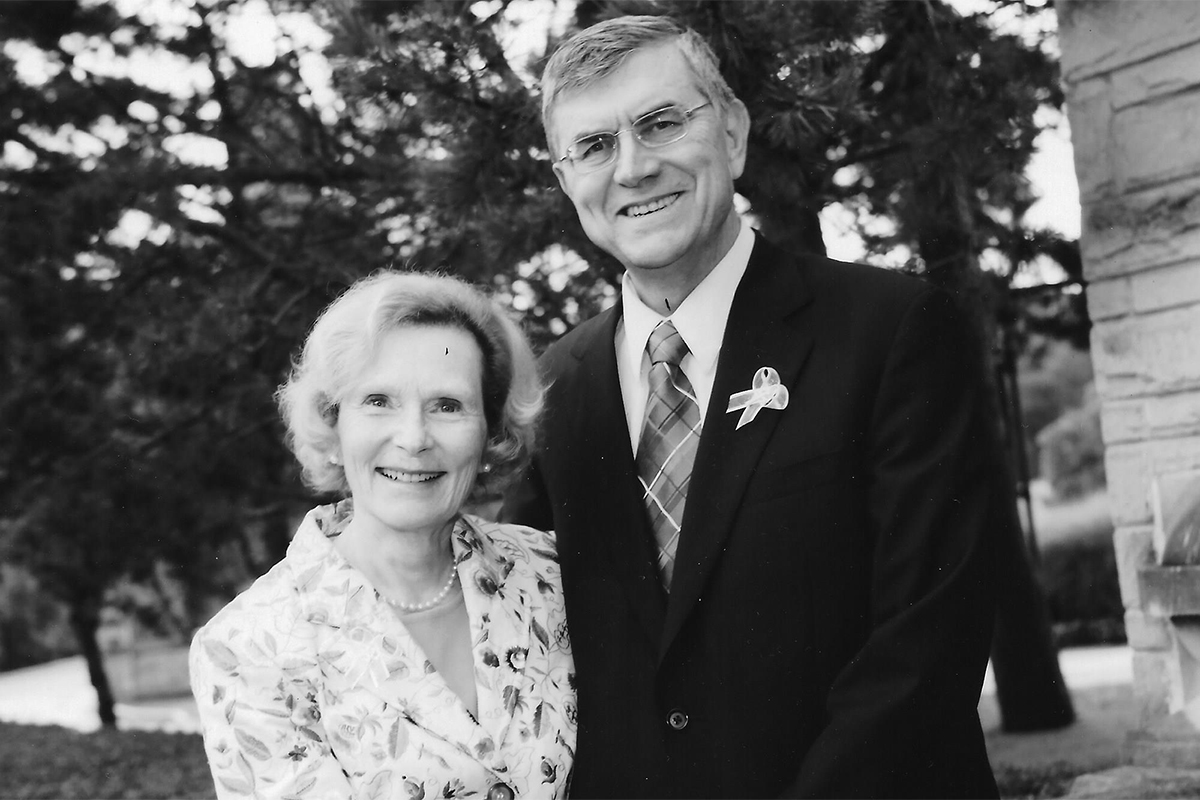
The Lovelands on Supporting Indigenous Academics
On October 21st 2021, Queen’s University announced a $1 million gift for Indigenous Academics in STEM, that is Science, Technology, Engineering and math based undergraduate degree programs through the Faculty of Engineering and Applied Science at Queen’s. This generous gift was endowed by Queen’s alumnus Norman Loveland and his wife Gay Loveland and builds on the success of the Aboriginal Access to Engineering program that their endowed gift continues to support. The Lovelands join us in this episode to chat about their inspirations to support STEM students at Queen’s generally and Indigenous students in particular and shed light on the need to build a stronger Indigenous STEM community in addition to the impact they hope their endowment will have.

Advancing COVID-19 Related Research in Law and Science
In this episode of Campus Beat we feature two conversations with Queen’s faculty researchers. In the first segment, we chat with Dr. Samuel Dahan from the Faculty of Law and Director of the Conflict Analytics Lab about his lab’s new Vaccine Mediator – a new COVID-19 vaccine online dispute resolution tool – and its development and implementation conducted in collaboration with researchers at Oxford University, University College Dublin, and the British Institute of International and Comparative Law. Vaccine Mediator is an innovative third-party system that enables individuals to register potential side-effects and receive fast and reliable information about available compensation options. Leveraging an AI-powered legal aid platform, it pre-assesses compensation eligibility, provides a customized report and an easy to understand guide to help individuals submit a pre-drafted claim to the relevant government agency. In the next segment around the 14:24 mark, we are joined by Dr. Maha Othman from the Department of Biomedical and Molecular Science. Dr. Othman’s groundbreaking 2007 research on blood clots and adenovirus has recently been cited in numerous scholarly articles on vaccine-induced immune thrombotic thrombocytopenia (VITT) is an extremely rare side effect that happens in a subset of the population following AstraZeneca and Johnson and Johnson COVID-19 vaccinations. From Othman, we learn about the research, its current applications in theory and scientific practice.
Laurels and Accolades for a New Student and a New Royal Society Fellow
On Tuesday September 7th, Queen’s University announced that four of its researchers have been elected to the Royal Society of Canada, one of the highest academic honours for Canadian scholars in arts, humanities and sciences. Professor emeritus John Berry has received the honour of Fellowship, while professors Heather Castleden, Karen Lawford, and Sari van Anders have been elected to the College of New Scholars, Scientists and Artists. This diverse group has research specialties ranging from Indigenous health policy, cross-cultural psychology, and gender/sex research to community and participatory-based research with Indigenous communities. In the first portion of this episode, we chat with Professor John Berry about his lengthy and distinguished research and his election to the Royal Society as a Fellow. After that, we chat with Haley Galsworthy, a new Queen’s student and recipient of the prestigious Schulich Leaders’ Scholarship. The Schulich Leader Scholarships, worth up to $100,000, were launched in 2012 by Canadian businessman and philanthropist Seymour Schulich to help identify the next generation of Canada’s brightest potential leaders in STEM.
Decades of Distinguished Service at Queen’s
In this extended episode of Campus Beat (broadcasting October 25th 2021 on cfrc 101.9 fm/cfrc.ca), we chat with four Queen’s University Distinguished Service Award recipients from 2020 and 2021. Inaugurated by the University Council Executive Committee in 1974, the Distinguished Service Award recognizes individuals who have made the university a better place through their exemplary service and extraordinary contributions. The University Council was established by statute in 1874. It is one of the three governing bodies of the Queen’s University and all elective members are elected by and from Queen’s alumni. The University Council serves as both an advisory and an ambassadorial body to the university as a whole and is responsible for the election of the Chancellor. In our conversations here, we chat with Jacquie Brown: Long-serving Program Assistant (Department of Mechanical and Materials Engineering), committed to compassionate and tailored student support, safety on campus and continuous training resulting in widespread positive impact on the lives of students, faculty, and staff. Jan Allen: Queen’s alumna, Director of the Agnes Etherington Art Centre, augmented the Centre’s exhibitions, publications and acquisitions while promoting collaborative curatorial and research work, nationally recognized curator and arts leader. (Beginning at 12 minute mark) Lucinda Walls Public Services Librarian, expert in art and music reference materials, educator on information literacy and invaluable resource to students and faculty within Art History, Fine Arts, Music, and Drama, with profound impact across the Queen’s community. (Beginning around 23 minute mark) Richard Reznick: Former Dean (Faculty of Health Sciences), Director (School of Medicine), and CEO (Southeastern Ontario Academic Medical Organization), pioneer of innovative educational programs, internationally renowned medical education expert, and leader of transformative change. (Beginning around the 37 minute Mark)
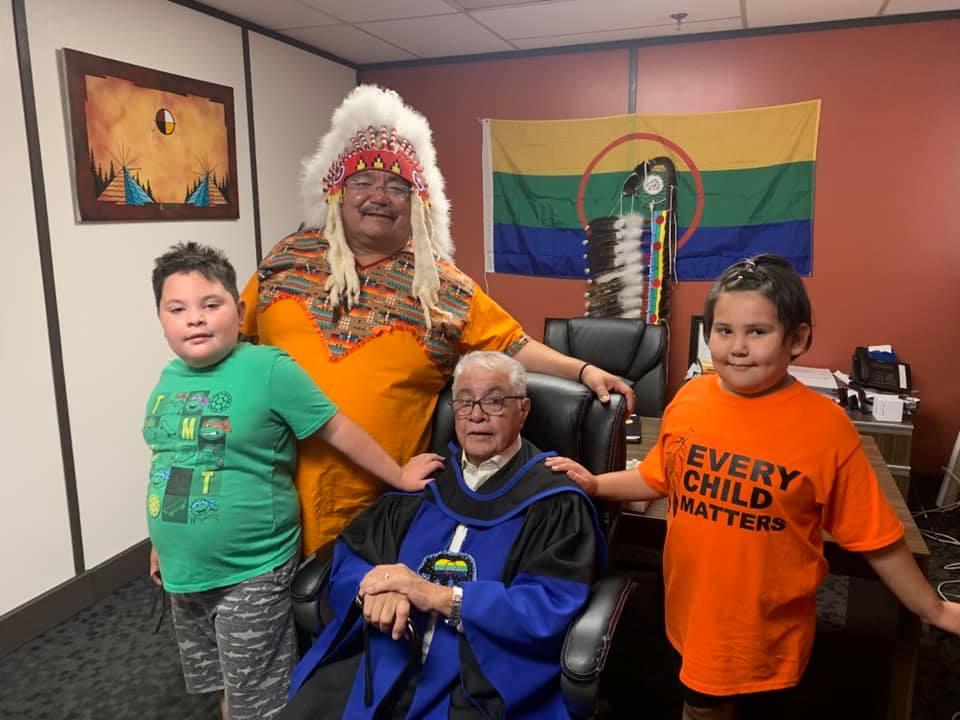
Dr. Raymond Mason in Conversation
In this very special episode of Campus Beat, we are joined by Dr. Raymond Mason, Ojibway activist, Elder member of the Peguis First Nation in Manitoba, and founder and Chairperson of Spirit Wind Inc. which organizes residential and Indian Day school survivors in Manitoba and also played a key role in the development of the Indian Residential School Settlement Agreement. Listeners are advised that this podcast contains triggering content related to residential schools, day schools, Indigenous childhood trauma and abuse. We also share audio furnished to us by the Queen’s University Secretariat covering the ceremony at which Dr. Mason was awarded an Honorary Doctorate in Law on October 5th 2021 recognizing his work in fighting for the rights of residential school survivors. Doctor Mason, a residential and Indian Day school survivor has also published a riveting memoir, Spirit of the Grassroots People: Seeking Justice for Indigenous Survivors of Canada’s Colonial Education System available through McGill-Queen’s University Press. In his conversation, Dr. Mason also revealed that he has been diagnosed with a terminal illness for which treatment is unavailable to him in Canada due to his age while treatment in the United States is prohibitively expensive. A fundraising campaign has been initiated to help Dr. Mason raise funds for treatment. We have added the link to this fundraiser with Dr. Mason’s permission. To get in touch with Dr. Mason about Spirit Wind Inc. and its ongoing work, please visit his facebook page. Photo from Dr. Mason’s facebook page.

Starts with Youth and the Pathy Fellowship
In this epsiode, we are joined by Prishni Seyone, ArtSci ’21 and founder of the new Starts with Youth Initiative with the Pathy Foundation Fellowship program. Jessica Franko, Program Assistant for Pathy also joins us. Seyone talks about herself, how her project germinated while a student at Queen’s University, what her innovative project’s mission is and where it will go from here. Franko fills student listeners in on upcoming deadlines for Pathy Foundation Fellowships.
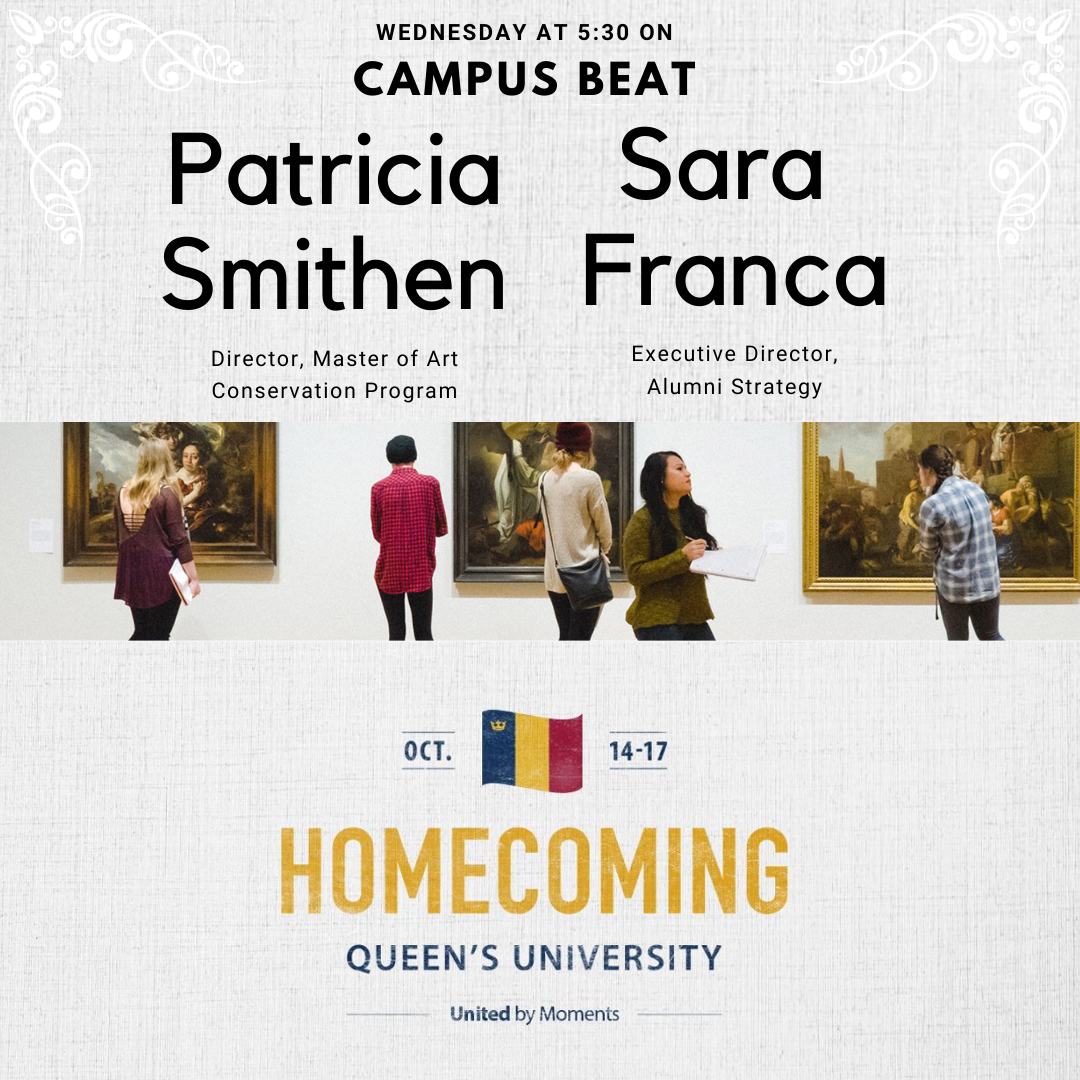
New Internship in Art Conservation and Homecoming Ramp Up!
In this episode, we feature two guests chatting about exciting Queen’s University initiatives and events. In the first segment, we chat with Patricia Smithen, Director, Master of Art Conservation program at Queen’s. She shares much with us about Art Conservation, the art of the science, conservators’ roles in the translation of cultural artifacts, and of course, the exciting new internship opportunity aimed at engaging Indigenous and Black students in the Master of Art Conservation program, an initiative launched in partnership with the National Gallery of Canada’s Diversity Internship program. In the second segment at the 15:36 mark, we jump into another lively conversation with Sara Franca, Executive Director, Alumni Strategy. Franca shares a lot of detail about the impressive list of activities Queen’s Alumni worldwide can enjoy October 14th-17th 2021. We also learn more about how Alumni can register and learn more about Homecoming events and thus reconnect with their Alma Mater and fellow alum around the world. Have you registered! Learn more here!
Conversations with New Royal Society Inductees
On Tuesday September 7th, Queen’s University announced that four of its researchers have been elected to the Royal Society of Canada, one of the highest academic honours for Canadian scholars in arts, humanities and sciences. Professor emeritus John Berry has received the honour of Fellowship, while professors Heather Castleden, Karen Lawford, and Sari van Anders have been elected to the College of New Scholars, Scientists and Artists. This diverse group has research specialties ranging from Indigenous health policy, cross-cultural psychology, and gender/sex research to community and participatory-based research with Indigenous communities. In this episode, we chat with Drs. Karen Lawford (Gender Studies) and Sari van Anders (Psychology) about their teaching and research passions and their election to the Royal Society of Canada’s College of New Scholars, Scientists, and Artists. The College, currently at over 300 members, aims to foster the emerging generation of intellectual leadership in Canada and its members are selected for their artistic, scholarly or research excellence.
Chris Spencer on Mountain Building Events
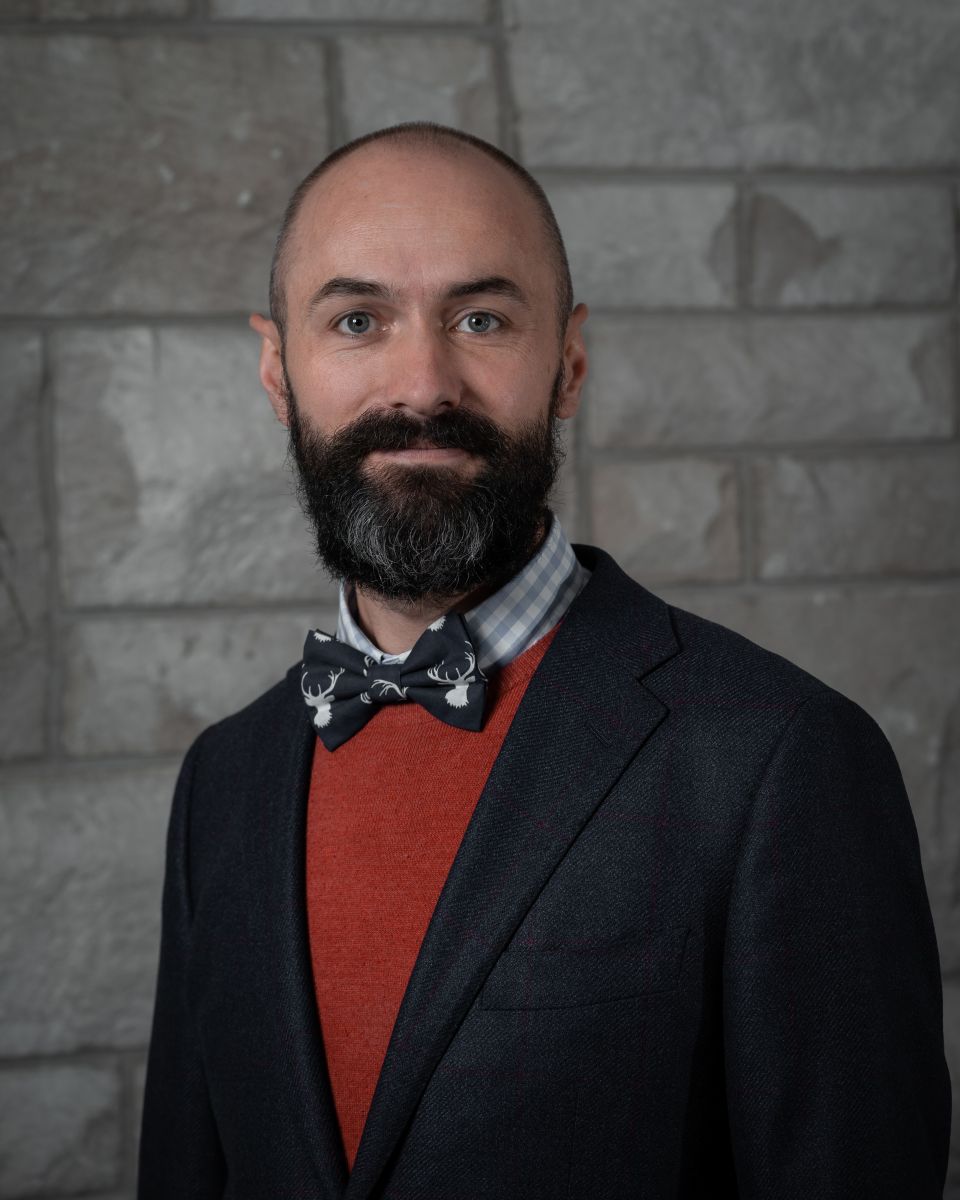
In a news story in the Queen’s Gazette on September 10th, Victoria Klassen wrote a story about mountain-building events a billion years ago a period some geologists have dubbed as the “boring billion,” arguing that the earth’s very thin crust during this time was a sign that no mountain-building events were happening, thus delaying the evolution of life. Chris Spencer Professor of Geology at Queen’s University disagrees, believing this interpretation goes against the geological record. In this episode, we chat with Dr. Spencer about his ground-breaking research about the earth, its crust and mountain-building events in the mid-Proterozoic period. We also get the scoop on how the science is done in the field and the implications for Spencer’s research for understanding Earth’s evolution let alone long-term climate change or the availability of natural resources such as minerals.
Fall Programming at the Isabel with Tricia Baldwin
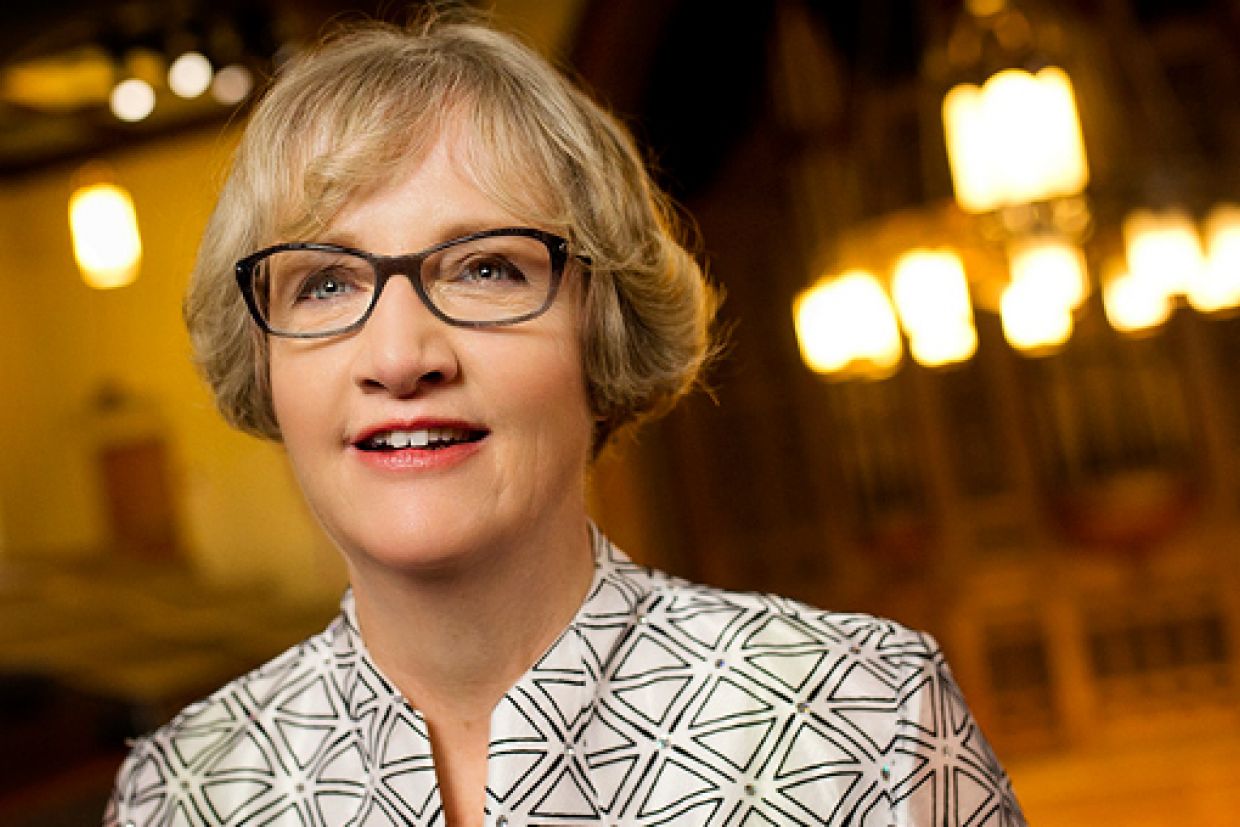
In this episode, Tricia Baldwin, Director of the Isabel Bader Centre for the Performing Arts joins us for a fabulous conversation. We chat about the very exciting fall concert line up at The Isabel and fantastic events including the Echo: Memories of the World live workshop performance and the Imagine Online Arts Festival. We also get to learn more about workshop performances and how The Isabel serves our community as an arts incubator. Lovely and inspiring, this cheerful conversation pairs well with a pot of tea and music by Sadaf Amini!
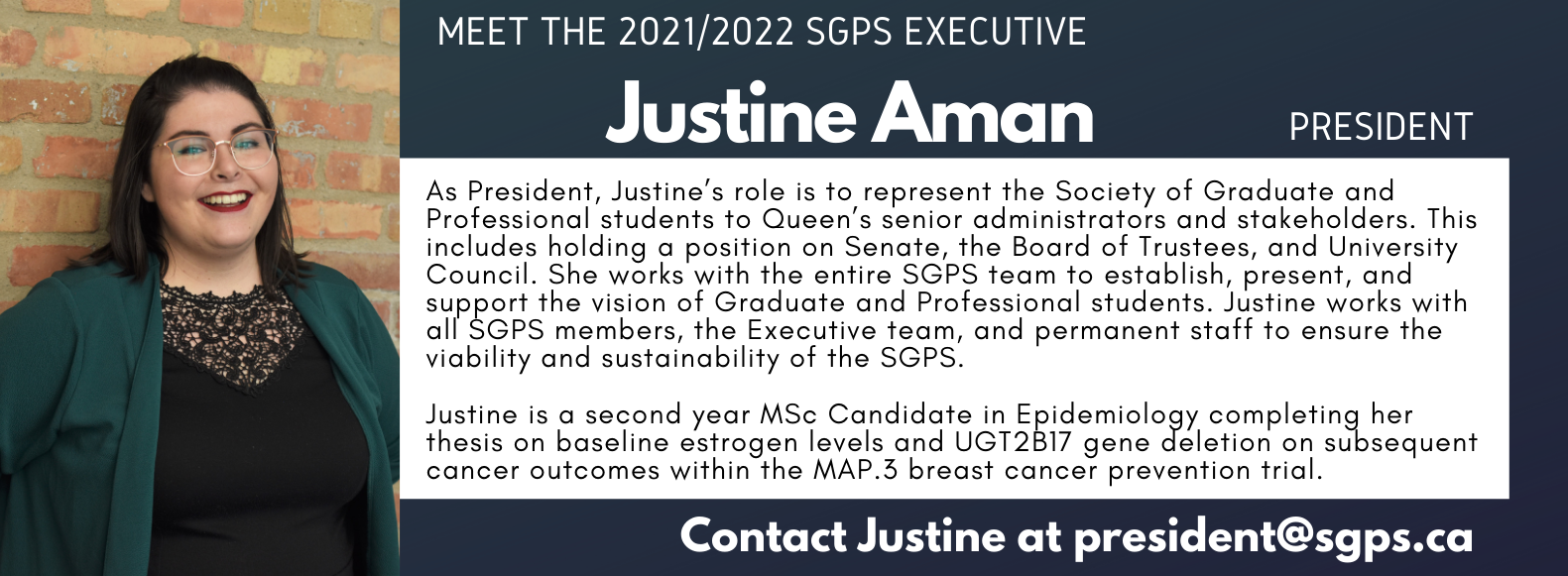
Justine Aman-SGPS President in Conversation
In this episode of Campus Beat, Justine Aman, President of the Society of Graduate and Professional Students (SGPS) at Queen’s University joins us. She chats about her role, the initiatives she and her teammates are engaged in and the many services available to graduate and professional students at Queen’s through the SGPS.
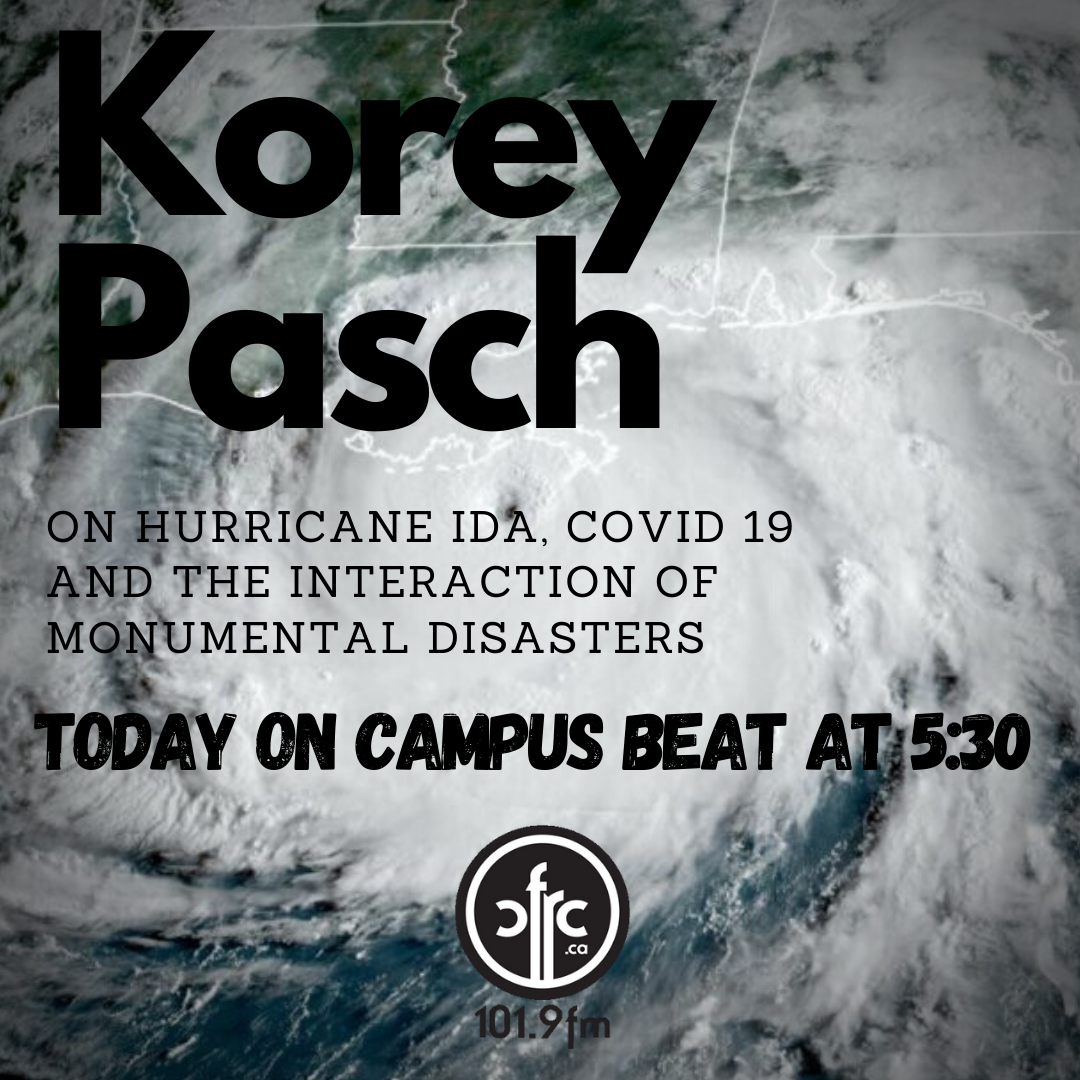
Korey Pasch on Hurricane Ida & the Interaction of Monumental Disasters
On August 27th Tropical Storm Ida strengthened into a hurricane moving north northwest from the Gulf of Mexico making landfall on the Louisiana Coast on August 28th with winds reaching 240 km/hr. Now a tropical depression as of September 1st, Ida proved to be the second most intense hurricane to strike Louisiana on record only after Hurricane Katrina. In its wake, four people have died, more than a million people remain without power largely in and around New Orleans while widespread heavy infrastructural damage and heavy floods amounting to an estimated 15 billion in insured losses have occurred. In the first episode of Season Four of Campus Beat, Korey Pasch, PhD Candidate in Political Studies at Queen’s University joins us to chat about this disaster, the tensions and interactions revealed by it and COVID-19, political responses and lasting impacts.
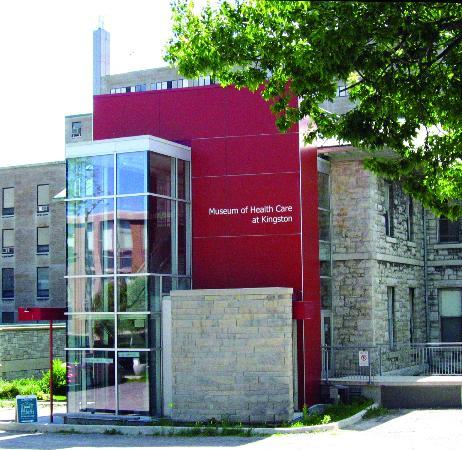
Museum of Health Care Encouraging Canadians to Become Part of the COVID 19 Historical Record
In this episode, we chat with Savannah Sewell, the Margaret Angus Research Fellow at the Museum of Health Care in Kingston. She is heading a collaborative project that will include an artifact collection, an archive of narratives, a manuscript, and a lecture. The project will explore the lived experience of Canadians and Canadian residents during the COVID-19 pandemic to record information regarding everyday life for future research. We learn much about this fascinating project, the importance of artefacts in historical study, and how any Canadian can participate.
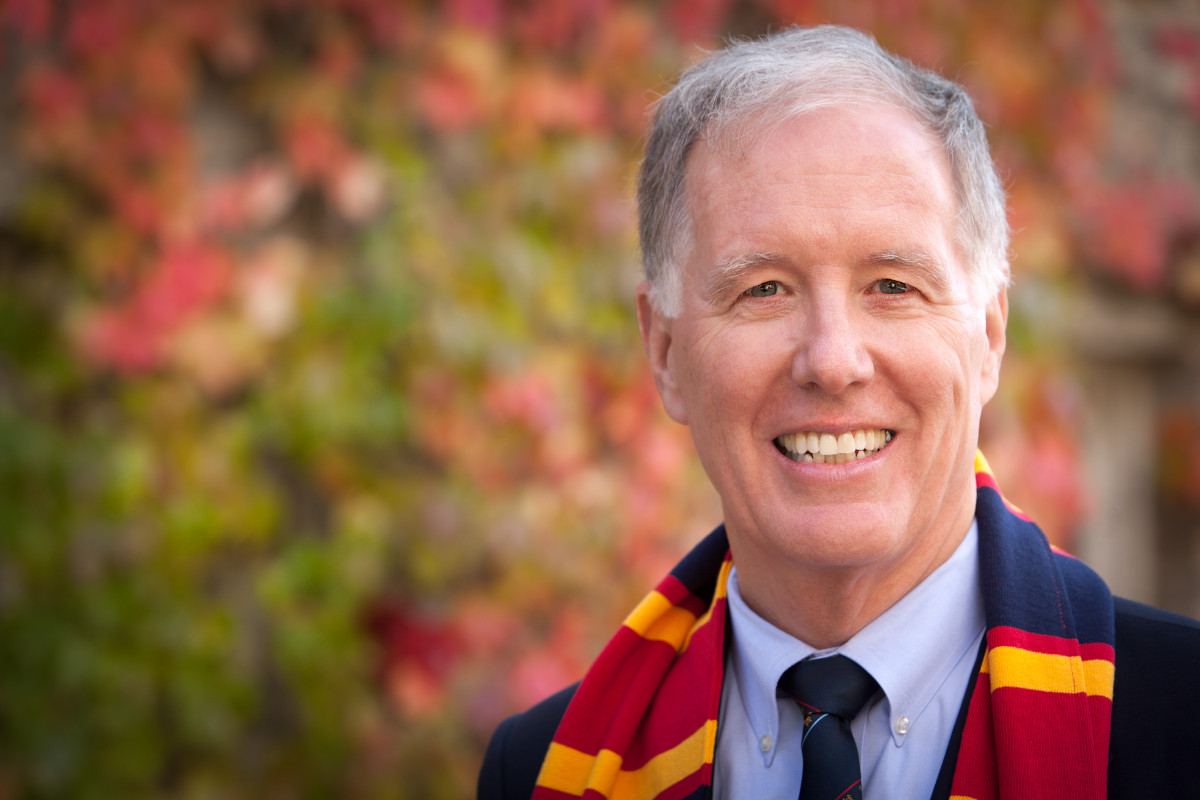
Chancellor Jim Leech in Conversation
Queen’s University, like many university’s has a Chancellor. Chancellors have many roles to play at and on behalf of the university as they represent its interests anywhere in the world, act as important points of contact with major donors and serve as goodwill ambassadors across a spectrum of activities. The Queen’s Chancellor also participates in a variety of university ceremonies, as well as student and alumni events, notably the traditional hearty handshakes students all receive at the time of their laureation at convocation. Following Queen’s University’s announcement that the Honourable Murray Sinclair will become the 15th Chancellor commencing in July, we sat down with the 14th Chancellor, Jim Leech. This extended episode features a joyful conversation with Jim about the many roles he’s played, the highlights and happy memories of his time as Chancellor, what he loves so much about Queen’s University and its community near and far, and the low down on the ‘Curious Case of the Missing Convocation Cap.’ Though not covered in our conversation with Chancellor Leech, Queen’s Alumni may be interested to learn that there is a campaign underway to support the Jim Leech Ceilidh Centre Campaign that will support the revitalization of the John Deutsch University Centre (affectionately known as The JDUC), home of student activities, engagement and governance on campus.
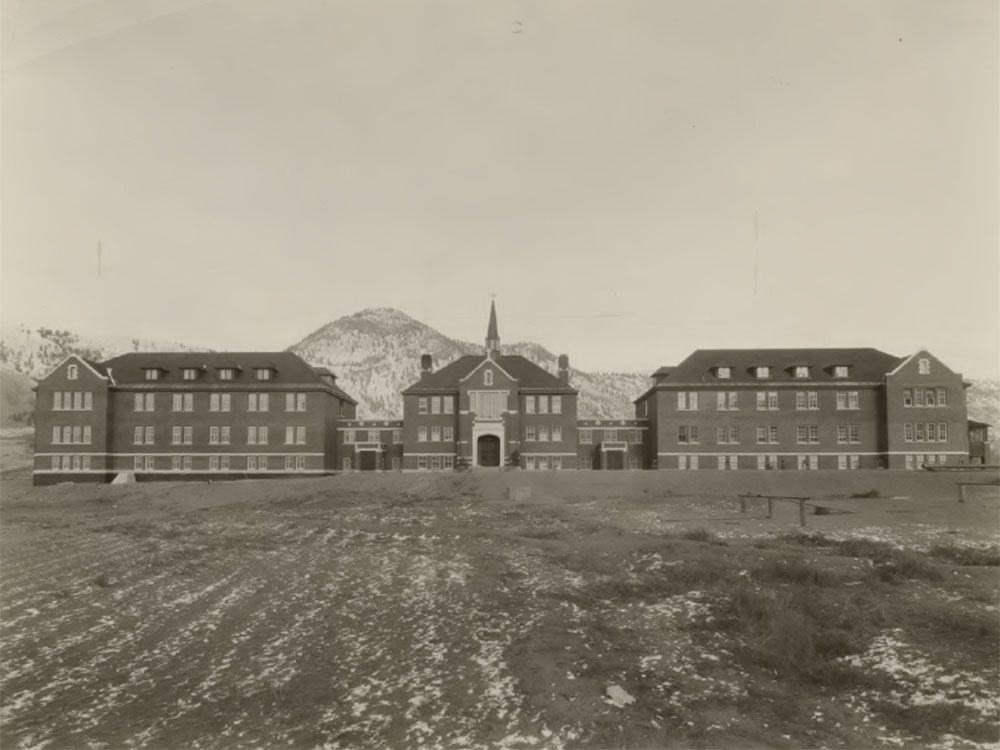
On the Technologies Used in the Search in Kamloops
In late May 2021, news broke of the discovery of the remains of 215 Indigenous school children buried at the former Kamloops Indian Residential School, a school operated by the Catholic Church between 1890 through 1969 and then by the federal government until it closed in 1978. In this episode of Campus Beat, we are joined by Dr. Alexander Braun, a geophysicist in the Department of Geological Sciences and Geological Engineering and cross-appointed to Physics, Engineering Physics, and Astronomy at Queen’s University. Dr. Braun chats with us about the technologies and techniques used in the discovery of the remains of these 215 indigenous children.
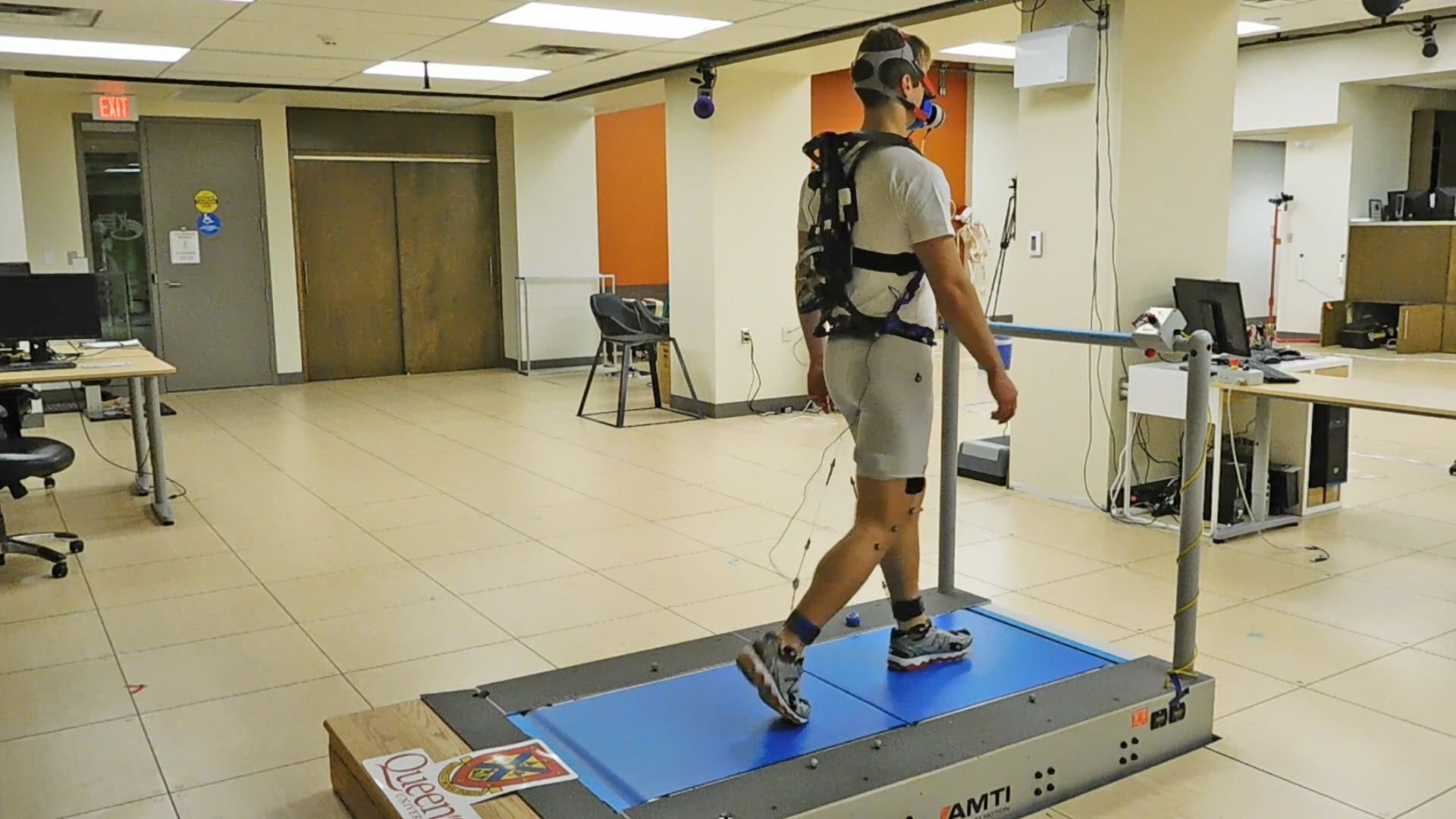
Reducing the Metabolic Costs of Walking: New Advances in Harvesting Kinetic Energy
The science of walking is taking its next big step with the aid of a unique exoskeleton that allows users to walk further while using less energy. Developed by a multidisciplinary team from the Queen’s Faculty of Engineering and Applied Science, the backpack-mounted prototype removes energy during a specific phase of the gait cycle, lessening the metabolic cost of walking. Details of the device’s development and evaluation were published on May 27th 2021 in Science—one of the world’s foremost academic journals. In this episode of Campus Beat, we’re doing by Dr. Michael Shepertycky, lead author of the study and Dr. Qingguo Li, co-senior author of the study and Associate Professor of Mechanical and Materials Engineering, Queen’s University. They share much with us about their research inspirations, details on what research and development actually looks like behind the scenes in addition to details about the exoskeleton device, how it works, its benefits and implications for everyday living and future research. Unlike existing exoskeleton technologies that either add energy or transfer it from one phase of the gait cycle to another, this new device assists users by removing energy which helps the knee muscles during a critical moment—called the terminal swing phase. Sherptycky and Li’s multidisciplinary team envisages the technology—which weighs just over half a kilogram—enabling hikers to walk longer distances or helping nurses be less tired after a long shift on their feet. In addition to assisting the user, the device converts the removed energy into electricity that can be used to power the device’s control system and other portable devices. This energy harvesting capability could be particularly useful for individuals travelling on foot in remote locations, allowing them to charge cellular phones or GPS devices. Yan-Fei Liu, Professor of Electrical and Computer Engineering and co-author of the study, also led the development of the device’s power electronics. The team’s interdisciplinary approach included elements of walking biomechanics, physiology, human-machine interactions, and design innovation. Much of this research was conducted in the Human Mobility Research Centre, a Queen’s/Kingston Health Sciences Centre facility equipped with world-class gait analysis technology. Put your feet up for a fun conversation and enjoy the program!
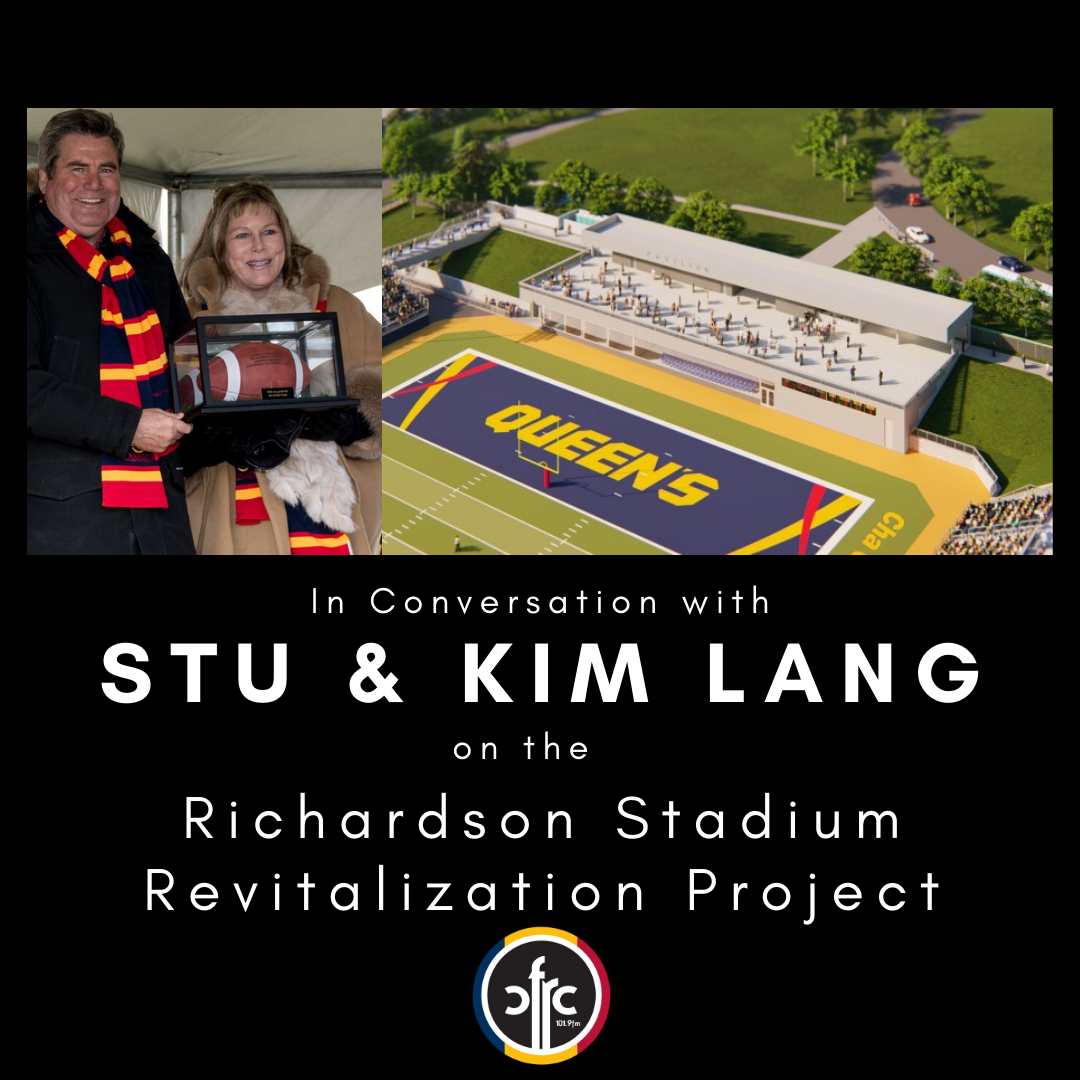
Stu & Kim Lang-Revitalizing Richardson Stadium at Queen’s
On April 15th 2021, Queen’s University announced and celebrated the gifts behind completing Richardson Stadium through alumni giving. Over 300 alumni contributed more than $11 million to construct a new pavilion to enhance and complete the space. The lead gift came from Stu (Sc’74) and Kim Lang (ArtSci’76). Stu played varsity hockey and football with the Golden Gaels and went on to a professional career in the CFL and later became Receivers’ Coach and then Head Coach of the University of Guelph Gryphons. Stu and Kim join us in this episode of Campus Beat to chat about their time at Queen’s, their moves to Edmonton and back to Oakville and Guelph through Stu’s illustrious sporting career. We also chat about Richardson Stadium and the many benefits for players, teams, students and spectators can enjoy with the construction of the new pavilion. We even get a better understanding of the importance of modernized equipment and facilities for athletes and some perspective on Stu’s experience transitioning from playing as a 5-time Grey Cup winning wide receiver to becoming a respected coach. A joyful conversation with two very enthusiastic alumni! Cha Gheill!

Queen’s geologists help to solve the mystery of how arsenic got into the soils in the Yellowknife area
Queen’s University geochemist, Dr. Heather Jamieson (Geological Sciences and Geological Engineering and Environmental Studies) and two of her former Master’s students Kirsten Maitland and Jon Oliver join us in this episode. They chat about the arsensic found in soil samples in the region around Giant Mine in Yellowknife, NWT, some of which is naturally occuring, but the research team also established that there are higher values of arsenic resulting from pollution from human impact including mining and ore processing. Then graduate students, Maitland and Oliver collected 479 samples and they share insights in this conversation on what this field research looked like in practice and what impact it may have on policy moving forward. Following analysis in the Analytical Services Unit at Queen’s University, arsenic trioxide was identified using the Scanning Electron Microscope in the Department of Geological Sciences and Geological Engineering. The study found arsenic trioxide in 80 percent of samples as far as 30 km away from Yellowknife. The research was published in The Science of the Total Environment Currently, the Yellowknife Dene First Nation is asking the federal government for an apology and compensation for the damage from Giant Mine to their traditional lands.
Sea Sponge Toxin Synthesis in the Fight against Cancer
Following a pivotal January 2019 announcement that certain ocean floor sea sponges were found to have toxins that can cause cancer cells to retract, on Thursday May 13th 2021, Queen’s University announced that scientists conducting research on this project have successfully reproduced a toxin found in a marine sponge in the fight against cancer. Joining us in this episode to chat about this groundbreaking research are Dr. John Allingham, Associate Professor and Canada Research Chair in Structural Biology in the Department of Biomedical and Molecular Sciences as well as Dr. Andrew Evans, Professor and Alfred R. Bader Chair of Organic Chemistry in the Department of Chemistry. From them, we learn much about the art of the science of reproducing a natural toxin found in sponges that can block cancer cells from metastasizing, the potential impact of this research, the critical importance of interdisciplinary collaboration to this type of research, and next steps in the project.
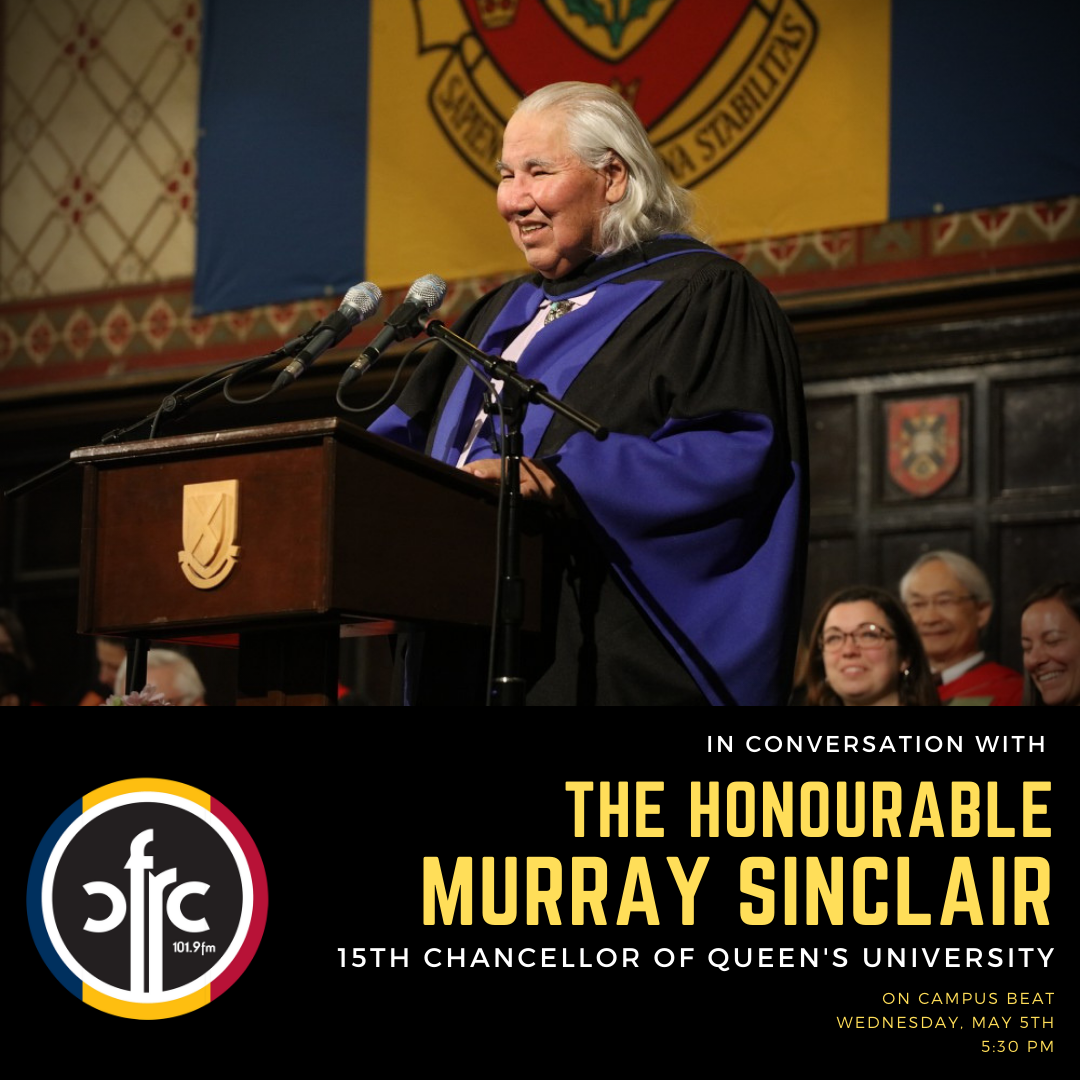
In Conversation with The Honourable Murray Sinclair, 15th Chancellor of Queen’s University
On April 28th, 2021 Queen’s University announced that the University has selected the longtime Indigenous rights advocate, former Senator, and former Chair of the Truth and Reconciliation Commission, The Honourable Murray Sinclair to serve as the 15th Chancellor of Queen’s, succeeding Jim Leech who has held the role since 2014. As an experienced national leader and advocate, His Honour will be well positioned to offer insight and guidance to the university. He will begin in his new role on July 1st 2021. In this episode, we have the great pleasure and privilege of welcoming His Honor to the virtual studio for a chat about his lifelong activism and advocacy for Indigenous communities across Canada, his work on TRC and the Senate of Canada, the experience of becoming Chancellor and of course, the goals our new Chancellor-Designate has in mind for his upcoming term.
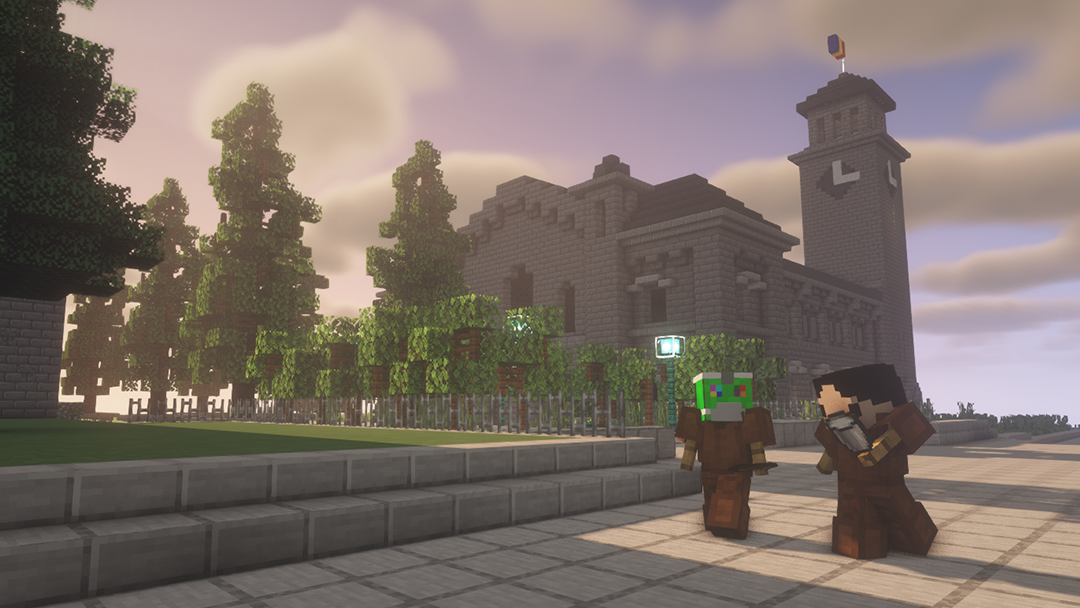
Touring Queen’s through Minecraft
On April 21 2021, almost 100 prospective Queen’s Engineering students took to the virtual campus – and experienced Queen’s in a whole new way. They toured the campus, hunted for eggs, and joined a lively Q&A with the Dean – on a dedicated Minecraft server that replicates the campus itself. In this episode of Campus Beat, we’re chatting with Alex McKinnon, Sci ’21 and co-President of QUCraft, the Queen’s Minecraft Team as well as with Kevin Deluzio, Dean of the Faculty of Engineering and Applied Science. From them, we learn about the Minecraft club, how Queen’s campus is being rebuilt in the Minecraft space, and how students and alumni can participate in this ongoing building effort. We also learn more about how the virtual campus came to become a fun, interactive segment of the Faculty’s recruitment campaign this year, what prospective students did on the tour, and what conversations emerged.

2021 CFRC Roundtable on Anti-Asian Racism
In this special episode episode of The Scoop, host Dinah Jansen is joined by Thomas Park, Dr. Courtney Czto and Noah Weisbord for a roundtable discussion about anti-Asian racism. Canada, like the US, has recently seen an uptick in anti-Asian racism since the onset of COVID 19. Dr. Courtney Szto of the School of Kinesiology and Health Studies at Queen’s University is an expert in activist driven research that explores the relationship between physical cultures and intersectional justice and who has written extensively on the experiences of South Asians on the hockey rink, a well-known site of Canadian cultural citizenship. Thomas Park, Vice President of the Business Development Bank of Canada, Chair of the Banff Forum and alumnus of McGill, Harvard and Dartmouth recently penned an op-ed in the Toronto Star entitled “The Era of the Model Minority ends in the face of anti-Asian racism.” Noah Weisbord is an Associate Professor in the Queen’s University Faculty of Law, a leading expert on individual criminal responsibility leading to aggressive war with a research focus on criminal law in the management, reflection and even exacerbation of intergroup conflict. Each share their thoughts on the roots of anti-Asian racism to the present day; discuss political, press and police responses to violence directed at Asian Canadian community members; share ideas on the divisions and solidarities between these communities and with other racialized groups in Canada; and also discuss ways in which we can build a safer more inclusive culture and society.
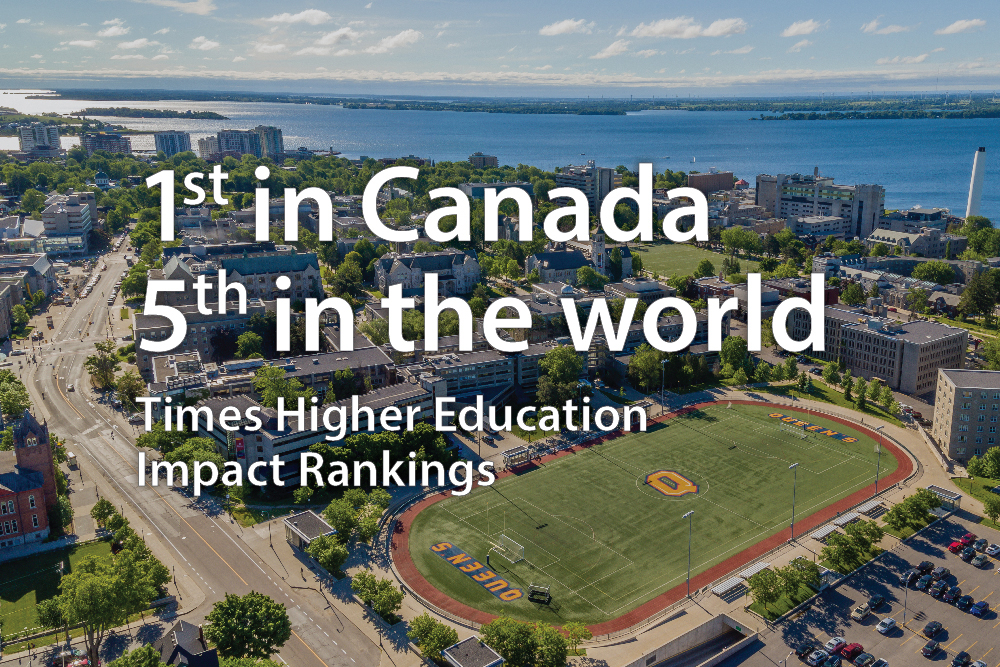
Dr. Patrick Deane on Times Higher Education Impact Rankings
Dr. Patrick Deane, Principal and Vice Chancellor of Queen’s University joins us on Campus Beat once again to chat about some very exciting news. Queen’s University announced on April 21st that Times Higher Education Impact Rankings had revealed that Queen’s placed first in Canada and fifth in the world in its global ranking of universities that are advancing the United Nations Sustainable Development Goals within and beyond their local communities. Established in 2019, THE Impact Rankings assess a university’s societal impact based on the UN’s SDGs, a set of goals outlining a universal call to action to protect the planet and improve the lives and prospects of everyone, everywhere. Using carefully calibrated indicators across four broad areas –research, outreach, teaching, and stewardship – THE Impact Rankings are a recognition of those who are working today to build a better tomorrow. Principal Deane sheds light on THE Impact Rankings and 17 Sustainable Development Goals; where Canada placed highest in Canada, North America and the world; and the herculean task undertaken by the University’s team to create a winning submission that included about 600 pieces of evidence to support the University’s candidacy. Deane also talks about the opportunities and challenges the Sustainable Development Goals themselves present to universities and how Queen’s may build on its achievements moving forward. On behalf of CFRC, congratulations to Queen’s University on these outstanding achievements.
How to Survive and Thrive this Exam Season
Students (and faculty) can learn much in this episode about surviving and thriving this exam season. Dr. Lindsay Heggie, Academic Skills Specialist with Student Academic Success Services joins us in this episode. She sheds light on the many services and resources available through SASS that students are encouraged to utilize throughout the school year and now during exam season. Dr. Heggie also offers great advice recognizing and managing test anxiety. A very informative conversation for Queen’s students and faculty members also seeking resources that can help their students.
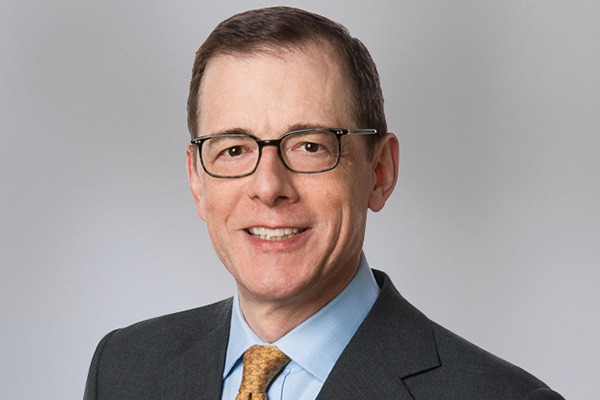
Robert Yalden on Québec’s Sole Shareholders Regime & Simplified Corporations
Robert Yalden, Sigurdson Professor in Corporate Law and Finance in the Faculty of Law at Queen’s University joins us in this episode to chat about his recently published study, “Québec’s Sole Shareholder Regime and the Rise of Simplified Corporations: Innovation, Implementation and the Challenges Ahead.” Yalden talks about what sole shareholder regimes and simplified corporations are in practical terms and why the Québec Model is a particularly innovative paradigm that other provinces may do well to adopt and promote to small businesses.
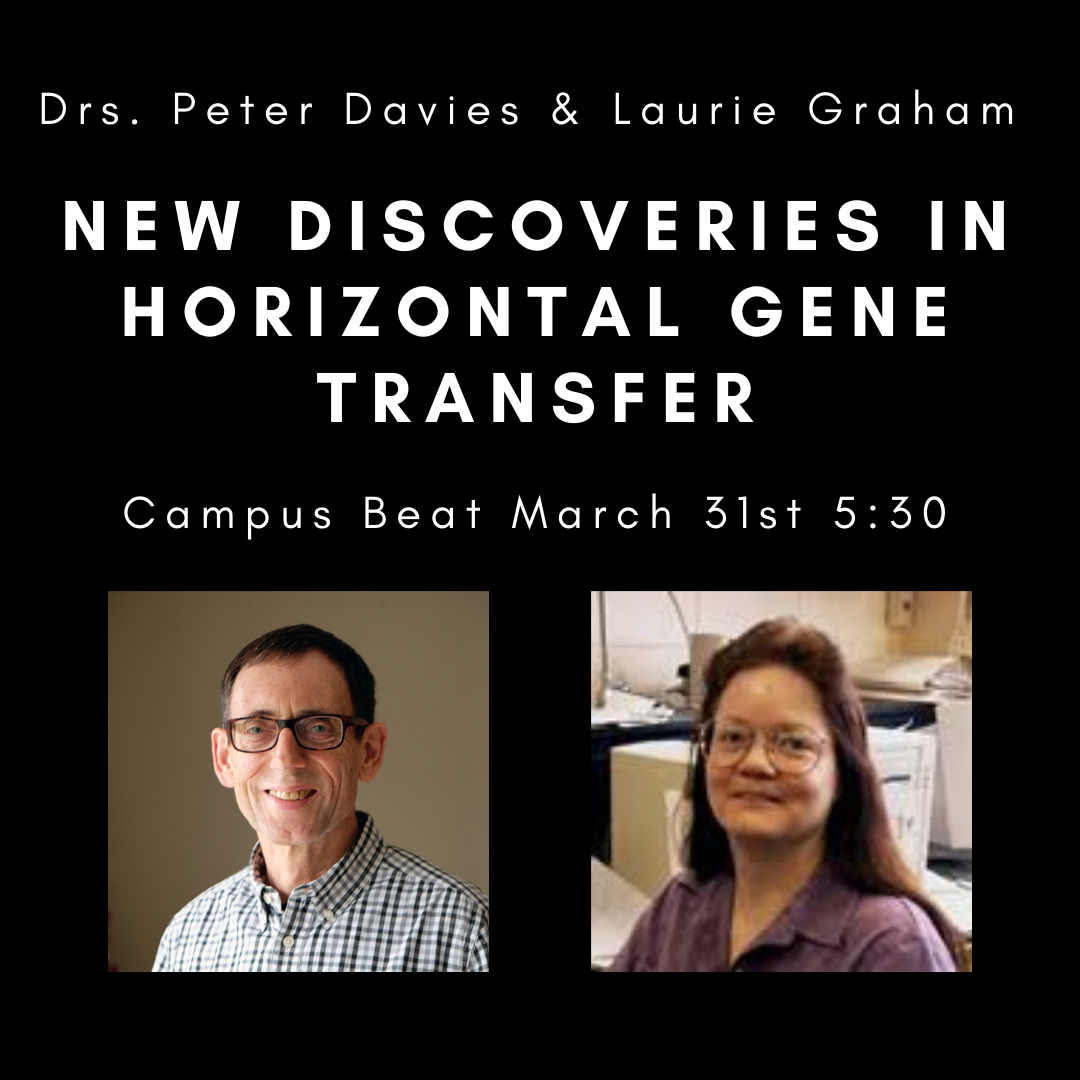
Horizontal Gene Transfer: New Discoveries
Queen’s University researchers Peter Davies and Laurie Graham from the Department of Biomedical and Molecular Sciences at Queen’s University join us in this episode. They recently published a free open-access study in Trends in Genetics reporting a gene that crossed the “species barrier”. The study, Horizontal Gene Transfer in Vertebrates: A Fishy Tale looks specifically at new evidence proving the direction of transfer was from herring to smelt. Their research shows a unique example of direct vertebrate to vertebrate transmission of a useful gene, analogous to genetic modifications that can be carried out in a laboratory. How did the gene jump the species barrier? Check out this episode and learn more from Drs. Davies and Graham.
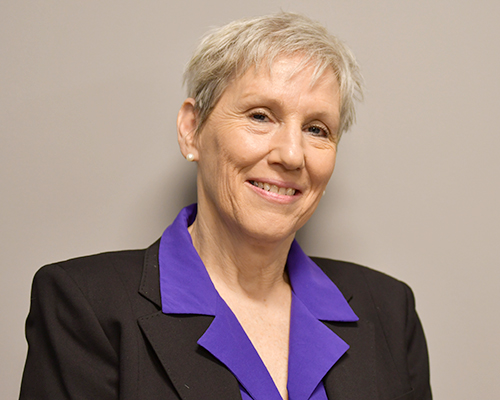
Dr. Kimberly Woodhouse on Newly Funded CFI Projects at Queen’s
On Thursday March 4th 2021, Prime Minister Justin Trudeau announced more than $518 million in research infrastructure funding through the Canada Foundation for Innovation (CFI). This funding will support 102 state-of-the-art projects at 35 post-secondary institutions and research hospitals across the country, and will help Canada remain at the forefront of exploration, innovation and discovery. Two projects led by Queen’s researchers have received close to $10 million to significantly advance their research. Queen’s is also a collaborator on a third project, led by Carleton University. The funding will be used for infrastructure that will help to combat climate change, treat cancer, and understand the fabric of the universe. In this episode, Dr. Kimberly Woodhouse, Vice Principal (Research) and Professor, Chemical Engineering at Queen’s University joins us. Dr. Woodhouse sheds light on the groundbreaking research CFI is now funding at Queen’s and also gives us a bird’s-eye view into the processes behind developing and securing major funding applications, and the work her office does to support faculty members and fellows at Queen’s to secure grants and collaborators. A fascinating discussion all around and particularly useful for early career researchers including graduate students.
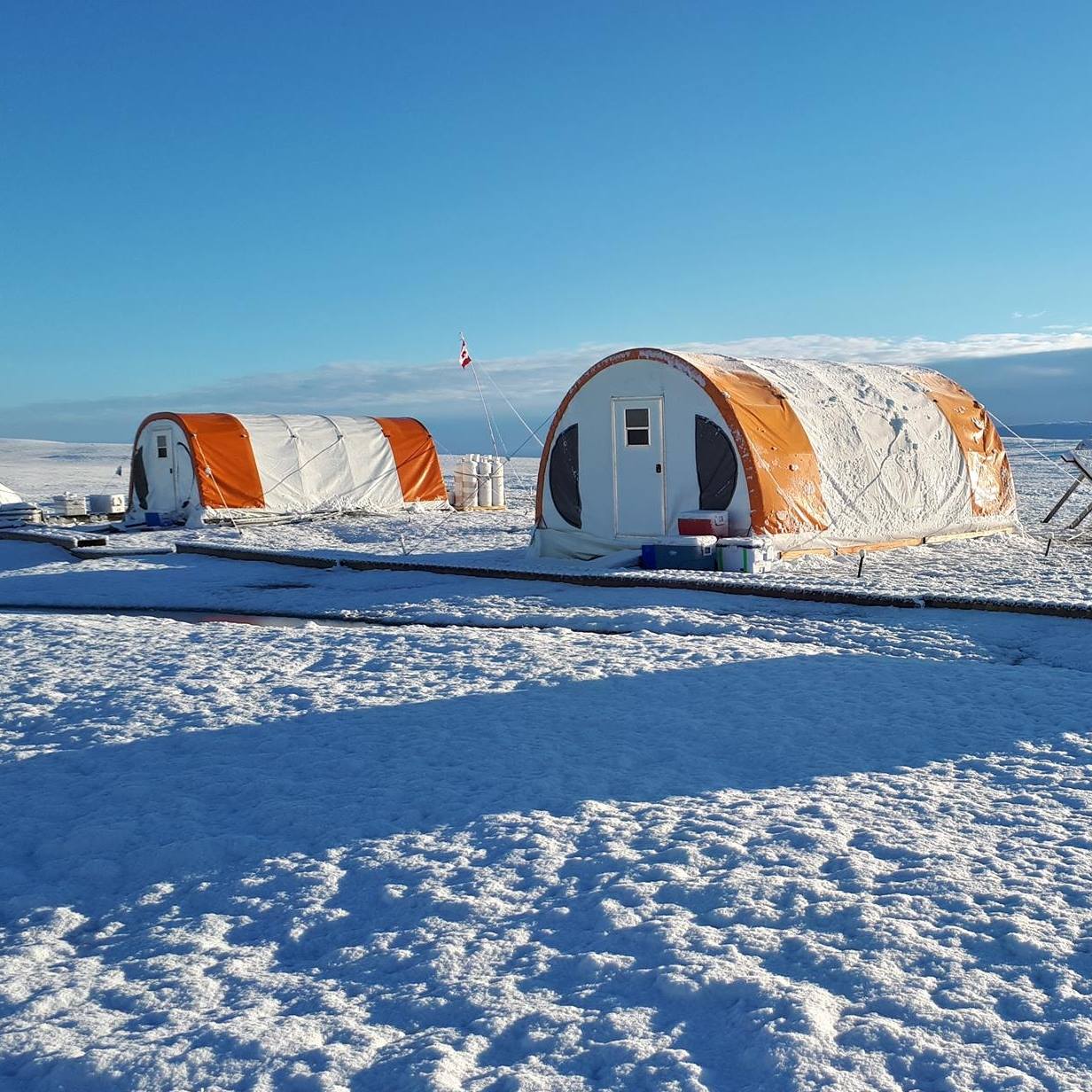
Profs. Scott Lamoureux and Melissa Lafrenière on Rainfall and Research in the High Arctic
“In this Adventures in Research edition of Campus Beat, we are joined by Professors Scott Lamoureux and Melissa Lafrenière, Department of Geography and Planning at Queen’s University. From them we learn about a recent study published in Nature Communications entitled “Emerging Dominance of Summer Rainfall Driving High Arctic Terrestrial Aquatic Connectivity.”Lafrenière and Lamoureux were co-authors of this study that was led by Queen’s PhD grad Dr. Casey Beel and former Robert Gilbert Post Doctoral Fellow, Dr. Joanne Heslop. Listeners not only get a glimpse into the logistics of conducting research on rainfall in the High Arctic (Cape Bounty Arctic Watershed Observatory, 400 km from Resolute), but also get an understanding of how the team did their research over the last 18 years and of course, the local and global implications of their study’s results.
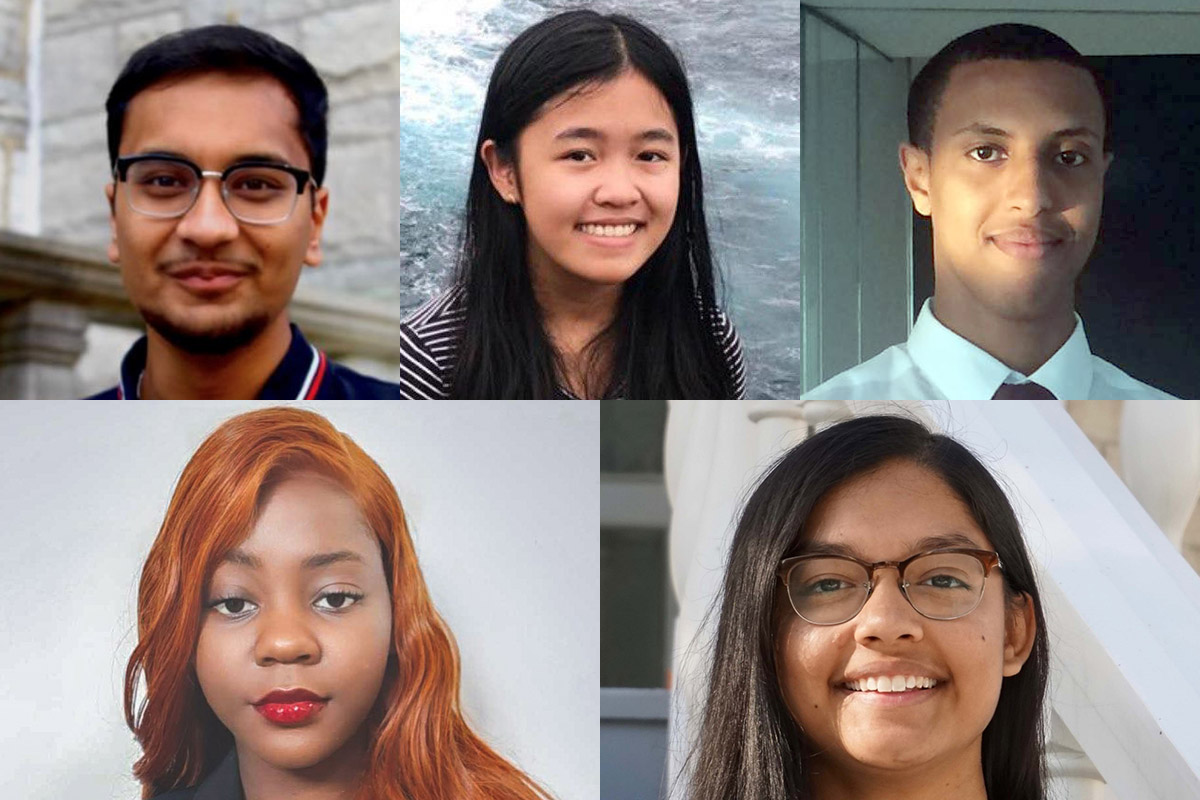
Queen’s University Equity Ambassador Roundtable
In this episode we welcome Richard Mitchell of Queen’s Undergraduate Admissions and Recruitment in addition to the five new Admissions and Recruitment Equity Ambassadors Fahmida Hossain, Kidus Lee-ul, Tatiana Yunadi, Tamjid Bari and Astrid Louise Nandoh. They chat about this innovative new peer mentorship program where prospective Queen’s University students can connect directly with upper-year peers to learn about student life from a shared perspective. The first five Equity Ambassadors will be connecting with prospective students about their lived experiences as BIPOC members of the campus community, and supporting applicants from equity-seeking backgrounds through the admissions process, as well as their transition to first-year studies. See the story in the Queen’s University Gazette.