Brazil Crypto Report
201 episodes — Page 2 of 5
#150 Bits and Borders: To Infinita and Beyond with Niklas Anzinger
Olá pessoal!I’m super excited to announce the soft launch of a new podcast series called Bits and Borders that explores frontier tech in frontier markets. Why a new series? Crypto remains my first love, but it’s just a part of a broader story playing out globally. We have new technologies and human coordination systems being developed in real time alongside rapidly shifting power dynamics in the global geopolitical order. Crypto is a piece of the puzzle, but the complete puzzle is much bigger. We’ll still keep focusing on Brazil, but I wanted to open up the design space to explore technologies beyond crypto in new markets beyond Latam. This Bits and Borders brand gives me the opportunity to do that. Feedback welcomed! For this inaugural episode, we explore Prospera — which is a Special Economic Zone located on Roatan Island in Honduras. Prospera is home to probably the most bleeding edge experiment in tech and governance innovation happening anywhere in the world right now. Tech names like Balaji Srinivasan, Brian Armstrong, Tim Draper and Brian Johnson have all supported the project in some capacity.Our guest for this interview is Niklas Anzinger, CEO of Infinita — which can be thought of in crypto terms as a “Layer 2” operating on top of the Prospera economic zone. Infinita is advancing biotech and longevity research on the island, in addition to community building across multiple verticals. For example, it is hosting a month-long Crypto Cities Pop-Up during June. We discuss the core theses of Prospera and Infinita, which is that new governance models can potentially unlock trillions in economic value by addressing the regulatory bottlenecks that have stalled innovation across multiple sectors.Specifically, Infinita is demonstrating how competitive governance frameworks can accelerate development in highly regulated fields like biotechnology and healthcare.Key Insights:* Regulatory Flexibility as Competitive Advantage: Prospera has implemented a system where businesses can select from proven international regulatory frameworks rather than operate under a one-size-fits-all monopolistic regulatory authority* Market-Driven Regulation: The model leverages mandatory liability insurance as a coordinating mechanism, creating market incentives for appropriate regulation without over-regulation that stifles innovation* "Stranded Technologies": Anzinger identifies numerous high-value technologies with enormous potential that remain "stranded" due to regulatory barriers, with nuclear energy serving as the archetypal example* Complementary Rather Than Competitive: This approach works alongside existing nation-states, offering a "win-win" model that attracts investment and development while providing regulatory optionalityStrategic Implications:This model challenges traditional assumptions about regulation and development. For executives in highly regulated industries, these governance innovations represent potential pathways to accelerate R&D and commercialization timelines while maintaining appropriate safety standards.The conversation illuminates how governance innovation may become the ultimate frontier for technological advancement, potentially unlocking tremendous value across multiple sectors by addressing the institutional bottlenecks that limit progress.I really enjoyed this conversation with Niklas and I hope you do as well.You can connect with him on Linkedin-AWSRecent Episodes Get full access to Brazil Crypto Report at brazilcrypto.substack.com/subscribe
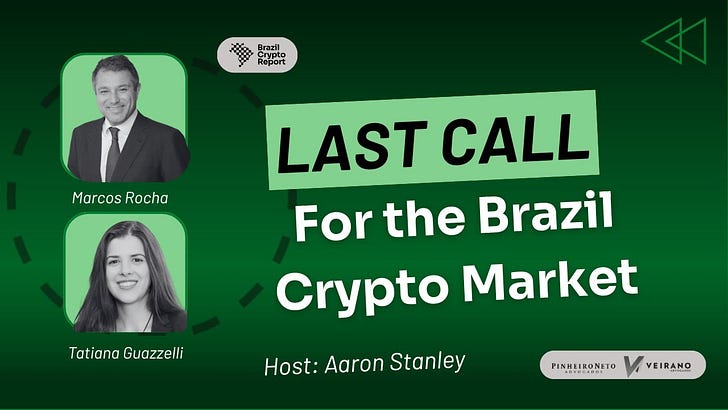
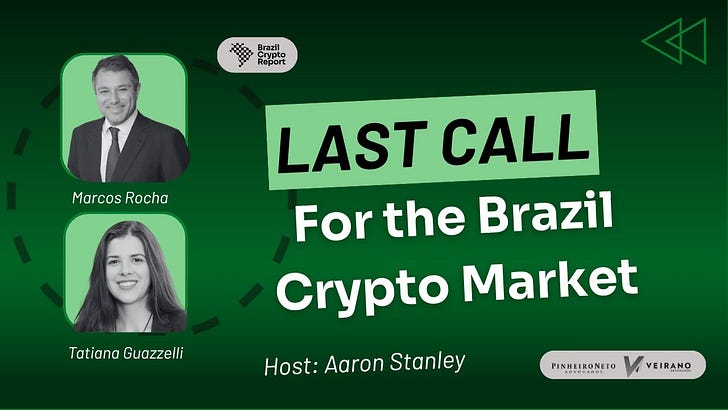
Episode #149: Last Call for Brazil's Crypto Market with Tatiana Guazzelli and Marcos Rocha
Olá pessoal!Greetings from Rio de Janeiro where we are at the final day of Web Summit Rio. I’ll be hanging around the Transfero stand most of the day, so please feel free to stop by and say hi if you’re around.For today’s episode I spoke with Tatiana Guazzelli of Pinheiro Neto Advogados and Marcos Rocha of Veirano Advogados about several important developments regarding Brazil’s forthcoming crypto regulation framework.TLDR is that the Brazilian Central Bank’s consultative process for defining regulations is at a critical inflection point, with final rules expected to be released in the second half of 2025. Due to proposed “grandfathering” provisions, companies planning to apply for licenses in the future without current operations in the country may find themselves waiting for a long time. Marcos and Tatiana, who also represent the ABToken industry association, stressed the urgency for crypto businesses eyeing the Brazilian market.Marcos explained: "If you're willing to come to Brazil, now is the time and do it fast. Otherwise, the door will close and you will be left outside, in the cold, for two - three years, at least.”In this context, “operations” isn’t merely having a shell company or legal entity, but rather demonstrating active operations through a Brazilian legal entity servicing local customers.However, it’s unclear what specific evidence the regulator will ask of companies to prove that they are indeed “operating” in the country. Important considerations on this front include: * Prove genuine operations: Having a local entity with demonstrable client activity is essential for grandfathering eligibility* Choose service offerings carefully: Companies will only be grandfathered for services they can prove they were already providing when regulations take effect* Prepare for the long haul: Even grandfathered entities face a multi-phase licensing process expected to take approximately three years🎧 You can find Brazil Crypto Report content wherever you listen to podcasts: Spotify | Apple Podcasts | Amazon | Anchor | YouTubeKey Regulatory Developments* Three critical public consultations have concluded: Public Consultation 109 (prudential rules for VASPs), 110 (authorization processes for VASPs), and 111 (crypto transactions in the foreign exchange market). * The Central Bank is currently digesting the commentary it received from the market during these consultations and is formulating final regulations that are now expected to be released in the second half of 2025* The market broadly welcomes regulation but is concerned about restrictions that could disadvantage Brazilian investors or create incentives for non-compliant operators* Major concerns include restrictions on Brazilian investors accessing global order books of international players, which could reduce market liquidity and increase prices* Stablecoin self-custody ban is likely to remain: Despite a myriad of objections from the market, Tatiana reckons that a controversial proposal to prohibit stablecoin transfers between self-hosted wallets is unlikely to be walked back in full, though it could be watered downAdditional Regulatory Considerations* Congress is considering separate stablecoin legislation, raising concerns about potentially conflicting regulatory frameworks* The Brazilian Securities Commission (CVM) is also working on adapting securities regulations to blockchain technologyFor financial institutions and crypto businesses interested in the Brazilian crypto market, the message is clear: establish local operations now or face significant barriers to entry in the near future. I appreciate Marcos and Tatiana joining the show to provide this timely update. You can connect with Tatiana and Marcos on Linkedin-AWSBrazil Crypto Report is presented byBinance is the largest platform for trading of digital assets. With over 250 million users around the world, the exchange offers over 350 trading pairs, best-in-class products and services for investors, and advanced tools for institutions players.Binance currently holds over US$ 160 billion in user assets under custody and reached a cumulative historical trading volume of $100 trillion in 2024, showcasing the trust placed in it by users worldwide.With user-focus at the core of its DNA, Binance continuously invests to increase usability, bring new features and deepen security.Liquidity matters. Security is non-negotiable. Join Binance NowRecent Episodes Get full access to Brazil Crypto Report at brazilcrypto.substack.com/subscribe
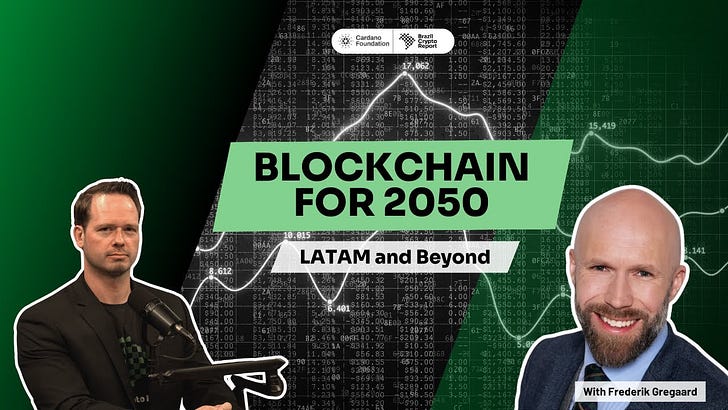
Episode #148: Blockchain for 2050 with Cardano Foundation CEO Frederik Gregaard
Olá pessoal!This week’s interview is with Frederik Gregaard, CEO of the Cardano Foundation, who discusses the organization's mission and Cardano’s growing presence in Latin America.Frederik shares how the Cardano Foundation approaches blockchain development differently - focusing on decades-long impact rather than short-term gains."I care about three things, and only three things," Frederik explained. "Operational resilience, education and regulation, and adoption." This philosophy has guided Cardano's operations since 2017, during which time the blockchain has not missed a single block.We talk about some significant developments in Latin America, particularly Cardano's growing presence in Brazil and Argentina through educational partnerships with major organizations like Petrobras and SERPRO in Brazil, and UTN Buenos Aires in Argentina.Key Takeaways:* Long-Term Vision: Unlike most blockchain projects, Cardano Foundation optimizes for 10-20 year outcomes, with governance structures designed to maintain mission consistency* Building to Become Obsolete: The Foundation uniquely aims to work itself out of existence, measuring success by how well it can enable decentralization without remaining necessary* Major Brazilian Partnerships: Educational collaborations with Petrobras (Brazil's state-owned energy company) and SERPRO (Brazil's largest state-owned IT company) are advancing blockchain implementation in critical infrastructure* Argentina Ecosystem: Cardano is working with UTN Buenos Aires (Argentina's largest engineering university) and the state of Entre Rios to create a blockchain startup hub* Pragmatic Approach to Regulation: Frederik shared insights from his experience with EU's MiCA regulations that could benefit Latin American regulators* Public Blockchain for Public Good: The transparency and accountability features of Cardano could transform how governments demonstrate trustworthiness to citizensI enjoyed this conversation with Frederik and I hope you do as well. You can connect with him on Linkedin. -AWS🙌 Friendly reminder that you can listen to BCR on your favorite podcast platform YouTube | Spotify | Apple PodcastsBrazil Crypto Report is presented byBinance is the largest platform for trading of digital assets. With over 250 million users around the world, the exchange offers over 350 trading pairs, best-in-class products and services for investors, and advanced tools for institutions players.Binance currently holds over US$ 160 billion in user assets under custody and reached a cumulative historical trading volume of $100 trillion in 2024, showcasing the trust placed in it by users worldwide.With user-focus at the core of its DNA, Binance continuously invests to increase usability, bring new features and deepen security.Liquidity matters. Security is non-negotiable. Join Binance NowRecent Episodes Get full access to Brazil Crypto Report at brazilcrypto.substack.com/subscribe
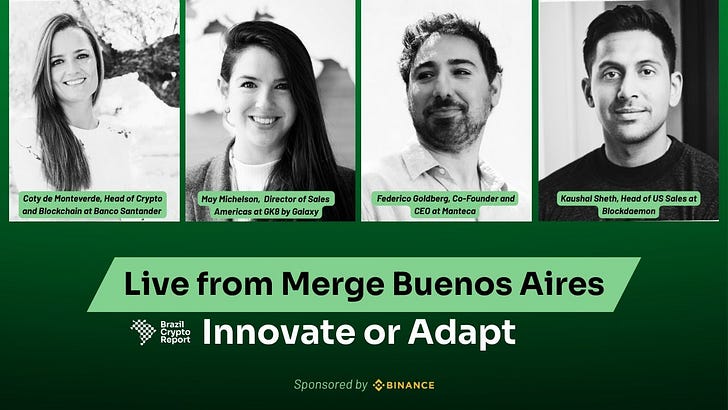
Live from Merge Buenos Aires: Innovate or Adapt - How Institutions are Embracing Crypto
Olá pessoal! I’m excited to share a panel that I hosted at Merge Buenos Aires last month as a special edition of Brazil Crypto Report. This conversation explored how banks and TradFi institutions are looking at digital assets in 2025, and gave a behind the scenes look into the U-turn that we’re seeing happening in real time. The discussion highlighted a paradigm shift in crypto markets — transitioning from retail-driven enthusiasm to institutional leadership. This evolution comes as regulatory frameworks like MiCA in Europe and policy changes in the U.S. have created a more hospitable environment for traditional financial institutions to engage with digital assets.Our panelists included:- Coty de Monteverde, Global Blockchain CTO at Banco Santander- Kaushal Sheth, Head of US Sales at BlockDaemon- Federico Goldberg, CEO at Manteca- May Michelson, Director of Global Sales at GK8 by Galaxy🇧🇷Brazil Crypto Report now has an English language Telegram community!Key Insights:* Regulatory Clarity Driving Adoption: With MiCA implementation in Europe and policy shifts in the US, banks are rapidly forming blockchain teams and developing digital asset strategies* Regional Adoption Patterns: While European banks are responding primarily to regulatory clarity, Latin American institutions are being driven by customer demand and economic factors like inflation* Institutional Focus Areas: Banks and financial institutions are particularly interested in three key areas:* Bitcoin as an investment asset* Stablecoins for payments and cross-border transactions* Tokenization of traditional assets* Security Standards Evolution: Financial institutions require institutional-grade security protocols that far exceed typical crypto exchange standards, with particular emphasis on custody solutions and smart contract security* Bank-Backed Innovation: Santander has pioneered blockchain initiatives for nine years, moving from enterprise use cases to digital securities, participating in CBDC projects, and offering crypto services in select markets* Implementation Considerations: When selecting partners, institutions should evaluate:* Regulatory compliance frameworks* Security infrastructure and protocols* Technical expertise and redundancy* Cost-effectiveness of build vs. buy strategiesThe panel noted that banks increasingly recognize that failing to enter the digital asset space means potentially losing customer engagement to more innovative players. As May Mickelson from GK8 observed, "Everybody down trying to get in... every bank is really pushing to have a blockchain team."I enjoyed this conversation and I hope you do as well! Big thanks to the Merge team for the opportunity!-AWS🙌 Friendly reminder that you can listen to BCR on your favorite podcast platform YouTube | Spotify | Apple PodcastsBrazil Crypto Report is presented byBinance is the largest platform for trading of digital assets. With over 250 million users around the world, the exchange offers over 350 trading pairs, best-in-class products and services for investors, and advanced tools for institutions players.Binance currently holds over US$ 160 billion in user assets under custody and reached a cumulative historical trading volume of $100 trillion in 2024, showcasing the trust placed in it by users worldwide.With user-focus at the core of its DNA, Binance continuously invests to increase usability, bring new features and deepen security.Liquidity matters. Security is non-negotiable. Join Binance NowRecent Episodes Get full access to Brazil Crypto Report at brazilcrypto.substack.com/subscribe
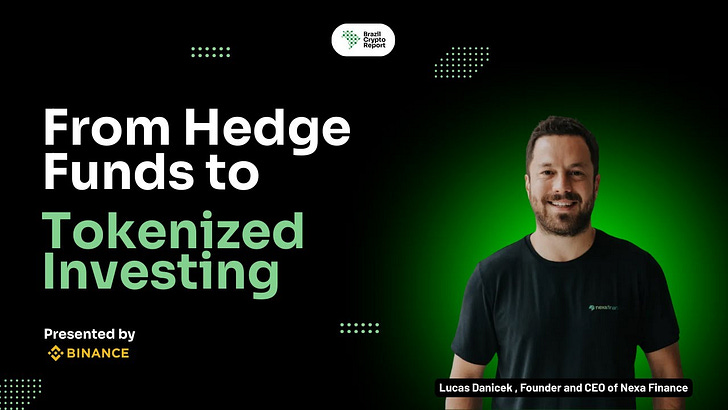
Episode #147: From Hedge Funds to Tokenized Investing with Lucas Danicek
Olá pessoal!Today’s interview is with Lucas Danicek, founder and CEO of Nexa Finance. Lucas shares how he is using tokenization to create hyper-customized investment products for customers across the risk curve.Lucas has over 15 years of experience managing portfolios for some of Brazil’s wealthiest individuals and families. During that journey, he identified a critical pain point in traditional investment models: the lack of personalization and accessibility for alternative investments. Nexa Finance's solution uses blockchain and AI to create personalized investment products that can be directly tailored to the specific preferences and risk profile of an individual investor.This bottom-up approach is a direct inversion of the traditional model, whereby big institutions create generic products and then push them downstream on clients, Lucas explains:“Personalization is always putting the client in first place."The Nexa platform allows investors to specify their risk tolerance, desired returns, cash flow structure, and other preferences, then builds a customized token portfolio combining various assets. This "private ETF" approach is generating impressive returns—approximately 18.4% IRR in Brazilian reals so far, 6.4% above the CDI benchmark (the overnight lending rate for financial institutions). 🇧🇷Brazil Crypto Report now has an English language Telegram community!Key takeaways from the conversation:* Alternative investments represent roughly 20% of global assets under management, but generate 50% of industry returns. However, they remain largely inaccessible to most Brazilian investors* Nexa Finance's tokenization approach addresses key barriers: high minimum investment amounts, illiquidity, geographical limitations, and lack of transparency* The platform has already tokenized approximately 65 assets and issued 55 tokens, with six completed investment cycles* Nexa Finance is launching its B2B platform on May 1st, enabling asset managers, investment advisors, and private banks to build customized products for clients* Danicek argues that tokenization parallels the transformation ETFs brought to traditional markets and that it's poised to become the next major financial innovation — a claim seconded by Blackrock CEO Larry Fink* Current regulatory frameworks for qualified investors are being challenged by personalization technology that can create products perfectly suited to individual needsAlso, Nexa recently released the Brazil Tokenization Report, a comprehensive 65-page analysis of the country's developing tokenization ecosystem, available in both Portuguese and English. Definitely worth a read if you’re interested in further exploring the country’s tokenization ecosystem.I enjoyed this conversation with Lucas and I hope you do as well. You can connect with him on Linkedin. -AWS🙌 Friendly reminder that you can listen to BCR on your favorite podcast platform YouTube | Spotify | Apple PodcastsBrazil Crypto Report is presented byBinance is the largest platform for trading of digital assets. With over 250 million users around the world, the exchange offers over 350 trading pairs, best-in-class products and services for investors, and advanced tools for institutions players.Binance currently holds over US$ 160 billion in user assets under custody and reached a cumulative historical trading volume of $100 trillion in 2024, showcasing the trust placed in it by users worldwide.With user-focus at the core of its DNA, Binance continuously invests to increase usability, bring new features and deepen security.Liquidity matters. Security is non-negotiable. Join Binance NowRecent Episodes Get full access to Brazil Crypto Report at brazilcrypto.substack.com/subscribe
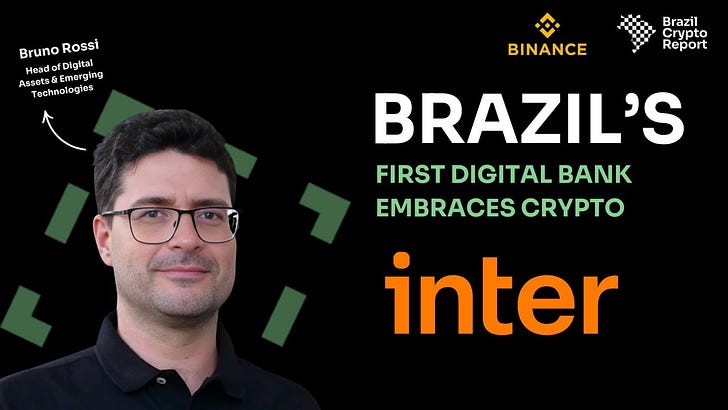
Episode #146: Live from Merge Buenos Aires with Bruno Grossi of Banco Inter
Olá pessoal!Today’s episode is a special interview recorded on site at Merge Buenos Aires last month.I had the pleasure of chatting with Bruno Grossi, who is Head of Emerging Technologies and Digital Assets at Banco Inter, which is Brazil's first digital bank. Our conversation dives into how this pioneering financial institution is leading blockchain integration, participating in Brazil's Drex CBDC project, and preparing for a quantum future.Grossi, with over 25 years in technology and involvement with blockchain since 2017, offers some great insights into how Banco Inter transformed from a small local financial institution into an innovative digital banking powerhouse. As the first bank to convince Brazil's Central Bank to allow account opening without physical documentation back in 2005, Banco Inter sparked Brazil's digital banking revolution long before fintech became mainstream.🇧🇷Brazil Crypto Report now has an English language Telegram community! Key Highlights:* Super App Innovation: Banco Inter created Brazil's first banking super app in 2018, integrating non-financial products like marketplace shopping, food delivery, and even mobile phone service directly within their banking platform.* Drex’s Revolutionary Design: Unlike most CBDCs that operate within central bank networks, Brazil's Drex uses a truly decentralized model where each participating bank runs its own blockchain node, allowing the network to function even if the central bank goes offline.* Transformative Use Cases: The Drex pilot has already demonstrated peer-to-peer government bond trading through smart contracts. Banco Inter is now working on trade finance and credit card receivables tokenization use cases within the pilot that could dramatically reduce costs and increase access for small businesses.* Cross-Border Collaboration: Banco Inter is partnering with Microsoft and Chainlink to solve cross-border liquidity problems between different CBDCs and blockchain systems in Asia.* Quantum Future: Grossi believes quantum computing will impact financial systems within five years, requiring new algorithms but potentially revolutionizing credit risk analysis, portfolio optimization, and personalized banking services.The conversation concludes with Grossi's outlook for 2025, including the anticipated regulatory framework for crypto and tokenization in Brazil and the growing role of stablecoins in cross-border payments—already surpassing credit card usage globally.For anyone interested in the future of digital banking, blockchain integration, or how emerging technologies are reshaping financial services in Latin America's largest economy, this interview provides invaluable front-line perspectives from one of the industry's true innovators.You can connect with Bruno on Linkedin-AWS🙌 Friendly reminder that you can listen to BCR on your favorite podcast platform YouTube | Spotify | Apple PodcastsBrazil Crypto Report is presented byBinance is the largest platform for trading of digital assets. With over 250 million users around the world, the exchange offers over 350 trading pairs, best-in-class products and services for investors, and advanced tools for institutions players.Binance currently holds over US$ 160 billion in user assets under custody and reached a cumulative historical trading volume of $100 trillion in 2024, showcasing the trust placed in it by users worldwide.With user-focus at the core of its DNA, Binance continuously invests to increase usability, bring new features and deepen security.Liquidity matters. Security is non-negotiable. Join Binance NowRecent Episodes Get full access to Brazil Crypto Report at brazilcrypto.substack.com/subscribe
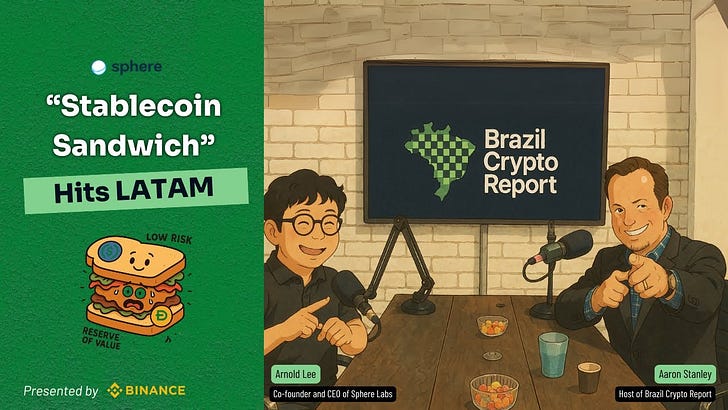
Episode #145: Sphere's "Stablecoin Sandwich" Comes to Latam, with Arnold Lee
Olá pessoal!For week’s podcast I caught up with Arnold Lee, co-founder CEO of Sphere Labs, on a recent trip to Sao Paulo. We discuss how Sphere has found product market fit using stablecoins for cross-border payments, and why Latin America is positioned as a critical region for stablecoin adoption in 2025.Arnold explains Sphere's core offerings: SpherePay, a cross-border payments API utilizing the "stablecoin sandwich" method, and SphereNet, an account ledger built on the Solana virtual machine designed for financial institutions. The stablecoin sandwich approach converts local currency to a stablecoin (typically USD-based) before converting to the destination currency, providing better liquidity and rates than direct currency pairs might offer.Key Takeaways:* Stablecoin Infrastructure: Sphere has built what they believe is the world's fastest on/off-ramp for cross-border payments without taking credit risk, processing billions of dollars annually.* Emerging Markets Focus: The company specifically targets emerging markets where traditional financial access is limited, with Latin America being particularly important for adoption.* Beyond Efficiency: Arnold frames stablecoins not just as efficiency plays but as opportunity enablers that can unlock structural "deadweight loss" by allowing entrepreneurs in smaller countries to access global markets without relocation.* B2B Emphasis: Sphere primarily serves B2B clients including import/export businesses (across metals, fabrics, oil, raw materials) and fintechs managing treasury operations.* Growth Trajectory: Sphere has scaled its team from 7 to 28 people and from processing millions to billions in transaction volume in a short timeframe.Lee's personal background informs Sphere's mission. As the child of Korean immigrants and co-founding the company with a fellow immigrant to the US, he understands firsthand the challenges of capital movement across borders.The conversation highlights how stablecoins are gaining legitimacy, particularly following Stripe's acquisition of Bridge - a moment Lee describes as directionally similar to Facebook's Instagram acquisition that transformed perceptions of an emerging technology.For 2025, Sphere is investing in Latin American expansion through local hiring, sales teams, compliance infrastructure, and partnerships to provide faster, cheaper, and more robust cross-border payment solutions in the region.I really enjoyed this conversation with Arnold and I hope you do as well. You can connect with him on Linkedin-AWS🙌 Friendly reminder that you can listen to BCR on your favorite podcast platform YouTube | Spotify | Apple PodcastsBrazil Crypto Report is presented byBinance is the largest platform for trading of digital assets. With over 250 million users around the world, the exchange offers over 350 trading pairs, best-in-class products and services for investors, and advanced tools for institutions players.Binance currently holds over US$ 160 billion in user assets under custody and reached a cumulative historical trading volume of $100 trillion in 2024, showcasing the trust placed in it by users worldwide.With user-focus at the core of its DNA, Binance continuously invests to increase usability, bring new features and deepen security.Liquidity matters. Security is non-negotiable. Join Binance NowRecent Episodes Get full access to Brazil Crypto Report at brazilcrypto.substack.com/subscribe
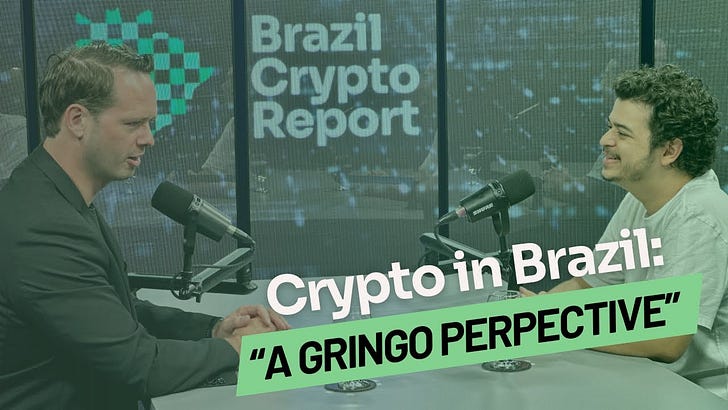
Episode #144 Crypto in Brazil: A Gringo's Perspective
Olá pessoal!Greetings from Buenos Aires where the Merge BA conference has just concluded. It was great to connect with readers and listeners from around the region throughout the week. Today’s episode is a Portuguese language crossover that I recorded with João Pedro Malar, host of Exame’s Future of Money podcast — one of the most influential crypto podcasts in Brazil. We discuss my experiences and views on crypto in Brazil having covered it for three years via this newsletter and podcast, and we talk about some other recent market developments. While I’m obviously more comfortable speaking in English, this was a fun opportunity to share more about my story and why I’ve invested the last decade of my life into building a career in crypto. I try to avoid talking about myself too much, but this was a fun episode where I had the chance to share more of my personal and professional story. I hope you enjoy! You can find the Future of Money version of this episode here. You can connect with João on Linkedin-AWS🙌 Friendly reminder that you can listen to BCR on your favorite podcast platform YouTube | Spotify | Apple PodcastsBrazil Crypto Report is presented byBinance is the largest platform for trading of digital assets. With over 250 million users around the world, the exchange offers over 350 trading pairs, best-in-class products and services for investors, and advanced tools for institutions players.Binance currently holds over US$ 160 billion in user assets under custody and reached a cumulative historical trading volume of $100 trillion in 2024, showcasing the trust placed in it by users worldwide.With user-focus at the core of its DNA, Binance continuously invests to increase usability, bring new features and deepen security.Liquidity matters. Security is non-negotiable. Join Binance NowRecent Episodes Get full access to Brazil Crypto Report at brazilcrypto.substack.com/subscribe

Episode #143: Making Sense of Crypto Market Turbulence with Andre Portilho
💡 If you haven't already be sure to check out Merge Buenos Aires, which takes place March 24-26 in the Argentine capital. The conference is an exciting opportunity to connect Europe and Latin America through Web3 and will provide a great pulse check on crypto adoption in the region. I'll be attending and I hope to see some of you there as wellOlá pessoal! For today’s episode I’m joined by Andre Portilho, Head of Digital Assets at BTG Pactual, to discuss the rapidly evolving cryptocurrency landscape over the first two months of 2025. Recorded at BTG Pactual's studios in São Paulo, this conversation offers valuable insights into market trends, regulatory developments, and the future of digital assets.Our discussion comes at a pivotal moment for crypto markets, which have experienced significant volatility following the initial euphoria of the Trump administration. Portilho brings a unique perspective as a seasoned trader with deep experience in both traditional and crypto markets, offering a balanced view of recent developments and long-term potential.Key Takeaways:* Bitcoin's Decoupling from Alts: The introduction of Bitcoin ETFs has redirected most new capital inflows toward bitcoin, increasing its market dominance to >60% and creating a separation between bitcoin and altcoins in terms of market performance* Market Correlation Reality: Despite years of discussing "decoupling," crypto remains highly correlated with traditional risk assets, especially during market stress periods. As Portilho notes: "We tend to look just at crypto. But right now, crypto is a part of everything else related to macro and risk assets."* Ethereum's Challenges: The ETH/BTC pair has struggled, reflecting Ethereum's difficulty in establishing a compelling narrative despite achieving its technical scaling goals through L2 solutions. Questions remain about value accrual to the token itself amid fierce competition from competitors like Solana* Brazil's Leadership Position: Brazil stands out globally with exceptional integration between traditional financial institutions and crypto. Four major banks in the country now offer crypto directly to clients—far ahead of Europe or the US.* Regulatory Progress: Brazil's Central Bank has conducted thorough public consultations on crypto regulation, with a framework expected to be implemented in the second half of 2025. While setting a high regulatory bar initially, this collaborative approach positions Brazil well for the future.🙌 Friendly reminder that you can listen to BCR on your favorite podcast platform YouTube | Spotify | Apple PodcastsDespite current market challenges, Portilho remains optimistic about the long-term transformation of finance through crypto: "Every bank will become a crypto bank... the new rails will be this. I'm quite confident of that. We're just beginning in this process. This is not something that will happen in two or three years. This is a movement that will last the next 10-20 years."For listeners both inside and outside of Brazil, this conversation offers valuable context on where we are in crypto's adoption cycle and how traditional institutions are positioning themselves for the future of finance.You can connect with Andre on LinkedinThanks for watching/listening, and we’ll see you at Merge Buenos Aires in a couple of weeks!-AWSBrazil Crypto Report is presented byBinance is the largest platform for trading of digital assets. With over 250 million users around the world, the exchange offers over 350 trading pairs, best-in-class products and services for investors, and advanced tools for institutions players.Binance currently holds over US$ 160 billion in user assets under custody and reached a cumulative historical trading volume of $100 trillion in 2024, showcasing the trust placed in it by users worldwide.With user-focus at the core of its DNA, Binance continuously invests to increase usability, bring new features and deepen security.Liquidity matters. Security is non-negotiable. Join Binance NowRecent Episodes Get full access to Brazil Crypto Report at brazilcrypto.substack.com/subscribe
Episode #142: Uniting Europe and Latam with Merge CEO Paula Pascual
🙌 Friendly reminder that you can listen to BCR on your favorite podcast platform YouTube | Spotify | Apple PodcastsOlá pessoal! For today’s episode I talk to Paula Pascual, who is founder and CEO of Merge, which is an exciting Web3 events brand that aims to create connections between Latin America, Europe, and the global blockchain ecosystem.After five years of working in the blockchain division at Santander in Madrid, Paula identified a significant gap: Latin America, despite its high crypto adoption rates, remains underrepresented at international blockchain conferences and generally across the global crypto community. This observation led her to launch Merge, which hosted its first international event in Madrid in October 2024 and is now preparing for its Buenos Aires edition later this month.🇧🇷Brazil Crypto Report is excited to be a media partner of Merge Buenos Aires, which takes place March 24-26 in the Argentine capital! Key Highlights:* Market Opportunity: Latin America shows remarkably high crypto adoption rates, making it a prime target for protocols and exchanges, yet remains underrepresented in terms of global mindshare* International Bridge: Merge aims to bring together regulators, traditional financial institutions, and crypto innovators to facilitate meaningful dialogue between Latin America and Europe* Strategic Timing: The Buenos Aires event comes at a critical moment for Argentina's crypto ecosystem, offering an opportunity to demonstrate industry legitimacy amid recent challenges* Partnership Approach: We discuss Merge’s approach to complementing and partnering with local communities in the region * Beyond Business: The conference will feature three stages (main, business and technical), plus some unique Argentine cultural experiences including concerts, digital art exhibitions, and immersive activitiesLooking Forward:Paula will be hosting the second edition of Merge Madrid in the second half of the year and looks to host another Latam edition in the first half of 2026. While Madrid will remain the European hub, the Latam editions will rotate based on market developments and regulatory progress. Brazil appears to be the likely next destination given its advanced institutional market. 🎉You can connect with Paula on Linkedin. Thanks for watching/listening, and we’ll see you at Merge Buenos Aires in a couple of weeks! -AWSBrazil Crypto Report is presented byBinance is the largest platform for trading of digital assets. With over 250 million users around the world, the exchange offers over 350 trading pairs, best-in-class products and services for investors, and advanced tools for institutions players.Binance currently holds over US$ 160 billion in user assets under custody and reached a cumulative historical trading volume of $100 trillion in 2024, showcasing the trust placed in it by users worldwide.With user-focus at the core of its DNA, Binance continuously invests to increase usability, bring new features and deepen security.Liquidity matters. Security is non-negotiable. Join Binance NowRecent Episodes Get full access to Brazil Crypto Report at brazilcrypto.substack.com/subscribe
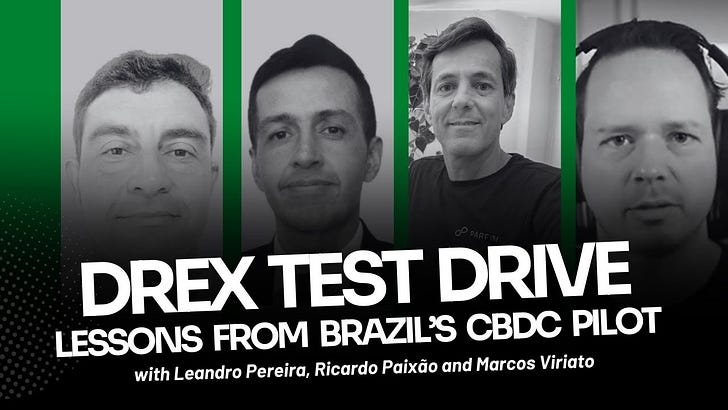
Episode #141: Drex Test Drive: Lessons from Brazil's CBDC Pilot
💡 If you haven't already be sure to check out Merge Buenos Aires, which takes place March 24-26 in the Argentine capital. The conference is an exciting opportunity to connect Europe and Latin America through Web3 and will provide a great pulse check on crypto adoption in the region. I'll be attending and I hope to see some of you there as well🙌 If you enjoy this content, please consider dropping a like or giving a 5-star rating to BCR wherever you listen to podcasts! YouTube | Spotify | Apple PodcastsOlá pessoal and happy Carnaval! For today’s episode we’ve assembled several key players from Drex ecosystem to discuss a new report from the Central Bank of Brazil analyzing Phase 1 of the Drex pilot. * Marcos Viriato, CEO of Parfin — whose Rayls solution is being used extensively in the testing* Leandro Sciammarella Pereira, Technology Lead at Núclea Digital Asset, which leads one of the 16 consortia participating in the pilot* Ricardo Paixão, technical adviser to the Brazilian Congress and coordinator of CRIA who has been involved in the Drex project since its very early daysFor those catching up, Drex is the ambitious CBDC/tokenization project that tries to thread the needle between the traditional wholesale and retail CBDC models. It’s the capstone project of the Brazilian Central Bank’s innovation agenda, which has successfully rolled out Pix and Open Finance over the last five years.Phase 1 of the Drex pilot concluded last June, and Brazil’s Central Bank released last week a 70+ page technical report last week highlighting the successes and blockers while noting that a “major adaptation” will be needed for Drex to become a core piece of Brazil’s financial infrastructure. This conversation with Marcos, Leandro and Ricardo addresses the report’s findings and addresses some of the negative reactions and FUD that circulated on social media and Whatsapp groups following the report’s publication.They argue that the findings weren't surprising or necessarily negative but rather confirmed technical challenges that the bank has been broadcasting publicly for some time now — specifically that of balancing the “DREX Trilemma” of: * Balancing privacy (shielding transaction details)* Maintaining composability (allowing smart contracts to interact)* Enabling programmability (supporting DeFi innovation)Managing expectations for a project of this size and scope is a critical, and it’s important to remember that this was a pilot that where the objective is to test, iterate, learn and improve. While the first phase of the pilot focused on testing privacy solutions, Phase 2 — now ongoing — is addressing the remaining challenges along with scalability concerns.The Central Bank's decision not to test additional use cases beyond the 13 already selected was viewed as pragmatic rather than problematic. With the existing use cases already covering tokenized real estate, credit receivables, and other key applications, expanding further would stretch limited resources.A significant challenge highlighted during the discussion was integration with legacy systems. As Leandro explained, connecting blockchain infrastructure with traditional banking systems requires building components "from scratch" - a complex undertaking beyond the technical aspects of the blockchain itself.The experts remained optimistic about the growth of tokenization in Brazil regardless of Drex’s timeline. "Companies are already tokenizing assets and doing business," noted Ricardo, pointing to ongoing market developments that will continue with or without the central bank infrastructure.Marcos concluded with a call for resilience: "The Central Bank is at the forefront of this innovation. Don't lose it... this infrastructure will be required for our nation."Have a great day everyone!-AWS🙌 🇧🇷Brazil Crypto Report is a free publication; if you wish to support us you can do so by hitting the button below👇Brazil Crypto Report is presented byBinance is the largest platform for trading of digital assets. With over 250 million users around the world, the exchange offers over 350 trading pairs, best-in-class products and services for investors, and advanced tools for institutions players.Binance currently holds over US$ 160 billion in user assets under custody and reached a cumulative historical trading volume of $100 trillion in 2024, showcasing the trust placed in it by users worldwide.With user-focus at the core of its DNA, Binance continuously invests to increase usability, bring new features and deepen security.Liquidity matters. Security is non-negotiable. Join Binance Now Recent Episodes Get full access to Brazil Crypto Report at brazilcrypto.substack.com/subscribe

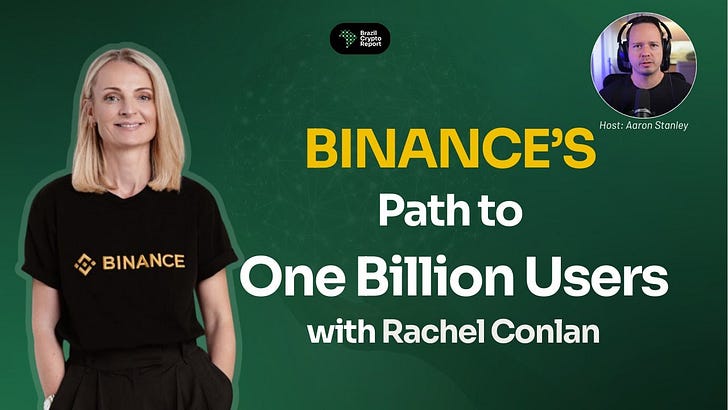
Episode #140: Binance's Path to One Billion Users with Rachel Conlan
🙌 If you enjoy this content, please consider dropping a like or giving a 5-star rating to BCR wherever you listen to podcasts! YouTube | Spotify | Apple PodcastsOlá pessoal!Today I’m joined by Rachel Conlan, Chief Marketing Officer at Binance, to discuss the exchange's remarkable growth and its strategic focus on Latin America. With over 20 years of marketing experience in advertising and entertainment, Rachel provides discusses how Binance has expanded to 250 million users globally while navigating regulatory challenges and a leadership transition.Her core objective now is to bring one billion total users onto the world’s largest crypto exchange.Key Takeaways:* Latin America leads global adoption: Binance’s user growth in Latin America grew an impressive 63% over the last year, significantly outpacing the global average of 56%* Community-first approach: Binance's marketing strategy revolves around education, transparency, and building meaningful connections through social platforms and in-person events.* Brazil as a crypto innovation hub: Brazilian users are among the most sophisticated, with high adoption rates of Binance products like Copy Trading, Earn, and Launchpool.* The power of education: In 2024, over 43 million people participated in Binance Academy courses, demonstrating the platform's commitment to crypto education.* Value-driven leadership transition: The successful transition from founder Changpeng Zhao to Richard Teng has been enabled by strong organizational values and a user-centric culture.Rachel describes Latin America as a testing ground for Binance's global strategy, noting that the region showcases "every type of use case for crypto" – from institutional adoption in Mexico to wealth preservation in Argentina. This diversity allows Binance to trial various approaches that can later be implemented in other markets.The conversation also touches on the changing perception of cryptocurrency, with Rachel highlighting 2024 as a "watershed year" following ETF approvals and increased institutional investment that has shifted the narrative from negative to optimistic.For those curious about entering the crypto space, Rachel emphasizes that "it's still early" and encourages newcomers to attend industry events and participate in communities. She also invites users to provide feedback through Binance's platforms to help strengthen the industry as it works toward the ambitious goal of reaching one billion users.You can connect with Rachel on X/Twitter and LinkedinHave a great day everyone!-AWS🙌 🇧🇷Brazil Crypto Report is a free publication; if you wish to support us you can do so by hitting the button below👇Brazil Crypto Report is presented byBinance is the largest platform for trading of digital assets. With over 250 million users around the world, the exchange offers over 350 trading pairs, best-in-class products and services for investors, and advanced tools for institutions players.Binance currently holds over US$ 160 billion in user assets under custody and reached a cumulative historical trading volume of $100 trillion in 2024, showcasing the trust placed in it by users worldwide.With user-focus at the core of its DNA, Binance continuously invests to increase usability, bring new features and deepen security.Liquidity matters. Security is non-negotiable. Join Binance NowPowered by hydroelectric energy from the ITAIPU Dam, Morphware provides high-performance compute to run, train, and build your AI apps and agents.One of the greatest expenses when it comes to building AI applications is the compute. Morphware provides a gateway to accessible compute for AI development.Using abundant clean energy from Paraguay, NVIDIA’s highest performing GPU servers, and bitcoin mining infrastructure Morphware offers some of the most competitive prices for compute in the industry.Follow on X @Morphwareai and join the Telegram to be a part of the communityRecent Episodes Get full access to Brazil Crypto Report at brazilcrypto.substack.com/subscribe
Episode #139: A Pop-Up City Comes to Floripa with Jean Hansen and Victor Cioffi
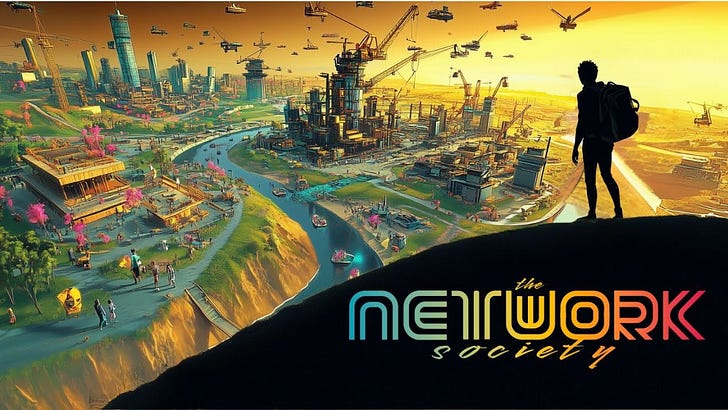
🙌 If you enjoy this content, please consider dropping a like or giving a 5-star rating to BCR wherever you listen to podcasts! YouTube | Spotify | Apple PodcastsOlá pessoal!The notion of Pop-Up cities has recently emerged as a fascinating experiments in combining technology, governance, and community building. These attempt to be a real-life manifestation of the “Network State” concept pioneered by Balaji Srinivasan and others. We’ve seen these initiatives spring up in Montenegro, Thailand, Honduras and Argentina over the last couple of years, and 2025 will be the year Brazil gets its own edition. Ipê City will take place in Florianópolis, Brazil’s Silicon Valley, April 22 - May 22 with an aim to rethink technological innovation and societal progress in Brazil.For this episode, I talk to Ipê core team members Jean Hansen — a veteran of various “network state” initiatives, and Victor Cioffi, formerly of the Solana Superteam and co-founder of the Bankless Brasil DAO. According to Jean and Victor, Ipê City represents more than just another tech gathering – it's an attempt to create a sandbox for innovation where 150-200 talented individuals prototype solutions to real-world challenges in health, finance, governance, and education in Brazil. Like other “pop-up city” concepts, it offers month-long immersive experience where participants can work, collaborate, and build in a supportive community environment.Key Takeaways:* Ipê City will run weekly cycles where residents pitch ideas on Mondays and present prototypes to investors and stakeholders on Saturdays* The project focuses on four main pillars: health, finance, governance, and education* There will be a heavy focus on AI tools and platforms offering no-code development* The initiative aims to foster a tech-optimistic culture in Brazil while creating practical solutions* The venue is located in Florianópolis's Jurerê Internacional neighborhood, offering a blend of work and lifestyle benefitsFor those interested in being part of this exciting initiative, you can apply at ipe.city. You can also find detailed documentation available at docs.ipe.city.You can also join the Ipê City Telegram group or Discord server to learn more. I also highly recommend Jean’s Network Society documentary film that tells the story of Honduras’ Prospera Island👇You can connect with Jean and Victor on Linkedin and X/Twitter.Have a great day everyone!-AWS🙌 🇧🇷Brazil Crypto Report is a free publication; if you wish to support us you can do so by hitting the button below👇Brazil Crypto Report is presented byBinance is the largest platform for trading of digital assets. With over 250 million users around the world, the exchange offers over 350 trading pairs, best-in-class products and services for investors, and advanced tools for institutions players.Binance currently holds over US$ 160 billion in user assets under custody and reached a cumulative historical trading volume of $100 trillion in 2024, showcasing the trust placed in it by users worldwide.With user-focus at the core of its DNA, Binance continuously invests to increase usability, bring new features and deepen security.Liquidity matters. Security is non-negotiable. Join Binance NowPowered by hydroelectric energy from the ITAIPU Dam, Morphware provides high-performance compute to run, train, and build your AI apps and agents.One of the greatest expenses when it comes to building AI applications is the compute. Morphware provides a gateway to accessible compute for AI development.Using abundant clean energy from Paraguay, NVIDIA’s highest performing GPU servers, and bitcoin mining infrastructure Morphware offers some of the most competitive prices for compute in the industry.Follow on X @Morphwareai and join the Telegram to be a part of the communityRecent Episodes Get full access to Brazil Crypto Report at brazilcrypto.substack.com/subscribe
Episode #138: Unlocking Financial Innovation in Brazil with FENASBAC
🙌 If you enjoy this content, please consider dropping a like or giving a 5-star rating to BCR wherever you listen to podcasts! YouTube | Spotify | Apple PodcastsOlá pessoal!Danielle Teixeira is a Program Manager for Innovation at FENASBAC. We discuss how the organization has evolved from a Central Bank employee association to become a crucial intermediary between regulators and financial innovators and builders in Brazil.FENASBAC operates several accelerator programs, including LIFT Lab and the NEXT Accelerator, which are designed to foster innovation while maintaining productive dialogue between startups and regulators. The organization's unique position as a non-profit allows it to create a neutral ground where both established institutions and emerging companies can collaborate effectively.The current NEXT Accelerator program features prominent sponsors including Banco do Brasil, Ripple, and Mercado Bitcoin, focusing on challenges ranging from blockchain implementation to tokenization of real-world assets. The program stands out for its commitment to facilitating tangible business opportunities while providing mentorship without taking equity from participating startups.Key Takeaways:* FENASBAC's programs have been instrumental in shaping Brazil's approach to financial innovation, including the development of Pix, Drex and real world asset tokenization* The NEXT Accelerator program is free for startups and allows them to retain full intellectual property rights of their proofs of concept* International startups are welcome to participate, with previous participants including companies from Belgium and other countries* Current blockchain-focused challenges include developing use cases for Ripple's XRPL and creating innovative applications RWAs using Mercado Bitcoin's platform.The program is in the process of expanding to work with the CVM (Brazil's securities regulator) on new initiatives aimed at fostering innovation in capital markets (more details on that to come).FENASBAC's approach has helped create what Teixeira describes as a "safe space" for dialogue between regulators and innovators, contributing to Brazil's position as a leader in financial innovation. For fintech companies and entrepreneurs interested in entering the Brazilian market, FENASBAC's programs offer a structured pathway to engage with regulators and established financial institutions.You can connect with Danielle on Linkedin. Have a great day everyone!-AWS🙌 🇧🇷Brazil Crypto Report is a free publication; if you wish to support us you can do so by hitting the button below👇Brazil Crypto Report is presented byBinance is the largest platform for trading of digital assets. With over 250 million users around the world, the exchange offers over 350 trading pairs, best-in-class products and services for investors, and advanced tools for institutions players.Binance currently holds over US$ 160 billion in user assets under custody and reached a cumulative historical trading volume of $100 trillion in 2024, showcasing the trust placed in it by users worldwide.With user-focus at the core of its DNA, Binance continuously invests to increase usability, bring new features and deepen security.Liquidity matters. Security is non-negotiable. Join Binance NowPowered by hydroelectric energy from the ITAIPU Dam, Morphware provides high-performance compute to run, train, and build your AI apps and agents.One of the greatest expenses when it comes to building AI applications is the compute. Morphware provides a gateway to accessible compute for AI development.Using abundant clean energy from Paraguay, NVIDIA’s highest performing GPU servers, and bitcoin mining infrastructure Morphware offers some of the most competitive prices for compute in the industry.Follow on X @Morphwareai and join the Telegram to be a part of the communityRecent Episodes Get full access to Brazil Crypto Report at brazilcrypto.substack.com/subscribe
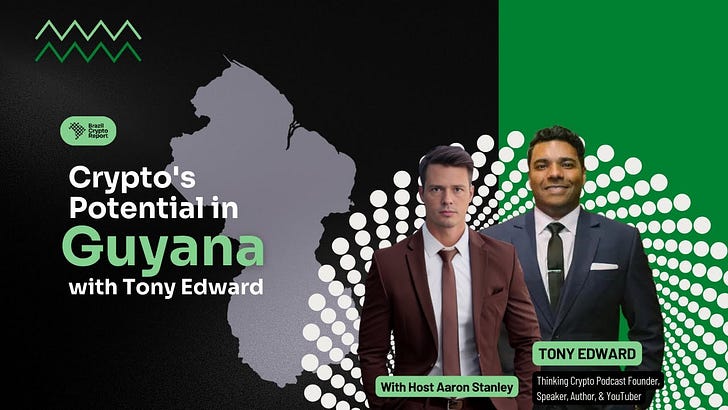
Episode #137: Bits & Borders: Crypto's Potential in Guyana with Tony Edward
🙌 If you enjoy this content, please consider dropping a like or giving a 5-star rating to BCR wherever you listen to podcasts! YouTube | Spotify | Apple PodcastsOlá pessoal!Today’s episode is the soft-launch of a special mini-series called Bits & Borders that will take us on a country-by-country tour exploring crypto adoption across Latin America. Each episode will spotlight a different country and map out the various adoption trends, entrepreneurial energy and regulatory environment in that specific nation. 🔥The first stop on our tour is: Guyana! As Guyana emerges as one of the world's fastest-growing economies thanks to major oil discoveries, the conversation around digital asset adoption becomes increasingly relevant. Tony Edward, host of the popular Thinking Crypto Podcast, shares his unique perspective as a Guyanese native on the intersection of traditional finance, crypto, and economic development.🗝️Key Takeaways:* Guyana's recent oil discovery has transformed the country's economic landscape, making it one of the fastest-growing economies globally* Traditional currency challenges persist, with many Guyanese preferring US dollars over local currency* USDC and stablecoins could serve as an ideal entry point for crypto adoption, given the population's familiarity with USD* Young, tech-savvy Guyanese are showing increasing interest in cryptocurrencies, primarily through peer-to-peer transactions* Limited infrastructure and few formal on-ramps currently pose challenges to wider adoption of crypto assets in the country Tony emphasizes that while formal crypto infrastructure remains limited in Guyana, the younger generation's technological literacy and smartphone penetration could drive future adoption. The country's historical relationship with currency debasement and strong ties to the US dollar make stablecoins a particularly compelling entry point for mainstream adoption.As Guyana continues its economic transformation, the opportunity for digital asset integration grows. The combination of increasing wealth from oil revenues, a young population comfortable with digital technology, and existing currency challenges creates fertile ground for crypto adoption.Looking ahead to 2025, Edward sees broader global trends - including institutional adoption and political support - potentially accelerating crypto acceptance in emerging markets like Guyana.You can connect with Tony on Linkedin and follow him on X/Twitter. Have a great weekend everyone!-AWS🙌 🇧🇷Brazil Crypto Report is a free publication; if you wish to support us you can do so by hitting the button below👇Brazil Crypto Report is presented byBinance is the largest platform for trading of digital assets. With over 250 million users around the world, the exchange offers over 350 trading pairs, best-in-class products and services for investors, and advanced tools for institutions players.Binance currently holds over US$ 160 billion in user assets under custody and reached a cumulative historical trading volume of $100 trillion in 2024, showcasing the trust placed in it by users worldwide.With user-focus at the core of its DNA, Binance continuously invests to increase usability, bring new features and deepen security.Liquidity matters. Security is non-negotiable. Join Binance NowPowered by hydroelectric energy from the ITAIPU Dam, Morphware provides high-performance compute to run, train, and build your AI apps and agents.One of the greatest expenses when it comes to building AI applications is the compute. Morphware provides a gateway to accessible compute for AI development.Using abundant clean energy from Paraguay, NVIDIA’s highest performing GPU servers, and bitcoin mining infrastructure Morphware offers some of the most competitive prices for compute in the industry.Follow on X @Morphwareai and join the Telegram to be a part of the communityRecent Episodes Get full access to Brazil Crypto Report at brazilcrypto.substack.com/subscribe
Episode #136: Live from Brazil House at the World Economic Forum
🙌 If you enjoy this content, please consider dropping a like or giving a 5-star rating to BCR wherever you listen to podcasts: YouTube | Spotify | Apple PodcastsOlá pessoal!BCR had the privilege of hosting a panel session at the inaugural Brazil House at the World Economic Forum in Davos, Switzerland last week. I’m delighted to be able to release the full discussion as a special edition of the BCR podcast. Our panel of industry leaders discussed Brazil's ascendance in the global digital assets ecosystem and its remarkable convergence of fintech and crypto innovation and traditional finance. The discussion featured:* Andre Portilho, Head of Digital Assets at BTG Pactual* Caroline Malcolm, Visiting Fellow at Oxford University* Dante Disparte, Chief Strategy Officer at Circle* Alan Cohn, Partner at Steptoe, LLCWe discussed several key developments shaping Brazil's digital asset landscape:* Every major Brazilian bank now maintains digital asset initiatives, with BTG Pactual and Nubank playing significant roles* How Circle's USDC partnership with Nubank reaches 100 million customers, marking a significant milestone in stablecoin adoption* The Central Bank of Brazil's DREX initiative advances as a pioneering hybrid wholesale CBDC model* Comprehensive digital asset regulations expected in 2024, positioning Brazil as a regional leader in regulatory frameworkThe panel highlighted how Brazil's three-phase modernization strategy - beginning with PIX, advancing through Open Finance, and culminating in DREX - demonstrates the country's methodical approach to financial innovation. This strategy, coupled with a tech-savvy population and forward-thinking regulatory environment, positions Brazil as a potential blueprint for other nations exploring the integration of traditional and digital finance.What distinguishes Brazil's approach is its balanced consideration of innovation and stability. While embracing digital asset adoption, the country maintains strong oversight of capital flows and monetary sovereignty, creating a model that other emerging markets might follow.This conversation provided a great insider vs outsider perspective on the state of crypto in Brazil as it sits right now, and it was an incredible opportunity to share what’s happening in Brazil with business and political leaders from around the world. Have a great weekend everyone!-AWS🙌 🇧🇷Brazil Crypto Report is a free publication; if you wish to support us you can do so by hitting the button below👇Brazil Crypto Report is presented byPowered by hydroelectric energy from the ITAIPU Dam, Morphware provides high-performance compute to run, train, and build your AI apps and agents.One of the greatest expenses when it comes to building AI applications is the compute. Morphware provides a gateway to accessible compute for AI development.Using abundant clean energy from Paraguay, NVIDIA’s highest performing GPU servers, and bitcoin mining infrastructure Morphware offers some of the most competitive prices for compute in the industry.Follow on X @Morphwareai and join the Telegram to be a part of the communityRecent Episodes Get full access to Brazil Crypto Report at brazilcrypto.substack.com/subscribe
Episode #135: FTX Two Years On with Antonio Neto (Part 2)
🙌 If you enjoy this content, please consider dropping a like or giving a 5-star rating to BCR wherever you listen to podcasts: YouTube | Spotify | Apple PodcastsOlá pessoal!This week we have Part Two of our two-part conversation with Antonio Neto, former head of FTX for Brazil and Latam, who provides a unique perspective on the exchange's dramatic collapse and Sam Bankman-Fried's recent conviction.Key takeaways and implications:* Regulatory Landscape: FTX was reportedly close to securing special SEC treatment, highlighting the delicate balance between innovation and oversight in crypto markets* Institutional Integration: Prior to collapse, FTX Brazil was in advanced discussions with major banks, indicating growing mainstream financial sector interest* Market Impact: Approximately 20-30,000 Brazilian users were affected, demonstrating significant retail market penetration* Risk Management: The collapse revealed critical gaps in asset segregation practices, prompting industry-wide reassessment* Corporate Governance: The lack of clear organizational structure and risk management protocols inside FTX proved fatal* Antonio lost significant personal assets in FTX's collapse and had to pay hefty WeWork contract terminations out of pocket* Antonio’s experiences working out of the FTX Bahamas compound* Antonio believes SBF's 25-year sentence was too lenient given the scale of damage to the crypto industryPost-FTX, Antonio has focused on building Vega Crypto, which helps international companies enter Brazil's crypto market. He's also leading Ethereum Brasil and working to build the country’s Web3 builder community while expanding its profile internationally. I really enjoyed hearing about Antonio’s experiences and first-hand view of one of the pivotal events in crypto’s history. I hope you find it valuable as well. Have a great weekend everyone!-AWS🙌 🇧🇷Brazil Crypto Report is a free publication; if you wish to support us you can do so by hitting the button below👇Brazil Crypto Report is presented byPowered by hydroelectric energy from the ITAIPU Dam, Morphware provides high-performance compute to run, train, and build your AI apps and agents.One of the greatest expenses when it comes to building AI applications is the compute. Morphware provides a gateway to accessible compute for AI development.Using abundant clean energy from Paraguay, NVIDIA’s highest performing GPU servers, and bitcoin mining infrastructure Morphware offers some of the most competitive prices for compute in the industry.Follow on X @Morphwareai and join the Telegram to be a part of the communityRecent Episodes Get full access to Brazil Crypto Report at brazilcrypto.substack.com/subscribe
Episode #134: FTX Two Years On with Antonio Neto (Part 1)
Olá pessoal!For today’s episode I’m joined by FTX’s former Head of Brazil and Latin America Antonio Neto to talk about the collapse of the cryptocurrency exchange and its larger-than-life founder Sam Bankman-Fried.In this conversation, Antonio shares publicly for the first time about his experience witnessing the dramatic collapse of one of crypto's most prominent exchanges firsthand. As employee #52, he discusses FTX's final days and shares his personal experience navigating one of the industry's most significant failures.The conversation offers rare insights into FTX's internal culture, the warning signs that were missed, and the chaotic sequence of events that led to its downfall. Antonio, who lost much of his personal wealth in the collapse, shares his perspective on why the bankruptcy happened so quickly and reflects on the complex relationships between FTX, Alameda Research, and key stakeholders.🙌 If you enjoy this content, please consider dropping a like or giving a 5-star rating to BCR wherever you listen to podcasts: YouTube | Spotify | Apple PodcastsKey Highlights:* FTX's unique culture attracted many crypto OGs and experienced professionals, despite lacking traditional corporate structure* The company's meteoric rise during the pandemic was fueled by a small, dedicated team working 12-14 hour days* Internal warning signs were often dismissed as "features, not bugs" of a fast-moving startup* The relationship between FTX and Alameda Research was more complex than publicly known* The bankruptcy declaration came surprisingly quickly, possibly driven by employees with traditional finance backgrounds looking to protect their future reputationsImportant Takeaways:* The importance of proper corporate governance and board oversight in crypto companies* How the "move fast and break things" mentality can mask serious structural issues* The dangers of concentrated power in crypto organizations* Why proper segregation of assets is crucial for exchanges* The impact of personal relationships on business decisions in cryptoAntonio's story serves as both a cautionary tale and a valuable lesson for the crypto industry. His decision to focus on moving forward rather than dwelling on losses offers an interesting perspective on resilience in the face of catastrophic failure.The episode provides a fascinating glimpse into one of crypto's most dramatic moments, told by someone who lived through it. Be sure to check back in next week for Part 2 of this conversation. Have a great weekend everyone!-AWS🙌 🇧🇷Brazil Crypto Report is a free publication; if you wish to support us you can do so by hitting the button below👇Brazil Crypto Report is presented byPowered by hydroelectric energy from the ITAIPU Dam, Morphware provides high-performance compute to run, train, and build your AI apps and agents.One of the greatest expenses when it comes to building AI applications is the compute. Morphware provides a gateway to accessible compute for AI development.Using abundant clean energy from Paraguay, NVIDIA’s highest performing GPU servers, and bitcoin mining infrastructure Morphware offers some of the most competitive prices for compute in the industry.Follow on X @Morphwareai and join the Telegram to be a part of the communityRecent Episodes Get full access to Brazil Crypto Report at brazilcrypto.substack.com/subscribe
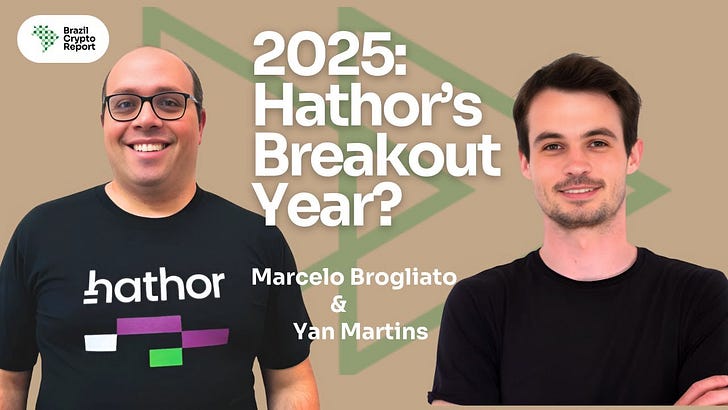
Episode 133: Why 2025 Could Be Hathor's Breakout Year
Olá pessoal!For our first episode of 2025, I’m joined by Hathor Network co-founders Marcelo Brogliato and Yan Martins to discuss their ecosystem and ambitious plans for 2025. As Hathor approaches its 5-year mainnet anniversary, the project stands out for its novel hybrid DAG-blockchain architecture and its focus on real-world asset tokenization and other features. They have a lot of exciting new features and community initiatives for 2025, so I definitely recommend keeping an eye on this project. If you want more background on Hathor, I recommend checking out this interview I did with Yan at Web Summit Rio 2024. 🙌 If you enjoy this content, please consider dropping a like or giving a 5-star rating to BCR wherever you listen to podcasts: YouTube | Spotify | Apple Podcasts Key Highlights of this Episode* Introduction of "nanocontracts" - Python-based smart contracts designed to lower the barrier to entry for non-blockchain developers* Implementation of an anti-MEV mechanism to create fairer trading conditions* Development of a "blueprint" system that allows developers to monetize their smart contract code* Integration with MetaMask through Snaps and upcoming EVM bridge deployment* Launch of a comprehensive grants program to accelerate ecosystem growthThe conversation reveals how Hathor has quietly built significant traction in the RWA space, notably facilitating Latin America's largest precatory note tokenization to date. While many projects are just beginning to explore RWA opportunities, Hathor has been focusing on this sector since 2018, working closely with Brazilian regulators and financial institutions.Technical Innovation: * Hathor's hybrid architecture addresses the blockchain trilemma through a unique approach that combines DAG-based transaction processing with traditional blockchain security. * Their upcoming nanocontracts platform aims to revolutionize smart contract development by allowing developers to write contracts in Python rather than specialized languages like Solidity.2025 Strategic Focus: * The team is expanding beyond their RWA roots to embrace DeFi and Web3 applications, while maintaining their commitment to accessibility and security. * The introduction of partially signed transactions and anti-MEV mechanisms positions Hathor as a compelling alternative for DeFi developers seeking a more equitable trading environment.Ecosystem Development: * With MetaMask integration, EVM compatibility, and a new grants program, Hathor is laying the groundwork for significant ecosystem expansion in 2025. * Their blueprint system introduces an innovative way for developers to monetize their code, potentially creating new incentive structures for blockchain development.This episode provides a great look into how a Latin American blockchain project is innovating beyond the standard Layer 1 playbook, focusing on real-world adoption while building developer-friendly infrastructure. Specifically, I enjoyed hearing the story of how Hathor emerged from Marcelo’s Ph.D work and his novel vision for creating a scalable blockchain network. Have a great weekend everyone!-AWS🙌 🇧🇷Brazil Crypto Report is a free publication; if you wish to support us you can do so by hitting the button below👇Brazil Crypto Report is presented byPowered by hydroelectric energy from the ITAIPU Dam, Morphware provides high-performance compute to run, train, and build your AI apps and agents.One of the greatest expenses when it comes to building AI applications is the compute. Morphware provides a gateway to accessible compute for AI development.Using abundant clean energy from Paraguay, NVIDIA’s highest performing GPU servers, and bitcoin mining infrastructure Morphware offers some of the most competitive prices for compute in the industry.Follow on X @Morphwareai and join the Telegram to be a part of the communityRecent Episodes Get full access to Brazil Crypto Report at brazilcrypto.substack.com/subscribe

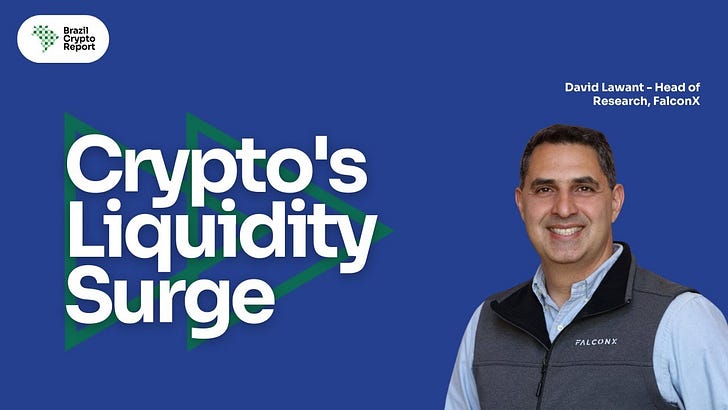
Episode #132: Crypto's Liquidity Surge with David Lawant
🎧 Listen: Spotify | Apple Podcasts | Anchor | Amazon | YouTubeOlá pessoal!David Lawant is Head of Research at FalconX, an institutional prime brokerage in the US. He joins for a great discussion about crypto market liquidity and institutional adoption trends. With previous roles at Bitwise Asset Management and Hashdex, and equity research experience at Itau and JPMorgan prior to that David brings a unique perspective bridging both US and Brazilian crypto markets.As one of the largest crypto prime brokers, FalconX serves as a crucial infrastructure provider for institutional players entering the space - from crypto-native hedge funds to traditional banks and ETF issuers. David's role involves analyzing market trends and helping institutional clients navigate the evolving crypto landscape.Key Market Insights:* Bitcoin spot trading volumes exploded from $10-12 billion daily pre-election to over $25 billion by mid-December, with several days exceeding $40 billion. This represents a 2-4x increase in market depth* Despite the price surge from $60-70K to $90-100K, order books have remained surprisingly tight, creating heightened price sensitivity to news and market sentiment.* Current market conditions mirror the October 2020 anticipation phase, suggesting we could be at the start of another significant market cycle* Bitcoin options open interest has reached $30 billion, matching what futures markets achieved just months ago🙌 🇧🇷Brazil Crypto Report is a free publication; if you wish to support us you can do so by hitting the button below👇Brazil Crypto Report is presented byLIT Collective is the ultimate creative and design studio for Web3 companies.Based in Brazil and serving the globe, they’ve helped more than 100 brands with user-centric branding, UX/UI design, motion, Webflow development and other creative needs.Check out their website, follow them on X/Twitter and Instagram, and book a free consultation to learn about how LIT Collective can help you with your creative needs.David and I also spend some time comparing institutional adoption across the US and Brazilian markets.* While US markets show broader institutional adoption across different types of funds, Brazilian banks are actually ahead in providing direct crypto access to clients* Brazil's Central Bank's progressive stance has enabled major financial institutions to offer integrated crypto services - something still rare in the US market* Traditional financial advisors remain an untapped market in both countries, though ETF launches are helping bridge this gapLooking ahead to 2025, David is particularly excited about several trends, including the potential for crypto index ETFs, the continued maturation of the derivatives market, and the emerging Bitcoin Layer 2 ecosystem.David brings incredible insights into institutional crypto trends, liquidity and market structure, and how major financial players are approaching this space. I really enjoyed this conversation and I hope you do as well. You can connect with David on Linkedin.Have a great weekend everyone!-AWSConnect with 🇧🇷Brazil Crypto Report across the web: Twitter | Linkedin | YouTube | Instagram | Spotify | Apple Podcasts | SubstackPowered by hydroelectric energy from the ITAIPU Dam, Morphware provides high-performance compute to run, train, and build your AI apps and agents.One of the greatest expenses when it comes to building AI applications is the compute. Morphware provides a gateway to accessible compute for AI development.Using abundant clean energy from Paraguay, NVIDIA’s highest performing GPU servers, and bitcoin mining infrastructure Morphware offers some of the most competitive prices for compute in the industry.Follow on X @Morphwareai and join the Telegram to be a part of the communityRecent Episodes Get full access to Brazil Crypto Report at brazilcrypto.substack.com/subscribe

Episode #131: Guilherme Nazar on Binance's Latam Roadmap
🎧 Listen: Spotify | Apple Podcasts | Anchor | Amazon | YouTubeOlá pessoal!For today’s interview I’m joined by Guilherme Nazar, who is Binance’s regional vice president for Brazil and the broader Latin America region. We discuss how Binance is positioning itself in key Latam markets while engaging with evolving regulatory frameworks.Key Takeaways:* Brazil's crypto market remains predominantly retail-driven, with users showing strong engagement in products like copy trading and earn features. The market exhibits unique characteristics including high mobile penetration and technological adaptability, though institutional adoption is still developing* Binance’s regulatory engagement is intensifying across the region, including the with the public consultations issued by Brazil's Central Bank* The exchange brings experience from ~20 different jurisdictions globally where it now holds licenses, emphasizing the importance of maintaining global liquidity while adapting to local requirements* Binance’s leadership transition away from Changpeng Zhao to new CEO Richard Teng has been successful and the platform has maintained strong user growth globally — with a total of 240 million registered at the end of 2024* Different LATAM markets show distinct adoption patterns: Brazil focuses on trading and investment, Mexico emphasizes remittances, and Argentina shows higher adoption rates driven by store-of-value use cases🙌 🇧🇷Brazil Crypto Report is a free publication; if you wish to support us you can do so by hitting the button below👇Brazil Crypto Report is presented byLIT Collective is the ultimate creative and design studio for Web3 companies.Based in Brazil and serving the globe, they’ve helped more than 100 brands with user-centric branding, UX/UI design, motion, Webflow development and other creative needs.Check out their website, follow them on X/Twitter and Instagram, and book a free consultation to learn about how LIT Collective can help you with your creative needs.Looking Ahead to 2025The coming year appears pivotal for crypto adoption in Latin America. Guilherme highlighted several key developments to watch:* The institutional segment is showing early signs of growth, with volumes increasing significantly year-over-year. As regulatory frameworks mature, particularly in Brazil, this trend is expected to accelerate.* Binance Pay is emerging as a strategic product for the region, with the exchange working to expand merchant adoption across major markets.* The exchange plans to maintain its market-leading position through continued focus on user security, education, and platform development — while adapting to local market needs and regulatory requirements.As Latin America's crypto ecosystem matures, the region is increasingly drawing global attention as an adoption hub. With major regulatory developments expected and institutional interest growing, 2025 could mark a significant evolution in the region's crypto landscape. Binance's deep engagement across major LATAM markets positions it to play a central role in this transformation, particularly as regulatory frameworks solidify and institutional participation expands.You can connect with Gui on LinkedinHave a great weekend everyone!-AWSConnect with 🇧🇷Brazil Crypto Report across the web: Twitter | Linkedin | YouTube | Instagram | Spotify | Apple Podcasts | SubstackPowered by hydroelectric energy from the ITAIPU Dam, Morphware provides high-performance compute to run, train, and build your AI apps and agents.One of the greatest expenses when it comes to building AI applications is the compute. Morphware provides a gateway to accessible compute for AI development.Using abundant clean energy from Paraguay, NVIDIA’s highest performing GPU servers, and bitcoin mining infrastructure Morphware offers some of the most competitive prices for compute in the industry.Follow on X @Morphwareai and join the Telegram to be a part of the communityRecent Episodes Get full access to Brazil Crypto Report at brazilcrypto.substack.com/subscribe

Episode #130: Crypto for Financial Empowerment with Wei Zhou
🎧 Listen: Spotify | Apple Podcasts | Anchor | Amazon | YouTubeOlá pessoal!Today’s interview is with former Binance executive and current Coins CEO Wei Zhou. Coins is an OG crypto exchange that originated in the Philippines in 2014. We discuss Wei’s recent acquisition of the platform and his push to expand it into emerging markets globally, including Brazil and Latin America. Key Takeaways:* Coins.ph has successfully transformed from a regional Filipino exchange into a global platform, now processing $15-20 million daily in stablecoin-to-peso trading* The Coins’ global expansion strategy focuses on emerging markets rather than traditional financial centers, targeting regions with similar banking infrastructure and user behavior patterns* Zhou emphasizes the importance of moving beyond simple token listings to creating genuine partnerships with blockchain projects and fostering real community engagement* The platform aims to reduce costs for users by improving fiat on/off ramps and developing innovative local currency solutionsZhou brings a unique perspective to cryptocurrency adoption, drawing from his experience as Binance's former CFO and his role in developing their Launchpad product. He also IPO-ed several companies in the US during his TradFi days. He argues that the industry needs to shift focus from financial inclusion – which he considers largely solved through widespread mobile wallet adoption – to financial empowerment."The real freedom of money isn't just about speculation or mobility," Zhou explains. "It's about the internet taking over financial services the same way it transformed commerce and information sharing – lowering costs, increasing speed, and expanding access."🙌 🇧🇷Brazil Crypto Report is a free publication; if you wish to support us you can do so by hitting the button below👇Brazil Crypto Report is presented byLIT Collective is the ultimate creative and design studio for Web3 companies.Based in Brazil and serving the globe, they’ve helped more than 100 brands with user-centric branding, UX/UI design, motion, Webflow development and other creative needs.Check out their website, follow them on X/Twitter and Instagram, and book a free consultation to learn about how LIT Collective can help you with your creative needs.Powered by hydroelectric energy from the ITAIPU Dam, Morphware provides high-performance compute to run, train, and build your AI apps and agents. One of the greatest expenses when it comes to building AI applications is the compute. Morphware provides a gateway to accessible compute for AI development. Using abundant clean energy from Paraguay, NVIDIA’s highest performing GPU servers, and bitcoin mining infrastructure Morphware offers some of the most competitive prices for compute in the industry.Follow on X @Morphwareai and join the Telegram to be a part of the communityOur discussion also touches on regulatory developments, with Wei sharing insights on how different jurisdictions approach crypto regulation. He emphasizes the importance of working within regulatory frameworks while maintaining innovation, particularly in emerging markets where cryptocurrency can have the most significant impact.Looking ahead, Coins plans to launch services in Brazil, focusing on building local partnerships and creating real-world use cases for crypto. The platform aims to differentiate itself through deeper integration with local financial systems and a commitment to community engagement.This episode offers good insights for anyone interested in crypto in emerging markets and the evolving relationship between traditional finance and digital assets. You can connect with Wei on X/Twitter and LinkedinHave a great weekend everyone!-AWSConnect with 🇧🇷Brazil Crypto Report across the web: Twitter | Linkedin | YouTube | Instagram | Spotify | Apple Podcasts | SubstackRecent Episodes Get full access to Brazil Crypto Report at brazilcrypto.substack.com/subscribe
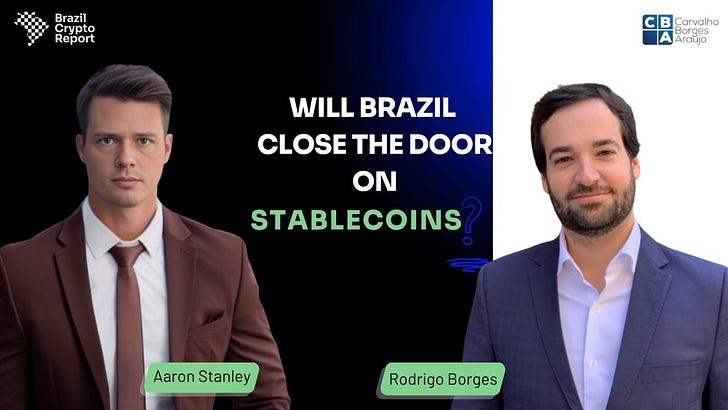
Episode #129: Is Brazil Closing the Door on Stablecoins? with Rodrigo Borges
🎧 Listen: Spotify | Apple Podcasts | Anchor | Amazon | YouTubeOlá pessoal!Brazil’s Central Bank released a controversial proposed rule last week calling for a prohibition on stablecoins being used in self-custodied wallets. This is an extremely important development with lots of implications for crypto markets, operators and users in Brazil. To help us understand this proposal, I spoke with Rodrigo Caldas de Carvalho Borges, a partner at Carvalho Borges Araujo Advogados in Sao Paulo. 🔑 Key Takeaways* The Central Bank of Brazil is proposing a ban on self-custody of stablecoins like USDT. This would limit transfers to only licensed exchanges and service providers* Crypto would be regulated in the same manner as foreign exchange transactions. These transactions would need to flow through regulated channels, creating a more controlled environment for cross-border transfers* The proposal could significantly impact how international transactions are monitored and regulated within Brazil's crypto ecosystem* The Central Bank wants greater visibility into the volume of US dollar-pegged stablecoins that are leaving the country, particularly with the Brazilian real at an all-time low. The proposed rule could fundamentally alter how Brazilians access and use not just stablecoins, but crypto assets of every type, and it could set a precendent for how other emerging markets approach stablecoin regulation. The requirement for exchanges to implement wallet whitelisting would create new compliance challenges and could reshape how international transactions are conducted.🙌 🇧🇷Brazil Crypto Report is a free publication; if you wish to support us you can do so by hitting the button below👇Brazil Crypto Report is presented byLIT Collective is the ultimate creative and design studio for Web3 companies.Based in Brazil and serving the globe, they’ve helped more than 100 brands with user-centric branding, UX/UI design, motion, Webflow development and other creative needs.Their experienced team will walk you through the complexities and nuances of Web3-native design and branding — helping you to grow faster, gain credibility and build brand awareness.Check out their website, follow them on X/Twitter and Instagram, and book a free consultation to learn about how LIT Collective can help you with your creative needs.The implementation of these rules would create a closed ecosystem where stablecoin transactions can only occur within a network of regulated entities. This means users would no longer be able to freely transfer stablecoins to private wallets or engage in peer-to-peer transactions outside of regulated platforms.While the industry is still trying to process exactly what the implications of this would be, there are concerns that this would limit financial innovation, create operational and compliance burdens for service providers, and potentially push users towards unregulated entities. The Central Bank’s comment window for this rule is open until the end of February. You can connect with Rodrigo on Linkedin. Have a great weekend everyone!-AWSConnect with 🇧🇷Brazil Crypto Report across the web: Twitter | Linkedin | YouTube | Instagram | Spotify | Apple Podcasts | SubstackRecent Episodes Get full access to Brazil Crypto Report at brazilcrypto.substack.com/subscribe
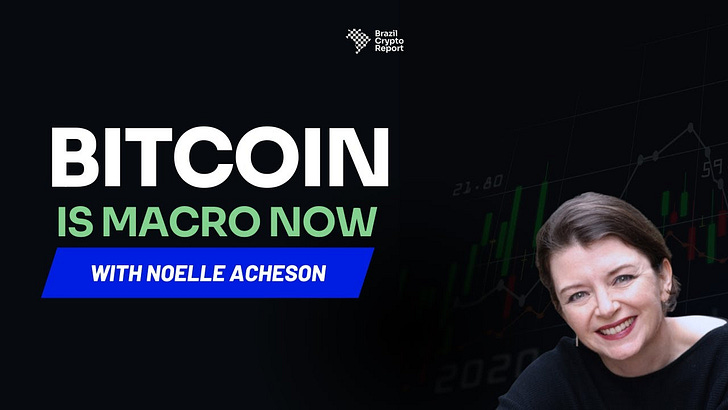
Episode #128: Bitcoin is Macro Now with Noelle Acheson
🎧 Listen: Spotify | Apple Podcasts | Anchor | Amazon | YouTubeOlá pessoal!Today Aaron is joined by veteran crypto analyst Noelle Acheson to examine this pivotal moment where bitcoin is rapidly intersecting with traditional finance and policy.Noelle is the author of the Crypto is Macro Now newsletter and one of the leading experts at the intersection of crypto and the global macroeconomy. She previously ran the research divisions at CoinDesk and Genesis Trading, and has a rich background in corporate finance prior to joining crypto.She is one of the brightest minds out there at articulating the value of bitcoin and crypto in the context of institutional investors and global macroeconomic shifts. Key themes from this episode: * The impacts of a pro-crypto administration in the US, including the potential creation of a dedicated crypto regulatory “czar” position and talk of a Strategic Bitcoin Reserve, on market sentiment* The evolution of bitcoin as a multi-narrative asset: store of value, risk asset, and technological innovation platform* MicroStrategy's innovative financial engineering to massively increase its bitcoin holdings through zero-coupon convertible debt issuance* Growing institutional interest in bitcoin for corporate treasury management and national reserves* Global monetary policy shifts, particularly around defense spending, driving potential currency debasement🙌 🇧🇷Brazil Crypto Report is a free publication; if you wish to support us you can do so by hitting the button below👇Brazil Crypto Report is presented byLIT Collective is the ultimate creative and design studio for Web3 companies.Based in Brazil and serving the globe, they’ve helped more than 100 brands with user-centric branding, UX/UI design, motion, Webflow development and other creative needs.Their experienced team will walk you through the complexities and nuances of Web3-native design and branding — helping you to grow faster, gain credibility and build brand awareness.Check out their website, follow them on X/Twitter and Instagram, and book a free consultation to learn about how LIT Collective can help you with your creative needs.We also explore bitcoin in the context of the global monetary policy environment. Noelle argues that rising global defense spending, particularly in Europe and the U.S., could drive increased government debt issuance. This dynamic, coupled with potential declining foreign interest in government bonds, may lead to monetary expansion— thus strengthening the case for bitcoin as a hard asset.We also touch on innovations like CBDCs, stablecoins and tokenization as crucial developments for long-term adoption and integration with TradFi systems. For institutional stakeholders, these developments suggest an accelerating mainstreaming of crypto assets, with regulatory clarity and new financial products unlocking new opportunities for portfolio diversification and treasury management.I really enjoyed this conversation with Noelle and I hope you do as well.You can connect with Noelle on X/Twitter and Linkedin. Have a great weekend everyone!-AWSConnect with 🇧🇷Brazil Crypto Report across the web: Twitter | Linkedin | YouTube | Instagram | Spotify | Apple Podcasts | SubstackRecent Episodes Get full access to Brazil Crypto Report at brazilcrypto.substack.com/subscribe
Episode #127: Avalanche's Third Way with Emin Gün Sirer
🎧 Listen: Spotify | Apple Podcasts | Anchor | Amazon | YouTubeOlá pessoal!Today Aaron talks to Emin Gün Sirer — CEO of Ava Labs, a former computer science professor at Cornell University and the mastermind behind the Avalanche blockchain. We discuss how Avalanche's deployment of subnets offers an alternative to the ongoing modular versus monolithic debate, recent successes on the gaming and tokenization fronts, and the Avalanche community’s strategic focus on emerging markets — evidenced by its recent summit in Buenos Aires. We also talk about Gün’s front-row seat involvement in crypto dating back to the early days of bitcoin, the 2016 DAO hack and now deploying his own alternative Layer 1 chain. Highlights from this conversation: * Of Turkish background, Gün articulates expertly the value proposition that crypto and blockchain systems offer for emerging market economies that struggle with inflation* Avalanche's customizable blockchain framework allows enterprises to create purpose-built chains for specific use cases, from gaming to financial services* This subnet architecture enables chains to adapt to different jurisdictional requirements, making it suitable for both regulated institutions and innovative startups alike* Breakthroughs in Gaming: Off The Grid, a battle royale game on Avalanche, has attracted over 7 million users and demonstrated successful blockchain integration while delivering great user experience* Avalanche 9000: The new protocol upgrade reduces entry barriers for validators, allowing chains to start with minimal stake and use their own tokens for staking* Enterprise Partnerships: Avalanche has seen notable progress in bringing traditional assets on-chain using Avalanche subnets, including BlackRock funds and California DMV vehicle titles. The team has also forged major partnerships with JPMorgan, Franklin Templeton and other financial institutions🙌 🇧🇷Brazil Crypto Report is a free publication; if you wish to support us you can do so by hitting the button below👇Brazil Crypto Report is presented byLIT Collective is the ultimate creative and design studio for Web3 companies.Based in Brazil and serving the globe, they’ve helped more than 100 brands with user-centric branding, UX/UI design, motion, Webflow development and other creative needs.Their experienced team will walk you through the complexities and nuances of Web3-native design and branding — helping you to grow faster, gain credibility and build brand awareness.Check out their website, follow them on X/Twitter and Instagram, and book a free consultation to learn about how LIT Collective can help you with your creative needs.This conversation highlights Avalanche's positioning as a serious contender as a Layer 1 blockchain space, particularly in emerging markets where its scalable, customizable architecture addresses both technical and regulatory requirements. For enterprises, games or degen activity, Avalanche's subnet model offers a flexible framework that can accommodate various use cases while maintaining regulatory compliance.I really enjoyed this conversation with Gün and I hope you do as well. You can follow him on X/Twitter and Linkedin. Have a great day everyone!-AWSConnect with 🇧🇷Brazil Crypto Report across the web: Twitter | Linkedin | YouTube | Instagram | Spotify | Apple Podcasts | SubstackRecent Episodes Get full access to Brazil Crypto Report at brazilcrypto.substack.com/subscribe
Episode #126: Brazil's Licensing Regime Takes Shape with Tatiana Guazzelli
🎧 Listen: Spotify | Apple Podcasts | Anchor | Amazon | YouTubeOlá pessoal!Today’s interview is with another legal expert exploring new developments on the regulatory front in Brazil. Tatiana Guazzelli is a partner at Pinheiro Neto Advogados, which is one of Brazil’s largest and most prominent law firms and represents some of the top crypto companies operating in the country. Tatiana provides important perspective on the many simultaneous movements happening with regard to crypto regulation in the country.These developments include:* The Central Bank’s proposed VASP licensing structure, which includes a three-tiered licensing system for crypto service providers: intermediaries, custodians, and brokers* Asset segregation legislation advancing through Congress that would enable the Central Bank to require exchanges to separate customer assets as part of its licensing regime* The Receita Federal is overhauling its tax reporting requirements for crypto assets* The CVM is expected to issue a public consultation regarding rules for tokenized securities offerings* The Central Bank will a separate public consultation in 2025 focused on stablecoin regulation🙌 🇧🇷Brazil Crypto Report is a free publication; if you wish to support us you can do so by hitting the button below👇These regulatory movements are a positive sign that Brazil is committed to balancing innovation with consumer protection. Key implementation challenges remain, however, such as enforcement of asset segregation rules, transition periods (and criteria) for grandfathering existing operators into the Central Bank’s licensing regime, and coordination among different regulatory bodies. Tatiana reckons that the Central Bank will release its VASP licensing framework by mid-2025, with a 2-3 year processing period for granting licenses.For companies looking to enter the Brazilian market, early positioning and engagement with the regulatory process could be advantageous.I found this conversation with Tatiana to be super insightful and I hope you do as well. You can connect with her on Linkedin.Have a great day everyone!-AWSConnect with 🇧🇷Brazil Crypto Report across the web: Twitter | Linkedin | YouTube | Instagram | Spotify | Apple Podcasts | SubstackBrazil Crypto Report is presented byLIT Collective is the ultimate creative and design studio for Web3 companies.Based in Brazil and serving the globe, they’ve helped more than 100 brands with user-centric branding, UX/UI design, motion, Webflow development and other creative needs.Their experienced team will walk you through the complexities and nuances of Web3-native design and branding — helping you to grow faster, gain credibility and build brand awareness.Check out their website, follow them on X/Twitter and Instagram, and book a free consultation to learn about how LIT Collective can help you with your creative needs.Recent Episodes Get full access to Brazil Crypto Report at brazilcrypto.substack.com/subscribe
Episode #125: Brazil Inches Towards Crypto Regulatory Clarity with Nicky Dyskant
🎧 Listen: Spotify | Apple Podcasts | Anchor | Amazon | YouTubeOlá pessoal!You’ve probably seen the news by now that the Central Bank of Brazil released its proposed licensing structure and regulations for digital asset companies operating in the country. Attorney Nicky Dyskant joins the show to discuss these developments, as well as new legislation on asset segregation and stablecoins that is now working its way through the Brazilian Congress. Additionally, the CVM (Brazilian SEC) and Receita Federal (tax authority) are also in the process of issuing their own public consultations related to crypto rules. This conversation with Nicky is a great primer on the incoming Brazilian regulatory framework — which is expected to be finalized and implemented by mid-2025.The proposed framework appears to strike a balance between embracing international standards while maintaining an innovative posture. While some smaller market participants have expressed concerns about compliance costs and burdens, the risk-based approach should hopefully allow for proportional implementation based on operational scale and complexity. 👀 BCR will have more expert interviews focusing on the regulatory space in the coming days so stay tuned. 🙌 🇧🇷Brazil Crypto Report is a free publication; if you wish to support us you can do so by hitting the button below👇You can connect with Nicky on LinkedinHave a great day everyone!-AWSConnect with 🇧🇷Brazil Crypto Report across the web: Twitter | Linkedin | YouTube | Instagram | Spotify | Apple Podcasts | SubstackBrazil Crypto Report is presented byLIT Collective is the ultimate creative and design studio for Web3 companies.Based in Brazil and serving the globe, they’ve helped more than 100 brands with user-centric branding, UX/UI design, motion, Webflow development and other creative needs.Their experienced team will walk you through the complexities and nuances of Web3-native design and branding — helping you to grow faster, gain credibility and build brand awareness.Check out their website, follow them on X/Twitter and Instagram, and book a free consultation to learn about how LIT Collective can help you with your creative needs.Recent Episodes Get full access to Brazil Crypto Report at brazilcrypto.substack.com/subscribe
Episode #124: Bitcoin is Inevitable with Samson Mow
🎧 Listen: Spotify | Apple Podcasts | Anchor | Amazon | YouTubeOlá pessoal!Today I’m joined by Samson Mow — an OG bitcoiner who has held executive roles at BTCC and Blockstream and now is working with governments around the world to promote bitcoin adoption. Samson, now CEO of Jan3, argues that bitcoin’s time is now and explains why nation states will soon be forced to embrace bitcoin whether they want to or not. Talk like this sounded crazy a couple of years ago, but with bitcoin surpassing silver as the 8th most valuable asset in the world it’s becoming much easier to see the end game. Key takeaways from this episode:* Strategic Bitcoin Reserve Implementation* The creation of a national bitcoin reserve became an issue on the US campaign trail* Proposed reserves could range from 250,000 to 1 million bitcoins* First-mover advantage is crucial, as demonstrated by ETF adoption patterns across different countries* Nation-State Adoption Frameworks* Samson sees three primary paths for nation state bitcoin adoption:* Legal tender implementation* Mining operations utilizing excess energy* Treasury/balance sheet allocation* Economic Development Opportunities* Bitcoin mining presents a solution for monetizing stranded energy resources* Geothermal and hydroelectric power can be efficiently converted to monetary value* Developing nations with abundant natural resources could leverage bitcoin to build wealth* Global Financial Independence* Bitcoin offers an alternative to traditional international lending institutions* Nations can reduce dependency on IMF and World Bank funding* Provides a path toward greater fiscal sovereignty* Current Market Dynamics* Bitcoin remains undervalued relative to macroeconomic conditions* Institutional adoption continues to grow through ETFs and corporate treasury allocation* Limited supply creates competitive dynamics among nations and institutions🙌 🇧🇷Brazil Crypto Report is a free publication; if you wish to support us you can do so by hitting the button below👇Brazil Crypto Report is presented byLIT Collective is the ultimate creative and design studio for Web3 companies.Based in Brazil and serving the globe, they’ve helped more than 100 brands with user-centric branding, UX/UI design, motion, Webflow development and other creative needs.Their experienced team will walk you through the complexities and nuances of Web3-native design and branding — helping you to grow faster, gain credibility and build brand awareness.Check out their website, follow them on X/Twitter and Instagram, and book a free consultation to learn about how LIT Collective can help you with your creative needs.Samson argues that adoption of bitcoin at the nation-state level is inevitable, with countries increasingly recognizing its potential as a strategic asset. Early adopters like El Salvador have demonstrated positive outcomes, including GDP growth and increased tourism. As more nations understand the realities of bitcoin, the competition for limited supply will accelerate adoption timelines.You can connect with Samson on X/TwitterHave a great day everyone!-AWSConnect with 🇧🇷Brazil Crypto Report across the web: Twitter | Linkedin | YouTube | Instagram | Spotify | Apple Podcasts | SubstackRecent Episodes Get full access to Brazil Crypto Report at brazilcrypto.substack.com/subscribe
Episode #123: What US elections mean for crypto markets with Samir Kerbage
🎧 Listen: Spotify | Apple Podcasts | Anchor | Amazon | YouTubeOlá pessoal!For today’s episode Hashdex Chief Investment Officer Samir Kerbage shares his analysis of how the upcoming U.S. presidential election could impact global crypto markets and regulation.Key takeaways:* Markets appear positioned for a positive 12-18 month period regardless of election results, driven by improving liquidity conditions and Bitcoin's halving cycle* Congressional composition may matter more than the US presidential outcome, as three critical areas require legislative action: stablecoin regulation, market infrastructure rules clarifying SEC/CFTC jurisdiction, and guidance for financial institutions* Prediction markets are emerging as a significant force in election forecasting, with platforms like Polymarket demonstrating resilience to manipulation through financial incentivesKerbage emphasized that while presidential candidates' crypto stances generate headlines and that markets would respond positively to a Trump victory, meaningful policy changes require Congressional action. He noted that even under a crypto-friendly administration, implementation of campaign promises would likely take significant time, particularly regarding regulatory reforms.🙌 🇧🇷Brazil Crypto Report is a free publication; if you wish to support us you can do so by hitting the button below👇Brazil Crypto Report is presented byKaleido is the most trusted digital assets and blockchain company by enterprises. Their product suite is the ultimate business blockchain cloud and is rated #1 for tokenization and #1 for blockchain-as-a-service. Kaleido is powered by open source, supports multiple protocols, connects to permissioned and public chains, and lets you utilize any smart contract. Tokenizing assets in a scalable and interoperable way has never been easier.Built by veterans of IBM Blockchain and Consensys, the Kaleido platform combines turnkey functionality with enterprise-grade security and scalability to power your application — whether it be in banking and financial services, supply chain, media, government & public sector, or central bank digital currencies.Request a custom demo of the platform today! The Hashdex CIO expressed optimism about crypto markets over the next 12-18 months, citing macro factors like improving liquidity conditions alongside crypto-specific catalysts such as Bitcoin's halving cycle. However, he cautioned that a contested election outcome could introduce significant market volatility, as uncertainty typically dampens risk appetite.On institutional adoption, Kerbage drew parallels between the recent Bitcoin ETF approval and potential future regulatory developments: "Just like all the big institutions waited for the SEC to approve a Bitcoin spot ETF to start investing, they will wait until the U.S. gives regulatory clarity on smart contract platforms, DAOs, and stablecoins to get involved."In discussing prediction markets, Kerbage highlighted their emerging role as one of crypto's first true "killer apps" beyond stablecoins. He noted how these platforms differ from traditional polling by requiring participants to have financial skin in the game, potentially offering more reliable signals of electoral trends.Looking at Brazil's crypto landscape, Kerbage noted that positive U.S. regulatory developments could accelerate the country's already progressive stance on digital assets, potentially encouraging greater institutional participation in areas like tokenization and central bank digital currency initiatives.You can connect with Samir on X/Twitter and LinkedinHave a great weekend everyone!-AWSConnect with 🇧🇷Brazil Crypto Report across the web: Twitter | Linkedin | YouTube | Instagram | Spotify | Apple Podcasts | SubstackRecent Episodes Get full access to Brazil Crypto Report at brazilcrypto.substack.com/subscribe
Episode #122: From the Peruvian Jungle to Crypto PR with Saul Hudson
🎧 Listen: Spotify | Apple Podcasts | Anchor | Amazon | YouTubeOlá pessoal!Today’s episode is a fascinating interview with Saul Hudson, a former Reuters executive turned crypto communications specialist, who shares his unique journey from international journalism to Web3 advocacy.We also discuss what it’s like to have the same name as the lead guitarist for Guns ‘n Roses 🤘Key takeaways from this episode:* Hudson's career trajectory began unexpectedly when he walked into a Venezuelan English-language newspaper office, leading to positions with Bloomberg and eventually becoming Reuters' general manager for the Americas* His experience covering financial crises in Latin America naturally led to an interest in cryptocurrency as an alternative solution to traditional banking challenges* After leaving Reuters, Hudson co-founded Angle42, a PR agency specializing in Web3 communications, which he has led for seven yearsEvolution of Crypto Media:Hudson provides valuable insights into how crypto media has matured, noting the progression from minimal coverage to today's sophisticated ecosystem. He highlights how early crypto journalists like Ian Allison evolved from mainstream outlets to become award-winning specialists breaking major stories like the FTX collapse.Latin America's Growing Importance:The discussion emphasizes Latin America's increasing relevance in the global crypto landscape, particularly noting:* Brazil's dynamic digital asset environment and productive collaboration between institutions and regulators* El Salvador's bitcoin adoption raising international attention* Natural use cases in countries like Venezuela and Argentina due to historical financial challenges🙌 🇧🇷Brazil Crypto Report is a free publication; if you wish to support us you can do so by hitting the button below👇Brazil Crypto Report is presented byKaleido is the most trusted digital assets and blockchain company by enterprises. Their product suite is the ultimate business blockchain cloud and is rated #1 for tokenization and #1 for blockchain-as-a-service. Kaleido is powered by open source, supports multiple protocols, connects to permissioned and public chains, and lets you utilize any smart contract. Tokenizing assets in a scalable and interoperable way has never been easier.Built by veterans of IBM Blockchain and Consensys, the Kaleido platform combines turnkey functionality with enterprise-grade security and scalability to power your application — whether it be in banking and financial services, supply chain, media, government & public sector, or central bank digital currencies.Request a custom demo of the platform today! PR Strategy Insights:Hudson shares key advice for both regional and international companies:For Latin American companies seeking global exposure:* Align communications goals with clear business objectives* Demonstrate local success and growth before international expansion* Leverage unique regional use cases and community engagementFor international companies entering Latin America:* Recognize regional nuances and avoid treating Latin America as monolithic* Build local communities in each target market* Utilize crypto's community-based approach for market entryThe conversation underscores the importance of third-party validation through legitimate media coverage versus paid promotion, particularly in the crypto space where credibility is crucial.Hudson's unique perspective combines traditional media expertise with crypto industry experience, and he provides valuable insights for companies navigating the evolving landscape of crypto communications and market expansion in Latin America.You can connect with Saul on Linkedin and via emailHave a great weekend everyone!-AWSConnect with 🇧🇷Brazil Crypto Report across the web: Twitter | Linkedin | YouTube | Instagram | Spotify | Apple Podcasts | SubstackRecent Episodes Get full access to Brazil Crypto Report at brazilcrypto.substack.com/subscribe
Episode #121: Transfero Goes Global with Juliana Felippe
🎧 Listen: Spotify | Apple Podcasts | Anchor | Amazon | YouTubeOlá pessoal!For this week’s episode I speak with Juliana Felipe, Chief Revenue Officer at Transfero, to discuss the company's journey from a bootstrapped startup to a leading blockchain payment infrastructure provider in Brazil.Transfero, founded in 2015, has established itself as a pioneer in the Brazilian crypto space, offering a suite of services including banking-as-a-service, on/off-ramps, and stablecoins like BRZ (Brazilian Real) and ARZ (Argentine Peso). With nearly a decade of experience, Transfero is now setting its sights on global expansion and seeking its first round of investment to accelerate growth.Key takeaways from this conversation: * Transfero has successfully bootstrapped its operations for almost 10 years, demonstrating impressive resilience in the volatile crypto market.* The company is pivoting from a retail-focused approach to a B2B model, offering white-label solutions for crypto-as-a-service and credit cards.* Transfero is actively pursuing regulatory compliance across multiple jurisdictions, aiming to become a truly global player in blockchain-based financial services.* The company is preparing for its first investment round to fuel international expansion and product development.🙌 🇧🇷Brazil Crypto Report is a free publication; if you wish to support us you can do so by hitting the button below👇Brazil Crypto Report is presented byKaleido is the most trusted digital assets and blockchain company by enterprises. Their product suite is the ultimate business blockchain cloud and is rated #1 for tokenization and #1 for blockchain-as-a-service. Kaleido is powered by open source, supports multiple protocols, connects to permissioned and public chains, and lets you utilize any smart contract. Tokenizing assets in a scalable and interoperable way has never been easier.Built by veterans of IBM Blockchain and Consensys, the Kaleido platform combines turnkey functionality with enterprise-grade security and scalability to power your application — whether it be in banking and financial services, supply chain, media, government & public sector, or central bank digital currencies.Request a custom demo of the platform today! Juliana shared insights on Transfero's strategy for navigating the evolving regulatory landscape in Brazil and beyond. As the country prepares to implement new crypto regulations, Transfero is well-positioned with its existing payments institution license and compliance infrastructure.The discussion also touched on the potential impact of CBDCs like Brazil's upcoming Drex. Juliana believes that stablecoins and CBDCs will coexist, each serving different purposes in the financial ecosystem.Looking ahead, Transfero aims to become a global leader in facilitating cross-border payments and providing blockchain infrastructure for financial institutions. The company is targeting expansion into 15 new countries, with a focus on Africa, Europe, and the United States.I enjoyed this conversation with Juliana and I hope you do as well. You can connect with Juliana on LinkedinHave a great weekend everyone!-AWSConnect with 🇧🇷Brazil Crypto Report across the web: Twitter | Linkedin | YouTube | Instagram | Spotify | Apple Podcasts | SubstackRecent Episodes Get full access to Brazil Crypto Report at brazilcrypto.substack.com/subscribe
Episode #120: Brazil's Blockchain Network with Gladstone Arantes of BNDES
🎧 Listen: Spotify | Apple Podcasts | Anchor | Amazon | YouTubeOlá pessoal!This week’s interview is with Gladstone Arantes, Blockchain Specialist at BNDES (Brazil’s national development bank). We discuss the groundbreaking Brazil Blockchain Network (RBB in Portuguese) project, which is a public-permissioned blockchain aimed at enhancing transparency and trust in government operations.Key Highlights:* RBB is a public permissioned blockchain that allows public read access while restricting transaction validation to authorized entities* The project aims to address the global issue of declining trust in institutions, particularly acute in Brazil* Diverse stakeholders include BNDES, Federal Court of Accounts (TCU), several state-level entities, and research institutes* RBB is built on Hyperledger Besu, the same technology as the Drex CBDC project being developed by the Brazilian Central Bank. This means there will likely be future interoperability between the two networks. 🙌 🇧🇷Brazil Crypto Report is a free publication; if you wish to support us you can do so by hitting the button below👇Brazil Crypto Report is presented byKaleido is the most trusted digital assets and blockchain company by enterprises. Their product suite is the ultimate business blockchain cloud and is rated #1 for tokenization and #1 for blockchain-as-a-service. Kaleido is powered by open source, supports multiple protocols, connects to permissioned and public chains, and lets you utilize any smart contract. Tokenizing assets in a scalable and interoperable way has never been easier.Built by veterans of IBM Blockchain and Consensys, the Kaleido platform combines turnkey functionality with enterprise-grade security and scalability to power your application — whether it be in banking and financial services, supply chain, media, government & public sector, or central bank digital currencies.Request a custom demo of the platform today! Potential public sector use cases and applications of RBB include: * Tracking public funds* Verifying educational diplomas* Managing organ transplant waitlistsKey Takeaways:* Trust Through Transparency: RBB seeks to rebuild trust in government operations through operational transparency and "compliance by design" via smart contracts.* Decentralized Governance: The network's diverse participants enhance its decentralization and trustworthiness.* Balancing Act: RBB aims to balance the need for transparency with regulatory compliance and data protection.* Scalable Solution: While focused on Brazil's needs, the project could potentially offer solutions to trust issues faced by developed nations.* Gradual Implementation: The team is taking a measured approach, prioritizing security and proper governance over rapid scaling.Challenges and Next Steps:* Expanding network participation* Enhancing security and availability* Addressing data protection concerns* Developing legal frameworks for broader participationThis project represents a significant step towards leveraging blockchain technology to enhance government transparency and efficiency. As the RBB continues to develop, it could serve as a model for similar initiatives worldwide.For more information, visit the RBB GitHub repository or connect with Gladstone on LinkedIn.Have a great weekend everyone!-AWSConnect with 🇧🇷Brazil Crypto Report across the web: Twitter | Linkedin | YouTube | Instagram | Spotify | Apple Podcasts | Substack Get full access to Brazil Crypto Report at brazilcrypto.substack.com/subscribe
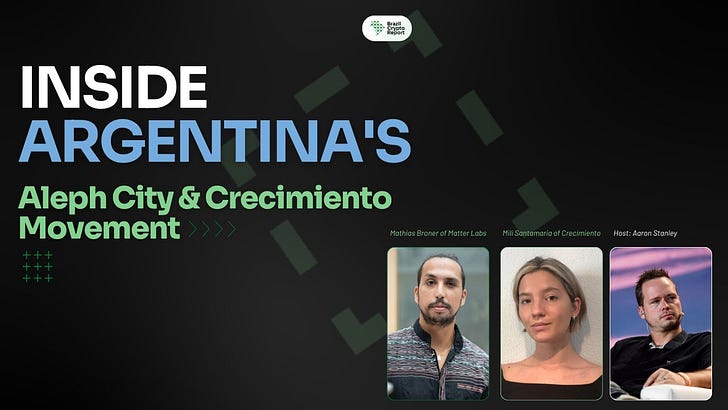
Episode #119: Inside Argentina's Aleph City and Crecimiento Movement with Matthias Broner and Mili Santamaria
🎧 Listen: Spotify | Apple Podcasts | Anchor | Amazon | YouTubeOlá pessoal!For this week’s episode I talk to Matthias Broner of Matter Labs (the team behind ZK Sync) and Mili Santamaria of the Crecimiento core team to discuss the Crecimiento movement, which aims to turn Argentina into a hub for crypto startups and talent. Key Themes:* Argentina has a perfect storm for crypto adoption: economic instability, tech-savvy population and workforce, and a government that is open to transformative solutions* The Aleph Pop-Up City: A month-long event bringing together 2,500 builders, startups, regulators, and investors during the month of August. After this episode was recorded, it was announced that the Aleph City will be happening again in Buenos Aires in December* Regulatory efforts to create a favorable environment for crypto and tech startups, such as the creation of Special Economic Zones and regulatory sandboxes* The potential for Argentina to once again become a top global economy through the Crecimiento movement🙌 🇧🇷Brazil Crypto Report is a free publication; if you wish to support us you can do so by hitting the button below👇Brazil Crypto Report is presented byKaleido is the most trusted digital assets and blockchain company by enterprises. Their product suite is the ultimate business blockchain cloud and is rated #1 for tokenization and #1 for blockchain-as-a-service. Kaleido is powered by open source, supports multiple protocols, connects to permissioned and public chains, and lets you utilize any smart contract. Tokenizing assets in a scalable and interoperable way has never been easier.Built by veterans of IBM Blockchain and Consensys, the Kaleido platform combines turnkey functionality with enterprise-grade security and scalability to power your application — whether it be in banking and financial services, supply chain, media, government & public sector, or central bank digital currencies.Request a custom demo of the platform today! Matthias highlighted the real-world impact of projects being developed in Argentina, such as QuarkID on ZKsync for digital identity and Lemon's efforts to onboard millions of users to crypto. These initiatives demonstrate the potential for blockchain technology to solve pressing economic and social issues in the country.Mili discussed the regulatory reform efforts that she has been leading, including work on a regulatory sandbox and a push to create a Special Economic Zone for crypto and tech. These initiatives aim to provide operating clarity and stability for businesses operating in the space, addressing key concerns such as taxation, labor laws, and access to funding.Both guests expressed optimism about Argentina's potential to become a global leader in crypto innovation. While acknowledging the ambitious nature of the movement, they stressed the importance of fostering an environment that encourages local talent to build and stay in Argentina, rather than relocating to other countries.As the Crecimiento movement gains momentum, it presents an exciting opportunity for the crypto community ggobally to engage with and support Argentina. By fostering innovation, addressing regulatory challenges, and leveraging the country's existing crypto adoption, Argentina could potentially transform its economy and become a leading force in the global crypto landscape.You can connect with Mattias on X/Twitter and Linkedin, and Mili on Linkedin. Also, if you want to learn more about Crecimiento, have a listen to this conversation I had with Diego Fernandez, Secretary of Digital Innovation for the city of Buenos Aires, back in July. Have a great weekend everyone!-AWSConnect with 🇧🇷Brazil Crypto Report across the web: Twitter | Linkedin | YouTube | Instagram | Spotify | Apple Podcasts | Substack Get full access to Brazil Crypto Report at brazilcrypto.substack.com/subscribe

Episode #118: Crypto Media in Latam with Pedro Solimano of The Defiant
🎧 Listen: Spotify | Apple Podcasts | Anchor | Amazon | YouTubeOlá pessoal!Today’s episode is a special crossover with Pedro Solimano, who is a reporter covering bitcoin at The Defiant and host of the Beyond the Beat podcast — which explores trends in crypto media. We do a deep look into the world of crypto journalism and explore the challenges and opportunities in covering digital assets across Latin America and beyond.Pedro discusses the state of crypto in his home country of Chile and provides unique insights into the evolving landscape of crypto media. We discuss the importance of niche reporting, the challenges of building personal brands in the industry, and the underreported potential of Latin American markets.Pedro has a rich background covering bitcoin and crypto for Decrypt, Bitcoin Magazine and other outlets. He also has his own Spanish-language newsletter called La Cadena that covers crypto and finance in the region.Key themes from this conversation: * The state of crypto media in Latin America and globally* Challenges and opportunities for independent content creators in crypto* The importance of niche reporting and personal branding* Underreported crypto adoption and innovation in Latin America* The future of crypto journalism and potential new formats 🙌 🇧🇷Brazil Crypto Report is a free publication; if you wish to support us you can do so by hitting the button below👇Brazil Crypto Report is presented byKaleido is the most trusted digital assets and blockchain company by enterprises. Their product suite is the ultimate business blockchain cloud and is rated #1 for tokenization and #1 for blockchain-as-a-service. Kaleido is powered by open source, supports multiple protocols, connects to permissioned and public chains, and lets you utilize any smart contract. Tokenizing assets in a scalable and interoperable way has never been easier.Built by veterans of IBM Blockchain and Consensys, the Kaleido platform combines turnkey functionality with enterprise-grade security and scalability to power your application — whether it be in banking and financial services, supply chain, media, government & public sector, or central bank digital currencies.Request a custom demo of the platform today! I really enjoyed this conversation with Pedro. He’s an enterprising journalist and content creator, and I was inspired by his passion to draw more awareness to crypto use cases in Latin America. You can connect with Pedro on X/Twitter and LinkedinHave a great weekend everyone!-AWSConnect with 🇧🇷Brazil Crypto Report across the web: Twitter | Linkedin | YouTube | Instagram | Spotify | Apple Podcasts | Substack Get full access to Brazil Crypto Report at brazilcrypto.substack.com/subscribe
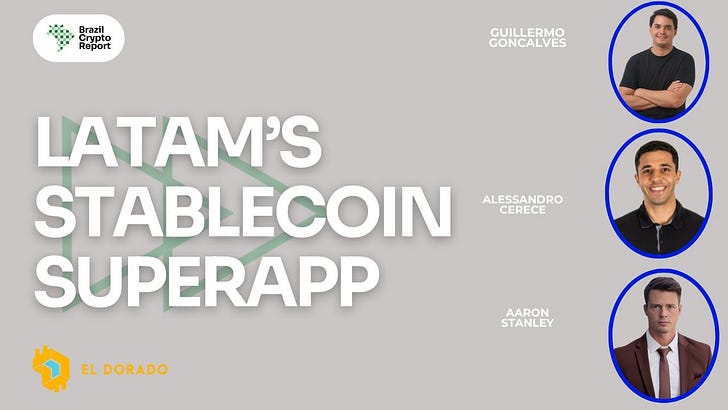
Episode #117: Inside El Dorado - Latam's Stablecoin SuperApp
🎧 Listen: Spotify | Apple Podcasts | Anchor | Amazon | YouTubeOlá pessoal!For today’s episode I talk to Guillermo Goncalves and Alessandro Cecere, CEO and CMO of El Dorado, to explore crypto adoption in Venezuela and their stablecoin-powered super app.El Dorado is a peer-to-peer marketplace for stablecoins focusing on remittances and cross-border payments in the Latin American market. Since launching in 2021, more than 250,000 users from Argentina, Brazil, Colombia, Panama, Peru and Venezuela have executed 2.3 million USDT transactions on Tron using El Dorado. Further, the platform now has integrations with 70 payments apps across the regionThe team raised US$3 million in a seed round from Multicoin Capital, Coinbase Ventures and others earlier this year .To understand why a solution like El Dorado is necessary, Goncalves and Cecere explain what it was like living in Venezuela during the economic crisis of the 2010s. They share their firsthand experiences navigating this turbulent financial landscape and how they were basically forced to explore alternatives like bitcoin during those years. From early at-home bitcoin mining ventures to arbitrage opportunities on peer-to-peer marketplaces, their journey provides valuable insights into how cryptocurrencies have become a lifeline for many Venezuelans.🙌 🇧🇷Brazil Crypto Report is a free publication; if you wish to support us you can do so by hitting the button below👇Brazil Crypto Report is presented byKaleido is the most trusted digital assets and blockchain company by enterprises. Their product suite is the ultimate business blockchain cloud and is rated #1 for tokenization and #1 for blockchain-as-a-service. Kaleido is powered by open source, supports multiple protocols, connects to permissioned and public chains, and lets you utilize any smart contract. Tokenizing assets in a scalable and interoperable way has never been easier.Built by veterans of IBM Blockchain and Consensys, the Kaleido platform combines turnkey functionality with enterprise-grade security and scalability to power your application — whether it be in banking and financial services, supply chain, media, government & public sector, or central bank digital currencies.Request a custom demo of the platform today! We then dive deep into El Dorado, which is designed to facilitate remittances and cross-border payments for the Venezuelan diaspora and other Latin American users. The platform's success lies in its ability to leverage stablecoin liquidity to bridge the gap between various payment methods across the region.One of the most intriguing aspects of the discussion is the dominance of USDT on the Tron blockchain in emerging markets. They explain why this particular stablecoin has gained such traction, outpacing its competitor USDC in many Latin American countries.We also touch on the potential of Brazil's PIX system and how it's influencing real-time payment solutions across Latin America. We also look at the team’s ambitious roadmap for El Dorado, including plans for yield-bearing stablecoin accounts, which could revolutionize how people in the region save and invest.Other Takeaways and Key Points: * Venezuela's hyperinflation led to rapid crypto adoption during the 2010s, with some citizens holding up to 99% of their assets in stablecoins and other cryptos* Peer-to-peer marketplaces like LocalBitcoins played a crucial role in early crypto adoption in Venezuela, but have since been shut down — leaving a void in the market* USDT on Tron has become the dominant stablecoin in Latin America due to low fees and network effects* El Dorado's success demonstrates the high demand for crypto-based remittance and cross-border payment solutions in Latin AmericaThis was a great interview detailing how stablecoins are being used to solve a set of acute real world problems in the region. I really enjoyed this conversation and I hope you do as well. You can connect with Guillermo and Alessandro on Linkedin. Have a great weekend everyone!-AWSConnect with 🇧🇷Brazil Crypto Report across the web: Twitter | Linkedin | YouTube | Instagram | Spotify | Apple Podcasts | Substack Get full access to Brazil Crypto Report at brazilcrypto.substack.com/subscribe
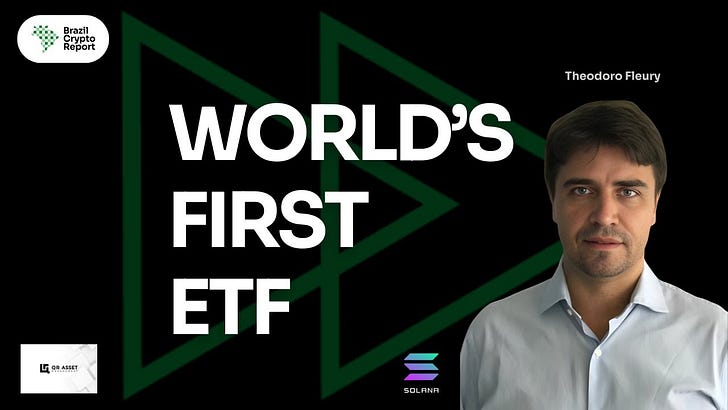
Episode #116: How QR Asset Launched the World's First Solana ETF
🎧 Listen: Spotify | Apple Podcasts | Anchor | Amazon | YouTubeOlá pessoal!For today’s episode I had the opportunity to chat with Theodoro Fleury, Chief Investment Officer at QR Asset, to discuss their groundbreaking Solana spot ETF—the world's first of its kind. The Solana product launched on August 29, 2024, and raised R$15 million (US$3 million) on Day 1. The fund’s SOL holdings have grown 25% since launch day. Our conversation offers insights into Brazil’s capital markets, the evolving landscape of crypto investment vehicles, and Brazil's role as a leader when it comes to creating a favorable environment for these types of products. Key Takeaways:* QR Asset launched the first bitcoin ETF outside of Canada in 2021 on Brazil’s B3 Exchange, followed by Ethereum and DeFi ETFs* Crypto ETFs have become among the most traded on Brazil's B3 exchange* Brazil's CVM (Securities and Exchange Commission) has long shown a progressive stance towards crypto products and approved the Solana ETF in early August 2024.* Brazil's move to approve a Solana ETF likely foreshadows similar developments in other markets such as the US. From launching their first crypto funds in early 2020 to becoming a major player in Brazil's ETF market, QR Asset has been one of the earliest movers globally operating these types of crypto products. The introduction of the Solana ETF marks a significant milestone. Fleury explains the rationale behind choosing Solana, citing its strong developer community, growing TVL, and position as the largest non-stablecoin asset after bitcoin and ethereum.🙌 🇧🇷Brazil Crypto Report is a free publication; if you wish to support us you can do so by hitting the button below👇Brazil Crypto Report is presented byKaleido is the most trusted digital assets and blockchain company by enterprises. Their product suite is the ultimate business blockchain cloud and is rated #1 for tokenization and #1 for blockchain-as-a-service. Kaleido is powered by open source, supports multiple protocols, connects to permissioned and public chains, and lets you utilize any smart contract. Tokenizing assets in a scalable and interoperable way has never been easier.Built by veterans of IBM Blockchain and Consensys, the Kaleido platform combines turnkey functionality with enterprise-grade security and scalability to power your application — whether it be in banking and financial services, supply chain, media, government & public sector, or central bank digital currencies.Request a custom demo of the platform today! Perhaps most intriguing is the potential global impact of this development. As Fleury notes:"If, as it was in the past, it is a sign of what could happen in the U.S. or in more developed markets, I think it's a good sign because people here are really trying to make it look serious."For professional investors and stakeholders, this episode underscores the importance of keeping an eye on emerging markets like Brazil. The country's regulatory environment and market dynamics are creating opportunities that may not yet exist in more established financial centers.You can connect with Theodoro on LinkedinHave a great weekend everyone!-AWSConnect with 🇧🇷Brazil Crypto Report across the web: Twitter | Linkedin | YouTube | Instagram | Spotify | Apple Podcasts | Substack Get full access to Brazil Crypto Report at brazilcrypto.substack.com/subscribe
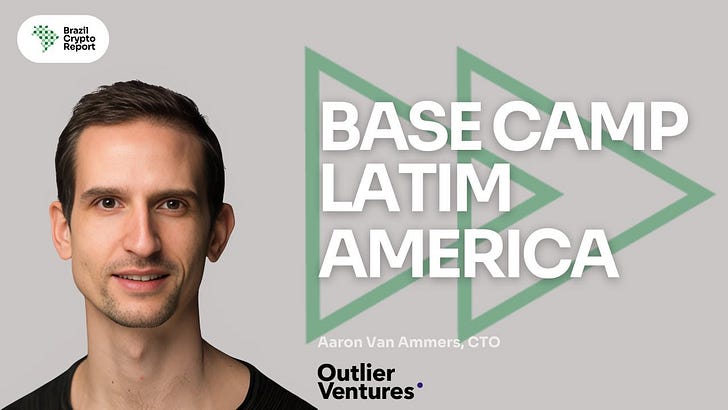
Episode #115: Inside Outlier Ventures' Latam Base Camp Accelerator
🎧 Listen: Spotify | Apple Podcasts | Anchor | Amazon | YouTubeOlá pessoal!Today I’m joined by Aron van Ammers, CTO of Outlier Ventures — which is one of the longest running Web3-focused venture capital firms. We talk about Outlier’s new Latin America Base Camp accelerator, which seeks to help founders and teams from the region take their projects to the next level. Founded in 2014 by van Ammers and Jamie Burke, Outlier Ventures has operated more than 20 Base Camp accelerators focusing on themes like DeFi, NFTs, Metaverse, Gaming and more. Now, it is spinning up a cohort specifically focused on the Latin America region. The Base Camp Program: Intensive and ComprehensiveThe Base Camp accelerator is a 12-13 week intensive, fully remote program designed to transform promising startups into investment-ready businesses. Key features include:* Mentor-focused initial two weeks with rigorous pitching sessions* Comprehensive support from expert teams in legal, marketing, finance, token economics, product engineering, and community building* Structured weekly goals and overall program objectives* Culmination in a virtual demo day to showcase polished pitches to relevant investors🙌 🇧🇷Brazil Crypto Report is a free publication; if you wish to support us you can do so by hitting the button below👇Brazil Crypto Report is presented byKaleido is the most trusted digital assets and blockchain company by enterprises. Their product suite is the ultimate business blockchain cloud and is rated #1 for tokenization and #1 for blockchain-as-a-service. Kaleido is powered by open source, supports multiple protocols, connects to permissioned and public chains, and lets you utilize any smart contract. Tokenizing assets in a scalable and interoperable way has never been easier.Built by veterans of IBM Blockchain and Consensys, the Kaleido platform combines turnkey functionality with enterprise-grade security and scalability to power your application — whether it be in banking and financial services, supply chain, media, government & public sector, or central bank digital currencies.Learn more and try it free at Kaleido.ioWhy Latin America?van Ammers explains Outlier’s decision to focus on Latin America stems from recognizing the region's unique characteristics:* A young, tech-savvy demographic* High inflation rates in some countries, creating a need for alternative financial solutions* Gaps in traditional banking access, opening opportunities for innovative fintech solutions* A growing pool of talented engineers and entrepreneurs with fresh perspectives on Web3 applicationsFour Key Sectors in FocusThe accelerator concentrates on four main areas, each with specific relevance to the Latin American context:* Fintech: Addressing local payment systems, remittances, and innovative savings and lending protocols* E-commerce: Leveraging blockchain for more efficient and transparent online marketplaces* Gaming: Tapping into the growing mobile gaming market with Web3 elements like true digital asset ownership* Infrastructure: Building the foundational layers for Web3 adoption in the regionThe Ideal CandidateBase Camp typically looks for startups with:* Teams of 2-3 co-founders, balancing technical and commercial expertise* Some level of product implementation and in-house engineering capability* An ambitious vision and passion for their project* Openness to feedback and willingness to iterate rapidlyPartnership with Morgan Creek DigitalThis Latin America Base Camp comes in collaboration with Morgan Creek Digital, which is led by world-renowned investor Mark Yusko, bringing additional firepower to the program:* Provides access to qualified deal flow in Latin America* Potential deployment of up to $1 million per cohort* Offers startups exposure to seasoned investors with a global perspectiveThis accelerator program represents a significant opportunity for Web3 startups in Latin America to access world-class mentorship, funding, and global connections. It also underscores the growing importance of the region in the global blockchain ecosystem.Interested founders can apply through the Outlier Ventures website, where they can also find a detailed 30-page thesis on the Latin America program. I really enjoyed this conversation with Aron and I hope you do as well. You can connect with him on Linkedin. Have a great weekend everyone!-AWSConnect with 🇧🇷Brazil Crypto Report across the web: Twitter | Linkedin | YouTube | Instagram | Spotify | Apple Podcasts | Substack Get full access to Brazil Crypto Report at brazilcrypto.substack.com/subscribe
Episode #114: Bitcoin Mining from Brazil to the US with Rudá Pellini
🎧 Listen: Spotify | Apple Podcasts | Anchor | Amazon | YouTubeOlá pessoal!Today’s interview is with Rudá Pellini, co-founder of Brazilian-born bitcoin mining company Arthur Inc. We dive into Arthur's expanding operations in the US, the evolution of the bitcoin mining business model and the challenges that would-be bitcoin miners face in Brazil. We also talk about Rudá’s journey from the Brazilian Army to bitcoin entrepreneur.Key themes from this conversation include:* The transformation of Bitcoin mining from a niche investment to a diversified business model* The importance of energy management and grid balancing in mining operations* Arthur’s new 15 megawatt mining facility in Oklahoma* The state of mining in Brazil and other Latin American countries🙌 🇧🇷Brazil Crypto Report is a free publication; if you wish to support us you can do so by hitting the button below👇Brazil Crypto Report is presented byKaleido is the most trusted digital assets and blockchain company by enterprises. Their product suite is the ultimate business blockchain cloud and is rated #1 for tokenization and #1 for blockchain-as-a-service. Kaleido is powered by open source, supports multiple protocols, connects to permissioned and public chains, and lets you utilize any smart contract. Tokenizing assets in a scalable and interoperable way has never been easier.Built by veterans of IBM Blockchain and Consensys, the Kaleido platform combines turnkey functionality with enterprise-grade security and scalability to power your application — whether it be in banking and financial services, supply chain, media, government & public sector, or central bank digital currencies.Learn more and try it free at Kaleido.ioPellini traces Arthur's journey from its beginnings in 2017 to its current status as a significant player in the US mining scene. In total, the company now operates facilities in Ohio, Wyoming, and Oklahoma, with plans to reach 50 megawatts of capacity in the coming months.A key focus of the discussion is the changing nature of mining operations. Pelini emphasizes how miners are increasingly partnering with energy providers, participating in demand response programs, and exploring new revenue streams such as hosting services and AI computing.We also touch on the state of the Brazilian market, where despite abundant and increasingly affordable energy, high import taxes on mining equipment remain a significant barrier. Pellini describes how Arthur is working to overcome these challenges, including exploring local assembly of ASICs to reduce costs.Pellini also talks about the broader Latin American context, noting recent developments in Paraguay and potential opportunities in countries like Argentina and El Salvador.I really enjoyed this conversation with Rudá and I hope you do as well. You can connect with him on LinkedinHave a great weekend everyone! -AWSConnect with 🇧🇷Brazil Crypto Report across the web: Twitter | Linkedin | YouTube | Instagram | Spotify | Apple Podcasts | Substack Get full access to Brazil Crypto Report at brazilcrypto.substack.com/subscribe
Episode #113: Rethinking the Monetary Stack with Luca Prosperi and João Reginatto of M^0
🎧 Listen: Spotify | Apple Podcasts | Anchor | Amazon | YouTubeOlá pessoal!Today we have a can’t miss episode with Luca Prosperi and João Reginatto of M^0 Labs to explore how M^0 plans to shake up the the monetary vertical stack and democratizing access to money issuance infrastructure.Luca and João, drawing from their extensive experience at in the Dai and USDC ecosystems respectively, provide invaluable insights into the limitations of current stablecoin models and the need for a more democratic, transparent, and resilient monetary system.Some key takeaways:* Notably, M^0 aims to create a many-to-many model for money issuance, moving away from the current one-to-many paradigm dominated by a handful of centralized stablecoin issuers.* The project introduces a unique two-token governance model designed to encourage active participation and avoid the pitfalls seen in other crypto governance systems.* M^0's approach challenges the traditional role of commercial banks as financial intermediaries.🙌 🇧🇷Brazil Crypto Report is a free publication; if you wish to support us you can do so by hitting the button below👇Brazil Crypto Report is presented byKaleido is the most trusted digital assets and blockchain company by enterprises. Their product suite is the ultimate business blockchain cloud and is rated #1 for tokenization and #1 for blockchain-as-a-service. Kaleido is powered by open source, supports multiple protocols, connects to permissioned and public chains, and lets you utilize any smart contract. Tokenizing assets in a scalable and interoperable way has never been easier.Built by veterans of IBM Blockchain and Consensys, the Kaleido platform combines turnkey functionality with enterprise-grade security and scalability to power your application — whether it be in banking and financial services, supply chain, media, government & public sector, or central bank digital currencies.Learn more and try it free at Kaleido.ioWe also discuss how M^0's approach could particularly benefit emerging markets, providing citizens with easier access to stable, dollar-denominated assets. This has profound implications for countries grappling with currency devaluation and limited access to global financial markets.This was a great conversation with two stablecoin legends with very strong connections to Brazil who are building an exciting new project that fundamentally rethinks how money is issued and distributed. You can connect with Luca and João on Linkedin.Have a great weekend everyone,-AWSConnect with 🇧🇷Brazil Crypto Report across the web: Twitter | Linkedin | YouTube | Instagram | Spotify | Apple Podcasts | Substack Get full access to Brazil Crypto Report at brazilcrypto.substack.com/subscribe
Episode #112: Web3 in Financial Services with Rita Martins
🎧 Listen: Spotify | Apple Podcasts | Anchor | Amazon | YouTubeOlá pessoal!Today I talk to Rita Martins, who is the author of a new book about blockchain and Web3 written from the lens of a financial services practitioner. Rita brings a unique perspective, shaped by her background in both consulting and banking, on how these technologies will impact traditional finance. Key themes of our conversation:* The evolution of blockchain in finance: From early experiments in 2014-2015 to today's focus on asset tokenization and stablecoins* The convergence of DeFi and TradFi: How both worlds are adapting and learning from each other* The potential of blockchain to transform financial infrastructure, particularly in emerging markets* The role of regulation in driving blockchain adoption in traditional financeNotably, Rita highlights the Central Bank of Brazil’s DREX project as a prototype for how tradfi and Web3 will eventually overlap and intertwine. She highlights several of the use cases explored during the bank’s 2022 LIFT Challenge (basically a sandbox for CBDC applications) as a harbinger for what’s likely to come as these types of projects continue developing globally. 🙌 🇧🇷Brazil Crypto Report is a free publication devoted to covering the Brazil and Latam crypto ecosystem; if you wish to support my work you can do so by hitting the button below👇Brazil Crypto Report is presented byKaleido is the most trusted digital assets and blockchain company by enterprises. Their product suite is the ultimate business blockchain cloud and is rated #1 for tokenization and #1 for blockchain-as-a-service. Kaleido is powered by open source, supports multiple protocols, connects to permissioned and public chains, and lets you utilize any smart contract. Tokenizing assets in a scalable and interoperable way has never been easier.Built by veterans of IBM Blockchain and Consensys, the Kaleido platform combines turnkey functionality with enterprise-grade security and scalability to power your application — whether it be in banking and financial services, supply chain, media, government & public sector, or central bank digital currencies.Learn more and try it free at Kaleido.ioSome other noteworthy observations from this discussion:* The DeFi space is not just populated by "crypto natives" but also by experienced professionals from traditional finance backgrounds* The ideals of decentralization face practical challenges in implementation, as seen in the governance of some DAOs* The coexistence and potential competition between stablecoins and CBDCs remains an open question* Regulatory clarity is crucial but not the only factor in blockchain adoption - technical and interoperability challenges also need to be addressedFor those interested in exploring these topics more from the vantage point of a financial services practitioner, Rita's book offers a comprehensive look at the current state and future potential of blockchain in finance. It serves as an excellent primer for professionals in traditional finance looking to better understand this new world. You can connect with Rita on LinkedinHave a great weekend everyone,-AWSConnect with 🇧🇷Brazil Crypto Report across the web: Twitter | Linkedin | YouTube | Instagram | Spotify | Apple Podcasts | Substack Get full access to Brazil Crypto Report at brazilcrypto.substack.com/subscribe
Episode #111: Argentina's Crecimiento with Diego Fernandez
🎧 Listen: Spotify | Apple Podcasts | Anchor | Amazon | YouTubeOlá pessoal!Today I talk to Diego Fernandez, who is Secretary of Innovation and Digital Transformation for the City of Buenos Aires. We discuss Crecimiento, which is an initiative to seize upon Argentina’s unique political moment by mobilizing talent and bringing actionable crypto solutions to the country’s economy and financial system.Argentina has a high crypto adoption rate (12-15% of the population uses crypto weekly), a concentration of top blockchain talent, and well-documented economic challenges. Because of these factors, the Crecimiento community believes that Argentina has all the necessary ingredients right now to become a crypto nation and innovation hub.The movement will ramp up in August with the Aleph Pop Up City in Buenos Aires from August 5 - September 1. * This is a startup city initiative modeled after a similar experiment led by Vitalik Buterin in Montenegro last year.* The city will convene 400-1000 founders and startup teams, builders, mentors, investors, experts and government officials to brainstorm and hack solutions for the Argentine economy* Crecimiento itself extends well beyond the Pop Up City. It is a multi-year initiative devoted to convening and funding talented builders and deploying actionable solutionsYou can find more more information about the initiative and how to participate at the Aleph Crecimiento website, on X/Twitter and in the Crecimiento Telegram group. You can also connect with Diego directly on Linkedin. Have a great weekend everyone,-AWS🙌 🇧🇷Brazil Crypto Report is a free publication devoted to covering the Brazil and Latam crypto ecosystem; if you wish to support my work you can do so by hitting the button below👇Brazil Crypto Report is presented byKaleido is the most trusted digital assets and blockchain company by enterprises. Their product suite is the ultimate business blockchain cloud and is rated #1 for tokenization and #1 for blockchain-as-a-service. Kaleido is powered by open source, supports multiple protocols, connects to permissioned and public chains, and lets you utilize any smart contract. Tokenizing assets in a scalable and interoperable way has never been easier.Built by veterans of IBM Blockchain and Consensys, the Kaleido platform combines turnkey functionality with enterprise-grade security and scalability to power your application — whether it be in banking and financial services, supply chain, media, government & public sector, or central bank digital currencies.Learn more and try it free at Kaleido.ioConnect with 🇧🇷Brazil Crypto Report across the web: Twitter | Linkedin | YouTube | Instagram | Spotify | Apple Podcasts | Substack Get full access to Brazil Crypto Report at brazilcrypto.substack.com/subscribe
Episode #110: Hyperledger in Brazil with Daniela Barbosa
🎧 Listen: Spotify | Apple Podcasts | Anchor | Amazon | YouTubeOlá pessoal!For today’s episode I’m joined by Daniela Barbosa, Executive Director at the Hyperledger Foundation and General Manager for blockchain and identity at the Linux Foundation. Daniela shares her insights on the evolution of enterprise blockchain adoption — with a special focus on developments in Brazil. More specifically, she describes how many large enterprises and companies are now building blockchain applications on platforms like Hyperledger Fabric and Besu.Daniela also shares about her experience at the Febraban Tech conference in São Paulo last week. 🙌 🇧🇷Brazil Crypto Report is a free publication; if you wish to support my work you can do so by hitting the button below👇Brazil Crypto Report is presented byKaleido is the most trusted digital assets and blockchain company by enterprises. Their product suite is the ultimate business blockchain cloud and is rated #1 for tokenization and #1 for blockchain-as-a-service. Kaleido is powered by open source, supports multiple protocols, connects to permissioned and public chains, and lets you utilize any smart contract. Tokenizing assets in a scalable and interoperable way has never been easier.Built by veterans of IBM Blockchain and Consensys, the Kaleido platform combines turnkey functionality with enterprise-grade security and scalability to power your application — whether it be in banking and financial services, supply chain, media, government & public sector, or central bank digital currencies.Learn more and try it free at Kaleido.ioKey Takeaways:* Hyperledger has been at the forefront of enterprise blockchain adoption since 2015, evolving to meet changing market needs* The Central Bank of Brazil is using Hyperledger Besu for its Drex project, showcasing the platform's utility as a base layer for central bank digital currencies* The new LF Decentralized Trust initiative will bring together various blockchain and blockchain-adjacent projects under one umbrella* Privacy challenges in the Drex project highlight the need for customizable, jurisdiction-specific solutions in blockchain implementations* Latin America, particularly Brazil, is seeing significant growth in blockchain adoption across various sectors, from finance to supply chain managementThis episode offers a compelling look at the state of enterprise blockchain adoption in 2024, with valuable insights for anyone interested in the intersection of blockchain technology and traditional business applications.You can connect directly with Daniela on Linkedin. Have a great weekend everyone,-AWSConnect with 🇧🇷Brazil Crypto Report across the web: Twitter | Linkedin | YouTube | Instagram | Spotify | Apple Podcasts | Substack Get full access to Brazil Crypto Report at brazilcrypto.substack.com/subscribe
Episode #109: How Brazil Became the World's Hottest Online Gambling Market
🎧 Listen: Spotify | Apple Podcasts | Anchor | Amazon | YouTubeOlá pessoal!If you’ve spent any time in Brazil recently, you’ve undoubtedly been bombarded by online sports betting ads every time you leave your home, watch television or surf the internet. You’re not the only one. Brazil today has the highest number of gambling websites accessed globally, nearly double that of the second-place UK. Nearly every major football team in Brazil has an online casino or sportsbook as a sponsor. Today’s episode takes a look at how Brazil has become the hottest online gambling market in the world over the last couple years, what will change when a new licensing regime goes live in 2025, and the overlap with the world of cryptocurrencies. To break it all down, we’re joined by two experts who give us both the local insider perspective as well as a global point of view. * Udo Seckelmann is Head of Gambling and Crypto at Bichara e Motta Advogados, which is a top tier law firm in Rio de Janeiro.* James Kilsby is Chief Analyst & VP of Americas at Vixio Regulatory Intelligence. Vixio is one of the leading business intelligence and research firms focusing on the global gambling industry. Brazil Crypto Report is presented byKaleido is the most trusted digital assets and blockchain company by enterprises. Their product suite is the ultimate business blockchain cloud and is rated #1 for tokenization and #1 for blockchain-as-a-service. Kaleido is powered by open source, supports multiple protocols, connects to permissioned and public chains, and lets you utilize any smart contract. Tokenizing assets in a scalable and interoperable way has never been easier.Built by veterans of IBM Blockchain and Consensys, the Kaleido platform combines turnkey functionality with enterprise-grade security and scalability to power your application — whether it be in banking and financial services, supply chain, media, government & public sector, or central bank digital currencies.Key takeaways from this episode:* Brazil legalized sports betting in 2018, but the industry has operated in a gray area without formal regulation until now.* New regulations will take effect on January 1, 2025, transforming the market from unregulated to licensed and regulated.* Cryptocurrency, particularly USDT, has played a significant role in facilitating transactions for offshore operators.* The new regulatory framework will prohibit direct use of crypto for deposits and withdrawals between operators and players.* However, operators may still be able to use crypto for back-end operations and fund transfers outside of Brazil.The episode provides a comprehensive look of how Brazil arrived at this pivotal moment. A combination of factors, including the 2018 legalization, the introduction of PIX instant payments, increased advertising freedom and Covid lockdowns helped create the current online gambling boom. Now, as the country prepares to implement a formal licensing regime, operators are scrambling to establish local entities and comply with new regulations.Looking ahead, our experts highlight several key points to watch:* The effectiveness of regulators in enforcing rules against unlicensed operators* How licensed operators will compete with potentially more attractive offshore options* The potential for crypto to become even more important in the unlicensed offshore segment* The challenge of balancing taxation and fees with the need to offer competitive productsI appreciated the opportunity to hear direclty from Udo and James about what’s at stake here. Definitely worth a listen whether you’ve been tracking the online gambling space for a while now or just starting to pay attention. You can connect directly with both James and Udo on Linkedin.Have a great weekend everyone,-AWSConnect with 🇧🇷Brazil Crypto Report across the web: Twitter | Linkedin | YouTube | Instagram | Spotify | Apple Podcasts | Substack Get full access to Brazil Crypto Report at brazilcrypto.substack.com/subscribe
Episode #108: Will Gaming Be Brazil's Killer Web3 App? with Skale's Jack O'Holleran and Andrew Saunders
🎧 Listen: Spotify | Apple Podcasts | Anchor | Amazon | Google Podcasts | YouTubeOlá pessoal!Today I’m joined by Skale founder Jack O’Holleran and chief marketing and growth officer Andrew Saunders. We take a look at one of the more innovative and fast-growing blockchain platforms you may not have heard of yet. We discuss Skale’s unique approach to blockchain scaling, how this facilitates the gaming use case and why they're particularly excited about the Brazilian market.Skale has developed a novel modular blockchain architecture that stands out in the increasingly crowded field of Layer 1 and Layer 2 solutions. Their platform enables:* Zero gas fees for end users* High throughput for applications with millions of users* Easy deployment options for developersThe results speak for themselves - Skale has seen impressive growth in active wallets and onchain transactions in recent months.Jack explains how Skale's technology differs fundamentally from other blockchain scaling approaches. Rather than following the typical paths of building faster Layer 1 chains or implementing rollups, Skale created a modular system that allows for horizontal scaling through app-specific chains. This architecture provides the benefits of appchains while maintaining strong security through connections to Ethereum.One of the most exciting developments on Skale has been the rapid growth of blockchain gaming. Andrew, drawing on his previous experience marketing for companies like Amazon and Arbitrum, shares insights on why gaming is emerging as a killer use case:* Skale's zero-fee structure removes a major barrier for players* High performance enables smooth gameplay even for graphics-intensive games* Several Skale-based games are already available on major platforms like the Epic Games StoreThe team is particularly bullish on Brazil and Latin America as key markets for expansion. Andrew, who has extensive experience working in Brazil, discusses why the region is so promising for blockchain adoption:* Mobile-first nature of the market aligns well with Scale's strengths* Tech-savvy population eager to explore new technologies* Potential for blockchain games to provide both entertainment and economic opportunitiesLooking ahead, Skale has some major developments in the pipeline, including a significant platform upgrade coming soon and partnerships with major players in the gaming industry. The team is also exploring integrations with zero-knowledge proofs to further enhance security and scalability.For developers interested in building on Skale, Jack outlines the flexible options available - from joining existing app-specific chains to easily deploying entirely new chains as projects grow.This episode provides a fascinating look at a project that's taking a genuinely different approach to solving blockchain's scalability challenges.I really enjoyed this conversation with both of them and I hope you do as well. You can connect with Jack and Andrew on Linkedin and X/TwitterHave a great weekend everyone,-AWSConnect with 🇧🇷Brazil Crypto Report across the web: Twitter | Linkedin | YouTube | Instagram | Spotify | Apple Podcasts | Substack Get full access to Brazil Crypto Report at brazilcrypto.substack.com/subscribe
Episode #107: Drex Delays 😱 What Happens Next?
🎧 Listen: Spotify | Apple Podcasts | Anchor | Amazon | Google Podcasts | YouTubeOlá pessoal!For today’s episode I talk to a pair of crypto journalists — Ricardo Bomfim of Valor Economico and Claudia Mancini of BlockNews — about delays impacting two highly-anticipated projects being developed by the Central Bank of Brazil.Both Drex and a regulatory framework for crypto brokerages and VASPs were originally expected to be unveiled in 2024. However, these have been pushed to next year due to technical roadblocks and staffing issues at the bank. Key themes discussed in this episode include:Drex’s Privacy Hurdle* The Central Bank has paused the CBDC pilot project after hitting a major privacy barrier* The core challenge is scaling the underlying Hyperledger Besu blockchain tech while complying with Brazil's bank secrecy laws* Several promising privacy solutions will be explored during the second phase of the pilot, which will also focus on incubating new use casesRegulatory Delays but Positive Engagement* A framework for crypto brokerages initially expected in the second half of 2024 has been pushed to Q1 2025* However, the Central Bank has continued to take an engaged approach, actively soliciting private sector feedback* Despite the delays, the market response has been positive given the open dialogueLeadership Change Ahead* Central Bank president Roberto Campos Neto, a key driver of Drex and the bank's crypto-friendly stance, will see his term expire in Dec 2024* His potential successor has made some skeptical comments about Drex, raising concerns of backtracking* However, Claudia and Ricardo argue these innovation projects have roots far deeper than just the BC’s leadershipI enjoyed the opportunity to discuss these topics with two of the country's top journalists, and I hope you the conversation! You can connect with Claudia and Ricardo on Linkedin.Have a great weekend everyone,-AWS💡Please hit the free subscribe button below if enjoy BCR! Note that I keep all 🇧🇷BCR content free so as to promote Brazil’s crypto ecosystem as widely as possible, but if you’re already subscribed and wish to support the platform, there’s an “upgrade to paid” option you can select. Always appreciated! 👇Connect with 🇧🇷Brazil Crypto Report across the web: Twitter | Linkedin | YouTube | Instagram | Spotify | Apple Podcasts | Substack Get full access to Brazil Crypto Report at brazilcrypto.substack.com/subscribe
Episode #106: Drex for Gringos with Leandro Pereira Sciammarella and Rafael Castaneda
🎧 Listen: Spotify | Apple Podcasts | Anchor | Amazon | Google Podcasts | YouTubeOlá pessoal!Today’s episode is a panel discussion with crypto educator Rafael Castaneda and Leandro Pereira Sciammarella, who is digital assets lead at Nuclea and the author of the excellent Drex for Gringos series.Followers of BCR know that the Central Bank of Brazil is building an ambitious CBDC/smart contract project, known as Drex, that looks to dramatically reshape the country’s financial system. This conversation was recorded onsite at Web Summit Rio back in April. After our live panel concluded, we learned that the Drex team had hit an impasse in its attempt to find adequate privacy solution that is both scalable and compliant with Brazil’s data protection law. I wasn’t going to publish this episode because the content is slightly out of date. However, many of the insights that Leandro and Casta share are still relevant, and both of them do a great job articulating the potential of the Drex project and the challenges it faces. There also just isn’t that much content about Drex in English, so hopefully this episode can be a valuable contribution to that library.The key topics covered include:* Drex is intended to be hybrid central bank digital currency and smart contract platform that enables the tokenizen of assets like government bonds. It seeks to do this on a permissioned, Ethereum Virtual Machine-compatible blockchain built using Hyperledger Besu.* It combines aspects of both "retail" and "wholesale" CBDC models - allowing tokenized Brazilian real to be used by consumers and for institutional settlement.* Privacy and scalability remain major hurdles, with ongoing tests of potential solutions developed by Parfin and EY. Ensuring interoperability across systems is also a challenge (as it is everywhere else in Web3). * Drex projects to bring transparency and access benefits, but its impact on banks' business models is an open question.* While promising, Drex is still in its infancy. There is a long way to go before its proposed benefits can be realized. I enjoyed this conversation because both Leandro and Casta dive into the technological nitty-gritty while keeping an eye on the bigger picture implications for monetary policy, institutions, and national sovereignty.A key focus is the project's embrace of public blockchain infrastructure like Ethereum, which raises questions around regulation, privacy, and control. As Casta notes, crypto was designed to resist regulation - so grafting it onto a central bank digital currency is uncharted territory fraught with technical and political minefields to navigate.Leandro provides a ground-level view of the scalability and interoperability obstacles developers are grappling with. Despite these hurdles, he’s optimistic that rising privacy tech like zero-knowledge proofs can bridge permissioned and permissionless systems.You can connect with Leandro on Linkedin and Casta on X/Twitter. I enjoyed this conversation with both of them and I hope you do as well.Also big shout out to Transfero Group for hosting this panel on their stage at Web Summit Rio.Have a great weekend everyone,-AWS💡Quick public service announcement: I keep all 🇧🇷BCR content free and accessible to promote Brazil’s crypto ecosystem as widely as possible, but please hit the free subscribe button below if enjoy this content. If you’re already subscribed, there’s an “upgrade to paid” enabled if you wish to support this platform👇Connect with 🇧🇷Brazil Crypto Report across the web: Twitter | Linkedin | YouTube | Instagram | Spotify | Apple Podcasts | Substack Get full access to Brazil Crypto Report at brazilcrypto.substack.com/subscribe
Episode #104: Onsite at Web Summit Rio with Marlyson Silva and Daniel Marquez
🎧 Listen: Spotify | Apple Podcasts | Anchor | Amazon | Google Podcasts | YouTubeOlá pessoal!This episode is a panel I moderated at Web Summit Rio with Transfero Group CEO Marylson Silva and Daniel Marquez — who is a partner at Koyamaki Ventures and based out of Colombia. This conversation provided a wholesale overview of crypto adoption in the region, told through the lens of an operator and an investor, respectively. 💡Quick public service announcement: I keep all 🇧🇷BCR content free and accessible to promote Brazil’s crypto ecosystem as widely as possible, but please hit the free subscribe button below if enjoy this content. If you’re already subscribed, there’s an “upgrade to paid” enabled if you wish to donate to support my work (greatly appreciated!)👇Key highlights of this conversation:* Crypto education has improved significantly in recent years, with people in Latin America now better understanding the difference between legitimate projects and fraudulent schemes.* Stablecoins, such as Transfero's BRZ and ARZ, are gaining traction for cross-border payments and remittances, with the potential to provide greater financial inclusion and lower fees compared to traditional banking systems.* Brazil is seen as a global use case for crypto applications, with its regulatory framework and large population making it an attractive market for entrepreneurs and investors.* The Central Bank of Brazil has taken a balanced approach to regulation, focusing on consumer privacy and allowing financial institutions to interface with users while providing the necessary infrastructure.Marylson highlighted Transfero's role in connecting the traditional financial system with the world of decentralized finance (DeFi), serving as an eventual bridge between Drex and DeFi protocols. He also emphasized the importance of financial education in driving adoption, particularly among retail users.Daniel pointed out that while there is an abundance of wallets and remittance solutions in the region, there is still room for innovation in areas such as DeFi and web3 applications. He also noted that Brazil's regulatory framework should serve as a model for other countries looking to follow a similar path. 🏆Big shout out to Transfero for letting us host this panel at their stand.I really enjoyed this conversation with Marlyson and Daniel and I hope you do as well. You can connect with both of them on Linkedin. Have a great week everyone,- AWSConnect with 🇧🇷Brazil Crypto Report across the web: Twitter | Linkedin | YouTube | Instagram | Spotify | Apple Podcasts | Substack Get full access to Brazil Crypto Report at brazilcrypto.substack.com/subscribe
Episode #103: Crypto Crime in 2024 with Chainalysis' Gurvais Grigg
🎧 Listen: Spotify | Apple Podcasts | Anchor | Amazon | Google Podcasts | YouTubeOlá pessoal!For today’s episode I’m joined by Gurvais Grigg, who is chief technology officer for public sector at blockchain analytics firm Chainalysis. Gurvais and I were able to record on location at the B Hotel in Brasilia during his recent visit, where we discussed the always uncomfortable topic of cryptocurrencies being used for illicit purposes. It’s not something that folks in this industry like to talk about, but it’s a critical piece of the puzzle that needs to be constantly addressed Quite frankly, there are few people on the planet better positioned than Gurvais to talk about this. Prior to joining Chainalysis, he was Assistant Director at the FBI, where he focused on fighting financial crime and following the money trails of criminal enterprises (crypto, fiat and otherwise) for more than two decades. His experience at the highest levels of US law enforcement gives him a truly unique perspective on the public safety challenges and opportunities related to crypto going mainstream. In this conversation we discuss the state of crypto crime in 2024, as well how the nature of illicit use cases has broadened significantly since the early days, when crypto was used mainly for ransomware, money laundering and buying contraband online, etc.💡Quick public service announcement: I keep all 🇧🇷BCR content free and accessible so as to promote Brazil’s crypto ecosystem as widely as possible! However, I leave the “upgrade to paid” option enabled as a donation method for those who wish to support me financially (greatly appreciated!)👇 Some key takeaways from this conversation:* While most crypto activity is legitimate, criminals will always follow the money. The speed, anonymity, and global liquidity of crypto attracts bad actors, though transparency acts as a deterrent.* Nation-state actors like North Korea are running elaborate crypto hacking and theft programs netting billions, though law enforcement has been able to stay on their trial via use of blockchain analytics.* Stablecoins have overtaken bitcoin as the highest volume coins traded by illicit actors in recent years due to their liquidity and ease of use.* Chainalysis' partnership with Tether provides proactive monitoring and counterparty risk management capabilities to the largest stablecoin.* Why he’s excited about the crypto market development and regulatory conversations he’s seeing in Brazil right now* As real-world assets like property get tokenized, new criminal risks will emerge that demand continued innovation in analytics tools and regulatory frameworks.His analysis highlights how the growth of blockchain forensics tools has been a a double-edged sword: it has empowered law enforcement actors to find bad guys, but has prompted criminals to become more sophisticated in their schemes — resulting in an escalating cat-and-mouse game.Despite all of that, Gurvais is super bullish on crypto and blockchain technology and excited about the role it will play in the financial system of the future. What will be absolutely necessary, he argues, is the development of ultra-scalable analytics tools that multiply the force of individual investigators. As he states: "We've got to build tools and capabilities that allow law enforcement to do the work of a hundred or a thousand."I learned a lot in this conversation and I hope you do as well. You can connect with Gurvais on Linkedin. Have a great week everyone,- AWSConnect with 🇧🇷Brazil Crypto Report across the web: Twitter | Linkedin | YouTube | Instagram | Spotify | Apple Podcasts | Substack Get full access to Brazil Crypto Report at brazilcrypto.substack.com/subscribe
Episode #102: Onsite at Web Summit Rio with Marcelo Sampaio and Bernardo Srur (PORTUGUESE)
🎧 Listen: Spotify | Apple Podcasts | Anchor | Amazon | Google Podcasts | YouTubeOlá pessoal! In this episode I’m joined by two rock stars from the Brazilian crypto universe. Marcelo Sampaio is the CEO Hashdex, which is Brazil’s largest crypto asset manager and now has products listed in the United States and Europe. Bernardo Srur is the CEO of ABCripto, the trade group representing the industry in Brazil.This conversation was recorded in Portuguese at the Transfero stand at Web Summit Rio back in April. Core themes discussed include:* How Brazil has been several years ahead of the US with regard to treatment of bitcoin ETFs and other crypto exchange traded products* How Brazil’s crypto market is still nascent and continues to show promising growth, with roughly 3% of the population currently participating * Hashdex’s journey to getting a bitcoin ETF listed in the United States* Why new competition in the Brazil market, which will ultimately benefit consumers and investors* Questions of custody and private key management in the context of ETF productsI really enjoyed this conversation with Bernardo and Marcelo and I hope you do as well. I appreciate the chance to interview both of them onstage simultaneously, and to do so in my gringo Portuguese 🤣Have a great week everyone,- AWSConnect with 🇧🇷Brazil Crypto Report across the web: Twitter | Linkedin | YouTube | Instagram | Spotify | Apple Podcasts | Substack Get full access to Brazil Crypto Report at brazilcrypto.substack.com/subscribe

Episode #101: Onsite at Web Summit Rio with Yat Siu
🎧 Listen: Spotify | Apple Podcasts | Anchor | Amazon | Google Podcasts | YouTubeOlá pessoal! For this special episode I’m joined by Yat Siu, co-founder and executive chairman of Animoca Brands. Animoca Brands is a pioneering game software and venture capital company that has invested in over 450 projects and supported major brands like The Sandbox metaverse and Bored Ape NFTs. In this conversation — recorded onstage at Web Summit Rio — Yat provides a master class on how crypto-native concepts like digital ownership, NFTs and airdrops are transforming how brands across both Web2 and Web3 are marketing and consumer engagement.Yat articulates these concepts probably better than anyone else out there right now. Honestly, it’s hard not to be bullish on this stuff listening to him talk about it. Here are some key takeaways from the episode:* While 2021 was full of hype around NFTs, 2023 has seen the actual building and emergence of real Web3 applications and use cases. As an example, major brands like Starbucks, Nike and Adidas have experimented NFT loyalty programs.* In Web3, users become stakeholders and members by holding tokens/NFTs from brands. This allows companies to build direct relationships and true loyalty with customers, rather than renting attention through ads.* Over $21 billion has been paid directly to users via token airdrops in Web3, making it the most novel user acquisition tool of our time. * Successful Web3-driven brand campaigns need to give customers ownership and upside through airdrops and tokens, not just discounts. Starbucks missed this by treating their NFTs as just digital membership cards.* Web3 technologies allow provable ownership that lets brands accurately identify and market to their true customers.* Yat believes Web3 standards will inevitably take over, just as the open internet displaced legacy media and platforms. The value flows to users are too compelling to ignore.* Why memecoins will eventually come to be recognized as powerful brand engagement tools. * Yat’s advice for builders in the space, particularly those in Brazil and Latin America.I really enjoyed this conversation with Yan and I hope you do as well. You can connect with him on X/Twitter and LinkedinHave a great week everyone,- AWSConnect with 🇧🇷Brazil Crypto Report across the web: Twitter | Linkedin | YouTube | Instagram | Spotify | Apple Podcasts | Substack Get full access to Brazil Crypto Report at brazilcrypto.substack.com/subscribe