Books of Titans Podcast
360 episodes — Page 2 of 8
#259 - Euthyphro by Plato
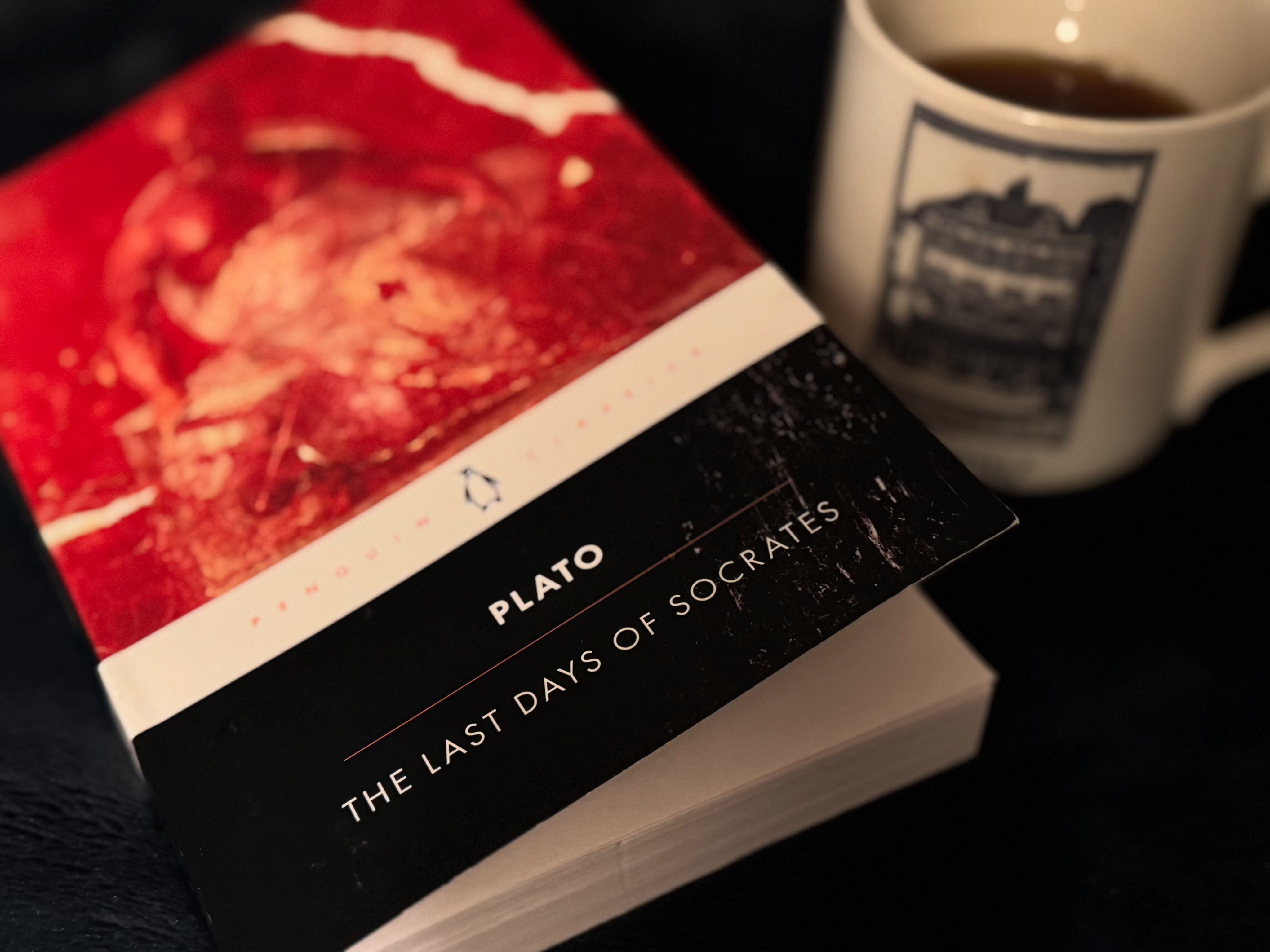
I have decided to read through the complete works of Plato. Euthyphro is my first dialogue in this Plato Project. I ended up reading it 4 times within 4 different translations. In this episode, I give a brief overview of the dialogue, talk about piety and if/when this word shows up in Homer, the Greek Tragedies, and elsewhere, and cover each of the answers and responses between Euthyphro and Socrates.Socrates has asked Euthyphro if piety and impiety take on an essential form. Poor Euthyphro thinks he is wise by giving particular example after particular example, but Socrates is after something deeper. Will we get to a form of piety and impiety that can be referenced in all circumstances? The stakes are high. Socrates has just been charged with impiety in corrupting the youth, creating new gods, and forsaking the old gods. If he can’t answer this charge, he’s in trouble. He’s hoping Euthyphro can give him a piety form. Or is Socrates just prodding Euthyphro to see if he knows what he is taking about?Here are the four versions I read:* Complete Works - edited by John M. Cooper - translated by G.M.A. Grube* Penguin Classics The Last Days of Socrates - translated by Hugh Tredennick and Harold Tarrant (intro)* Loeb Classical Library - translated by Harold North Fowler* Collected Dialogues - edited by Edith Hamilton & Huntington Cairns - translated by Lane Cooper This is a public episode. If you'd like to discuss this with other subscribers or get access to bonus episodes, visit www.booksoftitans.com/subscribe

Frameworks for Reading
Do you find yourself struggling to remember what you read? This has been a continual difficulty for me and is a main reason that I started this reading project. I wanted to read more books, but more importantly, I wanted to experiment with different ways to help me remember what I read.One of the most powerful ways I’ve found to remember what I read is to apply basic summary frameworks during and after the completion of each book. In this article, I’ll highlight the most powerful frameworks that you can write in the back of the book, in a journal, or in your notes app upon completing a book.The best part about these ideas is that they take a short time to complete but can greatly enhance your reading memory and comprehension.The One SentenceLast week, I had breakfast with my friend DT Slouffman. He’s a contender for the most interesting man alive and one of his roles is teaching the art of storytelling at a college. In that course, he writes the following sentence on the board as a tool for students to apply to fiction:________ wants ________ but ________ so ________ .What I love about this simple sentence is that it requires you to identify the protagonist, his or her desire, the challenge, and the path towards growth, resolution, or fulfillment. Going backwards, it identifies the change required to overcome an obstacle by the main character. It’s an encapsulation of the hero’s journey and it forces you to consolidate the book down to one sentence. If you can then remember this one sentence that you crafted, chances are you’ll be able to recall a large portion of the book.Here’s a One Sentence example I made from The Great Gatsby (yours may be quite different):Jay Gatsby wants Daisy but she is married so chaos and death ensue.I purposefully kept this one simple and short. I could elaborate on each fill-in part and you might choose to do so. The lack of a joyful resolution immediately identifies the work as a tragedy. By highlighting death, I immediately think of those situations in the book. I can picture Daisy and Jay as I did while reading the book. For properly recalling a book, sometimes you just need a simple hook that calls up other memories. This One Sentence framework is that hook.The One ThingA major focal point of this reading project is to attempt to remember just One Thing from each book that I read. It’s counterintuitive and may even sound wasteful, but I found that if I tried to remember many things from a book, I would forget them all, but if I just remembered One Thing, I could usually recall it, and it would in turn unlock other parts of the book.This idea is easier to impose upon works of non-fiction, but I’ll provide ideas for fiction as well. Here are a few ways to remember One Thing in different types of books:* For self-help books, instead of trying to remember One Thing, simply implement One Thing, immediately. If you are reading a book about personal finance, implement one idea from the book in relation to debt, budgets, or investments. If it’s a book about fasting, begin fasting. Running, apply one of the tips on your next run. You will always remember that book if you implement one idea into your daily routine.* For biographies and works of history, try to remember one story from the book. For example, in Walter Isaacson’s biography of Einstein, there was a story about Einstein being invited to a women’s prayer group in the USA during WWII. They prayed together in a circle and when it came to Einstein, he took out his violin and prayed through his instrument without saying a word. Oh, to have been a fly on the wall. That story helps me recall why Einstein was in the USA at that point, what he was working on, and other aspects of his story.* For works of fiction, write out the One Thing you can’t get out of your brain. Maybe it’s a theme you see across a variety of books. Perhaps the protagonist confronts a problem you’ve had in the past and your One Thing is how that person dealt with their situation.In general, you want to highlight the One Thing that stood out to you the most about that book. If you can remember that, it will help you to remember other parts of the book as well.Identifying StakesThis is another tool that my friend DT teaches his children and students. The idea here is that most books will present things of value or desire that are put at risk. That creates a stake and that stake must be paid by the end of the book. The exercise here is to create a two column list in the back of the book, in your journal, or in a notes app and write the stake on the left and its resolution on the right. If a stake is introduced and not resolved, you have a sub-par book (or movie, or tv show, etc.).Here are a few stakes from The Great Gatsby:* Jay Gatsby builds a mansion across the lake from Daisy in an effort to impress her with his wealth. That can’t just remain neutral, either it will have an impact or not. The stake must be paid in one way or another.* Jay tells Daisy’s husban
The Plato Project
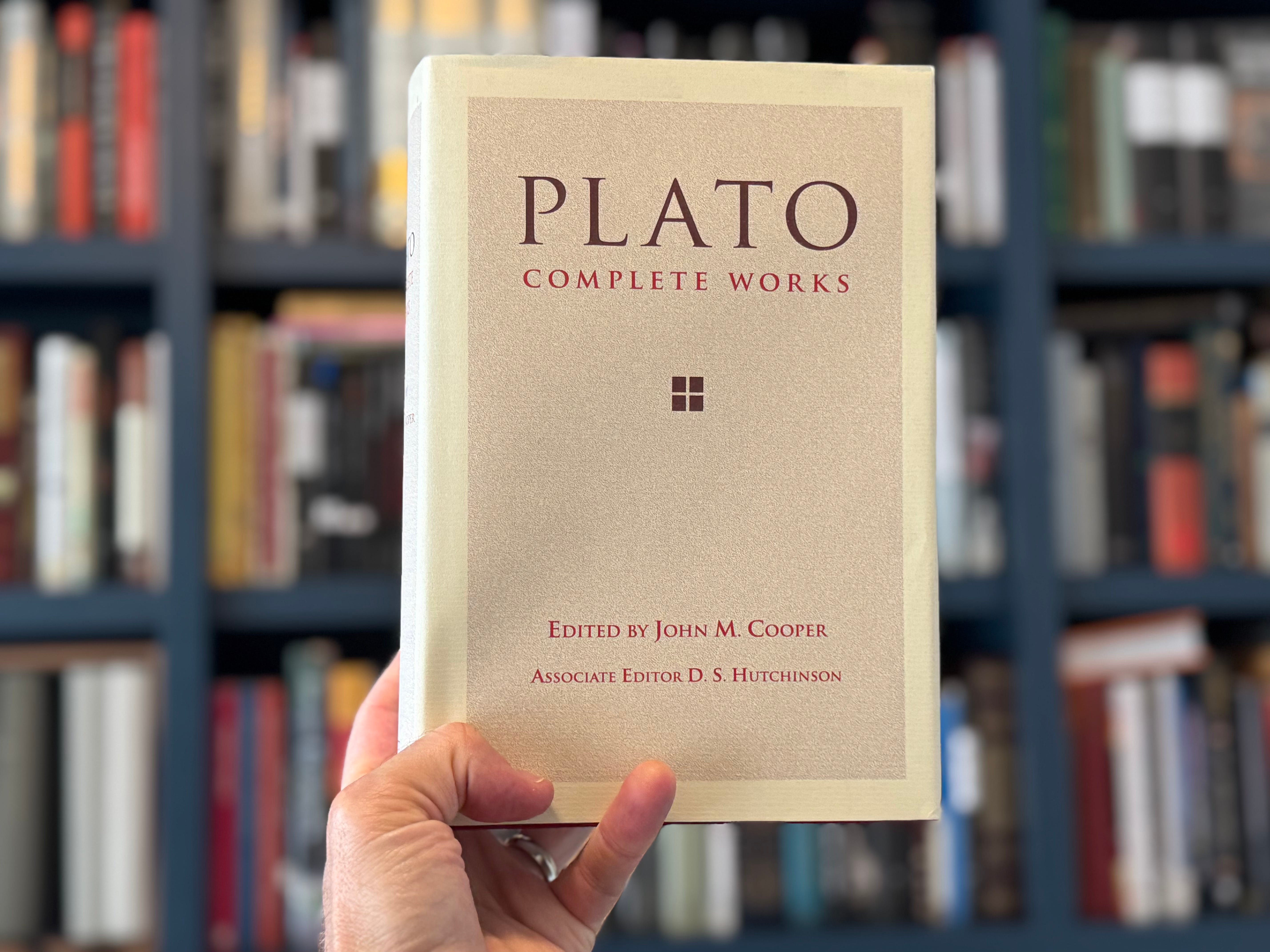
I’m currently making my way through The Immortal Books by 200 different authors. I expect the project to take 15 years. I’m currently in year 3 and Plato is author 18 out of 200. I had initially planned to read 9 of his works (Apology, The Republic, Laches, Symposium, Philebus, Crito, Phaedo, Theatetus, Meno), but when people on Twitter suggested I pick up this version of his complete works, I began to consider reading Plato’s entire corpus.Why not? Plato has an outsize influence on what comes after him. His ideas are ingrained in our heads. We see some things through his eyes. I’m largely approaching Plato blindly. I read The Republic in 2017 and remember next to nothing. I’ve avoided philosophy out of a deep fear of not understanding it. I’d like to change that. I’d like to dig into Plato, get to know his writings, ponder his ideas, and explore his works.I recorded this podcast episode as a time stamp of sorts. I want to see if there is something that happens to a person after they read Plato. Will there be a “before Plato Erik” and an “after Plato Erik?” We’ll see. I hope you follow along on this journey. I plan to cover most of Plato’s works on this podcast over the coming weeks and months. And I’ll see if I can finish this large tome by the end of 2025. This is a public episode. If you'd like to discuss this with other subscribers or get access to bonus episodes, visit www.booksoftitans.com/subscribe
#258 - The Last Sweet Mile by Allen Levi
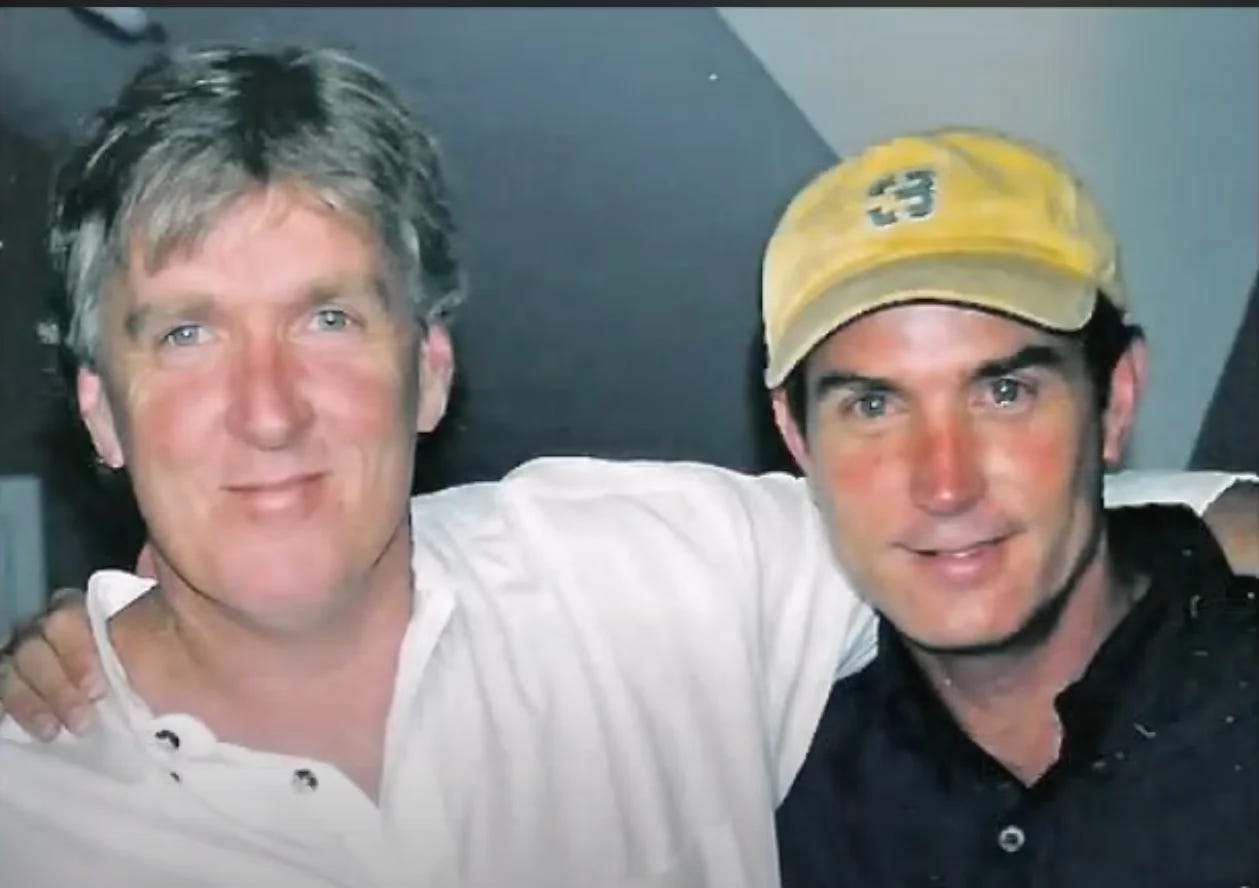
A life well-lived. Looking back, what would make you say that about your own life? What would constitute that well-lived life? Would it contain grand gestures seen by many or small, sacred acts seen by few?The Last Sweet Mile is a long letter written by Allen Levi to his family that covers the last year of his brother Gary’s life. They had a special relationship. A relationship we all long for. They were remarkably close. Gary was diagnosed with brain cancer in 2011 and died an exact year later on July 22, 2012. Allen called that year with his brother the best year of his life.Allen wrote this book before his latest novel, Theo of Golden. I have Theo on my mind, and so I naturally compared the two books despite Theo being a work of fiction and The Last Sweet Mile a work of non-fiction. I see a lot of Gary in the character of Theo. The sacredness of small things. The signposts of beauty. Sadness. Joy. Laughter.When I finished reading Theo of Golden last December, I had a one word response–Stunning. I had that same one-word response after finishing The Last Sweet Mile. It’s heart-wrenching, it’s sad, but it’s beautiful, for it portrays a life well-lived. This is a public episode. If you'd like to discuss this with other subscribers or get access to bonus episodes, visit www.booksoftitans.com/subscribe
The DIY Great Books Approach
This episode is for anyone who wants to tackle the Great Books independently—whether you’re years out of college or just looking for a self-guided approach. Not sure where to begin? In this episode, I share ideas on how to prepare, start, and continue on your very own Great Books journey. This is a public episode. If you'd like to discuss this with other subscribers or get access to bonus episodes, visit www.booksoftitans.com/subscribe

#257 - An Odyssey by Daniel Mendelsohn
I book the author events at Landmark Booksellers in Franklin, TN, and earlier this year, I saw that Dr. Mendelsohn was coming out with a brand new translation of The Odyssey for the University of Chicago Press. I reached out to Dr. Mendelsohn to see if he would be near Franklin any time soon, and to my delight, he was able to do an author event.It was fascinating. I learned so much about The Odyssey and about his translation choices. It shed new light on the epic. You can watch the event here and here are some of my main takeaways.The book I cover in this podcast episode is one that Dr. Mendelsohn wrote 8 years earlier in 2017. It’s account of an Odyssey cruise he had taken with his father, Jay Mendelsohn. His father decided to audit his son’s seminar course about The Odyssey and after that course, they took this cruise that stopped at all of the major locations in Homer’s epic.The book is a fascinating look at Homer’s Odyssey, a relationship between a father and a son, and a dive into major themes through out the epic. I learned a ton. I share some of those things in this podcast episode.I really enjoyed this book. It was not just an intellectual endeavor, it was a journey of the heart. The book is beautifully written and the format allowed for deep literary analysis, heartwarming father/son dynamics, and wonderful insight into the intangibles that make a marriage last forever. This is a public episode. If you'd like to discuss this with other subscribers or get access to bonus episodes, visit www.booksoftitans.com/subscribe
#256 - The Picture of Dorian Gray by Oscar Wilde
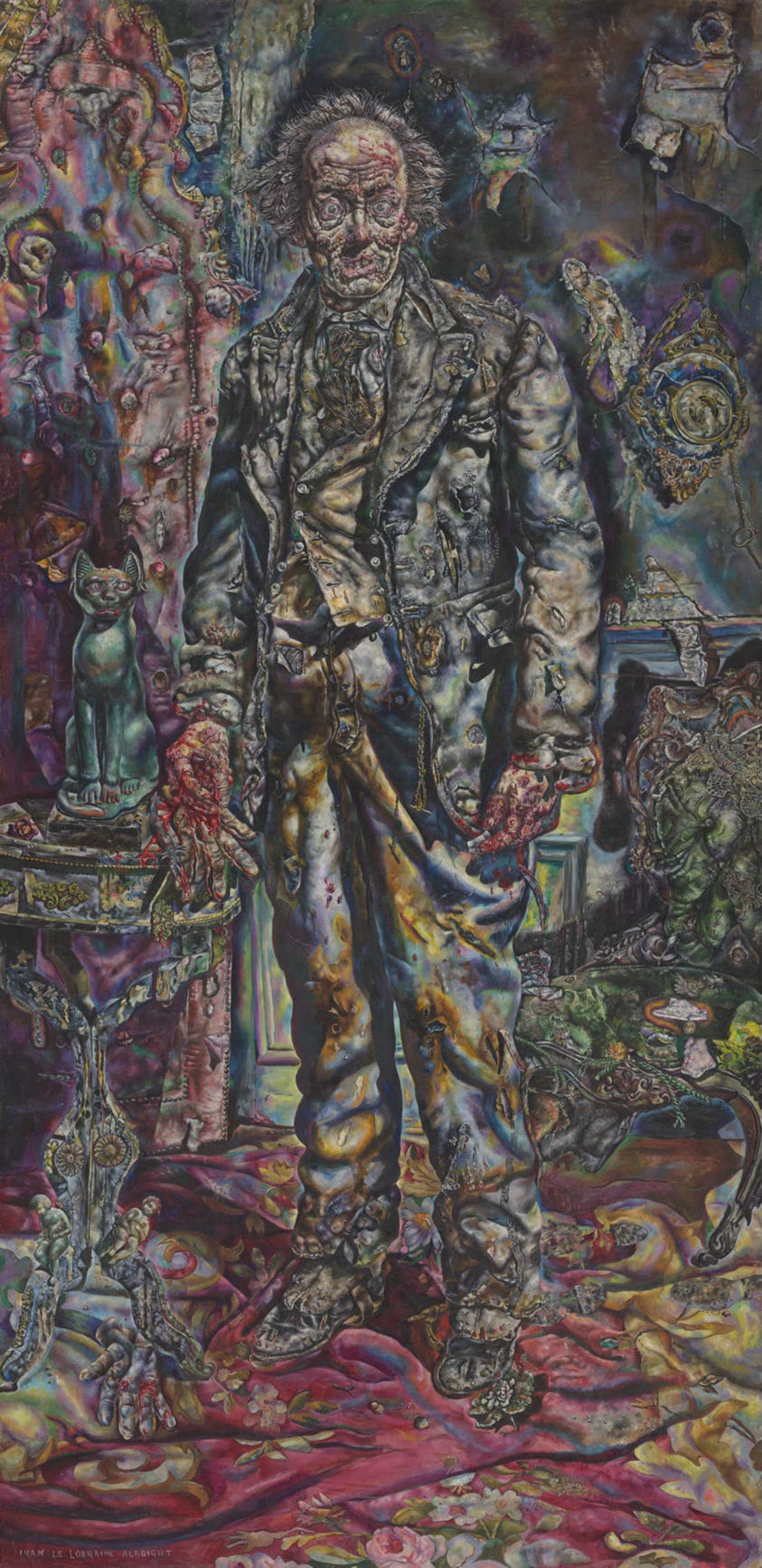
This book is seared into my memory. I first read it in August of 2002 and just re-read it for the second time in my life. My memory of the work from my first reading was near exact, something that almost never happens to me. It struck such a cord in my 20s that I thought about it often over the subsequent 20+ years. It is one of the most important novels I have ever read.Dorian Gray makes a Faustian bargain to retain his youth in exchange for his soul. A painted portrait then takes on his “passions and his sins” while his body does not change. We witness him go from age 22 to 38 with no visible change in his physical appearance. This makes it difficult for people to believe the horrible rumors they year. Surely someone so good looking and youthful could not do such things.Despite being written 130 years ago, this novel feels modern. Youth is still highly prized and now we use social media filters and botox to keep the facade alive. We are still really good at covering the degradation of our lives like Dorain covers and hides his portrait. It’s Adam & Eve all over again. An immediate desire to cover and hide when exposed by the Coldplay Cam.This novel is a tragedy but does fate guide Dorian’s actions? Is he irreparably influenced by Lord Henry to where there’s no turning back? Or does Dorian have a choice in the matter? What if he did change course? Would the portrait change back to what it was? Or would it remain the same?This is an endlessly fascinating novel. One with vivid pictures that have stuck with me for 23 years. It’s a novel I think about often. In this podcast episode, I talk about themes, questions, and my One Thing. This is a public episode. If you'd like to discuss this with other subscribers or get access to bonus episodes, visit www.booksoftitans.com/subscribe
#255 - The Library of Ancient Wisdom by Selena Wisnom
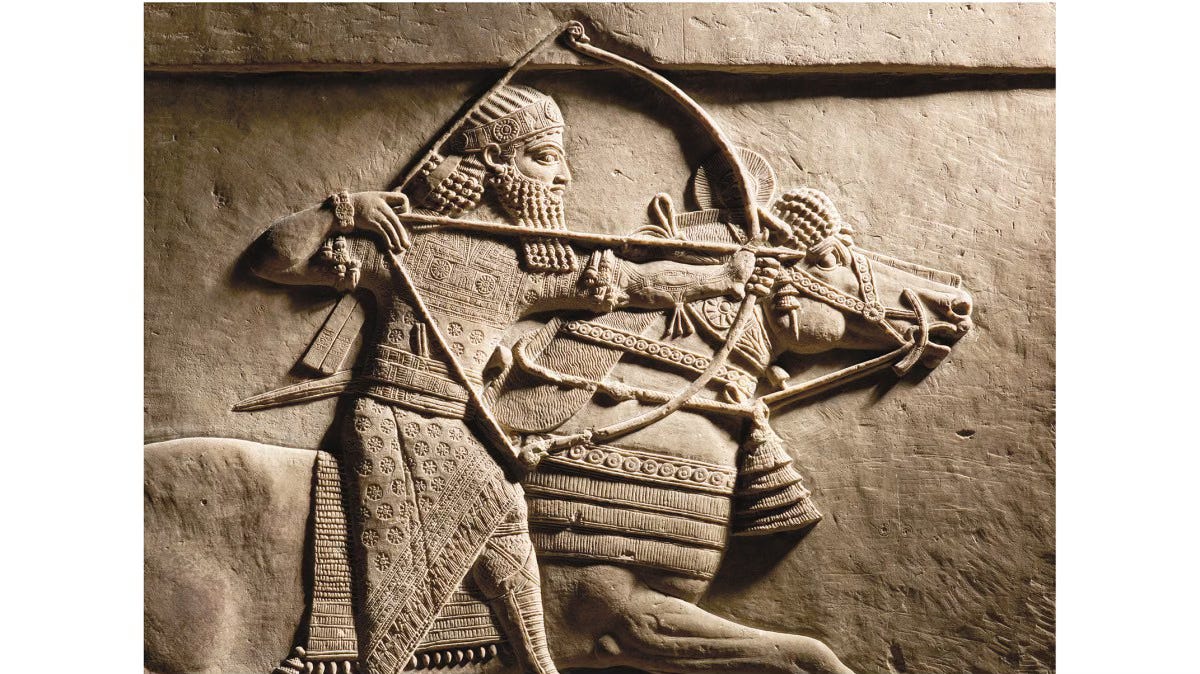
Ashurbanipal was king of Assyria from 669 to 631BC. He was a warrior poet, a scholar who carried a pen in his belt while decimating foes with cruel and unusual punishments. In a miraculous twist of history, the fire that destroyed his famous library is the very thing that ensured its survival. The fire solidified his 30,000+ clay tablets.Those clay tablets, lost to history for 2,400+ years, now mostly reside in the British Museum, where Cuneiform scholars work their way through works of astrology, exorcism, medicine, entrail divination, lamentation, and literature. The most and best preserved copies of The Epic of Gilgamesh come from Ashurbanipal’s library.This book looks at three main things: Cuneiform, Ashurbanipal, and the contents of Ashurbanipal’s Library. The author, Dr. Selena Wisnom, connects ideas from the surviving works to our own. We see how ideas that seem completely foreign to us are not that far removed from our experience. She shows how the Mesopotamians discovered many things long before others. In turn, these discoveries made our modern world. We’re continually learning more and more from what was discovered in Ashurbanipal’s Library.In this podcast episode, I talk about the book, Cuneiform, Ashurbanipal, and the contents of his library. This is a public episode. If you'd like to discuss this with other subscribers or get access to bonus episodes, visit www.booksoftitans.com/subscribe

2025 Mid-Year Reading Review
I find it helpful to take a step back from day to day reading to consider overall themes that show up over spans of reading time. That’s what I do in this episode. I look at the first half of reading for 2025 and talk about the 19 books I’ve read so far. I then talk about my favorite books, things I enjoy about Greek Literature, and share the one idea so far this year that has had the biggest impact. This is a public episode. If you'd like to discuss this with other subscribers or get access to bonus episodes, visit www.booksoftitans.com/subscribe
#254 - The Education of Cyrus by Xenophon
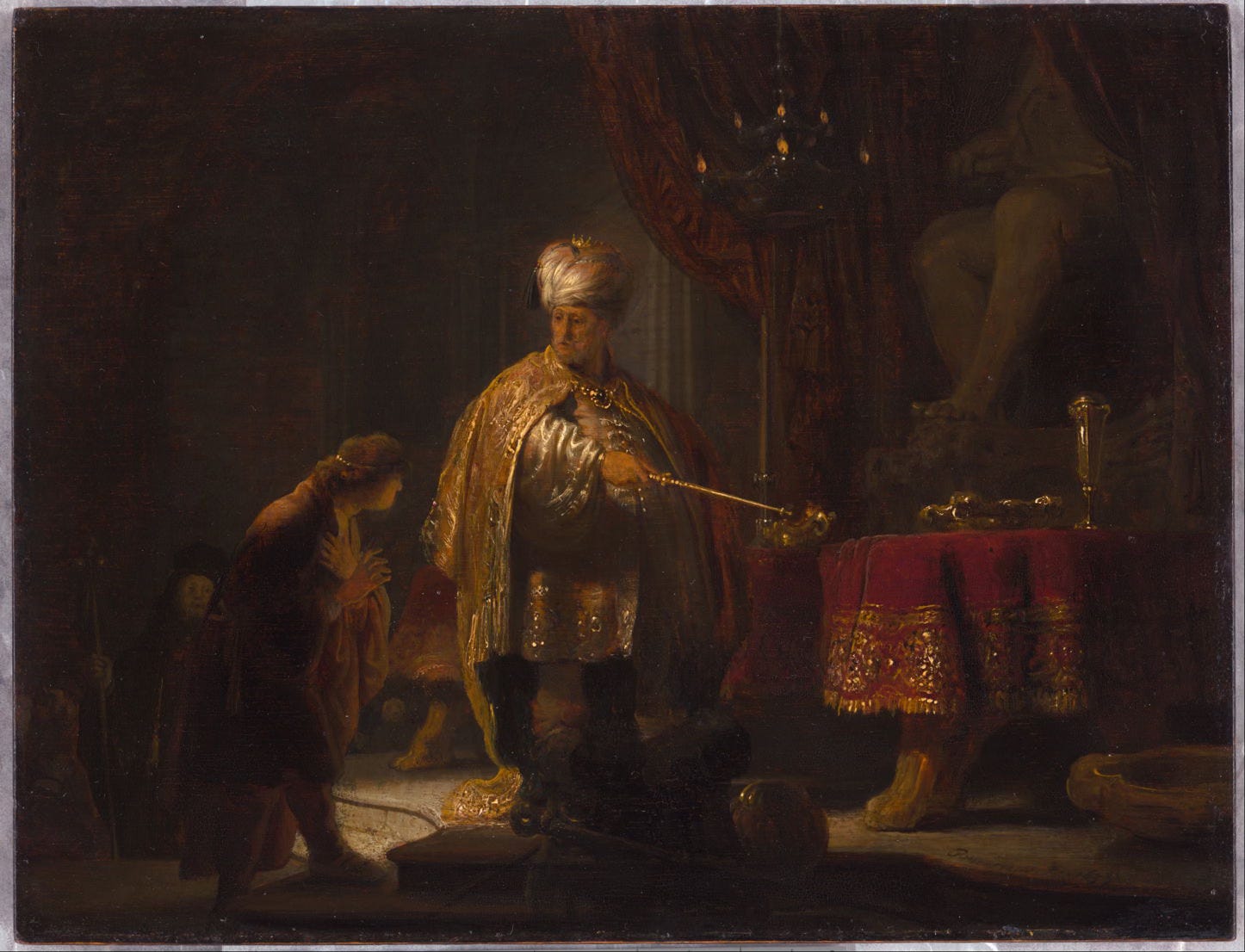
Last week, I discussed Anabasis by Xenophon, which covers the failed attempt of Cyrus the Younger to rule the Persian Empire with the help of 10,000+ Greek Mercenaries. The Education of Cyrus covers a different Cyrus, Cyrus the Great (600 - 530BC). This is the Cyrus in the Bible. The Cyrus of the British Museum’s Cyrus Cylinder. The Cyrus who conquered the Babylonians.The Education of Cyrus differs from Xenophon’s Hellenika and Anabasis in that it is largely a fictionalized account of Cyrus’ life. It allows Xenophon to share his moral philosophy and teachings through a famous person. It’s exciting and informative but also quite weird in that Cyrus repeatedly prays and sacrifices to Zeus and Hera, something Cyrus would not have done. It’s a mix of fact and fiction.Some have found it helpful to think of this book as a novel. Others as a moral treatise. It influenced Machiavelli’s The Prince and Thomas Jefferson was said to be fond of it. I felt like I was gaining secret knowledge in parts of it. Other parts moved slowly along before moving into the brilliant strategic move to take down the Babylonian empire.In this episode, I provide an overview of the book, discuss the fact or fiction debate, highlight wise leadership by Cyrus, and share the one thing I can’t get out of my head.Show Notes:* Version of The Education of Cyrus that I read This is a public episode. If you'd like to discuss this with other subscribers or get access to bonus episodes, visit www.booksoftitans.com/subscribe
#253 - Anabasis by Xenophon
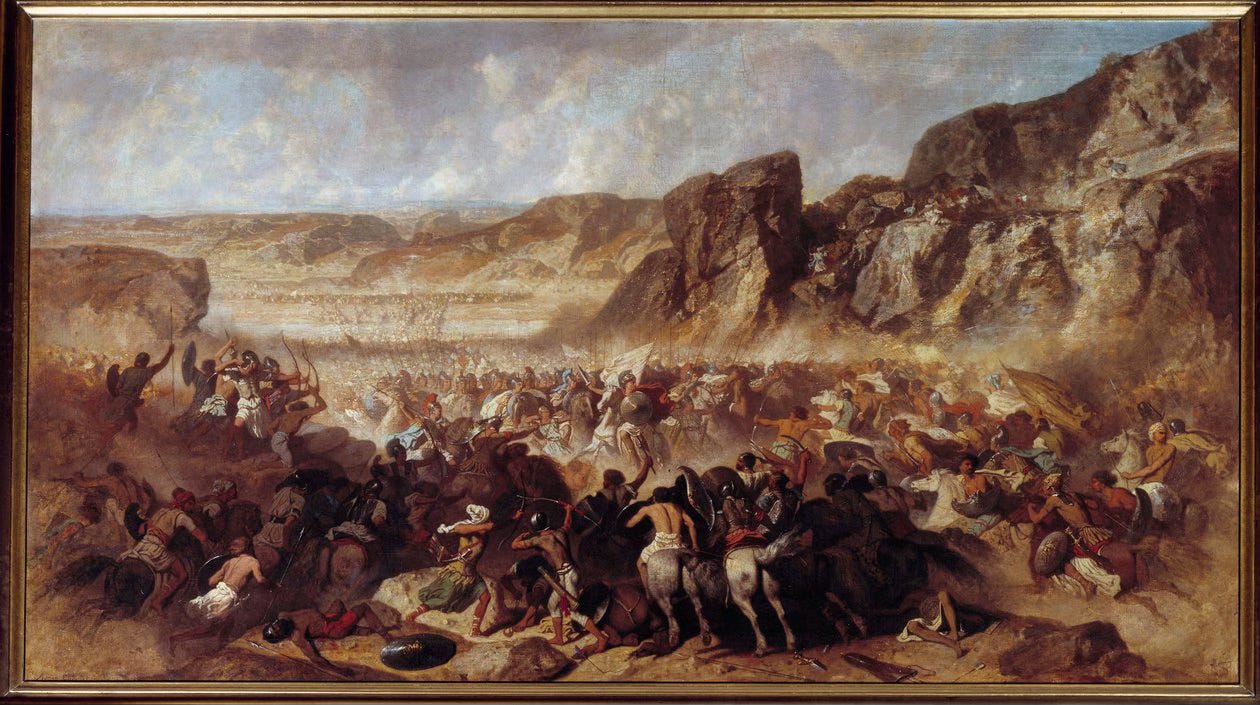
The Persian Cyrus the Younger recruits Greek mercenaries (12,900 to be exact, although Ten Thousand has a nicer ring to it) to help him try to claim the throne of Persia. The battle doesn’t go well, Cyrus loses a hand and a head, and the Greeks are forced to retreat to their country of origin. These events, take place between 401 - 399BC.Anabasis means a movement upwards, but can also refer both to an advance and a retreat. Both occur in this work, with Xenophon not only authoring the work but being a main character in the history.Xenophon was both a friend and a student of the philosopher Socrates. He was also a leader of these soldiers and he used what he learned from Socrates to try to persuade his men.This is an action-packed thriller of a tale. The Greeks meet unique people groups with wild customs, eat some mad honey, and party with clowns. All the while, they are longing to return home, a place many of them will never see again. This is a public episode. If you'd like to discuss this with other subscribers or get access to bonus episodes, visit www.booksoftitans.com/subscribe
Should You Re-Read Books From Your Past or Focus on New Books?
I love experiencing a book for the first time. There’s the rush of discovering a new story, an intoxicating idea, or a memorable character. By the time I’ve finished the book, I’m ready to get that hit again with a new book. I actually fear the high won’t be as good if I go back and read a book for a second time, even if it’s a book I really enjoyed.But that’s not how books work. Re-reading a book creates a new experience, not a recreation of the first reading. I’ve changed during readings. Life experience clues me into things I missed the first time around. I’m reminded of people, places, and things that stuck out the first time that made an indelible mark on my life.Many experiences in life can deteriorate with continued exposure. Reading a great book multiple times over the years is not one of those experiences.What I hope to do in this podcast episode is to encourage you begin re-reading certain books as part of your reading life. This is a public episode. If you'd like to discuss this with other subscribers or get access to bonus episodes, visit www.booksoftitans.com/subscribe
#252 - The Frogs by Aristophanes
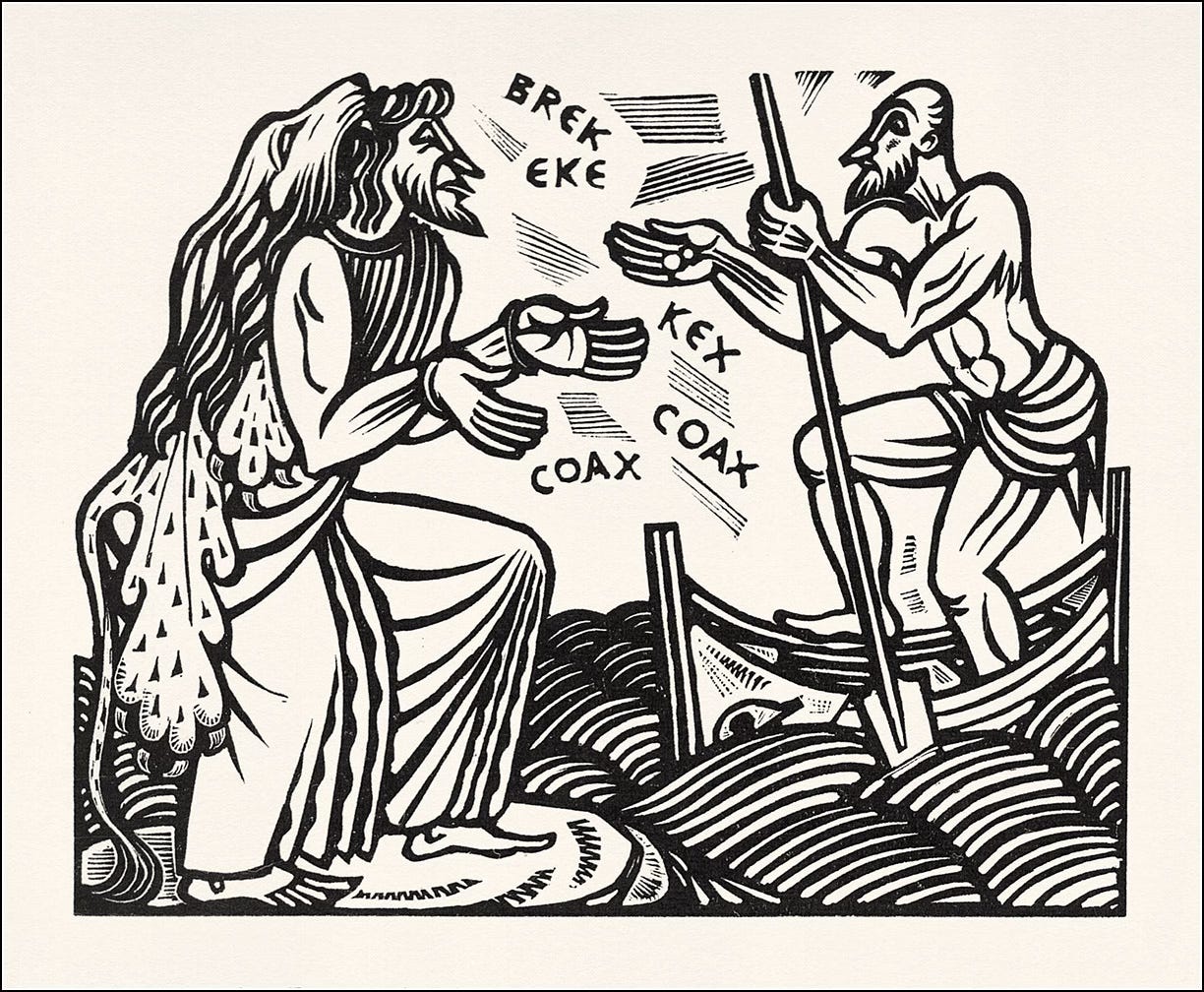
It took me 5 comedy plays by Aristophanes to begin to enjoy them. This was the 5th. It wasn’t as crude or banal as the first four I read (Clouds, Birds, Lysistrata, Women of the Assembly). I really enjoyed this one. Dionysus journeys to Hades to meet Euripides. A verbal contest ensues between the great tragedians Aeschylus and Euripides to determine who is the Best Tragic Poet. On the way to Hades, Dionysus hears the song of the Frogs, the title for this play.The Frogs was first performed at the City Dionysus festival in 405BC. It won first prize. This was one year after the death of Euripides and 51 years after the death of Aeschylus.In this episode, I talk about The Frogs, discuss aspects of comedy that had bothered me just a week ago, and share the one thing the stuck out the most. Enjoy! This is a public episode. If you'd like to discuss this with other subscribers or get access to bonus episodes, visit www.booksoftitans.com/subscribe
#251 - The Clouds by Aristophanes
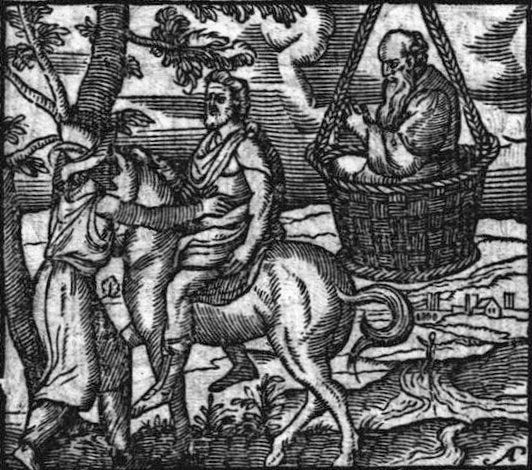
A father seeks to get out of debt, not in the traditional way of paying it off, but in the new way of winning an argument over his creditors. It doesn’t matter whether the argument is true or not, only if it gets him out of debt.This quest drives the father, Strepsiades, into the school of Socrates (likely in attendance at the play in 423BC) to learn the “wrong argument.” What ensues is a hilarious series of scenes masking some serious commentary on truth, justice, and persuasion. Arguments in the form of Right vs Wrong are even personified by actors, with the fourth wall between the audience regularly broken.I’m new to comedies, but what I’ve seen so far is a mix of Saturday Night Live and a roast. SNL for the cultural commentary and a roast for the tremendous abuse inflicted in person against notable people in the community. It’s funny, but it borders on cringe. I’m amazed that this was allowed in Ancient Greece, but I also wonder if this play set a path that led to the death of Socrates 24 years later.In this podcast episode, I highlight some key themes, give an overview of the story, and share the one thing that delighted me the most. This is a public episode. If you'd like to discuss this with other subscribers or get access to bonus episodes, visit www.booksoftitans.com/subscribe

#250 - Reading the Greek Tragedies
I just finished reading all of the Greek Tragedies that survive from Aeschylus, Sophocles, and Euripides. That was not the plan, I only expected to read 2 or 3 by each playwright, but I got hooked.In this episode, I share about my experience, cover the major themes throughout those plays, and talk about my favorites. These stories will be with me for the rest of my life. They cover ideas we hear daily in politics, news, and conversation. The plays are utterly thrilling and breathtaking.And we only get to read them. The lucky audience 2,500 years ago got to experience an all-encompassing extravaganza of dance, song, music, and acting. It must have been astonishing. When the time machine is invented, I’m typing in the 400s BC in Athens.Show Notes:* Suggested Greek Tragedy Reading Order This is a public episode. If you'd like to discuss this with other subscribers or get access to bonus episodes, visit www.booksoftitans.com/subscribe
#249 - Bacchae by Euripides
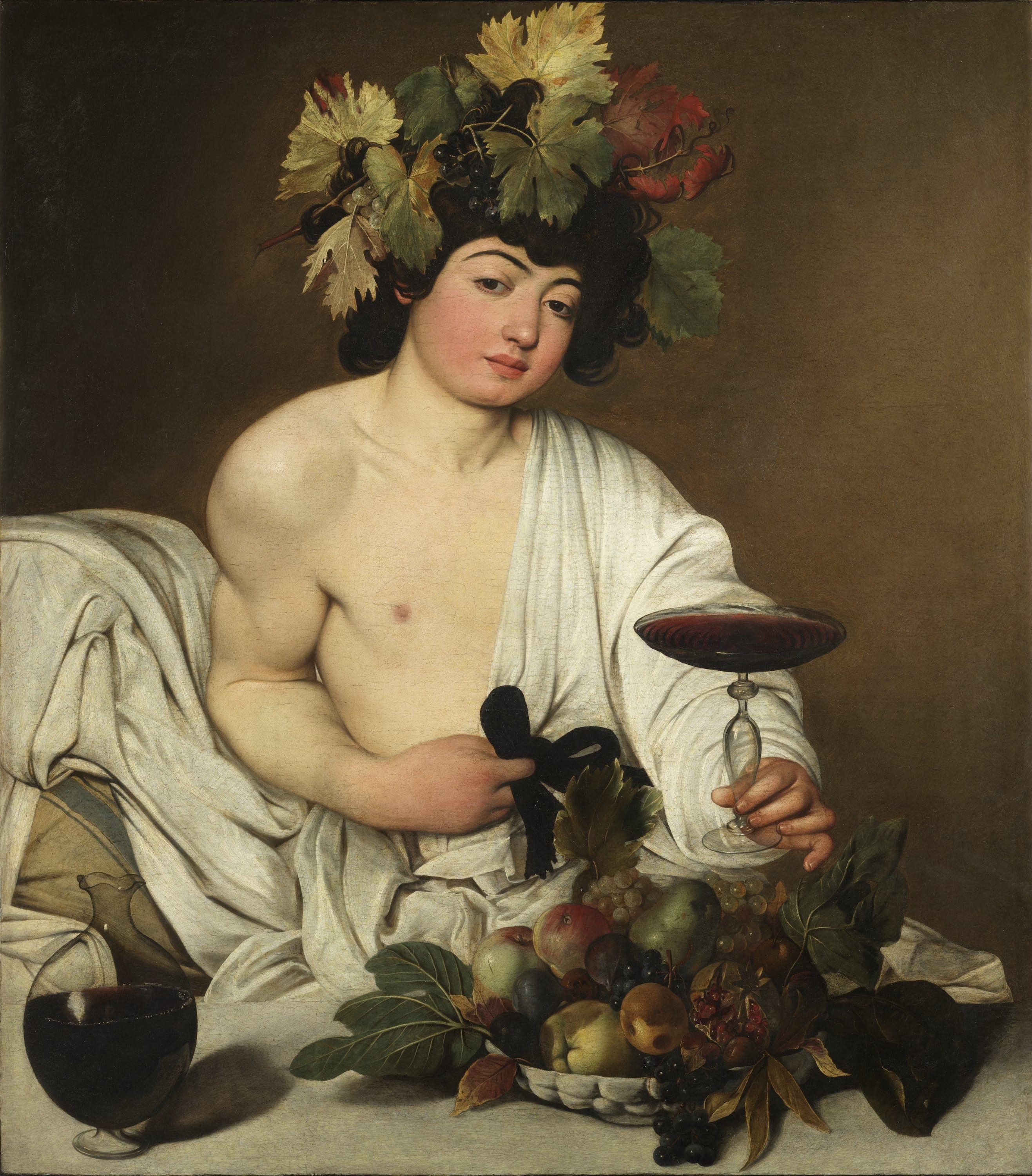
Homer (Simpson, not the epic poet) once said that alcohol is the “cause of... and solution to... all of life's problems.” I think of that quote when I think of the god Dionysus (also known as Bacchus). Dionysus is the god of joy and celebration, but also madness and violence. The god of inspiration and intoxication. He’s the god the indwells through wine, which can both bring happiness and cause drunkenness.The women who follow Dionysus are called Maenads or Bacchants. They worship outside of the city (Thebes in this tragedy play) and partake in rituals that are at first described as orderly. In fact, Tiresias, the blind seer, says that “Even in a Bacchic revel, a woman who is really virtuous will not be corrupted.”We see quite quickly that the rituals are far from orderly. The revels quickly descend into chaos, with the Maenads attacking a nearby town, stealing children, and ripping animals apart.Pentheus, the king of Thebes tries to stop this madness by battling Dionysus himself, who has taken on human form. Dionysus’ goal is to show that he is indeed a god. He convinces the king to explore his curiosity and witness one of the dances by the women. This is forbidden and so Pentheus must don women’s clothing. Perched upon a tree, the women see him, get him down, and promptly rip him to shreds. His mother leads the charge, unaware that she is killing her own son.The recognition scene of all recognition scenes has Pentheus’ mother slowly realize she is not carrying the head of a lion but rather the head of her son. Dionysus has not only destroyed an enemy in Pentheus but has destroyed a devoted worshipper, Pentheus’ mother. Dionysus leaves destruction in his wake, but all those involved do end up realizing he is a god.There’s a lot going on in this play. I had to read it twice to understand it. The lines of the chorus were beautiful. The verbal battles between Pentheus and Dionysus were fascinating. The tragedy at the end, brutal. This is a public episode. If you'd like to discuss this with other subscribers or get access to bonus episodes, visit www.booksoftitans.com/subscribe
#248 - Helen by Euripides
What if everything you knew of Helen of Troy wasn’t true? That she didn’t go with Paris to Troy. That instead, she was whisked away to Egypt while the Greeks and Trojans battled it out over her phantom.That’s the storyline of Helen by Euripides. It brings into question perception vs reality. It provides Helen a way to redeem her name. And it makes for an absolutely brilliant and entertaining tragedy play about the most famous woman in Greek literature.In this episode, I cover the storyline, main themes, and the one thing that struck me most about this tragedy. This is a public episode. If you'd like to discuss this with other subscribers or get access to bonus episodes, visit www.booksoftitans.com/subscribe
#247 - Iphigenia at Aulis by Euripides
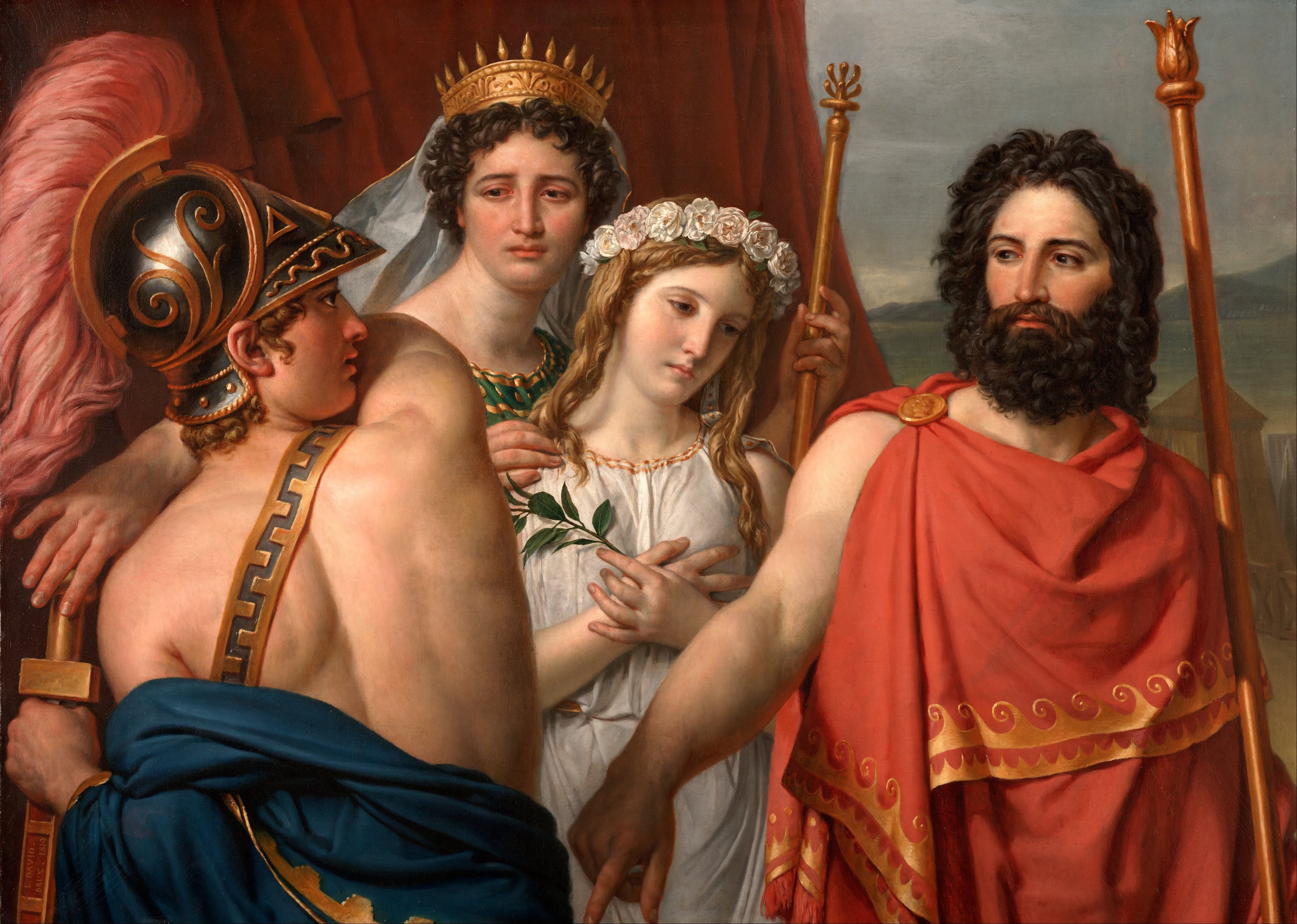
Homer doesn’t mention her but she permeates the Iliad. Without her, Aeschylus’ Oresteia doesn’t pack the same punch. Her story is so tragic that Euripides doesn’t let this play end as it should. He has her whisked away so she is not sacrificed.Her name is Iphigenia. She’s the daughter of Agamemnon, the King of the Greeks. This play takes place before the Iliad, before the Trojan War. The Greeks with their 1000 ships are headed to Troy to reclaim Helen. But Agamemnon has messed up. He hunted one of Artemis’ sacred deer. The winds have stopped. The winds that are required for the Greeks to sail to Troy. They are stuck in Aulis.There’s only one way to fix this. Artemis demands a sacrifice. Not your typical sacrifice. This one will hurt. And it will hurt Agamemnon. Artemis demands the human sacrifice of Iphigenia in order for the winds to pick back up and lead the army to Troy.I’ve seen this story referenced often in Greek literature. I’ve wondered how it actually happened. How did Agamemnon justify this? Did Clytemnestra his wife know what was about to happen? Did she try to stop him? What did Achilles think of all this? His name was used as a pretext to lure Iphigenia to Aulis in hopes of a wedding.This is tragedy at its finest. An impossible situation. Damned if you do; damned if you don’t. Necessity brought by the gods.This is my favorite tragedy play by Euripides of his surviving 19. This helps in understanding the conflict between Agamemnon and Achilles in the Iliad and between Agamemnon and Clytemnestra in The Oresteia.In this episode, I give a brief outline of the tragedy, share themes and things I learned, and talk about the one thing that stuck out the most.Show Notes:I read the Penguin Classics version of this play translated by John Davie with intro/notes by Dr. Richard Rutherford This is a public episode. If you'd like to discuss this with other subscribers or get access to bonus episodes, visit www.booksoftitans.com/subscribe
#246 - Orestes by Euripides
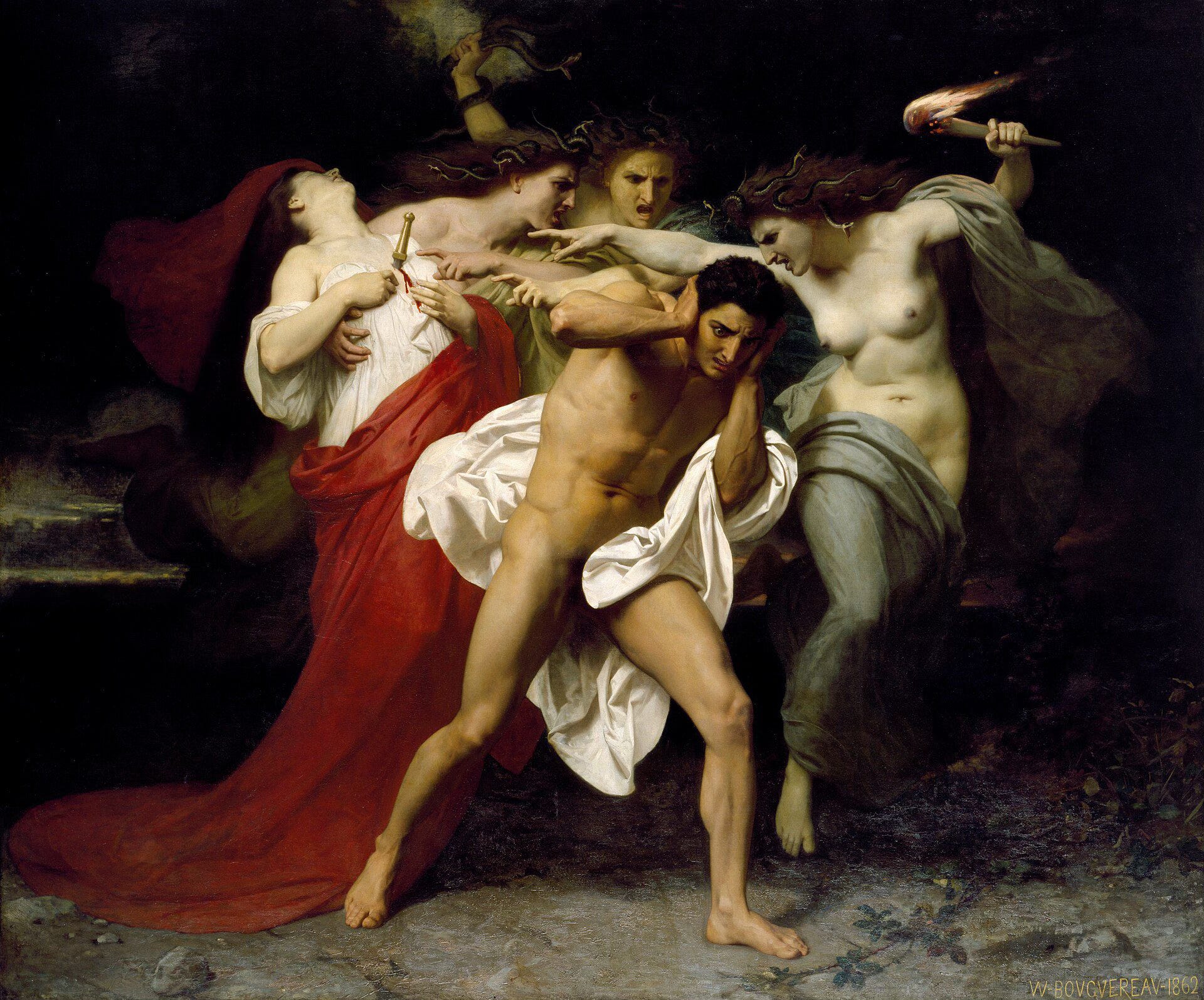
That’s such a brutal painting. Orestes has stabbed his own mother and the furies are immediately there to torment him. The story of Orestes was explored by each of the three main Greek tragedy playwrights, Aeschylus, Sophocles, and Euripides. Aeschylus set the standard with The Oresteia, Sophocles approached it through Electra, and Euripides through both Orestes & Electra.Orestes if a fascinating character study. He kills his mother Clytemnestra in vengeance of her killing her husband, Orestes’ father, Agamemnon. Agamemnon had sacrificed their daughter Iphigenia. Orestes thinks he is just. Clytemnestra thinks she is just. Agamemnon thinks he had to do what he had to do.Who is just? How is that determined? Can justice be meted out eye for an eye? What about in the case of a death? The wronged party cannot seek justice. Someone must do it on their behalf. How does that cycle end?These are the questions that come up in Orestes. It caused me to think about ways in which these cycles of violence could end. I share this ideas in this episode. This is a public episode. If you'd like to discuss this with other subscribers or get access to bonus episodes, visit www.booksoftitans.com/subscribe

#245 - Free Speech by Jacob Mchangama
“In fact, free speech may well be the most powerful engine of equality ever devised by human kind.”Free Speech by Jacob Mchangama presents a thorough and fascinating look at the history of free speech through the ages. What’s amazing is that free speech is a rather recent phenomenon, is quite fragile, and most of the people I consider to be the bulwarks of free speech were not as principled as I thought.I got to meet Jacob last week and hear more about this book at an event at Landmark Booksellers. I talk a bit about that and the question I asked him as well as cover some key themes from his book.If you’d like to watch the event at Landmark, you can do so here: This is a public episode. If you'd like to discuss this with other subscribers or get access to bonus episodes, visit www.booksoftitans.com/subscribe
How Can I Teach Myself to Read Better as an Adult?
A few years ago, I read a book about a coffee entrepreneur. It was really good. I immediately thought about a new friend of mine who worked at a coffee shop. I bought the book for him and met up a few weeks later to hear what he thought. His comments shocked me.He thanked me for the book and said it was the first full book he had read since college. This was a man in his early 30s, which means he hadn’t read a book in nearly 10 years.I think that’s where a lot of adults find themselves. Life gets busy. Work becomes the focus. Family, kids, activities, yard work. And now, all of those minutes in the margins are consumed with scrolling. It’s an addiction few of us can break.So how can we get into reading and then become better at it as adults?That’s the focus of this podcast episode. I hope you enjoy. This is a public episode. If you'd like to discuss this with other subscribers or get access to bonus episodes, visit www.booksoftitans.com/subscribe
#244 - Phoenician Women by Euripides
Euripides’ Phoenician Women mimics the Aeschylus tragedy Seven Against Thebes with some key differences. One of those is the composition of the members of the chorus. Aeschylus chose Theban women as the members of his chorus but Euripides selected foreign slave women from Tyre en route to Delphi. They don’t have skin in the game like the Theban women do as they watch their royal line destroy themselves before their eyes.I think Euripides’ choice is so interesting. Not only did he select the Phoenician Women as the members of the chorus but they also occupy the title of the play as well. The play could just have easily been named Jocasta, a character who ties all the others together and who starts the entire play recalling the recent family history.I love reading these retellings of the myths. I love seeing these slight changes and trying to figure out the reason by behind the choices. I love the themes that keep popping up and the ways these ideas are discussed amongst characters in the worst of circumstances.These and other topics encompass episode 244 of the podcast. This is a public episode. If you'd like to discuss this with other subscribers or get access to bonus episodes, visit www.booksoftitans.com/subscribe

#243 - The Authentic Confucius by Annping Chin
Most of the sayings of Confucius consist of three parts:* The Saying* The Person* The Time/LocationIf you just read The Analects, you get all of the sayings and if you’re very diligent (or use a commentary), you can get to know the people Confucius addresses in his responses. What’s difficult to gather from The Analects is the historical context (time/location) in which each statement was made.That’s where Annping Chin’s book comes in, The Authentic Confucius. Organized along the path of Confucius’ life, Annping takes us through the various political situations, locations, and career points that align with many of the sayings of Confucius. This book provides a very helpful analysis of that third part of each saying, while also being an interesting look at the life of this great teacher.I was surprised to learn that Confucius was not a religious teacher (he was a philosopher), that he would deeply ponder a question before answering instead of spouting off an answer based upon a set worldview, and that he was very politically minded.In this podcast episode, I talk about these things that surprised me, some things I learned about Confucius, and cover The One Thing, my key takeaway from The Authentic Confucius.Here’s my episode about The Analects:As well as an article about something Confucius said that I’m thinking about a lot: This is a public episode. If you'd like to discuss this with other subscribers or get access to bonus episodes, visit www.booksoftitans.com/subscribe

#242 - The Analects by Confucius
The life of Confucius (551 - 479 BC) overlaps the life of Greek playwright Aeschylus (525 - 455 BC). Confucius makes it clear that he is a transmitter, not an originator. He’s transmitting wisdom from the past, specifically from an ancient era of perfect rulers. The Analects is a set of collected sayings of Confucius compiled by his disciples.I was expecting a religious text but this read more like wisdom literature. The focus was on the rites and rituals that provide a path to moral virtue. The goal was to become a gentleman worthy of a life of politics. Confucius pursued (and pushed) a love of learning, speaking only when necessary, and leading by example.In this podcast episode, I cover ten themes found in The Analects and share the One Thing I’m still thinking about having read the statements of this greatest of Chinese teachers.I read the following versions / translations of The Analects:* Arthur Waley Translation (1938) / Everyman’s Library* Annping Chin Translation (2014) / Penguin Classics This is a public episode. If you'd like to discuss this with other subscribers or get access to bonus episodes, visit www.booksoftitans.com/subscribe
#241 - God's Secretaries by Adam Nicolson
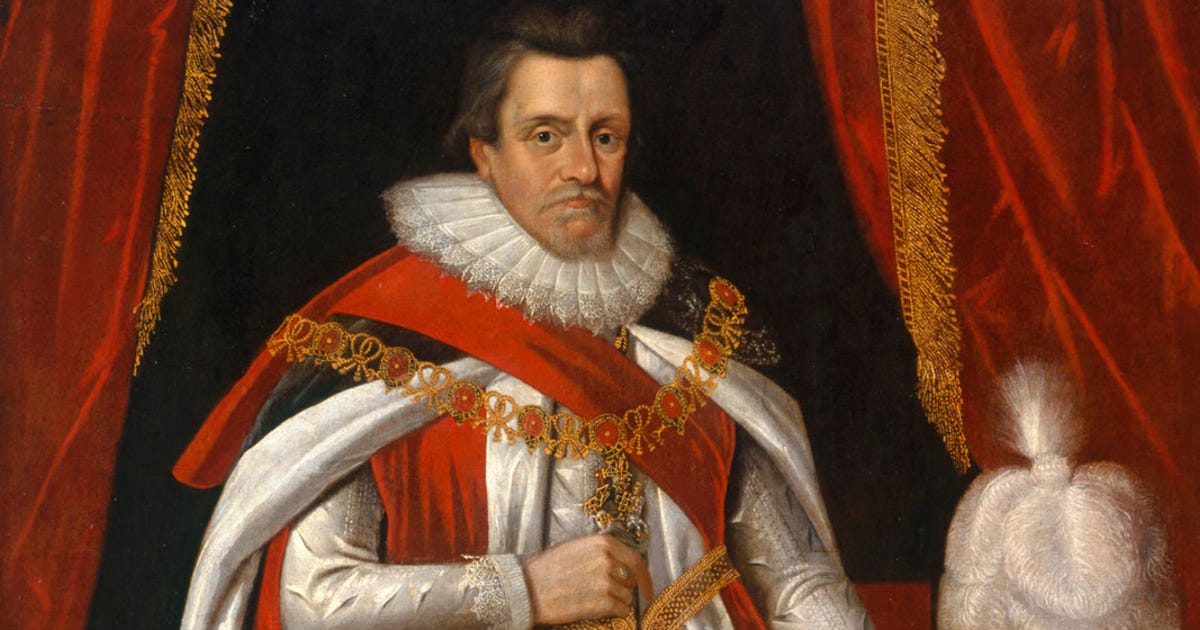
I started off 2025 reading straight through the King James Version of the Bible. As I was doing so, I kept wondering how that translation came about. It’s now over 400 years old. What English translation will people be reading 400 years from now? And I had other questions. Did people really speak like this? Is this the first English translation? Why is it called the King James Bible? Who translated this Bible? Have we learned things since then that give us better translations now? Why is it still read 400 years later?A friend of mine, Larry Carson, suggested I read God’s Secretaries by Adam Nicolson to get answers to these questions. I share them in this podcast episode.Here’s my episode about reading the King James Bible: This is a public episode. If you'd like to discuss this with other subscribers or get access to bonus episodes, visit www.booksoftitans.com/subscribe

#240 - The Bible | King James Version
I start each year reading straight through a different version of the Bible during January & February. This year, I selected the King James Version designed & illustrated by Barry Moser. This version contains 232 beautiful illustrations. This was my first time reading the full King James Version. I liked it very much.I divide this podcast episode up into three sections:* The things that stuck out in the Bible.* Highlights of the beautiful language found in the King James Version.* Info about the Moser Bible and my process of reading through it.Show Notes:Previous Bible Reading Episodes:20202024Documentary:My Articles about the Barry Moser Bible:Bible Reading Tools: This is a public episode. If you'd like to discuss this with other subscribers or get access to bonus episodes, visit www.booksoftitans.com/subscribe

Comparing LBJ & Robert Moses
In 2021, I dedicated my reading year to series of books. I read through Harry Potter, The Lord of the Rings, all books by Russ Roberts, and the Narnia series. I also read every single book written by Robert Caro. His The Years of Lyndon B. Johnson four-book set are some of the best books I’ve ever read and I think about them often. I also read The Power Broker about Robert Moses of New York City.In this episode, I contrast these two men - Lyndon B. Johnson and Robert Moses.Show Notes: This is a public episode. If you'd like to discuss this with other subscribers or get access to bonus episodes, visit www.booksoftitans.com/subscribe

The Gulag Archipelago
I’m digging into the podcast vault and taking us back to December 2019 when I first released this episode. In the past 5 years, I’ve thought about The Gulag Archipelago often. I’ve seen it referenced in other books and think its ideas can heal our current divides. This is a public episode. If you'd like to discuss this with other subscribers or get access to bonus episodes, visit www.booksoftitans.com/subscribe
The Beginning of Knowledge
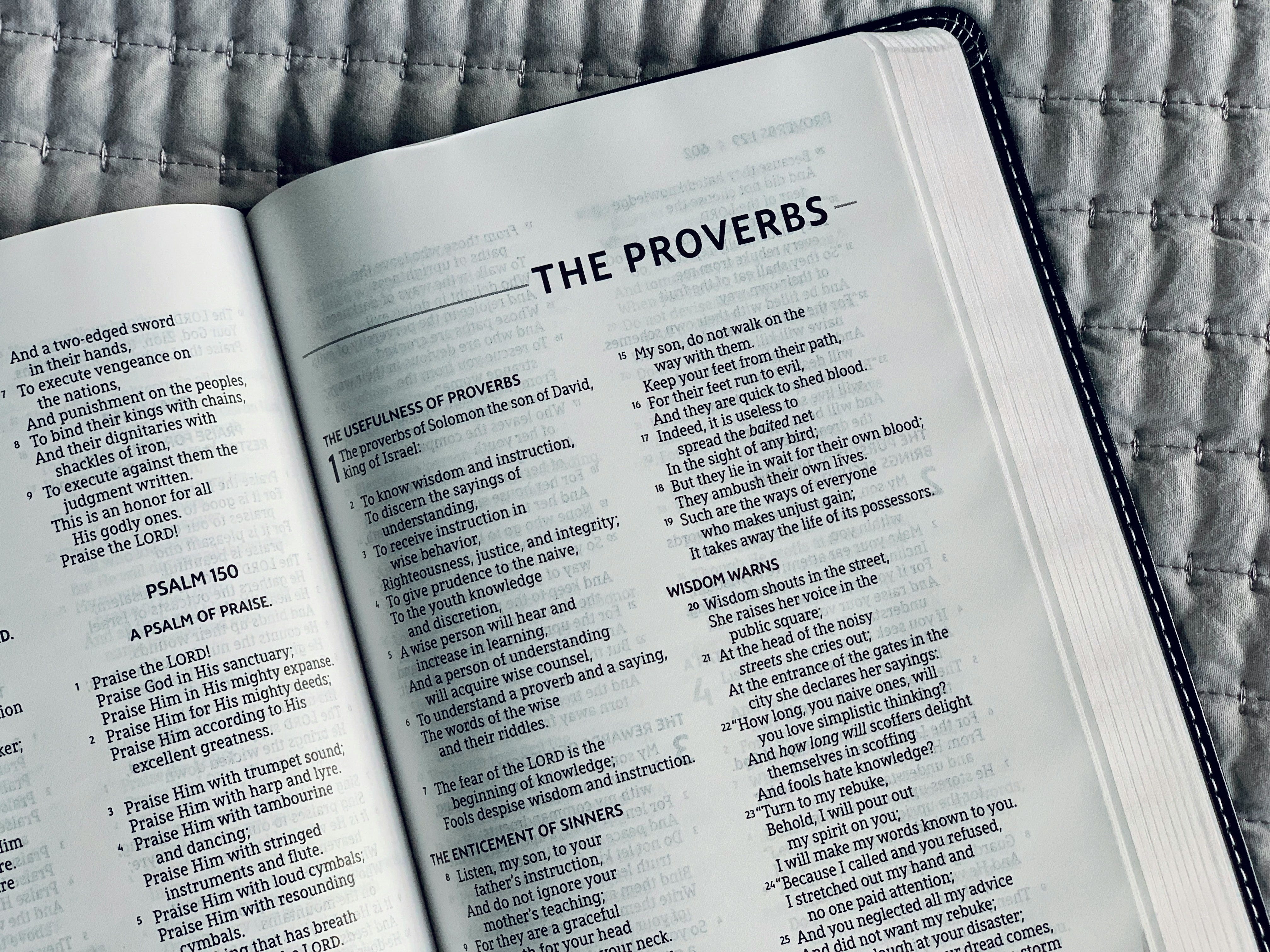
I’m digging into the podcast vault to share this episode from exactly 5 years ago (really, Feb 7, 2020 to today, Feb 7, 2025)! This episode covers The Book of Proverbs attributed to King Solomon. I had an epiphany of sorts about a key idea in this wisdom literature - The Fear of the Lord.I had always been baffled by that statement. Is that a trembling fear? A sense of awe?What am I supposed to make of this idea of fear and what does it mean in terms of how I relate to the Lord? I actually found part of the answer in the Book of Proverbs itself. That’s one of my key points in this episode.I re-introduce the episode at the start and add some more recent experiences with the Fear of the Lord that occurred in 2024. I hope you enjoy! This is a public episode. If you'd like to discuss this with other subscribers or get access to bonus episodes, visit www.booksoftitans.com/subscribe
Top Ideas from the World of Books
I’m digging into the podcast vault to share this episode from two years ago about some of the most important ideas I’ve come across from this reading project. This is a public episode. If you'd like to discuss this with other subscribers or get access to bonus episodes, visit www.booksoftitans.com/subscribe

On Direction
And so he did not resist in the small ways that a man might, and in time the accumulation of such daily choices of acquiescence hardened into a kind of moral muscle memory, such that resistance was no longer even a possible option. For almost nine years the man had been rehearsing his surrender. ~ The Places Beyond the Maps, Douglas McKelveyIf I were required to pick the single most important idea I’ve come across during the 8 years of this reading project, it would be the importance of direction.The idea is quite simple. We’re all moving in a particular direction that is mostly dictated by the small, seemingly insignificant choices we make on a daily basis. Nearly all of these choices are unseen in that they take place in our minds and oftentimes when we are alone.It’s at once a deeply encouraging yet frightening idea. Your very next decision could change the trajectory of your life yet your “daily choices of acquiescence” could alternatively be weakening you to a point of no return.The most important paragraph I’ve come across regarding direction was penned by C.S. Lewis in his masterpiece Mere Christianity:“I would much rather say that every time you make a choice you are turning the central part of you, the part of you that chooses, into something a little different from what it was before. And taking your life as a whole, with all your innumerable choices, all your life long you are slowly turning this central thing either into a heavenly creature or into a hellish creature…Each of us at each moment is progressing to the one state or the other.”As a child, I would spend hours pretending that I was saving my classmates from the bad guys. Fueled by action films starring Van Damme, Schwarzenegger, and Seagal, I would play out the role of the hero. I hoped that should the occasion arise, that I would rise up to meet the moment in the real world.As I grew up, I learned the hard truth that my heroic ideals oftentimes did not play out in real life. Cowardly unseen “choices of acquiescence” would spill out with harmful public consequences. The “muscle memory” of those poor choices made any public heroics all but impossible.I came to understand the statement by Archilochus that "We don't rise to the level of our expectations; we fall to the level of our training." Put another way, we don’t rise to the level of our heroic ideals; we continue in the direction of our daily choices.The books I have read for Books of Titans have provided an incredible view into the direction of the lives of both fictional and historical characters. Robert Caro shows us how the stated ends of Lyndon B. Johnson were corrupted by the very means he used to attempt to reach those ends. Douglas McKelvey shows us a father who lacked the strength to save his own daughter, to be the hero when it absolutely mattered, because of the “accumulation of such daily choices of acquiescence.” Alexander Solzhenitsyn shows us that survivors of the Soviet Gulag had decided upon a certain path during easier times and that “those people had been corrupted in camp who had already been corrupted out in freedom.”I knew in my own life that were I to be the man I wanted to be, to be someone who could be counted on in the most difficult of circumstances, that I would need to start moving in that direction in small, unnoticed, daily decisions. I needed to begin creating a “moral muscle memory.”David Goggins was once running when a driver pulled up and asked what he was training for. Goggins replied that he was training for life. He knew that avoiding the run that day made it easier to avoid it the next day and the day after that. That run was setting a direction for his life. It was an important daily choice.The great thing about viewing life through the prism of direction is that it applies to so many areas. Health, faith, work, exercise, raising children, self-improvement. Direction can take what seems like an impossible future and break it down to your next decision. To be a hero in a tough circumstance can start with what my friend Garrett Gravesen calls 10 Seconds of Insane Courage.Direction is not just a helpful mental model for yourself, it’s also a great litmus test to evaluate a church, school, business, or political party. Simply look at the stated ends of a group and see if the means are leading in that direction. Crooked means will corrupt utopian ends.There are very few overnight successes. Very few heroes of the moment. The truer story is that of the person slowly moving in a particular direction, day by day, decision by decision, over a period of years. There will be many diversions along the way. The direction will not be a straight path. But the beauty of this idea is that your life can change direction with your very next decision. If you screw up, make the next right decision. This is the lesson of some of the world’s great literature.“Great things are not done by impulse, but by a series of small things brought together. The trick is to focus

How Has This Reading Project Changed Me?
I received this set of questions from Brenda Slomka late in 2024. I couldn’t immediately answer them on Twitter X, so I decided to ponder them a bit and give a thoughtful response in this podcast episode. I’m glad I did it as it gave me a chance to take a step back and look at how the past 8 years of this reading project have impacted me.Here are the four questions:* What are you learning about yourself as you read?* Has your heart changed with these readings?* How has your view on the universe/humanity changed/expanded?* Are there any readings which have shown views that have harmed us / entrenched harm? This is a public episode. If you'd like to discuss this with other subscribers or get access to bonus episodes, visit www.booksoftitans.com/subscribe

2025: The Reading Year Ahead
READING YEAR THEME: GREEK TRAGEDIES, COMEDIES, HISTORY, AND PHILOSOPHY2025 is the year I shift from the Greek playwrights into the philosophers. It’s year 3 of my 15-year Immortal Books reading project, where I read the greatest books ever written in chronological order.In this episode, I share my plan for the year, give a brief history of this reading project, and highlight the books I’m most excited, scared, and curious about for 2025.I mention a Short Great Books reading group I’m leading this year. I’d love for you to join. To do so, simply become a paid member here on Substack and you’ll have access to each monthly meeting. Learn more here or subscribe below. This is a public episode. If you'd like to discuss this with other subscribers or get access to bonus episodes, visit www.booksoftitans.com/subscribe
The Intellectual Life by A.G. Sertillanges
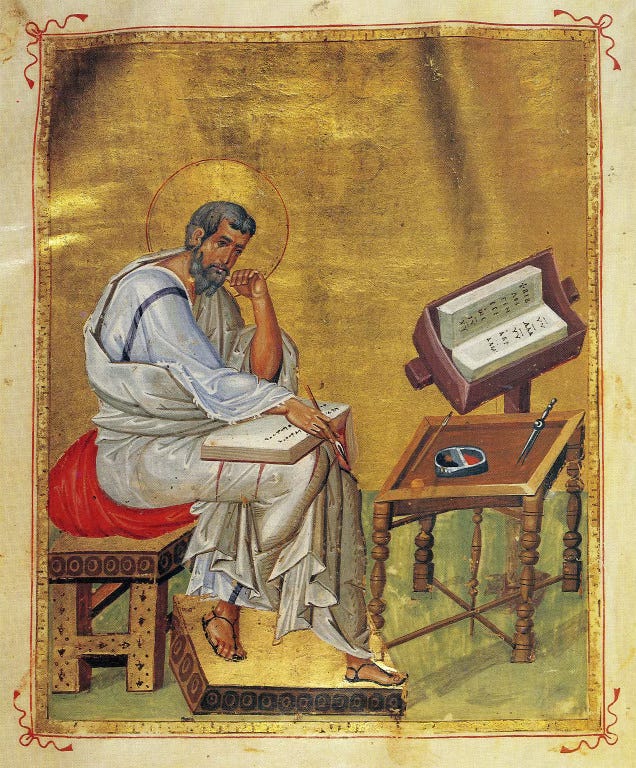
Love the eternal books that express eternal truths. ~ A.G. SertillangesHave you found yourself lost in mid-life? Not sure what direction to take? No focus or purpose? This is a book about continuing intellectual curiosity throughout life, of lifelong learning. It’s a book with practical advice on how to pursue the life of the mind. I wish I had read this book in my teens.The author, A.G. Sertillanges, says this life is possible with just two hours a day. But what you quickly realize is that dedicating those two hours will permeate the rest of your life, even your sleep!In this episode, I share the three main ideas that stuck out to me, share some advice found throughout the book, and highlight the one thing that hit me the most. I hope you enjoy. But more than that, I hope you end up reading this book.Join my 2025 Reading Group - One Great Book a MonthPurchase The Intellectual Life from Landmark Booksellers This is a public episode. If you'd like to discuss this with other subscribers or get access to bonus episodes, visit www.booksoftitans.com/subscribe

2024 Reading Year Recap
Each year, I stack all of the books from the previous year’s reading list next to me and reminisce over the reading year. It’s one of my favorite yearly podcast episodes and it’s a great way for you to hear about some books to add to your reading list.2024 was My Big Fat Greek Reading List. I’m reading through The Great Books The Immortal Books in chronological order over the next 15 years, and the time frame for this year was all Greek. Greek epic poetry, Greek tragedies, histories, and even fables.It was an absolutely delightful year of reading, the most enjoyable in my 44 years of living.In this episode, I cover the year as a whole, some of my favorite works, and some best of lists.Here are some of my favorite podcast episodes over this past year: This is a public episode. If you'd like to discuss this with other subscribers or get access to bonus episodes, visit www.booksoftitans.com/subscribe
Van Gogh Has a Broken Heart by Russ Ramsey
I used to think that great art had to have come from a great-souled artist with an honorable life. How else would you be able to forge David out of a slab of marble or compose an entire opera in your head? A minimum of a pure mind combined with superhuman abilities must have been required, right?Actually, art is oftentimes forged through intense suffering in the life of the artist. It’s suffering we know well as we also experience it to varying degrees. That’s the power of this book. It highlights Sacred Failures.In this episode, I cover three artists, what I learned about them, and how that shifted how I now see their art. This is a public episode. If you'd like to discuss this with other subscribers or get access to bonus episodes, visit www.booksoftitans.com/subscribe
Ep 237The Art of Teaching by Gilbert Highet
This book was suggested by a friend of mine named William Leachman. He’s a bonafide teacher, as in he has students and teaches them in a building that says school on the outside of it. He told me I should read this book and he told me that I’m a teacher.I bristled at that. I’m not a professional. I don’t teach eager students at the local high school. But after reading this book, I hesitantly acknowledge that I am indeed a teacher. I’m a teacher to my children, to those I work with, and perhaps to those I reach with this podcast. This book convinced me that I do indeed teach.But this book goes much deeper. It talks of the close connection between learning and teaching. How we all have an innate desire to share the beauty we encounter, be it physical or intellectual beauty. How the best teachers are those most desirous of learning.This is a book about the methods of teaching, not about which subjects to teach. It covers three main modes of teaching, famous teachers (and their students), and the role of parents in teaching their children.In this episode, I share some ideas I came across and how I’ve seen them play out in my own life through great teachers and even greater teaching styles. This is a public episode. If you'd like to discuss this with other subscribers or get access to bonus episodes, visit www.booksoftitans.com/subscribe

Hellenika by Xenophon
“And after this, not many days later…”Xenophon begins his history with these words. The “after this…” refers to the writings of Thucydides, which abruptly end in the midst of the Peloponnesian War in 411BC. Xenophon takes up the mantle and takes us first to the end of the Peloponnesian War in 404BC and then on to 362BC.Xenophon’s work takes us through the decline of the Athenian empire into the rise of the Spartans, Boeotians, and then Thebans. Throughout the work, the Persians are making their presence known as well.It’s a fascinating history, one that sets the stage for the eventual Macedonian takeover. I kept thinking about the literature and philosophy being composed during these years. Some of the world’s greatest works were created during this period of history.In this episode, I share the main things that stuck out about topics such as government, justice, and tradition. This is a public episode. If you'd like to discuss this with other subscribers or get access to bonus episodes, visit www.booksoftitans.com/subscribe
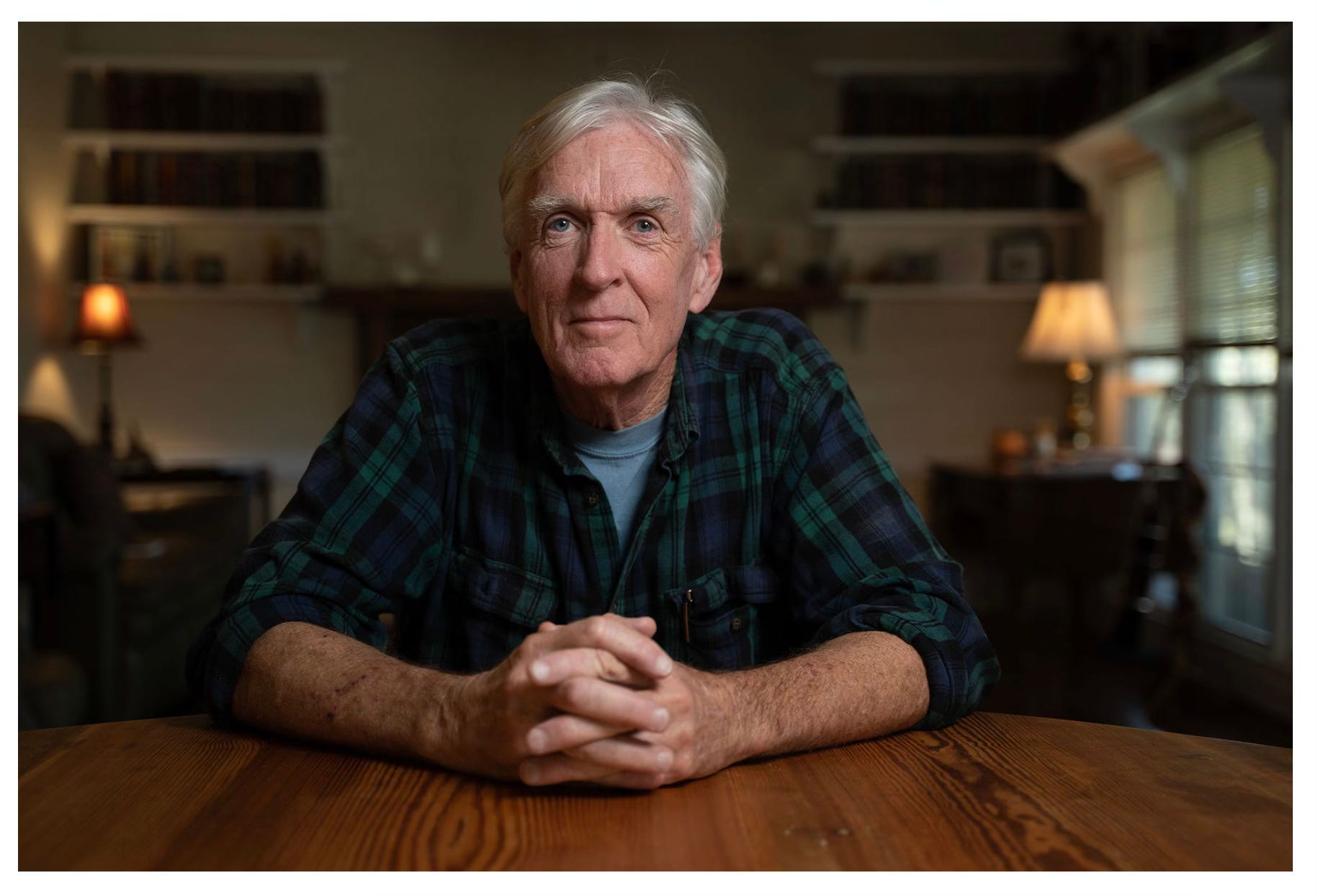
Theo of Golden by Allen Levi
Theo of Golden is a man “fully invested in the art of living.” He’s a character you want to emulate. A good man whose kindness is made up of “little, nameless, unremembered acts.” As the reader, we get to see how these small, daily acts weave throughout a small, fictional, Georgia town.This book was gifted to me by a publisher well acquainted with the written word. It’s her job to quickly work through books and see if they have merit. She read this book and then promptly read it four additional times. She was stunned.I now see why she wanted to do that. I plan to read it again later this month.I loved this book. It reminded me of Sir Gibbie by George MacDonald and Jayber Crow by Wendell Berry. In this episode, I share a few of my favorite things about this incredible book. I hope you read the book one or maybe five times!Bonus: Two Conversations I Had with Allen in September 2025 This is a public episode. If you'd like to discuss this with other subscribers or get access to bonus episodes, visit www.booksoftitans.com/subscribe
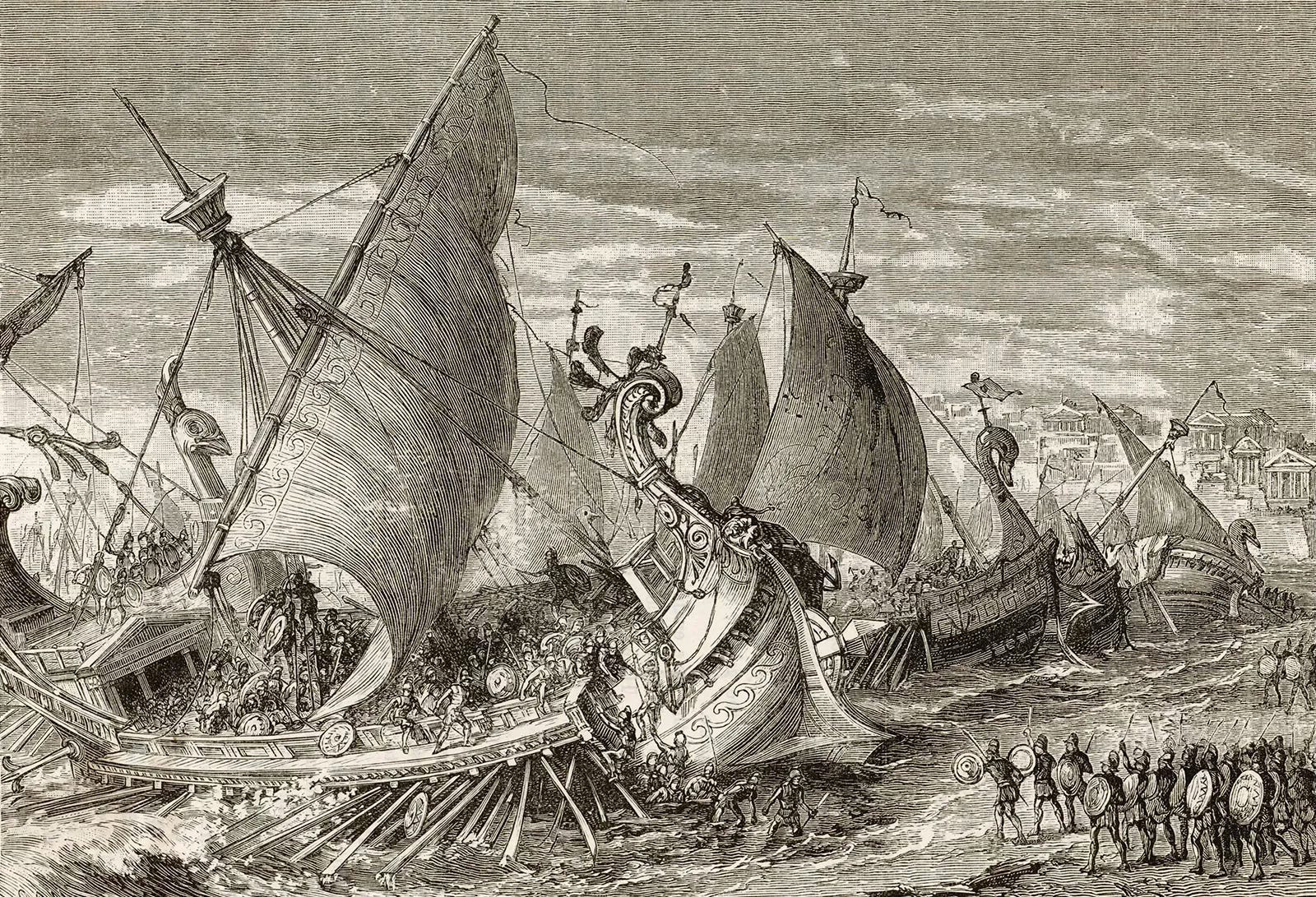
The Peloponnesian War by Thucydides
Prior to reading Thucydides’ Peloponnesian War, I envisioned a sort of Braveheart-like battle with lines of Athenians rushing towards lines of Spartans. That’s not even close to what happened. Most battles were proxy battles far from either Athens or Sparta and many battles were fought by sea.The Peloponnesian War took place between 431 - 404BC. This work covers years 431 - 411BC, abruptly ends mid-year, and is then picked up by Xenophon in Hellenika.Thucydides uses speeches (141 of them) to add tension & drama to the narrative. We as readers become part of the action, reading the speeches and wondering how the audience will respond. Thucydides also highlights themes of movement, technology, panic, and forms of government to compare and contrast the Athenians and Peloponnesians.In this episode, I give a brief overview of the work, share some themes and favorite quotes, and close with the ideas that stuck out the most through this work.Show Notes:* The Speeches of Pericles - Books of Titans Podcast #229* Intro to Thucydides - Podcast episode mentioned* Book Version - The Landmark Thucydides This is a public episode. If you'd like to discuss this with other subscribers or get access to bonus episodes, visit www.booksoftitans.com/subscribe

Andromache by Euripides
If you were to rank the individual suffering of those in Greek Literature, Andromache would easily rise to the top of that list. She lost her father, 7 brothers, and husband Hector to one man, Achilles. Her son was thrown from the walls of Troy. To top off the suffering cake, she was then forced to marry the son of her husband’s murderer, Neoptolemus.This tragedy begins with Andromache grasping the alter of Thetis in Thessaly, begging for her life. Her and Neoptolemus have had a son, which has made Neoptolemus’ Spartan wife, Hermione quite jealous. To top it off, Hermione, the daughter of Helen of Troy, is barren and is seeking to kill Andromache and her son.The Iliad permeates this tragedy in both storyline and direct quotes and references. There are some beautiful themes of justice and monogamy and other not so beautiful themes of jealousy, strife, and injustice.This is an incredible look into the horror of the life of a woman on the losing side of a war, forced to live with the victors as a slave. I love the painting above. Everyone is dressed in color except Andromache, veiled in black, lost in her personal tragedy. This is “peacetime,” and yet there is no peace for Andromache.In this episode, I walk through the tragedy play highlighting the story, themes, and beautiful dialogue. I also refer to two other tragedy plays by Euripides: This is a public episode. If you'd like to discuss this with other subscribers or get access to bonus episodes, visit www.booksoftitans.com/subscribe

Heracles by Euripides
This tragedy by Euripides was written in 420BC, 10 years after Children of Heracles. Historically, this is in the midst of the Peloponnesian War. Mythologically, it’s at the point of Heracles’ life where he is completing his 12th and final labor. While away, his family is in danger. He returns, neutralizes the danger, but becomes danger himself in the form of madness brought on by the gods. In this state, he kills his wife and children with the very bow that has brought victory in his life.Awaking from this madness, Heracles is confronted with the most cruel situation—he must live out his days knowing he killed his family. He opts for suicide but is saved by an act of great kindness.In considering the historical timeframe, this must have been sweet balm to soldiers returning from war who had experienced or were experiencing their own form of madness. What can save someone in that situation?I love reading Thucydides’ Peloponnesian War alongside these tragedies and considering what was happening in and around Athens while these plays are being written and performed. It adds a fascinating element in the consideration of their content. This is a public episode. If you'd like to discuss this with other subscribers or get access to bonus episodes, visit www.booksoftitans.com/subscribe
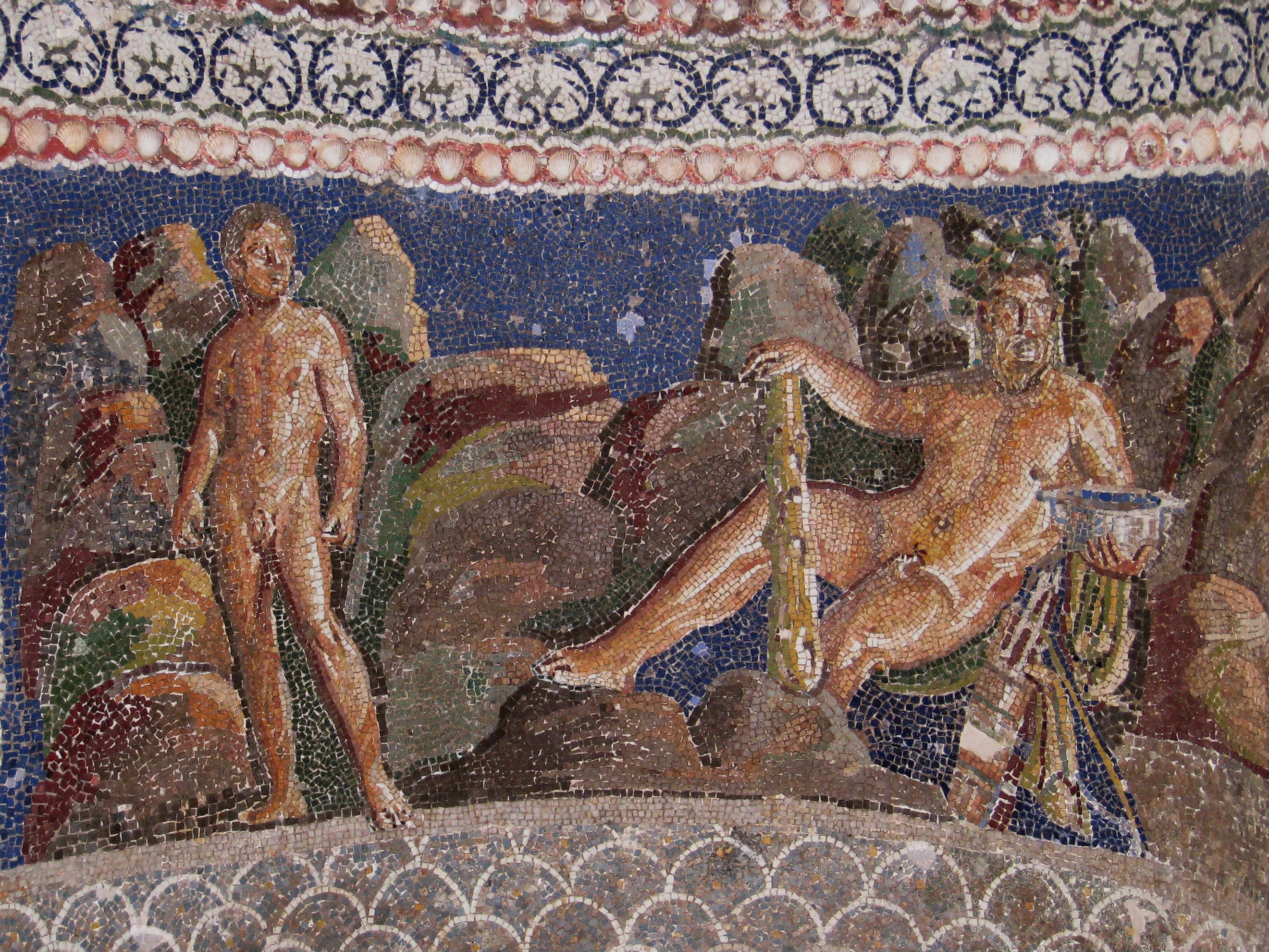
Children of Heracles by Euripides
Euripides wrote this tragedy in 430BC, a fateful year that saw the beginnings of the Peloponnesian War. It’s interesting to read this play in light of the historical atmosphere. Athens was entering a war with Sparta. The Spartans traced their descent from Heracles, and in this tragedy, the children of Heracles are near Athens (in Marathon) seeking refuge. Will Athens hold to her ideals and protect the suppliants? Will force beat deliberation? Will the innocent suffer?This is a wonderful tragedy play, with elements of humor, despair, and deep insight. In this episode, I walk through the play, cover important scenes, quotes, and themes.Related podcast episodes: This is a public episode. If you'd like to discuss this with other subscribers or get access to bonus episodes, visit www.booksoftitans.com/subscribe
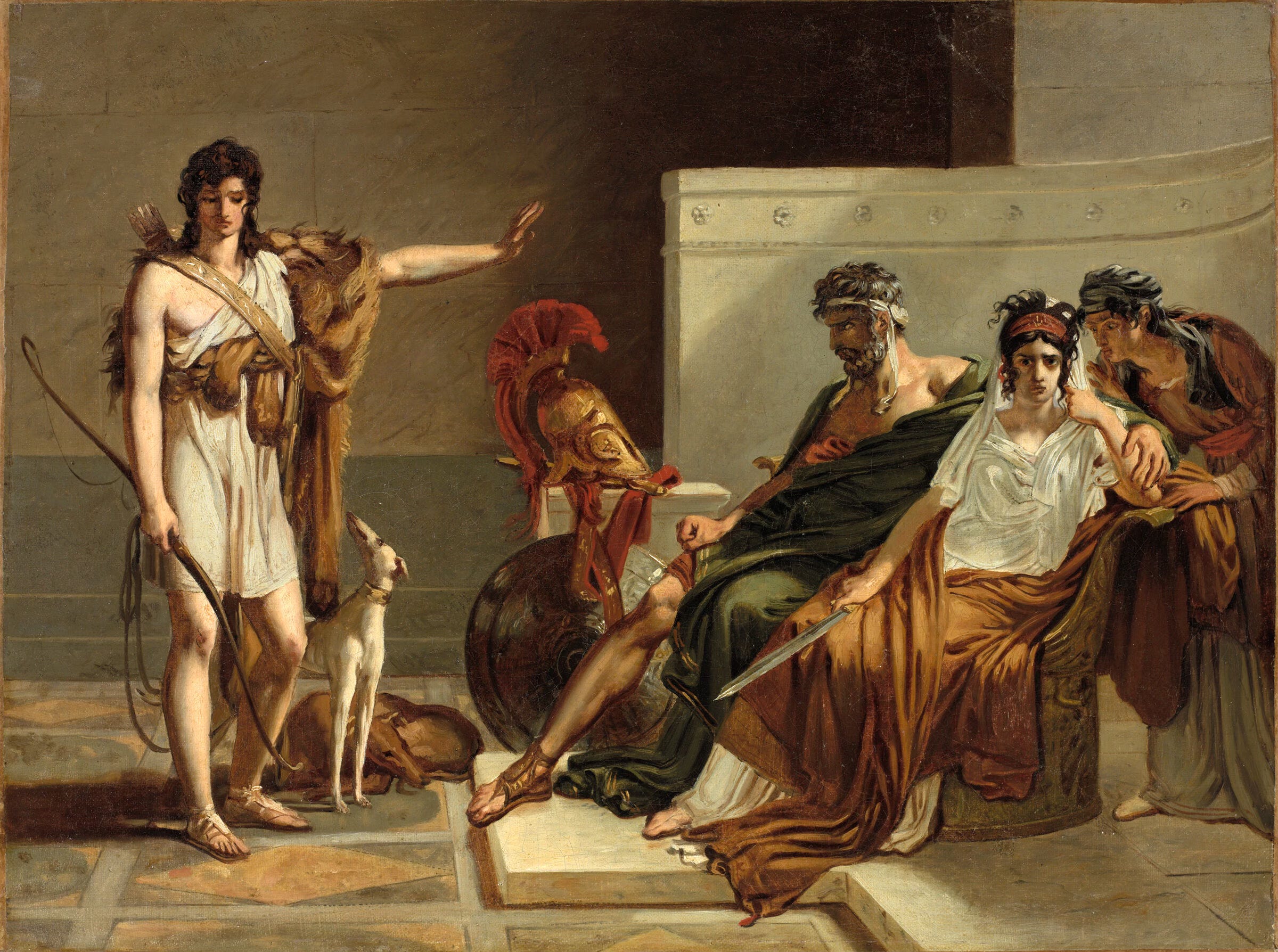
Hippolytus by Euripides
You, Aphrodite, lead captive the stubborn hearts of gods and of mortals.Aphrodite conquers all. Or nearly all. Zeus is under her spell and only a few, Athena and Artemis among them, have resisted her.Love is so powerful a force that it can even cause a step-mother to lust after her step-son. That at least is the premise for this tragedy and so the battle of Aphrodite (love, desire) is fought against Artemis (chastity) through Phaedra’s forbidden love for Hippolytus.Humans are quick to judge and often seek revenge before knowing the full story. This requires pardon and Hippolytus must decide whether to grant it to both his step-mother Phaedra and his father Theseus.This tragedy play won the award in Athens in 428BC, amidst the Peloponnesian War. It’s a stunning play and I try to capture its beauty and power in this episode. This is a public episode. If you'd like to discuss this with other subscribers or get access to bonus episodes, visit www.booksoftitans.com/subscribe
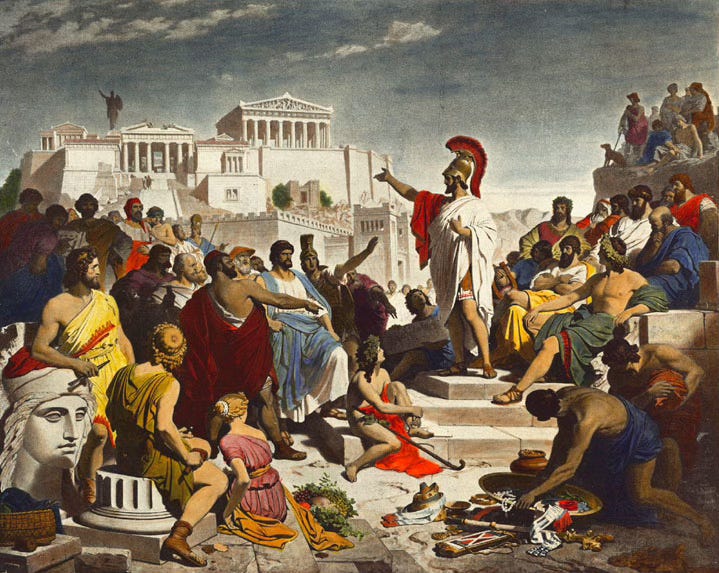
The Speeches of Pericles
In Book 2 of The Peloponnesian War by Thucydides, the Athenian general Pericles gives two extraordinary speeches. One is a eulogy and the other a response to an angry and devastated populace in the midst of war and pestilence.These speeches create a beautiful blend of history and exploration. Thucydides presents the historical facts of war—the size of armies, the results of certain battles, and naval vs land strategies. But it’s the speeches that allow him to explore the mindset, beliefs, governance, values, and national habits that play a role in those battles.Gone are the gods of Homer. Can democracy, courage, experience, and dialogue take the place of the gods? How do the strategies, preparations, provisions and levels of courage differ between the people of the Peloponnese and the Athenians? We learn about these things in these speeches. We learn about the leader’s ideas and the feelings of the populace. It’s a fascinating way to present history.In this podcast episode, I cover two speeches by Pericles and then compare a set of speeches by the Peloponnesian commanders and Athenian leaders. All speeches covered occur in book 2 of 8 in Thucydides great masterpiece. This is a public episode. If you'd like to discuss this with other subscribers or get access to bonus episodes, visit www.booksoftitans.com/subscribe

Leading a Reading Group
I just finished leading a 9-week, in-person reading group covering the Iliad. It was such a good experience. I’ve also participated in a number of groups over the years and wanted to use this podcast episode to share what I’ve learned and to hopefully encourage you to start your own reading group.Myths:* You don’t need to have all of the answers.* You don’t need to have an advanced degree.How to Prepare:* As you read the book you will cover, use different color pens/highlighters each time you read it. This will help you identify observations you had and will be helpful when you are leading the group.* Find podcast episodes that cover the book.* Find book guides that contain questions for the book.Facilitating the Reading Group:* Set expectations - expected time commitment, number of meetings, etc.* Limit the group to between 5 - 15 people.* Require an assignment:* A paragraph or an essay due a day before the meeting.* Use a shared Google folder so everyone can read the work of each other.* This has the added benefit of encouraging completion of the reading a day before the meeting. It also prepares the attendees to have a thought-out idea to address during the meeting.* Translation - attempt to use the same translation if it’s a work in another language. This will help everyone easily be able to locate the passage under discussion.Rules:* Use the first meeting to get to know each other. Don’t cover the book at all.* Discourage the reading of the book’s introduction. Just have them start right in with the book.* No outside influences - attempt to just discuss the book, not other books.Your Role as Facilitator:* You are not the teacher. The book is the teacher.* Ask questions that facilitate the discussion.* Keep the discussion on track.* Don’t give away spoilers to those who haven’t read the story. Keep the magic alive.Tools Specific to The Iliad* The History of Literature Podcast: Homer and His Iliad (with Robin Lane Fox)* Ascend the Great Books Podcast (incredible resource with a podcast episode per book of the Iliad)* Iliad Reading Guide (probably the single most helpful resource outside of the actual epic)* Young Heretics Podcast This is a public episode. If you'd like to discuss this with other subscribers or get access to bonus episodes, visit www.booksoftitans.com/subscribe
The Trojan Women by Euripides
“Sing, O Muse, a new song about Ilium, a funeral dirge accompanied by tears.”The glory of the Iliad is over. The Muses are being summoned to sing a funeral dirge, a new song of mourning for the city of Troy.This tragedy takes place in the immediate aftermath of the Trojan War. The Greeks have gotten past the famous Trojan walls, not by force but by trickery. They’ve entered the city, killed the men and children, and taken the women as slaves.In this period between the fall of Troy and the sailing back by the Greeks, these Trojan Women have become slaves and are being doled out to the Greek Warriors. Each Trojan Woman is paired to a Greek as a slave for the rest of their lives.These women have just witnessed the brutal deaths of their loved ones and have seen the city they loved burned to the ground. Helen is amongst them. She is one of the Trojan captives. Helen of Troy.At this point, everyone wants her dead, including her ex-husband, Menelaus.In this episode of the podcast, I give a brief introduction to this tragedy play, talk about three characters who stuck out to me, and share the one thing I’m still thinking about after having read The Trojan Women by Euripides. This is a public episode. If you'd like to discuss this with other subscribers or get access to bonus episodes, visit www.booksoftitans.com/subscribe
Iphigenia in Tauris by Euripides Podcast
In one of the most tragic stories of Greek Mythology, Agamemnon must sacrifice his daughter Iphigenia in order to secure favorable winds from Artemis so that the Greek Army can sail to Troy and retrieve Helen. That sacrifice sets off a series of events that curse a family line and destroy Agamemnon himself.It’d be fun to imagine an alternate ending. One that doesn’t involve the utterly tragic death of Iphigenia and a father being forced to kill his own daughter.That’s what happens here. Euripides provides some Ancient Greek Fan Fiction, an alternate history. Iphigenia is saved at the last moment in a scenario similar to Abraham and Issac where another sacrifice is provided at the last moment.Iphigenia is then whisked away by Artemis to Tauris where she becomes priestess at the temple of Artemis. One lovely job requirement is to sacrifice any Greeks who arrive in Tauris. Orestes, a Greek, and Iphegenia’s brother, arrives, setting up the remainder of this story.In this episode, I give a brief overview of the play, talk about some major themes, ask some questions I hope you’ll help me answer below, and share the one thing I’m still thinking about after reading Euripides’ Iphigenia in Tauris. This is a public episode. If you'd like to discuss this with other subscribers or get access to bonus episodes, visit www.booksoftitans.com/subscribe
Alcestis by Euripides Podcast
Admetus can escape Hades if he can find someone to die in his place. His wife Alcestis agrees to die for him in the ultimate sacrifice. Is she in the right? Should she have been the person to take his place? Where does that leave him if she dies?These tragic elements are balanced with comedic release in the arrival of Heracles amidst this tremendous household grief. It turns this play about Necessity, marriage, and hospitality into a satyr drama to lessen the blow of the questions raised.In this episode, I give a brief overview of the play, talk about the key themes, and share the one thing I’m still thinking about after reading Alcestis by Euripides. This is a public episode. If you'd like to discuss this with other subscribers or get access to bonus episodes, visit www.booksoftitans.com/subscribe
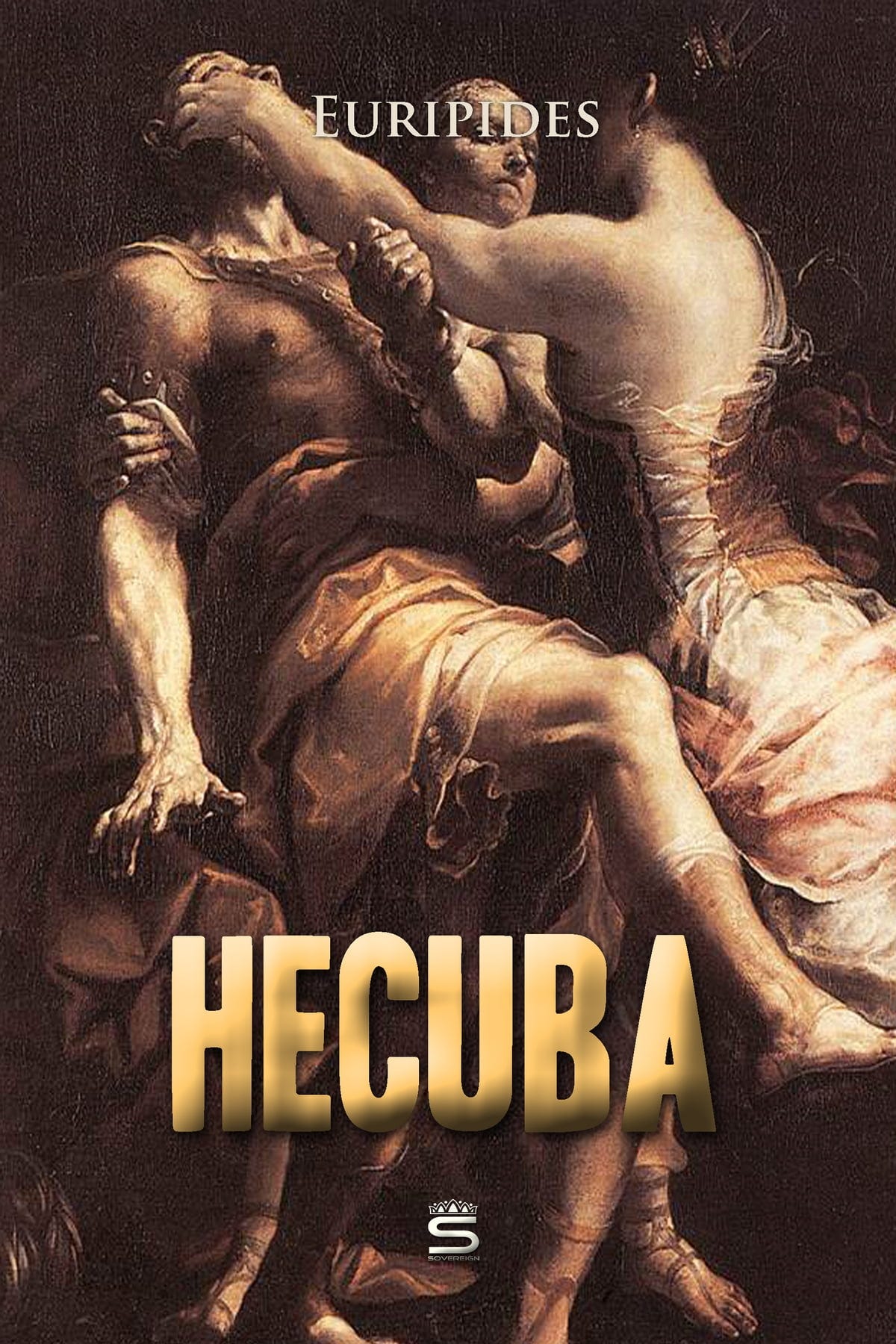
Hecabe by Euripides Podcast
Hecabe has to be one of the most tragic figures in the canon. Wife and Queen of King Priam, she’s lost close to 50 sons and 50 daughters by the start of this tragedy play. Not only that, she’s lost her husband, Hector, Paris, and Troy where she was queen.This play starts with one of her only surviving sons, Polydorus, appearing as a ghost and telling of his demise. Hecabe doesn’t know he’s dead yet, but we soon find out she has something else to lament. The ghost of Achilles has demanded the sacrifice of Polyxena, Hecabe’s daughter. Hecabe pleads with Odysseus to spare her daughter to no avail.The fact that Agamemnon shows up in this play is quite striking. Ten years earlier, he had sacrificed his own daughter Iphegenia to ensure favorable winds to Troy for the Greek ships. Here, he’s present while another sacrifice, this time from the Trojan side, is required to bookend the Trojan War. The damning thing in these tragedies is that it’s the innocent who usually suffer the most.It’s also fascinating that the last page provides a prophecy about Hecabe and Agamemnon. Hecabe is told (through Dionysus as told by Polymestor) that she will be transformed into a dog. It provides some insight into the effect of overwhelming grief on the mind. Agamemnon is told that his wife will kill him with an axe upon his return home (and that she will also kill Cassandra, another daughter of Hecabe). It makes you wonder if that was going through Agamemnon’s mind as he returned home to Clytemnestra.In this episode, I give some backstory to Hecabe, share the themes and quotes that impacted me the most, and close with the One Thing I keep thinking about from this incredible tragedy by Euripides.*Correction - in segment 1, I mistakenly say Priam killed Achilles. It was Paris that killed Achilles. This is a public episode. If you'd like to discuss this with other subscribers or get access to bonus episodes, visit www.booksoftitans.com/subscribe