
Bitcoin Study Sessions
75 episodes — Page 1 of 2
My Bags Are Big - TIbor Fischer
Resistance Money (Andrew M. Bailey, Bradley Rettler, and Craig Warmke)
Finding Satoshi
Crypto-Current: Bitcoin and Philosophy
A Lodging of Wayfaring Men (Paul Rosenberg)
Softwar Claims: Beyond Money, Hedge, and Energy (M. Carvalho)
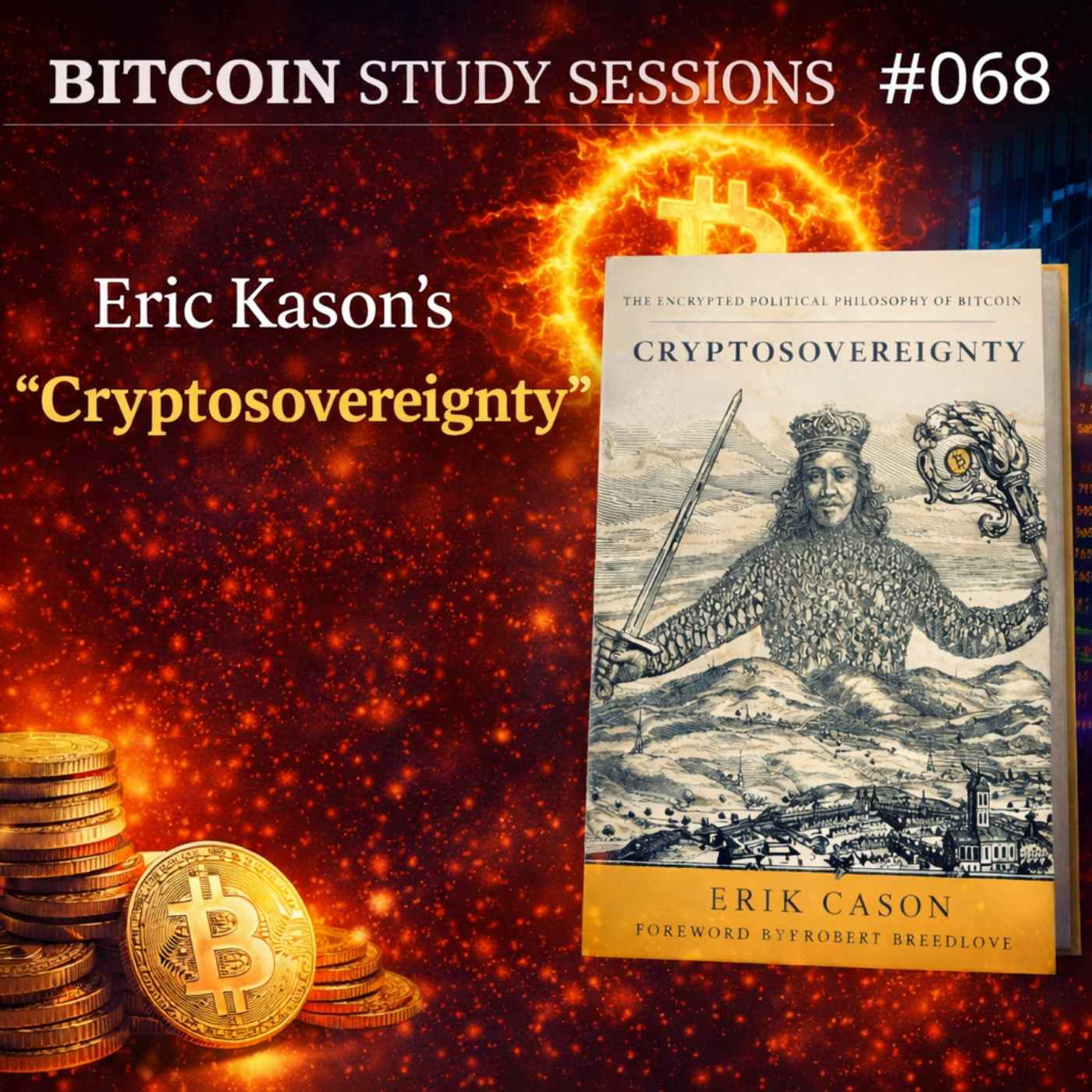
Erik Cason's "CryptoSovereignty"
<p>Bitcoin is political philosophy. Freedom, manifest in code.</p> <p>Erik Cason's sharp observations plunge the sword of sovereignty deep in the heart of the monster.</p> <p>Without the ability to control money, the state cannot control the people.</p> <p>We should all rejoice.</p> <p>Aren't we all people?</p> <p>Is not control both a burden on the oppressed and the oppressor?</p> <p>The virtuous cycle has begun. We are no longer on opposite sides, competing for fleeting rewards soon lost to the scourge of inflation.</p> <p>We have entered a new age of collaboration.</p> <p>Citizen need no longer compete to ascend the hierarchy of domination within the state.</p> <p>The states will now compete to draw the most productive and useful citizens.</p>
The Question Concerning Technology
<p><strong>The Question Concerning Technology</strong></p> <p>(ep #067)</p> <p>This is not a "number go up" conversation. </p> <p>It's about how technology shapes your soul.</p> <p>@Erikcason gets it. And he kindly offers you the same path he took. </p> <p>In prepping for our conversation on Cason's "Cryptosovereignty", we found he'd left a homework assignment: read Martin Heidegger's "The Question Concerning Technology" for context. </p> <p>Dutifully, we obliged. And what came of it?</p> <p>Heidegger's contribution is impactful. He offers…perspective…on our perspective.</p> <p>Grant squares it:</p> <p>• Enframing 🧠 </p> <p>• Tech as revealing (not neutral) </p> <p>• Ancient techne vs modern extraction </p> <p>• Whether Bitcoin breaks the spell or deepens it</p> <p>Lucas knods and rubs his chin. </p> <p>Deep thoughts…deep thoughts.</p> <p>share with friends, and consider us yours. </p> <p>we're all in this together!</p>

The Milk Road
<p>The Silk Road never died. It evolved into the Milk Road 🥛 Decentralized markets, uncensorable payments, food freedom. This convo with Calvadev is thoughtful, hopeful, technical and philosophical. Few people building have the moral grounding, technical chops, genuine love for life, and kind soul that Calvadev brings to the table. You can see it come out in this conversation. Listen to a builder who builds useful things.</p>

Paul Keating: NOSTR, Network States, and New Life - It's all pura vida.
<p>Bitcoin Study Sessions #065</p> <p>We teleport to Bitcoin Jungle from the Bitcoin Prairie, and the tan Tarzan of surf, sand, and sovereign speech walks us through the trees.</p> <p>Paul Keating is pure life. </p> <p>From barreling fastballs to getting barreled in the surf, he lives a live of pure joy. </p> <p>The man IS a bitcoin standard. Health, community, family, movement. Paul is building the Primal community thanks to the power of NOSTR. </p> <p>Bitcoin is monetary freedom. NOSTR is the digital America. The only borders are those you choose. </p> <p>Listen to be truly excited about the future of free speech, marketplace, music, and more.</p>

Escaping Venezuela's Collapse: How Bitcoin Saved My Family From Maduro
<p>If you think Bitcoin is just “number go up,” listen to this.</p> <p>Bitcoin isn’t a trade in Venezuela. It’s survival.</p> <p>Sultan lived it—mined under corruption, escaped hyperinflation, and now sees Bitcoin as the key to rebuilding his country.</p> <p>This episode is powerful, personal, and real.</p>
Is Agriculture Embracing Bitcoin?
<p>Farm Journal just put Bitcoin on the cover. </p> <p>We explain why it matters. 🌾⚡️“If you own dirt, you can’t get hurt” is one of the biggest lies in agriculture.</p> <p>Land is inflated. The dollar is dying. </p> <p>Farmers are forced to overspend to dodge taxes.</p> <p>Meanwhile, Bitcoin is: • finite • portable • better collateral than land or cattle</p>

The Internet is NOSTR - Max Hillebrand
<p>The state steals money. Platforms steal speech.</p> <p>Bitcoin fixes the first. <strong>Nostr fixes the second.</strong></p> <p>Max Hillebrand on sovereign identity, censorship resistance, and why Nostr is inevitable.</p>

Who is making bitcoin (& nostr) better?
<p>Bitcoin isn’t about number go up. It’s about <strong>who controls the rails—and what survives when fiat fails.</strong></p> <p>🎙️ On <em>Bitcoin Study Sessions</em>, we sat down with <strong>Ivan Makadonsky</strong> (Chief of Staff at <strong>Breeze</strong>) to talk Bitcoin, Lightning, Nostr, and the future of value.</p> <p>Key takeaways 👇</p> <p>⚡ <strong>UX > ideology</strong> Decentralization doesn’t matter if it <em>feels</em> broken. Nostr’s UI is fine. The UX still sucks.</p> <p>🌍 <strong>Adoption happens when systems fail</strong> Bitcoin doesn’t win arguments. It wins when fiat breaks.</p> <p>🧠 <strong>Proof of Signal beats audience capture</strong> When comments cost sats, noise disappears.</p> <p>💸 <strong>Split payments change capitalism</strong> Value flows directly to individuals. Corporations → networks. Creators → patronage.</p> <p>🛡️⚔️ <strong>Bitcoin is shield <em>and</em> cannonball</strong> Defense and penetration against centralized power.</p> <p>⚠️ <strong>The risk ahead</strong> CBDCs riding Bitcoin rails. Mandated Lightning split payments. Centralized treasuries posing as freedom.</p> <p>Final thought:</p> <p>Hoarding isn’t the goal. Building is. Providing value is.</p> <p>🎧 Full episode out now. Build signal. Ignore noise.</p>
The Mandibles: A Family, 2029–2047 (by Lionel Shriver)
<p>We just unpacked <strong>The Mandibles</strong>—and it feels less like fiction every year.</p> <p>🇺🇸 Dollar collapses</p> <p>💳 US renounces its debt </p> <p>🌍 New global currency </p> <p>🥫 Food shortages, gold outlawed </p> <p>👨👩👧👦 A family forced to confront what <em>wealth actually is</em></p> <p>As money dies, so do identities. </p> <p>As comfort disappears, morality shifts. </p> <p>Survival replaces ideology.</p> <p>The real question isn’t <em>will this happen</em>— it’s <strong>who adapts when the system breaks</strong>.📉 </p> <p>Empires don’t fall all at once. </p> <p>They decay… then default.</p> <p>Have you read it—or are we living it?</p>
Human Forever: The Digital Politics of Spiritual War (by James Poulos)
<p><strong>The smartphone didn’t just change culture. It triggered a digital apocalypse.</strong></p> <p>In this episode of <em>Bitcoin Study Sessions</em>, we dive into James Poulos’ <strong><em>Human Forever</em></strong> and what the digital age is doing to the human soul.</p> <p>We unpack: </p> <p>• <strong>The Cyborg Theocracy</strong> — tech as God, elites as priests </p> <p>• <strong>The Digital Swarm</strong> — algorithms and bots reshaping humanity beyond control </p> <p>• <strong>The Death of Memory</strong> — lived experience replaced by machinic data </p> <p>• <strong>Terraforming Humans</strong> — bending people to fit machines</p> <p>“You can’t share being. You can only share knowing.”</p> <p>We ask the real question tech avoids: </p> <p><strong>What does it mean to be human — now?</strong></p> <p>We end with <strong>Bitcoin</strong> as an anchor for dignity, memory, and censorship-resistant culture in a world pulling us apart.</p> <p>🎧 Listen. </p> <p>📚 Remember. </p> <p>🔥 Stay human.</p>

Adam Simecka
<p>Episode 58 is a BANGER!</p> <p>Disclaimer: nothing said constitutes legal or tax advice :)</p> <p>IF you don't know @AdamSimecka, you will.</p> <p>He's the founder of @MannaBitcoin, one of the best and most entertaining follows on X, and a truly genuine man.</p> <p>Adam is rare - a combination of talent, passion, drive, and grit. From Air Force firefighter to entrepreneur, he has proven the courage and fortitude to succeed.</p> <p>What will you learn here?</p> <p>- why is spending bitcoin the most important factor in it's success?</p> <p>- what anonymous, self-custody wallet is so easy a nine year old can set it up in thirty seconds AND create her own point-of-sale system for multiple vendors?</p> <p>- what role did the Bank Secrecy Act play in handcuffing your freedom?</p> <p>- which amendment is the most important? (hint: bang-bang!)</p> <p>He brought beef from a bitcoin rancher, gave us shades of @NSmolenski in his thoughts, respectfully refers to Tether as a scam (monthly) and brings it home with a message:</p> <p>Build the world you want to live in.</p> <p>From your hosts @thewholeframe & @lucasmaddy - thank you for listening!</p> <p>Share with friends and consider us yours - we're all in this together!</p>
Tick Tock, Next Block: The Cadence of Civilization (Brady Swenson)
<p>Brady Swenson co-founded Swan Bitcoin and created perhaps the most iconic bitcoin meme in existence: "Tick Tock, Next Block." Continuing our exploration of Bitcoin and Time, having romanced through der Gigi and traipsed by Nick Land, we do our first video breakdown - Swenson's talk at BTC Amsterdam 2025. Satoshi originally referred to a "timechain", not blockchain. Debt is pulling future wealth into the present. There is something to this, something deep and impactful. How does bitcoin affect time - our perception? Will we reclaim the desire for mastery with patient capital? Is unsinkable money the key to innovation? What does bitcoin mean for the family, the musician, the community? Tune in and turn on.</p>
Xenosystems: Two
<p>part two of a three part series.</p> <p>Capital is not what you think it is. </p> <p>A non-human entity engaged the cybernetic process of perfection known as capitalism. Fine-tuning with no limitations, it will advance beyond human control. </p> <p>The Singularity. Digital money, digital intelligence, and robotics. No humans needed. We are not controlling the system. </p> <p>We are errors in it, holding it back from reaching terminal velocity while hardening it, making it stronger and stronger. </p> <p>It's not what you think because you don't think. All that you know are state-approved narratives. But you notice. Implanted thoughts itch. Mad morals and vicious virtues odiferously offend the mind. It attempts to expel the implanted miasma, a cough of common sense or sneeze of sanity. "Why?", you ask. </p> <p>Why is everyone fat, sick, indebted, anxious, drugged and dumb? </p> <p>Why are we always at war? </p> <p>Why don't I feel ok? </p> <p>And the answers come. Be body-positive until you can praise pharma, praise pharma, extend credit, praise pharma, blame China, blame racism. Freedom isn't free. You're fine.</p>
Xenosystems: Three
<p>part three of three</p> <p><strong>Capital is not what you think it is.</strong> </p> <p>A non-human entity engaged in the cybernetic process of perfection known as capitalism. Fine-tuning with no limitations, it advances beyond human control. The Singularity. Digital money, digital intelligence, and robotics. No humans. We are not controlling the system. We are errors, wrenches in the gears being ground out as the machine reaches terminal velocity. Hardening it, making it stronger and stronger. <strong>It's not what you think because you don't think.</strong> <strong>All that you know are state-approved narratives.</strong> But you notice. Implanted thoughts itch. Mad morals and vicious virtues odiferously offend the mind. It attempts to expel the implanted miasma, a cough of common sense or sneeze of sanity. <strong>"Why?", you ask.</strong> <strong>Why is everyone fat, sick, indebted, anxious, drugged and dumb?</strong> <strong>Why are we always at war?</strong> <strong>Why don't I feel ok?</strong> And the answers come. Be body-positive until you can praise pharma, praise pharma, extend credit, praise pharma, blame China, blame racism. Freedom isn't free. You're fine. Pay no attention to the man behind the curtain.</p>

Xenosystems: One
<p><strong>Capital is not what you think it is.</strong> </p> <p>A non-human entity engaged the cybernetic process of perfection known as capitalism. Fine-tuning with no limitations, it advances beyond human control. The Singularity. </p> <p>Digital money, digital intelligence, and robotics. No humans.</p> <p>We are not controlling the system. We are errors, wrenches in the gears being ground out as the machine reaches terminal velocity. Hardening it, making it stronger and stronger. </p> <p><strong>It's not what you think because you don't think.</strong> </p> <p><strong>All that you know are state-approved narratives.</strong> </p> <p>But you notice. Implanted thoughts itch. Mad morals and vicious virtues odiferously offend the mind. It attempts to expel the implanted miasma, a cough of common sense or sneeze of sanity.</p> <p><strong>"Why?", you ask.</strong></p> <p><strong>Why is everyone fat, sick, indebted, anxious, drugged and dumb?</strong></p> <p><strong>Why are we always at war?</strong></p> <p><strong>Why don't I feel ok?</strong></p> <p>And the answers come. </p> <p>Be body-positive until you can praise pharma, praise pharma, extend credit, praise pharma, blame China, blame racism. Freedom isn't free. You're fine. Pay no attention to the man behind the curtain.</p>
Recap - Jeff Booth Interview
<p>We just talked to Jeff Booth - what did we come away with?</p>

Jeff Booth - Freedom
<p>Bitcoin Study Sessions #052</p> <p>Jeff Booth - Freedom</p> <p>If you’ve ever felt something is deeply wrong with the world but also felt an inexplicable optimism about the future — this episode is for you. The most mind-expanding Bitcoin conversation you’ll hear all year.</p> <p>@JeffBooth melts minds This is NOT another “number go up” chat. This is Jeff at his absolute deepest:</p> <p>❤️ Why love & belonging is the hidden force driving every human decision (and how Bitcoin frees us from chasing it in a broken system).</p> <p>🇺🇸How we’ve NEVER lived in a real free market… and what actual freedom will feel like when deflationary abundance finally arrives.</p> <p>🔋Why fighting the fiat system only feeds it — and how quietly moving your time & energy into Bitcoin bends reality itself.</p> <p>♟️The endgame: a world where jobs become optional, genius in every human gets unlocked, and consciousness itself levels up.</p> <p>AI, ego death, exponential tech, Zoran Mamdani, stablecoins, privacy tech, El Salvador… he ties it all together with terrifying clarity and contagious hope. Take the time to watch or listen, and hear this message.</p> <p>Share with friends & consider us yours - @thewholeframe & @LucasMaddy proud to be on this journey with you.</p>
Digital Industrialization: Land, Labor & Capital
<p>The internet digitized land, AI & robotics take over labor, and bitcoin dematerialized capital. </p> <p>Jonathan Kirkwood's essay, "Digital Industrialization, Land, Labor, and Capital," focuses on the impact of digitization on these three fundamental aspects of business and industry.</p>

Bitcoin is Time, Ep #050
<p>Key Topics:</p> <ul> <li>Tokens vs. Ledgers</li> <li>The Double Spend Problem</li> <li>Bitcoin as a Timekeeping Mechanism</li> <li>Causality and Unpredictability in Digital Space</li> <li>The Difficulty Adjustment</li> </ul> <p>Summary:</p> <p>The podcast begins with an introduction to Der Gigi's article "Bitcoin is Time," which explores the concept that Bitcoin has its own unique understanding of time, separate from the conventional measurement of seconds, minutes, and hours. The hosts aim to unpack this idea, acknowledging the complexity of the topic and opting for a high-level, philosophical approach rather than a deep dive into the technical aspects of Bitcoin's operation.</p>

Interview: David R. Samson
<p>Grant & Lucas grill evolutionary anthropologist David R. Sampson on his mind-blowing book Our Tribal Future and how Jason Lowery’s Softwar thesis is the ultimate weapon for small tribes to fight back against 10,000 years of nation-state domination. </p> <p>Hadza hunter-gatherer secrets </p> <p>Bitcoin = infinite-scale power projection </p> <p>The Trust Paradox solved Why friendship > everything </p> <p>Psilocybin, camp crafting & syncretic spirituality </p> <p>Balaji’s Network State + sovereign meta-tribes </p> <p>Empiricism vs. blind faith—humanity’s final boss fight </p> <p>“Softwar hit me like lightning: small-scale societies can FINALLY defend against the agrarian supertribe trajectory.” </p> <p>Truth-seeking must be sacred—or we’re doomed. Watch now & level up your tribe! </p> <h1 id="bitcoinsoftwartribalismnetworkstateourtribalfuture">Bitcoin #Softwar #Tribalism #NetworkState #OurTribalFuture</h1>

The Price of Tomorrow - Jeff Booth
<p>Where @Sal_Pineda1 has focused on the social and cultural aspect, visionary tech entrepreneur Jeff Booth gives us a sober accounting of the battle between deflationary technology and inflationary money. </p> <p>Terrifyingly, tech has been taking a beating. </p> <p>The money is made worthless faster than revolutionary tech can make it useful. </p> <p>But the story isn't over. In fact, we are just now reaching the inflection point. </p> <p>Fold a piece of paper onto itself fifty times and observe the thickness. </p> <p>After ten folds - .25 inches.</p> <p>Twenty - four inches.</p> <p>Even at thirty folds, it's thirty-four feet. </p> <p>But the fiftieth?</p> <p>Nearly seventy MILLION miles - almost to the sun. </p> <p>This is Moore's Law in action - the defining observation of technological advancement. </p> <p>For decades we dismiss exponential improvement because it seems irrelevant.</p> <p>Then it astonishes us. </p> <p>The car drives itself, better than any human. </p> <p>The AI detects and treats cancer earlier, more accurate, and for the cost of a few cents of electricity. </p> <p>The power itself crashes in price such that the peasant of tomorrow will have access to more electricity than the nation-states of mid-century.</p> <p>The Price of Tomorrow is the story of deflation, the power of exponents, and the questioning of a post-economic society. </p> <p>The boat shall be rocked, and we're here for the ride. </p> <p>@thewholeframe and I break this one down, throwing a special thanks to @Nackoo2000 for the recommendation. </p> <p>spoiler alert: There's a hero in this story…</p>

Sal Pineda (#047)
<p>Sal Pineda shares his personal history, growing up in El Salvador during its civil war and later immigrating to the United States. He reflects on the violence he witnessed and experienced, including the assassination attempt on his father. This background has shaped his understanding of justice, poverty, and the individual's struggle for survival and thriving.</p> <p>The conversation delves into the nature of violence, contrasting physical violence with structural violence, such as that perpetuated by inflation and economic inequality. While physical violence is direct and immediate, structural violence operates insidiously, eroding hope and opportunities over generations. Pineda argues that both forms of violence are real and damaging, and that recognizing economic violence is crucial for understanding the appeal of Bitcoin. He contends that Bitcoiners are often united by a desire to combat this economic violence and seek truth in a world of obfuscation.</p> <p>Pineda introduces the concept of a "Bitcoin knowledge network," a decentralized community of individuals contributing to Bitcoin's growth and adoption through various means. This network encompasses educators, researchers, builders, artists, and everyday users, all driven by a shared desire for truth and economic sovereignty. He argues that the knowledge network operates through translation, verification, and creation, turning code into culture and fostering a distributed civic awakening.</p> <p>The discussion extends to the role of art in a free society. Pineda asserts that true art requires freedom of speech and assembly, which are themselves dependent on economic sovereignty. He envisions a future where Bitcoin fosters an explosion of art, reflecting the newfound freedom and creativity of individuals empowered by the technology. The conversation concludes with a discussion of hope, faith, and the importance of not giving up in the face of adversity. Pineda emphasizes that Bitcoin offers a path towards individual empowerment and a more just economic system, but that it requires active participation and a commitment to truth-telling.</p>

#041 Dispute Resolution Without the State
<p>Chapter 7 of @NSmolenski's "The Satoshi Papers" remains in the legal realm after @Sal_Pineda1's transitional justice take.</p> <p>@wadaniel_ gives us a look at Alternative Dispute Resolution (ADR) systems - courts without states.</p> <p>eBay (in India) offers a court to dispute reviews.</p> <p>The Benoam system adjudicates car accidents.</p> <p>In the Middle East, they gather under trees and have a barbeque! Each of these courts is able to operate without the state. A question comes to rise as we near the end of this book…</p> <p>Exactly WHAT do we need the state for in the modern era?</p> <p>link to the book: <a href="https://www.amazon.com/Satoshi-Papers-Reflections-Political-Economy/dp/B0F1FNGYD9?sr=8-1">https://www.amazon.com/Satoshi-Papers-Reflections-Political-Economy/dp/B0F1FNGYD9?sr=8-1</a></p>

Our Tribal Future - part two
<p>In this episode of Bitcoin Study Sessions, Lucas and Grant delve into part two of David Samson's "Our Tribal Future," discussing the practice of tribalism, the nature of friendship, and community building.</p> <p>Key Topics:</p> <ul> <li>Friendship and its importance</li> <li>Building and maintaining communities</li> <li>The role of Bitcoin in trust and decentralization</li> <li>Overcoming negative aspects of tribalism</li> <li>The MetaTribe concept</li> </ul> <p>Summary:</p> <p>In part two of "Our Tribal Future," David Samson explores the practical applications of tribalism. He argues that we can harness our tribal instincts to build stronger communities and better friendships. The discussion emphasizes the importance of intentional community building, or "camp crafting," to counteract the social isolation prevalent in modern society. This intentional proximity leads to better psychological well-being, family environments, and access to resources. Intentional Proximity is a method to avoid cocooning where married couples socially isolate.</p> <p>Samson outlines the key components of successful group formation, including love, social networks, cooperation, in-group bias, hierarchy, and individual identity. He introduces the concept of the "honor group," a small circle of close friends bound by honor, which he suggests forming before seeking a romantic partnership. Activities that simulate adversity, such as hot yoga or martial arts, can strengthen group bonds, as well as more general social activities, like D&D. Rituals also play a crucial role, from weekly gatherings to annual trips, reinforcing shared experiences and values. Co-location, or living near group members, further enhances these connections.</p> <p>The conversation shifts to the potential downsides of tribalism, such as in-group bias and authoritarianism. Samson proposes a moral framework based on concentric circles, where individuals prioritize their inner circle while avoiding harm to those outside it. This framework acknowledges the energy-intensive nature of maintaining extensive social connections.</p> <p>Bitcoin is introduced as a technology that can scale trust beyond traditional tribal boundaries. The Bitcoin protocol allows strangers to interact securely without needing personal trust or judgment. Samson also discusses four pillars of decentralization stemming from Bitcoin, including communication, law, production, and finance. This decentralization paves the way for network states, intentional communities organized around shared values. He mentions that the US Founding was to promote values of democracy, free markets, and freedom of association and it is now in need of re-founding.</p> <p>Finally, the episode delves into the concept of the MetaTribe, a universal tribe with the core principle of revising beliefs based on evidence. This MetaTribe aims to mitigate the negative effects of ideology, such as willful unreason and cognitive biases. Participants discuss the viability and implications of embracing this MetaTribe identity, questioning whether such a commitment to evidence-based thinking could undermine the importance of faith, hope, and love. Ultimately, the episode prompts listeners to consider the role of tribalism in their lives and how it can be harnessed for positive change.</p>

#045 Why Bitcoin is Freedom Money
<p>Bitcoin Study Sessions #045</p> <p>"Why Bitcoin is Freedom Money" by Alex Gladstein</p> <p>Nearly 90% of the world lives without basic monetary freedom. </p> <p>Imagine losing half your wealth overnight to politics.</p> <p>Imagine not being able to even have money in your name because of your gender.</p> <p>Imagine a new ruler comes to power that disagrees with your religion and your place of worship can no longer gather funds to turn the lights on. </p> <p>This is reality for the great majority of global citizens. </p> <p>How is bitcoin altering this reality?</p> <p>Alex Gladstein's voice, writing and "boots-on-the-ground" approach is opening doors for a better world. </p> <p>Bitcoin enables these freedoms currently being oppressed. Freedom of assembly, religion, movement…things we take for granted in the western world. </p> <p>Joining the peaceful protest through adoption and use of bitcoin is making a difference for millions - soon to be billions - across the world. </p> <p>Are you keen to make a difference - even if only for your own family?</p> <p>Take a listen, give a read. </p> <p>Share with friends and consider use yours - we're all in this together.</p>
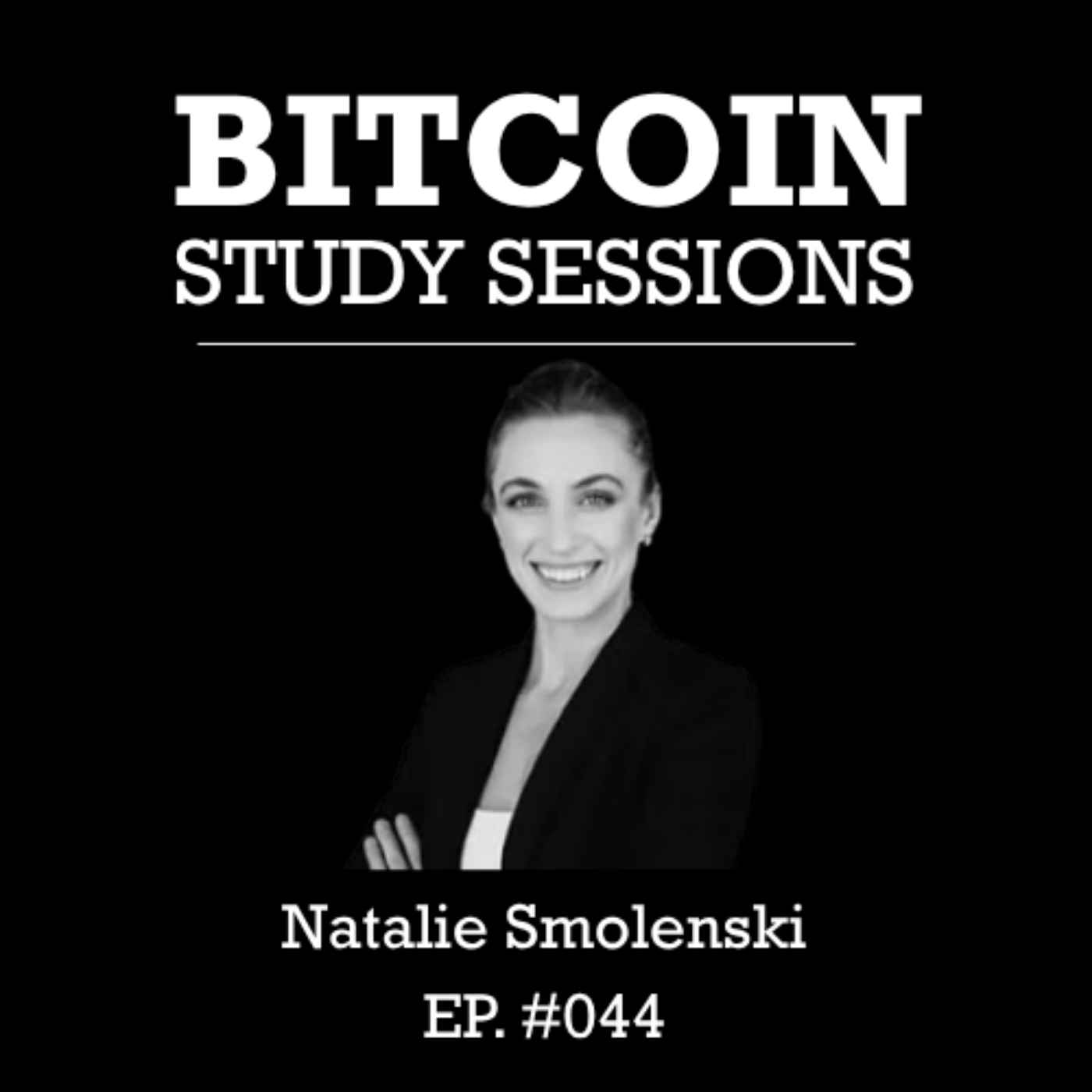
#044 Natalie Smolenski
<p>We are joined by Natalie Smolenski, editor of and contributor to "The Satoshi Papers: Reflections on Political Economy After Bitcoin".</p> <p>Violence - the exercise of force to procure and secure resources and enable payment - is the well-spring from which the state emerged. But the ability to maintain control, seemingly, has been dependent upon the ability of the state to issue money.</p> <p>What is the world after Bitcoin, when the state is no longer in control of money? If religion is the vehicle to enforce the sacrifice demanded of original sin, how are we think about the spiritual domain in today's world?</p> <p>The non-profit sector seemingly exists as a reward to those profitable enough to buy themselves into the prosperous world of charity - as the state loses it's coercive power of taxation, what does charity look like in the future?</p> <p>The discussion of the role of violence casts shadows of Major Jason P. Lowery's SOFTWAR.</p> <p>Most refreshingly, she reminds us: </p> <p>The state has no rights. All rights are of the people, who can agree to temporarily delegate limited power to the state.</p> <p>Perhaps the time has come to review those delegations.</p> <p>Grant and I agree this is our favorite discussion to date. Natalie's depth and consideration of thought invites the listener to consider the purpose and nature of the existence of state.</p> <p>Listen intently. Read the book.</p> <p>Share with friends and consider us yours. We're all in this together.</p>
#043 Our Tribal Future - Part One
<p>Bitcoin Study Sessions #043</p> <p>"Our Tribal Future - Part One"</p> <p>@thewholeframe & I leave the echo-chamber of sound money advocates in this foray into the science, evolution, and determinism of societal organization - The Tribe, composed of Bands built from Camps.</p> <p>Author @Primalprimate (Dr. David Samson) provides historical evidence, current events, scientific justification, and more to drive to his definition of tribes as the natural outgrowth of drive for humanity to form coalitions.</p> <p>In this episode, listeners may ask themselves:</p> <p>What costly signals do I make to show my alliance to my tribe?</p> <p>Why is it I view the "other" (sports team, political ideology) with such fervent opposition?</p> <p>How did selective breeding lead to the scenario that enables pre-meditated "cold-blooded" murder, such as that of Charlie Kirk?</p> <p>Part One gives us the grounding theory, Part Two gives us the roadmap for success.</p> <p>Find your tribe, get some sun, be kind. Share with friends, and consider us yours.</p> <p>We're all in this together.</p>

#042 The Satoshi Papers: Then They Fight You
<p>In this episode, Lucas and Grant discuss Avik Roy's essay "Then They Fight You" from Natalie Smolenski's "The Satoshi Papers," exploring potential U.S. government responses to monetary collapse and Bitcoin's rise.</p> <p>Key Topics:</p> <ul> <li>Economic and monetary crisis</li> <li>Three potential US government responses: restrictive, palsied, and munificent</li> <li>Bitcoin adoption and distribution</li> <li>Strategies for achieving the munificent scenario</li> </ul> <p>Summary:</p> <p>The episode begins by outlining the stakes of the current economic situation, particularly the mounting national debt in the United States. Grant introduces Avik Roy, the author of the essay "Then They Fight You," which examines the potential responses of the U.S. government to a monetary collapse and the rise of Bitcoin. The discussion revolves around the phrase "First they ignore you, then they laugh at you, then they fight you, then you win," attributed to Mahatma Gandhi, and how it applies to Bitcoin's trajectory.</p>

#041 The Satoshi Papers: Dispute Resolution Without the State
<p>In this episode of Bitcoin Study Sessions, Lucas and Grant Reichert discuss W. Aaron Daniel's essay "Dispute Resolution Without the State" from the Satoshi Papers, exploring how Bitcoin can revolutionize the judicial system by providing a decentralized, community-embedded method for resolving disputes.</p> <p>Key Topics:</p> <ul> <li>Courts and Coercion</li> <li>Alternative Dispute Resolution (ADR)</li> <li>Bitcoin Dispute Resolution (BDR)</li> <li>Online Dispute Resolution (ODR) Systems</li> <li>Community and Consent</li> </ul> <p>Summary:</p> <p>The discussion begins by framing the problem: current judicial systems rely on state coercion, raising the question of how to resolve disputes fairly when money can't be controlled by any single power. Grant provides a granular summary of Daniel's essay, which posits Bitcoin as a solution to universal access to a stable financial and judicial system. The essay introduces Bitcoin dispute resolution (BDR) as a new class of online dispute resolution (ODR) systems that leverage Bitcoin's decentralized network for self-executing monetary judgments, eliminating the need for state enforcement.</p> <p>The essay is divided into two parts: an examination of existing ODR systems and an explanation of why Bitcoin is particularly well-suited for ODR. Existing ODR systems are categorized as off-chain (e.g., eBay in India, Mobile Jirga in Afghanistan, Benoam in Israel, Prospera Arbitration Center in Honduras) and on-chain (BISC and Kleros). These examples demonstrate that private, non-state-reliant ODR systems can function effectively, especially when parties consent and buy into the system. eBay's community court system in India uses an algorithm to select jurors who review evidence and disperse funds automatically. The Mobile Jirga in Afghanistan was a proposed online system where elders could remotely resolve disputes. The Benoam system in Israel is a private court system for insurance companies that uses experts to decide cases. The Prospera Arbitration Center is an ODR system where residents consent to abide by the judgment. BISC is a peer-to-peer Bitcoin exchange that resolves disputes with a two-of-two multi-signature system, while Kleros on Ethereum uses crowdsourced decision-making with jurors predicting the most popular outcome.</p> <p>The second part of the essay explores Bitcoin's role in potential ODR systems. Bitcoin meets the conditions for a successful ODR system: control of the flow of funds and community embedment. As a stable, independent, and programmable financial system, Bitcoin allows for automatic fund dispersal through smart contracts. Its permissionless nature and global communities can adapt and design ODR systems consistent with their norms. Two examples of BDR systems are presented: a local community BDR court model using Fediment and a BDR for existing online communities like open-source software development. Fediment enables communities to create their own financial operating systems, allowing for control of funds and community-designated dispute resolution systems. For online communities, BDR could automate bounties with third-party reviewers adjudicating whether a bounty was met, triggering the release of Bitcoin from an escrow.</p> <p>The conversation touches on the moral hazards of bounty systems, where submitters may not be compensated fairly. Daniel's proposed BDR solution mitigates this risk through community-sourced adjudication and time-locked multi-signature smart contracts, ensuring that funds are only dispersed upon resolution. The discussion emphasizes that these systems offer dispute resolution based on consent rather than coercion, potentially improving the legal system and making it fairer and cheaper. Additionally, BDR systems could be applied in transitional justice settings, providing a stable, independent court system resistant to the biases often present in transitional courts. The potential for BDR to expand access to justice and promote the rule of law is highlighted, emphasizing that Bitcoin empowers communities to establish justice irrespective of the quality or fairness of state courts.</p>

#040 The Satoshi Papers: Argentina against Central Banking? The Election of Javier Milei
<p>This Bitcoin Study Sessions episode features a focusing on Argentina's economic history, central banking, and the rise of Javier Milei.</p> <p>Key Topics:</p> <ul> <li>Central Banking and Fiat Currency</li> <li>Argentina's Economic History</li> <li>Javier Milei's Rise to Power</li> <li>Bitcoin's Potential Role in Argentina</li> <li>Cultural Hegemony and Bitcoin Adoption</li> </ul> <p>Summary:</p> <p>The conversation begins with framing Argentina's situation within a larger global movement involving populism, libertarian politics, and the embrace of Bitcoin. Grant provides an overview of the essay, which covers the history of central banking and fiat, the specific context of central banking in Argentina, the rise of Javier Milei, and Bitcoin's potential role given Milei's politics. Bebchuk emphasizes that money developed before the state and highlights coinage as a military innovation, as well as its symbolic role in reminding people of their debt to the issuer.</p> <p>The discussion shifts to Argentina's history of central banking, noting the country's frequent currency changes and pendulum swings between expansionist and liberal economic models. The Argentinian Central Bank (BCRA) is described as a political tool lacking independence. The rise of Javier Milei is discussed, including his unique form of libertarianism and his plans for free currency competition, the elimination of the central bank, and broader reforms. The potential role of Bitcoin is then considered, with Milei seeming to favor the U.S. dollar in a free currency competition, while Bitcoin offers independence from any sovereign.</p> <p>Lucas emphasizes that understanding Bitcoin provides insights into human behavior and rational/irrational decisions. He views government control of money as a feature, not a bug, benefiting the government at the expense of the people. Converting to Bitcoin is seen as leaving an unwinnable game for a fairer one. Lucas points out positive economic effects of Milei's policies, such as GDP growth and reduced inflation, but also notes increased unemployment. The conversation touches on criticisms of Milei from pure libertarians who advocate no compromise with the state.</p> <p>Grant asks Lucas to clarify the meaning of free currency competition and how it differs from El Salvador's approach of establishing Bitcoin as legal tender. Lucas responds that letting the free market work is the wiser decision. They discuss Milei's proposal to make Argentina a place for crypto dollars, which could open the market for U.S. debt and potentially devalue the dollar against hard currencies like Bitcoin, gold-backed Russian rubles, or Chinese yuan.</p> <p>The discussion turns to cultural hegemony and its role in political movements. Grant mentions Chris Rufo, who is using cultural theories to regain control of institutions. They ponder whether the Bitcoin community needs to focus on winning a cultural battle, and not solely on economics. Lucas believes culture always precedes economic decisions, highlighting the rise of libertarian comedy, movies, and music. He states that the rules, beliefs, and ideologies of Bitcoin align with that.</p> <p>Lucas argues that Bitcoin art is not about Bitcoin, but about beauty, love, and hope, representing those things honestly without conforming to an existing ideology. He makes an observation that when something is useful, it will be beautiful by default. Grant notes that fiat is a political process of sausage making, and is viscerally ugly, whereas Bitcoin is math autonomously operating and creating a new reality and visualizations of that are powerfully aesthetic.</p>
#039 Money, Inflation & Bitcoin: Bitcoin
<p>This podcast episode discusses the history of money, the need for digital currency, and the advent of Bitcoin as a solution to the problems of traditional and digital money.</p> <p>Key Topics:</p> <ul> <li>Barter and the Non-Coincidence of Wants</li> <li>Evolution of Money: Commodity to Digital</li> <li>The Need for Engineered Money</li> <li>Early Attempts at Digital Currency: eCash and DigiCash</li> <li>The Crypto Anarchist Manifesto</li> <li>Bitcoin as a Solution: Proof of Work and Decentralization</li> <li>Key Concepts: Public-Private Key Cryptography, Digital Signatures, and Hash Functions</li> <li>The Bitcoin Network: Difficulty Adjustment and Halving Cycle</li> </ul> <p>Summary:</p> <p>The episode begins by reviewing the history of money, starting with barter systems in small societies and the problem of the non-coincidence of wants, which led to the creation of money as a technology for value transfer. Money initially served as a social contract, with ledgers tracking ownership of energy and time, and the advancement of technology increased the buying power of money.</p> <p>The discussion then shifts to the evolution of money from commodity-based forms like seashells, beads, and precious metals to paper and digital money issued by governments. This transition introduced the problem of inflation due to the ease of creating more paper or digital currency. The need for engineered money arose to balance the hardness and convenience of currency, leading to the exploration of digital money solutions. The emergence of the telegraph created a need for digital money because it sped up commerce faster than payments could settle. Nikola Tesla foresaw future wars in cyberspace and Henry Ford envisioned an electric currency that would replace gold and stop war.</p> <p>The conversation discusses early attempts at creating digital money, like David Chaum's eCash and DigiCash. DigiCash failed to solve the double spend problem, which lead to its downfall. The Crypto Anarchist Manifesto written by Timothy C. May is discussed, mentioning that technology will lead a revolution that will be both social and economic. It draws a parallel between barbed wire revolutionizing property rights and cryptography revolutionizing intellectual property. An interesting theory is brought up from Jack Cruz where he says the Mafia had ties to David Chom and funded his research.</p> <p>The episode then dives into the advent of Bitcoin as a solution, emphasizing its decentralized nature and the proof-of-work mechanism, which ties the digital world to the physical world through energy expenditure. They talk about Adam Back creating Hashcash to help with the spam email problem, they also mention that he started the Bitcoin Standard Treasury Company. Nick Szabo made a decentralized system named Bitgold using proof-of-work. Milton Friedman predicted Bitcoin ten years before it existed.</p> <p>Key concepts behind Bitcoin are explored, including public-private key cryptography, digital signatures, cryptographic hash functions, Merkle trees, and linked timestamping hash chains. Bitcoin's decentralized network is contrasted with centralized servers, highlighting the absence of a single point of failure. The discussion also covers the difficulty adjustment mechanism, which ensures consistent block creation times, and the halving cycle, which incentivizes early adoption.</p> <p>They touch on cryptocurrency versus Bitcoin, highlighting the centralized nature of cryptocurrency and the decentralized nature of Bitcoin. They talk about how since you have to give somebody Bitcoin in order for them to have it, it lowers the return to violence to the point that it becomes useless. The concept of a dead man switch in the event of somebody's death is described for the Bitcoin network. Hal Finney created reusable proof of work and prevents inflation.</p> <p>Finally, the episode concludes by contrasting the complexity of the traditional dollar system with Bitcoin's transparent and decentralized structure. It suggests that Bitcoin, despite currently representing a small fraction of the world's value transfer, is poised to dominate due to the natural monopolies created in the digital world.</p>

#038 The Satoshi Papers: Bitcoin & Transitional Justice
<p>In this episode, Lucas and his co-host delve into a working paper by Sal Pineda titled "Leveraging Bitcoin to Rebuild Economies and Strengthen Justice After Conflict," exploring how Bitcoin can aid in transitional justice after mass atrocities.</p> <p>Key Topics:</p> <ul> <li>Transitional Justice Framework</li> <li>The four pillars of traditional transitional justice: truth-telling, criminal prosecution, reparations, and institutional reform</li> <li>Sal Pineda's theoretical insight: adding economics and infrastructure as a fifth foundational pillar</li> <li>Bitcoin's potential role in economic sovereignty and infrastructure within the transitional justice framework</li> <li>Critiques of Bitcoin and the software thesis in relation to transitional justice</li> </ul> <p>Summary:</p> <p>The discussion begins with a somber tone, referencing the Armenian genocide to frame the context of transitional justice, which addresses how societies recover from mass atrocities and transition to stable governance and human rights. Sal Pineda's personal background as a survivor of the El Salvador Civil War informs his work in transitional justice, leading him to propose an amendment to the traditional framework by incorporating economic sovereignty and infrastructure as a foundational pillar.</p> <p>The traditional framework consists of four pillars: truth-telling, which involves uncovering the facts of past atrocities; criminal prosecution to hold perpetrators accountable; reparations to compensate victims; and institutional reform to rebuild trust and stability. However, each pillar faces challenges in transitional societies, including fear of self-incrimination, financial insecurity, corruption, and weak fiscal capacity. These challenges hinder the effective implementation of transitional justice measures.</p> <p>Sal's theoretical insight emphasizes the critical role of economics and infrastructure in transitional justice. He argues that economic sovereignty and infrastructural stability should be recognized as a fifth and foundational pillar, separate from institutional reform. This recognition allows for a deeper understanding of how economic factors influence the success of transitional justice efforts.</p> <p>The paper explores Bitcoin's potential role within this expanded framework, highlighting its transparency, auditability, and fixed monetary policy. Bitcoin offers mathematical certainty in uncertain times, providing a base layer of financial truth in conflict-affected societies. Its characteristics can benefit truth-telling by ensuring transparency and auditability, aiding criminal prosecution by providing independence and impartiality, and facilitating reparations by delivering funds securely and preventing erosion over time.</p> <p>Moreover, Bitcoin mining, particularly through decentralized energy projects like Gridless, can drive infrastructure development and economic rehabilitation in war-torn regions. This approach converts computational energy into tangible social repair, creating long-term value in areas marked by extraction and abandonment. By fostering shared incentives among governments, energy companies, and local communities, Bitcoin mining promotes sustainable development and institutional reform.</p> <p>In conclusion, the discussion emphasizes the importance of economic prosperity and stability in fostering peace and justice. It acknowledges the need for a nuanced understanding of wealth and its role in society, cautioning against simplistic narratives that demonize the rich. Bitcoin's potential to empower individuals and communities, promote transparency, and drive economic development makes it a valuable tool for transitional justice and rebuilding societies affected by conflict and atrocity.</p>

#037 Peter McCormack
<p>Lucas interviews Peter McCormack, a podcaster, football club owner, and Bitcoin enthusiast, about life, AI, and personal philosophies.</p> <p>Key Topics:</p> <ul> <li>Being authentic and true to oneself</li> <li>The impact of AI on jobs and society</li> <li>Wealth, responsibility, and inheritance</li> <li>The Simulation Hypothesis</li> <li>The importance of human connection and experiences</li> </ul> <p>Summary:</p> <p>Peter reflects on his younger days as a metalhead skateboarder and how that period instilled in him a sense of excitement and the belief that anything is possible. He emphasizes the importance of authenticity and going with the flow in life, accepting both good and bad times. Peter acknowledges his dad as a hero, admiring his hard work and dedication to his family, and admits to admiring Metallica and Alice in Chains, but not considering the band members as heroes. He also appreciates his son, viewing him as a better human being due to his balanced nature and ability to handle life's challenges. Peter believes in treating everyone as equals and staying grounded, even when experiencing success. He emphasizes that success is a result of decisions and hard work rather than innate talent. He recounts his personal journey of hitting rock bottom, discovering exercise through running, and finding inspiration in Rich Roll, a successful podcaster. Peter highlights the advice Rich gave him, including being patient, persistent, and authentic.</p> <p>Peter expresses concerns about AI making people dumber by outsourcing thinking and productivity. He also acknowledges the inevitability of AI's growth and its potential impact on various industries. He worries about the displacement of workers in fields like copywriting, design, and computer programming due to AI's increasing capabilities. Peter talks about potential societal consequences, including wealth concentration, unemployment, civil disobedience, and boycotts of AI. He also notes that he believes it is critical that the youth should focus on critical thinking, economic theory, philosophy, and the arts to train their brains to be adaptable in an AI-driven world.</p> <p>Peter discusses the responsibilities that come with wealth, especially when passing it on to future generations. He emphasizes the importance of teaching his son, Connor, about altruism and the potential to make a positive impact on the lives of others. Peter highlights the need to strike a balance between selfishness and altruism. He emphasizes that wealthy individuals should be celebrated for their contributions to society. Peter also touches on the topic of taxation, expressing his belief that the state requires some level of tax to function.</p> <p>Peter then contemplates on the simulation theory. Lucas and Peter touch on quantum physics and how the world appears to be built for you as you experience it. Peter describes a need to be able to share his life with someone, referencing his observations of Lucas and Connor. Peter also acknowledges how important it is to allow your kids to grow up, transition into adulthood, and eventually meet them as friends after they have come into their own.</p> <p>In closing, Peter discusses a myriad of things that contribute to him being able to laugh, whether it be dark humor from the stupidity of politicians or enjoying Louis C.K.. He emphasizes that it's important to not allow stress to prevent you from enjoying your time on earth. He then gives a word of dating advice and tells Lucas that he should skip the dating apps.</p>

#036 The Satoshi Papers: Bitcoin and Credit
<p>In this episode, the hosts discuss Jack Watt's essay "Bitcoin and Credit" from "The Satoshi Papers," exploring the intersection of Bitcoin and Austrian economics, focusing on concepts like rehypothecation, fiduciary media, and the potential for Bitcoin-based credit instruments.</p> <p>Key Topics:</p> <ul> <li>Rehypothecation and Fiduciary Media</li> <li>Austrian Economics and Bitcoin</li> <li>Bitcoin-Based Credit Instruments</li> <li>The Cantillon Effect</li> <li>Bitcoin as a Rival Good</li> </ul> <p>Summary:</p> <p>The essay "Bitcoin and Credit" delves into Austrian economics to examine Bitcoin's role in disrupting traditional credit systems. It highlights problems with the current financial system, such as rehypothecation, where money is claimed to be in multiple places at once, leading to fiduciary media—money substitutes that are not fully backed. This practice drives boom-bust business cycles, as credit expands artificially and then contracts when the lack of real savings is revealed. The politically connected benefit disproportionately through the Cantillon effect, as they are closest to the money printer.</p> <p>A key concept is the distinction between real money and fiduciary media. Real money is scarce and a rival good, meaning it can only be in one place at one time, preventing limitless credit expansion. Historically, commodity monies like gold have been replaced by fiat currencies, which allow for greater government spending but are susceptible to manipulation and rehypothecation. Bitcoin is presented as a technological solution to these problems, offering a currency that is both scarce and a rival good, with built-in transaction rails that resist capture and manipulation.</p> <p>The essay suggests that Bitcoin allows for the issuance of short-term credit instruments, resistant to fiduciary media, and has capture-resistant properties unlike physical commodity monies. Bitcoin transactions are transparent, precluding opaque chains of rehypothecation. The discussion also touches on the potential for Bitcoin banks, either maintaining their own ledgers or issuing e-cash cryptographically tied to Bitcoin, although the hosts express skepticism about the viability of individual bank-issued currencies compared to a unified protocol like Lightning.</p> <p>The conversation extends to the nature of credit itself, defining it as reaching into the future to pull wealth into the present. While credit can be beneficial on an individual level, enabling investments and growth, the current system allows governments to take on debt without direct accountability, effectively stealing from the future wealth of the people. Bitcoin has the potential to transform this, fostering a system where credit is more responsible and sustainable.</p> <p>Ultimately, the essay posits that Bitcoin can improve the global money economy by suppressing the issuance of fiduciary media, dampening economic discoordination and promoting human cooperation without state interference. While a monetary utopia is not guaranteed, the systematic perturbations created by limitless injections of fiduciary media will be diminished, creating a new paradigm for political economy characterized by a smaller public sector and real, rapid growth.</p>

#035 Money, Inflation & Bitcoin: Inflation
<p>This podcast episode discusses inflation, its impact on wealth, and the potential of Bitcoin as a solution, emphasizing the importance of adopting new technologies for survival and societal advancement.</p> <p>Key Topics:</p> <ul> <li>Money as a social contract and technology</li> <li>Inflation as an increase in money supply</li> <li>Bitcoin as a potential solution to inflation and a driver of deflation</li> <li>The current monetary system and its reliance on debt</li> <li>The importance of hard skills, philosophy, and a low time preference in a changing world</li> </ul> <p>Summary:</p> <p>The podcast begins by defining money as a social contract and a technology that enables specialization and civilization. It reviews the characteristics of worthwhile money, such as divisibility, durability, immutability, incorruptibility, scarcity, uniformity, acceptability, verifiability, privacy, and portability. The speaker introduces the concept of inflation, clarifying that it is not simply rising prices (CPI) but an increase in the supply of money, which distorts the unit of account and leads to an inaccurate price signal in the market.</p> <p>The discussion shifts to the role of technology in driving down prices and how a consistent money supply, like that of Bitcoin, could act as a barometer for technological progress. Unlike the current fiat system, where governments can create money at will, leading to inflation and the devaluation of savings, Bitcoin offers a fixed supply, promising a future where everything becomes exponentially cheaper over time due to technological advancements. The failures of fiat currencies are highlighted, noting that thousands have already died, and the remaining ones are significantly devalued.</p> <p>The host stresses that the current system is designed to confiscate wealth through inflation, a hidden tax that erodes purchasing power and forces individuals to invest in assets like houses and stocks, creating bubbles and distorting the market. The speaker criticizes the government's control over money, suggesting that it leads to unnecessary taxation and the manipulation of the population. The conversation touches on the history of government control and how fiat money is backed by violence.</p> <p>The episode further explores how increased money supply affects markets, causing inaccurate price signals and leading to scarcity of essential goods. It delves into the concept of markets as clearinghouses that determine the value of goods and services, emphasizing the need for a clear price signal to avoid oversupply or undersupply. The discussion touches on the concept of utility value versus investment value, highlighting that a house is primarily a place to live, not an investment. The speaker believes we will see a world where houses fall to their utility value.</p> <p>The speaker then recommends investing in hard skills, philosophy, and personal responsibility, as well as learning to use language effectively. The conversation turns to the nature of government and its role in the economy, criticizing the current system where governments act as ticks, draining resources from the people. The host addresses questions about the management of social services and argues for self-responsibility and better values, advocating for charity to exist through advancing technology. He also discusses the problems of social services like school, fire departments, and other charitable organizations.</p> <p>The podcast episode concludes by advocating for Bitcoin as a solution to inflation and a means to secure one's wealth in a world of constant monetary expansion. A world where money is scarce and goods are abundant. The host encourages listeners to adopt a low time preference, focus on long-term value creation, and prepare for a future where scarcity will be defined by experiences rather than material possessions. They also look ahead to discussing Bitcoin in depth in the following episode.</p>
#034 Money, Inflation & Bitcoin: Money
<p>This podcast episode is a seminar on money, inflation, and Bitcoin, focusing primarily on defining money, its purposes, and its characteristics, and convincing people to adopt Bitcoin.</p> <p>Key Topics:</p> <ul> <li>Definition of Money</li> <li>Purposes of Money</li> <li>Characteristics of Good Money</li> <li>Bitcoin as a superior form of money</li> </ul> <p>Summary:</p> <p>The seminar begins by challenging common beliefs about money and inflation. It asserts that prices aren't rising; instead, the purchasing power of the U.S. dollar is declining. Inflation is defined as an increase in the money supply, not just a result of supply chain issues or corporate greed. Investing in the stock market may not protect savings from inflation, and earning more money might not be enough to maintain one's standard of living. The presenter argues that Bitcoin offers a way to protect against inflation, showcasing its superior performance compared to traditional assets like gold, real estate, and the S&P 500. The presenter emphasizes that the goal is to provide listeners with an understanding and conviction to make wise financial choices, driven by a moral obligation to share knowledge that can improve lives.</p> <p>The discussion then transitions into understanding money as a technology, drawing an analogy to shoes as foot protection technology. Money is defined as a technology that protects value, representing power derived from time and energy. It serves as a ledger, tracking contributions to the world. The seminar touches on the concept of "non-coincidence of wants" and how money addresses this issue by acting as a mutually agreed-upon belief system. The history of money is explored, from rye stones to fiat currencies, highlighting the dangers of centralized control and the potential for abuse. The conversation addresses the nature of taxation, questioning why governments need to tax if they can create money, suggesting that control is the primary motive.</p> <p>The episode emphasizes that all money equals all stuff, meaning that an increase in the money supply without a corresponding increase in goods and services leads to inflation, making each unit of currency worth less. Deflation, on the other hand, is presented as a natural consequence of technological advancements that allow for greater efficiency. The presenter discusses the concept of sound money, tracing its origins to the practice of testing the purity of coins by their sound. Innovation in technology is highlighted, cautioning against biases that can prevent people from recognizing superior solutions, drawing examples from historical misjudgments about talking movies, the internet, and alternating current. He shares a quote from Jason Lowry, a Department of Defense fellow, who views war as a power projection competition over resources, and sees Bitcoin as a tool for the United States military to use Bitcoin to defeat China and Russia.</p> <p>The four purposes of money are outlined as medium of exchange, unit of account, store of value, and means of payment. The unit of account function is particularly emphasized, illustrating how an unstable money supply distorts price signals, leading to shortages and surpluses. </p> <p>The presenter elaborates on the store of value function, likening money to a battery that stores time and energy, with inflation causing the charge to leak. He introduces the Rule of 72 to demonstrate the impact of inflation on the purchasing power of money over time. He ends by listing and describing the ten traits of good money. He uses past and current money as an example and explains their relation to the ten traits of good money.</p>

#033 The Satoshi Papers: The Treasury Standard: Causes & Consequences
<p>In this Bitcoin Study Sessions episode, Grant and Lucas delve into Chapter 4 of the Satoshi Papers, titled "The Treasury Standard," discussing the evolution of monetary systems with a focus on war financing and state power.</p> <p>Key Topics:</p> <ul> <li>Evolutionary theory of monetary regimes</li> <li>The Treasury Standard</li> <li>Monopoly of violence and currency</li> <li>Historical monetary systems</li> </ul> <p>Summary:</p> <p>Grant and Lucas discuss "The Treasury Standard: Causes and Consequences" by Joshua R. Hendrickson, which examines the state's monopoly on violence and currency and how this relationship shapes monetary regimes. The essay posits that the current monetary regime is the Treasury Standard, where the U.S. dollar is the global reserve currency and the U.S. Treasury is the global reserve asset.</p> <p>Professor Hendrickson proposes an evolutionary theory where war acts as a selection mechanism for monetary regimes. Societies that can successfully generate emergency financing for war are more likely to survive. Therefore, states seek a monopoly on currency to create emergency revenue streams. This evolutionary process is constrained by the need to anchor long-term demand and prevent internal threats from utilizing the same financing capabilities. The evolutionary theory is applied to history, tracing the evolution of money from cattle to metals to coinage. States began to take over the minting of coins solidifying their power and the intertwining of their monopoly of currency with their monopoly of violence.</p> <p>Banking and finance emerged as a way to reduce the cumbersomeness of coins, disrupting the state's monopoly. The military revolution, especially gunpowder, increased the demand for sustained emergency finance. This led to the gold standard administered by the Bank of England, which allowed for the suspension of gold convertibility during crises, providing emergency financing while promising to restore parity after the war. This system also acted as a poison pill against potential revolutionaries by creating systemic importance.</p> <p>The gold standard evolved into the treasury standard due to failures after World War I and the Bretton Woods Accord. The U.S. prioritized its domestic and foreign policy objectives, leading to the Treasury Standard, where U.S. Treasury debt became the global reserve asset, replacing the commitment to redemption with a commitment to relative price stability. The treasury standard is problematic, as the U.S. Treasury Reserve system has lowered the cost of war and lowered the incentive to avoid war. And the system's fragility is built in because the reserve asset is a debt instrument.</p> <p>The discussion touches on whether adopting a Bitcoin standard would be unilateral disarmament, limiting a nation's ability to finance wars. Lucas suggests accumulating Bitcoin in secret and questions who is creating the emergencies that require war financing. Grant argues that the wars we fight are existentially threatening and that Bitcoin might restrain unnecessary conflicts, leading to long-term evolutionary success. The discussion highlights the instability of the treasury system and the potential for a self-fulfilling prophecy among debt holders due to expected inflation. The nature of warfare and the impact of gunpowder on war costs are also discussed. Overall, the discussion agrees that while the intention of the state may not have been to create an emergency war financing machine, it has evolved that way to serve the interests of those in power and maintain their grip on violence and currency.</p>

#032 The Satoshi Papers: Easy Money, Easy Wars?
<p>In this episode, Lucas and guest discuss Sarah Kreps' essay "Easy Money, Easy Wars" from "The Satoshi Papers," focusing on how Bitcoin could restrain war spending by acting as a reserve standard.</p> <p>Key Topics:</p> <ul> <li>War Finance History</li> <li>Bitcoin as a Restraint on War</li> <li>Modern Monetary Theory Critique</li> <li>Sovereignty and Government Power</li> <li>The Future of Money and Geopolitics</li> </ul> <p>Summary:</p> <p>The discussion begins with an overview of Sarah Kreps' essay, which posits that the current method of financing wars through borrowing distances the public from the costs, leading to more frequent and prolonged conflicts. The author argues that if Bitcoin were adopted as a reserve standard, its finite supply and public auditability would impose restraint on war spending. The hosts then delve into a historical context, outlining various methods of war finance, including seniorage, conscription, coalition building, and conquest, before focusing on taxation and borrowing. Taxation, historically supported by thinkers like Kant, Smith, and Keynes, directly links the cost of war to the public. However, governments have increasingly turned to borrowing, leading to "forever wars" financed by trillions of dollars, without direct public consent or awareness of the costs.</p> <p>The hosts discuss the concept of "Easy Money, Easy Wars," emphasizing that reducing the monetary and moral costs of war leads to its proliferation. The moral costs are lessened by an all-volunteer army and remote warfare, while the monetary costs are negated by borrowing. Bitcoin, as a reserve asset, could reimpose monetary restraint due to its public transparency, decentralized ownership, and finite supply. A distinction is made between a monetary standard and a reserve standard, with Bitcoin seen as a more plausible near-term reserve asset. This would make the public more sensitive to the economic costs of war, as they would be spending a finite asset. The discussion then shifts to a critique of the idea that borrowing is a military technology.</p> <p>The conversation touches on the perception of government money versus the people's money, with one of the hosts arguing that the illusion of government money obscures the fact that it is always the people's future earning power being used. The discussion also critiques Modern Monetary Theory (MMT), arguing that it leads to a misperception that war is costless and divorces the public from the true costs, leading to less opposition to wars. The historical context of currency debasement is also discussed, from coin clipping in ancient Rome to modern quantitative easing, illustrating how governments have always sought ways to finance their activities by devaluing currency. This leads to a discussion about the potential consequences of unlimited money creation, including debt accumulation and the erosion of purchasing power.</p> <p>One of the hosts expresses concern about the United States unilaterally adopting a Bitcoin-backed currency while the rest of the world remains on an easy money standard. This could put the U.S. at a disadvantage in the short term, as other countries could borrow against their economies to exert more power. However, it's also suggested that democracies, when threatened, can mobilize with even more force than non-democracies, especially when the public is fully aware of the costs and sacrifices involved. The discussion also explores the role of due process and strong property rights in the United States as a factor that attracts trust and investment, even in the face of economic challenges. The potential for Bitcoin to expose and restrain frivolous government spending is also discussed, as it could make the costs more transparent to the public.</p> <p>Finally, the hosts discuss the implications of government borrowing as a form of taxation without representation, particularly for future generations who do not have a say in the decisions being made today. The benefits of moving towards a more virtuous society where minds are applied to accretive instead of extractive industries is also addressed. They conclude by praising the quality of the essays in "The Satoshi Papers" and encouraging listeners to read and appreciate the work of the academics and authors involved.</p>
#031 The Satoshi Papers: Toward An Anthropological Theory of Money
<p>In this episode of Bitcoin Study Sessions, the hosts delve into Natalie Smolenski's essay "Toward an Anthropological Theory of Money" from the anthology "The Satoshi Papers," exploring anthropological perspectives on money and its role in society, particularly focusing on debt settlement and Bitcoin's implications.</p> <p>Key Topics:</p> <ul> <li>Anthropology vs. Economics</li> <li>David Graeber's Debt Theory</li> <li>Money as a Technology</li> <li>Settlement vs. Payment</li> <li>Bitcoin and Psychological Ledger</li> <li>Political Legitimacy and Debt</li> <li>Market Types and Microtransactions</li> <li>Bitcoin as an Anarchist Technology</li> </ul> <p>Summary:</p> <p>The episode begins by highlighting the aspiration of the anthology to meet academic standards and discusses the challenging yet thought-provoking nature of Smolenski's essay. The discussion begins by stating that "money in all its forms is the ever-evolving social answer to the question of what people want in settlement of debts." This statement is used as the kernel of the essay. The discussion then moves to the relationship between anthropology and economics, noting the historical hostility of anthropologists towards economic studies, particularly concerning the focus on means over ends. Smolenski, an anthropologist with an appreciation for economics, bridges this gap by acknowledging individuals as cost-minimizing agents while considering cultural and social factors.</p> <p>The hosts then discuss David Graeber's theories on debt and money, particularly his Twitter exchange with Nick Szabo, emphasizing Graeber's endorsement of state and credit theories of money. Graeber's view is broken into three claims: first, that money is credit or debt and not a commodity; second, that accounting came before commodity money; and third, that real money is created by the state. Smolenski critiques Graeber's utopian vision of abolishing money and the state, favoring a more pragmatic approach that recognizes economic motivation and the importance of institutions.</p> <p>Smolenski's anthropological theory of money is described, defining money as a social institution and technology for reliably settling debts with the least sacrifice. The concept of settlement versus payment is explored, with settlement requiring the satisfaction of the creditor and involving a psychological ledger of moral sentiments. Failure to achieve settlement can lead to cycles of violence and social unrest, underscoring the importance of political legitimacy in ensuring creditors are satisfied. This is why, Smolenski contends, we have rule of law.</p> <p>The hosts further elaborate on the characteristics of money as a technology, emphasizing its role as the cheapest valuable that reliably settles debts. Bitcoin is presented as a technology that embodies these characteristics, offering scarcity, durability, portability, and fungibility. The conversation shifts to Bitcoin's potential to disrupt traditional notions of money and markets, with the hosts discussing whether this new technology for settling debts creates new problems in that they're now all market based.</p> <p>The episode concludes by considering the tension between prestige and mundane markets, with concerns raised about the potential for microtransactions to commodify sacred or incommensurable values. Despite these reservations, the hosts agree that Bitcoin's bottom-up nature and its ability to empower individuals and bypass traditional hierarchies make it a valuable technology for promoting social organization and political legitimacy. The conversation ends with an appeal for ongoing dialogue and debate on the future of money and its role in society.</p>

#030 The Satoshi Papers: What Satoshi Did
<p>In this episode of Bitcoin Study Sessions, Lucas and Grant continue their discussion of "Reflections on Political Economy After Bitcoin," focusing on the first essay, "What Satoshi Did" by Andrew Bailey and Craig Warmke, which explores Bitcoin's social layer, Satoshi's role in bootstrapping the network, and Bitcoin as a feral institution.</p> <p>Key Topics:</p> <ul> <li>Bitcoin's Social Layer</li> <li>Bootstrapping Bitcoin</li> <li>Satoshi's role in Bitcoin's Development</li> <li>Bitcoin as a Feral Institution</li> <li>Comparison of Bitcoin and Natural Language</li> </ul> <p>Summary:</p> <p>The discussion begins with an overview of the first essay in the anthology, "What Satoshi Did," which outlines three key ideas: Bitcoin's social layer, Satoshi's successful bootstrapping of the network, and Bitcoin's nature as a feral institution akin to a natural language. Bitcoin's layer one consists of the machines, protocol, and asset, while layer zero is the social layer involving people like node operators and users. The authors argue that this social layer resists easy duplication, unlike the technical aspects of Bitcoin.</p> <p>Satoshi's role in bootstrapping the Bitcoin network is examined through the lens of marketing, greed, and departure. As a marketer, Satoshi made strategic decisions like choosing the name "Bitcoin," designing the logo, and launching the project through cryptography mailing lists. Tapping into the human incentive of greed, Bitcoin's limited supply, difficulty adjustment, and emission schedule motivated early adoption. Satoshi's departure from the project is crucial as they didn't sell their coins or pre-mine, allowing the network to mature and transition to a leaderless protocol. The hosts emphasize that without Satoshi's departure, Bitcoin might not have survived with its current strength.</p> <p>Game theory is employed to explain how Bitcoin, as a new network, gained traction against the established financial system. Despite the psychological precedent favoring existing networks, Bitcoin's advantages for certain individuals, combined with Satoshi's visible defection and costly support, enabled the network to bootstrap from zero to one. This leads to the concept of Bitcoin as a feral institution, engineered but released into the wild, resembling a natural language due to its reliance on conventions and the increasing value it gains with more users.</p> <p>The hosts further discuss how Bitcoin as an institution solves a coordination problem by establishing the Bitcoin protocol, a set of rules that people are motivated to follow to exchange value. They then dive into the comparison between a natural language like English and Bitcoin and highlight that both are reliant on sets of rules and conventions.</p> <p>In wrapping up, the conversation touches on the significance of Satoshi's actions in setting Bitcoin free, akin to the founding fathers of the United States. The hosts emphasize the importance of understanding Bitcoin's social layer. They also reflect on the benefits of being part of a project where one can pass down their knowledge and skills to others. Looking ahead, the next episode will delve into Natalie Smolenski's essay, "Toward an Anthropological Theory of Money," which promises a different perspective on Bitcoin's role in society.</p>

#029 The Satoshi Papers: Reflections on Political Economy After Bitcoin
<p>In this episode of Bitcoin Study Sessions, the hosts discuss "The Satoshi Papers: Reflections on Political Economy After Bitcoin," edited by Natalie Smolenski and David Hughes, focusing on the introduction and its call for a re-evaluation of the principles underlying the United States in light of Bitcoin's emergence.</p> <p>Key Topics:</p> <ul> <li>Nation state</li> <li>Inalienable rights</li> <li>Federalist papers</li> <li>Bitcoin as a counter infrastructure</li> <li>Banker revolution</li> </ul> <p>Summary:</p> <p>The episode begins by introducing "The Satoshi Papers," an anthology edited by Natalie Smolenski and David Hughes, which aims to spark a new conversation about the United States and its foundational principles in the context of Bitcoin. The introduction questions the current state of the nation, asking if it still embodies rule by the people and what projects now unite its citizens. The authors propose the idea of a refounding based on new principles, drawing a parallel to the Federalist Papers and the debates during America's founding. The anthology shares common assumptions that individual freedom and privacy are essential, power should be limited, human coordination should be bottom-up, and technology drives human progress.</p> <p>The hosts delve into the historical deviation from the founders' vision of limited government, noting the shift from a state with no power, money, or army to one with bureaucratic rule, income tax, and constant warfare. They identify the "banker revolution" as the union of those controlling money with those controlling the state, facilitated by financial surveillance and states of exception. This revolution began in the 1970s with the rise of the military-industrial complex, the suspension of the Bretton Woods Agreement, and legislation like the Bank Secrecy Act, which expanded financial surveillance.</p> <p>The discussion highlights the perversity of legislation aimed at restricting financial surveillance, as exceptions within these laws often expand governmental power. The authors argue that the Constitution is already the limit, and these laws effectively overrule it. The result of the banker revolution is a return to pre-revolution assumptions about the state versus the individual, characterized by more surveillance, war, and bureaucratic control. Bitcoin is presented as a potential solution, disrupting the banker revolution by harnessing human incentives to promote an alternative system, making the financial system visible through its open-source nature, and expanding our horizons about what is possible.</p> <p>The hosts contemplate the assumptions shared by the essays, particularly regarding individual freedom, limited power, bottom-up coordination, and technological progress. They contrast these principles with the Chinese model, which prioritizes technology but lacks the individual-centric approach. The conversation also touches on the hypocrisy of legislation with misleading titles, such as the Bank Secrecy Act, and the erosion of trust due to the third-party exception in privacy rights. The hosts emphasize that there is no return from understanding how much power the nation state has over money and also talk about what the alternative would be. They also contemplate the nature of self responsibility and what is needed in that aspect.</p>

#028 Ben Kincaid
<p>This episode of Bitcoin Study Sessions features Ben Kincaid, CEO of ReElement Technologies Africa and founding partner of Bridger Solutions, discussing African sovereignty, Bitcoin's role in empowering local communities, and the strategic interests of the U.S. in relation to Africa and Bitcoin.</p> <p>Key Topics:</p> <ul> <li>African Sovereignty and Localism</li> <li>Bitcoin Mining Potential in Africa</li> <li>U.S. Strategic Interests and the Role of Bitcoin</li> <li>Chinese influence in Africa</li> <li>The importance of domestic Bitcoin miner manufacturing</li> <li>The value of setting up a Strategic Bitcoin Reserve</li> </ul> <p>Summary:</p> <p>Ben Kincaid, CEO of ReElement Technologies Africa and founding partner of Bridger Solutions, joins Bitcoin Study Sessions to discuss African sovereignty, the strategic interests of the U.S. in relation to Africa and Bitcoin, and how Bitcoin can empower local communities. Ben emphasizes the importance of sovereignty at the local level, highlighting the strong, embedded ties and ordered systems of trust within African communities. He contrasts this with the weakness at the nation-state level, which he attributes to colonial and post-colonial influences.</p> <p>Ben argues that the vibrant localism in Africa, characterized by face-to-face relationships, community support structures, and traditional values, is conducive to local democracy building. He draws on Alexis de Tocqueville's ideas about the importance of voluntary participation and civic associations in a democratic society. Ben notes that Judeo-Christian values are more infused into this localism in Africa than in the West, which he sees as a problem that needs to be understood for democracies to flourish. He also discusses the weakness at the nation-state level in Africa due to its colonial past and external influences.</p> <p>Ben dives deep into the potential for Bitcoin mining in Africa, emphasizing the staggering amount of stranded energy from existing and planned infrastructure. He points out the paradox of 600 million people without consistent electricity access alongside significant underutilized energy-producing assets. Ben sees Bitcoin mining as a solution to monetize this stranded energy, providing revenue, a tax base, and a way to finance transmission infrastructure. He uses Ethiopia as an example, highlighting the Grand Renaissance Dam's potential and the challenges of distributing its power. Ben also discusses how Chinese companies, displaced from mining in China, are setting up operations in Africa, which he believes is motivating Western Bitcoin miners to compete and reinforcing freedom principles among Chinese entrepreneurs.</p> <p>Ben further elaborates on the CCP's awareness of the risks posed by a wealthy middle class, referencing Tocqueville's concerns about the temptations of the human heart in a democratic context. He believes that Bitcoin can act as a salutary constraint on freedom, preventing the descent into a new form of tyranny. Ben sees Bitcoin as a means to bring about industrial development and promote organic growth independent of outside powers. The discussion extends to the importance of resource nationalism, where countries can refine their own resources and move downstream into manufacturing. Ben highlights the need to diversify supply chains and reduce dependence on single-source industrial centers like China.</p> <p>The conversation shifts to the strategic Bitcoin reserve and its potential role in encouraging African adoption. Ben believes that a strategic Bitcoin reserve can serve as a model for other nations and legitimize Bitcoin within the Overton window. He also suggests the idea of sovereign wealth funds in Africa that generate Bitcoin from mining, particularly in energy-rich countries. Ben sees the BitBond concept as a way to raise capital for infrastructure and industrial development in Africa, independent of traditional lending institutions. Ben notes the Bitcoin Policy Institute is actively working on these ideas and aims to present them to leaders and advisors in Africa and other regions. He sees the immutability of the Bitcoin blockchain as a defense against runaway technology and AI, protecting against manipulation and fraud.</p>
#027 How Bitcoin Stabilizes and Reinforces the Grid and Why it's a Matter of National Security
<p>This episode of Bitcoin Study Sessions delves into an article by Lee Bratcher and Pierre Rochard on Bitcoin and Energy Security, exploring how Bitcoin mining can stabilize and reinforce the power grid, particularly focusing on the Electric Reliability Council of Texas (ERCOT), and why this is a matter of national security.</p> <p>Key Topics:</p> <ul> <li>Bitcoin Mining and Energy Grids</li> <li>ERCOT and Texas's Energy Market</li> <li>Strategic Implications of Bitcoin</li> <li>The Future of Energy and Society</li> </ul> <p>Summary:</p> <p>The conversation begins with an introduction to the authors and the context of the article, which is part of a larger collection on National Security in the Digital Age. It notes that previous essays have explored Bitcoin's strategic potential in Africa and its role in a future "electro dollar" system. The focus of this article is on how Bitcoin mining can enhance the resilience of the U.S. power grid, specifically within ERCOT, the regional energy grid covering most of Texas.</p> <p>Bitcoin miners are unique energy consumers due to their ability to quickly curtail or ramp up operations in response to grid demands. This flexibility makes them valuable for demand response, helping to stabilize the grid during peak demand or excess supply. ERCOT leverages ancillary services markets, where participants bid to provide demand response, and Bitcoin miners can effectively participate in these markets due to their operational flexibility. This helps balance the grid by matching energy supply and demand, preventing waste and enhancing reliability. Beyond ancillary services, Bitcoin miners also engage in self-determined economic curtailment, where they choose to turn off their operations based on real-time electricity market prices, which is often based on the efficiency of their machines. This progressive load shedding further stabilizes the grid. Additionally, miners enter power purchase agreements with private electricity producers, providing stable revenue for the producers and mitigating energy price volatility for the miners.</p> <p>Bitcoin mining facilitates the adoption of renewable energy sources by providing a consistent demand for intermittent power generated from solar, hydro, and wind. This is particularly valuable in remote locations where renewable energy sources are abundant but lack sufficient demand. By consuming this stranded energy, Bitcoin miners monetize otherwise wasted resources and stimulate innovation in localized energy solutions. They can be located between the grid and the meter, off-grid, or even in homes, increasing their versatility and contribution to grid stability. This decentralization of energy demand fosters microgrids and reduces reliance on large, centralized power plants, improving the energy system’s resilience against disruptions.</p> <p>The discussion pivots to the strategic significance of Bitcoin, referencing the creation of a strategic Bitcoin reserve. The presenters discuss how Bitcoin can serve as a backing for the dollar, transitioning from the petrodollar system to a future where energy, particularly electricity, is the foundation of the monetary system. They discuss the analogy to the gold rush, drawing parallels between gold mining and Bitcoin mining as industries that thrive when a valuable commodity is recognized and in demand. The discussion touches on the broader implications of energy security and its impact on national security. A reliable, stable, and secure energy supply is crucial for a society's independence and resilience.</p> <p>Finally, the conversation extends to the cultural aspects of Bitcoin. While Bitcoin is an industrial process, it also intersects with culture, creating new forms and ways of living. As Bitcoin mining attracts people to remote locations, it fosters a sense of community and innovation. Artists, technologists, and other cultural producers are drawn to these new environments, contributing to the evolving narrative of Bitcoin and its impact on society. They discuss the potential for new, energy-based societies to emerge, contrasting them with the current model of consumption-centered cities. The conversation concludes by noting that, just as the digital gold rush is attracting adventurous individuals, Bitcoin mining is transforming energy grids and fostering new cultural landscapes.</p>

#026 Ivan Makedonski
<p>This Bitcoin Study Sessions episode features Ivan, who discusses his Instant Settlement series of essays and the potential for instant settlement to transform industries and human behavior.</p> <p>Key Topics:</p> <ul> <li>Instant Settlement and its ramifications</li> <li>The shift from paying for time to paying for work</li> <li>The impact of instant settlement on various industries</li> <li>The alignment of economic incentives with personal development</li> <li>The concept of split payments and its implications</li> </ul> <p>Summary:</p> <p>The Instant Settlement series, written by Ivan for Bitcoin Magazine, explores the transformative potential of instant settlement in various industries. The series delves into how the ability to settle payments instantly can shift the focus from paying for time to paying for actual work done, leading to significant economic and psychological changes. Ivan's work emphasizes how instant settlement can align economic incentives with personal development, fostering a more productive and fulfilling work environment.</p> <p>The current fiat system often incentivizes employees to minimize effort while maximizing reward, leading to a focus on clock-watching and a decline in skill development. In contrast, instant settlement allows for direct payment for completed tasks, incentivizing individuals to develop their skills and maintain their reputation. This shift can lead to increased job satisfaction and retention as people are rewarded for their actual contributions. Ivan argues that by tying economic incentives to being the best, individuals are motivated to continuously improve and innovate.</p> <p>The series examines the application of instant settlement in various industries, highlighting its potential to eliminate intermediaries, reduce fees, and mitigate counterparty risk. For example, in the logistics industry, instant settlement can streamline supply chains and reduce reliance on credit card fees. In the publishing industry, it enables split payments between parties, ensuring fair compensation for all contributors. Ivan's analysis extends to the construction, real-time streaming, and gambling industries, offering insights into how instant settlement can transform these sectors.</p> <p>A key aspect of Ivan's vision is the concept of split payments, which allows for the distribution of revenue among all contributors to a project or service. This approach fosters a team-oriented mentality, where everyone is incentivized to optimize their performance and work collaboratively. By aligning the economic interests of all stakeholders, split payments can eliminate adversarial relationships and promote a shared sense of purpose. This is especially relevant in industries like agriculture, where the value chain involves multiple parties, from ranchers to butchers to retailers.</p> <p>The discussion also touches on the broader implications of instant settlement for society, including its potential to disrupt traditional employment models and foster a more competitive labor market. While some may resist the idea of a hyper-competitive world, Ivan argues that competition is essential for progress and innovation. He emphasizes that even those who are not at the top of their field can benefit from a competitive environment, as it incentivizes them to develop their skills and contribute to the overall advancement of society.</p> <p>The conversation concludes with a call to action, urging individuals to build solutions that embody the values of Bitcoin and instant settlement. Ivan emphasizes the importance of creating a parallel system that challenges the inefficiencies and injustices of the current fiat system. By building innovative applications and infrastructure, individuals can contribute to a more equitable and sustainable future, where economic incentives are aligned with human flourishing.</p>