Big Picture Science
697 episodes — Page 11 of 14

Smiley Virus
For many, the word virus is a synonym for disease – diseases of humans, plants, and even computers. Ebola is an example: a virus with a big and terrifying reputation. And yet the vast majority of viruses are not only friendly, they are essential for life. Find out how viruses make plant life in Yellowstone’s hottest environments possible, and fear your spinach salad no longer: a scientist recruits viruses to defeat E. coli bacteria. Plus, a new study presents the disconcerting facts of just how far a sneeze travels, and viruses in another kind of culture: but is ours benevolent? Find out from the man who coined the term, “viral media.” Guests: David Quammen – Science journalist, contributing writer for National Geographic Magazine, author of Spillover: Animal Infections and the Next Human Pandemic. His Op Ed about Ebola appeared in the New York Times. Marilyn Roossinck – Professor of plant pathology and environmental microbiology, Penn State, Center for Infectious Disease Dynamics Paul Ebner – Microbiologist and an associate professor of animal sciences, Purdue University Lydia Bourouiba – Physical applied mathematician, department of civil and environmental engineering, M.I.T. Douglas Rushkoff – Media theorist, author, Media Virus! Hidden Agendas in Popular Cultureand Present Shock: When Everything Happens Now First released May 12, 2014. Learn more about your ad choices. Visit megaphone.fm/adchoices

Space for Everyone
Is space the place for you? With a hefty amount of moolah, a trip there and back can be all yours. But when the price comes down, traffic into space may make the L.A. freeway look like a back-country lane. Space is more accessible than it once was, from the development of private commercial flights … to a radical new telescope that makes everyone an astronomer … to mining asteroids for their metals and water to keep humanity humming for a long time. Plus, move over Russia and America: Why the next words you hear from space may be in Mandarin. Guests: Leonard David – Space journalist, writer for SPACE.com Mario Juric – Astronomer working on data processing for the LSST – the Large Synoptic Survey Telescope John Lewis – Chemist, professor emeritus of planetary sciences, University of Arizona, chief scientist, Deep Space Industries Philip Lubin – Professor of physics, University of California, Santa Barbara James Oberg – Retired NASA rocket scientist, space historian, and a self-described space nut First released March 3, 2014. Learn more about your ad choices. Visit megaphone.fm/adchoices

Martian Madness
It’s the starkly beautiful setting for the new film “The Martian,” and – just in time – NASA has announced that the Red Planet is more than a little damp, with liquid water occasionally oozing over its surface. But Mars remains hostile terrain. Mark Watney, the astronaut portrayed by Matt Damon, struggles to survive there. If he has a hard time, what chance does anyone else have? Find out how long you could last just eating Martian potatoes. Also, author Andy Weir describes how he prevailed upon his readers to turn his serialized blog posts into a technically accurate thriller that inspired the film. Plus, the NASA advisor to “The Martian” sorts the science from the fiction. And, how the discovery of water on Mars might change NASA’s game plan. Guests: Andy Weir – Author, “The Martian” James Green - Director, NASA’s Planetary Science Christopher Wanjek - Health and science reporter based in Baltimore, Maryland James Watzin – Director, NASA’s Mars Exploration Program Learn more about your ad choices. Visit megaphone.fm/adchoices

Skeptic Check: What, We Worry?
We all have worries. But as trained observers, scientists learn things that can affect us all. So what troubles them should also trouble us. From viral pandemics to the limits of empirical knowledge, find out what science scenarios give researchers insomnia. But also, we discover which scary scenarios that preoccupy the public don’t worry the scientists at all. Despite the rumors, you needn’t fear that the Large Hadron Collider will produce black holes that could swallow the Earth. It’s Skeptic Check, our monthly look at critical thinking … but don’t take our word for it! Guests: David Quammen – Science journalist, contributing writer for National Geographic Magazine, author of Spillover: Animal Infections and the Next Human Pandemic Sandra Faber – Astronomer at the University of California, Santa Cruz Paul Saffo – Technology forecaster based in the Silicon Valley Seth Shostak – Senior astronomer, SETI Institute, host, Big Picture Science Elisa Quintana – Research scientist, SETI Institute Lawrence Krauss – Theoretical physicist, Director of the Origins Project at Arizona State University Inspiration for this episode comes from the book, What Should We Be Worried About?: Real Scenarios That Keep Scientists Up at Night edited by John Brockman. First released May 5, 2014. Learn more about your ad choices. Visit megaphone.fm/adchoices
Stranded
Imagine not knowing where you are – and no one else knowing either. Today, that’s pretty unlikely. Digital devices pinpoint our location within a few feet, so it’s hard to get lost anymore. But we can still get stranded. A reporter onboard an Antarctic ship that was stuck for weeks in sea ice describes his experience, and contrasts that with a stranding a hundred years prior in which explorers ate their dogs to survive. Plus, the Plan B that keeps astronauts from floating away forever … how animals and plants hitch rides on open sea to populate new lands … and the rise of the mapping technology that has made hiding a thing of the past. Guests: Hiawatha Bray – Technology reporter, Boston Globe, author of You Are Here: From the Compass to GPS, the History and Future of How We Find Ourselves Andrew Luck-Baker – Producer, BBC radio science unit, London Alan de Queiroz – Evolutionary biologist, University of Nevada, Reno and author of The Monkey’s Voyage: How Improbable Journeys Shaped the History of Life Chris Hadfield – Astronaut and author of An Astronaut’s Guide to Life on Earth: What Going to Space Taught Me About Ingenuity, Determination, and Being Prepared for Anything. His Space Oddity video. Descripción en español First released February 3, 2014. Learn more about your ad choices. Visit megaphone.fm/adchoices

The Pest of Us
Picture a cockroach skittering across your kitchen. Eeww! Now imagine it served as an entrée at your local restaurant. There’s good reason these diminutive arthropods give us the willies – but they may also be the key to protein-rich meals of the future. Get ready for cricket casserole, as our relationship to bugs is about to change. Also, share in one man’s panic attack when he is swarmed by grasshoppers. And the evolutionary reason insects revolt us, but also why the cicada’s buzz and the beetle’s click may have inspired humans to make music. Plus, the history of urban pests: why roaches love to hide out between your floorboards. And Molly adopts a boxful of mealworms. Guests: Jeffrey Lockwood – Professor of natural sciences and humanities, University of Wyoming, author of The Infested Mind: Why Humans Fear, Loathe, and Love Insects David Rothenberg – Musician, author of Bug Music: How Insects Gave Us Rhythm and Noise Dawn Day Biehler – Assistant professor of geography and environmental studies, University of Maryland, Baltimore county, author of Pests in the City: Flies, Bedbugs, Cockroaches, and Rats (Weyerhaeuser Environmental Books) Andrew Brentano, Jena Brentano and Daniel Imrie-Situnayake – Co-founders, Tiny Farms, Berkeley, California Descripción en español First released January 27, 2014. Learn more about your ad choices. Visit megaphone.fm/adchoices

Solar System Vacation
Ever gone bungee jumping on Venus? Of course not. No one has. However your great-great-great grandchildren might find themselves packing for the cloudy planet … or for another locale in our cosmic backyard. That’s what we picture as we accelerate our imagination to escape velocity and beyond – and tour vacation spots that are out of this world. An enormous mountain and an impressive canyon await you on Mars. If the outer solar system is more your thing, consider making a ten minute free-fall on Miranda, a moon of Uranus, or step up to the challenge of playing catch on an asteroid. Also, just opened up: Pluto. A member of the New Horizons science team describes why the dwarf planet could be a holiday haven. Bring your crampons for ice climbing! Guests: • Andrew Fraknoi – Chair of the astronomy department, Foothill College • Lori Fenton - Planetary scientist, SETI Institute • David Grinspoon – Astrobiologist, author of Venus Express • Mark Showalter – Planetary scientist, SETI institute, and member of the New Horizons team • Michael Busch – Planetary scientist, SETI Institute Learn more about your ad choices. Visit megaphone.fm/adchoices

Skeptic Check: Are You Sure You're Sure?
Nuclear fission powers the Sun. Or is it fusion? At any rate, helium is burned in the process, of that you are certain. After all, you read that article on astronomy last week*. You know what you know. But you probably don’t know what you don’t know. Few of us do. Scientists say we’re spectacularly incompetent at recognizing our own incompetency, and that sometimes leads to trouble. Find out why wrongness is the by-product of big brains and why even scientists – gasp! – are not immune. Plus, a peek into the trash bin of history: the biggest scientific blunders and the brighter-than-bright brains that made them. Including Einstein. *Oh, and the Sun burns hydrogen to produce helium. But then, you knew that. Guests: • David Dunning – Psychologist, Cornell University. His cover story, “We Are All Confidence Idiots,” appeared in the November/December issue of The Pacific Standard. • Robert Burton – Neurologist, author, On Being Certain: Believing You Are Right Even When You’re Not and A Skeptic’s Guide to the Mind: What Neuroscience Can and Cannot Tell Us About Ourselves • Brendan Nyhan – Political scientist, Dartmouth College • Mario Livio – Astrophysicist, Space Telescope Science Institute, author, Brilliant Blunders: From Darwin to Einstein – Colossal Mistakes by Great Scientists That Changed Our Understanding of Life and the Universe First released November 10, 2014. Learn more about your ad choices. Visit megaphone.fm/adchoices

Forget to Remember
You must not remember this. Indeed, it may be key to having a healthy brain. Our gray matter evolved to forget things; otherwise we’d have the images of every face we saw on the subway rattling around our head all day long. Yet we’re building computers with the capacity to remember everything. Everything! And we might one day hook these devices to our brains. Find out what’s it’s like – and whether it’s desirable – to live in a world of total recall. Plus, the quest for cognitive computers, and how to shake that catchy – but annoying – jingle that plays in your head over and over and over and … Guests: • Ramamoorthy Ramesh – Materials physicist, deputy director of science and technology, Oakridge National Lab • Michael Anderson – Neuroscientist, Memory Control Lab, MRC Cognition and Brain Sciences Unit at the University of Cambridge in the U.K. • Ira Hyman – Psychologist at Western Washington University in Bellingham, Washington • James McGaugh – Neurobiologist, University of California, Irvine • Larry Smarr – Professor of computer science, University of California, San Diego; director of the California Institute for Telecommunications and Information Technology (Calit2) First released January 20, 2014. Learn more about your ad choices. Visit megaphone.fm/adchoices

Dogged Pursuit of Pluto
Pluto is ready for its close up – but the near encounter during this historic flyby will last less than three minutes. Be ready for the action with our special New Horizons episode! Hear from researchers who are Pluto rock stars: the astronomer who discovered two of Pluto’s five moons, the planetary scientist who coined the term “dwarf planet,” and the man who claims to have “killed Pluto.” Find out how the New Horizons spacecraft will dodge rocks and other dangers as it approaches the planet and what we might learn about planet formation once we arrive. And why the battle over Pluto’s nomenclature continues. Plus, Neil deGrasse Tyson reads his hate mail – from 3rd graders. Guests: • Neil deGrasse Tyson – Astrophysicist, director of the Hayden Planetarium, New York City • Alan Stern – Planetary scientist, Principal Investigator, New Horizons mission • Mark Showalter – Senior research scientist, SETI Institute, New Horizons team member • Mike Brown – Astronomer, California Institute of Technology Learn more about your ad choices. Visit megaphone.fm/adchoices

What the Hack
A computer virus that bombards you with pop-up ads is one thing. A computer virus that shuts down a city’s electric grid is another. Welcome to the new generation of cybercrime. Discover what it will take to protect our power, communication and transportation systems as scientists try to stay ahead of hackers in an ever-escalating game of cat and mouse. The expert who helped decipher the centrifuge-destroying Stuxnet virus tells us what he thinks is next. Also convenience vs. vulnerability as we connect to the Internet of Everything. And, the journalist who wrote that Google was “making us stupid,” says automation is extracting an even higher toll: we’re losing basic skills. Such as how to fly airplanes. Guests: • Ray Sims – Computer Technician, Computer Courage, Berkeley, California • Eric Chien – Technical Director of Security Technology and Response, Symantec • Paul Jacobs – Chairman and CEO of Qualcomm • Shankar Sastry – Dean of the College of Engineering, University of California, Berkeley, director of TRUST • Nicholas Carr – Author of The Shallows: What the Internet Is Doing to Our Brains and the forthcoming “The Glass Cage”. His article, “The Great Forgetting,” is in the November 2013 issue of The Atlantic. First released November 11, 2013. Learn more about your ad choices. Visit megaphone.fm/adchoices

Skeptic Check: Evolutionary Arms Race
It’s hard to imagine the twists and turns of evolution that gave rise to Homo Sapiens. After all, it required geologic time, and the existence of many long-gone species that were once close relatives. That may be one reason why – according to a recent poll – one-third of all Americans reject the theory of evolution. They prefer to believe that humans and other living organisms have existed in their current form since the beginning of time. But if you’ve ever been sick, you’ve been the victim of evolution on a very observable time scale. Nasty viruses and bacteria take full advantage of evolutionary forces to adapt to new hosts. And they can do it quickly. Discover how comparing the deadly 1918 flu virus with variants today may help us prevent the next pandemic. Also, while antibiotic resistance is threatening to become a major health crisis, better understanding of how bacteria evolve their defenses against our drugs may help us out. And the geneticist who sequenced the Neanderthal genome says yes, our hirsute neighbors co-mingled with humans. It’s Skeptic Check … but don’t take our word for it! Guests: • Svante Pääbo – Evolutionary geneticist, Max Planck Institute for Evolutionary Anthropology, author of Neanderthal Man: In Search of Lost Genomes • Ann Reid – – Molecular biologist, executive director of the National Center for Science Education, Oakland, California • Martin Blaser – Microbiologist, New York University School of Medicine, member of the National Academy of Sciences, author of Missing Microbes: How the Overuse of Antibiotics Is Fueling Our Modern Plagues • Gautam Dantas – Pathologist, immunologist, Center for Genome Sciences and Systems Biology, Washington University, Saint Louis First released March 31, 2014. Learn more about your ad choices. Visit megaphone.fm/adchoices

It's All Relative
A century ago, Albert Einstein rewrote our understanding of physics with his Theory of General Relativity. Our intuitive ideas about space, time, mass, and gravity turned out to be wrong. Find out how this masterwork changed our understanding of how the universe works and why you can thank Einstein whenever you turn on your GPS. Also, high-profile experiments looking for gravitational waves and for black holes will put the theories of the German genius to the test – will they pass? And why the story of a box, a Geiger counter, and a zombie cat made Einstein and his friend Erwin Schrödinger uneasy about the quantum physics revolution. Guests: • Jeffrey Bennett – Astronomer, author of What Is Relativity?: An Intuitive Introduction to Einstein’s Ideas, and Why They Matter • Beverly Berger – Theoretical physicist and the Secretary for the International Society on General Relativity and Gravitation • Hiawatha Bray – Technology reporter, Boston Globe, author of You Are Here: From the Compass to GPS, the History and Future of How We Find Ourselves • Paul Halpern – Physicist at the University of the Sciences in Philadelphia, author of Einstein’s Dice and Schrödinger’s Cat: How Two Great Minds Battled Quantum Randomness to Create a Unified Theory of Physics Learn more about your ad choices. Visit megaphone.fm/adchoices

Math's Days Are Numbered
Imagine a world without algebra. We can hear the sound of school children applauding. What practical use are parametric equations and polynomials, anyway? Even some scholars argue that algebra is the Latin of today, and should be dropped from the mandatory curriculum. But why stop there? Maybe we should do away with math classes altogether. An astronomer says he’d be out of work: we can all forget about understanding the origins of the universe, the cycles of the moon and how to communicate with alien life. Also, no math = no cybersecurity + hackers (who have taken math) will have the upper hand. Also, without mathematics, you’ll laugh < you do now. The Simpsons creator Matt Groening has peppered his animated show with hidden math jokes. And why mathematics = love. Guests: • Andrew Hacker – Professor of political science and mathematics at Queens College, City University of New York. His article, “Is Algebra Necessary?”, appeared in The New York Times in 2012. • Bob Berman – Astronomy editor of The Old Farmer’s Almanac, the author of The Sun’s Heartbeat: And Other Stories from the Life of the Star That Powers Our Planet, and columnist for Astronomy Magazine. His article, “How Math Drives the Universe” is the cover story in the December 2013 issue. • Simon Singh – Science writer, author of The Simpsons and Their Mathematical Secrets • Rob Manning – Flight system chief engineer at the Jet Propulsion Lab, responsible for NASA’s Curiosity rover • Edward Frenkel – Professor of mathematics at the University of California, Berkeley, author of Love and Math: The Heart of Hidden Reality. His article, “The Perils of Hacking Math,” is found on the online magazine, Slate. First released December 2, 2015. Learn more about your ad choices. Visit megaphone.fm/adchoices

Invisible Worlds
You can’t see it, but it’s there, whether an atom, a gravity wave, or the bottom of the ocean … but we have technology that allows us to detect what eludes our sight. When we do, whole worlds open up. Without telescopes, asteroids become visible only three seconds before they slam into the Earth. Find out how we track them long before that happens. Also, could pulsars help us detect the gravity waves that Einstein’s theory predicts? Plus, why string theory and parallel universes may remain just interesting ideas … the story of the woman who mapped the ocean floor … and why the disappearance of honeybees may change what you eat. Guests: • David Morrison – NASA space scientist and Director of the Carl Sagan Center at the SETI Institute • May Berenbaum – Entomologist, University of Illinois • Scott Ransom – Astronomer, National Radio Astronomy Observatory • Lee Smolin – Theoretical physicist, Perimeter Institute of Theoretical Physics, Canada, author of Time Reborn: From the Crisis in Physics to the Future of the Universe • Hali Felt – Author of Soundings: The Story of the Remarkable Woman Who Mapped the Ocean Floor First released September 23, 2013. Learn more about your ad choices. Visit megaphone.fm/adchoices

Life in Space
Discovering bacteria on Mars would be big news. But nothing would scratch our alien itch like making contact with intelligent life. Hear why one man is impatient for the discovery, and also about the new tools that may speed up the “eureka” moment. One novel telescope may help us find E.T. at home, by detecting the heat of his cities. Also, the father of modern SETI research and how decoding the squeals of dolphins could teach us how to communicate with aliens. Guests: • Lee Billings – Journalist and author of Five Billion Years of Solitude: The Search for Life Among the Stars • Oliver Guyon – Optical physicist, astronomer, University of Arizona and Suburu telescope; 2012 McArthur Genius award winner • Jeff Kuhn – Physicist, Institute for Astronomy in Honolulu, Colossus Telescope • Frank Drake – Astronomer, SETI Institute • Denise Herzing – Behavioral biologist and research director of the Wild Dolphin Project Learn more about your ad choices. Visit megaphone.fm/adchoices

Skeptic Check: Monster Mashup
Monsters don’t exist. Except when they do. And extinction is forever, except when it isn’t. So, which animals are mythical and which are in hiding? Bigfoot sightings are plentiful, but real evidence for the hirsute creature is a big zilch. Yet, the coelacanth, a predatory fish thought extinct, actually lives. Today, its genome is offering clues as to how and when our fishy ancestors first flopped onto land. Meanwhile, the ivory-billed woodpecker assumes mythic status as it flutters between existence and extinction. And, from passenger pigeons to the wooly mammoth, hi-tech genetics may imitate Jurassic Park, and bring back vanished animals. Guests: • Donald Prothero – Paleontologist, geologist, former professor at Occidental College, co-author of Abominable Science!: Origins of the Yeti, Nessie, and Other Famous Cryptids • Chris Amemiya – Biologist and geneticist at the University of Washington and the Benaroya Research Institute, Seattle • John Fitzpatrick – Ornithologist and director, Cornell Lab of Ornithology, Cornell University • Ben Novak – Visiting biologist at the University of California, Santa Cruz, lead coordinating scientist of “The Great Comeback” at the Revive and Restore project, Long Now Foundation First released December 9, 2013. Learn more about your ad choices. Visit megaphone.fm/adchoices

Power to the People
Let there be light! Well, it’s easy to do: just flip a switch. But it took more than the invention of the light bulb to make that possible. It required new technology for the distribution of electricity. And that came, not so much from Thomas Edison, but from a Serbian genius named Nikola Tesla. Hear his story plus ideas on what might be the breakthrough energy innovations of the future. Perhaps hydrogen-fueled cars, nuclear fusion electrical generators or even orbiting solar cells? Plus, a reminder of cutting-edge technology back in Napoleon’s day: lighthouses. Guests: • W. Bernard Carlson – Professor of science, technology and society, University of Virginia, and author of Tesla: Inventor of the Electrical Age • Michael Dunne – Physicist, program director for laser fusion energy, Lawrence Livermore National Laboratory • R. Tom Baker – Chemist, director of the Center for Catalysis Research and Innovation, University of Ottawa • Paul Young – Radio engineer, director of Powersat Ltd. • Theresa Levitt – Historian, University of Mississippi, and author of A Short Bright Flash: Augustin Fresnel and the Birth of the Modern Lighthouse First released September 30, 2013. Learn more about your ad choices. Visit megaphone.fm/adchoices

Mars-Struck
You love to travel. But would you if doing so meant never coming home? The private company Mars One says it will land humans on the Red Planet by 2026, but is only offering passengers one-way tickets. Hundreds of thousands of people volunteered to go. Meet a young woman who made the short list, and hear why she’s ready to be Mars-bound. Also, why microbes could be hiding in water trapped in the planet’s rocks. And, how a wetter, better Mars lost its atmosphere and became a dry and forbidding place. Plus, why Kim Stanley Robinson, author of a famous trilogy about colonizing and terraforming Mars, thinks that the current timeline for going to the planet is unrealistic. Guests: • Laurel Kaye – A senior in the physics department at Duke University • Alfonso Davila – Senior scientist at the SETI Institute • Stephen Brecht – Physicist and president of the Bay Area Research Group • Kim Stanley Robinson – Hugo Award-winning science Fiction author of the Mars trilogy: Red Mars (Mars Trilogy), Green Mars (Mars Trilogy), Blue Mars (Mars Trilogy) Learn more about your ad choices. Visit megaphone.fm/adchoices

Sesquicentennial Science
Today, scientists are familiar to us, but they weren’t always. Even the word “scientist” is relatively modern, dating from the Victorian Era. And it is to that era we turn as we travel to the University of Notre Dame to celebrate the 150th anniversary of its College of Science with a show recorded in front of a live audience. Find out how the modern hunt for planets around other stars compares to our knowledge of the cosmos a century and a half ago. Also how faster computers have ushered in the realm of Big Data. And a science historian describes us what major science frontiers were being crossed during the era of Charles Darwin and germ theory. It’s then versus now on Sesquicentennial Science! Recorded at the Eck Center at the University of Notre Dame, February 4th, 2015 Guests: • Justin Crepp – Professor of physics, University of Notre Dame • Nitesh Chawla – Professor of computer science and engineering and director of the Interdisciplinary Center for Network Sciences and Applications at Notre Dame • John Durant – Historian of science, director of the MIT Museum Learn more about your ad choices. Visit megaphone.fm/adchoices

Digging Our Past
What’s past is prologue. For centuries, researchers have studied buried evidence – bones, teeth, or artifacts – to learn about murky human history, or even to investigate vanished species. But today’s hi-tech forensics allow us to analyze samples dug from the ground faster and at a far more sophisticated level. First, the discovery of an unknown species of dinosaur that changes our understanding of the bizarre beasts that once roamed North America. And then some history that’s more recent: two projects that use the tools of modern chemistry and anthropology to deepen our understanding of the slave trade. Plus, an anthropologist on an evolutionary habit that is strange to some, but nonetheless common all over the world: the urge to eat dirt. Guests: • Scott Sampson – Paleontologist at the Denver Museum of Nature and Science and author of Dinosaur Odyssey: Fossil Threads in the Web of Life • Fatimah Jackson – Biologist, anthropologist, University of North Carolina, Chapel Hill, director of the Cobb Lab at Howard University, and advisor to EUROTAST • Joseph Jones – Biological anthropologist, visiting assistant professor at the College of William and Mary, researcher on the African Burial Ground Project • Sera Young – Research scientist, division of Nutritional Sciences, Cornell University, and author of Craving Earth: Understanding Pica—the Urge to Eat Clay, Starch, Ice, and Chalk First released August 12, 2013. Learn more about your ad choices. Visit megaphone.fm/adchoices

Skeptic Check: Mummy Dearest
Shh …mummy’s the word! We don’t want to provoke the curse of King Tut. Except that there are many curses associated with this fossilized pharaoh – from evil spirits to alien malevolence. So it’s hard to know which one we’d face. We’ll unravel secrets about the famous young pharaoh, including the bizarre events that transpired after the discovery of his tomb in the Valley of the Kings, and learn what modern imaging reveals about life 3,000 years ago. Plus, we dispel myths about how to make a mummy, while learning the origin of that notorious mummy curse. Also, discover why superstitions have survival value. Guests: • Jo Marchant – Author of The Shadow King: The Bizarre Afterlife of King Tut’s Mummy • Andrew Wade – Physical anthropologist, McMaster University, Hamilton, Ontario • Salim Ikram – Professor of Egyptology, American University, Cairo • Stuart Vyse – Professor of psychology, Connecticut College, New London, Connecticut, author of Believing in Magic: The Psychology of Superstition • F. DeWolfe Miller – Professor of Epidemiology at the University of Hawaii at Manoa First released June 24, 2013. Learn more about your ad choices. Visit megaphone.fm/adchoices

Big Questions Somewhat Answered
Here are questions that give a cosmologist – and maybe even you – insomnia: What happened after the Big Bang? What is dark matter? Will dark energy tear the universe apart? Let us help you catch those zzzzs. We’re going to provide answers to the biggest cosmic puzzlers of our time. Somewhat. Each question is the focus of new experiments that are either underway or in the queue. Hear the latest results in the search for gravitational waves that would be evidence for cosmic inflation, as well as the hunt for dark matter and dark energy. And because these questions are bigger than big, we’ve enlisted cosmologist Sean Carroll as our guide to what these experiments might reveal and what it all means. Guests: • Sean Carroll – Cosmologist, California Institute of Technology • Jamie Bock – Experimental cosmologist at the California Institute of Technology and NASA’s Jet Propulsion Laboratory and a member of the BICEP team • Brendan Crill – Cosmologist at NASA’s Jet Propulsion Laboratory and member of the Planck collaboration • Jeff Filippini – Post-doctoral Fellow, California Institute of Technology, assistant professor of physics at the University of Illinois and member of the Spider team • Neil Gehrels – Astrophysicist at NASA’s Goddard Space Flight Center, project scientist for WFIRST Learn more about your ad choices. Visit megaphone.fm/adchoices

Meet Your Replacements
There’s no one like you. At least, not yet. But in some visions of the future, androids can do just about everything, computers will hook directly into your brain, and genetic human-hybrids with exotic traits will be walking the streets. So could humans become an endangered species? Be prepared to meet the new-and-improved you. But how much human would actually remain in the humanoids of the future? Plus, tips for preventing our own extinction in the face of inevitable natural catastrophes. Guests: • Robin Hanson – Associate professor of economics, George Mason University • Luke Muehlhauser – Executive director of the Machine Intelligence Research Institute • Stuart Newman – Professor of cell biology and anatomy, New York Medical College • Annalee Newitz – Editor of io9.com, and author of Scatter, Adapt, and Remember: How Humans Will Survive a Mass Extinction First released July 1, 2013. Learn more about your ad choices. Visit megaphone.fm/adchoices

Skeptic Check: Got a Sweet Truth?
The sweet stuff is getting sour press. Some researchers say sugar is toxic. A new study seems to support that idea: mice fed the human equivalent of an extra three sodas a day become infertile or die. But should cupcakes be regulated like alcohol? Hear both sides of the debate. Another researcher says that animal studies are misleading, and that, for good health, you should count calories, not candy and carbs. Plus, an investigative reporter exposes the tricks that giant food companies employ to keep you hooked on sugar, salt, and fat. It’s Skeptic Check … but don’t take our word for it! Guests: • Robert Lustig – University of California, San Francisco, author of Fat Chance: Beating the Odds Against Sugar, Processed Food, Obesity, and Disease • James Ruff – Biologist post-doc at The University of Utah • John Sievenpiper – Knowledge Synthesis Lead of the Toronto 3D Knowledge Synthesis and Clinical Trials Unit, St. Michael’s Hospital, University of Toronto, Canada • Michael Moss – Pulitzer prize-winning journalist at The New York Times, and author of Salt Sugar Fat: How the Food Giants Hooked Us First released August 19, 2013. Learn more about your ad choices. Visit megaphone.fm/adchoices

Shocking Ideas
Electricity is so 19th century. Most of the uses for it were established by the 1920s. So there’s nothing innovative left to do, right? That’s not the opinion of the Nobel committee that awarded its 2014 physics prize to scientists who invented the blue LED. Find out why this LED hue of blue was worthy of our most prestigious science prize … how some bacteria actually breathe rust … and a plan to cure disease by zapping our nervous system with electric pulses. Guests: • Siddha Pimputkar – Postdoctoral researcher in the Materials Department of the Solid State Lighting and Energy Electronics Center under Shuji Nakamura, winner of the 2014 Nobel Prize in Physics, University of California, Santa Barbara • Jeff Gralnick – Associate professor of microbiology at the University of Minnesota • Kevin Tracey – Neurosurgeon and president of the Feinstein Institute for Medical Research in New York Learn more about your ad choices. Visit megaphone.fm/adchoices

Long Live Longevity
Here’s to a long life – which, on average, is longer today than it was a century ago. How much farther can we extend that ultimate finish line? Scientists are in hot pursuit of the secret to longer life. The latest in aging studies and why there’s a silver lining for the silver-haired set: older people are happier. Also, what longevity means if you’re a tree. Plus, why civilizations need to stick around if we’re to make contact with E.T. And, how our perception of time shifts as we age, and other tricks that clocks play on the mind. Guests: • Ted Anton – Professor of English, DePaul University, Chicago, author of The Longevity Seekers: Science, Business, and the Fountain of Youth • Laura Carstensen – Psychologist, Stanford University, director of the Stanford Center on Longevity • Peter Crane – Botanist, dean of the School of Forestry and Environmental studies, Yale University, and author of Ginkgo: The Tree That Time Forgot • Frank Drake – Astronomer, SETI Institute • Claudia Hammond – BBC broadcaster and author of Time Warped: Unlocking the Mysteries of Time Perception Learn more about your ad choices. Visit megaphone.fm/adchoices

This Land Is Island
There are many kinds of islands. There’s your iconic sandy speck of land topped with a palm tree, but there’s also our home planet – an island in the vast seas of space. You might think of yourself as a biological island … until you tally the number of microbes living outside – and inside – your body. We go island hopping, and consider the Scottish definition of an island – one man, one sheep – as well as the swelling threat of high water to island nations. Also, how species populate islands … and tricks for communicating with extraterrestrial islanders hanging out elsewhere in the cosmos. Guests: • Edward Chamberlin – Professor emeritus of English and comparative literature at the University of Toronto; fellow of the Royal Society of Canada; author of Island: How Islands Transform the World • Bill McKibben – Writer, activist and professor of environmental studies, Middlebury College, founder of 350.org • Justin Sonnenburg – Microbiologist, Department of Microbiology and Immunology, Stanford University • Guy Consolmagno – Astronomer, Vatican Observatory • Margaret Race – Ecologist, SETI Institute Learn more about your ad choices. Visit megaphone.fm/adchoices

Sounds Abound
The world is a noisy place. But now we have a better idea what the fuss is about. Not only can we record sound, but our computers allow us to analyze it. Bird sonograms reveal that our feathery friends give each other nicknames and share details about their emotional state. Meanwhile, hydrophones capture the sounds of dying icebergs, and let scientists separate natural sound from man-made in the briny deep. Plus, native Ohio speakers help decipher what Neil Armstrong really said on that famous day. And, think your collection of 45 rpm records is impressive? Try feasting your ears on sound recorded before the Civil War. Guests: • Bob Dziak – Oceanographer, Hatfield Marine Science Center, Oregon State University, Program Manager, Acoustics Program, NOAA • Michael Porter – Senior scientist of H.L.S. Research, La Jolla, California • Patrick Feaster – Sound media historian at Indiana University • Laura Dilley – Assistant professor in the Department of Communicative Sciences and Disorders, Michigan State University • Jenny Papka – Co-director of Native Bird Connections • Michael Webster – Professor of neurobiology and behavior, director of the Macaulay Library, Cornell University Learn more about your ad choices. Visit megaphone.fm/adchoices

Skeptic Check: Friends Like These
We love our family and friends, but sometimes their ideas about how the world works seem a little wacky. We asked BiPiSci listeners to share examples of what they can’t believe their loved-ones believe, no matter how much they hear rational explanations to the contrary. Then we asked some scientists about those beliefs, to get their take. Discover whether newspaper ink causes cancer … if King Tut really did add a curse to his sarcophagus … the efficacy of examining your irises – iridology – to diagnose disease … and more! Oh, and what about string theory? Is it falsifiable? Guests: • Steven Novella – Physician at Yale University, host of the podcast, “Skeptic’s Guide to the Universe” • Matthew Hutson – Author of The 7 Laws of Magical Thinking: How Irrational Beliefs Keep Us Happy, Healthy, and Sane • Brian Greene – Physicist, Columbia University, author of The Hidden Reality: Parallel Universes and the Deep Laws of the Cosmos and The Elegant Universe: Superstrings, Hidden Dimensions, and the Quest for the Ultimate Theory • Guy Harrison – Author of 50 Popular Beliefs That People Think Are True and, most recently, 50 Simple Questions for Every Christian Learn more about your ad choices. Visit megaphone.fm/adchoices

What's the Difference?
We make split second decisions about others – someone is male or female, black or white, us or them. But sometimes the degrees of separation are incredibly few. A mere handful of genes determine skin color, for example. Find out why race is almost non-existent from a biological perspective, and how the snippet of DNA that is the Y chromosome came to separate male from female. Plus, why we’re wired to categorize. And, a groundbreaking court case proposes to erase the dividing line between species: lawyers argue to grant personhood status to our chimpanzee cousins. Guests: David Page – Biologist and geneticist, at the Whitehead Institute for Biomedical Research and the Massachusetts Institute of Technology Stephen Stearns – Evolutionary biologist, Yale University John Dovidio – Social psychologist at Yale University Steven M. Wise – Lawyer, Nonhuman Rights Project Descripción en español Learn more about your ad choices. Visit megaphone.fm/adchoices

As You Were
We all want to turn back time. But until we build a time machine, we’ll have to rely on a few creative approaches to capturing things as they were – and preserving them for posterity. One is upping memory storage capacity itself. Discover just how much of the past we can cram into our future archives, and whether going digital has made it all vulnerable to erasure. Plus – scratch it and tear it – then watch this eerily-smart material revert to its undamaged self. And, what was life like pre-digital technology? We can’t remember, but one writer knows; he’s living life circa 1993 (hint: no cell phone). Also, using stem cells to save the white rhino and other endangered species. And, the arrow of time itself – could it possibly run backwards in another universe? Guests: Michael S. Malone – Professor of professional writing at Santa Clara University and the author of The Guardian of All Things: The Epic Story of Human Memory Oliver Ryder – Director of genetics, San Diego Zoo Institute for Conservation Research Michael E. Smith – Chemist, Arkema, Inc Sean Carroll – Theoretical physicist at the California Institute of Technology, author of The Particle at the End of the Universe: How the Hunt for the Higgs Boson Leads Us to the Edge of a New World Pico Iyer – Writer, author of The Man Within My Head and the New York Times article, “The Joy of Quiet” Descripción en español First released October 29, 2012. Learn more about your ad choices. Visit megaphone.fm/adchoices

Skeptic Check: Is It True?
We often hear fantastic scientific claims that would change everything if true. Such as the report that algae is growing on the outside of the International Space Station or that engineers have built a rocket that requires no propellant to accelerate. We examine news stories that seem too sensational to be valid, yet just might be – including whether a killer asteroid has Earth’s name on it. Plus, a journalist investigates why people hold on to their beliefs even when the evidence is stacked hard against them – from skepticism about climate change to Holocaust denial. And, why professional skeptics are just as enamored with their beliefs as anyone else. Guests: Lynn Rothschild – Evolutionary biologist and astrobiologist at NASA Ames Research Center Will Storr – Journalist, author of The Unpersuadables: Adventures with the Enemies of Science Steven Novella – Assistant professor, Yale University School of Medicine, host of the “Skeptic’s Guide to the Universe” podcast David Morrison – Director of the Carl Sagan Center for the Study of Life in the Universe, SETI Institute Descripción en español Learn more about your ad choices. Visit megaphone.fm/adchoices

A Sudden Change in Planets
A planet is a planet is a planet. Unless it’s Pluto – then it’s a dwarf planet. But even then it’s a planet, according to experts. So what was behind the unpopular re-classification of Pluto by astronomers, and were they justified? As the New Horizons spacecraft closes in on this small body, one planetary scientist says that this dwarf planet could be more typical of planets than Mars, Mercury, and Saturn. And that our solar system has not 8 or even 9 planets, but 900. Also, meet a type of planet that’s surprisingly commonplace, although we don’t have one in our solar system: super Earths. Could they harbor life? And the DAWN mission continues its visit to the two most massive residents of the asteroid belt: Vesta and Ceres. Discover what these proto-planets may reveal to us about the early solar system. Guests: Alan Stern – Planetary scientist, Southwest Research Institute, Principal Investigator of the New Horizons mission Marc Rayman – DAWN Mission chief engineer and mission director David Stevenson – Professor of planetary science at CalTech Rebekah Dawson – Astronomer, postdoctoral fellow at the University of California, Berkeley David Eicher – Editor-in-chief, Astronomy Magazine Descripción en español Learn more about your ad choices. Visit megaphone.fm/adchoices

Welcome to Our Labor-atory
Hi ho, hi ho … it’s out with work we go! As you relax this holiday weekend, step into our labor-atory and imagine a world with no work allowed. Soft robots help us with tasks at home and at the office, while driverless cars allow us to catch ZZZZs in the front seat. Plus, the Internet of Everything interconnects all your devices, from your toaster to your roaster to … you. So there’s no need to ever get off the couch. But is a machine-ruled world a true utopia? And, the invention that got us into our 24/7 rat race: Edison’s electric light. Guests: Barry Trimmer – Professor of biology, neuroscience, and biomedical engineering at Tufts University, and editor-in-chief, Soft Robotics Red Whittaker – Roboticist at Carnegie Mellon University Ernest Freeberg – Historian, University of Tennessee, and author of The Age of Edison: Electric Light and the Invention of Modern America Rob Chandhok – Computer scientist, president of Qualcomm Interactive Platforms Andre Bormanis – Television writer, producer, screenwriter and science advisor to Star Trek and Cosmos Descripción en español First released August 26, 2013. Learn more about your ad choices. Visit megaphone.fm/adchoices

ZZZZZs Please
We’ve all hit the snooze button when the alarm goes off, but why do we crave sleep in the first place? We explore the evolutionary origins of sleep … the study of narcolepsy in dogs … and could novel drugs and technologies cut down on our need for those zzzzs. Plus, ditch your dream journal: a brain scanner may let you record – and play back – your dreams. And, branch out with the latest development in artificial light: bioluminescent trees. How gene tinkering may make your houseplants both grow and glow. Guests: Emmanuel Mignot – Professor of psychiatry and behavioral sciences, and director of the Stanford Center for Sleep Sciences and Medicine, Stanford University Kyle Taylor – Molecular biologist at Glowing Plant Jerry Siegel – Neuroscientist and professor of psychiatry, the University of California, Los Angeles Jack Gallant – Professor of psychology and neuroscience, University of California, Berkeley Descripción en español First released May 27, 2013. Learn more about your ad choices. Visit megaphone.fm/adchoices
De-Extinction Show
Maybe goodbye isn’t forever. Get ready to mingle with mammoths and gaze upon a ground sloth. Scientists want to give some animals a round-trip ticket back from oblivion. Learn how we might go from scraps of extinct DNA to creating live previously-extinct animals, and the man who claims it’s his mission to repopulate the skies with passenger pigeons. But even if we have the tools to bring vanished animals back, should we? Plus, the extinction of our own species: are we engineering the end of humans via our technology? Guests: Beth Shapiro – Associate professor of ecology and evolutionary biology, University of California, Santa Cruz Ben Novak – Biologist, Revive and Restore project at the Long Now Foundation, visiting biologist at the University of California, Santa Cruz Hank Greely – Lawyer working in bioethics, director of the Stanford Center for Law and the Biosciences at Stanford University Melanie Challenger – Poet, writer, author of On Extinction: How We Became Estranged from Nature Nick Bostrom – Director of the Future of Humanity Institute, Oxford University Descripción en español First released April 29, 2013. Learn more about your ad choices. Visit megaphone.fm/adchoices

Eye Spy
Who’s watching you? Could be anyone, really. Social media sites, webcams, CCTV cameras and smartphones have made keeping tabs on you as easy as tapping “refresh” on a tablet. And who knows what your cell phone records are telling the NSA? Surveillance technology has privacy on the run, as we navigate between big data benefits and Big Brother intrusion. Find out why wearing Google Glass could make everything you see the property of its creator, and which Orwellian technologies are with us today. But just how worried should we be? A cyber security expert weighs in. Also, the benefits of an eye in the sky. A startup company claims that their suite of microsatellites will help protect Earth’s fragile environment. And Gary catches a cat burglar! Guests: Robert Gehl – Professor in the Department of Communication, University of Utah. His article, “A Mind Meld with the Surveillance State” appeared in an online issue of The Week. Hal Rappaport – Technology consultant for businesses, author of the paranormal thriller Hath No Fury: The Lesson of Three Book One. His article, “7 Sinister Technologies from Orwell’s 1984", appeared on the SyFy Channel’s online magazine. Susan Landau – Professor of cyber security policy at Worcester Polytechnic Institute, author of Surveillance or Security?: The Risks Posed by New Wiretapping Technologies and Privacy on the Line: The Politics of Wiretapping and Encryption. William Marshall – Physicist, Planet Labs Descripción en español Learn more about your ad choices. Visit megaphone.fm/adchoices

Skeptic Check: About Face
Face it – humans are pattern-seeking animals. We identify eyes, nose and mouth where there are none. Martian rock takes on a visage and the silhouette of Elvis appears in our burrito. Discover the roots of our face-tracking tendency – pareidolia – and why it sometimes leads us astray. Plus, why some brains can’t recognize faces at all … how computer programs exhibit their own pareidolia … and why it’s so difficult to replicate human vision in a machine Guests: Phil Plait – Astronomer, Skeptic, and author of Slate Magazine’s blog Bad Astronomy Josef Parvizi – Associate professor, Stanford University, and clinical neurologist and epilepsy specialist at Stanford Medical Center Nancy Kanwisher – Cognitive neuroscientist, at the McGovern Institute for Brain Research at MIT Greg Borenstein – Artist, creative technologist who teaches at New York University Pietro Perona – Professor of electrical engineering, computation and neural systems, California Institute of Technology Descripción en español First released February 25, 2013. Learn more about your ad choices. Visit megaphone.fm/adchoices

Deep Time
Think back, way back. Beyond last week or last year … to what was happening on Earth 100,000 years ago. Or 100 million years ago. It’s hard to fathom such enormous stretches of time, yet to understand the evolution of the cosmos – and our place in it – your mind needs to grasp the deep meaning of eons. Discover techniques for thinking in units of billions of years, and how the events that unfold over such intervals have left their mark on you. Plus: the slow-churning processes that turned four-footed creatures into the largest marine animals that ever graced the planet and using a new telescope to travel in time to the birth of the galaxies. Guests: Jim Rosenau – Artist, Berkeley, California Robert Hazen – Senior staff scientist at the Geophysical Laboratory at the Carnegie Institution of Washington, executive director of the Deep Carbon Observatory and the author of The Story of Earth: The First 4.5 Billion Years, from Stardust to Living Planet Neil Shubin – Biologist, associate dean of biological sciences at the University of Chicago, and the author of The Universe Within: Discovering the Common History of Rocks, Planets, and People Nicholas Pyenson – Curator of fossil marine mammals at the Smithsonian Institution’s National Museum of Natural History in Washington D.C. Alison Peck – Scientist, National Radio Astronomy Observatory in Charlottesville, Virginia Descripción en español First released April 22, 2013. Learn more about your ad choices. Visit megaphone.fm/adchoices

Time for a Map
It’s hard to get lost these days. GPS pinpoints your location to within a few feet. Discover how our need to get from A to B holds clues about what makes us human, and what we lose now that every digital map puts us at the center. Plus, stories of animal navigation: how a cat found her way home across Florida, and the magnetic navigation systems used by salmon and sea turtles. Also, why you’ll soon be riding in driverless cars. And, how to map our universe. Guests: John Bradshaw – Director of the University of Bristol’s Anthrozoology Institute, author of Dog Sense: How the New Science of Dog Behavior Can Make You A Better Friend to Your Pet and, most recently, Cat Sense Kenneth Lohmann – Biologist at the University of North Carolina – Chapel Hill Simon Garfield – Author of On the Map: A Mind-Expanding Exploration of the Way the World Looks William “Red” Whittaker – Roboticist at Carnegie Mellon University James Trefil – Physicist at George Mason University, author of Space Atlas: Mapping the Universe and Beyond Descripción en español First released March 18, 2013. Learn more about your ad choices. Visit megaphone.fm/adchoices
What Do You Make Of It?
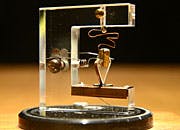
You are surrounded by products. Most of them, factory-made. Yet there was a time when building things by hand was commonplace, and if something stopped working, well, you jumped into the garage and fixed it, rather than tossing it into the circular file. Participants at the Maker Faire are bringing back the age of tinkering, one soldering iron and circuit board at a time. Meet the 12-year old who built a robot to solve his Rubik’s Cube, and learn how to print shoes at home. Yes, “print.” Plus, the woman who started Science Hack Day … the creation of a beard-slash-cosmic-ray detector … the history of the transistor … and new materials that come with nervous systems: get ready for self-healing concrete. (Photo is a model of the first transistor built in 1947 at the Bell Telephone Labs in New Jersey that led to a Nobel Prize. Today’s computers contain many million transistors … but they’re a lot smaller than this one, which is about the size of a quarter. Credit: Seth Shostak.) Guests: Lucy Beard – Founder of Feetz Mark Miodownik – Materials scientist, director of the Institute of Making, University College, London, and author of Stuff Matters: Exploring the Marvelous Materials That Shape Our Man-Made World Steve Nelson – Team K.I.S.S. Robotics, maker of Beer2D2 Dan Lankford – Managing director, Wavepoint Ventures Ariel Waldman – Founder, Spacehack.org, global instigator of Science Hack Day Saurabh Narain – 12 year-old participant in Maker Faire Descripción en español Learn more about your ad choices. Visit megaphone.fm/adchoices

A New Hope for Life In Space
Alien life. A flurry of recent discoveries has shifted the odds of finding it. Scientists use the Kepler telescope to spot a planet the same size and temperature as Earth … and announce that there could be tens of billions of similar worlds, just in our galaxy! Plus, new gravity data suggests a mammoth reservoir of water beneath the icy skin of Saturn’s moon Enceladus … and engineers are already in a race to design drills that can access the subsurface ocean of another moon, Jupiter’s Europa. Meanwhile, Congress holds hearings to assess the value of looking for life in space. Seth Shostak goes to Washington to testify. Hear what he said and whether the exciting discoveries in astrobiology have stimulated equal enthusiasm among those who hold the purse strings. Guests: Elisa Quintana – Research scientist at the SETI Institute and NASA Ames Research Center Christopher McKay – Planetary scientist, NASA Ames Research Center Victoria Siegel – Autonomous systems engineer for Stone Aerospace Inc. Cynthia Phillips – Planetary geologist, SETI Institute Descripción en español Learn more about your ad choices. Visit megaphone.fm/adchoices
We Can Rebuild It
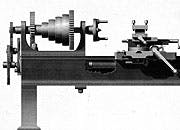
What goes up must come down. But it’s human nature to want to put things back together again. It can even be a matter of survival in the wake of some natural or manmade disasters. First, a portrait of disaster: the eruption of Tambora in 1815 is the biggest volcanic explosion in 5,000 years. It changed the course of history, although few people have heard of it. Then, stories of reconstruction: assembling, disassembling, moving and reassembling one of the nation’s largest T. Rex skeletons, and what we learn about dinos in the process. Also, the reanimation of Gorongosa National Park in Africa, after years of civil war destroyed nearly all the wildlife. And a handbook for rebuilding civilization itself from scratch. Guests: Gillen D’Arcy Wood – Professor of English, University of Illinois, author of Tambora: The Eruption That Changed the World Patrick Leiggi – Museum of the Rockies, Bozeman, Montana Matt Carrano – Curator of dinosauria, National Museum of Natural History, Smithsonian Institution Greg Carr – Entrepreneur and philanthropist, president of Gorongosa National Park, in Mozambique Lewis Dartnell – Astrobiologist, University of Leicester, author of The Knowledge: How to Rebuild Our World from Scratch Descripción en español Learn more about your ad choices. Visit megaphone.fm/adchoices

Our Tasteless Show
Imagine biting into a rich chocolate donut and not tasting it. That’s what happened to one woman when she lost her sense of smell. Discover what scientists have learned about how the brain experiences flavor, and the evolutionary intertwining of odor and taste. Plus a chef who tricks tongues into tasting something they’re not. It’s chemical camouflage that can make crabgrass taste like basil and turn bitter crops into delicious dishes – something that could improve nutrition world-wide. Meanwhile, are we a tasty treat for aliens? Discover whether we might be attractive snacks for E.T. And, out-of-this-world recipes from a “gAstronomy” cookbook! Guests: Bonnie Blodgett – Author of Remembering Smell: A Memoir of Losing—and Discovering—the Primal Sense Gordon Shepherd – Neurobiologist, Yale University School of Medicine, author of Neurogastronomy: How the Brain Creates Flavor and Why It Matters Homaro Cantu – Chef and owner of restaurants Moto and iNG in Chicago, chairman and founder of Cantu Designs Firm Niki Parenteau – Astrobiologist, SETI Institute Markus Hotakainen – Astronomer, chef, author of gAstronomical Cookbook Descripción en español First released March 11, 2013 Learn more about your ad choices. Visit megaphone.fm/adchoices

That's Containment!
We all crave power: to run laptops, charge cell phones, and play Angry Birds. But if generating energy is easy, storing it is not. Remember when your computer conked out during that cross-country flight? Why can’t someone build a better battery? Discover why battery design is stuck in the 1800s, and why updating it is key to future green transportation (not to mention more juice for your smartphone). Also, how to build a new type of solar cell that can turn sunlight directly into fuel at the pump. Plus, force fields, fat cells and other storage systems. And: Shock lobster! Energy from crustaceans? Guests: Dan Lankford – Former CEO of three battery technology companies, and a managing director at Wavepoint Ventures Jackie Stephens – Biochemist at Louisiana State University Kevin MacVittie – Graduate student of chemistry, Clarkson University, New York Nate Lewis – Chemist, California Institute of Technology Alex Filippenko – Astronomer, University of California, Berkeley Peter Williams – Physicist, San Francisco Bay Area Descripción en español First released February 4, 2103. Learn more about your ad choices. Visit megaphone.fm/adchoices
Since Sliced Bread
Happy Birthday, World Wide Web! The 25-year-old Web, along with the Internet and the personal computer, are among mankind’s greatest inventions. But back then, who knew? A techno-writer reminisces about the early days of the WWW and says he didn’t think it would ever catch on. Also, meet an inventor who claims his innovation will leave your laptop in the dust. Has quantum computing finally arrived? Plus, why these inventions are not as transformative as other creative biggies of history: The plow. The printing press. And… the knot? And, why scientific discoveries may beat out technology as the most revolutionary developments of all. A new result about the Big Bang may prove as important as germ theory and the double helix. Guests: Kevin Kelly – Senior maverick, Wired, author of What Technology Wants Eric Ladizinsky – Physicist, co-founder and the chief scientist of D-Wave Systems Palo Alto, California Aaron Gardner – Bakery manager, Hy-Vee Store, Chillicothe, Missouri George Dyson – Historian of technology, author of Turing’s Cathedral: The Origins of the Digital Universe and Darwin Among The Machines: The Evolution Of Global Intelligence Rob Shostak – Brother and founder of Vocera Communications, San Jose, California Jamie Bock – Physicist at the California Institute of Technology Descripción en español Learn more about your ad choices. Visit megaphone.fm/adchoices

Do the Math
One plus one is two. But what’s the square root of 64, divided by 6 over 12?* Wait, don’t run for the hills! Math isn’t scary. It helps us describe and design our world, and can be easier to grasp than the straight edge of a protractor. Discover how to walk through the city and number-crunch simultaneously using easy tips for estimating the number of bricks in a building or squirrels in the park. Plus, why our brains are wired for finger-counting … whether aliens would have calculators … and history’s most famous mathematical equations (after e=mc2). *The answer is 16 Guests: Ian Stewart – Emeritus professor of Mathematics, University of Warwick, U.K., author of In Pursuit of the Unknown: 17 Equations That Changed the World Michael Anderson – Psychologist and neuroscientist, Franklin & Marshall College, Lancaster, PA Keith Devlin – Mathematician and Director of the Human Sciences and Technology Advanced Research Institute, Stanford University John Adam – Mathematician, Old Dominion University, Norfolk, VA, and author of X and the City: Modeling Aspects of Urban Life Descripción en español Learn more about your ad choices. Visit megaphone.fm/adchoices

We Heart Robots
The machines are coming! Meet the prototypes of your future robot buddies and discover how you may come to love a hunk of hardware. From telerobots that are your mechanical avatars … to automated systems for the disabled … and artificial hands that can diffuse bombs. Plus, the ethics of advanced robotics: should life-or-death decisions be automated? And, a biologist uses robo-fish to understand evolution. Guests: Illah Nourbakhsh – Professor of robotics, Carnegie Mellon University, author of Robot Futures. Check out his Robot Futures blog. Marco Mascorro – Vice President of Hardware, 9th Sense Robotics, Mountain View, California Curt Salisbury – Mechanical engineer, senior member, technical staff, Sandia National Laboratories Joe Karnicky – Retired engineer, Menlo Park, California. Videos of his gadgetry can be found at the bottom of this page. John Long – Professor of biology and cognitive science at Vassar College and the author of Darwin’s Devices: What Evolving Robots Can Teach Us About the History of Life and the Future of Technology Descripción en español First released January 21, 2013 Learn more about your ad choices. Visit megaphone.fm/adchoices

Before the Big Bang
It’s one of the biggest questions you can ask: has the universe existed forever? The Big Bang is supposedly the moment it all began. But now scientists wonder if there isn’t an earlier chapter to our origin story. And maybe chapters before that! What happened before the Big Bang? It’s the ultimate prequel. Plus – the Big Bang as scientific story: nail biter or snoozer? Guests: Roger Penrose – Cosmologist, Oxford University Sean Carroll – Theoretical physicist, Caltech, author of The Particle at the End of the Universe: How the Hunt for the Higgs Boson Leads Us to the Edge of a New World Simon Steel – Astronomer, Tufts University Andrei Linde – Physicist, Stanford University Jonathan Gottschall – Writer, author of The Storytelling Animal: How Stories Make Us Human Marcus Chown – Science writer and cosmology consultant for New Scientist magazine Descripción en español First released December 17, 2012 Learn more about your ad choices. Visit megaphone.fm/adchoices