
Better PR Now with Mark Phillips
22 episodes

021 - Fred Wellman - Hardest working man in PR
Fred Wellman is the founder of ScoutComms, a niche agency in Fredericksburg, Virginia. He specializes in public relations and marketing efforts in support of corporations and nonprofits focused on veteran and military family support, as well as veteran-owned and focused businesses. In this episode, he explains why he started his own PR agency that focuses n service and why running a B Corp (a mission-driven benefit corporation) can create a competitive edge in attracting top quality clients and employees. He also explains the importance of serving pro bono clients and why we should hire against our weaknesses. As the hardest working man in public relations, Fred Wellman is the James Brown of PR. As the hardest working man in public relations, Fred Wellman is the James Brown of PR. A graduate of West Point and the Harvard Kennedy School of Government, he ran for mayor in Georgia, served as an Army Scout and Blackhawk helicopter pilot in Iraq, worked for Generals David Petraeus and Martin Dempsey (later Chairman of the Joint Chiefs of Staff). General Petraeus selected him to become an Army public affairs officer. Fred started his own agency at the bottom of the last recession. He found a niche that focuses on veterans' issues. His business, ScoutComms, is based on one simple idea: There are very few veterans in the agency world, so ScoutComms would serve as the expert in that niche for larger PR agencies initially and, eventually, for corporate clients directly. There is a bias against hiring senior practitioners who have not previously worked in agencies. This seems to be based on the assumption that it's difficult or impossible to learn how to manage client relationships and develop new business. This bias precludes hiring talented communication professionals with deep experience, rich insight, and a robust network in a particular sector. It is important to integrate all communications (PR, marketing, internal, executive, digital, etc.) across an organization. Know your clients. Bring on experts who know the client's business, culture, sensitivities, language, and how they communicate. It's important to know how your organization is different. What is your competitive advantage or secret sauce? Forming a B Corp can cost more money, but also can be a good fit if your business is founded on more than making money. Much of ScoutComms' business is in corporate social responsibility, so having an organizational framework that reinforces that social good creates a strategic, competitive advantage. The B Corp certification process can serve as a coaching tool. Fred refers to his former employees as "graduates" and he is very proud of what they have gone on to do. One runs a USO center in North Carolina, one is running an environmental organization in northern Virginia, and one works for Dr. Jill Biden.
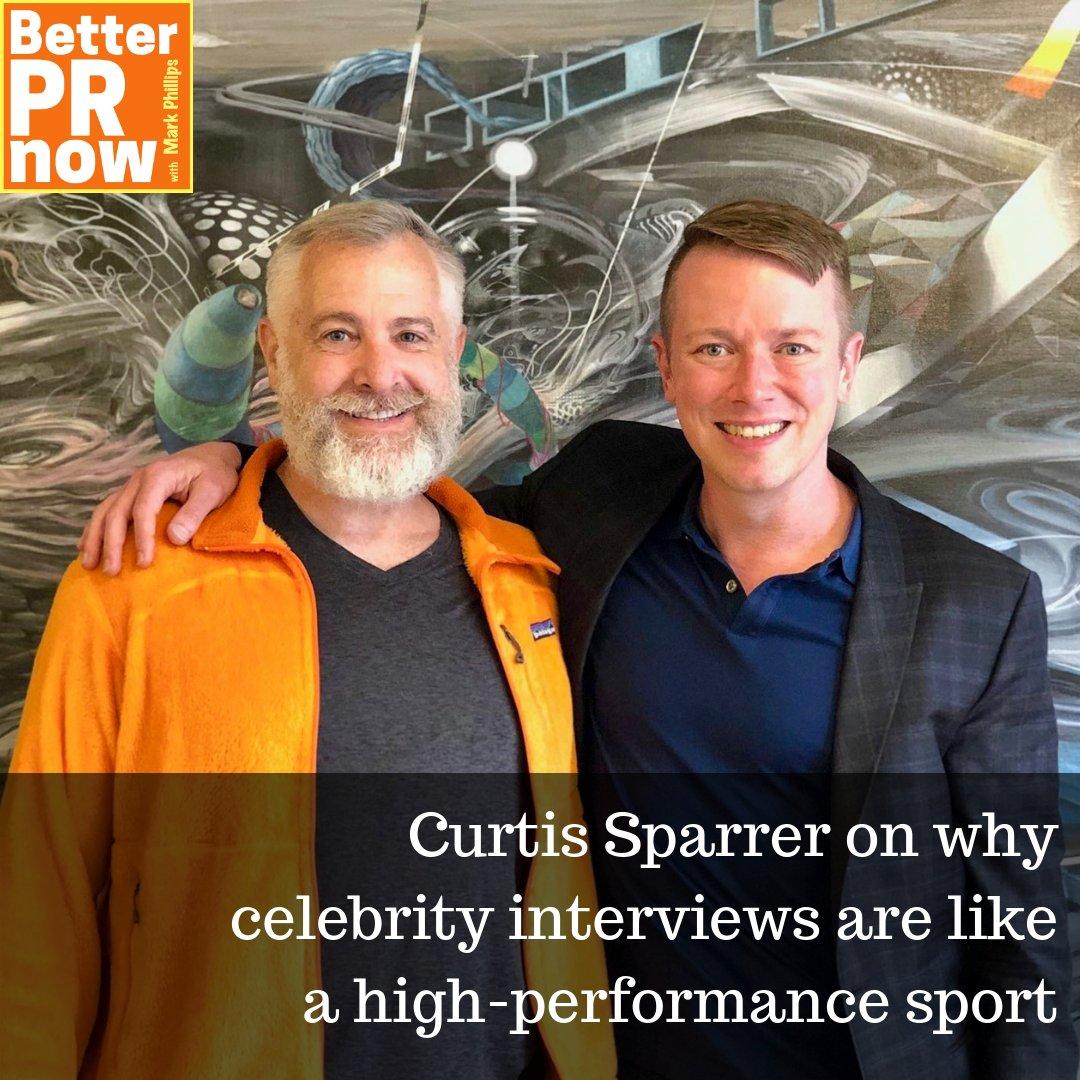
020 - Curtis Sparrer on why celebrity interviews are like a high-performance sport
Curtis Sparrer, principal at Bospar PR in San Francisco, shares terrific insights on why celebrity interviews are like a high-performance sport. He also explains how to set up really successful media engagements, tips on working with celebrities (he's done award-winning work with George Takei of Star Trek fame), and how to grow trust-based relationships with clients. Working with a celebrity or CEO on successful media engagements: Consider what they can and can't talk about; do a deep dive with them and their management team about those issues before any media interviews. Before an interview, clarify with the journalist what questions will be asked; ask for a written Q&A beforehand; be clear about ground rules; let them know what you want to focus on. Be clear about anything you'd like the journalist to include in the story. Send a follow-up note with thanks and a reminder of the key point(s) you'd like to have included in the story. If your key message isn't included in the final version of the story, contact the journalist to politely ask that the message be included in that or a future story. Crafting the message: First, ask celebrities what they are planning to say. Repeat the message: Working it into every interview in several ways helps ensure that key messages are included in the final article. Use pep talks with spokespeople to help keep them on message and excited to keep delivering the messages. Why celebrity interviews are like a high-performance sport: For media tours, consider how many engagements is enough versus what is too many. For a celebrity, after about five interviews, you often have diminishing returns as they get tired. Manage the message and the energy in interviews: For longer interviews or media tours, include refreshments to get their sugar levels/energy up so they can perform. Avoid including dairy products to keep the voice clear. Include long energy foods that won't lead to a sugar crash; fruits like bananas are great. Check with the talent's management or agent to information on what they prefer. Media training: Use recorded media simulations to prepare senior leaders or other spokespeople for their on-camera interviews. Give criticism in private to help them learn and develop their skills without needing to save face in front of their staff. Arrive early to media interviews to give them a chance to get a feel for how the show is flowing. Ask production assistants if they have a copy of the script, because it might have a copy of the questions. Make sure your clients read the news on the day of their interview and give them a run-down on that day's news in their sector, because they could be asked their opinion on breaking news. This keeps them from being caught off guard. Newsjacking: Pay attention to the news for opportunities to give your perspective on breaking stories. Local news producers are always looking to localize (find the local angle) national or international stories to make them relevant to their local audience. When a story breaks, journalists are trying to figure out what will happen in the future, what people can expect in the next X days. To get coverage that matters to your client's business, have the CEO give a three-sentence statement, including what this news event means, what people can expect in the future, and why we are an expert to talk about this. The importance of speed when responding to media: Don't perfect a statement to death; perfect is the enemy of the good. A good-enough statement on time is far more valuable than a perfect statement that is too late. Personal branding and networking for PR professionals: Share with your boss what your professional priorities are; helps build your reputation with your coworkers and leadership. On LinkedIn, talk about your core values and why they are important to you; make sure you also live those core values. Don't depend on building your brand on only one social platform; cross-pollinate content across your social platforms; show your personal side. Brand consistency in developing your personal brand is important, with some exceptions: Authenticity that is not self-promotional (such as sharing photos from your birthday or other important personal event). The biggest turnoff with LinkedIn is that it can be an echo chamber of bragging, so break that up with something other than how great you are professionally. Be willing to talk about your mistakes and the lessons you learned. Failure is the best teacher and we can learn from it. Fail fast, learn from your mistakes, and tell the story as you go. Be willing to be vulnerable; it makes you human. This isn't appropriate for all CEOs, so it's important to know your client and what will work for them. Media tours are a great way to bond with your CEO (or other client), because you'll spend hours with them in the process. This presents opportunities to get to know them better and to identify other PR opportunities for them. Make it a point to attend awards ceremo
019 - Josh Elledge generated $6 Million in free publicity!
Josh Elledge built and runs two very successful businesses: Savings Angel and Up My Influence. He generated more than $6 million dollars in publicity, essentially for free. Josh shares with us how he did it and he lays out the steps we can take right now to build our authority and promote our own businesses in the same way.
018 - Authority Marketing: Michael Greenberg's secret sauce for positioning brands
Authority Marketing is Michael Greenberg's secret sauce for positioning people and brands. It is the act of positioning someone as an expert in order to bring in more business. As founder and chief strategist at Call for Content, Michael shares his uniquely powerful method of building authority through content and leveraging that for B2B marketing. He also provides a free link to download his Authority Marketing Playbook. Michael's word of wisdom: "Start creating content; just do it."
Ep 17017 - Kill the PR Girl: Amy Sutton shares why diversity is key to powerful Public Relations
Amy Sutton, founder of Enjoy PR, takes us on her journey from law to PR. She shares why diversity is key to powerful Public Relations. We also explore the importance of relationships in PR and communications, and how to set expectations in client-agency relationships. Amy recently published an article on LinkedIn titled "Kill the PR Girl," in which she challenges the stereotype of "the PR Girl" and why that stereotype hurts both public relations professionals and their agencies, in part because of the reinforcement of glass ceilings. We explore the importance of diversity in public relations planning, specifically how diverse perspectives drive creativity and effective problem-solving.
Ep 16016 - Jake Eisenberg turbocharges lead generation via social media
I'm joined by Jake Eisenberg, president of Reach Digital Group. Jake shares his approach to local marketing and explains how he uses social media to boost lead generation and acquire solid leads. His company specializes in helping local businesses, but his approach works for national brands as well. Q: Jake, you're president of the Reach Digital Group. How did you get into this business and why did you choose to start your own agency? Originally, I got started with a mixed martial arts blog that I had in 2009, before MMA really took off. This website was gaining a lot of traffic, and I was generating money through ad revenue, and I saw how to bring new traffic in. I started getting familiar with search engine optimization and started thinking to myself, "What are other ways that I can bring this up?" As I was going through school, and working, and all these other things, I started working on other projects and I stumbled across doing some e-commerce websites, and I got familiar with doing Google AdWords. That lead to search engine optimization, Google AdWords, Facebook Ads, and running social media calendars. I was having great success with these strategies that I was working on and building through time. Some friends or family members started to approach me and say, "Can you give me a website for my business? We liked what you were doing; let's kind of see what you can do for us." These strategies were working at a local level and at the national level. Actually, it's easier at a local level, because there's not as much competition. So, I started having success with that and it quickly turned into family members who had businesses, became my testimonials, or my case studies. I was able to then get new business through referral. That's how I got started with it: I tapped my own network, did the work well, and was able to use that to leverage new business. Q: What are some of the biggest changes that you've seen since you started that MMA blog in 2009? Technology changes at warp-speed, so in the online marketing space, what have you experienced in terms of changes? A lot of the changes I've seen are from the platforms growing. Search engine optimization used to be something where you could just do what they call "keyword stuffing." If you wanted to rank for a certain keyword, you could just put a bunch of that same keyword on a page and you would rank. That's changed, because now there are so many more websites out there. So everyone's doing that, and now you've got to find new techniques, and new ways to do it. The same thing with Google AdWords. The pay-per-clicks have gone up a lot, because more people are using those channels. Facebook advertising is still relatively new and it's just gotten even more acknowledgment in the media world, because of everything that's just happened. So, we can still kind of consider the Internet to be new. There are a lot of unknown territories and directions that we can go. We're all learning and it's constantly changing and evolving. There's just so much more competition that you've got to come up with new strategies, and the platforms have become a lot more advanced. Q: I'd like to explore that a little bit more. For your peers, what should they be focusing on, in terms of skills they need to be honing or new platforms that they need to be becoming more adept at using? With how the marketing world is changing, it's a content-first world. You've got to build this customer loyalty. If you're selling a service or a product, you want to provide the information to the potential customer, what it is that you have that leads to it. You can put content out there in the form of video or blog posting, and be able to share that. The two top converting platforms right now are still Facebook and Instagram. If you're able to meet your customers at least on those two channels, as well as having a blog to explain what your business is, because that will help bring in keywords and maybe some backlinking to boost it; start with those. You don't need to be on every single channel. You just want to be able to meet them on at least the two biggest channels. I recommend tapping those three sources and provide information about yourself and your service. Q: There are many platforms, and it seems like new ones popping up every day. Obviously, it's better to go where your audience is and Facebook and Instagram are where they are. It seems like a lot of people feel compelled to be on as many platforms as they possibly can, almost like the shiny object syndrome, "There's this new thing; I have to do it." What is your advice for people who feel like they're getting spread too thin? Realistically, it's because they are getting spread too thin when you're trying to keep up with all the new trends. Coming from a business perspective, you look at the analytics and ask, "Where's my engagement coming from? Where am I getting the most clicks, the likes, the shares?" I would focus on those and chop off the
Ep 15015 - Strategic Communication lessons from the Marine Corps
I'd like to share strategic communication and stakeholder engagement lessons from the commandant of the Marine Corps. So to set the stage, in Washington D.C. the Marine Barracks Washington is downtown. If you've ever heard of 8th and I, that's Marine Barracks. It's the oldest post of the Corps. As the oldest post of the Corps, they do something very special every Friday evening during the summer called the evening parade. And according to their website, the parade has become a universal symbol of the professionalism, the discipline, and the Espirit de Corps of the United States Marines. The story of the ceremony reflects the story of Marines serving throughout the world. Whether aboard ship, in foreign embassies, at recruit depots, or in divisions, or in the many positions and places where Marines project their image, the individual marine continually tells the story of the Marine Corps. So the evening parade, let me paint a picture for you. You pull up and immediately, even though you're on the streets of Washington, D.C. and it's really crowded, lots of traffic. You're immediately met by a group of Marines who are in their full-service dress. The white hat, the blue jacket, the white pants, and they're just exquisite. They've got all their medals and they meet you, they park you, they bring you in, and they're very, very welcoming and professional. I was able to go to a VIP reception that the commandant hosted for about 200 people. He gave remarks and he also introduced the guest of honor, House Majority Leader Kevin McCarthy, and then there were 3 other congressional members who participated that evening, along with about 24 NCAA coaches. And those two groups are really important. There were many other people there that night. And then typically, after the reception which lasts about an hour and a half, out on the parade deck there are bleachers that hold probably 2,000 people, and they give an hour and fifteen-minute performance where they have Chesty XIV, who is the current mascot of Marine Barracks Washington. He's an English bulldog, he has all of his uniform and decorations on, all of his medals and awards. The silent drill team which is just absolutely astonishing in their precision and the Marine Band also gives a performance including numbers by John Phillip Sousa, one of the most famous Marine Band leaders. So altogether, it's an evening where you get to experience the Marine Corps on parade, but you also get to engage with both enlisted and officer marines. So during the reception, we had both officers and really junior enlisted marines come up and ask us how we were doing, welcomed us to the Barracks, talked about their role in the Marine Corps. They are very much steeped in their tradition in history and it gives you a very personal welcome and really heartwarming experience, being part of that whole evening. After the performance, the members of the VIP reception were able to take photos with the Commandant and his wife, with the drill team, with the mascot, and with some of the bandsmen. It's a really wonderful evening and lasts a couple hours. So here's some strategic communication lessons. For the purpose of this exercise, I'm talking about strategic communication in terms of the stakeholder engagement that affects your organization's ability to survive and thrive. I'm not talking about media relations, I'm not talking about broad public engagement. I'm talking about focusing on those stakeholders who have some kind of really important effect on your organization and its ability to exist and continue to operate. So the lens I would like to share with you, that we'll look at this through, is, and if you're a marketer, you're familiar with AIDA, A-I-D-A, which is an acronym that stands for Attention, Interest, Desire, and Action. So if you think about this being a funnel, at the very widest, open part of the funnel is attention. You have to get somebody's attention. Once you've got their attention, you have to create interest in what it is you're doing, your organization has to offer, whether it's a product or a service. Then you have to move them from interest to desire. You want them to, in the case of sales marketing, you want them to buy your product or purchase your service. In the case of the Marine Corps, you probably need to attract recruits, and there are other things that the Corps depends on as well. And finally, once you have that attention leading to interest leading to desire, you want them to take action. So in this case, there are three groups of people who are there participating. You have the Congressional members, you have coaches, and you have members of the public. All three of those are important for the future of the Marine Corps. So for the Congressional members, what does the Marine Corps, like every other government organization, rely on from Congress? One of the main things is funding. So that night we had the House Majority Leader and three other members of Congr
014 - Secrets to Win Tech PR - Curtis Sparrer of Bospar PR Shares Secrets of His Award-Winning Boutique Tech Public Relations Agency
The most important thing with PR is asking your clients what business results they want to achieve. And then reverse engineering a PR program around that. Welcome to another episode of Better PR Now. This episode is sponsored by our official transcription partner, transcribeme.com. If you'd like to see an example of their terrific work, check out the "notes" page on the Better PR Now website. For a 25% discount on their services, go to transcribeme.com/betterprnow. Today, we're fortunate to be joined by Curtis Sparrer, principal at Bospar in San Fransisco. Bospar recently won the PR Week Boutique Agency of the Year award. Congratulations and welcome, Curtis. Thanks. Thanks for having me. So, as we jump in, I'd like to find out about how people got into public relations, how they started their career in communication. You graduated from UT Austin with a degree in Radio, Television, and Film. What's happened between graduation and ending up in San Fransisco as a principal at one of the nation's leading agencies? Well, I think what happened in the short term is I got smart. But the long-term is a much more complicated story. I went to LA, worked for Roger Corman. He's a famous B-movie producer and discovered that I just did not have the patience to pay my dues in Hollywood. When I was going to school at UT Austin, I worked as a video film editor for the local TV stations, and I used that skill to go back into news. And my first job as a producer was in Toledo, Ohio. I cut my teeth as a producer there for about three years rising up the ranks and even moonlighting as a restaurant critic and advice columnist. I then moved to Huston where I worked the overnight show there. And then I got an amazing offer to produce the 9 PM news at [inaudible] in San Fransisco. I worked there. I won a regional Emmy. And I was promoted to the executive producer. And then as I kind of ended my career at [inaudible], I was faced with the choice that I could either move to a different city, or I could change my career trajectory so I could stay with my friends. And I gave it a long thought and determined that it would be best if I took all my skills and applied them somewhere else. I applied at a lot of different PR firms thinking that would be the best use of my skillset. And I was really surprised by the obnoxious response of a lot of people. How so [laughter]? I got some responses like, "Oh, I couldn't possibly qualify to do PR. It was far too complex." "Oh, PR is just so difficult and you would not just understand it." A lot of self-satisfied responses about how complex PR was. And I didn't get a lot of encouragement. I answered a Craigslist ad for a PR position, an internship really, and I met this woman named Kris [Balkie?]. And after Chris and I had a very long conversation, she called me back and said, "I don't want to do an internship. I want to get married. I want to hire you as our senior associate and I want to get things started." And so I started as a senior associate and started learning, very quickly. And I learned that a lot of people in PR were really good at telling clients no. And I decided that my fastest route for survival would be learning how to tell clients yes. And I I treated clients like anyone would treat a television anchor, with the utmost respect, and I learned that really paid off well. I also learned that a lot of times the press release material that clients were trying to get in the media was not useful for any journalist having both been a TV producer and also having been a writer. So before we go any further. Why was it not useful? Was there a pattern there? Yeah. It was. A lot of the content was jargon-heavy. A lot of the content was something that would not fit in any kind of current narrative or current story that journalists were already talking about. It was very tone deaf. A lot of the content was just tone deaf and it was as if a bunch of marketers were thinking I want to have this content run in TechCrunch without really bothering to think well, what is TechCrunch right now? What's important to them? And so my point to all our clients was that we needed to understand what our journalist contacts were working on and then reverse engineer our story so we would better match their priorities. That sounds a lot like in the startup community where people are tempted to-- they have an idea and they say, "This is a really cool thing. Let me go find a market for it." As opposed to looking at the market, seeing where the pain points are where people are having challenges, and then coming up with a solution for those challenges. Absolutely. Just because I have a story I want to tell in a certain way doesn't mean that anybody is going to be interested in hearing it. That's exactly it. And that's the problem that a lot of companies have and they kind of-- the expression, of course, is drink their own cool-aid but it's kind of a reality distortion field where they seem to think that the news that's imp
013 - Jason Anderson explains why emotional stories hook customers
I have a conversation with Jason Anderson, Senior Director of Marketing and Communications at Capital Impact Partners in Washington, DC. This is the first podcast ever recorded in a Wholefoods Supermarket, and I know it's the first podcast recorded in the Wholefoods Supermarket in Pentagon City, Virginia. The reason we're here today is there's a tap takeover by breweries from Richmond, Virginia, and I'm joined by Jason Anderson, somebody I've known for a long time who is a really fantastic communicator. Jason, welcome to the show. Thank you, Mark. So your current position? I am the Senior Director of Communications and Marketing at Capital Impact Partners. Fantastic. Now you've had a really fascinating career. We'll talk about your education, and then you worked for CNN. So tell me about how you got into communications and what drove you towards a communications career to begin with? Yeah. So I grew up in Southern California, and went to Claremont McKenna College where I actually majored in Government and Literature. I actually had an opportunity to attend USC for a broadcasting degree but decided that I wanted to really get the fundamentals of a hardcore political background. Because really my goal at that time was to get into political journalism. And that ultimately fulfilled itself by joining CNN for about 10 years where I literally started as what they called a video journalist, a VJ, at that time. Making roughly $15,000 a year. Killing it. Killing it. And there we did everything from running the camera to running the teleprompter with paper scripts. Which is something in this day of digital age if you think about it. And even robotic cameras, which we didn't have back then. But there I saw a number of fascinating things, really cut my teeth on what journalism was. Learned how to edit videotape, learned how to produce a segment and did a whole number of things with them, but ultimately decided after a number of events, ultimately concluding with the Monica Lewinsky episode in Washington DC, that I decided it was time for me to move on and pursue some of my more personal goals along with journalism. Which was at that point thinking about the environment. That's wonderful. And so after a decade or so at CNN where you focused on political and other reporting, you moved over to the non-profit world. Tell me about that transition. Yeah. So I saw an opportunity at an organization called Conservation International, which does international, non-profit environmental work in communities all across the world, and the opportunity was to take my journalism skills and apply them to public relations. How do we take the things that we do as an environmental non-profit and translate them into actually what news is, and serious news not just marketing, and talk to reporters about covering that news? So I did that actually for a division of Conservation International which was called the Center for Environmental Leadership in Business, and it was really thinking about, how do we work with corporations to reduce their environmental footprint, to contribute to the things that we were doing at Conservation International and translate that all into good. You know ultimately, the public relations part in a sense was marketing, in a sense was how do we drive fundraising, how do we drive other corporations to do good things? How do we put pressure on the organizations that we're working with to do more good things? But ultimately, it was a really fascinating experience. And then after Conservation International, you stayed in the non-profit world? I did. At that point after 10 years of working at the global sphere and working with Fortune 500 companies like McDonald's, like Starbucks, like Walmart to change their footprint and actually do some interesting marketing things with them. I really wanted to focus more in on local communities. And I found a small organization doing really fascinating things called Rare. And they would actually run marketing campaigns in local communities and these are hyper-local communities. Places you've never heard about or can't even find on the map in Indonesia, in Africa, throughout Asia. And what they would do is, they had the ability to take over the radio, take over the newspaper, create mascots around essential message because you have that hyper-local opportunity to not talk about a product, but to talk about environmental conservation. And perhaps it's water, perhaps it's a species, perhaps it's pollution. And you get folks really thinking about ways they can change their practices locally and using mass-media to do that. It was fascinating to watch how that would happen. Now again my job wasn't to do that work. We had specialists with a whole theory of change and the use of psychology, but my job was to get people interested in what we were doing. So again ... Were they trying to change behavior? Behaviour change, exactly. That was at the core of it, which you can do in a place like that
012 - Roll up your sleeves and get in the trenches - Megan Driscoll of EvolveMKD
Founder and CEO of EvolveMKD As a business owner, she likes controlling her destiny, who to work with, who to hire, how to invest in the business, and whether to expand. How she fell into a career in public relations, intern boss suggested it. Loves how dynamic working in PR is and how you get to "peek into" and get a behind-the- scenes view of other industries and companies. Likes: You have to continue to learn and grow. You will always be challenged. As technology changes and, how we consume news and media also change, you have to adapt. The importance of balancing the needs of your organization, your clients, and the media. Advice: Early in your career, recommend people get well-rounded, diverse experience, rather than immediately get pigeon-holed (e.g., digital, media, writing press releases, handling budget, developing strategy, etc.). Courses recommended: Take writing classes (e.g., business writing), "If your best-foot- forward includes typos, that's not good enough." Accounting (get comfortable with numbers), financials, "You have to have an understanding and appreciation for math." Frustrations in the PR field: Lack of education among potential clients, who don't know what PR is now (it's changed: digital), working with clients to broaden their understanding of what PR encompasses; PR can be used for evil as well as good (current politics); Strong PR people are a voice of reason. The importance of reputation management: "Our job as communications professionals is to gently remind business leaders that you can say whatever you want, but if you don't have the proof to back it up, you shouldn't be saying it." Our job as communication specialists is to ensure the business folks have thought through what they want to say and how they should act. "Good PR people want their company or client to speak the truth; that's an important part of the job." Some clients can be short-sighted. "The energy you put out there, the words you put out there, the actions you put out there carry weight and have business implications." How she advises business leaders: You can't just talk the talk, you have to walk the walk. Think about what is behind a clever or fun campaign; what will you need to do to reinforce the campaign's message. Education about how media relations and social work together. What do your leadership teams look like? Do they reflect the consumers you're trying to reach? "If you don't interact with the people you're trying to sell to, how can you have an effective strategy?" Genius PR move: Alyssa Milano's support for the #MeToo movement on social media to drive real, meaningful discussion. Dumbest thing you've seen in PR: United Airlines' handling of removal of a passenger from a plane and the communications follow-up. How they could have better handled it. When a company gets it wrong, but handles the aftermath well: Alaska Airlines' prompt, on-target handling of Randi Zuckerberg's complaint about sexual harassment by a fellow passenger. They took immediate accountability, were public about it, and resolved the issue in a classy way. Just because you make a mistake, doesn't mean you're doomed, but you do have to own the problem and proactively solve it. This keeps a mistake from turning into a huge scandal. Most PR crises start as operational issues that are mishandled. What does the future hold for PR and marketing? PR and social media are so intertwined that they will require integrated communication strategies. Communications must be integral in order to truly have a positive reputation. Must-have tools: Cell phone, laptop, Cision, access to social media platforms (Twitter is a great resource for understanding what stories reporters are working on and for following the news, as well as what competitors are doing), Mophie battery packs to keep mobile devices charged. Social media for research: Twitter, private groups on Facebook to stay engaged with other communications professionals and journalists, as well as Instagram. Helping clients avoid the shiny object syndrome: Everyone wants to be on Snapchat, but just because it's new doesn't mean it will fit. Unless you're trying to reach teens and those in their early 20s, it's probably not right for you. Snapchat is not the tool to sell anti-aging products. Facebook might not be cool anymore, but it might be right depending on who you're trying to reach and to what effect. "Having great media relationships isn't enough to be a great PR person, you also need to understand the consumer your client is trying to reach." That will identify the appropriate media and engagement activities. Current projects: Had a client (Lia Diagnostics) who won TechCrunch's Startup Battlefield at Disrupt 2017 in Berlin with the first major update of the pregnancy test since it was created in the 70's. Also working with Merz USA, another client, on a partnership with Christie Brinkley. Words of wisdom to new college grads: "Be ready to work." "Roll up your sleeves and get in t
011 - Why PR and Marketing might become synonymous - Doreen Clark of SmartBug Media
Doreen Clark, Director of Public Relations at SmartBug Media, shares some of her secrets to generating great press coverage, coaching executives to communicate more effectively, and the intertwining of PR and Marketing. Media relations: According to Doreen, public relations is a powerful tool and that we should, "Communicate in a way that is not just beneficial for us, but also for the people we're reaching out to." This forms a trifecta of solid media relations that comes together when we understand and communicate: What our audience needs to learn, The information reporters need to know to cover the story, and What we want to deliver for our company or client. She notes that, for media relations professionals, it's easy to deliver the facts that journalists need. But journalists also need us to offer an opinion, because that helps them craft stories with perspective and emotion. Media training: Doreen has trained a lot of senior executives to be better spokespeople for their organizations. When she provides media training for senior executives, some of the key lessons include: Coaching leaders on speaking to the common person, by using language they can understand. Executives are used to speaking with other experts in their industry; they frequently use jargon and technical language that the man on the street might not understand. Shifting their focus to be able to communicate with those who are not experts in their industry takes work, but helps them be much better communicators. Helping executives learn to speak in soundbites during interviews. Long-winded, detailed explanations allow the speaker to be precise, but they run the risk of losing control of the messages that will come through in the final news report. Making the information digestible by giving clear, but concise quotes, helps ensure their most important messages are included in the story. Everyone is a spokesperson: In an age of social media and 24-hour news cycles, everyone connected to an organization essentially is a spokesperson. Having a strategic plan, in which everybody knows their role and what they are expected to do, is key to success in public relations. Doreen also recommends that we identify the subject matter experts in our organization, train them to be effective spokespeople, and that will lead to more opportunities to engage the media. It's important for communication in an organization to be "by all, for all" and not just downward from managers. Working with freelance writers: When asked what she is most excited about, Doreen said that working with freelance writers has become a secret weapon. Her force-multiplier tip is to build relationships with freelance writers. It's common for them to write for many different media outlets, both online and off. These relationships can help us get more coverage, if they are willing to share the work they do for us with their contacts in these outlets. Merging PR and marketing: Looking into the future, Doreen expects that "Public relations and marketing will become even more intertwined and might become synonymous." She sees a blurring of the lines already, with paid advertising taking the form of earned editorial coverage. She sees a future in which PR will have more pay-to-play coverage, as advertising does now. While such changes could present signification challenges for those currently working in both PR and marketing, it could have certain beneficial effects, as it will drive improvements on both sides. For example, she notes that, "PR measurement tools are getting better and will eventually be on par with marketing measurement." " Doreen also sees a future in which podcasts and videos that are engaging, but brief, will become more important. After all, journalists need things to write about and to share as examples within their articles. Lesson learned: When asked what she knows now that would have been good to know when starting her career, Doreen said, "You don't have to be everything to everyone; hone your craft; it's okay to specialize." Quotable quotes: "If you really pay attention, you can become an expert in anything." "Relationships are everything." "Stay up to date on your craft; you have to always be a learner." "PR is necessary, 100%." "PR is about elevating reputation and building credibility."
010 - Great story seeks teller as OnePitch plays matchmaker
Jered Martin discusses OnePitch, which he co-founded with Rebecca "Beck" Bamberger in San Diego. OnePitch serves as a matchmaker to help journalists and publicists find each other with the right story idea at the right time. Think of it as eHarmony meets Bumble, but for communication professionals. OnePitch screens out the vast majority of pitches that are not a good fit for a particular journalist, and delivers only those story ideas that are closely matched with the journalist's interests. The journalist can browse pitches anonymously and connect with a publicist when they see a story idea that interests them. According to Jered, "We're offering a platform that's relevant, but not invasive." Jered described the value proposition that OnePitch offers journalists in that the use a categorization process to tailor pitches to journalist's needs. "You are going to receive at least one email a day that is going to have only the most relevant things you want to write about." He noted that, "The beauty of OnePitch is that, as a journalist, you can expect to only receive the most relevant inquiries." For publicists, OnePitch helps them connect with the journalists who are most interested in their story. Say goodbye to the "spray and pray" approach of blindly sending releases and pitches to every journalist in the hope that one will be interested. Jered noted that, "We care if their story gets coverage. In discussing the rise of chat bots in a wide range of customer-facing businesses, Jered noted the unique value of engaging a human being. "One thing we pride ourselves on at OnePitch is the high level of customer service and personalization." He pointed out that, "It's really important to understand how folks communicate and why they communicate." Prior to co-founding OnePitch, Jered earned a BA in Communication Studies with a minor in Marketing from Cal State Long Beach. He gravitated to a career in communications out of a deep desire to help people. He entered the public relations and marketing world through work with BITE San Diego, which he described as "A walking food tour with history." He started as an intern and worked his way up to eventually being the head of operations for BITE San Diego, as well as working for Beck at BAM Communications. In discussing how the OnePitch and BAM Communications teams maintain high performance, he noted the importance of senior leaders taking the time to mentor their employees, having regular face-to-face communication, and having an internal messaging tool, such as Slack. According to Jered, Slack is a great way to easily keep everyone on the same pag As for project management for the OnePitch team, Jered discussed how the team ran into scaleability challenges as the team's work grew. The project management and collaboration solution they settled on is a combination of Hubspot, Trello, and Slack. Jered noted that, "We have to have a solid system to organize and manage everyone, and without Hubspot, I would be pulling my hair out." He also discussed the importance of tools that work well together, noting that "One thing that is great about Trello is that it integrates with Slack." In addition to his work on OnePitch, Jered also is part of Tech Coast Angels, the largest angel capital firm in San Diego. He's working with them on a volunteer analyst program, in which his team conducts due diligence on start-up firms. In addition, he is also working with the Young Leaders of the Americas Initiative, to support their program for entrepreneurial women. This program brings female entrepreneurs from countries throughout the Americas to Southern California to see how business is done in the United States and to provide them with mentoring opportunities.
009 - Harnessing Leadership, Ethics, Intuition and Courage
Public Relations expert Deb Radman discusses the power of harnessing the four horsemen of public relations: Leadership, Ethics, Intuition, and Courage. She explains why she would advise her younger self to shut up and listen, so she could really understand what's being said. She contends that there is great power in taking time to think about something before you formulate an answer. We should then leverage the power of persuasion to engage, motivate, and activate. Because of changes in the media landscape, PR now has "the opportunity to be the primary source of ideas for our companies and our clients as they seek new ways to communicate." To do this, we have to venture way outside the box we've been in for so long, and have the guts and courage to do that. Deb also is in favor of integration across the communication spectrum. She argues that public relations professionals have "to be strong enough to go to clients with recommendations that transcend specific disciplines; we cannot be afraid to recommend integrated campaigns that include advertising, digital, promotion, direct response, and public relations." According to Deb, all of these disciplines are part of PR, because they are all part of trying to persuade an audience to do what you want them to do. In her words, "Paid, earned, shared, and owned media all have to work together." If paid, earned, and owned are not consistent, they will not help people share our message, because it will be fragmented. With this in mind, she argues that social media now is the province of public relations, because it is part of what PR practitioners do in the earned media arena. According to Deb, mentoring adds tremendous value by helping our people develop creativity and that "it's no longer sufficient to be able to write; we must also be creative problem solvers." She describes the PRSA College of Fellows' work with educators to create momentum for mentoring. She also urges junior PR practitioners to "Find teachers and mentors who will teach you what they know and what other people know." While public relations people might be well-trained in communication techniques, they need to be even more capable of understanding what motivates people to engage. Deb stresses the importance of lifelong learning and the value in being exposed to marketers, innovators, researchers, and creatives in the advertising world and beyond. High points in her career have included winning the USO contract, when she won her first Silver Anvil award, presenting the James C. Bowling Executive-In-Residence Lecture at the University of Kentucky, and serving as project lead for the IBM centennial celebration, which included IBM's Watson supercomputer competing on Jeopardy.
008 - You really need a Reputation for Integrity
PR veteran Deb Radman explains the value of non-traditional hires in public relations, the power of intuition, and the necessity of courage. She explains how PR nightmares come from bad decisions. She presented the James C. Bowling Executive-In-Residence Lecture Series in the University of Kentucky's Department of Integrated Strategic Communication. She also draws on lessons from Harold Burson, Richard Edelman, Betsy Plank, CKPR and the USO.
Ep 7007 - Measurement Queen Katie Paine Spills the Beans on Communication Metrics
Interview with "The Measurement Queen" Katie Paine, about the importance of measuring communications and the challenges of linking communication activities to the organization's bottom line. Better PR Now provides clarity so business leaders can communicate strategically, which creates competitive advantages for the business by creating favorable conditions that maximize long-term profits, by growing mutually beneficial relationships with the people you most depend on (employees, customers, suppliers), which creates opportunities (leads, sales, business intelligence) and reduces costs (employees, customers, litigation, regulation). Better PR Now provides communication strategy for executives.
006 - Communication Researchers are Smart, so why can't they Communicate?
Discussion with Boston University's Dustin Supa on sharing research, and the importance of bringing Public Relations research to the forefront. Better PR Now provides clarity so business leaders can communicate strategically, which creates competitive advantages for the business by creating favorable conditions that maximize long-term profits, by growing mutually beneficial relationships with the people you most depend on (employees, customers, suppliers), which creates opportunities (leads, sales, business intelligence) and reduces costs (employees, customers, litigation, regulation). Better PR Now provides communication strategy for executives.
005 - Steal the PR Secrets of These Podcaster Rock Stars
Mark recaps the public relations lessons, insights, tips, and tricks he learned at Podcast Movement 2016. Better PR Now is a podcast created for communicators, whether in public relations, public affairs, media relations, government relations, strategic communication, marketing, or corporate communications. Every episode delivers great insights, tips, and professional advice from some of the smartest, most experienced people in the field. Mark Phillips talks with top practitioners and cutting edge researchers to find best practices as we explore new ways to hone our communication skills. Learn the secrets to success, the tools they use, and lessons learned. Knowledge for communication and public relations professionals.

004 - What's Wrong With PR: Prof. David Dozier & Lou Williams
Interview with Professor David Dozier (San Diego State University) and Lou Williams (Lou Williams Companies) as they identify what's wrong with Public Relations today, along with four corrective steps to take. Better PR Now is a podcast created for communicators, whether in public relations, public affairs, media relations, government relations, strategic communication, marketing, or corporate communications. Every episode delivers great insights, tips, and professional advice from some of the smartest, most experienced people in the field. Mark Phillips talks with top practitioners and cutting edge researchers to find best practices as we explore new ways to hone our communication skills. Learn the secrets to success, the tools they use, and lessons learned.
003 - Prof. Dustin Supa on The Dude Deficit
Professor Dustin Supa of Boston University's College of Communication presents findings from a pilot research project that explored "The Dude Deficit" in undergraduate public relations classrooms. Why are so few young men choosing to major in Public Relations, as opposed to related fields like Marketing and Journalism? Dustin's research points to an explanation and suggests some ways to address this issue. Better PR Now is a podcast created for communicators, whether in public relations, public affairs, media relations, government relations, strategic communication, marketing, or corporate communications. Every episode delivers great insights, tips, and professional advice from some of the smartest, most experienced people in the field. Mark Phillips talks with top professionals and cutting edge researchers to find best practices as we explore new ways to hone our communication skills. Learn the secrets to success, the tools they use, and lessons learned.

002 - Col. Mike Lawhorn on the power of "Why"
Col. Mike Lawhorn (Army public affairs) explains: The importance of asking "why?" How changing the words you use can have powerful results. Three key questions to guide your work. The importance of reading professionally. The importance of being a team player. How you can help the boss articulate the outcomes they are looking for. Why you should ask these 3 questions: What problem are we trying to solve? Why is this a problem we need to solve? What do you think it will look like when we solve this problem? The power of substituting the word 'and' instead of 'but' when disagreeing with somebody. Better PR Now is a podcast created for communicators, whether in public relations, public affairs, media relations, government relations, strategic communication, marketing, or corporate communications. Every episode delivers great insights, tips, and professional advice from some of the smartest, most experienced people in the field. Mark Phillips talks with top practitioners and cutting edge researchers to find best practices as we explore new ways to hone our communication skills. Learn the secrets to success, the tools they use, and lessons learned. If you want to be a more effective, more influential, and more successful professional communicator, join Better PR Now as we improve Public Relations, one conversation at a time.
001 - Dylan Phillips on starting an advertising career
Dylan Phillips discusses the importance of formative research in brand communications, the power of storytelling, how to use specific online resources at just the right time, and the VCU Brandcenter experience. ---- Welcome to Better PR Now, Episode 1. I'm Mark Phillips and today we are talking with my son, Dylan Phillips. Now, before you start thinking this is just going to be one big bag of nepotism, there's a reason I wanted to talk with Dylan, particularly at this time. When this interview was recorded, he had just finished graduate school and was just starting his career. I wanted to explore his experiences as a student and intern, as well as his hopes for a future working in communications. We'll explore the importance of formative research in brand communications, the power of storytelling, and how to use specific online resources at just the right time. I think you'll find this interesting. Let's jump in. Mark: I wanted to save this very first interview for Dylan, because it's a special occasion. He just finished graduate school just a week ago, and I wanted to give him the absolute first interview. So Dylan, you just graduated from the Brandcenter at Virginia Commonwealth University; tell us about that program. Dylan: Well, it's a two-year graduate program for advertising. It's really intense, sort of boot-camp style. There are different tracks that people take, whether you're more art direction, or copywriting, or someone like me who is a strategist. They also have an experience design track, which is essentially creative technology. The program is two years, with lots of presentations and a lot of student work for big brands, small brands, and sometimes live clients. Mark: So why did you pick the Brandcenter? There are a lot of graduate programs in advertising and marketing around the country; why the Brandcenter? Dylan: Well, I was really interested in getting into advertising strategy. There are a lot of options for people who are looking to get into art direction or copywriting, whether it's The Creative Circus or the Miami Ad School, but Brandcenter is the only place that has a full program for strategy. Mark: Tell me a little bit about the strategy track; what does that entail? Dylan: We do things like ethnographies, where we go to people's homes and learn about how they use products. We do things like digital anthropologies. We are professional Googlers, but there are ways to be more affective at that. We make subculture documentaries and really get entrenched in a subculture that we aren't part of to learn as much as we can about those sorts of people. And really, the whole point of the track is to learn how to learn about people, to think strategically, and how that applies to advertising. Mark: So tell me a little bit more about this idea of thinking strategically from a marketing and advertising perspective; what does that mean? Dylan: Well, a lot of it has to do with asking "Why?" So you need to understand what the essence or the soul of a brand or company is. You need to figure that out and if that's already defined for you, then you need to figure out who cares about it and why they care about it. And so, when you can understand both who, on a DNA level, the brand is and who the people are that love it, or could potentially love it, then you can see a bigger picture of what you need to do to make a commercial. But it needs to be based on knowledge that you have that that will connect with audiences you want to connect with. I think that pretty much sums it up. Mark: So that knowledge gives you insight into the connection that the company or its products have with the people that might be consumers of those products or customers of that company? Dylan: Yeah, usually you figure out who the people are that love it, or who the people are that you want to love it, and that way you can not only figure out where you want to talk to them, whether that is on the Internet, television, or channels like newspapers, but also how you talk to them. It can inform, and this is the side that I am more interested in: it can inform the creative decision that goes into the communications. And a lot of advertising is heading towards a lot more content creation that's actually less advertising and more just entertainment that happens to be connected to a brand. So if you can figure out what people love, then you can create things. Content is such a buzzword, but you can create value that can add to their lives, rather than just trying to distract them for a minute to get their attention about a sale or something. Mark: That's interesting. So you've talked about this understanding, this insight and you've talked about being professional Googlers; how do you go about doing that and, in addition to using Google, talk about different ways to use tools like Google. How do you go about doing this research or getting this insight that you are able to help a brand better understand and make those important connect

000 - Creating the Better PR Now podcast
Dr. Gwen Schiada interviews Mark Phillips to explain why he created the Better PR Now podcast. They examine the need for this podcast and how communication professionals will benefit from it. Better PR Now is a podcast created for communicators in public relations, public affairs, media relations, government relations, strategic communication, marketing, and corporate communications. Every episode delivers great insights, tips, and professional advice from some of the smartest, most experienced communication leaders in the field. Mark Phillips talks with top professionals and cutting edge researchers to find best practices as we explore new ways to hone our communication, leadership, and management skills. Learn the secrets to success, the tools they use, and lessons learned. If you want to be a more effective, more influential, and more successful professional communicator, join Better PR Now as we improve Public Relations, one conversation at a time.