Peacocking: The History, Science, & Anthropology
Based Camp | Simone & Malcolm Collins · Based Camp | Simone & Malcolm
Audio is streamed directly from the publisher (api.substack.com) as published in their RSS feed. Play Podcasts does not host this file. Rights-holders can request removal through the copyright & takedown page.
Show Notes
Dive into the fascinating world of “peacocking” with Malcolm and Simone Collins on this episode of Based Camp! From evolutionary biology to modern dating signals, we explore how men and women use costly displays—like flashy cars, makeup, or even leg-lengthening surgery—to attract partners. Discover why choosing a spouse based on looks is a hidden commitment, the history of male fashion from codpieces to high heels, and why both sexes peacock in unique ways today. We break down honest vs. dishonest signaling, why males are becoming more selective in long-term relationships, and real-world examples from seahorses to Genghis Khan. If you’re into red pill insights, cultural trends, or just want to understand the hidden dynamics of attraction, this is a must-watch!
Episode Notes
* Both men and women who choose spouses based on looks are both telling on themselves and implicitly committing to something without realizing it
* Basically, when you’re being choosy about partners, it’s because you implicitly understand (and may be signalling) that you’ll do most of the work and/or take on most of the risk
* To understand why this is the case, we need to look to peacocking and WHY animals (plus humans) do it
* We also need to understand how peacocking has evolved in the face of modernity and how we may need to disregard certain instincts because they were evolved for an old game and these days, many of the rules are TOTALLY different
Why Peacock?
Peacocking is required when the target market is selective (it’s obvious and universal—products only need branding and marketing in competitive markets with choices).
Female peacocking is necessary only when men get sexually selective.
There are three reasons why males get sexually selective:
* Males invest heavily in parental care (time, energy, or risk), so they can only mate with a limited number of females.
* For example, male seahorses, which carry and nourish the eggs in a brood pouch (a form of male pregnancy), are notably choosy about mates.
* Married fathers’ childcare time rose from about 2.6 hours per week in 1965 to about 7.2 hours per week in 2011 and 7.8-8 hours/week in 2020/2021 (with married fathers around 8 hours and college‑educated fathers about 10 hours per week.)
* In case comparison is desired: Married mothers’ time went from about 10.6 hours per week in 1965 to roughly 14.3 hours per week in 2011, and around 13.5–14 hours remains a standard estimate in the 2000s.
* There is large variation in female quality (for example, in fecundity, size, or health), making some females much more valuable mates than others.
* Male seahorses preferentially select larger females, as these tend to produce more or higher-quality eggs, leading to better offspring survival. Males have been observed rejecting smaller or less suitable females by breaking off courtship dances or swimming away, even when the females are receptive. This selectivity stems from the males’ limited brood pouch capacity and the high energy investment in pregnancy, making indiscriminate mating costly
* The St. Andrews experience
* The marriage-and-then-kids bait-and-switch
* In many fish and bird species with biparental care (for example, certain cichlid fishes and shorebirds), males court and mate preferentially with larger or more fecund females and may ignore smaller or otherwise low-quality females.
* Will men eventually look for signals of actual COMMITMENT to larger families?
* Mating itself is costly (risk of predation, energy loss, disease, increased risk from male-on-male competition), so mating “indiscriminately” reduces a male’s total lifetime reproductive success.
* Legal risk
* One major form of “predation” in the modern civilized world
* Financial risk
* A major form of energy loss
* Pair bonding?
* In monogamous mammals like prairie voles, males form strong pair bonds and show selective affiliation and aggression toward intruding conspecifics, effectively refusing to mate with other available females once bonded
* Do men pair bond more???
* I recall in red pill forums men expressing some level of disdain for women who just aen’t really capable of love, which implied that men *were*—so is it that men really feel pair bonded to female partners beyond just mercenary calculations?
* And we discussed women potentially being into male-male romance because of pair bonding
The TL:DR here:
* So long as men have choices and are either made vulnerable by partnering with women or involved in childcare, they’ll be selective.
* BUT: So long as women are also subject to these risks and obligations, they’ll also be choosy
* So both sexes peacock, but in different ways depending on trends and the economy
The History of Peacocking
Neither men nor women stopped peacocking; the means of peacocking for each sex just evolved over time
* When you see restrained male dress, it is typically attributed peacocking through cultural signaling, not through a lack of peacocking
* Globally speaking
* Many Asian and African traditions start from a baseline where both genders can be richly dressed, especially in ritual or elite contexts, rather than a strong male/female distinction in ornament.
* Confucian, samurai, colonial, and capitalist influences all tended over time to align male public dress with restraint and practicality, especially where Western business and bureaucratic models were adopted.
* LOOKING JUST AT EUROPE: Before the 1800s, both men and women who had means to peacock did so in very ornate ways:
* Notable examples of male ornamentation:
* The Renaissance & Tudor England (1500s): Think Henry VIII. Men wore massive “codpieces,” heavy furs, and slashed sleeves to show off expensive under-layers. Leg shape was emphasized with tight hose, and jewelry was a masculine staple.
* Note that this is an extreme emphasis on masculinity
* The Baroque & Rococo Periods (1600s–1700s): This was the peak of male ornamentation. Under Louis XIV of France (the “Sun King”), men wore:
* High heels: Red-soled heels were a symbol of aristocratic status.
* Side note:
* for roughly the first 700 years of their existence, high heels were an exclusively masculine piece of gear.
* They weren’t invented for height or aesthetics, but for warfare.
* The high heel was born in Persia (modern-day Iran). It was a functional tool for the Persian cavalry, who were famous for their skills as horse-mounted archers.
* The Purpose: When a soldier stood up in his stirrups to shoot a bow and arrow, the heel “locked” his foot into place, providing the stability needed to aim a deadly shot while galloping.
* The Symbolism: Because horses were expensive to own and maintain, wearing heeled riding boots became an immediate signal that you were a man of wealth and military prowess.
* In 1599, the Persian Shah sent a diplomatic mission to Europe. The high-heeled boots worn by the Persian soldiers sparked a massive fashion craze among European aristocrats.
* Masculinity & Height: European men adopted the heel to look taller and more “virile.”
* Like pro leg lengthening surgery
* Men still totally do this:
* //
* Impracticality as Status: As the trend moved from the battlefield to the ballroom, heels became higher and thinner. This was intentional: a very high heel made it nearly impossible to walk on cobbles or work in fields, proving you were so rich you didn’t have to do either.
* The Red Heel: King Louis XIV of France took this to the extreme. He famously wore 4-inch heels and decreed that only nobility could wear heels colored with expensive red dye (talons rouges).
* Powdered wigs: The bigger and whiter, the better.
* Silk and Lace: Ruffled “cravats” and waistcoats embroidered with silver and gold thread.
* Why?
* Ornate dress signalled wealth
* Around the 1800s men’s fashion turned toward simplistic
* due to:
* The French Revolution and the need for stealth wealth
* Fashion icons like beau brummel
* Industrial capitalism shifting toward a focus on productivity, competence, and utility
* The rise of the enlightenment, which made it was cooler to be rational and useful rather than decorative
* The democratization of textiles (such that fancy textiles no longer signalled insane wealth)
* This turning point was called Great Male Renunciation by John Carl Flügel in 1930 (referring to the shift that occurred in Western Europe, especially Britain and France, around the end of the 18th century and spread through the 19th century)
* Maybe things are changing now
* Looksmaxxing
* Stealth looksmaxxing
* Height surgery (technically leg lenghening surgery) search queries are up
* In the movie The Materialists, one of the male protagonists (who is already wealthy) gets leg lengthening surgery
* It’s sort of a major plot point:
* Costs $75,000-$250,000
* The global market was valued at $4.1-4.18 billion in 2021-2023, projected to reach $8.3-8.6 billion by 2030-2031 at 8.5-8.7% CAGR,
* Male beauty routines in Asia
* Including not just lifters, but makeup
* The Men’s World / Bronze Age Mindset aesthetic of male body builders
Episode Transcript
Malcolm Collins: [00:00:00] What people really want to learn how to do is dishonest signaling. But what you wanna point out, which I think is interesting, is when
Simone Collins: we’re gonna go through in the history of peacocking, how as soon as dishonest signaling has been figured out by a group, the honest signalers choose a different signal.
Malcolm Collins: So in humans honest signaling, honest peacocking would be buying a sports car, which is hurting you, right? Mm-hmm. It
Simone Collins: hurts you financially. Yeah. Costly. It’s
Malcolm Collins: lowering your overall fitness, even the overall
Simone Collins: fitness
Malcolm Collins: of your family.
Simone Collins: I mean, the money you spent on the Maserati is money that you didn’t spend on food or housing or anything.
Malcolm Collins: the partner who is the gatekeeper is. Unlikely to attempt to peacock. Mm-hmm. Males, when you are out searching for a long-term partner, very rarely peacock. Even if they are familiar with the concept.
In fact, males, yeah.
Simone Collins: Take heed women. Yeah.
Malcolm Collins: When males who have lots of wealth date, specifically for marriage. They [00:01:00] attempt to hide how much wealth they have. Very interesting point. Yeah. Whereas when they date for casual sex, they both peacock and flaunt,
Would you like to know more?
Simone Collins: Hello, Malcolm. I’m so excited to be speaking with you today because both men and women who choose spouses based on looks are both telling on themselves and implicitly committed to something without realizing it. And so we should be really thinking about this and talking about it.
Basically, when you’re being choosy about who you partner with, it’s because you implicitly understand and may actually be signaling to other people that you’re gonna do most of the work and or take on significant risk. And I think that that’s underrated in discussion.
Malcolm Collins: Wait, wait, wait. Hold on. No, you gotta explain this to me in, in simpler terms so we can get the hook out because I wanna understand this concept that you’re talking about,
Simone Collins: figure, let, let’s say you’re king is con, right?
You don’t really care who you are. Surprise, [00:02:00] sexing, you are just doing it because you’re not put at risk by doing that. I guess STDs weren’t very widespread at that point, and you’re not investing in raising the kids.
Malcolm Collins: Didn’t he literally die having sex with someone? I mean, he, he apparently did put himself at risk.
Simone Collins: It’s just like when, when, when certain what sea turtles or something get stuck having sex underwater and they’re like, oh no, wait, was
Malcolm Collins: that Kahan or was that No, that was who was the one who went into Europe? The, he led the Huns.
Simone Collins: Atilla
Malcolm Collins: at, at
Simone Collins: not having sex. Wow. I mean, again, it’s risky, but No, I mean, in general, right.
That’s, that’s not the case. And
Malcolm Collins: yeah, so the direction, ‘cause I had to work this out of her that she plans to go with. This is a really interesting argument she made to me this morning that I hadn’t heard before.
That when you are. Peacocking is one way to think of it, but in women, this would be something like wearing lots of makeup and acting, you know, really prissy and putting on that, that very gendered act, right? [00:03:00] In an attempt to secure a partner. You are signaling to the partner that you are going to expect them to do the majority of the labor within the relationship.
And a lot of people don’t realize that this is the signal that they’re fundamentally signaling and you can be like. This is crazy. This isn’t true at all, but actually if you think about it for a few seconds, I think it’s something that’s intuitive to most people. When I met Simone, I specifically preferred to date women who did not wear makeup.
I actively looked for a partner who didn’t wear makeup and didn’t put a lot of effort into how they appeared to other people
Simone Collins: who didn’t invest heavily in signaling.
Malcolm Collins: Right, because to me that was a signal that they were dedicating more of their daily effort, especially,
Simone Collins: well, they, they’d signal that they were the selective ones, meaning that they knew that any relationship, they [00:04:00] would bring more value than their partner, and therefore they were the discerning.
And that is a really big tell in a relationship with
Malcolm Collins: someone. Someone and I, I wanna divide two categories here just before people misunderstand. Mm-hmm. I am not talking about the person who doesn’t wear makeup and doesn’t buy ‘cause they’re a slob because they’re a slob or they don’t have their life together.
I’m talking about the person who, as Simone very obviously does and did, has their life completely together, but doesn’t need to signal that to potential romantic
Simone Collins: aggress. We need to, yeah. So. This, and this should be very easy to understand, but it’s actually a really, really important point that you’re making, which is, there’s a very big difference between being a healthy specimen and being fit and peacocking.
In fact, sometimes peacocking makes you less fit. This is why we use peacocks as the, as the example of this behavior. A healthy peacock doesn’t. Need those feathers. Right. A healthy peacock is a robust bird of good size and, and, you know, [00:05:00] good, good plumage. Right. But the, the, the fact that a male peacock has these very cumbersome feathers actually puts it at greater risk.
That is a
Malcolm Collins: fascinating point, and I want to expand it while also defining peacocking, because some of our fans may not be in the bano manosphere space or the red pill space, and then
Simone Collins: we’re talking here Oh, right, because, yeah. Actually this, this term, which is, is. I mean, historically it was,
Malcolm Collins: we have effective altruists who, like this show, Simone, I guess they would know what peacocking is every effective
Simone Collins: alt.
Yeah. But by, by like it wasn’t always a manosphere phrase,
Malcolm Collins: it was a biological phrase. Yeah.
You know, the way eer kowski dresses constantly, that’s, that’s peacocking, right? Like that is, he obviously read like a, a, a book and then decided I’m gonna wear a top hat 24 7 so that I, you know, I have a conversation.
No, but the point that you made here. Look at the way that Jordan Peterson dresses, that’s peacocking, right? Like this is I’m gonna be the guy that everyone notices in the room, right? So, I think that the really important point that you made here that I had never considered before is. In peacocks, the feathers are [00:06:00] evolutionarily, maladaptive, and some species can even go extinct through.
This sort of a famous one is the Irish elk which ended up growing horns so long. It, it killed them. It led to their extinction. They, they couldn’t, I think like their necks would just break all the time.
Simone Collins: But I mean, obviously it, it takes. An immense amount of fitness to just grow horns that big feathers that big, and to survive long enough.
Like if you could literally survive with those feathers, with those horns long enough to reproduce like, wow, your teens are in.
Malcolm Collins: But in evolutionary biology, this is something called. Honest signaling. And, and this is an important concept for because women look for honest signaling in men too, right?
So honest signaling, and this is my background, biology, oh, we’re getting into biology. So we get into stuff that Malcolm actually isn’t making up. So honest signaling means that the signal of fitness bears a cost that is equal to the [00:07:00] reaction that females have. Two or males have in the case that you’re, you’re signaling in that direction to that signal.
So there are some species that will try to cheat, right? They will try to develop like a growl that makes them sound. Bigger and tougher than they are. Mm-hmm. Species that develop cheating mechanisms to use within sexual selection typically lose these mechanisms pretty quickly. Mm-hmm. Because the females that cannot identify them end up breeding with lower quality males and their genes do not end up surviving.
Simone Collins: Yeah.
Malcolm Collins: And so women get very good at detecting. Dishonest signaling. So in humans honest signaling, honest peacocking would be buying a sports car, which is hurting you, right? Mm-hmm. It
Simone Collins: hurts you financially. Yeah. Costly. It’s
Malcolm Collins: lowering your overall fitness, even the overall
Simone Collins: fitness
Malcolm Collins: of your family.
Simone Collins: I mean, the money you spent on the Maserati is money that you didn’t spend on food or housing or [00:08:00] anything.
And, and so the fact that you can survive despite having. Blown through all that money for something that does no good to you, shows that you are extra fit because you’ve just taken a significant hit as a result of that.
Malcolm Collins: Yeah, and then there’s, there’s dishonest signaling, which is buying a fake Maserati and females need to be good at determining, is this a.
Honest signaling male, or is this a dishonest signaling? Mm-hmm. But in normal peacocking, you just dress really crazy, right? Like you just dress in a crazy way that’s meant to get a woman’s attention, start conversations, et cetera. But you are actually doing a form of honest signaling when you do that, which is to.
One signal, a degree of personal confidence. Mm-hmm. Not everyone can just go to a club dress ridiculously. No. They don’t have
Simone Collins: the balls for it. Absolutely.
Malcolm Collins: I used to like develop peacocking before it came up in the red pill. I just learned that it worked and I liked dressing sort of crazy and, you know, and I did this in like high school and stuff, and.
Two you signal that you are able to be social, like they can see o [00:09:00] often your social status through your friends, through et cetera, despite the social cost of the ridiculous outfit.
Simone Collins: Mm-hmm. Yeah.
So we we’re gonna talk about why. Why some species? Peacock, because peacocking as, as we’ve just discussed, is actually quite risk.
It’s damaging. It’s, it is not good for you to do, right? So why do, why is it sometimes necessary? And then we will look at sort of a history of male and female peacocking because I think there’s this perception that. Women are, are the, the ones who do all the signaling with the makeup and the clothing and, oh, look at me.
Whereas that’s not always been the case. There have been fluctuations and I, I ha I actually argue that, that we are a rare species in which both sexes peacock but in sort of weird lumpy different ways. And I, I, I would love to sort of hear your thoughts on why and how that is. And I also have some.
Just points that you can use to, to, as a sounding board for your own thoughts and analysis. Malcolm,
Malcolm Collins: I I I By the way, I [00:10:00] love that you went into, this is a very, very interesting topic to me, and I think it is rife for theory, theorizing theory, crafting and better understanding human behavior.
Simone Collins: Well, and also the good strategic peacocking is.
So contingent on a variety of factors within your unique society, economy, time, technology et cetera. And so really there is no universal rule. You have to understand. The dynamics and the power of it. And so that’s why I think this is an important episode. Why, why this? Well, I want
Malcolm Collins: you divide this into two categories because I think talking doesn’t do this well, because let’s, let’s, let’s retie it to the biology.
Simone Collins: Okay.
Malcolm Collins: Honest signaling and dishonest signaling. Because if, if you if, if you’re like trying, yeah.
Simone Collins: But everything I’m gonna be discussing is on a signaling. So. Let’s just focus on that.
Malcolm Collins: What people really want to learn how to do is dishonest signaling. But what you wanna point out, which I think is interesting, is when
Simone Collins: we’re gonna go through in the history of peacocking, how as soon as dishonest signaling has been figured out by a group, the [00:11:00] honest signalers choose a different signal.
Malcolm Collins: That’s exactly it. Okay. Continue. I think
Simone Collins: that’s a great phrase. Yes. It almost doesn’t matter be, I mean, unless you, you discover what it is and, and you’re the first in until the bubble bursts essentially, like you can cheat until everyone realizes there’s the cheat code and then it won’t work anymore. So you just have to understand that it’s a limited time opportunity.
But why? Okay. Why do, why do species peacock? Basically, peacocking is required. When the target market is selective, and this is just obvious, like the, the, the only reason why products have brands that are flashy and attractive is because there’s a competitive market with choices. If there were just. Bread, like we had one option bread.
Like there wouldn’t be brands, there wouldn’t be differentiation. And, and there wouldn’t be
Malcolm Collins: a, a reason to show off one brand versus another brand.
Simone Collins: Exactly. Yeah. So female peacocking is necessary only when men get sexually selective and, and vice versa. There are three reasons why males get sexually selective.
The first [00:12:00] is that males. It, it they, they are sexually selective when they invest heavily in parental care. So if there’s time or energy or risk and they can, or they can only meet with a limited number of females, suddenly they are selective, whereas normally. Male species or male members of any species, it’s more spray and prey.
You know, you’re just gonna have sex with anything that moves and just hope for the best ‘cause there’s sort of no risk to you. So it is, it is relatively unusual and when it does happen, suddenly you care about who you’re sticking it in. So, for example, male seahorses who carry and nourish the eggs in a brood.
And, and like they have little brew pouches. They get, like, they look ERs. It’s, I think it’s one of the few, only, maybe the only form male form of pregnancy. They’re very, very choosy about mates and these days I think men have become more choosy in their mates. Because they invest more today in child rearing, like American men at least than they have before.
Married fathers childcare time rose from about [00:13:00] 2.6 hours per week in 1965 to about 7.2 hours per week in 2011, and then 7.8 to eight hours per week in 2020 to 2021. So it’s only going up and that is going to lead to more selectiveness with the partner choice. So the the second reason. Why there’s why I’m a male would be selective is that there’s large variation in female quality.
For example, there may be a lot of variation in the species fecundity among females or size or health which makes some females a lot more valuable than others. So to go back to seal horses. Seal horses, seahorses male seahorses preferentially select larger females because they tend to produce more or higher quality eggs, which I didn’t know.
But the bigger ones are better with eggs. And this leads to obviously better. The horses are like
Malcolm Collins: chubby chasers
Simone Collins: are, are they’re, they’re, they’re the OG chubby chasers. And then they’ve been, they’ve been observed actively rejecting [00:14:00] smaller. Seahorses, just turning them away. So
Malcolm Collins: male female horses, because they have to carry the eggs, will reject females.
Mm-hmm. Because they are the gatekeepers of sexuality in seahorses.
Simone Collins: Exactly. And they’re like, I’m not gonna spend my time on, on some small seahorse for like, just a few eggs. Like this is. I’m going through this. I’m gonna be careful about it.
Malcolm Collins: Well, no, I, I think that you’re getting to a point here that I think our audience would like de delineated, which is in humans females are the gatekeepers for casual sex, and males are the gatekeepers for long-term relationships and mm-hmm.
We, we, with that being the case, the ways that both parties dress and act when interacting in each of these contexts is going to be different.
Simone Collins: Mm-hmm. I also think that it, it’s just interesting, just an observation, I don’t know if this is, is, is, is really good as a comparison, but I love looking at old archival footage, be it re colorized or not.
A lot of it’s [00:15:00] resurfacing up because people are using AI to remaster it. It just looks amazing to see what the streets were like in some random city and you know, the early 19 hundreds or what have you. Yeah. What I find to be so notable is that everyone looks so neat and tidy. You know, people look quite.
Healthy on average probably ‘cause a lot of people die. Like if you were sick, you just, you died. Now there is actually quite a lot of variation in female quality among humans, and I think even in recent years this has gotten worse. I remember when you and I went to, what is it called, the spring dip or something at St.
Andrew’s, which is this event where it dawn a lot of people in this, this university in Scotland. Take off, go run
Malcolm Collins: into the ocean, the
Simone Collins: north. Yeah. Take off varying degrees of their clothing and run into the ocean and, and
Malcolm Collins: in, in ear winter or early spring. So, so, and we noticed how much more gross looking and not just in terms of obese, but like morphologically gross looking, the females were, than when I went to [00:16:00] school there.
Simone Collins: Yeah.
Malcolm Collins: I was. I, I was like, actually, like would not with most of these people, and yet I’m like an older guy now and,
Simone Collins: and so greater male selectiveness again. So I just, that, that anecdote. I also think there’s
Malcolm Collins: other, I wanna, I wanna delineate a point here that I think is. Guys, remember how you made the point that the, the partner who is the gatekeeper is. Unlikely to attempt to peacock. Mm-hmm. Males, when you are out searching for a long-term partner, very rarely peacock. Even if they are familiar with the concept.
In fact, males, yeah.
Simone Collins: Take heed women. Yeah.
Malcolm Collins: When males who have lots of wealth date, they frequently attempt date specifically for marriage. They attempt to hide how much wealth they have. Very interesting point. Yeah. Whereas when they date for casual sex, they both peacock and flaunt, sometimes even wealth, they do not have continue.
Simone Collins: That’s a yeah. And, and that was a, there was a recent like [00:17:00] social media thing that I, I talked with you about on another podcast where men were posting about hiding their wealth on, on initial dates. Asking to go Dutch with the women they were dating to see if they, you know, were hoping just to be taken care of or if they were interested in them for being them.
Yeah, so there’s the other big thing, I think when it comes to fertility and, and basically the, the new version of f Kennedy for women, which is their willingness at all to have kids. But beyond that, also the marriage bait and switch where there’s a lot of. Women who are like, yeah, I’ll have three kids, I’ll have four kids.
And then they have two kids and they’re like, I’m done. I don’t wanna do anymore. And men are who wanna have big families, especially I think are, are very much in a vulnerable position and at risk. And they need to be extremely selective about who they marry. Yeah. ‘cause even if you find a woman. Who wants to have kids.
And we know from emails and, and messages from our fans who are young men looking to get married, who wanna have families. It’s really hard to find a young woman who’s even [00:18:00] willing to think about family at a young age. Yeah. Which, so I mean, like, let alone
Malcolm Collins: Well, and I, and I, and I still fertile age, they, they start to think about family when they hit their thir the mid thirties.
Simone Collins: Yeah.
Malcolm Collins: But it’s too late then, you know?
Simone Collins: Yeah. Yeah. But I mean, I, this, this isn’t, you know, just a human thing in many fish and bird species with bi parental care when both, both members of a, of a pairing take care of the young males court inmate preferentially with larger or morphic females and, and ignore smaller, otherwise low quality looking ones.
‘cause they’re like, I’m I, if I have to hitch myself to a wagon, I want the wagon that’s gonna produce a lot of kids. And I think men are becoming more selected now because they know they can’t necessarily trust. Every woman, whether or not she physically have the capacity to have kids, to be actually willing to have kids.
So I’m wondering if men will eventually start to look for signals of, of commitment to larger families, like genuine commitment. Well, but yeah. Anyway,
Malcolm Collins: this is, this is fascinating. If you think about how culture has shifted in America, [00:19:00] if you go back to when the purpose of relationships was marriage.
Mm-hmm. You know, let’s say like the 1950s or something like that, men. Peacock or showed off with their outfits less than women did. Yeah. The woman was the one more likely to show off with the way she dressed and acted than the man was.
Simone Collins: Yeah.
Malcolm Collins: And that was because the men were the gatekeepers when marriage is the point of a relationship.
Simone Collins: Mm-hmm. Then the, the third reason why a male may be the selective one is, is when mating itself is very costly to them. Like there’s greater risk of predation. Or energy loss or disease or increased risk from male on male competition. You know, like, oh, well if I try to have sex with this gorilla, the alpha male’s gonna kill me.
That kind of thing, you know? Yeah,
Malcolm Collins: yeah, yeah, yeah. So
Simone Collins: that mating indiscriminately will actually reduce the male’s total lifetime reproduction success. And I am also thinking, oh my God, like this is absolutely the case for men because one, there’s the legal risk. Yeah. This is one [00:20:00] major form of modern predation.
Where, you know, let’s say that you marry young and then you, you think you’re gonna have kids with this woman, but then she divorces you and then it, it costs you a ton of money and a ton of time. Like you’re, then the lifetime number of kids you’re gonna have is absolutely re reduced. So that is huge.
Also, financial risk, that, that’s a major form of energy loss. If we wanna talk about energy loss, you know, peacocks, like you were saying, that, you know, the example of someone getting a really fancy car, that’s just the new form of, of. Energy, you know, it’s, is money. And then I also do feel too, like there, there’s, we, we talked about this in our male on male romance obsession that some women have the ywe obsession, how maybe women are really into male, male romance because men are able to feel some kind of ponting or true love that women just don’t feel experience.
And so part of me wonders too, if men are actually rendered more vulnerable. From marriage than women are, and I think both. [00:21:00] Have seen our fathers be more romantically attached to their wives than our mothers were attached to them.
Malcolm Collins: I, yeah, I think, I think men are generally, especially in long-term marriages, from what I’ve seen, more romantically attached than women are.
Simone Collins: Yeah.
Malcolm Collins: When women are like, oh, I’m so lucky I got a romantic guy. And it’s like, no, most guys are romantic. That is,
Simone Collins: yeah. Yeah.
Malcolm Collins: Just the way that they’re programmed.
Simone Collins: But the flip side of that is vulnerability. And, and that’s the thing that scared me the most about falling in love with you was like, I discovered this whole new way that someone could hurt me.
I mean, I don’t really care if someone hurts me, but if someone hurts you, my God, I can’t, you know, like I, it’s, it’s scary. So I also see that as a, another source of, of, of danger and vulnerability that many men may be instinctually trying to avoid, and therefore they’re being more selective. So again, women have to peacock more because men are like, I don’t know if I wanna commit to you because.
These days, women kind of [00:22:00] screw men over, like, you’re gonna break my heart and I don’t wanna risk that. So basically the, the TLDR with, with the sort of the, the incentives behind peacocking, so long as men of Choices. And are either made more v vulnerable by partnering with women, or they’re more involved in their relationships with women, typically through childcare.
They’re going to be selective. But so long as women are also subject to these same risks and obligations and women are of course, rendered vulnerable by having kids and by getting in relationships, they’ll also be choosy. And so what we have as a world, and I think a rare biological scenario or like species based scenario in which.
Both sex is peacock and then who peacocks more is a product of a broad variety of really interesting social and economic factors. And the way in which the peacocking is done across genders is also really interesting. So I thought we could get into the history a little bit because we were talking about that briefly this morning.
Yeah, and it is fun. But basically ne [00:23:00] neither men nor women have stopped peacocking. It’s, it’s just the means of peacocking for each sex have evolved over time. And when you see restrained male dress, it’s typically attributed to peacocking through cultural signaling, not through a lack of peacocking.
So, globally speaking even if we’re talking, because I’m, I’m gonna mostly focus in on Western. In European examples ‘cause that’s the fashion history I know best. But many Asian and African traditions start from a. Baseline where both genders can be very richly dressed or even sort of based in the same general garment, like a Komodo style garment or a robe style garment.
And then both would be very richly dressed, both both sexes. In ritual or elite context, there wasn’t this very strong distinction in ornament. And then what is really interesting is different cultural trends across these different. Geographical regions or ethnicities led to, for whatever [00:24:00] reason, men specifically, and I wonder if this is because they’re patriarchal societies and men are the ones who are involved in culture and therefore they’re subject more to cultural trends.
I’m just not sure. But it is cultural trends that have led them. To align male public dress more with restraint and practicality, which is really interesting. ‘cause this is not typically what you see, you know, with like, you know, ducks, right? Male ducks are the pretty ducks. Male peacocks are the pretty ones.
Yeah. So specifically in China, it was confusion. Ideology, which led to that streamlined look. In Japan, it was this samurai like sort of aesthetic that led to this more simplified, disciplined look.
Malcolm Collins: Stoicism or
Simone Collins: forms of stoic. Yes. Stoicism. Forms of stoicism. I’m gonna argue, ‘cause I mean Bo Brummel, which I think you mentioned this, who you mentioned this morning, was a major pioneer in the very streamlined look.
It. He didn’t actually have to do that much with that. He, he was, he was not a stoic, he like died a popper from gambling [00:25:00] debts. He is not a stoic guy or like, so someone who, who held back and, and we can talk about that. But in general, it’s that, or at least it’s, it’s societal trends of lead men to.
Peacock in a different way. But there, there’s more to it than just that. But let’s talk about Europe. Before the 18 hundreds, before there was this renunciation of flamboyance, essentially in fashion for men. Because there’s some hilarious examples that I’m sure you’ll be very familiar with, like, of course, famously in, in Tudor, England there was the cod piece, which was a, a, an exclusively male form of you, you could argue peacocking, which was also like.
Directly tied to m male dimorphism, but also sexual prowess. Because a con piece was for those of you unfamiliar with it, a little part that went over your, your as our children call them ies, your dongle, your of, of like armor
Malcolm Collins: outfits.
Simone Collins: Yeah. And I think, I can’t remember what museum it’s in. It might [00:26:00] be.
It’s, it’s in one of the famous royal, like maybe it’s the Tower of London. You can see the various, costume pieces or you know, like court dress and also armor of King, Henry viii. I think it’s his armor. And what’s really interesting is, is they have pieces of his armor from different periods in his life and as he gets older, he not only gets fatter, but his cod pieces just get larger and larger.
And you see these like erections that just kept like, and like these men are walking around with these massive, basically like massive boners. Metal, metal
Malcolm Collins: erections, like on their armor?
Simone Collins: Well, no, but I mean, this was on their armor, but like, also just in normal everyday wear. They were, they were, and they, you know, they were embroidered, you know, they’re very, they’re very nice, you know, it’s like, like men today wear Rolexes.
Back then they had. Very fancy, of course rich fabrics, but you know, these cloud pieces. So that’s, that’s one example.
Malcolm Collins: This is an example of dishonest signaling, by the way. Very easy to fake.
Simone Collins: Yeah. I mean, but I don’t actually [00:27:00] think, when, I remember when looking at, at the armor when, when you were, I, when you and I were in London and looking at that exhibit, I was like, man, he’s compensating.
Like, ugh. But no, I actually think it had more to just do with exaggerated fashion and, and how fashion kind of iterates and becomes more extreme over time. I don’t think he was actually trying to. In insinuate that, that his dongle had grown that much.
Malcolm Collins: Well, here’s, here’s what I suspect happened in Henry the Gates cards.
Simone Collins: Okay.
Malcolm Collins: Some people started wearing cod pieces that like explicitly looked like members. And then imagine you show up at a party and that’s now normalized, but another guest has one that’s larger than yours.
Simone Collins: Oh God. Yeah. And yours is small and with like what y’all, yeah, I guess, yeah.
Malcolm Collins: I, I gotta get a larger one made, man.
I can’t be the small one at the party. Yeah. Because I’ve explicitly made the reference here, right? Yeah. And I’m, I’m actually pretty sure you don’t want to be the one who accidentally walks in with a larger con piece than King Henry The I
Simone Collins: oh yeah. I’m sure. Yeah. There must have [00:28:00] been whisper networks on like.
What is the size of, of his majesty’s con piece? We must know. But anyway, like there, there were all, it got much more interesting in terms of uniquely male styles that were. They were flourishes that were very visually distinct in the baroque and Rococo periods in Europe. This was the era of the Sun King.
This was, it was just so fun. It was so flamboyant and men were so pretty. And we had, for example high Heels, the famous red sold shoes. That were worn in the French court which, which now have, you know, been sort of, well, now the Pope wears them, right? Oh, does he? Well, did you know though that, that actually for roughly two Pope ago, the first 700 years of high heel choose experience, they were only for men.
And do you know why?
Malcolm Collins: Why? Oh,
Simone Collins: think about cowboys back writing. Mean, think about cowboy. Yes, exactly. Yeah. They, they were, they were for warfare. And this was specifically the, it, it [00:29:00] came from Persia, modern day Iran. Rest in peace. It was, it was a functional tool for the Persian cavalry who are famous for their skills as horse mounted archers.
But what do you have to do as a horse mounted archer? You have to both ride and not have your hands on the horse. So you need feet that can really securely sit in stirrups as you’re riding. That means you’re not just sitting in stir. You need to have your, the ability to stand in stirrups with a lot of control.
Mm-hmm. And that is where that the heel allows your foot to lock in to the stirrups. And. When there was, I think there was oh yeah. In, in 1599 the Persian Shaw sent a diplomatic mission to Europe in the high heeled boots that were worn by the Persian soldiers just caused this massive fashion craze.
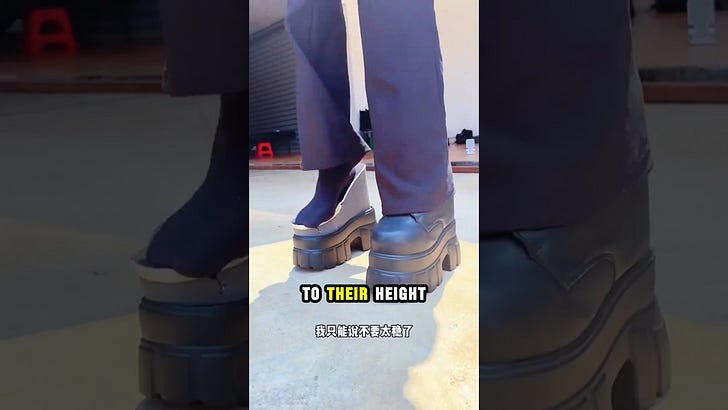
Like, all these are so cool, but why? Why, obviously. They, they were associated with these badass warriors. So one, it was just very masculine mm-hmm. To wear [00:30:00] heels. But two, you got the height. That’s a really big thing. In fact, I’m gonna s you have to look at these. There’s this whole thing in China where young men wear.
Risers on their
Malcolm Collins: Really
Simone Collins: Oh, that, watch these videos.
Speaker: Don’t trust the height of Chinese men, uh, because most of them use special tricks to make themselves look taller. They use super shoes that can add 20 centimeters to their height because in China, short men will difficulty to getting a girlfriend.
Simone Collins: Yeah. And they can make you significantly taller. And they’re actually, the, the shoes that these men are, are designed quite well to obscure just how thick they are. And there’s this really funny short that shows men waiting in line.
For a rollercoaster or some kind of ride that has a height requirement and sadly the ride operators have have grown wise to the fact that risers are endemic. And tragically you have these teenage boys who are asked to remove their [00:31:00] shoes. To get on the ride to, to measure. To measure this.
Speaker 2: Many Chinese are self-conscious about their height and need high shoes to enter the attraction, but at the entrance, they are asked to take off their shoes. As soon as they do, it turns out that their height is significantly reduced because of this complex in China. Even teenagers often wear platform sneakers to look taller, but these guys couldn’t hide their real height, and now that everyone could see that they weren’t as tall as they seemed, they were embarrassed.
Malcolm Collins: I used to wear
new rock boots as a kid.
Yeah. And they made me so effing tall compared to other guys.
Simone Collins: I, and I thought it made you feel good. It made,
Malcolm Collins: they’re these giant goth boots. Right. Oh, I loved it. I love, they were my go-to footwear for the longest time.
Simone Collins: Well, it’s so embarrassing for these boys who are going on the rollercoaster in China is.
They’re, you know, with their girlfriends who are laughing their butts off as they take off their shoes and like, lo and behold, they’re like a foot shorter. They’re like
Malcolm Collins: little, this is like asking a girl before she gets on a ride, take out your stuffing, like, you know.
Simone Collins: Yeah. Take off [00:32:00] your cut. Yeah. Take out your cutlets, take out your cuts.
Like
Malcolm Collins: see a real, how embarrassing. And it’s funny that we are talking about all of this while we’re redesigning my outfit. I just, I heard back from the Etsy seller about the, because I’ve decided that I should dress in more medieval inspired outfits the same way Simone does. Yeah. Because it looks weird that only she’s doing it now.
And we’ve pointed out in one of the videos that like, it actually, while a lot of cultures only have women dress in a unique fashion, it’s better when they both do like an orthodox Jewish culture.
Simone Collins: Yeah.
Malcolm Collins: So we should make up like a unique, so what do, what do you think of this vest, Simone? It is this, they, they said that they
could do it in this, this red color, or is that not right enough?
Simone Collins: That’s great. I like it. No, I like it. That’s like, it’s a deep burgundy. It’s good. It’s similar to my stays that I’m wearing. It’s, it’s all more wine. Yeah. They match
Malcolm Collins: really well. The two
Simone Collins: outfit. Yeah. But yeah, it’s it’s good. In fact, actually, can you see the the tearing on this? Oh,
Malcolm Collins: no, not at all.
Simone Collins: Okay. Well this is, I’m literally wearing this, these stays to shreds, and this is actually part of a larger historical fashion misnomer. A lot of people, when they go to costume institute, [00:33:00] institutes and museums and they see historical outfits, they think that people in the past were super, super small and yeah, they were a little bit shorter.
But there are tons of historical examples of men who are six plus feet. You know, like people weren’t that much tinier. There was some malnutrition.
The reason why people often misattribute historical people to being very small is because the few surviving clothes that exist