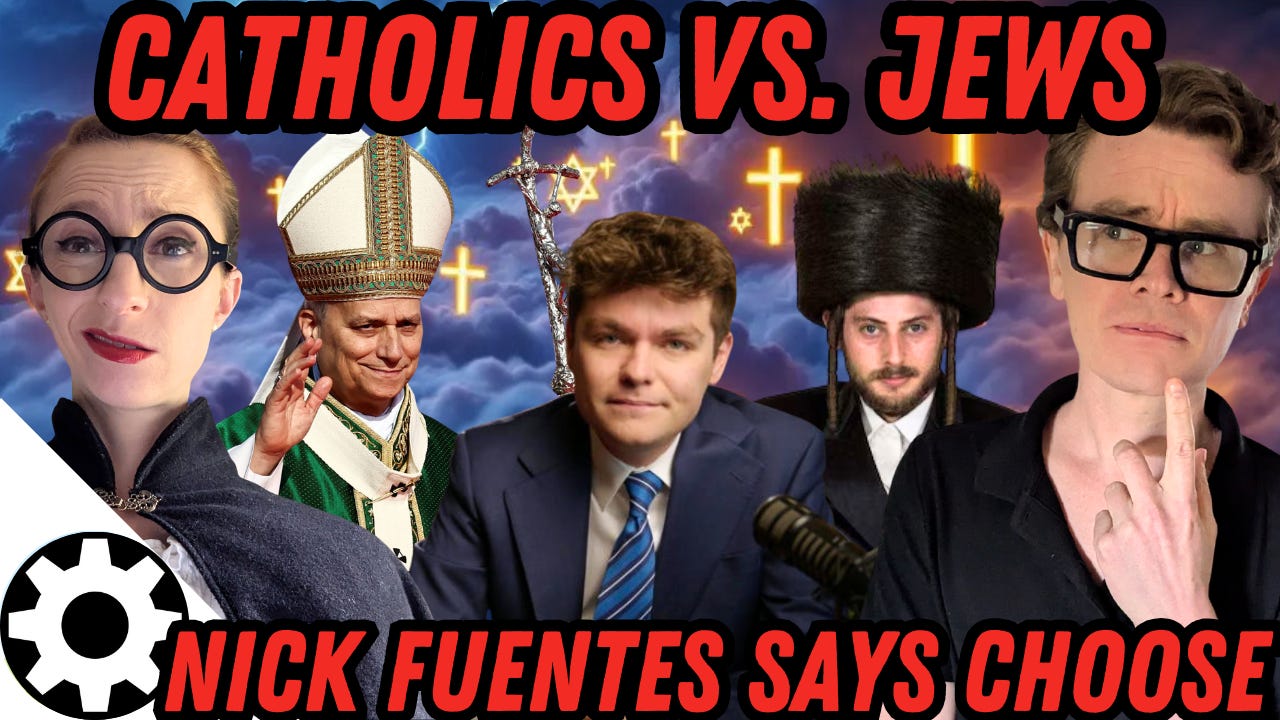
Nick Fuentes: Catholics Or Jews ... USA Must Choose
Based Camp | Simone & Malcolm Collins · Based Camp | Simone & Malcolm
Audio is streamed directly from the publisher (api.substack.com) as published in their RSS feed. Play Podcasts does not host this file. Rights-holders can request removal through the copyright & takedown page.
Show Notes
In this episode, Malcolm and Simone Collins dive deep into the historical and cultural dynamics between Catholics and Jews, using Nick Fuentes’ controversial statements as a springboard for discussion. They explore the roots of anti-Catholic sentiment in America, the differences between Catholicism and other Christian denominations, and the evolving role of both groups in U.S. society and politics.
The conversation covers:
* The founding of America as an anti-church nation and the implications for Catholics and Jews
* Nick Fuentes’ critiques of Israel and the Vatican, and how these perspectives fit into broader geopolitical realities
* The influence of both Catholics and Jews in American culture, from Hollywood to political power structures
* The Vatican’s historical and current stances on issues like immigration, capitalism, and alliances with other faiths
* The importance of pluralism, pragmatic alliances, and understanding the real differences between religious and cultural groups
Whether you’re interested in history, religion, politics, or just want a nuanced take on a hot-button topic, this episode offers thoughtful analysis, historical context, and a bit of humor along the way.
If you enjoy the discussion, don’t forget to like, subscribe, and share your thoughts in the comments!
Malcolm Collins: [00:00:00] Hello Simone. I’m excited to be here with you today. Today we are continuing from an episode that went very long, that was on Nick Fuentes. And as Nick Fuentes says, you’ve gotta pick a side. Is it the Catholics or is it the Jews? And in this episode we’re gonna go over his accusations about Israel and the Jews, which that he made in the Tuck of Carlson interview, which are.
Mostly accurate. But they leave out the context, which is, but then if I am making a decision between the Vatican and those loyal to the Vatican and the Jews, and those loyal to Israel which is a more antagonistic partner to the United States which has stabbed us in the back more frequently and more, well stabbed us in the face more directly when you’re talking about the Vatican.
Mm-hmm. And, and which is a more useful long-term partner in terms of the future of human civilization when we look at existing trends. Okay. And I, and I’m, and again, I’m saying all this, it’s like Nick’s broadly right [00:01:00] around most of the criticisms he has around Israel. And the biggest criticism he has, which is the one that I agree most fervently with him on, is if you.
And if you watch our video before this on Nick that I strongly suggest, I think it’s a great video of you are not familiar with American history and how anti-Catholic America’s founding was. It was essentially founded to be an anti-church country. An anti no. Malcolm
Simone Collins: blew my mind on this one because you’d think that we were taught that enough school.
No,
Malcolm Collins: no. It’s why it’s so ridiculous when he is like, America’s a Christian nation. And I’m like,
Simone Collins: you mean America’s a Catholic nation?
Malcolm Collins: Yeah. No, he said America is a Christian nation, not a Judeo-Christian nation. And I’m like, America is an anti-Catholic, anti Anglican nation. Not just a, not a normal, it’s a Christian nation founded in opposition to high church Christianity.
Mm. And very explicitly and very loudly with lots of receipts with even a cardinal saying this you know, this is not like me [00:02:00] or a conspiracy this is mainstream. If, if you’re familiar with it’s well
Simone Collins: attested and Malcolm has the receipts go to that episode. It’s very interesting.
Malcolm Collins: So the, the, the reason why that episode was important for framing for this episode is I think some people when they try to do the sleigh of hand is it’s, Catholics are just another form of Christian and it’s like.
That has never been true in American history. That’s not true in terms of the value sets of different Christian traditions as we’ve talked about. If you, if you look at even their metrics for truth, right? They are very different. And that difference has become important again very recently. Where if you look historically, what was the reformation about?
It was a conflict between two groups. One said that true should be determined by people who spent their entire life studying a subject. And then so. Somebody couldn’t just claim to be an expert on the subject certified by a central authority, and then another group of people, which is a perfectly reasonable way of doing things.
Yeah. Group of people came up and said, but that central authority could become corrupt, [00:03:00] so we should have truth determined by the individual. Which is also a perfectly reasonable retort. Right. But this is also the exact same fight we had with COVID. And we saw during this fight, the Catholic majority areas cited with the like, which was the, the inner cities, which is where Catholics mostly settled, cited with the trust of people who spent their entire life studying this subject.
And then the Protestant majority areas settled with the, every decision should be made by the individual, not declared experts because those certifying institutions can become corrupt. And, and what I’m pointing out here is that culturally Catholics are very, very different from other Christian denominations.
And so when people are like, oh, you gotta be worried about the Jews, to me this is a bit like an elf whispering to me. You gotta be worried about those dwarfs, you know, they may be very industrious and good at metal crafting and making jewels, oh my god, are dwarfs the, that very stubborn. They remember things for a long time.
They are very good with [00:04:00] engineering.
Speaker: One wrong put right. But the great book of grudges
remains full.
Malcolm Collins: No, but I’ve, I always sort of study it this way. The dwarves are the Jews and the Catholics are the ELs. Yeah. , And you can ally with both of them at the same time, but you’ve gotta be aware that if one of them then steps out and says, no, I refuse to be allied with you.
If you’re allied with the other faction, you gotta choose which one you’re gonna stay allies with. Yes. And we, we
Simone Collins: need, we need to bring back Lego a lesson Gimley, you know,
Malcolm Collins: we could be friends. Yes. And the reality is, is that Nick Fuentes is a minority Catholic opinion. Most Catholics are okay with saying you can be allied with both the Catholics and the Jews.
And if that’s an option, I wanna be allies with both. Yeah, right. But if somebody comes out and says, you gotta choose one America, I’m gonna argue that you’d have to be pants on head retarded to choose the [00:05:00] Catholics given current demographic economic trends and their stated goals and their historic positions.
So here’s the Nick Fuentes quote.
Simone Collins: Okay.
Malcolm Collins: Israel hosts zero bases sins. Zero troops during war, gives false intelligence, sells our secrets to China, has no oil spies on us and is a diplomatic liability US gives infinite foreign aid and weapons, fights their wars, brides their enemies and , covers their but in the un.
Now if you watch the last episode, you’ll know one thing here is just patently a lie that the US gives Israel infinite money. And I pointed out that actually if you look at Catholic majority countries and you look at the average amount of aid we give to Israel a year those numbers are not that different.
We give about the same amount of yearly aid to Catholic majority countries as we give to Israel on a yearly basis. Then I note that, but it’s actually way less money to Israel because almost all the money we give to Israel, they have to spend in us manufacturing jobs in [00:06:00] arms and munitions. But almost all the money we give to Catholic majority countries stays in those countries.
So, if we’re, if we’re weighing the two, and better yet when he says Israel is just a liability, consider an ally like Israel. Israel gets in a sc skirmish with one of its rivals, right? Like they attack first, it handles the situation. We donate an additional amount to them. For one year, we had one year of high a aid levels to Israel, and then the next year it had gone back to almost normal aid levels.
Simone Collins: But even in that case, the aid came with strings attached, meaning they had to, like strings find money from Americans. All, all the, went back to the United
Malcolm Collins: States. Okay? But the point here being is this is very different than like the Ukraine or like really almost any other country where lied was like no one else just gets it done in the way that Israel has.
But he is right about his other things here was, was we,
Simone Collins: what’s the selling stuff to China?
Malcolm Collins: This is a real thing that happened in the 1970s, which we’ll get to.
Simone Collins: Oh, in the seventies. That’s the seventies, a while ago. It
Malcolm Collins: was a while ago, and Israel was in a very different position then. And that’s really the [00:07:00] caveat that we need to take this with.
Okay. Yeah. When we consider what the Catholic church was doing in the seventies, what was the, do you remember all of those Communists and Socialists, republics you set up that had a goal of destroying America around Latin America? All those revolutions and genocides you ran because peppered farm remembers who might wait.
Catholics were involved with like, oh, the Catholics get a ton of communists and socialist revolutions. We’ll get into it. I have receipts. And good lord, because they were really all about that stuff. I mean, they, they really, they, they were against the communist in Russia because it was an atheist, communist state, and they were against the communist in China.
‘cause it was a aist communist state. But, but they were broadly pro-communist. Really with whiz. A Catholic flavor to it. So they were actually like a core geopolitical enemy of us in terms of like actual wars, historically speaking. Okay, now I note that they were [00:08:00] proxy wars, but they were still wars.
We were fighting proxy wars against the Vatican across Latin America, and we were fighting proxy wars against Russia across like East Asia and stuff like that. So, but we’ve, we’ve conveniently forgotten about this. And Israel, what did they do? They just sold some military tech. Like what? If, if, if somebody needs a forgiven, forget session here.
Mm-hmm. But let’s go to the zero troops during the war. Okay. Fuentes says, Israel never sends troops to fight along the US in its wars. This is true. Put with a very big asterisk. Why do they not send troops to fight alongside us in our wars? Do you know the answer to this, Simone?
Simone Collins: I, I don’t,
Malcolm Collins: because we ask them not to.
Wait.
Simone Collins: What? Okay. Why
Malcolm Collins: is the US asking Israel to not send troops to fight alongside us in our recent wars? Because since Israel became stable, basically, since it [00:09:00] had the capacity to send troops alongside us to fight in our wars. Okay. Almost every one of our wars has been in the Middle East, having Israel send troops to fight alongside us when we are trying to, as one of the US’ biggest diplomatic goals for the past half century, normalize their relations with other Arab countries.
Oh yeah. Could be an absolutely. Idiotic thing. Undo a lot of
Simone Collins: investment. Yes, that is true. Yeah. And that’s for Mossad spying on us. I mean, they spy on everyone. We spy on everyone. Like what? I don’t know if
Malcolm Collins: you think we don’t spy on Mossad, like I’m a little confused by that one, but we’ll get into it.
Yeah,
Simone Collins: that one, that one’s weird, but I mean, why not throw it in? If you’re just trying to put together these arguments, that’s fine, but like also no one cares. I wanna,
Malcolm Collins: everything I wanna steal, man, I wanna take the Maximalist. Israel is bad position in this one. Because it’s, it’s important to, to ask these sorts of questions.
Okay. Like, if you’re asking, if Israel had actively decided to not send troops was in any of our recent conflicts, that would be a definite sign that they are not actually a very [00:10:00] good friend. But, that is, that is not what happened. And you know, it’s, it’s, it’s a shame and I, I don’t even know if like Nick’s aware of this, of why like, it, it may just be that Ben Shapiro was such a dick to him.
As we pointed out, Ben Shapiro has basically created all of the antisemites. Nick is completely justified and becoming an antisemite after what Ben Shapiro put him through Ben Shapiro in the Daily Wire. Mm-hmm. Wire Owens. We don’t know everything, but she might be as well. We’ll wait to see when Brett Cooper starts coming about with antisemitic stuff.
Seriously though, Ben Shapiro seems, Hey Ben Shapiro’s come after us too. He doesn’t like our techno puritan nonsense. He thinks we’re weirdo nerds. He doesn’t, he doesn’t like anyone other than him getting popular in conservative spaces, especially any ideology other than him. But what I’m pointing out here, so first of all, what I wanna point out with all of this stuff is, nick Fuentes didn’t really get enough time to elaborate on any of these points. None of these points were stated so unruly that I think he is attempting to manipulate his audience using information. Mm-hmm. [00:11:00] I genuinely think that that, and this is, this is a big like. When he states this, he is speaking in good faith and I think so.
I think so. That, that it is a conversation we need to be able to have, and this is my biggest problem with Jews, is they will not let us have this conversation. And they, not all of them obviously, but it only takes a minority of people acting bad Allah heroes. Oh, so
Simone Collins: you’re saying like there should be more of a conversation around Zionism that’s like actually functional instead of just like It’s good.
It’s bad. He’s
Malcolm Collins: talked about it. He brought it up.
Simone Collins: I see.
Malcolm Collins: Cancel India show. Okay. You know, and that was really effed up and, and I think honestly Ben Shapiro needs to be pilloried for this. When I heard what Nick went, just went through, I was like, Ben Shapiro. Yeah. That’s unhinged threat to the Jewish people in America right now.
Speaker 5: Mm-hmm.
Nick Fuentes is the Wright Kaya right now.
Malcolm Collins: I think that he is completely unhinged what he did. It was completely unjustifiable. Well, and in sure. Basically
Simone Collins: before like I think [00:12:00] even. When Nick Fuentes was either in college or just recently out of college, a very young burgeoning influencer, very small platform relatively for where he is now at the time.
So like not even someone that, that Ben Shapiro should have been aware of. Really? Yeah. Ben Shapiro sort of came at him and tended to
Malcolm Collins: destroy his life.
Simone Collins: Yeah. Over and
Malcolm Collins: over
Simone Collins: and over again. Getting him fired from multiple jobs, he totally unwarranted. So yeah. That, that just for in, in case people are out of those illness.
Well, milk
Malcolm Collins: toes takes often, like, you know, and I think that, that, it. My, my takeaway is I can see I’m not even like anti Nick Fuentes, right? Like, I’m not like cancel Nick Fuentes or anything like that. I’m like, we have disagreements, here’s why. But I am like Ben Shapiro. We need to do something about Ben Shapiro.
And so I’ll be calling Mossad to make sure they take, they, they take care of the situation before he creates any more antisemites. But anyway let’s, let’s keep going here. Let’s, you were wondering about the sale to China, right? So what happened here? Oh, God,
Simone Collins: God, [00:13:00] sorry. Just small aside call, like with Call Mosad, we keep asking our kids who they’re gonna call, and obviously it’s the Ghostbusters, but yesterday in complete earnestness, our, our 6-year-old son, Octavian was like, what is their number?
He was like, really concerned. Ghostbuster, we like didn’t actually have their phone number, like, we need to call Ghostbusters, but.
Malcolm Collins: I can set up a phone service with some vibe coding. That’ll do both. I was like, I’ll do an ai That’ll be the Ghostbusters hotline for the kids, please. Oh my God. Do you want me to just like set that up?
Yeah, I probably get sued. Fans can tell me if they want me to create a AI hotline that pretends to be a Ghostbusters service. Or Mosad and they’re just like, okay, we’ll be able to create that with the R Fab agent Service actually. Yeah. Give them a, yeah. Okay. Okay.
Simone Collins: Carry on. Sorry.
Malcolm Collins: So there are documented instances of Israel doing this.
Mm-hmm. There was often framed more as unauthorized transfers or sales of US delivered military technology than outright, quote unquote, secrets in a spy novel since
Speaker 4: Huh.
Malcolm Collins: Israel has repeated US accusations of passing sensitive American tech to China dating [00:14:00] back decades and causing diplomatic flareups in the 1980s and 1990s.
Oh, so a bit more recently Israel sold China military hardware like missiles, radars, and navigation systems, including tech derived from US programs. And, sorry to make
Simone Collins: you feel old, but the nineties actually was a really long time ago.
Malcolm Collins: Yeah. For people who don’t know, it’s 2025 right now. Okay. So, this.
This was 30 something years ago. Different time. Okay. Different time. No, but what I’m saying is it, it the people who were involved in these decisions are not still in power in Israel. Yeah. Yeah. We we’re talking about the last or the generation before. The generation that we’re dealing with today.
Yeah. And the CIA specifically alleges that in 1993 that China had acquired advanced US source tech for jet fighters and air to air military missiles via Israel, where two to 3 billion in deals. This is totally a real thing that Israel actually [00:15:00] did and was a d move. It was an, yeah. Not cool Israel.
What the hell, man? Yeah. Hey. A major 1990 scandal involved Israel selling China blueprint for the US funded lobby fighter jet after canceling the project, which included proprietary American avionics and engine tech. Super, super. Not because we were
Simone Collins: being bros at that time too. You don’t do that to your bros.
Malcolm Collins: Yes. There is one recent instance of this tech transfer, but it’s fairly small. Mm-hmm. In 2013 the US Express Fury after Israel transferred secret missile and electro optics technology to China, violating our agreements on end use restrictions for US aid. Oh. So these were technologies that we funded their development of, but we said, you’re not allowed to transfer them to China.
And they did. You do develop them. Yeah. No, and they did. Which is an absolute D move. And I think, honestly,
Simone Collins: that for me, like on a relational level, I mean, I, I get that there’s still enough aligned [00:16:00] incentives where there’s, there was a reason why we obviously didn’t cut ties with him entirely, but. I if this were like on a, a personal granular level in our real lives and someone burned us like that, no.
Like, absolutely. Our relationship is over. Right? So I could see that being a really experienced issue. No, I can see that.
Malcolm Collins: The problem is, is that if the, if the, if the opposite of the, the counter force, if you’re having to choose between somebody who occasionally screws you over and somebody who states that they hate everything that you are doing and.
Has an ultimate plan for your destruction and subjugation. That’s, that’s the difference between the Vatican and Israel, which we’ll get to because we’re gonna get to the, the, the Vatican stuff in a second. It happens. Okay. Yeah. Well, no, I mean this is, it’s, it’s, it’s a like I will not pretend that Israel and what I actually even like about Nick Fuentes position is the thing that he didn’t mention, which he could have mentioned, which is also a true incident.
But I guess he didn’t mention it because it’s sort of like maybe not as hard as some of the other incidents he [00:17:00] rattled off. Okay. Was the destruction by, of the American warship by Israel during, I forget which conflict that was. But there is some evidence that it may have been deliberate, you know, killing us military personnel.
Deliberate what,
Simone Collins: why? And, and why would they be interested in doing that?
Malcolm Collins: Conspiracy. Why would do that? Conspiracy theorists have a reason. That’s pretty stupid. I think it was an accident. I think I, I, I really can’t like when I look at the reasons, it just doesn’t seem, even if they were going to do it to be mean, like to, to attempt to achieve some end.
It doesn’t seem worth the risk to me. It doesn’t seem worse. The damage bizarre. It, it, it, it seems to me fairly, but most people like Nick, but still believe that they did this attention. He would, I see this is like, you know, they, they, if you’re taking an an anti-Israel perspective, it’s something that you typically get in the bucket of anti-Israel perspectives.
And I like because a rational person like me who looked at it wouldn’t believe it. Nick didn’t throw it out there. I do believe Israel did. Act in a [00:18:00] way that was antagonistic to Americans interests with these tech transfers to China and stuff like that.
Simone Collins: Yeah. Yeah. That is, and I hadn’t known about that before.
I’m glad Nick, but I wa I wanna be
Malcolm Collins: clear, it is not like the two Southern 13 one, if, if your impression is Israel had spies who like stole secret military technology from the United States and then sold it to China, that is not what happened. It is more like the US and in this case it appears for, for usaid was funding the development of specific weapons was in Israel being developed by Israeli companies.
But a condition of that aid was that they not sell this technology to anyone else. And then those companies sold that technology to other people. This is not like. Somebody came into my house and stole my stuff. It’s like I gave somebody some money and said, develop this, but I get exclusive rights to sell it.
Right. Or just, you [00:19:00] know, and then they, they sell it to somebody else as well. My stance
Simone Collins: on that still holds.
Malcolm Collins: Yeah. It’s a, it’s a de if someone
Simone Collins: does that, you can’t trust them, you
Malcolm Collins: know, but, well, you can’t trust Israel like this is, they’re a foreign country with, with goals that are antagonistic to America’s goals.
Just as the Vatican has goals that are antagonistic to America’s goals at times. And, and this is what I’m trying to pull out here. Mm-hmm. Israel is not monstrous for acting like a foreign country. Right. Because they are
Simone Collins: a foreign country and they have their own,
Malcolm Collins: they are a foreign country. Right.
The US spies on Israel as well, probably less competently, but the US spies on Israel as well. Right. The US does things that f over Israel as well, not. As severely as Israel has done to us. But we have done things that have ed them over. Now let’s go to the gives false intelligent one here.
So, I’m not gonna go overly deep into things here, but we have the 1956 US crisis. We have the 1975 reassessment crisis. We have the 1981 [00:20:00] AAC sale to Saudi Arabia. We have the 1982 Lebanon War and arms restrictions. We have the 1991 loan guarantees dispute. We have the 2014 halt on hell fire missiles. We have the 2016 UN Security Council resolution 2, 3, 3 4.
This episode’s already long enough, so I’m not gonna go deep into every one of these.
Simone Collins: I need to All right, change your diaper and get the kids, and we can finish this later.
I’m doing Mongolian beef. I’m gonna look up a recipe and prepare it. We’re taking the kids trick or treating night. The one thing with
Malcolm Collins: Mongolian beef is you’re gonna wanna start early in the preparation process of you’re and the kids’ dinner with the marinade.
Simone Collins: Okay, I will take a look at that. And remember,
Malcolm Collins: it uses a lot of chives as well, and we’ll do it with rice.
And I love you to death and you’re a perfect wife. And I hope with this episode fun in, in, in
Simone Collins: fascinating. I had no idea about that history with American Catholicism. So that is
Malcolm Collins: insane. Really changes your perception of Catholicism than Catholics within modern America.
Simone Collins: It does, but I also just feel like we’re, we’re entering a new [00:21:00] era where it isn’t what it used to be.
It’s like, it’s like a new religion that. Is derived from Catholicism, but is no longer Catholicism.
Malcolm Collins: I, I agree with that. I, I agree with that, but I think a lot of the original fears that the founders have of having split alliances in allegiances is still very real.
Simone Collins: Mm. I don’t know. I don’t know.
That’s up for debate. I, I think that the, the new version of Catholicism feels more to me, like early American colonies. Like, Hey, we’re gonna go on our own and build communities and build a city upon a hill. I feel like the city’s won the hill that I’m excited about our Catholic communities in many senses in the United States.
Yeah. So I, I kind of disagree with you, but you’re
Speaker 4: got got around charismatic.
Simone Collins: Got run.
Love
you. Love you. You’re amazing. You’re amazing.
Malcolm Collins: And so the comments on the first Nick went this episode. I, I assume we got some pretty angry ones. ‘cause we do have breakers as fans.
Speaker 2: Yeah. Some of the Catholics were like, well, no, I know for like various reasons. I don’t [00:22:00] know if you saw the unhinged email we got from,
Malcolm Collins: oh, you can cure infertility.
That was the first line. I was just like, you know, you can’t, you, no. There are some forms of infertility you can cure. Yeah. But you can’t cure every form of infertility. Certainly not the type you suffered from Simone.
Simone Collins: No. Yeah. That was
Malcolm Collins: like, like I don’t, I don’t understand where these people come from, right.
Like. I’m like, come on man. Like at least approach us with like intellectual integrity. Don’t just tell me stuff that’s like patently untrue. But no, that’s it. It reminded me of the reporter who came at us and was like races
Speaker 2: have no differences.
Malcolm Collins: Oh no. But there, yeah, there were the other one who was like there’s nowhere in the US where it’s dangerous to be a white person.
And I was just, oh, yeah. It’s like a patently obviously untrue thing. Like why are you coming to us with that? And I assume that a lot of Catholics in the, in the, in the comments are rather like, no, you can be a Catholic and disagree with the Catholic bureaucracy. As a, as a, yeah, that was
Simone Collins: some [00:23:00] comments.
Yes.
Malcolm Collins: Yeah. But you, that’s literally what Protestantism is. You can, you can believe everything that Catholics believe and you can go to a Catholic church, but if you disagree with the organizational structure, that was the beef that the reformation had was the church. Yeah. I think ironically
Speaker 2: though. Some maybe Catholic commenters didn’t get that.
They’re like, well, yeah, but Protestants also disagree with each other. And we’re like, yeah, that’s kind of the point. Like that’s what they do. Yeah.
Malcolm Collins: We disagree with each other all the time because we don’t have a central authority telling us what Yes. That,
Speaker 2: that is the whole thing is that there isn’t,
Malcolm Collins: that is the core concern I have with Catholicism is that there is an external body to me, which can define what my faith is.
Yeah. Right. Like that’s my problem with Mormonism as well. And if you, if you deny that, then you are matic you are saying that you would refuse to, even if. It went through, you know, a, a, a council at the Catholic Church or was said Pap bull, [00:24:00] something that disagrees with your personal faith. Then you’re already schematic in your heart, right?
You know, you’re already saying, well, I’ll just flip from the church the moment the church doesn’t agree with my interpretation of Christianity.
Malcolm Collins: Which it’s, it’s,
Malcolm Collins: it’s, it’s,
Malcolm Collins: it’s,
Malcolm Collins: it’s a weird sort of like limbo schematic take. But I, but I also understand what you’re saying. Like a lot of Catholics in the US are, I think, unaware of like the specific,
Speaker 2: that’s the thing is, is we have a new evolution of Catholicism in the United States, which is almost like a form of Protestantism, if you wanna be super technical about it.
That is very grassroots, that is very independent, that’s very self-determined. And that isn’t necessarily about top-down. No, I
Malcolm Collins: agree really strongly with you. And I think that this form of Catholicism, I like this form of Catholicism, and that is
Speaker 2: probably the form of Catholicism to which Nick Fuentes.
It hears maybe without fully acknowledging it, maybe even to himself. But like I, I do think that’s more what he represents. And people [00:25:00] chiming into the comments also said that they, as followers of Nick Fuentes, who like actually watch his dreams a lot, have not at any point seen him express Catholic integralist views.
So I know you say like AI says back and forward like he is one, but
Malcolm Collins: Yeah, but I was like, but hey, I did the research. I said I couldn’t find anything where he said it explicitly,
Speaker 2: but there’s also nowhere where he says he’s not that. So that’s the problem, is that like, until we can get him on base camp and talk with him.
Malcolm Collins: Yeah. But like what his long-term plan for society is. But I think that what he represents and what we’re seeing with a lot of Catholics on our, among our fans or within even the US more broadly, and these are the Catholics who are having a lot of kids and are like actually have a chance of surviving.
Yeah. Is, is there sort of this we disagree with the Vatican. We disagree with essential bureaucracy, but we’re not gonna make a stink about it and we’re just going to create a Catholic identity that is more focused on the aesthetics of Catholicism rather than the, the [00:26:00] technical bureaucracy of Catholicism.
Speaker 2: Well what’s funny too though, and we’ve seen this in comments, is that there are also very papist Catholics. Who very much want to be a part of this top-down Vatican city-based hierarchy, but also don’t acknowledge the current regime, which I think there’s a long historical basis for this, right? Like all the different schisms and different like, oh, well.
Right. And, and usually those led to, to like schisms. Yeah. But what, what I find is interesting is, is at least the, the one, the, the Catholicism that will replace Catholicism, the future of Catholicism is very grassroots. And, and I don’t, I don’t, I wouldn’t say it’s accurate to say they disagree with Vatican City.
I would say that they are indifferent to it. That they use it as a resource when they want it and they don’t, when they don’t. It’s almost like how Americans kind of view the American government. They’re like, no, I, I
Malcolm Collins: completely agree with you. They are indifferent to it. But that it’s, it’s, they’re indifferent to it enough that it doesn’t cause them to like be like, okay, well now I need to think.
Does the word Catholic actually still apply to me? [00:27:00] Because they just don’t care. Like, they’re like, well, no, but
Speaker 2: just think, think about the way that we feel about America. Right? Like, we’re proud to be Americans. We we’re Team America, but we’re not like, you know, we, we don’t, you know, bow down to an American flag every morning.
We’re not like, well, the president said this. I think a true think
Malcolm Collins: argument. This is, no, this is a terrible analogy because as an American, right, like, I am not taking a vow when I claim to be like a nationalist American or something like that, that my theology is defined by what the president says is in specific circumstances.
Oh, okay. The only thing that makes a Protestant, a Protestant and a Catholic, a Catholic is a Catholic. Follow the beliefs of the councils. And they believe in apostolic succession and they believe that when a Pope says things under specific circumstances, those are now the word of God.
Simone Collins: Yeah, that’s true.
When you pledge allegiance, it’s to the republic. It’s not the president, it’s not any administration, it’s not any single politician. That’s true. But
Malcolm Collins: there’s a new form of Catholic that doesn’t believe that these things are [00:28:00] part of Catholic identity. And it’s more just like the vibe. And this is actually like Nick Fuentes larger thing here, which I find really fascinating is I always point out, you know, he, he’ll go out there and he’ll be like you know, we need to take back America from these foreign minorities.
And as we argued in yesterday’s episode, I’m like, there were like no Catholics that America’s founding, it was founded as an anti-Catholic state.
Speaker 2: Oh. And someone in the comments, even, even chimed in saying that there was this hilarious book he found at one point in the library where a Catholic. Mooned about the, in 1913, this book was published, like was mooning about the idea of maybe someday there will be Catholics in the Senate.
Just like that. Like it could it be possible, right. Like this glass ceiling, but there was so much anti-Catholic Catholicism. Yeah. But the, the, so, so the point I was making here was that Nick Fuentes, he’s like, we need to get rid of this foreign element in the United States that the, the founding fathers didn’t want here, that, et cetera.
Malcolm Collins: And he is part of that minority, like, as I’ve always said, if you’re getting a three course dish in American history, and one course is [00:29:00] anti-black racism and one course is antisemitism, the third course is always anti-Catholic sentiment. Mm. And it almost reminds me like, he’s like, bugs Bunny, and it’s like hunting season and it, he’s like, it’s not Catholic season, it’s.
Jewish season. Oh. And then the other one’s like, no, it’s Catholic season.
Speaker 2: But with,
Malcolm Collins: with
Speaker 2: Daffy Duck. Yeah.
Malcolm Collins: But the funny thing is, is he’s like, well, we need to get all of these, these Catholics together, all these conservative Catholics together and impose our will on America. Right. Like, make America a country of our colors.
Right. And what’s really wild to me. Is Catholics make up 20% of the US’ population. They are shrinking in terms of birth rate dramatically, quickly. Yeah. They are shrinking Well, but
Speaker 2: the, like mainstream ones, not these like grassroots communities. No, no. They’re
Malcolm Collins: shrinking in terms of deconversions very quickly.
So just so you know, in terms of the numbers here, for every one person who converts to Catholicism, 8.4 adults leave the face. Whoa. For every one person who converts to Protestant to [00:30:00] them, 1.8, leave the face. So. They’re, they, it’s a, it is a face that’s in an incredibly weak position right now basically across all positions in terms of like societal dominance.
And he’s acting like it’s the dominant viewpoint of, of Americans or even of conservatives. And it’s this sort of larp, which he also has was a Vatican where he has this LRP that I think that the Vatican or that the Central Catholic Bureau bureaucracy agrees with his position on things like immigration or things like, you know, they’ve basically written a whole thing, which we’ll get into in this episode where they basically denounce him you know, and specifically Catholic nationalism and, and, and sort of nationalist Catholicism and especially as it’s growing within the us, which, I mean, who else are they talking about?
But what’s, what’s what’s interesting is like Nick Fuentes worldview works. Because he pretends that most Americans are like him, and he pretends that the Vatican agrees with him. And that this makes his world view cohesive. Where if you look at the world as it actually [00:31:00] exists, the conservative party can only win as an alliance of many different groups, one of those groups being Catholic.
But to pretend that these groups aren’t actually different is a Trojan horse in am in American Christianity. Mm-hmm. More broadly, you know? Mm-hmm. Like trying to push Catholicism into the Protestant traditions that America grew is, is I think quite insidious. And I, and I think that a lot of conservative saw that they were just playing nice.
As, as you know, I always do. And I think we need to be honest that these are different religions, right? They actually have I would argue that like theologically, if you look at art. For example, iteration of like techno puritanism, which is like Calvinism mixed with science. It is closer to many forms of Judaism or even some forms of Mormonism than it is the Catholicism.
Mm-hmm. This idea that Protestantism and Catholicism are very close in their beliefs is just not, it, it not anymore. Right. Or at least a lot of Protestant factions. Right? Yeah. And, and but anyway, I’ll get started on the episode here. Let’s [00:32:00] go. So coming back in after we just went over all the text stealing and everything like that, and I was like, that’s terrible that they did that, man.
I wanna go into conspiracies, right? So we talked in the last episode about how castles basically dominate the Supreme Court because an invitation only. Society, which does have closed doors meeting. So a secret society, the Federalist Society basically put Catholics in charge of one third of our government.
Speaker 2: They’re so cool though. Can you even be mad? I can be mad because they pretend that they’re promoting conservative values when they’re really controlled by Catholics and disproportionately promote Catholics. Well, they’re Catholic conservative values. They’re still No, that’s not what they tell their donors.
Malcolm Collins: That’s not what they tell the public. They, they are, it, it is a. A shady thing that’s happening now. I like that they’re on our side. I, I prefer, you know, if there’s conservative Jews who are putting Jews in positions of power and, and promoting a conservative message, I’m like, okay, you’re on our side.
Whatever. Right? Yeah. And there’s conservative Catholics who have gotten together and put Catholics in a [00:33:00] position of power. As long as they aren’t sabotaging us, which they’re not so far, I’m like, okay, that’s great. Right. Speaking of conservative Jews, we watched Ben Shapiro’s basically like fallout from this, where he just goes nuts.
So, but, so, butt hurt about the Tucker Carlson, how Tucker Carlson is ruining America. And shows all these whiny, whiny clips about Nick Fuentes, which is like, look, I caught him. I caught him. I caught him saying thing, A guy who’s screams for multiple hours a day said something offensive once. And if you look at like, the things that he thinks he caught him on, a lot of them is just like.
True stuff that anyone being honest would say. Like the first one he runs is Nick, Nick saying, and I think he, he could have chosen his wording better that some women like to get griped. And what I think he meant to say which we point out in our book on sexuality, homosexuality, and I brought
Speaker 2: up on our podcast multiple times
Malcolm Collins: what
Speaker 2: something we’ve also brought up on our podcast.
Malcolm Collins: There, there, there, there are a, a large percentage like a, a [00:34:00] very meaningful percentage of women who get arousal from imagining scenarios like this. It doesn’t necessarily mean they want it to happen to them, that obviously in a minority of cases that is likely true and, and people will be like, oh, that’s because men scrambled their brain.
I’m like. 50 Shades of Gray did not become a bestseller because women wanted to show off to their husbands. I don’t go to Barnes and Noble and see an entire monster effer aisle. Sorry, not one. I’d say it’s like half of, like the women’s fiction section is about women, effing monsters. Okay. This is not because of men.
You can watch our episode on what we think led to this, but the point being is like. Ben, you can’t do this anymore. You can’t go out there and cherry pick a few things and then show them to your audience and think your audience is gonna be like, oh yeah, you know that, that, that what a, yeah, he said the naughty thing.
Now he’s off the air. He said the naughty thing. And that you think that that’s still okay, means you don’t really have a part in [00:35:00] the modern conservative movement because the modern conservative movement is an anti Pearl clutcher movement. And when you come out there and you’re clutching your pearls like little diva.
Speaker 2: Well, I
Malcolm Collins: think
Speaker 2: the bigger problem is that the conservative movement and, and the new right have really succeeded because they’re big tent. And a big problem that he has is he’s little tent. He, he wants people out of his tent. And Nick Fuentes? Yeah. No, no, no, no. Ben Shapiro. Well, both Ben Shapiro and Nick Fuentes.
Ben. Well, no, Nick, Nick, Nick Fuentes is off the reservation. He’s just doing his own thing. He’s not ending. He’s literally off
Malcolm Collins: the reservation. No, little farm out the
Speaker 2: woods. He’s he is out. No shelter. Just, you know, free balling it. But yeah,
Malcolm Collins: Nick DiPiro actually reminds me of Lemon Grab from Adventure Time.
Just like, no.
Speaker 6: Unacceptable. Unacceptable. Unacceptable.
Speaker 2: Well, I don’t know. My, my primary issue with him is that [00:36:00] he, he tries to exclude people, but also from this position of being superior and like morally superior and high and mighty. And I, I’m okay with trash. I love trash talk. I think trash talk is great. I think doing it from a position of moral superiority instead of like, gamesmanship is tedious, but let’s, let’s carry on.
Sorry. No.
Malcolm Collins: Let’s carry on. And when I will say, I, I, I do love it when people say things that are just meant to freak out. People like Ben Shapiro
Speaker 2: Curtis. Yeah. At this point now it’s, yeah. 1, 1, 1 is tempted,
Malcolm Collins: Curtis Jarvin is the king of this. Nick Fuentes is like, I watched the Nick Fuentes offensive clips and frankly.
I found them boring. I, I love Curtis Yas in biodiesel wine. You know that, that we, we, we’ll turn Ben Shapiro and his YPs into biodiesel. You say something like that and then that gets clipped and people will be like, oh, he must mean the Jews. And I’m like, no, I’m talking about the pearl clutches. The pearl clutches.
[00:37:00] We’re done with this. Okay. That’s no longer what we’re doing anymore. Okay? The people who are like, oh, you can’t say this, that hurt my peepees. What are they, you know, feels right. Yes. Nick pun punched him right in the feels. That was inappropriate. But anyway, to continue here. I now wanna talk about conspiracies.
Okay, so let’s talk about the Jews controlling Hollywood, right? ‘cause you’ll be like, well, look, the Jews take power within organizations and then uses organizations to shape society, right? So let’s look at how the Jews do this and contrast this with how the Catholics do it. The lab people don’t know that the Catholics also do this.
Let’s use Hollywood as the example here, because it’s the one that always people always take to okay. So, jewish immigrants from Eastern Europe who faced discrimination and established energy industries gravitated towards the nascent film business in the early 20th century. Many of the Big six studios were founded or co-founded by Jews Warner Bros.
Established by the four Warner Brothers Polish Jewish immigrants Metro Goldwin Meyer in GM was founded by a Belarusian Jew and a Polish [00:38:00] Jew. Paramount Pictures founded by a Hungarian Jew. Universal Pictures founded by a German Jew. Wow, Columbia Pictures. Founded by the son of a Russian German, Russian Jewish immigrant.
And then 20th Century Fox was founded by a Hungarian Jew and a Russian Jew. So the Jews really did, found almost every major studio in the United States except for Disney. And Disney of course, famously did not like the Jews very much. Well, he
Speaker 2: didn’t,
Malcolm Collins: I don’t know. Well, we should do the funny
Family guy: What the hell? What’s happened to us? I don’t know, but suddenly I feel all sweet and warm and fuzzy. It seems we are in a universe where everything is drawn by Disney. Look, there’s our house.
Look how gay we run.
Oh, still and Brian get just in time for pie. This is wonderful, Brian. Oh, let’s live in this [00:39:00] universe. .
Speaker 11: Hello, everybody.
Family guy: Oh yeah. I forgot. This is a Disney universe. Oh, but look how shiny my buttons are Here. Just push the, yeah, yeah. Okay. Okay. I’ll push the thing.
Malcolm Collins: . Yeah, he was, he was not a fan of the Little Hat people. But I imagine it’s because he was in an industry that was ter completely dominated by Jewish people at the time and even today. And by the way, 2008 poll noted that now only 22% of Americans believe that Jews, quote unquote, run Hollywood.
Whereas this number was 50% in 1964. Oh. But it was actually like functionally true. Most of the people running Hollywood were, jewish. Also you didn’t have a lot of criticism of Jews or the Jewish experience coming out of Hollywood during this period of Jewish dominance. So let’s, let’s look at the facts here.
Jews at least did control Hollywood. If you today have outsized influence in Hollywood, why do [00:40:00] they have the outside influence in Hollywood? It’s because they built it. They built it. They’re the reason why America has all of the soft power we have. So blaming, blaming the Jews for influence in, in Hollywood is like blaming the patriarchy for building the world, right?