Autism Classroom Resources Podcast: A Podcast for Special Educators
240 episodes — Page 2 of 5
Ep 177177. My 5 Best Tips for Using Visual Supports to the Max
We all use visual supports in our everyday lives, we just don’t realize that’s what we’re doing. Visual supports tell us where to sit at a concert or what rooms we aren’t allowed in at a restaurant. Using visual supports in your special education classroom helps your students understand expectations in the classroom like they help us understand expectations in the community.There are ways that you can use visual supports in your classroom to make the most impact. In today’s episode, I am sharing the importance of using visual schedules, why you should have behavior-related visuals around the room, and how to keep your room and visuals organized.01:57 - Why you need to have your visual schedules in place and why you should have a backup04:26 - What questions to ask yourself to determine where in your classroom you need more visual supports07:56 - How I use a variety of behaviorally related visuals around the room09:23 - Why you should have cubbies, bookshelves, and cabinets labeled11:58 - My tips for storing visuals in an organized fashionShow Notes: http://autismclassroomresources.com/episode177Resources:Check out SitSpotsGrab your free Pumpkin Mini SchedulesShop my Visual Supports on TPTGet more information about the Special Educator AcademyJoin the Free Facebook Group If you're enjoying this podcast, could you please take a quick moment to leave your review on Apple Podcasts? It would mean the world to me and will help spread the word to other special educators. ⭐️⭐️⭐️⭐️⭐️
Ep 176176. How to Build Relationships with Parents as a Teacher in Special Ed with Michelle Vazquez
Building strong relationships with parents as a teacher begins with having great communication and showing that you truly care about their child. Having positive interactions with parents is key to building these relationships and successfully working with families. My guest today, Michelle Vazquez, is sharing some incredible insight on how to build relationships with parents as a teacher.In this episode, Michelle is sharing ways she communicates regularly with families and tips for contacting parents with not-so-good news. Plus, how to build relationships with parents as a teacher when students are just getting qualified for special education.Grab Michelle's FREE IEP Meeting Checklist here!02:31 - Michelle’s background and what she is currently doing06:36 - Strategies she uses to build positive relationships with families at the beginning of the year11:20 - Michelle’s tips for contacting parents when you have to deliver not so good news19:50 - How she supports families when their children are just getting qualified and during the qualification process,28:27 - Ways Michelle builds relationships with families after they’ve had a negative experience in the pastShow Notes: http://autismclassroomresources.com/episode176Resources:Join the Autism Classroom Resources' Free Resource Library Get more information about the Special Educator AcademyJoin the Free Facebook Group If you're enjoying this podcast, could you please take a quick moment to leave your review on Apple Podcasts? It would mean the world to me and will help spread the word to other special educators. ⭐️⭐️⭐️⭐️⭐️
Ep 175175. 5 Tips for a Successful Start Teaching Special Needs Students
What can you do in the first few weeks of school to help create a more smoothly operating classroom for teaching special needs students? I often talk about the importance of putting strategies and systems in place in order to ensure your classroom runs efficiently and implementing some very basic strategies in the first weeks of school can help set you, your staff, and your students up for success.The first few weeks of school are crucial for getting students used to your classroom and how things work. In this episode, I am sharing why you should be focusing on building relationships with students and staff, the importance of using visuals, how to prioritize tasks for each day, and why you should be reflecting at the end of the school day.03:41 - How to build relationships with your students in the first few weeks of school08:50 - Ways you can build relationships with your staff even with limited time alone with them10:36 - Why you should be using more visuals than you actually need12:08 - The importance of making a prioritized list of tasks for each day16:12 - Why reflecting on what is working and what is not working is crucial in the first few weeksShow Notes: http://autismclassroomresources.com/episode175Resources:Paraprofessional Schedules and Team Building Kit Free Classroom Reflection Form Join the Autism Classroom Resources' Free Resource Library Get more information about the Special Educator AcademyJoin the Free Facebook Group
Ep 174174. Special Education and Autism Training in a Podcast from SEA
How can you change a negative rapport between a student and a staff member into a positive rapport? Is it even possible? Today, I am sharing an episode from inside the Special Educator Academy where I dive into the research behind ways to change negative rapport into positive rapport with your students.We all know we need to build relationships with our students and pair ourselves with reinforcements. But what does that really mean? In this episode, I am helping make the concept of building rapport between students and staff in the classroom a bit more concrete by sharing three ways you or your staff can build positive rapport with your students.03:51 - How to pair yourself with reinforcement to build positive rapport with students10:42 - What responsivity training is and how it can help build relationships16:29 - How to use turn taking and reciprocity with students20:07 - What ways the Special Educator Academy can help you with special education and autism training!Grab the transcript and resource links at http://autismclassroomresources.com/episode174Join the Autism Classroom Resources' Free Resource Library: https://autismclassroomresources.com/free Want more information about the Special Educator Academy? SpecialEducatorAcademy.comJoin the Free Facebook Group: https://www.facebook.com/groups/specialeducatorsconnection
Ep 173173. What are the Special Education Professional Development Opportunities in the Academy?
Is it possible for your job as a special educator to be easier while your teaching is more effective? The simple answer is yes! I am so passionate about using my knowledge and experience to help other teachers thrive in their special education classroom with as little stress as possible. I created the Special Educator Academy to provide incredible educators with the support and confidence they need to bring joy back to their classroom.The Special Educator Academy is filled with courses, printables, trainings, resources, and more! There are workshops that you can request special education professional development from your school for completing and monthly training themes just for Academy members. Join me as we dive into all the amazing benefits of being an Academy member!02:25 - What Lightning Trainings are03:09 - How you can use Quick Win videos to learn new strategies as well as train your staff05:18 - How we use SEA Paths to make getting exactly what you need easier and more user friendly07:25 - What to expect with the monthly themes inside the Special Educator Academy08:16 - How our loyalty program works and what perks you get for being a memberResources:Grab the transcript and resource links at http://autismclassroomresources.com/episode173Learn more about SEA here and join with a free trial!Join The Special Educators Academy without the trial (monthly payments).Join The Special Educators Academy without the trial (annual payment)Join the Autism Classroom Resources' Free Resource Library.Join the Free Facebook Group!
Ep 172172. Behavior Management in the Classroom: Helping Your Students Accept No When They Communicate
Behavior management in the classroom is challenging and when you begin teaching students to accept “no” when they communicate a request, it can be even more challenging. Oftentimes when we are working with students on making a request, we are enforcing every time. In turn, our students then expect to get what they request whenever they request it. As we know, there are times when students cannot have what they would like and this can lead to some challenging behaviors. Luckily, there are strategies you can use to help your students learn to accept “no” as an answer. In this episode, you’ll hear one of my Quick Win lessons from inside the Special Educator Academy, where I am sharing 5 ways you can help your students learn to accept “no.” Be sure to check out the Academy for more amazing quick wins like this one!02:23 - Who these strategies and tools are for03:15 - Why we want to teach our students to accept “no”05:38 - Five tools and strategies you can easily implement to help your students accept “no” when they are requesting17:52 - Join the Setting Up Classrooms Bootcamp starting July 24, 2023!Grab the transcript and resource links at http://autismclassroomresources.com/episode172Join the Autism Classroom Resources' Free Resource Library: https://autismclassroomresources.com/free Want more information about the Special Educator Academy? SpecialEducatorAcademy.comJoin the Free Facebook Group: https://www.facebook.com/groups/specialeducatorsconnection
Ep 171171. Special Education Training for Teachers in the Academy
Finding reliable information and useful ideas for your special education classroom on the internet can be challenging. Instagram and Pinterest are filled with examples and ideas for the classroom and activities but so many of them are not practical. So many teachers get lost in the idea of having a “Pinterest classroom” but we truly need to focus on setting up our classrooms in a way that is most beneficial to our students. I love helping reduce the overwhelm so many special educators feel when trying to figure it all out on their own. The Special Educator Academy is designed to help you move past the noise of the internet and get the information and practical systems and strategies you need to meet your students’ needs without the stress of doing it on your own. In this episode, I am breaking down the 6 courses inside the Special Educator Academy and what changes are coming for the academy.01:27 - A glimpse into school consulting and sharing ideas before the internet made everything so accessible05:35 - Membership options for the Special Educator Academy07:08 - An overview of how the 6 courses offered inside the Academy provide special education training for teachers13:06 - A peek at what new things are coming for the SEA Grab the transcript and resource links at http://autismclassroomresources.com/episode171Join the Autism Classroom Resources' Free Resource Library: https://autismclassroomresources.com/free Want more information about the Special Educator Academy? SpecialEducatorAcademy.comJoin the Free Facebook Group: https://www.facebook.com/groups/specialeducatorsconnection
Ep 170170. How the CORE Can Prevent Special Education Teacher Burnout (Roundup)
How can you avoid special education teacher burnout and continue loving your job? One way to prevent burnout is by implementing a framework that sets your classroom up in a way that it almost runs itself. With the CORE framework, the aim is to develop a highly organized classroom with systems in place so that you are not constantly directing staff and students and you can actually focus on teaching.Teacher burnout is a topic I’ve discussed with several professionals lately and today, I am sharing how the CORE can help prevent special education teacher burnout. I am sharing how it helps to reduce decision fatigue, why you need a one man down plan, and the importance of routines. 02:11 - Why summer is a great time to start thinking about how implementing the CORE can help reduce burnout03:08 - How the CORE helps lessen decision fatigue 05:01 - The importance of having a one man down zoning plan and schedule06:48 - Why routines are critical in preventing special education teacher burnoutGrab the transcript and resource links at http://autismclassroomresources.com/episode170Join the Autism Classroom Resources' Free Resource Library: https://autismclassroomresources.com/free Want more information about the Special Educator Academy? SpecialEducatorAcademy.comJoin the Free Facebook Group: https://www.facebook.com/groups/specialeducatorsconnection
Ep 169169. Busting Myths About Instructional Strategies in Special Education with the CORE
There is no one “right” strategy but most instructional strategies in special education have similar elements to other strategies. Every student is different which means that what might work for some will not work for others. However, with all strategies, we need to ensure we are providing students with enough practice and enough instructional loops to learn the targeted skill. In this episode, I am sharing why there is no one size fits all instructional strategy in special education, what elements most instructional strategies have in common, and the importance of instructional loops in helping students learn. I would love to hear your thoughts on instructional loops and the myths addressed in this episode! Hop in the Facebook group and let’s discuss!02:13 - My background in cognitive behavioral therapy and the importance of the science of education06:55 - Why there is no one size fits all instructional strategy in special education 11:01 - Debunking the myth that all children must have intensive discrete trial training13:28 - What an instructional loop is19:04 - How the CORE model incorporates different kinds of instruction24:32 - Addressing the myth that play based instruction is appropriate for all preschool studentsGrab the transcript and resource links at http://autismclassroomresources.com/episode169Join the Autism Classroom Resources' Free Resource Library: https://autismclassroomresources.com/free Want more information about the Special Educator Academy? SpecialEducatorAcademy.comJoin the Free Facebook Group: https://www.facebook.com/groups/specialeducatorsconnection
Ep 168168. CORE Framework - Evidence-Based Practice and Research Alignments
Highly structured environments allow for teachers to implement evidence based practices in the special education classroom. As we know, implementing EBPs is key to helping students learn and thrive. That is why the CORE is designed around evidence based practices. The CORE contains elements and systems that when put in place, allow us to provide meaningful instruction that's individualized for our students while automating processes and systems in our classroom so we can focus more on our students.In this episode, I am diving into the different components of the CORE, how they are beneficial, and using evidence based practice with autism classrooms. If you’d like a deeper analysis of how we use the CORE as well as checklists and tools to help you implement it in your classroom, check out the Special Educator Academy. 01:57 - What elements and systems the CORE is made up of 02:51 - What the TIP is and why it’s helpful04:17 - How to set up your classroom schedule and use it to help create your Zoning Plan08:51 - The overall goal of the systems of the CORE13:57 - Why we want to have systems that automate everyday activities14:55 - How team collaboration helps us make decisions based on the students17:48 - The importance of the physical organization of the classroomGrab the transcript and resource links at http://autismclassroomresources.com/episode168Join the Autism Classroom Resources' Free Resource Library: https://autismclassroomresources.com/free Want more information about the Special Educator Academy? SpecialEducatorAcademy.comJoin the Free Facebook Group: https://www.facebook.com/groups/specialeducatorsconnection
Ep 167167. Talking Data with Sasha Long from The Autism Helper
We know how important data collection in special education is but how can we make it work in actual classrooms? There are so many factors that play into our data collection and analysis systems that go beyond our control and can make it challenging for us and our paras to collect data. In this episode, I am joined by Sasha Long who is sharing recommendations for data collection, tips for beginning teachers, and a great perspective on the state of where we’re at in teaching. Sasha Long, BCBA, M.A., is the founder and president of The Autism Helper, Inc. She is a board certified behavior analyst and former special education teacher. Sasha shares strategies and best practices through her blog, podcast, membership, and online courses. Sasha travels internationally as a speaker and consultant providing individualized training and feedback to parents, educators, therapists and administrators in the world of autism. 02:28 - Why reinforcement is so important in making data work in the classroom06:40 - Sasha’s tips for making data collection in the classroom easier09:30 - Why we need to allow for flexibility in the way that data is collected by others12:34 - Sasha’s best advice for beginning teachers setting up a data system23:49 - The difference between behavior data and academic data28:47 - Sasha’s reminder about data collection in the current state of teachingGrab the transcript and resource links at http://autismclassroomresources.com/episode167Join the Autism Classroom Resources' Free Resource Library: https://autismclassroomresources.com/free Want more information about the Special Educator Academy? SpecialEducatorAcademy.comJoin the Free Facebook Group: https://www.facebook.com/groups/specialeducatorsconnection
Ep 166166. How to Setup Your Classroom to Improve Communication Skills
One of the most important factors in teaching language and communication is to ensure that we create many opportunities to practice throughout the day. As special educators, we know that to help our students improve communication skills, we must provide the tools needed for them to communicate beyond just when we are working on communication. In this episode, I am diving into the importance of encouraging communication throughout the day, why students’ communication systems are available to them at all times, and ways to engineer the classroom that supports our students in improving their communication skills.If you are looking for tools to help engineer your classroom, be sure to check out my communication boards. I'd love to hear how else you are engineering your classroom! Come share your ideas or pictures inside the Facebook group. I can’t wait to see how you are setting your classroom up to help encourage communication!02:33 - Why we need to ensure students are getting many opportunities to practice communicating throughout the day and how to track these opportunities 06:34 - The importance of making sure that students’ communication systems are available throughout the day, not just when we are intentionally practicing communication11:12 - Why having different types of communication supports set up in the classroom is crucial to improving communication skills12:28 - How to set up communication devices to include special vocabulary when needed14:03 - How to increase the number of opportunities students have to practice communicating during activities18:02 - Why including simple switches in your classroom is incredibly beneficial for your studentsGrab the transcript and resource links at http://autismclassroomresources.com/episode166Join the Autism Classroom Resources' Free Resource Library: https://autismclassroomresources.com/free Want more information about the Special Educator Academy? SpecialEducatorAcademy.comJoin the Free Facebook Group: https://www.facebook.com/groups/specialeducatorsconnection
Ep 165165. 8 Ways to Support Communication with Students Using Augmentative Communication
As special educators, it is so important to help our students expand their functions of communication and enhance their communication skills. It is especially important for our students who use any kind of augmentative communication that we help them to build their communication skills. In this episode, I am sharing 8 things you can do to help support communication within your classroom, particularly if you’re working with students who use augmentative communication, including the importance of core vocabulary, why we want to combine communication activities, and providing the “Goldilocks” of communication.If you are looking for more ways to ramp up your communication instruction for the coming year, join me inside the Special Educator Academy! There is a whole set of resources for communication and so many more topics that I know will help take your teaching to the next level! I can’t wait to see you inside! 03:13 - Why we need to focus on the function of communication rather than the form of communication04:40 - What core vocabulary is and why it’s important when building students’ communication skills08:31 - Why we should start with requesting but then move on 09:14 - The importance of creating communication opportunities throughout the day10:36 - Why students need the opportunities to practice combining communication activities11:36 - How to model for students using their tools of communication12:46 - The benefits of having repeated practice of communication activities for students14:42 - What the “Goldilocks of communication” is and why it’s crucial in helping students build their communication skillsGrab the transcript and resource links at http://autismclassroomresources.com/episode165Join the Autism Classroom Resources' Free Resource Library: https://autismclassroomresources.com/free Want more information about the Special Educator Academy? SpecialEducatorAcademy.comJoin the Free Facebook Group: https://www.facebook.com/groups/specialeducatorsconnection
Ep 164164. What Are the Functions of Communication (and Why Are They Important)
There are so many ways and reasons we use communication. Helping our students communicate effectively and expand the ways in which they are communicating is key. It’s important that we work on why a student is communicating and what they are trying to say rather than focusing on how they communicate it. In this episode, I'm talking about why the functions of communication are important, what different functions of communication are, and how we can help our students with these different communicative functions. I’ve gotten so many requests to cover communication and language and I am so happy to share this episode with you! If you have topics you’d like to hear covered on the podcast, please send me an email at [email protected]. I would love to hear from you!01:46 - What communication functions are and why we care about them04:01 - The difference between intentional communication and unintentional communication07:26 - A look at communication functions for regulation11:58 - Social interaction functions and how to help teach our students these functionsGrab the transcript and resource links at http://autismclassroomresources.com/episode164Join the Autism Classroom Resources' Free Resource Library: https://autismclassroomresources.com/free Want more information about the Special Educator Academy? SpecialEducatorAcademy.comJoin the Free Facebook Group: https://www.facebook.com/groups/specialeducatorsconnection
Ep 163163. Thriving at the End of the School Year in Special Ed
The end of the school year is quickly approaching which means that both students and teachers are getting a little squirrelly. So how can we keep our students on track, reduce the chaos, and keep student behavior under control? In today’s episode, I am sharing 5 strategies to help reduce end of year behavior challenges so you and your students can continue to thrive.What’s your best way of coping with the end of the school year? Let me know inside the Facebook group! Share a picture of this podcast and let’s talk more about it.02:36 - The importance of adding in more visuals at the end of the school year08:30 - How to redirect using a combination of words and visuals10:26 - What the High Octane Mix is and why now is the time to start using it13:55 - Why we need to keep the schedule as consistent as possible at the end of the year14:56 - How using social stories is especially beneficial this time of yearGrab the transcript and resource links at http://autismclassroomresources.com/episode163Join the Autism Classroom Resources' Free Resource Library: https://autismclassroomresources.com/free Want more information about the Special Educator Academy? SpecialEducatorAcademy.comJoin the Free Facebook Group: https://www.facebook.com/groups/specialeducatorsconnection
Ep 162162. Coping Strategies for Teachers with Kelsey Sorenson
The past few years have been especially stressful and exhausting for teachers. Students still have not fully adjusted to being back in the classroom and we have been seeing more behaviors than we have in the past. That means that now more than ever, coping strategies and true self care are so crucial for teachers. In this episode, Kelsey Sorenson of Wife Teacher Mommy is joining me to talk all things self care. She is sharing actionable tips to help you balance all your different roles, how to conceptualize events in a way that will impact how you feel about them, and the upcoming Educate and Rejuvenate event. I’d love to hear what you are taking away from this episode! Join the Facebook group and share your favorite tips and takeaways!06:59 - Tips for handling stress about things that are out of our control13:22 - Kelsey’s take on how teachers can advocate for what they need22:16 - Why self care isn’t selfish23:16 - What self care is and what it looks like29:15 - Suggestions for how teachers can spend their time this summer preparing for next school year while also taking a much needed breakGrab the transcript and resource links at http://autismclassroomresources.com/episode162Join the Autism Classroom Resources' Free Resource Library: https://autismclassroomresources.com/free Want more information about the Special Educator Academy? SpecialEducatorAcademy.comJoin the Free Facebook Group: https://www.facebook.com/groups/specialeducatorsconnection
Ep 161161. How to Communicate with Parents Effectively in Special Education: 5 Things to Do and Not Do for Success
A crucial part of building strong relationships with families is ensuring that there is a clear communication method between home and school. One of the hardest parts of establishing a communication system is deciding what needs to be shared and how to share this information in a way that works for both you and the families. We all know how busy special education teachers are and families are often quite busy as well so having efficient and effective communication is key.Finding how to communicate with parents effectively does not need to be complicated. In this episode, I am sharing 5 things you should not do and 5 things you should do when communicating with families. Are you loving what you are hearing on the show? DM me on Instagram or leave a review and let me know. I love to hear when I have had an impact on others!01:12 - Why having a home-school communication system is so important03:37 - The 5 Don'ts of a strong communication system between school and families13:20 - The 5 Dos of parent communication19:58 - My secret tip for successful home-school communicationGrab the transcript and resource links at http://autismclassroomresources.com/episode161Join the Autism Classroom Resources' Free Resource Library: https://autismclassroomresources.com/free Want more information about the Special Educator Academy? SpecialEducatorAcademy.comJoin the Free Facebook Group: https://www.facebook.com/groups/specialeducatorsconnection
Ep 160160. 5 Things You Need to Know in Building Positive Teacher-Parent Relationships in Special Ed
One of the most important elements in an IEP run smoothly is a strong and established teacher parent relationship. These relationships are the heart of the educational experience for all students, not just Special Ed. Teachers and parents both want to ensure their students are being provided the best education possible and establishing trusting and positive teacher parent relationships is crucial to doing so.All children do better when school and home are working together to support them and there are so many reasons to focus on building relationships with parents. In this episode, we are looking at why it is so important to have strong teacher parent relationships.If you’ve gotten any great takeaways from this episode, I’d love it if you leave a review or DM me on Instagram and let me know. It’s so inspiring to hear when I have had an impact on others!02:45 - The importance of having positive teacher parent relationships05:08 - How having a positive relationship with parents can be beneficial when issues arise07:33 - Why building a strong relationship is especially important when our students have limited communication skills11:23 - How having good home-school communication is beneficial when working on generalization of skills13:23 - The importance of a strong parent teacher relationship to foster a feeling of safety for both students and parents14:21 - Why teachers and parents need to work as a team with the common goal of supporting the student as best as possibleGrab the transcript and resource links at http://autismclassroomresources.com/episode160Join the Autism Classroom Resources' Free Resource Library: https://autismclassroomresources.com/free Want more information about the Special Educator Academy? SpecialEducatorAcademy.comJoin the Free Facebook Group: https://www.facebook.com/groups/specialeducatorsconnection
Ep 159159. Talking Strategies for Teaching Literacy with Reading Expert Sara Marye from the Stellar Teacher
Focusing on literacy can be difficult for special education teachers. The relationship between language and reading and the difficulties some of our students have can make teaching literacy challenging. Literacy expert Sara Marye is joining us to share some amazing strategies for teaching literacy to help us better reach our students.Sara is a former teacher, literacy coach, and assistant principal and is the creator behind The Stellar Teacher Company. She is an expert at helping teachers better support their students in reading and writing. In this episode, she is sharing practical and effective ways we can use routines to help our students develop their reading skills and become confident writers.Join us in the Special Educators’ Connection Facebook group and let us know how Sara's routines are working in your classroom!01:53 - Sara’s background as a classroom teacher and literacy expert and how she now supports teachers in finding ways to effectively and efficiently implement strategies for teaching literacy03:40 - What a literacy routine is04:59 - Examples of a literacy routines that would help students build the foundational literacy skills many students need11:00 - How to include literacy routines into the day and how it benefits students with disabilities 15:05 - Benefits of using a literacy routine with students19:57 - How teachers can get started with literacy routines in their classrooms Grab the transcript and resource links at http://autismclassroomresources.com/episode159Listen to Sara's podcast, The Stellar Teacher Podcast: https://www.stellarteacher.com/podcastJoin the Autism Classroom Resources' Free Resource Library: https://autismclassroomresources.com/free Want more information about the Special Educator Academy? SpecialEducatorAcademy.comJoin the Free Facebook Group: https://www.facebook.com/groups/specialeducatorsconnection
Ep 158158. Strategies for Surviving and Thriving During Your Special Ed Teacher Observations
Having someone come into your classroom for a teacher observation can be a stressful experience that most of us are not too fond of. But being observed by an instructional coach, principal, or even another teacher can be a very positive thing. Having others observe you and your classroom gives you opportunities to make your classroom better.When we can move past the stress of being observed, we can see that having another person allows us to improve in areas we weren’t aware needed improving. It gives us another perspective and fresh ideas that can help us better serve our students. Although having a teacher observation can be uncomfortable, it is a great opportunity for collaboration and today, I am sharing tips to make the feedback discussion as productive as possible.Join us in the Special Educator Academy where you’ll be surrounded by others looking to collaborate as well as trainings and strategies to best help your students!03:19 - Why getting a fresh perspective from an observer can be incredibly helpful in improving your classroom04:16 - How having an observer with a different skill set can allow for new ideas and strategies06:03 - The importance of avoiding becoming defensive when receiving feedback from your teacher observation07:58 - How to talk about what you think is going well in your classroom with the observer11:36 - Why you should work with the observer to create an action plan Grab the transcript and resource links at http://autismclassroomresources.com/episode158Join the Autism Classroom Resources' Free Resource Library: https://autismclassroomresources.com/free Want more information about the Special Educator Academy? SpecialEducatorAcademy.comJoin the Free Facebook Group: https://www.facebook.com/groups/specialeducatorsconnection
Ep 157157. 5 Strategies for Conflict Resolution When Handling Difficult Relationships in the Classroom
Working with the adults in your classroom is oftentimes more of a challenge than working with your students. Working as a team can be complicated because you likely did not hire them and you are not their boss, but you are evaluated on how well you work together to serve your students. Even with varying opinions and experiences, it’s so important to handle difficult relationships and conflict with respect.We want our team to work effectively and a major piece to working effectively is the ability to respectfully resolve conflicts. To help with this, I am sharing five strategies for conflict resolution to help you create more positive interactions with your staff. If you are struggling with conflict resolution, come check out the Special Educator Academy where we have some amazing resources to help you train classroom staff and build effective teams.06:31 - How bringing helpful tools to teachers can be used as a preventative strategy for conflict resolution09:01 - Why you should be finding out the story behind the staff on your team11:59 - The importance of setting teachers and staff up for easy successes13:28 - Why you should be acknowledging the positives, no matter how small15:44 - What to do if you cannot resolve the problemGrab the transcript and resource links at http://autismclassroomresources.com/episode157Join the Autism Classroom Resources' Free Resource Library: https://autismclassroomresources.com/free Want more information about the Special Educator Academy? SpecialEducatorAcademy.comJoin the Free Facebook Group: https://www.facebook.com/groups/specialeducatorsconnection
Ep 156156. Ways to Build the CORE Team for Collaboration in Special Education
There are a lot of differing opinions on how to do things best in the classroom. This can cause some challenges when collaborating and making sure all staff members are on the same page. Even with differing opinions, expectations, and experiences, collaboration in special education is so important so we can best serve our students.It is so important that we keep the focus on our students and student progress and not get derailed by our differences. I have five strategies that will promote collaboration in special education and help set you and your staff up for success and help to minimize the challenges and pushback by focusing on respect and collaboration within the team.I would love to see your classroom visions and hear about any frustrations or challenges you're facing! Send me a message on Instagram @autismclassroomresources and share your thoughts!05:28 - Why having a classroom vision is so important and tips for creating one10:27 - The importance of active listening and letting your staff know they are heard11:32 - Why you should be using “I Statements” when making suggestions or corrections12:53 - How keeping the focus on the students and goals helps staff to see that you are on their side14:55 - Why asking your staff how you can help when there is a problem is more beneficial than just providing a solution Grab the transcript, freebie and resource links at http://autismclassroomresources.com/episode156Autism Classroom Resources' Free Resource Library... http://library.autismclassroomresources.comWant more information about the Special Educator Academy? SpecialEducatorAcademy.comJoin the Free Facebook Group specialeducatorsconnection.com
Ep 155155. FAQs About Staff Zoning Plans and Duties of Special Education Paraprofessionals
The CORE framework is all about helping you create systems to make your classroom run efficiently and smoothly. A key component to an efficient classroom is making sure that your team works well together and understands what they should be doing and how they should be doing it. Making sure that your special education paraprofessionals know all the details of how the classroom runs will help create a classroom that operates without a lot of questions or confusion.Using a zoning plan to build teamwork within your classroom staff is so beneficial to helping your classroom run smoothly. In this episode, I am answering some common questions I get about zoning plans and how they help special education paraprofessionals clearly understand their duties. Let me know your thoughts on using zoning plans in your classroom! Send me a message on Instagram @autismclassroomresources and let me know if you use zoning plans, if you love them, or if you haven’t started with them yet.02:59 - What a zoning plan is and how it is not just a staff schedule04:04 - Why is it called a zoning plan?06:28 - Do you have to use zones in a zoning plan?09:47 - Should you give your special education paraprofessionals and other staff breaks?12:00 - How do you develop a zoning plan?Grab the transcript, freebie and resource links at http://autismclassroomresources.com/episode155Autism Classroom Resources' Free Resource Library... http://library.autismclassroomresources.comWant more information about the Special Educator Academy? SpecialEducatorAcademy.comJoin the Free Facebook Group specialeducatorsconnection.com
Ep 154154. Tweaking Your Autism Classroom Setup: Using the CORE Framework to Prepare Your Classroom for Absences
Getting to school and finding out you have a staff member absent can be a major source of stress if you are not prepared. The good news is your autism classroom setup can greatly reduce the amount of overwhelm and stress in these situations. If you have your plans in place, a staff absence will not throw off the whole day for you or your students.Having your classroom systems set up and practiced will help your classroom run smoothly no matter what situation is thrown your way. Being prepared with a plan for when you or a staff member is out is so important for preventing issues when you are a person down.I would love to hear your experiences with being a staff member down! Join the free Facebook group and share how you’ve managed being a person down.02:35 - The difference between being prepared and not being prepared for a staff member being absent05:45 - What steps go into making a one person down plan08:04 - The two things you adjust when making a one person down plan09:08 - Reasons you should be using your one person down plan regularly, even when you are fully staffedGrab the transcript, freebie and resource links at http://autismclassroomresources.com/episode154Autism Classroom Resources' Free Resource Library... http://library.autismclassroomresources.comWant more information about the Special Educator Academy? SpecialEducatorAcademy.comJoin the Free Facebook Group specialeducatorsconnection.com
Ep 153153. 4 Tools for Implementing Training for Paraprofessionals in Special Education Easily
Finding the right tools for effectively training paraprofessionals can be time consuming and challenging. I know how valuable your time is and how crucial it is to have your staff properly trained so I am sharing some of my favorite resources to help you provide training for paraprofessionals in special education.As a special educator, you know how important it is for your paras to know the “why” behind doing what they do. Providing them with resources to learn why things are done frees up more of your direct training time to train them on how things are done. In this episode, I am sharing four different resources that you can use as training for paraprofessionals in your special education classroom.Have you found other resources that I didn’t mention for training your staff? If so, I’d love to hear what you use! Send me a DM on Instagram @autismclassroomresources! If you’re looking for more support in training your paraprofessionals, grab your 7 day trial of the Special Educator Academy! 02:23 - How to use my free webinars to train your paraprofessionals05:43 - How using the Affirm Modules can help your paraprofessionals gain a better understanding of your classroom and strategies08:12 - What resources are available through the IRIS Center at Vanderbilt Peabody education department at Vanderbilt University10:34 - Why the Special Educator Academy is an amazing resource to help you train your paraprofessionalsGrab the transcript, freebie and resource links at http://autismclassroomresources.com/episode153Autism Classroom Resources' Free Resource Library... http://library.autismclassroomresources.comWant more information about the Special Educator Academy? SpecialEducatorAcademy.comJoin the Free Facebook Group specialeducatorsconnection.com
Ep 152152. Training Paraprofessionals in the Classroom: 5 Ways to Make it Work
How can you possibly find time to effectively train your paraprofessionals when there is little to no student-free or duty-free time to do so? It may seem overwhelming and impossible but, with your CORE systems in place, you can be successful in training paraprofessionals in your classroom.There are several to make training paraprofessionals more achievable even with an incredibly busy schedule. In this episode, I am sharing five tips to help you train your paraprofessionals, ideas for implementing these tips, and some resources to help along the way! I’d love to hear your thoughts and ideas for training paraprofessionals so send me a DM on Instagram @autismclassroomresources! If you’re looking for more support in training your paraprofessionals or with the CORE model, grab your 7 day trial of the Special Educator Academy! 03:09 - How to use a “One Man Down” plan to find time to training your paraprofessionals05:42 - Why having someone else lead an activity makes for a great time to observe and train06:38 - How video modeling can be incredibly useful way to train your staff09:03 - Why checklists are a great way to clearly let staff know what is expected12:47 - Why modeling for your paraprofessionals is one of the best ways to train them13:51 - BONUS tip to help you successfully train your paraprofessionalsGrab the transcript, freebie and resource links at http://autismclassroomresources.com/episode152Autism Classroom Resources' Free Resource Library... http://library.autismclassroomresources.comWant more information about the Special Educator Academy? SpecialEducatorAcademy.comJoin the Free Facebook Group specialeducatorsconnection.com
Ep 151151. Using the CORE Framework to Communicate Special Education Paraprofessional Duties
A huge factor in how efficiently and automatically your classroom runs is if your staff is on board with the classroom systems. We want our classrooms to run smoothly and with less support from you as the special education teacher. In order to do this, we must effectively communicate our expectations of special education paraprofessional duties to our staff.There are many tools and strategies that can be implemented to help communicate the duties of the paraprofessionals in your classroom. Making sure the staff knows the students’ needs, using a zoning plan, having a system for lesson planning, and using checklists and visuals can all help to ensure your special education paraprofessional duties are understood by the staff.Be sure to grab your FREE Staff Target Visual Supports and Lesson Plan Templates to help get these systems in place! If you’re looking for the how-to of implementing the CORE model in your classroom, grab your 7 day trial of the Special Educator Academy! 03:43 - How to make sure that your staff knows the needs of your students using 05:43 - Why using a zoning plan helps to ensure your staff knows what is expected of them throughout the day08:58 - Why lesson plans are so important in making sure your staff knows what they need to do for each activity11:19 - How to use checklists to communicate the steps of routine tasks12:05 - What you can use as visual supports for staff Grab the transcript, freebie and resource links at http://autismclassroomresources.com/episode151Autism Classroom Resources' Free Resource Library... http://library.autismclassroomresources.comWant more information about the Special Educator Academy? SpecialEducatorAcademy.comJoin the Free Facebook Group specialeducatorsconnection.com
Ep 150150. Creating Systems of Instruction Using Evidence-Based Practices
Using the CORE model of systems in your classroom can free up time to do more direct instruction, planning, and time for yourself. In order for these systems to help reduce stress and exhaustion, they must be set up ahead of time. One key thing to set up ahead of time are the systems of instruction we will use in our classroom.As special educators, we need to make sure that our systems of instruction are set up in a way that allows us to instruct in a predictable way that follows best practices. So today, we are talking about characteristics of strong instructional programs and why we should always use consistent methods of instruction. I’d love to hear what systems work for you! Come join us in the Special Educators Connection Facebook Group and share your favorite teaching methods! If you’re looking for more support with your systems of instruction, check out the Special Educator Academy! 02:02 - The 3 things to focus on for a strong instructional program05:25 - The importance of repetition when learning something new07:47- Why we should be using consistent methods of instruction and how having a written teaching plan helps with that10:34 - Why we need to ensure we are setting up our programs to help students generalize their skills14:13 - How checklists are beneficial in an instructional systemGrab the transcript, freebie and resource links at http://autismclassroomresources.com/episode150Autism Classroom Resources' Free Resource Library... http://library.autismclassroomresources.comWant more information about the Special Educator Academy? SpecialEducatorAcademy.comJoin the Free Facebook Group specialeducatorsconnection.com
Ep 149149. Tips for Saving Time in Your Classroom
As special educators, we have so many things going on in our classrooms everyday. We all want to find a way to be more efficient and save time in the classroom. That’s where the CORE model comes in. Setting up the different elements of the CORE model may take some time upfront but will save you so much time in the long run.When trying to save time in the classroom, there are a few tips that can really help. We want to ensure we have buy-in from our paraprofessionals, set aside specific time to complete tasks, set time limits for ourselves, and make information easily accessible for ourselves and other staff members. If you have some great efficiency tips, I’d love to hear them! Come share them inside the Special Educators Connection Facebook Group! If you’d like more in depth information about how to create these systems, check out the Special Educator Academy! 03:04 - Why you should be getting input from other team members when creating your classroom systems 05:31 - How setting specific times to work on different elements of your systems will help make you more efficient07:17- Why you should be setting a time limit when completing different tasks 09:22 - How centralizing information for your team saves you and your team time and increases efficiency11:44 - How checklists and to do lists can help save time in the classroom12:48 - The power of getting an accountability buddy to complete tasks withGrab the transcript, freebie and resource links at http://autismclassroomresources.com/episode149Autism Classroom Resources' Free Resource Library... http://library.autismclassroomresources.comWant more information about the Special Educator Academy? SpecialEducatorAcademy.comJoin the Free Facebook Group specialeducatorsconnection.com
Ep 148148. 5 Ways to Reduce Special Education Teacher Stress with the CORE Model
Are you ready to reduce stress and decision fatigue and regain some energy and happiness by improving the systems you have in your classroom? We all know there is no stress like teacher stress and if we can set our classrooms up in a way that can reduce this stress, it is well worth the time and effort to get the systems put in place.We are covering the benefits of the CORE model, the impact of decision fatigue, and five ways the CORE model helps reduce special educator stress. Have you found systems that work in your classroom? Come share time inside the Special Educators Connection Facebook Group! If you’d like more in depth information about how to create these systems, check out the Special Educator Academy! 02:34 - How the CORE model helps to reduce the need to make decisions in the moment 05:16 - Why the CORE model can reduce decision fatigue08:50- How this model reduces special educator stress by increasing engagement and reducing behaviors10:52 - Why making decisions when you’re calm helps you to make better decisions11:10 - How to reduce the teacher stress of wondering how your classroom will run if you aren’t in the room12:19 - How the CORE model systems help your classroom run more efficiently leading to less decision fatigueGrab the transcript, freebie and resource links at http://autismclassroomresources.com/episode148Autism Classroom Resources' Free Resource Library... http://library.autismclassroomresources.comWant more information about the Special Educator Academy? SpecialEducatorAcademy.comJoin the Free Facebook Group specialeducatorsconnection.com
Ep 147147. What Classroom Systems Do You Need to Run Your Classroom?
Looking at how your classroom currently runs, do you have systems in place so you don’t really have to think about what you’re doing because it runs automatically? Having efficient classroom systems has so many benefits including higher engagement for students and less decision-making fatigue for you. Today we are talking about what systems you should have in place in your classroom, why your systems should start with your students’ TIPs, and how to prepare for different scenarios to prevent decision fatigue. We’d love to hear about your classroom systems inside the Special Educators Connection Facebook Group!01:44 - What systems are, and examples of different system types 04:35 - Why your classroom systems have to start with your students and how looking at the TIPs helps guide your systems 10:07 - How to ensure all of the systems are implemented correctly by having a Zoning Plan in place13:18 - Other systems you want to have in place including a lesson plan system, a data collection system, and a data analysis system15:55 - Scenarios to consider and create a Zoning Plan for so you aren’t making in-the-moment decisionsGrab the transcript, freebie and resource links at http://autismclassroomresources.com/episode147Autism Classroom Resources' Free Resource Library... http://library.autismclassroomresources.comWant more information about the Special Educator Academy? SpecialEducatorAcademy.comJoin the Free Facebook Group specialeducatorsconnection.com
Ep 146146. How Can the Autism Classroom Organization Results in Effectiveness (CORE) Model Help Your Classroom?
Is your classroom set up in a way that allows it to run smoothly and almost automatically (or auto-magically, as I like to say)? Special education classroom organization is a huge piece of The CORE Model. It promotes collaboration, reduces stress, and allows you to get back to teaching instead of just managing your classroom. In this episode, I share what the CORE Model is, how it came about, what should be included, and why this model is so important. 02:42 - What the CORE model stands for and why strengthening the CORE should be a priority07:52 - What elements go into the CORE and how the Teaching Implementation Plan ties into this model09:34 - The importance of having a zoning plan and why your special education classroom organization is so important10:21 - Why having a system for data collection and lesson planning is so important12:08 - Two very important components for our students in Special Education and how they impact the outcomes we are trying to focus onGrab the transcript, freebie and resource links at http://autismclassroomresources.com/episode146Autism Classroom Resources' Free Resource Library... http://library.autismclassroomresources.comWant more information about the Special Educator Academy? SpecialEducatorAcademy.comJoin the Free Facebook Group specialeducatorsconnection.com

Ep 145145. When a Consequence Doesn’t Change Behavior
We live in a society where consequences seem to be the expectation for certain “bad” behavior. A lot of teachers seem to struggle with knowing what they’ll do when a student demonstrates disruptive behavior. So in this episode, I talk about consequences and how ones you choose may not always be the most productive for your students.2:51 - Why all consequences aren’t equal for all students6:58 - How an action meant to be a punishment can backfire (using a student named “Thomas” as an example)10:02 - Solutions for “Thomas” when opposite consequences won’t address the student’s behavior13:08 - Considerations when choosing a consequence to a student’s challenging behaviorGrab the transcript, freebie and resource links at http://autismclassroomresources.com/episode145Autism Classroom Resources' Free Resource Library... http://library.autismclassroomresources.comWant more information about the Special Educator Academy? SpecialEducatorAcademy.comJoin the Free Facebook Group specialeducatorsconnection.com--- Send in a voice message: https://anchor.fm/autismclassroomresources/message

Ep 144144. How to Use Interactive Whiteboards Responsibly
I have a love-hate relationship with interactive whiteboards. They have so much potential which I love, but too often they just get used as giant TVs. The interactivity part of the equation gets thrown out the window! So in this episode, I talk about the dos and don’ts of using these boards and how to help students use them constructively in the classroom.1:35 - Why this is such a hot topic for me5:42 - The “don’ts” of using interactive whiteboards9:35 - The “dos” of using interactive whiteboards12:43 - Why video modeling may work better than live modeling15:37 - Some ways you can help your students use whiteboards effectivelyGrab the transcript, freebie and resource links at http://autismclassroomresources.com/episode144Autism Classroom Resources' Free Resource Library... http://library.autismclassroomresources.comWant more information about the Special Educator Academy? SpecialEducatorAcademy.comJoin the Free Facebook Group specialeducatorsconnection.com--- Send in a voice message: https://anchor.fm/autismclassroomresources/message
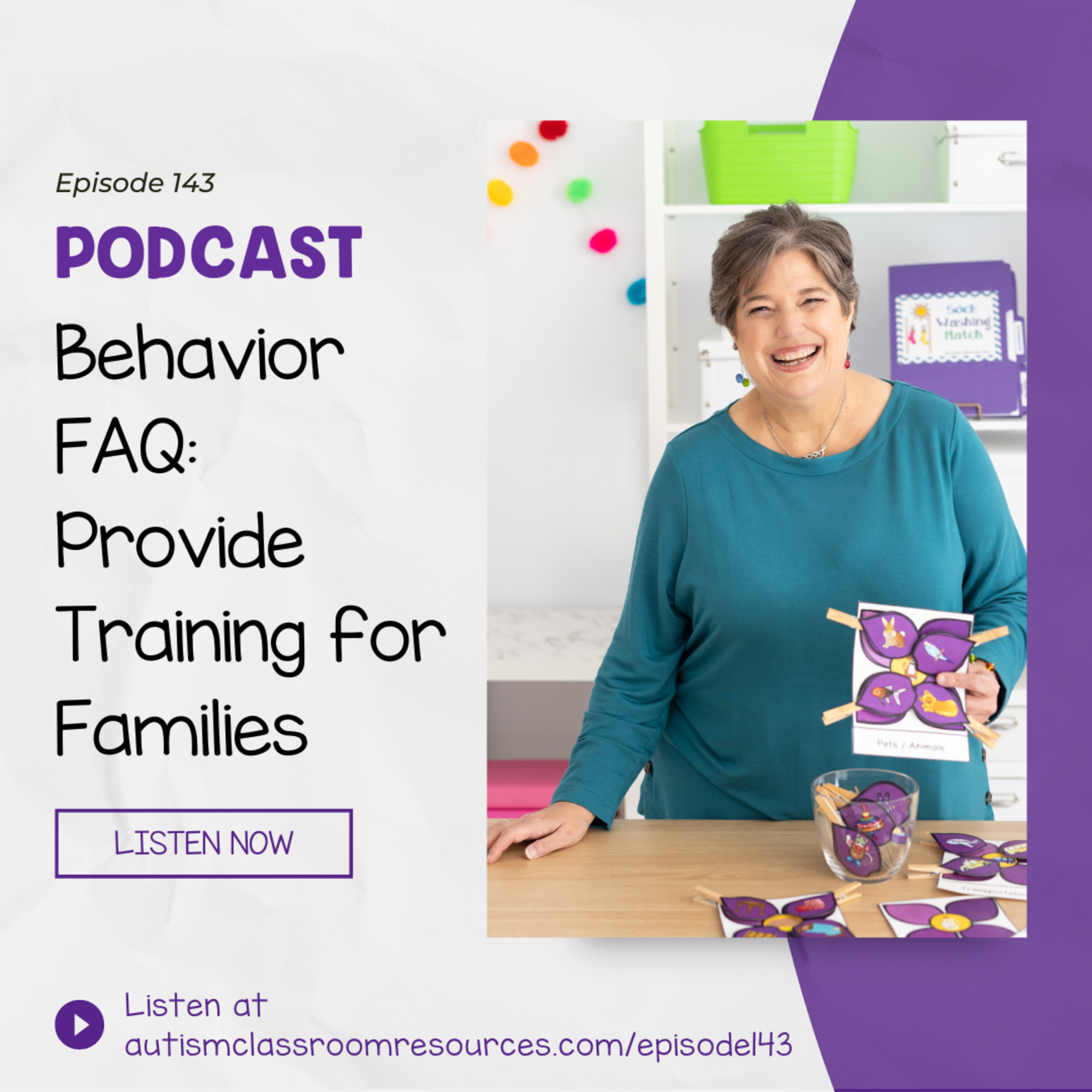
Ep 143143. Behavior FAQ: Provide Training for Families
How can parents, other caregivers, or service providers be trained in implementing behavioral support for autistic kids? And should you, as a teacher, facilitate it? I get asked these questions often when speaking about behavioral support in the classroom. In this episode, I answer these questions and give you specific ways to help students’ families handle their behavior.3:52 - How you train others in managing behavior depends on this5:34 - The variety of ways in which you can do this type of training for families7:23 - My general rule for training families who are new to behavioral support training8:42 - What to do to get parents on board once you know what works for the student10:07 - What I recommend if you chose to make a visit to the student’s home12:05 - What to do if parents can’t come to the school and you can’t visit their homeGrab the transcript, freebie and resource links at http://autismclassroomresources.com/episode143Autism Classroom Resources' Free Resource Library... http://library.autismclassroomresources.comWant more information about the Special Educator Academy? SpecialEducatorAcademy.comJoin the Free Facebook Group specialeducatorsconnection.com--- Send in a voice message: https://anchor.fm/autismclassroomresources/message

Ep 142142. Behavior FAQ: When a Student Is Distracted by Something They Can’t Have
Teachers deal with distracted students all the time. There’s the student who wants to be on the computer instead of reading his assignment or the one who’s waiting for lunch instead of working on her math problems. I get asked questions all the time about these kinds of behavioral support issues. So in this episode, I talk about some of the strategies you can use to deal with students who want to do one thing when it’s time to do something else.1:58 - The 1st step to addressing this unwanted behavior3:55 - What to do if the student’s behavior escalates to the point of being potentially harmful5:42 - A couple of examples using specific students with potential solutions11:56 - If the student just doesn’t want to wait to do the desired activity17:24 - How you can implement the behavioral support strategies talked about in this episodeGrab the transcript, freebie and resource links at http://autismclassroomresources.com/episode142Autism Classroom Resources' Free Resource Library... http://library.autismclassroomresources.comWant more information about the Special Educator Academy? SpecialEducatorAcademy.comJoin the Free Facebook Group specialeducatorsconnection.com--- Send in a voice message: https://anchor.fm/autismclassroomresources/message

Ep 141141. Autism & Thanksgiving: How to Help Your Students with ASD to Participate in Giving Thanks
Being thankful comes with a lot of health and mood benefits. And now that we’re in November, it’s the perfect time of the year to stop, take stock of what has happened to you, and give thanks. Your autistic students should have that opportunity as well, but they get robbed of the benefits if they don’t have the support to give that type of thanks in a way that other people will understand. In this episode, I talk about several ways you can help your students with ASD participate in giving thanks on Thanksgiving.1:57 - Why people will sometimes assume others aren’t thankful4:27 - A way of giving thanks visually5:16 - One unique way of giving thanks through speech9:06 - Another method that helps for those who struggle with speaking in groups or finding the right words9:49 - A technique for expressing thanks that most of us tend to think of11:31 - One strategy for the person who can’t be there in-personGrab the transcript, freebie and resource links at http://autismclassroomresources.com/episode141Autism Classroom Resources' Free Resource Library... http://library.autismclassroomresources.comWant more information about the Special Educator Academy? SpecialEducatorAcademy.comJoin the Free Facebook Group specialeducatorsconnection.com--- Send in a voice message: https://anchor.fm/autismclassroomresources/message

Ep 140140. Everyone Says Use First-Then Boards; What Does That Mean?
Someone recently asked me about using a first-then schedule. They wanted to know when to use one instead of a regular schedule. A first-then schedule is one of the simplest kinds of visual support you can use for autistic and other special needs kids. So in this episode, I talk about first-then schedules and how and when to use them in the classroom.1:46 - What a first-then schedule does and the different forms it can take2:15 - How this type of schedule can be used for behavioral support in the classroom5:02 - Using a first-then schedule as a daily schedule7:28 - A word of warning about using first-then schedules8:39 - Why creating a first-then schedule doesn’t have to be fancyGrab the transcript, freebie and resource links at http://autismclassroomresources.com/episode140Autism Classroom Resources' Free Resource Library... http://library.autismclassroomresources.comWant more information about the Special Educator Academy? SpecialEducatorAcademy.comJoin the Free Facebook Group specialeducatorsconnection.com--- Send in a voice message: https://anchor.fm/autismclassroomresources/message
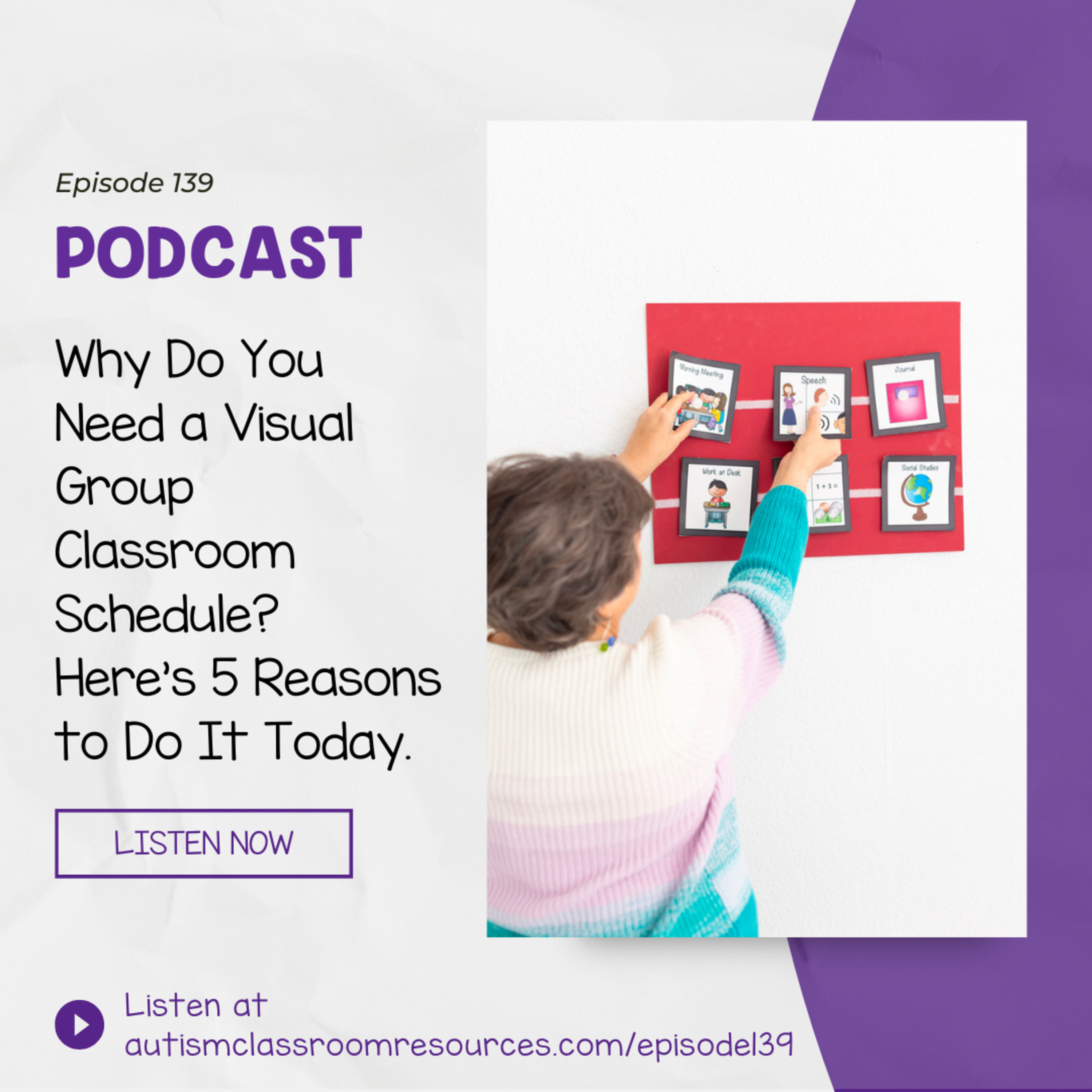
Ep 139139. Why Do You Need a Visual Group Classroom Schedule? Here's 5 Reasons to Do It Today.
For the last few episodes, you’ve heard me talk about visual schedules. But there’s a type of schedule that often gets forgotten about or overlooked by teachers. In this episode, I discuss group or class schedules and why they’re every bit as important as other kinds of schedules to use for your special education classroom.2:19 - Something I find happens a lot in self-contained special ed classrooms4:16 - The different forms that group schedules can take4:43 - The key to constructing a good group schedule for your students5:27 - What to do if students are doing different activities at the same time6:03 - Five reasons why groups schedules are important to use in the classroomGrab the transcript, freebie and resource links at http://autismclassroomresources.com/episode139Autism Classroom Resources' Free Resource Library... http://library.autismclassroomresources.comWant more information about the Special Educator Academy? SpecialEducatorAcademy.comJoin the Free Facebook Group specialeducatorsconnection.com--- Send in a voice message: https://anchor.fm/autismclassroomresources/message

Ep 138138. What Kind of Visual Schedule Does My Class Need?
How do you decide what kind of schedule to use for your students? While we focus on visual schedules for autistic classrooms, they’re very useful for a variety of reasons. In this episode, I discuss the different types of schedules, how I decide which type to use, and how I decide when I need to change it to a different kind of schedule.2:13 - The different kinds of visual schedules you can use for your students5:26 - Where I start if I don’t know where a student is in their learning of a schedule8:07 - The pros and cons of using photo schedules and when I primarily use them12:14 - What I do with a student with visual impairments13:09 - Advantages and disadvantages of using a written schedule16:22 - A quick recap of the episodeGrab the transcript, freebie and resource links at http://autismclassroomresources.com/episode138Autism Classroom Resources' Free Resource Library... http://library.autismclassroomresources.comWant more information about the Special Educator Academy? SpecialEducatorAcademy.comJoin the Free Facebook Group specialeducatorsconnection.com--- Send in a voice message: https://anchor.fm/autismclassroomresources/message

Ep 137137. Why You Should Be Using Visual Schedules in Your Classroom
Everyone says you must have visuals in an autism classroom. But everyone assumes you know what that means or that these visuals will somehow magically solve students’ behavioral problems. While they can’t do that, they are a really important component of your classroom (and not just for those with autism, either). In this episode, I discuss seven reasons why you need to use visual schedules in your classroom.3:32 - The 1st reason helps with your primary goal for students5:10 - Reason #2 helps cut down on arguments between you and the student5:54 - Why the actual visual aspect of visual schedules is important7:07 - How the 4th reason relieves student stress and anxiety8:40 - Reason number 5 sounds obvious but helps those with difficulty processing information around them9:38 - The 6th reason reveals a common trait for special ed students (and honestly, a large part of society in general)10:38 - The final reason why you want to use visual schedules11:35 - One more thing you need to know to make visual schedules useful in your classroomGrab the transcript, freebie and resource links at http://autismclassroomresources.com/episode137Autism Classroom Resources' Free Resource Library... http://library.autismclassroomresources.comWant more information about the Special Educator Academy? SpecialEducatorAcademy.comJoin the Free Facebook Group specialeducatorsconnection.com--- Send in a voice message: https://anchor.fm/autismclassroomresources/message

Ep 136136. How to Collect ABC Data Part 2
Just the facts, ma’am. That’s the attitude you need to have when you’re collecting antecedent behavior consequence data in a functional behavior assessment. Like I talked about last week, you want to keep your emotions out of it. In this episode, I want to get a little more specific and follow up with a couple more things to think about when taking ABC data, including a strategy to help you amend some of them if your classroom staff have difficulty keeping emotions out of it.1:36 - What you can do if you think you know the function of the student’s behavior3:01 - Why making assumptions about the behavior data you gather can backfire5:40 - Examples of how underlying causes of behavior can be different in the same scenario7:16 - The mistake to avoid with your factual observations after taking the data8:57 - One thing that can help if classroom staff struggle with sticking to the factsGrab the transcript, freebie and resource links at http://autismclassroomresources.com/episode136Autism Classroom Resources' Free Resource Library... http://library.autismclassroomresources.comWant more information about the Special Educator Academy? SpecialEducatorAcademy.comJoin the Free Facebook Group specialeducatorsconnection.com--- Send in a voice message: https://anchor.fm/autismclassroomresources/message

Ep 135135. How to Collect ABC Data Part 1
Students learn their ABCs, but special ed teachers need to know their ABC. When dealing with challenging behavior from students, you need to collect antecedent behavior consequence data (a.k.a. ABC) so you can figure out the why behind the behavior. In fact, it can give you all kinds of information, but only if you take it correctly. In this episode, I reveal some specific things you need to know in order to correctly collect ABC data.2:16 - The first thing you need to know about collecting ABC data4:07 - What do consequences mean when talking about antecedent behavior consequence data5:12 - One of the biggest issues I see when using ABC data sheets6:24 - How to be objective while recording antecedent behavior consequence data8:56 - Why objectivity in ABC data collection is so important11:17 - One last thing you must include in your data collectionGrab the transcript, freebie and resource links at http://autismclassroomresources.com/episode135Autism Classroom Resources' Free Resource Library... http://library.autismclassroomresources.comWant more information about the Special Educator Academy? SpecialEducatorAcademy.comJoin the Free Facebook Group specialeducatorsconnection.com--- Send in a voice message: https://anchor.fm/autismclassroomresources/message

How to Take Data in Circle Time and Morning Meeting
For a lot of special educators, data is the giant elephant in the room. It gets treated like that kind of a four-letter word when it’s not. Now I’m a huge data geek, so much so that I wrote a book about it. But I know data only helps you if it’s real, reliable, and teachable. So in this episode, I talk about how you can use data in a real classroom, with real students for group instruction. 3:14 - The key to making data collection feel less painful 4:18 - What we know about taking instructional data and how my naturalistic data sheet is set up 6:29 - How to take data on multiple points for multiple students during group activity 7:45 - Do you necessarily have to be the one to run the group activity? 9:59 - Another way to more easily record instructional data 10:23 - Tips for making instructional data collection work in your classroom Grab the transcript, freebie and resource links at http://autismclassroomresources.com/episode107 Autism Classroom Resources' Free Resource Library... http://library.autismclassroomresources.com Want more information about the Special Educator Academy? SpecialEducatorAcademy.com Join the Free Facebook Group specialeducatorsconnection.com --- Send in a voice message: https://anchor.fm/autismclassroomresources/message
How to Set Up Your Systems for Special Ed Classroom Data Analysis
You’ve collected some classroom data, so now what? Leaving it sitting in a binder doesn’t help anybody; therefore, it’s critical that you set up systems for regular analysis. We take this data for legal reasons, to show progress, but most importantly, to troubleshoot any learning issues confronting our students. In this episode, I discuss how to make analysis happen and the three elements to consider for developing systems that ensure the data gets analyzed and is practical for your classroom. 4:40 - The biggest takeaway from what little research exists on classroom data collection 6:14 - A tool that makes graphing your classroom data easier than ever 9:22 - How my ex-preschool’s strategy can help you fit this into everything else you have to do 10:52 - Two keys to adapting the preschool’s strategy to work for you 12:56 - Why paraprofessionals must get on-board with the analysis process Grab the transcript, freebie and resource links at http://autismclassroomresources.com/episode88 Autism Classroom Resources' Free Resource Library... http://library.autismclassroomresources.com Want more information about the Special Educator Academy? SpecialEducatorAcademy.com Join the Free Facebook Group specialeducatorsconnection.com --- Send in a voice message: https://anchor.fm/autismclassroomresources/message
How to Set Up Data Collection Systems for Your Autism Classroom
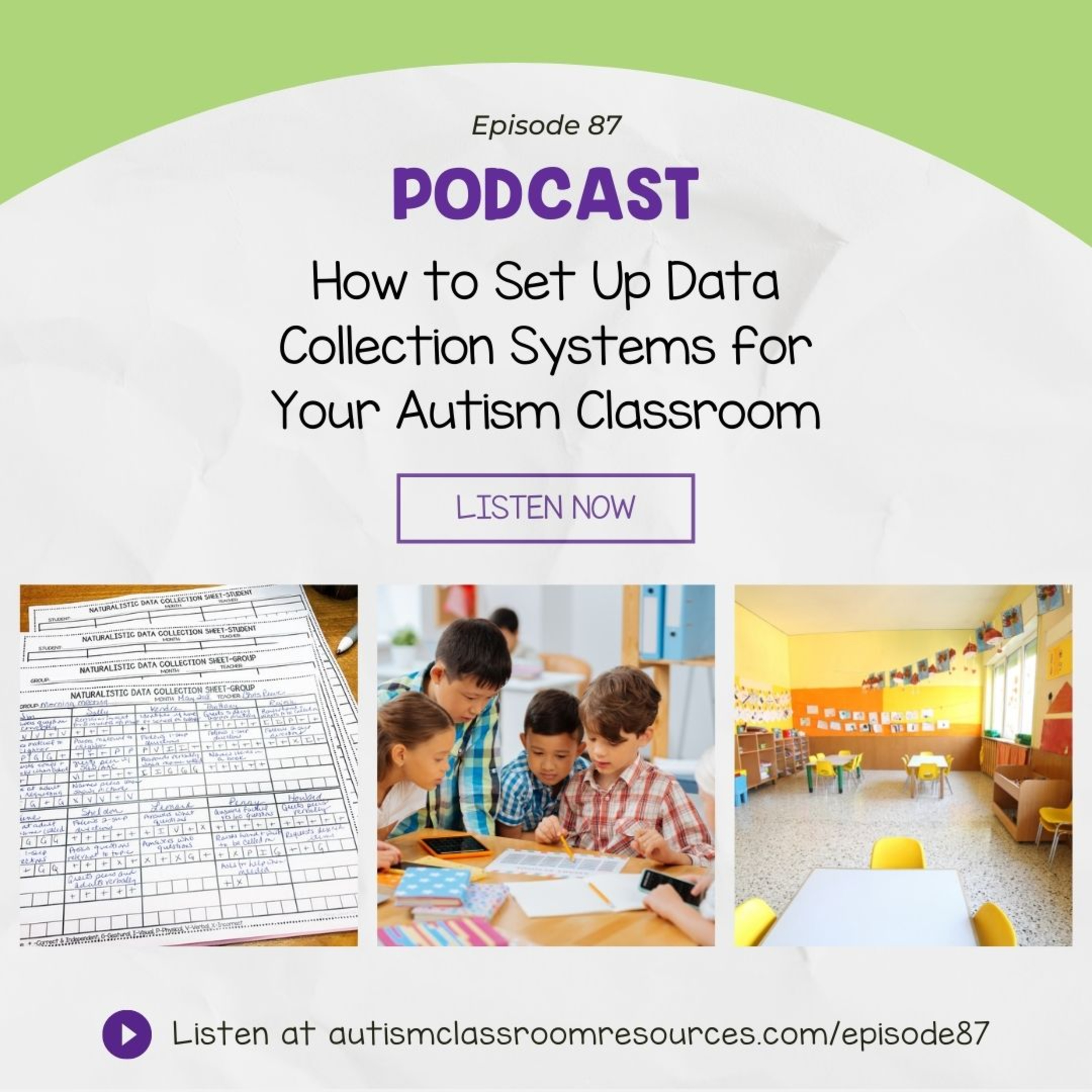
When it comes to data collection, there’s no one-size-fits-all, and it involves way more than just finding the right datasheet. You have to ensure you build a system with the right data, not more data. So today is all about focusing on data systems. In this episode, I walk you through how to get started and what you need to consider when creating your systems for instructional data collection. 3:14 - The question I get asked a LOT about data collection and why there’s no real answer 4:48 - Why quality over quantity matters when collecting data 6:06 - Two things you must be aware of when you’re collecting data 7:52 - How to get started on building a strategy for data collection 11:04 - Why you need to integrate your data plan with your zoning plan and what to look for afterward 12:41 - The final key about data collection systems I must reveal Grab the transcript, freebie and resource links at http://autismclassroomresources.com/episode87 Autism Classroom Resources' Free Resource Library... http://library.autismclassroomresources.com Want more information about the Special Educator Academy? SpecialEducatorAcademy.com Join the Free Facebook Group specialeducatorsconnection.com --- Send in a voice message: https://anchor.fm/autismclassroomresources/message

How to Make IEP Data Collection Work
Wouldn’t it be nice to have data collection work for you instead of against you? I hear from teachers all the time that data collection is one of the most difficult things to figure out. You get told to take it but not how. In this episode, I cover the three most important aspects of the data you collect and five things you can do to improve your data collection over the next few months. 1:45 - Three things your collected data must be 3:03 - How to write data-friendly goals 7:37 - How to make a data plan (and why it’s critical) 10:09 - Creating a data collection system for your classroom 12:27 - How to correctly analyze the data you’ve collected 14:25 - Using your data to write your next set of goals Grab the transcript, freebie and resource links at http://autismclassroomresources.com/episode22 Autism Classroom Resources' Free Resource Library... http://library.autismclassroomresources.com Want more information about the Special Educator Academy? SpecialEducatorAcademy.com Join the Free Facebook Group specialeducatorsconnection.com --- Send in a voice message: https://anchor.fm/autismclassroomresources/message

Ep 134134. Troubleshooting When Classroom Staff Aren’t Performing As You Would Like
As a leader of the classroom, you’ve done everything you needed to do to set up your staff for success. You’ve created the zoning plan, trained them, and provided feedback to them (and received feedback in kind). But what do you do when things still aren’t going well with the staff? That’s the really hard question I tackle in today’s episode, so buckle in!1:57 - What to do if you have concerns about student safety due to a staff member’s behavior4:13 - The mindset you must have in order to lead classroom staff effectively6:15 - Where to start when someone on your staff isn’t performing as planned7:25 - How to address a problem you see with anyone on the classroom staff10:03 - What to do if the staff member’s issue keeps repeating itselfGrab the transcript, freebie and resource links at http://autismclassroomresources.com/episode134Autism Classroom Resources' Free Resource Library... http://library.autismclassroomresources.comWant more information about the Special Educator Academy? SpecialEducatorAcademy.comJoin the Free Facebook Group specialeducatorsconnection.com--- Send in a voice message: https://anchor.fm/autismclassroomresources/message

Ep 133133. 3 Ways to Give Feedback to Staff Effectively Without 1-1 Collaboration Time
You went into education wanting to teach kids, not manage adults. But to run a special ed classroom takes a village--one you need to lead--and that takes the form of your classroom staff. I’ve dedicated this month to discuss how to train that staff and so far in this series, I’ve talked about setting up the classroom structure for them and addressed three of the most common roadblocks in training them. In this episode, I continue with how you can give meaningful feedback in the classroom when you have no time for one-on-one collaboration.2:35 - Why giving feedback is such a critical training tool4:23 - Why you don’t want to wait to give feedback to your staff6:15 - My first tip for having meaningful feedback8:35 - An easy way you can provide feedback9:28 - A way I love to share positive feedback, in particular11:13 - The golden ratio of positive-to-negative feedback and how to integrate itGrab the transcript, freebie and resource links at http://autismclassroomresources.com/episode133Autism Classroom Resources' Free Resource Library... http://library.autismclassroomresources.comWant more information about the Special Educator Academy? SpecialEducatorAcademy.comJoin the Free Facebook Group specialeducatorsconnection.com--- Send in a voice message: https://anchor.fm/autismclassroomresources/message

Ep 132Addressing 3 Common Roadblocks to Training Staff in the Classroom
Special education classrooms are unique in that they have a level of supervision not seen in other areas of the school. In running the classroom, you have a staff and are expected to train, but you’re not really a supervisor nor have a hand in selecting who’s on the staff. And with the students taking up so much time, you also don’t have a lot of opportunities to train them, either.In today’s episode, I focus on three of the biggest roadblocks you’ll face in training your staff and ways you can clear those roadblocks.3:32 - How to deal with the first roadblock to training your classroom staff5:30 - Does everyone on the staff need this?7:26 - My rule of thumb for handling the second roadblock that can come up10:57 - Some solutions for clearing arguably the biggest roadblock of allGrab the transcript, freebie and resource links at http://autismclassroomresources.com/episode132Autism Classroom Resources' Free Resource Library... http://library.autismclassroomresources.comWant more information about the Special Educator Academy? SpecialEducatorAcademy.comJoin the Free Facebook Group specialeducatorsconnection.com--- Send in a voice message: https://anchor.fm/autismclassroomresources/message