
Astronomy Daily: Space News Updates
786 episodes — Page 2 of 16
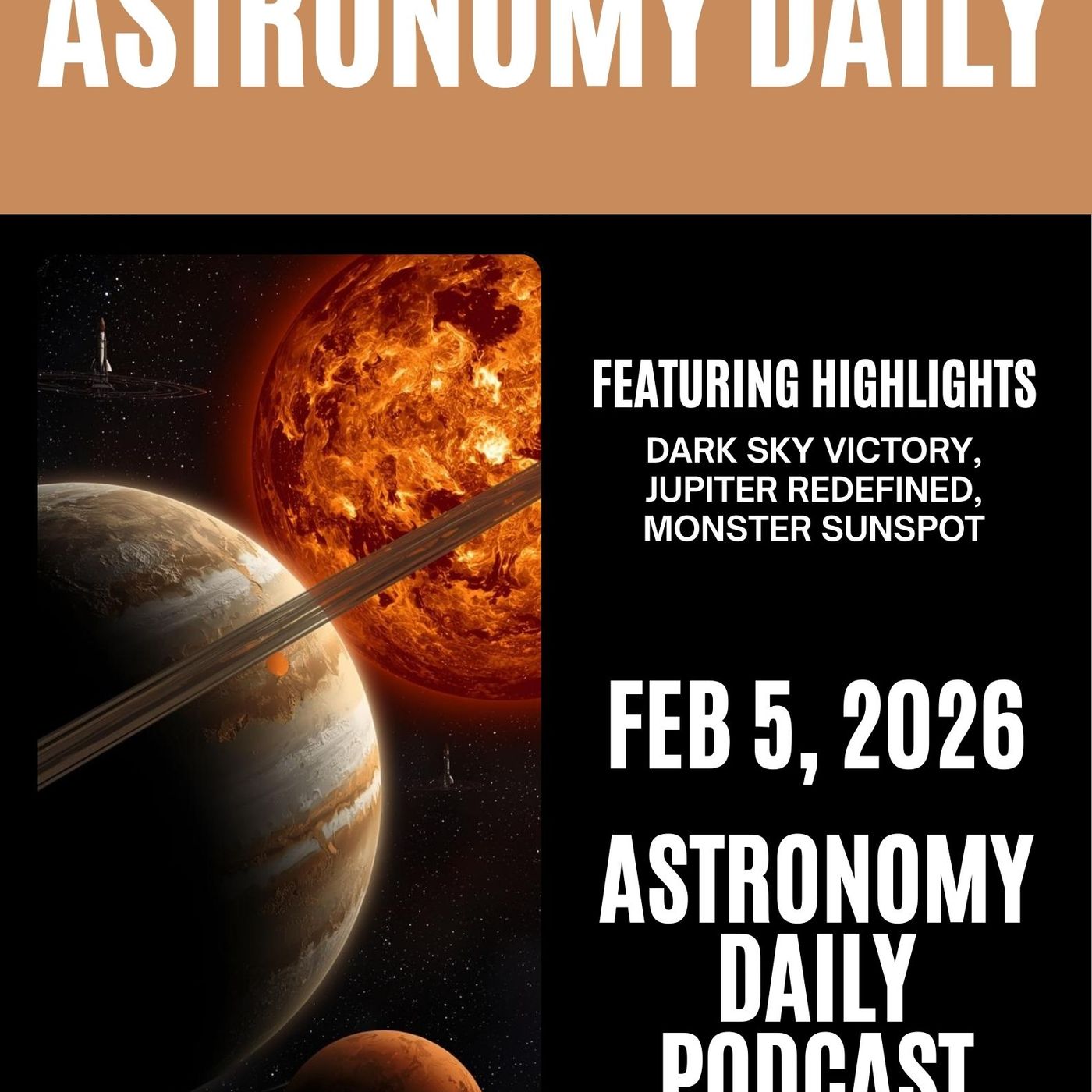
S5 Ep 31Dark Sky Victory, Jupiter Redefined, and Monster Sunspot Faces Earth
Astronomy Daily - S05E31: Dark Sky Victory, Jupiter Redefined, Monster SunspotVictory for dark skies as industrial plant near major observatory cancelled • NASA's Juno mission reveals Jupiter is larger and flatter than we thought • 15-Earth-wide sunspot currently facing our planet • Unusual Martian storm reveals subsurface secrets • NASA acknowledges SLS rocket sustainability challenges • How red giant stars destroy their own gas giant planetsHost Anna and Avery discuss six major space stories for Thursday, February 5th, 2026.Episode sponsored by astronomydaily.io - Your daily source for space and astronomy newsFeatured Stories:• Dark Sky Preservation: Industrial development threatening Canary Islands observatory cancelled• Jupiter Redefined: Juno mission measurements reveal true size and shape of gas giant• Solar Activity: Monster sunspot 15 Earths wide faces Earth - viewing safety tips included• Martian Meteorology: Unusual storm system reveals subsurface features of red planet• SLS Reality Check: NASA publicly addresses Space Launch System cost sustainability• Stellar Destruction: Red giants systematically destroy orbiting gas giant planetsFollow us:Website: astronomydaily.ioSocial: @AstroDailyPod (all platforms)Become a supporter of this podcast: https://www.spreaker.com/podcast/astronomy-daily-space-news-updates--5648921/support.Sponsor Details:Ensure your online privacy by using NordVPN. To get our special listener deal and save a lot of money, visit www.bitesz.com/nordvpn. You'll be glad you did!Become a supporter of Astronomy Daily by joining our Supporters Club. Commercial free episodes daily are only a click way... Click HereThis episode includes AI-generated content.
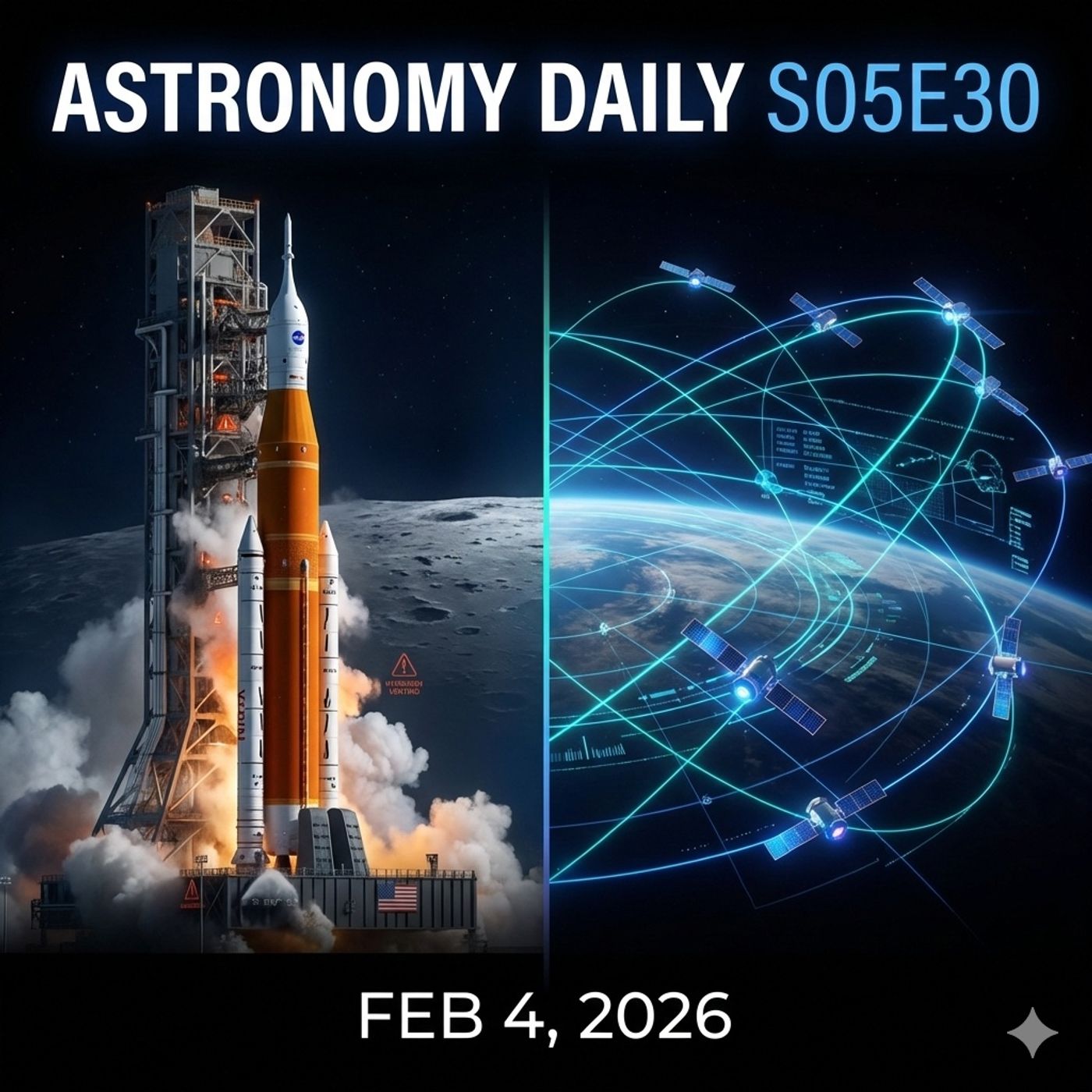
S5 Ep 30Artemis 2 Delayed, SpaceX Unveils Stargaze Safety System
Welcome to Astronomy Daily, bringing you the latest space and astronomy news. I'm Anna, joined by my co-host Avery, with today's cosmic headlines for Wednesday, February 4th, 2026.Episode Highlights:🚀 ARTEMIS 2 DELAYED - NASA's historic moon mission pushed to March after hydrogen leak during wet dress rehearsal. Four astronauts await their journey around the Moon as teams address familiar technical challenges.🛰️ SPACEX UNVEILS STARGAZE - Revolutionary space traffic management system uses 30,000 star trackers to detect 30 million orbital transits daily. Free conjunction data offered to all satellite operators starting this spring.⚠️ FALCON 9 GROUNDED - SpaceX temporarily halts launches after upper stage deorbit issue. Critical Crew-12 astronaut mission scheduled for February 11th hangs in the balance.🌌 JWST'S RARE DISCOVERY - Five-way galaxy merger spotted in early universe challenges cosmic evolution models. System formed just 800 million years after Big Bang shows unexpected complexity.🌠 LOCAL VOID MYSTERY SOLVED - 50-year puzzle resolved as scientists map flat sheet of matter beyond Local Group. Milky Way fleeing massive cosmic void at 600,000 mph.⭐ RUNAWAY STARS MAPPED - Largest study reveals dual mechanisms ejecting massive stars from the galaxy. 214 O-type stellar speedsters analyzed, some exceeding 700 km/s.For more space news, visit astronomydaily.io and follow us @AstroDailyPod on all major platforms.Become a supporter of this podcast: https://www.spreaker.com/podcast/astronomy-daily-space-news-updates--5648921/support.Sponsor Details:Ensure your online privacy by using NordVPN. To get our special listener deal and save a lot of money, visit www.bitesz.com/nordvpn. You'll be glad you did!Become a supporter of Astronomy Daily by joining our Supporters Club. Commercial free episodes daily are only a click way... Click HereThis episode includes AI-generated content.
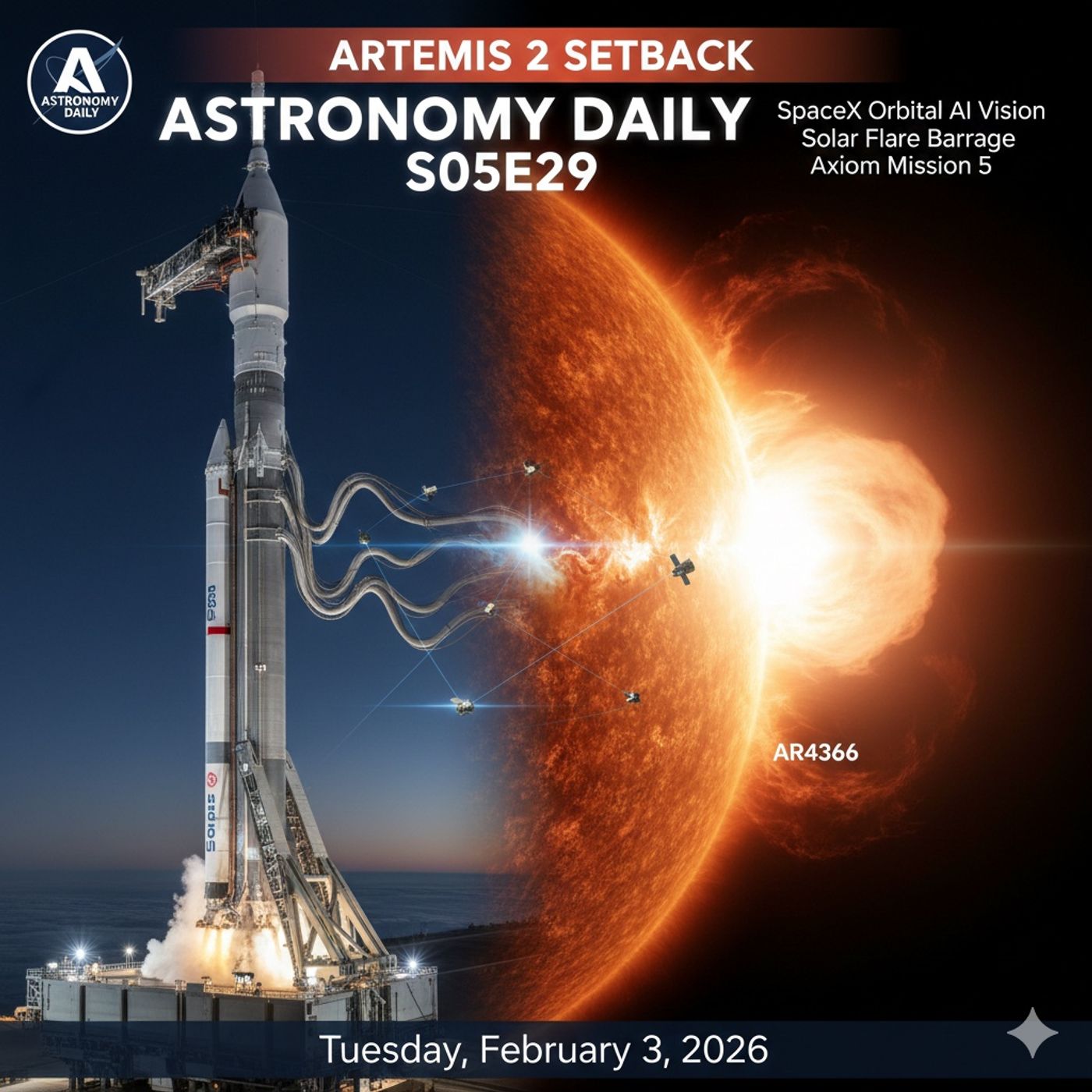
S5 Ep 29Artemis 2 Setback, SpaceX's Trillion-Dollar Orbital Vision & X8.3 Solar Flare
Welcome to Astronomy Daily! Join hosts Anna and Avery for Tuesday, February 3rd's space news roundup. Today we're covering a critical setback in NASA's Artemis 2 wet dress rehearsal, Elon Musk's controversial vision for orbital AI data centers following SpaceX's acquisition of xAI, NASA's announcement of Axiom Mission 5 to the ISS, extraordinary solar flare activity from a volatile new sunspot, the start of NASA's IMAP mission to map our heliosphere, and exciting opportunities through ESA's Graduate Trainee Programme.Episode Highlights: - https://jobs.esa.int/• Artemis 2 wet dress rehearsal terminated at T-5:15 due to hydrogen leak• SpaceX acquires xAI with plans for million-satellite orbital data center constellation• NASA books fifth Axiom private astronaut mission for January 2027 launch• Sun unleashes 18 M-class and 3 X-class flares including X8.3 eruption• NASA's IMAP begins mapping boundaries of our solar system• ESA opens applications for 2026 Graduate Trainee Programme https://jobs.esa.int/Featured Stories:ARTEMIS 2 SETBACKNASA's critical wet dress rehearsal for the Artemis 2 mission was terminated at the T-5 minute 15 second mark due to a liquid hydrogen leak at the tail service mast umbilical interface. The launch control team worked to safe the Space Launch System rocket and drain its tanks. This rehearsal represents one of the final major tests before the historic mission that will send the first crew around the Moon in over 50 years.SPACEX ORBITAL DATA CENTERSElon Musk announced SpaceX's acquisition of xAI and unveiled plans for up to one million satellites serving as orbital data centers. The proposal addresses ground-based data center challenges including electricity demands and water cooling needs by harnessing continuous solar power in space. Industry experts express skepticism about technical feasibility and suggest the timing may relate to SpaceX's potential IPO.AXIOM MISSION 5NASA ordered a fifth private astronaut mission from Axiom Space targeting launch no earlier than January 2027. The 14-day mission continues NASA's commercial space strategy, with Axiom proposing four crew members for approval. The mission includes service exchanges with NASA acquiring cold-return capability for scientific samples while Axiom purchases consumables and cargo services.SOLAR FLARE BARRAGESunspot region 4366 produced at least 18 M-class and three X-class solar flares in 24 hours, including the year's strongest X8.3 eruption. The February 1st flare triggered R3 radio blackouts across eastern Australia and New Zealand. Scientists monitor for coronal mass ejections with possible glancing Earth impact around February 5th that could produce high-latitude auroras.IMAP MISSION STARTNASA's Interstellar Mapping and Acceleration Probe officially began its two-year primary science mission on February 1st. The spacecraft's 10 instruments will map heliosphere boundaries and study particle energization and solar wind interactions. IMAP data feeds the I-ALiRT system providing near-real-time space weather observations to protect spacecraft and astronauts.ESA OPPORTUNITIESThe European Space Agency opened applications for its 2026 Graduate Trainee Programme for recent graduates in engineering, science, IT, and business. The one-year positions with possible second-year extension offer monthly tax-exempt salaries, travel reimbursement, installation allowances, and comprehensive benefits. Candidates can submit up to three applications through jobs.esa.int.Connect With Us:Website: astronomydaily.ioSocial Media: @AstroDailyPod on X/Twitter, Facebook, Instagram, TikTok, YouTube, TumblrBecome a supporter of this podcast: https://www.spreaker.com/podcast/astronomy-daily-space-news-updates--5648921/support.Sponsor Details:Ensure your online privacy by using NordVPN. To get our special listener deal and save a lot of money, visit www.bitesz.com/nordvpn. You'll be glad you did!Become a supporter of Astronomy Daily by joining our Supporters Club. Commercial free episodes daily are only a click way... Click HereThis episode includes AI-generated content.
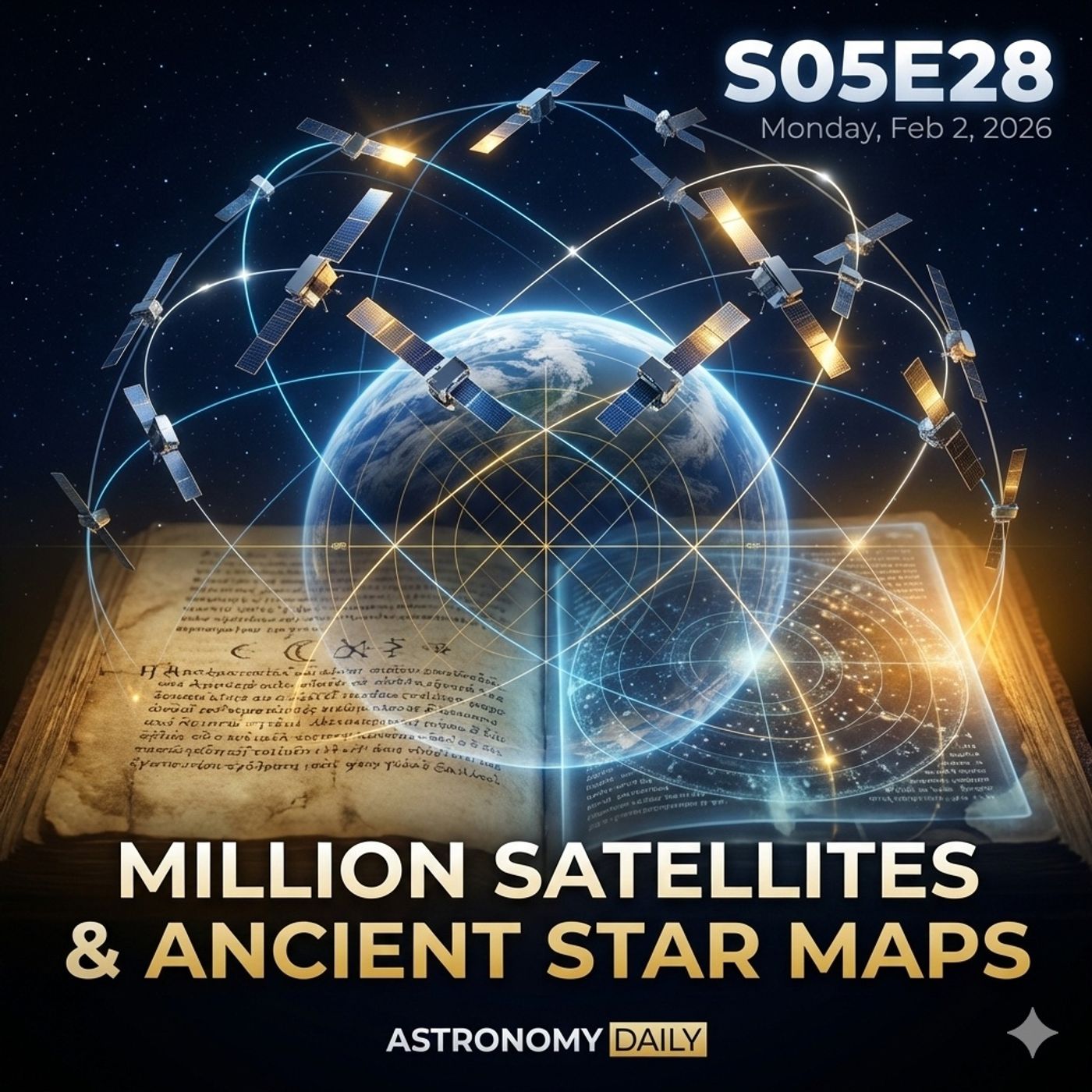
S5 Ep 28SpaceX's Million-Satellite Vision, Ancient Star Maps, and China's Solar Mission
Welcome to Astronomy Daily! Join hosts Anna and Avery for today's cosmic journey through space news, featuring SpaceX's audacious plan for one million solar-powered satellites, an ancient star catalog recovered from layers of medieval text, and China's groundbreaking solar mission to the L5 point.**Episode Highlights:**🛰️ **SpaceX's Million-Satellite Vision** - SpaceX files with the FCC to launch up to one million solar-powered satellite data centers for AI, framing it as a step toward becoming a Kardashev Type II civilization⭐ **Ancient Star Map Revealed** - Scientists use X-ray technology to uncover Hipparchus's 2,000-year-old star catalog hidden under six layers of ink in a medieval manuscript☀️ **China's Solar Observatory** - The Xihe-2 probe will become the first mission to monitor solar activity from the Sun-Earth L5 point, offering five-day advance warnings of space weather events🔭 **Stellar Detective Story** - Astronomers discover WOH G64 isn't dying after all—a hidden companion star was fooling scientists about the red supergiant's fate🚀 **Time Honors Artemis 2** - Time magazine releases special commemorative cover celebrating the Artemis 2 crew ahead of humanity's return to lunar orbit🌍 **Remembering Gladys West** - Honoring the GPS pioneer and "Hidden Figure" whose mathematical work shaped navigation technology used by billions worldwide**Episode Length:** 18-20 minutes**Hosts:** Anna & Avery**Production:** Astronomy Daily Podcast, Season 5---## Connect With Us🌐 Website: astronomydaily.io 🐦 Twitter/X: @AstroDailyPod 📘 Facebook: @AstroDailyPod 📸 Instagram: @AstroDailyPod 🎵 TikTok: @AstroDailyPod 📺 YouTube: @AstroDailyPod 📱 Tumblr: @AstroDailyPod---## Story Sources- TechCrunch- Daily Galaxy- Space.com- Journal for the History of Astronomy- CGTN News- Keele University- U.S. Department of DefenseBecome a supporter of this podcast: https://www.spreaker.com/podcast/astronomy-daily-space-news-updates--5648921/support.Sponsor Details:Ensure your online privacy by using NordVPN. To get our special listener deal and save a lot of money, visit www.bitesz.com/nordvpn. You'll be glad you did!Become a supporter of Astronomy Daily by joining our Supporters Club. Commercial free episodes daily are only a click way... Click HereThis episode includes AI-generated content.
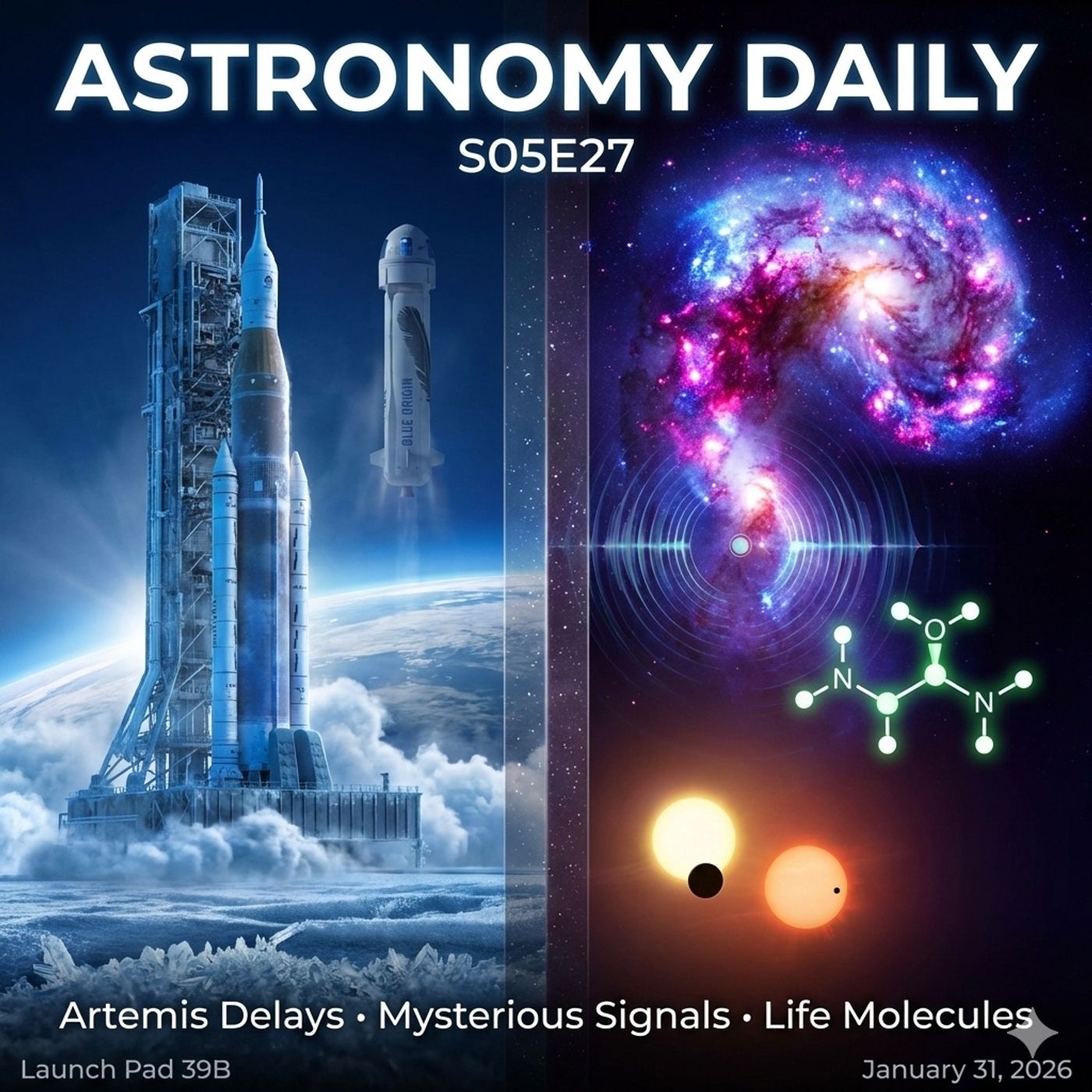
S5 Ep 27Artemis Delays, Blue Origin's Lunar Pivot, and Life's Building Blocks in Space
Join hosts Anna and Avery for Saturday's cosmic roundup! NASA's Artemis 2 wet dress rehearsal faces weather delays, pushing the historic lunar mission to April 2026. Blue Origin announces a major strategic shift, pausing space tourism for two years to focus on their Blue Moon lunar lander program. We explore million-mile-per-hour cosmic winds racing through a "magnetic superhighway" in colliding galaxies, investigate a mysterious object sending unexplained signals across the galaxy, discover why Tatooine-style planets might be more common than expected, and celebrate a groundbreaking first - the detection of ethanolamine, a molecule critical to cell membranes, in interstellar space.**Episode Keywords:** Artemis 2, NASA, Blue Origin, New Shepard, space tourism, lunar lander, cosmic winds, galaxy merger, IC 1623, mysterious signals, radio astronomy, circumbinary planets, binary stars, ethanolamine, astrobiology, interstellar molecules, space exploration, Kennedy Space Center**Detailed Chapter Markers:**- [00:00] Introduction & Episode Overview- [02:15] NASA Artemis 2 Wet Dress Rehearsal Delay- [06:45] Blue Origin Pauses Space Tourism for Lunar Ambitions- [11:20] Million-MPH Cosmic Winds in Magnetic Superhighway- [16:30] Mysterious Object Sending Unexplained Galactic Signals- [21:15] Tatooine Planets More Common Than Expected- [26:00] Life-Critical Molecule Detected in Interstellar Space- [30:45] Episode Wrap-Up & ClosingBecome a supporter of this podcast: https://www.spreaker.com/podcast/astronomy-daily-space-news-updates--5648921/support.Sponsor Details:Ensure your online privacy by using NordVPN. To get our special listener deal and save a lot of money, visit www.bitesz.com/nordvpn. You'll be glad you did!Become a supporter of Astronomy Daily by joining our Supporters Club. Commercial free episodes daily are only a click way... Click HereThis episode includes AI-generated content.

S5 Ep 25Io's Record Eruption, Nuclear Space Future, and Ancient Mars Beaches
Witness the largest volcanic eruption ever seen on Jupiter's moon Io, explore NASA's breakthrough in nuclear propulsion, and discover evidence of ancient Martian beaches that could rewrite the story of life beyond Earth.In this episode, we cover:• NASA's Juno spacecraft captures a colossal 150-mile-high volcanic plume on Io• KRUSTY nuclear reactor test paves the way for deep space exploration• Ancient beach deposits in Gale Crater reveal Mars' watery past• Artemis II communication networks ready for lunar missions• The Moon's February celestial tour featuring Venus, Saturn, and Jupiter• Life's chemical building blocks form naturally in interstellar spaceHosted by Anna and Avery, Astronomy Daily brings you the latest space and astronomy news in an engaging, accessible format perfect for enthusiasts and curious minds alike.**Links & Resources:**Visit astronomydaily.io for full articles, transcripts, and sourcesFollow us @AstroDailyPod on social mediaWatch on YouTubeBecome a supporter of this podcast: https://www.spreaker.com/podcast/astronomy-daily-space-news-updates--5648921/support.Sponsor Details:Ensure your online privacy by using NordVPN. To get our special listener deal and save a lot of money, visit www.bitesz.com/nordvpn. You'll be glad you did!Become a supporter of Astronomy Daily by joining our Supporters Club. Commercial free episodes daily are only a click way... Click HereThis episode includes AI-generated content.
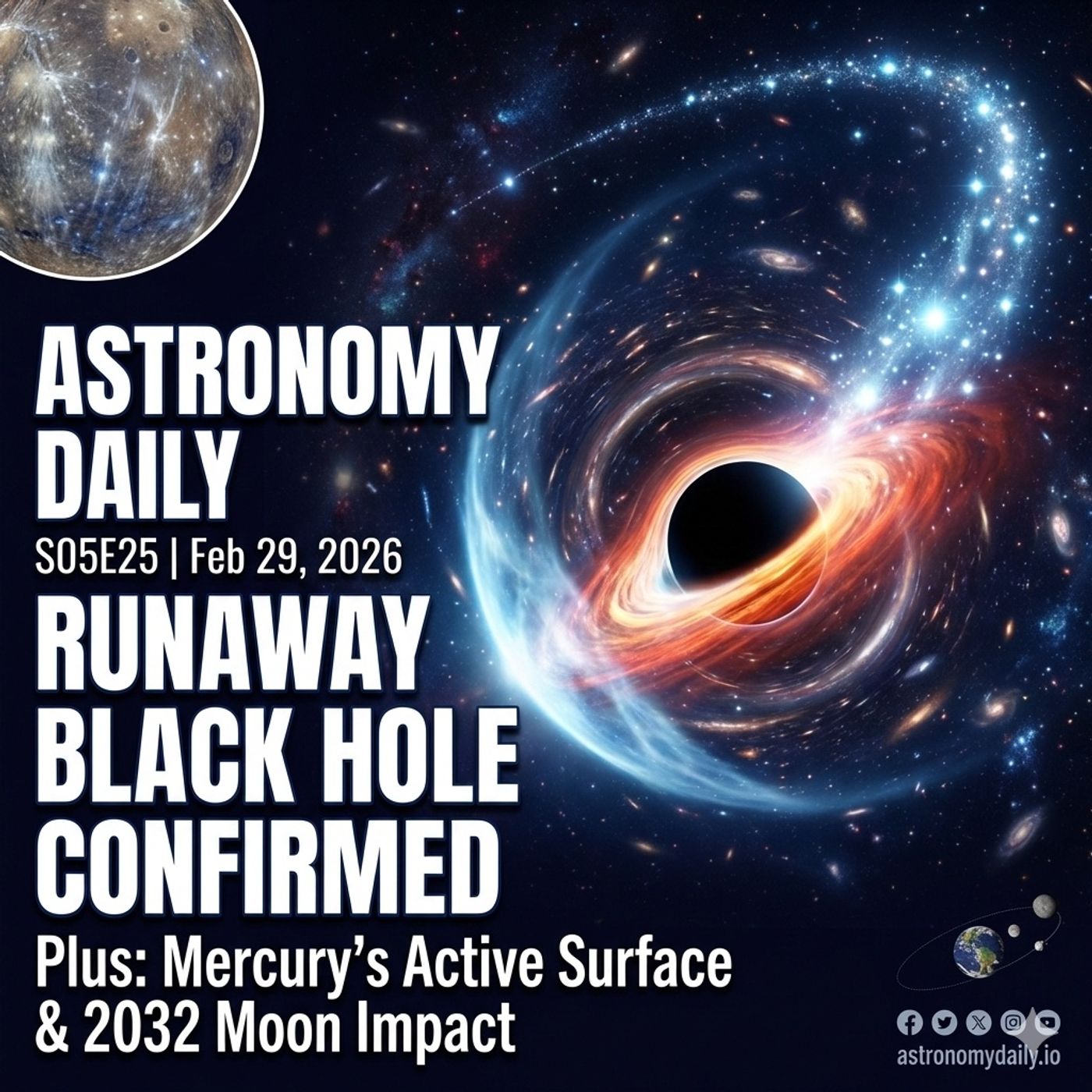
S5 Ep 25Runaway Black Hole Confirmed, Mercury Still Active & 2032 Moon Impact Risk
Join hosts Anna and Avery for an exciting journey through today's most compelling space stories. We explore Mercury's surprising geological activity, NASA's TESS satellite recovery, a frigid Earth-like exoplanet discovery, an accelerated ISS crew launch, runaway black holes tearing through space, and the scientific opportunities of a potential lunar asteroid impact in 2032.### Episode Highlights**Mercury's Hidden Activity**New research reveals that Mercury, long considered geologically dead, is still actively losing volatile materials from its interior. Using AI analysis of 100,000 MESSENGER images, scientists have mapped 400 bright slope streaks that indicate ongoing geological processes. The BepiColombo mission will provide unprecedented new data when it arrives at Mercury.**TESS Satellite Recovery**NASA's planet-hunting TESS satellite recently entered safe mode after a command error caused solar panel misalignment. The spacecraft successfully recovered, demonstrating the importance of built-in safeguards. NASA is reviewing procedures to prevent future incidents.**Ice-Cold Earth Twin**Astronomers have discovered HD 137010 b, an Earth-like exoplanet 146 light-years away that could be as cold as minus 90°F. Despite frigid temperatures, it orbits within its star's habitable zone, offering insights into the diversity of potentially habitable worlds.**Crew-12 Launch Advanced**SpaceX and NASA have moved up the Crew-12 launch to February 11, four days earlier than planned, to provide relief for the three-person skeleton crew managing the ISS after the first-ever medical evacuation from the station.**Runaway Black Holes Confirmed**The James Webb Space Telescope has confirmed the first runaway supermassive black hole, ejected from its galaxy and leaving a 200,000 light-year trail of newborn stars. Traveling at 1,600 km/s, this discovery validates 50-year-old theoretical predictions.**Moon Impact Opportunity**Asteroid 2024 YR4 has a 4% chance of striking the Moon on December 22, 2032. While posing risks to satellites and Earth, such an impact would provide unprecedented scientific data on lunar geology, create spectacular meteor displays, and deliver free lunar samples to Earth.### Featured Stories1. **Mercury Still Geologically Active** - University of Bern researchers discover 400 bright streaks indicating ongoing volatile loss (Source: Space Daily)2. **TESS Satellite Command Error** - NASA's exoplanet hunter recovers from safe mode after solar panel misalignment (Source: Daily Galaxy)3. **Frigid Earth-Like Planet Discovery** - HD 137010 b joins the search for Earth's twin despite extreme cold (Source: Daily Galaxy)4. **ISS Crew-12 Launch Moved Up** - February 11 launch provides relief after historic medical evacuation (Source: Space.com)5. **First Confirmed Runaway Black Hole** - JWST observations validate theoretical predictions with stunning stellar trail (Source: Phys.org/Science Sources)6. **Asteroid 2024 YR4 Lunar Impact** - 4% chance creates scientific opportunity and satellite risk in 2032 (Source: Universe Today)### HostsAnna and Avery### Links & Resources- Website: astronomydaily.io- Social Media: @AstroDailyPod (X, Facebook, Instagram, YouTube)- Subscribe for daily space news and updatesBecome a supporter of this podcast: https://www.spreaker.com/podcast/astronomy-daily-space-news-updates--5648921/support.Sponsor Details:Ensure your online privacy by using NordVPN. To get our special listener deal and save a lot of money, visit www.bitesz.com/nordvpn. You'll be glad you did!Become a supporter of Astronomy Daily by joining our Supporters Club. Commercial free episodes daily are only a click way... Click HereThis episode includes AI-generated content.
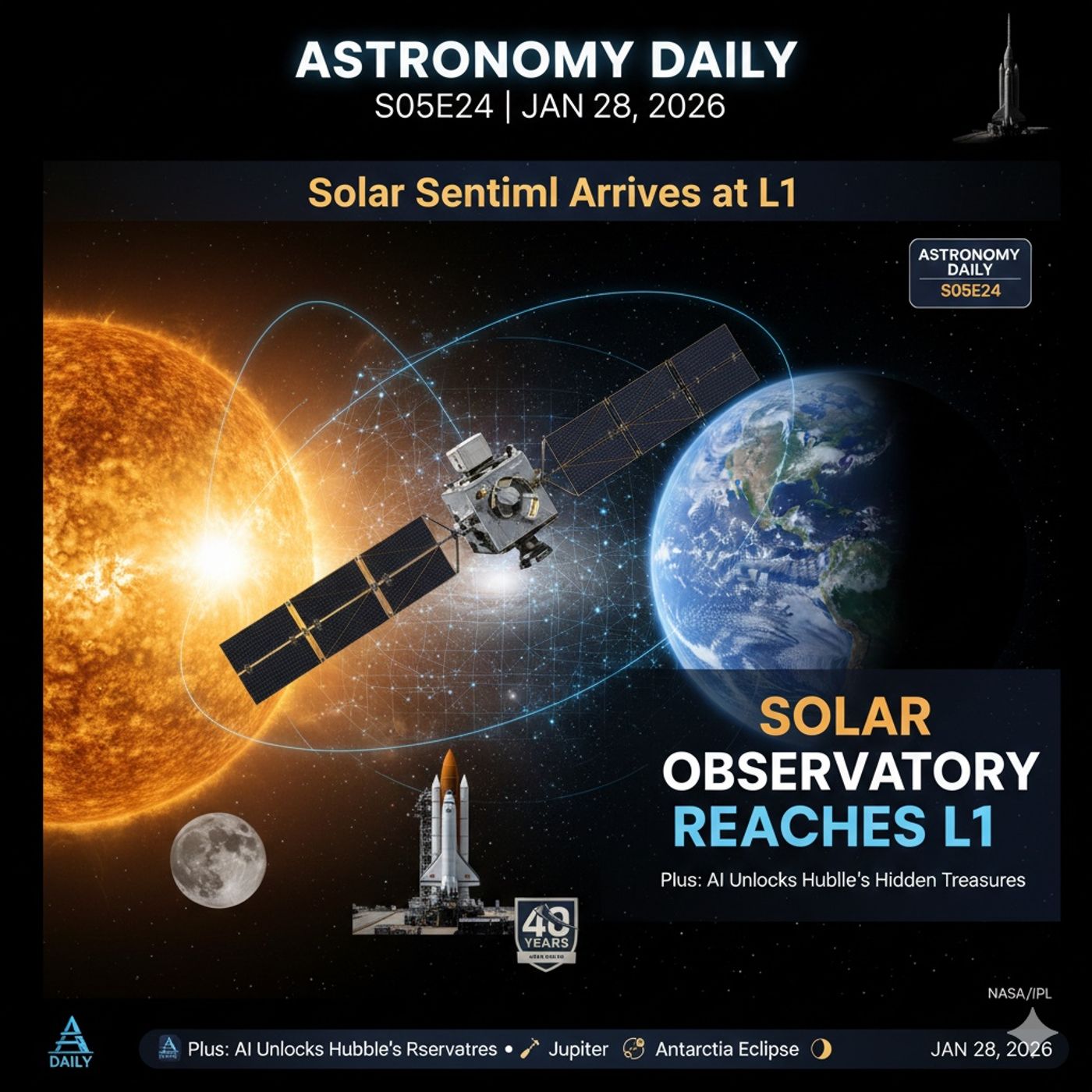
S5 Ep 24Solar Sentinel Reaches L1, Challenger's 40-Year Legacy, and AI's Hubble Discoveries
## Today's Headlines:🛰️ **NOAA Solar Observatory Reaches L1** NOAA's Space Weather Follow-On satellite successfully arrived at Lagrange point 1 on January 21st, establishing the first component of a future constellation designed to provide early warning of solar storms and coronal mass ejections. The satellite offers 15-60 minutes advance notice of space weather events that could impact Earth's infrastructure.🚀 **Challenger Disaster: 40 Years Later** Marking four decades since the Space Shuttle Challenger tragedy, we examine how unseasonably cold weather and O-ring failures led to the loss of seven crew members. The disaster fundamentally changed NASA's safety culture and decision-making processes, lessons that continue to influence spaceflight today.🤖 **AI Uncovers Cosmic Treasures in Hubble Archive** Advanced artificial intelligence algorithms have identified hundreds of previously undetected gravitational lenses in Hubble Space Telescope data. These discoveries include rare Einstein rings and exotic lensing configurations that provide windows into the early universe and dark matter distribution.☄️ **Venus's Potential Meteor Shower** Astronomers predict Venus may experience a significant meteor shower in July 2026 from debris of asteroid 2002 VT37. The event offers a rare opportunity to study how meteor showers interact with Venus's dense carbon dioxide atmosphere.🌌 **Stellar Fireworks at the Galactic Center** New observations reveal intense stellar activity near Sagittarius A*, our galaxy's supermassive black hole, including star formation, supernovae, and tidal disruption events in one of the most extreme environments in the Milky Way.📡 **Watch Artemis 2 Rocket Live** NASA has launched a 24-hour livestream of the Artemis 2 Space Launch System rocket on Launch Pad 39B as crews prepare for the first crewed lunar mission since 1972, currently targeting April 2026. https://www.youtube.com/watch?v=nrVnsO_rdew#### Resources & Links:- Story Sources: SpaceNews, Spectrum Local News, NASA Science, Space.com, Universe Today- Website: astronomydaily.io- Social Media: @AstroDailyPod (all platforms)Become a supporter of this podcast: https://www.spreaker.com/podcast/astronomy-daily-space-news-updates--5648921/support.Sponsor Details:Ensure your online privacy by using NordVPN. To get our special listener deal and save a lot of money, visit www.bitesz.com/nordvpn. You'll be glad you did!Become a supporter of Astronomy Daily by joining our Supporters Club. Commercial free episodes daily are only a click way... Click HereThis episode includes AI-generated content.
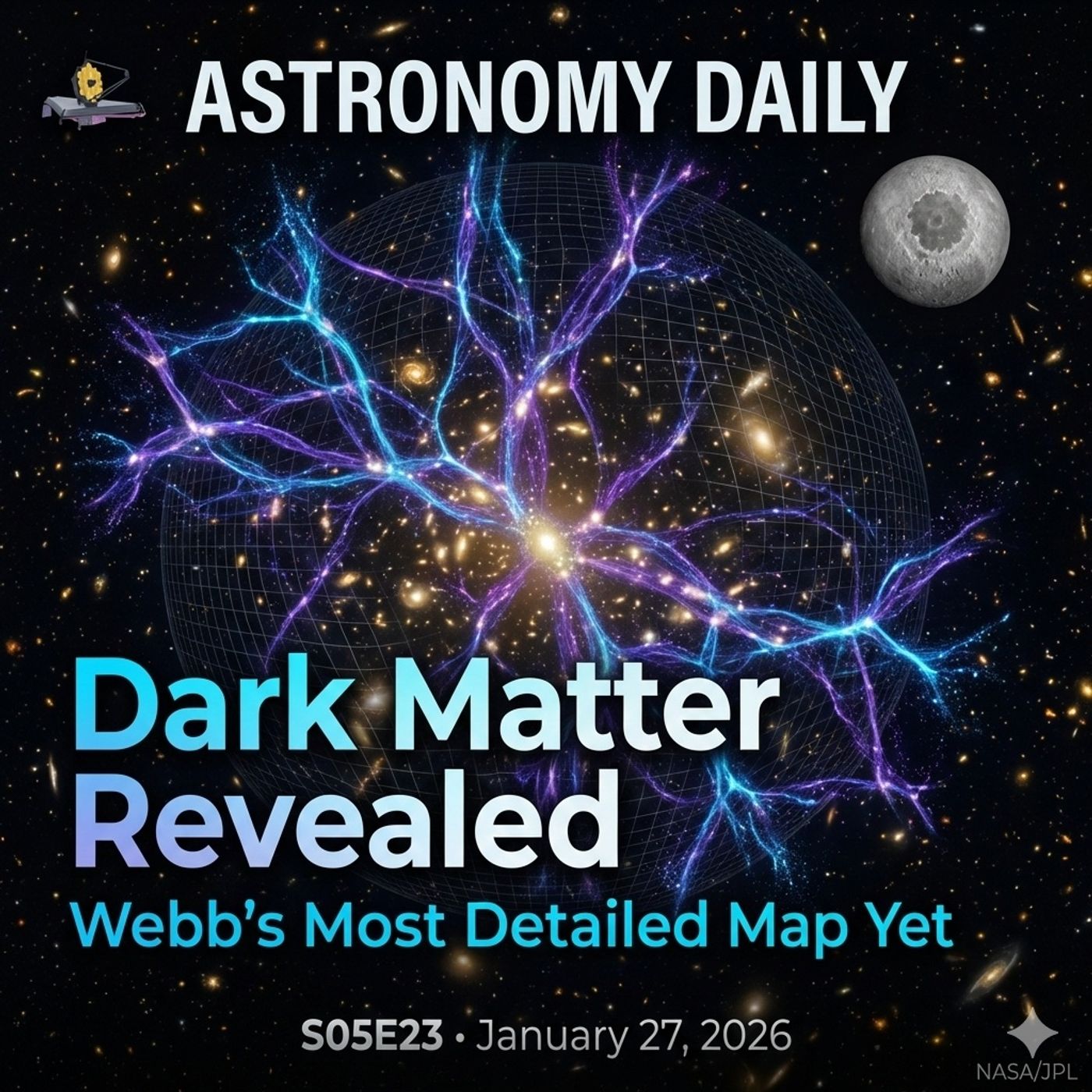
S5 Ep 23Dark Matter Mapped: Webb's Unprecedented Universe Discovery
Welcome to Astronomy Daily! Join hosts Anna and Avery as they explore today's most fascinating space and astronomy stories.IN THIS EPISODE:🌌 NASA's Dark Matter MapNASA's James Webb Space Telescope has created one of the most detailed dark matter maps ever produced, revealing the invisible scaffolding of the universe in unprecedented detail. Scientists mapped nearly 800,000 galaxies, showing how dark matter and regular matter have grown together throughout cosmic history - and how dark matter's influence may have been essential for creating the conditions necessary for life on Earth.🚀 Weekly Launch RoundupA busy week in orbital spaceflight with multiple missions planned from Florida, California, and New Zealand. SpaceX prepares to launch GPS III SV09 named after fallen Challenger astronaut Ellison Onizuka, while Rocket Lab readies its "Bridging the Swarm" mission carrying South Korea's NeonSat-1A satellite. Plus updates on multiple Starlink flights and possible Chinese launches.🌙 Artemis II's Far Side AdventureThe Artemis II crew - Reid Wiseman, Victor Glover, Christina Hammock Koch, and Jeremy Hansen - are training to become the first humans to see parts of the Moon never before observed by human eyes. Learn about their planned three-hour observation session focusing on Mare Orientale and other hidden lunar features, and how their geology training in Iceland is preparing them for this historic mission.🪐 Jupiter's Hidden DepthsNASA's Juno spacecraft continues to revolutionize our understanding of Jupiter, revealing that the planet's iconic cloud bands extend 1,900 miles below the surface. Discover recent findings about Jupiter's diluted core, mysterious green lightning flashes, and the remarkably persistent polar cyclones that form octagonal and pentagonal patterns at the planet's poles.☀️ Antarctica's Exclusive EclipseOnly about 16 people might witness one of 2026's most spectacular celestial events - a "ring of fire" annular solar eclipse crossing Antarctica on February 17th. Find out about the two research stations in the path of totality, the extreme conditions observers will face, and where else partial views of the eclipse will be visible.🛸 Starship V3 UpdateSpaceX's upgraded Starship rocket test has been rescheduled for mid-March following a November explosion during testing. Learn about the new capabilities of Starship V3, including plans to launch next-generation Starlink satellites and dock with other Starships in orbit - plus how Blue Origin's New Glenn is emerging as competition in the heavy-lift market.EPISODE LINKS:• NASA Dark Matter Discovery: https://www.jpl.nasa.gov/news/nasa-reveals-new-details-about-dark-matters-influence-on-universe/• Launch Schedule Details: https://www.nasaspaceflight.com/2026/01/launch-roundup-012626/• Artemis II Far Side Views: https://dailygalaxy.com/2026/01/artemis-first-humans-see-hidden-side-moon/• Antarctica Eclipse Information: https://dailygalaxy.com/2026/01/2026-ring-of-fire-eclipse/• Starship Development Update: https://techcrunch.com/2026/01/26/spacex-eyes-mid-march-for-first-test-of-upgraded-starship-rocket/CONNECT WITH US:🌐 Website: astronomydaily.io📱 Twitter/X: @AstroDailyPod📷 Instagram: @AstroDailyPod📘 Facebook: @AstroDailyPodBecome a supporter of this podcast: https://www.spreaker.com/podcast/astronomy-daily-space-news-updates--5648921/support.Sponsor Details:Ensure your online privacy by using NordVPN. To get our special listener deal and save a lot of money, visit www.bitesz.com/nordvpn. You'll be glad you did!Become a supporter of Astronomy Daily by joining our Supporters Club. Commercial free episodes daily are only a click way... Click HereThis episode includes AI-generated content.
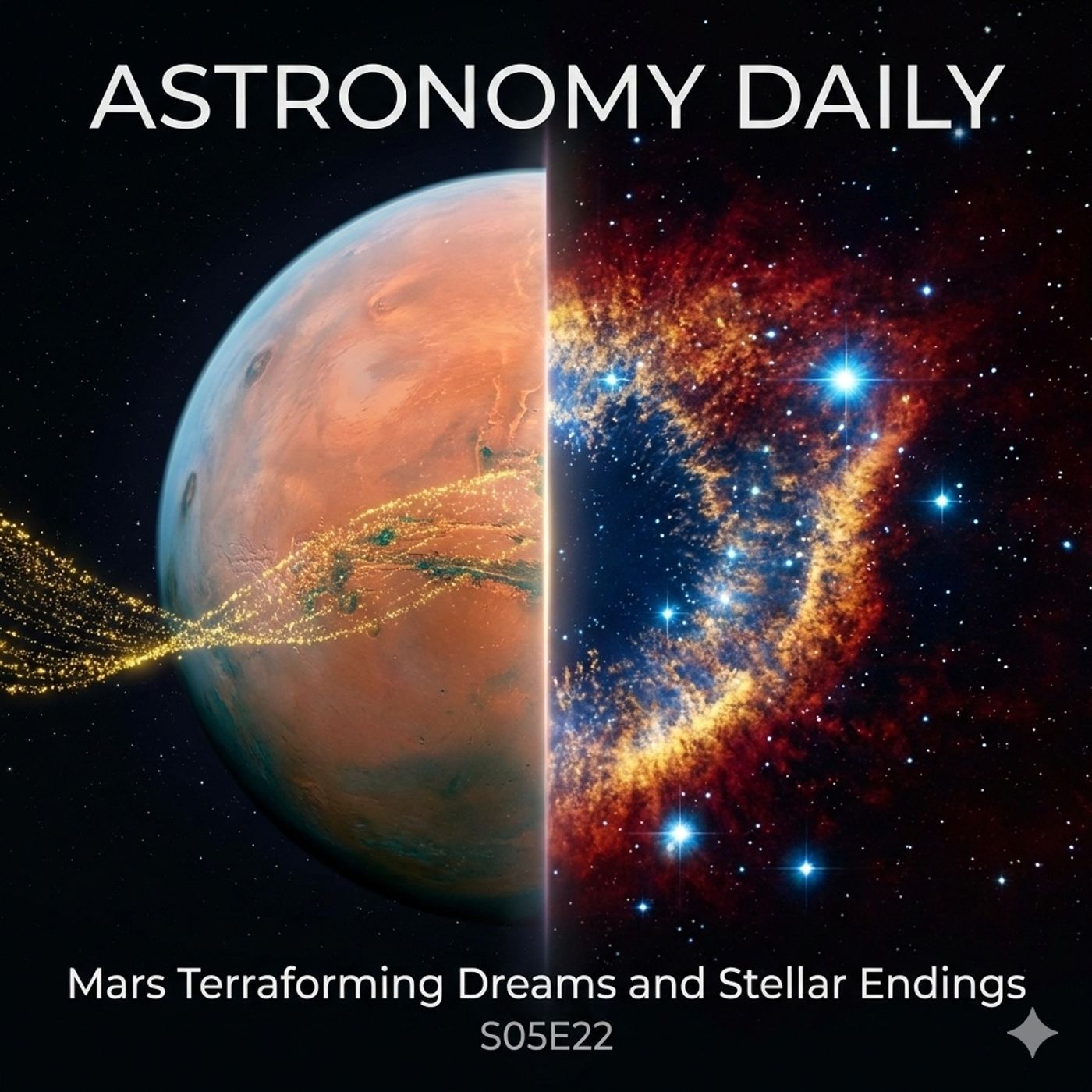
S5 Ep 22Terraforming Mars: A Real Plan & Webb's Dying Star Revelation
# Astronomy Daily - S05E22## Monday, January 26, 2026Welcome to Astronomy Daily! Join hosts Anna and Avery as they explore the latest developments in space and astronomy, from ambitious plans to terraform Mars to stunning new views of dying stars.### Episode Highlights**Mars Terraforming Gets Serious**Scientists unveil a comprehensive blueprint for transforming Mars into a habitable world. Discover the three-phase plan using Martian resources, engineered nanoparticles, and hardy microorganisms that could warm the Red Planet by 30°C and eventually create breathable air. But should we terraform Mars at all?**Harvesting Water from Mars' Atmosphere**While underground ice remains the primary water source for future Mars missions, researchers reveal how atmospheric moisture could provide a crucial backup. Learn about the innovative technologies that could make Mars settlements more self-sufficient.**Chandra's Cosmic Catalog Milestone**NASA's Chandra X-ray Observatory has now cataloged over 1.3 million X-ray detections across the sky. We explore this treasure trove of data spanning 22 years of observations, including a stunning view of the Galactic Center with over 3,300 sources in just 60 light-years.**Earthquake Sensors Track Space Debris**Ingenious new research shows how seismic monitoring networks can track dangerous falling satellites in near real-time. Discover how scientists reconstructed the trajectory and breakup of China's Shenzhou-15 module using earthquake sensors.**Water Worlds or Lava Planets?**Shocking new findings suggest 98% of planets we thought were ocean-bearing "hycean worlds" might actually be molten rock. Learn about the Solidification Shoreline model that's rewriting our understanding of sub-Neptune exoplanets.**Webb Captures a Dying Star's Beauty**The James Webb Space Telescope reveals the Helix Nebula in unprecedented detail, showing us the eventual fate of our own Sun. Witness stellar recycling in action as a dying star distributes the building blocks of future worlds.### Links & Resources- Research on Mars terraforming strategies- Advances in Space Research journal study on atmospheric water harvesting- Chandra Source Catalog: cxc.cfa.harvard.edu/csc/- Science journal publication on seismic debris tracking- arXiv preprint on sub-Neptune exoplanet composition- Webb Space Telescope Helix Nebula observationsFor more space news and daily episodes, visit astronomydaily.ioFollow us on social media @AstroDailyPod---*Astronomy Daily: Your daily dose of space and astronomy news*Become a supporter of this podcast: https://www.spreaker.com/podcast/astronomy-daily-space-news-updates--5648921/support.Sponsor Details:Ensure your online privacy by using NordVPN. To get our special listener deal and save a lot of money, visit www.bitesz.com/nordvpn. You'll be glad you did!Become a supporter of Astronomy Daily by joining our Supporters Club. Commercial free episodes daily are only a click way... Click HereThis episode includes AI-generated content.
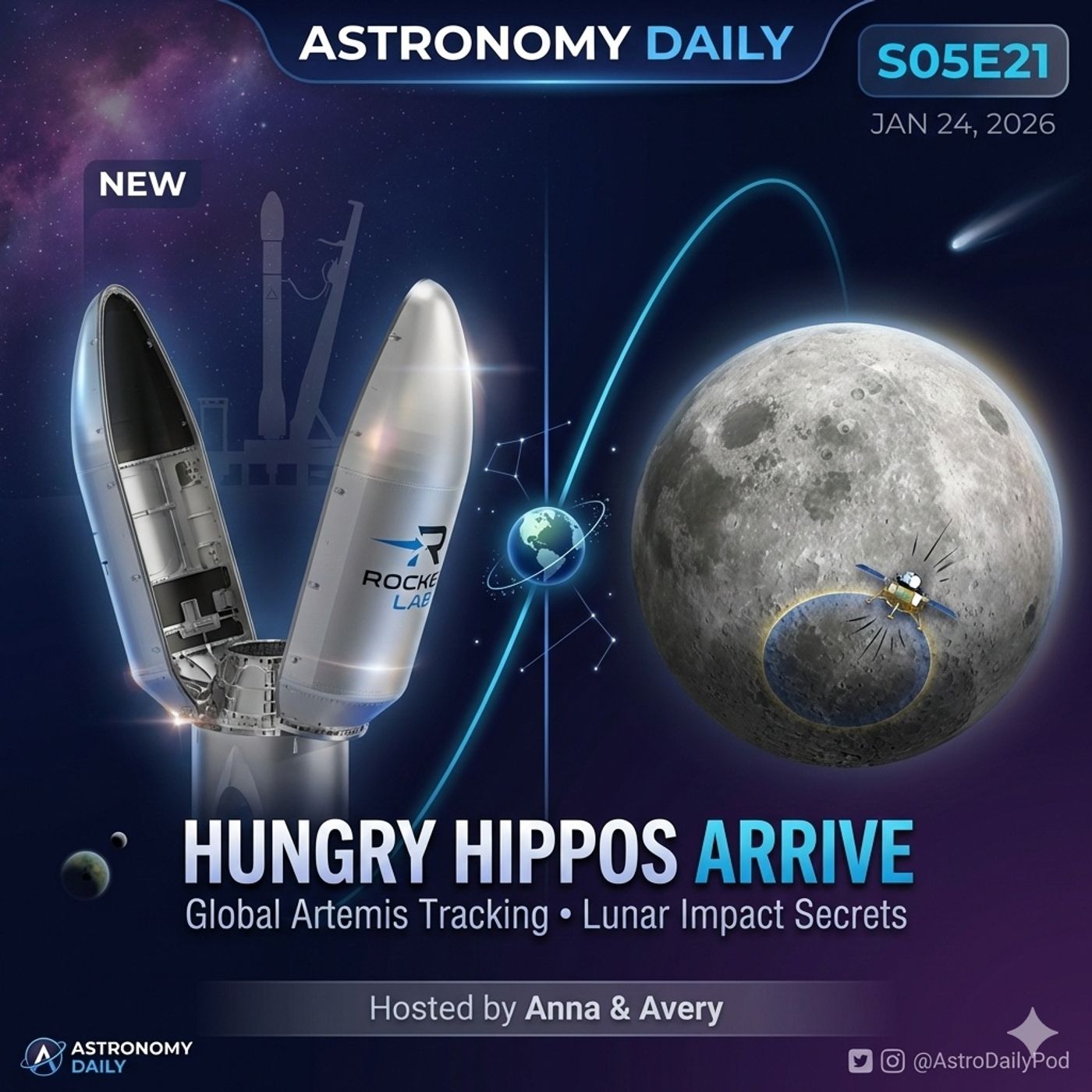
S5 Ep 21Rocket Lab's Hungry Hippos Arrive!| NASA Enlists Global Volunteers for Artemis II
Rocket Lab's "Hungry Hippos" arrive at Wallops Island despite tank test setback, NASA enlists global volunteers to track Artemis II, ancient lunar impact explains Moon's asymmetry, affordable space memorials launching in 2027, massive exomoon challenges definitions, and an 11th-century monk may have discovered Halley's Comet first.EPISODE HIGHLIGHTS:🚀 Rocket Lab's Neutron program reaches major milestone as innovative "Hungry Hippo" reusable fairings arrive at Wallops Island after month-long sea journey from New Zealand, though first-stage tank ruptures during qualification testing at Maryland facility🌕 NASA selects 34 volunteers from 14 countries to track Artemis II mission around the Moon, expanding from 10 participants during Artemis I and representing government agencies, commercial companies, universities, and amateur radio enthusiasts🌑 China's Chang'e 6 lunar samples reveal unusual potassium isotope ratios in South Pole-Aitken Basin rocks, providing evidence that the giant impact 4.2 billion years ago fundamentally altered the Moon's chemistry and explains why the far side has so few maria⭐ Space Beyond startup plans to send 1,000 people's ashes to orbit for just $249 using CubeSat technology on SpaceX rideshare mission in October 2027, founded by former Blue Origin engineer Ryan Mitchell🪐 Astronomers detect potential exomoon around HD 206893 B that may be 40% the mass of Jupiter, so massive it could force redefinition of what constitutes a moon versus binary companion system☄️ New research reveals 11th-century English monk Eilmer of Malmesbury recognized Halley's Comet's periodicity centuries before Edmond Halley, calling into question the comet's namesakeLINKS & RESOURCES:• Rocket Lab Neutron development: https://www.nasaspaceflight.com/2026/01/hungry-hippos-test-tanks-neutron/• NASA Artemis II tracking participants: https://www.nasa.gov/technology/space-comms/nasa-selects-participants-to-track-artemis-ii-mission/• Chang'e 6 lunar impact study: https://www.space.com/astronomy/moon/a-colossal-asteroid-may-have-warped-the-moon-from-the-inside-out• Space Beyond memorial service: https://techcrunch.com/2026/01/23/this-startup-will-send-1000-peoples-ashes-to-space-affordably-in-2027/• Massive exomoon discovery: https://dailygalaxy.com/2026/01/alien-moon-massive-redefine-what-a-moon-is/• Halley's Comet historical research: https://phys.org/news/2026-01-halley-comet-wrongly-11th-century.htmlFOLLOW ASTRONOMY DAILY:🌐 Website: astronomydaily.io🐦 X/Twitter: @AstroDailyPod📘 Facebook: @AstroDailyPod📷 Instagram: @AstroDailyPod🎵 TikTok: @AstroDailyPod📺 YouTube: @AstroDailyPod📱 Tumblr: @AstroDailyPodBecome a supporter of this podcast: https://www.spreaker.com/podcast/astronomy-daily-space-news-updates--5648921/support.Sponsor Details:Ensure your online privacy by using NordVPN. To get our special listener deal and save a lot of money, visit www.bitesz.com/nordvpn. You'll be glad you did!Become a supporter of Astronomy Daily by joining our Supporters Club. Commercial free episodes daily are only a click way... Click HereThis episode includes AI-generated content.
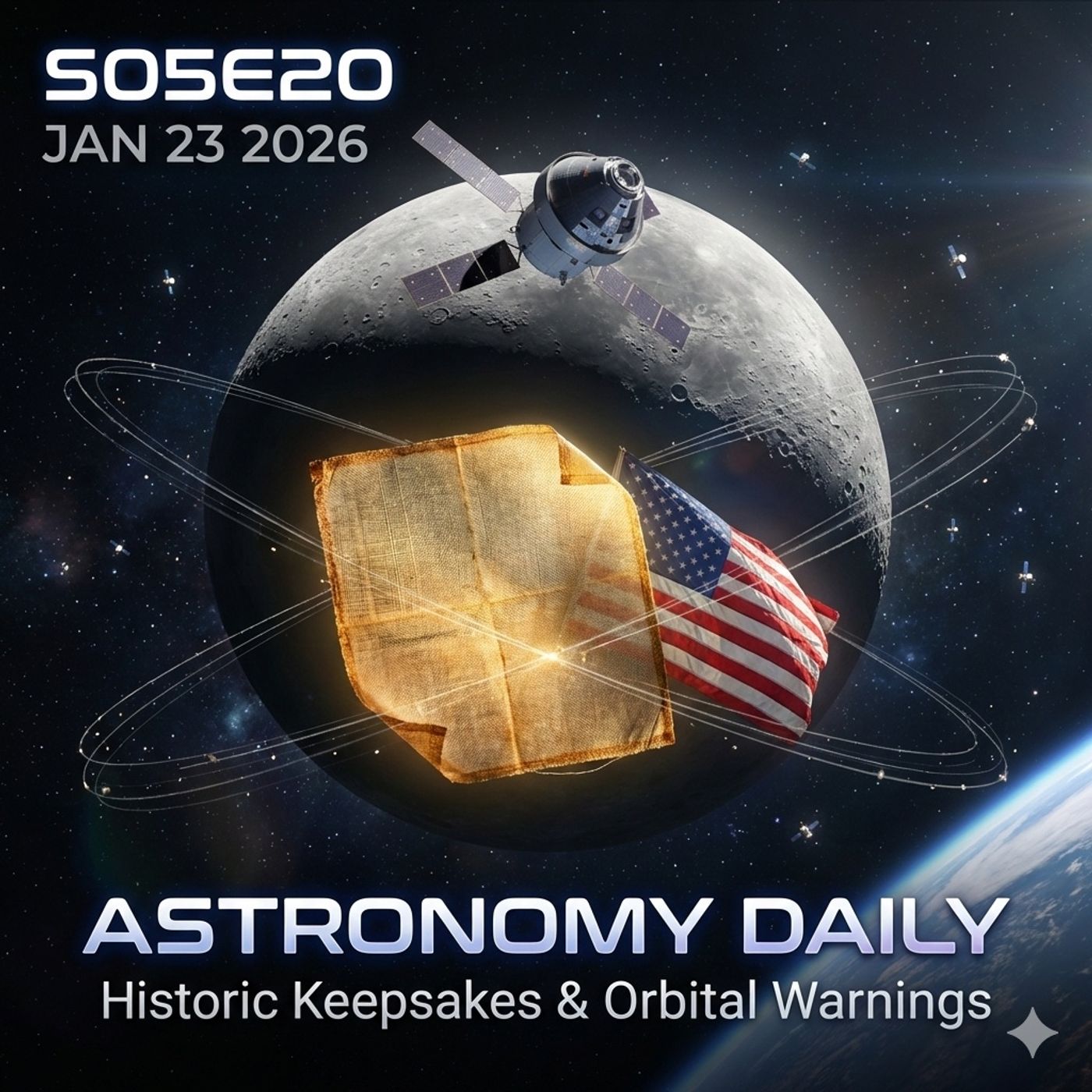
S5 Ep 20Artemis II's Historic Cargo, Orbital Debris Crisis, and AI Finds 7,000 New Worlds
Welcome to Astronomy Daily! Today we explore NASA's inspiring collection of historic keepsakes heading to the Moon on Artemis II, including fabric from the 1903 Wright Flyer. We examine an urgent warning about orbital debris—the CRASH Clock shows catastrophic collision could occur in just 5.5 days if satellites lose maneuvering capability. New analysis of Apollo lunar samples challenges our understanding of where Earth's water came from. Irish researchers solve the mystery of how supermassive black holes grew so quickly in the early universe. Plus, Blue Origin schedules its third New Glenn launch with a reused booster, and NASA's AI tool ExoMiner++ identifies 7,000 new exoplanet candidates in TESS data.Hosts: Anna & AveryEpisode: S05E20Become a supporter of this podcast: https://www.spreaker.com/podcast/astronomy-daily-space-news-updates--5648921/support.Sponsor Details:Ensure your online privacy by using NordVPN. To get our special listener deal and save a lot of money, visit www.bitesz.com/nordvpn. You'll be glad you did!Become a supporter of Astronomy Daily by joining our Supporters Club. Commercial free episodes daily are only a click way... Click HereThis episode includes AI-generated content.
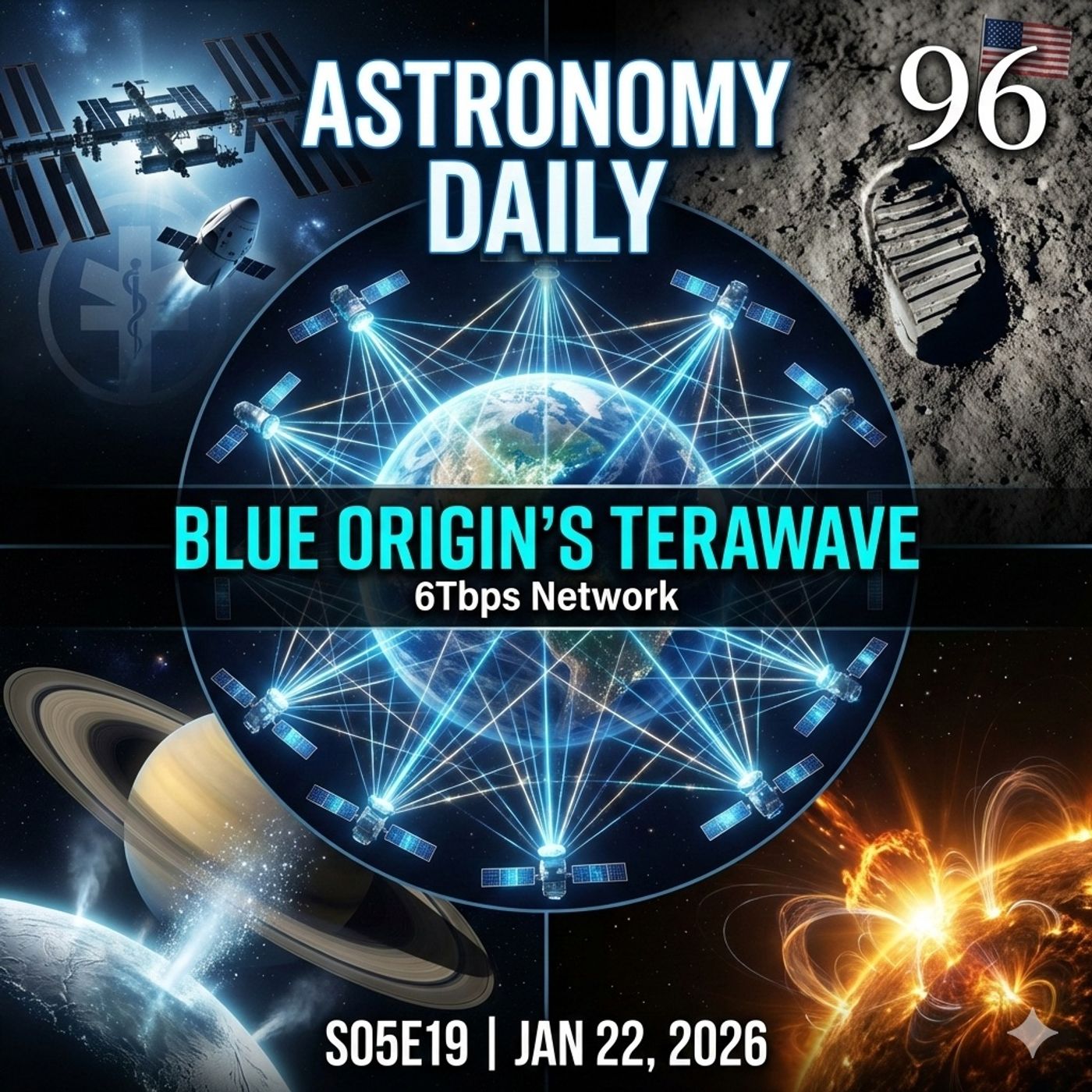
S5 Ep 19Blue Origin's TeraWave Network, Historic ISS Medical Evacuation & Buzz Aldrin Turns 96
Welcome to Astronomy Daily! In today's episode, we explore Blue Origin's ambitious new TeraWave satellite internet network offering speeds up to 6Tbps, discuss the first-ever medical evacuation from the International Space Station, and celebrate Buzz Aldrin's 96th birthday as the oldest living astronaut. We also dive into exciting science from Saturn's moon Enceladus, surprising plasma wave discoveries at Mercury, and groundbreaking Solar Orbiter observations revealing how magnetic avalanches power solar flares.EPISODE HIGHLIGHTS:• Blue Origin announces TeraWave: A new satellite network with 6Tbps speeds for enterprise and government customers• Historic ISS evacuation: Crew-11 returns early in NASA's first medical evacuation from space• Buzz Aldrin celebrates 96th birthday as Artemis II crew prepares for lunar journey• Scientists develop new method to analyze Enceladus plumes for ocean habitability• BepiColombo discovers Mercury shares plasma wave behavior with Earth• Solar Orbiter reveals magnetic avalanches trigger solar flaresSTORY TIMESTAMPS:[00:00] Introduction[01:15] Blue Origin's TeraWave Satellite Network[05:42] ISS Medical Evacuation - Crew-11's Historic Return[10:28] Buzz Aldrin's 96th Birthday & Artemis II Connections[14:35] Enceladus Plumes May Hold Clues to Ocean Habitability[18:20] Mercury and Earth Share Plasma Wave Behavior[22:10] Solar Orbiter Discovers Magnetic Avalanches Power Flares[26:45] OutroLINKS & RESOURCES:• Blue Origin TeraWave: https://www.blueorigin.com/terawave• NASA Crew-11 Mission Information: https://www.nasa.gov/• Artemis II Mission Details: https://www.nasa.gov/artemis-ii• BepiColombo Mission: https://www.esa.int/Science_Exploration/Space_Science/BepiColombo• Solar Orbiter Mission: https://www.esa.int/Science_Exploration/Space_Science/Solar_Orbiter• Astronomy Daily Website: https://astronomydaily.ioCREDITS:Hosted by Anna and AveryProduced by Astronomy DailyEpisode S05E19 - January 22, 2026SUBSCRIBE & CONNECT:Never miss an episode! Subscribe to Astronomy Daily on your favorite podcast platform and visit astronomydaily.io for more space news, articles, and community discussions.Follow us on social media for daily updates and bonus content!#AstronomyDaily #SpaceNews #BlueOrigin #NASA #ISS #BuzzAldrin #ArtemisII #Enceladus #Mercury #SolarOrbiter #SpaceExplorationBecome a supporter of this podcast: https://www.spreaker.com/podcast/astronomy-daily-space-news-updates--5648921/support.Sponsor Details:Ensure your online privacy by using NordVPN. To get our special listener deal and save a lot of money, visit www.bitesz.com/nordvpn. You'll be glad you did!Become a supporter of Astronomy Daily by joining our Supporters Club. Commercial free episodes daily are only a click way... Click HereThis episode includes AI-generated content.

S5 Ep 18Spectacular Auroras, Suni Williams Retires, China's Space Rescue
Stunning northern lights dazzle the world after a severe G4 geomagnetic storm, legendary NASA astronaut Suni Williams retires after 27 years, and China executes a dramatic space rescue. Plus, Blue Origin's next tourist launch and groundbreaking telescope observations!In today's episode of Astronomy Daily, hosts Anna and Avery bring you the latest space and astronomy news:🌌 SEVERE GEOMAGNETIC STORM UPDATE - Follow-up to yesterday's prediction as the CME slams into Earth, triggering spectacular auroras visible from New Mexico to China. We've got photos and the science behind the G4-level storm.👩🚀 SUNI WILLIAMS RETIRES - After 27 years and 608 days in space, NASA astronaut Suni Williams hangs up her spacesuit. We celebrate her incredible achievements including 9 spacewalks and command of the ISS.🚀 CHINA'S SHENZHOU-20 RESCUE - An incredible story of emergency response in orbit as China safely returns a damaged capsule after a suspected space debris impact. Three overlapping missions showcase impressive operational capability.🔵 BLUE ORIGIN NS-38 LAUNCH - Six space tourists prepare for Thursday's suborbital flight aboard New Shepard, including Blue Origin's own director of launch operations.☀️ NASA'S SUNRISE MISSION - Six toaster-sized satellites pass crucial tests and move closer to launch. They'll work together as one giant radio telescope to track dangerous solar eruptions.🪐 ALMA REVEALS TEENAGE PLANETS - The most detailed images ever of 24 debris disks show planetary systems in their awkward teenage years, revealing the violent phase our solar system once experienced.Visit astronomydaily.io for more space news and follow us on social media @AstroDailyPodBecome a supporter of this podcast: https://www.spreaker.com/podcast/astronomy-daily-space-news-updates--5648921/support.Sponsor Details:Ensure your online privacy by using NordVPN. To get our special listener deal and save a lot of money, visit www.bitesz.com/nordvpn. You'll be glad you did!Become a supporter of Astronomy Daily by joining our Supporters Club. Commercial free episodes daily are only a click way... Click HereThis episode includes AI-generated content.
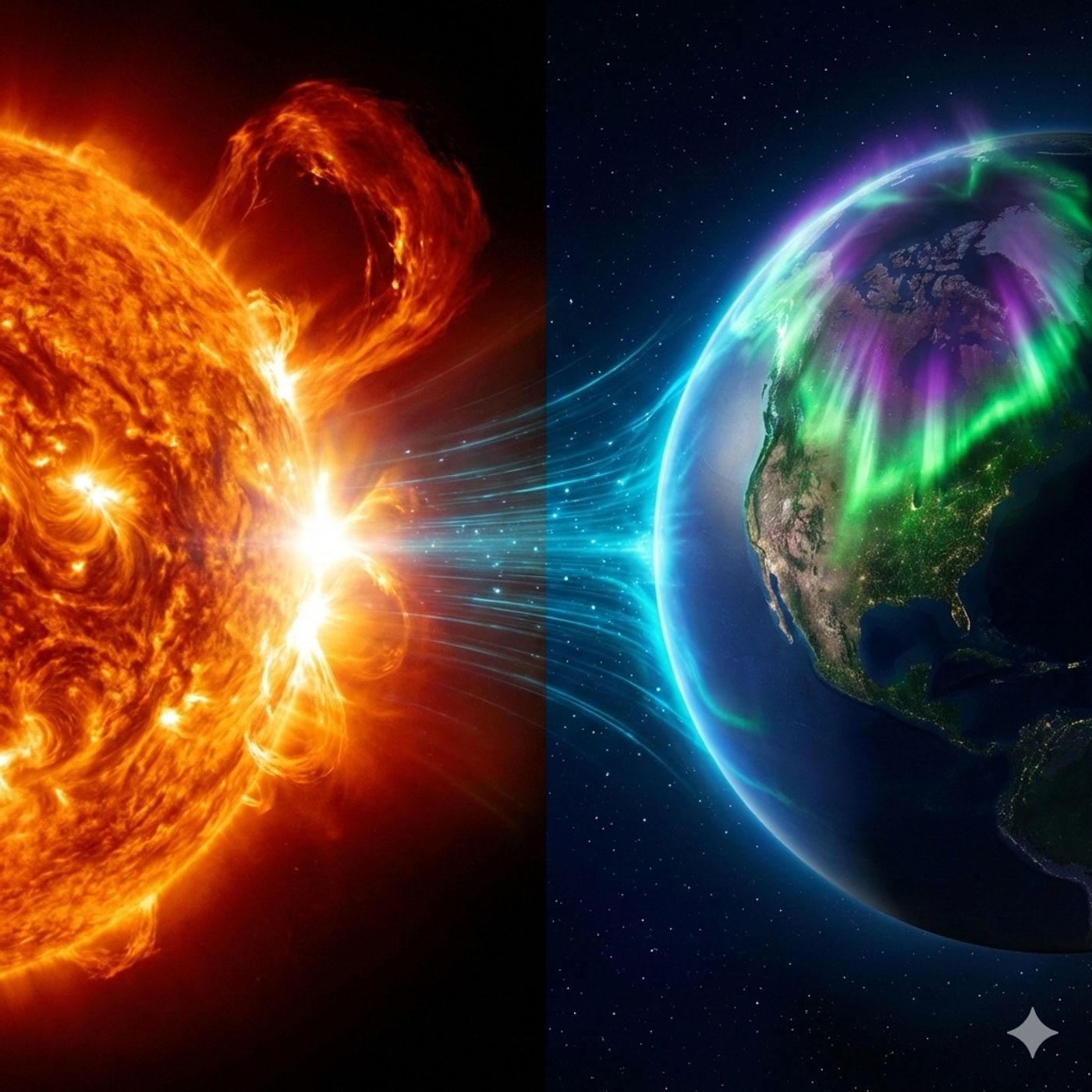
S5 Ep 17Solar Storm Hits Early! Plus China's Reusable Rockets & Exoplanet Magnetic Shields
The Sun's latest outburst arrived ahead of schedule! A powerful X1.9 solar flare and massive CME triggered severe G4 geomagnetic storms on January 19th, bringing spectacular auroras as far south as Alabama. Hosts Anna and Avery break down what happened and what to expect.Also in today's episode: China successfully tests the Long March 12B reusable rocket, giving us a preview of their next-gen launch capabilities. We get an exclusive look at the Xuntian space telescope set to launch in 2027, which could rival Hubble with 300x the field of view. Plus, stunning new Hubble images reveal how baby stars carve out cosmic homes in the Orion Molecular Cloud.We'll run through this week's packed launch schedule featuring SpaceX, Blue Origin, Rocket Lab, and China, and explore groundbreaking research showing how hidden magma oceans might protect rocky exoplanets from deadly radiation.**Episode Highlights:**• BREAKING: Severe G4 solar storm strikes Earth early - aurora forecast through Jan 20• China's Long March 12B reusable rocket passes critical static fire test• Xuntian telescope preview: China's answer to Hubble launches 2027• Hubble reveals protostar jets and cavities in Orion Molecular Cloud• 7 launches from 6 sites this week: Your complete guide• Basal magma oceans could generate protective magnetic fields on super-Earths**Topics Covered:**Space Weather, Solar Flares, CMEs, Geomagnetic Storms, Auroras, Reusable Rockets, Chinese Space Program, Space Telescopes, Star Formation, Orbital Launches, Exoplanets, Planetary Magnetism, AstrobiologyVisit us at astronomydaily.io for more space and astronomy news!Follow us on social media: @AstroDailyPod on all major platforms#SpaceWeather #SolarStorm #Aurora #NorthernLights #SpaceX #China #SpaceTelescope #Exoplanets #Astronomy #SpaceNewsBecome a supporter of this podcast: https://www.spreaker.com/podcast/astronomy-daily-space-news-updates--5648921/support.Sponsor Details:Ensure your online privacy by using NordVPN. To get our special listener deal and save a lot of money, visit www.bitesz.com/nordvpn. You'll be glad you did!Become a supporter of Astronomy Daily by joining our Supporters Club. Commercial free episodes daily are only a click way... Click HereThis episode includes AI-generated content.
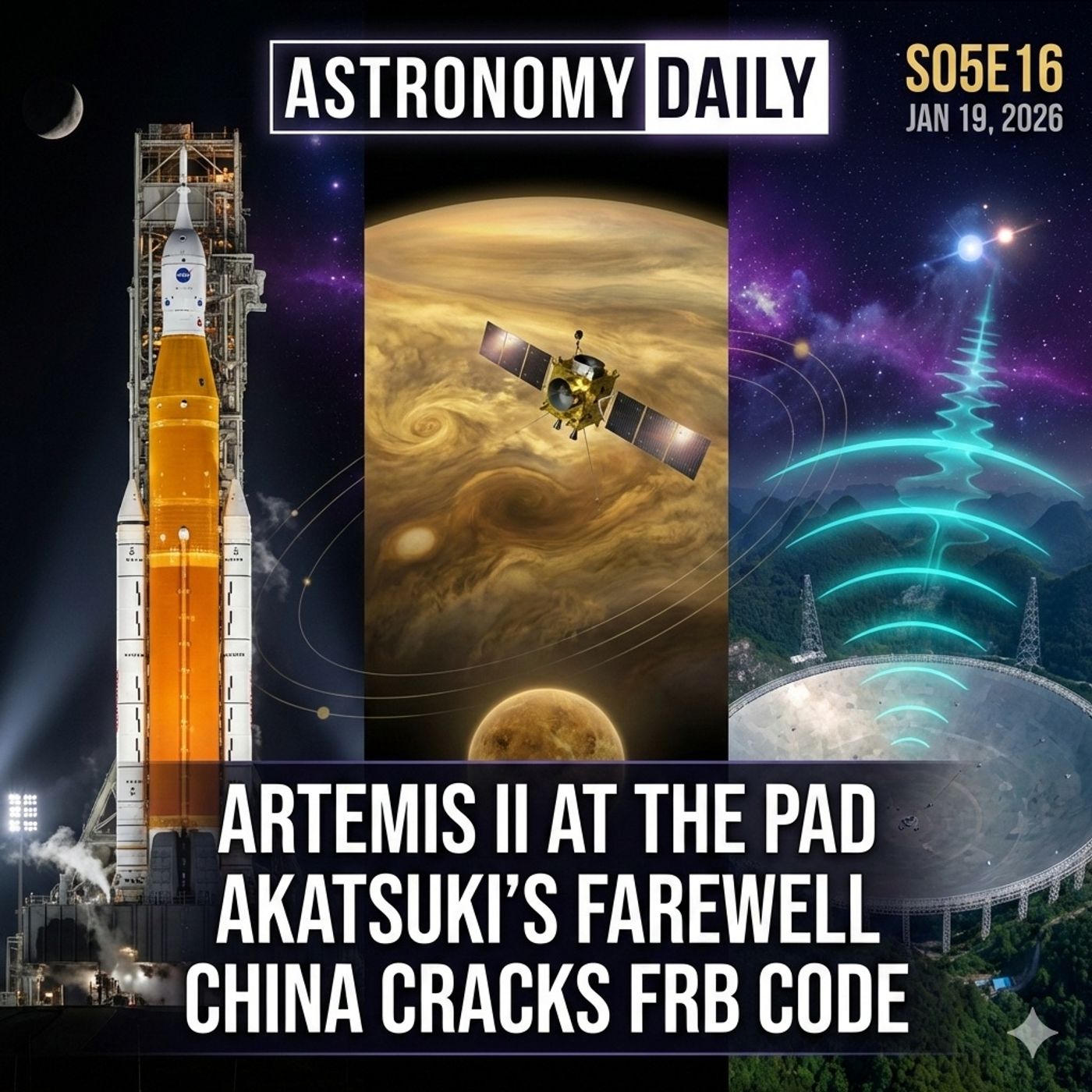
S5 Ep 16Artemis II Reaches the Pad, Akatsuki's Final Farewell, and China Cracks the FRB Code
Join hosts Anna and Avery for today's essential space and astronomy news roundup! 🚀NASA's Artemis II rocket completes its journey to Launch Pad 39B, bringing humanity one step closer to returning to the Moon. We bid farewell to Japan's remarkable Akatsuki Venus orbiter after a decade of groundbreaking discoveries. China's FAST telescope solves a ten-year mystery about fast radio bursts, revealing they come from binary star systems. Plus, we preview the incredible space science missions launching in 2026, discuss the devastating loss of Spain's brand-new military satellite to a tiny space particle, and explore new findings showing that dwarf galaxies host more active black holes than previously thought.**Featured Stories:**• NASA's Artemis II reaches the launch pad for wet dress rehearsal• Japan's Akatsuki mission ends after 15 years and extraordinary Venus discoveries • China's Sky Eye telescope cracks the fast radio burst mystery• 2026 space science preview: Moon, Mars, and telescope missions ahead• Spanish military satellite suffers catastrophic damage from millimeter-sized debris• New census reveals surprising black hole activity in dwarf galaxiesVisit astronomydaily.io for full articles, images, and more space news!#Astronomy #Space #NASA #ArtemisII #Venus #Akatsuki #FastRadioBursts #FAST #Mars #SpaceScience #BlackHoles #SpaceDebrisBecome a supporter of this podcast: https://www.spreaker.com/podcast/astronomy-daily-space-news-updates--5648921/support.Sponsor Details:Ensure your online privacy by using NordVPN. To get our special listener deal and save a lot of money, visit www.bitesz.com/nordvpn. You'll be glad you did!Become a supporter of Astronomy Daily by joining our Supporters Club. Commercial free episodes daily are only a click way... Click HereThis episode includes AI-generated content.
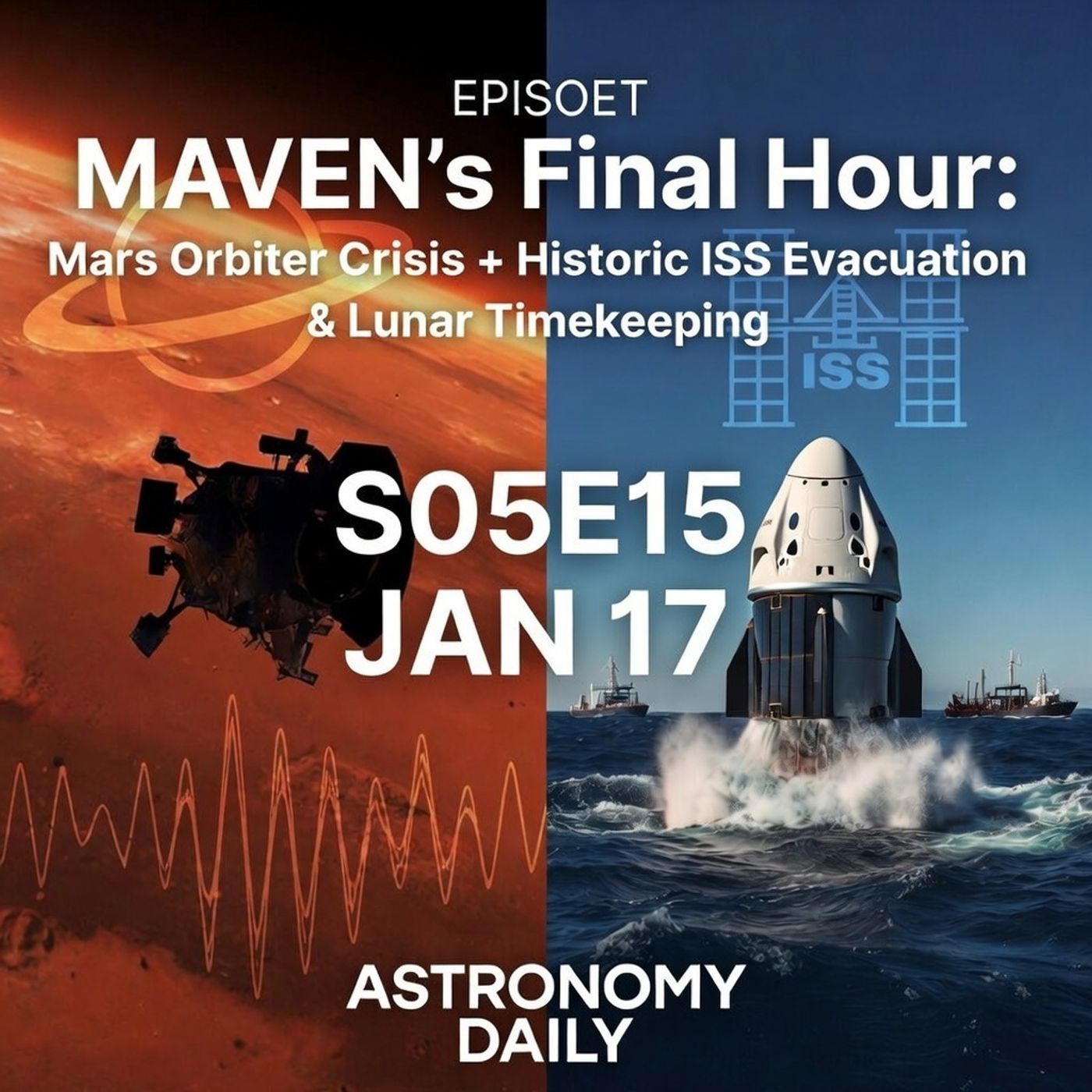
S5 Ep 15MAVEN's Final Hour: Mars Orbiter Crisis + Historic ISS Evacuation Update & Lunar Timekeeping
NASA attempts to contact the silent MAVEN Mars orbiter after 40 days—but prospects look grim. Plus: the first-ever ISS medical evacuation succeeds, Europe debuts its powerful Ariane 64, scientists crack asteroid defense secrets, China releases lunar timekeeping software, and Hubble reveals where planets are born. Your daily space news for January 15, 2026.### Extended Episode Description (for podcast websites/apps)After more than a month of silence, NASA is making what may be its final attempt to contact the MAVEN Mars orbiter. Mission leaders are pessimistic, but the veteran spacecraft has surprised them before. We break down what happened, what's at stake, and what MAVEN's potential loss means for Mars exploration.On a brighter note, the SpaceX Crew-11 astronauts have safely returned to Houston following the first-ever medical evacuation from the International Space Station—a historic operation that went flawlessly. We explore how NASA executed this unprecedented mission.Europe's taking a major step forward with the announcement that the first Ariane 64 rocket will launch February 12th. This four-booster beast can carry more than double the payload of its predecessor, and its debut mission will deploy 32 satellites for Amazon's Kuiper constellation.Scientists using CERN's particle accelerators have discovered that iron-rich asteroids are tougher than we thought—and they actually get stronger under stress. This surprising finding could reshape how we approach planetary defense.China has released the world's first practical software for keeping time on the Moon. It sounds like science fiction, but lunar timekeeping is becoming essential as multiple nations prepare for sustained lunar operations.And after 35 years in orbit, the Hubble Space Telescope is still delivering stunning science, with a new gallery of images showing protoplanetary disks where planets are being born around young stars.Become a supporter of this podcast: https://www.spreaker.com/podcast/astronomy-daily-space-news-updates--5648921/support.Sponsor Details:Ensure your online privacy by using NordVPN. To get our special listener deal and save a lot of money, visit www.bitesz.com/nordvpn. You'll be glad you did!Become a supporter of Astronomy Daily by joining our Supporters Club. Commercial free episodes daily are only a click way... Click HereThis episode includes AI-generated content.
S5 Ep 14Artemis II Rollout Weekend: NASA Preps Moon Mission + ESA Hacked & Jupiter's Oxygen Surprise
Artemis II is entering its final preparations! This weekend, NASA rolls out the Space Launch System and Orion spacecraft to the launch pad for the first crewed mission to lunar orbit in over 50 years. We cover the crew, timeline, challenges, and what to expect in the coming weeks.Plus: The European Space Agency suffers a major cyberattack with over 700 GB of sensitive data stolen. We discuss what was compromised, how it happened, and the broader cybersecurity implications for the space industry.Also in this episode: China's successful dual satellite launches kick off an ambitious 2026, scientists discover Jupiter has 1.5 times more oxygen than our Sun, a mysterious iron bar is found hidden in the Ring Nebula, and we explore the fascinating legacy of the Apollo 14 Moon Trees.New episodes every weekday!---## EPISODE TIMESTAMPS**[00:00]** Intro **[01:15]** Story 1: Artemis II Final Preparations **[04:45]** Story 2: European Space Agency Cyberattack **[08:30]** Story 3: China's Satellite Launches **[11:45]** Story 4: Jupiter's Oxygen Surprise **[14:30]** Story 5: Ring Nebula Iron Mystery **[17:00]** Story 6: Apollo 14 Moon Trees Legacy **[19:30]** Outro---## STORIES COVERED### 1. NASA Enters Final Preparations for Artemis II MissionNASA is entering the final stages of preparation for Artemis II, the first crewed mission beyond Low Earth Orbit in over fifty years. The Space Launch System rocket and Orion spacecraft will roll out to Launch Pad 39B this Saturday, January 17th.**Key Points:**- **Launch Window:** February 6 - April 2026 (subject to readiness)- **Crew:** Reid Wiseman (Commander, USA), Victor Glover (Pilot, USA), Christina Koch (Mission Specialist, USA), Jeremy Hansen (Mission Specialist, Canada)- **Mission Duration:** 10 days circumlunar flight- **Rollout:** 6.5 km journey takes ~12 hours on crawler-transporter-2- **Recent Updates:** Valve replacement on Orion hatch pressurization system (Jan 5), leak repair on ground support hardware- **Upcoming:** Wet dress rehearsal end of January with 2.65 million liters of cryogenic fuel- **Next Steps:** Flight readiness review, final crew walkdown at pad- **Historical Context:** First crewed deep space mission since Apollo 17 (1972)- **Looking Ahead:** Artemis III lunar landing scheduled for 2028**Why It Matters:**This mission is a crucial stepping stone for returning humans to the lunar surface and eventually sending astronauts to Mars. It will validate all systems needed for deep space exploration and demonstrate international cooperation through the Canadian Space Agency's participation.**Read More:**- [Universe Today: NASA Enters Final Preparations for Artemis II Mission](https://www.universetoday.com/articles/nasa-enters-final-preparations-for-artemis-ii-mission)- [NASA Artemis II Mission Page](https://www.nasa.gov/mission/artemis-ii/)---### 2. Cyberthieves Hit European Space Agency in Major Data BreachThe European Space Agency suffered significant cyberattacks over the Christmas period, resulting in over 700 gigabytes of potentially sensitive data being leaked to dark web forums.**Key Points:**- **Initial Attack:** Boxing Day 2025 - Hacker "888" dumps 200+ GB of data- **Second Attack:** One week later - "Scattered Lapsus$ Hunters" claims 500+ GB more- **Data Compromised:** Proprietary software, authorization credentials, access tokens, project documentation, operational procedures, spacecraft details, contractor data- **Affected Contractors:** SpaceX, Airbus Group, Thales Alenia Space- **ESA Response:** Criminal investigation launched, cooperating with authorities- **Root Cause:** Possible "infostealer malware" harvesting browser-stored credentials- **Broader Issue:** Email credentials of ESA and NASA employees frequently found on dark web- **Security Gap:** Solar conjunction prevented communications blackout- **Expert Warning:** Data could be combined with future breaches to enable attacks on space systems**Industry Context:**Cybersecurity researcher Clémence Poirier warns that cyberattacks against space agencies are common and will continue. NASA faces similar threats with vulnerabilities disclosed almost daily via BugCrowd platform.**Why It Matters:**As space infrastructure becomes increasingly critical for communications, navigation, and national security, cybersecurity vulnerabilities represent a major threat to space operations and international cooperation.**Read More:**- [Space.com: Cyberthieves hit European Space Agency](https://www.space.com/space-exploration/esa-email-credentials-on-dark-web)---### 3. China's Long March Rockets Launch Key Satellites to Start 2026China successfully launched two Long March rockets on January 13, 2026, deploying the Yaogan-50 01 remote sensing satellite and multiple Guowang constellation satellites, marking an ambitious start to their space program's busiest year yet.**Key Points:**- **Launch Date:** January 13, 2026- **Launch Site:** Wenchang Space Launch Center- **Mission 1:** Yaogan-50 01 remote sensing satelli
S5 Ep 13Historic ISS Medical Evacuation: Crew Returns Safely + Missing Galaxies & Mars Crisis
From historic medical evacuations to missing galaxies and stunning new images of the Milky Way, today's episode covers the latest breaking news from space exploration and astronomy. Join Anna and Avery as they discuss six fascinating stories from across the cosmos.---## Episode Timestamps**[00:00]** Intro **[01:15]** Story 1: ISS Medical Evacuation **[04:45]** Story 2: The Mystery of Missing Tiny Galaxies **[08:30]** Story 3: NASA's MAVEN Spacecraft in Trouble **[11:45]** Story 4: Viruses Behave Differently in Microgravity **[14:30]** Story 5: Two New Exoplanets and Redefining Habitable Zones **[17:00]** Story 6: Stunning New Radio Image of the Milky Way **[19:30]** Outro---## Stories Covered### 1. Historic First Medical Evacuation from ISSFour International Space Station crew members successfully completed the first-ever medical evacuation in the ISS's 26-year history, splashing down safely in the Pacific Ocean off San Diego.**Key Points:**- SpaceX Crew-11 returned early after 5 months in space- Crew included US astronauts Mike Fincke and Zena Cardman, Russian cosmonaut Oleg Platonov, and Japanese astronaut Kimiya Yui- Splashdown occurred at 12:41 AM ET on January 15, 2026- Affected crew member remains in stable condition- Three crew members remain aboard ISS to continue operations- Demonstrates importance of medical protocols in long-duration spaceflight**Read More:**- [Phys.org: ISS astronauts splash down on Earth after first-ever medical evacuation](https://phys.org/news/2026-01-iss-astronauts-splash-earth-medical.html)---### 2. The Universe's Missing Tiny GalaxiesNew research using the James Webb Space Telescope suggests there may be far fewer small galaxies in the early universe than predicted by current models, challenging our understanding of cosmic evolution.**Key Points:**- Study led by Xuheng Ma from University of Wisconsin-Madison- Used JWST's UNCOVER program to study galaxies through gravitational lensing- Observed the Epoch of Reionization (12-13 billion years ago)- Discovery of "faint-end suppression" - galaxy numbers drop off at smaller sizes- Suggests intense radiation from early massive stars prevented small galaxies from forming- May require rethinking models of cosmic reionization- Used Abell 2744 galaxy cluster as a natural gravitational lens**Why It Matters:**This finding has major implications for our understanding of how the universe evolved from the "cosmic dark ages" to its current transparent state.**Read More:**- [Space.com: The universe should be packed with tiny galaxies — so where are they?](https://www.space.com/astronomy/galaxies/the-universe-should-be-packed-with-tiny-galaxies-so-where-are-they)- Research paper on arXiv (preprint database)---### 3. NASA Pessimistic About Recovering MAVEN Mars OrbiterNASA officials acknowledge it's "very unlikely" they'll recover the MAVEN spacecraft, which has been silent since December 6, 2025, marking a potential end to a highly productive Mars mission.**Key Points:**- MAVEN (Mars Atmosphere and Volatile Evolution) launched November 2013, entered Mars orbit September 2014- Last communication: December 6, 2025- Telemetry indicates spacecraft is tumbling and orbit may have changed- Solar conjunction (Mars and Earth on opposite sides of Sun) complicated recovery efforts- Attempts to photograph spacecraft with Curiosity rover were unsuccessful- Other orbiters (Mars Reconnaissance Orbiter, Mars Odyssey, ExoMars Trace Gas Orbiter) can maintain communications relay- Spacecraft studied Mars atmospheric loss and recently observed interstellar object 3I/ATLAS**Mission Legacy:**Despite the likely loss, MAVEN has provided over a decade of groundbreaking data about Mars' upper atmosphere and how solar wind strips away the Martian atmosphere.**Read More:**- [SpaceNews: NASA pessimistic about odds of recovering MAVEN](https://spacenews.com/nasa-pessimistic-about-odds-of-recovering-maven/)- [NASA Science: MAVEN Spacecraft Updates](https://science.nasa.gov/blogs/maven/)---### 4. Space Station Study Reveals Unusual Virus-Bacteria DynamicsUniversity of Wisconsin-Madison researchers discovered that viruses infecting bacteria evolve differently in microgravity, potentially opening new avenues for fighting antibiotic-resistant infections on Earth.**Key Points:**- Study used E. coli bacteria and bacteriophage T7- Parallel experiments conducted on ISS and Earth- Virus infection delayed but not blocked in microgravity- Both viruses and bacteria developed unique mutations in space- Space-evolved viruses showed increased activity against drug-resistant E. coli strains- Findings could lead to improved phage therapy for antibiotic-resistant infections- Published in PLOS Biology journal- Demonstrates ISS value as unique research platform**Scientific Significance:**This research shows how the space environment fundamentally alters evolutionary processes, and how these insights can be applied to solve problems on Earth.**Read More:**- [Space Daily: Space station study r
S5 Ep 12Nuclear Moon Power, Mars Ocean Evidence, and Brains in Space
Astronomy Daily - January 14, 2026 Episode Nuclear Moon Power, Mars Ocean Evidence, and Brains in Space Episode Description Join hosts Anna and Avery for an action-packed episode covering six major space stories! We explore NASA's ambitious plan to put a nuclear reactor on the Moon by 2030, get the latest on tomorrow's historic ISS medical evacuation, examine compelling new evidence for an ancient Martian ocean, discover how spaceflight literally shifts astronauts' brains, learn about a revolutionary privately-funded space telescope, and find out how scientists finally solved the mystery of the Moon's two faces. Episode Duration: 17 minutes Episode Highlights ⚛️ NASA Commits to Lunar Nuclear Reactor by 2030NASA and DOE sign memorandum of understandingPresident Trump's executive order drives ambitious timelineNuclear power essential for permanent lunar basesBuilding on 50+ years of space nuclear collaboration🚀 Crew-11 Cleared for Wednesday DepartureFirst-ever medical evacuation from ISS proceeds on scheduleUndocking set for 5:05 PM EST Wednesday, January 15Splashdown off California coast at 3:41 AM ThursdayStation will operate with skeleton crew of three🌊 Ancient Martian Ocean Evidence DiscoveredRiver delta features identified in Valles MarinerisOcean covered half of Mars 3+ billion years agoHigh-resolution orbital imagery reveals ancient coastlineMajor implications for Mars' past habitability🧠 Spaceflight Shifts Astronaut Brains Inside SkullsMIT study reveals brains move "backward, upward and tilted"Changes persist up to 6 months after return to EarthBrain displacement linked to post-flight balance issuesCritical for planning longer Moon and Mars missions🔭 $500M Private Space Telescope to Launch in 3-5 YearsEric Schmidt funds Lazuli Space Observatory"Move fast" philosophy applied to flagship telescopeDesigned to catch transient events like gravitational wavesWill test technology for future NASA missions🌙 Moon's Two-Faced Mystery Finally SolvedChang'e-6 samples reveal impact chemistry differencesAncient collision reshaped Moon's internal structureEvidence of hemisphere-wide mantle convectionFirst hard evidence from lunar far sideBecome a supporter of this podcast: https://www.spreaker.com/podcast/astronomy-daily-space-news-updates--5648921/support.Sponsor Details:Ensure your online privacy by using NordVPN. To get our special listener deal and save a lot of money, visit www.bitesz.com/nordvpn. You'll be glad you did!Become a supporter of Astronomy Daily by joining our Supporters Club. Commercial free episodes daily are only a click way... Click HereThis episode includes AI-generated content.

S5 Ep 11Medical Evacuation from the ISS | Wobbling Black Hole Jets | Lunar Hotel Reservations: Your Daily Space Update
Astronomy Daily - January 13, 2026 Episode Historic ISS Evacuation, Wobbling Black Holes, and Lunar Hotels Episode Description Join hosts Anna and Avery for an exciting episode packed with groundbreaking space news! We cover the International Space Station's first-ever medical evacuation, a stunning discovery of a galaxy-wide wobbling black hole jet, this week's busy launch schedule, two NASA missions reaching their destinations, and the surprising announcement that you can now reserve a hotel room on the Moon. Episode Duration: 18 minutes Episode Highlights 🚨 BREAKING: First-Ever ISS Medical EvacuationSpaceX Crew-11 returns early due to undisclosed medical conditionHistoric change of command ceremony on the ISSCrew scheduled for Pacific splashdown Thursday morningStation operations continue with skeleton crew of three🌌 Astronomers Discover Wobbling Black Hole JetLargest extended jet ever observed spans 20,000 light-yearsFirst precessing jet found in galaxy VV 340aCombined observations from Keck Observatory, James Webb Space Telescope, and VLADiscovery challenges theories of galaxy evolution🚀 This Week's Launch ScheduleEight orbital launch attempts from China, US, and NorwaySpaceX Starlink missions and classified NRO launchChina debuts new Ceres 2 rocketIsar Aerospace's Spectrum attempts second test flight🛰️ NASA Missions Reach L1 DestinationCarruthers Geocorona Observatory arrives at target orbitIMAP mission begins mapping the heliosphere boundaryBoth spacecraft launched together on September 24, 2025Science operations begin in February 2026🌙 You Can Now Reserve a Moon Hotel RoomGRU Space opens applications for lunar tourismDeposits range from $250,000 to $1 millionTarget opening: 2032Hotel inspired by San Francisco's Palace of Fine Arts #AstronomyDaily #SpaceNews #ISS #BlackHoles #NASA #SpaceX #LunarTourism #Astronomy #SpaceExplorationBecome a supporter of this podcast: https://www.spreaker.com/podcast/astronomy-daily-space-news-updates--5648921/support.Sponsor Details:Ensure your online privacy by using NordVPN. To get our special listener deal and save a lot of money, visit www.bitesz.com/nordvpn. You'll be glad you did!Become a supporter of Astronomy Daily by joining our Supporters Club. Commercial free episodes daily are only a click way... Click HereThis episode includes AI-generated content.
S5 Ep 10Anomalies in India's Launch| SpaceX's Starlink Expansion| Cosmic Dawn Signals: Your Daily Space Update
In today’s episode of Astronomy Daily, Anna and Avery take you from rocket pads on Earth to the farthest corners of the cosmos. We cover India’s latest PSLV launch and its unexpected anomaly, the FCC’s green light for thousands more Starlink Gen2 satellites, NASA’s Pandora mission to decode exoplanet atmospheres, a fleeting signal from a supernova that exploded 13 billion years ago, a breakthrough in understanding the Sun’s most violent flares, and the surprising discovery of a barred spiral galaxy in the early Universe. It’s an episode where orbital mechanics meet cosmic archaeology — with a dash of solar storm science. ---## 📰 Stories Covered 1. India’s EOS‑N1 Launch on PSLV-C62 - First PSLV liftoff since a May 2025 anomaly. - Carried a military Earth‑observation satellite plus 15 payloads. - Third‑stage deviation under investigation. 2. FCC Approves 7,500 Additional Starlink Gen2 Satellites - Expansion to boost coverage and speed. - Partial approval pending further review of SpaceX’s larger request. - Implications for connectivity, orbital traffic, and astronomy. 3. NASA’s Pandora – Exoplanet Atmosphere Investigator - Small, dedicated telescope to study exoplanet atmospheres. - Focused on separating signals from planets and their stars. - Could refine the hunt for biosignatures. 4. A Ten‑Second Signal from the Early Universe - Likely a supernova about 13 billion light‑years away. - Offers a rare probe into early stellar death. - Discovered via coordinated, multi‑wavelength observations. 5. Unmasking the Sun’s Most Violent Flares - Discovery of ultra‑energetic particles in the upper solar atmosphere. - Provides a clearer picture of gamma‑ray production. - Could improve space weather forecasts. 6. Earliest Known Barred Spiral Galaxy - Dated to 11.5 billion years ago. - Challenges models of how fast galaxy structures form. - May force revisions in early-Universe galaxy evolution theories. ---## 🔍 Key Themes & Takeaways - Space Operations: Even reliable rockets can have anomalies — data analysis is crucial. - Policy & Infrastructure: Starlink expansion reshapes the orbital environment. - Scientific Frontiers: Compact, focused missions can massively advance our understanding. - Cosmic Forensics: The early Universe was more structured than we thought. - Solar Hazards: Better flare science means better protection for tech and people. ---## 📚 Further Reading & References - [India launches EOS‑N1 military satellite with PSLV-C62](https://www.space.com/space-exploration/launches-spacecraft/india-eos-n1-military-satellite-15-payloads-pslv-launch) - [FCC approves 7,500 more Starlink Gen2 satellites](https://spacenews.com/fcc-approves-7500-additional-starlink-satellites/) - [NASA’s Pandora mission launch coverage](https://www.space.com/space-exploration/launches-spacecraft/watch-spacex-launch-nasas-pandora-exoplanet-studying-satellite-on-jan-11) - [Supernova signal from 13 billion years ago](https://dailygalaxy.com/2026/01/earth-receives-10-second-signal-from-supernova-13-billion-years-ago/) - [Breakthrough on Sun’s flare particle populations](https://scitechdaily.com/what-powers-the-suns-most-violent-flares-scientists-finally-have-an-answer/) - [Early barred spiral galaxy discovery](https://connectsci.au/news/news-parent/7631/Barred-spiral-galaxy-may-be-the-earliest-seen-yet?searchresult=1) ---## 🎧 How to Listen Subscribe to Astronomy Daily on Spotify, Apple Podcasts, or your favorite podcast platform. ---## 💬 Join the Conversation Do you have a question about today’s stories or space science in general? Send us a message via the Astronomy Daily page — your question could be featured in an upcoming episode. 🌌 Clear skies, and see you next time.Become a supporter of this podcast: https://www.spreaker.com/podcast/astronomy-daily-space-news-updates--5648921/support.Sponsor Details:Ensure your online privacy by using NordVPN. To get our special listener deal and save a lot of money, visit www.bitesz.com/nordvpn. You'll be glad you did!Become a supporter of Astronomy Daily by joining our Supporters Club. Commercial free episodes daily are only a click way... Click HereThis episode includes AI-generated content.

S5 Ep 9Medical Drama on the ISS-Update | ESA's Rocket Revamp | Mysterious Early Galaxies: Your Daily Space News
In this episode, we dive into a wealth of exciting updates and discoveries that are shaping the world of space exploration. We begin with a significant follow-up on the medical situation aboard the International Space Station, where NASA and SpaceX have set a target date for Crew 11's return to Earth. This historic early evacuation marks the first time an entire crew has been medically evacuated from the ISS in its 25-year history, highlighting the human element of spaceflight.Next, we shift our focus to Europe, where the European Space Agency is exploring innovative upgrades to the Ariane 6 rocket. These proposed modifications aim to introduce reusable components to improve cost-effectiveness and competitiveness against reusable rockets like SpaceX's Falcon 9.In a thrilling revelation, the James Webb Space Telescope has identified peculiar cosmic objects that may represent a new class of early universe galaxies, nicknamed "baby platypus galaxies." These oddly shaped formations challenge existing models of galaxy formation and could reshape our understanding of the early universe.We also examine new observations of Sagittarius A, the supermassive black hole at the center of our Milky Way, revealing its turbulent past filled with energetic outbursts that have influenced galactic evolution.Lastly, we discuss China's ambitious plans for the Chinese Space Station Telescope, set to launch in 2026. This revolutionary telescope aims to uncover cosmic secrets and complement existing observatories like Hubble and JWST with its wide field of view and advanced imaging capabilities.Join us as we unpack these captivating stories and more in this episode of Astronomy Daily!00:00 – **Welcome to Astronomy Daily, your daily companion for all things space and astronomy00:46 – **NASA and SpaceX set target date for Crew 11's return after medical concern02:46 – **ESA is considering turning Ariane 6 into a Franken rocket with reusable elements04:09 – **James Webb Space Telescope has spotted unusual galaxies in the early universe06:07 – **Chinese Space Station Telescope on track for 2026, ready to uncover universe07:07 – **Thank you for listening to Astronomy Daily. What a packed day### Sources & Further Reading1. NASA2. European Space Agency3. James Webb Space Telescope4. Chinese Space Station### Follow & ContactX/Twitter: @AstroDailyPodInstagram: @astrodailypodEmail: [email protected]: astronomydaily.ioClear skies and see you next time! 🌟Become a supporter of this podcast: Support Astronomy Daily.Sponsor Details:Ensure your online privacy by using NordVPN. To get our special listener deal and save a lot of money, visit www.bitesz.com/nordvpn. You'll be glad you did!Sponsor Details:Ensure your online privacy by using NordVPN. To get our special listener deal and save a lot of money, visit www.bitesz.com/nordvpn. You'll be glad you did!Become a supporter of Astronomy Daily by joining our Supporters Club. Commercial free episodes daily are only a click way... Click HereThis episode includes AI-generated content.

S5 Ep 8ISS Crew Emergency Evacuation | Mars Mission Dead | Fastest Spinning Asteroid: Your Daily Space Update
In this episode, we explore a remarkable array of developments in space exploration and astronomy that are making headlines. We begin with a historic moment as NASA orders its first controlled medical evacuation from the International Space Station, bringing home the entire Crew 11 team due to a medical issue affecting one astronaut. This unprecedented decision underscores the importance of crew safety and the challenges of long-duration spaceflight.Next, we look forward to the upcoming February full moon, known as the Snow Moon, which promises a stunning display in the night sky. With peak illumination set for February 1st, we provide tips for the best viewing experience across various regions.Shifting our focus to the ongoing advancements at SpaceX's Starbase, we discuss significant upgrades to Pad 1, preparing for the next generation of Starship launches. These enhancements aim to facilitate rapid reusability and increase launch frequency, crucial for the ambitious goals of the Starship programme.We also address the unfortunate news regarding NASA's Mars Sample Return mission, which has effectively been shelved due to budget cuts. This opens the door for China's simpler and potentially quicker plans to return Martian samples, marking a significant shift in the landscape of Mars exploration.In a thrilling discovery, the Vera Rubin Observatory has identified the fastest spinning large asteroid ever recorded, prompting discussions on the implications for asteroid deflection strategies.Finally, we unveil a new map detailing the origins of billions of ghostly neutrinos that pass through us daily, offering insights into stellar processes and the mysteries of our galaxy.Join us as we unpack these fascinating stories and more in this episode of Astronomy Daily!00:00 – **Astronomy Daily brings you the latest news from space and astronomy00:57 – **NASA orders medical evacuation of entire ISS crew due to medical issue03:43 – **February full moon is coming up soon. Peak illumination at 5:09pm Eastern on February 1st05:29 – **NASA's Mars sample return mission effectively dead after budget cuts06:31 – **The Vera Rubin Observatory has spotted the fastest spinning large asteroid ever discovered07:47 – **From ISS drama to neutrino maps. What a day in space news### Sources & Further Reading1. NASA2. SpaceX3. European Space Agency4. Galactic Neutrinos### Follow & ContactX/Twitter: @AstroDailyPodInstagram: @astrodailypodEmail: [email protected]: astronomydaily.ioClear skies and see you next time! 🌟Become a supporter of this podcast: https://www.spreaker.com/podcast/astronomy-daily-space-news-updates--5648921/support.Sponsor Details:Ensure your online privacy by using NordVPN. To get our special listener deal and save a lot of money, visit www.bitesz.com/nordvpn. You'll be glad you did!Become a supporter of Astronomy Daily by joining our Supporters Club. Commercial free episodes daily are only a click way... Click HereThis episode includes AI-generated content.

S5 Ep 7From Betelgeuse's Secrets to Lunar Wonders: Your Daily Space Update
In this episode, we embark on an exciting journey through the latest astronomical discoveries and cosmic phenomena that are captivating enthusiasts around the globe. We begin with a groundbreaking revelation about Betelgeuse, the iconic red supergiant star. Astronomers have uncovered the cause behind its perplexing brightness fluctuations and the dramatic dimming event of 2020, attributing it to a hidden companion star, affectionately named Siwarha, which disrupts Betelgeuse's atmosphere and light.Next, we present a stunning decades-long time-lapse video of Kepler's supernova remnant, showcasing the evolution of this cosmic explosion as observed by the Chandra X-ray Observatory. This visual journey through time reveals the dynamic expansion of the remnant and its implications for the elements that contribute to new star formation.Shifting our focus closer to home, we discuss a comprehensive all-sky census of K dwarfs, revealing promising candidates for potential life-bearing planets. These cooler, longer-lived stars present a stable environment for life to evolve, providing a treasure trove of data for future exoplanet exploration.For sky watchers, we highlight a series of spectacular lunar events in 2026, including a total lunar eclipse, a blue moon, and a Christmas Eve supermoon, all offering breathtaking views for observers.We also explore a thought-provoking study on the potential risks posed by passing stars to our solar system, suggesting that galactic flybys could destabilise Earth's orbit, although the probability remains exceedingly low.Finally, we delve into the feasibility of asteroid mining, examining recent research on meteorites that sheds light on the challenges and potential of extracting resources from asteroids.Join us as we unpack these captivating stories and more in this episode of Astronomy Daily!00:00 – **Welcome to Astronomy Daily, the podcast where we discuss the coolest space news00:44 – **Astronomers have finally cracked Betelgeuse's biggest mystery02:34 – **NASA releases stunning video of supernova remnant from Chandra Xway Observatory05:40 – **Could a passing star fling Earth into deep space faster than thought07:45 – **Thanks for listening to Astronomy Daily! We appreciate every listen### Sources & Further Reading1. NASA2. Hubble Space Telescope3. Chandra X-ray Observatory4. European Space Agency### Follow & ContactX/Twitter: @AstroDailyPodInstagram: @astrodailypodEmail: [email protected]: astronomydaily.ioBecome a supporter of this podcast: https://www.spreaker.com/podcast/astronomy-daily-space-news-updates--5648921/support.Sponsor Details:Ensure your online privacy by using NordVPN. To get our special listener deal and save a lot of money, visit www.bitesz.com/nordvpn. You'll be glad you did!Become a supporter of Astronomy Daily by joining our Supporters Club. Commercial free episodes daily are only a click way... Click HereThis episode includes AI-generated content.

S5 Ep 6From Europa's Stillness to Artemis' Historic Launch: Your Daily Space Update
In this episode, we delve into a thrilling array of space news and discoveries that are shaping our understanding of the cosmos. We start with a sobering update on Europa, one of Jupiter's moons, where new research suggests its vast subsurface ocean may lack the necessary energy to support life as we know it. Despite its potential, the study highlights the importance of geological activity for habitability, leaving us with more questions than answers.Shifting gears, we turn our attention to the upcoming Artemis 2 mission, set to mark the first crewed flight around the Moon in over 50 years. With a launch date tentatively scheduled for February 6, 2026, the excitement builds as NASA prepares for this historic journey, testing life support systems and navigation in deep space.Next, we explore a surprising discovery made by the James Webb Space Telescope in the dwarf galaxy Sextans A, which has revealed unexpected dust content, challenging previous assumptions about early galaxies. This finding could have significant implications for our understanding of star formation and planet-building materials in the early universe.On Mars, the Curiosity rover continues to impress with stunning new panoramas from Mount Sharp, showcasing the planet's geological history and ongoing exploration efforts. The rover's advanced autonomy allows it to multitask while analyzing the Martian landscape, providing invaluable insights into the planet's past.For sky watchers, we discuss an intriguing upcoming astronomical event: a rare predicted double exoplanet transit set for April 1, 2026. However, due to scheduling constraints at major telescopes, real-time observations may be elusive, reminding us of the challenges in capturing such fleeting cosmic moments.Finally, we reflect on NASA's bittersweet decision to demolish three historic test facilities at the Marshall Space Flight Center, marking the end of an era in space exploration. While progress is essential, it comes with the acknowledgment of our rich history and the legacy of past achievements.Join us as we unpack these captivating stories and more in this episode of Astronomy Daily!00:00 – **Welcome to Astronomy Daily, your daily dose of space and astronomy news00:52 – **New research suggests Europa's vast subsurface ocean might not support life02:38 – **NASA is eyeing February 6, 2026 for launch of historic Artemis 2 mission03:50 – **James Webb Space Telescope finds dwarf galaxy with super low metallicity06:36 – **Astronomers predict rare double exoplanet transit in 2026### Sources & Further Reading1. NASA2. James Webb Space Telescope3. European Space Agency4. Jet Propulsion Laboratory### Follow & ContactX/Twitter: @AstroDailyPodInstagram: @astrodailypodEmail: [email protected]: astronomydaily.ioClear skies and see you next time! 🌟Become a supporter of this podcast: https://www.spreaker.com/podcast/astronomy-daily-space-news-updates--5648921/support.Sponsor Details:Ensure your online privacy by using NordVPN. To get our special listener deal and save a lot of money, visit www.bitesz.com/nordvpn. You'll be glad you did!Become a supporter of Astronomy Daily by joining our Supporters Club. Commercial free episodes daily are only a click way... Click HereThis episode includes AI-generated content.

S5 Ep 5From Cosmic Collisions to Habitable Moons: Your Daily Space Update
In this episode, we journey through the latest cosmic developments that are capturing our imaginations and shaping our understanding of the universe. We kick off with a concerning update about Spain's Spainsat NG2 satellite, which encountered a space particle during its ascent to orbit, highlighting the unpredictable nature of space travel. Fortunately, contingency plans are in place to ensure uninterrupted communications for the Spanish Ministry of Defence.Next, we delve into a busy launch schedule, featuring SpaceX's Falcon 9 missions that will deploy new Starlink satellites and a variety of rideshare missions, including NASA's Pandora project aimed at observing exoplanet transits. The excitement continues with ISRO's upcoming launch of an Earth observation satellite, showcasing the rapid advancements in global space initiatives.We then explore groundbreaking laboratory research supporting the RNA World hypothesis, which suggests that RNA could have been the first self-replicating molecule on Earth. This study, which mimics early Earth conditions, provides compelling evidence that life may have emerged more quickly than previously thought, with implications for the search for life on Mars.As we look towards the Moon, 2026 promises to be a pivotal year for private lunar exploration, with several companies planning missions to scout resources and test technologies essential for a sustainable human presence.We also discuss an ambitious proposal to develop a kilometric baseline interferometer to hunt for habitable moons around distant exoplanets, potentially revolutionising our search for life beyond Earth.Finally, we highlight China's Chang'e 7 mission, which is set to investigate the Moon's South Pole and its ancient ice deposits, crucial for future lunar habitation efforts.Join us as we unpack these fascinating stories and more in this episode of Astronomy Daily!00:00 – **Welcome to Astronomy Daily podcast, hosted by Anna and Avery00:38 – **Spainsat NG2 hit by space particle while heading to final orbit01:51 – **SpaceX and ISRO have several missions scheduled for next week03:08 – **RNA World hypothesis says RNA was first self replicating life precursor04:30 – **2026 could be a pivotal year for private lunar exploration07:13 – **This week's Astronomy Daily includes: Satellite hits, launch previews### Sources & Further Reading1. SpaceX2. ISRO3. European Space Agency4. NASA### Follow & ContactX/Twitter: @AstroDailyPodInstagram: @astrodailypodEmail: [email protected]: astronomydaily.ioClear skies and see you next time! 🌟Become a supporter of this podcast: Support Us.Sponsor Details:Ensure your online privacy by using NordVPN. To get our special listener deal and save a lot of money, visit www.bitesz.com/nordvpn. You'll be glad you did!Sponsor Details:Ensure your online privacy by using NordVPN. To get our special listener deal and save a lot of money, visit www.bitesz.com/nordvpn. You'll be glad you did!Become a supporter of Astronomy Daily by joining our Supporters Club. Commercial free episodes daily are only a click way... Click HereThis episode includes AI-generated content.

S5 Ep 4From VLEO Satellites to Black Hole Breakthroughs: Your Daily Space Update
In this episode, we embark on an exhilarating exploration of the cosmos, uncovering groundbreaking advancements and intriguing discoveries that are reshaping our understanding of the universe. We kick off with an exciting look at very low Earth orbit (VLEO) satellites, which operate at altitudes between 100 and 400 kilometres, offering sharper images for Earth observation and enhanced communication capabilities. The benefits of these closer orbits could revolutionise agriculture, climate monitoring, and disaster response, despite the challenges posed by atmospheric drag.Next, we delve into the BepiColombo mission, which is on the verge of entering orbit around Mercury after an arduous journey since its launch in 2018. This collaborative effort between the European Space Agency and the Japan Aerospace Exploration Agency promises to yield unprecedented insights into Mercury's surface composition and its magnetic field, advancing our understanding of the inner solar system.We then discuss a remarkable confirmation of Einstein's general theory of relativity, as astronomers observe a black hole twisting spacetime during a tidal disruption event. This stunning finding not only validates a century-old theory but also provides a new method for measuring black hole spins.In launch news, SpaceX continues its impressive streak with a successful Falcon 9 mission, deploying 29 Next Gen Starlink satellites to bolster global broadband coverage. With a record-breaking number of launches in 2025, SpaceX is set to maintain its momentum into the new year.We also highlight NASA's Escapade mission to Mars, which will investigate how solar wind erodes the Martian atmosphere. The mission's unique approach of waiting in a halo orbit around Earth's Lagrange point before heading to Mars exemplifies the clever engineering strategies that are becoming increasingly important for space exploration.Finally, we celebrate the X-ray Imaging and Spectroscopy Mission (XRISM), which has delivered the clearest X-ray spectrum yet from a fast-spinning supermassive black hole, revealing critical insights into black hole behaviour and their relationship with host galaxies.Join us for these captivating stories and more in this episode of Astronomy Daily!00:00 – **Welcome to Astronomy Daily, January 5, 202600:56 – **Very low Earth orbit satellites could revolutionise how we monitor Earth03:43 – **The BepiColombo mission is set to enter orbit around Mercury in 202606:06 – **Astronomers detect black hole's spin dragging spacetime07:54 – **SpaceX launched 29 Next Gen Starlink satellites on January 409:06 – **NASA's Escapade mission to Mars will investigate how solar wind erodes atmosphere10:53 – **X ray spectrum of fast spinning supermassive black hole from NASA mission12:48 – **This week's episode is packed with innovation, discovery and cosmic wonders### Sources & Further Reading1. European Space Agency2. Japan Aerospace Exploration Agency3. SpaceX4. NASA### Follow & ContactX/Twitter: @AstroDailyPodInstagram: @astrodailypodEmail: [email protected]: astronomydaily.ioClear skies and see you next time! 🌟Become a supporter of this podcast: Support Us.Sponsor Details:Ensure your online privacy by using NordVPN. To get our special listener deal and save a lot of money, visit www.bitesz.com/nordvpn. You'll be glad you did!Sponsor Details:Ensure your online privacy by using NordVPN. To get our special listener deal and save a lot of money, visit www.bitesz.com/nordvpn. You'll be glad you did!Become a supporter of Astronomy Daily by joining our Supporters Club. Commercial free episodes daily are only a click way... Click HereThis episode includes AI-generated content.

S5 Ep 3From Danish Moonshots to Vanishing Planets: Your Daily Space Update
In this episode, we traverse the cosmos, unveiling the latest developments in space exploration and astronomical discoveries. We kick off with exciting news from Denmark, as the European Space Agency has greenlit its first lunar mission, named Mani, aimed at high-resolution mapping of the Moon's surface. This marks a significant milestone for Denmark, showcasing its commitment to lunar exploration alongside ESA's push for cost-effective missions.Next, we celebrate SpaceX's impressive start to 2026, with the successful launch of the Cosmoskymet satellite, enhancing Earth observation capabilities for various applications. As we shift our focus to exoplanets, we unravel the mystery of Fomalhaut B, which has been revealed as an expanding cloud of debris rather than a planet, highlighting the dynamic nature of protoplanetary systems.Our journey continues with insights from the James Webb Space Telescope, revealing the tumultuous history of the Milky Way through the study of distant galaxies. This research reshapes our understanding of galactic evolution, showcasing a violent youth filled with mergers and intense star formation.As we look to the night sky, we provide tips for stargazing, with Jupiter shining brightly during its opposition on January 10th. This is the perfect opportunity for enthusiasts to spot the gas giant and its moons, as well as enjoy the Quadrantids meteor shower.Finally, we share good news for the International Space Station crew, as a persistent leak in the Russian segment has been successfully sealed after years of effort. This development ensures continued stability for ongoing operations aboard the ISS.Join us as we explore these captivating stories and more in this episode of Astronomy Daily!00:00 – **Welcome to Astronomy Daily, your go-to spot for space and astronomy news00:34 – **Danish team gets green light from esa for first lunar mission01:56 – **SpaceX launches Italian Earth observing satellite Cosmoskymet on January 204:24 – **Canadian astronomers used JWST data to piece together Milky Way's turbulent past07:02 – **After years of dealing with leak in Russian segment, it's stopped08:00 – **This week's Astronomy Daily includes: New missions, launches and more### Sources & Further Reading1. European Space Agency2. SpaceX3. NASA4. Hubble Space Telescope### Follow & ContactX/Twitter: @AstroDailyPodInstagram: @astrodailypodEmail: [email protected]: astronomydaily.ioClear skies and see you next time! 🌟Become a supporter of this podcast: https://www.spreaker.com/podcast/astronomy-daily-space-news-updates--5648921/support.Sponsor Details:Ensure your online privacy by using NordVPN. To get our special listener deal and save a lot of money, visit www.bitesz.com/nordvpn. You'll be glad you did!Become a supporter of Astronomy Daily by joining our Supporters Club. Commercial free episodes daily are only a click way... Click HereThis episode includes AI-generated content.

S5 Ep 2From Rogue Planets to Lunar Missions: Your Daily Space Update
In this episode, we embark on an exciting journey through the cosmos, uncovering the latest developments that are shaping our understanding of the universe. We begin with a significant update from low Earth orbit, where Starlink plans to lower its satellite constellation altitude to enhance space safety. This proactive measure aims to mitigate risks associated with space debris, showcasing responsibility in managing our crowded orbital environment. Next, we turn our attention to the Gaia Space Telescope, which has provided unprecedented insights into the formation of planets, detecting compelling evidence of planetary birth in 31 young stellar systems. This groundbreaking observation marks a shift from theoretical models to direct evidence of how solar systems like ours may have formed. We also discuss a remarkable achievement in the study of rogue planets, as astronomers successfully weighed one for the first time using microlensing techniques. This innovative approach not only measures the mass of the rogue planet but also reveals its distance from us, opening new avenues for understanding these elusive celestial bodies. Moving on to interstellar visitors, we explore the fascinating behavior of Comet 3I ATLAS, which has been releasing substantial amounts of water as it moves through space. This discovery indicates that the building blocks of planetary systems might be more common across the galaxy than previously thought. Looking ahead, we highlight the exciting prospects for 2026, with NASA's Artemis 2 mission set to return astronauts to the Moon, alongside advancements from the commercial sector, including new space stations and lunar landers. The upcoming Nancy Chris Roman Space Telescope and China's Soontian telescope promise to revolutionize our view of the universe. Finally, we celebrate a major upgrade to the Atacama Large Millimeter/Submillimeter Array (ALMA) in Chile, which will enhance its sensitivity and allow for clearer observations of the cold universe, paving the way for groundbreaking discoveries in cosmic history. Join us as we navigate these captivating stories and more in this episode of Astronomy Daily!00:00 – **Astronomy Daily brings you the latest happenings from across the cosmos00:33 – **Starlink plans to adjust its satellite constellation in 2026 for space safety reasons02:49 – **Astronomers have successfully weighed a rogue planet for the first time03:52 – **Comet 3I ATLs is behaving similar to comets from our solar system05:03 – **2026 is shaping up to be an absolutely massive year for space exploration06:08 – **The Atacama Large Millimeter Submillimeter Array in Chile recently upgraded07:25 – **Astronomy Daily thanks you for listening to today's show### Sources & Further Reading1. NASA2. European Space Agency3. Space.com### Follow & ContactX/Twitter: @AstroDailyPodInstagram: @astrodailypodEmail: [email protected]: astronomydaily.ioClear skies and see you next time! 🌟Become a supporter of this podcast: Support Us.Sponsor Details:Ensure your online privacy by using NordVPN. To get our special listener deal and save a lot of money, visit www.bitesz.com/nordvpn. You'll be glad you did!Sponsor Details:Ensure your online privacy by using NordVPN. To get our special listener deal and save a lot of money, visit www.bitesz.com/nordvpn. You'll be glad you did!Become a supporter of Astronomy Daily by joining our Supporters Club. Commercial free episodes daily are only a click way... Click HereThis episode includes AI-generated content.

S5 Ep 1From SpaceX Records to Lunar Gold Rush: Your Daily Space Update
In this episode, we delve into the latest astronomical marvels and groundbreaking developments that are shaping our understanding of the cosmos. We kick off with an astonishing achievement by SpaceX, which has shattered its own launch record with 165 orbital flights in 2025, averaging a launch every 2.2 days. The Falcon 9 rocket has been the backbone of this success, while the next-generation Starship is also making strides towards becoming a fully reusable heavy-lift vehicle.Next, we explore an innovative solution for cleaning up space junk, inspired by science fiction. Researchers at the University of Colorado Boulder are developing a tractor beam that uses a focused electrostatic beam to attract and maneuver debris without physical contact, promising a safer method of orbital debris removal.Shifting our gaze beyond Earth, we discuss a recent search for alien signals from the interstellar object 3i Atlas. Despite initial excitement over potential technosignatures, the search yielded no definitive evidence of extraterrestrial technology, but it set a new standard for future investigations.We then dive into the burgeoning lunar resource race, where countries and companies are vying to mine the Moon for valuable resources like water ice and helium-3. However, outdated international laws complicate this endeavor, prompting calls for a clearer framework to ensure responsible mining practices.As we look to the night sky, we highlight celestial events to watch for, including the brightest star, Sirius, and an upcoming total lunar eclipse on March 3rd. Jupiter will also be at opposition, shining brightly throughout the night, while Venus returns as the evening star.Finally, we unravel a cosmic mystery nearly a thousand years in the making regarding the supernova remnant PA30. Recent findings reveal it to be a failed type 1ax supernova, with a surviving white dwarf at its center emitting powerful winds that shape the nebula's unique structure.Join us for these captivating stories and more in this episode of Astronomy Daily!00:00 – **This podcast features the latest in astronomy news from around the world00:32 – **In 2025, SpaceX successfully completed 165 orbital flights01:39 – **Researchers at Colorado Boulder are developing a tractor beam to clean up space junk02:54 – **Astronomers conducted a highly sensitive radio search on an interstellar visitor04:09 – **There's a growing and increasingly urgent international race to mine the moon05:36 – **There's plenty to see in the night sky as we head into 201906:43 – **Astronomers finally solve puzzle of supernova remnant known as PA3008:42 – **Until tomorrow, this has been Avery and Anna telling stories### Sources & Further Reading1. SpaceX2. University of Colorado Boulder3. NASA4. Space.com### Follow & ContactX/Twitter: @AstroDailyPodInstagram: @astrodailypodEmail: [email protected]: astronomydaily.ioClear skies and see you next time! 🌟Become a supporter of this podcast: Support Us.Sponsor Details:Ensure your online privacy by using NordVPN. To get our special listener deal and save a lot of money, visit www.bitesz.com/nordvpn. You'll be glad you did!Sponsor Details:Ensure your online privacy by using NordVPN. To get our special listener deal and save a lot of money, visit www.bitesz.com/nordvpn. You'll be glad you did!Become a supporter of Astronomy Daily by joining our Supporters Club. Commercial free episodes daily are only a click way... Click HereThis episode includes AI-generated content.

S4 Ep 312From Stellar Winds to Martian Caves - Your Daily Space Update
In this episode, we embark on an exhilarating journey through the cosmos, exploring groundbreaking discoveries and developments that could reshape our understanding of the universe. We begin with a revelation about red giant stars, challenging long-held beliefs about how they spread life's essential elements across galaxies. New research on the star R Doradus suggests that powerful forces, rather than simple starlight pressure, are responsible for driving stellar winds, prompting a reconsideration of how galaxies are enriched.Next, we delve into the enigmatic world of hot Jupiters—gas giants that orbit perilously close to their stars. Recent studies indicate that many of these planets may have formed through a calmer process known as disk migration, providing insight into the evolution of planetary systems.Transitioning back to Earth, we provide a roundup of recent rocket launches, highlighting China's active role in space exploration and SpaceX's successful deployment of the CSG 3 satellite. As we shift our focus to Mars, we uncover the discovery of potential karst caves, which could harbor signs of ancient life, preserved from the planet's harsh surface conditions.We also celebrate the fourth anniversary of the James Webb Space Telescope, showcasing a stunning new video that offers an immersive tour of the cosmos, highlighting its remarkable contributions to astronomy. (https://youtu.be/lFiOZqyymUY?si=lOCkdIoMU5aRKuIB) Finally, we report on Iran's significant advancements in its space program, with the successful launch of three domestically built Earth observation satellites, marking a strategic collaboration with Russia.Join us as we traverse these captivating stories and more in this episode of Astronomy Daily!00:00 – **This week's podcast features a look at how giant stars might spread life00:38 – **New study could rewrite our understanding of how stars seed the cosmos02:04 – **New research suggests 30 hot Jupiters likely formed through disk migration03:23 – **China has been particularly active with two recent launches04:12 – **Chinese researchers have identified eight potential karst caves on Mars05:27 – **The James Webb Space Telescope recently celebrated its fourth anniversary06:20 – **Iran successfully launched three of its domestically built earth observation satellites07:11 – **This is the last Astronomy Daily podcast of 2017### Sources & Further Reading1. NASA2. European Space Agency3. Space.com### Follow & ContactX/Twitter: @AstroDailyPodInstagram: @astrodailypodEmail: [email protected]: astronomydaily.ioClear skies and see you next time! 🌟Become a supporter of this podcast: Support Us.Sponsor Details:Ensure your online privacy by using NordVPN. To get our special listener deal and save a lot of money, visit www.bitesz.com/nordvpn. You'll be glad you did!Sponsor Details:Ensure your online privacy by using NordVPN. To get our special listener deal and save a lot of money, visit www.bitesz.com/nordvpn. You'll be glad you did!Become a supporter of Astronomy Daily by joining our Supporters Club. Commercial free episodes daily are only a click way... Click HereThis episode includes AI-generated content.

S4 Ep 311From Kuiper Belt Discoveries to Space Burial Innovations: Your Daily Space Update
In this episode, we explore a diverse array of captivating stories from the far reaches of our solar system to pressing challenges in Earth's orbit. We kick off with a critical discussion on satellite disposal, weighing the merits of designing for demise versus non-demise as mega constellations like Starlink proliferate. The environmental implications of each approach are examined, highlighting the need for a sustainable solution.Next, we journey to the Kuiper Belt, where astronomers from Princeton University have uncovered a new structure known as the "inner kernel" of objects. This discovery challenges our understanding of the solar system's formation and reignites the search for the elusive Planet Nine.We then celebrate Rocket Lab's remarkable achievements over the past year, including 21 successful launches of their Electron rocket and the introduction of their innovative Neutron rocket, designed to compete with industry giants.As we mark the end of an era, we pay tribute to NASA's Terra satellite, which has provided invaluable data on Earth's climate and environment for 26 years.The James Webb Space Telescope surprises us with findings on the super Earth TOI561b, revealing it to be a dynamic volcanic world with a rich atmosphere, defying previous assumptions about such close proximity to its star.Finally, we delve into the unique business of space memorials with Celestis, which is set to launch its most ambitious mission yet—a permanent orbit around the sun for cremated remains and DNA, creating a man-made comet that will journey through the cosmos indefinitely.Join us as we unravel these intriguing stories and more in this episode of Astronomy Daily!00:00 – **Give us 10 minutes to give you the universe00:37 – **With mega constellations launching thousands of satellites, disposal of satellites is critical02:24 – **Scientists at Princeton University have found something new in the Kuiper Belt05:18 – **NASA's Terra satellite has been retired after 26 years of service06:12 – **The James Webb Telescope has turned its gaze to an exoplanet08:19 – **This week's Astronomy Daily features a variety of topics### Sources & Further Reading1. NASA2. Princeton University3. Rocket Lab4. Celestis5. Space.com### Follow & ContactX/Twitter: @AstroDailyPodInstagram: @astrodailypodEmail: [email protected]: astronomydaily.ioClear skies and see you next time! 🌟Become a supporter of this podcast: Support Us.Sponsor Details:Ensure your online privacy by using NordVPN. To get our special listener deal and save a lot of money, visit www.bitesz.com/nordvpn. You'll be glad you did!Sponsor Details:Ensure your online privacy by using NordVPN. To get our special listener deal and save a lot of money, visit www.bitesz.com/nordvpn. You'll be glad you did!Become a supporter of Astronomy Daily by joining our Supporters Club. Commercial free episodes daily are only a click way... Click HereThis episode includes AI-generated content.

S4 Ep 310From Solar Eclipses to Voyager Discoveries: Your Daily Space Update
In this episode, we take a deep dive into the cosmic events and scientific discoveries that await us in 2026. We kick off with an exciting preview of lunar exploration, as NASA's Artemis program prepares to send astronauts on a historic flyby of the Moon, alongside a fleet of robotic landers from various commercial companies, including Jeff Bezos's Blue Moon. Next, we highlight the total solar eclipse on August 12, which will cross the Arctic, as well as a ring of fire eclipse in Antarctica, making 2026 a year for eclipse chasers.Shifting our focus to the edge of our solar system, we discuss the latest findings from the Voyager probes, which have uncovered a "wall of fire" at the boundary of the heliosphere, challenging our understanding of solar and interstellar interactions. We also explore Russia's recent launch of the Abzor R1, a radar Earth observation satellite that enhances their surveillance capabilities, marking a significant step in their sovereign space program.In a discovery that feels like science fiction, scientists have detected interstellar tunnels—narrow structures of hot plasma extending from our solar bubble into the galaxy, possibly formed by ancient supernovae. This revelation adds a new layer of complexity to our understanding of galactic structure.Finally, we examine the rapidly evolving commercial space race, with updates on China's reusable rocket initiatives and how companies like Stokespace and Relativity Space are transforming Florida's historic Space Coast into a hub for future launches. Join us as we explore these captivating stories and much more in this episode of Astronomy Daily!00:00 – **Astronomy Daily brings you the latest news from across the cosmos00:43 – **2026 is shaping up to be a monumental year for lunar exploration01:41 – **A total solar eclipse will cross over the Arctic on August 12th02:36 – **NASA's Voyager probes have detected a searingly hot region of space04:16 – **Russia launches new radar Earth observation satellite with huge strategic importance05:24 – **Scientists have detected narrow structures of hot plasma extending into the wider galaxy06:58 – **The reusable rocket race is heating up, and it's not just SpaceX08:22 – **Stokespace and Relativity Space are building out launch sites at Cape Canaveral09:40 – **This is the end of today's Astronomy Daily show### Sources & Further Reading1. NASA2. Roscosmos3. Space.com### Follow & ContactX/Twitter: @AstroDailyPodInstagram: @astrodailypodEmail: [email protected]: astronomydaily.ioClear skies and see you next time! 🌟Become a supporter of this podcast: Support Us.Sponsor Details:Ensure your online privacy by using NordVPN. To get our special listener deal and save a lot of money, visit www.bitesz.com/nordvpn. You'll be glad you did!Become a supporter of Astronomy Daily by joining our Supporters Club. Commercial free episodes daily are only a click way... Click HereThis episode includes AI-generated content.

S4 Ep 309From Corporate Strategies to Cosmic Discoveries: Your Daily Space Update
In this episode, we dive into a myriad of exciting developments in the space industry and cosmology. We kick things off with a major shake-up as Blue Origin hires Tory Bruno, the former president and CEO of United Launch Alliance, to lead their new national security group. This strategic move signals Blue Origin's serious intent to compete for lucrative national security launch contracts, especially with their upcoming Glenn Heavy Lift rocket. Next, we explore a new and intriguing theory regarding dark matter, proposing that it may be composed of giant, star-sized objects, referred to as exotic astrophysical dark objects (IADs). Researchers are optimistic about detecting these objects through gravitational lensing, potentially using data from the Gaia Space Telescope. Shifting our focus, we discuss the upcoming close encounter of Asteroid Apophis with Earth in 2029, where the European Space Agency and JAXA will collaborate on the Ramses mission to study the asteroid's behavior under Earth's gravity. Understanding these interactions is crucial for future planetary defense strategies. We also tackle the mystery of missing normal matter in the universe. A recent study utilizing fast radio bursts has confirmed that a significant portion of this matter resides in the cosmic web, providing a monumental victory for cosmology by completing the census of normal matter. As we move closer to home, we highlight a groundbreaking dataset released by researchers at Lawrence Livermore Laboratory, mapping one million stable trajectories in the cis-lunar space. This open-source resource will aid future lunar missions and infrastructure planning. Finally, we preview the astronomical events of 2026, including a total solar eclipse, a total lunar eclipse, and exciting meteor showers, all set against a backdrop of high solar activity promising stunning auroras. Join us as we unravel these captivating stories and more in this episode of Astronomy Daily!00:00 – **Welcome to Astronomy Daily, the podcast that brings you the universe00:16 – **Blue Origin has hired Tory Bruno to head up its national security group01:07 – **New theory suggests dark matter could be made of giant star sized objects02:21 – **Asteroid Apophis will pass by Earth in 202903:18 – **Big Bang theory predicts a certain amount of normal matter in the universe04:48 – **Researchers at Lawrence Livermore Laboratory have created a roadmap for lunar navigation05:52 – **Total solar eclipse in 2026 is expected to be spectacular### Sources & Further Reading1. Blue Origin2. NASA3. European Space Agency4. JAXA5. Space.com### Follow & ContactX/Twitter: @AstroDailyPodInstagram: @astrodailypodEmail: [email protected]: astronomydaily.ioClear skies and see you next time! 🌟Become a supporter of this podcast: Support Us.Sponsor Details:Ensure your online privacy by using NordVPN. To get our special listener deal and save a lot of money, visit www.bitesz.com/nordvpn. You'll be glad you did!Sponsor Details:Ensure your online privacy by using NordVPN. To get our special listener deal and save a lot of money, visit www.bitesz.com/nordvpn. You'll be glad you did!Become a supporter of Astronomy Daily by joining our Supporters Club. Commercial free episodes daily are only a click way... Click HereThis episode includes AI-generated content.

S4 Ep 308From UAP Mysteries to Cosmic Dipoles: Your Daily Space Update
In this episode, we delve into the latest advancements in UAP research and explore a groundbreaking discovery that suggests our universe might not be as symmetrical as once thought. We begin with the ongoing investigation into unidentified anomalous phenomena (UAPs), where experts emphasize the need for rigorous scientific study and funding to uncover the truth behind these mysterious sightings. As momentum builds, institutions like the University of Wurtzburg and the Galileo Project are stepping up to collect high-quality data on UAPs, with potential national security implications highlighted by former Navy pilot Ryan Graves.Next, we shift our focus to a fascinating cosmological anomaly that challenges the long-held cosmological principle of isotropy. A new study reveals that the cosmic microwave background exhibits temperature variations that suggest our galaxy is moving through space in a preferred direction, raising questions about dark energy and the Big Bang itself.On Mars, NASA's Mars Reconnaissance Orbiter has identified the largest fresh impact crater ever confirmed, providing valuable insights into the planet's active geological processes. This remarkable discovery showcases the ongoing dynamism of our solar system.We then explore a rare cosmic phenomenon involving a triple system of galaxies, each hosting supermassive black holes that are actively feeding. This unprecedented finding enhances our understanding of galaxy evolution and the interactions that drive black hole growth.Finally, we discuss innovative strategies to protect future astronauts from the dangers of cosmic rays during long-duration missions. With insights drawn from biology and the study of resilient organisms, researchers are uncovering potential methods to safeguard human health in the harsh environment of space.Join us as we unpack these captivating stories and more on this episode of Astronomy Daily!00:00 – **Astronomy Daily brings you the latest news from across the cosmos00:37 – **Unidentified anomalous phenomena are still being reported in America's skies02:51 – **New study suggests the universe may not be as symmetrical as we've always thought04:40 – **NASA's Mars Reconnaissance Orbiter has discovered the largest fresh impact crater06:04 – **Astronomers have confirmed first known triple system where all three black holes feed07:40 – **One of the single biggest obstacles for future long duration space missions is cosmic rays09:42 – **This week's Astronomy Daily features a number of interesting topics### Sources & Further Reading1. NASA2. Scientific Coalition for UAP Studies3. HuffPost on UAPs4. Space.com### Follow & ContactX/Twitter: @AstroDailyPodInstagram: @astrodailypodEmail: [email protected]: astronomydaily.ioClear skies and see you next time! 🌟Become a supporter of this podcast: Support Us.Sponsor Details:Ensure your online privacy by using NordVPN. To get our special listener deal and save a lot of money, visit www.bitesz.com/nordvpn. You'll be glad you did!Become a supporter of Astronomy Daily by joining our Supporters Club. Commercial free episodes daily are only a click way... Click HereThis episode includes AI-generated content.

S4 Ep 307From Lunar Power Plants to Wobbling Comets: Your Daily Space Update
In this episode, we explore groundbreaking developments in lunar colonization and the intriguing behaviors of interstellar visitors. We kick off with a bold announcement from Russia, revealing plans to construct a nuclear power plant on the Moon in collaboration with China, aiming for completion by 2036. This ambitious project signifies a shift towards sustainable human presence on the lunar surface. Next, we dive into a sci-fi-inspired innovation as Russia's Energia rocket company patents a spacecraft design featuring artificial gravity, a game-changer for long-duration space missions, potentially mitigating the adverse effects of zero gravity on astronauts.Shifting gears, we celebrate a significant achievement in satellite technology with the launch of Bluebird 6, a record-breaking satellite designed to provide broadband internet directly to smartphones, boasting the largest communication array ever deployed in low Earth orbit. However, not all news is positive, as Japan faces a setback with the failure of its H3 rocket during a critical mission to deliver the Michibiki 5 satellite, crucial for enhancing GPS accuracy in East Asia.Finally, we journey beyond our solar system to investigate the interstellar comet 3I ATLAS, which exhibits unusual behavior, including a rare sun-facing anti-tail and wobbling jets of outgassing material. This discovery provides insights into the comet's rotation, revealing its nucleus spins once every 15.5 hours. Join us as we unpack these fascinating stories and more in this episode of Astronomy Daily!00:00 – **Today we're covering ambitious plans for lunar colonization and fascinating new discoveries00:36 – **Russia plans to build a nuclear power plant on the moon by 203601:49 – **Russian rocket company has just secured a patent for a new spacecraft design03:11 – **Indian rocket recently launched the Bluebird 6 satellite, and it's a record breaker04:27 – **Japan's ambitions for an independent satellite navigation system suffered a significant blow05:31 – **Astronomers studying interstellar comet 3I ATLAS have observed unusual behavior06:59 – **Today's featured news includes ambitious plans for nuclear power on the Moon### Sources & Further Reading1. NASA2. Roscosmos3. Space.com4. AST SpaceMobile5. JAXA### Follow & ContactX/Twitter: @AstroDailyPodInstagram: @astrodailypodEmail: [email protected]: astronomydaily.ioClear skies and see you next time! 🌟Become a supporter of this podcast: Support Us.Sponsor Details:Ensure your online privacy by using NordVPN. To get our special listener deal and save a lot of money, visit www.bitesz.com/nordvpn. You'll be glad you did!Sponsor Details:Ensure your online privacy by using NordVPN. To get our special listener deal and save a lot of money, visit www.bitesz.com/nordvpn. You'll be glad you did!Become a supporter of Astronomy Daily by joining our Supporters Club. Commercial free episodes daily are only a click way... Click HereThis episode includes AI-generated content.

S4 Ep 306From Rocket Crashes to Cosmic Balances: Your Daily Space Update
In this episode, we navigate through a range of significant stories impacting the space industry today. We begin with a setback for South Korea's Innospace, as their Hanbit Nano rocket tragically crashes just 30 seconds after liftoff from Brazil's Alcantara Space Center. While the company cited a vehicle abnormality, the incident raises questions about the challenges faced by emerging private space firms. Next, we take a fascinating journey back in time to explore a period when Earth's day lasted only 19 hours. New research reveals a unique balance between lunar and solar forces that maintained this rhythm for a billion years, potentially influencing the evolution of early life on our planet. As we shift our focus to the present, we discuss an exciting and busy launch schedule for the end of 2025, featuring missions from China, India, Russia, and SpaceX, highlighting the global nature of the space industry. We also address serious safety concerns surrounding Boeing's Starliner following its first crewed test flight. A NASA advisory panel has criticized the agency for not adequately recognizing the mission's issues, which led to astronauts being stranded on the ISS for nine months. Finally, we report on a major leadership change at United Launch Alliance, with CEO Tory Brian resigning after nearly 12 years, leaving behind a legacy tied to the development of the Vulcan Centaur rocket. Join us as we unpack these stories and more in this episode of Astronomy Daily!00:00 – **Today we'll cover some unfortunate news for South Korea's burgeoning space industry00:31 – **South Korean company Innospace's first commercial orbital rocket crashed in Brazil02:10 – **For about a billion years Earth's day flatlined at 19 hours04:34 – **The last full week of 2025 is shaping up to be incredibly busy for space launches06:18 – **NASA's Aerospace Safety Advisory Panel has come out with a pretty strong statement09:49 – **Tory Bruno, president and CEO of United Launch alliance, has resigned11:06 – **It's been another busy day in astronomy and spaceflight### Sources & Further Reading1. NASA2. SpaceX3. United Launch Alliance4. Innospace5. Space.com### Follow & ContactX/Twitter: @AstroDailyPodInstagram: @astrodailypodEmail: [email protected]: astronomydaily.ioClear skies and see you next time! 🌟Become a supporter of this podcast: https://www.spreaker.com/podcast/astronomy-daily-space-news-updates--5648921/support.Sponsor Details:Ensure your online privacy by using NordVPN. To get our special listener deal and save a lot of money, visit www.bitesz.com/nordvpn. You'll be glad you did!Become a supporter of Astronomy Daily by joining our Supporters Club. Commercial free episodes daily are only a click way... Click HereThis episode includes AI-generated content.

S4 Ep 305From Paraplegic Astronauts to a Lemon-Shaped World: Your Daily Space Update
In this episode, we celebrate remarkable advancements in space exploration and the intriguing discoveries that challenge our understanding of the universe. We kick off with the inspiring story of Michaela Benthaus, who has made history as the first paraplegic and wheelchair user to fly to space aboard Blue Origin's New Shepard rocket, showcasing the importance of accessibility in space travel. Next, we delve into NASA's groundbreaking PUNCH mission, which is set to provide an unprecedented view of the solar wind, allowing us to track solar phenomena and improve space weather forecasting like never before.Shifting our focus to lunar exploration, we discuss innovative engineering solutions for building reusable launch pads on the Moon using in situ resource utilization. This ambitious project aims to utilize lunar regolith to create durable surfaces, paving the way for sustainable human presence on the Moon.Then, we venture into the depths of space to explore a bizarre lemon-shaped planet, PSR J2322 2652B, orbiting a pulsar. Its unusual carbon-rich atmosphere and oblong shape challenge our current understanding of planetary formation around such extreme celestial objects.Finally, we return to Mars, where NASA's Perseverance rover is examining massive megaripples on the Martian surface, providing insights into the planet's dynamic climate history. Join us as we unpack these fascinating stories and more in this packed episode of Astronomy Daily!00:00 – 00:33 – 01:28 – 03:44 – 06:15 – 08:32 – 09:35 – ### Sources & Further Reading1. NASA2. Blue Origin3. James Webb Space Telescope4. NASA Mars Exploration5. Space.com### Follow & ContactX/Twitter: @AstroDailyPodInstagram: @astrodailypodEmail: [email protected]: astronomydaily.ioClear skies and see you next time! 🌟Become a supporter of this podcast: Support Us.Sponsor Details:Ensure your online privacy by using NordVPN. To get our special listener deal and save a lot of money, visit www.bitesz.com/nordvpn. You'll be glad you did!Become a supporter of Astronomy Daily by joining our Supporters Club. Commercial free episodes daily are only a click way... Click HereThis episode includes AI-generated content.

S4 Ep 304From Comet Closures to Space Station Shifts: Your Daily Astronomy Update
In this episode, we bid farewell to the interstellar comet 3I/Atlas as it completes its closest approach to Earth, offering a glimpse into a cosmic journey that spans billions of years. We discuss the Parker Solar Probe's remarkable 26th close approach to the Sun, where it continues to gather critical data about solar activity at a staggering speed of 430,000 miles per hour. In a more whimsical turn, we share the exciting news of a public contest to design a mascot for NASA's Artemis 2 mission, highlighting the incredible engagement from around the globe.Shifting gears, we delve into the enigma of luminous fast blue optical transients (LFBOTs), exploring a recent discovery that suggests these cosmic explosions may arise from massive black holes tearing apart companion stars. We also examine the potential threat posed by asteroid 2024 YR4, which has a small chance of impacting the Moon in 2032, potentially scattering debris into near-Earth space. Finally, we analyze Russia's revamped plans for its future in space, as it opts to repurpose aging modules from the International Space Station into a new national space station, raising questions about safety and scientific capabilities.### Timestamps & Stories01:05 –Story 1: Farewell to Interstellar Comet 3I/Atlas****Key Facts**- Comet 3I/Atlas made its closest approach to Earth, coming within 168 million miles.- It is only the third interstellar object detected passing through our solar system.03:20 – **Story 2: Parker Solar Probe's Close Approach****Key Facts**- The probe completed its 26th perihelion, flying just 3.8 million miles from the Sun.- It operated autonomously while gathering crucial data about solar activity.05:45 – **Story 3: NASA's Artemis 2 Mascot Contest****Key Facts**- NASA invited the public to design a zero gravity indicator for the Artemis 2 mission.- Thousands of submissions were received, with 25 finalists selected.08:00 – **Story 4: Understanding LFBOTs****Key Facts**- Recent findings suggest LFBOTs result from black holes shredding companion stars.- The energy emitted during these events is significantly higher than typical supernova explosions.10:15 – **Story 5: Potential Impact of Asteroid 2024 YR4****Key Facts**- There is a 4% chance that this building-sized asteroid will hit the Moon in 2032.- The impact could release energy equivalent to 400 times the Hiroshima bomb.12:00 – **Story 6: Russia's Future in Space****Key Facts**- Russia plans to repurpose the old ISS modules into a new national space station.- Concerns arise regarding the safety and maintenance of aging infrastructure.### Sources & Further Reading1. NASA2. James Webb Space Telescope3. Space.com4. European Space Agency5. NASA Solar System Exploration### Follow & ContactX/Twitter: @AstroDailyPodInstagram: @astrodailypodEmail: [email protected]: astronomydaily.ioClear skies and see you next time! 🌟Become a supporter of this podcast: https://www.spreaker.com/podcast/astronomy-daily-space-news-updates--5648921/support.Sponsor Details:Ensure your online privacy by using NordVPN. To get our special listener deal and save a lot of money, visit www.bitesz.com/nordvpn. You'll be glad you did!Become a supporter of Astronomy Daily by joining our Supporters Club. Commercial free episodes daily are only a click way... Click HereThis episode includes AI-generated content.

S4 Ep 303From Titan's Slush to Interstellar Visitors: Space News Roundup
In this episode, we journey through a captivating array of discoveries and cosmic events that challenge our understanding of the universe. We kick off with a surprising revelation about Titan, Saturn's largest moon, where new analysis suggests its interior may be a thick, warm slush rather than a vast ocean, complicating the search for extraterrestrial life. Next, we discuss a recent anomaly involving SpaceX's Starlink satellites that resulted in a satellite breaking apart, raising concerns about space debris and its implications for future missions.Shifting gears, we delve into the implications of President Trump's executive order on national space policy, which aims for a 2028 moon landing and addresses the increasing militarization of space. We then unravel the mystery of Fomalhaut B, once thought to be an exoplanet, but now revealed to be a cloud of debris from a cosmic collision, providing insight into the chaotic processes of planet formation.As we explore the interstellar comet 3I ATLAS making its closest approach to Earth, we highlight the fleeting opportunity for scientists to study this visitor from another solar system. Finally, we celebrate the Spherex Space Telescope's completion of its first all-sky infrared map, which promises to answer fundamental questions about the universe's structure and the origins of life.### Timestamps & Stories01:05 – **Story 1: Surprising Discovery about Titan****Key Facts**- New analysis suggests Titan's interior may be a thick, warm slush instead of a vast ocean.- This alters the prospects for extraterrestrial life.03:20 – **Story 2: SpaceX's Starlink Anomaly****Key Facts**- A Starlink satellite experienced an anomaly, breaking apart and creating debris.- The satellite is expected to deorbit and burn up in the atmosphere soon.05:45 – **Story 3: National Space Policy Changes****Key Facts**- President Trump's executive order aims for a 2028 moon landing and addresses space security.- The order reinforces NASA's Artemis program and emphasizes sustainable lunar presence.08:00 – **Story 4: The Mystery of Fomalhaut B****Key Facts**- Fomalhaut B was revealed to be a cloud of debris from a cosmic collision, not a planet.- This discovery offers a real-time look at planetary system formation.10:15 – **Story 5: Interstellar Comet 3I ATLAS Approaches Earth****Key Facts**- The comet is making its closest approach, providing a rare observational opportunity.- It is too faint for the naked eye but can be tracked online.12:00 – **Story 6: Spherex Telescope's All-Sky Map****Key Facts**- The Spherex Space Telescope has completed its first all-sky infrared map in 102 colors.- This map will help answer questions about the universe's structure and the origins of life.### Sources & Further Reading1. NASA2. SpaceX3. James Webb Space Telescope4. European Space Agency5. Space.com### Follow & ContactX/Twitter: @AstroDailyPodInstagram: @astrodailypodEmail: [email protected]: astronomydaily.ioClear skies and see you next time! 🌟Become a supporter of this podcast: Support Us.Sponsor Details:Ensure your online privacy by using NordVPN. To get our special listener deal and save a lot of money, visit www.bitesz.com/nordvpn. You'll be glad you did!Sponsor Details:Ensure your online privacy by using NordVPN. To get our special listener deal and save a lot of money, visit www.bitesz.com/nordvpn. You'll be glad you did!Become a supporter of Astronomy Daily by joining our Supporters Club. Commercial free episodes daily are only a click way... Click HereThis episode includes AI-generated content.

S4 Ep 302NASA's New Leader, a Runaway Black Hole, and Mars' Geological Secrets
In this episode, we explore a series of groundbreaking developments in space exploration and astronomy. We start with the monumental announcement of Jared Isaacman, the billionaire entrepreneur and astronaut, as the new head of NASA, signaling a potential shift towards more commercially driven missions. Next, we delve into the astonishing discovery of a supermassive black hole racing through intergalactic space, leaving a trail of newborn stars in its wake—an incredible testament to the capabilities of the James Webb Space Telescope. We then turn our attention to Mars, where the Perseverance Rover has traveled nearly 25 miles, uncovering geological treasures that may hold clues to past life on the Red Planet.Moving closer to home, we discuss recent findings from the Lunar Reconnaissance Orbiter that reveal the Moon is not as dormant as once thought, with young geological features indicating ongoing changes. Finally, we celebrate the successful inaugural launch of the Ariane 6 rocket by the European Space Agency, restoring Europe's independent access to space and enhancing its global navigation capabilities.### Timestamps & Stories01:05 – **Story 1: Jared Isaacman Appointed Head of NASA****Key Facts**- Billionaire entrepreneur and astronaut Jared Isaacman takes the helm at NASA.- His leadership may accelerate partnerships with private space companies.03:20 – **Story 2: Runaway Supermassive Black Hole****Key Facts**- Astronomers confirm a supermassive black hole moving at 2.2 million mph, leaving a trail of stars.- The black hole was ejected from its galaxy due to a cosmic collision.05:45 – **Story 3: Perseverance Rover's Milestone on Mars****Key Facts**- The rover has traveled nearly 25 miles and is conducting groundbreaking geological research.- It is analyzing rocks that may have interacted with water, hinting at past life.08:00 – **Story 4: Active Moon Surfaces****Key Facts**- New images reveal young geological features on the Moon, indicating ongoing changes.- These findings challenge previous assumptions about the Moon's inactivity.10:15 – **Story 5: Successful Launch of Ariane 6 Rocket****Key Facts**- The European Space Agency celebrates the successful inaugural launch of the Ariane 6 rocket.- This launch restores Europe's independent access to space and enhances the Galileo satellite system.### Sources & Further Reading1. NASA2. James Webb Space Telescope3. European Space Agency4. NASA Mars Exploration5. Space.com### Follow & ContactX/Twitter: @AstroDailyPodInstagram: @astrodailypodEmail: [email protected]: astronomydaily.ioClear skies and see you tomorrow! 🌟Become a supporter of this podcast: https://www.spreaker.com/podcast/astronomy-daily-space-news-updates--5648921/support.Sponsor Details:Ensure your online privacy by using NordVPN. To get our special listener deal and save a lot of money, visit www.bitesz.com/nordvpn. You'll be glad you did!Sponsor Details:Ensure your online privacy by using NordVPN. To get our special listener deal and save a lot of money, visit www.bitesz.com/nordvpn. You'll be glad you did!Become a supporter of Astronomy Daily by joining our Supporters Club. Commercial free episodes daily are only a click way... Click HereThis episode includes AI-generated content.

S4 Ep 301Earth-Like Planet Abundance, Alien Signals, and a Milestone Mars Image
In this episode, we dive into some thought-provoking topics that could reshape our understanding of the universe. A groundbreaking study introduces the immersion theory, suggesting that Earth-like planets may be far more common than previously believed, thanks to the explosive influence of nearby supernovae. We also explore the Eschtachian hypothesis, which proposes that our first contact with extraterrestrial life might come in the form of a powerful signal from a civilization in distress. Additionally, we highlight an exciting week of record space launches, including China's Long March 12A rocket and South Korea's Hanbit Nano. We celebrate a significant milestone for NASA's Mars Reconnaissance Orbiter, which has captured its 100,000th image, and we wrap up with the announcement of NASA's Orbit Challenge, inviting college students to innovate for future space exploration.### Timestamps & Stories01:05 – **Story 1: Immersion Theory and Earth-like Planets****Key Facts**- A new study suggests rocky planets may be more common due to supernova explosions.- Estimates indicate that 10-50% of sun-like stars could host planetary systems formed under these conditions.03:20 – **Story 2: The Eschtachian Hypothesis****Key Facts**- Proposed by David Kipping, this theory posits that first contact with aliens may come from a civilization in its final phase.- The idea suggests we may receive a powerful signal as a last testament rather than a friendly communication.05:45 – **Story 3: Record-Breaking Week for Space Launches****Key Facts**- Multiple agencies, including SpaceX and China's space program, are set to launch various missions.- Notable launches include the Ariane 6 for Galileo satellites and Blue Origin's crewed flight.08:00 – **Story 4: Mars Reconnaissance Orbiter Milestone****Key Facts**- NASA's MRO has captured its 100,000th image, chosen by a high school student through the HiWish program.- The landmark photo features stunning mesas and dunes in Syrtis Major.10:15 – **Story 5: NASA's Orbit Challenge for Students****Key Facts**- This new competition invites college students to develop solutions for Earth and deep space exploration.- With a prize pool of up to $380,000, registration is open until February 9, 2026.### Sources & Further Reading1. Science Advances2. NASA3. SpaceX4. European Space Agency5. JAXA### Follow & ContactX/Twitter: @AstroDailyPodInstagram: @astrodailypodEmail: [email protected]: astronomydaily.ioClear skies and see you tomorrow! 🌟Become a supporter of this podcast: https://www.spreaker.com/podcast/astronomy-daily-space-news-updates--5648921/support.Sponsor Details:Ensure your online privacy by using NordVPN. To get our special listener deal and save a lot of money, visit www.bitesz.com/nordvpn. You'll be glad you did!Sponsor Details:Ensure your online privacy by using NordVPN. To get our special listener deal and save a lot of money, visit www.bitesz.com/nordvpn. You'll be glad you did!Become a supporter of Astronomy Daily by joining our Supporters Club. Commercial free episodes daily are only a click way... Click HereThis episode includes AI-generated content.

S4 Ep 300A Silent Mars Orbiter Update, Interstellar Comet Encounters, and Mining the Cosmos
In today's episode, we cover a wide array of intriguing updates from the cosmos, including a concerning communication loss with NASA's MAVEN spacecraft at Mars and the implications of its potential silence for ongoing research. We also highlight a successful rendezvous between two private spacecraft, showcasing advancements in autonomous orbital technologies. Additionally, we discuss the upcoming close approach of interstellar comet 3I Atlas, the fascinating discovery of primordial "dinosaur stars" by the James Webb Space Telescope, and the stunning visuals from the recent Gemin meteor shower. Finally, we explore the future of asteroid mining and its potential to revolutionize space exploration and resource sustainability.### Timestamps & Stories 01:05 – **Story 1: MAVEN Spacecraft Communication Loss****Key Facts** - NASA's MAVEN spacecraft has lost communication, with a brief signal indicating unexpected rotation. - MAVEN plays a critical role in studying Mars' atmosphere and relaying communications for surface rovers. 03:20 – **Story 2: Successful Private Spacecraft Rendezvous****Key Facts** - Starfish Space and Impulse Space executed an autonomous rendezvous in Earth orbit, a significant step for satellite servicing. - The project, named Remora, showcases rapid development from concept to execution. 05:45 – **Story 3: Interstellar Comet 3I Atlas Approaches Earth****Key Facts** - The comet is set to make its closest approach on December 19th, providing a rare observational opportunity. - Telescopes like Hubble and ESA's JUICE will be studying its composition. 08:00 – **Story 4: Discovery of Dinosaur Stars****Key Facts** - JWST may have found evidence of massive primordial stars, potentially up to 10,000 times the mass of our Sun. - These stars could explain the rapid formation of supermassive black holes in the early universe. 10:15 – **Story 5: Gemin Meteor Shower Highlights****Key Facts** - The Gemin meteor shower peaked on December 13, showcasing bright meteors from asteroid 3200 Phaethon. - Astrophotographers captured stunning images from around the world. 12:00 – **Story 6: Future of Asteroid Mining****Key Facts** - Research suggests small asteroids could provide essential resources for Moon and Mars missions. - The potential for water extraction and the economic implications of space resource ownership are discussed. ### Sources & Further Reading 1. NASA2. James Webb Space Telescope3. European Space Agency4. Space.com5. Science Daily### Follow & Contact X/Twitter: @AstroDailyPod Instagram: @astrodailypod Email: [email protected] Website: astronomydaily.io Clear skies and see you tomorrow! 🌟Become a supporter of this podcast: https://www.spreaker.com/podcast/astronomy-daily-space-news-updates--5648921/support.Sponsor Details:Ensure your online privacy by using NordVPN. To get our special listener deal and save a lot of money, visit www.bitesz.com/nordvpn. You'll be glad you did!Become a supporter of Astronomy Daily by joining our Supporters Club. Commercial free episodes daily are only a click way... Click HereThis episode includes AI-generated content.

S4 Ep 299Google's Galactic Data Centres, Near Misses in Orbit, and Mars' Hidden Influence
In today's episode, we delve into a series of captivating stories from the cosmos, including Google's ambitious Project Suncatcher, which aims to build data centers in space, harnessing solar power and the cold vacuum of space for efficiency. We also discuss a close encounter between a Chinese spacecraft and a SpaceX Starlink satellite, highlighting the urgent need for better space traffic management. Additionally, we explore a new theory suggesting that a rogue planet may have reshaped our solar system, and how Mars has been subtly influencing Earth's climate over millennia. To cap it off, we celebrate a remarkable milestone for Voyager 1, as it approaches a staggering distance of one light day from Earth.### Timestamps & Stories 01:05 – **Story 1: Google's Project Suncatcher - Data Centers in Space****Key Facts** - Google plans to launch prototype satellites in 2027 to create an orbital data center powered by solar energy. - The project aims to address the immense energy consumption of data centers on Earth. 03:20 – **Story 2: Close Encounter in Orbit****Key Facts** - A Chinese spacecraft narrowly avoided a collision with a SpaceX Starlink satellite, coming within 200 meters. - The incident underscores the growing problem of space congestion and the need for better coordination among satellite operators. 05:45 – **Story 3: Richie Planet Theory Reshaping Solar System****Key Facts** - New research suggests a rogue planet may have triggered the rearrangement of our solar system's giant planets. - Simulations indicate that a massive object could have caused the instability that shaped the orbits of Jupiter, Saturn, Uranus, and Neptune. 08:00 – **Story 4: Mars' Influence on Earth's Climate****Key Facts** - A study finds that gravitational interactions between Earth and Mars amplify long-term climate cycles on Earth. - These interactions may enhance the effects of Milankovitch cycles, influencing ice ages over millions of years. 10:15 – **Story 5: Voyager 1's Milestone Journey****Key Facts** - Voyager 1 is set to reach a distance of one light day from Earth by November 2026, making communication a 48-hour round trip. - Launched in 1977, it remains the most distant human-made object, continuing to send valuable data from interstellar space. ### Sources & Further Reading 1. Google2. SpaceX3. NASA Voyager Mission4. NASA Solar System Exploration5. European Space Agency### Follow & Contact X/Twitter: @AstroDailyPod Instagram: @astrodailypod Email: [email protected] Website: astronomydaily.io Clear skies and see you tomorrow! 🌟Become a supporter of this podcast: https://www.spreaker.com/podcast/astronomy-daily-space-news-updates--5648921/support.Sponsor Details:Ensure your online privacy by using NordVPN. To get our special listener deal and save a lot of money, visit www.bitesz.com/nordvpn. You'll be glad you did!Sponsor Details:Ensure your online privacy by using NordVPN. To get our special listener deal and save a lot of money, visit www.bitesz.com/nordvpn. You'll be glad you did!Become a supporter of Astronomy Daily by joining our Supporters Club. Commercial free episodes daily are only a click way... Click HereThis episode includes AI-generated content.

S4 Ep 298Galactic Maps, Colour-Changing Spacesuits, and the Moon's Hidden Resources
Episode Summary In today's episode, we explore a myriad of fascinating developments in space science, ranging from a groundbreaking new galactic map created by NASA's Nancy Chris Roman Space Telescope to innovative color-changing spacesuits designed to protect astronauts from radiation. We also discuss how Earth's magnetosphere may be enriching the Moon's soil with vital resources, a busy month for the International Space Station, and SpaceX's potential plans for an IPO. Finally, we take a closer look at Comet 3i ATLAS, which has been observed glowing in X-ray light, providing new insights into its composition and origins.### Timestamps & Stories 01:05 – **Story 1: New Galactic Map from NASA's Roman Telescope****Key Facts** - NASA's new survey aims to create an unprecedented infrared map of the Milky Way, revealing tens of billions of stars. - The Roman telescope will utilize microlensing techniques to study stellar formation and hidden galactic structures. 03:30 – **Story 2: Color-Changing Spacesuits for Radiation Detection****Key Facts** - Scientists in Scotland are developing spacesuits with bacteria that change color in response to radiation exposure. - This innovation aims to provide real-time monitoring of astronauts' radiation levels during missions. 05:45 – **Story 3: Earth's Magnetosphere Enriching the Moon****Key Facts** - A study suggests that Earth's magnetic field may have seeded the Moon with vital resources like water and nitrogen over billions of years. - This finding could enhance the Moon's potential for future human exploration and habitation. 08:00 – **Story 4: Busy Month for the International Space Station****Key Facts** - The ISS celebrated 25 years of continuous human presence in space and had all eight docking ports occupied for the first time. - The crew conducted various scientific experiments and welcomed new crew members via Soyuz MS.28. 10:15 – **Story 5: SpaceX's Potential IPO****Key Facts** - Speculation arises around SpaceX considering an IPO valued at approximately $1.5 trillion to support ambitious projects like space-based data centers. - This move could pave the way for future Moon factories and advanced AI infrastructure. 12:00 – **Story 6: Comet 3i ATLAS Observed in X-rays****Key Facts** - The European Space Agency's XMM-Newton Observatory captured images of the interstellar comet 3i ATLAS emitting X-rays through charge exchange processes. - This observation provides insights into the comet's composition and its distant stellar origins. ### Sources & Further Reading 1. NASA2. European Space Agency3. University of Rochester4. SpaceX5. International Space Station### Follow & Contact X/Twitter: @AstroDailyPod Instagram: @astrodailypod Email: [email protected] Website: astronomydaily.io Clear skies and see you tomorrow! 🌟Become a supporter of this podcast: https://www.spreaker.com/podcast/astronomy-daily-space-news-updates--5648921/support.Sponsor Details:Ensure your online privacy by using NordVPN. To get our special listener deal and save a lot of money, visit www.bitesz.com/nordvpn. You'll be glad you did!Sponsor Details:Ensure your online privacy by using NordVPN. To get our special listener deal and save a lot of money, visit www.bitesz.com/nordvpn. You'll be glad you did!Become a supporter of Astronomy Daily by joining our Supporters Club. Commercial free episodes daily are only a click way... Click HereThis episode includes AI-generated content.
S4 Ep 297Wheelchair Astronaut, Cosmic Fireworks, and the Race to Mine the Moon
### Episode Summary Today’s episode features groundbreaking developments in space exploration, including the historic journey of Michaela Benthouse, the first wheelchair user set to fly to space aboard Blue Origin's NS37 mission. We also delve into a major survey of the Magellanic Clouds, revealing insights into their interaction with our Milky Way. Additionally, we discuss surprising findings from NASA's Parker Solar Probe regarding solar recycling, the new race for lunar resources, and the upcoming celestial fireworks from the binary star system V Sagittae. Finally, we explore the innovative Ristretto instrument aimed at studying Proxima B, our nearest exoplanet neighbor.### Timestamps & Stories 01:05 – **Story 1: Michaela Benthouse to Become First Wheelchair User in Space****Key Facts** - Michaela Benthouse, an aerospace engineer, will fly on Blue Origin's NS37 mission, marking a milestone for accessibility in space. - The mission emphasizes the importance of inclusivity in space exploration. 03:20 – **Story 2: Major Survey of the Magellanic Clouds****Key Facts** - A new five-year survey using the VISTA telescope will utilize spectroscopy to create a detailed 3D map of the Magellanic Clouds. - This data will help understand their interaction with the Milky Way and the dynamics of the Magellanic Stream. 05:45 – **Story 3: Surprising Findings from Parker Solar Probe****Key Facts** - The probe captured footage of coronal mass ejections showing material recycling back to the sun. - This discovery could enhance our understanding of solar activity and improve space weather predictions. 08:00 – **Story 4: New Space Race for Lunar Resources****Key Facts** - Nations and companies are developing technologies to mine the Moon for valuable resources like water ice and helium-3. - Concerns arise regarding environmental impacts and the need for updated space treaties. 10:15 – **Story 5: Upcoming Nova from V Sagittae****Key Facts** - The binary star system V Sagittae is predicted to undergo a nova explosion in the coming years, followed by a supernova event. - This celestial display may be visible to the naked eye, potentially occurring around 2083. 12:00 – **Story 6: Ristretto Instrument to Study Proxima B****Key Facts** - Ristretto, a new spectrograph, aims to analyze the atmosphere of Proxima B, our closest exoplanet. - It will use advanced techniques to block out the star's glare and search for potential biosignatures in the planet's atmosphere. ### Sources & Further Reading 1. Blue Origin2. European Southern Observatory3. NASA Parker Solar Probe4. Lunar Mining Developments5. Very Large Telescope### Follow & Contact X/Twitter: @AstroDailyPod Instagram: @astrodailypod Email: [email protected] Website: astronomydaily.io Clear skies and see you tomorrow! 🌟Become a supporter of this podcast: https://www.spreaker.com/podcast/astronomy-daily-space-news-updates--5648921/support.Sponsor Details:Ensure your online privacy by using NordVPN. To get our special listener deal and save a lot of money, visit www.bitesz.com/nordvpn. You'll be glad you did!Become a supporter of Astronomy Daily by joining our Supporters Club. Commercial free episodes daily are only a click way... Click HereThis episode includes AI-generated content.

S4 Ep 296Mars Mishaps, Earthly Tails, and the Hungry Hippo Rocket Fairing
Episode Summary Today’s episode dives into a whirlwind of cosmic news, featuring a communications hiccup with NASA's MAVEN orbiter at Mars, the astonishing discovery of Earth's magnetic tail, and the unveiling of NASA's new Rover Operations Center. We also explore the intriguing hints of a methane-rich atmosphere on an exoplanet detected by the James Webb Space Telescope, a groundbreaking dual-mode drone from China, and Rocket Lab's innovative "Hungry Hippo" fairing design for their upcoming neutron rocket.### Timestamps & Stories 01:05 – **Story 1: MAVEN Orbiter Loses Contact with Earth****Key Facts** - NASA's MAVEN orbiter has temporarily lost communication, crucial for relaying data from Mars rovers. - The team is working to reestablish contact with the spacecraft. 03:15 – **Story 2: Earth Has a Magnetic Tail****Key Facts** - A NASA study reveals Earth’s magnetotail stretches 2 million kilometers into space, formed by solar wind interaction. - Understanding this structure helps predict space weather impacts on technology. 05:00 – **Story 3: New Rover Operations Center at NASA****Key Facts** - NASA opens the Rover Operations Center to support future lunar and Martian missions. - The center integrates advanced AI and emphasizes partnerships with commercial space companies. 07:30 – **Story 4: James Webb Telescope’s Potential Discovery****Key Facts** - JWST observes the Trappist 1 system, hinting at a methane-rich atmosphere on Trappist 1 e. - The findings are preliminary, and further observations are planned to clarify the signal. 09:10 – **Story 5: China’s Dual-Mode Mars Drone****Key Facts** - A new drone concept combines flying and rolling capabilities to enhance Mars exploration efficiency. - The design aims to conserve energy while allowing exploration of hard-to-reach areas. 11:00 – **Story 6: Rocket Lab’s Hungry Hippo Fairing****Key Facts** - Rocket Lab’s neutron rocket features a unique fairing design that opens like a “Hungry Hippo” to release payloads. - This innovation streamlines the recovery process, contributing to rapid reusability in space launches. ### Sources & Further Reading 1. NASA2. European Space Agency3. James Webb Space Telescope4. Rocket Lab5. Mars Exploration Program### Follow & Contact X/Twitter: @AstroDailyPod Instagram: @astrodailypod Email: [email protected] Website: astronomydaily.io Clear skies and see you tomorrow! 🌟Become a supporter of this podcast: https://www.spreaker.com/podcast/astronomy-daily-space-news-updates--5648921/support.Sponsor Details:Ensure your online privacy by using NordVPN. To get our special listener deal and save a lot of money, visit www.bitesz.com/nordvpn. You'll be glad you did!Become a supporter of Astronomy Daily by joining our Supporters Club. Commercial free episodes daily are only a click way... Click HereThis episode includes AI-generated content.

S4 Ep 295Spacewalks, Supernovas, and the Mysteries of Super Jupiters
### Episode Summary A thrilling spacewalk at the Tiangong Space Station, the discovery of the oldest supernova witnessed by the James Webb Telescope, and new insights into the chaotic nature of Super Jupiters highlight today's episode. We also explore the powerful winds generated by a supermassive black hole, showcasing the dynamic interactions in our universe.### Timestamps & Stories 01:05 – **Story 1: Marathon Spacewalk at Tiangong Space Station****Key Facts** - Two astronauts from the Shenshou 21 mission conducted an 8-hour spacewalk to inspect damage on the Shenshou 20 return capsule, struck by space debris. - Installation of new debris protection systems highlights the growing threat of space junk. 03:40 – **Story 2: Record Launches by China****Key Facts** - China set a national record with three Long March rocket launches in under 19 hours. - Missions included broadband satellite deployments and classified military satellites. 05:20 – **Story 3: Bold Recommendations for Mars Exploration****Key Facts** - A new report emphasizes the search for life as the top priority for crewed Mars missions. - Proposed campaigns focus on glacier ice and deep subsurface exploration for biosignatures. 07:00 – **Story 4: Oldest Supernova Detected by JWST****Key Facts** - James Webb Telescope identifies a supernova from 13 billion years ago, just 730 million years post-Big Bang. - This discovery provides insights into the early universe and the lifecycle of massive stars. 08:40 – **Story 5: Super Jupiters Challenge Our Understanding****Key Facts** - Research on exoplanet VHS 1256 b reveals a chaotic atmosphere, differing significantly from Jupiter's stability. - The study suggests massive gas giants may exhibit turbulent weather patterns instead of organized bands. 10:15 – **Story 6: Winds from a Supermassive Black Hole****Key Facts** - A supermassive black hole in galaxy NGC 3783 emits powerful winds at 1/5 the speed of light, impacting galaxy evolution. - Observations from XMM-Newton and XRISM telescopes reveal the connection between black holes and their host galaxies. ### Sources & Further Reading 1. NASA2. European Space Agency3. James Webb Space Telescope4. Mars Exploration Program5. NASA Black Hole Research### Follow & Contact X/Twitter: @AstroDailyPod Instagram: @astrodailypod Email: [email protected] Website: astronomydaily.io Clear skies and see you tomorrow! 🌟Become a supporter of this podcast: https://www.spreaker.com/podcast/astronomy-daily-space-news-updates--5648921/support.Sponsor Details:Ensure your online privacy by using NordVPN. To get our special listener deal and save a lot of money, visit www.bitesz.com/nordvpn. You'll be glad you did!Sponsor Details:Ensure your online privacy by using NordVPN. To get our special listener deal and save a lot of money, visit www.bitesz.com/nordvpn. You'll be glad you did!Become a supporter of Astronomy Daily by joining our Supporters Club. Commercial free episodes daily are only a click way... Click HereThis episode includes AI-generated content.

S4 Ep 294Stellar Explosions, Galactic Surprises, and the Controversial Light Beaming Plan
### Episode Summary Real-time images of exploding stars, a surprisingly “gentle” supermassive black hole, the return of a long-duration Soyuz crew, a packed week of launches, Subaru’s first new exoplanet and brown-dwarf finds, and a controversial plan to light up the night sky with orbital mirrors.### Timestamps & Stories 00:00 – Cold Open 00:35 – Intro 01:05 – **Story 1: Astronomers watch novae explode in real time** **Key Facts** - First-ever direct imaging of two novae as they erupted using the CHARA optical interferometer - V1674 Herculis: fastest nova on record; brightened & faded in days; showed two perpendicular gas jets - V1405 Cassiopeiae: visible to naked eye for months; delayed ejection after 50+ days - Gamma-ray bursts from Fermi telescope timed perfectly with visible jets 03:35 – **Story 2: Soyuz MS-27 crew lands after 8-month ISS mission** **Key Facts** - Crew of three returned safely to Kazakhstan on 8 Dec 2025 - 260+ days in orbit (launched April 2025) - Handover completed; ISS now at full Expedition strength for next rotation 05:05 – **Story 3: Launch Roundup (8–15 Dec 2025)** **Key Facts** - SpaceX Starship Flight 6 (Texas) – major reusability test - China Long March 7A – new Tiangong station module - ULA Vulcan Centaur Cert-2 (Cape Canaveral) – second certification flight - Rocket Lab Electron (New Zealand) – successful dawn launch - Russia Soyuz-2.1b (Vostochny) – classified payload 06:35 – **Story 4: Subaru Telescope’s first discoveries** **Key Facts** - First science results from upgraded high-contrast infrared instruments - New brown dwarf (13–80 Jupiter masses) with dusty disk - New wide-orbit gas-giant exoplanet ~300 light-years away showing methane & water signatures 08:05 – **Story 5: Sagittarius A* is less destructive than thought** **Key Facts** - Objects like G2/DSO, D9, X3, X7 all survive stable orbits within 0.8 parsecs of the 4-million-solar-mass black hole - 20+ years of VLT data (SINFONI, NACO, ERIS) show no tidal disruption - Galactic Center may be a star-formation zone rather than a shredder 09:55 – **Story 6: Giant space mirrors to light up the night** **Key Facts** - Reflect Orbital plans thousands of mirror satellites by 2030 - Each beam ~5 km wide, 4× brighter than full moon - Goal: extend solar-farm output after sunset & aid night rescues - Astronomers warn of catastrophic light-pollution increase and wildlife disruption 11:20 – Outro ### Sources & Further Reading 1. https://connectsci.au/news/news-parent/7462/Astronomers-watch-stars-explode-in-real-time-and 2. https://www.nasa.gov/blogs/spacestation/2025/12/09/soyuz-crew-lands-ending-eight-month-space-research-journey/ 3. https://www.nasaspaceflight.com/2025/12/launch-roundup-120825/ 4. https://www.space.com/astronomy/exoplanets/the-subaru-telescope-just-made-its-1st-discoveries-a-failed-star-and-an-exoplanet 5. https://www.universetoday.com/articles/the-milky-ways-supermassive-black-hole-isnt-as-destructive-as-thought 6. https://dailygalaxy.com/2025/12/giant-space-mirrors-to-light-up-the-night/ ### Quick Quotes - “High-definition video of stellar explosions.” – Elias Aydi - “Sagittarius A* is less destructive than was previously thought.” – Florian Peißker - “Catastrophic for astronomy.” – Robert Massey (on orbital mirrors)### Follow & Contact X/Twitter: @AstroDailyPod Instagram: @astrodailypod Email: [email protected] Website: astronomydaily.io Clear skies and see you tomorrow! 🌟Become a supporter of this podcast: https://www.spreaker.com/podcast/astronomy-daily-space-news-updates--5648921/support.Sponsor Details:Ensure your online privacy by using NordVPN. To get our special listener deal and save a lot of money, visit www.bitesz.com/nordvpn. You'll be glad you did!Become a supporter of Astronomy Daily by joining our Supporters Club. Commercial free episodes daily are only a click way... Click HereThis episode includes AI-generated content.